
A English
X-Rays Questions in English
Class 12 Physics · Atoms · X-Rays
316+
Questions
English
Language
100%
With Solutions
Showing 50 of 316 questions in English
51
EasyMCQ
An $X$-ray machine has an accelerating potential difference of $25,000$ volts. By calculation, the shortest wavelength will be obtained as....... $\mathring{A}$ ($h = 6.62 \times 10^{-34} \text{ J-s}$; $e = 1.6 \times 10^{-19} \text{ C}$).
A
$0.25$
B
$0.50$
C
$1$
D
$2.50$
Solution
(B) The shortest wavelength (cut-off wavelength) of $X$-rays is given by the formula: $\lambda_{\min} = \frac{hc}{eV}$.
Substituting the values: $h = 6.62 \times 10^{-34} \text{ J-s}$, $c = 3 \times 10^8 \text{ m/s}$, $e = 1.6 \times 10^{-19} \text{ C}$, and $V = 25,000 \text{ V}$.
$\lambda_{\min} = \frac{6.62 \times 10^{-34} \times 3 \times 10^8}{1.6 \times 10^{-19} \times 25,000}$.
$\lambda_{\min} = \frac{19.86 \times 10^{-26}}{40,000 \times 10^{-19}} = \frac{19.86 \times 10^{-26}}{4 \times 10^{-15}} = 4.965 \times 10^{-11} \text{ m}$.
Converting to $\mathring{A}$: $4.965 \times 10^{-11} \text{ m} = 0.4965 \times 10^{-10} \text{ m} \approx 0.50 \mathring{A}$.
Substituting the values: $h = 6.62 \times 10^{-34} \text{ J-s}$, $c = 3 \times 10^8 \text{ m/s}$, $e = 1.6 \times 10^{-19} \text{ C}$, and $V = 25,000 \text{ V}$.
$\lambda_{\min} = \frac{6.62 \times 10^{-34} \times 3 \times 10^8}{1.6 \times 10^{-19} \times 25,000}$.
$\lambda_{\min} = \frac{19.86 \times 10^{-26}}{40,000 \times 10^{-19}} = \frac{19.86 \times 10^{-26}}{4 \times 10^{-15}} = 4.965 \times 10^{-11} \text{ m}$.
Converting to $\mathring{A}$: $4.965 \times 10^{-11} \text{ m} = 0.4965 \times 10^{-10} \text{ m} \approx 0.50 \mathring{A}$.
0 likes
View Solution52
EasyMCQ
For the production of $X$-rays of wavelength $0.1 \mathring{A}$,the minimum potential difference required will be.....$kV$.
A
$12.4$
B
$24.8$
C
$124$
D
$248$
Solution
(C) The minimum wavelength of $X$-rays produced is given by the formula: $\lambda_{\min} = \frac{hc}{eV}$.
Substituting the values of $h$,$c$,and $e$,we get the relation: $\lambda_{\min} (\text{in } \mathring{A}) = \frac{12400}{V (\text{in volts})}$.
Given $\lambda_{\min} = 0.1 \mathring{A}$.
Therefore,$0.1 = \frac{12400}{V}$.
$V = \frac{12400}{0.1} = 124000 \text{ V}$.
Converting to kilovolts $(kV)$,$V = 124 \text{ kV}$.
Substituting the values of $h$,$c$,and $e$,we get the relation: $\lambda_{\min} (\text{in } \mathring{A}) = \frac{12400}{V (\text{in volts})}$.
Given $\lambda_{\min} = 0.1 \mathring{A}$.
Therefore,$0.1 = \frac{12400}{V}$.
$V = \frac{12400}{0.1} = 124000 \text{ V}$.
Converting to kilovolts $(kV)$,$V = 124 \text{ kV}$.
0 likes
View Solution53
EasyMCQ
Moseley measured the frequency $(f)$ of the characteristic $X$-rays from many metals of different atomic number $(Z)$ and represented his results by a relation known as Moseley's law. This law is ($a, b$ are constants)
A
$f = a(Z - b)^2$
B
$Z = a(f - b)^2$
C
$f^2 = a(Z - b)$
D
$f = a(Z - b)^{1/2}$
Solution
(A) Moseley's law states that the square root of the frequency of characteristic $X$-rays is directly proportional to the atomic number $(Z)$ of the target element.
Mathematically,this is expressed as $\sqrt{f} = a(Z - b)$,where $a$ and $b$ are constants.
Squaring both sides,we get $f = a^2(Z - b)^2$.
Since $a^2$ is also a constant,the law is represented as $f = a(Z - b)^2$.
Mathematically,this is expressed as $\sqrt{f} = a(Z - b)$,where $a$ and $b$ are constants.
Squaring both sides,we get $f = a^2(Z - b)^2$.
Since $a^2$ is also a constant,the law is represented as $f = a(Z - b)^2$.
0 likes
View Solution54
EasyMCQ
Penetrating power of $X-$rays depends on
A
Current flowing in the filament
B
Applied potential difference
C
Nature of the target
D
All the above
Solution
(B) The penetrating power of $X-$rays is directly related to their energy.
According to the relation $E = eV$,where $V$ is the accelerating potential difference,the energy of the $X-$ray photons increases as the potential difference increases.
Since higher energy photons have a shorter wavelength and higher frequency,they possess greater penetrating power.
Therefore,the penetrating power depends on the applied potential difference.
According to the relation $E = eV$,where $V$ is the accelerating potential difference,the energy of the $X-$ray photons increases as the potential difference increases.
Since higher energy photons have a shorter wavelength and higher frequency,they possess greater penetrating power.
Therefore,the penetrating power depends on the applied potential difference.
0 likes
View Solution55
EasyMCQ
The energy of a photon of characteristic $X-$ rays from a Coolidge tube comes from
A
The kinetic energy of the striking electron
B
The kinetic energy of the free electrons of the target
C
The kinetic energy of the ions of the target
D
An electronic transition of the target atom
Solution
(D) Characteristic $X-$ rays are produced when a high-energy incident electron knocks out an inner-shell electron (e.g.,from the $K$ shell) of the target atom.
This creates a vacancy in the inner shell,making the atom unstable.
An electron from a higher energy level (e.g.,the $L$ shell) then drops down to fill this vacancy.
The energy difference between these two shells is released in the form of a photon,which constitutes the characteristic $X-$ ray.
Therefore,the energy of the photon comes from the electronic transition within the target atom.
This creates a vacancy in the inner shell,making the atom unstable.
An electron from a higher energy level (e.g.,the $L$ shell) then drops down to fill this vacancy.
The energy difference between these two shells is released in the form of a photon,which constitutes the characteristic $X-$ ray.
Therefore,the energy of the photon comes from the electronic transition within the target atom.
0 likes
View Solution56
EasyMCQ
An $X$-ray tube operates at $30 \ kV$. What is the minimum wavelength emitted in $\mathring{A}$? (Given: $h = 6.6 \times 10^{-34} \ J \cdot s$,$e = 1.6 \times 10^{-19} \ C$,$c = 3 \times 10^8 \ m/s$)
A
$0.133$
B
$0.4$
C
$1.2$
D
$6.6$
Solution
(B) The minimum wavelength (cut-off wavelength) of $X$-rays produced in an $X$-ray tube is given by the formula: $\lambda_{\min} = \frac{hc}{eV}$.
Substituting the given values:
$h = 6.6 \times 10^{-34} \ J \cdot s$
$c = 3 \times 10^8 \ m/s$
$e = 1.6 \times 10^{-19} \ C$
$V = 30 \times 10^3 \ V$
$\lambda_{\min} = \frac{(6.6 \times 10^{-34}) \times (3 \times 10^8)}{(1.6 \times 10^{-19}) \times (30 \times 10^3)}$
$\lambda_{\min} = \frac{19.8 \times 10^{-26}}{48 \times 10^{-16}} = 0.4125 \times 10^{-10} \ m = 0.4125 \ \mathring{A}$.
Rounding to the nearest option,we get $0.4 \ \mathring{A}$.
Substituting the given values:
$h = 6.6 \times 10^{-34} \ J \cdot s$
$c = 3 \times 10^8 \ m/s$
$e = 1.6 \times 10^{-19} \ C$
$V = 30 \times 10^3 \ V$
$\lambda_{\min} = \frac{(6.6 \times 10^{-34}) \times (3 \times 10^8)}{(1.6 \times 10^{-19}) \times (30 \times 10^3)}$
$\lambda_{\min} = \frac{19.8 \times 10^{-26}}{48 \times 10^{-16}} = 0.4125 \times 10^{-10} \ m = 0.4125 \ \mathring{A}$.
Rounding to the nearest option,we get $0.4 \ \mathring{A}$.
0 likes
View Solution57
EasyMCQ
The wavelength of the most energetic $X$-ray emitted when a metal target is bombarded by $100 \text{ keV}$ electrons is approximately.......$ \mathring{A} $
A
$12$
B
$4$
C
$0.31$
D
$0.124$
Solution
(D) The most energetic $X$-ray corresponds to the minimum wavelength $(\lambda_{\min})$ produced when the entire kinetic energy of the electron is converted into a single photon.
Using the Duane-Hunt law,the minimum wavelength is given by the formula:
$\lambda_{\min} = \frac{hc}{E} = \frac{12400 \text{ eV} \cdot \mathring{A}}{E \text{ (in eV)}}$
Given the energy $E = 100 \text{ keV} = 100,000 \text{ eV}$.
Substituting the values:
$\lambda_{\min} = \frac{12400}{100000} \mathring{A} = 0.124 \mathring{A}$
Thus,the correct option is $D$.
Using the Duane-Hunt law,the minimum wavelength is given by the formula:
$\lambda_{\min} = \frac{hc}{E} = \frac{12400 \text{ eV} \cdot \mathring{A}}{E \text{ (in eV)}}$
Given the energy $E = 100 \text{ keV} = 100,000 \text{ eV}$.
Substituting the values:
$\lambda_{\min} = \frac{12400}{100000} \mathring{A} = 0.124 \mathring{A}$
Thus,the correct option is $D$.
0 likes
View Solution58
EasyMCQ
An electron beam in an $X$-ray tube is accelerated through a potential difference of $50000 \ V$. These are then made to fall on a tungsten target. The shortest wavelength of the $X$-ray emitted by the tube is
A
$2.5 \ \mathring{A}$
B
$0.25 \ nm$
C
$0.25 \ cm$
D
$0.025 \ nm$
Solution
(D) The shortest wavelength (cut-off wavelength) of $X$-rays produced is given by the formula: $\lambda_{\min} = \frac{hc}{eV} = \frac{12400 \ \text{eV} \cdot \mathring{A}}{V \text{ (in volts)}}$.
Given the potential difference $V = 50000 \ V$.
Substituting the values: $\lambda_{\min} = \frac{12400}{50000} \ \mathring{A} = 0.248 \ \mathring{A} \approx 0.0248 \ nm$.
Rounding to the nearest provided option,we get $0.025 \ nm$.
Given the potential difference $V = 50000 \ V$.
Substituting the values: $\lambda_{\min} = \frac{12400}{50000} \ \mathring{A} = 0.248 \ \mathring{A} \approx 0.0248 \ nm$.
Rounding to the nearest provided option,we get $0.025 \ nm$.
0 likes
View Solution59
EasyMCQ
For harder $X$-rays:
A
The wavelength is higher
B
The intensity is higher
C
The frequency is higher
D
The photon energy is lower
Solution
(C) Hard $X$-rays are defined as $X$-rays with higher energy and shorter wavelengths compared to soft $X$-rays.
Since the energy of a photon is given by $E = h\nu = \frac{hc}{\lambda}$,a higher energy $E$ implies a higher frequency $\nu$ and a shorter wavelength $\lambda$.
Therefore,for harder $X$-rays,the frequency is higher and the wavelength is shorter.
Thus,option $C$ is correct.
Since the energy of a photon is given by $E = h\nu = \frac{hc}{\lambda}$,a higher energy $E$ implies a higher frequency $\nu$ and a shorter wavelength $\lambda$.
Therefore,for harder $X$-rays,the frequency is higher and the wavelength is shorter.
Thus,option $C$ is correct.
0 likes
View Solution60
EasyMCQ
When cathode rays strike a metal target of high melting point with very high velocity,then
A
$X$-rays are produced
B
Alpha-rays are produced
C
$TV$ waves are produced
D
Ultrasonic waves are produced
Solution
(A) Cathode rays consist of high-speed electrons. When these high-energy electrons strike a metal target with a high melting point (such as tungsten or molybdenum),they are suddenly decelerated by the strong electric fields of the target nuclei. This rapid deceleration causes the emission of high-energy electromagnetic radiation known as $X$-rays. This is the fundamental principle behind the operation of an $X$-ray tube.
0 likes
View Solution61
EasyMCQ
Penetrating power of $X-$rays can be increased by
A
Increasing the potential difference between anode and cathode
B
Decreasing the potential difference between anode and cathode
C
Increasing the cathode filament current
D
Decreasing the cathode filament current
Solution
(A) The penetrating power of $X-$rays is directly proportional to their energy (frequency).
When the potential difference between the anode and cathode is increased,the kinetic energy of the electrons striking the target increases.
This higher kinetic energy results in the production of $X-$rays with higher energy and shorter wavelengths,which possess greater penetrating power.
Therefore,increasing the potential difference between the anode and cathode increases the penetrating power of $X-$rays.
When the potential difference between the anode and cathode is increased,the kinetic energy of the electrons striking the target increases.
This higher kinetic energy results in the production of $X-$rays with higher energy and shorter wavelengths,which possess greater penetrating power.
Therefore,increasing the potential difference between the anode and cathode increases the penetrating power of $X-$rays.
0 likes
View Solution62
EasyMCQ
The $K_{\alpha}$ characteristic $X$-ray refers to the transition:
A
$n = 2$ to $n = 1$
B
$n = 3$ to $n = 2$
C
$n = 3$ to $n = 1$
D
$n = 4$ to $n = 2$
Solution
(A) In the characteristic $X$-ray spectrum,the $K$-series corresponds to transitions where the final state is the $K$-shell $(n = 1)$.
The $K_{\alpha}$ line specifically refers to the transition from the nearest shell,which is the $L$-shell $(n = 2)$,to the $K$-shell $(n = 1)$.
Therefore,the transition is from $n = 2$ to $n = 1$.
The $K_{\alpha}$ line specifically refers to the transition from the nearest shell,which is the $L$-shell $(n = 2)$,to the $K$-shell $(n = 1)$.
Therefore,the transition is from $n = 2$ to $n = 1$.
0 likes
View Solution63
MediumMCQ
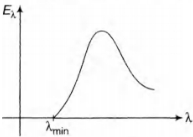
$X$-rays are produced in an $X$-ray tube operating at a given accelerating voltage. The wavelength of the continuous $X$-rays has values from
A
$0$ to $\infty$
B
$\lambda_{\min}$ to $\infty$,where $\lambda_{\min} > 0$
C
$0$ to $\lambda_{\max}$,where $\lambda_{\max} < \infty$
D
$\lambda_{\min}$ to $\lambda_{\max}$,where $0 < \lambda_{\min} < \lambda_{\max} < \infty$
Solution
(B) The continuous $X$-ray spectrum is produced due to the deceleration of electrons hitting the target. The maximum energy of a photon emitted is equal to the kinetic energy of the incident electron,given by $E_{\max} = eV = \frac{hc}{\lambda_{\min}}$.
Thus,the minimum wavelength is $\lambda_{\min} = \frac{hc}{eV}$.
Since electrons can lose any amount of energy less than their total kinetic energy,photons of all wavelengths greater than $\lambda_{\min}$ are emitted.
Therefore,the range of wavelengths for the continuous $X$-ray spectrum is from $\lambda_{\min}$ to $\infty$.
Thus,the minimum wavelength is $\lambda_{\min} = \frac{hc}{eV}$.
Since electrons can lose any amount of energy less than their total kinetic energy,photons of all wavelengths greater than $\lambda_{\min}$ are emitted.
Therefore,the range of wavelengths for the continuous $X$-ray spectrum is from $\lambda_{\min}$ to $\infty$.
0 likes
View Solution64
EasyMCQ
The wavelength of $X-$rays is
A
$2000 \mathring A$
B
$2 \mathring A$
C
$1 \text{ mm}$
D
$1 \text{ cm}$
Solution
(B) The wavelength range of $X-$rays typically lies between $0.1 \mathring A$ and $100 \mathring A$.
Among the given options,$2 \mathring A$ falls within this range.
Therefore,the correct option is $B$.
Among the given options,$2 \mathring A$ falls within this range.
Therefore,the correct option is $B$.
0 likes
View Solution65
EasyMCQ
The ratio of the energy of an $X$-ray photon of wavelength $1 \mathring{A}$ to that of visible light of wavelength $5000 \mathring{A}$ is:
A
$1 : 5000$
B
$5000 : 1$
C
$1 : 25 \times 10^6$
D
$25 \times 10^6 : 1$
Solution
(B) The energy $E$ of a photon is given by the formula $E = \frac{hc}{\lambda}$,where $h$ is Planck's constant,$c$ is the speed of light,and $\lambda$ is the wavelength.
Since $h$ and $c$ are constants,the energy is inversely proportional to the wavelength: $E \propto \frac{1}{\lambda}$.
Let $E_1$ be the energy of the $X$-ray photon with wavelength $\lambda_1 = 1 \mathring{A}$ and $E_2$ be the energy of the visible light photon with wavelength $\lambda_2 = 5000 \mathring{A}$.
The ratio of the energies is $\frac{E_1}{E_2} = \frac{\lambda_2}{\lambda_1}$.
Substituting the given values,we get $\frac{E_1}{E_2} = \frac{5000 \mathring{A}}{1 \mathring{A}} = 5000$.
Therefore,the ratio is $5000 : 1$.
Since $h$ and $c$ are constants,the energy is inversely proportional to the wavelength: $E \propto \frac{1}{\lambda}$.
Let $E_1$ be the energy of the $X$-ray photon with wavelength $\lambda_1 = 1 \mathring{A}$ and $E_2$ be the energy of the visible light photon with wavelength $\lambda_2 = 5000 \mathring{A}$.
The ratio of the energies is $\frac{E_1}{E_2} = \frac{\lambda_2}{\lambda_1}$.
Substituting the given values,we get $\frac{E_1}{E_2} = \frac{5000 \mathring{A}}{1 \mathring{A}} = 5000$.
Therefore,the ratio is $5000 : 1$.
0 likes
View Solution66
EasyMCQ
According to Moseley's law,the frequency of a spectral line in the $X$-ray spectrum varies as:
A
Atomic number of the element
B
Square of the atomic number of the element
C
Square root of the atomic number of the element
D
Fourth power of the atomic number of the element
Solution
(B) Moseley's law states that the frequency $\nu$ of a characteristic $X$-ray spectral line is given by the relation: $\sqrt{\nu} = a(Z - b)$.
Here,$Z$ is the atomic number of the element,and $a$ and $b$ are constants that depend on the specific type of spectral line (e.g.,$K$,$L$,etc.).
Squaring both sides of the equation,we get: $\nu = a^2(Z - b)^2$.
Since $b$ is a screening constant and is typically small compared to $Z$ for high-$Z$ elements,the frequency $\nu$ is directly proportional to the square of the atomic number $(Z^2)$.
Therefore,the frequency varies as the square of the atomic number of the element.
Here,$Z$ is the atomic number of the element,and $a$ and $b$ are constants that depend on the specific type of spectral line (e.g.,$K$,$L$,etc.).
Squaring both sides of the equation,we get: $\nu = a^2(Z - b)^2$.
Since $b$ is a screening constant and is typically small compared to $Z$ for high-$Z$ elements,the frequency $\nu$ is directly proportional to the square of the atomic number $(Z^2)$.
Therefore,the frequency varies as the square of the atomic number of the element.
0 likes
View Solution67
EasyMCQ
For the structural analysis of crystals, $X-$ rays are used because
A
$X-$ rays have a wavelength of the order of interatomic spacing.
B
$X-$ rays are highly penetrating radiations.
C
The wavelength of $X-$ rays is of the order of nuclear size.
D
$X-$ rays are coherent radiations.
Solution
(A) The structural analysis of crystals relies on the phenomenon of diffraction. For diffraction to occur, the wavelength of the incident radiation must be comparable to the spacing between the scattering centers (atoms) in the crystal lattice. The interatomic spacing in crystals is typically in the range of $0.1 \, nm$ to $0.5 \, nm$ ($1 \, \text{AA}$ to $5 \, \text{AA}$). $X-$ rays possess wavelengths in this same range, making them ideal for probing the atomic structure of crystals through $X-$ ray diffraction $(XRD)$. Therefore, option $A$ is correct.
0 likes
View Solution68
EasyMCQ
The essential distinction between $X$-rays and $\gamma$-rays is that
A
$\gamma$-rays have a smaller wavelength than $X$-rays
B
$\gamma$-rays emanate from the nucleus while $X$-rays emanate from the outer part of the atom
C
$\gamma$-rays have greater ionizing power than $X$-rays
D
$\gamma$-rays are more penetrating than $X$-rays
Solution
(B) $X$-rays and $\gamma$-rays are both electromagnetic radiations.
The fundamental difference lies in their origin.
$X$-rays are produced due to electronic transitions in the inner shells of an atom.
$\gamma$-rays are produced due to nuclear transitions within the nucleus of an atom.
Therefore,the essential distinction is that $\gamma$-rays emanate from the nucleus while $X$-rays emanate from the outer part of the atom.
The fundamental difference lies in their origin.
$X$-rays are produced due to electronic transitions in the inner shells of an atom.
$\gamma$-rays are produced due to nuclear transitions within the nucleus of an atom.
Therefore,the essential distinction is that $\gamma$-rays emanate from the nucleus while $X$-rays emanate from the outer part of the atom.
0 likes
View Solution69
EasyMCQ
The minimum wavelength of the $X$-rays produced by electrons accelerated through a potential difference of $V$ volts is directly proportional to
A
$\sqrt{V}$
B
$V^2$
C
$1/\sqrt{V}$
D
$1/V$
Solution
(D) The energy of an electron accelerated through a potential difference $V$ is given by $E = eV$.
When this electron strikes the target,it produces $X$-rays. The maximum energy of the emitted $X$-ray photon corresponds to the total kinetic energy of the electron,which is $E_{max} = h\nu_{max} = \frac{hc}{\lambda_{min}}$.
Equating the two,we get $eV = \frac{hc}{\lambda_{min}}$.
Rearranging for the minimum wavelength,we find $\lambda_{min} = \frac{hc}{eV}$.
Since $h$,$c$,and $e$ are constants,it follows that $\lambda_{min} \propto \frac{1}{V}$.
When this electron strikes the target,it produces $X$-rays. The maximum energy of the emitted $X$-ray photon corresponds to the total kinetic energy of the electron,which is $E_{max} = h\nu_{max} = \frac{hc}{\lambda_{min}}$.
Equating the two,we get $eV = \frac{hc}{\lambda_{min}}$.
Rearranging for the minimum wavelength,we find $\lambda_{min} = \frac{hc}{eV}$.
Since $h$,$c$,and $e$ are constants,it follows that $\lambda_{min} \propto \frac{1}{V}$.
0 likes
View Solution70
EasyMCQ
What determines the hardness of the $X-$rays obtained from the Coolidge tube?
A
Current in the filament
B
Pressure of air in the tube
C
Nature of target
D
Potential difference between cathode and target
Solution
(D) The hardness of $X-$rays refers to their penetrating power,which is directly related to their energy.
According to the Duane-Hunt law,the maximum frequency $f_{max}$ of $X-$rays produced is given by $hf_{max} = eV$,where $e$ is the elementary charge and $V$ is the accelerating potential difference between the cathode and the target.
Since $E = hf$,higher potential difference $V$ results in higher energy $X-$rays,which are termed 'hard' $X-$rays.
Therefore,the potential difference between the cathode and the target determines the hardness of the $X-$rays.
According to the Duane-Hunt law,the maximum frequency $f_{max}$ of $X-$rays produced is given by $hf_{max} = eV$,where $e$ is the elementary charge and $V$ is the accelerating potential difference between the cathode and the target.
Since $E = hf$,higher potential difference $V$ results in higher energy $X-$rays,which are termed 'hard' $X-$rays.
Therefore,the potential difference between the cathode and the target determines the hardness of the $X-$rays.
0 likes
View Solution71
EasyMCQ
On increasing the number of electrons striking the anode of an $X-$ray tube,which one of the following parameters of the resulting $X-$rays would increase?
A
Penetration power
B
Frequency
C
Wavelength
D
Intensity
Solution
(D) The intensity of $X-$rays is directly proportional to the number of electrons striking the anode per unit time. When the number of electrons striking the anode increases,the number of $X-$ray photons produced also increases,which leads to an increase in the intensity of the $X-$rays. Other parameters like frequency,wavelength,and penetration power depend on the accelerating voltage (potential difference) applied across the tube,not on the number of electrons.
0 likes
View Solution72
MediumMCQ
What $kV$ potential is to be applied on an $X$-ray tube so that the minimum wavelength of emitted $X$-rays may be $1 \text{ Å}$? $(h = 6.625 \times 10^{-34} \text{ J-s})$
A
$12.42$
B
$12.84$
C
$11.98$
D
$10.78$
Solution
(A) The minimum wavelength of emitted $X$-rays is given by the formula: $\lambda_{\min} = \frac{hc}{eV}$.
Substituting the values $h = 6.625 \times 10^{-34} \text{ J-s}$, $c = 3 \times 10^8 \text{ m/s}$, and $e = 1.6 \times 10^{-19} \text{ C}$, we get:
$\lambda_{\min} = \frac{12400}{V} \text{ Å}$ (where $V$ is in volts).
Given $\lambda_{\min} = 1 \text{ Å}$, we have $1 = \frac{12400}{V}$.
Therefore, $V = 12400 \text{ V} = 12.4 \text{ kV}$.
Comparing this with the given options, the closest value is $12.42 \text{ kV}$.
Substituting the values $h = 6.625 \times 10^{-34} \text{ J-s}$, $c = 3 \times 10^8 \text{ m/s}$, and $e = 1.6 \times 10^{-19} \text{ C}$, we get:
$\lambda_{\min} = \frac{12400}{V} \text{ Å}$ (where $V$ is in volts).
Given $\lambda_{\min} = 1 \text{ Å}$, we have $1 = \frac{12400}{V}$.
Therefore, $V = 12400 \text{ V} = 12.4 \text{ kV}$.
Comparing this with the given options, the closest value is $12.42 \text{ kV}$.
0 likes
View Solution73
EasyMCQ
$X$-rays cannot be deflected by means of an ordinary grating due to
A
Large wavelength
B
High speed
C
Short wavelength
D
None of these
Solution
(C) For diffraction to occur,the wavelength of the incident wave must be comparable to the spacing between the lines of the grating.
$X$-rays have very short wavelengths (typically $0.01 \ nm$ to $10 \ nm$).
An ordinary optical grating has a spacing of the order of $10^3 \ nm$ to $10^4 \ nm$.
Since the wavelength of $X$-rays is much smaller than the grating spacing,they cannot be diffracted by an ordinary grating.
Therefore,the correct option is $C$.
$X$-rays have very short wavelengths (typically $0.01 \ nm$ to $10 \ nm$).
An ordinary optical grating has a spacing of the order of $10^3 \ nm$ to $10^4 \ nm$.
Since the wavelength of $X$-rays is much smaller than the grating spacing,they cannot be diffracted by an ordinary grating.
Therefore,the correct option is $C$.
0 likes
View Solution74
EasyMCQ
Consider the following two statements $A$ and $B$ and identify the correct choice in the given answer.
$A:$ The characteristic $X-$ray spectrum depends on the nature of the material of the target.
$B:$ The short wavelength limit of the continuous $X-$ray spectrum varies inversely with the potential difference applied to the $X-$ray tube.
$A:$ The characteristic $X-$ray spectrum depends on the nature of the material of the target.
$B:$ The short wavelength limit of the continuous $X-$ray spectrum varies inversely with the potential difference applied to the $X-$ray tube.
A
$A$ is true and $B$ is false.
B
$A$ is false and $B$ is true.
C
Both $A$ and $B$ are true.
D
Both $A$ and $B$ are false.
Solution
(C) Statement $A$ is true: The characteristic $X-$ray spectrum is produced due to electronic transitions between energy levels of the target atoms. Since these energy levels $(E_K, E_L, \dots)$ are specific to the atomic number $(Z)$ of the element,the wavelengths $\lambda = \frac{hc}{E_K - E_L}$ depend on the nature of the target material.
Statement $B$ is true: The short wavelength limit (cut-off wavelength) of the continuous $X-$ray spectrum is given by $\lambda_{min} = \frac{hc}{eV}$,where $V$ is the accelerating potential difference. Thus,$\lambda_{min} \propto \frac{1}{V}$,meaning it varies inversely with the potential difference applied to the $X-$ray tube.
Therefore,both statements are true.
Statement $B$ is true: The short wavelength limit (cut-off wavelength) of the continuous $X-$ray spectrum is given by $\lambda_{min} = \frac{hc}{eV}$,where $V$ is the accelerating potential difference. Thus,$\lambda_{min} \propto \frac{1}{V}$,meaning it varies inversely with the potential difference applied to the $X-$ray tube.
Therefore,both statements are true.
0 likes
View Solution75
EasyMCQ
The energy of an $X$-ray photon of wavelength $1.65 \mathring{A}$ is ....... $keV$. $(h = 6.6 \times 10^{-34} \ J \cdot s, \ c = 3 \times 10^8 \ m/s, \ 1 \ eV = 1.6 \times 10^{-19} \ J)$ (in $.5$)
A
$3$
B
$5$
C
$7$
D
$9$
Solution
(C) The energy $E$ of a photon is given by the formula $E = \frac{hc}{\lambda}$.
Given:
$h = 6.6 \times 10^{-34} \ J \cdot s$
$c = 3 \times 10^8 \ m/s$
$\lambda = 1.65 \mathring{A} = 1.65 \times 10^{-10} \ m$
Substituting the values:
$E = \frac{6.6 \times 10^{-34} \times 3 \times 10^8}{1.65 \times 10^{-10}} \ J$
$E = \frac{19.8 \times 10^{-26}}{1.65 \times 10^{-10}} \ J = 12 \times 10^{-16} \ J$
To convert this energy into $eV$,divide by $1.6 \times 10^{-19} \ J/eV$:
$E(eV) = \frac{12 \times 10^{-16}}{1.6 \times 10^{-19}} = 7.5 \times 10^3 \ eV = 7.5 \ keV$.
Alternatively,using the shortcut $E(eV) = \frac{12400}{\lambda(\mathring{A})}$,we get $E = \frac{12400}{1.65} \approx 7515 \ eV \approx 7.5 \ keV$.
Given:
$h = 6.6 \times 10^{-34} \ J \cdot s$
$c = 3 \times 10^8 \ m/s$
$\lambda = 1.65 \mathring{A} = 1.65 \times 10^{-10} \ m$
Substituting the values:
$E = \frac{6.6 \times 10^{-34} \times 3 \times 10^8}{1.65 \times 10^{-10}} \ J$
$E = \frac{19.8 \times 10^{-26}}{1.65 \times 10^{-10}} \ J = 12 \times 10^{-16} \ J$
To convert this energy into $eV$,divide by $1.6 \times 10^{-19} \ J/eV$:
$E(eV) = \frac{12 \times 10^{-16}}{1.6 \times 10^{-19}} = 7.5 \times 10^3 \ eV = 7.5 \ keV$.
Alternatively,using the shortcut $E(eV) = \frac{12400}{\lambda(\mathring{A})}$,we get $E = \frac{12400}{1.65} \approx 7515 \ eV \approx 7.5 \ keV$.
0 likes
View Solution76
MediumMCQ
Bragg's law for $X$-rays is
A
$d \sin \theta = 2n\lambda$
B
$2d \sin \theta = n\lambda$
C
$n \sin \theta = 2\lambda d$
D
None of these
Solution
(B) Bragg's law describes the condition for constructive interference of $X$-rays scattered by the atomic planes of a crystal.
When an $X$-ray beam is incident on a crystal at an angle $\theta$ with respect to the atomic planes,the path difference between the rays reflected from successive planes separated by a distance $d$ is $2d \sin \theta$.
For constructive interference,this path difference must be an integer multiple of the wavelength $\lambda$.
Thus,the condition is $2d \sin \theta = n\lambda$,where $n$ is an integer representing the order of reflection.
When an $X$-ray beam is incident on a crystal at an angle $\theta$ with respect to the atomic planes,the path difference between the rays reflected from successive planes separated by a distance $d$ is $2d \sin \theta$.
For constructive interference,this path difference must be an integer multiple of the wavelength $\lambda$.
Thus,the condition is $2d \sin \theta = n\lambda$,where $n$ is an integer representing the order of reflection.
0 likes
View Solution77
EasyMCQ
The $X-$rays produced in a Coolidge tube of potential difference $40 \ kV$ have a minimum wavelength of:
A
$3.09 \times 10^{-11} \ m$
B
$5.09 \times 10^{-11} \ m$
C
$4.09 \times 10^{-11} \ m$
D
$1.09 \times 10^{-11} \ m$
Solution
(A) The minimum wavelength (cutoff wavelength) of $X-$rays produced by an electron accelerated through a potential difference $V$ is given by the formula: $\lambda_{\min} = \frac{hc}{eV} = \frac{12400 \ \mathring{A} \cdot V}{V \text{ (in volts)}}$.
Given $V = 40 \ kV = 40,000 \ V$.
Substituting the values: $\lambda_{\min} = \frac{12400}{40000} \ \mathring{A} = 0.31 \ \mathring{A}$.
Converting to meters: $0.31 \times 10^{-10} \ m = 3.1 \times 10^{-11} \ m$.
Given the options provided,the closest value is $3.09 \times 10^{-11} \ m$.
Given $V = 40 \ kV = 40,000 \ V$.
Substituting the values: $\lambda_{\min} = \frac{12400}{40000} \ \mathring{A} = 0.31 \ \mathring{A}$.
Converting to meters: $0.31 \times 10^{-10} \ m = 3.1 \times 10^{-11} \ m$.
Given the options provided,the closest value is $3.09 \times 10^{-11} \ m$.
0 likes
View Solution78
EasyMCQ
For the production of $X$-rays, the target should be made of
A
Steel
B
Copper
C
Aluminum
D
Tungsten
Solution
(D) The target material used in an $X$-ray tube must possess two primary characteristics:
$1$. A high atomic number $(Z)$ to increase the efficiency of $X$-ray production (Bremsstrahlung radiation).
$2$. A high melting point to withstand the intense heat generated by the bombardment of high-energy electrons.
Tungsten $(W)$ has a high atomic number $(Z = 74)$ and a very high melting point $(3422 ^\circ C)$, making it the ideal choice for the target material.
$1$. A high atomic number $(Z)$ to increase the efficiency of $X$-ray production (Bremsstrahlung radiation).
$2$. A high melting point to withstand the intense heat generated by the bombardment of high-energy electrons.
Tungsten $(W)$ has a high atomic number $(Z = 74)$ and a very high melting point $(3422 ^\circ C)$, making it the ideal choice for the target material.
0 likes
View Solution79
EasyMCQ
Intensity of $X-$rays depends upon the number of
A
Electrons
B
Protons
C
Neutrons
D
Positrons
Solution
(A) The intensity of $X-$rays is directly proportional to the number of electrons striking the target material per unit time.
When high-speed electrons collide with the target,they produce $X-$ray photons.
Therefore,increasing the number of electrons increases the number of $X-$ray photons produced,which corresponds to higher intensity.
When high-speed electrons collide with the target,they produce $X-$ray photons.
Therefore,increasing the number of electrons increases the number of $X-$ray photons produced,which corresponds to higher intensity.
0 likes
View Solution80
EasyMCQ
In an $X$-ray tube,electrons bombarding the target produce $X$-rays of minimum wavelength $1\; \mathring{A}$. What must be the energy of the bombarding electrons in $eV$?
A
$13375$
B
$12375$
C
$14375$
D
$15375$
Solution
(B) The energy $E$ of the bombarding electrons is equal to the maximum energy of the $X$-ray photons produced,which corresponds to the minimum wavelength $\lambda_{min}$.
Using the relation $E = \frac{hc}{\lambda_{min}}$,where $h = 6.626 \times 10^{-34} \; J\cdot s$,$c = 3 \times 10^8 \; m/s$,and $\lambda_{min} = 1 \; \mathring{A} = 10^{-10} \; m$.
In terms of electron-volts $(eV)$,the formula is $E(eV) = \frac{12400}{\lambda(\mathring{A})}$ (using $hc \approx 12400 \; eV\cdot\mathring{A}$).
Substituting the given value: $E = \frac{12400}{1} = 12400 \; eV$.
Given the options provided and the standard approximation $hc \approx 12375 \; eV\cdot\mathring{A}$,we calculate: $E = \frac{6.63 \times 10^{-34} \times 3 \times 10^8}{1.602 \times 10^{-19} \times 10^{-10}} \approx 12415 \; eV$.
Based on the provided options,the closest value is $12375 \; eV$.
Using the relation $E = \frac{hc}{\lambda_{min}}$,where $h = 6.626 \times 10^{-34} \; J\cdot s$,$c = 3 \times 10^8 \; m/s$,and $\lambda_{min} = 1 \; \mathring{A} = 10^{-10} \; m$.
In terms of electron-volts $(eV)$,the formula is $E(eV) = \frac{12400}{\lambda(\mathring{A})}$ (using $hc \approx 12400 \; eV\cdot\mathring{A}$).
Substituting the given value: $E = \frac{12400}{1} = 12400 \; eV$.
Given the options provided and the standard approximation $hc \approx 12375 \; eV\cdot\mathring{A}$,we calculate: $E = \frac{6.63 \times 10^{-34} \times 3 \times 10^8}{1.602 \times 10^{-19} \times 10^{-10}} \approx 12415 \; eV$.
Based on the provided options,the closest value is $12375 \; eV$.
0 likes
View Solution81
EasyMCQ
If the energy of a $K$-shell electron is $-40000 \ eV$ and a potential of $60000 \ V$ is applied to a Coolidge tube,which of the following $X$-rays will be formed?
A
Continuous
B
White $X$-rays
C
Continuous and all series of characteristic $X$-rays
D
None of these
Solution
(C) The energy of the incident electron beam is given by $E = eV = 60000 \ eV$.
The binding energy of the $K$-shell electron is $40000 \ eV$.
Since the energy of the incident electrons $(60000 \ eV)$ is greater than the binding energy of the $K$-shell electrons $(40000 \ eV)$,the incident electrons have sufficient energy to knock out the $K$-shell electrons.
When a $K$-shell electron is ejected,an electron from a higher energy level transitions to the $K$-shell,emitting characteristic $X$-rays of all series $(K, L, M, \dots)$.
Additionally,the deceleration of incident electrons in the target produces continuous $X$-rays (Bremsstrahlung).
Therefore,both continuous and all series of characteristic $X$-rays will be formed.
The binding energy of the $K$-shell electron is $40000 \ eV$.
Since the energy of the incident electrons $(60000 \ eV)$ is greater than the binding energy of the $K$-shell electrons $(40000 \ eV)$,the incident electrons have sufficient energy to knock out the $K$-shell electrons.
When a $K$-shell electron is ejected,an electron from a higher energy level transitions to the $K$-shell,emitting characteristic $X$-rays of all series $(K, L, M, \dots)$.
Additionally,the deceleration of incident electrons in the target produces continuous $X$-rays (Bremsstrahlung).
Therefore,both continuous and all series of characteristic $X$-rays will be formed.
0 likes
View Solution82
EasyMCQ
For the production of characteristic $K_{\beta}$ $X$-rays,the electron transition is:
A
$n = 2$ to $n = 1$
B
$n = 3$ to $n = 2$
C
$n = 3$ to $n = 1$
D
$n = 4$ to $n = 2$
Solution
(C) Characteristic $X$-rays are produced when an electron from a higher energy shell transitions to a vacancy in an inner shell.
For the $K$-series,the vacancy is in the $K$-shell $(n = 1)$.
- The $K_{\alpha}$ $X$-ray is produced by a transition from the $L$-shell $(n = 2)$ to the $K$-shell $(n = 1)$.
- The $K_{\beta}$ $X$-ray is produced by a transition from the $M$-shell $(n = 3)$ to the $K$-shell $(n = 1)$.
- The $K_{\gamma}$ $X$-ray is produced by a transition from the $N$-shell $(n = 4)$ to the $K$-shell $(n = 1)$.
Therefore,for the $K_{\beta}$ $X$-ray,the transition is from $n = 3$ to $n = 1$.
For the $K$-series,the vacancy is in the $K$-shell $(n = 1)$.
- The $K_{\alpha}$ $X$-ray is produced by a transition from the $L$-shell $(n = 2)$ to the $K$-shell $(n = 1)$.
- The $K_{\beta}$ $X$-ray is produced by a transition from the $M$-shell $(n = 3)$ to the $K$-shell $(n = 1)$.
- The $K_{\gamma}$ $X$-ray is produced by a transition from the $N$-shell $(n = 4)$ to the $K$-shell $(n = 1)$.
Therefore,for the $K_{\beta}$ $X$-ray,the transition is from $n = 3$ to $n = 1$.
0 likes
View Solution83
EasyMCQ
Penetrating power of $X-$rays does not depend on
A
Wavelength
B
Energy
C
Potential difference
D
Current in the filament
Solution
(D) The penetrating power of $X-$rays is determined by their energy,which is directly related to their frequency and inversely related to their wavelength.
Increasing the potential difference between the cathode and anode increases the kinetic energy of the electrons,which in turn increases the energy and penetrating power of the $X-$rays.
However,the current in the filament only controls the number of electrons emitted from the cathode (thermionic emission).
Increasing the filament current increases the intensity (number of photons) of the $X-$rays produced,but it does not change the energy of individual photons.
Therefore,the penetrating power does not depend on the current in the filament.
Increasing the potential difference between the cathode and anode increases the kinetic energy of the electrons,which in turn increases the energy and penetrating power of the $X-$rays.
However,the current in the filament only controls the number of electrons emitted from the cathode (thermionic emission).
Increasing the filament current increases the intensity (number of photons) of the $X-$rays produced,but it does not change the energy of individual photons.
Therefore,the penetrating power does not depend on the current in the filament.
0 likes
View Solution84
EasyMCQ
The potential difference applied to an $X$-ray tube is $5 \text{ kV}$ and the current through it is $3.2 \text{ mA}$. Then the number of electrons striking the target per second is
A
$2 \times 10^{16}$
B
$5 \times 10^{16}$
C
$1 \times 10^{17}$
D
$4 \times 10^{15}$
Solution
(A) The current $i$ is defined as the rate of flow of charge,given by the formula $i = \frac{Ne}{t}$,where $N$ is the number of electrons,$e$ is the elementary charge $(1.6 \times 10^{-19} \text{ C})$,and $t$ is the time.
To find the number of electrons striking the target per second,we rearrange the formula to solve for $\frac{N}{t}$:
$\frac{N}{t} = \frac{i}{e}$
Given $i = 3.2 \text{ mA} = 3.2 \times 10^{-3} \text{ A}$ and $e = 1.6 \times 10^{-19} \text{ C}$:
$\frac{N}{t} = \frac{3.2 \times 10^{-3}}{1.6 \times 10^{-19}}$
$\frac{N}{t} = 2 \times 10^{16} \text{ electrons/sec}$.
To find the number of electrons striking the target per second,we rearrange the formula to solve for $\frac{N}{t}$:
$\frac{N}{t} = \frac{i}{e}$
Given $i = 3.2 \text{ mA} = 3.2 \times 10^{-3} \text{ A}$ and $e = 1.6 \times 10^{-19} \text{ C}$:
$\frac{N}{t} = \frac{3.2 \times 10^{-3}}{1.6 \times 10^{-19}}$
$\frac{N}{t} = 2 \times 10^{16} \text{ electrons/sec}$.
0 likes
View Solution85
EasyMCQ
For the production of characteristic $K_{\gamma}$ $X$-ray,the electron transition is:
A
$n = 2$ to $n = 1$
B
$n = 3$ to $n = 2$
C
$n = 3$ to $n = 1$
D
$n = 4$ to $n = 1$
Solution
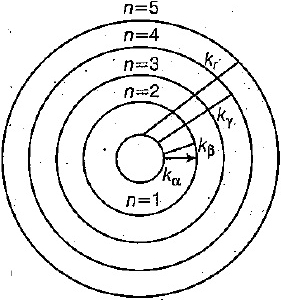
(D) Characteristic $X$-rays are produced when an electron from a higher energy shell transitions to a vacancy in an inner shell of an atom.
For the $K$-series,the vacancy is in the $n = 1$ shell.
The specific transitions are defined as follows:
$K_{\alpha}: n = 2 \to n = 1$
$K_{\beta}: n = 3 \to n = 1$
$K_{\gamma}: n = 4 \to n = 1$
As shown in the diagram,the $K_{\gamma}$ transition corresponds to an electron moving from the $n = 4$ shell to the $n = 1$ shell.
Therefore,the correct option is $(D)$.
For the $K$-series,the vacancy is in the $n = 1$ shell.
The specific transitions are defined as follows:
$K_{\alpha}: n = 2 \to n = 1$
$K_{\beta}: n = 3 \to n = 1$
$K_{\gamma}: n = 4 \to n = 1$
As shown in the diagram,the $K_{\gamma}$ transition corresponds to an electron moving from the $n = 4$ shell to the $n = 1$ shell.
Therefore,the correct option is $(D)$.
0 likes
View Solution86
EasyMCQ
When $X-$rays pass through a strong uniform magnetic field,then they
A
Do not get deflected at all
B
Get deflected in the direction of the field
C
Get deflected in the direction opposite to the field
D
Get deflected in the direction perpendicular to the field
Solution
(A) $X-$rays are electromagnetic waves consisting of high-energy photons.
Photons are electrically neutral particles,meaning they carry no net electric charge.
The Lorentz force acting on a particle moving in a magnetic field is given by $\vec{F} = q(\vec{v} \times \vec{B})$.
Since the charge $q = 0$ for $X-$rays,the magnetic force $\vec{F}$ acting on them is zero.
Therefore,$X-$rays do not experience any deflection when passing through a strong uniform magnetic field.
Photons are electrically neutral particles,meaning they carry no net electric charge.
The Lorentz force acting on a particle moving in a magnetic field is given by $\vec{F} = q(\vec{v} \times \vec{B})$.
Since the charge $q = 0$ for $X-$rays,the magnetic force $\vec{F}$ acting on them is zero.
Therefore,$X-$rays do not experience any deflection when passing through a strong uniform magnetic field.
0 likes
View Solution87
MediumMCQ
If the potential difference applied across an $X$-ray tube is $V$ volts,then the approximate minimum wavelength of the emitted $X$-rays will be:
A
$\frac{1227}{\sqrt{V}} \; \mathring{A}$
B
$\frac{1240}{V} \; \mathring{A}$
C
$\frac{2400}{V} \; \mathring{A}$
D
$\frac{12400}{V} \; \mathring{A}$
Solution
(D) The minimum wavelength $(\lambda_{\min})$ of $X$-rays produced in an $X$-ray tube is given by the Duane-Hunt law,where the entire kinetic energy of the electron is converted into a photon of maximum frequency:
$E = eV = \frac{hc}{\lambda_{\min}}$
Therefore,$\lambda_{\min} = \frac{hc}{eV}$.
Substituting the values of Planck's constant $(h = 6.626 \times 10^{-34} \; J \cdot s)$,speed of light $(c = 3 \times 10^8 \; m/s)$,and charge of an electron $(e = 1.6 \times 10^{-19} \; C)$:
$\lambda_{\min} = \frac{6.626 \times 10^{-34} \times 3 \times 10^8}{1.6 \times 10^{-19} \times V} \; m$
$\lambda_{\min} \approx \frac{12400}{V} \; \mathring{A}$.
$E = eV = \frac{hc}{\lambda_{\min}}$
Therefore,$\lambda_{\min} = \frac{hc}{eV}$.
Substituting the values of Planck's constant $(h = 6.626 \times 10^{-34} \; J \cdot s)$,speed of light $(c = 3 \times 10^8 \; m/s)$,and charge of an electron $(e = 1.6 \times 10^{-19} \; C)$:
$\lambda_{\min} = \frac{6.626 \times 10^{-34} \times 3 \times 10^8}{1.6 \times 10^{-19} \times V} \; m$
$\lambda_{\min} \approx \frac{12400}{V} \; \mathring{A}$.
0 likes
View Solution88
EasyMCQ
What is the difference between soft and hard $X-$rays?
A
Velocity
B
Intensity
C
Frequency
D
Polarization
Solution
(C) The primary difference between soft and hard $X-$rays lies in their energy and frequency. Hard $X-$rays have higher energy and higher frequency compared to soft $X-$rays. Soft $X-$rays have lower energy and lower frequency,making them less penetrating. Therefore,the correct option is $(c)$.
0 likes
View Solution89
EasyMCQ
$X$-rays will travel the minimum distance in which of the following materials?
A
Air
B
Iron
C
Wood
D
Water
Solution
(B) The penetration power of $X$-rays depends on the density and atomic number of the material through which they pass.
Materials with higher density and higher atomic number absorb $X$-rays more effectively,thereby reducing their penetration distance.
Among the given options,iron has the highest density and atomic number compared to air,wood,and water.
Therefore,$X$-rays will travel the minimum distance in iron.
Materials with higher density and higher atomic number absorb $X$-rays more effectively,thereby reducing their penetration distance.
Among the given options,iron has the highest density and atomic number compared to air,wood,and water.
Therefore,$X$-rays will travel the minimum distance in iron.
0 likes
View Solution90
EasyMCQ
The minimum wavelength of $X$-rays emitted by an $X$-ray tube is $0.4125 \mathring{A}$. The accelerating voltage is ...... $kV$.
A
$30$
B
$50$
C
$80$
D
$60$
Solution
(A) The minimum wavelength $(\lambda_{\min})$ of $X$-rays produced in an $X$-ray tube is given by the relation: $\lambda_{\min} = \frac{12400}{V} \mathring{A}$ (where $V$ is in volts).
Using the more precise constant $12375$ for the given value:
$\lambda_{\min} = \frac{12375}{V} \mathring{A}$
Given $\lambda_{\min} = 0.4125 \mathring{A}$.
Substituting the value:
$0.4125 = \frac{12375}{V}$
$V = \frac{12375}{0.4125} = 30000 \text{ V} = 30 \text{ kV}$.
Therefore,the accelerating voltage is $30 \text{ kV}$.
Using the more precise constant $12375$ for the given value:
$\lambda_{\min} = \frac{12375}{V} \mathring{A}$
Given $\lambda_{\min} = 0.4125 \mathring{A}$.
Substituting the value:
$0.4125 = \frac{12375}{V}$
$V = \frac{12375}{0.4125} = 30000 \text{ V} = 30 \text{ kV}$.
Therefore,the accelerating voltage is $30 \text{ kV}$.
0 likes
View Solution91
EasyMCQ
Characteristic $X$-rays are produced due to
A
Transfer of momentum in collision of electrons with target atoms
B
Transition of electrons from higher to lower electronic orbits in an atom
C
Heating of the target
D
Transfer of energy in collision of electrons with atoms in the target
Solution
(B) Characteristic $X$-rays are produced when an element is bombarded with high-energy particles such as photons,electrons,or ions.
When an incident particle strikes a bound electron in an atom,the bound electron is ejected from an inner shell of the atom.
After the electron is ejected,the atom is left with a vacant energy level,known as a core hole.
Electrons from outer shells then fall into the inner shell,emitting quantized photons with energy equivalent to the difference between the higher and lower energy states.
Since each element has a unique set of energy levels,the transitions from higher to lower energy levels produce $X$-rays with frequencies that are characteristic to each specific element.
When an incident particle strikes a bound electron in an atom,the bound electron is ejected from an inner shell of the atom.
After the electron is ejected,the atom is left with a vacant energy level,known as a core hole.
Electrons from outer shells then fall into the inner shell,emitting quantized photons with energy equivalent to the difference between the higher and lower energy states.
Since each element has a unique set of energy levels,the transitions from higher to lower energy levels produce $X$-rays with frequencies that are characteristic to each specific element.
0 likes
View Solution92
EasyMCQ
$X$-rays,when incident on a metal,do which of the following?
A
Exert a force on it
B
Transfer energy to it
C
Transfer pressure to it
D
All of the above
Solution
(D) $X$-rays are electromagnetic waves that carry both energy and momentum. When they are incident on a metal surface,they interact with the electrons and atoms of the metal.
$1$. Energy Transfer: The $X$-rays transfer their energy to the metal surface through processes like the photoelectric effect or Compton scattering.
$2$. Force and Pressure: Since $X$-rays carry momentum $(p = E/c)$,when they are absorbed or reflected by the metal,they exert a radiation pressure on the surface. This pressure results in a force acting on the metal surface.
Therefore,all the given statements are correct.
$1$. Energy Transfer: The $X$-rays transfer their energy to the metal surface through processes like the photoelectric effect or Compton scattering.
$2$. Force and Pressure: Since $X$-rays carry momentum $(p = E/c)$,when they are absorbed or reflected by the metal,they exert a radiation pressure on the surface. This pressure results in a force acting on the metal surface.
Therefore,all the given statements are correct.
0 likes
View Solution93
EasyMCQ
The minimum wavelength of $X$-rays produced in a Coolidge tube operated at a potential difference of $40 \ kV$ is ....... $\mathring{A}$.
A
$0.31$
B
$3.1$
C
$31$
D
$311$
Solution
(A) The minimum wavelength $(\lambda_{\min})$ of $X$-rays is given by the formula: $\lambda_{\min} = \frac{hc}{eV} = \frac{12400 \ \text{eV} \cdot \mathring{A}}{V \text{ (in volts)}}$.
Given the potential difference $V = 40 \ kV = 40,000 \ V$.
Substituting the values: $\lambda_{\min} = \frac{12400}{40000} \ \mathring{A} = 0.31 \ \mathring{A}$.
Thus,the minimum wavelength is $0.31 \ \mathring{A}$.
Given the potential difference $V = 40 \ kV = 40,000 \ V$.
Substituting the values: $\lambda_{\min} = \frac{12400}{40000} \ \mathring{A} = 0.31 \ \mathring{A}$.
Thus,the minimum wavelength is $0.31 \ \mathring{A}$.
0 likes
View Solution94
EasyMCQ
The potential difference between the cathode and the target in a Coolidge tube is $100 \ kV$. The minimum wavelength of the $X$-rays emitted by the tube is
A
$0.66 \ \mathring A$
B
$9.38 \ \mathring A$
C
$0.246 \ \mathring A$
D
$0.123 \ \mathring A$
Solution
(D) The minimum wavelength (cut-off wavelength) of $X$-rays produced in a Coolidge tube is given by the formula: $\lambda_{\min} = \frac{hc}{eV}$.
Here,$h = 6.63 \times 10^{-34} \ J \cdot s$ (Planck's constant),$c = 3 \times 10^8 \ m/s$ (speed of light),$e = 1.6 \times 10^{-19} \ C$ (charge of an electron),and $V = 100 \ kV = 10^5 \ V$.
Substituting the values:
$\lambda_{\min} = \frac{6.63 \times 10^{-34} \times 3 \times 10^8}{1.6 \times 10^{-19} \times 10^5} \ m$.
$\lambda_{\min} = \frac{19.89 \times 10^{-26}}{1.6 \times 10^{-14}} \ m$.
$\lambda_{\min} \approx 12.43 \times 10^{-12} \ m = 0.1243 \ \mathring A$.
Rounding to the nearest provided option,we get $0.123 \ \mathring A$.
Here,$h = 6.63 \times 10^{-34} \ J \cdot s$ (Planck's constant),$c = 3 \times 10^8 \ m/s$ (speed of light),$e = 1.6 \times 10^{-19} \ C$ (charge of an electron),and $V = 100 \ kV = 10^5 \ V$.
Substituting the values:
$\lambda_{\min} = \frac{6.63 \times 10^{-34} \times 3 \times 10^8}{1.6 \times 10^{-19} \times 10^5} \ m$.
$\lambda_{\min} = \frac{19.89 \times 10^{-26}}{1.6 \times 10^{-14}} \ m$.
$\lambda_{\min} \approx 12.43 \times 10^{-12} \ m = 0.1243 \ \mathring A$.
Rounding to the nearest provided option,we get $0.123 \ \mathring A$.
0 likes
View Solution95
EasyMCQ
$X$-rays are produced by accelerating electrons through a potential difference $V$ and letting them strike a metal target of atomic number $Z$. The highest frequency of the $X$-rays produced is proportional to:
A
$V$
B
$Z$
C
$(Z - 1)$
D
$(Z - 1)^2$
Solution
(D) The maximum frequency of $X$-rays produced in an $X$-ray tube is determined by the Duane-Hunt law,which states that the maximum frequency $\nu_{\max}$ is given by $\nu_{\max} = \frac{eV}{h}$.
However,the question refers to the characteristic $X$-rays. According to Moseley's law,the frequency $\nu$ of characteristic $X$-rays is given by $\nu = a(Z - b)^2$.
For the $K_{\alpha}$ line,the screening constant $b = 1$. Thus,the frequency is proportional to $(Z - 1)^2$.
Given the options provided,the question specifically targets the relationship defined by Moseley's law for characteristic radiation.
However,the question refers to the characteristic $X$-rays. According to Moseley's law,the frequency $\nu$ of characteristic $X$-rays is given by $\nu = a(Z - b)^2$.
For the $K_{\alpha}$ line,the screening constant $b = 1$. Thus,the frequency is proportional to $(Z - 1)^2$.
Given the options provided,the question specifically targets the relationship defined by Moseley's law for characteristic radiation.
0 likes
View Solution96
EasyMCQ
If the operating potential of an $X-$ray tube is $50 \text{ kV}$,the velocity of $X-$rays coming out of it is
A
$4 \times 10^4 \text{ m/s}$
B
$3 \times 10^8 \text{ m/s}$
C
$10^8 \text{ m/s}$
D
$3 \text{ m/s}$
Solution
(B) $X-$rays are electromagnetic waves.
All electromagnetic waves travel at the speed of light in a vacuum,which is approximately $3 \times 10^8 \text{ m/s}$.
The operating potential of the $X-$ray tube affects the energy and frequency of the $X-$rays produced,but it does not change their velocity.
Therefore,the velocity of the $X-$rays is $3 \times 10^8 \text{ m/s}$.
All electromagnetic waves travel at the speed of light in a vacuum,which is approximately $3 \times 10^8 \text{ m/s}$.
The operating potential of the $X-$ray tube affects the energy and frequency of the $X-$rays produced,but it does not change their velocity.
Therefore,the velocity of the $X-$rays is $3 \times 10^8 \text{ m/s}$.
0 likes
View Solution97
EasyMCQ
If the voltage of an $X$-ray tube is doubled,the intensity of $X$-rays will become
A
Half
B
Unchanged
C
Double
D
Four times
Solution
(B) The intensity of $X$-rays produced in an $X$-ray tube depends on the number of electrons striking the target per unit time,which is determined by the filament current (thermionic emission).
Changing the accelerating voltage (potential difference) affects the kinetic energy of the electrons and the minimum wavelength (cutoff wavelength) of the $X$-rays,but it does not significantly change the total intensity of the $X$-rays produced.
Therefore,if the voltage is doubled,the intensity of the $X$-rays remains unchanged.
Changing the accelerating voltage (potential difference) affects the kinetic energy of the electrons and the minimum wavelength (cutoff wavelength) of the $X$-rays,but it does not significantly change the total intensity of the $X$-rays produced.
Therefore,if the voltage is doubled,the intensity of the $X$-rays remains unchanged.
0 likes
View Solution98
EasyMCQ
If the minimum wavelength obtained in an $X-ray$ tube is $2.5 \times 10^{-10} \ m$,the operating potential of the tube will be.....$kV$.
A
$2$
B
$3$
C
$4$
D
$5$
Solution
(D) The minimum wavelength (cutoff wavelength) of an $X-ray$ tube is given by the formula: $\lambda_{\min} = \frac{hc}{eV}$.
Substituting the values $h = 6.63 \times 10^{-34} \ J \cdot s$,$c = 3 \times 10^8 \ m/s$,and $e = 1.6 \times 10^{-19} \ C$,we get the simplified relation: $\lambda_{\min} (\text{in } \mathring{A}) \approx \frac{12400}{V (\text{in volts})}$.
Given $\lambda_{\min} = 2.5 \times 10^{-10} \ m = 2.5 \ \mathring{A}$.
Substituting this into the formula: $2.5 = \frac{12400}{V}$.
$V = \frac{12400}{2.5} = 4960 \ V$.
$V \approx 5000 \ V = 5 \ kV$.
Substituting the values $h = 6.63 \times 10^{-34} \ J \cdot s$,$c = 3 \times 10^8 \ m/s$,and $e = 1.6 \times 10^{-19} \ C$,we get the simplified relation: $\lambda_{\min} (\text{in } \mathring{A}) \approx \frac{12400}{V (\text{in volts})}$.
Given $\lambda_{\min} = 2.5 \times 10^{-10} \ m = 2.5 \ \mathring{A}$.
Substituting this into the formula: $2.5 = \frac{12400}{V}$.
$V = \frac{12400}{2.5} = 4960 \ V$.
$V \approx 5000 \ V = 5 \ kV$.
0 likes
View Solution99
EasyMCQ
The wavelength of $X$-rays decreases,when
A
Temperature of target is increased
B
Intensity of electron beam is increased
C
$K.E.$ of electrons striking the target is increased
D
$K.E.$ of electrons striking the target is decreased
Solution
(C) The minimum wavelength (cutoff wavelength) of $X$-rays is given by the formula: $\lambda_{\min} = \frac{hc}{eV}$,where $eV$ is the kinetic energy $(K.E.)$ of the electrons striking the target.
From this relation,we can see that $\lambda_{\min} \propto \frac{1}{K.E.}$.
Therefore,when the kinetic energy $(K.E.)$ of the electrons striking the target is increased,the wavelength $\lambda_{\min}$ decreases.
From this relation,we can see that $\lambda_{\min} \propto \frac{1}{K.E.}$.
Therefore,when the kinetic energy $(K.E.)$ of the electrons striking the target is increased,the wavelength $\lambda_{\min}$ decreases.
0 likes
View Solution100
EasyMCQ
$X$-rays are produced in the laboratory by:
A
Radiation
B
Decomposition of the atom
C
Bombardment of high-energy electrons on a heavy metal target
D
None of these
Solution
(C) $X$-rays are electromagnetic radiations of very short wavelength. In a laboratory,they are produced using an $X$-ray tube. In this process,a beam of high-energy electrons is accelerated by a high potential difference and made to strike a target made of a heavy metal with a high atomic number (such as Tungsten or Molybdenum). When these fast-moving electrons strike the target,they are suddenly decelerated,and their kinetic energy is converted into $X$-ray photons. Therefore,the correct option is $C$.
0 likes
View SolutionAtoms — X-Rays · Frequently Asked Questions
1Are these Atoms questions useful for JEE and NEET?
Yes. All questions in this section are mapped to JEE Main and NEET exam patterns. Previous year questions from JEE Main, NEET, GUJCET and state-level exams are included with full solutions.
2Can I switch to Hindi or Gujarati for these questions?
Yes. Use the language tabs in the hero section or the sidebar to view the same questions and solutions in English, Hindi or Gujarati.
3How do I generate a question paper from this subtopic?
Use the Vedclass Exam Paper Generator — select the chapter and subtopic, set difficulty, and generate Sets A, B, C, D automatically. First 3 chapters of every subject are free.
Vedclass Products
For Students
Vedclass Test Series
Mock tests in real JEE/NEET style with performance analysis. 5-day free trial.
Start Free TrialFor Teachers
Exam Paper Generator
Generate Set A/B/C/D papers from this chapter in 2 minutes. 3 chapters free.
Try FreeFor Institutes
Online Exam Module
Live online exams with unlimited students, 360° analytics & white-label branding.
See DemoFor Teachers & Institutes
Generate a Atoms Exam Paper in 2 Minutes
Select subtopic & difficulty — Sets A, B, C, D auto-generated with No Repeat logic.
First 3 chapters of every subject are free — no payment required.