
A English
X-Rays Questions in English
Class 12 Physics · Atoms · X-Rays
316+
Questions
English
Language
100%
With Solutions
Showing 50 of 316 questions in English
101
EasyMCQ
In vacuum,an electron of energy $10 \ keV$ hits a tungsten target. The emitted radiation will be:
A
Cathode rays
B
$X-$ rays
C
Infrared rays
D
Visible spectrum
Solution
(B) When a high-energy electron strikes a heavy metal target (like tungsten),it undergoes rapid deceleration due to the interaction with the strong electric field of the target nuclei. This process results in the emission of electromagnetic radiation in the $X-$ ray region of the spectrum. Therefore,the emitted radiation is $X-$ rays.
0 likes
View Solution102
EasyMCQ
$X$-rays of wavelength $\lambda = 1\,\mathring{A}$ have a frequency of:
A
$3 \times 10^8\,Hz$
B
$3 \times 10^{18}\,Hz$
C
$3 \times 10^{10}\,Hz$
D
$3 \times 10^{15}\,Hz$
Solution
(B) The relationship between frequency $\nu$,speed of light $c$,and wavelength $\lambda$ is given by the formula: $\nu = \frac{c}{\lambda}$.
Given: $c = 3 \times 10^8\,m/s$ and $\lambda = 1\,\mathring{A} = 1 \times 10^{-10}\,m$.
Substituting these values into the formula:
$\nu = \frac{3 \times 10^8}{1 \times 10^{-10}} = 3 \times 10^{18}\,Hz$.
Therefore,the correct option is $B$.
Given: $c = 3 \times 10^8\,m/s$ and $\lambda = 1\,\mathring{A} = 1 \times 10^{-10}\,m$.
Substituting these values into the formula:
$\nu = \frac{3 \times 10^8}{1 \times 10^{-10}} = 3 \times 10^{18}\,Hz$.
Therefore,the correct option is $B$.
0 likes
View Solution103
EasyMCQ
Solid targets of different elements are bombarded by highly energetic electron beams. The frequency $(f)$ of the characteristic $X-$rays emitted from different targets varies with atomic number $Z$ as
A
$f \propto \sqrt{Z}$
B
$f \propto Z^2$
C
$f \propto Z$
D
$f \propto Z^{3/2}$
Solution
(B) According to Moseley's Law,the frequency $(f)$ of the characteristic $X-$rays emitted by an element is related to its atomic number $(Z)$ by the equation: $f = a(Z - b)^2$,where $a$ and $b$ are constants.
For high atomic numbers,$b$ is negligible,so $f \propto Z^2$.
Therefore,the frequency of characteristic $X-$rays varies with the square of the atomic number.
For high atomic numbers,$b$ is negligible,so $f \propto Z^2$.
Therefore,the frequency of characteristic $X-$rays varies with the square of the atomic number.
0 likes
View Solution104
MediumMCQ
An $X$-ray tube with a copper target emits a $Cu$ $K_{\alpha}$ line of wavelength $1.50 \ \mathring{A}$. What should be the minimum voltage through which electrons are to be accelerated to produce this wavelength of $X$-rays? $(h = 6.63 \times 10^{-34} \ \text{J}\cdot\text{s}, c = 3 \times 10^8 \ \text{m/s})$
A
$8280$
B
$828$
C
$82800$
D
$8.28$
Solution
(A) The minimum accelerating voltage $V$ required to produce $X$-rays of a given wavelength $\lambda$ is determined by the Duane-Hunt law,where the kinetic energy of the electron is converted into the energy of the photon: $eV = \frac{hc}{\lambda}$.
Given:
$h = 6.63 \times 10^{-34} \ \text{J}\cdot\text{s}$
$c = 3 \times 10^8 \ \text{m/s}$
$\lambda = 1.50 \ \mathring{A} = 1.50 \times 10^{-10} \ \text{m}$
$e = 1.6 \times 10^{-19} \ \text{C}$
Substituting the values:
$V = \frac{hc}{e\lambda} = \frac{6.63 \times 10^{-34} \times 3 \times 10^8}{1.6 \times 10^{-19} \times 1.50 \times 10^{-10}}$
$V = \frac{19.89 \times 10^{-26}}{2.4 \times 10^{-29}}$
$V = 8.2875 \times 10^3 \ \text{V} \approx 8280 \ \text{V}$.
Given:
$h = 6.63 \times 10^{-34} \ \text{J}\cdot\text{s}$
$c = 3 \times 10^8 \ \text{m/s}$
$\lambda = 1.50 \ \mathring{A} = 1.50 \times 10^{-10} \ \text{m}$
$e = 1.6 \times 10^{-19} \ \text{C}$
Substituting the values:
$V = \frac{hc}{e\lambda} = \frac{6.63 \times 10^{-34} \times 3 \times 10^8}{1.6 \times 10^{-19} \times 1.50 \times 10^{-10}}$
$V = \frac{19.89 \times 10^{-26}}{2.4 \times 10^{-29}}$
$V = 8.2875 \times 10^3 \ \text{V} \approx 8280 \ \text{V}$.
0 likes
View Solution105
EasyMCQ
In $X$-ray spectrum,the wavelength $\lambda$ of the $K_{\alpha}$ line depends on the atomic number $Z$ as:
A
$\lambda \propto Z^2$
B
$\lambda \propto (Z - 1)^2$
C
$\lambda \propto \frac{1}{(Z - 1)}$
D
$\lambda \propto \frac{1}{(Z - 1)^2}$
Solution
(D) According to Moseley's Law,the frequency $f$ of the characteristic $X$-rays is given by $f = a(Z - b)^2$.
For the $K_{\alpha}$ line,the screening constant $b = 1$,so $f \propto (Z - 1)^2$.
Since the frequency $f$ is inversely proportional to the wavelength $\lambda$ $(f = \frac{c}{\lambda})$,we have $\frac{c}{\lambda} \propto (Z - 1)^2$.
Therefore,$\lambda \propto \frac{1}{(Z - 1)^2}$.
For the $K_{\alpha}$ line,the screening constant $b = 1$,so $f \propto (Z - 1)^2$.
Since the frequency $f$ is inversely proportional to the wavelength $\lambda$ $(f = \frac{c}{\lambda})$,we have $\frac{c}{\lambda} \propto (Z - 1)^2$.
Therefore,$\lambda \propto \frac{1}{(Z - 1)^2}$.
0 likes
View Solution106
EasyMCQ
Absorption of $X$-rays is maximum in which of the following different sheets?
A
Copper
B
Gold
C
Beryllium
D
Lead
Solution
(D) The absorption of $X$-rays depends on the atomic number $(Z)$ and the density of the material. The absorption coefficient increases significantly with a higher atomic number.
Comparing the atomic numbers of the given elements:
- Beryllium $(Be)$: $Z = 4$
- Copper $(Cu)$: $Z = 29$
- Gold $(Au)$: $Z = 79$
- Lead $(Pb)$: $Z = 82$
Since Lead $(Pb)$ has the highest atomic number among the given options,it provides the maximum absorption of $X$-rays. Therefore,the correct option is $D$.
Comparing the atomic numbers of the given elements:
- Beryllium $(Be)$: $Z = 4$
- Copper $(Cu)$: $Z = 29$
- Gold $(Au)$: $Z = 79$
- Lead $(Pb)$: $Z = 82$
Since Lead $(Pb)$ has the highest atomic number among the given options,it provides the maximum absorption of $X$-rays. Therefore,the correct option is $D$.
0 likes
View Solution107
MediumMCQ
The wavelength of the ${K_\alpha }$ line in copper is $1.54 \mathring A$. The ionisation energy of the $K$ electron in copper in Joules is:
A
$11.2 \times 10^{-27}$
B
$12.9 \times 10^{-16}$
C
$1.7 \times 10^{-15}$
D
$10 \times 10^{-16}$
Solution
(B) The energy of a photon is given by the formula $E = \frac{hc}{\lambda}$.
Here,$h = 6.6 \times 10^{-34} \ J \cdot s$ (Planck's constant),
$c = 3 \times 10^8 \ m/s$ (speed of light),
and $\lambda = 1.54 \mathring A = 1.54 \times 10^{-10} \ m$.
Substituting these values into the formula:
$E = \frac{6.6 \times 10^{-34} \times 3 \times 10^8}{1.54 \times 10^{-10}} \ J$
$E = \frac{19.8 \times 10^{-26}}{1.54 \times 10^{-10}} \ J$
$E \approx 12.857 \times 10^{-16} \ J \approx 12.9 \times 10^{-16} \ J$.
Here,$h = 6.6 \times 10^{-34} \ J \cdot s$ (Planck's constant),
$c = 3 \times 10^8 \ m/s$ (speed of light),
and $\lambda = 1.54 \mathring A = 1.54 \times 10^{-10} \ m$.
Substituting these values into the formula:
$E = \frac{6.6 \times 10^{-34} \times 3 \times 10^8}{1.54 \times 10^{-10}} \ J$
$E = \frac{19.8 \times 10^{-26}}{1.54 \times 10^{-10}} \ J$
$E \approx 12.857 \times 10^{-16} \ J \approx 12.9 \times 10^{-16} \ J$.
0 likes
View Solution108
MediumMCQ
The wavelength of the ${K_{\alpha}}$ line for an element of atomic number $43$ is $\lambda$. Then the wavelength of the ${K_{\alpha}}$ line for an element of atomic number $29$ is:
A
$\frac{43}{29}\lambda$
B
$\frac{42}{28}\lambda$
C
$\frac{9}{4}\lambda$
D
$\frac{4}{9}\lambda$
Solution
(C) According to Moseley's law,the frequency of the ${K_{\alpha}}$ $X$-ray line is given by $\nu = cR(Z-1)^2(\frac{1}{1^2} - \frac{1}{2^2}) = \frac{3}{4}cR(Z-1)^2$.
Since $\nu = \frac{c}{\lambda}$,we have $\frac{c}{\lambda} \propto (Z-1)^2$,which implies $\lambda \propto \frac{1}{(Z-1)^2}$.
Given for $Z_1 = 43$,the wavelength is $\lambda_1 = \lambda$.
For $Z_2 = 29$,let the wavelength be $\lambda_2$.
Using the ratio: $\frac{\lambda_2}{\lambda_1} = \left(\frac{Z_1 - 1}{Z_2 - 1}\right)^2$.
Substituting the values: $\frac{\lambda_2}{\lambda} = \left(\frac{43 - 1}{29 - 1}\right)^2 = \left(\frac{42}{28}\right)^2$.
Simplifying the fraction: $\frac{42}{28} = \frac{3}{2}$.
Therefore,$\frac{\lambda_2}{\lambda} = (\frac{3}{2})^2 = \frac{9}{4}$.
Thus,$\lambda_2 = \frac{9}{4}\lambda$.
Since $\nu = \frac{c}{\lambda}$,we have $\frac{c}{\lambda} \propto (Z-1)^2$,which implies $\lambda \propto \frac{1}{(Z-1)^2}$.
Given for $Z_1 = 43$,the wavelength is $\lambda_1 = \lambda$.
For $Z_2 = 29$,let the wavelength be $\lambda_2$.
Using the ratio: $\frac{\lambda_2}{\lambda_1} = \left(\frac{Z_1 - 1}{Z_2 - 1}\right)^2$.
Substituting the values: $\frac{\lambda_2}{\lambda} = \left(\frac{43 - 1}{29 - 1}\right)^2 = \left(\frac{42}{28}\right)^2$.
Simplifying the fraction: $\frac{42}{28} = \frac{3}{2}$.
Therefore,$\frac{\lambda_2}{\lambda} = (\frac{3}{2})^2 = \frac{9}{4}$.
Thus,$\lambda_2 = \frac{9}{4}\lambda$.
0 likes
View Solution109
EasyMCQ
In an $X-$ray experiment,what do $K_{\alpha}$ and $K_{\beta}$ denote?
A
Characteristic $X-$rays
B
Continuous wavelength $X-$rays
C
$\alpha$ and $\beta$ emissions respectively
D
None of these
Solution
(A) In an $X-$ray spectrum,$K_{\alpha}$ and $K_{\beta}$ lines are part of the characteristic $X-$ray spectrum.
These lines are produced when an electron from a higher energy shell (like $L$ or $M$ shell) transitions to a vacancy in the $K$ shell $(n=1)$.
Specifically,$K_{\alpha}$ corresponds to a transition from the $L$ shell $(n=2)$ to the $K$ shell $(n=1)$,and $K_{\beta}$ corresponds to a transition from the $M$ shell $(n=3)$ to the $K$ shell $(n=1)$.
Since these lines depend on the atomic number of the target material,they are called characteristic $X-$rays.
These lines are produced when an electron from a higher energy shell (like $L$ or $M$ shell) transitions to a vacancy in the $K$ shell $(n=1)$.
Specifically,$K_{\alpha}$ corresponds to a transition from the $L$ shell $(n=2)$ to the $K$ shell $(n=1)$,and $K_{\beta}$ corresponds to a transition from the $M$ shell $(n=3)$ to the $K$ shell $(n=1)$.
Since these lines depend on the atomic number of the target material,they are called characteristic $X-$rays.
0 likes
View Solution110
MediumMCQ
$X$-rays of wavelength $0.1 \ \mathring A$ are allowed to fall on a metal and get scattered. The wavelength of the scattered radiation is $0.111 \ \mathring A$. If $h = 6.624 \times 10^{-34} \ J \cdot s$ and $m_0 = 9 \times 10^{-31} \ kg$,then the direction of the scattered photons will be:
A
$\cos^{-1}(0.547)$
B
$\cos^{-1}(0.4484)$
C
$\cos^{-1}(0.5)$
D
$\cos^{-1}(0.3)$
Solution
(A) The Compton shift formula is given by: $\Delta \lambda = \lambda' - \lambda = \frac{h}{m_0 c} (1 - \cos \phi)$.
Here,$\lambda = 0.1 \ \mathring A$ and $\lambda' = 0.111 \ \mathring A$.
So,$\Delta \lambda = 0.111 \ \mathring A - 0.1 \ \mathring A = 0.011 \ \mathring A = 0.011 \times 10^{-10} \ m$.
Rearranging the formula to find $\cos \phi$: $\cos \phi = 1 - \frac{\Delta \lambda \cdot m_0 c}{h}$.
Substituting the values: $\cos \phi = 1 - \frac{0.011 \times 10^{-10} \times 9 \times 10^{-31} \times 3 \times 10^8}{6.624 \times 10^{-34}}$.
$\cos \phi = 1 - \frac{0.0297 \times 10^{-33}}{6.624 \times 10^{-34}} = 1 - \frac{0.297}{0.6624} \approx 1 - 0.4484 = 0.5516$.
Wait,recalculating: $\frac{0.011 \times 10^{-10} \times 9 \times 10^{-31} \times 3 \times 10^8}{6.624 \times 10^{-34}} = \frac{0.0297 \times 10^{-33}}{6.624 \times 10^{-34}} = \frac{29.7}{66.24} \approx 0.4484$.
Therefore,$\cos \phi = 1 - 0.4484 = 0.5516$. Given the options,the intended calculation likely used $m_e = 9.1 \times 10^{-31} \ kg$ and resulted in $0.547$. Thus,$\phi = \cos^{-1}(0.547)$.
Here,$\lambda = 0.1 \ \mathring A$ and $\lambda' = 0.111 \ \mathring A$.
So,$\Delta \lambda = 0.111 \ \mathring A - 0.1 \ \mathring A = 0.011 \ \mathring A = 0.011 \times 10^{-10} \ m$.
Rearranging the formula to find $\cos \phi$: $\cos \phi = 1 - \frac{\Delta \lambda \cdot m_0 c}{h}$.
Substituting the values: $\cos \phi = 1 - \frac{0.011 \times 10^{-10} \times 9 \times 10^{-31} \times 3 \times 10^8}{6.624 \times 10^{-34}}$.
$\cos \phi = 1 - \frac{0.0297 \times 10^{-33}}{6.624 \times 10^{-34}} = 1 - \frac{0.297}{0.6624} \approx 1 - 0.4484 = 0.5516$.
Wait,recalculating: $\frac{0.011 \times 10^{-10} \times 9 \times 10^{-31} \times 3 \times 10^8}{6.624 \times 10^{-34}} = \frac{0.0297 \times 10^{-33}}{6.624 \times 10^{-34}} = \frac{29.7}{66.24} \approx 0.4484$.
Therefore,$\cos \phi = 1 - 0.4484 = 0.5516$. Given the options,the intended calculation likely used $m_e = 9.1 \times 10^{-31} \ kg$ and resulted in $0.547$. Thus,$\phi = \cos^{-1}(0.547)$.
0 likes
View Solution111
MediumMCQ
The largest distance between the interatomic planes of a crystal is $10^{-7} \text{ cm}$. The upper limit for the wavelength of $X$-rays which can be usefully studied with this crystal is ............ $\mathring{A}$.
A
$1$
B
$2$
C
$10$
D
$20$
Solution
(D) According to Bragg's law, the condition for diffraction is $2d \sin \theta = n\lambda$, where $d$ is the interplanar spacing, $\theta$ is the glancing angle, $n$ is the order of diffraction, and $\lambda$ is the wavelength of $X$-rays.
To find the maximum wavelength $\lambda_{\max}$ that can be studied, we set the order of diffraction to $n = 1$ and the maximum value of $\sin \theta$ to $1$ (since $\sin \theta \leq 1$).
Thus, $\lambda_{\max} = 2d$.
Given $d = 10^{-7} \text{ cm} = 10^{-7} \times 10^7 \text{ Å} = 10 \text{ Å}$.
Substituting the value of $d$, we get $\lambda_{\max} = 2 \times 10 \text{ Å} = 20 \text{ Å}$.
To find the maximum wavelength $\lambda_{\max}$ that can be studied, we set the order of diffraction to $n = 1$ and the maximum value of $\sin \theta$ to $1$ (since $\sin \theta \leq 1$).
Thus, $\lambda_{\max} = 2d$.
Given $d = 10^{-7} \text{ cm} = 10^{-7} \times 10^7 \text{ Å} = 10 \text{ Å}$.
Substituting the value of $d$, we get $\lambda_{\max} = 2 \times 10 \text{ Å} = 20 \text{ Å}$.
0 likes
View Solution112
MediumMCQ
An $X$-ray tube is operating at $50 kV$ and $20 mA$. The target material of the tube has a mass of $1.0 kg$ and specific heat $495 J kg^{-1} {}^\circ C^{-1}$. One percent of the supplied electric power is converted into $X$-rays and the entire remaining energy goes into heating the target. Then:
A
$A$ suitable target material must have a high melting temperature
B
The minimum wavelength of the $X$-rays emitted is about $0.25 \times 10^{-10} m$
C
The average rate of rise of temperature of the target would be $2 ^\circ C/s$
D
All of the above
Solution
(D) The total power supplied is $P = VI = (50 \times 10^3 V) \times (20 \times 10^{-3} A) = 1000 W$.
Since $1\%$ of power is converted into $X$-rays,$99\%$ is converted into heat.
Power converted into heat $P_H = 0.99 \times 1000 W = 990 W$.
The rate of rise of temperature is given by $P_H = ms \frac{dT}{dt}$.
Substituting the values: $990 = (1.0 kg) \times (495 J kg^{-1} {}^\circ C^{-1}) \times \frac{dT}{dt}$.
$\frac{dT}{dt} = \frac{990}{495} = 2 {}^\circ C/s$. Thus,option $(c)$ is correct.
The minimum wavelength is given by $\lambda_{min} = \frac{hc}{eV}$.
$\lambda_{min} = \frac{6.63 \times 10^{-34} \times 3 \times 10^8}{1.6 \times 10^{-19} \times 50 \times 10^3} \approx 0.248 \times 10^{-10} m \approx 0.25 \times 10^{-10} m$. Thus,option $(b)$ is correct.
Since the target absorbs a large amount of heat,it must have a high melting point to prevent damage. Thus,option $(a)$ is correct.
Therefore,all statements are correct.
Since $1\%$ of power is converted into $X$-rays,$99\%$ is converted into heat.
Power converted into heat $P_H = 0.99 \times 1000 W = 990 W$.
The rate of rise of temperature is given by $P_H = ms \frac{dT}{dt}$.
Substituting the values: $990 = (1.0 kg) \times (495 J kg^{-1} {}^\circ C^{-1}) \times \frac{dT}{dt}$.
$\frac{dT}{dt} = \frac{990}{495} = 2 {}^\circ C/s$. Thus,option $(c)$ is correct.
The minimum wavelength is given by $\lambda_{min} = \frac{hc}{eV}$.
$\lambda_{min} = \frac{6.63 \times 10^{-34} \times 3 \times 10^8}{1.6 \times 10^{-19} \times 50 \times 10^3} \approx 0.248 \times 10^{-10} m \approx 0.25 \times 10^{-10} m$. Thus,option $(b)$ is correct.
Since the target absorbs a large amount of heat,it must have a high melting point to prevent damage. Thus,option $(a)$ is correct.
Therefore,all statements are correct.
0 likes
View Solution113
MediumMCQ
$X$-ray beam of intensity $I_0$ passes through an absorption plate of thickness $d$. If the absorption coefficient of the material of the plate is $\mu$,the correct statement regarding the transmitted intensity $I$ of the $X$-ray is:
A
$I = I_0(1 - e^{-\mu d})$
B
$I = I_0e^{-\mu d}$
C
$I = I_0(1 - e^{-\mu /d})$
D
$I = I_0e^{-\mu /d}$
Solution
(B) When an $X$-ray beam passes through a material of thickness $dx$,the decrease in intensity $dI$ is proportional to the intensity $I$ and the thickness $dx$.
This is given by the differential equation: $-dI = \mu I dx$.
Rearranging the terms,we get: $\frac{dI}{I} = -\mu dx$.
Integrating both sides from $x = 0$ (where $I = I_0$) to $x = d$ (where $I = I$):
$\int_{I_0}^{I} \frac{dI}{I} = -\int_{0}^{d} \mu dx$.
This results in: $\ln(\frac{I}{I_0}) = -\mu d$.
Taking the exponential of both sides,we get: $I = I_0e^{-\mu d}$.
This is given by the differential equation: $-dI = \mu I dx$.
Rearranging the terms,we get: $\frac{dI}{I} = -\mu dx$.
Integrating both sides from $x = 0$ (where $I = I_0$) to $x = d$ (where $I = I$):
$\int_{I_0}^{I} \frac{dI}{I} = -\int_{0}^{d} \mu dx$.
This results in: $\ln(\frac{I}{I_0}) = -\mu d$.
Taking the exponential of both sides,we get: $I = I_0e^{-\mu d}$.
0 likes
View Solution114
MediumMCQ
The $K_{\alpha}$ $X$-ray emission line of tungsten occurs at $\lambda = 0.021 \ nm$. The energy difference between $K$ and $L$ levels in this atom is about:
A
$0.51 \ MeV$
B
$1.2 \ MeV$
C
$59 \ keV$
D
$13.6 \ eV$
Solution
(C) The energy of the emitted $X$-ray photon corresponds to the energy difference between the two levels involved in the transition.
For the $K_{\alpha}$ line,the transition occurs from the $L$ level to the $K$ level.
The energy difference is given by $\Delta E = E_K - E_L = \frac{hc}{\lambda}$.
Substituting the values: $h = 6.6 \times 10^{-34} \ J \cdot s$,$c = 3 \times 10^8 \ m/s$,and $\lambda = 0.021 \times 10^{-9} \ m$.
$\Delta E = \frac{(6.6 \times 10^{-34}) \times (3 \times 10^8)}{0.021 \times 10^{-9}} \ J$.
To convert this energy into electron-volts $(eV)$,divide by $1.6 \times 10^{-19} \ J/eV$:
$\Delta E = \frac{19.8 \times 10^{-26}}{0.021 \times 10^{-9} \times 1.6 \times 10^{-19}} \ eV \approx 58928 \ eV \approx 59 \ keV$.
For the $K_{\alpha}$ line,the transition occurs from the $L$ level to the $K$ level.
The energy difference is given by $\Delta E = E_K - E_L = \frac{hc}{\lambda}$.
Substituting the values: $h = 6.6 \times 10^{-34} \ J \cdot s$,$c = 3 \times 10^8 \ m/s$,and $\lambda = 0.021 \times 10^{-9} \ m$.
$\Delta E = \frac{(6.6 \times 10^{-34}) \times (3 \times 10^8)}{0.021 \times 10^{-9}} \ J$.
To convert this energy into electron-volts $(eV)$,divide by $1.6 \times 10^{-19} \ J/eV$:
$\Delta E = \frac{19.8 \times 10^{-26}}{0.021 \times 10^{-9} \times 1.6 \times 10^{-19}} \ eV \approx 58928 \ eV \approx 59 \ keV$.
0 likes
View Solution115
MediumMCQ
Electrons with energy $80 \ keV$ are incident on the tungsten target of an $X$-ray tube. $K$-shell electrons of tungsten have an ionization energy of $72.5 \ keV$. The $X$-rays emitted by the tube contain only:
A
$A$ continuous $X$-ray spectrum (Bremsstrahlung) with a minimum wavelength of $\approx 0.155 \ \mathring{A}$
B
$A$ continuous $X$-ray spectrum (Bremsstrahlung) with all wavelengths
C
The characteristic $X$-ray spectrum of tungsten
D
$A$ continuous $X$-ray spectrum (Bremsstrahlung) with a minimum wavelength of $\approx 0.155 \ \mathring{A}$ and the characteristic $X$-ray spectrum of tungsten
Solution
(D) The minimum wavelength of the continuous $X$-ray spectrum is given by the formula $\lambda_{\min} = \frac{hc}{E}$.
Using $hc \approx 12400 \ eV \cdot \mathring{A}$ (or $12375 \ eV \cdot \mathring{A}$),we get $\lambda_{\min} = \frac{12375}{80 \times 10^3} \approx 0.155 \ \mathring{A}$.
Since the energy of the incident electrons $(80 \ keV)$ is greater than the ionization energy of the $K$-shell electrons $(72.5 \ keV)$,the incident electrons have sufficient energy to eject $K$-shell electrons from the tungsten atoms.
When an electron is ejected from the $K$-shell,electrons from higher energy levels transition to fill the vacancy,resulting in the emission of characteristic $X$-rays.
Therefore,the emitted $X$-rays consist of both a continuous spectrum (Bremsstrahlung) and the characteristic $X$-ray spectrum of tungsten.
Using $hc \approx 12400 \ eV \cdot \mathring{A}$ (or $12375 \ eV \cdot \mathring{A}$),we get $\lambda_{\min} = \frac{12375}{80 \times 10^3} \approx 0.155 \ \mathring{A}$.
Since the energy of the incident electrons $(80 \ keV)$ is greater than the ionization energy of the $K$-shell electrons $(72.5 \ keV)$,the incident electrons have sufficient energy to eject $K$-shell electrons from the tungsten atoms.
When an electron is ejected from the $K$-shell,electrons from higher energy levels transition to fill the vacancy,resulting in the emission of characteristic $X$-rays.
Therefore,the emitted $X$-rays consist of both a continuous spectrum (Bremsstrahlung) and the characteristic $X$-ray spectrum of tungsten.
0 likes
View Solution116
DifficultMCQ
The $X$-ray wavelength of the $L_{\alpha}$ line of platinum $(Z=78)$ is $1.30 \ \mathring{A}$. The $X$-ray wavelength of the $L_{\alpha}$ line of Molybdenum $(Z=42)$ is ............. $\mathring{A}$.
A
$5.41$
B
$4.20$
C
$2.70$
D
$1.35$
Solution
(A) The wavelength of the $L_{\alpha}$ line is given by Moseley's law for $X$-rays:
$\frac{1}{\lambda} = R(Z - b)^2 \left( \frac{1}{n_1^2} - \frac{1}{n_2^2} \right)$
For the $L_{\alpha}$ line,$n_1 = 2$ and $n_2 = 3$,and the screening constant $b \approx 7.4$.
Thus,$\frac{1}{\lambda} \propto (Z - 7.4)^2$,which implies $\lambda \propto \frac{1}{(Z - 7.4)^2}$.
Given $\lambda_1 = 1.30 \ \mathring{A}$ for $Z_1 = 78$ and $\lambda_2$ for $Z_2 = 42$:
$\frac{\lambda_2}{\lambda_1} = \frac{(Z_1 - 7.4)^2}{(Z_2 - 7.4)^2}$
$\lambda_2 = 1.30 \times \left( \frac{78 - 7.4}{42 - 7.4} \right)^2$
$\lambda_2 = 1.30 \times \left( \frac{70.6}{34.6} \right)^2$
$\lambda_2 = 1.30 \times (2.04)^2 \approx 1.30 \times 4.16 = 5.41 \ \mathring{A}$.
$\frac{1}{\lambda} = R(Z - b)^2 \left( \frac{1}{n_1^2} - \frac{1}{n_2^2} \right)$
For the $L_{\alpha}$ line,$n_1 = 2$ and $n_2 = 3$,and the screening constant $b \approx 7.4$.
Thus,$\frac{1}{\lambda} \propto (Z - 7.4)^2$,which implies $\lambda \propto \frac{1}{(Z - 7.4)^2}$.
Given $\lambda_1 = 1.30 \ \mathring{A}$ for $Z_1 = 78$ and $\lambda_2$ for $Z_2 = 42$:
$\frac{\lambda_2}{\lambda_1} = \frac{(Z_1 - 7.4)^2}{(Z_2 - 7.4)^2}$
$\lambda_2 = 1.30 \times \left( \frac{78 - 7.4}{42 - 7.4} \right)^2$
$\lambda_2 = 1.30 \times \left( \frac{70.6}{34.6} \right)^2$
$\lambda_2 = 1.30 \times (2.04)^2 \approx 1.30 \times 4.16 = 5.41 \ \mathring{A}$.
0 likes
View Solution117
DifficultMCQ
The $K_{\alpha}$ wavelength emitted by an atom of atomic number $Z = 11$ is $\lambda$. Find the atomic number for an atom that emits $K_{\alpha}$ radiation with wavelength $4\lambda$.
A
$Z = 6$
B
$Z = 4$
C
$Z = 11$
D
$Z = 44$
Solution
(A) According to Moseley's law,the frequency of $K_{\alpha}$ $X$-rays is given by $\nu = c/\lambda = a(Z - b)^2$,where $b = 1$ for $K_{\alpha}$ lines.
Thus,$\frac{1}{\lambda} \propto (Z - 1)^2$,or $\frac{1}{\sqrt{\lambda}} \propto (Z - 1)$.
For the first atom,$Z_1 = 11$ and $\lambda_1 = \lambda$. So,$\frac{1}{\sqrt{\lambda}} = k(11 - 1) = 10k$.
For the second atom,$Z_2 = Z$ and $\lambda_2 = 4\lambda$. So,$\frac{1}{\sqrt{4\lambda}} = k(Z - 1) = \frac{1}{2\sqrt{\lambda}} = k(Z - 1)$.
Dividing the two equations: $\frac{1/\sqrt{\lambda}}{1/(2\sqrt{\lambda})} = \frac{10k}{k(Z - 1)}$.
$2 = \frac{10}{Z - 1}$.
$Z - 1 = 5$,which gives $Z = 6$.
Thus,$\frac{1}{\lambda} \propto (Z - 1)^2$,or $\frac{1}{\sqrt{\lambda}} \propto (Z - 1)$.
For the first atom,$Z_1 = 11$ and $\lambda_1 = \lambda$. So,$\frac{1}{\sqrt{\lambda}} = k(11 - 1) = 10k$.
For the second atom,$Z_2 = Z$ and $\lambda_2 = 4\lambda$. So,$\frac{1}{\sqrt{4\lambda}} = k(Z - 1) = \frac{1}{2\sqrt{\lambda}} = k(Z - 1)$.
Dividing the two equations: $\frac{1/\sqrt{\lambda}}{1/(2\sqrt{\lambda})} = \frac{10k}{k(Z - 1)}$.
$2 = \frac{10}{Z - 1}$.
$Z - 1 = 5$,which gives $Z = 6$.
0 likes
View Solution118
MediumMCQ
Let ${\lambda _\alpha }$,${\lambda _\beta }$ and ${\lambda '_\alpha }$ denote the wavelengths of the $X-$ rays of the ${K_\alpha }, {K_\beta }$ and ${L_\alpha }$ lines in the characteristic $X-$ rays for a metal.
A
${\lambda _\alpha } > {\lambda '_\alpha } > {\lambda _\beta }$
B
${\lambda '_\alpha } > {\lambda _\beta } > {\lambda _\alpha }$
C
$\frac{1}{{{\lambda _\beta }}} = \frac{1}{{{\lambda _\alpha }}} + \frac{1}{{{{\lambda '}_\alpha }}}$
D
$\frac{1}{{{\lambda _\alpha }}} + \frac{1}{{{\lambda _\beta }}} = \frac{1}{{{{\lambda '}_\alpha }}}$
Solution
(C) According to the energy level diagram of $X-$ ray spectra,the energy of a photon emitted during an electronic transition is given by $\Delta E = \frac{hc}{\lambda}$,which implies $\lambda \propto \frac{1}{\Delta E}$.
For $X-$ ray transitions:
$1$. The $K_\beta$ line corresponds to a transition from the $M$ shell to the $K$ shell.
$2$. The $K_\alpha$ line corresponds to a transition from the $L$ shell to the $K$ shell.
$3$. The $L_\alpha$ line corresponds to a transition from the $M$ shell to the $L$ shell.
From the energy conservation principle,the energy of the $K_\beta$ transition is the sum of the energies of the $K_\alpha$ and $L_\alpha$ transitions:
$(\Delta E)_{K_\beta} = (\Delta E)_{K_\alpha} + (\Delta E)_{L_\alpha}$
Substituting $\Delta E = \frac{hc}{\lambda}$ into the equation:
$\frac{hc}{\lambda_\beta} = \frac{hc}{\lambda_\alpha} + \frac{hc}{\lambda'_\alpha}$
Dividing both sides by $hc$,we get:
$\frac{1}{\lambda_\beta} = \frac{1}{\lambda_\alpha} + \frac{1}{\lambda'_\alpha}$
For $X-$ ray transitions:
$1$. The $K_\beta$ line corresponds to a transition from the $M$ shell to the $K$ shell.
$2$. The $K_\alpha$ line corresponds to a transition from the $L$ shell to the $K$ shell.
$3$. The $L_\alpha$ line corresponds to a transition from the $M$ shell to the $L$ shell.
From the energy conservation principle,the energy of the $K_\beta$ transition is the sum of the energies of the $K_\alpha$ and $L_\alpha$ transitions:
$(\Delta E)_{K_\beta} = (\Delta E)_{K_\alpha} + (\Delta E)_{L_\alpha}$
Substituting $\Delta E = \frac{hc}{\lambda}$ into the equation:
$\frac{hc}{\lambda_\beta} = \frac{hc}{\lambda_\alpha} + \frac{hc}{\lambda'_\alpha}$
Dividing both sides by $hc$,we get:
$\frac{1}{\lambda_\beta} = \frac{1}{\lambda_\alpha} + \frac{1}{\lambda'_\alpha}$
0 likes
View Solution119
MediumMCQ
In an $X-ray$ tube,when the accelerating voltage $V$ is halved,the difference between the wavelength of the $K_{\alpha}$ line and the minimum wavelength of the continuous $X-ray$ spectrum:
A
Remains constant
B
Becomes more than two times
C
Becomes half
D
Becomes less than two times
Solution
(D) The wavelength of the $K_{\alpha}$ line is characteristic of the target material and is independent of the accelerating voltage $V$. Thus,$\lambda_{K_{\alpha}}$ remains constant.
The minimum wavelength of the continuous $X-ray$ spectrum is given by $\lambda_{\min} = \frac{hc}{eV}$.
When the voltage $V$ is halved to $V' = V/2$,the new minimum wavelength becomes $\lambda'_{\min} = \frac{hc}{e(V/2)} = 2\lambda_{\min}$.
The initial difference is $\Delta \lambda = \lambda_{K_{\alpha}} - \lambda_{\min}$.
The new difference is $\Delta \lambda' = \lambda_{K_{\alpha}} - 2\lambda_{\min}$.
Since $\lambda_{K_{\alpha}} > \lambda_{\min}$,we can write $\Delta \lambda' = \lambda_{K_{\alpha}} - 2\lambda_{\min} = (\lambda_{K_{\alpha}} - \lambda_{\min}) - \lambda_{\min} = \Delta \lambda - \lambda_{\min}$.
Since $\lambda_{\min} > 0$,it follows that $\Delta \lambda' < \Delta \lambda$.
Also,$2\Delta \lambda = 2\lambda_{K_{\alpha}} - 2\lambda_{\min}$. Comparing $\Delta \lambda' = \lambda_{K_{\alpha}} - 2\lambda_{\min}$ with $2\Delta \lambda$,we see that $\Delta \lambda' < 2\Delta \lambda$. Therefore,the difference becomes less than two times the original difference.
The minimum wavelength of the continuous $X-ray$ spectrum is given by $\lambda_{\min} = \frac{hc}{eV}$.
When the voltage $V$ is halved to $V' = V/2$,the new minimum wavelength becomes $\lambda'_{\min} = \frac{hc}{e(V/2)} = 2\lambda_{\min}$.
The initial difference is $\Delta \lambda = \lambda_{K_{\alpha}} - \lambda_{\min}$.
The new difference is $\Delta \lambda' = \lambda_{K_{\alpha}} - 2\lambda_{\min}$.
Since $\lambda_{K_{\alpha}} > \lambda_{\min}$,we can write $\Delta \lambda' = \lambda_{K_{\alpha}} - 2\lambda_{\min} = (\lambda_{K_{\alpha}} - \lambda_{\min}) - \lambda_{\min} = \Delta \lambda - \lambda_{\min}$.
Since $\lambda_{\min} > 0$,it follows that $\Delta \lambda' < \Delta \lambda$.
Also,$2\Delta \lambda = 2\lambda_{K_{\alpha}} - 2\lambda_{\min}$. Comparing $\Delta \lambda' = \lambda_{K_{\alpha}} - 2\lambda_{\min}$ with $2\Delta \lambda$,we see that $\Delta \lambda' < 2\Delta \lambda$. Therefore,the difference becomes less than two times the original difference.
0 likes
View Solution120
EasyMCQ
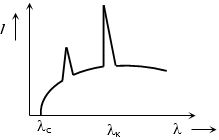
The intensity of $X$-rays from a Coolidge tube is plotted against wavelength as shown in the figure. The minimum wavelength found is ${\lambda _c}$ and the wavelength of the ${K_\alpha }$ line is ${\lambda _k}$. As the accelerating voltage is increased:
A
$({\lambda _K} - {\lambda _C})$ increases
B
$({\lambda _K} - {\lambda _C})$ decreases
C
${\lambda _K}$ increases
D
${\lambda _K}$ decreases
Solution
(A) The wavelength of the characteristic $X$-ray line,such as the ${K_\alpha }$ line $({\lambda _k})$,depends only on the material of the target and is independent of the accelerating voltage $(V)$.
The minimum wavelength of the continuous $X$-ray spectrum $({\lambda _c})$ is given by the Duane-Hunt law: ${\lambda _c} = \frac{hc}{eV}$.
From this relation,it is clear that ${\lambda _c}$ is inversely proportional to the accelerating voltage $(V)$.
As the accelerating voltage $(V)$ is increased,${\lambda _c}$ decreases,while ${\lambda _k}$ remains constant.
Therefore,the difference $({\lambda _K} - {\lambda _C})$ will increase.
The minimum wavelength of the continuous $X$-ray spectrum $({\lambda _c})$ is given by the Duane-Hunt law: ${\lambda _c} = \frac{hc}{eV}$.
From this relation,it is clear that ${\lambda _c}$ is inversely proportional to the accelerating voltage $(V)$.
As the accelerating voltage $(V)$ is increased,${\lambda _c}$ decreases,while ${\lambda _k}$ remains constant.
Therefore,the difference $({\lambda _K} - {\lambda _C})$ will increase.
0 likes
View Solution121
EasyMCQ
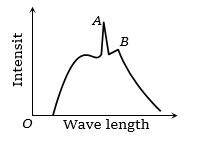
The figure represents the observed intensity of $X-$ rays emitted by an $X-$ ray tube as a function of wavelength. The sharp peaks $A$ and $B$ denote
A
Band spectrum
B
Continuous spectrum
C
Characteristic radiations
D
White radiations
Solution
(C) In $X-$ ray spectra,depending on the accelerating voltage and the target element,we may find sharp peaks superimposed on a continuous spectrum.
These sharp peaks occur at specific wavelengths that are unique to the target material used in the $X-$ ray tube.
These peaks arise due to electronic transitions within the atoms of the target material,where an electron from a higher energy shell drops into a vacancy in a lower energy shell,emitting a photon of specific energy.
Therefore,these peaks are known as characteristic radiations.
These sharp peaks occur at specific wavelengths that are unique to the target material used in the $X-$ ray tube.
These peaks arise due to electronic transitions within the atoms of the target material,where an electron from a higher energy shell drops into a vacancy in a lower energy shell,emitting a photon of specific energy.
Therefore,these peaks are known as characteristic radiations.
0 likes
View Solution122
MediumMCQ
The graph that correctly represents the relation of frequency $\nu$ of a particular characteristic $X$-ray with the atomic number $Z$ of the material is
A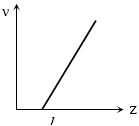
B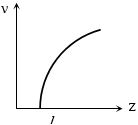
C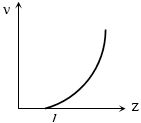
D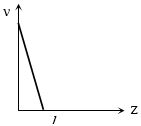
Solution
(C) According to Moseley's law,the frequency $\nu$ of a characteristic $X$-ray is related to the atomic number $Z$ of the target material by the equation:
$\sqrt{\nu} = a(Z - b)$
where $a$ and $b$ are constants.
Squaring both sides,we get:
$\nu = a^2(Z - b)^2$
This equation is of the form $\nu = k(Z - b)^2$,which represents a parabola opening upwards with its vertex at $(b, 0)$ on the $Z$-axis.
Comparing this with the given options,the graph that represents a parabolic relationship between $\nu$ and $Z$ is graph $C$.
$\sqrt{\nu} = a(Z - b)$
where $a$ and $b$ are constants.
Squaring both sides,we get:
$\nu = a^2(Z - b)^2$
This equation is of the form $\nu = k(Z - b)^2$,which represents a parabola opening upwards with its vertex at $(b, 0)$ on the $Z$-axis.
Comparing this with the given options,the graph that represents a parabolic relationship between $\nu$ and $Z$ is graph $C$.
0 likes
View Solution123
MediumMCQ
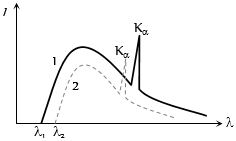
The intensity distribution of $X$-rays from two Coolidge tubes operated on different voltages $V_1$ and $V_2$ and using different target materials of atomic numbers $Z_1$ and $Z_2$ is shown in the figure. Which one of the following inequalities is true?
A
$V_1 > V_2, Z_1 < Z_2$
B
$V_1 > V_2, Z_1 > Z_2$
C
$V_1 < V_2, Z_1 > Z_2$
D
$V_1 = V_2, Z_1 < Z_2$
Solution
(B) $1$. The minimum wavelength of the continuous $X$-ray spectrum is given by $\lambda_{\min} = \frac{hc}{eV}$.
$2$. From the graph,we observe that $\lambda_1 < \lambda_2$. Since $\lambda_{\min} \propto \frac{1}{V}$,a smaller minimum wavelength corresponds to a higher accelerating voltage. Therefore,$V_1 > V_2$.
$3$. The characteristic $K_{\alpha}$ line wavelength is determined by Moseley's law: $\sqrt{\nu} = a(Z - b)$,which implies $\nu \propto (Z - 1)^2$. Since $\nu = \frac{c}{\lambda}$,we have $\lambda \propto \frac{1}{(Z - 1)^2}$.
$4$. From the graph,the $K_{\alpha}$ peak for curve $1$ appears at a shorter wavelength than the $K_{\alpha}$ peak for curve $2$. Thus,$\lambda_{K\alpha, 1} < \lambda_{K\alpha, 2}$.
$5$. This implies $(Z_1 - 1)^2 > (Z_2 - 1)^2$,which means $Z_1 > Z_2$.
$6$. Combining these results,we get $V_1 > V_2$ and $Z_1 > Z_2$.
$2$. From the graph,we observe that $\lambda_1 < \lambda_2$. Since $\lambda_{\min} \propto \frac{1}{V}$,a smaller minimum wavelength corresponds to a higher accelerating voltage. Therefore,$V_1 > V_2$.
$3$. The characteristic $K_{\alpha}$ line wavelength is determined by Moseley's law: $\sqrt{\nu} = a(Z - b)$,which implies $\nu \propto (Z - 1)^2$. Since $\nu = \frac{c}{\lambda}$,we have $\lambda \propto \frac{1}{(Z - 1)^2}$.
$4$. From the graph,the $K_{\alpha}$ peak for curve $1$ appears at a shorter wavelength than the $K_{\alpha}$ peak for curve $2$. Thus,$\lambda_{K\alpha, 1} < \lambda_{K\alpha, 2}$.
$5$. This implies $(Z_1 - 1)^2 > (Z_2 - 1)^2$,which means $Z_1 > Z_2$.
$6$. Combining these results,we get $V_1 > V_2$ and $Z_1 > Z_2$.
0 likes
View Solution124
EasyMCQ
The continuous $X-$ray spectrum obtained from a Coolidge tube is of the form:
A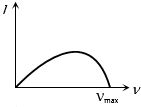
B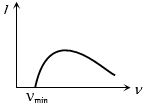
C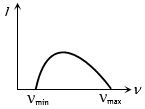
D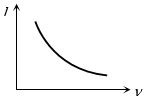
Solution
(A) In a Coolidge tube,the continuous $X-$ray spectrum is produced due to the deceleration of electrons hitting the target. The energy of the emitted photon $E = h\nu$ is derived from the kinetic energy of the incident electrons. The maximum frequency $\nu_{\max}$ corresponds to the case where the entire kinetic energy of an electron is converted into a single photon,given by $h\nu_{\max} = eV$,where $V$ is the accelerating potential. Since electrons can lose any fraction of their kinetic energy,the frequency $\nu$ of the emitted $X-$rays can range from $0$ up to a maximum value $\nu_{\max}$. The intensity $I$ is zero at $\nu = 0$ and $\nu = \nu_{\max}$,and it reaches a peak in between. This corresponds to the graph in option $A$.
0 likes
View Solution125
MediumMCQ
The dependence of the short wavelength limit $\lambda _{\min }$ on the accelerating potential $V$ is represented by the curve of figure.
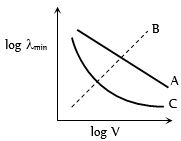
A
$A$
B
$B$
C
$C$
D
None of these
Solution
(A) The short wavelength limit $\lambda _{\min }$ is given by the relation $\lambda _{\min } = \frac{hc}{eV}$.
Taking the logarithm on both sides,we get $\log \lambda _{\min } = \log \left( \frac{hc}{e} \right) - \log V$.
This can be rewritten as $\log \lambda _{\min } = - \log V + \log \left( \frac{hc}{e} \right)$.
This is an equation of a straight line of the form $y = mx + c$,where $y = \log \lambda _{\min }$,$x = \log V$,slope $m = -1$,and intercept $c = \log \left( \frac{hc}{e} \right)$.
Since the slope is negative,the graph is a straight line with a downward slope,which corresponds to curve $A$ in the figure.
Taking the logarithm on both sides,we get $\log \lambda _{\min } = \log \left( \frac{hc}{e} \right) - \log V$.
This can be rewritten as $\log \lambda _{\min } = - \log V + \log \left( \frac{hc}{e} \right)$.
This is an equation of a straight line of the form $y = mx + c$,where $y = \log \lambda _{\min }$,$x = \log V$,slope $m = -1$,and intercept $c = \log \left( \frac{hc}{e} \right)$.
Since the slope is negative,the graph is a straight line with a downward slope,which corresponds to curve $A$ in the figure.
0 likes
View Solution126
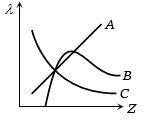
MediumMCQ
The variation of wavelength $\lambda$ of the $K_{\alpha}$ line with atomic number $Z$ of the target is shown by the following curve of
A
$A$
B
$B$
C
$C$
D
None of these
Solution
(C) According to Moseley's law,the frequency $\nu$ of the characteristic $K_{\alpha}$ $X$-ray line is given by $\nu = cR(Z - b)^2$,where $b = 1$ for $K_{\alpha}$ lines.
Thus,$\nu \propto (Z - 1)^2$.
Since $\nu = \frac{c}{\lambda}$,we have $\frac{c}{\lambda} \propto (Z - 1)^2$.
This implies $\lambda \propto \frac{1}{(Z - 1)^2}$.
As $Z$ increases,$\lambda$ decreases rapidly. This relationship represents a rectangular hyperbola-like curve that decreases as $Z$ increases,which corresponds to curve $C$.
Thus,$\nu \propto (Z - 1)^2$.
Since $\nu = \frac{c}{\lambda}$,we have $\frac{c}{\lambda} \propto (Z - 1)^2$.
This implies $\lambda \propto \frac{1}{(Z - 1)^2}$.
As $Z$ increases,$\lambda$ decreases rapidly. This relationship represents a rectangular hyperbola-like curve that decreases as $Z$ increases,which corresponds to curve $C$.
0 likes
View Solution127
EasyMCQ
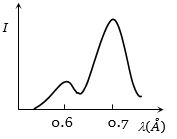
The diagram shows a graph between the intensity of $X$-rays emitted by a molybdenum target and the wavelength,when electrons of $30 \ keV$ are incident on the target. In the graph,one peak corresponds to the $K_\alpha$ line and the other peak corresponds to the $K_\beta$ line.
A
The first peak is the $K_\alpha$ line at $0.6 \ \mathring{A}$.
B
The highest peak is the $K_\alpha$ line at $0.7 \ \mathring{A}$.
C
If the energy of the incident particles is increased,the peaks will shift towards the left.
D
If the energy of the incident particles is increased,the peaks will shift towards the right.
Solution
(B) $1$. In the characteristic $X$-ray spectrum,the $K_\alpha$ line has a longer wavelength and higher intensity compared to the $K_\beta$ line.
$2$. From the graph,the peak at $0.7 \ \mathring{A}$ is higher than the peak at $0.6 \ \mathring{A}$. Therefore,the $K_\alpha$ line corresponds to the peak at $0.7 \ \mathring{A}$.
$3$. If the energy of the incident electrons is increased,the minimum wavelength (cut-off wavelength) $\lambda_{min} = \frac{hc}{E}$ decreases,shifting the continuous spectrum towards the left. However,the characteristic peaks $(K_\alpha, K_\beta)$ depend only on the target material and remain at their fixed wavelengths. Thus,option $(c)$ is incorrect as the characteristic peaks do not shift,and option $(b)$ is the correct observation from the graph.
$2$. From the graph,the peak at $0.7 \ \mathring{A}$ is higher than the peak at $0.6 \ \mathring{A}$. Therefore,the $K_\alpha$ line corresponds to the peak at $0.7 \ \mathring{A}$.
$3$. If the energy of the incident electrons is increased,the minimum wavelength (cut-off wavelength) $\lambda_{min} = \frac{hc}{E}$ decreases,shifting the continuous spectrum towards the left. However,the characteristic peaks $(K_\alpha, K_\beta)$ depend only on the target material and remain at their fixed wavelengths. Thus,option $(c)$ is incorrect as the characteristic peaks do not shift,and option $(b)$ is the correct observation from the graph.
0 likes
View Solution128
DifficultMCQ
The wavelength of ${K_{\alpha }}$ $X$-rays produced by an $X$-ray tube is $0.76 \, \mathring{A}$. The atomic number of the anticathode material is:
A
$82$
B
$41$
C
$20$
D
$10$
Solution
(B) For the ${K_{\alpha }}$ $X$-ray line,Moseley's law is given by:
$\frac{1}{\lambda} = R(Z - 1)^2 \left[ \frac{1}{1^2} - \frac{1}{2^2} \right] = \frac{3R}{4}(Z - 1)^2$
Given $\lambda = 0.76 \, \mathring{A} = 0.76 \times 10^{-10} \, m$ and Rydberg constant $R \approx 1.097 \times 10^7 \, m^{-1}$.
Substituting the values:
$\frac{1}{0.76 \times 10^{-10}} = \frac{3}{4} \times 1.097 \times 10^7 \times (Z - 1)^2$
$1.315 \times 10^{10} = 0.82275 \times 10^7 \times (Z - 1)^2$
$(Z - 1)^2 = \frac{1.315 \times 10^{10}}{0.82275 \times 10^7} \approx 1598.3$
$Z - 1 \approx \sqrt{1600} = 40$
$Z = 41$.
$\frac{1}{\lambda} = R(Z - 1)^2 \left[ \frac{1}{1^2} - \frac{1}{2^2} \right] = \frac{3R}{4}(Z - 1)^2$
Given $\lambda = 0.76 \, \mathring{A} = 0.76 \times 10^{-10} \, m$ and Rydberg constant $R \approx 1.097 \times 10^7 \, m^{-1}$.
Substituting the values:
$\frac{1}{0.76 \times 10^{-10}} = \frac{3}{4} \times 1.097 \times 10^7 \times (Z - 1)^2$
$1.315 \times 10^{10} = 0.82275 \times 10^7 \times (Z - 1)^2$
$(Z - 1)^2 = \frac{1.315 \times 10^{10}}{0.82275 \times 10^7} \approx 1598.3$
$Z - 1 \approx \sqrt{1600} = 40$
$Z = 41$.
0 likes
View Solution129
EasyMCQ
At the time of a total solar eclipse,the spectrum of solar radiation would be:
A
$A$ large number of dark Fraunhofer lines
B
$A$ less number of dark Fraunhofer lines
C
No lines at all
D
All Fraunhofer lines changed into brilliant colours
Solution
(D) Fraunhofer lines are dark absorption lines observed in the solar spectrum caused by the absorption of specific wavelengths by the cooler gases in the Sun's atmosphere (the photosphere).
During a total solar eclipse,the Moon blocks the bright photosphere of the Sun.
This allows the light from the chromosphere,which is a hotter and thinner layer of the Sun's atmosphere,to be observed.
The chromosphere emits light through emission,which produces bright emission lines at the exact same wavelengths where the dark absorption lines (Fraunhofer lines) were previously observed.
Therefore,the dark Fraunhofer lines are replaced by bright,brilliant emission lines.
During a total solar eclipse,the Moon blocks the bright photosphere of the Sun.
This allows the light from the chromosphere,which is a hotter and thinner layer of the Sun's atmosphere,to be observed.
The chromosphere emits light through emission,which produces bright emission lines at the exact same wavelengths where the dark absorption lines (Fraunhofer lines) were previously observed.
Therefore,the dark Fraunhofer lines are replaced by bright,brilliant emission lines.
0 likes
View Solution130
EasyMCQ
Fraunhofer lines of the solar system are an example of
A
Emission spectrum
B
Emission band spectrum
C
Continuous emission spectrum
D
Line absorption spectrum
Solution
(D) The correct answer is $D$. Fraunhofer lines are produced by the absorption of light rays from the Sun by the gases and vapors present in the solar atmosphere. When white light from the photosphere passes through the cooler chromosphere,the atoms and molecules present in the chromosphere absorb specific wavelengths of light. This process results in the formation of dark lines in the otherwise continuous spectrum of the Sun,which are known as Fraunhofer lines. Therefore,they represent a line absorption spectrum.
0 likes
View Solution131
EasyMCQ
$X$-rays are produced in an $X$-ray tube at a given accelerating voltage. The wavelength of the continuous $X$-rays will be in the range of .......
A
$0$ to $\infty$
B
$\lambda_{min}$ to $\infty$,where $\lambda_{min} > 0$
C
$0$ to $\lambda_{max}$,where $\lambda_{max} < \infty$
D
$\lambda_{min}$ to $\lambda_{max}$,where $0 < \lambda_{min} < \lambda_{max} < \infty$
Solution
(B) In an $X$-ray tube,when electrons are accelerated through a potential difference $V$,they possess a maximum kinetic energy $K_{max} = eV$.
When these electrons strike the target,they produce continuous $X$-rays due to Bremsstrahlung radiation.
The maximum energy of an emitted photon corresponds to the case where the electron loses all its kinetic energy in a single collision,given by $E_{max} = h\nu_{max} = \frac{hc}{\lambda_{min}} = eV$.
Thus,the minimum wavelength is $\lambda_{min} = \frac{hc}{eV}$.
Since the electron can lose any amount of energy from $0$ to $eV$ in various collisions,the emitted $X$-ray photons can have any wavelength from $\lambda_{min}$ to $\infty$.
Therefore,the range of wavelengths for continuous $X$-rays is $\lambda_{min}$ to $\infty$.
When these electrons strike the target,they produce continuous $X$-rays due to Bremsstrahlung radiation.
The maximum energy of an emitted photon corresponds to the case where the electron loses all its kinetic energy in a single collision,given by $E_{max} = h\nu_{max} = \frac{hc}{\lambda_{min}} = eV$.
Thus,the minimum wavelength is $\lambda_{min} = \frac{hc}{eV}$.
Since the electron can lose any amount of energy from $0$ to $eV$ in various collisions,the emitted $X$-ray photons can have any wavelength from $\lambda_{min}$ to $\infty$.
Therefore,the range of wavelengths for continuous $X$-rays is $\lambda_{min}$ to $\infty$.
0 likes
View Solution132
EasyMCQ
When are characteristic $X$-ray emissions produced?
A
An electron is knocked out from an inner shell of the target atom,and an electron from an outer shell fills the vacancy.
B
Valence electrons are removed from the target atoms as a result of collision.
C
An electron beam is emitted from a source with specific energy.
D
Electrons are accelerated with a constant energy.
Solution
(A) Characteristic $X$-rays are produced due to electronic transitions within the target atom. When a high-energy incident electron strikes the target,it knocks out an electron from an inner shell (e.g.,$K$-shell). This creates a vacancy in that shell. To stabilize the atom,an electron from a higher energy shell (e.g.,$L$ or $M$ shell) drops down to fill this vacancy. The difference in energy between these two shells is released in the form of a photon,which corresponds to the characteristic $X$-ray emission.
0 likes
View Solution133
EasyMCQ
If the voltage of an $X$-ray tube is doubled,the intensity of the $X$-rays will be ...... .
A
Halved
B
Constant
C
Doubled
D
One-fourth
Solution
(B) The intensity of $X$-rays depends on the number of electrons hitting the target,which is determined by the filament current,not the accelerating voltage. The accelerating voltage determines the minimum wavelength (maximum energy) of the $X$-rays. Therefore,if the voltage is doubled,the intensity of the $X$-rays remains constant.
0 likes
View Solution134
EasyMCQ
Why is a direct $X$-ray photograph of the intestines not taken by a radiologist?
A
The $X$-ray radiation causes the intestines to rupture.
B
$X$-rays cannot pass through the intestines.
C
$X$-rays pass through the intestines without casting a shadow,making them useless for diagnosis.
D
Very low exposure to $X$-rays in the intestines causes cancer.
Solution
(C) $X$-rays are high-energy electromagnetic waves that easily pass through soft tissues like the intestines without being significantly absorbed or scattered. Because they do not cast a clear shadow of the soft tissue structures on the photographic film,they cannot provide a useful diagnostic image of the intestines. To visualize the intestines,radiologists use contrast agents like barium sulfate,which absorbs $X$-rays and creates the necessary contrast.
0 likes
View Solution135
EasyMCQ
The characteristic $X$-rays depend on .........
A
Nature of the target material
B
Energy of the emitted electrons
C
Applied potential difference
D
None of these
Solution
(A) Characteristic $X$-rays are produced due to the transition of electrons from higher energy levels to lower energy levels within the atoms of the target material.
Since the energy levels of an atom are unique to the element,the energy (and thus the wavelength) of the characteristic $X$-rays emitted depends solely on the atomic number $(Z)$ of the target material.
Therefore,the characteristic $X$-rays depend on the nature of the target material.
Since the energy levels of an atom are unique to the element,the energy (and thus the wavelength) of the characteristic $X$-rays emitted depends solely on the atomic number $(Z)$ of the target material.
Therefore,the characteristic $X$-rays depend on the nature of the target material.
0 likes
View Solution136
EasyMCQ
When cathode rays strike a metal target with a high melting point and high atomic number,what is produced?
A
$X$-rays are produced.
B
$\alpha$-rays are produced.
C
$\beta$-rays are produced.
D
Side waves are produced.
Solution
(A) When high-speed electrons (cathode rays) strike a metal target with a high melting point and high atomic number,they are suddenly decelerated. This loss of kinetic energy is emitted in the form of high-frequency electromagnetic radiation known as $X$-rays.
0 likes
View Solution137
EasyMCQ
The ionization energies of Cobalt $(Co)$,Copper $(Cu)$,and Molybdenum $(Mo)$ are $7.8 \, keV$,$9.0 \, keV$,and $20.1 \, keV$ respectively. If any of these metals are used as a target in an $X$-ray tube operating at $15 \, kV$,then:
A
$K$-series characteristic $X$-rays will be emitted only by $Co$.
B
$K$-series characteristic $X$-rays will be emitted only by $Cu$ and $Co$.
C
$K$-series characteristic $X$-rays will be emitted by $Cu, Co$,and $Mo$.
D
The minimum wavelength of continuous $X$-rays emitted by the three metals will not be the same.
Solution
(B) For the emission of $K$-series characteristic $X$-rays,the energy of the incident electrons $(E = eV)$ must be greater than the ionization energy $(E_i)$ required to knock out an electron from the $K$-shell.
Given the operating voltage $V = 15 \, kV$,the energy of the incident electrons is $E = 15 \, keV$.
Comparing this with the ionization energies:
For $Co$: $7.8 \, keV < 15 \, keV$ (Emission possible).
For $Cu$: $9.0 \, keV < 15 \, keV$ (Emission possible).
For $Mo$: $20.1 \, keV > 15 \, keV$ (Emission not possible).
Thus,only $Co$ and $Cu$ can emit $K$-series characteristic $X$-rays.
The minimum wavelength of continuous $X$-rays is given by $\lambda_{min} = \frac{hc}{eV}$. Since $V$ is the same for all,$\lambda_{min}$ is the same for all three metals.
Given the operating voltage $V = 15 \, kV$,the energy of the incident electrons is $E = 15 \, keV$.
Comparing this with the ionization energies:
For $Co$: $7.8 \, keV < 15 \, keV$ (Emission possible).
For $Cu$: $9.0 \, keV < 15 \, keV$ (Emission possible).
For $Mo$: $20.1 \, keV > 15 \, keV$ (Emission not possible).
Thus,only $Co$ and $Cu$ can emit $K$-series characteristic $X$-rays.
The minimum wavelength of continuous $X$-rays is given by $\lambda_{min} = \frac{hc}{eV}$. Since $V$ is the same for all,$\lambda_{min}$ is the same for all three metals.
0 likes
View Solution138
EasyMCQ
The structure of a solid can be explained by using .......
A
$X$-rays
B
$\gamma$-rays
C
Cosmic rays
D
Infrared rays
Solution
(A) The structure of a solid,specifically the arrangement of atoms in a crystal lattice,is determined using $X$-ray diffraction.
Because the wavelength of $X$-rays is of the order of the interatomic spacing in solids (approximately $1 \ \mathring{A}$ or $10^{-10} \ \text{m}$),they undergo diffraction when interacting with the crystal lattice.
This phenomenon allows scientists to map the atomic positions within the solid,a technique known as $X$-ray crystallography.
Because the wavelength of $X$-rays is of the order of the interatomic spacing in solids (approximately $1 \ \mathring{A}$ or $10^{-10} \ \text{m}$),they undergo diffraction when interacting with the crystal lattice.
This phenomenon allows scientists to map the atomic positions within the solid,a technique known as $X$-ray crystallography.
0 likes
View Solution139
EasyMCQ
The shortest wavelength emitted from an $X$-ray tube depends on which of the following?
A
The voltage applied across the tube
B
The nature of the gas in the tube
C
The current in the tube
D
The nature of the target material
Solution
(A) The shortest wavelength (cutoff wavelength) of $X$-rays produced in an $X$-ray tube is given by the Duane-Hunt law: $\lambda_{min} = \frac{hc}{eV}$.
Here,$h$ is Planck's constant,$c$ is the speed of light,$e$ is the charge of an electron,and $V$ is the accelerating potential difference (voltage) applied across the tube.
Since $h$,$c$,and $e$ are constants,the minimum wavelength $\lambda_{min}$ is inversely proportional to the applied voltage $V$.
Therefore,the shortest wavelength depends on the voltage applied across the tube.
Here,$h$ is Planck's constant,$c$ is the speed of light,$e$ is the charge of an electron,and $V$ is the accelerating potential difference (voltage) applied across the tube.
Since $h$,$c$,and $e$ are constants,the minimum wavelength $\lambda_{min}$ is inversely proportional to the applied voltage $V$.
Therefore,the shortest wavelength depends on the voltage applied across the tube.
0 likes
View Solution140
EasyMCQ
In an $X$-ray tube,the wavelength of characteristic $X$-rays is a property of .......
A
Tube voltage
B
Target material
C
Filament current
D
None of these
Solution
(B) In an $X$-ray tube,the characteristic $X$-rays are produced due to the transitions of electrons between the inner shells of the atoms of the target material.
Since the energy levels of the inner shells depend on the atomic number $(Z)$ of the element,the wavelength of the characteristic $X$-rays depends solely on the nature of the target material.
Therefore,the correct option is $B$.
Since the energy levels of the inner shells depend on the atomic number $(Z)$ of the element,the wavelength of the characteristic $X$-rays depends solely on the nature of the target material.
Therefore,the correct option is $B$.
0 likes
View Solution141
EasyMCQ
If $X$-rays pass through a strong magnetic field,the $X$-rays . . . . . .
A
will deviate more
B
will deviate less
C
will not deviate
D
none of these
Solution
(C) $X$-rays are electromagnetic waves consisting of high-energy photons.
They do not carry any electric charge.
Since magnetic fields only exert a force on moving electric charges (Lorentz force) or magnetic dipoles,and $X$-rays possess neither,they remain unaffected by magnetic fields.
Therefore,$X$-rays will not deviate when passing through a strong magnetic field.
They do not carry any electric charge.
Since magnetic fields only exert a force on moving electric charges (Lorentz force) or magnetic dipoles,and $X$-rays possess neither,they remain unaffected by magnetic fields.
Therefore,$X$-rays will not deviate when passing through a strong magnetic field.
0 likes
View Solution142
MediumMCQ
The essential distinction between $X$-rays and $\gamma$-rays is that:
A
$X$-rays are produced by the nucleus,while $\gamma$-rays are an atomic property.
B
$X$-rays are an atomic property,while $\gamma$-rays are produced by the nucleus.
C
The frequency of $\gamma$-rays is lower than that of $X$-rays.
D
The velocity of $\gamma$-rays is lower than that of $X$-rays.
Solution
(B) $X$-rays are produced due to electronic transitions in the inner shells of an atom,making them an atomic property.
$\gamma$-rays are produced due to transitions within the nucleus during radioactive decay,making them a nuclear property.
Therefore,the fundamental difference is that $X$-rays originate from the electron cloud (atomic),while $\gamma$-rays originate from the nucleus.
$\gamma$-rays are produced due to transitions within the nucleus during radioactive decay,making them a nuclear property.
Therefore,the fundamental difference is that $X$-rays originate from the electron cloud (atomic),while $\gamma$-rays originate from the nucleus.
0 likes
View Solution143
MediumMCQ
When the potential difference applied to an $X$-ray tube is increased, the resulting emitted radiation shows:
A
$1, 2$
B
$3, 4$
C
$1, 4$
D
$2, 3$
Solution
(B) In an $X$-ray tube, the intensity of the emitted radiation depends on the filament current, while the minimum wavelength $(\lambda_{min})$ depends on the accelerating potential difference $(V)$.
$1$. The intensity of the $X$-rays remains constant if the filament current is not changed.
$2$. The minimum wavelength is given by the formula $\lambda_{min} = \frac{hc}{eV}$. As the potential difference $(V)$ increases, the minimum wavelength $(\lambda_{min})$ decreases.
Therefore, the correct observations are that the intensity remains constant and the minimum wavelength decreases, which corresponds to statements $(3)$ and $(4)$.
$1$. The intensity of the $X$-rays remains constant if the filament current is not changed.
$2$. The minimum wavelength is given by the formula $\lambda_{min} = \frac{hc}{eV}$. As the potential difference $(V)$ increases, the minimum wavelength $(\lambda_{min})$ decreases.
Therefore, the correct observations are that the intensity remains constant and the minimum wavelength decreases, which corresponds to statements $(3)$ and $(4)$.
0 likes
View Solution144
EasyMCQ
The intensity of the $X$-ray beam emitted in an $X$-ray tube is increased by........
A
Increasing the filament current.
B
Decreasing the filament current.
C
Increasing the target potential.
D
Decreasing the target potential.
Solution
(A) In an $X$-ray tube,the intensity of the emitted $X$-ray beam is directly proportional to the number of electrons striking the target per unit time.
This number of electrons is determined by the thermionic emission from the filament.
Therefore,increasing the filament current increases the temperature of the filament,which in turn increases the thermionic emission of electrons.
Consequently,the intensity of the $X$-ray beam increases.
This number of electrons is determined by the thermionic emission from the filament.
Therefore,increasing the filament current increases the temperature of the filament,which in turn increases the thermionic emission of electrons.
Consequently,the intensity of the $X$-ray beam increases.
0 likes
View Solution145
EasyMCQ
In an $X$-ray spectrum,if the wavelengths of $K_\alpha$,$K_\beta$,and $K_\gamma$ lines are $\lambda_\alpha$,$\lambda_\beta$,and $\lambda_\gamma$ respectively,then:
A
$\lambda_\alpha = \lambda_\beta = \lambda_\gamma$
B
$\lambda_\alpha > \lambda_\beta > \lambda_\gamma$
C
$\lambda_\alpha < \lambda_\beta < \lambda_\gamma$
D
None of these
Solution
(B) In an $X$-ray spectrum,the $K$-series lines are produced when electrons transition from higher energy levels $(n=2, 3, 4, ...)$ to the $K$-shell $(n=1)$.
The energy of the emitted photon is given by $E = \frac{hc}{\lambda}$,which implies $\lambda = \frac{hc}{E}$.
The energy difference for the transitions are:
For $K_\alpha$: $E_\alpha = E_2 - E_1$
For $K_\beta$: $E_\beta = E_3 - E_1$
For $K_\gamma$: $E_\gamma = E_4 - E_1$
Since $E_4 > E_3 > E_2$,it follows that $E_\gamma > E_\beta > E_\alpha$.
Because wavelength is inversely proportional to energy,we have $\lambda_\alpha > \lambda_\beta > \lambda_\gamma$.
The energy of the emitted photon is given by $E = \frac{hc}{\lambda}$,which implies $\lambda = \frac{hc}{E}$.
The energy difference for the transitions are:
For $K_\alpha$: $E_\alpha = E_2 - E_1$
For $K_\beta$: $E_\beta = E_3 - E_1$
For $K_\gamma$: $E_\gamma = E_4 - E_1$
Since $E_4 > E_3 > E_2$,it follows that $E_\gamma > E_\beta > E_\alpha$.
Because wavelength is inversely proportional to energy,we have $\lambda_\alpha > \lambda_\beta > \lambda_\gamma$.
0 likes
View Solution146
EasyMCQ
When $X$-rays are incident on an object in a dark room,they will appear as ........
A
Invisible
B
White
C
Yellow
D
Red
Solution
(A) $X$-rays are electromagnetic waves with wavelengths in the range of $0.01 \ nm$ to $10 \ nm$.
Human eyes are only sensitive to the visible spectrum,which ranges approximately from $380 \ nm$ to $750 \ nm$.
Since the wavelength of $X$-rays is much shorter than the visible spectrum,they cannot be detected by the human eye.
Therefore,$X$-rays are invisible to the human eye.
Human eyes are only sensitive to the visible spectrum,which ranges approximately from $380 \ nm$ to $750 \ nm$.
Since the wavelength of $X$-rays is much shorter than the visible spectrum,they cannot be detected by the human eye.
Therefore,$X$-rays are invisible to the human eye.
0 likes
View Solution147
EasyMCQ
The binding energy of the innermost electron is $40 \, keV$. To obtain characteristic $X$-rays using a tungsten target in an $X$-ray tube,the potential difference $V$ between the cathode and the anode must be:
A
$V < 40 \, kV$
B
$V \leq 40 \, kV$
C
$V > 40 \, kV$
D
$V \geq 40 \, kV$
Solution
(C) To produce characteristic $X$-rays,an incident electron must have enough kinetic energy to knock out an electron from the innermost shell ($K$-shell) of the target atom.
The energy required to remove this electron is equal to its binding energy,which is $40 \, keV$.
Therefore,the kinetic energy $K$ of the incident electron must be greater than the binding energy $E_b$:
$K > E_b$
Since the kinetic energy gained by an electron accelerated through a potential difference $V$ is given by $K = eV$,we have:
$eV > 40 \, keV$
Dividing both sides by $e$,we get:
$V > 40 \, kV$
Thus,the potential difference must be greater than $40 \, kV$ to ionize the atom and produce characteristic $X$-rays.
The energy required to remove this electron is equal to its binding energy,which is $40 \, keV$.
Therefore,the kinetic energy $K$ of the incident electron must be greater than the binding energy $E_b$:
$K > E_b$
Since the kinetic energy gained by an electron accelerated through a potential difference $V$ is given by $K = eV$,we have:
$eV > 40 \, keV$
Dividing both sides by $e$,we get:
$V > 40 \, kV$
Thus,the potential difference must be greater than $40 \, kV$ to ionize the atom and produce characteristic $X$-rays.
0 likes
View Solution148
EasyMCQ
The pressure inside an $X$-ray tube is approximately:
A
$740 \, mm$ of $Hg$
B
$76 \, mm$ of $Hg$
C
$10^{-6} \, mm$ of $Hg$
D
$10^{-7} \, mm$ of $Hg$
Solution
(C) An $X$-ray tube requires a very high vacuum to prevent the ionization of residual gas molecules by accelerated electrons,which would cause electrical discharge and damage the tube. The operating pressure inside an $X$-ray tube is typically maintained at a very low level,approximately $10^{-5} \, mm$ to $10^{-6} \, mm$ of $Hg$. Among the given options,$10^{-6} \, mm$ of $Hg$ is the correct order of magnitude.
0 likes
View Solution149
EasyMCQ
Characteristic $X$-rays are not obtained in the spectrum of a hydrogen atom because,
A
Hydrogen is a gas.
B
Hydrogen is very light.
C
The energy difference between the energy levels of hydrogen is very small.
D
The energy difference between the energy levels of hydrogen is very large.
Solution
(C) Characteristic $X$-rays are produced by transitions between inner electron shells (like $K$ or $L$ shells) in atoms with high atomic numbers $(Z)$.
In a hydrogen atom,there is only one electron and the energy difference between its energy levels is very small (in the order of $eV$).
$X$-rays require energy transitions in the range of $keV$,which is not possible in a hydrogen atom due to its low atomic number and small energy gap between levels.
In a hydrogen atom,there is only one electron and the energy difference between its energy levels is very small (in the order of $eV$).
$X$-rays require energy transitions in the range of $keV$,which is not possible in a hydrogen atom due to its low atomic number and small energy gap between levels.
0 likes
View Solution150
EasyMCQ
The emission of continuous $X$-rays is due to:
A
Transition of electrons from higher energy level to lower energy level in the target atom.
B
Deceleration of incident electrons as they enter the target atom.
C
Transition of electrons from lower energy level to higher energy level in the target atom.
D
Neutralization of incident electrons.
Solution
(B) Continuous $X$-rays are produced due to the deceleration (or retardation) of incident high-speed electrons as they interact with the electric field of the nuclei in the target material. This process is known as Bremsstrahlung radiation. As the electrons lose kinetic energy,the energy is emitted in the form of continuous $X$-ray photons.
0 likes
View SolutionAtoms — X-Rays · Frequently Asked Questions
1Are these Atoms questions useful for JEE and NEET?
Yes. All questions in this section are mapped to JEE Main and NEET exam patterns. Previous year questions from JEE Main, NEET, GUJCET and state-level exams are included with full solutions.
2Can I switch to Hindi or Gujarati for these questions?
Yes. Use the language tabs in the hero section or the sidebar to view the same questions and solutions in English, Hindi or Gujarati.
3How do I generate a question paper from this subtopic?
Use the Vedclass Exam Paper Generator — select the chapter and subtopic, set difficulty, and generate Sets A, B, C, D automatically. First 3 chapters of every subject are free.
Vedclass Products
For Students
Vedclass Test Series
Mock tests in real JEE/NEET style with performance analysis. 5-day free trial.
Start Free TrialFor Teachers
Exam Paper Generator
Generate Set A/B/C/D papers from this chapter in 2 minutes. 3 chapters free.
Try FreeFor Institutes
Online Exam Module
Live online exams with unlimited students, 360° analytics & white-label branding.
See DemoFor Teachers & Institutes
Generate a Atoms Exam Paper in 2 Minutes
Select subtopic & difficulty — Sets A, B, C, D auto-generated with No Repeat logic.
First 3 chapters of every subject are free — no payment required.