
A English
Bohr's Model of Hydrogen Atom Questions in English
Class 12 Physics · Atoms · Bohr's Model of Hydrogen Atom
574+
Questions
English
Language
100%
With Solutions
Showing 46 of 574 questions in English
1
EasyMCQ
In a hydrogen atom,the electron revolves around the nucleus in an orbit of radius $0.53 \times 10^{-10} \, m$. The electrical potential produced by the nucleus at the position of the electron is......$V$
A
$-13.6$
B
$-27.2$
C
$27.2$
D
$13.6$
Solution
(C) The electric potential $V$ due to a point charge $Q$ at a distance $r$ is given by the formula $V = \frac{kQ}{r}$,where $k = 9 \times 10^9 \, N \cdot m^2/C^2$.
For a hydrogen nucleus,the charge $Q = +e = 1.6 \times 10^{-19} \, C$.
The radius of the orbit is $r = 0.53 \times 10^{-10} \, m$.
Substituting these values into the formula:
$V = \frac{9 \times 10^9 \times 1.6 \times 10^{-19}}{0.53 \times 10^{-10}}$
$V = \frac{14.4 \times 10^{-10}}{0.53 \times 10^{-10}}$
$V \approx 27.17 \, V \approx 27.2 \, V$.
For a hydrogen nucleus,the charge $Q = +e = 1.6 \times 10^{-19} \, C$.
The radius of the orbit is $r = 0.53 \times 10^{-10} \, m$.
Substituting these values into the formula:
$V = \frac{9 \times 10^9 \times 1.6 \times 10^{-19}}{0.53 \times 10^{-10}}$
$V = \frac{14.4 \times 10^{-10}}{0.53 \times 10^{-10}}$
$V \approx 27.17 \, V \approx 27.2 \, V$.
0 likes
View Solution2
EasyMCQ
In a hydrogen atom, the electron makes $6.6 \times 10^{15}$ revolutions per second around the nucleus in an orbit of radius $0.5 \times 10^{-10} \, m$. This is equivalent to a current of nearly:
A
$1 \, A$
B
$1 \, mA$
C
$1 \, \mu A$
D
$1.6 \times 10^{-19} \, A$
Solution
(B) The current $I$ produced by a revolving charge is given by the formula $I = qf$, where $q$ is the charge of the electron and $f$ is the frequency of revolution.
Given:
Charge of electron $q = 1.6 \times 10^{-19} \, C$
Frequency $f = 6.6 \times 10^{15} \, \text{rev/s}$
Substituting the values:
$I = (1.6 \times 10^{-19} \, C) \times (6.6 \times 10^{15} \, \text{s}^{-1})$
$I = 10.56 \times 10^{-4} \, A$
$I \approx 1.056 \times 10^{-3} \, A$
$I \approx 1 \, mA$
Therefore, the equivalent current is nearly $1 \, mA$.
Given:
Charge of electron $q = 1.6 \times 10^{-19} \, C$
Frequency $f = 6.6 \times 10^{15} \, \text{rev/s}$
Substituting the values:
$I = (1.6 \times 10^{-19} \, C) \times (6.6 \times 10^{15} \, \text{s}^{-1})$
$I = 10.56 \times 10^{-4} \, A$
$I \approx 1.056 \times 10^{-3} \, A$
$I \approx 1 \, mA$
Therefore, the equivalent current is nearly $1 \, mA$.
0 likes
View Solution3
MediumMCQ
The radius of the orbit of an electron in a hydrogen atom is $0.5 \ \mathring{A}$. The speed of the electron is $2 \times 10^6 \ m/s$. The current in the loop due to the motion of the electron is ............. $mA$.
A
$1$
B
$1.5$
C
$2.5$
D
$1.5 \times 10^{-2}$
Solution
(A) The time period of revolution of the electron is given by $T = \frac{2\pi r}{v}$.
Since current $i$ is defined as the rate of flow of charge,$i = \frac{e}{T}$.
Substituting $T$,we get $i = \frac{ev}{2\pi r}$.
Given: $e = 1.6 \times 10^{-19} \ C$,$v = 2 \times 10^6 \ m/s$,and $r = 0.5 \ \mathring{A} = 0.5 \times 10^{-10} \ m$.
$i = \frac{1.6 \times 10^{-19} \times 2 \times 10^6}{2 \times 3.14 \times 0.5 \times 10^{-10}}$.
$i = \frac{3.2 \times 10^{-13}}{3.14 \times 10^{-10}} \approx 1.019 \times 10^{-3} \ A$.
Converting to $mA$,$i \approx 1 \ mA$.
Since current $i$ is defined as the rate of flow of charge,$i = \frac{e}{T}$.
Substituting $T$,we get $i = \frac{ev}{2\pi r}$.
Given: $e = 1.6 \times 10^{-19} \ C$,$v = 2 \times 10^6 \ m/s$,and $r = 0.5 \ \mathring{A} = 0.5 \times 10^{-10} \ m$.
$i = \frac{1.6 \times 10^{-19} \times 2 \times 10^6}{2 \times 3.14 \times 0.5 \times 10^{-10}}$.
$i = \frac{3.2 \times 10^{-13}}{3.14 \times 10^{-10}} \approx 1.019 \times 10^{-3} \ A$.
Converting to $mA$,$i \approx 1 \ mA$.
0 likes
View Solution4
MediumMCQ
The wavelength for an electron in an orbit of a hydrogen atom is $10^{-9} \ m$. The principal quantum number for this electron is:
A
$1$
B
$2$
C
$3$
D
$4$
Solution
(C) According to de Broglie's hypothesis,the circumference of the $n^{th}$ orbit is equal to an integral multiple of the de Broglie wavelength: $2\pi r_n = n\lambda$.
Given: Wavelength $\lambda = 10^{-9} \ m$.
The radius of the $n^{th}$ orbit of a hydrogen atom is given by $r_n = n^2 a_0$,where $a_0 = 0.529 \times 10^{-10} \ m$.
For $n=3$,$r_3 = 3^2 \times 0.529 \times 10^{-10} \ m = 9 \times 0.529 \times 10^{-10} \ m \approx 4.76 \times 10^{-10} \ m$.
Using the condition $n = \frac{2\pi r_n}{\lambda}$:
$n = \frac{2 \times 3.14159 \times 4.76 \times 10^{-10}}{10^{-9}} \approx 3$.
Thus,the principal quantum number is $3$.
Given: Wavelength $\lambda = 10^{-9} \ m$.
The radius of the $n^{th}$ orbit of a hydrogen atom is given by $r_n = n^2 a_0$,where $a_0 = 0.529 \times 10^{-10} \ m$.
For $n=3$,$r_3 = 3^2 \times 0.529 \times 10^{-10} \ m = 9 \times 0.529 \times 10^{-10} \ m \approx 4.76 \times 10^{-10} \ m$.
Using the condition $n = \frac{2\pi r_n}{\lambda}$:
$n = \frac{2 \times 3.14159 \times 4.76 \times 10^{-10}}{10^{-9}} \approx 3$.
Thus,the principal quantum number is $3$.
0 likes
View Solution5
EasyMCQ
In the Bohr's hydrogen atom model,the radius of the stationary orbit is directly proportional to ($n =$ principle quantum number)
A
$n^{-1}$
B
$n$
C
$n^{-2}$
D
$n^2$
Solution
(D) According to the Bohr model of the hydrogen atom,the radius of the $n^{th}$ stationary orbit is given by the formula:
$r_n = \frac{\varepsilon_0 n^2 h^2}{\pi Z m e^2}$
In this expression,$\varepsilon_0$ is the permittivity of free space,$h$ is Planck's constant,$Z$ is the atomic number,$m$ is the mass of the electron,and $e$ is the elementary charge.
Since all these parameters are constants for a given atom,the radius $r$ is directly proportional to the square of the principal quantum number $n$.
Therefore,$r \propto n^2$.
$r_n = \frac{\varepsilon_0 n^2 h^2}{\pi Z m e^2}$
In this expression,$\varepsilon_0$ is the permittivity of free space,$h$ is Planck's constant,$Z$ is the atomic number,$m$ is the mass of the electron,and $e$ is the elementary charge.
Since all these parameters are constants for a given atom,the radius $r$ is directly proportional to the square of the principal quantum number $n$.
Therefore,$r \propto n^2$.
0 likes
View Solution6
MediumMCQ
In the following atoms and molecules,for the transition from $n = 2$ to $n = 1$,the spectral line of minimum wavelength will be produced by:
A
Hydrogen atom
B
Deuterium atom
C
Uni-ionized helium
D
Di-ionized lithium
Solution
(D) The wavelength $\lambda$ of the spectral line emitted during a transition between energy levels is given by the Rydberg formula: $\frac{1}{\lambda} = R Z^2 \left( \frac{1}{n_1^2} - \frac{1}{n_2^2} \right)$.
For a transition from $n_2 = 2$ to $n_1 = 1$,the term $\left( \frac{1}{1^2} - \frac{1}{2^2} \right) = \frac{3}{4}$ is constant for all hydrogen-like species.
Therefore,$\frac{1}{\lambda} \propto Z^2$,which implies $\lambda \propto \frac{1}{Z^2}$.
To obtain the minimum wavelength $\lambda$,the atomic number $Z$ must be maximum.
- Hydrogen atom $(H)$: $Z = 1$
- Deuterium atom $(D)$: $Z = 1$
- Uni-ionized helium $(He^+)$: $Z = 2$
- Di-ionized lithium $(Li^{2+})$: $Z = 3$
Since $Li^{2+}$ has the highest atomic number $(Z = 3)$,it produces the spectral line with the minimum wavelength.
For a transition from $n_2 = 2$ to $n_1 = 1$,the term $\left( \frac{1}{1^2} - \frac{1}{2^2} \right) = \frac{3}{4}$ is constant for all hydrogen-like species.
Therefore,$\frac{1}{\lambda} \propto Z^2$,which implies $\lambda \propto \frac{1}{Z^2}$.
To obtain the minimum wavelength $\lambda$,the atomic number $Z$ must be maximum.
- Hydrogen atom $(H)$: $Z = 1$
- Deuterium atom $(D)$: $Z = 1$
- Uni-ionized helium $(He^+)$: $Z = 2$
- Di-ionized lithium $(Li^{2+})$: $Z = 3$
Since $Li^{2+}$ has the highest atomic number $(Z = 3)$,it produces the spectral line with the minimum wavelength.
0 likes
View Solution7
EasyMCQ
An electron has a mass of $9.1 \times 10^{-31} \ kg$. It revolves around the nucleus in a circular orbit of radius $0.529 \times 10^{-10} \ m$ at a speed of $2.2 \times 10^6 \ m/s$. The magnitude of its linear momentum in this motion is:
A
$1.1 \times 10^{-34} \ kg \cdot m/s$
B
$2.0 \times 10^{-24} \ kg \cdot m/s$
C
$4.0 \times 10^{-24} \ kg \cdot m/s$
D
$4.0 \times 10^{-31} \ kg \cdot m/s$
Solution
(B) The linear momentum $p$ of an object is given by the product of its mass $m$ and its velocity $v$.
$p = m \times v$
Given:
Mass $m = 9.1 \times 10^{-31} \ kg$
Velocity $v = 2.2 \times 10^6 \ m/s$
Substituting these values into the formula:
$p = (9.1 \times 10^{-31} \ kg) \times (2.2 \times 10^6 \ m/s)$
$p = (9.1 \times 2.2) \times 10^{-31+6} \ kg \cdot m/s$
$p = 20.02 \times 10^{-25} \ kg \cdot m/s$
$p = 2.002 \times 10^{-24} \ kg \cdot m/s$
Rounding to two significant figures,we get:
$p \approx 2.0 \times 10^{-24} \ kg \cdot m/s$
Thus,the correct option is $B$.
$p = m \times v$
Given:
Mass $m = 9.1 \times 10^{-31} \ kg$
Velocity $v = 2.2 \times 10^6 \ m/s$
Substituting these values into the formula:
$p = (9.1 \times 10^{-31} \ kg) \times (2.2 \times 10^6 \ m/s)$
$p = (9.1 \times 2.2) \times 10^{-31+6} \ kg \cdot m/s$
$p = 20.02 \times 10^{-25} \ kg \cdot m/s$
$p = 2.002 \times 10^{-24} \ kg \cdot m/s$
Rounding to two significant figures,we get:
$p \approx 2.0 \times 10^{-24} \ kg \cdot m/s$
Thus,the correct option is $B$.
0 likes
View Solution8
EasyMCQ
In terms of Bohr radius $a_0$,the radius of the second Bohr orbit of a hydrogen atom is given by
A
$\sqrt{2} a_{0}$
B
$2 a_{0}$
C
$4 a_{0}$
D
$8 a_{0}$
Solution
(C) According to Bohr's model,the radius of the $n^{th}$ orbit of a hydrogen atom is given by the formula $r_n = n^2 a_0$,where $a_0$ is the Bohr radius.
For the second Bohr orbit,the principal quantum number $n = 2$.
Substituting $n = 2$ into the formula,we get $r_2 = (2)^2 a_0 = 4 a_0$.
Therefore,the radius of the second Bohr orbit is $4 a_0$.
For the second Bohr orbit,the principal quantum number $n = 2$.
Substituting $n = 2$ into the formula,we get $r_2 = (2)^2 a_0 = 4 a_0$.
Therefore,the radius of the second Bohr orbit is $4 a_0$.
0 likes
View Solution9
MediumMCQ
The ionization potential for the second $He$ electron is ...... $eV$.
A
$13.6$
B
$27.2$
C
$54.4$
D
$100$
Solution
(C) For the ionization of the second $He$ electron,the ion $He^+$ acts as a hydrogen-like atom with atomic number $Z = 2$.
The ionization energy for a hydrogen-like atom is given by the formula $E = Z^2 \times 13.6 \, eV$.
Substituting $Z = 2$ into the formula:
$E = (2)^2 \times 13.6 \, eV = 4 \times 13.6 \, eV = 54.4 \, eV$.
Therefore,the ionization potential is $54.4 \, V$.
The ionization energy for a hydrogen-like atom is given by the formula $E = Z^2 \times 13.6 \, eV$.
Substituting $Z = 2$ into the formula:
$E = (2)^2 \times 13.6 \, eV = 4 \times 13.6 \, eV = 54.4 \, eV$.
Therefore,the ionization potential is $54.4 \, V$.
0 likes
View Solution10
MediumMCQ
The kinetic energy of the electron in an orbit of radius $r$ in a hydrogen atom is ($e =$ electronic charge).
A
$\frac{e^2}{r^2}$
B
$\frac{e^2}{2r}$
C
$\frac{e^2}{r}$
D
$\frac{e^2}{2r^2}$
Solution
(B) In the $CGS$ system,the electrostatic potential energy $U$ of an electron in an orbit of radius $r$ in a hydrogen atom is given by $U = -\frac{e^2}{r}$.
According to the virial theorem for a system with a $1/r$ potential,the kinetic energy $K$ is related to the potential energy $U$ by the relation $K = -\frac{1}{2}U$.
Substituting the value of $U$,we get $K = -\frac{1}{2} \left( -\frac{e^2}{r} \right) = \frac{e^2}{2r}$.
According to the virial theorem for a system with a $1/r$ potential,the kinetic energy $K$ is related to the potential energy $U$ by the relation $K = -\frac{1}{2}U$.
Substituting the value of $U$,we get $K = -\frac{1}{2} \left( -\frac{e^2}{r} \right) = \frac{e^2}{2r}$.
0 likes
View Solution11
MediumMCQ
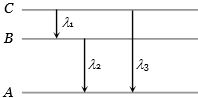
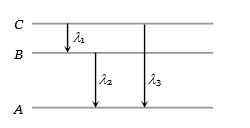
Energy levels $A, B, C$ of a certain atom correspond to increasing values of energy,i.e.,$E_A < E_B < E_C$. If $\lambda_1, \lambda_2, \lambda_3$ are the wavelengths of radiations corresponding to the transitions $C$ to $B$,$B$ to $A$,and $C$ to $A$ respectively,which of the following statements is correct?
A
$\lambda_3 = \lambda_1 + \lambda_2$
B
$\lambda_3 = \frac{\lambda_1 \lambda_2}{\lambda_1 + \lambda_2}$
C
$\lambda_1 + \lambda_2 + \lambda_3 = 0$
D
$\lambda_3^2 = \lambda_1^2 + \lambda_2^2$
Solution
(B) Let the energies of the states $A, B,$ and $C$ be $E_A, E_B,$ and $E_C$ respectively.
From the principle of conservation of energy,the energy of the transition from $C$ to $A$ is equal to the sum of the energies of the transitions from $C$ to $B$ and $B$ to $A$.
Thus,$(E_C - E_A) = (E_C - E_B) + (E_B - E_A)$.
Using the relation $E = \frac{hc}{\lambda}$,we can write:
$\frac{hc}{\lambda_3} = \frac{hc}{\lambda_1} + \frac{hc}{\lambda_2}$
Dividing both sides by $hc$,we get:
$\frac{1}{\lambda_3} = \frac{1}{\lambda_1} + \frac{1}{\lambda_2}$
$\frac{1}{\lambda_3} = \frac{\lambda_1 + \lambda_2}{\lambda_1 \lambda_2}$
Therefore,$\lambda_3 = \frac{\lambda_1 \lambda_2}{\lambda_1 + \lambda_2}$.
From the principle of conservation of energy,the energy of the transition from $C$ to $A$ is equal to the sum of the energies of the transitions from $C$ to $B$ and $B$ to $A$.
Thus,$(E_C - E_A) = (E_C - E_B) + (E_B - E_A)$.
Using the relation $E = \frac{hc}{\lambda}$,we can write:
$\frac{hc}{\lambda_3} = \frac{hc}{\lambda_1} + \frac{hc}{\lambda_2}$
Dividing both sides by $hc$,we get:
$\frac{1}{\lambda_3} = \frac{1}{\lambda_1} + \frac{1}{\lambda_2}$
$\frac{1}{\lambda_3} = \frac{\lambda_1 + \lambda_2}{\lambda_1 \lambda_2}$
Therefore,$\lambda_3 = \frac{\lambda_1 \lambda_2}{\lambda_1 + \lambda_2}$.
0 likes
View Solution12
EasyMCQ
The angular momentum of an electron in the $n^{th}$ orbit is given by:
A
$nh$
B
$\frac{h}{2\pi n}$
C
$n\frac{h}{2\pi}$
D
$n^2\frac{h}{2\pi}$
Solution
(C) According to Bohr's second postulate,the angular momentum $L$ of an electron revolving in a stable orbit is quantized.
It is given by the relation $L = mvr = \frac{nh}{2\pi}$,where $n$ is the principal quantum number $(n = 1, 2, 3, ...)$,$h$ is Planck's constant,and $m, v, r$ are the mass,velocity,and radius of the orbit respectively.
Therefore,the correct option is $C$.
It is given by the relation $L = mvr = \frac{nh}{2\pi}$,where $n$ is the principal quantum number $(n = 1, 2, 3, ...)$,$h$ is Planck's constant,and $m, v, r$ are the mass,velocity,and radius of the orbit respectively.
Therefore,the correct option is $C$.
0 likes
View Solution13
EasyMCQ
The ionisation energy of $10$ times ionised sodium atom is:
A
$13.6 \text{ eV}$
B
$13.6 \times 11 \text{ eV}$
C
$\frac{13.6}{11} \text{ eV}$
D
$13.6 \times (11)^2 \text{ eV}$
Solution
(D) The ionisation energy of a hydrogen-like atom is given by the formula $E_n = 13.6 \times Z^2 \text{ eV}$,where $Z$ is the atomic number.
For a sodium atom $(Na)$,the atomic number $Z = 11$.
$A$ $10$ times ionised sodium atom is a hydrogen-like ion with one electron remaining.
Therefore,the ionisation energy is $E = 13.6 \times Z^2 \text{ eV} = 13.6 \times (11)^2 \text{ eV}$.
For a sodium atom $(Na)$,the atomic number $Z = 11$.
$A$ $10$ times ionised sodium atom is a hydrogen-like ion with one electron remaining.
Therefore,the ionisation energy is $E = 13.6 \times Z^2 \text{ eV} = 13.6 \times (11)^2 \text{ eV}$.
0 likes
View Solution14
EasyMCQ
According to Bohr's theory,the radius of an electron in an orbit described by principal quantum number $n$ and atomic number $Z$ is proportional to:
A
$Z^2 n^2$
B
$\frac{Z^2}{n^2}$
C
$\frac{Z^2}{n}$
D
$\frac{n^2}{Z}$
Solution
(D) According to Bohr's model,the radius $r$ of the $n^{th}$ orbit is given by the formula:
$r = \frac{\varepsilon_0 n^2 h^2}{\pi Z m e^2}$
In this expression,$\varepsilon_0$,$h$,$\pi$,$m$,and $e$ are all physical constants.
Therefore,the radius $r$ is directly proportional to $n^2$ and inversely proportional to $Z$.
Thus,$r \propto \frac{n^2}{Z}$.
$r = \frac{\varepsilon_0 n^2 h^2}{\pi Z m e^2}$
In this expression,$\varepsilon_0$,$h$,$\pi$,$m$,and $e$ are all physical constants.
Therefore,the radius $r$ is directly proportional to $n^2$ and inversely proportional to $Z$.
Thus,$r \propto \frac{n^2}{Z}$.
0 likes
View Solution15
MediumMCQ
The radius of the electron's second stationary orbit in Bohr's atom is $R$. The radius of the third orbit will be:
A
$3 R$
B
$2.25 R$
C
$9 R$
D
$\frac{R}{3}$
Solution
(B) According to Bohr's model,the radius of the $n^{th}$ orbit is given by the relation $r_n \propto n^2$.
Given that the radius of the second orbit $(n=2)$ is $R$,we have $r_2 = k(2)^2 = 4k = R$,where $k$ is a constant.
Therefore,$k = \frac{R}{4}$.
For the third orbit $(n=3)$,the radius $r_3$ is given by $r_3 = k(3)^2 = 9k$.
Substituting the value of $k$,we get $r_3 = 9 \times \frac{R}{4} = 2.25 R$.
Given that the radius of the second orbit $(n=2)$ is $R$,we have $r_2 = k(2)^2 = 4k = R$,where $k$ is a constant.
Therefore,$k = \frac{R}{4}$.
For the third orbit $(n=3)$,the radius $r_3$ is given by $r_3 = k(3)^2 = 9k$.
Substituting the value of $k$,we get $r_3 = 9 \times \frac{R}{4} = 2.25 R$.
0 likes
View Solution16
MediumMCQ
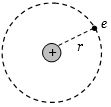
If $m$ is the mass of an electron,$v$ is its velocity,and $r$ is the radius of a stationary circular orbit around a nucleus with charge $Ze$,then from Bohr's postulate,the kinetic energy $K = \frac{1}{2}mv^2$ of the electron in the $C.G.S.$ system is equal to:
A
$\frac{1}{2} \frac{Ze^2}{r}$
B
$\frac{1}{2} \frac{Ze^2}{r^2}$
C
$\frac{Ze^2}{r}$
D
$\frac{Ze}{r^2}$
Solution
(A) In the $C.G.S.$ system,the electrostatic force of attraction between the nucleus (charge $Ze$) and the electron (charge $e$) provides the necessary centripetal force for circular motion.
The electrostatic force is given by $F_e = \frac{(Ze)(e)}{r^2} = \frac{Ze^2}{r^2}$.
The centripetal force required for circular motion is $F_c = \frac{mv^2}{r}$.
Equating the two forces: $\frac{mv^2}{r} = \frac{Ze^2}{r^2}$.
Multiplying both sides by $r$,we get $mv^2 = \frac{Ze^2}{r}$.
The kinetic energy $K$ is defined as $K = \frac{1}{2}mv^2$.
Substituting the expression for $mv^2$: $K = \frac{1}{2} \left( \frac{Ze^2}{r} \right) = \frac{Ze^2}{2r}$.
The electrostatic force is given by $F_e = \frac{(Ze)(e)}{r^2} = \frac{Ze^2}{r^2}$.
The centripetal force required for circular motion is $F_c = \frac{mv^2}{r}$.
Equating the two forces: $\frac{mv^2}{r} = \frac{Ze^2}{r^2}$.
Multiplying both sides by $r$,we get $mv^2 = \frac{Ze^2}{r}$.
The kinetic energy $K$ is defined as $K = \frac{1}{2}mv^2$.
Substituting the expression for $mv^2$: $K = \frac{1}{2} \left( \frac{Ze^2}{r} \right) = \frac{Ze^2}{2r}$.
0 likes
View Solution17
MediumMCQ
Consider an electron in the $n^{th}$ orbit of a hydrogen atom in the Bohr model. The circumference of the orbit can be expressed in terms of the de Broglie wavelength $\lambda$ of that electron as
A
$(0.259) n\lambda$
B
$\sqrt{n} \lambda$
C
$(13.6) \lambda$
D
$n\lambda$
Solution
(D) According to Bohr's postulate for the quantization of angular momentum,the angular momentum $L$ of an electron in the $n^{th}$ orbit is given by $mvr = n\frac{h}{2\pi}$.
Rearranging this equation,we get $2\pi r = n\left(\frac{h}{mv}\right)$.
Since the de Broglie wavelength $\lambda$ is defined as $\lambda = \frac{h}{p} = \frac{h}{mv}$,we can substitute this into the equation.
Therefore,the circumference of the orbit is $2\pi r = n\lambda$.
Rearranging this equation,we get $2\pi r = n\left(\frac{h}{mv}\right)$.
Since the de Broglie wavelength $\lambda$ is defined as $\lambda = \frac{h}{p} = \frac{h}{mv}$,we can substitute this into the equation.
Therefore,the circumference of the orbit is $2\pi r = n\lambda$.
0 likes
View Solution18
EasyMCQ
In any Bohr orbit of the hydrogen atom,the ratio of kinetic energy to potential energy of the electron is
A
$0.5$
B
$2$
C
$-0.5$
D
$-2$
Solution
(C) According to Bohr's model for a hydrogen-like atom,the kinetic energy $(K.E.)$ of an electron in an orbit of radius $r$ is given by $K.E. = \frac{kZe^2}{2r}$.
The potential energy $(P.E.)$ of the electron in the same orbit is given by $P.E. = -\frac{kZe^2}{r}$.
To find the ratio of kinetic energy to potential energy,we divide the two expressions:
$\frac{K.E.}{P.E.} = \frac{\frac{kZe^2}{2r}}{-\frac{kZe^2}{r}} = -\frac{1}{2} = -0.5$.
Thus,the ratio is $-0.5$.
The potential energy $(P.E.)$ of the electron in the same orbit is given by $P.E. = -\frac{kZe^2}{r}$.
To find the ratio of kinetic energy to potential energy,we divide the two expressions:
$\frac{K.E.}{P.E.} = \frac{\frac{kZe^2}{2r}}{-\frac{kZe^2}{r}} = -\frac{1}{2} = -0.5$.
Thus,the ratio is $-0.5$.
0 likes
View Solution19
MediumMCQ
An electron makes a transition from orbit $n = 4$ to the orbit $n = 2$ of a hydrogen atom. The wave number of the emitted radiations ($R =$ Rydberg's constant) will be
A
$\frac{16}{3R}$
B
$\frac{2R}{16}$
C
$\frac{3R}{16}$
D
$\frac{4R}{16}$
Solution
(C) The wave number $\bar{\nu}$ is given by the Rydberg formula: $\frac{1}{\lambda} = R \left[ \frac{1}{n_1^2} - \frac{1}{n_2^2} \right]$.
Here,the transition is from $n_2 = 4$ to $n_1 = 2$.
Substituting the values: $\frac{1}{\lambda} = R \left[ \frac{1}{2^2} - \frac{1}{4^2} \right]$.
$\frac{1}{\lambda} = R \left[ \frac{1}{4} - \frac{1}{16} \right]$.
$\frac{1}{\lambda} = R \left[ \frac{4 - 1}{16} \right] = \frac{3R}{16}$.
Here,the transition is from $n_2 = 4$ to $n_1 = 2$.
Substituting the values: $\frac{1}{\lambda} = R \left[ \frac{1}{2^2} - \frac{1}{4^2} \right]$.
$\frac{1}{\lambda} = R \left[ \frac{1}{4} - \frac{1}{16} \right]$.
$\frac{1}{\lambda} = R \left[ \frac{4 - 1}{16} \right] = \frac{3R}{16}$.
0 likes
View Solution20
EasyMCQ
The ratio of the kinetic energy to the total energy of an electron in a Bohr orbit is
A
-$1$
B
$2$
C
$1$:$2$
D
None of these
Solution
(A) In the Bohr model of the hydrogen atom,the kinetic energy $(K.E.)$ of an electron in an orbit is given by $K.E. = \frac{kZe^2}{2r}$.
The total energy $(T.E.)$ of the electron in the same orbit is given by $T.E. = -\frac{kZe^2}{2r}$.
Comparing these two expressions,we can see that $K.E. = -(T.E.)$.
Therefore,the ratio of the kinetic energy to the total energy is $\frac{K.E.}{T.E.} = \frac{K.E.}{-K.E.} = -1$.
The total energy $(T.E.)$ of the electron in the same orbit is given by $T.E. = -\frac{kZe^2}{2r}$.
Comparing these two expressions,we can see that $K.E. = -(T.E.)$.
Therefore,the ratio of the kinetic energy to the total energy is $\frac{K.E.}{T.E.} = \frac{K.E.}{-K.E.} = -1$.
0 likes
View Solution21
EasyMCQ
If an electron jumps from the $1^{st}$ orbital to the $3^{rd}$ orbital,then it will:
A
Absorb energy
B
Release energy
C
No gain of energy
D
None of these
Solution
(A) According to Bohr's model,the energy of an electron in an orbit is given by $E_n = -\frac{13.6}{n^2} \text{ eV}$.
As the principal quantum number $n$ increases,the energy of the orbit increases.
When an electron transitions from a lower energy level $(n=1)$ to a higher energy level $(n=3)$,it must gain energy from an external source to overcome the energy difference.
Therefore,the electron absorbs energy equal to $\Delta E = E_3 - E_1$.
As the principal quantum number $n$ increases,the energy of the orbit increases.
When an electron transitions from a lower energy level $(n=1)$ to a higher energy level $(n=3)$,it must gain energy from an external source to overcome the energy difference.
Therefore,the electron absorbs energy equal to $\Delta E = E_3 - E_1$.
0 likes
View Solution22
MediumMCQ
According to Bohr's theory,the expressions for the kinetic and potential energy of an electron revolving in an orbit are given respectively by:
A
$ + \frac{{{e^2}}}{{8\pi {\varepsilon _0}r}}$ and $ - \frac{{{e^2}}}{{4\pi {\varepsilon _0}r}}$
B
$ + \frac{{8\pi {\varepsilon _0}{e^2}}}{r}$ and $ - \frac{{4\pi {\varepsilon _0}{e^2}}}{r}$
C
$ - \frac{{{e^2}}}{{8\pi {\varepsilon _0}r}}$ and $ - \frac{{{e^2}}}{{4\pi {\varepsilon _0}r}}$
D
$ + \frac{{{e^2}}}{{8\pi {\varepsilon _0}r}}$ and $ + \frac{{{e^2}}}{{4\pi {\varepsilon _0}r}}$
Solution
(A) The electrostatic potential energy $(P.E.)$ of an electron at a distance $r$ from the nucleus is given by $P.E. = \frac{1}{4\pi \varepsilon_0} \frac{(Ze)( -e)}{r}$. For a hydrogen atom $(Z=1)$,this becomes $P.E. = - \frac{e^2}{4\pi \varepsilon_0 r}$.
According to the virial theorem for a stable orbit,the kinetic energy $(K.E.)$ is related to the potential energy by $K.E. = -\frac{1}{2} (P.E.)$.
Substituting the expression for $P.E.$,we get $K.E. = -\frac{1}{2} \left( - \frac{e^2}{4\pi \varepsilon_0 r} \right) = + \frac{e^2}{8\pi \varepsilon_0 r}$.
Thus,the kinetic energy is $+ \frac{e^2}{8\pi \varepsilon_0 r}$ and the potential energy is $- \frac{e^2}{4\pi \varepsilon_0 r}$.
According to the virial theorem for a stable orbit,the kinetic energy $(K.E.)$ is related to the potential energy by $K.E. = -\frac{1}{2} (P.E.)$.
Substituting the expression for $P.E.$,we get $K.E. = -\frac{1}{2} \left( - \frac{e^2}{4\pi \varepsilon_0 r} \right) = + \frac{e^2}{8\pi \varepsilon_0 r}$.
Thus,the kinetic energy is $+ \frac{e^2}{8\pi \varepsilon_0 r}$ and the potential energy is $- \frac{e^2}{4\pi \varepsilon_0 r}$.
0 likes
View Solution23
EasyMCQ
In the lowest energy level of a hydrogen atom,the electron has an angular momentum of:
A
$h / \pi$
B
$2\pi / h$
C
$h / 2\pi$
D
$\pi / h$
Solution
(C) According to Bohr's postulate,the angular momentum $L$ of an electron in a stationary orbit is given by the quantization condition:
$L = mvr = \frac{nh}{2\pi}$
where $n$ is the principal quantum number,$h$ is Planck's constant,$m$ is the mass of the electron,$v$ is its velocity,and $r$ is the radius of the orbit.
For the lowest energy level (ground state) of a hydrogen atom,$n = 1$.
Substituting $n = 1$ into the formula,we get:
$L = \frac{1 \cdot h}{2\pi} = \frac{h}{2\pi}$.
$L = mvr = \frac{nh}{2\pi}$
where $n$ is the principal quantum number,$h$ is Planck's constant,$m$ is the mass of the electron,$v$ is its velocity,and $r$ is the radius of the orbit.
For the lowest energy level (ground state) of a hydrogen atom,$n = 1$.
Substituting $n = 1$ into the formula,we get:
$L = \frac{1 \cdot h}{2\pi} = \frac{h}{2\pi}$.
0 likes
View Solution24
MediumMCQ
The Rydberg constant $R$ for hydrogen is
A
$R = - \left( {\frac{1}{{4\pi {\varepsilon _0}}}} \right).\frac{{2{\pi ^2}m{e^2}}}{{c{h^2}}}$
B
$R = \left( {\frac{1}{{4\pi {\varepsilon _0}}}} \right).\frac{{2{\pi ^2}m{e^4}}}{{c{h^2}}}$
C
$R = {\left( {\frac{1}{{4\pi {\varepsilon _0}}}} \right)^2}.\frac{{2{\pi ^2}m{e^4}}}{{{c^2}{h^2}}}$
D
$R = {\left( {\frac{1}{{4\pi {\varepsilon _0}}}} \right)^2}.\frac{{2{\pi ^2}m{e^4}}}{{c{h^3}}}$
Solution
(D) The energy of an electron in the $n^{th}$ orbit of a hydrogen atom is given by $E_n = -\frac{m e^4}{8 \varepsilon_0^2 n^2 h^2}$.
Using the Bohr model,the wavenumber $\bar{\nu}$ for a transition from $n_2$ to $n_1$ is $\bar{\nu} = \frac{1}{\lambda} = R \left( \frac{1}{n_1^2} - \frac{1}{n_2^2} \right)$.
From the energy difference $\Delta E = h c \bar{\nu} = E_{n_2} - E_{n_1}$,we get $R = \frac{m e^4}{8 \varepsilon_0^2 c h^3}$.
Substituting $k = \frac{1}{4 \pi \varepsilon_0}$,we have $\varepsilon_0 = \frac{1}{4 \pi k}$,so $\varepsilon_0^2 = \frac{1}{16 \pi^2 k^2}$.
Thus,$R = \frac{m e^4}{8 (\frac{1}{16 \pi^2 k^2}) c h^3} = \frac{16 \pi^2 k^2 m e^4}{8 c h^3} = \frac{2 \pi^2 k^2 m e^4}{c h^3}$.
Substituting $k = \frac{1}{4 \pi \varepsilon_0}$,we get $R = \left( \frac{1}{4 \pi \varepsilon_0} \right)^2 \frac{2 \pi^2 m e^4}{c h^3}$.
Using the Bohr model,the wavenumber $\bar{\nu}$ for a transition from $n_2$ to $n_1$ is $\bar{\nu} = \frac{1}{\lambda} = R \left( \frac{1}{n_1^2} - \frac{1}{n_2^2} \right)$.
From the energy difference $\Delta E = h c \bar{\nu} = E_{n_2} - E_{n_1}$,we get $R = \frac{m e^4}{8 \varepsilon_0^2 c h^3}$.
Substituting $k = \frac{1}{4 \pi \varepsilon_0}$,we have $\varepsilon_0 = \frac{1}{4 \pi k}$,so $\varepsilon_0^2 = \frac{1}{16 \pi^2 k^2}$.
Thus,$R = \frac{m e^4}{8 (\frac{1}{16 \pi^2 k^2}) c h^3} = \frac{16 \pi^2 k^2 m e^4}{8 c h^3} = \frac{2 \pi^2 k^2 m e^4}{c h^3}$.
Substituting $k = \frac{1}{4 \pi \varepsilon_0}$,we get $R = \left( \frac{1}{4 \pi \varepsilon_0} \right)^2 \frac{2 \pi^2 m e^4}{c h^3}$.
0 likes
View Solution25
MediumMCQ
According to Bohr's theory,the angular momentum of an electron revolving in the second orbit of a hydrogen atom will be:
A
$2\pi h$
B
$\pi h$
C
$\frac{h}{\pi}$
D
$\frac{2h}{\pi}$
Solution
(C) According to Bohr's postulate,the angular momentum $L$ of an electron in the $n^{th}$ orbit is given by the formula: $L = n \left( \frac{h}{2\pi} \right)$.
For the second orbit,we have $n = 2$.
Substituting the value of $n$ into the formula: $L = 2 \times \left( \frac{h}{2\pi} \right) = \frac{h}{\pi}$.
Therefore,the angular momentum of the electron in the second orbit is $\frac{h}{\pi}$.
For the second orbit,we have $n = 2$.
Substituting the value of $n$ into the formula: $L = 2 \times \left( \frac{h}{2\pi} \right) = \frac{h}{\pi}$.
Therefore,the angular momentum of the electron in the second orbit is $\frac{h}{\pi}$.
0 likes
View Solution26
EasyMCQ
The velocity of an electron in the second orbit of a sodium atom (atomic number $Z = 11$) is $v$. The velocity of an electron in its fifth orbit will be
A
$v$
B
$\frac{22}{5}v$
C
$\frac{5}{2}v$
D
$\frac{2}{5}v$
Solution
(D) The velocity of an electron in the $n^{th}$ orbit of a hydrogen-like atom is given by the formula $v_n = v_0 \frac{Z}{n}$,where $Z$ is the atomic number and $n$ is the orbit number.
From this relation,we can see that for a given atom (constant $Z$),the velocity is inversely proportional to the orbit number: $v_n \propto \frac{1}{n}$.
Given that the velocity in the second orbit $(n_2 = 2)$ is $v$,we have $v_2 = v$.
We need to find the velocity in the fifth orbit $(n_5 = 5)$,denoted as $v_5$.
Using the proportionality $v_n \propto \frac{1}{n}$,we can write the ratio: $\frac{v_5}{v_2} = \frac{n_2}{n_5}$.
Substituting the known values: $\frac{v_5}{v} = \frac{2}{5}$.
Therefore,$v_5 = \frac{2}{5}v$.
From this relation,we can see that for a given atom (constant $Z$),the velocity is inversely proportional to the orbit number: $v_n \propto \frac{1}{n}$.
Given that the velocity in the second orbit $(n_2 = 2)$ is $v$,we have $v_2 = v$.
We need to find the velocity in the fifth orbit $(n_5 = 5)$,denoted as $v_5$.
Using the proportionality $v_n \propto \frac{1}{n}$,we can write the ratio: $\frac{v_5}{v_2} = \frac{n_2}{n_5}$.
Substituting the known values: $\frac{v_5}{v} = \frac{2}{5}$.
Therefore,$v_5 = \frac{2}{5}v$.
0 likes
View Solution27
MediumMCQ
The number of absorption transitions between the first and the fourth energy states of a hydrogen atom is $3$. The number of emission transitions between these states will be
A
$3$
B
$4$
C
$5$
D
$6$
Solution
(D) The number of possible emission transitions from an excited state $n$ to the ground state is given by the formula $N_E = \frac{n(n - 1)}{2}$.
Here,the electron is in the fourth energy state,so $n = 4$.
Substituting the value of $n$ into the formula:
$N_E = \frac{4(4 - 1)}{2} = \frac{4 \times 3}{2} = \frac{12}{2} = 6$.
Therefore,there are $6$ possible emission transitions.
Here,the electron is in the fourth energy state,so $n = 4$.
Substituting the value of $n$ into the formula:
$N_E = \frac{4(4 - 1)}{2} = \frac{4 \times 3}{2} = \frac{12}{2} = 6$.
Therefore,there are $6$ possible emission transitions.
0 likes
View Solution28
EasyMCQ
In the Bohr model of a hydrogen atom,the centripetal force is furnished by the Coulomb attraction between the proton and the electron. If ${a_0}$ is the radius of the ground state orbit,$m$ is the mass,$e$ is the charge on the electron,and ${\varepsilon _0}$ is the vacuum permittivity,the speed of the electron is:
A
$0$
B
$\frac{e}{{\sqrt { {\varepsilon _0}{a_0}m} }}$
C
$\frac{e}{{\sqrt {4\pi {\varepsilon _0}{a_0}m} }}$
D
$\frac{{\sqrt {4\pi {\varepsilon _0}{a_0}m} }}{e}$
Solution
(C) The centripetal force required for the circular motion of the electron is provided by the electrostatic Coulomb force between the proton and the electron.
Equating the centripetal force to the Coulomb force:
$\frac{m{v^2}}{{a_0}} = \frac{1}{{4\pi {\varepsilon _0}}}\frac{{{e^2}}}{{a_0^2}}$
Canceling $a_0$ from both sides:
$m{v^2} = \frac{1}{{4\pi {\varepsilon _0}}}\frac{{{e^2}}}{{a_0}}$
Solving for $v^2$:
${v^2} = \frac{{{e^2}}}{{4\pi {\varepsilon _0}{a_0}m}}$
Taking the square root of both sides,we get the speed of the electron:
$v = \frac{e}{{\sqrt {4\pi {\varepsilon _0}{a_0}m} }}$
Thus,the correct option is $C$.
Equating the centripetal force to the Coulomb force:
$\frac{m{v^2}}{{a_0}} = \frac{1}{{4\pi {\varepsilon _0}}}\frac{{{e^2}}}{{a_0^2}}$
Canceling $a_0$ from both sides:
$m{v^2} = \frac{1}{{4\pi {\varepsilon _0}}}\frac{{{e^2}}}{{a_0}}$
Solving for $v^2$:
${v^2} = \frac{{{e^2}}}{{4\pi {\varepsilon _0}{a_0}m}}$
Taking the square root of both sides,we get the speed of the electron:
$v = \frac{e}{{\sqrt {4\pi {\varepsilon _0}{a_0}m} }}$
Thus,the correct option is $C$.
0 likes
View Solution29
MediumMCQ
The electron in a hydrogen atom makes a transition $n_1 \to n_2$,where $n_1$ and $n_2$ are the principal quantum numbers of the two states. Assume the Bohr model to be valid. The time period of the electron in the initial state is eight times that in the final state. The possible values of $n_1$ and $n_2$ are
A
$n_1 = 4, n_2 = 2$
B
$n_1 = 6, n_2 = 3$
C
$n_1 = 8, n_2 = 1$
D
Both $(a)$ and $(b)$
Solution
(D) According to the Bohr model,the time period $T$ of an electron in an orbit with principal quantum number $n$ is given by $T = \frac{2\pi r}{v}$.
Since $r \propto n^2$ and $v \propto \frac{1}{n}$,we have $T \propto n^3$.
Given that the time period in the initial state is eight times that in the final state: $T_{n_1} = 8 T_{n_2}$.
Substituting the proportionality: $n_1^3 = 8 n_2^3$.
Taking the cube root on both sides: $n_1 = 2 n_2$.
Checking the options:
For option $(a)$: $n_1 = 4, n_2 = 2$. Here $4 = 2(2)$,which is correct.
For option $(b)$: $n_1 = 6, n_2 = 3$. Here $6 = 2(3)$,which is correct.
Thus,both $(a)$ and $(b)$ are valid possibilities.
Since $r \propto n^2$ and $v \propto \frac{1}{n}$,we have $T \propto n^3$.
Given that the time period in the initial state is eight times that in the final state: $T_{n_1} = 8 T_{n_2}$.
Substituting the proportionality: $n_1^3 = 8 n_2^3$.
Taking the cube root on both sides: $n_1 = 2 n_2$.
Checking the options:
For option $(a)$: $n_1 = 4, n_2 = 2$. Here $4 = 2(2)$,which is correct.
For option $(b)$: $n_1 = 6, n_2 = 3$. Here $6 = 2(3)$,which is correct.
Thus,both $(a)$ and $(b)$ are valid possibilities.
0 likes
View Solution30
EasyMCQ
As per the Bohr model,the minimum energy (in $eV$) required to remove an electron from the ground state of a doubly ionized $Li$ atom $(Z = 3)$ is:
A
$1.51$
B
$13.6$
C
$40.8$
D
$122.4$
Solution
(D) According to the Bohr model,the energy of an electron in the $n^{th}$ orbit of a hydrogen-like atom is given by $E_n = -13.6 \times \frac{Z^2}{n^2} \; eV$.
For a doubly ionized lithium atom $(Li^{2+})$,the atomic number $Z = 3$.
For the ground state,the principal quantum number $n = 1$.
Substituting these values,the energy of the ground state is $E_1 = -13.6 \times \frac{3^2}{1^2} \; eV = -13.6 \times 9 \; eV = -122.4 \; eV$.
The energy required to remove the electron (ionization energy) is the energy needed to bring the electron from the ground state to infinity $(E_{\infty} = 0)$.
Therefore,Ionization Energy $= E_{\infty} - E_1 = 0 - (-122.4 \; eV) = 122.4 \; eV$.
For a doubly ionized lithium atom $(Li^{2+})$,the atomic number $Z = 3$.
For the ground state,the principal quantum number $n = 1$.
Substituting these values,the energy of the ground state is $E_1 = -13.6 \times \frac{3^2}{1^2} \; eV = -13.6 \times 9 \; eV = -122.4 \; eV$.
The energy required to remove the electron (ionization energy) is the energy needed to bring the electron from the ground state to infinity $(E_{\infty} = 0)$.
Therefore,Ionization Energy $= E_{\infty} - E_1 = 0 - (-122.4 \; eV) = 122.4 \; eV$.
0 likes
View Solution31
EasyMCQ
In Bohr's model of the hydrogen atom,let $PE$ represent potential energy and $TE$ represent total energy. When an electron transitions to a higher energy level,
A
$PE$ decreases,$TE$ increases
B
$PE$ increases,$TE$ increases
C
$PE$ decreases,$TE$ decreases
D
$PE$ increases,$TE$ decreases
Solution
(B) In Bohr's model,the potential energy of an electron in the $n^{th}$ orbit is given by $PE = -\frac{ke^2}{r_n}$,where $r_n \propto n^2$. As the principal quantum number $n$ increases,the radius $r_n$ increases,making the potential energy $PE$ less negative (i.e.,it increases).
The total energy is given by $TE = -\frac{13.6}{n^2} \text{ eV}$. As $n$ increases,the denominator $n^2$ increases,making the total energy $TE$ less negative (i.e.,it increases towards zero).
Therefore,both $PE$ and $TE$ increase as the electron moves to a higher energy level.
The total energy is given by $TE = -\frac{13.6}{n^2} \text{ eV}$. As $n$ increases,the denominator $n^2$ increases,making the total energy $TE$ less negative (i.e.,it increases towards zero).
Therefore,both $PE$ and $TE$ increase as the electron moves to a higher energy level.
0 likes
View Solution32
MediumMCQ
According to Bohr's model, the radius of the second orbit of a helium ion $(He^+)$ is ........ $\mathring{A}$.
A
$0.53$
B
$1.06$
C
$2.12$
D
$0.265$
Solution
(B) The radius of the $n^{th}$ orbit in a hydrogen-like atom is given by the formula: $r_n = r_0 \times \frac{n^2}{Z}$, where $r_0 = 0.53 \ \mathring{A}$ is the radius of the first orbit of the hydrogen atom.
For a helium ion $(He^+)$, the atomic number $Z = 2$.
For the second orbit, $n = 2$.
Substituting these values into the formula:
$r_2 = 0.53 \times \frac{2^2}{2} \ \mathring{A}$
$r_2 = 0.53 \times \frac{4}{2} \ \mathring{A}$
$r_2 = 0.53 \times 2 \ \mathring{A} = 1.06 \ \mathring{A}$.
Thus, the correct option is $B$.
For a helium ion $(He^+)$, the atomic number $Z = 2$.
For the second orbit, $n = 2$.
Substituting these values into the formula:
$r_2 = 0.53 \times \frac{2^2}{2} \ \mathring{A}$
$r_2 = 0.53 \times \frac{4}{2} \ \mathring{A}$
$r_2 = 0.53 \times 2 \ \mathring{A} = 1.06 \ \mathring{A}$.
Thus, the correct option is $B$.
0 likes
View Solution33
MediumMCQ
An ionic atom equivalent to a hydrogen atom has a wavelength equal to $1/4$ of the wavelength of the corresponding hydrogen line. The ion is:
A
$He^+$
B
$Li^{++}$
C
$Ne^{9+}$
D
$Na^{10+}$
Solution
(A) According to the Rydberg formula for hydrogen-like ions,the wavelength $\lambda$ of a spectral line is given by: $\frac{1}{\lambda} = R Z^2 \left( \frac{1}{n_1^2} - \frac{1}{n_2^2} \right)$.
For a hydrogen atom,$Z = 1$,so $\frac{1}{\lambda_H} = R \left( \frac{1}{n_1^2} - \frac{1}{n_2^2} \right)$.
For the ionic atom,$\frac{1}{\lambda_{ion}} = R Z^2 \left( \frac{1}{n_1^2} - \frac{1}{n_2^2} \right)$.
Given that $\lambda_{ion} = \frac{1}{4} \lambda_H$,we have $\frac{1}{\lambda_{ion}} = 4 \frac{1}{\lambda_H}$.
Substituting the expressions,we get $R Z^2 \left( \frac{1}{n_1^2} - \frac{1}{n_2^2} \right) = 4 R \left( \frac{1}{n_1^2} - \frac{1}{n_2^2} \right)$.
This simplifies to $Z^2 = 4$,which gives $Z = 2$.
The element with atomic number $Z = 2$ is Helium $(He)$. Since it is an ion,it is $He^+$. Therefore,the correct option is $A$.
For a hydrogen atom,$Z = 1$,so $\frac{1}{\lambda_H} = R \left( \frac{1}{n_1^2} - \frac{1}{n_2^2} \right)$.
For the ionic atom,$\frac{1}{\lambda_{ion}} = R Z^2 \left( \frac{1}{n_1^2} - \frac{1}{n_2^2} \right)$.
Given that $\lambda_{ion} = \frac{1}{4} \lambda_H$,we have $\frac{1}{\lambda_{ion}} = 4 \frac{1}{\lambda_H}$.
Substituting the expressions,we get $R Z^2 \left( \frac{1}{n_1^2} - \frac{1}{n_2^2} \right) = 4 R \left( \frac{1}{n_1^2} - \frac{1}{n_2^2} \right)$.
This simplifies to $Z^2 = 4$,which gives $Z = 2$.
The element with atomic number $Z = 2$ is Helium $(He)$. Since it is an ion,it is $He^+$. Therefore,the correct option is $A$.
0 likes
View Solution34
DifficultMCQ
The third line of the Balmer series of an ion equivalent to a hydrogen atom has a wavelength of $108.5 \ nm$. The ground state energy of an electron of this ion will be.....$eV$
A
$3.4$
B
$13.6$
C
$54.4$
D
$122.4$
Solution
(C) For the third line of the Balmer series,the transition is from $n_2 = 5$ to $n_1 = 2$.
Using the Rydberg formula: $\frac{1}{\lambda} = R Z^2 \left[ \frac{1}{n_1^2} - \frac{1}{n_2^2} \right]$.
Given $\lambda = 108.5 \ nm = 108.5 \times 10^{-9} \ m$ and $R \approx 1.097 \times 10^7 \ m^{-1}$.
Substituting the values: $\frac{1}{108.5 \times 10^{-9}} = (1.097 \times 10^7) Z^2 \left[ \frac{1}{2^2} - \frac{1}{5^2} \right]$.
$\frac{1}{108.5 \times 10^{-9}} = (1.097 \times 10^7) Z^2 \left[ \frac{1}{4} - \frac{1}{25} \right] = (1.097 \times 10^7) Z^2 \left[ \frac{21}{100} \right]$.
Solving for $Z^2$: $Z^2 \approx \frac{100}{108.5 \times 10^{-9} \times 1.097 \times 10^7 \times 21} \approx \frac{100}{25} = 4$.
Thus,$Z = 2$.
The ground state energy of a hydrogen-like ion is given by $E = -13.6 \frac{Z^2}{n^2} \ eV$.
For the ground state,$n = 1$,so $E = -13.6 \times \frac{2^2}{1^2} = -13.6 \times 4 = -54.4 \ eV$.
The magnitude of the ground state energy is $54.4 \ eV$.
Using the Rydberg formula: $\frac{1}{\lambda} = R Z^2 \left[ \frac{1}{n_1^2} - \frac{1}{n_2^2} \right]$.
Given $\lambda = 108.5 \ nm = 108.5 \times 10^{-9} \ m$ and $R \approx 1.097 \times 10^7 \ m^{-1}$.
Substituting the values: $\frac{1}{108.5 \times 10^{-9}} = (1.097 \times 10^7) Z^2 \left[ \frac{1}{2^2} - \frac{1}{5^2} \right]$.
$\frac{1}{108.5 \times 10^{-9}} = (1.097 \times 10^7) Z^2 \left[ \frac{1}{4} - \frac{1}{25} \right] = (1.097 \times 10^7) Z^2 \left[ \frac{21}{100} \right]$.
Solving for $Z^2$: $Z^2 \approx \frac{100}{108.5 \times 10^{-9} \times 1.097 \times 10^7 \times 21} \approx \frac{100}{25} = 4$.
Thus,$Z = 2$.
The ground state energy of a hydrogen-like ion is given by $E = -13.6 \frac{Z^2}{n^2} \ eV$.
For the ground state,$n = 1$,so $E = -13.6 \times \frac{2^2}{1^2} = -13.6 \times 4 = -54.4 \ eV$.
The magnitude of the ground state energy is $54.4 \ eV$.
0 likes
View Solution35
EasyMCQ
An electron in the $n = 1$ orbit of a hydrogen atom is bound by $13.6\, eV$. The energy required to ionize it is........$ eV$.
A
$13.6$
B
$6.53$
C
$5.4$
D
$1.51$
Solution
(A) The binding energy of an electron in the $n = 1$ orbit of a hydrogen atom is the energy required to remove the electron from the atom to infinity,which is $13.6\, eV$.
By definition,the ionization energy is the minimum energy required to remove an electron from its ground state to an infinite distance from the nucleus.
Therefore,the ionization energy is equal to the magnitude of the binding energy.
Ionization energy = $13.6\, eV$.
By definition,the ionization energy is the minimum energy required to remove an electron from its ground state to an infinite distance from the nucleus.
Therefore,the ionization energy is equal to the magnitude of the binding energy.
Ionization energy = $13.6\, eV$.
0 likes
View Solution36
MediumMCQ
The ionization energy of hydrogen is $13.6 \, eV$. If $h = 6.6 \times 10^{-34} \, J \cdot s$,the order of magnitude of the Rydberg constant $R$ will be:
A
$10^{10} \, m^{-1}$
B
$10^7 \, m^{-1}$
C
$10^4 \, m^{-1}$
D
$10^{-7} \, m^{-1}$
Solution
(B) The ionization energy $E$ of a hydrogen atom is related to the Rydberg constant $R$ by the formula $E = Rch$,where $c$ is the speed of light and $h$ is Planck's constant.
Rearranging for $R$,we get $R = \frac{E}{ch}$.
Given $E = 13.6 \, eV = 13.6 \times 1.6 \times 10^{-19} \, J$,$c = 3 \times 10^8 \, m/s$,and $h = 6.6 \times 10^{-34} \, J \cdot s$.
Substituting these values:
$R = \frac{13.6 \times 1.6 \times 10^{-19}}{3 \times 10^8 \times 6.6 \times 10^{-34}}$
$R = \frac{21.76 \times 10^{-19}}{19.8 \times 10^{-26}}$
$R \approx 1.098 \times 10^7 \, m^{-1}$.
Thus,the order of magnitude of $R$ is $10^7 \, m^{-1}$.
Rearranging for $R$,we get $R = \frac{E}{ch}$.
Given $E = 13.6 \, eV = 13.6 \times 1.6 \times 10^{-19} \, J$,$c = 3 \times 10^8 \, m/s$,and $h = 6.6 \times 10^{-34} \, J \cdot s$.
Substituting these values:
$R = \frac{13.6 \times 1.6 \times 10^{-19}}{3 \times 10^8 \times 6.6 \times 10^{-34}}$
$R = \frac{21.76 \times 10^{-19}}{19.8 \times 10^{-26}}$
$R \approx 1.098 \times 10^7 \, m^{-1}$.
Thus,the order of magnitude of $R$ is $10^7 \, m^{-1}$.
0 likes
View Solution37
EasyMCQ
To explain his theory,Bohr used
A
Conservation of linear momentum
B
Conservation of angular momentum
C
Conservation of quantum frequency
D
Conservation of energy
Solution
(B) Bohr's model of the atom is based on several postulates. One of the fundamental postulates is the quantization of angular momentum. Bohr proposed that an electron can revolve only in those orbits for which its angular momentum is an integral multiple of $h / (2\pi)$,where $h$ is Planck's constant. This is expressed as $L = mvr = n(h / 2\pi)$,where $n = 1, 2, 3, ...$. Thus,Bohr used the principle of quantization of angular momentum to explain the stability of atoms and the observed spectral lines.
0 likes
View Solution38
MediumMCQ
The radius of a hydrogen atom in its ground state is $5.3 \times 10^{-11} \ m$. After collision with an electron,it is found to have a radius of $21.2 \times 10^{-11} \ m$. What is the principal quantum number $n$ of the final state of the atom?
A
$4$
B
$2$
C
$16$
D
$3$
Solution
(B) The radius of an orbit in a hydrogen atom is given by $r_n = r_0 n^2$,where $r_0$ is the radius of the ground state $(n=1)$.
Therefore,the ratio of the final radius $r_f$ to the initial radius $r_i$ is given by $\frac{r_f}{r_i} = \left( \frac{n_f}{n_i} \right)^2$.
Given $r_i = 5.3 \times 10^{-11} \ m$ at $n_i = 1$ and $r_f = 21.2 \times 10^{-11} \ m$ at $n_f = n$.
Substituting the values: $\frac{21.2 \times 10^{-11}}{5.3 \times 10^{-11}} = \left( \frac{n}{1} \right)^2$.
$4 = n^2$.
Taking the square root,we get $n = 2$.
Therefore,the ratio of the final radius $r_f$ to the initial radius $r_i$ is given by $\frac{r_f}{r_i} = \left( \frac{n_f}{n_i} \right)^2$.
Given $r_i = 5.3 \times 10^{-11} \ m$ at $n_i = 1$ and $r_f = 21.2 \times 10^{-11} \ m$ at $n_f = n$.
Substituting the values: $\frac{21.2 \times 10^{-11}}{5.3 \times 10^{-11}} = \left( \frac{n}{1} \right)^2$.
$4 = n^2$.
Taking the square root,we get $n = 2$.
0 likes
View Solution39
EasyMCQ
When a hydrogen atom is in its first excited level,its radius is .... of the Bohr radius.
A
Half
B
Four times
C
Twice
D
Same
Solution
(B) The radius of an electron orbit in a hydrogen atom is given by the formula $r_n = n^2 a_0$,where $n$ is the principal quantum number and $a_0$ is the Bohr radius.
For the ground state,$n = 1$.
For the first excited state,$n = 2$.
Substituting $n = 2$ into the formula,we get $r_2 = (2)^2 a_0 = 4 a_0$.
Therefore,the radius of the first excited state is $4$ times the Bohr radius.
For the ground state,$n = 1$.
For the first excited state,$n = 2$.
Substituting $n = 2$ into the formula,we get $r_2 = (2)^2 a_0 = 4 a_0$.
Therefore,the radius of the first excited state is $4$ times the Bohr radius.
0 likes
View Solution40
MediumMCQ
In Bohr's model,the atomic radius of the first orbit is $r_0$,then the radius of the third orbit is
A
$r_0/9$
B
$r_0$
C
$9r_0$
D
$3r_0$
Solution
(C) The radius of the $n^{th}$ orbit of an electron in a hydrogen-like atom is given by the formula $r_n = r_0 n^2 / Z$.
For a hydrogen atom,the atomic number $Z = 1$,which simplifies the expression to $r_n = r_0 n^2$.
For the third orbit,we substitute $n = 3$ into the formula.
Therefore,the radius of the third orbit is $r_3 = r_0 \times (3)^2 = 9r_0$.
For a hydrogen atom,the atomic number $Z = 1$,which simplifies the expression to $r_n = r_0 n^2$.
For the third orbit,we substitute $n = 3$ into the formula.
Therefore,the radius of the third orbit is $r_3 = r_0 \times (3)^2 = 9r_0$.
0 likes
View Solution41
MediumMCQ
The wavelength of the energy emitted when an electron transitions from the fourth orbit to the second orbit in a hydrogen atom is $20.397 \, cm$. The wavelength of the energy for the same transition in $He^+$ is .......... $cm$.
A
$5.099$
B
$20.497$
C
$40.994$
D
$81.988$
Solution
(A) The Rydberg formula for the wavelength of emitted radiation is given by $\frac{1}{\lambda} = R Z^2 \left( \frac{1}{n_f^2} - \frac{1}{n_i^2} \right)$.
For a fixed transition ($n_i = 4$ to $n_f = 2$),the wavelength $\lambda$ is inversely proportional to the square of the atomic number $Z$,i.e.,$\lambda \propto \frac{1}{Z^2}$.
For hydrogen $(H)$,$Z = 1$,so $\lambda_H = 20.397 \, cm$.
For helium ion $(He^+)$,$Z = 2$,so $\lambda_{He^+} = \frac{\lambda_H}{Z^2} = \frac{20.397}{2^2} = \frac{20.397}{4} = 5.099 \, cm$.
For a fixed transition ($n_i = 4$ to $n_f = 2$),the wavelength $\lambda$ is inversely proportional to the square of the atomic number $Z$,i.e.,$\lambda \propto \frac{1}{Z^2}$.
For hydrogen $(H)$,$Z = 1$,so $\lambda_H = 20.397 \, cm$.
For helium ion $(He^+)$,$Z = 2$,so $\lambda_{He^+} = \frac{\lambda_H}{Z^2} = \frac{20.397}{2^2} = \frac{20.397}{4} = 5.099 \, cm$.
0 likes
View Solution42
MediumMCQ
Minimum excitation potential of Bohr's first orbit in hydrogen atom is.....$V$
A
$13.6$
B
$3.4$
C
$10.2$
D
$3.6$
Solution
(C) The excitation potential is defined as the excitation energy divided by the elementary charge $e$.
The minimum excitation energy corresponds to the transition of an electron from the ground state $(n = 1)$ to the first excited state $(n = 2)$.
The energy of the $n$-th orbit in a hydrogen atom is given by $E_n = -\frac{13.6}{n^2} \, eV$.
For $n = 1$,$E_1 = -13.6 \, eV$.
For $n = 2$,$E_2 = -\frac{13.6}{4} = -3.4 \, eV$.
The minimum excitation energy is $\Delta E = E_2 - E_1 = -3.4 - (-13.6) = 10.2 \, eV$.
Therefore,the minimum excitation potential is $10.2 \, V$.
The minimum excitation energy corresponds to the transition of an electron from the ground state $(n = 1)$ to the first excited state $(n = 2)$.
The energy of the $n$-th orbit in a hydrogen atom is given by $E_n = -\frac{13.6}{n^2} \, eV$.
For $n = 1$,$E_1 = -13.6 \, eV$.
For $n = 2$,$E_2 = -\frac{13.6}{4} = -3.4 \, eV$.
The minimum excitation energy is $\Delta E = E_2 - E_1 = -3.4 - (-13.6) = 10.2 \, eV$.
Therefore,the minimum excitation potential is $10.2 \, V$.
0 likes
View Solution43
DifficultMCQ
Which of the following statements are true regarding Bohr's model of the hydrogen atom?
$(I)$ Orbiting speed of the electron decreases as it shifts to discrete orbits away from the nucleus.
$(II)$ Radii of allowed orbits of the electron are proportional to the principal quantum number.
$(III)$ Frequency with which the electron orbits around the nucleus in discrete orbits is inversely proportional to the cube of the principal quantum number.
$(IV)$ Binding force with which the electron is bound to the nucleus increases as it shifts to outer orbits.
Select the correct answer using the codes given below.
$(I)$ Orbiting speed of the electron decreases as it shifts to discrete orbits away from the nucleus.
$(II)$ Radii of allowed orbits of the electron are proportional to the principal quantum number.
$(III)$ Frequency with which the electron orbits around the nucleus in discrete orbits is inversely proportional to the cube of the principal quantum number.
$(IV)$ Binding force with which the electron is bound to the nucleus increases as it shifts to outer orbits.
Select the correct answer using the codes given below.
A
$I$ and $III$
B
$II$ and $IV$
C
$I, II$ and $III$
D
$II, III$ and $IV$
Solution
(A) According to Bohr's model for a hydrogen atom:
$(I)$ The orbital speed $v_n$ is given by $v_n \propto \frac{1}{n}$. As $n$ increases (moving away from the nucleus),$v_n$ decreases. Thus,statement $(I)$ is true.
$(II)$ The radius of the $n^{th}$ orbit is $r_n \propto n^2$. Statement $(II)$ is false because it is proportional to the square of the principal quantum number.
$(III)$ The frequency of revolution $f$ is given by $f = \frac{v}{2\pi r}$. Since $v \propto \frac{1}{n}$ and $r \propto n^2$,we have $f \propto \frac{1/n}{n^2} = \frac{1}{n^3}$. Thus,statement $(III)$ is true.
$(IV)$ The electrostatic binding force is $F = \frac{ke^2}{r^2}$. Since $r$ increases as $n$ increases,the force $F$ decreases. Thus,statement $(IV)$ is false.
Therefore,statements $(I)$ and $(III)$ are correct.
$(I)$ The orbital speed $v_n$ is given by $v_n \propto \frac{1}{n}$. As $n$ increases (moving away from the nucleus),$v_n$ decreases. Thus,statement $(I)$ is true.
$(II)$ The radius of the $n^{th}$ orbit is $r_n \propto n^2$. Statement $(II)$ is false because it is proportional to the square of the principal quantum number.
$(III)$ The frequency of revolution $f$ is given by $f = \frac{v}{2\pi r}$. Since $v \propto \frac{1}{n}$ and $r \propto n^2$,we have $f \propto \frac{1/n}{n^2} = \frac{1}{n^3}$. Thus,statement $(III)$ is true.
$(IV)$ The electrostatic binding force is $F = \frac{ke^2}{r^2}$. Since $r$ increases as $n$ increases,the force $F$ decreases. Thus,statement $(IV)$ is false.
Therefore,statements $(I)$ and $(III)$ are correct.
0 likes
View Solution44
MediumMCQ
For an electron moving in the $n^{th}$ orbit of an $H$-atom,the angular velocity is proportional to:
A
$n$
B
$1/n$
C
$n^3$
D
$1/n^3$
Solution
(D) The radius of the $n^{th}$ orbit is given by $r_n \propto n^2$.
The velocity of an electron in the $n^{th}$ orbit is given by $v_n \propto 1/n$.
Angular velocity $\omega_n$ is defined as $\omega_n = v_n / r_n$.
Substituting the proportionalities: $\omega_n \propto (1/n) / n^2$.
Therefore,$\omega_n \propto 1/n^3$.
The velocity of an electron in the $n^{th}$ orbit is given by $v_n \propto 1/n$.
Angular velocity $\omega_n$ is defined as $\omega_n = v_n / r_n$.
Substituting the proportionalities: $\omega_n \propto (1/n) / n^2$.
Therefore,$\omega_n \propto 1/n^3$.
0 likes
View Solution45
MediumMCQ
When an electron in a hydrogen atom is excited from its $4^{th}$ to $5^{th}$ stationary orbit,the change in angular momentum of the electron is (Planck's constant: $h = 6.6 \times 10^{-34} \ J \cdot s$)
A
$4.16 \times 10^{-34} \ J \cdot s$
B
$3.32 \times 10^{-34} \ J \cdot s$
C
$1.05 \times 10^{-34} \ J \cdot s$
D
$2.08 \times 10^{-34} \ J \cdot s$
Solution
(C) According to Bohr's postulate,the angular momentum $L$ of an electron in the $n^{th}$ orbit is given by $L = \frac{nh}{2\pi}$.
The change in angular momentum $\Delta L$ when the electron moves from orbit $n_1 = 4$ to $n_2 = 5$ is:
$\Delta L = L_2 - L_1 = \frac{n_2 h}{2\pi} - \frac{n_1 h}{2\pi} = \frac{h}{2\pi}(n_2 - n_1)$.
Substituting the given values:
$\Delta L = \frac{6.6 \times 10^{-34}}{2 \times 3.14} \times (5 - 4)$.
$\Delta L = \frac{6.6 \times 10^{-34}}{6.28} \times 1$.
$\Delta L \approx 1.05 \times 10^{-34} \ J \cdot s$.
The change in angular momentum $\Delta L$ when the electron moves from orbit $n_1 = 4$ to $n_2 = 5$ is:
$\Delta L = L_2 - L_1 = \frac{n_2 h}{2\pi} - \frac{n_1 h}{2\pi} = \frac{h}{2\pi}(n_2 - n_1)$.
Substituting the given values:
$\Delta L = \frac{6.6 \times 10^{-34}}{2 \times 3.14} \times (5 - 4)$.
$\Delta L = \frac{6.6 \times 10^{-34}}{6.28} \times 1$.
$\Delta L \approx 1.05 \times 10^{-34} \ J \cdot s$.
0 likes
View Solution46
EasyMCQ
The concept of stationary orbits was proposed by
A
Niels Bohr
B
$J$.$J$. Thomson
C
Rutherford
D
$I$. Newton
Solution
(A) The concept of stationary orbits was proposed by Niels Bohr in $1913$,which is known as the Bohr model of the atom. According to this model,electrons revolve around the nucleus only in certain stable orbits without radiating energy. These orbits are called stationary orbits.
0 likes
View SolutionAtoms — Bohr's Model of Hydrogen Atom · Frequently Asked Questions
1Are these Atoms questions useful for JEE and NEET?
Yes. All questions in this section are mapped to JEE Main and NEET exam patterns. Previous year questions from JEE Main, NEET, GUJCET and state-level exams are included with full solutions.
2Can I switch to Hindi or Gujarati for these questions?
Yes. Use the language tabs in the hero section or the sidebar to view the same questions and solutions in English, Hindi or Gujarati.
3How do I generate a question paper from this subtopic?
Use the Vedclass Exam Paper Generator — select the chapter and subtopic, set difficulty, and generate Sets A, B, C, D automatically. First 3 chapters of every subject are free.
Vedclass Products
For Students
Vedclass Test Series
Mock tests in real JEE/NEET style with performance analysis. 5-day free trial.
Start Free TrialFor Teachers
Exam Paper Generator
Generate Set A/B/C/D papers from this chapter in 2 minutes. 3 chapters free.
Try FreeFor Institutes
Online Exam Module
Live online exams with unlimited students, 360° analytics & white-label branding.
See DemoFor Teachers & Institutes
Generate a Atoms Exam Paper in 2 Minutes
Select subtopic & difficulty — Sets A, B, C, D auto-generated with No Repeat logic.
First 3 chapters of every subject are free — no payment required.