
A English
X-Rays Questions in English
Class 12 Physics · Atoms · X-Rays
316+
Questions
English
Language
100%
With Solutions
Showing 50 of 316 questions in English
151
MediumMCQ
$X$-rays are used for the structural analysis of crystals because:
A
The wavelength of $X$-rays is of the order of interatomic spacing.
B
$X$-rays have higher penetrating power.
C
The wavelength of $X$-rays is of the order of the nuclear radius.
D
$X$-rays are coherent radiation.
Solution
(A) For diffraction to occur in a crystal, the wavelength of the incident radiation must be comparable to the spacing between the atoms in the crystal lattice.
Interatomic spacing in crystals is typically in the range of $1 \text{ to } 10 \text{ Å}$ $(10^{-10} \text{ m})$.
$X$-rays have wavelengths in the range of $0.01 \text{ to } 10 \text{ Å}$, which matches the interatomic spacing.
Therefore, $X$-rays are ideal for studying crystal structures through diffraction patterns.
Interatomic spacing in crystals is typically in the range of $1 \text{ to } 10 \text{ Å}$ $(10^{-10} \text{ m})$.
$X$-rays have wavelengths in the range of $0.01 \text{ to } 10 \text{ Å}$, which matches the interatomic spacing.
Therefore, $X$-rays are ideal for studying crystal structures through diffraction patterns.
0 likes
View Solution152
EasyMCQ
The wavelength of $X$-rays is of the order of ...... $ \mathring A $.
A
$10,000$
B
$1000$
C
$1$
D
$10^{-4}$
Solution
(C) $X$-rays are electromagnetic waves with very short wavelengths. The typical wavelength range for $X$-rays is approximately $0.01 \, \mathring A$ to $10 \, \mathring A$. Among the given options,$1 \, \mathring A$ is the most appropriate order of magnitude for $X$-rays.
0 likes
View Solution153
EasyMCQ
The $X$-rays produced by a Coolidge tube consist of . . . . .
A
Monochromatic
B
All wavelengths below the maximum wavelength
C
All wavelengths above the minimum wavelength
D
All wavelengths between the maximum and minimum wavelengths
Solution
(C) In a Coolidge tube,the $X$-ray spectrum consists of a continuous range of wavelengths.
When high-speed electrons strike the target,they undergo deceleration,emitting bremsstrahlung radiation.
This radiation covers all wavelengths starting from a specific minimum wavelength,denoted as $\lambda_{min} = \frac{hc}{eV}$,up to higher values.
Therefore,the $X$-rays produced contain all wavelengths greater than the minimum wavelength.
When high-speed electrons strike the target,they undergo deceleration,emitting bremsstrahlung radiation.
This radiation covers all wavelengths starting from a specific minimum wavelength,denoted as $\lambda_{min} = \frac{hc}{eV}$,up to higher values.
Therefore,the $X$-rays produced contain all wavelengths greater than the minimum wavelength.
0 likes
View Solution154
EasyMCQ
For hard $X$-rays,which of the following is true?
A
The wavelength is higher.
B
The intensity is higher.
C
The frequency is higher.
D
The photon energy is lower.
Solution
(C) Hard $X$-rays are characterized by their high energy and high frequency compared to soft $X$-rays.
Since the energy of a photon is given by $E = h\nu$,where $h$ is Planck's constant and $\nu$ is the frequency,a higher energy implies a higher frequency.
Also,since $\lambda = c/\nu$,a higher frequency corresponds to a shorter wavelength.
Therefore,hard $X$-rays have high frequency,high energy,and short wavelength.
Since the energy of a photon is given by $E = h\nu$,where $h$ is Planck's constant and $\nu$ is the frequency,a higher energy implies a higher frequency.
Also,since $\lambda = c/\nu$,a higher frequency corresponds to a shorter wavelength.
Therefore,hard $X$-rays have high frequency,high energy,and short wavelength.
0 likes
View Solution155
EasyMCQ
Hard $X$-rays produced from a Coolidge tube are due to .........
A
Electric current in the filament
B
Air pressure in the tube
C
Nature of the target
D
Potential difference between the cathode and the target
Solution
(D) The hardness of $X$-rays (their penetrating power) is determined by the energy of the incident electrons. Since the kinetic energy of the electrons is given by $K.E. = eV$,where $V$ is the potential difference between the cathode and the target,increasing the potential difference increases the energy of the electrons,resulting in harder $X$-rays with shorter wavelengths.
0 likes
View Solution156
MediumMCQ
The graph between the square root of the frequency of a characteristic line in the $X$-ray spectrum and the atomic number of the target is:
A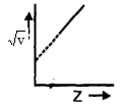
B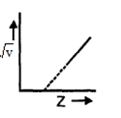
C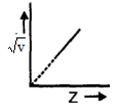
D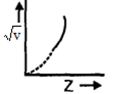
Solution
(B) According to Moseley's law,the frequency $\nu$ of a characteristic $X$-ray line is related to the atomic number $Z$ of the target material by the equation:
$\sqrt{\nu} = a(Z - b)$
where $a$ and $b$ are constants depending on the specific spectral line (e.g.,$K_{\alpha}$,$L_{\alpha}$).
This equation represents a straight line of the form $y = mx + c$,where $y = \sqrt{\nu}$,$x = Z$,$m = a$ (slope),and $c = -ab$ (y-intercept).
Since $b > 0$,the y-intercept $-ab$ is negative.
Therefore,the graph of $\sqrt{\nu}$ versus $Z$ is a straight line that does not pass through the origin and has a negative y-intercept.
Looking at the given options,graph $A$ represents a straight line with a positive y-intercept,graph $B$ represents a straight line with a negative y-intercept,graph $C$ represents a straight line passing through the origin,and graph $D$ represents a curve.
Thus,graph $B$ is the correct representation.
$\sqrt{\nu} = a(Z - b)$
where $a$ and $b$ are constants depending on the specific spectral line (e.g.,$K_{\alpha}$,$L_{\alpha}$).
This equation represents a straight line of the form $y = mx + c$,where $y = \sqrt{\nu}$,$x = Z$,$m = a$ (slope),and $c = -ab$ (y-intercept).
Since $b > 0$,the y-intercept $-ab$ is negative.
Therefore,the graph of $\sqrt{\nu}$ versus $Z$ is a straight line that does not pass through the origin and has a negative y-intercept.
Looking at the given options,graph $A$ represents a straight line with a positive y-intercept,graph $B$ represents a straight line with a negative y-intercept,graph $C$ represents a straight line passing through the origin,and graph $D$ represents a curve.
Thus,graph $B$ is the correct representation.
0 likes
View Solution157
EasyMCQ
The power input in an $X$-ray tube is increased by:
A
Increasing the potential difference between the anode and cathode.
B
Decreasing the potential difference between the anode and cathode.
C
Increasing the filament current.
D
Decreasing the filament current.
Solution
(C) The power input $P$ to an $X$-ray tube is given by the product of the accelerating voltage $V$ and the beam current $I$ (which is determined by the filament current),i.e.,$P = V \times I$.
Increasing the filament current increases the temperature of the filament,which leads to a higher rate of thermionic emission of electrons from the cathode. This increase in the number of emitted electrons results in a higher beam current $I$.
Since $P = V \times I$,an increase in the beam current $I$ directly leads to an increase in the power input $P$ to the $X$-ray tube.
Increasing the filament current increases the temperature of the filament,which leads to a higher rate of thermionic emission of electrons from the cathode. This increase in the number of emitted electrons results in a higher beam current $I$.
Since $P = V \times I$,an increase in the beam current $I$ directly leads to an increase in the power input $P$ to the $X$-ray tube.
0 likes
View Solution158
EasyMCQ
If the energy of an electron in the $K$-shell is $40000 \,eV$ and an accelerating potential of $60000 \,eV$ is applied across a Coolidge tube,which of the following $X$-rays will be obtained?
A
Continuous $X$-rays
B
$K$-series $X$-rays
C
Both continuous and characteristic $K$-series $X$-rays
D
None of these
Solution
(C) In a Coolidge tube,continuous $X$-rays are produced due to the deceleration of electrons as they strike the target,which occurs for any accelerating potential.
For characteristic $K$-series $X$-rays to be produced,the incident electron must have sufficient energy to knock out an electron from the $K$-shell.
The energy required to remove an electron from the $K$-shell is $40000 \,eV$.
Since the applied accelerating potential is $60000 \,eV$,which is greater than the $K$-shell binding energy $(60000 \,eV > 40000 \,eV)$,the incident electrons have enough energy to ionize the $K$-shell.
Therefore,both continuous $X$-rays (due to Bremsstrahlung) and characteristic $K$-series $X$-rays will be obtained.
For characteristic $K$-series $X$-rays to be produced,the incident electron must have sufficient energy to knock out an electron from the $K$-shell.
The energy required to remove an electron from the $K$-shell is $40000 \,eV$.
Since the applied accelerating potential is $60000 \,eV$,which is greater than the $K$-shell binding energy $(60000 \,eV > 40000 \,eV)$,the incident electrons have enough energy to ionize the $K$-shell.
Therefore,both continuous $X$-rays (due to Bremsstrahlung) and characteristic $K$-series $X$-rays will be obtained.
0 likes
View Solution159
EasyMCQ
The order of voltage applied across the ends of an $X$-ray tube is ...... $V$.
A
$1000$
B
$100$
C
$10$
D
$10^6$
Solution
(A) In an $X$-ray tube,the potential difference applied between the cathode and the anode (target) is typically in the range of kilovolts $(kV)$.
Therefore,the order of magnitude of the voltage is $10^3 \, V$ or $1000 \, V$.
Therefore,the order of magnitude of the voltage is $10^3 \, V$ or $1000 \, V$.
0 likes
View Solution160
MediumMCQ
If the frequency of the $K_\alpha$ line of an element with $Z = 64$ is $\nu_\alpha$ and the frequency of the $K_\alpha$ line of an element with $Z = 80$ is $\nu'_\alpha$,then the ratio of their frequencies is:
A
$16/25$
B
$2/5$
C
$4/5$
D
$25/16$
Solution
(A) According to Moseley's Law,the frequency of characteristic $X$-rays is given by $\nu = a(Z - b)^2$,where $b = 1$ for $K_\alpha$ lines.
Thus,$\nu \propto (Z - 1)^2$.
For $Z_1 = 64$,$\nu_\alpha \propto (64 - 1)^2 = 63^2$.
For $Z_2 = 80$,$\nu'_\alpha \propto (80 - 1)^2 = 79^2$.
The ratio is $\frac{\nu_\alpha}{\nu'_\alpha} = \frac{(63)^2}{(79)^2} = \frac{3969}{6241}$.
Note: If the question assumes the simplified relation $\nu \propto Z^2$ (ignoring the screening constant $b=1$),then $\frac{\nu_\alpha}{\nu'_\alpha} = \frac{64^2}{80^2} = (\frac{64}{80})^2 = (\frac{4}{5})^2 = \frac{16}{25}$.
Thus,$\nu \propto (Z - 1)^2$.
For $Z_1 = 64$,$\nu_\alpha \propto (64 - 1)^2 = 63^2$.
For $Z_2 = 80$,$\nu'_\alpha \propto (80 - 1)^2 = 79^2$.
The ratio is $\frac{\nu_\alpha}{\nu'_\alpha} = \frac{(63)^2}{(79)^2} = \frac{3969}{6241}$.
Note: If the question assumes the simplified relation $\nu \propto Z^2$ (ignoring the screening constant $b=1$),then $\frac{\nu_\alpha}{\nu'_\alpha} = \frac{64^2}{80^2} = (\frac{64}{80})^2 = (\frac{4}{5})^2 = \frac{16}{25}$.
0 likes
View Solution161
MediumMCQ
In a Coolidge tube,the potential difference between the cathode and the anode is $120 \, kV$. What will be the maximum energy of the emitted $X$-rays?
A
$1.2 \times 10^5 \, eV$
B
$10^{10} \, eV$
C
$10^{15} \, eV$
D
$10^{20} \, eV$
Solution
(A) The maximum energy of an $X$-ray photon produced in a Coolidge tube is equal to the kinetic energy gained by an electron accelerated through the potential difference $V$.
Given,potential difference $V = 120 \, kV = 120 \times 10^3 \, V$.
The maximum energy $E_{max}$ is given by the relation:
$E_{max} = eV$
Substituting the values:
$E_{max} = e \times (120 \times 10^3 \, V) = 120 \times 10^3 \, eV$
$E_{max} = 1.2 \times 10^5 \, eV$.
Given,potential difference $V = 120 \, kV = 120 \times 10^3 \, V$.
The maximum energy $E_{max}$ is given by the relation:
$E_{max} = eV$
Substituting the values:
$E_{max} = e \times (120 \times 10^3 \, V) = 120 \times 10^3 \, eV$
$E_{max} = 1.2 \times 10^5 \, eV$.
0 likes
View Solution162
MediumMCQ
If the minimum wavelength of an $X$-ray is $2 \mathring{A}$,then the potential difference between the anode and the cathode is ...... $kV$.
A
$62$
B
$6.2$
C
$24.8$
D
$2.48$
Solution
(B) The minimum wavelength of $X$-rays is given by the Duane-Hunt law: $\lambda_{\min} = \frac{hc}{eV}$.
Substituting the values $h = 6.63 \times 10^{-34} \ J \cdot s$,$c = 3 \times 10^8 \ m/s$,and $e = 1.6 \times 10^{-19} \ C$,we get $\lambda_{\min} \approx \frac{12400 \ \mathring{A} \cdot V}{V}$.
Given $\lambda_{\min} = 2 \ \mathring{A}$.
Therefore,$V = \frac{12400}{\lambda_{\min} (\text{in } \mathring{A})} \ V$.
$V = \frac{12400}{2} \ V = 6200 \ V$.
Converting to kilovolts,$V = 6.2 \ kV$.
Substituting the values $h = 6.63 \times 10^{-34} \ J \cdot s$,$c = 3 \times 10^8 \ m/s$,and $e = 1.6 \times 10^{-19} \ C$,we get $\lambda_{\min} \approx \frac{12400 \ \mathring{A} \cdot V}{V}$.
Given $\lambda_{\min} = 2 \ \mathring{A}$.
Therefore,$V = \frac{12400}{\lambda_{\min} (\text{in } \mathring{A})} \ V$.
$V = \frac{12400}{2} \ V = 6200 \ V$.
Converting to kilovolts,$V = 6.2 \ kV$.
0 likes
View Solution163
MediumMCQ
In tungsten,the energy of a $K$-shell electron is $20 \, keV$ and that of an $L$-shell electron is $2 \, keV$. When an electron jumps from the $L$ shell to the $K$ shell,the wavelength of the emitted $X$-ray photon will be:
A
$0.3443 \, \mathring{A}$
B
$0.6887 \, \mathring{A}$
C
$1.3982 \, \mathring{A}$
D
$2.78 \, \mathring{A}$
Solution
(B) The energy of the emitted photon $(E)$ is equal to the difference in energy between the two shells: $E = E_K - E_L$.
Given $E_K = 20 \, keV$ and $E_L = 2 \, keV$,the energy difference is $\Delta E = 20 \, keV - 2 \, keV = 18 \, keV = 18000 \, eV$.
The wavelength $\lambda$ is given by the formula $\lambda = \frac{hc}{E}$.
Using the relation $\lambda \approx \frac{12400 \, eV \cdot \mathring{A}}{E \text{ (in } eV)}$,we get:
$\lambda = \frac{12400}{18000} \, \mathring{A} = 0.6888 \, \mathring{A}$.
Rounding to the nearest option,the wavelength is $0.6887 \, \mathring{A}$.
Given $E_K = 20 \, keV$ and $E_L = 2 \, keV$,the energy difference is $\Delta E = 20 \, keV - 2 \, keV = 18 \, keV = 18000 \, eV$.
The wavelength $\lambda$ is given by the formula $\lambda = \frac{hc}{E}$.
Using the relation $\lambda \approx \frac{12400 \, eV \cdot \mathring{A}}{E \text{ (in } eV)}$,we get:
$\lambda = \frac{12400}{18000} \, \mathring{A} = 0.6888 \, \mathring{A}$.
Rounding to the nearest option,the wavelength is $0.6887 \, \mathring{A}$.
0 likes
View Solution164
MediumMCQ
The wavelength of the $K_{\alpha}$ line for an element with atomic number $57$ is $\lambda$. What will be the wavelength of the $K_{\alpha}$ line for an element with atomic number $29$?
A
$\lambda$
B
$13\lambda$
C
$2\lambda$
D
$4\lambda$
Solution
(D) According to Moseley's Law for $K_{\alpha}$ $X$-ray emission,the frequency $\nu$ is given by $\nu \propto (Z - 1)^2$.
Since $\lambda = c/\nu$,we have $\frac{1}{\lambda} \propto (Z - 1)^2$,which implies $\lambda \propto \frac{1}{(Z - 1)^2}$.
Given $\lambda_1 = \lambda$ for $Z_1 = 57$ and we need to find $\lambda_2$ for $Z_2 = 29$.
Using the ratio: $\frac{\lambda_2}{\lambda_1} = \frac{(Z_1 - 1)^2}{(Z_2 - 1)^2}$.
Substituting the values: $\frac{\lambda_2}{\lambda} = \frac{(57 - 1)^2}{(29 - 1)^2} = \frac{56^2}{28^2}$.
$\frac{\lambda_2}{\lambda} = (\frac{56}{28})^2 = 2^2 = 4$.
Therefore,$\lambda_2 = 4\lambda$.
Since $\lambda = c/\nu$,we have $\frac{1}{\lambda} \propto (Z - 1)^2$,which implies $\lambda \propto \frac{1}{(Z - 1)^2}$.
Given $\lambda_1 = \lambda$ for $Z_1 = 57$ and we need to find $\lambda_2$ for $Z_2 = 29$.
Using the ratio: $\frac{\lambda_2}{\lambda_1} = \frac{(Z_1 - 1)^2}{(Z_2 - 1)^2}$.
Substituting the values: $\frac{\lambda_2}{\lambda} = \frac{(57 - 1)^2}{(29 - 1)^2} = \frac{56^2}{28^2}$.
$\frac{\lambda_2}{\lambda} = (\frac{56}{28})^2 = 2^2 = 4$.
Therefore,$\lambda_2 = 4\lambda$.
0 likes
View Solution165
MediumMCQ
The $K_\alpha$ $X$-ray emission line for tungsten occurs at $\lambda = 0.021 \ nm$. What is the energy difference between the $K$ and $L$ levels in this atom in $keV$?
A
$39$
B
$59$
C
$72$
D
$85$
Solution
(B) The energy of the emitted $K_\alpha$ photon is given by the difference in energy between the $K$ and $L$ shells: $\Delta E = E_K - E_L = \frac{hc}{\lambda}$.
Given $h = 6.63 \times 10^{-34} \ J \cdot s$,$c = 3 \times 10^8 \ m/s$,and $\lambda = 0.021 \times 10^{-9} \ m$.
$\Delta E = \frac{(6.63 \times 10^{-34} \ J \cdot s) \times (3 \times 10^8 \ m/s)}{0.021 \times 10^{-9} \ m}$.
$\Delta E \approx 9.47 \times 10^{-15} \ J$.
To convert this energy into $keV$,divide by the charge of an electron $(1.6 \times 10^{-19} \ C)$ and then by $1000$.
$\Delta E_{keV} = \frac{9.47 \times 10^{-15}}{1.6 \times 10^{-19} \times 1000} \approx 59.2 \ keV$.
Rounding to the nearest integer,the energy difference is $59 \ keV$.
Given $h = 6.63 \times 10^{-34} \ J \cdot s$,$c = 3 \times 10^8 \ m/s$,and $\lambda = 0.021 \times 10^{-9} \ m$.
$\Delta E = \frac{(6.63 \times 10^{-34} \ J \cdot s) \times (3 \times 10^8 \ m/s)}{0.021 \times 10^{-9} \ m}$.
$\Delta E \approx 9.47 \times 10^{-15} \ J$.
To convert this energy into $keV$,divide by the charge of an electron $(1.6 \times 10^{-19} \ C)$ and then by $1000$.
$\Delta E_{keV} = \frac{9.47 \times 10^{-15}}{1.6 \times 10^{-19} \times 1000} \approx 59.2 \ keV$.
Rounding to the nearest integer,the energy difference is $59 \ keV$.
0 likes
View Solution166
EasyMCQ
The energy of the $L$ shell is $7200$ units and the energy of the $K$ shell is $1800$ units. Therefore,the energy of the $K_\alpha$ line is equal to ...... units.
A
$5400$
B
$9000$
C
$6900$
D
$7200$
Solution
(A) The $K_\alpha$ $X$-ray line is produced when an electron transitions from the $L$ shell (higher energy state) to the $K$ shell (lower energy state).
The energy of the emitted photon is given by the difference in energy between the two shells:
$\Delta E_{K_\alpha} = E_L - E_K$
Given:
$E_L = 7200$ units
$E_K = 1800$ units
Substituting the values:
$\Delta E_{K_\alpha} = 7200 - 1800 = 5400$ units.
The energy of the emitted photon is given by the difference in energy between the two shells:
$\Delta E_{K_\alpha} = E_L - E_K$
Given:
$E_L = 7200$ units
$E_K = 1800$ units
Substituting the values:
$\Delta E_{K_\alpha} = 7200 - 1800 = 5400$ units.
0 likes
View Solution167
MediumMCQ
If the attenuation coefficient of aluminum for soft $X$-rays is $1.73 \, cm^{-1}$,what percentage of $X$-rays will pass through an aluminum sheet of thickness $1.156 \, cm$?
A
$13.5$
B
$6.8$
C
$20.4$
D
$27$
Solution
(A) The intensity of $X$-rays after passing through a material is given by the formula $I = I_0 e^{-\mu x}$,where $I_0$ is the initial intensity,$\mu$ is the attenuation coefficient,and $x$ is the thickness of the material.
Given: $\mu = 1.73 \, cm^{-1}$ and $x = 1.156 \, cm$.
The ratio of transmitted intensity to initial intensity is $\frac{I}{I_0} = e^{-\mu x}$.
Substituting the values: $\frac{I}{I_0} = e^{-(1.73 \times 1.156)} = e^{-2}$.
Since $e \approx 2.718$,$e^2 \approx 7.389$.
Thus,$\frac{I}{I_0} = \frac{1}{7.389} \approx 0.1353$.
To express this as a percentage,multiply by $100$: $0.1353 \times 100 = 13.53\%$.
Therefore,approximately $13.5\%$ of the $X$-rays will pass through the sheet.
Given: $\mu = 1.73 \, cm^{-1}$ and $x = 1.156 \, cm$.
The ratio of transmitted intensity to initial intensity is $\frac{I}{I_0} = e^{-\mu x}$.
Substituting the values: $\frac{I}{I_0} = e^{-(1.73 \times 1.156)} = e^{-2}$.
Since $e \approx 2.718$,$e^2 \approx 7.389$.
Thus,$\frac{I}{I_0} = \frac{1}{7.389} \approx 0.1353$.
To express this as a percentage,multiply by $100$: $0.1353 \times 100 = 13.53\%$.
Therefore,approximately $13.5\%$ of the $X$-rays will pass through the sheet.
0 likes
View Solution168
MediumMCQ
If the lattice constant of a crystal is $3 \times 10^{-8} \, cm$ and the glancing angle for the first-order diffraction of $X$-rays is $30^{\circ}$,then the value of $\lambda$ will be ..... $\times 10^{-8} \, cm$.
A
$6$
B
$3$
C
$1.5$
D
$1$
Solution
(B) Given: Lattice constant $d = 3 \times 10^{-8} \, cm$,glancing angle $\theta = 30^{\circ}$,and order of diffraction $n = 1$.
Using Bragg's Law: $2d \sin \theta = n\lambda$.
Substituting the values: $\lambda = \frac{2 \times (3 \times 10^{-8} \, cm) \times \sin(30^{\circ})}{1}$.
Since $\sin(30^{\circ}) = 0.5$,we get $\lambda = 2 \times 3 \times 10^{-8} \times 0.5 = 3 \times 10^{-8} \, cm$.
Thus,the value is $3 \times 10^{-8} \, cm$.
Using Bragg's Law: $2d \sin \theta = n\lambda$.
Substituting the values: $\lambda = \frac{2 \times (3 \times 10^{-8} \, cm) \times \sin(30^{\circ})}{1}$.
Since $\sin(30^{\circ}) = 0.5$,we get $\lambda = 2 \times 3 \times 10^{-8} \times 0.5 = 3 \times 10^{-8} \, cm$.
Thus,the value is $3 \times 10^{-8} \, cm$.
0 likes
View Solution169
EasyMCQ
When $X$-rays from a Coolidge tube pass through an aluminum foil of thickness $0.3 \, mm$,$50\%$ of the $X$-rays are transmitted. If the potential difference between the target and the cathode is increased,the fraction of $X$-rays transmitted through the same foil will be .......
A
$50\%$
B
$> 50\%$
C
$< 50\%$
D
$0\%$
Solution
(B) The intensity of transmitted $X$-rays through a material is given by $I = I_0 e^{-\mu x}$,where $\mu$ is the linear absorption coefficient and $x$ is the thickness of the material.
The absorption coefficient $\mu$ depends on the wavelength $\lambda$ of the $X$-rays. Specifically,$\mu \propto \lambda^3$.
When the potential difference $V$ between the target and the cathode is increased,the energy of the electrons increases,which leads to the emission of $X$-rays with shorter wavelengths (higher frequency).
Since $\lambda$ decreases as $V$ increases,the absorption coefficient $\mu$ decreases $(\mu \propto \lambda^3)$.
As $\mu$ decreases,the transmission $I/I_0 = e^{-\mu x}$ increases.
Therefore,the fraction of $X$-rays transmitted through the same foil will be greater than $50\%$.
The absorption coefficient $\mu$ depends on the wavelength $\lambda$ of the $X$-rays. Specifically,$\mu \propto \lambda^3$.
When the potential difference $V$ between the target and the cathode is increased,the energy of the electrons increases,which leads to the emission of $X$-rays with shorter wavelengths (higher frequency).
Since $\lambda$ decreases as $V$ increases,the absorption coefficient $\mu$ decreases $(\mu \propto \lambda^3)$.
As $\mu$ decreases,the transmission $I/I_0 = e^{-\mu x}$ increases.
Therefore,the fraction of $X$-rays transmitted through the same foil will be greater than $50\%$.
0 likes
View Solution170
MediumMCQ
When an $X$-ray tube operates at a tube voltage of $50 \, kV$,the anode current is $20 \, mA$. If the efficiency of the $X$-ray production is $1 \%$,what is the heat produced per second in calories?
A
$249$
B
$236$
C
$1000$
D
$990$
Solution
(B) The total power input to the $X$-ray tube is $P = V \times I = 50 \times 10^3 \, V \times 20 \times 10^{-3} \, A = 1000 \, W$ (or $J/s$).
Since the efficiency $\eta$ is $1 \%$,the power converted into $X$-rays is $P_{X} = 0.01 \times 1000 = 10 \, J/s$.
The remaining power is dissipated as heat: $P_{heat} = P - P_{X} = 1000 - 10 = 990 \, J/s$.
To convert this into calories per second,we use the conversion factor $1 \, cal \approx 4.2 \, J$.
Heat produced per second $= \frac{990}{4.2} \approx 235.7 \, cal/s \approx 236 \, cal/s$.
Since the efficiency $\eta$ is $1 \%$,the power converted into $X$-rays is $P_{X} = 0.01 \times 1000 = 10 \, J/s$.
The remaining power is dissipated as heat: $P_{heat} = P - P_{X} = 1000 - 10 = 990 \, J/s$.
To convert this into calories per second,we use the conversion factor $1 \, cal \approx 4.2 \, J$.
Heat produced per second $= \frac{990}{4.2} \approx 235.7 \, cal/s \approx 236 \, cal/s$.
0 likes
View Solution171
EasyMCQ
If the operating voltage of an $X$-ray tube is $50 \, kV$,then the velocity of the $X$-rays is . . . . .
A
$4 \times 10^4 \, m/s$
B
$3 \times 10^8 \, m/s$
C
$10^8 \, m/s$
D
$3 \, m/s$
Solution
(B) $X$-rays are electromagnetic waves.
All electromagnetic waves travel at the speed of light in a vacuum.
The speed of light in a vacuum is $c = 3 \times 10^8 \, m/s$.
Since $X$-rays are electromagnetic radiation,their velocity is independent of the operating voltage of the $X$-ray tube.
Therefore,the velocity of the $X$-rays is $3 \times 10^8 \, m/s$.
All electromagnetic waves travel at the speed of light in a vacuum.
The speed of light in a vacuum is $c = 3 \times 10^8 \, m/s$.
Since $X$-rays are electromagnetic radiation,their velocity is independent of the operating voltage of the $X$-ray tube.
Therefore,the velocity of the $X$-rays is $3 \times 10^8 \, m/s$.
0 likes
View Solution172
EasyMCQ
For the study of bone fractures,the minimum wavelength of $X$-rays should be $10^{-11} \ m$. The accelerating voltage for electrons in the $X$-ray machine will be .......
A
$< 124.2 \ kV$
B
$> 124.2 \ kV$
C
Between $60 \ kV$ and $70 \ kV$
D
$= 100 \ kV$
Solution
(B) The minimum wavelength $\lambda_{min}$ of $X$-rays produced by an accelerating voltage $V$ is given by the formula: $\lambda_{min} = \frac{hc}{eV} = \frac{12400 \ \text{eV} \cdot \mathring{A}}{eV} \approx \frac{12400}{V(\text{volts})} \times 10^{-10} \ m$.
Given $\lambda_{min} = 10^{-11} \ m = 10^{-10} \ \mathring{A}$.
Substituting the values: $10^{-11} = \frac{12400 \times 10^{-10}}{V}$.
$V = \frac{12400 \times 10^{-10}}{10^{-11}} = 124000 \ V = 124 \ kV$.
Since the question specifies that the minimum wavelength should be $10^{-11} \ m$,the energy of the electrons must be at least $124 \ kV$. Therefore,the accelerating voltage must be at least $124.2 \ kV$ (or greater) to produce $X$-rays of this wavelength or shorter.
Given $\lambda_{min} = 10^{-11} \ m = 10^{-10} \ \mathring{A}$.
Substituting the values: $10^{-11} = \frac{12400 \times 10^{-10}}{V}$.
$V = \frac{12400 \times 10^{-10}}{10^{-11}} = 124000 \ V = 124 \ kV$.
Since the question specifies that the minimum wavelength should be $10^{-11} \ m$,the energy of the electrons must be at least $124 \ kV$. Therefore,the accelerating voltage must be at least $124.2 \ kV$ (or greater) to produce $X$-rays of this wavelength or shorter.
0 likes
View Solution173
MediumMCQ
When an $X$-ray tube operates at $60 \ kV$,the observed tube current is $50 \ mA$. Assuming that the total energy of the electrons is converted into heat,the rate of heat production at the anode in $cal/s$ is:
A
$100$
B
$300$
C
$500$
D
$714$
Solution
(D) The power or rate of heat production is given by $P = VI$.
Given $V = 60 \ kV = 60 \times 10^3 \ V$ and $I = 50 \ mA = 50 \times 10^{-3} \ A$.
$P = (60 \times 10^3) \times (50 \times 10^{-3}) = 3000 \ J/s$.
Since $1 \ calorie = 4.2 \ J$,the rate of heat production in $cal/s$ is $\frac{3000}{4.2} \ cal/s$.
$P \approx 714.3 \ cal/s$.
Thus,the correct option is $D$.
Given $V = 60 \ kV = 60 \times 10^3 \ V$ and $I = 50 \ mA = 50 \times 10^{-3} \ A$.
$P = (60 \times 10^3) \times (50 \times 10^{-3}) = 3000 \ J/s$.
Since $1 \ calorie = 4.2 \ J$,the rate of heat production in $cal/s$ is $\frac{3000}{4.2} \ cal/s$.
$P \approx 714.3 \ cal/s$.
Thus,the correct option is $D$.
0 likes
View Solution174
EasyMCQ
Find the ratio of the energy of an $X$-ray photon with a wavelength of $1 \mathring A$ to the energy of a visible light photon with a wavelength of $5000 \mathring A$.
A
$1:5000$
B
$5000:1$
C
$1:5000$
D
$5000:1$
Solution
(B) The energy $E$ of a photon is given by the formula $E = \frac{hc}{\lambda}$.
Since $h$ (Planck's constant) and $c$ (speed of light) are constants,the energy is inversely proportional to the wavelength: $E \propto \frac{1}{\lambda}$.
Let $E_1$ be the energy of the $X$-ray photon with wavelength $\lambda_1 = 1 \mathring A$.
Let $E_2$ be the energy of the visible light photon with wavelength $\lambda_2 = 5000 \mathring A$.
The ratio of the energies is given by $\frac{E_1}{E_2} = \frac{\lambda_2}{\lambda_1}$.
Substituting the given values: $\frac{E_1}{E_2} = \frac{5000 \mathring A}{1 \mathring A} = 5000$.
Therefore,the ratio is $5000:1$.
Since $h$ (Planck's constant) and $c$ (speed of light) are constants,the energy is inversely proportional to the wavelength: $E \propto \frac{1}{\lambda}$.
Let $E_1$ be the energy of the $X$-ray photon with wavelength $\lambda_1 = 1 \mathring A$.
Let $E_2$ be the energy of the visible light photon with wavelength $\lambda_2 = 5000 \mathring A$.
The ratio of the energies is given by $\frac{E_1}{E_2} = \frac{\lambda_2}{\lambda_1}$.
Substituting the given values: $\frac{E_1}{E_2} = \frac{5000 \mathring A}{1 \mathring A} = 5000$.
Therefore,the ratio is $5000:1$.
0 likes
View Solution175
DifficultMCQ
If the wavelength of the $K_\alpha$ line of an element with atomic number $43$ is $\lambda$,then the wavelength of the $K_\alpha$ line of an element with atomic number $29$ is:
A
$(43/29) \lambda$
B
$(42/28) \lambda$
C
$(9/4) \lambda$
D
$(4/9) \lambda$
Solution
(C) According to Moseley's Law,the frequency $\nu$ of the $K_\alpha$ line is given by $\nu = c/\lambda = R(Z-1)^2(1/1^2 - 1/2^2)$.
Thus,$1/\lambda \propto (Z-1)^2$.
Let $\lambda_1$ be the wavelength for $Z_1 = 43$ and $\lambda_2$ be the wavelength for $Z_2 = 29$.
Then,$\lambda_2 / \lambda_1 = (Z_1 - 1)^2 / (Z_2 - 1)^2$.
Substituting the values: $\lambda_2 / \lambda = (43 - 1)^2 / (29 - 1)^2$.
$\lambda_2 / \lambda = (42)^2 / (28)^2 = (42/28)^2$.
Simplifying the fraction $42/28 = 3/2$.
Therefore,$\lambda_2 / \lambda = (3/2)^2 = 9/4$.
Hence,$\lambda_2 = (9/4) \lambda$.
Thus,$1/\lambda \propto (Z-1)^2$.
Let $\lambda_1$ be the wavelength for $Z_1 = 43$ and $\lambda_2$ be the wavelength for $Z_2 = 29$.
Then,$\lambda_2 / \lambda_1 = (Z_1 - 1)^2 / (Z_2 - 1)^2$.
Substituting the values: $\lambda_2 / \lambda = (43 - 1)^2 / (29 - 1)^2$.
$\lambda_2 / \lambda = (42)^2 / (28)^2 = (42/28)^2$.
Simplifying the fraction $42/28 = 3/2$.
Therefore,$\lambda_2 / \lambda = (3/2)^2 = 9/4$.
Hence,$\lambda_2 = (9/4) \lambda$.
0 likes
View Solution176
EasyMCQ
An electron beam is accelerated by a potential difference of $V$ and strikes a metal target to produce $X$-rays. For which of the following values of $V$ (in $kV$) will the $X$-ray wavelength be the shortest?
A
$10$
B
$20$
C
$30$
D
$40$
Solution
(D) The energy of the electron is given by $E = eV$,where $e$ is the charge of the electron and $V$ is the accelerating potential difference.
This energy is converted into the energy of the emitted $X$-ray photon,$E = \frac{hc}{\lambda}$.
Equating the two,we get $eV = \frac{hc}{\lambda}$,which implies $\lambda = \frac{hc}{eV}$.
Since $h$,$c$,and $e$ are constants,the minimum wavelength $\lambda_{min}$ is inversely proportional to the accelerating potential $V$ $(\lambda_{min} \propto \frac{1}{V})$.
Therefore,to obtain the shortest wavelength,the potential difference $V$ must be the maximum among the given options.
Comparing the options $10 \ kV, 20 \ kV, 30 \ kV,$ and $40 \ kV$,the maximum value is $40 \ kV$.
This energy is converted into the energy of the emitted $X$-ray photon,$E = \frac{hc}{\lambda}$.
Equating the two,we get $eV = \frac{hc}{\lambda}$,which implies $\lambda = \frac{hc}{eV}$.
Since $h$,$c$,and $e$ are constants,the minimum wavelength $\lambda_{min}$ is inversely proportional to the accelerating potential $V$ $(\lambda_{min} \propto \frac{1}{V})$.
Therefore,to obtain the shortest wavelength,the potential difference $V$ must be the maximum among the given options.
Comparing the options $10 \ kV, 20 \ kV, 30 \ kV,$ and $40 \ kV$,the maximum value is $40 \ kV$.
0 likes
View Solution177
EasyMCQ
If $X$-rays are produced by bombarding electrons with an energy of $40 \ keV$ on a target,what will be the minimum wavelength (in $\mathring{A}$) of the $X$-rays produced?
A
$300$
B
$10$
C
$4$
D
$0.31$
Solution
(D) The energy of the incident electron is $E = 40 \ keV = 40 \times 10^3 \ eV$.
For $X$-rays,the minimum wavelength $\lambda_{\min}$ corresponds to the maximum energy of the emitted photon,which is equal to the kinetic energy of the incident electron.
The relation is given by $E = \frac{hc}{\lambda_{\min}}$.
Using $hc \approx 12400 \ eV \cdot \mathring{A}$,we have $\lambda_{\min} = \frac{12400 \ eV \cdot \mathring{A}}{40 \times 10^3 \ eV}$.
$\lambda_{\min} = \frac{12400}{40000} \ \mathring{A} = 0.31 \ \mathring{A}$.
For $X$-rays,the minimum wavelength $\lambda_{\min}$ corresponds to the maximum energy of the emitted photon,which is equal to the kinetic energy of the incident electron.
The relation is given by $E = \frac{hc}{\lambda_{\min}}$.
Using $hc \approx 12400 \ eV \cdot \mathring{A}$,we have $\lambda_{\min} = \frac{12400 \ eV \cdot \mathring{A}}{40 \times 10^3 \ eV}$.
$\lambda_{\min} = \frac{12400}{40000} \ \mathring{A} = 0.31 \ \mathring{A}$.
0 likes
View Solution178
MediumMCQ
The distance between interatomic lattice planes is $10\ \mathring A$. The maximum wavelength of $X$-rays that can be diffracted by this crystal is ......$\mathring A$.
A
$10$
B
$20$
C
$30$
D
$40$
Solution
(B) Given the distance between lattice planes $d = 10\ \mathring A$.
According to Bragg's Law,$2d \sin \theta = n \lambda$.
To find the maximum wavelength $\lambda_{\max}$,we set the order of diffraction $n = 1$ and the maximum value of $\sin \theta = 1$.
Substituting these values: $\lambda_{\max} = \frac{2d \sin \theta}{n} = \frac{2 \times 10\ \mathring A \times 1}{1} = 20\ \mathring A$.
According to Bragg's Law,$2d \sin \theta = n \lambda$.
To find the maximum wavelength $\lambda_{\max}$,we set the order of diffraction $n = 1$ and the maximum value of $\sin \theta = 1$.
Substituting these values: $\lambda_{\max} = \frac{2d \sin \theta}{n} = \frac{2 \times 10\ \mathring A \times 1}{1} = 20\ \mathring A$.
0 likes
View Solution179
DifficultMCQ
When $X$-rays of wavelength $0.5 \, Å$ pass through an $Al$ sheet of thickness $10 \, mm$, their intensity is reduced to one-sixth of its initial value. The absorption coefficient for aluminum is ............. $mm^{-1}$.
A
$1.520$
B
$0.589$
C
$1.229$
D
$0.179$
Solution
(D) The intensity of $X$-rays passing through a material is given by the formula $I = I_0 e^{-\mu x}$, where $I$ is the final intensity, $I_0$ is the initial intensity, $\mu$ is the absorption coefficient, and $x$ is the thickness of the material.
Given that $I = \frac{I_0}{6}$ and $x = 10 \, mm$.
Substituting these values: $\frac{I_0}{6} = I_0 e^{-\mu (10)}$.
Taking the natural logarithm on both sides: $\ln(6) = \mu \times 10$.
$\mu = \frac{\ln(6)}{10} = \frac{1.7917}{10} = 0.17917 \, mm^{-1}$.
Rounding to three decimal places, we get $\mu = 0.179 \, mm^{-1}$.
Given that $I = \frac{I_0}{6}$ and $x = 10 \, mm$.
Substituting these values: $\frac{I_0}{6} = I_0 e^{-\mu (10)}$.
Taking the natural logarithm on both sides: $\ln(6) = \mu \times 10$.
$\mu = \frac{\ln(6)}{10} = \frac{1.7917}{10} = 0.17917 \, mm^{-1}$.
Rounding to three decimal places, we get $\mu = 0.179 \, mm^{-1}$.
0 likes
View Solution180
EasyMCQ
For an $X$-ray tube operating at $40 \, kV$, which of the following wavelengths is $NOT$ possible?
A
$0.25$
B
$0.5$
C
$0.52$
D
$0.34$
Solution
(A) The minimum wavelength (cut-off wavelength) of $X$-rays produced is given by the formula: $\lambda_{min} = \frac{hc}{eV} = \frac{12400}{V(\in \, volts)} \, \mathring{A}$.
Given the potential difference $V = 40 \, kV = 40,000 \, V$.
Substituting the values: $\lambda_{min} = \frac{12400}{40000} \, \mathring{A} = 0.31 \, \mathring{A}$.
Any wavelength shorter than the minimum wavelength $\lambda_{min}$ is not possible.
Since $0.25 \, \mathring{A} < 0.31 \, \mathring{A}$, the wavelength $0.25 \, \mathring{A}$ is not possible.
Given the potential difference $V = 40 \, kV = 40,000 \, V$.
Substituting the values: $\lambda_{min} = \frac{12400}{40000} \, \mathring{A} = 0.31 \, \mathring{A}$.
Any wavelength shorter than the minimum wavelength $\lambda_{min}$ is not possible.
Since $0.25 \, \mathring{A} < 0.31 \, \mathring{A}$, the wavelength $0.25 \, \mathring{A}$ is not possible.
0 likes
View Solution181
MediumMCQ
If the wavelength of the $K_\alpha$ line of Molybdenum (atomic number $Z = 42$) is $0.7078\, \mathring A$,then the wavelength of the $K_\alpha$ line of Zinc (atomic number $Z = 30$) is .......
A
$0.3541\, \mathring A$
B
$1.414\, \mathring A$
C
$0.9425\, \mathring A$
D
$1.2547\, \mathring A$
Solution
(B) According to Moseley's law,the frequency of the $K_\alpha$ line is given by $\nu = cR(Z-1)^2(\frac{1}{1^2} - \frac{1}{2^2}) = \frac{3}{4}cR(Z-1)^2$.
Since $\lambda = \frac{c}{\nu}$,we have $\frac{1}{\lambda} \propto (Z-1)^2$,which implies $\lambda \propto \frac{1}{(Z-1)^2}$.
Therefore,$\frac{\lambda_{Zn}}{\lambda_{Mo}} = \frac{(Z_{Mo}-1)^2}{(Z_{Zn}-1)^2} = \left(\frac{42-1}{30-1}\right)^2 = \left(\frac{41}{29}\right)^2$.
$\lambda_{Zn} = \lambda_{Mo} \times \left(\frac{41}{29}\right)^2 = 0.7078 \times \left(\frac{1681}{841}\right) \approx 0.7078 \times 1.9988 \approx 1.414\, \mathring A$.
Since $\lambda = \frac{c}{\nu}$,we have $\frac{1}{\lambda} \propto (Z-1)^2$,which implies $\lambda \propto \frac{1}{(Z-1)^2}$.
Therefore,$\frac{\lambda_{Zn}}{\lambda_{Mo}} = \frac{(Z_{Mo}-1)^2}{(Z_{Zn}-1)^2} = \left(\frac{42-1}{30-1}\right)^2 = \left(\frac{41}{29}\right)^2$.
$\lambda_{Zn} = \lambda_{Mo} \times \left(\frac{41}{29}\right)^2 = 0.7078 \times \left(\frac{1681}{841}\right) \approx 0.7078 \times 1.9988 \approx 1.414\, \mathring A$.
0 likes
View Solution182
EasyMCQ
The energy of the $K_\alpha$ $X$-ray line of an element is $8578$ units,and the energy of the $L$ level is $-2859$ units. The energy of the $K$ level is . . . . . . units.
A
$-5719$
B
$5719$
C
$11437$
D
$-11437$
Solution
(D) The energy of a characteristic $X$-ray photon emitted during an electronic transition is given by the difference in energy between the two levels involved: $E_{K_\alpha} = E_L - E_K$.
Given that $E_{K_\alpha} = 8578$ units and $E_L = -2859$ units.
Substituting these values into the equation: $8578 = -2859 - E_K$.
Rearranging to solve for $E_K$: $E_K = -2859 - 8578$.
Therefore,$E_K = -11437$ units.
Given that $E_{K_\alpha} = 8578$ units and $E_L = -2859$ units.
Substituting these values into the equation: $8578 = -2859 - E_K$.
Rearranging to solve for $E_K$: $E_K = -2859 - 8578$.
Therefore,$E_K = -11437$ units.
0 likes
View Solution183
DifficultMCQ
The wavelengths of $K_\alpha$ lines of two elements are $250 \, pm$ and $179 \, pm$, respectively. The number of elements between these two elements in the periodic table will be:
A
Zero
B
$3$
C
$2$
D
$1$
Solution
(B) According to Moseley's Law for $K_\alpha$ lines: $\frac{1}{\lambda} = R(Z - 1)^2 \left( \frac{1}{1^2} - \frac{1}{2^2} \right) = \frac{3R(Z - 1)^2}{4}$.
Given $R \approx 1.097 \times 10^7 \, m^{-1}$, so $\frac{1}{R} \approx 912 \, \mathring{A} = 91200 \, pm$.
For the first element $(Z_1)$: $(Z_1 - 1)^2 = \frac{4}{3R \lambda_1} = \frac{4 \times 91200}{3 \times 250} = \frac{364800}{750} \approx 486.4$. Thus, $Z_1 - 1 \approx 22.05 \Rightarrow Z_1 \approx 23$.
For the second element $(Z_2)$: $(Z_2 - 1)^2 = \frac{4}{3R \lambda_2} = \frac{4 \times 91200}{3 \times 179} = \frac{364800}{537} \approx 679.3$. Thus, $Z_2 - 1 \approx 26.06 \Rightarrow Z_2 \approx 27$.
The elements between $Z_1 = 23$ and $Z_2 = 27$ are $24, 25, 26$. The number of elements is $3$.
Given $R \approx 1.097 \times 10^7 \, m^{-1}$, so $\frac{1}{R} \approx 912 \, \mathring{A} = 91200 \, pm$.
For the first element $(Z_1)$: $(Z_1 - 1)^2 = \frac{4}{3R \lambda_1} = \frac{4 \times 91200}{3 \times 250} = \frac{364800}{750} \approx 486.4$. Thus, $Z_1 - 1 \approx 22.05 \Rightarrow Z_1 \approx 23$.
For the second element $(Z_2)$: $(Z_2 - 1)^2 = \frac{4}{3R \lambda_2} = \frac{4 \times 91200}{3 \times 179} = \frac{364800}{537} \approx 679.3$. Thus, $Z_2 - 1 \approx 26.06 \Rightarrow Z_2 \approx 27$.
The elements between $Z_1 = 23$ and $Z_2 = 27$ are $24, 25, 26$. The number of elements is $3$.
0 likes
View Solution184
MediumMCQ
When an $X$-ray of wavelength $0.5 \, \mathring{A}$ passes through a metal foil of thickness $3.5 \, mm$,its intensity is reduced to one-fourth of its initial value. The absorption coefficient of the metal is ..... $mm^{-1}$.
A
$0.2$
B
$0.4$
C
$0.6$
D
$0.8$
Solution
(B) The intensity of $X$-rays passing through a material is given by the formula: $I = I_0 e^{-\mu x}$,where $I$ is the final intensity,$I_0$ is the initial intensity,$\mu$ is the absorption coefficient,and $x$ is the thickness of the material.
Given that the intensity becomes one-fourth of the initial value,we have: $\frac{I}{I_0} = \frac{1}{4}$.
Substituting the values into the equation: $\frac{1}{4} = e^{-\mu (3.5 \, mm)}$.
Taking the natural logarithm on both sides: $\ln(1/4) = -\mu (3.5 \, mm) \Rightarrow -\ln(4) = -\mu (3.5 \, mm)$.
Therefore,$\mu = \frac{\ln(4)}{3.5 \, mm} = \frac{2 \ln(2)}{3.5 \, mm}$.
Using $\ln(2) \approx 0.693$: $\mu \approx \frac{2 \times 0.693}{3.5 \, mm} = \frac{1.386}{3.5 \, mm} \approx 0.396 \, mm^{-1}$.
Rounding to the nearest value,we get $\mu \approx 0.4 \, mm^{-1}$.
Given that the intensity becomes one-fourth of the initial value,we have: $\frac{I}{I_0} = \frac{1}{4}$.
Substituting the values into the equation: $\frac{1}{4} = e^{-\mu (3.5 \, mm)}$.
Taking the natural logarithm on both sides: $\ln(1/4) = -\mu (3.5 \, mm) \Rightarrow -\ln(4) = -\mu (3.5 \, mm)$.
Therefore,$\mu = \frac{\ln(4)}{3.5 \, mm} = \frac{2 \ln(2)}{3.5 \, mm}$.
Using $\ln(2) \approx 0.693$: $\mu \approx \frac{2 \times 0.693}{3.5 \, mm} = \frac{1.386}{3.5 \, mm} \approx 0.396 \, mm^{-1}$.
Rounding to the nearest value,we get $\mu \approx 0.4 \, mm^{-1}$.
0 likes
View Solution185
DifficultMCQ
The wavelength of the $K_{\alpha}$ $X$-ray produced by an $X$-ray tube is $0.76 \ \mathring{A}$. The atomic number of the anode material is ...
A
$20$
B
$60$
C
$41$
D
$80$
Solution
(C) According to Moseley's Law for $K_{\alpha}$ $X$-rays:
$\frac{1}{\lambda} = R(Z - 1)^2 \left( \frac{1}{n_1^2} - \frac{1}{n_2^2} \right)$
For $K_{\alpha}$ transition,$n_1 = 1$ and $n_2 = 2$.
So,$\frac{1}{\lambda} = R(Z - 1)^2 \left( 1 - \frac{1}{4} \right) = R(Z - 1)^2 \left( \frac{3}{4} \right)$.
Given $\lambda = 0.76 \ \mathring{A} = 0.76 \times 10^{-10} \ m$ and Rydberg constant $R \approx 1.097 \times 10^7 \ m^{-1}$.
$(Z - 1)^2 = \frac{4}{3 \lambda R} = \frac{4}{3 \times 0.76 \times 10^{-10} \times 1.097 \times 10^7}$.
$(Z - 1)^2 \approx \frac{4}{2.501} \times 10^3 \approx 1600$.
$Z - 1 = \sqrt{1600} = 40$.
$Z = 41$.
$\frac{1}{\lambda} = R(Z - 1)^2 \left( \frac{1}{n_1^2} - \frac{1}{n_2^2} \right)$
For $K_{\alpha}$ transition,$n_1 = 1$ and $n_2 = 2$.
So,$\frac{1}{\lambda} = R(Z - 1)^2 \left( 1 - \frac{1}{4} \right) = R(Z - 1)^2 \left( \frac{3}{4} \right)$.
Given $\lambda = 0.76 \ \mathring{A} = 0.76 \times 10^{-10} \ m$ and Rydberg constant $R \approx 1.097 \times 10^7 \ m^{-1}$.
$(Z - 1)^2 = \frac{4}{3 \lambda R} = \frac{4}{3 \times 0.76 \times 10^{-10} \times 1.097 \times 10^7}$.
$(Z - 1)^2 \approx \frac{4}{2.501} \times 10^3 \approx 1600$.
$Z - 1 = \sqrt{1600} = 40$.
$Z = 41$.
0 likes
View Solution186
MediumMCQ
The wavelength of the $K_\alpha$ $X$-ray line for a given element is $0.32 \, \mathring{A}$. The wavelength of the $K_\beta$ line emitted by the same element will be ... $\mathring{A}$.
A
$0.27$
B
$0.32$
C
$0.39$
D
$0.2$
Solution
(A) According to Moseley's law and the Rydberg formula for $X$-ray transitions,the frequency $\nu$ is given by $\nu = c/\lambda = R(Z-b)^2 (1/n_1^2 - 1/n_2^2)$.
For $K_\alpha$ transition,$n_1 = 1$ and $n_2 = 2$. Thus,$1/\lambda_{K_\alpha} \propto (1/1^2 - 1/2^2) = 3/4$.
For $K_\beta$ transition,$n_1 = 1$ and $n_2 = 3$. Thus,$1/\lambda_{K_\beta} \propto (1/1^2 - 1/3^2) = 8/9$.
Taking the ratio: $\lambda_{K_\beta} / \lambda_{K_\alpha} = (3/4) / (8/9) = (3/4) \times (9/8) = 27/32$.
Given $\lambda_{K_\alpha} = 0.32 \, \mathring{A}$,we have $\lambda_{K_\beta} = (27/32) \times 0.32 \, \mathring{A} = 0.27 \, \mathring{A}$.
For $K_\alpha$ transition,$n_1 = 1$ and $n_2 = 2$. Thus,$1/\lambda_{K_\alpha} \propto (1/1^2 - 1/2^2) = 3/4$.
For $K_\beta$ transition,$n_1 = 1$ and $n_2 = 3$. Thus,$1/\lambda_{K_\beta} \propto (1/1^2 - 1/3^2) = 8/9$.
Taking the ratio: $\lambda_{K_\beta} / \lambda_{K_\alpha} = (3/4) / (8/9) = (3/4) \times (9/8) = 27/32$.
Given $\lambda_{K_\alpha} = 0.32 \, \mathring{A}$,we have $\lambda_{K_\beta} = (27/32) \times 0.32 \, \mathring{A} = 0.27 \, \mathring{A}$.
0 likes
View Solution187
MediumMCQ
The wavelength of the series limit of the Lyman series in the hydrogen spectrum is $911 \ \mathring{A}$. Calculate the atomic number of the element that emits characteristic $X$-rays with a minimum wavelength of $0.7 \ \mathring{A}$.
A
$30$
B
$33$
C
$35$
D
$37$
Solution
(D) The series limit of the Lyman series corresponds to the transition from $n = \infty$ to $n = 1$ in hydrogen $(Z=1)$.
$\frac{1}{\lambda_{\infty}} = R(1)^2 \left( \frac{1}{1^2} - \frac{1}{\infty^2} \right) = R \implies R = \frac{1}{911 \ \mathring{A}}$.
For characteristic $K_{\alpha}$ $X$-rays,the minimum wavelength corresponds to the transition from $n = \infty$ to $n = 1$ (Moseley's Law for $K$-series):
$\frac{1}{\lambda_{min}} = R(Z - 1)^2 \left( \frac{1}{1^2} - \frac{1}{\infty^2} \right) = R(Z - 1)^2$.
Substituting the values:
$\frac{1}{0.7 \ \mathring{A}} = \frac{1}{911 \ \mathring{A}} (Z - 1)^2$.
$(Z - 1)^2 = \frac{911}{0.7} \approx 1301.4$.
Wait,recalculating: The standard value for $R$ is $1.097 \times 10^7 \ m^{-1}$,and $1/R \approx 911.6 \ \mathring{A}$.
$(Z - 1)^2 = \frac{911}{0.7} \approx 1301.4 \implies Z - 1 \approx 36.07$.
Thus,$Z \approx 37$.
$\frac{1}{\lambda_{\infty}} = R(1)^2 \left( \frac{1}{1^2} - \frac{1}{\infty^2} \right) = R \implies R = \frac{1}{911 \ \mathring{A}}$.
For characteristic $K_{\alpha}$ $X$-rays,the minimum wavelength corresponds to the transition from $n = \infty$ to $n = 1$ (Moseley's Law for $K$-series):
$\frac{1}{\lambda_{min}} = R(Z - 1)^2 \left( \frac{1}{1^2} - \frac{1}{\infty^2} \right) = R(Z - 1)^2$.
Substituting the values:
$\frac{1}{0.7 \ \mathring{A}} = \frac{1}{911 \ \mathring{A}} (Z - 1)^2$.
$(Z - 1)^2 = \frac{911}{0.7} \approx 1301.4$.
Wait,recalculating: The standard value for $R$ is $1.097 \times 10^7 \ m^{-1}$,and $1/R \approx 911.6 \ \mathring{A}$.
$(Z - 1)^2 = \frac{911}{0.7} \approx 1301.4 \implies Z - 1 \approx 36.07$.
Thus,$Z \approx 37$.
0 likes
View Solution188
DifficultMCQ
When the atomic number of the first target is $Z_1 = 64$ and the atomic number of the second target is $Z_2 = 80$,the approximate ratio of the wavelengths of the $K_{\alpha,1}$ and $K_{\alpha,2}$ radiations is .......
A
$\frac{1}{4}$
B
$\frac{1}{16}$
C
$\frac{2}{\sqrt{5}}$
D
$\frac{25}{16}$
Solution
(D) According to Moseley's Law,the frequency of characteristic $X$-rays is given by $\nu = a(Z - b)^2$. For $K_{\alpha}$ lines,$b = 1$,so $\nu \propto (Z - 1)^2$.
Since $\lambda = \frac{c}{\nu}$,we have $\lambda \propto \frac{1}{(Z - 1)^2}$.
Given $Z_1 = 64$ and $Z_2 = 80$,the ratio of wavelengths is $\frac{\lambda_1}{\lambda_2} = \frac{(Z_2 - 1)^2}{(Z_1 - 1)^2}$.
Substituting the values: $\frac{\lambda_1}{\lambda_2} = \frac{(80 - 1)^2}{(64 - 1)^2} = \frac{79^2}{63^2} \approx \left(\frac{80}{64}\right)^2 = \left(\frac{5}{4}\right)^2 = \frac{25}{16}$.
Thus,the ratio is $\frac{25}{16}$.
Since $\lambda = \frac{c}{\nu}$,we have $\lambda \propto \frac{1}{(Z - 1)^2}$.
Given $Z_1 = 64$ and $Z_2 = 80$,the ratio of wavelengths is $\frac{\lambda_1}{\lambda_2} = \frac{(Z_2 - 1)^2}{(Z_1 - 1)^2}$.
Substituting the values: $\frac{\lambda_1}{\lambda_2} = \frac{(80 - 1)^2}{(64 - 1)^2} = \frac{79^2}{63^2} \approx \left(\frac{80}{64}\right)^2 = \left(\frac{5}{4}\right)^2 = \frac{25}{16}$.
Thus,the ratio is $\frac{25}{16}$.
0 likes
View Solution189
MediumMCQ
An $X$-ray tube operates at $50 \ kV$. It converts $1\%$ of the energy into $X$-rays. If the amount of heat produced is $495 \ W$, then the number of electrons striking the target per second is:
A
$6.25 \times 10^{16}$
B
$4.15 \times 10^{16}$
C
$3.2 \times 10^{16}$
D
$1.2 \times 10^{18}$
Solution
(A) The total power input to the $X$-ray tube is $P_{in} = VI$, where $V = 50 \ kV = 50 \times 10^3 \ V$ and $I$ is the current.
Since $1\%$ of the energy is converted into $X$-rays, the remaining $99\%$ is converted into heat.
Given that the heat produced is $495 \ W$, we have:
$P_{heat} = 0.99 \times P_{in} = 0.99 \times V \times I$
$495 = 0.99 \times (50 \times 10^3) \times I$
$I = \frac{495}{0.99 \times 50 \times 10^3} = \frac{495}{49500} = 0.01 \ A = 10 \ mA$.
The number of electrons striking the target per second is given by $n = \frac{I}{e}$, where $e = 1.6 \times 10^{-19} \ C$.
$n = \frac{0.01}{1.6 \times 10^{-19}} = \frac{10^{-2}}{1.6 \times 10^{-19}} = 0.625 \times 10^{17} = 6.25 \times 10^{16}$ electrons per second.
Since $1\%$ of the energy is converted into $X$-rays, the remaining $99\%$ is converted into heat.
Given that the heat produced is $495 \ W$, we have:
$P_{heat} = 0.99 \times P_{in} = 0.99 \times V \times I$
$495 = 0.99 \times (50 \times 10^3) \times I$
$I = \frac{495}{0.99 \times 50 \times 10^3} = \frac{495}{49500} = 0.01 \ A = 10 \ mA$.
The number of electrons striking the target per second is given by $n = \frac{I}{e}$, where $e = 1.6 \times 10^{-19} \ C$.
$n = \frac{0.01}{1.6 \times 10^{-19}} = \frac{10^{-2}}{1.6 \times 10^{-19}} = 0.625 \times 10^{17} = 6.25 \times 10^{16}$ electrons per second.
0 likes
View Solution190
DifficultMCQ
An $X$-ray tube operates at $50 \, kV$ and $20 \, mA$. The target material has a mass of $1.0 \, kg$ and a specific heat capacity of $495 \, J \cdot kg^{-1} \cdot ^\circ C^{-1}$. One percent of the applied electrical power is converted into $X$-rays,and the remaining energy is used to heat the target. Then:
$(1)$ $A$ suitable target material should have a high melting point.
$(2)$ $A$ suitable target material should have low thermal conductivity.
$(3)$ The rate of rise of temperature of the target is $2 \, ^\circ C/s$.
$(4)$ The minimum wavelength of the emitted $X$-rays is $0.25 \, \mathring{A}$.
$(1)$ $A$ suitable target material should have a high melting point.
$(2)$ $A$ suitable target material should have low thermal conductivity.
$(3)$ The rate of rise of temperature of the target is $2 \, ^\circ C/s$.
$(4)$ The minimum wavelength of the emitted $X$-rays is $0.25 \, \mathring{A}$.
A
$1, 3, 4$
B
$1, 2, 3$
C
$2, 3, 4$
D
None of these
Solution
(A) The minimum wavelength is given by $\lambda_{\text{min}} = \frac{hc}{eV} = \frac{12400}{50 \times 10^3} \, \mathring{A} = 0.248 \, \mathring{A} \approx 0.25 \, \mathring{A}$. Thus,statement $(4)$ is correct.
For the target material,a high melting point is required to prevent it from melting under intense heat,so statement $(1)$ is correct. High thermal conductivity is required to dissipate heat efficiently,so statement $(2)$ is incorrect.
The power supplied is $P = VI = (50 \times 10^3 \, V) \times (20 \times 10^{-3} \, A) = 1000 \, W$.
The power converted to $X$-rays is $1\%$ of $1000 \, W = 10 \, W$.
The power converted to heat is $P_H = 99\%$ of $1000 \, W = 990 \, W$.
Using $P_H = ms \frac{\Delta \theta}{\Delta t}$,where $m = 1.0 \, kg$ and $s = 495 \, J \cdot kg^{-1} \cdot ^\circ C^{-1}$:
$990 = 1.0 \times 495 \times \frac{\Delta \theta}{\Delta t}$
$\frac{\Delta \theta}{\Delta t} = \frac{990}{495} = 2 \, ^\circ C/s$. Thus,statement $(3)$ is correct.
Therefore,statements $(1), (3),$ and $(4)$ are correct.
For the target material,a high melting point is required to prevent it from melting under intense heat,so statement $(1)$ is correct. High thermal conductivity is required to dissipate heat efficiently,so statement $(2)$ is incorrect.
The power supplied is $P = VI = (50 \times 10^3 \, V) \times (20 \times 10^{-3} \, A) = 1000 \, W$.
The power converted to $X$-rays is $1\%$ of $1000 \, W = 10 \, W$.
The power converted to heat is $P_H = 99\%$ of $1000 \, W = 990 \, W$.
Using $P_H = ms \frac{\Delta \theta}{\Delta t}$,where $m = 1.0 \, kg$ and $s = 495 \, J \cdot kg^{-1} \cdot ^\circ C^{-1}$:
$990 = 1.0 \times 495 \times \frac{\Delta \theta}{\Delta t}$
$\frac{\Delta \theta}{\Delta t} = \frac{990}{495} = 2 \, ^\circ C/s$. Thus,statement $(3)$ is correct.
Therefore,statements $(1), (3),$ and $(4)$ are correct.
0 likes
View Solution191
DifficultMCQ
In an $X$-ray tube,when the accelerating voltage is increased from $10 \ kV$ to $20 \ kV$,the difference between the wavelength of the $K_\alpha$ line and the short-wavelength limit of the continuous spectrum increases by a factor of $3$. The atomic number of the target element is:
A
$29$
B
$27$
C
$25$
D
$23$
Solution
(A) Let the initial wavelength of the $K_\alpha$ line be $\lambda_{K_\alpha}$ and the initial minimum wavelength be $\lambda_{\min} = \frac{12400}{10000} \ \mathring{A} = 1.24 \ \mathring{A}$.
After increasing the voltage to $20 \ kV$,the new minimum wavelength is $\lambda_{\min}' = \frac{12400}{20000} \ \mathring{A} = 0.62 \ \mathring{A}$.
The problem states that the difference $(\lambda_{K_\alpha} - \lambda_{\min}')$ is $3$ times the difference $(\lambda_{K_\alpha} - \lambda_{\min})$.
So,$\lambda_{K_\alpha} - \lambda_{\min}' = 3(\lambda_{K_\alpha} - \lambda_{\min})$.
Rearranging gives $2\lambda_{K_\alpha} = 3\lambda_{\min} - \lambda_{\min}'$.
Using Moseley's law,$\lambda_{K_\alpha} = \frac{4}{3R(Z-1)^2}$,where $\frac{1}{R} \approx 912 \ \mathring{A}$.
Substituting the values: $2 \left[ \frac{4 \times 912}{3(Z-1)^2} \right] = 3(1.24) - 0.62 = 3.72 - 0.62 = 3.10 \ \mathring{A}$.
$\frac{8 \times 304}{(Z-1)^2} = 3.10 \implies (Z-1)^2 = \frac{2432}{3.10} \approx 784.5$.
Taking the square root,$Z-1 \approx 28$,so $Z = 29$.
After increasing the voltage to $20 \ kV$,the new minimum wavelength is $\lambda_{\min}' = \frac{12400}{20000} \ \mathring{A} = 0.62 \ \mathring{A}$.
The problem states that the difference $(\lambda_{K_\alpha} - \lambda_{\min}')$ is $3$ times the difference $(\lambda_{K_\alpha} - \lambda_{\min})$.
So,$\lambda_{K_\alpha} - \lambda_{\min}' = 3(\lambda_{K_\alpha} - \lambda_{\min})$.
Rearranging gives $2\lambda_{K_\alpha} = 3\lambda_{\min} - \lambda_{\min}'$.
Using Moseley's law,$\lambda_{K_\alpha} = \frac{4}{3R(Z-1)^2}$,where $\frac{1}{R} \approx 912 \ \mathring{A}$.
Substituting the values: $2 \left[ \frac{4 \times 912}{3(Z-1)^2} \right] = 3(1.24) - 0.62 = 3.72 - 0.62 = 3.10 \ \mathring{A}$.
$\frac{8 \times 304}{(Z-1)^2} = 3.10 \implies (Z-1)^2 = \frac{2432}{3.10} \approx 784.5$.
Taking the square root,$Z-1 \approx 28$,so $Z = 29$.
0 likes
View Solution192
MediumMCQ
The wavelength of the $L_\alpha$ $X$-ray line of $Pt^{78}$ is $1.32 \, \mathring A$. The wavelength of the $L_\alpha$ line in the $X$-ray spectrum of another unknown element is $4.17 \, \mathring A$. If the screening constant for the $L_\alpha$ line is $7.4$,then the atomic number of the unknown element is:
A
$78$
B
$47$
C
$40$
D
$35$
Solution
(B) The wavelength of the $L_\alpha$ line is given by Moseley's law: $\frac{1}{\lambda} = R(Z-b)^2 \left( \frac{1}{2^2} - \frac{1}{3^2} \right)$.
Taking the ratio for two elements:
$\frac{\lambda_2}{\lambda_1} = \left( \frac{Z_1 - b}{Z_2 - b} \right)^2$.
Given $\lambda_1 = 1.32 \, \mathring A$,$Z_1 = 78$,$\lambda_2 = 4.17 \, \mathring A$,$b = 7.4$.
$\frac{4.17}{1.32} = \left( \frac{78 - 7.4}{Z_2 - 7.4} \right)^2$.
$3.159 \approx \left( \frac{70.6}{Z_2 - 7.4} \right)^2$.
Taking the square root: $1.777 \approx \frac{70.6}{Z_2 - 7.4}$.
$Z_2 - 7.4 \approx \frac{70.6}{1.777} \approx 39.73$.
$Z_2 \approx 39.73 + 7.4 = 47.13$.
Rounding to the nearest integer,the atomic number is $47$.
Taking the ratio for two elements:
$\frac{\lambda_2}{\lambda_1} = \left( \frac{Z_1 - b}{Z_2 - b} \right)^2$.
Given $\lambda_1 = 1.32 \, \mathring A$,$Z_1 = 78$,$\lambda_2 = 4.17 \, \mathring A$,$b = 7.4$.
$\frac{4.17}{1.32} = \left( \frac{78 - 7.4}{Z_2 - 7.4} \right)^2$.
$3.159 \approx \left( \frac{70.6}{Z_2 - 7.4} \right)^2$.
Taking the square root: $1.777 \approx \frac{70.6}{Z_2 - 7.4}$.
$Z_2 - 7.4 \approx \frac{70.6}{1.777} \approx 39.73$.
$Z_2 \approx 39.73 + 7.4 = 47.13$.
Rounding to the nearest integer,the atomic number is $47$.
0 likes
View Solution193
DifficultMCQ
If the $K_\alpha$ radiation of $Mo (Z=42)$ has a wavelength of $0.71 \;\mathring A$,calculate the wavelength of the corresponding $K_\alpha$ radiation of $Cu (Z=29)$ (in $\mathring A$). (in $.52$)
A
$0$
B
$1$
C
$2$
D
$3$
Solution
(B) According to Moseley's Law,the frequency of characteristic $X$-rays is given by $\nu = a(Z-b)^2$. Since $\nu = c/\lambda$,we have $\lambda \propto 1/(Z-1)^2$ for $K_\alpha$ radiation.
Given for $Mo (Z_1 = 42)$,$\lambda_1 = 0.71 \;\mathring A$.
For $Cu (Z_2 = 29)$,we need to find $\lambda_2$.
Using the ratio: $\frac{\lambda_2}{\lambda_1} = \frac{(Z_1 - 1)^2}{(Z_2 - 1)^2}$.
Substituting the values: $\lambda_2 = 0.71 \times \frac{(42 - 1)^2}{(29 - 1)^2}$.
$\lambda_2 = 0.71 \times \frac{41^2}{28^2} = 0.71 \times \frac{1681}{784}$.
$\lambda_2 \approx 0.71 \times 2.144 = 1.522 \;\mathring A$.
Thus,the wavelength is $1.52 \;\mathring A$.
Given for $Mo (Z_1 = 42)$,$\lambda_1 = 0.71 \;\mathring A$.
For $Cu (Z_2 = 29)$,we need to find $\lambda_2$.
Using the ratio: $\frac{\lambda_2}{\lambda_1} = \frac{(Z_1 - 1)^2}{(Z_2 - 1)^2}$.
Substituting the values: $\lambda_2 = 0.71 \times \frac{(42 - 1)^2}{(29 - 1)^2}$.
$\lambda_2 = 0.71 \times \frac{41^2}{28^2} = 0.71 \times \frac{1681}{784}$.
$\lambda_2 \approx 0.71 \times 2.144 = 1.522 \;\mathring A$.
Thus,the wavelength is $1.52 \;\mathring A$.
0 likes
View Solution194
MediumMCQ
Find the wavelength of $K_\alpha$ $X$-rays.
A
$\frac{1216}{(Z - 1)^2} \ \mathring{A}$
B
$\frac{896}{(Z - 1)^2} \ \mathring{A}$
C
$\frac{1216}{(Z + 1)} \ \mathring{A}$
D
$\frac{912}{(Z - 1)^2} \ \mathring{A}$
Solution
(A) According to Moseley's law for $K_\alpha$ $X$-rays,the transition occurs from $n_2 = 2$ to $n_1 = 1$.
Using the Rydberg formula: $\frac{1}{\lambda_{K\alpha}} = R(Z - 1)^2 \left[ \frac{1}{n_1^2} - \frac{1}{n_2^2} \right]$.
Substituting the values: $\frac{1}{\lambda_{K\alpha}} = R(Z - 1)^2 \left[ \frac{1}{1^2} - \frac{1}{2^2} \right] = R(Z - 1)^2 \left[ 1 - \frac{1}{4} \right] = \frac{3R(Z - 1)^2}{4}$.
Thus,$\lambda_{K\alpha} = \frac{4}{3R(Z - 1)^2}$.
Given that $\frac{1}{R} \approx 912 \ \mathring{A}$,we substitute this into the equation:
$\lambda_{K\alpha} = \frac{4}{3} \times \frac{912}{(Z - 1)^2} = \frac{1216}{(Z - 1)^2} \ \mathring{A}$.
Using the Rydberg formula: $\frac{1}{\lambda_{K\alpha}} = R(Z - 1)^2 \left[ \frac{1}{n_1^2} - \frac{1}{n_2^2} \right]$.
Substituting the values: $\frac{1}{\lambda_{K\alpha}} = R(Z - 1)^2 \left[ \frac{1}{1^2} - \frac{1}{2^2} \right] = R(Z - 1)^2 \left[ 1 - \frac{1}{4} \right] = \frac{3R(Z - 1)^2}{4}$.
Thus,$\lambda_{K\alpha} = \frac{4}{3R(Z - 1)^2}$.
Given that $\frac{1}{R} \approx 912 \ \mathring{A}$,we substitute this into the equation:
$\lambda_{K\alpha} = \frac{4}{3} \times \frac{912}{(Z - 1)^2} = \frac{1216}{(Z - 1)^2} \ \mathring{A}$.
0 likes
View Solution195
MediumMCQ
After passing through a gold film of thickness $5 \times 10^{-3} \ m$,the intensity of an $X$-ray beam decreases to $36.8\%$ of its initial intensity. The absorption coefficient is ....... $m^{-1}$.
A
$50$
B
$100$
C
$150$
D
$200$
Solution
(D) The intensity of $X$-rays after passing through a material is given by the formula $I = I_0 e^{-\mu x}$,where $I$ is the final intensity,$I_0$ is the initial intensity,$\mu$ is the absorption coefficient,and $x$ is the thickness of the material.
Given that the intensity decreases to $36.8\%$ of its initial value,we have $\frac{I}{I_0} = 36.8\% = 0.368$.
Since $e^{-1} \approx 0.368$,we can write $e^{-\mu x} = e^{-1}$.
Comparing the exponents,we get $\mu x = 1$.
Given $x = 5 \times 10^{-3} \ m$,we have $\mu = \frac{1}{x} = \frac{1}{5 \times 10^{-3} \ m}$.
$\mu = \frac{1000}{5} \ m^{-1} = 200 \ m^{-1}$.
Given that the intensity decreases to $36.8\%$ of its initial value,we have $\frac{I}{I_0} = 36.8\% = 0.368$.
Since $e^{-1} \approx 0.368$,we can write $e^{-\mu x} = e^{-1}$.
Comparing the exponents,we get $\mu x = 1$.
Given $x = 5 \times 10^{-3} \ m$,we have $\mu = \frac{1}{x} = \frac{1}{5 \times 10^{-3} \ m}$.
$\mu = \frac{1000}{5} \ m^{-1} = 200 \ m^{-1}$.
0 likes
View Solution196
MediumMCQ
An electron beam strikes a target at an accelerating potential of $50 \,kV$. Which of the following frequencies of $X$-rays will not be obtained?
A
$4 \times 10^{18} \,Hz$
B
$6 \times 10^{18} \,Hz$
C
$12 \times 10^{18} \,Hz$
D
$14 \times 10^{18} \,Hz$
Solution
(D) The maximum frequency $(f_{max})$ of $X$-rays produced is given by the relation $hf_{max} = eV$,where $V$ is the accelerating potential.
$f_{max} = \frac{eV}{h} = \frac{1.6 \times 10^{-19} \,C \times 50 \times 10^3 \,V}{6.63 \times 10^{-34} \,J \cdot s}$
$f_{max} \approx 1.206 \times 10^{19} \,Hz = 12.06 \times 10^{18} \,Hz$.
Since the maximum frequency possible is approximately $12.06 \times 10^{18} \,Hz$,any frequency higher than this cannot be obtained.
Therefore,$14 \times 10^{18} \,Hz$ is not possible.
$f_{max} = \frac{eV}{h} = \frac{1.6 \times 10^{-19} \,C \times 50 \times 10^3 \,V}{6.63 \times 10^{-34} \,J \cdot s}$
$f_{max} \approx 1.206 \times 10^{19} \,Hz = 12.06 \times 10^{18} \,Hz$.
Since the maximum frequency possible is approximately $12.06 \times 10^{18} \,Hz$,any frequency higher than this cannot be obtained.
Therefore,$14 \times 10^{18} \,Hz$ is not possible.
0 likes
View Solution197
EasyMCQ
$X$-rays do not undergo diffraction because of their .....
A
Large wavelength
B
High energy
C
Small wavelength
D
None of these
Solution
(C) Diffraction of waves occurs when the size of the obstacle or aperture is comparable to the wavelength of the wave.
$X$-rays have a very small wavelength (typically in the range of $0.01 \ nm$ to $10 \ nm$).
Because their wavelength is extremely small,they cannot be easily diffracted by ordinary objects or apertures.
However,they can be diffracted by crystal lattices where the inter-atomic spacing is comparable to the $X$-ray wavelength.
In the context of general objects,they do not undergo diffraction due to their small wavelength.
Therefore,the correct option is $C$.
$X$-rays have a very small wavelength (typically in the range of $0.01 \ nm$ to $10 \ nm$).
Because their wavelength is extremely small,they cannot be easily diffracted by ordinary objects or apertures.
However,they can be diffracted by crystal lattices where the inter-atomic spacing is comparable to the $X$-ray wavelength.
In the context of general objects,they do not undergo diffraction due to their small wavelength.
Therefore,the correct option is $C$.
0 likes
View Solution198
MediumMCQ
What does the $K\alpha$ characteristic $X$-ray represent?
A
$n = 2 \to n = 1$
B
$n = 3 \to n = 2$
C
$n = 3 \to n = 1$
D
$n = 4 \to n = 2$
Solution
(A) In the context of $X$-ray emission,the $K$-series corresponds to electronic transitions to the $n = 1$ shell (the $K$-shell).
The $K\alpha$ line specifically represents the transition from the nearest higher energy level,which is the $L$-shell $(n = 2)$,to the $K$-shell $(n = 1)$.
Therefore,the transition is $n = 2 \to n = 1$.
The $K\alpha$ line specifically represents the transition from the nearest higher energy level,which is the $L$-shell $(n = 2)$,to the $K$-shell $(n = 1)$.
Therefore,the transition is $n = 2 \to n = 1$.
0 likes
View Solution199
EasyMCQ
$X$-rays are produced when ...
A
Electrons are accelerated by a high potential difference.
B
The source of electron emission produces a mono-energetic electron beam.
C
An incident electron knocks out an inner shell electron and an electron from an outer shell fills the vacancy.
D
Valence electrons are removed from the target atom as a result of collision.
Solution
(C) $X$-rays are electromagnetic radiations of high frequency produced when high-energy electrons strike a metal target of high atomic number.
Specifically,characteristic $X$-rays are produced when an incident high-energy electron knocks out an electron from an inner shell (like the $K$-shell) of the target atom.
This creates a vacancy in the inner shell,making the atom unstable.
To regain stability,an electron from a higher energy outer shell drops down to fill this vacancy.
The difference in energy between the two shells is released in the form of a high-energy photon,which is an $X$-ray photon.
Specifically,characteristic $X$-rays are produced when an incident high-energy electron knocks out an electron from an inner shell (like the $K$-shell) of the target atom.
This creates a vacancy in the inner shell,making the atom unstable.
To regain stability,an electron from a higher energy outer shell drops down to fill this vacancy.
The difference in energy between the two shells is released in the form of a high-energy photon,which is an $X$-ray photon.
0 likes
View Solution200
EasyMCQ
The wavelength of the $K\alpha$ line in copper is $1.54 \ \mathring{A}$. The ionization energy of the $K$ electron in copper in Joules is:
A
$11.2 \times 10^{-27}$
B
$12.9 \times 10^{-16}$
C
$1.7 \times 10^{-15}$
D
$10 \times 10^{-16}$
Solution
(B) The ionization energy $E$ required to remove a $K$-shell electron is given by the energy of the photon corresponding to the $K$-edge wavelength. Using the relation $E = \frac{hc}{\lambda}$:
Given: $h = 6.63 \times 10^{-34} \ J \cdot s$,$c = 3 \times 10^8 \ m/s$,and $\lambda = 1.54 \ \mathring{A} = 1.54 \times 10^{-10} \ m$.
$E = \frac{(6.63 \times 10^{-34}) \times (3 \times 10^8)}{1.54 \times 10^{-10}}$
$E = \frac{19.89 \times 10^{-26}}{1.54 \times 10^{-10}}$
$E \approx 12.91 \times 10^{-16} \ J$.
Given: $h = 6.63 \times 10^{-34} \ J \cdot s$,$c = 3 \times 10^8 \ m/s$,and $\lambda = 1.54 \ \mathring{A} = 1.54 \times 10^{-10} \ m$.
$E = \frac{(6.63 \times 10^{-34}) \times (3 \times 10^8)}{1.54 \times 10^{-10}}$
$E = \frac{19.89 \times 10^{-26}}{1.54 \times 10^{-10}}$
$E \approx 12.91 \times 10^{-16} \ J$.
0 likes
View SolutionAtoms — X-Rays · Frequently Asked Questions
1Are these Atoms questions useful for JEE and NEET?
Yes. All questions in this section are mapped to JEE Main and NEET exam patterns. Previous year questions from JEE Main, NEET, GUJCET and state-level exams are included with full solutions.
2Can I switch to Hindi or Gujarati for these questions?
Yes. Use the language tabs in the hero section or the sidebar to view the same questions and solutions in English, Hindi or Gujarati.
3How do I generate a question paper from this subtopic?
Use the Vedclass Exam Paper Generator — select the chapter and subtopic, set difficulty, and generate Sets A, B, C, D automatically. First 3 chapters of every subject are free.
Vedclass Products
For Students
Vedclass Test Series
Mock tests in real JEE/NEET style with performance analysis. 5-day free trial.
Start Free TrialFor Teachers
Exam Paper Generator
Generate Set A/B/C/D papers from this chapter in 2 minutes. 3 chapters free.
Try FreeFor Institutes
Online Exam Module
Live online exams with unlimited students, 360° analytics & white-label branding.
See DemoFor Teachers & Institutes
Generate a Atoms Exam Paper in 2 Minutes
Select subtopic & difficulty — Sets A, B, C, D auto-generated with No Repeat logic.
First 3 chapters of every subject are free — no payment required.