
A English
Properties of Haloarenes Questions in English
Class 12 Chemistry · Haloalkanes and Haloarenes · Properties of Haloarenes
423+
Questions
English
Language
100%
With Solutions
Showing 44 of 423 questions in English
351
MediumMCQ
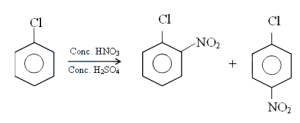
Chlorobenzene on heating with concentrated $HNO_3$ in the presence of concentrated $H_2SO_4$ gives:
A
$1-$chloro$-2,4-$dinitrobenzene
B
$2-$chloronitrobenzene and $4-$chloronitrobenzene
C
$1-$chloro$-4-$nitrobenzene
D
$2,4,6-$trinitrochlorobenzene
Solution
(B) Chlorobenzene undergoes electrophilic aromatic substitution (nitration) when treated with a mixture of concentrated $HNO_3$ and $H_2SO_4$.
Since the chlorine atom is ortho/para-directing,the reaction yields a mixture of $2-$chloronitrobenzene and $4-$chloronitrobenzene.
Since the chlorine atom is ortho/para-directing,the reaction yields a mixture of $2-$chloronitrobenzene and $4-$chloronitrobenzene.
0 likes
View Solution352
DifficultMCQ
Replacement of $Cl$ of chlorobenzene to give phenol requires drastic conditions,but $Cl$ of $2,4$-dinitrochlorobenzene is readily replaced. This is because,
A
$-NO_2$ group makes the ring electron rich at $o$- and $p$- positions.
B
$-NO_2$ group withdraws electrons from $m$-position.
C
$-NO_2$ donates electrons at $m$-position.
D
$-NO_2$ withdraws electrons from $o$- and $p$-positions.
Solution
(D) The reaction for chlorobenzene to phenol is: $C_6H_5Cl \xrightarrow[(ii) dil. HCl]{(i) 6-8\% NaOH, 623 K, 300 atm} C_6H_5OH$.
The presence of the $-NO_2$ group at $o$- and $p$- positions withdraws electron density from the benzene ring due to its strong $-I$ and $-M$ effects.
This reduction in electron density facilitates the nucleophilic attack of $OH^-$ on the haloarene.
Furthermore,the intermediate carbanion formed is stabilized through resonance by the $-NO_2$ group at the $o$- and $p$- positions,which delocalizes the negative charge.
The presence of the $-NO_2$ group at $o$- and $p$- positions withdraws electron density from the benzene ring due to its strong $-I$ and $-M$ effects.
This reduction in electron density facilitates the nucleophilic attack of $OH^-$ on the haloarene.
Furthermore,the intermediate carbanion formed is stabilized through resonance by the $-NO_2$ group at the $o$- and $p$- positions,which delocalizes the negative charge.
0 likes
View Solution353
MediumMCQ
Toluene reacts with halogen in the presence of iron$(III)$ chloride to give ortho and para halo compounds. The reaction is:
A
Electrophilic elimination reaction
B
Electrophilic substitution reaction
C
Free radical addition reaction
D
Nucleophilic substitution reaction
Solution
(B) The reaction involved is an electrophilic aromatic substitution.
In the presence of $FeCl_{3}$ (a Lewis acid) and in the dark,the halogen $(X_{2})$ reacts to generate an electrophile $(X^{+})$.
This electrophile attacks the benzene ring of toluene.
Since the methyl group $(-CH_{3})$ is an ortho/para-directing group due to its $+I$ effect and hyperconjugation,the electrophilic substitution occurs primarily at the ortho and para positions to yield ortho and para-halotoluene.
In the presence of $FeCl_{3}$ (a Lewis acid) and in the dark,the halogen $(X_{2})$ reacts to generate an electrophile $(X^{+})$.
This electrophile attacks the benzene ring of toluene.
Since the methyl group $(-CH_{3})$ is an ortho/para-directing group due to its $+I$ effect and hyperconjugation,the electrophilic substitution occurs primarily at the ortho and para positions to yield ortho and para-halotoluene.
0 likes
View Solution354
MediumMCQ
The compound that reacts the fastest with sodium methoxide is
A
B
C
D
Solution
(C) Nucleophilic aromatic substitution reactions in haloarenes are facilitated by the presence of electron-withdrawing groups (like $-NO_2$) at the ortho and para positions relative to the halogen atom.
These groups stabilize the carbanion intermediate formed during the reaction.
Among the given options,$2,4-$dinitrochlorobenzene has two $-NO_2$ groups at the ortho and para positions,which provide the maximum stabilization to the intermediate,making it the most reactive towards nucleophilic substitution with sodium methoxide.
These groups stabilize the carbanion intermediate formed during the reaction.
Among the given options,$2,4-$dinitrochlorobenzene has two $-NO_2$ groups at the ortho and para positions,which provide the maximum stabilization to the intermediate,making it the most reactive towards nucleophilic substitution with sodium methoxide.
0 likes
View Solution355
DifficultMCQ
In the sequence of the following reactions,the starting compound '$P$' is:

A
$o$-nitro toluene
B
$m$-nitro toluene
C
$o$-bromo toluene
D
$p$-nitro toluene
Solution
(D) The reaction sequence is as follows:
$1$. Starting with $p$-nitro toluene $(P)$,bromination gives $2-$bromo$-4-$nitrotoluene.
$2$. Reduction with $Sn/HCl$ converts the $-NO_2$ group to $-NH_2$,yielding $2-$bromo$-4-$aminotoluene $(Q)$.
$3$. Diazotization with $NaNO_2/HCl$ at $273-278 \ K$ followed by reduction with $H_3PO_2/H_2O$ removes the $-NH_2$ group,resulting in $o$-bromotoluene $(R)$.
$4$. Oxidation of the methyl group with $KMnO_4/OH^-$ gives $2-$bromobenzoic acid.
Thus,the starting compound $(P)$ is $p$-nitro toluene.
$1$. Starting with $p$-nitro toluene $(P)$,bromination gives $2-$bromo$-4-$nitrotoluene.
$2$. Reduction with $Sn/HCl$ converts the $-NO_2$ group to $-NH_2$,yielding $2-$bromo$-4-$aminotoluene $(Q)$.
$3$. Diazotization with $NaNO_2/HCl$ at $273-278 \ K$ followed by reduction with $H_3PO_2/H_2O$ removes the $-NH_2$ group,resulting in $o$-bromotoluene $(R)$.
$4$. Oxidation of the methyl group with $KMnO_4/OH^-$ gives $2-$bromobenzoic acid.
Thus,the starting compound $(P)$ is $p$-nitro toluene.
0 likes
View Solution356
EasyMCQ
Chlorobenzene reacts with bromine gas in the presence of $Anhyd. AlBr_3$ to yield $p-$Bromochlorobenzene. This reaction is classified as . . . . . .
A
Elimination reaction
B
Nucleophilic substitution reaction
C
Electrophilic substitution reaction
D
Addition reaction
Solution
(C) The reaction of chlorobenzene with bromine in the presence of a Lewis acid like $Anhyd. AlBr_3$ is an example of electrophilic aromatic substitution.
In this reaction,$AlBr_3$ acts as a catalyst to generate the electrophile $Br^+$ from $Br_2$.
This electrophile then attacks the benzene ring at the ortho and para positions due to the activating effect of the chlorine atom,resulting in the substitution of a hydrogen atom by a bromine atom.
In this reaction,$AlBr_3$ acts as a catalyst to generate the electrophile $Br^+$ from $Br_2$.
This electrophile then attacks the benzene ring at the ortho and para positions due to the activating effect of the chlorine atom,resulting in the substitution of a hydrogen atom by a bromine atom.
0 likes
View Solution357
MediumMCQ
Which of the following halides undergoes hydrolysis on warming with water or aqueous $NaOH$?
A
$4-$nitrochlorobenzene
B
$2,4,6-$trinitrochlorobenzene
C
Chlorobenzene
D
$2,4-$dinitrochlorobenzene
Solution
(B) The correct answer is $(B)$.
Nucleophilic aromatic substitution in haloarenes is facilitated by the presence of electron-withdrawing groups (like $-NO_2$) at the ortho and para positions.
These groups stabilize the carbanion intermediate formed during the reaction.
$2,4,6$-trinitrochlorobenzene has three electron-withdrawing $-NO_2$ groups at the ortho and para positions,which makes it highly reactive towards nucleophilic substitution.
Therefore,it can undergo hydrolysis even under mild conditions like warming with water or dilute aqueous $NaOH$.
Nucleophilic aromatic substitution in haloarenes is facilitated by the presence of electron-withdrawing groups (like $-NO_2$) at the ortho and para positions.
These groups stabilize the carbanion intermediate formed during the reaction.
$2,4,6$-trinitrochlorobenzene has three electron-withdrawing $-NO_2$ groups at the ortho and para positions,which makes it highly reactive towards nucleophilic substitution.
Therefore,it can undergo hydrolysis even under mild conditions like warming with water or dilute aqueous $NaOH$.
0 likes
View Solution358
MediumMCQ
$1$-$Chloro$-$4$-$nitrobenzene$,$1$-$Chloro$-$2,4$-$dinitrobenzene$ and $1$-$Chloro$-$2,4,6$-$trinitrobenzene$ are transformed to corresponding phenols with the reagents $X$,$Y$,$Z$ respectively. What are $X$,$Y$,$Z$?
A
$X = H_2O$; $Y = NaOH$,$365 \ K$; $Z = NaOH$,$445 \ K$
B
$X = (i) \ NaOH, 443 \ K, (ii) \ H^{+}$; $Y = (i) \ NaOH, 368 \ K, (ii) \ H^{+}$; $Z = \text{Warm } H_2O$
C
$X = (i) \ NaOH, 625 \ K, (ii) \ H^{+}$; $Y = (i) \ NaOH, 440 \ K, (ii) \ H^{+}$; $Z = H_2O / H^{+}$
D
$X = NaOH, 625 \ K$; $Y = H_2O$; $Z = NaOH, 440 \ K$
Solution
(B) The presence of electron-withdrawing groups like $-NO_2$ at ortho and para positions increases the reactivity of haloarenes towards nucleophilic substitution. As the number of $-NO_2$ groups increases,the reaction conditions become milder.
$1.$ $1$-$Chloro$-$4$-$nitrobenzene$ requires $(i) \ NaOH, 443 \ K, (ii) \ H^{+}$ to form $4$-$nitrophenol$.
$2.$ $1$-$Chloro$-$2,4$-$dinitrobenzene$ requires $(i) \ NaOH, 368 \ K, (ii) \ H^{+}$ to form $2,4$-$dinitrophenol$.
$3.$ $1$-$Chloro$-$2,4,6$-$trinitrobenzene$ reacts with just $\text{Warm } H_2O$ to form $2,4,6$-$trinitrophenol$ (picric acid).
$1.$ $1$-$Chloro$-$4$-$nitrobenzene$ requires $(i) \ NaOH, 443 \ K, (ii) \ H^{+}$ to form $4$-$nitrophenol$.
$2.$ $1$-$Chloro$-$2,4$-$dinitrobenzene$ requires $(i) \ NaOH, 368 \ K, (ii) \ H^{+}$ to form $2,4$-$dinitrophenol$.
$3.$ $1$-$Chloro$-$2,4,6$-$trinitrobenzene$ reacts with just $\text{Warm } H_2O$ to form $2,4,6$-$trinitrophenol$ (picric acid).
0 likes
View Solution359
DifficultMCQ
$C_6H_5NH_2$ $\xrightarrow[\substack{NaNO_2 \\ HCl, 0-5^{\circ}C}]{} X$ $\xrightarrow[CuCl]{HCl} Y$ $\xrightarrow[\text{dry ether}]{CH_3Cl, Na} Z$
What is $Z$ in the sequence of reactions?
What is $Z$ in the sequence of reactions?
A
Biphenyl
B
Toluene
C
Ethylbenzene
D
$4-$Chlorotoluene
Solution
(B) Step $1$: Aniline $(C_6H_5NH_2)$ reacts with $NaNO_2$ and $HCl$ at $0-5^{\circ}C$ to form Benzenediazonium chloride $(X = C_6H_5N_2^+Cl^-)$.
Step $2$: Benzenediazonium chloride reacts with $CuCl/HCl$ (Sandmeyer reaction) to form Chlorobenzene $(Y = C_6H_5Cl)$.
Step $3$: Chlorobenzene reacts with $CH_3Cl$ and $Na$ in the presence of dry ether (Wurtz-Fittig reaction) to form Toluene $(Z = C_6H_5CH_3)$.
Step $2$: Benzenediazonium chloride reacts with $CuCl/HCl$ (Sandmeyer reaction) to form Chlorobenzene $(Y = C_6H_5Cl)$.
Step $3$: Chlorobenzene reacts with $CH_3Cl$ and $Na$ in the presence of dry ether (Wurtz-Fittig reaction) to form Toluene $(Z = C_6H_5CH_3)$.
0 likes
View Solution360
MediumMCQ
The $C-Cl$ bond in chlorobenzene in comparison to the $C-Cl$ bond in methyl chloride is:
A
longer and weaker
B
shorter and weaker
C
shorter and stronger
D
longer and stronger
Solution
(C) Due to the $+R$ effect (resonance effect) of the $Cl$ atom with the benzene ring,the $C-Cl$ bond in chlorobenzene acquires partial double bond character.
This partial double bond character makes the $C-Cl$ bond in chlorobenzene shorter and stronger than the $C-Cl$ bond in methyl chloride $(CH_3-Cl)$,which exhibits only a single bond character.
This partial double bond character makes the $C-Cl$ bond in chlorobenzene shorter and stronger than the $C-Cl$ bond in methyl chloride $(CH_3-Cl)$,which exhibits only a single bond character.
0 likes
View Solution361
MediumMCQ
The $C-Cl$ bond lengths (in $pm$) in haloarene and haloalkane are respectively:
A
$169, 177$
B
$177, 169$
C
$195, 187$
D
$197, 185$
Solution
(A) In haloarenes, the $C-Cl$ bond acquires partial double bond character due to resonance between the lone pair of electrons on the chlorine atom and the $\pi$-electron system of the benzene ring.
This partial double bond character results in a shorter bond length compared to the pure single $C-Cl$ bond found in haloalkanes.
The bond length of $C-Cl$ in chlorobenzene (haloarene) is approximately $169 \ pm$, while in chloromethane (haloalkane) it is approximately $177 \ pm$.
Therefore, the correct order is $169 \ pm$ and $177 \ pm$.
This partial double bond character results in a shorter bond length compared to the pure single $C-Cl$ bond found in haloalkanes.
The bond length of $C-Cl$ in chlorobenzene (haloarene) is approximately $169 \ pm$, while in chloromethane (haloalkane) it is approximately $177 \ pm$.
Therefore, the correct order is $169 \ pm$ and $177 \ pm$.
0 likes
View Solution362
MediumMCQ
Number of deactivating groups in the following is $-Cl, -SO_3H, -OH, -NHC_2H_5, -COOCH_3, -CH_3$.
A
$4$
B
$3$
C
$2$
D
$1$
Solution
(B) Deactivating groups are those that withdraw electron density from the benzene ring through inductive or resonance effects, making the ring less reactive towards electrophilic substitution reactions.
Among the given groups:
$1$. $-Cl$: Deactivating (due to strong $-I$ effect).
$2$. $-SO_3H$: Deactivating (due to strong $-I$ and $-M$ effects).
$3$. $-OH$: Activating (due to $+M$ effect).
$4$. $-NHC_2H_5$: Activating (due to $+M$ effect).
$5$. $-COOCH_3$: Deactivating (due to $-I$ and $-M$ effects).
$6$. $-CH_3$: Activating (due to $+I$ and hyperconjugation).
Therefore, the deactivating groups are $-Cl, -SO_3H, \text{ and } -COOCH_3$.
The total number of deactivating groups is $3$.
Among the given groups:
$1$. $-Cl$: Deactivating (due to strong $-I$ effect).
$2$. $-SO_3H$: Deactivating (due to strong $-I$ and $-M$ effects).
$3$. $-OH$: Activating (due to $+M$ effect).
$4$. $-NHC_2H_5$: Activating (due to $+M$ effect).
$5$. $-COOCH_3$: Deactivating (due to $-I$ and $-M$ effects).
$6$. $-CH_3$: Activating (due to $+I$ and hyperconjugation).
Therefore, the deactivating groups are $-Cl, -SO_3H, \text{ and } -COOCH_3$.
The total number of deactivating groups is $3$.
0 likes
View Solution363
MediumMCQ
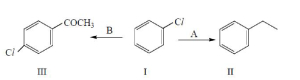
Identify the two reactions $A(I \rightarrow II)$ and $B(I \rightarrow III)$ respectively in the following set of reactions.
A
Wurtz-Fittig ; Friedel-Crafts
B
Friedel-Crafts ; Wurtz-Fittig
C
Wurtz ; Friedel-Crafts
D
Friedel-Crafts ; Swarts
Solution
(A) In reaction $A$,chlorobenzene $(I)$ is converted to ethylbenzene $(II)$. This is a $Wurtz-Fittig$ reaction where chlorobenzene reacts with ethyl chloride in the presence of sodium $(Na)$ and dry ether to form ethylbenzene.
In reaction $B$,chlorobenzene $(I)$ is converted to $4-chloroacetophenone$ $(III)$. This is a $Friedel-Crafts$ acylation reaction where chlorobenzene reacts with acetyl chloride $(CH_3COCl)$ in the presence of anhydrous $AlCl_3$ to form $4-chloroacetophenone$ as the major product.
Therefore,the correct sequence is $Wurtz-Fittig$ and $Friedel-Crafts$.
In reaction $B$,chlorobenzene $(I)$ is converted to $4-chloroacetophenone$ $(III)$. This is a $Friedel-Crafts$ acylation reaction where chlorobenzene reacts with acetyl chloride $(CH_3COCl)$ in the presence of anhydrous $AlCl_3$ to form $4-chloroacetophenone$ as the major product.
Therefore,the correct sequence is $Wurtz-Fittig$ and $Friedel-Crafts$.
0 likes
View Solution364
MediumMCQ
Which of the following reasons support that aryl halides are less reactive than alkyl halides towards nucleophilic substitution reactions?
$a)$ The formation of more stable arenium ion
$b)$ Partial double bond character of $C-X$ bond
$c)$ Longer $C-X$ bond
$d)$ $sp^2$ carbon bonded to $X$ is more electronegative
$a)$ The formation of more stable arenium ion
$b)$ Partial double bond character of $C-X$ bond
$c)$ Longer $C-X$ bond
$d)$ $sp^2$ carbon bonded to $X$ is more electronegative
A
$a, b$
B
$b, c$
C
$b, d$
D
$a, d$
Solution
(C) Aryl halides are less reactive towards nucleophilic substitution reactions due to the following reasons:
$1$. Resonance effect: The lone pair of electrons on the halogen atom participates in conjugation with the benzene ring,giving the $C-X$ bond a partial double bond character. This makes the bond stronger and shorter,making it difficult to break.
$2$. Hybridization of carbon: In aryl halides,the carbon atom attached to the halogen is $sp^2$ hybridized,which is more electronegative than the $sp^3$ hybridized carbon in alkyl halides. This increases the bond strength and reduces the polarity of the $C-X$ bond.
Therefore,statements $b$ and $d$ are correct.
$1$. Resonance effect: The lone pair of electrons on the halogen atom participates in conjugation with the benzene ring,giving the $C-X$ bond a partial double bond character. This makes the bond stronger and shorter,making it difficult to break.
$2$. Hybridization of carbon: In aryl halides,the carbon atom attached to the halogen is $sp^2$ hybridized,which is more electronegative than the $sp^3$ hybridized carbon in alkyl halides. This increases the bond strength and reduces the polarity of the $C-X$ bond.
Therefore,statements $b$ and $d$ are correct.
0 likes
View Solution365
MediumMCQ
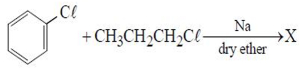
What is the product $X$ in the following Wurtz-Fittig reaction?
A
Propylbenzene
B
Isopropylbenzene
C
Ethylbenzene
D
Butylbenzene
Solution
(D) The given reaction is a Wurtz-Fittig reaction,which involves the coupling of an aryl halide with an alkyl halide in the presence of sodium metal and dry ether to form an alkylbenzene.
The reaction is:
$C_6H_5Cl + CH_3CH_2CH_2CH_2Cl + 2Na \xrightarrow{\text{dry ether}} C_6H_5-CH_2CH_2CH_2CH_3 + 2NaCl$
The product $X$ formed is $n$-butylbenzene (or simply butylbenzene).
The reaction is:
$C_6H_5Cl + CH_3CH_2CH_2CH_2Cl + 2Na \xrightarrow{\text{dry ether}} C_6H_5-CH_2CH_2CH_2CH_3 + 2NaCl$
The product $X$ formed is $n$-butylbenzene (or simply butylbenzene).
0 likes
View Solution366
EasyMCQ
Which of the following is the product of Fittig reaction?
A
Ethylbenzene
B
Diphenylmethane
C
Biphenyl
D
Azobenzene
Solution
(C) The Fittig reaction is a chemical reaction in which two aryl halides react with sodium metal in the presence of dry ether to form a diaryl compound (biphenyl).
The general reaction is:
$2Ar-X + 2Na \xrightarrow{\text{dry ether}} Ar-Ar + 2NaX$
For example,when chlorobenzene reacts with sodium in the presence of dry ether,it produces biphenyl:
$2C_6H_5Cl + 2Na \xrightarrow{\text{dry ether}} C_6H_5-C_6H_5 + 2NaCl$
Therefore,the product of the Fittig reaction is biphenyl.
The general reaction is:
$2Ar-X + 2Na \xrightarrow{\text{dry ether}} Ar-Ar + 2NaX$
For example,when chlorobenzene reacts with sodium in the presence of dry ether,it produces biphenyl:
$2C_6H_5Cl + 2Na \xrightarrow{\text{dry ether}} C_6H_5-C_6H_5 + 2NaCl$
Therefore,the product of the Fittig reaction is biphenyl.
0 likes
View Solution367
MediumMCQ
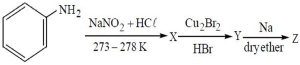
In the given reaction sequence,the conversion of $Y$ to $Z$ is:
A
$Wurtz$ reaction
B
$Wurtz-Fittig$ reaction
C
$Fittig$ reaction
D
$Swarts$ reaction
Solution
(C) The reaction sequence is as follows:
$1$. Aniline reacts with $NaNO_2 + HCl$ at $273-278 \ K$ to form $X$,which is benzene diazonium chloride $(C_6H_5N_2^+Cl^-)$.
$2$. Benzene diazonium chloride reacts with $Cu_2Br_2/HBr$ (Sandmeyer reaction) to form $Y$,which is bromobenzene $(C_6H_5Br)$.
$3$. Bromobenzene reacts with $Na$ in the presence of dry ether. Since only one type of aryl halide is used,this is the $Fittig$ reaction,which produces biphenyl $(Z)$.
$1$. Aniline reacts with $NaNO_2 + HCl$ at $273-278 \ K$ to form $X$,which is benzene diazonium chloride $(C_6H_5N_2^+Cl^-)$.
$2$. Benzene diazonium chloride reacts with $Cu_2Br_2/HBr$ (Sandmeyer reaction) to form $Y$,which is bromobenzene $(C_6H_5Br)$.
$3$. Bromobenzene reacts with $Na$ in the presence of dry ether. Since only one type of aryl halide is used,this is the $Fittig$ reaction,which produces biphenyl $(Z)$.
0 likes
View Solution368
EasyMCQ
The reaction of benzene diazonium chloride with $Cu$ powder and $HCl$ is known as:
A
Sandmeyer reaction
B
Etard reaction
C
Finkelstein reaction
D
Gattermann reaction
Solution
(D) The reaction of benzene diazonium chloride with $Cu$ powder in the presence of $HCl$ is known as the $Gattermann$ reaction.
In this reaction,the diazonium group is replaced by a chlorine atom to form chlorobenzene.
Note that if $Cu_2Cl_2$ and $HCl$ were used instead of $Cu$ powder,it would be called the $Sandmeyer$ reaction.
In this reaction,the diazonium group is replaced by a chlorine atom to form chlorobenzene.
Note that if $Cu_2Cl_2$ and $HCl$ were used instead of $Cu$ powder,it would be called the $Sandmeyer$ reaction.
0 likes
View Solution369
MediumMCQ
The most reactive compound towards nucleophilic substitution with an aqueous $NaOH$ is
A
Chlorobenzene
B
$1-$Chloro$-2-$nitrobenzene
C
$1-$Chloro$-2,4-$dinitrobenzene
D
$1-$Chloro$-2,4,6-$trinitrobenzene
Solution
(D) Nucleophilic aromatic substitution in haloarenes is facilitated by the presence of electron-withdrawing groups (like $-NO_2$) at the ortho and para positions relative to the halogen atom.
These groups stabilize the carbanion intermediate formed during the reaction through the resonance effect.
As the number of electron-withdrawing $-NO_2$ groups increases,the electron density on the benzene ring decreases,making the carbon atom attached to the chlorine more susceptible to nucleophilic attack.
Therefore,the reactivity increases with the number of $-NO_2$ groups.
Among the given options,$1$-chloro-$2,4,6$-trinitrobenzene has the maximum number of $-NO_2$ groups (three),making it the most reactive towards nucleophilic substitution.
These groups stabilize the carbanion intermediate formed during the reaction through the resonance effect.
As the number of electron-withdrawing $-NO_2$ groups increases,the electron density on the benzene ring decreases,making the carbon atom attached to the chlorine more susceptible to nucleophilic attack.
Therefore,the reactivity increases with the number of $-NO_2$ groups.
Among the given options,$1$-chloro-$2,4,6$-trinitrobenzene has the maximum number of $-NO_2$ groups (three),making it the most reactive towards nucleophilic substitution.
0 likes
View Solution370
MediumMCQ
Identify the compound which is least reactive towards nucleophilic substitution reactions.
A
Benzyl chloride $(C_6H_5CH_2Cl)$
B
$p$-Nitrochlorobenzene $(O_2NC_6H_4Cl)$
C
$m$-Nitrochlorobenzene $(O_2NC_6H_4Cl)$
D
Allyl chloride $(CH_2=CHCH_2Cl)$
Solution
(C) Nucleophilic substitution reactions in aryl halides are difficult due to the partial double bond character of the $C-Cl$ bond caused by resonance.
Electron-withdrawing groups like $-NO_2$ at ortho or para positions increase the reactivity towards nucleophilic substitution by stabilizing the carbanion intermediate.
$p$-Nitrochlorobenzene and $m$-Nitrochlorobenzene are aryl halides,which are generally less reactive than alkyl halides like benzyl chloride and allyl chloride.
Among the given options,$m$-Nitrochlorobenzene is the least reactive because the $-NO_2$ group at the meta position does not effectively stabilize the negative charge of the intermediate carbanion through resonance,unlike the para position.
Therefore,$m$-Nitrochlorobenzene is the least reactive towards nucleophilic substitution.
Electron-withdrawing groups like $-NO_2$ at ortho or para positions increase the reactivity towards nucleophilic substitution by stabilizing the carbanion intermediate.
$p$-Nitrochlorobenzene and $m$-Nitrochlorobenzene are aryl halides,which are generally less reactive than alkyl halides like benzyl chloride and allyl chloride.
Among the given options,$m$-Nitrochlorobenzene is the least reactive because the $-NO_2$ group at the meta position does not effectively stabilize the negative charge of the intermediate carbanion through resonance,unlike the para position.
Therefore,$m$-Nitrochlorobenzene is the least reactive towards nucleophilic substitution.
0 likes
View Solution371
EasyMCQ
Chlorobenzene $(X)$ when reacted with reagent '$A$' gets converted to phenol $(Y)$. The major product obtained from nitration of $X$ gets converted to $p$-nitrophenol $(Z)$ by reaction with reagent $B$. What are $A$ and $B$ respectively?
A
$A = (i) \ NaOH, 623 \ K, 300 \ atm \ (ii) \ H^{+}; \ B = (i) \ NaOH, 443 \ K \ (ii) \ H^{+}$
B
$A = (i) \ NaOH, 443 \ K \ (ii) \ H^{+}; \ B = H_2O, \Delta$
C
$A = (i) \ NaOH, 323 \ K \ (ii) \ H^{+}; \ B = (i) \ NaOH, 443 \ K \ (ii) \ H^{+}$
D
$A = (i) \ NaOH, 623 \ K, 300 \ atm \ (ii) \ H^{+}; \ B = H_2O, \Delta$
Solution
(A) $1$. Conversion of chlorobenzene to phenol is done by Dow's process,which requires $NaOH$ at $623 \ K$ and $300 \ atm$ pressure,followed by acidification with $H^+$.
$2$. The major product of nitration of chlorobenzene is $p$-nitrochlorobenzene. This compound is more reactive towards nucleophilic substitution due to the electron-withdrawing $-NO_2$ group at the para position. It can be converted to $p$-nitrophenol using $NaOH$ at a milder condition of $443 \ K$,followed by acidification with $H^+$.
$3$. Thus,$A = (i) \ NaOH, 623 \ K, 300 \ atm \ (ii) \ H^+$ and $B = (i) \ NaOH, 443 \ K \ (ii) \ H^+$.
$2$. The major product of nitration of chlorobenzene is $p$-nitrochlorobenzene. This compound is more reactive towards nucleophilic substitution due to the electron-withdrawing $-NO_2$ group at the para position. It can be converted to $p$-nitrophenol using $NaOH$ at a milder condition of $443 \ K$,followed by acidification with $H^+$.
$3$. Thus,$A = (i) \ NaOH, 623 \ K, 300 \ atm \ (ii) \ H^+$ and $B = (i) \ NaOH, 443 \ K \ (ii) \ H^+$.
0 likes
View Solution372
DifficultMCQ
The two reactions involved in the conversion of benzene diazonium chloride to diphenyl are respectively:
A
Swarts,Fittig
B
Gatterman,Swarts
C
Sandmeyer,Wurtz
D
Sandmeyer,Fittig
Solution
(D) The conversion of benzene diazonium chloride to diphenyl occurs in two steps:
$1$. The conversion of benzene diazonium chloride to chlorobenzene using $CuCl$ is known as the $Sandmeyer$ reaction.
$2$. The coupling of two aryl halide molecules (chlorobenzene) in the presence of sodium $(Na)$ and dry ether to form diphenyl is known as the $Fittig$ reaction.
Therefore,the correct sequence is $Sandmeyer$ and $Fittig$.
$1$. The conversion of benzene diazonium chloride to chlorobenzene using $CuCl$ is known as the $Sandmeyer$ reaction.
$2$. The coupling of two aryl halide molecules (chlorobenzene) in the presence of sodium $(Na)$ and dry ether to form diphenyl is known as the $Fittig$ reaction.
Therefore,the correct sequence is $Sandmeyer$ and $Fittig$.
0 likes
View Solution373
MediumMCQ
What are $Y$ and $Z$ respectively in the following reaction sequence?
Chlorobenzene $\xrightarrow[Conc. H_2SO_4]{HNO_3}$ $X$ (major product) $\xrightarrow{Y}$ $Z$
Chlorobenzene $\xrightarrow[Conc. H_2SO_4]{HNO_3}$ $X$ (major product) $\xrightarrow{Y}$ $Z$
A
$(i)$ $NaOH, 443 \ K, H^+$; $3-$nitrophenol
B
$(i)$ $NaOH, 443 \ K, (ii) H^+$; $4-$nitrophenol
C
$H_2O, \Delta$; $4-$nitrophenol
D
$H_2O, \Delta$; $2-$nitrophenol
Solution
(B) $1$. The nitration of chlorobenzene with $conc. HNO_3$ and $conc. H_2SO_4$ yields $1$-chloro-$4$-nitrobenzene as the major product $(X)$ because the $-Cl$ group is ortho/para directing and the para-isomer is sterically favored.
$2$. The conversion of $1$-chloro-$4$-nitrobenzene to $4$-nitrophenol involves nucleophilic aromatic substitution.
$3$. The reaction requires strong nucleophilic conditions,which are provided by $(i) NaOH$ at $443 \ K$ followed by $(ii) H^+$ (acidification) to convert the phenoxide ion to the phenol.
$4$. Thus,$Y$ is $(i) NaOH, 443 \ K, (ii) H^+$ and $Z$ is $4$-nitrophenol.
$2$. The conversion of $1$-chloro-$4$-nitrobenzene to $4$-nitrophenol involves nucleophilic aromatic substitution.
$3$. The reaction requires strong nucleophilic conditions,which are provided by $(i) NaOH$ at $443 \ K$ followed by $(ii) H^+$ (acidification) to convert the phenoxide ion to the phenol.
$4$. Thus,$Y$ is $(i) NaOH, 443 \ K, (ii) H^+$ and $Z$ is $4$-nitrophenol.
0 likes
View Solution374
EasyMCQ
In the Wurtz-Fittig reaction,a compound $X$ reacts with an alkyl halide. What is $X$?
A
Benzene
B
Chlorobenzene
C
Phenol
D
Nitrobenzene
Solution
(B) The Wurtz-Fittig reaction involves the reaction of an aryl halide with an alkyl halide in the presence of sodium metal and dry ether to form an alkyl-substituted aromatic compound.
The general reaction is:
$Ar-X + R-X + 2Na \xrightarrow{\text{dry ether}} Ar-R + 2NaX$
In this reaction,the compound $X$ must be an aryl halide (such as chlorobenzene) to react with the alkyl halide $(R-X)$ to form the substituted benzene product.
Therefore,the correct compound $X$ is chlorobenzene.
The general reaction is:
$Ar-X + R-X + 2Na \xrightarrow{\text{dry ether}} Ar-R + 2NaX$
In this reaction,the compound $X$ must be an aryl halide (such as chlorobenzene) to react with the alkyl halide $(R-X)$ to form the substituted benzene product.
Therefore,the correct compound $X$ is chlorobenzene.
0 likes
View Solution375
EasyMCQ
$\text{Benzene} + Cl_2$ $\xrightarrow{FeCl_3} X$ $\xrightarrow{R-X, \text{ Na/dry ether }} Y$
Conversion of $X$ to $Y$ is an example of:
Conversion of $X$ to $Y$ is an example of:
A
Wurtz reaction
B
Fittig reaction
C
Wurtz-Fittig reaction
D
Friedel-Crafts reaction
Solution
(C) The reaction sequence is as follows:
$1$. Benzene reacts with $Cl_2$ in the presence of $FeCl_3$ (a Lewis acid) to form chlorobenzene $(X)$ via electrophilic aromatic substitution.
$2$. Chlorobenzene $(X)$ reacts with an alkyl halide $(R-X)$ in the presence of sodium metal and dry ether to form an alkylbenzene $(Y)$.
This specific reaction between an aryl halide and an alkyl halide in the presence of sodium metal and dry ether is known as the Wurtz-Fittig reaction.
$1$. Benzene reacts with $Cl_2$ in the presence of $FeCl_3$ (a Lewis acid) to form chlorobenzene $(X)$ via electrophilic aromatic substitution.
$2$. Chlorobenzene $(X)$ reacts with an alkyl halide $(R-X)$ in the presence of sodium metal and dry ether to form an alkylbenzene $(Y)$.
This specific reaction between an aryl halide and an alkyl halide in the presence of sodium metal and dry ether is known as the Wurtz-Fittig reaction.
0 likes
View Solution376
MediumMCQ
Two statements are given below:
Statement $I$: Chlorobenzene on nitration gives $1-$chloro$-4-$nitrobenzene as the major product.
Statement $II$: Chlorobenzene undergoes nitration more slowly than benzene.
Identify the correct answer.
Statement $I$: Chlorobenzene on nitration gives $1-$chloro$-4-$nitrobenzene as the major product.
Statement $II$: Chlorobenzene undergoes nitration more slowly than benzene.
Identify the correct answer.
A
Statement $I$ and $II$ are correct.
B
Statements $I$ and $II$ are incorrect.
C
Statement $I$ is correct but statement $II$ is incorrect.
D
Statement $II$ is correct but statement $I$ is incorrect.
Solution
(A) The nitration of chlorobenzene with a mixture of concentrated $HNO_3$ and $H_2SO_4$ yields a mixture of $1-$chloro$-2-$nitrobenzene (minor) and $1-$chloro$-4-$nitrobenzene (major) due to the ortho/para directing nature of the $-Cl$ group. Thus,Statement $I$ is correct.
The $-Cl$ atom is an electron-withdrawing group due to its $-I$ effect,which deactivates the benzene ring towards electrophilic aromatic substitution. Consequently,chlorobenzene reacts more slowly than benzene in nitration. Thus,Statement $II$ is also correct.
The $-Cl$ atom is an electron-withdrawing group due to its $-I$ effect,which deactivates the benzene ring towards electrophilic aromatic substitution. Consequently,chlorobenzene reacts more slowly than benzene in nitration. Thus,Statement $II$ is also correct.
0 likes
View Solution377
EasyMCQ
The Fittig reaction is:
A
Reaction between two aryl halides in the presence of $Na / \text{dry ether}$
B
Reaction between two alkyl halides in the presence of $Na / \text{dry ether}$
C
Reaction between aryl halide and alkyl halide in the presence of $Na / \text{dry ether}$
D
Reaction between two aryl halides in the presence of $Fe / \text{dry ether}$
Solution
(A) The Fittig reaction involves the coupling of two aryl halide molecules in the presence of sodium metal and dry ether to form a diaryl compound (biphenyl).
The general reaction is:
$2 Ar-X + 2 Na \xrightarrow{\text{dry ether}} Ar-Ar + 2 NaX$
For example,with chlorobenzene:
$2 C_6H_5Cl + 2 Na \xrightarrow{\text{dry ether}} C_6H_5-C_6H_5 + 2 NaCl$
The general reaction is:
$2 Ar-X + 2 Na \xrightarrow{\text{dry ether}} Ar-Ar + 2 NaX$
For example,with chlorobenzene:
$2 C_6H_5Cl + 2 Na \xrightarrow{\text{dry ether}} C_6H_5-C_6H_5 + 2 NaCl$
0 likes
View Solution378
MediumMCQ
Identify the major product of the following reaction: $C_6H_5Cl + Br_2 \xrightarrow{\text{Anhyd. } FeCl_3} ?$
A
$1-$chloro$-2-$bromobenzene
B
$1-$chloro$-2-$bromobenzene
C
$1,3,5-$tribromo$-2-$chlorobenzene
D
$1-$chloro$-4-$bromobenzene
Solution
(D) The reaction of chlorobenzene with $Br_2$ in the presence of anhydrous $FeCl_3$ is an electrophilic aromatic substitution reaction (halogenation).
$Cl$ is an ortho/para-directing group due to its $+R$ effect,which increases electron density at the ortho and para positions.
Due to steric hindrance at the ortho position,the para-substituted product is formed as the major product.
Therefore,the major product is $1$-chloro-$4$-bromobenzene.
$Cl$ is an ortho/para-directing group due to its $+R$ effect,which increases electron density at the ortho and para positions.
Due to steric hindrance at the ortho position,the para-substituted product is formed as the major product.
Therefore,the major product is $1$-chloro-$4$-bromobenzene.
0 likes
View Solution379
MediumMCQ
Identify the product of the following reaction.
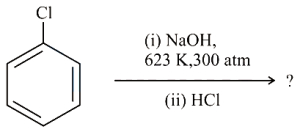
A
Benzene
B
Toluene
C
Aniline
D
Phenol
Solution
(D) Chlorobenzene is treated with aqueous sodium hydroxide at a temperature of $623 \ K$ and pressure of $300 \ atm$ to convert it into sodium phenoxide.
Acidification of sodium phenoxide yields phenol. This process is known as the Dow process.
The reaction is:
$C_6H_5Cl \xrightarrow[(ii) \ HCl]{(i) \ NaOH, \ 623 \ K, \ 300 \ atm} C_6H_5OH$
Acidification of sodium phenoxide yields phenol. This process is known as the Dow process.
The reaction is:
$C_6H_5Cl \xrightarrow[(ii) \ HCl]{(i) \ NaOH, \ 623 \ K, \ 300 \ atm} C_6H_5OH$
0 likes
View Solution380
EasyMCQ
Identify the best suitable reagent for the following reaction.
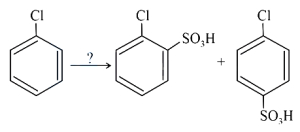
A
Concentrated Sulphuric acid
B
Dilute Sulphuric acid $(10\%)$
C
Concentrated Sulphuric acid & Concentrated Nitric acid
D
Concentrated Acetic acid (fuming)
Solution
(A) The given reaction is the sulphonation of chlorobenzene.
Halogen atoms are ortho-para directing but deactivating groups due to the $-I$ effect.
In the presence of concentrated sulphuric acid $(H_2SO_4)$,chlorobenzene undergoes an aromatic electrophilic substitution reaction.
The electrophile involved is sulphur trioxide $(SO_3)$.
The reaction produces $2-$chlorobenzenesulphonic acid (minor product) and $4-$chlorobenzenesulphonic acid (major product).
Therefore,concentrated sulphuric acid is the best suitable reagent for this reaction.
Halogen atoms are ortho-para directing but deactivating groups due to the $-I$ effect.
In the presence of concentrated sulphuric acid $(H_2SO_4)$,chlorobenzene undergoes an aromatic electrophilic substitution reaction.
The electrophile involved is sulphur trioxide $(SO_3)$.
The reaction produces $2-$chlorobenzenesulphonic acid (minor product) and $4-$chlorobenzenesulphonic acid (major product).
Therefore,concentrated sulphuric acid is the best suitable reagent for this reaction.
0 likes
View Solution381
MediumMCQ
Identify the product of the following Wurtz-Fittig reaction.
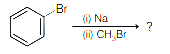
A
$3-$Bromotoluene
B
Toluene
C
$1,2-$Dibromocyclohexa$-1,4-$diene
D
Phenylsodium
Solution
(B) The reaction shown is the Wurtz-Fittig reaction,which involves the coupling of an aryl halide with an alkyl halide in the presence of sodium metal in dry ether.
In the first step,bromobenzene reacts with sodium to form phenylsodium $(C_6H_5Na)$ and sodium bromide $(NaBr)$.
In the second step,the phenylsodium intermediate reacts with methyl bromide $(CH_3Br)$ to form toluene $(C_6H_5CH_3)$ and sodium bromide $(NaBr)$.
The overall reaction is: $C_6H_5Br + 2Na + CH_3Br \rightarrow C_6H_5CH_3 + 2NaBr$.
In the first step,bromobenzene reacts with sodium to form phenylsodium $(C_6H_5Na)$ and sodium bromide $(NaBr)$.
In the second step,the phenylsodium intermediate reacts with methyl bromide $(CH_3Br)$ to form toluene $(C_6H_5CH_3)$ and sodium bromide $(NaBr)$.
The overall reaction is: $C_6H_5Br + 2Na + CH_3Br \rightarrow C_6H_5CH_3 + 2NaBr$.
0 likes
View Solution382
EasyMCQ
What is $A$ in the following reaction?
Benzyl chloride + $Cl_2 \xrightarrow{FeCl_3} A + \text{p-chlorobenzyl chloride}$
Benzyl chloride + $Cl_2 \xrightarrow{FeCl_3} A + \text{p-chlorobenzyl chloride}$
A
m-chlorobenzyl chloride
B
o-chlorobenzyl chloride
C
toluene
D
benzal chloride
Solution
(B) The reaction of benzyl chloride with $Cl_2$ in the presence of a Lewis acid catalyst like $FeCl_3$ is an electrophilic aromatic substitution reaction.
The $-CH_2Cl$ group is ortho/para directing due to its inductive effect and the nature of the benzene ring activation.
Therefore,the reaction produces a mixture of ortho-chlorobenzyl chloride and para-chlorobenzyl chloride.
In the given reaction,$A$ represents the ortho-substituted product,which is o-chlorobenzyl chloride.
The $-CH_2Cl$ group is ortho/para directing due to its inductive effect and the nature of the benzene ring activation.
Therefore,the reaction produces a mixture of ortho-chlorobenzyl chloride and para-chlorobenzyl chloride.
In the given reaction,$A$ represents the ortho-substituted product,which is o-chlorobenzyl chloride.
0 likes
View Solution383
EasyMCQ
Which among the following statements is true about the reactivity of haloarenes towards nucleophilic substitution reactions?
$1$. Haloarenes are very reactive towards nucleophilic substitution reaction.
$2$. In haloarenes,the $C-X$ bond acquires partial double bond character.
$3$. The $C-X$ bond in haloarenes is longer than the $C-X$ bond in haloalkanes.
$4$. In haloarenes,the phenyl cation formed as a result of self-ionisation is stable.
$1$. Haloarenes are very reactive towards nucleophilic substitution reaction.
$2$. In haloarenes,the $C-X$ bond acquires partial double bond character.
$3$. The $C-X$ bond in haloarenes is longer than the $C-X$ bond in haloalkanes.
$4$. In haloarenes,the phenyl cation formed as a result of self-ionisation is stable.
A
$1$
B
$2$
C
$3$
D
$4$
Solution
(B) Due to the $+R$ effect of the halogen atom $X$,the $C-X$ bond of haloarene acquires partial double bond character.
This makes the $C-X$ bond shorter and stronger than the $C-X$ bond in haloalkanes,thereby making nucleophilic substitution difficult.
Therefore,statement $2$ is correct.
This makes the $C-X$ bond shorter and stronger than the $C-X$ bond in haloalkanes,thereby making nucleophilic substitution difficult.
Therefore,statement $2$ is correct.
0 likes
View Solution384
MediumMCQ
Which of the following statements are correct?
$A$. The $C-Cl$ bond in chlorobenzene is shorter than in chloromethane.
$B$. It is more difficult to replace chlorine from chlorobenzene than from benzyl chloride.
$C$. The $C-Cl$ bond in chlorobenzene has some double bond character.
$D$. Chlorobenzene on chlorination gives $m$-dichlorobenzene.
$A$. The $C-Cl$ bond in chlorobenzene is shorter than in chloromethane.
$B$. It is more difficult to replace chlorine from chlorobenzene than from benzyl chloride.
$C$. The $C-Cl$ bond in chlorobenzene has some double bond character.
$D$. Chlorobenzene on chlorination gives $m$-dichlorobenzene.
A
$A, B, C$
B
$A, D$ only
C
$B, C, D$
D
$C, D$ only
Solution
$A$. Correct: Due to resonance, the $C-Cl$ bond in chlorobenzene acquires partial double bond character, making it shorter $(169 \ pm)$ than the $C-Cl$ bond in chloromethane $(178 \ pm)$.
$B$. Correct: The partial double bond character in chlorobenzene makes the $C-Cl$ bond stronger and harder to break compared to the single $C-Cl$ bond in benzyl chloride.
$C$. Correct: Resonance in chlorobenzene involves the lone pair of $Cl$ delocalizing into the ring, creating partial double bond character.
$D$. Incorrect: The $Cl$ atom is $o/p$-directing, so chlorination of chlorobenzene yields $o$-dichlorobenzene and $p$-dichlorobenzene, not $m$-dichlorobenzene.
Therefore, statements $A, B,$ and $C$ are correct.
$B$. Correct: The partial double bond character in chlorobenzene makes the $C-Cl$ bond stronger and harder to break compared to the single $C-Cl$ bond in benzyl chloride.
$C$. Correct: Resonance in chlorobenzene involves the lone pair of $Cl$ delocalizing into the ring, creating partial double bond character.
$D$. Incorrect: The $Cl$ atom is $o/p$-directing, so chlorination of chlorobenzene yields $o$-dichlorobenzene and $p$-dichlorobenzene, not $m$-dichlorobenzene.
Therefore, statements $A, B,$ and $C$ are correct.
0 likes
View Solution385
MediumMCQ
Identify $Z$ in the reaction :
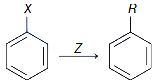
A
$RCOX$ / Anhydrous $AlCl_3$
B
$RX$ / $Na$ / dry $(C_2H_5)_2O$
C
$Na$ / dry $(C_2H_5)_2O$
D
$RCOX$ / $FeCl_3$
Solution
(B) The given reaction involves the conversion of an aryl halide to an alkylbenzene by reacting it with an alkyl halide $(RX)$ and sodium metal in the presence of dry ether. This specific reaction is known as the Wurtz-Fittig reaction. The general equation is: $Ar-X + R-X + 2Na \xrightarrow{\text{dry ether}} Ar-R + 2NaX$. Therefore,the reagent $Z$ is $RX / Na / \text{dry } (C_2H_5)_2O$.
0 likes
View Solution386
MediumMCQ
$p$-Chlorotoluene is the major product in which of the following reactions?
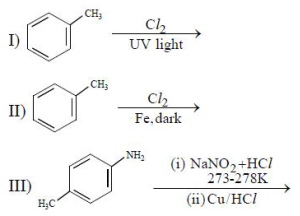
A
$I, III$ only
B
$I, II$ only
C
$II, III$ only
D
$I, II, III$
Solution
(C) In reaction $I$,toluene reacts with $Cl_2$ in the presence of $UV$ light,which leads to free radical substitution at the side chain,producing benzyl chloride $(C_6H_5CH_2Cl)$.
In reaction $II$,toluene undergoes electrophilic aromatic substitution with $Cl_2$ in the presence of $Fe$ (a Lewis acid) in the dark. The $-CH_3$ group is ortho/para directing,so $o$-chlorotoluene and $p$-chlorotoluene are formed,with $p$-chlorotoluene being the major product due to steric hindrance at the ortho position.
In reaction $III$,$p$-toluidine ($4$-methylaniline) reacts with $NaNO_2 + HCl$ at $273-278 \ K$ to form a diazonium salt,which then reacts with $Cu/HCl$ (Sandmeyer reaction) to replace the diazonium group with a chlorine atom,yielding $p$-chlorotoluene as the major product.
Thus,$p$-chlorotoluene is the major product in reactions $II$ and $III$.
In reaction $II$,toluene undergoes electrophilic aromatic substitution with $Cl_2$ in the presence of $Fe$ (a Lewis acid) in the dark. The $-CH_3$ group is ortho/para directing,so $o$-chlorotoluene and $p$-chlorotoluene are formed,with $p$-chlorotoluene being the major product due to steric hindrance at the ortho position.
In reaction $III$,$p$-toluidine ($4$-methylaniline) reacts with $NaNO_2 + HCl$ at $273-278 \ K$ to form a diazonium salt,which then reacts with $Cu/HCl$ (Sandmeyer reaction) to replace the diazonium group with a chlorine atom,yielding $p$-chlorotoluene as the major product.
Thus,$p$-chlorotoluene is the major product in reactions $II$ and $III$.
0 likes
View Solution387
MediumMCQ
Identify the major product of the following reaction sequence:
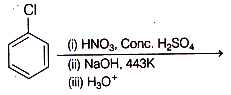
A
Phenol
B
$2,4-$Dinitrophenol
C
$2-$Nitrophenol
D
$4-$Nitrophenol
Solution
(D) The reaction proceeds as follows:
$1$. Electrophilic aromatic substitution (nitration) of chlorobenzene with $Conc. \ HNO_3$ and $Conc. \ H_2SO_4$ yields a mixture of $o$-nitrochlorobenzene (minor) and $p$-nitrochlorobenzene (major).
$2$. Nucleophilic aromatic substitution of the major product,$p$-nitrochlorobenzene,with $NaOH$ at $443 \ K$ followed by acidification $(H_3O^+)$ replaces the $-Cl$ group with an $-OH$ group.
$3$. The final major product is $p$-nitrophenol ($4$-nitrophenol).
$1$. Electrophilic aromatic substitution (nitration) of chlorobenzene with $Conc. \ HNO_3$ and $Conc. \ H_2SO_4$ yields a mixture of $o$-nitrochlorobenzene (minor) and $p$-nitrochlorobenzene (major).
$2$. Nucleophilic aromatic substitution of the major product,$p$-nitrochlorobenzene,with $NaOH$ at $443 \ K$ followed by acidification $(H_3O^+)$ replaces the $-Cl$ group with an $-OH$ group.
$3$. The final major product is $p$-nitrophenol ($4$-nitrophenol).
0 likes
View Solution388
EasyMCQ
Which one of the following is not present in the nitration mixture?
A
$NO_2^{+}$
B
$HSO_4^{-}$
C
$SO_4^{2-}$
D
$H_2O$
Solution
(C) The nitration mixture consists of concentrated $HNO_3$ and concentrated $H_2SO_4$. The reaction between them is as follows:
$HNO_3 + 2H_2SO_4 \rightarrow NO_2^{+} + H_3O^{+} + 2HSO_4^{-}$.
From the reaction,it is evident that $NO_2^{+}$,$H_3O^{+}$,and $HSO_4^{-}$ are present in the mixture.
$SO_4^{2-}$ ions are not formed in this reaction.
$HNO_3 + 2H_2SO_4 \rightarrow NO_2^{+} + H_3O^{+} + 2HSO_4^{-}$.
From the reaction,it is evident that $NO_2^{+}$,$H_3O^{+}$,and $HSO_4^{-}$ are present in the mixture.
$SO_4^{2-}$ ions are not formed in this reaction.
0 likes
View Solution389
MediumMCQ
What is the ratio of $sp^3$ carbons to $sp^2$ carbons in the product '$P$' of the given sequence of reactions?
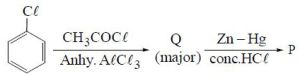
A
$3 : 1$
B
$2 : 1$
C
$1 : 2$
D
$1 : 3$
Solution
(D) The starting material is chlorobenzene. Friedel-Crafts acylation with $CH_3COCl$ in the presence of anhydrous $AlCl_3$ gives $p$-chloroacetophenone as the major product '$Q$' because the $-Cl$ group is ortho/para directing.
$Q = p-Cl-C_6H_4-COCH_3$.
Clemmensen reduction of '$Q$' using $Zn-Hg$ and $conc. HCl$ reduces the carbonyl group $(-COCH_3)$ to an ethyl group $(-CH_2CH_3)$.
Thus,the final product '$P$' is $p$-chloroethylbenzene,which is $Cl-C_6H_4-CH_2CH_3$.
In $p$-chloroethylbenzene $(C_8H_9Cl)$:
- The carbons in the ethyl group are: $-CH_2-$ $(sp^3)$ and $-CH_3$ $(sp^3)$. Total $sp^3$ carbons = $2$.
- The carbons in the benzene ring are all $sp^2$. Total $sp^2$ carbons = $6$.
- The ratio of $sp^3$ carbons to $sp^2$ carbons = $2 : 6 = 1 : 3$.
$Q = p-Cl-C_6H_4-COCH_3$.
Clemmensen reduction of '$Q$' using $Zn-Hg$ and $conc. HCl$ reduces the carbonyl group $(-COCH_3)$ to an ethyl group $(-CH_2CH_3)$.
Thus,the final product '$P$' is $p$-chloroethylbenzene,which is $Cl-C_6H_4-CH_2CH_3$.
In $p$-chloroethylbenzene $(C_8H_9Cl)$:
- The carbons in the ethyl group are: $-CH_2-$ $(sp^3)$ and $-CH_3$ $(sp^3)$. Total $sp^3$ carbons = $2$.
- The carbons in the benzene ring are all $sp^2$. Total $sp^2$ carbons = $6$.
- The ratio of $sp^3$ carbons to $sp^2$ carbons = $2 : 6 = 1 : 3$.
0 likes
View Solution390
MediumMCQ
Which of the following will undergo Friedel-Crafts alkylation with $CH_3Cl$ / anhy. $AlCl_3$?
A
$a, d$
B
$b, c$
C
$b, d$
D
$a, c$
Solution
(C) Friedel-Crafts alkylation is an electrophilic aromatic substitution reaction.
It does not occur with strongly deactivated rings (like benzoic acid,which has a $-COOH$ group) or with compounds that form a complex with the Lewis acid catalyst (like aniline,which has a $-NH_2$ group that coordinates with $AlCl_3$).
Chlorobenzene is deactivated due to the $-I$ effect of the chlorine atom,making it very slow to react,but it is generally considered to undergo the reaction under specific conditions.
Anisole (methoxybenzene) is an activated ring due to the $+M$ effect of the $-OCH_3$ group and readily undergoes Friedel-Crafts alkylation.
Therefore,$b$ (Chlorobenzene) and $d$ (Anisole) are the compounds that can undergo this reaction.
It does not occur with strongly deactivated rings (like benzoic acid,which has a $-COOH$ group) or with compounds that form a complex with the Lewis acid catalyst (like aniline,which has a $-NH_2$ group that coordinates with $AlCl_3$).
Chlorobenzene is deactivated due to the $-I$ effect of the chlorine atom,making it very slow to react,but it is generally considered to undergo the reaction under specific conditions.
Anisole (methoxybenzene) is an activated ring due to the $+M$ effect of the $-OCH_3$ group and readily undergoes Friedel-Crafts alkylation.
Therefore,$b$ (Chlorobenzene) and $d$ (Anisole) are the compounds that can undergo this reaction.
0 likes
View Solution391
MediumMCQ
The product$(s)$ formed when toluene is reacted with $Cl_2$ in the presence of $Fe$ in the dark is/are:
A
$o-$chlorotoluene and $p-$chlorotoluene
B
benzyl chloride
C
benzal chloride
D
benzotrichloride
Solution
(A) In the presence of $Fe$ in the dark,the reaction follows electrophilic aromatic substitution,which occurs at the ortho and para positions of the toluene ring.
Therefore,the products formed are $o-$chlorotoluene and $p-$chlorotoluene.
In the presence of $UV$ light with the same reagent,the $C(sp^3)-H$ bond breaks down and forms a free radical,resulting in side-chain chlorination.
Therefore,the products formed are $o-$chlorotoluene and $p-$chlorotoluene.
In the presence of $UV$ light with the same reagent,the $C(sp^3)-H$ bond breaks down and forms a free radical,resulting in side-chain chlorination.
0 likes
View Solution392
MediumMCQ
Identify the product $Y$ in the given reaction sequence:
Benzene $\xrightarrow[Conc. H_2SO_4]{Conc. HNO_3} X$ $\xrightarrow[FeCl_3]{Cl_2} Y$
Benzene $\xrightarrow[Conc. H_2SO_4]{Conc. HNO_3} X$ $\xrightarrow[FeCl_3]{Cl_2} Y$
A
$1-$chloro$-3-$nitrobenzene
B
$3-$chloro$-1-$nitrobenzene
C
$2-$chloro$-1-$nitrobenzene
D
$1-$chloro$-4-$nitrobenzene
Solution
(A) $1$. The first step is the nitration of benzene using a mixture of concentrated $HNO_3$ and concentrated $H_2SO_4$,which produces nitrobenzene $(X)$.
$2$. The second step is the chlorination of nitrobenzene in the presence of a Lewis acid catalyst $(FeCl_3)$.
$3$. The nitro group $(-NO_2)$ is a strong electron-withdrawing group and is meta-directing.
$4$. Therefore,the incoming chlorine atom will attach to the meta-position relative to the nitro group,resulting in $1-$chloro$-3-$nitrobenzene (or $m-$chloronitrobenzene) as the major product $Y$.
$2$. The second step is the chlorination of nitrobenzene in the presence of a Lewis acid catalyst $(FeCl_3)$.
$3$. The nitro group $(-NO_2)$ is a strong electron-withdrawing group and is meta-directing.
$4$. Therefore,the incoming chlorine atom will attach to the meta-position relative to the nitro group,resulting in $1-$chloro$-3-$nitrobenzene (or $m-$chloronitrobenzene) as the major product $Y$.
0 likes
View Solution393
MediumMCQ
Which of the following is least reactive towards $S_{N}1$ reaction?
A
$C_6H_5CH_2Cl$
B
$C_6H_5Cl$
C
$CH_2=CH-CH_2Cl$
D
$(C_6H_5)_2CHCl$
Solution
(B) The reactivity towards $S_{N}1$ reaction depends on the stability of the carbocation formed in the rate-determining step.
In $C_6H_5Cl$,the $C-Cl$ bond has partial double bond character due to resonance,making it extremely difficult to break.
Furthermore,the resulting phenyl cation $(C_6H_5^+)$ is highly unstable because the positive charge is on an $sp$-hybridized carbon atom.
In contrast,the other options form relatively stable carbocations: $C_6H_5CH_2^+$ (benzyl),$CH_2=CH-CH_2^+$ (allyl),and $(C_6H_5)_2CH^+$ (diphenylmethyl).
Therefore,$C_6H_5Cl$ is the least reactive towards $S_{N}1$ reaction.
In $C_6H_5Cl$,the $C-Cl$ bond has partial double bond character due to resonance,making it extremely difficult to break.
Furthermore,the resulting phenyl cation $(C_6H_5^+)$ is highly unstable because the positive charge is on an $sp$-hybridized carbon atom.
In contrast,the other options form relatively stable carbocations: $C_6H_5CH_2^+$ (benzyl),$CH_2=CH-CH_2^+$ (allyl),and $(C_6H_5)_2CH^+$ (diphenylmethyl).
Therefore,$C_6H_5Cl$ is the least reactive towards $S_{N}1$ reaction.
0 likes
View Solution394
MediumMCQ
Which of the following sets of functional groups contains only meta-directing groups?
A
$-NO_2, -NH_2, -COOH, -COOR$
B
$-NO_2, -CHO, -SO_3H, -COR$
C
$-CN, -CHO, -NHCOCH_3, -COOR$
D
$-CN, -NH_2, -NHR, -OCH_3$
Solution
(B) Meta-directing groups are electron-withdrawing groups that decrease the electron density of the benzene ring,particularly at the ortho and para positions,thereby directing the incoming electrophile to the meta position.
In the given options,the set $-NO_2, -CHO, -SO_3H, -COR$ consists entirely of electron-withdrawing groups that are meta-directing.
$-NH_2, -NHR, -OCH_3$ and $-NHCOCH_3$ are ortho/para-directing groups due to their electron-donating resonance effect.
In the given options,the set $-NO_2, -CHO, -SO_3H, -COR$ consists entirely of electron-withdrawing groups that are meta-directing.
$-NH_2, -NHR, -OCH_3$ and $-NHCOCH_3$ are ortho/para-directing groups due to their electron-donating resonance effect.
0 likes
View SolutionHaloalkanes and Haloarenes — Properties of Haloarenes · Frequently Asked Questions
1Are these Haloalkanes and Haloarenes questions useful for JEE and NEET?
Yes. All questions in this section are mapped to JEE Main and NEET exam patterns. Previous year questions from JEE Main, NEET, GUJCET and state-level exams are included with full solutions.
2Can I switch to Hindi or Gujarati for these questions?
Yes. Use the language tabs in the hero section or the sidebar to view the same questions and solutions in English, Hindi or Gujarati.
3How do I generate a question paper from this subtopic?
Use the Vedclass Exam Paper Generator — select the chapter and subtopic, set difficulty, and generate Sets A, B, C, D automatically. First 3 chapters of every subject are free.
Vedclass Products
For Students
Vedclass Test Series
Mock tests in real JEE/NEET style with performance analysis. 5-day free trial.
Start Free TrialFor Teachers
Exam Paper Generator
Generate Set A/B/C/D papers from this chapter in 2 minutes. 3 chapters free.
Try FreeFor Institutes
Online Exam Module
Live online exams with unlimited students, 360° analytics & white-label branding.
See DemoFor Teachers & Institutes
Generate a Haloalkanes and Haloarenes Exam Paper in 2 Minutes
Select subtopic & difficulty — Sets A, B, C, D auto-generated with No Repeat logic.
First 3 chapters of every subject are free — no payment required.