
A English
Properties of Haloarenes Questions in English
Class 12 Chemistry · Haloalkanes and Haloarenes · Properties of Haloarenes
423+
Questions
English
Language
100%
With Solutions
Showing 50 of 423 questions in English
251
Medium
Haloarenes are less reactive than haloalkanes and haloalkenes towards nucleophilic substitution reactions. Explain.
Solution
(N/A) The lone pair of electrons on the halogen atom is involved in resonance with the $\pi$-electrons of the benzene ring.
As a result,the $C-X$ bond acquires a partial double bond character,which makes it stronger and shorter than a pure single bond.
This partial double bond character makes it difficult for the bond to break,thereby reducing the reactivity of haloarenes towards nucleophilic substitution reactions compared to haloalkanes and haloalkenes.
As a result,the $C-X$ bond acquires a partial double bond character,which makes it stronger and shorter than a pure single bond.
This partial double bond character makes it difficult for the bond to break,thereby reducing the reactivity of haloarenes towards nucleophilic substitution reactions compared to haloalkanes and haloalkenes.
0 likes
View Solution252
Medium
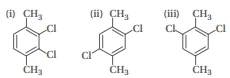
Which of the following compounds will have the highest melting point and why?
Solution
(B) The compound $(ii)$ has the highest melting point.
This is because it has a highly symmetrical structure,which allows it to pack more efficiently in the crystal lattice.
Greater packing efficiency leads to stronger intermolecular forces of attraction,requiring more energy to break the lattice and melt the solid.
This is because it has a highly symmetrical structure,which allows it to pack more efficiently in the crystal lattice.
Greater packing efficiency leads to stronger intermolecular forces of attraction,requiring more energy to break the lattice and melt the solid.
0 likes
View Solution253
Medium
Diphenyls are a potential threat to the environment. How are these produced from aryl halides?
Solution
(N/A) Diphenyls can be prepared by Fittig's reaction. When aryl halides are treated with sodium metal in the presence of dry ether,they undergo a coupling reaction to form diphenyls. The general reaction is as follows:
$2Ar-X + 2Na \xrightarrow{\text{dry ether}} Ar-Ar + 2NaX$
$2Ar-X + 2Na \xrightarrow{\text{dry ether}} Ar-Ar + 2NaX$
0 likes
View Solution254
MediumMCQ
Aryl halides are extremely less reactive towards nucleophilic substitution. Predict and explain the order of reactivity of the following compounds towards nucleophilic substitution:
$(I)$ $p$-nitrochlorobenzene
$(II)$ $2,4$-dinitrochlorobenzene
$(III)$ $2,4,6$-trinitrochlorobenzene
$(I)$ $p$-nitrochlorobenzene
$(II)$ $2,4$-dinitrochlorobenzene
$(III)$ $2,4,6$-trinitrochlorobenzene
A
$(I)$ > $(II)$ > $(III)$
B
$(III)$ > $(II)$ > $(I)$
C
$(II)$ > $(III)$ > $(I)$
D
$(I)$ > $(III)$ > $(II)$
Solution
(B) The reactivity of aryl halides towards nucleophilic substitution increases with the presence of electron-withdrawing groups (like $-NO_2$) at the $o-$ and $p-$positions.
These groups stabilize the carbanion intermediate formed during the reaction through resonance.
Compound $(I)$ has one $-NO_2$ group at the $p-$position.
Compound $(II)$ has two $-NO_2$ groups (one at $o-$ and one at $p-$position).
Compound $(III)$ has three $-NO_2$ groups (two at $o-$ and one at $p-$position).
As the number of electron-withdrawing groups increases,the stability of the intermediate increases,thereby increasing the reactivity.
Therefore,the correct order of reactivity is $(III) > (II) > (I)$.
These groups stabilize the carbanion intermediate formed during the reaction through resonance.
Compound $(I)$ has one $-NO_2$ group at the $p-$position.
Compound $(II)$ has two $-NO_2$ groups (one at $o-$ and one at $p-$position).
Compound $(III)$ has three $-NO_2$ groups (two at $o-$ and one at $p-$position).
As the number of electron-withdrawing groups increases,the stability of the intermediate increases,thereby increasing the reactivity.
Therefore,the correct order of reactivity is $(III) > (II) > (I)$.
0 likes
View Solution255
Medium
Discuss the nature of $C-X$ bond in the haloarenes.
Solution
(N/A) In haloarenes,the halogen atom is directly attached to an $sp^2$ hybridized carbon atom of the benzene ring.
$1$. The $sp^2$ hybridized carbon has more $s$-character $(33.3\%)$ compared to the $sp^3$ hybridized carbon in haloalkanes $(25\%)$.
$2$. Due to higher $s$-character,the $C-X$ bond in haloarenes is shorter and stronger than in haloalkanes.
$3$. Furthermore,the lone pair of electrons on the halogen atom participates in resonance with the $\pi$-electrons of the benzene ring.
$4$. This resonance gives the $C-X$ bond a partial double bond character,which makes it even shorter and stronger,making it difficult to break compared to the $C-X$ bond in haloalkanes.
$1$. The $sp^2$ hybridized carbon has more $s$-character $(33.3\%)$ compared to the $sp^3$ hybridized carbon in haloalkanes $(25\%)$.
$2$. Due to higher $s$-character,the $C-X$ bond in haloarenes is shorter and stronger than in haloalkanes.
$3$. Furthermore,the lone pair of electrons on the halogen atom participates in resonance with the $\pi$-electrons of the benzene ring.
$4$. This resonance gives the $C-X$ bond a partial double bond character,which makes it even shorter and stronger,making it difficult to break compared to the $C-X$ bond in haloalkanes.
0 likes
View Solution256
Difficult
Arrange the following set of compounds in order of their decreasing relative reactivity with an electrophile,$E^{+}$:
$(a)$ Chlorobenzene,$2,4-$dinitrochlorobenzene,$p-$nitrochlorobenzene
$(b)$ Toluene,$p-CH_3-C_6H_4-NO_2$,$p-O_2N-C_6H_4-NO_2$
$(a)$ Chlorobenzene,$2,4-$dinitrochlorobenzene,$p-$nitrochlorobenzene
$(b)$ Toluene,$p-CH_3-C_6H_4-NO_2$,$p-O_2N-C_6H_4-NO_2$
Solution
(N/A) Electrophiles are reagents that participate in a reaction by accepting an electron pair to bond with nucleophiles. The higher the electron density on a benzene ring,the more reactive the compound is towards an electrophile,$E^{+}$ (Electrophilic aromatic substitution).
$(a)$ The presence of electron-withdrawing groups (i.e.,$NO_2$ and $Cl$) deactivates the aromatic ring by decreasing the electron density. Since the $NO_2$ group is more electron-withdrawing (due to resonance and inductive effects) than the $Cl$ group (which is deactivating due to its strong inductive effect despite resonance donation),the decreasing order of reactivity is:
Chlorobenzene $> p-$Nitrochlorobenzene $> 2,4-$Dinitrochlorobenzene
$(b)$ While $CH_3$ is an electron-donating group (activating),the $NO_2$ group is electron-withdrawing (deactivating). Toluene has the highest electron density and is most easily attacked by $E^{+}$. As the number of $NO_2$ substituents increases,the electron density decreases. Thus,the order is:
Toluene $> p-CH_3-C_6H_4-NO_2 > p-O_2N-C_6H_4-NO_2$
$(a)$ The presence of electron-withdrawing groups (i.e.,$NO_2$ and $Cl$) deactivates the aromatic ring by decreasing the electron density. Since the $NO_2$ group is more electron-withdrawing (due to resonance and inductive effects) than the $Cl$ group (which is deactivating due to its strong inductive effect despite resonance donation),the decreasing order of reactivity is:
Chlorobenzene $> p-$Nitrochlorobenzene $> 2,4-$Dinitrochlorobenzene
$(b)$ While $CH_3$ is an electron-donating group (activating),the $NO_2$ group is electron-withdrawing (deactivating). Toluene has the highest electron density and is most easily attacked by $E^{+}$. As the number of $NO_2$ substituents increases,the electron density decreases. Thus,the order is:
Toluene $> p-CH_3-C_6H_4-NO_2 > p-O_2N-C_6H_4-NO_2$
0 likes
View Solution257
Medium
How will you convert benzene into:
$(i)$ $p-$nitrobromobenzene
(ii) $m-$nitrochlorobenzene
$(i)$ $p-$nitrobromobenzene
(ii) $m-$nitrochlorobenzene
Solution
(N/A) $(i)$ Conversion of benzene to $p-$nitrobromobenzene:
First,benzene undergoes bromination with $Br_2$ in the presence of anhydrous $FeBr_3$ to form bromobenzene.
Then,bromobenzene undergoes nitration with concentrated $HNO_3$ and concentrated $H_2SO_4$ to form a mixture of $o-$ and $p-$nitrobromobenzene.
The $p-$isomer is separated from the $o-$isomer by fractional distillation.
(ii) Conversion of benzene to $m-$nitrochlorobenzene:
First,benzene undergoes nitration with concentrated $HNO_3$ and concentrated $H_2SO_4$ to form nitrobenzene.
Since the nitro group $(-NO_2)$ is meta-directing,subsequent chlorination with $Cl_2$ in the presence of anhydrous $AlCl_3$ yields $m-$nitrochlorobenzene.
First,benzene undergoes bromination with $Br_2$ in the presence of anhydrous $FeBr_3$ to form bromobenzene.
Then,bromobenzene undergoes nitration with concentrated $HNO_3$ and concentrated $H_2SO_4$ to form a mixture of $o-$ and $p-$nitrobromobenzene.
The $p-$isomer is separated from the $o-$isomer by fractional distillation.
(ii) Conversion of benzene to $m-$nitrochlorobenzene:
First,benzene undergoes nitration with concentrated $HNO_3$ and concentrated $H_2SO_4$ to form nitrobenzene.
Since the nitro group $(-NO_2)$ is meta-directing,subsequent chlorination with $Cl_2$ in the presence of anhydrous $AlCl_3$ yields $m-$nitrochlorobenzene.
0 likes
View Solution258
Medium
Give chemical reactions for the following conversions:
$(1)$ Nitrobenzene from phenol
$(2)$ $p$-methylacetophenone from benzene
$(1)$ Nitrobenzene from phenol
$(2)$ $p$-methylacetophenone from benzene
Solution
(N/A) $(1)$ Conversion of phenol to nitrobenzene:
Phenol is first reduced to benzene using zinc dust,followed by nitration.
$\text{Phenol}$ $\xrightarrow{\text{Zn dust}, \Delta} \text{Benzene}$ $\xrightarrow{\text{Conc. } HNO_3, \text{Conc. } H_2SO_4, \Delta} \text{Nitrobenzene}$
$(2)$ Conversion of benzene to $p$-methylacetophenone:
Benzene undergoes Friedel-Crafts alkylation to form toluene,followed by Friedel-Crafts acylation.
$\text{Benzene}$ $\xrightarrow{\text{CH}_3\text{Cl, anhy. AlCl}_3} \text{Toluene}$ $\xrightarrow{\text{CH}_3\text{COCl, anhy. AlCl}_3} p\text{-methylacetophenone}$
Phenol is first reduced to benzene using zinc dust,followed by nitration.
$\text{Phenol}$ $\xrightarrow{\text{Zn dust}, \Delta} \text{Benzene}$ $\xrightarrow{\text{Conc. } HNO_3, \text{Conc. } H_2SO_4, \Delta} \text{Nitrobenzene}$
$(2)$ Conversion of benzene to $p$-methylacetophenone:
Benzene undergoes Friedel-Crafts alkylation to form toluene,followed by Friedel-Crafts acylation.
$\text{Benzene}$ $\xrightarrow{\text{CH}_3\text{Cl, anhy. AlCl}_3} \text{Toluene}$ $\xrightarrow{\text{CH}_3\text{COCl, anhy. AlCl}_3} p\text{-methylacetophenone}$
0 likes
View Solution259
MediumMCQ
Why is $m$-dinitrobenzene obtained from $C_6H_5NO_2$?
A
The $-NO_2$ group is ortho-para directing.
B
The $-NO_2$ group is meta-directing.
C
The $-NO_2$ group activates the ring.
D
The $-NO_2$ group is electron-donating.
Solution
(B) The $-NO_2$ group is a strong electron-withdrawing group due to its $-I$ and $-M$ effects.
It decreases the electron density at the ortho and para positions of the benzene ring.
Therefore,the incoming electrophile (nitronium ion,$NO_2^+$) is directed to the meta-position,where the electron density is relatively higher compared to the ortho and para positions.
Thus,$m$-dinitrobenzene is obtained.
It decreases the electron density at the ortho and para positions of the benzene ring.
Therefore,the incoming electrophile (nitronium ion,$NO_2^+$) is directed to the meta-position,where the electron density is relatively higher compared to the ortho and para positions.
Thus,$m$-dinitrobenzene is obtained.
0 likes
View Solution260
Easy
Which of the following are deactivating groups?
$-OH, -COCH_3, -NO_2, -NH_2, -Cl, -Br, -NHCOCH_3, -COOH$
$-OH, -COCH_3, -NO_2, -NH_2, -Cl, -Br, -NHCOCH_3, -COOH$
Solution
(D) In electrophilic aromatic substitution,groups are classified based on their effect on the electron density of the benzene ring.
$1$. Activator groups (electron-donating): $-OH, -NH_2, -NHCOCH_3$.
$2$. Deactivator groups (electron-withdrawing): $-COCH_3, -NO_2, -Cl, -Br, -COOH$.
$1$. Activator groups (electron-donating): $-OH, -NH_2, -NHCOCH_3$.
$2$. Deactivator groups (electron-withdrawing): $-COCH_3, -NO_2, -Cl, -Br, -COOH$.
0 likes
View Solution261
MediumMCQ
Arrange the following groups in increasing order of reactivity towards electrophilic nitration reaction: $C_6H_6, C_6H_5Cl, C_6H_5COOH, C_6H_5NH_2$.
A
$C_6H_5COOH < C_6H_5Cl < C_6H_6 < C_6H_5NH_2$
B
$C_6H_5NH_2 < C_6H_6 < C_6H_5Cl < C_6H_5COOH$
C
$C_6H_5Cl < C_6H_5COOH < C_6H_6 < C_6H_5NH_2$
D
$C_6H_6 < C_6H_5Cl < C_6H_5NH_2 < C_6H_5COOH$
Solution
(A) The reactivity of aromatic compounds towards electrophilic substitution (like nitration) depends on the electron density of the benzene ring.
Electron-donating groups $(EDG)$ increase electron density and reactivity,while electron-withdrawing groups $(EWG)$ decrease it.
$1$. $-NH_2$ is a strong activating group ($+R$ effect),making $C_6H_5NH_2$ the most reactive.
$2$. $C_6H_6$ is the reference compound.
$3$. $-Cl$ is a deactivating group ($-I$ effect dominates over $+R$ effect),making $C_6H_5Cl$ less reactive than benzene.
$4$. $-COOH$ is a strongly deactivating group ($-I$ and $-R$ effects),making $C_6H_5COOH$ the least reactive.
Therefore,the increasing order of reactivity is: $C_6H_5COOH < C_6H_5Cl < C_6H_6 < C_6H_5NH_2$.
Electron-donating groups $(EDG)$ increase electron density and reactivity,while electron-withdrawing groups $(EWG)$ decrease it.
$1$. $-NH_2$ is a strong activating group ($+R$ effect),making $C_6H_5NH_2$ the most reactive.
$2$. $C_6H_6$ is the reference compound.
$3$. $-Cl$ is a deactivating group ($-I$ effect dominates over $+R$ effect),making $C_6H_5Cl$ less reactive than benzene.
$4$. $-COOH$ is a strongly deactivating group ($-I$ and $-R$ effects),making $C_6H_5COOH$ the least reactive.
Therefore,the increasing order of reactivity is: $C_6H_5COOH < C_6H_5Cl < C_6H_6 < C_6H_5NH_2$.
0 likes
View Solution262
Medium
Why are aryl halides less reactive towards nucleophilic substitution reactions than alkyl halides? How can we enhance the reactivity of aryl halides?
Solution
(N/A) Aryl halides are less reactive towards nucleophilic substitution than alkyl halides due to the following reasons:
$1$. Resonance Effect: The lone pair of electrons on the halogen atom participates in conjugation with the $\pi$-electrons of the benzene ring,resulting in a partial double bond character between the carbon and the halogen atom. This makes the $C-X$ bond stronger and shorter,making it difficult to break.
$2$. Difference in Hybridization: In aryl halides,the carbon atom attached to the halogen is $sp^2$-hybridized,which is more electronegative and holds the electron pair more tightly than the $sp^3$-hybridized carbon in alkyl halides.
$3$. Instability of Phenyl Cation: The phenyl cation formed by the self-ionization of aryl halides is not stabilized by resonance.
$4$. Electron Repulsion: The electron-rich benzene ring repels the incoming nucleophile.
To enhance the reactivity of aryl halides,we can introduce electron-withdrawing groups (like $-NO_2$) at the ortho and para positions. These groups withdraw electron density from the benzene ring,thereby facilitating the attack of the nucleophile.
$1$. Resonance Effect: The lone pair of electrons on the halogen atom participates in conjugation with the $\pi$-electrons of the benzene ring,resulting in a partial double bond character between the carbon and the halogen atom. This makes the $C-X$ bond stronger and shorter,making it difficult to break.
$2$. Difference in Hybridization: In aryl halides,the carbon atom attached to the halogen is $sp^2$-hybridized,which is more electronegative and holds the electron pair more tightly than the $sp^3$-hybridized carbon in alkyl halides.
$3$. Instability of Phenyl Cation: The phenyl cation formed by the self-ionization of aryl halides is not stabilized by resonance.
$4$. Electron Repulsion: The electron-rich benzene ring repels the incoming nucleophile.
To enhance the reactivity of aryl halides,we can introduce electron-withdrawing groups (like $-NO_2$) at the ortho and para positions. These groups withdraw electron density from the benzene ring,thereby facilitating the attack of the nucleophile.
0 likes
View Solution263
Difficult
Match the reactants in Column-$I$ with their products in Column-$II$.
| Column-$I$ (Reactants) | Column-$II$ (Products) |
|---|---|
| $(A)$ $p$-Nitrochlorobenzene $\xrightarrow[(ii) H^+]{(i) NaOH, 443 \ K}$ | $(i)$ Phenol |
| $(B)$ Chlorobenzene $\xrightarrow[(ii) H^+]{(i) NaOH, 623 \ K, 300 \ atm}$ | $(ii)$ $2,4,6$-Trinitrophenol |
| $(C)$ $2,4$-Dinitrochlorobenzene $\xrightarrow[(ii) H^+]{(i) NaOH, 368 \ K}$ | $(iii)$ $2,4$-Dinitrophenol |
| $(D)$ $2,4,6$-Trinitrochlorobenzene $\xrightarrow{Warm \ H_2O}$ | $(iv)$ $p$-Nitrophenol |
Solution
(A-IV, B-I, C-III, D-II) The reaction of haloarenes with nucleophiles depends on the presence of electron-withdrawing groups (like $-NO_2$) on the benzene ring. These groups activate the ring towards nucleophilic substitution.
$(A)$ $p$-Nitrochlorobenzene reacts with $NaOH$ at $443 \ K$ to give $p$-nitrophenol. Thus,$(A \rightarrow iv)$.
$(B)$ Chlorobenzene is least reactive and requires harsh conditions $(623 \ K, 300 \ atm)$ to form phenol. Thus,$(B \rightarrow i)$.
$(C)$ $2,4$-Dinitrochlorobenzene is more reactive than $p$-nitrochlorobenzene and reacts at $368 \ K$ to give $2,4$-dinitrophenol. Thus,$(C \rightarrow iii)$.
$(D)$ $2,4,6$-Trinitrochlorobenzene is highly reactive and can be hydrolyzed by warm water to give $2,4,6$-trinitrophenol (picric acid). Thus,$(D \rightarrow ii)$.
The correct matching is: $(A$ $\rightarrow iv, B$ $\rightarrow i, C$ $\rightarrow iii, D$ $\rightarrow ii)$.
$(A)$ $p$-Nitrochlorobenzene reacts with $NaOH$ at $443 \ K$ to give $p$-nitrophenol. Thus,$(A \rightarrow iv)$.
$(B)$ Chlorobenzene is least reactive and requires harsh conditions $(623 \ K, 300 \ atm)$ to form phenol. Thus,$(B \rightarrow i)$.
$(C)$ $2,4$-Dinitrochlorobenzene is more reactive than $p$-nitrochlorobenzene and reacts at $368 \ K$ to give $2,4$-dinitrophenol. Thus,$(C \rightarrow iii)$.
$(D)$ $2,4,6$-Trinitrochlorobenzene is highly reactive and can be hydrolyzed by warm water to give $2,4,6$-trinitrophenol (picric acid). Thus,$(D \rightarrow ii)$.
The correct matching is: $(A$ $\rightarrow iv, B$ $\rightarrow i, C$ $\rightarrow iii, D$ $\rightarrow ii)$.
0 likes
View Solution264
Medium
In chlorobenzene,the $-Cl$ group is deactivating; however,it still undergoes electrophilic aromatic substitution reactions. Column-$(I)$ contains the reagents and Column-$(II)$ contains the products. Match Column-$(I)$ with Column-$(II)$.
| Column-$(I)$ (Reagents) | Column-$(II)$ (Products) |
| :--- | :--- |
| $(A)$ $Cl_2$ / anhydrous $AlCl_3$ | $(i)$ $1$-chloro-$2$-methylbenzene + $1$-chloro-$4$-methylbenzene |
| $(B)$ conc. $HNO_3$ + conc. $H_2SO_4$ | $(ii)$ $2$-chlorobenzenesulfonic acid + $4$-chlorobenzenesulfonic acid |
| $(C)$ conc. $H_2SO_4$ and heat | $(iii)$ $1,2$-dichlorobenzene + $1,4$-dichlorobenzene |
| $(D)$ $CH_3COCl$ in presence of anhydrous $AlCl_3$ | $(iv)$ $2$-chloroacetophenone + $4$-chloroacetophenone |
| | $(v)$ $1$-chloro-$2$-nitrobenzene + $1$-chloro-$4$-nitrobenzene |
| Column-$(I)$ (Reagents) | Column-$(II)$ (Products) |
| :--- | :--- |
| $(A)$ $Cl_2$ / anhydrous $AlCl_3$ | $(i)$ $1$-chloro-$2$-methylbenzene + $1$-chloro-$4$-methylbenzene |
| $(B)$ conc. $HNO_3$ + conc. $H_2SO_4$ | $(ii)$ $2$-chlorobenzenesulfonic acid + $4$-chlorobenzenesulfonic acid |
| $(C)$ conc. $H_2SO_4$ and heat | $(iii)$ $1,2$-dichlorobenzene + $1,4$-dichlorobenzene |
| $(D)$ $CH_3COCl$ in presence of anhydrous $AlCl_3$ | $(iv)$ $2$-chloroacetophenone + $4$-chloroacetophenone |
| | $(v)$ $1$-chloro-$2$-nitrobenzene + $1$-chloro-$4$-nitrobenzene |
Solution
(A-III, B-V, C-II, D-IV) The electrophilic aromatic substitution reactions of chlorobenzene occur at the ortho and para positions due to the resonance effect of the $-Cl$ atom.
$(A)$ Chlorination: $Cl_2$ / anhydrous $AlCl_3$ gives $1,2$-dichlorobenzene and $1,4$-dichlorobenzene. Thus,$(A \rightarrow iii)$.
$(B)$ Nitration: conc. $HNO_3$ + conc. $H_2SO_4$ gives $1$-chloro-$2$-nitrobenzene and $1$-chloro-$4$-nitrobenzene. Thus,$(B \rightarrow v)$.
$(C)$ Sulfonation: conc. $H_2SO_4$ and heat gives $2$-chlorobenzenesulfonic acid and $4$-chlorobenzenesulfonic acid. Thus,$(C \rightarrow ii)$.
$(D)$ Friedel-Crafts Acylation: $CH_3COCl$ / anhydrous $AlCl_3$ gives $2$-chloroacetophenone and $4$-chloroacetophenone. Thus,$(D \rightarrow iv)$.
$(A)$ Chlorination: $Cl_2$ / anhydrous $AlCl_3$ gives $1,2$-dichlorobenzene and $1,4$-dichlorobenzene. Thus,$(A \rightarrow iii)$.
$(B)$ Nitration: conc. $HNO_3$ + conc. $H_2SO_4$ gives $1$-chloro-$2$-nitrobenzene and $1$-chloro-$4$-nitrobenzene. Thus,$(B \rightarrow v)$.
$(C)$ Sulfonation: conc. $H_2SO_4$ and heat gives $2$-chlorobenzenesulfonic acid and $4$-chlorobenzenesulfonic acid. Thus,$(C \rightarrow ii)$.
$(D)$ Friedel-Crafts Acylation: $CH_3COCl$ / anhydrous $AlCl_3$ gives $2$-chloroacetophenone and $4$-chloroacetophenone. Thus,$(D \rightarrow iv)$.
0 likes
View Solution265
MediumMCQ
$[P]$ on treatment with $Br_{2}/FeBr_{3}$ in $CCl_{4}$ produced a single isomer $C_{8}H_{7}O_{2}Br$ while heating $[P]$ with sodalime gave toluene. The compound $[P]$ is:
A
Phenylacetic acid
B
$m$-Toluic acid
C
$o$-Toluic acid
D
$p$-Toluic acid
Solution
(D) $1$. Heating $[P]$ with sodalime $(NaOH + CaO)$ causes decarboxylation,yielding toluene $(C_6H_5CH_3)$. This implies $[P]$ is a toluic acid isomer $(CH_3C_6H_4COOH)$.
$2$. Bromination of $[P]$ with $Br_2/FeBr_3$ is an electrophilic aromatic substitution reaction. The $-CH_3$ group is ortho/para-directing,and the $-COOH$ group is meta-directing.
$3$. In $p$-toluic acid,both groups direct the incoming bromine to the same position (ortho to $-CH_3$ and meta to $-COOH$),resulting in a single isomer: $3$-bromo-$4$-methylbenzoic acid.
$4$. Therefore,$[P]$ is $p$-toluic acid.
$2$. Bromination of $[P]$ with $Br_2/FeBr_3$ is an electrophilic aromatic substitution reaction. The $-CH_3$ group is ortho/para-directing,and the $-COOH$ group is meta-directing.
$3$. In $p$-toluic acid,both groups direct the incoming bromine to the same position (ortho to $-CH_3$ and meta to $-COOH$),resulting in a single isomer: $3$-bromo-$4$-methylbenzoic acid.
$4$. Therefore,$[P]$ is $p$-toluic acid.
0 likes
View Solution266
MediumMCQ
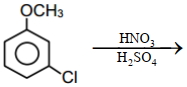
The major product of the following reaction is:
A
$1-$chloro$-4-$methoxy$-2-$nitrobenzene
B
$1-$chloro$-2-$methoxy$-4-$nitrobenzene
C
$1-$chloro$-2-$nitro$-3-$methoxybenzene
D
$1-$chloro$-4-$nitro$-2-$methoxybenzene
Solution
(A) The starting material is $1-$chloro$-3-$methoxybenzene. The $-OCH_3$ group is an ortho/para directing group,and the $-Cl$ group is also an ortho/para directing group. The $-OCH_3$ group is a stronger activating group than the $-Cl$ group,so the electrophilic substitution (nitration) is directed by the $-OCH_3$ group. The para position relative to $-OCH_3$ is occupied by the $-Cl$ group,so the nitration occurs at the ortho position relative to $-OCH_3$. Between the two ortho positions,the position para to the $-Cl$ group is less sterically hindered. Therefore,the major product is $1-$chloro$-4-$methoxy$-2-$nitrobenzene.
0 likes
View Solution267
MediumMCQ
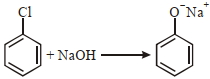
The above reaction requires which of the following reaction conditions?
A
$573 \ K, Cu, 300 \ atm$
B
$623 \ K, Cu, 300 \ atm$
C
$573 \ K, 300 \ atm$
D
$623 \ K, 300 \ atm$
Solution
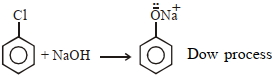
(D) The reaction shown is the conversion of chlorobenzene to sodium phenoxide,which is the first step of the Dow process.
This nucleophilic substitution reaction of chlorobenzene with aqueous $NaOH$ requires harsh conditions due to the partial double bond character of the $C-Cl$ bond.
The required conditions are a temperature of $623 \ K$ and a pressure of $300 \ atm$.
This nucleophilic substitution reaction of chlorobenzene with aqueous $NaOH$ requires harsh conditions due to the partial double bond character of the $C-Cl$ bond.
The required conditions are a temperature of $623 \ K$ and a pressure of $300 \ atm$.
0 likes
View Solution268
EasyMCQ
The correct order of the following compounds showing increasing tendency towards nucleophilic substitution reaction is :-
$(i)$ Chlorobenzene
(ii) $p$-Nitrochlorobenzene
(iii) $2,4$-Dinitrochlorobenzene
(iv) $2,4,6$-Trinitrochlorobenzene
$(i)$ Chlorobenzene
(ii) $p$-Nitrochlorobenzene
(iii) $2,4$-Dinitrochlorobenzene
(iv) $2,4,6$-Trinitrochlorobenzene
A
$ ( i ) < ( ii ) < ( iii ) < ( iv ) $
B
$ ( iv ) < ( i ) < ( ii ) < ( iii ) $
C
$ ( iv ) < ( i ) < ( iii ) < ( ii ) $
D
$ ( i ) < ( ii ) < ( iii ) < ( iv ) $
Solution
(A) Nucleophilic aromatic substitution reactions are facilitated by the presence of electron-withdrawing groups (like $-NO_2$) on the benzene ring.
These groups stabilize the intermediate carbanion through the $-I$ and $-M$ effects.
As the number of $-NO_2$ groups increases,the electron density on the ring decreases,making it more susceptible to nucleophilic attack.
The order of reactivity is:
$(i)$ Chlorobenzene (no $-NO_2$ group)
(ii) $p$-Nitrochlorobenzene (one $-NO_2$ group)
(iii) $2,4$-Dinitrochlorobenzene (two $-NO_2$ groups)
(iv) $2,4,6$-Trinitrochlorobenzene (three $-NO_2$ groups)
Therefore,the increasing order of tendency towards nucleophilic substitution is $(i) < (ii) < (iii) < (iv)$.
These groups stabilize the intermediate carbanion through the $-I$ and $-M$ effects.
As the number of $-NO_2$ groups increases,the electron density on the ring decreases,making it more susceptible to nucleophilic attack.
The order of reactivity is:
$(i)$ Chlorobenzene (no $-NO_2$ group)
(ii) $p$-Nitrochlorobenzene (one $-NO_2$ group)
(iii) $2,4$-Dinitrochlorobenzene (two $-NO_2$ groups)
(iv) $2,4,6$-Trinitrochlorobenzene (three $-NO_2$ groups)
Therefore,the increasing order of tendency towards nucleophilic substitution is $(i) < (ii) < (iii) < (iv)$.
0 likes
View Solution269
MediumMCQ
The correct sequence of reagents used in the preparation of $4-$bromo$-2-$nitroethylbenzene from benzene is:
A
$HNO_3 / H_2SO_4, Br_2 / AlCl_3, CH_3COCl / AlCl_3, Zn-Hg / HCl$
B
$Br_2 / AlBr_3, CH_3COCl / AlCl_3, HNO_3 / H_2SO_4, Zn / HCl$
C
$CH_3COCl / AlCl_3, Br_2 / AlBr_3, HNO_3 / H_2SO_4, Zn / HCl$
D
$CH_3COCl / AlCl_3, Zn-Hg / HCl, Br_2 / AlBr_3, HNO_3 / H_2SO_4$
Solution
(D) The synthesis of $4-$bromo$-2-$nitroethylbenzene from benzene involves the following steps:
$1$. Friedel-Crafts acylation of benzene with $CH_3COCl / AlCl_3$ to form acetophenone.
$2$. Clemmensen reduction of acetophenone using $Zn-Hg / HCl$ to form ethylbenzene.
$3$. Electrophilic aromatic bromination of ethylbenzene using $Br_2 / AlBr_3$ to form $4-$bromoethylbenzene (para-product is major due to steric hindrance at ortho position).
$4$. Nitration of $4-$bromoethylbenzene using $HNO_3 / H_2SO_4$ to form $4-$bromo$-2-$nitroethylbenzene.
$1$. Friedel-Crafts acylation of benzene with $CH_3COCl / AlCl_3$ to form acetophenone.
$2$. Clemmensen reduction of acetophenone using $Zn-Hg / HCl$ to form ethylbenzene.
$3$. Electrophilic aromatic bromination of ethylbenzene using $Br_2 / AlBr_3$ to form $4-$bromoethylbenzene (para-product is major due to steric hindrance at ortho position).
$4$. Nitration of $4-$bromoethylbenzene using $HNO_3 / H_2SO_4$ to form $4-$bromo$-2-$nitroethylbenzene.
0 likes
View Solution270
DifficultMCQ
The correct sequential addition of reagents in the preparation of $3-$nitrobenzoic acid from benzene is:
A
$Br_{2} / AlBr_{3}, HNO_{3} / H_{2} SO_{4}, Mg / \text{ether}, CO_{2}, H_{3} O^{+}$
B
$Br_{2} / AlBr_{3}, NaCN, H_{3} O^{+}, HNO_{3} / H_{2} SO_{4}$
C
$Br_{2} / AlBr_{3}, HNO_{3} / H_{2} SO_{4}, NaCN, H_{3} O^{+}$
D
$HNO_{3} / H_{2} SO_{4}, Br_{2} / AlBr_{3}, Mg / \text{ether}, CO_{2}, H_{3} O^{+}$
Solution
(D) The synthesis of $3-$nitrobenzoic acid from benzene involves the following steps:
$1$. Nitration of benzene using $HNO_{3} / H_{2} SO_{4}$ to form nitrobenzene.
$2$. Bromination of nitrobenzene using $Br_{2} / AlBr_{3}$ to form $1-$bromo$-3-$nitrobenzene (meta-directing effect of $-NO_{2}$ group).
$3$. Formation of Grignard reagent by reacting $1-$bromo$-3-$nitrobenzene with $Mg$ in dry ether to form $3-$nitrophenylmagnesium bromide.
$4$. Reaction with $CO_{2}$ followed by acidic hydrolysis $(H_{3} O^{+})$ to yield $3-$nitrobenzoic acid.
Thus,the correct sequence is $HNO_{3} / H_{2} SO_{4}, Br_{2} / AlBr_{3}, Mg / \text{ether}, CO_{2}, H_{3} O^{+}$.
$1$. Nitration of benzene using $HNO_{3} / H_{2} SO_{4}$ to form nitrobenzene.
$2$. Bromination of nitrobenzene using $Br_{2} / AlBr_{3}$ to form $1-$bromo$-3-$nitrobenzene (meta-directing effect of $-NO_{2}$ group).
$3$. Formation of Grignard reagent by reacting $1-$bromo$-3-$nitrobenzene with $Mg$ in dry ether to form $3-$nitrophenylmagnesium bromide.
$4$. Reaction with $CO_{2}$ followed by acidic hydrolysis $(H_{3} O^{+})$ to yield $3-$nitrobenzoic acid.
Thus,the correct sequence is $HNO_{3} / H_{2} SO_{4}, Br_{2} / AlBr_{3}, Mg / \text{ether}, CO_{2}, H_{3} O^{+}$.
0 likes
View Solution271
MediumMCQ
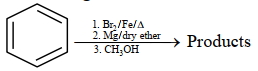
Predict the products for the following reaction sequence:
A
Anisole + $HMgBr$
B
Benzene + $Mg(OCH_3)Br$
C
Toluene + $Mg(OH)Br$
D
Bromobenzene + $Mg(H)(OCH_3)$
Solution
(B) The reaction proceeds in three steps:
$1$. Electrophilic aromatic substitution of benzene with $Br_2$ in the presence of $Fe$ catalyst gives bromobenzene $(C_6H_5Br)$.
$2$. Reaction of bromobenzene with $Mg$ in dry ether forms the Grignard reagent,phenylmagnesium bromide $(C_6H_5MgBr)$.
$3$. Grignard reagents are strong bases and react with protic sources like methanol $(CH_3OH)$ to form alkanes. Here,$C_6H_5MgBr + CH_3OH \rightarrow C_6H_6$ (benzene) $+ Mg(OCH_3)Br$.
$1$. Electrophilic aromatic substitution of benzene with $Br_2$ in the presence of $Fe$ catalyst gives bromobenzene $(C_6H_5Br)$.
$2$. Reaction of bromobenzene with $Mg$ in dry ether forms the Grignard reagent,phenylmagnesium bromide $(C_6H_5MgBr)$.
$3$. Grignard reagents are strong bases and react with protic sources like methanol $(CH_3OH)$ to form alkanes. Here,$C_6H_5MgBr + CH_3OH \rightarrow C_6H_6$ (benzene) $+ Mg(OCH_3)Br$.
0 likes
View Solution272
MediumMCQ
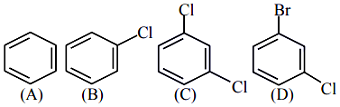
The correct decreasing order of densities of the following compounds is:
A
$D > C > B > A$
B
$C > B > A > D$
C
$C > D > A > B$
D
$A > B > C > D$
Solution
(A) Density is directly proportional to the molar mass of the compound.
Comparing the molar masses:
$(A)$ Benzene $(C_6H_6)$: $78 \ g/mol$
$(B)$ Chlorobenzene $(C_6H_5Cl)$: $112.5 \ g/mol$
$(C)$ Dichlorobenzene $(C_6H_4Cl_2)$: $147 \ g/mol$
$(D)$ Bromochlorobenzene $(C_6H_4BrCl)$: $191.5 \ g/mol$
Since the molar mass increases in the order $A < B < C < D$,the density follows the same order.
Therefore,the decreasing order of density is $D > C > B > A$.
Comparing the molar masses:
$(A)$ Benzene $(C_6H_6)$: $78 \ g/mol$
$(B)$ Chlorobenzene $(C_6H_5Cl)$: $112.5 \ g/mol$
$(C)$ Dichlorobenzene $(C_6H_4Cl_2)$: $147 \ g/mol$
$(D)$ Bromochlorobenzene $(C_6H_4BrCl)$: $191.5 \ g/mol$
Since the molar mass increases in the order $A < B < C < D$,the density follows the same order.
Therefore,the decreasing order of density is $D > C > B > A$.
0 likes
View Solution273
Medium
Explain why aryl halides are extremely less reactive towards nucleophilic substitution reactions.
Solution
(N/A) Aryl halides are extremely less reactive towards nucleophilic substitution reactions due to the following reasons:
$(i)$ Resonance effect: In haloarenes, the electron pairs on the halogen atom are in conjugation with the $\pi$-electrons of the ring. The $C-Cl$ bond acquires a partial double bond character due to resonance. As a result, the bond cleavage in haloarenes is more difficult than in haloalkanes, making them less reactive towards nucleophilic substitution.
$(ii)$ Difference in hybridisation of the carbon atom in the $C-X$ bond: In haloalkanes, the carbon atom attached to the halogen is $sp^{3}$ hybridised, while in haloarenes, it is $sp^{2}$ hybridised. The $sp^{2}$ hybridised carbon has greater s-character, is more electronegative, and holds the electron pair of the $C-X$ bond more tightly than the $sp^{3}$ hybridised carbon. Consequently, the $C-Cl$ bond length in haloarenes $(169 \ pm)$ is shorter than in haloalkanes $(177 \ pm)$. A shorter bond is harder to break, reducing reactivity.
$(iii)$ Instability of phenyl cation: In haloarenes, the phenyl cation formed by self-ionisation is not stabilised by resonance, ruling out the $S_{N}1$ mechanism.
$(iv)$ Electronic repulsions: It is difficult for an electron-rich nucleophile to approach the electron-rich arene ring.
$(i)$ Resonance effect: In haloarenes, the electron pairs on the halogen atom are in conjugation with the $\pi$-electrons of the ring. The $C-Cl$ bond acquires a partial double bond character due to resonance. As a result, the bond cleavage in haloarenes is more difficult than in haloalkanes, making them less reactive towards nucleophilic substitution.
$(ii)$ Difference in hybridisation of the carbon atom in the $C-X$ bond: In haloalkanes, the carbon atom attached to the halogen is $sp^{3}$ hybridised, while in haloarenes, it is $sp^{2}$ hybridised. The $sp^{2}$ hybridised carbon has greater s-character, is more electronegative, and holds the electron pair of the $C-X$ bond more tightly than the $sp^{3}$ hybridised carbon. Consequently, the $C-Cl$ bond length in haloarenes $(169 \ pm)$ is shorter than in haloalkanes $(177 \ pm)$. A shorter bond is harder to break, reducing reactivity.
$(iii)$ Instability of phenyl cation: In haloarenes, the phenyl cation formed by self-ionisation is not stabilised by resonance, ruling out the $S_{N}1$ mechanism.
$(iv)$ Electronic repulsions: It is difficult for an electron-rich nucleophile to approach the electron-rich arene ring.
0 likes
View Solution274
Medium
Describe the reaction of chlorobenzene with a hydroxyl group (nucleophilic substitution).
Solution
(N/A) Chlorobenzene is extremely resistant to nucleophilic substitution due to the partial double bond character of the $C-Cl$ bond and the instability of the phenyl cation. However,it can be converted into phenol by heating with aqueous sodium hydroxide $(NaOH)$ at a high temperature of $623 \ K$ and a high pressure of $300 \ atm$,followed by acidification.
The reaction is as follows:
$C_6H_5Cl + NaOH \xrightarrow{623 \ K, 300 \ atm} C_6H_5ONa + H_2O$
$C_6H_5ONa + H^+ \rightarrow C_6H_5OH + Na^+$
The presence of electron-withdrawing groups like $-NO_2$ at ortho- and para-positions significantly increases the reactivity of haloarenes towards nucleophilic substitution by stabilizing the carbanion intermediate.
The reaction is as follows:
$C_6H_5Cl + NaOH \xrightarrow{623 \ K, 300 \ atm} C_6H_5ONa + H_2O$
$C_6H_5ONa + H^+ \rightarrow C_6H_5OH + Na^+$
The presence of electron-withdrawing groups like $-NO_2$ at ortho- and para-positions significantly increases the reactivity of haloarenes towards nucleophilic substitution by stabilizing the carbanion intermediate.
0 likes
View Solution275
Medium
Why do aryl halides undergo electrophilic substitution reactions at $o-$ and $p-$positions? Why are they less reactive than benzene?
Solution
(N/A) Aryl halides undergo electrophilic substitution reactions such as halogenation,nitration,sulphonation,and Friedel-Crafts reactions. The halogen atom,due to its lone pairs,exhibits a $+M$ (mesomeric) effect,which increases the electron density at the $o-$ and $p-$positions. Therefore,the incoming electrophile is directed to these positions.
Aryl halides are less reactive than benzene towards electrophilic substitution because the halogen atom is highly electronegative and exerts a strong $-I$ (inductive) effect. This effect withdraws electron density from the benzene ring,thereby deactivating it. Consequently,electrophilic substitution in haloarenes requires more drastic conditions compared to benzene.
Aryl halides are less reactive than benzene towards electrophilic substitution because the halogen atom is highly electronegative and exerts a strong $-I$ (inductive) effect. This effect withdraws electron density from the benzene ring,thereby deactivating it. Consequently,electrophilic substitution in haloarenes requires more drastic conditions compared to benzene.
0 likes
View Solution276
Medium
Provide the following electrophilic substitution reactions of aryl halides:
$(i)$ Halogenation
$(ii)$ Nitration
$(iii)$ Sulphonation
$(iv)$ Friedel-Crafts reaction
$(i)$ Halogenation
$(ii)$ Nitration
$(iii)$ Sulphonation
$(iv)$ Friedel-Crafts reaction
Solution
(N/A) $(i)$ Halogenation: Chlorobenzene reacts with $Cl_2$ in the presence of anhydrous $FeCl_3$ to form $1,4$-dichlorobenzene (major) and $1,2$-dichlorobenzene (minor).
$(ii)$ Nitration: Chlorobenzene reacts with conc. $HNO_3$ and conc. $H_2SO_4$ to form $1$-chloro-$4$-nitrobenzene (major) and $1$-chloro-$2$-nitrobenzene (minor).
$(iii)$ Sulphonation: Chlorobenzene reacts with conc. $H_2SO_4$ upon heating to form $4$-chlorobenzenesulphonic acid (major) and $2$-chlorobenzenesulphonic acid (minor).
$(iv)$ Friedel-Crafts reaction: Chlorobenzene undergoes alkylation (with $CH_3Cl$ and anhydrous $AlCl_3$) or acylation (with $CH_3COCl$ and anhydrous $AlCl_3$) to yield ortho and para substituted products,with the para-isomer being the major product.
$(ii)$ Nitration: Chlorobenzene reacts with conc. $HNO_3$ and conc. $H_2SO_4$ to form $1$-chloro-$4$-nitrobenzene (major) and $1$-chloro-$2$-nitrobenzene (minor).
$(iii)$ Sulphonation: Chlorobenzene reacts with conc. $H_2SO_4$ upon heating to form $4$-chlorobenzenesulphonic acid (major) and $2$-chlorobenzenesulphonic acid (minor).
$(iv)$ Friedel-Crafts reaction: Chlorobenzene undergoes alkylation (with $CH_3Cl$ and anhydrous $AlCl_3$) or acylation (with $CH_3COCl$ and anhydrous $AlCl_3$) to yield ortho and para substituted products,with the para-isomer being the major product.
0 likes
View Solution277
Medium
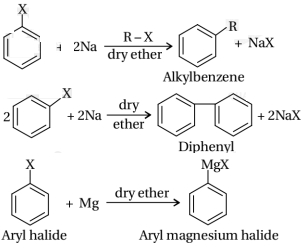
Give reactions of aryl halides with metals.
Solution
(N/A) $(i)$ Wurtz-Fittig reaction: $A$ mixture of an alkyl halide and an aryl halide gives an alkylarene when treated with sodium in dry ether.
$(ii)$ Fittig reaction: Aryl halides also give analogous compounds when treated with sodium in dry ether,in which two aryl groups are joined together.
$(iii)$ Grignard reaction: The reaction of an aryl halide with magnesium in the presence of dry ether gives an aryl magnesium halide,which is known as a Grignard reagent.
$(ii)$ Fittig reaction: Aryl halides also give analogous compounds when treated with sodium in dry ether,in which two aryl groups are joined together.
$(iii)$ Grignard reaction: The reaction of an aryl halide with magnesium in the presence of dry ether gives an aryl magnesium halide,which is known as a Grignard reagent.
0 likes
View Solution278
DifficultMCQ
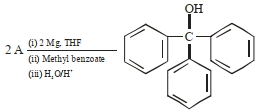
In the given reaction,$A$ can be .... .
A
benzyl bromide
B
bromobenzene
C
cyclohexyl bromide
D
methyl bromide
Solution
(B) The reaction involves the formation of a Grignard reagent from $A$ followed by its reaction with methyl benzoate to form triphenylmethanol.
$1$. $A + Mg \xrightarrow{THF} A-MgBr$
$2$. The Grignard reagent $(PhMgBr)$ attacks the carbonyl carbon of methyl benzoate $(PhCOOCH_3)$.
$3$. This leads to the formation of a ketone intermediate,benzophenone $(Ph_2CO)$,which further reacts with another equivalent of $PhMgBr$ to form the final product,triphenylmethanol $(Ph_3COH)$.
Since the product contains three phenyl groups attached to the central carbon,and one comes from the methyl benzoate,the other two must come from the Grignard reagent. Thus,$A$ must be bromobenzene $(C_6H_5Br)$.
$1$. $A + Mg \xrightarrow{THF} A-MgBr$
$2$. The Grignard reagent $(PhMgBr)$ attacks the carbonyl carbon of methyl benzoate $(PhCOOCH_3)$.
$3$. This leads to the formation of a ketone intermediate,benzophenone $(Ph_2CO)$,which further reacts with another equivalent of $PhMgBr$ to form the final product,triphenylmethanol $(Ph_3COH)$.
Since the product contains three phenyl groups attached to the central carbon,and one comes from the methyl benzoate,the other two must come from the Grignard reagent. Thus,$A$ must be bromobenzene $(C_6H_5Br)$.
0 likes
View Solution279
DifficultMCQ
The rate of reaction of $NaOH$ with the following compounds follows the order:
$I$: $1$-fluoro-$2$-nitrobenzene
$II$: $1$-fluoro-$3$-nitrobenzene
$III$: $1$-fluoro-$4$-nitrobenzene
$I$: $1$-fluoro-$2$-nitrobenzene
$II$: $1$-fluoro-$3$-nitrobenzene
$III$: $1$-fluoro-$4$-nitrobenzene
A
$II > I > III$
B
$II > III > I$
C
$I > III > II$
D
$III > II > I$
Solution
(C) Aryl halides are generally less reactive towards nucleophilic substitution reactions.
However,the presence of an electron-withdrawing group $(-NO_2)$ at the ortho- or para-position significantly increases the reactivity of haloarenes towards nucleophilic substitution due to the stabilization of the carbanion intermediate.
In $I$ ($o$-nitrofluorobenzene),the $-NO_2$ group is at the ortho-position.
In $III$ ($p$-nitrofluorobenzene),the $-NO_2$ group is at the para-position.
In $II$ ($m$-nitrofluorobenzene),the $-NO_2$ group is at the meta-position,where it does not stabilize the intermediate carbanion through resonance as effectively as it does at the ortho- and para-positions.
Thus,the reactivity order is $I > III > II$.
However,the presence of an electron-withdrawing group $(-NO_2)$ at the ortho- or para-position significantly increases the reactivity of haloarenes towards nucleophilic substitution due to the stabilization of the carbanion intermediate.
In $I$ ($o$-nitrofluorobenzene),the $-NO_2$ group is at the ortho-position.
In $III$ ($p$-nitrofluorobenzene),the $-NO_2$ group is at the para-position.
In $II$ ($m$-nitrofluorobenzene),the $-NO_2$ group is at the meta-position,where it does not stabilize the intermediate carbanion through resonance as effectively as it does at the ortho- and para-positions.
Thus,the reactivity order is $I > III > II$.
0 likes
View Solution280
MediumMCQ
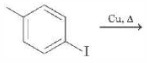
The major product of the following reaction is:
A
$4$,$4$'-dimethylbiphenyl
B
$1,2-$di($4$-iodophenyl)ethane
C
$1,2-$di($4$-iodophenyl)ethene
D
$4-$iodo-$4$'-methylbiphenyl
Solution
(A) The given reaction is the $Ullmann$ reaction.
In this reaction,two molecules of an aryl halide (in this case,$4$-iodotoluene) react with copper $(Cu)$ powder upon heating to form a biaryl compound.
The reaction is:
$2 \text{ } CH_3-C_6H_4-I + Cu \xrightarrow{\Delta} CH_3-C_6H_4-C_6H_4-CH_3 + CuI_2$
Thus,the major product is $4,4'$-dimethylbiphenyl.
In this reaction,two molecules of an aryl halide (in this case,$4$-iodotoluene) react with copper $(Cu)$ powder upon heating to form a biaryl compound.
The reaction is:
$2 \text{ } CH_3-C_6H_4-I + Cu \xrightarrow{\Delta} CH_3-C_6H_4-C_6H_4-CH_3 + CuI_2$
Thus,the major product is $4,4'$-dimethylbiphenyl.
0 likes
View Solution281
MediumMCQ
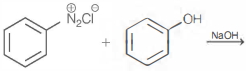
In the following reaction,the major product is:
A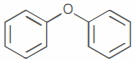
B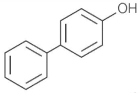
C
D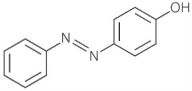
Solution
(D) The reaction between benzene diazonium chloride and phenol in the presence of $NaOH$ is an electrophilic aromatic substitution reaction known as a coupling reaction.
In this reaction,the aryl diazonium cation acts as an electrophile,and the activated phenol ring acts as a nucleophile.
The reaction occurs primarily at the para-position due to steric hindrance at the ortho-position,resulting in the formation of $p$-hydroxyazobenzene (an azo dye).
In this reaction,the aryl diazonium cation acts as an electrophile,and the activated phenol ring acts as a nucleophile.
The reaction occurs primarily at the para-position due to steric hindrance at the ortho-position,resulting in the formation of $p$-hydroxyazobenzene (an azo dye).
0 likes
View Solution282
DifficultMCQ
$A$ mixture of $1 \, mol$ of benzene and $1 \, mol$ of nitrobenzene is reacted with $1 \, mol$ of acetyl chloride in the presence of $AlCl_3$. The major product$(s)$ is/are
A
acetophenone
B
$3$-nitroacetophenone
C
$1:1$ mixture of acetophenone and $3$-nitroacetophenone
D
$1,3$-diacetyl benzene
Solution
(A) The correct answer is $A$.
In nitrobenzene,the $-NO_2$ group is a powerful electron-withdrawing group,which significantly reduces the electron density of the benzene ring.
Friedel-Crafts acylation is an electrophilic aromatic substitution reaction that requires an electron-rich aromatic ring to react with the acylium ion $(CH_3CO^+)$.
Due to the strong deactivating effect of the $-NO_2$ group,nitrobenzene fails to undergo Friedel-Crafts acylation.
Therefore,only benzene reacts with acetyl chloride in the presence of $AlCl_3$ to form acetophenone.
In nitrobenzene,the $-NO_2$ group is a powerful electron-withdrawing group,which significantly reduces the electron density of the benzene ring.
Friedel-Crafts acylation is an electrophilic aromatic substitution reaction that requires an electron-rich aromatic ring to react with the acylium ion $(CH_3CO^+)$.
Due to the strong deactivating effect of the $-NO_2$ group,nitrobenzene fails to undergo Friedel-Crafts acylation.
Therefore,only benzene reacts with acetyl chloride in the presence of $AlCl_3$ to form acetophenone.
0 likes
View Solution283
DifficultMCQ
The compound which will have the lowest rate towards nucleophilic aromatic substitution on treatment with $OH^-$ is
A
p-Nitrochlorobenzene
B
$2,4-$Dinitrochlorobenzene
C
o-Nitrochlorobenzene
D
m-Nitrochlorobenzene
Solution
(D) Nucleophilic aromatic substitution reactions are facilitated by the presence of electron-withdrawing groups (like $-NO_2$) at the ortho and para positions,as these groups stabilize the intermediate carbanion (Meisenheimer complex) through resonance.
At the meta position,the electron-withdrawing group cannot stabilize the negative charge of the intermediate through resonance,making it much less effective at accelerating the reaction compared to ortho or para positions.
Therefore,$m$-nitrochlorobenzene (option $D$) will have the lowest rate of nucleophilic aromatic substitution among the given compounds.
At the meta position,the electron-withdrawing group cannot stabilize the negative charge of the intermediate through resonance,making it much less effective at accelerating the reaction compared to ortho or para positions.
Therefore,$m$-nitrochlorobenzene (option $D$) will have the lowest rate of nucleophilic aromatic substitution among the given compounds.
0 likes
View Solution284
MediumMCQ
Identify the products $A$ and $E$ in the following reaction sequence:
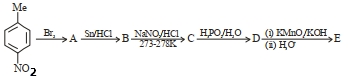
A
$A$ = $2-$bromo$-1-$methyl$-4-$nitrobenzene,$E$ = $2-$bromo$-5-$hydroxybenzoic acid
B
$A$ = $2-$bromo$-1-$methyl$-4-$nitrobenzene,$E$ = $2-$bromobenzoic acid
C
$A$ = $2-$bromo$-1-$methyl$-4-$nitrobenzene,$E$ = $2-$bromotoluene
D
$A$ = $2,6-$dibromo$-1-$methyl$-4-$nitrobenzene,$E$ = $2,6-$dibromobenzoic acid
Solution
(B) $1$. The starting material is $p$-nitrotoluene. Bromination $(Br_2)$ occurs at the ortho position relative to the methyl group,yielding $A$ ($2$-bromo-$1$-methyl-$4$-nitrobenzene).
$2$. Reduction with $Sn/HCl$ converts the nitro group to an amino group,yielding $B$ ($2$-bromo-$4$-aminotoluene).
$3$. Treatment with $NaNO_2/HCl$ at $273-278 \ K$ converts the amino group to a diazonium salt,yielding $C$ ($2$-bromo-$4$-methylbenzenediazonium chloride).
$4$. Reduction with $H_3PO_2/H_2O$ removes the diazonium group,yielding $D$ ($2$-bromotoluene).
$5$. Oxidation of the methyl group with $(i) \ KMnO_4/KOH$ followed by $(ii) \ H_3O^+$ yields $E$ ($2$-bromobenzoic acid).
$2$. Reduction with $Sn/HCl$ converts the nitro group to an amino group,yielding $B$ ($2$-bromo-$4$-aminotoluene).
$3$. Treatment with $NaNO_2/HCl$ at $273-278 \ K$ converts the amino group to a diazonium salt,yielding $C$ ($2$-bromo-$4$-methylbenzenediazonium chloride).
$4$. Reduction with $H_3PO_2/H_2O$ removes the diazonium group,yielding $D$ ($2$-bromotoluene).
$5$. Oxidation of the methyl group with $(i) \ KMnO_4/KOH$ followed by $(ii) \ H_3O^+$ yields $E$ ($2$-bromobenzoic acid).
0 likes
View Solution285
MediumMCQ
The correct order of melting point of dichlorobenzenes is
A
$1,2-$dichlorobenzene > $1,3-$dichlorobenzene > $1,4-$dichlorobenzene
B
$1,4-$dichlorobenzene > $1,2-$dichlorobenzene > $1,3-$dichlorobenzene
C
$1,4-$dichlorobenzene > $1,3-$dichlorobenzene > $1,2-$dichlorobenzene
D
$1,2-$dichlorobenzene > $1,4-$dichlorobenzene > $1,3-$dichlorobenzene
Solution
(B) The melting point of $1,4-$dichlorobenzene is higher than those of $1,2-$ and $1,3-$ isomers due to its symmetrical structure,which allows for better packing in the crystal lattice.
Comparing the melting points:
$1,4-$dichlorobenzene: $323 \ K$
$1,2-$dichlorobenzene: $256 \ K$
$1,3-$dichlorobenzene: $249 \ K$
Thus,the correct order is $1,4- > 1,2- > 1,3-$dichlorobenzene.
Comparing the melting points:
$1,4-$dichlorobenzene: $323 \ K$
$1,2-$dichlorobenzene: $256 \ K$
$1,3-$dichlorobenzene: $249 \ K$
Thus,the correct order is $1,4- > 1,2- > 1,3-$dichlorobenzene.
0 likes
View Solution286
MediumMCQ
Given below are two statements: one is labelled as Assertion $(A)$ and the other is labelled as Reason $(R)$.
Assertion $(A)$ : Chlorine is an electron withdrawing group but it is ortho,para directing in electrophilic aromatic substitution.
Reason $(R)$ : Inductive effect of chlorine destabilises the intermediate carbocation formed during the electrophilic substitution,however due to the more pronounced resonance effect,the halogen stabilises the carbocation at ortho and para positions.
In the light of the above statements,choose the most appropriate answer from the options given below :
Assertion $(A)$ : Chlorine is an electron withdrawing group but it is ortho,para directing in electrophilic aromatic substitution.
Reason $(R)$ : Inductive effect of chlorine destabilises the intermediate carbocation formed during the electrophilic substitution,however due to the more pronounced resonance effect,the halogen stabilises the carbocation at ortho and para positions.
In the light of the above statements,choose the most appropriate answer from the options given below :
A
Both $(A)$ and $(R)$ are correct and $(R)$ is the correct explanation of $(A)$
B
Both $(A)$ and $(R)$ are correct but $(R)$ is not the correct explanation of $(A)$
C
$(A)$ is correct but $(R)$ is not correct
D
$(A)$ is not correct but $(R)$ is correct.
Solution
(A) Chlorine is an electron-withdrawing group due to its high electronegativity ($-I$ effect),which deactivates the benzene ring.
However,it has lone pairs of electrons that participate in resonance ($+R$ effect).
During electrophilic aromatic substitution,the resonance effect stabilizes the carbocation intermediate specifically at the ortho and para positions.
Since both statements are scientifically accurate and the reason correctly explains the dual nature of the chlorine substituent,the correct option is $(A)$.
However,it has lone pairs of electrons that participate in resonance ($+R$ effect).
During electrophilic aromatic substitution,the resonance effect stabilizes the carbocation intermediate specifically at the ortho and para positions.
Since both statements are scientifically accurate and the reason correctly explains the dual nature of the chlorine substituent,the correct option is $(A)$.
0 likes
View Solution287
DifficultMCQ
The correct order of reactivity of the following haloarenes towards nucleophilic substitution with aqueous $NaOH$ is:
Choose the correct answer from the options given below:
Choose the correct answer from the options given below:
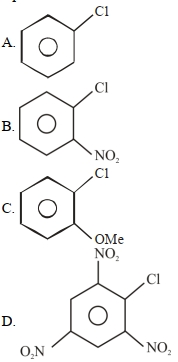
A
$A > B > D > C$
B
$C > A > D > B$
C
$D > C > B > A$
D
$D > B > A > C$
Solution
(D) The reactivity of haloarenes towards nucleophilic substitution increases with the presence of electron-withdrawing groups ($-M$ or $-I$ effect) on the benzene ring,as they stabilize the carbanion intermediate formed during the reaction.
Conversely,electron-donating groups ($+M$ or $+I$ effect) decrease the reactivity.
Analyzing the compounds:
$D$: Contains three $-NO_2$ groups (strong $-M$ effect),making it the most reactive.
$B$: Contains one $-NO_2$ group ($-M$ effect),making it more reactive than $A$.
$A$: Chlorobenzene,the reference compound.
$C$: Contains an $-OMe$ group ($+M$ effect),which destabilizes the intermediate,making it the least reactive.
Therefore,the correct order of reactivity is $D > B > A > C$.
Conversely,electron-donating groups ($+M$ or $+I$ effect) decrease the reactivity.
Analyzing the compounds:
$D$: Contains three $-NO_2$ groups (strong $-M$ effect),making it the most reactive.
$B$: Contains one $-NO_2$ group ($-M$ effect),making it more reactive than $A$.
$A$: Chlorobenzene,the reference compound.
$C$: Contains an $-OMe$ group ($+M$ effect),which destabilizes the intermediate,making it the least reactive.
Therefore,the correct order of reactivity is $D > B > A > C$.
0 likes
View Solution288
MediumMCQ
The major product formed in the Friedel-Crafts acylation of chlorobenzene is $p-$chloroacetophenone. Identify the correct structure of the major product.
A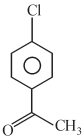
B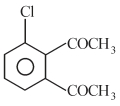
C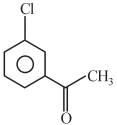
D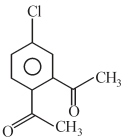
Solution
(A) Chlorine is an ortho/para directing group due to the resonance effect.
In electrophilic aromatic substitution reactions,the para-isomer is generally the major product due to less steric hindrance compared to the ortho-isomer.
Therefore,the major product of the Friedel-Crafts acylation of chlorobenzene is $p-$chloroacetophenone,which corresponds to the structure shown in option $A$.
In electrophilic aromatic substitution reactions,the para-isomer is generally the major product due to less steric hindrance compared to the ortho-isomer.
Therefore,the major product of the Friedel-Crafts acylation of chlorobenzene is $p-$chloroacetophenone,which corresponds to the structure shown in option $A$.
0 likes
View Solution289
DifficultMCQ
Identify $A$ and $B$ in the following reaction sequence.
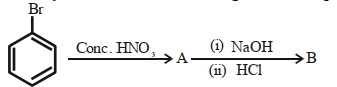
A
$A$ = $2,4,6-$trinitrobromobenzene,$B$ = $2,4,6-$trinitrophenol (picric acid)
B
$A$ = p-bromonitrobenzene,$B$ = p-nitrophenol
C
$A$ = $2-$bromo$-4-$nitrobenzene,$B$ = $2-$bromo$-4-$nitrophenol
D
$A$ = nitrobenzene,$B$ = m-nitrophenol
Solution
(A) The reaction of bromobenzene with concentrated $HNO_3$ (nitration) leads to the formation of $2,4,6-$trinitrobromobenzene $(A)$ due to the strong activating effect of the three nitro groups.
Subsequent treatment with $NaOH$ followed by $HCl$ (nucleophilic aromatic substitution) replaces the bromine atom with a hydroxyl group to form $2,4,6-$trinitrophenol,commonly known as picric acid $(B)$.
Subsequent treatment with $NaOH$ followed by $HCl$ (nucleophilic aromatic substitution) replaces the bromine atom with a hydroxyl group to form $2,4,6-$trinitrophenol,commonly known as picric acid $(B)$.
0 likes
View Solution290
DifficultMCQ
The azo-dye $(Y)$ formed in the following reactions is: $\text{Sulphanilic acid} + NaNO_2 + CH_3COOH \rightarrow X$; $X + \text{1-naphthylamine} \rightarrow Y$. Identify $Y$.
A
B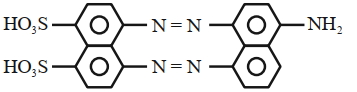
C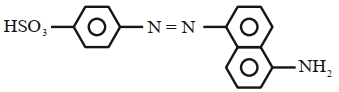
D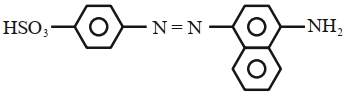
Solution
(D) The reaction of sulphanilic acid with $NaNO_2$ and $CH_3COOH$ forms a diazonium salt intermediate (or a related diazo-acetate species $X$).
This intermediate $X$ then undergoes an electrophilic aromatic substitution (coupling reaction) with $1$-naphthylamine.
The coupling occurs at the position para to the $-NH_2$ group in the naphthylamine ring,resulting in the formation of a red azo-dye $(Y)$.
The correct structure for the product $(Y)$ is shown in option $D$.
This intermediate $X$ then undergoes an electrophilic aromatic substitution (coupling reaction) with $1$-naphthylamine.
The coupling occurs at the position para to the $-NH_2$ group in the naphthylamine ring,resulting in the formation of a red azo-dye $(Y)$.
The correct structure for the product $(Y)$ is shown in option $D$.
0 likes
View Solution291
MediumMCQ
Which one of the following reactions is $NOT$ possible?
A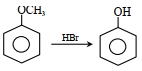
B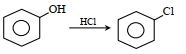
C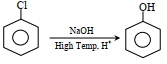
D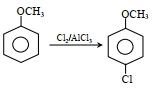
Solution
(B) The reaction of phenol with $HCl$ to form chlorobenzene is not possible under standard conditions. This is because the $C-OH$ bond in phenol has partial double bond character due to resonance,making it very strong and difficult to break. The carbon atom attached to the $-OH$ group is $sp^2$ hybridized,which further strengthens the bond. Therefore,nucleophilic substitution of the $-OH$ group by $Cl^-$ is not feasible.
0 likes
View Solution292
MediumMCQ
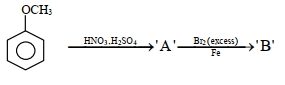
The major products formed in the following reaction sequence are:
(Image)
$A$ and $B$ respectively are:
(Image)
$A$ and $B$ respectively are:
A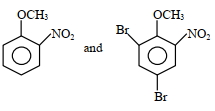
B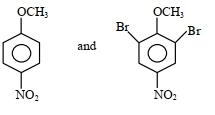
C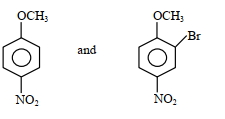
D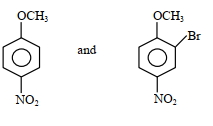
Solution
(C) $1$. The starting material is anisole $(C_6H_5OCH_3)$. The $-OCH_3$ group is strongly activating and ortho/para-directing.
$2$. Nitration with $HNO_3/H_2SO_4$ primarily yields the para-substituted product due to steric hindrance at the ortho position. Thus,$A$ is $p$-nitroanisole.
$3$. In the next step,$p$-nitroanisole reacts with excess $Br_2$ in the presence of $Fe$. The $-OCH_3$ group is a stronger activating group than the $-NO_2$ group is deactivating. Therefore,the bromination occurs at the positions ortho to the $-OCH_3$ group. Since the para position is already occupied by the $-NO_2$ group,both ortho positions are brominated to form $B$,which is $2,6$-dibromo-$4$-nitroanisole.
$4$. Comparing this with the given options,option $C$ represents the correct structures for $A$ and $B$.
$2$. Nitration with $HNO_3/H_2SO_4$ primarily yields the para-substituted product due to steric hindrance at the ortho position. Thus,$A$ is $p$-nitroanisole.
$3$. In the next step,$p$-nitroanisole reacts with excess $Br_2$ in the presence of $Fe$. The $-OCH_3$ group is a stronger activating group than the $-NO_2$ group is deactivating. Therefore,the bromination occurs at the positions ortho to the $-OCH_3$ group. Since the para position is already occupied by the $-NO_2$ group,both ortho positions are brominated to form $B$,which is $2,6$-dibromo-$4$-nitroanisole.
$4$. Comparing this with the given options,option $C$ represents the correct structures for $A$ and $B$.
0 likes
View Solution293
MediumMCQ
Number of compounds from the following which cannot undergo Friedel-Crafts reactions is ............ toluene,nitrobenzene,xylene,cumene,aniline,chlorobenzene,$m$-nitroaniline,$m$-dinitrobenzene
A
$8$
B
$5$
C
$3$
D
$4$
Solution
(D) Compounds which cannot undergo Friedel-Crafts reaction are:
$1$. Nitrobenzene: The $-NO_2$ group is a strongly deactivating group,which makes the ring electron-deficient and unsuitable for electrophilic substitution.
$2$. Aniline: The $-NH_2$ group forms a complex with the Lewis acid catalyst $AlCl_3$ (e.g.,$C_6H_5NH_2 \cdot AlCl_3$),which deactivates the ring and prevents the reaction.
$3$. $m$-nitroaniline: It contains both the strongly deactivating $-NO_2$ group and the $-NH_2$ group that forms a complex with the catalyst.
$4$. $m$-dinitrobenzene: It contains two strongly deactivating $-NO_2$ groups,making the ring highly electron-deficient.
Thus,a total of $4$ compounds cannot undergo Friedel-Crafts reaction.
$1$. Nitrobenzene: The $-NO_2$ group is a strongly deactivating group,which makes the ring electron-deficient and unsuitable for electrophilic substitution.
$2$. Aniline: The $-NH_2$ group forms a complex with the Lewis acid catalyst $AlCl_3$ (e.g.,$C_6H_5NH_2 \cdot AlCl_3$),which deactivates the ring and prevents the reaction.
$3$. $m$-nitroaniline: It contains both the strongly deactivating $-NO_2$ group and the $-NH_2$ group that forms a complex with the catalyst.
$4$. $m$-dinitrobenzene: It contains two strongly deactivating $-NO_2$ groups,making the ring highly electron-deficient.
Thus,a total of $4$ compounds cannot undergo Friedel-Crafts reaction.
0 likes
View Solution294
AdvancedMCQ
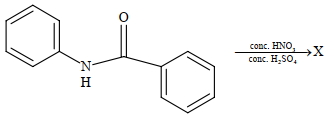
In the following reaction,the structure of the major product '$X$' is
A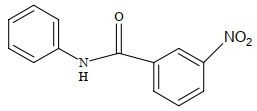
B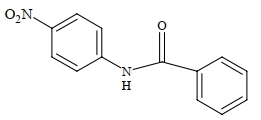
C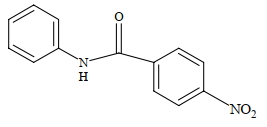
D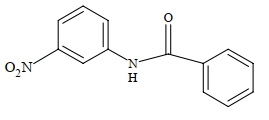
Solution
(B) The reaction is the nitration of $N$-phenylbenzamide (acetanilide derivative).
In $N$-phenylbenzamide,the $-NH-CO-C_6H_5$ group is an ortho/para-directing group due to the lone pair on the nitrogen atom,which can participate in resonance with the benzene ring.
However,the bulky benzoyl group causes steric hindrance at the ortho position.
Therefore,the para-substitution is favored,leading to the formation of $N$-($4$-nitrophenyl)benzamide as the major product.
In $N$-phenylbenzamide,the $-NH-CO-C_6H_5$ group is an ortho/para-directing group due to the lone pair on the nitrogen atom,which can participate in resonance with the benzene ring.
However,the bulky benzoyl group causes steric hindrance at the ortho position.
Therefore,the para-substitution is favored,leading to the formation of $N$-($4$-nitrophenyl)benzamide as the major product.
0 likes
View Solution295
AdvancedMCQ
$STATEMENT-1$: Bromobenzene upon reaction with $Br_2 / Fe$ gives $1,4$-dibromobenzene as the major product.
$STATEMENT-2$: In bromobenzene,the inductive effect of the bromo group is more dominant than the mesomeric effect in directing the incoming electrophile.
$STATEMENT-2$: In bromobenzene,the inductive effect of the bromo group is more dominant than the mesomeric effect in directing the incoming electrophile.
A
$STATEMENT-1$ is True,$STATEMENT-2$ is True; $STATEMENT-2$ is correct explanation for $STATEMENT-1$
B
$STATEMENT-1$ is True,$STATEMENT-2$ is True; $STATEMENT-2$ is $NOT$ a correct explanation for $STATEMENT-1$
C
$STATEMENT-1$ is True,$STATEMENT-2$ is False
D
$STATEMENT-1$ is False,$STATEMENT-2$ is True
Solution
(C) $STATEMENT-1$ is True: Bromobenzene undergoes electrophilic aromatic substitution. The $-Br$ group is ortho/para-directing due to the $+M$ (mesomeric) effect,and $1,4$-dibromobenzene (para-isomer) is the major product due to steric hindrance at the ortho position.
$STATEMENT-2$ is False: In halogens,the mesomeric effect $(+M)$ is more dominant than the inductive effect $(-I)$ in directing the incoming electrophile to the ortho and para positions.
$STATEMENT-2$ is False: In halogens,the mesomeric effect $(+M)$ is more dominant than the inductive effect $(-I)$ in directing the incoming electrophile to the ortho and para positions.
0 likes
View Solution296
MediumMCQ
The reaction of compound $P$ with $CH_3MgBr$ (excess) in $(C_2H_5)_2O$ followed by addition of $H_2O$ gives $Q$. The compound $Q$ on treatment with $H_2SO_4$ at $0^{\circ}C$ gives $R$. The reaction of $R$ with $CH_3COCl$ in the presence of anhydrous $AlCl_3$ in $CH_2Cl_2$ followed by treatment with $H_2O$ produces compound $S$ [$Et$ in compound $P$ is ethyl group].
$(1)$ The product $S$ is
$(2)$ The reactions,$Q$ to $R$ and $R$ to $S$,are
Given the answer question $(1)$ and $(2)$
$(1)$ The product $S$ is
$(2)$ The reactions,$Q$ to $R$ and $R$ to $S$,are
| $A$. Dehydration and Friedel-Crafts acylation | $B$. Aromatic sulfonation and Friedel-Crafts acylation |
| $C$. Friedel-Crafts alkylation,dehydration and Friedel-Crafts acylation | $D$. Friedel-Crafts alkylation and Friedel-Crafts acylation |
Given the answer question $(1)$ and $(2)$
A
$A, D$
B
$A, B$
C
$A, C, D$
D
$A, C$
Solution
(A, D) Step $1$: Reaction of $P$ with $CH_3MgBr$ (excess) followed by $H_2O$ converts the ester group $(-CO_2Et)$ into a tertiary alcohol $(-C(OH)(CH_3)_2)$,forming compound $Q$.
Step $2$: Treatment of $Q$ with $H_2SO_4$ at $0^{\circ}C$ causes dehydration of the alcohol to an alkene,followed by intramolecular Friedel-Crafts alkylation to form the indane derivative $R$.
Step $3$: Reaction of $R$ with $CH_3COCl$ in the presence of anhydrous $AlCl_3$ is a Friedel-Crafts acylation,which introduces an acetyl group $(-COCH_3)$ onto the aromatic ring to form compound $S$.
Thus,the product $S$ corresponds to structure $A$,and the reaction sequence $Q \rightarrow R$ involves dehydration and Friedel-Crafts alkylation,while $R \rightarrow S$ involves Friedel-Crafts acylation. The correct options are $A$ and $D$.
Step $2$: Treatment of $Q$ with $H_2SO_4$ at $0^{\circ}C$ causes dehydration of the alcohol to an alkene,followed by intramolecular Friedel-Crafts alkylation to form the indane derivative $R$.
Step $3$: Reaction of $R$ with $CH_3COCl$ in the presence of anhydrous $AlCl_3$ is a Friedel-Crafts acylation,which introduces an acetyl group $(-COCH_3)$ onto the aromatic ring to form compound $S$.
Thus,the product $S$ corresponds to structure $A$,and the reaction sequence $Q \rightarrow R$ involves dehydration and Friedel-Crafts alkylation,while $R \rightarrow S$ involves Friedel-Crafts acylation. The correct options are $A$ and $D$.
0 likes
View Solution297
AdvancedMCQ
The compounds $P$,$Q$,and $S$ were separately subjected to nitration using $HNO_3 / H_2SO_4$ mixture. The major product formed in each case respectively,is
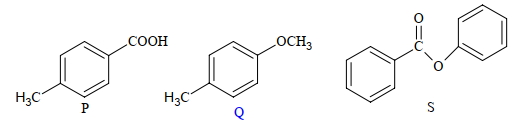
A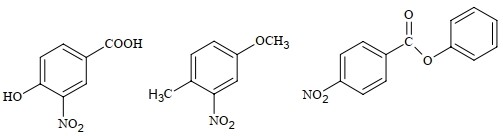
B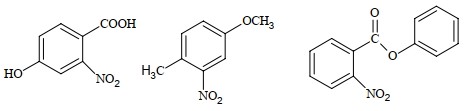
C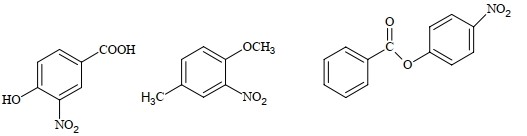
D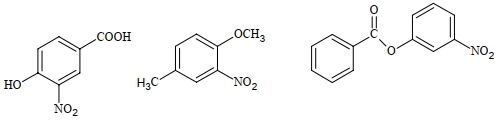
Solution
(A) For compound $P$ ($4$-hydroxybenzoic acid),the $-OH$ group is a strong activating group and ortho/para directing. Since the para position is occupied by $-COOH$,nitration occurs at the ortho position to the $-OH$ group.
For compound $Q$ ($1$-methoxy-$4$-methylbenzene),both $-OCH_3$ and $-CH_3$ are activating groups. $-OCH_3$ is a stronger activating group than $-CH_3$. Therefore,nitration occurs ortho to the $-OCH_3$ group.
For compound $S$ (phenyl benzoate),the ester group $-COO-$ is deactivating and meta-directing for the benzoyl ring,but the phenoxy ring is activated by the oxygen atom. The oxygen atom of the ester group is ortho/para directing. Due to steric hindrance,the para position of the phenoxy ring is the major site for electrophilic substitution.
For compound $Q$ ($1$-methoxy-$4$-methylbenzene),both $-OCH_3$ and $-CH_3$ are activating groups. $-OCH_3$ is a stronger activating group than $-CH_3$. Therefore,nitration occurs ortho to the $-OCH_3$ group.
For compound $S$ (phenyl benzoate),the ester group $-COO-$ is deactivating and meta-directing for the benzoyl ring,but the phenoxy ring is activated by the oxygen atom. The oxygen atom of the ester group is ortho/para directing. Due to steric hindrance,the para position of the phenoxy ring is the major site for electrophilic substitution.
0 likes
View Solution298
MediumMCQ
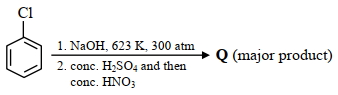
The weight percentage of hydrogen in $Q$,formed in the following reaction sequence,is. . . .
[Given : Atomic mass of $H = 1, C = 12, N = 14, O = 16, S = 32, Cl = 35$ ]
[Given : Atomic mass of $H = 1, C = 12, N = 14, O = 16, S = 32, Cl = 35$ ]
A
$1.30$
B
$1.31$
C
$1.35$
D
$1.40$
Solution
(B) $1$. The reaction of chlorobenzene with $NaOH$ at $623 \ K$ and $300 \ atm$ pressure gives sodium phenoxide.
$2$. Sodium phenoxide,upon treatment with concentrated $H_2SO_4$ and concentrated $HNO_3$,undergoes nitration to form $2,4,6$-trinitrophenol,commonly known as picric acid.
$3$. The molecular formula of picric acid is $C_6H_3N_3O_7$.
$4$. The molar mass of $C_6H_3N_3O_7 = (6 \times 12) + (3 \times 1) + (3 \times 14) + (7 \times 16) = 72 + 3 + 42 + 112 = 229 \ g/mol$.
$5$. The mass of hydrogen in one mole of picric acid is $3 \times 1 = 3 \ g$.
$6$. The weight percentage of hydrogen = $\frac{\text{Mass of H}}{\text{Molar mass of } Q} \times 100 = \frac{3}{229} \times 100 \approx 1.31\%$.
$2$. Sodium phenoxide,upon treatment with concentrated $H_2SO_4$ and concentrated $HNO_3$,undergoes nitration to form $2,4,6$-trinitrophenol,commonly known as picric acid.
$3$. The molecular formula of picric acid is $C_6H_3N_3O_7$.
$4$. The molar mass of $C_6H_3N_3O_7 = (6 \times 12) + (3 \times 1) + (3 \times 14) + (7 \times 16) = 72 + 3 + 42 + 112 = 229 \ g/mol$.
$5$. The mass of hydrogen in one mole of picric acid is $3 \times 1 = 3 \ g$.
$6$. The weight percentage of hydrogen = $\frac{\text{Mass of H}}{\text{Molar mass of } Q} \times 100 = \frac{3}{229} \times 100 \approx 1.31\%$.
0 likes
View Solution299
DifficultMCQ
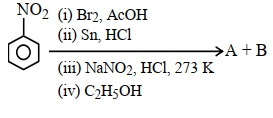
The products formed in the following reaction sequence are:
A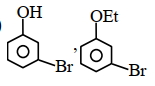
B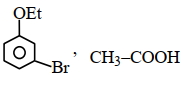
C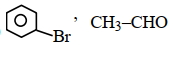
D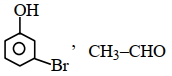
Solution
(D) The reaction sequence is as follows:
$1$. $Nitrobenzene$ reacts with $Br_2$ in $AcOH$ to undergo electrophilic aromatic substitution,forming $m-bromonitrobenzene$ (since $-NO_2$ is a meta-directing group).
$2$. Reduction of $m-bromonitrobenzene$ with $Sn/HCl$ yields $m-bromoaniline$.
$3$. Treatment of $m-bromoaniline$ with $NaNO_2/HCl$ at $273-278 \ K$ results in diazotization,forming $m-bromobenzenediazonium \ chloride$.
$4$. Finally,reaction with ethanol $(C_2H_5OH)$ reduces the diazonium salt to $bromobenzene$ (specifically $m-bromobenzene$ in this context,which is simply $bromobenzene$ as the bromine position is fixed) and ethanol is oxidized to acetaldehyde $(CH_3CHO)$.
Thus,the final products are $bromobenzene$ and $CH_3CHO$.
$1$. $Nitrobenzene$ reacts with $Br_2$ in $AcOH$ to undergo electrophilic aromatic substitution,forming $m-bromonitrobenzene$ (since $-NO_2$ is a meta-directing group).
$2$. Reduction of $m-bromonitrobenzene$ with $Sn/HCl$ yields $m-bromoaniline$.
$3$. Treatment of $m-bromoaniline$ with $NaNO_2/HCl$ at $273-278 \ K$ results in diazotization,forming $m-bromobenzenediazonium \ chloride$.
$4$. Finally,reaction with ethanol $(C_2H_5OH)$ reduces the diazonium salt to $bromobenzene$ (specifically $m-bromobenzene$ in this context,which is simply $bromobenzene$ as the bromine position is fixed) and ethanol is oxidized to acetaldehyde $(CH_3CHO)$.
Thus,the final products are $bromobenzene$ and $CH_3CHO$.
0 likes
View Solution300
MediumMCQ
In the following substitution reaction $:$
Product $P$ formed is $:$
Product $P$ formed is $:$
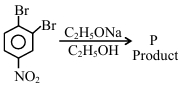
A
$1-$bromo$-2-$ethoxy$-4-$nitrobenzene
B
$1,2-$diethoxy$-4-$nitrobenzene
C
$2-$bromo$-1-$ethoxy$-4-$nitrobenzene
D
$1-$bromo$-2-$bromo$-4-$ethoxybenzene
Solution
(A) This is an example of a nucleophilic aromatic substitution reaction. The electron-withdrawing $-NO_2$ group at the para position activates the ring towards nucleophilic attack. The nucleophile $C_2H_5O^-$ attacks the carbon atom bearing the bromine atom at the para position relative to the $-NO_2$ group,as it is more sterically accessible and electronically activated. Thus,the bromine atom at the para position is replaced by the $-OC_2H_5$ group,resulting in $1-bromo-2-ethoxy-4-nitrobenzene$.
0 likes
View SolutionHaloalkanes and Haloarenes — Properties of Haloarenes · Frequently Asked Questions
1Are these Haloalkanes and Haloarenes questions useful for JEE and NEET?
Yes. All questions in this section are mapped to JEE Main and NEET exam patterns. Previous year questions from JEE Main, NEET, GUJCET and state-level exams are included with full solutions.
2Can I switch to Hindi or Gujarati for these questions?
Yes. Use the language tabs in the hero section or the sidebar to view the same questions and solutions in English, Hindi or Gujarati.
3How do I generate a question paper from this subtopic?
Use the Vedclass Exam Paper Generator — select the chapter and subtopic, set difficulty, and generate Sets A, B, C, D automatically. First 3 chapters of every subject are free.
Vedclass Products
For Students
Vedclass Test Series
Mock tests in real JEE/NEET style with performance analysis. 5-day free trial.
Start Free TrialFor Teachers
Exam Paper Generator
Generate Set A/B/C/D papers from this chapter in 2 minutes. 3 chapters free.
Try FreeFor Institutes
Online Exam Module
Live online exams with unlimited students, 360° analytics & white-label branding.
See DemoFor Teachers & Institutes
Generate a Haloalkanes and Haloarenes Exam Paper in 2 Minutes
Select subtopic & difficulty — Sets A, B, C, D auto-generated with No Repeat logic.
First 3 chapters of every subject are free — no payment required.