
A English
Properties of Haloarenes Questions in English
Class 12 Chemistry · Haloalkanes and Haloarenes · Properties of Haloarenes
423+
Questions
English
Language
100%
With Solutions
Showing 49 of 423 questions in English
301
MediumMCQ
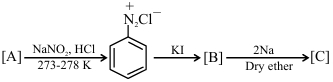
Identify $[A]$,$[B]$,and $[C]$,respectively in the following reaction sequence $:$
A
$[A] = \text{Aniline}, [B] = \text{Chlorobenzene}, [C] = \text{Iodobenzene}$
B
$[A] = \text{Aniline}, [B] = \text{Chlorobenzene}, [C] = \text{Benzene}$
C
$[A] = \text{Aniline}, [B] = \text{Iodobenzene}, [C] = \text{Biphenyl}$
D
$[A] = \text{Nitrobenzene}, [B] = \text{Iodobenzene}, [C] = \text{Biphenyl}$
Solution
(C) The given reaction sequence is as follows $:$
$1$. Aniline $(C_6H_5NH_2)$ reacts with $NaNO_2$ and $HCl$ at $273-278 \ K$ to form benzene diazonium chloride $(C_6H_5N_2^+Cl^-)$. Thus,$[A]$ is aniline.
$2$. Benzene diazonium chloride reacts with $KI$ to form iodobenzene $(C_6H_5I)$. Thus,$[B]$ is iodobenzene.
$3$. Iodobenzene reacts with $2Na$ in the presence of dry ether (Wurtz-Fittig reaction) to form biphenyl $(C_6H_5-C_6H_5)$. Thus,$[C]$ is biphenyl.
Therefore,the correct sequence is $[A] = \text{Aniline}, [B] = \text{Iodobenzene}, [C] = \text{Biphenyl}$.
$1$. Aniline $(C_6H_5NH_2)$ reacts with $NaNO_2$ and $HCl$ at $273-278 \ K$ to form benzene diazonium chloride $(C_6H_5N_2^+Cl^-)$. Thus,$[A]$ is aniline.
$2$. Benzene diazonium chloride reacts with $KI$ to form iodobenzene $(C_6H_5I)$. Thus,$[B]$ is iodobenzene.
$3$. Iodobenzene reacts with $2Na$ in the presence of dry ether (Wurtz-Fittig reaction) to form biphenyl $(C_6H_5-C_6H_5)$. Thus,$[C]$ is biphenyl.
Therefore,the correct sequence is $[A] = \text{Aniline}, [B] = \text{Iodobenzene}, [C] = \text{Biphenyl}$.
0 likes
View Solution302
MediumMCQ
In the following reactions,which one is $NOT$ correct?
A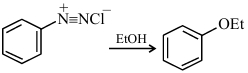
B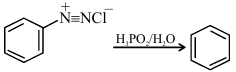
C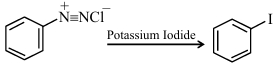
D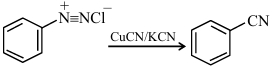
Solution
(A) The reaction of benzenediazonium chloride with ethanol $(EtOH)$ is a deamination reaction,not an etherification reaction.
In this reaction,the diazonium group is replaced by a hydrogen atom,resulting in the formation of benzene,not phenetole $(Ph-OEt)$.
Therefore,the reaction shown in option $A$ is incorrect.
Options $B$,$C$,and $D$ represent standard reactions of diazonium salts:
$B$: Reduction with $H_3PO_2$ gives benzene.
$C$: Reaction with $KI$ gives iodobenzene.
$D$: Sandmeyer reaction with $CuCN$ gives benzonitrile.
In this reaction,the diazonium group is replaced by a hydrogen atom,resulting in the formation of benzene,not phenetole $(Ph-OEt)$.
Therefore,the reaction shown in option $A$ is incorrect.
Options $B$,$C$,and $D$ represent standard reactions of diazonium salts:
$B$: Reduction with $H_3PO_2$ gives benzene.
$C$: Reaction with $KI$ gives iodobenzene.
$D$: Sandmeyer reaction with $CuCN$ gives benzonitrile.
0 likes
View Solution303
MediumMCQ
In the following series of reactions,identify the major products $A$ and $B$ respectively.
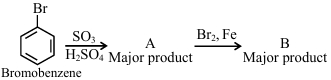
A
$A$: $2-$bromobenzenesulphonic acid,$B$: $2,4-$dibromobenzenesulphonic acid
B
$A$: $4-$bromobenzenesulphonic acid,$B$: $2,4-$dibromobenzenesulphonic acid
C
$A$: $2-$bromobenzenesulphonic acid,$B$: $2,5-$dibromobenzenesulphonic acid
D
$A$: $4-$bromobenzenesulphonic acid,$B$: $3,4-$dibromobenzenesulphonic acid
Solution
(B) The reaction of bromobenzene with $SO_3/H_2SO_4$ (sulphonation) primarily yields the para-substituted product due to steric hindrance at the ortho position,making $A$ = $4$-bromobenzenesulphonic acid.
Next,the reaction of $4$-bromobenzenesulphonic acid with $Br_2/Fe$ (electrophilic aromatic substitution) occurs. The $-SO_3H$ group is meta-directing,while the $-Br$ group is ortho/para-directing. The position ortho to the $-Br$ group and meta to the $-SO_3H$ group is the most favored site for the incoming electrophile,leading to $B$ = $2,4$-dibromobenzenesulphonic acid.
Next,the reaction of $4$-bromobenzenesulphonic acid with $Br_2/Fe$ (electrophilic aromatic substitution) occurs. The $-SO_3H$ group is meta-directing,while the $-Br$ group is ortho/para-directing. The position ortho to the $-Br$ group and meta to the $-SO_3H$ group is the most favored site for the incoming electrophile,leading to $B$ = $2,4$-dibromobenzenesulphonic acid.
0 likes
View Solution304
MediumMCQ
Match List-$I$ with List-$II$:
Choose the correct answer from the options given below:
| List-$I$ Conversion | List-$II$ Reagents,Conditions used |
|---|---|
| $A$. Chlorobenzene $\rightarrow$ Phenol | $I$. Warm,$H_2O$ |
| $B$. $1$-Chloro-$4$-nitrobenzene $\rightarrow$ $4$-Nitrophenol | $II$. $(a)$ $NaOH, 368 \ K$; $(b)$ $H_3O^+$ |
| $C$. $1$-Chloro-$2,4$-dinitrobenzene $\rightarrow$ $2,4$-Dinitrophenol | $III$. $(a)$ $NaOH, 443 \ K$; $(b)$ $H_3O^+$ |
| $D$. $1$-Chloro-$2,4,6$-trinitrobenzene $\rightarrow$ $2,4,6$-Trinitrophenol | $IV$. $(a)$ $NaOH, 623 \ K, 300 \ atm$; $(b)$ $H_3O^+$ |
Choose the correct answer from the options given below:
A
$A-IV, B-III, C-II, D-I$
B
$A-III, B-IV, C-II, D-I$
C
$A-IV, B-III, C-I, D-II$
D
$A-II, B-III, C-IV, D-I$
Solution
(A) The nucleophilic aromatic substitution reaction of aryl halides with $NaOH$ depends on the presence of electron-withdrawing groups $(-NO_2)$ on the ring.
$A$. Chlorobenzene requires harsh conditions: $(a)$ $NaOH, 623 \ K, 300 \ atm$; $(b)$ $H_3O^+$ $(IV)$.
$B$. $1$-Chloro-$4$-nitrobenzene has one $-NO_2$ group,requiring milder conditions: $(a)$ $NaOH, 443 \ K$; $(b)$ $H_3O^+$ $(III)$.
$C$. $1$-Chloro-$2,4$-dinitrobenzene has two $-NO_2$ groups,requiring even milder conditions: $(a)$ $NaOH, 368 \ K$; $(b)$ $H_3O^+$ $(II)$.
$D$. $1$-Chloro-$2,4,6$-trinitrobenzene has three $-NO_2$ groups,which activate the ring significantly,allowing substitution with just warm $H_2O$ $(I)$.
Thus,the correct match is $A-IV, B-III, C-II, D-I$.
$A$. Chlorobenzene requires harsh conditions: $(a)$ $NaOH, 623 \ K, 300 \ atm$; $(b)$ $H_3O^+$ $(IV)$.
$B$. $1$-Chloro-$4$-nitrobenzene has one $-NO_2$ group,requiring milder conditions: $(a)$ $NaOH, 443 \ K$; $(b)$ $H_3O^+$ $(III)$.
$C$. $1$-Chloro-$2,4$-dinitrobenzene has two $-NO_2$ groups,requiring even milder conditions: $(a)$ $NaOH, 368 \ K$; $(b)$ $H_3O^+$ $(II)$.
$D$. $1$-Chloro-$2,4,6$-trinitrobenzene has three $-NO_2$ groups,which activate the ring significantly,allowing substitution with just warm $H_2O$ $(I)$.
Thus,the correct match is $A-IV, B-III, C-II, D-I$.
0 likes
View Solution305
MediumMCQ
Choose the correct set of reagents for the following conversion.
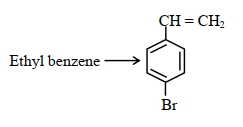
A
$Br_2 / Fe ; Cl_2, \Delta ; \text{alc. } KOH$
B
$Cl_2 / Fe ; Br_2 / \text{anhy. } AlCl_3 ; \text{aq. } KOH$
C
$Br_2 / \text{anhy. } AlCl_3 ; Cl_2, \Delta ; \text{aq. } KOH$
D
$Cl_2 / \text{anhy. } AlCl_3 ; Br_2 / Fe ; \text{alc. } KOH$
Solution
(A) The conversion of ethylbenzene to $p$-bromostyrene involves three steps:
$1$. Electrophilic aromatic substitution: Treatment of ethylbenzene with $Br_2 / Fe$ (or $FeBr_3$) leads to bromination at the para position due to the ortho/para-directing nature of the ethyl group.
$2$. Free radical halogenation: Treatment with $Cl_2, \Delta$ (or $h\nu$) results in the chlorination of the benzylic position of the ethyl group.
$3$. Dehydrohalogenation: Treatment with alcoholic $KOH$ (alc. $KOH$) causes the elimination of $HCl$ from the side chain to form the vinyl group (styrene derivative).
Thus,the correct sequence is $Br_2 / Fe ; Cl_2, \Delta ; \text{alc. } KOH$.
$1$. Electrophilic aromatic substitution: Treatment of ethylbenzene with $Br_2 / Fe$ (or $FeBr_3$) leads to bromination at the para position due to the ortho/para-directing nature of the ethyl group.
$2$. Free radical halogenation: Treatment with $Cl_2, \Delta$ (or $h\nu$) results in the chlorination of the benzylic position of the ethyl group.
$3$. Dehydrohalogenation: Treatment with alcoholic $KOH$ (alc. $KOH$) causes the elimination of $HCl$ from the side chain to form the vinyl group (styrene derivative).
Thus,the correct sequence is $Br_2 / Fe ; Cl_2, \Delta ; \text{alc. } KOH$.
0 likes
View Solution306
MediumMCQ
Compare the rate of Electrophilic Substitution Reaction $(ESR)$ for the following compounds:
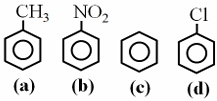
A
$a > c > d > b$
B
$b > a > c > d$
C
$a > c > d > b$
D
$a > c > b > d$
Solution
(A) The rate of Electrophilic Substitution Reaction $(ESR)$ depends on the electron density of the benzene ring. Electron-donating groups $(EDG)$ increase the rate,while electron-withdrawing groups $(EWG)$ decrease the rate.
$(a)$ Toluene: $-CH_3$ is an activating group ($+I$ and hyperconjugation effect),which increases electron density.
$(b)$ Nitrobenzene: $-NO_2$ is a strongly deactivating group ($-I$ and $-M$ effect),which significantly decreases electron density.
$(c)$ Benzene: Reference compound.
$(d)$ Chlorobenzene: $-Cl$ is a deactivating group ($-I$ effect dominates over $+M$ effect),which decreases electron density,but less than $-NO_2$.
Therefore,the order of reactivity is: Toluene $(a)$ > Benzene $(c)$ > Chlorobenzene $(d)$ > Nitrobenzene $(b)$.
Thus,the correct order is $a > c > d > b$.
$(a)$ Toluene: $-CH_3$ is an activating group ($+I$ and hyperconjugation effect),which increases electron density.
$(b)$ Nitrobenzene: $-NO_2$ is a strongly deactivating group ($-I$ and $-M$ effect),which significantly decreases electron density.
$(c)$ Benzene: Reference compound.
$(d)$ Chlorobenzene: $-Cl$ is a deactivating group ($-I$ effect dominates over $+M$ effect),which decreases electron density,but less than $-NO_2$.
Therefore,the order of reactivity is: Toluene $(a)$ > Benzene $(c)$ > Chlorobenzene $(d)$ > Nitrobenzene $(b)$.
Thus,the correct order is $a > c > d > b$.
0 likes
View Solution307
EasyMCQ
The reaction between chlorobenzene and chloral in the presence of concentrated sulphuric acid produces $:$
A
Gammexane
B
$p, p-DDT$ (dichloro diphenyl trichloro ethane)
C
Chloropicrin
D
Benzene hexachloride
Solution
(B) The reaction between $2$ moles of chlorobenzene and $1$ mole of chloral $(CCl_3CHO)$ in the presence of concentrated $H_2SO_4$ is a condensation reaction.
This reaction produces $1,1,1-trichloro-2,2-bis(p-chlorophenyl)ethane$,commonly known as $DDT$.
The chemical equation is: $2C_6H_5Cl + CCl_3CHO \xrightarrow{conc. H_2SO_4} (ClC_6H_4)_2CHCCl_3 + H_2O$.
This reaction produces $1,1,1-trichloro-2,2-bis(p-chlorophenyl)ethane$,commonly known as $DDT$.
The chemical equation is: $2C_6H_5Cl + CCl_3CHO \xrightarrow{conc. H_2SO_4} (ClC_6H_4)_2CHCCl_3 + H_2O$.
0 likes
View Solution308
MediumMCQ
Identify the incorrect match in the following reactions:
A
Benzene diazonium salt + $Cu_2X_2/HX \rightarrow \text{ESR}$
B
Toluene + $X_2/Fe \text{ (dark)} \rightarrow \text{ESR}$
C
$p$-Nitroethylbenzene + $Cl_2/AlCl_3 \rightarrow \text{ESR}$
D
$p$-Hydroxybenzyl alcohol + $HCl \text{ (heat)} \rightarrow \text{NSR}$
Solution
(A) Let's analyze each reaction:
$(A)$ The reaction of benzene diazonium salt with $Cu_2X_2/HX$ is the Sandmeyer reaction,which is a nucleophilic substitution reaction,not an Electrophilic Substitution Reaction $(ESR)$.
$(B)$ Toluene with $X_2/Fe$ in the dark undergoes electrophilic aromatic substitution $(ESR)$ on the ring.
$(C)$ $p$-Nitroethylbenzene is highly deactivated due to the $-NO_2$ group,making it extremely difficult to undergo Friedel-Crafts alkylation or halogenation $(ESR)$.
$(D)$ $p$-Hydroxybenzyl alcohol with $HCl$ undergoes nucleophilic substitution $(NSR)$ at the benzylic position to form $p$-hydroxybenzyl chloride.
Option $(A)$ is clearly incorrect as it represents a nucleophilic substitution,not an $ESR$.
$(A)$ The reaction of benzene diazonium salt with $Cu_2X_2/HX$ is the Sandmeyer reaction,which is a nucleophilic substitution reaction,not an Electrophilic Substitution Reaction $(ESR)$.
$(B)$ Toluene with $X_2/Fe$ in the dark undergoes electrophilic aromatic substitution $(ESR)$ on the ring.
$(C)$ $p$-Nitroethylbenzene is highly deactivated due to the $-NO_2$ group,making it extremely difficult to undergo Friedel-Crafts alkylation or halogenation $(ESR)$.
$(D)$ $p$-Hydroxybenzyl alcohol with $HCl$ undergoes nucleophilic substitution $(NSR)$ at the benzylic position to form $p$-hydroxybenzyl chloride.
Option $(A)$ is clearly incorrect as it represents a nucleophilic substitution,not an $ESR$.
0 likes
View Solution309
MediumMCQ
In which of the following compounds can the $X^{-}$ atom be most easily substituted by a stronger nucleophile?
A
Chlorobenzene
B
$p$-Methoxychlorobenzene
C
$p$-Nitrochlorobenzene
D
$2,4$-Dinitrochlorobenzene
Solution
(D) The rate of nucleophilic aromatic substitution is directly proportional to the presence of electron-withdrawing groups $(EWG)$ on the aromatic ring.
These groups stabilize the negatively charged intermediate (Meisenheimer complex) formed during the reaction.
The nitro group $(-NO_2)$ is a strong electron-withdrawing group.
Compound $(D)$ contains two $-NO_2$ groups at the ortho and para positions relative to the leaving group $X$,which provides the maximum stabilization to the intermediate,making it the most reactive towards nucleophilic substitution.
These groups stabilize the negatively charged intermediate (Meisenheimer complex) formed during the reaction.
The nitro group $(-NO_2)$ is a strong electron-withdrawing group.
Compound $(D)$ contains two $-NO_2$ groups at the ortho and para positions relative to the leaving group $X$,which provides the maximum stabilization to the intermediate,making it the most reactive towards nucleophilic substitution.
0 likes
View Solution310
MediumMCQ
Which of the following compounds has difficulty in breaking the $C-X$ bond?
A
$o$-Nitrochlorobenzene
B
$p$-Nitrochlorobenzene
C
$m$-Nitrochlorobenzene
D
$2, 4, 6$-Trinitrochlorobenzene
Solution
(C) In aryl halides,the halogen atom is attached to an $sp^2$ hybridized carbon atom,making the $C-X$ bond shorter and stronger than in alkyl halides.
Nucleophilic substitution in aryl halides is facilitated by the presence of strong electron-withdrawing groups (like $-NO_2$) at the $ortho$ and $para$ positions due to the stabilization of the carbanion intermediate.
In $o$-nitrochlorobenzene,$p$-nitrochlorobenzene,and $2, 4, 6$-trinitrochlorobenzene,the $-NO_2$ groups are at positions that allow for resonance stabilization of the intermediate.
However,in $m$-nitrochlorobenzene,the $-NO_2$ group at the $meta$ position does not provide resonance stabilization to the carbanion intermediate formed during nucleophilic attack.
Therefore,$m$-nitrochlorobenzene has the most difficulty in breaking the $C-X$ bond compared to the other options.
Nucleophilic substitution in aryl halides is facilitated by the presence of strong electron-withdrawing groups (like $-NO_2$) at the $ortho$ and $para$ positions due to the stabilization of the carbanion intermediate.
In $o$-nitrochlorobenzene,$p$-nitrochlorobenzene,and $2, 4, 6$-trinitrochlorobenzene,the $-NO_2$ groups are at positions that allow for resonance stabilization of the intermediate.
However,in $m$-nitrochlorobenzene,the $-NO_2$ group at the $meta$ position does not provide resonance stabilization to the carbanion intermediate formed during nucleophilic attack.
Therefore,$m$-nitrochlorobenzene has the most difficulty in breaking the $C-X$ bond compared to the other options.
0 likes
View Solution311
MediumMCQ
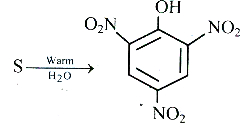
Identify the substrate '$S$' in the following reaction.
A
$p-$Nitrochlorobenzene
B
$o-$Nitrochlorobenzene
C
$2,4,6-$trichloronitrobenzene
D
$2,4,6-$trinitrochlorobenzene
Solution
(D) The reaction shown is the nucleophilic aromatic substitution of $2,4,6-$trinitrochlorobenzene with water (hydrolysis) to form $2,4,6-$trinitrophenol (picric acid).
Because of the presence of three strongly electron-withdrawing nitro $(-NO_2)$ groups at the ortho and para positions,the chlorine atom in $2,4,6-$trinitrochlorobenzene becomes highly susceptible to nucleophilic attack by water,even under mild conditions like warming with water.
Because of the presence of three strongly electron-withdrawing nitro $(-NO_2)$ groups at the ortho and para positions,the chlorine atom in $2,4,6-$trinitrochlorobenzene becomes highly susceptible to nucleophilic attack by water,even under mild conditions like warming with water.
0 likes
View Solution312
MediumMCQ
What is the percentage of $p$-bromoanisole formed in the bromination of anisole with bromine in acetic acid (in $\%$)?
A
$10$
B
$30$
C
$60$
D
$90$
Solution
(D) The bromination of anisole $(C_6H_5OCH_3)$ with bromine $(Br_2)$ in acetic acid $(CH_3COOH)$ is an electrophilic aromatic substitution reaction.
Anisole is an ortho/para directing group due to the $+M$ effect of the methoxy $(-OCH_3)$ group.
Due to steric hindrance at the ortho position,the para-isomer is the major product.
According to standard experimental data,the reaction yields $90 \%$ of $p$-bromoanisole and $10 \%$ of $o$-bromoanisole.
Therefore,the correct percentage of $p$-bromoanisole formed is $90 \%$.
Anisole is an ortho/para directing group due to the $+M$ effect of the methoxy $(-OCH_3)$ group.
Due to steric hindrance at the ortho position,the para-isomer is the major product.
According to standard experimental data,the reaction yields $90 \%$ of $p$-bromoanisole and $10 \%$ of $o$-bromoanisole.
Therefore,the correct percentage of $p$-bromoanisole formed is $90 \%$.
0 likes
View Solution313
MediumMCQ
Which of the following groups is strongly ortho and para directing?
A
$-C_6H_5$
B
$-OH$
C
$-CH_3$
D
$-Cl$
Solution
(B) All the given groups are $o-$ and $p-$ directing.
However,in the $-OH$ group,the lone pair of electrons on the $O$-atom participates in resonance,which significantly increases the electron density at the $o-$ and $p-$ positions of the benzene ring.
This makes the $-OH$ group a strongly activating and strongly $o-$ and $p-$ directing group compared to the others.
However,in the $-OH$ group,the lone pair of electrons on the $O$-atom participates in resonance,which significantly increases the electron density at the $o-$ and $p-$ positions of the benzene ring.
This makes the $-OH$ group a strongly activating and strongly $o-$ and $p-$ directing group compared to the others.
0 likes
View Solution314
EasyMCQ
The reaction of an aryl halide with an alkyl halide and sodium metal in dry ether to form substituted aromatic compounds is known as:
A
Wurtz reaction
B
Fittig reaction
C
Wurtz-Fittig reaction
D
Friedel-Craft's reaction
Solution
(C) The reaction involving an aryl halide $(Ar-X)$ and an alkyl halide $(R-X)$ in the presence of sodium metal $(Na)$ in dry ether is known as the $Wurtz-Fittig$ reaction.
The general equation is: $Ar-X + 2Na + R-X \xrightarrow{\text{dry ether}} Ar-R + 2NaX$.
The general equation is: $Ar-X + 2Na + R-X \xrightarrow{\text{dry ether}} Ar-R + 2NaX$.
0 likes
View Solution315
EasyMCQ
Which among the following is $NOT$ an example of Wurtz reaction?
A
$2 C_2 H_5 Br + 2 Na \xrightarrow{\text{dry ether}} C_4 H_{10} + 2 NaBr$
B
$CH_3 Br + C_2 H_5 Br \xrightarrow{\text{dry ether}} C_2 H_6 + C_3 H_8 + C_4 H_{10} + 2 NaBr$
C
$2 CH_3 Br + 2 Na \xrightarrow{\text{dry ether}} C_2 H_6 + 2 NaBr$
D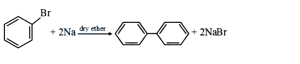
Solution
(D) The Wurtz reaction involves the coupling of two alkyl halides in the presence of sodium metal and dry ether to form a higher alkane.
Option $A$,$B$,and $C$ involve alkyl halides and are examples of the Wurtz reaction.
Option $D$ involves bromobenzene (an aryl halide) reacting with sodium to form biphenyl. This is known as the Fittig reaction,not the Wurtz reaction.
Option $A$,$B$,and $C$ involve alkyl halides and are examples of the Wurtz reaction.
Option $D$ involves bromobenzene (an aryl halide) reacting with sodium to form biphenyl. This is known as the Fittig reaction,not the Wurtz reaction.
0 likes
View Solution316
EasyMCQ
What is the intermediate compound formed when chlorobenzene is treated with fused $NaOH$ under pressure?
A
Benzene
B
Benzene diazonium chloride
C
Sodium phenoxide
D
Phenoxide ion
Solution
(C) The reaction of chlorobenzene with fused $NaOH$ at high temperature $(623 \ K)$ and high pressure $(300 \ atm)$ is known as the Dow process.
The reaction proceeds as follows:
$C_6H_5Cl + 2NaOH \rightarrow C_6H_5ONa + NaCl + H_2O$
In this reaction,chlorobenzene reacts with fused $NaOH$ to form sodium phenoxide $(C_6H_5ONa)$ as the intermediate product.
Subsequently,acidification of sodium phenoxide yields phenol.
Therefore,the intermediate compound formed is sodium phenoxide.
The reaction proceeds as follows:
$C_6H_5Cl + 2NaOH \rightarrow C_6H_5ONa + NaCl + H_2O$
In this reaction,chlorobenzene reacts with fused $NaOH$ to form sodium phenoxide $(C_6H_5ONa)$ as the intermediate product.
Subsequently,acidification of sodium phenoxide yields phenol.
Therefore,the intermediate compound formed is sodium phenoxide.
0 likes
View Solution317
MediumMCQ
The major product obtained in the following reaction is: Chlorobenzene + chlorine $\xrightarrow[FeCl_3]{\text{Anhydrous}}$ product (Major)
A
$1,3,5-$trichlorobenzene
B
$1,4-$dichlorobenzene
C
$1,2-$dichlorobenzene
D
$1,3-$dichlorobenzene
Solution
(B) Chlorobenzene undergoes electrophilic aromatic substitution (chlorination) in the presence of anhydrous $FeCl_3$ as a Lewis acid catalyst.
The chlorine atom on the benzene ring is ortho- and para-directing due to the resonance effect.
However,the para-isomer ($1,4-$dichlorobenzene) is the major product due to less steric hindrance compared to the ortho-isomer ($1,2-$dichlorobenzene).
The chlorine atom on the benzene ring is ortho- and para-directing due to the resonance effect.
However,the para-isomer ($1,4-$dichlorobenzene) is the major product due to less steric hindrance compared to the ortho-isomer ($1,2-$dichlorobenzene).
0 likes
View Solution318
MediumMCQ
The reaction in which $2$ molecules of chlorobenzene react with metallic sodium in the presence of dry ether to form diphenyl is an example of:
A
Wurtz–Fittig reaction
B
Wurtz reaction
C
Rosenmund reaction
D
Fittig reaction
Solution
(D) The reaction between two molecules of an aryl halide (like chlorobenzene) with metallic sodium in the presence of dry ether to form a diaryl (like diphenyl) is known as the Fittig reaction.
The reaction is:
$2C_6H_5Cl + 2Na \xrightarrow{\text{dry ether}} C_6H_5-C_6H_5 + 2NaCl$
Note: The Wurtz–Fittig reaction involves one molecule of alkyl halide and one molecule of aryl halide. Since this reaction involves two molecules of aryl halide,it is specifically the Fittig reaction.
The reaction is:
$2C_6H_5Cl + 2Na \xrightarrow{\text{dry ether}} C_6H_5-C_6H_5 + 2NaCl$
Note: The Wurtz–Fittig reaction involves one molecule of alkyl halide and one molecule of aryl halide. Since this reaction involves two molecules of aryl halide,it is specifically the Fittig reaction.
0 likes
View Solution319
MediumMCQ
The reaction in which $2$ molecules of chlorobenzene react with metallic sodium in the presence of dry ether to form biphenyl is an example of:
A
Wurtz-Fittig reaction
B
Wurtz reaction
C
Fittig reaction
D
Balz-Schiemann reaction
Solution
(C) The reaction of two molecules of an aryl halide (like chlorobenzene) with metallic sodium in the presence of dry ether to form a diaryl (biphenyl) is known as the $Fittig$ reaction.
The general equation is: $2C_6H_5Cl + 2Na \xrightarrow{\text{dry ether}} C_6H_5-C_6H_5 + 2NaCl$.
Therefore,the correct option is $C$.
The general equation is: $2C_6H_5Cl + 2Na \xrightarrow{\text{dry ether}} C_6H_5-C_6H_5 + 2NaCl$.
Therefore,the correct option is $C$.
0 likes
View Solution320
MediumMCQ
$C_{6}H_{6} + CH_{3}Cl \xrightarrow{\text{Anhy. } AlCl_{3}} C_{6}H_{5}CH_{3} + HCl$
The name of the above reaction is:
The name of the above reaction is:
A
Gattermann
B
Reimer-Tiemann
C
Friedel-Craft
D
Cannizzaro
Solution
(C) The given reaction is $C_{6}H_{6} + CH_{3}Cl \xrightarrow{\text{Anhy. } AlCl_{3}} C_{6}H_{5}CH_{3} + HCl$.
This is an electrophilic aromatic substitution reaction where a methyl group is introduced into the benzene ring using an alkyl halide in the presence of a Lewis acid catalyst $(AlCl_{3})$.
This reaction is known as the Friedel-Crafts alkylation reaction.
This is an electrophilic aromatic substitution reaction where a methyl group is introduced into the benzene ring using an alkyl halide in the presence of a Lewis acid catalyst $(AlCl_{3})$.
This reaction is known as the Friedel-Crafts alkylation reaction.
0 likes
View Solution321
MediumMCQ
Identify the product formed from chlorobenzene on heating with conc. $HNO_3$ in the presence of conc. $H_2SO_4$.
A
Only $1-$chloro$-4-$nitrobenzene
B
$1-$chloro$-2-$nitrobenzene
C
Mixture of $1-$chloro$-4-$nitrobenzene and $1-$chloro$-2-$nitrobenzene
D
$2,4,6-$trinitrochlorobenzene
Solution
(C) Chlorobenzene undergoes electrophilic aromatic substitution (nitration) when treated with a mixture of conc. $HNO_3$ and conc. $H_2SO_4$.
Because the chlorine atom is ortho/para-directing due to the resonance effect,the nitration occurs at both the $ortho$ and $para$ positions.
Therefore,the reaction yields a mixture of $1-$chloro$-2-$nitrobenzene ($ortho$-isomer) and $1-$chloro$-4-$nitrobenzene ($para$-isomer).
Because the chlorine atom is ortho/para-directing due to the resonance effect,the nitration occurs at both the $ortho$ and $para$ positions.
Therefore,the reaction yields a mixture of $1-$chloro$-2-$nitrobenzene ($ortho$-isomer) and $1-$chloro$-4-$nitrobenzene ($para$-isomer).
0 likes
View Solution322
MediumMCQ
Identify the substrate '$S$' in the following reaction:
$S \xrightarrow{\text{warm } H_2O} \text{Picric acid}$
$S \xrightarrow{\text{warm } H_2O} \text{Picric acid}$
A
$p-$Nitrochlorobenzene
B
$o-$Nitrochlorobenzene
C
$2,4-$dinitrochlorobenzene
D
$2,4,6-$trinitrochlorobenzene
Solution
(D) The reaction shown is the nucleophilic aromatic substitution of a chlorobenzene derivative with water (hydrolysis) to form a phenol derivative.
The product formed is $2,4,6-$trinitrophenol,commonly known as picric acid.
This reaction proceeds easily under mild conditions (warm water) because the three electron-withdrawing $-NO_2$ groups at the ortho and para positions significantly activate the benzene ring towards nucleophilic attack by $H_2O$.
Therefore,the substrate '$S$' must be $2,4,6-$trinitrochlorobenzene.
The product formed is $2,4,6-$trinitrophenol,commonly known as picric acid.
This reaction proceeds easily under mild conditions (warm water) because the three electron-withdrawing $-NO_2$ groups at the ortho and para positions significantly activate the benzene ring towards nucleophilic attack by $H_2O$.
Therefore,the substrate '$S$' must be $2,4,6-$trinitrochlorobenzene.
0 likes
View Solution323
MediumMCQ
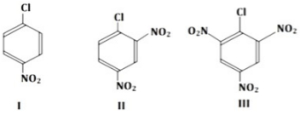
The correct order of reactivity for the reaction involving the cleavage of the $C-X$ bond in the following compounds is:
A
$I > II > III$
B
$II > III > I$
C
$III > I > II$
D
$III > II > I$
Solution
(D) The reaction involving the cleavage of the $C-X$ bond in haloarenes is Nucleophilic Aromatic Substitution $(S_NAr)$.
This reaction is facilitated by the presence of electron-withdrawing groups (like $-NO_2$) at the ortho and para positions,which stabilize the carbanion intermediate formed during the reaction.
Compound $I$ has one $-NO_2$ group at the para position.
Compound $II$ has two $-NO_2$ groups (one at ortho and one at para position).
Compound $III$ has three $-NO_2$ groups (two at ortho and one at para position).
As the number of electron-withdrawing groups increases,the reactivity towards nucleophilic substitution increases.
Therefore,the correct order of reactivity is $III > II > I$.
This reaction is facilitated by the presence of electron-withdrawing groups (like $-NO_2$) at the ortho and para positions,which stabilize the carbanion intermediate formed during the reaction.
Compound $I$ has one $-NO_2$ group at the para position.
Compound $II$ has two $-NO_2$ groups (one at ortho and one at para position).
Compound $III$ has three $-NO_2$ groups (two at ortho and one at para position).
As the number of electron-withdrawing groups increases,the reactivity towards nucleophilic substitution increases.
Therefore,the correct order of reactivity is $III > II > I$.
0 likes
View Solution324
EasyMCQ
Identify the name of the reaction in which an aryl halide reacts with an alkyl halide and sodium metal in the presence of dry ether to yield substituted aromatic compounds.
A
Wurtz reaction
B
Wurtz-Fittig reaction
C
Fittig reaction
D
Finkelstein reaction
Solution
(B) The reaction between an aryl halide $(Ar-X)$ and an alkyl halide $(R-X)$ in the presence of sodium metal $(Na)$ and dry ether is known as the $Wurtz-Fittig$ reaction.
The general equation is: $Ar-X + 2Na + R-X \xrightarrow{\text{dry ether}} Ar-R + 2NaX$.
This reaction is used to prepare alkyl-substituted aromatic compounds.
The general equation is: $Ar-X + 2Na + R-X \xrightarrow{\text{dry ether}} Ar-R + 2NaX$.
This reaction is used to prepare alkyl-substituted aromatic compounds.
0 likes
View Solution325
EasyMCQ
Which of the following reactions is a Fittig reaction?
A
$2 CH_3Cl + 2 Na \xrightarrow[\text{dry ether}]{\Delta} C_2H_6 + 2 NaCl$
B
$2 C_6H_5Cl + 2 Na \xrightarrow[\text{dry ether}]{\Delta} C_6H_5-C_6H_5 + 2 NaCl$
C
$C_6H_5Cl + C_2H_5Cl + 2 Na \xrightarrow[\text{dry ether}]{\Delta} C_6H_5-C_2H_5 + 2 NaCl$
D
$CH_3Cl + C_2H_5Cl + 2 Na \xrightarrow[\text{dry ether}]{\Delta} CH_3-C_2H_5 + 2 NaCl$
Solution
(B) The Fittig reaction is a coupling reaction where two aryl halides react with sodium metal in the presence of dry ether to form a diaryl compound.
Option $B$ represents the reaction of two molecules of chlorobenzene $(C_6H_5Cl)$ with sodium to form biphenyl $(C_6H_5-C_6H_5)$,which is the definition of the Fittig reaction.
Option $A$ is the Wurtz reaction.
Option $C$ is the Wurtz-Fittig reaction.
Option $D$ is the Wurtz reaction.
Option $B$ represents the reaction of two molecules of chlorobenzene $(C_6H_5Cl)$ with sodium to form biphenyl $(C_6H_5-C_6H_5)$,which is the definition of the Fittig reaction.
Option $A$ is the Wurtz reaction.
Option $C$ is the Wurtz-Fittig reaction.
Option $D$ is the Wurtz reaction.
0 likes
View Solution326
EasyMCQ
Identify the name of the reaction in which an aryl halide reacts with an alkyl halide and sodium metal in dry ether to produce substituted aromatic compounds.
A
Wurtz reaction
B
Fittig reaction
C
Wurtz-Fittig reaction
D
Friedel Crafts reaction
Solution
(C) The reaction of an aryl halide with an alkyl halide in the presence of sodium metal and dry ether is known as the $Wurtz-Fittig$ reaction.
In this reaction,the alkyl group from the alkyl halide replaces the halogen atom on the aromatic ring.
The general equation is: $Ar-X + R-X + 2Na \xrightarrow{\text{dry ether}} Ar-R + 2NaX$.
In this reaction,the alkyl group from the alkyl halide replaces the halogen atom on the aromatic ring.
The general equation is: $Ar-X + R-X + 2Na \xrightarrow{\text{dry ether}} Ar-R + 2NaX$.
0 likes
View Solution327
EasyMCQ
The reaction of bromobenzene with bromomethane and sodium metal in dry ether to give toluene is known as:
A
Wurtz reaction
B
Fittig reaction
C
Friedel-Crafts reaction
D
Wurtz-Fittig reaction
Solution
(D) The reaction involves an aryl halide (bromobenzene) and an alkyl halide (bromomethane) reacting with sodium metal in the presence of dry ether to form an alkylbenzene (toluene). This specific reaction is known as the $Wurtz-Fittig$ reaction. The general equation is: $C_6H_5Br + CH_3Br + 2Na \xrightarrow{\text{dry ether}} C_6H_5CH_3 + 2NaBr$.
0 likes
View Solution328
MediumMCQ
Which of the following has the highest reactivity towards nucleophilic substitution reaction involving the cleavage of the $C-Cl$ bond?
A
Chlorobenzene
B
$p-$Nitrochlorobenzene
C
$2,4-$Dinitrochlorobenzene
D
$2,4,6-$Trinitrochlorobenzene
Solution
(D) Nucleophilic aromatic substitution in aryl halides is facilitated by the presence of electron-withdrawing groups $(EWG)$ at the ortho and para positions relative to the halogen atom.
These groups stabilize the carbanion intermediate (Meisenheimer complex) formed during the reaction through resonance and inductive effects.
As the number of electron-withdrawing nitro groups $(-NO_2)$ increases,the electron density on the benzene ring decreases,making the carbon atom attached to the chlorine more electrophilic and thus more susceptible to nucleophilic attack.
Therefore,$2,4,6-$trinitrochlorobenzene has the highest number of electron-withdrawing groups,making it the most reactive towards nucleophilic substitution.
These groups stabilize the carbanion intermediate (Meisenheimer complex) formed during the reaction through resonance and inductive effects.
As the number of electron-withdrawing nitro groups $(-NO_2)$ increases,the electron density on the benzene ring decreases,making the carbon atom attached to the chlorine more electrophilic and thus more susceptible to nucleophilic attack.
Therefore,$2,4,6-$trinitrochlorobenzene has the highest number of electron-withdrawing groups,making it the most reactive towards nucleophilic substitution.
0 likes
View Solution329
EasyMCQ
The reaction of aryl halide with sodium metal in dry ether to give biphenyl is known as
A
Swartz reaction
B
Wurtz reaction
C
Fittig reaction
D
Wurtz-fittig reaction
Solution
(C) The reaction of two molecules of an aryl halide with sodium metal in the presence of dry ether to form a diaryl (biphenyl) is known as the $Fittig$ reaction.
$2Ar-X + 2Na \xrightarrow{\text{dry ether}} Ar-Ar + 2NaX$
Here,$Ar$ represents an aryl group and $X$ represents a halogen atom.
$2Ar-X + 2Na \xrightarrow{\text{dry ether}} Ar-Ar + 2NaX$
Here,$Ar$ represents an aryl group and $X$ represents a halogen atom.
0 likes
View Solution330
MediumMCQ
Which of the following compounds has the most difficulty in breaking the $C-X$ bond?
A
$o-$Nitrochlorobenzene
B
$m-$Nitrochlorobenzene
C
$p-$Nitrochlorobenzene
D
$2,4,6-$Trinitrochlorobenzene
Solution
(B) The ease of breaking the $C-X$ bond in haloarenes depends on the electron density at the carbon atom attached to the halogen.
Electron-withdrawing groups (like $-NO_2$) at the ortho and para positions increase the reactivity of the $C-X$ bond towards nucleophilic substitution by stabilizing the carbanion intermediate.
In $m-$Nitrochlorobenzene,the $-NO_2$ group is at the meta position,which does not exert a strong electron-withdrawing effect on the carbon attached to the chlorine through resonance.
Therefore,$m-$Nitrochlorobenzene has the least activation for nucleophilic substitution,making the $C-X$ bond the most difficult to break among the given options.
Electron-withdrawing groups (like $-NO_2$) at the ortho and para positions increase the reactivity of the $C-X$ bond towards nucleophilic substitution by stabilizing the carbanion intermediate.
In $m-$Nitrochlorobenzene,the $-NO_2$ group is at the meta position,which does not exert a strong electron-withdrawing effect on the carbon attached to the chlorine through resonance.
Therefore,$m-$Nitrochlorobenzene has the least activation for nucleophilic substitution,making the $C-X$ bond the most difficult to break among the given options.
0 likes
View Solution331
MediumMCQ
Identify $A$ in the following reaction.
$A \text{ (excess)} + \text{Acetyl chloride (excess)}$ $\xrightarrow[AlCl_3]{\text{Anhydrous}} 1-\text{Chloroacetophenone} + 4-\text{Chloroacetophenone}$
$A \text{ (excess)} + \text{Acetyl chloride (excess)}$ $\xrightarrow[AlCl_3]{\text{Anhydrous}} 1-\text{Chloroacetophenone} + 4-\text{Chloroacetophenone}$
A
Benzene
B
Chlorobenzene
C
Toluene
D
Phenol
Solution
(B) The reaction is a Friedel-Crafts acylation of $A$ with acetyl chloride in the presence of anhydrous $AlCl_3$.
The products formed are $1-\text{chloroacetophenone}$ (ortho-substituted) and $4-\text{chloroacetophenone}$ (para-substituted).
Since the products contain a chlorine atom attached to the benzene ring,the starting material $A$ must be $Chlorobenzene$.
Chlorobenzene is an ortho/para directing group due to the $+M$ effect of the chlorine atom,which explains the formation of the observed products.
The products formed are $1-\text{chloroacetophenone}$ (ortho-substituted) and $4-\text{chloroacetophenone}$ (para-substituted).
Since the products contain a chlorine atom attached to the benzene ring,the starting material $A$ must be $Chlorobenzene$.
Chlorobenzene is an ortho/para directing group due to the $+M$ effect of the chlorine atom,which explains the formation of the observed products.
0 likes
View Solution332
EasyMCQ
Identify the product when chlorobenzene is heated with nitrating mixture.
A
Only $1-$chloro$-4-$nitrobenzene
B
Only $1-$chloro$-2-$nitrobenzene
C
Mixture of $1-$chloro$-2-$nitrobenzene and $1-$chloro$-4-$nitrobenzene
D
$2,4,6-$trinitrochlorobenzene
Solution
(C) Chlorobenzene undergoes electrophilic aromatic substitution when treated with a nitrating mixture (concentrated $HNO_3$ and concentrated $H_2SO_4$).
Since the chlorine atom is ortho/para-directing due to the resonance effect,the nitration occurs at both the ortho and para positions.
Therefore,the reaction yields a mixture of $1-$chloro$-2-$nitrobenzene (ortho-isomer) and $1-$chloro$-4-$nitrobenzene (para-isomer).
Since the chlorine atom is ortho/para-directing due to the resonance effect,the nitration occurs at both the ortho and para positions.
Therefore,the reaction yields a mixture of $1-$chloro$-2-$nitrobenzene (ortho-isomer) and $1-$chloro$-4-$nitrobenzene (para-isomer).
0 likes
View Solution333
EasyMCQ
Which of the following is a Fittig reaction?
A
$C_6H_5Br + CH_3Br + 2Na \xrightarrow[\text{dry ether}]{} C_6H_5-CH_3 + 2NaBr$
B
$2C_2H_5Br + 2Na \xrightarrow[\text{dry ether}]{} C_2H_5-C_2H_5 + 2NaBr$
C
$2CH_3Br + 2Na \xrightarrow[\text{dry ether}]{} CH_3-CH_3 + 2NaBr$
D
$2C_6H_5Br + 2Na \xrightarrow[\text{dry ether}]{} C_6H_5-C_6H_5 + 2NaBr$
Solution
(D) The Fittig reaction involves the coupling of two aryl halide molecules in the presence of sodium metal and dry ether to form a diaryl compound.
Option $A$ represents the Wurtz-Fittig reaction.
Options $B$ and $C$ represent the Wurtz reaction.
Option $D$ represents the Fittig reaction: $2C_6H_5Br + 2Na \xrightarrow[\text{dry ether}]{} C_6H_5-C_6H_5 + 2NaBr$.
Option $A$ represents the Wurtz-Fittig reaction.
Options $B$ and $C$ represent the Wurtz reaction.
Option $D$ represents the Fittig reaction: $2C_6H_5Br + 2Na \xrightarrow[\text{dry ether}]{} C_6H_5-C_6H_5 + 2NaBr$.
0 likes
View Solution334
MediumMCQ
Identify '$A$' in the following reaction.
$A + \text{Acetyl chloride}$ $\xrightarrow[AlCl_3]{\text{anhydrous}} 1-\text{chloroacetophenone} + 4-\text{chloroacetophenone}$
$A + \text{Acetyl chloride}$ $\xrightarrow[AlCl_3]{\text{anhydrous}} 1-\text{chloroacetophenone} + 4-\text{chloroacetophenone}$
A
Benzene
B
Chlorobenzene
C
Toluene
D
Phenol
Solution
(B) The reaction is a Friedel-Crafts acylation of a substituted benzene ring.
Since the products are $1-\text{chloroacetophenone}$ (ortho-isomer) and $4-\text{chloroacetophenone}$ (para-isomer),the starting material '$A$' must be chlorobenzene.
Chlorobenzene undergoes electrophilic aromatic substitution where the chlorine atom is ortho/para-directing,leading to the formation of these specific products.
Since the products are $1-\text{chloroacetophenone}$ (ortho-isomer) and $4-\text{chloroacetophenone}$ (para-isomer),the starting material '$A$' must be chlorobenzene.
Chlorobenzene undergoes electrophilic aromatic substitution where the chlorine atom is ortho/para-directing,leading to the formation of these specific products.
0 likes
View Solution335
DifficultMCQ
Identify the major product obtained in the following reaction.
Chlorobenzene $\xrightarrow[\text{Anhydrous } FeCl_3]{Cl_2}$ major product
Chlorobenzene $\xrightarrow[\text{Anhydrous } FeCl_3]{Cl_2}$ major product
A
$1,2-$Dichlorobenzene
B
$1,3-$Dichlorobenzene
C
$1,4-$Dichlorocyclohexane
D
$1,4-$Dichlorobenzene
Solution
(D) The reaction of chlorobenzene with chlorine in the presence of anhydrous $FeCl_3$ is an electrophilic aromatic substitution reaction (chlorination).
The $-Cl$ group attached to the benzene ring is ortho/para-directing due to the resonance effect.
Due to steric hindrance at the ortho position,the para-isomer is formed as the major product.
Therefore,$1,4$-dichlorobenzene is the major product.
The $-Cl$ group attached to the benzene ring is ortho/para-directing due to the resonance effect.
Due to steric hindrance at the ortho position,the para-isomer is formed as the major product.
Therefore,$1,4$-dichlorobenzene is the major product.
0 likes
View Solution336
MediumMCQ
Which of the following compounds has the most difficulty in breaking the $C-Cl$ bond?
A
$o-$Nitrochlorobenzene
B
$m-$Nitrochlorobenzene
C
$p-$Nitrochlorobenzene
D
$2,4,6-$Trinitrochlorobenzene
Solution
(B) The reactivity of haloarenes towards nucleophilic substitution depends on the presence of electron-withdrawing groups $(EWG)$ at the $ortho$ and $para$ positions.
These groups stabilize the carbanion intermediate formed during the reaction.
An $EWG$ at the $meta$ position has practically no effect on the reactivity because the negative charge in the intermediate does not reside on the carbon atom attached to the $meta$ position.
Therefore,$m-$nitrochlorobenzene has the least reactivity,making it the most difficult to break the $C-Cl$ bond among the given options.
These groups stabilize the carbanion intermediate formed during the reaction.
An $EWG$ at the $meta$ position has practically no effect on the reactivity because the negative charge in the intermediate does not reside on the carbon atom attached to the $meta$ position.
Therefore,$m-$nitrochlorobenzene has the least reactivity,making it the most difficult to break the $C-Cl$ bond among the given options.
0 likes
View Solution337
EasyMCQ
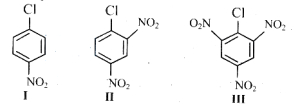
The correct order of reactivity for reactions involving the cleavage of the $C-Cl$ bond in the following compounds is:
A
$I < II < III$
B
$II < III < I$
C
$III < I < II$
D
$III < II < I$
Solution
(A) The reactivity of haloarenes towards nucleophilic substitution reactions increases with the presence of electron-withdrawing groups (like $-NO_2$) at the ortho and para positions.
These groups stabilize the carbanion intermediate formed during the reaction by withdrawing electron density through the inductive and resonance effects.
Compound $I$ has one $-NO_2$ group at the para position.
Compound $II$ has two $-NO_2$ groups (one at ortho and one at para position).
Compound $III$ has three $-NO_2$ groups (two at ortho and one at para position).
Therefore,the reactivity order is $I < II < III$.
These groups stabilize the carbanion intermediate formed during the reaction by withdrawing electron density through the inductive and resonance effects.
Compound $I$ has one $-NO_2$ group at the para position.
Compound $II$ has two $-NO_2$ groups (one at ortho and one at para position).
Compound $III$ has three $-NO_2$ groups (two at ortho and one at para position).
Therefore,the reactivity order is $I < II < III$.
0 likes
View Solution338
MediumMCQ
Identify the product obtained when chlorobenzene is heated with conc. $HNO_3$ in the presence of conc. $H_2SO_4$.
A
Only $1-$chloro$-4-$nitrobenzene
B
Only $1-$chloro$-2-$nitrobenzene
C
Mixture of $1-$chloro$-4-$nitrobenzene and $1-$chloro$-2-$nitrobenzene
D
$2,4,6-$trinitrochlorobenzene
Solution
(C) The reaction of chlorobenzene with conc. $HNO_3$ in the presence of conc. $H_2SO_4$ is an electrophilic aromatic substitution reaction known as nitration.
Chlorine is an ortho/para-directing group due to the resonance effect.
Therefore,the nitration of chlorobenzene yields a mixture of $1-$chloro$-2-$nitrobenzene (ortho-isomer) and $1-$chloro$-4-$nitrobenzene (para-isomer).
The reaction is: $C_6H_5Cl + HNO_3 \xrightarrow{conc. H_2SO_4, \Delta} C_6H_4(Cl)(NO_2) \text{ (ortho + para isomers)}$.
Chlorine is an ortho/para-directing group due to the resonance effect.
Therefore,the nitration of chlorobenzene yields a mixture of $1-$chloro$-2-$nitrobenzene (ortho-isomer) and $1-$chloro$-4-$nitrobenzene (para-isomer).
The reaction is: $C_6H_5Cl + HNO_3 \xrightarrow{conc. H_2SO_4, \Delta} C_6H_4(Cl)(NO_2) \text{ (ortho + para isomers)}$.
0 likes
View Solution339
EasyMCQ
Which of the following compounds has difficulty in breaking the $C-X$ bond during a nucleophilic substitution reaction?
A
$o-$Nitrochlorobenzene
B
$p-$Nitrochlorobenzene
C
$m-$Nitrochlorobenzene
D
$2,4,6-$Trinitrochlorobenzene
Solution
(C) The reactivity of haloarenes towards nucleophilic substitution increases with the presence of electron-withdrawing groups (like $-NO_2$) at the $ortho$ and $para$ positions due to the stabilization of the carbanion intermediate.
Electron-withdrawing groups at the $meta$ position have a negligible effect on the reactivity compared to $ortho$ and $para$ positions.
Therefore,among the given options,$m-$nitrochlorobenzene is the least reactive,making it the most difficult to break the $C-X$ bond during a nucleophilic substitution reaction.
Electron-withdrawing groups at the $meta$ position have a negligible effect on the reactivity compared to $ortho$ and $para$ positions.
Therefore,among the given options,$m-$nitrochlorobenzene is the least reactive,making it the most difficult to break the $C-X$ bond during a nucleophilic substitution reaction.
0 likes
View Solution340
EasyMCQ
Which of the following reactions is used to prepare toluene from bromobenzene?
A
Wurtz-Fittig reaction
B
Swartz reaction
C
Wurtz reaction
D
Fittig reaction
Solution
(A) The reaction of bromobenzene with methyl bromide in the presence of sodium metal and dry ether is known as the Wurtz-Fittig reaction.
In this reaction,an aryl halide reacts with an alkyl halide to form an alkylbenzene.
The chemical equation is: $C_6H_5Br + CH_3Br + 2Na \xrightarrow{\text{dry ether}} C_6H_5CH_3 + 2NaBr$.
Thus,the correct option is $A$.
In this reaction,an aryl halide reacts with an alkyl halide to form an alkylbenzene.
The chemical equation is: $C_6H_5Br + CH_3Br + 2Na \xrightarrow{\text{dry ether}} C_6H_5CH_3 + 2NaBr$.
Thus,the correct option is $A$.
0 likes
View Solution341
MediumMCQ
Which of the following reactions is a $Wurtz-Fittig$ reaction?
A
$C_6H_5Cl + CH_3Cl + 2 \ Na \xrightarrow[dry]{ether} C_6H_5-CH_3 + 2 \ NaCl$
B
$C_2H_5Cl + CH_3Cl + 2 \ Na \xrightarrow[dry]{ether} C_3H_8 + 2 \ NaCl$
C
$2 \ C_2H_5Cl + 2 \ Na \xrightarrow[dry]{ether} C_2H_5-C_2H_5 + 2 \ NaCl$
D
$2 \ C_6H_5Cl + 2 \ Na \xrightarrow[dry]{ether} C_6H_5-C_6H_5 + 2 \ NaCl$
Solution
(A) The $Wurtz-Fittig$ reaction involves the coupling of an aryl halide $(C_6H_5Cl)$ and an alkyl halide $(CH_3Cl)$ in the presence of sodium metal in dry ether to form an alkylbenzene $(C_6H_5-CH_3)$.
The reaction is: $C_6H_5Cl + CH_3Cl + 2 \ Na \xrightarrow[dry]{ether} C_6H_5-CH_3 + 2 \ NaCl$.
Option $A$ represents this reaction.
The reaction is: $C_6H_5Cl + CH_3Cl + 2 \ Na \xrightarrow[dry]{ether} C_6H_5-CH_3 + 2 \ NaCl$.
Option $A$ represents this reaction.
0 likes
View Solution342
MediumMCQ
The reaction of aryl halide with sodium metal in dry ether to give biphenyl is known as
A
Fittig reaction
B
Wurtz reaction
C
Swartz reaction
D
Wurtz-Fittig reaction
Solution
(A) The reaction of two moles of an aryl halide with sodium metal in the presence of dry ether to form a diaryl compound (biphenyl) is known as the $Fittig$ reaction.
The general reaction is:
$2Ar-X + 2Na \xrightarrow{\text{dry ether}} Ar-Ar + 2NaX$
Where $Ar$ is an aryl group and $X$ is a halogen.
The general reaction is:
$2Ar-X + 2Na \xrightarrow{\text{dry ether}} Ar-Ar + 2NaX$
Where $Ar$ is an aryl group and $X$ is a halogen.
0 likes
View Solution343
EasyMCQ
Which of the following reactions yields biphenyl from chlorobenzene?
A
Swartz reaction
B
Wurtz reaction
C
Fittig reaction
D
Finkelstein reaction
Solution
(C) The reaction of two molecules of aryl halides (like chlorobenzene) with sodium metal in the presence of dry ether to form diaryl compounds (like biphenyl) is known as the Fittig reaction.
The chemical equation is:
$2C_6H_5Cl + 2Na \xrightarrow{\text{dry ether}} C_6H_5-C_6H_5 + 2NaCl$
Therefore,the correct option is $C$.
The chemical equation is:
$2C_6H_5Cl + 2Na \xrightarrow{\text{dry ether}} C_6H_5-C_6H_5 + 2NaCl$
Therefore,the correct option is $C$.
0 likes
View Solution344
MediumMCQ
Identify the product when ethylbenzene reacts with dilute nitric acid.
A
$o$-Nitroethylbenzene
B
$p$-Nitroethylbenzene
C
Ethoxybenzene
D
Benzoic acid
Solution
(B) Ethylbenzene reacts with dilute nitric acid under specific conditions,but typically,dilute nitric acid is not a strong enough nitrating agent to perform electrophilic aromatic substitution on the benzene ring of ethylbenzene effectively. However,if the reaction is considered in the context of standard organic chemistry problems,the alkyl group $(-CH_2CH_3)$ is an ortho/para directing group. Therefore,the expected products of nitration would be a mixture of $o$-nitroethylbenzene and $p$-nitroethylbenzene. Given the options,both $A$ and $B$ are valid isomers,but usually,$p$-nitroethylbenzene is the major product due to steric hindrance at the ortho position. If the question implies a specific reaction condition leading to a single major product,$p$-nitroethylbenzene is the standard answer.
0 likes
View Solution345
EasyMCQ
Identify the major product formed in the following reaction.
$Chlorobenzene \xrightarrow{Cl_2, \text{ Anhydrous } FeCl_3} \text{Product}$
$Chlorobenzene \xrightarrow{Cl_2, \text{ Anhydrous } FeCl_3} \text{Product}$
A
$1,2-dichlorobenzene$
B
$1,3-dichlorobenzene$
C
$1,3,5-trichlorobenzene$
D
$1,4-dichlorobenzene$
Solution
(D) The reaction of $Chlorobenzene$ with $Cl_2$ in the presence of anhydrous $FeCl_3$ is an electrophilic aromatic substitution reaction (chlorination).
$Chlorine$ atom on the benzene ring is ortho/para-directing due to the resonance effect.
However,the para-isomer is the major product due to less steric hindrance compared to the ortho-isomer.
Therefore,$1,4-dichlorobenzene$ is the major product.
$Chlorine$ atom on the benzene ring is ortho/para-directing due to the resonance effect.
However,the para-isomer is the major product due to less steric hindrance compared to the ortho-isomer.
Therefore,$1,4-dichlorobenzene$ is the major product.
0 likes
View Solution346
MediumMCQ
Identify $A$ in the following reaction.
$A + \text{chloromethane} \xrightarrow[AlCl_3]{\text{Anhydrous}} 1-\text{chlorotoluene} + 4-\text{chlorotoluene}$
$A + \text{chloromethane} \xrightarrow[AlCl_3]{\text{Anhydrous}} 1-\text{chlorotoluene} + 4-\text{chlorotoluene}$
A
Benzene
B
Chlorobenzene
C
Toluene
D
Phenol
Solution
(B) The reaction is an electrophilic aromatic substitution,specifically a Friedel-Crafts alkylation.
Chlorobenzene reacts with chloromethane in the presence of anhydrous $AlCl_3$ to form $1-\text{chloro}-2-\text{methylbenzene}$ $(o-\text{chlorotoluene})$ and $1-\text{chloro}-4-\text{methylbenzene}$ $(p-\text{chlorotoluene})$.
Since the product is a mixture of $1-\text{chlorotoluene}$ (ortho-isomer) and $4-\text{chlorotoluene}$ (para-isomer),the reactant $A$ must be $Chlorobenzene$ because the chlorine atom on the benzene ring is ortho/para-directing.
Chlorobenzene reacts with chloromethane in the presence of anhydrous $AlCl_3$ to form $1-\text{chloro}-2-\text{methylbenzene}$ $(o-\text{chlorotoluene})$ and $1-\text{chloro}-4-\text{methylbenzene}$ $(p-\text{chlorotoluene})$.
Since the product is a mixture of $1-\text{chlorotoluene}$ (ortho-isomer) and $4-\text{chlorotoluene}$ (para-isomer),the reactant $A$ must be $Chlorobenzene$ because the chlorine atom on the benzene ring is ortho/para-directing.
0 likes
View Solution347
MediumMCQ
Identify '$A$' in the following reaction.
$A +$ Acetyl chloride $\xrightarrow{\text{Anhydrous } AlCl_3} 1-$Chloroacetophenone $+ 4-$Chloroacetophenone
$A +$ Acetyl chloride $\xrightarrow{\text{Anhydrous } AlCl_3} 1-$Chloroacetophenone $+ 4-$Chloroacetophenone
A
Benzene
B
Chlorobenzene
C
Toluene
D
Phenol
Solution
(B) The reaction is a Friedel-Crafts acylation of an aromatic compound '$A$' with acetyl chloride in the presence of anhydrous $AlCl_3$.
Since the products formed are $1-$chloroacetophenone (ortho-substituted) and $4-$chloroacetophenone (para-substituted),the starting material '$A$' must be chlorobenzene.
The chlorine atom on the benzene ring is ortho/para-directing,which explains the formation of these specific isomers.
Since the products formed are $1-$chloroacetophenone (ortho-substituted) and $4-$chloroacetophenone (para-substituted),the starting material '$A$' must be chlorobenzene.
The chlorine atom on the benzene ring is ortho/para-directing,which explains the formation of these specific isomers.
0 likes
View Solution348
MediumMCQ
Identify '$A$' in the following reaction:
$A + \text{Chloromethane} \xrightarrow{\text{Anhydrous } AlCl_3} \text{2-Chlorotoluene} + \text{4-Chlorotoluene}$
$A + \text{Chloromethane} \xrightarrow{\text{Anhydrous } AlCl_3} \text{2-Chlorotoluene} + \text{4-Chlorotoluene}$
A
Benzene
B
Chlorobenzene
C
Toluene
D
Phenol
Solution
(B) The given reaction is a Friedel-Crafts alkylation reaction.
In this reaction,$A$ reacts with chloromethane $(CH_3Cl)$ in the presence of anhydrous $AlCl_3$ to form $2$-chlorotoluene and $4$-chlorotoluene.
Since the products are ortho and para substituted chlorotoluenes,the reactant $A$ must be chlorobenzene $(C_6H_5Cl)$.
Chlorine is an ortho/para directing group,which directs the incoming methyl group to the ortho and para positions.
Therefore,$A$ is chlorobenzene.
In this reaction,$A$ reacts with chloromethane $(CH_3Cl)$ in the presence of anhydrous $AlCl_3$ to form $2$-chlorotoluene and $4$-chlorotoluene.
Since the products are ortho and para substituted chlorotoluenes,the reactant $A$ must be chlorobenzene $(C_6H_5Cl)$.
Chlorine is an ortho/para directing group,which directs the incoming methyl group to the ortho and para positions.
Therefore,$A$ is chlorobenzene.
0 likes
View Solution349
MediumMCQ
Identify reactant $(A)$ used in the following conversion.
Chlorobenzene $+ A \xrightarrow[anhydrous]{AlCl_3} 2-\text{chloroacetophenone} + 4-\text{chloroacetophenone}$
Chlorobenzene $+ A \xrightarrow[anhydrous]{AlCl_3} 2-\text{chloroacetophenone} + 4-\text{chloroacetophenone}$
A
Ethyl acetate
B
Acetophenone
C
Acetic acid
D
Acetyl chloride
Solution
(D) The given reaction is a Friedel-Crafts acylation reaction.
In this reaction,chlorobenzene reacts with an acylating agent in the presence of an anhydrous Lewis acid catalyst like $AlCl_3$.
The reaction is:
$\text{Chlorobenzene} + CH_3COCl$ $\xrightarrow[anhydrous]{AlCl_3} 2-\text{chloroacetophenone} + 4-\text{chloroacetophenone}$
Here,the reactant $(A)$ is acetyl chloride $(CH_3COCl)$.
In this reaction,chlorobenzene reacts with an acylating agent in the presence of an anhydrous Lewis acid catalyst like $AlCl_3$.
The reaction is:
$\text{Chlorobenzene} + CH_3COCl$ $\xrightarrow[anhydrous]{AlCl_3} 2-\text{chloroacetophenone} + 4-\text{chloroacetophenone}$
Here,the reactant $(A)$ is acetyl chloride $(CH_3COCl)$.
0 likes
View SolutionHaloalkanes and Haloarenes — Properties of Haloarenes · Frequently Asked Questions
1Are these Haloalkanes and Haloarenes questions useful for JEE and NEET?
Yes. All questions in this section are mapped to JEE Main and NEET exam patterns. Previous year questions from JEE Main, NEET, GUJCET and state-level exams are included with full solutions.
2Can I switch to Hindi or Gujarati for these questions?
Yes. Use the language tabs in the hero section or the sidebar to view the same questions and solutions in English, Hindi or Gujarati.
3How do I generate a question paper from this subtopic?
Use the Vedclass Exam Paper Generator — select the chapter and subtopic, set difficulty, and generate Sets A, B, C, D automatically. First 3 chapters of every subject are free.
Vedclass Products
For Students
Vedclass Test Series
Mock tests in real JEE/NEET style with performance analysis. 5-day free trial.
Start Free TrialFor Teachers
Exam Paper Generator
Generate Set A/B/C/D papers from this chapter in 2 minutes. 3 chapters free.
Try FreeFor Institutes
Online Exam Module
Live online exams with unlimited students, 360° analytics & white-label branding.
See DemoFor Teachers & Institutes
Generate a Haloalkanes and Haloarenes Exam Paper in 2 Minutes
Select subtopic & difficulty — Sets A, B, C, D auto-generated with No Repeat logic.
First 3 chapters of every subject are free — no payment required.