
A English
Properties of Haloalkanes Questions in English
Class 12 Chemistry · Haloalkanes and Haloarenes · Properties of Haloalkanes
1196+
Questions
English
Language
100%
With Solutions
Showing 46 of 1196 questions in English
1101
MediumMCQ
Assertion $(A)$: $S_N1$ hydrolysis of optically active $2-$bromooctane results in the formation of $(\pm)-$octan$-2-$ol.
Reason $(R)$: The reaction proceeds through a planar carbocation which can be attacked by the nucleophile from either side.
The correct answer is
Reason $(R)$: The reaction proceeds through a planar carbocation which can be attacked by the nucleophile from either side.
The correct answer is
A
$(A)$ and $(R)$ are correct,$(R)$ is the correct explanation of $(A)$
B
$(A)$ and $(R)$ are correct but $(R)$ is not the correct explanation of $(A)$
C
$(A)$ is correct but $(R)$ is not correct
D
$(A)$ is not correct but $(R)$ is correct
Solution
(A) The $S_N1$ mechanism involves the formation of a planar carbocation intermediate.
In the case of $2-$bromooctane,the loss of the bromide ion leads to a planar carbocation intermediate.
Because the carbocation is planar,the nucleophile (e.g.,$OH^-$) can attack from either the front or the back side with equal probability.
This leads to the formation of a racemic mixture,which is represented as $(\pm)-$octan$-2-$ol.
Therefore,both the Assertion $(A)$ and the Reason $(R)$ are correct,and the Reason $(R)$ is the correct explanation for the Assertion $(A)$.
In the case of $2-$bromooctane,the loss of the bromide ion leads to a planar carbocation intermediate.
Because the carbocation is planar,the nucleophile (e.g.,$OH^-$) can attack from either the front or the back side with equal probability.
This leads to the formation of a racemic mixture,which is represented as $(\pm)-$octan$-2-$ol.
Therefore,both the Assertion $(A)$ and the Reason $(R)$ are correct,and the Reason $(R)$ is the correct explanation for the Assertion $(A)$.
0 likes
View Solution1102
EasyMCQ
$S_{N}2$ reaction involving inversion of configuration takes place with an optically active compound $Z$. The compound $Z$ is
A
$CH_3CH_2X$
B
$(CH_3)_2CHX$
C
$CH_3CH_2CH(CH_3)X$
D
$(CH_3)_3CX$
Solution
(C) For a compound to be optically active,it must possess a chiral carbon atom (a carbon atom bonded to four different groups).
In $S_{N}2$ reactions,the nucleophile attacks the electrophilic carbon from the side opposite to the leaving group,leading to an inversion of configuration (Walden inversion).
Let's analyze the options:
$(A)$ $CH_3CH_2X$: The carbon attached to $X$ is bonded to two identical $H$ atoms. It is achiral.
$(B)$ $(CH_3)_2CHX$: The carbon attached to $X$ is bonded to two identical $CH_3$ groups. It is achiral.
$(C)$ $CH_3CH_2CH(CH_3)X$: The carbon attached to $X$ is bonded to $H$,$CH_3$,$CH_2CH_3$,and $X$. Since all four groups are different,this carbon is chiral,making the compound optically active.
$(D)$ $(CH_3)_3CX$: The carbon attached to $X$ is bonded to three identical $CH_3$ groups. It is achiral.
Therefore,the optically active compound $Z$ is $CH_3CH_2CH(CH_3)X$.
In $S_{N}2$ reactions,the nucleophile attacks the electrophilic carbon from the side opposite to the leaving group,leading to an inversion of configuration (Walden inversion).
Let's analyze the options:
$(A)$ $CH_3CH_2X$: The carbon attached to $X$ is bonded to two identical $H$ atoms. It is achiral.
$(B)$ $(CH_3)_2CHX$: The carbon attached to $X$ is bonded to two identical $CH_3$ groups. It is achiral.
$(C)$ $CH_3CH_2CH(CH_3)X$: The carbon attached to $X$ is bonded to $H$,$CH_3$,$CH_2CH_3$,and $X$. Since all four groups are different,this carbon is chiral,making the compound optically active.
$(D)$ $(CH_3)_3CX$: The carbon attached to $X$ is bonded to three identical $CH_3$ groups. It is achiral.
Therefore,the optically active compound $Z$ is $CH_3CH_2CH(CH_3)X$.
0 likes
View Solution1103
EasyMCQ
The rate of dehydrohalogenation of which one among the following is the least?
A
$CH_3-CH_2-CH_2-Br$
B
$CH_3-CH_2-CH_2-Cl$
C
$CH_3-CH_2-CH_2-I$
D
$CH_3-CH(CH_3)-CH_2I$
Solution
(B) The rate of dehydrohalogenation depends on the strength of the $C-X$ bond.
The bond dissociation energy follows the order $C-Cl > C-Br > C-I$.
Since the $C-Cl$ bond is the strongest,it is the most difficult to break,making the rate of dehydrohalogenation the slowest for alkyl chlorides compared to alkyl bromides and alkyl iodides.
Among the given options,$CH_3-CH_2-CH_2-Cl$ has the strongest $C-X$ bond,resulting in the lowest rate of dehydrohalogenation.
The bond dissociation energy follows the order $C-Cl > C-Br > C-I$.
Since the $C-Cl$ bond is the strongest,it is the most difficult to break,making the rate of dehydrohalogenation the slowest for alkyl chlorides compared to alkyl bromides and alkyl iodides.
Among the given options,$CH_3-CH_2-CH_2-Cl$ has the strongest $C-X$ bond,resulting in the lowest rate of dehydrohalogenation.
0 likes
View Solution1104
EasyMCQ
The order of reactivity of the following alkyl bromides towards $S_N1$ reactions is:
$a$) $(CH_3)_2CHBr$
$b$) $CH_3CH_2Br$
$c$) $(CH_3)_3CBr$
$a$) $(CH_3)_2CHBr$
$b$) $CH_3CH_2Br$
$c$) $(CH_3)_3CBr$
A
$a > b > c$
B
$b > a > c$
C
$c > a > b$
D
$c > b > a$
Solution
(C) The reactivity of alkyl halides towards $S_N1$ reactions depends on the stability of the carbocation intermediate formed during the rate-determining step.
$S_N1$ reactivity order: $\text{Tertiary} (3^{\circ}) > \text{Secondary} (2^{\circ}) > \text{Primary} (1^{\circ}) > \text{Methyl}$.
In the given compounds:
$a$) $(CH_3)_2CHBr$ is a secondary $(2^{\circ})$ alkyl bromide.
$b$) $CH_3CH_2Br$ is a primary $(1^{\circ})$ alkyl bromide.
$c$) $(CH_3)_3CBr$ is a tertiary $(3^{\circ})$ alkyl bromide.
Therefore,the order of stability of the carbocations formed is $(CH_3)_3C^+ > (CH_3)_2CH^+ > CH_3CH_2^+$.
Thus,the order of reactivity is $c > a > b$.
$S_N1$ reactivity order: $\text{Tertiary} (3^{\circ}) > \text{Secondary} (2^{\circ}) > \text{Primary} (1^{\circ}) > \text{Methyl}$.
In the given compounds:
$a$) $(CH_3)_2CHBr$ is a secondary $(2^{\circ})$ alkyl bromide.
$b$) $CH_3CH_2Br$ is a primary $(1^{\circ})$ alkyl bromide.
$c$) $(CH_3)_3CBr$ is a tertiary $(3^{\circ})$ alkyl bromide.
Therefore,the order of stability of the carbocations formed is $(CH_3)_3C^+ > (CH_3)_2CH^+ > CH_3CH_2^+$.
Thus,the order of reactivity is $c > a > b$.
0 likes
View Solution1105
MediumMCQ
Identify the statement which is not correct?
A
Dehydrobromination of $2-$bromopentane gives pent$-1-$ene as the major product.
B
Freon $12$ is manufactured by Swarts reaction.
C
$CHCl_3$ is stored in closed,dark coloured bottles.
D
Chronic exposure to $CHCl_3$ causes liver damage.
Solution
(A) The dehydrobromination of $2-$bromopentane follows Saytzeff's rule,which states that the more substituted alkene is the major product. Therefore,pent$-2-$ene is the major product,not pent$-1-$ene. The reaction is as follows: $CH_3-CH_2-CH_2-CH(Br)-CH_3$ $\xrightarrow{alc. KOH} CH_3-CH_2-CH=CH-CH_3 \text{ (major)} + CH_3-CH_2-CH_2-CH=CH_2 \text{ (minor)}$. Thus,statement $A$ is incorrect.
0 likes
View Solution1106
EasyMCQ
Which one of the following is more reactive towards $S_{N}2$ reaction?
A
$ (CH_{3})_{3}CX $
B
$ (CH_{3})_{2}CHX $
C
$ CH_{3}CH_{2}X $
D
$ CH_{3}X $
Solution
(D) The $S_{N}2$ reaction mechanism involves a single-step process where the nucleophile attacks the electrophilic carbon from the backside,leading to the inversion of configuration.
Steric hindrance plays a crucial role in the rate of $S_{N}2$ reactions.
As the number of alkyl groups attached to the electrophilic carbon increases,the steric hindrance increases,which makes the approach of the nucleophile more difficult.
The order of reactivity towards $S_{N}2$ is: $Methyl \ halide > 1^{\circ} \ alkyl \ halide > 2^{\circ} \ alkyl \ halide > 3^{\circ} \ alkyl \ halide$.
Among the given options,$CH_{3}X$ is a methyl halide,which has the least steric hindrance and is therefore the most reactive towards $S_{N}2$ reactions.
Steric hindrance plays a crucial role in the rate of $S_{N}2$ reactions.
As the number of alkyl groups attached to the electrophilic carbon increases,the steric hindrance increases,which makes the approach of the nucleophile more difficult.
The order of reactivity towards $S_{N}2$ is: $Methyl \ halide > 1^{\circ} \ alkyl \ halide > 2^{\circ} \ alkyl \ halide > 3^{\circ} \ alkyl \ halide$.
Among the given options,$CH_{3}X$ is a methyl halide,which has the least steric hindrance and is therefore the most reactive towards $S_{N}2$ reactions.
0 likes
View Solution1107
MediumMCQ
Consider the following reaction:
$CH_3-CH_2-CH(Br)-CH_3 \xrightarrow{alc. KOH, \Delta} CH_3-CH_2-CH=CH_2 (I) + CH_3-CH=CH-CH_3 (II)$
Which of the following statements are correct?
$a.$ $I$ is the major product of the reaction
$b.$ $II$ is the major product of the reaction
$c.$ Formation of $I$ is in accordance with Saytzeff's rule
$d.$ $II$ is more stable because it is more substituted
$CH_3-CH_2-CH(Br)-CH_3 \xrightarrow{alc. KOH, \Delta} CH_3-CH_2-CH=CH_2 (I) + CH_3-CH=CH-CH_3 (II)$
Which of the following statements are correct?
$a.$ $I$ is the major product of the reaction
$b.$ $II$ is the major product of the reaction
$c.$ Formation of $I$ is in accordance with Saytzeff's rule
$d.$ $II$ is more stable because it is more substituted
A
$a, c$
B
$b, c$
C
$a, d$
D
$b, d$
Solution
(D) The reaction is a dehydrohalogenation of $2$-bromobutane using alcoholic $KOH$,which follows the $E2$ mechanism.
According to Saytzeff's rule,the major product in dehydrohalogenation is the more substituted alkene.
Product $I$ is $but-1-ene$ (monosubstituted),and product $II$ is $but-2-ene$ (disubstituted).
Since $but-2-ene$ $(II)$ is more substituted,it is more stable and is the major product.
Therefore,statement $b$ is correct ($II$ is the major product) and statement $d$ is correct ($II$ is more stable because it is more substituted).
Thus,the correct option is $b, d$.
According to Saytzeff's rule,the major product in dehydrohalogenation is the more substituted alkene.
Product $I$ is $but-1-ene$ (monosubstituted),and product $II$ is $but-2-ene$ (disubstituted).
Since $but-2-ene$ $(II)$ is more substituted,it is more stable and is the major product.
Therefore,statement $b$ is correct ($II$ is the major product) and statement $d$ is correct ($II$ is more stable because it is more substituted).
Thus,the correct option is $b, d$.
0 likes
View Solution1108
EasyMCQ
Which one among the following undergoes dehydrohalogenation most readily?
A
$(H_3C)_2CHCl$
B
$(H_3C)_2CHI$
C
$(H_3C)_2CHBr$
D
$(H_3C)_3CI$
Solution
(D) Dehydrohalogenation is an elimination reaction ($E1$ or $E2$) where a hydrogen atom and a halogen atom are removed from adjacent carbon atoms to form an alkene.
$1$. The rate of dehydrohalogenation depends on the stability of the transition state and the strength of the $C-X$ bond.
$2$. The $C-I$ bond is the weakest among $C-Cl$,$C-Br$,and $C-I$ bonds due to the large size of the iodine atom,making it the best leaving group.
$3$. Tertiary alkyl halides $(3^{\circ})$ undergo dehydrohalogenation more readily than secondary $(2^{\circ})$ or primary $(1^{\circ})$ alkyl halides because the resulting alkene is more substituted and thus more stable.
$4$. Comparing the options,$(H_3C)_3CI$ is a tertiary alkyl halide with an iodine atom,which is the best leaving group. Therefore,it undergoes dehydrohalogenation most readily.
$1$. The rate of dehydrohalogenation depends on the stability of the transition state and the strength of the $C-X$ bond.
$2$. The $C-I$ bond is the weakest among $C-Cl$,$C-Br$,and $C-I$ bonds due to the large size of the iodine atom,making it the best leaving group.
$3$. Tertiary alkyl halides $(3^{\circ})$ undergo dehydrohalogenation more readily than secondary $(2^{\circ})$ or primary $(1^{\circ})$ alkyl halides because the resulting alkene is more substituted and thus more stable.
$4$. Comparing the options,$(H_3C)_3CI$ is a tertiary alkyl halide with an iodine atom,which is the best leaving group. Therefore,it undergoes dehydrohalogenation most readily.
0 likes
View Solution1109
MediumMCQ
Match the following:
The correct match is:
| Reactants | Products |
|---|---|
| $A$. $C_2H_5Cl$,moist $Ag_2O$ | $I$. $CH_3CH_2ONO$ |
| $B$. $C_2H_5Cl$,aqueous ethanolic $AgCN$ | $II$. $C_2H_4$ |
| $C$. $C_2H_5Cl$,aqueous ethanolic $AgNO_2$ | $III$. $CH_3CH_2OH$ |
| $D$. $C_2H_5Cl$,ethanolic $KOH$ | $IV$. $CH_3CH_2NC$ |
The correct match is:
A
$A-V, B-III, C-IV, D-I$
B
$A-I, B-II, C-III, D-IV$
C
$A-III, B-IV, C-I, D-II$
D
$A-IV, B-I, C-II, D-V$
Solution
(C) The reactions are as follows:
Therefore,the correct match is $A-III, B-IV, C-I, D-II$.
| Reactants | Products |
|---|---|
| $A$. $C_2H_5Cl + \text{moist } Ag_2O$ | $III$. $CH_3CH_2OH$ (Substitution) |
| $B$. $C_2H_5Cl + \text{aqueous ethanolic } AgCN$ | $IV$. $CH_3CH_2NC$ (Isocyanide formation) |
| $C$. $C_2H_5Cl + \text{aqueous ethanolic } AgNO_2$ | $I$. $CH_3CH_2ONO$ (Nitrite formation) |
| $D$. $C_2H_5Cl + \text{ethanolic } KOH$ | $II$. $C_2H_4$ (Elimination/Dehydrohalogenation) |
Therefore,the correct match is $A-III, B-IV, C-I, D-II$.
0 likes
View Solution1110
MediumMCQ
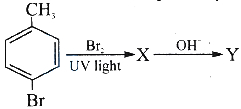
What are $X$ and $Y$ respectively in the following reactions?
A
$X = \text{4-bromobenzyl bromide}, Y = \text{4-bromobenzyl alcohol}$
B
$X = \text{2-bromo-4-bromotoluene}, Y = \text{2-hydroxy-4-bromotoluene}$
C
$X = \text{2-bromo-4-bromotoluene}, Y = \text{4-bromo-2-hydroxytoluene}$
D
$X = \text{4-bromobenzyl bromide}, Y = \text{4-bromophenol}$
Solution
(A) The reaction of $4$-bromotoluene with $Br_2$ in the presence of $UV$ light is a free radical substitution reaction. This reaction occurs at the benzylic position,not on the aromatic ring. Therefore,$X$ is $4$-bromobenzyl bromide $(Br-C_6H_4-CH_2Br)$.
When $4$-bromobenzyl bromide is treated with $OH^-$,it undergoes a nucleophilic substitution reaction $(S_N2)$ where the $Br$ atom on the side chain is replaced by an $OH$ group. Therefore,$Y$ is $4$-bromobenzyl alcohol $(Br-C_6H_4-CH_2OH)$.
When $4$-bromobenzyl bromide is treated with $OH^-$,it undergoes a nucleophilic substitution reaction $(S_N2)$ where the $Br$ atom on the side chain is replaced by an $OH$ group. Therefore,$Y$ is $4$-bromobenzyl alcohol $(Br-C_6H_4-CH_2OH)$.
0 likes
View Solution1111
MediumMCQ
An organic compound $X$ $(C_7H_7Cl)$ when reacted with $KCN$ in $C_2H_5OH$ gives a major product $Y$. $Z$ is formed when $Y$ is reduced with $LiAlH_4$. What are $Y$ and $Z$?
A
$Y$ = Benzyl isocyanide,$Z$ = $N$-methylbenzylamine
B
$Y$ = Benzyl cyanide,$Z$ = Phenylethylamine
C
$Y$ = p-Methylbenzonitrile,$Z$ = p-Methylbenzylamine
D
$Y$ = p-Methylphenyl isocyanide,$Z$ = $N$-methyl-p-toluidine
Solution
(B) The organic compound $X$ is benzyl chloride $(C_6H_5CH_2Cl)$.
When benzyl chloride reacts with $KCN$ in $C_2H_5OH$,it undergoes a nucleophilic substitution reaction to form benzyl cyanide $(C_6H_5CH_2CN)$ as the major product $Y$.
When benzyl cyanide $(Y)$ is reduced with $LiAlH_4$,it forms $2-$phenylethan$-1-$amine $(C_6H_5CH_2CH_2NH_2)$ as product $Z$.
When benzyl chloride reacts with $KCN$ in $C_2H_5OH$,it undergoes a nucleophilic substitution reaction to form benzyl cyanide $(C_6H_5CH_2CN)$ as the major product $Y$.
When benzyl cyanide $(Y)$ is reduced with $LiAlH_4$,it forms $2-$phenylethan$-1-$amine $(C_6H_5CH_2CH_2NH_2)$ as product $Z$.
0 likes
View Solution1112
MediumMCQ
The reaction involving the coupling of an aryl halide and an alkyl halide in the presence of sodium metal and dry ether is known as:

A
Wurtz-Fittig reaction
B
Wurtz reaction
C
Fittig reaction
D
Friedel-Crafts reaction
Solution
(A) The reaction involves the coupling of an aryl halide $(C_6H_5Cl)$ and an alkyl halide $(CH_3Cl)$ in the presence of sodium metal $(Na)$ and dry ether to form an alkylbenzene (toluene).
This specific type of coupling reaction between an aryl halide and an alkyl halide is known as the $Wurtz-Fittig$ reaction.
This specific type of coupling reaction between an aryl halide and an alkyl halide is known as the $Wurtz-Fittig$ reaction.
0 likes
View Solution1113
EasyMCQ
Which among the following will have the highest density?
A
$CCl_4$
B
$n-C_3H_7I$
C
$n-C_3H_7Br$
D
$n-C_3H_7Cl$
Solution
(B) The density of haloalkanes increases with an increase in the number of carbon atoms,the number of halogen atoms,and the atomic mass of the halogen atoms.
Among the given compounds,$n-C_3H_7I$ contains iodine,which has the highest atomic mass among the halogens listed $(Cl, Br, I)$.
Among the given compounds,$n-C_3H_7I$ contains iodine,which has the highest atomic mass among the halogens listed $(Cl, Br, I)$.
| Compound | Density in $g/mL$ |
| $CCl_4$ | $1.595$ |
| $n-C_3H_7I$ | $1.747$ |
| $n-C_3H_7Br$ | $1.335$ |
| $n-C_3H_7Cl$ | $0.89$ |
0 likes
View Solution1114
EasyMCQ
The following reaction is a/an:
$CH_3-CH_2-CH_2-Br \xrightarrow{KOH} CH_3-CH=CH_2 + KBr + H_2O$
$CH_3-CH_2-CH_2-Br \xrightarrow{KOH} CH_3-CH=CH_2 + KBr + H_2O$
A
substitution reaction
B
addition reaction
C
electrophilic substitution reaction
D
elimination reaction
Solution
(D) The given reaction is: $CH_3-CH_2-CH_2-Br \xrightarrow{KOH} CH_3-CH=CH_2 + KBr + H_2O$
In this reaction,a hydrogen atom $(-H)$ and a bromine atom $(-Br)$ are removed from adjacent carbon atoms of the alkyl halide to form an alkene.
This process of removing small molecules to form a multiple bond is known as an elimination reaction (specifically,dehydrohalogenation).
In this reaction,a hydrogen atom $(-H)$ and a bromine atom $(-Br)$ are removed from adjacent carbon atoms of the alkyl halide to form an alkene.
This process of removing small molecules to form a multiple bond is known as an elimination reaction (specifically,dehydrohalogenation).
0 likes
View Solution1115
EasyMCQ
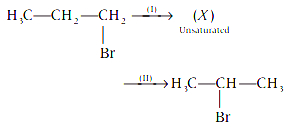
Identify the most suitable reagents $(I)$ and $(II)$ for the following sequence of reactions:
A
$I = \text{conc. } H_2SO_4, II = HBr$
B
$I = \text{aq. } KOH, II = HBr / \text{peroxide}$
C
$I = \text{alc. } KOH, II = HBr / \text{peroxide}$
D
$I = \text{alc. } KOH, II = HBr$
Solution
(D) The starting material is $1$-bromopropane $(CH_3CH_2CH_2Br)$.
Step $(I)$: Treatment with alcoholic $KOH$ causes dehydrohalogenation (elimination reaction) to form propene $(CH_3CH=CH_2)$.
Step $(II)$: The addition of $HBr$ to propene follows Markownikoff's rule,where the hydrogen atom attaches to the carbon with more hydrogens,resulting in the formation of $2$-bromopropane $(CH_3CH(Br)CH_3)$.
Step $(I)$: Treatment with alcoholic $KOH$ causes dehydrohalogenation (elimination reaction) to form propene $(CH_3CH=CH_2)$.
Step $(II)$: The addition of $HBr$ to propene follows Markownikoff's rule,where the hydrogen atom attaches to the carbon with more hydrogens,resulting in the formation of $2$-bromopropane $(CH_3CH(Br)CH_3)$.
0 likes
View Solution1116
EasyMCQ
$1-$chlorobutane on treatment with alcoholic potash forms
A
$2-$butanol
B
$1-$butene
C
$1-$butanol
D
$2-$butene
Solution
(B) Alcoholic $KOH$ acts as a dehydrohalogenating agent. It removes a molecule of $HCl$ from the alkyl halide to form an alkene.
For $1-$chlorobutane,the reaction is:
$CH_3CH_2CH_2CH_2Cl \xrightarrow{\text{Alc. } KOH} CH_3CH_2CH=CH_2 + KCl + H_2O$
This process is known as dehydrohalogenation,and the major product formed is $1-$butene.
Therefore,option $(B)$ is correct.
For $1-$chlorobutane,the reaction is:
$CH_3CH_2CH_2CH_2Cl \xrightarrow{\text{Alc. } KOH} CH_3CH_2CH=CH_2 + KCl + H_2O$
This process is known as dehydrohalogenation,and the major product formed is $1-$butene.
Therefore,option $(B)$ is correct.
0 likes
View Solution1117
MediumMCQ
Identify the products formed in the following reaction: $CH_3-CH_2-CH_2-CHBr-CH_3 \xrightarrow{KOH / C_2H_5OH} ?$
A
$CH_3-CH_2-CH=CH_2, CH_3-CH_2-CH(OH)-CH_3$
B
$CH_3-CH_2-CH=CH-CH_3, CH_3-CH_2-CH_2-CH(OH)-CH_3, CH_3-CH_2-CH_2-CH_2-CH_2OH$
C
$CH_3-CH_2-CH=CH-CH_3, CH_3-CH_2-CH_2-CH=CH_2$
D
$CH_3-CH_2-CH=CH-CH_3, CH_3-CH_2-CH_2-CH=CH_2, CH_3-CH_2-CH_2-CH(OH)-CH_3$
Solution
(C) The reaction of $2$-bromopentane $(CH_3-CH_2-CH_2-CHBr-CH_3)$ with alcoholic $KOH$ $(KOH / C_2H_5OH)$ is a dehydrohalogenation reaction (elimination reaction).
Alcoholic $KOH$ acts as a strong base and promotes the formation of alkenes via the $E2$ mechanism.
According to Saytzeff's rule,the more substituted alkene is the major product.
The possible elimination products are:
$1$. Pent-$2$-ene $(CH_3-CH_2-CH=CH-CH_3)$ (Major product,more substituted)
$2$. Pent-$1$-ene $(CH_3-CH_2-CH_2-CH=CH_2)$ (Minor product,less substituted)
Therefore,the correct option is $C$.
Alcoholic $KOH$ acts as a strong base and promotes the formation of alkenes via the $E2$ mechanism.
According to Saytzeff's rule,the more substituted alkene is the major product.
The possible elimination products are:
$1$. Pent-$2$-ene $(CH_3-CH_2-CH=CH-CH_3)$ (Major product,more substituted)
$2$. Pent-$1$-ene $(CH_3-CH_2-CH_2-CH=CH_2)$ (Minor product,less substituted)
Therefore,the correct option is $C$.
0 likes
View Solution1118
MediumMCQ
An alkene $X$ $(C_4H_8)$ on reaction with $HBr$ gave $Y$ $(C_4H_9Br)$. Reaction of $Y$ with benzene in the presence of anhydrous $AlCl_3$ gave $Z$,which is resistant to oxidation with $KMnO_4-KOH$. What are $X, Y, Z$ respectively?
A
$2-$methylpropene,tert-butyl bromide,tert-butylbenzene
B
$2-$methylpropene,isobutyl bromide,isobutylbenzene
C
$1-$butene,$2$-bromobutane,sec-butylbenzene
D
$1-$butene,$1$-bromobutane,n-butylbenzene
Solution
(A) $1$. The alkene $X$ is $2$-methylpropene $(CH_3-C(CH_3)=CH_2)$.
$2$. Reaction of $2$-methylpropene with $HBr$ follows Markovnikov's rule to give $Y$,which is $tert$-butyl bromide $(CH_3-C(Br)(CH_3)-CH_3)$.
$3$. Reaction of $tert$-butyl bromide with benzene in the presence of anhydrous $AlCl_3$ (Friedel-Crafts alkylation) gives $Z$,which is $tert$-butylbenzene $(C_6H_5-C(CH_3)_3)$.
$4$. $tert$-butylbenzene has no benzylic hydrogen atoms,so it is resistant to oxidation by $KMnO_4-KOH$.
$2$. Reaction of $2$-methylpropene with $HBr$ follows Markovnikov's rule to give $Y$,which is $tert$-butyl bromide $(CH_3-C(Br)(CH_3)-CH_3)$.
$3$. Reaction of $tert$-butyl bromide with benzene in the presence of anhydrous $AlCl_3$ (Friedel-Crafts alkylation) gives $Z$,which is $tert$-butylbenzene $(C_6H_5-C(CH_3)_3)$.
$4$. $tert$-butylbenzene has no benzylic hydrogen atoms,so it is resistant to oxidation by $KMnO_4-KOH$.
0 likes
View Solution1119
EasyMCQ
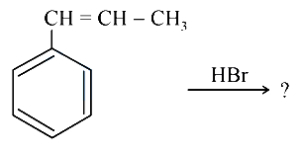
Identify the product of the following reaction.
A
$C_6H_5-CH_2-CH(Br)-CH_3$
B
$C_6H_5-CH(Br)-CH_2-CH_3$
C
$C_6H_5-CH_2-CH_2-CH_2-Br$
D
$C_6H_5-CH(Br)-CH_2-CH_3$
Solution
(B) The reaction is the electrophilic addition of $HBr$ to $1-phenylprop-1-ene$ $(C_6H_5-CH=CH-CH_3)$.
According to Markovnikov's rule,the proton $(H^+)$ adds to the carbon atom with more hydrogen atoms,and the bromide ion $(Br^-)$ adds to the carbon atom with fewer hydrogen atoms.
In this case,the carbocation formed at the benzylic position $(C_6H_5-CH^+-CH_2-CH_3)$ is highly stabilized by resonance with the phenyl ring.
Therefore,the bromide ion attacks this stable benzylic carbocation to form $1-bromo-1-phenylpropane$ as the major product.
The reaction is: $C_6H_5-CH=CH-CH_3 + HBr \rightarrow C_6H_5-CH(Br)-CH_2-CH_3$.
According to Markovnikov's rule,the proton $(H^+)$ adds to the carbon atom with more hydrogen atoms,and the bromide ion $(Br^-)$ adds to the carbon atom with fewer hydrogen atoms.
In this case,the carbocation formed at the benzylic position $(C_6H_5-CH^+-CH_2-CH_3)$ is highly stabilized by resonance with the phenyl ring.
Therefore,the bromide ion attacks this stable benzylic carbocation to form $1-bromo-1-phenylpropane$ as the major product.
The reaction is: $C_6H_5-CH=CH-CH_3 + HBr \rightarrow C_6H_5-CH(Br)-CH_2-CH_3$.
0 likes
View Solution1120
DifficultMCQ
Identify the major product formed from the following reaction: $1$-methylcyclohex-$1$-ene $\xrightarrow[(ii) AgNO_2]{(i) HCl} ?$
A
$1-$methyl$-1-$nitrocyclohexane
B
$1-$chloro$-2-$methylcyclohexane
C
$1-$methyl$-2-$nitritocyclohexane
D
$1-$methyl$-1-$nitritocyclohexane
Solution
(D) The reaction proceeds in two steps:
$1$. Electrophilic addition of $HCl$ to $1$-methylcyclohex-$1$-ene follows Markovnikov's rule. The proton $(H^+)$ adds to the carbon with more hydrogens,and the chloride ion $(Cl^-)$ adds to the more substituted carbon (the one with the methyl group),forming $1$-chloro-$1$-methylcyclohexane.
$2$. The reaction of $1$-chloro-$1$-methylcyclohexane with $AgNO_2$ is a nucleophilic substitution reaction ($S_N1$ mechanism). The $Cl^-$ is replaced by the nitrite group $(-ONO)$ or nitro group $(-NO_2)$. Since $AgNO_2$ is an ionic reagent,it primarily acts as a source of nitrite ions $(NO_2^-)$,which can bond through oxygen to form a nitrite ester $(-ONO)$ or through nitrogen to form a nitro compound $(-NO_2)$. In the case of tertiary alkyl halides,the formation of the nitrite ester $(-ONO)$ is often the major product due to the ambident nature of the nitrite ion and the stability of the tertiary carbocation intermediate. Thus,the major product is $1$-methyl-$1$-nitritocyclohexane.
$1$. Electrophilic addition of $HCl$ to $1$-methylcyclohex-$1$-ene follows Markovnikov's rule. The proton $(H^+)$ adds to the carbon with more hydrogens,and the chloride ion $(Cl^-)$ adds to the more substituted carbon (the one with the methyl group),forming $1$-chloro-$1$-methylcyclohexane.
$2$. The reaction of $1$-chloro-$1$-methylcyclohexane with $AgNO_2$ is a nucleophilic substitution reaction ($S_N1$ mechanism). The $Cl^-$ is replaced by the nitrite group $(-ONO)$ or nitro group $(-NO_2)$. Since $AgNO_2$ is an ionic reagent,it primarily acts as a source of nitrite ions $(NO_2^-)$,which can bond through oxygen to form a nitrite ester $(-ONO)$ or through nitrogen to form a nitro compound $(-NO_2)$. In the case of tertiary alkyl halides,the formation of the nitrite ester $(-ONO)$ is often the major product due to the ambident nature of the nitrite ion and the stability of the tertiary carbocation intermediate. Thus,the major product is $1$-methyl-$1$-nitritocyclohexane.
0 likes
View Solution1121
MediumMCQ
Identify the major product $Y$ in the given reaction sequence.

A
$CH_3-CH(OH)-CH_3$
B
$CH_3-CH_2-CH_2 OH$
C
$CH_3-CH(OH)-CH_2 OH$
D
$CH_2(OH)-CH_2-CH_2 OH$
Solution
(B) The reaction sequence is as follows:
$1$. Dehydrohalogenation: $CH_3-CH(Br)-CH_3$ reacts with alcoholic $KOH$ upon heating to undergo elimination,forming propene $(CH_3-CH=CH_2)$ as product $X$.
$2$. Hydroboration-Oxidation: Propene $(CH_3-CH=CH_2)$ reacts with $B_2H_6$ followed by $H_2O_2/OH^-$ to undergo anti-Markovnikov addition of water,yielding propan$-1-$ol $(CH_3-CH_2-CH_2OH)$ as the major product $Y$.
$1$. Dehydrohalogenation: $CH_3-CH(Br)-CH_3$ reacts with alcoholic $KOH$ upon heating to undergo elimination,forming propene $(CH_3-CH=CH_2)$ as product $X$.
$2$. Hydroboration-Oxidation: Propene $(CH_3-CH=CH_2)$ reacts with $B_2H_6$ followed by $H_2O_2/OH^-$ to undergo anti-Markovnikov addition of water,yielding propan$-1-$ol $(CH_3-CH_2-CH_2OH)$ as the major product $Y$.
0 likes
View Solution1122
MediumMCQ
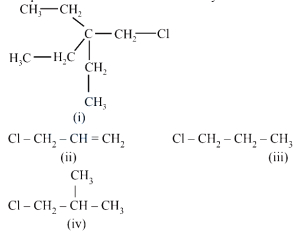
The decreasing order of reactivity of the following compounds in the Williamson's ether synthesis is:
A
$(ii) > (iv) > (iii) > (i)$
B
$(i) > (ii) > (iii) > (iv)$
C
$(iv) > (iii) > (ii) > (i)$
D
$(ii) > (iii) > (iv) > (i)$
Solution
(D) Williamson's ether synthesis proceeds via an $SN^2$ mechanism,which is highly sensitive to steric hindrance.
Primary alkyl halides are more reactive than secondary,which are more reactive than tertiary.
$(i)$ is a primary alkyl halide but is extremely sterically hindered due to the presence of a bulky quaternary carbon adjacent to the reaction site.
(ii) is an allylic primary halide,which is highly reactive due to resonance stabilization of the transition state.
(iii) is a simple primary alkyl halide $(CH_3CH_2CH_2Cl)$.
(iv) is a primary alkyl halide with branching at the $\beta$-carbon $(CH_3CH(CH_3)CH_2Cl)$.
The reactivity order for $SN^2$ is: Allylic primary $>$ Primary $>$ Primary with $\beta$-branching $>$ Highly hindered primary.
Thus,the decreasing order is $(ii) > (iii) > (iv) > (i)$.
Primary alkyl halides are more reactive than secondary,which are more reactive than tertiary.
$(i)$ is a primary alkyl halide but is extremely sterically hindered due to the presence of a bulky quaternary carbon adjacent to the reaction site.
(ii) is an allylic primary halide,which is highly reactive due to resonance stabilization of the transition state.
(iii) is a simple primary alkyl halide $(CH_3CH_2CH_2Cl)$.
(iv) is a primary alkyl halide with branching at the $\beta$-carbon $(CH_3CH(CH_3)CH_2Cl)$.
The reactivity order for $SN^2$ is: Allylic primary $>$ Primary $>$ Primary with $\beta$-branching $>$ Highly hindered primary.
Thus,the decreasing order is $(ii) > (iii) > (iv) > (i)$.
0 likes
View Solution1123
DifficultMCQ
What is the major product $Z$ in the given reaction sequence?
$(CH_3)_2 C=O \xrightarrow[(2) H_3O^{+}]{\text{(1) } C_2H_5MgBr} X$
$i) SOCl_2$ $\xrightarrow[\Delta]{\text{ii) } CH_3ONa} Y$ $\xrightarrow[\text{Peroxide}]{HBr} Z$
$(CH_3)_2 C=O \xrightarrow[(2) H_3O^{+}]{\text{(1) } C_2H_5MgBr} X$
$i) SOCl_2$ $\xrightarrow[\Delta]{\text{ii) } CH_3ONa} Y$ $\xrightarrow[\text{Peroxide}]{HBr} Z$
A
$1-$Bromo$-2-$methylpropene
B
$2-$Methoxy$-2-$methylbutane
C
$2-$Bromo$-3-$methylbutane
D
$1-$Bromo$-2-$methylbutane
Solution
(D) Step $1$: Reaction of acetone with $C_2H_5MgBr$ followed by hydrolysis gives $2-$methylbutan$-2-$ol $(X)$: $(CH_3)_2C=O + C_2H_5MgBr \rightarrow (CH_3)_2C(OH)C_2H_5$.
Step $2$: Reaction of $X$ with $SOCl_2$ gives $2-$chloro$-2-$methylbutane,which upon treatment with $CH_3ONa$ (base) undergoes dehydrohalogenation to form $2-$methylbut$-2-$ene $(Y)$ as the major product.
Step $3$: Addition of $HBr$ to $2-$methylbut$-2-$ene in the presence of peroxide follows anti-Markovnikov's rule to give $1-$bromo$-2-$methylbutane $(Z)$.
Step $2$: Reaction of $X$ with $SOCl_2$ gives $2-$chloro$-2-$methylbutane,which upon treatment with $CH_3ONa$ (base) undergoes dehydrohalogenation to form $2-$methylbut$-2-$ene $(Y)$ as the major product.
Step $3$: Addition of $HBr$ to $2-$methylbut$-2-$ene in the presence of peroxide follows anti-Markovnikov's rule to give $1-$bromo$-2-$methylbutane $(Z)$.
0 likes
View Solution1124
MediumMCQ
Which one of the following is used to obtain the maximum percentage of terminal alkene by dehydrohalogenation of $CH_3CH_2C(CH_3)_2Br$?
A
Sodium ethoxide in ethanol
B
Potassium ethoxide in ethanol
C
Potassium tert-butoxide in tert-butyl alcohol
D
Potassium alkoxide derived from $3$-ethyl-$3$-pentanol in $HO^{-}C(C_2H_5)_3$
Solution
(D) To obtain the maximum percentage of the terminal alkene (Hoffman product) in a dehydrohalogenation reaction,a bulky base is required.
Steric hindrance prevents the base from abstracting a proton from the more substituted $\beta$-carbon,favoring the abstraction of a proton from the less substituted $\beta$-carbon.
Among the given options,the potassium alkoxide derived from $3$-ethyl-$3$-pentanol,which is $(C_2H_5)_3CO^-K^+$,is the bulkiest base.
Therefore,it will yield the highest percentage of the terminal alkene.
Steric hindrance prevents the base from abstracting a proton from the more substituted $\beta$-carbon,favoring the abstraction of a proton from the less substituted $\beta$-carbon.
Among the given options,the potassium alkoxide derived from $3$-ethyl-$3$-pentanol,which is $(C_2H_5)_3CO^-K^+$,is the bulkiest base.
Therefore,it will yield the highest percentage of the terminal alkene.
0 likes
View Solution1125
MediumMCQ
Which one of the following is more readily hydrolysed by $S_{N}1$ mechanism?
A
$(C_6H_5)_2C(CH_3)Br$
B
$C_6H_5CH_2Br$
C
$C_6H_5CH(CH_3)Br$
D
$(C_6H_5)_2CHBr$
Solution
(A) The rate of $S_{N}1$ reaction depends on the stability of the carbocation intermediate formed after the departure of the leaving group.
More stable the carbocation,faster is the hydrolysis.
Comparing the carbocations formed from the given halides:
$(a)$ $(C_6H_5)_2C^+(CH_3)$ is a tertiary benzylic carbocation stabilized by two phenyl rings and one methyl group.
$(b)$ $C_6H_5CH_2^+$ is a primary benzylic carbocation.
$(c)$ $C_6H_5CH^+(CH_3)$ is a secondary benzylic carbocation.
$(d)$ $(C_6H_5)_2CH^+$ is a secondary benzylic carbocation stabilized by two phenyl rings.
The tertiary benzylic carbocation $(C_6H_5)_2C^+(CH_3)$ is the most stable among the given options due to maximum resonance stabilization and inductive effect.
Therefore,$(C_6H_5)_2C(CH_3)Br$ is most readily hydrolysed by $S_{N}1$ mechanism.
More stable the carbocation,faster is the hydrolysis.
Comparing the carbocations formed from the given halides:
$(a)$ $(C_6H_5)_2C^+(CH_3)$ is a tertiary benzylic carbocation stabilized by two phenyl rings and one methyl group.
$(b)$ $C_6H_5CH_2^+$ is a primary benzylic carbocation.
$(c)$ $C_6H_5CH^+(CH_3)$ is a secondary benzylic carbocation.
$(d)$ $(C_6H_5)_2CH^+$ is a secondary benzylic carbocation stabilized by two phenyl rings.
The tertiary benzylic carbocation $(C_6H_5)_2C^+(CH_3)$ is the most stable among the given options due to maximum resonance stabilization and inductive effect.
Therefore,$(C_6H_5)_2C(CH_3)Br$ is most readily hydrolysed by $S_{N}1$ mechanism.
0 likes
View Solution1126
MediumMCQ
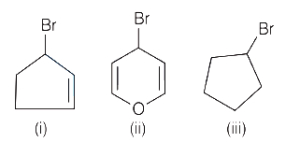
The correct order of rates of $C-Br$ bond ionisation of the following bromides is
A
$i > ii > iii$
B
$ii > iii > i$
C
$i > iii > ii$
D
$ii > i > iii$
Solution
(D) The rate of $C-Br$ bond ionisation depends on the stability of the resulting carbocation. Greater stability of the carbocation leads to a faster rate of ionisation.
In species $(ii)$,the loss of $Br^-$ generates a pyrylium cation,which is aromatic ($6\pi$ electrons) and highly stable.
In species $(i)$,the loss of $Br^-$ generates an allylic carbocation,which is stabilized by resonance but is less stable than the aromatic pyrylium cation.
In species $(iii)$,the loss of $Br^-$ generates a secondary alkyl carbocation,which is the least stable among the three as it is only stabilized by hyperconjugation.
Therefore,the correct order of stability of carbocations and thus the rate of ionisation is $ii > i > iii$.
In species $(ii)$,the loss of $Br^-$ generates a pyrylium cation,which is aromatic ($6\pi$ electrons) and highly stable.
In species $(i)$,the loss of $Br^-$ generates an allylic carbocation,which is stabilized by resonance but is less stable than the aromatic pyrylium cation.
In species $(iii)$,the loss of $Br^-$ generates a secondary alkyl carbocation,which is the least stable among the three as it is only stabilized by hyperconjugation.
Therefore,the correct order of stability of carbocations and thus the rate of ionisation is $ii > i > iii$.
0 likes
View Solution1127
MediumMCQ
Which of the following is the most reactive towards $S_{N}1$ mechanism?
A
$C_{6}H_{5}CH_{2}Br$
B
$C_{6}H_{5}CH(Br)CH_{3}$
C
$C_{6}H_{5}CH(Br)C_{6}H_{5}$
D
$C_{6}H_{5}C(Br)(CH_{3})C_{6}H_{5}$
Solution
(D) The reactivity of alkyl halides towards the $S_{N}1$ mechanism depends on the stability of the carbocation intermediate formed after the departure of the leaving group $(Br^-)$.
$1$. $C_{6}H_{5}CH_{2}^+$ (Benzyl carbocation): Stabilized by resonance with one phenyl ring.
$2$. $C_{6}H_{5}CH^+CH_{3}$ ($1$-phenylethyl carbocation): Stabilized by resonance with one phenyl ring and inductive effect of the methyl group.
$3$. $C_{6}H_{5}CH^+C_{6}H_{5}$ (Diphenylmethyl carbocation): Highly stabilized by resonance with two phenyl rings.
$4$. $C_{6}H_{5}C^+(CH_{3})C_{6}H_{5}$ ($1$,$1$-diphenyl$-1-$ethyl carbocation): Most stable due to resonance with two phenyl rings and the inductive effect of the methyl group.
Since the stability order of the carbocations is $C_{6}H_{5}C^+(CH_{3})C_{6}H_{5} > C_{6}H_{5}CH^+C_{6}H_{5} > C_{6}H_{5}CH^+CH_{3} > C_{6}H_{5}CH_{2}^+$,the compound $C_{6}H_{5}C(Br)(CH_{3})C_{6}H_{5}$ is the most reactive towards the $S_{N}1$ mechanism.
$1$. $C_{6}H_{5}CH_{2}^+$ (Benzyl carbocation): Stabilized by resonance with one phenyl ring.
$2$. $C_{6}H_{5}CH^+CH_{3}$ ($1$-phenylethyl carbocation): Stabilized by resonance with one phenyl ring and inductive effect of the methyl group.
$3$. $C_{6}H_{5}CH^+C_{6}H_{5}$ (Diphenylmethyl carbocation): Highly stabilized by resonance with two phenyl rings.
$4$. $C_{6}H_{5}C^+(CH_{3})C_{6}H_{5}$ ($1$,$1$-diphenyl$-1-$ethyl carbocation): Most stable due to resonance with two phenyl rings and the inductive effect of the methyl group.
Since the stability order of the carbocations is $C_{6}H_{5}C^+(CH_{3})C_{6}H_{5} > C_{6}H_{5}CH^+C_{6}H_{5} > C_{6}H_{5}CH^+CH_{3} > C_{6}H_{5}CH_{2}^+$,the compound $C_{6}H_{5}C(Br)(CH_{3})C_{6}H_{5}$ is the most reactive towards the $S_{N}1$ mechanism.
0 likes
View Solution1128
DifficultMCQ
Observe the following reactions:
$1$. $C_6H_5-CH=CH_2 + HBr \rightarrow X$
$2$. $C_6H_5-C(CH_3)=CH_2 + HBr \rightarrow Y$
$3$. $C_6H_5-CH=CH_2 + HBr \xrightarrow{(C_6H_5COO)_2} Z$
The correct order of reactivity of $X, Y, Z$ towards $S_N1$ reaction is:
$1$. $C_6H_5-CH=CH_2 + HBr \rightarrow X$
$2$. $C_6H_5-C(CH_3)=CH_2 + HBr \rightarrow Y$
$3$. $C_6H_5-CH=CH_2 + HBr \xrightarrow{(C_6H_5COO)_2} Z$
The correct order of reactivity of $X, Y, Z$ towards $S_N1$ reaction is:
A
$X > Y > Z$
B
$X > Z > Y$
C
$Y > X > Z$
D
$Y > Z > X$
Solution
(C) The products formed are:
$X$: $C_6H_5-CH(Br)-CH_3$ ($1$-phenylethyl bromide,secondary benzylic halide)
$Y$: $C_6H_5-C(Br)(CH_3)-CH_2-CH_3$ (Wait,the structure is $C_6H_5-C(CH_3)=CH_2$,so $Y$ is $C_6H_5-C(Br)(CH_3)-CH_3$,a tertiary benzylic halide)
$Z$: $C_6H_5-CH_2-CH_2-Br$ ($2$-phenylethyl bromide,primary alkyl halide)
Reactivity towards $S_N1$ depends on the stability of the carbocation intermediate formed.
For $Y$,the carbocation is $C_6H_5-C^+(CH_3)_2$,which is tertiary and benzylic (highly stable).
For $X$,the carbocation is $C_6H_5-CH^+-CH_3$,which is secondary and benzylic (stable).
For $Z$,the carbocation is $C_6H_5-CH_2-CH_2^+$,which is primary (least stable).
Therefore,the order of reactivity is $Y > X > Z$.
$X$: $C_6H_5-CH(Br)-CH_3$ ($1$-phenylethyl bromide,secondary benzylic halide)
$Y$: $C_6H_5-C(Br)(CH_3)-CH_2-CH_3$ (Wait,the structure is $C_6H_5-C(CH_3)=CH_2$,so $Y$ is $C_6H_5-C(Br)(CH_3)-CH_3$,a tertiary benzylic halide)
$Z$: $C_6H_5-CH_2-CH_2-Br$ ($2$-phenylethyl bromide,primary alkyl halide)
Reactivity towards $S_N1$ depends on the stability of the carbocation intermediate formed.
For $Y$,the carbocation is $C_6H_5-C^+(CH_3)_2$,which is tertiary and benzylic (highly stable).
For $X$,the carbocation is $C_6H_5-CH^+-CH_3$,which is secondary and benzylic (stable).
For $Z$,the carbocation is $C_6H_5-CH_2-CH_2^+$,which is primary (least stable).
Therefore,the order of reactivity is $Y > X > Z$.
0 likes
View Solution1129
MediumMCQ
$A$ halogen compound $X$ $(C_4 H_9 Br)$ on hydrolysis gives an alcohol $Y$. The alcohol $Y$ undergoes dehydration with $20 \% H_3 PO_4$ at $358 \ K$. What is $X$?
A
$(CH_3)_3 CBr$
B
$(CH_3)_2 CHCH_2 Br$
C
$CH_3 CH_2 CH_2 CH_2 Br$
D
$CH_3 CH(Br) CH_2 CH_3$
Solution
(A) The reaction sequence is as follows:
$1$. Hydrolysis of $C_4 H_9 Br$ $(X)$ gives an alcohol $Y$ $(C_4 H_9 OH)$.
$2$. The alcohol $Y$ undergoes dehydration with $20 \% H_3 PO_4$ at $358 \ K$ to form an alkene.
$3$. Tertiary butyl bromide,$(CH_3)_3 CBr$,on hydrolysis gives tertiary butyl alcohol,$(CH_3)_3 COH$.
$4$. Tertiary butyl alcohol undergoes easy dehydration with $20 \% H_3 PO_4$ at $358 \ K$ to form isobutylene ($2$-methylpropene),which is consistent with the provided reaction conditions.
$5$. Therefore,$X$ is $(CH_3)_3 CBr$.
$1$. Hydrolysis of $C_4 H_9 Br$ $(X)$ gives an alcohol $Y$ $(C_4 H_9 OH)$.
$2$. The alcohol $Y$ undergoes dehydration with $20 \% H_3 PO_4$ at $358 \ K$ to form an alkene.
$3$. Tertiary butyl bromide,$(CH_3)_3 CBr$,on hydrolysis gives tertiary butyl alcohol,$(CH_3)_3 COH$.
$4$. Tertiary butyl alcohol undergoes easy dehydration with $20 \% H_3 PO_4$ at $358 \ K$ to form isobutylene ($2$-methylpropene),which is consistent with the provided reaction conditions.
$5$. Therefore,$X$ is $(CH_3)_3 CBr$.
0 likes
View Solution1130
EasyMCQ
Identify the major product $(P)$ in the following reaction sequence.
$(CH_3)_3 CBr$ $\xrightarrow{\text{Alcoholic } KOH, \Delta}$ $\xrightarrow{HBr} P$
$(CH_3)_3 CBr$ $\xrightarrow{\text{Alcoholic } KOH, \Delta}$ $\xrightarrow{HBr} P$
A
$(CH_3)_3 CBr$
B
$(CH_3)_2 CHCH_2 Br$
C
$CH_3-CH(Br)-CH_2-CH_3$
D
$CH_3-CH=CH-CH_3$
Solution
(A) Step $1$: Dehydrohalogenation of tert-butyl bromide with alcoholic $KOH$ gives isobutylene ($2$-methylpropene).
$(CH_3)_3 CBr \xrightarrow{\text{alc. } KOH, \Delta} (CH_3)_2 C=CH_2 + KBr + H_2O$
Step $2$: Electrophilic addition of $HBr$ to isobutylene follows Markovnikov's rule to form tert-butyl bromide as the major product.
$(CH_3)_2 C=CH_2 + HBr \rightarrow (CH_3)_3 CBr$
$(CH_3)_3 CBr \xrightarrow{\text{alc. } KOH, \Delta} (CH_3)_2 C=CH_2 + KBr + H_2O$
Step $2$: Electrophilic addition of $HBr$ to isobutylene follows Markovnikov's rule to form tert-butyl bromide as the major product.
$(CH_3)_2 C=CH_2 + HBr \rightarrow (CH_3)_3 CBr$
0 likes
View Solution1131
EasyMCQ
The organic halide,which does not undergo hydrolysis by $S_{N}1$ mechanism is
A
Benzyl chloride $(C_6H_5CH_2Cl)$
B
$CH_2=CH-CH_2Cl$
C
$(CH_3)_3C-Cl$
D
$CH_3-CH=CH-Cl$
Solution
(D) $S_{N}1$ mechanism proceeds via the formation of a carbocation intermediate. The stability of the carbocation determines the ease of the $S_{N}1$ reaction.
$(A)$ Benzyl chloride forms a benzyl carbocation $(C_6H_5CH_2^+)$,which is resonance-stabilized by the benzene ring.
$(B)$ $CH_2=CH-CH_2Cl$ forms an allyl carbocation $(CH_2=CH-CH_2^+)$,which is resonance-stabilized.
$(C)$ $(CH_3)_3C-Cl$ forms a tertiary carbocation $((CH_3)_3C^+)$,which is stabilized by the inductive effect $(+I)$ of three methyl groups.
$(D)$ $CH_3-CH=CH-Cl$ would form a vinylic carbocation $(CH_3-CH=CH^+)$. $A$ positive charge on a carbon atom involved in a double bond is highly unstable due to the high electronegativity of $sp$-hybridized carbon.
Therefore,$CH_3-CH=CH-Cl$ does not undergo hydrolysis by the $S_{N}1$ mechanism.
$(A)$ Benzyl chloride forms a benzyl carbocation $(C_6H_5CH_2^+)$,which is resonance-stabilized by the benzene ring.
$(B)$ $CH_2=CH-CH_2Cl$ forms an allyl carbocation $(CH_2=CH-CH_2^+)$,which is resonance-stabilized.
$(C)$ $(CH_3)_3C-Cl$ forms a tertiary carbocation $((CH_3)_3C^+)$,which is stabilized by the inductive effect $(+I)$ of three methyl groups.
$(D)$ $CH_3-CH=CH-Cl$ would form a vinylic carbocation $(CH_3-CH=CH^+)$. $A$ positive charge on a carbon atom involved in a double bond is highly unstable due to the high electronegativity of $sp$-hybridized carbon.
Therefore,$CH_3-CH=CH-Cl$ does not undergo hydrolysis by the $S_{N}1$ mechanism.
0 likes
View Solution1132
MediumMCQ
Which of the following is least reactive towards $S_N2$ reaction?
A
$(CH_3)_3C-CH_2Br$
B
$CH_3-CH_2-CH_2-Br$
C
$(CH_3)_2CH-Br$
D
$(CH_3)_3C-Br$
Solution
(D) $S_N2$ mechanism involves a single-step attack of the nucleophile and departure of the leaving group.
Reactivity towards $S_N2$ reaction depends on steric hindrance at the $\alpha$-carbon.
As the number of alkyl groups attached to the $\alpha$-carbon increases,steric hindrance increases,making the nucleophilic attack more difficult.
The order of reactivity towards $S_N2$ is: $\text{Primary} > \text{Secondary} > \text{Tertiary}$.
In $(CH_3)_3C-Br$,the carbon attached to the bromine is a tertiary carbon,which is highly sterically hindered,making it the least reactive towards $S_N2$ reaction.
Reactivity towards $S_N2$ reaction depends on steric hindrance at the $\alpha$-carbon.
As the number of alkyl groups attached to the $\alpha$-carbon increases,steric hindrance increases,making the nucleophilic attack more difficult.
The order of reactivity towards $S_N2$ is: $\text{Primary} > \text{Secondary} > \text{Tertiary}$.
In $(CH_3)_3C-Br$,the carbon attached to the bromine is a tertiary carbon,which is highly sterically hindered,making it the least reactive towards $S_N2$ reaction.
0 likes
View Solution1133
MediumMCQ
Choose the correct decreasing order of reactivity of alkyl halides towards $S_{N}1$ reaction.
A
Primary halide $>$ Secondary halide $>$ Tertiary halide
B
Secondary halide $>$ Tertiary halide $>$ Primary halide
C
Tertiary halide $>$ Secondary halide $>$ Primary halide
D
Tertiary halide $>$ Primary halide $>$ Secondary halide
Solution
(C) The reactivity of alkyl halides towards nucleophilic $S_{N}1$ reaction depends on the stability of the intermediate carbocation formed in the rate-determining step.
Since the stability of carbocations follows the order $3^{\circ} > 2^{\circ} > 1^{\circ}$,the reactivity towards $S_{N}1$ follows the same order.
Therefore,the correct order is $3^{\circ} \text{ halide} > 2^{\circ} \text{ halide} > 1^{\circ} \text{ halide}$.
Since the stability of carbocations follows the order $3^{\circ} > 2^{\circ} > 1^{\circ}$,the reactivity towards $S_{N}1$ follows the same order.
Therefore,the correct order is $3^{\circ} \text{ halide} > 2^{\circ} \text{ halide} > 1^{\circ} \text{ halide}$.
0 likes
View Solution1134
MediumMCQ
An alkyl halide $X$ $(C_4H_9Br)$ undergoes nucleophilic substitution by $S_N2$ reaction. The product of $X$ on reaction with $Mg/\text{dry ether}$ followed by $D_2O$ is:
A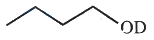
B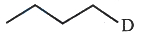
C
D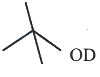
Solution
(B) The alkyl halide $X$ $(C_4H_9Br)$ undergoes $S_N2$ reaction,which implies it must be a primary alkyl halide to minimize steric hindrance. Thus,$X$ is $n$-butyl bromide $(CH_3CH_2CH_2CH_2Br)$.
When $n$-butyl bromide reacts with $Mg$ in dry ether,it forms a Grignard reagent,$n$-butylmagnesium bromide $(CH_3CH_2CH_2CH_2MgBr)$.
Subsequent reaction with $D_2O$ replaces the $MgBr$ group with a deuterium atom $(D)$,resulting in $n$-butane$-1-$d $(CH_3CH_2CH_2CH_2D)$.
When $n$-butyl bromide reacts with $Mg$ in dry ether,it forms a Grignard reagent,$n$-butylmagnesium bromide $(CH_3CH_2CH_2CH_2MgBr)$.
Subsequent reaction with $D_2O$ replaces the $MgBr$ group with a deuterium atom $(D)$,resulting in $n$-butane$-1-$d $(CH_3CH_2CH_2CH_2D)$.
0 likes
View Solution1135
MediumMCQ
The order of reactivity of the following compounds towards dilute aqueous $KOH$ in $SN_1$ reaction is
$I$. $CH_3CH_2CH_2CH_2Br$
$II$. $CH_3CH_2CHBrCH_3$
$III$. $(CH_3)_2CHCH_2Br$
$IV$. $(CH_3)_3CBr$
$I$. $CH_3CH_2CH_2CH_2Br$
$II$. $CH_3CH_2CHBrCH_3$
$III$. $(CH_3)_2CHCH_2Br$
$IV$. $(CH_3)_3CBr$
A
$I < IV < III < II$
B
$IV < II < III < I$
C
$III < II < I < IV$
D
$I < III < II < IV$
Solution
(D) The $SN_1$ reaction rate depends on the stability of the carbocation formed in the rate-determining step.
The carbocations formed are:
$I$. $CH_3CH_2CH_2CH_2^+$ (Primary)
$II$. $CH_3CH_2CH^+CH_3$ (Secondary)
$III$. $(CH_3)_2CHCH_2^+$ (Primary,but branched)
$IV$. $(CH_3)_3C^+$ (Tertiary)
Tertiary carbocations are more stable than secondary,which are more stable than primary carbocations.
Among the primary carbocations,$III$ is slightly more stable than $I$ due to the inductive effect of the methyl group.
Therefore,the stability order is $I < III < II < IV$.
Since the rate of $SN_1$ reaction follows the stability order of carbocations,the reactivity order is $I < III < II < IV$.
The carbocations formed are:
$I$. $CH_3CH_2CH_2CH_2^+$ (Primary)
$II$. $CH_3CH_2CH^+CH_3$ (Secondary)
$III$. $(CH_3)_2CHCH_2^+$ (Primary,but branched)
$IV$. $(CH_3)_3C^+$ (Tertiary)
Tertiary carbocations are more stable than secondary,which are more stable than primary carbocations.
Among the primary carbocations,$III$ is slightly more stable than $I$ due to the inductive effect of the methyl group.
Therefore,the stability order is $I < III < II < IV$.
Since the rate of $SN_1$ reaction follows the stability order of carbocations,the reactivity order is $I < III < II < IV$.
0 likes
View Solution1136
MediumMCQ
Sodium tertiary butoxide on reaction with methyl bromide produces the product $P$.
Sodium methoxide upon reaction with tertiary butyl bromide generates the product $Q$.
The products $P$ and $Q$ are
Sodium methoxide upon reaction with tertiary butyl bromide generates the product $Q$.
The products $P$ and $Q$ are
A
Both $P$ and $Q$ are $2-methylpropene$
B
$P$ is $t-butyl$ methyl ether and $Q$ is $2-methylpropene$
C
$P$ is $2-methylpropene$ and $Q$ is $t-butyl$ methyl ether
D
Both $P$ and $Q$ are $t-butyl$ methyl ether
Solution
(B) Reaction $1$: Sodium $t-butoxide$ $((CH_3)_3CONa)$ is a strong base and a bulky nucleophile. It reacts with methyl bromide $(CH_3Br)$ via an $S_N2$ mechanism to produce $t-butyl$ methyl ether $(CH_3-O-C(CH_3)_3)$ as the major product $(P)$.
Reaction $2$: Sodium methoxide $(CH_3ONa)$ is a strong base. When it reacts with a tertiary substrate like $t-butyl$ bromide $((CH_3)_3CBr)$,the steric hindrance prevents $S_N2$ substitution. Instead,an $E2$ elimination reaction occurs,producing $2-methylpropene$ $((CH_3)_2C=CH_2)$ as the major product $(Q)$.
Reaction $2$: Sodium methoxide $(CH_3ONa)$ is a strong base. When it reacts with a tertiary substrate like $t-butyl$ bromide $((CH_3)_3CBr)$,the steric hindrance prevents $S_N2$ substitution. Instead,an $E2$ elimination reaction occurs,producing $2-methylpropene$ $((CH_3)_2C=CH_2)$ as the major product $(Q)$.
0 likes
View Solution1137
MediumMCQ
Match the following reactions with their mechanisms:
$(A)$ $CH_3CH_2CH_2I \xrightarrow{aq. KOH}$
$(B)$ $(CH_3)_3CCl \xrightarrow{H_2O}$
$(I)$ $S_N1$
$(II)$ $E_2$
$(III)$ $S_N2$
$(IV)$ $E_1$
$(A)$ $CH_3CH_2CH_2I \xrightarrow{aq. KOH}$
$(B)$ $(CH_3)_3CCl \xrightarrow{H_2O}$
$(I)$ $S_N1$
$(II)$ $E_2$
$(III)$ $S_N2$
$(IV)$ $E_1$
A
$A-III, B-I$
B
$A-I, B-III$
C
$A-II, B-IV$
D
$A-III, B-II$
Solution
(A) Reaction $(A)$: $CH_3CH_2CH_2I$ is a primary alkyl halide. In the presence of aqueous $KOH$ (a strong nucleophile),it undergoes a bimolecular nucleophilic substitution $(S_N2)$ reaction to form propan$-1-$ol.
Reaction $(B)$: $(CH_3)_3CCl$ is a tertiary alkyl halide. In the presence of water (a polar protic solvent),it undergoes a unimolecular nucleophilic substitution $(S_N1)$ reaction to form tert-butyl alcohol.
Therefore,the correct matching is $A-III$ and $B-I$.
Reaction $(B)$: $(CH_3)_3CCl$ is a tertiary alkyl halide. In the presence of water (a polar protic solvent),it undergoes a unimolecular nucleophilic substitution $(S_N1)$ reaction to form tert-butyl alcohol.
Therefore,the correct matching is $A-III$ and $B-I$.
0 likes
View Solution1138
MediumMCQ
$1-$chloro$-3-$methylbutane on reaction with zinc and dilute hydrochloric acid gives . . . . . . as the major product.
A
$2-$methylbutane
B
$2-$methylbutene
C
$n-$pentane
D
$n-$pentene
Solution
(A) The reaction of an alkyl halide with $Zn$ and dilute $HCl$ is a reduction reaction.
In this reaction,the halogen atom is replaced by a hydrogen atom to form the corresponding alkane.
The chemical equation is:
$(CH_3)_2CH-CH_2-CH_2Cl + [H] \xrightarrow{Zn/dil.HCl} (CH_3)_2CH-CH_2-CH_3 + HCl$
Here,$1-$chloro$-3-$methylbutane is reduced to $2-$methylbutane.
In this reaction,the halogen atom is replaced by a hydrogen atom to form the corresponding alkane.
The chemical equation is:
$(CH_3)_2CH-CH_2-CH_2Cl + [H] \xrightarrow{Zn/dil.HCl} (CH_3)_2CH-CH_2-CH_3 + HCl$
Here,$1-$chloro$-3-$methylbutane is reduced to $2-$methylbutane.
0 likes
View Solution1139
EasyMCQ
$CH_3-CH_2-Br + Nu^{\Theta} \rightarrow CH_3-CH_2-Nu + Br^{\Theta}$
The decreasing order of the reaction rate with nucleophile $Nu^{\Theta}$ is $Nu^{\Theta} = (I) PhO^{\Theta}; (II) CH_3COO^{\Theta}; (III) OH^{\Theta}; (IV) CH_3O^{\Theta}$
The decreasing order of the reaction rate with nucleophile $Nu^{\Theta}$ is $Nu^{\Theta} = (I) PhO^{\Theta}; (II) CH_3COO^{\Theta}; (III) OH^{\Theta}; (IV) CH_3O^{\Theta}$
A
$IV > III > I > II$
B
$IV > III > II > I$
C
$I > II > III > IV$
D
$III > IV > II > I$
Solution
(A) The rate of nucleophilic substitution reaction depends on the nucleophilicity of the nucleophile $Nu^{\Theta}$.
Stronger nucleophiles react faster.
Comparing the basicity and nucleophilicity:
$CH_3O^{\Theta}$ is a stronger base and nucleophile than $OH^{\Theta}$ due to the $+I$ effect of the $CH_3$ group.
$OH^{\Theta}$ is a stronger nucleophile than $PhO^{\Theta}$ because the negative charge in $PhO^{\Theta}$ is delocalized over the benzene ring.
$PhO^{\Theta}$ is a stronger nucleophile than $CH_3COO^{\Theta}$ because the negative charge in $CH_3COO^{\Theta}$ is delocalized over two oxygen atoms.
Thus,the order of nucleophilicity is $(IV) CH_3O^{\Theta} > (III) OH^{\Theta} > (I) PhO^{\Theta} > (II) CH_3COO^{\Theta}$.
Stronger nucleophiles react faster.
Comparing the basicity and nucleophilicity:
$CH_3O^{\Theta}$ is a stronger base and nucleophile than $OH^{\Theta}$ due to the $+I$ effect of the $CH_3$ group.
$OH^{\Theta}$ is a stronger nucleophile than $PhO^{\Theta}$ because the negative charge in $PhO^{\Theta}$ is delocalized over the benzene ring.
$PhO^{\Theta}$ is a stronger nucleophile than $CH_3COO^{\Theta}$ because the negative charge in $CH_3COO^{\Theta}$ is delocalized over two oxygen atoms.
Thus,the order of nucleophilicity is $(IV) CH_3O^{\Theta} > (III) OH^{\Theta} > (I) PhO^{\Theta} > (II) CH_3COO^{\Theta}$.
0 likes
View Solution1140
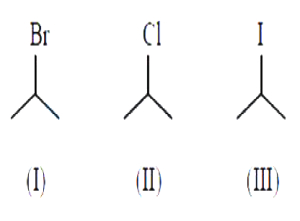
MediumMCQ
The correct order of the rate of dehydrohalogenation of the following halides in the presence of alcoholic $KOH$ is:
A
$II > I > III$
B
$III > II > I$
C
$III > I > II$
D
$I > II > III$
Solution
(C) Dehydrohalogenation involves the elimination of a hydrogen atom and a halogen atom from adjacent carbon atoms to form an alkene in the presence of a strong base like alcoholic $KOH$.
For a series of alkyl halides with the same alkyl group,the rate of dehydrohalogenation depends primarily on the strength of the $C-X$ bond and the leaving group ability of the halide ion.
The leaving group ability follows the order: $I^- > Br^- > Cl^- > F^-$.
Since the iodide ion $(I^-)$ is the best leaving group among the given halides,the alkyl iodide $(III)$ will undergo dehydrohalogenation the fastest.
The chloride ion $(Cl^-)$ is the poorest leaving group among the three,so the alkyl chloride $(II)$ will react the slowest.
Therefore,the correct order of the rate of dehydrohalogenation is $(III) > (I) > (II)$.
For a series of alkyl halides with the same alkyl group,the rate of dehydrohalogenation depends primarily on the strength of the $C-X$ bond and the leaving group ability of the halide ion.
The leaving group ability follows the order: $I^- > Br^- > Cl^- > F^-$.
Since the iodide ion $(I^-)$ is the best leaving group among the given halides,the alkyl iodide $(III)$ will undergo dehydrohalogenation the fastest.
The chloride ion $(Cl^-)$ is the poorest leaving group among the three,so the alkyl chloride $(II)$ will react the slowest.
Therefore,the correct order of the rate of dehydrohalogenation is $(III) > (I) > (II)$.
0 likes
View Solution1141
MediumMCQ
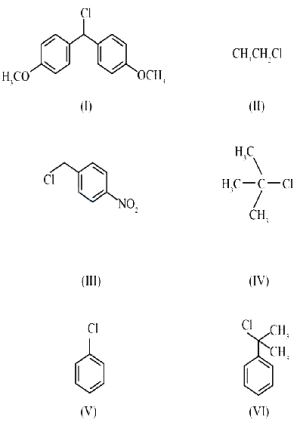
The most reactive molecules towards $SN^1$ reaction are:
A
$(I), (IV)$ and $(VI)$
B
$(I), (II)$ and $(IV)$
C
$(II), (III)$ and $(V)$
D
$(IV), (V)$ and $(VI)$
Solution
(A) The rate of $SN^1$ reaction depends on the stability of the carbocation intermediate formed after the departure of the leaving group $(Cl^-)$. The more stable the carbocation,the faster the $SN^1$ reaction.
$(I)$ forms a highly stable carbocation due to resonance stabilization by two $p$-methoxyphenyl groups. The $+R$ effect of the methoxy group significantly stabilizes the positive charge.
$(IV)$ is $tert$-butyl chloride,which forms a stable tertiary carbocation.
$(VI)$ is $2$-chloro-$2$-phenylpropane,which forms a tertiary carbocation stabilized by resonance with the phenyl ring and the $+I$ effect of methyl groups.
$(II)$ is a primary alkyl halide (unstable carbocation).
$(III)$ is a primary benzylic halide with a strong electron-withdrawing $-NO_2$ group,which destabilizes the carbocation.
$(V)$ is chlorobenzene,which does not undergo $SN^1$ reaction easily due to partial double bond character of the $C-Cl$ bond and the instability of the phenyl cation.
Therefore,$(I), (IV)$ and $(VI)$ are the most reactive towards $SN^1$ reaction.
$(I)$ forms a highly stable carbocation due to resonance stabilization by two $p$-methoxyphenyl groups. The $+R$ effect of the methoxy group significantly stabilizes the positive charge.
$(IV)$ is $tert$-butyl chloride,which forms a stable tertiary carbocation.
$(VI)$ is $2$-chloro-$2$-phenylpropane,which forms a tertiary carbocation stabilized by resonance with the phenyl ring and the $+I$ effect of methyl groups.
$(II)$ is a primary alkyl halide (unstable carbocation).
$(III)$ is a primary benzylic halide with a strong electron-withdrawing $-NO_2$ group,which destabilizes the carbocation.
$(V)$ is chlorobenzene,which does not undergo $SN^1$ reaction easily due to partial double bond character of the $C-Cl$ bond and the instability of the phenyl cation.
Therefore,$(I), (IV)$ and $(VI)$ are the most reactive towards $SN^1$ reaction.
0 likes
View Solution1142
EasyMCQ
Which one of the following will be most reactive for $SN^1$ reaction?
A
Chlorocyclohexane
B
$3-$Chlorocyclohexene
C
$1-$Methyl$-1-$chlorocyclohexane
D
$1-$Methyl$-3-$chlorocyclohexene
Solution
(D) The rate of $SN^1$ reaction depends upon the stability of the carbocation intermediate formed in the rate-determining step.
$1$. $A$ forms a secondary carbocation.
$2$. $B$ forms an allylic secondary carbocation,which is stabilized by resonance.
$3$. $C$ forms a tertiary carbocation.
$4$. $D$ forms an allylic tertiary carbocation,which is the most stable due to both the tertiary nature and resonance stabilization.
Therefore,$D$ is the most reactive for the $SN^1$ reaction.
$1$. $A$ forms a secondary carbocation.
$2$. $B$ forms an allylic secondary carbocation,which is stabilized by resonance.
$3$. $C$ forms a tertiary carbocation.
$4$. $D$ forms an allylic tertiary carbocation,which is the most stable due to both the tertiary nature and resonance stabilization.
Therefore,$D$ is the most reactive for the $SN^1$ reaction.
0 likes
View Solution1143
MediumMCQ
Which one among the following will undergo a faster $S_{N}1$ reaction?
A
Benzyl bromide $(C_6H_5CH_2Br)$
B
$1-$Phenylethyl bromide $(C_6H_5CH(CH_3)Br)$
C
$2-$Phenylpropan$-2-$yl bromide $(C_6H_5C(CH_3)_2Br)$
D
$1,1-$Diphenylethyl bromide $(C_6H_5C(CH_3)(C_6H_5)Br)$
Solution
(D) The rate of an $S_{N}1$ reaction depends on the stability of the carbocation intermediate formed in the rate-determining step. The more stable the carbocation,the faster the $S_{N}1$ reaction.
Comparing the carbocations formed from the given substrates:
$A$: Benzyl cation $(C_6H_5CH_2^+)$ - Stabilized by resonance with one phenyl ring.
$B$: $1-$Phenylethyl cation $(C_6H_5CH^+CH_3)$ - Stabilized by resonance and the inductive effect of the methyl group.
$C$: $2-$Phenylpropan$-2-$yl cation $(C_6H_5C^+(CH_3)_2)$ - Stabilized by resonance and two methyl groups.
$D$: $1,1-$Diphenylethyl cation $(C_6H_5C^+(CH_3)C_6H_5)$ - Stabilized by resonance with two phenyl rings and the inductive effect of one methyl group.
Since the carbocation in option $D$ is stabilized by resonance with two phenyl rings,it is the most stable among the given options. Therefore,it will undergo the fastest $S_{N}1$ reaction.
Comparing the carbocations formed from the given substrates:
$A$: Benzyl cation $(C_6H_5CH_2^+)$ - Stabilized by resonance with one phenyl ring.
$B$: $1-$Phenylethyl cation $(C_6H_5CH^+CH_3)$ - Stabilized by resonance and the inductive effect of the methyl group.
$C$: $2-$Phenylpropan$-2-$yl cation $(C_6H_5C^+(CH_3)_2)$ - Stabilized by resonance and two methyl groups.
$D$: $1,1-$Diphenylethyl cation $(C_6H_5C^+(CH_3)C_6H_5)$ - Stabilized by resonance with two phenyl rings and the inductive effect of one methyl group.
Since the carbocation in option $D$ is stabilized by resonance with two phenyl rings,it is the most stable among the given options. Therefore,it will undergo the fastest $S_{N}1$ reaction.
0 likes
View Solution1144
MediumMCQ
$2-$bromopentane is heated with potassium ethoxide in ethanol. The major product is
A
trans-pent$-2-$ene
B
$2-$ethoxypentane
C
pent$-1-$ene
D
$3-$ethoxypentane
Solution
(A) When $2-$bromopentane is heated with potassium ethoxide in ethanol,it undergoes a dehydrohalogenation reaction (an $E2$ elimination reaction).
Potassium ethoxide $(C_2H_5OK)$ acts as a strong base,which abstracts a proton from the $\beta$-carbon.
According to Zaitsev's rule,the more substituted alkene is the major product.
$2-$bromopentane has two types of $\beta$-hydrogens,leading to the formation of pent$-1-$ene and pent$-2-$ene.
$Pent-2-ene$ is more substituted and thus more stable than $pent-1-ene$.
Between the geometric isomers of $pent-2-ene$,the $trans$ isomer is more stable than the $cis$ isomer due to reduced steric hindrance.
Therefore,$trans-pent-2-ene$ is the major product.
Thus,option $(A)$ is the correct answer.
Potassium ethoxide $(C_2H_5OK)$ acts as a strong base,which abstracts a proton from the $\beta$-carbon.
According to Zaitsev's rule,the more substituted alkene is the major product.
$2-$bromopentane has two types of $\beta$-hydrogens,leading to the formation of pent$-1-$ene and pent$-2-$ene.
$Pent-2-ene$ is more substituted and thus more stable than $pent-1-ene$.
Between the geometric isomers of $pent-2-ene$,the $trans$ isomer is more stable than the $cis$ isomer due to reduced steric hindrance.
Therefore,$trans-pent-2-ene$ is the major product.
Thus,option $(A)$ is the correct answer.
0 likes
View Solution1145
MediumMCQ
Find the reactants which on heating with alcoholic $KOH$ produce the compound $CH_3-CH_2-CH_2-CH=CH_2$.
$(i) \ CH_3-CH(Br)-CH_2-CH_2-CH_3$
$(ii) \ CH_3-CH_2-CH(Br)-CH_2-CH_3$
$(iii) \ CH_3-CH_2-CH_2-CH_2-CH_2Br$
$(iv) \ CH_3-CH_2-CH_2-CH(Br)-CH_3$
$(i) \ CH_3-CH(Br)-CH_2-CH_2-CH_3$
$(ii) \ CH_3-CH_2-CH(Br)-CH_2-CH_3$
$(iii) \ CH_3-CH_2-CH_2-CH_2-CH_2Br$
$(iv) \ CH_3-CH_2-CH_2-CH(Br)-CH_3$
A
$(ii), (iv)$
B
$(i), (iv)$
C
$(ii), (iii), (iv)$
D
$(i), (ii)$
Solution
(B) Dehydrohalogenation of haloalkanes with alcoholic $KOH$ follows Zaitsev's rule,where the more substituted alkene is the major product. However,the target product is $pent-1-ene$ $(CH_3-CH_2-CH_2-CH=CH_2)$.
$(i) \ CH_3-CH(Br)-CH_2-CH_2-CH_3$ on dehydrohalogenation gives $pent-1-ene$ and $pent-2-ene$.
$(ii) \ CH_3-CH_2-CH(Br)-CH_2-CH_3$ on dehydrohalogenation gives $pent-2-ene$.
$(iii) \ CH_3-CH_2-CH_2-CH_2-CH_2Br$ on dehydrohalogenation gives $pent-1-ene$.
$(iv) \ CH_3-CH_2-CH_2-CH(Br)-CH_3$ on dehydrohalogenation gives $pent-1-ene$ and $pent-2-ene$.
Thus,reactants $(i)$,$(iii)$,and $(iv)$ can produce $pent-1-ene$. Given the options,$(i)$ and $(iv)$ are the most appropriate choices for producing the terminal alkene.
$(i) \ CH_3-CH(Br)-CH_2-CH_2-CH_3$ on dehydrohalogenation gives $pent-1-ene$ and $pent-2-ene$.
$(ii) \ CH_3-CH_2-CH(Br)-CH_2-CH_3$ on dehydrohalogenation gives $pent-2-ene$.
$(iii) \ CH_3-CH_2-CH_2-CH_2-CH_2Br$ on dehydrohalogenation gives $pent-1-ene$.
$(iv) \ CH_3-CH_2-CH_2-CH(Br)-CH_3$ on dehydrohalogenation gives $pent-1-ene$ and $pent-2-ene$.
Thus,reactants $(i)$,$(iii)$,and $(iv)$ can produce $pent-1-ene$. Given the options,$(i)$ and $(iv)$ are the most appropriate choices for producing the terminal alkene.
0 likes
View Solution1146
EasyMCQ
Arrange the following bromides in the order of reactivity in undergoing $S_{N}1$ reaction:
$(i)$ $(CH_3)_3CBr$
(ii) $CH_3CH_2CH_2Br$
(iii) $(CH_3)_2CHCH_2Br$
(iv) $CH_3Br$
$(i)$ $(CH_3)_3CBr$
(ii) $CH_3CH_2CH_2Br$
(iii) $(CH_3)_2CHCH_2Br$
(iv) $CH_3Br$
A
$i > iii > ii > iv$
B
$iv > ii > iii > i$
C
$i > ii > iii > iv$
D
$ii > iv > iii > i$
Solution
(A) The reactivity of alkyl halides towards $S_{N}1$ reaction depends on the stability of the carbocation intermediate formed in the rate-determining step.
The order of stability of carbocations is $3^{\circ} > 2^{\circ} > 1^{\circ} > \text{methyl}$.
$(i)$ $(CH_3)_3CBr$ forms a $3^{\circ}$ carbocation (most stable).
(ii) $CH_3CH_2CH_2Br$ forms a $1^{\circ}$ carbocation.
(iii) $(CH_3)_2CHCH_2Br$ forms a $1^{\circ}$ carbocation,but it is slightly more stable than (ii) due to the inductive effect of the alkyl group,though both are $1^{\circ}$. However,in standard textbook problems,(ii) and (iii) are both $1^{\circ}$ and (iv) is methyl.
Comparing the structures: $(i)$ is $3^{\circ}$,(ii) is $1^{\circ}$ (n-propyl),(iii) is $1^{\circ}$ (isobutyl),(iv) is methyl.
The order of reactivity is $i > iii > ii > iv$.
The order of stability of carbocations is $3^{\circ} > 2^{\circ} > 1^{\circ} > \text{methyl}$.
$(i)$ $(CH_3)_3CBr$ forms a $3^{\circ}$ carbocation (most stable).
(ii) $CH_3CH_2CH_2Br$ forms a $1^{\circ}$ carbocation.
(iii) $(CH_3)_2CHCH_2Br$ forms a $1^{\circ}$ carbocation,but it is slightly more stable than (ii) due to the inductive effect of the alkyl group,though both are $1^{\circ}$. However,in standard textbook problems,(ii) and (iii) are both $1^{\circ}$ and (iv) is methyl.
Comparing the structures: $(i)$ is $3^{\circ}$,(ii) is $1^{\circ}$ (n-propyl),(iii) is $1^{\circ}$ (isobutyl),(iv) is methyl.
The order of reactivity is $i > iii > ii > iv$.
0 likes
View SolutionHaloalkanes and Haloarenes — Properties of Haloalkanes · Frequently Asked Questions
1Are these Haloalkanes and Haloarenes questions useful for JEE and NEET?
Yes. All questions in this section are mapped to JEE Main and NEET exam patterns. Previous year questions from JEE Main, NEET, GUJCET and state-level exams are included with full solutions.
2Can I switch to Hindi or Gujarati for these questions?
Yes. Use the language tabs in the hero section or the sidebar to view the same questions and solutions in English, Hindi or Gujarati.
3How do I generate a question paper from this subtopic?
Use the Vedclass Exam Paper Generator — select the chapter and subtopic, set difficulty, and generate Sets A, B, C, D automatically. First 3 chapters of every subject are free.
Vedclass Products
For Students
Vedclass Test Series
Mock tests in real JEE/NEET style with performance analysis. 5-day free trial.
Start Free TrialFor Teachers
Exam Paper Generator
Generate Set A/B/C/D papers from this chapter in 2 minutes. 3 chapters free.
Try FreeFor Institutes
Online Exam Module
Live online exams with unlimited students, 360° analytics & white-label branding.
See DemoFor Teachers & Institutes
Generate a Haloalkanes and Haloarenes Exam Paper in 2 Minutes
Select subtopic & difficulty — Sets A, B, C, D auto-generated with No Repeat logic.
First 3 chapters of every subject are free — no payment required.