
A English
Properties of Haloalkanes Questions in English
Class 12 Chemistry · Haloalkanes and Haloarenes · Properties of Haloalkanes
1196+
Questions
English
Language
100%
With Solutions
Showing 50 of 1196 questions in English
1001
MediumMCQ
Which of the following reactions is used for the conversion of alkyl chloride to alkyl iodide?
A
$A$. Fittig reaction
B
$B$. Finkelstein reaction
C
$C$. Swartz reaction
D
$D$. Friedel-Crafts reaction
Solution
(B) The conversion of alkyl chlorides or alkyl bromides to alkyl iodides is known as the Finkelstein reaction.
In this reaction,the alkyl halide is treated with sodium iodide $(NaI)$ in the presence of dry acetone.
The reaction is: $R-X + NaI \xrightarrow{\text{dry acetone}} R-I + NaX$ (where $X = Cl, Br$).
In this reaction,the alkyl halide is treated with sodium iodide $(NaI)$ in the presence of dry acetone.
The reaction is: $R-X + NaI \xrightarrow{\text{dry acetone}} R-I + NaX$ (where $X = Cl, Br$).
0 likes
View Solution1002
MediumMCQ
What type of hybridisation is present in the carbocation formed during the alkaline hydrolysis of $1-$bromo$-1-$phenylethane?
A
$sp^2$
B
$sp$
C
$d^2sp^3$
D
$sp^3$
Solution
(A) The alkaline hydrolysis of $1-$bromo$-1-$phenylethane proceeds via an $S_N1$ mechanism.
In the first,rate-determining step,the leaving group (bromide ion) departs,resulting in the formation of a carbocation intermediate.
The carbocation intermediate has a positively charged carbon atom bonded to three other groups (a methyl group,a phenyl group,and a hydrogen atom).
Since the positively charged carbon is bonded to three atoms and has no lone pairs,it is $sp^2$ hybridized,resulting in a planar geometry.
The reaction is as follows:
$CH_3-CH(Ph)-Br \rightleftharpoons CH_3-CH^+(Ph) + Br^-$
$CH_3-CH^+(Ph) + OH^- \rightarrow CH_3-CH(OH)-Ph$
In the first,rate-determining step,the leaving group (bromide ion) departs,resulting in the formation of a carbocation intermediate.
The carbocation intermediate has a positively charged carbon atom bonded to three other groups (a methyl group,a phenyl group,and a hydrogen atom).
Since the positively charged carbon is bonded to three atoms and has no lone pairs,it is $sp^2$ hybridized,resulting in a planar geometry.
The reaction is as follows:
$CH_3-CH(Ph)-Br \rightleftharpoons CH_3-CH^+(Ph) + Br^-$
$CH_3-CH^+(Ph) + OH^- \rightarrow CH_3-CH(OH)-Ph$
0 likes
View Solution1003
MediumMCQ
Identify the reagent $R$ used in the following conversion: $tert$-butyl bromide $\xrightarrow{R}$ Isobutylene
A
$Sn / HCl$
B
$Na-Hg / H_2O$
C
$NH_3$ (alc.)
D
$LiAlH_4$
Solution
(C) The conversion of $tert$-butyl bromide to isobutylene is a dehydrohalogenation reaction,which is an elimination reaction ($E1$ or $E2$).
In this reaction,a base is required to abstract a proton from the $\beta$-carbon.
Alcoholic $NH_3$ (or more commonly,alcoholic $KOH$) acts as a base to facilitate this elimination.
As shown in the mechanism,the loss of $Br^-$ leads to a carbocation,followed by the loss of $H^+$ to form the double bond in isobutylene.
Therefore,the correct reagent is $NH_3$ (alc.).
In this reaction,a base is required to abstract a proton from the $\beta$-carbon.
Alcoholic $NH_3$ (or more commonly,alcoholic $KOH$) acts as a base to facilitate this elimination.
As shown in the mechanism,the loss of $Br^-$ leads to a carbocation,followed by the loss of $H^+$ to form the double bond in isobutylene.
Therefore,the correct reagent is $NH_3$ (alc.).
0 likes
View Solution1004
EasyMCQ
Identify the correct decreasing order of ease of dehydrohalogenation of alkyl halides.
A
$1^{\circ} > 3^{\circ} > 2^{\circ}$
B
$1^{\circ} > 2^{\circ} > 3^{\circ}$
C
$3^{\circ} > 2^{\circ} > 1^{\circ}$
D
$2^{\circ} > 3^{\circ} > 1^{\circ}$
Solution
(C) The dehydrohalogenation of alkyl halides follows the $E2$ mechanism,where the stability of the transition state is determined by the stability of the alkene being formed.
According to Saytzeff's rule,more substituted alkenes are more stable.
Therefore,the ease of dehydrohalogenation follows the order: $3^{\circ} > 2^{\circ} > 1^{\circ}$.
According to Saytzeff's rule,more substituted alkenes are more stable.
Therefore,the ease of dehydrohalogenation follows the order: $3^{\circ} > 2^{\circ} > 1^{\circ}$.
0 likes
View Solution1005
MediumMCQ
Identify the product formed when tertiary butyl bromide reacts with alcoholic $NH_3$ solution?
A
$2-$Methylpropene
B
$2-$Methylpropane
C
but$-1-$ene
D
$2-$Methylpropan$-1-$ol
Solution
(A) Tertiary butyl bromide $(CH_3)_3C-Br$ is a tertiary alkyl halide. When it reacts with an alcoholic solution of $NH_3$,it undergoes a dehydrohalogenation reaction ($\alpha, \beta-$elimination).
In this reaction,the base (ammonia) abstracts a proton from the $\beta-$carbon,leading to the elimination of $HBr$ and the formation of an alkene.
The reaction is: $(CH_3)_3C-Br \xrightarrow{alc. NH_3} CH_3-C(CH_3)=CH_2 + HBr$.
The product formed is $2-$methylpropene.
In this reaction,the base (ammonia) abstracts a proton from the $\beta-$carbon,leading to the elimination of $HBr$ and the formation of an alkene.
The reaction is: $(CH_3)_3C-Br \xrightarrow{alc. NH_3} CH_3-C(CH_3)=CH_2 + HBr$.
The product formed is $2-$methylpropene.
0 likes
View Solution1006
EasyMCQ
$1$-chlorobutane on reaction with alcoholic potash gives
A
but-$1$-ene
B
butan-$1$-ol
C
but-$2$-ene
D
butan-$2$-ol
Solution
(A) The reaction of $1$-chlorobutane $(CH_3-CH_2-CH_2-CH_2-Cl)$ with alcoholic $KOH$ is a dehydrohalogenation reaction.
In this reaction,an $H$ atom is removed from the $\beta$-carbon and the $Cl$ atom is removed from the $\alpha$-carbon,resulting in the formation of an alkene.
The reaction proceeds as follows:
$CH_3-CH_2-CH_2-CH_2-Cl + \text{alc. } KOH \xrightarrow{\Delta} CH_3-CH_2-CH=CH_2 + KCl + H_2O$
The product formed is but-$1$-ene.
In this reaction,an $H$ atom is removed from the $\beta$-carbon and the $Cl$ atom is removed from the $\alpha$-carbon,resulting in the formation of an alkene.
The reaction proceeds as follows:
$CH_3-CH_2-CH_2-CH_2-Cl + \text{alc. } KOH \xrightarrow{\Delta} CH_3-CH_2-CH=CH_2 + KCl + H_2O$
The product formed is but-$1$-ene.
0 likes
View Solution1007
EasyMCQ
Which of the following gases is formed during the oxidation of trichloromethane?
A
$CO_{(g)}$
B
$CO_{2_{(g)}}$
C
$COCl_{2_{(g)}}$
D
$H_{2_{(g)}}$
Solution
(C) Chloroform ($CHCl_3$,trichloromethane) undergoes slow oxidation in the presence of air and light to form a highly poisonous gas known as phosgene $(COCl_2)$.
The chemical reaction is: $2CHCl_3 + O_2 \xrightarrow{\text{light}} 2COCl_2 + 2HCl$.
Due to this,chloroform is stored in dark-colored,airtight bottles to prevent oxidation.
The chemical reaction is: $2CHCl_3 + O_2 \xrightarrow{\text{light}} 2COCl_2 + 2HCl$.
Due to this,chloroform is stored in dark-colored,airtight bottles to prevent oxidation.
0 likes
View Solution1008
EasyMCQ
Which among the following statements is $TRUE$ about gammexane?
A
It is an isomer of $BHC$.
B
It is one of the herbicides.
C
It is obtained from benzene by bromination.
D
It is monochloro derivative of benzene.
Solution
(A) Gammexane,also known as lindane,is the $\gamma$-isomer of benzene hexachloride $(BHC)$.
It is prepared by the addition of chlorine to benzene in the presence of ultraviolet light.
It is widely used as an insecticide,not a herbicide.
It is prepared by the addition of chlorine to benzene in the presence of ultraviolet light.
It is widely used as an insecticide,not a herbicide.
0 likes
View Solution1009
MediumMCQ
Which of the following is the correct decreasing order of the boiling point of the given compounds?
A
$CH_3Cl > CH_3Br > CH_2Br_2 > CHBr_3$
B
$CH_3Br > CH_2Br_2 > CHBr_3 > CH_3Cl$
C
$CHBr_3 > CH_2Br_2 > CH_3Br > CH_3Cl$
D
$CH_3Br > CH_3Cl > CHBr_3 > CH_2Br_2$
Solution
(C) The boiling points of haloalkanes are primarily determined by the magnitude of van der Waals forces,which increase with an increase in molecular size and mass.
For the given compounds,the molecular mass increases with the number of bromine atoms present.
$CHBr_3$ $(M \approx 253 \ g/mol)$ has the highest molecular mass,followed by $CH_2Br_2$ $(M \approx 174 \ g/mol)$,then $CH_3Br$ $(M \approx 95 \ g/mol)$,and finally $CH_3Cl$ $(M \approx 50.5 \ g/mol)$.
Therefore,the correct decreasing order of boiling point is $CHBr_3 > CH_2Br_2 > CH_3Br > CH_3Cl$.
For the given compounds,the molecular mass increases with the number of bromine atoms present.
$CHBr_3$ $(M \approx 253 \ g/mol)$ has the highest molecular mass,followed by $CH_2Br_2$ $(M \approx 174 \ g/mol)$,then $CH_3Br$ $(M \approx 95 \ g/mol)$,and finally $CH_3Cl$ $(M \approx 50.5 \ g/mol)$.
Therefore,the correct decreasing order of boiling point is $CHBr_3 > CH_2Br_2 > CH_3Br > CH_3Cl$.
0 likes
View Solution1010
EasyMCQ
Which product is obtained from the reaction between $CH_3ONa$ and $(CH_3)_3CBr$?
A
Only Alkene
B
Only Ether
C
Both alkene and Ether
D
Alcohol
Solution
(A) The reaction between a strong base/nucleophile like $CH_3ONa$ (sodium methoxide) and a tertiary alkyl halide like $(CH_3)_3CBr$ (tert-butyl bromide) proceeds primarily via an $E2$ elimination mechanism.
Because the substrate is sterically hindered,the nucleophilic substitution $(S_N2)$ is suppressed.
Therefore,the major product formed is the alkene,which is $2$-methylpropene (isobutylene).
Thus,the correct option is $A$.
Because the substrate is sterically hindered,the nucleophilic substitution $(S_N2)$ is suppressed.
Therefore,the major product formed is the alkene,which is $2$-methylpropene (isobutylene).
Thus,the correct option is $A$.
0 likes
View Solution1011
EasyMCQ
Match the reactions given in Column-$I$ with their names given in Column-$II$.
| Column-$I$ | Column-$II$ |
|---|---|
| $(i)$ $R-Cl + NaI \xrightarrow{\text{dry acetone}} R-I + NaCl$ | $(a)$ Swarts reaction |
| $(ii)$ $CH_3-Br + AgF \xrightarrow{\Delta} CH_3-F + AgBr$ | $(b)$ Wurtz reaction |
| $(iii)$ $R-X + Mg$ $\xrightarrow{\text{dry ether}} R-Mg-X$ $\xrightarrow{H_2O} RH + Mg(OH)X$ | $(c)$ Finkelstein reaction |
| $(d)$ Grignard reaction |
A
$i$ $\rightarrow c; ii$ $\rightarrow a; iii$ $\rightarrow d$
B
$i$ $\rightarrow d; ii$ $\rightarrow c; iii$ $\rightarrow b$
C
$i$ $\rightarrow a; ii$ $\rightarrow c; iii$ $\rightarrow d$
D
$i$ $\rightarrow b; ii$ $\rightarrow a; iii$ $\rightarrow d$
Solution
(A) The reactions are identified as follows:
$(i)$ $R-Cl + NaI \xrightarrow{\text{dry acetone}} R-I + NaCl$ is the Finkelstein reaction $(c)$.
$(ii)$ $CH_3-Br + AgF \xrightarrow{\Delta} CH_3-F + AgBr$ is the Swarts reaction $(a)$.
$(iii)$ $R-X + Mg$ $\xrightarrow{\text{dry ether}} R-Mg-X$ $\xrightarrow{H_2O} RH + Mg(OH)X$ involves the formation of a Grignard reagent $(d)$.
Therefore,the correct match is $i$ $\rightarrow c; ii$ $\rightarrow a; iii$ $\rightarrow d$.
$(i)$ $R-Cl + NaI \xrightarrow{\text{dry acetone}} R-I + NaCl$ is the Finkelstein reaction $(c)$.
$(ii)$ $CH_3-Br + AgF \xrightarrow{\Delta} CH_3-F + AgBr$ is the Swarts reaction $(a)$.
$(iii)$ $R-X + Mg$ $\xrightarrow{\text{dry ether}} R-Mg-X$ $\xrightarrow{H_2O} RH + Mg(OH)X$ involves the formation of a Grignard reagent $(d)$.
Therefore,the correct match is $i$ $\rightarrow c; ii$ $\rightarrow a; iii$ $\rightarrow d$.
0 likes
View Solution1012
EasyMCQ
Predict the order of reactivity of the following compounds in $S_N1$ reaction.
$(I)$ $C_6H_5-CH_2Br$
$(II)$ $C_6H_5-CH(C_6H_5)Br$
$(III)$ $C_6H_5-CH(CH_3)Br$
$(IV)$ $C_6H_5-C(CH_3)(C_6H_5)Br$
$(I)$ $C_6H_5-CH_2Br$
$(II)$ $C_6H_5-CH(C_6H_5)Br$
$(III)$ $C_6H_5-CH(CH_3)Br$
$(IV)$ $C_6H_5-C(CH_3)(C_6H_5)Br$
A
$(II)$ > $(III)$ > $(IV)$ > $(I)$
B
$(II)$ > $(IV)$ > $(III)$ > $(I)$
C
$(IV)$ > $(III)$ > $(II)$ > $(I)$
D
$(IV)$ > $(II)$ > $(III)$ > $(I)$
Solution
(D) The reactivity of compounds in an $S_N1$ reaction depends on the stability of the carbocation intermediate formed after the departure of the leaving group $(Br^-)$.
The stability order of the carbocations is as follows:
$(I)$ $C_6H_5-CH_2^+$ (Benzyl carbocation,stabilized by one phenyl ring).
$(II)$ $(C_6H_5)_2CH^+$ (Diphenylmethyl carbocation,stabilized by two phenyl rings).
$(III)$ $C_6H_5-CH^+(CH_3)$ ($1$-Phenylethyl carbocation,stabilized by one phenyl ring and one methyl group).
$(IV)$ $(C_6H_5)_2C^+(CH_3)$ ($1$,$1$-Diphenylethyl carbocation,stabilized by two phenyl rings and one methyl group).
Comparing the stability: $(IV) > (II) > (III) > (I)$.
Since the rate of $S_N1$ reaction is directly proportional to the stability of the carbocation,the order of reactivity is $(IV) > (II) > (III) > (I)$.
The stability order of the carbocations is as follows:
$(I)$ $C_6H_5-CH_2^+$ (Benzyl carbocation,stabilized by one phenyl ring).
$(II)$ $(C_6H_5)_2CH^+$ (Diphenylmethyl carbocation,stabilized by two phenyl rings).
$(III)$ $C_6H_5-CH^+(CH_3)$ ($1$-Phenylethyl carbocation,stabilized by one phenyl ring and one methyl group).
$(IV)$ $(C_6H_5)_2C^+(CH_3)$ ($1$,$1$-Diphenylethyl carbocation,stabilized by two phenyl rings and one methyl group).
Comparing the stability: $(IV) > (II) > (III) > (I)$.
Since the rate of $S_N1$ reaction is directly proportional to the stability of the carbocation,the order of reactivity is $(IV) > (II) > (III) > (I)$.
0 likes
View Solution1013
EasyMCQ
Which of the following compounds has the fastest $S_N2$ reaction rate?
A
$C_6H_5CH(CH_3)Br$
B
$C_6H_5CH(C_6H_5)Br$
C
$C_6H_5C(CH_3)(C_6H_5)Br$
D
$C_6H_5CH_2Br$
Solution
(D) The rate of an $S_N2$ reaction depends primarily on the steric hindrance around the electrophilic carbon atom.
Less sterically hindered substrates react faster in $S_N2$ reactions.
The order of reactivity for $S_N2$ is: $\text{primary} > \text{secondary} > \text{tertiary}$.
In the given options:
$A$ is a secondary alkyl halide.
$B$ is a secondary alkyl halide (with two bulky phenyl groups).
$C$ is a tertiary alkyl halide.
$D$ $(C_6H_5CH_2Br)$ is a primary benzylic halide.
Since $D$ is a primary halide,it experiences the least steric hindrance,making it the most reactive towards $S_N2$ substitution.
Therefore,the correct option is $D$.
Less sterically hindered substrates react faster in $S_N2$ reactions.
The order of reactivity for $S_N2$ is: $\text{primary} > \text{secondary} > \text{tertiary}$.
In the given options:
$A$ is a secondary alkyl halide.
$B$ is a secondary alkyl halide (with two bulky phenyl groups).
$C$ is a tertiary alkyl halide.
$D$ $(C_6H_5CH_2Br)$ is a primary benzylic halide.
Since $D$ is a primary halide,it experiences the least steric hindrance,making it the most reactive towards $S_N2$ substitution.
Therefore,the correct option is $D$.
0 likes
View Solution1014
EasyMCQ
Which of the following halides will give $S_N 1$ reaction fastest?
A
$2-$bromo-$3-$methylbutane
B
$2-$chloro-$3-$methylbutane
C
chloromethane
D
$2-$bromo-$2-$methylpropane
Solution
(D) The rate of $S_N 1$ reaction depends on the stability of the carbocation intermediate formed during the rate-determining step.
$S_N 1$ reactivity order is: $3^{\circ} > 2^{\circ} > 1^{\circ} > CH_3-X$.
$A$: $2-$bromo-$3-$methylbutane is a $2^{\circ}$ halide.
$B$: $2-$chloro-$3-$methylbutane is a $2^{\circ}$ halide.
$C$: Chloromethane is a $1^{\circ}$ halide.
$D$: $2-$bromo-$2-$methylpropane is a $3^{\circ}$ halide.
Since $3^{\circ}$ carbocations are the most stable,$2-$bromo-$2-$methylpropane will undergo $S_N 1$ reaction the fastest.
$S_N 1$ reactivity order is: $3^{\circ} > 2^{\circ} > 1^{\circ} > CH_3-X$.
$A$: $2-$bromo-$3-$methylbutane is a $2^{\circ}$ halide.
$B$: $2-$chloro-$3-$methylbutane is a $2^{\circ}$ halide.
$C$: Chloromethane is a $1^{\circ}$ halide.
$D$: $2-$bromo-$2-$methylpropane is a $3^{\circ}$ halide.
Since $3^{\circ}$ carbocations are the most stable,$2-$bromo-$2-$methylpropane will undergo $S_N 1$ reaction the fastest.
0 likes
View Solution1015
EasyMCQ
Which is the main organic product obtained by the reaction of $2,2,2-$trichloroethanol with calcium hydroxide?
A
Methylene chloride
B
Carbon tetrachloride
C
Chloroform
D
Trichloroethane
Solution
(C) The reaction of $2,2,2-$trichloroethanol $(CCl_3CH_2OH)$ with calcium hydroxide $(Ca(OH)_2)$ is a base-catalyzed decomposition reaction.
$2CCl_3CH_2OH + Ca(OH)_2 \rightarrow 2CHCl_3 + Ca(HCOO)_2 + H_2O$.
In this reaction,$2,2,2-$trichloroethanol undergoes haloform-like cleavage to produce chloroform $(CHCl_3)$ as the main organic product.
$2CCl_3CH_2OH + Ca(OH)_2 \rightarrow 2CHCl_3 + Ca(HCOO)_2 + H_2O$.
In this reaction,$2,2,2-$trichloroethanol undergoes haloform-like cleavage to produce chloroform $(CHCl_3)$ as the main organic product.
0 likes
View Solution1016
EasyMCQ
$50\%$ of the reagent is used for dehydrohalogenation of $6.45 \ g$ $CH_3CH_2Cl$. What will be the weight of the main product obtained (in $g$)? [At. mass of $H$,$C$,and $Cl$ are $1$,$12$,and $35.5 \ g \ mol^{-1}$ respectively]
A
$0.7$
B
$1.4$
C
$2.8$
D
$5.6$
Solution
(B) The chemical reaction for the dehydrohalogenation of ethyl chloride is:
$CH_3CH_2Cl + KOH \xrightarrow{\text{Ethanol}, \Delta} CH_2=CH_2 + KCl + H_2O$
Molar mass of $CH_3CH_2Cl = (2 \times 12) + (5 \times 1) + 35.5 = 64.5 \ g \ mol^{-1}$.
Molar mass of the main product,ethene $(CH_2=CH_2)$ $= (2 \times 12) + (4 \times 1) = 28 \ g \ mol^{-1}$.
According to the stoichiometry,$64.5 \ g$ of $CH_3CH_2Cl$ produces $28 \ g$ of ethene.
Therefore,$6.45 \ g$ of $CH_3CH_2Cl$ would theoretically produce:
$\text{Mass} = \frac{6.45 \ g}{64.5 \ g \ mol^{-1}} \times 28 \ g \ mol^{-1} = 2.8 \ g$ of ethene.
Since only $50\%$ of the reagent is used,the actual amount of product obtained is:
$2.8 \ g \times 0.5 = 1.4 \ g$.
$CH_3CH_2Cl + KOH \xrightarrow{\text{Ethanol}, \Delta} CH_2=CH_2 + KCl + H_2O$
Molar mass of $CH_3CH_2Cl = (2 \times 12) + (5 \times 1) + 35.5 = 64.5 \ g \ mol^{-1}$.
Molar mass of the main product,ethene $(CH_2=CH_2)$ $= (2 \times 12) + (4 \times 1) = 28 \ g \ mol^{-1}$.
According to the stoichiometry,$64.5 \ g$ of $CH_3CH_2Cl$ produces $28 \ g$ of ethene.
Therefore,$6.45 \ g$ of $CH_3CH_2Cl$ would theoretically produce:
$\text{Mass} = \frac{6.45 \ g}{64.5 \ g \ mol^{-1}} \times 28 \ g \ mol^{-1} = 2.8 \ g$ of ethene.
Since only $50\%$ of the reagent is used,the actual amount of product obtained is:
$2.8 \ g \times 0.5 = 1.4 \ g$.
0 likes
View Solution1017
EasyMCQ
Name the following reaction: $CH_3CH_2Cl + NaI \xrightarrow{\text{acetone}} CH_3CH_2I + NaCl$

A
Swartz reaction
B
Finkelstein reaction
C
Wurtz reaction
D
Hell-Volhard-Zelinsky reaction
Solution
(B) The given reaction is $CH_3CH_2Cl + NaI \xrightarrow{\text{acetone}} CH_3CH_2I + NaCl$.
This is a halogen exchange reaction where an alkyl chloride reacts with sodium iodide in the presence of acetone to form an alkyl iodide.
This specific reaction is known as the $Finkelstein$ reaction.
This is a halogen exchange reaction where an alkyl chloride reacts with sodium iodide in the presence of acetone to form an alkyl iodide.
This specific reaction is known as the $Finkelstein$ reaction.
0 likes
View Solution1018
EasyMCQ
Which of the following statements is incorrect for a bimolecular nucleophilic substitution reaction $(S_{N}2)$?
A
It is a second-order reaction.
B
In an $S_{N}2$ reaction,the substrate does not undergo heterolytic fission.
C
The rate of an $S_{N}2$ reaction does not depend on the concentrations of both the substrate and the nucleophilic reagent.
D
$S_{N}2$ reaction occurs in a single step without forming an intermediate.
Solution
(C) The $S_{N}2$ reaction is a second-order reaction where the rate depends on the concentration of both the substrate and the nucleophile.
Statement $C$ is incorrect because the rate law for an $S_{N}2$ reaction is given by $\text{Rate} = k[\text{Substrate}][\text{Nucleophile}]$,meaning it is dependent on both concentrations.
Statement $C$ is incorrect because the rate law for an $S_{N}2$ reaction is given by $\text{Rate} = k[\text{Substrate}][\text{Nucleophile}]$,meaning it is dependent on both concentrations.
0 likes
View Solution1019
EasyMCQ
Which one of the following is the Swartz reaction?
A
$CH_3Cl + NaI \xrightarrow{\text{Acetone}} CH_3I + NaCl$
B
$CH_3Br + NaI \xrightarrow{\text{Acetone}} CH_3I + NaBr$
C
$CH_3Br + AgF \longrightarrow CH_3F + AgBr$
D
$2 CH_3Cl + 2 Na \xrightarrow{\text{Dry ether}} CH_3-CH_3 + 2 NaCl$
Solution
(C) The Swartz reaction is a method used to prepare alkyl fluorides by heating alkyl chlorides or alkyl bromides in the presence of metallic fluorides like $AgF$,$Hg_2F_2$,$CoF_2$,or $SbF_3$.
In the given options,the reaction $CH_3Br + AgF \longrightarrow CH_3F + AgBr$ represents the Swartz reaction.
Note: The reactions in options $A$ and $B$ are Finkelstein reactions,and the reaction in option $D$ is the Wurtz reaction.
In the given options,the reaction $CH_3Br + AgF \longrightarrow CH_3F + AgBr$ represents the Swartz reaction.
Note: The reactions in options $A$ and $B$ are Finkelstein reactions,and the reaction in option $D$ is the Wurtz reaction.
0 likes
View Solution1020
EasyMCQ
Which compound has the highest reactivity towards $S_{N}1$ reaction?
A
$C_{6}H_{5}CH_{2}Br$
B
$C_{6}H_{5}CH(CH_{3})Br$
C
$C_{6}H_{5}CH(C_{6}H_{5})Br$
D
$C_{6}H_{5}C(CH_{3})(C_{6}H_{5})Br$
Solution
(D) The reactivity of alkyl halides towards $S_{N}1$ reaction depends on the stability of the carbocation intermediate formed after the loss of the leaving group $(Br^-)$.
$1$. $C_{6}H_{5}CH_{2}^+$ (Primary benzylic carbocation)
$2$. $C_{6}H_{5}CH^+(CH_{3})$ (Secondary benzylic carbocation)
$3$. $C_{6}H_{5}CH^+(C_{6}H_{5})$ (Secondary benzylic carbocation with two phenyl rings)
$4$. $C_{6}H_{5}C^+(CH_{3})(C_{6}H_{5})$ (Tertiary benzylic carbocation with two phenyl rings)
The stability of carbocations follows the order: $3^\circ > 2^\circ > 1^\circ$. Furthermore,the presence of two phenyl groups provides extensive resonance stabilization to the carbocation.
Compound $D$ forms a tertiary benzylic carbocation stabilized by two phenyl rings,making it the most stable carbocation and thus the most reactive towards $S_{N}1$.
$1$. $C_{6}H_{5}CH_{2}^+$ (Primary benzylic carbocation)
$2$. $C_{6}H_{5}CH^+(CH_{3})$ (Secondary benzylic carbocation)
$3$. $C_{6}H_{5}CH^+(C_{6}H_{5})$ (Secondary benzylic carbocation with two phenyl rings)
$4$. $C_{6}H_{5}C^+(CH_{3})(C_{6}H_{5})$ (Tertiary benzylic carbocation with two phenyl rings)
The stability of carbocations follows the order: $3^\circ > 2^\circ > 1^\circ$. Furthermore,the presence of two phenyl groups provides extensive resonance stabilization to the carbocation.
Compound $D$ forms a tertiary benzylic carbocation stabilized by two phenyl rings,making it the most stable carbocation and thus the most reactive towards $S_{N}1$.
0 likes
View Solution1021
EasyMCQ
Predict the order of reactivity of the following compounds in $S_N1$ reaction :
$(I)$ $CH_3-CH_2-CH(Br)-CH_3$
$(II)$ $(CH_3)_2CH-CH_2-Br$
$(III)$ $(CH_3)_3CBr$
$(I)$ $CH_3-CH_2-CH(Br)-CH_3$
$(II)$ $(CH_3)_2CH-CH_2-Br$
$(III)$ $(CH_3)_3CBr$
A
$(III) < (II) < (I)$
B
$(II) < (I) < (III)$
C
$(I) < (II) < (III)$
D
$(III) < (I) < (II)$
Solution
(B) The reactivity of alkyl halides in an $S_N1$ reaction depends on the stability of the carbocation intermediate formed during the rate-determining step.
The stability order of carbocations is: $3^{\circ} > 2^{\circ} > 1^{\circ}$.
Let us analyze the carbocations formed from the given compounds:
$(I)$ $CH_3-CH_2-CH^+(CH_3)$ is a $2^{\circ}$ carbocation.
$(II)$ $(CH_3)_2CH-CH_2^+$ is a $1^{\circ}$ carbocation.
$(III)$ $(CH_3)_3C^+$ is a $3^{\circ}$ carbocation.
Since the stability order is $(II) < (I) < (III)$,the reactivity order in $S_N1$ reaction is $(II) < (I) < (III)$.
The stability order of carbocations is: $3^{\circ} > 2^{\circ} > 1^{\circ}$.
Let us analyze the carbocations formed from the given compounds:
$(I)$ $CH_3-CH_2-CH^+(CH_3)$ is a $2^{\circ}$ carbocation.
$(II)$ $(CH_3)_2CH-CH_2^+$ is a $1^{\circ}$ carbocation.
$(III)$ $(CH_3)_3C^+$ is a $3^{\circ}$ carbocation.
Since the stability order is $(II) < (I) < (III)$,the reactivity order in $S_N1$ reaction is $(II) < (I) < (III)$.
0 likes
View Solution1022
EasyMCQ
Which compound has the highest reactivity towards $S_{N}2$ reaction?
A
$1-$Bromobutane
B
$1-$Bromo-$2$-methylbutane
C
$1-$Bromo-$2,2$-dimethylpropane
D
$1-$Bromo-$3$-methylbutane
Solution
(A) The reactivity of alkyl halides towards $S_{N}2$ reaction depends on the steric hindrance around the electrophilic carbon atom. The order of reactivity is: $Primary > Secondary > Tertiary$.
Among the given options:
$A$. $1-$Bromobutane is a primary alkyl halide with the least steric hindrance.
$B$. $1-$Bromo-$2$-methylbutane is a primary alkyl halide but has more steric hindrance due to the methyl group at the $C-2$ position.
$C$. $1-$Bromo-$2,2$-dimethylpropane is a primary alkyl halide but is highly hindered due to the two methyl groups at the $C-2$ position (neopentyl halide).
$D$. $1-$Bromo-$3$-methylbutane is a primary alkyl halide with steric hindrance further away from the reaction site compared to $B$ and $C$.
Since $1-$Bromobutane has the least steric hindrance,it is the most reactive towards $S_{N}2$ reaction.
Among the given options:
$A$. $1-$Bromobutane is a primary alkyl halide with the least steric hindrance.
$B$. $1-$Bromo-$2$-methylbutane is a primary alkyl halide but has more steric hindrance due to the methyl group at the $C-2$ position.
$C$. $1-$Bromo-$2,2$-dimethylpropane is a primary alkyl halide but is highly hindered due to the two methyl groups at the $C-2$ position (neopentyl halide).
$D$. $1-$Bromo-$3$-methylbutane is a primary alkyl halide with steric hindrance further away from the reaction site compared to $B$ and $C$.
Since $1-$Bromobutane has the least steric hindrance,it is the most reactive towards $S_{N}2$ reaction.
0 likes
View Solution1023
MediumMCQ
The product '$B$' is

A
Cyclohexanol
B
Cyclohexylmagnesium bromide
C
Cyclohexane
D
Phenol
Solution
(C) The reaction of bromocyclohexane with magnesium in the presence of dry ether forms the Grignard reagent,cyclohexylmagnesium bromide $(A)$.
$C_6H_{11}Br + Mg \xrightarrow{\text{dry ether}} C_6H_{11}MgBr (A)$
Subsequent hydrolysis of the Grignard reagent with water in an acidic medium yields cyclohexane $(B)$ as the final product.
$C_6H_{11}MgBr + H_2O \xrightarrow{H^+} C_6H_{12} (B) + Mg(OH)Br$
Therefore,the product '$B$' is cyclohexane.
$C_6H_{11}Br + Mg \xrightarrow{\text{dry ether}} C_6H_{11}MgBr (A)$
Subsequent hydrolysis of the Grignard reagent with water in an acidic medium yields cyclohexane $(B)$ as the final product.
$C_6H_{11}MgBr + H_2O \xrightarrow{H^+} C_6H_{12} (B) + Mg(OH)Br$
Therefore,the product '$B$' is cyclohexane.
0 likes
View Solution1024
MediumMCQ
The compound which forms acetaldehyde when heated with dilute $NaOH$ is
A
$1, 1-$dichloroethane
B
$1, 1, 1-$trichloroethane
C
$1-$chloroethane
D
$1, 2-$dichloroethane
Solution
(A) When $1, 1-$dichloroethane $(CH_3CHCl_2)$ is heated with dilute $NaOH$,it undergoes hydrolysis to form an unstable gem-diol intermediate,$1, 1-$ethanediol $(CH_3CH(OH)_2)$.
This unstable intermediate loses a water molecule to form acetaldehyde $(CH_3CHO)$.
The reaction is as follows:
$CH_3CHCl_2 + 2NaOH \rightarrow CH_3CH(OH)_2 + 2NaCl$
$CH_3CH(OH)_2 \rightarrow CH_3CHO + H_2O$
This unstable intermediate loses a water molecule to form acetaldehyde $(CH_3CHO)$.
The reaction is as follows:
$CH_3CHCl_2 + 2NaOH \rightarrow CH_3CH(OH)_2 + 2NaCl$
$CH_3CH(OH)_2 \rightarrow CH_3CHO + H_2O$
0 likes
View Solution1025
MediumMCQ
The arrangement of the following compounds in the increasing order of their boiling points is:
$i$. bromomethane
$ii$. bromoform
$iii$. chloromethane
$iv$. dibromomethane
$i$. bromomethane
$ii$. bromoform
$iii$. chloromethane
$iv$. dibromomethane
A
$iii < i < iv < ii$
B
$iv < iii < i < ii$
C
$ii < iii < i < iv$
D
$i < ii < iii < iv$
Solution
(A) The boiling point of haloalkanes increases with an increase in the molecular mass and the number of halogen atoms due to stronger van der Waals forces of attraction.
Comparing the compounds:
$iii$. Chloromethane ($CH_{3}Cl$,molar mass $\approx 50.5 \ g/mol$)
$i$. Bromomethane ($CH_{3}Br$,molar mass $\approx 95 \ g/mol$)
$iv$. Dibromomethane ($CH_{2}Br_{2}$,molar mass $\approx 173.8 \ g/mol$)
$ii$. Bromoform ($CHBr_{3}$,molar mass $\approx 252.7 \ g/mol$)
Thus,the increasing order of boiling points is $iii < i < iv < ii$.
Comparing the compounds:
$iii$. Chloromethane ($CH_{3}Cl$,molar mass $\approx 50.5 \ g/mol$)
$i$. Bromomethane ($CH_{3}Br$,molar mass $\approx 95 \ g/mol$)
$iv$. Dibromomethane ($CH_{2}Br_{2}$,molar mass $\approx 173.8 \ g/mol$)
$ii$. Bromoform ($CHBr_{3}$,molar mass $\approx 252.7 \ g/mol$)
Thus,the increasing order of boiling points is $iii < i < iv < ii$.
0 likes
View Solution1026
MediumMCQ
An incorrect statement with respect to $S_N1$ and $S_N2$ mechanisms for alkyl halide is
A
Competing reaction for an $S_N2$ reaction is rearrangement.
B
$A$ weak nucleophile and a protic solvent increases the rate or favours $S_N1$ reaction.
C
$A$ strong nucleophile in an aprotic solvent increases the rate or favours $S_N2$ reaction.
D
$S_N1$ reactions can be catalyzed by some Lewis acids.
Solution
(A) The competing reaction for an $S_N2$ reaction is elimination,not rearrangement.
Substitution and elimination reactions often compete with each other.
Most bases act as nucleophiles and can participate in either substitution or elimination depending on the structure of the alkyl halide and the reaction conditions.
Rearrangements are typically associated with carbocation intermediates in $S_N1$ reactions,not $S_N2$ reactions.
Substitution and elimination reactions often compete with each other.
Most bases act as nucleophiles and can participate in either substitution or elimination depending on the structure of the alkyl halide and the reaction conditions.
Rearrangements are typically associated with carbocation intermediates in $S_N1$ reactions,not $S_N2$ reactions.
0 likes
View Solution1027
MediumMCQ
Prolonged exposure of chloroform in humans may cause damage to the liver. It is due to the formation of the following compound.
A
$CCl_{4}$
B
$COCl_{2}$
C
$CH_{2}Cl_{2}$
D
$Cl_{2}$
Solution
(B) The prolonged exposure of chloroform $(CHCl_{3})$ to air and sunlight leads to its oxidation to form phosgene $(COCl_{2})$,which is a highly poisonous gas.
Phosgene causes damage to the liver and other organs upon inhalation or exposure.
The chemical reaction is:
$2CHCl_{3} + O_{2} \xrightarrow{\text{Sunlight}} 2COCl_{2} + 2HCl$
Phosgene causes damage to the liver and other organs upon inhalation or exposure.
The chemical reaction is:
$2CHCl_{3} + O_{2} \xrightarrow{\text{Sunlight}} 2COCl_{2} + 2HCl$
0 likes
View Solution1028
EasyMCQ
In the following pairs of halogen compounds,which compound undergoes faster $S_N 1$ reaction?

A
$(i)$ $2$-chloro$-2-$methylpropane and (ii) $2$-chloropentane
B
$(i)$ $2$-chloropentane and (ii) $1$-chloropentane
C
$(i)$ $2$-chloro$-2-$methylpropane and (ii) $1$-chloropentane
D
$(i)$ $2$-chloropentane and (ii) $2$-chlorohexane
Solution
(A) The rate of $S_N 1$ reaction depends on the stability of the carbocation intermediate formed during the rate-determining step.
The stability order of carbocations is $3^{\circ} > 2^{\circ} > 1^{\circ}$.
In pair $(i)$,$2$-chloro$-2-$methylpropane forms a $3^{\circ}$ carbocation,which is more stable than the $2^{\circ}$ carbocation formed by $2$-chloropentane.
In pair (ii),$2$-chloropentane forms a $2^{\circ}$ carbocation,which is more stable than the $1^{\circ}$ carbocation formed by $1$-chloropentane.
Therefore,both $2$-chloro$-2-$methylpropane and $2$-chloropentane undergo faster $S_N 1$ reactions compared to their respective counterparts in the given pairs.
The stability order of carbocations is $3^{\circ} > 2^{\circ} > 1^{\circ}$.
In pair $(i)$,$2$-chloro$-2-$methylpropane forms a $3^{\circ}$ carbocation,which is more stable than the $2^{\circ}$ carbocation formed by $2$-chloropentane.
In pair (ii),$2$-chloropentane forms a $2^{\circ}$ carbocation,which is more stable than the $1^{\circ}$ carbocation formed by $1$-chloropentane.
Therefore,both $2$-chloro$-2-$methylpropane and $2$-chloropentane undergo faster $S_N 1$ reactions compared to their respective counterparts in the given pairs.
0 likes
View Solution1029
MediumMCQ
The major product formed when $1$-Bromo-$3$-chlorocyclobutane reacts with metallic sodium in dry ether is
A
Chlorocyclobutane
B
Cyclobutane
C
Bicyclobutane
D
Bromocyclobutane
Solution
(C) The reaction of $1$-Bromo-$3$-chlorocyclobutane with metallic sodium in dry ether is an intramolecular Wurtz reaction. Since both halogen atoms are present on the same ring at positions $1$ and $3$,the sodium metal facilitates the removal of both halogen atoms as $NaBr$ and $NaCl$ (or $NaBr$ and $NaCl$ depending on the specific halogen reactivity,here $Br$ is more reactive),leading to the formation of a new carbon-carbon bond between the $1$ and $3$ positions. This results in the formation of bicyclo[$1.1.0$]butane.
0 likes
View Solution1030
MediumMCQ
$A$ haloalkane undergoes $S_{N}2$ or $S_{N}1$ reaction depending on
A
solvent used in the reaction
B
low temperature
C
the type of halogen atom
D
stability of the haloalkane
Solution
(A) - The mechanism of nucleophilic substitution in haloalkanes,whether $S_{N}2$ or $S_{N}1$,is significantly influenced by the nature of the solvent used in the reaction.
- $S_{N}2$ reactions are favored in polar aprotic solvents (e.g.,acetone,$DMSO$,$DMF$) because they do not solvate the nucleophile strongly.
- $S_{N}1$ reactions are favored in polar protic solvents (e.g.,$H_2O$,alcohols) because they stabilize the carbocation intermediate and the leaving group through solvation.
- $S_{N}2$ reactions are favored in polar aprotic solvents (e.g.,acetone,$DMSO$,$DMF$) because they do not solvate the nucleophile strongly.
- $S_{N}1$ reactions are favored in polar protic solvents (e.g.,$H_2O$,alcohols) because they stabilize the carbocation intermediate and the leaving group through solvation.
0 likes
View Solution1031
MediumMCQ
Identify the products $A$ and $B$ in the reactions :
$R-X + AgCN \longrightarrow A + AgX$
$R-X + KCN \longrightarrow B + KX$
$R-X + AgCN \longrightarrow A + AgX$
$R-X + KCN \longrightarrow B + KX$
A
$A = R-CN ; B = R-NC$
B
$A = R-NC ; B = R-CN$
C
$A = R-NC ; B = R-NC$
D
$A = R-CN ; B = R-CN$
Solution
(B) $R-X + AgCN \longrightarrow R-NC + AgX$
$R-X + KCN \longrightarrow R-CN + KX$
$KCN$ is predominantly ionic in nature,providing $CN^-$ ions in solution. The carbon atom is more nucleophilic,leading to the formation of alkyl cyanide $(R-CN)$.
$AgCN$ is predominantly covalent in nature. The nitrogen atom has a lone pair available for bonding,while the carbon atom is involved in the covalent bond with silver. This leads to the formation of alkyl isocyanide $(R-NC)$.
$R-X + KCN \longrightarrow R-CN + KX$
$KCN$ is predominantly ionic in nature,providing $CN^-$ ions in solution. The carbon atom is more nucleophilic,leading to the formation of alkyl cyanide $(R-CN)$.
$AgCN$ is predominantly covalent in nature. The nitrogen atom has a lone pair available for bonding,while the carbon atom is involved in the covalent bond with silver. This leads to the formation of alkyl isocyanide $(R-NC)$.
0 likes
View Solution1032
MediumMCQ
Which of the following halides shows the highest reactivity towards $S_{N}1$ reaction?
A
$C_{6}H_{5}CH_{2}Cl$
B
$CH_{3}CH_{2}Cl$
C
$CH_{3}CH_{2}CH_{2}CH_{2}I$
D
$C_{6}H_{5}Cl$
Solution
(A) The reactivity of halides towards $S_{N}1$ reaction depends on the stability of the carbocation intermediate formed in the rate-determining step.
$S_{N}1$ reactivity order is generally $3^{\circ} > 2^{\circ} > 1^{\circ}$.
In $C_{6}H_{5}CH_{2}Cl$,the loss of $Cl^{-}$ generates a benzyl carbocation $(C_{6}H_{5}CH_{2}^{+})$,which is highly stabilized by resonance with the benzene ring.
$CH_{3}CH_{2}Cl$ and $CH_{3}CH_{2}CH_{2}CH_{2}I$ form primary carbocations,which are less stable.
$C_{6}H_{5}Cl$ does not undergo $S_{N}1$ reaction easily due to the partial double bond character of the $C-Cl$ bond and the instability of the phenyl cation.
Therefore,$C_{6}H_{5}CH_{2}Cl$ shows the highest reactivity towards $S_{N}1$ reaction.
$S_{N}1$ reactivity order is generally $3^{\circ} > 2^{\circ} > 1^{\circ}$.
In $C_{6}H_{5}CH_{2}Cl$,the loss of $Cl^{-}$ generates a benzyl carbocation $(C_{6}H_{5}CH_{2}^{+})$,which is highly stabilized by resonance with the benzene ring.
$CH_{3}CH_{2}Cl$ and $CH_{3}CH_{2}CH_{2}CH_{2}I$ form primary carbocations,which are less stable.
$C_{6}H_{5}Cl$ does not undergo $S_{N}1$ reaction easily due to the partial double bond character of the $C-Cl$ bond and the instability of the phenyl cation.
Therefore,$C_{6}H_{5}CH_{2}Cl$ shows the highest reactivity towards $S_{N}1$ reaction.
0 likes
View Solution1033
EasyMCQ
Tertiary alkyl halide is practically $inert$ to substitution by $S_{N}2$ mechanism because of:
A
Insolubility
B
Instability
C
Inductive effect
D
Steric hindrance
Solution
(D) In $S_{N}2$ reactions,the nucleophile attacks the carbon atom bearing the leaving group from the backside.
In tertiary alkyl halides,the central carbon is surrounded by three bulky alkyl groups.
These bulky groups create significant $steric \text{ } hindrance$,which blocks the path of the incoming nucleophile.
Due to this,the rate of $S_{N}2$ reaction is extremely low for tertiary alkyl halides.
Therefore,the order of reactivity for $S_{N}2$ mechanism is $1^{\circ} > 2^{\circ} > 3^{\circ}$.
In tertiary alkyl halides,the central carbon is surrounded by three bulky alkyl groups.
These bulky groups create significant $steric \text{ } hindrance$,which blocks the path of the incoming nucleophile.
Due to this,the rate of $S_{N}2$ reaction is extremely low for tertiary alkyl halides.
Therefore,the order of reactivity for $S_{N}2$ mechanism is $1^{\circ} > 2^{\circ} > 3^{\circ}$.
0 likes
View Solution1034
EasyMCQ
Which of the following statements is true in the case of alkyl halides?
A
They are polar in nature
B
They can form hydrogen bonds
C
They are highly soluble in water
D
They undergo addition reactions
Solution
(A) Alkyl halides $(R-X)$ are polar in nature because the halogen atom is more electronegative than the carbon atom,creating a dipole with a partial positive charge on carbon and a partial negative charge on the halogen.
They do not form hydrogen bonds with water molecules,which makes them insoluble in water.
They typically undergo substitution or elimination reactions,not addition reactions.
They do not form hydrogen bonds with water molecules,which makes them insoluble in water.
They typically undergo substitution or elimination reactions,not addition reactions.
0 likes
View Solution1035
MediumMCQ
The order of reactivity of alkyl halides for dehydrohalogenation is:
A
$R-F > R-Cl > R-Br > R-I$
B
$R-I > R-Br > R-Cl > R-F$
C
$R-I > R-Cl > R-Br > R-F$
D
$R-F > R-I > R-Br > R-Cl$
Solution
(B) Dehydrohalogenation is a $\beta$-elimination reaction where an alkyl halide reacts with a strong base to form an alkene.
The rate of this reaction depends on the strength of the $C-X$ bond.
The bond dissociation energy follows the order $C-F > C-Cl > C-Br > C-I$.
Since the $C-I$ bond is the weakest,it is the easiest to break,making the alkyl iodide the most reactive.
Therefore,the order of reactivity is $R-I > R-Br > R-Cl > R-F$.
The rate of this reaction depends on the strength of the $C-X$ bond.
The bond dissociation energy follows the order $C-F > C-Cl > C-Br > C-I$.
Since the $C-I$ bond is the weakest,it is the easiest to break,making the alkyl iodide the most reactive.
Therefore,the order of reactivity is $R-I > R-Br > R-Cl > R-F$.
0 likes
View Solution1036
MediumMCQ
Which of the following pairs are correctly matched?
| | Reactants | Products |
|---|---|---|
| $I.$ | $RX + AgOH(aq)$ | $RH$ |
| $II.$ | $RX + AgCN(alc)$ | $RNC$ |
| $III.$ | $RX + KCN(alc)$ | $RNC$ |
| $IV.$ | $RX + Na(ether)$ | $R-R$ |
| | Reactants | Products |
|---|---|---|
| $I.$ | $RX + AgOH(aq)$ | $RH$ |
| $II.$ | $RX + AgCN(alc)$ | $RNC$ |
| $III.$ | $RX + KCN(alc)$ | $RNC$ |
| $IV.$ | $RX + Na(ether)$ | $R-R$ |
A
Only $I$
B
$I$ and $II$
C
$II$ and $IV$
D
$III$ and $IV$
Solution
(C) Let us analyze each reaction:
$I.$ $RX + AgOH(aq) \longrightarrow ROH + AgX$. The product is an alcohol $(ROH)$,not an alkane $(RH)$. So,$I$ is incorrect.
$II.$ $RX + AgCN(alc) \longrightarrow RNC + AgX$. This is a correct reaction where alkyl isocyanide is formed.
$III.$ $RX + KCN(alc) \longrightarrow RCN + KX$. The product is alkyl cyanide $(RCN)$,not isocyanide $(RNC)$. So,$III$ is incorrect.
$IV.$ $RX + Na(ether) \longrightarrow R-R + 2NaX$. This is the Wurtz reaction,which correctly forms an alkane $(R-R)$.
Thus,pairs $II$ and $IV$ are correctly matched.
$I.$ $RX + AgOH(aq) \longrightarrow ROH + AgX$. The product is an alcohol $(ROH)$,not an alkane $(RH)$. So,$I$ is incorrect.
$II.$ $RX + AgCN(alc) \longrightarrow RNC + AgX$. This is a correct reaction where alkyl isocyanide is formed.
$III.$ $RX + KCN(alc) \longrightarrow RCN + KX$. The product is alkyl cyanide $(RCN)$,not isocyanide $(RNC)$. So,$III$ is incorrect.
$IV.$ $RX + Na(ether) \longrightarrow R-R + 2NaX$. This is the Wurtz reaction,which correctly forms an alkane $(R-R)$.
Thus,pairs $II$ and $IV$ are correctly matched.
0 likes
View Solution1037
MediumMCQ
Which of the following is not true for $S_{N}1$ reaction?
A
$3^{\circ}$-alkyl halides generally react through $S_{N}1$ reaction
B
The rate of the reaction does not depend upon the molar concentration of the nucleophile
C
$1^{\circ}$-alkyl halides generally react through $S_{N}1$ reaction
D
It is favoured by polar solvents
Solution
(C) $S_{N}1$ reactions proceed via the formation of a carbocation intermediate.
The rate of the reaction depends only on the concentration of the substrate,not on the concentration of the nucleophile.
$3^{\circ}$-alkyl halides are most reactive towards $S_{N}1$ due to the stability of the resulting carbocation.
$1^{\circ}$-alkyl halides generally undergo $S_{N}2$ reactions because they form unstable carbocations.
Polar solvents stabilize the transition state and the carbocation intermediate,thus favouring $S_{N}1$ reactions.
Therefore,the statement that $1^{\circ}$-alkyl halides generally react through $S_{N}1$ reaction is incorrect.
The rate of the reaction depends only on the concentration of the substrate,not on the concentration of the nucleophile.
$3^{\circ}$-alkyl halides are most reactive towards $S_{N}1$ due to the stability of the resulting carbocation.
$1^{\circ}$-alkyl halides generally undergo $S_{N}2$ reactions because they form unstable carbocations.
Polar solvents stabilize the transition state and the carbocation intermediate,thus favouring $S_{N}1$ reactions.
Therefore,the statement that $1^{\circ}$-alkyl halides generally react through $S_{N}1$ reaction is incorrect.
0 likes
View Solution1038
MediumMCQ
Which one of the following is not true for the hydrolysis of $t$-butyl bromide with aqueous $NaOH$?
A
Reaction occurs through the $S_{N}1$ mechanism
B
The intermediate formed is a carbocation
C
Rate of the reaction doubles when the concentration of alkali is doubled
D
Rate of the reaction doubles when the concentration of $t$-butyl bromide is doubled
Solution
(C) The hydrolysis of $t$-butyl bromide $((CH_3)_3CBr)$ with aqueous $NaOH$ follows the $S_{N}1$ mechanism.
In the $S_{N}1$ mechanism,the rate-determining step is the formation of a carbocation intermediate,which depends only on the concentration of the substrate ($t$-butyl bromide).
Rate $= k[(CH_3)_3CBr]$.
Since the rate is independent of the concentration of the nucleophile $(OH^-)$,the rate of the reaction does not change when the concentration of alkali is doubled.
Therefore,the statement that the rate of the reaction doubles when the concentration of alkali is doubled is false.
In the $S_{N}1$ mechanism,the rate-determining step is the formation of a carbocation intermediate,which depends only on the concentration of the substrate ($t$-butyl bromide).
Rate $= k[(CH_3)_3CBr]$.
Since the rate is independent of the concentration of the nucleophile $(OH^-)$,the rate of the reaction does not change when the concentration of alkali is doubled.
Therefore,the statement that the rate of the reaction doubles when the concentration of alkali is doubled is false.
0 likes
View Solution1039
EasyMCQ
The following is a substitution reaction in which $-CN$ replaces $-Cl$:
$R-Cl \xrightarrow[\text{alcoholic}]{KCN, \Delta} R-CN + KCl$
To obtain propanenitrile,$R-Cl$ should be:
$R-Cl \xrightarrow[\text{alcoholic}]{KCN, \Delta} R-CN + KCl$
To obtain propanenitrile,$R-Cl$ should be:
A
chloroethane
B
$1-$chloropropane
C
chloromethane
D
$2-$chloropropane
Solution
(A) The general reaction is $R-Cl + KCN \rightarrow R-CN + KCl$.
Propanenitrile is $CH_3CH_2CN$.
For this to form,the alkyl group $R$ must be $CH_3CH_2-$.
Therefore,$R-Cl$ is $CH_3CH_2Cl$,which is chloroethane.
Propanenitrile is $CH_3CH_2CN$.
For this to form,the alkyl group $R$ must be $CH_3CH_2-$.
Therefore,$R-Cl$ is $CH_3CH_2Cl$,which is chloroethane.
0 likes
View Solution1040
EasyMCQ
The reaction of methyl bromide with aqueous sodium hydroxide involves:
A
racemisation
B
$S_{N}1$ mechanism
C
retention of configuration
D
$S_{N}2$ mechanism
Solution
(D) Methyl bromide $(CH_3Br)$ is a primary alkyl halide.
In the reaction with aqueous sodium hydroxide $(NaOH)$,the nucleophile $(OH^-)$ attacks the electrophilic carbon from the backside.
Since the reaction rate depends on the concentration of both the substrate $(CH_3Br)$ and the nucleophile $(OH^-)$,it follows a second-order kinetics,which is characteristic of an $S_{N}2$ mechanism.
This process involves a single-step transition state and results in the inversion of configuration.
In the reaction with aqueous sodium hydroxide $(NaOH)$,the nucleophile $(OH^-)$ attacks the electrophilic carbon from the backside.
Since the reaction rate depends on the concentration of both the substrate $(CH_3Br)$ and the nucleophile $(OH^-)$,it follows a second-order kinetics,which is characteristic of an $S_{N}2$ mechanism.
This process involves a single-step transition state and results in the inversion of configuration.
0 likes
View Solution1041
MediumMCQ
Which one of the following forms propane nitrile as the major product?
A
Ethyl bromide + alcoholic $KCN$
B
Propyl bromide + alcoholic $KCN$
C
Propyl bromide + alcoholic $AgCN$
D
Ethyl bromide + alcoholic $AgCN$
Solution
(A) When ethyl bromide $(C_{2}H_{5}Br)$ reacts with alcoholic $KCN$,a nucleophilic substitution reaction occurs where the cyanide ion $(CN^-)$ acts as an ambident nucleophile and attacks through the carbon atom to form an alkyl cyanide (nitrile).
The reaction is: $C_{2}H_{5}Br + KCN (\text{alc.}) \rightarrow C_{2}H_{5}CN + KBr$.
Here,$C_{2}H_{5}CN$ is propane nitrile (also known as propanenitrile).
The reaction is: $C_{2}H_{5}Br + KCN (\text{alc.}) \rightarrow C_{2}H_{5}CN + KBr$.
Here,$C_{2}H_{5}CN$ is propane nitrile (also known as propanenitrile).
0 likes
View Solution1042
MediumMCQ
Which one of the following chlorohydrocarbons readily undergoes solvolysis?
A
$C_6H_5Cl$
B
$C_6H_5CH_2Cl$
C
$C_6H_5CH_2CH_2Cl$
D
$CH_2=CHCl$
Solution
(B) Solvolysis proceeds via an $S_N1$ mechanism,which involves the formation of a carbocation intermediate. The rate of solvolysis depends on the stability of the carbocation formed.
$(a)$ $C_6H_5Cl$: The carbocation formed would be a phenyl cation,which is highly unstable.
$(b)$ $C_6H_5CH_2Cl$: The carbocation formed is $C_6H_5CH_2^+$,which is resonance-stabilized by the benzene ring (benzylic carbocation). This is the most stable among the options.
$(c)$ $C_6H_5CH_2CH_2Cl$: The carbocation formed is a primary alkyl carbocation,which is less stable than the benzylic carbocation.
$(d)$ $CH_2=CHCl$: The carbocation formed would be a vinyl cation,which is highly unstable due to the $sp$ hybridization of the positively charged carbon.
Therefore,$C_6H_5CH_2Cl$ readily undergoes solvolysis.
$(a)$ $C_6H_5Cl$: The carbocation formed would be a phenyl cation,which is highly unstable.
$(b)$ $C_6H_5CH_2Cl$: The carbocation formed is $C_6H_5CH_2^+$,which is resonance-stabilized by the benzene ring (benzylic carbocation). This is the most stable among the options.
$(c)$ $C_6H_5CH_2CH_2Cl$: The carbocation formed is a primary alkyl carbocation,which is less stable than the benzylic carbocation.
$(d)$ $CH_2=CHCl$: The carbocation formed would be a vinyl cation,which is highly unstable due to the $sp$ hybridization of the positively charged carbon.
Therefore,$C_6H_5CH_2Cl$ readily undergoes solvolysis.
0 likes
View Solution1043
EasyMCQ
The order of reactivity of the compounds $C_6H_5CH_2Br$,$C_6H_5CH(C_6H_5)Br$,$C_6H_5CH(CH_3)Br$ and $C_6H_5C(CH_3)(C_6H_5)Br$ in $S_N2$ reaction is
A
$C_6H_5C(CH_3)(C_6H_5)Br < C_6H_5CH(C_6H_5)Br < C_6H_5CH(CH_3)Br < C_6H_5CH_2Br$
B
$C_6H_5CH_2Br < C_6H_5CH(CH_3)Br < C_6H_5CH(C_6H_5)Br < C_6H_5C(CH_3)(C_6H_5)Br$
C
$C_6H_5CH(CH_3)Br < C_6H_5CH_2Br < C_6H_5CH(C_6H_5)Br < C_6H_5C(CH_3)(C_6H_5)Br$
D
$C_6H_5CH(CH_3)Br < C_6H_5CH_2Br < C_6H_5C(CH_3)(C_6H_5)Br < C_6H_5CH(C_6H_5)Br$
Solution
(A) The reactivity of alkyl halides in $S_N2$ reactions is primarily governed by steric hindrance. The nucleophile attacks from the side opposite to the leaving group. As the number of bulky groups attached to the electrophilic carbon increases,the steric hindrance increases,making the $S_N2$ reaction slower.
The compounds are:
$1$. $C_6H_5CH_2Br$ (Primary,least hindered)
$2$. $C_6H_5CH(CH_3)Br$ (Secondary,more hindered than primary)
$3$. $C_6H_5CH(C_6H_5)Br$ (Secondary,more hindered than $C_6H_5CH(CH_3)Br$ due to the bulky phenyl group)
$4$. $C_6H_5C(CH_3)(C_6H_5)Br$ (Tertiary,most hindered)
Thus,the order of reactivity in $S_N2$ is: $C_6H_5C(CH_3)(C_6H_5)Br < C_6H_5CH(C_6H_5)Br < C_6H_5CH(CH_3)Br < C_6H_5CH_2Br$.
The compounds are:
$1$. $C_6H_5CH_2Br$ (Primary,least hindered)
$2$. $C_6H_5CH(CH_3)Br$ (Secondary,more hindered than primary)
$3$. $C_6H_5CH(C_6H_5)Br$ (Secondary,more hindered than $C_6H_5CH(CH_3)Br$ due to the bulky phenyl group)
$4$. $C_6H_5C(CH_3)(C_6H_5)Br$ (Tertiary,most hindered)
Thus,the order of reactivity in $S_N2$ is: $C_6H_5C(CH_3)(C_6H_5)Br < C_6H_5CH(C_6H_5)Br < C_6H_5CH(CH_3)Br < C_6H_5CH_2Br$.
0 likes
View Solution1044
MediumMCQ
The compound having the longest $C-Cl$ bond is:
A
$p-Nitrochlorobenzene$
B
$CH_2=CH-Cl$
C
$Chlorobenzene$
D
$3-Chlorocyclohexene$
Solution
(D) The bond length of $C-Cl$ depends on the hybridization of the carbon atom attached to the chlorine atom.
$1$. In $p-Nitrochlorobenzene$,$Chlorobenzene$,and $CH_2=CH-Cl$,the carbon atom attached to $Cl$ is $sp^2$ hybridized.
$2$. In $3-Chlorocyclohexene$,the carbon atom attached to $Cl$ is $sp^3$ hybridized.
$3$. The bond length increases as the $s$-character of the hybrid orbital decreases. $sp^3$ hybridized carbon has $25\%$ $s$-character,while $sp^2$ hybridized carbon has $33.3\%$ $s$-character.
$4$. Therefore,the $C-Cl$ bond in $3-Chlorocyclohexene$ is the longest due to the $sp^3$ hybridization of the carbon atom.
$1$. In $p-Nitrochlorobenzene$,$Chlorobenzene$,and $CH_2=CH-Cl$,the carbon atom attached to $Cl$ is $sp^2$ hybridized.
$2$. In $3-Chlorocyclohexene$,the carbon atom attached to $Cl$ is $sp^3$ hybridized.
$3$. The bond length increases as the $s$-character of the hybrid orbital decreases. $sp^3$ hybridized carbon has $25\%$ $s$-character,while $sp^2$ hybridized carbon has $33.3\%$ $s$-character.
$4$. Therefore,the $C-Cl$ bond in $3-Chlorocyclohexene$ is the longest due to the $sp^3$ hybridization of the carbon atom.
0 likes
View Solution1045
EasyMCQ
The hydrolysis of optically active $2-$bromobutane with aqueous $NaOH$ results in the formation of:
A
$(+)$ butan$-2-$ol
B
$(-)$ butan$-2-$ol
C
$(\pm)$ butan$-1-$ol
D
$(\pm)$ butan$-2-$ol
Solution
(D) $2-$Bromobutane is a secondary alkyl halide. In the presence of aqueous $NaOH$,the reaction proceeds primarily through the $S_N1$ mechanism.
This mechanism involves the formation of a planar carbocation intermediate.
The nucleophile $(OH^-)$ can attack the carbocation from either side with equal probability.
This leads to the formation of both enantiomers in equal amounts,resulting in a racemic mixture of $(\pm)$ butan$-2-$ol.
This mechanism involves the formation of a planar carbocation intermediate.
The nucleophile $(OH^-)$ can attack the carbocation from either side with equal probability.
This leads to the formation of both enantiomers in equal amounts,resulting in a racemic mixture of $(\pm)$ butan$-2-$ol.
0 likes
View Solution1046
DifficultMCQ
An alkyl bromide $(X)$ reacts with sodium in ether to form $4,5-$diethyl octane. The compound $X$ is:
A
$CH_{3}(CH_{2})_{3}CH_{2}Br$
B
$CH_{3}(CH_{2})_{5}CH_{2}Br$
C
$CH_{3}(CH_{2})_{3}CH(Br)CH_{3}$
D
$CH_{3}(CH_{2})_{2}CH(Br)CH_{2}CH_{3}$
Solution
(D) The $Wurtz$ reaction involves the coupling of two alkyl halide molecules in the presence of metallic $Na$ and dry ether to form a symmetrical alkane.
The product $4,5-$diethyl octane has the structure $CH_{3}CH_{2}CH_{2}CH(CH_{2}CH_{3})CH(CH_{2}CH_{3})CH_{2}CH_{2}CH_{3}$.
This molecule is formed by the coupling of two $3-$bromohexane units at the $C-3$ position.
Therefore,the alkyl bromide $(X)$ is $3-$bromohexane,which is $CH_{3}CH_{2}CH_{2}CH(Br)CH_{2}CH_{3}$.
The product $4,5-$diethyl octane has the structure $CH_{3}CH_{2}CH_{2}CH(CH_{2}CH_{3})CH(CH_{2}CH_{3})CH_{2}CH_{2}CH_{3}$.
This molecule is formed by the coupling of two $3-$bromohexane units at the $C-3$ position.
Therefore,the alkyl bromide $(X)$ is $3-$bromohexane,which is $CH_{3}CH_{2}CH_{2}CH(Br)CH_{2}CH_{3}$.
0 likes
View Solution1047
MediumMCQ
The major product of the following reaction is $CH_{2}=CH-CH_{2}-OH \xrightarrow[\text{Excess}]{HBr} \text{Product}$
A
$CH_{3}-CHBr-CH_{2}Br$
B
$CH_{2}=CH-CH_{2}Br$
C
$CH_{3}-CHBr-CH_{2}-OH$
D
$CH_{3}-CHOH-CH_{2}OH$
Solution
(A) The reaction proceeds in two steps as $HBr$ is in excess:
$1$. The $-OH$ group is substituted by $-Br$ to form allyl bromide: $CH_{2}=CH-CH_{2}-OH + HBr \rightarrow CH_{2}=CH-CH_{2}Br + H_{2}O$.
$2$. The second equivalent of $HBr$ adds across the double bond following Markownikoff's rule to form $1,2-\text{dibromopropane}$: $CH_{2}=CH-CH_{2}Br + HBr \rightarrow CH_{3}-CH(Br)-CH_{2}Br$.
$1$. The $-OH$ group is substituted by $-Br$ to form allyl bromide: $CH_{2}=CH-CH_{2}-OH + HBr \rightarrow CH_{2}=CH-CH_{2}Br + H_{2}O$.
$2$. The second equivalent of $HBr$ adds across the double bond following Markownikoff's rule to form $1,2-\text{dibromopropane}$: $CH_{2}=CH-CH_{2}Br + HBr \rightarrow CH_{3}-CH(Br)-CH_{2}Br$.
0 likes
View Solution1048
EasyMCQ
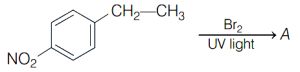
The compound $A$ (major product) is
A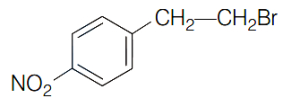
B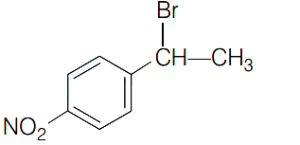
C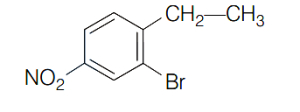
D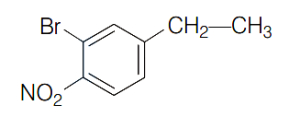
Solution
(C) The reaction of $p$-nitroethylbenzene with $Br_2$ in the presence of $UV$ light proceeds via a free radical mechanism. The bromine radical abstracts a hydrogen atom from the benzylic position because the resulting benzylic radical is stabilized by resonance with the benzene ring. Therefore,the major product is $1$-bromo-$1$-($4$-nitrophenyl)ethane.
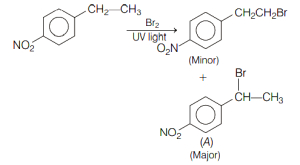
0 likes
View Solution1049
MediumMCQ
$n-$propyl bromide on treating with alcoholic $KOH$ produces
A
propane
B
propene
C
propyne
D
propanol
Solution
(B) Alcoholic $KOH$ acts as a dehydrohalogenating agent, which removes a molecule of $HBr$ from the alkyl halide to form an alkene.
When $n-$propyl bromide $(CH_{3}CH_{2}CH_{2}Br)$ reacts with alcoholic $KOH$, it undergoes dehydrohalogenation to produce propene $(CH_{3}CH=CH_{2})$.
The reaction is: $CH_{3}CH_{2}CH_{2}Br + \text{alc. } KOH \longrightarrow CH_{3}CH=CH_{2} + KBr + H_{2}O$.
When $n-$propyl bromide $(CH_{3}CH_{2}CH_{2}Br)$ reacts with alcoholic $KOH$, it undergoes dehydrohalogenation to produce propene $(CH_{3}CH=CH_{2})$.
The reaction is: $CH_{3}CH_{2}CH_{2}Br + \text{alc. } KOH \longrightarrow CH_{3}CH=CH_{2} + KBr + H_{2}O$.
0 likes
View Solution1050
EasyMCQ
The major product obtained in the following reaction is $C_2H_5ONa + (CH_3)_3C-Cl \rightarrow$
A
$CH_3-C(CH_3)_2-O-C_2H_5$
B
$CH_2=C(CH_3)_2$
C
$CH_3-CH(CH_3)-O-C_2H_5$
D
$(CH_3)_3C-CH_2CHO$
Solution
(B) The reaction involves a tertiary alkyl halide,$(CH_3)_3C-Cl$,and a strong base,$C_2H_5ONa$ (sodium ethoxide).
Since the alkyl halide is sterically hindered (tertiary),the $S_N2$ pathway is unfavorable.
Instead,the base acts as a proton acceptor,leading to an $E2$ elimination reaction.
The base abstracts a proton from one of the $\beta$-carbon atoms,resulting in the formation of an alkene.
The major product is $2$-methylpropene,which is $(CH_3)_2C=CH_2$.
Since the alkyl halide is sterically hindered (tertiary),the $S_N2$ pathway is unfavorable.
Instead,the base acts as a proton acceptor,leading to an $E2$ elimination reaction.
The base abstracts a proton from one of the $\beta$-carbon atoms,resulting in the formation of an alkene.
The major product is $2$-methylpropene,which is $(CH_3)_2C=CH_2$.
0 likes
View SolutionHaloalkanes and Haloarenes — Properties of Haloalkanes · Frequently Asked Questions
1Are these Haloalkanes and Haloarenes questions useful for JEE and NEET?
Yes. All questions in this section are mapped to JEE Main and NEET exam patterns. Previous year questions from JEE Main, NEET, GUJCET and state-level exams are included with full solutions.
2Can I switch to Hindi or Gujarati for these questions?
Yes. Use the language tabs in the hero section or the sidebar to view the same questions and solutions in English, Hindi or Gujarati.
3How do I generate a question paper from this subtopic?
Use the Vedclass Exam Paper Generator — select the chapter and subtopic, set difficulty, and generate Sets A, B, C, D automatically. First 3 chapters of every subject are free.
Vedclass Products
For Students
Vedclass Test Series
Mock tests in real JEE/NEET style with performance analysis. 5-day free trial.
Start Free TrialFor Teachers
Exam Paper Generator
Generate Set A/B/C/D papers from this chapter in 2 minutes. 3 chapters free.
Try FreeFor Institutes
Online Exam Module
Live online exams with unlimited students, 360° analytics & white-label branding.
See DemoFor Teachers & Institutes
Generate a Haloalkanes and Haloarenes Exam Paper in 2 Minutes
Select subtopic & difficulty — Sets A, B, C, D auto-generated with No Repeat logic.
First 3 chapters of every subject are free — no payment required.