
A English
Properties of Haloalkanes Questions in English
Class 12 Chemistry · Haloalkanes and Haloarenes · Properties of Haloalkanes
1196+
Questions
English
Language
100%
With Solutions
Showing 39 of 1196 questions in English
1151
Difficult
Which of the following statements is correct for optically active alkyl halides,upon reaction with nucleophiles?
| $S_{N}1$ | $S_{N}2$ | |
|---|---|---|
| $(a)$ | Retention of configuration | Inversion of configuration |
| $(b)$ | Racemisation | Inversion of configuration |
| $(c)$ | Inversion of configuration | Retention of configuration |
| $(d)$ | Racemisation | Retention of configuration |
Solution
(B) In an $S_{N}1$ reaction,the carbocation intermediate formed is planar,allowing the nucleophile to attack from either side,which leads to the formation of a racemic mixture (racemisation).
In an $S_{N}2$ reaction,the nucleophile attacks the carbon atom from the side opposite to the leaving group,resulting in the inversion of configuration (Walden inversion).
Therefore,the correct statement is that $S_{N}1$ leads to racemisation and $S_{N}2$ leads to inversion of configuration,which corresponds to option $(b)$.
In an $S_{N}2$ reaction,the nucleophile attacks the carbon atom from the side opposite to the leaving group,resulting in the inversion of configuration (Walden inversion).
Therefore,the correct statement is that $S_{N}1$ leads to racemisation and $S_{N}2$ leads to inversion of configuration,which corresponds to option $(b)$.
0 likes
View Solution1152
MediumMCQ
The reactivity of alkyl bromides towards iodide ion in dry acetone decreases in the order:
$I. CH_3CH_2Br$
$II. CH_3-CH(CH_3)-Br$
$III. CH_3-C(CH_3)_2-Br$
$IV. CH_3Br$
$I. CH_3CH_2Br$
$II. CH_3-CH(CH_3)-Br$
$III. CH_3-C(CH_3)_2-Br$
$IV. CH_3Br$
A
$IV > I > II > III$
B
$I > IV > II > III$
C
$III > II > I > IV$
D
$III > II > IV > I$
Solution
(A) In dry acetone,the reaction with iodide ion follows the $S_N2$ mechanism.
In an $S_N2$ reaction,the rate of reaction is inversely proportional to the steric hindrance around the electrophilic carbon atom.
The order of steric hindrance is: $Methyl < Primary < Secondary < Tertiary$.
Therefore,the order of reactivity is: $CH_3Br (IV) > CH_3CH_2Br (I) > (CH_3)_2CHBr (II) > (CH_3)_3CBr (III)$.
Thus,the correct order is $IV > I > II > III$.
In an $S_N2$ reaction,the rate of reaction is inversely proportional to the steric hindrance around the electrophilic carbon atom.
The order of steric hindrance is: $Methyl < Primary < Secondary < Tertiary$.
Therefore,the order of reactivity is: $CH_3Br (IV) > CH_3CH_2Br (I) > (CH_3)_2CHBr (II) > (CH_3)_3CBr (III)$.
Thus,the correct order is $IV > I > II > III$.
0 likes
View Solution1153
MediumMCQ
Consider the following reaction,
$C_2H_5Cl + AgCN \xrightarrow{EtOH / H_2O} \underline{X} \text{ (major)}$
Which one of the following statements is true for $\underline{X}$?
$(I)$ It gives propionic acid on hydrolysis
$(II)$ It has an ester functional group
$(III)$ It has a nitrogen linked to ethyl carbon
$(IV)$ It has a cyanide group
$C_2H_5Cl + AgCN \xrightarrow{EtOH / H_2O} \underline{X} \text{ (major)}$
Which one of the following statements is true for $\underline{X}$?
$(I)$ It gives propionic acid on hydrolysis
$(II)$ It has an ester functional group
$(III)$ It has a nitrogen linked to ethyl carbon
$(IV)$ It has a cyanide group
A
$(I)$
B
$(II)$
C
$(III)$
D
$(IV)$
Solution
(B) The reaction of an alkyl halide $(C_2H_5Cl)$ with $AgCN$ is a nucleophilic substitution reaction.
$AgCN$ is a covalent compound,and the nitrogen atom acts as the nucleophilic center.
Therefore,the reaction proceeds as follows:
$C_2H_5Cl + AgCN \xrightarrow{EtOH / H_2O} C_2H_5-NC + AgCl$
Here,$\underline{X}$ is ethyl isocyanide $(C_2H_5NC)$.
In ethyl isocyanide,the nitrogen atom is directly linked to the ethyl carbon $(C_2H_5-N \equiv C)$.
Thus,statement $(III)$ is correct.
$AgCN$ is a covalent compound,and the nitrogen atom acts as the nucleophilic center.
Therefore,the reaction proceeds as follows:
$C_2H_5Cl + AgCN \xrightarrow{EtOH / H_2O} C_2H_5-NC + AgCl$
Here,$\underline{X}$ is ethyl isocyanide $(C_2H_5NC)$.
In ethyl isocyanide,the nitrogen atom is directly linked to the ethyl carbon $(C_2H_5-N \equiv C)$.
Thus,statement $(III)$ is correct.
0 likes
View Solution1154
MediumMCQ
Match the following reactants with their corresponding products:
Reactants:
$(A)$ $C_2H_5Cl$,moist $Ag_2O$
$(B)$ $C_2H_5Cl$,ethanolic $AgCN$
$(C)$ $C_2H_5Cl$,ethanolic $AgNO_2$
$(D)$ $C_2H_5Cl$,ethanolic $KOH$
Products:
$(i)$ $CH_3CH_2ONO$
$(ii)$ $C_2H_4$
$(iii)$ $CH_3CH_2OH$
$(iv)$ $CH_3CH_2NC$
Select the correct match:
Reactants:
$(A)$ $C_2H_5Cl$,moist $Ag_2O$
$(B)$ $C_2H_5Cl$,ethanolic $AgCN$
$(C)$ $C_2H_5Cl$,ethanolic $AgNO_2$
$(D)$ $C_2H_5Cl$,ethanolic $KOH$
Products:
$(i)$ $CH_3CH_2ONO$
$(ii)$ $C_2H_4$
$(iii)$ $CH_3CH_2OH$
$(iv)$ $CH_3CH_2NC$
Select the correct match:
A
$A-iii, B-iv, C-i, D-ii$
B
$A-i, B-ii, C-iii, D-iv$
C
$A-iii, B-i, C-iv, D-ii$
D
$A-iv, B-i, C-ii, D-iii$
Solution
(A) $C_2H_5Cl + \text{moist } Ag_2O \rightarrow C_2H_5OH + AgCl$. Thus,$A-iii$.
$(B)$ $C_2H_5Cl + AgCN \rightarrow C_2H_5NC + AgCl$ (Isocyanide is the major product). Thus,$B-iv$.
$(C)$ $C_2H_5Cl + AgNO_2 \rightarrow C_2H_5ONO + AgCl$ (Alkyl nitrite is the major product). Thus,$C-i$.
$(D)$ $C_2H_5Cl + \text{ethanolic } KOH \rightarrow C_2H_4 + KCl + H_2O$ (Dehydrohalogenation). Thus,$D-ii$.
Therefore,the correct match is $A-iii, B-iv, C-i, D-ii$.
$(B)$ $C_2H_5Cl + AgCN \rightarrow C_2H_5NC + AgCl$ (Isocyanide is the major product). Thus,$B-iv$.
$(C)$ $C_2H_5Cl + AgNO_2 \rightarrow C_2H_5ONO + AgCl$ (Alkyl nitrite is the major product). Thus,$C-i$.
$(D)$ $C_2H_5Cl + \text{ethanolic } KOH \rightarrow C_2H_4 + KCl + H_2O$ (Dehydrohalogenation). Thus,$D-ii$.
Therefore,the correct match is $A-iii, B-iv, C-i, D-ii$.
0 likes
View Solution1155
EasyMCQ
Which of the following is added to chloroform to slow down its aerial oxidation in the presence of light?
A
Carbonyl chloride
B
Ethyl alcohol
C
Sodium hydroxide
D
Nitric acid
Solution
(B) Chloroform $(CHCl_3)$ undergoes aerial oxidation in the presence of light to form a highly poisonous gas called phosgene $(COCl_2)$.
$2CHCl_3 + O_2 \xrightarrow{light} 2COCl_2 + 2HCl$
To prevent this,$1\%$ of ethyl alcohol $(C_2H_5OH)$ is added to chloroform.
Ethyl alcohol acts as a negative catalyst and converts any phosgene formed back into harmless diethyl carbonate.
$2CHCl_3 + O_2 \xrightarrow{light} 2COCl_2 + 2HCl$
To prevent this,$1\%$ of ethyl alcohol $(C_2H_5OH)$ is added to chloroform.
Ethyl alcohol acts as a negative catalyst and converts any phosgene formed back into harmless diethyl carbonate.
0 likes
View Solution1156
MediumMCQ
Which of the following reagents,when heated with ethyl chloride,forms ethylene?
A
Aqueous $KOH$
B
$Zn / HCl$
C
Alcoholic $KOH$
D
$HI$
Solution
(C) Only alcoholic $KOH$ undergoes a dehydrohalogenation reaction with alkyl halides. When ethyl chloride $(CH_3CH_2Cl)$ is heated with alcoholic $KOH$,it undergoes elimination to form ethylene $(CH_2=CH_2)$.
The reaction is as follows:
$CH_3CH_2Cl + KOH (alc.) \rightarrow CH_2=CH_2 + KCl + H_2O$
The reaction is as follows:
$CH_3CH_2Cl + KOH (alc.) \rightarrow CH_2=CH_2 + KCl + H_2O$
0 likes
View Solution1157
MediumMCQ
Identify $A$ and $B$ in the following reactions:
$A \xrightarrow[\Delta]{aq. NaOH} C_2H_5OH \xleftarrow{AgOH} B$
$A \xrightarrow[\Delta]{aq. NaOH} C_2H_5OH \xleftarrow{AgOH} B$
A
$A=C_2H_2, B=C_2H_6$
B
$A=C_2H_5Cl, B=C_2H_4$
C
$A=C_2H_4, B=C_2H_5Cl$
D
$A=C_2H_5Cl, B=C_2H_5Cl$
Solution
(D) The reaction of haloalkanes with aqueous $NaOH$ or moist $AgOH$ (which acts as $AgOH$ or $Ag_2O + H_2O$) leads to the nucleophilic substitution of the halogen atom with a hydroxyl group $(-OH)$ to form an alcohol.
In the given reaction,$C_2H_5Cl$ reacts with aqueous $NaOH$ to form $C_2H_5OH$ (ethanol).
Similarly,$C_2H_5Cl$ reacts with moist $AgOH$ to form $C_2H_5OH$ (ethanol).
Therefore,both $A$ and $B$ are $C_2H_5Cl$.
In the given reaction,$C_2H_5Cl$ reacts with aqueous $NaOH$ to form $C_2H_5OH$ (ethanol).
Similarly,$C_2H_5Cl$ reacts with moist $AgOH$ to form $C_2H_5OH$ (ethanol).
Therefore,both $A$ and $B$ are $C_2H_5Cl$.
0 likes
View Solution1158
EasyMCQ
Identify $A$ and $B$ in the following reaction:
$C_2H_5Cl \xrightarrow{A} C_2H_5OH \xleftarrow{B} C_2H_5Cl$
$C_2H_5Cl \xrightarrow{A} C_2H_5OH \xleftarrow{B} C_2H_5Cl$
A
$A = \text{aq. } KOH; B = AgOH$
B
$A = \text{al. } KOH / \Delta; B = \text{aq. } NaOH$
C
$A = \text{aq. } NaOH; B = AgNO_2$
D
$A = AgNO_2; B = KNO_2$
Solution
(A) The reaction of haloalkanes like $C_2H_5Cl$ with aqueous alkali (e.g.,$\text{aq. } KOH$ or $\text{aq. } NaOH$) undergoes nucleophilic substitution to form alcohols.
Similarly,moist silver oxide $(AgOH)$ also acts as a source of hydroxide ions and converts haloalkanes into alcohols.
Therefore,$A$ can be $\text{aq. } KOH$ and $B$ can be $AgOH$.
Similarly,moist silver oxide $(AgOH)$ also acts as a source of hydroxide ions and converts haloalkanes into alcohols.
Therefore,$A$ can be $\text{aq. } KOH$ and $B$ can be $AgOH$.
0 likes
View Solution1159
EasyMCQ
Phosgene is formed slowly from which one of the following on exposure to air and sunlight?
A
$CHCl_3$
B
$H_3CCl$
C
$H_3COH$
D
$C_2H_5Cl$
Solution
(A) In the presence of air and light,chloroform $(CHCl_3)$ undergoes oxidation to form carbonyl chloride,commonly known as phosgene $(COCl_2)$,which is a highly toxic gas.
The chemical reaction is:
$CHCl_3 + \frac{1}{2}O_2 \xrightarrow{\text{Air and light}} COCl_2 + HCl$
The chemical reaction is:
$CHCl_3 + \frac{1}{2}O_2 \xrightarrow{\text{Air and light}} COCl_2 + HCl$
0 likes
View Solution1160
MediumMCQ
Which one of the following has the highest boiling point?
A
$H_3CCH_2CH_2CH_2Cl$
B
$(H_3C)_2CHCH_2Cl$
C
$(H_3C)_3CCl$
D
$H_3CCH_2CHClCH_3$
Solution
(A) The correct answer is $H_3CCH_2CH_2CH_2Cl$ (n-butyl chloride).
For isomeric alkyl halides,the boiling point decreases with an increase in branching.
Branching of the carbon chain makes the molecule more compact,which reduces the surface area.
As the surface area decreases,the magnitude of intermolecular van der Waals forces of attraction also decreases.
Therefore,straight-chain isomers have higher boiling points compared to their branched-chain counterparts with the same molecular formula.
Among the given options,$H_3CCH_2CH_2CH_2Cl$ is a straight-chain isomer,while the others are branched,making it the one with the highest boiling point.
For isomeric alkyl halides,the boiling point decreases with an increase in branching.
Branching of the carbon chain makes the molecule more compact,which reduces the surface area.
As the surface area decreases,the magnitude of intermolecular van der Waals forces of attraction also decreases.
Therefore,straight-chain isomers have higher boiling points compared to their branched-chain counterparts with the same molecular formula.
Among the given options,$H_3CCH_2CH_2CH_2Cl$ is a straight-chain isomer,while the others are branched,making it the one with the highest boiling point.
0 likes
View Solution1161
DifficultMCQ
Identify the major product $C$ in the given sequence of reactions.
$(CH_3)_2C=O$ $\xrightarrow[(ii) H^+/H_2O]{(i) CH_3MgBr/Ether} A$ $\xrightarrow[\Delta]{SOCl_2} B$ $\xrightarrow[\Delta]{CH_3ONa} C$
$(CH_3)_2C=O$ $\xrightarrow[(ii) H^+/H_2O]{(i) CH_3MgBr/Ether} A$ $\xrightarrow[\Delta]{SOCl_2} B$ $\xrightarrow[\Delta]{CH_3ONa} C$
A
$CH_3-C(CH_3)=CH_2$
B
$CH_3-CH(CH_3)-O-CH_3$
C
$CH_3-C(CH_3)_2-O-CH_3$
D
$CH_3-CH(CH_3)-COCl$
Solution
(A) $1$. The reaction of acetone $(CH_3)_2C=O$ with $CH_3MgBr$ followed by acidic hydrolysis gives tert-butyl alcohol $(A)$,which is $(CH_3)_3C-OH$.
$2$. Treatment of $(A)$ with $SOCl_2$ leads to the formation of tert-butyl chloride $(B)$,which is $(CH_3)_3C-Cl$.
$3$. The reaction of $(B)$ with $CH_3ONa$ (a strong base) under heating conditions leads to dehydrohalogenation via an $E2$ mechanism,resulting in the formation of isobutylene ($2$-methylpropene) as the major product $(C)$,which is $(CH_3)_2C=CH_2$.
$2$. Treatment of $(A)$ with $SOCl_2$ leads to the formation of tert-butyl chloride $(B)$,which is $(CH_3)_3C-Cl$.
$3$. The reaction of $(B)$ with $CH_3ONa$ (a strong base) under heating conditions leads to dehydrohalogenation via an $E2$ mechanism,resulting in the formation of isobutylene ($2$-methylpropene) as the major product $(C)$,which is $(CH_3)_2C=CH_2$.
0 likes
View Solution1162
MediumMCQ
Amongst the following compounds,which one$(s)$ readily react with ethanolic $KCN$?
A
Ethyl chloride
B
Chlorobenzene
C
Benzaldehyde
D
Salicylic acid
Solution
(A, C) Ethyl chloride undergoes nucleophilic substitution with ethanolic $KCN$ to form ethyl cyanide:
$C_2H_5Cl + KCN \xrightarrow{\text{Ethanol}} C_2H_5CN + KCl$
$(B)$ Chlorobenzene does not undergo nucleophilic substitution with $KCN$ under normal conditions due to the partial double bond character of the $C-Cl$ bond.
$(C)$ Benzaldehyde reacts with $HCN$ (generated from $KCN$ in the presence of an acid or in alcoholic medium) to form a cyanohydrin:
$C_6H_5CHO + HCN \rightarrow C_6H_5CH(OH)CN$
$(D)$ Salicylic acid does not react with $KCN$.
$C_2H_5Cl + KCN \xrightarrow{\text{Ethanol}} C_2H_5CN + KCl$
$(B)$ Chlorobenzene does not undergo nucleophilic substitution with $KCN$ under normal conditions due to the partial double bond character of the $C-Cl$ bond.
$(C)$ Benzaldehyde reacts with $HCN$ (generated from $KCN$ in the presence of an acid or in alcoholic medium) to form a cyanohydrin:
$C_6H_5CHO + HCN \rightarrow C_6H_5CH(OH)CN$
$(D)$ Salicylic acid does not react with $KCN$.
0 likes
View Solution1163
EasyMCQ
The best method for the preparation of $Me_{3}CCN$ is
A
to react $Me_{3}COH$ with $HCN$
B
to react $Me_{3}CBr$ with $NaCN$
C
to react $Me_{3}CMgBr$ with $ClCN$
D
to react $Me_{3}CCl$ with $NH_{2}CN$
Solution
(C) The preparation of $Me_{3}CCN$ (pivalonitrile) from $Me_{3}CBr$ via $S_{N}2$ reaction with $NaCN$ is not feasible because $Me_{3}CBr$ is a tertiary alkyl halide,which undergoes elimination rather than substitution.
The reaction of $Me_{3}CMgBr$ (a Grignard reagent) with $ClCN$ (cyanogen chloride) is the most effective method for introducing a cyano group to a tertiary carbon atom.
The reaction is as follows:
$Me_{3}CMgBr + ClCN \rightarrow Me_{3}CCN + Mg(Cl)Br$
The reaction of $Me_{3}CMgBr$ (a Grignard reagent) with $ClCN$ (cyanogen chloride) is the most effective method for introducing a cyano group to a tertiary carbon atom.
The reaction is as follows:
$Me_{3}CMgBr + ClCN \rightarrow Me_{3}CCN + Mg(Cl)Br$
0 likes
View Solution1164
EasyMCQ
$(+)-2-$chloro$-2-$phenylethane in toluene racemises slowly in the presence of small amount of $SbCl_5$,due to the formation of
A
carbanion
B
carbene
C
free-radical
D
carbocation
Solution
(D) The $SbCl_5$ acts as a Lewis acid and abstracts the chloride ion $(Cl^-)$ from the substrate,$(+)-2-$chloro$-2-$phenylethane.
This results in the formation of a planar,$sp^2$ hybridized carbocation intermediate.
Because the carbocation is planar,the chloride ion can attack from either the top or the bottom face with equal probability.
This leads to the formation of both enantiomers,resulting in a racemic mixture.
This results in the formation of a planar,$sp^2$ hybridized carbocation intermediate.
Because the carbocation is planar,the chloride ion can attack from either the top or the bottom face with equal probability.
This leads to the formation of both enantiomers,resulting in a racemic mixture.
0 likes
View Solution1165
EasyMCQ
Under identical conditions,the $S_{N}1$ reaction will occur most efficiently with
A
tert-butyl chloride
B
$1-$chlorobutane
C
$2-$methyl$-1-$chloropropane
D
$2-$chlorobutane
Solution
(A) The rate of $S_{N}1$ reaction depends on the stability of the carbocation intermediate formed during the rate-determining step.
$S_{N}1$ reactions proceed via the formation of a carbocation,and the stability order of carbocations is $3^{\circ} > 2^{\circ} > 1^{\circ}$.
Therefore,the reactivity order for $S_{N}1$ reactions is $3^{\circ} > 2^{\circ} > 1^{\circ}$ alkyl halides.
Among the given options:
$A$. tert-butyl chloride is a $3^{\circ}$ alkyl halide.
$B$. $1-$chlorobutane is a $1^{\circ}$ alkyl halide.
$C$. $2-$methyl$-1-$chloropropane is a $1^{\circ}$ alkyl halide.
$D$. $2-$chlorobutane is a $2^{\circ}$ alkyl halide.
Since tert-butyl chloride forms the most stable $3^{\circ}$ carbocation,it reacts most efficiently via the $S_{N}1$ mechanism.
$S_{N}1$ reactions proceed via the formation of a carbocation,and the stability order of carbocations is $3^{\circ} > 2^{\circ} > 1^{\circ}$.
Therefore,the reactivity order for $S_{N}1$ reactions is $3^{\circ} > 2^{\circ} > 1^{\circ}$ alkyl halides.
Among the given options:
$A$. tert-butyl chloride is a $3^{\circ}$ alkyl halide.
$B$. $1-$chlorobutane is a $1^{\circ}$ alkyl halide.
$C$. $2-$methyl$-1-$chloropropane is a $1^{\circ}$ alkyl halide.
$D$. $2-$chlorobutane is a $2^{\circ}$ alkyl halide.
Since tert-butyl chloride forms the most stable $3^{\circ}$ carbocation,it reacts most efficiently via the $S_{N}1$ mechanism.
0 likes
View Solution1166
MediumMCQ
Which of the following compounds is most reactive in $S_N 1$ reaction?
A
$3-$bromocyclopent$-1,4-$diene
B
$3-$bromocyclopent$-1-$ene
C
$3-$bromoprop$-1-$ene
D
$3-$bromo$-2-$methylprop$-1-$ene
Solution
(A) The reactivity of $S_N 1$ reaction is directly proportional to the stability of the carbocation intermediate formed after the departure of the leaving group $(Br^-)$.
In option $A$,the carbocation formed is the cyclopentadienyl cation,which is aromatic ($6 \pi$ electrons,planar,cyclic,conjugated). Aromatic compounds are exceptionally stable.
In option $B$,the carbocation is allylic,which is resonance-stabilized but not aromatic.
In option $C$,the carbocation is also allylic but less substituted than $B$.
In option $D$,the carbocation is also allylic but with different substitution.
Since the cyclopentadienyl cation is aromatic,it is the most stable carbocation among the choices,making the corresponding alkyl bromide the most reactive in an $S_N 1$ reaction.
In option $A$,the carbocation formed is the cyclopentadienyl cation,which is aromatic ($6 \pi$ electrons,planar,cyclic,conjugated). Aromatic compounds are exceptionally stable.
In option $B$,the carbocation is allylic,which is resonance-stabilized but not aromatic.
In option $C$,the carbocation is also allylic but less substituted than $B$.
In option $D$,the carbocation is also allylic but with different substitution.
Since the cyclopentadienyl cation is aromatic,it is the most stable carbocation among the choices,making the corresponding alkyl bromide the most reactive in an $S_N 1$ reaction.
0 likes
View Solution1167
EasyMCQ
The reactivity order of the following molecules towards $S_N1$ reaction is:
$(I)$ Allyl chloride
$(II)$ Chlorobenzene
$(III)$ Ethyl chloride
$(I)$ Allyl chloride
$(II)$ Chlorobenzene
$(III)$ Ethyl chloride
A
$I > III > II$
B
$I > II > III$
C
$II > I > III$
D
$III > I > II$
Solution
(A) The reactivity of alkyl halides towards $S_N1$ reaction depends on the stability of the carbocation formed in the rate-determining step.
$1$. Allyl chloride $(I)$ forms an allyl carbocation $(CH_2=CH-CH_2^+)$,which is resonance-stabilized.
$2$. Ethyl chloride $(III)$ forms a primary ethyl carbocation $(CH_3-CH_2^+)$,which is less stable than the allyl carbocation.
$3$. Chlorobenzene $(II)$ does not undergo $S_N1$ reaction easily because the $C-Cl$ bond has partial double bond character due to resonance,making the formation of a phenyl carbocation extremely difficult.
Thus,the order of reactivity is $I > III > II$.
$1$. Allyl chloride $(I)$ forms an allyl carbocation $(CH_2=CH-CH_2^+)$,which is resonance-stabilized.
$2$. Ethyl chloride $(III)$ forms a primary ethyl carbocation $(CH_3-CH_2^+)$,which is less stable than the allyl carbocation.
$3$. Chlorobenzene $(II)$ does not undergo $S_N1$ reaction easily because the $C-Cl$ bond has partial double bond character due to resonance,making the formation of a phenyl carbocation extremely difficult.
Thus,the order of reactivity is $I > III > II$.
0 likes
View Solution1168
MediumMCQ
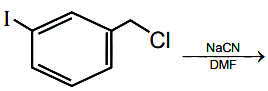
The major product of the following reaction is:
A
$3-$(cyanomethyl)benzonitrile
B
$3-$(chloromethyl)benzonitrile
C
$2-$($3$-iodophenyl)acetonitrile
D
$3-$iodobenzonitrile
Solution
(C) The reaction involves the nucleophilic substitution of a primary alkyl halide in the presence of $NaCN$ and $DMF$ (a polar aprotic solvent),which favors the $S_{N}2$ mechanism.
The substrate contains two halogen atoms: an iodine atom directly attached to the benzene ring (aryl iodide) and a chlorine atom attached to a benzylic carbon (benzylic chloride).
$1$. The $C-I$ bond attached to the benzene ring has partial double-bond character due to resonance,making it very resistant to nucleophilic substitution.
$2$. The benzylic $C-Cl$ bond is highly reactive towards $S_{N}2$ substitution because the transition state is stabilized by the adjacent benzene ring.
Therefore,the $CN^-$ nucleophile selectively attacks the benzylic carbon,displacing the $Cl^-$ ion to form $2-(3-iodophenyl)acetonitrile$ as the major product.
The substrate contains two halogen atoms: an iodine atom directly attached to the benzene ring (aryl iodide) and a chlorine atom attached to a benzylic carbon (benzylic chloride).
$1$. The $C-I$ bond attached to the benzene ring has partial double-bond character due to resonance,making it very resistant to nucleophilic substitution.
$2$. The benzylic $C-Cl$ bond is highly reactive towards $S_{N}2$ substitution because the transition state is stabilized by the adjacent benzene ring.
Therefore,the $CN^-$ nucleophile selectively attacks the benzylic carbon,displacing the $Cl^-$ ion to form $2-(3-iodophenyl)acetonitrile$ as the major product.
0 likes
View Solution1169
DifficultMCQ
Which of the following statements about the $S_{N}2$ reaction mechanism is/are true?
A
The rate of reaction increases with increasing nucleophilicity.
B
The number $2$ denotes a second order reaction.
C
Tertiary butyl substrates do not follow this mechanism.
D
The optical rotation of substrates always changes from $(+)$ to $(-)$ or from $(-)$ to $(+)$.
Solution
(A, B, C) The $S_{N}2$ reaction is a bimolecular nucleophilic substitution reaction.
$1$. The rate of reaction depends on the concentration of both the substrate and the nucleophile,hence it is a second-order reaction.
$2$. The rate increases with the strength of the nucleophile (nucleophilicity).
$3$. Tertiary substrates are sterically hindered,making $S_{N}2$ reactions extremely slow or impossible.
$4$. Optical rotation change is not guaranteed; it depends on the priority of the incoming nucleophile compared to the leaving group according to Cahn-Ingold-Prelog rules.
Therefore,statements $A$,$B$,and $C$ are true.
$1$. The rate of reaction depends on the concentration of both the substrate and the nucleophile,hence it is a second-order reaction.
$2$. The rate increases with the strength of the nucleophile (nucleophilicity).
$3$. Tertiary substrates are sterically hindered,making $S_{N}2$ reactions extremely slow or impossible.
$4$. Optical rotation change is not guaranteed; it depends on the priority of the incoming nucleophile compared to the leaving group according to Cahn-Ingold-Prelog rules.
Therefore,statements $A$,$B$,and $C$ are true.
0 likes
View Solution1170
DifficultMCQ
If all the nucleophilic substitution reactions at saturated carbon atoms in the above sequence of reactions follow $S_N2$ mechanism,then $\underline{E}$ and $\underline{E}$ will be respectively,

A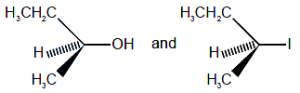
B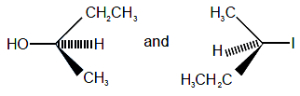
C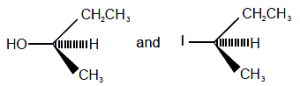
D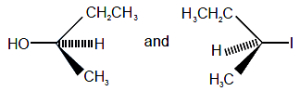
Solution
(D) The reaction sequence involves two $S_N2$ steps,each resulting in an inversion of configuration at the chiral center.
$1$. The starting material is $sec$-butyl chloride. Reaction with aqueous $NaOH$ proceeds via $S_N2$ mechanism,leading to the formation of $sec$-butyl alcohol with inversion of configuration.
$2$. The alcohol then reacts with $p$-toluenesulfonyl chloride $(TsCl)$ in pyridine to form a tosylate intermediate,which is a good leaving group.
$3$. Finally,the tosylate reacts with $NaI$ in acetone via another $S_N2$ reaction,resulting in a second inversion of configuration.
$4$. Since there are two inversions,the final product $C_4H_9I$ will have the same configuration as the starting material $C_4H_9Cl$.
$5$. Comparing the structures,option $D$ correctly represents the intermediate alcohol (inverted) and the final iodide (retained configuration relative to the starting material).
$1$. The starting material is $sec$-butyl chloride. Reaction with aqueous $NaOH$ proceeds via $S_N2$ mechanism,leading to the formation of $sec$-butyl alcohol with inversion of configuration.
$2$. The alcohol then reacts with $p$-toluenesulfonyl chloride $(TsCl)$ in pyridine to form a tosylate intermediate,which is a good leaving group.
$3$. Finally,the tosylate reacts with $NaI$ in acetone via another $S_N2$ reaction,resulting in a second inversion of configuration.
$4$. Since there are two inversions,the final product $C_4H_9I$ will have the same configuration as the starting material $C_4H_9Cl$.
$5$. Comparing the structures,option $D$ correctly represents the intermediate alcohol (inverted) and the final iodide (retained configuration relative to the starting material).
0 likes
View Solution1171
MediumMCQ
Among the following chlorides,the compounds which will be hydrolysed most easily and most slowly in aqueous $NaOH$ solution are respectively:
$1$. Methoxymethyl chloride $(CH_3OCH_2Cl)$
$2$. Benzyl chloride $(C_6H_5CH_2Cl)$
$3$. Neopentyl chloride $((CH_3)_3CCH_2Cl)$
$4$. Propyl chloride $(CH_3CH_2CH_2Cl)$
$1$. Methoxymethyl chloride $(CH_3OCH_2Cl)$
$2$. Benzyl chloride $(C_6H_5CH_2Cl)$
$3$. Neopentyl chloride $((CH_3)_3CCH_2Cl)$
$4$. Propyl chloride $(CH_3CH_2CH_2Cl)$
A
$1$ and $3$
B
$2$ and $3$
C
$2$ and $4$
D
$3$ and $1$
Solution
(A) The hydrolysis of alkyl chlorides in aqueous $NaOH$ proceeds via $S_N1$ or $S_N2$ mechanisms.
$1$. Methoxymethyl chloride $(CH_3OCH_2Cl)$ undergoes $S_N1$ reaction very rapidly because the resulting carbocation $(CH_3OCH_2^+)$ is highly stabilized by resonance from the lone pair on the oxygen atom.
$2$. Benzyl chloride $(C_6H_5CH_2Cl)$ also forms a resonance-stabilized carbocation,but it is less stable than the methoxymethyl carbocation.
$3$. Neopentyl chloride $((CH_3)_3CCH_2Cl)$ is a primary alkyl halide with significant steric hindrance at the $\beta$-carbon,which makes $S_N2$ reactions extremely slow.
$4$. Propyl chloride $(CH_3CH_2CH_2Cl)$ is a primary alkyl halide that undergoes $S_N2$ reaction at a moderate rate.
Therefore,methoxymethyl chloride $(1)$ is hydrolysed most easily,and neopentyl chloride $(3)$ is hydrolysed most slowly.
$1$. Methoxymethyl chloride $(CH_3OCH_2Cl)$ undergoes $S_N1$ reaction very rapidly because the resulting carbocation $(CH_3OCH_2^+)$ is highly stabilized by resonance from the lone pair on the oxygen atom.
$2$. Benzyl chloride $(C_6H_5CH_2Cl)$ also forms a resonance-stabilized carbocation,but it is less stable than the methoxymethyl carbocation.
$3$. Neopentyl chloride $((CH_3)_3CCH_2Cl)$ is a primary alkyl halide with significant steric hindrance at the $\beta$-carbon,which makes $S_N2$ reactions extremely slow.
$4$. Propyl chloride $(CH_3CH_2CH_2Cl)$ is a primary alkyl halide that undergoes $S_N2$ reaction at a moderate rate.
Therefore,methoxymethyl chloride $(1)$ is hydrolysed most easily,and neopentyl chloride $(3)$ is hydrolysed most slowly.
0 likes
View Solution1172
MediumMCQ
Which information below regarding this reaction is applicable?
$CH_3-O-CH_2-Cl \xrightarrow{aq. OH^-, \Delta} CH_3-O-CH_2-OH$
$CH_3-O-CH_2-Cl \xrightarrow{aq. OH^-, \Delta} CH_3-O-CH_2-OH$
A
It follows $S_{N}2$ pathway,because it is a primary alkyl chloride.
B
It follows $S_{N}1$ pathway,because the intermediate carbocation is resonance stabilized.
C
$S_{N}1$ pathway is not followed,because the intermediate carbocation is destabilised by $-I$ effect of oxygen.
D
$A$ mixed $S_{N}1$ and $S_{N}2$ pathway is followed.
Solution
(B) The reaction involves the substitution of a chlorine atom in $CH_3-O-CH_2-Cl$ with a hydroxyl group.
In this substrate,the carbon atom attached to chlorine is adjacent to an oxygen atom with lone pairs.
If the $C-Cl$ bond breaks to form a carbocation,the intermediate $CH_3-O^+-CH_2$ is formed.
This carbocation is highly stabilized by resonance due to the donation of lone pair electrons from the oxygen atom $(CH_3-O^+=CH_2)$.
Due to this significant resonance stabilization,the reaction proceeds via the $S_{N}1$ mechanism.
In this substrate,the carbon atom attached to chlorine is adjacent to an oxygen atom with lone pairs.
If the $C-Cl$ bond breaks to form a carbocation,the intermediate $CH_3-O^+-CH_2$ is formed.
This carbocation is highly stabilized by resonance due to the donation of lone pair electrons from the oxygen atom $(CH_3-O^+=CH_2)$.
Due to this significant resonance stabilization,the reaction proceeds via the $S_{N}1$ mechanism.
0 likes
View Solution1173
DifficultMCQ
The ease of dehydrohalogenation of alkyl halide with alcoholic $KOH$ is:
A
$3^{\circ} < 2^{\circ} < 1^{\circ}$
B
$3^{\circ} > 2^{\circ} > 1^{\circ}$
C
$3^{\circ} < 2^{\circ} > 1^{\circ}$
D
$3^{\circ} > 2^{\circ} < 1^{\circ}$
Solution
(B) Dehydrohalogenation of alkyl halides with alcoholic $KOH$ follows the $E_2$ mechanism.
In this reaction,the rate-determining step involves the formation of an alkene.
The stability of the resulting alkene is the primary driving force for the reaction.
According to Saytzeff's rule,more substituted alkenes are more stable.
Since tertiary $(3^{\circ})$ alkyl halides form the most substituted (and thus most stable) alkenes,they react the fastest.
Therefore,the order of reactivity is $3^{\circ} > 2^{\circ} > 1^{\circ}$.
In this reaction,the rate-determining step involves the formation of an alkene.
The stability of the resulting alkene is the primary driving force for the reaction.
According to Saytzeff's rule,more substituted alkenes are more stable.
Since tertiary $(3^{\circ})$ alkyl halides form the most substituted (and thus most stable) alkenes,they react the fastest.
Therefore,the order of reactivity is $3^{\circ} > 2^{\circ} > 1^{\circ}$.
0 likes
View Solution1174
EasyMCQ
By passing excess $Cl_{2(g)}$ in boiling toluene,which one of the following compounds is exclusively formed?
A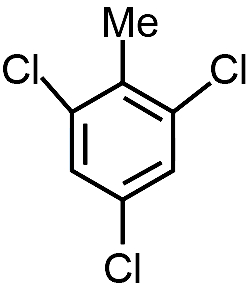
$p-$chlorotoluene
B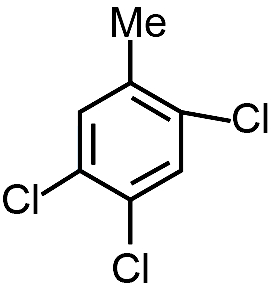
$m-$chlorotoluene
C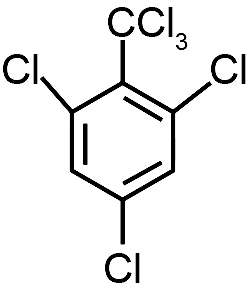
benzyl chloride
D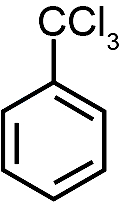
trichloromethylbenzene (benzotrichloride)
Solution
(D) In the presence of heat (boiling point conditions) or $UV$ light,chlorine reacts with the side chain of toluene via a free radical substitution mechanism.
When excess $Cl_{2}$ is used,it leads to the progressive substitution of all three hydrogen atoms on the methyl group.
The reaction proceeds as follows:
$C_6H_5CH_3$ $\xrightarrow{Cl_2, \Delta} C_6H_5CH_2Cl$ $\xrightarrow{Cl_2, \Delta} C_6H_5CHCl_2$ $\xrightarrow{Cl_2, \Delta} C_6H_5CCl_3$.
Thus,the final product is $C_6H_5CCl_3$,which is known as trichloromethylbenzene or benzotrichloride.
When excess $Cl_{2}$ is used,it leads to the progressive substitution of all three hydrogen atoms on the methyl group.
The reaction proceeds as follows:
$C_6H_5CH_3$ $\xrightarrow{Cl_2, \Delta} C_6H_5CH_2Cl$ $\xrightarrow{Cl_2, \Delta} C_6H_5CHCl_2$ $\xrightarrow{Cl_2, \Delta} C_6H_5CCl_3$.
Thus,the final product is $C_6H_5CCl_3$,which is known as trichloromethylbenzene or benzotrichloride.
0 likes
View Solution1175
DifficultMCQ
Identify the major product $(P)$ for the following reaction sequence:
$1,2-\text{dibromo}-3-\text{ethyl}-4-\text{methylcyclopentane} \xrightarrow[(ii) HBr]{(i) Zn, \Delta} (P)$
$1,2-\text{dibromo}-3-\text{ethyl}-4-\text{methylcyclopentane} \xrightarrow[(ii) HBr]{(i) Zn, \Delta} (P)$
A
$1-$bromo$-2-$ethyl$-3-$methylcyclopentane
B
$1-$bromo$-1-$methyl$-2-$ethylcyclopentane
C
$1-$bromo$-2-$methyl$-1-$ethylcyclopentane
D
$1-$bromo$-3-$ethyl$-2-$methylcyclopentane
Solution
(B) Step $1$: Dehalogenation with $Zn/\Delta$ removes the two bromine atoms to form a double bond,resulting in $3-\text{ethyl}-4-\text{methylcyclopentene}$.
Step $2$: Electrophilic addition of $HBr$ to the alkene follows Markovnikov's rule. Protonation of the double bond forms a secondary carbocation.
Step $3$: $A$ $1,2-\text{hydride shift}$ occurs to form a more stable tertiary carbocation at the carbon bearing the methyl group.
Step $4$: The bromide ion $(Br^-)$ attacks the tertiary carbocation to form $1-\text{bromo}-1-\text{methyl}-2-\text{ethylcyclopentane}$ as the major product.
Step $2$: Electrophilic addition of $HBr$ to the alkene follows Markovnikov's rule. Protonation of the double bond forms a secondary carbocation.
Step $3$: $A$ $1,2-\text{hydride shift}$ occurs to form a more stable tertiary carbocation at the carbon bearing the methyl group.
Step $4$: The bromide ion $(Br^-)$ attacks the tertiary carbocation to form $1-\text{bromo}-1-\text{methyl}-2-\text{ethylcyclopentane}$ as the major product.
0 likes
View Solution1176
DifficultMCQ
Consider all the structural isomers with molecular formula $C_5H_{11}Br$. They are separately treated with $KOH$ $(aq)$ to give respective substitution products,without any rearrangement. The number of products which can exhibit optical isomerism from these is . . . . . . .
A
$2$
B
$3$
C
$4$
D
$5$
Solution
(B) The structural isomers of $C_5H_{11}Br$ are:
$1$. $1$-bromopentane: $CH_3CH_2CH_2CH_2CH_2Br$ $\rightarrow$ $1$-pentanol (achiral).
$2$. $2$-bromopentane: $CH_3CH_2CH_2CH(Br)CH_3$ $\rightarrow$ $2$-pentanol ($CH_3CH_2CH_2CH(OH)CH_3$,chiral).
$3$. $3$-bromopentane: $CH_3CH_2CH(Br)CH_2CH_3$ $\rightarrow$ $3$-pentanol (achiral).
$4$. $1$-bromo-$2$-methylbutane: $CH_3CH_2CH(CH_3)CH_2Br$ $\rightarrow$ $2$-methyl-$1$-butanol ($CH_3CH_2CH(CH_3)CH_2OH$,chiral).
$5$. $2$-bromo-$2$-methylbutane: $CH_3CH_2C(Br)(CH_3)_2$ $\rightarrow$ $2$-methyl-$2$-butanol (achiral).
$6$. $2$-bromo-$3$-methylbutane: $CH_3CH(Br)CH(CH_3)_2$ $\rightarrow$ $3$-methyl-$2$-butanol ($CH_3CH(OH)CH(CH_3)_2$,chiral).
$7$. $1$-bromo-$3$-methylbutane: $CH_3CH(CH_3)CH_2CH_2Br$ $\rightarrow$ $3$-methyl-$1$-butanol (achiral).
$8$. $1$-bromo-$2,2$-dimethylpropane: $(CH_3)_3CCH_2Br$ $\rightarrow$ $2,2$-dimethyl-$1$-propanol (achiral).
Among the products,$2$-pentanol,$2$-methyl-$1$-butanol,and $3$-methyl-$2$-butanol exhibit optical isomerism.
Thus,the number of products is $3$.
$1$. $1$-bromopentane: $CH_3CH_2CH_2CH_2CH_2Br$ $\rightarrow$ $1$-pentanol (achiral).
$2$. $2$-bromopentane: $CH_3CH_2CH_2CH(Br)CH_3$ $\rightarrow$ $2$-pentanol ($CH_3CH_2CH_2CH(OH)CH_3$,chiral).
$3$. $3$-bromopentane: $CH_3CH_2CH(Br)CH_2CH_3$ $\rightarrow$ $3$-pentanol (achiral).
$4$. $1$-bromo-$2$-methylbutane: $CH_3CH_2CH(CH_3)CH_2Br$ $\rightarrow$ $2$-methyl-$1$-butanol ($CH_3CH_2CH(CH_3)CH_2OH$,chiral).
$5$. $2$-bromo-$2$-methylbutane: $CH_3CH_2C(Br)(CH_3)_2$ $\rightarrow$ $2$-methyl-$2$-butanol (achiral).
$6$. $2$-bromo-$3$-methylbutane: $CH_3CH(Br)CH(CH_3)_2$ $\rightarrow$ $3$-methyl-$2$-butanol ($CH_3CH(OH)CH(CH_3)_2$,chiral).
$7$. $1$-bromo-$3$-methylbutane: $CH_3CH(CH_3)CH_2CH_2Br$ $\rightarrow$ $3$-methyl-$1$-butanol (achiral).
$8$. $1$-bromo-$2,2$-dimethylpropane: $(CH_3)_3CCH_2Br$ $\rightarrow$ $2,2$-dimethyl-$1$-propanol (achiral).
Among the products,$2$-pentanol,$2$-methyl-$1$-butanol,and $3$-methyl-$2$-butanol exhibit optical isomerism.
Thus,the number of products is $3$.
0 likes
View Solution1177
DifficultMCQ
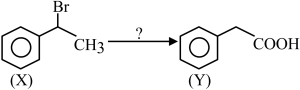
The correct sequence of reagents for the conversion of $X$ to $Y$ is :
A
$(i) NaOH \ (aq) \ (ii) \text{Jones reagent} \ (iii) H_{3}O^{+}$
B
$(i) B_{2}H_{6}/H_{2}O_{2} \ (ii) NaOEt \ (iii) \text{Jones reagent}$
C
$(i) \text{Jones reagent} \ (ii) NaOEt \ (iii) \text{Hot } KMnO_{4}/KOH$
D
$(i) NaOEt \ (ii) B_{2}H_{6}/H_{2}O_{2} \ (iii) \text{Jones reagent}$
Solution
(D) The conversion of $1-\text{phenylethyl bromide}$ $(X)$ to $2-\text{phenylacetic acid}$ $(Y)$ involves the following steps:
$1$. Dehydrohalogenation: Treatment of $1-\text{phenylethyl bromide}$ with $NaOEt$ (a strong base) leads to the formation of $styrene$ $(Ph-CH=CH_{2})$ via an $E2$ elimination mechanism.
$2$. Hydroboration-Oxidation: $Styrene$ reacts with $B_{2}H_{6}$ followed by $H_{2}O_{2}/OH^{-}$ to yield $2-\text{phenylethanol}$ $(Ph-CH_{2}-CH_{2}-OH)$ via anti-Markovnikov addition of water.
$3$. Oxidation: Finally,$2-\text{phenylethanol}$ is oxidized to $2-\text{phenylacetic acid}$ $(Ph-CH_{2}-COOH)$ using a strong oxidizing agent like Jones reagent $(CrO_{3}/H_{2}SO_{4})$.
Thus,the correct sequence is $(i) NaOEt, (ii) B_{2}H_{6}/H_{2}O_{2}, (iii) \text{Jones reagent}$.
$1$. Dehydrohalogenation: Treatment of $1-\text{phenylethyl bromide}$ with $NaOEt$ (a strong base) leads to the formation of $styrene$ $(Ph-CH=CH_{2})$ via an $E2$ elimination mechanism.
$2$. Hydroboration-Oxidation: $Styrene$ reacts with $B_{2}H_{6}$ followed by $H_{2}O_{2}/OH^{-}$ to yield $2-\text{phenylethanol}$ $(Ph-CH_{2}-CH_{2}-OH)$ via anti-Markovnikov addition of water.
$3$. Oxidation: Finally,$2-\text{phenylethanol}$ is oxidized to $2-\text{phenylacetic acid}$ $(Ph-CH_{2}-COOH)$ using a strong oxidizing agent like Jones reagent $(CrO_{3}/H_{2}SO_{4})$.
Thus,the correct sequence is $(i) NaOEt, (ii) B_{2}H_{6}/H_{2}O_{2}, (iii) \text{Jones reagent}$.
0 likes
View Solution1178
DifficultMCQ
The correct order of the rate of the reaction for the following reaction with respect to nucleophiles is: $CH_{3}Br + Nu^{\ominus} \longrightarrow CH_{3}Nu + Br^{\ominus}$
A
$PhO^{-} > {}^{-}OH > CH_{3}COO^{-} > ClO_{4}^{-}$
B
$ClO_{4}^{-} > CH_{3}COO^{-} > {}^{-}OH > PhO^{-}$
C
$CH_{3}COO^{-} > PhO^{-} > {}^{-}OH > ClO_{4}^{-}$
D
${}^{-}OH > PhO^{-} > CH_{3}COO^{-} > ClO_{4}^{-}$
Solution
(D) The rate of an $S_{N}2$ reaction depends on the nucleophilicity of the nucleophile. Nucleophilicity is generally inversely proportional to the stability of the anion (conjugate base).
The stability order of the given anions is: $ClO_{4}^{-} > CH_{3}COO^{-} > PhO^{-} > {}^{-}OH$.
Since nucleophilicity is the reverse of the stability of the anion,the order of nucleophilicity (and thus the rate of reaction) is: ${}^{-}OH > PhO^{-} > CH_{3}COO^{-} > ClO_{4}^{-}$.
The stability order of the given anions is: $ClO_{4}^{-} > CH_{3}COO^{-} > PhO^{-} > {}^{-}OH$.
Since nucleophilicity is the reverse of the stability of the anion,the order of nucleophilicity (and thus the rate of reaction) is: ${}^{-}OH > PhO^{-} > CH_{3}COO^{-} > ClO_{4}^{-}$.
0 likes
View Solution1179
DifficultMCQ
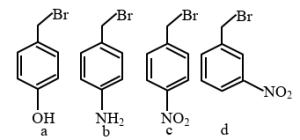
The correct order of reactivity of the following benzyl halides towards reaction with $KCN$ is:
A
$a > b > c > d$
B
$b > a > d > c$
C
$b > a > c > d$
D
$a > b > d > c$
Solution
(B) The reaction of benzyl halides with $KCN$ typically proceeds via an $S_{N}1$ mechanism in polar protic solvents or $S_{N}2$ depending on conditions. However,for benzyl halides,the rate is governed by the stability of the intermediate carbocation in $S_{N}1$ or steric/electronic factors in $S_{N}2$. In both cases,electron-donating groups $(EDG)$ increase reactivity,while electron-withdrawing groups $(EWG)$ decrease it.
$a$ has $-OH$ (strong $EDG$ via resonance),$b$ has $-NH_2$ (strong $EDG$ via resonance),$c$ has $-NO_2$ (strong $EWG$ at para position),and $d$ has $-NO_2$ (strong $EWG$ at meta position).
Comparing $a$ and $b$: $-NH_2$ is a stronger $EDG$ than $-OH$ due to lower electronegativity of $N$ compared to $O$,making $b$ more reactive than $a$.
Comparing $c$ and $d$: $-NO_2$ at the para position $(c)$ exerts a stronger destabilizing effect on the carbocation than at the meta position $(d)$ due to direct resonance destabilization.
Thus,the order is $b > a > d > c$.
$a$ has $-OH$ (strong $EDG$ via resonance),$b$ has $-NH_2$ (strong $EDG$ via resonance),$c$ has $-NO_2$ (strong $EWG$ at para position),and $d$ has $-NO_2$ (strong $EWG$ at meta position).
Comparing $a$ and $b$: $-NH_2$ is a stronger $EDG$ than $-OH$ due to lower electronegativity of $N$ compared to $O$,making $b$ more reactive than $a$.
Comparing $c$ and $d$: $-NO_2$ at the para position $(c)$ exerts a stronger destabilizing effect on the carbocation than at the meta position $(d)$ due to direct resonance destabilization.
Thus,the order is $b > a > d > c$.
0 likes
View Solution1180
DifficultMCQ
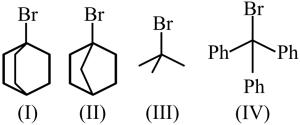
The correct order of the rate of reaction of the following reactants with a nucleophile by $S_{N}1$ mechanism is:
(Given: Structure $I$ and $II$ are rigid)
(Given: Structure $I$ and $II$ are rigid)
A
$IV < III < II < I$
B
$III < I < II < IV$
C
$II < I < III < IV$
D
$I < II < III < IV$
Solution
(C) The rate of $S_{N}1$ reaction is directly proportional to the stability of the carbocation $(C^{\oplus})$ formed.
$I$ is $1-$bromobicyclo[$2.2$.$1$]heptane and $II$ is $1-$bromobicyclo[$2.2$.$2$]octane. Both are bridgehead halides and are extremely unreactive in $S_{N}1$ reactions due to Bredt's rule,which prevents the formation of a planar carbocation at the bridgehead position.
Between $I$ and $II$,$II$ is slightly more reactive than $I$ because the bridgehead carbocation in $II$ is less strained than in $I$.
$III$ is a tert-butyl carbocation,which is more stable than the bridgehead carbocations.
$IV$ is a triphenylmethyl carbocation,which is the most stable due to extensive resonance stabilization by three phenyl rings.
Thus,the correct order of reactivity is $II < I < III < IV$.
$I$ is $1-$bromobicyclo[$2.2$.$1$]heptane and $II$ is $1-$bromobicyclo[$2.2$.$2$]octane. Both are bridgehead halides and are extremely unreactive in $S_{N}1$ reactions due to Bredt's rule,which prevents the formation of a planar carbocation at the bridgehead position.
Between $I$ and $II$,$II$ is slightly more reactive than $I$ because the bridgehead carbocation in $II$ is less strained than in $I$.
$III$ is a tert-butyl carbocation,which is more stable than the bridgehead carbocations.
$IV$ is a triphenylmethyl carbocation,which is the most stable due to extensive resonance stabilization by three phenyl rings.
Thus,the correct order of reactivity is $II < I < III < IV$.
0 likes
View Solution1181
DifficultMCQ
The correct order of reactivity of $CH_3Br$ in methanol with the following nucleophiles is:
$F^{-}, I^{-}, C_2H_5O^{-}$ and $C_6H_5O^{-}$
$F^{-}, I^{-}, C_2H_5O^{-}$ and $C_6H_5O^{-}$
A
$I^{-} > C_6H_5O^{-} > F^{-} > C_2H_5O^{-}$
B
$I^{-} > C_2H_5O^{-} > C_6H_5O^{-} > F^{-}$
C
$I^{-} > C_2H_5O^{-} > F^{-} > C_6H_5O^{-}$
D
$I^{-} > F^{-} > C_6H_5O^{-} > C_2H_5O^{-}$
Solution
(B) In a polar protic solvent like methanol,nucleophilicity is determined by the ability of the nucleophile to donate an electron pair.
The order of nucleophilicity is governed by basicity and polarizability.
$C_2H_5O^{-}$ is a strong base and a good nucleophile.
$C_6H_5O^{-}$ (phenoxide) is less basic than $C_2H_5O^{-}$ due to resonance stabilization of the negative charge on the oxygen atom.
$I^{-}$ is a very good nucleophile in polar protic solvents due to its high polarizability,despite being a weak base.
$F^{-}$ is a small,highly solvated ion in methanol,making it a poor nucleophile.
Thus,the correct order is $I^{-} > C_2H_5O^{-} > C_6H_5O^{-} > F^{-}$.
The order of nucleophilicity is governed by basicity and polarizability.
$C_2H_5O^{-}$ is a strong base and a good nucleophile.
$C_6H_5O^{-}$ (phenoxide) is less basic than $C_2H_5O^{-}$ due to resonance stabilization of the negative charge on the oxygen atom.
$I^{-}$ is a very good nucleophile in polar protic solvents due to its high polarizability,despite being a weak base.
$F^{-}$ is a small,highly solvated ion in methanol,making it a poor nucleophile.
Thus,the correct order is $I^{-} > C_2H_5O^{-} > C_6H_5O^{-} > F^{-}$.
0 likes
View Solution1182
MediumMCQ
How many minimum numbers of $C$-atom containing monohaloalkane shows optical isomerism?
A
$6$
B
$4$
C
$3$
D
$5$
Solution
(B) For a molecule to show optical isomerism,it must be chiral,meaning it must possess at least one chiral center.
$A$ chiral center is a carbon atom bonded to four different groups.
In the case of a monohaloalkane with the general formula $C_nH_{2n+1}X$,we need to find the smallest alkane chain that can accommodate a chiral center.
For $n=1$ (chloromethane) and $n=2$ (chloroethane),all carbons are bonded to at least two identical hydrogen atoms.
For $n=3$ (chloropropane),$1$-chloropropane has no chiral center,and $2-$chloropropane has two identical methyl groups attached to the central carbon.
For $n=4$,$2$-chlorobutane $(CH_3-CHCl-CH_2-CH_3)$ has a chiral center at the $C-2$ position because it is bonded to four different groups: $-H$,$-Cl$,$-CH_3$,and $-CH_2CH_3$.
Therefore,the minimum number of carbon atoms required is $4$.
$A$ chiral center is a carbon atom bonded to four different groups.
In the case of a monohaloalkane with the general formula $C_nH_{2n+1}X$,we need to find the smallest alkane chain that can accommodate a chiral center.
For $n=1$ (chloromethane) and $n=2$ (chloroethane),all carbons are bonded to at least two identical hydrogen atoms.
For $n=3$ (chloropropane),$1$-chloropropane has no chiral center,and $2-$chloropropane has two identical methyl groups attached to the central carbon.
For $n=4$,$2$-chlorobutane $(CH_3-CHCl-CH_2-CH_3)$ has a chiral center at the $C-2$ position because it is bonded to four different groups: $-H$,$-Cl$,$-CH_3$,and $-CH_2CH_3$.
Therefore,the minimum number of carbon atoms required is $4$.
0 likes
View Solution1183
MediumMCQ
Which of the following compounds has the highest reactivity towards $S_N2$ reaction?
A
$1-$Bromo$-3-$methylbutane
B
$1-$Bromo$-2,2-$dimethylpropane
C
$1-$Bromo$-2-$methylbutane
D
$1-$Bromobutane
Solution
(D) The reactivity of alkyl halides towards $S_N2$ reactions is primarily governed by steric hindrance.
$S_N2$ reactions proceed via a transition state where the nucleophile attacks the carbon atom from the side opposite to the leaving group.
As the steric hindrance (bulkiness) near the reactive carbon increases,the rate of $S_N2$ reaction decreases.
The order of reactivity for primary alkyl halides is: $CH_3X > R-CH_2X > R_2CH-CH_2X > R_3C-CH_2X$.
Comparing the given options:
$(A)$ $1$-Bromo-$3$-methylbutane: $CH_3-CH(CH_3)-CH_2-CH_2Br$ (Primary,but branched at $\gamma$-position).
$(B)$ $1$-Bromo-$2,2$-dimethylpropane: $(CH_3)_3C-CH_2Br$ (Primary,but highly hindered at $\beta$-position).
$(C)$ $1$-Bromo-$2$-methylbutane: $CH_3-CH_2-CH(CH_3)-CH_2Br$ (Primary,but branched at $\beta$-position).
$(D)$ $1$-Bromobutane: $CH_3-CH_2-CH_2-CH_2Br$ (Straight-chain primary alkyl halide).
Since $1$-Bromobutane has the least steric hindrance among the given options,it exhibits the highest reactivity towards $S_N2$ reaction.
$S_N2$ reactions proceed via a transition state where the nucleophile attacks the carbon atom from the side opposite to the leaving group.
As the steric hindrance (bulkiness) near the reactive carbon increases,the rate of $S_N2$ reaction decreases.
The order of reactivity for primary alkyl halides is: $CH_3X > R-CH_2X > R_2CH-CH_2X > R_3C-CH_2X$.
Comparing the given options:
$(A)$ $1$-Bromo-$3$-methylbutane: $CH_3-CH(CH_3)-CH_2-CH_2Br$ (Primary,but branched at $\gamma$-position).
$(B)$ $1$-Bromo-$2,2$-dimethylpropane: $(CH_3)_3C-CH_2Br$ (Primary,but highly hindered at $\beta$-position).
$(C)$ $1$-Bromo-$2$-methylbutane: $CH_3-CH_2-CH(CH_3)-CH_2Br$ (Primary,but branched at $\beta$-position).
$(D)$ $1$-Bromobutane: $CH_3-CH_2-CH_2-CH_2Br$ (Straight-chain primary alkyl halide).
Since $1$-Bromobutane has the least steric hindrance among the given options,it exhibits the highest reactivity towards $S_N2$ reaction.
0 likes
View Solution1184
EasyMCQ
$ . . . . . . $ compound is slowly oxidized by air in the presence of light to an extremely poisonous gas,carbonyl chloride.
A
Trichloromethane
B
Methylene chloride
C
Chlorobenzene
D
Chloromethane
Solution
(A) Trichloromethane,commonly known as chloroform $(CHCl_3)$,undergoes slow oxidation by atmospheric oxygen in the presence of light to form carbonyl chloride,also known as phosgene $(COCl_2)$,which is highly toxic.
The chemical reaction is as follows:
$2CHCl_3 + O_2 \xrightarrow{\text{light}} 2COCl_2 + 2HCl$
The chemical reaction is as follows:
$2CHCl_3 + O_2 \xrightarrow{\text{light}} 2COCl_2 + 2HCl$
0 likes
View Solution1185
MediumMCQ
Which of the following compounds has a chiral carbon atom?
A
$2-$chlorobutane
B
$2,2-$dichlorobutane
C
$1-$chlorobutane
D
$2-$chloro$-2-$methylpropane
Solution
(A) chiral carbon atom is a carbon atom that is bonded to four different groups or atoms.
In $2$-chlorobutane $(CH_3-CHCl-CH_2-CH_3)$,the carbon atom at position $2$ is bonded to four different groups: a hydrogen atom $(-H)$,a chlorine atom $(-Cl)$,a methyl group $(-CH_3)$,and an ethyl group $(-CH_2CH_3)$.
Since all four groups attached to this carbon are distinct,it is a chiral center.
In the other options,the carbon atoms are either bonded to identical groups (e.g.,two methyl groups or two hydrogen atoms),making them achiral.
In $2$-chlorobutane $(CH_3-CHCl-CH_2-CH_3)$,the carbon atom at position $2$ is bonded to four different groups: a hydrogen atom $(-H)$,a chlorine atom $(-Cl)$,a methyl group $(-CH_3)$,and an ethyl group $(-CH_2CH_3)$.
Since all four groups attached to this carbon are distinct,it is a chiral center.
In the other options,the carbon atoms are either bonded to identical groups (e.g.,two methyl groups or two hydrogen atoms),making them achiral.
0 likes
View Solution1186
MediumMCQ
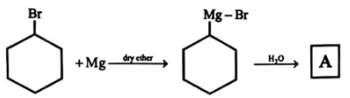
Identify '$A$' in the following reaction.
A
Cyclohexene
B
Cyclohexane
C
Cyclohexanol
D
Benzene
Solution
(B) The reaction of bromocyclohexane with magnesium in the presence of dry ether forms a Grignard reagent,which is cyclohexylmagnesium bromide $(C_6H_{11}MgBr)$.
When this Grignard reagent is treated with water $(\text{H}_2\text{O})$,it undergoes protonolysis to yield cyclohexane $(C_6H_{12})$ as the final product '$A$'.
When this Grignard reagent is treated with water $(\text{H}_2\text{O})$,it undergoes protonolysis to yield cyclohexane $(C_6H_{12})$ as the final product '$A$'.
0 likes
View Solution1187
EasyMCQ
$A$ mixture of an alkyl halide and an aryl halide is treated with sodium in dry ether. What is the name of this reaction?
A
Fittig reaction
B
Finkelstein reaction
C
Wurtz-Fittig reaction
D
Wurtz reaction
Solution
(C) The reaction involving the coupling of an alkyl halide and an aryl halide in the presence of sodium metal and dry ether to form an alkylbenzene is known as the Wurtz-Fittig reaction.
General equation: $R-X + 2Na + X-Ar \xrightarrow{\text{dry ether}} R-Ar + 2NaX$.
General equation: $R-X + 2Na + X-Ar \xrightarrow{\text{dry ether}} R-Ar + 2NaX$.
0 likes
View Solution1188
MediumMCQ
Match the $LIST$-$I$ with $LIST$-$II$:
Choose the correct answer from the options given below:
| List-$I$ (Reaction) | List-$II$ (Mechanism) |
| $A$. Williamson Synthesis | $I$. Electrophilic addition |
| $B$. Friedel-Crafts Reaction | $II$. Free radical substitution |
| $C$. Bromination of vinyl benzene | $III$. Nucleophilic substitution |
| $D$. Chlorination of toluene in light | $IV$. Electrophilic substitution |
Choose the correct answer from the options given below:
A
$A-III, B-I, C-II, D-IV$
B
$A-III, B-IV, C-II, D-I$
C
$A-III, B-IV, C-I, D-II$
D
$A-I, B-III, C-IV, D-II$
Solution
(C) . Williamson synthesis involves the reaction of an alkoxide ion with an alkyl halide,which is a nucleophilic substitution $(III)$ reaction.
$B$. Friedel-Crafts reaction involves the substitution of an aromatic hydrogen by an alkyl or acyl group,which is an electrophilic aromatic substitution $(IV)$ reaction.
$C$. Bromination of vinyl benzene (an alkene) involves the addition of bromine across the double bond,which is an electrophilic addition $(I)$ reaction.
$D$. Chlorination of toluene in the presence of light involves the substitution of a hydrogen atom on the side chain via a free radical mechanism,which is a free radical substitution $(II)$ reaction.
Therefore,the correct matching is $A-III, B-IV, C-I, D-II$.
$B$. Friedel-Crafts reaction involves the substitution of an aromatic hydrogen by an alkyl or acyl group,which is an electrophilic aromatic substitution $(IV)$ reaction.
$C$. Bromination of vinyl benzene (an alkene) involves the addition of bromine across the double bond,which is an electrophilic addition $(I)$ reaction.
$D$. Chlorination of toluene in the presence of light involves the substitution of a hydrogen atom on the side chain via a free radical mechanism,which is a free radical substitution $(II)$ reaction.
Therefore,the correct matching is $A-III, B-IV, C-I, D-II$.
0 likes
View Solution1189
DifficultMCQ
Given below are two statements:
Statement $(I)$: Benzyl chloride reacts faster in $S_N1$ mechanism than ethyl chloride.
Statement $(II)$: Ethyl carbocation intermediate is less stabilized by hyperconjugation than benzyl carbocation by resonance.
In the light of the above statements, choose the correct answer from the options given below:
Statement $(I)$: Benzyl chloride reacts faster in $S_N1$ mechanism than ethyl chloride.
Statement $(II)$: Ethyl carbocation intermediate is less stabilized by hyperconjugation than benzyl carbocation by resonance.
In the light of the above statements, choose the correct answer from the options given below:
A
Both Statement $I$ and Statement $II$ are true
B
Both Statement $I$ and Statement $II$ are false
C
Statement $I$ is true but Statement $II$ is false
D
Statement $I$ is false but Statement $II$ is true
Solution
$(A)$ Statement $(I)$ is true because the benzyl carbocation formed as an intermediate in the $S_N1$ mechanism is resonance-stabilized by the phenyl ring, making it significantly more stable than the primary ethyl carbocation.
Statement $(II)$ is also true because resonance stabilization (involving the delocalization of electrons over the aromatic ring) provides much greater stability to the carbocation than hyperconjugation (involving the overlap of $C-H$ $\sigma$-orbitals with the empty $p$-orbital).
Since both statements are correct, the correct option is $(A)$.
Statement $(II)$ is also true because resonance stabilization (involving the delocalization of electrons over the aromatic ring) provides much greater stability to the carbocation than hyperconjugation (involving the overlap of $C-H$ $\sigma$-orbitals with the empty $p$-orbital).
Since both statements are correct, the correct option is $(A)$.
0 likes
View SolutionHaloalkanes and Haloarenes — Properties of Haloalkanes · Frequently Asked Questions
1Are these Haloalkanes and Haloarenes questions useful for JEE and NEET?
Yes. All questions in this section are mapped to JEE Main and NEET exam patterns. Previous year questions from JEE Main, NEET, GUJCET and state-level exams are included with full solutions.
2Can I switch to Hindi or Gujarati for these questions?
Yes. Use the language tabs in the hero section or the sidebar to view the same questions and solutions in English, Hindi or Gujarati.
3How do I generate a question paper from this subtopic?
Use the Vedclass Exam Paper Generator — select the chapter and subtopic, set difficulty, and generate Sets A, B, C, D automatically. First 3 chapters of every subject are free.
Vedclass Products
For Students
Vedclass Test Series
Mock tests in real JEE/NEET style with performance analysis. 5-day free trial.
Start Free TrialFor Teachers
Exam Paper Generator
Generate Set A/B/C/D papers from this chapter in 2 minutes. 3 chapters free.
Try FreeFor Institutes
Online Exam Module
Live online exams with unlimited students, 360° analytics & white-label branding.
See DemoFor Teachers & Institutes
Generate a Haloalkanes and Haloarenes Exam Paper in 2 Minutes
Select subtopic & difficulty — Sets A, B, C, D auto-generated with No Repeat logic.
First 3 chapters of every subject are free — no payment required.