
A English
Properties of Haloalkanes Questions in English
Class 12 Chemistry · Haloalkanes and Haloarenes · Properties of Haloalkanes
1196+
Questions
English
Language
100%
With Solutions
Showing 37 of 1196 questions in English
1051
EasyMCQ
The major product obtained in the following reaction is $C_2H_5ONa + (CH_3)_3C-Cl \rightarrow$
A
$CH_3-C(CH_3)_2-O-C_2H_5$
B
$CH_2=C(CH_3)_2$
C
$CH_3-CH(CH_3)-O-C_2H_5$
D
$(CH_3)_3C-CH_2CHO$
Solution
(B) The reaction involves a tertiary alkyl halide,$(CH_3)_3C-Cl$,and a strong base,$C_2H_5ONa$ (sodium ethoxide).
Since the alkyl halide is sterically hindered (tertiary),the $S_N2$ pathway is unfavorable.
Instead,the base acts as a proton acceptor,leading to an $E2$ elimination reaction.
The base abstracts a proton from one of the $\beta$-carbon atoms,resulting in the formation of an alkene.
The major product is $2$-methylpropene,which is $(CH_3)_2C=CH_2$.
Since the alkyl halide is sterically hindered (tertiary),the $S_N2$ pathway is unfavorable.
Instead,the base acts as a proton acceptor,leading to an $E2$ elimination reaction.
The base abstracts a proton from one of the $\beta$-carbon atoms,resulting in the formation of an alkene.
The major product is $2$-methylpropene,which is $(CH_3)_2C=CH_2$.
0 likes
View Solution1052
MediumMCQ
What are $X, Y$ and $Z$ in the following reactions?
$(CH_3)_3 C-O^- Na^+ + CH_3 CH_2 Br \longrightarrow X + NaBr$
$(CH_3)_3 C-Br + CH_3 CH_2 O^- Na^+ \longrightarrow Y + Z$
$(CH_3)_3 C-O^- Na^+ + CH_3 CH_2 Br \longrightarrow X + NaBr$
$(CH_3)_3 C-Br + CH_3 CH_2 O^- Na^+ \longrightarrow Y + Z$
A
$(CH_3)_3 C-Br, (CH_3)_3 C-OH, CH_3 CH_2 Br$
B
$CH_3-C(CH_3)=CH_2, (CH_3)_3 C-OCH_2 CH_3, NaBr$
C
$(CH_3)_3 C-OCH_2 CH_3, CH_3-C(CH_3)=CH_2, CH_3 CH_2 OH$
D
$CH_3-CH(CH_3)-CH_2 OH, CH_3-CH(CH_3)-OCH_2 CH_3, NaBr$
Solution
(C) The first reaction is: $(CH_3)_3 C-O^- Na^+ + CH_3 CH_2 Br \longrightarrow (CH_3)_3 C-OCH_2 CH_3 (X) + NaBr$.
This is a $S_N2$ reaction where a primary halide reacts with a bulky alkoxide to form an ether.
The second reaction is: $(CH_3)_3 C-Br + CH_3 CH_2 O^- Na^+ \longrightarrow CH_3-C(CH_3)=CH_2 (Y) + CH_3 CH_2 OH (Z) + NaBr$.
This is an elimination reaction $(E2)$ where a tertiary alkyl halide reacts with a strong base (alkoxide) to form an alkene and an alcohol.
This is a $S_N2$ reaction where a primary halide reacts with a bulky alkoxide to form an ether.
The second reaction is: $(CH_3)_3 C-Br + CH_3 CH_2 O^- Na^+ \longrightarrow CH_3-C(CH_3)=CH_2 (Y) + CH_3 CH_2 OH (Z) + NaBr$.
This is an elimination reaction $(E2)$ where a tertiary alkyl halide reacts with a strong base (alkoxide) to form an alkene and an alcohol.
0 likes
View Solution1053
MediumMCQ
Chloroethane with silver acetate forms $X$ and with $LiAlH_4$ forms $Y$. What are $X$ and $Y$?
A
$H_3CCH_2CH_3$ & $H_3CCHO$
B
$HCOOCH_2CH_3$ & $H_3CCH_2OH$
C
$H_3CCOOCH_2CH_3$ & $H_3CCH_3$
D
$H_3CCH_2COOH$ & $H_3CCH_2Li$
Solution
(C) $1$. Reaction with silver acetate $(CH_3COOAg)$: Chloroethane $(CH_3CH_2Cl)$ reacts with silver acetate via a nucleophilic substitution reaction to form ethyl acetate $(CH_3COOCH_2CH_3)$. Thus,$X = CH_3COOCH_2CH_3$.
$2$. Reaction with $LiAlH_4$: Chloroethane $(CH_3CH_2Cl)$ undergoes reduction with lithium aluminium hydride $(LiAlH_4)$ to form ethane $(CH_3CH_3)$. Thus,$Y = CH_3CH_3$.
$3$. Therefore,the correct option is $C$.
$2$. Reaction with $LiAlH_4$: Chloroethane $(CH_3CH_2Cl)$ undergoes reduction with lithium aluminium hydride $(LiAlH_4)$ to form ethane $(CH_3CH_3)$. Thus,$Y = CH_3CH_3$.
$3$. Therefore,the correct option is $C$.
0 likes
View Solution1054
EasyMCQ
In the presence of light,chloroform is slowly oxidised by air to form:
A
$COCl_2$
B
$HC(OH)_3$
C
$CH_2Cl_2$
D
$CH_3OH$
Solution
(A) Chloroform $(CHCl_3)$ in the presence of light and air undergoes slow oxidation to form a highly poisonous gas known as phosgene $(COCl_2)$.
The chemical reaction is as follows:
$2CHCl_3 + O_2 \xrightarrow{\text{light}} 2COCl_2 + 2HCl$
The chemical reaction is as follows:
$2CHCl_3 + O_2 \xrightarrow{\text{light}} 2COCl_2 + 2HCl$
0 likes
View Solution1055
EasyMCQ
The correct order for increasing reactivity towards $S_N1$ substitution for the following compounds is:
$1. CH_3CH_2Br$
$2. CH_2=CHCH(Br)CH_3$
$3. CH_2=CHBr$
$4. CH_3CH(Br)CH_3$
$1. CH_3CH_2Br$
$2. CH_2=CHCH(Br)CH_3$
$3. CH_2=CHBr$
$4. CH_3CH(Br)CH_3$
A
$1 < 4 < 3 < 2$
B
$4 < 1 < 2 < 3$
C
$3 < 1 < 2 < 4$
D
$3 < 1 < 4 < 2$
Solution
(D) The reactivity of compounds towards $S_N1$ substitution depends on the stability of the carbocation formed in the rate-determining step.
$1. CH_3CH_2Br \rightarrow CH_3CH_2^+$ (Ethyl carbocation,$1^\circ$)
$2. CH_2=CHCH(Br)CH_3 \rightarrow CH_2=CHCH^+CH_3$ (Allylic carbocation,resonance stabilized)
$3. CH_2=CHBr \rightarrow CH_2=CH^+$ (Vinyl carbocation,highly unstable)
$4. CH_3CH(Br)CH_3 \rightarrow CH_3CH^+CH_3$ (Isopropyl carbocation,$2^\circ$)
The stability order of carbocations is: $\text{Vinyl} < 1^\circ < 2^\circ < \text{Allylic}$.
Therefore,the reactivity order is $3 < 1 < 4 < 2$.
$1. CH_3CH_2Br \rightarrow CH_3CH_2^+$ (Ethyl carbocation,$1^\circ$)
$2. CH_2=CHCH(Br)CH_3 \rightarrow CH_2=CHCH^+CH_3$ (Allylic carbocation,resonance stabilized)
$3. CH_2=CHBr \rightarrow CH_2=CH^+$ (Vinyl carbocation,highly unstable)
$4. CH_3CH(Br)CH_3 \rightarrow CH_3CH^+CH_3$ (Isopropyl carbocation,$2^\circ$)
The stability order of carbocations is: $\text{Vinyl} < 1^\circ < 2^\circ < \text{Allylic}$.
Therefore,the reactivity order is $3 < 1 < 4 < 2$.
0 likes
View Solution1056
MediumMCQ
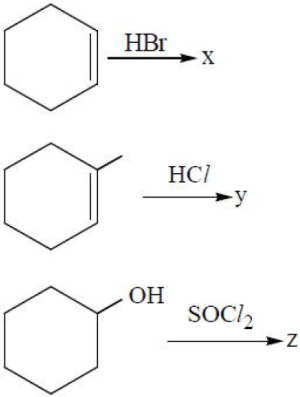
Observe the following reactions. The order of reactivity of $x, y, z$ towards $S_{N}1$ reaction is:
A
$x > z > y$
B
$x > y > z$
C
$y > x > z$
D
$y > z > x$
Solution
(C) $1$. Identify the products $x, y, z$:
- Reaction $1$: Cyclohexene + $HBr$ gives bromocyclohexane $(x)$.
- Reaction $2$: $1-$methylcyclohexene + $HCl$ gives $1-$chloro$-1-$methylcyclohexane $(y)$.
- Reaction $3$: Cyclohexanol + $SOCl_2$ gives chlorocyclohexane $(z)$.
$2$. Analyze $S_{N}1$ reactivity:
- $S_{N}1$ reactivity depends on the stability of the carbocation intermediate formed.
- $y$ is $1-$chloro$-1-$methylcyclohexane (tertiary alkyl halide),which forms a stable tertiary carbocation.
- $x$ is bromocyclohexane (secondary alkyl halide),which forms a secondary carbocation.
- $z$ is chlorocyclohexane (secondary alkyl halide),which forms a secondary carbocation.
- Comparing $x$ and $z$: The leaving group ability of $Br^-$ is better than $Cl^-$,making $x$ more reactive than $z$.
$3$. Order of reactivity: $y$ (tertiary) > $x$ (secondary,$Br$) > $z$ (secondary,$Cl$).
Therefore,the correct order is $y > x > z$.
- Reaction $1$: Cyclohexene + $HBr$ gives bromocyclohexane $(x)$.
- Reaction $2$: $1-$methylcyclohexene + $HCl$ gives $1-$chloro$-1-$methylcyclohexane $(y)$.
- Reaction $3$: Cyclohexanol + $SOCl_2$ gives chlorocyclohexane $(z)$.
$2$. Analyze $S_{N}1$ reactivity:
- $S_{N}1$ reactivity depends on the stability of the carbocation intermediate formed.
- $y$ is $1-$chloro$-1-$methylcyclohexane (tertiary alkyl halide),which forms a stable tertiary carbocation.
- $x$ is bromocyclohexane (secondary alkyl halide),which forms a secondary carbocation.
- $z$ is chlorocyclohexane (secondary alkyl halide),which forms a secondary carbocation.
- Comparing $x$ and $z$: The leaving group ability of $Br^-$ is better than $Cl^-$,making $x$ more reactive than $z$.
$3$. Order of reactivity: $y$ (tertiary) > $x$ (secondary,$Br$) > $z$ (secondary,$Cl$).
Therefore,the correct order is $y > x > z$.
0 likes
View Solution1057
MediumMCQ
Which one of the following halogen compounds is least reactive towards hydrolysis by $S_{N}1$ mechanism?
A
Tertiary butyl chloride
B
Isopropyl chloride
C
Allyl chloride
D
Ethyl chloride
Solution
(D) The reactivity of alkyl halides towards the $S_{N}1$ mechanism depends on the stability of the carbocation intermediate formed during the rate-determining step.
Stability order of carbocations: $3^{\circ} > 2^{\circ} > 1^{\circ}$.
$1$. Tertiary butyl chloride ($CH_3)_3CCl$ forms a $3^{\circ}$ carbocation,which is highly stable.
$2$. Isopropyl chloride $(CH_3)_2CHCl$ forms a $2^{\circ}$ carbocation.
$3$. Allyl chloride $CH_2=CH-CH_2Cl$ forms an allyl carbocation,which is resonance stabilized.
$4$. Ethyl chloride $CH_3CH_2Cl$ forms a $1^{\circ}$ carbocation,which is the least stable among the given options.
Therefore,ethyl chloride is the least reactive towards the $S_{N}1$ mechanism.
Stability order of carbocations: $3^{\circ} > 2^{\circ} > 1^{\circ}$.
$1$. Tertiary butyl chloride ($CH_3)_3CCl$ forms a $3^{\circ}$ carbocation,which is highly stable.
$2$. Isopropyl chloride $(CH_3)_2CHCl$ forms a $2^{\circ}$ carbocation.
$3$. Allyl chloride $CH_2=CH-CH_2Cl$ forms an allyl carbocation,which is resonance stabilized.
$4$. Ethyl chloride $CH_3CH_2Cl$ forms a $1^{\circ}$ carbocation,which is the least stable among the given options.
Therefore,ethyl chloride is the least reactive towards the $S_{N}1$ mechanism.
0 likes
View Solution1058
MediumMCQ
An alkyl halide $C_3H_7Cl$,on reaction with a reagent $X$ gave the major product $Y$ $(C_4H_7N)$. $Y$ on hydrolysis released a gas,which turns red litmus to blue. What are $X$ and $Y$?
A
$KCN/C_2H_5OH$,$CH_3CH_2CH_2NC$
B
$KCN/C_2H_5OH$,$CH_3CH_2CH_2CN$
C
$AgCN/C_2H_5OH$,$CH_3CH_2CH_2CN$
D
$AgCN/C_2H_5OH$,$CH_3CH_2CH_2NC$
Solution
(B) The reaction of alkyl halide $C_3H_7Cl$ with $KCN$ in the presence of $C_2H_5OH$ (an alcoholic solvent) leads to the formation of an alkyl cyanide (nitrile) as the major product via an $S_N2$ mechanism.
$CH_3CH_2CH_2Cl + KCN \xrightarrow{C_2H_5OH} CH_3CH_2CH_2CN + KCl$
Here,$X = KCN/C_2H_5OH$ and $Y = CH_3CH_2CH_2CN$.
Hydrolysis of alkyl cyanide $(Y)$ yields a carboxylic acid and ammonia gas $(NH_3)$:
$CH_3CH_2CH_2CN + 2H_2O + H^+ \rightarrow CH_3CH_2CH_2COOH + NH_3 \uparrow$
The ammonia gas $(NH_3)$ released is basic in nature and turns red litmus paper blue.
$CH_3CH_2CH_2Cl + KCN \xrightarrow{C_2H_5OH} CH_3CH_2CH_2CN + KCl$
Here,$X = KCN/C_2H_5OH$ and $Y = CH_3CH_2CH_2CN$.
Hydrolysis of alkyl cyanide $(Y)$ yields a carboxylic acid and ammonia gas $(NH_3)$:
$CH_3CH_2CH_2CN + 2H_2O + H^+ \rightarrow CH_3CH_2CH_2COOH + NH_3 \uparrow$
The ammonia gas $(NH_3)$ released is basic in nature and turns red litmus paper blue.
0 likes
View Solution1059
MediumMCQ
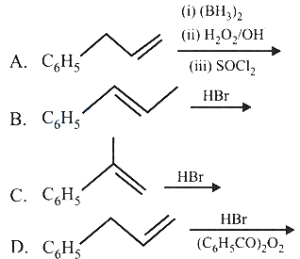
The product of which of the following reactions undergoes hydrolysis by the $S_N 1$ mechanism?
A
$C, D$ only
B
$A, B, C$ only
C
$B, C$ only
D
$A, D$ only
Solution
(C) The $S_N 1$ mechanism proceeds via the formation of a stable carbocation intermediate. The stability of the carbocation determines the ease of the $S_N 1$ reaction. Benzylic carbocations are highly stable due to resonance.
$(A)$ The product is $C_6H_5CH_2CH_2CH_2Cl$ (a primary alkyl halide),which undergoes hydrolysis via $S_N 2$.
$(B)$ The product is $C_6H_5CH(Br)CH_2CH_3$,which forms a stable benzylic carbocation $(C_6H_5CH^+CH_2CH_3)$ upon ionization,thus favoring $S_N 1$.
$(C)$ The product is $C_6H_5C(Br)(CH_3)_2$,which forms a stable benzylic carbocation $(C_6H_5C^+(CH_3)_2)$ upon ionization,thus favoring $S_N 1$.
$(D)$ The product is $C_6H_5CH_2CH_2Br$ (a primary alkyl halide),which undergoes hydrolysis via $S_N 2$.
Therefore,only $(B)$ and $(C)$ form stable benzylic carbocations and undergo hydrolysis by the $S_N 1$ mechanism.
$(A)$ The product is $C_6H_5CH_2CH_2CH_2Cl$ (a primary alkyl halide),which undergoes hydrolysis via $S_N 2$.
$(B)$ The product is $C_6H_5CH(Br)CH_2CH_3$,which forms a stable benzylic carbocation $(C_6H_5CH^+CH_2CH_3)$ upon ionization,thus favoring $S_N 1$.
$(C)$ The product is $C_6H_5C(Br)(CH_3)_2$,which forms a stable benzylic carbocation $(C_6H_5C^+(CH_3)_2)$ upon ionization,thus favoring $S_N 1$.
$(D)$ The product is $C_6H_5CH_2CH_2Br$ (a primary alkyl halide),which undergoes hydrolysis via $S_N 2$.
Therefore,only $(B)$ and $(C)$ form stable benzylic carbocations and undergo hydrolysis by the $S_N 1$ mechanism.
0 likes
View Solution1060
DifficultMCQ
What are the major products $X$ and $Y$ respectively in the following reactions?
$(CH_3)_3CONa + CH_3CH_2Br \rightarrow X$
$(CH_3)_3CBr + CH_3CH_2ONa \rightarrow Y$
$(CH_3)_3CONa + CH_3CH_2Br \rightarrow X$
$(CH_3)_3CBr + CH_3CH_2ONa \rightarrow Y$
A
$CH_2=CH_2, (CH_3)_3COCH_2CH_3$
B
$(CH_3)_3COCH_2CH_3, (CH_3)_3COCH_2CH_3$
C
$CH_2=CH_2, (CH_3)_2C=CH_2$
D
$(CH_3)_3COCH_2CH_3, (CH_3)_2C=CH_2$
Solution
(D) In the first reaction,$(CH_3)_3CONa$ is a strong nucleophile and $CH_3CH_2Br$ is a primary alkyl halide. This undergoes an $S_N2$ reaction to form the ether $(CH_3)_3COCH_2CH_3$ $(X)$.
In the second reaction,$(CH_3)_3CBr$ is a tertiary alkyl halide and $CH_3CH_2ONa$ is a strong base. Tertiary alkyl halides with strong bases undergo an $E2$ elimination reaction to form an alkene,which is $(CH_3)_2C=CH_2$ $(Y)$.
In the second reaction,$(CH_3)_3CBr$ is a tertiary alkyl halide and $CH_3CH_2ONa$ is a strong base. Tertiary alkyl halides with strong bases undergo an $E2$ elimination reaction to form an alkene,which is $(CH_3)_2C=CH_2$ $(Y)$.
0 likes
View Solution1061
MediumMCQ
An isomer of $C_5H_{12}$ on reaction with $Br_2 / \text{light}$ gave only one isomer $C_5H_{11}Br(X)$. Reaction of $X$ with $AgNO_2$ gave $Y$ as the major product. What is $Y$?
A
$2,2-$dimethyl$-1-$nitropropane
B
$2,2-$dimethylpropyl nitrite
C
$1,1-$dimethylpropyl nitrite
D
$2,2-$dimethyl$-1-$nitropropane (structure shown)
Solution
(D) $1$. The isomer of $C_5H_{12}$ that gives only one monobrominated product $C_5H_{11}Br$ upon reaction with $Br_2 / \text{light}$ is neopentane $(2,2-\text{dimethylpropane})$. This is because all $12$ hydrogen atoms in neopentane are equivalent.
$2$. Neopentane reacts with $Br_2 / \text{light}$ to form $1-\text{bromo}-2,2-\text{dimethylpropane}$ $(X)$.
$3$. The reaction of a primary alkyl halide $(X)$ with $AgNO_2$ proceeds via an $S_N2$ mechanism,where the nucleophile is the nitrite ion $(NO_2^-)$. Since $AgNO_2$ is largely covalent,the nitrogen atom acts as the nucleophile,leading to the formation of a nitroalkane $(R-NO_2)$ as the major product.
$4$. Therefore,the reaction of $1-\text{bromo}-2,2-\text{dimethylpropane}$ with $AgNO_2$ yields $2,2-\text{dimethyl}-1-\text{nitropropane}$ $(Y)$ as the major product.
$2$. Neopentane reacts with $Br_2 / \text{light}$ to form $1-\text{bromo}-2,2-\text{dimethylpropane}$ $(X)$.
$3$. The reaction of a primary alkyl halide $(X)$ with $AgNO_2$ proceeds via an $S_N2$ mechanism,where the nucleophile is the nitrite ion $(NO_2^-)$. Since $AgNO_2$ is largely covalent,the nitrogen atom acts as the nucleophile,leading to the formation of a nitroalkane $(R-NO_2)$ as the major product.
$4$. Therefore,the reaction of $1-\text{bromo}-2,2-\text{dimethylpropane}$ with $AgNO_2$ yields $2,2-\text{dimethyl}-1-\text{nitropropane}$ $(Y)$ as the major product.
0 likes
View Solution1062
MediumMCQ
The major products $X$ and $Y$ respectively from the following reactions are:

A
$CH_3CH_2CH_3, CH_3CH_2CH_2OCH_2CH_3$
B
$CH_3CH_2CH_3, CH_3CH=CH_2$
C
$CH_3CH_2CH_2OH, CH_3CH=CH_2$
D
$CH_3CH_2CH_2OH, CH_3CH_2CH_2OCH_2CH_3$
Solution
(A) $1$. For the formation of $X$: The reaction of $CH_3CH_2CH_2Br$ with $Mg$ in dry ether forms a Grignard reagent,$CH_3CH_2CH_2MgBr$. Subsequent hydrolysis with $H_2O$ yields propane,$CH_3CH_2CH_3$,as product $X$.
$2$. For the formation of $Y$: The reaction of $CH_3CH_2CH_2Br$ with $NaOEt$ (a strong nucleophile/base) in ethanol follows an $S_N2$ mechanism to produce an ether,$CH_3CH_2CH_2OCH_2CH_3$,as the major product $Y$.
$2$. For the formation of $Y$: The reaction of $CH_3CH_2CH_2Br$ with $NaOEt$ (a strong nucleophile/base) in ethanol follows an $S_N2$ mechanism to produce an ether,$CH_3CH_2CH_2OCH_2CH_3$,as the major product $Y$.
0 likes
View Solution1063
MediumMCQ
Hydrolysis of an alkyl bromide $X$ $(C_5H_{11}Br)$ follows first-order kinetics. Reaction of $X$ with $Mg$ in dry ether followed by treatment with $D_2O$ gives $Y$. What is $Y$?
A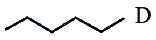
B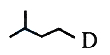
C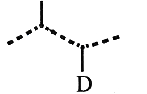
D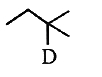
Solution
(D) The hydrolysis of an alkyl bromide $C_5H_{11}Br$ following first-order kinetics indicates an $S_N1$ mechanism,which proceeds via the formation of a stable carbocation. For a $C_5$ alkyl bromide to form a stable carbocation,it is likely a tertiary alkyl bromide,specifically $2$-bromo-$2$-methylbutane.
$1$. Formation of Grignard reagent: $CH_3CH_2C(CH_3)_2Br + Mg \xrightarrow{\text{dry ether}} CH_3CH_2C(CH_3)_2MgBr$.
$2$. Reaction with $D_2O$: The Grignard reagent reacts with $D_2O$ to replace the $MgBr$ group with a deuterium atom $(D)$: $CH_3CH_2C(CH_3)_2MgBr + D_2O \rightarrow CH_3CH_2C(CH_3)_2D + Mg(OD)Br$.
Thus,the product $Y$ is $2$-deuterio-$2$-methylbutane,which matches the structure shown in option $D$.
$1$. Formation of Grignard reagent: $CH_3CH_2C(CH_3)_2Br + Mg \xrightarrow{\text{dry ether}} CH_3CH_2C(CH_3)_2MgBr$.
$2$. Reaction with $D_2O$: The Grignard reagent reacts with $D_2O$ to replace the $MgBr$ group with a deuterium atom $(D)$: $CH_3CH_2C(CH_3)_2MgBr + D_2O \rightarrow CH_3CH_2C(CH_3)_2D + Mg(OD)Br$.
Thus,the product $Y$ is $2$-deuterio-$2$-methylbutane,which matches the structure shown in option $D$.
0 likes
View Solution1064
DifficultMCQ
The product $(C)$ in the following reaction sequence is:
$4-\text{Bromoethylbenzene}$ $\xrightarrow[\Delta]{Br_2} B$ $\xrightarrow{\text{aq. } KOH} C$
$4-\text{Bromoethylbenzene}$ $\xrightarrow[\Delta]{Br_2} B$ $\xrightarrow{\text{aq. } KOH} C$
A
$1-$($4$-Bromophenyl)ethanol
B
$1-$($4$-Hydroxyphenyl)ethanol
C
$4-$Bromostyrene
D
$1-$($4$-Bromophenyl)ethanol
Solution
(D) $1$. The reaction of $4-\text{bromoethylbenzene}$ with $Br_2$ in the presence of heat $(\Delta)$ undergoes free-radical substitution at the benzylic position to form $1-(4-\text{bromophenyl})\text{bromoethane}$ (compound $B$).
$2$. The subsequent reaction of compound $B$ with aqueous $KOH$ is a nucleophilic substitution reaction ($S_N1$ or $S_N2$),where the bromine atom at the benzylic position is replaced by a hydroxyl group $(-OH)$ to form $1-(4-\text{bromophenyl})\text{ethanol}$ (compound $C$).
$2$. The subsequent reaction of compound $B$ with aqueous $KOH$ is a nucleophilic substitution reaction ($S_N1$ or $S_N2$),where the bromine atom at the benzylic position is replaced by a hydroxyl group $(-OH)$ to form $1-(4-\text{bromophenyl})\text{ethanol}$ (compound $C$).
0 likes
View Solution1065
MediumMCQ
In $S_{N}2$ reaction,the carbon in the transition state is
A
Tri coordinated
B
Penta coordinated
C
Tetra coordinated
D
Hexa coordinated
Solution
(B) In an $S_{N}2$ reaction,the nucleophile attacks the carbon atom from the side opposite to the leaving group.
This leads to a transition state where the carbon atom is simultaneously bonded to the incoming nucleophile,the leaving group,and the three other substituents.
As shown in the mechanism,the carbon atom is bonded to $5$ groups in the transition state,making it penta-coordinated.
This leads to a transition state where the carbon atom is simultaneously bonded to the incoming nucleophile,the leaving group,and the three other substituents.
As shown in the mechanism,the carbon atom is bonded to $5$ groups in the transition state,making it penta-coordinated.
0 likes
View Solution1066
MediumMCQ
Which of the following alkyl halides is most reactive towards substitution by the $S_{N}1$ mechanism?
A
$(CH_3)_3C-Br$
B
$(CH_3)_3C-I$
C
$(CH_3)_3C-F$
D
$(CH_3)_3C-Cl$
Solution
(B) The $S_{N}1$ mechanism involves the formation of a carbocation as the rate-determining step.
Since the carbocation formed is the same for all given options $((CH_3)_3C^+)$,the rate of the reaction depends on the ease of leaving group departure.
The bond dissociation energy of the $C-X$ bond decreases as the size of the halogen atom increases $(F < Cl < Br < I)$.
Therefore,the $C-I$ bond is the weakest and breaks most easily.
Thus,$(CH_3)_3C-I$ is the most reactive towards $S_{N}1$ substitution.
Since the carbocation formed is the same for all given options $((CH_3)_3C^+)$,the rate of the reaction depends on the ease of leaving group departure.
The bond dissociation energy of the $C-X$ bond decreases as the size of the halogen atom increases $(F < Cl < Br < I)$.
Therefore,the $C-I$ bond is the weakest and breaks most easily.
Thus,$(CH_3)_3C-I$ is the most reactive towards $S_{N}1$ substitution.
0 likes
View Solution1067
MediumMCQ
The least reactive alkyl chloride in an $S_N2$ reaction is:
A
$1-$Chlorobutane
B
$1-$Chloro$-2-$methylpropane
C
$2-$Chloro$-2-$methylpropane
D
$2-$Chlorobutane
Solution
(C) The $S_N2$ reaction mechanism is a concerted,single-step process where the nucleophile attacks the $\alpha$-carbon from the backside.
Steric hindrance plays a crucial role in determining the rate of the $S_N2$ reaction.
As the number of alkyl groups attached to the $\alpha$-carbon increases,the steric hindrance increases,making the approach of the nucleophile more difficult.
The order of reactivity for $S_N2$ reactions is: $\text{Primary} > \text{Secondary} > \text{Tertiary}$.
$2-$Chloro$-2-$methylpropane is a tertiary alkyl chloride,which provides maximum steric hindrance,making it the least reactive towards $S_N2$ substitution.
Steric hindrance plays a crucial role in determining the rate of the $S_N2$ reaction.
As the number of alkyl groups attached to the $\alpha$-carbon increases,the steric hindrance increases,making the approach of the nucleophile more difficult.
The order of reactivity for $S_N2$ reactions is: $\text{Primary} > \text{Secondary} > \text{Tertiary}$.
$2-$Chloro$-2-$methylpropane is a tertiary alkyl chloride,which provides maximum steric hindrance,making it the least reactive towards $S_N2$ substitution.
0 likes
View Solution1068
MediumMCQ
The major product of the following reaction is:
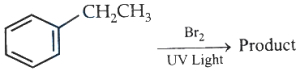
A
$1-$bromo$-1-$phenylethane
B
$2-$bromo$-1-$phenylethane
C
p-bromoethylbenzene
D
o,p-dibromoethylbenzene
Solution
(A) The reaction of ethylbenzene with $Br_2$ in the presence of $UV$ light is a free radical substitution reaction. The bromine radical abstracts a hydrogen atom from the benzylic carbon because the resulting benzylic radical is resonance-stabilized by the phenyl ring. The radical formed at the $\alpha$-carbon (benzylic position) is more stable than the radical at the $\beta$-carbon. Therefore,the major product is $1$-bromo-$1$-phenylethane $(C_6H_5CH(Br)CH_3)$.
0 likes
View Solution1069
MediumMCQ
Among the following organic halides,arrange them in the increasing order of their dehydrohalogenation reactions in the presence of alcoholic $KOH$:
$(A)$ $CH_3-CH_2-Br$
$(B)$ $CH_3-CH_2-CH_2-Br$
$(C)$ $CH_3-CH(Br)-CH_3$
$(D)$ $(CH_3)_3-CBr$
$(A)$ $CH_3-CH_2-Br$
$(B)$ $CH_3-CH_2-CH_2-Br$
$(C)$ $CH_3-CH(Br)-CH_3$
$(D)$ $(CH_3)_3-CBr$
A
$A < B < C < D$
B
$D < B < C < A$
C
$A < C < B < D$
D
$B < A < C < D$
Solution
(A) Dehydrohalogenation via the $E2$ mechanism is favored by the stability of the transition state,which is influenced by the degree of substitution of the alkyl halide. The reactivity order for dehydrohalogenation is $3^{\circ} > 2^{\circ} > 1^{\circ}$ alkyl halides due to the formation of more substituted (stable) alkenes (Saytzeff's rule).
The given compounds are:
$(A)$ $CH_3-CH_2-Br$ ($1^{\circ}$ halide)
$(B)$ $CH_3-CH_2-CH_2-Br$ ($1^{\circ}$ halide)
$(C)$ $CH_3-CH(Br)-CH_3$ ($2^{\circ}$ halide)
$(D)$ $(CH_3)_3-CBr$ ($3^{\circ}$ halide)
Comparing the $1^{\circ}$ halides,$CH_3-CH_2-Br$ is less reactive than $CH_3-CH_2-CH_2-Br$ due to steric and electronic factors. Thus,the increasing order of reactivity is $A < B < C < D$.
The given compounds are:
$(A)$ $CH_3-CH_2-Br$ ($1^{\circ}$ halide)
$(B)$ $CH_3-CH_2-CH_2-Br$ ($1^{\circ}$ halide)
$(C)$ $CH_3-CH(Br)-CH_3$ ($2^{\circ}$ halide)
$(D)$ $(CH_3)_3-CBr$ ($3^{\circ}$ halide)
Comparing the $1^{\circ}$ halides,$CH_3-CH_2-Br$ is less reactive than $CH_3-CH_2-CH_2-Br$ due to steric and electronic factors. Thus,the increasing order of reactivity is $A < B < C < D$.
0 likes
View Solution1070
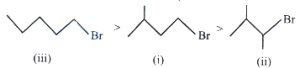
MediumMCQ
Which is the correct order of the following alkyl halides for an $S_{N}2$ reaction?
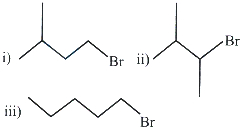
A
$ii > i > iii$
B
$iii > i > ii$
C
$iii > ii > i$
D
$ii > iii > i$
Solution
(B) The reactivity of alkyl halides towards $S_{N}2$ reactions depends on the steric hindrance at the $\alpha$-carbon atom. The order of reactivity is: primary $(1^{\circ})$ > secondary $(2^{\circ})$ > tertiary $(3^{\circ})$.
In the given structures:
(iii) is a primary alkyl halide ($1$-bromopentane).
$(i)$ is a primary alkyl halide ($1$-bromo$-3-$methylbutane),but it has more steric hindrance at the $\beta$-carbon compared to (iii).
(ii) is a secondary alkyl halide ($2$-bromo$-3-$methylbutane).
Therefore,the correct order of reactivity for $S_{N}2$ is $(iii) > (i) > (ii)$.
In the given structures:
(iii) is a primary alkyl halide ($1$-bromopentane).
$(i)$ is a primary alkyl halide ($1$-bromo$-3-$methylbutane),but it has more steric hindrance at the $\beta$-carbon compared to (iii).
(ii) is a secondary alkyl halide ($2$-bromo$-3-$methylbutane).
Therefore,the correct order of reactivity for $S_{N}2$ is $(iii) > (i) > (ii)$.
0 likes
View Solution1071
MediumMCQ
Arrange the following in the correct order of reactivity towards $S_{N}2$ reaction:
$I$: $1$-Chloropropane
$II$: $2$-Chloropropane
$III$: $1$-Iodopropane
$IV$: $2$-Iodopropane
$I$: $1$-Chloropropane
$II$: $2$-Chloropropane
$III$: $1$-Iodopropane
$IV$: $2$-Iodopropane
A
$III > I > IV > II$
B
$III > IV > I > II$
C
$I > II > III > IV$
D
$I > III > II > IV$
Solution
(A) $S_{N}2$ reactivity depends on two main factors: steric hindrance at the $\alpha$-carbon and the strength of the $C-X$ bond.
$1$. Steric hindrance: Primary alkyl halides $(1^{\circ})$ are more reactive than secondary alkyl halides $(2^{\circ})$ due to less steric crowding. Thus,$1$-substituted compounds $(I, III)$ are more reactive than $2$-substituted compounds $(II, IV)$.
$2$. Leaving group ability: The $C-I$ bond is weaker and longer than the $C-Cl$ bond,making $I^-$ a better leaving group than $Cl^-$. Therefore,iodides are more reactive than chlorides.
Combining these factors,the order of reactivity is:
$1$-Iodopropane $(III)$ > $1$-Chloropropane $(I)$ > $2$-Iodopropane $(IV)$ > $2$-Chloropropane $(II)$
Therefore,the correct order is $III > I > IV > II$.
$1$. Steric hindrance: Primary alkyl halides $(1^{\circ})$ are more reactive than secondary alkyl halides $(2^{\circ})$ due to less steric crowding. Thus,$1$-substituted compounds $(I, III)$ are more reactive than $2$-substituted compounds $(II, IV)$.
$2$. Leaving group ability: The $C-I$ bond is weaker and longer than the $C-Cl$ bond,making $I^-$ a better leaving group than $Cl^-$. Therefore,iodides are more reactive than chlorides.
Combining these factors,the order of reactivity is:
$1$-Iodopropane $(III)$ > $1$-Chloropropane $(I)$ > $2$-Iodopropane $(IV)$ > $2$-Chloropropane $(II)$
Therefore,the correct order is $III > I > IV > II$.
0 likes
View Solution1072
DifficultMCQ
When $1-$chlorobutane is treated with aqueous $KOH$,it gives $P$. However,when it is treated with alcoholic $KOH$,it gives $Q$. Identify the products $P$ and $Q$ respectively.
A
$P = \text{butan-}1\text{-ol}, Q = \text{butan-}1\text{-ol}$
B
$P = \text{but-}1\text{-ene}, Q = \text{but-}2\text{-ene}$
C
$P = \text{but-}1\text{-ene}, Q = \text{butan-}1\text{-ol}$
D
$P = \text{butan-}1\text{-ol}, Q = \text{but-}1\text{-ene}$
Solution
(D) In the presence of aqueous $KOH$,$1-$chlorobutane undergoes nucleophilic substitution ($S_{N}2$ mechanism) to form butan$-1-$ol.
Alcoholic $KOH$ contains $RO^-$ ions which act as a strong base. It abstracts a $\beta$-hydrogen atom,leading to a dehydrohalogenation reaction (elimination reaction).
Hence,in the presence of alcoholic $KOH$,$1-$chlorobutane undergoes $\beta$-elimination to form but$-1-$ene.
Alcoholic $KOH$ contains $RO^-$ ions which act as a strong base. It abstracts a $\beta$-hydrogen atom,leading to a dehydrohalogenation reaction (elimination reaction).
Hence,in the presence of alcoholic $KOH$,$1-$chlorobutane undergoes $\beta$-elimination to form but$-1-$ene.
0 likes
View Solution1073
MediumMCQ
The major product of the following reaction is:
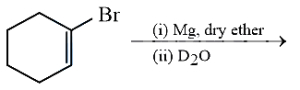
A
Cyclohexene with an $-OD$ group attached to the double bond.
B
Cyclohexanone derivative with $-OD$ and $-D$ groups.
C
Cyclohexene with a $-D$ group attached at the $3$-position.
D
Cyclohexene with a $-D$ group attached to the double bond.
Solution
(D) The reaction proceeds in two steps:
$1$. Formation of the Grignard reagent: Bromocyclohexene reacts with $Mg$ in the presence of dry ether to form cyclohex$-1-$enylmagnesium bromide $(C_6H_9MgBr)$.
$2$. Reaction with heavy water $(D_2O)$: The Grignard reagent acts as a strong nucleophile and reacts with $D_2O$ to replace the $-MgBr$ group with a deuterium atom $(-D)$.
The overall reaction is: $C_6H_9Br + Mg$ $\xrightarrow{\text{dry ether}} C_6H_9MgBr$ $\xrightarrow{D_2O} C_6H_9D$.
$1$. Formation of the Grignard reagent: Bromocyclohexene reacts with $Mg$ in the presence of dry ether to form cyclohex$-1-$enylmagnesium bromide $(C_6H_9MgBr)$.
$2$. Reaction with heavy water $(D_2O)$: The Grignard reagent acts as a strong nucleophile and reacts with $D_2O$ to replace the $-MgBr$ group with a deuterium atom $(-D)$.
The overall reaction is: $C_6H_9Br + Mg$ $\xrightarrow{\text{dry ether}} C_6H_9MgBr$ $\xrightarrow{D_2O} C_6H_9D$.
0 likes
View Solution1074
MediumMCQ
Assertion $(A)$: $1-$Bromopentane reacts with $AgCN$ to give pentylisocyanide.
Reason $(R)$: $AgCN$ is mainly ionic in nature.
Reason $(R)$: $AgCN$ is mainly ionic in nature.
A
$A$ is true,$R$ is true and $R$ is correct explanation of $A$
B
$A$ is true,$R$ is true but $R$ is not correct explanation of $A$
C
$A$ is true,$R$ is false
D
$A$ is false,$R$ is true
Solution
(C) $AgCN$ is covalent in nature,not ionic.
Because of its covalent nature,the nitrogen atom is the only nucleophilic site available to attack the alkyl halide,leading to the formation of isocyanide $(R-NC)$.
In contrast,$KCN$ is ionic and provides the cyanide ion $(CN^-)$,which attacks via the carbon atom to form cyanide $(R-CN)$.
Therefore,the Assertion $(A)$ is true,but the Reason $(R)$ is false.
Because of its covalent nature,the nitrogen atom is the only nucleophilic site available to attack the alkyl halide,leading to the formation of isocyanide $(R-NC)$.
In contrast,$KCN$ is ionic and provides the cyanide ion $(CN^-)$,which attacks via the carbon atom to form cyanide $(R-CN)$.
Therefore,the Assertion $(A)$ is true,but the Reason $(R)$ is false.
0 likes
View Solution1075
MediumMCQ
The rate of $S_N1$ reaction will be faster for which of the following bromides?
A
$Ph_2CHBr$
B
$Ph-C_6H_4-CH_2Br$
C
$Ph-CH(CH_3)Br$
D
$CH_3-CH(CH_3)Br$
Solution
(A) The rate of $S_N1$ reaction depends on the stability of the carbocation intermediate formed in the rate-determining step.
In $Ph_2CHBr$,the carbocation formed is $Ph_2CH^+$,which is a benzhydryl carbocation. This carbocation is highly stabilized by resonance delocalization of the positive charge over two benzene rings.
Comparing the stability of carbocations:
$1$. $Ph_2CH^+$ (benzhydryl,stabilized by two phenyl rings)
$2$. $Ph-C_6H_4-CH_2^+$ (stabilized by one phenyl ring)
$3$. $Ph-CH^+(CH_3)$ (secondary benzylic,stabilized by one phenyl ring)
$4$. $(CH_3)_2CH^+$ (secondary alkyl,no resonance stabilization)
The $Ph_2CH^+$ carbocation is the most stable among the given options,therefore $Ph_2CHBr$ will undergo $S_N1$ reaction the fastest.
In $Ph_2CHBr$,the carbocation formed is $Ph_2CH^+$,which is a benzhydryl carbocation. This carbocation is highly stabilized by resonance delocalization of the positive charge over two benzene rings.
Comparing the stability of carbocations:
$1$. $Ph_2CH^+$ (benzhydryl,stabilized by two phenyl rings)
$2$. $Ph-C_6H_4-CH_2^+$ (stabilized by one phenyl ring)
$3$. $Ph-CH^+(CH_3)$ (secondary benzylic,stabilized by one phenyl ring)
$4$. $(CH_3)_2CH^+$ (secondary alkyl,no resonance stabilization)
The $Ph_2CH^+$ carbocation is the most stable among the given options,therefore $Ph_2CHBr$ will undergo $S_N1$ reaction the fastest.
0 likes
View Solution1076
EasyMCQ
The reaction of $1$-bromohexane with aqueous $NaOH$ solution follows the order
A
zero order kinetics
B
first order kinetics
C
second order kinetics
D
third order kinetics
Solution
(C) The reaction of $1$-bromohexane with aqueous $NaOH$ is a nucleophilic substitution reaction.
Since $1$-bromohexane is a primary alkyl halide,the reaction proceeds via the $S_N2$ mechanism.
In an $S_N2$ mechanism,the rate of reaction depends on the concentration of both the substrate ($1$-bromohexane) and the nucleophile $(OH^-)$.
Therefore,the rate law is $Rate = k[CH_3(CH_2)_5Br][OH^-]$.
This indicates that the reaction follows second order kinetics.
Since $1$-bromohexane is a primary alkyl halide,the reaction proceeds via the $S_N2$ mechanism.
In an $S_N2$ mechanism,the rate of reaction depends on the concentration of both the substrate ($1$-bromohexane) and the nucleophile $(OH^-)$.
Therefore,the rate law is $Rate = k[CH_3(CH_2)_5Br][OH^-]$.
This indicates that the reaction follows second order kinetics.
0 likes
View Solution1077
EasyMCQ
Identify the major product formed when propene is treated with hydrogen chloride followed by Swarts reaction.
A
$1-$fluoropropane
B
$1-$nitropropane
C
$2-$fluoropropane
D
$2-$nitropropane
Solution
(C) Propene $(CH_3-CH=CH_2)$ reacts with $HCl$ according to Markovnikov's rule to form $2-$chloropropane $(CH_3-CHCl-CH_3)$.
$2-$chloropropane then undergoes the Swarts reaction (using reagents like $SbF_3$ or $AgF$) to replace the chlorine atom with a fluorine atom,resulting in the formation of $2-$fluoropropane $(CH_3-CHF-CH_3)$.
$2-$chloropropane then undergoes the Swarts reaction (using reagents like $SbF_3$ or $AgF$) to replace the chlorine atom with a fluorine atom,resulting in the formation of $2-$fluoropropane $(CH_3-CHF-CH_3)$.
0 likes
View Solution1078
EasyMCQ
$S_N1$ reactions are generally carried out in which type of solvents?
A
Polar aprotic solvent.
B
Non-polar aprotic solvent.
C
Polar protic solvent.
D
Non-polar protic solvent.
Solution
(C) polar protic solvent favours $S_N1$ mechanism.
Polar protic solvents stabilise the carbocation formed as an intermediate through solvation and also stabilise the leaving group,thereby facilitating the ionisation step.
Additionally,they reduce the reactivity of the nucleophile by hydrogen bonding,which prevents it from attacking the substrate before the carbocation is formed.
Polar protic solvents stabilise the carbocation formed as an intermediate through solvation and also stabilise the leaving group,thereby facilitating the ionisation step.
Additionally,they reduce the reactivity of the nucleophile by hydrogen bonding,which prevents it from attacking the substrate before the carbocation is formed.
0 likes
View Solution1079
EasyMCQ
The rate of reaction of $t-$butyl bromide and $NaOH$ in water depends on the concentration of
A
both $t-$butyl bromide and $NaOH$
B
$NaOH$
C
independent of concentration
D
$t-$butyl bromide
Solution
(D) The hydrolysis of $t-$butyl bromide with aqueous $NaOH$ is an example of an $S_N1$ reaction.
Step $I$: The formation of the carbocation is the slow step and therefore the rate-determining step.
$(CH_3)_3C-Br \rightarrow (CH_3)_3C^+ + Br^-$
Step $II$: The nucleophile $(OH^-)$ attacks the carbocation in a fast step.
$(CH_3)_3C^+ + OH^- \rightarrow (CH_3)_3C-OH$
Since the rate-determining step involves only the $t-$butyl bromide molecule,the rate of the reaction depends only on the concentration of $t-$butyl bromide.
Step $I$: The formation of the carbocation is the slow step and therefore the rate-determining step.
$(CH_3)_3C-Br \rightarrow (CH_3)_3C^+ + Br^-$
Step $II$: The nucleophile $(OH^-)$ attacks the carbocation in a fast step.
$(CH_3)_3C^+ + OH^- \rightarrow (CH_3)_3C-OH$
Since the rate-determining step involves only the $t-$butyl bromide molecule,the rate of the reaction depends only on the concentration of $t-$butyl bromide.
0 likes
View Solution1080
MediumMCQ
Which among the following is most reactive via $S_N2$ mechanism?
A
$3-$bromo$-2-$methylpentane
B
$1-$bromo$-3-$methylbutane
C
$2-$bromo$-3,3-$dimethylbutane
D
$3-$bromopentane
Solution
(B) The reactivity of alkyl halides towards $S_N2$ mechanism follows the order: $Primary > Secondary > Tertiary$.
This order is primarily governed by steric hindrance,where less hindered substrates are more reactive.
- Option $A$ is a secondary alkyl halide.
- Option $B$ is a primary alkyl halide $(CH_3-CH(CH_3)-CH_2-CH_2-Br)$.
- Option $C$ is a secondary alkyl halide with significant steric hindrance.
- Option $D$ is a secondary alkyl halide.
Since $S_N2$ reactions are highly sensitive to steric bulk,the primary alkyl halide in option $B$ is the most reactive.
This order is primarily governed by steric hindrance,where less hindered substrates are more reactive.
- Option $A$ is a secondary alkyl halide.
- Option $B$ is a primary alkyl halide $(CH_3-CH(CH_3)-CH_2-CH_2-Br)$.
- Option $C$ is a secondary alkyl halide with significant steric hindrance.
- Option $D$ is a secondary alkyl halide.
Since $S_N2$ reactions are highly sensitive to steric bulk,the primary alkyl halide in option $B$ is the most reactive.
0 likes
View Solution1081
MediumMCQ
Identify the starting compound '$P$' in the following reaction.
$P \stackrel{Na / \text{dry ether}}{\longrightarrow} (H_3C)_2CHCH_2CH_2CH(CH_3)_2$
$P \stackrel{Na / \text{dry ether}}{\longrightarrow} (H_3C)_2CHCH_2CH_2CH(CH_3)_2$
A
$1-$Bromo$-2-$methylpropane
B
$1-$Bromobutane
C
$2-$Bromopropene
D
$2-$Bromobutane
Solution
(A) The given reaction is the Wurtz reaction,where two molecules of an alkyl halide react with sodium metal in the presence of dry ether to form a symmetrical alkane.
The product is $2,5-$dimethylhexane,which has the structure $(H_3C)_2CHCH_2CH_2CH(CH_3)_2$.
This alkane is formed by the coupling of two $1-$bromo$-2-$methylpropane units $(CH_3CH(CH_3)CH_2Br)$.
Therefore,the starting compound '$P$' is $1-$bromo$-2-$methylpropane.
The product is $2,5-$dimethylhexane,which has the structure $(H_3C)_2CHCH_2CH_2CH(CH_3)_2$.
This alkane is formed by the coupling of two $1-$bromo$-2-$methylpropane units $(CH_3CH(CH_3)CH_2Br)$.
Therefore,the starting compound '$P$' is $1-$bromo$-2-$methylpropane.
0 likes
View Solution1082
MediumMCQ
Which among the following is most common in alkyl halides?
A
Nucleophilic substitution
B
Electrophilic substitution
C
Electrophilic addition
D
Nucleophilic addition
Solution
(A) Alkyl halides readily undergo nucleophilic substitution reactions like $S_{N}2$ and $S_{N}1$.
In these reactions,a stronger nucleophile $(Nu^{\ominus})$ substitutes a weaker nucleophile (the leaving group,$X^{-}$) from an alkyl halide $(R-X)$.
The general reaction is: $R-X + Nu^{\ominus} \rightarrow R-Nu + X^{-}$.
In these reactions,a stronger nucleophile $(Nu^{\ominus})$ substitutes a weaker nucleophile (the leaving group,$X^{-}$) from an alkyl halide $(R-X)$.
The general reaction is: $R-X + Nu^{\ominus} \rightarrow R-Nu + X^{-}$.
0 likes
View Solution1083
MediumMCQ
What is the product of the reaction given below?
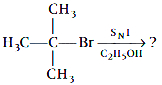
A
$CH_3-CH_2-CH_2-OC_2H_5$
B
$CH_3-C(CH_3)_2-OC_2H_5$
C
$CH_3-CH(CH_3)-CH(CH_3)-OC_2H_5$
D
$CH_3-C(CH_3)_2-OH$
Solution
(B) The reaction involves the solvolysis of $2$-bromo-$2$-methylpropane in ethanol $(C_2H_5OH)$.
This is an $S_N1$ reaction.
Step $1$: The $C-Br$ bond breaks to form a stable $3^{\circ}$ carbocation,$(CH_3)_3C^+$.
Step $2$: The nucleophile,which is the solvent ethanol $(C_2H_5OH)$,attacks the $3^{\circ}$ carbocation.
This leads to the formation of an ether,$(CH_3)_3C-OC_2H_5$ (tert-butyl ethyl ether),as the major product.
This is an $S_N1$ reaction.
Step $1$: The $C-Br$ bond breaks to form a stable $3^{\circ}$ carbocation,$(CH_3)_3C^+$.
Step $2$: The nucleophile,which is the solvent ethanol $(C_2H_5OH)$,attacks the $3^{\circ}$ carbocation.
This leads to the formation of an ether,$(CH_3)_3C-OC_2H_5$ (tert-butyl ethyl ether),as the major product.
0 likes
View Solution1084
EasyMCQ
The increasing order of densities of the following alkyl halides is:
$(I)$ $n-C_3H_7Br$
$(II)$ $n-C_3H_7Cl$
$(III)$ $n-C_3H_7I$
$(I)$ $n-C_3H_7Br$
$(II)$ $n-C_3H_7Cl$
$(III)$ $n-C_3H_7I$
A
$(II) < (I) < (III)$
B
$(III) < (I) < (II)$
C
$(I) < (II) < (III)$
D
$(III) < (II) < (I)$
Solution
(A) For the same alkyl group,the density of alkyl halides increases with the increase in the atomic mass of the halogen atom.
The order of atomic masses of halogens is $Cl < Br < I$.
Therefore,the order of density is $n-C_3H_7Cl < n-C_3H_7Br < n-C_3H_7I$,which corresponds to $(II) < (I) < (III)$.
The order of atomic masses of halogens is $Cl < Br < I$.
Therefore,the order of density is $n-C_3H_7Cl < n-C_3H_7Br < n-C_3H_7I$,which corresponds to $(II) < (I) < (III)$.
0 likes
View Solution1085
MediumMCQ
Which of the following undergoes nucleophilic substitution exclusively by $S_N1$ mechanism?
A
Ethyl chloride
B
Isopropyl chloride
C
Chlorobenzene
D
Benzyl chloride
Solution
(D) $S_N1$ mechanism proceeds via the formation of a carbocation intermediate. The stability of the carbocation determines the reactivity.
Benzyl chloride $(C_6H_5CH_2Cl)$ forms a benzyl carbocation $(C_6H_5CH_2^+)$,which is highly stabilized by resonance with the benzene ring.
Ethyl chloride $(CH_3CH_2Cl)$ and isopropyl chloride $(CH_3CHClCH_3)$ primarily undergo $S_N2$ or a mixture of $S_N1/S_N2$ mechanisms depending on conditions,but they are not exclusive $S_N1$ substrates.
Chlorobenzene does not undergo nucleophilic substitution under normal conditions due to partial double bond character in the $C-Cl$ bond.
Therefore,benzyl chloride is the correct answer as it forms a stable carbocation.
Benzyl chloride $(C_6H_5CH_2Cl)$ forms a benzyl carbocation $(C_6H_5CH_2^+)$,which is highly stabilized by resonance with the benzene ring.
Ethyl chloride $(CH_3CH_2Cl)$ and isopropyl chloride $(CH_3CHClCH_3)$ primarily undergo $S_N2$ or a mixture of $S_N1/S_N2$ mechanisms depending on conditions,but they are not exclusive $S_N1$ substrates.
Chlorobenzene does not undergo nucleophilic substitution under normal conditions due to partial double bond character in the $C-Cl$ bond.
Therefore,benzyl chloride is the correct answer as it forms a stable carbocation.
0 likes
View Solution1086
EasyMCQ
Arrange the following organic halides in the correct order of reactivity towards $S_{N}2$ displacement:
$(P) \ (CH_3)_2C(Br)CH_2CH_3$
$(Q) \ BrCH_2(CH_2)_3CH_3$
$(R) \ CH_3CH(Br)(CH_2)_2CH_3$
$(P) \ (CH_3)_2C(Br)CH_2CH_3$
$(Q) \ BrCH_2(CH_2)_3CH_3$
$(R) \ CH_3CH(Br)(CH_2)_2CH_3$
A
$P > Q > R$
B
$R > P > Q$
C
$P > R > Q$
D
$Q > R > P$
Solution
(D) The reactivity of alkyl halides towards $S_{N}2$ reactions depends on the steric hindrance around the electrophilic carbon atom.
$S_{N}2$ reactivity order is: $1^{\circ} > 2^{\circ} > 3^{\circ}$ alkyl halide.
$(P) \ (CH_3)_2C(Br)CH_2CH_3$ is a $3^{\circ}$ alkyl halide (highly sterically hindered).
$(Q) \ BrCH_2(CH_2)_3CH_3$ is a $1^{\circ}$ alkyl halide (least sterically hindered).
$(R) \ CH_3CH(Br)(CH_2)_2CH_3$ is a $2^{\circ}$ alkyl halide.
Therefore,the correct order of reactivity is $Q > R > P$.
$S_{N}2$ reactivity order is: $1^{\circ} > 2^{\circ} > 3^{\circ}$ alkyl halide.
$(P) \ (CH_3)_2C(Br)CH_2CH_3$ is a $3^{\circ}$ alkyl halide (highly sterically hindered).
$(Q) \ BrCH_2(CH_2)_3CH_3$ is a $1^{\circ}$ alkyl halide (least sterically hindered).
$(R) \ CH_3CH(Br)(CH_2)_2CH_3$ is a $2^{\circ}$ alkyl halide.
Therefore,the correct order of reactivity is $Q > R > P$.
0 likes
View Solution1087
MediumMCQ
What are $X$ and $Y$ in the following reaction sequence?
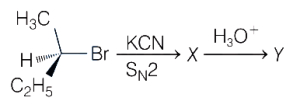
A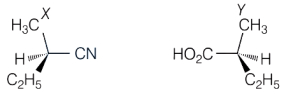
B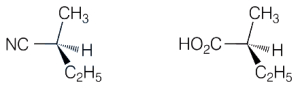
C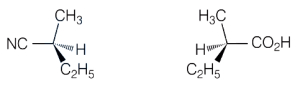
D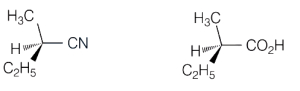
Solution
(C) The given reaction proceeds as follows:
$1$. The starting material is a chiral $2^{\circ}$ haloalkane,specifically $(S)-2-$bromobutane.
$2$. The reaction with $KCN$ proceeds via an $S_{N}2$ mechanism. The nucleophile $CN^-$ attacks from the side opposite to the leaving group $(Br^-)$,resulting in a Walden inversion of the configuration at the chiral center.
$3$. This produces $(R)-2-$methylbutanenitrile as product $X$.
$4$. Subsequent acid-catalyzed hydrolysis of the nitrile group $(-CN)$ converts it into a carboxylic acid group $(-COOH)$ without affecting the chiral center. Thus,the configuration remains inverted relative to the starting material,yielding $(R)-2-$methylbutanoic acid as product $Y$.
$5$. Comparing this with the given options,option $C$ correctly represents the structures of $X$ and $Y$.
$1$. The starting material is a chiral $2^{\circ}$ haloalkane,specifically $(S)-2-$bromobutane.
$2$. The reaction with $KCN$ proceeds via an $S_{N}2$ mechanism. The nucleophile $CN^-$ attacks from the side opposite to the leaving group $(Br^-)$,resulting in a Walden inversion of the configuration at the chiral center.
$3$. This produces $(R)-2-$methylbutanenitrile as product $X$.
$4$. Subsequent acid-catalyzed hydrolysis of the nitrile group $(-CN)$ converts it into a carboxylic acid group $(-COOH)$ without affecting the chiral center. Thus,the configuration remains inverted relative to the starting material,yielding $(R)-2-$methylbutanoic acid as product $Y$.
$5$. Comparing this with the given options,option $C$ correctly represents the structures of $X$ and $Y$.
0 likes
View SolutionHaloalkanes and Haloarenes — Properties of Haloalkanes · Frequently Asked Questions
1Are these Haloalkanes and Haloarenes questions useful for JEE and NEET?
Yes. All questions in this section are mapped to JEE Main and NEET exam patterns. Previous year questions from JEE Main, NEET, GUJCET and state-level exams are included with full solutions.
2Can I switch to Hindi or Gujarati for these questions?
Yes. Use the language tabs in the hero section or the sidebar to view the same questions and solutions in English, Hindi or Gujarati.
3How do I generate a question paper from this subtopic?
Use the Vedclass Exam Paper Generator — select the chapter and subtopic, set difficulty, and generate Sets A, B, C, D automatically. First 3 chapters of every subject are free.
Vedclass Products
For Students
Vedclass Test Series
Mock tests in real JEE/NEET style with performance analysis. 5-day free trial.
Start Free TrialFor Teachers
Exam Paper Generator
Generate Set A/B/C/D papers from this chapter in 2 minutes. 3 chapters free.
Try FreeFor Institutes
Online Exam Module
Live online exams with unlimited students, 360° analytics & white-label branding.
See DemoFor Teachers & Institutes
Generate a Haloalkanes and Haloarenes Exam Paper in 2 Minutes
Select subtopic & difficulty — Sets A, B, C, D auto-generated with No Repeat logic.
First 3 chapters of every subject are free — no payment required.