
A English
Conductor and Conductance and Cell constant Questions in English
Class 12 Chemistry · Electrochemistry · Conductor and Conductance and Cell constant
419+
Questions
English
Language
100%
With Solutions
Showing 50 of 419 questions in English
201
MediumMCQ
How is the cell constant determined?
A
By measuring the resistance of the cell containing a solution of known conductivity.
B
By measuring the resistance of the cell containing a solution of unknown conductivity.
C
By measuring the length and area of the electrodes.
D
By measuring the potential difference across the cell.
Solution
(A) The cell constant $(G^*)$ is defined as the ratio of the distance between the electrodes $(l)$ to the area of cross-section of the electrodes $(A)$,i.e.,$G^* = l/A$.
Since it is difficult to measure $l$ and $A$ accurately for many cells,the cell constant is determined by measuring the resistance $(R)$ of the cell when filled with a standard solution of known conductivity $(\kappa)$,such as $KCl$ solution.
The relationship is given by: $\kappa = G^* / R$,which implies $G^* = \kappa \times R$.
Since it is difficult to measure $l$ and $A$ accurately for many cells,the cell constant is determined by measuring the resistance $(R)$ of the cell when filled with a standard solution of known conductivity $(\kappa)$,such as $KCl$ solution.
The relationship is given by: $\kappa = G^* / R$,which implies $G^* = \kappa \times R$.
0 likes
View Solution202
Medium
Between $AC$ and $DC$ current,which one is used to determine the conductivity of an electrolytic solution? Why?
Solution
(N/A) For determining the conductivity of an electrolytic solution,$AC$ (Alternating Current) is used instead of $DC$ (Direct Current).
This is because $DC$ causes electrolysis,which leads to a change in the concentration of the solution near the electrodes.
This change in concentration results in polarization effects,making it difficult to measure the true resistance of the solution.
$AC$ prevents these changes in concentration and polarization,allowing for an accurate measurement of the solution's conductivity.
This is because $DC$ causes electrolysis,which leads to a change in the concentration of the solution near the electrodes.
This change in concentration results in polarization effects,making it difficult to measure the true resistance of the solution.
$AC$ prevents these changes in concentration and polarization,allowing for an accurate measurement of the solution's conductivity.
0 likes
View Solution203
MediumMCQ
What benefit do we get by forming a thin layer of $Pt$ particles on the electrodes of a conductivity cell?
A
It increases the surface area of the electrodes.
B
It decreases the resistance of the cell.
C
It prevents the corrosion of the electrodes.
D
It makes the electrodes inert.
Solution
(A) In a conductivity cell,the electrodes are typically made of platinum $(Pt)$ coated with finely divided platinum black.
This coating of $Pt$ particles significantly increases the effective surface area of the electrodes.
By increasing the surface area,the polarization effect at the electrode-electrolyte interface is minimized,which ensures more accurate and stable measurements of the electrolytic conductivity.
This coating of $Pt$ particles significantly increases the effective surface area of the electrodes.
By increasing the surface area,the polarization effect at the electrode-electrolyte interface is minimized,which ensures more accurate and stable measurements of the electrolytic conductivity.
0 likes
View Solution204
MediumMCQ
$0.0129 \ S \ cm^{-1}$ is equivalent to how many $S \ m^{-1}$ (in $S \ m^{-1}$)?
A
$0.129$
B
$1.29$
C
$12.9$
D
$129$
Solution
(B) To convert $S \ cm^{-1}$ to $S \ m^{-1}$,we use the conversion factor $1 \ cm = 10^{-2} \ m$.
Therefore,$1 \ cm^{-1} = (10^{-2} \ m)^{-1} = 10^2 \ m^{-1} = 100 \ m^{-1}$.
Given value: $0.0129 \ S \ cm^{-1}$.
Calculation: $0.0129 \ S \ cm^{-1} = 0.0129 \times 100 \ S \ m^{-1} = 1.29 \ S \ m^{-1}$.
Therefore,$1 \ cm^{-1} = (10^{-2} \ m)^{-1} = 10^2 \ m^{-1} = 100 \ m^{-1}$.
Given value: $0.0129 \ S \ cm^{-1}$.
Calculation: $0.0129 \ S \ cm^{-1} = 0.0129 \times 100 \ S \ m^{-1} = 1.29 \ S \ m^{-1}$.
0 likes
View Solution205
Medium
Write the formula to calculate conductivity by using a conductivity cell.
Solution
(N/A) The conductivity $(\kappa)$ is calculated using the formula: $\kappa = G \times G^*$.
Here,$G$ is the conductance,which is the reciprocal of resistance $(G = \frac{1}{R})$,and $G^*$ is the cell constant,defined as the ratio of the distance between electrodes $(l)$ to the area of cross-section $(A)$,i.e.,$G^* = \frac{l}{A}$.
Here,$G$ is the conductance,which is the reciprocal of resistance $(G = \frac{1}{R})$,and $G^*$ is the cell constant,defined as the ratio of the distance between electrodes $(l)$ to the area of cross-section $(A)$,i.e.,$G^* = \frac{l}{A}$.
0 likes
View Solution206
MediumMCQ
$0.01\, S\, m^2\, mol^{-1} = $ ....... $S\, cm^2\, mol^{-1}$
A
$1$
B
$10$
C
$100$
D
$0.1$
Solution
(C) We know that $1\, m = 100\, cm$.
Therefore,$1\, m^2 = (100\, cm)^2 = 10000\, cm^2 = 10^4\, cm^2$.
Given value is $0.01\, S\, m^2\, mol^{-1}$.
Substituting the conversion factor: $0.01 \times 10^4\, S\, cm^2\, mol^{-1}$.
$= 10^{-2} \times 10^4\, S\, cm^2\, mol^{-1} = 10^2\, S\, cm^2\, mol^{-1} = 100\, S\, cm^2\, mol^{-1}$.
Therefore,$1\, m^2 = (100\, cm)^2 = 10000\, cm^2 = 10^4\, cm^2$.
Given value is $0.01\, S\, m^2\, mol^{-1}$.
Substituting the conversion factor: $0.01 \times 10^4\, S\, cm^2\, mol^{-1}$.
$= 10^{-2} \times 10^4\, S\, cm^2\, mol^{-1} = 10^2\, S\, cm^2\, mol^{-1} = 100\, S\, cm^2\, mol^{-1}$.
0 likes
View Solution207
EasyMCQ
What is the mathematical relationship between the radius $(r)$ of a cylindrical conductor and its cross-sectional area $(A)$?
A
$A = \pi r$
B
$A = \pi r^2$
C
$A = 2 \pi r$
D
$A = \pi r^3$
Solution
(B) The cross-sectional area $(A)$ of a cylindrical conductor is the area of the circle formed by its cross-section.
For a circle with radius $(r)$,the area is given by the formula $A = \pi r^2$.
For a circle with radius $(r)$,the area is given by the formula $A = \pi r^2$.
0 likes
View Solution208
EasyMCQ
When is the conductance $G$ equal to the conductivity $k$?
A
When the cell constant is $1 \ cm^{-1}$
B
When the area of cross-section is $1 \ cm^2$ and length is $1 \ cm$
C
When the volume of the solution is $1 \ cm^3$
D
All of the above
Solution
(D) The relationship between conductance $(G)$ and conductivity $(k)$ is given by the formula: $G = k \times (A/l)$,where $A$ is the area of cross-section and $l$ is the length of the conductor.
For $G = k$,the cell constant $(l/A)$ must be equal to $1 \ cm^{-1}$.
This occurs when the area of cross-section $A = 1 \ cm^2$ and the length $l = 1 \ cm$.
Since these conditions define a unit cube of solution,the volume is $1 \ cm^3$.
Therefore,all the given options are correct.
For $G = k$,the cell constant $(l/A)$ must be equal to $1 \ cm^{-1}$.
This occurs when the area of cross-section $A = 1 \ cm^2$ and the length $l = 1 \ cm$.
Since these conditions define a unit cube of solution,the volume is $1 \ cm^3$.
Therefore,all the given options are correct.
0 likes
View Solution209
Medium
Define $\Lambda _m = \frac{\kappa \times 1000}{C}$ where $C$ is concentration in $mol \ L^{-1}$ and $\kappa$ is conductivity in $S \ cm^{-1}$.
Solution
(N/A) The term $\Lambda _m$ represents the molar conductivity of an electrolytic solution.
It is defined as the conducting power of all the ions produced by dissolving one mole of an electrolyte in a solution of volume $V \ mL$.
In the given formula,$\kappa$ is the conductivity (specific conductance) in $S \ cm^{-1}$,$C$ is the molar concentration in $mol \ L^{-1}$,and the factor $1000$ is used to convert the concentration from $mol \ L^{-1}$ to $mol \ cm^{-3}$ (since $1 \ L = 1000 \ cm^3$).
It is defined as the conducting power of all the ions produced by dissolving one mole of an electrolyte in a solution of volume $V \ mL$.
In the given formula,$\kappa$ is the conductivity (specific conductance) in $S \ cm^{-1}$,$C$ is the molar concentration in $mol \ L^{-1}$,and the factor $1000$ is used to convert the concentration from $mol \ L^{-1}$ to $mol \ cm^{-3}$ (since $1 \ L = 1000 \ cm^3$).
0 likes
View Solution210
MediumMCQ
What is the relation between the concentration of solution and molar conductivity $(\Lambda_m)$?
A
$\Lambda_m$ increases with an increase in concentration.
B
$\Lambda_m$ decreases with an increase in concentration.
C
$\Lambda_m$ remains constant with an increase in concentration.
D
$\Lambda_m$ is independent of concentration.
Solution
(B) Molar conductivity $(\Lambda_m)$ is defined as the conducting power of all the ions produced by dissolving one mole of an electrolyte in a solution of volume $V$.
As the concentration of the solution increases,the number of ions per unit volume increases,but the volume of the solution containing one mole of electrolyte decreases.
Due to the decrease in volume and increased inter-ionic attractions at higher concentrations,the mobility of ions decreases.
Consequently,the molar conductivity $(\Lambda_m)$ decreases with an increase in the concentration of the solution.
As the concentration of the solution increases,the number of ions per unit volume increases,but the volume of the solution containing one mole of electrolyte decreases.
Due to the decrease in volume and increased inter-ionic attractions at higher concentrations,the mobility of ions decreases.
Consequently,the molar conductivity $(\Lambda_m)$ decreases with an increase in the concentration of the solution.
0 likes
View Solution211
DifficultMCQ
Identify True $(T)$ or False $(F)$ for the following statements :
$(i)$ As concentration of solution is more,conductivity is less.
$(ii)$ As concentration of solution is less,conductivity is more.
$(iii)$ As temperature is less,conductivity is more.
$(i)$ As concentration of solution is more,conductivity is less.
$(ii)$ As concentration of solution is less,conductivity is more.
$(iii)$ As temperature is less,conductivity is more.
A
$(i) T, (ii) F, (iii) T$
B
$(i) F, (ii) T, (iii) F$
C
$(i) F, (ii) F, (iii) T$
D
$(i) F, (ii) F, (iii) F$
Solution
(D) $(i)$ Conductivity $(\kappa)$ is defined as the conductance of $1 \ cm^3$ of solution. As concentration increases,the number of ions per unit volume increases,so conductivity increases. Thus,statement $(i)$ is False.
$(ii)$ As concentration decreases,the number of ions per unit volume decreases,so conductivity decreases. Thus,statement $(ii)$ is False.
$(iii)$ As temperature increases,the kinetic energy of ions increases and the viscosity of the solvent decreases,which increases the mobility of ions,thereby increasing conductivity. Conversely,if temperature is less,conductivity is less. Thus,statement $(iii)$ is False.
Therefore,all statements are False.
$(ii)$ As concentration decreases,the number of ions per unit volume decreases,so conductivity decreases. Thus,statement $(ii)$ is False.
$(iii)$ As temperature increases,the kinetic energy of ions increases and the viscosity of the solvent decreases,which increases the mobility of ions,thereby increasing conductivity. Conversely,if temperature is less,conductivity is less. Thus,statement $(iii)$ is False.
Therefore,all statements are False.
0 likes
View Solution212
DifficultMCQ
Identify True $(T)$ or False $(F)$ for the following statements :
$(i)$ As temperature of solution is more,then conductivity is more.
$(ii)$ Conductivity of $Cu \propto$ temperature.
$(iii)$ As temperature increases,conductivity of $Cu$ decreases.
$(i)$ As temperature of solution is more,then conductivity is more.
$(ii)$ Conductivity of $Cu \propto$ temperature.
$(iii)$ As temperature increases,conductivity of $Cu$ decreases.
A
$(i) T, (ii) T, (iii) T$
B
$(i) T, (ii) F, (iii) T$
C
$(i) F, (ii) T, (iii) F$
D
$(i) F, (ii) F, (iii) T$
Solution
(B) $(i)$ For electrolytic solutions,conductivity increases with an increase in temperature because the kinetic energy of ions increases and viscosity of the solvent decreases,leading to higher ionic mobility. Thus,statement $(i)$ is $T$.
$(ii)$ $Cu$ is a metallic conductor. For metallic conductors,conductivity is inversely proportional to temperature due to increased scattering of electrons by vibrating metal ions. Thus,statement $(ii)$ is $F$.
$(iii)$ As temperature increases,the resistance of metallic conductors like $Cu$ increases,which means conductivity decreases. Thus,statement $(iii)$ is $T$.
Therefore,the correct sequence is $(i) T, (ii) F, (iii) T$.
$(ii)$ $Cu$ is a metallic conductor. For metallic conductors,conductivity is inversely proportional to temperature due to increased scattering of electrons by vibrating metal ions. Thus,statement $(ii)$ is $F$.
$(iii)$ As temperature increases,the resistance of metallic conductors like $Cu$ increases,which means conductivity decreases. Thus,statement $(iii)$ is $T$.
Therefore,the correct sequence is $(i) T, (ii) F, (iii) T$.
0 likes
View Solution213
MediumMCQ
What is the value of $\Lambda _m^o$ $(NaCl)$ at $298 \ K$?
A
$126.4 \ S \ cm^2 \ mol^{-1}$
B
$390.5 \ S \ cm^2 \ mol^{-1}$
C
$426.2 \ S \ cm^2 \ mol^{-1}$
D
$91.0 \ S \ cm^2 \ mol^{-1}$
Solution
(A) The molar conductivity at infinite dilution $\Lambda _m^o$ for $NaCl$ can be calculated using Kohlrausch's law of independent migration of ions.
$\Lambda _m^o (NaCl) = \lambda ^o (Na^+) + \lambda ^o (Cl^-)$.
Given the standard values at $298 \ K$:
$\lambda ^o (Na^+) = 50.1 \ S \ cm^2 \ mol^{-1}$
$\lambda ^o (Cl^-) = 76.3 \ S \ cm^2 \ mol^{-1}$
Therefore,$\Lambda _m^o (NaCl) = 50.1 + 76.3 = 126.4 \ S \ cm^2 \ mol^{-1}$.
$\Lambda _m^o (NaCl) = \lambda ^o (Na^+) + \lambda ^o (Cl^-)$.
Given the standard values at $298 \ K$:
$\lambda ^o (Na^+) = 50.1 \ S \ cm^2 \ mol^{-1}$
$\lambda ^o (Cl^-) = 76.3 \ S \ cm^2 \ mol^{-1}$
Therefore,$\Lambda _m^o (NaCl) = 50.1 + 76.3 = 126.4 \ S \ cm^2 \ mol^{-1}$.
0 likes
View Solution214
Medium
Why is alternating current $(AC)$ used for measuring the resistance of an electrolytic solution?
Solution
(N/A) Alternating current $(AC)$ is used to prevent the occurrence of electrolysis in the electrolytic cell. If direct current $(DC)$ were used,it would lead to the migration of ions towards the electrodes and cause chemical changes,thereby altering the concentration of the solution. By using $AC$,the direction of the current changes rapidly,which prevents the net migration of ions and keeps the concentration of the solution constant,allowing for an accurate measurement of resistance.
0 likes
View Solution215
Medium
Solutions of two electrolytes $A$ and $B$ are diluted. The $\Lambda_m$ of $B$ increases $1.5$ times while that of $A$ increases $25$ times. Which of the two is a strong electrolyte? Justify your answer.
Solution
(B) Electrolyte $B$ is a strong electrolyte because,upon dilution,the number of ions remains constant,and only the interionic attraction decreases,leading to a small increase in $\Lambda_m$.
Electrolyte $A$ is a weak electrolyte because it does not undergo complete ionization. Upon dilution,the degree of dissociation increases significantly,leading to a large increase in the number of ions,which causes a drastic increase ($25$ times) in its $\Lambda_m$ value.
Therefore,$B$ is the strong electrolyte.
Electrolyte $A$ is a weak electrolyte because it does not undergo complete ionization. Upon dilution,the degree of dissociation increases significantly,leading to a large increase in the number of ions,which causes a drastic increase ($25$ times) in its $\Lambda_m$ value.
Therefore,$B$ is the strong electrolyte.
0 likes
View Solution216
MediumMCQ
In an aqueous solution,how does specific conductivity of electrolytes change with the addition of water?
A
It increases.
B
It decreases.
C
It remains constant.
D
It first increases then decreases.
Solution
(B) Specific conductivity (kappa) of a solution decreases with dilution.
On the addition of water to the electrolytic solution,the number of ions per unit volume decreases.
Since specific conductivity is defined as the conductance of $1 \ cm^3$ of the solution,a decrease in the number of ions per unit volume leads to a decrease in specific conductivity.
On the addition of water to the electrolytic solution,the number of ions per unit volume decreases.
Since specific conductivity is defined as the conductance of $1 \ cm^3$ of the solution,a decrease in the number of ions per unit volume leads to a decrease in specific conductivity.
0 likes
View Solution217
MediumMCQ
Let $C_{NaCl}$ and $C_{BaSO_4}$ be the conductances (in $S$) measured for saturated aqueous solutions of $NaCl$ and $BaSO_4,$ respectively,at a temperature $T.$ Which of the following is false?
A
Ionic mobilities of ions from both salts increase with $T$.
B
$C_{NaCl} \gg C_{BaSO_4}$ at a given $T$.
C
$C_{NaCl}(T_2) > C_{NaCl}(T_1)$ for $T_2 > T_1$.
D
$C_{BaSO_4}(T_2) > C_{BaSO_4}(T_1)$ for $T_2 > T_1$.
Solution
(D) The conductance of a saturated solution depends on both the ionic mobility and the solubility of the salt.
For $NaCl$,which is highly soluble,the solubility does not change significantly with temperature,but ionic mobility increases with $T$,so $C_{NaCl}$ increases.
For $BaSO_4$,although ionic mobility increases with $T$,the solubility of $BaSO_4$ is very low and its dissolution is endothermic. However,the increase in ionic mobility generally dominates the conductance behavior in dilute solutions.
Wait,re-evaluating: The solubility of $BaSO_4$ increases with temperature. Therefore,both the number of ions and the ionic mobility increase with $T$.
Actually,the statement that $C_{BaSO_4}$ decreases is false because both factors (solubility and mobility) increase with temperature for $BaSO_4$.
For $NaCl$,which is highly soluble,the solubility does not change significantly with temperature,but ionic mobility increases with $T$,so $C_{NaCl}$ increases.
For $BaSO_4$,although ionic mobility increases with $T$,the solubility of $BaSO_4$ is very low and its dissolution is endothermic. However,the increase in ionic mobility generally dominates the conductance behavior in dilute solutions.
Wait,re-evaluating: The solubility of $BaSO_4$ increases with temperature. Therefore,both the number of ions and the ionic mobility increase with $T$.
Actually,the statement that $C_{BaSO_4}$ decreases is false because both factors (solubility and mobility) increase with temperature for $BaSO_4$.
0 likes
View Solution218
MediumMCQ
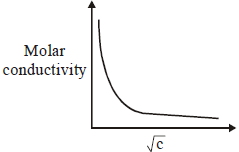
The variation of molar conductivity with concentration of an electrolyte $X$ in aqueous solution is shown in the given figure.
The electrolyte $X$ is :
The electrolyte $X$ is :
A
$CH_{3}COOH$
B
$KNO_{3}$
C
$HCl$
D
$NaCl$
Solution
(A) The given graph shows a sharp increase in molar conductivity with a decrease in concentration (as $\sqrt{c}$ approaches zero). This behavior is characteristic of a weak electrolyte,where the degree of dissociation increases significantly upon dilution.
Among the given options,$CH_{3}COOH$ is a weak electrolyte,while $KNO_{3}$,$HCl$,and $NaCl$ are strong electrolytes which show a linear variation according to the Kohlrausch equation: $\Lambda_{m} = \Lambda_{m}^{\circ} - A\sqrt{c}$.
Therefore,the correct electrolyte is $CH_{3}COOH$.
Among the given options,$CH_{3}COOH$ is a weak electrolyte,while $KNO_{3}$,$HCl$,and $NaCl$ are strong electrolytes which show a linear variation according to the Kohlrausch equation: $\Lambda_{m} = \Lambda_{m}^{\circ} - A\sqrt{c}$.
Therefore,the correct electrolyte is $CH_{3}COOH$.
0 likes
View Solution219
MediumMCQ
The conductivity of a $0.05 \, M$ solution of a weak monobasic acid is $10^{-3} \, S \, cm^{-1}$. If $\lambda_{m}^{\infty}$ for the weak acid is $500 \, S \, cm^{2} \, mol^{-1}$,calculate the $K_{a}$ of the weak monobasic acid.
A
$8 \times 10^{-5}$
B
$4 \times 10^{-6}$
C
$16 \times 10^{-7}$
D
$14 \times 10^{-8}$
Solution
(A) First,calculate the molar conductivity $(\lambda_{m})$ using the formula: $\lambda_{m} = \frac{1000 \times \kappa}{M}$
$\lambda_{m} = \frac{1000 \times 10^{-3}}{0.05} = 20 \, S \, cm^{2} \, mol^{-1}$
Next,calculate the degree of dissociation $(\alpha)$: $\alpha = \frac{\lambda_{m}}{\lambda_{m}^{\infty}} = \frac{20}{500} = 0.04$
Finally,calculate the dissociation constant $(K_{a})$ using the formula: $K_{a} = C \alpha^{2}$
$K_{a} = 0.05 \times (0.04)^{2} = 0.05 \times 0.0016 = 8 \times 10^{-5}$
$\lambda_{m} = \frac{1000 \times 10^{-3}}{0.05} = 20 \, S \, cm^{2} \, mol^{-1}$
Next,calculate the degree of dissociation $(\alpha)$: $\alpha = \frac{\lambda_{m}}{\lambda_{m}^{\infty}} = \frac{20}{500} = 0.04$
Finally,calculate the dissociation constant $(K_{a})$ using the formula: $K_{a} = C \alpha^{2}$
$K_{a} = 0.05 \times (0.04)^{2} = 0.05 \times 0.0016 = 8 \times 10^{-5}$
0 likes
View Solution220
DifficultMCQ
$A$ $5.0 \, mmol \, dm^{-3}$ aqueous solution of $KCl$ has a conductance of $0.55 \, mS$ when measured in a cell with a cell constant of $1.3 \, cm^{-1}$. The molar conductivity of this solution is ....... $mS \, m^{2} \, mol^{-1}$. (Round off to the Nearest Integer)
A
$133$
B
$195$
C
$143$
D
$241$
Solution
(C) Given: Concentration $(C) = 5.0 \, mmol \, dm^{-3} = 5.0 \times 10^{-3} \, mol \, L^{-1} = 5.0 \, mol \, m^{-3}$.
Conductance $(G) = 0.55 \, mS = 0.55 \times 10^{-3} \, S$.
Cell constant $(G^*) = 1.3 \, cm^{-1} = 130 \, m^{-1}$.
Conductivity $(\kappa) = G \times G^* = 0.55 \, mS \times 130 \, m^{-1} = 71.5 \, mS \, m^{-1} = 0.0715 \, S \, m^{-1}$.
Molar conductivity $(\lambda_m) = \frac{\kappa}{C} = \frac{0.0715 \, S \, m^{-1}}{5.0 \, mol \, m^{-3}} = 0.0143 \, S \, m^2 \, mol^{-1} = 14.3 \, mS \, m^2 \, mol^{-1}$.
Rounding to the nearest integer,the value is $14$.
Conductance $(G) = 0.55 \, mS = 0.55 \times 10^{-3} \, S$.
Cell constant $(G^*) = 1.3 \, cm^{-1} = 130 \, m^{-1}$.
Conductivity $(\kappa) = G \times G^* = 0.55 \, mS \times 130 \, m^{-1} = 71.5 \, mS \, m^{-1} = 0.0715 \, S \, m^{-1}$.
Molar conductivity $(\lambda_m) = \frac{\kappa}{C} = \frac{0.0715 \, S \, m^{-1}}{5.0 \, mol \, m^{-3}} = 0.0143 \, S \, m^2 \, mol^{-1} = 14.3 \, mS \, m^2 \, mol^{-1}$.
Rounding to the nearest integer,the value is $14$.
0 likes
View Solution221
DifficultMCQ
$A$ $KCl$ solution of conductivity $0.14 \, S m^{-1}$ shows a resistance of $4.19 \, \Omega$ in a conductivity cell. If the same cell is filled with an $HCl$ solution,the resistance drops to $1.03 \, \Omega$. The conductivity of the $HCl$ solution is $....... \, \times 10^{-2} \, S m^{-1}$. (Round off to the Nearest Integer).
A
$28$
B
$107$
C
$67$
D
$57$
Solution
(D) The conductivity $\kappa$ is related to resistance $R$ and cell constant $G^{*}$ by the formula: $\kappa = \frac{1}{R} \cdot G^{*}$
For the same conductivity cell,$G^{*}$ is constant,therefore $\kappa \cdot R = G^{*} = \text{constant}$.
For the $KCl$ solution: $\kappa_{KCl} \cdot R_{KCl} = 0.14 \times 4.19 = 0.5866 \, S$.
For the $HCl$ solution: $\kappa_{HCl} \cdot R_{HCl} = 0.5866 \, S$.
$\kappa_{HCl} = \frac{0.5866}{1.03} \approx 0.5695 \, S m^{-1}$.
Converting to the required units: $0.5695 \, S m^{-1} = 56.95 \times 10^{-2} \, S m^{-1}$.
Rounding to the nearest integer,we get $57 \times 10^{-2} \, S m^{-1}$.
For the same conductivity cell,$G^{*}$ is constant,therefore $\kappa \cdot R = G^{*} = \text{constant}$.
For the $KCl$ solution: $\kappa_{KCl} \cdot R_{KCl} = 0.14 \times 4.19 = 0.5866 \, S$.
For the $HCl$ solution: $\kappa_{HCl} \cdot R_{HCl} = 0.5866 \, S$.
$\kappa_{HCl} = \frac{0.5866}{1.03} \approx 0.5695 \, S m^{-1}$.
Converting to the required units: $0.5695 \, S m^{-1} = 56.95 \times 10^{-2} \, S m^{-1}$.
Rounding to the nearest integer,we get $57 \times 10^{-2} \, S m^{-1}$.
0 likes
View Solution222
MediumMCQ
The molar conductivities at infinite dilution of barium chloride,sulphuric acid and hydrochloric acid are $280$,$860$ and $426 \, S \, cm^{2} \, mol^{-1}$ respectively. The molar conductivity at infinite dilution of barium sulphate is $...... \, S \, cm^{2} \, mol^{-1}$ ($Round$ off to the Nearest Integer).
A
$102$
B
$328$
C
$488$
D
$288$
Solution
(D) According to Kohlrausch's law of independent migration of ions:
$\Lambda_{m}^{\infty}(BaSO_{4}) = \lambda_{m}^{\infty}(Ba^{2+}) + \lambda_{m}^{\infty}(SO_{4}^{2-})$
We can express this in terms of the given electrolytes:
$\Lambda_{m}^{\infty}(BaSO_{4}) = \Lambda_{m}^{\infty}(BaCl_{2}) + \Lambda_{m}^{\infty}(H_{2}SO_{4}) - 2\Lambda_{m}^{\infty}(HCl)$
Substituting the given values:
$\Lambda_{m}^{\infty}(BaSO_{4}) = 280 + 860 - 2(426)$
$= 1140 - 852$
$= 288 \, S \, cm^{2} \, mol^{-1}$
$\Lambda_{m}^{\infty}(BaSO_{4}) = \lambda_{m}^{\infty}(Ba^{2+}) + \lambda_{m}^{\infty}(SO_{4}^{2-})$
We can express this in terms of the given electrolytes:
$\Lambda_{m}^{\infty}(BaSO_{4}) = \Lambda_{m}^{\infty}(BaCl_{2}) + \Lambda_{m}^{\infty}(H_{2}SO_{4}) - 2\Lambda_{m}^{\infty}(HCl)$
Substituting the given values:
$\Lambda_{m}^{\infty}(BaSO_{4}) = 280 + 860 - 2(426)$
$= 1140 - 852$
$= 288 \, S \, cm^{2} \, mol^{-1}$
0 likes
View Solution223
DifficultMCQ
Given below are two statements :
Statement $I :$ The limiting molar conductivity of $KCl$ (strong electrolyte) is higher compared to that of $CH_{3}COOH$ (weak electrolyte).
Statement $II :$ Molar conductivity decreases with decrease in concentration of electrolyte.
In the light of the above statements,choose the most appropriate answer from the options given below:
Statement $I :$ The limiting molar conductivity of $KCl$ (strong electrolyte) is higher compared to that of $CH_{3}COOH$ (weak electrolyte).
Statement $II :$ Molar conductivity decreases with decrease in concentration of electrolyte.
In the light of the above statements,choose the most appropriate answer from the options given below:
A
Statement $I$ is true but Statement $II$ is false.
B
Statement $I$ is false but Statement $II$ is true.
C
Both Statement $I$ and Statement $II$ are true.
D
Both Statement $I$ and Statement $II$ are false.
Solution
(D) Statement $I$: The limiting molar conductivity $(\Lambda_{m}^{\infty})$ is the sum of the ionic conductivities of the constituent ions. For $CH_{3}COOH$,$\Lambda_{m}^{\infty} = \lambda^{\infty}(H^{+}) + \lambda^{\infty}(CH_{3}COO^{-}) \approx 349.8 + 40.9 = 390.7 \, S \, cm^{2} \, mol^{-1}$. For $KCl$,$\Lambda_{m}^{\infty} = \lambda^{\infty}(K^{+}) + \lambda^{\infty}(Cl^{-}) \approx 73.5 + 76.3 = 149.8 \, S \, cm^{2} \, mol^{-1}$. Since $390.7 > 149.8$,Statement $I$ is false.
Statement $II$: Molar conductivity $(\Lambda_{m})$ is defined as $\Lambda_{m} = \frac{\kappa}{c}$. As concentration $(c)$ decreases,the dilution increases. For both strong and weak electrolytes,the decrease in concentration leads to an increase in molar conductivity because the interionic attractions decrease (for strong electrolytes) or the degree of dissociation increases (for weak electrolytes). Thus,Statement $II$ is false.
Statement $II$: Molar conductivity $(\Lambda_{m})$ is defined as $\Lambda_{m} = \frac{\kappa}{c}$. As concentration $(c)$ decreases,the dilution increases. For both strong and weak electrolytes,the decrease in concentration leads to an increase in molar conductivity because the interionic attractions decrease (for strong electrolytes) or the degree of dissociation increases (for weak electrolytes). Thus,Statement $II$ is false.
0 likes
View Solution224
EasyMCQ
The resistance of a conductivity cell with cell constant $1.14 \, cm^{-1}$,containing $0.001 \, M \, KCl$ at $298 \, K$ is $1500 \, \Omega$. The molar conductivity of $0.001 \, M \, KCl$ solution at $298 \, K$ in $S \, cm^{2} \, mol^{-1}$ is ...... . (Integer answer)
A
$760$
B
$76$
C
$7.6$
D
$141$
Solution
(A) The conductivity $\kappa$ is given by $\kappa = \frac{1}{R} \times \left(\frac{\ell}{A}\right)$.
Given $R = 1500 \, \Omega$ and cell constant $\frac{\ell}{A} = 1.14 \, cm^{-1}$.
$\kappa = \frac{1}{1500} \times 1.14 = 7.6 \times 10^{-4} \, S \, cm^{-1}$.
Molar conductivity $\wedge_{m}$ is calculated as $\wedge_{m} = \frac{1000 \times \kappa}{C}$.
$\wedge_{m} = \frac{1000 \times 7.6 \times 10^{-4}}{0.001} = \frac{0.76}{0.001} = 760 \, S \, cm^{2} \, mol^{-1}$.
Given $R = 1500 \, \Omega$ and cell constant $\frac{\ell}{A} = 1.14 \, cm^{-1}$.
$\kappa = \frac{1}{1500} \times 1.14 = 7.6 \times 10^{-4} \, S \, cm^{-1}$.
Molar conductivity $\wedge_{m}$ is calculated as $\wedge_{m} = \frac{1000 \times \kappa}{C}$.
$\wedge_{m} = \frac{1000 \times 7.6 \times 10^{-4}}{0.001} = \frac{0.76}{0.001} = 760 \, S \, cm^{2} \, mol^{-1}$.
0 likes
View Solution225
EasyMCQ
Match List-$I$ with List-$II$:
Choose the most appropriate answer from the options given below:
| List-$I$ (Parameter) | List-$II$ (Unit) |
| $a$. Cell constant | $i$. $S\, cm^{2}\, mol^{-1}$ |
| $b$. Molar conductivity | $ii$. Dimensionless |
| $c$. Conductivity | $iii$. $m^{-1}$ |
| $d$. Degree of dissociation of electrolyte | $iv$. $\Omega^{-1}\, m^{-1}$ |
Choose the most appropriate answer from the options given below:
A
$a-iii, b-i, c-iv, d-ii$
B
$a-iii, b-i, c-ii, d-iv$
C
$a-i, b-iv, c-iii, d-ii$
D
$a-ii, b-i, c-iii, d-iv$
Solution
(A) The cell constant is defined as the ratio of the distance between electrodes $(\ell)$ to the area of cross-section $(A)$,so its unit is $m^{-1}$.
Molar conductivity $(\Lambda_{m})$ is defined as the conductance of all ions produced from one mole of electrolyte,with units $S\, m^{2}\, mol^{-1}$ (or $S\, cm^{2}\, mol^{-1}$).
Conductivity $(\kappa)$ is the reciprocal of resistivity,with units $\Omega^{-1}\, m^{-1}$ or $S\, m^{-1}$.
Degree of dissociation $(\alpha)$ is the ratio of the number of moles dissociated to the total number of moles,which is a dimensionless quantity.
Therefore,the correct matching is $a-iii, b-i, c-iv, d-ii$.
Molar conductivity $(\Lambda_{m})$ is defined as the conductance of all ions produced from one mole of electrolyte,with units $S\, m^{2}\, mol^{-1}$ (or $S\, cm^{2}\, mol^{-1}$).
Conductivity $(\kappa)$ is the reciprocal of resistivity,with units $\Omega^{-1}\, m^{-1}$ or $S\, m^{-1}$.
Degree of dissociation $(\alpha)$ is the ratio of the number of moles dissociated to the total number of moles,which is a dimensionless quantity.
Therefore,the correct matching is $a-iii, b-i, c-iv, d-ii$.
0 likes
View Solution226
DifficultMCQ
If the conductivity of mercury at $0^{\circ} \, C$ is $1.07 \times 10^{6} \, S \, m^{-1}$ and the resistance of a cell containing mercury is $0.243 \, \Omega$,then the cell constant of the cell is $x \times 10^{4} \, m^{-1}$. The value of $x$ is ...... (Nearest integer).
A
$260$
B
$39$
C
$26$
D
$13$
Solution
(C) Given: Conductivity $\kappa = 1.07 \times 10^{6} \, S \, m^{-1}$ and Resistance $R = 0.243 \, \Omega$.
The relationship between conductivity $(\kappa)$,conductance $(G)$,and cell constant $(G^{*})$ is $\kappa = G \times G^{*}$.
Since $G = \frac{1}{R}$,we have $\kappa = \frac{1}{R} \times G^{*}$.
Rearranging for the cell constant: $G^{*} = \kappa \times R$.
Substituting the values: $G^{*} = (1.07 \times 10^{6} \, S \, m^{-1}) \times (0.243 \, \Omega) = 0.26001 \times 10^{6} \, m^{-1}$.
Expressing in the form $x \times 10^{4} \, m^{-1}$: $G^{*} = 26.001 \times 10^{4} \, m^{-1}$.
Therefore,the value of $x$ is $26$.
The relationship between conductivity $(\kappa)$,conductance $(G)$,and cell constant $(G^{*})$ is $\kappa = G \times G^{*}$.
Since $G = \frac{1}{R}$,we have $\kappa = \frac{1}{R} \times G^{*}$.
Rearranging for the cell constant: $G^{*} = \kappa \times R$.
Substituting the values: $G^{*} = (1.07 \times 10^{6} \, S \, m^{-1}) \times (0.243 \, \Omega) = 0.26001 \times 10^{6} \, m^{-1}$.
Expressing in the form $x \times 10^{4} \, m^{-1}$: $G^{*} = 26.001 \times 10^{4} \, m^{-1}$.
Therefore,the value of $x$ is $26$.
0 likes
View Solution227
MediumMCQ
The molar conductivity of $0.007 \ M$ acetic acid is $20 \ S \ cm^{2} \ mol^{-1}$. What is the dissociation constant of acetic acid? (In $\times 10^{-5} \ mol \ L^{-1}$)
$[\Lambda_{H^{+}}^{\circ}=350 \ S \ cm^{2} \ mol^{-1}, \Lambda_{CH_{3}COO^{-}}^{\circ}=50 \ S \ cm^{2} \ mol^{-1}]$
$[\Lambda_{H^{+}}^{\circ}=350 \ S \ cm^{2} \ mol^{-1}, \Lambda_{CH_{3}COO^{-}}^{\circ}=50 \ S \ cm^{2} \ mol^{-1}]$
A
$175$
B
$2.50$
C
$1.75$
D
$250$
Solution
(C) First,calculate the limiting molar conductivity of acetic acid:
$\Lambda_{m}^{\circ}(CH_{3}COOH) = \Lambda_{H^{+}}^{\circ} + \Lambda_{CH_{3}COO^{-}}^{\circ} = 350 + 50 = 400 \ S \ cm^{2} \ mol^{-1}$
Next,calculate the degree of dissociation $(\alpha)$:
$\alpha = \frac{\Lambda_{m}}{\Lambda_{m}^{\circ}} = \frac{20}{400} = 0.05$
Finally,calculate the dissociation constant $(K_{a})$ using the formula $K_{a} = C \alpha^{2} / (1 - \alpha)$. Since $\alpha$ is very small,we use $K_{a} \approx C \alpha^{2}$:
$K_{a} = 0.007 \times (0.05)^{2}$
$K_{a} = 7 \times 10^{-3} \times 25 \times 10^{-4}$
$K_{a} = 175 \times 10^{-7} = 1.75 \times 10^{-5} \ mol \ L^{-1}$
Thus,the value is $1.75$.
$\Lambda_{m}^{\circ}(CH_{3}COOH) = \Lambda_{H^{+}}^{\circ} + \Lambda_{CH_{3}COO^{-}}^{\circ} = 350 + 50 = 400 \ S \ cm^{2} \ mol^{-1}$
Next,calculate the degree of dissociation $(\alpha)$:
$\alpha = \frac{\Lambda_{m}}{\Lambda_{m}^{\circ}} = \frac{20}{400} = 0.05$
Finally,calculate the dissociation constant $(K_{a})$ using the formula $K_{a} = C \alpha^{2} / (1 - \alpha)$. Since $\alpha$ is very small,we use $K_{a} \approx C \alpha^{2}$:
$K_{a} = 0.007 \times (0.05)^{2}$
$K_{a} = 7 \times 10^{-3} \times 25 \times 10^{-4}$
$K_{a} = 175 \times 10^{-7} = 1.75 \times 10^{-5} \ mol \ L^{-1}$
Thus,the value is $1.75$.
0 likes
View Solution228
EasyMCQ
Given that $\Lambda_{m}^{\infty} = 133.4 \, S \, cm^{2} \, mol^{-1} (AgNO_{3})$; $\Lambda_{m}^{\infty} = 149.9 \, S \, cm^{2} \, mol^{-1} (KCl)$ and $\Lambda_{m}^{\infty} = 144.9 \, S \, cm^{2} \, mol^{-1} (KNO_{3})$,the molar conductivity at infinite dilution for $AgCl$ is $....... \, S \, cm^{2} \, mol^{-1}$.
A
$140$
B
$138$
C
$134$
D
$132$
Solution
(B) According to Kohlrausch's law of independent migration of ions,the molar conductivity at infinite dilution for $AgCl$ can be calculated as:
$\Lambda_{m}^{\infty}(AgCl) = \Lambda_{m}^{\infty}(Ag^{+}) + \Lambda_{m}^{\infty}(Cl^{-})$
Using the given values:
$\Lambda_{m}^{\infty}(AgCl) = \Lambda_{m}^{\infty}(AgNO_{3}) + \Lambda_{m}^{\infty}(KCl) - \Lambda_{m}^{\infty}(KNO_{3})$
Substituting the values:
$= 133.4 + 149.9 - 144.9$
$= 283.3 - 144.9$
$= 138.4 \, S \, cm^{2} \, mol^{-1}$
Rounding to the nearest integer,the value is $138 \, S \, cm^{2} \, mol^{-1}$.
$\Lambda_{m}^{\infty}(AgCl) = \Lambda_{m}^{\infty}(Ag^{+}) + \Lambda_{m}^{\infty}(Cl^{-})$
Using the given values:
$\Lambda_{m}^{\infty}(AgCl) = \Lambda_{m}^{\infty}(AgNO_{3}) + \Lambda_{m}^{\infty}(KCl) - \Lambda_{m}^{\infty}(KNO_{3})$
Substituting the values:
$= 133.4 + 149.9 - 144.9$
$= 283.3 - 144.9$
$= 138.4 \, S \, cm^{2} \, mol^{-1}$
Rounding to the nearest integer,the value is $138 \, S \, cm^{2} \, mol^{-1}$.
0 likes
View Solution229
MediumMCQ
The resistance of a conductivity cell containing $0.01 \, M \, KCl$ solution at $298 \, K$ is $1750 \, \Omega$. If the conductivity of $0.01 \, M \, KCl$ solution at $298 \, K$ is $0.152 \times 10^{-3} \, S \, cm^{-1}$,then the cell constant of the conductivity cell is $.......... \, \times 10^{-3} \, cm^{-1}$.
A
$452$
B
$312$
C
$266$
D
$199$
Solution
(C) The relationship between conductivity $(k)$,resistance $(R)$,and cell constant $(G^*)$ is given by:
$k = \frac{1}{R} \times G^*$
Given:
$R = 1750 \, \Omega$
$k = 0.152 \times 10^{-3} \, S \, cm^{-1}$
Substituting the values:
$0.152 \times 10^{-3} = \frac{1}{1750} \times G^*$
$G^* = 0.152 \times 10^{-3} \times 1750$
$G^* = 266 \times 10^{-3} \, cm^{-1}$
$k = \frac{1}{R} \times G^*$
Given:
$R = 1750 \, \Omega$
$k = 0.152 \times 10^{-3} \, S \, cm^{-1}$
Substituting the values:
$0.152 \times 10^{-3} = \frac{1}{1750} \times G^*$
$G^* = 0.152 \times 10^{-3} \times 1750$
$G^* = 266 \times 10^{-3} \, cm^{-1}$
0 likes
View Solution230
MediumMCQ
The limiting molar conductivities of $NaI$,$NaNO_3$ and $AgNO_3$ are $12.7$,$12.0$ and $13.3 \, mS \, m^2 \, mol^{-1}$,respectively (all at $25^{\circ} C$). The limiting molar conductivity of $AgI$ at this temperature is $.... \, mS \, m^2 \, mol^{-1}$.
A
$15.0$
B
$14.0$
C
$8.9$
D
$12.3$
Solution
(B) According to Kohlrausch's law of independent migration of ions,the limiting molar conductivity of an electrolyte is the sum of the limiting molar conductivities of its constituent ions.
$\lambda_{m}^{\infty}(AgI) = \lambda_{m}^{\infty}(Ag^+) + \lambda_{m}^{\infty}(I^-)$
We can express this using the given values:
$\lambda_{m}^{\infty}(AgI) = \lambda_{m}^{\infty}(AgNO_3) + \lambda_{m}^{\infty}(NaI) - \lambda_{m}^{\infty}(NaNO_3)$
Substituting the given values:
$\lambda_{m}^{\infty}(AgI) = 13.3 + 12.7 - 12.0$
$\lambda_{m}^{\infty}(AgI) = 26.0 - 12.0$
$\lambda_{m}^{\infty}(AgI) = 14.0 \, mS \, m^2 \, mol^{-1}$
$\lambda_{m}^{\infty}(AgI) = \lambda_{m}^{\infty}(Ag^+) + \lambda_{m}^{\infty}(I^-)$
We can express this using the given values:
$\lambda_{m}^{\infty}(AgI) = \lambda_{m}^{\infty}(AgNO_3) + \lambda_{m}^{\infty}(NaI) - \lambda_{m}^{\infty}(NaNO_3)$
Substituting the given values:
$\lambda_{m}^{\infty}(AgI) = 13.3 + 12.7 - 12.0$
$\lambda_{m}^{\infty}(AgI) = 26.0 - 12.0$
$\lambda_{m}^{\infty}(AgI) = 14.0 \, mS \, m^2 \, mol^{-1}$
0 likes
View Solution231
MediumMCQ
The molar conductivity of a conductivity cell filled with $10 \ moles$ of $20 \ mL$ $NaCl$ solution is $\Lambda_{m1}$ and that of another identical cell filled with $20 \ moles$ of $80 \ mL$ $NaCl$ solution is $\Lambda_{m2}$. If the conductivities $(\kappa)$ exhibited by these two cells are the same,the relationship between $\Lambda_{m2}$ and $\Lambda_{m1}$ is $........$
A
$\Lambda_{m2} = 2 \Lambda_{m1}$
B
$\Lambda_{m2} = \Lambda_{m1} / 2$
C
$\Lambda_{m2} = \Lambda_{m1}$
D
$\Lambda_{m2} = 4 \Lambda_{m1}$
Solution
(A) The formula for molar conductivity is $\Lambda_{m} = \kappa \times \frac{1000}{M}$,where $M$ is the molarity of the solution.
Since the conductivities $\kappa$ are the same,$\Lambda_{m} \propto \frac{1}{M}$.
Calculate the molarity for both solutions:
$M_1 = \frac{n_1}{V_1} = \frac{10 \ mol}{20 \ mL} = 0.5 \ mol/mL$.
$M_2 = \frac{n_2}{V_2} = \frac{20 \ mol}{80 \ mL} = 0.25 \ mol/mL$.
Now,find the ratio:
$\frac{\Lambda_{m2}}{\Lambda_{m1}} = \frac{M_1}{M_2} = \frac{0.5}{0.25} = 2$.
Therefore,$\Lambda_{m2} = 2 \Lambda_{m1}$.
Since the conductivities $\kappa$ are the same,$\Lambda_{m} \propto \frac{1}{M}$.
Calculate the molarity for both solutions:
$M_1 = \frac{n_1}{V_1} = \frac{10 \ mol}{20 \ mL} = 0.5 \ mol/mL$.
$M_2 = \frac{n_2}{V_2} = \frac{20 \ mol}{80 \ mL} = 0.25 \ mol/mL$.
Now,find the ratio:
$\frac{\Lambda_{m2}}{\Lambda_{m1}} = \frac{M_1}{M_2} = \frac{0.5}{0.25} = 2$.
Therefore,$\Lambda_{m2} = 2 \Lambda_{m1}$.
1 likes
View Solution232
DifficultMCQ
Resistance of a conductivity cell (cell constant $129 \; m^{-1}$) filled with $74.5 \; ppm$ solution of $KCl$ is $100 \; \Omega$ (labelled as solution $1$). When the same cell is filled with $KCl$ solution of $149 \; ppm$,the resistance is $50 \; \Omega$ (labelled as solution $2$). The ratio of molar conductivity of solution $1$ and solution $2$ is i.e.,$\frac{\wedge_{1}}{\wedge_{2}} = x \times 10^{-3}$. The value of $x$ is (Nearest integer). Given,molar mass of $KCl$ is $74.5 \; g \; mol^{-1}$.
A
$1000$
B
$2000$
C
$3000$
D
$4000$
Solution
(A) Cell constant $G^* = \frac{\ell}{A} = 129 \; m^{-1} = 1.29 \; cm^{-1}$.
Conductivity $\kappa = \frac{G^*}{R}$.
For solution $1$ $(74.5 \; ppm)$: $\kappa_1 = \frac{1.29}{100} \; S \; cm^{-1}$.
Concentration $C_1 \propto 74.5 \; ppm$.
For solution $2$ $(149 \; ppm)$: $\kappa_2 = \frac{1.29}{50} \; S \; cm^{-1}$.
Concentration $C_2 \propto 149 \; ppm$.
Since $ppm$ is proportional to molarity $(M)$,$\frac{C_1}{C_2} = \frac{74.5}{149} = \frac{1}{2}$.
Molar conductivity $\wedge_m = \frac{1000 \kappa}{C}$.
$\frac{\wedge_1}{\wedge_2} = \frac{\kappa_1}{\kappa_2} \times \frac{C_2}{C_1} = \frac{1.29/100}{1.29/50} \times \frac{149}{74.5} = \frac{50}{100} \times 2 = 1$.
Given $\frac{\wedge_1}{\wedge_2} = x \times 10^{-3} = 1$.
Therefore,$x = 1000$.
Conductivity $\kappa = \frac{G^*}{R}$.
For solution $1$ $(74.5 \; ppm)$: $\kappa_1 = \frac{1.29}{100} \; S \; cm^{-1}$.
Concentration $C_1 \propto 74.5 \; ppm$.
For solution $2$ $(149 \; ppm)$: $\kappa_2 = \frac{1.29}{50} \; S \; cm^{-1}$.
Concentration $C_2 \propto 149 \; ppm$.
Since $ppm$ is proportional to molarity $(M)$,$\frac{C_1}{C_2} = \frac{74.5}{149} = \frac{1}{2}$.
Molar conductivity $\wedge_m = \frac{1000 \kappa}{C}$.
$\frac{\wedge_1}{\wedge_2} = \frac{\kappa_1}{\kappa_2} \times \frac{C_2}{C_1} = \frac{1.29/100}{1.29/50} \times \frac{149}{74.5} = \frac{50}{100} \times 2 = 1$.
Given $\frac{\wedge_1}{\wedge_2} = x \times 10^{-3} = 1$.
Therefore,$x = 1000$.
0 likes
View Solution233
DifficultMCQ
Among the following,the plot that correctly represents the conductometric titration of $0.05 \ M \ H_2SO_4$ with $0.1 \ M \ NH_4OH$ is
A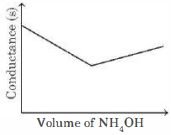
Plot $(a)$
B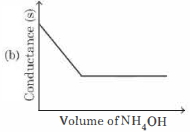
Plot $(b)$
C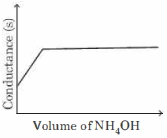
Plot $(c)$
D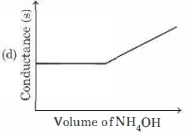
Plot $(d)$
Solution
(B) The principle of conductometric titration is based on the fact that during the titration,one of the ions is replaced by another,and these two ions differ in their ionic conductivity.
In the conductometric titration of $0.05 \ M \ H_2SO_4$ with $0.1 \ M \ NH_4OH$,initially,the highly mobile $H^+$ ions are neutralized by $OH^-$ ions to form $H_2O$ and are replaced by less mobile $NH_4^+$ ions. This leads to a decrease in conductance up to the equivalence point.
After the equivalence point,the addition of excess weak electrolyte $NH_4OH$ does not significantly increase the conductance because it is weakly dissociated.
Therefore,the plot showing a decrease in conductance followed by a nearly constant conductance is the correct representation.
In the conductometric titration of $0.05 \ M \ H_2SO_4$ with $0.1 \ M \ NH_4OH$,initially,the highly mobile $H^+$ ions are neutralized by $OH^-$ ions to form $H_2O$ and are replaced by less mobile $NH_4^+$ ions. This leads to a decrease in conductance up to the equivalence point.
After the equivalence point,the addition of excess weak electrolyte $NH_4OH$ does not significantly increase the conductance because it is weakly dissociated.
Therefore,the plot showing a decrease in conductance followed by a nearly constant conductance is the correct representation.
0 likes
View Solution234
MediumMCQ
The limiting molar conductivities of the given electrolytes at $298 \ K$ follow the order: $\lambda^{\circ}_{(K^{+})} = 73.5, \lambda^{\circ}_{(Cl^{-})} = 76.3, \lambda^{\circ}_{(Ca^{2+})} = 119.0, \lambda^{\circ}_{(SO_{4}^{2-})} = 160.0 \ S \ cm^{2} \ mol^{-1}$.
A
$KCl < CaCl_{2} < K_{2}SO_{4}$
B
$KCl < K_{2}SO_{4} < CaCl_{2}$
C
$K_{2}SO_{4} < CaCl_{2} < KCl$
D
$CaCl_{2} < K_{2}SO_{4} < KCl$
Solution
(A) The limiting molar conductivities of the given electrolytes are calculated using Kohlrausch's law:
$\lambda^{\circ}_{KCl} = \lambda^{\circ}_{K^{+}} + \lambda^{\circ}_{Cl^{-}} = 73.5 + 76.3 = 149.8 \ S \ cm^{2} \ mol^{-1}$
$\lambda^{\circ}_{CaCl_{2}} = \lambda^{\circ}_{Ca^{2+}} + 2\lambda^{\circ}_{Cl^{-}} = 119.0 + 2 \times 76.3 = 271.6 \ S \ cm^{2} \ mol^{-1}$
$\lambda^{\circ}_{K_{2}SO_{4}} = 2\lambda^{\circ}_{K^{+}} + \lambda^{\circ}_{SO_{4}^{2-}} = 2 \times 73.5 + 160.0 = 307.0 \ S \ cm^{2} \ mol^{-1}$
Comparing the values,the order is: $\lambda^{\circ}_{KCl} < \lambda^{\circ}_{CaCl_{2}} < \lambda^{\circ}_{K_{2}SO_{4}}$.
$\lambda^{\circ}_{KCl} = \lambda^{\circ}_{K^{+}} + \lambda^{\circ}_{Cl^{-}} = 73.5 + 76.3 = 149.8 \ S \ cm^{2} \ mol^{-1}$
$\lambda^{\circ}_{CaCl_{2}} = \lambda^{\circ}_{Ca^{2+}} + 2\lambda^{\circ}_{Cl^{-}} = 119.0 + 2 \times 76.3 = 271.6 \ S \ cm^{2} \ mol^{-1}$
$\lambda^{\circ}_{K_{2}SO_{4}} = 2\lambda^{\circ}_{K^{+}} + \lambda^{\circ}_{SO_{4}^{2-}} = 2 \times 73.5 + 160.0 = 307.0 \ S \ cm^{2} \ mol^{-1}$
Comparing the values,the order is: $\lambda^{\circ}_{KCl} < \lambda^{\circ}_{CaCl_{2}} < \lambda^{\circ}_{K_{2}SO_{4}}$.
0 likes
View Solution235
DifficultMCQ
The specific conductance $(\kappa)$ of $0.02 \ M$ aqueous acetic acid solution at $298 \ K$ is $1.65 \times 10^{-4} \ S \ cm^{-1}$. The degree of dissociation of acetic acid is [Given equivalent conductance at infinite dilution of $H^{+} = 349.1 \ S \ cm^{2} \ mol^{-1}$ and $CH_{3}COO^{-} = 40.9 \ S \ cm^{2} \ mol^{-1}$]
A
$0.021$
B
$0.21$
C
$0.012$
D
$0.12$
Solution
(A) Given,specific conductance $(\kappa) = 1.65 \times 10^{-4} \ S \ cm^{-1}$ and molarity $(M) = 0.02 \ M$.
Molar conductance $(\lambda_{m})$ is calculated as:
$\lambda_{m} = \frac{1000 \times \kappa}{M} = \frac{1000 \times 1.65 \times 10^{-4}}{0.02} = 8.25 \ S \ cm^{2} \ mol^{-1}$.
Molar conductance at infinite dilution $(\lambda_{m}^{\infty})$ is:
$\lambda_{m}^{\infty} = \lambda_{m(H^{+})}^{\infty} + \lambda_{m(CH_{3}COO^{-})}^{\infty} = 349.1 + 40.9 = 390 \ S \ cm^{2} \ mol^{-1}$.
The degree of dissociation $(\alpha)$ is given by:
$\alpha = \frac{\lambda_{m}}{\lambda_{m}^{\infty}} = \frac{8.25}{390} \approx 0.0211$.
Molar conductance $(\lambda_{m})$ is calculated as:
$\lambda_{m} = \frac{1000 \times \kappa}{M} = \frac{1000 \times 1.65 \times 10^{-4}}{0.02} = 8.25 \ S \ cm^{2} \ mol^{-1}$.
Molar conductance at infinite dilution $(\lambda_{m}^{\infty})$ is:
$\lambda_{m}^{\infty} = \lambda_{m(H^{+})}^{\infty} + \lambda_{m(CH_{3}COO^{-})}^{\infty} = 349.1 + 40.9 = 390 \ S \ cm^{2} \ mol^{-1}$.
The degree of dissociation $(\alpha)$ is given by:
$\alpha = \frac{\lambda_{m}}{\lambda_{m}^{\infty}} = \frac{8.25}{390} \approx 0.0211$.
0 likes
View Solution236
DifficultMCQ
The molar conductivities of $HCl$,$NaCl$,$CH_{3}COOH$,and $CH_{3}COONa$ at infinite dilution follow the order:
A
$HCl > NaCl > CH_{3}COONa > CH_{3}COOH$
B
$CH_{3}COONa > HCl > NaCl > CH_{3}COOH$
C
$HCl > NaCl > CH_{3}COOH > CH_{3}COONa$
D
$CH_{3}COOH > CH_{3}COONa > HCl > NaCl$
Solution
(A) Molar conductivity at infinite dilution $(\Lambda_{m}^{\circ})$ depends on the mobility of ions in the solution.
$HCl$ is a strong acid and dissociates completely into $H^{ }$ and $Cl^{-}$ ions. $H^{ }$ ions have the highest ionic mobility.
$NaCl$ is a strong electrolyte,dissociating into $Na^{ }$ and $Cl^{-}$ ions.
$CH_{3}COONa$ is a strong electrolyte,dissociating into $CH_{3}COO^{-}$ and $Na^{ }$ ions.
$CH_{3}COOH$ is a weak acid and dissociates only partially,resulting in fewer ions in the solution compared to strong electrolytes.
Since $HCl$ provides the highly mobile $H^{ }$ ion,it has the highest molar conductivity.
$NaCl$ has higher conductivity than $CH_{3}COONa$ because the $Cl^{-}$ ion has higher mobility than the $CH_{3}COO^{-}$ ion.
$CH_{3}COOH$ has the lowest molar conductivity due to its weak dissociation.
Thus,the correct order is $HCl > NaCl > CH_{3}COONa > CH_{3}COOH$.
$HCl$ is a strong acid and dissociates completely into $H^{ }$ and $Cl^{-}$ ions. $H^{ }$ ions have the highest ionic mobility.
$NaCl$ is a strong electrolyte,dissociating into $Na^{ }$ and $Cl^{-}$ ions.
$CH_{3}COONa$ is a strong electrolyte,dissociating into $CH_{3}COO^{-}$ and $Na^{ }$ ions.
$CH_{3}COOH$ is a weak acid and dissociates only partially,resulting in fewer ions in the solution compared to strong electrolytes.
Since $HCl$ provides the highly mobile $H^{ }$ ion,it has the highest molar conductivity.
$NaCl$ has higher conductivity than $CH_{3}COONa$ because the $Cl^{-}$ ion has higher mobility than the $CH_{3}COO^{-}$ ion.
$CH_{3}COOH$ has the lowest molar conductivity due to its weak dissociation.
Thus,the correct order is $HCl > NaCl > CH_{3}COONa > CH_{3}COOH$.
0 likes
View Solution237
MediumMCQ
If the molar conductivities (in $S \ cm^2 \ mol^{-1}$) of $NaCl$,$KCl$,and $NaOH$ at infinite dilution are $126$,$150$,and $250$,respectively,the molar conductivity of $KOH$ (in $S \ cm^2 \ mol^{-1}$) is
A
$526$
B
$226$
C
$26$
D
$274$
Solution
(D) According to Kohlrausch's law of independent migration of ions,the molar conductivity at infinite dilution for $KOH$ can be expressed as:
$\lambda^{\infty}_{KOH} = \lambda^{\infty}_{K^+} + \lambda^{\infty}_{OH^-}$
Given values:
$\lambda^{\infty}_{NaCl} = \lambda^{\infty}_{Na^+} + \lambda^{\infty}_{Cl^-} = 126 \ S \ cm^2 \ mol^{-1}$
$\lambda^{\infty}_{KCl} = \lambda^{\infty}_{K^+} + \lambda^{\infty}_{Cl^-} = 150 \ S \ cm^2 \ mol^{-1}$
$\lambda^{\infty}_{NaOH} = \lambda^{\infty}_{Na^+} + \lambda^{\infty}_{OH^-} = 250 \ S \ cm^2 \ mol^{-1}$
To obtain $\lambda^{\infty}_{KOH}$,we perform the operation:
$\lambda^{\infty}_{KOH} = \lambda^{\infty}_{KCl} + \lambda^{\infty}_{NaOH} - \lambda^{\infty}_{NaCl}$
$\lambda^{\infty}_{KOH} = 150 + 250 - 126$
$\lambda^{\infty}_{KOH} = 400 - 126 = 274 \ S \ cm^2 \ mol^{-1}$
Therefore,the correct option is $D$.
$\lambda^{\infty}_{KOH} = \lambda^{\infty}_{K^+} + \lambda^{\infty}_{OH^-}$
Given values:
$\lambda^{\infty}_{NaCl} = \lambda^{\infty}_{Na^+} + \lambda^{\infty}_{Cl^-} = 126 \ S \ cm^2 \ mol^{-1}$
$\lambda^{\infty}_{KCl} = \lambda^{\infty}_{K^+} + \lambda^{\infty}_{Cl^-} = 150 \ S \ cm^2 \ mol^{-1}$
$\lambda^{\infty}_{NaOH} = \lambda^{\infty}_{Na^+} + \lambda^{\infty}_{OH^-} = 250 \ S \ cm^2 \ mol^{-1}$
To obtain $\lambda^{\infty}_{KOH}$,we perform the operation:
$\lambda^{\infty}_{KOH} = \lambda^{\infty}_{KCl} + \lambda^{\infty}_{NaOH} - \lambda^{\infty}_{NaCl}$
$\lambda^{\infty}_{KOH} = 150 + 250 - 126$
$\lambda^{\infty}_{KOH} = 400 - 126 = 274 \ S \ cm^2 \ mol^{-1}$
Therefore,the correct option is $D$.
0 likes
View Solution238
MediumMCQ
The $INCORRECT$ statement about the conductivity of electrolytic (ionic) solution is
A
It is independent of the solvent viscosity
B
It depends on the size of the ions and their solvation
C
It increases with the increase in electrolyte concentration
D
It increases with the increase in temperature
Solution
(A) The correct answer is $A$.
Conductivity of an electrolytic solution depends on the nature of the electrolyte,the size of the ions produced,their solvation,the nature of the solvent,and its viscosity.
Option $A$ is incorrect because conductivity is inversely proportional to the viscosity of the solvent.
Option $C$ is also technically incorrect as molar conductivity decreases with an increase in concentration,but specific conductivity increases; however,in the context of general electrolytic conductivity,$A$ is the most fundamentally incorrect statement regarding the physical properties of the solution.
Conductivity of an electrolytic solution depends on the nature of the electrolyte,the size of the ions produced,their solvation,the nature of the solvent,and its viscosity.
Option $A$ is incorrect because conductivity is inversely proportional to the viscosity of the solvent.
Option $C$ is also technically incorrect as molar conductivity decreases with an increase in concentration,but specific conductivity increases; however,in the context of general electrolytic conductivity,$A$ is the most fundamentally incorrect statement regarding the physical properties of the solution.
0 likes
View Solution239
MediumMCQ
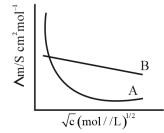
The following figure shows the dependence of molar conductance of two electrolytes on concentration. $\Lambda_m^0$ is the limiting molar conductivity. The number of incorrect statement$(s)$ from the following is $...........$
$(A)$ $\Lambda_m^0$ for electrolyte $A$ is obtained by extrapolation.
$(B)$ For electrolyte $B$,the $\Lambda_m$ vs $\sqrt{c}$ graph is a straight line with an intercept equal to $\Lambda_m^0$.
$(C)$ At infinite dilution,the value of the degree of dissociation approaches zero for electrolyte $B$.
$(D)$ $\Lambda_m^0$ for any electrolyte $A$ or $B$ can be calculated using $\lambda^0$ for individual ions.
$(A)$ $\Lambda_m^0$ for electrolyte $A$ is obtained by extrapolation.
$(B)$ For electrolyte $B$,the $\Lambda_m$ vs $\sqrt{c}$ graph is a straight line with an intercept equal to $\Lambda_m^0$.
$(C)$ At infinite dilution,the value of the degree of dissociation approaches zero for electrolyte $B$.
$(D)$ $\Lambda_m^0$ for any electrolyte $A$ or $B$ can be calculated using $\lambda^0$ for individual ions.
A
$1$
B
$2$
C
$3$
D
$4$
Solution
(B) Electrolyte $B$ is a strong electrolyte,and electrolyte $A$ is a weak electrolyte.
Statement $(A)$ is incorrect because $\Lambda_m^0$ for a weak electrolyte $(A)$ cannot be obtained by extrapolation; it is calculated using Kohlrausch's law.
Statement $(B)$ is correct because strong electrolytes follow the Debye-$H$ückel-Onsager equation: $\Lambda_m = \Lambda_m^0 - A\sqrt{c}$,which is a straight line.
Statement $(C)$ is incorrect because at infinite dilution,the degree of dissociation $(\alpha)$ for any electrolyte approaches $1$ (or $100\%$),not zero.
Statement $(D)$ is correct because Kohlrausch's law of independent migration of ions states that $\Lambda_m^0$ can be calculated for any electrolyte using the limiting molar conductivities of its individual ions.
Therefore,statements $(A)$ and $(C)$ are incorrect. The total number of incorrect statements is $2$.
Statement $(A)$ is incorrect because $\Lambda_m^0$ for a weak electrolyte $(A)$ cannot be obtained by extrapolation; it is calculated using Kohlrausch's law.
Statement $(B)$ is correct because strong electrolytes follow the Debye-$H$ückel-Onsager equation: $\Lambda_m = \Lambda_m^0 - A\sqrt{c}$,which is a straight line.
Statement $(C)$ is incorrect because at infinite dilution,the degree of dissociation $(\alpha)$ for any electrolyte approaches $1$ (or $100\%$),not zero.
Statement $(D)$ is correct because Kohlrausch's law of independent migration of ions states that $\Lambda_m^0$ can be calculated for any electrolyte using the limiting molar conductivities of its individual ions.
Therefore,statements $(A)$ and $(C)$ are incorrect. The total number of incorrect statements is $2$.
0 likes
View Solution240
MediumMCQ
The resistivity of a $0.8 \ M$ solution of an electrolyte is $5 \times 10^{-3} \ \Omega \ cm$. Its molar conductivity is $..... \times 10^4 \ \Omega^{-1} \ cm^2 \ mol^{-1}$. (Nearest integer)
A
$24$
B
$23$
C
$25$
D
$22$
Solution
(C) The formula for molar conductivity is $\Lambda_{m} = \frac{\kappa \times 1000}{M}$.
Given that conductivity $\kappa = \frac{1}{\rho}$,where $\rho = 5 \times 10^{-3} \ \Omega \ cm$.
Substituting the values: $\Lambda_{m} = \frac{1}{5 \times 10^{-3}} \times \frac{1000}{0.8}$.
$\Lambda_{m} = 200 \times 1250 = 250,000 \ \Omega^{-1} \ cm^2 \ mol^{-1}$.
Expressing in the required form: $250,000 = 25 \times 10^4 \ \Omega^{-1} \ cm^2 \ mol^{-1}$.
Thus,the nearest integer is $25$.
Given that conductivity $\kappa = \frac{1}{\rho}$,where $\rho = 5 \times 10^{-3} \ \Omega \ cm$.
Substituting the values: $\Lambda_{m} = \frac{1}{5 \times 10^{-3}} \times \frac{1000}{0.8}$.
$\Lambda_{m} = 200 \times 1250 = 250,000 \ \Omega^{-1} \ cm^2 \ mol^{-1}$.
Expressing in the required form: $250,000 = 25 \times 10^4 \ \Omega^{-1} \ cm^2 \ mol^{-1}$.
Thus,the nearest integer is $25$.
0 likes
View Solution241
MediumMCQ
The specific conductance of $0.0025 \ M$ acetic acid is $5 \times 10^{-5} \ S \ cm^{-1}$ at a certain temperature. The dissociation constant of acetic acid is $...... \times 10^{-7}$. (Nearest integer) Consider limiting molar conductivity of $CH_3COOH$ as $400 \ S \ cm^2 \ mol^{-1}$.
A
$65$
B
$64$
C
$66$
D
$63$
Solution
(D) The molar conductivity $\wedge_m$ is calculated as: $\wedge_m = \frac{k \times 1000}{C}$
Given $k = 5 \times 10^{-5} \ S \ cm^{-1}$ and $C = 0.0025 \ M$.
$\wedge_m = \frac{5 \times 10^{-5} \times 1000}{0.0025} = \frac{0.05}{0.0025} = 20 \ S \ cm^2 \ mol^{-1}$.
The degree of dissociation $\alpha$ is given by $\alpha = \frac{\wedge_m}{\wedge_m^\circ} = \frac{20}{400} = 0.05$.
The dissociation constant $K_a$ is given by $K_a = \frac{C \alpha^2}{1 - \alpha}$.
Since $\alpha$ is very small,$1 - \alpha \approx 1$,so $K_a \approx C \alpha^2 = 0.0025 \times (0.05)^2 = 0.0025 \times 0.0025 = 6.25 \times 10^{-6} = 62.5 \times 10^{-7}$.
Rounding to the nearest integer,we get $63 \times 10^{-7}$.
Given $k = 5 \times 10^{-5} \ S \ cm^{-1}$ and $C = 0.0025 \ M$.
$\wedge_m = \frac{5 \times 10^{-5} \times 1000}{0.0025} = \frac{0.05}{0.0025} = 20 \ S \ cm^2 \ mol^{-1}$.
The degree of dissociation $\alpha$ is given by $\alpha = \frac{\wedge_m}{\wedge_m^\circ} = \frac{20}{400} = 0.05$.
The dissociation constant $K_a$ is given by $K_a = \frac{C \alpha^2}{1 - \alpha}$.
Since $\alpha$ is very small,$1 - \alpha \approx 1$,so $K_a \approx C \alpha^2 = 0.0025 \times (0.05)^2 = 0.0025 \times 0.0025 = 6.25 \times 10^{-6} = 62.5 \times 10^{-7}$.
Rounding to the nearest integer,we get $63 \times 10^{-7}$.
0 likes
View Solution242
MediumMCQ
The number of correct statements from the following is $...........$.
$(A)$ Conductivity always decreases with decrease in concentration for both strong and weak electrolytes.
$(B)$ The number of ions per unit volume that carry current in a solution increases on dilution.
$(C)$ Molar conductivity increases with decrease in concentration.
$(D)$ The variation in molar conductivity is different for strong and weak electrolytes.
$(E)$ For weak electrolytes,the change in molar conductivity with dilution is due to decrease in degree of dissociation.
$(A)$ Conductivity always decreases with decrease in concentration for both strong and weak electrolytes.
$(B)$ The number of ions per unit volume that carry current in a solution increases on dilution.
$(C)$ Molar conductivity increases with decrease in concentration.
$(D)$ The variation in molar conductivity is different for strong and weak electrolytes.
$(E)$ For weak electrolytes,the change in molar conductivity with dilution is due to decrease in degree of dissociation.
A
$2$
B
$3$
C
$4$
D
$1$
Solution
(B) Conductivity $(\kappa)$ decreases with dilution because the number of ions per unit volume decreases. This is true for both strong and weak electrolytes. Statement $(A)$ is correct.
$(B)$ On dilution,the volume of the solution increases,so the number of ions per unit volume decreases. Statement $(B)$ is incorrect.
$(C)$ Molar conductivity $(\Lambda_m)$ increases with decrease in concentration (dilution) because the total volume containing one mole of electrolyte increases. Statement $(C)$ is correct.
$(D)$ For strong electrolytes,$\Lambda_m$ increases slowly with dilution,whereas for weak electrolytes,it increases sharply due to an increase in the degree of dissociation. Statement $(D)$ is correct.
$(E)$ For weak electrolytes,the change in molar conductivity with dilution is due to an increase in the degree of dissociation $(\alpha)$,not a decrease. Statement $(E)$ is incorrect.
The correct statements are $(A)$,$(C)$,and $(D)$. Therefore,the total number of correct statements is $3$.
$(B)$ On dilution,the volume of the solution increases,so the number of ions per unit volume decreases. Statement $(B)$ is incorrect.
$(C)$ Molar conductivity $(\Lambda_m)$ increases with decrease in concentration (dilution) because the total volume containing one mole of electrolyte increases. Statement $(C)$ is correct.
$(D)$ For strong electrolytes,$\Lambda_m$ increases slowly with dilution,whereas for weak electrolytes,it increases sharply due to an increase in the degree of dissociation. Statement $(D)$ is correct.
$(E)$ For weak electrolytes,the change in molar conductivity with dilution is due to an increase in the degree of dissociation $(\alpha)$,not a decrease. Statement $(E)$ is incorrect.
The correct statements are $(A)$,$(C)$,and $(D)$. Therefore,the total number of correct statements is $3$.
0 likes
View Solution243
DifficultMCQ
The conductivity of a centimolar solution of $KCl$ at $25^{\circ} C$ is $0.0210 \, \Omega^{-1} cm^{-1}$ and the resistance of the cell containing the solution at $25^{\circ} C$ is $60 \, \Omega$. The value of the cell constant is $......... \, cm^{-1}$.
A
$3.34$
B
$1.34$
C
$3.28$
D
$1.26$
Solution
(D) The relationship between conductivity $(k)$,conductance $(G)$,and cell constant $(G^*)$ is given by:
$k = G \times G^*$
Since conductance $G = \frac{1}{R}$,where $R$ is the resistance:
$k = \frac{1}{R} \times G^*$
Rearranging to solve for the cell constant $(G^*)$:
$G^* = k \times R$
Given:
$k = 0.0210 \, \Omega^{-1} cm^{-1}$
$R = 60 \, \Omega$
Calculation:
$G^* = 0.0210 \, \Omega^{-1} cm^{-1} \times 60 \, \Omega = 1.26 \, cm^{-1}$
$k = G \times G^*$
Since conductance $G = \frac{1}{R}$,where $R$ is the resistance:
$k = \frac{1}{R} \times G^*$
Rearranging to solve for the cell constant $(G^*)$:
$G^* = k \times R$
Given:
$k = 0.0210 \, \Omega^{-1} cm^{-1}$
$R = 60 \, \Omega$
Calculation:
$G^* = 0.0210 \, \Omega^{-1} cm^{-1} \times 60 \, \Omega = 1.26 \, cm^{-1}$
0 likes
View Solution244
DifficultMCQ
Identify the factor from the following that does not affect electrolytic conductance of a solution.
A
The nature of the electrolyte added.
B
The nature of the electrode used.
C
Concentration of the electrolyte.
D
The nature of solvent used.
Solution
(B) The electrolytic conductance of a solution depends on the nature of the electrolyte (degree of dissociation),the concentration of the electrolyte,the temperature,and the nature of the solvent (viscosity and dielectric constant).
The nature of the electrode used does not affect the conductance of the solution itself,as conductance is a property of the electrolyte solution.
The nature of the electrode used does not affect the conductance of the solution itself,as conductance is a property of the electrolyte solution.
0 likes
View Solution245
DifficultMCQ
The values of conductivity of some materials at $298.15 \ K$ in $S \ m^{-1}$ are $2.1 \times 10^3$,$1.0 \times 10^{-16}$,$1.2 \times 10$,$3.91$,$1.5 \times 10^{-2}$,$1 \times 10^{-1}$,$1.0 \times 10^3$. The number of conductors among the materials is............
A
$1$
B
$2$
C
$3$
D
$4$
Solution
(B) Materials with high conductivity (typically $> 10^2 \ S \ m^{-1}$) are classified as conductors.
Given values in $S \ m^{-1}$ are: $2.1 \times 10^3$,$1.0 \times 10^{-16}$,$1.2 \times 10$,$3.91$,$1.5 \times 10^{-2}$,$1 \times 10^{-1}$,$1.0 \times 10^3$.
$1$. $2.1 \times 10^3$ (Conductor)
$2$. $1.0 \times 10^{-16}$ (Insulator)
$3$. $1.2 \times 10$ (Semiconductor)
$4$. $3.91$ (Semiconductor)
$5$. $1.5 \times 10^{-2}$ (Semiconductor)
$6$. $1 \times 10^{-1}$ (Semiconductor)
$7$. $1.0 \times 10^3$ (Conductor)
There are $2$ materials with high conductivity values ($2.1 \times 10^3$ and $1.0 \times 10^3$).
Therefore,the number of conductors is $2$.
Given values in $S \ m^{-1}$ are: $2.1 \times 10^3$,$1.0 \times 10^{-16}$,$1.2 \times 10$,$3.91$,$1.5 \times 10^{-2}$,$1 \times 10^{-1}$,$1.0 \times 10^3$.
$1$. $2.1 \times 10^3$ (Conductor)
$2$. $1.0 \times 10^{-16}$ (Insulator)
$3$. $1.2 \times 10$ (Semiconductor)
$4$. $3.91$ (Semiconductor)
$5$. $1.5 \times 10^{-2}$ (Semiconductor)
$6$. $1 \times 10^{-1}$ (Semiconductor)
$7$. $1.0 \times 10^3$ (Conductor)
There are $2$ materials with high conductivity values ($2.1 \times 10^3$ and $1.0 \times 10^3$).
Therefore,the number of conductors is $2$.
0 likes
View Solution246
MediumMCQ
For a strong electrolyte,a plot of molar conductivity against (concentration)$^{1/2}$ is a straight line,with a negative slope. The correct unit for the slope is:
A
$S \ cm^2 \ mol^{-3/2} \ L^{1/2}$
B
$S \ cm^2 \ mol^{-1} \ L^{1/2}$
C
$S \ cm^2 \ mol^{-3/2} \ L$
D
$S \ cm^2 \ mol^{-3/2} \ L^{-1/2}$
Solution
(A) The Kohlrausch equation for strong electrolytes is given by: $\Lambda_{m} = \Lambda_{m}^{\circ} - A \sqrt{C}$.
Here,$\Lambda_{m}$ is the molar conductivity,$C$ is the concentration,and $A$ is a constant.
The unit of $\Lambda_{m}$ is $S \ cm^2 \ mol^{-1}$.
The unit of $\sqrt{C}$ is $(mol \ L^{-1})^{1/2} = mol^{1/2} \ L^{-1/2}$.
Since the slope $A = \frac{\Lambda_{m}}{\sqrt{C}}$,the unit of $A$ is $\frac{S \ cm^2 \ mol^{-1}}{mol^{1/2} \ L^{-1/2}} = S \ cm^2 \ mol^{-3/2} \ L^{1/2}$.
Here,$\Lambda_{m}$ is the molar conductivity,$C$ is the concentration,and $A$ is a constant.
The unit of $\Lambda_{m}$ is $S \ cm^2 \ mol^{-1}$.
The unit of $\sqrt{C}$ is $(mol \ L^{-1})^{1/2} = mol^{1/2} \ L^{-1/2}$.
Since the slope $A = \frac{\Lambda_{m}}{\sqrt{C}}$,the unit of $A$ is $\frac{S \ cm^2 \ mol^{-1}}{mol^{1/2} \ L^{-1/2}} = S \ cm^2 \ mol^{-3/2} \ L^{1/2}$.
0 likes
View Solution247
MediumMCQ
Molar ionic conductivities of a divalent cation and a divalent anion are $57 \ S \ cm^2 \ mol^{-1}$ and $73 \ S \ cm^2 \ mol^{-1}$ respectively. The molar conductivity of a solution of an electrolyte containing these ions will be:
A
$65 \ S \ cm^2 \ mol^{-1}$
B
$130 \ S \ cm^2 \ mol^{-1}$
C
$187 \ S \ cm^2 \ mol^{-1}$
D
$260 \ S \ cm^2 \ mol^{-1}$
Solution
(B) According to Kohlrausch's law of independent migration of ions,the molar conductivity of an electrolyte at infinite dilution is the sum of the molar ionic conductivities of its constituent ions.
For an electrolyte $CA$ where $C$ is a divalent cation $(C^{2+})$ and $A$ is a divalent anion $(A^{2-})$,the molar conductivity is given by:
$\Lambda_m^\circ = \lambda_+ + \lambda_-$
Given:
$\lambda_{C^{2+}} = 57 \ S \ cm^2 \ mol^{-1}$
$\lambda_{A^{2-}} = 73 \ S \ cm^2 \ mol^{-1}$
Therefore:
$\Lambda_m^\circ = 57 + 73 = 130 \ S \ cm^2 \ mol^{-1}$
For an electrolyte $CA$ where $C$ is a divalent cation $(C^{2+})$ and $A$ is a divalent anion $(A^{2-})$,the molar conductivity is given by:
$\Lambda_m^\circ = \lambda_+ + \lambda_-$
Given:
$\lambda_{C^{2+}} = 57 \ S \ cm^2 \ mol^{-1}$
$\lambda_{A^{2-}} = 73 \ S \ cm^2 \ mol^{-1}$
Therefore:
$\Lambda_m^\circ = 57 + 73 = 130 \ S \ cm^2 \ mol^{-1}$
0 likes
View Solution248
MediumMCQ
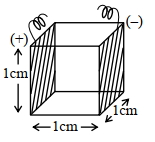
$A$ conductivity cell with two electrodes (shaded sides) is half-filled with an infinitely dilute aqueous solution of a weak electrolyte. If the volume is doubled by adding more water at a constant temperature,the molar conductivity of the cell will -
A
increase sharply
B
remain the same
C
decrease sharply
D
depend upon the type of electrolyte
Solution
(B) The molar conductivity at infinite dilution,denoted as $\Lambda_m^\circ$,represents the limiting value of molar conductivity when the concentration of the electrolyte approaches zero (i.e.,at infinite dilution).
Since the solution is already at infinite dilution,the degree of dissociation of the weak electrolyte is already at its maximum value.
Adding more water to an already infinitely dilute solution does not change the concentration of ions or the degree of dissociation.
Therefore,the molar conductivity remains constant and does not change.
Since the solution is already at infinite dilution,the degree of dissociation of the weak electrolyte is already at its maximum value.
Adding more water to an already infinitely dilute solution does not change the concentration of ions or the degree of dissociation.
Therefore,the molar conductivity remains constant and does not change.
0 likes
View Solution249
MediumMCQ
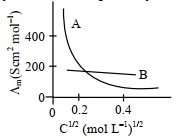
The molar conductivity for electrolytes $A$ and $B$ are plotted against $C^{1/2}$ as shown below. Electrolytes $A$ and $B$ respectively are:
A
Weak electrolyte,weak electrolyte
B
Strong electrolyte,strong electrolyte
C
Weak electrolyte,strong electrolyte
D
Strong electrolyte,weak electrolyte
Solution
(C) For strong electrolytes,molar conductivity $(\Lambda_m)$ varies linearly with $C^{1/2}$ according to the Kohlrausch equation: $\Lambda_m = \Lambda_m^0 - A \sqrt{C}$. This is represented by the straight line $B$.
For weak electrolytes,molar conductivity increases sharply with dilution (decrease in $C^{1/2}$) due to an increase in the degree of dissociation,as shown by the curve $A$.
For weak electrolytes,molar conductivity increases sharply with dilution (decrease in $C^{1/2}$) due to an increase in the degree of dissociation,as shown by the curve $A$.
0 likes
View Solution250
MediumMCQ
Which of the following is the correct equation representing the change in molar conductivity with respect to concentration for a weak electrolyte,where the symbols carry their usual meaning?
A
$\Lambda_{m}^2 C + K_{a} \Lambda_{m} - K_{a} \Lambda_{m}^{\circ} = 0$
B
$\Lambda_{m} - \Lambda_{m}^{\circ} + AC^{\frac{1}{2}} = 0$
C
$\Lambda_{m} - \Lambda_{m}^{\circ} - AC^{\frac{1}{2}} = 0$
D
$\Lambda_{m}^2 C + K_{a} \Lambda_{m} \Lambda_{m}^{\circ} - K_{a} (\Lambda_{m}^{\circ})^2 = 0$
Solution
(D) For a weak electrolyte $HA \rightleftharpoons H^{+} + A^{-}$,the dissociation constant $K_{a}$ is given by $K_{a} = \frac{\alpha^2 C}{1 - \alpha}$.
Since $\alpha = \frac{\Lambda_{m}}{\Lambda_{m}^{\circ}}$,we substitute this into the expression:
$K_{a} = \frac{(\Lambda_{m} / \Lambda_{m}^{\circ})^2 C}{1 - (\Lambda_{m} / \Lambda_{m}^{\circ})} = \frac{\Lambda_{m}^2 C}{\Lambda_{m}^{\circ}(\Lambda_{m}^{\circ} - \Lambda_{m})}$.
Rearranging this gives: $K_{a} \Lambda_{m}^{\circ}(\Lambda_{m}^{\circ} - \Lambda_{m}) = \Lambda_{m}^2 C$.
$K_{a} (\Lambda_{m}^{\circ})^2 - K_{a} \Lambda_{m} \Lambda_{m}^{\circ} = \Lambda_{m}^2 C$.
Therefore,the correct equation is $\Lambda_{m}^2 C + K_{a} \Lambda_{m} \Lambda_{m}^{\circ} - K_{a} (\Lambda_{m}^{\circ})^2 = 0$.
Since $\alpha = \frac{\Lambda_{m}}{\Lambda_{m}^{\circ}}$,we substitute this into the expression:
$K_{a} = \frac{(\Lambda_{m} / \Lambda_{m}^{\circ})^2 C}{1 - (\Lambda_{m} / \Lambda_{m}^{\circ})} = \frac{\Lambda_{m}^2 C}{\Lambda_{m}^{\circ}(\Lambda_{m}^{\circ} - \Lambda_{m})}$.
Rearranging this gives: $K_{a} \Lambda_{m}^{\circ}(\Lambda_{m}^{\circ} - \Lambda_{m}) = \Lambda_{m}^2 C$.
$K_{a} (\Lambda_{m}^{\circ})^2 - K_{a} \Lambda_{m} \Lambda_{m}^{\circ} = \Lambda_{m}^2 C$.
Therefore,the correct equation is $\Lambda_{m}^2 C + K_{a} \Lambda_{m} \Lambda_{m}^{\circ} - K_{a} (\Lambda_{m}^{\circ})^2 = 0$.
0 likes
View SolutionElectrochemistry — Conductor and Conductance and Cell constant · Frequently Asked Questions
1Are these Electrochemistry questions useful for JEE and NEET?
Yes. All questions in this section are mapped to JEE Main and NEET exam patterns. Previous year questions from JEE Main, NEET, GUJCET and state-level exams are included with full solutions.
2Can I switch to Hindi or Gujarati for these questions?
Yes. Use the language tabs in the hero section or the sidebar to view the same questions and solutions in English, Hindi or Gujarati.
3How do I generate a question paper from this subtopic?
Use the Vedclass Exam Paper Generator — select the chapter and subtopic, set difficulty, and generate Sets A, B, C, D automatically. First 3 chapters of every subject are free.
Vedclass Products
For Students
Vedclass Test Series
Mock tests in real JEE/NEET style with performance analysis. 5-day free trial.
Start Free TrialFor Teachers
Exam Paper Generator
Generate Set A/B/C/D papers from this chapter in 2 minutes. 3 chapters free.
Try FreeFor Institutes
Online Exam Module
Live online exams with unlimited students, 360° analytics & white-label branding.
See DemoFor Teachers & Institutes
Generate a Electrochemistry Exam Paper in 2 Minutes
Select subtopic & difficulty — Sets A, B, C, D auto-generated with No Repeat logic.
First 3 chapters of every subject are free — no payment required.