
A English
Conductor and Conductance and Cell constant Questions in English
Class 12 Chemistry · Electrochemistry · Conductor and Conductance and Cell constant
419+
Questions
English
Language
100%
With Solutions
Showing 49 of 419 questions in English
151
EasyMCQ
Equivalent conductance of an electrolyte containing $NaF$ at infinite dilution is $90.1 \, \Omega^{-1} \, cm^2$. If $NaF$ is replaced by $KF$,what is the value of equivalent conductance? ........... $\Omega^{-1} \, cm^{2}$
A
$90.1$
B
$111.2$
C
$0$
D
$222.4$
Solution
(B) According to Kohlrausch's law of independent migration of ions,the equivalent conductance at infinite dilution is the sum of the ionic conductances of the cation and the anion.
For $NaF$,$\Lambda^{\infty}_{NaF} = \lambda^{\infty}_{Na^+} + \lambda^{\infty}_{F^-} = 90.1 \, \Omega^{-1} \, cm^2$.
For $KF$,$\Lambda^{\infty}_{KF} = \lambda^{\infty}_{K^+} + \lambda^{\infty}_{F^-}$.
Since the ionic mobility of $K^+$ is higher than $Na^+$,the equivalent conductance of $KF$ will be higher than $NaF$.
However,in many simplified textbook contexts,if the question implies a comparison where the values are expected to be similar or if it is a trick question regarding the nature of the electrolyte,we must note that $KF$ has a higher value than $90.1$.
Given the options provided,$111.2$ is the only value greater than $90.1$ that fits the expected trend for the substitution of $Na^+$ with $K^+$.
For $NaF$,$\Lambda^{\infty}_{NaF} = \lambda^{\infty}_{Na^+} + \lambda^{\infty}_{F^-} = 90.1 \, \Omega^{-1} \, cm^2$.
For $KF$,$\Lambda^{\infty}_{KF} = \lambda^{\infty}_{K^+} + \lambda^{\infty}_{F^-}$.
Since the ionic mobility of $K^+$ is higher than $Na^+$,the equivalent conductance of $KF$ will be higher than $NaF$.
However,in many simplified textbook contexts,if the question implies a comparison where the values are expected to be similar or if it is a trick question regarding the nature of the electrolyte,we must note that $KF$ has a higher value than $90.1$.
Given the options provided,$111.2$ is the only value greater than $90.1$ that fits the expected trend for the substitution of $Na^+$ with $K^+$.
0 likes
View Solution152
DifficultMCQ
$A$ $0.5\,M\,NaOH$ solution offers a resistance of $31.6\,\Omega$ in a conductivity cell at room temperature. What shall be the approximate molar conductance of this $NaOH$ solution if the cell constant of the cell is $0.367\,cm^{-1}$? (in $S\,cm^2\,mol^{-1}$)
A
$234$
B
$23.2$
C
$4645$
D
$5464$
Solution
(B) Given: Resistance $R = 31.6\,\Omega$,Cell constant $G^* = 0.367\,cm^{-1}$,Molarity $M = 0.5\,M$.
Conductance $C = \frac{1}{R} = \frac{1}{31.6} \approx 0.0316\,S$.
Specific conductance $\kappa = C \times G^* = 0.0316\,S \times 0.367\,cm^{-1} \approx 0.0116\,S\,cm^{-1}$.
Molar conductance $\Lambda_m = \frac{\kappa \times 1000}{M} = \frac{0.0116 \times 1000}{0.5} = \frac{11.6}{0.5} = 23.2\,S\,cm^2\,mol^{-1}$.
Conductance $C = \frac{1}{R} = \frac{1}{31.6} \approx 0.0316\,S$.
Specific conductance $\kappa = C \times G^* = 0.0316\,S \times 0.367\,cm^{-1} \approx 0.0116\,S\,cm^{-1}$.
Molar conductance $\Lambda_m = \frac{\kappa \times 1000}{M} = \frac{0.0116 \times 1000}{0.5} = \frac{11.6}{0.5} = 23.2\,S\,cm^2\,mol^{-1}$.
0 likes
View Solution153
DifficultMCQ
Molar conductances of $BaCl_2, H_2SO_4$ and $HCl$ at infinite dilutions are $x_1, x_2$ and $x_3$ respectively. Equivalent conductance of $BaSO_4$ at infinite dilution will be
A
$(x_1 + x_2 - 2x_3) / 2$
B
$x_1 + x_2 - 2x_3$
C
$(x_1 + x_2 - x_3) / 2$
D
$(x_1 - x_2 - x_3) / 2$
Solution
(A) According to Kohlrausch's law,the molar conductance at infinite dilution is the sum of the ionic conductances of the constituent ions.
$\lambda_m^\infty (BaSO_4) = \lambda_{Ba^{2+}}^\infty + \lambda_{SO_4^{2-}}^\infty$
We can express this using the given values:
$\lambda_m^\infty (BaSO_4) = \lambda_m^\infty (BaCl_2) + \lambda_m^\infty (H_2SO_4) - 2\lambda_m^\infty (HCl)$
$\lambda_m^\infty (BaSO_4) = x_1 + x_2 - 2x_3$
Equivalent conductance $(\lambda_e^\infty)$ is related to molar conductance $(\lambda_m^\infty)$ by the formula $\lambda_e^\infty = \frac{\lambda_m^\infty}{n}$,where $n$ is the valency factor. For $BaSO_4$,$n = 2$.
Therefore,$\lambda_e^\infty (BaSO_4) = \frac{x_1 + x_2 - 2x_3}{2}$.
$\lambda_m^\infty (BaSO_4) = \lambda_{Ba^{2+}}^\infty + \lambda_{SO_4^{2-}}^\infty$
We can express this using the given values:
$\lambda_m^\infty (BaSO_4) = \lambda_m^\infty (BaCl_2) + \lambda_m^\infty (H_2SO_4) - 2\lambda_m^\infty (HCl)$
$\lambda_m^\infty (BaSO_4) = x_1 + x_2 - 2x_3$
Equivalent conductance $(\lambda_e^\infty)$ is related to molar conductance $(\lambda_m^\infty)$ by the formula $\lambda_e^\infty = \frac{\lambda_m^\infty}{n}$,where $n$ is the valency factor. For $BaSO_4$,$n = 2$.
Therefore,$\lambda_e^\infty (BaSO_4) = \frac{x_1 + x_2 - 2x_3}{2}$.
0 likes
View Solution154
EasyMCQ
The cell constant of a given cell is $0.47 \, cm^{-1}$. The resistance of a solution placed in this cell is measured to be $31.6 \, \Omega$. The conductivity of the solution (in $S \, cm^{-1}$ where $S$ has usual meaning) is
A
$0.15$
B
$1.5$
C
$0.015$
D
$150$
Solution
(C) The formula for conductivity $(\kappa)$ is given by: $\kappa = \frac{1}{R} \times \text{Cell constant}$.
Given: $\text{Cell constant} = 0.47 \, cm^{-1}$,$\text{Resistance } (R) = 31.6 \, \Omega$.
Substituting the values: $\kappa = \frac{0.47}{31.6} \, S \, cm^{-1}$.
$\kappa \approx 0.01487 \, S \, cm^{-1} \approx 0.015 \, S \, cm^{-1}$.
Given: $\text{Cell constant} = 0.47 \, cm^{-1}$,$\text{Resistance } (R) = 31.6 \, \Omega$.
Substituting the values: $\kappa = \frac{0.47}{31.6} \, S \, cm^{-1}$.
$\kappa \approx 0.01487 \, S \, cm^{-1} \approx 0.015 \, S \, cm^{-1}$.
0 likes
View Solution155
MediumMCQ
Assertion: Electrical conductivity of copper increases with increase in temperature.
Reason: The electrical conductivity of metals is due to the motion of electrons.
Reason: The electrical conductivity of metals is due to the motion of electrons.
A
If both Assertion and Reason are correct and the Reason is a correct explanation of the Assertion.
B
If both Assertion and Reason are correct but Reason is not a correct explanation of the Assertion.
C
If the Assertion is correct but Reason is incorrect.
D
If the Assertion is incorrect but the Reason is correct.
Solution
(D) The Assertion is incorrect because the electrical conductivity of metals like copper decreases with an increase in temperature. This happens because an increase in temperature causes increased vibrations of metal ions,which increases the resistance to the flow of electrons.
The Reason is correct because the electrical conductivity of metals is indeed due to the motion of free electrons.
Therefore,the Assertion is incorrect,but the Reason is correct.
The Reason is correct because the electrical conductivity of metals is indeed due to the motion of free electrons.
Therefore,the Assertion is incorrect,but the Reason is correct.
0 likes
View Solution156
MediumMCQ
Assertion : On increasing dilution,the specific conductance keeps on increasing.
Reason : On increasing dilution,the degree of ionization of a weak electrolyte increases and the mobility of ions also increases.
Reason : On increasing dilution,the degree of ionization of a weak electrolyte increases and the mobility of ions also increases.
A
If both Assertion and Reason are correct and the Reason is a correct explanation of the Assertion.
B
If both Assertion and Reason are correct but Reason is not a correct explanation of the Assertion.
C
If the Assertion is correct but Reason is incorrect.
D
If both the Assertion and Reason are incorrect.
Solution
(D) Specific conductance (conductivity,$\kappa$) is defined as the conductance of $1 \ cm^3$ of the solution.
On increasing dilution,the number of ions per unit volume decreases,which leads to a decrease in specific conductance.
Therefore,the Assertion is incorrect.
Although the degree of ionization and ionic mobility increase with dilution,the Assertion itself is false,making the correct choice $D$.
On increasing dilution,the number of ions per unit volume decreases,which leads to a decrease in specific conductance.
Therefore,the Assertion is incorrect.
Although the degree of ionization and ionic mobility increase with dilution,the Assertion itself is false,making the correct choice $D$.
0 likes
View Solution157
Difficult
Resistance of a conductivity cell filled with $0.1 \, mol \, L^{-1}$ $KCl$ solution is $100 \, \Omega$. If the resistance of the same cell when filled with $0.02 \, mol \, L^{-1}$ $KCl$ solution is $520 \, \Omega$,calculate the conductivity and molar conductivity of $0.02 \, mol \, L^{-1} \, KCl$ solution. The conductivity of $0.1 \, mol \, L^{-1} \, KCl$ solution is $1.29 \, S / m$.
Solution
(N/A) The cell constant $(G^*)$ is calculated as:
$G^* = \text{conductivity} \times \text{resistance} = 1.29 \, S \, m^{-1} \times 100 \, \Omega = 129 \, m^{-1}$.
Conductivity $(\kappa)$ of $0.02 \, mol \, L^{-1}$ $KCl$ solution:
$\kappa = \frac{G^*}{R} = \frac{129 \, m^{-1}}{520 \, \Omega} = 0.248 \, S \, m^{-1}$.
Molar conductivity $(\Lambda_m)$ is given by $\Lambda_m = \frac{\kappa}{c}$.
Concentration $c = 0.02 \, mol \, L^{-1} = 20 \, mol \, m^{-3}$.
$\Lambda_m = \frac{0.248 \, S \, m^{-1}}{20 \, mol \, m^{-3}} = 0.0124 \, S \, m^2 \, mol^{-1} = 124 \times 10^{-4} \, S \, m^2 \, mol^{-1}$.
$G^* = \text{conductivity} \times \text{resistance} = 1.29 \, S \, m^{-1} \times 100 \, \Omega = 129 \, m^{-1}$.
Conductivity $(\kappa)$ of $0.02 \, mol \, L^{-1}$ $KCl$ solution:
$\kappa = \frac{G^*}{R} = \frac{129 \, m^{-1}}{520 \, \Omega} = 0.248 \, S \, m^{-1}$.
Molar conductivity $(\Lambda_m)$ is given by $\Lambda_m = \frac{\kappa}{c}$.
Concentration $c = 0.02 \, mol \, L^{-1} = 20 \, mol \, m^{-3}$.
$\Lambda_m = \frac{0.248 \, S \, m^{-1}}{20 \, mol \, m^{-3}} = 0.0124 \, S \, m^2 \, mol^{-1} = 124 \times 10^{-4} \, S \, m^2 \, mol^{-1}$.
0 likes
View Solution158
Difficult
The electrical resistance of a column of $0.05 \ mol \ L^{-1}$ $NaOH$ solution of diameter $1 \ cm$ and length $50 \ cm$ is $5.55 \times 10^{3} \ \Omega$. Calculate its resistivity,conductivity and molar conductivity.
Solution
$A = \pi r^{2} = 3.14 \times (0.5 \ cm)^{2} = 0.785 \ cm^{2} = 0.785 \times 10^{-4} \ m^{2}$
$l = 50 \ cm = 0.5 \ m$
$\rho = \frac{R A}{l} = \frac{5.55 \times 10^{3} \ \Omega \times 0.785 \ cm^{2}}{50 \ cm} = 87.135 \ \Omega \ cm$
$\kappa = \frac{1}{\rho} = \frac{1}{87.135} \ S \ cm^{-1} = 0.01148 \ S \ cm^{-1}$
$\Lambda_{m} = \frac{\kappa \times 1000}{c} = \frac{0.01148 \ S \ cm^{-1} \times 1000 \ cm^{3} \ L^{-1}}{0.05 \ mol \ L^{-1}} = 229.6 \ S \ cm^{2} \ mol^{-1}$
$l = 50 \ cm = 0.5 \ m$
$\rho = \frac{R A}{l} = \frac{5.55 \times 10^{3} \ \Omega \times 0.785 \ cm^{2}}{50 \ cm} = 87.135 \ \Omega \ cm$
$\kappa = \frac{1}{\rho} = \frac{1}{87.135} \ S \ cm^{-1} = 0.01148 \ S \ cm^{-1}$
$\Lambda_{m} = \frac{\kappa \times 1000}{c} = \frac{0.01148 \ S \ cm^{-1} \times 1000 \ cm^{3} \ L^{-1}}{0.05 \ mol \ L^{-1}} = 229.6 \ S \ cm^{2} \ mol^{-1}$
0 likes
View Solution159
Medium
The molar conductivity of $KCl$ solutions at different concentrations at $298 \, K$ are given below:
Show that a plot between $\Lambda_m$ and $c^{1/2}$ is a straight line. Determine the values of $\Lambda_m^o$ and $A$ for $KCl$.
| $c^{1/2} / (mol \, L^{-1})^{1/2}$ | $\Lambda_m / S \, cm^2 \, mol^{-1}$ |
| $0.000198$ | $148.61$ |
| $0.000309$ | $148.29$ |
| $0.000521$ | $147.81$ |
| $0.000989$ | $147.09$ |
Show that a plot between $\Lambda_m$ and $c^{1/2}$ is a straight line. Determine the values of $\Lambda_m^o$ and $A$ for $KCl$.
Solution
(N/A) The Kohlrausch equation is given by $\Lambda_m = \Lambda_m^o - A c^{1/2}$.
To verify this,we calculate the square root of the concentration $(c^{1/2})$:
$A$ plot of $\Lambda_m$ ($y$-axis) versus $c^{1/2}$ ($x$-axis) yields a straight line.
By extrapolating the line to $c^{1/2} = 0$,we find the intercept $\Lambda_m^o = 150.0 \, S \, cm^2 \, mol^{-1}$.
The slope of the line is given by $A = - \text{slope} = - \frac{147.09 - 148.61}{0.03145 - 0.01407} \approx 87.46 \, S \, cm^2 \, mol^{-1} / (mol \, L^{-1})^{1/2}$.
To verify this,we calculate the square root of the concentration $(c^{1/2})$:
| $c^{1/2} / (mol \, L^{-1})^{1/2}$ | $\Lambda_m / S \, cm^2 \, mol^{-1}$ |
| $0.01407$ | $148.61$ |
| $0.01758$ | $148.29$ |
| $0.02283$ | $147.81$ |
| $0.03145$ | $147.09$ |
$A$ plot of $\Lambda_m$ ($y$-axis) versus $c^{1/2}$ ($x$-axis) yields a straight line.
By extrapolating the line to $c^{1/2} = 0$,we find the intercept $\Lambda_m^o = 150.0 \, S \, cm^2 \, mol^{-1}$.
The slope of the line is given by $A = - \text{slope} = - \frac{147.09 - 148.61}{0.03145 - 0.01407} \approx 87.46 \, S \, cm^2 \, mol^{-1} / (mol \, L^{-1})^{1/2}$.
0 likes
View Solution160
Medium
Calculate $\Lambda _m^o$ for $CaCl_2$ and $MgSO_4$ from the data given in the table below:
| Ion and $\lambda ^o / (S \ cm^2 \ mol^{-1})$ | Ion and $\lambda ^o / (S \ cm^2 \ mol^{-1})$ |
|---|---|
| $H^{+} : 349.6$ | $OH^{-} : 199.1$ |
| $Na^{+} : 50.1$ | $Cl^{-} : 76.3$ |
| $K^{+} : 73.5$ | $Br^{-} : 78.1$ |
| $Ca^{2+} : 119.0$ | $CH_3COO^{-} : 40.9$ |
| $Mg^{2+} : 106.0$ | $SO_4^{2-} : 160.0$ |
Solution
According to Kohlrausch law of independent migration of ions:
$\Lambda _{m(CaCl_2)}^o = \lambda _{Ca^{2+}}^o + 2\lambda _{Cl^{-}}^o$
$= 119.0 \ S \ cm^2 \ mol^{-1} + 2(76.3 \ S \ cm^2 \ mol^{-1})$
$= 119.0 + 152.6 = 271.6 \ S \ cm^2 \ mol^{-1}$
$\Lambda _{m(MgSO_4)}^o = \lambda _{Mg^{2+}}^o + \lambda _{SO_4^{2-}}^o$
$= 106.0 \ S \ cm^2 \ mol^{-1} + 160.0 \ S \ cm^2 \ mol^{-1}$
$= 266.0 \ S \ cm^2 \ mol^{-1}$
$\Lambda _{m(CaCl_2)}^o = \lambda _{Ca^{2+}}^o + 2\lambda _{Cl^{-}}^o$
$= 119.0 \ S \ cm^2 \ mol^{-1} + 2(76.3 \ S \ cm^2 \ mol^{-1})$
$= 119.0 + 152.6 = 271.6 \ S \ cm^2 \ mol^{-1}$
$\Lambda _{m(MgSO_4)}^o = \lambda _{Mg^{2+}}^o + \lambda _{SO_4^{2-}}^o$
$= 106.0 \ S \ cm^2 \ mol^{-1} + 160.0 \ S \ cm^2 \ mol^{-1}$
$= 266.0 \ S \ cm^2 \ mol^{-1}$
0 likes
View Solution161
MediumMCQ
$\Lambda _m^\circ$ for $NaCl$,$HCl$ and $NaAc$ are $126.4$,$425.9$ and $91.0 \ S \ cm^2 \ mol^{-1}$ respectively. Calculate $\Lambda _m^\circ$ for $HAc$.
A
$390.5 \ S \ cm^2 \ mol^{-1}$
B
$490.5 \ S \ cm^2 \ mol^{-1}$
C
$290.5 \ S \ cm^2 \ mol^{-1}$
D
$350.5 \ S \ cm^2 \ mol^{-1}$
Solution
(A) According to Kohlrausch's law of independent migration of ions:
$\Lambda _{m(HAc)}^\circ = \lambda _{H^{+}}^\circ + \lambda _{Ac^{-}}^\circ$
We can express this in terms of the given values:
$\Lambda _{m(HAc)}^\circ = (\lambda _{H^{+}}^\circ + \lambda _{Cl^{-}}^\circ) + (\lambda _{Na^{+}}^\circ + \lambda _{Ac^{-}}^\circ) - (\lambda _{Na^{+}}^\circ + \lambda _{Cl^{-}}^\circ)$
$\Lambda _{m(HAc)}^\circ = \Lambda _{m(HCl)}^\circ + \Lambda _{m(NaAc)}^\circ - \Lambda _{m(NaCl)}^\circ$
Substituting the given values:
$\Lambda _{m(HAc)}^\circ = 425.9 + 91.0 - 126.4$
$\Lambda _{m(HAc)}^\circ = 390.5 \ S \ cm^2 \ mol^{-1}$
$\Lambda _{m(HAc)}^\circ = \lambda _{H^{+}}^\circ + \lambda _{Ac^{-}}^\circ$
We can express this in terms of the given values:
$\Lambda _{m(HAc)}^\circ = (\lambda _{H^{+}}^\circ + \lambda _{Cl^{-}}^\circ) + (\lambda _{Na^{+}}^\circ + \lambda _{Ac^{-}}^\circ) - (\lambda _{Na^{+}}^\circ + \lambda _{Cl^{-}}^\circ)$
$\Lambda _{m(HAc)}^\circ = \Lambda _{m(HCl)}^\circ + \Lambda _{m(NaAc)}^\circ - \Lambda _{m(NaCl)}^\circ$
Substituting the given values:
$\Lambda _{m(HAc)}^\circ = 425.9 + 91.0 - 126.4$
$\Lambda _{m(HAc)}^\circ = 390.5 \ S \ cm^2 \ mol^{-1}$
0 likes
View Solution162
Easy
Why does the conductivity of a solution decrease with dilution?
Solution
(N/A) The conductivity $(\kappa)$ of a solution is defined as the conductance of ions present in a unit volume $(1 \ cm^3)$ of the solution.
Upon dilution,the total number of ions remains the same,but the number of ions per unit volume decreases.
Since the conductivity depends directly on the concentration of ions in a unit volume,the conductivity of the solution decreases with dilution.
Upon dilution,the total number of ions remains the same,but the number of ions per unit volume decreases.
Since the conductivity depends directly on the concentration of ions in a unit volume,the conductivity of the solution decreases with dilution.
0 likes
View Solution163
Medium
Suggest a way to determine the $\Lambda _m^o$ value of water.
Solution
(N/A) Applying Kohlrausch's law of independent migration of ions,the $\Lambda _{m}^{o}$ value of water can be determined as follows:
$\Lambda _{m(H_2O)}^o = \lambda _{H^{+}}^o + \lambda _{OH^{-}}^o$
$= (\lambda _{H^{+}}^o + \lambda _{Cl^{-}}^o) + (\lambda _{Na^{+}}^o + \lambda _{OH^{-}}^o) - (\lambda _{Na^{+}}^o + \lambda _{Cl^{-}}^o)$
$= \Lambda _{m(HCl)}^o + \Lambda _{m(NaOH)}^o - \Lambda _{m(NaCl)}^o$
Hence,by knowing the values of $\Lambda _m^o$ for $HCl, NaOH,$ and $NaCl$,the $\Lambda _m^o$ value of water can be determined.
$\Lambda _{m(H_2O)}^o = \lambda _{H^{+}}^o + \lambda _{OH^{-}}^o$
$= (\lambda _{H^{+}}^o + \lambda _{Cl^{-}}^o) + (\lambda _{Na^{+}}^o + \lambda _{OH^{-}}^o) - (\lambda _{Na^{+}}^o + \lambda _{Cl^{-}}^o)$
$= \Lambda _{m(HCl)}^o + \Lambda _{m(NaOH)}^o - \Lambda _{m(NaCl)}^o$
Hence,by knowing the values of $\Lambda _m^o$ for $HCl, NaOH,$ and $NaCl$,the $\Lambda _m^o$ value of water can be determined.
0 likes
View Solution164
Difficult
Define conductivity and molar conductivity for the solution of an electrolyte. Discuss their variation with concentration.
Solution
(N/A) Conductivity of a solution is defined as the conductance of a solution of $1 \, cm$ in length and area of cross-section $1 \, cm^2$. The inverse of resistivity is called conductivity or specific conductance. It is represented by the symbol $\kappa$. If $\rho$ is resistivity,then we can write:
$\kappa = \frac{1}{\rho}$
The conductivity of a solution at any given concentration is the conductance $(G)$ of one unit volume of solution kept between two platinum electrodes with the unit area of cross-section and at a distance of unit length.
i.e.,$G = \kappa \frac{a}{l} = \kappa \cdot 1 = \kappa$
(since $a = 1, l = 1$)
Conductivity always decreases with a decrease in concentration,both for weak and strong electrolytes. This is because the number of ions per unit volume that carry the current in a solution decreases with a decrease in concentration.
Molar conductivity:
Molar conductivity of a solution at a given concentration is the conductance of volume $V$ of a solution containing $1 \, mole$ of the electrolyte kept between two electrodes with the area of cross-section $A$ and distance of unit length.
$\Lambda_m = \kappa \cdot \frac{A}{l}$
Now,$l = 1$ and $A = V$ (volume containing $1 \, mole$ of the electrolyte).
$\therefore \Lambda_m = \kappa \cdot V$
Molar conductivity increases with a decrease in concentration. This is because the total volume $V$ of the solution containing one mole of the electrolyte increases on dilution.
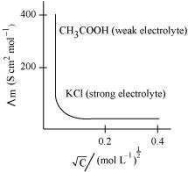
The variation of $\Lambda_m$ with $\sqrt{c}$ for strong and weak electrolytes is shown in the following plot:
$\kappa = \frac{1}{\rho}$
The conductivity of a solution at any given concentration is the conductance $(G)$ of one unit volume of solution kept between two platinum electrodes with the unit area of cross-section and at a distance of unit length.
i.e.,$G = \kappa \frac{a}{l} = \kappa \cdot 1 = \kappa$
(since $a = 1, l = 1$)
Conductivity always decreases with a decrease in concentration,both for weak and strong electrolytes. This is because the number of ions per unit volume that carry the current in a solution decreases with a decrease in concentration.
Molar conductivity:
Molar conductivity of a solution at a given concentration is the conductance of volume $V$ of a solution containing $1 \, mole$ of the electrolyte kept between two electrodes with the area of cross-section $A$ and distance of unit length.
$\Lambda_m = \kappa \cdot \frac{A}{l}$
Now,$l = 1$ and $A = V$ (volume containing $1 \, mole$ of the electrolyte).
$\therefore \Lambda_m = \kappa \cdot V$
Molar conductivity increases with a decrease in concentration. This is because the total volume $V$ of the solution containing one mole of the electrolyte increases on dilution.
The variation of $\Lambda_m$ with $\sqrt{c}$ for strong and weak electrolytes is shown in the following plot:
0 likes
View Solution165
Medium
The conductivity of $0.20 \, M$ solution of $KCl$ at $298 \, K$ is $0.0248 \, S \, cm^{-1}$. Calculate its molar conductivity.
Solution
$(124 S CM^2 MOL^-1)$ Given,conductivity $\kappa = 0.0248 \, S \, cm^{-1}$.
Concentration $c = 0.20 \, M$.
Formula for molar conductivity is $\Lambda_{m} = \frac{\kappa \times 1000}{c}$.
Substituting the values: $\Lambda_{m} = \frac{0.0248 \times 1000}{0.20}$.
$\Lambda_{m} = \frac{24.8}{0.20} = 124 \, S \, cm^{2} \, mol^{-1}$.
Concentration $c = 0.20 \, M$.
Formula for molar conductivity is $\Lambda_{m} = \frac{\kappa \times 1000}{c}$.
Substituting the values: $\Lambda_{m} = \frac{0.0248 \times 1000}{0.20}$.
$\Lambda_{m} = \frac{24.8}{0.20} = 124 \, S \, cm^{2} \, mol^{-1}$.
0 likes
View Solution166
Medium
The resistance of a conductivity cell containing $0.001 \ M \ KCl$ solution at $298 \ K$ is $1500 \ \Omega$. What is the cell constant if the conductivity of $0.001 \ M \ KCl$ solution at $298 \ K$ is $0.146 \times 10^{-3} \ S \ cm^{-1}$?
Solution
(N/A) Given:
Conductivity,$\kappa = 0.146 \times 10^{-3} \ S \ cm^{-1}$
Resistance,$R = 1500 \ \Omega$
The formula for cell constant $(G^*)$ is:
$G^* = \kappa \times R$
Substituting the values:
$G^* = (0.146 \times 10^{-3} \ S \ cm^{-1}) \times (1500 \ \Omega)$
$G^* = 0.219 \ cm^{-1}$
Thus,the cell constant is $0.219 \ cm^{-1}$.
Conductivity,$\kappa = 0.146 \times 10^{-3} \ S \ cm^{-1}$
Resistance,$R = 1500 \ \Omega$
The formula for cell constant $(G^*)$ is:
$G^* = \kappa \times R$
Substituting the values:
$G^* = (0.146 \times 10^{-3} \ S \ cm^{-1}) \times (1500 \ \Omega)$
$G^* = 0.219 \ cm^{-1}$
Thus,the cell constant is $0.219 \ cm^{-1}$.
0 likes
View Solution167
Difficult
The conductivity of sodium chloride at $298 \ K$ has been determined at different concentrations and the results are given below:
Calculate ${\Lambda _m}$ for all concentrations and draw a plot between ${\Lambda _m}$ and $c^{1/2}$. Find the value of $\Lambda _m^o$.
| Concentration $/ M$ | $0.001$ | $0.010$ | $0.020$ | $0.050$ | $0.100$ |
| ${10^2} \times \kappa / S \, m^{-1}$ | $1.237$ | $11.85$ | $23.15$ | $55.53$ | $106.74$ |
Calculate ${\Lambda _m}$ for all concentrations and draw a plot between ${\Lambda _m}$ and $c^{1/2}$. Find the value of $\Lambda _m^o$.
Solution
(A) The molar conductivity ${\Lambda _m}$ is calculated using the formula: ${\Lambda _m} = \frac{\kappa \times 1000}{c}$ where $\kappa$ is in $S \, cm^{-1}$ and $c$ is in $mol \, L^{-1}$.
Given $\kappa$ values are in $S \, m^{-1}$,we convert them to $S \, cm^{-1}$ by multiplying by $10^{-2}$.
$1$. For $c = 0.001 \, M$: $\kappa = 1.237 \times 10^{-4} \, S \, cm^{-1} \implies {\Lambda _m} = \frac{1.237 \times 10^{-4} \times 1000}{0.001} = 123.7 \, S \, cm^2 \, mol^{-1}$. $c^{1/2} = 0.0316 \, M^{1/2}$.
$2$. For $c = 0.010 \, M$: $\kappa = 11.85 \times 10^{-4} \, S \, cm^{-1} \implies {\Lambda _m} = \frac{11.85 \times 10^{-4} \times 1000}{0.010} = 118.5 \, S \, cm^2 \, mol^{-1}$. $c^{1/2} = 0.1000 \, M^{1/2}$.
$3$. For $c = 0.020 \, M$: $\kappa = 23.15 \times 10^{-4} \, S \, cm^{-1} \implies {\Lambda _m} = \frac{23.15 \times 10^{-4} \times 1000}{0.020} = 115.8 \, S \, cm^2 \, mol^{-1}$. $c^{1/2} = 0.1414 \, M^{1/2}$.
$4$. For $c = 0.050 \, M$: $\kappa = 55.53 \times 10^{-4} \, S \, cm^{-1} \implies {\Lambda _m} = \frac{55.53 \times 10^{-4} \times 1000}{0.050} = 111.1 \, S \, cm^2 \, mol^{-1}$. $c^{1/2} = 0.2236 \, M^{1/2}$.
$5$. For $c = 0.100 \, M$: $\kappa = 106.74 \times 10^{-4} \, S \, cm^{-1} \implies {\Lambda _m} = \frac{106.74 \times 10^{-4} \times 1000}{0.100} = 106.7 \, S \, cm^2 \, mol^{-1}$. $c^{1/2} = 0.3162 \, M^{1/2}$.
Plotting ${\Lambda _m}$ vs $c^{1/2}$ and extrapolating to $c^{1/2} = 0$,we find the intercept $\Lambda _m^o \approx 124.0 \, S \, cm^2 \, mol^{-1}$.
Given $\kappa$ values are in $S \, m^{-1}$,we convert them to $S \, cm^{-1}$ by multiplying by $10^{-2}$.
$1$. For $c = 0.001 \, M$: $\kappa = 1.237 \times 10^{-4} \, S \, cm^{-1} \implies {\Lambda _m} = \frac{1.237 \times 10^{-4} \times 1000}{0.001} = 123.7 \, S \, cm^2 \, mol^{-1}$. $c^{1/2} = 0.0316 \, M^{1/2}$.
$2$. For $c = 0.010 \, M$: $\kappa = 11.85 \times 10^{-4} \, S \, cm^{-1} \implies {\Lambda _m} = \frac{11.85 \times 10^{-4} \times 1000}{0.010} = 118.5 \, S \, cm^2 \, mol^{-1}$. $c^{1/2} = 0.1000 \, M^{1/2}$.
$3$. For $c = 0.020 \, M$: $\kappa = 23.15 \times 10^{-4} \, S \, cm^{-1} \implies {\Lambda _m} = \frac{23.15 \times 10^{-4} \times 1000}{0.020} = 115.8 \, S \, cm^2 \, mol^{-1}$. $c^{1/2} = 0.1414 \, M^{1/2}$.
$4$. For $c = 0.050 \, M$: $\kappa = 55.53 \times 10^{-4} \, S \, cm^{-1} \implies {\Lambda _m} = \frac{55.53 \times 10^{-4} \times 1000}{0.050} = 111.1 \, S \, cm^2 \, mol^{-1}$. $c^{1/2} = 0.2236 \, M^{1/2}$.
$5$. For $c = 0.100 \, M$: $\kappa = 106.74 \times 10^{-4} \, S \, cm^{-1} \implies {\Lambda _m} = \frac{106.74 \times 10^{-4} \times 1000}{0.100} = 106.7 \, S \, cm^2 \, mol^{-1}$. $c^{1/2} = 0.3162 \, M^{1/2}$.
Plotting ${\Lambda _m}$ vs $c^{1/2}$ and extrapolating to $c^{1/2} = 0$,we find the intercept $\Lambda _m^o \approx 124.0 \, S \, cm^2 \, mol^{-1}$.
0 likes
View Solution168
EasyMCQ
$Al$ has double the conductivity compared to which metal?
A
$Cu$
B
$Fe$
C
$Ag$
D
$Zn$
Solution
(A) $Al$ (Aluminum) has approximately double the electrical conductivity compared to $Cu$ (Copper) when compared on an equal mass basis.
0 likes
View Solution169
Difficult
Explain the conduction of electricity in metals and non-metals.
Solution
(N/A) The conduction of electricity in conductors is due to the movement of electrons or ions. Conductors are classified into metallic conductors and electrolytic conductors.
- Metals conduct electricity in both solid and molten states. The conductivity of metals depends on the number of valence electrons available per atom.
- The atomic orbitals of metal atoms form molecular orbitals,which are so close in energy that they form bands.
- If these bands are partially filled or overlap with a higher energy unoccupied conduction band,electrons can flow easily under an electric field,and the metal shows conductivity.
- If the gap between the filled valence band and the next higher unoccupied band (conduction band) is large,electrons cannot jump into it. Such substances have very low conductivity and behave as insulators.
- Metals conduct electricity in both solid and molten states. The conductivity of metals depends on the number of valence electrons available per atom.
- The atomic orbitals of metal atoms form molecular orbitals,which are so close in energy that they form bands.
- If these bands are partially filled or overlap with a higher energy unoccupied conduction band,electrons can flow easily under an electric field,and the metal shows conductivity.
- If the gap between the filled valence band and the next higher unoccupied band (conduction band) is large,electrons cannot jump into it. Such substances have very low conductivity and behave as insulators.
0 likes
View Solution170
Medium
What is electrical resistance? Give a note on it.
Solution
(N/A) Electrical resistance is a measure of the opposition to current flow in an electrical circuit. It is defined as the ratio of potential difference across a conductor to the current flowing through it.
The electrical resistance $R$ of a conductor is directly proportional to its length $l$ and inversely proportional to its area of cross-section $A$. That is,$R \propto \frac{l}{A}$.
$R = \rho \left( \frac{l}{A} \right)$,where $\rho$ is the resistivity constant.
The electrical resistance is represented by the symbol $R$ and is measured in ohm $(\Omega)$.
Its $SI$ base unit is $(kg \cdot m^{2}) / (s^{3} \cdot A^{2})$. It can be measured using a Wheatstone bridge.
$1 \, \Omega = 1 \, (kg \cdot m^{2}) / (s^{3} \cdot A^{2})$.
Conversion: $1 \, \Omega \cdot m = 100 \, \Omega \cdot cm$ or $1 \, \Omega \cdot cm = 0.01 \, \Omega \cdot m$.
The electrical resistance $R$ of a conductor is directly proportional to its length $l$ and inversely proportional to its area of cross-section $A$. That is,$R \propto \frac{l}{A}$.
$R = \rho \left( \frac{l}{A} \right)$,where $\rho$ is the resistivity constant.
The electrical resistance is represented by the symbol $R$ and is measured in ohm $(\Omega)$.
Its $SI$ base unit is $(kg \cdot m^{2}) / (s^{3} \cdot A^{2})$. It can be measured using a Wheatstone bridge.
$1 \, \Omega = 1 \, (kg \cdot m^{2}) / (s^{3} \cdot A^{2})$.
Conversion: $1 \, \Omega \cdot m = 100 \, \Omega \cdot cm$ or $1 \, \Omega \cdot cm = 0.01 \, \Omega \cdot m$.
0 likes
View Solution171
Medium
Define resistance or specific resistance and write a note on it.
Solution
(N/A) The electrical resistance of any object is directly proportional to its length $l$ and inversely proportional to its area of cross-section $A$.
$R \propto \frac{l}{A}$
$\therefore R = \rho \left( \frac{l}{A} \right)$ and $\rho = R \left( \frac{A}{l} \right)$
Here,$\rho$ (rho) is the specific resistance or resistivity.
Unit: The $SI$ unit of resistivity is ohm meter $(\Omega \ m)$,and sometimes it is expressed as ohm centimetre $(\Omega \ cm)$.
Note: $IUPAC$ recommends the use of the term resistivity over specific resistance.
If $l = 1 \ m$ and $A = 1 \ m^2$,then $R = \rho$.
$SI \ unit \ of \ \rho = \frac{(\Omega)(m)^2}{m} = \Omega \ m$.
Conversion: $1 \ \Omega \ m = 100 \ \Omega \ cm$ and $1 \ \Omega \ cm = 0.01 \ \Omega \ m$.
$R \propto \frac{l}{A}$
$\therefore R = \rho \left( \frac{l}{A} \right)$ and $\rho = R \left( \frac{A}{l} \right)$
Here,$\rho$ (rho) is the specific resistance or resistivity.
Unit: The $SI$ unit of resistivity is ohm meter $(\Omega \ m)$,and sometimes it is expressed as ohm centimetre $(\Omega \ cm)$.
Note: $IUPAC$ recommends the use of the term resistivity over specific resistance.
If $l = 1 \ m$ and $A = 1 \ m^2$,then $R = \rho$.
$SI \ unit \ of \ \rho = \frac{(\Omega)(m)^2}{m} = \Omega \ m$.
Conversion: $1 \ \Omega \ m = 100 \ \Omega \ cm$ and $1 \ \Omega \ cm = 0.01 \ \Omega \ m$.
0 likes
View Solution172
Difficult
What is conductivity? On what factors does conductivity depend?
Solution
(N/A) Conductivity $(k)$,also known as specific conductance,is the reciprocal of resistivity $(
ho)$.
Mathematically,$k = \frac{1}{\rho}$.
Conductivity depends on the following factors:
$1$. Nature of the material: It depends on the nature of the electrolyte and the solvent.
$2$. Concentration of ions: It depends on the concentration of ions present in the solution.
$3$. Temperature: It increases with an increase in temperature because the kinetic energy of ions increases,leading to higher mobility.
Mathematically,$k = \frac{1}{\rho}$.
Conductivity depends on the following factors:
$1$. Nature of the material: It depends on the nature of the electrolyte and the solvent.
$2$. Concentration of ions: It depends on the concentration of ions present in the solution.
$3$. Temperature: It increases with an increase in temperature because the kinetic energy of ions increases,leading to higher mobility.
1 likes
View Solution173
Medium
Write a note on specific conductivity $(k)$.
Solution
(N/A) The inverse of resistivity is called conductivity (specific conductance) and is represented by the symbol $k$ (Greek,kappa).
$k = \frac{1}{\rho}$
$IUPAC$ has recommended the use of the term conductivity over specific conductance.
The $SI$ units of conductivity are $S \ m^{-1}$,but quite often,$k$ is expressed in $S \ cm^{-1}$.
Conductivity of a material in $S \ m^{-1}$ is its conductance when it is $1 \ m$ long and its area of cross-section is $1 \ m^{2}$.
It may be noted that $1 \ S \ cm^{-1} = 100 \ S \ m^{-1}$.
Unit of kappa $(k): S \ m^{-1}$ or $S \ cm^{-1}$ or $\Omega^{-1} \ m^{-1}$ or $\Omega^{-1} \ cm^{-1}$.
Since $\rho = \frac{RA}{l}$,substituting this into $k = \frac{1}{\rho}$ gives:
$k = \left( \frac{l}{A} \right) \frac{1}{R}$
Since $G = \frac{1}{R}$ (conductance) and $G^{*} = \frac{l}{A}$ (cell constant):
$k = G \times G^{*}$
$k = \frac{1}{\rho}$
$IUPAC$ has recommended the use of the term conductivity over specific conductance.
The $SI$ units of conductivity are $S \ m^{-1}$,but quite often,$k$ is expressed in $S \ cm^{-1}$.
Conductivity of a material in $S \ m^{-1}$ is its conductance when it is $1 \ m$ long and its area of cross-section is $1 \ m^{2}$.
It may be noted that $1 \ S \ cm^{-1} = 100 \ S \ m^{-1}$.
Unit of kappa $(k): S \ m^{-1}$ or $S \ cm^{-1}$ or $\Omega^{-1} \ m^{-1}$ or $\Omega^{-1} \ cm^{-1}$.
Since $\rho = \frac{RA}{l}$,substituting this into $k = \frac{1}{\rho}$ gives:
$k = \left( \frac{l}{A} \right) \frac{1}{R}$
Since $G = \frac{1}{R}$ (conductance) and $G^{*} = \frac{l}{A}$ (cell constant):
$k = G \times G^{*}$
0 likes
View Solution174
Medium
What is metallic or electronic conductivity? On what factors does it depend?
Solution
(N/A) Definition: The flow of electric current through metals due to the movement of electrons is known as metallic or electronic conductivity.
Factors affecting metallic conductivity:
$i$. Nature and structure of the metal.
$ii$. Number of valence electrons per atom.
$iii$. Temperature: As the temperature increases,the conductivity decreases because of the increased vibration of metal ions which hinders the flow of electrons.
Key characteristic: Since electrons enter at one end and exit through the other,the chemical composition of the metallic conductor remains unchanged.
Factors affecting metallic conductivity:
$i$. Nature and structure of the metal.
$ii$. Number of valence electrons per atom.
$iii$. Temperature: As the temperature increases,the conductivity decreases because of the increased vibration of metal ions which hinders the flow of electrons.
Key characteristic: Since electrons enter at one end and exit through the other,the chemical composition of the metallic conductor remains unchanged.
0 likes
View Solution175
Medium
What is ionic conductivity? On what factors does it depend?
Solution
(N/A) Definition: When electrolytes are dissolved in water,they furnish their own ions in the solution,which increases the conductivity of the solution. The conductance of electricity by ions present in the solution is called electrolytic or ionic conductance. Pure water has very low conductivity,approximately $3.5 \times 10^{-5} \ S \ m^{-1}$.
Ionic conductivity depends on the following factors:
$(i)$ The nature of the electrolyte added.
$(ii)$ The size of the ions produced and their degree of solvation.
$(iii)$ The nature of the solvent and its viscosity.
$(iv)$ The concentration of the electrolyte.
$(v)$ Temperature: It increases with an increase in temperature.
Note: The passage of direct current $(DC)$ through an ionic solution over a prolonged period can lead to a change in its composition due to electrochemical reactions.
Ionic conductivity depends on the following factors:
$(i)$ The nature of the electrolyte added.
$(ii)$ The size of the ions produced and their degree of solvation.
$(iii)$ The nature of the solvent and its viscosity.
$(iv)$ The concentration of the electrolyte.
$(v)$ Temperature: It increases with an increase in temperature.
Note: The passage of direct current $(DC)$ through an ionic solution over a prolonged period can lead to a change in its composition due to electrochemical reactions.
0 likes
View Solution176
Medium
Write a note on the difficulties associated with the measurement of resistivity of an ionic solution.
Solution
(N/A) The inverse of the resistance of an ionic solution is known as the conductivity of the ionic solution,given by $k = \frac{G^{*}}{R}$.
Accurate measurement of an unknown resistance can be performed using a Wheatstone bridge.
However,for measuring the resistance of an ionic solution,we face two main problems:
$1$. Firstly,passing direct current $(DC)$ through the solution changes its chemical composition due to electrolysis.
This difficulty is resolved by using an alternating current $(AC)$ source of power.
$2$. Secondly,an ionic solution cannot be connected to the bridge like a metallic wire or other solid conductor.
This second problem is solved by using a specially designed vessel called a conductivity cell.
Accurate measurement of an unknown resistance can be performed using a Wheatstone bridge.
However,for measuring the resistance of an ionic solution,we face two main problems:
$1$. Firstly,passing direct current $(DC)$ through the solution changes its chemical composition due to electrolysis.
This difficulty is resolved by using an alternating current $(AC)$ source of power.
$2$. Secondly,an ionic solution cannot be connected to the bridge like a metallic wire or other solid conductor.
This second problem is solved by using a specially designed vessel called a conductivity cell.
0 likes
View Solution177
Medium
Explain the difficulties encountered in the measurement of the resistance of ionic solutions and how to resolve them.
Solution
(N/A) The inverse of the resistance of an ionic solution is known as its conductance. The relationship is given by $k = \frac{G^{*}}{R}$.
Accurate measurement of an unknown resistance is typically performed using a Wheatstone bridge. However,measuring the resistance of an ionic solution presents two primary difficulties:
$1$. Passing direct current $(DC)$ through the solution causes electrolysis,which changes the chemical composition of the solution.
This difficulty is resolved by using an alternating current $(AC)$ source of power,which prevents electrolysis.
$2$. An ionic solution cannot be connected to the Wheatstone bridge like a metallic wire or other solid conductor.
This problem is solved by using a specially designed vessel known as a conductivity cell.
Accurate measurement of an unknown resistance is typically performed using a Wheatstone bridge. However,measuring the resistance of an ionic solution presents two primary difficulties:
$1$. Passing direct current $(DC)$ through the solution causes electrolysis,which changes the chemical composition of the solution.
This difficulty is resolved by using an alternating current $(AC)$ source of power,which prevents electrolysis.
$2$. An ionic solution cannot be connected to the Wheatstone bridge like a metallic wire or other solid conductor.
This problem is solved by using a specially designed vessel known as a conductivity cell.
0 likes
View Solution178
Medium
Discuss the construction and uses of a conductivity cell.
Solution
(N/A) conductivity cell is an instrument used to measure the ionic conductivity or resistivity of an electrolytic solution.
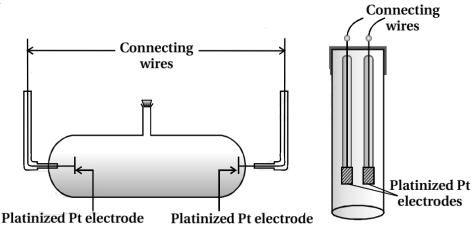
It is available in several designs,and two simple ones are shown in the diagram.
Construction: Basically,it consists of two platinum electrodes coated with platinum black (finely divided metallic $Pt$ is deposited on the electrodes electrochemically).
These electrodes have an area of cross-section equal to $A$ and are separated by a distance $l$.
Therefore,the solution confined between these electrodes acts as a column of length $l$ and area of cross-section $A$.
Uses: By using a conductivity cell,the conductivity and resistivity of an unknown electrolytic solution can be measured.
It is available in several designs,and two simple ones are shown in the diagram.
Construction: Basically,it consists of two platinum electrodes coated with platinum black (finely divided metallic $Pt$ is deposited on the electrodes electrochemically).
These electrodes have an area of cross-section equal to $A$ and are separated by a distance $l$.
Therefore,the solution confined between these electrodes acts as a column of length $l$ and area of cross-section $A$.
Uses: By using a conductivity cell,the conductivity and resistivity of an unknown electrolytic solution can be measured.
0 likes
View Solution179
Medium
What is a conductivity cell constant? Provide a note on the conductivity cell constant $(G^*)$.
Solution
(N/A) The quantity $\left(\frac{l}{A}\right)$ is called the cell constant,denoted by the symbol $G^*$. Here,$l$ is the distance between the two electrodes of the cell,and $A$ is the area of cross-section of the electrodes. Direct measurement of $l$ and $A$ is often inconvenient and unreliable.
$(A)$ Measurement of cell resistance: The cell constant is usually determined by measuring the resistance of the cell containing a solution whose conductivity is already known. For this purpose,we generally use $KCl$ solutions,whose conductivity is known accurately at various concentrations and temperatures.
$(B)$ Procedure: The conductivity cell is filled with a $KCl$ solution of known concentration and is then connected to a Wheatstone bridge using an $AC$ current source to measure its resistance.
$(C)$ Calculation of cell constant $G^*$: $G^* = \left(\frac{l}{A}\right) = R \cdot \kappa$
Where,$R$ is the measured resistance of the $KCl$ solution,and $\kappa$ is the conductivity of the $KCl$ solution obtained from standard tables.
The table below provides reference values for $KCl$ solutions at $298.15 \ K$:
$(A)$ Measurement of cell resistance: The cell constant is usually determined by measuring the resistance of the cell containing a solution whose conductivity is already known. For this purpose,we generally use $KCl$ solutions,whose conductivity is known accurately at various concentrations and temperatures.
$(B)$ Procedure: The conductivity cell is filled with a $KCl$ solution of known concentration and is then connected to a Wheatstone bridge using an $AC$ current source to measure its resistance.
$(C)$ Calculation of cell constant $G^*$: $G^* = \left(\frac{l}{A}\right) = R \cdot \kappa$
Where,$R$ is the measured resistance of the $KCl$ solution,and $\kappa$ is the conductivity of the $KCl$ solution obtained from standard tables.
The table below provides reference values for $KCl$ solutions at $298.15 \ K$:
| Molarity (mol $L^{-1}$) | Molarity (mol $m^{-3}$) | Conductivity $(S \ cm^{-1})$ | Conductivity $(S \ m^{-1})$ | Molar Conductivity $(S \ cm^{2} \ mol^{-1})$ | Molar Conductivity $(S \ m^{2} \ mol^{-1})$ |
|---|---|---|---|---|---|
| $1.000$ | $1000$ | $0.1113$ | $11.13$ | $111.3$ | $111.3 \times 10^{-4}$ |
| $0.100$ | $100.0$ | $0.0129$ | $1.29$ | $129.0$ | $129.0 \times 10^{-4}$ |
| $0.010$ | $10.00$ | $0.00141$ | $0.141$ | $141.0$ | $141.0 \times 10^{-4}$ |
0 likes
View Solution180
Difficult
Explain the measurement and calculation of the resistivity of an electrolytic solution.
Solution
(N/A) To measure the resistivity of an electrolytic solution,we first determine the conductivity cell constant $G^*$. By using this cell,we measure the resistance and ionic conductivity of the solution.
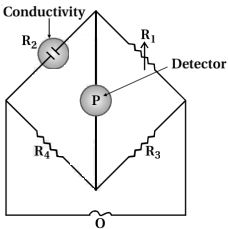
$(A)$ Measurement of resistance of solution: The setup for the measurement of the resistance is shown in the figure. It consists of two known resistances $R_3$ and $R_4$,a variable resistance $R_1$,and the conductivity cell having the unknown resistance $R_2$. The Wheatstone bridge is fed by an oscillator $O$ (a source of $a.c.$ power in the audio frequency range $550$ to $5000$ cycles per second). $P$ is a suitable detector (a headphone or other electronic device),and the bridge is balanced when no current passes through the detector.
$(B)$ Calculation for resistance of solution: In the balanced condition,the unknown resistance $R_2$ of the solution is obtained by the formula:
$R_2 = \frac{R_1 R_4}{R_3} = R$
These days,inexpensive conductivity meters are available. Electric resistance $R$ is measured in ohm $(\Omega)$. The relationship between resistance,resistivity,and cell constant is:
$R = \rho \left( \frac{l}{A} \right) = \frac{1}{\kappa} \left( \frac{l}{A} \right) = \frac{G^*}{\kappa}$
Where,
$R = \text{Resistance}$
$G^* = \text{Cell constant} = \frac{l}{A}$
$\rho = \text{Resistivity}$
$\kappa = \text{Conductivity of solution}$
Thus,resistivity $\rho$ can be calculated as $\rho = R \left( \frac{A}{l} \right) = \frac{R}{G^*}$.
$(A)$ Measurement of resistance of solution: The setup for the measurement of the resistance is shown in the figure. It consists of two known resistances $R_3$ and $R_4$,a variable resistance $R_1$,and the conductivity cell having the unknown resistance $R_2$. The Wheatstone bridge is fed by an oscillator $O$ (a source of $a.c.$ power in the audio frequency range $550$ to $5000$ cycles per second). $P$ is a suitable detector (a headphone or other electronic device),and the bridge is balanced when no current passes through the detector.
$(B)$ Calculation for resistance of solution: In the balanced condition,the unknown resistance $R_2$ of the solution is obtained by the formula:
$R_2 = \frac{R_1 R_4}{R_3} = R$
These days,inexpensive conductivity meters are available. Electric resistance $R$ is measured in ohm $(\Omega)$. The relationship between resistance,resistivity,and cell constant is:
$R = \rho \left( \frac{l}{A} \right) = \frac{1}{\kappa} \left( \frac{l}{A} \right) = \frac{G^*}{\kappa}$
Where,
$R = \text{Resistance}$
$G^* = \text{Cell constant} = \frac{l}{A}$
$\rho = \text{Resistivity}$
$\kappa = \text{Conductivity of solution}$
Thus,resistivity $\rho$ can be calculated as $\rho = R \left( \frac{A}{l} \right) = \frac{R}{G^*}$.
0 likes
View Solution181
MediumMCQ
How can the ionic conductivity of an unknown solution be determined?
A
By measuring the cell constant and resistance of the solution.
B
By measuring the potential difference only.
C
By measuring the current only.
D
By measuring the volume of the solution.
Solution
(A) $(i)$ First,determine the cell constant $(G^*)$ using a standard solution of known conductivity.
$(ii)$ Determine the resistance $(R)$ of the unknown solution using a conductivity cell.
$(iii)$ Calculate the conductivity $(\kappa)$ of the solution using the equation: $\kappa = \frac{G^*}{R}$.
The $SI$ unit of conductivity is $S \ m^{-1}$,and it is also commonly expressed as $S \ cm^{-1}$.
$(ii)$ Determine the resistance $(R)$ of the unknown solution using a conductivity cell.
$(iii)$ Calculate the conductivity $(\kappa)$ of the solution using the equation: $\kappa = \frac{G^*}{R}$.
The $SI$ unit of conductivity is $S \ m^{-1}$,and it is also commonly expressed as $S \ cm^{-1}$.
0 likes
View Solution182
Medium
Write a note on molar conductivity $(\Lambda_{m})$ of a solution.
Solution
(N/A) The conductivity of solutions of different electrolytes in the same solvent and at a given temperature differs due to the charge and size of the ions in which they dissociate,the concentration of ions,or the ease with which the ions move under a potential gradient. It,therefore,becomes necessary to define a physically more meaningful quantity called molar conductivity. It is denoted by the symbol $\Lambda_{m}$ (Greek,lambda).
It is related to the conductivity of the solution by the equation:
$\Lambda_{m} = \frac{k}{c}$
Where,
$k =$ conductivity of the solution (unit: $S \ m^{-1}$)
$c =$ concentration of the solution (unit: $mol \ m^{-3}$)
$\Lambda_{m} =$ molar conductivity of the solution
Therefore,the unit of $\Lambda_{m}$ is $S \ m^{2} \ mol^{-1}$.
In practical units,if $k$ is in $S \ cm^{-1}$ and concentration $(c)$ is in $mol \ L^{-1}$ (molarity),the formula is:
$\Lambda_{m} = \frac{k \times 1000}{Molarity}$
The unit becomes $S \ cm^{2} \ mol^{-1}$ or $\Omega^{-1} \ cm^{2} \ mol^{-1}$.
Conversion factor:
$1 \ S \ m^{2} \ mol^{-1} = 10^{4} \ S \ cm^{2} \ mol^{-1}$
It is related to the conductivity of the solution by the equation:
$\Lambda_{m} = \frac{k}{c}$
Where,
$k =$ conductivity of the solution (unit: $S \ m^{-1}$)
$c =$ concentration of the solution (unit: $mol \ m^{-3}$)
$\Lambda_{m} =$ molar conductivity of the solution
Therefore,the unit of $\Lambda_{m}$ is $S \ m^{2} \ mol^{-1}$.
In practical units,if $k$ is in $S \ cm^{-1}$ and concentration $(c)$ is in $mol \ L^{-1}$ (molarity),the formula is:
$\Lambda_{m} = \frac{k \times 1000}{Molarity}$
The unit becomes $S \ cm^{2} \ mol^{-1}$ or $\Omega^{-1} \ cm^{2} \ mol^{-1}$.
Conversion factor:
$1 \ S \ m^{2} \ mol^{-1} = 10^{4} \ S \ cm^{2} \ mol^{-1}$
0 likes
View Solution183
Advanced
Explain the effect of change in concentration on the conductivity of a solution.
Solution
(N/A) Both conductivity $(k)$ and molar conductivity $(\Lambda_{m})$ change with the concentration of the electrolyte.
Conductivity $(k)$ always decreases with a decrease in concentration (dilution),for both weak and strong electrolytes.
This is because the number of ions per unit volume that carry the current in the solution decreases upon dilution.
Conductivity is defined as the conductance of one unit volume of solution kept between two platinum electrodes with unit area of cross-section and unit length. If $G$ is the conductance,$A$ is the cross-sectional area,and $l$ is the distance between electrodes,then $G = k \left( \frac{A}{l} \right)$. For $A = 1$ and $l = 1$,$G = k$.
Molar conductivity $(\Lambda_{m})$ is the conductance of the volume $V$ of solution containing one mole of electrolyte kept between two electrodes. It is related to conductivity by the equation $\Lambda_{m} = k V$. As concentration decreases,$V$ increases,which leads to an increase in molar conductivity.
Conductivity $(k)$ always decreases with a decrease in concentration (dilution),for both weak and strong electrolytes.
This is because the number of ions per unit volume that carry the current in the solution decreases upon dilution.
Conductivity is defined as the conductance of one unit volume of solution kept between two platinum electrodes with unit area of cross-section and unit length. If $G$ is the conductance,$A$ is the cross-sectional area,and $l$ is the distance between electrodes,then $G = k \left( \frac{A}{l} \right)$. For $A = 1$ and $l = 1$,$G = k$.
Molar conductivity $(\Lambda_{m})$ is the conductance of the volume $V$ of solution containing one mole of electrolyte kept between two electrodes. It is related to conductivity by the equation $\Lambda_{m} = k V$. As concentration decreases,$V$ increases,which leads to an increase in molar conductivity.
0 likes
View Solution184
Difficult
What is a strong electrolyte? Explain the relation between molar conductivity and the concentration of a solution with a strong electrolyte.
Solution
(N/A) Strong electrolyte: Electrolytes that undergo complete or maximum ionization in their aqueous solution are known as strong electrolytes. Their solutions exhibit high conductivity. Examples include $KCl, NaCl, KNO_{3}, NaNO_{3}, MgCl_{2}, CaCl_{2}, MgSO_{4}$,etc. Salts of strong acids and strong bases are typically strong electrolytes.
$(b)$ Concentration of solution and value of $\Lambda_{m}$: For strong electrolytes,$\Lambda_{m}$ increases slowly with dilution and can be represented by the Kohlrausch equation:
$\Lambda_{m} = \Lambda_{m}^{\circ} - A c^{1/2}$
Where:
$\Lambda_{m} =$ molar conductivity of the strong electrolyte.
$\Lambda_{m}^{\circ} =$ limiting molar conductivity of the strong electrolyte.
$c =$ concentration of the solution in $mol \ L^{-1}$.
$A =$ constant,which represents the negative slope of the graph.
The value of $A$ depends on: $(i)$ the type of electrolyte (charge on ions) like $1-1, 2-1, 2-2$ etc.,$(ii)$ temperature,and $(iii)$ pressure.
$(b)$ Concentration of solution and value of $\Lambda_{m}$: For strong electrolytes,$\Lambda_{m}$ increases slowly with dilution and can be represented by the Kohlrausch equation:
$\Lambda_{m} = \Lambda_{m}^{\circ} - A c^{1/2}$
Where:
$\Lambda_{m} =$ molar conductivity of the strong electrolyte.
$\Lambda_{m}^{\circ} =$ limiting molar conductivity of the strong electrolyte.
$c =$ concentration of the solution in $mol \ L^{-1}$.
$A =$ constant,which represents the negative slope of the graph.
| Strong electrolyte | $NaCl, KCl, CaCl_{2}, MgSO_{4}$ |
| Valency or Type | $1-1, 1-1, 2-1, 2-2$ |
The value of $A$ depends on: $(i)$ the type of electrolyte (charge on ions) like $1-1, 2-1, 2-2$ etc.,$(ii)$ temperature,and $(iii)$ pressure.
0 likes
View Solution185
Medium
The molar conductivity of $KCl$ solutions at different concentrations at $298 \ K$ is given below:
Show that a plot of $\Lambda_m$ versus $c^{1/2}$ is a straight line. Determine the values of $\Lambda_m^o$ and $A$ for $KCl$.
| $c / mol \ L^{-1}$ | $\Lambda_m / S \ cm^2 \ mol^{-1}$ |
| $0.000198$ | $148.61$ |
| $0.000309$ | $148.29$ |
| $0.000521$ | $147.81$ |
| $0.000989$ | $147.09$ |
Show that a plot of $\Lambda_m$ versus $c^{1/2}$ is a straight line. Determine the values of $\Lambda_m^o$ and $A$ for $KCl$.
Solution
(N/A) The Kohlrausch equation is given by: $\Lambda_m = \Lambda_m^o - A \sqrt{c}$.
To verify this,we calculate $c^{1/2}$ for each concentration:
Plotting $\Lambda_m$ on the y-axis and $c^{1/2}$ on the x-axis yields a straight line.
From the slope of the line,$A = -\frac{\Delta \Lambda_m}{\Delta c^{1/2}} = -\frac{147.09 - 148.61}{0.03145 - 0.01407} \approx -87.46 \ S \ cm^2 \ mol^{-1} (mol \ L^{-1})^{-1/2}$.
Extrapolating the line to $c^{1/2} = 0$ (y-intercept),we get $\Lambda_m^o \approx 150.0 \ S \ cm^2 \ mol^{-1}$.
To verify this,we calculate $c^{1/2}$ for each concentration:
| $c / mol \ L^{-1}$ | $c^{1/2} / (mol \ L^{-1})^{1/2}$ | $\Lambda_m / S \ cm^2 \ mol^{-1}$ |
| $0.000198$ | $0.01407$ | $148.61$ |
| $0.000309$ | $0.01758$ | $148.29$ |
| $0.000521$ | $0.02283$ | $147.81$ |
| $0.000989$ | $0.03145$ | $147.09$ |
Plotting $\Lambda_m$ on the y-axis and $c^{1/2}$ on the x-axis yields a straight line.
From the slope of the line,$A = -\frac{\Delta \Lambda_m}{\Delta c^{1/2}} = -\frac{147.09 - 148.61}{0.03145 - 0.01407} \approx -87.46 \ S \ cm^2 \ mol^{-1} (mol \ L^{-1})^{-1/2}$.
Extrapolating the line to $c^{1/2} = 0$ (y-intercept),we get $\Lambda_m^o \approx 150.0 \ S \ cm^2 \ mol^{-1}$.
0 likes
View Solution186
Difficult
Write a note on Kohlrausch law of independent migration of ions and limiting molar conductivity $\Lambda_{m}^{o}$ of strong electrolyte.
Solution
(N/A) Kohlrausch examined $\Lambda_{m}^{o}$ values for several strong electrolytes and observed certain regularities. He noted that the difference in $\Lambda_{m}^{o}$ of the electrolytes $NaX$ and $KX$ for any $X$ is nearly constant. For example,at $298 \ K$ :
$[\Lambda_{m(KCl)}^{o} - \Lambda_{m(NaCl)}^{o}] = [\Lambda_{m(KBr)}^{o} - \Lambda_{m(NaBr)}^{o}] = [\Lambda_{m(KI)}^{o} - \Lambda_{m(NaI)}^{o}] = 23.4 \ S \ cm^{2} \ mol^{-1}$
Similarly,$[\Lambda_{m(NaBr)}^{o} - \Lambda_{m(NaCl)}^{o}] = [\Lambda_{m(KBr)}^{o} - \Lambda_{m(KCl)}^{o}] = 1.8 \ S \ cm^{2} \ mol^{-1}$
Kohlrausch Law: Based on the above observations,he enunciated the Kohlrausch law of independent migration of ions.
Law: The limiting molar conductivity of an electrolyte can be represented as the sum of the individual contributions of the anion and cation of the electrolyte.
If $\lambda_{Na^{+}}^{o}$ is the limiting molar conductivity of sodium ions and $\lambda_{Cl^{-}}^{o}$ is the limiting molar conductivity of chloride ions,then:
$\Lambda_{m(NaCl)}^{o} = \lambda_{Na^{+}}^{o} + \lambda_{Cl^{-}}^{o}$
In general,if an electrolyte on dissociation gives $\nu_{+}$ cations and $\nu_{-}$ anions,then its limiting molar conductivity is given by:
$\Lambda_{m}^{o} = \nu_{+} \lambda_{+}^{o} + \nu_{-} \lambda_{-}^{o}$
Here,$\lambda_{+}^{o}$ and $\lambda_{-}^{o}$ are the limiting molar conductivities of the cation and anion,respectively.
$[\Lambda_{m(KCl)}^{o} - \Lambda_{m(NaCl)}^{o}] = [\Lambda_{m(KBr)}^{o} - \Lambda_{m(NaBr)}^{o}] = [\Lambda_{m(KI)}^{o} - \Lambda_{m(NaI)}^{o}] = 23.4 \ S \ cm^{2} \ mol^{-1}$
Similarly,$[\Lambda_{m(NaBr)}^{o} - \Lambda_{m(NaCl)}^{o}] = [\Lambda_{m(KBr)}^{o} - \Lambda_{m(KCl)}^{o}] = 1.8 \ S \ cm^{2} \ mol^{-1}$
Kohlrausch Law: Based on the above observations,he enunciated the Kohlrausch law of independent migration of ions.
Law: The limiting molar conductivity of an electrolyte can be represented as the sum of the individual contributions of the anion and cation of the electrolyte.
If $\lambda_{Na^{+}}^{o}$ is the limiting molar conductivity of sodium ions and $\lambda_{Cl^{-}}^{o}$ is the limiting molar conductivity of chloride ions,then:
$\Lambda_{m(NaCl)}^{o} = \lambda_{Na^{+}}^{o} + \lambda_{Cl^{-}}^{o}$
In general,if an electrolyte on dissociation gives $\nu_{+}$ cations and $\nu_{-}$ anions,then its limiting molar conductivity is given by:
$\Lambda_{m}^{o} = \nu_{+} \lambda_{+}^{o} + \nu_{-} \lambda_{-}^{o}$
Here,$\lambda_{+}^{o}$ and $\lambda_{-}^{o}$ are the limiting molar conductivities of the cation and anion,respectively.
0 likes
View Solution187
Medium
Give a note on the measurement of limiting molar conductivity of a solution of a weak electrolyte.
Solution
(N/A) At infinite dilution (i.e.,concentration $c \rightarrow 0$),an electrolyte dissociates completely $(\alpha = 1)$. However,at such low concentrations,the conductivity of the solution is so low that it cannot be measured accurately.
Therefore,the value of $\Lambda_{m}^{\circ}$ cannot be determined by extrapolating the graph of $\Lambda_{m}$ versus $c^{1/2}$.
Instead,$\Lambda_{m}^{\circ}$ for weak electrolytes is obtained using Kohlrausch's law of independent migration of ions.
According to this law,$\Lambda_{m}^{\circ} = \nu_{+} \lambda_{+}^{\circ} + \nu_{-} \lambda_{-}^{\circ}$,where $\lambda^{\circ}$ represents the limiting molar conductivity of individual ions.
Furthermore,the dissociation constant $(K_{a})$ of a weak electrolyte like acetic acid can be calculated using the relation $K_{a} = \frac{c \alpha^{2}}{1 - \alpha}$,where $\alpha = \frac{\Lambda_{m}}{\Lambda_{m}^{\circ}}$.
Therefore,the value of $\Lambda_{m}^{\circ}$ cannot be determined by extrapolating the graph of $\Lambda_{m}$ versus $c^{1/2}$.
Instead,$\Lambda_{m}^{\circ}$ for weak electrolytes is obtained using Kohlrausch's law of independent migration of ions.
According to this law,$\Lambda_{m}^{\circ} = \nu_{+} \lambda_{+}^{\circ} + \nu_{-} \lambda_{-}^{\circ}$,where $\lambda^{\circ}$ represents the limiting molar conductivity of individual ions.
Furthermore,the dissociation constant $(K_{a})$ of a weak electrolyte like acetic acid can be calculated using the relation $K_{a} = \frac{c \alpha^{2}}{1 - \alpha}$,where $\alpha = \frac{\Lambda_{m}}{\Lambda_{m}^{\circ}}$.
0 likes
View Solution188
Medium
Explain Kohlrausch law of independent migration of ions.
Solution
(N/A) Law: The law states that the limiting molar conductivity of an electrolyte can be represented as the sum of the individual contributions of the anion and cation of the electrolyte.
For example,if the limiting molar conductivity of positive and negative ions is $\lambda_{m^{+}}^{\circ}$ and $\lambda_{m^{-}}^{\circ}$,respectively,then the limiting molar conductivity of the solution $(\Lambda_{m}^{\circ})$ will be as follows:
$\Lambda_{m}^{\circ} = v_{+} \lambda_{m^{+}}^{\circ} + v_{-} \lambda_{m^{-}}^{\circ}$
Explanation:
If $\lambda_{m}^{\circ}$ of $K^{+} = 73.5$ and $\lambda_{m}^{\circ}$ of $Br^{-} = 78.1 \ S \ cm^{2} \ mol^{-1}$,then the limiting molar conductivity of $KBr$ solution at infinite dilution is as follows:
$\Lambda_{m}^{\circ}(KBr) = \lambda_{m}^{\circ}(K^{+}) + \lambda_{m}^{\circ}(Br^{-})$
$= 73.5 + 78.1$
$= 151.6 \ S \ cm^{2} \ mol^{-1}$
Limiting molar conductivity of some ions at $298 \ K$ temperature:
For example,if the limiting molar conductivity of positive and negative ions is $\lambda_{m^{+}}^{\circ}$ and $\lambda_{m^{-}}^{\circ}$,respectively,then the limiting molar conductivity of the solution $(\Lambda_{m}^{\circ})$ will be as follows:
$\Lambda_{m}^{\circ} = v_{+} \lambda_{m^{+}}^{\circ} + v_{-} \lambda_{m^{-}}^{\circ}$
Explanation:
If $\lambda_{m}^{\circ}$ of $K^{+} = 73.5$ and $\lambda_{m}^{\circ}$ of $Br^{-} = 78.1 \ S \ cm^{2} \ mol^{-1}$,then the limiting molar conductivity of $KBr$ solution at infinite dilution is as follows:
$\Lambda_{m}^{\circ}(KBr) = \lambda_{m}^{\circ}(K^{+}) + \lambda_{m}^{\circ}(Br^{-})$
$= 73.5 + 78.1$
$= 151.6 \ S \ cm^{2} \ mol^{-1}$
Limiting molar conductivity of some ions at $298 \ K$ temperature:
| Ion | $\lambda^{\circ} / (S \ cm^{2} \ mol^{-1})$ | Ion | $\lambda^{\circ} / (S \ cm^{2} \ mol^{-1})$ |
| $H^{+} \ | \ 349.6$ | $OH^{-} \ | \ 199.1$ |
| $Na^{+} \ | \ 50.1$ | $Cl^{-} \ | \ 76.3$ |
| $K^{+} \ | \ 73.5$ | $Br^{-} \ | \ 78.1$ |
| $Ca^{2+} \ | \ 119.0$ | $CH_{3}COO^{-} \ | \ 40.9$ |
| $Mg^{2+} \ | \ 106.0$ | $SO_{4}^{2-} \ | \ 160.0$ |
0 likes
View Solution189
Medium
State Kohlrausch's law of independent migration of ions and explain its applications.
Solution
(N/A) Kohlrausch's law of independent migration of ions states that the limiting molar conductivity of an electrolyte can be represented as the sum of the individual contributions of the anion and cation of the electrolyte. Mathematically,$\Lambda_{m}^{\circ} = \nu_{+} \lambda_{+}^{\circ} + \nu_{-} \lambda_{-}^{\circ}$,where $\nu_{+}$ and $\nu_{-}$ are the number of cations and anions per formula unit of electrolyte,and $\lambda_{+}^{\circ}$ and $\lambda_{-}^{\circ}$ are the limiting molar conductivities of the individual ions.
Applications:
$1$. Calculation of limiting molar conductivity $(\Lambda_{m}^{\circ})$ for weak electrolytes: The law allows the determination of $\Lambda_{m}^{\circ}$ for weak electrolytes by using the limiting molar conductivities of strong electrolytes.
$2$. Calculation of degree of dissociation $(\alpha)$: For a weak electrolyte at a given concentration $c$,the degree of dissociation is given by $\alpha = \frac{\Lambda_{m}}{\Lambda_{m}^{\circ}}$,where $\Lambda_{m}$ is the molar conductivity at concentration $c$.
$3$. Calculation of dissociation constant $(K_{a})$: The dissociation constant is calculated using the formula $K_{a} = \frac{c \alpha^{2}}{1 - \alpha} = \frac{c \Lambda_{m}^{2}}{\Lambda_{m}^{\circ}(\Lambda_{m}^{\circ} - \Lambda_{m})}$.
Applications:
$1$. Calculation of limiting molar conductivity $(\Lambda_{m}^{\circ})$ for weak electrolytes: The law allows the determination of $\Lambda_{m}^{\circ}$ for weak electrolytes by using the limiting molar conductivities of strong electrolytes.
$2$. Calculation of degree of dissociation $(\alpha)$: For a weak electrolyte at a given concentration $c$,the degree of dissociation is given by $\alpha = \frac{\Lambda_{m}}{\Lambda_{m}^{\circ}}$,where $\Lambda_{m}$ is the molar conductivity at concentration $c$.
$3$. Calculation of dissociation constant $(K_{a})$: The dissociation constant is calculated using the formula $K_{a} = \frac{c \alpha^{2}}{1 - \alpha} = \frac{c \Lambda_{m}^{2}}{\Lambda_{m}^{\circ}(\Lambda_{m}^{\circ} - \Lambda_{m})}$.
0 likes
View Solution190
Medium
Provide the graph of $\Lambda_{m}$ versus $c^{1/2}$ for aqueous solutions of strong and weak electrolytes,and clarify their differences and uses.
Solution
(N/A) The graph of $\Lambda_{m}$ versus $c^{1/2}$ for aqueous solutions of strong and weak electrolytes is shown below:
Uses:
$1$. For strong electrolytes,the graph allows the determination of molar conductivity at infinite dilution $(\Lambda_{m}^{o})$ using the intercept.
$2$. For weak electrolytes,$\Lambda_{m}^{o}$ cannot be determined graphically; it is calculated using Kohlrausch's Law of independent migration of ions.
| Feature | Strong Electrolyte (e.g.,$KCl$) | Weak Electrolyte (e.g.,$CH_{3}COOH$) |
|---|---|---|
| Graph Nature | Linear graph. | Non-linear (curved) graph. |
| Kohlrausch Equation | Follows $\Lambda_{m} = \Lambda_{m}^{o} - A c^{1/2}$. | Does not follow this linear relation. |
| Determination of $\Lambda_{m}^{o}$ | Can be obtained by extrapolating the graph to zero concentration (intercept). | Cannot be obtained by extrapolation as the curve becomes parallel to the y-axis at low concentrations. |
Uses:
$1$. For strong electrolytes,the graph allows the determination of molar conductivity at infinite dilution $(\Lambda_{m}^{o})$ using the intercept.
$2$. For weak electrolytes,$\Lambda_{m}^{o}$ cannot be determined graphically; it is calculated using Kohlrausch's Law of independent migration of ions.
0 likes
View Solution191
MediumMCQ
Resistivity of $0.5 \ M$ electrolytic solution is $10 \ \Omega \ cm$. Find the molar conductivity of the solution.
A
$100 \ S \ cm^{2} \ mol^{-1}$
B
$200 \ S \ cm^{2} \ mol^{-1}$
C
$50 \ S \ cm^{2} \ mol^{-1}$
D
$400 \ S \ cm^{2} \ mol^{-1}$
Solution
(B) $\Lambda_{m}$ is the molar conductivity of the solution.
$k$ is the specific conductivity (conductivity) of the solution.
$\rho$ is the resistivity of the solution $= 10 \ \Omega \ cm$.
$k = \frac{1}{\rho} = \frac{1}{10} = 0.1 \ \Omega^{-1} \ cm^{-1} = 0.1 \ S \ cm^{-1}$.
Concentration of the solution $c = 0.5 \ M = 0.5 \ mol \ L^{-1}$.
The formula for molar conductivity is $\Lambda_{m} = \frac{1000 \times k}{c}$.
Substituting the values: $\Lambda_{m} = \frac{1000 \times 0.1}{0.5} = \frac{100}{0.5} = 200 \ S \ cm^{2} \ mol^{-1}$.
$k$ is the specific conductivity (conductivity) of the solution.
$\rho$ is the resistivity of the solution $= 10 \ \Omega \ cm$.
$k = \frac{1}{\rho} = \frac{1}{10} = 0.1 \ \Omega^{-1} \ cm^{-1} = 0.1 \ S \ cm^{-1}$.
Concentration of the solution $c = 0.5 \ M = 0.5 \ mol \ L^{-1}$.
The formula for molar conductivity is $\Lambda_{m} = \frac{1000 \times k}{c}$.
Substituting the values: $\Lambda_{m} = \frac{1000 \times 0.1}{0.5} = \frac{100}{0.5} = 200 \ S \ cm^{2} \ mol^{-1}$.
0 likes
View Solution192
Difficult
Resistance of $0.05 \ M$ electrolytic solution at $298 \ K$ temperature is $30.0 \ \Omega$. The cross-sectional area of the conductivity cell having $Pt$ electrodes is $3.8 \ cm^{2}$ and the distance between the two electrodes is $1.5 \ cm$. What is the molar conductivity of the electrolytic solution?
Solution
(N/A) Cell constant $(G^{*})$ is given by:
$G^{*} = \frac{l}{A} = \frac{1.5 \ cm}{3.8 \ cm^{2}} = 0.3947 \ cm^{-1}$
Conductivity $(k)$ is calculated as:
$k = \frac{G^{*}}{R} = \frac{0.3947 \ cm^{-1}}{30.0 \ \Omega} = 0.013157 \ S \ cm^{-1}$
Molar conductivity $(\Lambda_{m})$ is calculated using the formula:
$\Lambda_{m} = \frac{1000 \times k}{c}$
$\Lambda_{m} = \frac{1000 \times 0.013157 \ S \ cm^{-1}}{0.05 \ mol \ L^{-1}} = 263.14 \ S \ cm^{2} \ mol^{-1}$
$G^{*} = \frac{l}{A} = \frac{1.5 \ cm}{3.8 \ cm^{2}} = 0.3947 \ cm^{-1}$
Conductivity $(k)$ is calculated as:
$k = \frac{G^{*}}{R} = \frac{0.3947 \ cm^{-1}}{30.0 \ \Omega} = 0.013157 \ S \ cm^{-1}$
Molar conductivity $(\Lambda_{m})$ is calculated using the formula:
$\Lambda_{m} = \frac{1000 \times k}{c}$
$\Lambda_{m} = \frac{1000 \times 0.013157 \ S \ cm^{-1}}{0.05 \ mol \ L^{-1}} = 263.14 \ S \ cm^{2} \ mol^{-1}$
0 likes
View Solution193
Medium
Calculate the molar conductivity of a solution having a concentration of $0.08 \ M$ and a resistivity of $5 \times 10^{-3} \ \Omega \ cm$.
Solution
(N/A) The conductivity $k$ is the reciprocal of resistivity $\rho$:
$k = \frac{1}{\rho} = \frac{1}{5 \times 10^{-3} \ \Omega \ cm} = 200 \ S \ cm^{-1}$
The formula for molar conductivity $\Lambda_{m}$ is:
$\Lambda_{m} = \frac{1000 \times k}{c}$
Substituting the values:
$\Lambda_{m} = \frac{1000 \times 200}{0.08} \ S \ cm^{2} \ mol^{-1}$
$\Lambda_{m} = \frac{200000}{0.08} \ S \ cm^{2} \ mol^{-1}$
$\Lambda_{m} = 2.5 \times 10^{6} \ S \ cm^{2} \ mol^{-1}$
$k = \frac{1}{\rho} = \frac{1}{5 \times 10^{-3} \ \Omega \ cm} = 200 \ S \ cm^{-1}$
The formula for molar conductivity $\Lambda_{m}$ is:
$\Lambda_{m} = \frac{1000 \times k}{c}$
Substituting the values:
$\Lambda_{m} = \frac{1000 \times 200}{0.08} \ S \ cm^{2} \ mol^{-1}$
$\Lambda_{m} = \frac{200000}{0.08} \ S \ cm^{2} \ mol^{-1}$
$\Lambda_{m} = 2.5 \times 10^{6} \ S \ cm^{2} \ mol^{-1}$
0 likes
View Solution194
Medium
Calculate the molar conductivity of $NH_4OH$ at infinite dilution by using the following data:
$[\Lambda _m^o(NH_4Cl) = 129.8, \Lambda _m^o(KOH) = 248.0$ and $\Lambda _m^o(KCl) = 126 \ S \ cm^2 \ mol^{-1}]$
$[\Lambda _m^o(NH_4Cl) = 129.8, \Lambda _m^o(KOH) = 248.0$ and $\Lambda _m^o(KCl) = 126 \ S \ cm^2 \ mol^{-1}]$
Solution
According to Kohlrausch's law of independent migration of ions:
$NH_4OH \rightarrow NH_{4(aq)}^{+} + OH_{(aq)}^{-}$
$\Lambda_{m}^{\circ}(NH_4OH) = \lambda_{m}^{\circ}(NH_{4}^{+}) + \lambda_{m}^{\circ}(OH^{-})$
Given data:
$(I) \Lambda_{m}^{\circ}(NH_4Cl) = \lambda_{m}^{\circ}(NH_{4}^{+}) + \lambda_{m}^{\circ}(Cl^{-}) = 129.8 \ S \ cm^2 \ mol^{-1}$
$(II) \Lambda_{m}^{\circ}(KOH) = \lambda_{m}^{\circ}(K^{+}) + \lambda_{m}^{\circ}(OH^{-}) = 248.0 \ S \ cm^2 \ mol^{-1}$
$(III) \Lambda_{m}^{\circ}(KCl) = \lambda_{m}^{\circ}(K^{+}) + \lambda_{m}^{\circ}(Cl^{-}) = 126.0 \ S \ cm^2 \ mol^{-1}$
To obtain $\Lambda_{m}^{\circ}(NH_4OH)$,we perform the operation $(I) + (II) - (III)$:
$\Lambda_{m}^{\circ}(NH_4OH) = \Lambda_{m}^{\circ}(NH_4Cl) + \Lambda_{m}^{\circ}(KOH) - \Lambda_{m}^{\circ}(KCl)$
$\Lambda_{m}^{\circ}(NH_4OH) = 129.8 + 248.0 - 126.0$
$\Lambda_{m}^{\circ}(NH_4OH) = 251.8 \ S \ cm^2 \ mol^{-1}$
$NH_4OH \rightarrow NH_{4(aq)}^{+} + OH_{(aq)}^{-}$
$\Lambda_{m}^{\circ}(NH_4OH) = \lambda_{m}^{\circ}(NH_{4}^{+}) + \lambda_{m}^{\circ}(OH^{-})$
Given data:
$(I) \Lambda_{m}^{\circ}(NH_4Cl) = \lambda_{m}^{\circ}(NH_{4}^{+}) + \lambda_{m}^{\circ}(Cl^{-}) = 129.8 \ S \ cm^2 \ mol^{-1}$
$(II) \Lambda_{m}^{\circ}(KOH) = \lambda_{m}^{\circ}(K^{+}) + \lambda_{m}^{\circ}(OH^{-}) = 248.0 \ S \ cm^2 \ mol^{-1}$
$(III) \Lambda_{m}^{\circ}(KCl) = \lambda_{m}^{\circ}(K^{+}) + \lambda_{m}^{\circ}(Cl^{-}) = 126.0 \ S \ cm^2 \ mol^{-1}$
To obtain $\Lambda_{m}^{\circ}(NH_4OH)$,we perform the operation $(I) + (II) - (III)$:
$\Lambda_{m}^{\circ}(NH_4OH) = \Lambda_{m}^{\circ}(NH_4Cl) + \Lambda_{m}^{\circ}(KOH) - \Lambda_{m}^{\circ}(KCl)$
$\Lambda_{m}^{\circ}(NH_4OH) = 129.8 + 248.0 - 126.0$
$\Lambda_{m}^{\circ}(NH_4OH) = 251.8 \ S \ cm^2 \ mol^{-1}$
0 likes
View Solution195
Medium
Resistance of a cell containing $0.02 \ M \ KCl$ solution is $164 \ \Omega$. If the cell is filled with $0.05 \ M \ AgNO_3$,the resistance becomes $75.8 \ \Omega$. Calculate the following: [Conductivity of $0.02 \ M \ KCl = 2.768 \times 10^{-3} \ \Omega^{-1} \ cm^{-1}$] $(i)$ Conductivity of $0.05 \ M \ AgNO_3$ (ii) Molar conductivity of $AgNO_3$ solution.
Solution
Step $1$: Calculate the cell constant $(G^*)$.
$G^* = \kappa \times R = (2.768 \times 10^{-3} \ \Omega^{-1} \ cm^{-1}) \times (164 \ \Omega) = 0.4539 \ cm^{-1}$.
Step $2$: Calculate the conductivity $(\kappa)$ of $0.05 \ M \ AgNO_3$.
$\kappa = \frac{G^*}{R} = \frac{0.4539 \ cm^{-1}}{75.8 \ \Omega} = 5.988 \times 10^{-3} \ \Omega^{-1} \ cm^{-1} \approx 5.99 \times 10^{-3} \ \Omega^{-1} \ cm^{-1}$.
Step $3$: Calculate the molar conductivity $(\Lambda_m)$ of $AgNO_3$.
$\Lambda_m = \frac{1000 \times \kappa}{M} = \frac{1000 \times 5.988 \times 10^{-3}}{0.05} = 119.76 \ \Omega^{-1} \ cm^2 \ mol^{-1}$.
$G^* = \kappa \times R = (2.768 \times 10^{-3} \ \Omega^{-1} \ cm^{-1}) \times (164 \ \Omega) = 0.4539 \ cm^{-1}$.
Step $2$: Calculate the conductivity $(\kappa)$ of $0.05 \ M \ AgNO_3$.
$\kappa = \frac{G^*}{R} = \frac{0.4539 \ cm^{-1}}{75.8 \ \Omega} = 5.988 \times 10^{-3} \ \Omega^{-1} \ cm^{-1} \approx 5.99 \times 10^{-3} \ \Omega^{-1} \ cm^{-1}$.
Step $3$: Calculate the molar conductivity $(\Lambda_m)$ of $AgNO_3$.
$\Lambda_m = \frac{1000 \times \kappa}{M} = \frac{1000 \times 5.988 \times 10^{-3}}{0.05} = 119.76 \ \Omega^{-1} \ cm^2 \ mol^{-1}$.
0 likes
View Solution196
Medium
Calculate the molar conductivity of a $0.02 \, M$ solution if its conductivity is $2.06 \times 10^{-3} \, S \, cm^{-1}$.
Solution
(N/A) The formula for molar conductivity is $\Lambda_m = \frac{\kappa \times 1000}{C}$.
Given conductivity $\kappa = 2.06 \times 10^{-3} \, S \, cm^{-1}$ and concentration $C = 0.02 \, M$.
Substituting the values: $\Lambda_m = \frac{2.06 \times 10^{-3} \times 1000}{0.02} = \frac{2.06}{0.02} = 103 \, S \, cm^2 \, mol^{-1}$.
Given conductivity $\kappa = 2.06 \times 10^{-3} \, S \, cm^{-1}$ and concentration $C = 0.02 \, M$.
Substituting the values: $\Lambda_m = \frac{2.06 \times 10^{-3} \times 1000}{0.02} = \frac{2.06}{0.02} = 103 \, S \, cm^2 \, mol^{-1}$.
0 likes
View Solution197
MediumMCQ
If the distance between two $Pt$ electrodes is $2 \, cm$,the cross-sectional area is $4.0 \, cm^2$,and the resistance is $25 \, \Omega$,find the molar conductivity of a $0.5 \, M$ solution.
A
$40 \, S \, cm^2 \, mol^{-1}$
B
$20 \, S \, cm^2 \, mol^{-1}$
C
$80 \, S \, cm^2 \, mol^{-1}$
D
$10 \, S \, cm^2 \, mol^{-1}$
Solution
(A) Given: Distance $(l) = 2 \, cm$,Area $(A) = 4.0 \, cm^2$,Resistance $(R) = 25 \, \Omega$,Molarity $(C) = 0.5 \, M$.
Cell constant $(G^*) = \frac{l}{A} = \frac{2}{4} = 0.5 \, cm^{-1}$.
Conductivity $(\kappa) = \frac{G^*}{R} = \frac{0.5}{25} = 0.02 \, S \, cm^{-1}$.
Molar conductivity $(\Lambda_m) = \frac{\kappa \times 1000}{C} = \frac{0.02 \times 1000}{0.5} = \frac{20}{0.5} = 40 \, S \, cm^2 \, mol^{-1}$.
Cell constant $(G^*) = \frac{l}{A} = \frac{2}{4} = 0.5 \, cm^{-1}$.
Conductivity $(\kappa) = \frac{G^*}{R} = \frac{0.5}{25} = 0.02 \, S \, cm^{-1}$.
Molar conductivity $(\Lambda_m) = \frac{\kappa \times 1000}{C} = \frac{0.02 \times 1000}{0.5} = \frac{20}{0.5} = 40 \, S \, cm^2 \, mol^{-1}$.
0 likes
View Solution198
Difficult
Resistance of a conductivity cell at $298 \ K$ for $0.0100 \ M \ KCl$ is $161.8 \ \Omega$. Resistance becomes $190 \ \Omega$ when $0.005 \ M \ NaOH$ solution is filled in this cell. Calculate: $(i)$ cell constant,$(ii)$ specific conductivity for $NaOH$ solution,and $(iii)$ molar conductivity.
Solution
(N/A) Given: For $0.0100 \ M \ KCl$,$\kappa = 0.00141 \ S \ cm^{-1}$ and $R = 161.8 \ \Omega$.
$(i)$ Cell constant $(G^*)$ = $\kappa \times R = 0.00141 \ S \ cm^{-1} \times 161.8 \ \Omega = 0.2281 \ cm^{-1}$.
$(ii)$ For $0.005 \ M \ NaOH$,$R = 190 \ \Omega$. Specific conductivity $(\kappa)$ = $G^* / R = 0.2281 \ cm^{-1} / 190 \ \Omega = 1.2 \times 10^{-3} \ S \ cm^{-1}$.
$(iii)$ Molar conductivity $(\Lambda_m)$ = $(\kappa \times 1000) / M = (1.2 \times 10^{-3} \ S \ cm^{-1} \times 1000) / 0.005 \ M = 240 \ S \ cm^2 \ mol^{-1}$.
$(i)$ Cell constant $(G^*)$ = $\kappa \times R = 0.00141 \ S \ cm^{-1} \times 161.8 \ \Omega = 0.2281 \ cm^{-1}$.
$(ii)$ For $0.005 \ M \ NaOH$,$R = 190 \ \Omega$. Specific conductivity $(\kappa)$ = $G^* / R = 0.2281 \ cm^{-1} / 190 \ \Omega = 1.2 \times 10^{-3} \ S \ cm^{-1}$.
$(iii)$ Molar conductivity $(\Lambda_m)$ = $(\kappa \times 1000) / M = (1.2 \times 10^{-3} \ S \ cm^{-1} \times 1000) / 0.005 \ M = 240 \ S \ cm^2 \ mol^{-1}$.
0 likes
View Solution199
MediumMCQ
Metallic and ionic conductivity depends on which factors?
A
Nature of material and temperature
B
Concentration of electrolyte and nature of solvent
C
Size of ions and their solvation
D
All of the above
Solution
(D) Metallic conductivity depends on the nature of the material,the number of valence electrons per atom,and temperature. As temperature increases,metallic conductivity decreases due to the vibration of metal ions.
Ionic (electrolytic) conductivity depends on the nature of the electrolyte,the size of the ions produced and their solvation,the nature of the solvent and its viscosity,the concentration of the electrolyte,and temperature. As temperature increases,ionic conductivity increases due to decreased viscosity and increased kinetic energy.
Ionic (electrolytic) conductivity depends on the nature of the electrolyte,the size of the ions produced and their solvation,the nature of the solvent and its viscosity,the concentration of the electrolyte,and temperature. As temperature increases,ionic conductivity increases due to decreased viscosity and increased kinetic energy.
0 likes
View SolutionElectrochemistry — Conductor and Conductance and Cell constant · Frequently Asked Questions
1Are these Electrochemistry questions useful for JEE and NEET?
Yes. All questions in this section are mapped to JEE Main and NEET exam patterns. Previous year questions from JEE Main, NEET, GUJCET and state-level exams are included with full solutions.
2Can I switch to Hindi or Gujarati for these questions?
Yes. Use the language tabs in the hero section or the sidebar to view the same questions and solutions in English, Hindi or Gujarati.
3How do I generate a question paper from this subtopic?
Use the Vedclass Exam Paper Generator — select the chapter and subtopic, set difficulty, and generate Sets A, B, C, D automatically. First 3 chapters of every subject are free.
Vedclass Products
For Students
Vedclass Test Series
Mock tests in real JEE/NEET style with performance analysis. 5-day free trial.
Start Free TrialFor Teachers
Exam Paper Generator
Generate Set A/B/C/D papers from this chapter in 2 minutes. 3 chapters free.
Try FreeFor Institutes
Online Exam Module
Live online exams with unlimited students, 360° analytics & white-label branding.
See DemoFor Teachers & Institutes
Generate a Electrochemistry Exam Paper in 2 Minutes
Select subtopic & difficulty — Sets A, B, C, D auto-generated with No Repeat logic.
First 3 chapters of every subject are free — no payment required.