
A English
Conductor and Conductance and Cell constant Questions in English
Class 12 Chemistry · Electrochemistry · Conductor and Conductance and Cell constant
419+
Questions
English
Language
100%
With Solutions
Showing 50 of 419 questions in English
251
MediumMCQ
The conductance of a $0.0015 \ M$ aqueous solution of a weak monobasic acid was determined by using a conductivity cell consisting of platinized $Pt$ electrodes. The distance between the electrodes is $120 \ cm$ with an area of cross section of $1 \ cm^2$. The conductance of this solution was found to be $5 \times 10^{-7} \ S$. The $pH$ of the solution is $4$. The value of limiting molar conductivity $\left(\Lambda_{m}^0\right)$ of this weak monobasic acid in aqueous solution is $Z \times 10^2 \ S \ cm^{2} \ mol^{-1}$. The value of $Z$ is
A
$4$
B
$7$
C
$6$
D
$5$
Solution
(C) The cell constant $G^* = \frac{\ell}{a} = \frac{120 \ cm}{1 \ cm^2} = 120 \ cm^{-1}$.
The conductivity $\kappa = G \times G^* = 5 \times 10^{-7} \ S \times 120 \ cm^{-1} = 6 \times 10^{-5} \ S \ cm^{-1}$.
The molar conductivity at concentration $C$ is $\Lambda_{m}^{c} = \frac{\kappa \times 1000}{C} = \frac{6 \times 10^{-5} \times 1000}{0.0015} = 40 \ S \ cm^2 \ mol^{-1}$.
For a weak acid,$pH = 4 \implies [H^+] = 10^{-4} \ M$. Since $[H^+] = C \alpha$,the degree of dissociation $\alpha = \frac{10^{-4}}{0.0015} = \frac{1}{15}$.
Using the relation $\alpha = \frac{\Lambda_{m}^{c}}{\Lambda_{m}^0}$,we get $\Lambda_{m}^0 = \frac{\Lambda_{m}^{c}}{\alpha} = \frac{40}{1/15} = 600 \ S \ cm^2 \ mol^{-1}$.
Given $\Lambda_{m}^0 = Z \times 10^2 \ S \ cm^2 \ mol^{-1}$,we have $Z \times 10^2 = 600$,which implies $Z = 6$.
The conductivity $\kappa = G \times G^* = 5 \times 10^{-7} \ S \times 120 \ cm^{-1} = 6 \times 10^{-5} \ S \ cm^{-1}$.
The molar conductivity at concentration $C$ is $\Lambda_{m}^{c} = \frac{\kappa \times 1000}{C} = \frac{6 \times 10^{-5} \times 1000}{0.0015} = 40 \ S \ cm^2 \ mol^{-1}$.
For a weak acid,$pH = 4 \implies [H^+] = 10^{-4} \ M$. Since $[H^+] = C \alpha$,the degree of dissociation $\alpha = \frac{10^{-4}}{0.0015} = \frac{1}{15}$.
Using the relation $\alpha = \frac{\Lambda_{m}^{c}}{\Lambda_{m}^0}$,we get $\Lambda_{m}^0 = \frac{\Lambda_{m}^{c}}{\alpha} = \frac{40}{1/15} = 600 \ S \ cm^2 \ mol^{-1}$.
Given $\Lambda_{m}^0 = Z \times 10^2 \ S \ cm^2 \ mol^{-1}$,we have $Z \times 10^2 = 600$,which implies $Z = 6$.
0 likes
View Solution252
DifficultMCQ
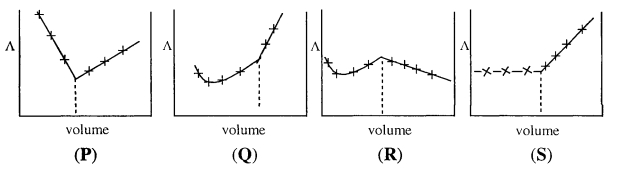
$AgNO_3$ (aq.) was added to an aqueous $KCl$ solution gradually and the conductivity of the solution was measured. The plot of conductance ( $\Lambda$ ) versus the volume of $AgNO_3$ is
A
$(P)$
B
$(Q)$
C
$(R)$
D
$(S)$
Solution
(A) The reaction between $AgNO_3$ and $KCl$ is: $Ag^+(aq) + NO_3^-(aq) + K^+(aq) + Cl^-(aq) \rightarrow AgCl(s) + K^+(aq) + NO_3^-(aq)$.
Initially,the solution contains $K^+$ and $Cl^-$ ions. As $AgNO_3$ is added,$Ag^+$ ions react with $Cl^-$ ions to form $AgCl$ precipitate.
Since $AgCl$ is insoluble,the $Cl^-$ ions are replaced by $NO_3^-$ ions in the solution.
The ionic mobility of $Cl^-$ is higher than that of $NO_3^-$,so the conductance of the solution decreases until the equivalence point is reached.
After the equivalence point,adding more $AgNO_3$ increases the concentration of $Ag^+$ and $NO_3^-$ ions in the solution,which leads to an increase in the conductance.
Therefore,the graph shows a decrease followed by an increase,which corresponds to plot $(P)$.
Initially,the solution contains $K^+$ and $Cl^-$ ions. As $AgNO_3$ is added,$Ag^+$ ions react with $Cl^-$ ions to form $AgCl$ precipitate.
Since $AgCl$ is insoluble,the $Cl^-$ ions are replaced by $NO_3^-$ ions in the solution.
The ionic mobility of $Cl^-$ is higher than that of $NO_3^-$,so the conductance of the solution decreases until the equivalence point is reached.
After the equivalence point,adding more $AgNO_3$ increases the concentration of $Ag^+$ and $NO_3^-$ ions in the solution,which leads to an increase in the conductance.
Therefore,the graph shows a decrease followed by an increase,which corresponds to plot $(P)$.
0 likes
View Solution253
MediumMCQ
At $298 \ K$,the limiting molar conductivity of a weak monobasic acid is $4 \times 10^2 \ S \ cm^2 \ mol^{-1}$. At $298 \ K$,for an aqueous solution of the acid,the degree of dissociation is $\alpha$ and the molar conductivity is $y \times 10^2 \ S \ cm^2 \ mol^{-1}$. At $298 \ K$,upon $20$ times dilution with water,the molar conductivity of the solution becomes $3y \times 10^2 \ S \ cm^2 \ mol^{-1}$. $(1)$ The value of $\alpha$ is. . . . . . $(2)$ The value of $y$ is. . . . . .
A
$0.25, 0.90$
B
$0.28, 0.95$
C
$0.21, 0.86$
D
$0.20, 0.80$
Solution
(C) The degree of dissociation is given by $\alpha = \frac{\Lambda_m}{\Lambda_m^\circ}$.
For the initial solution,$\alpha = \frac{y \times 10^2}{4 \times 10^2} = \frac{y}{4}$.
The dissociation constant $K_a$ is given by $K_a = \frac{C \alpha^2}{1-\alpha} = \frac{C (\Lambda_m / \Lambda_m^\circ)^2}{1 - (\Lambda_m / \Lambda_m^\circ)} = \frac{C \Lambda_m^2}{\Lambda_m^\circ(\Lambda_m^\circ - \Lambda_m)}$.
For the initial solution: $K_a = \frac{C (y \times 10^2)^2}{4 \times 10^2 (4 \times 10^2 - y \times 10^2)} = \frac{C y^2}{4(4-y)}$.
After $20$ times dilution,the concentration becomes $C' = C/20$ and molar conductivity becomes $\Lambda_m' = 3y \times 10^2$.
$K_a = \frac{(C/20) (3y \times 10^2)^2}{4 \times 10^2 (4 \times 10^2 - 3y \times 10^2)} = \frac{C (9y^2)}{20 \times 4 (4-3y)} = \frac{9 C y^2}{80(4-3y)}$.
Equating the two expressions for $K_a$: $\frac{C y^2}{4(4-y)} = \frac{9 C y^2}{80(4-3y)}$.
$\frac{1}{4-y} = \frac{9}{20(4-3y)}$ $\Rightarrow 20(4-3y) = 9(4-y)$ $\Rightarrow 80 - 60y = 36 - 9y$.
$44 = 51y \Rightarrow y = \frac{44}{51} \approx 0.86$.
Then $\alpha = \frac{y}{4} = \frac{44/51}{4} = \frac{11}{51} \approx 0.2156 \approx 0.21$.
For the initial solution,$\alpha = \frac{y \times 10^2}{4 \times 10^2} = \frac{y}{4}$.
The dissociation constant $K_a$ is given by $K_a = \frac{C \alpha^2}{1-\alpha} = \frac{C (\Lambda_m / \Lambda_m^\circ)^2}{1 - (\Lambda_m / \Lambda_m^\circ)} = \frac{C \Lambda_m^2}{\Lambda_m^\circ(\Lambda_m^\circ - \Lambda_m)}$.
For the initial solution: $K_a = \frac{C (y \times 10^2)^2}{4 \times 10^2 (4 \times 10^2 - y \times 10^2)} = \frac{C y^2}{4(4-y)}$.
After $20$ times dilution,the concentration becomes $C' = C/20$ and molar conductivity becomes $\Lambda_m' = 3y \times 10^2$.
$K_a = \frac{(C/20) (3y \times 10^2)^2}{4 \times 10^2 (4 \times 10^2 - 3y \times 10^2)} = \frac{C (9y^2)}{20 \times 4 (4-3y)} = \frac{9 C y^2}{80(4-3y)}$.
Equating the two expressions for $K_a$: $\frac{C y^2}{4(4-y)} = \frac{9 C y^2}{80(4-3y)}$.
$\frac{1}{4-y} = \frac{9}{20(4-3y)}$ $\Rightarrow 20(4-3y) = 9(4-y)$ $\Rightarrow 80 - 60y = 36 - 9y$.
$44 = 51y \Rightarrow y = \frac{44}{51} \approx 0.86$.
Then $\alpha = \frac{y}{4} = \frac{44/51}{4} = \frac{11}{51} \approx 0.2156 \approx 0.21$.
0 likes
View Solution254
AdvancedMCQ
An aqueous solution of $X$ is added slowly to an aqueous solution of $Y$ as shown in List-$I$. The variation in conductivity of these reactions is given in List-$II$. Match List-$I$ with List-$II$ and select the correct answer using the code given below the lists :
Codes: $P \quad Q \quad R \quad S$
| List-$I$ | List-$II$ |
|---|---|
| $P$. $\underset{X}{(C_2H_5)_3N} + \underset{Y}{CH_3COOH}$ | $1$. Conductivity decreases and then increases |
| $Q$. $\underset{X}{KI (0.1 \ M)} + \underset{Y}{AgNO_3 (0.01 \ M)}$ | $2$. Conductivity decreases and then does not change much |
| $R$. $\underset{X}{CH_3COOH} + \underset{Y}{KOH}$ | $3$. Conductivity increases and then does not change much |
| $S$. $\underset{X}{NaOH} + \underset{Y}{HI}$ | $4$. Conductivity does not change much and then increases |
Codes: $P \quad Q \quad R \quad S$
A
$3 \quad 4 \quad 2 \quad 1$
B
$4 \quad 3 \quad 2 \quad 1$
C
$2 \quad 3 \quad 4 \quad 1$
D
$3 \quad 4 \quad 2 \quad 1$
Solution
(A) $(P)$ $(C_2H_5)_3N + CH_3COOH \longrightarrow (C_2H_5)_3NH^+ + CH_3COO^-$. Since both reactants are weak,the formation of ions leads to an increase in conductivity initially. After the equivalence point,the addition of excess weak acid does not significantly change the ion concentration,so it remains nearly constant. Thus,$P-3$.
$(Q)$ $KI + AgNO_3 \longrightarrow AgI(s) + KNO_3$. Here,$Ag^+$ ions are replaced by $K^+$ ions in the solution. Since the mobility of $K^+$ is comparable to $Ag^+$,the conductivity does not change much initially. After the equivalence point,excess $AgNO_3$ adds $Ag^+$ and $NO_3^-$ ions,causing conductivity to increase. Thus,$Q-4$.
$(R)$ $CH_3COOH + KOH \longrightarrow CH_3COOK + H_2O$. $OH^-$ ions (high mobility) are replaced by $CH_3COO^-$ ions (low mobility),causing conductivity to decrease. After the equivalence point,excess $KOH$ adds $K^+$ and $OH^-$ ions,but the effect is minimal due to the common ion effect or dilution. Thus,$R-2$.
$(S)$ $NaOH + HI \longrightarrow NaI + H_2O$. $H^+$ ions (very high mobility) are replaced by $Na^+$ ions (low mobility),causing conductivity to decrease. After the equivalence point,excess $HI$ adds $H^+$ and $I^-$ ions,causing conductivity to increase. Thus,$S-1$.
The correct matching is $P-3, Q-4, R-2, S-1$,which corresponds to option $(A)$.
$(Q)$ $KI + AgNO_3 \longrightarrow AgI(s) + KNO_3$. Here,$Ag^+$ ions are replaced by $K^+$ ions in the solution. Since the mobility of $K^+$ is comparable to $Ag^+$,the conductivity does not change much initially. After the equivalence point,excess $AgNO_3$ adds $Ag^+$ and $NO_3^-$ ions,causing conductivity to increase. Thus,$Q-4$.
$(R)$ $CH_3COOH + KOH \longrightarrow CH_3COOK + H_2O$. $OH^-$ ions (high mobility) are replaced by $CH_3COO^-$ ions (low mobility),causing conductivity to decrease. After the equivalence point,excess $KOH$ adds $K^+$ and $OH^-$ ions,but the effect is minimal due to the common ion effect or dilution. Thus,$R-2$.
$(S)$ $NaOH + HI \longrightarrow NaI + H_2O$. $H^+$ ions (very high mobility) are replaced by $Na^+$ ions (low mobility),causing conductivity to decrease. After the equivalence point,excess $HI$ adds $H^+$ and $I^-$ ions,causing conductivity to increase. Thus,$S-1$.
The correct matching is $P-3, Q-4, R-2, S-1$,which corresponds to option $(A)$.
0 likes
View Solution255
DifficultMCQ
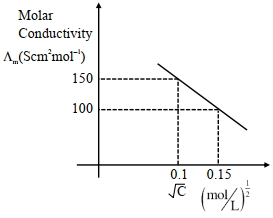
Given below is the plot of the molar conductivity vs $\sqrt{concentration}$ for $KCl$ in aqueous solution. If,for the higher concentration of $KCl$ solution,the resistance of the conductivity cell is $100 \ \Omega$,then the resistance of the same cell with the dilute solution is '$x$' $\Omega$. The value of $x$ is $............$ ($Nearest$ $integer$)
A
$150$
B
$250$
C
$350$
D
$450$
Solution
(A) From the graph,for the concentrated solution $(c)$: $\sqrt{C_c} = 0.15 \ (mol/L)^{1/2}$,so $C_c = (0.15)^2 = 0.0225 \ mol/L$. The molar conductivity $\Lambda_{m,c} = 100 \ S \ cm^2 \ mol^{-1}$.
For the dilute solution $(d)$: $\sqrt{C_d} = 0.1 \ (mol/L)^{1/2}$,so $C_d = (0.1)^2 = 0.01 \ mol/L$. The molar conductivity $\Lambda_{m,d} = 150 \ S \ cm^2 \ mol^{-1}$.
We know that $\kappa = \frac{\Lambda_m \cdot C}{1000}$ and $R = \frac{G^*}{\kappa}$,where $G^*$ is the cell constant.
Thus,$R = \frac{1000 \cdot G^*}{\Lambda_m \cdot C}$.
Taking the ratio of resistances: $\frac{R_d}{R_c} = \frac{\Lambda_{m,c} \cdot C_c}{\Lambda_{m,d} \cdot C_d}$.
Substituting the values: $\frac{R_d}{100} = \frac{100 \times 0.0225}{150 \times 0.01} = \frac{2.25}{1.5} = 1.5$.
Therefore,$R_d = 100 \times 1.5 = 150 \ \Omega$.
For the dilute solution $(d)$: $\sqrt{C_d} = 0.1 \ (mol/L)^{1/2}$,so $C_d = (0.1)^2 = 0.01 \ mol/L$. The molar conductivity $\Lambda_{m,d} = 150 \ S \ cm^2 \ mol^{-1}$.
We know that $\kappa = \frac{\Lambda_m \cdot C}{1000}$ and $R = \frac{G^*}{\kappa}$,where $G^*$ is the cell constant.
Thus,$R = \frac{1000 \cdot G^*}{\Lambda_m \cdot C}$.
Taking the ratio of resistances: $\frac{R_d}{R_c} = \frac{\Lambda_{m,c} \cdot C_c}{\Lambda_{m,d} \cdot C_d}$.
Substituting the values: $\frac{R_d}{100} = \frac{100 \times 0.0225}{150 \times 0.01} = \frac{2.25}{1.5} = 1.5$.
Therefore,$R_d = 100 \times 1.5 = 150 \ \Omega$.
0 likes
View Solution256
MediumMCQ
When the molar conductivity of a weak electrolyte is plotted against the square root of its concentration $(\sqrt{C})$,which of the following is observed?
A
$A$. $A$ small decrease in molar conductivity is observed at infinite dilution.
B
$B$. $A$ small increase in molar conductivity is observed at infinite dilution.
C
$C$. Molar conductivity increases sharply with increase in concentration.
D
$D$. Molar conductivity decreases sharply with increase in concentration.
Solution
(D) For a weak electrolyte,the degree of dissociation increases as the concentration decreases (dilution increases).
At very low concentrations (near infinite dilution,where $\sqrt{C} \to 0$),the degree of dissociation increases rapidly,leading to a sharp increase in molar conductivity.
Conversely,as the concentration increases (moving away from the y-axis),the degree of dissociation decreases,causing a sharp decrease in molar conductivity.
Therefore,the graph shows that molar conductivity decreases sharply with an increase in concentration.
At very low concentrations (near infinite dilution,where $\sqrt{C} \to 0$),the degree of dissociation increases rapidly,leading to a sharp increase in molar conductivity.
Conversely,as the concentration increases (moving away from the y-axis),the degree of dissociation decreases,causing a sharp decrease in molar conductivity.
Therefore,the graph shows that molar conductivity decreases sharply with an increase in concentration.
0 likes
View Solution257
DifficultMCQ
$0.2\% (w/v)$ solution of $NaOH$ is measured to have resistivity $870.0 \ m\Omega \ m$. The molar conductivity of the solution will be $........ \times 10^2 \ mS \ dm^2 \ mol^{-1}$. $(Nearest \ integer)$
A
$13$
B
$23$
C
$33$
D
$43$
Solution
(B) Given: Concentration of $NaOH = 0.2 \% (w/v)$.
This means $0.2 \ g$ of $NaOH$ is present in $100 \ mL$ of solution.
Molarity $(M) = \frac{\text{moles of solute}}{\text{Volume of solution in } L} = \frac{0.2 / 40}{100 / 1000} = \frac{0.005}{0.1} = 0.05 \ M$.
Given resistivity $(\rho) = 870.0 \ m\Omega \ m = 870.0 \times 10^{-3} \ \Omega \ m = 0.87 \ \Omega \ m$.
Since $1 \ m = 10 \ dm$,$\rho = 0.87 \ \Omega \ m = 0.87 \ \Omega \ (10 \ dm) = 8.7 \ \Omega \ dm$.
Conductivity $(\kappa) = \frac{1}{\rho} = \frac{1}{8.7} \ S \ dm^{-1}$.
Molar conductivity $(\Lambda_m) = \frac{\kappa}{M} = \frac{1 / 8.7}{0.05} = \frac{1}{8.7 \times 0.05} = \frac{1}{0.435} \approx 2.2988 \ S \ dm^2 \ mol^{-1}$.
Converting to $mS \ dm^2 \ mol^{-1}$: $2.2988 \ S \ dm^2 \ mol^{-1} = 2298.8 \ mS \ dm^2 \ mol^{-1} = 22.988 \times 10^2 \ mS \ dm^2 \ mol^{-1}$.
Rounding to the nearest integer,we get $23 \times 10^2 \ mS \ dm^2 \ mol^{-1}$.
This means $0.2 \ g$ of $NaOH$ is present in $100 \ mL$ of solution.
Molarity $(M) = \frac{\text{moles of solute}}{\text{Volume of solution in } L} = \frac{0.2 / 40}{100 / 1000} = \frac{0.005}{0.1} = 0.05 \ M$.
Given resistivity $(\rho) = 870.0 \ m\Omega \ m = 870.0 \times 10^{-3} \ \Omega \ m = 0.87 \ \Omega \ m$.
Since $1 \ m = 10 \ dm$,$\rho = 0.87 \ \Omega \ m = 0.87 \ \Omega \ (10 \ dm) = 8.7 \ \Omega \ dm$.
Conductivity $(\kappa) = \frac{1}{\rho} = \frac{1}{8.7} \ S \ dm^{-1}$.
Molar conductivity $(\Lambda_m) = \frac{\kappa}{M} = \frac{1 / 8.7}{0.05} = \frac{1}{8.7 \times 0.05} = \frac{1}{0.435} \approx 2.2988 \ S \ dm^2 \ mol^{-1}$.
Converting to $mS \ dm^2 \ mol^{-1}$: $2.2988 \ S \ dm^2 \ mol^{-1} = 2298.8 \ mS \ dm^2 \ mol^{-1} = 22.988 \times 10^2 \ mS \ dm^2 \ mol^{-1}$.
Rounding to the nearest integer,we get $23 \times 10^2 \ mS \ dm^2 \ mol^{-1}$.
0 likes
View Solution258
DifficultMCQ
Correct order of limiting molar conductivity for cations in water at $298 \ K$ is $:$
A
$H^{+} > Na^{+} > K^{+} > Ca^{2+} > Mg^{2+}$
B
$H^{+} > Ca^{2+} > Mg^{2+} > K^{+} > Na^{+}$
C
$Mg^{2+} > H^{+} > Ca^{2+} > K^{+} > Na^{+}$
D
$H^{+} > Na^{+} > Ca^{2+} > Mg^{2+} > K^{+}$
Solution
(B) The limiting molar conductivities $(\lambda^0)$ of the given ions in water at $298 \ K$ are as follows $:$
$H^{ } : 349.8 \ S \ cm^2 \ mol^{-1}$
$Ca^{2 } : 119.0 \ S \ cm^2 \ mol^{-1}$
$Mg^{2 } : 106.1 \ S \ cm^2 \ mol^{-1}$
$K^{ } : 73.5 \ S \ cm^2 \ mol^{-1}$
$Na^{ } : 50.1 \ S \ cm^2 \ mol^{-1}$
Comparing these values,the correct order of limiting molar conductivity is $H^{ } > Ca^{2 } > Mg^{2 } > K^{ } > Na^{ }$.
$H^{ } : 349.8 \ S \ cm^2 \ mol^{-1}$
$Ca^{2 } : 119.0 \ S \ cm^2 \ mol^{-1}$
$Mg^{2 } : 106.1 \ S \ cm^2 \ mol^{-1}$
$K^{ } : 73.5 \ S \ cm^2 \ mol^{-1}$
$Na^{ } : 50.1 \ S \ cm^2 \ mol^{-1}$
Comparing these values,the correct order of limiting molar conductivity is $H^{ } > Ca^{2 } > Mg^{2 } > K^{ } > Na^{ }$.
0 likes
View Solution259
MediumMCQ
The molar conductance of an infinitely dilute solution of ammonium chloride was found to be $185 \ S \ cm^2 \ mol^{-1}$ and the ionic conductance of hydroxyl and chloride ions are $170$ and $70 \ S \ cm^2 \ mol^{-1}$,respectively. If molar conductance of $0.02 \ M$ solution of ammonium hydroxide is $85.5 \ S \ cm^2 \ mol^{-1}$,its degree of dissociation is given by $x \times 10^{-1}$. The value of $x$ is $...........$ $(Nearest \ integer)$
A
$0$
B
$1$
C
$2$
D
$3$
Solution
(D) Given: $\lambda_{m}^{\circ}(NH_4Cl) = 185 \ S \ cm^2 \ mol^{-1}$,$\lambda_{m}^{\circ}(OH^-) = 170 \ S \ cm^2 \ mol^{-1}$,$\lambda_{m}^{\circ}(Cl^-) = 70 \ S \ cm^2 \ mol^{-1}$.
Using Kohlrausch's law: $\lambda_{m}^{\circ}(NH_4Cl) = \lambda_{m}^{\circ}(NH_4^+) + \lambda_{m}^{\circ}(Cl^-) = 185$.
Therefore,$\lambda_{m}^{\circ}(NH_4^+) = 185 - 70 = 115 \ S \ cm^2 \ mol^{-1}$.
Now,$\lambda_{m}^{\circ}(NH_4OH) = \lambda_{m}^{\circ}(NH_4^+) + \lambda_{m}^{\circ}(OH^-) = 115 + 170 = 285 \ S \ cm^2 \ mol^{-1}$.
The degree of dissociation $(\alpha)$ is given by $\alpha = \frac{\lambda_{m}}{\lambda_{m}^{\circ}} = \frac{85.5}{285} = 0.3$.
Since $\alpha = x \times 10^{-1}$,we have $0.3 = x \times 10^{-1}$,which gives $x = 3$.
Using Kohlrausch's law: $\lambda_{m}^{\circ}(NH_4Cl) = \lambda_{m}^{\circ}(NH_4^+) + \lambda_{m}^{\circ}(Cl^-) = 185$.
Therefore,$\lambda_{m}^{\circ}(NH_4^+) = 185 - 70 = 115 \ S \ cm^2 \ mol^{-1}$.
Now,$\lambda_{m}^{\circ}(NH_4OH) = \lambda_{m}^{\circ}(NH_4^+) + \lambda_{m}^{\circ}(OH^-) = 115 + 170 = 285 \ S \ cm^2 \ mol^{-1}$.
The degree of dissociation $(\alpha)$ is given by $\alpha = \frac{\lambda_{m}}{\lambda_{m}^{\circ}} = \frac{85.5}{285} = 0.3$.
Since $\alpha = x \times 10^{-1}$,we have $0.3 = x \times 10^{-1}$,which gives $x = 3$.
0 likes
View Solution260
MediumMCQ
Given below are two statements $:$
Statement $I :$ Mohr's salt is composed of only three types of ions$-$ferrous,ammonium and sulphate.
Statement $II :$ If the molar conductance at infinite dilution of ferrous,ammonium and sulphate ions are $x_1, x_2$ and $x_3 \ S \ cm^2 \ mol^{-1}$,respectively then the molar conductance for Mohr's salt solution at infinite dilution would be given by $x_1+x_2+2 x_3$
In the light of the given statements,choose the correct answer from the options given below $:$
Statement $I :$ Mohr's salt is composed of only three types of ions$-$ferrous,ammonium and sulphate.
Statement $II :$ If the molar conductance at infinite dilution of ferrous,ammonium and sulphate ions are $x_1, x_2$ and $x_3 \ S \ cm^2 \ mol^{-1}$,respectively then the molar conductance for Mohr's salt solution at infinite dilution would be given by $x_1+x_2+2 x_3$
In the light of the given statements,choose the correct answer from the options given below $:$
A
Both statements $I$ and Statement $II$ are false
B
Statement $I$ is false but Statement $II$ is true
C
Statement $I$ is true but Statement $II$ is false
D
Both statements $I$ and Statement $II$ are true
Solution
(C) Mohr's salt is $FeSO_4 \cdot (NH_4)_2SO_4 \cdot 6H_2O$.
It dissociates into $Fe^{2+}$,$2NH_4^+$,and $2SO_4^{2-}$ ions. Thus,Statement $I$ is true.
According to Kohlrausch's law of independent migration of ions,the molar conductance at infinite dilution is the sum of the molar conductances of the constituent ions multiplied by their respective stoichiometric coefficients.
$\lambda_{m}^{\infty} (FeSO_4 \cdot (NH_4)_2SO_4 \cdot 6H_2O) = \lambda^{\infty}(Fe^{2+}) + 2\lambda^{\infty}(NH_4^+) + 2\lambda^{\infty}(SO_4^{2-}) = x_1 + 2x_2 + 2x_3$.
Since the given expression in Statement $II$ is $x_1 + x_2 + 2x_3$,Statement $II$ is false.
It dissociates into $Fe^{2+}$,$2NH_4^+$,and $2SO_4^{2-}$ ions. Thus,Statement $I$ is true.
According to Kohlrausch's law of independent migration of ions,the molar conductance at infinite dilution is the sum of the molar conductances of the constituent ions multiplied by their respective stoichiometric coefficients.
$\lambda_{m}^{\infty} (FeSO_4 \cdot (NH_4)_2SO_4 \cdot 6H_2O) = \lambda^{\infty}(Fe^{2+}) + 2\lambda^{\infty}(NH_4^+) + 2\lambda^{\infty}(SO_4^{2-}) = x_1 + 2x_2 + 2x_3$.
Since the given expression in Statement $II$ is $x_1 + x_2 + 2x_3$,Statement $II$ is false.
0 likes
View Solution261
EasyMCQ
With dilution,the conductivity of a solution $—$
A
Increases
B
Decreases
C
Remains the same
D
None of these
Solution
(B) Conductivity (specific conductance) is defined as the conductance of a solution contained between two electrodes of unit area of cross-section separated by a unit distance.
With dilution,the number of ions per unit volume decreases.
Since conductivity depends on the number of ions present per unit volume,it decreases upon dilution.
With dilution,the number of ions per unit volume decreases.
Since conductivity depends on the number of ions present per unit volume,it decreases upon dilution.
0 likes
View Solution262
EasyMCQ
For an aqueous solution of $CaCl_2$ electrolyte,the graph between molar conductivity $(\lambda_m)$ and $(\text{concentration})^{1/2}$ is:
A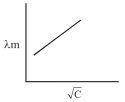
B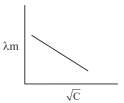
C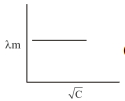
D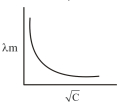
Solution
(B) The variation of molar conductivity $(\lambda_m)$ with concentration $(C)$ for strong electrolytes is given by the Kohlrausch equation: $\lambda_m = \lambda_m^\circ - A\sqrt{C}$.
Here,$\lambda_m^\circ$ is the molar conductivity at infinite dilution,$A$ is a constant,and $\sqrt{C}$ is the square root of the concentration.
This equation represents a straight line equation of the form $y = mx + c$,where $y = \lambda_m$,$x = \sqrt{C}$,$m = -A$ (slope),and $c = \lambda_m^\circ$ (intercept).
Since the slope is negative $(-A)$,the graph of $\lambda_m$ versus $\sqrt{C}$ is a straight line with a negative slope.
Here,$\lambda_m^\circ$ is the molar conductivity at infinite dilution,$A$ is a constant,and $\sqrt{C}$ is the square root of the concentration.
This equation represents a straight line equation of the form $y = mx + c$,where $y = \lambda_m$,$x = \sqrt{C}$,$m = -A$ (slope),and $c = \lambda_m^\circ$ (intercept).
Since the slope is negative $(-A)$,the graph of $\lambda_m$ versus $\sqrt{C}$ is a straight line with a negative slope.
0 likes
View Solution263
MediumMCQ
The equivalent conductances of two strong electrolytes at infinite dilution in $H_2O$ (where ions move freely through a solution) at $25^{\circ}C$ are given below:
$\lambda^{\infty}_{CH_3COONa} = 91.0 \ S \ cm^2 \ eq^{-1}$
$\lambda^{\infty}_{HCl} = 426.25 \ S \ cm^2 \ eq^{-1}$
What additional information/quantity is needed to calculate $\lambda^{\infty}$ of an aqueous solution of acetic acid?
$\lambda^{\infty}_{CH_3COONa} = 91.0 \ S \ cm^2 \ eq^{-1}$
$\lambda^{\infty}_{HCl} = 426.25 \ S \ cm^2 \ eq^{-1}$
What additional information/quantity is needed to calculate $\lambda^{\infty}$ of an aqueous solution of acetic acid?
A
The limiting equivalent conductance of $H^{+}$
B
$\lambda^{\infty}$ of chloroacetic acid $(ClCH_2COOH)$
C
$\lambda^{\infty}$ of $NaCl$
D
$\lambda^{\infty}$ of $CH_3COOK$
Solution
(C) According to Kohlrausch's law,the equivalent conductivity at infinite dilution $(\lambda^{\infty})$ for the weak electrolyte $CH_3COOH$ is given by:
$\lambda^{\infty}_{CH_3COOH} = \lambda^{\infty}_{CH_3COONa} + \lambda^{\infty}_{HCl} - \lambda^{\infty}_{NaCl}$
Therefore,to calculate the value of $\lambda^{\infty}_{CH_3COOH}$,the value of $\lambda^{\infty}_{NaCl}$ must also be known.
$\lambda^{\infty}_{CH_3COOH} = \lambda^{\infty}_{CH_3COONa} + \lambda^{\infty}_{HCl} - \lambda^{\infty}_{NaCl}$
Therefore,to calculate the value of $\lambda^{\infty}_{CH_3COOH}$,the value of $\lambda^{\infty}_{NaCl}$ must also be known.
0 likes
View Solution264
MediumMCQ
Resistance of a decimolar solution between two electrodes $0.02 \ m$ apart and $0.0004 \ m^2$ in area was found to be $50 \ \Omega$. Specific conductance $(\kappa)$ is $:$
A
$0.1 \ S \ m^{-1}$
B
$1 \ S \ m^{-1}$
C
$10 \ S \ m^{-1}$
D
$4 \times 10^{-4} \ S \ m^{-1}$
Solution
(B) The formula for specific conductance $(\kappa)$ is given by: $\kappa = \frac{1}{R} \times \frac{\ell}{A}$
Given: Resistance $(R) = 50 \ \Omega$,distance $(\ell) = 0.02 \ m$,and area $(A) = 0.0004 \ m^2$.
Substituting the values: $\kappa = \frac{1}{50} \times \frac{0.02}{0.0004}$
$\kappa = \frac{0.02}{0.02} = 1 \ S \ m^{-1}$.
Given: Resistance $(R) = 50 \ \Omega$,distance $(\ell) = 0.02 \ m$,and area $(A) = 0.0004 \ m^2$.
Substituting the values: $\kappa = \frac{1}{50} \times \frac{0.02}{0.0004}$
$\kappa = \frac{0.02}{0.02} = 1 \ S \ m^{-1}$.
0 likes
View Solution265
EasyMCQ
The ionic conductivity of $Ba^{2+}$ and $Cl^{-}$ at infinite dilution are $127$ and $76 \ ohm^{-1} cm^2 eq^{-1}$ respectively. The equivalent conductivity of $BaCl_2$ at infinite dilution (in $ohm^{-1} cm^2 eq^{-1}$) would be $:-$
A
$203$
B
$279$
C
$101.5$
D
$139.5$
Solution
(A) According to Kohlrausch's law of independent migration of ions,the equivalent conductivity of an electrolyte at infinite dilution is the sum of the equivalent conductivities of its constituent ions.
For $BaCl_2$,the equivalent conductivity at infinite dilution is given by:
$\Lambda^{\infty}_{eq}(BaCl_2) = \lambda^{\infty}_{eq}(Ba^{2+}) + \lambda^{\infty}_{eq}(Cl^{-})$
Given that the ionic conductivities provided are already in terms of equivalent conductivities $(ohm^{-1} cm^2 eq^{-1})$,we simply add the values:
$\Lambda^{\infty}_{eq}(BaCl_2) = 127 + 76 = 203 \ ohm^{-1} cm^2 eq^{-1}$
Therefore,the correct option is $A$.
For $BaCl_2$,the equivalent conductivity at infinite dilution is given by:
$\Lambda^{\infty}_{eq}(BaCl_2) = \lambda^{\infty}_{eq}(Ba^{2+}) + \lambda^{\infty}_{eq}(Cl^{-})$
Given that the ionic conductivities provided are already in terms of equivalent conductivities $(ohm^{-1} cm^2 eq^{-1})$,we simply add the values:
$\Lambda^{\infty}_{eq}(BaCl_2) = 127 + 76 = 203 \ ohm^{-1} cm^2 eq^{-1}$
Therefore,the correct option is $A$.
0 likes
View Solution266
MediumMCQ
The limiting molar conductivities of $X^{+}$ and $Y^{-2}$ ions are $45$ and $110 \ S \ cm^2 \ mol^{-1}$ respectively. The $\Lambda_{m}^{\infty}$ of $X_2Y$ is:
A
$200 \ S \ cm^2 \ mol^{-1}$
B
$100 \ S \ cm^2 \ mol^{-1}$
C
$400 \ S \ cm^2 \ mol^{-1}$
D
$77.5 \ S \ cm^2 \ mol^{-1}$
Solution
(A) The dissociation of $X_2Y$ is given by: $X_2Y \rightarrow 2X^{+} + Y^{-2}$.
According to Kohlrausch's law of independent migration of ions,the limiting molar conductivity of an electrolyte is the sum of the limiting molar conductivities of its constituent ions.
$\Lambda_{m}^{\infty}(X_2Y) = 2 \times \lambda^{\infty}(X^{+}) + 1 \times \lambda^{\infty}(Y^{-2})$.
Substituting the given values: $\Lambda_{m}^{\infty}(X_2Y) = 2 \times 45 + 110 = 90 + 110 = 200 \ S \ cm^2 \ mol^{-1}$.
According to Kohlrausch's law of independent migration of ions,the limiting molar conductivity of an electrolyte is the sum of the limiting molar conductivities of its constituent ions.
$\Lambda_{m}^{\infty}(X_2Y) = 2 \times \lambda^{\infty}(X^{+}) + 1 \times \lambda^{\infty}(Y^{-2})$.
Substituting the given values: $\Lambda_{m}^{\infty}(X_2Y) = 2 \times 45 + 110 = 90 + 110 = 200 \ S \ cm^2 \ mol^{-1}$.
0 likes
View Solution267
MediumMCQ
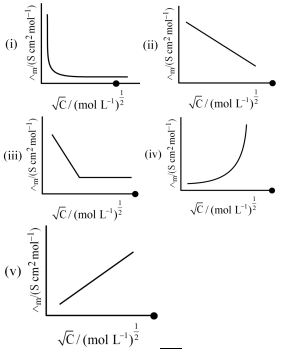
Which of the following graphs represents the variation of molar conductance $(\Lambda_m)$ of an electrolyte with $\sqrt{C}$ for weak and strong electrolytes,respectively?
A
Weak electrolyte $\rightarrow (iv),$ Strong electrolyte $\rightarrow (v)$
B
Weak electrolyte $\rightarrow (ii),$ Strong electrolyte $\rightarrow (iv)$
C
Weak electrolyte $\rightarrow (i),$ Strong electrolyte $\rightarrow (ii)$
D
Weak electrolyte $\rightarrow (iii),$ Strong electrolyte $\rightarrow (ii)$
Solution
(C) For a strong electrolyte,the variation of molar conductance $(\Lambda_m)$ with concentration $(C)$ is given by the Kohlrausch equation: $\Lambda_m = \Lambda_m^0 - A\sqrt{C}$. This is a linear equation with a negative slope,which corresponds to graph $(ii)$.
For a weak electrolyte,molar conductance increases sharply as concentration decreases (i.e.,as $\sqrt{C}$ approaches zero) due to an increase in the degree of dissociation. This behavior is represented by graph $(i)$.
For a weak electrolyte,molar conductance increases sharply as concentration decreases (i.e.,as $\sqrt{C}$ approaches zero) due to an increase in the degree of dissociation. This behavior is represented by graph $(i)$.
0 likes
View Solution268
MediumMCQ
For an electrolytic solution,specific conductance is $9.2 \times 10^{-2} \ \Omega^{-1} \ m^{-1}$,then calculate the value of molar conductance for a solution having a concentration of $0.02 \ M$.
A
$4.6 \times 10^{-3} \ S \ m^2 \ mol^{-1}$
B
$4.6 \times 10^2 \ S \ m^2 \ mol^{-1}$
C
$9.2 \times 10^{-2} \ S \ m^2 \ mol^{-1}$
D
$4.6 \times 10^{-5} \ S \ m^2 \ mol^{-1}$
Solution
(A) The formula for molar conductance $(\Lambda_m)$ in $S \ m^2 \ mol^{-1}$ when concentration $(C)$ is in $mol \ m^{-3}$ is $\Lambda_m = \frac{\kappa}{C}$.
Given $\kappa = 9.2 \times 10^{-2} \ S \ m^{-1}$.
Concentration $C = 0.02 \ M = 0.02 \ mol \ L^{-1} = 0.02 \times 10^3 \ mol \ m^{-3} = 20 \ mol \ m^{-3}$.
$\Lambda_m = \frac{9.2 \times 10^{-2}}{20} = 0.46 \times 10^{-2} = 4.6 \times 10^{-3} \ S \ m^2 \ mol^{-1}$.
Given $\kappa = 9.2 \times 10^{-2} \ S \ m^{-1}$.
Concentration $C = 0.02 \ M = 0.02 \ mol \ L^{-1} = 0.02 \times 10^3 \ mol \ m^{-3} = 20 \ mol \ m^{-3}$.
$\Lambda_m = \frac{9.2 \times 10^{-2}}{20} = 0.46 \times 10^{-2} = 4.6 \times 10^{-3} \ S \ m^2 \ mol^{-1}$.
0 likes
View Solution269
MediumMCQ
Molar conductivities $\left(\Lambda_{m}^{\circ}\right)$ at infinite dilution of $NaCl$,$HCl$,and $CH_{3}COONa$ are $126.4$,$425.9$,and $91.0 \ S \ cm^{2} \ mol^{-1}$ respectively. $\Lambda_{m}^{\circ}$ for $CH_{3}COOH$ will be $:-$
A
$290.8 \ S \ cm^{2} \ mol^{-1}$
B
$390.5 \ S \ cm^{2} \ mol^{-1}$
C
$425.5 \ S \ cm^{2} \ mol^{-1}$
D
$180.5 \ S \ cm^{2} \ mol^{-1}$
Solution
(B) According to Kohlrausch's law of independent migration of ions:
$\Lambda_{m}^{\circ}(CH_{3}COOH) = \Lambda_{m}^{\circ}(CH_{3}COONa) + \Lambda_{m}^{\circ}(HCl) - \Lambda_{m}^{\circ}(NaCl)$
Substituting the given values:
$\Lambda_{m}^{\circ}(CH_{3}COOH) = 91.0 + 425.9 - 126.4$
$= 516.9 - 126.4 = 390.5 \ S \ cm^{2} \ mol^{-1}$
$\Lambda_{m}^{\circ}(CH_{3}COOH) = \Lambda_{m}^{\circ}(CH_{3}COONa) + \Lambda_{m}^{\circ}(HCl) - \Lambda_{m}^{\circ}(NaCl)$
Substituting the given values:
$\Lambda_{m}^{\circ}(CH_{3}COOH) = 91.0 + 425.9 - 126.4$
$= 516.9 - 126.4 = 390.5 \ S \ cm^{2} \ mol^{-1}$
0 likes
View Solution270
EasyMCQ
Calculate the degree of dissociation of $0.01 \ M$ acetic acid at $25^{\circ} C$ given that the molar conductivity at concentration $c$ is $\Lambda_{c} = 15.0 \ \Omega^{-1} \ cm^2 \ mol^{-1}$ and the limiting molar conductivity is $\Lambda_0 = 300 \ \Omega^{-1} \ cm^2 \ mol^{-1}$.
A
$0.042$
B
$0.035$
C
$0.025$
D
$0.05$
Solution
(D) The degree of dissociation $(\alpha)$ is defined as the ratio of molar conductivity at a specific concentration $(\Lambda_c)$ to the limiting molar conductivity $(\Lambda_0)$.
$\alpha = \frac{\Lambda_c}{\Lambda_0}$
Given:
$\Lambda_c = 15.0 \ \Omega^{-1} \ cm^2 \ mol^{-1}$
$\Lambda_0 = 300 \ \Omega^{-1} \ cm^2 \ mol^{-1}$
Substituting the values:
$\alpha = \frac{15.0}{300} = 0.05$
$\alpha = \frac{\Lambda_c}{\Lambda_0}$
Given:
$\Lambda_c = 15.0 \ \Omega^{-1} \ cm^2 \ mol^{-1}$
$\Lambda_0 = 300 \ \Omega^{-1} \ cm^2 \ mol^{-1}$
Substituting the values:
$\alpha = \frac{15.0}{300} = 0.05$
0 likes
View Solution271
EasyMCQ
Which of the following is the correct relationship between molar conductivity $(\Lambda_m)$,conductivity $(k)$,and molarity $(M)$ of a solution for an electrolyte?
A
$k = \frac{\Lambda_m \times M}{1000}$
B
$\Lambda_m = \frac{1000 \times k}{M}$
C
$\Lambda_m = \frac{k \times M}{1000}$
D
$k = \frac{1000 \times M}{\Lambda_m}$
Solution
(B) The molar conductivity $(\Lambda_m)$ of a solution is defined as the conducting power of all the ions produced by dissolving one mole of an electrolyte in a solution of volume $V \ mL$.
The relationship is given by the formula: $\Lambda_m = \frac{k \times 1000}{M}$,where $k$ is the conductivity in $S \ cm^{-1}$ and $M$ is the molarity in $mol \ L^{-1}$.
Therefore,option $B$ is the correct relationship.
The relationship is given by the formula: $\Lambda_m = \frac{k \times 1000}{M}$,where $k$ is the conductivity in $S \ cm^{-1}$ and $M$ is the molarity in $mol \ L^{-1}$.
Therefore,option $B$ is the correct relationship.
0 likes
View Solution272
EasyMCQ
What is the molar conductivity at zero concentration in $\Omega^{-1} \ cm^2 \ mol^{-1}$ for aluminium sulphate,if the molar ionic conductivities at zero concentration of $Al^{3+}$ and $SO_4^{2-}$ are $189 \ \Omega^{-1} \ cm^2 \ mol^{-1}$ and $50.1 \ \Omega^{-1} \ cm^2 \ mol^{-1}$ respectively?
A
$239.1$
B
$428.1$
C
$478.2$
D
$528.3$
Solution
(D) The chemical formula for aluminium sulphate is $Al_2(SO_4)_3$.
According to Kohlrausch's law of independent migration of ions,the molar conductivity at infinite dilution (zero concentration) is given by:
$\Lambda_m^0 (Al_2(SO_4)_3) = 2 \lambda_m^0 (Al^{3+}) + 3 \lambda_m^0 (SO_4^{2-})$
Given:
$\lambda_m^0 (Al^{3+}) = 189 \ \Omega^{-1} \ cm^2 \ mol^{-1}$
$\lambda_m^0 (SO_4^{2-}) = 50.1 \ \Omega^{-1} \ cm^2 \ mol^{-1}$
Substituting the values:
$\Lambda_m^0 = 2(189) + 3(50.1)$
$\Lambda_m^0 = 378 + 150.3 = 528.3 \ \Omega^{-1} \ cm^2 \ mol^{-1}$
Thus,the correct option is $D$.
According to Kohlrausch's law of independent migration of ions,the molar conductivity at infinite dilution (zero concentration) is given by:
$\Lambda_m^0 (Al_2(SO_4)_3) = 2 \lambda_m^0 (Al^{3+}) + 3 \lambda_m^0 (SO_4^{2-})$
Given:
$\lambda_m^0 (Al^{3+}) = 189 \ \Omega^{-1} \ cm^2 \ mol^{-1}$
$\lambda_m^0 (SO_4^{2-}) = 50.1 \ \Omega^{-1} \ cm^2 \ mol^{-1}$
Substituting the values:
$\Lambda_m^0 = 2(189) + 3(50.1)$
$\Lambda_m^0 = 378 + 150.3 = 528.3 \ \Omega^{-1} \ cm^2 \ mol^{-1}$
Thus,the correct option is $D$.
0 likes
View Solution273
EasyMCQ
Calculate the cell constant of a conductivity cell containing $0.01 \ M \ AgNO_3$ solution having a resistance of $1440 \ \Omega$ and a conductivity of $0.001262 \ \Omega^{-1} \ cm^{-1}$. (in $cm^{-1}$)
A
$1.014$
B
$0.883$
C
$1.817$
D
$1.411$
Solution
(C) The cell constant $(G^*)$ is defined by the formula: $G^* = \kappa \times R$,where $\kappa$ is the conductivity and $R$ is the resistance.
Given:
Conductivity $(\kappa)$ = $0.001262 \ \Omega^{-1} \ cm^{-1}$
Resistance $(R)$ = $1440 \ \Omega$
Calculation:
$G^* = 0.001262 \ \Omega^{-1} \ cm^{-1} \times 1440 \ \Omega$
$G^* = 1.81728 \ cm^{-1}$
Rounding to three decimal places,we get $1.817 \ cm^{-1}$.
Given:
Conductivity $(\kappa)$ = $0.001262 \ \Omega^{-1} \ cm^{-1}$
Resistance $(R)$ = $1440 \ \Omega$
Calculation:
$G^* = 0.001262 \ \Omega^{-1} \ cm^{-1} \times 1440 \ \Omega$
$G^* = 1.81728 \ cm^{-1}$
Rounding to three decimal places,we get $1.817 \ cm^{-1}$.
0 likes
View Solution274
EasyMCQ
What is the $SI$ unit of resistivity?
A
$\Omega \ m$
B
$\Omega \ m^{-1}$
C
$\Omega^{-1} \ m^{-1}$
D
$\Omega \ m^{-2}$
Solution
(A) The resistance $R$ of a conductor is given by the formula $R = \rho \frac{l}{A}$,where $\rho$ is the resistivity,$l$ is the length,and $A$ is the cross-sectional area.
Rearranging for resistivity,we get $\rho = R \frac{A}{l}$.
The unit of resistance $R$ is $\Omega$ (ohm),the unit of area $A$ is $m^2$,and the unit of length $l$ is $m$.
Substituting these units,the unit of resistivity $\rho = \Omega \times \frac{m^2}{m} = \Omega \ m$.
Therefore,the $SI$ unit of resistivity is $\Omega \ m$.
Rearranging for resistivity,we get $\rho = R \frac{A}{l}$.
The unit of resistance $R$ is $\Omega$ (ohm),the unit of area $A$ is $m^2$,and the unit of length $l$ is $m$.
Substituting these units,the unit of resistivity $\rho = \Omega \times \frac{m^2}{m} = \Omega \ m$.
Therefore,the $SI$ unit of resistivity is $\Omega \ m$.
0 likes
View Solution275
EasyMCQ
The resistance of a decimolar solution of $NaCl$ is $30 \ \Omega$. Calculate the conductivity of the solution if the cell constant is $0.33 \ cm^{-1}$.
A
$0.025 \ \Omega^{-1} \ cm^{-1}$
B
$0.035 \ \Omega^{-1} \ cm^{-1}$
C
$0.011 \ \Omega^{-1} \ cm^{-1}$
D
$0.029 \ \Omega^{-1} \ cm^{-1}$
Solution
(C) The conductivity $(\kappa)$ is given by the formula: $\kappa = \frac{\text{cell constant}}{R}$.
Given: Cell constant = $0.33 \ cm^{-1}$,Resistance $(R)$ = $30 \ \Omega$.
$\kappa = \frac{0.33 \ cm^{-1}}{30 \ \Omega} = 0.011 \ \Omega^{-1} \ cm^{-1}$.
Given: Cell constant = $0.33 \ cm^{-1}$,Resistance $(R)$ = $30 \ \Omega$.
$\kappa = \frac{0.33 \ cm^{-1}}{30 \ \Omega} = 0.011 \ \Omega^{-1} \ cm^{-1}$.
0 likes
View Solution276
EasyMCQ
The resistance of a conductivity cell of $0.1 \ M$ $KCl$ solution is $120 \ \Omega$ and conductivity is $1.64 \times 10^{-4} \ S \ cm^{-1}$. What is the value of cell constant (in $cm^{-1}$)?
A
$0.0136$
B
$0.0618$
C
$0.0196$
D
$0.0731$
Solution
(C) The relationship between conductivity $(k)$,cell constant $(G^*)$,and resistance $(R)$ is given by:
$k = \frac{G^*}{R}$
Therefore,the cell constant $(G^*)$ is:
$G^* = k \times R$
Substituting the given values:
$G^* = (1.64 \times 10^{-4} \ S \ cm^{-1}) \times (120 \ \Omega)$
$G^* = 0.01968 \ \text{cm}^{-1} \approx 0.0196 \ \text{cm}^{-1}$
$k = \frac{G^*}{R}$
Therefore,the cell constant $(G^*)$ is:
$G^* = k \times R$
Substituting the given values:
$G^* = (1.64 \times 10^{-4} \ S \ cm^{-1}) \times (120 \ \Omega)$
$G^* = 0.01968 \ \text{cm}^{-1} \approx 0.0196 \ \text{cm}^{-1}$
0 likes
View Solution277
MediumMCQ
The molar conductivity of $0.02 \ M$ $KCl$ solution is $410 \ \Omega^{-1} \ cm^2 \ mol^{-1}$ at $25^{\circ} C$. Calculate its conductivity?
A
$8.2 \times 10^{-3} \ \Omega^{-1} \ cm^{-1}$
B
$2.8 \times 10^{-3} \ \Omega^{-1} \ cm^{-1}$
C
$4.1 \times 10^{-3} \ \Omega^{-1} \ cm^{-1}$
D
$5.4 \times 10^{-3} \ \Omega^{-1} \ cm^{-1}$
Solution
(A) The formula for molar conductivity is $\Lambda_{m} = \frac{1000 \kappa}{C}$.
Given: $\Lambda_{m} = 410 \ \Omega^{-1} \ cm^2 \ mol^{-1}$ and $C = 0.02 \ M$.
Rearranging the formula to find conductivity $(\kappa)$: $\kappa = \frac{\Lambda_{m} \times C}{1000}$.
Substituting the values: $\kappa = \frac{410 \times 0.02}{1000} \ \Omega^{-1} \ cm^{-1}$.
$\kappa = \frac{8.2}{1000} \ \Omega^{-1} \ cm^{-1} = 8.2 \times 10^{-3} \ \Omega^{-1} \ cm^{-1}$.
Given: $\Lambda_{m} = 410 \ \Omega^{-1} \ cm^2 \ mol^{-1}$ and $C = 0.02 \ M$.
Rearranging the formula to find conductivity $(\kappa)$: $\kappa = \frac{\Lambda_{m} \times C}{1000}$.
Substituting the values: $\kappa = \frac{410 \times 0.02}{1000} \ \Omega^{-1} \ cm^{-1}$.
$\kappa = \frac{8.2}{1000} \ \Omega^{-1} \ cm^{-1} = 8.2 \times 10^{-3} \ \Omega^{-1} \ cm^{-1}$.
0 likes
View Solution278
EasyMCQ
What is the cell constant,if two platinum electrodes in a conductivity cell are separated by $0.92 \ cm$ and the area of cross-section is $1.2 \ cm^2$ (in $cm^{-1}$)?
A
$0.767$
B
$0.906$
C
$1.304$
D
$1.104$
Solution
(A) The cell constant $(G^*)$ is defined as the ratio of the distance between the electrodes $(l)$ to the area of cross-section $(A)$:
$G^* = \frac{l}{A}$
Given:
$l = 0.92 \ cm$
$A = 1.2 \ cm^2$
Calculation:
$G^* = \frac{0.92 \ cm}{1.2 \ cm^2} = 0.7666... \ cm^{-1} \approx 0.767 \ cm^{-1}$
$G^* = \frac{l}{A}$
Given:
$l = 0.92 \ cm$
$A = 1.2 \ cm^2$
Calculation:
$G^* = \frac{0.92 \ cm}{1.2 \ cm^2} = 0.7666... \ cm^{-1} \approx 0.767 \ cm^{-1}$
0 likes
View Solution279
EasyMCQ
$A$ conductivity cell dipped in $0.05 \ M$ $KCl$ has a resistance of $600 \ \Omega$. If the conductivity is $0.0015 \ \Omega^{-1} \ cm^{-1}$,what is the value of the cell constant (in $cm^{-1}$)?
A
$0.47$
B
$0.90$
C
$1.5$
D
$2.5$
Solution
(B) The relationship between conductivity $(k)$,resistance $(R)$,and cell constant $(G^*)$ is given by the formula:
$k = \frac{1}{R} \times G^*$
Rearranging the formula to solve for the cell constant:
$G^* = k \times R$
Given values:
$k = 0.0015 \ \Omega^{-1} \ cm^{-1}$
$R = 600 \ \Omega$
Substituting the values:
$G^* = 0.0015 \ \Omega^{-1} \ cm^{-1} \times 600 \ \Omega = 0.90 \ cm^{-1}$
$k = \frac{1}{R} \times G^*$
Rearranging the formula to solve for the cell constant:
$G^* = k \times R$
Given values:
$k = 0.0015 \ \Omega^{-1} \ cm^{-1}$
$R = 600 \ \Omega$
Substituting the values:
$G^* = 0.0015 \ \Omega^{-1} \ cm^{-1} \times 600 \ \Omega = 0.90 \ cm^{-1}$
0 likes
View Solution280
EasyMCQ
The limiting molar conductivities $(\Lambda_0)$ for $NaCl$,$KBr$ and $KCl$ are $126$,$152$ and $150 \ S \ cm^2 \ mol^{-1}$ respectively. What is the $\Lambda_0$ of $NaBr$?
A
$128 \ S \ cm^2 \ mol^{-1}$
B
$302 \ S \ cm^2 \ mol^{-1}$
C
$278 \ S \ cm^2 \ mol^{-1}$
D
$176 \ S \ cm^2 \ mol^{-1}$
Solution
(A) According to Kohlrausch's law of independent migration of ions,the limiting molar conductivity of an electrolyte is the sum of the limiting molar conductivities of its constituent ions.
$\Lambda_{0(NaBr)} = \lambda^0_{Na^+} + \lambda^0_{Br^-}$
$\Lambda_{0(NaCl)} = \lambda^0_{Na^+} + \lambda^0_{Cl^-} = 126 \ S \ cm^2 \ mol^{-1}$
$\Lambda_{0(KBr)} = \lambda^0_{K^+} + \lambda^0_{Br^-} = 152 \ S \ cm^2 \ mol^{-1}$
$\Lambda_{0(KCl)} = \lambda^0_{K^+} + \lambda^0_{Cl^-} = 150 \ S \ cm^2 \ mol^{-1}$
To find $\Lambda_{0(NaBr)}$,we perform the operation:
$\Lambda_{0(NaBr)} = \Lambda_{0(NaCl)} + \Lambda_{0(KBr)} - \Lambda_{0(KCl)}$
$\Lambda_{0(NaBr)} = 126 + 152 - 150 = 128 \ S \ cm^2 \ mol^{-1}$
$\Lambda_{0(NaBr)} = \lambda^0_{Na^+} + \lambda^0_{Br^-}$
$\Lambda_{0(NaCl)} = \lambda^0_{Na^+} + \lambda^0_{Cl^-} = 126 \ S \ cm^2 \ mol^{-1}$
$\Lambda_{0(KBr)} = \lambda^0_{K^+} + \lambda^0_{Br^-} = 152 \ S \ cm^2 \ mol^{-1}$
$\Lambda_{0(KCl)} = \lambda^0_{K^+} + \lambda^0_{Cl^-} = 150 \ S \ cm^2 \ mol^{-1}$
To find $\Lambda_{0(NaBr)}$,we perform the operation:
$\Lambda_{0(NaBr)} = \Lambda_{0(NaCl)} + \Lambda_{0(KBr)} - \Lambda_{0(KCl)}$
$\Lambda_{0(NaBr)} = 126 + 152 - 150 = 128 \ S \ cm^2 \ mol^{-1}$
0 likes
View Solution281
EasyMCQ
The conductivity of $0.005 \ M$ $NaI$ solution at $25^{\circ} C$ is $6.07 \times 10^{-4} \ \Omega^{-1} \ cm^{-1}$. Calculate its molar conductivity.
A
$121.4 \ \Omega^{-1} \ cm^2 \ mol^{-1}$
B
$110.1 \ \Omega^{-1} \ cm^2 \ mol^{-1}$
C
$201.1 \ \Omega^{-1} \ cm^2 \ mol^{-1}$
D
$241.4 \ \Omega^{-1} \ cm^2 \ mol^{-1}$
Solution
(A) The formula for molar conductivity is $\Lambda_{m} = \frac{1000 \times \kappa}{c}$.
Given,conductivity $\kappa = 6.07 \times 10^{-4} \ \Omega^{-1} \ cm^{-1}$ and concentration $c = 0.005 \ M$.
Substituting the values:
$\Lambda_{m} = \frac{1000 \times 6.07 \times 10^{-4}}{0.005} \ \Omega^{-1} \ cm^2 \ mol^{-1}$.
$\Lambda_{m} = \frac{0.607}{0.005} \ \Omega^{-1} \ cm^2 \ mol^{-1} = 121.4 \ \Omega^{-1} \ cm^2 \ mol^{-1}$.
Given,conductivity $\kappa = 6.07 \times 10^{-4} \ \Omega^{-1} \ cm^{-1}$ and concentration $c = 0.005 \ M$.
Substituting the values:
$\Lambda_{m} = \frac{1000 \times 6.07 \times 10^{-4}}{0.005} \ \Omega^{-1} \ cm^2 \ mol^{-1}$.
$\Lambda_{m} = \frac{0.607}{0.005} \ \Omega^{-1} \ cm^2 \ mol^{-1} = 121.4 \ \Omega^{-1} \ cm^2 \ mol^{-1}$.
0 likes
View Solution282
EasyMCQ
Which of the following expressions for conductivity of a solution of an electrolyte is $NOT$ correct?
A
$\kappa = \frac{1}{\varrho}$
B
$\kappa = G \cdot \frac{1}{a}$
C
$\kappa = \frac{1}{R} \cdot \frac{l}{A}$
D
$\kappa = \Lambda_m \cdot c$
Solution
(B) Conductivity $(\kappa)$ is defined as the reciprocal of resistivity $(\varrho)$. Thus,$\kappa = \frac{1}{\varrho}$.
For a given electrolytic cell,the relationship between conductivity $(\kappa)$ and conductance $(G)$ is given by $\kappa = G \cdot G^*$,where $G^*$ is the cell constant,defined as $\frac{l}{A}$.
Evaluating the options:
$A$: $\kappa = \frac{1}{\varrho}$ is the correct definition of conductivity.
$B$: $\kappa = G \cdot \frac{1}{a}$ is incorrect because the correct relation is $\kappa = G \cdot a$ (assuming $a$ is the cell constant).
$C$: $\kappa = \frac{1}{R} \cdot \frac{l}{A}$ is correct because $G = \frac{1}{R}$ and $\frac{l}{A}$ is the cell constant.
$D$: $\kappa = \Lambda_m \cdot c$ is correct based on the definition of molar conductivity,$\Lambda_m = \frac{\kappa}{c}$.
Therefore,the incorrect expression is $B$.
For a given electrolytic cell,the relationship between conductivity $(\kappa)$ and conductance $(G)$ is given by $\kappa = G \cdot G^*$,where $G^*$ is the cell constant,defined as $\frac{l}{A}$.
Evaluating the options:
$A$: $\kappa = \frac{1}{\varrho}$ is the correct definition of conductivity.
$B$: $\kappa = G \cdot \frac{1}{a}$ is incorrect because the correct relation is $\kappa = G \cdot a$ (assuming $a$ is the cell constant).
$C$: $\kappa = \frac{1}{R} \cdot \frac{l}{A}$ is correct because $G = \frac{1}{R}$ and $\frac{l}{A}$ is the cell constant.
$D$: $\kappa = \Lambda_m \cdot c$ is correct based on the definition of molar conductivity,$\Lambda_m = \frac{\kappa}{c}$.
Therefore,the incorrect expression is $B$.
0 likes
View Solution283
MediumMCQ
What is the conductivity of $0.02 \ M$ $AgNO_3$ solution having cell constant $1.1 \ cm^{-1}$ and resistance $94.5 \ \Omega$?
A
$0.0216 \ \Omega^{-1} \ cm^{-1}$
B
$0.0116 \ \Omega^{-1} \ cm^{-1}$
C
$0.0416 \ \Omega^{-1} \ cm^{-1}$
D
$0.0859 \ \Omega^{-1} \ cm^{-1}$
Solution
(B) The conductivity $(\kappa)$ is calculated using the formula: $\kappa = \frac{\text{Cell constant}}{R}$
Substituting the given values: $\kappa = \frac{1.1 \ cm^{-1}}{94.5 \ \Omega}$
$\kappa = 0.0116 \ \Omega^{-1} \ cm^{-1}$
Substituting the given values: $\kappa = \frac{1.1 \ cm^{-1}}{94.5 \ \Omega}$
$\kappa = 0.0116 \ \Omega^{-1} \ cm^{-1}$
0 likes
View Solution284
MediumMCQ
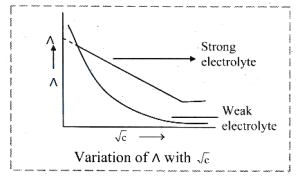
For which electrolyte the molar conductivity at infinite dilution cannot be obtained graphically?
A
$HNO_3$
B
$H_2SO_4$
C
$CH_3COOH$
D
$KCl$
Solution
(C) The molar conductivity of a weak electrolyte like $CH_3COOH$ does not vary linearly with the square root of concentration,as shown in the graph.
Unlike strong electrolytes,the curve for a weak electrolyte does not intersect the y-axis upon extrapolation.
Therefore,the molar conductivity at infinite dilution $(\Lambda_0)$ for weak electrolytes cannot be determined by the graphical extrapolation method.
Unlike strong electrolytes,the curve for a weak electrolyte does not intersect the y-axis upon extrapolation.
Therefore,the molar conductivity at infinite dilution $(\Lambda_0)$ for weak electrolytes cannot be determined by the graphical extrapolation method.
0 likes
View Solution285
MediumMCQ
Resistance and conductivity of a cell containing $0.1 \ M \ KCl$ solution at $298 \ K$ are $115 \ \Omega$ and $1.90 \times 10^{-6} \ S \ cm^{-1}$ respectively. What is the value of cell constant (in $cm^{-1}$)?
A
$0.165$
B
$1.601$
C
$2.185$
D
$0.218$
Solution
(D) The cell constant $\left(\frac{l}{A}\right)$ is defined by the relationship: $\frac{l}{A} = \kappa \times R$
where $\kappa$ is the conductivity and $R$ is the resistance.
Given:
$\kappa = 1.90 \times 10^{-6} \ S \ cm^{-1}$
$R = 115 \ \Omega$
Calculation:
$\frac{l}{A} = (1.90 \times 10^{-6} \ S \ cm^{-1}) \times (115 \ \Omega) = 0.2185 \ cm^{-1}$
Rounding to three decimal places,we get $0.218 \ cm^{-1}$.
Thus,the correct option is $D$.
where $\kappa$ is the conductivity and $R$ is the resistance.
Given:
$\kappa = 1.90 \times 10^{-6} \ S \ cm^{-1}$
$R = 115 \ \Omega$
Calculation:
$\frac{l}{A} = (1.90 \times 10^{-6} \ S \ cm^{-1}) \times (115 \ \Omega) = 0.2185 \ cm^{-1}$
Rounding to three decimal places,we get $0.218 \ cm^{-1}$.
Thus,the correct option is $D$.
0 likes
View Solution286
EasyMCQ
What is the conductivity of $0.05 \ M$ $KCl$ solution if cell constant is $1.32 \ cm^{-1}$ and resistance is $528 \ \Omega$?
A
$0.0401 \ \Omega^{-1} \ cm^{-1}$
B
$0.0051 \ \Omega^{-1} \ cm^{-1}$
C
$0.0025 \ \Omega^{-1} \ cm^{-1}$
D
$0.0691 \ \Omega^{-1} \ cm^{-1}$
Solution
(C) The conductivity $(\kappa)$ is calculated using the formula: $\kappa = \frac{\text{Cell constant}}{R}$.
Given: Cell constant = $1.32 \ cm^{-1}$,Resistance $(R)$ = $528 \ \Omega$.
$\kappa = \frac{1.32 \ cm^{-1}}{528 \ \Omega} = 0.0025 \ \Omega^{-1} \ cm^{-1}$.
Given: Cell constant = $1.32 \ cm^{-1}$,Resistance $(R)$ = $528 \ \Omega$.
$\kappa = \frac{1.32 \ cm^{-1}}{528 \ \Omega} = 0.0025 \ \Omega^{-1} \ cm^{-1}$.
0 likes
View Solution287
EasyMCQ
$A$ conductivity cell dipped in $0.05 \ M$ $KCl$ has resistance $600 \ \Omega$. If conductivity is $0.0012 \ \Omega^{-1} \ cm^{-1}$,what is the value of cell constant (in $cm^{-1}$)?
A
$0.50$
B
$0.72$
C
$1.5$
D
$2.0$
Solution
(B) The relationship between conductivity $(k)$,resistance $(R)$,and cell constant $(G^*)$ is given by:
$k = \frac{G^*}{R}$
Therefore,the cell constant is:
$G^* = k \times R$
Given:
$k = 0.0012 \ \Omega^{-1} \ cm^{-1}$
$R = 600 \ \Omega$
Substituting the values:
$G^* = 0.0012 \ \Omega^{-1} \ cm^{-1} \times 600 \ \Omega = 0.72 \ cm^{-1}$
$k = \frac{G^*}{R}$
Therefore,the cell constant is:
$G^* = k \times R$
Given:
$k = 0.0012 \ \Omega^{-1} \ cm^{-1}$
$R = 600 \ \Omega$
Substituting the values:
$G^* = 0.0012 \ \Omega^{-1} \ cm^{-1} \times 600 \ \Omega = 0.72 \ cm^{-1}$
0 likes
View Solution288
EasyMCQ
Which of the following units of electrical measurement is not equivalent to $1$ Siemen?
A
$\Omega^{-1}$
B
$A V^{-1}$
C
$C V^{-1} s^{-1}$
D
$\Omega$
Solution
(D) $\because V = I R$ and $Q = I t$
Conductance $(G) = \frac{1}{R} = \frac{I}{V} = \frac{Q}{V t}$
Substituting with units,
$\therefore 1 \text{ Siemen} = \frac{1}{\Omega} = \Omega^{-1} = \frac{A}{V} = A V^{-1} = \frac{C}{V s} = C V^{-1} s^{-1}$
Since $\Omega$ is the unit of resistance,it is not equivalent to $1$ Siemen.
Conductance $(G) = \frac{1}{R} = \frac{I}{V} = \frac{Q}{V t}$
Substituting with units,
$\therefore 1 \text{ Siemen} = \frac{1}{\Omega} = \Omega^{-1} = \frac{A}{V} = A V^{-1} = \frac{C}{V s} = C V^{-1} s^{-1}$
Since $\Omega$ is the unit of resistance,it is not equivalent to $1$ Siemen.
0 likes
View Solution289
EasyMCQ
The conductivity of $0.02 \ M$ $KCl$ solution is $0.00250 \ \Omega^{-1} \ cm^{-1}$. What is its molar conductivity?
A
$125 \ \Omega^{-1} \ cm^{2} \ mol^{-1}$
B
$0.05 \ \Omega^{-1} \ cm^{2} \ mol^{-1}$
C
$725 \ \Omega^{-1} \ cm^{2} \ mol^{-1}$
D
$8000 \ \Omega^{-1} \ cm^{2} \ mol^{-1}$
Solution
(A) The formula for molar conductivity $(\Lambda_m)$ is given by: $\Lambda_m = \frac{1000 \times \kappa}{C}$
Given:
Conductivity $(\kappa)$ = $0.00250 \ \Omega^{-1} \ cm^{-1}$
Concentration $(C)$ = $0.02 \ M$
Substituting the values:
$\Lambda_m = \frac{1000 \times 0.00250}{0.02} \ \Omega^{-1} \ cm^2 \ mol^{-1}$
$\Lambda_m = \frac{2.5}{0.02} \ \Omega^{-1} \ cm^2 \ mol^{-1}$
$\Lambda_m = 125 \ \Omega^{-1} \ cm^2 \ mol^{-1}$
Given:
Conductivity $(\kappa)$ = $0.00250 \ \Omega^{-1} \ cm^{-1}$
Concentration $(C)$ = $0.02 \ M$
Substituting the values:
$\Lambda_m = \frac{1000 \times 0.00250}{0.02} \ \Omega^{-1} \ cm^2 \ mol^{-1}$
$\Lambda_m = \frac{2.5}{0.02} \ \Omega^{-1} \ cm^2 \ mol^{-1}$
$\Lambda_m = 125 \ \Omega^{-1} \ cm^2 \ mol^{-1}$
0 likes
View Solution290
EasyMCQ
The resistance of a conductivity cell filled with $0.1 \ M$ $KCl$ solution is $100 \ \Omega$ and the conductivity is $1.70 \times 10^{-4} \ S \ cm^{-1}$. What is the cell constant of the cell (in $cm^{-1}$)?
A
$1.70$
B
$0.017$
C
$0.058$
D
$0.012$
Solution
(B) The formula for cell constant $(G^*)$ is given by:
$G^* = \kappa \times R$
Where:
- $\kappa$ is the conductivity $(S \ cm^{-1})$,
- $R$ is the resistance $(\Omega)$.
Given:
- $\kappa = 1.70 \times 10^{-4} \ S \ cm^{-1}$,
- $R = 100 \ \Omega$.
Calculation:
$G^* = (1.70 \times 10^{-4} \ S \ cm^{-1}) \times (100 \ \Omega) = 0.017 \ cm^{-1}$.
Therefore,the cell constant is $0.017 \ cm^{-1}$.
Hence,the correct option is $B$.
$G^* = \kappa \times R$
Where:
- $\kappa$ is the conductivity $(S \ cm^{-1})$,
- $R$ is the resistance $(\Omega)$.
Given:
- $\kappa = 1.70 \times 10^{-4} \ S \ cm^{-1}$,
- $R = 100 \ \Omega$.
Calculation:
$G^* = (1.70 \times 10^{-4} \ S \ cm^{-1}) \times (100 \ \Omega) = 0.017 \ cm^{-1}$.
Therefore,the cell constant is $0.017 \ cm^{-1}$.
Hence,the correct option is $B$.
0 likes
View Solution291
MediumMCQ
Which of the following cannot be used as a standard solution for the determination of the cell constant of a conductivity cell?
A
$1 \ M \ KCl$
B
$0.1 \ M \ KCl$
C
$0.01 \ M \ KCl$
D
Saturated $KCl$
Solution
(D) saturated $KCl$ solution is not typically used as a standard solution for conductivity calibration.
The reason is that a saturated $KCl$ solution may have variable composition due to temperature changes,partial crystallization,and the difficulty in ensuring a uniform,reproducible concentration.
Thus,it does not have a precisely known or easily reproducible conductivity value compared to the other standard concentrations.
Conclusion: Out of the given options,the saturated $KCl$ solution (Option $D$) is not suitable for use as a standard solution in determining the cell constant because its concentration and thus its conductivity are not stable or easily reproducible.
The reason is that a saturated $KCl$ solution may have variable composition due to temperature changes,partial crystallization,and the difficulty in ensuring a uniform,reproducible concentration.
Thus,it does not have a precisely known or easily reproducible conductivity value compared to the other standard concentrations.
Conclusion: Out of the given options,the saturated $KCl$ solution (Option $D$) is not suitable for use as a standard solution in determining the cell constant because its concentration and thus its conductivity are not stable or easily reproducible.
0 likes
View Solution292
MediumMCQ
Cell constant of a conductivity cell is $0.9 \ cm^{-1}$ and resistance shown by $AgNO_3$ solution is $6530 \ \Omega$. What is the conductivity of $AgNO_3$ solution?
A
$725 \ \Omega^{-1} \ cm^{-1}$
B
$5870 \ \Omega^{-1} \ cm^{-1}$
C
$1.38 \times 10^{-4} \ \Omega^{-1} \ cm^{-1}$
D
$4.72 \times 10^{-4} \ \Omega^{-1} \ cm^{-1}$
Solution
(C) The conductivity $(\kappa)$ is given by the formula: $\kappa = \frac{\text{Cell constant}}{R}$
Given: Cell constant $= 0.9 \ cm^{-1}$ and $R = 6530 \ \Omega$.
Substituting the values: $\kappa = \frac{0.9 \ cm^{-1}}{6530 \ \Omega} = 1.378 \times 10^{-4} \ \Omega^{-1} \ cm^{-1} \approx 1.38 \times 10^{-4} \ \Omega^{-1} \ cm^{-1}$.
Given: Cell constant $= 0.9 \ cm^{-1}$ and $R = 6530 \ \Omega$.
Substituting the values: $\kappa = \frac{0.9 \ cm^{-1}}{6530 \ \Omega} = 1.378 \times 10^{-4} \ \Omega^{-1} \ cm^{-1} \approx 1.38 \times 10^{-4} \ \Omega^{-1} \ cm^{-1}$.
0 likes
View Solution293
EasyMCQ
What is the concentration of an electrolyte solution to have molar conductivity of $101 \ \Omega^{-1} \ cm^2 \ mol^{-1}$ and conductivity of $1.01 \times 10^{-2} \ \Omega^{-1} \ cm^{-1}$ at $298 \ K$ (in $M$)?
A
$0.05$
B
$0.1$
C
$0.15$
D
$0.2$
Solution
(B) The formula for molar conductivity $(\Lambda_m)$ is given by: $\Lambda_m = \frac{1000 \times \kappa}{c}$
Given: $\Lambda_m = 101 \ \Omega^{-1} \ cm^2 \ mol^{-1}$ and $\kappa = 1.01 \times 10^{-2} \ \Omega^{-1} \ cm^{-1}$
Substituting the values: $101 = \frac{1000 \times 1.01 \times 10^{-2}}{c}$
$101 = \frac{10.1}{c}$
$c = \frac{10.1}{101} = 0.1 \ M$
Given: $\Lambda_m = 101 \ \Omega^{-1} \ cm^2 \ mol^{-1}$ and $\kappa = 1.01 \times 10^{-2} \ \Omega^{-1} \ cm^{-1}$
Substituting the values: $101 = \frac{1000 \times 1.01 \times 10^{-2}}{c}$
$101 = \frac{10.1}{c}$
$c = \frac{10.1}{101} = 0.1 \ M$
0 likes
View Solution294
EasyMCQ
The conductivity of $0.02 \ M$ solution of $AgNO_3$ is $0.00216 \ \Omega^{-1} \ cm^{-1}$ at $298 \ K$. What is its molar conductivity?
A
$232.0 \ \Omega^{-1} \ cm^2 \ mol^{-1}$
B
$402.0 \ \Omega^{-1} \ cm^2 \ mol^{-1}$
C
$108.0 \ \Omega^{-1} \ cm^2 \ mol^{-1}$
D
$150.0 \ \Omega^{-1} \ cm^2 \ mol^{-1}$
Solution
(C) The formula for molar conductivity is $\Lambda_m = \frac{1000 \times \kappa}{C}$.
Given: $\kappa = 0.00216 \ \Omega^{-1} \ cm^{-1}$ and $C = 0.02 \ M$.
Substituting the values: $\Lambda_m = \frac{1000 \times 0.00216}{0.02} = 108.0 \ \Omega^{-1} \ cm^2 \ mol^{-1}$.
Given: $\kappa = 0.00216 \ \Omega^{-1} \ cm^{-1}$ and $C = 0.02 \ M$.
Substituting the values: $\Lambda_m = \frac{1000 \times 0.00216}{0.02} = 108.0 \ \Omega^{-1} \ cm^2 \ mol^{-1}$.
0 likes
View Solution295
EasyMCQ
What is the conductivity of $0.05 \ M$ $NaOH$ solution having resistance $31.5 \ \Omega$ and cell constant $0.315 \ cm^{-1}$?
A
$100 \ \Omega^{-1} \ cm^{-1}$
B
$0.02 \ \Omega^{-1} \ cm^{-1}$
C
$0.09 \ \Omega^{-1} \ cm^{-1}$
D
$0.01 \ \Omega^{-1} \ cm^{-1}$
Solution
(D) The formula for conductivity $(k)$ is given by: $k = \frac{1}{R} \times \frac{l}{A}$
Given: Resistance $(R)$ = $31.5 \ \Omega$ and Cell constant $(\frac{l}{A})$ = $0.315 \ cm^{-1}$
Substituting the values: $k = \frac{1}{31.5 \ \Omega} \times 0.315 \ cm^{-1}$
$k = 0.01 \ \Omega^{-1} \ cm^{-1}$
Given: Resistance $(R)$ = $31.5 \ \Omega$ and Cell constant $(\frac{l}{A})$ = $0.315 \ cm^{-1}$
Substituting the values: $k = \frac{1}{31.5 \ \Omega} \times 0.315 \ cm^{-1}$
$k = 0.01 \ \Omega^{-1} \ cm^{-1}$
0 likes
View Solution296
EasyMCQ
Calculate the cell constant of a conductivity cell containing $0.1 \ M$ $KCl$ solution having a resistance of $60 \ \Omega$ and a conductivity of $0.014 \ \Omega^{-1} \ cm^{-1}$ at $25^{\circ} \ C$. (in $cm^{-1}$)
A
$0.42$
B
$0.84$
C
$0.60$
D
$1.04$
Solution
(B) The relationship between conductivity $(\kappa)$,resistance $(R)$,and cell constant $(G^*)$ is given by:
$\kappa = \frac{1}{R} \times G^*$
Given:
Resistance $(R)$ = $60 \ \Omega$
Conductivity $(\kappa)$ = $0.014 \ \Omega^{-1} \ cm^{-1}$
Substituting the values:
$0.014 \ \Omega^{-1} \ cm^{-1} = \frac{1}{60 \ \Omega} \times G^*$
$G^* = 0.014 \ \Omega^{-1} \ cm^{-1} \times 60 \ \Omega$
$G^* = 0.84 \ cm^{-1}$
$\kappa = \frac{1}{R} \times G^*$
Given:
Resistance $(R)$ = $60 \ \Omega$
Conductivity $(\kappa)$ = $0.014 \ \Omega^{-1} \ cm^{-1}$
Substituting the values:
$0.014 \ \Omega^{-1} \ cm^{-1} = \frac{1}{60 \ \Omega} \times G^*$
$G^* = 0.014 \ \Omega^{-1} \ cm^{-1} \times 60 \ \Omega$
$G^* = 0.84 \ cm^{-1}$
0 likes
View Solution297
MediumMCQ
What is the conductivity of $0.05 \ M \ BaCl_2$ solution if its molar conductivity is $220 \ \Omega^{-1} \ cm^2 \ mol^{-1}$?
A
$0.011 \ \Omega^{-1} \ cm^{-1}$
B
$0.022 \ \Omega^{-1} \ cm^{-1}$
C
$0.033 \ \Omega^{-1} \ cm^{-1}$
D
$0.044 \ \Omega^{-1} \ cm^{-1}$
Solution
(A) The relationship between molar conductivity $(\Lambda_m)$ and conductivity $(k)$ is given by the formula: $\Lambda_m = \frac{1000 \times k}{C}$
Rearranging for conductivity $(k)$: $k = \frac{\Lambda_m \times C}{1000}$
Given: $\Lambda_m = 220 \ \Omega^{-1} \ cm^2 \ mol^{-1}$ and $C = 0.05 \ M$
Substituting the values: $k = \frac{220 \times 0.05}{1000} \ \Omega^{-1} \ cm^{-1}$
$k = \frac{11}{1000} \ \Omega^{-1} \ cm^{-1} = 0.011 \ \Omega^{-1} \ cm^{-1}$
Rearranging for conductivity $(k)$: $k = \frac{\Lambda_m \times C}{1000}$
Given: $\Lambda_m = 220 \ \Omega^{-1} \ cm^2 \ mol^{-1}$ and $C = 0.05 \ M$
Substituting the values: $k = \frac{220 \times 0.05}{1000} \ \Omega^{-1} \ cm^{-1}$
$k = \frac{11}{1000} \ \Omega^{-1} \ cm^{-1} = 0.011 \ \Omega^{-1} \ cm^{-1}$
0 likes
View Solution298
MediumMCQ
Conductivity of a solution is $1.26 \times 10^{-2} \ \Omega^{-1} \ cm^{-1}$. Calculate molar conductivity for $0.01 \ M$ solution.
A
$1.26 \times 10^3 \ \Omega^{-1} \ cm^2 \ mol^{-1}$
B
$2.52 \times 10^3 \ \Omega^{-1} \ cm^2 \ mol^{-1}$
C
$4.82 \times 10^3 \ \Omega^{-1} \ cm^2 \ mol^{-1}$
D
$6.30 \times 10^3 \ \Omega^{-1} \ cm^2 \ mol^{-1}$
Solution
(A) The formula for molar conductivity is $\Lambda_m = \frac{1000 \times \kappa}{c}$.
Given,conductivity $\kappa = 1.26 \times 10^{-2} \ \Omega^{-1} \ cm^{-1}$ and concentration $c = 0.01 \ M$.
Substituting the values:
$\Lambda_m = \frac{1000 \times 1.26 \times 10^{-2}}{0.01} \ \Omega^{-1} \ cm^2 \ mol^{-1}$.
$\Lambda_m = \frac{12.6}{0.01} \ \Omega^{-1} \ cm^2 \ mol^{-1} = 1.26 \times 10^3 \ \Omega^{-1} \ cm^2 \ mol^{-1}$.
Given,conductivity $\kappa = 1.26 \times 10^{-2} \ \Omega^{-1} \ cm^{-1}$ and concentration $c = 0.01 \ M$.
Substituting the values:
$\Lambda_m = \frac{1000 \times 1.26 \times 10^{-2}}{0.01} \ \Omega^{-1} \ cm^2 \ mol^{-1}$.
$\Lambda_m = \frac{12.6}{0.01} \ \Omega^{-1} \ cm^2 \ mol^{-1} = 1.26 \times 10^3 \ \Omega^{-1} \ cm^2 \ mol^{-1}$.
0 likes
View Solution299
MediumMCQ
Calculate the conductivity of $0.02 \ M$ electrolyte solution if its molar conductivity is $407.2 \ \Omega^{-1} \ cm^2 \ mol^{-1}$.
A
$8.144 \times 10^{-3} \ \Omega^{-1} \ cm^{-1}$
B
$4.072 \times 10^{-3} \ \Omega^{-1} \ cm^{-1}$
C
$7.15 \times 10^{-3} \ \Omega^{-1} \ cm^{-1}$
D
$6.055 \times 10^{-3} \ \Omega^{-1} \ cm^{-1}$
Solution
(A) The relationship between molar conductivity $(\Lambda_{m})$ and conductivity $(k)$ is given by the formula: $\Lambda_{m} = \frac{1000 \times k}{c}$.
Rearranging the formula to solve for conductivity $(k)$: $k = \frac{\Lambda_{m} \times c}{1000}$.
Given values: $\Lambda_{m} = 407.2 \ \Omega^{-1} \ cm^2 \ mol^{-1}$ and $c = 0.02 \ M$.
Substituting the values: $k = \frac{407.2 \times 0.02}{1000}$.
$k = \frac{8.144}{1000} = 8.144 \times 10^{-3} \ \Omega^{-1} \ cm^{-1}$.
Rearranging the formula to solve for conductivity $(k)$: $k = \frac{\Lambda_{m} \times c}{1000}$.
Given values: $\Lambda_{m} = 407.2 \ \Omega^{-1} \ cm^2 \ mol^{-1}$ and $c = 0.02 \ M$.
Substituting the values: $k = \frac{407.2 \times 0.02}{1000}$.
$k = \frac{8.144}{1000} = 8.144 \times 10^{-3} \ \Omega^{-1} \ cm^{-1}$.
0 likes
View Solution300
EasyMCQ
What happens when the solution of an electrolyte is diluted?
A
Both $\wedge$ and $k$ increase
B
Both $\wedge$ and $k$ decrease
C
$\wedge$ increases and $k$ decreases
D
$\wedge$ decreases and $k$ increases
Solution
(C) The molar conductivity $(\wedge_m)$ of an electrolyte increases upon dilution because the total volume of the solution containing one mole of electrolyte increases,leading to greater dissociation or increased ionic mobility.
Conversely,the conductivity $(k)$ (specific conductance) decreases upon dilution because the number of ions per unit volume of the solution decreases.
Conversely,the conductivity $(k)$ (specific conductance) decreases upon dilution because the number of ions per unit volume of the solution decreases.
0 likes
View SolutionElectrochemistry — Conductor and Conductance and Cell constant · Frequently Asked Questions
1Are these Electrochemistry questions useful for JEE and NEET?
Yes. All questions in this section are mapped to JEE Main and NEET exam patterns. Previous year questions from JEE Main, NEET, GUJCET and state-level exams are included with full solutions.
2Can I switch to Hindi or Gujarati for these questions?
Yes. Use the language tabs in the hero section or the sidebar to view the same questions and solutions in English, Hindi or Gujarati.
3How do I generate a question paper from this subtopic?
Use the Vedclass Exam Paper Generator — select the chapter and subtopic, set difficulty, and generate Sets A, B, C, D automatically. First 3 chapters of every subject are free.
Vedclass Products
For Students
Vedclass Test Series
Mock tests in real JEE/NEET style with performance analysis. 5-day free trial.
Start Free TrialFor Teachers
Exam Paper Generator
Generate Set A/B/C/D papers from this chapter in 2 minutes. 3 chapters free.
Try FreeFor Institutes
Online Exam Module
Live online exams with unlimited students, 360° analytics & white-label branding.
See DemoFor Teachers & Institutes
Generate a Electrochemistry Exam Paper in 2 Minutes
Select subtopic & difficulty — Sets A, B, C, D auto-generated with No Repeat logic.
First 3 chapters of every subject are free — no payment required.