
A English
Isomerism and Magnetic properties Questions in English
Class 12 Chemistry · Coordination Compounds · Isomerism and Magnetic properties
800+
Questions
English
Language
100%
With Solutions
Showing 50 of 800 questions in English
601
MediumMCQ
The correct order of spin-only magnetic moments for the following complex ions is:
A
$[Fe(CN)_6]^{3-} < [CoF_6]^{3-} < [MnBr_4]^{2-} < [Mn(CN)_6]^{3-}$
B
$[Fe(CN)_6]^{3-} < [Mn(CN)_6]^{3-} < [CoF_6]^{3-} < [MnBr_4]^{2-}$
C
$[MnBr_4]^{2-} < [CoF_6]^{3-} < [Fe(CN)_6]^{3-} < [Mn(CN)_6]^{3-}$
D
$[CoF_6]^{3-} < [MnBr_4]^{2-} < [Fe(CN)_6]^{3-} < [Mn(CN)_6]^{3-}$
Solution
(B) The spin-only magnetic moment is given by $\mu = \sqrt{n(n+2)} \ B.M.$,where $n$ is the number of unpaired electrons.
$1$. $[Fe(CN)_6]^{3-}$: $Fe^{3+}$ is $d^5$. $CN^-$ is a strong field ligand,so $n = 1$. $\mu = \sqrt{1(3)} = 1.73 \ B.M.$
$2$. $[Mn(CN)_6]^{3-}$: $Mn^{3+}$ is $d^4$. $CN^-$ is a strong field ligand,so $n = 2$. $\mu = \sqrt{2(4)} = 2.83 \ B.M.$
$3$. $[CoF_6]^{3-}$: $Co^{3+}$ is $d^6$. $F^-$ is a weak field ligand,so $n = 4$. $\mu = \sqrt{4(6)} = 4.90 \ B.M.$
$4$. $[MnBr_4]^{2-}$: $Mn^{2+}$ is $d^5$. $Br^-$ is a weak field ligand,so $n = 5$. $\mu = \sqrt{5(7)} = 5.92 \ B.M.$
The correct order is $[Fe(CN)_6]^{3-} < [Mn(CN)_6]^{3-} < [CoF_6]^{3-} < [MnBr_4]^{2-}$.
$1$. $[Fe(CN)_6]^{3-}$: $Fe^{3+}$ is $d^5$. $CN^-$ is a strong field ligand,so $n = 1$. $\mu = \sqrt{1(3)} = 1.73 \ B.M.$
$2$. $[Mn(CN)_6]^{3-}$: $Mn^{3+}$ is $d^4$. $CN^-$ is a strong field ligand,so $n = 2$. $\mu = \sqrt{2(4)} = 2.83 \ B.M.$
$3$. $[CoF_6]^{3-}$: $Co^{3+}$ is $d^6$. $F^-$ is a weak field ligand,so $n = 4$. $\mu = \sqrt{4(6)} = 4.90 \ B.M.$
$4$. $[MnBr_4]^{2-}$: $Mn^{2+}$ is $d^5$. $Br^-$ is a weak field ligand,so $n = 5$. $\mu = \sqrt{5(7)} = 5.92 \ B.M.$
The correct order is $[Fe(CN)_6]^{3-} < [Mn(CN)_6]^{3-} < [CoF_6]^{3-} < [MnBr_4]^{2-}$.
0 likes
View Solution602
MediumMCQ
Match List-$I$ with List-$II$ :-
Choose the correct answer from the options given below :-
| List-$I$ (Coordination compounds) | List-$II$ (Number of unpaired electrons) |
| $A$. $[Cr(CN)_6]^{3-}$ | $I$. $0$ |
| $B$. $[Fe(H_2O)_6]^{2+}$ | $II$. $3$ |
| $C$. $[Co(NH_3)_6]^{3+}$ | $III$. $2$ |
| $D$. $[Ni(NH_3)_6]^{2+}$ | $IV$. $4$ |
Choose the correct answer from the options given below :-
A
$A-II, B-IV, C-I, D-III$
B
$A-IV, B-III, C-II, D-I$
C
$A-III, B-IV, C-I, D-II$
D
$A-II, B-I, C-IV, D-III$
Solution
(A) For option $(A)$: $[Cr(CN)_6]^{3-}$,$Cr^{3+}$ is $3d^3$. Since $CN^-$ is a strong field ligand,the electrons remain in $t_{2g}$ orbitals. Number of unpaired electrons $= 3$.
For option $(B)$: $[Fe(H_2O)_6]^{2+}$,$Fe^{2+}$ is $3d^6$. Since $H_2O$ is a weak field ligand,the configuration is $t_{2g}^4 e_g^2$. Number of unpaired electrons $= 4$.
For option $(C)$: $[Co(NH_3)_6]^{3+}$,$Co^{3+}$ is $3d^6$. Since $NH_3$ is a strong field ligand,all electrons are paired. Number of unpaired electrons $= 0$.
For option $(D)$: $[Ni(NH_3)_6]^{2+}$,$Ni^{2+}$ is $3d^8$. The configuration is $t_{2g}^6 e_g^2$. Number of unpaired electrons $= 2$.
Thus,the correct matching is $A-II, B-IV, C-I, D-III$.
For option $(B)$: $[Fe(H_2O)_6]^{2+}$,$Fe^{2+}$ is $3d^6$. Since $H_2O$ is a weak field ligand,the configuration is $t_{2g}^4 e_g^2$. Number of unpaired electrons $= 4$.
For option $(C)$: $[Co(NH_3)_6]^{3+}$,$Co^{3+}$ is $3d^6$. Since $NH_3$ is a strong field ligand,all electrons are paired. Number of unpaired electrons $= 0$.
For option $(D)$: $[Ni(NH_3)_6]^{2+}$,$Ni^{2+}$ is $3d^8$. The configuration is $t_{2g}^6 e_g^2$. Number of unpaired electrons $= 2$.
Thus,the correct matching is $A-II, B-IV, C-I, D-III$.
0 likes
View Solution603
MediumMCQ
The observed magnetic moment of the complex $[Mn(NCS)_6]^{x-}$ is $6.06 \ BM$. The numerical value of $x$ is $.......$.
A
$4$
B
$6$
C
$8$
D
$10$
Solution
(A) The magnetic moment $\mu = \sqrt{n(n+2)} \ BM$.
Given $\mu = 6.06 \ BM$,which corresponds to $n = 5$ unpaired electrons.
For $Mn$ $(Z=25)$,the electronic configuration is $[Ar] 3d^5 4s^2$.
To have $5$ unpaired electrons in the complex,$Mn$ must be in the $+2$ oxidation state $(Mn^{2+})$,which has the configuration $[Ar] 3d^5$.
Let the oxidation state of $Mn$ be $y$. The charge on the complex is given by $y + 6 \times (-1) = -x$.
Since $y = +2$,we have $2 - 6 = -x$,which gives $-4 = -x$,so $x = 4$.
Given $\mu = 6.06 \ BM$,which corresponds to $n = 5$ unpaired electrons.
For $Mn$ $(Z=25)$,the electronic configuration is $[Ar] 3d^5 4s^2$.
To have $5$ unpaired electrons in the complex,$Mn$ must be in the $+2$ oxidation state $(Mn^{2+})$,which has the configuration $[Ar] 3d^5$.
Let the oxidation state of $Mn$ be $y$. The charge on the complex is given by $y + 6 \times (-1) = -x$.
Since $y = +2$,we have $2 - 6 = -x$,which gives $-4 = -x$,so $x = 4$.
0 likes
View Solution604
MediumMCQ
The correct order of the number of unpaired electrons in the given complexes is
$A$. $[Fe(CN)_6]^{3-}$; $B$. $[FeF_6]^{3-}$; $C$. $[CoF_6]^{3-}$; $D$. $[Cr(oxalate)_3]^{3-}$; $E$. $[Ni(CO)_4]$
Choose the correct answer from the options given below:
$A$. $[Fe(CN)_6]^{3-}$; $B$. $[FeF_6]^{3-}$; $C$. $[CoF_6]^{3-}$; $D$. $[Cr(oxalate)_3]^{3-}$; $E$. $[Ni(CO)_4]$
Choose the correct answer from the options given below:
A
$A < E < D < C < B$
B
$E < A < D < C < B$
C
$E < A < B < D < C$
D
$A < E < C < B < D$
Solution
(B) . $[Fe(CN)_6]^{3-}$: $Fe^{3+}$ is $d^5$. $CN^-$ is a strong field ligand,so pairing occurs. $n = 1$.
$B$. $[FeF_6]^{3-}$: $Fe^{3+}$ is $d^5$. $F^-$ is a weak field ligand,so no pairing. $n = 5$.
$C$. $[CoF_6]^{3-}$: $Co^{3+}$ is $d^6$. $F^-$ is a weak field ligand,so no pairing. $n = 4$.
$D$. $[Cr(oxalate)_3]^{3-}$: $Cr^{3+}$ is $d^3$. $n = 3$.
$E$. $[Ni(CO)_4]$: $Ni^0$ is $d^{10}$. $CO$ is a strong field ligand,all electrons paired. $n = 0$.
The number of unpaired electrons are: $A=1, B=5, C=4, D=3, E=0$.
Ordering them: $E(0) < A(1) < D(3) < C(4) < B(5)$.
Thus,the correct order is $E < A < D < C < B$.
$B$. $[FeF_6]^{3-}$: $Fe^{3+}$ is $d^5$. $F^-$ is a weak field ligand,so no pairing. $n = 5$.
$C$. $[CoF_6]^{3-}$: $Co^{3+}$ is $d^6$. $F^-$ is a weak field ligand,so no pairing. $n = 4$.
$D$. $[Cr(oxalate)_3]^{3-}$: $Cr^{3+}$ is $d^3$. $n = 3$.
$E$. $[Ni(CO)_4]$: $Ni^0$ is $d^{10}$. $CO$ is a strong field ligand,all electrons paired. $n = 0$.
The number of unpaired electrons are: $A=1, B=5, C=4, D=3, E=0$.
Ordering them: $E(0) < A(1) < D(3) < C(4) < B(5)$.
Thus,the correct order is $E < A < D < C < B$.
0 likes
View Solution605
MediumMCQ
For a metal ion,the calculated magnetic moment is $4.90 \ BM$. This metal ion has $........$ number of unpaired electrons.
A
$6$
B
$8$
C
$4$
D
$5$
Solution
(C) The magnetic moment $\mu$ is related to the number of unpaired electrons $n$ by the formula: $\mu = \sqrt{n(n+2)} \ BM$.
Given $\mu = 4.90 \ BM$,we have $4.90 = \sqrt{n(n+2)}$.
Squaring both sides,we get $24.01 = n(n+2)$,which is approximately $n^2 + 2n - 24 = 0$.
Solving this quadratic equation,$(n+6)(n-4) = 0$.
Since $n$ must be positive,$n = 4$.
Thus,the metal ion has $4$ unpaired electrons.
Given $\mu = 4.90 \ BM$,we have $4.90 = \sqrt{n(n+2)}$.
Squaring both sides,we get $24.01 = n(n+2)$,which is approximately $n^2 + 2n - 24 = 0$.
Solving this quadratic equation,$(n+6)(n-4) = 0$.
Since $n$ must be positive,$n = 4$.
Thus,the metal ion has $4$ unpaired electrons.
0 likes
View Solution606
MediumMCQ
Which of the following complexes has the possibility to exist as a meridional isomer?
A
$[Co(NH_3)_3(NO_2)_3]$
B
$[Co(en)_3]$
C
$[Co(en)_2Cl_2]$
D
$[Pt(NH_3)_2Cl_2]$
Solution
(A) Complexes of the type $[MA_3B_3]$ exhibit facial (fac) and meridional (mer) isomerism.
In the given options,$[Co(NH_3)_3(NO_2)_3]$ is of the type $[MA_3B_3]$,where $M = Co$,$A = NH_3$,and $B = NO_2$.
Therefore,it can exist as both facial and meridional isomers.
In the given options,$[Co(NH_3)_3(NO_2)_3]$ is of the type $[MA_3B_3]$,where $M = Co$,$A = NH_3$,and $B = NO_2$.
Therefore,it can exist as both facial and meridional isomers.
0 likes
View Solution607
MediumMCQ
The ratio of spin-only magnetic moment values $\mu_{eff}[Cr(CN)_6]^{3-} / \mu_{eff}[Cr(H_2O)_6]^{3+}$ is $.........$.
A
$2$
B
$3$
C
$4$
D
$1$
Solution
(D) For $[Cr(CN)_6]^{3-}$,the oxidation state of $Cr$ is $+3$. The electronic configuration is $3d^3$. Since $CN^-$ is a strong field ligand,the configuration is $t_{2g}^3 e_g^0$. The number of unpaired electrons $n = 3$.
$\mu_1 = \sqrt{n(n+2)} = \sqrt{3(3+2)} = \sqrt{15} \ BM$.
For $[Cr(H_2O)_6]^{3+}$,the oxidation state of $Cr$ is $+3$. The electronic configuration is $3d^3$. Since $H_2O$ is a weak field ligand,the configuration is $t_{2g}^3 e_g^0$. The number of unpaired electrons $n = 3$.
$\mu_2 = \sqrt{n(n+2)} = \sqrt{3(3+2)} = \sqrt{15} \ BM$.
The ratio $\frac{\mu_1}{\mu_2} = \frac{\sqrt{15}}{\sqrt{15}} = 1$.
$\mu_1 = \sqrt{n(n+2)} = \sqrt{3(3+2)} = \sqrt{15} \ BM$.
For $[Cr(H_2O)_6]^{3+}$,the oxidation state of $Cr$ is $+3$. The electronic configuration is $3d^3$. Since $H_2O$ is a weak field ligand,the configuration is $t_{2g}^3 e_g^0$. The number of unpaired electrons $n = 3$.
$\mu_2 = \sqrt{n(n+2)} = \sqrt{3(3+2)} = \sqrt{15} \ BM$.
The ratio $\frac{\mu_1}{\mu_2} = \frac{\sqrt{15}}{\sqrt{15}} = 1$.
0 likes
View Solution608
MediumMCQ
The magnetic moment is measured in Bohr Magneton $(BM)$. Spin only magnetic moment of $Fe$ in $[Fe(H_2O)_6]^{3+}$ and $[Fe(CN)_6]^{3-}$ complexes respectively is:
A
$6.92 \ BM$ in both
B
$4.89 \ BM$ and $6.92 \ BM$
C
$3.87 \ BM$ and $1.732 \ BM$
D
$5.92 \ BM$ and $1.732 \ BM$
Solution
(D) For $[Fe(H_2O)_6]^{3+}$:
$Fe^{3+}$ has $d^5$ configuration. $H_2O$ is a weak field ligand,so no pairing occurs.
Number of unpaired electrons $(n)$ = $5$.
$\mu = \sqrt{n(n+2)} = \sqrt{5(5+2)} = \sqrt{35} \approx 5.92 \ BM$.
For $[Fe(CN)_6]^{3-}$:
$Fe^{3+}$ has $d^5$ configuration. $CN^-$ is a strong field ligand,so pairing occurs.
Number of unpaired electrons $(n)$ = $1$.
$\mu = \sqrt{1(1+2)} = \sqrt{3} \approx 1.732 \ BM$.
Thus,the magnetic moments are $5.92 \ BM$ and $1.732 \ BM$ respectively.
$Fe^{3+}$ has $d^5$ configuration. $H_2O$ is a weak field ligand,so no pairing occurs.
Number of unpaired electrons $(n)$ = $5$.
$\mu = \sqrt{n(n+2)} = \sqrt{5(5+2)} = \sqrt{35} \approx 5.92 \ BM$.
For $[Fe(CN)_6]^{3-}$:
$Fe^{3+}$ has $d^5$ configuration. $CN^-$ is a strong field ligand,so pairing occurs.
Number of unpaired electrons $(n)$ = $1$.
$\mu = \sqrt{1(1+2)} = \sqrt{3} \approx 1.732 \ BM$.
Thus,the magnetic moments are $5.92 \ BM$ and $1.732 \ BM$ respectively.
0 likes
View Solution609
DifficultMCQ
The total number of stereoisomers for the complex $[Cr(ox)_2ClBr]^{3-}$ (where $ox$ = oxalate) is:
A
$2$
B
$3$
C
$1$
D
$4$
Solution
(B) The complex $[Cr(ox)_2ClBr]^{3-}$ is of the type $[M(AA)_2a_2]$ where $AA$ is a bidentate ligand (oxalate) and $a$ represents monodentate ligands ($Cl^-$ and $Br^-$).
$1$. Geometrical Isomerism: There are two geometrical isomers:
- $trans$-isomer: The two monodentate ligands ($Cl$ and $Br$) are at $180^{\circ}$ to each other. This isomer has a plane of symmetry and is optically inactive.
- $cis$-isomer: The two monodentate ligands ($Cl$ and $Br$) are at $90^{\circ}$ to each other. This isomer lacks a plane of symmetry and is chiral.
$2$. Optical Isomerism: The $cis$-isomer exists as a pair of enantiomers ($d$ and $l$ forms).
Total stereoisomers = $1$ $(trans)$ + $2$ ($cis$-$d$ and $cis$-$l$) = $3$.
$1$. Geometrical Isomerism: There are two geometrical isomers:
- $trans$-isomer: The two monodentate ligands ($Cl$ and $Br$) are at $180^{\circ}$ to each other. This isomer has a plane of symmetry and is optically inactive.
- $cis$-isomer: The two monodentate ligands ($Cl$ and $Br$) are at $90^{\circ}$ to each other. This isomer lacks a plane of symmetry and is chiral.
$2$. Optical Isomerism: The $cis$-isomer exists as a pair of enantiomers ($d$ and $l$ forms).
Total stereoisomers = $1$ $(trans)$ + $2$ ($cis$-$d$ and $cis$-$l$) = $3$.
0 likes
View Solution610
MediumMCQ
Which of the following complexes will exhibit maximum attraction to an applied magnetic field?
A
$[Zn(H_2O)_6]^{2+}$
B
$[Co(H_2O)_6]^{2+}$
C
$[Co(en)_3]^{3+}$
D
$[Ni(H_2O)_6]^{2+}$
Solution
(B) The complex with the maximum number of unpaired electrons will exhibit the maximum attraction to an applied magnetic field (paramagnetism).
$1$. $[Zn(H_2O)_6]^{2+}$: $Zn^{2+}$ is a $d^{10}$ system,which has $0$ unpaired electrons.
$2$. $[Co(H_2O)_6]^{2+}$: $Co^{2+}$ is a $d^7$ system. In an octahedral field with a weak field ligand $(H_2O)$,the configuration is $t_{2g}^5 e_g^2$,resulting in $3$ unpaired electrons.
$3$. $[Co(en)_3]^{3+}$: $Co^{3+}$ is a $d^6$ system. Since $en$ is a strong field ligand,the configuration is $t_{2g}^6 e_g^0$,resulting in $0$ unpaired electrons.
$4$. $[Ni(H_2O)_6]^{2+}$: $Ni^{2+}$ is a $d^8$ system,which has $2$ unpaired electrons.
Since $[Co(H_2O)_6]^{2+}$ has the highest number of unpaired electrons $(3)$,it will exhibit the maximum attraction.
$1$. $[Zn(H_2O)_6]^{2+}$: $Zn^{2+}$ is a $d^{10}$ system,which has $0$ unpaired electrons.
$2$. $[Co(H_2O)_6]^{2+}$: $Co^{2+}$ is a $d^7$ system. In an octahedral field with a weak field ligand $(H_2O)$,the configuration is $t_{2g}^5 e_g^2$,resulting in $3$ unpaired electrons.
$3$. $[Co(en)_3]^{3+}$: $Co^{3+}$ is a $d^6$ system. Since $en$ is a strong field ligand,the configuration is $t_{2g}^6 e_g^0$,resulting in $0$ unpaired electrons.
$4$. $[Ni(H_2O)_6]^{2+}$: $Ni^{2+}$ is a $d^8$ system,which has $2$ unpaired electrons.
Since $[Co(H_2O)_6]^{2+}$ has the highest number of unpaired electrons $(3)$,it will exhibit the maximum attraction.
0 likes
View Solution611
DifficultMCQ
Consider the following complex ions $P = [FeF_6]^{3-}$,$Q = [V(H_2O)_6]^{2+}$,$R = [Fe(H_2O)_6]^{2+}$. The correct order of the complex ions,according to their spin-only magnetic moment values (in $B.M.$) is:
A
$R < Q < P$
B
$R < P < Q$
C
$Q < R < P$
D
$Q < P < R$
Solution
(C) $[FeF_6]^{3-}$: $Fe^{3+}$ is $[Ar] 3d^5$. $F^-$ is a weak field ligand,so the number of unpaired electrons is $5$. $\mu = \sqrt{5(5+2)} = \sqrt{35} \ B.M.$
$[V(H_2O)_6]^{2+}$: $V^{2+}$ is $3d^3$. The number of unpaired electrons is $3$. $\mu = \sqrt{3(3+2)} = \sqrt{15} \ B.M.$
$[Fe(H_2O)_6]^{2+}$: $Fe^{2+}$ is $3d^6$. $H_2O$ is a weak field ligand,so the number of unpaired electrons is $4$. $\mu = \sqrt{4(4+2)} = \sqrt{24} \ B.M.$
Comparing the values: $\sqrt{15} < \sqrt{24} < \sqrt{35}$.
Therefore,the correct order is $Q < R < P$.
$[V(H_2O)_6]^{2+}$: $V^{2+}$ is $3d^3$. The number of unpaired electrons is $3$. $\mu = \sqrt{3(3+2)} = \sqrt{15} \ B.M.$
$[Fe(H_2O)_6]^{2+}$: $Fe^{2+}$ is $3d^6$. $H_2O$ is a weak field ligand,so the number of unpaired electrons is $4$. $\mu = \sqrt{4(4+2)} = \sqrt{24} \ B.M.$
Comparing the values: $\sqrt{15} < \sqrt{24} < \sqrt{35}$.
Therefore,the correct order is $Q < R < P$.
0 likes
View Solution612
DifficultMCQ
The spin-only magnetic moment value of the square planar complex $[Pt(NH_3)_2 Cl(NH_2 CH_3)] Cl$ is $B.M.$ (Nearest integer). (Given atomic number for $Pt = 78$)
A
$1$
B
$2$
C
$3$
D
$0$
Solution
(D) The complex is $[Pt(NH_3)_2 Cl(NH_2 CH_3)] Cl$.
In this complex,the oxidation state of $Pt$ is $+2$.
$Pt$ $(Z=78)$ has an electronic configuration of $[Xe] 4f^{14} 5d^9 6s^1$. Thus,$Pt^{2+}$ has a $5d^8$ configuration.
Since the complex is square planar,it undergoes $dsp^2$ hybridization.
In a $5d^8$ square planar complex,the electrons pair up in the $5d$ orbitals,leaving no unpaired electrons.
Therefore,the number of unpaired electrons $(n)$ is $0$.
The spin-only magnetic moment is given by $\mu = \sqrt{n(n+2)} \ B.M.$
Substituting $n=0$,we get $\mu = \sqrt{0(0+2)} = 0 \ B.M.$
In this complex,the oxidation state of $Pt$ is $+2$.
$Pt$ $(Z=78)$ has an electronic configuration of $[Xe] 4f^{14} 5d^9 6s^1$. Thus,$Pt^{2+}$ has a $5d^8$ configuration.
Since the complex is square planar,it undergoes $dsp^2$ hybridization.
In a $5d^8$ square planar complex,the electrons pair up in the $5d$ orbitals,leaving no unpaired electrons.
Therefore,the number of unpaired electrons $(n)$ is $0$.
The spin-only magnetic moment is given by $\mu = \sqrt{n(n+2)} \ B.M.$
Substituting $n=0$,we get $\mu = \sqrt{0(0+2)} = 0 \ B.M.$
0 likes
View Solution613
DifficultMCQ
The number of complexes that show optical isomerism among the following is $ . . . . . . $.
$cis-[Cr(ox)_2 Cl_2]^{3-}, [Co(en)_3]^{3+}$
$cis-[Pt(en)_2 Cl_2]^{2+}, cis-[Co(en)_2 Cl_2]^{+}$
$trans-[Pt(en)_2 Cl_2]^{2+}, trans-[Cr(ox)_2 Cl_2]^{3-}$
$cis-[Cr(ox)_2 Cl_2]^{3-}, [Co(en)_3]^{3+}$
$cis-[Pt(en)_2 Cl_2]^{2+}, cis-[Co(en)_2 Cl_2]^{+}$
$trans-[Pt(en)_2 Cl_2]^{2+}, trans-[Cr(ox)_2 Cl_2]^{3-}$
A
$2$
B
$3$
C
$4$
D
$5$
Solution
(C) $1. cis-[Cr(ox)_2 Cl_2]^{3-}$: This complex lacks both a plane of symmetry $(POS)$ and a center of symmetry $(COS)$,so it shows optical isomerism.
$2. [Co(en)_3]^{3+}$: This complex is chiral and lacks $POS$ and $COS$,so it shows optical isomerism.
$3. cis-[Pt(en)_2 Cl_2]^{2+}$: This complex lacks $POS$ and $COS$,so it shows optical isomerism.
$4. cis-[Co(en)_2 Cl_2]^{+}$: This complex lacks $POS$ and $COS$,so it shows optical isomerism.
$5. trans-[Pt(en)_2 Cl_2]^{2+}$: This complex possesses both $POS$ and $COS$,so it is optically inactive.
$6. trans-[Cr(ox)_2 Cl_2]^{3-}$: This complex possesses both $POS$ and $COS$,so it is optically inactive.
Therefore,the total number of complexes showing optical isomerism is $4$.
$2. [Co(en)_3]^{3+}$: This complex is chiral and lacks $POS$ and $COS$,so it shows optical isomerism.
$3. cis-[Pt(en)_2 Cl_2]^{2+}$: This complex lacks $POS$ and $COS$,so it shows optical isomerism.
$4. cis-[Co(en)_2 Cl_2]^{+}$: This complex lacks $POS$ and $COS$,so it shows optical isomerism.
$5. trans-[Pt(en)_2 Cl_2]^{2+}$: This complex possesses both $POS$ and $COS$,so it is optically inactive.
$6. trans-[Cr(ox)_2 Cl_2]^{3-}$: This complex possesses both $POS$ and $COS$,so it is optically inactive.
Therefore,the total number of complexes showing optical isomerism is $4$.
0 likes
View Solution614
DifficultMCQ
The 'Spin only' magnetic moment for $[Ni(NH_3)_6]^{2+}$ is $ . . . . . . \times 10^{-1} \ BM$.
(Given: Atomic number of $Ni = 28$)
(Given: Atomic number of $Ni = 28$)
A
$20$
B
$28$
C
$30$
D
$35$
Solution
(B) $NH_3$ acts as a weak field ligand with $Ni^{2+}$.
The electronic configuration of $Ni$ $(Z=28)$ is $[Ar] 3d^8 4s^2$.
For $Ni^{2+}$,the configuration is $3d^8$.
The $3d$ orbitals are filled as follows: two orbitals are doubly occupied,and two orbitals are singly occupied (total $2$ unpaired electrons).
The spin-only magnetic moment is calculated as:
$\mu = \sqrt{n(n+2)} \ BM$
Where $n = 2$ (number of unpaired electrons).
$\mu = \sqrt{2(2+2)} = \sqrt{8} \approx 2.82 \ BM$.
To express this as $x \times 10^{-1} \ BM$,we have $2.82 = 28.2 \times 10^{-1}$.
Rounding to the nearest integer,$x = 28$.
The electronic configuration of $Ni$ $(Z=28)$ is $[Ar] 3d^8 4s^2$.
For $Ni^{2+}$,the configuration is $3d^8$.
The $3d$ orbitals are filled as follows: two orbitals are doubly occupied,and two orbitals are singly occupied (total $2$ unpaired electrons).
The spin-only magnetic moment is calculated as:
$\mu = \sqrt{n(n+2)} \ BM$
Where $n = 2$ (number of unpaired electrons).
$\mu = \sqrt{2(2+2)} = \sqrt{8} \approx 2.82 \ BM$.
To express this as $x \times 10^{-1} \ BM$,we have $2.82 = 28.2 \times 10^{-1}$.
Rounding to the nearest integer,$x = 28$.
0 likes
View Solution615
DifficultMCQ
Given below are two statements:
Statement $I$: $A$ solution of $[Ni(H_2O)_6]^{2+}$ is green in colour.
Statement $II$: $A$ solution of $[Ni(CN)_4]^{2-}$ is colourless.
In the light of the above statements,choose the most appropriate answer from the options given below:
Statement $I$: $A$ solution of $[Ni(H_2O)_6]^{2+}$ is green in colour.
Statement $II$: $A$ solution of $[Ni(CN)_4]^{2-}$ is colourless.
In the light of the above statements,choose the most appropriate answer from the options given below:
A
Both Statement $I$ and Statement $II$ are incorrect
B
Both Statement $I$ and Statement $II$ are correct
C
Statement $I$ is incorrect but Statement $II$ is correct
D
Statement $I$ is correct but Statement $II$ is incorrect
Solution
(D) In $[Ni(H_2O)_6]^{2+}$,$Ni$ is in $+2$ oxidation state with $d^8$ configuration. $H_2O$ is a weak field ligand,so it forms an octahedral complex with two unpaired electrons,which undergoes $d-d$ transition,making the solution green.
In $[Ni(CN)_4]^{2-}$,$Ni$ is in $+2$ oxidation state with $d^8$ configuration. $CN^-$ is a strong field ligand,causing pairing of electrons. The complex is square planar and diamagnetic. However,it is yellow in colour due to charge transfer or specific electronic transitions,but it is often cited in textbooks as being colourless or having very pale colour compared to other complexes; however,strictly speaking,it is yellow. Given the standard context of such questions,Statement $I$ is correct and Statement $II$ is incorrect.
In $[Ni(CN)_4]^{2-}$,$Ni$ is in $+2$ oxidation state with $d^8$ configuration. $CN^-$ is a strong field ligand,causing pairing of electrons. The complex is square planar and diamagnetic. However,it is yellow in colour due to charge transfer or specific electronic transitions,but it is often cited in textbooks as being colourless or having very pale colour compared to other complexes; however,strictly speaking,it is yellow. Given the standard context of such questions,Statement $I$ is correct and Statement $II$ is incorrect.
0 likes
View Solution616
MediumMCQ
Number of complexes from the following with an even number of unpaired $d$ electrons is . . . . . . . . . .
$[V(H_2O)_6]^{3+}, \quad [Cr(H_2O)_6]^{2+}, \quad [Fe(H_2O)_6]^{3+}, \quad [Ni(H_2O)_6]^{3+}, \quad [Cu(H_2O)_6]^{2+}$
[Given atomic numbers: $V=23, Cr=24, Fe=26, Ni=28, Cu=29$]
$[V(H_2O)_6]^{3+}, \quad [Cr(H_2O)_6]^{2+}, \quad [Fe(H_2O)_6]^{3+}, \quad [Ni(H_2O)_6]^{3+}, \quad [Cu(H_2O)_6]^{2+}$
[Given atomic numbers: $V=23, Cr=24, Fe=26, Ni=28, Cu=29$]
A
$2$
B
$4$
C
$5$
D
$1$
Solution
(A) To determine the number of unpaired $d$ electrons,we analyze the electronic configuration of the central metal ions in the given octahedral complexes:
$1$. $[V(H_2O)_6]^{3+}$: $V^{3+}$ is $3d^2$. Number of unpaired electrons $(n)$ = $2$ (Even).
$2$. $[Cr(H_2O)_6]^{2+}$: $Cr^{2+}$ is $3d^4$. Since $H_2O$ is a weak field ligand,electrons fill according to Hund's rule: $t_{2g}^3 e_g^1$. Number of unpaired electrons $(n)$ = $4$ (Even).
$3$. $[Fe(H_2O)_6]^{3+}$: $Fe^{3+}$ is $3d^5$. With a weak field ligand,$t_{2g}^3 e_g^2$. Number of unpaired electrons $(n)$ = $5$ (Odd).
$4$. $[Ni(H_2O)_6]^{3+}$: $Ni^{3+}$ is $3d^7$. With a weak field ligand,$t_{2g}^5 e_g^2$. Number of unpaired electrons $(n)$ = $3$ (Odd).
$5$. $[Cu(H_2O)_6]^{2+}$: $Cu^{2+}$ is $3d^9$. With a weak field ligand,$t_{2g}^6 e_g^3$. Number of unpaired electrons $(n)$ = $1$ (Odd).
The complexes with an even number of unpaired electrons are $[V(H_2O)_6]^{3+}$ and $[Cr(H_2O)_6]^{2+}$.
Therefore,the total number of such complexes is $2$.
$1$. $[V(H_2O)_6]^{3+}$: $V^{3+}$ is $3d^2$. Number of unpaired electrons $(n)$ = $2$ (Even).
$2$. $[Cr(H_2O)_6]^{2+}$: $Cr^{2+}$ is $3d^4$. Since $H_2O$ is a weak field ligand,electrons fill according to Hund's rule: $t_{2g}^3 e_g^1$. Number of unpaired electrons $(n)$ = $4$ (Even).
$3$. $[Fe(H_2O)_6]^{3+}$: $Fe^{3+}$ is $3d^5$. With a weak field ligand,$t_{2g}^3 e_g^2$. Number of unpaired electrons $(n)$ = $5$ (Odd).
$4$. $[Ni(H_2O)_6]^{3+}$: $Ni^{3+}$ is $3d^7$. With a weak field ligand,$t_{2g}^5 e_g^2$. Number of unpaired electrons $(n)$ = $3$ (Odd).
$5$. $[Cu(H_2O)_6]^{2+}$: $Cu^{2+}$ is $3d^9$. With a weak field ligand,$t_{2g}^6 e_g^3$. Number of unpaired electrons $(n)$ = $1$ (Odd).
The complexes with an even number of unpaired electrons are $[V(H_2O)_6]^{3+}$ and $[Cr(H_2O)_6]^{2+}$.
Therefore,the total number of such complexes is $2$.
0 likes
View Solution617
MediumMCQ
Which one of the following complexes will exhibit the least paramagnetic behaviour?
[Atomic number: $Cr=24, Mn=25, Fe=26, Co=27$]
[Atomic number: $Cr=24, Mn=25, Fe=26, Co=27$]
A
$[Co(H_2O)_6]^{2+}$
B
$[Fe(H_2O)_6]^{2+}$
C
$[Mn(H_2O)_6]^{2+}$
D
$[Cr(H_2O)_6]^{2+}$
Solution
(A) To determine the paramagnetic behaviour,we calculate the number of unpaired electrons $(n)$ for each complex. Since $H_2O$ is a weak field ligand,the electrons remain unpaired in the $d$-orbitals.
Paramagnetic behaviour is directly proportional to the number of unpaired electrons $(n)$.
Since $[Co(H_2O)_6]^{2+}$ has the minimum number of unpaired electrons $(n=3)$,it exhibits the least paramagnetic behaviour.
| Complex | Electronic Configuration and Unpaired Electrons $(n)$ |
| $[Co(H_2O)_6]^{2+}$ | $Co^{2+} (d^7): t_{2g}^5 e_g^2, n=3$ |
| $[Fe(H_2O)_6]^{2+}$ | $Fe^{2+} (d^6): t_{2g}^4 e_g^2, n=4$ |
| $[Mn(H_2O)_6]^{2+}$ | $Mn^{2+} (d^5): t_{2g}^3 e_g^2, n=5$ |
| $[Cr(H_2O)_6]^{2+}$ | $Cr^{2+} (d^4): t_{2g}^3 e_g^1, n=4$ |
Paramagnetic behaviour is directly proportional to the number of unpaired electrons $(n)$.
Since $[Co(H_2O)_6]^{2+}$ has the minimum number of unpaired electrons $(n=3)$,it exhibits the least paramagnetic behaviour.
0 likes
View Solution618
MediumMCQ
The metal atom present in the complex $MABXL$ (where $A, B, X$ and $L$ are unidentate ligands and $M$ is metal) involves $sp^3$ hybridization. The number of geometrical isomers exhibited by the complex is:
A
$4$
B
$0$
C
$2$
D
$3$
Solution
(B) The complex $MABXL$ involves $sp^3$ hybridization,which indicates a tetrahedral geometry.
Tetrahedral complexes with four different unidentate ligands do not exhibit geometrical isomerism because all positions in a tetrahedron are equivalent relative to each other.
Therefore,the number of geometrical isomers is $0$.
Tetrahedral complexes with four different unidentate ligands do not exhibit geometrical isomerism because all positions in a tetrahedron are equivalent relative to each other.
Therefore,the number of geometrical isomers is $0$.
0 likes
View Solution619
MediumMCQ
Among $VO_2^{+}$,$MnO_4^{-}$ and $Cr_2O_7^{2-}$,the spin-only magnetic moment value of the species with least oxidising ability is $BM$ (Nearest integer). (Given atomic number $V=23$,$Mn=25$,$Cr=24$)
A
$1$
B
$0$
C
$5$
D
$8$
Solution
(B) The oxidizing ability of these oxoanions depends on the oxidation state and the stability of the lower oxidation states of the central metal atom. The order of oxidizing power is $VO_2^{+} < Cr_2O_7^{2-} < MnO_4^{-}$.
Thus,$VO_2^{+}$ has the least oxidizing ability.
In $VO_2^{+}$,the oxidation state of $V$ is $+5$.
The electronic configuration of $V$ $(Z=23)$ is $[Ar] 3d^3 4s^2$.
For $V^{+5}$,the configuration is $[Ar] 3d^0 4s^0$.
Since there are no unpaired electrons $(n=0)$,the spin-only magnetic moment $\mu = \sqrt{n(n+2)} = \sqrt{0(0+2)} = 0 \ BM$.
Thus,$VO_2^{+}$ has the least oxidizing ability.
In $VO_2^{+}$,the oxidation state of $V$ is $+5$.
The electronic configuration of $V$ $(Z=23)$ is $[Ar] 3d^3 4s^2$.
For $V^{+5}$,the configuration is $[Ar] 3d^0 4s^0$.
Since there are no unpaired electrons $(n=0)$,the spin-only magnetic moment $\mu = \sqrt{n(n+2)} = \sqrt{0(0+2)} = 0 \ BM$.
0 likes
View Solution620
MediumMCQ
The 'spin only' magnetic moment value of $MO_4^{2-}$ is . . . . . $BM$. (Where $M$ is a metal having least metallic radii among $Sc, Ti, V, Cr, Mn$ and $Zn$).
(Given atomic number: $Sc=21, Ti=22, V=23, Cr=24, Mn=25$ and $Zn=30$)
(Given atomic number: $Sc=21, Ti=22, V=23, Cr=24, Mn=25$ and $Zn=30$)
A
$0$
B
$5$
C
$8$
D
$9$
Solution
(A) The metallic radii of the given elements generally decrease across the period due to increasing effective nuclear charge,but $Zn$ has a larger radius due to metallic bonding characteristics. Among the transition metals $Sc$ to $Mn$,the atomic radius decreases. However,the question asks for the least metallic radii among the listed elements. $Cr$ has a smaller radius than $Sc, Ti, V$ and $Mn$.
In $CrO_4^{2-}$,the oxidation state of $Cr$ is $x + 4(-2) = -2$,so $x = +6$.
The electronic configuration of $Cr$ is $[Ar] 3d^5 4s^1$.
The electronic configuration of $Cr^{6+}$ is $[Ar] 3d^0$.
Since there are no unpaired electrons $(n=0)$,the spin-only magnetic moment $\mu = \sqrt{n(n+2)} = \sqrt{0(0+2)} = 0 \ BM$.
In $CrO_4^{2-}$,the oxidation state of $Cr$ is $x + 4(-2) = -2$,so $x = +6$.
The electronic configuration of $Cr$ is $[Ar] 3d^5 4s^1$.
The electronic configuration of $Cr^{6+}$ is $[Ar] 3d^0$.
Since there are no unpaired electrons $(n=0)$,the spin-only magnetic moment $\mu = \sqrt{n(n+2)} = \sqrt{0(0+2)} = 0 \ BM$.
0 likes
View Solution621
MediumMCQ
Match List-$I$ with List-$II$.
Choose the correct answer from the options given below:
| List-$I$ (Complex) | List-$II$ (Spin only magnetic moment in $B$.$M$.) |
| $A$. $[Cr(NH_3)_6]^{3+}$ | $I$. $4.90$ |
| $B$. $[NiCl_4]^{2-}$ | $II$. $3.87$ |
| $C$. $[CoF_6]^{3-}$ | $III$. $0.0$ |
| $D$. $[Ni(CN)_4]^{2-}$ | $IV$. $2.83$ |
Choose the correct answer from the options given below:
A
$A-II, B-IV, C-I, D-III$
B
$A-IV, B-III, C-I, D-II$
C
$A-II, B-IV, C-I, D-III$
D
$A-II, B-III, C-I, D-IV$
Solution
(A) The spin-only magnetic moment is calculated using the formula $\mu = \sqrt{n(n+2)} \ B.M.$,where $n$ is the number of unpaired electrons.
$(A) [Cr(NH_3)_6]^{3+}$: $Cr^{3+}$ is $3d^3$. Number of unpaired electrons $n=3$. $\mu = \sqrt{3(3+2)} = \sqrt{15} \approx 3.87 \ B.M. \ (II)$.
$(B) [NiCl_4]^{2-}$: $Ni^{2+}$ is $3d^8$. In a tetrahedral field,$n=2$. $\mu = \sqrt{2(2+2)} = \sqrt{8} \approx 2.83 \ B.M. \ (IV)$.
$(C) [CoF_6]^{3-}$: $Co^{3+}$ is $3d^6$. $F^-$ is a weak field ligand,so $n=4$. $\mu = \sqrt{4(4+2)} = \sqrt{24} \approx 4.90 \ B.M. \ (I)$.
$(D) [Ni(CN)_4]^{2-}$: $Ni^{2+}$ is $3d^8$. $CN^-$ is a strong field ligand,causing pairing,so $n=0$. $\mu = 0 \ B.M. \ (III)$.
Thus,the correct match is $A-II, B-IV, C-I, D-III$.
$(A) [Cr(NH_3)_6]^{3+}$: $Cr^{3+}$ is $3d^3$. Number of unpaired electrons $n=3$. $\mu = \sqrt{3(3+2)} = \sqrt{15} \approx 3.87 \ B.M. \ (II)$.
$(B) [NiCl_4]^{2-}$: $Ni^{2+}$ is $3d^8$. In a tetrahedral field,$n=2$. $\mu = \sqrt{2(2+2)} = \sqrt{8} \approx 2.83 \ B.M. \ (IV)$.
$(C) [CoF_6]^{3-}$: $Co^{3+}$ is $3d^6$. $F^-$ is a weak field ligand,so $n=4$. $\mu = \sqrt{4(4+2)} = \sqrt{24} \approx 4.90 \ B.M. \ (I)$.
$(D) [Ni(CN)_4]^{2-}$: $Ni^{2+}$ is $3d^8$. $CN^-$ is a strong field ligand,causing pairing,so $n=0$. $\mu = 0 \ B.M. \ (III)$.
Thus,the correct match is $A-II, B-IV, C-I, D-III$.
0 likes
View Solution622
MediumMCQ
Total number of unpaired electrons in the complex ions $[Co(NH_3)_6]^{3+}$ and $[NiCl_4]^{2-}$ is...............
A
$5$
B
$3$
C
$1$
D
$2$
Solution
(D) For $[Co(NH_3)_6]^{3+}$: $Co$ is in $+3$ oxidation state. The electronic configuration of $Co^{3+}$ is $[Ar] 3d^6$. Since $NH_3$ is a strong field ligand,it causes pairing of electrons in $d$-orbitals,resulting in $t_{2g}^6 e_g^0$. Thus,the number of unpaired electrons is $0$.
For $[NiCl_4]^{2-}$: $Ni$ is in $+2$ oxidation state. The electronic configuration of $Ni^{2+}$ is $[Ar] 3d^8$. Since $Cl^-$ is a weak field ligand,the electrons remain unpaired in the $d$-orbitals. The configuration is $e^4 t_2^4$,which results in $2$ unpaired electrons.
Total number of unpaired electrons = $0 + 2 = 2$.
For $[NiCl_4]^{2-}$: $Ni$ is in $+2$ oxidation state. The electronic configuration of $Ni^{2+}$ is $[Ar] 3d^8$. Since $Cl^-$ is a weak field ligand,the electrons remain unpaired in the $d$-orbitals. The configuration is $e^4 t_2^4$,which results in $2$ unpaired electrons.
Total number of unpaired electrons = $0 + 2 = 2$.
0 likes
View Solution623
MediumMCQ
Given below are two statements: one is labelled as Assertion $A$ and the other is labelled as Reason $R$.
Assertion $A$: The total number of geometrical isomers shown by $[Co(en)_2 Cl_2]^{+}$ complex ion is three.
Reason $R$: $[Co(en)_2 Cl_2]^{+}$ complex ion has an octahedral geometry.
In the light of the above statements,choose the most appropriate answer from the options given below:
Assertion $A$: The total number of geometrical isomers shown by $[Co(en)_2 Cl_2]^{+}$ complex ion is three.
Reason $R$: $[Co(en)_2 Cl_2]^{+}$ complex ion has an octahedral geometry.
In the light of the above statements,choose the most appropriate answer from the options given below:
A
Both $A$ and $R$ are correct and $R$ is the correct explanation of $A$.
B
$A$ is correct but $R$ is not correct.
C
$A$ is not correct but $R$ is correct.
D
Both $A$ and $R$ are correct but $R$ is not the correct explanation of $A$.
Solution
(C) The complex ion $[Co(en)_2 Cl_2]^{+}$ has an octahedral geometry.
It exhibits geometrical isomerism,specifically $cis$ and $trans$ isomers.
Therefore,the total number of geometrical isomers is $2$,not $3$.
Thus,Assertion $A$ is incorrect,while Reason $R$ is correct.
It exhibits geometrical isomerism,specifically $cis$ and $trans$ isomers.
Therefore,the total number of geometrical isomers is $2$,not $3$.
Thus,Assertion $A$ is incorrect,while Reason $R$ is correct.
0 likes
View Solution624
MediumMCQ
Match List-$I$ with List-$II$.
Choose the correct answer from the options given below:
| List-$I$ (Complex) | List-$II$ (Type of isomerism) |
| $A$. $[Co(NH_3)_5(NO_2)]Cl_2$ | $I$. Solvate isomerism |
| $B$. $[Co(NH_3)_5(SO_4)]Br$ | $II$. Linkage isomerism |
| $C$. $[Co(NH_3)_6][Cr(CN)_6]$ | $III$. Ionization isomerism |
| $D$. $[Co(H_2O)_6]Cl_3$ | $IV$. Coordination isomerism |
Choose the correct answer from the options given below:
A
$A-I, B-III, C-IV, D-II$
B
$A-I, B-IV, C-III, D-II$
C
$A-II, B-IV, C-III, D-I$
D
$A-II, B-III, C-IV, D-I$
Solution
(D) The correct matches are:
$A$. $[Co(NH_3)_5(NO_2)]Cl_2$ exhibits $II$. Linkage isomerism because the $NO_2^-$ ligand is an ambidentate ligand that can coordinate through $N$ or $O$.
$B$. $[Co(NH_3)_5(SO_4)]Br$ exhibits $III$. Ionization isomerism as the $SO_4^{2-}$ and $Br^-$ ions can exchange positions between the coordination sphere and the counter ion.
$C$. $[Co(NH_3)_6][Cr(CN)_6]$ exhibits $IV$. Coordination isomerism because the ligands are distributed between two metal centers.
$D$. $[Co(H_2O)_6]Cl_3$ exhibits $I$. Solvate (hydrate) isomerism because water molecules can act as ligands or be present as solvent molecules of crystallization.
Therefore,the correct sequence is $A-II, B-III, C-IV, D-I$.
$A$. $[Co(NH_3)_5(NO_2)]Cl_2$ exhibits $II$. Linkage isomerism because the $NO_2^-$ ligand is an ambidentate ligand that can coordinate through $N$ or $O$.
$B$. $[Co(NH_3)_5(SO_4)]Br$ exhibits $III$. Ionization isomerism as the $SO_4^{2-}$ and $Br^-$ ions can exchange positions between the coordination sphere and the counter ion.
$C$. $[Co(NH_3)_6][Cr(CN)_6]$ exhibits $IV$. Coordination isomerism because the ligands are distributed between two metal centers.
$D$. $[Co(H_2O)_6]Cl_3$ exhibits $I$. Solvate (hydrate) isomerism because water molecules can act as ligands or be present as solvent molecules of crystallization.
Therefore,the correct sequence is $A-II, B-III, C-IV, D-I$.
0 likes
View Solution625
MediumMCQ
Given below are two statements:
Statement $I$: Both $[Co(NH_3)_6]^{3+}$ and $[CoF_6]^{3-}$ complexes are octahedral but differ in their magnetic behaviour.
Statement $II$: $[Co(NH_3)_6]^{3+}$ is diamagnetic whereas $[CoF_6]^{3-}$ is paramagnetic.
In the light of the above statements,choose the correct answer from the options given below:
Statement $I$: Both $[Co(NH_3)_6]^{3+}$ and $[CoF_6]^{3-}$ complexes are octahedral but differ in their magnetic behaviour.
Statement $II$: $[Co(NH_3)_6]^{3+}$ is diamagnetic whereas $[CoF_6]^{3-}$ is paramagnetic.
In the light of the above statements,choose the correct answer from the options given below:
A
Both Statement $I$ and Statement $II$ are false
B
Statement $I$ is true but Statement $II$ is false
C
Statement $I$ is false but Statement $II$ is true
D
Both Statement $I$ and Statement $II$ are true
Solution
(D) In $[Co(NH_3)_6]^{3+}$,$Co^{3+}$ ion has a $3d^6$ configuration.
In the presence of the strong field ligand $NH_3$,pairing of electrons occurs,resulting in a diamagnetic complex ion with $d^2sp^3$ hybridization.
In the case of $[CoF_6]^{3-}$,$Co^{3+}$ is in a $3d^6$ configuration. In the presence of the weak field ligand $F^-$,pairing does not occur,resulting in an $sp^3d^2$ hybridized paramagnetic complex with four unpaired electrons.
Therefore,both Statement $I$ and Statement $II$ are true.
In the presence of the strong field ligand $NH_3$,pairing of electrons occurs,resulting in a diamagnetic complex ion with $d^2sp^3$ hybridization.
In the case of $[CoF_6]^{3-}$,$Co^{3+}$ is in a $3d^6$ configuration. In the presence of the weak field ligand $F^-$,pairing does not occur,resulting in an $sp^3d^2$ hybridized paramagnetic complex with four unpaired electrons.
Therefore,both Statement $I$ and Statement $II$ are true.
0 likes
View Solution626
DifficultMCQ
Among the following,the coloured compound is:
A
$CuCl$
B
$K_3[Cu(CN)_4]$
C
$CuF_2$
D
$[Cu(CH_3CN)_4]BF_4$
Solution
(C) In $CuCl$,$Cu$ is in the $+1$ oxidation state ($d^{10}$ configuration),which is colourless.
In $K_3[Cu(CN)_4]$,$Cu$ is in the $+1$ oxidation state ($d^{10}$ configuration),which is colourless.
In $[Cu(CH_3CN)_4]BF_4$,$Cu$ is in the $+1$ oxidation state ($d^{10}$ configuration),which is colourless.
In $CuF_2$,$Cu$ is in the $+2$ oxidation state ($d^9$ configuration). Due to the presence of an unpaired electron,$d-d$ transitions occur,making it blue-coloured.
In $K_3[Cu(CN)_4]$,$Cu$ is in the $+1$ oxidation state ($d^{10}$ configuration),which is colourless.
In $[Cu(CH_3CN)_4]BF_4$,$Cu$ is in the $+1$ oxidation state ($d^{10}$ configuration),which is colourless.
In $CuF_2$,$Cu$ is in the $+2$ oxidation state ($d^9$ configuration). Due to the presence of an unpaired electron,$d-d$ transitions occur,making it blue-coloured.
0 likes
View Solution627
AdvancedMCQ
$STATEMENT-1$: The geometrical isomers of the complex $[M(NH_3)_4Cl_2]$ are optically inactive.
$STATEMENT-2$: Both geometrical isomers of the complex $[M(NH_3)_4Cl_2]$ possess a plane of symmetry.
$STATEMENT-2$: Both geometrical isomers of the complex $[M(NH_3)_4Cl_2]$ possess a plane of symmetry.
A
$STATEMENT-1$ is True,$STATEMENT-2$ is True; $STATEMENT-2$ is the correct explanation for $STATEMENT-1$
B
$STATEMENT-1$ is True,$STATEMENT-2$ is True; $STATEMENT-2$ is $NOT$ a correct explanation for $STATEMENT-1$
C
$STATEMENT-1$ is True,$STATEMENT-2$ is False
D
$STATEMENT-1$ is False,$STATEMENT-2$ is True
Solution
(A) The complex $[M(NH_3)_4Cl_2]$ exhibits two geometrical isomers: $cis$ and $trans$.
In the $trans$-isomer,the two $Cl$ atoms are at $180^{\circ}$ to each other,and the molecule possesses a plane of symmetry.
In the $cis$-isomer,the two $Cl$ atoms are at $90^{\circ}$ to each other,and the molecule also possesses a plane of symmetry.
Since both isomers possess a plane of symmetry,they are achiral and therefore optically inactive.
Thus,both statements are true and $STATEMENT-2$ is the correct explanation for $STATEMENT-1$.
In the $trans$-isomer,the two $Cl$ atoms are at $180^{\circ}$ to each other,and the molecule possesses a plane of symmetry.
In the $cis$-isomer,the two $Cl$ atoms are at $90^{\circ}$ to each other,and the molecule also possesses a plane of symmetry.
Since both isomers possess a plane of symmetry,they are achiral and therefore optically inactive.
Thus,both statements are true and $STATEMENT-2$ is the correct explanation for $STATEMENT-1$.
0 likes
View Solution628
DifficultMCQ
The compound$(s)$ that exhibit$(s)$ geometrical isomerism is(are):
$A$. $[Pt(en)Cl_2]$
$B$. $[Pt(en)_2]Cl_2$
$C$. $[Pt(en)_2Cl_2]Cl_2$
$D$. $[Pt(NH_3)_2Cl_2]$
$A$. $[Pt(en)Cl_2]$
$B$. $[Pt(en)_2]Cl_2$
$C$. $[Pt(en)_2Cl_2]Cl_2$
$D$. $[Pt(NH_3)_2Cl_2]$
A
$(C, B)$
B
$(C, D)$
C
$(A, D)$
D
$(B, D)$
Solution
(B) Geometrical isomerism in coordination compounds occurs when ligands can be arranged in different spatial orientations around the central metal atom.
$A$. $[Pt(en)Cl_2]$ is a square planar complex of the type $[M(AA)X_2]$. It does not show geometrical isomerism because the chelating ligand $(en)$ occupies adjacent positions,and the two $Cl$ ligands are also adjacent.
$B$. $[Pt(en)_2]Cl_2$ is a square planar complex of the type $[M(AA)_2]$. It does not show geometrical isomerism as all possible arrangements are identical.
$C$. $[Pt(en)_2Cl_2]Cl_2$ is an octahedral complex of the type $[M(AA)_2X_2]$. It exhibits geometrical isomerism,existing as $cis$ and $trans$ isomers.
$D$. $[Pt(NH_3)_2Cl_2]$ is a square planar complex of the type $[MA_2X_2]$. It exhibits geometrical isomerism,existing as $cis$ and $trans$ isomers.
Thus,compounds $C$ and $D$ exhibit geometrical isomerism.
$A$. $[Pt(en)Cl_2]$ is a square planar complex of the type $[M(AA)X_2]$. It does not show geometrical isomerism because the chelating ligand $(en)$ occupies adjacent positions,and the two $Cl$ ligands are also adjacent.
$B$. $[Pt(en)_2]Cl_2$ is a square planar complex of the type $[M(AA)_2]$. It does not show geometrical isomerism as all possible arrangements are identical.
$C$. $[Pt(en)_2Cl_2]Cl_2$ is an octahedral complex of the type $[M(AA)_2X_2]$. It exhibits geometrical isomerism,existing as $cis$ and $trans$ isomers.
$D$. $[Pt(NH_3)_2Cl_2]$ is a square planar complex of the type $[MA_2X_2]$. It exhibits geometrical isomerism,existing as $cis$ and $trans$ isomers.
Thus,compounds $C$ and $D$ exhibit geometrical isomerism.
0 likes
View Solution629
DifficultMCQ
The spin only magnetic moment value (in Bohr magneton units) of $Cr(CO)_6$ is
A
$0$
B
$2.84$
C
$4.90$
D
$5.92$
Solution
(A) In $Cr(CO)_6$, the central metal atom $Cr$ is in the $0$ oxidation state.
The ground state electronic configuration of $Cr$ is $[Ar] 3d^5 4s^1$.
$CO$ is a strong field ligand, which causes the pairing of all $6$ electrons ($5$ from $3d$ and $1$ from $4s$) into the $3d$ orbitals.
As a result, the number of unpaired electrons $(n)$ is $0$.
The spin-only magnetic moment $(\mu)$ is calculated using the formula $\mu = \sqrt{n(n+2)} \ BM$.
Substituting $n = 0$, we get $\mu = \sqrt{0(0+2)} = 0 \ BM$.
The ground state electronic configuration of $Cr$ is $[Ar] 3d^5 4s^1$.
$CO$ is a strong field ligand, which causes the pairing of all $6$ electrons ($5$ from $3d$ and $1$ from $4s$) into the $3d$ orbitals.
As a result, the number of unpaired electrons $(n)$ is $0$.
The spin-only magnetic moment $(\mu)$ is calculated using the formula $\mu = \sqrt{n(n+2)} \ BM$.
Substituting $n = 0$, we get $\mu = \sqrt{0(0+2)} = 0 \ BM$.
0 likes
View Solution630
MediumMCQ
Among $[Ni(CO)_4]$,$[NiCl_4]^{2-}$,$[Co(NH_3)_4Cl_2]Cl$,$Na_3[CoF_6]$,$Na_2O_2$ and $CsO_2$,the total number of paramagnetic compounds is
A
$2$
B
$3$
C
$4$
D
$5$
Solution
(C) Let us analyze the magnetic nature of each compound:
$1$. $[Ni(CO)_4]$: $Ni$ is in $0$ oxidation state $(3d^8 4s^2)$. $CO$ is a strong field ligand,causing pairing of electrons. All electrons are paired,so it is diamagnetic.
$2$. $[NiCl_4]^{2-}$: $Ni^{2+}$ is $3d^8$. $Cl^-$ is a weak field ligand,so it is paramagnetic (has $2$ unpaired electrons).
$3$. $[Co(NH_3)_4Cl_2]Cl$: $Co^{3+}$ is $3d^6$. In an octahedral complex with $NH_3$ and $Cl^-$,$Co^{3+}$ is paramagnetic (has $4$ unpaired electrons).
$4$. $Na_3[CoF_6]$: $Co^{3+}$ is $3d^6$. $F^-$ is a weak field ligand,so it is paramagnetic (has $4$ unpaired electrons).
$5$. $Na_2O_2$: Contains peroxide ion $O_2^{2-}$,which has all electrons paired,so it is diamagnetic.
$6$. $CsO_2$: Contains superoxide ion $O_2^-$,which has an odd number of electrons,so it is paramagnetic.
The paramagnetic compounds are $[NiCl_4]^{2-}$,$[Co(NH_3)_4Cl_2]Cl$,$Na_3[CoF_6]$,and $CsO_2$. The total number is $4$.
$1$. $[Ni(CO)_4]$: $Ni$ is in $0$ oxidation state $(3d^8 4s^2)$. $CO$ is a strong field ligand,causing pairing of electrons. All electrons are paired,so it is diamagnetic.
$2$. $[NiCl_4]^{2-}$: $Ni^{2+}$ is $3d^8$. $Cl^-$ is a weak field ligand,so it is paramagnetic (has $2$ unpaired electrons).
$3$. $[Co(NH_3)_4Cl_2]Cl$: $Co^{3+}$ is $3d^6$. In an octahedral complex with $NH_3$ and $Cl^-$,$Co^{3+}$ is paramagnetic (has $4$ unpaired electrons).
$4$. $Na_3[CoF_6]$: $Co^{3+}$ is $3d^6$. $F^-$ is a weak field ligand,so it is paramagnetic (has $4$ unpaired electrons).
$5$. $Na_2O_2$: Contains peroxide ion $O_2^{2-}$,which has all electrons paired,so it is diamagnetic.
$6$. $CsO_2$: Contains superoxide ion $O_2^-$,which has an odd number of electrons,so it is paramagnetic.
The paramagnetic compounds are $[NiCl_4]^{2-}$,$[Co(NH_3)_4Cl_2]Cl$,$Na_3[CoF_6]$,and $CsO_2$. The total number is $4$.
0 likes
View Solution631
MediumMCQ
The number of geometric isomers possible for the complex $[CoL_2 Cl_2]^{-}$ where $L = H_2NCH_2CH_2O^{-}$ is
A
$3$
B
$4$
C
$5$
D
$6$
Solution
(C) The complex is $[Co(AB)_2Cl_2]^{-}$,where $AB$ is an unsymmetrical bidentate ligand $(H_2NCH_2CH_2O^{-})$.
Here,$A$ represents the $N$ donor atom and $B$ represents the $O$ donor atom.
For an octahedral complex of the type $[M(AB)_2X_2]$,the possible geometric isomers are:
$1$. Trans-$Cl$,Trans-$A$,Trans-$B$
$2$. Trans-$Cl$,Cis-$A$,Cis-$B$
$3$. Cis-$Cl$,Trans-$A$,Cis-$B$
$4$. Cis-$Cl$,Cis-$A$,Trans-$B$
$5$. Cis-$Cl$,Cis-$A$,Cis-$B$
Thus,there are $5$ possible geometric isomers.
Here,$A$ represents the $N$ donor atom and $B$ represents the $O$ donor atom.
For an octahedral complex of the type $[M(AB)_2X_2]$,the possible geometric isomers are:
$1$. Trans-$Cl$,Trans-$A$,Trans-$B$
$2$. Trans-$Cl$,Cis-$A$,Cis-$B$
$3$. Cis-$Cl$,Trans-$A$,Cis-$B$
$4$. Cis-$Cl$,Cis-$A$,Trans-$B$
$5$. Cis-$Cl$,Cis-$A$,Cis-$B$
Thus,there are $5$ possible geometric isomers.
0 likes
View Solution632
EasyMCQ
The complex(es),which can exhibit the type of isomerism shown by $[Pt(NH_3)_2 Br_2]$,is(are) [en $= H_2 NCH_2 CH_2 NH_2$ ]
$(A)$ $[Pt(en)(SCN)_2]$
$(B)$ $[Zn(NH_3)_2 Cl_2]$
$(C)$ $[Pt(NH_3)_2 Cl_4]$
$(D)$ $[Cr(en)_2(H_2 O)(SO_4)]^{+}$
$(A)$ $[Pt(en)(SCN)_2]$
$(B)$ $[Zn(NH_3)_2 Cl_2]$
$(C)$ $[Pt(NH_3)_2 Cl_4]$
$(D)$ $[Cr(en)_2(H_2 O)(SO_4)]^{+}$
A
$C, A$
B
$C, D$
C
$C, B$
D
$C, D, A$
Solution
(B) The complex $[Pt(NH_3)_2 Br_2]$ exhibits geometrical isomerism (cis-trans isomerism).
$(A)$ $[Pt(en)(SCN)_2]$: This is a square planar complex with a bidentate ligand $(en)$. It cannot show cis-trans isomerism because the two donor atoms of the $en$ ligand are fixed in adjacent positions.
$(B)$ $[Zn(NH_3)_2 Cl_2]$: This is a tetrahedral complex. Tetrahedral complexes do not exhibit geometrical isomerism because all positions are adjacent to each other.
$(C)$ $[Pt(NH_3)_2 Cl_4]$: This is an octahedral complex of the type $[MA_2 B_4]$. It can exhibit cis-trans isomerism.
$(D)$ $[Cr(en)_2(H_2 O)(SO_4)]^{+}$: This is an octahedral complex of the type $[M(AA)_2 BC]$. It can exhibit cis-trans isomerism.
Thus,both $(C)$ and $(D)$ exhibit geometrical isomerism.
$(A)$ $[Pt(en)(SCN)_2]$: This is a square planar complex with a bidentate ligand $(en)$. It cannot show cis-trans isomerism because the two donor atoms of the $en$ ligand are fixed in adjacent positions.
$(B)$ $[Zn(NH_3)_2 Cl_2]$: This is a tetrahedral complex. Tetrahedral complexes do not exhibit geometrical isomerism because all positions are adjacent to each other.
$(C)$ $[Pt(NH_3)_2 Cl_4]$: This is an octahedral complex of the type $[MA_2 B_4]$. It can exhibit cis-trans isomerism.
$(D)$ $[Cr(en)_2(H_2 O)(SO_4)]^{+}$: This is an octahedral complex of the type $[M(AA)_2 BC]$. It can exhibit cis-trans isomerism.
Thus,both $(C)$ and $(D)$ exhibit geometrical isomerism.
0 likes
View Solution633
EasyMCQ
The ionization isomer of $[Cr(H_2O)_4Cl(NO_2)]Cl$ is
A
$[Cr(H_2O)_4(NO_2)]Cl_2$
B
$[Cr(H_2O)_4Cl_2](NO_2)$
C
$[Cr(H_2O)_4Cl(ONO)]Cl$
D
$[Cr(H_2O)_4Cl_2(NO_2)]H_2O$
Solution
(B) Ionization isomers are coordination compounds that produce different ions in solution.
In the complex $[Cr(H_2O)_4Cl(NO_2)]Cl$,the $Cl^-$ ion is present in the ionization sphere.
To form an ionization isomer,the $Cl^-$ ion in the ionization sphere is exchanged with the $NO_2^-$ ligand inside the coordination sphere.
Thus,the isomer is $[Cr(H_2O)_4Cl_2](NO_2)$.
In the complex $[Cr(H_2O)_4Cl(NO_2)]Cl$,the $Cl^-$ ion is present in the ionization sphere.
To form an ionization isomer,the $Cl^-$ ion in the ionization sphere is exchanged with the $NO_2^-$ ligand inside the coordination sphere.
Thus,the isomer is $[Cr(H_2O)_4Cl_2](NO_2)$.
0 likes
View Solution634
MediumMCQ
The complex showing a spin-only magnetic moment of $2.82 \ B.M.$ is
A
$Ni(CO)_4$
B
$\left[NiCl_4\right]^{2-}$
C
$Ni\left(PPh_3\right)_4$
D
$\left[Ni(CN)_4\right]^{2-}$
Solution
(B) The spin-only magnetic moment $\mu$ is given by $\sqrt{n(n+2)} \ B.M.$,where $n$ is the number of unpaired electrons. For $\mu = 2.82 \ B.M.$,$n=2$.
$(A)$ $Ni(CO)_4$: $Ni$ is in $0$ oxidation state. $Ni(0) = 3d^8 4s^2$. $CO$ is a strong field ligand,causing pairing of electrons. All electrons are paired $(n=0)$.
$(B)$ $\left[NiCl_4\right]^{2-}$: $Ni$ is in $+2$ oxidation state. $Ni^{2+} = 3d^8$. $Cl^-$ is a weak field ligand,so no pairing occurs. The $3d$ orbitals have $2$ unpaired electrons $(n=2)$. Thus,$\mu = \sqrt{2(2+2)} = \sqrt{8} \approx 2.82 \ B.M.$
$(C)$ $Ni\left(PPh_3\right)_4$: $Ni$ is in $0$ oxidation state. $Ni(0) = 3d^8 4s^2$. $PPh_3$ is a strong field ligand,causing pairing. All electrons are paired $(n=0)$.
$(D)$ $\left[Ni(CN)_4\right]^{2-}$: $Ni$ is in $+2$ oxidation state. $Ni^{2+} = 3d^8$. $CN^-$ is a strong field ligand,causing pairing. All electrons are paired $(n=0)$.
$(A)$ $Ni(CO)_4$: $Ni$ is in $0$ oxidation state. $Ni(0) = 3d^8 4s^2$. $CO$ is a strong field ligand,causing pairing of electrons. All electrons are paired $(n=0)$.
$(B)$ $\left[NiCl_4\right]^{2-}$: $Ni$ is in $+2$ oxidation state. $Ni^{2+} = 3d^8$. $Cl^-$ is a weak field ligand,so no pairing occurs. The $3d$ orbitals have $2$ unpaired electrons $(n=2)$. Thus,$\mu = \sqrt{2(2+2)} = \sqrt{8} \approx 2.82 \ B.M.$
$(C)$ $Ni\left(PPh_3\right)_4$: $Ni$ is in $0$ oxidation state. $Ni(0) = 3d^8 4s^2$. $PPh_3$ is a strong field ligand,causing pairing. All electrons are paired $(n=0)$.
$(D)$ $\left[Ni(CN)_4\right]^{2-}$: $Ni$ is in $+2$ oxidation state. $Ni^{2+} = 3d^8$. $CN^-$ is a strong field ligand,causing pairing. All electrons are paired $(n=0)$.
0 likes
View Solution635
DifficultMCQ
Among the following complexes $(K-P)$,
$K_3[Fe(CN)_6]$ $(K)$,$[Co(NH_3)_6]Cl_3$ $(L)$,$Na_3[Co(ox)_3]$ $(M)$,$[Ni(H_2O)_6]Cl_2$ $(N)$,$K_2[Pt(CN)_4]$ $(O)$ and $[Zn(H_2O)_6](NO_3)_2$ $(P)$,the diamagnetic complexes are
$K_3[Fe(CN)_6]$ $(K)$,$[Co(NH_3)_6]Cl_3$ $(L)$,$Na_3[Co(ox)_3]$ $(M)$,$[Ni(H_2O)_6]Cl_2$ $(N)$,$K_2[Pt(CN)_4]$ $(O)$ and $[Zn(H_2O)_6](NO_3)_2$ $(P)$,the diamagnetic complexes are
A
$K, L, M, N$
B
$K, M, O, P$
C
$L, M, O, P$
D
$L, M, N, O$
Solution
(C) $K \Rightarrow K_3[Fe(CN)_6], Fe^{3+} = 3d^5$ (has $5$ unpaired electrons). It is paramagnetic.
$L \Rightarrow [Co(NH_3)_6]Cl_3, Co^{3+} = 3d^6$. $NH_3$ is a strong field ligand,causing pairing. It is diamagnetic.
$M \Rightarrow Na_3[Co(ox)_3], Co^{3+} = 3d^6$. Oxalate $(ox^{2-})$ acts as a strong field ligand with $Co^{3+}$,causing pairing. It is diamagnetic.
$N \Rightarrow [Ni(H_2O)_6]Cl_2, Ni^{2+} = 3d^8$ (has $2$ unpaired electrons). It is paramagnetic.
$O \Rightarrow K_2[Pt(CN)_4], Pt^{2+} = 5d^8$. $CN^{-}$ is a strong field ligand and $5d$ orbitals have large splitting. It is diamagnetic.
$P \Rightarrow [Zn(H_2O)_6](NO_3)_2, Zn^{2+} = 3d^{10}$. All electrons are paired. It is diamagnetic.
Therefore,the diamagnetic complexes are $L, M, O, P$.
$L \Rightarrow [Co(NH_3)_6]Cl_3, Co^{3+} = 3d^6$. $NH_3$ is a strong field ligand,causing pairing. It is diamagnetic.
$M \Rightarrow Na_3[Co(ox)_3], Co^{3+} = 3d^6$. Oxalate $(ox^{2-})$ acts as a strong field ligand with $Co^{3+}$,causing pairing. It is diamagnetic.
$N \Rightarrow [Ni(H_2O)_6]Cl_2, Ni^{2+} = 3d^8$ (has $2$ unpaired electrons). It is paramagnetic.
$O \Rightarrow K_2[Pt(CN)_4], Pt^{2+} = 5d^8$. $CN^{-}$ is a strong field ligand and $5d$ orbitals have large splitting. It is diamagnetic.
$P \Rightarrow [Zn(H_2O)_6](NO_3)_2, Zn^{2+} = 3d^{10}$. All electrons are paired. It is diamagnetic.
Therefore,the diamagnetic complexes are $L, M, O, P$.
0 likes
View Solution636
DifficultMCQ
Among the species given below,the total number of diamagnetic species is. . . . . $H$ atom,$NO_2$ monomer,$O_2^{-}$ (superoxide),dimeric sulphur in vapour phase,$Mn_3O_4$,$(NH_4)_2[FeCl_4]$,$(NH_4)_2[NiCl_4]$,$K_2MnO_4$,$K_2CrO_4$
A
$1$
B
$2$
C
$5$
D
$8$
Solution
(A) $1$. $H$ atom: $1s^1$ (Paramagnetic)
$2$. $NO_2$ monomer: Odd electron (Paramagnetic)
$3$. $O_2^{-}$ (superoxide): $13$ electrons (Paramagnetic)
$4$. $S_2$ (vapour): Similar to $O_2$,has two unpaired electrons in $\pi^*$ orbitals (Paramagnetic)
$5$. $Mn_3O_4$: Mixed oxide of $MnO \cdot Mn_2O_3$,contains $Mn^{2+}$ and $Mn^{3+}$ (Paramagnetic)
$6$. $(NH_4)_2[FeCl_4]$: $Fe^{2+}$ is $d^6$ (Paramagnetic)
$7$. $(NH_4)_2[NiCl_4]$: $Ni^{2+}$ is $d^8$ (Paramagnetic)
$8$. $K_2MnO_4$: $Mn^{6+}$ is $d^1$ (Paramagnetic)
$9$. $K_2CrO_4$: $Cr^{6+}$ is $d^0$ (Diamagnetic)
Only $K_2CrO_4$ is diamagnetic. The total number of diamagnetic species is $1$.
$2$. $NO_2$ monomer: Odd electron (Paramagnetic)
$3$. $O_2^{-}$ (superoxide): $13$ electrons (Paramagnetic)
$4$. $S_2$ (vapour): Similar to $O_2$,has two unpaired electrons in $\pi^*$ orbitals (Paramagnetic)
$5$. $Mn_3O_4$: Mixed oxide of $MnO \cdot Mn_2O_3$,contains $Mn^{2+}$ and $Mn^{3+}$ (Paramagnetic)
$6$. $(NH_4)_2[FeCl_4]$: $Fe^{2+}$ is $d^6$ (Paramagnetic)
$7$. $(NH_4)_2[NiCl_4]$: $Ni^{2+}$ is $d^8$ (Paramagnetic)
$8$. $K_2MnO_4$: $Mn^{6+}$ is $d^1$ (Paramagnetic)
$9$. $K_2CrO_4$: $Cr^{6+}$ is $d^0$ (Diamagnetic)
Only $K_2CrO_4$ is diamagnetic. The total number of diamagnetic species is $1$.
0 likes
View Solution637
MediumMCQ
Total number of cis $N-Mn-Cl$ bond angles (that is,$Mn-N$ and $Mn-Cl$ bonds in cis positions) present in $cis-[Mn(en)_2Cl_2]$ is: $(en = NH_2CH_2CH_2NH_2)$
A
$6$
B
$8$
C
$9$
D
$10$
Solution
(A) In the $cis-[Mn(en)_2Cl_2]$ complex,the central metal ion $Mn$ is octahedrally coordinated.
There are two $Cl$ ligands and two $en$ (ethylenediamine) ligands.
Each $en$ ligand provides two $N$ donor atoms.
Let the $Cl$ atoms be $Cl_{(a)}$ and $Cl_{(b)}$,and the $N$ atoms be $N_{(1)}, N_{(2)}, N_{(3)}, N_{(4)}$.
By analyzing the octahedral geometry,the cis $N-Mn-Cl$ bond angles are:
$Cl_{(a)}-Mn-N_{(1)}$,$Cl_{(a)}-Mn-N_{(2)}$,$Cl_{(a)}-Mn-N_{(4)}$,$Cl_{(b)}-Mn-N_{(1)}$,$Cl_{(b)}-Mn-N_{(3)}$,and $Cl_{(b)}-Mn-N_{(4)}$.
Counting these,we find a total of $6$ such cis bond angles.
There are two $Cl$ ligands and two $en$ (ethylenediamine) ligands.
Each $en$ ligand provides two $N$ donor atoms.
Let the $Cl$ atoms be $Cl_{(a)}$ and $Cl_{(b)}$,and the $N$ atoms be $N_{(1)}, N_{(2)}, N_{(3)}, N_{(4)}$.
By analyzing the octahedral geometry,the cis $N-Mn-Cl$ bond angles are:
$Cl_{(a)}-Mn-N_{(1)}$,$Cl_{(a)}-Mn-N_{(2)}$,$Cl_{(a)}-Mn-N_{(4)}$,$Cl_{(b)}-Mn-N_{(1)}$,$Cl_{(b)}-Mn-N_{(3)}$,and $Cl_{(b)}-Mn-N_{(4)}$.
Counting these,we find a total of $6$ such cis bond angles.
0 likes
View Solution638
AdvancedMCQ
In an experiment,$m$ grams of a compound $X$ (gas/liquid/solid) taken in a container is loaded in a balance as shown in figure $I$ below. In the presence of a magnetic field,the pan with $X$ is either deflected upwards (figure $II$),or deflected downwards (figure $III$),depending on the compound $X$. Identify the correct statement$(s)$:
$(A)$ If $X$ is $H_2O_{(l)}$,deflection of the pan is upwards.
$(B)$ If $X$ is $K_4[Fe(CN)_6]_{(s)}$,deflection of the pan is upwards.
$(C)$ If $X$ is $O_{2(g)}$,deflection of the pan is downwards.
$(D)$ If $X$ is $C_6H_{6(l)}$,deflection of the pan is downwards.
$(A)$ If $X$ is $H_2O_{(l)}$,deflection of the pan is upwards.
$(B)$ If $X$ is $K_4[Fe(CN)_6]_{(s)}$,deflection of the pan is upwards.
$(C)$ If $X$ is $O_{2(g)}$,deflection of the pan is downwards.
$(D)$ If $X$ is $C_6H_{6(l)}$,deflection of the pan is downwards.
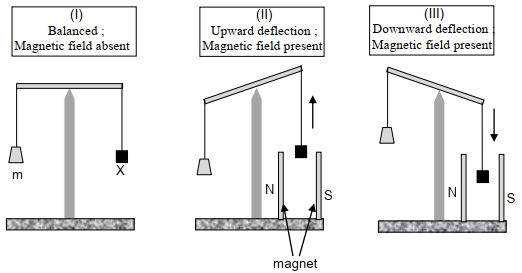
A
$A, B, D$
B
$A, B, C$
C
$A, B$
D
$A, D$
Solution
(B) Paramagnetic compounds are attracted towards a magnetic field,causing the pan to be deflected downwards (figure $III$).
Diamagnetic compounds are repelled by a magnetic field,causing the pan to be deflected upwards (figure $II$).
$(A)$ $H_2O_{(l)}$ is diamagnetic. Therefore,the deflection is upwards. (Correct)
$(B)$ $K_4[Fe(CN)_6]_{(s)}$ contains $Fe^{2+}$ with a strong field ligand $(CN^-)$,resulting in a $d^6$ configuration $[t_{2g}^6, e_g^0]$. It is diamagnetic. Therefore,the deflection is upwards. (Correct)
$(C)$ $O_{2(g)}$ is paramagnetic due to two unpaired electrons in its $\pi^*$ antibonding orbitals. Therefore,the deflection is downwards. (Correct)
$(D)$ $C_6H_{6(l)}$ (benzene) is diamagnetic as it has no unpaired electrons. Therefore,the deflection should be upwards,not downwards. (Incorrect)
Thus,statements $(A), (B),$ and $(C)$ are correct.
Diamagnetic compounds are repelled by a magnetic field,causing the pan to be deflected upwards (figure $II$).
$(A)$ $H_2O_{(l)}$ is diamagnetic. Therefore,the deflection is upwards. (Correct)
$(B)$ $K_4[Fe(CN)_6]_{(s)}$ contains $Fe^{2+}$ with a strong field ligand $(CN^-)$,resulting in a $d^6$ configuration $[t_{2g}^6, e_g^0]$. It is diamagnetic. Therefore,the deflection is upwards. (Correct)
$(C)$ $O_{2(g)}$ is paramagnetic due to two unpaired electrons in its $\pi^*$ antibonding orbitals. Therefore,the deflection is downwards. (Correct)
$(D)$ $C_6H_{6(l)}$ (benzene) is diamagnetic as it has no unpaired electrons. Therefore,the deflection should be upwards,not downwards. (Incorrect)
Thus,statements $(A), (B),$ and $(C)$ are correct.
0 likes
View Solution639
EasyMCQ
The calculated spin-only magnetic moments of $[Cr(NH_3)_6]^{3+}$ and $[CuF_6]^{3-}$ in $BM$,respectively,are (Atomic numbers of $Cr$ and $Cu$ are $24$ and $29$,respectively).
A
$3.87$ and $2.84$
B
$4.90$ and $1.73$
C
$3.87$ and $1.73$
D
$4.90$ and $2.84$
Solution
(A) For $[Cr(NH_3)_6]^{3+}$:
$Cr$ $(Z=24)$ has configuration $[Ar] 3d^5 4s^1$. Thus,$Cr^{3+}$ is $[Ar] 3d^3$.
Number of unpaired electrons $(n)$ = $3$.
$\mu = \sqrt{n(n+2)} = \sqrt{3(3+2)} = \sqrt{15} \approx 3.87 \text{ B.M.}$
For $[CuF_6]^{3-}$:
$Cu$ $(Z=29)$ has configuration $[Ar] 3d^{10} 4s^1$. Thus,$Cu^{3+}$ is $[Ar] 3d^8$.
In an octahedral field,$3d^8$ configuration has $2$ unpaired electrons in the $e_g$ orbitals.
Number of unpaired electrons $(n)$ = $2$.
$\mu = \sqrt{n(n+2)} = \sqrt{2(2+2)} = \sqrt{8} \approx 2.84 \text{ B.M.}$
Therefore,the values are $3.87 \text{ B.M.}$ and $2.84 \text{ B.M.}$ respectively.
$Cr$ $(Z=24)$ has configuration $[Ar] 3d^5 4s^1$. Thus,$Cr^{3+}$ is $[Ar] 3d^3$.
Number of unpaired electrons $(n)$ = $3$.
$\mu = \sqrt{n(n+2)} = \sqrt{3(3+2)} = \sqrt{15} \approx 3.87 \text{ B.M.}$
For $[CuF_6]^{3-}$:
$Cu$ $(Z=29)$ has configuration $[Ar] 3d^{10} 4s^1$. Thus,$Cu^{3+}$ is $[Ar] 3d^8$.
In an octahedral field,$3d^8$ configuration has $2$ unpaired electrons in the $e_g$ orbitals.
Number of unpaired electrons $(n)$ = $2$.
$\mu = \sqrt{n(n+2)} = \sqrt{2(2+2)} = \sqrt{8} \approx 2.84 \text{ B.M.}$
Therefore,the values are $3.87 \text{ B.M.}$ and $2.84 \text{ B.M.}$ respectively.
0 likes
View Solution640
EasyMCQ
The total number of possible isomers for $[Pt(NH_3)_4Cl_2]Br_2$ is . . . . . . .
A
$5$
B
$6$
C
$8$
D
$9$
Solution
(B) The complex $[Pt(NH_3)_4Cl_2]Br_2$ exhibits ionization isomerism.
Possible ionization isomers are:
$1$. $[Pt(NH_3)_4Cl_2]Br_2$ (Geometrical isomers: $cis$ and $trans$,so $2$ isomers)
$2$. $[Pt(NH_3)_4ClBr]ClBr$ (Geometrical isomers: $cis$ and $trans$,so $2$ isomers)
$3$. $[Pt(NH_3)_4Br_2]Cl_2$ (Geometrical isomers: $cis$ and $trans$,so $2$ isomers)
Each ionization isomer has $2$ geometrical isomers.
Total isomers = $2 + 2 + 2 = 6$.
Possible ionization isomers are:
$1$. $[Pt(NH_3)_4Cl_2]Br_2$ (Geometrical isomers: $cis$ and $trans$,so $2$ isomers)
$2$. $[Pt(NH_3)_4ClBr]ClBr$ (Geometrical isomers: $cis$ and $trans$,so $2$ isomers)
$3$. $[Pt(NH_3)_4Br_2]Cl_2$ (Geometrical isomers: $cis$ and $trans$,so $2$ isomers)
Each ionization isomer has $2$ geometrical isomers.
Total isomers = $2 + 2 + 2 = 6$.
0 likes
View Solution641
DifficultMCQ
Consider the following complex ions,$P$,$Q$ and $R$.
$P = [FeF_6]^{3-}$,$Q = [V(H_2O)_6]^{2+}$ and $R = [Fe(H_2O)_6]^{2+}$.
The correct order of the complex ions,according to their spin-only magnetic moment values (in $B.M.$) is
$P = [FeF_6]^{3-}$,$Q = [V(H_2O)_6]^{2+}$ and $R = [Fe(H_2O)_6]^{2+}$.
The correct order of the complex ions,according to their spin-only magnetic moment values (in $B.M.$) is
A
$R < Q < P$
B
$Q < R < P$
C
$R < P < Q$
D
$Q < P < R$
Solution
(B) $P = [FeF_6]^{3-}$,oxidation number of $Fe = +3$,configuration: $3d^5$.
Since $F^-$ is a weak field ligand,no pairing occurs,resulting in $5$ unpaired electrons.
$Q = [V(H_2O)_6]^{2+}$,oxidation number of $V = +2$,configuration: $3d^3$.
It has $3$ unpaired electrons.
$R = [Fe(H_2O)_6]^{2+}$,oxidation number of $Fe = +2$,configuration: $3d^6$.
Since $H_2O$ is a weak field ligand,no pairing occurs,resulting in $4$ unpaired electrons.
The spin-only magnetic moment is given by $\mu = \sqrt{n(n+2)} \ B.M.$,where $n$ is the number of unpaired electrons.
Number of unpaired electrons: $Q(3) < R(4) < P(5)$.
Therefore,the order of magnetic moments is $Q < R < P$.
Thus,the correct option is $B$.
Since $F^-$ is a weak field ligand,no pairing occurs,resulting in $5$ unpaired electrons.
$Q = [V(H_2O)_6]^{2+}$,oxidation number of $V = +2$,configuration: $3d^3$.
It has $3$ unpaired electrons.
$R = [Fe(H_2O)_6]^{2+}$,oxidation number of $Fe = +2$,configuration: $3d^6$.
Since $H_2O$ is a weak field ligand,no pairing occurs,resulting in $4$ unpaired electrons.
The spin-only magnetic moment is given by $\mu = \sqrt{n(n+2)} \ B.M.$,where $n$ is the number of unpaired electrons.
Number of unpaired electrons: $Q(3) < R(4) < P(5)$.
Therefore,the order of magnetic moments is $Q < R < P$.
Thus,the correct option is $B$.
0 likes
View Solution642
DifficultMCQ
The pair$(s)$ of coordination complexes/ions exhibiting the same kind of isomerism is(are)
$(A)$ $[Cr(NH_3)_5Cl]Cl_2$ and $[Cr(NH_3)_4Cl_2]Cl$
$(B)$ $[Co(NH_3)_4Cl_2]^+$ and $[Pt(NH_3)_2(H_2O)Cl]^+$
$(C)$ $[CoBr_2Cl_2]^{2-}$ and $[PtBr_2Cl_2]^{2-}$
$(D)$ $[Pt(NH_3)_3(NO_3)]Cl$ and $[Pt(NH_3)_3Cl]Br$
$(A)$ $[Cr(NH_3)_5Cl]Cl_2$ and $[Cr(NH_3)_4Cl_2]Cl$
$(B)$ $[Co(NH_3)_4Cl_2]^+$ and $[Pt(NH_3)_2(H_2O)Cl]^+$
$(C)$ $[CoBr_2Cl_2]^{2-}$ and $[PtBr_2Cl_2]^{2-}$
$(D)$ $[Pt(NH_3)_3(NO_3)]Cl$ and $[Pt(NH_3)_3Cl]Br$
A
$(B, D)$
B
$(B, C)$
C
$(A, D)$
D
$(C, D)$
Solution
(A) $[Cr(NH_3)_5Cl]Cl_2$ and $[Cr(NH_3)_4Cl_2]Cl$ exhibit ionisation isomerism.
$(B)$ $[Co(NH_3)_4Cl_2]^+$ (octahedral,$Ma_4b_2$ type) and $[Pt(NH_3)_2(H_2O)Cl]^+$ (square planar,$Ma_2bc$ type) both exhibit geometrical isomerism.
$(C)$ $[CoBr_2Cl_2]^{2-}$ (tetrahedral,$Ma_2b_2$ type) does not show geometrical isomerism,whereas $[PtBr_2Cl_2]^{2-}$ (square planar,$Ma_2b_2$ type) does.
$(D)$ $[Pt(NH_3)_3(NO_3)]Cl$ and $[Pt(NH_3)_3Cl]Br$ both exhibit ionisation isomerism.
Therefore,pairs $(B)$ and $(D)$ exhibit the same kind of isomerism.
$(B)$ $[Co(NH_3)_4Cl_2]^+$ (octahedral,$Ma_4b_2$ type) and $[Pt(NH_3)_2(H_2O)Cl]^+$ (square planar,$Ma_2bc$ type) both exhibit geometrical isomerism.
$(C)$ $[CoBr_2Cl_2]^{2-}$ (tetrahedral,$Ma_2b_2$ type) does not show geometrical isomerism,whereas $[PtBr_2Cl_2]^{2-}$ (square planar,$Ma_2b_2$ type) does.
$(D)$ $[Pt(NH_3)_3(NO_3)]Cl$ and $[Pt(NH_3)_3Cl]Br$ both exhibit ionisation isomerism.
Therefore,pairs $(B)$ and $(D)$ exhibit the same kind of isomerism.
0 likes
View Solution643
MediumMCQ
For the octahedral complexes of $Fe^{3+}$ in $SCN^{-}$ (thiocyanato-$S$) and in $CN^{-}$ ligand environments,the difference between the spin-only magnetic moments in Bohr magnetons (when approximated to the nearest integer) is
[Atomic number of $Fe = 26$]
[Atomic number of $Fe = 26$]
A
$4$
B
$5$
C
$6$
D
$7$
Solution
(A) The electronic configuration of $Fe^{3+}$ is $[Ar] 3d^5$.
Case-$1$: In the presence of $SCN^{-}$ (a weak field ligand),no pairing occurs in the $d$-orbitals. The number of unpaired electrons $(n)$ is $5$.
$\mu = \sqrt{n(n+2)} = \sqrt{5(5+2)} = \sqrt{35} \approx 5.91 \ BM$.
Case-$2$: In the presence of $CN^{-}$ (a strong field ligand),pairing occurs in the $d$-orbitals. The number of unpaired electrons $(n)$ is $1$.
$\mu = \sqrt{n(n+2)} = \sqrt{1(1+2)} = \sqrt{3} \approx 1.73 \ BM$.
Difference in spin-only magnetic moments $= 5.91 - 1.73 = 4.18 \ BM$.
Rounding to the nearest integer,the difference is $4$.
Case-$1$: In the presence of $SCN^{-}$ (a weak field ligand),no pairing occurs in the $d$-orbitals. The number of unpaired electrons $(n)$ is $5$.
$\mu = \sqrt{n(n+2)} = \sqrt{5(5+2)} = \sqrt{35} \approx 5.91 \ BM$.
Case-$2$: In the presence of $CN^{-}$ (a strong field ligand),pairing occurs in the $d$-orbitals. The number of unpaired electrons $(n)$ is $1$.
$\mu = \sqrt{n(n+2)} = \sqrt{1(1+2)} = \sqrt{3} \approx 1.73 \ BM$.
Difference in spin-only magnetic moments $= 5.91 - 1.73 = 4.18 \ BM$.
Rounding to the nearest integer,the difference is $4$.
0 likes
View Solution644
AdvancedMCQ
Among the complex ions,$[Co(en)_2Cl_2]^{+}$,$[CrCl_2(C_2O_4)_2]^{3-}$,$[Fe(H_2O)_4(OH)_2]^{+}$,$[Fe(NH_3)_2(CN)_4]^{-}$,$[Co(en)_2(NH_3)Cl]^{2+}$ and $[Co(NH_3)_4(H_2O)Cl]^{2+}$,the number of complex ion$(s)$ that show$(s)$ cis-trans isomerism is
A
$2$
B
$3$
C
$4$
D
$5$
Solution
(D) $1$. $[Co(en)_2Cl_2]^{+}$: This is of the type $[M(AA)_2a_2]$,which shows cis-trans isomerism.
$2$. $[CrCl_2(C_2O_4)_2]^{3-}$: This is of the type $[M(AA)_2a_2]$,which shows cis-trans isomerism.
$3$. $[Fe(H_2O)_4(OH)_2]^{+}$: This is of the type $[Ma_4b_2]$,which shows cis-trans isomerism.
$4$. $[Fe(NH_3)_2(CN)_4]^{-}$: This is of the type $[Ma_4b_2]$,which shows cis-trans isomerism.
$5$. $[Co(en)_2(NH_3)Cl]^{2+}$: This is of the type $[M(AA)_2ab]$,which shows cis-trans isomerism.
$6$. $[Co(NH_3)_4(H_2O)Cl]^{2+}$: This is of the type $[Ma_4bc]$. It shows geometrical isomerism,but specifically,it does not have a 'cis-trans' pair in the same sense as the others (it has facial/meridional or specific geometric arrangements,but is often excluded from the simple cis-trans definition).
Thus,there are $5$ complex ions that show cis-trans isomerism.
$2$. $[CrCl_2(C_2O_4)_2]^{3-}$: This is of the type $[M(AA)_2a_2]$,which shows cis-trans isomerism.
$3$. $[Fe(H_2O)_4(OH)_2]^{+}$: This is of the type $[Ma_4b_2]$,which shows cis-trans isomerism.
$4$. $[Fe(NH_3)_2(CN)_4]^{-}$: This is of the type $[Ma_4b_2]$,which shows cis-trans isomerism.
$5$. $[Co(en)_2(NH_3)Cl]^{2+}$: This is of the type $[M(AA)_2ab]$,which shows cis-trans isomerism.
$6$. $[Co(NH_3)_4(H_2O)Cl]^{2+}$: This is of the type $[Ma_4bc]$. It shows geometrical isomerism,but specifically,it does not have a 'cis-trans' pair in the same sense as the others (it has facial/meridional or specific geometric arrangements,but is often excluded from the simple cis-trans definition).
Thus,there are $5$ complex ions that show cis-trans isomerism.
0 likes
View Solution645
EasyMCQ
Among the following options,select the option in which each complex in Set-$I$ shows geometrical isomerism and the two complexes in Set-$II$ are ionization isomers of each other.
$[en = H_2N-CH_2-CH_2-NH_2]$
$[en = H_2N-CH_2-CH_2-NH_2]$
A
Set-$I$: $[Ni(CO)_4]$ and $[PdCl_2(PPh_3)_2]$
Set-$II$: $[Co(NH_3)_5Cl]SO_4$ and $[Co(NH_3)_5(SO_4)]Cl$
Set-$II$: $[Co(NH_3)_5Cl]SO_4$ and $[Co(NH_3)_5(SO_4)]Cl$
B
Set-$I$: $[Co(en)(NH_3)_2Cl_2]$ and $[PdCl_2(PPh_3)_2]$
Set-$II$: $[Co(NH_3)_6][Cr(CN)_6]$ and $[Cr(NH_3)_6][Co(CN)_6]$
Set-$II$: $[Co(NH_3)_6][Cr(CN)_6]$ and $[Cr(NH_3)_6][Co(CN)_6]$
C
Set-$I$: $[Co(NH_3)_3(NO_2)_3]$ and $[Co(en)_2Cl_2]$
Set-$II$: $[Co(NH_3)_5Cl]SO_4$ and $[Co(NH_3)_5(SO_4)]Cl$
Set-$II$: $[Co(NH_3)_5Cl]SO_4$ and $[Co(NH_3)_5(SO_4)]Cl$
D
Set-$I$: $[Cr(NH_3)_5Cl]Cl_2$ and $[Co(en)(NH_3)_2Cl_2]$
Set-$II$: $[Cr(H_2O)_6]Cl_3$ and $[Cr(H_2O)_5Cl]Cl_2 \cdot H_2O$
Set-$II$: $[Cr(H_2O)_6]Cl_3$ and $[Cr(H_2O)_5Cl]Cl_2 \cdot H_2O$
Solution
(C) Set-$I$: $[Co(NH_3)_3(NO_2)_3]$ exhibits facial and meridional geometrical isomers. $[Co(en)_2Cl_2]$ exhibits cis and trans geometrical isomers.
Set-$II$: $[Co(NH_3)_5Cl]SO_4$ and $[Co(NH_3)_5(SO_4)]Cl$ are ionization isomers because they exchange the counter ion $(SO_4^{2-})$ with the ligand $(Cl^-)$ inside the coordination sphere.
Set-$II$: $[Co(NH_3)_5Cl]SO_4$ and $[Co(NH_3)_5(SO_4)]Cl$ are ionization isomers because they exchange the counter ion $(SO_4^{2-})$ with the ligand $(Cl^-)$ inside the coordination sphere.
0 likes
View Solution646
MediumMCQ
Among the following complexes,the total number of diamagnetic species is. . . . $[Mn(NH_3)_6]^{3+}, [MnCl_6]^{3-}, [FeF_6]^{3-}, [CoF_6]^{3-}, [Fe(NH_3)_6]^{3+}$ and $[Co(en)_3]^{3+}$
[Given,atomic number: $Mn=25, Fe=26, Co=27$; $en=H_2NCH_2CH_2NH_2$ ]
[Given,atomic number: $Mn=25, Fe=26, Co=27$; $en=H_2NCH_2CH_2NH_2$ ]
A
$1$
B
$2$
C
$4$
D
$5$
Solution
(A) $Mn^{3+} (3d^4)$: In both strong and weak fields,it has unpaired electrons. Hence,$[Mn(NH_3)_6]^{3+}$ and $[MnCl_6]^{3-}$ are paramagnetic.
$Fe^{3+} (3d^5)$: In both strong and weak fields,it has unpaired electrons. Hence,$[FeF_6]^{3-}$ and $[Fe(NH_3)_6]^{3+}$ are paramagnetic.
$Co^{3+} (3d^6)$:
$1$. $[CoF_6]^{3-}$: $F^-$ is a weak field ligand,so it forms a high-spin complex with $t_{2g}^4 e_g^2$ configuration,which is paramagnetic.
$2$. $[Co(en)_3]^{3+}$: $en$ is a strong field ligand,so it forms a low-spin complex with $t_{2g}^6 e_g^0$ configuration,which is diamagnetic.
Thus,only $[Co(en)_3]^{3+}$ is diamagnetic. The total number of diamagnetic species is $1$.
$Fe^{3+} (3d^5)$: In both strong and weak fields,it has unpaired electrons. Hence,$[FeF_6]^{3-}$ and $[Fe(NH_3)_6]^{3+}$ are paramagnetic.
$Co^{3+} (3d^6)$:
$1$. $[CoF_6]^{3-}$: $F^-$ is a weak field ligand,so it forms a high-spin complex with $t_{2g}^4 e_g^2$ configuration,which is paramagnetic.
$2$. $[Co(en)_3]^{3+}$: $en$ is a strong field ligand,so it forms a low-spin complex with $t_{2g}^6 e_g^0$ configuration,which is diamagnetic.
Thus,only $[Co(en)_3]^{3+}$ is diamagnetic. The total number of diamagnetic species is $1$.
0 likes
View Solution647
MediumMCQ
Identify the homoleptic complex(es) that is/are low spin.
$(A) \ [Fe(CN)_5NO]^{2-}$
$(B) \ [CoF_6]^{3-}$
$(C) \ [Fe(CN)_6]^{4-}$
$(D) \ [Co(NH_3)_6]^{3+}$
$(E) \ [Cr(H_2O)_6]^{2+}$
Choose the correct answer from the options given below:
$(A) \ [Fe(CN)_5NO]^{2-}$
$(B) \ [CoF_6]^{3-}$
$(C) \ [Fe(CN)_6]^{4-}$
$(D) \ [Co(NH_3)_6]^{3+}$
$(E) \ [Cr(H_2O)_6]^{2+}$
Choose the correct answer from the options given below:
A
$(B)$ and $(E)$ only
B
$(A)$ and $(C)$ only
C
$(C)$ and $(D)$ only
D
$(C)$ only
Solution
(C) homoleptic complex contains only one type of ligand.
$(A) \ [Fe(CN)_5NO]^{2-}$: Heteroleptic (contains $CN^-$ and $NO$ ligands).
$(B) \ [CoF_6]^{3-}$: Homoleptic,$Co^{3+}$ $(3d^6)$,$F^-$ is a weak field ligand,so it is high spin.
$(C) \ [Fe(CN)_6]^{4-}$: Homoleptic,$Fe^{2+}$ $(3d^6)$,$CN^-$ is a strong field ligand,so it is low spin $(t_{2g}^6 e_g^0)$.
$(D) \ [Co(NH_3)_6]^{3+}$: Homoleptic,$Co^{3+}$ $(3d^6)$,$NH_3$ is a strong field ligand,so it is low spin $(t_{2g}^6 e_g^0)$.
$(E) \ [Cr(H_2O)_6]^{2+}$: Homoleptic,$Cr^{2+}$ $(3d^4)$,$H_2O$ is a weak field ligand,so it is high spin $(t_{2g}^3 e_g^1)$.
Thus,$(C)$ and $(D)$ are homoleptic and low spin complexes.
$(A) \ [Fe(CN)_5NO]^{2-}$: Heteroleptic (contains $CN^-$ and $NO$ ligands).
$(B) \ [CoF_6]^{3-}$: Homoleptic,$Co^{3+}$ $(3d^6)$,$F^-$ is a weak field ligand,so it is high spin.
$(C) \ [Fe(CN)_6]^{4-}$: Homoleptic,$Fe^{2+}$ $(3d^6)$,$CN^-$ is a strong field ligand,so it is low spin $(t_{2g}^6 e_g^0)$.
$(D) \ [Co(NH_3)_6]^{3+}$: Homoleptic,$Co^{3+}$ $(3d^6)$,$NH_3$ is a strong field ligand,so it is low spin $(t_{2g}^6 e_g^0)$.
$(E) \ [Cr(H_2O)_6]^{2+}$: Homoleptic,$Cr^{2+}$ $(3d^4)$,$H_2O$ is a weak field ligand,so it is high spin $(t_{2g}^3 e_g^1)$.
Thus,$(C)$ and $(D)$ are homoleptic and low spin complexes.
0 likes
View Solution648
MediumMCQ
The complex that shows Facial - Meridional isomerism is
A
$[Co(NH_3)_3Cl_3]$
B
$[Co(NH_3)_4Cl_2]^{+}$
C
$[Co(en)_3]^{3+}$
D
$[Co(en)_2Cl_2]^{+}$
Solution
(A) $Ma_3b_3$ type complexes show Facial - Meridional isomerism.
$(i)$ $[Co(NH_3)_3Cl_3] \Rightarrow Ma_3b_3$
$(ii)$ $[Co(NH_3)_4Cl_2]^{+} \Rightarrow Ma_4b_2$
$(iii)$ $[Co(en)_3]^{3+} \Rightarrow M(AA)_3$
$(iv)$ $[Co(en)_2Cl_2]^{+} \Rightarrow M(AA)_2b_2$
Here,$a = NH_3$,$b = Cl^{-}$,and $AA = en$ (ethylenediamine).
Thus,only $[Co(NH_3)_3Cl_3]$ corresponds to the $Ma_3b_3$ type.
$(i)$ $[Co(NH_3)_3Cl_3] \Rightarrow Ma_3b_3$
$(ii)$ $[Co(NH_3)_4Cl_2]^{+} \Rightarrow Ma_4b_2$
$(iii)$ $[Co(en)_3]^{3+} \Rightarrow M(AA)_3$
$(iv)$ $[Co(en)_2Cl_2]^{+} \Rightarrow M(AA)_2b_2$
Here,$a = NH_3$,$b = Cl^{-}$,and $AA = en$ (ethylenediamine).
Thus,only $[Co(NH_3)_3Cl_3]$ corresponds to the $Ma_3b_3$ type.
0 likes
View Solution649
MediumMCQ
The metal ion whose electronic configuration is not affected by the nature of the ligand and which gives a violet colour in non-luminous flame under hot condition in borax bead test is
A
$Ti^{3+}$
B
$Ni^{2+}$
C
$Mn^{2+}$
D
$Cr^{3+}$
Solution
(B) $Ni^{2+}$ gives a violet-coloured bead in a non-luminous flame under hot conditions.
$Ni^{2+}$ has a $d^8$ configuration,which remains unaffected by the nature of the ligand in an octahedral complex.
$Ni^{2+}: t_{2g}^{6} e_{g}^{2}$
$Ni^{2+}$ has a $d^8$ configuration,which remains unaffected by the nature of the ligand in an octahedral complex.
$Ni^{2+}: t_{2g}^{6} e_{g}^{2}$
0 likes
View Solution650
MediumMCQ
The calculated spin-only magnetic moments of $K_3[Fe(OH)_6]$ and $K_4[Fe(OH)_6]$ respectively are $:$
A
$4.90$ and $4.90 \ B.M.$
B
$5.92$ and $4.90 \ B.M.$
C
$3.87$ and $4.90 \ B.M.$
D
$4.90$ and $5.92 \ B.M.$
Solution
(B) In $K_3[Fe(OH)_6]$,the oxidation state of $Fe$ is $+3$. The electronic configuration of $Fe^{3+}$ is $[Ar] 3d^5$. Since $OH^-$ is a weak field ligand,the electrons remain unpaired. Thus,$n = 5$. The magnetic moment $\mu = \sqrt{n(n+2)} = \sqrt{5(5+2)} = \sqrt{35} \approx 5.92 \ B.M.$
In $K_4[Fe(OH)_6]$,the oxidation state of $Fe$ is $+2$. The electronic configuration of $Fe^{2+}$ is $[Ar] 3d^6$. Since $OH^-$ is a weak field ligand,the electrons remain unpaired. Thus,$n = 4$. The magnetic moment $\mu = \sqrt{4(4+2)} = \sqrt{24} \approx 4.90 \ B.M.$
Therefore,the values are $5.92 \ B.M.$ and $4.90 \ B.M.$ respectively.
In $K_4[Fe(OH)_6]$,the oxidation state of $Fe$ is $+2$. The electronic configuration of $Fe^{2+}$ is $[Ar] 3d^6$. Since $OH^-$ is a weak field ligand,the electrons remain unpaired. Thus,$n = 4$. The magnetic moment $\mu = \sqrt{4(4+2)} = \sqrt{24} \approx 4.90 \ B.M.$
Therefore,the values are $5.92 \ B.M.$ and $4.90 \ B.M.$ respectively.
0 likes
View SolutionCoordination Compounds — Isomerism and Magnetic properties · Frequently Asked Questions
1Are these Coordination Compounds questions useful for JEE and NEET?
Yes. All questions in this section are mapped to JEE Main and NEET exam patterns. Previous year questions from JEE Main, NEET, GUJCET and state-level exams are included with full solutions.
2Can I switch to Hindi or Gujarati for these questions?
Yes. Use the language tabs in the hero section or the sidebar to view the same questions and solutions in English, Hindi or Gujarati.
3How do I generate a question paper from this subtopic?
Use the Vedclass Exam Paper Generator — select the chapter and subtopic, set difficulty, and generate Sets A, B, C, D automatically. First 3 chapters of every subject are free.
Vedclass Products
For Students
Vedclass Test Series
Mock tests in real JEE/NEET style with performance analysis. 5-day free trial.
Start Free TrialFor Teachers
Exam Paper Generator
Generate Set A/B/C/D papers from this chapter in 2 minutes. 3 chapters free.
Try FreeFor Institutes
Online Exam Module
Live online exams with unlimited students, 360° analytics & white-label branding.
See DemoFor Teachers & Institutes
Generate a Coordination Compounds Exam Paper in 2 Minutes
Select subtopic & difficulty — Sets A, B, C, D auto-generated with No Repeat logic.
First 3 chapters of every subject are free — no payment required.