
A English
Isomerism and Magnetic properties Questions in English
Class 12 Chemistry · Coordination Compounds · Isomerism and Magnetic properties
800+
Questions
English
Language
100%
With Solutions
Showing 50 of 800 questions in English
551
DifficultMCQ
The spin-only magnetic moment of an octahedral complex of $Fe^{2+}$ in the presence of a strong field ligand in $B.M.$ is $.....$
A
$4.89$
B
$0$
C
$2.82$
D
$3.46$
Solution
(B) The electronic configuration of $Fe^{2+}$ is $[Ar] 3d^6$.
In the presence of a strong field ligand $(SFL)$,the crystal field splitting energy $\Delta_0$ is greater than the pairing energy $P$ $(\Delta_0 > P)$.
This causes the electrons to pair up in the $t_{2g}$ orbitals.
The distribution of electrons in the $t_{2g}$ orbitals is $(t_{2g})^6 (e_g)^0$.
Since all electrons are paired,the number of unpaired electrons $(n)$ is $0$.
The spin-only magnetic moment $\mu$ is calculated as $\mu = \sqrt{n(n+2)} \ B.M.$
Substituting $n = 0$,we get $\mu = \sqrt{0(0+2)} = 0 \ B.M.$
In the presence of a strong field ligand $(SFL)$,the crystal field splitting energy $\Delta_0$ is greater than the pairing energy $P$ $(\Delta_0 > P)$.
This causes the electrons to pair up in the $t_{2g}$ orbitals.
The distribution of electrons in the $t_{2g}$ orbitals is $(t_{2g})^6 (e_g)^0$.
Since all electrons are paired,the number of unpaired electrons $(n)$ is $0$.
The spin-only magnetic moment $\mu$ is calculated as $\mu = \sqrt{n(n+2)} \ B.M.$
Substituting $n = 0$,we get $\mu = \sqrt{0(0+2)} = 0 \ B.M.$
0 likes
View Solution552
DifficultMCQ
Which one of the following species responds to an external magnetic field?
A
$[Fe(H_{2}O)_{6}]^{3+}$
B
$[Ni(CO)_{4}]$
C
$[Co(CN)_{6}]^{3-}$
D
$[Ni(CN)_{4}]^{2-}$
Solution
(A) species responds to an external magnetic field if it is paramagnetic (contains unpaired electrons).
$1.$ $[Fe(H_{2}O)_{6}]^{3+}$: $Fe^{3+}$ is $3d^{5}$. $H_{2}O$ is a weak field ligand,so electrons remain unpaired. It is paramagnetic.
$2.$ $[Ni(CO)_{4}]$: $Ni$ is $3d^{8} 4s^{2}$. $CO$ is a strong field ligand,forcing pairing. It is diamagnetic.
$3.$ $[Co(CN)_{6}]^{3-}$: $Co^{3+}$ is $3d^{6}$. $CN^{-}$ is a strong field ligand,forcing pairing. It is diamagnetic.
$4.$ $[Ni(CN)_{4}]^{2-}$: $Ni^{2+}$ is $3d^{8}$. $CN^{-}$ is a strong field ligand,forcing pairing. It is diamagnetic.
Thus,$[Fe(H_{2}O)_{6}]^{3+}$ is the only paramagnetic species.
$1.$ $[Fe(H_{2}O)_{6}]^{3+}$: $Fe^{3+}$ is $3d^{5}$. $H_{2}O$ is a weak field ligand,so electrons remain unpaired. It is paramagnetic.
$2.$ $[Ni(CO)_{4}]$: $Ni$ is $3d^{8} 4s^{2}$. $CO$ is a strong field ligand,forcing pairing. It is diamagnetic.
$3.$ $[Co(CN)_{6}]^{3-}$: $Co^{3+}$ is $3d^{6}$. $CN^{-}$ is a strong field ligand,forcing pairing. It is diamagnetic.
$4.$ $[Ni(CN)_{4}]^{2-}$: $Ni^{2+}$ is $3d^{8}$. $CN^{-}$ is a strong field ligand,forcing pairing. It is diamagnetic.
Thus,$[Fe(H_{2}O)_{6}]^{3+}$ is the only paramagnetic species.
0 likes
View Solution553
DifficultMCQ
The number of geometrical isomers found in the metal complexes $[PtCl_2(NH_3)_2]$,$[Ni(CO)_4]$,$[Ru(H_2O)_3Cl_3]$ and $[CoCl_2(NH_3)_4]^+$ respectively,are :
A
$1, 1, 1, 1$
B
$2, 1, 2, 2$
C
$2, 1, 2, 1$
D
$2, 0, 2, 2$
Solution
(D) $1$. $[PtCl_2(NH_3)_2]$ is a square planar complex of type $[MA_2B_2]$. It exhibits $2$ geometrical isomers (cis and trans).
$2$. $[Ni(CO)_4]$ is a tetrahedral complex. Tetrahedral complexes do not show geometrical isomerism because all positions are equivalent relative to each other. Thus,it has $0$ geometrical isomers.
$3$. $[Ru(H_2O)_3Cl_3]$ is an octahedral complex of type $[MA_3B_3]$. It exhibits $2$ geometrical isomers (facial and meridional).
$4$. $[CoCl_2(NH_3)_4]^+$ is an octahedral complex of type $[MA_4B_2]$. It exhibits $2$ geometrical isomers (cis and trans).
Therefore,the number of geometrical isomers are $2, 0, 2, 2$ respectively.
$2$. $[Ni(CO)_4]$ is a tetrahedral complex. Tetrahedral complexes do not show geometrical isomerism because all positions are equivalent relative to each other. Thus,it has $0$ geometrical isomers.
$3$. $[Ru(H_2O)_3Cl_3]$ is an octahedral complex of type $[MA_3B_3]$. It exhibits $2$ geometrical isomers (facial and meridional).
$4$. $[CoCl_2(NH_3)_4]^+$ is an octahedral complex of type $[MA_4B_2]$. It exhibits $2$ geometrical isomers (cis and trans).
Therefore,the number of geometrical isomers are $2, 0, 2, 2$ respectively.
0 likes
View Solution554
DifficultMCQ
The number of geometrical isomers possible in triamminetrinitrocobalt $(III)$ is $X$ and in trioxalatochromate $(III)$ is $Y$. Then the value of $X+Y$ is $....$
A
$1$
B
$2$
C
$3$
D
$4$
Solution
(B) For triamminetrinitrocobalt $(III)$,the formula is $[Co(NH_{3})_{3}(NO_{2})_{3}]$. This complex exhibits facial $(fac)$ and meridional $(mer)$ isomers,so $X = 2$.
For trioxalatochromate $(III)$,the formula is $[Cr(C_{2}O_{4})_{3}]^{3-}$. This is a tris-chelated complex with identical bidentate ligands. Such complexes do not show geometrical isomerism,so $Y = 0$.
Therefore,$X+Y = 2+0 = 2$.
For trioxalatochromate $(III)$,the formula is $[Cr(C_{2}O_{4})_{3}]^{3-}$. This is a tris-chelated complex with identical bidentate ligands. Such complexes do not show geometrical isomerism,so $Y = 0$.
Therefore,$X+Y = 2+0 = 2$.
0 likes
View Solution555
MediumMCQ
For the tetrahedral complex $[MnBr_4]^{2-}$, the spin-only magnetic moment value is $....$ (At. no. of $Mn = 25$) (in $BM$)
A
$1.7$
B
$5.9$
C
$4.8$
D
$2.4$
Solution
(B) The central metal ion is $Mn^{2+}$.
The atomic number of $Mn$ is $25$, so the electronic configuration of $Mn^{2+}$ is $[Ar] 3d^5$.
In the tetrahedral complex $[MnBr_4]^{2-}$, $Br^-$ is a weak field ligand, so the electrons remain unpaired.
Number of unpaired electrons $(n)$ = $5$.
The spin-only magnetic moment $(\mu)$ is calculated using the formula $\mu = \sqrt{n(n+2)} \ BM$.
$\mu = \sqrt{5(5+2)} = \sqrt{35} \approx 5.92 \ BM$.
The atomic number of $Mn$ is $25$, so the electronic configuration of $Mn^{2+}$ is $[Ar] 3d^5$.
In the tetrahedral complex $[MnBr_4]^{2-}$, $Br^-$ is a weak field ligand, so the electrons remain unpaired.
Number of unpaired electrons $(n)$ = $5$.
The spin-only magnetic moment $(\mu)$ is calculated using the formula $\mu = \sqrt{n(n+2)} \ BM$.
$\mu = \sqrt{5(5+2)} = \sqrt{35} \approx 5.92 \ BM$.
0 likes
View Solution556
MediumMCQ
Which of the following complex ions is not diamagnetic?
A
$[Ti(en)_{2}(NH_{3})_{2}]^{4+}$
B
$[Cr(NH_{3})_{6}]^{3+}$
C
$[Zn(NH_{3})_{6}]^{2+}$
D
$[Sc(H_{2}O)_{3}(NH_{3})_{3}]^{3+}$
Solution
(B) To determine if a complex is diamagnetic,we check for the presence of unpaired electrons in the central metal ion.
$A$. In $[Ti(en)_{2}(NH_{3})_{2}]^{4+}$,$Ti$ is in the $+4$ oxidation state ($d^0$ configuration). It has no unpaired electrons,so it is diamagnetic.
$B$. In $[Cr(NH_{3})_{6}]^{3+}$,$Cr$ is in the $+3$ oxidation state ($d^3$ configuration). The $d$-orbitals have $3$ unpaired electrons $(t_{2g}^3)$,making it paramagnetic.
$C$. In $[Zn(NH_{3})_{6}]^{2+}$,$Zn$ is in the $+2$ oxidation state ($d^{10}$ configuration). It has no unpaired electrons,so it is diamagnetic.
$D$. In $[Sc(H_{2}O)_{3}(NH_{3})_{3}]^{3+}$,$Sc$ is in the $+3$ oxidation state ($d^0$ configuration). It has no unpaired electrons,so it is diamagnetic.
Therefore,$[Cr(NH_{3})_{6}]^{3+}$ is not diamagnetic.
$A$. In $[Ti(en)_{2}(NH_{3})_{2}]^{4+}$,$Ti$ is in the $+4$ oxidation state ($d^0$ configuration). It has no unpaired electrons,so it is diamagnetic.
$B$. In $[Cr(NH_{3})_{6}]^{3+}$,$Cr$ is in the $+3$ oxidation state ($d^3$ configuration). The $d$-orbitals have $3$ unpaired electrons $(t_{2g}^3)$,making it paramagnetic.
$C$. In $[Zn(NH_{3})_{6}]^{2+}$,$Zn$ is in the $+2$ oxidation state ($d^{10}$ configuration). It has no unpaired electrons,so it is diamagnetic.
$D$. In $[Sc(H_{2}O)_{3}(NH_{3})_{3}]^{3+}$,$Sc$ is in the $+3$ oxidation state ($d^0$ configuration). It has no unpaired electrons,so it is diamagnetic.
Therefore,$[Cr(NH_{3})_{6}]^{3+}$ is not diamagnetic.
0 likes
View Solution557
Medium
Explain the origin of magnetic properties in a substance.
Solution
(N/A) The origin of magnetic properties in a substance is due to two types of motions of electrons:
$(i)$ Orbital motion around the nucleus.
$(ii)$ Spin motion around its own axis.
Each electron in an atom behaves like a tiny magnet. The magnetic moment generated by these motions is responsible for the magnetic properties of the substance.
$(i)$ Orbital motion around the nucleus.
$(ii)$ Spin motion around its own axis.
Each electron in an atom behaves like a tiny magnet. The magnetic moment generated by these motions is responsible for the magnetic properties of the substance.
0 likes
View Solution558
MediumMCQ
Although $Cr^{3+}$ and $Co^{2+}$ ions have the same number of unpaired electrons,why is the magnetic moment of $Cr^{3+}$ $3.87 \ B.M.$ and that of $Co^{2+}$ $4.87 \ B.M.?$
A
Due to difference in atomic number.
B
Due to orbital contribution in $Co^{2+}$ ion.
C
Due to different oxidation states.
D
Due to difference in crystal field splitting.
Solution
(B) Both $Cr^{3+}$ $(3d^3)$ and $Co^{2+}$ $(3d^7)$ have $3$ unpaired electrons.
According to the spin-only formula,$\mu = \sqrt{n(n+2)} \ B.M.$,both should have a magnetic moment of $\sqrt{3(3+2)} = \sqrt{15} \approx 3.87 \ B.M.$
However,$Cr^{3+}$ has a symmetrical $t_{2g}^3$ configuration,resulting in no orbital contribution to the magnetic moment.
In contrast,$Co^{2+}$ has an unsymmetrical configuration,which leads to a significant orbital contribution,increasing the observed magnetic moment to approximately $4.87 \ B.M.$
According to the spin-only formula,$\mu = \sqrt{n(n+2)} \ B.M.$,both should have a magnetic moment of $\sqrt{3(3+2)} = \sqrt{15} \approx 3.87 \ B.M.$
However,$Cr^{3+}$ has a symmetrical $t_{2g}^3$ configuration,resulting in no orbital contribution to the magnetic moment.
In contrast,$Co^{2+}$ has an unsymmetrical configuration,which leads to a significant orbital contribution,increasing the observed magnetic moment to approximately $4.87 \ B.M.$
0 likes
View Solution559
Medium
Explain different types of structural isomerism in coordination compounds.
Solution
(N/A) $(i)$ Ionisation isomerism: This form of isomerism arises when the counter ion in a complex salt is itself a potential ligand and can displace a ligand which can then become a counter ion. Hence,there is an exchange of ligands between the coordination entity and the ionisation sphere.
The compounds showing ionisation isomerism give different ions in aqueous solution.
For example: $[Co(NH_{3})_{5}(SO_{4})]Br$ and $[Co(NH_{3})_{5}Br]SO_{4}$.
$(ii)$ Hydrate isomerism (Solvate isomerism): This form of isomerism exists where water is involved as a solvent. When water molecules are interchanged between the coordination sphere and the ionisation sphere,the resulting isomers are called hydrate (solvate) isomers.
For example:
$[Cr(H_{2}O)_{6}]Cl_{3} \Rightarrow \text{Violet}$
$[Cr(H_{2}O)_{5}Cl]Cl_{2} \cdot H_{2}O \Rightarrow \text{Grey-green}$
$[Cr(H_{2}O)_{4}Cl_{2}]Cl \cdot 2H_{2}O \Rightarrow \text{Green}$
$(iii)$ Linkage isomerism: This isomerism arises in a coordination compound containing an ambidentate ligand. $A$ simple example is provided by complexes containing the thiocyanate ligand $(NCS^{-})$ which may bind either through sulphur or by nitrogen.
For example:
$(a) [Cr(SCN)(H_{2}O)_{5}]^{2+}$ and $[Cr(NCS)(H_{2}O)_{5}]^{2+}$
$(b) [Co(ONO)(NH_{3})_{5}]^{2+}$ and $[Co(NO_{2})(NH_{3})_{5}]^{2+}$
Jorgensen discovered such behaviour in the complex $[Co(NH_{3})_{5}(NO_{2})]Cl_{2}$,which is obtained in a red form,in which the nitrite ligand is bound through oxygen $(-ONO)$,and as a yellow form,in which the nitrite ligand is bound through nitrogen $(-NO_{2})$.
$(iv)$ Coordination isomerism: This type of isomerism arises from the interchange of ligands between cationic and anionic entities of different metal ions present in a complex.
For example:
$(a) [Co(NH_{3})_{6}][Cr(CN)_{6}]$ and $[Cr(NH_{3})_{6}][Co(CN)_{6}]$
$(b) [Cu(NH_{3})_{4}][PtCl_{4}]$ and $[Pt(NH_{3})_{4}][CuCl_{4}]$
The compounds showing ionisation isomerism give different ions in aqueous solution.
For example: $[Co(NH_{3})_{5}(SO_{4})]Br$ and $[Co(NH_{3})_{5}Br]SO_{4}$.
$(ii)$ Hydrate isomerism (Solvate isomerism): This form of isomerism exists where water is involved as a solvent. When water molecules are interchanged between the coordination sphere and the ionisation sphere,the resulting isomers are called hydrate (solvate) isomers.
For example:
$[Cr(H_{2}O)_{6}]Cl_{3} \Rightarrow \text{Violet}$
$[Cr(H_{2}O)_{5}Cl]Cl_{2} \cdot H_{2}O \Rightarrow \text{Grey-green}$
$[Cr(H_{2}O)_{4}Cl_{2}]Cl \cdot 2H_{2}O \Rightarrow \text{Green}$
$(iii)$ Linkage isomerism: This isomerism arises in a coordination compound containing an ambidentate ligand. $A$ simple example is provided by complexes containing the thiocyanate ligand $(NCS^{-})$ which may bind either through sulphur or by nitrogen.
For example:
$(a) [Cr(SCN)(H_{2}O)_{5}]^{2+}$ and $[Cr(NCS)(H_{2}O)_{5}]^{2+}$
$(b) [Co(ONO)(NH_{3})_{5}]^{2+}$ and $[Co(NO_{2})(NH_{3})_{5}]^{2+}$
Jorgensen discovered such behaviour in the complex $[Co(NH_{3})_{5}(NO_{2})]Cl_{2}$,which is obtained in a red form,in which the nitrite ligand is bound through oxygen $(-ONO)$,and as a yellow form,in which the nitrite ligand is bound through nitrogen $(-NO_{2})$.
$(iv)$ Coordination isomerism: This type of isomerism arises from the interchange of ligands between cationic and anionic entities of different metal ions present in a complex.
For example:
$(a) [Co(NH_{3})_{6}][Cr(CN)_{6}]$ and $[Cr(NH_{3})_{6}][Co(CN)_{6}]$
$(b) [Cu(NH_{3})_{4}][PtCl_{4}]$ and $[Pt(NH_{3})_{4}][CuCl_{4}]$
0 likes
View Solution560
Medium
Explain geometrical isomerism in four-coordinated compounds.
Solution
(N/A) Four-coordinated complex compounds are either tetrahedral or square planar in shape.
Tetrahedral complexes do not show geometrical isomerism because all four ligands are adjacent to each other at an angle of $109.5^{\circ}$.
Hence,only square planar complexes can show geometrical isomerism.
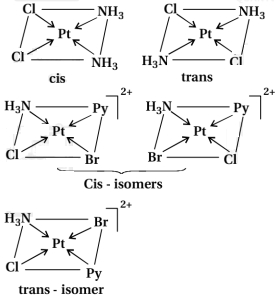
In square planar complexes,if similar ligands are at adjacent positions $(90^{\circ})$,it is called a $Cis$-isomer,and if the similar ligands are at opposite positions $(180^{\circ})$,it is called a $Trans$-isomer.
$(i)$ Complexes of type $[M X_{2} L_{2}]$ where $X$ and $L$ are monodentate ligands.
Example: $[Pt(NH_{3})_{2} Cl_{2}]$ where $X=NH_{3}$,$L=Cl$.
$(ii)$ Complexes of type $[M A B X L]$ where $A, B, X$ and $L$ are unidentate ligands also show geometrical isomerism.
Example: $[Pt(NH_{3})(Py)(Cl)(Br)]^{2+}$
$A=NH_{3}$,$B=Py$,$X=Cl$,$L=Br$.
Tetrahedral complexes do not show geometrical isomerism because all four ligands are adjacent to each other at an angle of $109.5^{\circ}$.
Hence,only square planar complexes can show geometrical isomerism.
In square planar complexes,if similar ligands are at adjacent positions $(90^{\circ})$,it is called a $Cis$-isomer,and if the similar ligands are at opposite positions $(180^{\circ})$,it is called a $Trans$-isomer.
$(i)$ Complexes of type $[M X_{2} L_{2}]$ where $X$ and $L$ are monodentate ligands.
Example: $[Pt(NH_{3})_{2} Cl_{2}]$ where $X=NH_{3}$,$L=Cl$.
$(ii)$ Complexes of type $[M A B X L]$ where $A, B, X$ and $L$ are unidentate ligands also show geometrical isomerism.
Example: $[Pt(NH_{3})(Py)(Cl)(Br)]^{2+}$
$A=NH_{3}$,$B=Py$,$X=Cl$,$L=Br$.
0 likes
View Solution561
Medium
Explain geometrical isomerism in six-coordinated complex compounds or octahedral complexes.
Solution
(N/A) Geometrical isomerism in octahedral complexes arises due to the different possible arrangements of ligands around the central metal ion.
$(i)$ Complexes of type $[MX_4L_2]^{n \pm}$:
These complexes exhibit cis and trans isomers. In the cis-isomer,the two $L$ ligands are adjacent to each other,while in the trans-isomer,they are opposite to each other ($180$° apart).
Example: $[Co(NH_3)_4Cl_2]^+$.
$(ii)$ Complexes of type $[MX_3L_3]$:
These complexes exhibit facial $(fac)$ and meridional $(mer)$ isomerism.
- Facial $(fac)$ isomer: When the three identical ligands occupy the corners of one of the triangular faces of the octahedron.
- Meridional $(mer)$ isomer: When the three identical ligands occupy the positions around the meridian of the octahedron.
Example: $[Co(NH_3)_3(NO_2)_3]$.
$(iii)$ Complexes of type $[MX_2(LL)_2]^{n \pm}$:
These complexes also show cis and trans isomerism,where $LL$ represents a bidentate ligand and $X$ represents a monodentate ligand.
$(i)$ Complexes of type $[MX_4L_2]^{n \pm}$:
These complexes exhibit cis and trans isomers. In the cis-isomer,the two $L$ ligands are adjacent to each other,while in the trans-isomer,they are opposite to each other ($180$° apart).
Example: $[Co(NH_3)_4Cl_2]^+$.
$(ii)$ Complexes of type $[MX_3L_3]$:
These complexes exhibit facial $(fac)$ and meridional $(mer)$ isomerism.
- Facial $(fac)$ isomer: When the three identical ligands occupy the corners of one of the triangular faces of the octahedron.
- Meridional $(mer)$ isomer: When the three identical ligands occupy the positions around the meridian of the octahedron.
Example: $[Co(NH_3)_3(NO_2)_3]$.
$(iii)$ Complexes of type $[MX_2(LL)_2]^{n \pm}$:
These complexes also show cis and trans isomerism,where $LL$ represents a bidentate ligand and $X$ represents a monodentate ligand.
0 likes
View Solution562
Medium
Explain optical isomerism in six-coordinated complex compounds or octahedral complexes.
Solution
(N/A) Octahedral complexes are optically active if:
$(i)$ The plane of symmetry is absent.
$(ii)$ Their mirror images are non-superimposable on each other.
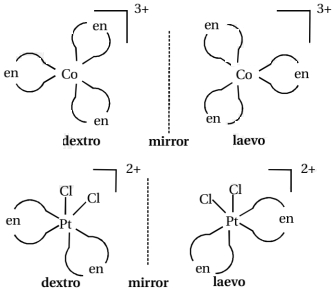
Hence,these are called enantiomers. The two forms of enantiomers are called $\text{dextro} (d)$ and $\text{laevo} (l)$ depending upon the direction they rotate the plane-polarized light in a polarimeter. The $\text{dextro}$ molecule rotates it to the right and the $\text{laevo}$ rotatory molecule rotates it to the left.
Optical isomerism in octahedral complexes is common if they contain bidentate ligands.
$(i)$ Complexes of type $\left[M(AA)_{3}\right]^{n \pm}$:
$AA$ : Symmetrical bidentate ligand.
For example: $\left[Co(en)_{3}\right]^{3+}$.
$(ii)$ Complexes of type $\left[M(AA)_{2}X_{2}\right]^{n \pm}$:
$AA$ : Symmetrical bidentate ligands.
$X$ : Monodentate ligand.
For example: $\left[PtCl_{2}(en)_{2}\right]^{2+}$.
$(i)$ The plane of symmetry is absent.
$(ii)$ Their mirror images are non-superimposable on each other.
Hence,these are called enantiomers. The two forms of enantiomers are called $\text{dextro} (d)$ and $\text{laevo} (l)$ depending upon the direction they rotate the plane-polarized light in a polarimeter. The $\text{dextro}$ molecule rotates it to the right and the $\text{laevo}$ rotatory molecule rotates it to the left.
Optical isomerism in octahedral complexes is common if they contain bidentate ligands.
$(i)$ Complexes of type $\left[M(AA)_{3}\right]^{n \pm}$:
$AA$ : Symmetrical bidentate ligand.
For example: $\left[Co(en)_{3}\right]^{3+}$.
$(ii)$ Complexes of type $\left[M(AA)_{2}X_{2}\right]^{n \pm}$:
$AA$ : Symmetrical bidentate ligands.
$X$ : Monodentate ligand.
For example: $\left[PtCl_{2}(en)_{2}\right]^{2+}$.
0 likes
View Solution563
Medium
Discuss the magnetic properties of coordination compounds.
Solution
(N/A) The magnetic moment of coordination compounds can be measured by magnetic susceptibility experiments. The results provide information about the number of unpaired electrons and the structures adopted by metal complexes.
For metal ions like $Ti^{3+}$ $(d^{1})$,$V^{3+}$ $(d^{2})$,and $Cr^{3+}$ $(d^{3})$,two vacant $d$-orbitals are available for octahedral hybridization with $4s$ and $4p$ orbitals. The magnetic behavior of these free ions and their coordination entities is similar.
When more than three $3d$ electrons are present,the required pair of $3d$ orbitals for octahedral hybridization is not directly available according to Hund's rule. Thus,for $d^{4}$ $(Cr^{2+}, Mn^{3+})$,$d^{5}$ $(Mn^{2+}, Fe^{3+})$,and $d^{6}$ $(Fe^{2+}, Co^{3+})$,a vacant pair of $d$-orbitals results only by the pairing of $3d$ electrons,which leaves two,one,and zero unpaired electrons,respectively.
There are complications with species having $d^{4}$ and $d^{5}$ configurations. For example:
$(i)$ $[Mn(CN)_{6}]^{3-}$ has a magnetic moment corresponding to two unpaired electrons,while $[MnCl_{6}]^{3-}$ has a paramagnetic moment corresponding to four unpaired electrons.
$(ii)$ $[Fe(CN)_{6}]^{3-}$ has a magnetic moment corresponding to a single unpaired electron,while $[FeF_{6}]^{3-}$ has a paramagnetic moment corresponding to five unpaired electrons.
$(iii)$ $[CoF_{6}]^{3-}$ is paramagnetic with four unpaired electrons,while $[Co(C_{2}O_{4})_{3}]^{3-}$ is diamagnetic.
The above behavior is explained by Valence Bond Theory in terms of inner orbital and outer orbital coordination entities. The complexes $[Mn(CN)_{6}]^{3-}$,$[Fe(CN)_{6}]^{3-}$,and $[Co(C_{2}O_{4})_{3}]^{3-}$ are inner orbital complexes ($d^{2}sp^{3}$ hybridization).
The complexes $[MnCl_{6}]^{3-}$,$[FeF_{6}]^{3-}$,and $[CoF_{6}]^{3-}$ are outer orbital complexes ($sp^{3}d^{2}$ hybridization) and are paramagnetic,corresponding to four,five,and four unpaired electrons,respectively. With $d^{6}$ configuration,the magnetic data agree with maximum spin pairing in many cases.
For metal ions like $Ti^{3+}$ $(d^{1})$,$V^{3+}$ $(d^{2})$,and $Cr^{3+}$ $(d^{3})$,two vacant $d$-orbitals are available for octahedral hybridization with $4s$ and $4p$ orbitals. The magnetic behavior of these free ions and their coordination entities is similar.
When more than three $3d$ electrons are present,the required pair of $3d$ orbitals for octahedral hybridization is not directly available according to Hund's rule. Thus,for $d^{4}$ $(Cr^{2+}, Mn^{3+})$,$d^{5}$ $(Mn^{2+}, Fe^{3+})$,and $d^{6}$ $(Fe^{2+}, Co^{3+})$,a vacant pair of $d$-orbitals results only by the pairing of $3d$ electrons,which leaves two,one,and zero unpaired electrons,respectively.
There are complications with species having $d^{4}$ and $d^{5}$ configurations. For example:
$(i)$ $[Mn(CN)_{6}]^{3-}$ has a magnetic moment corresponding to two unpaired electrons,while $[MnCl_{6}]^{3-}$ has a paramagnetic moment corresponding to four unpaired electrons.
$(ii)$ $[Fe(CN)_{6}]^{3-}$ has a magnetic moment corresponding to a single unpaired electron,while $[FeF_{6}]^{3-}$ has a paramagnetic moment corresponding to five unpaired electrons.
$(iii)$ $[CoF_{6}]^{3-}$ is paramagnetic with four unpaired electrons,while $[Co(C_{2}O_{4})_{3}]^{3-}$ is diamagnetic.
The above behavior is explained by Valence Bond Theory in terms of inner orbital and outer orbital coordination entities. The complexes $[Mn(CN)_{6}]^{3-}$,$[Fe(CN)_{6}]^{3-}$,and $[Co(C_{2}O_{4})_{3}]^{3-}$ are inner orbital complexes ($d^{2}sp^{3}$ hybridization).
The complexes $[MnCl_{6}]^{3-}$,$[FeF_{6}]^{3-}$,and $[CoF_{6}]^{3-}$ are outer orbital complexes ($sp^{3}d^{2}$ hybridization) and are paramagnetic,corresponding to four,five,and four unpaired electrons,respectively. With $d^{6}$ configuration,the magnetic data agree with maximum spin pairing in many cases.
0 likes
View Solution564
MediumMCQ
Amongst $FeCl_{3} \cdot 3H_{2}O$,$K_{3}[Fe(CN)_{6}]$ and $[Co(NH_{3})_{6}]Cl_{3}$,the spin-only magnetic moment value of the inner-orbital complex that absorbs light at the shortest wavelength is $B.M.$ [nearest integer].
A
$5$
B
$0.2$
C
$2$
D
$20$
Solution
(C) The inner-orbital complexes are $K_{3}[Fe(CN)_{6}]$ and $[Co(NH_{3})_{6}]Cl_{3}$.
$K_{3}[Fe(CN)_{6}]$ contains $Fe^{3+}$ $(3d^{5})$,which forms a $d^{2}sp^{3}$ complex with $1$ unpaired electron. Its spin-only magnetic moment is $\mu = \sqrt{1(1+2)} = \sqrt{3} \approx 1.732 \ B.M.$
$[Co(NH_{3})_{6}]Cl_{3}$ contains $Co^{3+}$ $(3d^{6})$,which forms a $d^{2}sp^{3}$ complex with $0$ unpaired electrons. Its spin-only magnetic moment is $\mu = 0 \ B.M.$
$CN^{-}$ is a stronger field ligand than $NH_{3}$,so $K_{3}[Fe(CN)_{6}]$ has a larger crystal field splitting energy $(\Delta_{0})$ than $[Co(NH_{3})_{6}]Cl_{3}$.
Since $\Delta_{0} = \frac{hc}{\lambda}$,a larger $\Delta_{0}$ corresponds to a shorter wavelength $(\lambda)$ of absorbed light.
Therefore,$K_{3}[Fe(CN)_{6}]$ is the complex that absorbs light at the shortest wavelength.
Its spin-only magnetic moment is $1.732 \ B.M.$,which rounds to $2$ to the nearest integer.
$K_{3}[Fe(CN)_{6}]$ contains $Fe^{3+}$ $(3d^{5})$,which forms a $d^{2}sp^{3}$ complex with $1$ unpaired electron. Its spin-only magnetic moment is $\mu = \sqrt{1(1+2)} = \sqrt{3} \approx 1.732 \ B.M.$
$[Co(NH_{3})_{6}]Cl_{3}$ contains $Co^{3+}$ $(3d^{6})$,which forms a $d^{2}sp^{3}$ complex with $0$ unpaired electrons. Its spin-only magnetic moment is $\mu = 0 \ B.M.$
$CN^{-}$ is a stronger field ligand than $NH_{3}$,so $K_{3}[Fe(CN)_{6}]$ has a larger crystal field splitting energy $(\Delta_{0})$ than $[Co(NH_{3})_{6}]Cl_{3}$.
Since $\Delta_{0} = \frac{hc}{\lambda}$,a larger $\Delta_{0}$ corresponds to a shorter wavelength $(\lambda)$ of absorbed light.
Therefore,$K_{3}[Fe(CN)_{6}]$ is the complex that absorbs light at the shortest wavelength.
Its spin-only magnetic moment is $1.732 \ B.M.$,which rounds to $2$ to the nearest integer.
0 likes
View Solution565
MediumMCQ
The spin-only magnetic moment value of an octahedral complex among $CoCl_{3} \cdot 4NH_{3}$,$NiCl_{2} \cdot 6H_{2}O$ and $PtCl_{4} \cdot 2HCl$,which upon reaction with excess of $AgNO_{3}$ gives $2$ moles of $AgCl$ is $....$ $B.M.$ (Nearest Integer)
A
$3$
B
$30$
C
$12$
D
$1$
Solution
(A) First,identify the coordination compounds and their ionization behavior:
$CoCl_{3} \cdot 4NH_{3} \rightarrow [Co(NH_{3})_{4}Cl_{2}]Cl$ (gives $1$ mole of $AgCl$)
$NiCl_{2} \cdot 6H_{2}O \rightarrow [Ni(H_{2}O)_{6}]Cl_{2}$ (gives $2$ moles of $AgCl$)
$PtCl_{4} \cdot 2HCl \rightarrow H_{2}[PtCl_{6}]$ (gives $0$ moles of $AgCl$)
The complex that gives $2$ moles of $AgCl$ is $[Ni(H_{2}O)_{6}]Cl_{2}$.
In $[Ni(H_{2}O)_{6}]^{2+}$,the oxidation state of $Ni$ is $+2$,and its electronic configuration is $[Ar]3d^{8}$.
For $Ni^{2+}$ $(d^{8})$,there are $2$ unpaired electrons $(n=2)$.
The spin-only magnetic moment is calculated as $\mu = \sqrt{n(n+2)} \ B.M. = \sqrt{2(2+2)} \ B.M. = \sqrt{8} \ B.M. \approx 2.83 \ B.M.$
The nearest integer value is $3$ $B.M.$
$CoCl_{3} \cdot 4NH_{3} \rightarrow [Co(NH_{3})_{4}Cl_{2}]Cl$ (gives $1$ mole of $AgCl$)
$NiCl_{2} \cdot 6H_{2}O \rightarrow [Ni(H_{2}O)_{6}]Cl_{2}$ (gives $2$ moles of $AgCl$)
$PtCl_{4} \cdot 2HCl \rightarrow H_{2}[PtCl_{6}]$ (gives $0$ moles of $AgCl$)
The complex that gives $2$ moles of $AgCl$ is $[Ni(H_{2}O)_{6}]Cl_{2}$.
In $[Ni(H_{2}O)_{6}]^{2+}$,the oxidation state of $Ni$ is $+2$,and its electronic configuration is $[Ar]3d^{8}$.
For $Ni^{2+}$ $(d^{8})$,there are $2$ unpaired electrons $(n=2)$.
The spin-only magnetic moment is calculated as $\mu = \sqrt{n(n+2)} \ B.M. = \sqrt{2(2+2)} \ B.M. = \sqrt{8} \ B.M. \approx 2.83 \ B.M.$
The nearest integer value is $3$ $B.M.$
0 likes
View Solution566
MediumMCQ
Arrange the following coordination compounds in the increasing order of magnetic moments. (Atomic numbers: $Mn = 25$; $Fe = 26$)
$(A)$ $[FeF_{6}]^{3-}$
$(B)$ $[Fe(CN)_{6}]^{3-}$
$(C)$ $[MnCl_{6}]^{3-}$ (high spin)
$(D)$ $[Mn(CN)_{6}]^{3-}$
$(A)$ $[FeF_{6}]^{3-}$
$(B)$ $[Fe(CN)_{6}]^{3-}$
$(C)$ $[MnCl_{6}]^{3-}$ (high spin)
$(D)$ $[Mn(CN)_{6}]^{3-}$
A
$A < B < D < C$
B
$B < D < C < A$
C
$A < C < D < B$
D
$B < D < A < C$
Solution
(B) The magnetic moment $\mu$ is given by $\sqrt{n(n+2)} \ BM$,where $n$ is the number of unpaired electrons.
$(A)$ $[FeF_{6}]^{3-}$: $Fe^{3+}$ is $3d^{5}$. $F^-$ is a weak field ligand,so electrons remain unpaired. $n = 5$.
$(B)$ $[Fe(CN)_{6}]^{3-}$: $Fe^{3+}$ is $3d^{5}$. $CN^-$ is a strong field ligand,causing pairing. $n = 1$.
$(C)$ $[MnCl_{6}]^{3-}$: $Mn^{3+}$ is $3d^{4}$. High spin complex means $n = 4$.
$(D)$ $[Mn(CN)_{6}]^{3-}$: $Mn^{3+}$ is $3d^{4}$. $CN^-$ is a strong field ligand,causing pairing. $n = 2$.
Comparing $n$ values: $B(n=1) < D(n=2) < C(n=4) < A(n=5)$.
Therefore,the increasing order of magnetic moments is $B < D < C < A$.
$(A)$ $[FeF_{6}]^{3-}$: $Fe^{3+}$ is $3d^{5}$. $F^-$ is a weak field ligand,so electrons remain unpaired. $n = 5$.
$(B)$ $[Fe(CN)_{6}]^{3-}$: $Fe^{3+}$ is $3d^{5}$. $CN^-$ is a strong field ligand,causing pairing. $n = 1$.
$(C)$ $[MnCl_{6}]^{3-}$: $Mn^{3+}$ is $3d^{4}$. High spin complex means $n = 4$.
$(D)$ $[Mn(CN)_{6}]^{3-}$: $Mn^{3+}$ is $3d^{4}$. $CN^-$ is a strong field ligand,causing pairing. $n = 2$.
Comparing $n$ values: $B(n=1) < D(n=2) < C(n=4) < A(n=5)$.
Therefore,the increasing order of magnetic moments is $B < D < C < A$.
0 likes
View Solution567
MediumMCQ
$[Fe(CN)_6]^{4-}$; $[Fe(CN)_6]^{3-}$; $[Ti(CN)_6]^{3-}$; $[Ni(CN)_4]^{2-}$; $[Co(CN)_6]^{3-}$
Among the given complexes,the number of paramagnetic complexes is .... .
Among the given complexes,the number of paramagnetic complexes is .... .
A
$1$
B
$3$
C
$2$
D
$4$
Solution
(C) $[Fe(CN)_6]^{4-}$: $Fe^{2+}$ is $d^6$,$CN^-$ is a strong field ligand,so $t_{2g}^6 e_g^0$. Diamagnetic.
$[Fe(CN)_6]^{3-}$: $Fe^{3+}$ is $d^5$,$CN^-$ is a strong field ligand,so $t_{2g}^5 e_g^0$. Paramagnetic ($1$ unpaired electron).
$[Ti(CN)_6]^{3-}$: $Ti^{3+}$ is $d^1$,so $t_{2g}^1 e_g^0$. Paramagnetic ($1$ unpaired electron).
$[Ni(CN)_4]^{2-}$: $Ni^{2+}$ is $d^8$,$CN^-$ is a strong field ligand,so $dsp^2$ hybridization. Diamagnetic.
$[Co(CN)_6]^{3-}$: $Co^{3+}$ is $d^6$,$CN^-$ is a strong field ligand,so $t_{2g}^6 e_g^0$. Diamagnetic.
Therefore,the number of paramagnetic complexes is $2$.
$[Fe(CN)_6]^{3-}$: $Fe^{3+}$ is $d^5$,$CN^-$ is a strong field ligand,so $t_{2g}^5 e_g^0$. Paramagnetic ($1$ unpaired electron).
$[Ti(CN)_6]^{3-}$: $Ti^{3+}$ is $d^1$,so $t_{2g}^1 e_g^0$. Paramagnetic ($1$ unpaired electron).
$[Ni(CN)_4]^{2-}$: $Ni^{2+}$ is $d^8$,$CN^-$ is a strong field ligand,so $dsp^2$ hybridization. Diamagnetic.
$[Co(CN)_6]^{3-}$: $Co^{3+}$ is $d^6$,$CN^-$ is a strong field ligand,so $t_{2g}^6 e_g^0$. Diamagnetic.
Therefore,the number of paramagnetic complexes is $2$.
0 likes
View Solution568
MediumMCQ
$(a) \ CoCl_{3} \cdot 4 NH_{3}$
$(b) \ CoCl_{3} \cdot 5 NH_{3}$
$(c) \ CoCl_{3} \cdot 6 NH_{3}$
$(d) \ CoCl(NO_{3})_{2} \cdot 5 NH_{3}$
Number of complex(es) which will exist in $cis-trans$ isomerism is/are ....
$(b) \ CoCl_{3} \cdot 5 NH_{3}$
$(c) \ CoCl_{3} \cdot 6 NH_{3}$
$(d) \ CoCl(NO_{3})_{2} \cdot 5 NH_{3}$
Number of complex(es) which will exist in $cis-trans$ isomerism is/are ....
A
$4$
B
$3$
C
$2$
D
$1$
Solution
(D) $(a) \ [Co(NH_{3})_{4}Cl_{2}]Cl$ is of the type $[MA_{4}B_{2}]$,which exhibits $cis-trans$ isomerism.
$(b) \ [Co(NH_{3})_{5}Cl]Cl_{2}$ is of the type $[MA_{5}B]$,which does not exhibit $cis-trans$ isomerism.
$(c) \ [Co(NH_{3})_{6}]Cl_{3}$ is of the type $[MA_{6}]$,which does not exhibit $cis-trans$ isomerism.
$(d) \ [Co(NH_{3})_{5}Cl](NO_{3})_{2}$ or $[Co(NH_{3})_{5}(NO_{3})]Cl(NO_{3})$ are of the type $[MA_{5}B]$,which do not exhibit $cis-trans$ isomerism.
Therefore,only one complex,$[Co(NH_{3})_{4}Cl_{2}]Cl$,exhibits $cis-trans$ isomerism.
$(b) \ [Co(NH_{3})_{5}Cl]Cl_{2}$ is of the type $[MA_{5}B]$,which does not exhibit $cis-trans$ isomerism.
$(c) \ [Co(NH_{3})_{6}]Cl_{3}$ is of the type $[MA_{6}]$,which does not exhibit $cis-trans$ isomerism.
$(d) \ [Co(NH_{3})_{5}Cl](NO_{3})_{2}$ or $[Co(NH_{3})_{5}(NO_{3})]Cl(NO_{3})$ are of the type $[MA_{5}B]$,which do not exhibit $cis-trans$ isomerism.
Therefore,only one complex,$[Co(NH_{3})_{4}Cl_{2}]Cl$,exhibits $cis-trans$ isomerism.
0 likes
View Solution569
MediumMCQ
Spin only magnetic moment of $[MnBr_{6}]^{4-}$ is $..... \ B.M.$ (round off to the closest integer)
A
$5$
B
$6$
C
$4$
D
$3$
Solution
(B) In $[MnBr_{6}]^{4-}$,the oxidation state of $Mn$ is $+2$.
Electronic configuration of $Mn^{2+}$ is $[Ar] 3d^{5}$.
Since $Br^{-}$ is a weak field ligand,the electrons remain unpaired in the $d$-orbitals.
Number of unpaired electrons $(n)$ = $5$.
The spin-only magnetic moment is calculated as $\mu = \sqrt{n(n+2)} \ B.M.$
$\mu = \sqrt{5(5+2)} = \sqrt{35} \approx 5.91 \ B.M.$
Rounding off to the closest integer,we get $6 \ B.M.$
Electronic configuration of $Mn^{2+}$ is $[Ar] 3d^{5}$.
Since $Br^{-}$ is a weak field ligand,the electrons remain unpaired in the $d$-orbitals.
Number of unpaired electrons $(n)$ = $5$.
The spin-only magnetic moment is calculated as $\mu = \sqrt{n(n+2)} \ B.M.$
$\mu = \sqrt{5(5+2)} = \sqrt{35} \approx 5.91 \ B.M.$
Rounding off to the closest integer,we get $6 \ B.M.$
0 likes
View Solution570
MediumMCQ
Consider the following metal complexes:
$1. [Co(NH_3)_6]^{3+}$
$2. [CoCl(NH_3)_5]^{2+}$
$3. [Co(CN)_6]^{3-}$
$4. [Co(NH_3)_5(H_2O)]^{3+}$
The spin-only magnetic moment value of the complex that absorbs light with the shortest wavelength is $B.M.$ (Nearest integer).
$1. [Co(NH_3)_6]^{3+}$
$2. [CoCl(NH_3)_5]^{2+}$
$3. [Co(CN)_6]^{3-}$
$4. [Co(NH_3)_5(H_2O)]^{3+}$
The spin-only magnetic moment value of the complex that absorbs light with the shortest wavelength is $B.M.$ (Nearest integer).
A
$3$
B
$0$
C
$2$
D
$1$
Solution
(B) The energy of absorbed light is inversely proportional to the wavelength: $\Delta_0 \propto \frac{1}{\lambda}$.
To absorb light with the shortest wavelength,the complex must have the largest crystal field splitting energy $(\Delta_0)$.
Among the ligands provided $(Cl^- < H_2O < NH_3 < CN^-)$,the cyanide ion $(CN^-)$ is the strongest field ligand $(SFL)$.
Therefore,$[Co(CN)_6]^{3-}$ has the largest $\Delta_0$ and absorbs light of the shortest wavelength.
In $[Co(CN)_6]^{3-}$,the oxidation state of $Co$ is $+3$,which corresponds to a $d^6$ configuration.
Since $CN^-$ is a strong field ligand,it causes pairing of electrons,resulting in a low-spin $t_{2g}^6 e_g^0$ configuration.
The number of unpaired electrons $(n)$ is $0$,so the spin-only magnetic moment $\mu = \sqrt{n(n+2)} = 0 \ B.M.$
To absorb light with the shortest wavelength,the complex must have the largest crystal field splitting energy $(\Delta_0)$.
Among the ligands provided $(Cl^- < H_2O < NH_3 < CN^-)$,the cyanide ion $(CN^-)$ is the strongest field ligand $(SFL)$.
Therefore,$[Co(CN)_6]^{3-}$ has the largest $\Delta_0$ and absorbs light of the shortest wavelength.
In $[Co(CN)_6]^{3-}$,the oxidation state of $Co$ is $+3$,which corresponds to a $d^6$ configuration.
Since $CN^-$ is a strong field ligand,it causes pairing of electrons,resulting in a low-spin $t_{2g}^6 e_g^0$ configuration.
The number of unpaired electrons $(n)$ is $0$,so the spin-only magnetic moment $\mu = \sqrt{n(n+2)} = 0 \ B.M.$
0 likes
View Solution571
EasyMCQ
The metal complex that is diamagnetic is (Atomic number: $Fe = 26, Cu = 29$)
A
$K_{3}[Cu(CN)_{4}]$
B
$K_{2}[Cu(CN)_{4}]$
C
$K_{3}[Fe(CN)_{4}]$
D
$K_{4}[FeCl_{6}]$
Solution
(A) In $K_{3}[Cu(CN)_{4}]$,the oxidation state of $Cu$ is $+1$.
$Cu^{+}$ has the electronic configuration $[Ar] 3d^{10}$.
Since all $d$-orbitals are completely filled,there are no unpaired electrons.
Therefore,$K_{3}[Cu(CN)_{4}]$ is diamagnetic.
$Cu^{+}$ has the electronic configuration $[Ar] 3d^{10}$.
Since all $d$-orbitals are completely filled,there are no unpaired electrons.
Therefore,$K_{3}[Cu(CN)_{4}]$ is diamagnetic.
0 likes
View Solution572
MediumMCQ
The difference between spin-only magnetic moment values of $[Co(H_2O)_6]Cl_2$ and $[Cr(H_2O)_6]Cl_3$ is $....$
A
$1$
B
$2$
C
$0$
D
$3$
Solution
(C) For $[Co(H_2O)_6]Cl_2$:
$Co^{2+}$ has a $3d^7$ configuration. In an octahedral field,the electrons are arranged as $t_{2g}^5 e_g^2$,resulting in $3$ unpaired electrons.
The spin-only magnetic moment $\mu = \sqrt{n(n+2)} \ BM = \sqrt{3(3+2)} = \sqrt{15} \ BM$.
For $[Cr(H_2O)_6]Cl_3$:
$Cr^{3+}$ has a $3d^3$ configuration. The electrons are arranged as $t_{2g}^3 e_g^0$,resulting in $3$ unpaired electrons.
The spin-only magnetic moment $\mu = \sqrt{n(n+2)} \ BM = \sqrt{3(3+2)} = \sqrt{15} \ BM$.
Difference in spin-only magnetic moment $= \sqrt{15} - \sqrt{15} = 0$.
$Co^{2+}$ has a $3d^7$ configuration. In an octahedral field,the electrons are arranged as $t_{2g}^5 e_g^2$,resulting in $3$ unpaired electrons.
The spin-only magnetic moment $\mu = \sqrt{n(n+2)} \ BM = \sqrt{3(3+2)} = \sqrt{15} \ BM$.
For $[Cr(H_2O)_6]Cl_3$:
$Cr^{3+}$ has a $3d^3$ configuration. The electrons are arranged as $t_{2g}^3 e_g^0$,resulting in $3$ unpaired electrons.
The spin-only magnetic moment $\mu = \sqrt{n(n+2)} \ BM = \sqrt{3(3+2)} = \sqrt{15} \ BM$.
Difference in spin-only magnetic moment $= \sqrt{15} - \sqrt{15} = 0$.
0 likes
View Solution573
MediumMCQ
The spin-only magnetic moment of the complex present in Fehling's reagent is $B.M.$ (Nearest integer).
A
$3$
B
$0$
C
$1$
D
$2$
Solution
(D) Fehling's reagent contains a complex of $Cu^{2+}$ ions,specifically copper$(II)$ tartrate.
The electronic configuration of $Cu^{2+}$ is $[Ar] 3d^9$.
In a $3d^9$ configuration,there is $1$ unpaired electron.
The spin-only magnetic moment is calculated using the formula $\mu = \sqrt{n(n+2)} \ B.M.$,where $n$ is the number of unpaired electrons.
$\mu = \sqrt{1(1+2)} = \sqrt{3} \approx 1.73 \ B.M.$
The nearest integer to $1.73$ is $2$.
The electronic configuration of $Cu^{2+}$ is $[Ar] 3d^9$.
In a $3d^9$ configuration,there is $1$ unpaired electron.
The spin-only magnetic moment is calculated using the formula $\mu = \sqrt{n(n+2)} \ B.M.$,where $n$ is the number of unpaired electrons.
$\mu = \sqrt{1(1+2)} = \sqrt{3} \approx 1.73 \ B.M.$
The nearest integer to $1.73$ is $2$.
0 likes
View Solution574
MediumMCQ
Total number of relatively more stable isomer$(s)$ possible for octahedral complex $[Cu(en)_2(SCN)_2]$ will be $.........$
A
$3$
B
$2$
C
$1$
D
$0$
Solution
(A) The complex $[Cu(en)_2(SCN)_2]$ exhibits linkage isomerism due to the ambidentate ligand $SCN^-$.
For the trans-isomer,the possible linkage isomers are:
$1$. $[Cu(en)_2(SCN)_2]$ (trans-dithiocyanato)
$2$. $[Cu(en)_2(NCS)_2]$ (trans-diisothiocyanato)
$3$. $[Cu(en)_2(SCN)(NCS)]$ (trans-thiocyanato-isothiocyanato)
These three forms represent distinct linkage isomers. Since the question asks for the number of relatively more stable isomers,and these three linkage isomers are chemically distinct and stable,the total number is $3$.
For the trans-isomer,the possible linkage isomers are:
$1$. $[Cu(en)_2(SCN)_2]$ (trans-dithiocyanato)
$2$. $[Cu(en)_2(NCS)_2]$ (trans-diisothiocyanato)
$3$. $[Cu(en)_2(SCN)(NCS)]$ (trans-thiocyanato-isothiocyanato)
These three forms represent distinct linkage isomers. Since the question asks for the number of relatively more stable isomers,and these three linkage isomers are chemically distinct and stable,the total number is $3$.
0 likes
View Solution575
DifficultMCQ
The magnetic moment (in $\mu_{B}$) of $[Ni(dimethylglyoximate)_{2}]$ complex is closest to $......$
A
$5.37$
B
$0.00$
C
$1.73$
D
$2.25$
Solution
(B) The complex $[Ni(dimethylglyoximate)_{2}]$ involves the $Ni^{2+}$ ion.
Dimethylglyoximate $(DMG^-)$ is a strong field chelating ligand.
In this square planar complex,the $Ni^{2+}$ ion ($d^8$ configuration) undergoes $dsp^2$ hybridization.
Due to the strong field nature of the ligand,all electrons are paired in the $d$-orbitals.
Since the number of unpaired electrons $(n)$ is $0$,the magnetic moment $(\mu)$ is calculated as $\mu = \sqrt{n(n+2)} = \sqrt{0(0+2)} = 0.00 \ \mu_{B}$.
Dimethylglyoximate $(DMG^-)$ is a strong field chelating ligand.
In this square planar complex,the $Ni^{2+}$ ion ($d^8$ configuration) undergoes $dsp^2$ hybridization.
Due to the strong field nature of the ligand,all electrons are paired in the $d$-orbitals.
Since the number of unpaired electrons $(n)$ is $0$,the magnetic moment $(\mu)$ is calculated as $\mu = \sqrt{n(n+2)} = \sqrt{0(0+2)} = 0.00 \ \mu_{B}$.
0 likes
View Solution576
DifficultMCQ
Number of stereoisomers possible for the octahedral complexes $[Co(NH_3)_3Cl_3]$ and $[Ni(en)_2Cl_2]$,respectively,are (where $en = 1,2-$ethylenediamine):
A
$2$ and $4$
B
$4$ and $3$
C
$3$ and $2$
D
$2$ and $3$
Solution
(D) For the complex $[Co(NH_3)_3Cl_3]$,it exists in two geometric isomeric forms: $fac$ (facial) and $mer$ (meridional). Both are optically inactive,so there are $2$ stereoisomers.
For the complex $[Ni(en)_2Cl_2]$,it exists in $trans$ and $cis$ forms. The $trans$ form is achiral,while the $cis$ form exists as a pair of enantiomers. Thus,there are $3$ stereoisomers in total ($1$ trans + $2$ cis enantiomers).
For the complex $[Ni(en)_2Cl_2]$,it exists in $trans$ and $cis$ forms. The $trans$ form is achiral,while the $cis$ form exists as a pair of enantiomers. Thus,there are $3$ stereoisomers in total ($1$ trans + $2$ cis enantiomers).
0 likes
View Solution577
DifficultMCQ
For an octahedral complex $MX_{4}Y_{2}$ ($M=$ a transition metal,$X$ and $Y$ are monodentate achiral ligands),the correct statement among the following is
A
$MX_{4}Y_{2}$ has $2$ geometrical isomers,one of which is chiral
B
$MX_{4}Y_{2}$ has $2$ geometrical isomers both of which are achiral
C
$MX_{4}Y_{2}$ has $4$ geometrical isomers,all of which are achiral
D
$MX_{4}Y_{2}$ has $4$ geometrical isomers,two of which are chiral
Solution
(B) The complex $MX_{4}Y_{2}$ exhibits two geometrical isomers: $cis$ and $trans$.
In the $trans$ isomer,the two $Y$ ligands are at $180^{\circ}$ to each other. This isomer possesses a center of symmetry and multiple planes of symmetry,making it achiral.
In the $cis$ isomer,the two $Y$ ligands are at $90^{\circ}$ to each other. This isomer possesses planes of symmetry,making it also achiral.
Thus,both geometrical isomers are achiral.
In the $trans$ isomer,the two $Y$ ligands are at $180^{\circ}$ to each other. This isomer possesses a center of symmetry and multiple planes of symmetry,making it achiral.
In the $cis$ isomer,the two $Y$ ligands are at $90^{\circ}$ to each other. This isomer possesses planes of symmetry,making it also achiral.
Thus,both geometrical isomers are achiral.
0 likes
View Solution578
AdvancedMCQ
The octahedral complex $[Co(NH_3)_5SO_4]Cl$ exists in two isomeric forms $X$ and $Y$. Isomer $X$ reacts with $AgNO_3$ to give a white precipitate,but does not react with $BaCl_2$. Isomer $Y$ gives a white precipitate with $BaCl_2$ but does not react with $AgNO_3$. Isomers $X$ and $Y$ are $.....$
A
ionisation isomers
B
linkage isomers
C
coordination isomers
D
solvate isomers
Solution
(A) The complex $[Co(NH_3)_5SO_4]Cl$ can exist as two ionisation isomers: $[Co(NH_3)_5SO_4]Cl$ and $[Co(NH_3)_5Cl]SO_4$.
Isomer $X$ reacts with $AgNO_3$ to give a white precipitate of $AgCl$,which indicates the presence of free $Cl^-$ ions in the coordination sphere. Thus,$X$ is $[Co(NH_3)_5SO_4]Cl$.
Isomer $Y$ reacts with $BaCl_2$ to give a white precipitate of $BaSO_4$,which indicates the presence of free $SO_4^{2-}$ ions. Thus,$Y$ is $[Co(NH_3)_5Cl]SO_4$.
Since these isomers differ in the exchange of ions between the coordination sphere and the counter-ion,they are ionisation isomers.
Isomer $X$ reacts with $AgNO_3$ to give a white precipitate of $AgCl$,which indicates the presence of free $Cl^-$ ions in the coordination sphere. Thus,$X$ is $[Co(NH_3)_5SO_4]Cl$.
Isomer $Y$ reacts with $BaCl_2$ to give a white precipitate of $BaSO_4$,which indicates the presence of free $SO_4^{2-}$ ions. Thus,$Y$ is $[Co(NH_3)_5Cl]SO_4$.
Since these isomers differ in the exchange of ions between the coordination sphere and the counter-ion,they are ionisation isomers.
0 likes
View Solution579
MediumMCQ
Among the following,the pair of paramagnetic complexes is
A
$K_{3}[Fe(CN)_{6}]$ and $K_{3}[CoF_{6}]$
B
$K_{3}[Fe(CN)_{6}]$ and $[Co(NH_{3})_{6}]Cl_{3}$
C
$K_{4}[Fe(CN)_{6}]$ and $K_{3}[CoF_{6}]$
D
$K_{4}[Fe(CN)_{6}]$ and $[Co(NH_{3})_{6}]Cl_{3}$
Solution
(A) The correct answer is $A$.
$1$. $K_{3}[Fe(CN)_{6}]$: The central metal ion is $Fe^{3+}$,which has a $[Ar] 3d^{5}$ configuration as a free ion.
In the strong ligand field of $CN^{-}$,the $d$-orbitals split to become $t_{2g}^{5} e_{g}^{0}$.
There is one unpaired electron,therefore it is paramagnetic.
$2$. $K_{3}[CoF_{6}]$: The central metal ion is $Co^{3+}$.
The free metal ion configuration is $[Ar] 3d^{6}$.
In the weak ligand field of $F^{-}$,the $d$-orbitals split to become $t_{2g}^{4} e_{g}^{2}$.
There are four unpaired electrons,therefore it is paramagnetic.
$3$. In $K_{4}[Fe(CN)_{6}]$,the central ion is $Fe^{2+}$ $(d^{6})$,and in $[Co(NH_{3})_{6}]Cl_{3}$,the central ion is $Co^{3+}$ $(d^{6})$.
Both $CN^{-}$ and $NH_{3}$ are strong field ligands,so $\Delta_{0} > P$.
Thus,the $d^{6}$ configuration splits to $t_{2g}^{6} e_{g}^{0}$.
There are no unpaired electrons,therefore both are diamagnetic.
$1$. $K_{3}[Fe(CN)_{6}]$: The central metal ion is $Fe^{3+}$,which has a $[Ar] 3d^{5}$ configuration as a free ion.
In the strong ligand field of $CN^{-}$,the $d$-orbitals split to become $t_{2g}^{5} e_{g}^{0}$.
There is one unpaired electron,therefore it is paramagnetic.
$2$. $K_{3}[CoF_{6}]$: The central metal ion is $Co^{3+}$.
The free metal ion configuration is $[Ar] 3d^{6}$.
In the weak ligand field of $F^{-}$,the $d$-orbitals split to become $t_{2g}^{4} e_{g}^{2}$.
There are four unpaired electrons,therefore it is paramagnetic.
$3$. In $K_{4}[Fe(CN)_{6}]$,the central ion is $Fe^{2+}$ $(d^{6})$,and in $[Co(NH_{3})_{6}]Cl_{3}$,the central ion is $Co^{3+}$ $(d^{6})$.
Both $CN^{-}$ and $NH_{3}$ are strong field ligands,so $\Delta_{0} > P$.
Thus,the $d^{6}$ configuration splits to $t_{2g}^{6} e_{g}^{0}$.
There are no unpaired electrons,therefore both are diamagnetic.
0 likes
View Solution580
DifficultMCQ
The complex that can exhibit linkage isomerism is
A
$[Co(NH_3)_5(H_2O)]Cl_3$
B
$[Co(NH_3)_5(NO_2)]Cl_2$
C
$[Co(NH_3)_5(NO_3)](NO_3)_2$
D
$[Co(NH_3)_5(SO_4)]Cl$
Solution
(B) Linkage isomerism arises in a coordination compound containing an ambidentate ligand.
Among the given ligands,$NO_2^-$ is an ambidentate ligand as it can be bonded to the metal atom through either the $N$-atom or the $O$-atom.
Thus,$[Co(NH_3)_5(NO_2)]Cl_2$ exhibits linkage isomerism.
Among the given ligands,$NO_2^-$ is an ambidentate ligand as it can be bonded to the metal atom through either the $N$-atom or the $O$-atom.
Thus,$[Co(NH_3)_5(NO_2)]Cl_2$ exhibits linkage isomerism.
0 likes
View Solution581
DifficultMCQ
The complex having the highest spin-only magnetic moment is
A
$[Fe(CN)_6]^{3-}$
B
$[Fe(H_2O)_6]^{2+}$
C
$[MnF_6]^{4-}$
D
$[NiCl_4]^{2-}$
Solution
(C) The spin-only magnetic moment $\mu$ is calculated using the formula $\mu = \sqrt{n(n+2)} \ BM$,where $n$ is the number of unpaired electrons.
$(A)$ $[Fe(CN)_6]^{3-}$: $Fe$ is in $+3$ oxidation state $(3d^5)$. $CN^-$ is a strong field ligand,causing pairing of electrons. $n = 1$. $\mu = \sqrt{1(1+2)} = \sqrt{3} \ BM$.
$(B)$ $[Fe(H_2O)_6]^{2+}$: $Fe$ is in $+2$ oxidation state $(3d^6)$. $H_2O$ is a weak field ligand,no pairing occurs. $n = 4$. $\mu = \sqrt{4(4+2)} = \sqrt{24} \ BM$.
$(C)$ $[MnF_6]^{4-}$: $Mn$ is in $+2$ oxidation state $(3d^5)$. $F^-$ is a weak field ligand,no pairing occurs. $n = 5$. $\mu = \sqrt{5(5+2)} = \sqrt{35} \ BM$.
$(D)$ $[NiCl_4]^{2-}$: $Ni$ is in $+2$ oxidation state $(3d^8)$. $Cl^-$ is a weak field ligand,no pairing occurs. $n = 2$. $\mu = \sqrt{2(2+2)} = \sqrt{8} \ BM$.
Comparing the values,$[MnF_6]^{4-}$ has the highest number of unpaired electrons $(n=5)$,hence the highest magnetic moment.
$(A)$ $[Fe(CN)_6]^{3-}$: $Fe$ is in $+3$ oxidation state $(3d^5)$. $CN^-$ is a strong field ligand,causing pairing of electrons. $n = 1$. $\mu = \sqrt{1(1+2)} = \sqrt{3} \ BM$.
$(B)$ $[Fe(H_2O)_6]^{2+}$: $Fe$ is in $+2$ oxidation state $(3d^6)$. $H_2O$ is a weak field ligand,no pairing occurs. $n = 4$. $\mu = \sqrt{4(4+2)} = \sqrt{24} \ BM$.
$(C)$ $[MnF_6]^{4-}$: $Mn$ is in $+2$ oxidation state $(3d^5)$. $F^-$ is a weak field ligand,no pairing occurs. $n = 5$. $\mu = \sqrt{5(5+2)} = \sqrt{35} \ BM$.
$(D)$ $[NiCl_4]^{2-}$: $Ni$ is in $+2$ oxidation state $(3d^8)$. $Cl^-$ is a weak field ligand,no pairing occurs. $n = 2$. $\mu = \sqrt{2(2+2)} = \sqrt{8} \ BM$.
Comparing the values,$[MnF_6]^{4-}$ has the highest number of unpaired electrons $(n=5)$,hence the highest magnetic moment.
0 likes
View Solution582
EasyMCQ
Among the following complexes,the one that can exist as facial $(fac)$ and meridional $(mer)$ isomers is
A
$[Co(NO_2)_3(NH_3)_3]$
B
$K_3[Fe(CN)_6]$
C
$[Co(H_2O)_2(NH_3)_4]Cl_3$
D
$[CoCl(NH_3)_5]Cl_2$
Solution
(A) The correct option is $(A)$.
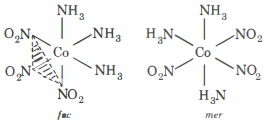
Facial $(fac)$ and meridional $(mer)$ isomers are types of geometrical isomers which occur in octahedral coordination entities of the type $[Ma_3b_3]$.
The types of complexes given in the options are as follows:
Thus,$[Co(NO_2)_3(NH_3)_3]$ is the complex that shows $fac$ and $mer$ isomers.
Facial $(fac)$ and meridional $(mer)$ isomers are types of geometrical isomers which occur in octahedral coordination entities of the type $[Ma_3b_3]$.
The types of complexes given in the options are as follows:
| Complex | Type of complex |
|---|---|
| $[Co(NO_2)_3(NH_3)_3]$ | $[Ma_3b_3]$ |
| $K_3[Fe(CN)_6]$ | $[Ma_6]$ |
| $[Co(H_2O)_2(NH_3)_4]Cl_3$ | $[Ma_2b_4]$ |
| $[CoCl(NH_3)_5]Cl_2$ | $[Mab_5]$ |
Thus,$[Co(NO_2)_3(NH_3)_3]$ is the complex that shows $fac$ and $mer$ isomers.
0 likes
View Solution583
DifficultMCQ
The total number of geometrical isomers possible for an octahedral complex of the type $[MA_{2}B_{2}C_{2}]$ is ($M=$ transition metal; $A, B$ and $C$ are monodentate ligands).
A
$3$
B
$4$
C
$5$
D
$6$
Solution
(C) Geometrical isomerism arises in heteroleptic complexes due to different possible geometric arrangements of ligands around the central metal atom.
For an octahedral complex of the type $[MA_{2}B_{2}C_{2}]$,there are $5$ possible geometrical isomers.
These isomers correspond to the different relative positions of the pairs of ligands $A, B,$ and $C$ (trans or cis to each other).
For an octahedral complex of the type $[MA_{2}B_{2}C_{2}]$,there are $5$ possible geometrical isomers.
These isomers correspond to the different relative positions of the pairs of ligands $A, B,$ and $C$ (trans or cis to each other).
0 likes
View Solution584
MediumMCQ
Among $(i)$ $[Cr(en)_{3}]^{3+}$,$(ii)$ $trans-[Cr(en)_{2}Cl_{2}]^{+}$,$(iii)$ $cis-[Cr(en)_{2}Cl_{2}]^{+}$,$(iv)$ $[Co(NH_{3})_{4}Cl_{2}]^{+}$,the optically active complexes are:
A
$(i)$ and $(ii)$
B
$(i)$ and $(iii)$
C
$(ii)$ and $(iii)$
D
$(iii)$ and $(iv)$
Solution
(B) Optically active complexes are those that possess non-superimposable mirror images,which occurs when the complex lacks a plane of symmetry or a center of inversion.
$1$. $[Cr(en)_{3}]^{3+}$: This is of the type $[M(AA)_{3}]$. It lacks a plane of symmetry and is optically active.
$2$. $trans-[Cr(en)_{2}Cl_{2}]^{+}$: This is of the type $trans-[M(AA)_{2}X_{2}]$. It has a plane of symmetry and is optically inactive.
$3$. $cis-[Cr(en)_{2}Cl_{2}]^{+}$: This is of the type $cis-[M(AA)_{2}X_{2}]$. It lacks a plane of symmetry and is optically active.
$4$. $[Co(NH_{3})_{4}Cl_{2}]^{+}$: This is of the type $[MA_{4}B_{2}]$. It has a plane of symmetry and is optically inactive.
Therefore,$(i)$ and $(iii)$ are the optically active complexes. The correct option is $B$.
$1$. $[Cr(en)_{3}]^{3+}$: This is of the type $[M(AA)_{3}]$. It lacks a plane of symmetry and is optically active.
$2$. $trans-[Cr(en)_{2}Cl_{2}]^{+}$: This is of the type $trans-[M(AA)_{2}X_{2}]$. It has a plane of symmetry and is optically inactive.
$3$. $cis-[Cr(en)_{2}Cl_{2}]^{+}$: This is of the type $cis-[M(AA)_{2}X_{2}]$. It lacks a plane of symmetry and is optically active.
$4$. $[Co(NH_{3})_{4}Cl_{2}]^{+}$: This is of the type $[MA_{4}B_{2}]$. It has a plane of symmetry and is optically inactive.
Therefore,$(i)$ and $(iii)$ are the optically active complexes. The correct option is $B$.
0 likes
View Solution585
MediumMCQ
Among the following complexes,the one that can exhibit optical activity is
A
$[CoCl_6]^{3-}$
B
$[Co(en)Cl_4]^{-}$
C
$cis-[Co(en)_2Cl_2]^{+}$
D
$trans-[Co(en)_2Cl_2]^{+}$
Solution
(C) . Optical activity is exhibited by complexes that possess optical isomers. Optical isomers are non-superimposable mirror images of each other.
Complexes of the type $[M(AA)_2B_2]$ exhibit optical isomerism only in their $cis$-form,as the $trans$-form possesses a plane of symmetry.
Therefore,$cis-[Co(en)_2Cl_2]^{+}$ exhibits optical activity.
Complexes of the type $[M(AA)_2B_2]$ exhibit optical isomerism only in their $cis$-form,as the $trans$-form possesses a plane of symmetry.
| Complex | Type |
| $[CoCl_6]^{3-}$ | $[MA_6]$ |
| $[Co(en)Cl_4]^{-}$ | $[M(AA)B_4]$ |
| $cis-[Co(en)_2Cl_2]^{+}$ | $cis-[M(AA)_2B_2]$ |
| $trans-[Co(en)_2Cl_2]^{+}$ | $trans-[M(AA)_2B_2]$ |
Therefore,$cis-[Co(en)_2Cl_2]^{+}$ exhibits optical activity.
0 likes
View Solution586
MediumMCQ
The spin-only magnetic moment of $[ZCl_{4}]^{2-}$ is $3.87 \, BM,$ where $Z$ is $.....$
A
$Mn$
B
$Ni$
C
$Co$
D
$Cu$
Solution
(C) The spin-only magnetic moment of a complex is calculated using the formula: $\mu = \sqrt{n(n+2)} \, BM$,where $n$ is the number of unpaired electrons.
The oxidation state of $Z$ in $[ZCl_{4}]^{2-}$ is $+2$.
The spin-only magnetic moments for the given metals in the $+2$ oxidation state are:
$(a)$ $Mn^{2+}$: Electronic configuration is $3d^{5}$,$n=5$,$\mu = \sqrt{5(5+2)} = \sqrt{35} \approx 5.92 \, BM$.
$(b)$ $Ni^{2+}$: Electronic configuration is $3d^{8}$,$n=2$,$\mu = \sqrt{2(2+2)} = \sqrt{8} \approx 2.83 \, BM$.
$(c)$ $Co^{2+}$: Electronic configuration is $3d^{7}$,$n=3$,$\mu = \sqrt{3(3+2)} = \sqrt{15} \approx 3.87 \, BM$.
$(d)$ $Cu^{2+}$: Electronic configuration is $3d^{9}$,$n=1$,$\mu = \sqrt{1(1+2)} = \sqrt{3} \approx 1.73 \, BM$.
Since the given magnetic moment is $3.87 \, BM$,$Z$ must be $Co$.
The oxidation state of $Z$ in $[ZCl_{4}]^{2-}$ is $+2$.
The spin-only magnetic moments for the given metals in the $+2$ oxidation state are:
$(a)$ $Mn^{2+}$: Electronic configuration is $3d^{5}$,$n=5$,$\mu = \sqrt{5(5+2)} = \sqrt{35} \approx 5.92 \, BM$.
$(b)$ $Ni^{2+}$: Electronic configuration is $3d^{8}$,$n=2$,$\mu = \sqrt{2(2+2)} = \sqrt{8} \approx 2.83 \, BM$.
$(c)$ $Co^{2+}$: Electronic configuration is $3d^{7}$,$n=3$,$\mu = \sqrt{3(3+2)} = \sqrt{15} \approx 3.87 \, BM$.
$(d)$ $Cu^{2+}$: Electronic configuration is $3d^{9}$,$n=1$,$\mu = \sqrt{1(1+2)} = \sqrt{3} \approx 1.73 \, BM$.
Since the given magnetic moment is $3.87 \, BM$,$Z$ must be $Co$.
0 likes
View Solution587
MediumMCQ
The number of geometrical isomers of $[CrCl_2(en)(NH_3)_2]$,where $en = \text{ethylenediamine}$,is
A
$2$
B
$3$
C
$4$
D
$1$
Solution
(B) The complex $[CrCl_2(en)(NH_3)_2]$ is of the type $M(AA)X_2Y_2$,where $M = Cr$,$AA = en$,$X = Cl$,and $Y = NH_3$.
This complex exhibits $3$ geometrical isomers:
$1$. One $cis$ isomer where the two $Cl$ atoms are adjacent.
$2$. Two $trans$ isomers where the two $Cl$ atoms are opposite to each other,but the relative positions of $NH_3$ and $en$ differ.
Thus,the total number of geometrical isomers is $3$.
This complex exhibits $3$ geometrical isomers:
$1$. One $cis$ isomer where the two $Cl$ atoms are adjacent.
$2$. Two $trans$ isomers where the two $Cl$ atoms are opposite to each other,but the relative positions of $NH_3$ and $en$ differ.
Thus,the total number of geometrical isomers is $3$.
0 likes
View Solution588
MediumMCQ
The spin-only magnetic moments of $[Fe(NH_3)_6]^{3+}$ and $[FeF_6]^{3-}$ in $BM$ are,respectively
A
$1.73$ and $1.73$
B
$5.92$ and $1.73$
C
$1.73$ and $5.92$
D
$5.92$ and $5.92$
Solution
(C) The magnetic moment is calculated using the formula $\mu = \sqrt{n(n+2)}$,where $n$ is the number of unpaired electrons.
For $[Fe(NH_3)_6]^{3+}$,$Fe$ is in the $+3$ oxidation state $(3d^5)$. Since $NH_3$ is a strong field ligand,it causes pairing of electrons,resulting in $n = 1$ unpaired electron.
$\mu = \sqrt{1(1+2)} = \sqrt{3} = 1.73 \ BM$.
For $[FeF_6]^{3-}$,$Fe$ is in the $+3$ oxidation state $(3d^5)$. Since $F^-$ is a weak field ligand,no pairing occurs,resulting in $n = 5$ unpaired electrons.
$\mu = \sqrt{5(5+2)} = \sqrt{35} = 5.92 \ BM$.
Therefore,the values are $1.73 \ BM$ and $5.92 \ BM$.
For $[Fe(NH_3)_6]^{3+}$,$Fe$ is in the $+3$ oxidation state $(3d^5)$. Since $NH_3$ is a strong field ligand,it causes pairing of electrons,resulting in $n = 1$ unpaired electron.
$\mu = \sqrt{1(1+2)} = \sqrt{3} = 1.73 \ BM$.
For $[FeF_6]^{3-}$,$Fe$ is in the $+3$ oxidation state $(3d^5)$. Since $F^-$ is a weak field ligand,no pairing occurs,resulting in $n = 5$ unpaired electrons.
$\mu = \sqrt{5(5+2)} = \sqrt{35} = 5.92 \ BM$.
Therefore,the values are $1.73 \ BM$ and $5.92 \ BM$.
0 likes
View Solution589
MediumMCQ
For a tetrahedral complex $[MCl_{4}]^{2-}$,the spin-only magnetic moment is $3.83 \ BM$. The element $M$ is
A
$Co$
B
$Cu$
C
$Mn$
D
$Fe$
Solution
(A) Given,$\mu = 3.83 \ BM$.
The spin-only magnetic moment is calculated as $\mu = \sqrt{n(n+2)} \ BM$,where $n$ is the number of unpaired electrons.
$3.83 = \sqrt{n(n+2)}$ $\Rightarrow n(n+2) \approx 14.67$ $\Rightarrow n \approx 3$.
Thus,the complex $[MCl_{4}]^{2-}$ has $3$ unpaired electrons.
In $[MCl_{4}]^{2-}$,the oxidation state of $M$ is $+2$.
For $Co^{2+}$ $(Z=27)$,the configuration is $[Ar] 3d^7$. In a tetrahedral field,the $3d^7$ configuration has $3$ unpaired electrons $(t_2^4 e^3)$.
$(a)$ $Co = [Ar] 3d^7 4s^2$; $Co^{2+} = [Ar] 3d^7$ ($3$ unpaired electrons).
$(b)$ $Cu = [Ar] 3d^{10} 4s^1$; $Cu^{2+} = [Ar] 3d^9$ ($1$ unpaired electron).
$(c)$ $Mn = [Ar] 3d^5 4s^2$; $Mn^{2+} = [Ar] 3d^5$ ($5$ unpaired electrons).
$(d)$ $Fe = [Ar] 3d^6 4s^2$; $Fe^{2+} = [Ar] 3d^6$ ($4$ unpaired electrons).
Therefore,the element $M$ is $Co$.
The spin-only magnetic moment is calculated as $\mu = \sqrt{n(n+2)} \ BM$,where $n$ is the number of unpaired electrons.
$3.83 = \sqrt{n(n+2)}$ $\Rightarrow n(n+2) \approx 14.67$ $\Rightarrow n \approx 3$.
Thus,the complex $[MCl_{4}]^{2-}$ has $3$ unpaired electrons.
In $[MCl_{4}]^{2-}$,the oxidation state of $M$ is $+2$.
For $Co^{2+}$ $(Z=27)$,the configuration is $[Ar] 3d^7$. In a tetrahedral field,the $3d^7$ configuration has $3$ unpaired electrons $(t_2^4 e^3)$.
$(a)$ $Co = [Ar] 3d^7 4s^2$; $Co^{2+} = [Ar] 3d^7$ ($3$ unpaired electrons).
$(b)$ $Cu = [Ar] 3d^{10} 4s^1$; $Cu^{2+} = [Ar] 3d^9$ ($1$ unpaired electron).
$(c)$ $Mn = [Ar] 3d^5 4s^2$; $Mn^{2+} = [Ar] 3d^5$ ($5$ unpaired electrons).
$(d)$ $Fe = [Ar] 3d^6 4s^2$; $Fe^{2+} = [Ar] 3d^6$ ($4$ unpaired electrons).
Therefore,the element $M$ is $Co$.
0 likes
View Solution590
MediumMCQ
The spin-only magnetic moments of $[Mn(CN)_6]^{2-}$ and $[MnBr_4]^{2-}$ in Bohr magnetons,respectively are
A
$5.92$ and $5.92$
B
$4.89$ and $1.73$
C
$1.73$ and $5.92$
D
$1.73$ and $1.73$
Solution
(C) The oxidation state of $Mn$ in $[Mn(CN)_6]^{2-}$ is $+4$. The electronic configuration of $Mn^{4+}$ is $[Ar] 3d^3$.
Since $CN^-$ is a strong field ligand,the $3d$ electrons are arranged as follows: $t_{2g}^3 e_g^0$. The number of unpaired electrons $(n)$ is $1$.
The spin-only magnetic moment is $\mu = \sqrt{n(n+2)} = \sqrt{1(1+2)} = \sqrt{3} \approx 1.73 \ BM$.
The oxidation state of $Mn$ in $[MnBr_4]^{2-}$ is $+2$. The electronic configuration of $Mn^{2+}$ is $[Ar] 3d^5$.
Since $Br^-$ is a weak field ligand,no pairing occurs. The number of unpaired electrons $(n)$ is $5$.
The spin-only magnetic moment is $\mu = \sqrt{5(5+2)} = \sqrt{35} \approx 5.92 \ BM$.
Thus,the values are $1.73 \ BM$ and $5.92 \ BM$.
Since $CN^-$ is a strong field ligand,the $3d$ electrons are arranged as follows: $t_{2g}^3 e_g^0$. The number of unpaired electrons $(n)$ is $1$.
The spin-only magnetic moment is $\mu = \sqrt{n(n+2)} = \sqrt{1(1+2)} = \sqrt{3} \approx 1.73 \ BM$.
The oxidation state of $Mn$ in $[MnBr_4]^{2-}$ is $+2$. The electronic configuration of $Mn^{2+}$ is $[Ar] 3d^5$.
Since $Br^-$ is a weak field ligand,no pairing occurs. The number of unpaired electrons $(n)$ is $5$.
The spin-only magnetic moment is $\mu = \sqrt{5(5+2)} = \sqrt{35} \approx 5.92 \ BM$.
Thus,the values are $1.73 \ BM$ and $5.92 \ BM$.
0 likes
View Solution591
MediumMCQ
The number of isomers of $[Co(dien)Cl_3]$ is
A
$2$
B
$3$
C
$4$
D
$5$
Solution
(A) The complex $[Co(dien)Cl_3]$ contains a tridentate ligand,diethylenetriamine $(dien)$.
This complex exists in two geometrical isomeric forms: $fac$ (facial) and $mer$ (meridional) isomers.
In the $fac$-isomer,the three donor nitrogen atoms of the $dien$ ligand and the three $Cl^-$ ions occupy the corners of the same face of the octahedron.
In the $mer$-isomer,the three donor nitrogen atoms of the $dien$ ligand and the three $Cl^-$ ions are arranged in a meridional plane.
Therefore,the total number of isomers is $2$.
This complex exists in two geometrical isomeric forms: $fac$ (facial) and $mer$ (meridional) isomers.
In the $fac$-isomer,the three donor nitrogen atoms of the $dien$ ligand and the three $Cl^-$ ions occupy the corners of the same face of the octahedron.
In the $mer$-isomer,the three donor nitrogen atoms of the $dien$ ligand and the three $Cl^-$ ions are arranged in a meridional plane.
Therefore,the total number of isomers is $2$.
0 likes
View Solution592
MediumMCQ
Among $(i) [Co(NH_3)_6]Cl_3$,$(ii) [Ni(NH_3)_6]Cl_2$,$(iii) [Cr(H_2O)_6]Cl_3$,$(iv) [Fe(H_2O)_6]Cl_2$,the complex which is diamagnetic is $....$
A
$(i)$
B
$(ii)$
C
$(iii)$
D
$(iv)$
Solution
(A) $(i) [Co(NH_3)_6]Cl_3$: $Co^{3+}$ is $3d^6$. $NH_3$ is a strong field ligand,causing pairing of electrons. All $6$ electrons are paired,so it is diamagnetic.
$(ii) [Ni(NH_3)_6]Cl_2$: $Ni^{2+}$ is $3d^8$. It has $2$ unpaired electrons,so it is paramagnetic.
$(iii) [Cr(H_2O)_6]Cl_3$: $Cr^{3+}$ is $3d^3$. It has $3$ unpaired electrons,so it is paramagnetic.
$(iv) [Fe(H_2O)_6]Cl_2$: $Fe^{2+}$ is $3d^6$. $H_2O$ is a weak field ligand,so it has $4$ unpaired electrons,making it paramagnetic.
$(ii) [Ni(NH_3)_6]Cl_2$: $Ni^{2+}$ is $3d^8$. It has $2$ unpaired electrons,so it is paramagnetic.
$(iii) [Cr(H_2O)_6]Cl_3$: $Cr^{3+}$ is $3d^3$. It has $3$ unpaired electrons,so it is paramagnetic.
$(iv) [Fe(H_2O)_6]Cl_2$: $Fe^{2+}$ is $3d^6$. $H_2O$ is a weak field ligand,so it has $4$ unpaired electrons,making it paramagnetic.
0 likes
View Solution593
MediumMCQ
The correct match of the complexes with their structure and magnetic property is:
| Complex | Structure and magnetic property |
|---|---|
| $i$. $NiCl_4^{2-}$ | $p$. tetrahedral and diamagnetic |
| $ii$. $Ni(CO)_4$ | $q$. tetrahedral and paramagnetic |
| $iii$. $PtCl_4^{2-}$ | $r$. square planar and diamagnetic |
| $iv$. $Ni(CN)_4^{2-}$ | $s$. square planar and paramagnetic |
A
$i$ $\rightarrow q, ii$ $\rightarrow p, iii$ $\rightarrow r, iv$ $\rightarrow r$
B
$i$ $\rightarrow q, ii$ $\rightarrow p, iii$ $\rightarrow r, iv$ $\rightarrow r$
C
$i$ $\rightarrow q, ii$ $\rightarrow p, iii$ $\rightarrow r, iv$ $\rightarrow r$
D
$i$ $\rightarrow q, ii$ $\rightarrow p, iii$ $\rightarrow r, iv$ $\rightarrow r$
Solution
(A) The correct match is:
$i$. $NiCl_4^{2-}$: $Ni^{2+}$ is $d^8$. $Cl^-$ is a weak field ligand,so it forms a tetrahedral complex which is paramagnetic due to two unpaired electrons. Match: $i \rightarrow q$.
$ii$. $Ni(CO)_4$: $Ni$ is $d^{10}$. $CO$ is a strong field ligand,forming a tetrahedral complex which is diamagnetic. Match: $ii \rightarrow p$.
$iii$. $PtCl_4^{2-}$: $Pt^{2+}$ is $5d^8$. $Cl^-$ is a weak field ligand,but for $5d$ series elements,the crystal field splitting energy is high,resulting in a square planar diamagnetic complex. Match: $iii \rightarrow r$.
$iv$. $Ni(CN)_4^{2-}$: $Ni^{2+}$ is $d^8$. $CN^-$ is a strong field ligand,forcing pairing,resulting in a square planar diamagnetic complex. Match: $iv \rightarrow r$.
Thus,the correct sequence is $i$ $\rightarrow q, ii$ $\rightarrow p, iii$ $\rightarrow r, iv$ $\rightarrow r$.
$i$. $NiCl_4^{2-}$: $Ni^{2+}$ is $d^8$. $Cl^-$ is a weak field ligand,so it forms a tetrahedral complex which is paramagnetic due to two unpaired electrons. Match: $i \rightarrow q$.
$ii$. $Ni(CO)_4$: $Ni$ is $d^{10}$. $CO$ is a strong field ligand,forming a tetrahedral complex which is diamagnetic. Match: $ii \rightarrow p$.
$iii$. $PtCl_4^{2-}$: $Pt^{2+}$ is $5d^8$. $Cl^-$ is a weak field ligand,but for $5d$ series elements,the crystal field splitting energy is high,resulting in a square planar diamagnetic complex. Match: $iii \rightarrow r$.
$iv$. $Ni(CN)_4^{2-}$: $Ni^{2+}$ is $d^8$. $CN^-$ is a strong field ligand,forcing pairing,resulting in a square planar diamagnetic complex. Match: $iv \rightarrow r$.
Thus,the correct sequence is $i$ $\rightarrow q, ii$ $\rightarrow p, iii$ $\rightarrow r, iv$ $\rightarrow r$.
0 likes
View Solution594
MediumMCQ
The number of paramagnetic species from the following is $............$.
$[Ni(CN)_4]^{2-}, [Ni(CO)_4], [NiCl_4]^{2-}$
$[Fe(CN)_6]^{4-}, [Cu(NH_3)_4]^{2+}$
$[Fe(CN)_6]^{3-}$ and $[Fe(H_2O)_6]^{2+}$
$[Ni(CN)_4]^{2-}, [Ni(CO)_4], [NiCl_4]^{2-}$
$[Fe(CN)_6]^{4-}, [Cu(NH_3)_4]^{2+}$
$[Fe(CN)_6]^{3-}$ and $[Fe(H_2O)_6]^{2+}$
A
$2$
B
$3$
C
$4$
D
$5$
Solution
(C) To determine the number of paramagnetic species,we analyze the electronic configuration and magnetic behavior of each complex:
$1. [Ni(CN)_4]^{2-}$: $Ni^{2+}$ is $3d^8$. $CN^-$ is a strong field ligand,causing pairing of electrons. It is diamagnetic.
$2. [Ni(CO)_4]$: $Ni$ is $3d^8 4s^2$. $CO$ is a strong field ligand,forcing electrons to pair. It is diamagnetic.
$3. [NiCl_4]^{2-}$: $Ni^{2+}$ is $3d^8$. $Cl^-$ is a weak field ligand,no pairing occurs. It has $2$ unpaired electrons,so it is paramagnetic.
$4. [Fe(CN)_6]^{4-}$: $Fe^{2+}$ is $3d^6$. $CN^-$ is a strong field ligand,causing pairing. It is diamagnetic.
$5. [Cu(NH_3)_4]^{2+}$: $Cu^{2+}$ is $3d^9$. It has $1$ unpaired electron,so it is paramagnetic.
$6. [Fe(CN)_6]^{3-}$: $Fe^{3+}$ is $3d^5$. $CN^-$ is a strong field ligand,causing pairing. It has $1$ unpaired electron,so it is paramagnetic.
$7. [Fe(H_2O)_6]^{2+}$: $Fe^{2+}$ is $3d^6$. $H_2O$ is a weak field ligand,no pairing occurs. It has $4$ unpaired electrons,so it is paramagnetic.
The paramagnetic species are $[NiCl_4]^{2-}, [Cu(NH_3)_4]^{2+}, [Fe(CN)_6]^{3-}$,and $[Fe(H_2O)_6]^{2+}$.
Total number of paramagnetic species = $4$.
$1. [Ni(CN)_4]^{2-}$: $Ni^{2+}$ is $3d^8$. $CN^-$ is a strong field ligand,causing pairing of electrons. It is diamagnetic.
$2. [Ni(CO)_4]$: $Ni$ is $3d^8 4s^2$. $CO$ is a strong field ligand,forcing electrons to pair. It is diamagnetic.
$3. [NiCl_4]^{2-}$: $Ni^{2+}$ is $3d^8$. $Cl^-$ is a weak field ligand,no pairing occurs. It has $2$ unpaired electrons,so it is paramagnetic.
$4. [Fe(CN)_6]^{4-}$: $Fe^{2+}$ is $3d^6$. $CN^-$ is a strong field ligand,causing pairing. It is diamagnetic.
$5. [Cu(NH_3)_4]^{2+}$: $Cu^{2+}$ is $3d^9$. It has $1$ unpaired electron,so it is paramagnetic.
$6. [Fe(CN)_6]^{3-}$: $Fe^{3+}$ is $3d^5$. $CN^-$ is a strong field ligand,causing pairing. It has $1$ unpaired electron,so it is paramagnetic.
$7. [Fe(H_2O)_6]^{2+}$: $Fe^{2+}$ is $3d^6$. $H_2O$ is a weak field ligand,no pairing occurs. It has $4$ unpaired electrons,so it is paramagnetic.
The paramagnetic species are $[NiCl_4]^{2-}, [Cu(NH_3)_4]^{2+}, [Fe(CN)_6]^{3-}$,and $[Fe(H_2O)_6]^{2+}$.
Total number of paramagnetic species = $4$.
0 likes
View Solution595
MediumMCQ
Which of the following is a chiral complex? Here $en = \text{ethylenediamine}$.
A
$cis-[PtCl_2(en)_2]^{2+}$
B
$trans-[PtCl_2(en)_2]^{2+}$
C
$cis-[PtCl_2(NH_3)_2]$
D
$trans-[Co(NH_3)_4Cl_2]^{+}$
Solution
(A) complex is chiral if it lacks a plane of symmetry and a center of inversion.
$cis-[PtCl_2(en)_2]^{2+}$ has a $cis$ configuration where the two $Cl$ atoms are adjacent. This structure lacks a plane of symmetry,making it optically active and chiral.
$trans-[PtCl_2(en)_2]^{2+}$ has a plane of symmetry,so it is achiral.
$cis-[PtCl_2(NH_3)_2]$ is a square planar complex,which is achiral.
$trans-[Co(NH_3)_4Cl_2]^{+}$ has a plane of symmetry,so it is achiral.
$cis-[PtCl_2(en)_2]^{2+}$ has a $cis$ configuration where the two $Cl$ atoms are adjacent. This structure lacks a plane of symmetry,making it optically active and chiral.
$trans-[PtCl_2(en)_2]^{2+}$ has a plane of symmetry,so it is achiral.
$cis-[PtCl_2(NH_3)_2]$ is a square planar complex,which is achiral.
$trans-[Co(NH_3)_4Cl_2]^{+}$ has a plane of symmetry,so it is achiral.
0 likes
View Solution596
MediumMCQ
The correct order of spin-only magnetic moment of the following complex ions is: (Given At. No. $Fe: 26, Co: 27$)
A
$[FeF_6]^{3-} > [CoF_6]^{3-} > [Co(C_2O_4)_3]^{3-}$
B
$[Co(C_2O_4)_3]^{3-} > [CoF_6]^{3-} > [FeF_6]^{3-}$
C
$[FeF_6]^{3-} > [Co(C_2O_4)_3]^{3-} > [CoF_6]^{3-}$
D
$[CoF_6]^{3-} > [FeF_6]^{3-} > [Co(C_2O_4)_3]^{3-}$
Solution
(A) $[FeF_6]^{3-}: Fe^{3+} = 3d^5$ (weak field ligand,$\Delta_0 < P$). Number of unpaired electrons $n = 5$,$\mu = \sqrt{5(5+2)} = \sqrt{35} \, BM$.
$[CoF_6]^{3-}: Co^{3+} = 3d^6$ (weak field ligand,$\Delta_0 < P$). Number of unpaired electrons $n = 4$,$\mu = \sqrt{4(4+2)} = \sqrt{24} \, BM$.
$[Co(C_2O_4)_3]^{3-}: Co^{3+} = 3d^6$ (strong field ligand,$\Delta_0 > P$). Number of unpaired electrons $n = 0$,$\mu = 0 \, BM$.
Therefore,the correct order is $[FeF_6]^{3-} > [CoF_6]^{3-} > [Co(C_2O_4)_3]^{3-}$.
$[CoF_6]^{3-}: Co^{3+} = 3d^6$ (weak field ligand,$\Delta_0 < P$). Number of unpaired electrons $n = 4$,$\mu = \sqrt{4(4+2)} = \sqrt{24} \, BM$.
$[Co(C_2O_4)_3]^{3-}: Co^{3+} = 3d^6$ (strong field ligand,$\Delta_0 > P$). Number of unpaired electrons $n = 0$,$\mu = 0 \, BM$.
Therefore,the correct order is $[FeF_6]^{3-} > [CoF_6]^{3-} > [Co(C_2O_4)_3]^{3-}$.
0 likes
View Solution597
MediumMCQ
The complex cation which has two isomers is:
A
$[Co(H_2O)_6]^{3+}$
B
$[Co(NH_3)_5Cl]^{2+}$
C
$[Co(NH_3)_5NO_2]^{2+}$
D
$[Co(NH_3)_5Cl]^{+}$
Solution
(C) The complex cation $[Co(NH_3)_5NO_2]^{2+}$ exhibits linkage isomerism.
This occurs because the $NO_2^-$ ligand is an ambidentate ligand,which can coordinate to the central metal atom through either the nitrogen atom (nitro isomer) or the oxygen atom (nitrito isomer).
This occurs because the $NO_2^-$ ligand is an ambidentate ligand,which can coordinate to the central metal atom through either the nitrogen atom (nitro isomer) or the oxygen atom (nitrito isomer).
0 likes
View Solution598
MediumMCQ
The spin-only magnetic moment of $[Mn(H_2O)_6]^{2+}$ complex is $........ \ B.M.$ (Nearest integer) (Given: Atomic number of $Mn$ is $25$)
A
$3$
B
$6$
C
$9$
D
$12$
Solution
(B) The electronic configuration of $Mn$ $(Z=25)$ is $[Ar] 3d^5 4s^2$.
In the complex $[Mn(H_2O)_6]^{2+}$,$Mn$ is in the $+2$ oxidation state,so its configuration is $3d^5$.
Since $H_2O$ is a weak field ligand,the electrons remain unpaired in the $d$-orbitals,resulting in $n=5$ unpaired electrons.
The spin-only magnetic moment is calculated using the formula $\mu = \sqrt{n(n+2)} \ B.M.$.
Substituting $n=5$,we get $\mu = \sqrt{5(5+2)} = \sqrt{35} \approx 5.91 \ B.M.$.
The nearest integer value is $6$.
In the complex $[Mn(H_2O)_6]^{2+}$,$Mn$ is in the $+2$ oxidation state,so its configuration is $3d^5$.
Since $H_2O$ is a weak field ligand,the electrons remain unpaired in the $d$-orbitals,resulting in $n=5$ unpaired electrons.
The spin-only magnetic moment is calculated using the formula $\mu = \sqrt{n(n+2)} \ B.M.$.
Substituting $n=5$,we get $\mu = \sqrt{5(5+2)} = \sqrt{35} \approx 5.91 \ B.M.$.
The nearest integer value is $6$.
0 likes
View Solution599
MediumMCQ
Match List-$I$ with List-$II$ :
Choose the correct answer from the options given below :
| List-$I$ (Complexes) | List-$II$ (Types) |
| $a$. $[Co(NH_3)_5NO_2]Cl_2$ and $[Co(NH_3)_5ONO]Cl_2$ | $i$. Linkage isomerism |
| $b$. $[Cr(NH_3)_6][Co(CN)_6]$ and $[Cr(CN)_6][Co(NH_3)_6]$ | $ii$. Coordination isomerism |
| $c$. $[Co(NH_3)_5(SO_4)]Br$ and $[Co(NH_3)_5Br]SO_4$ | $iii$. Ionisation isomerism |
| $d$. $[Cr(H_2O)_6]Cl_3$ and $[Cr(H_2O)_5Cl]Cl_2 \cdot H_2O$ | $iv$. Solvate isomerism |
Choose the correct answer from the options given below :
A
$a-i, b-ii, c-iii, d-iv$
B
$a-ii, b-iii, c-iv, d-i$
C
$a-iii, b-ii, c-i, d-iv$
D
$a-iv, b-iii, c-ii, d-i$
Solution
(A) $[Co(NH_3)_5NO_2]Cl_2$ and $[Co(NH_3)_5ONO]Cl_2$ exhibit linkage isomerism due to the ambidentate ligand $NO_2^-$. Thus,$a-i$.
$(b)$ $[Cr(NH_3)_6][Co(CN)_6]$ and $[Cr(CN)_6][Co(NH_3)_6]$ exhibit coordination isomerism due to the exchange of ligands between cationic and anionic entities. Thus,$b-ii$.
$(c)$ $[Co(NH_3)_5(SO_4)]Br$ and $[Co(NH_3)_5Br]SO_4$ exhibit ionisation isomerism as they produce different ions in solution. Thus,$c-iii$.
$(d)$ $[Cr(H_2O)_6]Cl_3$ and $[Cr(H_2O)_5Cl]Cl_2 \cdot H_2O$ exhibit solvate (hydrate) isomerism. Thus,$d-iv$.
Therefore,the correct match is $a-i, b-ii, c-iii, d-iv$.
$(b)$ $[Cr(NH_3)_6][Co(CN)_6]$ and $[Cr(CN)_6][Co(NH_3)_6]$ exhibit coordination isomerism due to the exchange of ligands between cationic and anionic entities. Thus,$b-ii$.
$(c)$ $[Co(NH_3)_5(SO_4)]Br$ and $[Co(NH_3)_5Br]SO_4$ exhibit ionisation isomerism as they produce different ions in solution. Thus,$c-iii$.
$(d)$ $[Cr(H_2O)_6]Cl_3$ and $[Cr(H_2O)_5Cl]Cl_2 \cdot H_2O$ exhibit solvate (hydrate) isomerism. Thus,$d-iv$.
Therefore,the correct match is $a-i, b-ii, c-iii, d-iv$.
0 likes
View Solution600
MediumMCQ
Given below are two statements,one is labelled as Assertion $A$ and the other is labelled as Reason $R$.
Assertion $A:$ The spin only magnetic moment value for $[Fe(CN)_6]^{3-}$ is $1.74 \ BM$,whereas for $[Fe(H_2O)_6]^{3+}$ is $5.92 \ BM$.
Reason $R:$ In both complexes,$Fe$ is present in $+3$ oxidation state.
In the light of the above statements,choose the correct answer from the options given below:
Assertion $A:$ The spin only magnetic moment value for $[Fe(CN)_6]^{3-}$ is $1.74 \ BM$,whereas for $[Fe(H_2O)_6]^{3+}$ is $5.92 \ BM$.
Reason $R:$ In both complexes,$Fe$ is present in $+3$ oxidation state.
In the light of the above statements,choose the correct answer from the options given below:
A
Both $A$ and $R$ are true but $R$ is $NOT$ the correct explanation of $A$.
B
$A$ is false but $R$ is true.
C
$A$ is true but $R$ is false.
D
Both $A$ and $R$ are true and $R$ is the correct explanation of $A$.
Solution
(A) For $[Fe(CN)_6]^{3-}$,$Fe$ is in $+3$ oxidation state $(3d^5)$. $CN^-$ is a strong field ligand,causing pairing of electrons. Number of unpaired electrons $(n)$ $= 1$.
$\mu = \sqrt{n(n+2)} = \sqrt{1(1+2)} = \sqrt{3} \approx 1.74 \ BM$.
For $[Fe(H_2O)_6]^{3+}$,$Fe$ is in $+3$ oxidation state $(3d^5)$. $H_2O$ is a weak field ligand,no pairing occurs. Number of unpaired electrons $(n)$ $= 5$.
$\mu = \sqrt{5(5+2)} = \sqrt{35} \approx 5.92 \ BM$.
Both Assertion $A$ and Reason $R$ are true. However,the difference in magnetic moments is due to the nature of the ligands (strong field vs weak field),not just the oxidation state of $Fe$. Thus,$R$ is not the correct explanation of $A$.
$\mu = \sqrt{n(n+2)} = \sqrt{1(1+2)} = \sqrt{3} \approx 1.74 \ BM$.
For $[Fe(H_2O)_6]^{3+}$,$Fe$ is in $+3$ oxidation state $(3d^5)$. $H_2O$ is a weak field ligand,no pairing occurs. Number of unpaired electrons $(n)$ $= 5$.
$\mu = \sqrt{5(5+2)} = \sqrt{35} \approx 5.92 \ BM$.
Both Assertion $A$ and Reason $R$ are true. However,the difference in magnetic moments is due to the nature of the ligands (strong field vs weak field),not just the oxidation state of $Fe$. Thus,$R$ is not the correct explanation of $A$.
0 likes
View SolutionCoordination Compounds — Isomerism and Magnetic properties · Frequently Asked Questions
1Are these Coordination Compounds questions useful for JEE and NEET?
Yes. All questions in this section are mapped to JEE Main and NEET exam patterns. Previous year questions from JEE Main, NEET, GUJCET and state-level exams are included with full solutions.
2Can I switch to Hindi or Gujarati for these questions?
Yes. Use the language tabs in the hero section or the sidebar to view the same questions and solutions in English, Hindi or Gujarati.
3How do I generate a question paper from this subtopic?
Use the Vedclass Exam Paper Generator — select the chapter and subtopic, set difficulty, and generate Sets A, B, C, D automatically. First 3 chapters of every subject are free.
Vedclass Products
For Students
Vedclass Test Series
Mock tests in real JEE/NEET style with performance analysis. 5-day free trial.
Start Free TrialFor Teachers
Exam Paper Generator
Generate Set A/B/C/D papers from this chapter in 2 minutes. 3 chapters free.
Try FreeFor Institutes
Online Exam Module
Live online exams with unlimited students, 360° analytics & white-label branding.
See DemoFor Teachers & Institutes
Generate a Coordination Compounds Exam Paper in 2 Minutes
Select subtopic & difficulty — Sets A, B, C, D auto-generated with No Repeat logic.
First 3 chapters of every subject are free — no payment required.