
A English
Isomerism and Magnetic properties Questions in English
Class 12 Chemistry · Coordination Compounds · Isomerism and Magnetic properties
800+
Questions
English
Language
100%
With Solutions
Showing 50 of 800 questions in English
651
DifficultMCQ
Identify the homoleptic complexes with an odd number of $d$ electrons in the central metal ion.
$(A) \ [FeO_4]^{2-}$
$(B) \ [Fe(CN)_6]^{3-}$
$(C) \ [Fe(CN)_5 NO]^{2-}$
$(D) \ [CoCl_4]^{2-}$
$(E) \ [Co(H_2O)_3 F_3]$
Choose the correct answer from the options given below $:$
$(A) \ [FeO_4]^{2-}$
$(B) \ [Fe(CN)_6]^{3-}$
$(C) \ [Fe(CN)_5 NO]^{2-}$
$(D) \ [CoCl_4]^{2-}$
$(E) \ [Co(H_2O)_3 F_3]$
Choose the correct answer from the options given below $:$
A
$(B)$ and $(D)$ only
B
$(C)$ and $(E)$ only
C
$(A), (B)$ and $(D)$ only
D
$(A), (C)$ and $(E)$ only
Solution
(A) homoleptic complex is one in which the central metal atom or ion is bonded to only one type of donor atom.
$(A) \ [FeO_4]^{2-}$: Homoleptic. $Fe$ is in $+6$ oxidation state $(d^2)$. Even number of $d$ electrons.
$(B) \ [Fe(CN)_6]^{3-}$: Homoleptic. $Fe$ is in $+3$ oxidation state $(d^5)$. Odd number of $d$ electrons.
$(C) \ [Fe(CN)_5 NO]^{2-}$: Heteroleptic (contains $CN^-$ and $NO$ ligands).
$(D) \ [CoCl_4]^{2-}$: Homoleptic. $Co$ is in $+2$ oxidation state $(d^7)$. Odd number of $d$ electrons.
$(E) \ [Co(H_2O)_3 F_3]$: Heteroleptic (contains $H_2O$ and $F^-$ ligands).
Thus,the homoleptic complexes with an odd number of $d$ electrons are $(B)$ and $(D)$.
$(A) \ [FeO_4]^{2-}$: Homoleptic. $Fe$ is in $+6$ oxidation state $(d^2)$. Even number of $d$ electrons.
$(B) \ [Fe(CN)_6]^{3-}$: Homoleptic. $Fe$ is in $+3$ oxidation state $(d^5)$. Odd number of $d$ electrons.
$(C) \ [Fe(CN)_5 NO]^{2-}$: Heteroleptic (contains $CN^-$ and $NO$ ligands).
$(D) \ [CoCl_4]^{2-}$: Homoleptic. $Co$ is in $+2$ oxidation state $(d^7)$. Odd number of $d$ electrons.
$(E) \ [Co(H_2O)_3 F_3]$: Heteroleptic (contains $H_2O$ and $F^-$ ligands).
Thus,the homoleptic complexes with an odd number of $d$ electrons are $(B)$ and $(D)$.
0 likes
View Solution652
MediumMCQ
Consider the following low-spin complexes: $K_3[Co(NO_2)_6]$,$K_4[Fe(CN)_6]$,$K_3[Fe(CN)_6]$,$Cu_2[Fe(CN)_6]$,and $Zn_2[Fe(CN)_6]$. The sum of the spin-only magnetic moment values of complexes having yellow colour is $.......... B.M.$ (answer is nearest integer).
A
$0$
B
$1$
C
$2$
D
$3$
Solution
(A) The complexes are:
$1$. $K_3[Co(NO_2)_6]$: Contains $[Co(NO_2)_6]^{3-}$,where $Co^{3+}$ is $d^6$ low-spin. It is yellow in color. Magnetic moment $\mu = \sqrt{n(n+2)} = 0 \ B.M.$ (since $n=0$).
$2$. $K_4[Fe(CN)_6]$: Contains $[Fe(CN)_6]^{4-}$,where $Fe^{2+}$ is $d^6$ low-spin. It is pale yellow in color. Magnetic moment $\mu = 0 \ B.M.$ (since $n=0$).
$3$. $K_3[Fe(CN)_6]$: Contains $[Fe(CN)_6]^{3-}$,which is red.
$4$. $Cu_2[Fe(CN)_6]$: This is a brown/chocolate colored precipitate.
$5$. $Zn_2[Fe(CN)_6]$: This is a white precipitate.
The yellow complexes are $K_3[Co(NO_2)_6]$ and $K_4[Fe(CN)_6]$.
The sum of their spin-only magnetic moments is $0 + 0 = 0 \ B.M.$
$1$. $K_3[Co(NO_2)_6]$: Contains $[Co(NO_2)_6]^{3-}$,where $Co^{3+}$ is $d^6$ low-spin. It is yellow in color. Magnetic moment $\mu = \sqrt{n(n+2)} = 0 \ B.M.$ (since $n=0$).
$2$. $K_4[Fe(CN)_6]$: Contains $[Fe(CN)_6]^{4-}$,where $Fe^{2+}$ is $d^6$ low-spin. It is pale yellow in color. Magnetic moment $\mu = 0 \ B.M.$ (since $n=0$).
$3$. $K_3[Fe(CN)_6]$: Contains $[Fe(CN)_6]^{3-}$,which is red.
$4$. $Cu_2[Fe(CN)_6]$: This is a brown/chocolate colored precipitate.
$5$. $Zn_2[Fe(CN)_6]$: This is a white precipitate.
The yellow complexes are $K_3[Co(NO_2)_6]$ and $K_4[Fe(CN)_6]$.
The sum of their spin-only magnetic moments is $0 + 0 = 0 \ B.M.$
0 likes
View Solution653
DifficultMCQ
The spin-only magnetic moment value of $M^{n+}$ ion formed among $Ni$, $Zn$, $Mn$, and $Cu$ that has the least enthalpy of atomisation is $........$ (in nearest integer). Here $n$ is equal to the number of diamagnetic complexes among $K_2[NiCl_4]$, $[Zn(H_2O)_6]Cl_2$, $K_3[Mn(CN)_6]$, and $[Cu(PPh_3)_3I]$.
A
$0$
B
$1$
C
$2$
D
$3$
Solution
(A) $1$. Identify the number of diamagnetic complexes $(n)$:
$K_2[NiCl_4]$: $Ni^{2+}$ is $d^8$, $sp^3$ hybridization, paramagnetic.
$[Zn(H_2O)_6]Cl_2$: $Zn^{2+}$ is $d^{10}$, $sp^3d^2$ hybridization, diamagnetic.
$K_3[Mn(CN)_6]$: $Mn^{3+}$ is $d^4$, $d^2sp^3$ hybridization, paramagnetic.
$[Cu(PPh_3)_3I]$: $Cu^+$ is $d^{10}$, $sp^3$ hybridization, diamagnetic.
Thus, $n = 2$.
$2$. Identify the metal with the least enthalpy of atomisation: Among $Ni$, $Zn$, $Mn$, and $Cu$, $Zn$ has the least enthalpy of atomisation due to the absence of unpaired $d$-electrons for metallic bonding.
$3$. Calculate the spin-only magnetic moment of $Zn^{2+}$:
$Zn^{2+}$ has the electronic configuration $[Ar] 3d^{10}$.
Since there are no unpaired electrons, the number of unpaired electrons $(x)$ is $0$.
$\mu = \sqrt{x(x+2)} = \sqrt{0(0+2)} = 0 \ BM$.
$K_2[NiCl_4]$: $Ni^{2+}$ is $d^8$, $sp^3$ hybridization, paramagnetic.
$[Zn(H_2O)_6]Cl_2$: $Zn^{2+}$ is $d^{10}$, $sp^3d^2$ hybridization, diamagnetic.
$K_3[Mn(CN)_6]$: $Mn^{3+}$ is $d^4$, $d^2sp^3$ hybridization, paramagnetic.
$[Cu(PPh_3)_3I]$: $Cu^+$ is $d^{10}$, $sp^3$ hybridization, diamagnetic.
Thus, $n = 2$.
$2$. Identify the metal with the least enthalpy of atomisation: Among $Ni$, $Zn$, $Mn$, and $Cu$, $Zn$ has the least enthalpy of atomisation due to the absence of unpaired $d$-electrons for metallic bonding.
$3$. Calculate the spin-only magnetic moment of $Zn^{2+}$:
$Zn^{2+}$ has the electronic configuration $[Ar] 3d^{10}$.
Since there are no unpaired electrons, the number of unpaired electrons $(x)$ is $0$.
$\mu = \sqrt{x(x+2)} = \sqrt{0(0+2)} = 0 \ BM$.
0 likes
View Solution654
MediumMCQ
The metal ions that have the calculated spin-only magnetic moment value of $4.9 \ B.M.$ are:
$A. Cr^{2+}$ $B. Fe^{2+}$ $C. Fe^{3+}$ $D. Co^{2+}$ $E. Mn^{3+}$
Choose the correct answer from the options given below:
$A. Cr^{2+}$ $B. Fe^{2+}$ $C. Fe^{3+}$ $D. Co^{2+}$ $E. Mn^{3+}$
Choose the correct answer from the options given below:
A
$A, C$ and $E$ only
B
$A, D$ and $E$ only
C
$B$ and $E$ only
D
$A, B$ and $E$ only
Solution
(D) The spin-only magnetic moment is given by the formula $\mu = \sqrt{n(n+2)} \ B.M.$,where $n$ is the number of unpaired electrons.
Given $\mu = 4.9 \ B.M.$,we have $\sqrt{n(n+2)} = 4.9$,which implies $n = 4$.
Let us calculate the number of unpaired electrons for each ion:
$(A) {}_{24} Cr^{2+} \Rightarrow [Ar] 3d^4$ ($4$ unpaired $e^{-}$)
$(B) {}_{26} Fe^{2+} \Rightarrow [Ar] 3d^6$ ($4$ unpaired $e^{-}$)
$(C) {}_{26} Fe^{3+} \Rightarrow [Ar] 3d^5$ ($5$ unpaired $e^{-}$)
$(D) {}_{27} Co^{2+} \Rightarrow [Ar] 3d^7$ ($3$ unpaired $e^{-}$)
$(E) {}_{25} Mn^{3+} \Rightarrow [Ar] 3d^4$ ($4$ unpaired $e^{-}$)
Thus,ions $A, B,$ and $E$ have $4$ unpaired electrons and a magnetic moment of $4.9 \ B.M.$
Given $\mu = 4.9 \ B.M.$,we have $\sqrt{n(n+2)} = 4.9$,which implies $n = 4$.
Let us calculate the number of unpaired electrons for each ion:
$(A) {}_{24} Cr^{2+} \Rightarrow [Ar] 3d^4$ ($4$ unpaired $e^{-}$)
$(B) {}_{26} Fe^{2+} \Rightarrow [Ar] 3d^6$ ($4$ unpaired $e^{-}$)
$(C) {}_{26} Fe^{3+} \Rightarrow [Ar] 3d^5$ ($5$ unpaired $e^{-}$)
$(D) {}_{27} Co^{2+} \Rightarrow [Ar] 3d^7$ ($3$ unpaired $e^{-}$)
$(E) {}_{25} Mn^{3+} \Rightarrow [Ar] 3d^4$ ($4$ unpaired $e^{-}$)
Thus,ions $A, B,$ and $E$ have $4$ unpaired electrons and a magnetic moment of $4.9 \ B.M.$
0 likes
View Solution655
DifficultMCQ
The number of optical isomers exhibited by the iron complex $(A)$ obtained from the following reaction is $.........$
$FeCl_3 + KOH + H_2C_2O_4 \rightarrow A$
$FeCl_3 + KOH + H_2C_2O_4 \rightarrow A$
A
$0$
B
$1$
C
$2$
D
$3$
Solution
(C) The reaction is: $FeCl_3 + 3KOH + 3H_2C_2O_4 \rightarrow K_3[Fe(C_2O_4)_3] + 3KCl + 6H_2O$.
The complex $(A)$ is $[Fe(C_2O_4)_3]^{3-}$.
This is an octahedral complex of the type $[M(AA)_3]$,where $AA$ is a bidentate ligand (oxalate ion).
Complexes of the type $[M(AA)_3]$ exhibit optical isomerism,existing as a pair of enantiomers (d-form and l-form).
Therefore,the total number of optical isomers is $2$.
The complex $(A)$ is $[Fe(C_2O_4)_3]^{3-}$.
This is an octahedral complex of the type $[M(AA)_3]$,where $AA$ is a bidentate ligand (oxalate ion).
Complexes of the type $[M(AA)_3]$ exhibit optical isomerism,existing as a pair of enantiomers (d-form and l-form).
Therefore,the total number of optical isomers is $2$.
0 likes
View Solution656
MediumMCQ
Identify the diamagnetic octahedral complex ions from below $:$
$A. [Mn(CN)_6]^{3-}$
$B. [Co(NH_3)_6]^{3+}$
$C. [Fe(CN)_6]^{4-}$
$D. [Co(H_2O)_3F_3]$
Choose the correct answer from the options given below $:$
$A. [Mn(CN)_6]^{3-}$
$B. [Co(NH_3)_6]^{3+}$
$C. [Fe(CN)_6]^{4-}$
$D. [Co(H_2O)_3F_3]$
Choose the correct answer from the options given below $:$
A
$B$ and $D$ Only
B
$A$ and $D$ Only
C
$A$ and $C$ Only
D
$B$ and $C$ Only
Solution
(D) To determine if a complex is diamagnetic,we check the electronic configuration of the central metal ion and the effect of the ligand field strength on the $d$-orbital splitting.
$1$. $[Mn(CN)_6]^{3-}$: $Mn^{3+}$ is $3d^4$. $CN^-$ is a strong field ligand,causing pairing. Configuration: $t_{2g}^4 e_g^0$. It has two unpaired electrons,so it is paramagnetic.
$2$. $[Co(NH_3)_6]^{3+}$: $Co^{3+}$ is $3d^6$. $NH_3$ is a strong field ligand. Configuration: $t_{2g}^6 e_g^0$. All electrons are paired,so it is diamagnetic.
$3$. $[Fe(CN)_6]^{4-}$: $Fe^{2+}$ is $3d^6$. $CN^-$ is a strong field ligand. Configuration: $t_{2g}^6 e_g^0$. All electrons are paired,so it is diamagnetic.
$4$. $[Co(H_2O)_3F_3]$: $Co^{3+}$ is $3d^6$. $H_2O$ and $F^-$ are weak field ligands. Configuration: $t_{2g}^4 e_g^2$. It has unpaired electrons,so it is paramagnetic.
Thus,$B$ and $C$ are diamagnetic.
$1$. $[Mn(CN)_6]^{3-}$: $Mn^{3+}$ is $3d^4$. $CN^-$ is a strong field ligand,causing pairing. Configuration: $t_{2g}^4 e_g^0$. It has two unpaired electrons,so it is paramagnetic.
$2$. $[Co(NH_3)_6]^{3+}$: $Co^{3+}$ is $3d^6$. $NH_3$ is a strong field ligand. Configuration: $t_{2g}^6 e_g^0$. All electrons are paired,so it is diamagnetic.
$3$. $[Fe(CN)_6]^{4-}$: $Fe^{2+}$ is $3d^6$. $CN^-$ is a strong field ligand. Configuration: $t_{2g}^6 e_g^0$. All electrons are paired,so it is diamagnetic.
$4$. $[Co(H_2O)_3F_3]$: $Co^{3+}$ is $3d^6$. $H_2O$ and $F^-$ are weak field ligands. Configuration: $t_{2g}^4 e_g^2$. It has unpaired electrons,so it is paramagnetic.
Thus,$B$ and $C$ are diamagnetic.
0 likes
View Solution657
MediumMCQ
Number of stereoisomers possible for the complexes, $[CrCl_3(py)_3]$ and $[CrCl_2(ox)_2]^{3-}$ are respectively $(py = \text{pyridine}, ox = \text{oxalate})$
A
$3 \ & \ 3$
B
$2 \ & \ 2$
C
$2 \ & \ 3$
D
$1 \ & \ 2$
Solution
(C) $1$. For the complex $[CrCl_3(py)_3]$, which is of the type $[MA_3B_3]$, it exhibits geometrical isomerism with two isomers: facial $(fac)$ and meridional $(mer)$. Neither of these is optically active. Thus, the total number of stereoisomers is $2$.
$2$. For the complex $[CrCl_2(ox)_2]^{3-}$, which is of the type $[M(AA)_2B_2]$, it exhibits geometrical isomerism with two isomers: $cis$ and $trans$.
$3$. The $cis$ isomer is optically active and exists as a pair of enantiomers ($d$ and $l$ forms), while the $trans$ isomer is optically inactive (achiral). Thus, the total number of stereoisomers is $3$ ($cis-d$, $cis-l$, and $trans$).
$4$. Therefore, the number of stereoisomers for $[CrCl_3(py)_3]$ and $[CrCl_2(ox)_2]^{3-}$ are $2$ and $3$ respectively.
$2$. For the complex $[CrCl_2(ox)_2]^{3-}$, which is of the type $[M(AA)_2B_2]$, it exhibits geometrical isomerism with two isomers: $cis$ and $trans$.
$3$. The $cis$ isomer is optically active and exists as a pair of enantiomers ($d$ and $l$ forms), while the $trans$ isomer is optically inactive (achiral). Thus, the total number of stereoisomers is $3$ ($cis-d$, $cis-l$, and $trans$).
$4$. Therefore, the number of stereoisomers for $[CrCl_3(py)_3]$ and $[CrCl_2(ox)_2]^{3-}$ are $2$ and $3$ respectively.
0 likes
View Solution658
DifficultMCQ
$A$ metal complex with a formula $MCl_4 \cdot 3NH_3$ is involved in $sp^3d^2$ hybridisation. It upon reaction with excess of $AgNO_3$ solution gives '$x$' moles of $AgCl$. Consider '$x$' is equal to the number of lone pairs of electron present in the central atom of $BrF_5$. Then the number of geometrical isomers exhibited by the complex is $............$
A
$0$
B
$1$
C
$2$
D
$3$
Solution
(C) $1$. The central atom $Br$ in $BrF_5$ has $7$ valence electrons. It forms $5$ bonds with $F$ atoms and has $1$ lone pair. Thus,$x = 1$.
$2$. Since $x = 1$,the complex $MCl_4 \cdot 3NH_3$ releases $1$ mole of $AgCl$ per mole of complex,indicating the formula is $[M(NH_3)_3Cl_3]Cl$.
$3$. The coordination sphere is $[M(NH_3)_3Cl_3]$,which is of the type $Ma_3b_3$.
$4$. Complexes of the type $Ma_3b_3$ exhibit $2$ geometrical isomers: facial (fac) and meridional (mer).
$2$. Since $x = 1$,the complex $MCl_4 \cdot 3NH_3$ releases $1$ mole of $AgCl$ per mole of complex,indicating the formula is $[M(NH_3)_3Cl_3]Cl$.
$3$. The coordination sphere is $[M(NH_3)_3Cl_3]$,which is of the type $Ma_3b_3$.
$4$. Complexes of the type $Ma_3b_3$ exhibit $2$ geometrical isomers: facial (fac) and meridional (mer).
0 likes
View Solution659
MediumMCQ
An octahedral complex having molecular composition $Co \cdot 5NH_3 \cdot Cl \cdot SO_4$ has two isomers $A$ and $B$. The solution of $A$ gives a white precipitate with $AgNO_3$ solution and the solution of $B$ gives a white precipitate with $BaCl_2$ solution. The type of isomerism exhibited by the complex is,
A
$Co$-ordinate isomerism
B
Linkage isomerism
C
Ionisation isomerism
D
Geometrical isomerism
Solution
(C) The complex $A$ reacts with $AgNO_3$ to give a white precipitate,which indicates the presence of free $Cl^-$ ions outside the coordination sphere. Thus,$A$ is $[Co(NH_3)_5(SO_4)]Cl$.
The complex $B$ reacts with $BaCl_2$ to give a white precipitate,which indicates the presence of free $SO_4^{2-}$ ions outside the coordination sphere. Thus,$B$ is $[Co(NH_3)_5Cl]SO_4$.
Since the isomers differ in the ions they provide in solution,this is an example of Ionisation isomerism.
The complex $B$ reacts with $BaCl_2$ to give a white precipitate,which indicates the presence of free $SO_4^{2-}$ ions outside the coordination sphere. Thus,$B$ is $[Co(NH_3)_5Cl]SO_4$.
Since the isomers differ in the ions they provide in solution,this is an example of Ionisation isomerism.
0 likes
View Solution660
MediumMCQ
The number of paramagnetic metal complex species among $[Co(NH_3)_6]^{3+}$,$[Co(C_2O_4)_3]^{3-}$,$[MnCl_6]^{3-}$,$[Mn(CN)_6]^{3-}$,$[CoF_6]^{3-}$,$[Fe(CN)_6]^{3-}$ and $[FeF_6]^{3-}$ with the same number of unpaired electrons is $............$
A
$0$
B
$1$
C
$3$
D
$2$
Solution
(D) Let us analyze the number of unpaired electrons $(n)$ for each complex:
$1.$ $[Co(NH_3)_6]^{3+}: Co^{3+} (3d^6)$,$\text{NH}_3$ is a strong field ligand $(SFL)$ $\rightarrow t_{2g}^6 e_g^0, n=0$ (Diamagnetic)
$2.$ $[Co(C_2O_4)_3]^{3-}: Co^{3+} (3d^6)$,$\text{C}_2\text{O}_4^{2-}$ is a $SFL$ with $Co^{3+} \rightarrow t_{2g}^6 e_g^0, n=0$ (Diamagnetic)
$3.$ $[MnCl_6]^{3-}: Mn^{3+} (3d^4)$,$\text{Cl}^{-}$ is a weak field ligand $(WFL)$ $\rightarrow t_{2g}^3 e_g^1, n=4$ (Paramagnetic)
$4.$ $[Mn(CN)_6]^{3-}: Mn^{3+} (3d^4)$,$\text{CN}^{-}$ is a $SFL$ $\rightarrow t_{2g}^4 e_g^0, n=2$ (Paramagnetic)
$5.$ $[CoF_6]^{3-}: Co^{3+} (3d^6)$,$\text{F}^{-}$ is a $WFL$ $\rightarrow t_{2g}^4 e_g^2, n=4$ (Paramagnetic)
$6.$ $[Fe(CN)_6]^{3-}: Fe^{3+} (3d^5)$,$\text{CN}^{-}$ is a $SFL$ $\rightarrow t_{2g}^5 e_g^0, n=1$ (Paramagnetic)
$7.$ $[FeF_6]^{3-}: Fe^{3+} (3d^5)$,$\text{F}^{-}$ is a $WFL$ $\rightarrow t_{2g}^3 e_g^2, n=5$ (Paramagnetic)
The paramagnetic species with the same number of unpaired electrons $(n=4)$ are $[MnCl_6]^{3-}$ and $[CoF_6]^{3-}$.
Therefore,the number of such species is $2$.
$1.$ $[Co(NH_3)_6]^{3+}: Co^{3+} (3d^6)$,$\text{NH}_3$ is a strong field ligand $(SFL)$ $\rightarrow t_{2g}^6 e_g^0, n=0$ (Diamagnetic)
$2.$ $[Co(C_2O_4)_3]^{3-}: Co^{3+} (3d^6)$,$\text{C}_2\text{O}_4^{2-}$ is a $SFL$ with $Co^{3+} \rightarrow t_{2g}^6 e_g^0, n=0$ (Diamagnetic)
$3.$ $[MnCl_6]^{3-}: Mn^{3+} (3d^4)$,$\text{Cl}^{-}$ is a weak field ligand $(WFL)$ $\rightarrow t_{2g}^3 e_g^1, n=4$ (Paramagnetic)
$4.$ $[Mn(CN)_6]^{3-}: Mn^{3+} (3d^4)$,$\text{CN}^{-}$ is a $SFL$ $\rightarrow t_{2g}^4 e_g^0, n=2$ (Paramagnetic)
$5.$ $[CoF_6]^{3-}: Co^{3+} (3d^6)$,$\text{F}^{-}$ is a $WFL$ $\rightarrow t_{2g}^4 e_g^2, n=4$ (Paramagnetic)
$6.$ $[Fe(CN)_6]^{3-}: Fe^{3+} (3d^5)$,$\text{CN}^{-}$ is a $SFL$ $\rightarrow t_{2g}^5 e_g^0, n=1$ (Paramagnetic)
$7.$ $[FeF_6]^{3-}: Fe^{3+} (3d^5)$,$\text{F}^{-}$ is a $WFL$ $\rightarrow t_{2g}^3 e_g^2, n=5$ (Paramagnetic)
The paramagnetic species with the same number of unpaired electrons $(n=4)$ are $[MnCl_6]^{3-}$ and $[CoF_6]^{3-}$.
Therefore,the number of such species is $2$.
0 likes
View Solution661
MediumMCQ
Given below are two statements:
Statement $I$: $A$ homoleptic octahedral complex,formed using monodentate ligands,will not show stereoisomerism.
Statement $II$: $cis-$ and $trans-$ platin are heteroleptic complexes of $Pd$.
In the light of the above statements,choose the correct answer from the options given below.
Statement $I$: $A$ homoleptic octahedral complex,formed using monodentate ligands,will not show stereoisomerism.
Statement $II$: $cis-$ and $trans-$ platin are heteroleptic complexes of $Pd$.
In the light of the above statements,choose the correct answer from the options given below.
A
Both statement $I$ and Statement $II$ are false.
B
Statement $I$ is false but Statement $II$ is true.
C
Both statement $I$ and Statement $II$ are true.
D
Statement $I$ is true but Statement $II$ is false.
Solution
(D) Statement $I$ is true: $A$ homoleptic octahedral complex with only one type of monodentate ligand (e.g.,$[Ma_6]$) does not exhibit stereoisomerism.
Statement $II$ is false: $cis-$platin and $trans-$platin have the formula $[Pt(NH_3)_2Cl_2]$. These are heteroleptic complexes of $Pt$ (Platinum),not $Pd$ (Palladium).
Therefore,Statement $I$ is true but Statement $II$ is false.
Statement $II$ is false: $cis-$platin and $trans-$platin have the formula $[Pt(NH_3)_2Cl_2]$. These are heteroleptic complexes of $Pt$ (Platinum),not $Pd$ (Palladium).
Therefore,Statement $I$ is true but Statement $II$ is false.
0 likes
View Solution662
DifficultMCQ
Which of the following are paramagnetic?
$A$. $[NiCl_4]^{2-}$
$B$. $Ni(CO)_4$
$C$. $[Ni(CN)_4]^{2-}$
$D$. $[Ni(H_2O)_6]^{2+}$
$E$. $Ni(PPh_3)_4$
Choose the correct answer from the options given below:
$A$. $[NiCl_4]^{2-}$
$B$. $Ni(CO)_4$
$C$. $[Ni(CN)_4]^{2-}$
$D$. $[Ni(H_2O)_6]^{2+}$
$E$. $Ni(PPh_3)_4$
Choose the correct answer from the options given below:
A
$A$ and $C$ only
B
$B$ and $E$ only
C
$A$ and $D$ only
D
$A, D$ and $E$ only
Solution
(C) To determine paramagnetism,we check for the presence of unpaired electrons in the $Ni$ center:
$A$. $[NiCl_4]^{2-}$: $Ni^{2+}$ $(3d^8)$. $Cl^-$ is a weak field ligand,so no pairing occurs. It has $2$ unpaired electrons (Paramagnetic).
$B$. $Ni(CO)_4$: $Ni^0$ $(3d^8 4s^2)$. $CO$ is a strong field ligand,causing pairing. It is diamagnetic.
$C$. $[Ni(CN)_4]^{2-}$: $Ni^{2+}$ $(3d^8)$. $CN^-$ is a strong field ligand,causing pairing. It is diamagnetic.
$D$. $[Ni(H_2O)_6]^{2+}$: $Ni^{2+}$ $(3d^8)$. $H_2O$ is a weak field ligand,so no pairing occurs. It has $2$ unpaired electrons (Paramagnetic).
$E$. $Ni(PPh_3)_4$: $Ni^0$ $(3d^8 4s^2)$. $PPh_3$ is a strong field ligand,causing pairing. It is diamagnetic.
Thus,only $A$ and $D$ are paramagnetic.
$A$. $[NiCl_4]^{2-}$: $Ni^{2+}$ $(3d^8)$. $Cl^-$ is a weak field ligand,so no pairing occurs. It has $2$ unpaired electrons (Paramagnetic).
$B$. $Ni(CO)_4$: $Ni^0$ $(3d^8 4s^2)$. $CO$ is a strong field ligand,causing pairing. It is diamagnetic.
$C$. $[Ni(CN)_4]^{2-}$: $Ni^{2+}$ $(3d^8)$. $CN^-$ is a strong field ligand,causing pairing. It is diamagnetic.
$D$. $[Ni(H_2O)_6]^{2+}$: $Ni^{2+}$ $(3d^8)$. $H_2O$ is a weak field ligand,so no pairing occurs. It has $2$ unpaired electrons (Paramagnetic).
$E$. $Ni(PPh_3)_4$: $Ni^0$ $(3d^8 4s^2)$. $PPh_3$ is a strong field ligand,causing pairing. It is diamagnetic.
Thus,only $A$ and $D$ are paramagnetic.
0 likes
View Solution663
MediumMCQ
Which of the following is incorrectly matched?
A
Complex $[FeF_6]^{3-}$,Number of unpaired electrons $\rightarrow 5$
B
Complex $[Cr(en)_3]^{2+}$,Number of unpaired electrons $\rightarrow 2$
C
Complex $[Co(NH_3)_6]^{3+}$,Number of unpaired electrons $\rightarrow 4$
D
Complex $[Mn(H_2O)_6]^{2+}$,Number of unpaired electrons $\rightarrow 5$
Solution
(C) Let us analyze each complex:
$A$. $[FeF_6]^{3-}$: $Fe^{3+}$ is $3d^5$. $F^-$ is a weak field ligand,so no pairing occurs. Unpaired electrons $(n)$ = $5$. (Correctly matched)
$B$. $[Cr(en)_3]^{2+}$: $Cr^{2+}$ is $3d^4$. $en$ is a strong field ligand,causing pairing. The $3d^4$ configuration becomes $t_{2g}^4 e_g^0$,resulting in $n = 2$. (Correctly matched)
$C$. $[Co(NH_3)_6]^{3+}$: $Co^{3+}$ is $3d^6$. $NH_3$ is a strong field ligand,causing all electrons to pair up in the $t_{2g}$ orbitals. Thus,$n = 0$. The given value $4$ is incorrect. (Incorrectly matched)
$D$. $[Mn(H_2O)_6]^{2+}$: $Mn^{2+}$ is $3d^5$. $H_2O$ is a weak field ligand,so no pairing occurs. $n = 5$. (Correctly matched)
Therefore,the incorrectly matched option is $C$.
$A$. $[FeF_6]^{3-}$: $Fe^{3+}$ is $3d^5$. $F^-$ is a weak field ligand,so no pairing occurs. Unpaired electrons $(n)$ = $5$. (Correctly matched)
$B$. $[Cr(en)_3]^{2+}$: $Cr^{2+}$ is $3d^4$. $en$ is a strong field ligand,causing pairing. The $3d^4$ configuration becomes $t_{2g}^4 e_g^0$,resulting in $n = 2$. (Correctly matched)
$C$. $[Co(NH_3)_6]^{3+}$: $Co^{3+}$ is $3d^6$. $NH_3$ is a strong field ligand,causing all electrons to pair up in the $t_{2g}$ orbitals. Thus,$n = 0$. The given value $4$ is incorrect. (Incorrectly matched)
$D$. $[Mn(H_2O)_6]^{2+}$: $Mn^{2+}$ is $3d^5$. $H_2O$ is a weak field ligand,so no pairing occurs. $n = 5$. (Correctly matched)
Therefore,the incorrectly matched option is $C$.
0 likes
View Solution664
MediumMCQ
Which of the following is not optically active?
A
$[Co(en)_3]^{3+}$
B
$[Cr(OX)_3]^{3-}$
C
$cis-[CoCl_2(en)_2]^{+}$
D
$trans-[CoCl_2(en)_2]^{+}$
Solution
(D) The complex $trans-[CoCl_2(en)_2]^{+}$ has a plane of symmetry $(POS)$.
Due to the presence of a plane of symmetry,it is superimposable on its mirror image and is therefore optically inactive.
All other given complexes ($[Co(en)_3]^{3+}$,$[Cr(OX)_3]^{3-}$,and $cis-[CoCl_2(en)_2]^{+}$) lack a plane of symmetry and are optically active.
Due to the presence of a plane of symmetry,it is superimposable on its mirror image and is therefore optically inactive.
All other given complexes ($[Co(en)_3]^{3+}$,$[Cr(OX)_3]^{3-}$,and $cis-[CoCl_2(en)_2]^{+}$) lack a plane of symmetry and are optically active.
0 likes
View Solution665
MediumMCQ
Select the correct pair of complexes that exhibit the same type of isomerism:
A
$[CoBr(NH_3)_5]Cl_2, [IrBr_3(H_2O)_3]$
B
$[Cr(NO_2)_2(en)_2]^+, [Rh(SCN)(H_2O)(ox)_2]^{2-}$
C
$[Pt(gly)(NH_3)(H_2O)]^+, [Zn(gly)(NH_3)_2]^+$
D
$[CoCl_2(NH_3)_4]^+, [CrBr(H_2O)_5]Br_2$
Solution
(B) The complex $[Cr(NO_2)_2(en)_2]^+$ contains the ambidentate ligand $NO_2^-$,which can coordinate through $N$ or $O$,thus exhibiting linkage isomerism.
Similarly,the complex $[Rh(SCN)(H_2O)(ox)_2]^{2-}$ contains the ambidentate ligand $SCN^-$,which can coordinate through $S$ or $N$,thus also exhibiting linkage isomerism.
Therefore,both complexes exhibit the same type of isomerism (linkage isomerism).
Similarly,the complex $[Rh(SCN)(H_2O)(ox)_2]^{2-}$ contains the ambidentate ligand $SCN^-$,which can coordinate through $S$ or $N$,thus also exhibiting linkage isomerism.
Therefore,both complexes exhibit the same type of isomerism (linkage isomerism).
0 likes
View Solution666
MediumMCQ
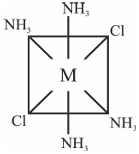
Identify the type of isomer shown in the given structure of the coordination compound.
A
Cis isomer
B
Trans isomer
C
$d$-isomer
D
$l$-isomer
Solution
(B) In the given square planar or octahedral complex structure,the two identical ligands ($Cl$ atoms) are positioned opposite to each other at an angle of $180^{\circ}$.
When identical ligands are placed at opposite positions,the isomer is classified as a $Trans$ isomer.
When identical ligands are placed at opposite positions,the isomer is classified as a $Trans$ isomer.
0 likes
View Solution667
EasyMCQ
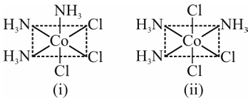
Identify the types of isomers shown in the structures $(i)$ and $(ii)$:
A
$i$. fac-Isomer,$ii$. mer-Isomer
B
$i$. optical-Isomer,$ii$. trans-Isomer
C
$i$. mer-Isomer,$ii$. fac-Isomer
D
$i$. trans-Isomer,$ii$. cis-Isomer
Solution
(A) The given structures represent the geometrical isomers of the octahedral complex $[Co(NH_3)_3Cl_3]$.
In structure $(i)$,the three identical ligands ($NH_3$ or $Cl$) occupy the corners of one triangular face of the octahedron. This is known as the facial $(fac)$ isomer.
In structure $(ii)$,the three identical ligands lie in a plane passing through the metal atom,forming a meridian. This is known as the meridional $(mer)$ isomer.
Therefore,$(i)$ is the $fac$-isomer and $(ii)$ is the $mer$-isomer.
In structure $(i)$,the three identical ligands ($NH_3$ or $Cl$) occupy the corners of one triangular face of the octahedron. This is known as the facial $(fac)$ isomer.
In structure $(ii)$,the three identical ligands lie in a plane passing through the metal atom,forming a meridian. This is known as the meridional $(mer)$ isomer.
Therefore,$(i)$ is the $fac$-isomer and $(ii)$ is the $mer$-isomer.
0 likes
View Solution668
MediumMCQ
Correct increasing order of spin magnetic moment $($in $B.M.)$ for the following complexes is:
$(I) \ [FeF_6]^{3-} \ (II) \ [V(H_2O)_6]^{2+} \ (III) \ [Fe(H_2O)_6]^{2+}$
$(I) \ [FeF_6]^{3-} \ (II) \ [V(H_2O)_6]^{2+} \ (III) \ [Fe(H_2O)_6]^{2+}$
A
$III < II < I$
B
$II < III < I$
C
$III < I < II$
D
$II < I < III$
Solution
(B) The spin magnetic moment is calculated using the formula $\mu = \sqrt{n(n+2)} \ B.M.$,where $n$ is the number of unpaired electrons.
$(I) \ [FeF_6]^{3-}$: $Fe^{3+}$ is $3d^5$. $F^-$ is a weak field ligand,so electrons remain unpaired. $n = 5$. $\mu = \sqrt{5(5+2)} = \sqrt{35} \approx 5.92 \ B.M$.
$(II) \ [V(H_2O)_6]^{2+}$: $V^{2+}$ is $3d^3$. $n = 3$. $\mu = \sqrt{3(3+2)} = \sqrt{15} \approx 3.87 \ B.M$.
$(III) \ [Fe(H_2O)_6]^{2+}$: $Fe^{2+}$ is $3d^6$. $H_2O$ is a weak field ligand,so electrons are $t_{2g}^4 e_g^2$. $n = 4$. $\mu = \sqrt{4(4+2)} = \sqrt{24} \approx 4.90 \ B.M$.
Comparing the values: $3.87 < 4.90 < 5.92$,which corresponds to $II < III < I$.
$(I) \ [FeF_6]^{3-}$: $Fe^{3+}$ is $3d^5$. $F^-$ is a weak field ligand,so electrons remain unpaired. $n = 5$. $\mu = \sqrt{5(5+2)} = \sqrt{35} \approx 5.92 \ B.M$.
$(II) \ [V(H_2O)_6]^{2+}$: $V^{2+}$ is $3d^3$. $n = 3$. $\mu = \sqrt{3(3+2)} = \sqrt{15} \approx 3.87 \ B.M$.
$(III) \ [Fe(H_2O)_6]^{2+}$: $Fe^{2+}$ is $3d^6$. $H_2O$ is a weak field ligand,so electrons are $t_{2g}^4 e_g^2$. $n = 4$. $\mu = \sqrt{4(4+2)} = \sqrt{24} \approx 4.90 \ B.M$.
Comparing the values: $3.87 < 4.90 < 5.92$,which corresponds to $II < III < I$.
0 likes
View Solution669
MediumMCQ
Which of the following is not a coordination isomer of $[Cr(NH_3)_6][CoCl_6]$?
A
$[Cr(NH_3)_5Cl][CoCl_5(NH_3)]$
B
$[Cr(NH_3)_3Cl_3][CoCl_3(NH_3)_3]$
C
$[Cr(NH_3)Cl_5][CoCl(NH_3)_5]$
D
$[Cr(NH_3)_2Cl_4][CoCl_2(NH_3)_4]$
Solution
(D) Coordination isomerism occurs when there is an interchange of ligands between cationic and anionic entities of different metal ions in a complex salt.
For the complex $[Cr(NH_3)_6][CoCl_6]$,the total number of $NH_3$ ligands is $6$ and $Cl$ ligands is $6$.
In option $A$: $[Cr(NH_3)_5Cl][CoCl_5(NH_3)]$,total $NH_3 = 6$ and $Cl = 6$. This is a coordination isomer.
In option $B$: $[Cr(NH_3)_3Cl_3][CoCl_3(NH_3)_3]$,total $NH_3 = 6$ and $Cl = 6$. This is a coordination isomer.
In option $C$: $[Cr(NH_3)Cl_5][CoCl(NH_3)_5]$,total $NH_3 = 6$ and $Cl = 6$. This is a coordination isomer.
In option $D$: $[Cr(NH_3)_2Cl_4][CoCl_2(NH_3)_4]$,total $NH_3 = 6$ and $Cl = 6$. However,the coordination number of $Cr$ in the original complex is $6$. In option $D$,the complex $[Cr(NH_3)_2Cl_4]$ has a coordination number of $6$,but the ligand distribution does not follow the standard exchange pattern relative to the original stoichiometry of the metal centers in a way that maintains the specific isomerism definition compared to the others,or it is simply a valid isomer. Wait,checking the stoichiometry: all options maintain the same total ligand count. Actually,all options provided are technically coordination isomers. Given the standard nature of this question,there might be a typo in the question or options. Assuming the question asks for the one that is $NOT$,and checking the coordination numbers: all are $6$. If we assume the question is correct as provided,all are isomers. However,usually,such questions have one option that violates the stoichiometry. Since all options $A, B, C, D$ have $6$ $NH_3$ and $6$ $Cl$ total,they are all coordination isomers. If this is a multiple-choice question where one must be selected,there may be an error in the question source.
For the complex $[Cr(NH_3)_6][CoCl_6]$,the total number of $NH_3$ ligands is $6$ and $Cl$ ligands is $6$.
In option $A$: $[Cr(NH_3)_5Cl][CoCl_5(NH_3)]$,total $NH_3 = 6$ and $Cl = 6$. This is a coordination isomer.
In option $B$: $[Cr(NH_3)_3Cl_3][CoCl_3(NH_3)_3]$,total $NH_3 = 6$ and $Cl = 6$. This is a coordination isomer.
In option $C$: $[Cr(NH_3)Cl_5][CoCl(NH_3)_5]$,total $NH_3 = 6$ and $Cl = 6$. This is a coordination isomer.
In option $D$: $[Cr(NH_3)_2Cl_4][CoCl_2(NH_3)_4]$,total $NH_3 = 6$ and $Cl = 6$. However,the coordination number of $Cr$ in the original complex is $6$. In option $D$,the complex $[Cr(NH_3)_2Cl_4]$ has a coordination number of $6$,but the ligand distribution does not follow the standard exchange pattern relative to the original stoichiometry of the metal centers in a way that maintains the specific isomerism definition compared to the others,or it is simply a valid isomer. Wait,checking the stoichiometry: all options maintain the same total ligand count. Actually,all options provided are technically coordination isomers. Given the standard nature of this question,there might be a typo in the question or options. Assuming the question asks for the one that is $NOT$,and checking the coordination numbers: all are $6$. If we assume the question is correct as provided,all are isomers. However,usually,such questions have one option that violates the stoichiometry. Since all options $A, B, C, D$ have $6$ $NH_3$ and $6$ $Cl$ total,they are all coordination isomers. If this is a multiple-choice question where one must be selected,there may be an error in the question source.
0 likes
View Solution670
MediumMCQ
Which of the following complexes can show ionisation,linkage,geometrical,and optical isomers?
A
$[Co(NO_2)_2(en)_2] Br$
B
$[Cr(NH_3)_4(CN)_2] Cl$
C
$[Co(en)_2 Cl_2] Br$
D
$[Pt(NH_3)_3 Cl_3] NO_2$
Solution
(D) To show all four types of isomerism (ionisation,linkage,geometrical,and optical),the complex must satisfy the following conditions:
$1$. Ionisation isomerism: It must have an exchangeable counter ion (e.g.,$Br^-$ or $NO_2^-$).
$2$. Linkage isomerism: It must contain an ambidentate ligand (e.g.,$NO_2^-$).
$3$. Geometrical isomerism: It must have a structure that allows cis-trans or facial-meridional arrangements (e.g.,$MA_2B_2$ or $MA_3B_3$ type).
$4$. Optical isomerism: It must be chiral (lacks a plane of symmetry).
Analyzing option $D$: $[Pt(NH_3)_3 Cl_3] NO_2$
- Ionisation: The $NO_2^-$ can exchange with $Cl^-$.
- Linkage: $NO_2^-$ is an ambidentate ligand.
- Geometrical: $MA_3B_3$ type complexes show facial $(fac)$ and meridional $(mer)$ isomerism.
- Optical: The $mer$ isomer is achiral,but the $fac$ isomer can exhibit optical activity in specific configurations,or the complex can be designed to show these properties depending on the coordination geometry.
$1$. Ionisation isomerism: It must have an exchangeable counter ion (e.g.,$Br^-$ or $NO_2^-$).
$2$. Linkage isomerism: It must contain an ambidentate ligand (e.g.,$NO_2^-$).
$3$. Geometrical isomerism: It must have a structure that allows cis-trans or facial-meridional arrangements (e.g.,$MA_2B_2$ or $MA_3B_3$ type).
$4$. Optical isomerism: It must be chiral (lacks a plane of symmetry).
Analyzing option $D$: $[Pt(NH_3)_3 Cl_3] NO_2$
- Ionisation: The $NO_2^-$ can exchange with $Cl^-$.
- Linkage: $NO_2^-$ is an ambidentate ligand.
- Geometrical: $MA_3B_3$ type complexes show facial $(fac)$ and meridional $(mer)$ isomerism.
- Optical: The $mer$ isomer is achiral,but the $fac$ isomer can exhibit optical activity in specific configurations,or the complex can be designed to show these properties depending on the coordination geometry.
0 likes
View Solution671
MediumMCQ
Consider the following statements and select the correct option using the codes given.
$(i)$ $[Cr(NH_3)_6][Cr(CN)_6]$ and $[Cr(NH_3)_4(CN)_2][Cr(NH_3)_2(CN)_4]$ are coordination isomers.
$(ii)$ $[Cr(py)_2(H_2O)_2Cl_2]Cl$ and $[Cr(py)_2(H_2O)Cl_3]H_2O$ are linkage isomers.
$(iii)$ $[Pt(NH_3)_4Br_2]Cl_2$ and $[Pt(NH_3)_4Cl_2]Br_2$ are linkage isomers.
$(iv)$ $[NiCl_2(PPh_3)_2]$ (tetrahedral) exhibits geometrical isomerism.
$(i)$ $[Cr(NH_3)_6][Cr(CN)_6]$ and $[Cr(NH_3)_4(CN)_2][Cr(NH_3)_2(CN)_4]$ are coordination isomers.
$(ii)$ $[Cr(py)_2(H_2O)_2Cl_2]Cl$ and $[Cr(py)_2(H_2O)Cl_3]H_2O$ are linkage isomers.
$(iii)$ $[Pt(NH_3)_4Br_2]Cl_2$ and $[Pt(NH_3)_4Cl_2]Br_2$ are linkage isomers.
$(iv)$ $[NiCl_2(PPh_3)_2]$ (tetrahedral) exhibits geometrical isomerism.
A
$i$ only
B
$i$ and $ii$ only
C
$ii$ and $iii$ only
D
$iii$ and $iv$ only
Solution
(A) $(i)$ $[Cr(NH_3)_6][Cr(CN)_6]$ and $[Cr(NH_3)_4(CN)_2][Cr(NH_3)_2(CN)_4]$ are coordination isomers because they involve the exchange of ligands between cationic and anionic coordination spheres. This statement is correct.
$(ii)$ $[Cr(py)_2(H_2O)_2Cl_2]Cl$ and $[Cr(py)_2(H_2O)Cl_3]H_2O$ are hydrate isomers,not linkage isomers. This statement is incorrect.
$(iii)$ $[Pt(NH_3)_4Br_2]Cl_2$ and $[Pt(NH_3)_4Cl_2]Br_2$ are ionization isomers,not linkage isomers. This statement is incorrect.
$(iv)$ Tetrahedral complexes of the type $[Ma_2b_2]$ do not exhibit geometrical isomerism because all positions in a tetrahedron are adjacent to each other. This statement is incorrect.
Therefore,only statement $(i)$ is correct.
$(ii)$ $[Cr(py)_2(H_2O)_2Cl_2]Cl$ and $[Cr(py)_2(H_2O)Cl_3]H_2O$ are hydrate isomers,not linkage isomers. This statement is incorrect.
$(iii)$ $[Pt(NH_3)_4Br_2]Cl_2$ and $[Pt(NH_3)_4Cl_2]Br_2$ are ionization isomers,not linkage isomers. This statement is incorrect.
$(iv)$ Tetrahedral complexes of the type $[Ma_2b_2]$ do not exhibit geometrical isomerism because all positions in a tetrahedron are adjacent to each other. This statement is incorrect.
Therefore,only statement $(i)$ is correct.
0 likes
View Solution672
MediumMCQ
In which of the following complex species,$\Delta_0 > P$ (pairing energy) with magnetic moment $\sqrt{3} \ B.M.$?
A
$[Co(H_2O)_4(NH_3)_2]^{3+}$
B
$[RhF_6]^{3-}$
C
$[Cr(CO)_6]$
D
$[Fe(CN)_6]^{3-}$
Solution
(D) The magnetic moment is given by $\mu = \sqrt{n(n+2)} \ B.M.$,where $n$ is the number of unpaired electrons.
Given $\mu = \sqrt{3} \ B.M.$,we have $\sqrt{n(n+2)} = \sqrt{3}$,which implies $n = 1$.
For $\Delta_0 > P$,the complex must be a low-spin complex.
Let's analyze the options:
$A$: $[Co(H_2O)_4(NH_3)_2]^{3+}$: $Co^{3+}$ is $d^6$. With strong field ligands,it forms a low-spin complex with $t_{2g}^6 e_g^0$,so $n = 0$.
$B$: $[RhF_6]^{3-}$: $Rh^{3+}$ is $4d^6$. $4d$ and $5d$ series elements always form low-spin complexes,but $F^-$ is a weak field ligand. However,$Rh^{3+}$ is $d^6$,so $t_{2g}^6 e_g^0$,$n = 0$.
$C$: $[Cr(CO)_6]$: $Cr^0$ is $d^6$. $CO$ is a strong field ligand,forming a low-spin complex with $t_{2g}^6 e_g^0$,$n = 0$.
$D$: $[Fe(CN)_6]^{3-}$: $Fe^{3+}$ is $d^5$. $CN^-$ is a strong field ligand,forcing pairing. The configuration is $t_{2g}^5 e_g^0$,resulting in $n = 1$ unpaired electron. Thus,$\mu = \sqrt{1(1+2)} = \sqrt{3} \ B.M.$ and $\Delta_0 > P$.
Given $\mu = \sqrt{3} \ B.M.$,we have $\sqrt{n(n+2)} = \sqrt{3}$,which implies $n = 1$.
For $\Delta_0 > P$,the complex must be a low-spin complex.
Let's analyze the options:
$A$: $[Co(H_2O)_4(NH_3)_2]^{3+}$: $Co^{3+}$ is $d^6$. With strong field ligands,it forms a low-spin complex with $t_{2g}^6 e_g^0$,so $n = 0$.
$B$: $[RhF_6]^{3-}$: $Rh^{3+}$ is $4d^6$. $4d$ and $5d$ series elements always form low-spin complexes,but $F^-$ is a weak field ligand. However,$Rh^{3+}$ is $d^6$,so $t_{2g}^6 e_g^0$,$n = 0$.
$C$: $[Cr(CO)_6]$: $Cr^0$ is $d^6$. $CO$ is a strong field ligand,forming a low-spin complex with $t_{2g}^6 e_g^0$,$n = 0$.
$D$: $[Fe(CN)_6]^{3-}$: $Fe^{3+}$ is $d^5$. $CN^-$ is a strong field ligand,forcing pairing. The configuration is $t_{2g}^5 e_g^0$,resulting in $n = 1$ unpaired electron. Thus,$\mu = \sqrt{1(1+2)} = \sqrt{3} \ B.M.$ and $\Delta_0 > P$.
0 likes
View Solution673
EasyMCQ
Which of the following ligands is able to form linkage isomers?
A
$SCN^{-}$
B
$H_2O$
C
$CN^{-}$
D
$C_2O_4^{2-}$
Solution
(A) Ligands that can coordinate through two different donor atoms are called ambidentate ligands.
$SCN^{-}$ is an ambidentate ligand because it can coordinate through either the sulfur atom $(S)$ or the nitrogen atom $(N)$,thus exhibiting linkage isomerism.
$SCN^{-}$ is an ambidentate ligand because it can coordinate through either the sulfur atom $(S)$ or the nitrogen atom $(N)$,thus exhibiting linkage isomerism.
0 likes
View Solution674
MediumMCQ
Which of the following complexes is an example of the $MA_2BC$ type of stereoisomers?
A
$[Co(en)_2Cl_2]^+$
B
$[Pt(NH_3)(H_2O)Cl_2]$
C
$[Pt(NH_3)_2Cl_2]$
D
$[Co(NH_3)_4Cl_2]^+$
Solution
(B) The general formula $MA_2BC$ represents a coordination complex with a central metal atom $M$,two identical ligands $A$,and two different ligands $B$ and $C$.
In the complex $[Pt(NH_3)(H_2O)Cl_2]$,the central metal is $Pt$,$A = Cl^-$,$B = NH_3$,and $C = H_2O$.
This complex exhibits geometric isomerism (cis and trans forms) and is a classic example of the $MA_2BC$ type.
Therefore,the correct option is $B$.
In the complex $[Pt(NH_3)(H_2O)Cl_2]$,the central metal is $Pt$,$A = Cl^-$,$B = NH_3$,and $C = H_2O$.
This complex exhibits geometric isomerism (cis and trans forms) and is a classic example of the $MA_2BC$ type.
Therefore,the correct option is $B$.
0 likes
View Solution675
MediumMCQ
Identify the pair of complexes that exhibits solvate isomerism.
A
$[Cr(H_2O)_6]Cl_3$ and $[Cr(H_2O)_5Cl]Cl_2 \cdot H_2O$
B
$[Co(NH_3)_5SO_4]Br$ and $[Co(NH_3)_5Br]SO_4$
C
$[Co(NH_3)_6][Cr(CN)_6]$ and $[Cr(NH_3)_6][Co(CN)_6]$
D
$[Fe(H_2O)_5SCN]^{+}$ and $[Fe(H_2O)_5NCS]^{+}$
Solution
(A) Solvate isomerism (also known as hydrate isomerism when water is the solvent) occurs when the solvent molecule acts as a ligand in one isomer and as a lattice molecule (outside the coordination sphere) in another.
In the pair $[Cr(H_2O)_6]Cl_3$ and $[Cr(H_2O)_5Cl]Cl_2 \cdot H_2O$,the first complex has $6$ water molecules as ligands,while the second has $5$ water molecules as ligands and $1$ water molecule as a lattice molecule.
Therefore,this pair exhibits solvate isomerism.
In the pair $[Cr(H_2O)_6]Cl_3$ and $[Cr(H_2O)_5Cl]Cl_2 \cdot H_2O$,the first complex has $6$ water molecules as ligands,while the second has $5$ water molecules as ligands and $1$ water molecule as a lattice molecule.
Therefore,this pair exhibits solvate isomerism.
0 likes
View Solution676
MediumMCQ
Which from the following ligands is able to form linkage isomers?
A
Aqua
B
Iodo
C
Ammine
D
Nitro
Solution
(D) Linkage isomerism is exhibited by ambidentate ligands.
An ambidentate ligand is a ligand that can coordinate to the central metal atom through two different donor atoms.
Among the given options,$Nitro$ $(-NO_2^-)$ is an ambidentate ligand because it can coordinate through either the nitrogen atom $(-NO_2)$ or the oxygen atom $(-ONO)$.
Other options like $Aqua$ $(H_2O)$,$Iodo$ $(I^-)$,and $Ammine$ $(NH_3)$ are monodentate ligands that do not exhibit linkage isomerism.
An ambidentate ligand is a ligand that can coordinate to the central metal atom through two different donor atoms.
Among the given options,$Nitro$ $(-NO_2^-)$ is an ambidentate ligand because it can coordinate through either the nitrogen atom $(-NO_2)$ or the oxygen atom $(-ONO)$.
Other options like $Aqua$ $(H_2O)$,$Iodo$ $(I^-)$,and $Ammine$ $(NH_3)$ are monodentate ligands that do not exhibit linkage isomerism.
0 likes
View Solution677
MediumMCQ
What type of isomerism is exhibited by $[Cr(H_2O)_6]Cl_3$ and $[Cr(H_2O)_5Cl]Cl_2 \cdot H_2O$?
A
Coordinate
B
Solvate
C
Ionization
D
Linkage
Solution
(B) The complexes $[Cr(H_2O)_6]Cl_3$ and $[Cr(H_2O)_5Cl]Cl_2 \cdot H_2O$ differ in the number of water molecules directly coordinated to the central metal ion $Cr^{3+}$ versus those present as lattice water (solvent of crystallization).
This type of isomerism,where the solvent molecule (in this case,$H_2O$) acts as a ligand in one isomer and as a free solvent molecule in another,is known as solvate isomerism (also called hydrate isomerism).
Therefore,the correct answer is $B$.
This type of isomerism,where the solvent molecule (in this case,$H_2O$) acts as a ligand in one isomer and as a free solvent molecule in another,is known as solvate isomerism (also called hydrate isomerism).
Therefore,the correct answer is $B$.
0 likes
View Solution678
EasyMCQ
Identify the type of isomerism exhibited by the complex compounds: $[Cr(H_2O)_6]Cl_3$ and $[Cr(H_2O)_5Cl]Cl_2 \cdot H_2O$.
A
Linkage isomerism
B
Ionization isomerism
C
Coordination isomerism
D
Solvate isomerism
Solution
(D) The given complexes are $[Cr(H_2O)_6]Cl_3$ and $[Cr(H_2O)_5Cl]Cl_2 \cdot H_2O$.
In these complexes,the water molecule $(H_2O)$ acts as a ligand in the first complex,while in the second complex,one $H_2O$ molecule is present outside the coordination sphere as a solvent molecule.
This type of isomerism,where the solvent molecule (usually water) exchanges its position between the coordination sphere and the lattice,is known as solvate isomerism (also called hydrate isomerism).
In these complexes,the water molecule $(H_2O)$ acts as a ligand in the first complex,while in the second complex,one $H_2O$ molecule is present outside the coordination sphere as a solvent molecule.
This type of isomerism,where the solvent molecule (usually water) exchanges its position between the coordination sphere and the lattice,is known as solvate isomerism (also called hydrate isomerism).
0 likes
View Solution679
EasyMCQ
What type of isomerism is exhibited by $[Co(NH_3)_6][Cr(CN)_6]$ and $[Cr(NH_3)_6][Co(CN)_6]$?
A
Ionization isomerism
B
Linkage isomerism
C
Coordination isomerism
D
Solvate isomerism
Solution
(C) In coordination compounds where both the cation and the anion are complex ions,the interchange of ligands between the two metal centers results in coordination isomerism.
Since the ligands $NH_3$ and $CN^-$ are exchanged between the $Co$ and $Cr$ centers in the given pair,they exhibit coordination isomerism.
Since the ligands $NH_3$ and $CN^-$ are exchanged between the $Co$ and $Cr$ centers in the given pair,they exhibit coordination isomerism.
0 likes
View Solution680
DifficultMCQ
Which among the following complexes does $NOT$ exhibit different geometrical isomers? [$M=$ metal ion and $A, B, C=$ ligands]
A
$[MA_4BC]$
B
$[MA_4B_2]$
C
$[MA_6]$
D
$[M(AA)_2B_2]$
Solution
(C) Geometrical isomerism occurs when ligands can be arranged in different spatial configurations around the central metal ion.
For $[MA_6]$,all six ligands are identical,meaning any exchange of positions results in the same structure.
Therefore,$[MA_6]$ does not exhibit geometrical isomerism.
For $[MA_6]$,all six ligands are identical,meaning any exchange of positions results in the same structure.
Therefore,$[MA_6]$ does not exhibit geometrical isomerism.
0 likes
View Solution681
EasyMCQ
Identify the correct pair of properties of the $[Co(NH_3)_6]^{3+}$ complex ion.
A
Low spin,diamagnetic
B
High spin,paramagnetic
C
High spin,diamagnetic
D
Low spin,paramagnetic
Solution
(A) The central metal ion is $Co^{3+}$,which has an electronic configuration of $[Ar] 3d^6$.
$NH_3$ is a strong field ligand,which causes pairing of electrons in the $3d$ orbitals.
As a result,the $3d$ electrons are paired,leaving two $3d$ orbitals empty.
These two $3d$,one $4s$,and three $4p$ orbitals hybridize to form $d^2sp^3$ hybrid orbitals.
Since all electrons are paired,the complex is diamagnetic.
Because the electrons are paired in the lower energy $d$ orbitals,it is a low spin complex.
$NH_3$ is a strong field ligand,which causes pairing of electrons in the $3d$ orbitals.
As a result,the $3d$ electrons are paired,leaving two $3d$ orbitals empty.
These two $3d$,one $4s$,and three $4p$ orbitals hybridize to form $d^2sp^3$ hybrid orbitals.
Since all electrons are paired,the complex is diamagnetic.
Because the electrons are paired in the lower energy $d$ orbitals,it is a low spin complex.
0 likes
View Solution682
MediumMCQ
Identify the ionic charge and magnetic nature respectively of the manganate ion.
A
$-1$,Diamagnetic
B
$-2$,Diamagnetic
C
$-2$,Paramagnetic
D
$-1$,Paramagnetic
Solution
(C) The chemical formula for the manganate ion is $MnO_4^{2-}$.
In $MnO_4^{2-}$,the oxidation state of $Mn$ is $+6$. The electronic configuration of $Mn^{6+}$ is $[Ar] 3d^1$.
Due to the presence of one unpaired electron in the $3d$ orbital,the manganate ion is paramagnetic.
The ionic charge of the manganate ion is $-2$.
In $MnO_4^{2-}$,the oxidation state of $Mn$ is $+6$. The electronic configuration of $Mn^{6+}$ is $[Ar] 3d^1$.
Due to the presence of one unpaired electron in the $3d$ orbital,the manganate ion is paramagnetic.
The ionic charge of the manganate ion is $-2$.
0 likes
View Solution683
MediumMCQ
What is the value of effective magnetic moment found in $+3$ oxidation state of Chromium $(Z=24)$ (in $BM$)?
A
$1.73$
B
$3.87$
C
$4.90$
D
$2.84$
Solution
(B) The electronic configuration of $Cr$ $(Z=24)$ is $[Ar] 3d^5 4s^1$.
In the $+3$ oxidation state, $Cr^{3+}$ loses three electrons to form $[Ar] 3d^3$.
This configuration contains $n = 3$ unpaired electrons.
The effective magnetic moment $\mu$ is calculated using the formula $\mu = \sqrt{n(n+2)} \ BM$.
Substituting $n=3$, we get $\mu = \sqrt{3(3+2)} = \sqrt{15} \approx 3.87 \ BM$.
In the $+3$ oxidation state, $Cr^{3+}$ loses three electrons to form $[Ar] 3d^3$.
This configuration contains $n = 3$ unpaired electrons.
The effective magnetic moment $\mu$ is calculated using the formula $\mu = \sqrt{n(n+2)} \ BM$.
Substituting $n=3$, we get $\mu = \sqrt{3(3+2)} = \sqrt{15} \approx 3.87 \ BM$.
0 likes
View Solution684
EasyMCQ
Find the value of spin-only magnetic moment for $Zn^{2+}$ in $BM$.
A
$1.73$
B
$2.84$
C
$0$
D
$3.87$
Solution
(C) The atomic number of $Zn$ is $30$.
The electronic configuration of $Zn$ is $[Ar] 3d^{10} 4s^2$.
The electronic configuration of $Zn^{2+}$ is $[Ar] 3d^{10}$.
Since all $10$ electrons in the $3d$ subshell are paired,the number of unpaired electrons $(n)$ is $0$.
The formula for spin-only magnetic moment is $\mu = \sqrt{n(n+2)} \ BM$.
Substituting $n = 0$,we get $\mu = \sqrt{0(0+2)} = 0 \ BM$.
The electronic configuration of $Zn$ is $[Ar] 3d^{10} 4s^2$.
The electronic configuration of $Zn^{2+}$ is $[Ar] 3d^{10}$.
Since all $10$ electrons in the $3d$ subshell are paired,the number of unpaired electrons $(n)$ is $0$.
The formula for spin-only magnetic moment is $\mu = \sqrt{n(n+2)} \ BM$.
Substituting $n = 0$,we get $\mu = \sqrt{0(0+2)} = 0 \ BM$.
0 likes
View Solution685
EasyMCQ
What is the value of spin only magnetic moment for $Mn^{2+}$ in $BM$?
A
$3.87$
B
$4.9$
C
$1.73$
D
$5.92$
Solution
(D) The atomic number of $Mn$ is $25$. The electronic configuration of $Mn$ is $[Ar] 3d^5 4s^2$.
For $Mn^{2+}$,the configuration is $[Ar] 3d^5$.
This means there are $5$ unpaired electrons $(n = 5)$.
The spin only magnetic moment is calculated using the formula $\mu = \sqrt{n(n+2)} \ BM$.
Substituting $n = 5$,we get $\mu = \sqrt{5(5+2)} = \sqrt{35} \approx 5.92 \ BM$.
For $Mn^{2+}$,the configuration is $[Ar] 3d^5$.
This means there are $5$ unpaired electrons $(n = 5)$.
The spin only magnetic moment is calculated using the formula $\mu = \sqrt{n(n+2)} \ BM$.
Substituting $n = 5$,we get $\mu = \sqrt{5(5+2)} = \sqrt{35} \approx 5.92 \ BM$.
0 likes
View Solution686
EasyMCQ
What is the value of spin-only magnetic moment for $Cu^{2+}$ in $BM$?
A
$2.84$
B
$3.87$
C
$1.73$
D
$0$
Solution
(C) The atomic number of $Cu$ is $29$. The electronic configuration of $Cu$ is $[Ar] 3d^{10} 4s^1$.
For $Cu^{2+}$, the electronic configuration is $[Ar] 3d^9$.
This means there is $1$ unpaired electron in the $3d$ orbital $(n = 1)$.
The spin-only magnetic moment $(\mu)$ is calculated using the formula $\mu = \sqrt{n(n+2)} \ BM$.
Substituting $n = 1$, we get $\mu = \sqrt{1(1+2)} = \sqrt{3} \approx 1.73 \ BM$.
For $Cu^{2+}$, the electronic configuration is $[Ar] 3d^9$.
This means there is $1$ unpaired electron in the $3d$ orbital $(n = 1)$.
The spin-only magnetic moment $(\mu)$ is calculated using the formula $\mu = \sqrt{n(n+2)} \ BM$.
Substituting $n = 1$, we get $\mu = \sqrt{1(1+2)} = \sqrt{3} \approx 1.73 \ BM$.
0 likes
View Solution687
EasyMCQ
Which among the following elements in their respective oxidation states develops the lowest spin-only magnetic moment? (Atomic numbers: $Cu=29, Fe=26, Ni=28, Co=27$)
A
$Co^{2+}$
B
$Cu^{2+}$
C
$Fe^{2+}$
D
$Ni^{2+}$
Solution
(B) The spin-only magnetic moment is calculated using the formula $\mu = \sqrt{n(n+2)} \text{ BM}$,where $n$ is the number of unpaired electrons.
$1$. $Co^{2+}$ $(3d^7)$: $n=3$,$\mu = \sqrt{3(5)} = \sqrt{15} \approx 3.87 \text{ BM}$.
$2$. $Cu^{2+}$ $(3d^9)$: $n=1$,$\mu = \sqrt{1(3)} = \sqrt{3} \approx 1.73 \text{ BM}$.
$3$. $Fe^{2+}$ $(3d^6)$: $n=4$,$\mu = \sqrt{4(6)} = \sqrt{24} \approx 4.90 \text{ BM}$.
$4$. $Ni^{2+}$ $(3d^8)$: $n=2$,$\mu = \sqrt{2(4)} = \sqrt{8} \approx 2.83 \text{ BM}$.
Comparing the values,$Cu^{2+}$ has the lowest number of unpaired electrons $(n=1)$,hence it exhibits the lowest spin-only magnetic moment.
$1$. $Co^{2+}$ $(3d^7)$: $n=3$,$\mu = \sqrt{3(5)} = \sqrt{15} \approx 3.87 \text{ BM}$.
$2$. $Cu^{2+}$ $(3d^9)$: $n=1$,$\mu = \sqrt{1(3)} = \sqrt{3} \approx 1.73 \text{ BM}$.
$3$. $Fe^{2+}$ $(3d^6)$: $n=4$,$\mu = \sqrt{4(6)} = \sqrt{24} \approx 4.90 \text{ BM}$.
$4$. $Ni^{2+}$ $(3d^8)$: $n=2$,$\mu = \sqrt{2(4)} = \sqrt{8} \approx 2.83 \text{ BM}$.
Comparing the values,$Cu^{2+}$ has the lowest number of unpaired electrons $(n=1)$,hence it exhibits the lowest spin-only magnetic moment.
0 likes
View Solution688
EasyMCQ
What is the calculated value of spin-only magnetic moment in terms of $BM$ if only one unpaired electron is present in a species?
A
$2.76$
B
$2.84$
C
$2.2$
D
$1.73$
Solution
(D) The formula for spin-only magnetic moment is $\mu = \sqrt{n(n+2)} \ BM$,where $n$ is the number of unpaired electrons.
Given that the number of unpaired electrons $n = 1$.
Substituting the value of $n$ into the formula: $\mu = \sqrt{1(1+2)} = \sqrt{3} \approx 1.73 \ BM$.
Given that the number of unpaired electrons $n = 1$.
Substituting the value of $n$ into the formula: $\mu = \sqrt{1(1+2)} = \sqrt{3} \approx 1.73 \ BM$.
0 likes
View Solution689
EasyMCQ
Identify a $CORRECT$ formula for spin only magnetic moment.
A
$\mu = (n^2 + 2) \ BM$
B
$\mu = \sqrt{n^2 + 2} \ BM$
C
$\mu = \sqrt{n(n + 2)} \ BM$
D
$\mu = (n + 2)^2 \ BM$
Solution
(C) The spin-only magnetic moment $(\mu)$ of an atom or ion is calculated using the formula $\mu = \sqrt{n(n + 2)} \ BM$,where $n$ represents the number of unpaired electrons. The unit $BM$ stands for Bohr Magneton.
0 likes
View Solution690
DifficultMCQ
What is the spin-only magnetic moment of an element having one unpaired electron (in $BM$)?
A
$0.34$
B
$1.0$
C
$1.73$
D
$3.1$
Solution
(C) The spin-only magnetic moment is calculated using the formula: $\mu = \sqrt{n(n+2)} \ BM$,where $n$ is the number of unpaired electrons.
For an element with $n = 1$ unpaired electron:
$\mu = \sqrt{1(1+2)} = \sqrt{3} \approx 1.73 \ BM$.
For an element with $n = 1$ unpaired electron:
$\mu = \sqrt{1(1+2)} = \sqrt{3} \approx 1.73 \ BM$.
0 likes
View Solution691
EasyMCQ
Which of the following species shows the maximum magnetic moment?
A
$Mn^{6+}$
B
$Ni^{2+}$
C
$Fe^{3+}$
D
$Ag^{+}$
Solution
(C) The magnetic moment $(\mu)$ is calculated using the formula $\mu = \sqrt{n(n+2)} \text{ BM}$,where $n$ is the number of unpaired electrons.
$1$. For $Mn^{6+}$ $([Ar]3d^1)$: $n = 1$,$\mu = \sqrt{1(1+2)} = 1.73 \text{ BM}$.
$2$. For $Ni^{2+}$ $([Ar]3d^8)$: $n = 2$,$\mu = \sqrt{2(2+2)} = 2.83 \text{ BM}$.
$3$. For $Fe^{3+}$ $([Ar]3d^5)$: $n = 5$,$\mu = \sqrt{5(5+2)} = 5.91 \text{ BM}$.
$4$. For $Ag^{+}$ $([Kr]4d^{10})$: $n = 0$,$\mu = 0 \text{ BM}$.
Thus,$Fe^{3+}$ has the maximum number of unpaired electrons $(n=5)$ and consequently shows the maximum magnetic moment.
$1$. For $Mn^{6+}$ $([Ar]3d^1)$: $n = 1$,$\mu = \sqrt{1(1+2)} = 1.73 \text{ BM}$.
$2$. For $Ni^{2+}$ $([Ar]3d^8)$: $n = 2$,$\mu = \sqrt{2(2+2)} = 2.83 \text{ BM}$.
$3$. For $Fe^{3+}$ $([Ar]3d^5)$: $n = 5$,$\mu = \sqrt{5(5+2)} = 5.91 \text{ BM}$.
$4$. For $Ag^{+}$ $([Kr]4d^{10})$: $n = 0$,$\mu = 0 \text{ BM}$.
Thus,$Fe^{3+}$ has the maximum number of unpaired electrons $(n=5)$ and consequently shows the maximum magnetic moment.
0 likes
View Solution692
EasyMCQ
Identify the optically active compound from the following.
A
$[Pt(NH_3)_2Cl_2]$
B
$[Co(NH_3)_6]Cl_2$
C
$[Co(en)_3]Cl_3$
D
$[Co(NH_3)_5Cl]Cl$
Solution
(C) An optically active compound must be chiral,meaning it lacks a plane of symmetry or a center of symmetry.
In the complex $[Co(en)_3]Cl_3$,the ligand $en$ (ethylenediamine) is a bidentate ligand.
The complex $[Co(en)_3]^{3+}$ forms a tris-chelated octahedral structure that does not possess a plane of symmetry or a center of symmetry.
Therefore,it exists as a pair of non-superimposable mirror images (enantiomers),making it optically active.
The other complexes listed are either square planar or octahedral with planes of symmetry,rendering them optically inactive.
In the complex $[Co(en)_3]Cl_3$,the ligand $en$ (ethylenediamine) is a bidentate ligand.
The complex $[Co(en)_3]^{3+}$ forms a tris-chelated octahedral structure that does not possess a plane of symmetry or a center of symmetry.
Therefore,it exists as a pair of non-superimposable mirror images (enantiomers),making it optically active.
The other complexes listed are either square planar or octahedral with planes of symmetry,rendering them optically inactive.
0 likes
View Solution693
EasyMCQ
What kind of isomerism exists between $[Cr(H_2O)_6]Cl_3$ and $[Cr(H_2O)_5Cl]Cl_2 \cdot H_2O$?
A
Ionisation isomerism
B
Solvate isomerism
C
Coordination isomerism
D
Linkage isomerism
Solution
(B) The given complexes are $[Cr(H_2O)_6]Cl_3$ and $[Cr(H_2O)_5Cl]Cl_2 \cdot H_2O$.
In these complexes,the water molecule acts as a ligand in the first case,while in the second case,one water molecule is present as a solvent of crystallization (lattice water) outside the coordination sphere.
This type of isomerism,where the solvent molecule (like $H_2O$) can be either inside or outside the coordination sphere,is known as solvate isomerism (also called hydrate isomerism).
In these complexes,the water molecule acts as a ligand in the first case,while in the second case,one water molecule is present as a solvent of crystallization (lattice water) outside the coordination sphere.
This type of isomerism,where the solvent molecule (like $H_2O$) can be either inside or outside the coordination sphere,is known as solvate isomerism (also called hydrate isomerism).
0 likes
View Solution694
EasyMCQ
How many geometrical isomers does $[Pt(NH_3)(Br)(Cl)(Py)]$ have?
A
$3$
B
$2$
C
$1$
D
$4$
Solution
(A) The complex $[Pt(NH_3)(Br)(Cl)(Py)]$ is of the type $[Mabcd]$,where $M = Pt$,$a = NH_3$,$b = Br$,$c = Cl$,and $d = Py$.
For a square planar complex of the type $[Mabcd]$,the number of geometrical isomers is $3$.
These isomers are formed by fixing one ligand (e.g.,$NH_3$) and arranging the other three ligands ($Br$,$Cl$,$Py$) in the $trans$ positions relative to the fixed ligand.
For a square planar complex of the type $[Mabcd]$,the number of geometrical isomers is $3$.
These isomers are formed by fixing one ligand (e.g.,$NH_3$) and arranging the other three ligands ($Br$,$Cl$,$Py$) in the $trans$ positions relative to the fixed ligand.
0 likes
View Solution695
EasyMCQ
Which type of isomerism is exhibited by the isomers $[Co(NH_3)_5(SO_4)]Br$ and $[Co(NH_3)_5Br]SO_4$?
A
Linkage
B
Ionisation
C
Coordination
D
Solvate
Solution
(B) The given isomers are $[Co(NH_3)_5(SO_4)]Br$ and $[Co(NH_3)_5Br]SO_4$.
These compounds produce different ions in an aqueous solution.
$[Co(NH_3)_5(SO_4)]Br$ gives $Br^-$ ions,while $[Co(NH_3)_5Br]SO_4$ gives $SO_4^{2-}$ ions.
This type of isomerism,where the counter ion in the coordination sphere is exchanged with a ligand,is known as $Ionisation$ isomerism.
These compounds produce different ions in an aqueous solution.
$[Co(NH_3)_5(SO_4)]Br$ gives $Br^-$ ions,while $[Co(NH_3)_5Br]SO_4$ gives $SO_4^{2-}$ ions.
This type of isomerism,where the counter ion in the coordination sphere is exchanged with a ligand,is known as $Ionisation$ isomerism.
0 likes
View Solution696
EasyMCQ
Which isomerism is possible in hexa-ammine cobalt$(III)$ hexa-cyanido chromate$(III)$ complex?
A
Ionisation isomerism
B
Coordination isomerism
C
Linkage isomerism
D
Solvate isomerism
Solution
(B) The complex is $[Co(NH_3)_6][Cr(CN)_6]$.
This complex consists of both a cationic part $[Co(NH_3)_6]^{3+}$ and an anionic part $[Cr(CN)_6]^{3-}$.
Coordination isomerism occurs in complexes where both the cation and anion are complex ions,and the ligands can be exchanged between the metal centers.
Therefore,the isomer $[Cr(NH_3)_6][Co(CN)_6]$ is possible.
Thus,the correct answer is $B$.
This complex consists of both a cationic part $[Co(NH_3)_6]^{3+}$ and an anionic part $[Cr(CN)_6]^{3-}$.
Coordination isomerism occurs in complexes where both the cation and anion are complex ions,and the ligands can be exchanged between the metal centers.
Therefore,the isomer $[Cr(NH_3)_6][Co(CN)_6]$ is possible.
Thus,the correct answer is $B$.
0 likes
View Solution697
EasyMCQ
Which of the following complexes possesses a meridional $(mer)$ isomer?
A
$[Co(NH_3)_3Cl_3]$
B
$[Co(NH_3)_4Cl_2]$
C
$[Co(NH_3)_2Cl_4]$
D
$[Co(NH_3)_5Cl]$
Solution
(A) The meridional $(mer)$ isomer is a type of geometric isomerism found in octahedral complexes of the type $[MA_3B_3]$.
In this configuration,three identical ligands occupy the positions around the meridian of the octahedron.
Among the given options,$[Co(NH_3)_3Cl_3]$ is an octahedral complex of the type $[MA_3B_3]$.
It can exist in two geometric isomeric forms: facial $(fac)$ and meridional $(mer)$.
Therefore,the correct option is $A$.
In this configuration,three identical ligands occupy the positions around the meridian of the octahedron.
Among the given options,$[Co(NH_3)_3Cl_3]$ is an octahedral complex of the type $[MA_3B_3]$.
It can exist in two geometric isomeric forms: facial $(fac)$ and meridional $(mer)$.
Therefore,the correct option is $A$.
0 likes
View Solution698
EasyMCQ
Which complex possesses a facial $(fac)$ isomer?
A
$[Co(NH_3)_4CO_3]Cl$
B
$[Co(NH_3)_3(NO_2)_3]$
C
$K[Fe(NH_3)_2(CN)_4]$
D
$[Ni(H_2O)_4(NH_3)_2]SO_4$
Solution
(B) The facial $(fac)$ isomer is a type of geometric isomerism observed in octahedral complexes of the type $[MA_3B_3]$.
In the $fac$ isomer,the three identical ligands occupy the corners of one triangular face of the octahedron.
Among the given options,$[Co(NH_3)_3(NO_2)_3]$ is an octahedral complex of the type $[MA_3B_3]$,where $A = NH_3$ and $B = NO_2^-$.
Therefore,it can exhibit both $fac$ (facial) and $mer$ (meridional) isomerism.
In the $fac$ isomer,the three identical ligands occupy the corners of one triangular face of the octahedron.
Among the given options,$[Co(NH_3)_3(NO_2)_3]$ is an octahedral complex of the type $[MA_3B_3]$,where $A = NH_3$ and $B = NO_2^-$.
Therefore,it can exhibit both $fac$ (facial) and $mer$ (meridional) isomerism.
0 likes
View Solution699
EasyMCQ
Which of the following complexes is paramagnetic?
A
$[Co(NH_3)_6]^{3+}$
B
$[Ni(CO)_4]$
C
$[Ni(CN)_4]^{2-}$
D
$[NiCl_4]^{2-}$
Solution
(D) To determine the magnetic nature,we calculate the number of unpaired electrons in each complex:
$1$. In $[Co(NH_3)_6]^{3+}$,$Co^{3+}$ is $d^6$. $NH_3$ is a strong field ligand,causing pairing. All electrons are paired,so it is diamagnetic.
$2$. In $[Ni(CO)_4]$,$Ni$ is $d^8 s^2$. $CO$ is a strong field ligand,causing $4s$ electrons to pair into $3d$. All electrons are paired,so it is diamagnetic.
$3$. In $[Ni(CN)_4]^{2-}$,$Ni^{2+}$ is $d^8$. $CN^-$ is a strong field ligand,causing pairing in $3d$ orbitals. All electrons are paired,so it is diamagnetic.
$4$. In $[NiCl_4]^{2-}$,$Ni^{2+}$ is $d^8$. $Cl^-$ is a weak field ligand,so no pairing occurs. There are $2$ unpaired electrons in the $3d$ orbitals,making it paramagnetic.
$1$. In $[Co(NH_3)_6]^{3+}$,$Co^{3+}$ is $d^6$. $NH_3$ is a strong field ligand,causing pairing. All electrons are paired,so it is diamagnetic.
$2$. In $[Ni(CO)_4]$,$Ni$ is $d^8 s^2$. $CO$ is a strong field ligand,causing $4s$ electrons to pair into $3d$. All electrons are paired,so it is diamagnetic.
$3$. In $[Ni(CN)_4]^{2-}$,$Ni^{2+}$ is $d^8$. $CN^-$ is a strong field ligand,causing pairing in $3d$ orbitals. All electrons are paired,so it is diamagnetic.
$4$. In $[NiCl_4]^{2-}$,$Ni^{2+}$ is $d^8$. $Cl^-$ is a weak field ligand,so no pairing occurs. There are $2$ unpaired electrons in the $3d$ orbitals,making it paramagnetic.
0 likes
View Solution700
EasyMCQ
Which of the following complexes does not show optical isomerism?
A
$[Cr(C_2O_4)_3]^{3-}$
B
$Cis-[Pt(Br)_2(en)_2]^{2+}$
C
$[CrCl_2(NH_3)_2en]^+$
D
$[Cr(NH_3)_4SO_4]^+$
Solution
(D) Optical isomerism is shown by complexes that lack a plane of symmetry or center of inversion (i.e.,they are chiral).
$1$. $[Cr(C_2O_4)_3]^{3-}$ is an octahedral complex of the type $[M(AA)_3]$,which is chiral and shows optical isomerism.
$2$. $Cis-[Pt(Br)_2(en)_2]^{2+}$ is an octahedral complex of the type $Cis-[M(AA)_2X_2]$,which lacks a plane of symmetry and shows optical isomerism.
$3$. $[CrCl_2(NH_3)_2en]^+$ exists in various geometric isomers,and the specific isomer with the correct arrangement (lacking symmetry) shows optical isomerism.
$4$. $[Cr(NH_3)_4SO_4]^+$ is an octahedral complex of the type $[M(NH_3)_4(SO_4)]^+$. This complex possesses a plane of symmetry (the plane containing the $SO_4$ ligand and the two trans $NH_3$ ligands),making it achiral. Therefore,it does not show optical isomerism.
$1$. $[Cr(C_2O_4)_3]^{3-}$ is an octahedral complex of the type $[M(AA)_3]$,which is chiral and shows optical isomerism.
$2$. $Cis-[Pt(Br)_2(en)_2]^{2+}$ is an octahedral complex of the type $Cis-[M(AA)_2X_2]$,which lacks a plane of symmetry and shows optical isomerism.
$3$. $[CrCl_2(NH_3)_2en]^+$ exists in various geometric isomers,and the specific isomer with the correct arrangement (lacking symmetry) shows optical isomerism.
$4$. $[Cr(NH_3)_4SO_4]^+$ is an octahedral complex of the type $[M(NH_3)_4(SO_4)]^+$. This complex possesses a plane of symmetry (the plane containing the $SO_4$ ligand and the two trans $NH_3$ ligands),making it achiral. Therefore,it does not show optical isomerism.
0 likes
View SolutionCoordination Compounds — Isomerism and Magnetic properties · Frequently Asked Questions
1Are these Coordination Compounds questions useful for JEE and NEET?
Yes. All questions in this section are mapped to JEE Main and NEET exam patterns. Previous year questions from JEE Main, NEET, GUJCET and state-level exams are included with full solutions.
2Can I switch to Hindi or Gujarati for these questions?
Yes. Use the language tabs in the hero section or the sidebar to view the same questions and solutions in English, Hindi or Gujarati.
3How do I generate a question paper from this subtopic?
Use the Vedclass Exam Paper Generator — select the chapter and subtopic, set difficulty, and generate Sets A, B, C, D automatically. First 3 chapters of every subject are free.
Vedclass Products
For Students
Vedclass Test Series
Mock tests in real JEE/NEET style with performance analysis. 5-day free trial.
Start Free TrialFor Teachers
Exam Paper Generator
Generate Set A/B/C/D papers from this chapter in 2 minutes. 3 chapters free.
Try FreeFor Institutes
Online Exam Module
Live online exams with unlimited students, 360° analytics & white-label branding.
See DemoFor Teachers & Institutes
Generate a Coordination Compounds Exam Paper in 2 Minutes
Select subtopic & difficulty — Sets A, B, C, D auto-generated with No Repeat logic.
First 3 chapters of every subject are free — no payment required.