
A English
Isomerism and Magnetic properties Questions in English
Class 12 Chemistry · Coordination Compounds · Isomerism and Magnetic properties
800+
Questions
English
Language
100%
With Solutions
Showing 49 of 800 questions in English
701
EasyMCQ
What will be the theoretical value of magnetic moment $(\mu)$ when $CN^-$ ligands join $Fe^{3+}$ ion to yield a complex (in $BM$)?
A
$2.83$
B
$3.87$
C
$5.92$
D
$1.73$
Solution
(D) The electronic configuration of $Fe$ $(Z=26)$ is $[Ar] 3d^6 4s^2$.
For $Fe^{3+}$,the configuration is $[Ar] 3d^5$.
$CN^-$ is a strong field ligand,which causes pairing of electrons in the $3d$ orbitals.
In $Fe^{3+}$ $(3d^5)$,the five electrons are paired such that four electrons form two pairs and one electron remains unpaired $(n=1)$.
The magnetic moment $(\mu)$ is calculated using the formula $\mu = \sqrt{n(n+2)} \ BM$,where $n$ is the number of unpaired electrons.
$\mu = \sqrt{1(1+2)} = \sqrt{3} \approx 1.73 \ BM$.
For $Fe^{3+}$,the configuration is $[Ar] 3d^5$.
$CN^-$ is a strong field ligand,which causes pairing of electrons in the $3d$ orbitals.
In $Fe^{3+}$ $(3d^5)$,the five electrons are paired such that four electrons form two pairs and one electron remains unpaired $(n=1)$.
The magnetic moment $(\mu)$ is calculated using the formula $\mu = \sqrt{n(n+2)} \ BM$,where $n$ is the number of unpaired electrons.
$\mu = \sqrt{1(1+2)} = \sqrt{3} \approx 1.73 \ BM$.
0 likes
View Solution702
EasyMCQ
Which of the following complexes does not show geometrical isomerism?
A
$[Co(NH_3)_4Cl_2]^+$
B
$[Fe(NH_3)_2(CN)_4]^-$
C
$[Cr(OX)_3]^{3-}$
D
$[Co(NH_3)_3(NO_2)_3]$
Solution
(C) Geometrical isomerism is shown by complexes that have different spatial arrangements of ligands around the central metal ion.
For octahedral complexes of the type $[MA_6]$,$[MA_5B]$,$[MA_4B_2]$,$[MA_3B_3]$,and $[MA_2B_4]$,geometrical isomerism is possible.
Option $A$: $[Co(NH_3)_4Cl_2]^+$ is of the type $[MA_4B_2]$,which shows $cis$ and $trans$ isomers.
Option $B$: $[Fe(NH_3)_2(CN)_4]^-$ is of the type $[MA_2B_4]$,which shows $cis$ and $trans$ isomers.
Option $C$: $[Cr(OX)_3]^{3-}$ contains a bidentate ligand $(OX^{2-})$. Complexes of the type $[M(AA)_3]$ do not show geometrical isomerism because all positions are equivalent.
Option $D$: $[Co(NH_3)_3(NO_2)_3]$ is of the type $[MA_3B_3]$,which shows facial $(fac)$ and meridional $(mer)$ isomers.
Therefore,the correct answer is $C$.
For octahedral complexes of the type $[MA_6]$,$[MA_5B]$,$[MA_4B_2]$,$[MA_3B_3]$,and $[MA_2B_4]$,geometrical isomerism is possible.
Option $A$: $[Co(NH_3)_4Cl_2]^+$ is of the type $[MA_4B_2]$,which shows $cis$ and $trans$ isomers.
Option $B$: $[Fe(NH_3)_2(CN)_4]^-$ is of the type $[MA_2B_4]$,which shows $cis$ and $trans$ isomers.
Option $C$: $[Cr(OX)_3]^{3-}$ contains a bidentate ligand $(OX^{2-})$. Complexes of the type $[M(AA)_3]$ do not show geometrical isomerism because all positions are equivalent.
Option $D$: $[Co(NH_3)_3(NO_2)_3]$ is of the type $[MA_3B_3]$,which shows facial $(fac)$ and meridional $(mer)$ isomers.
Therefore,the correct answer is $C$.
0 likes
View Solution703
EasyMCQ
Indicate the complex entity which shows optical isomerism.
A
$Trans-[PtCl_2(en)_2]^{2+}$
B
$[Co(NH_3)_4Cl_2]^{4+}$
C
$Cis-[CrCl_2(ox)_2]^{3-}$
D
$[Co(NH_3)_3(NO_3)_3]$
Solution
(C) Optical isomerism is shown by complexes that lack a plane of symmetry and a center of inversion.
$Cis-[CrCl_2(ox)_2]^{3-}$ contains two bidentate oxalate $(ox^{2-})$ ligands and two chloride ligands in a cis configuration.
This complex lacks a plane of symmetry and is chiral,meaning it exists as a pair of non-superimposable mirror images (enantiomers).
In contrast,$Trans-[PtCl_2(en)_2]^{2+}$ has a plane of symmetry,and the other options are either achiral or do not exhibit optical isomerism due to their specific geometry.
$Cis-[CrCl_2(ox)_2]^{3-}$ contains two bidentate oxalate $(ox^{2-})$ ligands and two chloride ligands in a cis configuration.
This complex lacks a plane of symmetry and is chiral,meaning it exists as a pair of non-superimposable mirror images (enantiomers).
In contrast,$Trans-[PtCl_2(en)_2]^{2+}$ has a plane of symmetry,and the other options are either achiral or do not exhibit optical isomerism due to their specific geometry.
0 likes
View Solution704
EasyMCQ
$[Co(NH_3)_5Cl]SO_4$ and $[Co(NH_3)_5SO_4]Cl$ are which type of isomers?
A
Ionisation isomer
B
Linkage isomer
C
Solvate isomer
D
Coordination isomer
Solution
(A) The given complexes $[Co(NH_3)_5Cl]SO_4$ and $[Co(NH_3)_5SO_4]Cl$ differ in the counter ion present outside the coordination sphere.
In the first complex,the $SO_4^{2-}$ ion is the counter ion,while in the second complex,the $Cl^-$ ion is the counter ion.
When these complexes are dissolved in water,they give different ions in the solution.
This type of isomerism,where the counter ion is exchanged with a ligand from the coordination sphere,is known as ionisation isomerism.
Therefore,the correct option is $A$.
In the first complex,the $SO_4^{2-}$ ion is the counter ion,while in the second complex,the $Cl^-$ ion is the counter ion.
When these complexes are dissolved in water,they give different ions in the solution.
This type of isomerism,where the counter ion is exchanged with a ligand from the coordination sphere,is known as ionisation isomerism.
Therefore,the correct option is $A$.
0 likes
View Solution705
EasyMCQ
Number of possible isomers for $[Cr(H_2O)_2(C_2O_4)_2]^{-}$ are . . . . . . .
A
$3$
B
$4$
C
$2$
D
$6$
Solution
(A) The complex $[Cr(H_2O)_2(C_2O_4)_2]^{-}$ is an octahedral complex of the type $[M(AA)_2(a)_2]$.
Here,$AA$ represents the bidentate oxalate ligand $(C_2O_4^{2-})$ and $a$ represents the monodentate aqua ligand $(H_2O)$.
This type of complex exhibits geometric isomerism:
$1$. $cis$-isomer: The two $H_2O$ ligands are adjacent to each other. The $cis$-isomer is optically active and exists as a pair of enantiomers ($d$ and $l$ forms).
$2$. $trans$-isomer: The two $H_2O$ ligands are opposite to each other. The $trans$-isomer is optically inactive due to the presence of a plane of symmetry.
Therefore,the total number of isomers is $3$ ($cis$-$d$,$cis$-$l$,and $trans$).
Here,$AA$ represents the bidentate oxalate ligand $(C_2O_4^{2-})$ and $a$ represents the monodentate aqua ligand $(H_2O)$.
This type of complex exhibits geometric isomerism:
$1$. $cis$-isomer: The two $H_2O$ ligands are adjacent to each other. The $cis$-isomer is optically active and exists as a pair of enantiomers ($d$ and $l$ forms).
$2$. $trans$-isomer: The two $H_2O$ ligands are opposite to each other. The $trans$-isomer is optically inactive due to the presence of a plane of symmetry.
Therefore,the total number of isomers is $3$ ($cis$-$d$,$cis$-$l$,and $trans$).
0 likes
View Solution706
EasyMCQ
$[PtCl_2(en)_2]$ possesses which type of isomerism?
A
Ionisation
B
Geometrical
C
Optical
D
Geometrical and optical both
Solution
(D) The complex $[PtCl_2(en)_2]$ contains two monodentate ligands $(Cl^-)$ and two bidentate ligands $(en)$.
It exhibits geometrical isomerism due to the different spatial arrangements of the $Cl^-$ ligands (cis and trans forms).
The cis-isomer of $[PtCl_2(en)_2]$ is optically active because it lacks a plane of symmetry,while the trans-isomer is optically inactive.
Therefore,the complex exhibits both geometrical and optical isomerism.
It exhibits geometrical isomerism due to the different spatial arrangements of the $Cl^-$ ligands (cis and trans forms).
The cis-isomer of $[PtCl_2(en)_2]$ is optically active because it lacks a plane of symmetry,while the trans-isomer is optically inactive.
Therefore,the complex exhibits both geometrical and optical isomerism.
0 likes
View Solution707
EasyMCQ
Which type of isomerism is exhibited by the complexes $[Co(NH_3)_5SO_4]Br$ and $[Co(NH_3)_5Br]SO_4$?
A
Optical isomerism
B
Geometric isomerism
C
Ionisation isomerism
D
Coordination isomerism
Solution
(C) The complexes $[Co(NH_3)_5SO_4]Br$ and $[Co(NH_3)_5Br]SO_4$ exhibit ionisation isomerism.
Ionisation isomerism occurs when the counter ion in a coordination compound is a potential ligand and can displace a ligand which can then become the counter ion.
In this case,the $SO_4^{2-}$ ion and the $Br^-$ ion exchange positions between the coordination sphere and the counter ion position.
Ionisation isomerism occurs when the counter ion in a coordination compound is a potential ligand and can displace a ligand which can then become the counter ion.
In this case,the $SO_4^{2-}$ ion and the $Br^-$ ion exchange positions between the coordination sphere and the counter ion position.
0 likes
View Solution708
EasyMCQ
Which of the following compounds does not show optical activity?
A
$Cis-[CrCl_2(ox)_2]^{3-}$
B
$Cis-[CoBr_2(en)_2]^{+}$
C
$Cis-[Fe(NH_3)_2(CN)_4]^{-}$
D
$Cis-[PtCl_2(en)_2]^{2+}$
Solution
(C) Optical activity in coordination compounds requires the absence of a plane of symmetry or a center of inversion.
$Cis-[CrCl_2(ox)_2]^{3-}$ has no plane of symmetry and is optically active.
$Cis-[CoBr_2(en)_2]^{+}$ has no plane of symmetry and is optically active.
$Cis-[Fe(NH_3)_2(CN)_4]^{-}$ possesses a plane of symmetry (the plane containing the $Fe$,$2NH_3$,and $2CN$ ligands),making it achiral and optically inactive.
$Cis-[PtCl_2(en)_2]^{2+}$ is optically active due to the lack of a plane of symmetry.
Therefore,the correct option is $C$.
$Cis-[CrCl_2(ox)_2]^{3-}$ has no plane of symmetry and is optically active.
$Cis-[CoBr_2(en)_2]^{+}$ has no plane of symmetry and is optically active.
$Cis-[Fe(NH_3)_2(CN)_4]^{-}$ possesses a plane of symmetry (the plane containing the $Fe$,$2NH_3$,and $2CN$ ligands),making it achiral and optically inactive.
$Cis-[PtCl_2(en)_2]^{2+}$ is optically active due to the lack of a plane of symmetry.
Therefore,the correct option is $C$.
0 likes
View Solution709
EasyMCQ
Which of the following pairs is an example of linkage isomerism?
A
$[Cr(H_2O)_6]Cl_3$ and $[Cr(H_2O)_5Cl]Cl_2 \cdot H_2O$
B
$[Co(NH_3)_5NO_3]Cl$ and $[Co(NH_3)_5Cl]NO_3$
C
$[Co(NH_3)_6]^{3+} [Cr(CN)_6]^{3-}$ and $[Cr(NH_3)_6]^{3+} [Co(CN)_6]^{3-}$
D
$[Co(NO_2)(NH_3)_5]Cl_2$ and $[Co(ONO)(NH_3)_5]Cl_2$
Solution
(D) Linkage isomerism occurs in coordination compounds containing ambidentate ligands,which can coordinate to the central metal atom through two different donor atoms.
In the pair $[Co(NO_2)(NH_3)_5]Cl_2$ and $[Co(ONO)(NH_3)_5]Cl_2$,the ligand $NO_2^-$ is an ambidentate ligand.
In the first complex,the nitrogen atom $(N)$ is the donor atom $(Co-NO_2)$,
while in the second complex,the oxygen atom $(O)$ is the donor atom $(Co-ONO)$.
Therefore,this pair represents linkage isomerism.
In the pair $[Co(NO_2)(NH_3)_5]Cl_2$ and $[Co(ONO)(NH_3)_5]Cl_2$,the ligand $NO_2^-$ is an ambidentate ligand.
In the first complex,the nitrogen atom $(N)$ is the donor atom $(Co-NO_2)$,
while in the second complex,the oxygen atom $(O)$ is the donor atom $(Co-ONO)$.
Therefore,this pair represents linkage isomerism.
0 likes
View Solution710
EasyMCQ
The coordination number,oxidation number,number of electrons in $d$-orbital,and number of unpaired electrons respectively in the complex $[Co(NH_3)_4CO_3]ClO_4$ are . . . . . . .
A
$5, 2, 6, 4$
B
$7, 2, 7, 1$
C
$6, 3, 6, 0$
D
$6, 2, 7, 3$
Solution
(C) $1$. Coordination number: $NH_3$ is a monodentate ligand $(4 \times 1 = 4)$ and $CO_3^{2-}$ is a bidentate ligand $(1 \times 2 = 2)$. Total coordination number = $4 + 2 = 6$.
$2$. Oxidation number: Let the oxidation state of $Co$ be $x$. The complex is $[Co(NH_3)_4CO_3]ClO_4$. The charge on $ClO_4$ is $-1$,so the complex ion $[Co(NH_3)_4CO_3]^+$ has a charge of $+1$. Thus,$x + 4(0) + 1(-2) = +1$,which gives $x = +3$.
$3$. Number of electrons in $d$-orbital: $Co$ $(Z=27)$ has the configuration $[Ar] 3d^7 4s^2$. $Co^{3+}$ has the configuration $[Ar] 3d^6$. Thus,there are $6$ electrons in the $d$-orbital.
$4$. Number of unpaired electrons: In the presence of strong field ligands like $NH_3$ and $CO_3^{2-}$,the $6$ electrons in the $3d$ orbitals of $Co^{3+}$ pair up in the $t_{2g}$ set. Therefore,the number of unpaired electrons is $0$.
$2$. Oxidation number: Let the oxidation state of $Co$ be $x$. The complex is $[Co(NH_3)_4CO_3]ClO_4$. The charge on $ClO_4$ is $-1$,so the complex ion $[Co(NH_3)_4CO_3]^+$ has a charge of $+1$. Thus,$x + 4(0) + 1(-2) = +1$,which gives $x = +3$.
$3$. Number of electrons in $d$-orbital: $Co$ $(Z=27)$ has the configuration $[Ar] 3d^7 4s^2$. $Co^{3+}$ has the configuration $[Ar] 3d^6$. Thus,there are $6$ electrons in the $d$-orbital.
$4$. Number of unpaired electrons: In the presence of strong field ligands like $NH_3$ and $CO_3^{2-}$,the $6$ electrons in the $3d$ orbitals of $Co^{3+}$ pair up in the $t_{2g}$ set. Therefore,the number of unpaired electrons is $0$.
0 likes
View Solution711
EasyMCQ
Which one of the following complex ions possesses ionisation isomerism?
A
$[Pt(NH_3)_4 Cl_2] Br_2$
B
$[Pt Cl_2(en)_2]^{2+}$
C
$[Cr(C_2 O_4)_3]^{3-}$
D
$[Cr Cl_2(NH_3)_2 (en)]^+$
Solution
(A) Ionisation isomerism occurs when the counter ion in a coordination compound is a potential ligand and can displace a ligand that is currently bonded to the central metal atom.
In the complex $[Pt(NH_3)_4 Cl_2] Br_2$,the $Br^-$ ions are outside the coordination sphere and can exchange places with the $Cl^-$ ligands inside the coordination sphere to form $[Pt(NH_3)_4 Cl Br] Cl Br$ or $[Pt(NH_3)_4 Br_2] Cl_2$.
Therefore,the correct option is $A$.
In the complex $[Pt(NH_3)_4 Cl_2] Br_2$,the $Br^-$ ions are outside the coordination sphere and can exchange places with the $Cl^-$ ligands inside the coordination sphere to form $[Pt(NH_3)_4 Cl Br] Cl Br$ or $[Pt(NH_3)_4 Br_2] Cl_2$.
Therefore,the correct option is $A$.
0 likes
View Solution712
EasyMCQ
For the complex ion $[Ni(Cl)_4]^{2-}$, what is the theoretical value of the magnetic moment (in $BM$)?
A
$3.82$
B
$2.83$
C
$4.9$
D
$1.73$
Solution
(B) $1$. In the complex ion $[Ni(Cl)_4]^{2-}$, the oxidation state of $Ni$ is $+2$.
$2$. The electronic configuration of $Ni^{2+}$ $(Z=28)$ is $[Ar] 3d^8$.
$3$. Since $Cl^-$ is a weak field ligand, it does not cause pairing of electrons in the $3d$ orbitals.
$4$. The $3d^8$ configuration has two unpaired electrons $(n=2)$.
$5$. The magnetic moment $(\mu)$ is calculated using the formula $\mu = \sqrt{n(n+2)} \ BM$.
$6$. Substituting $n=2$, we get $\mu = \sqrt{2(2+2)} = \sqrt{8} \approx 2.83 \ BM$.
$2$. The electronic configuration of $Ni^{2+}$ $(Z=28)$ is $[Ar] 3d^8$.
$3$. Since $Cl^-$ is a weak field ligand, it does not cause pairing of electrons in the $3d$ orbitals.
$4$. The $3d^8$ configuration has two unpaired electrons $(n=2)$.
$5$. The magnetic moment $(\mu)$ is calculated using the formula $\mu = \sqrt{n(n+2)} \ BM$.
$6$. Substituting $n=2$, we get $\mu = \sqrt{2(2+2)} = \sqrt{8} \approx 2.83 \ BM$.
0 likes
View Solution713
EasyMCQ
Which of the following ions shows the highest spin-only magnetic moment value?
A
$Co^{2+}$
B
$Mn^{2+}$
C
$Ti^{2+}$
D
$Fe^{2+}$
Solution
(B) The spin-only magnetic moment $(\mu)$ is calculated using the formula $\mu = \sqrt{n(n+2)} \ BM$,where $n$ is the number of unpaired electrons.
$1$. For $Co^{2+}$ $(3d^7)$: $n = 3$,$\mu = \sqrt{3(3+2)} = \sqrt{15} \approx 3.87 \ BM$.
$2$. For $Mn^{2+}$ $(3d^5)$: $n = 5$,$\mu = \sqrt{5(5+2)} = \sqrt{35} \approx 5.92 \ BM$.
$3$. For $Ti^{2+}$ $(3d^2)$: $n = 2$,$\mu = \sqrt{2(2+2)} = \sqrt{8} \approx 2.83 \ BM$.
$4$. For $Fe^{2+}$ $(3d^6)$: $n = 4$,$\mu = \sqrt{4(4+2)} = \sqrt{24} \approx 4.90 \ BM$.
Comparing the values,$Mn^{2+}$ has the highest number of unpaired electrons $(n=5)$,hence it shows the highest magnetic moment.
$1$. For $Co^{2+}$ $(3d^7)$: $n = 3$,$\mu = \sqrt{3(3+2)} = \sqrt{15} \approx 3.87 \ BM$.
$2$. For $Mn^{2+}$ $(3d^5)$: $n = 5$,$\mu = \sqrt{5(5+2)} = \sqrt{35} \approx 5.92 \ BM$.
$3$. For $Ti^{2+}$ $(3d^2)$: $n = 2$,$\mu = \sqrt{2(2+2)} = \sqrt{8} \approx 2.83 \ BM$.
$4$. For $Fe^{2+}$ $(3d^6)$: $n = 4$,$\mu = \sqrt{4(4+2)} = \sqrt{24} \approx 4.90 \ BM$.
Comparing the values,$Mn^{2+}$ has the highest number of unpaired electrons $(n=5)$,hence it shows the highest magnetic moment.
0 likes
View Solution714
EasyMCQ
If the atomic number of an element is $26$, then the magnetic moment of its divalent aqueous ion is . . . . . . $BM$.
A
$1.73$
B
$3.87$
C
$2.83$
D
$4.90$
Solution
(D) The element with atomic number $26$ is Iron $(Fe)$.
Its electronic configuration is $[Ar] 3d^6 4s^2$.
The divalent ion $Fe^{2+}$ has the configuration $[Ar] 3d^6$.
In the $3d$ subshell, there are $4$ unpaired electrons.
The magnetic moment $(\mu)$ is calculated using the formula $\mu = \sqrt{n(n+2)} \ BM$, where $n$ is the number of unpaired electrons.
Substituting $n = 4$, we get $\mu = \sqrt{4(4+2)} = \sqrt{24} \approx 4.90 \ BM$.
Its electronic configuration is $[Ar] 3d^6 4s^2$.
The divalent ion $Fe^{2+}$ has the configuration $[Ar] 3d^6$.
In the $3d$ subshell, there are $4$ unpaired electrons.
The magnetic moment $(\mu)$ is calculated using the formula $\mu = \sqrt{n(n+2)} \ BM$, where $n$ is the number of unpaired electrons.
Substituting $n = 4$, we get $\mu = \sqrt{4(4+2)} = \sqrt{24} \approx 4.90 \ BM$.
0 likes
View Solution715
EasyMCQ
Which ion has the least value of theoretical magnetic moment?
A
$Ti^{3+}$
B
$Co^{3+}$
C
$Cr^{3+}$
D
$V^{3+}$
Solution
(A) The theoretical magnetic moment is calculated using the formula $\mu = \sqrt{n(n+2)} \text{ BM}$,where $n$ is the number of unpaired electrons.
$1$. For $Ti^{3+}$ $(3d^1)$: $n = 1$,$\mu = \sqrt{1(1+2)} = \sqrt{3} \approx 1.73 \text{ BM}$.
$2$. For $Co^{3+}$ $(3d^6)$: In an octahedral field,$n = 4$ (high spin) or $n = 0$ (low spin). Assuming high spin,$n = 4$,$\mu = \sqrt{4(6)} = \sqrt{24} \approx 4.90 \text{ BM}$.
$3$. For $Cr^{3+}$ $(3d^3)$: $n = 3$,$\mu = \sqrt{3(5)} = \sqrt{15} \approx 3.87 \text{ BM}$.
$4$. For $V^{3+}$ $(3d^2)$: $n = 2$,$\mu = \sqrt{2(4)} = \sqrt{8} \approx 2.83 \text{ BM}$.
Comparing the values,$Ti^{3+}$ has the least number of unpaired electrons $(n=1)$,hence it has the least magnetic moment.
$1$. For $Ti^{3+}$ $(3d^1)$: $n = 1$,$\mu = \sqrt{1(1+2)} = \sqrt{3} \approx 1.73 \text{ BM}$.
$2$. For $Co^{3+}$ $(3d^6)$: In an octahedral field,$n = 4$ (high spin) or $n = 0$ (low spin). Assuming high spin,$n = 4$,$\mu = \sqrt{4(6)} = \sqrt{24} \approx 4.90 \text{ BM}$.
$3$. For $Cr^{3+}$ $(3d^3)$: $n = 3$,$\mu = \sqrt{3(5)} = \sqrt{15} \approx 3.87 \text{ BM}$.
$4$. For $V^{3+}$ $(3d^2)$: $n = 2$,$\mu = \sqrt{2(4)} = \sqrt{8} \approx 2.83 \text{ BM}$.
Comparing the values,$Ti^{3+}$ has the least number of unpaired electrons $(n=1)$,hence it has the least magnetic moment.
0 likes
View Solution716
EasyMCQ
What is the magnetic moment of a divalent ion in aqueous solution if its atomic number is $28$ (in $BM$)?
A
$3.87$
B
$2.84$
C
$1.73$
D
$4.90$
Solution
(B) The atomic number of the element is $28$, which corresponds to Nickel $(Ni)$.
The electronic configuration of $Ni$ $(Z=28)$ is $[Ar] 3d^8 4s^2$.
A divalent ion $(Ni^{2+})$ is formed by the loss of two electrons from the $4s$ orbital, resulting in the configuration $[Ar] 3d^8$.
In the $3d^8$ configuration, there are $2$ unpaired electrons $(n=2)$.
The magnetic moment $(\mu)$ is calculated using the spin-only formula: $\mu = \sqrt{n(n+2)} \ BM$.
Substituting $n=2$: $\mu = \sqrt{2(2+2)} = \sqrt{8} \approx 2.84 \ BM$.
The electronic configuration of $Ni$ $(Z=28)$ is $[Ar] 3d^8 4s^2$.
A divalent ion $(Ni^{2+})$ is formed by the loss of two electrons from the $4s$ orbital, resulting in the configuration $[Ar] 3d^8$.
In the $3d^8$ configuration, there are $2$ unpaired electrons $(n=2)$.
The magnetic moment $(\mu)$ is calculated using the spin-only formula: $\mu = \sqrt{n(n+2)} \ BM$.
Substituting $n=2$: $\mu = \sqrt{2(2+2)} = \sqrt{8} \approx 2.84 \ BM$.
0 likes
View Solution717
EasyMCQ
Which compound has a magnetic moment equal to $4.90 \ B.M.$?
A
$MnSO_4$
B
$NiSO_4$
C
$FeSO_4$
D
$Cr_2(SO_4)_3$
Solution
(C) The magnetic moment is given by the formula $\mu = \sqrt{n(n+2)} \ B.M.$,where $n$ is the number of unpaired electrons.
For $\mu = 4.90 \ B.M.$,we solve $\sqrt{n(n+2)} = 4.90$,which gives $n = 4$.
In $FeSO_4$,the iron ion is $Fe^{2+}$.
The electronic configuration of $Fe^{2+}$ is $[Ar] 3d^6$.
In the $3d^6$ configuration,there are $4$ unpaired electrons.
Therefore,$FeSO_4$ has a magnetic moment of $4.90 \ B.M.$
For $\mu = 4.90 \ B.M.$,we solve $\sqrt{n(n+2)} = 4.90$,which gives $n = 4$.
In $FeSO_4$,the iron ion is $Fe^{2+}$.
The electronic configuration of $Fe^{2+}$ is $[Ar] 3d^6$.
In the $3d^6$ configuration,there are $4$ unpaired electrons.
Therefore,$FeSO_4$ has a magnetic moment of $4.90 \ B.M.$
0 likes
View Solution718
EasyMCQ
Which of the following compounds has the highest magnetic moment?
A
$Ni(NO_3)_2$
B
$MnSO_4$
C
$CrCl_3$
D
$FeSO_4$
Solution
(B) To determine the magnetic moment,we calculate the number of unpaired electrons $(n)$ in each metal ion:
$1$. In $Ni(NO_3)_2$,$Ni$ is in the $+2$ oxidation state $(3d^8)$. It has $n = 2$ unpaired electrons.
$2$. In $MnSO_4$,$Mn$ is in the $+2$ oxidation state $(3d^5)$. It has $n = 5$ unpaired electrons.
$3$. In $CrCl_3$,$Cr$ is in the $+3$ oxidation state $(3d^3)$. It has $n = 3$ unpaired electrons.
$4$. In $FeSO_4$,$Fe$ is in the $+2$ oxidation state $(3d^6)$. It has $n = 4$ unpaired electrons.
The magnetic moment is given by the formula $\mu = \sqrt{n(n+2)} \ BM$. Since $Mn^{2+}$ has the highest number of unpaired electrons $(n=5)$,it will have the highest magnetic moment.
$1$. In $Ni(NO_3)_2$,$Ni$ is in the $+2$ oxidation state $(3d^8)$. It has $n = 2$ unpaired electrons.
$2$. In $MnSO_4$,$Mn$ is in the $+2$ oxidation state $(3d^5)$. It has $n = 5$ unpaired electrons.
$3$. In $CrCl_3$,$Cr$ is in the $+3$ oxidation state $(3d^3)$. It has $n = 3$ unpaired electrons.
$4$. In $FeSO_4$,$Fe$ is in the $+2$ oxidation state $(3d^6)$. It has $n = 4$ unpaired electrons.
The magnetic moment is given by the formula $\mu = \sqrt{n(n+2)} \ BM$. Since $Mn^{2+}$ has the highest number of unpaired electrons $(n=5)$,it will have the highest magnetic moment.
0 likes
View Solution719
EasyMCQ
Which of the following ions has the lowest magnetic moment?
A
$Ti^{3+}$
B
$Co^{3+}$
C
$Cr^{3+}$
D
$Fe^{3+}$
Solution
(A) The magnetic moment $(\mu)$ is calculated using the formula $\mu = \sqrt{n(n+2)} \ BM$,where $n$ is the number of unpaired electrons.
$1$. For $Ti^{3+}$ $(3d^1)$: $n = 1$,$\mu = \sqrt{1(1+2)} = \sqrt{3} \approx 1.73 \ BM$.
$2$. For $Co^{3+}$ $(3d^6)$: In the presence of weak field ligands,$n = 4$,$\mu = \sqrt{4(4+2)} = \sqrt{24} \approx 4.90 \ BM$.
$3$. For $Cr^{3+}$ $(3d^3)$: $n = 3$,$\mu = \sqrt{3(3+2)} = \sqrt{15} \approx 3.87 \ BM$.
$4$. For $Fe^{3+}$ $(3d^5)$: $n = 5$,$\mu = \sqrt{5(5+2)} = \sqrt{35} \approx 5.92 \ BM$.
Comparing the values,$Ti^{3+}$ has the lowest number of unpaired electrons $(n=1)$,therefore it has the lowest magnetic moment.
$1$. For $Ti^{3+}$ $(3d^1)$: $n = 1$,$\mu = \sqrt{1(1+2)} = \sqrt{3} \approx 1.73 \ BM$.
$2$. For $Co^{3+}$ $(3d^6)$: In the presence of weak field ligands,$n = 4$,$\mu = \sqrt{4(4+2)} = \sqrt{24} \approx 4.90 \ BM$.
$3$. For $Cr^{3+}$ $(3d^3)$: $n = 3$,$\mu = \sqrt{3(3+2)} = \sqrt{15} \approx 3.87 \ BM$.
$4$. For $Fe^{3+}$ $(3d^5)$: $n = 5$,$\mu = \sqrt{5(5+2)} = \sqrt{35} \approx 5.92 \ BM$.
Comparing the values,$Ti^{3+}$ has the lowest number of unpaired electrons $(n=1)$,therefore it has the lowest magnetic moment.
0 likes
View Solution720
EasyMCQ
What is the value of the magnetic moment of $Co^{2+}$ (in $BM$)?
A
$3.87$
B
$2.83$
C
$1.73$
D
$4.90$
Solution
(A) The electronic configuration of $Co$ $(Z=27)$ is $[Ar] 3d^7 4s^2$.
For $Co^{2+}$,the configuration is $[Ar] 3d^7$.
In the $3d$ subshell,there are $3$ unpaired electrons $(n=3)$.
The magnetic moment $(\mu)$ is calculated using the formula $\mu = \sqrt{n(n+2)} \ BM$.
Substituting $n=3$: $\mu = \sqrt{3(3+2)} = \sqrt{15} \approx 3.87 \ BM$.
For $Co^{2+}$,the configuration is $[Ar] 3d^7$.
In the $3d$ subshell,there are $3$ unpaired electrons $(n=3)$.
The magnetic moment $(\mu)$ is calculated using the formula $\mu = \sqrt{n(n+2)} \ BM$.
Substituting $n=3$: $\mu = \sqrt{3(3+2)} = \sqrt{15} \approx 3.87 \ BM$.
0 likes
View Solution721
EasyMCQ
The complex compounds $[Co(NH_3)_5 SO_4] Br$ and $[Co(NH_3)_5 Br] SO_4$ are
A
coordination isomers
B
geometrical isomers
C
optical isomers
D
ionisation isomers
Solution
(D) The complex compounds $[Co(NH_3)_5 SO_4] Br$ and $[Co(NH_3)_5 Br] SO_4$ are ionisation isomers of each other.
- Ionisation isomerism occurs when the counter ion in a coordination compound is a potential ligand and can exchange places with a ligand present in the coordination sphere.
- In $[Co(NH_3)_5 SO_4] Br$,the $Br^-$ ion is the counter ion,while in $[Co(NH_3)_5 Br] SO_4$,the $SO_4^{2-}$ ion is the counter ion.
- Ionisation isomerism occurs when the counter ion in a coordination compound is a potential ligand and can exchange places with a ligand present in the coordination sphere.
- In $[Co(NH_3)_5 SO_4] Br$,the $Br^-$ ion is the counter ion,while in $[Co(NH_3)_5 Br] SO_4$,the $SO_4^{2-}$ ion is the counter ion.
0 likes
View Solution722
EasyMCQ
Number of stereoisomers exhibited by $[Co(en)_{2} Cl_{2}]^{+}$ is
A
$4$
B
$2$
C
$5$
D
$3$
Solution
(D) The complex $[Co(en)_{2} Cl_{2}]^{+}$ exhibits geometrical isomerism and optical isomerism.
$1$. Geometrical isomerism: It exists in two forms,the $cis$-isomer and the $trans$-isomer.
$2$. Optical isomerism: The $cis$-isomer is optically active and exists as a pair of enantiomers ($d$ and $l$ forms),while the $trans$-isomer is optically inactive (achiral) due to the presence of a plane of symmetry.
Therefore,the total number of stereoisomers is $2$ (from $cis$-enantiomers) $+ 1$ (from $trans$-isomer) $= 3$.
$1$. Geometrical isomerism: It exists in two forms,the $cis$-isomer and the $trans$-isomer.
$2$. Optical isomerism: The $cis$-isomer is optically active and exists as a pair of enantiomers ($d$ and $l$ forms),while the $trans$-isomer is optically inactive (achiral) due to the presence of a plane of symmetry.
Therefore,the total number of stereoisomers is $2$ (from $cis$-enantiomers) $+ 1$ (from $trans$-isomer) $= 3$.
0 likes
View Solution723
EasyMCQ
$[Fe(NO_{2})_{3} Cl_{3}]$ and $[Fe(ONO)_{3} Cl_{3}]$ show
A
Linkage isomerism
B
Geometrical isomerism
C
Optical isomerism
D
Hydrate isomerism
Solution
(A) $[Fe(NO_{2})_{3} Cl_{3}]$ and $[Fe(ONO)_{3} Cl_{3}]$ exhibit linkage isomerism.
This occurs because the nitrite ion $(NO_{2}^-)$ is an ambidentate ligand.
It can coordinate to the central metal atom through either the nitrogen atom $(-NO_{2})$ or the oxygen atom $(-ONO)$.
This occurs because the nitrite ion $(NO_{2}^-)$ is an ambidentate ligand.
It can coordinate to the central metal atom through either the nitrogen atom $(-NO_{2})$ or the oxygen atom $(-ONO)$.
0 likes
View Solution724
MediumMCQ
The number of isomers possible for the octahedral complex $[CoCl_{2}(en)(NH_{3})_{2}]^{+}$ is,
A
Two
B
Three
C
No isomer
D
Four isomers
Solution
(B) The complex $[CoCl_{2}(en)(NH_{3})_{2}]^{+}$ has the general formula $[M(AA)a_{2}b_{2}]$,where $M = Co$,$AA = en$,$a = Cl$,and $b = NH_{3}$.
For this type of complex,there are $3$ geometrical isomers possible:
$1$. Trans-isomer: Both $Cl$ atoms are trans to each other,and both $NH_{3}$ molecules are trans to each other.
$2$. Cis-isomer $(I)$: $Cl$ atoms are cis to each other,and $NH_{3}$ molecules are cis to each other.
$3$. Cis-isomer $(II)$: $Cl$ atoms are cis to each other,and $NH_{3}$ molecules are trans to each other.
Thus,a total of $3$ geometrical isomers are possible.
For this type of complex,there are $3$ geometrical isomers possible:
$1$. Trans-isomer: Both $Cl$ atoms are trans to each other,and both $NH_{3}$ molecules are trans to each other.
$2$. Cis-isomer $(I)$: $Cl$ atoms are cis to each other,and $NH_{3}$ molecules are cis to each other.
$3$. Cis-isomer $(II)$: $Cl$ atoms are cis to each other,and $NH_{3}$ molecules are trans to each other.
Thus,a total of $3$ geometrical isomers are possible.
0 likes
View Solution725
EasyMCQ
Which of the following will be able to show geometrical isomerism?
A
$M A_{3} B$ - Square planar
B
$M A_{2} B_{2}$ - Tetrahedral
C
$M A B C D$ - Square planar
D
$M A B C D$ - Tetrahedral
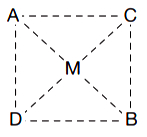
Solution
(C) Tetrahedral complexes do not show geometrical isomerism because,due to their symmetrical structure,the relative positions of the ligands are the same with respect to each other.
Square planar complexes of the type $M A_{3} B$ do not show geometrical isomerism because all possible spatial arrangements are equivalent.
Square planar complexes of the type $M A B C D$ show three geometrical isomers. These can be obtained by fixing the position of one ligand and placing any of the remaining three ligands at the trans-position one by one.
Square planar complexes of the type $M A_{3} B$ do not show geometrical isomerism because all possible spatial arrangements are equivalent.
Square planar complexes of the type $M A B C D$ show three geometrical isomers. These can be obtained by fixing the position of one ligand and placing any of the remaining three ligands at the trans-position one by one.
0 likes
View Solution726
EasyMCQ
What will be the value of $x$ in $Fe^{x+}$,if the magnetic moment,$\mu=\sqrt{24} \ BM$?
A
$3$
B
$0$
C
$1$
D
$2$
Solution
(D) The magnetic moment is given by the formula $\mu = \sqrt{n(n+2)} \ BM$,where $n$ is the number of unpaired electrons.
Given $\mu = \sqrt{24} \ BM$,we have $\sqrt{n(n+2)} = \sqrt{24}$.
Squaring both sides,$n(n+2) = 24$,which simplifies to $n^2 + 2n - 24 = 0$.
Solving the quadratic equation: $(n+6)(n-4) = 0$.
Since the number of electrons cannot be negative,$n = 4$.
The electronic configuration of $Fe$ $(Z=26)$ is $[Ar] 3d^6 4s^2$.
For $Fe^{2+}$,the configuration is $[Ar] 3d^6$,which has $4$ unpaired electrons.
Thus,$x = 2$.
Given $\mu = \sqrt{24} \ BM$,we have $\sqrt{n(n+2)} = \sqrt{24}$.
Squaring both sides,$n(n+2) = 24$,which simplifies to $n^2 + 2n - 24 = 0$.
Solving the quadratic equation: $(n+6)(n-4) = 0$.
Since the number of electrons cannot be negative,$n = 4$.
The electronic configuration of $Fe$ $(Z=26)$ is $[Ar] 3d^6 4s^2$.
For $Fe^{2+}$,the configuration is $[Ar] 3d^6$,which has $4$ unpaired electrons.
Thus,$x = 2$.
0 likes
View Solution727
EasyMCQ
The spin-only magnetic moment of $Fe^{2+}$ ion (in $BM$) is approximately
A
$4$
B
$7$
C
$5$
D
$6$
Solution
(C) The electronic configuration of $Fe^{2+}$ is $[Ar] 3d^{6}$.
It has $4$ unpaired electrons as shown in the $d$-orbital diagram:
$d^{6} = [\uparrow\downarrow] [\uparrow] [\uparrow] [\uparrow] [\uparrow]$
The spin-only magnetic moment is calculated using the formula:
$\mu = \sqrt{n(n+2)} \ BM$
Where $n$ is the number of unpaired electrons.
$\mu = \sqrt{4(4+2)} = \sqrt{24} \approx 4.89 \ BM$
Rounding to the nearest integer,the value is $5 \ BM$.
It has $4$ unpaired electrons as shown in the $d$-orbital diagram:
$d^{6} = [\uparrow\downarrow] [\uparrow] [\uparrow] [\uparrow] [\uparrow]$
The spin-only magnetic moment is calculated using the formula:
$\mu = \sqrt{n(n+2)} \ BM$
Where $n$ is the number of unpaired electrons.
$\mu = \sqrt{4(4+2)} = \sqrt{24} \approx 4.89 \ BM$
Rounding to the nearest integer,the value is $5 \ BM$.
0 likes
View Solution728
EasyMCQ
The "spin only" magnetic moment of $Ni^{2+}$ in aqueous solution would be [At. no. of $Ni = 28$]
A
$\sqrt{15} \ BM$
B
$\sqrt{2} \ BM$
C
$\sqrt{8} \ BM$
D
$\sqrt{6} \ BM$
Solution
(C) The electronic configuration of $Ni$ $(Z=28)$ is $[Ar] 3d^8 4s^2$.
$Ni^{2+}$ ion has the configuration $[Ar] 3d^8$.
In an aqueous solution,$Ni^{2+}$ forms the octahedral complex $[Ni(H_2O)_6]^{2+}$.
In the $3d$ subshell,the $8$ electrons are arranged as follows: three orbitals are doubly occupied and two orbitals are singly occupied.
Therefore,the number of unpaired electrons $(n)$ $= 2$.
The spin-only magnetic moment is calculated using the formula $\mu = \sqrt{n(n + 2)} \ BM$.
Substituting $n = 2$,we get $\mu = \sqrt{2(2 + 2)} = \sqrt{8} \ BM$.
$Ni^{2+}$ ion has the configuration $[Ar] 3d^8$.
In an aqueous solution,$Ni^{2+}$ forms the octahedral complex $[Ni(H_2O)_6]^{2+}$.
In the $3d$ subshell,the $8$ electrons are arranged as follows: three orbitals are doubly occupied and two orbitals are singly occupied.
Therefore,the number of unpaired electrons $(n)$ $= 2$.
The spin-only magnetic moment is calculated using the formula $\mu = \sqrt{n(n + 2)} \ BM$.
Substituting $n = 2$,we get $\mu = \sqrt{2(2 + 2)} = \sqrt{8} \ BM$.
0 likes
View Solution729
EasyMCQ
Which one of the following shows the highest magnetic moment?
A
$Fe^{2+}$
B
$Co^{2+}$
C
$Cr^{3+}$
D
$Ni^{2+}$
Solution
(A) The magnetic moment $(\mu)$ is related to the number of unpaired electrons $(n)$ by the formula: $\mu = \sqrt{n(n+2)} \ BM$.
Greater the number of unpaired electrons,higher is the magnetic moment.
Let us determine the number of unpaired electrons for each ion:
$Cr^{3+}$ $(3d^3)$: $n = 3$
$Fe^{2+}$ $(3d^6)$: $n = 4$
$Co^{2+}$ $(3d^7)$: $n = 3$
$Ni^{2+}$ $(3d^8)$: $n = 2$
Since $Fe^{2+}$ has the maximum number of unpaired electrons $(n=4)$,it exhibits the highest magnetic moment.
Greater the number of unpaired electrons,higher is the magnetic moment.
Let us determine the number of unpaired electrons for each ion:
$Cr^{3+}$ $(3d^3)$: $n = 3$
$Fe^{2+}$ $(3d^6)$: $n = 4$
$Co^{2+}$ $(3d^7)$: $n = 3$
$Ni^{2+}$ $(3d^8)$: $n = 2$
Since $Fe^{2+}$ has the maximum number of unpaired electrons $(n=4)$,it exhibits the highest magnetic moment.
0 likes
View Solution730
EasyMCQ
Square planar complex of the type $MAXBL$ (where $A, B, X$ and $L$ are unidentate ligands) shows which of the following sets of isomers?
A
Two cis and one trans
B
Two trans and one cis
C
Two cis and two trans
D
Three cis and one trans
Solution
(A) For a square planar complex of the type $M(abcd)$,there are $3$ possible geometric isomers.
In the case of $MAXBL$,we can fix one ligand (e.g.,$M$) and arrange the others.
There are $2$ isomers where two specific ligands are in the $cis$ position (adjacent) and $1$ isomer where they are in the $trans$ position (opposite).
Thus,the complex shows $2$ $cis$ and $1$ $trans$ isomers.
In the case of $MAXBL$,we can fix one ligand (e.g.,$M$) and arrange the others.
There are $2$ isomers where two specific ligands are in the $cis$ position (adjacent) and $1$ isomer where they are in the $trans$ position (opposite).
Thus,the complex shows $2$ $cis$ and $1$ $trans$ isomers.
0 likes
View Solution731
EasyMCQ
The magnetic moment of a transition metal ion is $\sqrt{15} \ \text{BM}$. Therefore,the number of unpaired electrons present in it,is:
A
$3$
B
$4$
C
$1$
D
$2$
Solution
(A) The magnetic moment $(\mu)$ is calculated using the spin-only formula: $\mu = \sqrt{n(n+2)} \ \text{BM}$,where $n$ is the number of unpaired electrons.
Given $\mu = \sqrt{15} \ \text{BM}$.
$\sqrt{n(n+2)} = \sqrt{15}$
$n(n+2) = 15$
$n^2 + 2n - 15 = 0$
$(n+5)(n-3) = 0$
Since $n$ cannot be negative,$n = 3$.
Given $\mu = \sqrt{15} \ \text{BM}$.
$\sqrt{n(n+2)} = \sqrt{15}$
$n(n+2) = 15$
$n^2 + 2n - 15 = 0$
$(n+5)(n-3) = 0$
Since $n$ cannot be negative,$n = 3$.
0 likes
View Solution732
MediumMCQ
Arrange the following in order of increasing number of unpaired electrons in them:
$i$. $[Fe(CN)_6]^{3-}$
$ii$. $[MnCl_6]^{3-}$
$iii$. $[FeF_6]^{3-}$
$iv$. $[Co(NH_3)_6]^{3+}$
$i$. $[Fe(CN)_6]^{3-}$
$ii$. $[MnCl_6]^{3-}$
$iii$. $[FeF_6]^{3-}$
$iv$. $[Co(NH_3)_6]^{3+}$
A
$i, iv, ii, iii$
B
$iv, i, iii, ii$
C
$iv, i, ii, iii$
D
$i, iv, iii, ii$
Solution
(C) $(i)$ $[Fe(CN)_6]^{3-}$: $Fe$ is in $+3$ oxidation state $(3d^5)$. $CN^-$ is a strong-field ligand,causing pairing. Unpaired electrons = $1$.
$(ii)$ $[MnCl_6]^{3-}$: $Mn$ is in $+3$ oxidation state $(3d^4)$. $Cl^-$ is a weak-field ligand. Unpaired electrons = $4$.
$(iii)$ $[FeF_6]^{3-}$: $Fe$ is in $+3$ oxidation state $(3d^5)$. $F^-$ is a weak-field ligand. Unpaired electrons = $5$.
$(iv)$ $[Co(NH_3)_6]^{3+}$: $Co$ is in $+3$ oxidation state $(3d^6)$. $NH_3$ is a strong-field ligand,causing pairing. Unpaired electrons = $0$.
Increasing order of unpaired electrons: $(iv) < (i) < (ii) < (iii)$.
$(ii)$ $[MnCl_6]^{3-}$: $Mn$ is in $+3$ oxidation state $(3d^4)$. $Cl^-$ is a weak-field ligand. Unpaired electrons = $4$.
$(iii)$ $[FeF_6]^{3-}$: $Fe$ is in $+3$ oxidation state $(3d^5)$. $F^-$ is a weak-field ligand. Unpaired electrons = $5$.
$(iv)$ $[Co(NH_3)_6]^{3+}$: $Co$ is in $+3$ oxidation state $(3d^6)$. $NH_3$ is a strong-field ligand,causing pairing. Unpaired electrons = $0$.
Increasing order of unpaired electrons: $(iv) < (i) < (ii) < (iii)$.
0 likes
View Solution733
MediumMCQ
Which of the following complexes exhibit geometrical isomerism?
$I$) $[Co(en)(NH_3)_2 Cl_2] Cl$
$II$) $[Co(NH_3)_4 Cl_2] Cl$
$III$) $[Co(en)_3] Cl_3$
$IV$) $[Co(en)_2 Cl_2] Br$
$I$) $[Co(en)(NH_3)_2 Cl_2] Cl$
$II$) $[Co(NH_3)_4 Cl_2] Cl$
$III$) $[Co(en)_3] Cl_3$
$IV$) $[Co(en)_2 Cl_2] Br$
A
$I, II \& III$ only
B
$II, III \& IV$ only
C
$I, II \& IV$ only
D
$II \& III$ only
Solution
(C) Geometrical isomerism in octahedral complexes occurs when ligands are arranged in different spatial orientations (cis and trans forms).
$I$) $[Co(en)(NH_3)_2 Cl_2] Cl$: This complex has the form $[M(AA)(a)_2(b)_2]$,which exhibits geometrical isomerism.
$II$) $[Co(NH_3)_4 Cl_2] Cl$: This complex has the form $[M(a)_4(b)_2]$,which exhibits cis and trans geometrical isomers.
$III$) $[Co(en)_3] Cl_3$: This complex has the form $[M(AA)_3]$. It does not show geometrical isomerism because all positions are equivalent due to the symmetry of the bidentate ligands.
$IV$) $[Co(en)_2 Cl_2] Br$: This complex has the form $[M(AA)_2(b)_2]$,which exhibits cis and trans geometrical isomers.
Therefore,complexes $I, II,$ and $IV$ exhibit geometrical isomerism.
$I$) $[Co(en)(NH_3)_2 Cl_2] Cl$: This complex has the form $[M(AA)(a)_2(b)_2]$,which exhibits geometrical isomerism.
$II$) $[Co(NH_3)_4 Cl_2] Cl$: This complex has the form $[M(a)_4(b)_2]$,which exhibits cis and trans geometrical isomers.
$III$) $[Co(en)_3] Cl_3$: This complex has the form $[M(AA)_3]$. It does not show geometrical isomerism because all positions are equivalent due to the symmetry of the bidentate ligands.
$IV$) $[Co(en)_2 Cl_2] Br$: This complex has the form $[M(AA)_2(b)_2]$,which exhibits cis and trans geometrical isomers.
Therefore,complexes $I, II,$ and $IV$ exhibit geometrical isomerism.
0 likes
View Solution734
MediumMCQ
Which of the following exhibit ionization isomerism?
$I) [Cr(NH_3)_4Cl_2]Cl$
$II) [Ti(H_2O)_5Cl](NO_3)_2$
$III) [Pt(en)(NH_3)Cl]NO_3$
$IV) [Co(NH_3)_4(NO_3)_2]NO_3$
$I) [Cr(NH_3)_4Cl_2]Cl$
$II) [Ti(H_2O)_5Cl](NO_3)_2$
$III) [Pt(en)(NH_3)Cl]NO_3$
$IV) [Co(NH_3)_4(NO_3)_2]NO_3$
A
$II$ & $III$ only
B
$I$ & $II$ only
C
$II$ & $IV$ only
D
$III$ & $IV$ only
Solution
(A) Ionization isomerism occurs when the counter ion in a coordination complex is a potential ligand and can displace a ligand from the coordination sphere.
$I) [Cr(NH_3)_4Cl_2]Cl$ can form $[Cr(NH_3)_4Cl_3]$ (No,$Cl$ is already inside).
$II) [Ti(H_2O)_5Cl](NO_3)_2$ can form $[Ti(H_2O)_5(NO_3)]Cl(NO_3)$ or $[Ti(H_2O)_5(NO_3)_2]Cl$. This exhibits ionization isomerism.
$III) [Pt(en)(NH_3)Cl]NO_3$ can form $[Pt(en)(NH_3)(NO_3)]Cl$. This exhibits ionization isomerism.
$IV) [Co(NH_3)_4(NO_3)_2]NO_3$ can form $[Co(NH_3)_4(NO_3)_3]$. This exhibits ionization isomerism.
However,looking at the options provided,the most appropriate pair exhibiting this behavior clearly is $II$ and $III$.
$I) [Cr(NH_3)_4Cl_2]Cl$ can form $[Cr(NH_3)_4Cl_3]$ (No,$Cl$ is already inside).
$II) [Ti(H_2O)_5Cl](NO_3)_2$ can form $[Ti(H_2O)_5(NO_3)]Cl(NO_3)$ or $[Ti(H_2O)_5(NO_3)_2]Cl$. This exhibits ionization isomerism.
$III) [Pt(en)(NH_3)Cl]NO_3$ can form $[Pt(en)(NH_3)(NO_3)]Cl$. This exhibits ionization isomerism.
$IV) [Co(NH_3)_4(NO_3)_2]NO_3$ can form $[Co(NH_3)_4(NO_3)_3]$. This exhibits ionization isomerism.
However,looking at the options provided,the most appropriate pair exhibiting this behavior clearly is $II$ and $III$.
0 likes
View Solution735
MediumMCQ
Which of the following does not show optical isomerism?
A
$Cis-[Cr Cl_2(C_2 O_4)_2]^{3-}$
B
$[Pt Cl_2(en)_2]^{2+}$
C
$[Co(NH_3)_3(NO_2)_3]$
D
$[Co(en)_3]^{3+}$
Solution
(C) To be optically active,a molecule must not possess any of the following symmetry elements:
$1-$ Centre of symmetry
$2-$ Plane of symmetry $(POS)$
Analysis of the given complexes:
$A) Cis-[Cr Cl_2(C_2 O_4)_2]^{3-}$: This complex lacks a plane of symmetry and is optically active.
$B) [Pt Cl_2(en)_2]^{2+}$: The $cis$-isomer of this complex lacks a plane of symmetry and is optically active.
$C) [Co(NH_3)_3(NO_2)_3]$: This complex exists in $fac$ and $mer$ forms. Both forms possess a plane of symmetry,making them optically inactive.
$D) [Co(en)_3]^{3+}$: This complex is a tris-chelated species and is optically active (chiral).
Therefore,the complex that does not show optical isomerism is $[Co(NH_3)_3(NO_2)_3]$.
$1-$ Centre of symmetry
$2-$ Plane of symmetry $(POS)$
Analysis of the given complexes:
$A) Cis-[Cr Cl_2(C_2 O_4)_2]^{3-}$: This complex lacks a plane of symmetry and is optically active.
$B) [Pt Cl_2(en)_2]^{2+}$: The $cis$-isomer of this complex lacks a plane of symmetry and is optically active.
$C) [Co(NH_3)_3(NO_2)_3]$: This complex exists in $fac$ and $mer$ forms. Both forms possess a plane of symmetry,making them optically inactive.
$D) [Co(en)_3]^{3+}$: This complex is a tris-chelated species and is optically active (chiral).
Therefore,the complex that does not show optical isomerism is $[Co(NH_3)_3(NO_2)_3]$.
0 likes
View Solution736
MediumMCQ
Which of the following types of isomerism is exhibited by $[Co(NH_3)_5(NO_2)](NO_3)_2$?
$i$. Optical
$ii$. Linkage
$iii$. Ionization
$iv$. Coordination
$i$. Optical
$ii$. Linkage
$iii$. Ionization
$iv$. Coordination
A
$ii, iii$ only
B
$i, ii, iii$ only
C
$i, iii$ only
D
$ii, iv$ only
Solution
(A) The complex $[Co(NH_3)_5(NO_2)](NO_3)_2$ does not exhibit optical isomerism because it possesses a plane of symmetry.
Linkage isomerism is exhibited due to the ambidentate ligand $NO_2^-$,which can coordinate through $N$ or $O$ (forming $[Co(NH_3)_5(NO_2)]^{2+}$ and $[Co(NH_3)_5(ONO)]^{2+}$).
Ionization isomerism is exhibited because the $NO_2^-$ ligand inside the coordination sphere can exchange with the $NO_3^-$ ion outside the sphere (forming $[Co(NH_3)_5(NO_2)](NO_3)_2$ and $[Co(NH_3)_5(NO_3)](NO_2)(NO_3)$).
Coordination isomerism requires both cationic and anionic entities to be coordination complexes,which is not the case here.
Therefore,the complex exhibits linkage and ionization isomerism.
Linkage isomerism is exhibited due to the ambidentate ligand $NO_2^-$,which can coordinate through $N$ or $O$ (forming $[Co(NH_3)_5(NO_2)]^{2+}$ and $[Co(NH_3)_5(ONO)]^{2+}$).
Ionization isomerism is exhibited because the $NO_2^-$ ligand inside the coordination sphere can exchange with the $NO_3^-$ ion outside the sphere (forming $[Co(NH_3)_5(NO_2)](NO_3)_2$ and $[Co(NH_3)_5(NO_3)](NO_2)(NO_3)$).
Coordination isomerism requires both cationic and anionic entities to be coordination complexes,which is not the case here.
Therefore,the complex exhibits linkage and ionization isomerism.
0 likes
View Solution737
MediumMCQ
Which of the following complex ions shows geometrical isomerism?
A
$\left[Cr(H_2O)_4Cl_2\right]^{+}$
B
$\left[Pt(NH_3)_3Cl\right]^{+}$
C
$\left[Co(NH_3)_6\right]^{3+}$
D
$\left[Co(CN)_5(NC)\right]^{3-}$
Solution
(A) The complex ion $\left[Cr(H_2O)_4Cl_2\right]^{+}$ exhibits geometrical isomerism.
It is an octahedral complex of the type $\left[Ma_4b_2\right]$,where $M = Cr$,$a = H_2O$,and $b = Cl$.
In this type of complex,the two $b$ ligands can be adjacent to each other (cis-isomer) or opposite to each other (trans-isomer).
Other options do not show geometrical isomerism:
$\left[Pt(NH_3)_3Cl\right]^{+}$ is of the type $\left[Ma_3b\right]$ (square planar),which does not show geometrical isomerism.
$\left[Co(NH_3)_6\right]^{3+}$ is of the type $\left[Ma_6\right]$,which is highly symmetrical and does not show isomerism.
$\left[Co(CN)_5(NC)\right]^{3-}$ is of the type $\left[Ma_5b\right]$,which does not show geometrical isomerism.
It is an octahedral complex of the type $\left[Ma_4b_2\right]$,where $M = Cr$,$a = H_2O$,and $b = Cl$.
In this type of complex,the two $b$ ligands can be adjacent to each other (cis-isomer) or opposite to each other (trans-isomer).
Other options do not show geometrical isomerism:
$\left[Pt(NH_3)_3Cl\right]^{+}$ is of the type $\left[Ma_3b\right]$ (square planar),which does not show geometrical isomerism.
$\left[Co(NH_3)_6\right]^{3+}$ is of the type $\left[Ma_6\right]$,which is highly symmetrical and does not show isomerism.
$\left[Co(CN)_5(NC)\right]^{3-}$ is of the type $\left[Ma_5b\right]$,which does not show geometrical isomerism.
0 likes
View Solution738
MediumMCQ
Identify the complex which exhibits optical isomerism.
A
$[Co(NH_3)_5(SO_4)]Br$
B
$[Co(NH_3)_5Cl]Cl_2$
C
$[Co(en)_3]Cl_3$
D
$[Co(NH_3)_4(NO_2)Cl]Cl$
Solution
(C) Optical isomerism is exhibited by complexes that lack a plane of symmetry and a center of symmetry (chiral complexes).
For octahedral complexes of the type $[M(AA)_3]$,where $AA$ is a bidentate ligand like ethylenediamine $(en)$,the complex exists as a pair of enantiomers (non-superimposable mirror images).
In the given options,$[Co(en)_3]Cl_3$ contains three bidentate ligands,which creates a chiral environment around the central metal ion,thus exhibiting optical isomerism.
The other complexes listed are either of the type $[MA_5B]$ or $[MA_4BC]$,which generally exhibit geometrical isomerism but not optical isomerism.
For octahedral complexes of the type $[M(AA)_3]$,where $AA$ is a bidentate ligand like ethylenediamine $(en)$,the complex exists as a pair of enantiomers (non-superimposable mirror images).
In the given options,$[Co(en)_3]Cl_3$ contains three bidentate ligands,which creates a chiral environment around the central metal ion,thus exhibiting optical isomerism.
The other complexes listed are either of the type $[MA_5B]$ or $[MA_4BC]$,which generally exhibit geometrical isomerism but not optical isomerism.
0 likes
View Solution739
MediumMCQ
The complex which does not exhibit geometrical isomerism is
A
$[Co(NH_3)_5 Cl] Cl_2$
B
$[Co(NH_3)_4 Cl_2]$
C
$[Co(NH_3)_3(NO_2)_3]$
D
$[Co(en)_2 Cl_2] Cl$
Solution
(A) Geometrical isomerism is observed in coordination complexes where ligands can be arranged in different spatial positions relative to each other.
For octahedral complexes of the type $[MA_5B]$,geometrical isomerism is not possible because all positions are equivalent relative to the unique ligand $B$.
In the complex $[Co(NH_3)_5 Cl] Cl_2$,the coordination sphere is $[Co(NH_3)_5 Cl]^{2+}$,which is of the type $[MA_5B]$.
Therefore,it does not exhibit geometrical isomerism.
In contrast,$[Co(NH_3)_4 Cl_2]^+$ (type $[MA_4B_2]$),$[Co(NH_3)_3(NO_2)_3]$ (type $[MA_3B_3]$),and $[Co(en)_2 Cl_2]^+$ (type $[M(AA)_2B_2]$) all exhibit geometrical isomerism (cis-trans or fac-mer).
For octahedral complexes of the type $[MA_5B]$,geometrical isomerism is not possible because all positions are equivalent relative to the unique ligand $B$.
In the complex $[Co(NH_3)_5 Cl] Cl_2$,the coordination sphere is $[Co(NH_3)_5 Cl]^{2+}$,which is of the type $[MA_5B]$.
Therefore,it does not exhibit geometrical isomerism.
In contrast,$[Co(NH_3)_4 Cl_2]^+$ (type $[MA_4B_2]$),$[Co(NH_3)_3(NO_2)_3]$ (type $[MA_3B_3]$),and $[Co(en)_2 Cl_2]^+$ (type $[M(AA)_2B_2]$) all exhibit geometrical isomerism (cis-trans or fac-mer).
0 likes
View Solution740
EasyMCQ
$[Co(NH_3)_5SO_4]Br$ and $[Co(NH_3)_5Br]SO_4$ are a pair of which isomers?
A
Ionisation
B
Ligand
C
Coordination
D
Hydrate
Solution
(A) The given compounds are:
$1. [Co(NH_3)_5SO_4]Br \rightleftharpoons [Co(NH_3)_5SO_4]^+ + Br^-$
$2. [Co(NH_3)_5Br]SO_4 \rightleftharpoons [Co(NH_3)_5Br]^{2+} + SO_4^{2-}$
Since both compounds have the same molecular formula but produce different ions in an aqueous solution,they exhibit ionisation isomerism.
$1. [Co(NH_3)_5SO_4]Br \rightleftharpoons [Co(NH_3)_5SO_4]^+ + Br^-$
$2. [Co(NH_3)_5Br]SO_4 \rightleftharpoons [Co(NH_3)_5Br]^{2+} + SO_4^{2-}$
Since both compounds have the same molecular formula but produce different ions in an aqueous solution,they exhibit ionisation isomerism.
0 likes
View Solution741
MediumMCQ
Identify the complex ion with spin only magnetic moment of $4.90 \ BM$.
A
$[Co(NH_3)_6]^{3+}$
B
$[Cr(NH_3)_6]^{3+}$
C
$[Mn(CN)_6]^{3-}$
D
$[MnCl_6]^{3-}$
Solution
(D) The spin-only magnetic moment $(\mu_{eff})$ is given by the formula $\mu = \sqrt{n(n+2)} \ BM$,where $n$ is the number of unpaired electrons.
For $\mu = 4.90 \ BM$,$n$ must be $4$ (since $\sqrt{4(4+2)} = \sqrt{24} \approx 4.90$).
$A$: $[Co(NH_3)_6]^{3+}$: $Co^{3+}$ is $d^6$. $NH_3$ is a strong field ligand,causing pairing. $n = 0$.
$B$: $[Cr(NH_3)_6]^{3+}$: $Cr^{3+}$ is $d^3$. $n = 3$.
$C$: $[Mn(CN)_6]^{3-}$: $Mn^{3+}$ is $d^4$. $CN^{-}$ is a strong field ligand,causing pairing. $n = 2$.
$D$: $[MnCl_6]^{3-}$: $Mn^{3+}$ is $d^4$. $Cl^{-}$ is a weak field ligand,no pairing occurs. The configuration is $t_{2g}^3 e_g^1$,resulting in $n = 4$ unpaired electrons.
Therefore,$[MnCl_6]^{3-}$ has a magnetic moment of $4.90 \ BM$.
For $\mu = 4.90 \ BM$,$n$ must be $4$ (since $\sqrt{4(4+2)} = \sqrt{24} \approx 4.90$).
$A$: $[Co(NH_3)_6]^{3+}$: $Co^{3+}$ is $d^6$. $NH_3$ is a strong field ligand,causing pairing. $n = 0$.
$B$: $[Cr(NH_3)_6]^{3+}$: $Cr^{3+}$ is $d^3$. $n = 3$.
$C$: $[Mn(CN)_6]^{3-}$: $Mn^{3+}$ is $d^4$. $CN^{-}$ is a strong field ligand,causing pairing. $n = 2$.
$D$: $[MnCl_6]^{3-}$: $Mn^{3+}$ is $d^4$. $Cl^{-}$ is a weak field ligand,no pairing occurs. The configuration is $t_{2g}^3 e_g^1$,resulting in $n = 4$ unpaired electrons.
Therefore,$[MnCl_6]^{3-}$ has a magnetic moment of $4.90 \ BM$.
0 likes
View Solution742
EasyMCQ
The spin-only magnetic moments of the complexes $[Mn(CN)_6]^{3-}$ and $[Co(C_2O_4)_3]^{3-}$ are respectively:
A
$2.84 \ BM, 0 \ BM$
B
$0 \ BM, 2.84 \ BM$
C
$0 \ BM, 3.87 \ BM$
D
$5.92 \ BM, 2.84 \ BM$
Solution
(A) In $[Mn(CN)_6]^{3-}$,the oxidation state of $Mn$ is $+3$. The electronic configuration of $Mn^{3+}$ is $3d^4$. Since $CN^-$ is a strong field ligand,it causes pairing of electrons in $d$-orbitals. Thus,the configuration becomes $t_{2g}^4 e_g^0$,resulting in $n = 2$ unpaired electrons.
$\mu_{\text{spin only}} = \sqrt{n(n+2)} \ BM = \sqrt{2(2+2)} \ BM = \sqrt{8} \ BM \approx 2.84 \ BM$.
In $[Co(C_2O_4)_3]^{3-}$,the oxidation state of $Co$ is $+3$. The electronic configuration of $Co^{3+}$ is $3d^6$. Since $C_2O_4^{2-}$ is a chelating ligand,in the octahedral field,$Co^{3+}$ $(d^6)$ forms a low-spin complex with $t_{2g}^6 e_g^0$ configuration,resulting in $n = 0$ unpaired electrons.
$\mu_{\text{spin only}} = \sqrt{0(0+2)} \ BM = 0 \ BM$.
$\mu_{\text{spin only}} = \sqrt{n(n+2)} \ BM = \sqrt{2(2+2)} \ BM = \sqrt{8} \ BM \approx 2.84 \ BM$.
In $[Co(C_2O_4)_3]^{3-}$,the oxidation state of $Co$ is $+3$. The electronic configuration of $Co^{3+}$ is $3d^6$. Since $C_2O_4^{2-}$ is a chelating ligand,in the octahedral field,$Co^{3+}$ $(d^6)$ forms a low-spin complex with $t_{2g}^6 e_g^0$ configuration,resulting in $n = 0$ unpaired electrons.
$\mu_{\text{spin only}} = \sqrt{0(0+2)} \ BM = 0 \ BM$.
0 likes
View Solution743
MediumMCQ
Which complex among the following is most paramagnetic?
A
$[Co(NH_3)_6]^{2+}$
B
$[Co(NH_3)_6]^{3+}$
C
$[Co(H_2O)_6]^{2+}$
D
$[Co(H_2O)_6]^{3+}$
Solution
(C) The paramagnetism of a complex depends on the number of unpaired electrons $(n)$.
$1.$ In $[Co(NH_3)_6]^{2+}$,$Co$ is in $+2$ oxidation state. $Co^{2+} = [Ar] 3d^7$. $NH_3$ is a strong field ligand,so $n = 1$.
$2.$ In $[Co(NH_3)_6]^{3+}$,$Co$ is in $+3$ oxidation state. $Co^{3+} = [Ar] 3d^6$. $NH_3$ is a strong field ligand,so $n = 0$.
$3.$ In $[Co(H_2O)_6]^{2+}$,$Co$ is in $+2$ oxidation state. $Co^{2+} = [Ar] 3d^7$. $H_2O$ is a weak field ligand,so $n = 3$.
$4.$ In $[Co(H_2O)_6]^{3+}$,$Co$ is in $+3$ oxidation state. $Co^{3+} = [Ar] 3d^6$. $H_2O$ acts as a strong field ligand for $Co^{3+}$,so $n = 0$.
Since $[Co(H_2O)_6]^{2+}$ has the maximum number of unpaired electrons $(n=3)$,it is the most paramagnetic.
$1.$ In $[Co(NH_3)_6]^{2+}$,$Co$ is in $+2$ oxidation state. $Co^{2+} = [Ar] 3d^7$. $NH_3$ is a strong field ligand,so $n = 1$.
$2.$ In $[Co(NH_3)_6]^{3+}$,$Co$ is in $+3$ oxidation state. $Co^{3+} = [Ar] 3d^6$. $NH_3$ is a strong field ligand,so $n = 0$.
$3.$ In $[Co(H_2O)_6]^{2+}$,$Co$ is in $+2$ oxidation state. $Co^{2+} = [Ar] 3d^7$. $H_2O$ is a weak field ligand,so $n = 3$.
$4.$ In $[Co(H_2O)_6]^{3+}$,$Co$ is in $+3$ oxidation state. $Co^{3+} = [Ar] 3d^6$. $H_2O$ acts as a strong field ligand for $Co^{3+}$,so $n = 0$.
Since $[Co(H_2O)_6]^{2+}$ has the maximum number of unpaired electrons $(n=3)$,it is the most paramagnetic.
0 likes
View Solution744
EasyMCQ
The correct order regarding the number of unpaired electrons present in the following complexes is
$I. [Fe(CN)_6]^{4-} \quad II. [Fe(H_2O)_6]^{2+} \quad III. [Co(H_2O)_6]^{2+}$
$I. [Fe(CN)_6]^{4-} \quad II. [Fe(H_2O)_6]^{2+} \quad III. [Co(H_2O)_6]^{2+}$
A
$II > III > I$
B
$II > I > III$
C
$I > II > III$
D
$III > II > I$
Solution
(A) $I. [Fe(CN)_6]^{4-}$: $Fe$ is in $+2$ oxidation state $(d^6)$. $CN^-$ is a strong field ligand,causing pairing of electrons. Number of unpaired electrons = $0$.
$II. [Fe(H_2O)_6]^{2+}$: $Fe$ is in $+2$ oxidation state $(d^6)$. $H_2O$ is a weak field ligand,no pairing occurs. Configuration is $t_{2g}^4 e_g^2$. Number of unpaired electrons = $4$.
$III. [Co(H_2O)_6]^{2+}$: $Co$ is in $+2$ oxidation state $(d^7)$. $H_2O$ is a weak field ligand. Configuration is $t_{2g}^5 e_g^2$. Number of unpaired electrons = $3$.
Thus,the correct order is $II (4) > III (3) > I (0)$.
$II. [Fe(H_2O)_6]^{2+}$: $Fe$ is in $+2$ oxidation state $(d^6)$. $H_2O$ is a weak field ligand,no pairing occurs. Configuration is $t_{2g}^4 e_g^2$. Number of unpaired electrons = $4$.
$III. [Co(H_2O)_6]^{2+}$: $Co$ is in $+2$ oxidation state $(d^7)$. $H_2O$ is a weak field ligand. Configuration is $t_{2g}^5 e_g^2$. Number of unpaired electrons = $3$.
Thus,the correct order is $II (4) > III (3) > I (0)$.
0 likes
View Solution745
MediumMCQ
Atomic numbers of $Cr$,$Fe$,and $Co$ are $24$,$26$,and $27$ respectively. Which of the following inner orbital octahedral complexes are paramagnetic?
A
$[Co(NH_3)_6]^{3+}$
B
$[Co(CN)_6]^{3-}$
C
$[Fe(CN)_6]^{4-}$
D
$[Cr(CN)_6]^{3-}$
Solution
(D) To determine which complex is paramagnetic,we analyze the electronic configuration of the central metal ion in each complex:
$1$. $[Co(NH_3)_6]^{3+}$: $Co^{3+}$ is $3d^6$. $NH_3$ is a strong field ligand,causing pairing. All electrons are paired $(t_{2g}^6 e_g^0)$,so it is diamagnetic.
$2$. $[Co(CN)_6]^{3-}$: $Co^{3+}$ is $3d^6$. $CN^-$ is a strong field ligand,causing pairing. All electrons are paired $(t_{2g}^6 e_g^0)$,so it is diamagnetic.
$3$. $[Fe(CN)_6]^{4-}$: $Fe^{2+}$ is $3d^6$. $CN^-$ is a strong field ligand,causing pairing. All electrons are paired $(t_{2g}^6 e_g^0)$,so it is diamagnetic.
$4$. $[Cr(CN)_6]^{3-}$: $Cr^{3+}$ is $3d^3$. The configuration is $t_{2g}^3 e_g^0$. There are $3$ unpaired electrons in the $3d$ orbitals. Thus,it is paramagnetic.
Therefore,the correct option is $D$.
$1$. $[Co(NH_3)_6]^{3+}$: $Co^{3+}$ is $3d^6$. $NH_3$ is a strong field ligand,causing pairing. All electrons are paired $(t_{2g}^6 e_g^0)$,so it is diamagnetic.
$2$. $[Co(CN)_6]^{3-}$: $Co^{3+}$ is $3d^6$. $CN^-$ is a strong field ligand,causing pairing. All electrons are paired $(t_{2g}^6 e_g^0)$,so it is diamagnetic.
$3$. $[Fe(CN)_6]^{4-}$: $Fe^{2+}$ is $3d^6$. $CN^-$ is a strong field ligand,causing pairing. All electrons are paired $(t_{2g}^6 e_g^0)$,so it is diamagnetic.
$4$. $[Cr(CN)_6]^{3-}$: $Cr^{3+}$ is $3d^3$. The configuration is $t_{2g}^3 e_g^0$. There are $3$ unpaired electrons in the $3d$ orbitals. Thus,it is paramagnetic.
Therefore,the correct option is $D$.
0 likes
View Solution746
EasyMCQ
Which among the following is most paramagnetic?
A
$[Cr(H_2O)_6]^{3+}$
B
$[Fe(H_2O)_6]^{2+}$
C
$[Cu(H_2O)_6]^{2+}$
D
$[Zn(H_2O)_6]^{2+}$
Solution
(B) Paramagnetic character depends on the number of unpaired electrons in the $d$-subshell.
In these complex ions,$H_2O$ is a weak field ligand,so the electrons remain unpaired according to Hund's rule:
$(a)$ In $[Cr(H_2O)_6]^{3+}$,$Cr^{3+}$ has a $3d^3$ configuration. Number of unpaired electrons $= 3$.
$(b)$ In $[Fe(H_2O)_6]^{2+}$,$Fe^{2+}$ has a $3d^6$ configuration. In an octahedral field,this corresponds to $t_{2g}^4 e_g^2$,resulting in $4$ unpaired electrons.
$(c)$ In $[Cu(H_2O)_6]^{2+}$,$Cu^{2+}$ has a $3d^9$ configuration. Number of unpaired electrons $= 1$.
$(d)$ In $[Zn(H_2O)_6]^{2+}$,$Zn^{2+}$ has a $3d^{10}$ configuration. Number of unpaired electrons $= 0$.
Since paramagnetic character is directly proportional to the number of unpaired electrons,$[Fe(H_2O)_6]^{2+}$ is the most paramagnetic.
In these complex ions,$H_2O$ is a weak field ligand,so the electrons remain unpaired according to Hund's rule:
$(a)$ In $[Cr(H_2O)_6]^{3+}$,$Cr^{3+}$ has a $3d^3$ configuration. Number of unpaired electrons $= 3$.
$(b)$ In $[Fe(H_2O)_6]^{2+}$,$Fe^{2+}$ has a $3d^6$ configuration. In an octahedral field,this corresponds to $t_{2g}^4 e_g^2$,resulting in $4$ unpaired electrons.
$(c)$ In $[Cu(H_2O)_6]^{2+}$,$Cu^{2+}$ has a $3d^9$ configuration. Number of unpaired electrons $= 1$.
$(d)$ In $[Zn(H_2O)_6]^{2+}$,$Zn^{2+}$ has a $3d^{10}$ configuration. Number of unpaired electrons $= 0$.
Since paramagnetic character is directly proportional to the number of unpaired electrons,$[Fe(H_2O)_6]^{2+}$ is the most paramagnetic.
0 likes
View Solution747
EasyMCQ
Which of the following outer octahedral complexes have the same number of unpaired electrons?
$1$. $[MnCl_6]^{3-}$
$2$. $[FeF_6]^{3-}$
$3$. $[CoF_6]^{3-}$
$4$. $[Ni(NH_3)_6]^{2+}$
$1$. $[MnCl_6]^{3-}$
$2$. $[FeF_6]^{3-}$
$3$. $[CoF_6]^{3-}$
$4$. $[Ni(NH_3)_6]^{2+}$
A
$1$ and $3$
B
$1$ and $2$
C
$3$ and $4$
D
$2$ and $3$
Solution
(A) The complexes are octahedral and involve weak field ligands,resulting in high spin (outer orbital) complexes.
$1$. $[MnCl_6]^{3-}$: $Mn^{3+}$ is $d^4$. With weak field ligands,all $4$ electrons remain unpaired $(n = 4)$.
$2$. $[FeF_6]^{3-}$: $Fe^{3+}$ is $d^5$. With weak field ligands,all $5$ electrons remain unpaired $(n = 5)$.
$3$. $[CoF_6]^{3-}$: $Co^{3+}$ is $d^6$. With weak field ligands,the configuration is $t_{2g}^4 e_g^2$,resulting in $4$ unpaired electrons $(n = 4)$.
$4$. $[Ni(NH_3)_6]^{2+}$: $Ni^{2+}$ is $d^8$. The configuration is $t_{2g}^6 e_g^2$,resulting in $2$ unpaired electrons $(n = 2)$.
Thus,complexes $1$ and $3$ have the same number of unpaired electrons $(n = 4)$.
$1$. $[MnCl_6]^{3-}$: $Mn^{3+}$ is $d^4$. With weak field ligands,all $4$ electrons remain unpaired $(n = 4)$.
$2$. $[FeF_6]^{3-}$: $Fe^{3+}$ is $d^5$. With weak field ligands,all $5$ electrons remain unpaired $(n = 5)$.
$3$. $[CoF_6]^{3-}$: $Co^{3+}$ is $d^6$. With weak field ligands,the configuration is $t_{2g}^4 e_g^2$,resulting in $4$ unpaired electrons $(n = 4)$.
$4$. $[Ni(NH_3)_6]^{2+}$: $Ni^{2+}$ is $d^8$. The configuration is $t_{2g}^6 e_g^2$,resulting in $2$ unpaired electrons $(n = 2)$.
Thus,complexes $1$ and $3$ have the same number of unpaired electrons $(n = 4)$.
0 likes
View Solution748
MediumMCQ
Which complex among the following has the highest value of spin only magnetic moment?
$[Fe(CN)_6]^{3-}, [Fe(CN)_6]^{4-}, [Ni(CN)_4]^{2-}, [NiCl_4]^{2-}$
$[Fe(CN)_6]^{3-}, [Fe(CN)_6]^{4-}, [Ni(CN)_4]^{2-}, [NiCl_4]^{2-}$
A
$[Fe(CN)_6]^{3-}$
B
$[Fe(CN)_6]^{4-}$
C
$[Ni(CN)_4]^{2-}$
D
$[NiCl_4]^{2-}$
Solution
(D) To determine the spin only magnetic moment,we calculate the number of unpaired electrons $(n)$ in each complex:
$1$. $[Fe(CN)_6]^{3-}$: $Fe^{3+}$ is $3d^5$. $CN^-$ is a strong field ligand,causing pairing. Configuration: $t_{2g}^5, e_g^0$. Unpaired electrons $(n)$ = $1$.
$2$. $[Fe(CN)_6]^{4-}$: $Fe^{2+}$ is $3d^6$. $CN^-$ is a strong field ligand. Configuration: $t_{2g}^6, e_g^0$. Unpaired electrons $(n)$ = $0$.
$3$. $[Ni(CN)_4]^{2-}$: $Ni^{2+}$ is $3d^8$. $CN^-$ is a strong field ligand,forcing pairing to form $dsp^2$ hybridisation. Unpaired electrons $(n)$ = $0$.
$4$. $[NiCl_4]^{2-}$: $Ni^{2+}$ is $3d^8$. $Cl^-$ is a weak field ligand,no pairing occurs. Configuration: $3d^8$ with $sp^3$ hybridisation. Unpaired electrons $(n)$ = $2$.
Since magnetic moment $\mu = \sqrt{n(n+2)} \ BM$,the complex with the highest number of unpaired electrons $(n=2)$ has the highest magnetic moment.
Therefore,$[NiCl_4]^{2-}$ has the highest value.
$1$. $[Fe(CN)_6]^{3-}$: $Fe^{3+}$ is $3d^5$. $CN^-$ is a strong field ligand,causing pairing. Configuration: $t_{2g}^5, e_g^0$. Unpaired electrons $(n)$ = $1$.
$2$. $[Fe(CN)_6]^{4-}$: $Fe^{2+}$ is $3d^6$. $CN^-$ is a strong field ligand. Configuration: $t_{2g}^6, e_g^0$. Unpaired electrons $(n)$ = $0$.
$3$. $[Ni(CN)_4]^{2-}$: $Ni^{2+}$ is $3d^8$. $CN^-$ is a strong field ligand,forcing pairing to form $dsp^2$ hybridisation. Unpaired electrons $(n)$ = $0$.
$4$. $[NiCl_4]^{2-}$: $Ni^{2+}$ is $3d^8$. $Cl^-$ is a weak field ligand,no pairing occurs. Configuration: $3d^8$ with $sp^3$ hybridisation. Unpaired electrons $(n)$ = $2$.
Since magnetic moment $\mu = \sqrt{n(n+2)} \ BM$,the complex with the highest number of unpaired electrons $(n=2)$ has the highest magnetic moment.
Therefore,$[NiCl_4]^{2-}$ has the highest value.
0 likes
View Solution749
MediumMCQ
Which one of the following coordination complexes exhibits the lowest value of magnetic moment (in $BM$)?
A
$\left[Cr(CN)_6\right]^{3-}$
B
$\left[Mn(CN)_6\right]^{3-}$
C
$\left[Fe(CN)_6\right]^{3-}$
D
$\left[Co(CN)_6\right]^{3-}$
Solution
(D) To find the magnetic moment,we calculate the number of unpaired electrons $(n)$ in each complex. The magnetic moment is given by $\mu = \sqrt{n(n+2)} \ BM$.
$(I)$ $\left[Cr(CN)_6\right]^{3-}$: $Cr^{3+}$ is $3d^3$. With $CN^-$ as a strong field ligand,all $3$ electrons remain unpaired in the $t_{2g}$ orbitals. $n = 3$,$\mu = \sqrt{3(3+2)} = \sqrt{15} \ BM$.
$(II)$ $\left[Mn(CN)_6\right]^{3-}$: $Mn^{3+}$ is $3d^4$. With $CN^-$ as a strong field ligand,electrons pair up,leaving $n = 2$ unpaired electrons. $\mu = \sqrt{2(2+2)} = \sqrt{8} \ BM$.
$(III)$ $\left[Fe(CN)_6\right]^{3-}$: $Fe^{3+}$ is $3d^5$. With $CN^-$ as a strong field ligand,electrons pair up,leaving $n = 1$ unpaired electron. $\mu = \sqrt{1(1+2)} = \sqrt{3} \ BM$.
$(IV)$ $\left[Co(CN)_6\right]^{3-}$: $Co^{3+}$ is $3d^6$. With $CN^-$ as a strong field ligand,all electrons pair up in the $t_{2g}$ orbitals $(t_{2g}^6 e_g^0)$. $n = 0$,$\mu = 0 \ BM$.
Thus,$\left[Co(CN)_6\right]^{3-}$ has the lowest magnetic moment.
$(I)$ $\left[Cr(CN)_6\right]^{3-}$: $Cr^{3+}$ is $3d^3$. With $CN^-$ as a strong field ligand,all $3$ electrons remain unpaired in the $t_{2g}$ orbitals. $n = 3$,$\mu = \sqrt{3(3+2)} = \sqrt{15} \ BM$.
$(II)$ $\left[Mn(CN)_6\right]^{3-}$: $Mn^{3+}$ is $3d^4$. With $CN^-$ as a strong field ligand,electrons pair up,leaving $n = 2$ unpaired electrons. $\mu = \sqrt{2(2+2)} = \sqrt{8} \ BM$.
$(III)$ $\left[Fe(CN)_6\right]^{3-}$: $Fe^{3+}$ is $3d^5$. With $CN^-$ as a strong field ligand,electrons pair up,leaving $n = 1$ unpaired electron. $\mu = \sqrt{1(1+2)} = \sqrt{3} \ BM$.
$(IV)$ $\left[Co(CN)_6\right]^{3-}$: $Co^{3+}$ is $3d^6$. With $CN^-$ as a strong field ligand,all electrons pair up in the $t_{2g}$ orbitals $(t_{2g}^6 e_g^0)$. $n = 0$,$\mu = 0 \ BM$.
Thus,$\left[Co(CN)_6\right]^{3-}$ has the lowest magnetic moment.
0 likes
View SolutionCoordination Compounds — Isomerism and Magnetic properties · Frequently Asked Questions
1Are these Coordination Compounds questions useful for JEE and NEET?
Yes. All questions in this section are mapped to JEE Main and NEET exam patterns. Previous year questions from JEE Main, NEET, GUJCET and state-level exams are included with full solutions.
2Can I switch to Hindi or Gujarati for these questions?
Yes. Use the language tabs in the hero section or the sidebar to view the same questions and solutions in English, Hindi or Gujarati.
3How do I generate a question paper from this subtopic?
Use the Vedclass Exam Paper Generator — select the chapter and subtopic, set difficulty, and generate Sets A, B, C, D automatically. First 3 chapters of every subject are free.
Vedclass Products
For Students
Vedclass Test Series
Mock tests in real JEE/NEET style with performance analysis. 5-day free trial.
Start Free TrialFor Teachers
Exam Paper Generator
Generate Set A/B/C/D papers from this chapter in 2 minutes. 3 chapters free.
Try FreeFor Institutes
Online Exam Module
Live online exams with unlimited students, 360° analytics & white-label branding.
See DemoFor Teachers & Institutes
Generate a Coordination Compounds Exam Paper in 2 Minutes
Select subtopic & difficulty — Sets A, B, C, D auto-generated with No Repeat logic.
First 3 chapters of every subject are free — no payment required.