
A English
Isomerism and Magnetic properties Questions in English
Class 12 Chemistry · Coordination Compounds · Isomerism and Magnetic properties
800+
Questions
English
Language
100%
With Solutions
Showing 50 of 800 questions in English
501
Easy
Indicate the types of isomerism exhibited by the following complexes and draw the structures for these isomers:
$(i)$ $K[Cr(H_2O)_2(C_2O_4)_2]$
$(ii)$ $[Co(en)_3]Cl_3$
$(iii)$ $[Co(NH_3)_5(NO_2)](NO_3)_2$
$(iv)$ $[Pt(NH_3)(H_2O)Cl_2]$
$(i)$ $K[Cr(H_2O)_2(C_2O_4)_2]$
$(ii)$ $[Co(en)_3]Cl_3$
$(iii)$ $[Co(NH_3)_5(NO_2)](NO_3)_2$
$(iv)$ $[Pt(NH_3)(H_2O)Cl_2]$
Solution
(N/A) $(i)$ $K[Cr(H_2O)_2(C_2O_4)_2]$ exhibits geometrical isomerism (cis and trans forms) and optical isomerism (the cis-isomer is optically active).
$(ii)$ $[Co(en)_3]Cl_3$ exhibits optical isomerism due to the presence of the bidentate ligand $en$ (ethylenediamine),forming non-superimposable mirror images (d and l forms).
$(iii)$ $[Co(NH_3)_5(NO_2)](NO_3)_2$ exhibits linkage isomerism because the $NO_2^-$ ligand can coordinate through either the $N$ atom or the $O$ atom $(ONO^-)$,and ionization isomerism due to the exchange of $NO_2^-$ and $NO_3^-$ ions.
$(iv)$ $[Pt(NH_3)(H_2O)Cl_2]$ exhibits geometrical isomerism (cis and trans forms) due to the square planar geometry of the $Pt(II)$ complex.
$(ii)$ $[Co(en)_3]Cl_3$ exhibits optical isomerism due to the presence of the bidentate ligand $en$ (ethylenediamine),forming non-superimposable mirror images (d and l forms).
$(iii)$ $[Co(NH_3)_5(NO_2)](NO_3)_2$ exhibits linkage isomerism because the $NO_2^-$ ligand can coordinate through either the $N$ atom or the $O$ atom $(ONO^-)$,and ionization isomerism due to the exchange of $NO_2^-$ and $NO_3^-$ ions.
$(iv)$ $[Pt(NH_3)(H_2O)Cl_2]$ exhibits geometrical isomerism (cis and trans forms) due to the square planar geometry of the $Pt(II)$ complex.
0 likes
View Solution502
Medium
Provide evidence that $[Co(NH_3)_5Cl]SO_4$ and $[Co(NH_3)_5SO_4]Cl$ are ionization isomers.
Solution
(N/A) Ionization isomers produce different ions in solution.
$1$. When $[Co(NH_3)_5Cl]SO_4$ is treated with $BaCl_2$ solution,it gives a white precipitate of $BaSO_4$,confirming the presence of $SO_4^{2-}$ ions in the ionization sphere:
$[Co(NH_3)_5Cl]SO_4 + Ba^{2+} \to [Co(NH_3)_5Cl]^{2+} + BaSO_4 \downarrow (\text{white precipitate})$.
$2$. When $[Co(NH_3)_5SO_4]Cl$ is treated with $AgNO_3$ solution,it gives a white precipitate of $AgCl$,confirming the presence of $Cl^-$ ions in the ionization sphere:
$[Co(NH_3)_5SO_4]Cl + Ag^+ \to [Co(NH_3)_5SO_4]^+ + AgCl \downarrow (\text{white precipitate})$.
Since they yield different ions in aqueous solution,they are ionization isomers.
$1$. When $[Co(NH_3)_5Cl]SO_4$ is treated with $BaCl_2$ solution,it gives a white precipitate of $BaSO_4$,confirming the presence of $SO_4^{2-}$ ions in the ionization sphere:
$[Co(NH_3)_5Cl]SO_4 + Ba^{2+} \to [Co(NH_3)_5Cl]^{2+} + BaSO_4 \downarrow (\text{white precipitate})$.
$2$. When $[Co(NH_3)_5SO_4]Cl$ is treated with $AgNO_3$ solution,it gives a white precipitate of $AgCl$,confirming the presence of $Cl^-$ ions in the ionization sphere:
$[Co(NH_3)_5SO_4]Cl + Ag^+ \to [Co(NH_3)_5SO_4]^+ + AgCl \downarrow (\text{white precipitate})$.
Since they yield different ions in aqueous solution,they are ionization isomers.
0 likes
View Solution503
Difficult
List various types of isomerism possible for coordination compounds,giving an example of each.
Solution
(N/A) . Geometric isomerism:
This type of isomerism is common in heteroleptic complexes. It arises due to the different possible geometric arrangements of the ligands. For example,$[Pt(NH_3)_2Cl_2]$ shows $cis$ and $trans$ isomers.
$b$. Optical isomerism:
This type of isomerism arises in chiral molecules. Isomers are mirror images of each other and are non-superimposable. For example,$[Co(en)_3]^{3+}$ exists as $d$ and $l$ forms.
$c$. Linkage isomerism:
This type of isomerism is found in complexes that contain ambidentate ligands. For example,$[Co(NH_3)_5(NO_2)]Cl_2$ and $[Co(NH_3)_5(ONO)]Cl_2$.
$d$. Coordination isomerism:
This type of isomerism arises when the ligands are interchanged between cationic and anionic entities of different metal ions present in the complex. For example,$[Co(NH_3)_6][Cr(CN)_6]$ and $[Cr(NH_3)_6][Co(CN)_6]$.
$e$. Ionization isomerism:
This type of isomerism arises when a counter ion replaces a ligand within the coordination sphere. For example,$[Co(NH_3)_5(SO_4)]Br$ and $[Co(NH_3)_5Br]SO_4$.
$f$. Solvate isomerism:
Solvate isomers differ by whether or not the solvent molecule is directly bonded to the metal ion or merely present as a free solvent molecule in the crystal lattice. For example,$[Cr(H_2O)_6]Cl_3$,$[Cr(H_2O)_5Cl]Cl_2 \cdot H_2O$,and $[Cr(H_2O)_4Cl_2]Cl \cdot 2H_2O$.
This type of isomerism is common in heteroleptic complexes. It arises due to the different possible geometric arrangements of the ligands. For example,$[Pt(NH_3)_2Cl_2]$ shows $cis$ and $trans$ isomers.
$b$. Optical isomerism:
This type of isomerism arises in chiral molecules. Isomers are mirror images of each other and are non-superimposable. For example,$[Co(en)_3]^{3+}$ exists as $d$ and $l$ forms.
$c$. Linkage isomerism:
This type of isomerism is found in complexes that contain ambidentate ligands. For example,$[Co(NH_3)_5(NO_2)]Cl_2$ and $[Co(NH_3)_5(ONO)]Cl_2$.
$d$. Coordination isomerism:
This type of isomerism arises when the ligands are interchanged between cationic and anionic entities of different metal ions present in the complex. For example,$[Co(NH_3)_6][Cr(CN)_6]$ and $[Cr(NH_3)_6][Co(CN)_6]$.
$e$. Ionization isomerism:
This type of isomerism arises when a counter ion replaces a ligand within the coordination sphere. For example,$[Co(NH_3)_5(SO_4)]Br$ and $[Co(NH_3)_5Br]SO_4$.
$f$. Solvate isomerism:
Solvate isomers differ by whether or not the solvent molecule is directly bonded to the metal ion or merely present as a free solvent molecule in the crystal lattice. For example,$[Cr(H_2O)_6]Cl_3$,$[Cr(H_2O)_5Cl]Cl_2 \cdot H_2O$,and $[Cr(H_2O)_4Cl_2]Cl \cdot 2H_2O$.
0 likes
View Solution504
Medium
How many geometrical isomers are possible in the following coordination entities?
$(i)$ $[Cr(C_2O_4)_3]^{3-}$
$(ii)$ $[Co(NH_3)_3Cl_3]$
$(i)$ $[Cr(C_2O_4)_3]^{3-}$
$(ii)$ $[Co(NH_3)_3Cl_3]$
Solution
(N/A) $(i)$ For $[Cr(C_2O_4)_3]^{3-},$ no geometrical isomer is possible because the complex contains three identical symmetrical bidentate ligands,which results in a highly symmetric structure.
$(ii)$ For $[Co(NH_3)_3Cl_3],$ two geometrical isomers are possible: the facial $(fac)$ isomer,where the three identical ligands occupy the corners of one triangular face of the octahedron,and the meridional $(mer)$ isomer,where the three identical ligands occupy the positions around the meridian of the octahedron.
$(ii)$ For $[Co(NH_3)_3Cl_3],$ two geometrical isomers are possible: the facial $(fac)$ isomer,where the three identical ligands occupy the corners of one triangular face of the octahedron,and the meridional $(mer)$ isomer,where the three identical ligands occupy the positions around the meridian of the octahedron.
0 likes
View Solution505
Medium
Draw the structures of optical isomers of:
$(i)$ $[Cr(C_2O_4)_3]^{3-}$
$(ii)$ $[PtCl_2(en)_2]^{2+}$
$(iii)$ $[Cr(NH_3)_2Cl_2(en)]^{+}$
$(i)$ $[Cr(C_2O_4)_3]^{3-}$
$(ii)$ $[PtCl_2(en)_2]^{2+}$
$(iii)$ $[Cr(NH_3)_2Cl_2(en)]^{+}$
Solution
(N/A) Optical isomers are non-superimposable mirror images of each other.
$(i)$ $[Cr(C_2O_4)_3]^{3-}$: This complex shows optical isomerism due to the presence of three bidentate oxalate ligands. It exists as a pair of enantiomers (dextro and laevo forms).
$(ii)$ $[PtCl_2(en)_2]^{2+}$: The cis-isomer of this complex is optically active and exists as a pair of non-superimposable mirror images. The trans-isomer is optically inactive due to the presence of a plane of symmetry.
$(iii)$ $[Cr(NH_3)_2Cl_2(en)]^{+}$: This complex exhibits optical isomerism in its cis-form,where the two $Cl^-$ ligands are adjacent to each other,allowing for chiral arrangements.
$(i)$ $[Cr(C_2O_4)_3]^{3-}$: This complex shows optical isomerism due to the presence of three bidentate oxalate ligands. It exists as a pair of enantiomers (dextro and laevo forms).
$(ii)$ $[PtCl_2(en)_2]^{2+}$: The cis-isomer of this complex is optically active and exists as a pair of non-superimposable mirror images. The trans-isomer is optically inactive due to the presence of a plane of symmetry.
$(iii)$ $[Cr(NH_3)_2Cl_2(en)]^{+}$: This complex exhibits optical isomerism in its cis-form,where the two $Cl^-$ ligands are adjacent to each other,allowing for chiral arrangements.
0 likes
View Solution506
Medium
Draw all the isomers (geometrical and optical) of:
$(i)$ $[CoCl_2(en)_2]^+$
$(ii)$ $[Co(NH_3)Cl(en)_2]^{2+}$
$(iii)$ $[Co(NH_3)_2Cl_2(en)]^+$
$(i)$ $[CoCl_2(en)_2]^+$
$(ii)$ $[Co(NH_3)Cl(en)_2]^{2+}$
$(iii)$ $[Co(NH_3)_2Cl_2(en)]^+$
Solution
(N/A) $(i)$ $[CoCl_2(en)_2]^+$: This complex exhibits geometrical isomerism (cis and trans). The cis-isomer is optically active (exists as a pair of enantiomers),while the trans-isomer is optically inactive (achiral). Total isomers = $3$ (cis-d,cis-l,trans).
$(ii)$ $[Co(NH_3)Cl(en)_2]^{2+}$: This complex exhibits geometrical isomerism (cis and trans). The trans-isomer is optically inactive. The cis-isomer is optically active and exists as a pair of enantiomers. Total isomers = $3$ (cis-d,cis-l,trans).
$(iii)$ $[Co(NH_3)_2Cl_2(en)]^+$: This complex exhibits geometrical isomerism. There are $5$ possible isomers: trans-trans,cis-trans,trans-cis,and two optically active cis-cis isomers (d and l).
$(ii)$ $[Co(NH_3)Cl(en)_2]^{2+}$: This complex exhibits geometrical isomerism (cis and trans). The trans-isomer is optically inactive. The cis-isomer is optically active and exists as a pair of enantiomers. Total isomers = $3$ (cis-d,cis-l,trans).
$(iii)$ $[Co(NH_3)_2Cl_2(en)]^+$: This complex exhibits geometrical isomerism. There are $5$ possible isomers: trans-trans,cis-trans,trans-cis,and two optically active cis-cis isomers (d and l).
0 likes
View Solution507
Medium
Write all the geometrical isomers of $[Pt(NH_3)(Br)(Cl)(Py)]$ and determine how many of these will exhibit optical isomerism.
Solution
(N/A) The complex $[Pt(NH_3)(Br)(Cl)(Py)]$ is a square planar complex of the type $[M(abcd)]$.
For a square planar complex of the type $[M(abcd)]$,there are $3$ possible geometrical isomers.
These isomers are formed by fixing one ligand (e.g.,$NH_3$) and varying the positions of the other three ligands $(Br, Cl, Py)$ relative to it.
$1$. $NH_3$ trans to $Br$ (with $Cl$ trans to $Py$).
$2$. $NH_3$ trans to $Cl$ (with $Br$ trans to $Py$).
$3$. $NH_3$ trans to $Py$ (with $Br$ trans to $Cl$).
Square planar complexes do not exhibit optical isomerism because they are planar and possess a plane of symmetry (the molecular plane itself). Therefore,none of these isomers will exhibit optical isomerism.
For a square planar complex of the type $[M(abcd)]$,there are $3$ possible geometrical isomers.
These isomers are formed by fixing one ligand (e.g.,$NH_3$) and varying the positions of the other three ligands $(Br, Cl, Py)$ relative to it.
$1$. $NH_3$ trans to $Br$ (with $Cl$ trans to $Py$).
$2$. $NH_3$ trans to $Cl$ (with $Br$ trans to $Py$).
$3$. $NH_3$ trans to $Py$ (with $Br$ trans to $Cl$).
Square planar complexes do not exhibit optical isomerism because they are planar and possess a plane of symmetry (the molecular plane itself). Therefore,none of these isomers will exhibit optical isomerism.
0 likes
View Solution508
Difficult
$[Cr(NH_3)_6]^{3+}$ is paramagnetic while $[Ni(CN)_4]^{2-}$ is diamagnetic. Explain why?
Solution
(N/A) In $[Cr(NH_3)_6]^{3+}$,$Cr$ is in the $+3$ oxidation state,which corresponds to a $d^3$ configuration.
$NH_3$ is a ligand that forms an octahedral complex. The $Cr^{3+}$ ion undergoes $d^2sp^3$ hybridization.
Since there are $3$ unpaired electrons in the $3d$ orbitals,the complex is paramagnetic.
In $[Ni(CN)_4]^{2-}$,$Ni$ is in the $+2$ oxidation state,which corresponds to a $d^8$ configuration.
$CN^-$ is a strong field ligand that causes the pairing of electrons in the $3d$ orbitals.
After pairing,the $Ni^{2+}$ ion undergoes $dsp^2$ hybridization to form a square planar complex.
As there are no unpaired electrons,the complex is diamagnetic.
$NH_3$ is a ligand that forms an octahedral complex. The $Cr^{3+}$ ion undergoes $d^2sp^3$ hybridization.
Since there are $3$ unpaired electrons in the $3d$ orbitals,the complex is paramagnetic.
In $[Ni(CN)_4]^{2-}$,$Ni$ is in the $+2$ oxidation state,which corresponds to a $d^8$ configuration.
$CN^-$ is a strong field ligand that causes the pairing of electrons in the $3d$ orbitals.
After pairing,the $Ni^{2+}$ ion undergoes $dsp^2$ hybridization to form a square planar complex.
As there are no unpaired electrons,the complex is diamagnetic.
0 likes
View Solution509
Medium
$A$ solution of $[Ni(H_{2}O)_{6}]^{2+}$ is green but a solution of $[Ni(CN)_{4}]^{2-}$ is colourless. Explain.
Solution
(N/A) In $[Ni(H_{2}O)_{6}]^{2+}$,$H_{2}O$ is a weak field ligand. Therefore,there are unpaired electrons in $Ni^{2+}$. In this complex,the $d$ electrons from the lower energy level can be excited to the higher energy level,i.e.,the possibility of $d-d$ transition is present. Hence,$[Ni(H_{2}O)_{6}]^{2+}$ is coloured.
In $[Ni(CN)_{4}]^{2-}$,the electrons are all paired as $CN^{-}$ is a strong field ligand. Therefore,$d-d$ transition is not possible in $[Ni(CN)_{4}]^{2-}$. Hence,it is colourless.
In $[Ni(CN)_{4}]^{2-}$,the electrons are all paired as $CN^{-}$ is a strong field ligand. Therefore,$d-d$ transition is not possible in $[Ni(CN)_{4}]^{2-}$. Hence,it is colourless.
0 likes
View Solution510
EasyMCQ
Amongst the following ions,which one has the highest magnetic moment value?
$(i)$ $[Cr(H_2O)_6]^{3+}$
$(ii)$ $[Fe(H_2O)_6]^{2+}$
$(iii)$ $[Zn(H_2O)_6]^{2+}$
$(i)$ $[Cr(H_2O)_6]^{3+}$
$(ii)$ $[Fe(H_2O)_6]^{2+}$
$(iii)$ $[Zn(H_2O)_6]^{2+}$
A
$(i)$
B
$(ii)$
C
$(iii)$
D
All have equal magnetic moment
Solution
(B) $(i)$ The number of unpaired electrons in $[Cr(H_2O)_6]^{3+}$ is $3$.
The magnetic moment $\mu = \sqrt{n(n+2)} = \sqrt{3(3+2)} = \sqrt{15} \approx 3.87 \ BM$.
$(ii)$ The number of unpaired electrons in $[Fe(H_2O)_6]^{2+}$ is $4$.
The magnetic moment $\mu = \sqrt{4(4+2)} = \sqrt{24} \approx 4.90 \ BM$.
$(iii)$ The number of unpaired electrons in $[Zn(H_2O)_6]^{2+}$ is $0$.
Therefore,$[Fe(H_2O)_6]^{2+}$ has the highest magnetic moment value.
The magnetic moment $\mu = \sqrt{n(n+2)} = \sqrt{3(3+2)} = \sqrt{15} \approx 3.87 \ BM$.
$(ii)$ The number of unpaired electrons in $[Fe(H_2O)_6]^{2+}$ is $4$.
The magnetic moment $\mu = \sqrt{4(4+2)} = \sqrt{24} \approx 4.90 \ BM$.
$(iii)$ The number of unpaired electrons in $[Zn(H_2O)_6]^{2+}$ is $0$.
Therefore,$[Fe(H_2O)_6]^{2+}$ has the highest magnetic moment value.
0 likes
View Solution511
Difficult
What can be inferred from the magnetic moment values of the following complex species?
| Complex | Magnetic Moment $(BM)$ |
| $K_4[Mn(CN)_6]$ | $2.2$ |
| $[Fe(H_2O)_6]^{2+}$ | $5.3$ |
| $K_2[MnCl_4]$ | $5.9$ |
Solution
The spin-only magnetic moment $(\mu)$ is calculated using the formula $\mu = \sqrt{n(n+2)} \ BM$,where $n$ is the number of unpaired electrons.
$1$. For $K_4[Mn(CN)_6]$: $Mn$ is in the $+2$ oxidation state ($d^5$ configuration). The observed $\mu = 2.2 \ BM$ corresponds to $n \approx 1$. This indicates that $CN^-$ is a strong field ligand causing pairing of electrons.
$2$. For $[Fe(H_2O)_6]^{2+}$: $Fe$ is in the $+2$ oxidation state ($d^6$ configuration). The observed $\mu = 5.3 \ BM$ corresponds to $n \approx 4$. This indicates that $H_2O$ is a weak field ligand and does not cause pairing of electrons.
$3$. For $K_2[MnCl_4]$: $Mn$ is in the $+2$ oxidation state ($d^5$ configuration). The observed $\mu = 5.9 \ BM$ corresponds to $n \approx 5$. This indicates that $Cl^-$ is a weak field ligand and does not cause pairing of electrons.
$1$. For $K_4[Mn(CN)_6]$: $Mn$ is in the $+2$ oxidation state ($d^5$ configuration). The observed $\mu = 2.2 \ BM$ corresponds to $n \approx 1$. This indicates that $CN^-$ is a strong field ligand causing pairing of electrons.
$2$. For $[Fe(H_2O)_6]^{2+}$: $Fe$ is in the $+2$ oxidation state ($d^6$ configuration). The observed $\mu = 5.3 \ BM$ corresponds to $n \approx 4$. This indicates that $H_2O$ is a weak field ligand and does not cause pairing of electrons.
$3$. For $K_2[MnCl_4]$: $Mn$ is in the $+2$ oxidation state ($d^5$ configuration). The observed $\mu = 5.9 \ BM$ corresponds to $n \approx 5$. This indicates that $Cl^-$ is a weak field ligand and does not cause pairing of electrons.
0 likes
View Solution512
Difficult
Explain paramagnetism and diamagnetism.
Solution
(N/A) $(i)$ Paramagnetism: Substances that contain one or more unpaired electrons are weakly attracted by an external magnetic field. These substances are magnetized in the direction of the magnetic field and lose their magnetism when the field is removed. Examples: $O_2, Cu^{2+}, Fe^{3+}, Cr^{3+}$.
$(ii)$ Diamagnetism: Substances in which all electrons are paired (completely filled orbitals) are weakly repelled by an external magnetic field. They are weakly magnetized in the direction opposite to the applied magnetic field. The pairing of electrons cancels out their individual magnetic moments. Examples: $H_2O, NaCl, C_6H_6$.
$(ii)$ Diamagnetism: Substances in which all electrons are paired (completely filled orbitals) are weakly repelled by an external magnetic field. They are weakly magnetized in the direction opposite to the applied magnetic field. The pairing of electrons cancels out their individual magnetic moments. Examples: $H_2O, NaCl, C_6H_6$.
0 likes
View Solution513
EasyMCQ
The value of $1$ Bohr magneton $(\mu_B)$ is equal to ......... $A \cdot m^2$.
A
$9.27 \times 10^{-24} \ A \cdot m^2$
B
$9.27 \times 10^{-26} \ A \cdot m^2$
C
$9.27 \times 10^{-28} \ A \cdot m^2$
D
$9.27 \times 10^{-22} \ A \cdot m^2$
Solution
(A) The Bohr magneton $(\mu_B)$ is a physical constant related to the magnetic moment of an electron caused by its orbital or spin angular momentum.
It is defined as $\mu_B = \frac{eh}{4\pi m_e}$.
Substituting the values of the elementary charge $(e)$, Planck's constant $(h)$, and electron mass $(m_e)$:
$\mu_B \approx 9.274 \times 10^{-24} \ J \cdot T^{-1}$ (or $A \cdot m^2$ since $J \cdot T^{-1} = A \cdot m^2$).
Thus, the correct value is $9.27 \times 10^{-24} \ A \cdot m^2$.
It is defined as $\mu_B = \frac{eh}{4\pi m_e}$.
Substituting the values of the elementary charge $(e)$, Planck's constant $(h)$, and electron mass $(m_e)$:
$\mu_B \approx 9.274 \times 10^{-24} \ J \cdot T^{-1}$ (or $A \cdot m^2$ since $J \cdot T^{-1} = A \cdot m^2$).
Thus, the correct value is $9.27 \times 10^{-24} \ A \cdot m^2$.
0 likes
View Solution514
Medium
Explain stereoisomerism in coordination compounds.
Solution
(N/A) Stereoisomerism arises in compounds that have the same chemical formula and chemical bonds but differ in their spatial arrangement of atoms or groups.
Geometric Isomerism:
For square planar complexes of the type $[ML_4]$: This type of isomerism arises due to different possible arrangements of ligands in heteroleptic complexes.
In complexes with coordination number $4$,square planar complexes with the formula $[MX_2L_2]$ exhibit two isomers: the $cis$ isomer,where two $X$ ligands are adjacent to each other,and the $trans$ isomer,where they are opposite to each other.
Other square planar complexes of the type $[MABXL]$ can also show three isomers (two $cis$ and one $trans$). This type of isomerism is not possible in tetrahedral geometry.
For octahedral complexes of the type $[ML_6]$: In complexes with the formula $[MX_2L_4]$,the two $X$ ligands can be oriented in either $cis$ or $trans$ positions relative to each other.
This type of isomerism also arises in complexes with the formula $[MX_2(L-L)_2]$ when bidentate ligands $(L-L)$ (e.g.,$en = NH_2CH_2CH_2NH_2$) are present.
Another type of geometric isomerism arises in octahedral complexes of the type $[Ma_3b_3]$,such as $[Co(NH_3)_3(NO_2)_3]$. If the three donor atoms of the same ligands occupy adjacent corners of an octahedral face,we obtain the facial $(fac)$ isomer.
Geometric Isomerism:
For square planar complexes of the type $[ML_4]$: This type of isomerism arises due to different possible arrangements of ligands in heteroleptic complexes.
In complexes with coordination number $4$,square planar complexes with the formula $[MX_2L_2]$ exhibit two isomers: the $cis$ isomer,where two $X$ ligands are adjacent to each other,and the $trans$ isomer,where they are opposite to each other.
Other square planar complexes of the type $[MABXL]$ can also show three isomers (two $cis$ and one $trans$). This type of isomerism is not possible in tetrahedral geometry.
For octahedral complexes of the type $[ML_6]$: In complexes with the formula $[MX_2L_4]$,the two $X$ ligands can be oriented in either $cis$ or $trans$ positions relative to each other.
This type of isomerism also arises in complexes with the formula $[MX_2(L-L)_2]$ when bidentate ligands $(L-L)$ (e.g.,$en = NH_2CH_2CH_2NH_2$) are present.
Another type of geometric isomerism arises in octahedral complexes of the type $[Ma_3b_3]$,such as $[Co(NH_3)_3(NO_2)_3]$. If the three donor atoms of the same ligands occupy adjacent corners of an octahedral face,we obtain the facial $(fac)$ isomer.
0 likes
View Solution515
MediumMCQ
Give an example of ionization isomerism.
A
[Co(NH_3)_5(SO_4)]Br
B
[Co(NH_3)_5Br]SO_4
C
Both $(A)$ and $(B)$
D
None of the above
Solution
(C) Ionization isomerism occurs when the counter ion in a coordination complex is itself a potential ligand and can displace a ligand from the coordination sphere.
An example of ionization isomerism is the pair of compounds $[Co(NH_3)_5(SO_4)]Br$ and $[Co(NH_3)_5Br]SO_4$.
In the first compound,the $Br^-$ ion is the counter ion,while in the second,the $SO_4^{2-}$ ion is the counter ion.
Therefore,both $(A)$ and $(B)$ represent ionization isomers.
An example of ionization isomerism is the pair of compounds $[Co(NH_3)_5(SO_4)]Br$ and $[Co(NH_3)_5Br]SO_4$.
In the first compound,the $Br^-$ ion is the counter ion,while in the second,the $SO_4^{2-}$ ion is the counter ion.
Therefore,both $(A)$ and $(B)$ represent ionization isomers.
0 likes
View Solution516
Medium
Explain optical isomerism.
Solution
(N/A) Optical isomers are mirror images that cannot be superimposed on each other. These are called enantiomers.
Molecules or ions that cannot be superimposed are called chiral.
The two forms are called dextrorotatory $(d)$ (rotating plane-polarized light to the right) and laevorotatory $(l)$ (rotating plane-polarized light to the left) based on the direction in which they rotate plane-polarized light in a polarimeter.
Optical isomerism is common in octahedral complexes involving bidentate ligands. In a complex of the type $[PtCl_{2}(en)_{2}]^{2+}$,only the cis-isomer shows optical activity.
Molecules or ions that cannot be superimposed are called chiral.
The two forms are called dextrorotatory $(d)$ (rotating plane-polarized light to the right) and laevorotatory $(l)$ (rotating plane-polarized light to the left) based on the direction in which they rotate plane-polarized light in a polarimeter.
Optical isomerism is common in octahedral complexes involving bidentate ligands. In a complex of the type $[PtCl_{2}(en)_{2}]^{2+}$,only the cis-isomer shows optical activity.
0 likes
View Solution517
Medium
Define coordination isomerism and hydrate isomerism.
Solution
(N/A) $1$. Coordination Isomerism: This type of isomerism occurs in coordination compounds containing both cationic and anionic complex ions of different metal ions. The isomerism arises from the interchange of ligands between the cationic and anionic entities. For example,$[Co(NH_3)_6][Cr(CN)_6]$ and $[Cr(NH_3)_6][Co(CN)_6]$.
$2$. Hydrate Isomerism: This is a special type of ionization isomerism where water molecules act as ligands. It occurs when water molecules can be either inside the coordination sphere (as ligands) or outside the coordination sphere (as water of crystallization). For example,$[Cr(H_2O)_6]Cl_3$ (violet) and $[Cr(H_2O)_5Cl]Cl_2 cdot H_2O$ (blue-green).
$2$. Hydrate Isomerism: This is a special type of ionization isomerism where water molecules act as ligands. It occurs when water molecules can be either inside the coordination sphere (as ligands) or outside the coordination sphere (as water of crystallization). For example,$[Cr(H_2O)_6]Cl_3$ (violet) and $[Cr(H_2O)_5Cl]Cl_2 cdot H_2O$ (blue-green).
0 likes
View Solution518
Medium
Explain different types of structural isomerism in coordination compounds.
Solution
(N/A) $i$. Ionisation isomerism: This form of isomerism arises when the counter ion in a complex salt is itself a potential ligand and can displace a ligand which can then become a counter ion. Hence,there is an exchange of ligands between the coordination entity and the ionisation sphere.
The compounds showing ionisation isomerism give different ions in aqueous solution.
For example: $[Co(NH_3)_5(SO_4)]Br$ and $[Co(NH_3)_5Br]SO_4$.
$ii$. Hydrate isomerism (Solvate isomerism): This form of isomerism exists where water is involved as a solvent. When water molecules are interchanged between the coordination sphere and the ionisation sphere,the resulting isomers are called hydrate (solvate) isomers.
For example:
$[Cr(H_2O)_6]Cl_3 \Rightarrow \text{Violet}$
$[Cr(H_2O)_5Cl]Cl_2 \cdot H_2O \Rightarrow \text{Grey-green}$
$[Cr(H_2O)_4Cl_2]Cl \cdot 2H_2O \Rightarrow \text{Green}$
$iii$. Linkage isomerism: This isomerism arises in a coordination compound containing an ambidentate ligand. $A$ simple example is provided by complexes containing the thiocyanate ligand $(NCS^-)$ which may bind either through sulphur or by nitrogen.
For example:
$1$. $[Cr(SCN)(H_2O)_5]^{2+}$ and $[Cr(NCS)(H_2O)_5]^{2+}$
$2$. $[Co(ONO)(NH_3)_5]^{2+}$ and $[Co(NO_2)(NH_3)_5]^{2+}$
Jorgensen discovered such behaviour in the complex $[Co(NH_3)_5(NO_2)]Cl_2$,which is obtained in a red form,in which the nitrite ligand is bound through oxygen $(-ONO)$,and as a yellow form,in which the nitrite ligand is bound through nitrogen $(-NO_2)$.
$iv$. Coordination isomerism: This type of isomerism arises from the interchange of ligands between cationic and anionic entities.
The compounds showing ionisation isomerism give different ions in aqueous solution.
For example: $[Co(NH_3)_5(SO_4)]Br$ and $[Co(NH_3)_5Br]SO_4$.
$ii$. Hydrate isomerism (Solvate isomerism): This form of isomerism exists where water is involved as a solvent. When water molecules are interchanged between the coordination sphere and the ionisation sphere,the resulting isomers are called hydrate (solvate) isomers.
For example:
$[Cr(H_2O)_6]Cl_3 \Rightarrow \text{Violet}$
$[Cr(H_2O)_5Cl]Cl_2 \cdot H_2O \Rightarrow \text{Grey-green}$
$[Cr(H_2O)_4Cl_2]Cl \cdot 2H_2O \Rightarrow \text{Green}$
$iii$. Linkage isomerism: This isomerism arises in a coordination compound containing an ambidentate ligand. $A$ simple example is provided by complexes containing the thiocyanate ligand $(NCS^-)$ which may bind either through sulphur or by nitrogen.
For example:
$1$. $[Cr(SCN)(H_2O)_5]^{2+}$ and $[Cr(NCS)(H_2O)_5]^{2+}$
$2$. $[Co(ONO)(NH_3)_5]^{2+}$ and $[Co(NO_2)(NH_3)_5]^{2+}$
Jorgensen discovered such behaviour in the complex $[Co(NH_3)_5(NO_2)]Cl_2$,which is obtained in a red form,in which the nitrite ligand is bound through oxygen $(-ONO)$,and as a yellow form,in which the nitrite ligand is bound through nitrogen $(-NO_2)$.
$iv$. Coordination isomerism: This type of isomerism arises from the interchange of ligands between cationic and anionic entities.
0 likes
View Solution519
MediumMCQ
Give an example of solvate isomerism.
A
$[Cr(H_2O)_6]Cl_3$ (violet)
B
$[Cr(H_2O)_5Cl]Cl_2 \cdot H_2O$ (blue-green)
C
$[Cr(H_2O)_4Cl_2]Cl \cdot 2H_2O$ (dark green)
D
All of the above
Solution
(D) Solvate isomerism (also known as hydrate isomerism) occurs when the solvent molecule (usually water) acts as a ligand or exists as a free molecule of crystallization.
For the complex $CrCl_3 \cdot 6H_2O$,the following isomers exist:
$1$. $[Cr(H_2O)_6]Cl_3$ (violet)
$2$. $[Cr(H_2O)_5Cl]Cl_2 \cdot H_2O$ (blue-green)
$3$. $[Cr(H_2O)_4Cl_2]Cl \cdot 2H_2O$ (dark green)
Since all these represent different arrangements of water molecules inside and outside the coordination sphere,all of the above are correct examples.
For the complex $CrCl_3 \cdot 6H_2O$,the following isomers exist:
$1$. $[Cr(H_2O)_6]Cl_3$ (violet)
$2$. $[Cr(H_2O)_5Cl]Cl_2 \cdot H_2O$ (blue-green)
$3$. $[Cr(H_2O)_4Cl_2]Cl \cdot 2H_2O$ (dark green)
Since all these represent different arrangements of water molecules inside and outside the coordination sphere,all of the above are correct examples.
0 likes
View Solution520
Medium
Explain the magnetic properties of coordination compounds.
Solution
(N/A) The magnetic properties of coordination compounds of the first transition series are as follows:
For metal ions with up to three $d$-electrons,such as $Ti^{+3} (d^1)$,$V^{+3} (d^2)$,and $Cr^{+3} (d^3)$,two empty $d$-orbitals are available along with $4s$ and $4p$ orbitals for hybridization to form octahedral geometry. The magnetic behavior of these free ions and their coordination species is identical.
When more than three $d$-electrons are present,the necessary pairing of $3d$-orbitals for octahedral hybridization is not directly available.
For configurations like $d^4$ $(Cr^{+2}, Mn^{+3})$,$d^5$ $(Mn^{+2}, Fe^{+3})$,and $d^6$ $(Fe^{+2}, Co^{+3})$,a pair of empty $d$-orbitals is obtained only by pairing the electrons in the $3d$-orbitals,leaving two,one,and zero unpaired electrons respectively.
Coordination compounds containing $d^6$ ions show maximum spin pairing. However,for species containing $d^4$ and $d^5$ ions:
$[Mn(CN)_6]^{-3}$ has a magnetic moment corresponding to two unpaired electrons.
$[MnCl_6]^{-3}$ has a magnetic moment corresponding to four unpaired electrons.
$[Fe(CN)_6]^{-3}$ has a magnetic moment corresponding to one unpaired electron.
$[FeF_6]^{-3}$ has a magnetic moment corresponding to five unpaired electrons.
$[CoF_6]^{-3}$ is paramagnetic with four unpaired electrons,while $[Co(C_2O_4)_3]^{-3}$ is diamagnetic.
The reason for this discrepancy is that $[Mn(CN)_6]^{-3}$,$[Fe(CN)_6]^{-3}$,and $[Co(C_2O_4)_3]^{-3}$ are inner-orbital complexes involving $d^2sp^3$ hybridization. Among these,$[Mn(CN)_6]^{-3}$ and $[Fe(CN)_6]^{-3}$ are paramagnetic.
$[MnCl_6]^{-3}$,$[FeF_6]^{-3}$,and $[CoF_6]^{-3}$ are outer-orbital complexes involving $sp^3d^2$ hybridization and are paramagnetic,corresponding to $4, 5,$ and $4$ unpaired electrons respectively.
For metal ions with up to three $d$-electrons,such as $Ti^{+3} (d^1)$,$V^{+3} (d^2)$,and $Cr^{+3} (d^3)$,two empty $d$-orbitals are available along with $4s$ and $4p$ orbitals for hybridization to form octahedral geometry. The magnetic behavior of these free ions and their coordination species is identical.
When more than three $d$-electrons are present,the necessary pairing of $3d$-orbitals for octahedral hybridization is not directly available.
For configurations like $d^4$ $(Cr^{+2}, Mn^{+3})$,$d^5$ $(Mn^{+2}, Fe^{+3})$,and $d^6$ $(Fe^{+2}, Co^{+3})$,a pair of empty $d$-orbitals is obtained only by pairing the electrons in the $3d$-orbitals,leaving two,one,and zero unpaired electrons respectively.
Coordination compounds containing $d^6$ ions show maximum spin pairing. However,for species containing $d^4$ and $d^5$ ions:
$[Mn(CN)_6]^{-3}$ has a magnetic moment corresponding to two unpaired electrons.
$[MnCl_6]^{-3}$ has a magnetic moment corresponding to four unpaired electrons.
$[Fe(CN)_6]^{-3}$ has a magnetic moment corresponding to one unpaired electron.
$[FeF_6]^{-3}$ has a magnetic moment corresponding to five unpaired electrons.
$[CoF_6]^{-3}$ is paramagnetic with four unpaired electrons,while $[Co(C_2O_4)_3]^{-3}$ is diamagnetic.
The reason for this discrepancy is that $[Mn(CN)_6]^{-3}$,$[Fe(CN)_6]^{-3}$,and $[Co(C_2O_4)_3]^{-3}$ are inner-orbital complexes involving $d^2sp^3$ hybridization. Among these,$[Mn(CN)_6]^{-3}$ and $[Fe(CN)_6]^{-3}$ are paramagnetic.
$[MnCl_6]^{-3}$,$[FeF_6]^{-3}$,and $[CoF_6]^{-3}$ are outer-orbital complexes involving $sp^3d^2$ hybridization and are paramagnetic,corresponding to $4, 5,$ and $4$ unpaired electrons respectively.
0 likes
View Solution521
MediumMCQ
Determine the magnetic property of $[CoF_6]^{3-}$.
A
Diamagnetic
B
Paramagnetic
C
Ferromagnetic
D
Antiferromagnetic
Solution
(B) $1$. In $[CoF_6]^{3-}$,the oxidation state of $Co$ is $x + 6(-1) = -3$,so $x = +3$.
$2$. The electronic configuration of $Co^{3+}$ is $[Ar] 3d^6$.
$3$. $F^-$ is a weak field ligand,so it does not cause pairing of electrons.
$4$. The $3d$ orbitals have $4$ unpaired electrons.
$5$. Since there are unpaired electrons,the complex is paramagnetic.
$2$. The electronic configuration of $Co^{3+}$ is $[Ar] 3d^6$.
$3$. $F^-$ is a weak field ligand,so it does not cause pairing of electrons.
$4$. The $3d$ orbitals have $4$ unpaired electrons.
$5$. Since there are unpaired electrons,the complex is paramagnetic.
0 likes
View Solution522
Difficult
$A$ complex of the type $[M(AA)_{2}X_{2}]^{n+}$ is known to be optically active. What does this indicate about the structure of the complex? Give one example of such a complex.
Solution
(N/A) The fact that the complex $[M(AA)_{2}X_{2}]^{n+}$ is optically active indicates that it must exist in the $cis$-form,which lacks a plane of symmetry and is therefore chiral (asymmetric).
For example: $[Co(en)_{2}Cl_{2}]^{+}$ is an optically active complex where $en$ is ethylenediamine ($AA$ type ligand) and $Cl$ is the $X$ type ligand.
The $trans$-isomer of this complex is optically inactive because it possesses a plane of symmetry.
For example: $[Co(en)_{2}Cl_{2}]^{+}$ is an optically active complex where $en$ is ethylenediamine ($AA$ type ligand) and $Cl$ is the $X$ type ligand.
The $trans$-isomer of this complex is optically inactive because it possesses a plane of symmetry.
0 likes
View Solution523
Medium
Explain why $[Fe(H_{2}O)_{6}]^{3+}$ has a magnetic moment value of $5.92 \ BM$ whereas $[Fe(CN)_{6}]^{3-}$ has a value of only $1.74 \ BM$.
Solution
(N/A) In both complexes,the oxidation state of $Fe$ is $+3$,which corresponds to a $d^5$ electronic configuration.
$1.$ In $[Fe(H_{2}O)_{6}]^{3+}$,$H_{2}O$ is a weak field ligand. It does not cause pairing of electrons in the $d$-orbitals. Thus,the $d^5$ configuration remains as $t_{2g}^3 e_g^2$,resulting in $n = 5$ unpaired electrons.
The magnetic moment is calculated as $\mu = \sqrt{n(n+2)} \ BM = \sqrt{5(5+2)} = \sqrt{35} \approx 5.92 \ BM$.
$2.$ In $[Fe(CN)_{6}]^{3-}$,$CN^{-}$ is a strong field ligand. It causes pairing of electrons in the $d$-orbitals. Thus,the $d^5$ configuration becomes $t_{2g}^5 e_g^0$,resulting in $n = 1$ unpaired electron.
The magnetic moment is calculated as $\mu = \sqrt{1(1+2)} = \sqrt{3} \approx 1.74 \ BM$.
$1.$ In $[Fe(H_{2}O)_{6}]^{3+}$,$H_{2}O$ is a weak field ligand. It does not cause pairing of electrons in the $d$-orbitals. Thus,the $d^5$ configuration remains as $t_{2g}^3 e_g^2$,resulting in $n = 5$ unpaired electrons.
The magnetic moment is calculated as $\mu = \sqrt{n(n+2)} \ BM = \sqrt{5(5+2)} = \sqrt{35} \approx 5.92 \ BM$.
$2.$ In $[Fe(CN)_{6}]^{3-}$,$CN^{-}$ is a strong field ligand. It causes pairing of electrons in the $d$-orbitals. Thus,the $d^5$ configuration becomes $t_{2g}^5 e_g^0$,resulting in $n = 1$ unpaired electron.
The magnetic moment is calculated as $\mu = \sqrt{1(1+2)} = \sqrt{3} \approx 1.74 \ BM$.
0 likes
View Solution524
Medium
The magnetic moment of $[Fe(H_2O)_6]^{3+}$ is $5.92 \ BM$,whereas the magnetic moment of $[Fe(CN)_6]^{3-}$ is $1.74 \ BM$. Explain why.
Solution
(N/A) In $[Fe(CN)_6]^{3-}$,$Fe^{3+}$ has a $3d^5$ configuration. $CN^-$ is a strong field ligand,which causes the pairing of electrons in the $3d$ orbitals,resulting in $d^2sp^3$ hybridization and one unpaired electron $(n=1)$. The magnetic moment $\mu = \sqrt{n(n+2)} = \sqrt{1(1+2)} = \sqrt{3} \approx 1.732 \ BM$.
In $[Fe(H_2O)_6]^{3+}$,$Fe^{3+}$ has a $3d^5$ configuration. $H_2O$ is a weak field ligand,which does not cause pairing of electrons in the $3d$ orbitals,resulting in $sp^3d^2$ hybridization and five unpaired electrons $(n=5)$. The magnetic moment $\mu = \sqrt{5(5+2)} = \sqrt{35} \approx 5.916 \ BM$.
In $[Fe(H_2O)_6]^{3+}$,$Fe^{3+}$ has a $3d^5$ configuration. $H_2O$ is a weak field ligand,which does not cause pairing of electrons in the $3d$ orbitals,resulting in $sp^3d^2$ hybridization and five unpaired electrons $(n=5)$. The magnetic moment $\mu = \sqrt{5(5+2)} = \sqrt{35} \approx 5.916 \ BM$.
0 likes
View Solution525
Medium
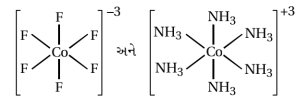
Why do compounds having similar geometry have different magnetic moments?
Solution
(N/A) The difference in magnetic moment arises due to the presence of weak field and strong field ligands.
If a ligand is strong,the complex formed will be of low spin,and if a ligand is weak,the complex formed is of high spin.
For example,$[CoF_{6}]^{3-}$ is paramagnetic while $[Co(NH_{3})_{6}]^{3+}$ is diamagnetic.
If a ligand is strong,the complex formed will be of low spin,and if a ligand is weak,the complex formed is of high spin.
For example,$[CoF_{6}]^{3-}$ is paramagnetic while $[Co(NH_{3})_{6}]^{3+}$ is diamagnetic.
0 likes
View Solution526
Difficult
Identify the type of isomerism observed when an ambidentate ligand binds to a central metal atom and provide two examples of ambidentate ligands.
Solution
(N/A) An ambidentate ligand is a ligand that possesses two different donor atoms and can bind to the central metal atom through either of these donor atoms.
Examples of ambidentate ligands include:
$1. \text{ } SCN^{-} \text{ (thiocyanate/isothiocyanate)}$
$2. \text{ } NO_{2}^{-} \text{ (nitro/nitrito)}$
Complexes containing ambidentate ligands exhibit linkage isomerism.
Examples of linkage isomers:
$(i) \text{ } [Co(NH_{3})_{5}SCN]^{2+} \text{ and } [Co(NH_{3})_{5}NCS]^{2+}$
$(ii) \text{ } [Fe(H_{2}O)_{5}NO_{2}]^{2+} \text{ and } [Fe(H_{2}O)_{5}ONO]^{2+}$
Examples of ambidentate ligands include:
$1. \text{ } SCN^{-} \text{ (thiocyanate/isothiocyanate)}$
$2. \text{ } NO_{2}^{-} \text{ (nitro/nitrito)}$
Complexes containing ambidentate ligands exhibit linkage isomerism.
Examples of linkage isomers:
$(i) \text{ } [Co(NH_{3})_{5}SCN]^{2+} \text{ and } [Co(NH_{3})_{5}NCS]^{2+}$
$(ii) \text{ } [Fe(H_{2}O)_{5}NO_{2}]^{2+} \text{ and } [Fe(H_{2}O)_{5}ONO]^{2+}$
0 likes
View Solution527
Advanced
$CoSO_{4}Cl \cdot 5NH_{3}$ exists in two isomeric forms '$A$' and '$B$'. Isomer '$A$' reacts with $AgNO_{3}$ to give white precipitate,but does not react with $BaCl_{2}$. Isomer '$B$' gives white precipitate with $BaCl_{2}$ but does not react with $AgNO_{3}$. Answer the following questions.
$(i)$ Identify '$A$' and '$B$' and write their structural formulas.
$(ii)$ Name the type of isomerism involved.
$(iii)$ Give the $IUPAC$ name of '$A$' and '$B$.'
$(i)$ Identify '$A$' and '$B$' and write their structural formulas.
$(ii)$ Name the type of isomerism involved.
$(iii)$ Give the $IUPAC$ name of '$A$' and '$B$.'
Solution
(A) Isomer '$A$' reacts with $AgNO_{3}$ to give white precipitates,indicating the presence of $Cl^{-}$ ions in the ionisation sphere.
$\therefore A = [Co(NH_{3})_{5}(SO_{4})]Cl$
Isomer '$B$' reacts with $BaCl_{2}$,indicating the presence of $SO_{4}^{2-}$ ions in the ionisation sphere.
$\therefore B = [Co(NH_{3})_{5}Cl](SO_{4})$
$(ii)$ The type of isomerism is Ionisation Isomerism.
$(iii)$ $IUPAC$ names:
$A$: Pentaamminesulphatocobalt$(III)$ chloride
$B$: Pentaamminechloridocobalt$(III)$ sulphate
$\therefore A = [Co(NH_{3})_{5}(SO_{4})]Cl$
Isomer '$B$' reacts with $BaCl_{2}$,indicating the presence of $SO_{4}^{2-}$ ions in the ionisation sphere.
$\therefore B = [Co(NH_{3})_{5}Cl](SO_{4})$
$(ii)$ The type of isomerism is Ionisation Isomerism.
$(iii)$ $IUPAC$ names:
$A$: Pentaamminesulphatocobalt$(III)$ chloride
$B$: Pentaamminechloridocobalt$(III)$ sulphate
0 likes
View Solution528
MediumMCQ
The one that is not expected to show isomerism is:
A
$[Ni(NH_3)_4(H_2O)_2]^{2+}$
B
$[Ni(NH_3)_2Cl_2]$
C
$[Pt(NH_3)_2Cl_2]$
D
$[Ni(en)_3]^{2+}$
Solution
(B) $[Ni(NH_3)_2Cl_2]$ is a tetrahedral complex,which does not exhibit geometrical or optical isomerism.
It also does not exhibit structural isomerism.
$[Ni(NH_3)_4(H_2O)_2]^{2+}$ (octahedral) shows geometrical isomerism.
$[Pt(NH_3)_2Cl_2]$ (square planar) shows geometrical isomerism.
$[Ni(en)_3]^{2+}$ (octahedral) shows optical isomerism.
It also does not exhibit structural isomerism.
$[Ni(NH_3)_4(H_2O)_2]^{2+}$ (octahedral) shows geometrical isomerism.
$[Pt(NH_3)_2Cl_2]$ (square planar) shows geometrical isomerism.
$[Ni(en)_3]^{2+}$ (octahedral) shows optical isomerism.
0 likes
View Solution529
DifficultMCQ
The complex that can show optical activity is:
A
$trans-[Fe(NH_3)_2(CN)_4]^-$
B
$cis-[Fe(NH_3)_2(CN)_4]^-$
C
$cis-[CrCl_2(ox)_2]^{3-}$
D
$trans-[CrCl_2(ox)_2]^{3-}$
Solution
(C) Optical activity in coordination complexes requires the absence of a plane of symmetry or a center of inversion.
$1$. $trans-[Fe(NH_3)_2(CN)_4]^-$ has a plane of symmetry,so it is optically inactive.
$2$. $cis-[Fe(NH_3)_2(CN)_4]^-$ also possesses a plane of symmetry,making it optically inactive.
$3$. $cis-[CrCl_2(ox)_2]^{3-}$ lacks both a plane of symmetry and a center of inversion,therefore it is chiral and shows optical activity.
$4$. $trans-[CrCl_2(ox)_2]^{3-}$ has a plane of symmetry,so it is optically inactive.
Thus,the correct option is $C$.
$1$. $trans-[Fe(NH_3)_2(CN)_4]^-$ has a plane of symmetry,so it is optically inactive.
$2$. $cis-[Fe(NH_3)_2(CN)_4]^-$ also possesses a plane of symmetry,making it optically inactive.
$3$. $cis-[CrCl_2(ox)_2]^{3-}$ lacks both a plane of symmetry and a center of inversion,therefore it is chiral and shows optical activity.
$4$. $trans-[CrCl_2(ox)_2]^{3-}$ has a plane of symmetry,so it is optically inactive.
Thus,the correct option is $C$.
0 likes
View Solution530
MediumMCQ
The number of linkage isomers possible for $[Pt(en)(NO_2)_2]$ is :
A
$3$
B
$2$
C
$1$
D
$4$
Solution
(A) The complex $[Pt(en)(NO_2)_2]$ contains ambidentate ligands $(NO_2^-)$,which can coordinate through either the $N$ atom or the $O$ atom.
This leads to the formation of linkage isomers based on the coordination mode of the two $NO_2^-$ ligands:
$I$. $[Pt(en)(NO_2)_2]$ (both $NO_2^-$ coordinated through $N$)
$II$. $[Pt(en)(NO_2)(ONO)]$ (one $NO_2^-$ through $N$,one through $O$)
$III$. $[Pt(en)(ONO)_2]$ (both $NO_2^-$ coordinated through $O$)
Thus,there are $3$ possible linkage isomers.
This leads to the formation of linkage isomers based on the coordination mode of the two $NO_2^-$ ligands:
$I$. $[Pt(en)(NO_2)_2]$ (both $NO_2^-$ coordinated through $N$)
$II$. $[Pt(en)(NO_2)(ONO)]$ (one $NO_2^-$ through $N$,one through $O$)
$III$. $[Pt(en)(ONO)_2]$ (both $NO_2^-$ coordinated through $O$)
Thus,there are $3$ possible linkage isomers.
0 likes
View Solution531
MediumMCQ
The pair in which both the species have the same magnetic moment (spin only) is :
A
$[Mn(H_2O)_6]^{2+}$ and $[Cr(H_2O)_6]^{2+}$
B
$[Cr(H_2O)_6]^{2+}$ and $[CoCl_4]^{2-}$
C
$[Cr(H_2O)_6]^{2+}$ and $[Fe(H_2O)_6]^{2+}$
D
$[Co(OH)_4]^{2-}$ and $[Fe(NH_3)_6]^{2+}$
Solution
(C) The magnetic moment (spin only) is given by the formula $\mu = \sqrt{n(n+2)} \text{ BM}$,where $n$ is the number of unpaired electrons.
For $[Cr(H_2O)_6]^{2+}$,$Cr^{2+}$ is $d^4$. Since $H_2O$ is a weak field ligand,the configuration is $t_{2g}^3 e_g^1$,giving $n = 4$.
For $[Fe(H_2O)_6]^{2+}$,$Fe^{2+}$ is $d^6$. Since $H_2O$ is a weak field ligand,the configuration is $t_{2g}^4 e_g^2$,giving $n = 4$.
Since both complexes have $n = 4$ unpaired electrons,they have the same magnetic moment.
Thus,the correct pair is $[Cr(H_2O)_6]^{2+}$ and $[Fe(H_2O)_6]^{2+}$.
For $[Cr(H_2O)_6]^{2+}$,$Cr^{2+}$ is $d^4$. Since $H_2O$ is a weak field ligand,the configuration is $t_{2g}^3 e_g^1$,giving $n = 4$.
For $[Fe(H_2O)_6]^{2+}$,$Fe^{2+}$ is $d^6$. Since $H_2O$ is a weak field ligand,the configuration is $t_{2g}^4 e_g^2$,giving $n = 4$.
Since both complexes have $n = 4$ unpaired electrons,they have the same magnetic moment.
Thus,the correct pair is $[Cr(H_2O)_6]^{2+}$ and $[Fe(H_2O)_6]^{2+}$.
0 likes
View Solution532
MediumMCQ
Consider the complex ions,$trans-[Co(en)_2Cl_2]^+$ $(A)$ and $cis-[Co(en)_2Cl_2]^+$ $(B)$. The correct statement regarding them is :
A
both $(A)$ and $(B)$ can be optically active
B
both $(A)$ and $(B)$ cannot be optically active
C
$(A)$ can be optically active,but $(B)$ cannot be optically active
D
$(A)$ cannot be optically active,but $(B)$ can be optically active
Solution
(D) The $trans-[Co(en)_2Cl_2]^+$ $(A)$ isomer possesses a plane of symmetry,which makes it achiral and therefore optically inactive.
In contrast,the $cis-[Co(en)_2Cl_2]^+$ $(B)$ isomer lacks a plane of symmetry and a center of inversion,making it chiral and optically active.
Thus,$(A)$ cannot be optically active,but $(B)$ can be optically active.
In contrast,the $cis-[Co(en)_2Cl_2]^+$ $(B)$ isomer lacks a plane of symmetry and a center of inversion,making it chiral and optically active.
Thus,$(A)$ cannot be optically active,but $(B)$ can be optically active.
0 likes
View Solution533
DifficultMCQ
The species that has a (spin only) magnetic moment of $5.9 \, BM$ is:
A
$Ni(CO)_4$ $(T_d)$
B
$[MnBr_4]^{2-}$ $(T_d)$
C
$[NiCl_4]^{2-}$ $(T_d)$
D
$[Ni(CN)_4]^{2-}$ (square planar)
Solution
(B) The spin-only magnetic moment $\mu$ is given by the formula $\mu = \sqrt{n(n+2)} \, BM$,where $n$ is the number of unpaired electrons.
For $\mu = 5.9 \, BM$,we have $\sqrt{n(n+2)} \approx 5.9$,which implies $n = 5$.
In $[MnBr_4]^{2-}$,the oxidation state of $Mn$ is $+2$. The electronic configuration of $Mn^{2+}$ is $[Ar] 3d^5$.
Since $Br^-$ is a weak field ligand,it does not cause pairing of electrons in the $3d$ orbitals.
Thus,$Mn^{2+}$ has $5$ unpaired electrons $(n=5)$.
Therefore,$\mu = \sqrt{5(5+2)} = \sqrt{35} \approx 5.9 \, BM$.
For $\mu = 5.9 \, BM$,we have $\sqrt{n(n+2)} \approx 5.9$,which implies $n = 5$.
In $[MnBr_4]^{2-}$,the oxidation state of $Mn$ is $+2$. The electronic configuration of $Mn^{2+}$ is $[Ar] 3d^5$.
Since $Br^-$ is a weak field ligand,it does not cause pairing of electrons in the $3d$ orbitals.
Thus,$Mn^{2+}$ has $5$ unpaired electrons $(n=5)$.
Therefore,$\mu = \sqrt{5(5+2)} = \sqrt{35} \approx 5.9 \, BM$.
0 likes
View Solution534
MediumMCQ
Among the following complex ions,the one which shows geometrical isomerism will be
A
$[Cr(H_2O)_4Cl_2]^+$
B
$[Pt(NH_3)_3Cl]^+$
C
$[Co(NH_3)_6]^{3+}$
D
$[Co(CN)_5(NC)]^{3-}$
Solution
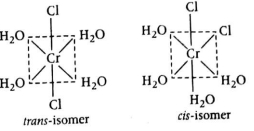
(A) $[Cr(H_2O)_4Cl_2]^+$ shows geometrical isomerism because it is a $MA_4B_2$ type coordination compound which contains two sets of equivalent ligands,four $H_2O$ and two $Cl^-$.
Hence,the possible geometrical isomers are as shown in the figure.
Thus,the correct option is $(A)$.
Hence,the possible geometrical isomers are as shown in the figure.
Thus,the correct option is $(A)$.
0 likes
View Solution535
MediumMCQ
Which of the following complexes is optically inactive?
A
$[RhCl(CO)(PPh_3)(NH_3)]$
B
$[Fe(C_2O_4)_3]^{3-}$
C
$[Fe(en)_2Cl_2]$
D
$[Pd(en)_2Cl_2]$
Solution
(A) complex is optically inactive if it possesses a plane of symmetry or a center of inversion.
$1$. $[RhCl(CO)(PPh_3)(NH_3)]$ is a square planar complex. All square planar complexes are optically inactive because they possess a plane of symmetry (the molecular plane).
$2$. $[Fe(C_2O_4)_3]^{3-}$ is an octahedral complex with three bidentate ligands,which is chiral and optically active.
$3$. $[Fe(en)_2Cl_2]$ can exist as cis and trans isomers; the cis-isomer is optically active.
$4$. $[Pd(en)_2Cl_2]$ is a square planar complex,but in the context of coordination chemistry,$[RhCl(CO)(PPh_3)(NH_3)]$ is the most classic example of an inherently achiral square planar geometry.
$1$. $[RhCl(CO)(PPh_3)(NH_3)]$ is a square planar complex. All square planar complexes are optically inactive because they possess a plane of symmetry (the molecular plane).
$2$. $[Fe(C_2O_4)_3]^{3-}$ is an octahedral complex with three bidentate ligands,which is chiral and optically active.
$3$. $[Fe(en)_2Cl_2]$ can exist as cis and trans isomers; the cis-isomer is optically active.
$4$. $[Pd(en)_2Cl_2]$ is a square planar complex,but in the context of coordination chemistry,$[RhCl(CO)(PPh_3)(NH_3)]$ is the most classic example of an inherently achiral square planar geometry.
0 likes
View Solution536
DifficultMCQ
What is the spin-only magnetic moment value $(BM)$ of a divalent metal ion with atomic number $25$ in its aqueous solution?
A
$5.92$
B
$5.0$
C
$0$
D
$5.26$
Solution
(A) The electronic configuration of a divalent metal ion with atomic number $25$ $(Mn^{2 })$ is $[Ar] 3d^5 4s^0$.
The number of unpaired electrons $(n)$ is $5$.
The spin-only magnetic moment $(\mu)$ is calculated using the formula:
$\mu = \sqrt{n(n 2)} \ BM$
Substituting $n = 5$:
$\mu = \sqrt{5(5 2)} = \sqrt{35} \ BM \approx 5.92 \ BM$.
The number of unpaired electrons $(n)$ is $5$.
The spin-only magnetic moment $(\mu)$ is calculated using the formula:
$\mu = \sqrt{n(n 2)} \ BM$
Substituting $n = 5$:
$\mu = \sqrt{5(5 2)} = \sqrt{35} \ BM \approx 5.92 \ BM$.
0 likes
View Solution537
DifficultMCQ
The correct structures of trans-$[NiBr_{2}(PPh_{3})_{2}]$ and meridional-$[Co(NH_{3})_{3}(NO_{2})_{3}]$,respectively,are
A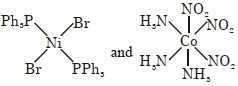
B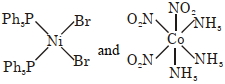
C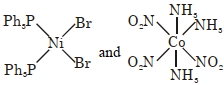
D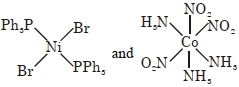
Solution
(A) $1$. For the square planar complex $trans-[NiBr_{2}(PPh_{3})_{2}]$,the two identical ligands ($Br$ or $PPh_{3}$) must be positioned opposite to each other (at $180^{\circ}$ angle). In the structure shown in option $A$,the $Br$ atoms are trans to each other,and the $PPh_{3}$ groups are trans to each other.
$2$. For the octahedral complex $meridional-[Co(NH_{3})_{3}(NO_{2})_{3}]$,the three identical ligands must lie on the same plane (meridian). In the structure shown in option $A$,the three $NH_{3}$ ligands are in a meridional arrangement,and the three $NO_{2}$ ligands are also in a meridional arrangement.
$3$. Therefore,the structure in option $A$ correctly represents both the trans-isomer of the nickel complex and the meridional-isomer of the cobalt complex.
$2$. For the octahedral complex $meridional-[Co(NH_{3})_{3}(NO_{2})_{3}]$,the three identical ligands must lie on the same plane (meridian). In the structure shown in option $A$,the three $NH_{3}$ ligands are in a meridional arrangement,and the three $NO_{2}$ ligands are also in a meridional arrangement.
$3$. Therefore,the structure in option $A$ correctly represents both the trans-isomer of the nickel complex and the meridional-isomer of the cobalt complex.
0 likes
View Solution538
MediumMCQ
The total number of unpaired electrons present in the complex $K_3[Cr(C_2O_4)_3]$ is ..........
A
$3$
B
$9$
C
$7$
D
$2$
Solution
(A) In the complex $K_3[Cr(C_2O_4)_3]$,the oxalate ion $(C_2O_4^{2-})$ has a charge of $-2$.
Let the oxidation state of $Cr$ be $x$.
$3(+1) + x + 3(-2) = 0$
$3 + x - 6 = 0$
$x = +3$.
The atomic number of $Cr$ is $24$,and its electronic configuration is $[Ar] 3d^5 4s^1$.
For $Cr^{3+}$,the configuration is $[Ar] 3d^3$.
Thus,there are $3$ unpaired electrons in the $3d$ orbitals.
Let the oxidation state of $Cr$ be $x$.
$3(+1) + x + 3(-2) = 0$
$3 + x - 6 = 0$
$x = +3$.
The atomic number of $Cr$ is $24$,and its electronic configuration is $[Ar] 3d^5 4s^1$.
For $Cr^{3+}$,the configuration is $[Ar] 3d^3$.
Thus,there are $3$ unpaired electrons in the $3d$ orbitals.
0 likes
View Solution539
MediumMCQ
Match List-$I$ with List-$II$ :
Choose the correct answer from the options given below:
| List-$I$ | List-$II$ |
| $(a).$ $[Co(NH_3)_6][Cr(CN)_6]$ | $(i).$ Linkage isomerism |
| $(b).$ $[Co(NH_3)_3(NO_2)_3]$ | $(ii).$ Solvate isomerism |
| $(c).$ $[Cr(H_2O)_6]Cl_3$ | $(iii).$ Coordination isomerism |
| $(d).$ $cis-[CrCl_2(ox)_2]^{3-}$ | $(iv).$ Optical isomerism |
Choose the correct answer from the options given below:
A
$(a)-(iii), (b)-(i), (c)-(ii), (d)-(iv)$
B
$(a)-(iv), (b)-(ii), (c)-(iii), (d)-(i)$
C
$(a)-(ii), (b)-(i), (c)-(iii), (d)-(iv)$
D
$(a)-(i), (b)-(ii), (c)-(iii), (d)-(iv)$
Solution
(A) The correct matching is as follows:
$1$. $[Co(NH_3)_6][Cr(CN)_6]$ shows Coordination isomerism because both the cation and anion are complex ions,and ligands can be exchanged between them.
$2$. $[Co(NH_3)_3(NO_2)_3]$ shows Linkage isomerism due to the presence of the ambidentate ligand $NO_2^-$.
$3$. $[Cr(H_2O)_6]Cl_3$ shows Solvate (or Hydrate) isomerism as water molecules can act as ligands or be present as lattice water.
$4$. $cis-[CrCl_2(ox)_2]^{3-}$ shows Optical isomerism because the $cis$ isomer lacks a plane of symmetry.
Thus,the correct sequence is $(a)-(iii), (b)-(i), (c)-(ii), (d)-(iv)$.
$1$. $[Co(NH_3)_6][Cr(CN)_6]$ shows Coordination isomerism because both the cation and anion are complex ions,and ligands can be exchanged between them.
$2$. $[Co(NH_3)_3(NO_2)_3]$ shows Linkage isomerism due to the presence of the ambidentate ligand $NO_2^-$.
$3$. $[Cr(H_2O)_6]Cl_3$ shows Solvate (or Hydrate) isomerism as water molecules can act as ligands or be present as lattice water.
$4$. $cis-[CrCl_2(ox)_2]^{3-}$ shows Optical isomerism because the $cis$ isomer lacks a plane of symmetry.
Thus,the correct sequence is $(a)-(iii), (b)-(i), (c)-(ii), (d)-(iv)$.
0 likes
View Solution540
MediumMCQ
The calculated magnetic moments (spin only value) for species $[FeCl_{4}]^{2-}$,$[Co(C_{2}O_{4})_{3}]^{3-}$ and $MnO_{4}^{2-}$ respectively are ..... .
A
$5.82$,$0$ and $0 \ BM$
B
$4.90$,$0$ and $1.73 \ BM$
C
$5.92$,$4.90$ and $0 \ BM$
D
$4.90$,$0$ and $2.83 \ BM$
Solution
(B) $(i)$ $[FeCl_{4}]^{2-}$: $Fe^{2+}$ is $d^{6}$ in a tetrahedral field. Configuration is $e^{3} t_{2}^{3}$,so $n = 4$ unpaired electrons. $\mu = \sqrt{4(4+2)} = \sqrt{24} \approx 4.90 \ BM$.
$(ii)$ $[Co(C_{2}O_{4})_{3}]^{3-}$: $Co^{3+}$ is $d^{6}$ in an octahedral field with a strong field ligand ($C_{2}O_{4}^{2-}$ is often considered strong enough to cause pairing in $Co^{3+}$). Configuration is $t_{2g}^{6} e_{g}^{0}$,so $n = 0$ unpaired electrons. $\mu = 0 \ BM$.
$(iii)$ $MnO_{4}^{2-}$: $Mn$ is in $+6$ oxidation state. $Mn^{6+}$ is $3d^{1}$. $n = 1$ unpaired electron. $\mu = \sqrt{1(1+2)} = \sqrt{3} \approx 1.73 \ BM$.
$(ii)$ $[Co(C_{2}O_{4})_{3}]^{3-}$: $Co^{3+}$ is $d^{6}$ in an octahedral field with a strong field ligand ($C_{2}O_{4}^{2-}$ is often considered strong enough to cause pairing in $Co^{3+}$). Configuration is $t_{2g}^{6} e_{g}^{0}$,so $n = 0$ unpaired electrons. $\mu = 0 \ BM$.
$(iii)$ $MnO_{4}^{2-}$: $Mn$ is in $+6$ oxidation state. $Mn^{6+}$ is $3d^{1}$. $n = 1$ unpaired electron. $\mu = \sqrt{1(1+2)} = \sqrt{3} \approx 1.73 \ BM$.
0 likes
View Solution541
DifficultMCQ
In which of the following orders are the given complex ions arranged correctly with respect to their decreasing spin-only magnetic moment?
$(i)$ $[FeF_{6}]^{3-}$
$(ii)$ $[Co(NH_{3})_{6}]^{3+}$
$(iii)$ $[NiCl_{4}]^{2-}$
$(iv)$ $[Cu(NH_{3})_{4}]^{2+}$
$(i)$ $[FeF_{6}]^{3-}$
$(ii)$ $[Co(NH_{3})_{6}]^{3+}$
$(iii)$ $[NiCl_{4}]^{2-}$
$(iv)$ $[Cu(NH_{3})_{4}]^{2+}$
A
$i > iii > iv > ii$
B
$ii > iii > i > iv$
C
$iii > iv > ii > i$
D
$ii > i > iii > iv$
Solution
(A) To determine the spin-only magnetic moment $(\mu = \sqrt{n(n+2)} \ B.M.)$,we find the number of unpaired electrons $(n)$ for each complex:
$(i)$ $[FeF_{6}]^{3-}$: $Fe^{3+}$ is $3d^{5}$. $F^{-}$ is a weak field ligand $(WFL)$,so electrons remain unpaired. $n = 5$,$\mu = \sqrt{5(5+2)} = \sqrt{35} \ B.M.$
$(ii)$ $[Co(NH_{3})_{6}]^{3+}$: $Co^{3+}$ is $3d^{6}$. $NH_{3}$ is a strong field ligand $(SFL)$,causing pairing. $n = 0$,$\mu = 0 \ B.M.$
$(iii)$ $[NiCl_{4}]^{2-}$: $Ni^{2+}$ is $3d^{8}$. $Cl^{-}$ is a $WFL$. In tetrahedral geometry,$n = 2$,$\mu = \sqrt{2(2+2)} = \sqrt{8} \ B.M.$
$(iv)$ $[Cu(NH_{3})_{4}]^{2+}$: $Cu^{2+}$ is $3d^{9}$. $n = 1$,$\mu = \sqrt{1(1+2)} = \sqrt{3} \ B.M.$
Comparing the values: $\sqrt{35} > \sqrt{8} > \sqrt{3} > 0$,which corresponds to $i > iii > iv > ii$.
$(i)$ $[FeF_{6}]^{3-}$: $Fe^{3+}$ is $3d^{5}$. $F^{-}$ is a weak field ligand $(WFL)$,so electrons remain unpaired. $n = 5$,$\mu = \sqrt{5(5+2)} = \sqrt{35} \ B.M.$
$(ii)$ $[Co(NH_{3})_{6}]^{3+}$: $Co^{3+}$ is $3d^{6}$. $NH_{3}$ is a strong field ligand $(SFL)$,causing pairing. $n = 0$,$\mu = 0 \ B.M.$
$(iii)$ $[NiCl_{4}]^{2-}$: $Ni^{2+}$ is $3d^{8}$. $Cl^{-}$ is a $WFL$. In tetrahedral geometry,$n = 2$,$\mu = \sqrt{2(2+2)} = \sqrt{8} \ B.M.$
$(iv)$ $[Cu(NH_{3})_{4}]^{2+}$: $Cu^{2+}$ is $3d^{9}$. $n = 1$,$\mu = \sqrt{1(1+2)} = \sqrt{3} \ B.M.$
Comparing the values: $\sqrt{35} > \sqrt{8} > \sqrt{3} > 0$,which corresponds to $i > iii > iv > ii$.
0 likes
View Solution542
MediumMCQ
The spin-only magnetic moment of a divalent ion in aqueous solution (atomic number $29$) is ...... $BM.$
A
$2$
B
$8$
C
$6$
D
$4$
Solution
(A) The atomic number of the element is $Z = 29$,which corresponds to Copper $(Cu)$.
The electronic configuration of $Cu$ is $[Ar] 3d^{10} 4s^1$.
For the divalent ion $Cu^{2+}$,the electronic configuration is $[Ar] 3d^9$.
In the $3d$ orbital,there are $9$ electrons,which means there is $1$ unpaired electron.
The spin-only magnetic moment formula is $\mu = \sqrt{n(n+2)} \ BM$,where $n$ is the number of unpaired electrons.
Substituting $n = 1$: $\mu = \sqrt{1(1+2)} = \sqrt{3} \approx 1.73 \ BM$.
Rounding $1.73$ to the nearest integer gives $2 \ BM$.
The electronic configuration of $Cu$ is $[Ar] 3d^{10} 4s^1$.
For the divalent ion $Cu^{2+}$,the electronic configuration is $[Ar] 3d^9$.
In the $3d$ orbital,there are $9$ electrons,which means there is $1$ unpaired electron.
The spin-only magnetic moment formula is $\mu = \sqrt{n(n+2)} \ BM$,where $n$ is the number of unpaired electrons.
Substituting $n = 1$: $\mu = \sqrt{1(1+2)} = \sqrt{3} \approx 1.73 \ BM$.
Rounding $1.73$ to the nearest integer gives $2 \ BM$.
0 likes
View Solution543
MediumMCQ
The number of stereoisomers possible for $[Co(ox)_2(Br)(NH_3)]^{2-}$ is $...$. $[ox = \text{oxalate}]$
A
$5$
B
$8$
C
$14$
D
$3$
Solution
(D) The complex $[Co(ox)_2(Br)(NH_3)]^{2-}$ is of the type $[M(AA)_2ab]$,where $M = Co^{3+}$,$AA = ox^{2-}$,$a = Br^-$,and $b = NH_3$.
$1$. For the $[M(AA)_2ab]$ type complex,there are two geometrical isomers: $cis$ and $trans$.
$2$. The $trans$ isomer has a plane of symmetry and is optically inactive (achiral).
$3$. The $cis$ isomer does not have a plane of symmetry and exists as a pair of enantiomers ($d$ and $l$ forms),making it optically active.
$4$. Therefore,the total number of stereoisomers is $1$ $(trans)$ $+ 2$ ($cis$ enantiomers) $= 3$.
$1$. For the $[M(AA)_2ab]$ type complex,there are two geometrical isomers: $cis$ and $trans$.
$2$. The $trans$ isomer has a plane of symmetry and is optically inactive (achiral).
$3$. The $cis$ isomer does not have a plane of symmetry and exists as a pair of enantiomers ($d$ and $l$ forms),making it optically active.
$4$. Therefore,the total number of stereoisomers is $1$ $(trans)$ $+ 2$ ($cis$ enantiomers) $= 3$.
0 likes
View Solution544
EasyMCQ
Indicate the complex or complex ion which does not show any geometrical isomerism:
A
$[CoCl_2(en)_2]$
B
$[Co(CN)_5(NC)]^{3-}$
C
$[Co(NH_3)_3(NO_2)_3]$
D
$[Co(NH_3)_4Cl_2]^+$
Solution
(B) $1$. $[CoCl_2(en)_2]$ shows $cis$ and $trans$ geometrical isomerism.
$2$. $[Co(CN)_5(NC)]^{3-}$ is an octahedral complex of the type $[MA_5B]$,which does not exhibit geometrical isomerism.
$3$. $[Co(NH_3)_3(NO_2)_3]$ shows $fac$ (facial) and $mer$ (meridional) isomerism,which are types of geometrical isomerism.
$4$. $[Co(NH_3)_4Cl_2]^+$ shows $cis$ and $trans$ geometrical isomerism.
Therefore,the correct option is $B$.
$2$. $[Co(CN)_5(NC)]^{3-}$ is an octahedral complex of the type $[MA_5B]$,which does not exhibit geometrical isomerism.
$3$. $[Co(NH_3)_3(NO_2)_3]$ shows $fac$ (facial) and $mer$ (meridional) isomerism,which are types of geometrical isomerism.
$4$. $[Co(NH_3)_4Cl_2]^+$ shows $cis$ and $trans$ geometrical isomerism.
Therefore,the correct option is $B$.
0 likes
View Solution545
MediumMCQ
The number of optical isomers possible for $[Cr(C_{2}O_{4})_{3}]^{3-}$ is $.....$ .
A
$2$
B
$1$
C
$4$
D
$3$
Solution
(A) The complex $[Cr(C_{2}O_{4})_{3}]^{3-}$ contains three bidentate oxalate ligands $(C_{2}O_{4}^{2-})$.
It forms an octahedral geometry.
This complex exists as two non-superimposable mirror images,which are enantiomers of each other.
Therefore,the number of optical isomers is $2$.
It forms an octahedral geometry.
This complex exists as two non-superimposable mirror images,which are enantiomers of each other.
Therefore,the number of optical isomers is $2$.
0 likes
View Solution546
EasyMCQ
The spin-only magnetic moment in $BM$ of $[Fe(CO)_4(C_2O_4)]^+$ is:
A
$5.92$
B
$0$
C
$1$
D
$1.73$
Solution
(D) In the complex $[Fe(CO)_4(C_2O_4)]^+$,let the oxidation state of $Fe$ be $x$.
$x + 4(0) + (-2) = +1$
$x = +3$
$Fe^{3+}$ has a $3d^5$ configuration.
$CO$ is a strong field ligand,and $C_2O_4^{2-}$ (oxalate) is a chelating ligand.
In the presence of strong field ligands,the $d$-electrons pair up.
For $Fe^{3+}$ $(3d^5)$,the pairing results in one unpaired electron $(n = 1)$.
The spin-only magnetic moment is given by $\mu = \sqrt{n(n+2)} \ BM$.
$\mu = \sqrt{1(1+2)} \ BM = \sqrt{3} \ BM \approx 1.73 \ BM$.
$x + 4(0) + (-2) = +1$
$x = +3$
$Fe^{3+}$ has a $3d^5$ configuration.
$CO$ is a strong field ligand,and $C_2O_4^{2-}$ (oxalate) is a chelating ligand.
In the presence of strong field ligands,the $d$-electrons pair up.
For $Fe^{3+}$ $(3d^5)$,the pairing results in one unpaired electron $(n = 1)$.
The spin-only magnetic moment is given by $\mu = \sqrt{n(n+2)} \ BM$.
$\mu = \sqrt{1(1+2)} \ BM = \sqrt{3} \ BM \approx 1.73 \ BM$.
0 likes
View Solution547
MediumMCQ
Match List-$I$ with List-$II$.
Choose the correct answer from the options given below.
| List-$I$ | List-$II$ |
|---|---|
| $a. [Fe(CN)_{6}]^{3-}$ | $i. 5.92 \ BM$ |
| $b. [Fe(H_{2}O)_{6}]^{3+}$ | $ii. 0 \ BM$ |
| $c. [Fe(CN)_{6}]^{4-}$ | $iii. 4.90 \ BM$ |
| $d. [Fe(H_{2}O)_{6}]^{2+}$ | $iv. 1.73 \ BM$ |
Choose the correct answer from the options given below.
A
$a-iv, b-ii, c-i, d-iii$
B
$a-ii, b-iv, c-iii, d-i$
C
$a-i, b-iii, c-iv, d-ii$
D
$a-iv, b-i, c-ii, d-iii$
Solution
(D) To find the magnetic moment,we calculate the number of unpaired electrons $(n)$ in each complex:
$a. [Fe(CN)_{6}]^{3-}$: $Fe^{3+}$ is $3d^{5}$. $CN^-$ is a strong field ligand,causing pairing. $n=1$,$\mu = \sqrt{1(1+2)} = 1.73 \ BM$.
$b. [Fe(H_{2}O)_{6}]^{3+}$: $Fe^{3+}$ is $3d^{5}$. $H_2O$ is a weak field ligand,no pairing. $n=5$,$\mu = \sqrt{5(5+2)} = 5.92 \ BM$.
$c. [Fe(CN)_{6}]^{4-}$: $Fe^{2+}$ is $3d^{6}$. $CN^-$ is a strong field ligand,causing pairing. $n=0$,$\mu = 0 \ BM$.
$d. [Fe(H_{2}O)_{6}]^{2+}$: $Fe^{2+}$ is $3d^{6}$. $H_2O$ is a weak field ligand,no pairing. $n=4$,$\mu = \sqrt{4(4+2)} = 4.90 \ BM$.
Matching these values: $a-iv, b-i, c-ii, d-iii$.
$a. [Fe(CN)_{6}]^{3-}$: $Fe^{3+}$ is $3d^{5}$. $CN^-$ is a strong field ligand,causing pairing. $n=1$,$\mu = \sqrt{1(1+2)} = 1.73 \ BM$.
$b. [Fe(H_{2}O)_{6}]^{3+}$: $Fe^{3+}$ is $3d^{5}$. $H_2O$ is a weak field ligand,no pairing. $n=5$,$\mu = \sqrt{5(5+2)} = 5.92 \ BM$.
$c. [Fe(CN)_{6}]^{4-}$: $Fe^{2+}$ is $3d^{6}$. $CN^-$ is a strong field ligand,causing pairing. $n=0$,$\mu = 0 \ BM$.
$d. [Fe(H_{2}O)_{6}]^{2+}$: $Fe^{2+}$ is $3d^{6}$. $H_2O$ is a weak field ligand,no pairing. $n=4$,$\mu = \sqrt{4(4+2)} = 4.90 \ BM$.
Matching these values: $a-iv, b-i, c-ii, d-iii$.
0 likes
View Solution548
DifficultMCQ
The correct order of intensity of colors of the compounds is:
A
$[Ni(CN)_{4}]^{2-} > [NiCl_{4}]^{2-} > [Ni(H_{2}O)_{6}]^{2+}$
B
$[NiCl_{4}]^{2-} > [Ni(CN)_{4}]^{2-} > [Ni(H_{2}O)_{6}]^{2+}$
C
$[NiCl_{4}]^{2-} > [Ni(H_{2}O)_{6}]^{2+} > [Ni(CN)_{4}]^{2-}$
D
$[Ni(H_{2}O)_{6}]^{2+} > [NiCl_{4}]^{2-} > [Ni(CN)_{4}]^{2-}$
Solution
(C) The intensity of color in coordination complexes is related to the probability of $d-d$ transitions. Complexes that lack a center of inversion (like tetrahedral complexes) exhibit more intense colors due to the relaxation of the Laporte selection rule compared to centrosymmetric complexes (like octahedral or square planar complexes).
The complexes are: $[NiCl_{4}]^{2-}$ (tetrahedral,non-centrosymmetric),$[Ni(H_{2}O)_{6}]^{2+}$ (octahedral,centrosymmetric),and $[Ni(CN)_{4}]^{2-}$ (square planar,centrosymmetric).
Thus,the intensity order is: $[NiCl_{4}]^{2-} > [Ni(H_{2}O)_{6}]^{2+} > [Ni(CN)_{4}]^{2-}$.
The complexes are: $[NiCl_{4}]^{2-}$ (tetrahedral,non-centrosymmetric),$[Ni(H_{2}O)_{6}]^{2+}$ (octahedral,centrosymmetric),and $[Ni(CN)_{4}]^{2-}$ (square planar,centrosymmetric).
Thus,the intensity order is: $[NiCl_{4}]^{2-} > [Ni(H_{2}O)_{6}]^{2+} > [Ni(CN)_{4}]^{2-}$.
0 likes
View Solution549
DifficultMCQ
The spin-only magnetic moment value for the complex $[Co(CN)_6]^{4-}$ is $...... \ BM$ [At. no. of $Co=27$]
A
$1$
B
$2$
C
$3$
D
$5$
Solution
(B) For the complex $[Co(CN)_6]^{4-}$,let the oxidation state of $Co$ be $x$.
$x + 6 \times (-1) = -4 \implies x = +2$.
Electronic configuration of $Co^{2+}$ $(Z=27)$ is $[Ar] 3d^7$.
In the presence of a strong field ligand like $CN^-$,the electrons in the $3d$ orbital undergo pairing.
For $3d^7$,the distribution is $t_{2g}^6 e_g^1$,which leaves $n = 1$ unpaired electron.
The spin-only magnetic moment is given by $\mu = \sqrt{n(n+2)} \ BM$.
Substituting $n=1$,we get $\mu = \sqrt{1(1+2)} = \sqrt{3} \approx 1.73 \ BM$.
The nearest integer value is $2 \ BM$.
$x + 6 \times (-1) = -4 \implies x = +2$.
Electronic configuration of $Co^{2+}$ $(Z=27)$ is $[Ar] 3d^7$.
In the presence of a strong field ligand like $CN^-$,the electrons in the $3d$ orbital undergo pairing.
For $3d^7$,the distribution is $t_{2g}^6 e_g^1$,which leaves $n = 1$ unpaired electron.
The spin-only magnetic moment is given by $\mu = \sqrt{n(n+2)} \ BM$.
Substituting $n=1$,we get $\mu = \sqrt{1(1+2)} = \sqrt{3} \approx 1.73 \ BM$.
The nearest integer value is $2 \ BM$.
0 likes
View Solution550
DifficultMCQ
Which one of the following species does not have a magnetic moment of $1.73 \ BM$ (spin only value)?
A
$CuI$
B
$\left[Cu(NH_{3})_{4}\right]Cl_{2}$
C
$O_{2}^{+}$
D
$O_{2}^{-}$
Solution
(A) The magnetic moment $\mu$ is given by $\sqrt{n(n+2)} \ BM$,where $n$ is the number of unpaired electrons. For $\mu = 1.73 \ BM$,$n$ must be $1$.
$(1)$ $CuI$: In $CuI$,$Cu$ is in the $+1$ oxidation state $(Cu^{+})$. The electronic configuration of $Cu^{+}$ is $[Ar]3d^{10}$,which has $0$ unpaired electrons. Thus,$\mu = 0 \ BM$.
$(2)$ $\left[Cu(NH_{3})_{4}\right]Cl_{2}$: Here,$Cu$ is in the $+2$ oxidation state $(Cu^{2+})$. The electronic configuration of $Cu^{2+}$ is $[Ar]3d^{9}$,which has $1$ unpaired electron. Thus,$\mu = \sqrt{1(1+2)} = 1.73 \ BM$.
$(3)$ $O_{2}^{+}$: Total electrons = $15$. Molecular orbital configuration: $\sigma_{1s}^{2} \sigma_{1s}^{*2} \sigma_{2s}^{2} \sigma_{2s}^{*2} \sigma_{2pz}^{2} \pi_{2px}^{2} \pi_{2py}^{2} \pi_{2px}^{*1}$. It has $1$ unpaired electron. Thus,$\mu = 1.73 \ BM$.
$(4)$ $O_{2}^{-}$: Total electrons = $17$. Molecular orbital configuration: $\sigma_{1s}^{2} \sigma_{1s}^{*2} \sigma_{2s}^{2} \sigma_{2s}^{*2} \sigma_{2pz}^{2} \pi_{2px}^{2} \pi_{2py}^{2} \pi_{2px}^{*2} \pi_{2py}^{*1}$. It has $1$ unpaired electron. Thus,$\mu = 1.73 \ BM$.
Therefore,$CuI$ does not have a magnetic moment of $1.73 \ BM$.
$(1)$ $CuI$: In $CuI$,$Cu$ is in the $+1$ oxidation state $(Cu^{+})$. The electronic configuration of $Cu^{+}$ is $[Ar]3d^{10}$,which has $0$ unpaired electrons. Thus,$\mu = 0 \ BM$.
$(2)$ $\left[Cu(NH_{3})_{4}\right]Cl_{2}$: Here,$Cu$ is in the $+2$ oxidation state $(Cu^{2+})$. The electronic configuration of $Cu^{2+}$ is $[Ar]3d^{9}$,which has $1$ unpaired electron. Thus,$\mu = \sqrt{1(1+2)} = 1.73 \ BM$.
$(3)$ $O_{2}^{+}$: Total electrons = $15$. Molecular orbital configuration: $\sigma_{1s}^{2} \sigma_{1s}^{*2} \sigma_{2s}^{2} \sigma_{2s}^{*2} \sigma_{2pz}^{2} \pi_{2px}^{2} \pi_{2py}^{2} \pi_{2px}^{*1}$. It has $1$ unpaired electron. Thus,$\mu = 1.73 \ BM$.
$(4)$ $O_{2}^{-}$: Total electrons = $17$. Molecular orbital configuration: $\sigma_{1s}^{2} \sigma_{1s}^{*2} \sigma_{2s}^{2} \sigma_{2s}^{*2} \sigma_{2pz}^{2} \pi_{2px}^{2} \pi_{2py}^{2} \pi_{2px}^{*2} \pi_{2py}^{*1}$. It has $1$ unpaired electron. Thus,$\mu = 1.73 \ BM$.
Therefore,$CuI$ does not have a magnetic moment of $1.73 \ BM$.
0 likes
View SolutionCoordination Compounds — Isomerism and Magnetic properties · Frequently Asked Questions
1Are these Coordination Compounds questions useful for JEE and NEET?
Yes. All questions in this section are mapped to JEE Main and NEET exam patterns. Previous year questions from JEE Main, NEET, GUJCET and state-level exams are included with full solutions.
2Can I switch to Hindi or Gujarati for these questions?
Yes. Use the language tabs in the hero section or the sidebar to view the same questions and solutions in English, Hindi or Gujarati.
3How do I generate a question paper from this subtopic?
Use the Vedclass Exam Paper Generator — select the chapter and subtopic, set difficulty, and generate Sets A, B, C, D automatically. First 3 chapters of every subject are free.
Vedclass Products
For Students
Vedclass Test Series
Mock tests in real JEE/NEET style with performance analysis. 5-day free trial.
Start Free TrialFor Teachers
Exam Paper Generator
Generate Set A/B/C/D papers from this chapter in 2 minutes. 3 chapters free.
Try FreeFor Institutes
Online Exam Module
Live online exams with unlimited students, 360° analytics & white-label branding.
See DemoFor Teachers & Institutes
Generate a Coordination Compounds Exam Paper in 2 Minutes
Select subtopic & difficulty — Sets A, B, C, D auto-generated with No Repeat logic.
First 3 chapters of every subject are free — no payment required.