
A English
Properties of Amines Questions in English
Class 12 Chemistry · Amines · Properties of Amines
1212+
Questions
English
Language
100%
With Solutions
Showing 50 of 1212 questions in English
801
DifficultMCQ
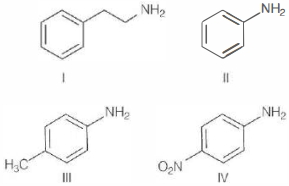
The correct order of basicity of the following amines is:
A
$I > II > III > IV$
B
$I > III > II > IV$
C
$III > II > I > IV$
D
$IV > III > II > I$
Solution
(B) The correct order is $I > III > II > IV$.
$I$ (Benzylamine) is the most basic because the lone pair on the nitrogen atom is not delocalized by resonance with the benzene ring.
In $II$ (Aniline),$III$ ($p$-Toluidine),and $IV$ ($p$-Nitroaniline),the lone pair on the nitrogen atom is involved in resonance with the benzene ring,which significantly decreases their basicity.
Comparing $II$,$III$,and $IV$:
- $III$ is more basic than $II$ because the $-CH_3$ group exerts a $+I$ and $+H$ (hyperconjugation) effect,which increases the electron density on the nitrogen atom.
- $IV$ is the least basic because the $-NO_2$ group exerts a strong $-R$ (or $-M$) and $-I$ effect,which strongly withdraws electron density from the ring and the nitrogen atom.
Thus,the order is $I > III > II > IV$.
$I$ (Benzylamine) is the most basic because the lone pair on the nitrogen atom is not delocalized by resonance with the benzene ring.
In $II$ (Aniline),$III$ ($p$-Toluidine),and $IV$ ($p$-Nitroaniline),the lone pair on the nitrogen atom is involved in resonance with the benzene ring,which significantly decreases their basicity.
Comparing $II$,$III$,and $IV$:
- $III$ is more basic than $II$ because the $-CH_3$ group exerts a $+I$ and $+H$ (hyperconjugation) effect,which increases the electron density on the nitrogen atom.
- $IV$ is the least basic because the $-NO_2$ group exerts a strong $-R$ (or $-M$) and $-I$ effect,which strongly withdraws electron density from the ring and the nitrogen atom.
Thus,the order is $I > III > II > IV$.
0 likes
View Solution802
DifficultMCQ
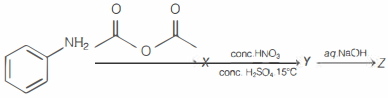
Identify the major products $X$,$Y$,and $Z$ in the following sequence of transformations:
A
$X$ = $N$-phenylacetamide,$Y$ = p-nitro-$N$-phenylacetamide,$Z$ = p-nitroaniline
B
$X$ = $N$-phenylacetamide,$Y$ = o-nitro-$N$-phenylacetamide,$Z$ = o-nitroaniline
C
$X$ = $N$-phenylacetamide,$Y$ = p-nitro-$N$-phenylacetamide,$Z$ = p-nitroaniline (as shown in option $C$)
D
$X$ = $N$-phenylacetamide,$Y$ = o-nitro-$N$-phenylacetamide,$Z$ = o-nitroaniline (as shown in option $D$)
Solution
(C) $1$. The reaction of aniline with acetic anhydride leads to the formation of $N$-phenylacetamide (acetanilide) as product $X$. This step protects the amino group.
$2$. $N$-phenylacetamide undergoes electrophilic aromatic substitution (nitration) with a mixture of concentrated $HNO_3$ and concentrated $H_2SO_4$ at $15^{\circ}C$. The acetamido group $(-NHCOCH_3)$ is ortho/para directing,but due to steric hindrance,the para-isomer is the major product $Y$ ($p$-nitroacetanilide).
$3$. Finally,the hydrolysis of $p$-nitroacetanilide with aqueous $NaOH$ removes the acetyl group to yield $p$-nitroaniline as the final product $Z$.
$2$. $N$-phenylacetamide undergoes electrophilic aromatic substitution (nitration) with a mixture of concentrated $HNO_3$ and concentrated $H_2SO_4$ at $15^{\circ}C$. The acetamido group $(-NHCOCH_3)$ is ortho/para directing,but due to steric hindrance,the para-isomer is the major product $Y$ ($p$-nitroacetanilide).
$3$. Finally,the hydrolysis of $p$-nitroacetanilide with aqueous $NaOH$ removes the acetyl group to yield $p$-nitroaniline as the final product $Z$.
0 likes
View Solution803
MediumMCQ
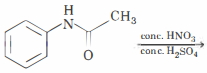
The major product formed in the following reaction is
A
$p$-nitroacetanilide
B
$m$-nitroacetanilide
C
$2,4$-dinitroacetanilide
D
$o$-nitroacetanilide
Solution
(A) The reaction involves the nitration of acetanilide using a mixture of concentrated $HNO_3$ and concentrated $H_2SO_4$.
In acetanilide,the $-NHCOCH_3$ group is ortho/para-directing due to the resonance effect of the lone pair on the nitrogen atom.
However,due to the steric hindrance caused by the bulky $-NHCOCH_3$ group,the para-position is more accessible than the ortho-position.
Therefore,the major product formed is $p$-nitroacetanilide.
In acetanilide,the $-NHCOCH_3$ group is ortho/para-directing due to the resonance effect of the lone pair on the nitrogen atom.
However,due to the steric hindrance caused by the bulky $-NHCOCH_3$ group,the para-position is more accessible than the ortho-position.
Therefore,the major product formed is $p$-nitroacetanilide.
0 likes
View Solution804
MediumMCQ
The reagent$(s)$ used for the conversion of benzene diazonium hydrogensulphate to benzene is/are:
A
$H_{2}O$
B
$H_{3}PO_{2} + H_{2}O$
C
$H_{2}SO_{4} + H_{2}O$
D
$CuCl / HCl$
Solution
(B) The correct option is $(b)$.
The conversion of benzene diazonium hydrogensulphate to benzene is a reduction reaction.
$C_{6}H_{5}N_{2}^{+}HSO_{4}^{-} + H_{3}PO_{2} + H_{2}O \rightarrow C_{6}H_{6} + N_{2} + H_{3}PO_{3} + H_{2}SO_{4}$
Phosphinic acid $(H_{3}PO_{2})$ acts as a reducing agent in the presence of water to reduce the diazonium group to a hydrogen atom,yielding benzene.
The conversion of benzene diazonium hydrogensulphate to benzene is a reduction reaction.
$C_{6}H_{5}N_{2}^{+}HSO_{4}^{-} + H_{3}PO_{2} + H_{2}O \rightarrow C_{6}H_{6} + N_{2} + H_{3}PO_{3} + H_{2}SO_{4}$
Phosphinic acid $(H_{3}PO_{2})$ acts as a reducing agent in the presence of water to reduce the diazonium group to a hydrogen atom,yielding benzene.
0 likes
View Solution805
MediumMCQ
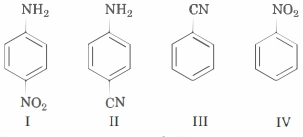
Reaction of aniline with $NaNO_{2} +$ dil. $HCl$ at $0^{\circ} C$ followed by reaction with $CuCN$ yields:
A
$I$
B
$II$
C
$III$
D
$IV$
Solution
(C) The correct answer is $C$ $(III)$.
Step $1$: Aniline reacts with $NaNO_{2} +$ dil. $HCl$ at $0-5^{\circ} C$ to form benzene diazonium chloride $(C_{6}H_{5}N_{2}^{+}Cl^{-})$.
Step $2$: The benzene diazonium chloride then reacts with $CuCN$ (Sandmeyer reaction) to replace the diazonium group with a cyano group $(-CN)$,yielding cyanobenzene (benzonitrile) and releasing $N_{2}$ gas.
Structure $III$ represents cyanobenzene.
Step $1$: Aniline reacts with $NaNO_{2} +$ dil. $HCl$ at $0-5^{\circ} C$ to form benzene diazonium chloride $(C_{6}H_{5}N_{2}^{+}Cl^{-})$.
Step $2$: The benzene diazonium chloride then reacts with $CuCN$ (Sandmeyer reaction) to replace the diazonium group with a cyano group $(-CN)$,yielding cyanobenzene (benzonitrile) and releasing $N_{2}$ gas.
Structure $III$ represents cyanobenzene.
0 likes
View Solution806
MediumMCQ
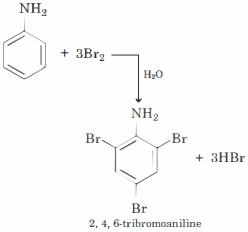
Aniline reacts with excess $Br_2 / H_2O$ to give the major product.
A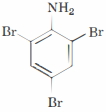
B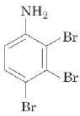
C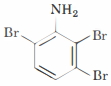
D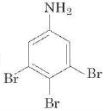
Solution
(A) When aniline reacts with excess bromine water $(Br_2 / H_2O)$,the $-NH_2$ group strongly activates the benzene ring towards electrophilic substitution.
This results in the substitution of bromine atoms at all available ortho and para positions,yielding $2,4,6-$tribromoaniline as the major white precipitate product.
This results in the substitution of bromine atoms at all available ortho and para positions,yielding $2,4,6-$tribromoaniline as the major white precipitate product.
0 likes
View Solution807
MediumMCQ
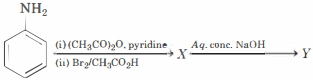
In the reaction sequence,
$X$ and $Y$ are,respectively
$X$ and $Y$ are,respectively
A
$p$-bromoacetanilide and $p$-bromoaniline
B
$2,4,6$-tribromoacetanilide and $2,4,6$-tribromoaniline
C
$o$-bromoacetanilide and $o$-bromoaniline
D
$2,6$-dibromoacetanilide and $2,6$-dibromoaniline
Solution
(A) Aniline is a highly reactive species towards electrophilic substitution due to the strong activating effect of the $-NH_2$ group. To control the reaction and obtain a monobrominated product,the $-NH_2$ group is first protected by acetylation using $(CH_3CO)_2O$ in the presence of pyridine to form acetanilide.
Acetanilide then undergoes electrophilic bromination with $Br_2/CH_3CO_2H$ to yield $p$-bromoacetanilide as the major product $(X)$.
Finally,the acetyl protecting group is removed by hydrolysis using aqueous concentrated $NaOH$ to yield $p$-bromoaniline $(Y)$.
Acetanilide then undergoes electrophilic bromination with $Br_2/CH_3CO_2H$ to yield $p$-bromoacetanilide as the major product $(X)$.
Finally,the acetyl protecting group is removed by hydrolysis using aqueous concentrated $NaOH$ to yield $p$-bromoaniline $(Y)$.
0 likes
View Solution808
DifficultMCQ
The major product obtained in the reaction of aniline with acetic anhydride is
A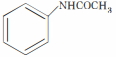
B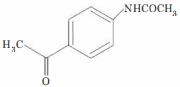
C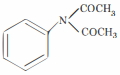
D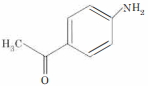
Solution
(A) The reaction of aniline $(C_6H_5NH_2)$ with acetic anhydride $(CH_3CO)_2O$ is an acetylation reaction.
In this reaction,the lone pair of electrons on the nitrogen atom of the aniline attacks the carbonyl carbon of the acetic anhydride.
This leads to the formation of $N$-phenylethanamide,commonly known as acetanilide $(C_6H_5NHCOCH_3)$,and acetic acid $(CH_3COOH)$ as a byproduct.
The reaction is:
$C_6H_5NH_2 + (CH_3CO)_2O \rightarrow C_6H_5NHCOCH_3 + CH_3COOH$
Therefore,the major product is $N$-phenylethanamide.
In this reaction,the lone pair of electrons on the nitrogen atom of the aniline attacks the carbonyl carbon of the acetic anhydride.
This leads to the formation of $N$-phenylethanamide,commonly known as acetanilide $(C_6H_5NHCOCH_3)$,and acetic acid $(CH_3COOH)$ as a byproduct.
The reaction is:
$C_6H_5NH_2 + (CH_3CO)_2O \rightarrow C_6H_5NHCOCH_3 + CH_3COOH$
Therefore,the major product is $N$-phenylethanamide.
0 likes
View Solution809
MediumMCQ
The compound $X (C_{7}H_{9}N)$ reacts with benzene sulphonyl chloride to give $Y (C_{13}H_{13}NO_{2}S)$ which is insoluble in alkali. The compound $X$ is
A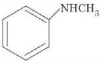
B
C
D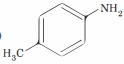
Solution
(A) Benzene sulphonyl chloride,also known as Hinsberg's reagent,reacts with $1^{\circ}$ and $2^{\circ}$ amines to form sulphonamides.
The sulphonamide formed from a $1^{\circ}$ amine contains an acidic hydrogen atom attached to the nitrogen,making it soluble in alkali.
The sulphonamide formed from a $2^{\circ}$ amine does not contain any acidic hydrogen atom attached to the nitrogen,making it insoluble in alkali.
Given that compound $X (C_{7}H_{9}N)$ reacts with benzene sulphonyl chloride to form a product $Y$ that is insoluble in alkali,$X$ must be a $2^{\circ}$ amine.
Among the given options,$N$-methylaniline $(C_{6}H_{5}NHCH_{3})$ is a $2^{\circ}$ amine,which satisfies the given conditions.
The sulphonamide formed from a $1^{\circ}$ amine contains an acidic hydrogen atom attached to the nitrogen,making it soluble in alkali.
The sulphonamide formed from a $2^{\circ}$ amine does not contain any acidic hydrogen atom attached to the nitrogen,making it insoluble in alkali.
Given that compound $X (C_{7}H_{9}N)$ reacts with benzene sulphonyl chloride to form a product $Y$ that is insoluble in alkali,$X$ must be a $2^{\circ}$ amine.
Among the given options,$N$-methylaniline $(C_{6}H_{5}NHCH_{3})$ is a $2^{\circ}$ amine,which satisfies the given conditions.
0 likes
View Solution810
MediumMCQ
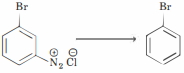
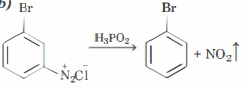
For the transformation shown below,the reagent used is:
A
$LiAlH_4$
B
$H_3PO_2$
C
$H_3O^{+}$
D
$H_2 / Pt$
Solution
(B) The correct option is $(B)$.
The reaction involves the removal of the diazonium group $(-N_2^+ Cl^-)$ from the benzene ring and its replacement with a hydrogen atom.
This transformation is achieved using hypophosphorous acid $(H_3PO_2)$ in the presence of water. The diazonium salt is reduced to the corresponding arene,while $H_3PO_2$ is oxidized to phosphorous acid $(H_3PO_3)$.
The reaction is represented as:
$Ar-N_2^+ Cl^- + H_3PO_2 + H_2O \rightarrow Ar-H + N_2 + H_3PO_3 + HCl$
This is a standard method for the deamination of aromatic amines via their diazonium salts.
The reaction involves the removal of the diazonium group $(-N_2^+ Cl^-)$ from the benzene ring and its replacement with a hydrogen atom.
This transformation is achieved using hypophosphorous acid $(H_3PO_2)$ in the presence of water. The diazonium salt is reduced to the corresponding arene,while $H_3PO_2$ is oxidized to phosphorous acid $(H_3PO_3)$.
The reaction is represented as:
$Ar-N_2^+ Cl^- + H_3PO_2 + H_2O \rightarrow Ar-H + N_2 + H_3PO_3 + HCl$
This is a standard method for the deamination of aromatic amines via their diazonium salts.
0 likes
View Solution811
MediumMCQ
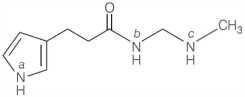
The most acidic proton and the strongest nucleophilic nitrogen in the following compound are respectively:
A
$N^a-H ; N^b$
B
$N^b-H ; N^c$
C
$N^a-H ; N^c$
D
$N^c-H ; N^a$
Solution
(B) The correct option is $(B)$.
In the given compound,the most acidic proton is $N^b-H$. This is because the resulting conjugate base is resonance-stabilized by the adjacent carbonyl group $(C=O)$.
The most nucleophilic nitrogen is $N^c$. This is because the lone pair of electrons on this nitrogen is localized in an $sp^3$-hybrid orbital and is not involved in resonance,making it readily available for donation.
In the given compound,the most acidic proton is $N^b-H$. This is because the resulting conjugate base is resonance-stabilized by the adjacent carbonyl group $(C=O)$.
The most nucleophilic nitrogen is $N^c$. This is because the lone pair of electrons on this nitrogen is localized in an $sp^3$-hybrid orbital and is not involved in resonance,making it readily available for donation.
0 likes
View Solution812
MediumMCQ
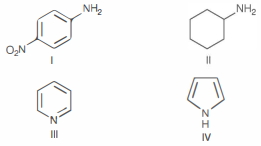
The order of basicity of the following compounds in water is:
A
$IV < I < III < II$
B
$II < I < IV < III$
C
$IV < III < I < II$
D
$II < III < I < IV$
Solution
(A) The correct order of basicity is $IV < I < III < II$.
$1$. Compound $IV$ (pyrrole) is the least basic because the lone pair on the nitrogen atom is involved in the aromatic sextet,making it unavailable for protonation.
$2$. Compound $I$ ($p$-nitroaniline) is less basic than $III$ (pyridine) because the strong electron-withdrawing $-NO_2$ group decreases the electron density on the nitrogen atom through both $-I$ and $-M$ effects.
$3$. Compound $III$ (pyridine) has the nitrogen atom $sp^2$ hybridized,which is more electronegative than the $sp^3$ hybridized nitrogen in aliphatic amines,making it less basic than $II$.
$4$. Compound $II$ (cyclohexylamine) is the most basic as it is a primary aliphatic amine with no electron-withdrawing groups attached,and the nitrogen is $sp^3$ hybridized.
$1$. Compound $IV$ (pyrrole) is the least basic because the lone pair on the nitrogen atom is involved in the aromatic sextet,making it unavailable for protonation.
$2$. Compound $I$ ($p$-nitroaniline) is less basic than $III$ (pyridine) because the strong electron-withdrawing $-NO_2$ group decreases the electron density on the nitrogen atom through both $-I$ and $-M$ effects.
$3$. Compound $III$ (pyridine) has the nitrogen atom $sp^2$ hybridized,which is more electronegative than the $sp^3$ hybridized nitrogen in aliphatic amines,making it less basic than $II$.
$4$. Compound $II$ (cyclohexylamine) is the most basic as it is a primary aliphatic amine with no electron-withdrawing groups attached,and the nitrogen is $sp^3$ hybridized.
0 likes
View Solution813
MediumMCQ
Among the following substituted pyridines,the most basic compound is
A
Pyridine
B
$4-$(Dimethylamino)pyridine
C
$4-$Methylpyridine
D
$4-$Chloropyridine
Solution
(B) Pyridine is basic in nature due to the presence of a free lone pair on the nitrogen atom. Its basicity is influenced by the substituents attached to the ring. Electron-withdrawing groups $(EWG)$ decrease the basicity of pyridine,while electron-releasing groups $(ERG)$ increase its basicity.
Substituents like $-N(CH_3)_2$ and $-CH_3$ are electron-releasing,but the $-N(CH_3)_2$ group is a much stronger electron-donating group due to the resonance effect (+$R$ effect) compared to the inductive effect (+$I$ effect) of the $-CH_3$ group.
Conversely,the $-Cl$ group is electron-withdrawing due to its strong inductive effect (-$I$ effect),which decreases the electron density on the nitrogen atom,making it the least basic.
The order of basicity is: $4\text{-Chloropyridine} < \text{Pyridine} < 4\text{-Methylpyridine} < 4\text{-(Dimethylamino)pyridine}$.
Therefore,$4\text{-(Dimethylamino)pyridine}$ is the most basic compound.
Substituents like $-N(CH_3)_2$ and $-CH_3$ are electron-releasing,but the $-N(CH_3)_2$ group is a much stronger electron-donating group due to the resonance effect (+$R$ effect) compared to the inductive effect (+$I$ effect) of the $-CH_3$ group.
Conversely,the $-Cl$ group is electron-withdrawing due to its strong inductive effect (-$I$ effect),which decreases the electron density on the nitrogen atom,making it the least basic.
The order of basicity is: $4\text{-Chloropyridine} < \text{Pyridine} < 4\text{-Methylpyridine} < 4\text{-(Dimethylamino)pyridine}$.
Therefore,$4\text{-(Dimethylamino)pyridine}$ is the most basic compound.
0 likes
View Solution814
MediumMCQ
The major product in the following reaction at $25^{\circ} C$ is $CH_3COOH \xrightarrow{CH_3CH_2NH_2}$
A
$CH_3CONHCH_2CH_3$
B
$CH_3CH=NCH_2CH_3$
C
$CH_3CH_2NH_3^+ \cdot CH_3COO^-$
D
$CH_3CON=CHCH_3$
Solution
(C) The reaction between a carboxylic acid $(CH_3COOH)$ and an amine $(CH_3CH_2NH_2)$ at room temperature $(25^{\circ} C)$ is an acid-base reaction.
$CH_3COOH$ acts as a Bronsted-Lowry acid and $CH_3CH_2NH_2$ acts as a Bronsted-Lowry base.
The proton transfer occurs from the acid to the amine,resulting in the formation of an ammonium carboxylate salt.
$CH_3COOH + CH_3CH_2NH_2 \xrightarrow{25^{\circ} C} CH_3CH_2NH_3^+ \cdot CH_3COO^-$
$CH_3COOH$ acts as a Bronsted-Lowry acid and $CH_3CH_2NH_2$ acts as a Bronsted-Lowry base.
The proton transfer occurs from the acid to the amine,resulting in the formation of an ammonium carboxylate salt.
$CH_3COOH + CH_3CH_2NH_2 \xrightarrow{25^{\circ} C} CH_3CH_2NH_3^+ \cdot CH_3COO^-$
0 likes
View Solution815
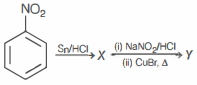
MediumMCQ
The products $X$ and $Y$ in the following reaction sequence are:
A
$X$: Nitrosobenzene,$Y$: Chlorobenzene
B
$X$: Aniline,$Y$: Bromobenzene
C
$X$: $3-$Chloronitrobenzene,$Y$: $1-$Bromo$-3-$chlorobenzene
D
$X$: $3-$Chloronitrosobenzene,$Y$: $1-$Bromo$-3-$chlorobenzene
Solution
(B) $1$. The reaction of nitrobenzene with $Sn/HCl$ is a reduction reaction that converts the nitro group $(-NO_2)$ into an amino group $(-NH_2)$,forming aniline $(X)$.
$2$. Aniline reacts with $NaNO_2/HCl$ at low temperatures $(0-5 \ ^\circ C)$ to undergo diazotization,forming benzenediazonium chloride.
$3$. The subsequent reaction with $CuBr$ (Sandmeyer reaction) replaces the diazonium group with a bromine atom,resulting in the formation of bromobenzene $(Y)$.
$2$. Aniline reacts with $NaNO_2/HCl$ at low temperatures $(0-5 \ ^\circ C)$ to undergo diazotization,forming benzenediazonium chloride.
$3$. The subsequent reaction with $CuBr$ (Sandmeyer reaction) replaces the diazonium group with a bromine atom,resulting in the formation of bromobenzene $(Y)$.
0 likes
View Solution816
MediumMCQ
$A$ compound $X$ with formula $C_4H_{11}N$ reacts with $HNO_2$ to liberate nitrogen and produce compound $Y$. The compound $Y$ on treatment with $I_2 / NaOH$ produces a sodium salt of a carboxylic acid. The compound $X$ is
A
$CH_3-CH_2-CH_2-CH_2-NH_2$
B
$CH_3-CH(CH_3)-CH_2-NH_2$
C
$CH_3-CH(NH_2)-CH_2-CH_3$
D
$(CH_3)_3C-NH_2$
Solution
(C) $1$. The reaction of an aliphatic primary amine with $HNO_2$ gives an alcohol with the evolution of $N_2$ gas.
$2$. The compound $Y$ reacts with $I_2 / NaOH$ (iodoform test) to give a sodium salt of a carboxylic acid,which indicates that $Y$ must be a secondary alcohol containing the $CH_3-CH(OH)-$ group.
$3$. Among the given options,$CH_3-CH(NH_2)-CH_2-CH_3$ (butan$-2-$amine) reacts with $HNO_2$ to form butan$-2-$ol $(CH_3-CH(OH)-CH_2-CH_3)$.
$4$. Butan$-2-$ol contains the $CH_3-CH(OH)-$ group,which gives a positive iodoform test with $I_2 / NaOH$ to produce sodium propionate and iodoform $(CHI_3)$.
$2$. The compound $Y$ reacts with $I_2 / NaOH$ (iodoform test) to give a sodium salt of a carboxylic acid,which indicates that $Y$ must be a secondary alcohol containing the $CH_3-CH(OH)-$ group.
$3$. Among the given options,$CH_3-CH(NH_2)-CH_2-CH_3$ (butan$-2-$amine) reacts with $HNO_2$ to form butan$-2-$ol $(CH_3-CH(OH)-CH_2-CH_3)$.
$4$. Butan$-2-$ol contains the $CH_3-CH(OH)-$ group,which gives a positive iodoform test with $I_2 / NaOH$ to produce sodium propionate and iodoform $(CHI_3)$.
0 likes
View Solution817
DifficultMCQ
Given below are two statements:
Statement $I$: Pure Aniline and other arylamines are usually colourless.
Statement $II$: Arylamines get coloured on storage due to atmospheric reduction.
In the light of the above statements,choose the most appropriate answer from the options given below:
Statement $I$: Pure Aniline and other arylamines are usually colourless.
Statement $II$: Arylamines get coloured on storage due to atmospheric reduction.
In the light of the above statements,choose the most appropriate answer from the options given below:
A
Both Statement $I$ and Statement $II$ are incorrect
B
Both Statement $I$ and Statement $II$ are correct
C
Statement $I$ is correct but Statement $II$ is incorrect
D
Statement $I$ is incorrect but Statement $II$ is correct
Solution
(C) Statement $-I$ is correct. Pure aniline and other arylamines are generally colourless liquids or solids when freshly prepared.
Statement $-II$ is incorrect. Arylamines get coloured on storage due to atmospheric oxidation,not reduction. They form complex coloured products when exposed to air and light.
Statement $-II$ is incorrect. Arylamines get coloured on storage due to atmospheric oxidation,not reduction. They form complex coloured products when exposed to air and light.
0 likes
View Solution818
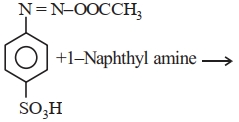
DifficultMCQ
Choose the correct colour of the product for the following reaction.
A
Yellow
B
White
C
Red
D
Blue
Solution
(C) The given reaction is a coupling reaction between a diazonium salt derivative and $1$-naphthylamine. The reaction proceeds as follows:
$1$-naphthylamine reacts with the diazonium species to form an azo dye.
This specific azo dye product is known to have a red colour.
Therefore,the correct option is $C$.
$1$-naphthylamine reacts with the diazonium species to form an azo dye.
This specific azo dye product is known to have a red colour.
Therefore,the correct option is $C$.
0 likes
View Solution819
MediumMCQ
The correct order of basic strength of methyl-substituted amines in an aqueous medium is:
A
$Me_2NH > MeNH_2 > Me_3N > NH_3$
B
$Me_2NH > Me_3N > MeNH_2 > NH_3$
C
$NH_3 > Me_3N > MeNH_2 > Me_2NH$
D
$Me_3N > Me_2NH > MeNH_2 > NH_3$
Solution
(A) In an aqueous medium,the basic strength of amines is determined by a combination of three factors: inductive effect,solvation effect,and steric hindrance.
$1$. The inductive effect ($+I$ effect) of methyl groups increases the electron density on the nitrogen atom,making it more basic.
$2$. The solvation effect stabilizes the protonated amine cation through hydrogen bonding with water molecules. More substituted cations are less stabilized due to steric hindrance.
$3$. For methyl-substituted amines,the combined effect results in the following order of basicity: $Me_2NH > MeNH_2 > Me_3N > NH_3$.
$1$. The inductive effect ($+I$ effect) of methyl groups increases the electron density on the nitrogen atom,making it more basic.
$2$. The solvation effect stabilizes the protonated amine cation through hydrogen bonding with water molecules. More substituted cations are less stabilized due to steric hindrance.
$3$. For methyl-substituted amines,the combined effect results in the following order of basicity: $Me_2NH > MeNH_2 > Me_3N > NH_3$.
0 likes
View Solution820
DifficultMCQ
Match List $I$ with List $II$:
Choose the correct answer from the options given below:
| List $I$ (Amines) | List $II$ $(pK_{b})$ |
| $A$. Aniline | $I$. $3.25$ |
| $B$. Ethanamine | $II$. $3.00$ |
| $C$. $N$-Ethylethanamine | $III$. $9.38$ |
| $D$. $N,N$-Diethylethanamine | $IV$. $3.29$ |
Choose the correct answer from the options given below:
A
$A-I, B-IV, C-II, D-III$
B
$A-III, B-II, C-I, D-IV$
C
$A-III, B-II, C-IV, D-I$
D
$A-III, B-IV, C-II, D-I$
Solution
(D) The basic strength of amines is inversely proportional to their $pK_{b}$ values.
$1$. Aniline $(A)$ is the least basic due to resonance,so it has the highest $pK_{b}$ value: $9.38$ $(III)$.
$2$. Among aliphatic amines,the basicity order in aqueous solution is determined by inductive effect,solvation,and steric hindrance. For ethylamines,the order is: $N$-Ethylethanamine ($C$,secondary) > $N,N$-Diethylethanamine ($D$,tertiary) > Ethanamine ($B$,primary).
$3$. Corresponding $pK_{b}$ values are:
- $C$ ($N$-Ethylethanamine): $3.00$ $(II)$
- $D$ ($N,N$-Diethylethanamine): $3.25$ $(I)$
- $B$ (Ethanamine): $3.29$ $(IV)$
Thus,the correct matching is: $A-III, B-IV, C-II, D-I$.
$1$. Aniline $(A)$ is the least basic due to resonance,so it has the highest $pK_{b}$ value: $9.38$ $(III)$.
$2$. Among aliphatic amines,the basicity order in aqueous solution is determined by inductive effect,solvation,and steric hindrance. For ethylamines,the order is: $N$-Ethylethanamine ($C$,secondary) > $N,N$-Diethylethanamine ($D$,tertiary) > Ethanamine ($B$,primary).
$3$. Corresponding $pK_{b}$ values are:
- $C$ ($N$-Ethylethanamine): $3.00$ $(II)$
- $D$ ($N,N$-Diethylethanamine): $3.25$ $(I)$
- $B$ (Ethanamine): $3.29$ $(IV)$
Thus,the correct matching is: $A-III, B-IV, C-II, D-I$.
0 likes
View Solution821
MediumMCQ
Reaction of propanamide with $Br_2 / KOH \ (aq)$ produces :
A
Ethylnitrile
B
Propylamine
C
Propanenitrile
D
Ethylamine
Solution
(D) The reaction of an amide with $Br_2$ and an aqueous base $(KOH)$ is known as the $Hoffmann$ $Bromamide$ degradation reaction.
In this reaction,the amide is converted into a primary amine containing one carbon atom less than the original amide.
Propanamide is $CH_3CH_2CONH_2$ (a $3$-carbon amide).
Upon treatment with $Br_2 / KOH$,it undergoes degradation to form ethylamine $(CH_3CH_2NH_2)$,which is a $2$-carbon primary amine.
In this reaction,the amide is converted into a primary amine containing one carbon atom less than the original amide.
Propanamide is $CH_3CH_2CONH_2$ (a $3$-carbon amide).
Upon treatment with $Br_2 / KOH$,it undergoes degradation to form ethylamine $(CH_3CH_2NH_2)$,which is a $2$-carbon primary amine.
0 likes
View Solution822
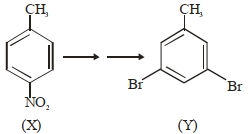
MediumMCQ
In the above conversion of compound $(X)$ to product $(Y)$,the sequence of reagents to be used will be:
A
$(I) Br_2, Fe$ $(II) Fe, H^{+}$ $(III) LiAlH_4$
B
$(I) Br_2 (aq)$ $(II) LiAlH_4$ $(III) H_3O^{+}$
C
$(I) Fe, H^{+}$ $(II) Br_2 (aq)$ $(III) HNO_2$ $(IV) CuBr$
D
$(I) Fe, H^{+}$ $(II) Br_2 (aq)$ $(III) HNO_2$ $(IV) H_3PO_2$
Solution
(D) The conversion of $p$-nitrotoluene $(X)$ to $3,5$-dibromotoluene $(Y)$ involves the following steps:
$1$. Reduction of the nitro group to an amino group: $p$-nitrotoluene is reduced using $Fe/H^{+}$ to form $p$-toluidine.
$2$. Bromination: $p$-toluidine is treated with $Br_2 (aq)$ to form $2,6$-dibromo-$4$-methylaniline due to the strong activating effect of the $-NH_2$ group.
$3$. Diazotization: The amino group is converted to a diazonium salt using $HNO_2$ at $0-5 \ ^{\circ}C$.
$4$. Deamination: The diazonium group is removed using $H_3PO_2$ and water to yield $3,5$-dibromotoluene $(Y)$.
$1$. Reduction of the nitro group to an amino group: $p$-nitrotoluene is reduced using $Fe/H^{+}$ to form $p$-toluidine.
$2$. Bromination: $p$-toluidine is treated with $Br_2 (aq)$ to form $2,6$-dibromo-$4$-methylaniline due to the strong activating effect of the $-NH_2$ group.
$3$. Diazotization: The amino group is converted to a diazonium salt using $HNO_2$ at $0-5 \ ^{\circ}C$.
$4$. Deamination: The diazonium group is removed using $H_3PO_2$ and water to yield $3,5$-dibromotoluene $(Y)$.
0 likes
View Solution823
EasyMCQ
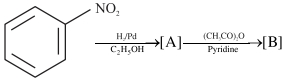
Find $B$ in the following reaction sequence:
A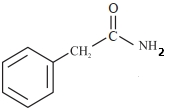
B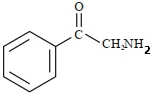
C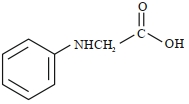
D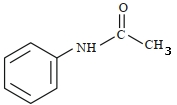
Solution
(D) The reaction sequence is as follows:
$1$. Nitrobenzene $(C_6H_5NO_2)$ is reduced using $H_2/Pd$ in ethanol $(C_2H_5OH)$ to form aniline $(C_6H_5NH_2)$,which is compound $[A]$.
$2$. Aniline $(C_6H_5NH_2)$ reacts with acetic anhydride $((CH_3CO)_2O)$ in the presence of pyridine to undergo acetylation,forming $N$-phenylacetamide (acetanilide),$C_6H_5NHCOCH_3$,which is compound $[B]$.
$1$. Nitrobenzene $(C_6H_5NO_2)$ is reduced using $H_2/Pd$ in ethanol $(C_2H_5OH)$ to form aniline $(C_6H_5NH_2)$,which is compound $[A]$.
$2$. Aniline $(C_6H_5NH_2)$ reacts with acetic anhydride $((CH_3CO)_2O)$ in the presence of pyridine to undergo acetylation,forming $N$-phenylacetamide (acetanilide),$C_6H_5NHCOCH_3$,which is compound $[B]$.
0 likes
View Solution824
DifficultMCQ
An organic compound $[A]$ $(C_4H_{11}N)$ shows optical activity and gives $N_2$ gas on treatment with $HNO_2$. The compound $[A]$ reacts with $PhSO_2Cl$ producing a compound which is soluble in $KOH$. The structure of $A$ is:
A
Butan$-1-$amine
B
$N$,$N$-dimethylethanamine
C
$N$-methylethanamine
D
Butan$-2-$amine
Solution
(D) $1$. The molecular formula $C_4H_{11}N$ corresponds to a saturated amine.
$2$. The reaction with $HNO_2$ to release $N_2$ gas indicates that the compound is a primary aliphatic amine $(R-NH_2)$.
$3$. The reaction with $PhSO_2Cl$ (Hinsberg reagent) produces a sulfonamide that is soluble in $KOH$. This confirms that the amine is a primary amine,as the resulting sulfonamide contains an acidic hydrogen on the nitrogen atom.
$4$. The compound must be optically active. Among the primary amines with the formula $C_4H_{11}N$,butan$-2-$amine $(CH_3CH_2CH(NH_2)CH_3)$ contains a chiral carbon atom and is therefore optically active.
$5$. Butan$-1-$amine is achiral.
$2$. The reaction with $HNO_2$ to release $N_2$ gas indicates that the compound is a primary aliphatic amine $(R-NH_2)$.
$3$. The reaction with $PhSO_2Cl$ (Hinsberg reagent) produces a sulfonamide that is soluble in $KOH$. This confirms that the amine is a primary amine,as the resulting sulfonamide contains an acidic hydrogen on the nitrogen atom.
$4$. The compound must be optically active. Among the primary amines with the formula $C_4H_{11}N$,butan$-2-$amine $(CH_3CH_2CH(NH_2)CH_3)$ contains a chiral carbon atom and is therefore optically active.
$5$. Butan$-1-$amine is achiral.
0 likes
View Solution825
DifficultMCQ
Given below are two statements: one is labelled as Assertion $(A)$ and the other is labelled as Reason $(R)$.
Assertion $(A)$: $\alpha$-halocarboxylic acid on reaction with dil. $NH_3$ gives good yield of $\alpha$-amino carboxylic acid whereas the yield of amines is very low when prepared from alkyl halides.
Reason $(R)$: Amino acids exist in zwitter ion form in aqueous medium.
In the light of the above statements,choose the correct answer from the options given below:
Assertion $(A)$: $\alpha$-halocarboxylic acid on reaction with dil. $NH_3$ gives good yield of $\alpha$-amino carboxylic acid whereas the yield of amines is very low when prepared from alkyl halides.
Reason $(R)$: Amino acids exist in zwitter ion form in aqueous medium.
In the light of the above statements,choose the correct answer from the options given below:
A
Both $(A)$ and $(R)$ are correct and $(R)$ is the correct explanation of $(A)$.
B
Both $(A)$ and $(R)$ are correct but $(R)$ is not the correct explanation of $(A)$.
C
$(A)$ is correct but $(R)$ is not correct.
D
$(A)$ is not correct but $(R)$ is correct.
Solution
(B) Assertion $(A)$ is correct. The reaction of $\alpha$-halocarboxylic acids with aqueous $NH_3$ is a standard method for preparing $\alpha$-amino acids because the reaction is controlled and the product is stable. In contrast,the reaction of alkyl halides with $NH_3$ (ammonolysis) often leads to a mixture of primary,secondary,and tertiary amines,resulting in a low yield of the primary amine.
Reason $(R)$ is correct. Amino acids do exist as zwitter ions in aqueous medium due to the internal acid-base reaction between the $-COOH$ and $-NH_2$ groups.
However,the zwitter ion nature of amino acids is not the reason why $\alpha$-halocarboxylic acids give a better yield of amino acids compared to alkyl halides. The yield difference is due to the nature of the substitution reaction and the stability of the products formed.
Therefore,both $(A)$ and $(R)$ are correct,but $(R)$ is not the correct explanation of $(A)$.
Reason $(R)$ is correct. Amino acids do exist as zwitter ions in aqueous medium due to the internal acid-base reaction between the $-COOH$ and $-NH_2$ groups.
However,the zwitter ion nature of amino acids is not the reason why $\alpha$-halocarboxylic acids give a better yield of amino acids compared to alkyl halides. The yield difference is due to the nature of the substitution reaction and the stability of the products formed.
Therefore,both $(A)$ and $(R)$ are correct,but $(R)$ is not the correct explanation of $(A)$.
0 likes
View Solution826
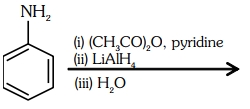
DifficultMCQ
The product formed from the following reaction sequence is:
A
$N$-ethylaniline
B
$2-(1$-hydroxyethyl)aniline
C
$4-(1$-hydroxyethyl)aniline
D
$2,4$-bis($1$-hydroxyethyl)aniline
Solution
(A) Step $1$: Aniline reacts with acetic anhydride $(CH_3CO)_2O$ in the presence of pyridine to form acetanilide $(C_6H_5NHCOCH_3)$.
Step $2$: Acetanilide is then reduced by $LiAlH_4$ (a strong reducing agent) which reduces the amide group $(-NHCOCH_3)$ to an amine group $(-NHCH_2CH_3)$.
Step $3$: Hydrolysis $(H_2O)$ yields the final product,$N$-ethylaniline $(C_6H_5NHCH_2CH_3)$.
Step $2$: Acetanilide is then reduced by $LiAlH_4$ (a strong reducing agent) which reduces the amide group $(-NHCOCH_3)$ to an amine group $(-NHCH_2CH_3)$.
Step $3$: Hydrolysis $(H_2O)$ yields the final product,$N$-ethylaniline $(C_6H_5NHCH_2CH_3)$.
0 likes
View Solution827
MediumMCQ
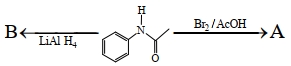
The major products $A$ and $B$ from the following reactions are:
A
$A = \text{2,4,6-tribromoacetanilide}, B = \text{N-ethylaniline}$
B
$A = \text{4-bromoacetanilide}, B = \text{N-ethylaniline}$
C
$A = \text{2,4,6-tribromoacetanilide}, B = \text{aniline}$
D
$A = \text{4-bromoacetanilide}, B = \text{aniline}$
Solution
(B) The starting material is acetanilide.
$1$. Reaction with $Br_2/AcOH$: The $-NHCOCH_3$ group is strongly activating and ortho/para-directing. Due to the steric hindrance of the bulky acetamido group,the para-substitution is favored,yielding $4$-bromoacetanilide as the major product $A$.
$2$. Reaction with $LiAlH_4$: $LiAlH_4$ is a strong reducing agent that reduces the amide group $(-NHCOCH_3)$ to an amine group $(-NHCH_2CH_3)$. Thus,acetanilide is reduced to $N$-ethylaniline,which is the major product $B$.
$1$. Reaction with $Br_2/AcOH$: The $-NHCOCH_3$ group is strongly activating and ortho/para-directing. Due to the steric hindrance of the bulky acetamido group,the para-substitution is favored,yielding $4$-bromoacetanilide as the major product $A$.
$2$. Reaction with $LiAlH_4$: $LiAlH_4$ is a strong reducing agent that reduces the amide group $(-NHCOCH_3)$ to an amine group $(-NHCH_2CH_3)$. Thus,acetanilide is reduced to $N$-ethylaniline,which is the major product $B$.
0 likes
View Solution828
MediumMCQ
Match List-$I$ with List-$II$:
Benzenediazonium chloride $(C_6H_5N_2^+Cl^-)$ is reacted with reagents in List-$I$ to form products in List-$II$.
| List-$I$ (Reagent) | List-$II$ (Product) |
| :--- | :--- |
| $A$. Aniline $(C_6H_5NH_2)$ | $I$. Fluorobenzene $(C_6H_5F)$ |
| $B$. $HBF_4, \Delta$ | $II$. Benzonitrile $(C_6H_5CN)$ |
| $C$. $Cu, HCl$ | $III$. $p$-Aminoazobenzene $(C_6H_5-N=N-C_6H_4-NH_2)$ |
| $D$. $CuCN/KCN$ | $IV$. Chlorobenzene $(C_6H_5Cl)$ |
Choose the correct answer from the options given below:
Benzenediazonium chloride $(C_6H_5N_2^+Cl^-)$ is reacted with reagents in List-$I$ to form products in List-$II$.
| List-$I$ (Reagent) | List-$II$ (Product) |
| :--- | :--- |
| $A$. Aniline $(C_6H_5NH_2)$ | $I$. Fluorobenzene $(C_6H_5F)$ |
| $B$. $HBF_4, \Delta$ | $II$. Benzonitrile $(C_6H_5CN)$ |
| $C$. $Cu, HCl$ | $III$. $p$-Aminoazobenzene $(C_6H_5-N=N-C_6H_4-NH_2)$ |
| $D$. $CuCN/KCN$ | $IV$. Chlorobenzene $(C_6H_5Cl)$ |
Choose the correct answer from the options given below:
A
$A-IV, B-III, C-II, D-I$
B
$A-I, B-III, C-IV, D-II$
C
$A-III, B-I, C-II, D-IV$
D
$A-III, B-I, C-IV, D-II$
Solution
(D) The reactions of benzenediazonium chloride $(C_6H_5N_2^ Cl^-)$ are as follows:
$A$. Reaction with aniline $(C_6H_5NH_2)$ leads to coupling reaction to form $p$-aminoazobenzene (Product $III$).
$B$. Reaction with $HBF_4$ followed by heating $(\Delta)$ is the Balz-Schiemann reaction,which forms fluorobenzene (Product $I$).
$C$. Reaction with $Cu/HCl$ is the Gattermann reaction,which forms chlorobenzene (Product $IV$).
$D$. Reaction with $CuCN/KCN$ is the Sandmeyer reaction,which forms benzonitrile (Product $II$).
Thus,the correct matching is $A-III, B-I, C-IV, D-II$.
$A$. Reaction with aniline $(C_6H_5NH_2)$ leads to coupling reaction to form $p$-aminoazobenzene (Product $III$).
$B$. Reaction with $HBF_4$ followed by heating $(\Delta)$ is the Balz-Schiemann reaction,which forms fluorobenzene (Product $I$).
$C$. Reaction with $Cu/HCl$ is the Gattermann reaction,which forms chlorobenzene (Product $IV$).
$D$. Reaction with $CuCN/KCN$ is the Sandmeyer reaction,which forms benzonitrile (Product $II$).
Thus,the correct matching is $A-III, B-I, C-IV, D-II$.
0 likes
View Solution829
MediumMCQ
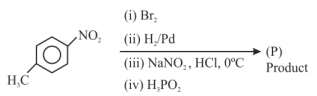
The product $(P)$ formed from the following multistep reaction is :-
A
$2-$bromo$-1-$methylbenzene
B
$3-$bromo$-1-$methylbenzene
C
$4-$bromo$-1-$methylbenzene
D
$2-$bromo$-4-$methylphenol
Solution
(A) Step $1$: Electrophilic aromatic substitution of $p$-nitrotoluene with $Br_2$ gives $2$-bromo-$4$-nitrotoluene.
Step $2$: Reduction of the nitro group using $H_2/Pd$ yields $2$-bromo-$4$-methylaniline.
Step $3$: Diazotization using $NaNO_2/HCl$ at $0^{\circ}C$ converts the amino group into a diazonium salt,forming $2$-bromo-$4$-methylbenzenediazonium chloride.
Step $4$: Reduction of the diazonium salt with $H_3PO_2$ replaces the $-N_2^+Cl^-$ group with a hydrogen atom,resulting in $2$-bromo-$1$-methylbenzene (also known as $o$-bromotoluene).
Step $2$: Reduction of the nitro group using $H_2/Pd$ yields $2$-bromo-$4$-methylaniline.
Step $3$: Diazotization using $NaNO_2/HCl$ at $0^{\circ}C$ converts the amino group into a diazonium salt,forming $2$-bromo-$4$-methylbenzenediazonium chloride.
Step $4$: Reduction of the diazonium salt with $H_3PO_2$ replaces the $-N_2^+Cl^-$ group with a hydrogen atom,resulting in $2$-bromo-$1$-methylbenzene (also known as $o$-bromotoluene).
0 likes
View Solution830
MediumMCQ
Isomeric amines with molecular formula $C_8H_{11}N$ give the following tests:
Isomer $(P) \Rightarrow$ Can be prepared by Gabriel phthalimide synthesis.
Isomer $(Q) \Rightarrow$ Reacts with Hinsberg's reagent to give a solid insoluble in $NaOH$.
Isomer $(R) \Rightarrow$ Reacts with $HONO$ followed by $\beta$-naphthol in $NaOH$ to give a red dye.
Isomers $(P), (Q)$ and $(R)$ respectively are:
Isomer $(P) \Rightarrow$ Can be prepared by Gabriel phthalimide synthesis.
Isomer $(Q) \Rightarrow$ Reacts with Hinsberg's reagent to give a solid insoluble in $NaOH$.
Isomer $(R) \Rightarrow$ Reacts with $HONO$ followed by $\beta$-naphthol in $NaOH$ to give a red dye.
Isomers $(P), (Q)$ and $(R)$ respectively are:
A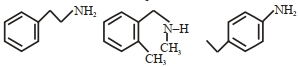
B
C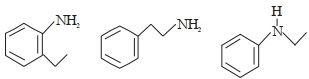
D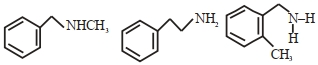
Solution
(D) $(P)$ Gabriel phthalimide synthesis is used for the preparation of aliphatic primary amines. Among the given options,$2$-phenylethanamine $(C_6H_5CH_2CH_2NH_2)$ is an aliphatic primary amine.
$(Q)$ $2^{\circ}$-amines react with Hinsberg's reagent (benzenesulfonyl chloride) to form a sulfonamide that is insoluble in $NaOH$ because it lacks an acidic hydrogen on the nitrogen atom. $N$-ethylaniline $(C_6H_5NHC_2H_5)$ is a $2^{\circ}$-amine.
$(R)$ Aromatic primary amines react with nitrous acid $(HONO)$ at low temperature $(273-278 \ K)$ to form diazonium salts,which undergo coupling reactions with $\beta$-naphthol in alkaline medium to form a red azo dye. $o$-ethylaniline is an aromatic primary amine.
Therefore,the correct sequence is $(P) = 2$-phenylethanamine,$(Q) = N$-ethylaniline,$(R) = o$-ethylaniline. This corresponds to option $D$.
$(Q)$ $2^{\circ}$-amines react with Hinsberg's reagent (benzenesulfonyl chloride) to form a sulfonamide that is insoluble in $NaOH$ because it lacks an acidic hydrogen on the nitrogen atom. $N$-ethylaniline $(C_6H_5NHC_2H_5)$ is a $2^{\circ}$-amine.
$(R)$ Aromatic primary amines react with nitrous acid $(HONO)$ at low temperature $(273-278 \ K)$ to form diazonium salts,which undergo coupling reactions with $\beta$-naphthol in alkaline medium to form a red azo dye. $o$-ethylaniline is an aromatic primary amine.
Therefore,the correct sequence is $(P) = 2$-phenylethanamine,$(Q) = N$-ethylaniline,$(R) = o$-ethylaniline. This corresponds to option $D$.
0 likes
View Solution831
MediumMCQ
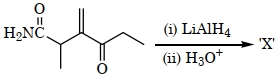
In the reaction given below:
The product '$X$' is:
The product '$X$' is:
A
$A$ structure showing a primary amine and a secondary alcohol group.
B
$A$ structure showing a primary amine and two hydroxyl groups.
C
$A$ structure showing a primary amine and two hydroxyl groups at different positions.
D
$A$ structure showing a primary amine and a secondary alcohol group with a different carbon skeleton.
Solution
(A) $LiAlH_4$ is a strong reducing agent that reduces amides to amines and ketones to secondary alcohols.
In the given substrate,the amide group $(-CONH_2)$ is reduced to a primary amine $(-CH_2NH_2)$ and the ketone group $(>C=O)$ is reduced to a secondary alcohol $(-CH(OH)-)$.
The alkene double bond $(C=C)$ remains unaffected by $LiAlH_4$.
Therefore,the product '$X$' is the molecule containing both a primary amine and a secondary alcohol group,with the alkene intact.
In the given substrate,the amide group $(-CONH_2)$ is reduced to a primary amine $(-CH_2NH_2)$ and the ketone group $(>C=O)$ is reduced to a secondary alcohol $(-CH(OH)-)$.
The alkene double bond $(C=C)$ remains unaffected by $LiAlH_4$.
Therefore,the product '$X$' is the molecule containing both a primary amine and a secondary alcohol group,with the alkene intact.
0 likes
View Solution832
DifficultMCQ
$o$-Phenylenediamine $\stackrel{HNO_2}{\longrightarrow}$ '$X$'
A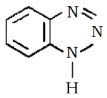
B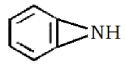
C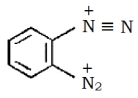
D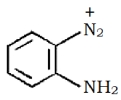
Solution
(A) When $o$-phenylenediamine reacts with nitrous acid $(HNO_2)$,one of the amino groups is converted into a diazonium salt group $(-N_2^+)$.
Due to the proximity of the other amino group $(-NH_2)$ at the ortho position,an intramolecular nucleophilic attack occurs.
The lone pair on the nitrogen of the $-NH_2$ group attacks the diazonium nitrogen,leading to the formation of a cyclic compound known as benzotriazole.
The reaction proceeds as follows:
$o$-Phenylenediamine $\xrightarrow{HNO_2}$ $o$-amino-benzenediazonium ion $\xrightarrow{-H_2O, -H^+}$ Benzotriazole.
Due to the proximity of the other amino group $(-NH_2)$ at the ortho position,an intramolecular nucleophilic attack occurs.
The lone pair on the nitrogen of the $-NH_2$ group attacks the diazonium nitrogen,leading to the formation of a cyclic compound known as benzotriazole.
The reaction proceeds as follows:
$o$-Phenylenediamine $\xrightarrow{HNO_2}$ $o$-amino-benzenediazonium ion $\xrightarrow{-H_2O, -H^+}$ Benzotriazole.
0 likes
View Solution833
DifficultMCQ
The incorrect statement regarding the reaction given below is:
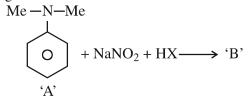
A
The electrophile involved in the reaction is $NO^{+}$
B
$'B'$ is $N$-nitroso ammonium compound
C
The reaction occurs at low temperature
D
The product $'B'$ formed in the above reaction is $p$-nitroso compound at low temperature
Solution
(B) The reaction of $N,N$-dimethylaniline with $NaNO_2$ and $HX$ (nitrous acid) at low temperature $(0-5^{\circ}C)$ is an electrophilic aromatic substitution reaction.
$1$. The electrophile generated is the nitrosonium ion,$NO^{+}$.
$2$. Since the $-N(CH_3)_2$ group is a strong ortho/para directing group,the electrophile $NO^{+}$ attacks the para position to form $p$-nitroso-$N,N$-dimethylaniline.
$3$. Option $A$ is correct as $NO^{+}$ is the electrophile.
$4$. Option $B$ is incorrect because the product is $p$-nitroso-$N,N$-dimethylaniline,not an $N$-nitroso ammonium compound (which would form with secondary amines).
$5$. Option $C$ is correct as the reaction is performed at low temperatures to stabilize the nitrous acid and prevent side reactions.
$6$. Option $D$ is correct as the major product is the $p$-nitroso derivative.
$1$. The electrophile generated is the nitrosonium ion,$NO^{+}$.
$2$. Since the $-N(CH_3)_2$ group is a strong ortho/para directing group,the electrophile $NO^{+}$ attacks the para position to form $p$-nitroso-$N,N$-dimethylaniline.
$3$. Option $A$ is correct as $NO^{+}$ is the electrophile.
$4$. Option $B$ is incorrect because the product is $p$-nitroso-$N,N$-dimethylaniline,not an $N$-nitroso ammonium compound (which would form with secondary amines).
$5$. Option $C$ is correct as the reaction is performed at low temperatures to stabilize the nitrous acid and prevent side reactions.
$6$. Option $D$ is correct as the major product is the $p$-nitroso derivative.
0 likes
View Solution834
MediumMCQ
Compound $A$ from the following reaction sequence is:
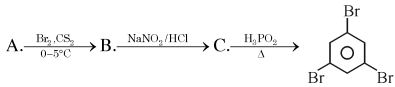
A
Benzoic Acid
B
Phenol
C
Salicylic Acid
D
Aniline
Solution
(D) The reaction sequence is as follows:
$1$. $A$ is $Aniline$ $(C_6H_5NH_2)$.
$2$. When $Aniline$ reacts with $Br_2$ in water (or $Br_2/CS_2$ at low temperature),it undergoes electrophilic substitution to form $2,4,6-tribromoaniline$ (Compound $B$).
$3$. $2,4,6-tribromoaniline$ reacts with $NaNO_2/HCl$ at $0-5^{\circ}C$ to form the diazonium salt,$2,4,6-tribromobenzenediazonium$ chloride (Compound $C$).
$4$. Finally,reduction of the diazonium salt with $H_3PO_2$ and water removes the $-N_2^+Cl^-$ group,yielding $1,3,5-tribromobenzene$.
Thus,compound $A$ is $Aniline$.
$1$. $A$ is $Aniline$ $(C_6H_5NH_2)$.
$2$. When $Aniline$ reacts with $Br_2$ in water (or $Br_2/CS_2$ at low temperature),it undergoes electrophilic substitution to form $2,4,6-tribromoaniline$ (Compound $B$).
$3$. $2,4,6-tribromoaniline$ reacts with $NaNO_2/HCl$ at $0-5^{\circ}C$ to form the diazonium salt,$2,4,6-tribromobenzenediazonium$ chloride (Compound $C$).
$4$. Finally,reduction of the diazonium salt with $H_3PO_2$ and water removes the $-N_2^+Cl^-$ group,yielding $1,3,5-tribromobenzene$.
Thus,compound $A$ is $Aniline$.
0 likes
View Solution835
MediumMCQ
Consider the following sequence of reactions:
$C_6H_5NH_2$ $\xrightarrow{NaNO_2, 0-5^{\circ}C} 'A'$ $\xrightarrow{N,N-\text{Dimethylaniline}} 'B'$
The product $B$ is
$C_6H_5NH_2$ $\xrightarrow{NaNO_2, 0-5^{\circ}C} 'A'$ $\xrightarrow{N,N-\text{Dimethylaniline}} 'B'$
The product $B$ is
A
$4-$(Dimethylamino)phenylhydrazine
B
$N,N$-Dimethyl$-4-$(phenylazo)aniline
C
$1,2-$Diphenyl-$N$,$N$-dimethylhydrazine
D
$4-$Amino-$N$,$N$-dimethyl$-1,2-$diphenylhydrazine
Solution
(B) Step $1$: Aniline $(C_6H_5NH_2)$ reacts with $NaNO_2$ in the presence of $HCl$ at $0-5^{\circ}C$ to form benzenediazonium chloride $(C_6H_5N_2^+Cl^-)$,which is product '$A$'.
Step $2$: Benzenediazonium chloride undergoes a diazo coupling reaction with $N,N$-dimethylaniline in a weakly acidic medium. The diazonium group $( -N=N- )$ attacks the para-position of the $N,N$-dimethylaniline ring to form $N,N$-dimethyl$-4-$(phenylazo)aniline,which is product '$B$'.
The reaction is: $C_6H_5N_2^+Cl^- + C_6H_5N(CH_3)_2 \rightarrow C_6H_5-N=N-C_6H_4-N(CH_3)_2 + HCl$.
Step $2$: Benzenediazonium chloride undergoes a diazo coupling reaction with $N,N$-dimethylaniline in a weakly acidic medium. The diazonium group $( -N=N- )$ attacks the para-position of the $N,N$-dimethylaniline ring to form $N,N$-dimethyl$-4-$(phenylazo)aniline,which is product '$B$'.
The reaction is: $C_6H_5N_2^+Cl^- + C_6H_5N(CH_3)_2 \rightarrow C_6H_5-N=N-C_6H_4-N(CH_3)_2 + HCl$.
0 likes
View Solution836
MediumMCQ
Which of the following reactions will $NOT$ give a primary amine as the product?
A
$CH_3CN \xrightarrow[(ii) H_3O^{\oplus}]{(i) LiAlH_4} \text{product}$
B
$CH_3CONH_2 \xrightarrow{Br_2/KOH} \text{product}$
C
$CH_3CONH_2 \xrightarrow[(ii) H_3O^{\oplus}]{(i) LiAlH_4} \text{product}$
D
$CH_3NC \xrightarrow[(ii) H_3O^{\oplus}]{(i) LiAlH_4} \text{product}$
Solution
(D) Let us analyze each reaction:
$(A)$ $CH_3CN + (i) LiAlH_4 / (ii) H_3O^{\oplus} \rightarrow CH_3CH_2NH_2$ (Ethylamine,a primary amine).
$(B)$ $CH_3CONH_2 + Br_2/KOH \rightarrow CH_3NH_2$ (Methylamine,a primary amine) via the Hoffmann bromamide degradation reaction.
$(C)$ $CH_3CONH_2 + (i) LiAlH_4 / (ii) H_3O^{\oplus} \rightarrow CH_3CH_2NH_2$ (Ethylamine,a primary amine).
$(D)$ $CH_3NC + (i) LiAlH_4 / (ii) H_3O^{\oplus} \rightarrow CH_3NHCH_3$ (Dimethylamine,a secondary amine).
Thus,reaction $(D)$ does not yield a primary amine.
$(A)$ $CH_3CN + (i) LiAlH_4 / (ii) H_3O^{\oplus} \rightarrow CH_3CH_2NH_2$ (Ethylamine,a primary amine).
$(B)$ $CH_3CONH_2 + Br_2/KOH \rightarrow CH_3NH_2$ (Methylamine,a primary amine) via the Hoffmann bromamide degradation reaction.
$(C)$ $CH_3CONH_2 + (i) LiAlH_4 / (ii) H_3O^{\oplus} \rightarrow CH_3CH_2NH_2$ (Ethylamine,a primary amine).
$(D)$ $CH_3NC + (i) LiAlH_4 / (ii) H_3O^{\oplus} \rightarrow CH_3NHCH_3$ (Dimethylamine,a secondary amine).
Thus,reaction $(D)$ does not yield a primary amine.
0 likes
View Solution837
DifficultMCQ
Which of the following is the strongest Bronsted base?
A
Aniline
B
Diphenylamine
C
Pyrrole
D
Pyrrolidine
Solution
(D) Bronsted base is a substance that can accept a proton $(H^+)$. The strength of a base depends on the availability of the lone pair of electrons on the nitrogen atom.
$1$. In $A$ (Aniline),the lone pair on nitrogen is delocalized into the benzene ring due to resonance,making it less available for protonation.
$2$. In $B$ (Diphenylamine),the lone pair is delocalized into two benzene rings,making it even less basic than aniline.
$3$. In $C$ (Pyrrole),the lone pair on nitrogen is involved in the aromatic sextet (it is part of the $6\pi$ electron system),so it is not available for protonation.
$4$. In $D$ (Pyrrolidine),the nitrogen atom is $sp^3$ hybridized and the lone pair is localized (not involved in resonance). This makes the lone pair readily available for donation to a proton,making it the strongest base among the given options.
$1$. In $A$ (Aniline),the lone pair on nitrogen is delocalized into the benzene ring due to resonance,making it less available for protonation.
$2$. In $B$ (Diphenylamine),the lone pair is delocalized into two benzene rings,making it even less basic than aniline.
$3$. In $C$ (Pyrrole),the lone pair on nitrogen is involved in the aromatic sextet (it is part of the $6\pi$ electron system),so it is not available for protonation.
$4$. In $D$ (Pyrrolidine),the nitrogen atom is $sp^3$ hybridized and the lone pair is localized (not involved in resonance). This makes the lone pair readily available for donation to a proton,making it the strongest base among the given options.
0 likes
View Solution838
DifficultMCQ
Identify $B$ formed in the reaction: $Cl-(CH_2)_4-Cl$ $\xrightarrow{\text{excess } NH_3} A$ $\xrightarrow{NaOH} B + H_2O + NaCl$
A
$Cl-(CH_2)_4-NH_2$
B
$H_2N-(CH_2)_4-NH_2$
C
$Cl^{-}H_3N^{+}-(CH_2)_4-NH_3^{+}Cl^{-}$
D
$CH_3-CH_2-CH_2-CH_2-NH_2$
Solution
(B) When $1,4$-dichlorobutane reacts with excess ammonia,it undergoes nucleophilic substitution to form the ammonium salt $A$ $([H_3N^{+}-(CH_2)_4-NH_3^{+}] 2Cl^{-})$.
Treatment of this salt with a strong base like $NaOH$ releases the free diamine $B$ $(H_2N-(CH_2)_4-NH_2)$,along with water and sodium chloride.
The reaction is:
$Cl-(CH_2)_4-Cl + 2NH_3 \rightarrow [H_3N^{+}-(CH_2)_4-NH_3^{+}] 2Cl^{-} (A)$
$[H_3N^{+}-(CH_2)_4-NH_3^{+}] 2Cl^{-} + 2NaOH \rightarrow H_2N-(CH_2)_4-NH_2 (B) + 2H_2O + 2NaCl$
Treatment of this salt with a strong base like $NaOH$ releases the free diamine $B$ $(H_2N-(CH_2)_4-NH_2)$,along with water and sodium chloride.
The reaction is:
$Cl-(CH_2)_4-Cl + 2NH_3 \rightarrow [H_3N^{+}-(CH_2)_4-NH_3^{+}] 2Cl^{-} (A)$
$[H_3N^{+}-(CH_2)_4-NH_3^{+}] 2Cl^{-} + 2NaOH \rightarrow H_2N-(CH_2)_4-NH_2 (B) + 2H_2O + 2NaCl$
0 likes
View Solution839
DifficultMCQ
The product $A$ formed in the following reaction is:

A
Aniline with an ortho-chloro substituent
B
Benzenediazonium chloride
C
Chlorobenzene
D
$1,2-$dichlorobenzene
Solution
(C) The reaction sequence is as follows:
$1$. Aniline $(C_6H_5NH_2)$ reacts with $NaNO_2$ and $HCl$ at $0-5 \ ^{\circ}C$ to form benzenediazonium chloride $(C_6H_5N_2^+Cl^-)$. This is known as the diazotization reaction.
$2$. The benzenediazonium chloride then reacts with $Cu_2Cl_2$ (cuprous chloride) to form chlorobenzene $(C_6H_5Cl)$. This is a classic Sandmeyer reaction.
Therefore,the final product $A$ is chlorobenzene.
$1$. Aniline $(C_6H_5NH_2)$ reacts with $NaNO_2$ and $HCl$ at $0-5 \ ^{\circ}C$ to form benzenediazonium chloride $(C_6H_5N_2^+Cl^-)$. This is known as the diazotization reaction.
$2$. The benzenediazonium chloride then reacts with $Cu_2Cl_2$ (cuprous chloride) to form chlorobenzene $(C_6H_5Cl)$. This is a classic Sandmeyer reaction.
Therefore,the final product $A$ is chlorobenzene.
0 likes
View Solution840
DifficultMCQ
The following is a confirmatory test for aromatic primary amines. Identify reagent $(A)$ and $(B)$.

A
$A = NaNO_2 + HCl, 0-5^{\circ}C$; $B = \text{Phenol}$
B
$A = NaNO_2 + HCl, 0-5^{\circ}C$; $B = \text{Aniline}$
C
$A = NaNO_2 + HCl, 0-5^{\circ}C$; $B = \alpha\text{-Naphthol}$
D
$A = NaNO_2 + HCl, 0-5^{\circ}C$; $B = \beta\text{-Naphthol}$
Solution
(D) The reaction shown is the diazotization of aniline followed by a coupling reaction to form an azo dye.
Step $1$: Aniline reacts with $NaNO_2 + HCl$ at $0-5^{\circ}C$ to form benzenediazonium chloride. Thus,reagent $(A)$ is $NaNO_2 + HCl$ at $0-5^{\circ}C$.
Step $2$: Benzenediazonium chloride reacts with $\beta\text{-naphthol}$ in the presence of $NaOH$ to form a scarlet red dye (an azo dye). Thus,reagent $(B)$ is $\beta\text{-naphthol}$.
Therefore,the correct option is $(D)$.
Step $1$: Aniline reacts with $NaNO_2 + HCl$ at $0-5^{\circ}C$ to form benzenediazonium chloride. Thus,reagent $(A)$ is $NaNO_2 + HCl$ at $0-5^{\circ}C$.
Step $2$: Benzenediazonium chloride reacts with $\beta\text{-naphthol}$ in the presence of $NaOH$ to form a scarlet red dye (an azo dye). Thus,reagent $(B)$ is $\beta\text{-naphthol}$.
Therefore,the correct option is $(D)$.
0 likes
View Solution841
DifficultMCQ
The products $A$ and $B$ formed in the following reaction scheme are respectively:
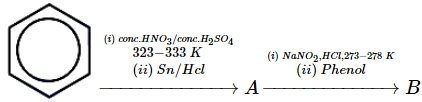
A
$3$-chloronitrobenzene,$4$-hydroxy-$3'$-nitrobiphenyl
B
Aniline,$4$-hydroxybiphenyl
C
Aniline,$p$-hydroxyazobenzene
D
Aniline,$o$-hydroxyazobenzene
Solution
(C) $1$. The reaction of benzene with $conc. HNO_3$ and $conc. H_2SO_4$ at $323-333 \ K$ gives nitrobenzene.
$2$. Reduction of nitrobenzene with $Sn/HCl$ gives aniline $(A)$.
$3$. Aniline reacts with $NaNO_2/HCl$ at $273-278 \ K$ $(0-5^{\circ}C)$ to form benzenediazonium chloride.
$4$. Coupling of benzenediazonium chloride with phenol in a basic medium yields $p$-hydroxyazobenzene $(B)$.
$2$. Reduction of nitrobenzene with $Sn/HCl$ gives aniline $(A)$.
$3$. Aniline reacts with $NaNO_2/HCl$ at $273-278 \ K$ $(0-5^{\circ}C)$ to form benzenediazonium chloride.
$4$. Coupling of benzenediazonium chloride with phenol in a basic medium yields $p$-hydroxyazobenzene $(B)$.
0 likes
View Solution842
DifficultMCQ
Given below are two statements :
Statement $I$: Aniline reacts with conc. $H_2SO_4$ followed by heating at $453-473 \ K$ to give $p$-aminobenzene sulphonic acid (sulphanilic acid). This compound contains both nitrogen and sulphur,and thus it gives a blood red colour in the 'Lassaigne's test' due to the formation of ferric thiocyanate,$[Fe(SCN)]^{2+}$.
Statement $II$: In Friedel-Craft's alkylation and acylation reactions,aniline forms a salt with the $AlCl_3$ catalyst. Due to this,the nitrogen atom of aniline acquires a positive charge and acts as a deactivating group,preventing further reaction.
In the light of the above statements,choose the correct answer from the options given below :
Statement $I$: Aniline reacts with conc. $H_2SO_4$ followed by heating at $453-473 \ K$ to give $p$-aminobenzene sulphonic acid (sulphanilic acid). This compound contains both nitrogen and sulphur,and thus it gives a blood red colour in the 'Lassaigne's test' due to the formation of ferric thiocyanate,$[Fe(SCN)]^{2+}$.
Statement $II$: In Friedel-Craft's alkylation and acylation reactions,aniline forms a salt with the $AlCl_3$ catalyst. Due to this,the nitrogen atom of aniline acquires a positive charge and acts as a deactivating group,preventing further reaction.
In the light of the above statements,choose the correct answer from the options given below :
A
Statement $I$ is false but statement $II$ is true
B
Both statement $I$ and statement $II$ are false
C
Statement $I$ is true but statement $II$ is false
D
Both statement $I$ and statement $II$ are true
Solution
(D) Statement $I$ is true: Aniline reacts with conc. $H_2SO_4$ to form anilinium hydrogen sulphate,which on heating at $453-473 \ K$ undergoes rearrangement to form $p$-aminobenzene sulphonic acid (sulphanilic acid). Since this molecule contains both $N$ and $S$,it gives a positive Lassaigne's test for both elements,resulting in the formation of $[Fe(SCN)]^{2+}$,which is blood red in colour.
Statement $II$ is true: Aniline is a Lewis base due to the lone pair on the nitrogen atom. It reacts with the Lewis acid $AlCl_3$ (used in Friedel-Crafts reactions) to form an acid-base adduct (salt). The nitrogen atom acquires a positive charge,which makes the $-NH_3^+$ group strongly electron-withdrawing (deactivating),thereby inhibiting the Friedel-Crafts reaction.
Statement $II$ is true: Aniline is a Lewis base due to the lone pair on the nitrogen atom. It reacts with the Lewis acid $AlCl_3$ (used in Friedel-Crafts reactions) to form an acid-base adduct (salt). The nitrogen atom acquires a positive charge,which makes the $-NH_3^+$ group strongly electron-withdrawing (deactivating),thereby inhibiting the Friedel-Crafts reaction.
0 likes
View Solution843
DifficultMCQ
$A$ compound $(x)$ with molar mass $108 \ g \ mol^{-1}$ undergoes acetylation to give a product with molar mass $192 \ g \ mol^{-1}$. The number of amino groups in the compound $(x)$ is . . . . . .
A
$1$
B
$11$
C
$2$
D
$4$
Solution
(C) Acetylation involves the replacement of a hydrogen atom $(-H)$ by an acetyl group $(-COCH_3)$.
The net change in molar mass for each amino group $(-NH_2)$ reacting is the replacement of one $H$ atom (mass $1$) with one $COCH_3$ group (mass $43$).
Gain in molecular weight per amino group $= 43 - 1 = 42 \ g \ mol^{-1}$.
Total increase in molecular weight $= 192 - 108 = 84 \ g \ mol^{-1}$.
Therefore,the number of amino groups in $(x) = \frac{84}{42} = 2$.
The net change in molar mass for each amino group $(-NH_2)$ reacting is the replacement of one $H$ atom (mass $1$) with one $COCH_3$ group (mass $43$).
Gain in molecular weight per amino group $= 43 - 1 = 42 \ g \ mol^{-1}$.
Total increase in molecular weight $= 192 - 108 = 84 \ g \ mol^{-1}$.
Therefore,the number of amino groups in $(x) = \frac{84}{42} = 2$.
0 likes
View Solution844
DifficultMCQ
Given below are two statements:
Statement $I$ : The $NH_2$ group in Aniline is ortho and para directing and a powerful activating group.
Statement $II$ : Aniline does not undergo Friedel-Craft's reaction (alkylation and acylation).
In the light of the above statements,choose the most appropriate answer from the options given below :
Statement $I$ : The $NH_2$ group in Aniline is ortho and para directing and a powerful activating group.
Statement $II$ : Aniline does not undergo Friedel-Craft's reaction (alkylation and acylation).
In the light of the above statements,choose the most appropriate answer from the options given below :
A
Both Statement $I$ and Statement $II$ are correct
B
Both Statement $I$ and Statement $II$ are incorrect
C
Statement $I$ is incorrect but Statement $II$ is correct
D
Statement $I$ is correct but Statement $II$ is incorrect
Solution
(A) The $NH_2$ group in Aniline is ortho and para directing and a powerful activating group because the lone pair on the nitrogen atom exhibits a strong $+M$ effect.
Aniline does not undergo Friedel-Craft's reaction (alkylation and acylation) because the lone pair on the nitrogen atom of Aniline reacts with the Lewis acid $AlCl_3$ to form a salt (complex). This results in a positive charge on the nitrogen atom,which acts as a strong deactivating group for the benzene ring,thereby preventing the reaction.
Aniline does not undergo Friedel-Craft's reaction (alkylation and acylation) because the lone pair on the nitrogen atom of Aniline reacts with the Lewis acid $AlCl_3$ to form a salt (complex). This results in a positive charge on the nitrogen atom,which acts as a strong deactivating group for the benzene ring,thereby preventing the reaction.
0 likes
View Solution845
MediumMCQ
$X \ g$ of ethylamine is subjected to reaction with $NaNO_2 / HCl$ followed by water; evolved dinitrogen gas which occupied $2.24 \ L$ volume at $STP$. $X$ is . . . . . . $\times 10^{-1} \ g$.
A
$39$
B
$40$
C
$45$
D
$50$
Solution
(C) The reaction of ethylamine $(CH_3CH_2NH_2)$ with $NaNO_2 / HCl$ followed by water produces ethanol,nitrogen gas,and water:
$CH_3CH_2NH_2 + NaNO_2 + HCl \rightarrow CH_3CH_2OH + N_2(g) + NaCl + H_2O$
From the stoichiometry,$1 \ mole$ of ethylamine $(45 \ g)$ produces $1 \ mole$ of $N_2$ gas.
At $STP$,$1 \ mole$ of gas occupies $22.4 \ L$.
Given that $2.24 \ L$ of $N_2$ gas is evolved,the number of moles of $N_2$ is:
$n = \frac{2.24 \ L}{22.4 \ L/mol} = 0.1 \ mol$
Since $1 \ mole$ of ethylamine produces $1 \ mole$ of $N_2$,$0.1 \ mol$ of ethylamine is required.
The mass of $0.1 \ mol$ of ethylamine is:
$Mass = 0.1 \ mol \times 45 \ g/mol = 4.5 \ g$
We need to express $4.5 \ g$ as $X \times 10^{-1} \ g$,so $X = 45$.
$CH_3CH_2NH_2 + NaNO_2 + HCl \rightarrow CH_3CH_2OH + N_2(g) + NaCl + H_2O$
From the stoichiometry,$1 \ mole$ of ethylamine $(45 \ g)$ produces $1 \ mole$ of $N_2$ gas.
At $STP$,$1 \ mole$ of gas occupies $22.4 \ L$.
Given that $2.24 \ L$ of $N_2$ gas is evolved,the number of moles of $N_2$ is:
$n = \frac{2.24 \ L}{22.4 \ L/mol} = 0.1 \ mol$
Since $1 \ mole$ of ethylamine produces $1 \ mole$ of $N_2$,$0.1 \ mol$ of ethylamine is required.
The mass of $0.1 \ mol$ of ethylamine is:
$Mass = 0.1 \ mol \times 45 \ g/mol = 4.5 \ g$
We need to express $4.5 \ g$ as $X \times 10^{-1} \ g$,so $X = 45$.
0 likes
View Solution846
MediumMCQ
$9.3 \ g$ of pure aniline is treated with bromine water at room temperature to give a white precipitate of the product '$P$'. The mass of product '$P$' obtained is $26.4 \ g$. The percentage yield is $......... \ \%$.
A
$70$
B
$80$
C
$90$
D
$100$
Solution
(B) The reaction of aniline with bromine water is:
$C_6H_5NH_2 + 3Br_2 \rightarrow C_6H_2Br_3NH_2 + 3HBr$
(Aniline) $\rightarrow$ ($2,4,6-$tribromoaniline)
Molar mass of aniline $(C_6H_7N)$ = $93 \ g/mol$.
Molar mass of $2,4,6-$tribromoaniline $(C_6H_4Br_3N)$ = $12 \times 6 + 1 \times 4 + 80 \times 3 + 14 = 72 + 4 + 240 + 14 = 330 \ g/mol$.
According to the stoichiometry,$93 \ g$ of aniline produces $330 \ g$ of $2,4,6-$tribromoaniline.
Therefore,$9.3 \ g$ of aniline should theoretically produce:
$\frac{330}{93} \times 9.3 = 33 \ g$ of $2,4,6-$tribromoaniline.
The actual mass obtained is $26.4 \ g$.
Percentage yield = $\frac{\text{Actual yield}}{\text{Theoretical yield}} \times 100$
Percentage yield = $\frac{26.4}{33} \times 100 = 80 \ \%$.
$C_6H_5NH_2 + 3Br_2 \rightarrow C_6H_2Br_3NH_2 + 3HBr$
(Aniline) $\rightarrow$ ($2,4,6-$tribromoaniline)
Molar mass of aniline $(C_6H_7N)$ = $93 \ g/mol$.
Molar mass of $2,4,6-$tribromoaniline $(C_6H_4Br_3N)$ = $12 \times 6 + 1 \times 4 + 80 \times 3 + 14 = 72 + 4 + 240 + 14 = 330 \ g/mol$.
According to the stoichiometry,$93 \ g$ of aniline produces $330 \ g$ of $2,4,6-$tribromoaniline.
Therefore,$9.3 \ g$ of aniline should theoretically produce:
$\frac{330}{93} \times 9.3 = 33 \ g$ of $2,4,6-$tribromoaniline.
The actual mass obtained is $26.4 \ g$.
Percentage yield = $\frac{\text{Actual yield}}{\text{Theoretical yield}} \times 100$
Percentage yield = $\frac{26.4}{33} \times 100 = 80 \ \%$.
0 likes
View Solution847
MediumMCQ
If $279 \ g$ of aniline is reacted with one equivalent of benzenediazonium chloride,the maximum amount of aniline yellow formed will be $.........$ $g$. (nearest integer)
(consider complete conversion)
(consider complete conversion)
A
$590$
B
$599$
C
$591$
D
$589$
Solution
(C) The reaction between aniline $(C_6H_5NH_2)$ and benzenediazonium chloride $(C_6H_5N_2^+Cl^-)$ is an electrophilic substitution reaction (coupling reaction) that produces $p$-aminoazobenzene (aniline yellow).
The molar mass of aniline $(C_6H_5NH_2)$ is $93 \ g/mol$.
The number of moles of aniline given is $n = \frac{279 \ g}{93 \ g/mol} = 3 \ mol$.
Since the reaction is with one equivalent of benzenediazonium chloride,and assuming complete conversion,$3 \ moles$ of aniline will produce $3 \ moles$ of aniline yellow $(C_{12}H_{11}N_3)$.
The molar mass of aniline yellow $(C_{12}H_{11}N_3)$ is $(12 \times 12) + (11 \times 1) + (3 \times 14) = 144 + 11 + 42 = 197 \ g/mol$.
The mass of aniline yellow formed is $3 \ mol \times 197 \ g/mol = 591 \ g$.
The molar mass of aniline $(C_6H_5NH_2)$ is $93 \ g/mol$.
The number of moles of aniline given is $n = \frac{279 \ g}{93 \ g/mol} = 3 \ mol$.
Since the reaction is with one equivalent of benzenediazonium chloride,and assuming complete conversion,$3 \ moles$ of aniline will produce $3 \ moles$ of aniline yellow $(C_{12}H_{11}N_3)$.
The molar mass of aniline yellow $(C_{12}H_{11}N_3)$ is $(12 \times 12) + (11 \times 1) + (3 \times 14) = 144 + 11 + 42 = 197 \ g/mol$.
The mass of aniline yellow formed is $3 \ mol \times 197 \ g/mol = 591 \ g$.
0 likes
View Solution848
MediumMCQ
The correct order of basic strength of Pyrrole,Pyridine,and Piperidine is:
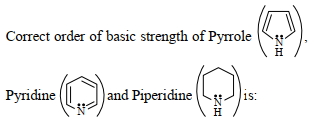
A
Pyrrole > Piperidine > Pyridine
B
Pyrrole > Pyridine > Piperidine
C
Pyridine > Piperidine > Pyrrole
D
Piperidine > Pyridine > Pyrrole
Solution
(D) The basic strength depends on the availability of the lone pair on the nitrogen atom.
$1$. In Piperidine,the nitrogen is $sp^3$ hybridized and the lone pair is localized,making it the most basic.
$2$. In Pyridine,the nitrogen is $sp^2$ hybridized and the lone pair is localized in an $sp^2$ orbital,making it less basic than Piperidine.
$3$. In Pyrrole,the lone pair on the nitrogen is involved in the aromatic sextet (delocalized),making it the least basic.
Therefore,the correct order is: $\text{Piperidine} > \text{Pyridine} > \text{Pyrrole}$.
$1$. In Piperidine,the nitrogen is $sp^3$ hybridized and the lone pair is localized,making it the most basic.
$2$. In Pyridine,the nitrogen is $sp^2$ hybridized and the lone pair is localized in an $sp^2$ orbital,making it less basic than Piperidine.
$3$. In Pyrrole,the lone pair on the nitrogen is involved in the aromatic sextet (delocalized),making it the least basic.
Therefore,the correct order is: $\text{Piperidine} > \text{Pyridine} > \text{Pyrrole}$.
0 likes
View Solution849
MediumMCQ
Given below are two statements:
Statement $I$: Aniline does not undergo Friedel-Crafts alkylation reaction.
Statement $II$: Aniline cannot be prepared through Gabriel synthesis.
In the light of the above statements,choose the correct answer from the options given below:
Statement $I$: Aniline does not undergo Friedel-Crafts alkylation reaction.
Statement $II$: Aniline cannot be prepared through Gabriel synthesis.
In the light of the above statements,choose the correct answer from the options given below:
A
Both Statement $I$ and Statement $II$ are false
B
Statement $I$ is correct but Statement $II$ is false
C
Statement $I$ is incorrect but Statement $II$ is true
D
Both Statement $I$ and Statement $II$ are true
Solution
(D) Statement $I$ is true: Aniline is a Lewis base. It reacts with the Lewis acid catalyst $(AlCl_3)$ used in Friedel-Crafts reactions to form an anilinium ion-aluminium chloride salt. This deactivates the ring and prevents the reaction.
Statement $II$ is true: Gabriel phthalimide synthesis involves the nucleophilic substitution of an alkyl halide by the phthalimide anion. Aryl halides do not undergo nucleophilic substitution with the phthalimide anion under these conditions,so aniline cannot be prepared by this method.
Statement $II$ is true: Gabriel phthalimide synthesis involves the nucleophilic substitution of an alkyl halide by the phthalimide anion. Aryl halides do not undergo nucleophilic substitution with the phthalimide anion under these conditions,so aniline cannot be prepared by this method.
1 likes
View Solution850
MediumMCQ
$CH_3NH_2 + CHCl_3 + KOH \rightarrow$ Nitrogen containing compound $+ KCl + H_2O$. The nitrogen-containing compound is:
A
$CH_3-C \equiv N$
B
$CH_3-NH-CH_3$
C
$CH_3-N \equiv C$
D
$CH_3-N^{+} \equiv C^{-}$
Solution
(C) The given reaction is the $Carbylamine$ reaction (also known as the isocyanide test).
Primary amines (both aliphatic and aromatic) react with chloroform $(CHCl_3)$ and alcoholic potassium hydroxide $(KOH)$ to form isocyanides (carbylamines),which have a foul smell.
The balanced chemical equation is:
$CH_3NH_2 + CHCl_3 + 3KOH \rightarrow CH_3NC + 3KCl + 3H_2O$.
The nitrogen-containing compound formed is methyl isocyanide $(CH_3NC)$,which is represented as $CH_3-N \equiv C$ or $CH_3-N^{+} \equiv C^{-}$.
Primary amines (both aliphatic and aromatic) react with chloroform $(CHCl_3)$ and alcoholic potassium hydroxide $(KOH)$ to form isocyanides (carbylamines),which have a foul smell.
The balanced chemical equation is:
$CH_3NH_2 + CHCl_3 + 3KOH \rightarrow CH_3NC + 3KCl + 3H_2O$.
The nitrogen-containing compound formed is methyl isocyanide $(CH_3NC)$,which is represented as $CH_3-N \equiv C$ or $CH_3-N^{+} \equiv C^{-}$.
0 likes
View SolutionAmines — Properties of Amines · Frequently Asked Questions
1Are these Amines questions useful for JEE and NEET?
Yes. All questions in this section are mapped to JEE Main and NEET exam patterns. Previous year questions from JEE Main, NEET, GUJCET and state-level exams are included with full solutions.
2Can I switch to Hindi or Gujarati for these questions?
Yes. Use the language tabs in the hero section or the sidebar to view the same questions and solutions in English, Hindi or Gujarati.
3How do I generate a question paper from this subtopic?
Use the Vedclass Exam Paper Generator — select the chapter and subtopic, set difficulty, and generate Sets A, B, C, D automatically. First 3 chapters of every subject are free.
Vedclass Products
For Students
Vedclass Test Series
Mock tests in real JEE/NEET style with performance analysis. 5-day free trial.
Start Free TrialFor Teachers
Exam Paper Generator
Generate Set A/B/C/D papers from this chapter in 2 minutes. 3 chapters free.
Try FreeFor Institutes
Online Exam Module
Live online exams with unlimited students, 360° analytics & white-label branding.
See DemoFor Teachers & Institutes
Generate a Amines Exam Paper in 2 Minutes
Select subtopic & difficulty — Sets A, B, C, D auto-generated with No Repeat logic.
First 3 chapters of every subject are free — no payment required.