
A English
Properties of Amines Questions in English
Class 12 Chemistry · Amines · Properties of Amines
1212+
Questions
English
Language
100%
With Solutions
Showing 50 of 1212 questions in English
751
MediumMCQ
Hoffmann bromamide degradation of benzamide gives product $A$,which upon heating with $CHCl_{3}$ and $NaOH$ gives product $B$. The structures of $A$ and $B$ are
A
$A = \text{p-bromoaniline}, B = \text{p-bromophenyl isocyanide}$
B
$A = \text{aniline}, B = \text{phenyl isocyanide}$
C
$A = \text{aniline}, B = \text{o-formylaniline}$
D
$A = \text{benzamide}, B = \text{o-formylbenzamide}$
Solution
(B) Step $1$: Hoffmann bromamide degradation of benzamide $(C_6H_5CONH_2)$ involves the reaction with $Br_2$ and $NaOH$ to form aniline $(C_6H_5NH_2)$ as product $A$.
Step $2$: Aniline $(C_6H_5NH_2)$ is a primary amine. When heated with $CHCl_3$ and $NaOH$ (or $KOH$),it undergoes the carbylamine reaction to form phenyl isocyanide $(C_6H_5NC)$ as product $B$.
Thus,$A$ is aniline and $B$ is phenyl isocyanide.
Step $2$: Aniline $(C_6H_5NH_2)$ is a primary amine. When heated with $CHCl_3$ and $NaOH$ (or $KOH$),it undergoes the carbylamine reaction to form phenyl isocyanide $(C_6H_5NC)$ as product $B$.
Thus,$A$ is aniline and $B$ is phenyl isocyanide.
0 likes
View Solution752
MediumMCQ
Which of the following reactions is an example of ammonolysis?
A
$C_{6}H_{5}COCl + C_{6}H_{5}NH_{2} \longrightarrow C_{6}H_{5}CONHC_{6}H_{5} + HCl$
B
$C_{6}H_{5}CH_{2}CN \stackrel{[H]}{\longrightarrow} C_{6}H_{5}CH_{2}CH_{2}NH_{2}$
C
$C_{6}H_{5}NH_{2} + HCl \longrightarrow C_{6}H_{5}NH_{3}^{+}Cl^{-}$
D
$C_{6}H_{5}CH_{2}Cl + NH_{3} \longrightarrow C_{6}H_{5}CH_{2}NH_{2} + HCl$
Solution
(D) The process of cleavage of the $C-X$ bond by an ammonia molecule is known as ammonolysis.
In this reaction,the nucleophilic ammonia molecule attacks the alkyl halide,resulting in the substitution of the halogen atom by the amino group.
The reaction $C_{6}H_{5}CH_{2}Cl + NH_{3} \longrightarrow C_{6}H_{5}CH_{2}NH_{2} + HCl$ represents the nucleophilic substitution of a benzyl chloride by ammonia,which is a classic example of ammonolysis.
In this reaction,the nucleophilic ammonia molecule attacks the alkyl halide,resulting in the substitution of the halogen atom by the amino group.
The reaction $C_{6}H_{5}CH_{2}Cl + NH_{3} \longrightarrow C_{6}H_{5}CH_{2}NH_{2} + HCl$ represents the nucleophilic substitution of a benzyl chloride by ammonia,which is a classic example of ammonolysis.
0 likes
View Solution753
MediumMCQ
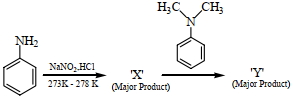
Considering the above reaction,$X$ and $Y$ respectively are
A
Benzenediazonium chloride and $p$-(dimethylamino)azobenzene
B
Benzenediazonium chloride and $o$-(dimethylamino)azobenzene
C
Chlorobenzene and $p$-(dimethylamino)azobenzene
D
Chlorobenzene and $o$-(dimethylamino)azobenzene
Solution
(A) The reaction of aniline with $NaNO_2$ and $HCl$ at $273-278 \ K$ is a diazotization reaction,which produces benzenediazonium chloride as the major product $(X)$.
Benzenediazonium chloride then undergoes an electrophilic aromatic substitution reaction (coupling reaction) with $N,N$-dimethylaniline. Since the $-N(CH_3)_2$ group is a strong activating group and is ortho/para-directing,the coupling occurs primarily at the para-position due to steric hindrance at the ortho-position.
Therefore,the major product $(Y)$ is $p$-(dimethylamino)azobenzene.
Benzenediazonium chloride then undergoes an electrophilic aromatic substitution reaction (coupling reaction) with $N,N$-dimethylaniline. Since the $-N(CH_3)_2$ group is a strong activating group and is ortho/para-directing,the coupling occurs primarily at the para-position due to steric hindrance at the ortho-position.
Therefore,the major product $(Y)$ is $p$-(dimethylamino)azobenzene.
0 likes
View Solution754
MediumMCQ
$A$ reaction of $0.1 \ mol$ of Benzylamine with bromomethane gave $23 \ g$ of Benzyl trimethyl ammonium bromide. The number of moles of bromomethane consumed in this reaction are $n \times 10^{-1},$ when $n = \dots$ (Round off to the Nearest Integer).
(Given : Atomic masses: $C : 12.0 \ u, H : 1.0 \ u, N : 14.0 \ u, Br : 80.0 \ u$)
(Given : Atomic masses: $C : 12.0 \ u, H : 1.0 \ u, N : 14.0 \ u, Br : 80.0 \ u$)
A
$1$
B
$3$
C
$7$
D
$9$
Solution
(B) The reaction of Benzylamine $(Ph-CH_2-NH_2)$ with bromomethane $(CH_3Br)$ is an exhaustive methylation reaction.
Benzylamine reacts with $3$ moles of bromomethane to form Benzyl trimethyl ammonium bromide $(Ph-CH_2-N(CH_3)_3^+Br^-)$.
The molar mass of Benzyl trimethyl ammonium bromide $(C_{10}H_{16}NBr)$ is calculated as:
$M = (10 \times 12) + (16 \times 1) + (14 \times 1) + (80 \times 1) = 120 + 16 + 14 + 80 = 230 \ g/mol$.
Given mass of product = $23 \ g$.
Number of moles of product = $\frac{23 \ g}{230 \ g/mol} = 0.1 \ mol$.
Since $1 \ mol$ of Benzylamine reacts with $3 \ mol$ of bromomethane to produce $1 \ mol$ of Benzyl trimethyl ammonium bromide,$0.1 \ mol$ of Benzylamine will react with $0.1 \times 3 = 0.3 \ mol$ of bromomethane.
Given that the number of moles of bromomethane consumed is $n \times 10^{-1} = 0.3$.
Therefore,$n = 3$.
Benzylamine reacts with $3$ moles of bromomethane to form Benzyl trimethyl ammonium bromide $(Ph-CH_2-N(CH_3)_3^+Br^-)$.
The molar mass of Benzyl trimethyl ammonium bromide $(C_{10}H_{16}NBr)$ is calculated as:
$M = (10 \times 12) + (16 \times 1) + (14 \times 1) + (80 \times 1) = 120 + 16 + 14 + 80 = 230 \ g/mol$.
Given mass of product = $23 \ g$.
Number of moles of product = $\frac{23 \ g}{230 \ g/mol} = 0.1 \ mol$.
Since $1 \ mol$ of Benzylamine reacts with $3 \ mol$ of bromomethane to produce $1 \ mol$ of Benzyl trimethyl ammonium bromide,$0.1 \ mol$ of Benzylamine will react with $0.1 \times 3 = 0.3 \ mol$ of bromomethane.
Given that the number of moles of bromomethane consumed is $n \times 10^{-1} = 0.3$.
Therefore,$n = 3$.
0 likes
View Solution755
MediumMCQ
Ammonolysis of alkyl halides followed by treatment with $NaOH$ solution can be used to prepare primary,secondary,and tertiary amines. The purpose of $NaOH$ in the reaction is:
A
to remove basic impurities
B
to activate $NH_3$ used in the reaction
C
to remove acidic impurities
D
to increase the reactivity of alkyl halide
Solution
(C) In the reaction of alkyl halides with ammonia,the initial product is an alkylammonium salt,which is an acidic species (e.g.,$[R-NH_3]^+ X^-$).
$NaOH$ is added to the reaction mixture to neutralize this acidic salt,thereby liberating the free amine $(R-NH_2)$ which can then further react with more alkyl halide to form secondary and tertiary amines.
Thus,the purpose of $NaOH$ is to remove acidic impurities (the hydrogen halide salt) from the reaction medium.
$NaOH$ is added to the reaction mixture to neutralize this acidic salt,thereby liberating the free amine $(R-NH_2)$ which can then further react with more alkyl halide to form secondary and tertiary amines.
Thus,the purpose of $NaOH$ is to remove acidic impurities (the hydrogen halide salt) from the reaction medium.
0 likes
View Solution756
MediumMCQ
Which of the following is least basic?
A
$(CH_3CO)\ddot{N}HC_2H_5$
B
$(C_2H_5)_3\ddot{N}$
C
$(CH_3CO)_2\ddot{N}H$
D
$(C_2H_5)_2\ddot{N}H$
Solution
(C) The basicity of an amine depends on the availability of the lone pair of electrons on the nitrogen atom for protonation.
$1$. In $(CH_3CO)\ddot{N}HC_2H_5$ (an amide),the lone pair on nitrogen is delocalized due to conjugation with the carbonyl group $(C=O)$,making it less available.
$2$. In $(C_2H_5)_3\ddot{N}$ (a tertiary amine),the lone pair is localized and available for donation.
$3$. In $(CH_3CO)_2\ddot{N}H$ (an imide),the lone pair on nitrogen is strongly delocalized due to conjugation with two electron-withdrawing carbonyl groups. This makes the lone pair least available for protonation,rendering it the least basic.
$4$. In $(C_2H_5)_2\ddot{N}H$ (a secondary amine),the lone pair is localized and available for donation.
Therefore,$(CH_3CO)_2\ddot{N}H$ is the least basic compound.
$1$. In $(CH_3CO)\ddot{N}HC_2H_5$ (an amide),the lone pair on nitrogen is delocalized due to conjugation with the carbonyl group $(C=O)$,making it less available.
$2$. In $(C_2H_5)_3\ddot{N}$ (a tertiary amine),the lone pair is localized and available for donation.
$3$. In $(CH_3CO)_2\ddot{N}H$ (an imide),the lone pair on nitrogen is strongly delocalized due to conjugation with two electron-withdrawing carbonyl groups. This makes the lone pair least available for protonation,rendering it the least basic.
$4$. In $(C_2H_5)_2\ddot{N}H$ (a secondary amine),the lone pair is localized and available for donation.
Therefore,$(CH_3CO)_2\ddot{N}H$ is the least basic compound.
0 likes
View Solution757
MediumMCQ
In the reaction of hypobromite with amide,the carbonyl carbon is lost as :
A
$CO_3^{2-}$
B
$HCO_3^{-}$
C
$CO_2$
D
$CO$
Solution
(A) The reaction described is the Hofmann bromamide degradation reaction.
In this reaction,an amide reacts with bromine in the presence of an aqueous or ethanolic solution of sodium hydroxide $(NaOH)$.
The overall reaction is: $R-CONH_2 + Br_2 + 4NaOH \rightarrow R-NH_2 + Na_2CO_3 + 2NaBr + 2H_2O$.
As shown in the reaction mechanism,the carbonyl carbon of the amide is released as the carbonate ion $(CO_3^{2-})$.
In this reaction,an amide reacts with bromine in the presence of an aqueous or ethanolic solution of sodium hydroxide $(NaOH)$.
The overall reaction is: $R-CONH_2 + Br_2 + 4NaOH \rightarrow R-NH_2 + Na_2CO_3 + 2NaBr + 2H_2O$.
As shown in the reaction mechanism,the carbonyl carbon of the amide is released as the carbonate ion $(CO_3^{2-})$.
0 likes
View Solution758
MediumMCQ
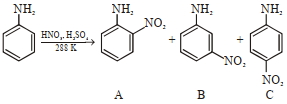
Consider the given reaction,find the correct order of percentage yield for the products $A$,$B$,and $C$:
A
$C > A > B$
B
$B > C > A$
C
$A > C > B$
D
$C > B > A$
Solution
(D) In the nitration of aniline using concentrated $HNO_3$ and $H_2SO_4$ at $288 \ K$,the amino group $(-NH_2)$ is protonated to form the anilinium ion $(-NH_3^+)$ in the acidic medium.
The $-NH_3^+$ group is meta-directing,which leads to a significant amount of meta-nitroaniline $(B)$.
However,some unprotonated aniline also reacts,leading to ortho $(A)$ and para $(C)$ products.
The experimental percentage yields are approximately:
$p$-nitroaniline $(C)$ $\approx 51\%$
$m$-nitroaniline $(B)$ $\approx 47\%$
$o$-nitroaniline $(A)$ $\approx 2\%$
Thus,the order of percentage yield is $C > B > A$.
The $-NH_3^+$ group is meta-directing,which leads to a significant amount of meta-nitroaniline $(B)$.
However,some unprotonated aniline also reacts,leading to ortho $(A)$ and para $(C)$ products.
The experimental percentage yields are approximately:
$p$-nitroaniline $(C)$ $\approx 51\%$
$m$-nitroaniline $(B)$ $\approx 47\%$
$o$-nitroaniline $(A)$ $\approx 2\%$
Thus,the order of percentage yield is $C > B > A$.
0 likes
View Solution759
MediumMCQ
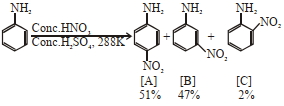
In the following reaction,the reason why the meta-nitro product is also formed is:
A
low temperature
B
$-NH_2$ group is highly meta-directive
C
Formation of anilinium ion
D
$-NO_2$ substitution always takes place at meta-position
Solution
(C) In the presence of concentrated $H_2SO_4$,aniline is protonated to form the anilinium ion $(-NH_3^+)$.
The $-NH_3^+$ group is strongly electron-withdrawing due to its $-I$ effect and is meta-directing.
Therefore,during the nitration of aniline,a significant amount of the meta-nitro product is formed due to the presence of the anilinium ion.
The $-NH_3^+$ group is strongly electron-withdrawing due to its $-I$ effect and is meta-directing.
Therefore,during the nitration of aniline,a significant amount of the meta-nitro product is formed due to the presence of the anilinium ion.
0 likes
View Solution760
MediumMCQ
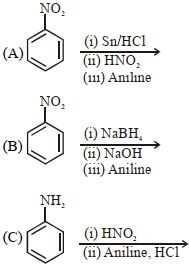
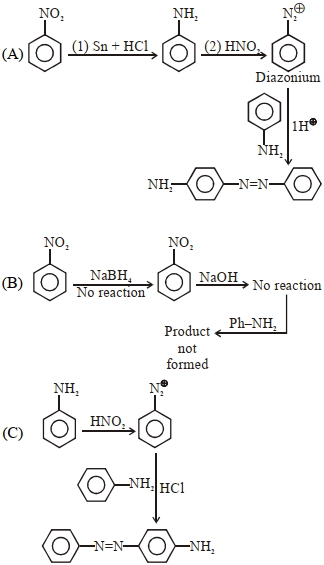
Which of the following reaction/s will not give $p-$aminoazobenzene?
A
Only $A$
B
Only $B$
C
Only $C$
D
$A$ and $B$
Solution
(B) In basic or neutral medium,$N-N$ coupling is favourable,while in slightly acidic medium,$C-N$ coupling is favourable to form $p-$aminoazobenzene.
Reaction $A$: Nitrobenzene is reduced to aniline by $Sn/HCl$,then diazotized by $HNO_2$ to form benzene diazonium chloride,which couples with aniline in acidic medium to give $p-$aminoazobenzene.
Reaction $B$: $NaBH_4$ is a selective reducing agent and does not reduce nitrobenzene to aniline. Therefore,no diazonium salt is formed,and $p-$aminoazobenzene is not produced.
Reaction $C$: Aniline is directly diazotized by $HNO_2$ to form benzene diazonium chloride,which then couples with aniline in acidic medium to give $p-$aminoazobenzene.
Thus,only reaction $B$ will not give $p-$aminoazobenzene.
Reaction $A$: Nitrobenzene is reduced to aniline by $Sn/HCl$,then diazotized by $HNO_2$ to form benzene diazonium chloride,which couples with aniline in acidic medium to give $p-$aminoazobenzene.
Reaction $B$: $NaBH_4$ is a selective reducing agent and does not reduce nitrobenzene to aniline. Therefore,no diazonium salt is formed,and $p-$aminoazobenzene is not produced.
Reaction $C$: Aniline is directly diazotized by $HNO_2$ to form benzene diazonium chloride,which then couples with aniline in acidic medium to give $p-$aminoazobenzene.
Thus,only reaction $B$ will not give $p-$aminoazobenzene.
0 likes
View Solution761
EasyMCQ
An amine on reaction with benzenesulphonyl chloride produces a compound insoluble in alkaline solution. This amine can be prepared by ammonolysis of ethyl chloride. The correct structure of the amine is:
A
$N$-propylaniline
B
$CH_3CH_2NH_2$
C
$CH_3CH_2CH_2NHCH_3$
D
$CH_3CH_2CH_2NHCH_2CH_3$
Solution
(D) The reaction of an amine with benzenesulphonyl chloride (Hinsberg reagent) produces a product that is insoluble in alkaline solution if the amine is a secondary $(2^{\circ})$ amine. This is because the resulting $N,N$-disubstituted sulphonamide does not contain any acidic hydrogen atom attached to the nitrogen atom.
The amine is prepared by the ammonolysis of ethyl chloride $(CH_3CH_2Cl)$,which implies the amine must contain an ethyl group $(CH_3CH_2-)$.
Among the options,$N$-propylaniline is a secondary amine,but it is not formed by the ammonolysis of ethyl chloride. The structure $CH_3CH_2CH_2NHCH_2CH_3$ ($N$-ethylpropylamine) is a secondary amine that can be formed by the reaction of propylamine with ethyl chloride. Therefore,the correct structure is $CH_3CH_2CH_2NHCH_2CH_3$.
The amine is prepared by the ammonolysis of ethyl chloride $(CH_3CH_2Cl)$,which implies the amine must contain an ethyl group $(CH_3CH_2-)$.
Among the options,$N$-propylaniline is a secondary amine,but it is not formed by the ammonolysis of ethyl chloride. The structure $CH_3CH_2CH_2NHCH_2CH_3$ ($N$-ethylpropylamine) is a secondary amine that can be formed by the reaction of propylamine with ethyl chloride. Therefore,the correct structure is $CH_3CH_2CH_2NHCH_2CH_3$.
0 likes
View Solution762
EasyMCQ
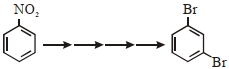
What is the correct sequence of reagents used for converting nitrobenzene into $m$-dibromobenzene?
A
$\xrightarrow{NaNO_2 / HCl}$ $\xrightarrow{KBr}$ $\xrightarrow{H^+}$
B
$\xrightarrow{Br_2/Fe}$ $\xrightarrow{Sn/HCl}$ $\xrightarrow{NaNO_2/HCl}$ $\xrightarrow{CuBr/HBr}$
C
$\xrightarrow{Sn/HCl}$ $\xrightarrow{KBr}$ $\xrightarrow{Br_2}$ $\xrightarrow{H^+}$
D
$\xrightarrow{Sn/HCl}$ $\xrightarrow{Br_2}$ $\xrightarrow{NaNO_2}$ $\xrightarrow{NaBr}$
Solution
(B) The conversion of nitrobenzene to $m$-dibromobenzene involves the following steps:
$1$. Bromination of nitrobenzene using $Br_2/Fe$ gives $m$-bromonitrobenzene.
$2$. Reduction of $m$-bromonitrobenzene using $Sn/HCl$ gives $m$-bromoaniline.
$3$. Diazotization of $m$-bromoaniline using $NaNO_2/HCl$ at $0-5^{\circ}C$ gives $m$-bromobenzenediazonium chloride.
$4$. Sandmeyer reaction of $m$-bromobenzenediazonium chloride with $CuBr/HBr$ replaces the diazonium group with a bromine atom to yield $m$-dibromobenzene.
$1$. Bromination of nitrobenzene using $Br_2/Fe$ gives $m$-bromonitrobenzene.
$2$. Reduction of $m$-bromonitrobenzene using $Sn/HCl$ gives $m$-bromoaniline.
$3$. Diazotization of $m$-bromoaniline using $NaNO_2/HCl$ at $0-5^{\circ}C$ gives $m$-bromobenzenediazonium chloride.
$4$. Sandmeyer reaction of $m$-bromobenzenediazonium chloride with $CuBr/HBr$ replaces the diazonium group with a bromine atom to yield $m$-dibromobenzene.
0 likes
View Solution763
MediumMCQ
The diazonium salt of which of the following compounds will form a coloured dye on reaction with $\beta$-Naphthol in $NaOH$?
A
Benzylamine $(C_6H_5CH_2NH_2)$
B
$N,N$-Dimethylaniline $(C_6H_5N(CH_3)_2)$
C
Aniline $(C_6H_5NH_2)$
D
$N$-Methylaniline $(C_6H_5NHCH_3)$
Solution
(C) The formation of a coloured dye (azo dye) occurs through the coupling reaction of a diazonium salt with an aromatic compound like $\beta$-Naphthol in an alkaline medium $(NaOH)$.
Primary aromatic amines,such as aniline $(C_6H_5NH_2)$,react with $NaNO_2$ and $HCl$ at $0-5 \ ^\circ C$ to form stable benzenediazonium chloride.
This diazonium salt then undergoes an electrophilic substitution (coupling) reaction with $\beta$-Naphthol to produce an orange-red azo dye.
Benzylamine is an aliphatic amine and does not form a stable diazonium salt under these conditions.
$N,N$-Dimethylaniline and $N$-Methylaniline are secondary and tertiary amines,respectively,and do not form the same type of stable diazonium salt required for this specific coupling reaction to produce the characteristic dye.
Primary aromatic amines,such as aniline $(C_6H_5NH_2)$,react with $NaNO_2$ and $HCl$ at $0-5 \ ^\circ C$ to form stable benzenediazonium chloride.
This diazonium salt then undergoes an electrophilic substitution (coupling) reaction with $\beta$-Naphthol to produce an orange-red azo dye.
Benzylamine is an aliphatic amine and does not form a stable diazonium salt under these conditions.
$N,N$-Dimethylaniline and $N$-Methylaniline are secondary and tertiary amines,respectively,and do not form the same type of stable diazonium salt required for this specific coupling reaction to produce the characteristic dye.
0 likes
View Solution764
MediumMCQ
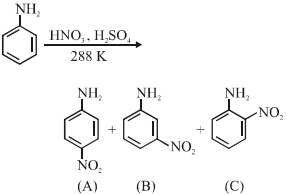
The correct statement about the given chemical reaction is:
A
$-\ddot{N}H_2$ group is ortho and para directive,so product $(B)$ is not possible.
B
Reaction is possible and compound $(B)$ will be the major product.
C
The reaction will form a sulphonated product instead of nitration.
D
Reaction is possible and compound $(A)$ will be the major product.
Solution
(D) In the presence of strong acid $(H_2SO_4)$,aniline is protonated to form the anilinium ion $(C_6H_5NH_3^+)$.
The $-NH_3^+$ group is meta-directing due to its strong electron-withdrawing nature.
As a result,a significant amount of the $m$-nitroaniline (compound $(B)$) is formed,along with the $p$-nitroaniline (compound $(A)$) and $o$-nitroaniline (compound $(C)$).
Experimental data shows that $p$-nitroaniline $(51\%)$ is the major product,followed by $m$-nitroaniline $(47\%)$ and $o$-nitroaniline $(2\%)$.
The $-NH_3^+$ group is meta-directing due to its strong electron-withdrawing nature.
As a result,a significant amount of the $m$-nitroaniline (compound $(B)$) is formed,along with the $p$-nitroaniline (compound $(A)$) and $o$-nitroaniline (compound $(C)$).
Experimental data shows that $p$-nitroaniline $(51\%)$ is the major product,followed by $m$-nitroaniline $(47\%)$ and $o$-nitroaniline $(2\%)$.
0 likes
View Solution765
EasyMCQ
$A$. Phenyl methanamine
$B$. $N,N$-Dimethylaniline
$C$. $N$-Methylaniline
$D$. Benzenamine
Choose the correct order of basic nature of the above amines.
$B$. $N,N$-Dimethylaniline
$C$. $N$-Methylaniline
$D$. Benzenamine
Choose the correct order of basic nature of the above amines.
A
$A > C > B > D$
B
$D > C > B > A$
C
$D > B > C > A$
D
$A > B > C > D$
Solution
(D) The basic strength of amines depends on the availability of the lone pair on the nitrogen atom.
$A$ (Phenyl methanamine,$C_6H_5CH_2NH_2$): The lone pair is not in conjugation with the benzene ring,making it the most basic.
$B$ ($N,N$-Dimethylaniline,$C_6H_5N(CH_3)_2$): The lone pair is in conjugation with the benzene ring,but the two methyl groups provide inductive effect $(+I)$,increasing basicity compared to $C$ and $D$.
$C$ ($N$-Methylaniline,$C_6H_5NHCH_3$): The lone pair is in conjugation with the benzene ring,and one methyl group provides inductive effect $(+I)$.
$D$ (Benzenamine,$C_6H_5NH_2$): The lone pair is in conjugation with the benzene ring,and there is no inductive effect from alkyl groups.
Therefore,the order of basic strength is $A > B > C > D$.
$A$ (Phenyl methanamine,$C_6H_5CH_2NH_2$): The lone pair is not in conjugation with the benzene ring,making it the most basic.
$B$ ($N,N$-Dimethylaniline,$C_6H_5N(CH_3)_2$): The lone pair is in conjugation with the benzene ring,but the two methyl groups provide inductive effect $(+I)$,increasing basicity compared to $C$ and $D$.
$C$ ($N$-Methylaniline,$C_6H_5NHCH_3$): The lone pair is in conjugation with the benzene ring,and one methyl group provides inductive effect $(+I)$.
$D$ (Benzenamine,$C_6H_5NH_2$): The lone pair is in conjugation with the benzene ring,and there is no inductive effect from alkyl groups.
Therefore,the order of basic strength is $A > B > C > D$.
0 likes
View Solution766
MediumMCQ
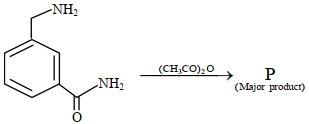
The major product in the above reaction is:
A
$3-$(acetamidomethyl)benzamide
B
$N$-($3$-carbamoylphenyl)acetamide
C
$3-$(aminomethyl)-$N$-acetylbenzamide
D
$N$-acetyl$-3-$(acetamidomethyl)benzamide
Solution
(A) The starting material is $3-(\text{aminomethyl})\text{benzamide}$. It contains two nucleophilic nitrogen sites: a primary aliphatic amine $(-CH_2NH_2)$ and a primary amide $(-CONH_2)$.
Aliphatic amines are significantly more nucleophilic than amides because the lone pair on the nitrogen of the amide is delocalized into the carbonyl group via resonance,making it less available for nucleophilic attack.
Therefore,acetic anhydride $(CH_3CO)_2O$ will selectively acetylate the more nucleophilic aliphatic amine group.
The reaction is: $3-(\text{aminomethyl})\text{benzamide} + (CH_3CO)_2O \rightarrow 3-(\text{acetamidomethyl})\text{benzamide} + CH_3COOH$.
The major product is $3-(\text{acetamidomethyl})\text{benzamide}$.
Aliphatic amines are significantly more nucleophilic than amides because the lone pair on the nitrogen of the amide is delocalized into the carbonyl group via resonance,making it less available for nucleophilic attack.
Therefore,acetic anhydride $(CH_3CO)_2O$ will selectively acetylate the more nucleophilic aliphatic amine group.
The reaction is: $3-(\text{aminomethyl})\text{benzamide} + (CH_3CO)_2O \rightarrow 3-(\text{acetamidomethyl})\text{benzamide} + CH_3COOH$.
The major product is $3-(\text{acetamidomethyl})\text{benzamide}$.
0 likes
View Solution767
EasyMCQ
Which of the following is not a correct statement for primary aliphatic amines?
A
The intermolecular association in primary amines is less than the intermolecular association in secondary amines.
B
Primary amines on treating with nitrous acid solution form corresponding alcohols except methyl amine.
C
Primary amines are less basic than the secondary amines.
D
Primary amines can be prepared by the Gabriel phthalimide synthesis.
Solution
(A) The intermolecular association is more prominent in primary amines compared to secondary amines because primary amines have two hydrogen atoms attached to the nitrogen atom,allowing for more extensive hydrogen bonding. Therefore,the statement that intermolecular association in primary amines is less than in secondary amines is incorrect.
0 likes
View Solution768
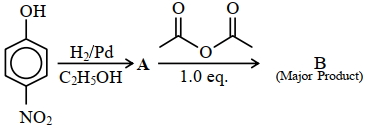
MediumMCQ
The correct structures of $A$ and $B$ formed in the following reactions are:
A
$A$: $p$-aminophenol,$B$: $N$-($4$-hydroxyphenyl)acetamide
B
$A$: $p$-aminophenol,$B$: $p$-acetamidophenol
C
$A$: $p$-acetamidophenol,$B$: $p$-aminophenol
D
$A$: $p$-aminophenol,$B$: $N$-($4$-acetoxyphenyl)acetamide
Solution
(D) $1$. The first step is the reduction of $p$-nitrophenol using $H_2/Pd$ in $C_2H_5OH$. The nitro group $(-NO_2)$ is reduced to an amino group $(-NH_2)$,yielding $p$-aminophenol as product $A$.
$2$. In the second step,$p$-aminophenol reacts with $1.0$ equivalent of acetic anhydride. The amino group $(-NH_2)$ is more nucleophilic than the phenolic hydroxyl group $(-OH)$. Therefore,the amino group undergoes nucleophilic acyl substitution $(S_N AE)$ with acetic anhydride to form $N$-($4$-hydroxyphenyl)acetamide (also known as $p$-acetamidophenol) as the major product $B$.
$2$. In the second step,$p$-aminophenol reacts with $1.0$ equivalent of acetic anhydride. The amino group $(-NH_2)$ is more nucleophilic than the phenolic hydroxyl group $(-OH)$. Therefore,the amino group undergoes nucleophilic acyl substitution $(S_N AE)$ with acetic anhydride to form $N$-($4$-hydroxyphenyl)acetamide (also known as $p$-acetamidophenol) as the major product $B$.
0 likes
View Solution769
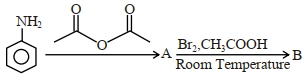
DifficultMCQ
The major products $A$ and $B$ formed in the following reaction sequence are :
A
$A$ = Acetanilide,$B$ = m-bromoacetanilide
B
$A$ = Acetanilide,$B$ = p-bromoacetanilide
C
$A$ = p-aminoacetophenone,$B$ = $3-$bromo$-4-$aminoacetophenone
D
$A$ = p-aminoacetophenone,$B$ = $3,5-$dibromo$-4-$aminoacetophenone
Solution
(B) $1$. The reaction of aniline with acetic anhydride ($CH_3CO)_2O$ is an acetylation reaction,which protects the amino group and forms acetanilide $(A)$.
$2$. The acetamido group $(-NHCOCH_3)$ is ortho/para directing. Due to steric hindrance,the para-substituted product is the major product.
$3$. Reaction of acetanilide with $Br_2$ in $CH_3COOH$ at room temperature leads to electrophilic aromatic substitution,yielding $p$-bromoacetanilide $(B)$ as the major product.
$2$. The acetamido group $(-NHCOCH_3)$ is ortho/para directing. Due to steric hindrance,the para-substituted product is the major product.
$3$. Reaction of acetanilide with $Br_2$ in $CH_3COOH$ at room temperature leads to electrophilic aromatic substitution,yielding $p$-bromoacetanilide $(B)$ as the major product.
0 likes
View Solution770
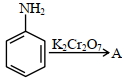
DifficultMCQ
Identify $A$ in the following reaction.
A
p-Benzoquinone
B
p-Aminophenol
C
Nitrobenzene
D
Nitrocyclohexane
Solution
(A) When aniline is treated with a strong oxidizing agent like $K_2Cr_2O_7$ in the presence of $H_2SO_4$,it undergoes oxidation to form $p$-benzoquinone as the final product. This is a characteristic oxidation reaction of aniline.
0 likes
View Solution771
EasyMCQ
Which one of the following gives the most stable diazonium salt?
A
$CH_3-CH_2-CH_2-NH_2$
B
$p-CH_3-C_6H_4-NH_2$
C
$CH_3-CH(NH_2)-CH_3$
D
$C_6H_5-NH-CH_3$
Solution
(B) Aromatic primary amines,especially those with electron-donating groups on the ring,form the most stable diazonium salts due to resonance stabilization. Among the options,$p$-toluidine $(p-CH_3-C_6H_4-NH_2)$ forms a diazonium salt that is stabilized by both the resonance of the benzene ring and the electron-donating inductive effect ($+I$ effect) of the methyl group. Aliphatic amines form highly unstable diazonium salts that decompose readily,and secondary amines like $N$-methylaniline do not form diazonium salts under these conditions.
0 likes
View Solution772
MediumMCQ
Identify the compound that will react with Hinsberg's reagent to give a solid which dissolves in alkali.
A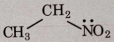
B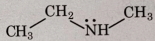
C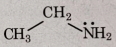
D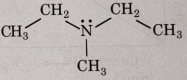
Solution
(C) Hinsberg's reagent is benzenesulfonyl chloride $(C_6H_5SO_2Cl)$.
$1^{\circ}$ amines $(R-NH_2)$ react with Hinsberg's reagent to form $N$-alkylbenzenesulfonamide,which contains an acidic hydrogen atom attached to the nitrogen. This makes the product soluble in alkali (e.g.,$KOH$ or $NaOH$).
$2^{\circ}$ amines form $N,N$-dialkylbenzenesulfonamides,which do not have an acidic hydrogen and are insoluble in alkali.
$3^{\circ}$ amines do not react with Hinsberg's reagent.
Among the given options,$CH_3-CH_2-NH_2$ is a $1^{\circ}$ amine,so it will react to form a product that is soluble in alkali.
$1^{\circ}$ amines $(R-NH_2)$ react with Hinsberg's reagent to form $N$-alkylbenzenesulfonamide,which contains an acidic hydrogen atom attached to the nitrogen. This makes the product soluble in alkali (e.g.,$KOH$ or $NaOH$).
$2^{\circ}$ amines form $N,N$-dialkylbenzenesulfonamides,which do not have an acidic hydrogen and are insoluble in alkali.
$3^{\circ}$ amines do not react with Hinsberg's reagent.
Among the given options,$CH_3-CH_2-NH_2$ is a $1^{\circ}$ amine,so it will react to form a product that is soluble in alkali.
0 likes
View Solution773
MediumMCQ
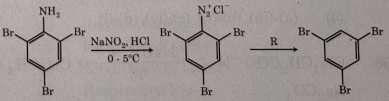
The reagent '$R$' in the given sequence of chemical reaction is:
A
$H_{2}O$
B
$CH_{3}CH_{2}OH$
C
$HI$
D
$CuCN / KCN$
Solution
(B) The given reaction sequence involves the conversion of $2,4,6$-tribromoaniline to $2,4,6$-tribromobenzenediazonium chloride using $NaNO_{2} / HCl$ at $0-5^{\circ}C$.
To replace the diazonium group $(-N_{2}^{+}Cl^{-})$ with a hydrogen atom,a reducing agent is required.
Ethanol $(CH_{3}CH_{2}OH)$ acts as a mild reducing agent that reduces the diazonium salt to the corresponding aromatic hydrocarbon (in this case,$1,3,5$-tribromobenzene) while being oxidized to acetaldehyde.
Therefore,the reagent '$R$' is $CH_{3}CH_{2}OH$.
To replace the diazonium group $(-N_{2}^{+}Cl^{-})$ with a hydrogen atom,a reducing agent is required.
Ethanol $(CH_{3}CH_{2}OH)$ acts as a mild reducing agent that reduces the diazonium salt to the corresponding aromatic hydrocarbon (in this case,$1,3,5$-tribromobenzene) while being oxidized to acetaldehyde.
Therefore,the reagent '$R$' is $CH_{3}CH_{2}OH$.
0 likes
View Solution774
EasyMCQ
Compound $A$ is converted to $B$ on reaction with $CHCl_3$ and $KOH$. The compound $B$ is toxic and can be decomposed by $C$. $A, B$ and $C$ respectively are:
A
secondary amine,nitrile compound,conc. $NaOH$
B
primary amine,isonitrile compound,conc. $HCl$
C
secondary amine,isonitrile compound,conc. $NaOH$
D
primary amine,nitrile compound,conc. $HCl$
Solution
(B) The reaction described is the Carbylamine reaction,which is a characteristic test for primary amines.
$R-NH_2 + CHCl_3 + 3KOH \rightarrow R-NC + 3KCl + 3H_2O$
Here,$A$ is a primary amine $(R-NH_2)$,and $B$ is an isonitrile $(R-NC)$,which is toxic.
Isonitriles can be decomposed (hydrolyzed) by treatment with concentrated mineral acids like $HCl$ to yield the original amine and formic acid:
$R-NC + 2H_2O \xrightarrow{HCl} R-NH_2 + HCOOH$
Thus,$A$ is a primary amine,$B$ is an isonitrile compound,and $C$ is conc. $HCl$.
$R-NH_2 + CHCl_3 + 3KOH \rightarrow R-NC + 3KCl + 3H_2O$
Here,$A$ is a primary amine $(R-NH_2)$,and $B$ is an isonitrile $(R-NC)$,which is toxic.
Isonitriles can be decomposed (hydrolyzed) by treatment with concentrated mineral acids like $HCl$ to yield the original amine and formic acid:
$R-NC + 2H_2O \xrightarrow{HCl} R-NH_2 + HCOOH$
Thus,$A$ is a primary amine,$B$ is an isonitrile compound,and $C$ is conc. $HCl$.
0 likes
View Solution775
DifficultMCQ
In the above reactions,product $A$ and product $B$ respectively are:
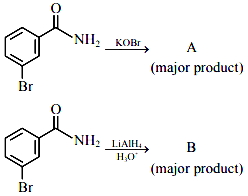
A
$3-$bromobenzenamine and $3-$bromobenzylamine
B
$3-$bromobenzenamine and $3-$bromobenzyl alcohol
C
$3-$bromobenzylamine and $3-$bromobenzenamine
D
$3-$bromobenzenamine and $3-$bromobenzyl amine
Solution
(A) $1$. The first reaction is the Hoffmann bromamide degradation reaction. In this reaction,an amide $(R-CONH_2)$ reacts with $Br_2$ in the presence of a strong base (like $KOH$) to form a primary amine $(R-NH_2)$ with one carbon atom less than the original amide. Thus,$3$-bromobenzamide reacts to form $3$-bromobenzenamine $(A)$:
$m-Br-C_6H_4-CONH_2 \xrightarrow{KOBr} m-Br-C_6H_4-NH_2$
$2$. The second reaction is the reduction of an amide using $LiAlH_4$ followed by $H_3O^+$. $LiAlH_4$ is a strong reducing agent that reduces an amide $(R-CONH_2)$ to a primary amine $(R-CH_2NH_2)$ with the same number of carbon atoms. Thus,$3$-bromobenzamide reacts to form $3$-bromobenzylamine $(B)$:
$m-Br-C_6H_4-CONH_2 \xrightarrow{LiAlH_4, H_3O^+} m-Br-C_6H_4-CH_2NH_2$
Therefore,the products $A$ and $B$ are $3$-bromobenzenamine and $3$-bromobenzylamine respectively.
$m-Br-C_6H_4-CONH_2 \xrightarrow{KOBr} m-Br-C_6H_4-NH_2$
$2$. The second reaction is the reduction of an amide using $LiAlH_4$ followed by $H_3O^+$. $LiAlH_4$ is a strong reducing agent that reduces an amide $(R-CONH_2)$ to a primary amine $(R-CH_2NH_2)$ with the same number of carbon atoms. Thus,$3$-bromobenzamide reacts to form $3$-bromobenzylamine $(B)$:
$m-Br-C_6H_4-CONH_2 \xrightarrow{LiAlH_4, H_3O^+} m-Br-C_6H_4-CH_2NH_2$
Therefore,the products $A$ and $B$ are $3$-bromobenzenamine and $3$-bromobenzylamine respectively.
0 likes
View Solution776
DifficultMCQ
Consider the reaction shown below. Compound $B$ is:
A
$HO_3S-C_6H_4-N=N-C_6H_4-N(CH_3)_2$
B
$C_6H_5-N=N-C_6H_4-N(CH_3)_2$
C
$HO_3S-C_6H_4-N=N-C_6H_3(N(CH_3)_2)$
D
$HO_3S-C_6H_4-C_6H_4-N(CH_3)_2$
Solution
(A) Step $1$: The reaction of $p$-aminobenzenesulfonic acid (sulfanilic acid) with $NaNO_2$ and $HCl$ at $273-278 \ K$ results in the formation of $p$-benzenediazonium sulfonate (Compound $A$).
Step $2$: Compound $A$ undergoes an electrophilic aromatic substitution (coupling reaction) with $N,N$-dimethylaniline at $273 \ K$.
Step $3$: The diazonium group $-N_2^+$ acts as an electrophile and attacks the para-position of $N,N$-dimethylaniline, which is activated by the electron-donating $-N(CH_3)_2$ group.
Step $4$: The final product $B$ is $4-(dimethylamino)azobenzene-4'-sulfonic acid$, represented as $HO_3S-C_6H_4-N=N-C_6H_4-N(CH_3)_2$.
Step $2$: Compound $A$ undergoes an electrophilic aromatic substitution (coupling reaction) with $N,N$-dimethylaniline at $273 \ K$.
Step $3$: The diazonium group $-N_2^+$ acts as an electrophile and attacks the para-position of $N,N$-dimethylaniline, which is activated by the electron-donating $-N(CH_3)_2$ group.
Step $4$: The final product $B$ is $4-(dimethylamino)azobenzene-4'-sulfonic acid$, represented as $HO_3S-C_6H_4-N=N-C_6H_4-N(CH_3)_2$.
0 likes
View Solution777
DifficultMCQ
Which one of the following reactions does not occur?
A
$C_6H_5NH_2 + AlCl_3 + CH_3Cl \rightarrow p-CH_3-C_6H_4-NH_2$
B
$C_6H_5NH_2 + H_2SO_4 \rightarrow p-SO_3H-C_6H_4-NH_2$
C
$C_6H_5NH_2 + (CH_3CO)_2O / \text{Pyridine} \rightarrow C_6H_5NHCOCH_3$
D
$C_6H_5NH_2 + HNO_3 / H_2SO_4 \rightarrow p-NO_2-C_6H_4-NH_2$
Solution
(A) $(1)$ Aniline is a Lewis base and reacts with the Lewis acid $AlCl_3$ to form an anilinium ion complex,which strongly deactivates the benzene ring. Therefore,Friedel-Crafts alkylation does not occur.
$(2)$ Sulfonation of aniline with $H_2SO_4$ produces anilinium hydrogen sulfate,which upon heating at $473-513 \ K$ gives sulfanilic acid $(p-aminobenzenesulfonic acid)$. The reaction shown in option $B$ is a standard representation of this process.
$(3)$ Acetylation of aniline with acetic anhydride in the presence of pyridine is a standard reaction.
$(4)$ Nitration of aniline in acidic medium gives a mixture of ortho,meta,and para-nitroaniline due to the protonation of the amino group,but the para-product is a major component.
$(2)$ Sulfonation of aniline with $H_2SO_4$ produces anilinium hydrogen sulfate,which upon heating at $473-513 \ K$ gives sulfanilic acid $(p-aminobenzenesulfonic acid)$. The reaction shown in option $B$ is a standard representation of this process.
$(3)$ Acetylation of aniline with acetic anhydride in the presence of pyridine is a standard reaction.
$(4)$ Nitration of aniline in acidic medium gives a mixture of ortho,meta,and para-nitroaniline due to the protonation of the amino group,but the para-product is a major component.
0 likes
View Solution778
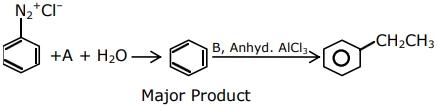
DifficultMCQ
In the chemical reaction given above,$A$ and $B$ respectively are:
A
$CH_3CH_2OH$ and $H_3PO_2$
B
$H_3PO_2$ and $CH_3CH_2Cl$
C
$H_3PO_2$ and $CH_3CH_2OH$
D
$CH_3CH_2Cl$ and $H_3PO_2$
Solution
(B) The reaction sequence is as follows:
$1$. The first step is the reduction of benzene diazonium chloride to benzene. This is achieved using hypophosphorous acid $(H_3PO_2)$ and water $(H_2O)$. Thus,$A = H_3PO_2$.
$2$. The second step is the Friedel-Crafts alkylation of benzene to form ethylbenzene. This requires an alkyl halide,specifically ethyl chloride $(CH_3CH_2Cl)$,in the presence of an anhydrous Lewis acid catalyst like $AlCl_3$. Thus,$B = CH_3CH_2Cl$.
Therefore,$A$ is $H_3PO_2$ and $B$ is $CH_3CH_2Cl$.
$1$. The first step is the reduction of benzene diazonium chloride to benzene. This is achieved using hypophosphorous acid $(H_3PO_2)$ and water $(H_2O)$. Thus,$A = H_3PO_2$.
$2$. The second step is the Friedel-Crafts alkylation of benzene to form ethylbenzene. This requires an alkyl halide,specifically ethyl chloride $(CH_3CH_2Cl)$,in the presence of an anhydrous Lewis acid catalyst like $AlCl_3$. Thus,$B = CH_3CH_2Cl$.
Therefore,$A$ is $H_3PO_2$ and $B$ is $CH_3CH_2Cl$.
0 likes
View Solution779
DifficultMCQ
$C_{6}H_{5}NO_{2}$ $\xrightarrow{Sn+HCl} A$ $\xrightarrow{C_{6}H_{5}N_{2}^{\oplus}Cl^{\ominus}} P$
(Yellow coloured compound)
Consider the above reaction,the Product "$P$" is:
(Yellow coloured compound)
Consider the above reaction,the Product "$P$" is:
A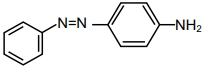
B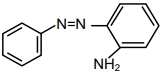
C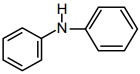
D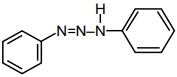
Solution
(A) $1$. The reduction of nitrobenzene $(C_{6}H_{5}NO_{2})$ with $Sn+HCl$ yields aniline $(C_{6}H_{5}NH_{2})$,which is compound $A$.
$2$. Aniline then undergoes an electrophilic aromatic substitution reaction (coupling reaction) with benzenediazonium chloride $(C_{6}H_{5}N_{2}^{\oplus}Cl^{\ominus})$ in a weakly acidic medium.
$3$. The diazonium ion acts as an electrophile and attacks the para-position of the aniline ring to form $p$-aminoazobenzene,which is a yellow-colored azo dye $(P)$.
$2$. Aniline then undergoes an electrophilic aromatic substitution reaction (coupling reaction) with benzenediazonium chloride $(C_{6}H_{5}N_{2}^{\oplus}Cl^{\ominus})$ in a weakly acidic medium.
$3$. The diazonium ion acts as an electrophile and attacks the para-position of the aniline ring to form $p$-aminoazobenzene,which is a yellow-colored azo dye $(P)$.
0 likes
View Solution780
DifficultMCQ
What is the major product $P$ of the following reaction?

A
$1-$methylcycloheptylmethyl chloride
B
$1-$methylcycloheptylmethyl diazonium chloride
C
$1-$methylcycloheptylmethanol
D
$1,1-$diethylcyclohexane
Solution
(C) The reaction of a primary aliphatic amine with $NaNO_2$ and $HCl$ at $278 \ K$ leads to the formation of a highly unstable diazonium salt intermediate.
This intermediate rapidly loses nitrogen gas $(N_2)$ to form a carbocation.
In this specific case,the primary carbocation formed at the terminal carbon is unstable and undergoes rearrangement (if possible) or is directly attacked by the nucleophile $(H_2O)$ present in the medium.
Here,the primary amine $1-methylcycloheptylmethanamine$ reacts to form the corresponding alcohol,$1-methylcycloheptylmethanol$,as the major product $P$.
This intermediate rapidly loses nitrogen gas $(N_2)$ to form a carbocation.
In this specific case,the primary carbocation formed at the terminal carbon is unstable and undergoes rearrangement (if possible) or is directly attacked by the nucleophile $(H_2O)$ present in the medium.
Here,the primary amine $1-methylcycloheptylmethanamine$ reacts to form the corresponding alcohol,$1-methylcycloheptylmethanol$,as the major product $P$.
0 likes
View Solution781
DifficultMCQ
Given below are two statements:
Statement $I$: Aniline is less basic than acetamide.
Statement $II$: In aniline,the lone pair of electrons on nitrogen atom is delocalised over benzene ring due to resonance and hence less available to a proton.
Choose the most appropriate option:
Statement $I$: Aniline is less basic than acetamide.
Statement $II$: In aniline,the lone pair of electrons on nitrogen atom is delocalised over benzene ring due to resonance and hence less available to a proton.
Choose the most appropriate option:
A
Both statement $I$ and statement $II$ are true.
B
Both statement $I$ and statement $II$ are false.
C
Statement $I$ is true but statement $II$ is false.
D
Statement $I$ is false but statement $II$ is true.
Solution
(D) Explanation :- The basicity of an amine depends on the availability of the lone pair of electrons on the nitrogen atom.
In $CH_3CONH_2$ (acetamide),the lone pair on nitrogen is involved in resonance with the highly electronegative oxygen atom $(O)$,making it significantly less basic.
In $C_6H_5NH_2$ (aniline),the lone pair on nitrogen is involved in resonance with the benzene ring,which also reduces its basicity,but to a lesser extent than in acetamide.
Therefore,aniline is more basic than acetamide.
Statement $I$ is false.
Statement $II$ is true because the lone pair of electrons on the nitrogen atom in aniline is indeed delocalised over the benzene ring due to resonance,making it less available for protonation.
In $CH_3CONH_2$ (acetamide),the lone pair on nitrogen is involved in resonance with the highly electronegative oxygen atom $(O)$,making it significantly less basic.
In $C_6H_5NH_2$ (aniline),the lone pair on nitrogen is involved in resonance with the benzene ring,which also reduces its basicity,but to a lesser extent than in acetamide.
Therefore,aniline is more basic than acetamide.
Statement $I$ is false.
Statement $II$ is true because the lone pair of electrons on the nitrogen atom in aniline is indeed delocalised over the benzene ring due to resonance,making it less available for protonation.
0 likes
View Solution782
MediumMCQ
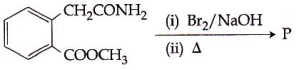
The product $(P)$ of the following reaction:
A
B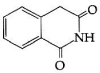
C
D
Solution
(C) The reaction involves two steps:
$1$. The first step uses $Br_2/NaOH$,which is the condition for the Hofmann bromamide degradation reaction. This reaction converts an amide group $(-CONH_2)$ into a primary amine group $(-NH_2)$.
$2$. The starting material is methyl $2-(carbamoylmethyl)benzoate$. The $-CONH_2$ group is converted to $-CH_2NH_2$.
$3$. The intermediate formed is methyl $2-(aminomethyl)benzoate$.
$4$. In the second step,heating $(\Delta)$ causes an intramolecular cyclization (nucleophilic acyl substitution) where the $-NH_2$ group attacks the ester carbonyl group $(-COOCH_3)$,resulting in the loss of a methanol molecule $(-CH_3OH)$ and the formation of a cyclic amide (lactam).
$5$. The final product $(P)$ is $isoindolin-1-one$.
$1$. The first step uses $Br_2/NaOH$,which is the condition for the Hofmann bromamide degradation reaction. This reaction converts an amide group $(-CONH_2)$ into a primary amine group $(-NH_2)$.
$2$. The starting material is methyl $2-(carbamoylmethyl)benzoate$. The $-CONH_2$ group is converted to $-CH_2NH_2$.
$3$. The intermediate formed is methyl $2-(aminomethyl)benzoate$.
$4$. In the second step,heating $(\Delta)$ causes an intramolecular cyclization (nucleophilic acyl substitution) where the $-NH_2$ group attacks the ester carbonyl group $(-COOCH_3)$,resulting in the loss of a methanol molecule $(-CH_3OH)$ and the formation of a cyclic amide (lactam).
$5$. The final product $(P)$ is $isoindolin-1-one$.
0 likes
View Solution783
MediumMCQ
Given below are two statements:
Statement $I$: Primary aliphatic amines react with $HNO_2$ to give unstable diazonium salts.
Statement $II$: Primary aromatic amines react with $HNO_2$ to form diazonium salts which are stable even above $300 \ K$.
In the light of the above statements,choose the most appropriate answer from the options given below:
Statement $I$: Primary aliphatic amines react with $HNO_2$ to give unstable diazonium salts.
Statement $II$: Primary aromatic amines react with $HNO_2$ to form diazonium salts which are stable even above $300 \ K$.
In the light of the above statements,choose the most appropriate answer from the options given below:
A
Both Statement $I$ and Statement $II$ are incorrect.
B
Statement $I$ is correct but Statement $II$ is incorrect.
C
Statement $I$ is incorrect but Statement $II$ is correct.
D
Both Statement $I$ and Statement $II$ are correct.
Solution
(B) Statement $I$ is correct: Primary aliphatic amines react with nitrous acid $(HNO_2)$ to form highly unstable aliphatic diazonium salts,which decompose immediately to evolve $N_2$ gas and form alcohols.
Statement $II$ is incorrect: Primary aromatic amines react with $HNO_2$ to form benzene diazonium salts,which are stable only at low temperatures $(273-278 \ K)$. Above $278 \ K$ (or $5 \ ^\circ C$),these salts decompose; they are certainly not stable above $300 \ K$.
Statement $II$ is incorrect: Primary aromatic amines react with $HNO_2$ to form benzene diazonium salts,which are stable only at low temperatures $(273-278 \ K)$. Above $278 \ K$ (or $5 \ ^\circ C$),these salts decompose; they are certainly not stable above $300 \ K$.
0 likes
View Solution784
MediumMCQ
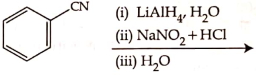
The product formed from the following reaction sequence is?
A
Benzyl diazonium chloride
B
Benzyl chloride
C
Benzyl alcohol
D
Benzamide
Solution
(C) The reaction sequence is as follows:
$1$. Reduction of benzonitrile $(C_6H_5CN)$ with $LiAlH_4$ followed by $H_2O$ gives benzylamine $(C_6H_5CH_2NH_2)$.
$2$. Treatment of benzylamine with $NaNO_2 + HCl$ at low temperature $(0-5 \ ^\circ C)$ forms unstable benzyl diazonium chloride $(C_6H_5CH_2N_2^+Cl^-)$.
$3$. Benzyl diazonium chloride rapidly decomposes to form a benzyl carbocation $(C_6H_5CH_2^+)$,which reacts with water $(H_2O)$ to yield benzyl alcohol $(C_6H_5CH_2OH)$.
$1$. Reduction of benzonitrile $(C_6H_5CN)$ with $LiAlH_4$ followed by $H_2O$ gives benzylamine $(C_6H_5CH_2NH_2)$.
$2$. Treatment of benzylamine with $NaNO_2 + HCl$ at low temperature $(0-5 \ ^\circ C)$ forms unstable benzyl diazonium chloride $(C_6H_5CH_2N_2^+Cl^-)$.
$3$. Benzyl diazonium chloride rapidly decomposes to form a benzyl carbocation $(C_6H_5CH_2^+)$,which reacts with water $(H_2O)$ to yield benzyl alcohol $(C_6H_5CH_2OH)$.
0 likes
View Solution785
MediumMCQ
The reaction of $RCONH_2$ with bromine and $KOH$ gives $RNH_2$ as the end product. Which one of the following is the intermediate product formed in this reaction?
A
$RCONHBr$
B
$RNHBr$
C
$RN=C=O$
D
$RCONBr_2$
Solution
(C) The given reaction is the Hoffmann-Bromamide degradation reaction.
In this reaction,the amide $(RCONH_2)$ reacts with $Br_2$ and $KOH$ to form an $N$-bromamide intermediate $(RCONHBr)$,which then undergoes rearrangement to form an isocyanate intermediate $(RN=C=O)$.
Finally,the isocyanate is hydrolyzed to form the primary amine $(RNH_2)$.
Both $RCONHBr$ and $RN=C=O$ are intermediates,but $RN=C=O$ (alkyl isocyanate) is the key intermediate formed during the rearrangement step.
In this reaction,the amide $(RCONH_2)$ reacts with $Br_2$ and $KOH$ to form an $N$-bromamide intermediate $(RCONHBr)$,which then undergoes rearrangement to form an isocyanate intermediate $(RN=C=O)$.
Finally,the isocyanate is hydrolyzed to form the primary amine $(RNH_2)$.
Both $RCONHBr$ and $RN=C=O$ are intermediates,but $RN=C=O$ (alkyl isocyanate) is the key intermediate formed during the rearrangement step.
0 likes
View Solution786
EasyMCQ
The correct order of nucleophilicity is $.....$ .
A
$F^{-} > OH^{-}$
B
$H_{2}\ddot{O} > OH^{-}$
C
$R\ddot{O}H > RO^{-}$
D
$NH_{2}^{-} > NH_{3}$
Solution
(D) Nucleophilicity is directly proportional to the electron density on the donor atom.
For species with the same donor atom,the one with a negative charge is a stronger nucleophile than its conjugate acid because it has higher electron density.
Comparing $NH_{2}^{-}$ and $NH_{3}$,$NH_{2}^{-}$ has a negative charge and a lone pair,whereas $NH_{3}$ only has a lone pair.
Therefore,$NH_{2}^{-}$ is a better nucleophile than $NH_{3}$.
For species with the same donor atom,the one with a negative charge is a stronger nucleophile than its conjugate acid because it has higher electron density.
Comparing $NH_{2}^{-}$ and $NH_{3}$,$NH_{2}^{-}$ has a negative charge and a lone pair,whereas $NH_{3}$ only has a lone pair.
Therefore,$NH_{2}^{-}$ is a better nucleophile than $NH_{3}$.
0 likes
View Solution787
EasyMCQ
The final product $C$ in the following series of reactions is:

A
$1-$(phenylazo)naphthalen$-2-$ol
B
$4-$(phenylazo)naphthalen$-1-$ol
C
$2-$(phenylazo)naphthalen$-1-$ol
D
$6-$(phenylazo)naphthalen$-2-$ol
Solution
(A) $1$. Reduction: Nitrobenzene $(C_6H_5NO_2)$ reacts with $Sn/HCl$ to form aniline $(C_6H_5NH_2)$,which is product $A$.
$2$. Diazotization: Aniline reacts with $NaNO_2/HCl$ at $0-5 \ ^\circ C$ to form benzene diazonium chloride $(C_6H_5N_2^+Cl^-)$,which is product $B$.
$3$. Coupling Reaction: Benzene diazonium chloride reacts with $\beta$-naphthol in the presence of $NaOH$ to form an azo dye. The coupling occurs at the ortho position relative to the $-OH$ group in $\beta$-naphthol,yielding $1-$(phenylazo)naphthalen$-2-$ol as the final product $C$.
$2$. Diazotization: Aniline reacts with $NaNO_2/HCl$ at $0-5 \ ^\circ C$ to form benzene diazonium chloride $(C_6H_5N_2^+Cl^-)$,which is product $B$.
$3$. Coupling Reaction: Benzene diazonium chloride reacts with $\beta$-naphthol in the presence of $NaOH$ to form an azo dye. The coupling occurs at the ortho position relative to the $-OH$ group in $\beta$-naphthol,yielding $1-$(phenylazo)naphthalen$-2-$ol as the final product $C$.
0 likes
View Solution788
MediumMCQ
Decarboxylation of all six possible isomers of diaminobenzoic acids $C_6H_3(NH_2)_2COOH$ yields three products $A, B$ and $C$. Three acids give product $A$,two acids give product $B$ and one acid gives product $C$. The melting point of product $C$ is .....$^{\circ} C$.
A
$63$
B
$90$
C
$104$
D
$142$
Solution
(D) The six isomers of diaminobenzoic acid are decarboxylated to form phenylenediamine isomers.
$1$. The three isomers that yield $m$-phenylenediamine $(A)$ are $2,4$-diaminobenzoic acid,$2,6$-diaminobenzoic acid,and $3,5$-diaminobenzoic acid.
$2$. The two isomers that yield $o$-phenylenediamine $(B)$ are $2,3$-diaminobenzoic acid and $3,4$-diaminobenzoic acid.
$3$. The one isomer that yields $p$-phenylenediamine $(C)$ is $2,5$-diaminobenzoic acid.
$p$-phenylenediamine $(C)$ has a melting point of $142^{\circ} C$.
$1$. The three isomers that yield $m$-phenylenediamine $(A)$ are $2,4$-diaminobenzoic acid,$2,6$-diaminobenzoic acid,and $3,5$-diaminobenzoic acid.
$2$. The two isomers that yield $o$-phenylenediamine $(B)$ are $2,3$-diaminobenzoic acid and $3,4$-diaminobenzoic acid.
$3$. The one isomer that yields $p$-phenylenediamine $(C)$ is $2,5$-diaminobenzoic acid.
$p$-phenylenediamine $(C)$ has a melting point of $142^{\circ} C$.
0 likes
View Solution789
DifficultMCQ
Given below are two statements:
Statement-$I$: In Hofmann degradation reaction,the migration of only an alkyl group takes place from carbonyl carbon of the amide to the nitrogen atom.
Statement-$II$: The group is migrated in Hofmann degradation reaction to an electron-deficient nitrogen atom.
In the light of the above statements,choose the most appropriate answer from the options given below:
Statement-$I$: In Hofmann degradation reaction,the migration of only an alkyl group takes place from carbonyl carbon of the amide to the nitrogen atom.
Statement-$II$: The group is migrated in Hofmann degradation reaction to an electron-deficient nitrogen atom.
In the light of the above statements,choose the most appropriate answer from the options given below:
A
Both Statement-$I$ and Statement-$II$ are correct
B
Both Statement-$I$ and Statement-$II$ are incorrect
C
Statement-$I$ is correct but Statement-$II$ is incorrect
D
Statement-$I$ is incorrect but Statement-$II$ is correct
Solution
(D) In the Hofmann bromamide degradation reaction,an amide reacts with bromine in an alkaline medium to form a primary amine.
The mechanism involves the formation of an $N$-bromamide intermediate,which loses a proton to form an electron-deficient nitrene-like species (or nitrenoid intermediate).
During the rearrangement,the alkyl or aryl group $(R)$ migrates from the carbonyl carbon to the electron-deficient nitrogen atom to form an isocyanate $(R-N=C=O)$.
Statement-$I$ is incorrect because not only alkyl groups but also aryl groups can migrate.
Statement-$II$ is correct because the migration occurs specifically to the electron-deficient nitrogen atom.
Therefore,Statement-$I$ is incorrect and Statement-$II$ is correct.
The mechanism involves the formation of an $N$-bromamide intermediate,which loses a proton to form an electron-deficient nitrene-like species (or nitrenoid intermediate).
During the rearrangement,the alkyl or aryl group $(R)$ migrates from the carbonyl carbon to the electron-deficient nitrogen atom to form an isocyanate $(R-N=C=O)$.
Statement-$I$ is incorrect because not only alkyl groups but also aryl groups can migrate.
Statement-$II$ is correct because the migration occurs specifically to the electron-deficient nitrogen atom.
Therefore,Statement-$I$ is incorrect and Statement-$II$ is correct.
0 likes
View Solution790
MediumMCQ
With respect to the following reaction,consider the given statements:
$C_6H_5NH_2 \xrightarrow{HNO_3, H_2SO_4, 288 \ K} \text{products}$
$(A)$ $o$-Nitroaniline and $p$-nitroaniline are the predominant products.
$(B)$ $p$-Nitroaniline and $m$-nitroaniline are the predominant products.
$(C)$ $HNO_3$ acts as an acid.
$(D)$ $H_2SO_4$ acts as an acid.
$C_6H_5NH_2 \xrightarrow{HNO_3, H_2SO_4, 288 \ K} \text{products}$
$(A)$ $o$-Nitroaniline and $p$-nitroaniline are the predominant products.
$(B)$ $p$-Nitroaniline and $m$-nitroaniline are the predominant products.
$(C)$ $HNO_3$ acts as an acid.
$(D)$ $H_2SO_4$ acts as an acid.
A
$A$ and $C$ are correct statements.
B
$A$ and $D$ are correct statements.
C
$B$ and $D$ are correct statements.
D
$B$ and $C$ are correct statements.
Solution
(C) In the nitration of aniline using $HNO_3$ and $H_2SO_4$,aniline is protonated to form the anilinium ion $(C_6H_5NH_3^+)$,which is meta-directing.
However,due to the presence of some unprotonated aniline,ortho and para products are also formed.
Experimental results show that $m$-nitroaniline $(47\%)$ and $p$-nitroaniline $(51\%)$ are the major products.
Thus,statement $(B)$ is correct.
In the reaction between $HNO_3$ and $H_2SO_4$,$H_2SO_4$ acts as an acid and $HNO_3$ acts as a base:
$HNO_3 + H_2SO_4$ $\rightarrow H_2NO_3^+ + HSO_4^-$ $\rightarrow NO_2^+ + H_2O + HSO_4^-$.
Thus,statement $(D)$ is correct.
Therefore,statements $(B)$ and $(D)$ are correct.
However,due to the presence of some unprotonated aniline,ortho and para products are also formed.
Experimental results show that $m$-nitroaniline $(47\%)$ and $p$-nitroaniline $(51\%)$ are the major products.
Thus,statement $(B)$ is correct.
In the reaction between $HNO_3$ and $H_2SO_4$,$H_2SO_4$ acts as an acid and $HNO_3$ acts as a base:
$HNO_3 + H_2SO_4$ $\rightarrow H_2NO_3^+ + HSO_4^-$ $\rightarrow NO_2^+ + H_2O + HSO_4^-$.
Thus,statement $(D)$ is correct.
Therefore,statements $(B)$ and $(D)$ are correct.
0 likes
View Solution791
DifficultMCQ
Identify the major product formed in the following sequence of reactions:
Aniline $\xrightarrow{Br_2/H_2O}$ $2,4,6-$Tribromoaniline $\xrightarrow{NaNO_2/HCl}$ $2,4,6-$Tribromobenzenediazonium chloride $\xrightarrow{H_3PO_2/H_2O}$ Product.
Aniline $\xrightarrow{Br_2/H_2O}$ $2,4,6-$Tribromoaniline $\xrightarrow{NaNO_2/HCl}$ $2,4,6-$Tribromobenzenediazonium chloride $\xrightarrow{H_3PO_2/H_2O}$ Product.
A
Bromobenzene
B
$p-$Bromoaniline
C
$1,3,5-$Tribromobenzene
D
$2,4,6-$Tribromophenol
Solution
(C) The reaction sequence is as follows:
$1$. Aniline reacts with $Br_2$ water to form $2,4,6-$tribromoaniline as a white precipitate.
$2$. $2,4,6-$Tribromoaniline reacts with $NaNO_2/HCl$ at $0-5^{\circ}C$ to form $2,4,6-$tribromobenzenediazonium chloride.
$3$. $2,4,6-$Tribromobenzenediazonium chloride reacts with $H_3PO_2$ (hypophosphorous acid) and water to undergo reduction,replacing the diazonium group with a hydrogen atom,resulting in $1,3,5-$tribromobenzene.
$1$. Aniline reacts with $Br_2$ water to form $2,4,6-$tribromoaniline as a white precipitate.
$2$. $2,4,6-$Tribromoaniline reacts with $NaNO_2/HCl$ at $0-5^{\circ}C$ to form $2,4,6-$tribromobenzenediazonium chloride.
$3$. $2,4,6-$Tribromobenzenediazonium chloride reacts with $H_3PO_2$ (hypophosphorous acid) and water to undergo reduction,replacing the diazonium group with a hydrogen atom,resulting in $1,3,5-$tribromobenzene.
0 likes
View Solution792
MediumMCQ
$A$ primary aliphatic amine on reaction with nitrous acid in cold $(273 \, K)$ and thereafter raising the temperature of the reaction mixture to room temperature $(298 \, K)$ gives a/an .....
A
nitrile
B
alcohol
C
diazonium salt
D
secondary amine
Solution
(B) Primary aliphatic amines react with nitrous acid $(HNO_2)$ at low temperatures $(273-278 \, K)$ to form unstable aliphatic diazonium salts.
Upon raising the temperature to room temperature $(298 \, K)$,these diazonium salts decompose rapidly by losing nitrogen gas to form carbocations,which then react with water to yield alcohols.
The reaction sequence is: $R-NH_2 + HNO_2$ $\xrightarrow{273 \, K} [R-N_2^+Cl^-]$ $\xrightarrow{298 \, K} R-OH + N_2 + HCl$.
Upon raising the temperature to room temperature $(298 \, K)$,these diazonium salts decompose rapidly by losing nitrogen gas to form carbocations,which then react with water to yield alcohols.
The reaction sequence is: $R-NH_2 + HNO_2$ $\xrightarrow{273 \, K} [R-N_2^+Cl^-]$ $\xrightarrow{298 \, K} R-OH + N_2 + HCl$.
0 likes
View Solution793
MediumMCQ
In Friedel-Crafts alkylation of aniline,one gets ....
A
alkylated product with ortho and para substitution
B
secondary amine after acidic treatment
C
an amide product.
D
positively charged nitrogen at benzene ring.
Solution
(D) Aniline $(C_6H_5NH_2)$ is a Lewis base due to the lone pair of electrons on the nitrogen atom.
Friedel-Crafts catalysts like anhydrous $AlCl_3$ are Lewis acids.
When aniline reacts with $AlCl_3$,the lone pair on the nitrogen atom coordinates with the $AlCl_3$ to form a salt,resulting in a positively charged nitrogen atom $(C_6H_5NH_2^+-AlCl_3^-)$.
Because of this positive charge,the nitrogen atom becomes strongly electron-withdrawing,which deactivates the benzene ring towards electrophilic substitution.
Therefore,aniline does not undergo Friedel-Crafts alkylation or acylation.
Friedel-Crafts catalysts like anhydrous $AlCl_3$ are Lewis acids.
When aniline reacts with $AlCl_3$,the lone pair on the nitrogen atom coordinates with the $AlCl_3$ to form a salt,resulting in a positively charged nitrogen atom $(C_6H_5NH_2^+-AlCl_3^-)$.
Because of this positive charge,the nitrogen atom becomes strongly electron-withdrawing,which deactivates the benzene ring towards electrophilic substitution.
Therefore,aniline does not undergo Friedel-Crafts alkylation or acylation.
0 likes
View Solution794
AdvancedMCQ
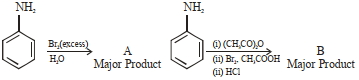
Consider the above reaction,the product $A$ and product $B$ respectively are ...
A
$2,4,6$-tribromoaniline and $p$-bromoaniline
B
$p$-bromoaniline and $2,4,6$-tribromoaniline
C
$2,4,6$-tribromoaniline and $2,4,6$-tribromoaniline
D
$p$-bromoaniline and $p$-bromoaniline
Solution
(A) $1$. In the first reaction,aniline reacts with $Br_2$ in water (excess). Due to the strongly activating nature of the $-NH_2$ group,electrophilic substitution occurs at all ortho and para positions,yielding $2,4,6$-tribromoaniline as the major product $A$.
$2$. In the second reaction,aniline is first acetylated using acetic anhydride to form acetanilide. This protects the $-NH_2$ group and reduces its activating effect. Subsequent bromination with $Br_2$ in $CH_3COOH$ occurs primarily at the para position due to steric hindrance at the ortho positions. Finally,hydrolysis with $HCl$ removes the acetyl group to yield $p$-bromoaniline as the major product $B$.
$2$. In the second reaction,aniline is first acetylated using acetic anhydride to form acetanilide. This protects the $-NH_2$ group and reduces its activating effect. Subsequent bromination with $Br_2$ in $CH_3COOH$ occurs primarily at the para position due to steric hindrance at the ortho positions. Finally,hydrolysis with $HCl$ removes the acetyl group to yield $p$-bromoaniline as the major product $B$.
0 likes
View Solution795
DifficultMCQ
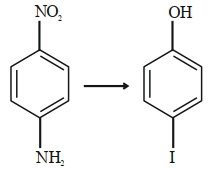
The correct sequential order of the reagents for the given reaction is:
A
$HNO_2, Fe/H^{+}, HNO_2, KI, H_2O/H^{+}$
B
$HNO_2, KI, Fe/H^{+}, HNO_2, H_2O/\text{warm}$
C
$HNO_2, KI, HNO_2, Fe/H^{+}, H_2O/H^{+}$
D
$HNO_2, Fe/H^{+}, KI, HNO_2, H_2O/\text{warm}$
Solution
(B) The starting material is $p$-nitroaniline. The goal is to convert the $-NO_2$ group to $-OH$ and the $-NH_2$ group to $-I$.
$1$. First,treat $p$-nitroaniline with $HNO_2$ ($NaNO_2 + HCl$ at $0-5^{\circ}C$) to form the diazonium salt at the $-NH_2$ position.
$2$. Then,treat with $KI$ to replace the diazonium group with $-I$.
$3$. Next,reduce the $-NO_2$ group to $-NH_2$ using $Fe/H^{+}$.
$4$. Treat with $HNO_2$ again to convert the new $-NH_2$ group into a diazonium salt.
$5$. Finally,heat with $H_2O$ to convert the diazonium group into an $-OH$ group.
This corresponds to the sequence: $HNO_2, KI, Fe/H^{+}, HNO_2, H_2O/\text{warm}$.
$1$. First,treat $p$-nitroaniline with $HNO_2$ ($NaNO_2 + HCl$ at $0-5^{\circ}C$) to form the diazonium salt at the $-NH_2$ position.
$2$. Then,treat with $KI$ to replace the diazonium group with $-I$.
$3$. Next,reduce the $-NO_2$ group to $-NH_2$ using $Fe/H^{+}$.
$4$. Treat with $HNO_2$ again to convert the new $-NH_2$ group into a diazonium salt.
$5$. Finally,heat with $H_2O$ to convert the diazonium group into an $-OH$ group.
This corresponds to the sequence: $HNO_2, KI, Fe/H^{+}, HNO_2, H_2O/\text{warm}$.
0 likes
View Solution796
MediumMCQ
Given below are two statements: one is labelled as Assertion $(A)$ and the other is labelled as Reason $(R)$.
Assertion $(A)$: Experimental reaction of $CH_{3}Cl$ with aniline and anhydrous $AlCl_{3}$ does not give $o-$ and $p-$methylaniline.
Reason $(R)$: The $-NH_{2}$ group of aniline becomes deactivating because of salt formation with anhydrous $AlCl_{3}$ and hence yields $m-$methylaniline as the product.
In the light of the above statements,choose the most appropriate answer from the options given below.
Assertion $(A)$: Experimental reaction of $CH_{3}Cl$ with aniline and anhydrous $AlCl_{3}$ does not give $o-$ and $p-$methylaniline.
Reason $(R)$: The $-NH_{2}$ group of aniline becomes deactivating because of salt formation with anhydrous $AlCl_{3}$ and hence yields $m-$methylaniline as the product.
In the light of the above statements,choose the most appropriate answer from the options given below.
A
Both $(A)$ and $(R)$ are true and $(R)$ is the correct explanation of $(A)$.
B
Both $(A)$ and $(R)$ are true but $(R)$ is not the correct explanation of $(A)$.
C
$(A)$ is true,but $(R)$ is false.
D
$(A)$ is false,but $(R)$ is true.
Solution
(C) Aniline is a Lewis base and reacts with the Lewis acid $AlCl_{3}$ to form an acid-base adduct (salt),$C_{6}H_{5}NH_{2} \cdot AlCl_{3}$.
In this adduct,the nitrogen atom carries a positive charge,which makes the $-NH_{2}$ group strongly electron-withdrawing (deactivating) and meta-directing.
However,because the ring is so strongly deactivated,it does not undergo Friedel-Crafts alkylation with $CH_{3}Cl$.
Therefore,the reaction does not yield $o-$ or $p-$methylaniline,nor does it yield $m-$methylaniline; it simply does not proceed.
Thus,Assertion $(A)$ is true,but Reason $(R)$ is false because the reaction does not yield $m-$methylaniline.
In this adduct,the nitrogen atom carries a positive charge,which makes the $-NH_{2}$ group strongly electron-withdrawing (deactivating) and meta-directing.
However,because the ring is so strongly deactivated,it does not undergo Friedel-Crafts alkylation with $CH_{3}Cl$.
Therefore,the reaction does not yield $o-$ or $p-$methylaniline,nor does it yield $m-$methylaniline; it simply does not proceed.
Thus,Assertion $(A)$ is true,but Reason $(R)$ is false because the reaction does not yield $m-$methylaniline.
0 likes
View Solution797
MediumMCQ
Given below are two statements: one is labelled as Assertion $A$ and the other is labelled as Reason $R$.
Assertion $A$: Aniline on nitration yields ortho,meta and para nitro derivatives of aniline.
Reason $R$: Nitrating mixture is a strong acidic mixture.
In the light of the above statements,choose the correct answer from the options given below.
Assertion $A$: Aniline on nitration yields ortho,meta and para nitro derivatives of aniline.
Reason $R$: Nitrating mixture is a strong acidic mixture.
In the light of the above statements,choose the correct answer from the options given below.
A
Both $A$ and $R$ are true and $R$ is the correct explanation of $A$.
B
Both $A$ and $R$ are true but $R$ is $NOT$ the correct explanation of $A$.
C
$A$ is true but $R$ is false.
D
$A$ is false but $R$ is true.
Solution
(A) Direct nitration of aniline with concentrated $HNO_3$ and $H_2SO_4$ (nitrating mixture) yields a mixture of ortho,meta,and para nitroanilines.
Assertion $A$ is true because the formation of the meta-isomer occurs due to the protonation of the $-NH_2$ group in the strongly acidic medium,forming the anilinium ion $(-NH_3^+)$,which is meta-directing.
Reason $R$ is also true,as the nitrating mixture is indeed a strong acidic mixture.
Since the formation of the meta-product is specifically due to the acidic nature of the medium (which protonates the amino group),Reason $R$ correctly explains Assertion $A$.
Assertion $A$ is true because the formation of the meta-isomer occurs due to the protonation of the $-NH_2$ group in the strongly acidic medium,forming the anilinium ion $(-NH_3^+)$,which is meta-directing.
Reason $R$ is also true,as the nitrating mixture is indeed a strong acidic mixture.
Since the formation of the meta-product is specifically due to the acidic nature of the medium (which protonates the amino group),Reason $R$ correctly explains Assertion $A$.
0 likes
View Solution798
MediumMCQ
Which among the following is the strongest Bronsted base?
A
Triethylamine
B
Diethylamine
C
$N$-methylpyrrole
D
Quinuclidine
Solution
(D) The basicity of an amine depends on the availability of the lone pair of electrons on the nitrogen atom.
In $N$-methylpyrrole,the lone pair is involved in aromaticity,making it very weakly basic.
In acyclic amines like triethylamine and diethylamine,the nitrogen atom can undergo amine inversion,which affects its basicity.
Quinuclidine is a bicyclic tertiary amine where the nitrogen atom is held in a rigid structure.
Due to this rigid bicyclic structure,the lone pair on the nitrogen is highly available for protonation,and the molecule cannot undergo amine inversion,which would otherwise decrease the availability of the lone pair.
Therefore,quinuclidine is the strongest Bronsted base among the given options.
In $N$-methylpyrrole,the lone pair is involved in aromaticity,making it very weakly basic.
In acyclic amines like triethylamine and diethylamine,the nitrogen atom can undergo amine inversion,which affects its basicity.
Quinuclidine is a bicyclic tertiary amine where the nitrogen atom is held in a rigid structure.
Due to this rigid bicyclic structure,the lone pair on the nitrogen is highly available for protonation,and the molecule cannot undergo amine inversion,which would otherwise decrease the availability of the lone pair.
Therefore,quinuclidine is the strongest Bronsted base among the given options.
0 likes
View Solution799
EasyMCQ
The Hinsberg reagent is:
A
B
C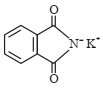
D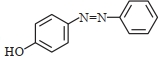
Solution
(A) The Hinsberg reagent is $Benzene$ $sulphonyl$ $chloride$ $(C_6H_5SO_2Cl)$.
It is used for the separation and identification of primary,secondary,and tertiary amines.
It is used for the separation and identification of primary,secondary,and tertiary amines.
0 likes
View Solution800
MediumMCQ
The compound $X$ in the following reaction scheme is:

A
acetonitrile
B
methyl isocyanide
C
acetaldehyde
D
nitromethane
Solution
(A) The given compound $(X)$ is acetonitrile $(CH_{3}CN)$.
Acidic hydrolysis of acetonitrile $(CH_{3}CN)$ yields acetic acid $(CH_{3}COOH)$.
Reduction of acetonitrile $(CH_{3}CN)$ using reducing agents like $LiAlH_{4}$ or $H_{2}/Ni$ yields ethanamine $(CH_{3}CH_{2}NH_{2})$.
The complete reaction scheme is:
$CH_{3}COOH \xleftarrow{\text{Acid hydrolysis}} CH_{3}CN (X) \xrightarrow{\text{Reduction}} CH_{3}CH_{2}NH_{2}$
Acidic hydrolysis of acetonitrile $(CH_{3}CN)$ yields acetic acid $(CH_{3}COOH)$.
Reduction of acetonitrile $(CH_{3}CN)$ using reducing agents like $LiAlH_{4}$ or $H_{2}/Ni$ yields ethanamine $(CH_{3}CH_{2}NH_{2})$.
The complete reaction scheme is:
$CH_{3}COOH \xleftarrow{\text{Acid hydrolysis}} CH_{3}CN (X) \xrightarrow{\text{Reduction}} CH_{3}CH_{2}NH_{2}$
0 likes
View SolutionAmines — Properties of Amines · Frequently Asked Questions
1Are these Amines questions useful for JEE and NEET?
Yes. All questions in this section are mapped to JEE Main and NEET exam patterns. Previous year questions from JEE Main, NEET, GUJCET and state-level exams are included with full solutions.
2Can I switch to Hindi or Gujarati for these questions?
Yes. Use the language tabs in the hero section or the sidebar to view the same questions and solutions in English, Hindi or Gujarati.
3How do I generate a question paper from this subtopic?
Use the Vedclass Exam Paper Generator — select the chapter and subtopic, set difficulty, and generate Sets A, B, C, D automatically. First 3 chapters of every subject are free.
Vedclass Products
For Students
Vedclass Test Series
Mock tests in real JEE/NEET style with performance analysis. 5-day free trial.
Start Free TrialFor Teachers
Exam Paper Generator
Generate Set A/B/C/D papers from this chapter in 2 minutes. 3 chapters free.
Try FreeFor Institutes
Online Exam Module
Live online exams with unlimited students, 360° analytics & white-label branding.
See DemoFor Teachers & Institutes
Generate a Amines Exam Paper in 2 Minutes
Select subtopic & difficulty — Sets A, B, C, D auto-generated with No Repeat logic.
First 3 chapters of every subject are free — no payment required.