
A English
Properties of Amines Questions in English
Class 12 Chemistry · Amines · Properties of Amines
1212+
Questions
English
Language
100%
With Solutions
Showing 49 of 1212 questions in English
901
MediumMCQ
Identify the correct decreasing order of basic strength of methyl-substituted amines in an aqueous solution.
A
$(CH_3)_3N > (CH_3)_2NH > CH_3NH_2$
B
$(CH_3)_2NH > CH_3NH_2 > (CH_3)_3N$
C
$(CH_3)_2NH > (CH_3)_3N > CH_3NH_2$
D
$CH_3NH_2 > (CH_3)_2NH > (CH_3)_3N$
Solution
(B) In an aqueous solution,the basic strength of amines is determined by a combination of inductive effect,solvation effect (hydrogen bonding),and steric hindrance.
For methyl-substituted amines,the order of basicity is $(CH_3)_2NH > CH_3NH_2 > (CH_3)_3N$.
$1.$ $(CH_3)_2NH$ (secondary amine) is the most basic due to the combined effect of the electron-donating $+I$ effect of two methyl groups and sufficient solvation of the conjugate acid.
$2.$ $CH_3NH_2$ (primary amine) is less basic than the secondary amine but more basic than the tertiary amine in aqueous media.
$3.$ $(CH_3)_3N$ (tertiary amine) is the least basic among these because the steric hindrance of the three methyl groups prevents effective solvation of the protonated amine by water molecules,which outweighs the inductive effect.
For methyl-substituted amines,the order of basicity is $(CH_3)_2NH > CH_3NH_2 > (CH_3)_3N$.
$1.$ $(CH_3)_2NH$ (secondary amine) is the most basic due to the combined effect of the electron-donating $+I$ effect of two methyl groups and sufficient solvation of the conjugate acid.
$2.$ $CH_3NH_2$ (primary amine) is less basic than the secondary amine but more basic than the tertiary amine in aqueous media.
$3.$ $(CH_3)_3N$ (tertiary amine) is the least basic among these because the steric hindrance of the three methyl groups prevents effective solvation of the protonated amine by water molecules,which outweighs the inductive effect.
0 likes
View Solution902
MediumMCQ
Which of the following amines has the lowest $pK_{b}$ value?
A
$C_2H_5NH_2$
B
$(CH_3)_3N$
C
$C_6H_5NH_2$
D
$C_6H_5CH_2NH_2$
Solution
(A) The $pK_{b}$ value is inversely proportional to the basic strength of the amine. $A$ lower $pK_{b}$ value indicates a stronger base.
$1$. $C_6H_5NH_2$ (Aniline) is a weak base due to the resonance of the lone pair on nitrogen with the benzene ring.
$2$. $(CH_3)_3N$ is a tertiary amine,which is less basic than secondary amines due to steric hindrance.
$3$. $C_6H_5CH_2NH_2$ (Benzylamine) is more basic than aniline because the lone pair is not in conjugation with the benzene ring.
$4$. $C_2H_5NH_2$ (Ethylamine) is a primary aliphatic amine. In the gas phase,basicity increases with the number of alkyl groups,but in aqueous solution,$C_2H_5NH_2$ is a strong base due to the inductive effect and solvation.
Comparing these,$C_2H_5NH_2$ is the strongest base among the given options,hence it has the lowest $pK_{b}$ value.
$1$. $C_6H_5NH_2$ (Aniline) is a weak base due to the resonance of the lone pair on nitrogen with the benzene ring.
$2$. $(CH_3)_3N$ is a tertiary amine,which is less basic than secondary amines due to steric hindrance.
$3$. $C_6H_5CH_2NH_2$ (Benzylamine) is more basic than aniline because the lone pair is not in conjugation with the benzene ring.
$4$. $C_2H_5NH_2$ (Ethylamine) is a primary aliphatic amine. In the gas phase,basicity increases with the number of alkyl groups,but in aqueous solution,$C_2H_5NH_2$ is a strong base due to the inductive effect and solvation.
Comparing these,$C_2H_5NH_2$ is the strongest base among the given options,hence it has the lowest $pK_{b}$ value.
0 likes
View Solution903
EasyMCQ
Identify the medium required for the formation of $p$-Hydroxyazobenzene from benzene diazonium chloride and phenol.
A
Strong acidic
B
Mild alkaline
C
Alcoholic
D
Ether
Solution
(B) The reaction between benzene diazonium chloride and phenol is an electrophilic substitution reaction known as coupling reaction.
This reaction occurs in a mild alkaline medium (pH $9-10$).
In this medium,phenol is converted into phenoxide ion,which is more reactive towards the electrophilic attack by the diazonium cation,leading to the formation of $p$-hydroxyazobenzene.
This reaction occurs in a mild alkaline medium (pH $9-10$).
In this medium,phenol is converted into phenoxide ion,which is more reactive towards the electrophilic attack by the diazonium cation,leading to the formation of $p$-hydroxyazobenzene.
0 likes
View Solution904
MediumMCQ
Which of the following amines,on heating with chloroform and ethanolic potassium hydroxide,produces a foul smell?
A
$ (CH_3)_3N $
B
$ (CH_3)_2NH $
C
$ (CH_3CH_2)_2NH $
D
$ CH_3CH_2NH_2 $
Solution
(D) The reaction of primary amines with chloroform $(CHCl_3)$ and ethanolic potassium hydroxide $(KOH)$ is known as the Carbylamine reaction.
This reaction produces isocyanides (carbylamines),which have a characteristic foul smell.
Secondary and tertiary amines do not undergo the Carbylamine reaction.
Among the given options,$CH_3CH_2NH_2$ is a primary amine,while $(CH_3)_3N$ is a tertiary amine and $(CH_3)_2NH$ and $(CH_3CH_2)_2NH$ are secondary amines.
Therefore,$CH_3CH_2NH_2$ will produce a foul smell.
This reaction produces isocyanides (carbylamines),which have a characteristic foul smell.
Secondary and tertiary amines do not undergo the Carbylamine reaction.
Among the given options,$CH_3CH_2NH_2$ is a primary amine,while $(CH_3)_3N$ is a tertiary amine and $(CH_3)_2NH$ and $(CH_3CH_2)_2NH$ are secondary amines.
Therefore,$CH_3CH_2NH_2$ will produce a foul smell.
0 likes
View Solution905
MediumMCQ
What is the expected order of basic strength of different compounds from the following in the aqueous phase?
A
$NH_3 < RNH_2 < R_2NH < R_3N$
B
$NH_3 < R_3N < R_2NH < RNH_2$
C
$NH_3 < RNH_2 < R_3N < R_2NH$
D
$R_3N < R_2NH < RNH_2 < NH_3$
Solution
(C) In the aqueous phase,the basic strength of amines depends on three factors: inductive effect,solvation effect,and steric hindrance.
For alkyl amines (where $R = CH_3$ or $C_2H_5$),the combined effect of these factors results in the order:
$R_2NH > RNH_2 > R_3N > NH_3$ (for $R = CH_3$) or $R_2NH > R_3N > RNH_2 > NH_3$ (for $R = C_2H_5$).
However,considering the general trend often taught for alkyl amines in aqueous solution,the secondary amine is the most basic.
Given the options provided,the correct order reflecting the higher basicity of secondary amines is $NH_3 < RNH_2 < R_3N < R_2NH$.
For alkyl amines (where $R = CH_3$ or $C_2H_5$),the combined effect of these factors results in the order:
$R_2NH > RNH_2 > R_3N > NH_3$ (for $R = CH_3$) or $R_2NH > R_3N > RNH_2 > NH_3$ (for $R = C_2H_5$).
However,considering the general trend often taught for alkyl amines in aqueous solution,the secondary amine is the most basic.
Given the options provided,the correct order reflecting the higher basicity of secondary amines is $NH_3 < RNH_2 < R_3N < R_2NH$.
0 likes
View Solution906
MediumMCQ
Identify the least stable species from the following.
A
$NH_4^{+}$
B
$R-NH_3^{+}$
C
$R_2NH_2^{+}$
D
$R_3NH^{+}$
Solution
(A) The stability of substituted ammonium ions depends on the number of alkyl groups attached to the nitrogen atom.
Alkyl groups are electron-donating ($+I$ effect),which increases the electron density on the nitrogen atom and stabilizes the positive charge.
As the number of alkyl groups increases,the positive charge on the nitrogen is better dispersed,leading to greater stability.
$NH_4^{+}$ has no alkyl groups,$R-NH_3^{+}$ has one,$R_2NH_2^{+}$ has two,and $R_3NH^{+}$ has three.
Therefore,$NH_4^{+}$ is the least stable species among the given options because it lacks the stabilizing effect of electron-donating alkyl groups.
Alkyl groups are electron-donating ($+I$ effect),which increases the electron density on the nitrogen atom and stabilizes the positive charge.
As the number of alkyl groups increases,the positive charge on the nitrogen is better dispersed,leading to greater stability.
$NH_4^{+}$ has no alkyl groups,$R-NH_3^{+}$ has one,$R_2NH_2^{+}$ has two,and $R_3NH^{+}$ has three.
Therefore,$NH_4^{+}$ is the least stable species among the given options because it lacks the stabilizing effect of electron-donating alkyl groups.
0 likes
View Solution907
EasyMCQ
Identify the tertiary amine from the following.
A
Cyclohexanamine
B
Ethane-$1,2$-diamine
C
$N$-Phenylbenzeneamine
D
$N$-Ethyl-$N$-methylpropan-$2$-amine
Solution
(D) tertiary amine is an amine where the nitrogen atom is bonded to three carbon atoms $(R_3N)$.
$1$. Cyclohexanamine is a primary amine $(R-NH_2)$.
$2$. Ethane-$1,2$-diamine is a primary diamine $(H_2N-CH_2-CH_2-NH_2)$.
$3$. $N$-Phenylbenzeneamine (Diphenylamine) is a secondary amine $(Ph-NH-Ph)$.
$4$. $N$-Ethyl-$N$-methylpropan-$2$-amine has the nitrogen atom bonded to an ethyl group,a methyl group,and a propan-$2$-yl group. Since the nitrogen is bonded to three carbon atoms,it is a tertiary amine.
$1$. Cyclohexanamine is a primary amine $(R-NH_2)$.
$2$. Ethane-$1,2$-diamine is a primary diamine $(H_2N-CH_2-CH_2-NH_2)$.
$3$. $N$-Phenylbenzeneamine (Diphenylamine) is a secondary amine $(Ph-NH-Ph)$.
$4$. $N$-Ethyl-$N$-methylpropan-$2$-amine has the nitrogen atom bonded to an ethyl group,a methyl group,and a propan-$2$-yl group. Since the nitrogen is bonded to three carbon atoms,it is a tertiary amine.
0 likes
View Solution908
MediumMCQ
Which of the following reactions represents Hofmann's exhaustive alkylation?
A
$RCONH_2 \xrightarrow[\Delta]{Br_2, KOH_{(aq)}} RNH_2$
B
$RNH_2 \xrightarrow[\text{excess}]{RX} R_4N^{+} X^{-}$
C
$R_4N^{+} X^{-} \xrightarrow[\Delta]{\text{moist } Ag_2O} \text{Alkene} + R_3N$
D
$RCN \xrightarrow{Na / C_2H_5OH} RCH_2NH_2$
Solution
(B) Hofmann's exhaustive alkylation is a process where a primary amine $(RNH_2)$ reacts with an excess of an alkyl halide $(RX)$ to form a quaternary ammonium salt $(R_4N^{+} X^{-})$.
Option $B$ correctly represents this reaction: $RNH_2 + 3RX \rightarrow R_4N^{+} X^{-} + 3HX$.
Option $B$ correctly represents this reaction: $RNH_2 + 3RX \rightarrow R_4N^{+} X^{-} + 3HX$.
0 likes
View Solution909
MediumMCQ
Identify an aromatic,mixed,$3^{\circ}$ amine among the following compounds.
A
$C_6H_5NHC_2H_5$
B
$(C_2H_5)_3N$
C
$(CH_3)_3N$
D
$C_6H_5N(CH_3)_2$
Solution
(D) An aromatic amine is one where the nitrogen atom is directly attached to an aromatic ring.
$A$ mixed amine (or unsymmetrical amine) has different alkyl or aryl groups attached to the nitrogen atom.
$A$ $3^{\circ}$ (tertiary) amine has three groups (alkyl or aryl) attached to the nitrogen atom.
Let us analyze the options:
$A$: $C_6H_5NHC_2H_5$ is an aromatic,mixed,$2^{\circ}$ amine.
$B$: $(C_2H_5)_3N$ is an aliphatic,simple,$3^{\circ}$ amine.
$C$: $(CH_3)_3N$ is an aliphatic,simple,$3^{\circ}$ amine.
$D$: $C_6H_5N(CH_3)_2$ ($N$,$N$-dimethylaniline) has a phenyl group and two methyl groups attached to the nitrogen. It is aromatic,mixed,and a $3^{\circ}$ amine.
Therefore,the correct option is $D$.
$A$ mixed amine (or unsymmetrical amine) has different alkyl or aryl groups attached to the nitrogen atom.
$A$ $3^{\circ}$ (tertiary) amine has three groups (alkyl or aryl) attached to the nitrogen atom.
Let us analyze the options:
$A$: $C_6H_5NHC_2H_5$ is an aromatic,mixed,$2^{\circ}$ amine.
$B$: $(C_2H_5)_3N$ is an aliphatic,simple,$3^{\circ}$ amine.
$C$: $(CH_3)_3N$ is an aliphatic,simple,$3^{\circ}$ amine.
$D$: $C_6H_5N(CH_3)_2$ ($N$,$N$-dimethylaniline) has a phenyl group and two methyl groups attached to the nitrogen. It is aromatic,mixed,and a $3^{\circ}$ amine.
Therefore,the correct option is $D$.
0 likes
View Solution910
MediumMCQ
Which among the following has the highest basic strength?
A
Ammonia
B
Ethylamine
C
Diethylamine
D
Triethylamine
Solution
(C) As a consequence of the combined effect of the inductive effect,steric effect,and solvation,the secondary amines are the strongest bases among aliphatic amines in the aqueous phase.
Therefore,the basic strength varies as: $2^{\circ} \text{ amine} > 3^{\circ} \text{ amine} > 1^{\circ} \text{ amine} > \text{ammonia}$.
Hence,among the given options,diethylamine $(2^{\circ})$ has the highest basic strength.
Therefore,the basic strength varies as: $2^{\circ} \text{ amine} > 3^{\circ} \text{ amine} > 1^{\circ} \text{ amine} > \text{ammonia}$.
Hence,among the given options,diethylamine $(2^{\circ})$ has the highest basic strength.
0 likes
View Solution911
EasyMCQ
Which of the following does not have intermolecular hydrogen bonding?
A
Cyclohexylamine
B
Allylamine
C
Trimethylamine
D
Diphenylamine
Solution
(C) Intermolecular hydrogen bonding requires a hydrogen atom directly bonded to a highly electronegative atom like $N$,$O$,or $F$.
In $Trimethylamine$ $(N(CH_3)_3)$,the nitrogen atom is bonded to three methyl groups and has no hydrogen atom attached to it.
Therefore,it cannot form intermolecular hydrogen bonds.
In contrast,$Cyclohexylamine$ $(C_6H_{11}NH_2)$,$Allylamine$ $(CH_2=CH-CH_2NH_2)$,and $Diphenylamine$ $((C_6H_5)_2NH)$ all contain at least one $N-H$ bond,allowing them to participate in intermolecular hydrogen bonding.
In $Trimethylamine$ $(N(CH_3)_3)$,the nitrogen atom is bonded to three methyl groups and has no hydrogen atom attached to it.
Therefore,it cannot form intermolecular hydrogen bonds.
In contrast,$Cyclohexylamine$ $(C_6H_{11}NH_2)$,$Allylamine$ $(CH_2=CH-CH_2NH_2)$,and $Diphenylamine$ $((C_6H_5)_2NH)$ all contain at least one $N-H$ bond,allowing them to participate in intermolecular hydrogen bonding.
0 likes
View Solution912
MediumMCQ
Identify the alkene obtained as the major product in the following Hofmann elimination reaction.
$(CH_3CH_2CH_2)N^{+}(CH_2CH_3)_3 I^{-}$ $\xrightarrow[\Delta]{\text{moist } Ag_2O} A$ $\xrightarrow[\Delta]{\text{heat}} \text{Alkene} + \text{Amine}$
$(CH_3CH_2CH_2)N^{+}(CH_2CH_3)_3 I^{-}$ $\xrightarrow[\Delta]{\text{moist } Ag_2O} A$ $\xrightarrow[\Delta]{\text{heat}} \text{Alkene} + \text{Amine}$
A
Propene
B
Ethene
C
But$-1-$ene
D
But$-2-$ene
Solution
(B) In Hofmann elimination,the quaternary ammonium hydroxide undergoes thermal decomposition to form the least substituted alkene as the major product.
Step $1$: The quaternary ammonium iodide is converted to the corresponding hydroxide using moist $Ag_2O$.
$(CH_3CH_2CH_2)N^{+}(CH_2CH_3)_3 I^{-} + AgOH \rightarrow (CH_3CH_2CH_2)N^{+}(CH_2CH_3)_3 OH^{-} + AgI$
Step $2$: Upon heating,the $OH^{-}$ ion abstracts a $\beta$-hydrogen from the alkyl groups attached to the nitrogen atom.
The available $\beta$-hydrogens are on the propyl group (at the $\beta$-carbon) and the ethyl groups (at the $\beta$-carbon).
Removal of $\beta$-hydrogen from the ethyl group yields ethene $(CH_2=CH_2)$.
Removal of $\beta$-hydrogen from the propyl group yields propene $(CH_3CH=CH_2)$.
According to the Hofmann rule,the less substituted alkene is the major product. Since ethene is less substituted than propene,ethene is the major product.
Step $1$: The quaternary ammonium iodide is converted to the corresponding hydroxide using moist $Ag_2O$.
$(CH_3CH_2CH_2)N^{+}(CH_2CH_3)_3 I^{-} + AgOH \rightarrow (CH_3CH_2CH_2)N^{+}(CH_2CH_3)_3 OH^{-} + AgI$
Step $2$: Upon heating,the $OH^{-}$ ion abstracts a $\beta$-hydrogen from the alkyl groups attached to the nitrogen atom.
The available $\beta$-hydrogens are on the propyl group (at the $\beta$-carbon) and the ethyl groups (at the $\beta$-carbon).
Removal of $\beta$-hydrogen from the ethyl group yields ethene $(CH_2=CH_2)$.
Removal of $\beta$-hydrogen from the propyl group yields propene $(CH_3CH=CH_2)$.
According to the Hofmann rule,the less substituted alkene is the major product. Since ethene is less substituted than propene,ethene is the major product.
0 likes
View Solution913
DifficultMCQ
Identify the number of moles of ethene obtained when $n$ moles of $N, N, N$-triethylpropylammonium iodide is treated with moist $Ag_2O$ and then heated.
A
$n$
B
$2n$
C
$3n$
D
$4n$
Solution
(A) The reaction is an example of the Hofmann elimination reaction.
$1$ mole of $N, N, N$-triethylpropylammonium iodide reacts with moist $Ag_2O$ to form the corresponding quaternary ammonium hydroxide.
Upon heating,the quaternary ammonium hydroxide undergoes elimination to yield ethene $(CH_2=CH_2)$ and $N, N$-diethylpropylamine.
The stoichiometry of the reaction is $1:1$ with respect to the quaternary ammonium salt and ethene.
Therefore,$n$ moles of $N, N, N$-triethylpropylammonium iodide will yield $n$ moles of ethene.
$1$ mole of $N, N, N$-triethylpropylammonium iodide reacts with moist $Ag_2O$ to form the corresponding quaternary ammonium hydroxide.
Upon heating,the quaternary ammonium hydroxide undergoes elimination to yield ethene $(CH_2=CH_2)$ and $N, N$-diethylpropylamine.
The stoichiometry of the reaction is $1:1$ with respect to the quaternary ammonium salt and ethene.
Therefore,$n$ moles of $N, N, N$-triethylpropylammonium iodide will yield $n$ moles of ethene.
0 likes
View Solution914
MediumMCQ
How many isomers of $C_4H_{11}N$ are secondary amines?
A
One
B
Two
C
Three
D
Four
Solution
(C) secondary amine has the general formula $R-NH-R'$. For the molecular formula $C_4H_{11}N$,the possible secondary amine isomers are:
$1$. $CH_3CH_2-NH-CH_2CH_3$ (Diethylamine)
$2$. $CH_3-NH-CH_2CH_2CH_3$ (Methylpropylamine)
$3$. $CH_3-NH-CH(CH_3)_2$ (Methylisopropylamine)
Thus,there are $3$ such isomers.
$1$. $CH_3CH_2-NH-CH_2CH_3$ (Diethylamine)
$2$. $CH_3-NH-CH_2CH_2CH_3$ (Methylpropylamine)
$3$. $CH_3-NH-CH(CH_3)_2$ (Methylisopropylamine)
Thus,there are $3$ such isomers.
0 likes
View Solution915
MediumMCQ
The major product formed in carbylamine reaction is
A
Alkyl halide
B
Alkyl cyanide
C
Nitroalkane
D
Alkyl isocyanide
Solution
(D) Aliphatic or aromatic primary amines on heating with chloroform $(CHCl_3)$ and alcoholic potassium hydroxide $(KOH)$ give foul-smelling products called alkyl or aryl isocyanides (carbylamines).
The chemical reaction is:
$R-NH_2 + CHCl_3 + 3KOH \xrightarrow[\text{alc.}]{\Delta} R-NC + 3KCl + 3H_2O$
Here,$R-NC$ is the alkyl isocyanide.
The chemical reaction is:
$R-NH_2 + CHCl_3 + 3KOH \xrightarrow[\text{alc.}]{\Delta} R-NC + 3KCl + 3H_2O$
Here,$R-NC$ is the alkyl isocyanide.
0 likes
View Solution916
MediumMCQ
Which of the following amines undergoes acylation reaction?
A
Ethyldimethylamine
B
$N$-Methylaniline
C
$N,N$-Dimethylmethanamine
D
$N,N$-Dimethylaniline
Solution
(B) Acylation reaction occurs with primary and secondary amines because they possess at least one hydrogen atom attached to the nitrogen atom,which can be replaced by an acyl group.
$N$-Methylaniline $(C_6H_5NHCH_3)$ is a secondary amine and thus undergoes acylation.
Ethyldimethylamine,$N,N$-Dimethylmethanamine,and $N,N$-Dimethylaniline are all tertiary amines,which lack a hydrogen atom on the nitrogen and therefore do not undergo acylation.
$N$-Methylaniline $(C_6H_5NHCH_3)$ is a secondary amine and thus undergoes acylation.
Ethyldimethylamine,$N,N$-Dimethylmethanamine,and $N,N$-Dimethylaniline are all tertiary amines,which lack a hydrogen atom on the nitrogen and therefore do not undergo acylation.
0 likes
View Solution917
MediumMCQ
Which one of the following compounds does not react with acetyl chloride?
A
$CH_3CH_2NH_2$
B
$CH_3CH_2CH_2NHCH_3$
C
$(CH_3CH_2)_3N$
D
$(CH_3)_3CNH_2$
Solution
(C) Aliphatic and aromatic primary and secondary amines undergo acylation reactions because they contain replaceable hydrogen atoms attached to the nitrogen atom.
Triethylamine,$(CH_3CH_2)_3N$,is a tertiary amine and does not possess any replaceable hydrogen atom on the nitrogen.
Therefore,it does not react with acetyl chloride.
Triethylamine,$(CH_3CH_2)_3N$,is a tertiary amine and does not possess any replaceable hydrogen atom on the nitrogen.
Therefore,it does not react with acetyl chloride.
0 likes
View Solution918
EasyMCQ
Identify the correct decreasing order of $pK_b$ values of the following compounds.
A
$NH_3 > RNH_2 > R_2NH$
B
$R_2NH > RNH_2 > NH_3$
C
$RNH_2 > R_2NH > NH_3$
D
$R_2NH > NH_3 > RNH_2$
Solution
(A) The basic strength of amines depends on the electron-donating inductive effect of the alkyl group $(R)$.
As the number of alkyl groups increases,the electron density on the nitrogen atom increases,making the amine more basic.
Therefore,the order of basic strength is $NH_3 < RNH_2 < R_2NH$.
Since $pK_b = -\log(K_b)$,a higher basic strength corresponds to a lower $pK_b$ value.
Thus,the decreasing order of $pK_b$ values is $NH_3 > RNH_2 > R_2NH$.
As the number of alkyl groups increases,the electron density on the nitrogen atom increases,making the amine more basic.
Therefore,the order of basic strength is $NH_3 < RNH_2 < R_2NH$.
Since $pK_b = -\log(K_b)$,a higher basic strength corresponds to a lower $pK_b$ value.
Thus,the decreasing order of $pK_b$ values is $NH_3 > RNH_2 > R_2NH$.
0 likes
View Solution919
MediumMCQ
Which from the following amines has the highest $pK_{b}$ value?
A
Arylamine
B
Tertiary alkanamine
C
Secondary alkanamine
D
Primary alkanamine
Solution
(A) The $pK_{b}$ value is inversely proportional to the basic strength of the amine.
Arylamines are much weaker bases than aliphatic amines due to the delocalization of the lone pair of electrons on the nitrogen atom into the benzene ring.
Among the given options,arylamine is the weakest base,and therefore,it possesses the highest $pK_{b}$ value.
Arylamines are much weaker bases than aliphatic amines due to the delocalization of the lone pair of electrons on the nitrogen atom into the benzene ring.
Among the given options,arylamine is the weakest base,and therefore,it possesses the highest $pK_{b}$ value.
0 likes
View Solution920
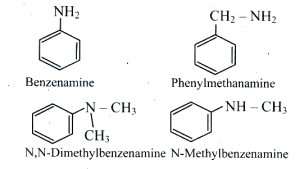
MediumMCQ
Which among the following is the strongest base?
A
Benzenamine
B
Phenylmethanamine
C
$N,N$-Dimethylbenzenamine
D
$N$-Methylbenzenamine
Solution
(B) In arylamines,the $-NH_2$ group is attached directly to an aromatic ring. The lone pair of electrons on nitrogen is conjugated to the aromatic ring and is less available for protonation.
In phenylmethanamine (an aliphatic amine),the lone pair of electrons on nitrogen is not involved in resonance with the aromatic ring and is thus more available for protonation.
Therefore,phenylmethanamine is the strongest base among the given amines.
In phenylmethanamine (an aliphatic amine),the lone pair of electrons on nitrogen is not involved in resonance with the aromatic ring and is thus more available for protonation.
Therefore,phenylmethanamine is the strongest base among the given amines.
0 likes
View Solution921
EasyMCQ
Which of the following conversions is a Hofmann elimination reaction?
A
$RCONH_2 \xrightarrow{Br_2, KOH_{(aq)}} RNH_2$
B
$RNH_2 \xrightarrow[\text{excess}]{RX} R_4NX$
C
$R_4NX \xrightarrow[\Delta]{\text{moist } Ag_2O} \text{Alkene} + R_3N$
D
$RCN \xrightarrow{Na / C_2H_5OH} RCH_2NH_2$
Solution
(C) The Hofmann elimination reaction is a process where a quaternary ammonium hydroxide $(R_4N^{+}OH^{-})$ undergoes elimination upon heating to form an alkene and a tertiary amine.
This reaction typically involves the treatment of a quaternary ammonium halide with moist $Ag_2O$ (which generates $AgOH$ to provide the $OH^{-}$ ion),followed by thermal decomposition.
This reaction typically involves the treatment of a quaternary ammonium halide with moist $Ag_2O$ (which generates $AgOH$ to provide the $OH^{-}$ ion),followed by thermal decomposition.
0 likes
View Solution922
EasyMCQ
Identify substrate $A$ in the following reaction.
$A + AgOH \xrightarrow[ii) \Delta]{i) \text{moist } Ag_2O} CH_3CH_2N(CH_3)_2 + CH_2=CH_2$
$A + AgOH \xrightarrow[ii) \Delta]{i) \text{moist } Ag_2O} CH_3CH_2N(CH_3)_2 + CH_2=CH_2$
A
Diethyldimethyl ammonium halide
B
Ethyltrimethyl ammonium halide
C
Diethyldimethyl ammonium hydroxide
D
Ethyltrimethyl ammonium hydroxide
Solution
(A) The reaction is Hofmann elimination.
Substrate $A$ is diethyldimethyl ammonium halide,which reacts with moist $Ag_2O$ (forming $AgOH$) to produce the quaternary ammonium hydroxide.
$(CH_3CH_2)_2N^+(CH_3)_2X^- + AgOH \rightarrow (CH_3CH_2)_2N^+(CH_3)_2OH^- + AgX$
Upon heating,the quaternary ammonium hydroxide undergoes Hofmann elimination to form the alkene and the tertiary amine.
$(CH_3CH_2)_2N^+(CH_3)_2OH^- \xrightarrow{\Delta} CH_3CH_2N(CH_3)_2 + CH_2=CH_2 + H_2O$
Substrate $A$ is diethyldimethyl ammonium halide,which reacts with moist $Ag_2O$ (forming $AgOH$) to produce the quaternary ammonium hydroxide.
$(CH_3CH_2)_2N^+(CH_3)_2X^- + AgOH \rightarrow (CH_3CH_2)_2N^+(CH_3)_2OH^- + AgX$
Upon heating,the quaternary ammonium hydroxide undergoes Hofmann elimination to form the alkene and the tertiary amine.
$(CH_3CH_2)_2N^+(CH_3)_2OH^- \xrightarrow{\Delta} CH_3CH_2N(CH_3)_2 + CH_2=CH_2 + H_2O$
0 likes
View Solution923
EasyMCQ
Identify product $B$ in the following reaction: $Aniline$ $\xrightarrow{NaNO_2 + HCl, 273 \ K} A$ $\xrightarrow{H_2O, \Delta} B + N_2 \uparrow$
A
Chlorobenzene
B
Benzyl alcohol
C
Benzenediazonium chloride
D
Phenol
Solution
(D) The reaction proceeds as follows:
$1$. $Aniline$ reacts with $NaNO_2 + HCl$ at $273 \ K$ to form $Benzenediazonium \ chloride$ $(A)$.
$C_6H_5NH_2 + NaNO_2 + 2HCl \xrightarrow{273 \ K} C_6H_5N_2^+Cl^- + NaCl + 2H_2O$
$2$. $Benzenediazonium \ chloride$ $(A)$ on heating with water $(H_2O, \Delta)$ undergoes hydrolysis to form $Phenol$ $(B)$ and releases $N_2$ gas.
$C_6H_5N_2^+Cl^- + H_2O \xrightarrow{\Delta} C_6H_5OH + N_2 \uparrow + HCl$
Therefore,product $B$ is $Phenol$.
$1$. $Aniline$ reacts with $NaNO_2 + HCl$ at $273 \ K$ to form $Benzenediazonium \ chloride$ $(A)$.
$C_6H_5NH_2 + NaNO_2 + 2HCl \xrightarrow{273 \ K} C_6H_5N_2^+Cl^- + NaCl + 2H_2O$
$2$. $Benzenediazonium \ chloride$ $(A)$ on heating with water $(H_2O, \Delta)$ undergoes hydrolysis to form $Phenol$ $(B)$ and releases $N_2$ gas.
$C_6H_5N_2^+Cl^- + H_2O \xrightarrow{\Delta} C_6H_5OH + N_2 \uparrow + HCl$
Therefore,product $B$ is $Phenol$.
0 likes
View Solution924
MediumMCQ
Identify the $CORRECT$ decreasing order of basic strength of compounds from the following.
A
$CH_3NH_2 > (CH_3)_2NH > C_6H_5NH_2 > NH_3$
B
$(CH_3)_2NH > CH_3NH_2 > NH_3 > C_6H_5NH_2$
C
$NH_3 > CH_3NH_2 > (CH_3)_2NH > C_6H_5NH_2$
D
$C_6H_5NH_2 > (CH_3)_2NH > CH_3NH_2 > NH_3$
Solution
(B) Arylamines are generally weaker bases than ammonia and aliphatic amines due to the resonance effect,which delocalizes the lone pair of electrons on the nitrogen atom into the benzene ring.
Aliphatic amines are stronger bases than ammonia due to the electron-donating inductive effect ($+I$ effect) of the alkyl groups.
Among aliphatic amines,$(CH_3)_2NH$ ($2^{\circ}$ amine) is a stronger base than $CH_3NH_2$ ($1^{\circ}$ amine) in the gas phase or non-polar solvents due to the greater inductive effect of two methyl groups.
Therefore,the correct decreasing order of basic strength is: $(CH_3)_2NH > CH_3NH_2 > NH_3 > C_6H_5NH_2$.
Aliphatic amines are stronger bases than ammonia due to the electron-donating inductive effect ($+I$ effect) of the alkyl groups.
Among aliphatic amines,$(CH_3)_2NH$ ($2^{\circ}$ amine) is a stronger base than $CH_3NH_2$ ($1^{\circ}$ amine) in the gas phase or non-polar solvents due to the greater inductive effect of two methyl groups.
Therefore,the correct decreasing order of basic strength is: $(CH_3)_2NH > CH_3NH_2 > NH_3 > C_6H_5NH_2$.
0 likes
View Solution925
MediumMCQ
Identify substrate $A$ in the following conversion.
$A + \underset{\text{(excess)}}{CH_3 I} \xrightarrow{\Delta} C_2 H_5(CH_3)_3 N^+ I^-$
$A + \underset{\text{(excess)}}{CH_3 I} \xrightarrow{\Delta} C_2 H_5(CH_3)_3 N^+ I^-$
A
$C_2 H_5 NO_2$
B
$C_2 H_5 CN$
C
$C_2 H_5 NH_2$
D
$CH_3 CONH_2$
Solution
(C) The reaction involves the exhaustive methylation of an amine using excess methyl iodide $(CH_3 I)$.
$C_2 H_5 NH_2 + 3CH_3 I \xrightarrow{\Delta} C_2 H_5(CH_3)_3 N^+ I^- + 2HI$
This reaction is known as the exhaustive alkylation (or Hofmann's exhaustive methylation) of amines,where a primary amine reacts with excess alkyl halide to form a quaternary ammonium salt.
$C_2 H_5 NH_2 + 3CH_3 I \xrightarrow{\Delta} C_2 H_5(CH_3)_3 N^+ I^- + 2HI$
This reaction is known as the exhaustive alkylation (or Hofmann's exhaustive methylation) of amines,where a primary amine reacts with excess alkyl halide to form a quaternary ammonium salt.
0 likes
View Solution926
MediumMCQ
Identify the $X$ in the reaction.
$R-NH_2 + HNO_2 \underset{273-278 \ K}{}$ ${\xrightarrow{NaNO_2 + HCl}} X$ $\xrightarrow{H_2O} R-OH + N_2 + HCl$
$R-NH_2 + HNO_2 \underset{273-278 \ K}{}$ ${\xrightarrow{NaNO_2 + HCl}} X$ $\xrightarrow{H_2O} R-OH + N_2 + HCl$
A
$R-NH-NO_2$
B
$R-N_2^+ Cl^-$
C
$R-NH-N=O$
D
$R-NO_2$
Solution
(B) The reaction of a primary aliphatic amine $(R-NH_2)$ with nitrous acid $(HNO_2)$,which is generated in situ by the reaction of $NaNO_2$ and $HCl$ at $273-278 \ K$,forms an alkyl diazonium salt $(R-N_2^+ Cl^-)$ as an intermediate $(X)$.
This alkyl diazonium salt is highly unstable and decomposes rapidly in the presence of water to form an alcohol $(R-OH)$,nitrogen gas $(N_2)$,and hydrochloric acid $(HCl)$.
Therefore,the intermediate $X$ is $R-N_2^+ Cl^-$.
This alkyl diazonium salt is highly unstable and decomposes rapidly in the presence of water to form an alcohol $(R-OH)$,nitrogen gas $(N_2)$,and hydrochloric acid $(HCl)$.
Therefore,the intermediate $X$ is $R-N_2^+ Cl^-$.
0 likes
View Solution927
MediumMCQ
Identify compound $X$ in the following reaction.

A
$(C_2H_5)_3N$
B
$C_2H_5NH_2$
C
$(C_2H_5)_2NH$
D
$CH_3NHC_2H_5$
Solution
(C) The given reaction is the reaction of a secondary amine with benzenesulfonyl chloride (Hinsberg reagent).
In this reaction,the secondary amine $(C_2H_5)_2NH$ reacts with benzenesulfonyl chloride to form $N,N$-diethylbenzenesulfonamide.
The nitrogen atom in the secondary amine has one hydrogen atom,which is replaced by the sulfonyl group,releasing $HCl$.
Therefore,the compound $X$ is diethylamine,which is $(C_2H_5)_2NH$.
In this reaction,the secondary amine $(C_2H_5)_2NH$ reacts with benzenesulfonyl chloride to form $N,N$-diethylbenzenesulfonamide.
The nitrogen atom in the secondary amine has one hydrogen atom,which is replaced by the sulfonyl group,releasing $HCl$.
Therefore,the compound $X$ is diethylamine,which is $(C_2H_5)_2NH$.
0 likes
View Solution928
MediumMCQ
Which among the following is a correct order of $pK_b$ values of amines in the aqueous phase?
A
$RNH_2 > R_2NH > R_3N > NH_3$
B
$R_3N > RNH_2 > R_2NH > NH_3$
C
$NH_3 > RNH_2 > R_3N > R_2NH$
D
$NH_3 > RNH_2 > R_2NH > R_3N$
Solution
(C) The basic strength of amines in the aqueous phase depends on the inductive effect,solvation effect,and steric hindrance.
For aliphatic amines where $R = CH_3$,the order of basicity is $(CH_3)_2NH > CH_3NH_2 > (CH_3)_3N > NH_3$.
Since $pK_b = -\log(K_b)$,a higher basic strength corresponds to a lower $pK_b$ value.
Therefore,the order of $pK_b$ values is the reverse of the basicity order: $NH_3 > (CH_3)_3N > CH_3NH_2 > (CH_3)_2NH$.
However,in general terms for alkyl amines,the order of basicity is $R_2NH > RNH_2 > R_3N > NH_3$.
Thus,the correct order of $pK_b$ values is $NH_3 > R_3N > RNH_2 > R_2NH$.
For aliphatic amines where $R = CH_3$,the order of basicity is $(CH_3)_2NH > CH_3NH_2 > (CH_3)_3N > NH_3$.
Since $pK_b = -\log(K_b)$,a higher basic strength corresponds to a lower $pK_b$ value.
Therefore,the order of $pK_b$ values is the reverse of the basicity order: $NH_3 > (CH_3)_3N > CH_3NH_2 > (CH_3)_2NH$.
However,in general terms for alkyl amines,the order of basicity is $R_2NH > RNH_2 > R_3N > NH_3$.
Thus,the correct order of $pK_b$ values is $NH_3 > R_3N > RNH_2 > R_2NH$.
0 likes
View Solution929
MediumMCQ
How many moles of ethyl bromide are required for the formation of $1 \ mole$ of $N,N$-diethylethanamine from ethylamine?
A
$1$
B
$2$
C
$3$
D
$4$
Solution
(B) The reaction of ethylamine $(CH_3CH_2NH_2)$ with ethyl bromide $(C_2H_5Br)$ is an example of ammonolysis/alkylation of amines.
Step $1$: Ethylamine reacts with $1 \ mole$ of ethyl bromide to form diethylamine $(CH_3CH_2NHCH_2CH_3)$.
$CH_3CH_2NH_2 + C_2H_5Br \rightarrow (CH_3CH_2)_2NH + HBr$
Step $2$: Diethylamine further reacts with another $1 \ mole$ of ethyl bromide to form $N,N$-diethylethanamine (triethylamine,$(CH_3CH_2)_3N$).
$(CH_3CH_2)_2NH + C_2H_5Br \rightarrow (CH_3CH_2)_3N + HBr$
Total moles of ethyl bromide required = $1 + 1 = 2 \ moles$.
Step $1$: Ethylamine reacts with $1 \ mole$ of ethyl bromide to form diethylamine $(CH_3CH_2NHCH_2CH_3)$.
$CH_3CH_2NH_2 + C_2H_5Br \rightarrow (CH_3CH_2)_2NH + HBr$
Step $2$: Diethylamine further reacts with another $1 \ mole$ of ethyl bromide to form $N,N$-diethylethanamine (triethylamine,$(CH_3CH_2)_3N$).
$(CH_3CH_2)_2NH + C_2H_5Br \rightarrow (CH_3CH_2)_3N + HBr$
Total moles of ethyl bromide required = $1 + 1 = 2 \ moles$.
0 likes
View Solution930
MediumMCQ
Which among the following molecules has the lowest $pK_b$ value?
A
$CH_3CH_2NH_2$
B
$(CH_3CH_2)_3N$
C
$(CH_3CH_2)_2NH$
D
$CH_3NH_2$
Solution
(C) The $pK_b$ value is inversely proportional to the basic strength of the amine. $A$ lower $pK_b$ value indicates a stronger base.
In the aqueous phase,the basicity of ethyl-substituted amines follows the order: $(C_2H_5)_2NH > C_2H_5NH_2 > (C_2H_5)_3N > NH_3$.
However,comparing the given options: $CH_3NH_2$ $(pK_b = 3.36)$,$CH_3CH_2NH_2$ $(pK_b = 3.29)$,$(CH_3CH_2)_3N$ $(pK_b = 3.25)$,and $(CH_3CH_2)_2NH$ $(pK_b = 3.00)$.
Thus,diethylamine $(CH_3CH_2)_2NH$ has the lowest $pK_b$ value,making it the strongest base among the choices.
In the aqueous phase,the basicity of ethyl-substituted amines follows the order: $(C_2H_5)_2NH > C_2H_5NH_2 > (C_2H_5)_3N > NH_3$.
However,comparing the given options: $CH_3NH_2$ $(pK_b = 3.36)$,$CH_3CH_2NH_2$ $(pK_b = 3.29)$,$(CH_3CH_2)_3N$ $(pK_b = 3.25)$,and $(CH_3CH_2)_2NH$ $(pK_b = 3.00)$.
Thus,diethylamine $(CH_3CH_2)_2NH$ has the lowest $pK_b$ value,making it the strongest base among the choices.
0 likes
View Solution931
EasyMCQ
Identify the reagent used for the conversion of aniline to phenol from the following.
A
$NaNO_2 / HCl$
B
$LiAlH_4$
C
$\frac{H_2}{Ni}$
D
Cobalt naphthenate
Solution
(A) The conversion of aniline to phenol involves two steps:
$1$. Diazotization of aniline using $NaNO_2 / HCl$ at $0-5 \ ^{\circ}C$ to form benzene diazonium chloride.
$2$. Hydrolysis of benzene diazonium chloride by warming with water to yield phenol.
Therefore,$NaNO_2 / HCl$ is the correct reagent for the initial step of this conversion.
$1$. Diazotization of aniline using $NaNO_2 / HCl$ at $0-5 \ ^{\circ}C$ to form benzene diazonium chloride.
$2$. Hydrolysis of benzene diazonium chloride by warming with water to yield phenol.
Therefore,$NaNO_2 / HCl$ is the correct reagent for the initial step of this conversion.
0 likes
View Solution932
EasyMCQ
Identify the amine that does not form alcohol by the action of $NaNO_2$ and $HCl$.
A
$(CH_3)_3C-NH_2$
B
$CH_3-CH_2-NH_2$
C
$CH_3-CH(NH_2)-CH_3$
D
$(CH_3)_2NH$
Solution
(D) Primary aliphatic amines $(R-NH_2)$ react with $NaNO_2$ and $HCl$ to form unstable diazonium salts,which decompose to give alcohols $(R-OH)$.
Secondary amines $(R_2NH)$ react with $NaNO_2$ and $HCl$ to form $N$-nitrosoamines,which are yellow oily compounds,not alcohols.
$(CH_3)_2NH$ is a secondary amine,therefore it does not form alcohol.
Secondary amines $(R_2NH)$ react with $NaNO_2$ and $HCl$ to form $N$-nitrosoamines,which are yellow oily compounds,not alcohols.
$(CH_3)_2NH$ is a secondary amine,therefore it does not form alcohol.
0 likes
View Solution933
MediumMCQ
How many molecules of methyl iodide are required to obtain tetramethyl ammonium iodide from dimethyl amine?
A
$1$
B
$3$
C
$2$
D
$4$
Solution
(C) The reaction of dimethylamine $(CH_3)_2NH$ with methyl iodide $(CH_3I)$ proceeds via nucleophilic substitution (Hofmann alkylation).
Step $1$: $(CH_3)_2NH + CH_3I \rightarrow (CH_3)_3N + HI$
Step $2$: $(CH_3)_3N + CH_3I \rightarrow (CH_3)_4N^{+}I^{-}$
Thus,a total of $2$ molecules of methyl iodide are required to convert dimethylamine into tetramethylammonium iodide.
Step $1$: $(CH_3)_2NH + CH_3I \rightarrow (CH_3)_3N + HI$
Step $2$: $(CH_3)_3N + CH_3I \rightarrow (CH_3)_4N^{+}I^{-}$
Thus,a total of $2$ molecules of methyl iodide are required to convert dimethylamine into tetramethylammonium iodide.
0 likes
View Solution934
MediumMCQ
Identify the compound from the following having the lowest boiling point.
A
$n-C_4H_9NH_2$
B
$C_2H_5CH(CH_3)_2$
C
$C_2H_5N(CH_3)_2$
D
$(C_2H_5)_2NH$
Solution
(B) The boiling point of compounds depends on intermolecular forces such as hydrogen bonding and molar mass.
$1$. Primary amines $(n-C_4H_9NH_2)$ and secondary amines $((C_2H_5)_2NH)$ can form intermolecular hydrogen bonds,leading to higher boiling points.
$2$. Tertiary amines $(C_2H_5N(CH_3)_2)$ cannot form intermolecular hydrogen bonds because they lack a hydrogen atom attached to the nitrogen.
$3$. Alkanes $(C_2H_5CH(CH_3)_2)$ have only weak van der Waals forces.
$4$. Comparing $C_2H_5N(CH_3)_2$ (molar mass $\approx 73 \ g/mol$) and $C_2H_5CH(CH_3)_2$ (molar mass $\approx 72 \ g/mol$),the tertiary amine has a higher boiling point due to the dipole-dipole interaction of the $C-N$ bond compared to the non-polar alkane.
$5$. Therefore,$C_2H_5CH(CH_3)_2$ has the lowest boiling point.
$1$. Primary amines $(n-C_4H_9NH_2)$ and secondary amines $((C_2H_5)_2NH)$ can form intermolecular hydrogen bonds,leading to higher boiling points.
$2$. Tertiary amines $(C_2H_5N(CH_3)_2)$ cannot form intermolecular hydrogen bonds because they lack a hydrogen atom attached to the nitrogen.
$3$. Alkanes $(C_2H_5CH(CH_3)_2)$ have only weak van der Waals forces.
$4$. Comparing $C_2H_5N(CH_3)_2$ (molar mass $\approx 73 \ g/mol$) and $C_2H_5CH(CH_3)_2$ (molar mass $\approx 72 \ g/mol$),the tertiary amine has a higher boiling point due to the dipole-dipole interaction of the $C-N$ bond compared to the non-polar alkane.
$5$. Therefore,$C_2H_5CH(CH_3)_2$ has the lowest boiling point.
0 likes
View Solution935
EasyMCQ
Identify '$A$' in the following reaction:
$R-NO_2 \xrightarrow{Zn / NH_4Cl, \text{ neutral medium }} A + H_2O$
$R-NO_2 \xrightarrow{Zn / NH_4Cl, \text{ neutral medium }} A + H_2O$
A
$R-NO$
B
$R-NHOH$
C
$R-COOH$
D
$R-NH_2$
Solution
(B) The reduction of nitro compounds $(R-NO_2)$ with $Zn$ and $NH_4Cl$ in a neutral medium is a selective reduction process.
This reaction yields $N$-alkylhydroxylamine $(R-NHOH)$ as the major product '$A$'.
The reaction is represented as:
$R-NO_2 + 4[H] \xrightarrow{Zn / NH_4Cl} R-NHOH + H_2O$
This reaction yields $N$-alkylhydroxylamine $(R-NHOH)$ as the major product '$A$'.
The reaction is represented as:
$R-NO_2 + 4[H] \xrightarrow{Zn / NH_4Cl} R-NHOH + H_2O$
0 likes
View Solution936
MediumMCQ
Which among the following decreasing order of boiling points is correct for amines?
A
$Ethyl$ dimethylamine $>$ $Diethylamine$ $>$ $n-Butylamine$
B
$Diethylamine$ $>$ $Ethyl$ dimethylamine $>$ $n-Butylamine$
C
$n-Butylamine$ $>$ $Ethyl$ dimethylamine $>$ $Diethylamine$
D
$n-Butylamine$ $>$ $Diethylamine$ $>$ $Ethyl$ dimethylamine
Solution
(D) The boiling point of amines depends on the extent of intermolecular hydrogen bonding.
Primary amines $(R-NH_2)$ have two hydrogen atoms available for hydrogen bonding,secondary amines $(R_2NH)$ have one,and tertiary amines $(R_3N)$ have none.
Therefore,the general order of boiling points is $1^{\circ} > 2^{\circ} > 3^{\circ}$ for isomeric amines.
$n-Butylamine$ $(1^{\circ})$ has the highest boiling point,followed by $Diethylamine$ $(2^{\circ})$,and $Ethyl$ dimethylamine $(3^{\circ})$ has the lowest.
The correct order is $n-Butylamine > Diethylamine > Ethyl$ dimethylamine.
Primary amines $(R-NH_2)$ have two hydrogen atoms available for hydrogen bonding,secondary amines $(R_2NH)$ have one,and tertiary amines $(R_3N)$ have none.
Therefore,the general order of boiling points is $1^{\circ} > 2^{\circ} > 3^{\circ}$ for isomeric amines.
$n-Butylamine$ $(1^{\circ})$ has the highest boiling point,followed by $Diethylamine$ $(2^{\circ})$,and $Ethyl$ dimethylamine $(3^{\circ})$ has the lowest.
The correct order is $n-Butylamine > Diethylamine > Ethyl$ dimethylamine.
0 likes
View Solution937
MediumMCQ
In the aqueous phase,what is the correct order of basic strength for methyl-substituted amines?
A
$CH_{3}NH_{2} > (CH_{3})_{2}NH > (CH_{3})_{3}N > NH_{3}$
B
$(CH_{3})_{2}NH > (CH_{3})_{3}N > CH_{3}NH_{2} > NH_{3}$
C
$(CH_{3})_{3}N > (CH_{3})_{2}NH > CH_{3}NH_{2} > NH_{3}$
D
$(CH_{3})_{2}NH > CH_{3}NH_{2} > (CH_{3})_{3}N > NH_{3}$
Solution
(D) In the aqueous phase,the basic strength of amines is determined by a combination of three factors: inductive effect,solvation effect (solvation of the conjugate acid),and steric hindrance.
For methyl-substituted amines,the order is $(CH_{3})_{2}NH > CH_{3}NH_{2} > (CH_{3})_{3}N > NH_{3}$.
This is because the secondary amine $(CH_{3})_{2}NH$ has the optimal balance of inductive effect and solvation,while the tertiary amine $(CH_{3})_{3}N$ experiences significant steric hindrance,reducing its basicity compared to the secondary and primary amines.
For methyl-substituted amines,the order is $(CH_{3})_{2}NH > CH_{3}NH_{2} > (CH_{3})_{3}N > NH_{3}$.
This is because the secondary amine $(CH_{3})_{2}NH$ has the optimal balance of inductive effect and solvation,while the tertiary amine $(CH_{3})_{3}N$ experiences significant steric hindrance,reducing its basicity compared to the secondary and primary amines.
0 likes
View Solution938
MediumMCQ
Which of the following reactions does $NOT$ involve the replacement of the diazonium group?
A
Reaction with potassium iodide
B
Reaction with aniline
C
Reaction with cuprous chloride in $HCl$
D
Reaction with hypophosphorus acid
Solution
(B) The reaction of benzene diazonium chloride with aniline is a coupling reaction,not a replacement reaction. In this reaction,the diazonium group $(-N_2^+Cl^-)$ is retained in the product,$p$-aminoazobenzene,where the nitrogen atoms form an azo linkage $(-N=N-)$ between the two benzene rings.
In contrast,the other options involve the replacement of the diazonium group:
$1$. Reaction with $KI$ replaces the $-N_2^+Cl^-$ group with $-I$.
$2$. Reaction with $CuCl/HCl$ (Sandmeyer reaction) replaces the $-N_2^+Cl^-$ group with $-Cl$.
$3$. Reaction with $H_3PO_2$ (hypophosphorus acid) replaces the $-N_2^+Cl^-$ group with $-H$ (reduction to benzene).
In contrast,the other options involve the replacement of the diazonium group:
$1$. Reaction with $KI$ replaces the $-N_2^+Cl^-$ group with $-I$.
$2$. Reaction with $CuCl/HCl$ (Sandmeyer reaction) replaces the $-N_2^+Cl^-$ group with $-Cl$.
$3$. Reaction with $H_3PO_2$ (hypophosphorus acid) replaces the $-N_2^+Cl^-$ group with $-H$ (reduction to benzene).
0 likes
View Solution939
EasyMCQ
Primary nitroalkanes on boiling with hydrochloric acid undergo hydrolysis to form
A
Alcohol and nitrous acid
B
Carboxylic acid and hydroxylamine
C
Aldehyde and hydroxylamine
D
Ketone and nitrous acid
Solution
(B) Primary nitroalkanes $(R-CH_2-NO_2)$ undergo hydrolysis when boiled with concentrated mineral acids like $HCl$ or $H_2SO_4$ to form the corresponding carboxylic acid $(R-COOH)$ and hydroxylamine $(NH_2OH)$.
The reaction is represented as: $R-CH_2-NO_2 + H_2O \xrightarrow{HCl/\Delta} R-COOH + NH_2OH$.
The reaction is represented as: $R-CH_2-NO_2 + H_2O \xrightarrow{HCl/\Delta} R-COOH + NH_2OH$.
0 likes
View Solution940
MediumMCQ
Benzene diazonium chloride on reaction with aniline in a mild alkaline medium forms:
A
yellow dye
B
blue dye
C
red dye
D
orange dye
Solution
(A) The reaction of benzene diazonium chloride with aniline in a mild alkaline medium is a coupling reaction.
This reaction leads to the formation of $p$-aminoazobenzene,which is a yellow dye.
The reaction is: $C_6H_5N_2Cl + C_6H_5NH_2 \xrightarrow{pH \approx 4-5} C_6H_5-N=N-C_6H_4-NH_2 + HCl$.
This reaction leads to the formation of $p$-aminoazobenzene,which is a yellow dye.
The reaction is: $C_6H_5N_2Cl + C_6H_5NH_2 \xrightarrow{pH \approx 4-5} C_6H_5-N=N-C_6H_4-NH_2 + HCl$.
0 likes
View Solution941
EasyMCQ
Which of the following reagents is used in the Hoffmann elimination reaction of amines?
A
$NaNO_{2} + HCl$
B
$CH_{3}COCl$
C
$Ag_{2}O / H_{2}O, \Delta$
D
$CHCl_{3} + KOH$
Solution
(C) The Hoffmann elimination reaction involves the conversion of a quaternary ammonium halide into an alkene.
First,the quaternary ammonium halide is treated with moist silver oxide $(Ag_{2}O / H_{2}O)$ to form a quaternary ammonium hydroxide.
This hydroxide is then subjected to strong heating $(\Delta)$,which causes $\beta$-elimination to yield an alkene as the major product.
Therefore,the reagent used is $Ag_{2}O / H_{2}O, \Delta$.
First,the quaternary ammonium halide is treated with moist silver oxide $(Ag_{2}O / H_{2}O)$ to form a quaternary ammonium hydroxide.
This hydroxide is then subjected to strong heating $(\Delta)$,which causes $\beta$-elimination to yield an alkene as the major product.
Therefore,the reagent used is $Ag_{2}O / H_{2}O, \Delta$.
0 likes
View Solution942
EasyMCQ
Identify the product $A$ in the following reaction:
Aniline $\xrightarrow{(CH_3CO)_2O / \text{pyridine}} A$
Aniline $\xrightarrow{(CH_3CO)_2O / \text{pyridine}} A$
A
Acetanilide
B
Sulphanilic acid
C
$p-$Nitroacetanilide
D
Benzenediazonium chloride
Solution
(A) The reaction of aniline with acetic anhydride in the presence of pyridine is an acetylation reaction.
Aniline reacts with acetic anhydride to form $N$-phenylacetamide,which is commonly known as Acetanilide.
The reaction is as follows:
$C_6H_5NH_2 + (CH_3CO)_2O \xrightarrow{\text{pyridine}} C_6H_5NHCOCH_3 + CH_3COOH$
Thus,the product $A$ is Acetanilide.
Aniline reacts with acetic anhydride to form $N$-phenylacetamide,which is commonly known as Acetanilide.
The reaction is as follows:
$C_6H_5NH_2 + (CH_3CO)_2O \xrightarrow{\text{pyridine}} C_6H_5NHCOCH_3 + CH_3COOH$
Thus,the product $A$ is Acetanilide.
0 likes
View Solution943
MediumMCQ
Which of the following groups increases the basic strength of substituted aniline?
A
$-SO_3H$
B
$-OCH_3$
C
$-NO_2$
D
$-CN$
Solution
(B)
$-OCH_3$ is an electron-donating group $(EDG)$ due to the $+M$ effect,which increases the electron density on the nitrogen atom of the aniline ring,thereby increasing the basic strength of substituted aniline.
$-OCH_3$ is an electron-donating group $(EDG)$ due to the $+M$ effect,which increases the electron density on the nitrogen atom of the aniline ring,thereby increasing the basic strength of substituted aniline.
0 likes
View Solution944
EasyMCQ
Benzene diazonium chloride on reaction with ethanol forms
A
aniline
B
benzene
C
nitrobenzene
D
phenol
Solution
(B) The correct answer is $B$.
When benzene diazonium chloride reacts with ethanol,it undergoes a reduction reaction where the diazonium group is replaced by a hydrogen atom.
The ethanol is oxidized to acetaldehyde.
The reaction is as follows:
$C_6H_5N_2Cl + CH_3CH_2OH \xrightarrow{\Delta} C_6H_6 + CH_3CHO + HCl + N_2$
Thus,benzene is formed.
When benzene diazonium chloride reacts with ethanol,it undergoes a reduction reaction where the diazonium group is replaced by a hydrogen atom.
The ethanol is oxidized to acetaldehyde.
The reaction is as follows:
$C_6H_5N_2Cl + CH_3CH_2OH \xrightarrow{\Delta} C_6H_6 + CH_3CHO + HCl + N_2$
Thus,benzene is formed.
0 likes
View Solution945
MediumMCQ
Which of the following amines is most basic in nature in the aqueous phase?
A
Ammonia
B
Trimethylamine
C
Methylamine
D
Dimethylamine
Solution
(D) The basicity of amines in the aqueous phase depends on the combined effect of inductive effect,solvation effect,and steric hindrance.
For methyl-substituted amines,the order of basicity is $(CH_3)_2NH > CH_3NH_2 > (CH_3)_3N > NH_3$.
Thus,dimethylamine is the most basic among the given options.
For methyl-substituted amines,the order of basicity is $(CH_3)_2NH > CH_3NH_2 > (CH_3)_3N > NH_3$.
Thus,dimethylamine is the most basic among the given options.
0 likes
View Solution946
MediumMCQ
Which of the following compounds does $NOT$ react with bromine in an alkaline medium?
A
$CH_3CH_2CH(NO_2)CH_3$
B
$(CH_3)_3CNO_2$
C
$(CH_3)_2CHNO_2$
D
$CH_3CH_2NO_2$
Solution
(B) In an alkaline medium,nitroalkanes react with bromine only if they possess at least one $\alpha$-hydrogen atom.
The reaction involves the formation of a carbanion at the $\alpha$-carbon,which then reacts with bromine.
Option $B$,which is $2$-methyl-$2$-nitropropane $((CH_3)_3CNO_2)$,is a tertiary nitroalkane and does not have any $\alpha$-hydrogen atom.
Therefore,it cannot form the required carbanion and does not react with bromine in an alkaline medium.
The reaction involves the formation of a carbanion at the $\alpha$-carbon,which then reacts with bromine.
Option $B$,which is $2$-methyl-$2$-nitropropane $((CH_3)_3CNO_2)$,is a tertiary nitroalkane and does not have any $\alpha$-hydrogen atom.
Therefore,it cannot form the required carbanion and does not react with bromine in an alkaline medium.
0 likes
View Solution947
DifficultMCQ
Identify the amine formed when $ethyltrimethyl$ ammonium iodide is treated with silver hydroxide and further heated strongly.
A
$C_2H_5N(CH_3)_2$
B
$C_2H_5NH_2$
C
$(CH_3)_3N$
D
$CH_3NH_2$
Solution
(C) The reaction of $ethyltrimethyl$ ammonium iodide with silver hydroxide $(AgOH)$ produces $ethyltrimethyl$ ammonium hydroxide.
Upon strong heating,this undergoes the $Hofmann$ elimination reaction.
Since the ethyl group has $\beta$-hydrogens,it is eliminated as ethene $(CH_2=CH_2)$,while the nitrogen retains the three methyl groups to form trimethylamine,$(CH_3)_3N$.
Upon strong heating,this undergoes the $Hofmann$ elimination reaction.
Since the ethyl group has $\beta$-hydrogens,it is eliminated as ethene $(CH_2=CH_2)$,while the nitrogen retains the three methyl groups to form trimethylamine,$(CH_3)_3N$.
0 likes
View Solution948
DifficultMCQ
Identify $B$ in the following reaction: Acetaldoxime $\xrightarrow[\text{alcohol}]{Na} A$ $\xrightarrow[HCl]{NaNO_2} B + H_2O + N_2 \uparrow$
A
$CH_3CH_2CH_2OH$
B
$C_2H_5OH$
C
$C_2H_5Cl$
D
$C_2H_5NH_2$
Solution
(B) $1$. The reduction of acetaldoxime $(CH_3CH=NOH)$ with $Na$ in alcohol gives ethylamine $(CH_3CH_2NH_2)$ as product $A$.
$2$. The reaction of ethylamine $(CH_3CH_2NH_2)$ with nitrous acid $(NaNO_2 + HCl)$ is a diazotization reaction followed by hydrolysis,which produces ethanol $(C_2H_5OH)$ as product $B$,along with the evolution of nitrogen gas $(N_2 \uparrow)$ and water $(H_2O)$.
$2$. The reaction of ethylamine $(CH_3CH_2NH_2)$ with nitrous acid $(NaNO_2 + HCl)$ is a diazotization reaction followed by hydrolysis,which produces ethanol $(C_2H_5OH)$ as product $B$,along with the evolution of nitrogen gas $(N_2 \uparrow)$ and water $(H_2O)$.
0 likes
View Solution949
DifficultMCQ
Identify the product '$C$' in the following reaction.
Aniline $\xrightarrow[\text{Pyridine}]{\left(CH_3CO\right)_2O} A$ $\xrightarrow[CH_3COOH]{Br_2} B$ $\xrightarrow{H^{+} \text{ or } OH^{-}} C$
Aniline $\xrightarrow[\text{Pyridine}]{\left(CH_3CO\right)_2O} A$ $\xrightarrow[CH_3COOH]{Br_2} B$ $\xrightarrow{H^{+} \text{ or } OH^{-}} C$
A
Acetanilide
B
$p$-Bromoacetanilide
C
$p$-Bromoaniline
D
$o$-Bromoaniline
Solution
(C) Step $1$: Aniline reacts with acetic anhydride in the presence of pyridine to form acetanilide $(A)$. This step protects the amino group.
Step $2$: Acetanilide undergoes electrophilic aromatic substitution (bromination) with $Br_2$ in $CH_3COOH$ to form $p$-bromoacetanilide $(B)$. The acetamido group is ortho/para directing,but the para product is major due to steric hindrance.
Step $3$: Hydrolysis of $p$-bromoacetanilide $(B)$ in the presence of acid $(H^+)$ or base $(OH^-)$ removes the acetyl group to yield $p$-bromoaniline $(C)$.
Step $2$: Acetanilide undergoes electrophilic aromatic substitution (bromination) with $Br_2$ in $CH_3COOH$ to form $p$-bromoacetanilide $(B)$. The acetamido group is ortho/para directing,but the para product is major due to steric hindrance.
Step $3$: Hydrolysis of $p$-bromoacetanilide $(B)$ in the presence of acid $(H^+)$ or base $(OH^-)$ removes the acetyl group to yield $p$-bromoaniline $(C)$.
0 likes
View SolutionAmines — Properties of Amines · Frequently Asked Questions
1Are these Amines questions useful for JEE and NEET?
Yes. All questions in this section are mapped to JEE Main and NEET exam patterns. Previous year questions from JEE Main, NEET, GUJCET and state-level exams are included with full solutions.
2Can I switch to Hindi or Gujarati for these questions?
Yes. Use the language tabs in the hero section or the sidebar to view the same questions and solutions in English, Hindi or Gujarati.
3How do I generate a question paper from this subtopic?
Use the Vedclass Exam Paper Generator — select the chapter and subtopic, set difficulty, and generate Sets A, B, C, D automatically. First 3 chapters of every subject are free.
Vedclass Products
For Students
Vedclass Test Series
Mock tests in real JEE/NEET style with performance analysis. 5-day free trial.
Start Free TrialFor Teachers
Exam Paper Generator
Generate Set A/B/C/D papers from this chapter in 2 minutes. 3 chapters free.
Try FreeFor Institutes
Online Exam Module
Live online exams with unlimited students, 360° analytics & white-label branding.
See DemoFor Teachers & Institutes
Generate a Amines Exam Paper in 2 Minutes
Select subtopic & difficulty — Sets A, B, C, D auto-generated with No Repeat logic.
First 3 chapters of every subject are free — no payment required.