
A English
Properties of Amines Questions in English
Class 12 Chemistry · Amines · Properties of Amines
1212+
Questions
English
Language
100%
With Solutions
Showing 50 of 1212 questions in English
451
DifficultMCQ
Predict the product of the following reaction:
$2\text{-bromo-6-(methoxycarbonyl)phenylacetamide} \xrightarrow{Br_2/KOH} ?$
$2\text{-bromo-6-(methoxycarbonyl)phenylacetamide} \xrightarrow{Br_2/KOH} ?$
A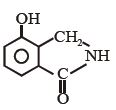
B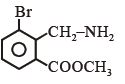
C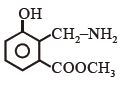
D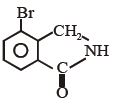
Solution
(B) The reaction $Br_2/KOH$ is the Hofmann bromamide degradation reaction.
In this reaction,an amide $(-CONH_2)$ is converted into a primary amine $(-NH_2)$ with the loss of one carbon atom.
The starting material is $2\text{-bromo-6-(methoxycarbonyl)phenylacetamide}$.
The $-CONH_2$ group is converted to $-NH_2$.
The $-Br$ and $-COOCH_3$ groups remain unaffected.
Thus,the product is $2\text{-bromo-6-(methoxycarbonyl)benzylamine}$.
In this reaction,an amide $(-CONH_2)$ is converted into a primary amine $(-NH_2)$ with the loss of one carbon atom.
The starting material is $2\text{-bromo-6-(methoxycarbonyl)phenylacetamide}$.
The $-CONH_2$ group is converted to $-NH_2$.
The $-Br$ and $-COOCH_3$ groups remain unaffected.
Thus,the product is $2\text{-bromo-6-(methoxycarbonyl)benzylamine}$.
0 likes
View Solution452
DifficultMCQ
An organic compound on reaction with nitrous acid $(HNO_2)$ gives an alcohol. The organic compound can be:
A
Diethylamine
B
$CH_3-N(CH_3)_2$
C
Isopropylamine
D
$2-$Nitropropane
Solution
(C) Primary aliphatic amines react with nitrous acid $(HNO_2)$ to form unstable diazonium salts,which decompose to evolve nitrogen gas $(N_2)$ and form alcohols.
Among the given options,isopropylamine $(CH_3-CH(NH_2)-CH_3)$ is a primary amine and reacts with $HNO_2$ to form isopropyl alcohol.
Diethylamine is a secondary amine and forms an $N$-nitroso compound.
$CH_3-N(CH_3)_2$ is a tertiary amine and forms a salt with $HNO_2$.
$2$-Nitropropane is a nitroalkane and does not react with $HNO_2$ to form an alcohol.
Among the given options,isopropylamine $(CH_3-CH(NH_2)-CH_3)$ is a primary amine and reacts with $HNO_2$ to form isopropyl alcohol.
Diethylamine is a secondary amine and forms an $N$-nitroso compound.
$CH_3-N(CH_3)_2$ is a tertiary amine and forms a salt with $HNO_2$.
$2$-Nitropropane is a nitroalkane and does not react with $HNO_2$ to form an alcohol.
0 likes
View Solution453
DifficultMCQ
The main product of the following reaction will be:
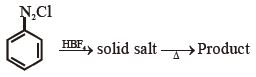
A
Aniline
B
Fluorobenzene
C
Phenylboron trifluoride
D
Chlorobenzene
Solution
(B) The reaction shown is the Balz-Schiemann reaction.
$1$. Benzenediazonium chloride reacts with fluoroboric acid $(HBF_4)$ to form benzenediazonium fluoroborate $(C_6H_5N_2^ BF_4^-)$,which precipitates as a solid salt.
$2$. Upon heating $(\Delta)$,this salt undergoes thermal decomposition to release nitrogen gas $(N_2)$ and boron trifluoride $(BF_3)$,resulting in the formation of fluorobenzene $(C_6H_5F)$.
$1$. Benzenediazonium chloride reacts with fluoroboric acid $(HBF_4)$ to form benzenediazonium fluoroborate $(C_6H_5N_2^ BF_4^-)$,which precipitates as a solid salt.
$2$. Upon heating $(\Delta)$,this salt undergoes thermal decomposition to release nitrogen gas $(N_2)$ and boron trifluoride $(BF_3)$,resulting in the formation of fluorobenzene $(C_6H_5F)$.
0 likes
View Solution454
DifficultMCQ
Identify the product $C$ in the following reaction sequence:
$C_6H_5COOH$ $\xrightarrow{NH_3, \Delta} A$ $\xrightarrow{Br_2, KOH} B$ $\xrightarrow{CHCl_3, KOH} C$
$C_6H_5COOH$ $\xrightarrow{NH_3, \Delta} A$ $\xrightarrow{Br_2, KOH} B$ $\xrightarrow{CHCl_3, KOH} C$
A
Aniline $(C_6H_5NH_2)$
B
Phenol $(C_6H_5OH)$
C
Phenylhydroxylamine $(C_6H_5NHOH)$
D
Phenyl isocyanide $(C_6H_5NC)$
Solution
(D) Step $1$: Benzoic acid $(C_6H_5COOH)$ reacts with $NH_3$ followed by heating to form benzamide $(C_6H_5CONH_2)$,which is product $A$.
Step $2$: Benzamide $(C_6H_5CONH_2)$ undergoes the Hofmann bromamide degradation reaction with $Br_2$ and $KOH$ to form aniline $(C_6H_5NH_2)$,which is product $B$.
Step $3$: Aniline $(C_6H_5NH_2)$ reacts with $CHCl_3$ and $KOH$ (carbylamine reaction) to form phenyl isocyanide $(C_6H_5NC)$,which is product $C$.
Step $2$: Benzamide $(C_6H_5CONH_2)$ undergoes the Hofmann bromamide degradation reaction with $Br_2$ and $KOH$ to form aniline $(C_6H_5NH_2)$,which is product $B$.
Step $3$: Aniline $(C_6H_5NH_2)$ reacts with $CHCl_3$ and $KOH$ (carbylamine reaction) to form phenyl isocyanide $(C_6H_5NC)$,which is product $C$.
0 likes
View Solution455
MediumMCQ
What is the product obtained in the following reaction?
$C_6H_5NO_2 \xrightarrow[{NH_4Cl}]{{Zn}} .....?$
$C_6H_5NO_2 \xrightarrow[{NH_4Cl}]{{Zn}} .....?$
A
$C_6H_5NHOH$
B
$C_6H_5-N=N-C_6H_5$
C
$C_6H_5-N^+(O^-)=N-C_6H_5$
D
$C_6H_5NH_2$
Solution
(A) The reduction of nitrobenzene $(C_6H_5NO_2)$ with zinc $(Zn)$ in the presence of an aqueous ammonium chloride $(NH_4Cl)$ solution is a controlled reduction reaction.
This reaction takes place in a neutral medium.
Under these specific conditions,nitrobenzene is reduced to $N$-phenylhydroxylamine $(C_6H_5NHOH)$.
This reaction takes place in a neutral medium.
Under these specific conditions,nitrobenzene is reduced to $N$-phenylhydroxylamine $(C_6H_5NHOH)$.
0 likes
View Solution456
DifficultMCQ
In the following reaction,the product $(A)$ is
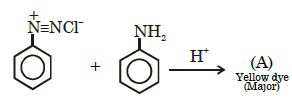
A
Ph-$N$=$N$-$NH$-Ph
B
$2-$aminoazobenzene
C
$3-$aminoazobenzene
D
$4-$aminoazobenzene
Solution
(D) The reaction between benzene diazonium chloride and aniline is an electrophilic aromatic substitution reaction known as a coupling reaction.
The $-NH_2$ group is a strong ortho/para directing group. Due to steric hindrance,the coupling reaction occurs primarily at the para-position to the $-NH_2$ group.
Thus,the major product $(A)$ is $p$-aminoazobenzene ($4$-aminoazobenzene),which is a yellow dye.
The $-NH_2$ group is a strong ortho/para directing group. Due to steric hindrance,the coupling reaction occurs primarily at the para-position to the $-NH_2$ group.
Thus,the major product $(A)$ is $p$-aminoazobenzene ($4$-aminoazobenzene),which is a yellow dye.
0 likes
View Solution457
MediumMCQ
Which of the following is not correct regarding basic strength?
A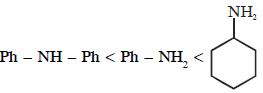
B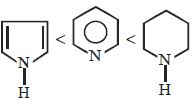
C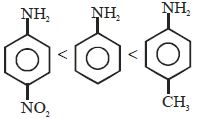
D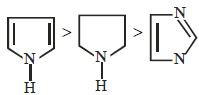
Solution
(D) The basic strength of amines depends on the availability of the lone pair on the nitrogen atom.
$(A)$ $Ph-NH-Ph$ (diphenylamine) is very weak due to resonance with two phenyl rings. $Ph-NH_2$ (aniline) is weak due to resonance with one phenyl ring. Cyclohexylamine is a strong base because the lone pair is localized. The order is correct.
$(B)$ Pyrrole is non-basic because the lone pair is involved in aromaticity. Pyridine is weakly basic ($sp^2$ hybridized). Piperidine is a strong secondary amine. The order is correct.
$(C)$ $-NO_2$ is an electron-withdrawing group (decreases basicity),and $-CH_3$ is an electron-donating group (increases basicity). The order is correct.
$(D)$ Pyrrole is non-basic. Pyrrolidine is a strong secondary amine. Imidazole is also basic. The order $Pyrrole > Pyrrolidine > Imidazole$ is incorrect because pyrrolidine is much more basic than pyrrole. Thus,option $D$ is not correct.
$(A)$ $Ph-NH-Ph$ (diphenylamine) is very weak due to resonance with two phenyl rings. $Ph-NH_2$ (aniline) is weak due to resonance with one phenyl ring. Cyclohexylamine is a strong base because the lone pair is localized. The order is correct.
$(B)$ Pyrrole is non-basic because the lone pair is involved in aromaticity. Pyridine is weakly basic ($sp^2$ hybridized). Piperidine is a strong secondary amine. The order is correct.
$(C)$ $-NO_2$ is an electron-withdrawing group (decreases basicity),and $-CH_3$ is an electron-donating group (increases basicity). The order is correct.
$(D)$ Pyrrole is non-basic. Pyrrolidine is a strong secondary amine. Imidazole is also basic. The order $Pyrrole > Pyrrolidine > Imidazole$ is incorrect because pyrrolidine is much more basic than pyrrole. Thus,option $D$ is not correct.
0 likes
View Solution458
MediumMCQ
Aniline $\xrightarrow[{{0^{\circ}}C - {5^{\circ}}C}]{{NaNO_2/HCl}}A$ $\xrightarrow{{Ph-N(CH_3)_2}}B$
What is $B$?
What is $B$?
A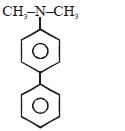
B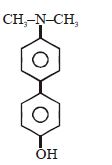
C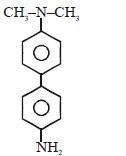
D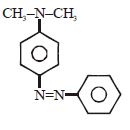
Solution
(D) The reaction of aniline with $NaNO_2/HCl$ at $0^{\circ}C - 5^{\circ}C$ is a diazotization reaction,which produces benzenediazonium chloride as intermediate $A$ $(Ph-N_2^+Cl^-)$.
When benzenediazonium chloride $(A)$ reacts with $N,N$-dimethylaniline $(Ph-N(CH_3)_2)$,an electrophilic aromatic substitution reaction (coupling reaction) occurs.
The diazonium cation acts as an electrophile and attacks the para-position of the $N,N$-dimethylaniline ring to form $p$-(dimethylamino)azobenzene,which is product $B$.
The structure of $B$ is $Ph-N=N-C_6H_4-N(CH_3)_2$.
When benzenediazonium chloride $(A)$ reacts with $N,N$-dimethylaniline $(Ph-N(CH_3)_2)$,an electrophilic aromatic substitution reaction (coupling reaction) occurs.
The diazonium cation acts as an electrophile and attacks the para-position of the $N,N$-dimethylaniline ring to form $p$-(dimethylamino)azobenzene,which is product $B$.
The structure of $B$ is $Ph-N=N-C_6H_4-N(CH_3)_2$.
0 likes
View Solution459
MediumMCQ
Which of the following has the highest value of $pK_b$?
A
Pyrrolidine
B
Pyrrole
C
Aniline
D
$H_2N-C(=NH)-NH_2$
Solution
(B) $pK_b$ is inversely proportional to basic strength $(pK_b \propto 1/K_b)$.
$A$ higher $pK_b$ value indicates a weaker base.
In $Pyrrole$,the lone pair of electrons on the nitrogen atom is involved in the aromatic sextet (delocalized to maintain aromaticity),making it the weakest base among the given options.
Therefore,$Pyrrole$ has the highest $pK_b$ value.
$A$ higher $pK_b$ value indicates a weaker base.
In $Pyrrole$,the lone pair of electrons on the nitrogen atom is involved in the aromatic sextet (delocalized to maintain aromaticity),making it the weakest base among the given options.
Therefore,$Pyrrole$ has the highest $pK_b$ value.
0 likes
View Solution460
MediumMCQ
Which of the following is the strongest base?
A
$C_6H_5NH_2$ $(K_b = 3 \times 10^{-13})$
B
$C_6H_5NHCH_3$ $(K_b = 4 \times 10^{-11})$
C
$C_6H_5N(CH_3)_2$ $(K_b = 3 \times 10^{-12})$
D
$C_6H_5NHC_2H_5$ $(K_b = 2 \times 10^{-9})$
Solution
(D) The strength of a base is directly proportional to its dissociation constant $(K_b)$.
Comparing the given $K_b$ values:
$A: 3 \times 10^{-13}$
$B: 4 \times 10^{-11}$
$C: 3 \times 10^{-12}$
$D: 2 \times 10^{-9}$
Since $2 \times 10^{-9}$ is the largest value among the given options,$C_6H_5NHC_2H_5$ is the strongest base.
Comparing the given $K_b$ values:
$A: 3 \times 10^{-13}$
$B: 4 \times 10^{-11}$
$C: 3 \times 10^{-12}$
$D: 2 \times 10^{-9}$
Since $2 \times 10^{-9}$ is the largest value among the given options,$C_6H_5NHC_2H_5$ is the strongest base.
0 likes
View Solution461
MediumMCQ
In the reaction sequence: $C_6H_5NH_2$ $\xrightarrow{CHCl_3/KOH, \Delta} (X)$ $\xrightarrow{LiAlH_4/H_2O} (Y)$,the product $(Y)$ is:
A
$C_6H_5NHCH_3$
B
$C_6H_5CH_2NH_2$
C
$C_6H_5NHCHO$
D
$C_6H_5NC$
Solution
(A) The reaction sequence is as follows:
$1$. Aniline $(C_6H_5NH_2)$ reacts with chloroform $(CHCl_3)$ and alcoholic potassium hydroxide $(KOH)$ under heating to undergo the carbylamine reaction,forming phenyl isocyanide $(C_6H_5NC)$ as product $(X)$.
$C_6H_5NH_2 + CHCl_3 + 3KOH \xrightarrow{\Delta} C_6H_5NC + 3KCl + 3H_2O$
$2$. Phenyl isocyanide $(C_6H_5NC)$ is then reduced using lithium aluminium hydride $(LiAlH_4)$ followed by hydrolysis to yield $N$-methylaniline $(C_6H_5NHCH_3)$ as product $(Y)$.
$C_6H_5NC \xrightarrow{LiAlH_4/H_2O} C_6H_5NHCH_3$
Therefore,the correct option is $(A)$.
$1$. Aniline $(C_6H_5NH_2)$ reacts with chloroform $(CHCl_3)$ and alcoholic potassium hydroxide $(KOH)$ under heating to undergo the carbylamine reaction,forming phenyl isocyanide $(C_6H_5NC)$ as product $(X)$.
$C_6H_5NH_2 + CHCl_3 + 3KOH \xrightarrow{\Delta} C_6H_5NC + 3KCl + 3H_2O$
$2$. Phenyl isocyanide $(C_6H_5NC)$ is then reduced using lithium aluminium hydride $(LiAlH_4)$ followed by hydrolysis to yield $N$-methylaniline $(C_6H_5NHCH_3)$ as product $(Y)$.
$C_6H_5NC \xrightarrow{LiAlH_4/H_2O} C_6H_5NHCH_3$
Therefore,the correct option is $(A)$.
0 likes
View Solution462
DifficultMCQ
Which of the following reactions does not give a primary amine as a product?
A
$CH_3CH_2CN \xrightarrow{Na/C_2H_5OH} CH_3CH_2CH_2NH_2$
B
$CH_3CONH_2 \xrightarrow{LiAlH_4} CH_3CH_2NH_2$
C
Phthalimide $\xrightarrow[(ii) CH_3CH_2Br]{(i) KOH}$ $\xrightarrow{(iii) H_2O, \Delta} CH_3CH_2NH_2$
D
$CH_3CH_2NC \xrightarrow{H_2/Pd} CH_3CH_2NHCH_3$
Solution
(D) The reduction of alkyl isocyanides $(R-NC)$ using $H_2/Pd$ or other reducing agents yields secondary amines $(R-NH-CH_3)$.
In contrast,the reduction of nitriles $(R-CN)$ gives primary amines $(R-CH_2NH_2)$.
The reduction of amides $(R-CONH_2)$ using $LiAlH_4$ gives primary amines $(R-CH_2NH_2)$.
The Gabriel phthalimide synthesis is a standard method for preparing primary amines $(R-NH_2)$.
Therefore,option $D$ is the correct answer as it produces a secondary amine.
In contrast,the reduction of nitriles $(R-CN)$ gives primary amines $(R-CH_2NH_2)$.
The reduction of amides $(R-CONH_2)$ using $LiAlH_4$ gives primary amines $(R-CH_2NH_2)$.
The Gabriel phthalimide synthesis is a standard method for preparing primary amines $(R-NH_2)$.
Therefore,option $D$ is the correct answer as it produces a secondary amine.
0 likes
View Solution463
MediumMCQ
Which of the following is the strongest base?
A
$C_6H_5NH_2$
B
$C_6H_5NHCH_3$
C
$o-CH_3C_6H_4NH_2$
D
$C_6H_5CH_2NH_2$
Solution
(D) To determine the strongest base,we evaluate the availability of the lone pair on the nitrogen atom for protonation.
$1$. In $C_6H_5NH_2$ (aniline),the lone pair on $N$ is in conjugation with the benzene ring,making it less available.
$2$. In $C_6H_5NHCH_3$ ($N$-methylaniline),the $+I$ effect of the $-CH_3$ group increases electron density on $N$,but it is still less basic than aliphatic amines due to resonance.
$3$. In $o-CH_3C_6H_4NH_2$ ($o$-toluidine),the ortho-effect reduces basicity compared to aniline.
$4$. In $C_6H_5CH_2NH_2$ (benzylamine),the $-NH_2$ group is attached to an $sp^3$ hybridized carbon,not directly to the benzene ring. Therefore,there is no resonance stabilization of the lone pair with the ring. It behaves like an aliphatic primary amine,which is significantly more basic than aromatic amines.
$1$. In $C_6H_5NH_2$ (aniline),the lone pair on $N$ is in conjugation with the benzene ring,making it less available.
$2$. In $C_6H_5NHCH_3$ ($N$-methylaniline),the $+I$ effect of the $-CH_3$ group increases electron density on $N$,but it is still less basic than aliphatic amines due to resonance.
$3$. In $o-CH_3C_6H_4NH_2$ ($o$-toluidine),the ortho-effect reduces basicity compared to aniline.
$4$. In $C_6H_5CH_2NH_2$ (benzylamine),the $-NH_2$ group is attached to an $sp^3$ hybridized carbon,not directly to the benzene ring. Therefore,there is no resonance stabilization of the lone pair with the ring. It behaves like an aliphatic primary amine,which is significantly more basic than aromatic amines.
0 likes
View Solution464
DifficultMCQ
The correct order of decreasing basic strength of the following compounds is:
$(I)$ Aniline
$(II)$ $p$-Methoxyaniline
$(III)$ $p$-Nitroaniline
$(IV)$ $m$-Nitroaniline
$(I)$ Aniline
$(II)$ $p$-Methoxyaniline
$(III)$ $p$-Nitroaniline
$(IV)$ $m$-Nitroaniline
A
$I > II > III > IV$
B
$II > I > IV > III$
C
$III > IV > II > I$
D
$II > I > III > IV$
Solution
(B) The basic strength of aromatic amines depends on the availability of the lone pair of electrons on the nitrogen atom.
Electron-donating groups $(EDG)$ increase basicity by increasing electron density on the nitrogen atom,while electron-withdrawing groups $(EWG)$ decrease basicity.
$(II)$ $p$-Methoxyaniline has a $-OCH_3$ group,which is a strong electron-donating group ($+M$ effect),making it the most basic.
$(I)$ Aniline has no substituent.
$(IV)$ $m$-Nitroaniline has a $-NO_2$ group at the meta position,which exerts only an electron-withdrawing inductive effect ($-I$ effect).
$(III)$ $p$-Nitroaniline has a $-NO_2$ group at the para position,which exerts a strong electron-withdrawing effect through both resonance $(-M)$ and induction $(-I)$,making it the least basic.
Therefore,the order of decreasing basic strength is: $II > I > IV > III$.
Electron-donating groups $(EDG)$ increase basicity by increasing electron density on the nitrogen atom,while electron-withdrawing groups $(EWG)$ decrease basicity.
$(II)$ $p$-Methoxyaniline has a $-OCH_3$ group,which is a strong electron-donating group ($+M$ effect),making it the most basic.
$(I)$ Aniline has no substituent.
$(IV)$ $m$-Nitroaniline has a $-NO_2$ group at the meta position,which exerts only an electron-withdrawing inductive effect ($-I$ effect).
$(III)$ $p$-Nitroaniline has a $-NO_2$ group at the para position,which exerts a strong electron-withdrawing effect through both resonance $(-M)$ and induction $(-I)$,making it the least basic.
Therefore,the order of decreasing basic strength is: $II > I > IV > III$.
0 likes
View Solution465
DifficultMCQ
$CH_3-C(=O)-NH_2 \xrightarrow[\Delta]{Br_2 + KOH} CH_3-NH_2$. Intermediates of the reaction is/are:
A
$CH_3-C(=O)-NH^{-}Br$ and $CH_3-CH_2-N=C=O$
B
$CH_3-C(=O)-Br$ and $CH_3-N=C=O$
C
$CH_3-C(=O)-NH^{-}Br$ and $CH_3-N=C=O$
D
$CH_3-C(=O)-\ddot{N}:$ and $CH_3-C(=O)-Br$
Solution
(C) The reaction is the Hofmann bromamide degradation reaction.
In the first step,the amide reacts with $Br_2$ and $KOH$ to form an $N$-bromamide intermediate,$CH_3-C(=O)-NHBr$,which then loses a proton to form $CH_3-C(=O)-NH^{-}Br$.
Subsequently,this undergoes rearrangement to form methyl isocyanate $(CH_3-N=C=O)$ as a key intermediate.
Therefore,the correct intermediates are $CH_3-C(=O)-NH^{-}Br$ and $CH_3-N=C=O$.
In the first step,the amide reacts with $Br_2$ and $KOH$ to form an $N$-bromamide intermediate,$CH_3-C(=O)-NHBr$,which then loses a proton to form $CH_3-C(=O)-NH^{-}Br$.
Subsequently,this undergoes rearrangement to form methyl isocyanate $(CH_3-N=C=O)$ as a key intermediate.
Therefore,the correct intermediates are $CH_3-C(=O)-NH^{-}Br$ and $CH_3-N=C=O$.
0 likes
View Solution466
DifficultMCQ
In which of the following reactions is a primary amine not obtained as a product?
A
$CH_3-COCl \xrightarrow[(ii) \text{Hydrolysis}]{(i) NaN_3 / \Delta}$
B
$CH_3-CONH_2 \xrightarrow[\Delta]{KOBr}$
C
$CH_3-CH_2-CONH_2 \xrightarrow{LiAlH_4}$
D
$CH_3-CONH-CH_3 \xrightarrow{LiAlH_4}$
Solution
(D) Curtius rearrangement of acid chloride gives $CH_3NH_2$ (primary amine).
$(b)$ Hofmann bromamide degradation of $CH_3CONH_2$ gives $CH_3NH_2$ (primary amine).
$(c)$ Reduction of $CH_3CH_2CONH_2$ with $LiAlH_4$ gives $CH_3CH_2CH_2NH_2$ (primary amine).
$(d)$ Reduction of $N$-methylacetamide $(CH_3CONHCH_3)$ with $LiAlH_4$ gives $CH_3CH_2NHCH_3$,which is a secondary amine.
$(b)$ Hofmann bromamide degradation of $CH_3CONH_2$ gives $CH_3NH_2$ (primary amine).
$(c)$ Reduction of $CH_3CH_2CONH_2$ with $LiAlH_4$ gives $CH_3CH_2CH_2NH_2$ (primary amine).
$(d)$ Reduction of $N$-methylacetamide $(CH_3CONHCH_3)$ with $LiAlH_4$ gives $CH_3CH_2NHCH_3$,which is a secondary amine.
0 likes
View Solution467
MediumMCQ
In carbyl amine reaction,the electrophile is:
A
Nitrene
B
Carbene
C
Carbanion
D
Carbocation
Solution
(B) The carbylamine reaction involves the reaction of a primary amine with chloroform $(CHCl_3)$ in the presence of a strong base (like $KOH$).
In this reaction,chloroform reacts with the base to form dichlorocarbene $(:CCl_2)$.
Dichlorocarbene is a neutral species with a sextet of electrons around the carbon atom,making it an electron-deficient species.
Therefore,dichlorocarbene acts as the electrophile in the carbylamine reaction.
In this reaction,chloroform reacts with the base to form dichlorocarbene $(:CCl_2)$.
Dichlorocarbene is a neutral species with a sextet of electrons around the carbon atom,making it an electron-deficient species.
Therefore,dichlorocarbene acts as the electrophile in the carbylamine reaction.
0 likes
View Solution468
MediumMCQ
$R-CONH_2 \xrightarrow[\Delta]{KOBr} R-NH_2$. The correct statement about the product is:
A
It is optically inactive.
B
It is optically active and has one carbon less than the reactant.
C
The product does not give the Carbylamine test.
D
The product is an acid bromide.
Solution
(B) The reaction $R-CONH_2 \xrightarrow[\Delta]{KOBr} R-NH_2$ is the $Hoffmann$ bromamide degradation reaction.
In this reaction,an amide is converted into a primary amine with one carbon atom less than the original amide.
Since the product is a primary amine $(R-NH_2)$,it will give the Carbylamine test (a characteristic test for primary amines).
If the $R$ group is chiral,the product will be optically active.
However,the most general and defining characteristic of this reaction is the loss of one carbon atom from the amide group to form the amine.
In this reaction,an amide is converted into a primary amine with one carbon atom less than the original amide.
Since the product is a primary amine $(R-NH_2)$,it will give the Carbylamine test (a characteristic test for primary amines).
If the $R$ group is chiral,the product will be optically active.
However,the most general and defining characteristic of this reaction is the loss of one carbon atom from the amide group to form the amine.
0 likes
View Solution469
MediumMCQ
The product of the reaction of nitrobenzene with $Zn$ and $NH_4Cl$ is:
A
Nitrosobenzene
B
Phenylhydroxylamine
C
Aniline
D
Both $(A)$ and $(B)$
Solution
(D) The reduction of nitrobenzene with $Zn$ dust and aqueous $NH_4Cl$ is a controlled reduction process.
This reaction proceeds through the formation of nitrosobenzene and phenylhydroxylamine as intermediates.
Under these specific mild conditions,the reaction typically stops at the formation of $N$-phenylhydroxylamine $(C_6H_5NHOH)$.
However,depending on the reaction conditions and time,nitrosobenzene can also be formed as an intermediate.
Therefore,both nitrosobenzene and phenylhydroxylamine are products formed during this reduction process.
This reaction proceeds through the formation of nitrosobenzene and phenylhydroxylamine as intermediates.
Under these specific mild conditions,the reaction typically stops at the formation of $N$-phenylhydroxylamine $(C_6H_5NHOH)$.
However,depending on the reaction conditions and time,nitrosobenzene can also be formed as an intermediate.
Therefore,both nitrosobenzene and phenylhydroxylamine are products formed during this reduction process.
0 likes
View Solution470
DifficultMCQ
Reduction of nitrobenzene with zinc $(Zn)$ and ammonium chloride $(NH_4Cl)$ gives:
A
Azobenzene
B
Aniline
C
Hydrazobenzene
D
$N$-Phenylhydroxylamine
Solution
(D) The reduction of nitrobenzene with zinc dust $(Zn)$ and aqueous ammonium chloride $(NH_4Cl)$ is a selective reduction process.
This reaction leads to the formation of $N$-phenylhydroxylamine as the major product.
Reaction: $C_6H_5NO_2 + 4[H] \xrightarrow{Zn/NH_4Cl} C_6H_5NHOH + H_2O$.
This reaction leads to the formation of $N$-phenylhydroxylamine as the major product.
Reaction: $C_6H_5NO_2 + 4[H] \xrightarrow{Zn/NH_4Cl} C_6H_5NHOH + H_2O$.
0 likes
View Solution471
DifficultMCQ
In the following reaction,
$C_6H_5NHCOC_6H_5 \xrightarrow[conc. \ H_2SO_4]{conc. \ HNO_3} X$
the structure of the major product $X$ is
$C_6H_5NHCOC_6H_5 \xrightarrow[conc. \ H_2SO_4]{conc. \ HNO_3} X$
the structure of the major product $X$ is
A
$N$-($3$-nitrophenyl)benzamide
B
$N$-($4$-nitrophenyl)benzamide
C
$N$-phenyl$-3-$nitrobenzamide
D
$N$-phenyl$-4-$nitrobenzamide
Solution
(B) The reaction of $N$-phenylbenzamide $(C_6H_5NHCOC_6H_5)$ with a nitrating mixture $(conc. \ HNO_3 + conc. \ H_2SO_4)$ is an electrophilic aromatic substitution reaction.
The $-NHCOC_6H_5$ group is an ortho/para-directing group because the nitrogen atom has a lone pair that can be delocalized into the benzene ring.
However,due to the steric hindrance caused by the bulky benzamido group $(-NHCOC_6H_5)$,the para-substitution is favored over the ortho-substitution.
Therefore,the major product formed is $N$-($4$-nitrophenyl)benzamide.
The $-NHCOC_6H_5$ group is an ortho/para-directing group because the nitrogen atom has a lone pair that can be delocalized into the benzene ring.
However,due to the steric hindrance caused by the bulky benzamido group $(-NHCOC_6H_5)$,the para-substitution is favored over the ortho-substitution.
Therefore,the major product formed is $N$-($4$-nitrophenyl)benzamide.
0 likes
View Solution472
MediumMCQ
Which of the following will give benzene when reacted with benzene diazonium chloride?
A
$H_3PO_3$
B
$H_2O$
C
$CH_3CHO$
D
$CH_3CH_2OH$
Solution
(D) Benzene diazonium chloride $(C_6H_5N_2Cl)$ reacts with mild reducing agents like hypophosphorous acid $(H_3PO_2)$ or ethanol $(CH_3CH_2OH)$ to form benzene.
Specifically,the reaction with $CH_3CH_2OH$ is:
$C_6H_5N_2Cl + CH_3CH_2OH \rightarrow C_6H_6 + CH_3CHO + N_2 + HCl$.
Among the given options,both $H_3PO_2$ (often written as $H_3PO_3$ in some contexts,though $H_3PO_2$ is the correct reductant) and $CH_3CH_2OH$ are known to reduce diazonium salts to benzene. However,$CH_3CH_2OH$ is a standard reagent for this reduction.
Specifically,the reaction with $CH_3CH_2OH$ is:
$C_6H_5N_2Cl + CH_3CH_2OH \rightarrow C_6H_6 + CH_3CHO + N_2 + HCl$.
Among the given options,both $H_3PO_2$ (often written as $H_3PO_3$ in some contexts,though $H_3PO_2$ is the correct reductant) and $CH_3CH_2OH$ are known to reduce diazonium salts to benzene. However,$CH_3CH_2OH$ is a standard reagent for this reduction.
0 likes
View Solution473
MediumMCQ
$R-CONH_2 \xrightarrow[{(2)H_3O^{+}}]{{(1)LiAlH_4}} P$ (Major),$P$ should be:
A
$R-CH_2-OH$
B
$R-CH_2-NH_2$
C
$R-CHO$
D
None of these
Solution
(B) $LiAlH_4$ (Lithium Aluminum Hydride) is a strong reducing agent that reduces amides to primary amines.
The carbonyl group $(C=O)$ in the amide is reduced to a methylene group $(CH_2)$.
The overall reaction is: $R-CONH_2 \xrightarrow[{(2)H_3O^{+}}]{{(1)LiAlH_4}} R-CH_2-NH_2$.
The carbonyl group $(C=O)$ in the amide is reduced to a methylene group $(CH_2)$.
The overall reaction is: $R-CONH_2 \xrightarrow[{(2)H_3O^{+}}]{{(1)LiAlH_4}} R-CH_2-NH_2$.
0 likes
View Solution474
DifficultMCQ
$CH_3COOH$ $\xrightarrow[\Delta ]{NH_3} X$ $\xrightarrow{NaOBr} Y$ $\xrightarrow{NaNO_2 + HCl} Z$. What is $Z$?
A
$CH_3-CHO$
B
$CH_3-CH_2-OH$
C
$CH_3-O-CH_3$
D
$CH_3-CH_2-Cl$
Solution
(C) The reaction sequence is as follows:
$1.$ $CH_3COOH + NH_3 \xrightarrow{\Delta} CH_3CONH_2 (X)$ (Acetamide)
$2.$ $CH_3CONH_2 + NaOBr \xrightarrow{} CH_3NH_2 (Y)$ (Methylamine - Hoffmann Bromamide Degradation)
$3.$ $CH_3NH_2 + NaNO_2 + HCl \xrightarrow{} CH_3OH$ (Methanol) or $CH_3OCH_3$ (Dimethyl ether) depending on conditions. Given the options,$Z$ is $CH_3-O-CH_3$.
$1.$ $CH_3COOH + NH_3 \xrightarrow{\Delta} CH_3CONH_2 (X)$ (Acetamide)
$2.$ $CH_3CONH_2 + NaOBr \xrightarrow{} CH_3NH_2 (Y)$ (Methylamine - Hoffmann Bromamide Degradation)
$3.$ $CH_3NH_2 + NaNO_2 + HCl \xrightarrow{} CH_3OH$ (Methanol) or $CH_3OCH_3$ (Dimethyl ether) depending on conditions. Given the options,$Z$ is $CH_3-O-CH_3$.
0 likes
View Solution475
DifficultMCQ
$(CH_3)_2CHCONH_2$ $\xrightarrow{Br_2/NaOH} A$ $\xrightarrow{COCl_2} B$. In this reaction sequence,$B$ is:
A
$(CH_3)_2CHN=C=O$
B
$CH_3-CH(NH_2)-CH_3$
C
$(CH_3)_2CHNHCOCH_3$
D
$CH_3-CH_2-NHCOCH_3$
Solution
(A) The reaction sequence is as follows:
$1.$ Hofmann Bromamide Degradation: $(CH_3)_2CHCONH_2 \xrightarrow{Br_2/NaOH} (CH_3)_2CHNH_2$ (Product $A$ is isopropylamine).
$2.$ Reaction with Phosgene: $(CH_3)_2CHNH_2 + COCl_2 \rightarrow (CH_3)_2CHN=C=O + 2HCl$ (Product $B$ is isopropyl isocyanate).
$1.$ Hofmann Bromamide Degradation: $(CH_3)_2CHCONH_2 \xrightarrow{Br_2/NaOH} (CH_3)_2CHNH_2$ (Product $A$ is isopropylamine).
$2.$ Reaction with Phosgene: $(CH_3)_2CHNH_2 + COCl_2 \rightarrow (CH_3)_2CHN=C=O + 2HCl$ (Product $B$ is isopropyl isocyanate).
0 likes
View Solution476
DifficultMCQ
The reaction of chloroform with alcoholic $KOH$ and $p-toluidine$ forms:
A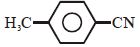
B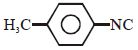
C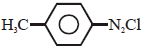
D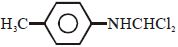
Solution
(B) The reaction of a primary amine (like $p-toluidine$) with chloroform $(CHCl_3)$ and alcoholic potassium hydroxide $(KOH)$ is known as the carbylamine reaction or isocyanide test.
In this reaction,the primary amine is converted into an isocyanide (also called carbylamine),which has a characteristic foul smell.
$p-Toluidine$ is $4-methylaniline$.
The reaction is:
$CH_3-C_6H_4-NH_2 + CHCl_3 + 3KOH(alc.) \rightarrow CH_3-C_6H_4-NC + 3KCl + 3H_2O$.
Thus,the product formed is $p-tolyl$ isocyanide.
In this reaction,the primary amine is converted into an isocyanide (also called carbylamine),which has a characteristic foul smell.
$p-Toluidine$ is $4-methylaniline$.
The reaction is:
$CH_3-C_6H_4-NH_2 + CHCl_3 + 3KOH(alc.) \rightarrow CH_3-C_6H_4-NC + 3KCl + 3H_2O$.
Thus,the product formed is $p-tolyl$ isocyanide.
0 likes
View Solution477
DifficultMCQ
Identify the product $(Y)$ in the following reaction sequence:
$C_6H_5NH_2$ $\xrightarrow{CHCl_3, KOH, \Delta} X$ $\xrightarrow{LiAlH_4, H_2O} Y$
$C_6H_5NH_2$ $\xrightarrow{CHCl_3, KOH, \Delta} X$ $\xrightarrow{LiAlH_4, H_2O} Y$
A
$C_6H_5NHCH_3$
B
$C_6H_5CH_2NH_2$
C
$C_6H_5NHCHO$
D
$C_6H_5NC$
Solution
(A) $1$. The reaction of aniline $(C_6H_5NH_2)$ with $CHCl_3$ and $KOH$ is the carbylamine reaction,which produces phenyl isocyanide $(C_6H_5NC)$ as the intermediate $(X)$.
$2$. The reduction of phenyl isocyanide $(C_6H_5NC)$ with $LiAlH_4$ followed by hydrolysis yields $N$-methylaniline $(C_6H_5NHCH_3)$ as the final product $(Y)$.
$2$. The reduction of phenyl isocyanide $(C_6H_5NC)$ with $LiAlH_4$ followed by hydrolysis yields $N$-methylaniline $(C_6H_5NHCH_3)$ as the final product $(Y)$.
0 likes
View Solution478
DifficultMCQ
Identify $'X'$ in the following sequence of reaction:
$C_6H_5N_2^+Cl^-$ $\xrightarrow{CuCN/KCN} P$ $\xrightarrow{LiAlH_4} Q$ $\xrightarrow{HNO_2} X$
$C_6H_5N_2^+Cl^-$ $\xrightarrow{CuCN/KCN} P$ $\xrightarrow{LiAlH_4} Q$ $\xrightarrow{HNO_2} X$
A
Benzoic acid
B
Phenyl acetic acid
C
Benzyl alcohol
D
Benzamide
Solution
(C) $1$. The reaction of benzene diazonium chloride $(C_6H_5N_2^+Cl^-)$ with $CuCN/KCN$ (Sandmeyer reaction) yields benzonitrile $(P = C_6H_5CN)$.
$2$. Reduction of benzonitrile $(C_6H_5CN)$ with $LiAlH_4$ gives benzylamine $(Q = C_6H_5CH_2NH_2)$.
$3$. The reaction of primary aliphatic amine (benzylamine) with nitrous acid $(HNO_2)$ produces an unstable diazonium salt which decomposes to form benzyl alcohol $(X = C_6H_5CH_2OH)$.
$2$. Reduction of benzonitrile $(C_6H_5CN)$ with $LiAlH_4$ gives benzylamine $(Q = C_6H_5CH_2NH_2)$.
$3$. The reaction of primary aliphatic amine (benzylamine) with nitrous acid $(HNO_2)$ produces an unstable diazonium salt which decomposes to form benzyl alcohol $(X = C_6H_5CH_2OH)$.
0 likes
View Solution479
DifficultMCQ
The final product $(IV)$ obtained in the reaction sequence
Toluene $\xrightarrow[{2. \ H^{+}}]{{1. \ KMnO_4/OH^{-}}} I$ $\xrightarrow{{SOCl_2}} II$ $\xrightarrow{{NH_3}} III$ $\xrightarrow{{OBr^{-}}} IV$ is
Toluene $\xrightarrow[{2. \ H^{+}}]{{1. \ KMnO_4/OH^{-}}} I$ $\xrightarrow{{SOCl_2}} II$ $\xrightarrow{{NH_3}} III$ $\xrightarrow{{OBr^{-}}} IV$ is
A
$C_6H_5CONH_2$
B
$p-CH_3C_6H_4NO_2$
C
$C_6H_5CH_2NH_2$
D
$C_6H_5NH_2$
Solution
(D) The reaction sequence is as follows:
$1$. Toluene is oxidized by $KMnO_4/OH^-$ followed by $H^+$ to form benzoic acid $(I = C_6H_5COOH)$.
$2$. Benzoic acid reacts with $SOCl_2$ to form benzoyl chloride $(II = C_6H_5COCl)$.
$3$. Benzoyl chloride reacts with $NH_3$ to form benzamide $(III = C_6H_5CONH_2)$.
$4$. Benzamide undergoes the Hofmann bromamide degradation reaction with $OBr^-$ (formed from $Br_2/NaOH$) to yield aniline $(IV = C_6H_5NH_2)$.
Thus,the final product $(IV)$ is aniline $(C_6H_5NH_2)$.
$1$. Toluene is oxidized by $KMnO_4/OH^-$ followed by $H^+$ to form benzoic acid $(I = C_6H_5COOH)$.
$2$. Benzoic acid reacts with $SOCl_2$ to form benzoyl chloride $(II = C_6H_5COCl)$.
$3$. Benzoyl chloride reacts with $NH_3$ to form benzamide $(III = C_6H_5CONH_2)$.
$4$. Benzamide undergoes the Hofmann bromamide degradation reaction with $OBr^-$ (formed from $Br_2/NaOH$) to yield aniline $(IV = C_6H_5NH_2)$.
Thus,the final product $(IV)$ is aniline $(C_6H_5NH_2)$.
0 likes
View Solution480
DifficultMCQ
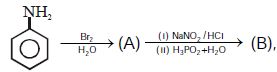
Product $(B)$ in this reaction is
A
$1,2,4-$tribromobenzene
B
$1,3,5-$tribromobenzene
C
$2,3,4-$tribromobenzene
D
Bromobenzene
Solution
(B) The reaction proceeds in two steps:
$1$. Aniline reacts with bromine water $(Br_2/H_2O)$ to form $2,4,6$-tribromoaniline as product $(A)$ due to the strong activating effect of the $-NH_2$ group.
$2$. $2,4,6$-tribromoaniline is then treated with $NaNO_2/HCl$ at $0-5 \ ^\circ C$ to form the diazonium salt,which is subsequently reduced by $H_3PO_2$ and $H_2O$ to remove the $-NH_2$ group,yielding $1,3,5$-tribromobenzene as product $(B)$.
$1$. Aniline reacts with bromine water $(Br_2/H_2O)$ to form $2,4,6$-tribromoaniline as product $(A)$ due to the strong activating effect of the $-NH_2$ group.
$2$. $2,4,6$-tribromoaniline is then treated with $NaNO_2/HCl$ at $0-5 \ ^\circ C$ to form the diazonium salt,which is subsequently reduced by $H_3PO_2$ and $H_2O$ to remove the $-NH_2$ group,yielding $1,3,5$-tribromobenzene as product $(B)$.
0 likes
View Solution481
DifficultMCQ
Which of the following will not give Hoffmann bromamide reaction?
A
$CH_3CONH_2$
B
$C_6H_5CONHBr$
C
$C_6H_5CONH_2$
D
$C_6H_5CONHCH_3$
Solution
(D) The Hoffmann bromamide degradation reaction is specifically given by primary amides $(R-CONH_2)$ to form primary amines with one less carbon atom.
This reaction requires two hydrogen atoms on the nitrogen atom of the amide group to proceed through the mechanism involving the formation of an isocyanate intermediate.
Secondary amides $(R-CONHR)$ and tertiary amides $(R-CONR_2)$ do not undergo this reaction because they lack the necessary two hydrogen atoms on the nitrogen.
In the given options,$C_6H_5CONHCH_3$ is a secondary amide ($N$-methylbenzamide),which lacks the two hydrogen atoms on the nitrogen required for the reaction. Therefore,it will not give the Hoffmann bromamide reaction.
This reaction requires two hydrogen atoms on the nitrogen atom of the amide group to proceed through the mechanism involving the formation of an isocyanate intermediate.
Secondary amides $(R-CONHR)$ and tertiary amides $(R-CONR_2)$ do not undergo this reaction because they lack the necessary two hydrogen atoms on the nitrogen.
In the given options,$C_6H_5CONHCH_3$ is a secondary amide ($N$-methylbenzamide),which lacks the two hydrogen atoms on the nitrogen required for the reaction. Therefore,it will not give the Hoffmann bromamide reaction.
0 likes
View Solution482
DifficultMCQ
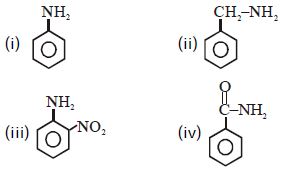
Arrange the following compounds in the correct order of their basic strength:
A
$iv < iii < i < ii$
B
$iv < i < iii < ii$
C
$iv < iii < ii < i$
D
$ii < i < iii < iv$
Solution
(A) To determine the basic strength,we look at the availability of the lone pair on the nitrogen atom:
$(ii)$ Benzylamine $(C_6H_5CH_2NH_2)$: The lone pair on the nitrogen is localized (not involved in resonance),making it the strongest base.
$(i)$ Aniline $(C_6H_5NH_2)$: The lone pair on the nitrogen is delocalized into the benzene ring due to resonance,reducing its basicity.
$(iii)$ $o$-Nitroaniline $(o-NO_2-C_6H_4NH_2)$: The $-NO_2$ group is a strong electron-withdrawing group ($-I$ and $-M$ effect),which further decreases the electron density on the nitrogen compared to aniline.
$(iv)$ Benzamide $(C_6H_5CONH_2)$: The lone pair on the nitrogen is involved in resonance with the adjacent carbonyl group $(C=O)$,making it the least basic.
Therefore,the correct order of basic strength is: $iv < iii < i < ii$.
$(ii)$ Benzylamine $(C_6H_5CH_2NH_2)$: The lone pair on the nitrogen is localized (not involved in resonance),making it the strongest base.
$(i)$ Aniline $(C_6H_5NH_2)$: The lone pair on the nitrogen is delocalized into the benzene ring due to resonance,reducing its basicity.
$(iii)$ $o$-Nitroaniline $(o-NO_2-C_6H_4NH_2)$: The $-NO_2$ group is a strong electron-withdrawing group ($-I$ and $-M$ effect),which further decreases the electron density on the nitrogen compared to aniline.
$(iv)$ Benzamide $(C_6H_5CONH_2)$: The lone pair on the nitrogen is involved in resonance with the adjacent carbonyl group $(C=O)$,making it the least basic.
Therefore,the correct order of basic strength is: $iv < iii < i < ii$.
0 likes
View Solution483
DifficultMCQ
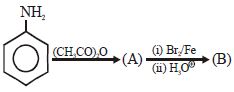
The major product $(B)$ in this reaction is:
A
p-Bromoaniline
B
$2,4,6-$Tribromoaniline
C
$1,3,5-$Tribromobenzene
D
o-Bromoaniline
Solution
(A) $1$. The reaction of aniline with acetic anhydride $(CH_3CO)_2O$ in the presence of pyridine leads to the formation of acetanilide,which is compound $(A)$. This step protects the $-NH_2$ group to reduce its activating effect and prevent poly-substitution.
$2$. Acetanilide undergoes electrophilic aromatic substitution with $Br_2/Fe$ to give $p$-bromoacetanilide as the major product due to steric hindrance at the ortho position.
$3$. Finally,hydrolysis of $p$-bromoacetanilide with $H_3O^+$ removes the acetyl group to yield $p$-bromoaniline as the major product $(B)$.
$2$. Acetanilide undergoes electrophilic aromatic substitution with $Br_2/Fe$ to give $p$-bromoacetanilide as the major product due to steric hindrance at the ortho position.
$3$. Finally,hydrolysis of $p$-bromoacetanilide with $H_3O^+$ removes the acetyl group to yield $p$-bromoaniline as the major product $(B)$.
0 likes
View Solution484
MediumMCQ
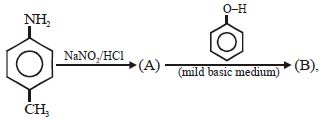
Product $(B)$ of this reaction is
A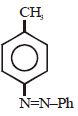
B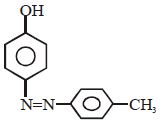
C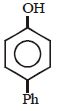
D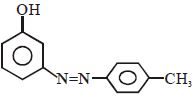
Solution
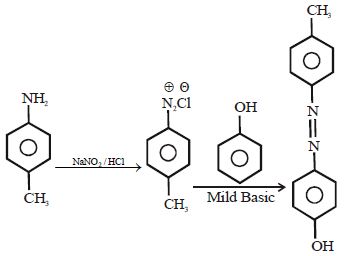
(C) The reaction involves two steps:
$1$. Diazotization: $p$-toluidine ($4$-methylaniline) reacts with $NaNO_2/HCl$ at $0-5 \ ^\circ C$ to form $p$-methylbenzenediazonium chloride as intermediate $(A)$.
$2$. Coupling reaction: The diazonium salt $(A)$ undergoes electrophilic aromatic substitution (coupling) with phenol in a mild basic medium. The coupling occurs primarily at the para-position of the phenol due to steric hindrance and the strong activating effect of the $-OH$ group.
The final product $(B)$ is $4$-hydroxy-$4'$-methylazobenzene.
$1$. Diazotization: $p$-toluidine ($4$-methylaniline) reacts with $NaNO_2/HCl$ at $0-5 \ ^\circ C$ to form $p$-methylbenzenediazonium chloride as intermediate $(A)$.
$2$. Coupling reaction: The diazonium salt $(A)$ undergoes electrophilic aromatic substitution (coupling) with phenol in a mild basic medium. The coupling occurs primarily at the para-position of the phenol due to steric hindrance and the strong activating effect of the $-OH$ group.
The final product $(B)$ is $4$-hydroxy-$4'$-methylazobenzene.
0 likes
View Solution485
MediumMCQ
Which one will not give alcohol on reduction with $LiAlH_4$?
A
$CH_3CONH_2$
B
$CH_3COCl$
C
$CH_3COOC_2H_5$
D
All of the above
Solution
(A) $LiAlH_4$ is a strong reducing agent.
$CH_3CONH_2$ (amide) is reduced to $CH_3CH_2NH_2$ (amine),which is not an alcohol.
$CH_3COCl$ (acid chloride) is reduced to $CH_3CH_2OH$ (alcohol).
$CH_3COOC_2H_5$ (ester) is reduced to $CH_3CH_2OH$ (alcohol) and $C_2H_5OH$ (alcohol).
Therefore,$CH_3CONH_2$ does not give an alcohol upon reduction.
$CH_3CONH_2$ (amide) is reduced to $CH_3CH_2NH_2$ (amine),which is not an alcohol.
$CH_3COCl$ (acid chloride) is reduced to $CH_3CH_2OH$ (alcohol).
$CH_3COOC_2H_5$ (ester) is reduced to $CH_3CH_2OH$ (alcohol) and $C_2H_5OH$ (alcohol).
Therefore,$CH_3CONH_2$ does not give an alcohol upon reduction.
0 likes
View Solution486
DifficultMCQ
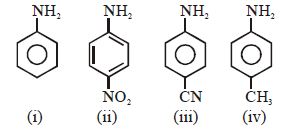
Arrange the following compounds in decreasing order of basic strength:
A
$iv > i > iii > ii$
B
$ii > iii > i > iv$
C
$iv > i > ii > iii$
D
$i > ii > iii > iv$
Solution
(A) The basic strength of substituted anilines depends on the nature of the substituent group attached to the benzene ring. Electron-donating groups $(EDG)$ increase basic strength by increasing electron density on the nitrogen atom,while electron-withdrawing groups $(EWG)$ decrease it.
$(i)$ Aniline: Reference compound.
(ii) $p$-Nitroaniline: $-NO_2$ is a strong electron-withdrawing group ($-M$ and $-I$ effect),which significantly decreases basic strength.
(iii) $p$-Cyanoaniline: $-CN$ is an electron-withdrawing group ($-M$ and $-I$ effect),which decreases basic strength,but less than $-NO_2$.
(iv) $p$-Toluidine: $-CH_3$ is an electron-donating group ($+H$ and $+I$ effect),which increases basic strength.
Comparing the effects:
- $(iv)$ has an $EDG$ $(+H)$,making it the most basic.
- $(i)$ is the reference.
- $(iii)$ has an $EWG$ $(-M)$,making it less basic than $(i)$.
- $(ii)$ has a stronger $EWG$ $(-M)$,making it the least basic.
Therefore,the decreasing order of basic strength is: $(iv) > (i) > (iii) > (ii)$.
$(i)$ Aniline: Reference compound.
(ii) $p$-Nitroaniline: $-NO_2$ is a strong electron-withdrawing group ($-M$ and $-I$ effect),which significantly decreases basic strength.
(iii) $p$-Cyanoaniline: $-CN$ is an electron-withdrawing group ($-M$ and $-I$ effect),which decreases basic strength,but less than $-NO_2$.
(iv) $p$-Toluidine: $-CH_3$ is an electron-donating group ($+H$ and $+I$ effect),which increases basic strength.
Comparing the effects:
- $(iv)$ has an $EDG$ $(+H)$,making it the most basic.
- $(i)$ is the reference.
- $(iii)$ has an $EWG$ $(-M)$,making it less basic than $(i)$.
- $(ii)$ has a stronger $EWG$ $(-M)$,making it the least basic.
Therefore,the decreasing order of basic strength is: $(iv) > (i) > (iii) > (ii)$.
0 likes
View Solution487
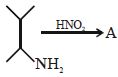
MediumMCQ
The (major) product $(A)$ is:
A
$3-$methylbutan$-2-$ol
B
$2-$methylbutan$-1-$ol
C
$2-$methylbutan$-2-$ol
D
$2-$methoxy$-2-$methylbutane
Solution
(C) The reactant is $3$-methylbutan-$2$-amine,which is a primary aliphatic amine.
When a primary aliphatic amine reacts with nitrous acid ($HNO_2$,generated in situ from $NaNO_2 + HCl$),it forms an unstable diazonium salt.
This diazonium salt rapidly loses nitrogen gas $(N_2)$ to form a carbocation.
The initial carbocation formed is a secondary carbocation: $CH_3-CH(CH_3)-CH^+-CH_3$.
This secondary carbocation undergoes a $1,2$-hydride shift to form a more stable tertiary carbocation: $CH_3-C^+(CH_3)-CH_2-CH_3$.
Finally,the tertiary carbocation reacts with water $(H_2O)$ to form the major product,which is $2$-methylbutan-$2$-ol.
Therefore,the correct option is $(C)$.
When a primary aliphatic amine reacts with nitrous acid ($HNO_2$,generated in situ from $NaNO_2 + HCl$),it forms an unstable diazonium salt.
This diazonium salt rapidly loses nitrogen gas $(N_2)$ to form a carbocation.
The initial carbocation formed is a secondary carbocation: $CH_3-CH(CH_3)-CH^+-CH_3$.
This secondary carbocation undergoes a $1,2$-hydride shift to form a more stable tertiary carbocation: $CH_3-C^+(CH_3)-CH_2-CH_3$.
Finally,the tertiary carbocation reacts with water $(H_2O)$ to form the major product,which is $2$-methylbutan-$2$-ol.
Therefore,the correct option is $(C)$.
0 likes
View Solution488
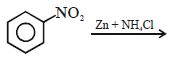
MediumMCQ
The product of the following reaction is:
A
Azoxybenzene
B
Phenylhydroxylamine
C
Hydrazobenzene
D
Aniline
Solution
(B) The reduction of nitrobenzene with $Zn$ and $NH_4Cl$ (neutral medium) yields $N$-phenylhydroxylamine $(C_6H_5NHOH)$ as the major product.
Reaction:
$C_6H_5NO_2 + 4[H] \xrightarrow{Zn/NH_4Cl} C_6H_5NHOH + H_2O$
Reaction:
$C_6H_5NO_2 + 4[H] \xrightarrow{Zn/NH_4Cl} C_6H_5NHOH + H_2O$
0 likes
View Solution489
MediumMCQ
The reaction of $N$-phenylbenzamide with $NO_2^{\oplus}$ (nitronium ion) yields which product?
A
$N$-($3$-nitrophenyl)benzamide
B
$N$-phenyl$-3-$nitrobenzamide
C
$N$-($2$-nitrophenyl)benzamide
D
$N$-($4$-nitrophenyl)benzamide
Solution
(D) The starting material is $N$-phenylbenzamide,which contains two benzene rings: one attached to the nitrogen atom (aniline derivative) and one attached to the carbonyl group (benzoyl derivative).
The $-NH-CO-Ph$ group is an ortho/para-directing group because of the lone pair on the nitrogen atom,which can participate in resonance with the attached benzene ring.
The $-CO-NH-Ph$ group is a meta-directing group because the carbonyl group is electron-withdrawing.
In electrophilic aromatic substitution (nitration),the $-NH-CO-Ph$ group is a much stronger activating group than the $-CO-NH-Ph$ group is deactivating. Therefore,the nitration occurs on the ring attached to the nitrogen atom.
Due to the steric hindrance of the bulky $-NH-CO-Ph$ group,the para-position is favored over the ortho-position. Thus,the major product is $N$-($4$-nitrophenyl)benzamide.
The $-NH-CO-Ph$ group is an ortho/para-directing group because of the lone pair on the nitrogen atom,which can participate in resonance with the attached benzene ring.
The $-CO-NH-Ph$ group is a meta-directing group because the carbonyl group is electron-withdrawing.
In electrophilic aromatic substitution (nitration),the $-NH-CO-Ph$ group is a much stronger activating group than the $-CO-NH-Ph$ group is deactivating. Therefore,the nitration occurs on the ring attached to the nitrogen atom.
Due to the steric hindrance of the bulky $-NH-CO-Ph$ group,the para-position is favored over the ortho-position. Thus,the major product is $N$-($4$-nitrophenyl)benzamide.
0 likes
View Solution490
MediumMCQ
What is the major product $X$ in the following reaction?
$C_6H_5CONH-C_6H_5 \xrightarrow{Br_2/Fe} X \text{ (major)}$
$C_6H_5CONH-C_6H_5 \xrightarrow{Br_2/Fe} X \text{ (major)}$
A
$N$-($3$-bromophenyl)benzamide
B
$N$-($4$-bromophenyl)benzamide
C
$4-$bromobenzanilide
D
$3-$bromobenzanilide
Solution
(B) The reaction is an electrophilic aromatic substitution on the aniline derivative,$N$-phenylbenzamide (benzanilide).
The $-NH-CO-C_6H_5$ group is an activating group and is ortho/para-directing due to the lone pair on the nitrogen atom.
However,due to the steric hindrance caused by the bulky benzoyl group attached to the nitrogen,the para-position is significantly more favored than the ortho-position.
Therefore,the major product is $N$-($4$-bromophenyl)benzamide.
The $-NH-CO-C_6H_5$ group is an activating group and is ortho/para-directing due to the lone pair on the nitrogen atom.
However,due to the steric hindrance caused by the bulky benzoyl group attached to the nitrogen,the para-position is significantly more favored than the ortho-position.
Therefore,the major product is $N$-($4$-bromophenyl)benzamide.
0 likes
View Solution491
DifficultMCQ
When a primary amine is heated with $NaNO_2/HCl$,a gas is evolved with brisk effervescence. Identify the gas.
$R-NH_2 \xrightarrow{NaNO_2/HCl} ..................$
$R-NH_2 \xrightarrow{NaNO_2/HCl} ..................$
A
$CO_2$
B
$N_2$
C
$NH_3$
D
None of these
Solution
(B) When a primary aliphatic amine reacts with nitrous acid $(HNO_2)$,which is generated in situ by the reaction of $NaNO_2$ and $HCl$,it forms an unstable diazonium salt that decomposes to release nitrogen gas $(N_2)$ with brisk effervescence.
The reaction is: $R-NH_2 + NaNO_2 + 2HCl \rightarrow R-OH + N_2 \uparrow + H_2O + NaCl$.
The reaction is: $R-NH_2 + NaNO_2 + 2HCl \rightarrow R-OH + N_2 \uparrow + H_2O + NaCl$.
0 likes
View Solution492
DifficultMCQ
$Ph-C(=O)-OH$ $\xrightarrow{NH_3, \Delta} (A)$ $\xrightarrow{Br_2, KOH} (B)$,product $(B)$ is:
A
$Ph-C(=O)-NH_2$
B
$Ph-C(=O)-O-C(=O)-Ph$
C
$Ph-NH_2$
D
$Ph-CH_2-NH_2$
Solution
(C) Benzoic acid $(Ph-C(=O)-OH)$ reacts with ammonia $(NH_3)$ followed by heating to produce benzamide ($A$,$Ph-C(=O)-NH_2$).
Benzamide then undergoes the Hofmann bromamide degradation reaction with $Br_2$ and $KOH$ to yield aniline ($B$,$Ph-NH_2$).
Reaction:
$Ph-C(=O)-OH + NH_3 \xrightarrow{\Delta} Ph-C(=O)-NH_2 + H_2O$
$Ph-C(=O)-NH_2 + Br_2 + 4KOH \rightarrow Ph-NH_2 + K_2CO_3 + 2KBr + 2H_2O$
Benzamide then undergoes the Hofmann bromamide degradation reaction with $Br_2$ and $KOH$ to yield aniline ($B$,$Ph-NH_2$).
Reaction:
$Ph-C(=O)-OH + NH_3 \xrightarrow{\Delta} Ph-C(=O)-NH_2 + H_2O$
$Ph-C(=O)-NH_2 + Br_2 + 4KOH \rightarrow Ph-NH_2 + K_2CO_3 + 2KBr + 2H_2O$
0 likes
View Solution493
AdvancedMCQ
Several factors (steric,electronic,orbital interactions,etc.) can affect the inversion barrier of an amine. In the given pairs,which data is correctly placed?
A
Comparison of $N(CH_3)_3$ and $N(i-Pr)_2(CH_3)$ with $\Delta G^{\ddagger} = 7.9 \ kcal/mol$ and $0.2 \ kcal/mol$ respectively.
B
Comparison of $N$-methylaziridine and $N$-methylpyrrolidine with $\Delta G^{\ddagger} = 20.5 \ kcal/mol$ and $7.0 \ kcal/mol$ respectively.
C
Comparison of $N(CH_3)_3$ and $NCl_3$ with $\Delta G^{\ddagger} = 7.9 \ kcal/mol$ and $22.9 \ kcal/mol$ respectively.
D
All of these
Solution
(D) The barrier to inversion for $N(i-Pr)_2(CH_3)$ is less than for $N(CH_3)_3$ because going from $sp^3$ (tetrahedral) to $sp^2$ (trigonal planar) spreads the bulky isopropyl groups further apart and relieves steric crowding. In other words,the isopropyl groups destabilize the pyramidal amine more than the planar transition structure.
$(b)$ The $sp^2$ transition state has an ideal bond angle of $\sim 120^{\circ}$. The three-membered ring transition state is highly strained because it cannot achieve $120^{\circ}$ due to the small ring locking the angles at $\sim 60^{\circ}$. The $5$-membered ring can easily adopt the $120^{\circ}$ angle.
$(c)$ As the nitrogen goes from $sp^3 \rightarrow sp^2$,it becomes effectively more electronegative. (Remember: more $s$-character means more electronegative). The electronegative chlorine atoms pull electron density away from $N$ more than the methyl groups,creating an electron-deficient $N$ and destabilizing the transition state $(T.S.)$.
$(b)$ The $sp^2$ transition state has an ideal bond angle of $\sim 120^{\circ}$. The three-membered ring transition state is highly strained because it cannot achieve $120^{\circ}$ due to the small ring locking the angles at $\sim 60^{\circ}$. The $5$-membered ring can easily adopt the $120^{\circ}$ angle.
$(c)$ As the nitrogen goes from $sp^3 \rightarrow sp^2$,it becomes effectively more electronegative. (Remember: more $s$-character means more electronegative). The electronegative chlorine atoms pull electron density away from $N$ more than the methyl groups,creating an electron-deficient $N$ and destabilizing the transition state $(T.S.)$.
0 likes
View Solution494
MediumMCQ
Among the isomeric amines,select the one with the lowest boiling point.
A
$4-$methylpiperidine
B
$N$-methylcyclopentanamine
C
$1-$methylpiperidine
D
cyclohexanamine
Solution
(C) The boiling point of amines depends on the extent of intermolecular hydrogen bonding.
Primary $(1^{\circ})$ and secondary $(2^{\circ})$ amines can form intermolecular hydrogen bonds due to the presence of $N-H$ bonds,which leads to higher boiling points.
Tertiary $(3^{\circ})$ amines do not have any $N-H$ bonds and therefore cannot participate in intermolecular hydrogen bonding.
Among the given options,$1$-methylpiperidine is a tertiary amine,while the others are primary or secondary amines.
Thus,$1$-methylpiperidine has the lowest boiling point.
Primary $(1^{\circ})$ and secondary $(2^{\circ})$ amines can form intermolecular hydrogen bonds due to the presence of $N-H$ bonds,which leads to higher boiling points.
Tertiary $(3^{\circ})$ amines do not have any $N-H$ bonds and therefore cannot participate in intermolecular hydrogen bonding.
Among the given options,$1$-methylpiperidine is a tertiary amine,while the others are primary or secondary amines.
Thus,$1$-methylpiperidine has the lowest boiling point.
0 likes
View Solution495
MediumMCQ
Among the following compounds,the most basic compound is
A
Pyridine
B
Pyrrole
C
Furan
D
Pyrrolidine
Solution
(D) To determine the basicity,we look at the availability of the lone pair of electrons on the nitrogen or oxygen atom.
$A$. Pyridine: The lone pair on $N$ is in an $sp^2$ orbital and is not involved in the aromatic sextet. It is available for protonation,making it a weak base.
$B$. Pyrrole: The lone pair on $N$ is involved in the aromatic sextet (it is part of the $6\pi$ electron system). Thus,it is not available for protonation,making it extremely weakly basic.
$C$. Furan: The lone pair on $O$ is involved in the aromatic sextet. It is not available for protonation.
$D$. Pyrrolidine: This is a saturated cyclic amine. The lone pair on $N$ is in an $sp^3$ orbital and is not involved in any resonance or aromatic system. It is highly available for protonation,making it the most basic compound among the given options.
Therefore,the correct order of basicity is: $\text{Pyrrolidine} > \text{Pyridine} > \text{Pyrrole} > \text{Furan}$.
$A$. Pyridine: The lone pair on $N$ is in an $sp^2$ orbital and is not involved in the aromatic sextet. It is available for protonation,making it a weak base.
$B$. Pyrrole: The lone pair on $N$ is involved in the aromatic sextet (it is part of the $6\pi$ electron system). Thus,it is not available for protonation,making it extremely weakly basic.
$C$. Furan: The lone pair on $O$ is involved in the aromatic sextet. It is not available for protonation.
$D$. Pyrrolidine: This is a saturated cyclic amine. The lone pair on $N$ is in an $sp^3$ orbital and is not involved in any resonance or aromatic system. It is highly available for protonation,making it the most basic compound among the given options.
Therefore,the correct order of basicity is: $\text{Pyrrolidine} > \text{Pyridine} > \text{Pyrrole} > \text{Furan}$.
0 likes
View Solution496
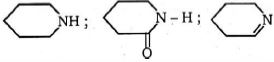
DifficultMCQ
The correct order of decreasing basic strengths of $x$ (piperidine),$y$ (caprolactam derivative),and $z$ ($3$,$4$,$5$,$6$-tetrahydropyridine) is:
A
$x > z > y$
B
$x > y > z$
C
$y > x > z$
D
$z > x > y$
Solution
(A) The basic strength of amines depends on the availability of the lone pair of electrons on the nitrogen atom.
$1$. In $x$ (piperidine),the nitrogen is $sp^3$-hybridized,and its lone pair is localized,making it the most basic.
$2$. In $z$ ($3$,$4$,$5$,$6$-tetrahydropyridine),the nitrogen is $sp^2$-hybridized. Due to higher $s$-character,the lone pair is held more tightly by the nucleus,making it less basic than $x$.
$3$. In $y$ (the amide derivative),the lone pair on nitrogen is delocalized through resonance with the adjacent carbonyl group $(C=O)$,making it the least basic.
Therefore,the decreasing order of basic strength is $x > z > y$.
$1$. In $x$ (piperidine),the nitrogen is $sp^3$-hybridized,and its lone pair is localized,making it the most basic.
$2$. In $z$ ($3$,$4$,$5$,$6$-tetrahydropyridine),the nitrogen is $sp^2$-hybridized. Due to higher $s$-character,the lone pair is held more tightly by the nucleus,making it less basic than $x$.
$3$. In $y$ (the amide derivative),the lone pair on nitrogen is delocalized through resonance with the adjacent carbonyl group $(C=O)$,making it the least basic.
Therefore,the decreasing order of basic strength is $x > z > y$.
0 likes
View Solution497
MediumMCQ
Which of the following is the strongest Bronsted base?
A
Aniline $(C_6H_5NH_2)$
B
Ammonia $(NH_3)$
C
Pyrrole $(C_4H_4NH)$
D
Pyrrolidine $(C_4H_8NH)$
Solution
(D) To determine the strongest Bronsted base,we look for the availability of the lone pair on the nitrogen atom.
$1$. In Aniline $(C_6H_5NH_2)$,the lone pair on $N$ is delocalized into the benzene ring due to resonance,making it less available for protonation.
$2$. In Ammonia $(NH_3)$,the lone pair is localized but lacks the electron-donating alkyl groups that increase basicity.
$3$. In Pyrrole $(C_4H_4NH)$,the lone pair on $N$ is part of the aromatic sextet (delocalized),making it non-basic.
$4$. In Pyrrolidine $(C_4H_8NH)$,the lone pair is localized on the nitrogen atom and is not involved in resonance. Additionally,the alkyl chain provides an inductive effect ($+I$ effect) that increases the electron density on the nitrogen,making it the most basic among the given options.
$1$. In Aniline $(C_6H_5NH_2)$,the lone pair on $N$ is delocalized into the benzene ring due to resonance,making it less available for protonation.
$2$. In Ammonia $(NH_3)$,the lone pair is localized but lacks the electron-donating alkyl groups that increase basicity.
$3$. In Pyrrole $(C_4H_4NH)$,the lone pair on $N$ is part of the aromatic sextet (delocalized),making it non-basic.
$4$. In Pyrrolidine $(C_4H_8NH)$,the lone pair is localized on the nitrogen atom and is not involved in resonance. Additionally,the alkyl chain provides an inductive effect ($+I$ effect) that increases the electron density on the nitrogen,making it the most basic among the given options.
0 likes
View Solution498
MediumMCQ
Which isomeric amine has the lowest boiling point?
A
$1^{\circ}$ amine
B
$2^{\circ}$ amine
C
$3^{\circ}$ amine
D
Cannot predict
Solution
(C) Primary and secondary amines can form intermolecular hydrogen bonds,which leads to higher boiling points compared to tertiary amines.
Tertiary amines ($3^{\circ}$ amines) lack a hydrogen atom directly attached to the nitrogen atom,meaning they cannot form intermolecular hydrogen bonds with each other.
As a result,for a set of isomeric amines,the $3^{\circ}$ amine will have the weakest intermolecular forces and consequently the lowest boiling point.
Therefore,the order of boiling points is $1^{\circ} > 2^{\circ} > 3^{\circ}$.
Tertiary amines ($3^{\circ}$ amines) lack a hydrogen atom directly attached to the nitrogen atom,meaning they cannot form intermolecular hydrogen bonds with each other.
As a result,for a set of isomeric amines,the $3^{\circ}$ amine will have the weakest intermolecular forces and consequently the lowest boiling point.
Therefore,the order of boiling points is $1^{\circ} > 2^{\circ} > 3^{\circ}$.
0 likes
View Solution499
MediumMCQ
In the given pair of compounds,in which pair does the second compound have a higher boiling point than the first compound?
A
Cyclopropanol and Oxetane
B
Acetone and Propene
C
$HO-CH_2-CH_2-OH$ and $CH_3-CH_2-CH_2-OH$
D
$N$-Methylpyrrolidine and Piperidine
Solution
(D) The boiling point $(B.P.)$ of a compound depends on the strength of intermolecular forces.
$1.$ In option $(A)$,cyclopropanol has intermolecular $H$-bonding,while oxetane does not,so cyclopropanol has a higher $B.P.$
$2.$ In option $(B)$,acetone has dipole-dipole interactions,while propene has only weak London dispersion forces,so acetone has a higher $B.P.$
$3.$ In option $(C)$,ethane$-1,2-$diol $(HO-CH_2-CH_2-OH)$ has two $-OH$ groups allowing extensive intermolecular $H$-bonding,whereas propan$-1-$ol $(CH_3-CH_2-CH_2-OH)$ has only one $-OH$ group. Thus,the first compound has a higher $B.P.$
$4.$ In option $(D)$,$N$-methylpyrrolidine is a tertiary amine with no $H$-bonding,while piperidine is a secondary amine capable of intermolecular $H$-bonding. Therefore,the second compound (piperidine) has a higher $B.P.$ than the first compound.
$1.$ In option $(A)$,cyclopropanol has intermolecular $H$-bonding,while oxetane does not,so cyclopropanol has a higher $B.P.$
$2.$ In option $(B)$,acetone has dipole-dipole interactions,while propene has only weak London dispersion forces,so acetone has a higher $B.P.$
$3.$ In option $(C)$,ethane$-1,2-$diol $(HO-CH_2-CH_2-OH)$ has two $-OH$ groups allowing extensive intermolecular $H$-bonding,whereas propan$-1-$ol $(CH_3-CH_2-CH_2-OH)$ has only one $-OH$ group. Thus,the first compound has a higher $B.P.$
$4.$ In option $(D)$,$N$-methylpyrrolidine is a tertiary amine with no $H$-bonding,while piperidine is a secondary amine capable of intermolecular $H$-bonding. Therefore,the second compound (piperidine) has a higher $B.P.$ than the first compound.
0 likes
View Solution500
DifficultMCQ
In sets $A - D$, only one of the sets is incorrect regarding basic strength. Select it.
A
$Ph-NH-Ph < Ph-NH_2 < \text{Cyclohexylamine}$
B
$\text{Pyrrole} < \text{Pyridine} < \text{Piperidine}$
C
$\text{Pyrrole} > \text{Pyrrolidine} > \text{Pyrazole}$
D
$p\text{-Nitroaniline} < \text{Aniline} < p\text{-Toluidine}$
Solution
(C) The basic strength of amines depends on the availability of the lone pair of electrons on the nitrogen atom.
In option $A$, the order is correct: diphenylamine is less basic than aniline due to two phenyl groups, and cyclohexylamine is the most basic as its lone pair is not involved in resonance.
In option $B$, the order is correct: pyrrole is the least basic because its lone pair is involved in the aromatic sextet, pyridine is more basic, and piperidine is the most basic as it is a saturated cyclic amine.
In option $C$, the order is incorrect. The correct order of basicity is $\text{Pyrrolidine} > \text{Pyrazole} > \text{Pyrrole}$. Pyrrolidine is a secondary aliphatic amine (most basic), pyrazole has a lone pair available for protonation, and pyrrole is the least basic.
In option $D$, the order is correct: the $-NO_2$ group is electron-withdrawing (decreases basicity), while the $-CH_3$ group is electron-donating (increases basicity).
Therefore, the incorrect set is $C$.
In option $A$, the order is correct: diphenylamine is less basic than aniline due to two phenyl groups, and cyclohexylamine is the most basic as its lone pair is not involved in resonance.
In option $B$, the order is correct: pyrrole is the least basic because its lone pair is involved in the aromatic sextet, pyridine is more basic, and piperidine is the most basic as it is a saturated cyclic amine.
In option $C$, the order is incorrect. The correct order of basicity is $\text{Pyrrolidine} > \text{Pyrazole} > \text{Pyrrole}$. Pyrrolidine is a secondary aliphatic amine (most basic), pyrazole has a lone pair available for protonation, and pyrrole is the least basic.
In option $D$, the order is correct: the $-NO_2$ group is electron-withdrawing (decreases basicity), while the $-CH_3$ group is electron-donating (increases basicity).
Therefore, the incorrect set is $C$.
0 likes
View SolutionAmines — Properties of Amines · Frequently Asked Questions
1Are these Amines questions useful for JEE and NEET?
Yes. All questions in this section are mapped to JEE Main and NEET exam patterns. Previous year questions from JEE Main, NEET, GUJCET and state-level exams are included with full solutions.
2Can I switch to Hindi or Gujarati for these questions?
Yes. Use the language tabs in the hero section or the sidebar to view the same questions and solutions in English, Hindi or Gujarati.
3How do I generate a question paper from this subtopic?
Use the Vedclass Exam Paper Generator — select the chapter and subtopic, set difficulty, and generate Sets A, B, C, D automatically. First 3 chapters of every subject are free.
Vedclass Products
For Students
Vedclass Test Series
Mock tests in real JEE/NEET style with performance analysis. 5-day free trial.
Start Free TrialFor Teachers
Exam Paper Generator
Generate Set A/B/C/D papers from this chapter in 2 minutes. 3 chapters free.
Try FreeFor Institutes
Online Exam Module
Live online exams with unlimited students, 360° analytics & white-label branding.
See DemoFor Teachers & Institutes
Generate a Amines Exam Paper in 2 Minutes
Select subtopic & difficulty — Sets A, B, C, D auto-generated with No Repeat logic.
First 3 chapters of every subject are free — no payment required.