
A English
Properties of Amines Questions in English
Class 12 Chemistry · Amines · Properties of Amines
1212+
Questions
English
Language
100%
With Solutions
Showing 50 of 1212 questions in English
501
MediumMCQ
Order of basic strength: $(A) Ph-NH_2$,$(B) Ph-NH-CH_3$,$(C) Ph-N(CH_3)_2$,$(D) \text{o-toluidine (2-methylaniline)}$
A
$A > B > C > D$
B
$B > A > C > D$
C
$C > B > A > D$
D
$C > B > D > A$
Solution
(C) The basic strength of aromatic amines is influenced by the electron-donating $+I$ effect of alkyl groups and the steric inhibition of protonation $(SIP)$ effect.
$(1)$ The $+I$ effect of methyl groups increases the electron density on the nitrogen atom,making it more available for donation. Thus,the basicity order for $N$-substituted anilines is: $N,N$-dimethylaniline $(C) > N$-methylaniline $(B) > \text{Aniline} (A)$.
$(2)$ In $o$-toluidine $(D)$,the ortho-methyl group causes steric hindrance to the protonation of the amino group,a phenomenon known as the Steric Inhibition of Protonation $(SIP)$ effect. This significantly reduces its basicity compared to aniline $(A)$.
$(3)$ Combining these factors,the overall order of basic strength is: $C > B > A > D$.
$(1)$ The $+I$ effect of methyl groups increases the electron density on the nitrogen atom,making it more available for donation. Thus,the basicity order for $N$-substituted anilines is: $N,N$-dimethylaniline $(C) > N$-methylaniline $(B) > \text{Aniline} (A)$.
$(2)$ In $o$-toluidine $(D)$,the ortho-methyl group causes steric hindrance to the protonation of the amino group,a phenomenon known as the Steric Inhibition of Protonation $(SIP)$ effect. This significantly reduces its basicity compared to aniline $(A)$.
$(3)$ Combining these factors,the overall order of basic strength is: $C > B > A > D$.
0 likes
View Solution502
DifficultMCQ
Compare the basic strengths of the given compounds:

A
$i > ii > iii$
B
$ii > i > iii$
C
$ii > iii > i$
D
$iii > ii > i$
Solution
(B) The basic strength of amines depends on the availability of the lone pair on the nitrogen atom.
$(i)$ $Et_3N$ is a tertiary amine where the lone pair is available for protonation,but it is less basic than the bicyclic structure (ii) due to steric hindrance and solvation effects.
(ii) Quinuclidine is a rigid bicyclic amine where the lone pair is highly available because the structure prevents amine inversion,making it more basic than $Et_3N$.
(iii) $1,4-diazabicyclo[2.2.2]octane$ $(DABCO)$ has two nitrogen atoms. One nitrogen atom acts as a base,but the other nitrogen atom exerts an electron-withdrawing $-I$ effect on the first,reducing its basicity compared to quinuclidine.
Therefore,the order of basic strength is $(ii) > (i) > (iii)$.
$(i)$ $Et_3N$ is a tertiary amine where the lone pair is available for protonation,but it is less basic than the bicyclic structure (ii) due to steric hindrance and solvation effects.
(ii) Quinuclidine is a rigid bicyclic amine where the lone pair is highly available because the structure prevents amine inversion,making it more basic than $Et_3N$.
(iii) $1,4-diazabicyclo[2.2.2]octane$ $(DABCO)$ has two nitrogen atoms. One nitrogen atom acts as a base,but the other nitrogen atom exerts an electron-withdrawing $-I$ effect on the first,reducing its basicity compared to quinuclidine.
Therefore,the order of basic strength is $(ii) > (i) > (iii)$.
0 likes
View Solution503
DifficultMCQ
Which of the following cyclic amines has the lowest $\Delta G^{o}$ for inversion?
A
$N$-methylaziridine
B
$N$-$n$-butylaziridine
C
$N$-$t$-butylaziridine
D
$N$-phenylaziridine
Solution
(C) The inversion of nitrogen in cyclic amines involves a transition state where the nitrogen atom becomes $sp^2$ hybridized.
In $N$-substituted aziridines,the steric bulk of the substituent on the nitrogen atom affects the energy barrier for inversion.
Bulky groups like the $t$-butyl group increase the steric strain in the ground state,which is relieved in the transition state,thereby lowering the activation energy $(\Delta G^{o\ddagger})$ for the inversion process.
Therefore,$N$-$t$-butylaziridine has the lowest $\Delta G^{o}$ for inversion among the given options.
In $N$-substituted aziridines,the steric bulk of the substituent on the nitrogen atom affects the energy barrier for inversion.
Bulky groups like the $t$-butyl group increase the steric strain in the ground state,which is relieved in the transition state,thereby lowering the activation energy $(\Delta G^{o\ddagger})$ for the inversion process.
Therefore,$N$-$t$-butylaziridine has the lowest $\Delta G^{o}$ for inversion among the given options.
0 likes
View Solution504
DifficultMCQ
Which of the following is the strongest acid?
A
$NH_4^+$
B
$1,2,3,4-$tetrahydroisoquinolinium ion
C
$1,2,3,4-$tetrahydroquinolinium ion
D
piperidinium ion
Solution
(A) The acidic strength of an acid is inversely proportional to the basic strength of its conjugate base.
$1$. The conjugate base of $NH_4^+$ is $NH_3$.
$2$. The conjugate base of the ion in option $B$ is $1,2,3,4$-tetrahydroisoquinoline.
$3$. The conjugate base of the ion in option $C$ is $1,2,3,4$-tetrahydroquinoline.
$4$. The conjugate base of the ion in option $D$ is piperidine.
Among these,$NH_3$ is the least basic because it lacks the electron-donating alkyl groups present in the other cyclic amines. Since $NH_3$ is the weakest base,its conjugate acid $NH_4^+$ is the strongest acid.
$1$. The conjugate base of $NH_4^+$ is $NH_3$.
$2$. The conjugate base of the ion in option $B$ is $1,2,3,4$-tetrahydroisoquinoline.
$3$. The conjugate base of the ion in option $C$ is $1,2,3,4$-tetrahydroquinoline.
$4$. The conjugate base of the ion in option $D$ is piperidine.
Among these,$NH_3$ is the least basic because it lacks the electron-donating alkyl groups present in the other cyclic amines. Since $NH_3$ is the weakest base,its conjugate acid $NH_4^+$ is the strongest acid.
0 likes
View Solution505
MediumMCQ
The preferred sites of protonation in the following compounds are:
$(i)$ $CH_3CONHCH_3$
(ii) $2$-aminopyridine
$(i)$ $CH_3CONHCH_3$
(ii) $2$-aminopyridine
A
$1$ and $3$
B
$2$ and $4$
C
$1$ and $4$
D
$2$ and $3$
Solution
(A) In compound $(i)$,$N$-methylacetamide,the oxygen atom $(1)$ is more basic than the nitrogen atom $(2)$ because the lone pair on the nitrogen is involved in resonance with the carbonyl group,reducing its availability for protonation.
In compound $(ii)$,$2$-aminopyridine,the ring nitrogen $(3)$ is more basic than the amino group nitrogen $(4)$. The lone pair on the amino group nitrogen is delocalized into the pyridine ring,whereas the lone pair on the ring nitrogen is in an $sp^2$ orbital and is available for protonation.
Therefore,the preferred sites of protonation are $1$ and $3$.
In compound $(ii)$,$2$-aminopyridine,the ring nitrogen $(3)$ is more basic than the amino group nitrogen $(4)$. The lone pair on the amino group nitrogen is delocalized into the pyridine ring,whereas the lone pair on the ring nitrogen is in an $sp^2$ orbital and is available for protonation.
Therefore,the preferred sites of protonation are $1$ and $3$.
0 likes
View Solution506
MediumMCQ
Rank the following species in order of decreasing nucleophilicity in a polar protic solvent (most $\to$ least nucleophilic):
$(1) \ CH_3CH_2CH_2O^{-}$,$(2) \ CH_3CH_2CH_2S^{-}$,$(3) \ CH_3CH_2C(=O)O^{-}$
$(1) \ CH_3CH_2CH_2O^{-}$,$(2) \ CH_3CH_2CH_2S^{-}$,$(3) \ CH_3CH_2C(=O)O^{-}$
A
$3 > 1 > 2$
B
$2 > 3 > 1$
C
$1 > 3 > 2$
D
$2 > 1 > 3$
Solution
(D) In a polar protic solvent,nucleophilicity is determined by the ability of the species to form hydrogen bonds with the solvent. Stronger hydrogen bonding leads to greater solvation,which decreases the nucleophilicity of the species.
$(1) \ CH_3CH_2CH_2O^{-}$ is a strong base and forms strong hydrogen bonds with the solvent.
$(2) \ CH_3CH_2CH_2S^{-}$ is a larger,more polarizable ion with lower charge density,resulting in weaker hydrogen bonding and higher nucleophilicity in polar protic solvents.
$(3) \ CH_3CH_2C(=O)O^{-}$ is a resonance-stabilized carboxylate ion,which makes it a weaker nucleophile compared to the alkoxide ion $(1)$.
Thus,the order of decreasing nucleophilicity is $(2) > (1) > (3)$.
$(1) \ CH_3CH_2CH_2O^{-}$ is a strong base and forms strong hydrogen bonds with the solvent.
$(2) \ CH_3CH_2CH_2S^{-}$ is a larger,more polarizable ion with lower charge density,resulting in weaker hydrogen bonding and higher nucleophilicity in polar protic solvents.
$(3) \ CH_3CH_2C(=O)O^{-}$ is a resonance-stabilized carboxylate ion,which makes it a weaker nucleophile compared to the alkoxide ion $(1)$.
Thus,the order of decreasing nucleophilicity is $(2) > (1) > (3)$.
0 likes
View Solution507
DifficultMCQ
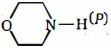
When $(P)$ undergoes Hoffmann exhaustive methylation (twice) then the product obtained will be
A
Divinyl ether
B
$N$,$N$-dimethylvinylamine
C
Divinylamine
D
Cyclohexene
Solution
(A) The starting material $(P)$ is morpholine.
$1$. First,exhaustive methylation of the secondary amine $(P)$ with excess $CH_3I$ followed by treatment with $Ag_2O/H_2O$ and heat (Hofmann elimination) leads to the ring opening and formation of an intermediate.
$2$. The second round of exhaustive methylation and elimination removes the nitrogen group entirely.
$3$. The final product obtained is divinyl ether,which has the structure $CH_2=CH-O-CH=CH_2$.
$1$. First,exhaustive methylation of the secondary amine $(P)$ with excess $CH_3I$ followed by treatment with $Ag_2O/H_2O$ and heat (Hofmann elimination) leads to the ring opening and formation of an intermediate.
$2$. The second round of exhaustive methylation and elimination removes the nitrogen group entirely.
$3$. The final product obtained is divinyl ether,which has the structure $CH_2=CH-O-CH=CH_2$.
0 likes
View Solution508
MediumMCQ
What product will be formed from the Hofmann exhaustive methylation of the following compound?
$CH_3-CH(CH_3)-CH_2-NH-CH_2-CH_2-CH_3 \xrightarrow[(i) CH_3I (excess), (ii) Ag_2O, (iii) \Delta]{} \text{Product}$
$CH_3-CH(CH_3)-CH_2-NH-CH_2-CH_2-CH_3 \xrightarrow[(i) CH_3I (excess), (ii) Ag_2O, (iii) \Delta]{} \text{Product}$
A
$CH_3-CH=CH_2$
B
$CH_2=CH_2$
C
$CH_3-C(CH_3)=CH_2$
D
$CH_3-CH(CH_3)-CH=CH_2$
Solution
(A) Hofmann exhaustive methylation involves the formation of a quaternary ammonium hydroxide followed by thermal decomposition (Hofmann elimination).
The elimination follows Hofmann's rule,which states that the least substituted alkene is the major product.
The nitrogen atom is attached to an isobutyl group $(CH_3-CH(CH_3)-CH_2-)$ and a propyl group $(-CH_2-CH_2-CH_3)$.
Elimination from the propyl group yields propene $(CH_3-CH=CH_2)$,which is a monosubstituted alkene.
Elimination from the isobutyl group yields isobutylene $(CH_3-C(CH_3)=CH_2)$,which is a disubstituted alkene.
According to Hofmann's rule,the less substituted alkene,propene,is the major product.
The elimination follows Hofmann's rule,which states that the least substituted alkene is the major product.
The nitrogen atom is attached to an isobutyl group $(CH_3-CH(CH_3)-CH_2-)$ and a propyl group $(-CH_2-CH_2-CH_3)$.
Elimination from the propyl group yields propene $(CH_3-CH=CH_2)$,which is a monosubstituted alkene.
Elimination from the isobutyl group yields isobutylene $(CH_3-C(CH_3)=CH_2)$,which is a disubstituted alkene.
According to Hofmann's rule,the less substituted alkene,propene,is the major product.
0 likes
View Solution509
DifficultMCQ
The product $(C)$ in the above reaction is:

A
Cyclohepta$-1,3-$diene
B
Cyclohepta$-1,4-$diene
C
$N,N$-dimethylcyclohepta$-2,4-$dienamine
D
Cyclohexa$-1,3-$diene
Solution
(A) The starting material is tropine (a bicyclic amine with a hydroxyl group).
$1$. Treatment with conc. $H_2SO_4$ causes dehydration of the alcohol to form the alkene,tropidine $(A)$.
$2$. Tropidine undergoes Hoffmann exhaustive methylation:
$(i)$ Reaction with $MeI$ forms the quaternary ammonium salt.
(ii) Reaction with $AgOH$ replaces $I^-$ with $OH^-$.
(iii) Heating $(\Delta)$ causes elimination to form the diene,cyclohepta$-1,3-$diene $(B)$.
$3$. Repeating the Hoffmann exhaustive methylation on the remaining amine moiety (if applicable) or further elimination leads to the final product. However,based on the standard reaction sequence for tropine,the final product $(C)$ is cyclohepta$-1,3-$diene.
$1$. Treatment with conc. $H_2SO_4$ causes dehydration of the alcohol to form the alkene,tropidine $(A)$.
$2$. Tropidine undergoes Hoffmann exhaustive methylation:
$(i)$ Reaction with $MeI$ forms the quaternary ammonium salt.
(ii) Reaction with $AgOH$ replaces $I^-$ with $OH^-$.
(iii) Heating $(\Delta)$ causes elimination to form the diene,cyclohepta$-1,3-$diene $(B)$.
$3$. Repeating the Hoffmann exhaustive methylation on the remaining amine moiety (if applicable) or further elimination leads to the final product. However,based on the standard reaction sequence for tropine,the final product $(C)$ is cyclohepta$-1,3-$diene.
0 likes
View Solution510
MediumMCQ
$(A)$ $\xrightarrow[(1) \text{ excess } CH_3I/K_2CO_3, (2) \text{ } Ag_2O/H_2O, (3) \text{ } \Delta]{} (B)$ $\xrightarrow[(i) \text{ excess } CH_3I/K_2CO_3, (ii) \text{ } Ag_2O, (iii) \text{ } \Delta]{} H_2C=CH-CH(CH_3)-CH=CH_2$. Identify $(A)$.
A
Piperidine
B
$3-$Methylpiperidine
C
$4-$Methylpiperidine
D
$2-$Methylpiperidine
Solution
(C) The reaction sequence is the Hofmann exhaustive methylation,which is used to determine the structure of amines by converting them into alkenes through quaternary ammonium salts.
Starting from $(A)$,the first sequence of reactions produces $(B)$,and the second sequence produces $H_2C=CH-CH(CH_3)-CH=CH_2$ ($3$-methyl$-1,4-$pentadiene).
By analyzing the product $H_2C=CH-CH(CH_3)-CH=CH_2$,it can be traced back to the cyclic amine $4-$methylpiperidine.
In $4-$methylpiperidine,the nitrogen is at position $1$ and the methyl group is at position $4$.
Upon exhaustive methylation and elimination,the ring opens to form the observed diene product.
Therefore,$(A)$ is $4-$methylpiperidine.
Starting from $(A)$,the first sequence of reactions produces $(B)$,and the second sequence produces $H_2C=CH-CH(CH_3)-CH=CH_2$ ($3$-methyl$-1,4-$pentadiene).
By analyzing the product $H_2C=CH-CH(CH_3)-CH=CH_2$,it can be traced back to the cyclic amine $4-$methylpiperidine.
In $4-$methylpiperidine,the nitrogen is at position $1$ and the methyl group is at position $4$.
Upon exhaustive methylation and elimination,the ring opens to form the observed diene product.
Therefore,$(A)$ is $4-$methylpiperidine.
0 likes
View Solution511
MediumMCQ
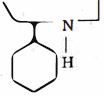
What is the major product of the reaction when the given compound undergoes Hofmann exhaustive methylation?
A
Cyclohexyl-ethyl-methyl-amine
B
Ethyl-cyclohexyl-methyl-amine
C
$N$,$N$-dimethylcyclohexanamine
D
$H_2C = CH_2$
Solution
(D) Hofmann exhaustive methylation involves the following steps:
$1$. The amine reacts with excess $CH_3I$ to form a quaternary ammonium salt.
$2$. Treatment with moist $Ag_2O$ $(AgOH)$ replaces the iodide ion with a hydroxide ion.
$3$. Upon heating,the quaternary ammonium hydroxide undergoes an elimination reaction (Hofmann elimination) to form an alkene and a tertiary amine.
In the given compound,the nitrogen is attached to a cyclohexyl group and an ethyl group. During elimination,the $OH^-$ base abstracts a proton from the $\beta$-carbon of the ethyl group,leading to the formation of ethene $(H_2C = CH_2)$ as the alkene product and $N,N$-dimethylcyclohexanamine as the tertiary amine. The question asks for the major product,which is the alkene $H_2C = CH_2$.
$1$. The amine reacts with excess $CH_3I$ to form a quaternary ammonium salt.
$2$. Treatment with moist $Ag_2O$ $(AgOH)$ replaces the iodide ion with a hydroxide ion.
$3$. Upon heating,the quaternary ammonium hydroxide undergoes an elimination reaction (Hofmann elimination) to form an alkene and a tertiary amine.
In the given compound,the nitrogen is attached to a cyclohexyl group and an ethyl group. During elimination,the $OH^-$ base abstracts a proton from the $\beta$-carbon of the ethyl group,leading to the formation of ethene $(H_2C = CH_2)$ as the alkene product and $N,N$-dimethylcyclohexanamine as the tertiary amine. The question asks for the major product,which is the alkene $H_2C = CH_2$.
0 likes
View Solution512
MediumMCQ
The reaction of $N$-ethylcyclohexanamine with excess $CH_3I$ yields a product. Identify the product.
A
a primary amine
B
a tertiary amine
C
a secondary amine
D
a quaternary ammonium salt
Solution
(D) The reaction involves the nucleophilic substitution of $CH_3I$ by the nitrogen atom of the amine.
Since $CH_3I$ is present in excess,the amine undergoes exhaustive methylation.
The secondary amine ($N$-ethylcyclohexanamine) reacts with $CH_3I$ to form a tertiary amine,which further reacts with another molecule of $CH_3I$ to form a quaternary ammonium salt.
The final product is a quaternary ammonium salt,specifically $N,N$-dimethyl-$N$-ethylcyclohexanaminium iodide.
Since $CH_3I$ is present in excess,the amine undergoes exhaustive methylation.
The secondary amine ($N$-ethylcyclohexanamine) reacts with $CH_3I$ to form a tertiary amine,which further reacts with another molecule of $CH_3I$ to form a quaternary ammonium salt.
The final product is a quaternary ammonium salt,specifically $N,N$-dimethyl-$N$-ethylcyclohexanaminium iodide.
0 likes
View Solution513
MediumMCQ
Which of the following compounds gives an even number of Hoffmann's exhaustive methylation and elimination cycles?
A
Piperidine
B
Decahydroquinoline
C
Quinolizidine
D
Both $(a)$ and $(b)$
Solution
(D) Hoffmann's exhaustive methylation $(HEM)$ and elimination is a process used to degrade amines. The number of cycles required depends on the structure of the amine.
$(a)$ Piperidine is a secondary cyclic amine. It undergoes $2$ cycles of $HEM$ and elimination to form $1,5$-pentadiene.
$(b)$ Decahydroquinoline is a secondary cyclic amine. It also undergoes $2$ cycles of $HEM$ and elimination.
Since both $(a)$ and $(b)$ undergo an even number $(2)$ of cycles,the correct option is $(d)$.
$(a)$ Piperidine is a secondary cyclic amine. It undergoes $2$ cycles of $HEM$ and elimination to form $1,5$-pentadiene.
$(b)$ Decahydroquinoline is a secondary cyclic amine. It also undergoes $2$ cycles of $HEM$ and elimination.
Since both $(a)$ and $(b)$ undergo an even number $(2)$ of cycles,the correct option is $(d)$.
0 likes
View Solution514
DifficultMCQ
In the reactions given below,
$R-Cl \xrightarrow{(i)\, KCN, (ii)\, LiAlH_4}$ Product $A$
$R-Cl \xrightarrow{(i)\, AgCN, (ii)\, LiAlH_4}$ Product $B$
the compounds $A$ and $B$ are
$R-Cl \xrightarrow{(i)\, KCN, (ii)\, LiAlH_4}$ Product $A$
$R-Cl \xrightarrow{(i)\, AgCN, (ii)\, LiAlH_4}$ Product $B$
the compounds $A$ and $B$ are
A
chain isomers
B
position isomers
C
functional isomers
D
metamers
Solution
(C) $R-Cl$ $\xrightarrow{(i)\, KCN} R-CN$ $\xrightarrow{LiAlH_4} R-CH_2-NH_2$ (primary amine)
$R-Cl$ $\xrightarrow{(i)\, AgCN} R-NC$ $\xrightarrow{LiAlH_4} R-NH-CH_3$ (secondary amine)
Since $A$ is a primary amine and $B$ is a secondary amine,they have different functional groups attached to the alkyl chain. Thus,$A$ and $B$ are functional isomers.
$R-Cl$ $\xrightarrow{(i)\, AgCN} R-NC$ $\xrightarrow{LiAlH_4} R-NH-CH_3$ (secondary amine)
Since $A$ is a primary amine and $B$ is a secondary amine,they have different functional groups attached to the alkyl chain. Thus,$A$ and $B$ are functional isomers.
0 likes
View Solution515
MediumMCQ
$Br-CH_2-(CH_2)_2-CH_2-Br + CH_3NH_2 \to$ The product of the reaction is:
A
$N$-methylpyrrolidine
B
Pyrrolidine
C
$1-$methyl$-1-$azacyclopentane
D
$N$-methylpyrrolidine (Correct structure)
Solution
(A) The reaction is an intramolecular nucleophilic substitution $(S_N2)$ reaction.
$1$. The lone pair on the nitrogen atom of $CH_3NH_2$ attacks one of the terminal carbon atoms of $Br-(CH_2)_4-Br$,displacing a $Br^-$ ion.
$2$. This forms a secondary amine intermediate: $CH_3-NH_2^+-CH_2-(CH_2)_2-CH_2-Br$.
$3$. $A$ proton is lost from the nitrogen to form $CH_3-NH-CH_2-(CH_2)_2-CH_2-Br$.
$4$. The lone pair on the nitrogen then attacks the other terminal carbon atom,leading to ring closure (cyclization) and the loss of the second $Br^-$ ion.
$5$. The final product is $N$-methylpyrrolidine,which is a five-membered ring containing nitrogen with a methyl group attached to the nitrogen atom.
$1$. The lone pair on the nitrogen atom of $CH_3NH_2$ attacks one of the terminal carbon atoms of $Br-(CH_2)_4-Br$,displacing a $Br^-$ ion.
$2$. This forms a secondary amine intermediate: $CH_3-NH_2^+-CH_2-(CH_2)_2-CH_2-Br$.
$3$. $A$ proton is lost from the nitrogen to form $CH_3-NH-CH_2-(CH_2)_2-CH_2-Br$.
$4$. The lone pair on the nitrogen then attacks the other terminal carbon atom,leading to ring closure (cyclization) and the loss of the second $Br^-$ ion.
$5$. The final product is $N$-methylpyrrolidine,which is a five-membered ring containing nitrogen with a methyl group attached to the nitrogen atom.
0 likes
View Solution516
DifficultMCQ
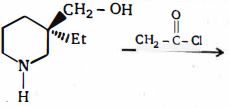
Predict the major product $(A)$ for the following reaction:
A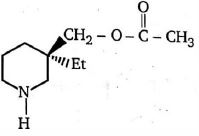
B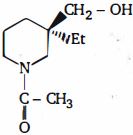
C
D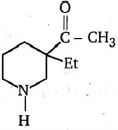
Solution
(B) The reactant is a secondary amine with a primary alcohol group. The reagent is an acid chloride $(CH_3COCl)$.
Nitrogen in the amine is more nucleophilic than the oxygen in the alcohol.
Therefore,the nitrogen atom will attack the carbonyl carbon of the acid chloride,leading to the formation of an amide.
The product $(A)$ is the $N$-acetylated derivative.
Nitrogen in the amine is more nucleophilic than the oxygen in the alcohol.
Therefore,the nitrogen atom will attack the carbonyl carbon of the acid chloride,leading to the formation of an amide.
The product $(A)$ is the $N$-acetylated derivative.
0 likes
View Solution517
DifficultMCQ
The product $(A)$ of the following reaction is:
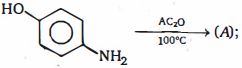
A
$4-$acetamidophenyl acetate
B
$4-$aminophenol
C
$4-$acetamidophenol
D
$3-$acetamidophenyl acetate
Solution
(C) The reaction involves the acetylation of $4$-aminophenol with acetic anhydride $(Ac_2O)$.
$4$-aminophenol contains two nucleophilic sites: the phenolic $-OH$ group and the amino $-NH_2$ group.
The amino group is a better nucleophile than the phenolic $-OH$ group due to the lower electronegativity of nitrogen compared to oxygen.
Therefore,the acetylation occurs selectively at the $-NH_2$ group to form $N$-($4$-hydroxyphenyl)acetamide,also known as $4$-acetamidophenol (paracetamol).
The reaction is: $H_2N-C_6H_4-OH + (CH_3CO)_2O \xrightarrow{100^{\circ}C} CH_3CONH-C_6H_4-OH + CH_3COOH$.
$4$-aminophenol contains two nucleophilic sites: the phenolic $-OH$ group and the amino $-NH_2$ group.
The amino group is a better nucleophile than the phenolic $-OH$ group due to the lower electronegativity of nitrogen compared to oxygen.
Therefore,the acetylation occurs selectively at the $-NH_2$ group to form $N$-($4$-hydroxyphenyl)acetamide,also known as $4$-acetamidophenol (paracetamol).
The reaction is: $H_2N-C_6H_4-OH + (CH_3CO)_2O \xrightarrow{100^{\circ}C} CH_3CONH-C_6H_4-OH + CH_3COOH$.
0 likes
View Solution518
DifficultMCQ
Succinic acid $\xrightarrow{\Delta } (A)$ $\xrightarrow[\Delta ]{NH_3} (B)$ $\xrightarrow[KOH]{Br_2} (C);$ Product $(C)$ will be
A
$CH_2(COOH)-CH_2-CH_2NH_2$
B
$CH_2(COOH)-CH_2NH_2$
C
$CH_2(COO^-K^+)-CH_2NH_2$
D
$CH_2(COOH)-CH_2-CH_2Br$
Solution
(C) $1$. Succinic acid on heating loses a water molecule to form succinic anhydride $(A)$.
$2$. Succinic anhydride reacts with $NH_3$ followed by heating to form succinimide $(B)$.
$3$. Succinimide undergoes the Hofmann bromamide degradation reaction with $Br_2/KOH$. This reaction converts an amide group into a primary amine with the loss of one carbon atom as $CO_2$. In this case,the ring opens to form $\beta$-alanine derivative,specifically $\beta$-aminopropionate potassium salt,$CH_2(COO^-K^+)-CH_2NH_2$.
$2$. Succinic anhydride reacts with $NH_3$ followed by heating to form succinimide $(B)$.
$3$. Succinimide undergoes the Hofmann bromamide degradation reaction with $Br_2/KOH$. This reaction converts an amide group into a primary amine with the loss of one carbon atom as $CO_2$. In this case,the ring opens to form $\beta$-alanine derivative,specifically $\beta$-aminopropionate potassium salt,$CH_2(COO^-K^+)-CH_2NH_2$.
0 likes
View Solution519
MediumMCQ
In the following sequence $CH_3CH_2Cl$ $\xrightarrow{NaCN} (i)$ $\xrightarrow{Ni/H_2} (ii)$ $\xrightarrow{\text{acetic anhydride}} (iii)$,Product $(iii)$ is
A
$CH_3CH_2CH_2NH_2$
B
$CH_3CH_2CH_2CONHCH_3$
C
$CH_3CH_2CH_2NHCOCH_3$
D
$CH_3CH_2CH_2CONHCOCH_3$
Solution
(C) Step $1$: $CH_3CH_2Cl + NaCN \rightarrow CH_3CH_2CN + NaCl$. Product $(i)$ is propanenitrile $(CH_3CH_2CN)$.
Step $2$: $CH_3CH_2CN + 2H_2 \xrightarrow{Ni} CH_3CH_2CH_2NH_2$. Product $(ii)$ is propan$-1-$amine $(CH_3CH_2CH_2NH_2)$.
Step $3$: $CH_3CH_2CH_2NH_2 + (CH_3CO)_2O \rightarrow CH_3CH_2CH_2NHCOCH_3 + CH_3COOH$. Product $(iii)$ is $N$-propylacetamide $(CH_3CH_2CH_2NHCOCH_3)$.
Step $2$: $CH_3CH_2CN + 2H_2 \xrightarrow{Ni} CH_3CH_2CH_2NH_2$. Product $(ii)$ is propan$-1-$amine $(CH_3CH_2CH_2NH_2)$.
Step $3$: $CH_3CH_2CH_2NH_2 + (CH_3CO)_2O \rightarrow CH_3CH_2CH_2NHCOCH_3 + CH_3COOH$. Product $(iii)$ is $N$-propylacetamide $(CH_3CH_2CH_2NHCOCH_3)$.
0 likes
View Solution520
AdvancedMCQ
Product $(A)$ is

A
Decahydroquinoline
B
Tetrahydroquinoline
C
Quinoline
D
None of these
Solution
(A) The reaction involves the intramolecular cyclization of $2-(3-aminopropyl)cyclohexanone$ to form an imine intermediate,which is then reduced by $H_2/Ni$ to form the final product,decahydroquinoline.
$1$. The amino group $(-NH_2)$ attacks the carbonyl carbon $(C=O)$ of the ketone,leading to the loss of a water molecule $(H_2O)$ and the formation of a cyclic imine.
$2$. The cyclic imine is then hydrogenated in the presence of $H_2/Ni$ to yield the saturated bicyclic amine,decahydroquinoline.
$1$. The amino group $(-NH_2)$ attacks the carbonyl carbon $(C=O)$ of the ketone,leading to the loss of a water molecule $(H_2O)$ and the formation of a cyclic imine.
$2$. The cyclic imine is then hydrogenated in the presence of $H_2/Ni$ to yield the saturated bicyclic amine,decahydroquinoline.
0 likes
View Solution521
DifficultMCQ
The reaction sequence is given as follows:
$CH_3-CO-CH_2-CH_2-CO-CH_3$ $\xrightarrow[(NH_4)_2CO_3]{\Delta} (A)$ $\xrightarrow[CCl_3CO_2Na]{\Delta} (B)$
Product $(B)$ of the above reaction is:
$CH_3-CO-CH_2-CH_2-CO-CH_3$ $\xrightarrow[(NH_4)_2CO_3]{\Delta} (A)$ $\xrightarrow[CCl_3CO_2Na]{\Delta} (B)$
Product $(B)$ of the above reaction is:
A
$3-$chloro$-2,6-$dimethylpyridine
B
$4-$chloro$-2,6-$dimethylpyridine
C
$3-$chloro$-2,5-$dimethylpyridine
D
$3-$chloro$-2,4-$dimethylpyridine
Solution
(A) Step $1$: The reaction of $CH_3-CO-CH_2-CH_2-CO-CH_3$ (hexane$-2,5-$dione) with $(NH_4)_2CO_3$ is a Paal-Knorr pyrrole synthesis,which yields $2,5-$dimethylpyrrole as product $(A)$.
Step $2$: The reaction of $2,5-$dimethylpyrrole with $CCl_3CO_2Na$ (sodium trichloroacetate) under heating is an abnormal Reimer-Tiemann reaction. This reaction involves the insertion of a dichlorocarbene $(:CCl_2)$ species into the pyrrole ring,followed by ring expansion to form a pyridine derivative.
Step $3$: The product $(B)$ formed is $3-$chloro$-2,6-$dimethylpyridine.
Step $2$: The reaction of $2,5-$dimethylpyrrole with $CCl_3CO_2Na$ (sodium trichloroacetate) under heating is an abnormal Reimer-Tiemann reaction. This reaction involves the insertion of a dichlorocarbene $(:CCl_2)$ species into the pyrrole ring,followed by ring expansion to form a pyridine derivative.
Step $3$: The product $(B)$ formed is $3-$chloro$-2,6-$dimethylpyridine.
0 likes
View Solution522
DifficultMCQ
Product of the reaction is
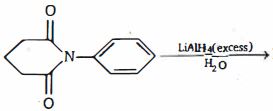
A
$1,5-$pentanediol
B
Aniline
C
$N$-phenylpiperidine
D
$2,6-$dihydroxypiperidine derivative
Solution
(C) The reaction involves the reduction of an imide ($N$-phenylglutarimide) using an excess of $LiAlH_4$ (Lithium Aluminium Hydride).
$LiAlH_4$ is a strong reducing agent that reduces imides to amines.
Specifically,the two carbonyl groups $(C=O)$ of the imide are reduced to methylene groups $(-CH_2-)$.
Therefore,the product formed is $N$-phenylpiperidine.
$LiAlH_4$ is a strong reducing agent that reduces imides to amines.
Specifically,the two carbonyl groups $(C=O)$ of the imide are reduced to methylene groups $(-CH_2-)$.
Therefore,the product formed is $N$-phenylpiperidine.
0 likes
View Solution523
AdvancedMCQ
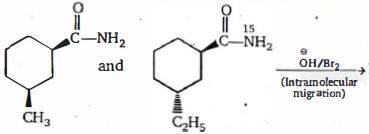
The reaction of amides with $Br_2$ and $OH^-$ (Hofmann bromamide degradation) involves an intramolecular migration of the alkyl group from the carbonyl carbon to the nitrogen atom with retention of configuration at the migrating center. Predict the products for the following reaction:
(Image shows two substituted cyclohexanecarboxamides reacting with $Br_2/OH^-$)
(Image shows two substituted cyclohexanecarboxamides reacting with $Br_2/OH^-$)
A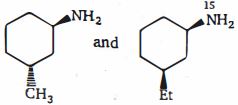
B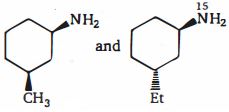
C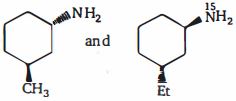
D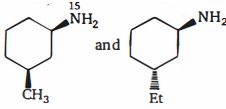
Solution
(B) The Hofmann bromamide degradation reaction proceeds through the formation of an isocyanate intermediate.
In this mechanism,the alkyl group attached to the carbonyl carbon migrates to the nitrogen atom.
Crucially,this migration occurs with retention of configuration at the chiral center of the migrating alkyl group.
Since the starting materials have the amide group and the alkyl substituent in a specific stereochemical orientation (cis/trans),the resulting amine will maintain the same relative stereochemistry because the bond between the chiral carbon and the carbonyl group is never broken during the migration step.
Therefore,the configuration of the chiral center in the cyclohexane ring remains unchanged in the product amine.
In this mechanism,the alkyl group attached to the carbonyl carbon migrates to the nitrogen atom.
Crucially,this migration occurs with retention of configuration at the chiral center of the migrating alkyl group.
Since the starting materials have the amide group and the alkyl substituent in a specific stereochemical orientation (cis/trans),the resulting amine will maintain the same relative stereochemistry because the bond between the chiral carbon and the carbonyl group is never broken during the migration step.
Therefore,the configuration of the chiral center in the cyclohexane ring remains unchanged in the product amine.
0 likes
View Solution524
MediumMCQ
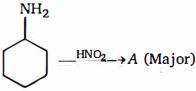
The product $(A)$ is:
A
Cyclohexanol
B
Bicyclohexyl
C
$N$-nitrocyclohexylamine
D
Cyclohexyl nitrite
Solution
(A) The reaction of a primary aliphatic amine with nitrous acid $(HNO_2)$ leads to the formation of an unstable diazonium salt,which rapidly decomposes to form a carbocation. This carbocation then reacts with water to form an alcohol as the major product. In this case,cyclohexylamine reacts with $HNO_2$ to give cyclohexanol as the major product $(A)$.
0 likes
View Solution525
AdvancedMCQ
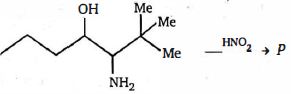
Predict the major product $P$ in the following reaction.
A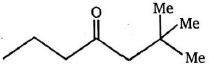
B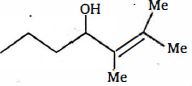
C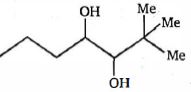
D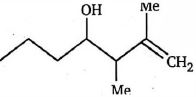
Solution
(A) The reaction of a $\beta$-amino alcohol with $HNO_2$ (nitrous acid) leads to the formation of a diazonium salt,which is unstable and loses $N_2$ gas to form a carbocation at the carbon atom originally attached to the $-NH_2$ group.
This carbocation undergoes a $1,2$-hydride shift to form a more stable carbocation adjacent to the $-OH$ group.
The lone pair on the oxygen atom of the $-OH$ group then stabilizes the carbocation by forming a $C=O$ double bond,resulting in the formation of a ketone.
Based on the structure provided,the major product is the ketone shown in option $A$.
This carbocation undergoes a $1,2$-hydride shift to form a more stable carbocation adjacent to the $-OH$ group.
The lone pair on the oxygen atom of the $-OH$ group then stabilizes the carbocation by forming a $C=O$ double bond,resulting in the formation of a ketone.
Based on the structure provided,the major product is the ketone shown in option $A$.
0 likes
View Solution526
DifficultMCQ
The product of this reaction is:
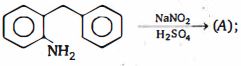
A
Fluorene
B
Anthracene
C
Phenanthrene
D
Naphthalene
Solution
(A) The reaction of $2$-aminodiphenylmethane with $NaNO_2$ and $H_2SO_4$ (diazotization) forms a diazonium salt intermediate.
This diazonium salt then undergoes an intramolecular electrophilic aromatic substitution reaction.
The diazonium group acts as an electrophile,attacking the other benzene ring to form a new $C-C$ bond,resulting in the formation of fluorene.
This diazonium salt then undergoes an intramolecular electrophilic aromatic substitution reaction.
The diazonium group acts as an electrophile,attacking the other benzene ring to form a new $C-C$ bond,resulting in the formation of fluorene.
0 likes
View Solution527
AdvancedMCQ
In the given reaction,$A$ will be:
$\text{Cyclopropylmethylamine} \xrightarrow{HNO_2} (A) + \text{cyclobutanol} (47\%) + \text{but-3-en-1-ol} (5\%)$
$\text{Cyclopropylmethylamine} \xrightarrow{HNO_2} (A) + \text{cyclobutanol} (47\%) + \text{but-3-en-1-ol} (5\%)$
A
Cyclopropylmethanol
B
Cyclobutylamine
C
Cyclobutene
D
Cyclopropane
Solution
(A) The reaction of primary aliphatic amines with nitrous acid $(HNO_2)$ proceeds via the formation of a highly unstable diazonium salt,which rapidly loses nitrogen gas to form a carbocation intermediate.
In the case of cyclopropylmethylamine,the initial carbocation formed is the cyclopropylmethyl cation. This cation is in equilibrium with the cyclobutyl cation and the homoallyl cation due to ring expansion and rearrangement processes.
These carbocations then react with water (the nucleophile) to form the corresponding alcohols. The major product $(A)$ formed in this reaction is cyclopropylmethanol,which accounts for $48\%$ of the product mixture.
Therefore,$A$ is cyclopropylmethanol.
In the case of cyclopropylmethylamine,the initial carbocation formed is the cyclopropylmethyl cation. This cation is in equilibrium with the cyclobutyl cation and the homoallyl cation due to ring expansion and rearrangement processes.
These carbocations then react with water (the nucleophile) to form the corresponding alcohols. The major product $(A)$ formed in this reaction is cyclopropylmethanol,which accounts for $48\%$ of the product mixture.
Therefore,$A$ is cyclopropylmethanol.
0 likes
View Solution528
MediumMCQ
Which of the following isomers of $C_8H_9NO$ is the weakest base?
A
$o-$Aminoacetophenone
B
$p-$Aminoacetophenone
C
$m-$Aminoacetophenone
D
Acetanilide
Solution
(D) The basicity of an amine depends on the availability of the lone pair of electrons on the nitrogen atom.
In $o-$,$m-$,and $p-$aminoacetophenone,the lone pair on the nitrogen atom of the $-NH_2$ group is available for protonation,although it is involved in resonance with the benzene ring.
In Acetanilide $(C_6H_5NHCOCH_3)$,the lone pair on the nitrogen atom is involved in resonance with the carbonyl group $(-C=O)$ of the acetyl group,forming a stable amide structure: $C_6H_5-NH-C(=O)CH_3 \leftrightarrow C_6H_5-NH^+=C(O^-)CH_3$.
This strong resonance with the electron-withdrawing carbonyl group significantly reduces the electron density on the nitrogen atom,making it much less available for protonation compared to the amino group in the other isomers.
Therefore,Acetanilide is the weakest base among the given options.
In $o-$,$m-$,and $p-$aminoacetophenone,the lone pair on the nitrogen atom of the $-NH_2$ group is available for protonation,although it is involved in resonance with the benzene ring.
In Acetanilide $(C_6H_5NHCOCH_3)$,the lone pair on the nitrogen atom is involved in resonance with the carbonyl group $(-C=O)$ of the acetyl group,forming a stable amide structure: $C_6H_5-NH-C(=O)CH_3 \leftrightarrow C_6H_5-NH^+=C(O^-)CH_3$.
This strong resonance with the electron-withdrawing carbonyl group significantly reduces the electron density on the nitrogen atom,making it much less available for protonation compared to the amino group in the other isomers.
Therefore,Acetanilide is the weakest base among the given options.
0 likes
View Solution529
MediumMCQ
Which of the following arylamines will not form a diazonium salt on reaction with sodium nitrite in hydrochloric acid?
A
$m-$Ethylaniline
B
$p-$Aminoacetophenone
C
$4-$Chloro$-2-$nitroaniline
D
$N-$Ethyl$-2-$methylaniline
Solution
(D) Primary $(1^{\circ})$ aromatic amines react with $NaNO_2$ and $HCl$ at $0-5^{\circ}C$ to form stable diazonium salts.
Secondary $(2^{\circ})$ amines,such as $N-$ethyl$-2-$methylaniline,react with $NaNO_2$ and $HCl$ to form $N-$nitrosoamines,not diazonium salts.
Therefore,$N-$ethyl$-2-$methylaniline will not form a diazonium salt.
Secondary $(2^{\circ})$ amines,such as $N-$ethyl$-2-$methylaniline,react with $NaNO_2$ and $HCl$ to form $N-$nitrosoamines,not diazonium salts.
Therefore,$N-$ethyl$-2-$methylaniline will not form a diazonium salt.
0 likes
View Solution530
DifficultMCQ
Identify product $D$ in the following reaction sequence:
$CH_3-C(CH_3)_2-CH_2-CH_2-OH$ $\xrightarrow[H_2O, \text{heat}]{K_2Cr_2O_7, H_2SO_4} A$ $\xrightarrow{SOCl_2} B$ $\xrightarrow{2(CH_3)_2NH} C$ $\xrightarrow[2. H_2O]{1. LiAlH_4, \text{diethyl ether}} D$
$CH_3-C(CH_3)_2-CH_2-CH_2-OH$ $\xrightarrow[H_2O, \text{heat}]{K_2Cr_2O_7, H_2SO_4} A$ $\xrightarrow{SOCl_2} B$ $\xrightarrow{2(CH_3)_2NH} C$ $\xrightarrow[2. H_2O]{1. LiAlH_4, \text{diethyl ether}} D$
A
$CH_3-C(CH_3)_2-CH_2-CN$
B
$CH_3-C(CH_3)_2-CH_2-CH_2-N(CH_3)_2$
C
$CH_3-C(CH_3)_2-CH_2-CH(N(CH_3)_2)_2$
D
$CH_3-C(CH_3)_2-CH_2-CH(OH)N(CH_3)_2$
Solution
(B) The reaction sequence is as follows:
$1.$ Oxidation: $CH_3-C(CH_3)_2-CH_2-CH_2-OH \xrightarrow{K_2Cr_2O_7/H^{+}} CH_3-C(CH_3)_2-CH_2-COOH$ (Product $A$)
$2.$ Chlorination: $CH_3-C(CH_3)_2-CH_2-COOH \xrightarrow{SOCl_2} CH_3-C(CH_3)_2-CH_2-COCl$ (Product $B$)
$3.$ Amidation: $CH_3-C(CH_3)_2-CH_2-COCl \xrightarrow{2(CH_3)_2NH} CH_3-C(CH_3)_2-CH_2-CON(CH_3)_2$ (Product $C$)
$4.$ Reduction: $CH_3-C(CH_3)_2-CH_2-CON(CH_3)_2 \xrightarrow{LiAlH_4/H_2O} CH_3-C(CH_3)_2-CH_2-CH_2-N(CH_3)_2$ (Product $D$)
Therefore,the correct product $D$ is $CH_3-C(CH_3)_2-CH_2-CH_2-N(CH_3)_2$,which corresponds to option $B$.
$1.$ Oxidation: $CH_3-C(CH_3)_2-CH_2-CH_2-OH \xrightarrow{K_2Cr_2O_7/H^{+}} CH_3-C(CH_3)_2-CH_2-COOH$ (Product $A$)
$2.$ Chlorination: $CH_3-C(CH_3)_2-CH_2-COOH \xrightarrow{SOCl_2} CH_3-C(CH_3)_2-CH_2-COCl$ (Product $B$)
$3.$ Amidation: $CH_3-C(CH_3)_2-CH_2-COCl \xrightarrow{2(CH_3)_2NH} CH_3-C(CH_3)_2-CH_2-CON(CH_3)_2$ (Product $C$)
$4.$ Reduction: $CH_3-C(CH_3)_2-CH_2-CON(CH_3)_2 \xrightarrow{LiAlH_4/H_2O} CH_3-C(CH_3)_2-CH_2-CH_2-N(CH_3)_2$ (Product $D$)
Therefore,the correct product $D$ is $CH_3-C(CH_3)_2-CH_2-CH_2-N(CH_3)_2$,which corresponds to option $B$.
0 likes
View Solution531
DifficultMCQ
The major products obtained from the following sequence of reactions are
$(CH_3)_2CHCH_2N(CH_2CH_3)_2$ $\xrightarrow{CH_3I}$ $\xrightarrow[H_2O]{Ag_2O}$ $\xrightarrow{\Delta} \text{products}$
$(CH_3)_2CHCH_2N(CH_2CH_3)_2$ $\xrightarrow{CH_3I}$ $\xrightarrow[H_2O]{Ag_2O}$ $\xrightarrow{\Delta} \text{products}$
A
$(CH_3)_2CHCH_2NH_2 + H_2C = CH_2$
B
$(CH_3)_2NCH_2CH_3 + H_2C = C(CH_3)_2$
C
$(CH_3)_2CHCH_2N(CH_3)CH_2CH_3 + H_2C = CH_2$
D
$(CH_3)_3\overset{+}{N}CH_2CH_3I^{-} + H_2C = CH_2$
Solution
(C) The reaction sequence is an example of Hofmann elimination.
$1$. The amine $(CH_3)_2CHCH_2N(CH_2CH_3)_2$ reacts with excess $CH_3I$ to form the quaternary ammonium salt $(CH_3)_2CHCH_2N(CH_2CH_3)_2(CH_3)^+ I^-$.
$2$. Treatment with $Ag_2O/H_2O$ converts the iodide salt into the corresponding quaternary ammonium hydroxide $(CH_3)_2CHCH_2N(CH_2CH_3)_2(CH_3)^+ OH^-$.
$3$. Upon heating,the Hofmann elimination occurs. The base (hydroxide) abstracts a $\beta$-hydrogen from the ethyl group (which is less sterically hindered than the isobutyl group),leading to the formation of ethene $(H_2C=CH_2)$ and the tertiary amine $(CH_3)_2CHCH_2N(CH_3)CH_2CH_3$.
$1$. The amine $(CH_3)_2CHCH_2N(CH_2CH_3)_2$ reacts with excess $CH_3I$ to form the quaternary ammonium salt $(CH_3)_2CHCH_2N(CH_2CH_3)_2(CH_3)^+ I^-$.
$2$. Treatment with $Ag_2O/H_2O$ converts the iodide salt into the corresponding quaternary ammonium hydroxide $(CH_3)_2CHCH_2N(CH_2CH_3)_2(CH_3)^+ OH^-$.
$3$. Upon heating,the Hofmann elimination occurs. The base (hydroxide) abstracts a $\beta$-hydrogen from the ethyl group (which is less sterically hindered than the isobutyl group),leading to the formation of ethene $(H_2C=CH_2)$ and the tertiary amine $(CH_3)_2CHCH_2N(CH_3)CH_2CH_3$.
0 likes
View Solution532
MediumMCQ
Which amine yields $N$-nitroso amine after treatment with nitrous acid $(NaNO_2, HCl)$?
A
$C_6H_5CH_2NH_2$
B
$CH_3-C_6H_4-NH_2$
C
$C_6H_5-N(CH_2)_5$ (piperidine derivative)
D
$C_6H_5NHCH_3$
Solution
(D) Secondary $(2^o)$ amines react with nitrous acid $(HNO_2)$,generated in situ from $NaNO_2$ and $HCl$,to form $N$-nitrosoamines,which are yellow oily compounds.
Among the given options,$C_6H_5NHCH_3$ is a secondary amine ($N$-methylaniline),which reacts with nitrous acid to yield $N$-nitroso-$N$-methylaniline.
$C_6H_5NHCH_3 + HNO_2 \rightarrow C_6H_5N(NO)CH_3 + H_2O$.
Among the given options,$C_6H_5NHCH_3$ is a secondary amine ($N$-methylaniline),which reacts with nitrous acid to yield $N$-nitroso-$N$-methylaniline.
$C_6H_5NHCH_3 + HNO_2 \rightarrow C_6H_5N(NO)CH_3 + H_2O$.
0 likes
View Solution533
DifficultMCQ
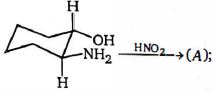
The product $(A)$ is:
A
cyclopentanecarbaldehyde
B
cyclohexane$-1,2-$diol
C
$2-$aminocyclohexene
D
cyclohex$-2-$enol
Solution
(A) The reaction of $2-$aminocyclohexanol with $HNO_2$ (nitrous acid) leads to the formation of a diazonium salt at the amino group.
Since the amino and hydroxyl groups are in a trans-diaxial orientation,the bond anti-periplanar to the leaving group (the $C-C$ bond of the ring) undergoes migration.
This results in ring contraction,converting the six-membered cyclohexane ring into a five-membered cyclopentane ring with a formyl group attached,yielding cyclopentanecarbaldehyde as the final product $(A)$.
Since the amino and hydroxyl groups are in a trans-diaxial orientation,the bond anti-periplanar to the leaving group (the $C-C$ bond of the ring) undergoes migration.
This results in ring contraction,converting the six-membered cyclohexane ring into a five-membered cyclopentane ring with a formyl group attached,yielding cyclopentanecarbaldehyde as the final product $(A)$.
0 likes
View Solution534
DifficultMCQ
Deamination (or) diazotization of $n$-butylamine $(CH_3CH_2CH_2CH_2NH_2)$ with $NaNO_2/HCl$ gives how many isomeric butenes?
A
$2$
B
$3$
C
$4$
D
$5$
Solution
(B) The reaction of $n$-butylamine with $NaNO_2/HCl$ proceeds via the formation of a diazonium salt,which is unstable and loses $N_2$ to form a primary carbocation $(CH_3CH_2CH_2CH_2^+)$.
This primary carbocation undergoes a $1,2$-hydride shift to form a more stable secondary carbocation $(CH_3CH_2CH^+CH_3)$.
The primary carbocation eliminates a proton to form $1$-butene $(CH_3CH_2CH=CH_2)$.
The secondary carbocation eliminates a proton to form a mixture of $cis$-$2$-butene and $trans$-$2$-butene.
Thus,the isomeric butenes formed are $1$-butene,$cis$-$2$-butene,and $trans$-$2$-butene,totaling $3$ isomers.
This primary carbocation undergoes a $1,2$-hydride shift to form a more stable secondary carbocation $(CH_3CH_2CH^+CH_3)$.
The primary carbocation eliminates a proton to form $1$-butene $(CH_3CH_2CH=CH_2)$.
The secondary carbocation eliminates a proton to form a mixture of $cis$-$2$-butene and $trans$-$2$-butene.
Thus,the isomeric butenes formed are $1$-butene,$cis$-$2$-butene,and $trans$-$2$-butene,totaling $3$ isomers.
0 likes
View Solution535
DifficultMCQ
The compound $X$ $(C_7H_9N)$ reacts with benzenesulfonyl chloride to give $Y$ $(C_{13}H_{13}NO_2S)$ which is insoluble in alkali. The compound $X$ is
A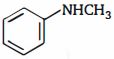
B
C
D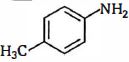
Solution
(A) The reaction of amines with benzenesulfonyl chloride is known as the Hinsberg test.
$1^{\circ}$ amines react to form a sulfonamide that contains an acidic hydrogen atom,making it soluble in alkali.
$2^{\circ}$ amines react to form a sulfonamide that does not contain an acidic hydrogen atom,making it insoluble in alkali.
$3^{\circ}$ amines do not react with benzenesulfonyl chloride.
Given that $X$ $(C_7H_9N)$ forms a product $Y$ that is insoluble in alkali,$X$ must be a secondary amine.
Among the given options,$N$-methylaniline $(C_6H_5NHCH_3)$ is a secondary amine,which corresponds to option $(A)$.
$1^{\circ}$ amines react to form a sulfonamide that contains an acidic hydrogen atom,making it soluble in alkali.
$2^{\circ}$ amines react to form a sulfonamide that does not contain an acidic hydrogen atom,making it insoluble in alkali.
$3^{\circ}$ amines do not react with benzenesulfonyl chloride.
Given that $X$ $(C_7H_9N)$ forms a product $Y$ that is insoluble in alkali,$X$ must be a secondary amine.
Among the given options,$N$-methylaniline $(C_6H_5NHCH_3)$ is a secondary amine,which corresponds to option $(A)$.
0 likes
View Solution536
DifficultMCQ
Which of the following will not give the Hoffmann bromamide reaction?
A
$CH_3-CONH_2$
B
$Ph-CONH_2$
C
$CH_3-CONHBr$
D
$Ph-CONH-Ph$
Solution
(D) The Hoffmann bromamide reaction requires a primary amide $(R-CONH_2)$ to react with $Br_2$ and $KOH$ to form an isocyanate intermediate,which subsequently yields a primary amine.
$N$-substituted amides like $Ph-CONH-Ph$ do not possess the necessary hydrogen atoms on the nitrogen to form the isocyanate intermediate,hence they do not undergo this reaction.
Therefore,the correct option is $D$.
$N$-substituted amides like $Ph-CONH-Ph$ do not possess the necessary hydrogen atoms on the nitrogen to form the isocyanate intermediate,hence they do not undergo this reaction.
Therefore,the correct option is $D$.
0 likes
View Solution537
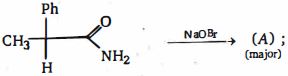
DifficultMCQ
The product of the reaction is:
A
$CH_3-C(Ph)(H)-NH_2$
B
$CH_3-C(Ph)(NH_2)-H$
C
$CH_3-C(H)(Ph)-NH_2$
D
$CH_3-C(Ph)(H)-NH$
Solution
(A) The reaction given is the Hofmann bromamide degradation reaction,where an amide is treated with $NaOBr$ (or $Br_2/NaOH$) to form a primary amine with one carbon atom less than the original amide.
In this reaction,the migration of the alkyl group from the carbonyl carbon to the nitrogen atom occurs with complete retention of configuration at the chiral center.
Starting material: $2$-phenylpropanamide.
Product: $1$-phenylethanamine.
Since the configuration is retained,the product is $1$-phenylethanamine with the same stereochemistry as the reactant.
In this reaction,the migration of the alkyl group from the carbonyl carbon to the nitrogen atom occurs with complete retention of configuration at the chiral center.
Starting material: $2$-phenylpropanamide.
Product: $1$-phenylethanamine.
Since the configuration is retained,the product is $1$-phenylethanamine with the same stereochemistry as the reactant.
0 likes
View Solution538
MediumMCQ
$R-CONH_2 + xNaOH + Br_2 \to R-NH_2 + 2NaBr + Na_2CO_3 + H_2O$
The number of moles of $NaOH$ used in the above Hoffmann bromamide reaction is:
The number of moles of $NaOH$ used in the above Hoffmann bromamide reaction is:
A
$3$
B
$4$
C
$5$
D
$6$
Solution
(B) The balanced chemical equation for the Hoffmann bromamide degradation reaction is:
$R-CONH_2 + 4NaOH + Br_2 \to R-NH_2 + 2NaBr + Na_2CO_3 + H_2O$
From the balanced equation,it is clear that $4$ moles of $NaOH$ are required for every mole of amide.
$R-CONH_2 + 4NaOH + Br_2 \to R-NH_2 + 2NaBr + Na_2CO_3 + H_2O$
From the balanced equation,it is clear that $4$ moles of $NaOH$ are required for every mole of amide.
0 likes
View Solution539
MediumMCQ
The reaction of $p$-toluidine with chloroform and alcoholic $KOH$ forms:
A
$p$-methylbenzonitrile
B
$p$-tolyl isocyanide
C
$p$-methylbenzenediazonium chloride
D
$N$-dichloromethyl-$p$-toluidine
Solution
(B) The reaction of a primary amine $(R-NH_2)$ with chloroform $(CHCl_3)$ and alcoholic potassium hydroxide $(KOH)$ is known as the carbylamine reaction or isocyanide test.
In this reaction,the amine is converted into an isocyanide $(R-NC)$.
For $p$-toluidine $(CH_3-C_6H_4-NH_2)$,the reaction proceeds as follows:
$CH_3-C_6H_4-NH_2 + CHCl_3 + 3KOH \rightarrow CH_3-C_6H_4-NC + 3KCl + 3H_2O$.
The product formed is $p$-tolyl isocyanide.
In this reaction,the amine is converted into an isocyanide $(R-NC)$.
For $p$-toluidine $(CH_3-C_6H_4-NH_2)$,the reaction proceeds as follows:
$CH_3-C_6H_4-NH_2 + CHCl_3 + 3KOH \rightarrow CH_3-C_6H_4-NC + 3KCl + 3H_2O$.
The product formed is $p$-tolyl isocyanide.
0 likes
View Solution540
MediumMCQ
In the given carbylamine reaction,the value of $x$ (moles of $KOH$ consumed) is:
$C_6H_5NH_2 + CHCl_3 + xKOH \rightarrow C_6H_5NC + 3KCl + 3H_2O$
$C_6H_5NH_2 + CHCl_3 + xKOH \rightarrow C_6H_5NC + 3KCl + 3H_2O$
A
$1$
B
$2$
C
$3$
D
$4$
Solution
(C) The given reaction is the carbylamine reaction,which is a test for primary amines.
The balanced chemical equation for the reaction of aniline with chloroform and potassium hydroxide is:
$C_6H_5NH_2 + CHCl_3 + 3KOH \rightarrow C_6H_5NC + 3KCl + 3H_2O$
Comparing this with the given equation,we find that the value of $x$ is $3$.
The balanced chemical equation for the reaction of aniline with chloroform and potassium hydroxide is:
$C_6H_5NH_2 + CHCl_3 + 3KOH \rightarrow C_6H_5NC + 3KCl + 3H_2O$
Comparing this with the given equation,we find that the value of $x$ is $3$.
0 likes
View Solution541
DifficultMCQ
Product $X$ will be:
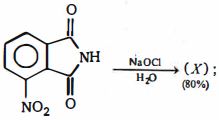
A
$3-$nitroanthranilic acid
B
$6-$nitroanthranilic acid
C
$3-$nitrophthalic acid
D
$4-$nitroanthranilic acid
Solution
(A) The reaction of $3-$nitrophthalimide with $NaOCl$ in $H_2O$ is an example of the Hofmann bromamide degradation (or more generally,a Hofmann rearrangement of an imide).
In this reaction,the cyclic imide undergoes ring opening and decarboxylation to form an amino acid.
Specifically,$3$-nitrophthalimide reacts to form $2-$amino$-3-$nitrobenzoic acid (also known as $3-$nitroanthranilic acid).
Therefore,the correct product $X$ is $3-$nitroanthranilic acid.
In this reaction,the cyclic imide undergoes ring opening and decarboxylation to form an amino acid.
Specifically,$3$-nitrophthalimide reacts to form $2-$amino$-3-$nitrobenzoic acid (also known as $3-$nitroanthranilic acid).
Therefore,the correct product $X$ is $3-$nitroanthranilic acid.
0 likes
View Solution542
MediumMCQ
The relation between $(A)$ and $(B)$ is:
$CH_3-CONH_2 \xrightarrow{KOBr} (A)$
$CH_3-CONH_2 \xrightarrow{LiAlH_4} (B)$
$CH_3-CONH_2 \xrightarrow{KOBr} (A)$
$CH_3-CONH_2 \xrightarrow{LiAlH_4} (B)$
A
Identical
B
Functional isomer
C
Homologous
D
Positional isomers
Solution
(C) Reaction $1$ is the Hofmann bromamide degradation reaction: $CH_3-CONH_2 + KOBr \rightarrow CH_3-NH_2 \ (A)$.
Reaction $2$ is the reduction of an amide: $CH_3-CONH_2 \xrightarrow{LiAlH_4} CH_3-CH_2-NH_2 \ (B)$.
Since $(A)$ $(CH_3-NH_2)$ and $(B)$ $(CH_3-CH_2-NH_2)$ belong to the same functional group (primary amines) and differ by a $-CH_2-$ group,they are homologous.
Reaction $2$ is the reduction of an amide: $CH_3-CONH_2 \xrightarrow{LiAlH_4} CH_3-CH_2-NH_2 \ (B)$.
Since $(A)$ $(CH_3-NH_2)$ and $(B)$ $(CH_3-CH_2-NH_2)$ belong to the same functional group (primary amines) and differ by a $-CH_2-$ group,they are homologous.
0 likes
View Solution543
DifficultMCQ
When ethyl amine is heated with chloroform and alcoholic $KOH$,a compound with an offensive smell is obtained. This compound is
A
$A$. $A$ secondary amine
B
$B$. An isocyanide
C
$C$. $A$ cyanide
D
$D$. An acid
Solution
(B) The reaction described is the carbylamine reaction,which is a characteristic test for primary amines.
When ethyl amine $(CH_3CH_2NH_2)$ is heated with chloroform $(CHCl_3)$ and alcoholic $KOH$,it forms ethyl isocyanide $(CH_3CH_2NC)$,which has a highly offensive,foul smell.
The reaction is: $CH_3CH_2NH_2 + CHCl_3 + 3KOH(alc.) \rightarrow CH_3CH_2NC + 3KCl + 3H_2O$.
When ethyl amine $(CH_3CH_2NH_2)$ is heated with chloroform $(CHCl_3)$ and alcoholic $KOH$,it forms ethyl isocyanide $(CH_3CH_2NC)$,which has a highly offensive,foul smell.
The reaction is: $CH_3CH_2NH_2 + CHCl_3 + 3KOH(alc.) \rightarrow CH_3CH_2NC + 3KCl + 3H_2O$.
0 likes
View Solution544
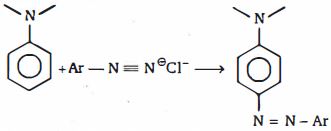
DifficultMCQ
The above $(C-N)$ coupling reaction takes place at
A
low $pH$
B
Intermediate $pH$
C
high $pH$
D
any $pH$
Solution
(B) The coupling reaction between a diazonium salt and an aromatic amine (like $N,N$-dimethylaniline) is highly dependent on the $pH$ of the reaction medium.
At high $pH$,the diazonium ion is converted into non-electrophilic species like diazohydroxide $(Ar-N=N-OH)$ or diazotate ion $(Ar-N=N-O^-)$,which do not undergo coupling.
At low $pH$,the amine group $(-NMe_2)$ of the aromatic amine gets protonated to form an ammonium ion $(-NH^+Me_2)$,which is deactivating and lacks the lone pair of electrons necessary for the nucleophilic attack on the diazonium ion.
Therefore,the coupling reaction is most effective at an intermediate $pH$,where the diazonium ion remains electrophilic and the amine remains in its nucleophilic,unprotonated form.
At high $pH$,the diazonium ion is converted into non-electrophilic species like diazohydroxide $(Ar-N=N-OH)$ or diazotate ion $(Ar-N=N-O^-)$,which do not undergo coupling.
At low $pH$,the amine group $(-NMe_2)$ of the aromatic amine gets protonated to form an ammonium ion $(-NH^+Me_2)$,which is deactivating and lacks the lone pair of electrons necessary for the nucleophilic attack on the diazonium ion.
Therefore,the coupling reaction is most effective at an intermediate $pH$,where the diazonium ion remains electrophilic and the amine remains in its nucleophilic,unprotonated form.
0 likes
View Solution545
MediumMCQ
Sulphonation is most favourable at the carbon number $...$
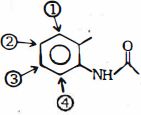
A
$1$
B
$2$
C
$3$
D
$4$
Solution
(D) The molecule is $o$-acetotoluidide. The $-NHCOCH_3$ group is a strong ortho/para directing group due to its $+M$ effect,while the $-CH_3$ group is a weak ortho/para directing group due to hyperconjugation.
In electrophilic aromatic substitution,the directing effect of the $-NHCOCH_3$ group dominates.
Position $4$ is para to the $-NHCOCH_3$ group and ortho to the $-CH_3$ group,making it the least sterically hindered and most electronically activated position for substitution.
Therefore,sulphonation is most favourable at carbon number $4$.
In electrophilic aromatic substitution,the directing effect of the $-NHCOCH_3$ group dominates.
Position $4$ is para to the $-NHCOCH_3$ group and ortho to the $-CH_3$ group,making it the least sterically hindered and most electronically activated position for substitution.
Therefore,sulphonation is most favourable at carbon number $4$.
0 likes
View Solution546
MediumMCQ
The product $(B)$ in the given reaction is:
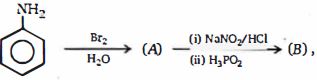
A
$2,4-$dibromobenzene
B
$2,4,6-$tribromobenzene
C
$1,3,5-$tribromobenzene
D
Bromobenzene
Solution
(C) $1$. The reaction of aniline with $Br_2/H_2O$ leads to electrophilic aromatic substitution,resulting in the formation of $2,4,6$-tribromoaniline as product $(A)$.
$2$. The treatment of $2,4,6$-tribromoaniline with $(i) NaNO_2/HCl$ at low temperature $(0-5 \ ^\circ C)$ forms the corresponding diazonium salt,$2,4,6$-tribromobenzenediazonium chloride.
$3$. Subsequent treatment with $H_3PO_2$ (hypophosphorous acid) and water reduces the diazonium group to a hydrogen atom,resulting in the formation of $1,3,5$-tribromobenzene as product $(B)$.
$2$. The treatment of $2,4,6$-tribromoaniline with $(i) NaNO_2/HCl$ at low temperature $(0-5 \ ^\circ C)$ forms the corresponding diazonium salt,$2,4,6$-tribromobenzenediazonium chloride.
$3$. Subsequent treatment with $H_3PO_2$ (hypophosphorous acid) and water reduces the diazonium group to a hydrogen atom,resulting in the formation of $1,3,5$-tribromobenzene as product $(B)$.
0 likes
View Solution547
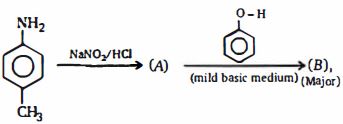
DifficultMCQ
Product $(B)$ of this reaction is
A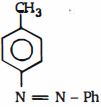
B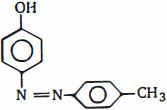
C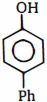
D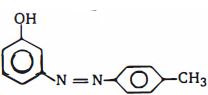
Solution
(B) $1$. The reaction of $p$-toluidine ($4$-methylaniline) with $NaNO_2/HCl$ at $0-5 \ ^\circ C$ produces $p$-methylbenzenediazonium chloride,which is intermediate $(A)$.
$2$. This diazonium salt undergoes an electrophilic aromatic substitution (coupling reaction) with phenol in a mild basic medium.
$3$. The diazonium cation acts as an electrophile and attacks the electron-rich ring of phenol.
$4$. Since the para position of phenol is less sterically hindered than the ortho position,the coupling occurs primarily at the para position to form $4$-hydroxy-$4'$-methylazobenzene as the major product $(B)$.
$2$. This diazonium salt undergoes an electrophilic aromatic substitution (coupling reaction) with phenol in a mild basic medium.
$3$. The diazonium cation acts as an electrophile and attacks the electron-rich ring of phenol.
$4$. Since the para position of phenol is less sterically hindered than the ortho position,the coupling occurs primarily at the para position to form $4$-hydroxy-$4'$-methylazobenzene as the major product $(B)$.
0 likes
View Solution548
DifficultMCQ
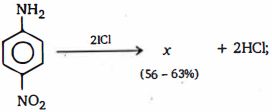
The major product $(x)$ in the following reaction is:
A
$2,3-$diiodo$-4-$nitroaniline
B
$3,5-$diiodo$-4-$nitroaniline
C
$2,6-$diiodo$-4-$nitroaniline
D
$2,5-$diiodo$-4-$nitroaniline
Solution
(C) The reaction of $p$-nitroaniline with $ICl$ is an electrophilic aromatic substitution reaction.
The $-NH_2$ group is a strong activating group and is ortho/para directing.
The $-NO_2$ group is a strong deactivating group and is meta directing.
In $p$-nitroaniline,the positions ortho to the $-NH_2$ group are also meta to the $-NO_2$ group.
Therefore,both ortho positions are activated by the $-NH_2$ group and directed by the $-NO_2$ group.
Thus,iodination occurs at both ortho positions relative to the $-NH_2$ group,yielding $2,6$-diiodo-$4$-nitroaniline.
The $-NH_2$ group is a strong activating group and is ortho/para directing.
The $-NO_2$ group is a strong deactivating group and is meta directing.
In $p$-nitroaniline,the positions ortho to the $-NH_2$ group are also meta to the $-NO_2$ group.
Therefore,both ortho positions are activated by the $-NH_2$ group and directed by the $-NO_2$ group.
Thus,iodination occurs at both ortho positions relative to the $-NH_2$ group,yielding $2,6$-diiodo-$4$-nitroaniline.
0 likes
View Solution549
MediumMCQ
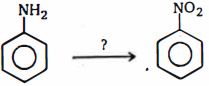
The missing reagent is:
A
$CF_3CO_3H$
B
$H_2SO_4$
C
$LAH$
D
$NaBH_4$
Solution
(A) The reaction shows the oxidation of aniline to nitrobenzene.
Peroxytrifluoroacetic acid $(CF_3CO_3H)$ is a strong oxidizing agent that can directly oxidize the amino group $(-NH_2)$ to the nitro group $(-NO_2)$ in aromatic amines.
Peroxytrifluoroacetic acid $(CF_3CO_3H)$ is a strong oxidizing agent that can directly oxidize the amino group $(-NH_2)$ to the nitro group $(-NO_2)$ in aromatic amines.
0 likes
View Solution550
MediumMCQ
Nitration of which of the following reactants gives the maximum $\%$ of the meta product (using $HNO_3 / H_2SO_4$)?
A
Toluene
B
Aniline
C
Benzene
D
Isopropyl benzene
Solution
(B) In the presence of concentrated $H_2SO_4$,aniline $(Ph-NH_2)$ undergoes protonation to form the anilinium ion $(Ph-NH_3^+)$.
The reaction is: $Ph-NH_2 + H^+ \rightarrow Ph-NH_3^+$.
The $-NH_3^+$ group is strongly electron-withdrawing and meta-directing due to its positive charge.
Therefore,during nitration,the major product formed is $m$-nitroaniline,resulting in a high percentage of the meta product compared to other substituted benzenes where the substituents are ortho/para-directing.
The reaction is: $Ph-NH_2 + H^+ \rightarrow Ph-NH_3^+$.
The $-NH_3^+$ group is strongly electron-withdrawing and meta-directing due to its positive charge.
Therefore,during nitration,the major product formed is $m$-nitroaniline,resulting in a high percentage of the meta product compared to other substituted benzenes where the substituents are ortho/para-directing.
0 likes
View SolutionAmines — Properties of Amines · Frequently Asked Questions
1Are these Amines questions useful for JEE and NEET?
Yes. All questions in this section are mapped to JEE Main and NEET exam patterns. Previous year questions from JEE Main, NEET, GUJCET and state-level exams are included with full solutions.
2Can I switch to Hindi or Gujarati for these questions?
Yes. Use the language tabs in the hero section or the sidebar to view the same questions and solutions in English, Hindi or Gujarati.
3How do I generate a question paper from this subtopic?
Use the Vedclass Exam Paper Generator — select the chapter and subtopic, set difficulty, and generate Sets A, B, C, D automatically. First 3 chapters of every subject are free.
Vedclass Products
For Students
Vedclass Test Series
Mock tests in real JEE/NEET style with performance analysis. 5-day free trial.
Start Free TrialFor Teachers
Exam Paper Generator
Generate Set A/B/C/D papers from this chapter in 2 minutes. 3 chapters free.
Try FreeFor Institutes
Online Exam Module
Live online exams with unlimited students, 360° analytics & white-label branding.
See DemoFor Teachers & Institutes
Generate a Amines Exam Paper in 2 Minutes
Select subtopic & difficulty — Sets A, B, C, D auto-generated with No Repeat logic.
First 3 chapters of every subject are free — no payment required.