
A English
Properties of Amines Questions in English
Class 12 Chemistry · Amines · Properties of Amines
1212+
Questions
English
Language
100%
With Solutions
Showing 50 of 1212 questions in English
401
AdvancedMCQ
$Y \xleftarrow[(ii)\,KOD, Br_2, \Delta]{(i)\,NH_3, \Delta} \text{Benzoic acid}$ $\xrightarrow[(ii)\,KOH, Br_2, \Delta]{(i)\,ND_3, \Delta} X$
What are $X$ and $Y$?
What are $X$ and $Y$?
A
$X$ is $\text{deuterated aniline} (C_6H_5ND_2)$; $Y$ is $\text{aniline} (C_6H_5NH_2)$
B
$X$ is $\text{aniline} (C_6H_5NH_2)$; $Y$ is $\text{deuterated aniline} (C_6H_5ND_2)$
C
both are $\text{aniline} (C_6H_5NH_2)$
D
both are $\text{deuterated aniline} (C_6H_5ND_2)$
Solution
(A) The reaction is the Hofmann bromamide degradation,where the amide nitrogen is retained in the amine product.
$1$. For $X$: Benzoic acid reacts with $ND_3$ and $\Delta$ to form benzamide $(C_6H_5COND_2)$. Subsequent reaction with $KOH$ and $Br_2$ yields $C_6H_5ND_2$ $(X)$,as the nitrogen atom of the amide is retained in the amine.
$2$. For $Y$: Benzoic acid reacts with $NH_3$ and $\Delta$ to form benzamide $(C_6H_5CONH_2)$. Subsequent reaction with $KOD$ and $Br_2$ yields $C_6H_5NH_2$ $(Y)$,as the nitrogen atom of the amide is retained in the amine.
Thus,$X$ is $C_6H_5ND_2$ and $Y$ is $C_6H_5NH_2$.
$1$. For $X$: Benzoic acid reacts with $ND_3$ and $\Delta$ to form benzamide $(C_6H_5COND_2)$. Subsequent reaction with $KOH$ and $Br_2$ yields $C_6H_5ND_2$ $(X)$,as the nitrogen atom of the amide is retained in the amine.
$2$. For $Y$: Benzoic acid reacts with $NH_3$ and $\Delta$ to form benzamide $(C_6H_5CONH_2)$. Subsequent reaction with $KOD$ and $Br_2$ yields $C_6H_5NH_2$ $(Y)$,as the nitrogen atom of the amide is retained in the amine.
Thus,$X$ is $C_6H_5ND_2$ and $Y$ is $C_6H_5NH_2$.
0 likes
View Solution402
DifficultMCQ
Name the products in the acid-base reaction :
$(a)$ $CH_3CH_2NH_2 + HI$
$(b)$ $(CH_3)_3N + HBr$
$(a)$ $CH_3CH_2NH_2 + HI$
$(b)$ $(CH_3)_3N + HBr$
A
$(a)$ Ethylammonium iodide $(b)$ Trimethylammonium bromide
B
$(a)$ Ethylammonium iodide $(b)$ Methylammonium bromide
C
$(a)$ Methylammonium iodide $(b)$ Trimethylammonium bromide
D
None of these
Solution
(A) Amines act as Lewis bases due to the presence of a lone pair of electrons on the nitrogen atom.
$(a)$ $CH_3CH_2NH_2 + HI \rightarrow [CH_3CH_2NH_3]^+ I^-$. The product is $CH_3CH_2NH_3^+ I^-$,which is named Ethylammonium iodide.
$(b)$ $(CH_3)_3N + HBr \rightarrow [(CH_3)_3NH]^+ Br^-$. The product is $(CH_3)_3NH^+ Br^-$,which is named Trimethylammonium bromide.
Therefore,the correct option is $(a)$ Ethylammonium iodide and $(b)$ Trimethylammonium bromide.
$(a)$ $CH_3CH_2NH_2 + HI \rightarrow [CH_3CH_2NH_3]^+ I^-$. The product is $CH_3CH_2NH_3^+ I^-$,which is named Ethylammonium iodide.
$(b)$ $(CH_3)_3N + HBr \rightarrow [(CH_3)_3NH]^+ Br^-$. The product is $(CH_3)_3NH^+ Br^-$,which is named Trimethylammonium bromide.
Therefore,the correct option is $(a)$ Ethylammonium iodide and $(b)$ Trimethylammonium bromide.
0 likes
View Solution403
MediumMCQ
Which of the following is the strongest base?
A
$N,N$-dimethylaniline
B
$2$-methyl-$N,N$-dimethylaniline
C
$3$-methyl-$N,N$-dimethylaniline
D
$4$-methyl-$N,N$-dimethylaniline
Solution
(D) The basicity of substituted $N,N$-dimethylanilines depends on the electron-donating or electron-withdrawing nature of the substituent and steric effects.
In $4$-methyl-$N,N$-dimethylaniline,the $-CH_3$ group at the para position exerts a $+I$ effect and hyperconjugation,which increases the electron density on the nitrogen atom,making it more available for protonation.
In $2$-methyl-$N,N$-dimethylaniline,the ortho-substituent causes steric hindrance,which inhibits the resonance of the lone pair of the nitrogen with the benzene ring (ortho effect),but the steric hindrance also makes it difficult for the proton to approach the nitrogen,generally reducing its basicity compared to the para-isomer.
$3$-methyl-$N,N$-dimethylaniline has a $+I$ effect but lacks the strong resonance stabilization of the para-isomer.
Therefore,$4$-methyl-$N,N$-dimethylaniline is the strongest base among the given options.
In $4$-methyl-$N,N$-dimethylaniline,the $-CH_3$ group at the para position exerts a $+I$ effect and hyperconjugation,which increases the electron density on the nitrogen atom,making it more available for protonation.
In $2$-methyl-$N,N$-dimethylaniline,the ortho-substituent causes steric hindrance,which inhibits the resonance of the lone pair of the nitrogen with the benzene ring (ortho effect),but the steric hindrance also makes it difficult for the proton to approach the nitrogen,generally reducing its basicity compared to the para-isomer.
$3$-methyl-$N,N$-dimethylaniline has a $+I$ effect but lacks the strong resonance stabilization of the para-isomer.
Therefore,$4$-methyl-$N,N$-dimethylaniline is the strongest base among the given options.
0 likes
View Solution404
AdvancedMCQ
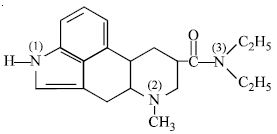
The correct order of basicity of the various nitrogen atoms in $LSD$ is:
A
$1 > 2 > 3$
B
$2 > 1 > 3$
C
$2 > 3 > 1$
D
$3 > 2 > 1$
Solution
(B) Nitrogen $2$ is the most basic because its lone pair is not involved in resonance,and it is a tertiary amine with electron-donating alkyl groups (inductive effect).
Nitrogen $3$ is the least basic because its lone pair is in resonance with the $C=O$ double bond of the amide group,significantly reducing its availability.
Nitrogen $1$ is less basic than $2$ because its lone pair is involved in resonance with the indole ring system (aromatic system).
Therefore,the correct order of basicity is $2 > 1 > 3$.
Nitrogen $3$ is the least basic because its lone pair is in resonance with the $C=O$ double bond of the amide group,significantly reducing its availability.
Nitrogen $1$ is less basic than $2$ because its lone pair is involved in resonance with the indole ring system (aromatic system).
Therefore,the correct order of basicity is $2 > 1 > 3$.
0 likes
View Solution405
MediumMCQ
$2-$Aminocyclohexane$-1-$ol on treatment with $HNO_2$ produces
A
Cyclopentane carboxaldehyde
B
Cyclohexane$-1,2-$diol
C
$2-$Amino cyclohexene
D
Cyclohex$-2-$enol
Solution
(A) The reaction of $2-$aminocyclohexane$-1-$ol with nitrous acid $(HNO_2)$ is a deamination reaction involving the formation of a diazonium salt intermediate.
Since the amino group is adjacent to a hydroxyl group,the diazonium ion formed is unstable and undergoes a Tiffeneau-Demjanov rearrangement or ring expansion/contraction depending on the structure.
However,for $2-$aminocyclohexane$-1-$ol,the primary product is the ring-contracted product,which is $Cyclopentane \text{ } carboxaldehyde$.
Since the amino group is adjacent to a hydroxyl group,the diazonium ion formed is unstable and undergoes a Tiffeneau-Demjanov rearrangement or ring expansion/contraction depending on the structure.
However,for $2-$aminocyclohexane$-1-$ol,the primary product is the ring-contracted product,which is $Cyclopentane \text{ } carboxaldehyde$.
0 likes
View Solution406
AdvancedMCQ
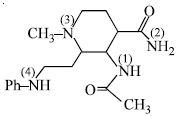
The correct order of basicity for the labeled nitrogen atoms in the given structure is:
A
$3 > 1 > 2 > 4$
B
$3 < 1 < 2 < 4$
C
$3 < 4 < 1 < 2$
D
$3 > 4 > 1 > 2$
Solution
(D) To determine the basicity,we analyze the availability of the lone pair on each nitrogen atom:
$(3)$ is a tertiary aliphatic amine. The lone pair is localized and available for donation,making it the most basic.
$(4)$ is an aniline derivative $(Ph-NH-)$. The lone pair is in conjugation with the benzene ring,reducing its availability,but it is more basic than amides.
$(1)$ is an amide nitrogen $(R-NH-CO-CH_3)$. The lone pair is involved in resonance with the carbonyl group $(C=O)$,making it significantly less basic.
$(2)$ is a primary amide nitrogen $(R-CO-NH_2)$. The lone pair is involved in resonance with the carbonyl group,and it is even less basic due to the strong electron-withdrawing effect of the carbonyl group in a primary amide structure.
Comparing these,the order of basicity is $(3) > (4) > (1) > (2)$.
$(3)$ is a tertiary aliphatic amine. The lone pair is localized and available for donation,making it the most basic.
$(4)$ is an aniline derivative $(Ph-NH-)$. The lone pair is in conjugation with the benzene ring,reducing its availability,but it is more basic than amides.
$(1)$ is an amide nitrogen $(R-NH-CO-CH_3)$. The lone pair is involved in resonance with the carbonyl group $(C=O)$,making it significantly less basic.
$(2)$ is a primary amide nitrogen $(R-CO-NH_2)$. The lone pair is involved in resonance with the carbonyl group,and it is even less basic due to the strong electron-withdrawing effect of the carbonyl group in a primary amide structure.
Comparing these,the order of basicity is $(3) > (4) > (1) > (2)$.
0 likes
View Solution407
AdvancedMCQ
The hydrolysis of alkyl isocyanides $(R-CH_2-NC)$ gives:
A
$RNHCOOH$
B
$R-CH(NH_2)-COOH$
C
$RNH_2 + HCOOH$
D
$RCH_2NH_2 + HCOOH$
Solution
(D) The hydrolysis of alkyl isocyanides with dilute mineral acids yields primary amines and formic acid.
The reaction is as follows:
$R-CH_2-NC + 2H_2O \xrightarrow{H^+} R-CH_2-NH_2 + HCOOH$
The reaction is as follows:
$R-CH_2-NC + 2H_2O \xrightarrow{H^+} R-CH_2-NH_2 + HCOOH$
0 likes
View Solution408
DifficultMCQ
Action of $HNO_2$ on $CH_3NH_2$ gives the following as the major product:
A
$CH_3OH$
B
$CH_3-O-CH_3$
C
$CH_3-O-N=O$
D
$CH_3-NO_2$
Solution
(A) The reaction of primary aliphatic amines with nitrous acid $(HNO_2)$ produces an unstable diazonium salt,which immediately decomposes to form a carbocation. This carbocation then reacts with water to form an alcohol as the major product.
$CH_3NH_2 + HNO_2 \rightarrow [CH_3N_2^+] + H_2O$
$[CH_3N_2^+] + H_2O \rightarrow CH_3OH + N_2 + H^+$
$CH_3NH_2 + HNO_2 \rightarrow [CH_3N_2^+] + H_2O$
$[CH_3N_2^+] + H_2O \rightarrow CH_3OH + N_2 + H^+$
0 likes
View Solution409
MediumMCQ
Which one of the following is the most basic compound?
A
$C_6H_5-NH_2$
B
$C_6H_5-NHCH_3$
C
$C_6H_5-N(CH_3)_2$
D
$C_6H_5-N(C_2H_5)_2$
Solution
(D) The basicity of amines depends on the availability of the lone pair of electrons on the nitrogen atom for protonation.
In aromatic amines,the lone pair is involved in resonance with the benzene ring,which decreases its availability.
However,the presence of electron-donating groups (like alkyl groups) on the nitrogen atom increases the electron density on the nitrogen,thereby increasing its basicity.
Comparing the given options:
$C_6H_5-NH_2$ (Aniline) has no alkyl groups.
$C_6H_5-NHCH_3$ has one methyl group.
$C_6H_5-N(CH_3)_2$ has two methyl groups.
$C_6H_5-N(C_2H_5)_2$ has two ethyl groups.
Ethyl groups are better electron-donating groups than methyl groups due to the $+I$ effect.
Therefore,$C_6H_5-N(C_2H_5)_2$ is the most basic compound among the given options.
In aromatic amines,the lone pair is involved in resonance with the benzene ring,which decreases its availability.
However,the presence of electron-donating groups (like alkyl groups) on the nitrogen atom increases the electron density on the nitrogen,thereby increasing its basicity.
Comparing the given options:
$C_6H_5-NH_2$ (Aniline) has no alkyl groups.
$C_6H_5-NHCH_3$ has one methyl group.
$C_6H_5-N(CH_3)_2$ has two methyl groups.
$C_6H_5-N(C_2H_5)_2$ has two ethyl groups.
Ethyl groups are better electron-donating groups than methyl groups due to the $+I$ effect.
Therefore,$C_6H_5-N(C_2H_5)_2$ is the most basic compound among the given options.
0 likes
View Solution410
MediumMCQ
Which of the following reactions will not take place?
A
$ArN_2^{\oplus} + CuBr \rightarrow ArBr$
B
$ArN_2^{\oplus} + PhOH \rightarrow Ar-N=N-Ph-OH$
C
$ArN_2^{\oplus} + H_3PO_2 \xrightarrow{H_2O} ArH$
D
$ArN_2^{\oplus} + I^{-} \rightarrow ArI$
Solution
(B) The reaction $ArN_2^{\oplus} + PhOH \rightarrow Ar-OH$ is incorrect as written. The coupling reaction between a diazonium salt and phenol $(PhOH)$ produces an azo dye,specifically $p$-hydroxyazobenzene $(Ar-N=N-C_6H_4-OH)$,not a phenol $(Ar-OH)$.
Option $A$ is the Sandmeyer reaction,which is valid.
Option $C$ is the reduction of diazonium salt using hypophosphorous acid $(H_3PO_2)$,which is valid.
Option $D$ is the standard method for preparing aryl iodides,which is valid.
Option $A$ is the Sandmeyer reaction,which is valid.
Option $C$ is the reduction of diazonium salt using hypophosphorous acid $(H_3PO_2)$,which is valid.
Option $D$ is the standard method for preparing aryl iodides,which is valid.
0 likes
View Solution411
MediumMCQ
$m$-Bromotoluene is prepared by :
A
Bromination of toluene
B
Friedel Craft's reaction of bromobenzene with $CH_3Cl$
C
Bromination of nitrobenzene and subsequent replacement of $-NO_2$ group with methyl group
D
Bromination of aceto-$p$-toluidine followed by hydrolysis and deamination
Solution
(D) The preparation of $m$-bromotoluene cannot be done by direct bromination of toluene because the $-CH_3$ group is ortho/para directing.
To obtain the meta-isomer,we use the following sequence:
$1$. Acetylation of $p$-toluidine to form aceto-$p$-toluidine.
$2$. Bromination of aceto-$p$-toluidine,where the $-NHCOCH_3$ group is ortho/para directing,directing the bromine to the position meta to the methyl group.
$3$. Hydrolysis of the amide to remove the acetyl group.
$4$. Deamination (diazotization followed by reduction) to remove the $-NH_2$ group,leaving the bromine at the meta position relative to the methyl group.
To obtain the meta-isomer,we use the following sequence:
$1$. Acetylation of $p$-toluidine to form aceto-$p$-toluidine.
$2$. Bromination of aceto-$p$-toluidine,where the $-NHCOCH_3$ group is ortho/para directing,directing the bromine to the position meta to the methyl group.
$3$. Hydrolysis of the amide to remove the acetyl group.
$4$. Deamination (diazotization followed by reduction) to remove the $-NH_2$ group,leaving the bromine at the meta position relative to the methyl group.
0 likes
View Solution412
MediumMCQ
Aniline under acidic medium,when chlorinated,produces :
A
$o-$chloroaniline
B
$m-$chloroaniline
C
$p-$chloroaniline
D
Mixture of $o-$ and $p-$chloroaniline
Solution
(B) In an acidic medium,aniline $(C_6H_5NH_2)$ gets protonated to form the anilinium ion $(C_6H_5NH_3^+)$.
The $-NH_3^+$ group is meta-directing because it is strongly electron-withdrawing due to the positive charge on the nitrogen atom.
Consequently,the electrophilic substitution (chlorination) occurs primarily at the meta-position.
Therefore,the major product formed is $m-$chloroaniline.
The $-NH_3^+$ group is meta-directing because it is strongly electron-withdrawing due to the positive charge on the nitrogen atom.
Consequently,the electrophilic substitution (chlorination) occurs primarily at the meta-position.
Therefore,the major product formed is $m-$chloroaniline.
0 likes
View Solution413
MediumMCQ
Which of the following undergoes chlorination at the fastest rate?
A
$C_6H_5OH$
B
$C_6H_5NH_2$
C
$C_6H_5NHCH_3$
D
$C_6H_5N(CH_3)_2$
Solution
(D) Chlorination of aromatic compounds is an electrophilic aromatic substitution reaction. The rate of this reaction depends on the electron-donating ability of the substituent group attached to the benzene ring. Stronger electron-donating groups increase the electron density in the ring,making it more reactive towards electrophiles.
The electron-donating power of the groups is as follows:
$-N(CH_3)_2 > -NHCH_3 > -NH_2 > -OH$.
Among the given options,the dimethylamino group $(-N(CH_3)_2)$ is the strongest electron-donating group due to the $+I$ effect of the two methyl groups,which further increases the electron density on the nitrogen atom and consequently on the benzene ring. Therefore,$N,N$-dimethylaniline $(C_6H_5N(CH_3)_2)$ undergoes chlorination at the fastest rate.
The electron-donating power of the groups is as follows:
$-N(CH_3)_2 > -NHCH_3 > -NH_2 > -OH$.
Among the given options,the dimethylamino group $(-N(CH_3)_2)$ is the strongest electron-donating group due to the $+I$ effect of the two methyl groups,which further increases the electron density on the nitrogen atom and consequently on the benzene ring. Therefore,$N,N$-dimethylaniline $(C_6H_5N(CH_3)_2)$ undergoes chlorination at the fastest rate.
0 likes
View Solution414
MediumMCQ
Which of the following undergoes nitration fastest?
A
$C_6H_5NH_2$
B
$C_6H_5N^+(CH_3)_3$
C
$C_6H_5CH_2N^+(CH_3)_3$
D
$C_6H_5CH_2CH_2N^+(CH_3)_3$
Solution
(A) Nitration is an electrophilic aromatic substitution reaction. The rate of this reaction depends on the electron density of the benzene ring. Groups that donate electrons to the ring (activating groups) increase the rate of nitration,while groups that withdraw electrons (deactivating groups) decrease the rate.
$1$. $C_6H_5NH_2$ (Aniline): The $-NH_2$ group has a lone pair of electrons on the nitrogen atom,which it donates to the benzene ring through resonance ($+R$ effect). This strongly activates the ring towards electrophilic substitution.
$2$. $C_6H_5N^+(CH_3)_3$: The $-N^+(CH_3)_3$ group is a strong electron-withdrawing group due to its positive charge ($-I$ effect),which deactivates the ring.
$3$. $C_6H_5CH_2N^+(CH_3)_3$ and $C_6H_5CH_2CH_2N^+(CH_3)_3$: These also contain electron-withdrawing groups ($-I$ effect) attached to the ring,which deactivate the ring.
Therefore,$C_6H_5NH_2$ is the most activated and undergoes nitration fastest.
$1$. $C_6H_5NH_2$ (Aniline): The $-NH_2$ group has a lone pair of electrons on the nitrogen atom,which it donates to the benzene ring through resonance ($+R$ effect). This strongly activates the ring towards electrophilic substitution.
$2$. $C_6H_5N^+(CH_3)_3$: The $-N^+(CH_3)_3$ group is a strong electron-withdrawing group due to its positive charge ($-I$ effect),which deactivates the ring.
$3$. $C_6H_5CH_2N^+(CH_3)_3$ and $C_6H_5CH_2CH_2N^+(CH_3)_3$: These also contain electron-withdrawing groups ($-I$ effect) attached to the ring,which deactivate the ring.
Therefore,$C_6H_5NH_2$ is the most activated and undergoes nitration fastest.
0 likes
View Solution415
MediumMCQ
When sulphanilic acid $(p-H_2NC_6H_4SO_3H)$ is treated with excess of bromine,the product is:
A
tribromo product
B
dibromo product
C
monobromo product
D
tetrabromo product
Solution
(A) Sulphanilic acid $(p-H_2NC_6H_4SO_3H)$ contains a strongly activating amino group $(-NH_2)$ and a sulfonic acid group $(-SO_3H)$.
In the presence of water,the amino group is protonated to form the zwitterion $(H_3N^+C_6H_4SO_3^-)$.
However,the $-NH_2$ group is highly activating and directs electrophilic substitution to the ortho positions.
When treated with excess bromine water,the $-SO_3H$ group is displaced by bromine due to the high reactivity of the intermediate,leading to the formation of $2,4,6-tribromoaniline$.
Therefore,the final product is a tribromo product.
In the presence of water,the amino group is protonated to form the zwitterion $(H_3N^+C_6H_4SO_3^-)$.
However,the $-NH_2$ group is highly activating and directs electrophilic substitution to the ortho positions.
When treated with excess bromine water,the $-SO_3H$ group is displaced by bromine due to the high reactivity of the intermediate,leading to the formation of $2,4,6-tribromoaniline$.
Therefore,the final product is a tribromo product.
0 likes
View Solution416
MediumMCQ
If $meta$-nitroaniline is chlorinated,the major product is:
A
$4-$chloro$-3-$nitroaniline
B
$6-$chloro$-3-$nitroaniline
C
$5-$chloro$-3-$nitroaniline
D
$2-$chloro$-3-$nitroaniline
Solution
(A) In $meta$-nitroaniline,the $-NH_2$ group is a strong ortho/para-directing group,while the $-NO_2$ group is a meta-directing group.
Both groups direct the incoming electrophile $(Cl^+)$ to the same position,which is the position ortho to the $-NH_2$ group and para to the $-NO_2$ group (position $4$).
Therefore,the major product formed is $4$-chloro-$3$-nitroaniline.
Both groups direct the incoming electrophile $(Cl^+)$ to the same position,which is the position ortho to the $-NH_2$ group and para to the $-NO_2$ group (position $4$).
Therefore,the major product formed is $4$-chloro-$3$-nitroaniline.
0 likes
View Solution417
AdvancedMCQ
Predict the major product of the following reaction sequence:
$CH_3-C(H)(C_6H_4-D)-COCl$ $\xrightarrow{NH_3} \text{Intermediate}$ $\xrightarrow{OH^-/Br_2} \text{Product}$
$CH_3-C(H)(C_6H_4-D)-COCl$ $\xrightarrow{NH_3} \text{Intermediate}$ $\xrightarrow{OH^-/Br_2} \text{Product}$
A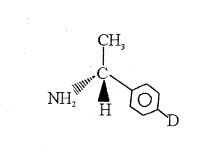
B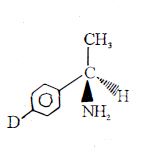
C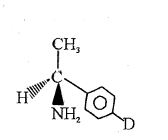
D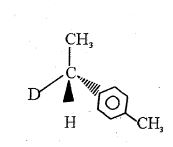
Solution
(A) $1$. The reaction of the acid chloride $(CH_3-C(H)(C_6H_4-D)-COCl)$ with $NH_3$ yields the corresponding amide,$CH_3-C(H)(C_6H_4-D)-CONH_2$. This step does not involve the chiral center,so the configuration is retained.
$2$. The subsequent reaction with $OH^-/Br_2$ is the Hoffmann Bromamide degradation. In this reaction,the carbonyl group $(CO)$ is removed,and the $NH_2$ group attaches directly to the chiral carbon atom.
$3$. The Hoffmann Bromamide degradation proceeds with complete retention of configuration at the chiral center because the migrating group does not break its bond with the chiral carbon until the new bond with nitrogen is formed.
$4$. Therefore,the final product is $CH_3-C(H)(C_6H_4-D)-NH_2$ with the same configuration as the starting material.
$2$. The subsequent reaction with $OH^-/Br_2$ is the Hoffmann Bromamide degradation. In this reaction,the carbonyl group $(CO)$ is removed,and the $NH_2$ group attaches directly to the chiral carbon atom.
$3$. The Hoffmann Bromamide degradation proceeds with complete retention of configuration at the chiral center because the migrating group does not break its bond with the chiral carbon until the new bond with nitrogen is formed.
$4$. Therefore,the final product is $CH_3-C(H)(C_6H_4-D)-NH_2$ with the same configuration as the starting material.
0 likes
View Solution418
DifficultMCQ
Predict the major product of the following reaction:
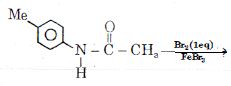
A
$4-$methylacetanilide with a bromine atom at the ortho position relative to the acetamido group.
B
$N$-($4$-methylphenyl)$-2-$bromoacetamide.
C
$4-$methyl$-2-$(bromomethyl)acetanilide.
D
$2-$bromo$-4-$methylacetanilide.
Solution
(D) The starting material is $4$-methylacetanilide. The acetamido group $(-NHCOCH_3)$ is a strong activating group due to the $+M$ effect of the nitrogen lone pair,making it ortho/para directing. The methyl group $(-CH_3)$ is also activating and ortho/para directing.
In $4$-methylacetanilide,the para position relative to the acetamido group is occupied by the methyl group. Therefore,electrophilic aromatic substitution (bromination) occurs at the ortho position relative to the acetamido group.
Since the methyl group is at the para position,the ortho position relative to the acetamido group is also the meta position relative to the methyl group. The acetamido group is a stronger activator than the methyl group,so it directs the incoming electrophile $(Br^+)$. The product is $2$-bromo-$4$-methylacetanilide.
In $4$-methylacetanilide,the para position relative to the acetamido group is occupied by the methyl group. Therefore,electrophilic aromatic substitution (bromination) occurs at the ortho position relative to the acetamido group.
Since the methyl group is at the para position,the ortho position relative to the acetamido group is also the meta position relative to the methyl group. The acetamido group is a stronger activator than the methyl group,so it directs the incoming electrophile $(Br^+)$. The product is $2$-bromo-$4$-methylacetanilide.
0 likes
View Solution419
DifficultMCQ
In the carbylamine reaction,the number of moles of $KOH$ and $CHCl_3$ used per mole of isocyanide produced are $X_1$ and $X_2$ respectively. Find out $X_1 - X_2$.
A
$1$
B
$3$
C
$2$
D
$4$
Solution
(C) The chemical equation for the carbylamine reaction is: $R-NH_2 + CHCl_3 + 3KOH \rightarrow R-NC + 3KCl + 3H_2O$.
Here,the number of moles of $KOH$ $(X_1)$ is $3$ and the number of moles of $CHCl_3$ $(X_2)$ is $1$.
Therefore,$X_1 - X_2 = 3 - 1 = 2$.
Here,the number of moles of $KOH$ $(X_1)$ is $3$ and the number of moles of $CHCl_3$ $(X_2)$ is $1$.
Therefore,$X_1 - X_2 = 3 - 1 = 2$.
0 likes
View Solution420
MediumMCQ
$R-NH_2 \to R-NH-CH_3$ (major product). The correct sequence of reagents is:
A
$CH_3-CO-Cl$
B
$CH_3I$ (excess)
C
$CHCl_3 + KOH$ followed by $LiAlH_4$
D
$NaNO_2 + HCl$ $(0-5^\circ C)$; $(CH_3)_2NH$
Solution
(C) The conversion of $R-NH_2$ to $R-NH-CH_3$ involves two steps:
$1$. Carbylamine reaction: $R-NH_2 + CHCl_3 + 3KOH \to R-NC + 3KCl + 3H_2O$
$2$. Reduction: $R-NC + 4[H] \xrightarrow{LiAlH_4} R-NH-CH_3$.
This sequence effectively adds a methyl group to the nitrogen atom of a primary amine to form a secondary amine.
$1$. Carbylamine reaction: $R-NH_2 + CHCl_3 + 3KOH \to R-NC + 3KCl + 3H_2O$
$2$. Reduction: $R-NC + 4[H] \xrightarrow{LiAlH_4} R-NH-CH_3$.
This sequence effectively adds a methyl group to the nitrogen atom of a primary amine to form a secondary amine.
0 likes
View Solution421
DifficultMCQ
Which of the following is expected to be the least basic?
A
$CH_3CH_2CH_2NH_2$
B
$2-$aminoacetophenone
C
Aniline
D
$(CH_3)_3N$
Solution
(B) The basicity of amines depends on the availability of the lone pair of electrons on the nitrogen atom.
$1$. $CH_3CH_2CH_2NH_2$ (n-propylamine) is an aliphatic amine,where the lone pair is readily available for protonation.
$2$. $(CH_3)_3N$ (trimethylamine) is also an aliphatic amine with high electron density on nitrogen due to the inductive effect of three methyl groups.
$3$. Aniline $(C_6H_5NH_2)$ is less basic because the lone pair on nitrogen is involved in resonance with the benzene ring.
$4$. $2-$aminoacetophenone has an $-NH_2$ group attached to a benzene ring which also has an electron-withdrawing acetyl group $(-COCH_3)$ at the ortho position. The $-COCH_3$ group exerts a strong $-I$ and $-M$ effect,which significantly reduces the electron density on the nitrogen atom,making it the least basic among the given options.
$1$. $CH_3CH_2CH_2NH_2$ (n-propylamine) is an aliphatic amine,where the lone pair is readily available for protonation.
$2$. $(CH_3)_3N$ (trimethylamine) is also an aliphatic amine with high electron density on nitrogen due to the inductive effect of three methyl groups.
$3$. Aniline $(C_6H_5NH_2)$ is less basic because the lone pair on nitrogen is involved in resonance with the benzene ring.
$4$. $2-$aminoacetophenone has an $-NH_2$ group attached to a benzene ring which also has an electron-withdrawing acetyl group $(-COCH_3)$ at the ortho position. The $-COCH_3$ group exerts a strong $-I$ and $-M$ effect,which significantly reduces the electron density on the nitrogen atom,making it the least basic among the given options.
0 likes
View Solution422
MediumMCQ
The gas evolved when ethyl amine reacts with sodium metal is
A
$NH_3$
B
$N_2$
C
$H_2$
D
$C_2H_6$
Solution
(C) Ethyl amine $(C_2H_5NH_2)$ contains an acidic hydrogen atom attached to the nitrogen atom.
When it reacts with an active metal like sodium $(Na)$,the sodium replaces the hydrogen atom to form sodium ethylamide $(C_2H_5NHNa)$ and releases hydrogen gas $(H_2)$.
The chemical equation is:
$2C_2H_5NH_2 + 2Na \to 2C_2H_5NHNa + H_2 \uparrow$
Therefore,the gas evolved is $H_2$.
When it reacts with an active metal like sodium $(Na)$,the sodium replaces the hydrogen atom to form sodium ethylamide $(C_2H_5NHNa)$ and releases hydrogen gas $(H_2)$.
The chemical equation is:
$2C_2H_5NH_2 + 2Na \to 2C_2H_5NHNa + H_2 \uparrow$
Therefore,the gas evolved is $H_2$.
0 likes
View Solution423
MediumMCQ
The coloured major product formed in the above reaction is:
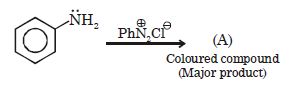
A
$p$-aminoazobenzene
B
$o$-aminoazobenzene
C
$m$-aminoazobenzene
D
$N$-phenyl-diazoaminobenzene
Solution
(C) The reaction between aniline $(C_6H_5NH_2)$ and benzenediazonium chloride $(C_6H_5N_2^+Cl^-)$ is an electrophilic aromatic substitution reaction known as coupling reaction.
In this reaction,the diazonium ion acts as an electrophile and attacks the electron-rich ring of aniline.
Since the $-NH_2$ group is strongly activating and ortho/para-directing,the electrophile preferentially attacks the para-position due to steric hindrance at the ortho-position.
Thus,the major product formed is $p$-aminoazobenzene,which is a yellow-orange coloured dye.
In this reaction,the diazonium ion acts as an electrophile and attacks the electron-rich ring of aniline.
Since the $-NH_2$ group is strongly activating and ortho/para-directing,the electrophile preferentially attacks the para-position due to steric hindrance at the ortho-position.
Thus,the major product formed is $p$-aminoazobenzene,which is a yellow-orange coloured dye.
0 likes
View Solution424
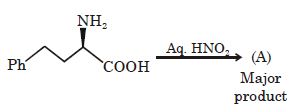
DifficultMCQ
The major product of the reaction shown below is:
A
$2-$hydroxy$-4-$phenylbutanoic acid
B
$3-$hydroxy$-4-$phenylbutanoic acid
C
$3-$hydroxy$-3-$phenylpropanoic acid
D
$2-$hydroxy$-1-$phenylbutanoic acid
Solution
(A) The reaction of an aliphatic primary amine with nitrous acid $(HNO_2)$ produces a diazonium salt,which is highly unstable and decomposes to form a carbocation.
In this case,the starting material is $Ph-CH_2-CH_2-CH(NH_2)-COOH$.
Upon treatment with $HNO_2$,the $-NH_2$ group is replaced by a diazonium group $(-N_2^+)$,which leaves as $N_2$ gas,generating a carbocation at the $\alpha$-position relative to the $-COOH$ group.
This carbocation is then attacked by water (the nucleophile) to form the corresponding $\alpha$-hydroxy acid.
The configuration at the chiral center is generally retained or undergoes partial inversion depending on the mechanism,but the primary product is the $\alpha$-hydroxy acid,which is $2$-hydroxy-$4$-phenylbutanoic acid.
In this case,the starting material is $Ph-CH_2-CH_2-CH(NH_2)-COOH$.
Upon treatment with $HNO_2$,the $-NH_2$ group is replaced by a diazonium group $(-N_2^+)$,which leaves as $N_2$ gas,generating a carbocation at the $\alpha$-position relative to the $-COOH$ group.
This carbocation is then attacked by water (the nucleophile) to form the corresponding $\alpha$-hydroxy acid.
The configuration at the chiral center is generally retained or undergoes partial inversion depending on the mechanism,but the primary product is the $\alpha$-hydroxy acid,which is $2$-hydroxy-$4$-phenylbutanoic acid.
0 likes
View Solution425
DifficultMCQ
In which of the following reactions is an alcohol formed as the major product?
A
$ (CH_3)_3N \xrightarrow{NaNO_2 + HCl} $
B
Aniline reacting with $NaNO_2 + HCl$ at $0-5^{\circ}C$
C
Cyclopentyl-ethylamine reacting with $NaNO_2 + HCl$
D
$N$-methylaniline reacting with $NaNO_2 + HCl$
Solution
(C) The reaction of primary aliphatic amines with nitrous acid $(NaNO_2 + HCl)$ produces unstable diazonium salts,which decompose to form carbocations. These carbocations then react with water to form alcohols as the major product.
In option $C$,the primary aliphatic amine (cyclopentyl-ethylamine) reacts with $NaNO_2 + HCl$ to form a diazonium salt,which subsequently yields the corresponding alcohol.
Option $A$ is a tertiary amine,which forms a salt.
Option $B$ is an aromatic primary amine,which forms a stable diazonium salt at $0-5^{\circ}C$.
Option $D$ is a secondary aromatic amine,which forms an $N$-nitroso compound.
In option $C$,the primary aliphatic amine (cyclopentyl-ethylamine) reacts with $NaNO_2 + HCl$ to form a diazonium salt,which subsequently yields the corresponding alcohol.
Option $A$ is a tertiary amine,which forms a salt.
Option $B$ is an aromatic primary amine,which forms a stable diazonium salt at $0-5^{\circ}C$.
Option $D$ is a secondary aromatic amine,which forms an $N$-nitroso compound.
0 likes
View Solution426
MediumMCQ
How many structural isomers of amine are possible for the molecular formula $C_3H_9N$?
A
$2$
B
$4$
C
$6$
D
$8$
Solution
(B) The molecular formula $C_3H_9N$ corresponds to the following four structural isomers of amines:
$1$. $CH_3CH_2CH_2NH_2$ (propan$-1-$amine)
$2$. $CH_3CH(NH_2)CH_3$ (propan$-2-$amine)
$3$. $CH_3CH_2NHCH_3$ ($N$-methylethanamine)
$4$. $(CH_3)_3N$ ($N,N$-dimethylmethanamine)
These represent primary,secondary,and tertiary amines. Thus,there are $4$ structural isomers.
Hence,option $B$ is correct.
$1$. $CH_3CH_2CH_2NH_2$ (propan$-1-$amine)
$2$. $CH_3CH(NH_2)CH_3$ (propan$-2-$amine)
$3$. $CH_3CH_2NHCH_3$ ($N$-methylethanamine)
$4$. $(CH_3)_3N$ ($N,N$-dimethylmethanamine)
These represent primary,secondary,and tertiary amines. Thus,there are $4$ structural isomers.
Hence,option $B$ is correct.
0 likes
View Solution427
MediumMCQ
$Ph-NH_2$ $\xrightarrow[Br_2]{HNO_2} A$ $\xrightarrow[Warm]{H_2O} B$
$B$ is
$B$ is
A
Phenol
B
Cresol
C
Benzene
D
Nitrobenzene
Solution
(A) Step $1$: Aniline $(Ph-NH_2)$ reacts with $HNO_2$ at $0-5 \ ^\circ C$ to form a diazonium salt,but in the presence of $Br_2$,the reaction proceeds to form $2,4,6-tribromoaniline$ first,which then undergoes diazotization to form $2,4,6-tribromobenzenediazonium$ chloride $(A)$.
Step $2$: When $2,4,6-tribromobenzenediazonium$ chloride $(A)$ is warmed with water,it undergoes hydrolysis to form $2,4,6-tribromophenol$ $(B)$.
Note: Given the options provided,the intended reaction sequence likely refers to the formation of phenol if the $Br_2$ was not present,or the question implies the final product of the diazotization and hydrolysis sequence. However,based on the standard reaction of aniline with $HNO_2$ followed by $H_2O/warm$,the product is $Phenol$.
Step $2$: When $2,4,6-tribromobenzenediazonium$ chloride $(A)$ is warmed with water,it undergoes hydrolysis to form $2,4,6-tribromophenol$ $(B)$.
Note: Given the options provided,the intended reaction sequence likely refers to the formation of phenol if the $Br_2$ was not present,or the question implies the final product of the diazotization and hydrolysis sequence. However,based on the standard reaction of aniline with $HNO_2$ followed by $H_2O/warm$,the product is $Phenol$.
0 likes
View Solution428
MediumMCQ
$PhN_2Cl \xrightarrow[\Delta]{H_2O}$ What is the product of the following reaction?
A
Benzene
B
Aniline
C
Chlorobenzene
D
Phenol
Solution
(D) The reaction of benzenediazonium chloride $(PhN_2Cl)$ with water $(H_2O)$ upon heating $(\Delta)$ is a standard hydrolysis reaction.
In this reaction,the diazonium group $(-N_2Cl)$ is replaced by a hydroxyl group $(-OH)$,resulting in the formation of phenol $(PhOH)$ and the release of nitrogen gas $(N_2)$ and hydrochloric acid $(HCl)$.
The reaction is:
$PhN_2Cl H_2O \xrightarrow{\Delta} PhOH N_2 HCl$
Therefore,the product is phenol.
In this reaction,the diazonium group $(-N_2Cl)$ is replaced by a hydroxyl group $(-OH)$,resulting in the formation of phenol $(PhOH)$ and the release of nitrogen gas $(N_2)$ and hydrochloric acid $(HCl)$.
The reaction is:
$PhN_2Cl H_2O \xrightarrow{\Delta} PhOH N_2 HCl$
Therefore,the product is phenol.
0 likes
View Solution429
MediumMCQ
For the given compounds:
$I$: Pyridine
$II$: Pyrrole
$III$: $3$-Pyrroline
$IV$: Guanidine
The correct statement is:
$I$: Pyridine
$II$: Pyrrole
$III$: $3$-Pyrroline
$IV$: Guanidine
The correct statement is:
A
The most basic compound is $IV$.
B
The least basic compound is $I$.
C
The most basic compound is $III$.
D
The least basic compound is $IV$.
Solution
(A) To determine the basicity,we analyze the availability of the lone pair on the nitrogen atom:
$I$ (Pyridine): The lone pair is in an $sp^2$ orbital,perpendicular to the aromatic $\pi$ system,making it available for protonation.
$II$ (Pyrrole): The lone pair is involved in the $6\pi$ aromatic system,making it unavailable for protonation. It is very weakly basic.
$III$ ($3$-Pyrroline): The lone pair is on a nitrogen atom in a non-aromatic ring. It is more basic than pyrrole but less basic than aliphatic amines.
$IV$ (Guanidine): The lone pair is highly stabilized by resonance across three nitrogen atoms,but the resulting conjugate acid is extremely stable due to resonance,making guanidine one of the strongest organic bases.
Comparing the basicity order: $IV > III > I > II$.
Therefore,the most basic compound is $IV$ and the least basic compound is $II$.
$I$ (Pyridine): The lone pair is in an $sp^2$ orbital,perpendicular to the aromatic $\pi$ system,making it available for protonation.
$II$ (Pyrrole): The lone pair is involved in the $6\pi$ aromatic system,making it unavailable for protonation. It is very weakly basic.
$III$ ($3$-Pyrroline): The lone pair is on a nitrogen atom in a non-aromatic ring. It is more basic than pyrrole but less basic than aliphatic amines.
$IV$ (Guanidine): The lone pair is highly stabilized by resonance across three nitrogen atoms,but the resulting conjugate acid is extremely stable due to resonance,making guanidine one of the strongest organic bases.
Comparing the basicity order: $IV > III > I > II$.
Therefore,the most basic compound is $IV$ and the least basic compound is $II$.
0 likes
View Solution430
MediumMCQ
Consider the following:
$(I)$ $CH_3CH_2NH_2$
$(II)$ $PhCH_2NH_2$
$(III)$ $PhNH_2$
The correct order of their basic strength is:
$(I)$ $CH_3CH_2NH_2$
$(II)$ $PhCH_2NH_2$
$(III)$ $PhNH_2$
The correct order of their basic strength is:
A
$III > II > I$
B
$I > II > III$
C
$I > III > II$
D
$II > I > III$
Solution
(B) In ethylamine $(I)$,the $+I$ effect of the ethyl group increases the electron density on the nitrogen atom,making it the strongest base.
In benzylamine $(II)$,the phenyl group exerts a $-I$ effect,which decreases the electron density on the nitrogen atom compared to ethylamine,but the lone pair is not involved in resonance with the ring.
In aniline $(III)$,the lone pair on the nitrogen atom is delocalized into the benzene ring due to resonance,which significantly reduces the availability of the lone pair for protonation,making it the weakest base.
Therefore,the correct order of basic strength is $I > II > III$.
In benzylamine $(II)$,the phenyl group exerts a $-I$ effect,which decreases the electron density on the nitrogen atom compared to ethylamine,but the lone pair is not involved in resonance with the ring.
In aniline $(III)$,the lone pair on the nitrogen atom is delocalized into the benzene ring due to resonance,which significantly reduces the availability of the lone pair for protonation,making it the weakest base.
Therefore,the correct order of basic strength is $I > II > III$.
0 likes
View Solution431
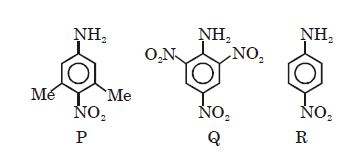
MediumMCQ
Determine the order of basic strength for the following compounds:
A
$R < P < Q$
B
$Q < P < R$
C
$P < R < Q$
D
$Q < R < P$
Solution
(D) The basic strength of aromatic amines depends on the availability of the lone pair on the nitrogen atom. Electron-withdrawing groups $(EWG)$ like $-NO_2$ decrease basicity by pulling electron density away from the nitrogen atom through inductive and resonance effects. Electron-donating groups $(EDG)$ like $-CH_3$ (methyl) increase basicity.
$P$: Contains one $-NO_2$ group and two $-CH_3$ groups. The $-CH_3$ groups are electron-donating,which increases the electron density on the nitrogen atom,making it the most basic among the three.
$Q$: Contains three $-NO_2$ groups (two ortho,one para). These are strong electron-withdrawing groups that significantly reduce the electron density on the nitrogen atom,making it the least basic.
$R$: Contains one $-NO_2$ group at the para position. It is less basic than $P$ (due to the absence of electron-donating groups) but more basic than $Q$ (which has three electron-withdrawing groups).
Therefore,the order of basic strength is $Q < R < P$.
$P$: Contains one $-NO_2$ group and two $-CH_3$ groups. The $-CH_3$ groups are electron-donating,which increases the electron density on the nitrogen atom,making it the most basic among the three.
$Q$: Contains three $-NO_2$ groups (two ortho,one para). These are strong electron-withdrawing groups that significantly reduce the electron density on the nitrogen atom,making it the least basic.
$R$: Contains one $-NO_2$ group at the para position. It is less basic than $P$ (due to the absence of electron-donating groups) but more basic than $Q$ (which has three electron-withdrawing groups).
Therefore,the order of basic strength is $Q < R < P$.
0 likes
View Solution432
MediumMCQ
Find the major product of the following reaction:
$C_6H_5NHCOC_6H_5 \xrightarrow{conc. HNO_3 + conc. H_2SO_4} \text{Major product}$
$C_6H_5NHCOC_6H_5 \xrightarrow{conc. HNO_3 + conc. H_2SO_4} \text{Major product}$
A
$N$-($3$-nitrophenyl)benzamide
B
$N$-($4$-nitrophenyl)benzamide
C
$N$-phenyl$-4-$nitrobenzamide
D
$N$-phenyl$-2-$nitrobenzamide
Solution
(B) The reaction is an electrophilic aromatic substitution (nitration) of $N$-phenylbenzamide (benzanilide).
The $-NHCOC_6H_5$ group is an ortho/para-directing group because the nitrogen atom has a lone pair of electrons that can be delocalized into the benzene ring.
Due to the steric hindrance caused by the bulky $-NHCOC_6H_5$ group,the para-position is more accessible than the ortho-position.
Therefore,the major product is the para-substituted isomer,which is $N$-($4$-nitrophenyl)benzamide.
The $-NHCOC_6H_5$ group is an ortho/para-directing group because the nitrogen atom has a lone pair of electrons that can be delocalized into the benzene ring.
Due to the steric hindrance caused by the bulky $-NHCOC_6H_5$ group,the para-position is more accessible than the ortho-position.
Therefore,the major product is the para-substituted isomer,which is $N$-($4$-nitrophenyl)benzamide.
0 likes
View Solution433
MediumMCQ
Which of the following is most basic?
A
Pyrrole
B
Aniline
C
Pyridine
D
Piperidine
Solution
(D) To determine the basicity,we look at the availability of the lone pair of electrons on the nitrogen atom for protonation.
$A$. In Pyrrole,the lone pair on the nitrogen atom is involved in the aromatic sextet,making it unavailable for protonation. Thus,it is very weakly basic.
$B$. In Aniline,the lone pair on the nitrogen atom is in conjugation with the benzene ring,which reduces its availability for protonation.
$C$. In Pyridine,the lone pair is in an $sp^2$ hybridized orbital. Although it is not involved in the aromatic system,the $sp^2$ character makes it less basic than aliphatic amines.
$D$. In Piperidine,the nitrogen atom is $sp^3$ hybridized and there is no resonance or aromaticity to delocalize the lone pair. Therefore,the lone pair is highly available for protonation,making Piperidine the most basic among the given options.
$A$. In Pyrrole,the lone pair on the nitrogen atom is involved in the aromatic sextet,making it unavailable for protonation. Thus,it is very weakly basic.
$B$. In Aniline,the lone pair on the nitrogen atom is in conjugation with the benzene ring,which reduces its availability for protonation.
$C$. In Pyridine,the lone pair is in an $sp^2$ hybridized orbital. Although it is not involved in the aromatic system,the $sp^2$ character makes it less basic than aliphatic amines.
$D$. In Piperidine,the nitrogen atom is $sp^3$ hybridized and there is no resonance or aromaticity to delocalize the lone pair. Therefore,the lone pair is highly available for protonation,making Piperidine the most basic among the given options.
0 likes
View Solution434
DifficultMCQ
Consider the molecule $1,3-dimethyl-1,2,3,4-tetrahydroquinoxaline$ with an amino group at the $5$-position. Upon protonation,which nitrogen atom is the most basic and will be protonated first? Identify the correct structure of the product '$A$' formed after protonation.
A
Structure with protonation at the amino group $(-NH_3^+)$.
B
Structure with protonation at the $N-1$ position (tertiary amine).
C
Structure with protonation at the $N-3$ position (tertiary amine).
D
All are correct.
Solution
(C) The basicity of nitrogen atoms depends on the availability of the lone pair.
In $1,3-dimethyl-1,2,3,4-tetrahydroquinoxaline$,the amino group at the $5$-position is conjugated with the benzene ring,reducing its basicity.
The nitrogen at the $1$-position is an aniline-like nitrogen (conjugated with the ring),while the nitrogen at the $3$-position is an aliphatic tertiary amine.
Aliphatic amines are more basic than aromatic/conjugated amines.
Therefore,the nitrogen at the $3$-position is the most basic and will be protonated first to form the stable conjugate acid.
In $1,3-dimethyl-1,2,3,4-tetrahydroquinoxaline$,the amino group at the $5$-position is conjugated with the benzene ring,reducing its basicity.
The nitrogen at the $1$-position is an aniline-like nitrogen (conjugated with the ring),while the nitrogen at the $3$-position is an aliphatic tertiary amine.
Aliphatic amines are more basic than aromatic/conjugated amines.
Therefore,the nitrogen at the $3$-position is the most basic and will be protonated first to form the stable conjugate acid.
0 likes
View Solution435
DifficultMCQ
Rank the following in decreasing order of their acidic strengths:
$(A)$ Tetrahydrofuran-oxonium ion
$(B)$ Pyrrolidine
$(C)$ Cyclopentanol
$(D)$ $N$-methylpyrrolidinium ion
$(A)$ Tetrahydrofuran-oxonium ion
$(B)$ Pyrrolidine
$(C)$ Cyclopentanol
$(D)$ $N$-methylpyrrolidinium ion
A
$A > D > B > C$
B
$A > C > B > D$
C
$A > D > C > B$
D
$D > A > C > B$
Solution
(C) The acidic strength depends on the stability of the conjugate base and the electronegativity of the atom bearing the positive charge.
$A$ is an oxonium ion $(R-OH^{+}-R)$,which is a very strong acid because oxygen is highly electronegative and carries a positive charge.
$D$ is an ammonium ion $(R-NH^{+}-CH_3)$,which is also a strong acid but less acidic than the oxonium ion because nitrogen is less electronegative than oxygen.
$C$ is an alcohol $(R-OH)$,which is a weak acid.
$B$ is an amine $(R-NH_2)$,which is a very weak acid (essentially basic).
Therefore,the decreasing order of acidic strength is $A > D > C > B$.
$A$ is an oxonium ion $(R-OH^{+}-R)$,which is a very strong acid because oxygen is highly electronegative and carries a positive charge.
$D$ is an ammonium ion $(R-NH^{+}-CH_3)$,which is also a strong acid but less acidic than the oxonium ion because nitrogen is less electronegative than oxygen.
$C$ is an alcohol $(R-OH)$,which is a weak acid.
$B$ is an amine $(R-NH_2)$,which is a very weak acid (essentially basic).
Therefore,the decreasing order of acidic strength is $A > D > C > B$.
0 likes
View Solution436
DifficultMCQ
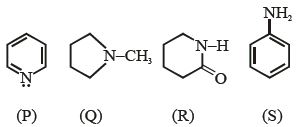
Write the order of basic strength for the following compounds:
A
$P > Q > R > S$
B
$Q > P > R > S$
C
$Q > P > S > R$
D
$S > P > Q > R$
Solution
(C) To determine the basic strength,we analyze the availability of the lone pair on the nitrogen atom:
$1$. $(Q)$ is $N$-methylpiperidine,a tertiary aliphatic amine where the nitrogen is $sp^3$ hybridized and the lone pair is localized,making it the most basic.
$2$. $(P)$ is pyridine,where the nitrogen is $sp^2$ hybridized. The lone pair is in an $sp^2$ orbital,which is more electronegative than an $sp^3$ orbital,making it less basic than $(Q)$.
$3$. $(S)$ is aniline,where the lone pair on the nitrogen is involved in resonance with the benzene ring,significantly reducing its availability for protonation.
$4$. $(R)$ is $\delta$-valerolactam,an amide. The lone pair on the nitrogen is delocalized into the carbonyl group $(C=O)$ via resonance,making it the least basic among the given compounds.
Therefore,the order of basic strength is $(Q) > (P) > (S) > (R)$.
$1$. $(Q)$ is $N$-methylpiperidine,a tertiary aliphatic amine where the nitrogen is $sp^3$ hybridized and the lone pair is localized,making it the most basic.
$2$. $(P)$ is pyridine,where the nitrogen is $sp^2$ hybridized. The lone pair is in an $sp^2$ orbital,which is more electronegative than an $sp^3$ orbital,making it less basic than $(Q)$.
$3$. $(S)$ is aniline,where the lone pair on the nitrogen is involved in resonance with the benzene ring,significantly reducing its availability for protonation.
$4$. $(R)$ is $\delta$-valerolactam,an amide. The lone pair on the nitrogen is delocalized into the carbonyl group $(C=O)$ via resonance,making it the least basic among the given compounds.
Therefore,the order of basic strength is $(Q) > (P) > (S) > (R)$.
0 likes
View Solution437
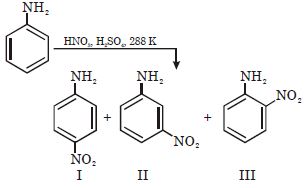
DifficultMCQ
Select the percentage in which these amine derivatives are formed in the reaction mixture along with the reason for the nitration of aniline:
A
$I \to 2\%, II \to 47\%, III \to 51\%$. In the acidic medium,aniline is protonated to form the anilinium ion which is ortho directing.
B
$I \to 51\%, II \to 2\%, III \to 47\%$. In the acidic medium,aniline is protonated to form the anilinium ion which is para directing.
C
$I \to 51\%, II \to 47\%, III \to 2\%$. In the acidic medium,aniline is protonated to form the anilinium ion which is meta directing.
D
$I \to 50\%, II \to 20\%, III \to 20\%$. In acidic medium aniline is protonated to form the anilinium ion which is ortho directing.
Solution
(C) In the presence of concentrated $H_2SO_4$,aniline is protonated to form the anilinium ion $(C_6H_5NH_3^+)$.
This anilinium ion is meta-directing because the $-NH_3^+$ group is strongly electron-withdrawing due to the positive charge on the nitrogen atom.
Consequently,the nitration of aniline in an acidic medium yields a significant amount of meta-nitroaniline $(47\%)$ along with ortho $(2\%)$ and para $(51\%)$ products.
Therefore,the correct distribution is $I$ (para) $\to 51\%$,$II$ (meta) $\to 47\%$,and $III$ (ortho) $\to 2\%$.
This anilinium ion is meta-directing because the $-NH_3^+$ group is strongly electron-withdrawing due to the positive charge on the nitrogen atom.
Consequently,the nitration of aniline in an acidic medium yields a significant amount of meta-nitroaniline $(47\%)$ along with ortho $(2\%)$ and para $(51\%)$ products.
Therefore,the correct distribution is $I$ (para) $\to 51\%$,$II$ (meta) $\to 47\%$,and $III$ (ortho) $\to 2\%$.
0 likes
View Solution438
DifficultMCQ
In the given reaction $A$ is :- $A$ $\xrightarrow{\text{Reduction}} B$ $\xrightarrow{HNO_2} C_2H_5OH$
A
$CH_3CN$
B
$CH_3NC$
C
$C_2H_5CN$
D
$CH_3NO_2$
Solution
(A) The reaction sequence is as follows:
$CH_3CN$ $\xrightarrow{\text{Reduction}} CH_3CH_2NH_2$ $\xrightarrow{HNO_2} C_2H_5OH + N_2 + H_2O$
Here,$A$ is $CH_3CN$ (acetonitrile or ethanenitrile).
Reduction of $CH_3CN$ gives ethylamine $(CH_3CH_2NH_2)$,which on reaction with nitrous acid $(HNO_2)$ yields ethanol $(C_2H_5OH)$.
$CH_3CN$ $\xrightarrow{\text{Reduction}} CH_3CH_2NH_2$ $\xrightarrow{HNO_2} C_2H_5OH + N_2 + H_2O$
Here,$A$ is $CH_3CN$ (acetonitrile or ethanenitrile).
Reduction of $CH_3CN$ gives ethylamine $(CH_3CH_2NH_2)$,which on reaction with nitrous acid $(HNO_2)$ yields ethanol $(C_2H_5OH)$.
0 likes
View Solution439
MediumMCQ
The correct order of basic strength is:
A
Piperidine > Pyridine > Pyrrole
B
Pyridine > Piperidine > Pyrrole
C
Piperidine > Pyrrole > Pyridine
D
Pyridine > Pyrrole > Piperidine
Solution
(A) To determine the basic strength,we look at the availability of the lone pair on the nitrogen atom:
$1$. In $Piperidine$,the nitrogen atom is $sp^3$ hybridized and its lone pair is localized,making it the most basic.
$2$. In $Pyridine$,the nitrogen atom is $sp^2$ hybridized. The lone pair is in an $sp^2$ orbital,which is more electronegative than an $sp^3$ orbital,making it less basic than $Piperidine$.
$3$. In $Pyrrole$,the lone pair on the nitrogen atom is involved in the aromatic sextet (delocalized). Therefore,it is not available for protonation,making it the least basic.
Thus,the correct order of basic strength is $Piperidine > Pyridine > Pyrrole$.
$1$. In $Piperidine$,the nitrogen atom is $sp^3$ hybridized and its lone pair is localized,making it the most basic.
$2$. In $Pyridine$,the nitrogen atom is $sp^2$ hybridized. The lone pair is in an $sp^2$ orbital,which is more electronegative than an $sp^3$ orbital,making it less basic than $Piperidine$.
$3$. In $Pyrrole$,the lone pair on the nitrogen atom is involved in the aromatic sextet (delocalized). Therefore,it is not available for protonation,making it the least basic.
Thus,the correct order of basic strength is $Piperidine > Pyridine > Pyrrole$.
0 likes
View Solution440
DifficultMCQ
Arrange the following compounds in their correct order of $pK_b$ values.
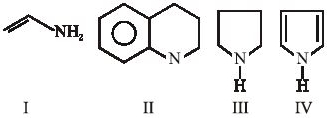
A
$III > I > II > IV$
B
$IV > II > I > III$
C
$II > IV > I > III$
D
$III > II > IV > I$
Solution
(B) To determine the $pK_b$ order,we first determine the basicity order. Higher basicity corresponds to lower $pK_b$ values.
$I$: Vinylamine $(CH_2=CH-NH_2)$. The lone pair on $N$ is in conjugation with the double bond,reducing its availability.
$II$: $1,2,3,4$-Tetrahydroquinoline. The lone pair on $N$ is not involved in resonance with the benzene ring due to the saturated carbons,making it a relatively strong base.
$III$: Pyrrolidine. It is a saturated secondary amine,making it the most basic among the given compounds.
$IV$: Pyrrole. The lone pair on $N$ is involved in the aromatic sextet,making it extremely weakly basic.
Basicity order: $III > II > I > IV$.
Since $pK_b = -\log(K_b)$,the order of $pK_b$ is the inverse of the basicity order: $IV > I > II > III$.
$I$: Vinylamine $(CH_2=CH-NH_2)$. The lone pair on $N$ is in conjugation with the double bond,reducing its availability.
$II$: $1,2,3,4$-Tetrahydroquinoline. The lone pair on $N$ is not involved in resonance with the benzene ring due to the saturated carbons,making it a relatively strong base.
$III$: Pyrrolidine. It is a saturated secondary amine,making it the most basic among the given compounds.
$IV$: Pyrrole. The lone pair on $N$ is involved in the aromatic sextet,making it extremely weakly basic.
Basicity order: $III > II > I > IV$.
Since $pK_b = -\log(K_b)$,the order of $pK_b$ is the inverse of the basicity order: $IV > I > II > III$.
0 likes
View Solution441
DifficultMCQ
$Ph-NC$ $\xrightarrow{LiAlH_4} A$ $\xrightarrow{NaNO_2 + HCl} B$. Identify product $B$.
A
$N$-methylaniline
B
$N$-nitroso-$N$-methylaniline
C
p-nitroso-$N$-methylaniline
D
o-nitroso-$N$-methylaniline
Solution
(B) $1$. The reduction of phenyl isocyanide $(Ph-NC)$ with $LiAlH_4$ yields $N$-methylaniline $(Ph-NH-CH_3)$ as product $A$.
$2$. $N$-methylaniline is a secondary aromatic amine.
$3$. Secondary amines react with nitrous acid $(NaNO_2 + HCl)$ at low temperatures $(0-5 \ ^\circ C)$ to form $N$-nitroso compounds.
$4$. Therefore,the reaction of $N$-methylaniline with $NaNO_2 + HCl$ gives $N$-nitroso-$N$-methylaniline as product $B$.
$2$. $N$-methylaniline is a secondary aromatic amine.
$3$. Secondary amines react with nitrous acid $(NaNO_2 + HCl)$ at low temperatures $(0-5 \ ^\circ C)$ to form $N$-nitroso compounds.
$4$. Therefore,the reaction of $N$-methylaniline with $NaNO_2 + HCl$ gives $N$-nitroso-$N$-methylaniline as product $B$.
0 likes
View Solution442
MediumMCQ
The major organic product formed from the following reaction is:
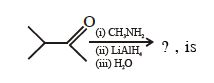
A
$(CH_3)_2CH-O-NHCH_3$
B
$(CH_3)_2CH-CH_2-NHCH_3$
C
$(CH_3)_2CH-CH(NHCH_3)-OH$
D
$(CH_3)_2CH-CH(OH)-NHCH_3$
Solution
(B) The reaction involves the following steps:
$1$. The reaction of $3$-methylbutan-$2$-one (an aldehyde/ketone) with methylamine $(CH_3NH_2)$ forms an imine intermediate $(R_2C=NCH_3)$.
$2$. The subsequent reduction with $LiAlH_4$ reduces the $C=N$ double bond to a $C-NH$ single bond,resulting in a secondary amine.
$3$. The starting material is $3$-methylbutan-$2$-one,which is $(CH_3)_2CH-C(=O)-CH_3$.
$4$. The reaction with $CH_3NH_2$ forms the imine $(CH_3)_2CH-C(=NCH_3)-CH_3$.
$5$. Reduction with $LiAlH_4$ gives the amine $(CH_3)_2CH-CH(NHCH_3)-CH_3$.
$1$. The reaction of $3$-methylbutan-$2$-one (an aldehyde/ketone) with methylamine $(CH_3NH_2)$ forms an imine intermediate $(R_2C=NCH_3)$.
$2$. The subsequent reduction with $LiAlH_4$ reduces the $C=N$ double bond to a $C-NH$ single bond,resulting in a secondary amine.
$3$. The starting material is $3$-methylbutan-$2$-one,which is $(CH_3)_2CH-C(=O)-CH_3$.
$4$. The reaction with $CH_3NH_2$ forms the imine $(CH_3)_2CH-C(=NCH_3)-CH_3$.
$5$. Reduction with $LiAlH_4$ gives the amine $(CH_3)_2CH-CH(NHCH_3)-CH_3$.
0 likes
View Solution443
MediumMCQ
The base having the highest $pK_b$ value is
A
$NH_3$
B
$CH_3NH_2$
C
$(CH_3)_3N$
D
$(CH_3)_2NH$
Solution
(A) The $pK_b$ value is inversely proportional to the basic strength of the compound. Higher $pK_b$ means lower basic strength.
Among the given options,$NH_3$ is the weakest base because alkyl groups are electron-donating ($+I$ effect),which increases the electron density on the nitrogen atom,thereby increasing basicity.
In the gas phase,the order of basicity is $(CH_3)_3N > (CH_3)_2NH > CH_3NH_2 > NH_3$.
In aqueous solution,the order is $(CH_3)_2NH > CH_3NH_2 > (CH_3)_3N > NH_3$ due to solvation effects and steric hindrance.
In both cases,$NH_3$ remains the weakest base,and therefore,it has the highest $pK_b$ value.
Among the given options,$NH_3$ is the weakest base because alkyl groups are electron-donating ($+I$ effect),which increases the electron density on the nitrogen atom,thereby increasing basicity.
In the gas phase,the order of basicity is $(CH_3)_3N > (CH_3)_2NH > CH_3NH_2 > NH_3$.
In aqueous solution,the order is $(CH_3)_2NH > CH_3NH_2 > (CH_3)_3N > NH_3$ due to solvation effects and steric hindrance.
In both cases,$NH_3$ remains the weakest base,and therefore,it has the highest $pK_b$ value.
0 likes
View Solution444
DifficultMCQ
In the following reaction,the product $(A)$ is:
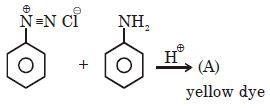
A
$C_6H_5-N=N-NH-C_6H_5$
B
$C_6H_5-N=N-(C_6H_4)-NH_2$ (ortho)
C
$C_6H_5-N=N-(C_6H_4)-NH_2$ (meta)
D
$C_6H_5-N=N-(C_6H_4)-NH_2$ (para)
Solution
(D) The reaction between benzenediazonium chloride and aniline in a weakly acidic medium $(pH \approx 4-5)$ is an electrophilic aromatic substitution reaction known as coupling reaction.
In this reaction,the diazonium cation acts as an electrophile and attacks the electron-rich ring of aniline.
Since the $-NH_2$ group is a strong ortho/para directing group,and due to steric hindrance at the ortho position,the electrophile preferentially attacks the para position of aniline to form $p$-aminoazobenzene,which is a yellow dye.
In this reaction,the diazonium cation acts as an electrophile and attacks the electron-rich ring of aniline.
Since the $-NH_2$ group is a strong ortho/para directing group,and due to steric hindrance at the ortho position,the electrophile preferentially attacks the para position of aniline to form $p$-aminoazobenzene,which is a yellow dye.
0 likes
View Solution445
DifficultMCQ
Identify the major product of the following Hofmann elimination reaction: $[\text{cyclohexyl-}N^{+}(CH_3)(CH_2CH_3)(n\text{-Bu})]OH^{-} \xrightarrow{\Delta} \text{Major product}$
A
$1\text{-Methylcyclohexene}$
B
$3\text{-Methylcyclohexene}$
C
$\text{But-}1\text{-ene}$
D
$\text{Ethene}$
Solution
(D) The reaction is a Hofmann elimination of a quaternary ammonium hydroxide.
In Hofmann elimination,the base $(OH^{-})$ abstracts a proton from the $\beta$-carbon that is least sterically hindered.
The possible $\beta$-hydrogens are on the cyclohexyl ring,the ethyl group,and the $n$-butyl group.
The transition state for the formation of the least substituted alkene is favored due to steric hindrance.
Among the alkyl groups attached to the nitrogen,the ethyl group has the most accessible $\beta$-hydrogens.
Therefore,the elimination of the ethyl group leads to the formation of ethene $(CH_2=CH_2)$ as the major product.
In Hofmann elimination,the base $(OH^{-})$ abstracts a proton from the $\beta$-carbon that is least sterically hindered.
The possible $\beta$-hydrogens are on the cyclohexyl ring,the ethyl group,and the $n$-butyl group.
The transition state for the formation of the least substituted alkene is favored due to steric hindrance.
Among the alkyl groups attached to the nitrogen,the ethyl group has the most accessible $\beta$-hydrogens.
Therefore,the elimination of the ethyl group leads to the formation of ethene $(CH_2=CH_2)$ as the major product.
0 likes
View Solution446
DifficultMCQ
Which is the best method for the preparation of $N$-methylethanamide?
A
$CH_3COOH + CH_3NH_2 \to$
B
$CH_3COCl + CH_3NH_2 \to$
C
$CH_3COOCOCH_3 + CH_3CH_2NH_2 \to$
D
$CH_3CONH_2 + CH_3F \to$
Solution
(B) The reaction between an acid chloride $(CH_3COCl)$ and a primary amine $(CH_3NH_2)$ is the most effective method for preparing amides.
Acid chlorides are highly reactive towards nucleophilic substitution by amines, providing high yields of the $N$-substituted amide at room temperature.
Acid chlorides are highly reactive towards nucleophilic substitution by amines, providing high yields of the $N$-substituted amide at room temperature.
0 likes
View Solution447
AdvancedMCQ
Identify the major product of the following reaction:
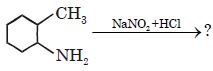
A
$2-$methylcyclohexanol
B
$1-$chlorocyclohexane
C
$1-$nitrocyclohexane
D
$1-$methylcyclohexanol
Solution
(D) The reaction of a primary aliphatic amine with $NaNO_2 + HCl$ (nitrous acid) forms an unstable diazonium salt.
This diazonium salt quickly decomposes to form a carbocation.
In this case,the $2$-methylcyclohexyl cation is formed.
This secondary carbocation undergoes a $1,2$-hydride shift to form a more stable tertiary carbocation ($1$-methylcyclohexyl cation).
Finally,the nucleophilic attack by $H_2O$ on the tertiary carbocation yields $1$-methylcyclohexanol as the major product.
This diazonium salt quickly decomposes to form a carbocation.
In this case,the $2$-methylcyclohexyl cation is formed.
This secondary carbocation undergoes a $1,2$-hydride shift to form a more stable tertiary carbocation ($1$-methylcyclohexyl cation).
Finally,the nucleophilic attack by $H_2O$ on the tertiary carbocation yields $1$-methylcyclohexanol as the major product.
0 likes
View Solution448
DifficultMCQ
Compound $III$ is
$\xrightarrow[{ii)\,CuCl/HCl}]{{i)\,HNO_2\,(0 - 5\,^oC)}}I$ $\xrightarrow{{Sn/HCl}}II$ $\xrightarrow[{ii)\,H_3PO_2 + H_2O}]{{i)HNO_2\,(0 - 5\,^oC)\,}}III$
$\xrightarrow[{ii)\,CuCl/HCl}]{{i)\,HNO_2\,(0 - 5\,^oC)}}I$ $\xrightarrow{{Sn/HCl}}II$ $\xrightarrow[{ii)\,H_3PO_2 + H_2O}]{{i)HNO_2\,(0 - 5\,^oC)\,}}III$
A
$1,3-$dibromo$-5-$chlorobenzene
B
$1,3-$dibromo$-5-$nitrobenzene
C
$2,6-$dibromochlorobenzene
D
$1,3-$dibromobenzene
Solution
(C) The reaction sequence is as follows:
$1$. The starting material (not explicitly shown but implied as $4-$nitro$-2,6-$dibromoaniline or similar derivative) undergoes diazotization followed by Sandmeyer reaction with $CuCl/HCl$ to replace the amino group with a chlorine atom,forming compound $I$ $(1-chloro-2,6-dibromo-4-nitrobenzene)$.
$2$. Reduction of the nitro group in compound $I$ using $Sn/HCl$ yields compound $II$ $(4-amino-3,5-dibromochlorobenzene)$.
$3$. Diazotization of compound $II$ with $HNO_2$ at $0-5\,^oC$ followed by treatment with $H_3PO_2$ and $H_2O$ (reductive deamination) removes the amino group,resulting in compound $III$ $(1-chloro-2,6-dibromobenzene)$.
$1$. The starting material (not explicitly shown but implied as $4-$nitro$-2,6-$dibromoaniline or similar derivative) undergoes diazotization followed by Sandmeyer reaction with $CuCl/HCl$ to replace the amino group with a chlorine atom,forming compound $I$ $(1-chloro-2,6-dibromo-4-nitrobenzene)$.
$2$. Reduction of the nitro group in compound $I$ using $Sn/HCl$ yields compound $II$ $(4-amino-3,5-dibromochlorobenzene)$.
$3$. Diazotization of compound $II$ with $HNO_2$ at $0-5\,^oC$ followed by treatment with $H_3PO_2$ and $H_2O$ (reductive deamination) removes the amino group,resulting in compound $III$ $(1-chloro-2,6-dibromobenzene)$.
0 likes
View Solution449
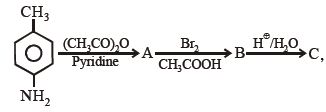
DifficultMCQ
$C$ will be
A
$2$-bromo-$4$-methylaniline
B
$3$-bromo-$4$-methylaniline
C
$2$-bromo-$4$-methylacetanilide
D
$4$-methylacetophenone
Solution
(A) The reaction sequence is as follows:
$1$. $p$-Toluidine reacts with acetic anhydride in the presence of pyridine to form $N$-(p-tolyl)acetamide (compound $A$).
$2$. Compound $A$ undergoes electrophilic aromatic substitution with $Br_2$ in $CH_3COOH$. The acetamido group $(-NHCOCH_3)$ is ortho/para directing. Since the para position is occupied by a methyl group,bromine enters the ortho position relative to the acetamido group to form $2$-bromo-$4$-methylacetanilide (compound $B$).
$3$. Finally,acid-catalyzed hydrolysis $(H^{\oplus}/H_2O)$ of the acetamido group in compound $B$ yields $2$-bromo-$4$-methylaniline (compound $C$).
$1$. $p$-Toluidine reacts with acetic anhydride in the presence of pyridine to form $N$-(p-tolyl)acetamide (compound $A$).
$2$. Compound $A$ undergoes electrophilic aromatic substitution with $Br_2$ in $CH_3COOH$. The acetamido group $(-NHCOCH_3)$ is ortho/para directing. Since the para position is occupied by a methyl group,bromine enters the ortho position relative to the acetamido group to form $2$-bromo-$4$-methylacetanilide (compound $B$).
$3$. Finally,acid-catalyzed hydrolysis $(H^{\oplus}/H_2O)$ of the acetamido group in compound $B$ yields $2$-bromo-$4$-methylaniline (compound $C$).
0 likes
View Solution450
MediumMCQ
In which of the following reactions is a primary amine not obtained as a product?
A
$CH_3CONH_2 \xrightarrow[\Delta]{Br_2 + KOH}$
B
$CH_3COCl \xrightarrow[(ii) \text{Hydrolysis}]{(i) NaN_3 / \Delta}$
C
$CH_3CH_2CONH_2 \xrightarrow{LiAlH_4 / \text{ether}}$
D
$CH_3NC \xrightarrow{LiAlH_4 / \text{ether}}$
Solution
(D) Hofmann bromamide degradation of $CH_3CONH_2$ yields methylamine $(CH_3NH_2)$,a primary amine.
$(b)$ Curtius rearrangement of $CH_3COCl$ with $NaN_3$ followed by hydrolysis yields methylamine $(CH_3NH_2)$,a primary amine.
$(c)$ Reduction of $CH_3CH_2CONH_2$ with $LiAlH_4$ yields ethylamine $(CH_3CH_2NH_2)$,a primary amine.
$(d)$ Reduction of methyl isocyanide $(CH_3NC)$ with $LiAlH_4$ yields dimethylamine $(CH_3NHCH_3)$,which is a secondary amine.
Therefore,the correct option is $(d)$.
$(b)$ Curtius rearrangement of $CH_3COCl$ with $NaN_3$ followed by hydrolysis yields methylamine $(CH_3NH_2)$,a primary amine.
$(c)$ Reduction of $CH_3CH_2CONH_2$ with $LiAlH_4$ yields ethylamine $(CH_3CH_2NH_2)$,a primary amine.
$(d)$ Reduction of methyl isocyanide $(CH_3NC)$ with $LiAlH_4$ yields dimethylamine $(CH_3NHCH_3)$,which is a secondary amine.
Therefore,the correct option is $(d)$.
0 likes
View SolutionAmines — Properties of Amines · Frequently Asked Questions
1Are these Amines questions useful for JEE and NEET?
Yes. All questions in this section are mapped to JEE Main and NEET exam patterns. Previous year questions from JEE Main, NEET, GUJCET and state-level exams are included with full solutions.
2Can I switch to Hindi or Gujarati for these questions?
Yes. Use the language tabs in the hero section or the sidebar to view the same questions and solutions in English, Hindi or Gujarati.
3How do I generate a question paper from this subtopic?
Use the Vedclass Exam Paper Generator — select the chapter and subtopic, set difficulty, and generate Sets A, B, C, D automatically. First 3 chapters of every subject are free.
Vedclass Products
For Students
Vedclass Test Series
Mock tests in real JEE/NEET style with performance analysis. 5-day free trial.
Start Free TrialFor Teachers
Exam Paper Generator
Generate Set A/B/C/D papers from this chapter in 2 minutes. 3 chapters free.
Try FreeFor Institutes
Online Exam Module
Live online exams with unlimited students, 360° analytics & white-label branding.
See DemoFor Teachers & Institutes
Generate a Amines Exam Paper in 2 Minutes
Select subtopic & difficulty — Sets A, B, C, D auto-generated with No Repeat logic.
First 3 chapters of every subject are free — no payment required.