
A English
Properties of Amines Questions in English
Class 12 Chemistry · Amines · Properties of Amines
1212+
Questions
English
Language
100%
With Solutions
Showing 50 of 1212 questions in English
551
MediumMCQ
Which one of the following compounds undergoes bromination of its aromatic ring (electrophilic aromatic substitution) at the fastest rate?
A
Tetralin
B
$1,2,3,4-$Tetrahydroquinoline
C
$1,2,3,4-$Tetrahydroisoquinoline
D
$3,4-$Dihydroquinolin-$2$(1H)-one
Solution
(B) The rate of electrophilic aromatic substitution depends on the electron density of the aromatic ring. Groups with a $+M$ (mesomeric) effect increase the electron density,thereby activating the ring towards electrophilic attack.
$A$: Tetralin has only alkyl groups,which are weakly activating.
$B$: $1,2,3,4$-Tetrahydroquinoline has an $-NH-$ group directly attached to the benzene ring. The lone pair on the nitrogen atom participates in resonance ($+M$ effect),significantly increasing the electron density of the ring.
$C$: $1,2,3,4$-Tetrahydroisoquinoline has the nitrogen atom separated from the ring by a $CH_2$ group,so it does not exert a direct $+M$ effect on the ring.
$D$: $3,4$-Dihydroquinolin-$2(1H)$-one has an amide group where the nitrogen lone pair is involved in resonance with the carbonyl group ($-M$ effect),which deactivates the ring.
Therefore,$1,2,3,4$-Tetrahydroquinoline $(B)$ undergoes bromination at the fastest rate due to the strong $+M$ effect of the $-NH-$ group.
$A$: Tetralin has only alkyl groups,which are weakly activating.
$B$: $1,2,3,4$-Tetrahydroquinoline has an $-NH-$ group directly attached to the benzene ring. The lone pair on the nitrogen atom participates in resonance ($+M$ effect),significantly increasing the electron density of the ring.
$C$: $1,2,3,4$-Tetrahydroisoquinoline has the nitrogen atom separated from the ring by a $CH_2$ group,so it does not exert a direct $+M$ effect on the ring.
$D$: $3,4$-Dihydroquinolin-$2(1H)$-one has an amide group where the nitrogen lone pair is involved in resonance with the carbonyl group ($-M$ effect),which deactivates the ring.
Therefore,$1,2,3,4$-Tetrahydroquinoline $(B)$ undergoes bromination at the fastest rate due to the strong $+M$ effect of the $-NH-$ group.
0 likes
View Solution552
DifficultMCQ
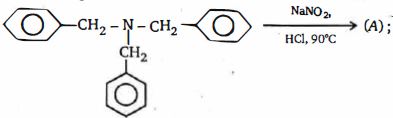
The product $(A)$ is:
A
$Ph-CH_2-N(N=O)-CH_2-Ph$
B
$Ph-CH_2-N(Ph)-N=O$
C
$(Ph-CH_2)_3N^{+}-N=O$
D
$Ph-N=O$
Solution
(C) The given reactant is a tertiary amine,$(Ph-CH_2)_3N$.
Tertiary aliphatic amines react with nitrous acid $(HNO_2)$ generated from $NaNO_2/HCl$ to form a salt,which is a nitrosoammonium salt.
The reaction is: $(Ph-CH_2)_3N + HNO_2 \rightarrow (Ph-CH_2)_3N^{+}-N=O \, OH^{-}$.
Thus,the product $(A)$ is $(Ph-CH_2)_3N^{+}-N=O$.
Tertiary aliphatic amines react with nitrous acid $(HNO_2)$ generated from $NaNO_2/HCl$ to form a salt,which is a nitrosoammonium salt.
The reaction is: $(Ph-CH_2)_3N + HNO_2 \rightarrow (Ph-CH_2)_3N^{+}-N=O \, OH^{-}$.
Thus,the product $(A)$ is $(Ph-CH_2)_3N^{+}-N=O$.
0 likes
View Solution553
MediumMCQ
$p$-aminophenol reacts with one equivalent of acetyl chloride in the presence of pyridine to give mainly
A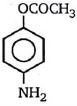
B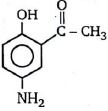
C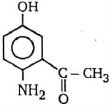
D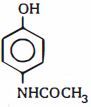
Solution
(D) $p$-aminophenol contains both an amino group $(-NH_2)$ and a hydroxyl group $(-OH)$.
In the presence of a base like pyridine,the amino group is more nucleophilic than the hydroxyl group.
Therefore,the acetylation reaction with one equivalent of acetyl chloride occurs selectively at the $-NH_2$ group to form $N$-($4$-hydroxyphenyl)acetamide (paracetamol).
The correct option is $D$.
In the presence of a base like pyridine,the amino group is more nucleophilic than the hydroxyl group.
Therefore,the acetylation reaction with one equivalent of acetyl chloride occurs selectively at the $-NH_2$ group to form $N$-($4$-hydroxyphenyl)acetamide (paracetamol).
The correct option is $D$.
0 likes
View Solution554
MediumMCQ
$PhNH_2 + Ph_3COH \xrightarrow{H^{+}} P$ (major) (not an $N$-derivative). The product $(P)$ is:
A
o-tritylaniline
B
p-tritylaniline
C
m-tritylaniline
D
tritylbenzene
Solution
(B) $1$. In the presence of an acid $(H^{+})$,triphenylmethanol $(Ph_3COH)$ undergoes protonation followed by the loss of water to form a stable triphenylmethyl carbocation $(Ph_3C^{+})$.
$2$. Aniline $(PhNH_2)$ acts as a nucleophile. The amino group $(-NH_2)$ is a strongly activating group and is ortho/para-directing.
$3$. Due to the significant steric hindrance provided by the bulky triphenylmethyl group $(Ph_3C^{+})$,the electrophilic aromatic substitution occurs primarily at the para-position.
$4$. Therefore,the major product is $p$-tritylaniline.
$2$. Aniline $(PhNH_2)$ acts as a nucleophile. The amino group $(-NH_2)$ is a strongly activating group and is ortho/para-directing.
$3$. Due to the significant steric hindrance provided by the bulky triphenylmethyl group $(Ph_3C^{+})$,the electrophilic aromatic substitution occurs primarily at the para-position.
$4$. Therefore,the major product is $p$-tritylaniline.
0 likes
View Solution555
MediumMCQ
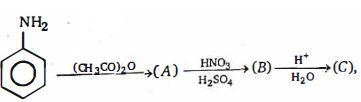
The product $(C)$ of the following reaction is:
A
o-Nitroaniline
B
p-Nitroaniline
C
m-Nitroaniline
D
p-Dinitrobenzene
Solution
(B) The reaction sequence is as follows:
$1$. Aniline reacts with acetic anhydride $(CH_3CO)_2O$ to form acetanilide $(A)$ (protection of the $-NH_2$ group).
$2$. Acetanilide undergoes nitration with $HNO_3/H_2SO_4$ to give $p$-nitroacetanilide $(B)$ as the major product due to the steric hindrance and the activating effect of the $-NHCOCH_3$ group.
$3$. Finally,hydrolysis of $(B)$ with $H^+/H_2O$ removes the acetyl group to yield $p$-nitroaniline $(C)$ as the final product.
$1$. Aniline reacts with acetic anhydride $(CH_3CO)_2O$ to form acetanilide $(A)$ (protection of the $-NH_2$ group).
$2$. Acetanilide undergoes nitration with $HNO_3/H_2SO_4$ to give $p$-nitroacetanilide $(B)$ as the major product due to the steric hindrance and the activating effect of the $-NHCOCH_3$ group.
$3$. Finally,hydrolysis of $(B)$ with $H^+/H_2O$ removes the acetyl group to yield $p$-nitroaniline $(C)$ as the final product.
0 likes
View Solution556
MediumMCQ
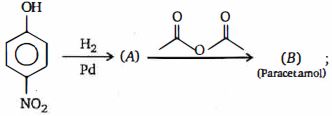
The product $(B)$ of this reaction is:
A
$4-$acetoxy-aniline
B
$N$-($4$-hydroxyphenyl)acetamide
C
$2-$acetyl$-4-$aminophenol
D
$4-$aminophenol
Solution
(B) The reaction proceeds in two steps:
$1$. Reduction of $p$-nitrophenol with $H_2/Pd$ gives $p$-aminophenol as product $(A)$.
$2$. $p$-aminophenol reacts with acetic anhydride. Since the amino group $(-NH_2)$ is more nucleophilic than the hydroxyl group $(-OH)$,the nitrogen atom attacks the carbonyl carbon of acetic anhydride to form an amide linkage.
This results in the formation of $N-(4-hydroxyphenyl)acetamide$,commonly known as Paracetamol.
$1$. Reduction of $p$-nitrophenol with $H_2/Pd$ gives $p$-aminophenol as product $(A)$.
$2$. $p$-aminophenol reacts with acetic anhydride. Since the amino group $(-NH_2)$ is more nucleophilic than the hydroxyl group $(-OH)$,the nitrogen atom attacks the carbonyl carbon of acetic anhydride to form an amide linkage.
This results in the formation of $N-(4-hydroxyphenyl)acetamide$,commonly known as Paracetamol.
0 likes
View Solution557
DifficultMCQ
Which one of the following compounds undergoes bromination of its aromatic ring (electrophilic aromatic substitution) at the fastest rate?
A
Tetralin
B
$1,2,3,4-$Tetrahydroquinoline
C
$1,2,3,4-$Tetrahydroisoquinoline
D
$3,4-$Dihydroquinolin-$2$(1H)-one
Solution
(B) The rate of electrophilic aromatic substitution depends on the electron density of the aromatic ring.
Groups that donate electrons via resonance ($+M$ effect) significantly increase the electron density,making the ring more reactive.
In $1,2,3,4$-tetrahydroquinoline (option $B$),the nitrogen atom has a lone pair of electrons that can participate in resonance with the benzene ring,exerting a strong $+M$ effect.
In $1,2,3,4$-tetrahydroisoquinoline (option $C$),the nitrogen is also attached to the ring,but the resonance effect is slightly less effective compared to the position in $B$ due to the connectivity.
Tetralin (option $A$) has only alkyl groups,which are weakly activating.
$3,4$-dihydroquinolin-$2(1H)$-one (option $D$) has an amide group where the lone pair on nitrogen is involved in resonance with the carbonyl group $(-C=O)$,reducing its availability for the aromatic ring,thus making it the least reactive.
Therefore,$1,2,3,4$-tetrahydroquinoline is the most reactive.
Groups that donate electrons via resonance ($+M$ effect) significantly increase the electron density,making the ring more reactive.
In $1,2,3,4$-tetrahydroquinoline (option $B$),the nitrogen atom has a lone pair of electrons that can participate in resonance with the benzene ring,exerting a strong $+M$ effect.
In $1,2,3,4$-tetrahydroisoquinoline (option $C$),the nitrogen is also attached to the ring,but the resonance effect is slightly less effective compared to the position in $B$ due to the connectivity.
Tetralin (option $A$) has only alkyl groups,which are weakly activating.
$3,4$-dihydroquinolin-$2(1H)$-one (option $D$) has an amide group where the lone pair on nitrogen is involved in resonance with the carbonyl group $(-C=O)$,reducing its availability for the aromatic ring,thus making it the least reactive.
Therefore,$1,2,3,4$-tetrahydroquinoline is the most reactive.
0 likes
View Solution558
DifficultMCQ
For the following diazonium ions,the order of reactivity towards diazo-coupling with phenol in the presence of dilute $NaOH$ is:
$(I)$ $p-Me_2N-C_6H_4-N_2^+$
$(II)$ $p-O_2N-C_6H_4-N_2^+$
$(III)$ $p-CH_3O-C_6H_4-N_2^+$
$(IV)$ $p-CH_3-C_6H_4-N_2^+$
$(I)$ $p-Me_2N-C_6H_4-N_2^+$
$(II)$ $p-O_2N-C_6H_4-N_2^+$
$(III)$ $p-CH_3O-C_6H_4-N_2^+$
$(IV)$ $p-CH_3-C_6H_4-N_2^+$
A
$I < IV < II < III$
B
$I < III < IV < II$
C
$III < I < II < IV$
D
$III < I < IV < II$
Solution
(B) The reactivity of diazonium ions towards diazo-coupling depends on the electrophilicity of the diazonium group $(-N_2^+)$.
Electron-withdrawing groups $(EWG)$ increase the electrophilicity of the diazonium ion,thereby increasing its reactivity towards coupling.
Electron-donating groups $(EDG)$ decrease the electrophilicity,thereby decreasing its reactivity.
The substituents at the para-position are:
$(I)$ $-NMe_2$ (Strong $EDG$)
$(II)$ $-NO_2$ (Strong $EWG$)
$(III)$ $-OCH_3$ (Moderate $EDG$)
$(IV)$ $-CH_3$ (Weak $EDG$)
The order of electron-withdrawing power is: $-NO_2 > -CH_3 > -OCH_3 > -NMe_2$.
Therefore,the order of reactivity is: $(I) < (III) < (IV) < (II)$.
Electron-withdrawing groups $(EWG)$ increase the electrophilicity of the diazonium ion,thereby increasing its reactivity towards coupling.
Electron-donating groups $(EDG)$ decrease the electrophilicity,thereby decreasing its reactivity.
The substituents at the para-position are:
$(I)$ $-NMe_2$ (Strong $EDG$)
$(II)$ $-NO_2$ (Strong $EWG$)
$(III)$ $-OCH_3$ (Moderate $EDG$)
$(IV)$ $-CH_3$ (Weak $EDG$)
The order of electron-withdrawing power is: $-NO_2 > -CH_3 > -OCH_3 > -NMe_2$.
Therefore,the order of reactivity is: $(I) < (III) < (IV) < (II)$.
0 likes
View Solution559
DifficultMCQ
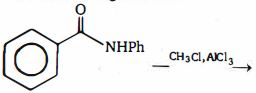
Give the major product of the following reaction:
A
$N$-($4$-methylphenyl)benzamide
B
$N$-($3$-methylphenyl)benzamide
C
$4-$methyl-$N$-phenylbenzamide
D
$3-$methyl-$N$-phenylbenzamide
Solution
(C) The reaction is a Friedel-Crafts alkylation of $N$-phenylbenzamide (benzanilide) with $CH_3Cl$ in the presence of $AlCl_3$.
In $N$-phenylbenzamide,the $-NHCOPh$ group is attached to the benzene ring. The $-NHCOPh$ group is a deactivating group because the lone pair on the nitrogen atom is involved in resonance with the carbonyl group $(-C=O)$,making it less available for resonance with the benzene ring.
However,the $-NHCOPh$ group is still ortho/para-directing due to the presence of the lone pair on the nitrogen atom.
Between the ortho and para positions,the para position is sterically less hindered. Therefore,the major product is the para-substituted isomer,which is $4$-methyl-$N$-phenylbenzamide.
Thus,the correct option is $(C)$.
In $N$-phenylbenzamide,the $-NHCOPh$ group is attached to the benzene ring. The $-NHCOPh$ group is a deactivating group because the lone pair on the nitrogen atom is involved in resonance with the carbonyl group $(-C=O)$,making it less available for resonance with the benzene ring.
However,the $-NHCOPh$ group is still ortho/para-directing due to the presence of the lone pair on the nitrogen atom.
Between the ortho and para positions,the para position is sterically less hindered. Therefore,the major product is the para-substituted isomer,which is $4$-methyl-$N$-phenylbenzamide.
Thus,the correct option is $(C)$.
0 likes
View Solution560
MediumMCQ
For the transformation shown below,the reagent used is:
$3-bromobenzenediazonium \ chloride \rightarrow \text{bromobenzene}$
$3-bromobenzenediazonium \ chloride \rightarrow \text{bromobenzene}$
A
$LiAlH_4$
B
$H_3PO_2$
C
$H_3O^{+}$
D
$H_2 / Pt$
Solution
(B) The given reaction involves the removal of the diazonium group $(-N_2^{+}Cl^{-})$ from the benzene ring and its replacement with a hydrogen atom.
This is a reductive deamination reaction of a diazonium salt.
$H_3PO_2$ (hypophosphorous acid) in the presence of water is a standard reagent used to reduce diazonium salts to the corresponding arenes.
The reaction is:
$Ar-N_2^{+}Cl^{-} + H_3PO_2 + H_2O \rightarrow Ar-H + N_2 + H_3PO_3 + HCl$
Therefore,the correct reagent is $H_3PO_2$.
This is a reductive deamination reaction of a diazonium salt.
$H_3PO_2$ (hypophosphorous acid) in the presence of water is a standard reagent used to reduce diazonium salts to the corresponding arenes.
The reaction is:
$Ar-N_2^{+}Cl^{-} + H_3PO_2 + H_2O \rightarrow Ar-H + N_2 + H_3PO_3 + HCl$
Therefore,the correct reagent is $H_3PO_2$.
0 likes
View Solution561
DifficultMCQ
The increasing order of diazotisation of the following compounds is:
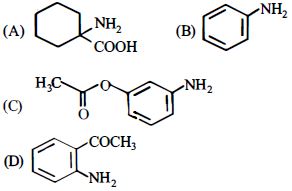
A
$ (D) < (C) < (B) < (A) $
B
$ (A) < (D) < (B) < (C) $
C
$ (A) < (B) < (C) < (D) $
D
$ (A) < (D) < (C) < (B) $
Solution
(B) The ease of diazotisation depends on the basicity of the amine and the stability of the resulting diazonium salt.
$ (A) $ is an aliphatic amine,which forms highly unstable diazonium salts that decompose immediately. Thus,it has the lowest tendency for diazotisation.
Among aromatic amines,electron-donating groups increase the electron density on the nitrogen atom,increasing basicity and facilitating diazotisation. Electron-withdrawing groups decrease electron density,making diazotisation more difficult.
$ (B) $ is aniline.
$ (C) $ has an $ -OCOCH_3 $ group at the meta position,which is electron-donating by resonance but electron-withdrawing by induction. Overall,it is slightly activating or neutral.
$ (D) $ has an $ -COCH_3 $ group at the ortho position,which is a strong electron-withdrawing group,significantly reducing the basicity of the amine and making diazotisation difficult.
Therefore,the increasing order of diazotisation is $ (A) < (D) < (B) < (C) $.
$ (A) $ is an aliphatic amine,which forms highly unstable diazonium salts that decompose immediately. Thus,it has the lowest tendency for diazotisation.
Among aromatic amines,electron-donating groups increase the electron density on the nitrogen atom,increasing basicity and facilitating diazotisation. Electron-withdrawing groups decrease electron density,making diazotisation more difficult.
$ (B) $ is aniline.
$ (C) $ has an $ -OCOCH_3 $ group at the meta position,which is electron-donating by resonance but electron-withdrawing by induction. Overall,it is slightly activating or neutral.
$ (D) $ has an $ -COCH_3 $ group at the ortho position,which is a strong electron-withdrawing group,significantly reducing the basicity of the amine and making diazotisation difficult.
Therefore,the increasing order of diazotisation is $ (A) < (D) < (B) < (C) $.
0 likes
View Solution562
DifficultMCQ
Products $A$ and $B$ formed in the following reactions are respectively:
$p$-aminobenzenesulfonic acid + $HNO_2$ $\longrightarrow$ $A$ $\xrightarrow{C_6H_5NH_2}$ $B$
$p$-aminobenzenesulfonic acid + $HNO_2$ $\longrightarrow$ $A$ $\xrightarrow{C_6H_5NH_2}$ $B$
A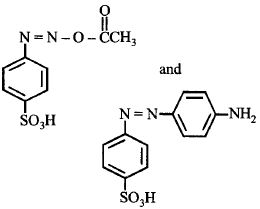
B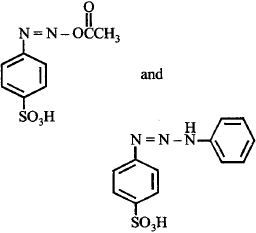
C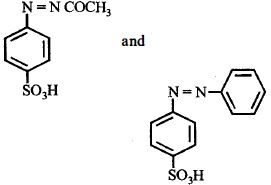
D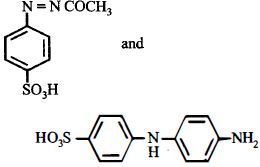
Solution
(A) The reaction of $p$-aminobenzenesulfonic acid with $HNO_2$ produces a diazonium salt intermediate.
In the presence of acetic anhydride or similar conditions (often implied in such reaction schemes),the diazonium group can form a diazo-ester linkage.
Product $A$ is the diazo-ester formed from the reaction.
When this intermediate reacts with aniline $(C_6H_5NH_2)$,it undergoes a coupling reaction to form an amino-azo compound $(B)$,specifically $p$-aminoazobenzene-sulfonic acid derivative.
In the presence of acetic anhydride or similar conditions (often implied in such reaction schemes),the diazonium group can form a diazo-ester linkage.
Product $A$ is the diazo-ester formed from the reaction.
When this intermediate reacts with aniline $(C_6H_5NH_2)$,it undergoes a coupling reaction to form an amino-azo compound $(B)$,specifically $p$-aminoazobenzene-sulfonic acid derivative.
0 likes
View Solution563
AdvancedMCQ
$A$ mixture containing the following four compounds is extracted with $1 \, M \, HCl$. The compound that goes to the aqueous layer is:
$(I)$ Cyclohexyl methyl sulfide
$(II)$ $N$-methylcyclohexylamine
$(III)$ Methoxycyclohexane
$(IV)$ Cyclohexyl methyl ketone
$(I)$ Cyclohexyl methyl sulfide
$(II)$ $N$-methylcyclohexylamine
$(III)$ Methoxycyclohexane
$(IV)$ Cyclohexyl methyl ketone
A
$(I)$
B
$(II)$
C
$(III)$
D
$(IV)$
Solution
(B) When the given mixture is shaken with $1 \, M \, HCl$,the amine gets protonated to form a salt,which is a cation $\left( RNH_2CH_3^{\oplus} \right)$.
This salt is ionic and therefore dissolves in the aqueous layer $(H_2O)$ rather than the organic solvent.
Among the given compounds,$(II)$ is an amine ($N$-methylcyclohexylamine),which reacts with $HCl$ to form a water-soluble salt.
The other compounds (sulfide,ether,and ketone) do not react with $1 \, M \, HCl$ to form ionic species and remain in the organic layer.
Therefore,the correct option is $(II)$.
This salt is ionic and therefore dissolves in the aqueous layer $(H_2O)$ rather than the organic solvent.
Among the given compounds,$(II)$ is an amine ($N$-methylcyclohexylamine),which reacts with $HCl$ to form a water-soluble salt.
The other compounds (sulfide,ether,and ketone) do not react with $1 \, M \, HCl$ to form ionic species and remain in the organic layer.
Therefore,the correct option is $(II)$.
0 likes
View Solution564
DifficultMCQ
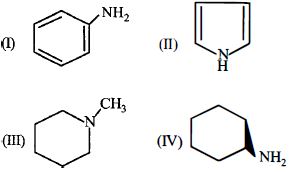
Among the following compounds,the increasing order of their basic strength is
A
$II < I < IV < III$
B
$I < II < III < IV$
C
$II < I < III < IV$
D
$I < II < IV < III$
Solution
(A) The basic strength of amines depends on the availability of the lone pair of electrons on the nitrogen atom for protonation.
$(II)$ Pyrrole: The lone pair on nitrogen is involved in the aromatic sextet,making it non-basic.
$(I)$ Aniline: The lone pair on nitrogen is delocalized into the benzene ring due to resonance,reducing its availability for protonation.
$(IV)$ Cyclohexylamine: This is a primary aliphatic amine. The lone pair is localized on the nitrogen atom,making it more basic than aniline.
$(III)$ $N$-Methylpiperidine: This is a tertiary aliphatic amine. It is more basic than primary aliphatic amines due to the electron-donating inductive effect $(+I)$ of the alkyl groups,which increases the electron density on the nitrogen atom.
Therefore,the increasing order of basic strength is: $II < I < IV < III$.
$(II)$ Pyrrole: The lone pair on nitrogen is involved in the aromatic sextet,making it non-basic.
$(I)$ Aniline: The lone pair on nitrogen is delocalized into the benzene ring due to resonance,reducing its availability for protonation.
$(IV)$ Cyclohexylamine: This is a primary aliphatic amine. The lone pair is localized on the nitrogen atom,making it more basic than aniline.
$(III)$ $N$-Methylpiperidine: This is a tertiary aliphatic amine. It is more basic than primary aliphatic amines due to the electron-donating inductive effect $(+I)$ of the alkyl groups,which increases the electron density on the nitrogen atom.
Therefore,the increasing order of basic strength is: $II < I < IV < III$.
0 likes
View Solution565
DifficultMCQ
Fluorination of an aromatic ring is easily accomplished by treating a diazonium salt with $HBF_4$. Which of the following conditions is correct about this reaction?
A
$NaF/Cu$
B
$Cu_2O/H_2O$
C
Only heat
D
$NaNO_2/Cu$
Solution
(C) The reaction described is the Balz-Schiemann reaction.
In this reaction,an aromatic diazonium salt is treated with fluoroboric acid $(HBF_4)$ to form an insoluble diazonium fluoroborate salt $(ArN_2^ BF_4^-)$.
Upon heating this salt,it undergoes thermal decomposition to yield an aryl fluoride,nitrogen gas $(N_2)$,and boron trifluoride $(BF_3)$.
Therefore,the condition required for the conversion of the diazonium fluoroborate to the aryl fluoride is simply heating $(\Delta)$.
In this reaction,an aromatic diazonium salt is treated with fluoroboric acid $(HBF_4)$ to form an insoluble diazonium fluoroborate salt $(ArN_2^ BF_4^-)$.
Upon heating this salt,it undergoes thermal decomposition to yield an aryl fluoride,nitrogen gas $(N_2)$,and boron trifluoride $(BF_3)$.
Therefore,the condition required for the conversion of the diazonium fluoroborate to the aryl fluoride is simply heating $(\Delta)$.
0 likes
View Solution566
DifficultMCQ
Arrange the following amines in the order of increasing basicity.
A
$p$-nitroaniline < aniline < $p$-methoxyaniline < $CH_3NH_2$
B
$p$-methoxyaniline < $p$-nitroaniline < aniline < $CH_3NH_2$
C
$p$-nitroaniline < aniline < $p$-methoxyaniline < $CH_3NH_2$
D
aniline < $p$-methoxyaniline < $p$-nitroaniline < $CH_3NH_2$
Solution
(A) The basicity of amines depends on the availability of the lone pair of electrons on the nitrogen atom.
Aliphatic amines (like $CH_3NH_2$) are more basic than aromatic amines because the lone pair on the nitrogen atom in aromatic amines is involved in resonance with the benzene ring,making it less available for protonation.
Among aromatic amines,electron-donating groups (like $-OCH_3$) increase the electron density on the nitrogen atom,thereby increasing basicity.
Electron-withdrawing groups (like $-NO_2$) decrease the electron density on the nitrogen atom,thereby decreasing basicity.
Therefore,the order of increasing basicity is: $p$-nitroaniline < aniline < $p$-methoxyaniline < $CH_3NH_2$.
Aliphatic amines (like $CH_3NH_2$) are more basic than aromatic amines because the lone pair on the nitrogen atom in aromatic amines is involved in resonance with the benzene ring,making it less available for protonation.
Among aromatic amines,electron-donating groups (like $-OCH_3$) increase the electron density on the nitrogen atom,thereby increasing basicity.
Electron-withdrawing groups (like $-NO_2$) decrease the electron density on the nitrogen atom,thereby decreasing basicity.
Therefore,the order of increasing basicity is: $p$-nitroaniline < aniline < $p$-methoxyaniline < $CH_3NH_2$.
0 likes
View Solution567
DifficultMCQ
The major product of the reaction is:
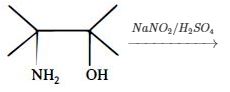
A
$3,3-$dimethylbutan$-2-$one
B
$2,3-$dimethylbut$-2-$ene
C
$2,2,3-$trimethylaziridine
D
$3,3-$dimethylbutan$-2-$ol
0 likes
View Solution568
MediumMCQ
Complete reduction of $benzene-diazonium$ chloride with $Zn/HCl$ gives:
A
Aniline
B
Phenylhydrazine
C
Azobenzene
D
Hydrazobenzene
Solution
(B) The reduction of $benzene-diazonium$ chloride $(C_6H_5N_2Cl)$ with $Zn/HCl$ is a strong reduction process.
It leads to the formation of $phenylhydrazine$ $(C_6H_5NHNH_2)$ as the final product.
Note: While mild reducing agents like $SnCl_2/HCl$ or $Na_2SO_3$ can produce $phenylhydrazine$,strong reduction with $Zn/HCl$ also yields $phenylhydrazine$ as the primary product.
It leads to the formation of $phenylhydrazine$ $(C_6H_5NHNH_2)$ as the final product.
Note: While mild reducing agents like $SnCl_2/HCl$ or $Na_2SO_3$ can produce $phenylhydrazine$,strong reduction with $Zn/HCl$ also yields $phenylhydrazine$ as the primary product.
0 likes
View Solution569
DifficultMCQ
The final product formed when $Methyl \ amine$ is treated with $NaNO_2$ and $HCl$ is
A
Diazomethane
B
Methyl alcohol
C
Methyl cyanide
D
Nitromethane
Solution
(B) When $Methyl \ amine$ $(CH_3NH_2)$ reacts with nitrous acid $(HNO_2)$,which is generated in situ by the reaction of $NaNO_2$ and $HCl$,it forms an unstable diazonium salt $(CH_3N_2^+Cl^-)$.
This salt immediately undergoes hydrolysis to produce $Methyl \ alcohol$ $(CH_3OH)$,nitrogen gas $(N_2)$,and water $(H_2O)$.
The overall reaction is: $CH_3NH_2 + NaNO_2 + HCl \rightarrow CH_3OH + N_2 + H_2O$.
This salt immediately undergoes hydrolysis to produce $Methyl \ alcohol$ $(CH_3OH)$,nitrogen gas $(N_2)$,and water $(H_2O)$.
The overall reaction is: $CH_3NH_2 + NaNO_2 + HCl \rightarrow CH_3OH + N_2 + H_2O$.
0 likes
View Solution570
DifficultMCQ
The order of basicity of amines in the gaseous state is
A
$1^o > 2^o > 3^o > NH_3$
B
$3^o > 2^o > NH_3 > 1^o$
C
$3^o > 2^o > 1^o > NH_3$
D
$NH_3 > 1^o > 2^o > 3^o$
Solution
(C) In the gaseous phase,the basicity of amines is determined solely by the inductive effect of the alkyl groups.
Alkyl groups are electron-donating ($+I$ effect),which increases the electron density on the nitrogen atom,making the lone pair more available for donation.
As the number of alkyl groups increases,the electron density on the nitrogen atom increases.
Therefore,the order of basicity in the gaseous phase is $3^o > 2^o > 1^o > NH_3$.
Alkyl groups are electron-donating ($+I$ effect),which increases the electron density on the nitrogen atom,making the lone pair more available for donation.
As the number of alkyl groups increases,the electron density on the nitrogen atom increases.
Therefore,the order of basicity in the gaseous phase is $3^o > 2^o > 1^o > NH_3$.
0 likes
View Solution571
DifficultMCQ
Carbylamine is formed from aliphatic or aromatic primary amine via which of the following intermediates?
A
Carbanion
B
Carbene
C
Carbocation
D
Carbon radical
Solution
(B) The carbylamine reaction (also known as the isocyanide test) involves the reaction of a primary amine $(RNH_2)$ with chloroform $(CHCl_3)$ in the presence of a base like $KOH$.
In the first step of the mechanism,chloroform undergoes $\alpha$-elimination in the presence of a base to form dichlorocarbene $(:CCl_2)$,which acts as the reactive intermediate.
This dichlorocarbene then undergoes nucleophilic attack by the nitrogen atom of the primary amine to eventually yield the isocyanide $(RNC)$.
Therefore,the correct intermediate is a carbene.
In the first step of the mechanism,chloroform undergoes $\alpha$-elimination in the presence of a base to form dichlorocarbene $(:CCl_2)$,which acts as the reactive intermediate.
This dichlorocarbene then undergoes nucleophilic attack by the nitrogen atom of the primary amine to eventually yield the isocyanide $(RNC)$.
Therefore,the correct intermediate is a carbene.
0 likes
View Solution572
MediumMCQ
The most basic compound among the following is:
A
Acetanilide
B
Benzylamine
C
$p-$Nitroaniline
D
Aniline
Solution
(B) Benzylamine $(C_6H_5CH_2NH_2)$ is the most basic compound among the given options.
In benzylamine,the lone pair of electrons on the nitrogen atom is localized because it is not in conjugation with the benzene ring.
In contrast,in aniline $(C_6H_5NH_2)$,$p-$nitroaniline,and acetanilide $(CH_3CONHC_6H_5)$,the lone pair of electrons on the nitrogen atom is delocalized due to resonance with the benzene ring or the carbonyl group,which significantly decreases their basicity.
In benzylamine,the lone pair of electrons on the nitrogen atom is localized because it is not in conjugation with the benzene ring.
In contrast,in aniline $(C_6H_5NH_2)$,$p-$nitroaniline,and acetanilide $(CH_3CONHC_6H_5)$,the lone pair of electrons on the nitrogen atom is delocalized due to resonance with the benzene ring or the carbonyl group,which significantly decreases their basicity.
0 likes
View Solution573
DifficultMCQ
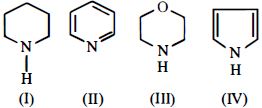
The order of basicity of the compounds is
A
$IV > I > III > II$
B
$I > III > II > IV$
C
$III > I > IV > II$
D
$II > I > III > IV$
Solution
(B) The compounds are: $(I)$ Piperidine,$(II)$ Pyridine,$(III)$ Morpholine,and $(IV)$ Pyrrole.
In $(I)$,the nitrogen atom is $sp^3$ hybridized,and the lone pair is localized,making it highly basic.
In $(III)$,the nitrogen atom is $sp^3$ hybridized,but the presence of an electronegative oxygen atom exerts an electron-withdrawing $-I$ effect,reducing its basicity compared to $(I)$.
In $(II)$,the nitrogen atom is $sp^2$ hybridized,making the lone pair less available for protonation than in $sp^3$ hybridized amines.
In $(IV)$,the lone pair on the nitrogen atom is involved in the aromatic sextet ($6\pi$ electrons),making it unavailable for protonation,thus it is the least basic.
Therefore,the correct order of basicity is $(I) > (III) > (II) > (IV)$.
In $(I)$,the nitrogen atom is $sp^3$ hybridized,and the lone pair is localized,making it highly basic.
In $(III)$,the nitrogen atom is $sp^3$ hybridized,but the presence of an electronegative oxygen atom exerts an electron-withdrawing $-I$ effect,reducing its basicity compared to $(I)$.
In $(II)$,the nitrogen atom is $sp^2$ hybridized,making the lone pair less available for protonation than in $sp^3$ hybridized amines.
In $(IV)$,the lone pair on the nitrogen atom is involved in the aromatic sextet ($6\pi$ electrons),making it unavailable for protonation,thus it is the least basic.
Therefore,the correct order of basicity is $(I) > (III) > (II) > (IV)$.
0 likes
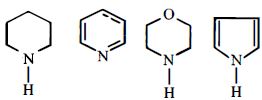
View Solution574
DifficultMCQ
In the following compounds,the order of basicity is as follows:
A
$I > III > II > IV$
B
$III > I > II > IV$
C
$II > III > I > IV$
D
$IV > III > II > I$
Solution
(A) The basicity of amines depends on the availability of the lone pair of electrons on the nitrogen atom.
$I$ (Piperidine): The nitrogen atom is $sp^3$ hybridized,and the lone pair is not involved in resonance. It is the most basic.
$II$ (Pyridine): The nitrogen atom is $sp^2$ hybridized. The lone pair is in an $sp^2$ orbital,which is more electronegative than an $sp^3$ orbital,making it less basic than piperidine.
$III$ (Morpholine): Similar to piperidine,the nitrogen is $sp^3$ hybridized,but the presence of an electronegative oxygen atom exerts an inductive effect ($-I$ effect),which reduces the electron density on the nitrogen atom,making it less basic than piperidine but more basic than pyridine.
$IV$ (Pyrrole): The nitrogen atom is $sp^2$ hybridized,and its lone pair is involved in the aromatic sextet (delocalized). Thus,it is the least basic.
Therefore,the order of basicity is $I > III > II > IV$.
$I$ (Piperidine): The nitrogen atom is $sp^3$ hybridized,and the lone pair is not involved in resonance. It is the most basic.
$II$ (Pyridine): The nitrogen atom is $sp^2$ hybridized. The lone pair is in an $sp^2$ orbital,which is more electronegative than an $sp^3$ orbital,making it less basic than piperidine.
$III$ (Morpholine): Similar to piperidine,the nitrogen is $sp^3$ hybridized,but the presence of an electronegative oxygen atom exerts an inductive effect ($-I$ effect),which reduces the electron density on the nitrogen atom,making it less basic than piperidine but more basic than pyridine.
$IV$ (Pyrrole): The nitrogen atom is $sp^2$ hybridized,and its lone pair is involved in the aromatic sextet (delocalized). Thus,it is the least basic.
Therefore,the order of basicity is $I > III > II > IV$.
0 likes
View Solution575
DifficultMCQ
The decreasing order of basicity for the following amine compounds is:
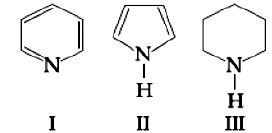
A
$III > I > II$
B
$I > III > II$
C
$III > II > I$
D
$II > I > III$
Solution
(A) The basicity of amines depends on the availability of the lone pair of electrons on the nitrogen atom.
In compound $(III)$ (piperidine),the nitrogen atom is $sp^3$ hybridized,and the lone pair is localized,making it the most basic.
In compound $(I)$ (pyridine),the nitrogen atom is $sp^2$ hybridized. The lone pair is in an $sp^2$ orbital,which is more electronegative than an $sp^3$ orbital,making it less basic than $(III)$.
In compound $(II)$ (pyrrole),the lone pair of electrons on the nitrogen atom participates in the aromatic sextet (delocalization). Therefore,it is not available for protonation,making it the least basic.
Thus,the decreasing order of basicity is $III > I > II$.
In compound $(III)$ (piperidine),the nitrogen atom is $sp^3$ hybridized,and the lone pair is localized,making it the most basic.
In compound $(I)$ (pyridine),the nitrogen atom is $sp^2$ hybridized. The lone pair is in an $sp^2$ orbital,which is more electronegative than an $sp^3$ orbital,making it less basic than $(III)$.
In compound $(II)$ (pyrrole),the lone pair of electrons on the nitrogen atom participates in the aromatic sextet (delocalization). Therefore,it is not available for protonation,making it the least basic.
Thus,the decreasing order of basicity is $III > I > II$.
0 likes
View Solution576
DifficultMCQ
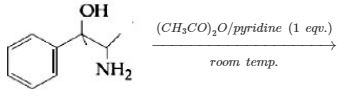
The major product obtained in the following reaction is:
A
$A$ structure showing an alkene with an acetamide group.
B
$A$ structure showing an acetyl group on the benzene ring and an amino group.
C
$A$ structure showing an ester group at the hydroxyl position.
D
$A$ structure showing an acetamide group at the amino position with the hydroxyl group intact.
Solution
(D) The reactant is $2$-amino-$1$-phenylpropan-$1$-ol. It contains both an amino group $(-NH_2)$ and a hydroxyl group $(-OH)$.
When treated with acetic anhydride $((CH_3CO)_2O)$ in the presence of pyridine at room temperature,acetylation occurs.
Since the nucleophilicity of the amino group $(-NH_2)$ is significantly higher than that of the hydroxyl group $(-OH)$,the amino group undergoes acetylation preferentially to form an amide.
Therefore,the major product is the $N$-acetylated derivative,where the $-NH_2$ group is converted to $-NHCOCH_3$ while the $-OH$ group remains unchanged.
When treated with acetic anhydride $((CH_3CO)_2O)$ in the presence of pyridine at room temperature,acetylation occurs.
Since the nucleophilicity of the amino group $(-NH_2)$ is significantly higher than that of the hydroxyl group $(-OH)$,the amino group undergoes acetylation preferentially to form an amide.
Therefore,the major product is the $N$-acetylated derivative,where the $-NH_2$ group is converted to $-NHCOCH_3$ while the $-OH$ group remains unchanged.
0 likes
View Solution577
DifficultMCQ
The increasing basicity order of the following compounds is:
$(1)$ $CH_3CH_2NH_2$
$(2)$ $(CH_3CH_2)_2NH$
$(3)$ $(CH_3)_3N$
$(4)$ $PhNHCH_3$
$(1)$ $CH_3CH_2NH_2$
$(2)$ $(CH_3CH_2)_2NH$
$(3)$ $(CH_3)_3N$
$(4)$ $PhNHCH_3$
A
$(4) < (3) < (2) < (1)$
B
$(4) < (3) < (1) < (2)$
C
$(1) < (2) < (3) < (4)$
D
$(1) < (2) < (4) < (3)$
Solution
(B) The basicity of amines depends on the availability of the lone pair on the nitrogen atom and the stability of the resulting conjugate acid.
$(i)$ $PhNHCH_3$ $(4)$ is an aromatic amine where the lone pair on nitrogen is delocalized into the benzene ring,making it the least basic.
$(ii)$ Among aliphatic amines,basicity is influenced by the inductive effect $(+I)$,solvation,and steric hindrance.
$(iii)$ Diethylamine $(2)$ is a $2^\circ$ amine,which is more basic than Ethylamine $(1)$ ($1^\circ$ amine) due to the $+I$ effect of two ethyl groups.
$(iv)$ Trimethylamine $(3)$ is a $3^\circ$ amine. Due to significant steric hindrance and reduced solvation of its conjugate acid in water,it is less basic than Ethylamine $(1)$.
Thus,the increasing order of basicity is: $(4) < (3) < (1) < (2)$.
$(i)$ $PhNHCH_3$ $(4)$ is an aromatic amine where the lone pair on nitrogen is delocalized into the benzene ring,making it the least basic.
$(ii)$ Among aliphatic amines,basicity is influenced by the inductive effect $(+I)$,solvation,and steric hindrance.
$(iii)$ Diethylamine $(2)$ is a $2^\circ$ amine,which is more basic than Ethylamine $(1)$ ($1^\circ$ amine) due to the $+I$ effect of two ethyl groups.
$(iv)$ Trimethylamine $(3)$ is a $3^\circ$ amine. Due to significant steric hindrance and reduced solvation of its conjugate acid in water,it is less basic than Ethylamine $(1)$.
Thus,the increasing order of basicity is: $(4) < (3) < (1) < (2)$.
0 likes
View Solution578
DifficultMCQ
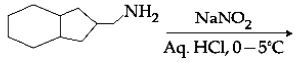
The major product formed in the reaction given below will be
A
Bicyclo[$4.4$.$0$]decyl$-2-$nitromethane
B
Bicyclo[$4.3$.$0$]nonyl$-2-$nitro
C
Decalin$-2-$methanol
D
Decalin$-2-$ol
Solution
(D) The reaction of a primary aliphatic amine with $NaNO_2$ and $HCl$ at $0-5^{\circ}C$ produces an unstable diazonium salt.
This diazonium salt undergoes rapid loss of $N_2$ gas to form a primary carbocation.
Since the primary carbocation is unstable,it undergoes a ring expansion rearrangement to form a more stable secondary carbocation.
Specifically,the $5$-membered ring expands to a $6$-membered ring to form a decalin system.
Finally,the secondary carbocation reacts with water to form the major product,which is decalin-$2$-ol.
This diazonium salt undergoes rapid loss of $N_2$ gas to form a primary carbocation.
Since the primary carbocation is unstable,it undergoes a ring expansion rearrangement to form a more stable secondary carbocation.
Specifically,the $5$-membered ring expands to a $6$-membered ring to form a decalin system.
Finally,the secondary carbocation reacts with water to form the major product,which is decalin-$2$-ol.
0 likes
View Solution579
DifficultMCQ
$A$ compound $X$ on treatment with $Br_2/NaOH$ provided $C_3H_9N$,which gives a positive carbylamine test. Compound $X$ is
A
$CH_3COCH_2NHCH_3$
B
$CH_3CH_2COCH_2NH_2$
C
$CH_3CH_2CH_2CONH_2$
D
$CH_3CON(CH_3)_2$
Solution
(C) The reaction of a compound with $Br_2/NaOH$ is the Hofmann bromamide degradation reaction,which converts an amide $(RCONH_2)$ into a primary amine $(RNH_2)$ with one carbon atom less.
Given that the product $C_3H_9N$ gives a positive carbylamine test,it must be a primary aliphatic amine $(CH_3CH_2CH_2NH_2)$.
Since the product has $3$ carbon atoms,the starting amide must have $4$ carbon atoms.
Among the options,$CH_3CH_2CH_2CONH_2$ (butanamide) is the only primary amide with $4$ carbon atoms that would yield $CH_3CH_2CH_2NH_2$ upon reaction with $Br_2/NaOH$.
Given that the product $C_3H_9N$ gives a positive carbylamine test,it must be a primary aliphatic amine $(CH_3CH_2CH_2NH_2)$.
Since the product has $3$ carbon atoms,the starting amide must have $4$ carbon atoms.
Among the options,$CH_3CH_2CH_2CONH_2$ (butanamide) is the only primary amide with $4$ carbon atoms that would yield $CH_3CH_2CH_2NH_2$ upon reaction with $Br_2/NaOH$.
0 likes
View Solution580
DifficultMCQ
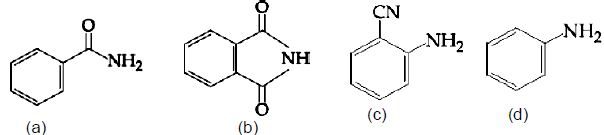
The increasing order of reactivity of the following compounds towards reaction with alkyl halide is:
A
$b < a < c < d$
B
$a < b < c < d$
C
$b < a < d < c$
D
$a < c < d < b$
Solution
(A) The reaction of these compounds with alkyl halide is a nucleophilic substitution reaction where the nitrogen atom acts as the nucleophile.
Reactivity depends on the availability of the lone pair on the nitrogen atom.
$(a)$ Benzamide: The lone pair on nitrogen is involved in resonance with the carbonyl group $(C=O)$,making it very weakly nucleophilic.
$(b)$ Phthalimide: The lone pair on nitrogen is involved in resonance with two carbonyl groups,making it the least nucleophilic.
$(c)$ $2$-Cyanoaniline: The $-CN$ group is electron-withdrawing by both $-I$ and $-M$ effects,which reduces the electron density on the nitrogen atom.
$(d)$ Aniline: The lone pair on nitrogen is involved in resonance with the benzene ring,but it is more nucleophilic than the others because it lacks the strong electron-withdrawing carbonyl groups present in $(a)$ and $(b)$ or the strong $-I$ effect of the $-CN$ group in $(c)$.
Thus,the order of nucleophilicity (and reactivity) is $b < a < c < d$.
Reactivity depends on the availability of the lone pair on the nitrogen atom.
$(a)$ Benzamide: The lone pair on nitrogen is involved in resonance with the carbonyl group $(C=O)$,making it very weakly nucleophilic.
$(b)$ Phthalimide: The lone pair on nitrogen is involved in resonance with two carbonyl groups,making it the least nucleophilic.
$(c)$ $2$-Cyanoaniline: The $-CN$ group is electron-withdrawing by both $-I$ and $-M$ effects,which reduces the electron density on the nitrogen atom.
$(d)$ Aniline: The lone pair on nitrogen is involved in resonance with the benzene ring,but it is more nucleophilic than the others because it lacks the strong electron-withdrawing carbonyl groups present in $(a)$ and $(b)$ or the strong $-I$ effect of the $-CN$ group in $(c)$.
Thus,the order of nucleophilicity (and reactivity) is $b < a < c < d$.
0 likes
View Solution581
DifficultMCQ
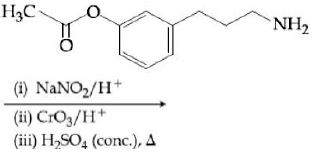
The major product of the following reaction is:
A
$3-$($3$-hydroxyphenyl)propan$-1-$one derivative
B
$3-$acetoxyphenyl$-1-$propanone derivative
C
$5-$acetoxy$-1-$indanone
D
$5-$hydroxy$-1-$indanone
Solution
(D) The reaction proceeds as follows:
$1$. Treatment of the primary amine with $NaNO_2/H^+$ leads to the formation of a diazonium salt,which is unstable and undergoes hydrolysis to form a primary alcohol: $Ar-(CH_2)_3-OH$.
$2$. Oxidation with $CrO_3/H^+$ (Jones reagent) oxidizes the primary alcohol to a carboxylic acid: $Ar-(CH_2)_2-COOH$.
$3$. Treatment with conc. $H_2SO_4$ and heat causes an intramolecular Friedel-Crafts acylation. During this process,the ester group (acetoxy) is hydrolyzed to a phenolic $-OH$ group under acidic conditions. The resulting carboxylic acid cyclizes onto the benzene ring to form a five-membered ketone ring,yielding $5-hydroxy-1-indanone$.
$1$. Treatment of the primary amine with $NaNO_2/H^+$ leads to the formation of a diazonium salt,which is unstable and undergoes hydrolysis to form a primary alcohol: $Ar-(CH_2)_3-OH$.
$2$. Oxidation with $CrO_3/H^+$ (Jones reagent) oxidizes the primary alcohol to a carboxylic acid: $Ar-(CH_2)_2-COOH$.
$3$. Treatment with conc. $H_2SO_4$ and heat causes an intramolecular Friedel-Crafts acylation. During this process,the ester group (acetoxy) is hydrolyzed to a phenolic $-OH$ group under acidic conditions. The resulting carboxylic acid cyclizes onto the benzene ring to form a five-membered ketone ring,yielding $5-hydroxy-1-indanone$.
0 likes
View Solution582
DifficultMCQ
In the following compounds,the decreasing order of basic strength will be:
A
$C_2H_5NH_2 > NH_3 > (C_2H_5)_2NH$
B
$NH_3 > C_2H_5NH_2 > (C_2H_5)_2NH$
C
$(C_2H_5)_2NH > C_2H_5NH_2 > NH_3$
D
$(C_2H_5)_2NH > NH_3 > C_2H_5NH_2$
Solution
(C) The basic strength of amines in the gaseous phase or non-polar solvents is determined by the inductive effect ($+I$ effect) of the alkyl groups attached to the nitrogen atom.
As the number of alkyl groups increases,the electron density on the nitrogen atom increases due to the $+I$ effect,making the lone pair more available for donation.
Therefore,the order of basic strength is $(C_2H_5)_2NH > C_2H_5NH_2 > NH_3$.
As the number of alkyl groups increases,the electron density on the nitrogen atom increases due to the $+I$ effect,making the lone pair more available for donation.
Therefore,the order of basic strength is $(C_2H_5)_2NH > C_2H_5NH_2 > NH_3$.
0 likes
View Solution583
DifficultMCQ
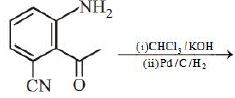
The major product obtained in the following reaction is:
A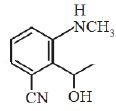
B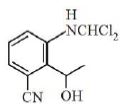
C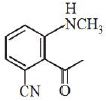
D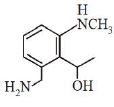
Solution
(D) The reaction sequence is as follows:
$1$. The starting material is $2$-amino-$3$-cyano-benzaldehyde.
$2$. Treatment with $CHCl_3/KOH$ (carbylamine reaction) converts the $-NH_2$ group into an isocyanide group $(-NC)$.
$3$. Subsequent reduction with $Pd/C/H_2$ reduces the isocyanide $(-NC)$ to a methylamino group $(-NHCH_3)$,the aldehyde group $(-CHO)$ to a secondary alcohol $(-CH(OH)CH_3)$,and the nitrile group $(-CN)$ to a primary amine $(-CH_2NH_2)$.
$1$. The starting material is $2$-amino-$3$-cyano-benzaldehyde.
$2$. Treatment with $CHCl_3/KOH$ (carbylamine reaction) converts the $-NH_2$ group into an isocyanide group $(-NC)$.
$3$. Subsequent reduction with $Pd/C/H_2$ reduces the isocyanide $(-NC)$ to a methylamino group $(-NHCH_3)$,the aldehyde group $(-CHO)$ to a secondary alcohol $(-CH(OH)CH_3)$,and the nitrile group $(-CN)$ to a primary amine $(-CH_2NH_2)$.
0 likes
View Solution584
DifficultMCQ
Aniline dissolved in dilute $HCl$ is reacted with sodium nitrite at $0\,^oC$. This solution was added dropwise to a solution containing an equimolar mixture of aniline and phenol in dilute $HCl$. The structure of the major product is
A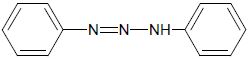
B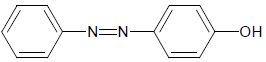
C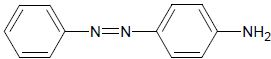
D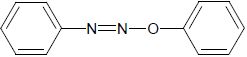
Solution
(A) $1$. Aniline reacts with $NaNO_2$ and $HCl$ at $0\,^oC$ to form benzenediazonium chloride $(C_6H_5N_2^+Cl^-)$.
$2$. When this diazonium salt is added to a mixture of aniline and phenol in dilute $HCl$,the medium is acidic.
$3$. In an acidic medium,the amino group of aniline is protonated to form an anilinium ion $(-NH_3^+)$,which is deactivating and does not undergo coupling.
$4$. However,the diazonium salt reacts with aniline to form a diazoamino compound $(C_6H_5-N=N-NH-C_6H_5)$ in a slightly acidic or neutral medium,but in the presence of dilute $HCl$,the reaction with aniline is suppressed.
$5$. The coupling reaction with phenol occurs in a basic medium. Since the medium is acidic,the coupling reaction is generally slow or inhibited for both.
$6$. However,among the given options,the formation of the diazoamino compound $(C_6H_5-N=N-NH-C_6H_5)$ is the characteristic reaction of benzenediazonium chloride with aniline in the presence of dilute $HCl$ (where the aniline is not fully protonated or the reaction is kinetically favored).
$7$. Therefore,the major product formed is the diazoamino compound.
$2$. When this diazonium salt is added to a mixture of aniline and phenol in dilute $HCl$,the medium is acidic.
$3$. In an acidic medium,the amino group of aniline is protonated to form an anilinium ion $(-NH_3^+)$,which is deactivating and does not undergo coupling.
$4$. However,the diazonium salt reacts with aniline to form a diazoamino compound $(C_6H_5-N=N-NH-C_6H_5)$ in a slightly acidic or neutral medium,but in the presence of dilute $HCl$,the reaction with aniline is suppressed.
$5$. The coupling reaction with phenol occurs in a basic medium. Since the medium is acidic,the coupling reaction is generally slow or inhibited for both.
$6$. However,among the given options,the formation of the diazoamino compound $(C_6H_5-N=N-NH-C_6H_5)$ is the characteristic reaction of benzenediazonium chloride with aniline in the presence of dilute $HCl$ (where the aniline is not fully protonated or the reaction is kinetically favored).
$7$. Therefore,the major product formed is the diazoamino compound.
0 likes
View Solution585
DifficultMCQ
The major product of the following reaction is:
$CH_3-CH(OH)-CH_2-CH_2-NH_2 \xrightarrow[triethylamine]{ethyl\ formate\ (1\ equiv)}$
$CH_3-CH(OH)-CH_2-CH_2-NH_2 \xrightarrow[triethylamine]{ethyl\ formate\ (1\ equiv)}$
A
$CH_3-CH(OH)-CH=CH_2$
B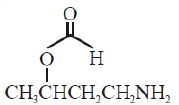
C
$CH_3-CH=CH-CH_2-NH_2$
D
$CH_3-CH(OH)-CH_2-CH_2-NH-CHO$
Solution
(D) Amines are more nucleophilic than alcohols.
Therefore, the $-NH_2$ group reacts preferentially with ethyl formate $(HCOOC_2H_5)$ to form the formamide derivative $CH_3-CH(OH)-CH_2-CH_2-NH-CHO$.
Therefore, the $-NH_2$ group reacts preferentially with ethyl formate $(HCOOC_2H_5)$ to form the formamide derivative $CH_3-CH(OH)-CH_2-CH_2-NH-CHO$.
0 likes
View Solution586
DifficultMCQ
The increasing order of nucleophilicity of the following nucleophiles is: $a. CH_3CO_2^-$,$b. H_2O$,$c. CH_3SO_3^-$,$d. OH^-$
A
$(b) < (c) < (a) < (d)$
B
$(a) < (d) < (c) < (b)$
C
$(d) < (a) < (c) < (b)$
D
$(b) < (c) < (d) < (a)$
Solution
(A) Nucleophilicity is the ability of a species to donate an electron pair to an electrophile.
For charged species,the nucleophilicity is generally higher than for neutral species.
Among the given species,$H_2O$ is a neutral molecule and is the weakest nucleophile.
Comparing the anions,$CH_3SO_3^-$ is a very weak nucleophile because the negative charge is delocalized over three oxygen atoms,making it a stable conjugate base of a strong acid.
$CH_3CO_2^-$ has the negative charge delocalized over two oxygen atoms,making it a stronger nucleophile than $CH_3SO_3^-$.
$OH^-$ is the strongest nucleophile among these as the charge is localized on a single oxygen atom.
Thus,the increasing order is $(b) < (c) < (a) < (d)$.
For charged species,the nucleophilicity is generally higher than for neutral species.
Among the given species,$H_2O$ is a neutral molecule and is the weakest nucleophile.
Comparing the anions,$CH_3SO_3^-$ is a very weak nucleophile because the negative charge is delocalized over three oxygen atoms,making it a stable conjugate base of a strong acid.
$CH_3CO_2^-$ has the negative charge delocalized over two oxygen atoms,making it a stronger nucleophile than $CH_3SO_3^-$.
$OH^-$ is the strongest nucleophile among these as the charge is localized on a single oxygen atom.
Thus,the increasing order is $(b) < (c) < (a) < (d)$.
0 likes
View Solution587
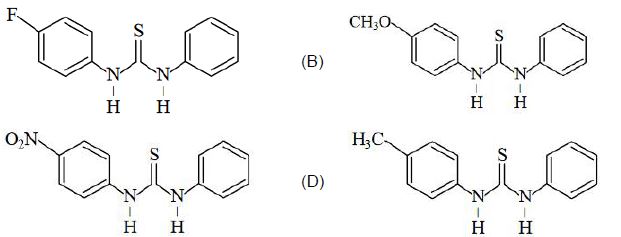
DifficultMCQ
The increasing order of the $pK_b$ of the following compounds is:
A
$(c) < (a) < (d) < (b)$
B
$(b) < (d) < (a) < (c)$
C
$(a) < (c) < (d) < (b)$
D
$(b) < (d) < (c) < (a)$
Solution
(A) The $pK_b$ value is inversely proportional to the basic strength of the compound.
Basic strength depends on the availability of the lone pair on the nitrogen atom.
Electron-donating groups $(EDG)$ increase basicity (decrease $pK_b$),while electron-withdrawing groups $(EWG)$ decrease basicity (increase $pK_b$).
The substituents on the phenyl ring are: $(A) -F$ ($EWG$ by inductive effect),$(B) -OCH_3$ ($EDG$ by resonance),$(C) -NO_2$ (strong $EWG$),$(D) -CH_3$ ($EDG$ by hyperconjugation).
Basicity order: $(B) > (D) > (A) > (C)$.
Since $pK_b$ is inversely proportional to basicity,the increasing order of $pK_b$ is: $(C) < (A) < (D) < (B)$.
Basic strength depends on the availability of the lone pair on the nitrogen atom.
Electron-donating groups $(EDG)$ increase basicity (decrease $pK_b$),while electron-withdrawing groups $(EWG)$ decrease basicity (increase $pK_b$).
The substituents on the phenyl ring are: $(A) -F$ ($EWG$ by inductive effect),$(B) -OCH_3$ ($EDG$ by resonance),$(C) -NO_2$ (strong $EWG$),$(D) -CH_3$ ($EDG$ by hyperconjugation).
Basicity order: $(B) > (D) > (A) > (C)$.
Since $pK_b$ is inversely proportional to basicity,the increasing order of $pK_b$ is: $(C) < (A) < (D) < (B)$.
0 likes
View Solution588
MediumMCQ
Benzene diazonium chloride on reaction with aniline in the presence of dilute hydrochloric acid gives:
A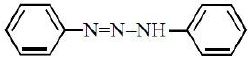
B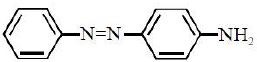
C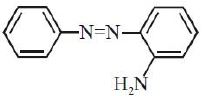
D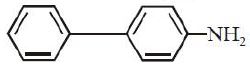
Solution
(B) When benzene diazonium chloride reacts with aniline in the presence of dilute $HCl$ at a low temperature $(273-278 \ K)$,an electrophilic substitution reaction occurs at the para-position of the aniline ring. This process is known as coupling reaction,which yields $p$-aminoazobenzene,a yellow-colored dye.
0 likes
View Solution589
DifficultMCQ
Which of the following will not give a primary amine upon reduction with $LiAlH_4$?
A
$CH_3CONH_2$
B
$CH_3NC$
C
$CH_3CN$
D
$C_6H_5NO_2$
Solution
(B) $CH_3NC$ (methyl isocyanide) on reduction with $LiAlH_4$ gives $CH_3NHCH_3$ (dimethylamine),which is a secondary amine.
$CH_3CONH_2$ (acetamide) reduces to $CH_3CH_2NH_2$ (ethylamine),$CH_3CN$ (acetonitrile) reduces to $CH_3CH_2NH_2$ (ethylamine),and $C_6H_5NO_2$ (nitrobenzene) reduces to $C_6H_5NH_2$ (aniline). All of these are primary amines.
$CH_3CONH_2$ (acetamide) reduces to $CH_3CH_2NH_2$ (ethylamine),$CH_3CN$ (acetonitrile) reduces to $CH_3CH_2NH_2$ (ethylamine),and $C_6H_5NO_2$ (nitrobenzene) reduces to $C_6H_5NH_2$ (aniline). All of these are primary amines.
0 likes
View Solution590
MediumMCQ
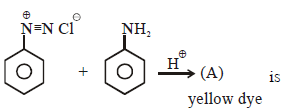
In the following reaction,the product $(A)$ is a yellow dye. Identify $(A)$.
A
Phenylhydrazine derivative
B
o-Aminoazobenzene
C
m-Aminoazobenzene
D
p-Aminoazobenzene
Solution
(D) The reaction between benzenediazonium chloride and aniline in a mildly acidic medium $(pH \approx 4-5)$ is an electrophilic aromatic substitution reaction known as coupling reaction.
In this reaction,the diazonium ion acts as an electrophile and attacks the electron-rich para-position of the aniline ring.
Since the $-NH_2$ group is a strong ortho/para-directing group,the para-position is sterically favored over the ortho-position.
Thus,the major product formed is $p$-aminoazobenzene,which is a yellow-colored dye.
In this reaction,the diazonium ion acts as an electrophile and attacks the electron-rich para-position of the aniline ring.
Since the $-NH_2$ group is a strong ortho/para-directing group,the para-position is sterically favored over the ortho-position.
Thus,the major product formed is $p$-aminoazobenzene,which is a yellow-colored dye.
0 likes
View Solution591
DifficultMCQ
Which of the following is the incorrect order?
A
o-Nitrobenzoic acid > Benzoic acid (Acidic strength)
B
o-Toluidine > Aniline (Basic strength)
C
$(CH_3)_3C-O^- > CH_3-CH_2-O^-$ (Stability)
D
Methylenecyclohexane > $1-$Methylcyclohexene (Heat of Hydrogenation)
Solution
(B) Let's analyze each option:
$A$: $o$-Nitrobenzoic acid is more acidic than benzoic acid due to the ortho effect,which is correct.
$B$: $o$-Toluidine is less basic than aniline due to the Steric Inhibition of Protonation $(SIP)$ effect,which decreases the basic strength. Thus,the given order is incorrect.
$C$: $(CH_3)_3C-O^-$ is less stable than $CH_3-CH_2-O^-$ because the electron-donating inductive effect $(+I)$ of the three methyl groups in the tert-butoxide ion increases the electron density on the oxygen atom,making it less stable. The order $(CH_3)_3C-O^- < CH_3-CH_2-O^-$ is correct for stability. Wait,the question asks for the incorrect order. Let's re-evaluate.
$D$: Methylenecyclohexane is less stable than $1-$methylcyclohexene due to the lack of hyperconjugation and resonance stabilization of the double bond. Therefore,it has a higher heat of hydrogenation. This order is correct.
Since $B$ shows $o$-Toluidine $>$ Aniline,which is incorrect due to the $SIP$ effect,$B$ is the correct answer.
$A$: $o$-Nitrobenzoic acid is more acidic than benzoic acid due to the ortho effect,which is correct.
$B$: $o$-Toluidine is less basic than aniline due to the Steric Inhibition of Protonation $(SIP)$ effect,which decreases the basic strength. Thus,the given order is incorrect.
$C$: $(CH_3)_3C-O^-$ is less stable than $CH_3-CH_2-O^-$ because the electron-donating inductive effect $(+I)$ of the three methyl groups in the tert-butoxide ion increases the electron density on the oxygen atom,making it less stable. The order $(CH_3)_3C-O^- < CH_3-CH_2-O^-$ is correct for stability. Wait,the question asks for the incorrect order. Let's re-evaluate.
$D$: Methylenecyclohexane is less stable than $1-$methylcyclohexene due to the lack of hyperconjugation and resonance stabilization of the double bond. Therefore,it has a higher heat of hydrogenation. This order is correct.
Since $B$ shows $o$-Toluidine $>$ Aniline,which is incorrect due to the $SIP$ effect,$B$ is the correct answer.
0 likes
View Solution592
DifficultMCQ
Identify $Y$ in the following reaction sequence:
$CH_3-CH(CH_3)-CH_2-CONH_2$ $\xrightarrow{KOBr(aq)} X$ $\xrightarrow{NaNO_2/HCl(aq)} Y$
$CH_3-CH(CH_3)-CH_2-CONH_2$ $\xrightarrow{KOBr(aq)} X$ $\xrightarrow{NaNO_2/HCl(aq)} Y$
A
$CH_3-CH(CH_3)-CH_2-CH_2OH$
B
$CH_3-CH(CH_3)-CH_2OH$
C
$(CH_3)_3C-OH$
D
$CH_3-CH_2-CH_2-CH_2OH$
Solution
(B) The given reaction is a two-step process:
$1$. The first step uses $KOBr(aq)$,which is the reagent for the Hofmann bromamide degradation reaction. This converts an amide $(R-CONH_2)$ into a primary amine $(R-NH_2)$ with one carbon atom less.
$CH_3-CH(CH_3)-CH_2-CONH_2 \xrightarrow{KOBr} CH_3-CH(CH_3)-CH_2-NH_2$ (This is $X$,isobutylamine).
$2$. The second step involves the reaction of a primary aliphatic amine with nitrous acid $(NaNO_2/HCl)$,which forms an unstable diazonium salt that decomposes to form a carbocation,eventually leading to the formation of an alcohol.
$CH_3-CH(CH_3)-CH_2-NH_2$ $\xrightarrow{NaNO_2/HCl} [CH_3-CH(CH_3)-CH_2-N_2^+]$ $\rightarrow CH_3-CH(CH_3)-CH_2^+$ $\rightarrow CH_3-CH(CH_3)-CH_2OH$ (This is $Y$,isobutyl alcohol).
Thus,the correct option is $B$.
$1$. The first step uses $KOBr(aq)$,which is the reagent for the Hofmann bromamide degradation reaction. This converts an amide $(R-CONH_2)$ into a primary amine $(R-NH_2)$ with one carbon atom less.
$CH_3-CH(CH_3)-CH_2-CONH_2 \xrightarrow{KOBr} CH_3-CH(CH_3)-CH_2-NH_2$ (This is $X$,isobutylamine).
$2$. The second step involves the reaction of a primary aliphatic amine with nitrous acid $(NaNO_2/HCl)$,which forms an unstable diazonium salt that decomposes to form a carbocation,eventually leading to the formation of an alcohol.
$CH_3-CH(CH_3)-CH_2-NH_2$ $\xrightarrow{NaNO_2/HCl} [CH_3-CH(CH_3)-CH_2-N_2^+]$ $\rightarrow CH_3-CH(CH_3)-CH_2^+$ $\rightarrow CH_3-CH(CH_3)-CH_2OH$ (This is $Y$,isobutyl alcohol).
Thus,the correct option is $B$.
0 likes
View Solution593
DifficultMCQ
Consider the following reaction sequence. The final product $D$ will be:
$C_6H_5CH_3$ $\xrightarrow[\Delta]{KMnO_4/H^+} A$ $\xrightarrow{SOCl_2} B$ $\xrightarrow[\Delta]{NH_3} C$ $\xrightarrow{KOH/Br_2} D$
$C_6H_5CH_3$ $\xrightarrow[\Delta]{KMnO_4/H^+} A$ $\xrightarrow{SOCl_2} B$ $\xrightarrow[\Delta]{NH_3} C$ $\xrightarrow{KOH/Br_2} D$
A
$3-$aminobenzoic acid
B
Aniline
C
Benzamide
D
Benzoyl chloride
Solution
(B) Step $1$: Oxidation of toluene with $KMnO_4/H^+$ gives benzoic acid $(A = C_6H_5COOH)$.
Step $2$: Reaction of benzoic acid with $SOCl_2$ gives benzoyl chloride $(B = C_6H_5COCl)$.
Step $3$: Reaction of benzoyl chloride with $NH_3$ gives benzamide $(C = C_6H_5CONH_2)$.
Step $4$: Reaction of benzamide with $KOH/Br_2$ is the Hofmann bromamide degradation reaction,which converts an amide to a primary amine with one carbon atom less. Thus,benzamide is converted to aniline $(D = C_6H_5NH_2)$.
Step $2$: Reaction of benzoic acid with $SOCl_2$ gives benzoyl chloride $(B = C_6H_5COCl)$.
Step $3$: Reaction of benzoyl chloride with $NH_3$ gives benzamide $(C = C_6H_5CONH_2)$.
Step $4$: Reaction of benzamide with $KOH/Br_2$ is the Hofmann bromamide degradation reaction,which converts an amide to a primary amine with one carbon atom less. Thus,benzamide is converted to aniline $(D = C_6H_5NH_2)$.
0 likes
View Solution594
DifficultMCQ
Which of the following statements is correct?
A
$CH_3-CH_2-CH_2-NH_2$ and $CH_3-CH_2-NH-CH_3$ are functional isomers.
B
$CH_3-NH_2$,$CH_3-NH-CH_3$,and $CH_3-N(CH_3)-CH_3$ are homologues.
C
Basic behavior in the gaseous phase: $CH_3-NH_2 < CH_3-NH-CH_3 < CH_3-N(CH_3)-CH_3$.
D
Boiling point: $CH_3-N(CH_3)-CH_3 > CH_3-NH-CH_3 > CH_3-NH_2$.
Solution
(A) Primary,secondary,and tertiary amines with the same molecular formula are functional isomers. $CH_3-CH_2-CH_2-NH_2$ (a $1^\circ$ amine) and $CH_3-CH_2-NH-CH_3$ (a $2^\circ$ amine) both have the molecular formula $C_3H_9N$,thus they are functional isomers.
$(b)$ Homologues differ by a $-CH_2-$ group. These are not homologues.
$(c)$ In the gaseous phase,basicity increases with the number of alkyl groups due to the $+I$ effect: $CH_3-N(CH_3)-CH_3 > CH_3-NH-CH_3 > CH_3-NH_2$.
$(d)$ Boiling point depends on hydrogen bonding. $CH_3-NH_2$ has two $H$-atoms on $N$,$CH_3-NH-CH_3$ has one,and $CH_3-N(CH_3)-CH_3$ has none. Thus,the order is $CH_3-NH_2 > CH_3-NH-CH_3 > CH_3-N(CH_3)-CH_3$.
$(b)$ Homologues differ by a $-CH_2-$ group. These are not homologues.
$(c)$ In the gaseous phase,basicity increases with the number of alkyl groups due to the $+I$ effect: $CH_3-N(CH_3)-CH_3 > CH_3-NH-CH_3 > CH_3-NH_2$.
$(d)$ Boiling point depends on hydrogen bonding. $CH_3-NH_2$ has two $H$-atoms on $N$,$CH_3-NH-CH_3$ has one,and $CH_3-N(CH_3)-CH_3$ has none. Thus,the order is $CH_3-NH_2 > CH_3-NH-CH_3 > CH_3-N(CH_3)-CH_3$.
0 likes
View Solution595
DifficultMCQ
$C_6H_5NH_2$ $\xrightarrow[0-5\,^{\circ}C]{HCl + NaNO_2} A$ $\xrightarrow{CuCN} B$ $\xrightarrow{H_2/Ni} C$ $\xrightarrow{HNO_2} D$
The structure of $D$ is
The structure of $D$ is
A
$C_6H_5CH_2OH$
B
$C_6H_5CH_2NH_2$
C
$C_6H_5NHOH$
D
$C_6H_5NHCH_2CH_3$
Solution
(A) $1$. $C_6H_5NH_2$ (Aniline) reacts with $HCl + NaNO_2$ at $0-5\,^{\circ}C$ to form $C_6H_5N_2^+Cl^-$ (Benzenediazonium chloride),which is $A$.
$2$. $A$ reacts with $CuCN$ (Sandmeyer reaction) to form $C_6H_5CN$ (Benzonitrile),which is $B$.
$3$. $B$ undergoes catalytic hydrogenation with $H_2/Ni$ to form $C_6H_5CH_2NH_2$ (Benzylamine),which is $C$.
$4$. $C$ reacts with $HNO_2$ (Nitrous acid) to form $C_6H_5CH_2OH$ (Benzyl alcohol),which is $D$.
$2$. $A$ reacts with $CuCN$ (Sandmeyer reaction) to form $C_6H_5CN$ (Benzonitrile),which is $B$.
$3$. $B$ undergoes catalytic hydrogenation with $H_2/Ni$ to form $C_6H_5CH_2NH_2$ (Benzylamine),which is $C$.
$4$. $C$ reacts with $HNO_2$ (Nitrous acid) to form $C_6H_5CH_2OH$ (Benzyl alcohol),which is $D$.
0 likes
View Solution596
DifficultMCQ
Suppose the following reaction:
$CH_3-CH(CH_3)-COOH + CH_3-NH_2$ $\rightarrow 'A'$ $\xrightarrow{\Delta} 'B'$ $\xrightarrow{LiAlH_4 (excess)} 'C'$
The final product '$C$' will be:
$CH_3-CH(CH_3)-COOH + CH_3-NH_2$ $\rightarrow 'A'$ $\xrightarrow{\Delta} 'B'$ $\xrightarrow{LiAlH_4 (excess)} 'C'$
The final product '$C$' will be:
A
$1^o$ Amine
B
$2^o$ Amine
C
$3^o$ Amine
D
Ester
Solution
(B) The reaction sequence is as follows:
$1.$ Carboxylic acid reacts with methylamine to form an ammonium salt: $CH_3-CH(CH_3)-COOH + CH_3-NH_2 \rightarrow CH_3-CH(CH_3)-COO^- NH_3^+CH_3$ ('$A$').
$2.$ Heating the salt results in dehydration to form an $N$-substituted amide: $CH_3-CH(CH_3)-COO^- NH_3^+CH_3 \xrightarrow{\Delta} CH_3-CH(CH_3)-CONH-CH_3$ ('$B$').
$3.$ Reduction of the amide with $LiAlH_4$ yields a secondary amine: $CH_3-CH(CH_3)-CONH-CH_3 \xrightarrow{LiAlH_4} CH_3-CH(CH_3)-CH_2-NH-CH_3$ ('$C$').
Since the nitrogen in '$C$' is bonded to two carbon atoms,it is a $2^o$ amine.
$1.$ Carboxylic acid reacts with methylamine to form an ammonium salt: $CH_3-CH(CH_3)-COOH + CH_3-NH_2 \rightarrow CH_3-CH(CH_3)-COO^- NH_3^+CH_3$ ('$A$').
$2.$ Heating the salt results in dehydration to form an $N$-substituted amide: $CH_3-CH(CH_3)-COO^- NH_3^+CH_3 \xrightarrow{\Delta} CH_3-CH(CH_3)-CONH-CH_3$ ('$B$').
$3.$ Reduction of the amide with $LiAlH_4$ yields a secondary amine: $CH_3-CH(CH_3)-CONH-CH_3 \xrightarrow{LiAlH_4} CH_3-CH(CH_3)-CH_2-NH-CH_3$ ('$C$').
Since the nitrogen in '$C$' is bonded to two carbon atoms,it is a $2^o$ amine.
0 likes
View Solution597
DifficultMCQ
What is the major product of the following reaction?
$CH_3CH_2CH_2CH_2NH_2 \xrightarrow{HNO_2} ?$
$CH_3CH_2CH_2CH_2NH_2 \xrightarrow{HNO_2} ?$
A
$CH_3CH_2CH_2CH_2OH$
B
$CH_3CH_2CH(OH)CH_3$
C
$CH_3CH_2CH_2CH_2NO_2$
D
$CH_3CH_2CH_2CH_2CH_2OH$
Solution
(B) The reaction of a primary aliphatic amine with nitrous acid $(HNO_2)$ produces an unstable diazonium salt,which rapidly decomposes to form a carbocation.
$CH_3CH_2CH_2CH_2NH_2 + HNO_2$ $\rightarrow [CH_3CH_2CH_2CH_2N_2^+]$ $\rightarrow CH_3CH_2CH_2CH_2^+ + N_2 + H_2O$
This primary carbocation can undergo rearrangement (hydride shift) to form a more stable secondary carbocation.
$CH_3CH_2CH_2CH_2^+ \rightarrow CH_3CH_2CH^+CH_3$
The secondary carbocation then reacts with water to form the major product,butan-$2$-ol.
$CH_3CH_2CH^+CH_3 + H_2O \rightarrow CH_3CH_2CH(OH)CH_3$
Therefore,the major product is butan-$2$-ol.
$CH_3CH_2CH_2CH_2NH_2 + HNO_2$ $\rightarrow [CH_3CH_2CH_2CH_2N_2^+]$ $\rightarrow CH_3CH_2CH_2CH_2^+ + N_2 + H_2O$
This primary carbocation can undergo rearrangement (hydride shift) to form a more stable secondary carbocation.
$CH_3CH_2CH_2CH_2^+ \rightarrow CH_3CH_2CH^+CH_3$
The secondary carbocation then reacts with water to form the major product,butan-$2$-ol.
$CH_3CH_2CH^+CH_3 + H_2O \rightarrow CH_3CH_2CH(OH)CH_3$
Therefore,the major product is butan-$2$-ol.
0 likes
View Solution598
MediumMCQ
$CH_3-NH_2 \xrightarrow{HNO_2} ?$
A
$CH_3-OH$
B
$CH_3-N=N-OH$
C
$CH_3-O-CH_3$
D
$CH_3-N=O$
Solution
(A) The reaction of primary aliphatic amines with nitrous acid $(HNO_2)$ produces an unstable diazonium salt,which immediately decomposes in the presence of water to form an alcohol,nitrogen gas,and a proton.
The reaction is: $CH_3-NH_2 + HNO_2$ $\rightarrow [CH_3-N_2^+ Cl^-]$ $\xrightarrow{H_2O} CH_3-OH + N_2 + HCl$.
Therefore,the major product is methanol $(CH_3-OH)$.
The reaction is: $CH_3-NH_2 + HNO_2$ $\rightarrow [CH_3-N_2^+ Cl^-]$ $\xrightarrow{H_2O} CH_3-OH + N_2 + HCl$.
Therefore,the major product is methanol $(CH_3-OH)$.
0 likes
View Solution599
MediumMCQ
Total number of secondary amines (excluding stereoisomers) possible with the molecular formula $C_5H_{13}N$ is
A
$7$
B
$6$
C
$8$
D
$14$
Solution
(B) secondary amine has the general structure $R-NH-R'$.
For $C_5H_{13}N$,the sum of carbon atoms in $R$ and $R'$ must be $5$.
The possible combinations of $(R, R')$ are:
$1$. $(CH_3, C_4H_9)$: $C_4H_9$ has $4$ isomers ($n$-butyl,isobutyl,sec-butyl,tert-butyl). Total = $4$.
$2$. $(C_2H_5, C_3H_7)$: $C_3H_7$ has $2$ isomers ($n$-propyl,isopropyl). Total = $2$.
Summing these up: $4 + 2 = 6$.
Therefore,the total number of secondary amines is $6$.
For $C_5H_{13}N$,the sum of carbon atoms in $R$ and $R'$ must be $5$.
The possible combinations of $(R, R')$ are:
$1$. $(CH_3, C_4H_9)$: $C_4H_9$ has $4$ isomers ($n$-butyl,isobutyl,sec-butyl,tert-butyl). Total = $4$.
$2$. $(C_2H_5, C_3H_7)$: $C_3H_7$ has $2$ isomers ($n$-propyl,isopropyl). Total = $2$.
Summing these up: $4 + 2 = 6$.
Therefore,the total number of secondary amines is $6$.
0 likes
View Solution600
DifficultMCQ
Identify $Y$ in the following reaction sequence:
$C_6H_5NH_2$ $\xrightarrow[5^{\circ}C]{NaNO_2 + HCl} X$ $\xrightarrow{H_3PO_2 / H_2O} Y$
$C_6H_5NH_2$ $\xrightarrow[5^{\circ}C]{NaNO_2 + HCl} X$ $\xrightarrow{H_3PO_2 / H_2O} Y$
A
Phenol
B
Benzene
C
Biphenyl
D
Nitrobenzene
Solution
(B) The reaction sequence is as follows:
$1$. Aniline $(C_6H_5NH_2)$ reacts with $NaNO_2 + HCl$ at $0-5^{\circ}C$ to form benzene diazonium chloride $(C_6H_5N_2^+Cl^-)$,which is $X$.
$2$. Benzene diazonium chloride $(X)$ reacts with hypophosphorous acid $(H_3PO_2)$ and water to undergo reduction,yielding benzene $(C_6H_6)$ as the final product $Y$.
Therefore,$Y$ is benzene.
$1$. Aniline $(C_6H_5NH_2)$ reacts with $NaNO_2 + HCl$ at $0-5^{\circ}C$ to form benzene diazonium chloride $(C_6H_5N_2^+Cl^-)$,which is $X$.
$2$. Benzene diazonium chloride $(X)$ reacts with hypophosphorous acid $(H_3PO_2)$ and water to undergo reduction,yielding benzene $(C_6H_6)$ as the final product $Y$.
Therefore,$Y$ is benzene.
0 likes
View SolutionAmines — Properties of Amines · Frequently Asked Questions
1Are these Amines questions useful for JEE and NEET?
Yes. All questions in this section are mapped to JEE Main and NEET exam patterns. Previous year questions from JEE Main, NEET, GUJCET and state-level exams are included with full solutions.
2Can I switch to Hindi or Gujarati for these questions?
Yes. Use the language tabs in the hero section or the sidebar to view the same questions and solutions in English, Hindi or Gujarati.
3How do I generate a question paper from this subtopic?
Use the Vedclass Exam Paper Generator — select the chapter and subtopic, set difficulty, and generate Sets A, B, C, D automatically. First 3 chapters of every subject are free.
Vedclass Products
For Students
Vedclass Test Series
Mock tests in real JEE/NEET style with performance analysis. 5-day free trial.
Start Free TrialFor Teachers
Exam Paper Generator
Generate Set A/B/C/D papers from this chapter in 2 minutes. 3 chapters free.
Try FreeFor Institutes
Online Exam Module
Live online exams with unlimited students, 360° analytics & white-label branding.
See DemoFor Teachers & Institutes
Generate a Amines Exam Paper in 2 Minutes
Select subtopic & difficulty — Sets A, B, C, D auto-generated with No Repeat logic.
First 3 chapters of every subject are free — no payment required.