
A English
Properties of Amines Questions in English
Class 12 Chemistry · Amines · Properties of Amines
1212+
Questions
English
Language
100%
With Solutions
Showing 50 of 1212 questions in English
351
DifficultMCQ
Which of the following compounds will form a significant amount of meta-product during a mono-nitration reaction?
A
Phenol
B
Phenyl acetate
C
Aniline
D
Acetanilide
Solution
(C) . Nitration reactions are carried out in the presence of concentrated $HNO_3$ and concentrated $H_2SO_4$.
$(b)$. Aniline acts as a base. In the presence of $H_2SO_4$,it undergoes protonation to form the anilinium ion $(-NH_3^+)$.
$(c)$. The anilinium ion is a strongly deactivating group and is meta-directing in nature due to the positive charge on the nitrogen atom,which exerts a strong $-I$ effect.
$(d)$. Consequently,during the nitration of aniline in an acidic medium,a significant amount of the meta-nitro product is formed.
$(b)$. Aniline acts as a base. In the presence of $H_2SO_4$,it undergoes protonation to form the anilinium ion $(-NH_3^+)$.
$(c)$. The anilinium ion is a strongly deactivating group and is meta-directing in nature due to the positive charge on the nitrogen atom,which exerts a strong $-I$ effect.
$(d)$. Consequently,during the nitration of aniline in an acidic medium,a significant amount of the meta-nitro product is formed.
0 likes
View Solution352
DifficultMCQ
The major product $(R)$ of the following reaction is:
Aniline $\xrightarrow[{pyridine}]{{CH_3COCl}}$ $P$ $\xrightarrow[{CH_3COOH}]{{Br_2}}$ $Q$ $\xrightarrow{{{H_3O^{+}}}}$ $R$
Aniline $\xrightarrow[{pyridine}]{{CH_3COCl}}$ $P$ $\xrightarrow[{CH_3COOH}]{{Br_2}}$ $Q$ $\xrightarrow{{{H_3O^{+}}}}$ $R$
A
o-bromoaniline
B
$2,4,6-$tribromoaniline
C
p-bromoaniline
D
m-bromoaniline
Solution
(C) $1)$ The amino group of aniline is acetylated with $CH_3COCl$ / pyridine to form acetanilide $(P)$.
$2)$ It is then brominated with $Br_2$ / $CH_3COOH$. Since the $-NHCOCH_3$ group is ortho/para directing (due to the lone pair on $N$ activating the ring),bromine enters the para position,making the para product the major one $(Q)$.
$3)$ The final step is acid hydrolysis,where the $-NHCOCH_3$ group is hydrolysed back to the $-NH_2$ group.
Thus,the final product $R$ is $p$-bromoaniline.
$2)$ It is then brominated with $Br_2$ / $CH_3COOH$. Since the $-NHCOCH_3$ group is ortho/para directing (due to the lone pair on $N$ activating the ring),bromine enters the para position,making the para product the major one $(Q)$.
$3)$ The final step is acid hydrolysis,where the $-NHCOCH_3$ group is hydrolysed back to the $-NH_2$ group.
Thus,the final product $R$ is $p$-bromoaniline.
0 likes
View Solution353
MediumMCQ
The major product $(R)$ of the following reaction is:
$C_6H_5NH_2$ $\xrightarrow[{0 \, ^\circ C}]{{HNO_2}} P$ $\xrightarrow{{HBF_4}} Q$ $\xrightarrow[{Cu, \, \Delta }]{{NaNO_2}} R$
$C_6H_5NH_2$ $\xrightarrow[{0 \, ^\circ C}]{{HNO_2}} P$ $\xrightarrow{{HBF_4}} Q$ $\xrightarrow[{Cu, \, \Delta }]{{NaNO_2}} R$
A
Fluorobenzene
B
$1-$Fluoro$-4-$nitrobenzene
C
Nitrobenzene
D
Biphenyl
Solution
(C) $1$. The reaction of aniline $(C_6H_5NH_2)$ with $HNO_2$ at $0 \, ^\circ C$ produces benzenediazonium chloride $(C_6H_5N_2^+Cl^-)$,which is $P$.
$2$. The reaction of $P$ with $HBF_4$ produces benzenediazonium tetrafluoroborate $(C_6H_5N_2^+BF_4^-)$,which is $Q$.
$3$. The thermal decomposition of $Q$ in the presence of $NaNO_2$ and $Cu$ is a variation of the Schiemann reaction or related diazotization-substitution. However,the standard reaction of $C_6H_5N_2^+BF_4^-$ with $NaNO_2/Cu$ typically leads to the replacement of the diazonium group with a nitro group $(-NO_2)$,forming nitrobenzene $(C_6H_5NO_2)$,which is $R$.
$2$. The reaction of $P$ with $HBF_4$ produces benzenediazonium tetrafluoroborate $(C_6H_5N_2^+BF_4^-)$,which is $Q$.
$3$. The thermal decomposition of $Q$ in the presence of $NaNO_2$ and $Cu$ is a variation of the Schiemann reaction or related diazotization-substitution. However,the standard reaction of $C_6H_5N_2^+BF_4^-$ with $NaNO_2/Cu$ typically leads to the replacement of the diazonium group with a nitro group $(-NO_2)$,forming nitrobenzene $(C_6H_5NO_2)$,which is $R$.
0 likes
View Solution354
DifficultMCQ
Choose the incorrect option:
A
Cyclohexanone forms cyanohydrin in good yield but $2,2,6-$trimethylcyclohexanone does not.
B
Tertiary amines $(Me_3N)$ have higher boiling point than primary amine $(MeNH_2)$.
C
$pK_b$ of aniline is more than that of methyl amine.
D
$PCC$ can oxidise $1^o$ alcohol to aldehyde in anhydrous condition.
Solution
(B) Option $B$ is incorrect because primary amines $(R-NH_2)$ possess two hydrogen atoms attached to the nitrogen,which allows for extensive intermolecular hydrogen bonding. Tertiary amines $(R_3N)$ lack hydrogen atoms on the nitrogen,preventing intermolecular hydrogen bonding. Therefore,primary amines have significantly higher boiling points than tertiary amines of comparable molar mass.
Option $A$ is correct: $2,2,6-$trimethylcyclohexanone is sterically hindered,making nucleophilic attack by $CN^-$ difficult.
Option $C$ is correct: Aniline is a weaker base than methylamine due to the delocalization of the lone pair on nitrogen into the benzene ring,resulting in a higher $pK_b$ value.
Option $D$ is correct: $PCC$ (Pyridinium chlorochromate) is a selective oxidizing agent that oxidizes primary alcohols to aldehydes without further oxidation to carboxylic acids.
Option $A$ is correct: $2,2,6-$trimethylcyclohexanone is sterically hindered,making nucleophilic attack by $CN^-$ difficult.
Option $C$ is correct: Aniline is a weaker base than methylamine due to the delocalization of the lone pair on nitrogen into the benzene ring,resulting in a higher $pK_b$ value.
Option $D$ is correct: $PCC$ (Pyridinium chlorochromate) is a selective oxidizing agent that oxidizes primary alcohols to aldehydes without further oxidation to carboxylic acids.
0 likes
View Solution355
DifficultMCQ
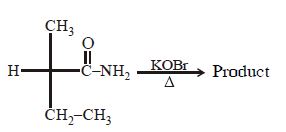
The given reaction is $2$-methylbutanamide reacting with $KOBr$ and $\Delta$. What is the correct statement about the product?
A
It is optically inactive
B
It is optically active and has one less carbon than the reactant
C
The product does not give the isocyanide test
D
The product is a carboxylic acid
Solution
(B) The reaction is the $Hofmann$ $Bromamide$ degradation,which converts an amide into a primary amine with one less carbon atom.
Reactant: $CH_3-CH(C_2H_5)-CONH_2$ ($2$-methylbutanamide).
Product: $CH_3-CH(C_2H_5)-NH_2$ ($sec$-butylamine).
$1$. The product $sec$-butylamine has a chiral center at the carbon attached to the $-NH_2$ group,making it optically active.
$2$. The product has $4$ carbon atoms,while the reactant has $5$ carbon atoms,so it has one less carbon.
$3$. Primary amines give the isocyanide test.
Therefore,option $B$ is correct.
Reactant: $CH_3-CH(C_2H_5)-CONH_2$ ($2$-methylbutanamide).
Product: $CH_3-CH(C_2H_5)-NH_2$ ($sec$-butylamine).
$1$. The product $sec$-butylamine has a chiral center at the carbon attached to the $-NH_2$ group,making it optically active.
$2$. The product has $4$ carbon atoms,while the reactant has $5$ carbon atoms,so it has one less carbon.
$3$. Primary amines give the isocyanide test.
Therefore,option $B$ is correct.
0 likes
View Solution356
DifficultMCQ
Choose the correct option.
A
Total structural isomeric ethers of molecular formula $C_5H_{12}O$ is $4$.
B
Basic strength order of the following amines in aqueous phase: $(CH_3)_2NH > (CH_3)_3N > CH_3NH_2 > NH_3$.
C
Inductive effect is the dominant phenomenon over resonance for halogens towards electrophilic aromatic substitution.
D
All of these
Solution
(C) $1$. For $C_5H_{12}O$,the structural isomeric ethers are: $CH_3-O-CH_2-CH_2-CH_2-CH_3$ (methyl butyl ether),$CH_3-O-CH(CH_3)-CH_2-CH_3$ (methyl sec-butyl ether),$CH_3-O-CH_2-CH(CH_3)_2$ (methyl isobutyl ether),$CH_3-O-C(CH_3)_3$ (methyl tert-butyl ether),$CH_3CH_2-O-CH_2CH_2CH_3$ (ethyl propyl ether),and $CH_3CH_2-O-CH(CH_3)_2$ (ethyl isopropyl ether). There are $6$ structural isomers,so option $A$ is incorrect.
$2$. In the aqueous phase,the basic strength of methyl-substituted amines is governed by a combination of inductive effect,solvation effect,and steric hindrance. The correct order is $(CH_3)_2NH > CH_3NH_2 > (CH_3)_3N > NH_3$. Thus,option $B$ is incorrect.
$3$. For halogens attached to a benzene ring,the inductive effect $(-I)$ is stronger than the resonance effect $(+M)$ in terms of electron withdrawal,which deactivates the ring towards electrophilic aromatic substitution. Thus,option $C$ is correct.
$2$. In the aqueous phase,the basic strength of methyl-substituted amines is governed by a combination of inductive effect,solvation effect,and steric hindrance. The correct order is $(CH_3)_2NH > CH_3NH_2 > (CH_3)_3N > NH_3$. Thus,option $B$ is incorrect.
$3$. For halogens attached to a benzene ring,the inductive effect $(-I)$ is stronger than the resonance effect $(+M)$ in terms of electron withdrawal,which deactivates the ring towards electrophilic aromatic substitution. Thus,option $C$ is correct.
0 likes
View Solution357
MediumMCQ
Which compound is virtually non-basic?
A
$N(CH_3)_3$
B
$N(CF_3)(CH_3)_2$
C
$N(CF_3)_2(CH_3)$
D
$N(CF_3)_3$
Solution
(D) The basicity of amines depends on the availability of the lone pair of electrons on the nitrogen atom.
In $N(CF_3)_3$,the three $-CF_3$ groups are highly electron-withdrawing due to the strong inductive effect ($-I$ effect) of the fluorine atoms.
This strong electron-withdrawing effect pulls the lone pair of electrons on the nitrogen atom towards the carbon atoms,making them unavailable for donation to a proton.
As a result,$N(CF_3)_3$ is virtually non-basic.
In $N(CF_3)_3$,the three $-CF_3$ groups are highly electron-withdrawing due to the strong inductive effect ($-I$ effect) of the fluorine atoms.
This strong electron-withdrawing effect pulls the lone pair of electrons on the nitrogen atom towards the carbon atoms,making them unavailable for donation to a proton.
As a result,$N(CF_3)_3$ is virtually non-basic.
0 likes
View Solution358
DifficultMCQ
Among the following,the weakest base is:
A
$C_6H_5CH_2NH_2$
B
$C_6H_5CH_2NHCH_3$
C
$NO_2CH_2NH_2$
D
$CH_3NHCHO$
Solution
(D) The compound $CH_3NHCHO$ ($N$-methylformamide) is the weakest base among the given options.
In $CH_3NHCHO$,the lone pair of electrons on the nitrogen atom is involved in resonance with the carbonyl group $(C=O)$,which significantly reduces its availability for protonation.
The resonance structure is shown as: $CH_3-\ddot{N}H-CHO \leftrightarrow CH_3-NH^+=CH-O^-$.
In contrast,the other compounds are amines where the lone pair is more available for donation,although their basicity is influenced by inductive and resonance effects of substituents.
In $CH_3NHCHO$,the lone pair of electrons on the nitrogen atom is involved in resonance with the carbonyl group $(C=O)$,which significantly reduces its availability for protonation.
The resonance structure is shown as: $CH_3-\ddot{N}H-CHO \leftrightarrow CH_3-NH^+=CH-O^-$.
In contrast,the other compounds are amines where the lone pair is more available for donation,although their basicity is influenced by inductive and resonance effects of substituents.
0 likes
View Solution359
DifficultMCQ
In the following compounds,the order of basicity is:
$I$: Piperidine
$II$: Pyridine
$III$: Morpholine
$IV$: Pyrrole
$I$: Piperidine
$II$: Pyridine
$III$: Morpholine
$IV$: Pyrrole
A
$IV > I > III > II$
B
$III > I > IV > II$
C
$II > I > III > IV$
D
$I > III > II > IV$
Solution
(D) $(I)$ Piperidine is the most basic. The $N$ lone pair is in an $sp^3$ hybrid orbital and there is no resonance.
$(II)$ In pyridine,the $N$ lone pair is in an $sp^2$ hybrid orbital. The $sp^2$ hybrid is smaller than the $sp^3$ hybrid,so there is a stronger attraction to the nucleus,making it less basic than $I$.
$(III)$ In morpholine,the $N$ lone pair is in an $sp^3$ hybrid orbital. However,the electron-withdrawing effect of the $O$ atom in the ring makes the lone pair less available for donation compared to piperidine.
$(IV)$ Pyrrole is a very weak base. The $N$ lone pair is involved in the aromatic sextet. Protonation would destroy the aromaticity,which is an energetically unfavourable process.
Therefore,the correct order of basicity is $I > III > II > IV$.
$(II)$ In pyridine,the $N$ lone pair is in an $sp^2$ hybrid orbital. The $sp^2$ hybrid is smaller than the $sp^3$ hybrid,so there is a stronger attraction to the nucleus,making it less basic than $I$.
$(III)$ In morpholine,the $N$ lone pair is in an $sp^3$ hybrid orbital. However,the electron-withdrawing effect of the $O$ atom in the ring makes the lone pair less available for donation compared to piperidine.
$(IV)$ Pyrrole is a very weak base. The $N$ lone pair is involved in the aromatic sextet. Protonation would destroy the aromaticity,which is an energetically unfavourable process.
Therefore,the correct order of basicity is $I > III > II > IV$.
0 likes
View Solution360
DifficultMCQ
Consider the following compounds:
$I. CH_3-CH_2-NH_2$
$II. Ph-CH_2-NH_2$
$III. Ph-NH_2$
The correct order of their basic strength is:
$I. CH_3-CH_2-NH_2$
$II. Ph-CH_2-NH_2$
$III. Ph-NH_2$
The correct order of their basic strength is:
A
$III > II > I$
B
$I > II > III$
C
$I > III > II$
D
$II > I > III$
Solution
(B) The basic strength of amines depends on the availability of the lone pair on the nitrogen atom.
$1$. In $CH_3-CH_2-NH_2$ (Ethylamine),the ethyl group is an electron-donating group ($+I$ effect),which increases the electron density on the nitrogen atom,making it the most basic.
$2$. In $Ph-CH_2-NH_2$ (Benzylamine),the phenyl group is attached to the $CH_2$ group,which is separated from the nitrogen by a $CH_2$ spacer. The phenyl group exerts an electron-withdrawing effect ($-I$ effect),making it less basic than ethylamine.
$3$. In $Ph-NH_2$ (Aniline),the lone pair on the nitrogen atom is in conjugation with the benzene ring (delocalized),making it the least basic.
Therefore,the correct order of basic strength is $I > II > III$.
$1$. In $CH_3-CH_2-NH_2$ (Ethylamine),the ethyl group is an electron-donating group ($+I$ effect),which increases the electron density on the nitrogen atom,making it the most basic.
$2$. In $Ph-CH_2-NH_2$ (Benzylamine),the phenyl group is attached to the $CH_2$ group,which is separated from the nitrogen by a $CH_2$ spacer. The phenyl group exerts an electron-withdrawing effect ($-I$ effect),making it less basic than ethylamine.
$3$. In $Ph-NH_2$ (Aniline),the lone pair on the nitrogen atom is in conjugation with the benzene ring (delocalized),making it the least basic.
Therefore,the correct order of basic strength is $I > II > III$.
0 likes
View Solution361
DifficultMCQ
$CH_3NH_2 + CHCl_3 + 3KOH \rightarrow X + Y + 3H_2O$;
Compounds $X$ and $Y$ are:
Compounds $X$ and $Y$ are:
A
$CH_3CN + 3KCl$
B
$CH_3NC + 3KCl$
C
$CH_3CONH_2 + 3KCl$
D
$CH_3NC + K_2CO_3$
Solution
(B) The given reaction is the Carbylamine reaction,which is a characteristic test for primary amines.
$CH_3NH_2 + CHCl_3 + 3KOH \rightarrow CH_3NC + 3KCl + 3H_2O$
Here,$X$ is $CH_3NC$ (methyl isocyanide) and $Y$ is $3KCl$ (potassium chloride).
$CH_3NH_2 + CHCl_3 + 3KOH \rightarrow CH_3NC + 3KCl + 3H_2O$
Here,$X$ is $CH_3NC$ (methyl isocyanide) and $Y$ is $3KCl$ (potassium chloride).
0 likes
View Solution362
DifficultMCQ
Which of the following will give $N_2$ gas on treatment with nitrous acid?
A
$C_2H_5NH_2$
B
$CH_3NH_2$
C
$(CH_3)_2CHNH_2$
D
All the above
Solution
(D) Primary aliphatic amines react with nitrous acid $(HNO_2)$ to form unstable diazonium salts,which decompose to evolve $N_2$ gas.
Since $C_2H_5NH_2$,$CH_3NH_2$,and $(CH_3)_2CHNH_2$ are all primary amines,they all undergo this reaction to release $N_2$ gas.
Since $C_2H_5NH_2$,$CH_3NH_2$,and $(CH_3)_2CHNH_2$ are all primary amines,they all undergo this reaction to release $N_2$ gas.
0 likes
View Solution363
DifficultMCQ
Benzamide reacts with $Br_2$ and $KOH$ gives :-
A
Benzene
B
Bromobenzene
C
Aniline
D
Benzylamine
Solution
(C) The reaction of an amide with $Br_2$ and $KOH$ (or $NaOH$) is known as the $Hofmann$ $Bromamide$ $Degradation$ reaction.
In this reaction,the amide group $(-CONH_2)$ is converted into a primary amine $(-NH_2)$ with the loss of one carbon atom.
For $Benzamide$ $(C_6H_5CONH_2)$,the reaction is:
$C_6H_5CONH_2 + Br_2 + 4KOH \rightarrow C_6H_5NH_2 + K_2CO_3 + 2KBr + 2H_2O$.
The product formed is $Aniline$ $(C_6H_5NH_2)$.
In this reaction,the amide group $(-CONH_2)$ is converted into a primary amine $(-NH_2)$ with the loss of one carbon atom.
For $Benzamide$ $(C_6H_5CONH_2)$,the reaction is:
$C_6H_5CONH_2 + Br_2 + 4KOH \rightarrow C_6H_5NH_2 + K_2CO_3 + 2KBr + 2H_2O$.
The product formed is $Aniline$ $(C_6H_5NH_2)$.
0 likes
View Solution364
DifficultMCQ
Identify $A$ and $B$ in the following reaction sequence:
$C_6H_5NH_2 + CH_3COCl$ $\rightarrow A$ $\xrightarrow{Br_2/H_2O} B$
$C_6H_5NH_2 + CH_3COCl$ $\rightarrow A$ $\xrightarrow{Br_2/H_2O} B$
A
$A = \text{acetanilide}, B = 2,4,6-\text{tribromoaniline}$
B
$A = \text{acetanilide}, B = p-\text{bromoaniline}$
C
$A = p-\text{bromoacetanilide}, B = p-\text{bromoaniline}$
D
$A = \text{acetanilide}, B = 2,4,6-\text{tribromoacetanilide}$
Solution
(B) The reaction of aniline $(C_6H_5NH_2)$ with acetyl chloride $(CH_3COCl)$ in the presence of a base leads to the formation of acetanilide $(C_6H_5NHCOCH_3)$,which is compound $A$.
Acetanilide is then treated with bromine water $(Br_2/H_2O)$. The $-NHCOCH_3$ group is less activating than the $-NH_2$ group,which prevents poly-substitution and directs the bromine to the para-position,forming $p-\text{bromoacetanilide}$.
However,the question asks for the final product $B$ after the reaction sequence. The standard reaction of aniline with $Br_2/H_2O$ gives $2,4,6-\text{tribromoaniline}$. By protecting the amino group via acetylation,we control the reaction to yield $p-\text{bromoacetanilide}$.
Looking at the provided options and the standard reaction pathway,$A$ is acetanilide and $B$ is $p-\text{bromoacetanilide}$ (which can be hydrolyzed to $p-\text{bromoaniline}$). Based on the options provided,option $B$ is the most accurate representation of the intermediate and the final product after hydrolysis.
Acetanilide is then treated with bromine water $(Br_2/H_2O)$. The $-NHCOCH_3$ group is less activating than the $-NH_2$ group,which prevents poly-substitution and directs the bromine to the para-position,forming $p-\text{bromoacetanilide}$.
However,the question asks for the final product $B$ after the reaction sequence. The standard reaction of aniline with $Br_2/H_2O$ gives $2,4,6-\text{tribromoaniline}$. By protecting the amino group via acetylation,we control the reaction to yield $p-\text{bromoacetanilide}$.
Looking at the provided options and the standard reaction pathway,$A$ is acetanilide and $B$ is $p-\text{bromoacetanilide}$ (which can be hydrolyzed to $p-\text{bromoaniline}$). Based on the options provided,option $B$ is the most accurate representation of the intermediate and the final product after hydrolysis.
0 likes
View Solution365
DifficultMCQ
Reaction of $R-CONH_2$ with a mixture of $Br_2$ and $KOH$ gives $R-NH_2$ as the main product. The intermediates involved in this reaction are :-
$(A)$ $R-CONHBr$
$(B)$ $R-NH-Br$
$(C)$ $R-N=C=O$
$(D)$ $R-CONBr_2$
$(A)$ $R-CONHBr$
$(B)$ $R-NH-Br$
$(C)$ $R-N=C=O$
$(D)$ $R-CONBr_2$
A
$A, B$
B
$A, D$
C
$A, C$
D
$A, B, D$
Solution
(C) The reaction described is the $Hofmann$ bromamide degradation reaction.
The mechanism involves the following steps:
$1$. Formation of $N$-bromamide: $R-CONH_2 + Br_2 + KOH \rightarrow R-CONHBr + KBr + H_2O$.
$2$. Formation of an acyl nitrene or direct rearrangement: The $N$-bromamide reacts with base to form an anion,which loses $Br^-$ to form an acyl nitrene,which then rearranges to form an isocyanate intermediate: $R-CONHBr + KOH \rightarrow R-N=C=O + KBr + H_2O$.
$3$. Hydrolysis of isocyanate: $R-N=C=O + 2KOH \rightarrow R-NH_2 + K_2CO_3$.
Thus,the intermediates involved are $R-CONHBr$ $(A)$ and $R-N=C=O$ $(C)$.
The mechanism involves the following steps:
$1$. Formation of $N$-bromamide: $R-CONH_2 + Br_2 + KOH \rightarrow R-CONHBr + KBr + H_2O$.
$2$. Formation of an acyl nitrene or direct rearrangement: The $N$-bromamide reacts with base to form an anion,which loses $Br^-$ to form an acyl nitrene,which then rearranges to form an isocyanate intermediate: $R-CONHBr + KOH \rightarrow R-N=C=O + KBr + H_2O$.
$3$. Hydrolysis of isocyanate: $R-N=C=O + 2KOH \rightarrow R-NH_2 + K_2CO_3$.
Thus,the intermediates involved are $R-CONHBr$ $(A)$ and $R-N=C=O$ $(C)$.
0 likes
View Solution366
MediumMCQ
Consider the following sequence of reactions: $C_2H_5-Br$ $\xrightarrow{AgCN} A$ $\xrightarrow{H_2/Ni} B$. Product $B$ is:
A
$CH_3-CH_2-CH_2-NH_2$
B
$CH_3-CH_2-NH-CH_3$
C
$(CH_3-CH_2)_2NH$
D
$CH_3-CH_2-NH_2$
Solution
(B) $1$. The reaction of $C_2H_5-Br$ with $AgCN$ is a nucleophilic substitution reaction. Since $AgCN$ is a covalent compound,the nitrogen atom acts as the nucleophile,leading to the formation of an isocyanide (carbylamine).
$C_2H_5-Br + AgCN \rightarrow C_2H_5-NC + AgBr$
$2$. The product $A$ is ethyl isocyanide $(C_2H_5-NC)$.
$3$. The catalytic hydrogenation of an isocyanide using $H_2/Ni$ results in the formation of a secondary amine.
$C_2H_5-NC + 2H_2 \xrightarrow{Ni} C_2H_5-NH-CH_3$
$4$. The product $B$ is $N$-methylethanamine $(CH_3-CH_2-NH-CH_3)$.
$C_2H_5-Br + AgCN \rightarrow C_2H_5-NC + AgBr$
$2$. The product $A$ is ethyl isocyanide $(C_2H_5-NC)$.
$3$. The catalytic hydrogenation of an isocyanide using $H_2/Ni$ results in the formation of a secondary amine.
$C_2H_5-NC + 2H_2 \xrightarrow{Ni} C_2H_5-NH-CH_3$
$4$. The product $B$ is $N$-methylethanamine $(CH_3-CH_2-NH-CH_3)$.
0 likes
View Solution367
MediumMCQ
Which of the following will not give Hoffmann bromamide reaction?
A
$CH_3-CONH_2$
B
$C_6H_5-CONHBr$
C
$C_6H_5-CONH_2$
D
$C_6H_5-CONH-CH_3$
Solution
(D) The Hoffmann bromamide degradation reaction is specific to primary $(1^\circ)$ amides $(R-CONH_2)$.
$A$: $CH_3-CONH_2$ is a $1^\circ$ amide,so it gives the reaction.
$B$: $C_6H_5-CONHBr$ is an $N$-bromoamide,which is an intermediate in the reaction,but it is not the starting material ($1^\circ$ amide) that undergoes the degradation process.
$C$: $C_6H_5-CONH_2$ is a $1^\circ$ amide,so it gives the reaction.
$D$: $C_6H_5-CONH-CH_3$ is a secondary $(2^\circ)$ amide,which does not undergo the Hoffmann bromamide reaction.
Thus,both $B$ and $D$ do not give the reaction as starting materials,but in the context of standard textbook questions,secondary amides $(D)$ are the classic examples of compounds that do not undergo this reaction.
$A$: $CH_3-CONH_2$ is a $1^\circ$ amide,so it gives the reaction.
$B$: $C_6H_5-CONHBr$ is an $N$-bromoamide,which is an intermediate in the reaction,but it is not the starting material ($1^\circ$ amide) that undergoes the degradation process.
$C$: $C_6H_5-CONH_2$ is a $1^\circ$ amide,so it gives the reaction.
$D$: $C_6H_5-CONH-CH_3$ is a secondary $(2^\circ)$ amide,which does not undergo the Hoffmann bromamide reaction.
Thus,both $B$ and $D$ do not give the reaction as starting materials,but in the context of standard textbook questions,secondary amides $(D)$ are the classic examples of compounds that do not undergo this reaction.
0 likes
View Solution368
MediumMCQ
The reaction of chloroform with alcoholic $KOH$ and $p-$toluidine forms:
A
$p-$tolyl isocyanide
B
$p-$chlorotoluene
C
$p-$toluidine hydrochloride
D
$p-$nitrotoluene
Solution
(A) The reaction of a primary amine with chloroform $(CHCl_3)$ and alcoholic $KOH$ is known as the carbylamine reaction.
$p-$toluidine $(CH_3-C_6H_4-NH_2)$ is a primary aromatic amine.
When it reacts with $CHCl_3$ and alcoholic $KOH$,it undergoes the carbylamine reaction to form an isocyanide (carbylamine) as the product.
The chemical reaction is:
$CH_3-C_6H_4-NH_2 + CHCl_3 + 3KOH(alc.) \rightarrow CH_3-C_6H_4-NC + 3KCl + 3H_2O$
Thus,the product formed is $p-$tolyl isocyanide.
$p-$toluidine $(CH_3-C_6H_4-NH_2)$ is a primary aromatic amine.
When it reacts with $CHCl_3$ and alcoholic $KOH$,it undergoes the carbylamine reaction to form an isocyanide (carbylamine) as the product.
The chemical reaction is:
$CH_3-C_6H_4-NH_2 + CHCl_3 + 3KOH(alc.) \rightarrow CH_3-C_6H_4-NC + 3KCl + 3H_2O$
Thus,the product formed is $p-$tolyl isocyanide.
0 likes
View Solution369
MediumMCQ
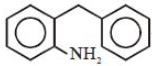
The product of the reaction $image \xrightarrow[{HCl}]{{NaNO_2}} (A)$ is:
A
Fluorene
B
Anthracene
C
Fluorenone
D
Naphthalene
Solution
(A) The starting material is $2$-aminodiphenylmethane.
Treatment with $NaNO_2/HCl$ at $0-5 \ ^{\circ}C$ converts the primary amine group into a diazonium salt,forming $2$-diphenylmethyldiazonium chloride.
This diazonium salt is unstable and undergoes intramolecular cyclization (Gomberg-Bachmann type reaction or direct cyclization) to form fluorene.
Treatment with $NaNO_2/HCl$ at $0-5 \ ^{\circ}C$ converts the primary amine group into a diazonium salt,forming $2$-diphenylmethyldiazonium chloride.
This diazonium salt is unstable and undergoes intramolecular cyclization (Gomberg-Bachmann type reaction or direct cyclization) to form fluorene.
0 likes
View Solution370
MediumMCQ
The major product of the reaction is:
$R-CONH_2 \xrightarrow{NaOBr} (A)$
(where $R$ is the chiral group shown in the image)
$R-CONH_2 \xrightarrow{NaOBr} (A)$
(where $R$ is the chiral group shown in the image)
A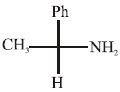
B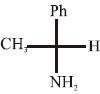
C
D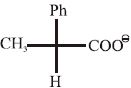
Solution
(A) The reaction $R-CONH_2 \xrightarrow{NaOBr} R-NH_2$ is the Hofmann bromamide degradation reaction.
In this reaction,the alkyl or aryl group $R$ migrates from the carbonyl carbon to the nitrogen atom.
This migration occurs with complete retention of configuration at the chiral center of the $R$ group.
Since the starting material has the $Ph$ group at the top,$CH_3$ on the left,$H$ at the bottom,and the $CONH_2$ group on the right,the resulting amine $R-NH_2$ will have the $NH_2$ group in the same position as the original $CONH_2$ group,with all other groups $(Ph, CH_3, H)$ remaining in their respective positions.
Comparing this with the given options,the structure in image $817-$a132 represents the correct product with retained configuration.
In this reaction,the alkyl or aryl group $R$ migrates from the carbonyl carbon to the nitrogen atom.
This migration occurs with complete retention of configuration at the chiral center of the $R$ group.
Since the starting material has the $Ph$ group at the top,$CH_3$ on the left,$H$ at the bottom,and the $CONH_2$ group on the right,the resulting amine $R-NH_2$ will have the $NH_2$ group in the same position as the original $CONH_2$ group,with all other groups $(Ph, CH_3, H)$ remaining in their respective positions.
Comparing this with the given options,the structure in image $817-$a132 represents the correct product with retained configuration.
0 likes
View Solution371
AdvancedMCQ
The final product of the given sequence is :
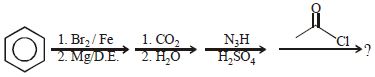
A
Acetophenone
B
Benzoic acid
C
m-Aminoacetophenone
D
Acetanilide
Solution
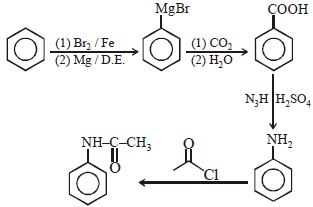
0 likes
View Solution372
DifficultMCQ
Consider the following reaction sequence and identify the correct option:
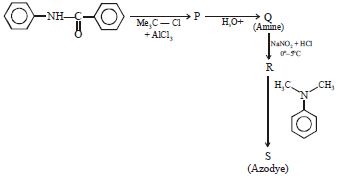
A
$P$ is $N-(4-tert-butylphenyl)benzamide$
B
$S$ is $4-tert-butyl-4'-(dimethylamino)azobenzene$
C
$S$ is $4-tert-butyl-4'-aminoazobenzene$
D
$R$ to $S$ is carried out at $pH = 9.5$
Solution
(B) $1$. The starting material is $N-phenylbenzamide$. Friedel-Crafts alkylation with $Me_3C-Cl/AlCl_3$ occurs at the para-position of the aniline ring because the amide group is ortho/para directing. Thus,$P$ is $N-(4-tert-butylphenyl)benzamide$.
$2$. Acidic hydrolysis $(H_3O^+)$ of $P$ yields $4-tert-butylaniline$ $(Q)$.
$3$. Diazotization of $Q$ with $NaNO_2/HCl$ at $0-5^{\circ}C$ gives $4-tert-butylbenzenediazonium$ chloride $(R)$.
$4$. Coupling of $R$ with $N,N-dimethylaniline$ occurs in basic or weakly acidic medium. The reaction $R$ to $S$ is typically carried out at $pH \approx 4-5$ for coupling with amines,but the question asks for the correct statement. Option $B$ correctly identifies the structure of the azo dye $S$ as $4-tert-butyl-4'-(dimethylamino)azobenzene$.
$2$. Acidic hydrolysis $(H_3O^+)$ of $P$ yields $4-tert-butylaniline$ $(Q)$.
$3$. Diazotization of $Q$ with $NaNO_2/HCl$ at $0-5^{\circ}C$ gives $4-tert-butylbenzenediazonium$ chloride $(R)$.
$4$. Coupling of $R$ with $N,N-dimethylaniline$ occurs in basic or weakly acidic medium. The reaction $R$ to $S$ is typically carried out at $pH \approx 4-5$ for coupling with amines,but the question asks for the correct statement. Option $B$ correctly identifies the structure of the azo dye $S$ as $4-tert-butyl-4'-(dimethylamino)azobenzene$.
0 likes
View Solution373
MediumMCQ
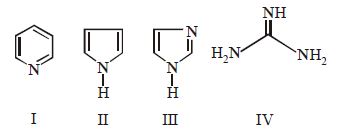
The correct order of basic strength for the given compounds is:
A
$IV > I > II > III$
B
$IV > I > III > II$
C
$III > IV > I > II$
D
$IV > III > I > II$
Solution
(D) To determine the basic strength,we analyze the availability of the lone pair on the nitrogen atom:
$1$. Compound $IV$ is Guanidine. It is a very strong base because its conjugate acid is highly stabilized by resonance involving three equivalent nitrogen atoms.
$2$. Compound $I$ is Pyridine. The lone pair is in an $sp^2$ orbital,which is not involved in the aromatic sextet,making it moderately basic.
$3$. Compound $III$ is Imidazole. It contains two nitrogen atoms; one has a lone pair in an $sp^2$ orbital (similar to pyridine),making it more basic than pyridine.
$4$. Compound $II$ is Pyrrole. The lone pair on the nitrogen is involved in the aromatic sextet ($6\pi$ electrons),making it non-basic.
Comparing these,the order of basic strength is $IV > III > I > II$.
$1$. Compound $IV$ is Guanidine. It is a very strong base because its conjugate acid is highly stabilized by resonance involving three equivalent nitrogen atoms.
$2$. Compound $I$ is Pyridine. The lone pair is in an $sp^2$ orbital,which is not involved in the aromatic sextet,making it moderately basic.
$3$. Compound $III$ is Imidazole. It contains two nitrogen atoms; one has a lone pair in an $sp^2$ orbital (similar to pyridine),making it more basic than pyridine.
$4$. Compound $II$ is Pyrrole. The lone pair on the nitrogen is involved in the aromatic sextet ($6\pi$ electrons),making it non-basic.
Comparing these,the order of basic strength is $IV > III > I > II$.
0 likes
View Solution374
MediumMCQ
Which of the following is the strongest base?
A
Piperidine
B
Pyridine
C
Pyrrole
D
Aniline
Solution
(A) To determine the basicity,we look at the availability of the lone pair of electrons on the nitrogen atom:
$1$. In $Piperidine$,the nitrogen is $sp^3$ hybridized and the lone pair is localized,making it the most basic.
$2$. In $Pyridine$,the nitrogen is $sp^2$ hybridized,and the lone pair is in an $sp^2$ orbital,which is less basic than $sp^3$.
$3$. In $Pyrrole$,the lone pair on nitrogen is involved in the aromatic sextet,making it unavailable for protonation,thus it is very weakly basic.
$4$. In $Aniline$,the lone pair is delocalized into the benzene ring due to resonance,reducing its availability for protonation.
Therefore,$Piperidine$ is the strongest base.
$1$. In $Piperidine$,the nitrogen is $sp^3$ hybridized and the lone pair is localized,making it the most basic.
$2$. In $Pyridine$,the nitrogen is $sp^2$ hybridized,and the lone pair is in an $sp^2$ orbital,which is less basic than $sp^3$.
$3$. In $Pyrrole$,the lone pair on nitrogen is involved in the aromatic sextet,making it unavailable for protonation,thus it is very weakly basic.
$4$. In $Aniline$,the lone pair is delocalized into the benzene ring due to resonance,reducing its availability for protonation.
Therefore,$Piperidine$ is the strongest base.
0 likes
View Solution375
MediumMCQ
How many secondary amines are possible with the molecular formula $C_4H_{11}N$?
A
$4$
B
$3$
C
$2$
D
$1$
Solution
(B) The molecular formula $C_4H_{11}N$ corresponds to a saturated amine. $A$ secondary amine has the general structure $R-NH-R'$.
For $C_4H_{11}N$,the possible secondary amines are:
$1.$ $N$-methylpropan-$1$-amine $(CH_3-NH-CH_2-CH_2-CH_3)$
$2.$ $N$-methylpropan-$2$-amine $(CH_3-NH-CH(CH_3)_2)$
$3.$ $N$-ethylethanamine $(CH_3-CH_2-NH-CH_2-CH_3)$
Thus,there are $3$ possible secondary amines.
For $C_4H_{11}N$,the possible secondary amines are:
$1.$ $N$-methylpropan-$1$-amine $(CH_3-NH-CH_2-CH_2-CH_3)$
$2.$ $N$-methylpropan-$2$-amine $(CH_3-NH-CH(CH_3)_2)$
$3.$ $N$-ethylethanamine $(CH_3-CH_2-NH-CH_2-CH_3)$
Thus,there are $3$ possible secondary amines.
0 likes
View Solution376
DifficultMCQ
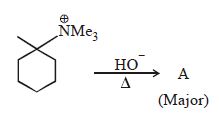
The major product $A$ is:
A
$1-$methylcyclohexene
B
methylenecyclohexane
C
$3-$methylcyclohexene
D
$1-$methylenecyclohex$-2-$ene
Solution
(B) The given reaction is a Hofmann elimination reaction of a quaternary ammonium hydroxide.
In this reaction,the base $(HO^-)$ abstracts a proton from the $\beta$-carbon atom.
According to the Hofmann rule,the less substituted alkene is formed as the major product because the base attacks the most accessible (least sterically hindered) $\beta$-hydrogen.
In the given molecule,there are two types of $\beta$-hydrogens: those on the methyl group and those on the ring carbons.
Removing a proton from the methyl group leads to the formation of the exocyclic double bond,resulting in methylenecyclohexane.
Removing a proton from the ring carbon leads to the formation of $1-$methylcyclohexene.
Since the exocyclic double bond (methylenecyclohexane) is less substituted than the endocyclic double bond ($1$-methylcyclohexene),methylenecyclohexane is the major product.
In this reaction,the base $(HO^-)$ abstracts a proton from the $\beta$-carbon atom.
According to the Hofmann rule,the less substituted alkene is formed as the major product because the base attacks the most accessible (least sterically hindered) $\beta$-hydrogen.
In the given molecule,there are two types of $\beta$-hydrogens: those on the methyl group and those on the ring carbons.
Removing a proton from the methyl group leads to the formation of the exocyclic double bond,resulting in methylenecyclohexane.
Removing a proton from the ring carbon leads to the formation of $1-$methylcyclohexene.
Since the exocyclic double bond (methylenecyclohexane) is less substituted than the endocyclic double bond ($1$-methylcyclohexene),methylenecyclohexane is the major product.
0 likes
View Solution377
AdvancedMCQ
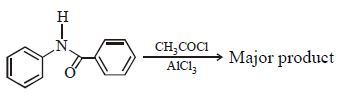
Give the major product of the following reaction $.$
A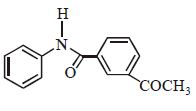
B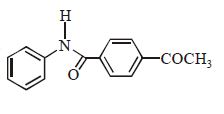
C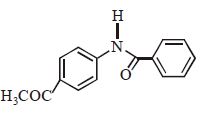
D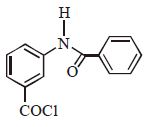
Solution
(C) The reaction is a Friedel-Crafts acylation of $N$-phenylbenzamide (benzanilide) with acetyl chloride $(CH_3COCl)$ in the presence of $AlCl_3$.
In $N$-phenylbenzamide,the nitrogen atom is attached to two phenyl rings: one from the aniline part and one from the benzoyl part.
The $-NHCO-$ group is an ortho/para-directing group because of the lone pair on the nitrogen atom,which increases the electron density on the aniline ring.
However,the benzoyl group attached to the nitrogen is strongly electron-withdrawing,which deactivates the benzoyl ring towards electrophilic substitution.
Therefore,the electrophilic substitution (Friedel-Crafts acylation) occurs on the more electron-rich aniline ring at the para position due to steric hindrance at the ortho position.
Thus,the major product is $N-(4-acetylphenyl)benzamide$.
In $N$-phenylbenzamide,the nitrogen atom is attached to two phenyl rings: one from the aniline part and one from the benzoyl part.
The $-NHCO-$ group is an ortho/para-directing group because of the lone pair on the nitrogen atom,which increases the electron density on the aniline ring.
However,the benzoyl group attached to the nitrogen is strongly electron-withdrawing,which deactivates the benzoyl ring towards electrophilic substitution.
Therefore,the electrophilic substitution (Friedel-Crafts acylation) occurs on the more electron-rich aniline ring at the para position due to steric hindrance at the ortho position.
Thus,the major product is $N-(4-acetylphenyl)benzamide$.
0 likes
View Solution378
MediumMCQ
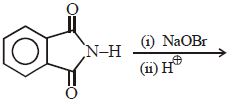
What is the product of the following reaction?
A
$2-$aminobenzoic acid
B
$2-$amino$-2-$phenylacetic acid
C
$2-$(aminomethyl)benzoic acid
D
Isoindolin$-1-$one
Solution
(A) The given reaction is the Hofmann rearrangement of phthalimide.
Phthalimide reacts with $NaOBr$ (which is $NaOH + Br_2$) followed by acid hydrolysis $(H^{\oplus})$.
This reaction converts the amide group $(-CONH_2)$ into an amine group $(-NH_2)$ with the loss of one carbon atom as $CO_2$.
In the case of phthalimide,the cyclic imide structure undergoes rearrangement to form anthranilic acid ($2$-aminobenzoic acid).
Phthalimide reacts with $NaOBr$ (which is $NaOH + Br_2$) followed by acid hydrolysis $(H^{\oplus})$.
This reaction converts the amide group $(-CONH_2)$ into an amine group $(-NH_2)$ with the loss of one carbon atom as $CO_2$.
In the case of phthalimide,the cyclic imide structure undergoes rearrangement to form anthranilic acid ($2$-aminobenzoic acid).
0 likes
View Solution379
AdvancedMCQ
What is the end product of the following reaction sequence?
$CH_3CH_2NH_2$ $\xrightarrow[H^+]{KMnO_4}$ $\xrightarrow{SOCl_2}$ $\xrightarrow[\Delta]{NH_3}$ $\xrightarrow{NaOH/Br_2} ?$
$CH_3CH_2NH_2$ $\xrightarrow[H^+]{KMnO_4}$ $\xrightarrow{SOCl_2}$ $\xrightarrow[\Delta]{NH_3}$ $\xrightarrow{NaOH/Br_2} ?$
A
$CH_3CH_2OH$
B
$CH_3CH_2Br$
C
$CH_3CH_2NH_2$
D
$CH_3NH_2$
Solution
(D) The reaction sequence is as follows:
$1$. $CH_3CH_2NH_2 \xrightarrow{KMnO_4/H^+} CH_3COOH$ (Oxidation of primary amine to carboxylic acid).
$2$. $CH_3COOH \xrightarrow{SOCl_2} CH_3COCl$ (Conversion of carboxylic acid to acid chloride).
$3$. $CH_3COCl \xrightarrow{NH_3, \Delta} CH_3CONH_2$ (Ammonolysis of acid chloride to amide).
$4$. $CH_3CONH_2 \xrightarrow{NaOH/Br_2} CH_3NH_2$ (Hofmann bromamide degradation reaction).
Thus,the end product is $CH_3NH_2$.
$1$. $CH_3CH_2NH_2 \xrightarrow{KMnO_4/H^+} CH_3COOH$ (Oxidation of primary amine to carboxylic acid).
$2$. $CH_3COOH \xrightarrow{SOCl_2} CH_3COCl$ (Conversion of carboxylic acid to acid chloride).
$3$. $CH_3COCl \xrightarrow{NH_3, \Delta} CH_3CONH_2$ (Ammonolysis of acid chloride to amide).
$4$. $CH_3CONH_2 \xrightarrow{NaOH/Br_2} CH_3NH_2$ (Hofmann bromamide degradation reaction).
Thus,the end product is $CH_3NH_2$.
0 likes
View Solution380
DifficultMCQ
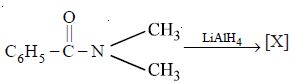
In the given reaction,$[X]$ will be:
A
$C_6H_5-CH_2OH$
B
$C_6H_5COOH$
C
$C_6H_5CONH_2$
D
$C_6H_5-CH_2-N(CH_3)_2$
Solution
(D) The given reaction is the reduction of an amide,$N,N$-dimethylbenzamide $(C_6H_5CON(CH_3)_2)$,using lithium aluminum hydride $(LiAlH_4)$.
$LiAlH_4$ is a strong reducing agent that reduces amides to their corresponding amines.
In this reaction,the carbonyl group $(C=O)$ of the amide is reduced to a methylene group $(-CH_2-)$.
Therefore,the reaction is: $C_6H_5CON(CH_3)_2 + 4[H] \xrightarrow{LiAlH_4} C_6H_5CH_2N(CH_3)_2 + H_2O$.
The product $[X]$ is $N,N$-dimethylbenzylamine,which corresponds to option $D$.
$LiAlH_4$ is a strong reducing agent that reduces amides to their corresponding amines.
In this reaction,the carbonyl group $(C=O)$ of the amide is reduced to a methylene group $(-CH_2-)$.
Therefore,the reaction is: $C_6H_5CON(CH_3)_2 + 4[H] \xrightarrow{LiAlH_4} C_6H_5CH_2N(CH_3)_2 + H_2O$.
The product $[X]$ is $N,N$-dimethylbenzylamine,which corresponds to option $D$.
0 likes
View Solution381
DifficultMCQ
Which one of the following compounds gives carboxylic acid with $HNO_2$?
A
$C_6H_5COCl$
B
$C_6H_5CONH_2$
C
$(CH_3CO)_2O$
D
$CH_3COOC_2H_5$
Solution
(B) Primary amides react with nitrous acid $(HNO_2)$ to yield carboxylic acids and nitrogen gas.
The reaction is as follows:
$C_6H_5CONH_2 + HNO_2 \rightarrow C_6H_5COOH + N_2 + H_2O$
The reaction is as follows:
$C_6H_5CONH_2 + HNO_2 \rightarrow C_6H_5COOH + N_2 + H_2O$
0 likes
View Solution382
DifficultMCQ
In the given reaction sequence:
$CH_3-CH_2-OH$ $\xrightarrow[(ii) H^{\oplus}]{(i) KMnO_4/OH^{\ominus}/\Delta} (A)$ $\xrightarrow[(ii) NH_3/\Delta]{(i) SOCl_2} (B)$ $\xrightarrow{Br_2/KOH} (C)$
$(C)$ will be:
$CH_3-CH_2-OH$ $\xrightarrow[(ii) H^{\oplus}]{(i) KMnO_4/OH^{\ominus}/\Delta} (A)$ $\xrightarrow[(ii) NH_3/\Delta]{(i) SOCl_2} (B)$ $\xrightarrow{Br_2/KOH} (C)$
$(C)$ will be:
A
Methylamine
B
Ethylamine
C
Propylamine
D
Acetamide
Solution
(A) Ethanol is oxidized with potassium permanganate in alkaline medium followed by acidification to obtain acetic acid (compound $A$).
The carboxylic group is converted to acid chloride by thionyl chloride,followed by reaction with ammonia to form acetamide (compound $B$).
Hoffmann bromamide degradation of acetamide gives methylamine (compound $C$).
$CH_3-CH_2-OH$ $\xrightarrow[(ii) H^{\oplus}]{(i) KMnO_4/OH^{\ominus}/\Delta} CH_3-COOH \; (A)$ $\xrightarrow[(ii) NH_3/\Delta]{(i) SOCl_2} CH_3-CONH_2 \; (B)$ $\xrightarrow{Br_2/KOH} CH_3NH_2 \; (C)$
The carboxylic group is converted to acid chloride by thionyl chloride,followed by reaction with ammonia to form acetamide (compound $B$).
Hoffmann bromamide degradation of acetamide gives methylamine (compound $C$).
$CH_3-CH_2-OH$ $\xrightarrow[(ii) H^{\oplus}]{(i) KMnO_4/OH^{\ominus}/\Delta} CH_3-COOH \; (A)$ $\xrightarrow[(ii) NH_3/\Delta]{(i) SOCl_2} CH_3-CONH_2 \; (B)$ $\xrightarrow{Br_2/KOH} CH_3NH_2 \; (C)$
0 likes
View Solution383
DifficultMCQ
Which of the following is hydrolysed to give a secondary amine?
A
Alkyl cyanide
B
Isocyanide $(R-NC)$
C
Nitro paraffins
D
Acid amide $(H-CON(CH_3)_2)$
Solution
(D) Hydrolysis of isocyanides $(R-NC)$ yields a primary amine $(R-NH_2)$ and formic acid $(HCOOH)$.
Hydrolysis of alkyl cyanides $(R-CN)$ yields carboxylic acids.
Hydrolysis of nitro paraffins does not yield amines.
Hydrolysis of $N,N$-dimethylformamide $(H-CON(CH_3)_2)$,which is a substituted acid amide,yields dimethylamine $((CH_3)_2NH)$,which is a secondary amine.
Therefore,the correct option is $D$.
Hydrolysis of alkyl cyanides $(R-CN)$ yields carboxylic acids.
Hydrolysis of nitro paraffins does not yield amines.
Hydrolysis of $N,N$-dimethylformamide $(H-CON(CH_3)_2)$,which is a substituted acid amide,yields dimethylamine $((CH_3)_2NH)$,which is a secondary amine.
Therefore,the correct option is $D$.
0 likes
View Solution384
MediumMCQ
Which amine will not react with nitrous acid $(HNO_2)$?
A
Methyl amine
B
Ethyl amine
C
Dimethyl amine
D
$N, N$-Dimethyl ethanamine
Solution
(D) Primary aliphatic amines $(R-NH_2)$ react with nitrous acid $(HNO_2)$ to form unstable diazonium salts,which decompose to evolve $N_2$ gas.
Secondary amines $(R_2NH)$ react with $HNO_2$ to form $N$-nitrosoamines (yellow oily liquids).
Tertiary aliphatic amines $(R_3N)$ form water-soluble nitrite salts with $HNO_2$ but do not undergo the characteristic diazotization or nitrosation reactions that evolve gas or form distinct oily layers like primary and secondary amines.
Among the given options,$N, N$-dimethyl ethanamine is a tertiary amine $(CH_3CH_2N(CH_3)_2)$,which does not react with nitrous acid to form a stable product or evolve gas in the same manner as primary or secondary amines.
Secondary amines $(R_2NH)$ react with $HNO_2$ to form $N$-nitrosoamines (yellow oily liquids).
Tertiary aliphatic amines $(R_3N)$ form water-soluble nitrite salts with $HNO_2$ but do not undergo the characteristic diazotization or nitrosation reactions that evolve gas or form distinct oily layers like primary and secondary amines.
Among the given options,$N, N$-dimethyl ethanamine is a tertiary amine $(CH_3CH_2N(CH_3)_2)$,which does not react with nitrous acid to form a stable product or evolve gas in the same manner as primary or secondary amines.
0 likes
View Solution385
DifficultMCQ
Which gas will be evolved out when $[CH_3CH_2NH_2 + (CH_3)_2CHNH_2]$ is treated with sodium nitrite and $HCl$?
A
Chlorine
B
Ammonia
C
Nitrogen
D
$NO_2$
Solution
(C) Primary aliphatic amines react with nitrous acid $(HNO_2)$,which is generated in situ by the reaction of $NaNO_2$ and $HCl$,to form unstable diazonium salts that decompose to yield primary alcohols,water,and nitrogen gas $(N_2)$.
The reaction is as follows:
$CH_3CH_2NH_2 + (CH_3)_2CHNH_2 + 2HNO_2$ $\xrightarrow[273-278 \ K]{NaNO_2 + HCl} CH_3CH_2OH + (CH_3)_2CHOH + 2H_2O + 2N_2 \uparrow$
Thus,the gas evolved is nitrogen $(N_2)$.
The reaction is as follows:
$CH_3CH_2NH_2 + (CH_3)_2CHNH_2 + 2HNO_2$ $\xrightarrow[273-278 \ K]{NaNO_2 + HCl} CH_3CH_2OH + (CH_3)_2CHOH + 2H_2O + 2N_2 \uparrow$
Thus,the gas evolved is nitrogen $(N_2)$.
0 likes
View Solution386
MediumMCQ
Boiling ethylamine on reaction with acidified $KMnO_4$ gives:
A
Acetaldehyde
B
Ethanoic acid
C
Ethanol
D
Acetamide
Solution
(B) Ethylamine $(CH_3CH_2NH_2)$ on reaction with strong oxidizing agents like acidified $KMnO_4$ undergoes oxidation.
Initially,it forms an imine intermediate which is unstable and hydrolyzes to form acetaldehyde $(CH_3CHO)$.
However,acetaldehyde is further oxidized to ethanoic acid $(CH_3COOH)$ in the presence of strong oxidizing agents like acidified $KMnO_4$.
Initially,it forms an imine intermediate which is unstable and hydrolyzes to form acetaldehyde $(CH_3CHO)$.
However,acetaldehyde is further oxidized to ethanoic acid $(CH_3COOH)$ in the presence of strong oxidizing agents like acidified $KMnO_4$.
0 likes
View Solution387
DifficultMCQ
$Methyl$ amine on reaction with chlorine in the presence of $NaOH$ gives:
A
Chloroform
B
$Methyl$ chloride
C
$N$-Methyl chloramine
D
Chloramine
Solution
(C) When $Methyl$ amine $(CH_3NH_2)$ reacts with chlorine $(Cl_2)$ in the presence of a base like $NaOH$,it undergoes chlorination to form $N$-methyl chloramine $(CH_3NHCl)$.
The reaction is: $CH_3NH_2 + Cl_2 + NaOH \rightarrow CH_3NHCl + NaCl + H_2O$.
The reaction is: $CH_3NH_2 + Cl_2 + NaOH \rightarrow CH_3NHCl + NaCl + H_2O$.
0 likes
View Solution388
MediumMCQ
Highest value of $pK_b$ will be of :
A
$NH_3$
B
$(CH_3)_2NH$
C
$(CH_3)_3N$
D
$CH_3NH_2$
Solution
(A) The $pK_b$ value is inversely proportional to the basic strength of the amine.
Alkyl groups are electron-donating groups ($+I$ effect),which increase the electron density on the nitrogen atom,thereby increasing the basicity and decreasing the $pK_b$ value.
Among the given options,$NH_3$ has no alkyl groups attached to the nitrogen atom,making it the least basic.
Therefore,$NH_3$ has the highest $pK_b$ value.
Alkyl groups are electron-donating groups ($+I$ effect),which increase the electron density on the nitrogen atom,thereby increasing the basicity and decreasing the $pK_b$ value.
Among the given options,$NH_3$ has no alkyl groups attached to the nitrogen atom,making it the least basic.
Therefore,$NH_3$ has the highest $pK_b$ value.
0 likes
View Solution389
MediumMCQ
The compound with the lowest boiling point is:
A
Ethylamine
B
Ethylmethylamine
C
$1-$Propanamine
D
$N,N-$Dimethylmethanamine
Solution
(D) The boiling point of amines depends on the extent of intermolecular hydrogen bonding.
$1.$ Ethylamine $(CH_3CH_2NH_2)$ is a primary amine and can form extensive hydrogen bonds.
$2.$ Ethylmethylamine $(CH_3CH_2NHCH_3)$ is a secondary amine and can form hydrogen bonds.
$3.$ $1-$Propanamine $(CH_3CH_2CH_2NH_2)$ is a primary amine and can form extensive hydrogen bonds.
$4.$ $N,N-$Dimethylmethanamine $(N(CH_3)_3)$ is a tertiary amine and lacks a hydrogen atom attached to the nitrogen atom,so it cannot form intermolecular hydrogen bonds.
Therefore,$N,N-$Dimethylmethanamine has the lowest boiling point.
$1.$ Ethylamine $(CH_3CH_2NH_2)$ is a primary amine and can form extensive hydrogen bonds.
$2.$ Ethylmethylamine $(CH_3CH_2NHCH_3)$ is a secondary amine and can form hydrogen bonds.
$3.$ $1-$Propanamine $(CH_3CH_2CH_2NH_2)$ is a primary amine and can form extensive hydrogen bonds.
$4.$ $N,N-$Dimethylmethanamine $(N(CH_3)_3)$ is a tertiary amine and lacks a hydrogen atom attached to the nitrogen atom,so it cannot form intermolecular hydrogen bonds.
Therefore,$N,N-$Dimethylmethanamine has the lowest boiling point.
0 likes
View Solution390
MediumMCQ
Amines are basic in nature because:
A
They produce $OH^{-}$ ions when treated with water
B
They have replaceable $H$ atoms on $N$ atoms
C
They have lone pair of electron on $N$ atom
D
None of these
Solution
(C) Amines are considered Lewis bases because the nitrogen atom in the amine group ($-NH_2$,$-NHR$,or $-NR_2$) possesses a lone pair of electrons.
This lone pair can be donated to an electron-deficient species (an acid),which is the definition of a Lewis base.
Therefore,the presence of the lone pair on the $N$ atom is the fundamental reason for their basicity.
This lone pair can be donated to an electron-deficient species (an acid),which is the definition of a Lewis base.
Therefore,the presence of the lone pair on the $N$ atom is the fundamental reason for their basicity.
0 likes
View Solution391
DifficultMCQ
Which of the following diazonium salts is relatively stable at $0-5 \, ^{\circ}C$?
A
$CH_3-N \equiv N^{\oplus} Cl^{-}$
B
$CH_3CH_2-N \equiv N^{\oplus} Cl^{-}$
C
$C_6H_5-N \equiv N^{\oplus} Cl^{-}$
D
$(CH_3)_3C-N \equiv N^{\oplus} Cl^{-}$
Solution
(C) Diazonium salts derived from aliphatic primary amines are highly unstable even at low temperatures due to the ease of decomposition into carbocations and nitrogen gas.
Conversely,diazonium salts derived from aromatic primary amines are relatively stable at $0-5 \, ^{\circ}C$ due to the resonance stabilization of the diazonium group by the benzene ring.
Among the given options,$C_6H_5-N \equiv N^{\oplus} Cl^{-}$ (benzene diazonium chloride) is an aromatic diazonium salt,making it the most stable.
Conversely,diazonium salts derived from aromatic primary amines are relatively stable at $0-5 \, ^{\circ}C$ due to the resonance stabilization of the diazonium group by the benzene ring.
Among the given options,$C_6H_5-N \equiv N^{\oplus} Cl^{-}$ (benzene diazonium chloride) is an aromatic diazonium salt,making it the most stable.
0 likes
View Solution392
DifficultMCQ
Alkylamine dissolves in hydrochloric acid to form alkylammonium chloride. The nitrogen in the latter salt is:
A
Quadricovalent only
B
Tricovalent only
C
Unielectrovalent only
D
Quadricovalent,Unielectrovalent
Solution
(D) Alkylamine $(R-NH_2)$ reacts with hydrochloric acid $(HCl)$ to form alkylammonium chloride $([R-NH_3]^+Cl^-)$.
In the alkylammonium ion $([R-NH_3]^+)$,the nitrogen atom forms $4$ covalent bonds (three with hydrogen atoms and one with the alkyl group),making it quadricovalent.
Since the nitrogen atom carries a positive charge and is part of an ionic salt,it exhibits unielectrovalent character.
Therefore,the nitrogen in the salt is both quadricovalent and unielectrovalent.
In the alkylammonium ion $([R-NH_3]^+)$,the nitrogen atom forms $4$ covalent bonds (three with hydrogen atoms and one with the alkyl group),making it quadricovalent.
Since the nitrogen atom carries a positive charge and is part of an ionic salt,it exhibits unielectrovalent character.
Therefore,the nitrogen in the salt is both quadricovalent and unielectrovalent.
0 likes
View Solution393
DifficultMCQ
Hydrolysis of alkyl isocyanide yields:
A
Primary amine
B
Tert. amine
C
Alcohol
D
Aldehyde
Solution
(A) Hydrolysis of alkyl isocyanide yields a primary amine and formic acid.
This reaction is carried out in the presence of a dilute mineral acid such as $H_2SO_4$ or $HCl$.
Alkali is not used for this purpose.
The chemical equation is: $R-NC + 2H_2O \xrightarrow{H^+} R-NH_2 + HCOOH$.
This reaction is carried out in the presence of a dilute mineral acid such as $H_2SO_4$ or $HCl$.
Alkali is not used for this purpose.
The chemical equation is: $R-NC + 2H_2O \xrightarrow{H^+} R-NH_2 + HCOOH$.
0 likes
View Solution394
MediumMCQ
Which of the following compounds gives the smell of mustard oil?
A
Alkyl isocyanate
B
Alkyl isothiocyanate
C
Alkyl isocyanide
D
Alkyl isonitrile
Solution
(B) The reaction of primary amines with carbon disulfide $(CS_2)$ followed by treatment with mercuric chloride $(HgCl_2)$ produces alkyl isothiocyanate $(RNCS)$.
Alkyl isothiocyanates are known for their characteristic pungent smell,which is similar to that of mustard oil.
Alkyl isothiocyanates are known for their characteristic pungent smell,which is similar to that of mustard oil.
0 likes
View Solution395
MediumMCQ
The compound obtained by the reaction between primary amine and aldehyde is:
A
An amide
B
Imine
C
Nitrite
D
Nitro
Solution
(B) Primary amine reacts with an aldehyde to form an imine.
$R-NH_2 + R'-CHO \rightarrow R-N=CH-R' + H_2O$
This is a condensation reaction in which a molecule of water is lost.
An imine is a functional group or chemical compound containing a carbon-nitrogen double bond. The nitrogen atom can be attached to a hydrogen $(H)$ or an organic group $(R)$.
$R-NH_2 + R'-CHO \rightarrow R-N=CH-R' + H_2O$
This is a condensation reaction in which a molecule of water is lost.
An imine is a functional group or chemical compound containing a carbon-nitrogen double bond. The nitrogen atom can be attached to a hydrogen $(H)$ or an organic group $(R)$.
0 likes
View Solution396
MediumMCQ
When propionamide reacts with $Br_2$ in the presence of alkali the product is :
A
$CH_3CH_2CH_2NH_2$
B
$CH_3CH_2NH_2$
C
$C_3H_7CN$
D
$C_2H_5CN$
Solution
(B) The reaction of an amide with $Br_2$ in the presence of an alkali ($KOH$ or $NaOH$) is known as the Hofmann bromamide degradation reaction.
In this reaction,the amide group $(-CONH_2)$ is converted into a primary amine $(-NH_2)$ with the loss of one carbon atom.
Propionamide is $CH_3CH_2CONH_2$.
According to the Hofmann bromamide degradation reaction: $CH_3CH_2CONH_2 + Br_2 + 4KOH \rightarrow CH_3CH_2NH_2 + K_2CO_3 + 2KBr + 2H_2O$.
The product formed is ethylamine $(CH_3CH_2NH_2)$.
In this reaction,the amide group $(-CONH_2)$ is converted into a primary amine $(-NH_2)$ with the loss of one carbon atom.
Propionamide is $CH_3CH_2CONH_2$.
According to the Hofmann bromamide degradation reaction: $CH_3CH_2CONH_2 + Br_2 + 4KOH \rightarrow CH_3CH_2NH_2 + K_2CO_3 + 2KBr + 2H_2O$.
The product formed is ethylamine $(CH_3CH_2NH_2)$.
0 likes
View Solution397
DifficultMCQ
The reaction of ethylamine and acetic anhydride leads to the formation of:
A
$CH_3NHCOCH_3$
B
$C_2H_5CONHCH_3$
C
$CH_3CONHC_2H_5$
D
$CH_3-CH=NOC_2H_5$
Solution
(C) Ethylamine $(C_2H_5NH_2)$ reacts with acetic anhydride $((CH_3CO)_2O)$ to undergo an acetylation reaction.
In this reaction,the hydrogen atom on the nitrogen of the amine is replaced by an acetyl group $(CH_3CO-)$.
The reaction is as follows:
$C_2H_5NH_2 + (CH_3CO)_2O \rightarrow CH_3CONHC_2H_5 + CH_3COOH$
The product formed is $N$-ethylacetamide $(CH_3CONHC_2H_5)$.
In this reaction,the hydrogen atom on the nitrogen of the amine is replaced by an acetyl group $(CH_3CO-)$.
The reaction is as follows:
$C_2H_5NH_2 + (CH_3CO)_2O \rightarrow CH_3CONHC_2H_5 + CH_3COOH$
The product formed is $N$-ethylacetamide $(CH_3CONHC_2H_5)$.
0 likes
View Solution398
AdvancedMCQ
Identify $X$ in the reaction:
$p$-chloroaniline $\xrightarrow[\text{heat}]{CHCl_3/KOH}$ Intermediate $\xrightarrow[300 \ K]{HCl}$ $X$
$p$-chloroaniline $\xrightarrow[\text{heat}]{CHCl_3/KOH}$ Intermediate $\xrightarrow[300 \ K]{HCl}$ $X$
A
$4-$chlorobenzoic acid
B
$4-$chloroaniline
C
$4-$aminobenzoic acid
D
$1-$chloro$-4-$isocyanobenzene
Solution
(B) The reaction of a primary amine with $CHCl_3$ and $KOH$ (alcoholic) is the carbylamine reaction,which produces an isocyanide (carbylamine) as an intermediate.
$p$-chloroaniline reacts with $CHCl_3/KOH$ to form $p$-chlorophenyl isocyanide $(Cl-C_6H_4-NC)$ as the intermediate.
When this isocyanide is treated with $HCl$ at $300 \ K$,it undergoes hydrolysis to yield the original amine ($p$-chloroaniline) and formic acid.
Therefore,$X$ is $p$-chloroaniline.
$p$-chloroaniline reacts with $CHCl_3/KOH$ to form $p$-chlorophenyl isocyanide $(Cl-C_6H_4-NC)$ as the intermediate.
When this isocyanide is treated with $HCl$ at $300 \ K$,it undergoes hydrolysis to yield the original amine ($p$-chloroaniline) and formic acid.
Therefore,$X$ is $p$-chloroaniline.
0 likes
View Solution399
AdvancedMCQ
The reaction of $N,N'$-diphenylthiourea with concentrated $HCl$ upon heating is given by:
$(C_6H_5NH)_2C=S \xrightarrow{conc. HCl, Heat} A + B$
The unknown compounds $A$ and $B$ in the above reaction are:
$(C_6H_5NH)_2C=S \xrightarrow{conc. HCl, Heat} A + B$
The unknown compounds $A$ and $B$ in the above reaction are:
A
Phenyl mercaptan and aniline
B
Thiophenol and aniline hydrochloride
C
$C_6H_5-N=C=S$ and $C_6H_5NH_3^+Cl^-$
D
$C_6H_5CH_2SH$ and $C_6H_5NH_3^+Cl^-$
Solution
(C) The reaction of $N,N'$-diphenylthiourea with concentrated $HCl$ under heating conditions is a decomposition reaction.
The chemical equation for the reaction is:
$(C_6H_5NH)_2C=S + HCl \xrightarrow{Heat} C_6H_5-N=C=S + C_6H_5NH_3^+Cl^-$
Here,$A$ is phenyl isothiocyanate $(C_6H_5-N=C=S)$ and $B$ is aniline hydrochloride $(C_6H_5NH_3^+Cl^-)$.
Therefore,the correct option is $C$.
The chemical equation for the reaction is:
$(C_6H_5NH)_2C=S + HCl \xrightarrow{Heat} C_6H_5-N=C=S + C_6H_5NH_3^+Cl^-$
Here,$A$ is phenyl isothiocyanate $(C_6H_5-N=C=S)$ and $B$ is aniline hydrochloride $(C_6H_5NH_3^+Cl^-)$.
Therefore,the correct option is $C$.
0 likes
View Solution400
DifficultMCQ
Aniline with solid $KOH$ and $CS_2$ gives :
A
Thiourea
B
Phenyl thio urea
C
Phenol
D
Diphenyl thio-urea
Solution
(D) The reaction of aniline $(C_6H_5NH_2)$ with carbon disulfide $(CS_2)$ in the presence of solid potassium hydroxide $(KOH)$ is known as the Hofmann mustard oil reaction.
In this reaction,aniline reacts with $CS_2$ to form a dithiocarbamate intermediate,which upon heating with $KOH$ decomposes to form phenyl isothiocyanate $(C_6H_5NCS)$.
However,if the reaction is carried out under specific conditions or if the intermediate is treated further,it can lead to the formation of $N,N'$-diphenylthiourea $(C_6H_5NH-CS-NHC_6H_5)$.
Given the options,$N,N'$-diphenylthiourea is the standard product formed in this specific chemical transformation.
In this reaction,aniline reacts with $CS_2$ to form a dithiocarbamate intermediate,which upon heating with $KOH$ decomposes to form phenyl isothiocyanate $(C_6H_5NCS)$.
However,if the reaction is carried out under specific conditions or if the intermediate is treated further,it can lead to the formation of $N,N'$-diphenylthiourea $(C_6H_5NH-CS-NHC_6H_5)$.
Given the options,$N,N'$-diphenylthiourea is the standard product formed in this specific chemical transformation.
0 likes
View SolutionAmines — Properties of Amines · Frequently Asked Questions
1Are these Amines questions useful for JEE and NEET?
Yes. All questions in this section are mapped to JEE Main and NEET exam patterns. Previous year questions from JEE Main, NEET, GUJCET and state-level exams are included with full solutions.
2Can I switch to Hindi or Gujarati for these questions?
Yes. Use the language tabs in the hero section or the sidebar to view the same questions and solutions in English, Hindi or Gujarati.
3How do I generate a question paper from this subtopic?
Use the Vedclass Exam Paper Generator — select the chapter and subtopic, set difficulty, and generate Sets A, B, C, D automatically. First 3 chapters of every subject are free.
Vedclass Products
For Students
Vedclass Test Series
Mock tests in real JEE/NEET style with performance analysis. 5-day free trial.
Start Free TrialFor Teachers
Exam Paper Generator
Generate Set A/B/C/D papers from this chapter in 2 minutes. 3 chapters free.
Try FreeFor Institutes
Online Exam Module
Live online exams with unlimited students, 360° analytics & white-label branding.
See DemoFor Teachers & Institutes
Generate a Amines Exam Paper in 2 Minutes
Select subtopic & difficulty — Sets A, B, C, D auto-generated with No Repeat logic.
First 3 chapters of every subject are free — no payment required.