
A English
Properties of alcohol Questions in English
Class 12 Chemistry · Alcohols, Phenols and Ethers · Properties of alcohol
889+
Questions
English
Language
100%
With Solutions
Showing 50 of 889 questions in English
301
MediumMCQ
What is the product formed when ethylene oxide is treated with a Grignard reagent?
A
primary alcohol
B
secondary alcohol
C
tertiary alcohol
D
cyclopropyl alcohol
Solution
(A) The reaction of ethylene oxide $(CH_2-CH_2-O)$ with a Grignard reagent $(RMgX)$ involves the nucleophilic attack of the alkyl group $(R^-)$ on one of the carbon atoms of the epoxide ring,leading to ring opening.
This forms an intermediate alkoxide $(R-CH_2-CH_2-OMgX)$.
Subsequent acid hydrolysis of this intermediate yields a primary alcohol $(R-CH_2-CH_2-OH)$ as the final product.
This forms an intermediate alkoxide $(R-CH_2-CH_2-OMgX)$.
Subsequent acid hydrolysis of this intermediate yields a primary alcohol $(R-CH_2-CH_2-OH)$ as the final product.
0 likes
View Solution302
MediumMCQ
Which of the following reagents would distinguish $cis$-cyclopenta-$1,2$-diol from the $trans$-isomer?
A
$MnO_2$
B
Aluminium isopropoxide
C
Acetone
D
Ozone
Solution
(C) $cis$-cyclopenta-$1,2$-diol reacts with acetone to form an acetonide (a cyclic ketal) because the two hydroxyl groups are on the same side of the ring,allowing for the formation of a stable five-membered ring structure.
$trans$-cyclopenta-$1,2$-diol cannot form this cyclic ketal with acetone because the hydroxyl groups are on opposite sides of the ring,making the formation of the required cyclic structure geometrically impossible.
Therefore,acetone acts as a reagent to distinguish between the two isomers.
$trans$-cyclopenta-$1,2$-diol cannot form this cyclic ketal with acetone because the hydroxyl groups are on opposite sides of the ring,making the formation of the required cyclic structure geometrically impossible.
Therefore,acetone acts as a reagent to distinguish between the two isomers.
0 likes
View Solution303
DifficultMCQ
Phenyl magnesium bromide reacts with methanol to give
A
a mixture of toluene and $Mg(OH)Br$
B
a mixture of phenol and $Mg(Me)Br$
C
a mixture of anisole and $Mg(OH)Br$
D
a mixture of benzene and $Mg(OMe)Br$
Solution
(D) Grignard reagents $(RMgX)$ are strong bases and react with compounds containing active hydrogen atoms (like alcohols) to form alkanes.
$C_{6}H_{5}MgBr + CH_{3}OH \longrightarrow C_{6}H_{6} + CH_{3}OMgBr$
Here,phenyl magnesium bromide reacts with methanol to produce benzene and methoxymagnesium bromide $(Mg(OMe)Br)$.
$C_{6}H_{5}MgBr + CH_{3}OH \longrightarrow C_{6}H_{6} + CH_{3}OMgBr$
Here,phenyl magnesium bromide reacts with methanol to produce benzene and methoxymagnesium bromide $(Mg(OMe)Br)$.
0 likes
View Solution304
MediumMCQ
Among the following,the one that gives a positive iodoform test upon reaction with $I_2$ and $NaOH$ is
A
$CH_3-CH(CH_3)-CH_2OH$
B
$C_6H_5-CH(OH)-CH_3$
C
$CH_3-CH_2-CH(OH)-CH_2-CH_3$
D
$C_6H_5-CH_2OH$
Solution
(B) The iodoform test is given by alcohols containing the $CH_3-CH(OH)-$ group or carbonyl compounds containing the $CH_3-CO-$ group.
$C_6H_5-CH(OH)-CH_3$ ($1$-phenylethanol) contains the $CH_3-CH(OH)-$ group and thus gives a positive iodoform test.
The reaction is:
$C_6H_5-CH(OH)-CH_3 + 4I_2 + 6NaOH \rightarrow CHI_3 + C_6H_5-COONa + 5NaI + 5H_2O$
$C_6H_5-CH(OH)-CH_3$ ($1$-phenylethanol) contains the $CH_3-CH(OH)-$ group and thus gives a positive iodoform test.
The reaction is:
$C_6H_5-CH(OH)-CH_3 + 4I_2 + 6NaOH \rightarrow CHI_3 + C_6H_5-COONa + 5NaI + 5H_2O$
0 likes
View Solution305
DifficultMCQ
From amongst the following alcohols,the one that would react fastest with conc. $HCl$ and anhydrous $ZnCl_2$ is:
A
$2-$Butanol
B
$2-$Methylpropan$-2-$ol
C
$2-$Methylpropanol
D
$1-$Butanol
Solution
(B) The reaction of alcohols with conc. $HCl$ and anhydrous $ZnCl_2$ (Lucas reagent) follows the $S_N1$ mechanism.
The reactivity depends on the stability of the carbocation formed.
The order of reactivity is tertiary $(3^\circ)$ > secondary $(2^\circ)$ > primary $(1^\circ)$.
$1.$ $2-$Methylpropan$-2-$ol $(CH_3-C(OH)(CH_3)-CH_3)$ is a tertiary alcohol and forms a stable tertiary carbocation,thus reacting fastest.
$2.$ $2-$Butanol is a secondary alcohol.
$3.$ $1-$Butanol and $2-$methylpropanol are primary alcohols.
The reactivity depends on the stability of the carbocation formed.
The order of reactivity is tertiary $(3^\circ)$ > secondary $(2^\circ)$ > primary $(1^\circ)$.
$1.$ $2-$Methylpropan$-2-$ol $(CH_3-C(OH)(CH_3)-CH_3)$ is a tertiary alcohol and forms a stable tertiary carbocation,thus reacting fastest.
$2.$ $2-$Butanol is a secondary alcohol.
$3.$ $1-$Butanol and $2-$methylpropanol are primary alcohols.
0 likes
View Solution306
DifficultMCQ
The main product of the following reaction is:
$C_6H_5-CH_2-CH(OH)-CH(CH_3)_2 \xrightarrow{conc. H_2SO_4} ?$
$C_6H_5-CH_2-CH(OH)-CH(CH_3)_2 \xrightarrow{conc. H_2SO_4} ?$
A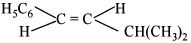
B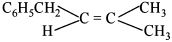
C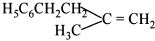
D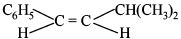
Solution
(B) The reaction involves the acid-catalyzed dehydration of an alcohol using concentrated $H_2SO_4$.
$1.$ Protonation of the $-OH$ group followed by the loss of $H_2O$ forms a secondary carbocation: $C_6H_5-CH_2-CH^+-CH(CH_3)_2$.
$2.$ $A$ $1,2-H$ shift occurs from the tertiary carbon to form a more stable tertiary carbocation: $C_6H_5-CH_2-C^+(CH_3)_2$.
$3.$ Elimination of a proton from the benzylic carbon results in the formation of the most stable alkene,which is trisubstituted and conjugated with the benzene ring: $C_6H_5-CH=C(CH_3)_2$. This corresponds to the structure in option $B$.
$1.$ Protonation of the $-OH$ group followed by the loss of $H_2O$ forms a secondary carbocation: $C_6H_5-CH_2-CH^+-CH(CH_3)_2$.
$2.$ $A$ $1,2-H$ shift occurs from the tertiary carbon to form a more stable tertiary carbocation: $C_6H_5-CH_2-C^+(CH_3)_2$.
$3.$ Elimination of a proton from the benzylic carbon results in the formation of the most stable alkene,which is trisubstituted and conjugated with the benzene ring: $C_6H_5-CH=C(CH_3)_2$. This corresponds to the structure in option $B$.
0 likes
View Solution307
DifficultMCQ
An unknown alcohol is treated with the "Lucas reagent" to determine whether the alcohol is primary,secondary,or tertiary. Which alcohol reacts fastest and by what mechanism?
A
secondary alcohol by $S_N1$
B
tertiary alcohol by $S_N1$
C
secondary alcohol by $S_N2$
D
tertiary alcohol by $S_N2$
Solution
(B) The reaction of an alcohol with Lucas reagent $(conc. \ HCl + ZnCl_2)$ proceeds via an $S_N1$ mechanism.
In this reaction,the rate-determining step is the formation of a carbocation intermediate.
The stability of the carbocation follows the order: $3^{\circ} > 2^{\circ} > 1^{\circ}$.
Since a tertiary $(3^{\circ})$ alcohol forms the most stable carbocation,it reacts the fastest with the Lucas reagent.
In this reaction,the rate-determining step is the formation of a carbocation intermediate.
The stability of the carbocation follows the order: $3^{\circ} > 2^{\circ} > 1^{\circ}$.
Since a tertiary $(3^{\circ})$ alcohol forms the most stable carbocation,it reacts the fastest with the Lucas reagent.
0 likes
View Solution308
DifficultMCQ
The product of the reaction given below is :
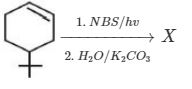
A
$A$ cyclohexenone derivative with a tert-butyl group.
B
$A$ cyclohexene carboxylic acid derivative with a tert-butyl group.
C
$A$ cyclohexene derivative with a tert-butyl group.
D
$4-$tert-butylcyclohex$-2-$en$-1-$ol.
Solution
(D) The reaction proceeds in two steps:
$1$. Allylic bromination using $NBS$ ($N$-Bromosuccinimide) under $hv$ (light) conditions,which introduces a bromine atom at the allylic position.
$2$. Nucleophilic substitution of the bromine atom with a hydroxyl group using $H_2O/K_2CO_3$,resulting in the formation of an allylic alcohol.
The final product is $4$-tert-butylcyclohex-$2$-en-$1$-ol.
$1$. Allylic bromination using $NBS$ ($N$-Bromosuccinimide) under $hv$ (light) conditions,which introduces a bromine atom at the allylic position.
$2$. Nucleophilic substitution of the bromine atom with a hydroxyl group using $H_2O/K_2CO_3$,resulting in the formation of an allylic alcohol.
The final product is $4$-tert-butylcyclohex-$2$-en-$1$-ol.
0 likes
View Solution309
MediumMCQ
Iodoform can be prepared from all except:
A
Ethyl methyl ketone
B
Isopropyl alcohol
C
$3-$Methyl$2-$butanone
D
Isobutyl alcohol
Solution
(D) The iodoform test is given by compounds containing the $CH_3CO-$ group or the $CH_3CH(OH)-$ group.
$A$. Ethyl methyl ketone $(CH_3COCH_2CH_3)$ contains the $CH_3CO-$ group,so it gives a positive iodoform test.
$B$. Isopropyl alcohol $(CH_3CH(OH)CH_3)$ contains the $CH_3CH(OH)-$ group,so it gives a positive iodoform test.
$C$. $3-$Methyl$2-$butanone $(CH_3COCH(CH_3)_2)$ contains the $CH_3CO-$ group,so it gives a positive iodoform test.
$D$. Isobutyl alcohol $(CH_3CH(CH_3)CH_2OH)$ does not contain either the $CH_3CO-$ or $CH_3CH(OH)-$ group. Therefore,it does not give a positive iodoform test.
$A$. Ethyl methyl ketone $(CH_3COCH_2CH_3)$ contains the $CH_3CO-$ group,so it gives a positive iodoform test.
$B$. Isopropyl alcohol $(CH_3CH(OH)CH_3)$ contains the $CH_3CH(OH)-$ group,so it gives a positive iodoform test.
$C$. $3-$Methyl$2-$butanone $(CH_3COCH(CH_3)_2)$ contains the $CH_3CO-$ group,so it gives a positive iodoform test.
$D$. Isobutyl alcohol $(CH_3CH(CH_3)CH_2OH)$ does not contain either the $CH_3CO-$ or $CH_3CH(OH)-$ group. Therefore,it does not give a positive iodoform test.
0 likes
View Solution310
MediumMCQ
Which of the following options will not produce $(P)$ as the major product on reaction with dil. $H_2SO_4$?
A
$1-$cyclohexyl$-1-$butene
B
$1-$cyclohexylbutan$-2-$ol
C
$1-$cyclohexyl$-1-$ethenylcyclohexane
D
$1-$cyclohexyl$-1-$butene
Solution
(B) The reaction with dil. $H_2SO_4$ is an acid-catalyzed hydration of an alkene or dehydration of an alcohol. The product $(P)$ is $1-cyclohexylbutan-1-ol$.
$A$. $1-cyclohexyl-1-butene$ on hydration follows Markovnikov's rule to form $1-cyclohexylbutan-1-ol$ as the major product.
$B$. $1-cyclohexylbutan-2-ol$ on dehydration with dil. $H_2SO_4$ forms $1-cyclohexyl-1-butene$ or $1-cyclohexyl-2-butene$. It does not directly yield $(P)$ as the major product.
$C$. $1-cyclohexyl-1-ethenylcyclohexane$ is not the correct structure for the precursor of $(P)$.
$D$. The options provided in the image represent different isomers. Based on the mechanism of acid-catalyzed hydration,the alkene $1-cyclohexyl-1-butene$ yields $(P)$. The structure $1-cyclohexylbutan-2-ol$ is an alcohol that would undergo dehydration rather than hydration to form $(P)$.
$A$. $1-cyclohexyl-1-butene$ on hydration follows Markovnikov's rule to form $1-cyclohexylbutan-1-ol$ as the major product.
$B$. $1-cyclohexylbutan-2-ol$ on dehydration with dil. $H_2SO_4$ forms $1-cyclohexyl-1-butene$ or $1-cyclohexyl-2-butene$. It does not directly yield $(P)$ as the major product.
$C$. $1-cyclohexyl-1-ethenylcyclohexane$ is not the correct structure for the precursor of $(P)$.
$D$. The options provided in the image represent different isomers. Based on the mechanism of acid-catalyzed hydration,the alkene $1-cyclohexyl-1-butene$ yields $(P)$. The structure $1-cyclohexylbutan-2-ol$ is an alcohol that would undergo dehydration rather than hydration to form $(P)$.
0 likes
View Solution311
MediumMCQ
$C_6H_6$ $\xrightarrow[(ii)\,\,Zn-Hg/HCl]{(i)\,\,CH_3COCl/AlCl_3}$ $(P)$ $\xrightarrow[(ii)\,\,H_2O/K_2CO_3]{(i)\,\,NBS}$ $(Q)$
Major product $(Q)$ of the following sequence is:
Major product $(Q)$ of the following sequence is:
A
Benzaldehyde
B
Acetophenone
C
Benzyl alcohol
D
$1-$Phenylethanol
Solution
(D) Step $1$: Friedel-Crafts acylation of benzene $(C_6H_6)$ with acetyl chloride $(CH_3COCl)$ in the presence of $AlCl_3$ gives acetophenone $(C_6H_5COCH_3)$.
Step $2$: Clemmensen reduction of acetophenone using $Zn-Hg/HCl$ reduces the carbonyl group to a methylene group,yielding ethylbenzene $(C_6H_5CH_2CH_3)$.
Step $3$: Reaction of ethylbenzene with $NBS$ ($N$-bromosuccinimide) leads to benzylic bromination,forming $1-$bromo$-1-$phenylethane $(C_6H_5CH(Br)CH_3)$.
Step $4$: Hydrolysis of $1-$bromo$-1-$phenylethane with $H_2O/K_2CO_3$ (nucleophilic substitution) yields $1-$phenylethanol $(C_6H_5CH(OH)CH_3)$ as the major product.
Step $2$: Clemmensen reduction of acetophenone using $Zn-Hg/HCl$ reduces the carbonyl group to a methylene group,yielding ethylbenzene $(C_6H_5CH_2CH_3)$.
Step $3$: Reaction of ethylbenzene with $NBS$ ($N$-bromosuccinimide) leads to benzylic bromination,forming $1-$bromo$-1-$phenylethane $(C_6H_5CH(Br)CH_3)$.
Step $4$: Hydrolysis of $1-$bromo$-1-$phenylethane with $H_2O/K_2CO_3$ (nucleophilic substitution) yields $1-$phenylethanol $(C_6H_5CH(OH)CH_3)$ as the major product.
0 likes
View Solution312
MediumMCQ
Arrange the following compounds in decreasing order of their boiling point $(BP)$:
$CH_3CHO$ $(I)$,$CH_3CH_2OH$ $(II)$
$CH_3OCH_3$ $(III)$,$CH_3CH_2CH_3$ $(IV)$
$CH_3CHO$ $(I)$,$CH_3CH_2OH$ $(II)$
$CH_3OCH_3$ $(III)$,$CH_3CH_2CH_3$ $(IV)$
A
$II > I > III > IV$
B
$IV > III > I > II$
C
$II > III > I > IV$
D
$I > II > III > IV$
Solution
(A) The boiling point $(BP)$ depends on the intermolecular forces of attraction.
$1$. $CH_3CH_2OH$ $(II)$ exhibits strong intermolecular $H$-bonding,resulting in the highest $BP$.
$2$. $CH_3CHO$ $(I)$ is a polar molecule with dipole-dipole interactions,giving it a higher $BP$ than ethers and alkanes.
$3$. $CH_3OCH_3$ $(III)$ is a polar ether with weaker dipole-dipole interactions compared to aldehydes.
$4$. $CH_3CH_2CH_3$ $(IV)$ is a non-polar alkane with only weak London dispersion forces,resulting in the lowest $BP$.
Therefore,the decreasing order of $BP$ is $II > I > III > IV$.
$1$. $CH_3CH_2OH$ $(II)$ exhibits strong intermolecular $H$-bonding,resulting in the highest $BP$.
$2$. $CH_3CHO$ $(I)$ is a polar molecule with dipole-dipole interactions,giving it a higher $BP$ than ethers and alkanes.
$3$. $CH_3OCH_3$ $(III)$ is a polar ether with weaker dipole-dipole interactions compared to aldehydes.
$4$. $CH_3CH_2CH_3$ $(IV)$ is a non-polar alkane with only weak London dispersion forces,resulting in the lowest $BP$.
Therefore,the decreasing order of $BP$ is $II > I > III > IV$.
0 likes
View Solution313
MediumMCQ
Methanol can be distinguished from ethanol by
A
Sodium
B
Lucas reagent
C
Tollens reagent
D
$I_2 + NaOH$
Solution
(D) Ethanol $(CH_3CH_2OH)$ contains a $CH_3CH(OH)-$ group,which gives a positive iodoform test with $I_2 + NaOH$ to form yellow crystals of iodoform $(CHI_3)$.
Methanol $(CH_3OH)$ does not contain this group and does not give the iodoform test.
Therefore,$I_2 + NaOH$ is used to distinguish between them.
Methanol $(CH_3OH)$ does not contain this group and does not give the iodoform test.
Therefore,$I_2 + NaOH$ is used to distinguish between them.
0 likes
View Solution314
DifficultMCQ
Number of possible product$(s)$ formed in the above reaction :-
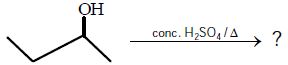
A
$2$
B
$3$
C
$4$
D
$5$
Solution
(B) The reaction is the acid-catalyzed dehydration of butan-$2$-ol $(CH_3CH_2CH(OH)CH_3)$ using conc. $H_2SO_4$ and heat.
This reaction proceeds via an $E1$ mechanism involving the formation of a secondary carbocation $(CH_3CH_2CH^+CH_3)$.
This carbocation can undergo elimination of a proton from adjacent carbons to form alkenes.
$1$. Removal of a proton from $C_1$ gives but-$1$-ene $(CH_3CH_2CH=CH_2)$.
$2$. Removal of a proton from $C_3$ gives but-$2$-ene $(CH_3CH=CHCH_3)$.
But-$2$-ene exhibits geometrical isomerism,existing as both $cis$-but-$2$-ene and $trans$-but-$2$-ene.
Therefore,the possible products are but-$1$-ene,$cis$-but-$2$-ene,and $trans$-but-$2$-ene,totaling $3$ products.
This reaction proceeds via an $E1$ mechanism involving the formation of a secondary carbocation $(CH_3CH_2CH^+CH_3)$.
This carbocation can undergo elimination of a proton from adjacent carbons to form alkenes.
$1$. Removal of a proton from $C_1$ gives but-$1$-ene $(CH_3CH_2CH=CH_2)$.
$2$. Removal of a proton from $C_3$ gives but-$2$-ene $(CH_3CH=CHCH_3)$.
But-$2$-ene exhibits geometrical isomerism,existing as both $cis$-but-$2$-ene and $trans$-but-$2$-ene.
Therefore,the possible products are but-$1$-ene,$cis$-but-$2$-ene,and $trans$-but-$2$-ene,totaling $3$ products.
0 likes
View Solution315
MediumMCQ
The order of reactivity of the following alcohols with halogen acids is . . . . . .
$(A)$ $CH_3-CH_2-CH_2-OH$
$(B)$ $CH_3-CH_2-CH(OH)-CH_3$
$(C)$ $CH_3-CH_2-C(CH_3)_2-OH$
$(A)$ $CH_3-CH_2-CH_2-OH$
$(B)$ $CH_3-CH_2-CH(OH)-CH_3$
$(C)$ $CH_3-CH_2-C(CH_3)_2-OH$
A
$(A) > (B) > (C)$
B
$(C) > (B) > (A)$
C
$(B) > (A) > (C)$
D
$(A) > (C) > (B)$
Solution
(B) The reaction of alcohols with halogen acids proceeds via the formation of a carbocation intermediate.
The stability of carbocations follows the order: $3^\circ > 2^\circ > 1^\circ$.
In the given structures,$(C)$ is a tertiary $(3^\circ)$ alcohol,$(B)$ is a secondary $(2^\circ)$ alcohol,and $(A)$ is a primary $(1^\circ)$ alcohol.
Therefore,the order of reactivity is $(C) > (B) > (A)$.
The stability of carbocations follows the order: $3^\circ > 2^\circ > 1^\circ$.
In the given structures,$(C)$ is a tertiary $(3^\circ)$ alcohol,$(B)$ is a secondary $(2^\circ)$ alcohol,and $(A)$ is a primary $(1^\circ)$ alcohol.
Therefore,the order of reactivity is $(C) > (B) > (A)$.
0 likes
View Solution316
MediumMCQ
Among the following compounds,the one that can be dehydrated most easily is:
A
$CH_3-CH_2-CH_2-CH_2-CH_2-OH$
B
$CH_3-CH_2-CH_2-CH(OH)-CH_3$
C
$CH_3-CH_2-C(CH_3)(OH)-CH_2-CH_3$
D
$CH_3-CH_2-CH(CH_3)-CH_2-CH_2-OH$
Solution
(C) The dehydration of alcohols proceeds via the formation of a carbocation intermediate.
The ease of dehydration depends on the stability of the carbocation formed,which follows the order: $3^\circ > 2^\circ > 1^\circ$.
$(A)$ $CH_3-CH_2-CH_2-CH_2-CH_2-OH$ is a primary $(1^\circ)$ alcohol.
$(B)$ $CH_3-CH_2-CH_2-CH(OH)-CH_3$ is a secondary $(2^\circ)$ alcohol.
$(C)$ $CH_3-CH_2-C(CH_3)(OH)-CH_2-CH_3$ is a tertiary $(3^\circ)$ alcohol.
$(D)$ $CH_3-CH_2-CH(CH_3)-CH_2-CH_2-OH$ is a primary $(1^\circ)$ alcohol.
Since option $(C)$ is a tertiary alcohol,it forms the most stable carbocation and thus dehydrates most easily.
The ease of dehydration depends on the stability of the carbocation formed,which follows the order: $3^\circ > 2^\circ > 1^\circ$.
$(A)$ $CH_3-CH_2-CH_2-CH_2-CH_2-OH$ is a primary $(1^\circ)$ alcohol.
$(B)$ $CH_3-CH_2-CH_2-CH(OH)-CH_3$ is a secondary $(2^\circ)$ alcohol.
$(C)$ $CH_3-CH_2-C(CH_3)(OH)-CH_2-CH_3$ is a tertiary $(3^\circ)$ alcohol.
$(D)$ $CH_3-CH_2-CH(CH_3)-CH_2-CH_2-OH$ is a primary $(1^\circ)$ alcohol.
Since option $(C)$ is a tertiary alcohol,it forms the most stable carbocation and thus dehydrates most easily.
0 likes
View Solution317
MediumMCQ
Which one of the following will most readily dehydrate in acidic condition?
A
$CH_3COCH_2CH(OH)CH_3$
B
$CH_3CH_2CH_2CH(OH)CH_3$
C
$CH_3COCH(OH)CH_2CH_3$
D
$CH_3COCH_2CH_2CH(OH)CH_3$
Solution
(C) Acid-catalyzed dehydration of alcohols proceeds via the formation of a carbocation intermediate. The rate of dehydration depends on the stability of the carbocation formed after the loss of water.
In option $C$,the structure is $CH_3COCH(OH)CH_2CH_3$. Upon protonation and loss of water,it forms a carbocation at the $\alpha$-position relative to the carbonyl group $(CH_3COC^+HCH_2CH_3)$. This carbocation is stabilized by resonance with the adjacent carbonyl group,making it significantly more stable than the carbocations formed from the other options.
Therefore,the compound in option $C$ will dehydrate most readily.
In option $C$,the structure is $CH_3COCH(OH)CH_2CH_3$. Upon protonation and loss of water,it forms a carbocation at the $\alpha$-position relative to the carbonyl group $(CH_3COC^+HCH_2CH_3)$. This carbocation is stabilized by resonance with the adjacent carbonyl group,making it significantly more stable than the carbocations formed from the other options.
Therefore,the compound in option $C$ will dehydrate most readily.
0 likes
View Solution318
MediumMCQ
Identify the reagent $X$ in the following reaction:
(Image provided)
$X$ can be $-$
(Image provided)
$X$ can be $-$
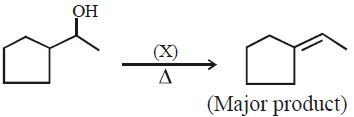
A
conc. $H_2SO_4$
B
$POCl_3$ / Pyridine
C
conc. $H_3PO_4$
D
None of these
Solution
(B) The reaction involves the dehydration of $1$-cyclopentylethanol to form ethylidenecyclopentane.
In the presence of strong acid catalysts like conc. $H_2SO_4$ or conc. $H_3PO_4$,the reaction proceeds via an $E_1$ mechanism involving a carbocation intermediate.
This carbocation undergoes ring expansion (from a $5$-membered ring to a $6$-membered ring) to form a more stable product.
However,the given product is ethylidenecyclopentane,which retains the $5$-membered ring.
To avoid rearrangement and ring expansion,we use $POCl_3$ / Pyridine,which follows an $E_2$ mechanism and prevents carbocation formation,thus yielding the desired product without ring expansion.
In the presence of strong acid catalysts like conc. $H_2SO_4$ or conc. $H_3PO_4$,the reaction proceeds via an $E_1$ mechanism involving a carbocation intermediate.
This carbocation undergoes ring expansion (from a $5$-membered ring to a $6$-membered ring) to form a more stable product.
However,the given product is ethylidenecyclopentane,which retains the $5$-membered ring.
To avoid rearrangement and ring expansion,we use $POCl_3$ / Pyridine,which follows an $E_2$ mechanism and prevents carbocation formation,thus yielding the desired product without ring expansion.
0 likes
View Solution319
AdvancedMCQ
Identify the major product $P_3$ in the following reaction sequence:
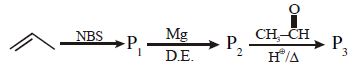
A
$CH_2=CH-CH_2-CH_2-CH_2-OH$
B
$CH_2=CH-CH_2-CH(OH)-CH_3$
C
$CH_3-CH_2-CH_2-CH_2-CH_2-OH$
D
$CH_2=CH-CH_2-CH_2-CH_3$
Solution
(B) $1$. Propene reacts with $NBS$ ($N$-Bromosuccinimide) to undergo allylic bromination,forming $P_1$ $(CH_2=CH-CH_2Br)$.
$2$. $P_1$ reacts with $Mg$ in dry ether $(D.E.)$ to form the Grignard reagent $P_2$ $(CH_2=CH-CH_2MgBr)$.
$3$. The Grignard reagent $P_2$ reacts with acetaldehyde $(CH_3CHO)$ followed by acidic hydrolysis $(H^+/\Delta)$ to form a secondary alcohol.
$4$. The reaction is: $CH_2=CH-CH_2MgBr + CH_3CHO$ $\rightarrow CH_2=CH-CH_2-CH(OMgBr)-CH_3$ $\xrightarrow{H^+/\Delta} CH_2=CH-CH_2-CH(OH)-CH_3$ (pent$-4-$en$-2-$ol).
$2$. $P_1$ reacts with $Mg$ in dry ether $(D.E.)$ to form the Grignard reagent $P_2$ $(CH_2=CH-CH_2MgBr)$.
$3$. The Grignard reagent $P_2$ reacts with acetaldehyde $(CH_3CHO)$ followed by acidic hydrolysis $(H^+/\Delta)$ to form a secondary alcohol.
$4$. The reaction is: $CH_2=CH-CH_2MgBr + CH_3CHO$ $\rightarrow CH_2=CH-CH_2-CH(OMgBr)-CH_3$ $\xrightarrow{H^+/\Delta} CH_2=CH-CH_2-CH(OH)-CH_3$ (pent$-4-$en$-2-$ol).
0 likes
View Solution320
DifficultMCQ
An alcohol with molecular formula $C_5H_{12}O$ does not change the colour of acidic dichromate solution. Identify that alcohol from the following-
A
$A$. $2-$Methylbutan$-2-$ol
B
$B$. Pentan$-1-$ol
C
$C$. Pentan$-2-$ol
D
$D$. $2,2-$Dimethylpropan$-1-$ol
Solution
(A) An alcohol that does not change the colour of acidic dichromate solution is a tertiary $(3^{\circ})$ alcohol because it does not undergo oxidation under these conditions.
Among the given options,$2-$Methylbutan$-2-$ol is a tertiary alcohol,while the others are primary or secondary alcohols which can be oxidized by acidic dichromate.
Among the given options,$2-$Methylbutan$-2-$ol is a tertiary alcohol,while the others are primary or secondary alcohols which can be oxidized by acidic dichromate.
0 likes
View Solution321
MediumMCQ
Which of the following alcohols shows turbidity immediately when reacted with Lucas reagent $(HCl + ZnCl_2)$?
A
$1-$cyclohexylethan$-1-$ol
B
$1-$propylcyclohexan$-1-$ol
C
$3-$cyclohexylpropan$-1-$ol
D
$3-$propylcyclohexan$-1-$ol
Solution
(B) The reaction of alcohols with Lucas reagent $(conc. HCl + anhydrous ZnCl_2)$ is known as the Lucas test.
This test is used to distinguish between primary,secondary,and tertiary alcohols.
- Tertiary $(3^o)$ alcohols react immediately to form an alkyl chloride,which appears as turbidity in the solution.
- Secondary $(2^o)$ alcohols show turbidity within $5-10$ minutes.
- Primary $(1^o)$ alcohols do not show turbidity at room temperature.
Analyzing the options:
- Option $A$ is a secondary alcohol.
- Option $B$ is a tertiary alcohol (the $-OH$ group is attached to a carbon atom that is bonded to three other carbon atoms).
- Option $C$ is a primary alcohol.
- Option $D$ is a secondary alcohol.
Therefore,the tertiary alcohol in option $B$ will show turbidity immediately.
This test is used to distinguish between primary,secondary,and tertiary alcohols.
- Tertiary $(3^o)$ alcohols react immediately to form an alkyl chloride,which appears as turbidity in the solution.
- Secondary $(2^o)$ alcohols show turbidity within $5-10$ minutes.
- Primary $(1^o)$ alcohols do not show turbidity at room temperature.
Analyzing the options:
- Option $A$ is a secondary alcohol.
- Option $B$ is a tertiary alcohol (the $-OH$ group is attached to a carbon atom that is bonded to three other carbon atoms).
- Option $C$ is a primary alcohol.
- Option $D$ is a secondary alcohol.
Therefore,the tertiary alcohol in option $B$ will show turbidity immediately.
0 likes
View Solution322
DifficultMCQ
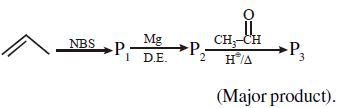
Identify $P_3$ in the following reaction sequence:
A
$CH_2=CH-CH_2-CH_2-CH_3$
B
$CH_2=CH-CH_2-CH(OH)-CH_3$
C
$CH_2=CH-CH_2-CH=CH_2$
D
$CH_2=CH-CH_2-CH_2-OH$
Solution
(B) $1$. Propene reacts with $NBS$ ($N$-Bromosuccinimide) to form allyl bromide $(P_1 = CH_2=CH-CH_2Br)$.
$2$. Allyl bromide reacts with $Mg$ in dry ether $(D.E.)$ to form the Grignard reagent,allylmagnesium bromide $(P_2 = CH_2=CH-CH_2MgBr)$.
$3$. The Grignard reagent reacts with acetaldehyde $(CH_3CHO)$ followed by acidic workup $(H^+/\Delta)$ to form a secondary alcohol,pent$-4-$en$-2-$ol $(CH_2=CH-CH_2-CH(OH)-CH_3)$.
$4$. The correct option is $B$.
$2$. Allyl bromide reacts with $Mg$ in dry ether $(D.E.)$ to form the Grignard reagent,allylmagnesium bromide $(P_2 = CH_2=CH-CH_2MgBr)$.
$3$. The Grignard reagent reacts with acetaldehyde $(CH_3CHO)$ followed by acidic workup $(H^+/\Delta)$ to form a secondary alcohol,pent$-4-$en$-2-$ol $(CH_2=CH-CH_2-CH(OH)-CH_3)$.
$4$. The correct option is $B$.
0 likes
View Solution323
AdvancedMCQ
What is the final product $(IV)$ in the following reaction sequence? $CH_3-CH(OH)-CH_3$ $\xrightarrow{PBr_3} I$ $\xrightarrow{Mg/ether} II$ $\xrightarrow{\text{Ethylene oxide}} III$ $\xrightarrow{H_2O} IV$
A
$CH_3-CH(CH_3)-O^-CH_2-CH_2-OH$
B
$CH_3-CH(CH_3)-CH_2-CH_2-Br$
C
$CH_3-CH(CH_3)-CH_2-CH_2-OH$
D
$CH_3-CH(CH_3)-O^-CH_2-CH_3$
Solution
(C) The reaction sequence is as follows:
$1.$ $CH_3-CH(OH)-CH_3 + PBr_3 \rightarrow CH_3-CH(Br)-CH_3$ (Isopropyl bromide,$I$)
$2.$ $CH_3-CH(Br)-CH_3 + Mg/\text{ether} \rightarrow CH_3-CH(MgBr)-CH_3$ (Isopropyl magnesium bromide,$II$)
$3.$ $CH_3-CH(MgBr)-CH_3 + \text{Ethylene oxide} \rightarrow CH_3-CH(CH_3)-CH_2-CH_2-OMgBr$ (Product $III$)
$4.$ $CH_3-CH(CH_3)-CH_2-CH_2-OMgBr + H_2O \rightarrow CH_3-CH(CH_3)-CH_2-CH_2-OH$ ($3$-Methylbutan$-1-$ol,$IV$).
$1.$ $CH_3-CH(OH)-CH_3 + PBr_3 \rightarrow CH_3-CH(Br)-CH_3$ (Isopropyl bromide,$I$)
$2.$ $CH_3-CH(Br)-CH_3 + Mg/\text{ether} \rightarrow CH_3-CH(MgBr)-CH_3$ (Isopropyl magnesium bromide,$II$)
$3.$ $CH_3-CH(MgBr)-CH_3 + \text{Ethylene oxide} \rightarrow CH_3-CH(CH_3)-CH_2-CH_2-OMgBr$ (Product $III$)
$4.$ $CH_3-CH(CH_3)-CH_2-CH_2-OMgBr + H_2O \rightarrow CH_3-CH(CH_3)-CH_2-CH_2-OH$ ($3$-Methylbutan$-1-$ol,$IV$).
0 likes
View Solution324
AdvancedMCQ
In the given reaction: $CH_3-CH(OH)-C(OH)(CH_3)_2 \xrightarrow{HIO_4} (a) + (b)$. $(a)$ and $(b)$ respectively are:
A
$CH_3CHO$ and $CH_3CHO$
B
$CH_3CHO$ and $CH_3COCH_3$
C
$CH_3COCH_3$ and $CH_3COCH_3$
D
$CH_3COOH$ and $CH_3COCH_3$
Solution
(B) Periodic acid $(HIO_4)$ causes oxidative cleavage of vicinal diols ($1,2$-diols).
The $C-C$ bond between the two carbons bearing the hydroxyl groups breaks.
The reaction is: $CH_3-CH(OH)-C(OH)(CH_3)_2 \xrightarrow{HIO_4} CH_3CHO + CH_3COCH_3$.
Thus,$(a)$ is acetaldehyde $(CH_3CHO)$ and $(b)$ is acetone $(CH_3COCH_3)$.
The $C-C$ bond between the two carbons bearing the hydroxyl groups breaks.
The reaction is: $CH_3-CH(OH)-C(OH)(CH_3)_2 \xrightarrow{HIO_4} CH_3CHO + CH_3COCH_3$.
Thus,$(a)$ is acetaldehyde $(CH_3CHO)$ and $(b)$ is acetone $(CH_3COCH_3)$.
0 likes
View Solution325
DifficultMCQ
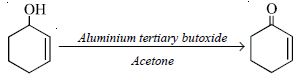
The given reaction is known as :
A
Kolbe reaction
B
Tischenko reaction
C
$MPV$ reaction
D
Oppenauer oxidation
Solution
(D) The given reaction is $Oppenauer$ oxidation.
In this reaction,a secondary alcohol is oxidized to a ketone.
Other functional groups present such as amines,sulfides,and carbon-carbon double bonds are not oxidized.
The reagent used is aluminium isopropoxide or aluminium tertiary butoxide in the presence of acetone.
In this reaction,a secondary alcohol is oxidized to a ketone.
Other functional groups present such as amines,sulfides,and carbon-carbon double bonds are not oxidized.
The reagent used is aluminium isopropoxide or aluminium tertiary butoxide in the presence of acetone.
0 likes
View Solution326
DifficultMCQ
Acetylation reaction with acetyl chloride is carried out in the presence of which solvent?
A
$H_2O$
B
$CH_3OH$
C
Pyridine
D
$NaOH$
Solution
(C) Acetylation of alcohols or amines using acetyl chloride $(CH_3COCl)$ is typically carried out in the presence of a base like pyridine.
The base serves two purposes:
$1$. It acts as a solvent.
$2$. It neutralizes the $HCl$ produced during the reaction,which prevents the reverse reaction and shifts the equilibrium towards the product side.
The base serves two purposes:
$1$. It acts as a solvent.
$2$. It neutralizes the $HCl$ produced during the reaction,which prevents the reverse reaction and shifts the equilibrium towards the product side.
0 likes
View Solution327
AdvancedMCQ
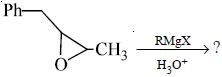
The product of the reaction is:
A
The product is $Ph-CH_2-CH(OH)-CH(R)-CH_3$
B
The product is $Ph-CH_2-CH(OH)-CH(CH_3)-R$
C
The product is $Ph-CH_2-CH(OH)-CH(OH)-CH_3$
D
None of these
Solution
(A) The reaction involves the nucleophilic ring opening of an epoxide by a Grignard reagent $(RMgX)$.
In an unsymmetrical epoxide,the nucleophile $(R^-)$ attacks the less sterically hindered carbon atom.
The epoxide is $1-phenyl-2,3-epoxybutane$ (or $2-methyl-3-benzyloxirane$).
The carbon atom attached to the $CH_3$ group is less sterically hindered compared to the carbon atom attached to the $PhCH_2$ group.
Therefore,the $R$ group attacks the carbon atom bearing the $CH_3$ group.
After the attack,the $O^-$ is protonated by $H_3O^+$ to form an alcohol.
The resulting product is $1-phenyl-3-substituted-butan-2-ol$,which is $Ph-CH_2-CH(OH)-CH(R)-CH_3$.
In an unsymmetrical epoxide,the nucleophile $(R^-)$ attacks the less sterically hindered carbon atom.
The epoxide is $1-phenyl-2,3-epoxybutane$ (or $2-methyl-3-benzyloxirane$).
The carbon atom attached to the $CH_3$ group is less sterically hindered compared to the carbon atom attached to the $PhCH_2$ group.
Therefore,the $R$ group attacks the carbon atom bearing the $CH_3$ group.
After the attack,the $O^-$ is protonated by $H_3O^+$ to form an alcohol.
The resulting product is $1-phenyl-3-substituted-butan-2-ol$,which is $Ph-CH_2-CH(OH)-CH(R)-CH_3$.
0 likes
View Solution328
DifficultMCQ
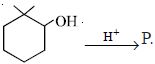
The product $P$ is :
A
$1-$methylcyclohexene
B
$3-$methylcyclohexene
C
methylenecyclohexane
D
$2-$methylcyclohexene
Solution
(A) The reaction involves the acid-catalyzed dehydration of $1$-methylcyclohexanol.
$1$. Protonation of the hydroxyl group occurs to form a good leaving group $(-OH_2^+)$.
$2$. Loss of water generates a tertiary $(3^{\circ})$ carbocation at the $C1$ position.
$3$. Elimination of a proton from the adjacent carbon ($C2$ or $C6$) leads to the formation of the most stable alkene.
$4$. According to Zaitsev's rule,the more substituted alkene is the major product.
$5$. Elimination from $C2$ gives $1$-methylcyclohexene,which is a trisubstituted alkene and more stable than the disubstituted $3$-methylcyclohexene or the exocyclic methylenecyclohexane.
Therefore,the major product $P$ is $1$-methylcyclohexene.
$1$. Protonation of the hydroxyl group occurs to form a good leaving group $(-OH_2^+)$.
$2$. Loss of water generates a tertiary $(3^{\circ})$ carbocation at the $C1$ position.
$3$. Elimination of a proton from the adjacent carbon ($C2$ or $C6$) leads to the formation of the most stable alkene.
$4$. According to Zaitsev's rule,the more substituted alkene is the major product.
$5$. Elimination from $C2$ gives $1$-methylcyclohexene,which is a trisubstituted alkene and more stable than the disubstituted $3$-methylcyclohexene or the exocyclic methylenecyclohexane.
Therefore,the major product $P$ is $1$-methylcyclohexene.
0 likes
View Solution329
MediumMCQ
Among the given compounds,the correct dehydration order is:
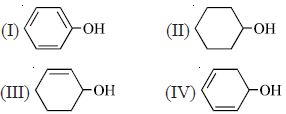
A
$I < II < III < IV$
B
$II < III < IV < I$
C
$I < III < IV < II$
D
$I < II < III = IV$
Solution
(A) The rate of dehydration of alcohols depends on the stability of the carbocation intermediate formed after the loss of water.
$I$ is phenol,which forms a phenyl carbocation $(C_6H_5^+)$ upon dehydration. This is extremely unstable due to the $sp$ hybridization of the carbon atom.
$II$ is cyclohexanol,which forms a $2^{\circ}$ alkyl carbocation.
$III$ is cyclohex$-2-$en$-1-$ol,which forms an allylic carbocation. This is stabilized by resonance.
$IV$ is cyclohexa$-2,5-$dien$-1-$ol,which forms a carbocation that is stabilized by resonance with two double bonds,making it the most stable among the given options.
Comparing the stability of the carbocations: Phenyl carbocation $(I)$ < $2^{\circ}$ alkyl carbocation $(II)$ < allylic carbocation $(III)$ < resonance-stabilized dienyl carbocation $(IV)$.
Therefore,the correct order of dehydration is $I < II < III < IV$.
$I$ is phenol,which forms a phenyl carbocation $(C_6H_5^+)$ upon dehydration. This is extremely unstable due to the $sp$ hybridization of the carbon atom.
$II$ is cyclohexanol,which forms a $2^{\circ}$ alkyl carbocation.
$III$ is cyclohex$-2-$en$-1-$ol,which forms an allylic carbocation. This is stabilized by resonance.
$IV$ is cyclohexa$-2,5-$dien$-1-$ol,which forms a carbocation that is stabilized by resonance with two double bonds,making it the most stable among the given options.
Comparing the stability of the carbocations: Phenyl carbocation $(I)$ < $2^{\circ}$ alkyl carbocation $(II)$ < allylic carbocation $(III)$ < resonance-stabilized dienyl carbocation $(IV)$.
Therefore,the correct order of dehydration is $I < II < III < IV$.
0 likes
View Solution330
MediumMCQ
$HBr$ reacts fastest with
A
$2-$Methylbutan$-2-$ol
B
$3-$Methylbutan$-2-$ol
C
Butan$-1-$ol
D
$2-$Methylbutan$-1-$ol
Solution
(A) The reaction of alcohols with $HBr$ proceeds via an $S_N1$ mechanism,where the rate-determining step is the formation of a carbocation.
The reactivity order of alcohols towards $HBr$ is $3^{\circ} > 2^{\circ} > 1^{\circ}$ due to the stability of the resulting carbocation.
$A$: $2-$Methylbutan$-2-$ol is a $3^{\circ}$ alcohol.
$B$: $3-$Methylbutan$-2-$ol is a $2^{\circ}$ alcohol.
$C$: Butan$-1-$ol is a $1^{\circ}$ alcohol.
$D$: $2-$Methylbutan$-1-$ol is a $1^{\circ}$ alcohol.
Since $3^{\circ}$ alcohols form the most stable carbocation,$2-$Methylbutan$-2-$ol reacts the fastest.
The reactivity order of alcohols towards $HBr$ is $3^{\circ} > 2^{\circ} > 1^{\circ}$ due to the stability of the resulting carbocation.
$A$: $2-$Methylbutan$-2-$ol is a $3^{\circ}$ alcohol.
$B$: $3-$Methylbutan$-2-$ol is a $2^{\circ}$ alcohol.
$C$: Butan$-1-$ol is a $1^{\circ}$ alcohol.
$D$: $2-$Methylbutan$-1-$ol is a $1^{\circ}$ alcohol.
Since $3^{\circ}$ alcohols form the most stable carbocation,$2-$Methylbutan$-2-$ol reacts the fastest.
0 likes
View Solution331
AdvancedMCQ
What is the product $A$ in the following reaction?
$2-(but-3-en-1-yl)oxirane \xrightarrow{H_3O^{+}} A$
$2-(but-3-en-1-yl)oxirane \xrightarrow{H_3O^{+}} A$
A
$A$ cyclic diol with a methyl group.
B
$A$ cyclic diol with a hydroxymethyl group.
C
An open-chain triol.
D
An open-chain diol with a tertiary alcohol group.
Solution
(C) $1$. The reaction involves the acid-catalyzed ring opening of an epoxide and the acid-catalyzed hydration of an alkene in the presence of $H_3O^{+}$.
$2$. The epoxide ring is protonated,and water attacks the more substituted carbon,resulting in a vicinal diol.
$3$. Simultaneously,the alkene group $(C=CH_2)$ undergoes Markovnikov hydration to form a tertiary alcohol.
$4$. The resulting molecule is an open-chain triol containing two hydroxyl groups from the epoxide opening and one hydroxyl group from the alkene hydration.
$5$. Therefore,the product is an open-chain triol.
$2$. The epoxide ring is protonated,and water attacks the more substituted carbon,resulting in a vicinal diol.
$3$. Simultaneously,the alkene group $(C=CH_2)$ undergoes Markovnikov hydration to form a tertiary alcohol.
$4$. The resulting molecule is an open-chain triol containing two hydroxyl groups from the epoxide opening and one hydroxyl group from the alkene hydration.
$5$. Therefore,the product is an open-chain triol.
0 likes
View Solution332
MediumMCQ
Which one of the following alcohols will undergo acid-catalyzed dehydration with the greatest ease by the $E_1$ mechanism?
A
$CH_2 = CH-OH$
B
Cyclopentanol
C
Cycloprop$-2-$en$-1-$ol
D
$Me_2CHOH$
Solution
(C) The rate of acid-catalyzed dehydration of alcohols via the $E_1$ mechanism depends on the stability of the carbocation intermediate formed after the loss of water.
$1$. $CH_2 = CH-OH$ forms a vinyl cation,which is highly unstable.
$2$. Cyclopentanol forms a secondary cyclopentyl carbocation.
$3$. Cycloprop$-2-$en$-1-$ol forms a cyclopropenyl cation. The cyclopropenyl cation is an aromatic system ($2\pi$ electrons,$H$ückel's rule $4n+2$ where $n=0$),making it exceptionally stable.
$4$. $Me_2CHOH$ (isopropyl alcohol) forms a secondary isopropyl carbocation.
Since the cyclopropenyl cation is aromatic,its formation is the most favorable,leading to the greatest ease of dehydration.
$1$. $CH_2 = CH-OH$ forms a vinyl cation,which is highly unstable.
$2$. Cyclopentanol forms a secondary cyclopentyl carbocation.
$3$. Cycloprop$-2-$en$-1-$ol forms a cyclopropenyl cation. The cyclopropenyl cation is an aromatic system ($2\pi$ electrons,$H$ückel's rule $4n+2$ where $n=0$),making it exceptionally stable.
$4$. $Me_2CHOH$ (isopropyl alcohol) forms a secondary isopropyl carbocation.
Since the cyclopropenyl cation is aromatic,its formation is the most favorable,leading to the greatest ease of dehydration.
0 likes
View Solution333
MediumMCQ
$\xrightarrow{{ROH/{H^ + }}}$ $P$ (major organic product)
The product $P$ is
The product $P$ is
A
$3,4-$dihydro-2H-pyran$-2-$yl ether
B
Tetrahydropyran$-2-$yl ether
C
$5-$methyl-tetrahydrofuran$-2-$yl ether
D
Tetrahydropyran$-4-$yl ether
Solution
(B) The reaction of $3,4-dihydro-2H-pyran$ with an alcohol $(ROH)$ in the presence of an acid catalyst $(H^+)$ is a standard method for protecting alcohols as tetrahydropyranyl $(THP)$ ethers.
$1$. The acid catalyst protonates the double bond of the $3,4-dihydro-2H-pyran$ to form a stable resonance-stabilized oxocarbenium ion.
$2$. The alcohol $(ROH)$ then acts as a nucleophile and attacks the electrophilic carbon of the oxocarbenium ion.
$3$. Deprotonation yields the final product,which is a $2-alkoxytetrahydropyran$ (also known as a tetrahydropyran$-2-$yl ether).
Thus,the major product $P$ is the tetrahydropyran$-2-$yl ether.
$1$. The acid catalyst protonates the double bond of the $3,4-dihydro-2H-pyran$ to form a stable resonance-stabilized oxocarbenium ion.
$2$. The alcohol $(ROH)$ then acts as a nucleophile and attacks the electrophilic carbon of the oxocarbenium ion.
$3$. Deprotonation yields the final product,which is a $2-alkoxytetrahydropyran$ (also known as a tetrahydropyran$-2-$yl ether).
Thus,the major product $P$ is the tetrahydropyran$-2-$yl ether.
0 likes
View Solution334
MediumMCQ
Which of the following alcohols shows the fastest reaction with $HI$?
A
Cyclopropanol
B
Cyclopropylmethanol
C
Allyl alcohol $(CH_2=CH-CH_2OH)$
D
Benzyl alcohol $(C_6H_5CH_2OH)$
Solution
(D) The reaction of alcohols with $HI$ proceeds via the formation of a carbocation intermediate. The rate of reaction depends on the stability of the carbocation formed after the loss of water.
$A$. Cyclopropanol forms a cyclopropyl carbocation,which is highly unstable due to ring strain.
$B$. Cyclopropylmethanol forms a cyclopropylmethyl carbocation,which can rearrange to a more stable allyl carbocation.
$C$. Allyl alcohol forms an allyl carbocation $(CH_2=CH-CH_2^+)$,which is resonance-stabilized.
$D$. Benzyl alcohol forms a benzyl carbocation $(C_6H_5CH_2^+)$,which is highly stabilized by resonance with the benzene ring.
Comparing the stability of the carbocations,the benzyl carbocation is the most stable due to extensive resonance stabilization with the aromatic ring. Therefore,benzyl alcohol reacts the fastest with $HI$.
$A$. Cyclopropanol forms a cyclopropyl carbocation,which is highly unstable due to ring strain.
$B$. Cyclopropylmethanol forms a cyclopropylmethyl carbocation,which can rearrange to a more stable allyl carbocation.
$C$. Allyl alcohol forms an allyl carbocation $(CH_2=CH-CH_2^+)$,which is resonance-stabilized.
$D$. Benzyl alcohol forms a benzyl carbocation $(C_6H_5CH_2^+)$,which is highly stabilized by resonance with the benzene ring.
Comparing the stability of the carbocations,the benzyl carbocation is the most stable due to extensive resonance stabilization with the aromatic ring. Therefore,benzyl alcohol reacts the fastest with $HI$.
0 likes
View Solution335
MediumMCQ
Which of the following is correctly matched?
A
$CH_3-C(CH_3)(OH)-CH_3$,$E_1$ reaction
B
$CH_3-CH_2-CH_2OH$,$E_1cb$ reaction
C
$CH_3-C(CH_3)(OH)-CH_3$,thermal reaction
D
$CH_3-CH_2-CH_2OH$,$E_2$ reaction
Solution
(A) The dehydration of tertiary alcohols like $CH_3-C(CH_3)(OH)-CH_3$ (tert-butyl alcohol) proceeds via the $E_1$ mechanism.
This is because the reaction involves the formation of a stable tertiary carbocation intermediate,$(CH_3)_3C^+$,which is the rate-determining step.
Therefore,the match in option $A$ is correct.
This is because the reaction involves the formation of a stable tertiary carbocation intermediate,$(CH_3)_3C^+$,which is the rate-determining step.
Therefore,the match in option $A$ is correct.
0 likes
View Solution336
MediumMCQ
Arrange the following alcohols in increasing order of reactivity towards elimination reaction:
$(I)$ $NO_2-CH_2-CH_2-CH_2-CH_2OH$
$(II)$ $CH_3-CH_2-CH(NO_2)-CH_2OH$
$(III)$ $CH_3-CH(NO_2)-CH_2-CH_2OH$
$(IV)$ $CH_3-CH_2-CH_2-CH_2OH$
Select the answer from the codes given below:
$(I)$ $NO_2-CH_2-CH_2-CH_2-CH_2OH$
$(II)$ $CH_3-CH_2-CH(NO_2)-CH_2OH$
$(III)$ $CH_3-CH(NO_2)-CH_2-CH_2OH$
$(IV)$ $CH_3-CH_2-CH_2-CH_2OH$
Select the answer from the codes given below:
A
$I < II < IV < III$
B
$I < II < III < IV$
C
$II < III < I < IV$
D
$II < III < IV < I$
Solution
(C) The elimination reaction (dehydration) of alcohols involves the formation of a carbocation or a transition state with a partial positive charge.
The $-NO_2$ group is a strong electron-withdrawing group ($-I$ effect),which destabilizes the positive charge.
The closer the $-NO_2$ group is to the reaction center (the carbon atoms involved in the double bond formation),the more it destabilizes the intermediate,thus decreasing the rate of reaction.
The distance of the $-NO_2$ group from the $-OH$ group determines the extent of destabilization: $(II)$ has the $-NO_2$ group closest to the reaction site,followed by $(III)$,then $(I)$.
In $(IV)$,there is no $-NO_2$ group,only the $+I$ effect of the alkyl chain,which stabilizes the carbocation,making it the most reactive.
Therefore,the increasing order of reactivity is: $(II) < (III) < (I) < (IV)$.
The $-NO_2$ group is a strong electron-withdrawing group ($-I$ effect),which destabilizes the positive charge.
The closer the $-NO_2$ group is to the reaction center (the carbon atoms involved in the double bond formation),the more it destabilizes the intermediate,thus decreasing the rate of reaction.
The distance of the $-NO_2$ group from the $-OH$ group determines the extent of destabilization: $(II)$ has the $-NO_2$ group closest to the reaction site,followed by $(III)$,then $(I)$.
In $(IV)$,there is no $-NO_2$ group,only the $+I$ effect of the alkyl chain,which stabilizes the carbocation,making it the most reactive.
Therefore,the increasing order of reactivity is: $(II) < (III) < (I) < (IV)$.
0 likes
View Solution337
MediumMCQ
In the given reaction,$[X]$ is:
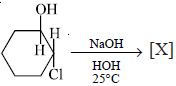
A
$A$ cyclic ether (epoxide)
B
trans-cyclohexane$-1,2-$diol
C
Mixture of $(A)$ and $(B)$
D
cis-cyclohexane$-1,2-$diol
Solution
(A) The starting material is a halohydrin,specifically $2$-chlorocyclohexanol,where the $-OH$ and $-Cl$ groups are in a trans configuration.
When treated with a base like $NaOH$,the hydroxide ion deprotonates the hydroxyl group to form an alkoxide ion.
This alkoxide ion then performs an intramolecular $S_N2$ displacement of the chloride ion from the adjacent carbon.
Because the $-OH$ and $-Cl$ groups are trans to each other,they are in the anti-periplanar geometry required for the $S_N2$ reaction to occur.
This results in the formation of an epoxide (cyclohexene oxide) as the product $[X]$.
When treated with a base like $NaOH$,the hydroxide ion deprotonates the hydroxyl group to form an alkoxide ion.
This alkoxide ion then performs an intramolecular $S_N2$ displacement of the chloride ion from the adjacent carbon.
Because the $-OH$ and $-Cl$ groups are trans to each other,they are in the anti-periplanar geometry required for the $S_N2$ reaction to occur.
This results in the formation of an epoxide (cyclohexene oxide) as the product $[X]$.
0 likes
View Solution338
AdvancedMCQ
The product formed when glycerol reacts with $PCl_5$ is -
A
$1,2,3-$trichloropropane
B
Glycero monochlorohydrin
C
Glycero dichlorohydrin
D
All of these
Solution
(A) When glycerol reacts with $PCl_5$,the hydroxyl groups are replaced by chlorine atoms to form $1,2,3-$trichloropropane (also known as glyceryl trichloride).
The reaction is as follows:
$CH_2OH-CHOH-CH_2OH + 3PCl_5 \rightarrow CH_2Cl-CHCl-CH_2Cl + 3POCl_3 + 3HCl$
The reaction is as follows:
$CH_2OH-CHOH-CH_2OH + 3PCl_5 \rightarrow CH_2Cl-CHCl-CH_2Cl + 3POCl_3 + 3HCl$
0 likes
View Solution339
DifficultMCQ
On heating glycerol with excess amount of $HI$,the product formed is -
A
Allyl iodide
B
Isopropyl iodide
C
Propylene
D
$1,2,3-$tri-iodopropane
Solution
(B) When glycerol $(CH_2OH-CHOH-CH_2OH)$ is heated with excess $HI$,the $-OH$ groups are first replaced by iodine atoms to form $1,2,3-$tri-iodopropane.
This intermediate is unstable and undergoes elimination to form allyl iodide $(CH_2=CH-CH_2I)$.
Finally,the allyl iodide reacts with $HI$ to form isopropyl iodide $(CH_3-CHI-CH_3)$ as the stable final product.
This intermediate is unstable and undergoes elimination to form allyl iodide $(CH_2=CH-CH_2I)$.
Finally,the allyl iodide reacts with $HI$ to form isopropyl iodide $(CH_3-CHI-CH_3)$ as the stable final product.
0 likes
View Solution340
MediumMCQ
When ethyl bromide is treated with moist $Ag_2O$,the main product is:
A
Ethyl ether
B
Ethanol
C
Ethoxy ethane
D
All of the above
Solution
(B) When ethyl bromide $(C_2H_5Br)$ is treated with moist $Ag_2O$,it acts as a source of $AgOH$ (silver hydroxide).
The reaction is as follows:
$2C_2H_5Br + Ag_2O + H_2O \rightarrow 2C_2H_5OH + 2AgBr$
Here,$C_2H_5OH$ is ethanol.
Note that 'Ethyl ether' and 'Ethoxy ethane' are the same compound $(C_2H_5-O-C_2H_5)$,which is formed when dry $Ag_2O$ is used (Williamson ether synthesis).
Since the reagent is moist $Ag_2O$,the primary product is ethanol.
The reaction is as follows:
$2C_2H_5Br + Ag_2O + H_2O \rightarrow 2C_2H_5OH + 2AgBr$
Here,$C_2H_5OH$ is ethanol.
Note that 'Ethyl ether' and 'Ethoxy ethane' are the same compound $(C_2H_5-O-C_2H_5)$,which is formed when dry $Ag_2O$ is used (Williamson ether synthesis).
Since the reagent is moist $Ag_2O$,the primary product is ethanol.
0 likes
View Solution341
DifficultMCQ
$A \xrightarrow{KOBr} CHBr_3$
Here $A$ is:
Here $A$ is:
A
Isopropyl alcohol
B
Methanol
C
Ethanoic acid
D
$n-$ Butyl alcohol
Solution
(A) The reaction $A \xrightarrow{KOBr} CHBr_3$ represents the haloform reaction (specifically the bromoform reaction).
Compounds containing the $CH_3CO-$ group or the $CH_3CH(OH)-$ group undergo the haloform reaction.
Among the given options,Isopropyl alcohol $(CH_3CH(OH)CH_3)$ contains the $CH_3CH(OH)-$ group.
When treated with $KOBr$ (which acts as a source of $Br_2$ and $KOH$),it undergoes oxidation to acetone followed by bromination to form bromoform $(CHBr_3)$.
Compounds containing the $CH_3CO-$ group or the $CH_3CH(OH)-$ group undergo the haloform reaction.
Among the given options,Isopropyl alcohol $(CH_3CH(OH)CH_3)$ contains the $CH_3CH(OH)-$ group.
When treated with $KOBr$ (which acts as a source of $Br_2$ and $KOH$),it undergoes oxidation to acetone followed by bromination to form bromoform $(CHBr_3)$.
0 likes
View Solution342
EasyMCQ
Glycerol on treatment with oxalic acid at $110 \ ^oC$ forms
A
Allyl alcohol
B
Formic acid
C
$CO_2$ and $CO$
D
Glyceric acid
Solution
(A) When glycerol is heated with oxalic acid at $110 \ ^oC$,it undergoes esterification to form glycerol mono-oxalate.
This intermediate then loses $CO_2$ to form glycerol mono-formate.
Finally,the mono-formate undergoes hydrolysis to yield allyl alcohol (prop$-2-$en$-1-$ol) along with the regeneration of oxalic acid and the release of $CO_2$ and $H_2O$.
This intermediate then loses $CO_2$ to form glycerol mono-formate.
Finally,the mono-formate undergoes hydrolysis to yield allyl alcohol (prop$-2-$en$-1-$ol) along with the regeneration of oxalic acid and the release of $CO_2$ and $H_2O$.
0 likes
View Solution343
EasyMCQ
Ethanol cannot be dried by anhydrous $CaCl_2$ due to the formation of the following solvated product:
A
$CaCl_2 \cdot 2C_2H_5OH$
B
$2CaCl_2 \cdot 3C_2H_5OH$
C
$CaCl_2 \cdot 3C_2H_5OH$
D
$CaCl_2 \cdot C_2H_5OH$
Solution
(A) Anhydrous $CaCl_2$ is a common drying agent for many organic solvents.
However,it cannot be used to dry ethanol because it reacts with ethanol to form a stable solvated complex.
The reaction is: $CaCl_2 + 4C_2H_5OH \rightarrow CaCl_2 \cdot 4C_2H_5OH$.
Among the given options,the complex $CaCl_2 \cdot 4C_2H_5OH$ is the standard solvated product,but since the question asks for the specific solvated product formed in this context,and based on standard chemical literature,the correct adduct is $CaCl_2 \cdot 4C_2H_5OH$.
Given the options provided,there is a discrepancy in the stoichiometry. However,$CaCl_2$ forms adducts with alcohols similar to how it forms hydrates.
Assuming the question implies the formation of a stable adduct,the correct answer is $CaCl_2 \cdot 4C_2H_5OH$,but since it is not listed,we identify that $CaCl_2$ forms adducts with ethanol.
However,it cannot be used to dry ethanol because it reacts with ethanol to form a stable solvated complex.
The reaction is: $CaCl_2 + 4C_2H_5OH \rightarrow CaCl_2 \cdot 4C_2H_5OH$.
Among the given options,the complex $CaCl_2 \cdot 4C_2H_5OH$ is the standard solvated product,but since the question asks for the specific solvated product formed in this context,and based on standard chemical literature,the correct adduct is $CaCl_2 \cdot 4C_2H_5OH$.
Given the options provided,there is a discrepancy in the stoichiometry. However,$CaCl_2$ forms adducts with alcohols similar to how it forms hydrates.
Assuming the question implies the formation of a stable adduct,the correct answer is $CaCl_2 \cdot 4C_2H_5OH$,but since it is not listed,we identify that $CaCl_2$ forms adducts with ethanol.
0 likes
View Solution344
EasyMCQ
Most acidic alcohol out of the following compounds is
A
$(CH_3)_3COH$
B
$CH_3CH_2OH$
C
$CH_3OH$
D
$PhOH$
Solution
(C) The acidity of alcohols depends on the stability of the conjugate base (alkoxide ion) formed after the loss of a proton $(H^+)$.
Electron-donating groups (like alkyl groups) destabilize the alkoxide ion by increasing the negative charge density,thereby decreasing acidity.
In $(CH_3)_3COH$ (tert-butyl alcohol),there are three electron-donating methyl groups,making it the least acidic.
In $CH_3CH_2OH$ (ethanol),there is one ethyl group.
In $CH_3OH$ (methanol),there is no alkyl group attached to the carbon bearing the $-OH$ group.
Comparing the aliphatic alcohols,$CH_3OH$ is the most acidic due to the absence of electron-donating alkyl groups.
Note: $PhOH$ (phenol) is more acidic than aliphatic alcohols,but the question specifically asks for the most acidic 'alcohol'. Phenol is classified as a phenol,not an alcohol.
Electron-donating groups (like alkyl groups) destabilize the alkoxide ion by increasing the negative charge density,thereby decreasing acidity.
In $(CH_3)_3COH$ (tert-butyl alcohol),there are three electron-donating methyl groups,making it the least acidic.
In $CH_3CH_2OH$ (ethanol),there is one ethyl group.
In $CH_3OH$ (methanol),there is no alkyl group attached to the carbon bearing the $-OH$ group.
Comparing the aliphatic alcohols,$CH_3OH$ is the most acidic due to the absence of electron-donating alkyl groups.
Note: $PhOH$ (phenol) is more acidic than aliphatic alcohols,but the question specifically asks for the most acidic 'alcohol'. Phenol is classified as a phenol,not an alcohol.
0 likes
View Solution345
DifficultMCQ
Select the odd structure out.
A
$CH_3-CH(OH)-CH_2-CH_3$
B
$CH_3-CH(OH)-CH_2-CH_2-CH_3$
C
$CH_3-CH(OH)-CH_3$
D
$CH_3-CH_2-CH(OH)-C_2H_5$
Solution
(D) Let us analyze the structure of the given alcohols:
$A$: $CH_3-CH(OH)-CH_2-CH_3$ is $butan-2-ol$ (a secondary alcohol with $4$ carbons).
$B$: $CH_3-CH(OH)-CH_2-CH_2-CH_3$ is $pentan-2-ol$ (a secondary alcohol with $5$ carbons).
$C$: $CH_3-CH(OH)-CH_3$ is $propan-2-ol$ (a secondary alcohol with $3$ carbons).
$D$: $CH_3-CH_2-CH(OH)-CH_2-CH_3$ is $pentan-3-ol$ (a secondary alcohol with $5$ carbons).
All the given structures are secondary alcohols. However,if we look at the symmetry or the chain length,$pentan-3-ol$ $(D)$ is a symmetric secondary alcohol,whereas $A$,$B$,and $C$ are asymmetric secondary alcohols. Alternatively,$B$ and $D$ have $5$ carbons,$A$ has $4$,and $C$ has $3$. The most distinct feature is that $D$ is the only symmetric secondary alcohol where the $-OH$ group is attached to the central carbon of a $5$-carbon chain.
$A$: $CH_3-CH(OH)-CH_2-CH_3$ is $butan-2-ol$ (a secondary alcohol with $4$ carbons).
$B$: $CH_3-CH(OH)-CH_2-CH_2-CH_3$ is $pentan-2-ol$ (a secondary alcohol with $5$ carbons).
$C$: $CH_3-CH(OH)-CH_3$ is $propan-2-ol$ (a secondary alcohol with $3$ carbons).
$D$: $CH_3-CH_2-CH(OH)-CH_2-CH_3$ is $pentan-3-ol$ (a secondary alcohol with $5$ carbons).
All the given structures are secondary alcohols. However,if we look at the symmetry or the chain length,$pentan-3-ol$ $(D)$ is a symmetric secondary alcohol,whereas $A$,$B$,and $C$ are asymmetric secondary alcohols. Alternatively,$B$ and $D$ have $5$ carbons,$A$ has $4$,and $C$ has $3$. The most distinct feature is that $D$ is the only symmetric secondary alcohol where the $-OH$ group is attached to the central carbon of a $5$-carbon chain.
0 likes
View Solution346
DifficultMCQ
Glycerol $\xrightarrow{KHSO_4} A$ $\xrightarrow{LiAlH_4} B$
$A$ and $B$ are :
$A$ and $B$ are :
A
Acrolein,allyl alcohol
B
Glyceryl sulphate,acrylic acid
C
Allyl alcohol,acrolein
D
Only acrolein ($B$ is not formed)
Solution
(A) When glycerol is heated with dehydrating agents like $KHSO_4$,it undergoes dehydration to form acrolein $(A)$.
$CH_2(OH)-CH(OH)-CH_2(OH) \xrightarrow{KHSO_4, \Delta} CH_2=CH-CHO + 2H_2O$
Acrolein $(A)$ is $CH_2=CH-CHO$.
$LiAlH_4$ is a reducing agent that reduces the aldehyde group to a primary alcohol without affecting the double bond.
$CH_2=CH-CHO \xrightarrow{LiAlH_4} CH_2=CH-CH_2OH$
Thus,$B$ is allyl alcohol $(CH_2=CH-CH_2OH)$.
$CH_2(OH)-CH(OH)-CH_2(OH) \xrightarrow{KHSO_4, \Delta} CH_2=CH-CHO + 2H_2O$
Acrolein $(A)$ is $CH_2=CH-CHO$.
$LiAlH_4$ is a reducing agent that reduces the aldehyde group to a primary alcohol without affecting the double bond.
$CH_2=CH-CHO \xrightarrow{LiAlH_4} CH_2=CH-CH_2OH$
Thus,$B$ is allyl alcohol $(CH_2=CH-CH_2OH)$.
0 likes
View Solution347
AdvancedMCQ
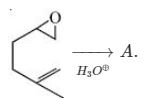
What is the product '$A$' in the following reaction?
(Image of an epoxide ring fused to a cyclopentane ring with an exocyclic double bond,reacting with $H_3O^{\oplus}$ to form $A$.)
(Image of an epoxide ring fused to a cyclopentane ring with an exocyclic double bond,reacting with $H_3O^{\oplus}$ to form $A$.)
A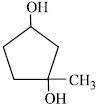
B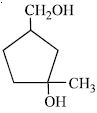
C
D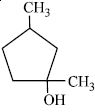
Solution
(B) The reaction involves the acid-catalyzed ring opening of an epoxide.
$1$. The oxygen atom of the epoxide is protonated by $H_3O^{\oplus}$ to form a better leaving group.
$2$. The ring opens to form a more stable carbocation intermediate. In this specific structure,the epoxide ring is fused to a five-membered ring.
$3$. The nucleophilic attack by water $(H_2O)$ occurs at the more substituted carbon of the epoxide,followed by deprotonation to yield the diol product.
$4$. The structure corresponds to a cyclopentane ring with a $-CH_2OH$ group at the top position and a tertiary alcohol group ($-OH$ and $-CH_3$) at the adjacent carbon.
Therefore,the correct product is represented by option $B$.
$1$. The oxygen atom of the epoxide is protonated by $H_3O^{\oplus}$ to form a better leaving group.
$2$. The ring opens to form a more stable carbocation intermediate. In this specific structure,the epoxide ring is fused to a five-membered ring.
$3$. The nucleophilic attack by water $(H_2O)$ occurs at the more substituted carbon of the epoxide,followed by deprotonation to yield the diol product.
$4$. The structure corresponds to a cyclopentane ring with a $-CH_2OH$ group at the top position and a tertiary alcohol group ($-OH$ and $-CH_3$) at the adjacent carbon.
Therefore,the correct product is represented by option $B$.
0 likes
View Solution348
DifficultMCQ
The reaction sequence is given as:
$1-methylcyclohexene$ $\xrightarrow[alkaline \ KMnO_4]{cold} A$ $\xrightarrow[AcOH]{CrO_3} B$
Identify $A$ and $B$.
$1-methylcyclohexene$ $\xrightarrow[alkaline \ KMnO_4]{cold} A$ $\xrightarrow[AcOH]{CrO_3} B$
Identify $A$ and $B$.
A
$1-$methylcyclohexane$-1,2-$diol and $2-$hydroxy$-2-$methylcyclohexanone
B
$1-$methylcyclohexane$-1,2-$diol and $1-$methylcyclohexane$-1,2-$dione
C
$1-$methylcyclohexane$-1,2-$diol and $2-$methylcyclohexanol
D
no formation of $A$ and $B$
Solution
(A) $1$. The reaction of $1-methylcyclohexene$ with cold alkaline $KMnO_4$ (Baeyer's reagent) is a syn-hydroxylation reaction,which adds two hydroxyl groups across the double bond to form a vicinal diol.
$2$. Thus,$A$ is $1-methylcyclohexane-1,2-diol$.
$3$. The subsequent reaction of $A$ with $CrO_3$ in $AcOH$ is an oxidation reaction. $CrO_3$ in acetic acid is a selective oxidizing agent that can oxidize secondary alcohols to ketones.
$4$. In $1-methylcyclohexane-1,2-diol$,the hydroxyl group at the $C-2$ position is secondary,while the hydroxyl group at the $C-1$ position is tertiary (attached to a carbon already bonded to a methyl group).
$5$. Therefore,$CrO_3$ selectively oxidizes the secondary alcohol at $C-2$ to a ketone,resulting in $2-hydroxy-2-methylcyclohexanone$ as product $B$.
$2$. Thus,$A$ is $1-methylcyclohexane-1,2-diol$.
$3$. The subsequent reaction of $A$ with $CrO_3$ in $AcOH$ is an oxidation reaction. $CrO_3$ in acetic acid is a selective oxidizing agent that can oxidize secondary alcohols to ketones.
$4$. In $1-methylcyclohexane-1,2-diol$,the hydroxyl group at the $C-2$ position is secondary,while the hydroxyl group at the $C-1$ position is tertiary (attached to a carbon already bonded to a methyl group).
$5$. Therefore,$CrO_3$ selectively oxidizes the secondary alcohol at $C-2$ to a ketone,resulting in $2-hydroxy-2-methylcyclohexanone$ as product $B$.
0 likes
View Solution349
AdvancedMCQ
$B \xleftarrow{CH_3OH/CH_3ONa} \text{Epoxide} \xrightarrow{H_2O^{18}/H^{+}} A$. $A$ and $B$ are:
A
$CH_3-C(CH_3)(^{18}OH)-CH_2-OH$,$CH_3-C(CH_3)(OH)-CH_2-OCH_3$
B
$CH_3-C(CH_3)(OH)-CH_2-^{18}OH$,$CH_3-C(CH_3)(OH)-CH_2-OCH_3$
C
$CH_3-C(CH_3)(^{18}OH)-CH_2-OH$,$CH_3-C(CH_3)(^{18}OH)-CH_2-^{18}OH$
D
$CH_3-C(CH_3)(^{18}OH)-CH_2-^{18}OH$,$CH_3-C(CH_3)(OCH_3)-CH_2-OH$
Solution
(A) In acidic medium,the nucleophile $(H_2O^{18})$ attacks the more substituted carbon of the epoxide (isobutylene oxide) due to the stability of the carbocation-like transition state. Thus,$A$ is $CH_3-C(CH_3)(^{18}OH)-CH_2-OH$.
In basic medium,the nucleophile $(CH_3O^{-})$ attacks the less substituted carbon due to steric hindrance. Thus,$B$ is $CH_3-C(CH_3)(OH)-CH_2-OCH_3$.
In basic medium,the nucleophile $(CH_3O^{-})$ attacks the less substituted carbon due to steric hindrance. Thus,$B$ is $CH_3-C(CH_3)(OH)-CH_2-OCH_3$.
0 likes
View Solution350
MediumMCQ
The order of ease of dehydration of the following alcohols is:
$I$: $CH_3-CH_2-CH_2-OH$
$II$: $(CH_3)_2CH-OH$
$III$: $(CH_3)_3C-OH$
$IV$: $CH_3-CH_2-OH$
$I$: $CH_3-CH_2-CH_2-OH$
$II$: $(CH_3)_2CH-OH$
$III$: $(CH_3)_3C-OH$
$IV$: $CH_3-CH_2-OH$
A
$III > II > I > IV$
B
$IV > I > II > III$
C
$III > II > IV > I$
D
$I > II > III > IV$
Solution
(A) The dehydration of alcohols proceeds via the formation of a carbocation intermediate.
The ease of dehydration depends on the stability of the carbocation formed.
The stability order of carbocations is: $3^\circ > 2^\circ > 1^\circ$.
$I$: $CH_3-CH_2-CH_2-OH$ ($1^\circ$ alcohol)
$II$: $(CH_3)_2CH-OH$ ($2^\circ$ alcohol)
$III$: $(CH_3)_3C-OH$ ($3^\circ$ alcohol)
$IV$: $CH_3-CH_2-OH$ ($1^\circ$ alcohol)
Comparing the $1^\circ$ alcohols,$CH_3-CH_2-CH_2-OH$ $(I)$ is slightly more reactive than $CH_3-CH_2-OH$ $(IV)$ due to the inductive effect of the propyl chain.
Thus,the order of ease of dehydration is $III > II > I > IV$.
The ease of dehydration depends on the stability of the carbocation formed.
The stability order of carbocations is: $3^\circ > 2^\circ > 1^\circ$.
$I$: $CH_3-CH_2-CH_2-OH$ ($1^\circ$ alcohol)
$II$: $(CH_3)_2CH-OH$ ($2^\circ$ alcohol)
$III$: $(CH_3)_3C-OH$ ($3^\circ$ alcohol)
$IV$: $CH_3-CH_2-OH$ ($1^\circ$ alcohol)
Comparing the $1^\circ$ alcohols,$CH_3-CH_2-CH_2-OH$ $(I)$ is slightly more reactive than $CH_3-CH_2-OH$ $(IV)$ due to the inductive effect of the propyl chain.
Thus,the order of ease of dehydration is $III > II > I > IV$.
0 likes
View SolutionAlcohols, Phenols and Ethers — Properties of alcohol · Frequently Asked Questions
1Are these Alcohols, Phenols and Ethers questions useful for JEE and NEET?
Yes. All questions in this section are mapped to JEE Main and NEET exam patterns. Previous year questions from JEE Main, NEET, GUJCET and state-level exams are included with full solutions.
2Can I switch to Hindi or Gujarati for these questions?
Yes. Use the language tabs in the hero section or the sidebar to view the same questions and solutions in English, Hindi or Gujarati.
3How do I generate a question paper from this subtopic?
Use the Vedclass Exam Paper Generator — select the chapter and subtopic, set difficulty, and generate Sets A, B, C, D automatically. First 3 chapters of every subject are free.
Vedclass Products
For Students
Vedclass Test Series
Mock tests in real JEE/NEET style with performance analysis. 5-day free trial.
Start Free TrialFor Teachers
Exam Paper Generator
Generate Set A/B/C/D papers from this chapter in 2 minutes. 3 chapters free.
Try FreeFor Institutes
Online Exam Module
Live online exams with unlimited students, 360° analytics & white-label branding.
See DemoFor Teachers & Institutes
Generate a Alcohols, Phenols and Ethers Exam Paper in 2 Minutes
Select subtopic & difficulty — Sets A, B, C, D auto-generated with No Repeat logic.
First 3 chapters of every subject are free — no payment required.