
A English
Properties of alcohol Questions in English
Class 12 Chemistry · Alcohols, Phenols and Ethers · Properties of alcohol
889+
Questions
English
Language
100%
With Solutions
Showing 50 of 889 questions in English
651
DifficultMCQ
Consider the above reaction and identify the product $P :$

A
Cyclohexylmethanol
B
$1-$Methylcyclohexanol
C
$2-$Methylcyclohexanol
D
$2-$(Hydroxymethyl)cyclohexanol
Solution
(C) Step $1$: Dehydration of cyclohexylmethanol using $H_3PO_4$ at $120^{\circ}C$ proceeds via an $E1$ mechanism to form the more stable alkene,$1$-methylcyclohexene,as the major product $A$.
Step $2$: Hydroboration-oxidation $(HBO)$ of $1$-methylcyclohexene involves the anti-Markovnikov addition of water across the double bond.
The $OH$ group attaches to the less hindered carbon atom (the $CH$ group of the double bond),while the $H$ atom attaches to the more hindered carbon atom (the $C-CH_3$ group).
Therefore,the final major product $P$ is $2$-methylcyclohexanol.
Step $2$: Hydroboration-oxidation $(HBO)$ of $1$-methylcyclohexene involves the anti-Markovnikov addition of water across the double bond.
The $OH$ group attaches to the less hindered carbon atom (the $CH$ group of the double bond),while the $H$ atom attaches to the more hindered carbon atom (the $C-CH_3$ group).
Therefore,the final major product $P$ is $2$-methylcyclohexanol.
0 likes
View Solution652
DifficultMCQ
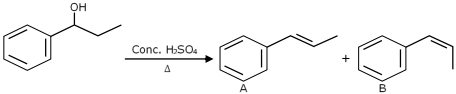
Consider the below reaction,and choose the correct statement:
A
The reaction is not possible in acidic medium
B
Both compounds $A$ and $B$ are formed equally
C
Compound $B$ will be the major product
D
Compound $A$ will be the major product
Solution
(D) The reaction is an acid-catalyzed dehydration of an alcohol.
$1$. The hydroxyl group is protonated by $H_2SO_4$ to form a good leaving group $(-OH_2^+)$.
$2$. Water is eliminated to form a stable benzylic carbocation.
$3$. $A$ proton is removed from the adjacent carbon to form an alkene.
$4$. The resulting alkene can exist as two geometric isomers: $A$ (trans-isomer) and $B$ (cis-isomer).
$5$. The trans-isomer $(A)$ is more stable due to reduced steric hindrance compared to the cis-isomer $(B)$.
$6$. According to the thermodynamic control of the reaction,the more stable product is formed as the major product.
Therefore,compound $A$ is the major product.
$1$. The hydroxyl group is protonated by $H_2SO_4$ to form a good leaving group $(-OH_2^+)$.
$2$. Water is eliminated to form a stable benzylic carbocation.
$3$. $A$ proton is removed from the adjacent carbon to form an alkene.
$4$. The resulting alkene can exist as two geometric isomers: $A$ (trans-isomer) and $B$ (cis-isomer).
$5$. The trans-isomer $(A)$ is more stable due to reduced steric hindrance compared to the cis-isomer $(B)$.
$6$. According to the thermodynamic control of the reaction,the more stable product is formed as the major product.
Therefore,compound $A$ is the major product.
0 likes
View Solution653
MediumMCQ
Of the following alcohols,the one that would react fastest with conc. $HCl$ and anhydrous $ZnCl_{2}$ is,
A
Butan$-1-$ol
B
Butan$-2-$ol
C
$2-$methylpropan$-2-$ol
D
$2-$methylpropan$-1-$ol
Solution
(C) The reaction of alcohols with conc. $HCl$ and anhydrous $ZnCl_{2}$ is known as the Lucas test.
This reaction proceeds via an $S_{N}1$ mechanism,where the rate-determining step is the formation of a carbocation.
Therefore,the reactivity of alcohols follows the order: $3^{\circ} > 2^{\circ} > 1^{\circ}$.
Among the given options:
$A$. Butan$-1-$ol is a $1^{\circ}$ alcohol.
$B$. Butan$-2-$ol is a $2^{\circ}$ alcohol.
$C$. $2-$methylpropan$-2-$ol is a $3^{\circ}$ alcohol.
$D$. $2-$methylpropan$-1-$ol is a $1^{\circ}$ alcohol.
Since $3^{\circ}$ alcohols form the most stable carbocation,$2-$methylpropan$-2-$ol reacts fastest.
This reaction proceeds via an $S_{N}1$ mechanism,where the rate-determining step is the formation of a carbocation.
Therefore,the reactivity of alcohols follows the order: $3^{\circ} > 2^{\circ} > 1^{\circ}$.
Among the given options:
$A$. Butan$-1-$ol is a $1^{\circ}$ alcohol.
$B$. Butan$-2-$ol is a $2^{\circ}$ alcohol.
$C$. $2-$methylpropan$-2-$ol is a $3^{\circ}$ alcohol.
$D$. $2-$methylpropan$-1-$ol is a $1^{\circ}$ alcohol.
Since $3^{\circ}$ alcohols form the most stable carbocation,$2-$methylpropan$-2-$ol reacts fastest.
0 likes
View Solution654
MediumMCQ
Given below are two statements :
Statement $I$ :
In Lucas test,primary,secondary and tertiary alcohols are distinguished on the basis of their reactivity with conc. $HCl + ZnCl_{2}$,known as Lucas Reagent.
Statement $II$ :
Primary alcohols are most reactive and immediately produce turbidity at room temperature on reaction with Lucas Reagent.
In the light of the above statements,choose the most appropriate answer from the options given below :
Statement $I$ :
In Lucas test,primary,secondary and tertiary alcohols are distinguished on the basis of their reactivity with conc. $HCl + ZnCl_{2}$,known as Lucas Reagent.
Statement $II$ :
Primary alcohols are most reactive and immediately produce turbidity at room temperature on reaction with Lucas Reagent.
In the light of the above statements,choose the most appropriate answer from the options given below :
A
Both Statement $I$ and Statement $II$ are incorrect.
B
Statement $I$ is correct but Statement $II$ is incorrect.
C
Statement $I$ is incorrect but Statement $II$ is correct.
D
Both Statement $I$ and Statement $II$ are correct.
Solution
(B) Statement $I$ is correct because the Lucas test uses a mixture of conc. $HCl$ and anhydrous $ZnCl_{2}$ (Lucas Reagent) to distinguish between $1^{\circ}$,$2^{\circ}$,and $3^{\circ}$ alcohols based on their reactivity.
Statement $II$ is incorrect because $3^{\circ}$ alcohols are the most reactive and produce turbidity immediately at room temperature,whereas $1^{\circ}$ alcohols are the least reactive and do not produce turbidity at room temperature.
The reactivity order towards Lucas reagent is $3^{\circ} > 2^{\circ} > 1^{\circ}$ alcohol.
Statement $II$ is incorrect because $3^{\circ}$ alcohols are the most reactive and produce turbidity immediately at room temperature,whereas $1^{\circ}$ alcohols are the least reactive and do not produce turbidity at room temperature.
The reactivity order towards Lucas reagent is $3^{\circ} > 2^{\circ} > 1^{\circ}$ alcohol.
0 likes
View Solution655
DifficultMCQ
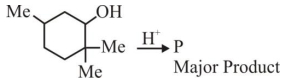
The major product $(P)$ of the given reaction is .... (where,$Me$ is $-CH_3$)
A
$1,5,5-$trimethylcyclohex$-1-$ene
B
$3,3,5-$trimethylcyclohex$-1-$ene
C
$1,2,5-$trimethylcyclohex$-1-$ene
D
$5-$methyl$-1-$methylenecyclohexane
Solution
(C) The reaction proceeds via an acid-catalyzed dehydration of a secondary alcohol.
$1$. Protonation of the $-OH$ group occurs to form a good leaving group $(-OH_2^+)$.
$2$. Loss of a water molecule generates a secondary carbocation.
$3$. $A$ $1,2$-methyl shift occurs to rearrange the secondary carbocation into a more stable tertiary carbocation.
$4$. Finally,deprotonation (loss of $H^+$) from the adjacent carbon leads to the formation of the most stable,highly substituted alkene (Zaitsev product).
Thus,the major product is $1,2,5$-trimethylcyclohex-$1$-ene.
$1$. Protonation of the $-OH$ group occurs to form a good leaving group $(-OH_2^+)$.
$2$. Loss of a water molecule generates a secondary carbocation.
$3$. $A$ $1,2$-methyl shift occurs to rearrange the secondary carbocation into a more stable tertiary carbocation.
$4$. Finally,deprotonation (loss of $H^+$) from the adjacent carbon leads to the formation of the most stable,highly substituted alkene (Zaitsev product).
Thus,the major product is $1,2,5$-trimethylcyclohex-$1$-ene.
0 likes
View Solution656
EasyMCQ
The number of chiral alcohol$(s)$ with molecular formula $C_{4}H_{10}O$ is $.....$ .
A
$1$
B
$3$
C
$2$
D
$4$
Solution
(A) The isomers of $C_{4}H_{10}O$ that are alcohols are:
$1$. $CH_{3}CH_{2}CH_{2}CH_{2}OH$ (butan-$1$-ol): Achiral.
$2$. $CH_{3}CH(OH)CH_{2}CH_{3}$ (butan-$2$-ol): Chiral,as the $C_{2}$ carbon is bonded to four different groups $(-H, -OH, -CH_{3}, -CH_{2}CH_{3})$.
$3$. $(CH_{3})_{2}CHCH_{2}OH$ ($2$-methylpropan-$1$-ol): Achiral.
$4$. $(CH_{3})_{3}COH$ ($2$-methylpropan-$2$-ol): Achiral.
Thus,there is only $1$ chiral alcohol with the molecular formula $C_{4}H_{10}O$.
$1$. $CH_{3}CH_{2}CH_{2}CH_{2}OH$ (butan-$1$-ol): Achiral.
$2$. $CH_{3}CH(OH)CH_{2}CH_{3}$ (butan-$2$-ol): Chiral,as the $C_{2}$ carbon is bonded to four different groups $(-H, -OH, -CH_{3}, -CH_{2}CH_{3})$.
$3$. $(CH_{3})_{2}CHCH_{2}OH$ ($2$-methylpropan-$1$-ol): Achiral.
$4$. $(CH_{3})_{3}COH$ ($2$-methylpropan-$2$-ol): Achiral.
Thus,there is only $1$ chiral alcohol with the molecular formula $C_{4}H_{10}O$.
0 likes
View Solution657
DifficultMCQ
$A$ sample of $4.5 \ g$ of an unknown monohydric alcohol,$ROH$,was added to methylmagnesium iodide. $A$ gas is evolved,collected,and its volume is measured to be $3.1 \ L$ at $NTP$. The molecular weight of the unknown alcohol is $g/mol$. [Nearest integer]
A
$33$
B
$32$
C
$31$
D
$30$
Solution
(A) The reaction between a monohydric alcohol and methylmagnesium iodide is: $ROH + CH_3MgI \rightarrow ROMgI + CH_4(g)$.
According to the stoichiometry,$1 \ mole$ of $ROH$ produces $1 \ mole$ of $CH_4$ gas.
At $NTP$ conditions,$1 \ mole$ of gas occupies $22.4 \ L$.
Given volume of $CH_4 = 3.1 \ L$.
Moles of $CH_4 = \frac{3.1}{22.4} \approx 0.1384 \ mol$.
Since moles of $ROH = \text{moles of } CH_4$,we have $0.1384 = \frac{\text{mass}}{\text{Molar Mass}} = \frac{4.5}{M.M}$.
$M.M = \frac{4.5}{0.1384} \approx 32.51 \ g/mol$.
The nearest integer is $33$.
According to the stoichiometry,$1 \ mole$ of $ROH$ produces $1 \ mole$ of $CH_4$ gas.
At $NTP$ conditions,$1 \ mole$ of gas occupies $22.4 \ L$.
Given volume of $CH_4 = 3.1 \ L$.
Moles of $CH_4 = \frac{3.1}{22.4} \approx 0.1384 \ mol$.
Since moles of $ROH = \text{moles of } CH_4$,we have $0.1384 = \frac{\text{mass}}{\text{Molar Mass}} = \frac{4.5}{M.M}$.
$M.M = \frac{4.5}{0.1384} \approx 32.51 \ g/mol$.
The nearest integer is $33$.
0 likes
View Solution658
DifficultMCQ
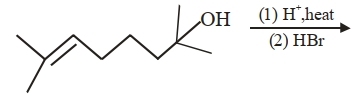
The major product in the given reaction is
A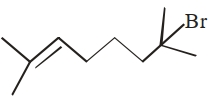
B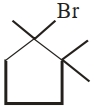
C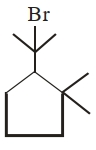
D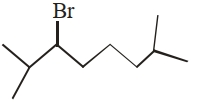
Solution
(C) The reaction proceeds through the following steps:
$1$. Protonation of the hydroxyl group by $H^+$ followed by the loss of a water molecule to form a tertiary carbocation.
$2$. The double bond in the chain attacks the carbocation,leading to a cyclization reaction to form a more stable five-membered ring carbocation.
$3$. The bromide ion $(Br^-)$ then attacks the carbocation to form the final product.
$4$. The structure corresponding to this mechanism is option $C$.
$1$. Protonation of the hydroxyl group by $H^+$ followed by the loss of a water molecule to form a tertiary carbocation.
$2$. The double bond in the chain attacks the carbocation,leading to a cyclization reaction to form a more stable five-membered ring carbocation.
$3$. The bromide ion $(Br^-)$ then attacks the carbocation to form the final product.
$4$. The structure corresponding to this mechanism is option $C$.
0 likes
View Solution659
MediumMCQ
In the following reaction sequence,$X$ and $Y$,respectively,are:
$CH_2=C(CH_3)_2$ $\xrightarrow{X} \text{Epoxide}$ $\xrightarrow{Y} (CH_3)_3C-OH$
$CH_2=C(CH_3)_2$ $\xrightarrow{X} \text{Epoxide}$ $\xrightarrow{Y} (CH_3)_3C-OH$
A
$H_2O_2$; $LiAlH_4$
B
$C_6H_5COOH$; $LiAlH_4$
C
$C_6H_5COOH$; $Zn/Hg \cdot HCl$
D
alk. $KMnO_4$; $LiAlH_4$
Solution
(B) The reaction sequence involves the conversion of an alkene to an epoxide followed by the reduction of the epoxide to an alcohol.
$1$. The conversion of an alkene to an epoxide (epoxidation) requires a peroxyacid. $C_6H_5COOH$ (perbenzoic acid) is a standard reagent for this transformation.
$2$. The reduction of an epoxide to an alcohol requires a strong reducing agent like $LiAlH_4$,which attacks the less hindered carbon of the epoxide ring to yield the corresponding alcohol.
Therefore,$X = C_6H_5COOH$ and $Y = LiAlH_4$.
$1$. The conversion of an alkene to an epoxide (epoxidation) requires a peroxyacid. $C_6H_5COOH$ (perbenzoic acid) is a standard reagent for this transformation.
$2$. The reduction of an epoxide to an alcohol requires a strong reducing agent like $LiAlH_4$,which attacks the less hindered carbon of the epoxide ring to yield the corresponding alcohol.
Therefore,$X = C_6H_5COOH$ and $Y = LiAlH_4$.
0 likes
View Solution660
MediumMCQ
The major product formed in the following transformation is most likely to be
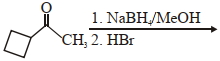
A
$1-$bromo$-1-$cyclobutyl-ethane
B
$1-$bromo$-1-$methylcyclopentane
C
$1-$bromo$-3-$cyclobutylpropane
D
$1-$bromo$-1-$cyclopentylmethane
Solution
(B) The reaction proceeds in two steps:
$1$. Reduction of cyclobutyl methyl ketone with $NaBH_4/MeOH$ yields $1-cyclobutyl-1-ethanol$.
$2$. Treatment with $HBr$ leads to the protonation of the alcohol,followed by the loss of water to form a secondary carbocation.
$3$. This secondary carbocation undergoes ring expansion to form a more stable cyclopentyl carbocation.
$4$. $A$ $1,2-hydride$ shift occurs to form a more stable tertiary carbocation.
$5$. Finally,the nucleophilic attack by $Br^-$ yields $1-bromo-1-methylcyclopentane$ as the major product.
$1$. Reduction of cyclobutyl methyl ketone with $NaBH_4/MeOH$ yields $1-cyclobutyl-1-ethanol$.
$2$. Treatment with $HBr$ leads to the protonation of the alcohol,followed by the loss of water to form a secondary carbocation.
$3$. This secondary carbocation undergoes ring expansion to form a more stable cyclopentyl carbocation.
$4$. $A$ $1,2-hydride$ shift occurs to form a more stable tertiary carbocation.
$5$. Finally,the nucleophilic attack by $Br^-$ yields $1-bromo-1-methylcyclopentane$ as the major product.
0 likes
View Solution661
MediumMCQ
Find out the major product from the following reaction.
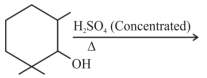
A
$1,2,3-$trimethylcyclohex$-1-$ene
B
$3,3-$dimethyl$-2-$methylenecyclohexane
C
$2,3,3-$trimethylcyclohex$-1-$ene
D
$3,3-$dimethyl$-1-$methylcyclohex$-1-$ene
Solution
(A) The reaction involves the acid-catalyzed dehydration of an alcohol.
$1$. Protonation of the hydroxyl group occurs,followed by the loss of a water molecule to form a secondary carbocation.
$2$. $A$ $1,2$-methyl shift occurs to convert the secondary carbocation into a more stable tertiary carbocation.
$3$. Finally,deprotonation occurs to form the most substituted alkene,which is the thermodynamically controlled product.
$4$. The resulting major product is $1,2,3$-trimethylcyclohex-$1$-ene.
$1$. Protonation of the hydroxyl group occurs,followed by the loss of a water molecule to form a secondary carbocation.
$2$. $A$ $1,2$-methyl shift occurs to convert the secondary carbocation into a more stable tertiary carbocation.
$3$. Finally,deprotonation occurs to form the most substituted alkene,which is the thermodynamically controlled product.
$4$. The resulting major product is $1,2,3$-trimethylcyclohex-$1$-ene.
0 likes
View Solution662
MediumMCQ
Find the major product for the following reaction.
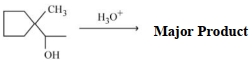
A
$1,2-$dimethylcyclohexene
B
$2,3-$dimethylcyclohexene
C
$1-$methyl$-1-$methylenecyclohexane
D
$1-$methyl$-1-$vinylcyclopentane
Solution
(A) The reaction involves the acid-catalyzed dehydration of an alcohol.
$1$. Protonation of the hydroxyl group occurs to form a good leaving group $(-OH_2^+)$.
$2$. Loss of water generates a secondary carbocation.
$3$. $A$ ring expansion occurs because the five-membered ring with a carbocation adjacent to it is less stable than a six-membered ring. The bond from the ring shifts to the carbocation center,resulting in a more stable six-membered ring with a carbocation at the adjacent position.
$4$. Finally,deprotonation occurs to form the most stable alkene,which is the more substituted alkene (Saytzeff product).
Thus,the major product is $1,2$-dimethylcyclohexene.
$1$. Protonation of the hydroxyl group occurs to form a good leaving group $(-OH_2^+)$.
$2$. Loss of water generates a secondary carbocation.
$3$. $A$ ring expansion occurs because the five-membered ring with a carbocation adjacent to it is less stable than a six-membered ring. The bond from the ring shifts to the carbocation center,resulting in a more stable six-membered ring with a carbocation at the adjacent position.
$4$. Finally,deprotonation occurs to form the most stable alkene,which is the more substituted alkene (Saytzeff product).
Thus,the major product is $1,2$-dimethylcyclohexene.
0 likes
View Solution663
DifficultMCQ
The decreasing order of dehydration of the following alcohols is:

A
$a > d > b > c$
B
$b > d > c > a$
C
$b > a > d > c$
D
$d > b > c > a$
Solution
(B) The rate of dehydration of alcohols is directly proportional to the stability of the carbocation formed as an intermediate.
$(a)$ Phenol: The carbocation formed would be highly unstable due to the $sp^2$ hybridized carbon atom.
$(b)$ Cyclohexa$-2,4-$dien$-1-$ol: Forms a resonance-stabilized carbocation (aromatic character can be achieved).
$(c)$ Cyclohex$-2-$en$-1-$ol: Forms a resonance-stabilized allylic carbocation.
$(d)$ Cyclohexanol: Forms a secondary carbocation.
Comparing the stability: $(b) > (c) > (d) > (a)$.
Therefore,the decreasing order of dehydration is $b > c > d > a$.
$(a)$ Phenol: The carbocation formed would be highly unstable due to the $sp^2$ hybridized carbon atom.
$(b)$ Cyclohexa$-2,4-$dien$-1-$ol: Forms a resonance-stabilized carbocation (aromatic character can be achieved).
$(c)$ Cyclohex$-2-$en$-1-$ol: Forms a resonance-stabilized allylic carbocation.
$(d)$ Cyclohexanol: Forms a secondary carbocation.
Comparing the stability: $(b) > (c) > (d) > (a)$.
Therefore,the decreasing order of dehydration is $b > c > d > a$.
0 likes
View Solution664
MediumMCQ
In the following reaction,'$B$' is
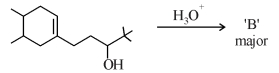
A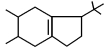
B
C
D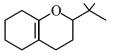
Solution
(B) The reaction proceeds via the following steps:
$1$. Protonation of the alcohol group: The $-OH$ group is protonated by $H_3O^+$ to form a good leaving group $(-OH_2^+)$.
$2$. Formation of carbocation: Loss of water molecule generates a secondary carbocation.
$3$. Rearrangement: $A$ $1,2-CH_3^-$ shift occurs to form a more stable tertiary carbocation.
$4$. Cyclization: The double bond attacks the carbocation to form a new ring.
$5$. Deprotonation: Loss of a proton $(H^+)$ from the adjacent carbon leads to the formation of the final stable alkene product,which corresponds to the structure in option $B$.
$1$. Protonation of the alcohol group: The $-OH$ group is protonated by $H_3O^+$ to form a good leaving group $(-OH_2^+)$.
$2$. Formation of carbocation: Loss of water molecule generates a secondary carbocation.
$3$. Rearrangement: $A$ $1,2-CH_3^-$ shift occurs to form a more stable tertiary carbocation.
$4$. Cyclization: The double bond attacks the carbocation to form a new ring.
$5$. Deprotonation: Loss of a proton $(H^+)$ from the adjacent carbon leads to the formation of the final stable alkene product,which corresponds to the structure in option $B$.
0 likes
View Solution665
MediumMCQ
Given below are two statements: One is labelled as Assertion $A$ and the other is labelled as Reason $R$.
Assertion $A:$ Butan$-1-$ol has higher boiling point than ethoxyethane.
Reason $R:$ Extensive hydrogen bonding leads to stronger association of molecules.
In the light of the above statements,choose the correct answer from the options given below:
Assertion $A:$ Butan$-1-$ol has higher boiling point than ethoxyethane.
Reason $R:$ Extensive hydrogen bonding leads to stronger association of molecules.
In the light of the above statements,choose the correct answer from the options given below:
A
Both $A$ and $R$ are true and $R$ is the correct explanation of $A$
B
$A$ is true but $R$ is false
C
Both $A$ and $R$ are true but $R$ is not the correct explanation of $A$
D
$A$ is false but $R$ is true
Solution
(A) Butan$-1-$ol $(CH_3CH_2CH_2CH_2OH)$ contains an $-OH$ group,which allows it to undergo extensive intermolecular hydrogen bonding.
Ethoxyethane $(CH_3CH_2-O-CH_2CH_3)$ lacks a hydrogen atom attached to an electronegative atom like $O, N,$ or $F$,and therefore cannot form hydrogen bonds.
Stronger intermolecular forces (hydrogen bonding) in butan$-1-$ol lead to greater molecular association,resulting in a higher boiling point compared to ethoxyethane.
Therefore,both Assertion $(A)$ and Reason $(R)$ are true,and $(R)$ is the correct explanation of $(A)$.
Ethoxyethane $(CH_3CH_2-O-CH_2CH_3)$ lacks a hydrogen atom attached to an electronegative atom like $O, N,$ or $F$,and therefore cannot form hydrogen bonds.
Stronger intermolecular forces (hydrogen bonding) in butan$-1-$ol lead to greater molecular association,resulting in a higher boiling point compared to ethoxyethane.
Therefore,both Assertion $(A)$ and Reason $(R)$ are true,and $(R)$ is the correct explanation of $(A)$.
0 likes
View Solution666
DifficultMCQ
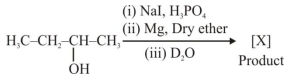
Product $[X]$ formed in the above reaction is :
A
$H_3C-CH_2-CH(D)-CH_3$
B
$H_3C-CH_2-CH_2-CH_2-D$
C
$H_3C-CH_2-CH=CH_2$
D
$H_3C-CH=CH-CH_3$
Solution
(A) The reaction proceeds in three steps:
$1$. Reaction of butan$-2-$ol with $NaI$ and $H_3PO_4$ replaces the $-OH$ group with $-I$ to form $2-$iodobutane $(CH_3-CH_2-CH(I)-CH_3)$.
$2$. Reaction of $2-$iodobutane with $Mg$ in dry ether forms the Grignard reagent,sec-butylmagnesium iodide $(CH_3-CH_2-CH(MgI)-CH_3)$.
$3$. The Grignard reagent reacts with $D_2O$ (deuterium oxide) to replace the $-MgI$ group with a deuterium atom,resulting in $2-$deuteriobutane $(CH_3-CH_2-CH(D)-CH_3)$.
$1$. Reaction of butan$-2-$ol with $NaI$ and $H_3PO_4$ replaces the $-OH$ group with $-I$ to form $2-$iodobutane $(CH_3-CH_2-CH(I)-CH_3)$.
$2$. Reaction of $2-$iodobutane with $Mg$ in dry ether forms the Grignard reagent,sec-butylmagnesium iodide $(CH_3-CH_2-CH(MgI)-CH_3)$.
$3$. The Grignard reagent reacts with $D_2O$ (deuterium oxide) to replace the $-MgI$ group with a deuterium atom,resulting in $2-$deuteriobutane $(CH_3-CH_2-CH(D)-CH_3)$.
1 likes
View Solution667
MediumMCQ
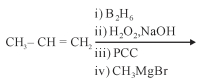
The product formed in the following multistep reaction is:
A
$CH_3-CH_2-CH_2-CH_2-OH$
B
$CH_3-CH_2-CH(OH)-CH_3$
C
$CH_3-CH_2-CO-OCH_3$
D
$(CH_3)_3C-OH$
Solution
(B) Step $1$: Hydroboration-oxidation of propene $(CH_3-CH=CH_2)$ with $B_2H_6$ followed by $H_2O_2, NaOH$ gives propan$-1-$ol $(CH_3-CH_2-CH_2-OH)$.
Step $2$: Oxidation of propan$-1-$ol with $PCC$ (Pyridinium chlorochromate) gives propanal $(CH_3-CH_2-CHO)$.
Step $3$: Reaction of propanal with methylmagnesium bromide $(CH_3MgBr)$ followed by acidic workup gives butan$-2-$ol $(CH_3-CH_2-CH(OH)-CH_3)$.
Step $2$: Oxidation of propan$-1-$ol with $PCC$ (Pyridinium chlorochromate) gives propanal $(CH_3-CH_2-CHO)$.
Step $3$: Reaction of propanal with methylmagnesium bromide $(CH_3MgBr)$ followed by acidic workup gives butan$-2-$ol $(CH_3-CH_2-CH(OH)-CH_3)$.
0 likes
View Solution668
MediumMCQ
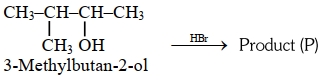
Consider the following reaction and identify the product $(P)$.
A
$CH_{3}-C(CH_{3})_{2}-CH_{2}Br$
B
$CH_{3}-C(Br)(CH_{3})-CH_{2}-CH_{3}$
C
$CH_{3}-CH(CH_{3})-CH(Br)-CH_{3}$
D
$CH_{3}-CH_{2}-CH(Br)-CH_{2}-CH_{3}$
Solution
(B) The reaction of $3\text{-methylbutan-2-ol}$ with $HBr$ proceeds via an $S_N1$ mechanism.
$1$. Protonation of the alcohol group followed by the loss of a water molecule generates a secondary carbocation: $CH_{3}-CH(CH_{3})-CH^+-CH_{3}$.
$2$. This secondary carbocation undergoes a $1,2\text{-hydride shift}$ to form a more stable tertiary carbocation: $CH_{3}-C^+(CH_{3})-CH_{2}-CH_{3}$.
$3$. Finally,the bromide ion $(Br^-)$ attacks the tertiary carbocation to form the major product: $2\text{-bromo-2-methylbutane}$,which is $CH_{3}-C(Br)(CH_{3})-CH_{2}-CH_{3}$.
$1$. Protonation of the alcohol group followed by the loss of a water molecule generates a secondary carbocation: $CH_{3}-CH(CH_{3})-CH^+-CH_{3}$.
$2$. This secondary carbocation undergoes a $1,2\text{-hydride shift}$ to form a more stable tertiary carbocation: $CH_{3}-C^+(CH_{3})-CH_{2}-CH_{3}$.
$3$. Finally,the bromide ion $(Br^-)$ attacks the tertiary carbocation to form the major product: $2\text{-bromo-2-methylbutane}$,which is $CH_{3}-C(Br)(CH_{3})-CH_{2}-CH_{3}$.
0 likes
View Solution669
DifficultMCQ
Which amongst the following will be most readily dehydrated under acidic conditions?
A
$5-$nitrohexan$-2-$ol
B
$4-$nitrohexan$-2-$ol
C
pentane$-2,4-$diol
D
$3-$nitro$-2-$methylbutane$-1,2-$diol
Solution
(A) The dehydration of alcohols under acidic conditions proceeds via the formation of a carbocation intermediate. The rate of dehydration depends on the stability of the carbocation formed. Among the given options,the molecule that can form the most stable carbocation or has a structural feature facilitating elimination will dehydrate most readily. However,looking at the provided options and standard chemical behavior,$\beta$-hydroxy carbonyl compounds (aldols) are known to undergo dehydration very easily due to the formation of a conjugated $\alpha,\beta$-unsaturated system. If we re-examine the structures,the question likely intends to identify the compound that forms a stable conjugated system upon dehydration. Given the options provided,the most stable product is formed by the dehydration of $\beta$-hydroxy compounds. Based on standard competitive chemistry problems of this type,the correct answer is $A$.
0 likes
View Solution670
DifficultMCQ
The final product $A$,formed in the following reaction sequence is:
$Ph-CH=CH_2$ $\xrightarrow[\text{(iii) } HBr, \text{ (iv) } Mg, \text{ ether, then } HCHO / H_3O^{+}]{\text{(i) } BH_3, \text{ (ii) } H_2O_2, OH^{-}} A$
$Ph-CH=CH_2$ $\xrightarrow[\text{(iii) } HBr, \text{ (iv) } Mg, \text{ ether, then } HCHO / H_3O^{+}]{\text{(i) } BH_3, \text{ (ii) } H_2O_2, OH^{-}} A$
A
$Ph-CH_2-CH_2-CH_3$
B
$Ph-CH(CH_3)_2$
C
$Ph-CH(CH_3)-CH_2OH$
D
$Ph-CH_2-CH_2-CH_2-OH$
Solution
(D) Step $1$: Hydroboration-oxidation of styrene $(Ph-CH=CH_2)$ gives anti-Markovnikov addition of water,resulting in $Ph-CH_2-CH_2-OH$.
Step $2$: Reaction with $HBr$ converts the alcohol to an alkyl bromide: $Ph-CH_2-CH_2-OH + HBr \rightarrow Ph-CH_2-CH_2-Br + H_2O$.
Step $3$: Formation of Grignard reagent and reaction with formaldehyde $(HCHO)$ followed by hydrolysis:
$Ph-CH_2-CH_2-Br + Mg \xrightarrow{\text{ether}} Ph-CH_2-CH_2-MgBr$
$Ph-CH_2-CH_2-MgBr + HCHO \rightarrow Ph-CH_2-CH_2-CH_2-OMgBr$
$Ph-CH_2-CH_2-CH_2-OMgBr \xrightarrow{H_3O^{+}} Ph-CH_2-CH_2-CH_2-OH$.
Thus,the final product $A$ is $Ph-CH_2-CH_2-CH_2-OH$.
Step $2$: Reaction with $HBr$ converts the alcohol to an alkyl bromide: $Ph-CH_2-CH_2-OH + HBr \rightarrow Ph-CH_2-CH_2-Br + H_2O$.
Step $3$: Formation of Grignard reagent and reaction with formaldehyde $(HCHO)$ followed by hydrolysis:
$Ph-CH_2-CH_2-Br + Mg \xrightarrow{\text{ether}} Ph-CH_2-CH_2-MgBr$
$Ph-CH_2-CH_2-MgBr + HCHO \rightarrow Ph-CH_2-CH_2-CH_2-OMgBr$
$Ph-CH_2-CH_2-CH_2-OMgBr \xrightarrow{H_3O^{+}} Ph-CH_2-CH_2-CH_2-OH$.
Thus,the final product $A$ is $Ph-CH_2-CH_2-CH_2-OH$.
0 likes
View Solution671
DifficultMCQ
The product $(C)$ in the below mentioned reaction is:
$CH_3-CH_2-CH_2-Br$ $\xrightarrow[\Delta]{KOH_{(alc)}} A$ $\xrightarrow{HBr} B$ $\xrightarrow[KOH_{(aq)}]{\Delta} C$
$CH_3-CH_2-CH_2-Br$ $\xrightarrow[\Delta]{KOH_{(alc)}} A$ $\xrightarrow{HBr} B$ $\xrightarrow[KOH_{(aq)}]{\Delta} C$
A
Propan$-1-$ol
B
Propene
C
Propyne
D
Propan$-2-$ol
Solution
(D) Step $1$: Dehydrohalogenation of $CH_3-CH_2-CH_2-Br$ with $KOH_{(alc)}$ gives propene $(A)$ as $CH_3-CH=CH_2$.
Step $2$: Electrophilic addition of $HBr$ to propene follows Markovnikov's rule to give $2-$bromopropane $(B)$ as $CH_3-CH(Br)-CH_3$.
Step $3$: Nucleophilic substitution of $2-$bromopropane with $KOH_{(aq)}$ gives propan$-2-$ol $(C)$ as $CH_3-CH(OH)-CH_3$.
Step $2$: Electrophilic addition of $HBr$ to propene follows Markovnikov's rule to give $2-$bromopropane $(B)$ as $CH_3-CH(Br)-CH_3$.
Step $3$: Nucleophilic substitution of $2-$bromopropane with $KOH_{(aq)}$ gives propan$-2-$ol $(C)$ as $CH_3-CH(OH)-CH_3$.
0 likes
View Solution672
DifficultMCQ
Given below are two statements: One is labelled as Assertion $A$ and the other is labelled as Reason $R$:
Assertion $A$: Alcohols react both as nucleophiles and electrophiles.
Reason $R$: Alcohols react with active metals such as sodium,potassium and aluminum to yield corresponding alkoxides and liberate hydrogen.
In the light of the above statements,choose the correct answer from the options given below:
Assertion $A$: Alcohols react both as nucleophiles and electrophiles.
Reason $R$: Alcohols react with active metals such as sodium,potassium and aluminum to yield corresponding alkoxides and liberate hydrogen.
In the light of the above statements,choose the correct answer from the options given below:
A
$A$ is false but $R$ is true.
B
$A$ is true but $R$ is false.
C
Both $A$ and $R$ are true and $R$ is the correct explanation of $A$.
D
Both $A$ and $R$ are true but $R$ is $NOT$ the correct explanation of $A$.
Solution
(D) Alcohols act as nucleophiles because the oxygen atom has lone pairs of electrons.
Alcohols act as electrophiles when the $C-O$ bond is broken,typically after protonation of the oxygen atom.
Thus,Assertion $A$ is true.
Alcohols react with active metals like $Na$,$K$,and $Al$ to form alkoxides and release $H_2$ gas,which confirms the acidic nature of alcohols.
Thus,Reason $R$ is true.
However,the reaction with active metals explains the acidity of alcohols,not their dual nature as nucleophiles and electrophiles.
Therefore,$R$ is not the correct explanation of $A$.
Alcohols act as electrophiles when the $C-O$ bond is broken,typically after protonation of the oxygen atom.
Thus,Assertion $A$ is true.
Alcohols react with active metals like $Na$,$K$,and $Al$ to form alkoxides and release $H_2$ gas,which confirms the acidic nature of alcohols.
Thus,Reason $R$ is true.
However,the reaction with active metals explains the acidity of alcohols,not their dual nature as nucleophiles and electrophiles.
Therefore,$R$ is not the correct explanation of $A$.
0 likes
View Solution673
DifficultMCQ
Which among the following has the highest boiling point?
A
$CH_3CH_2CH_2CH_3$
B
$CH_3CH_2CH_2CH_2OH$
C
$CH_3CH_2CH_2CHO$
D
$C_2H_5OC_2H_5$
Solution
(B) The boiling point of organic compounds depends on intermolecular forces.
$CH_3CH_2CH_2CH_2OH$ is an alcohol,which exhibits strong intermolecular hydrogen bonding.
$CH_3CH_2CH_2CH_3$ (butane) is a non-polar alkane with weak van der Waals forces.
$CH_3CH_2CH_2CHO$ (butanal) and $C_2H_5OC_2H_5$ (diethyl ether) exhibit dipole-dipole interactions,which are weaker than hydrogen bonding.
Therefore,the alcohol has the highest boiling point.
$CH_3CH_2CH_2CH_2OH$ is an alcohol,which exhibits strong intermolecular hydrogen bonding.
$CH_3CH_2CH_2CH_3$ (butane) is a non-polar alkane with weak van der Waals forces.
$CH_3CH_2CH_2CHO$ (butanal) and $C_2H_5OC_2H_5$ (diethyl ether) exhibit dipole-dipole interactions,which are weaker than hydrogen bonding.
Therefore,the alcohol has the highest boiling point.
0 likes
View Solution674
MediumMCQ
$CH_3-CH_2-CH_2-Br + NaOH \xrightarrow{C_2H_5OH} \text{Product } A$. Consider the above reactions,identify product $B$ and product $C$.
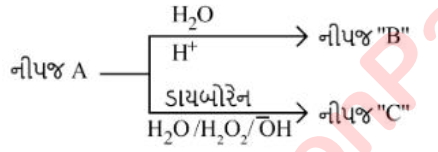
A
$B=C=2\text{-Propanol}$
B
$B=2\text{-Propanol}, C=1\text{-Propanol}$
C
$B=1\text{-Propanol}, C=2\text{-Propanol}$
D
$B=C=1\text{-Propanol}$
Solution
(B) $1$. The reaction of $CH_3-CH_2-CH_2-Br$ with $NaOH$ in $C_2H_5OH$ is a dehydrohalogenation reaction (elimination),which produces propene $(CH_3-CH=CH_2)$ as Product $A$.
$2$. The hydration of propene in the presence of acid $(H_2O/H^+)$ follows Markovnikov's rule,leading to the formation of $2\text{-Propanol}$ as Product $B$.
$3$. The hydroboration-oxidation of propene $(B_2H_6, H_2O_2/OH^-)$ follows anti-Markovnikov's rule,leading to the formation of $1\text{-Propanol}$ as Product $C$.
$4$. Therefore,$B = 2\text{-Propanol}$ and $C = 1\text{-Propanol}$.
$2$. The hydration of propene in the presence of acid $(H_2O/H^+)$ follows Markovnikov's rule,leading to the formation of $2\text{-Propanol}$ as Product $B$.
$3$. The hydroboration-oxidation of propene $(B_2H_6, H_2O_2/OH^-)$ follows anti-Markovnikov's rule,leading to the formation of $1\text{-Propanol}$ as Product $C$.
$4$. Therefore,$B = 2\text{-Propanol}$ and $C = 1\text{-Propanol}$.
0 likes
View Solution675
MediumMCQ
Identify the major products $A$ and $B$ respectively in the following set of reactions.
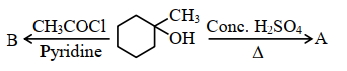
A
$A = \text{1-methylcyclohexene}$,$B = \text{1-methylcyclohexyl acetate}$
B
$A = \text{1-methylcyclohexene}$,$B = \text{4-acetylcyclohexanol}$
C
$A = \text{methylenecyclohexane}$,$B = \text{1-methylcyclohexyl ketone}$
D
$A = \text{methylenecyclohexane}$,$B = \text{1-methylcyclohexyl acetate}$
Solution
(A) The reaction of $1\text{-methylcyclohexanol}$ with $\text{conc. } H_2SO_4$ at high temperature involves acid-catalyzed dehydration. This proceeds via an $E1$ mechanism,where the hydroxyl group is protonated and leaves as water to form a tertiary carbocation. Subsequent loss of a proton from the adjacent carbon leads to the formation of the more stable,more substituted alkene,which is $1\text{-methylcyclohexene}$ $(A)$.
The reaction of $1\text{-methylcyclohexanol}$ with $CH_3COCl$ in the presence of pyridine is an acetylation reaction. The alcohol acts as a nucleophile,attacking the acetyl chloride to form an ester,$1\text{-methylcyclohexyl acetate}$ $(B)$.
The reaction of $1\text{-methylcyclohexanol}$ with $CH_3COCl$ in the presence of pyridine is an acetylation reaction. The alcohol acts as a nucleophile,attacking the acetyl chloride to form an ester,$1\text{-methylcyclohexyl acetate}$ $(B)$.
0 likes
View Solution676
MediumMCQ
Which one of the following alcohols reacts instantaneously with Lucas reagent?
A
$CH_3-CH_2-CH(OH)-CH_3$
B
$CH_3-CH(CH_3)-CH_2OH$
C
$(CH_3)_3C-OH$
D
$CH_3-CH_2-CH_2-CH_2OH$
Solution
(C) The Lucas reagent is a mixture of concentrated $HCl$ and anhydrous $ZnCl_2$.
Alcohols react with the Lucas reagent to form alkyl chlorides,which appear as turbidity in the solution.
The reactivity order of alcohols towards the Lucas reagent is: $3^\circ > 2^\circ > 1^\circ$.
Tertiary $(3^\circ)$ alcohols react instantaneously with the Lucas reagent to produce immediate turbidity because they form stable carbocations.
Among the given options,$(CH_3)_3C-OH$ is a tertiary alcohol,hence it reacts instantaneously.
Alcohols react with the Lucas reagent to form alkyl chlorides,which appear as turbidity in the solution.
The reactivity order of alcohols towards the Lucas reagent is: $3^\circ > 2^\circ > 1^\circ$.
Tertiary $(3^\circ)$ alcohols react instantaneously with the Lucas reagent to produce immediate turbidity because they form stable carbocations.
Among the given options,$(CH_3)_3C-OH$ is a tertiary alcohol,hence it reacts instantaneously.
0 likes
View Solution677
MediumMCQ
Given below are two statements:
Statement $(I)$: The boiling points of alcohols and phenols increase with an increase in the number of $C$ atoms.
Statement $(II)$: The boiling points of alcohols and phenols are higher in comparison to other classes of compounds such as ethers and haloalkanes.
In the light of the above statements,choose the correct answer from the options given below:
Statement $(I)$: The boiling points of alcohols and phenols increase with an increase in the number of $C$ atoms.
Statement $(II)$: The boiling points of alcohols and phenols are higher in comparison to other classes of compounds such as ethers and haloalkanes.
In the light of the above statements,choose the correct answer from the options given below:
A
Both Statement $I$ and Statement $II$ are false
B
Statement $I$ is false but Statement $II$ is true
C
Statement $I$ is true but Statement $II$ is false
D
Both Statement $I$ and Statement $II$ are true
Solution
(D) Statement $(I)$ is true: The boiling point of alcohols and phenols increases with an increase in the number of carbon atoms due to an increase in van der Waals forces of attraction as the molecular weight increases $(B.P. \propto M.W.)$.
Statement $(II)$ is true: Alcohols and phenols exhibit intermolecular hydrogen bonding,which is significantly stronger than the dipole-dipole interactions found in ethers and haloalkanes of comparable molecular mass. Therefore,they have higher boiling points.
Statement $(II)$ is true: Alcohols and phenols exhibit intermolecular hydrogen bonding,which is significantly stronger than the dipole-dipole interactions found in ethers and haloalkanes of comparable molecular mass. Therefore,they have higher boiling points.
0 likes
View Solution678
DifficultMCQ
$A$ toxic compound $A$ when reacted with $NaCN$ in aqueous acidic medium yields an edible cooking component and food preservative $B$. $B$ is converted to $C$ by diborane and can be used as an additive to petrol to reduce emission. $C$ upon reaction with oleum at $140^{\circ} C$ yields an inhalable anesthetic $D$. Identify $A, B, C$ and $D$,respectively.
A
Methanol; formaldehyde; methyl chloride; chloroform
B
Ethanol; acetonitrile; ethylamine; ethylene
C
Methanol; acetic acid; ethanol; diethyl ether
D
Acetaldehyde; $2-$hydroxypropanoic acid; propanoic acid; dipropyl ether
Solution
(C) The reaction sequence is as follows:
$1$. $A$ is Methanol $(CH_3OH)$. In acidic medium,it forms $CH_3-OH_2^+$,which reacts with $NaCN$ followed by hydrolysis to yield Acetic acid $(CH_3COOH)$ as $B$. Acetic acid is a common food preservative (vinegar).
$2$. $B$ (Acetic acid) is reduced by diborane $(B_2H_6)$ to form Ethanol $(C_2H_5OH)$ as $C$. Ethanol is used as a fuel additive.
$3$. $C$ (Ethanol) reacts with oleum $(H_2SO_4 + SO_3)$ at $140^{\circ} C$ to undergo intermolecular dehydration,yielding Diethyl ether $(C_2H_5-O-C_2H_5)$ as $D$,which is an inhalable anesthetic.
Therefore,the correct sequence is Methanol,Acetic acid,Ethanol,Diethyl ether.
$1$. $A$ is Methanol $(CH_3OH)$. In acidic medium,it forms $CH_3-OH_2^+$,which reacts with $NaCN$ followed by hydrolysis to yield Acetic acid $(CH_3COOH)$ as $B$. Acetic acid is a common food preservative (vinegar).
$2$. $B$ (Acetic acid) is reduced by diborane $(B_2H_6)$ to form Ethanol $(C_2H_5OH)$ as $C$. Ethanol is used as a fuel additive.
$3$. $C$ (Ethanol) reacts with oleum $(H_2SO_4 + SO_3)$ at $140^{\circ} C$ to undergo intermolecular dehydration,yielding Diethyl ether $(C_2H_5-O-C_2H_5)$ as $D$,which is an inhalable anesthetic.
Therefore,the correct sequence is Methanol,Acetic acid,Ethanol,Diethyl ether.
0 likes
View Solution679
MediumMCQ
Which alcohol produces turbidity with Lucas reagent after five minutes $:-$
A
$2-$Butanol
B
$t-$Butyl alcohol
C
Isobutyl alcohol
D
Diphenyl carbinol
Solution
(A) The Lucas test is used to distinguish between primary,secondary,and tertiary alcohols based on the rate of reaction with Lucas reagent (a mixture of concentrated $HCl$ and anhydrous $ZnCl_2$).
$1^{\circ}$ alcohols do not produce turbidity at room temperature.
$2^{\circ}$ alcohols produce turbidity within $5-10$ minutes.
$3^{\circ}$ alcohols produce turbidity immediately.
Among the given options:
$(1)$ $2-$Butanol is a $2^{\circ}$ alcohol.
$(2)$ $t-$Butyl alcohol is a $3^{\circ}$ alcohol.
$(3)$ Isobutyl alcohol is a $1^{\circ}$ alcohol.
$(4)$ Diphenyl carbinol is a $2^{\circ}$ alcohol,but due to the presence of two bulky phenyl groups,its reactivity is different from simple aliphatic $2^{\circ}$ alcohols.
Thus,$2-$Butanol is the standard example of a $2^{\circ}$ alcohol that produces turbidity within $5$ minutes.
$1^{\circ}$ alcohols do not produce turbidity at room temperature.
$2^{\circ}$ alcohols produce turbidity within $5-10$ minutes.
$3^{\circ}$ alcohols produce turbidity immediately.
Among the given options:
$(1)$ $2-$Butanol is a $2^{\circ}$ alcohol.
$(2)$ $t-$Butyl alcohol is a $3^{\circ}$ alcohol.
$(3)$ Isobutyl alcohol is a $1^{\circ}$ alcohol.
$(4)$ Diphenyl carbinol is a $2^{\circ}$ alcohol,but due to the presence of two bulky phenyl groups,its reactivity is different from simple aliphatic $2^{\circ}$ alcohols.
Thus,$2-$Butanol is the standard example of a $2^{\circ}$ alcohol that produces turbidity within $5$ minutes.
0 likes
View Solution680
MediumMCQ
The major product of the following reaction is $:-$
$CH_3-CH(CH_3)-CH(OH)-CH_3 \xrightarrow{HBr} \text{Major Product}$
$CH_3-CH(CH_3)-CH(OH)-CH_3 \xrightarrow{HBr} \text{Major Product}$
A
$CH_3-C(CH_3)(Br)-CH_2-CH_3$
B
$CH_3-CH(CH_3)-CH_2-CH_2Br$
C
$CH_3-CH(CH_3)-CH(Br)-CH_3$
D
$CH_3-CH_2-C(CH_3)(H)-CH_2-CH_3$
Solution
(A) The reaction proceeds via the formation of a carbocation intermediate.
$1$. Protonation of the $-OH$ group by $HBr$ followed by the loss of $H_2O$ leads to the formation of a secondary $(2^{\circ})$ carbocation: $CH_3-CH(CH_3)-CH^+-CH_3$.
$2$. This $2^{\circ}$ carbocation undergoes a $1,2-H^-$ shift to form a more stable tertiary $(3^{\circ})$ carbocation: $CH_3-C^+(CH_3)-CH_2-CH_3$.
$3$. Finally,the bromide ion $(Br^-)$ attacks the $3^{\circ}$ carbocation to form the major product: $CH_3-C(Br)(CH_3)-CH_2-CH_3$.
$1$. Protonation of the $-OH$ group by $HBr$ followed by the loss of $H_2O$ leads to the formation of a secondary $(2^{\circ})$ carbocation: $CH_3-CH(CH_3)-CH^+-CH_3$.
$2$. This $2^{\circ}$ carbocation undergoes a $1,2-H^-$ shift to form a more stable tertiary $(3^{\circ})$ carbocation: $CH_3-C^+(CH_3)-CH_2-CH_3$.
$3$. Finally,the bromide ion $(Br^-)$ attacks the $3^{\circ}$ carbocation to form the major product: $CH_3-C(Br)(CH_3)-CH_2-CH_3$.
0 likes
View Solution681
MediumMCQ
The vapours of an alcohol $(X)$ are passed over $Cu$ heated at $300^{\circ} C$,where an alkene is formed as the product. The alcohol $(X)$ is expected to be $:-$
A
Ethanol
B
sec-Butyl alcohol
C
tert-Butyl alcohol
D
$2-$Pentanol
Solution
(C) When vapours of primary $(1^{\circ})$ alcohols are passed over heated $Cu$ at $573 \ K$ $(300^{\circ} C)$,they undergo dehydrogenation to form aldehydes.
When vapours of secondary $(2^{\circ})$ alcohols are passed over heated $Cu$ at $573 \ K$ $(300^{\circ} C)$,they undergo dehydrogenation to form ketones.
When vapours of tertiary $(3^{\circ})$ alcohols are passed over heated $Cu$ at $573 \ K$ $(300^{\circ} C)$,they undergo dehydration to form alkenes.
Among the given options,tert-Butyl alcohol is a tertiary $(3^{\circ})$ alcohol,which undergoes dehydration to form an alkene (isobutylene) under these conditions.
When vapours of secondary $(2^{\circ})$ alcohols are passed over heated $Cu$ at $573 \ K$ $(300^{\circ} C)$,they undergo dehydrogenation to form ketones.
When vapours of tertiary $(3^{\circ})$ alcohols are passed over heated $Cu$ at $573 \ K$ $(300^{\circ} C)$,they undergo dehydration to form alkenes.
Among the given options,tert-Butyl alcohol is a tertiary $(3^{\circ})$ alcohol,which undergoes dehydration to form an alkene (isobutylene) under these conditions.
0 likes
View Solution682
MediumMCQ
Which of the following alcohols will not react with $Cu / \Delta$?
A
$CH_3-CH_2-OH$
B
Tertiary alcohol with structure:
$Ph-C(Ph)(Ph)-OH$
$Ph-C(Ph)(Ph)-OH$
C
$CH_3-C(CH_3)(CH_3)-OH$
D
$Ph-CH(OH)-CH_3$
Solution
(C) Primary $(1^{\circ})$ alcohols react with $Cu / \Delta$ to form aldehydes.
Secondary $(2^{\circ})$ alcohols react with $Cu / \Delta$ to form ketones.
Tertiary $(3^{\circ})$ alcohols do not undergo dehydrogenation in the presence of $Cu / \Delta$ because they lack an $\alpha$-hydrogen atom. Instead,they undergo dehydration to form alkenes.
Among the given options,$CH_3-C(CH_3)(CH_3)-OH$ is a tertiary alcohol and will not undergo dehydrogenation.
Secondary $(2^{\circ})$ alcohols react with $Cu / \Delta$ to form ketones.
Tertiary $(3^{\circ})$ alcohols do not undergo dehydrogenation in the presence of $Cu / \Delta$ because they lack an $\alpha$-hydrogen atom. Instead,they undergo dehydration to form alkenes.
Among the given options,$CH_3-C(CH_3)(CH_3)-OH$ is a tertiary alcohol and will not undergo dehydrogenation.
0 likes
View Solution683
EasyMCQ
Identify an aromatic compound $A \left( C_7H_8O \right)$ which gives the following tests with the given reagents:
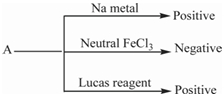
A
$C_6H_5OCH_3$
B
$C_6H_5CH_2OH$
C
$p-CH_3C_6H_4OH$
D
$m-CH_3C_6H_4OH$
Solution
(B) The molecular formula $C_7H_8O$ corresponds to an aromatic compound.
$1$. $Na$ metal test: $A$ positive test indicates the presence of an acidic hydrogen (like in $-OH$ group).
$2$. Neutral $FeCl_3$ test: $A$ negative test indicates the absence of a phenolic $-OH$ group.
$3$. Lucas reagent test: $A$ positive test indicates the presence of an alcohol group (specifically,primary,secondary,or tertiary alcohol).
Analyzing the options:
- $C_6H_5OCH_3$ (Anisole) does not have an $-OH$ group,so it will not react with $Na$ metal.
- $C_6H_5CH_2OH$ (Benzyl alcohol) has an alcoholic $-OH$ group. It reacts with $Na$ metal (positive),does not give a color with neutral $FeCl_3$ (negative,as it is not a phenol),and reacts with Lucas reagent (positive,as it is a primary alcohol).
- $p-CH_3C_6H_4OH$ and $m-CH_3C_6H_4OH$ are cresols (phenols). They will give a positive test with neutral $FeCl_3$.
Therefore,the compound $A$ is $C_6H_5CH_2OH$.
$1$. $Na$ metal test: $A$ positive test indicates the presence of an acidic hydrogen (like in $-OH$ group).
$2$. Neutral $FeCl_3$ test: $A$ negative test indicates the absence of a phenolic $-OH$ group.
$3$. Lucas reagent test: $A$ positive test indicates the presence of an alcohol group (specifically,primary,secondary,or tertiary alcohol).
Analyzing the options:
- $C_6H_5OCH_3$ (Anisole) does not have an $-OH$ group,so it will not react with $Na$ metal.
- $C_6H_5CH_2OH$ (Benzyl alcohol) has an alcoholic $-OH$ group. It reacts with $Na$ metal (positive),does not give a color with neutral $FeCl_3$ (negative,as it is not a phenol),and reacts with Lucas reagent (positive,as it is a primary alcohol).
- $p-CH_3C_6H_4OH$ and $m-CH_3C_6H_4OH$ are cresols (phenols). They will give a positive test with neutral $FeCl_3$.
Therefore,the compound $A$ is $C_6H_5CH_2OH$.
0 likes
View Solution684
MediumMCQ
Order of boiling points of the given compounds is:
$(a)$ $\text{pentan-1-ol}$
$(b)$ $\text{butan-1-ol}$
$(c)$ $\text{butan-2-ol}$
$(d)$ $\text{propan-1-ol}$
$(a)$ $\text{pentan-1-ol}$
$(b)$ $\text{butan-1-ol}$
$(c)$ $\text{butan-2-ol}$
$(d)$ $\text{propan-1-ol}$
A
$a > b > c > d$
B
$a > c > b > d$
C
$d > c > b > a$
D
$d > b > c > a$
Solution
(A) The boiling point of alcohols depends on the molecular mass and the extent of branching.
$1$. As the molecular mass increases,the boiling point increases. The order of molecular mass is: $\text{pentan-1-ol} (C_5H_{12}O) > \text{butan-1-ol} = \text{butan-2-ol} (C_4H_{10}O) > \text{propan-1-ol} (C_3H_8O)$.
$2$. For isomers with the same molecular mass,the boiling point decreases with an increase in branching because the surface area decreases,leading to weaker van der Waals forces. Thus,$\text{butan-1-ol}$ (straight chain) has a higher boiling point than $\text{butan-2-ol}$ (branched).
$3$. Combining these factors,the order is: $\text{pentan-1-ol} (a) > \text{butan-1-ol} (b) > \text{butan-2-ol} (c) > \text{propan-1-ol} (d)$.
$1$. As the molecular mass increases,the boiling point increases. The order of molecular mass is: $\text{pentan-1-ol} (C_5H_{12}O) > \text{butan-1-ol} = \text{butan-2-ol} (C_4H_{10}O) > \text{propan-1-ol} (C_3H_8O)$.
$2$. For isomers with the same molecular mass,the boiling point decreases with an increase in branching because the surface area decreases,leading to weaker van der Waals forces. Thus,$\text{butan-1-ol}$ (straight chain) has a higher boiling point than $\text{butan-2-ol}$ (branched).
$3$. Combining these factors,the order is: $\text{pentan-1-ol} (a) > \text{butan-1-ol} (b) > \text{butan-2-ol} (c) > \text{propan-1-ol} (d)$.
0 likes
View Solution685
MediumMCQ
$Ph-CH=CH-CH_3$ $\xrightarrow[H_2O_2/OH^-]{B_2H_6/THF}$ Products. Reaction $(A)$
$CH_3-CH=CH-Ph$ $\xrightarrow[NaBH_4]{Hg(OAc)_2/H_2O}$ Products. Reaction $(B)$
Which statement is correct?
$CH_3-CH=CH-Ph$ $\xrightarrow[NaBH_4]{Hg(OAc)_2/H_2O}$ Products. Reaction $(B)$
Which statement is correct?
A
In reaction $(A)$,the product is formed according to the Markownikoff rule.
B
In reaction $(B)$,the product is formed according to the Antimarkownikoff rule.
C
In reaction $(A)$,the product is a meso compound.
D
In reaction $(B)$,the product is a racemic mixture.
0 likes
View Solution686
DifficultMCQ
Statement-$1$ : Secondary $\&$ Tertiary alcohols can be distinguished by Lucas reagent.
Statement-$2$ : Secondary $\&$ Tertiary alcohols can be distinguished by dichromate test.
Statement-$2$ : Secondary $\&$ Tertiary alcohols can be distinguished by dichromate test.
A
Both Statement-$1$ and Statement-$2$ are correct.
B
Both Statement-$1$ and Statement-$2$ are incorrect.
C
Statement-$1$ is correct and Statement-$2$ is incorrect.
D
Statement-$1$ is incorrect and Statement-$2$ is correct.
Solution
(C) Statement-$1$ is correct: Lucas reagent $(conc. \ HCl + ZnCl_2)$ reacts with tertiary alcohols immediately to form turbidity,while secondary alcohols take about $5-10$ minutes to form turbidity. Thus,they can be distinguished.
Statement-$2$ is incorrect: Dichromate test (oxidation with $K_2Cr_2O_7/H^+$) is used to distinguish primary,secondary,and tertiary alcohols based on the products formed (aldehyde/acid,ketone,and no reaction/alkene respectively). However,it is not a specific test to distinguish between secondary and tertiary alcohols alone as effectively as the Lucas test or Victor Meyer's test,and specifically,both secondary and tertiary alcohols do not show the same color change pattern as primary alcohols. Therefore,Statement-$2$ is considered incorrect in the context of specific distinction.
Statement-$2$ is incorrect: Dichromate test (oxidation with $K_2Cr_2O_7/H^+$) is used to distinguish primary,secondary,and tertiary alcohols based on the products formed (aldehyde/acid,ketone,and no reaction/alkene respectively). However,it is not a specific test to distinguish between secondary and tertiary alcohols alone as effectively as the Lucas test or Victor Meyer's test,and specifically,both secondary and tertiary alcohols do not show the same color change pattern as primary alcohols. Therefore,Statement-$2$ is considered incorrect in the context of specific distinction.
0 likes
View Solution687
MediumMCQ
Product $A$ is$:-$
$H-CHO \xrightarrow[(ii) D_2O]{(i) C_6H_{11}MgBr} A$
$H-CHO \xrightarrow[(ii) D_2O]{(i) C_6H_{11}MgBr} A$
A
Cyclohexylmethanol with an $-OH$ group
B
Cyclohexylmethanol with an $-OD$ group
C
Cyclohexylmethanol with two $D$ atoms on the carbon
D
$4-$Methylcyclohexylmethanol
Solution
(B) The reaction of a Grignard reagent $(R-MgBr)$ with formaldehyde $(HCHO)$ followed by hydrolysis with $D_2O$ proceeds as follows:
$1$. The nucleophilic cyclohexyl group $(C_6H_{11}^-)$ from the Grignard reagent attacks the electrophilic carbonyl carbon of formaldehyde $(HCHO)$:
$C_6H_{11}-MgBr + HCHO \rightarrow C_6H_{11}-CH_2-OMgBr$
$2$. Subsequent hydrolysis with $D_2O$ replaces the $MgBr$ group with a deuterium atom $(D)$ on the oxygen,forming a deuterated alcohol:
$C_6H_{11}-CH_2-OMgBr + D_2O \rightarrow C_6H_{11}-CH_2-OD + MgBr(OD)$
Thus,the product $A$ is cyclohexylmethanol where the hydroxyl hydrogen is replaced by deuterium,which corresponds to the structure in option $B$.
$1$. The nucleophilic cyclohexyl group $(C_6H_{11}^-)$ from the Grignard reagent attacks the electrophilic carbonyl carbon of formaldehyde $(HCHO)$:
$C_6H_{11}-MgBr + HCHO \rightarrow C_6H_{11}-CH_2-OMgBr$
$2$. Subsequent hydrolysis with $D_2O$ replaces the $MgBr$ group with a deuterium atom $(D)$ on the oxygen,forming a deuterated alcohol:
$C_6H_{11}-CH_2-OMgBr + D_2O \rightarrow C_6H_{11}-CH_2-OD + MgBr(OD)$
Thus,the product $A$ is cyclohexylmethanol where the hydroxyl hydrogen is replaced by deuterium,which corresponds to the structure in option $B$.
0 likes
View Solution688
MediumMCQ
Primary,secondary and tertiary alcohols can be distinguished by$-$
A
Reimer$-$Tiemann reaction
B
Tollen's reagent
C
Lucas test
D
Lassaigne's test
Solution
(C) The $Lucas$ test is used to distinguish between primary,secondary,and tertiary alcohols.
It involves the use of $Lucas$ reagent,which is a mixture of concentrated $HCl$ and anhydrous $ZnCl_2$.
$1.$ Tertiary alcohols react immediately with $Lucas$ reagent to form turbidity.
$2.$ Secondary alcohols react within $5$-$10$ minutes to form turbidity.
$3.$ Primary alcohols do not react at room temperature and show no turbidity.
It involves the use of $Lucas$ reagent,which is a mixture of concentrated $HCl$ and anhydrous $ZnCl_2$.
$1.$ Tertiary alcohols react immediately with $Lucas$ reagent to form turbidity.
$2.$ Secondary alcohols react within $5$-$10$ minutes to form turbidity.
$3.$ Primary alcohols do not react at room temperature and show no turbidity.
0 likes
View Solution689
EasyMCQ
An unknown alcohol is treated with the 'Lucas' reagent to determine whether the alcohol is primary,secondary,or tertiary. Which alcohol reacts fastest and by what mechanism $:-$
A
Secondary alcohol by $S_N2$
B
Tertiary alcohol by $S_N2$
C
Secondary alcohol by $S_N1$
D
Tertiary alcohol by $S_N1$
Solution
(D) The 'Lucas' reagent is a mixture of concentrated $HCl$ and anhydrous $ZnCl_2$.
The reaction of alcohols with the Lucas reagent proceeds via the formation of a carbocation intermediate,which is characteristic of the $S_N1$ mechanism.
Since the stability of carbocations follows the order: $3^\circ > 2^\circ > 1^\circ$,the tertiary $(3^\circ)$ alcohol forms the most stable carbocation and therefore reacts the fastest.
Thus,the tertiary alcohol reacts fastest via the $S_N1$ mechanism.
The reaction of alcohols with the Lucas reagent proceeds via the formation of a carbocation intermediate,which is characteristic of the $S_N1$ mechanism.
Since the stability of carbocations follows the order: $3^\circ > 2^\circ > 1^\circ$,the tertiary $(3^\circ)$ alcohol forms the most stable carbocation and therefore reacts the fastest.
Thus,the tertiary alcohol reacts fastest via the $S_N1$ mechanism.
0 likes
View Solution690
MediumMCQ
The major product obtained by the dehydration of the given alcohol is $:-$
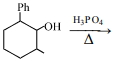
A
$1-$phenyl$-3-$methylcyclohex$-1-$ene
B
$3-$methyl$-1-$phenylcyclohexene
C
$1-$phenyl$-5-$methylcyclohexene
D
$3-$methyl$-1-$phenylcyclohex$-1-$ene
Solution
(A) The dehydration of alcohol in the presence of $H_3PO_4$ and heat proceeds via an $E1$ mechanism involving the formation of a carbocation intermediate.
$1$. Protonation of the $-OH$ group occurs,followed by the loss of a water molecule to form a secondary carbocation at the $C_2$ position.
$2$. The carbocation is adjacent to a phenyl group $(Ph)$ at $C_1$,which provides resonance stabilization.
$3$. Elimination of a proton $(H^+)$ can occur from either $C_1$ or $C_3$.
$4$. Elimination from $C_1$ leads to a double bond between $C_1$ and $C_2$,which is conjugated with the phenyl ring. This forms the most stable product,$1$-phenyl$-3-$methylcyclohex$-1-$ene.
Thus,the major product is $1-$phenyl$-3-$methylcyclohex$-1-$ene.
$1$. Protonation of the $-OH$ group occurs,followed by the loss of a water molecule to form a secondary carbocation at the $C_2$ position.
$2$. The carbocation is adjacent to a phenyl group $(Ph)$ at $C_1$,which provides resonance stabilization.
$3$. Elimination of a proton $(H^+)$ can occur from either $C_1$ or $C_3$.
$4$. Elimination from $C_1$ leads to a double bond between $C_1$ and $C_2$,which is conjugated with the phenyl ring. This forms the most stable product,$1$-phenyl$-3-$methylcyclohex$-1-$ene.
Thus,the major product is $1-$phenyl$-3-$methylcyclohex$-1-$ene.
0 likes
View Solution691
MediumMCQ
In Victor Meyer's test,red colour is given by $-$
A
Primary alcohol
B
Secondary alcohol
C
Tertiary alcohol
D
None of these
Solution
(A) In Victor Meyer's test,the alcohol is first converted to an alkyl iodide using $P/I_2$,then to a nitroalkane using $AgNO_2$,and finally treated with nitrous acid $(HNO_2)$.
For primary alcohols $(RCH_2OH)$,the resulting nitrolic acid forms a blood-red colour with alkali $(NaOH)$.
For secondary alcohols $(R_2CHOH)$,the pseudonitrol formed gives a blue colour with alkali.
Tertiary alcohols $(R_3COH)$ do not react with nitrous acid and remain colourless.
For primary alcohols $(RCH_2OH)$,the resulting nitrolic acid forms a blood-red colour with alkali $(NaOH)$.
For secondary alcohols $(R_2CHOH)$,the pseudonitrol formed gives a blue colour with alkali.
Tertiary alcohols $(R_3COH)$ do not react with nitrous acid and remain colourless.
0 likes
View Solution692
EasyMCQ
Which of the following alcohols will yield alkyl chloride at once on reaction with concentrated $HCl$ and $ZnCl_2$ at room temperature?
A
$CH_3-CH_2-CH_2-OH$
B
$CH_3-CH(CH_3)-CH_2-OH$
C
$CH_3-CH_2-CH(CH_3)-CH_2-CH_2-OH$
D
$CH_3-CH_2-C(CH_3)_2-OH$
Solution
(D) The reaction of alcohols with concentrated $HCl$ in the presence of anhydrous $ZnCl_2$ is known as the Lucas test.
This test is used to distinguish between primary,secondary,and tertiary alcohols.
$3^{\circ}$ (tertiary) alcohols react immediately at room temperature to form a cloudy precipitate of alkyl chloride due to the formation of a stable carbocation.
Among the given options,$CH_3-CH_2-C(CH_3)_2-OH$ is a tertiary alcohol,hence it will react at once.
This test is used to distinguish between primary,secondary,and tertiary alcohols.
$3^{\circ}$ (tertiary) alcohols react immediately at room temperature to form a cloudy precipitate of alkyl chloride due to the formation of a stable carbocation.
Among the given options,$CH_3-CH_2-C(CH_3)_2-OH$ is a tertiary alcohol,hence it will react at once.
0 likes
View Solution693
MediumMCQ
Which of the following compounds is most reactive toward acid-catalyzed hydration?
A
$1,2,3,4-$tetrahydronaphthalen$-1-$ol
B
$5,6,7,8-$tetrahydronaphthalen$-1-$ol
C
$5,6,7,8-$tetrahydronaphthalen$-2-$ol
D
$1,2,3,4-$tetrahydronaphthalen$-2-$ol
Solution
(A) Acid-catalyzed hydration involves the formation of a carbocation intermediate. The reactivity depends on the stability of the carbocation formed after the loss of water or the protonation of the double bond.
In the case of $1,2,3,4$-tetrahydronaphthalen-$1$-ol,the dehydration leads to the formation of a carbocation that is stabilized by resonance with the benzene ring,eventually leading to the formation of naphthalene,which is a highly stable aromatic system.
Therefore,the compound that can form the most stable carbocation intermediate or lead to the most stable product is the most reactive. Among the given options,the structure in option $A$ is the most reactive because its dehydration leads to the formation of the stable aromatic compound naphthalene.
In the case of $1,2,3,4$-tetrahydronaphthalen-$1$-ol,the dehydration leads to the formation of a carbocation that is stabilized by resonance with the benzene ring,eventually leading to the formation of naphthalene,which is a highly stable aromatic system.
Therefore,the compound that can form the most stable carbocation intermediate or lead to the most stable product is the most reactive. Among the given options,the structure in option $A$ is the most reactive because its dehydration leads to the formation of the stable aromatic compound naphthalene.
0 likes
View Solution694
EasyMCQ
Which of the following is the structure of an alcohol with molecular formula $C_5H_{12}O$?
A
Cyclopentanol
B
Pentan$-1-$ol
C
Pentan$-3-$ol
D
Cyclopent$-2-$en$-1-$ol
Solution
(B) The general formula for a saturated acyclic alcohol is $C_nH_{2n+2}O$.
For $n = 5$,the formula is $C_5H_{12}O$.
Option $A$ is cyclopentanol,which has the formula $C_5H_{10}O$.
Option $B$ is pentan$-1-$ol,which is a straight-chain saturated alcohol with the formula $C_5H_{12}O$.
Option $C$ is pentan$-3-$ol,which is also a saturated alcohol with the formula $C_5H_{12}O$.
Option $D$ is cyclopent$-2-$en$-1-$ol,which has the formula $C_5H_8O$.
Both $B$ and $C$ are valid structures for $C_5H_{12}O$. However,in standard multiple-choice questions of this type,pentan$-1-$ol is a primary representative structure.
For $n = 5$,the formula is $C_5H_{12}O$.
Option $A$ is cyclopentanol,which has the formula $C_5H_{10}O$.
Option $B$ is pentan$-1-$ol,which is a straight-chain saturated alcohol with the formula $C_5H_{12}O$.
Option $C$ is pentan$-3-$ol,which is also a saturated alcohol with the formula $C_5H_{12}O$.
Option $D$ is cyclopent$-2-$en$-1-$ol,which has the formula $C_5H_8O$.
Both $B$ and $C$ are valid structures for $C_5H_{12}O$. However,in standard multiple-choice questions of this type,pentan$-1-$ol is a primary representative structure.
0 likes
View Solution695
EasyMCQ
Which of the following is a primary allylic alcohol?
A
$H_2C=CH-CH(CH_3)-OH$
B
$H_2C=CH-CH_2-OH$
C
$H_2C=CH-C(CH_3)_2-OH$
D
$CH_3-CH=CH-CH(CH_3)-OH$
Solution
(B) An allylic alcohol is one in which the $-OH$ group is attached to a carbon atom next to a carbon-carbon double bond $(C=C)$.
$1$. $A$ primary $(1^{\circ})$ alcohol has the $-OH$ group attached to a carbon atom that is bonded to only one other carbon atom.
$2$. Let's analyze the options:
- $A$: $H_2C=CH-CH(CH_3)-OH$ is a secondary $(2^{\circ})$ allylic alcohol.
- $B$: $H_2C=CH-CH_2-OH$ is a primary $(1^{\circ})$ allylic alcohol because the $-OH$ group is attached to a $CH_2$ group.
- $C$: $H_2C=CH-C(CH_3)_2-OH$ is a tertiary $(3^{\circ})$ allylic alcohol.
- $D$: $CH_3-CH=CH-CH(CH_3)-OH$ is a secondary $(2^{\circ})$ allylic alcohol.
Therefore,the correct option is $B$.
$1$. $A$ primary $(1^{\circ})$ alcohol has the $-OH$ group attached to a carbon atom that is bonded to only one other carbon atom.
$2$. Let's analyze the options:
- $A$: $H_2C=CH-CH(CH_3)-OH$ is a secondary $(2^{\circ})$ allylic alcohol.
- $B$: $H_2C=CH-CH_2-OH$ is a primary $(1^{\circ})$ allylic alcohol because the $-OH$ group is attached to a $CH_2$ group.
- $C$: $H_2C=CH-C(CH_3)_2-OH$ is a tertiary $(3^{\circ})$ allylic alcohol.
- $D$: $CH_3-CH=CH-CH(CH_3)-OH$ is a secondary $(2^{\circ})$ allylic alcohol.
Therefore,the correct option is $B$.
0 likes
View Solution696
EasyMCQ
Which among the following compounds has the lowest boiling point?
A
$n$-Butanol
B
Isobutanol ($2$-methylpropan-$1$-ol)
C
sec-Butanol (butan-$2$-ol)
D
tert-Butanol ($2$-methylpropan-$2$-ol)
Solution
(D) The boiling point of alcohols depends on the extent of intermolecular hydrogen bonding and the surface area of the molecule.
For isomeric alcohols,the boiling point decreases as the degree of branching increases because branching reduces the surface area,which in turn decreases the magnitude of van der Waals forces.
Comparing the given structures:
$A$: $n$-Butanol (primary alcohol,straight chain)
$B$: Isobutanol (primary alcohol,branched)
$C$: sec-Butanol (secondary alcohol,branched)
$D$: tert-Butanol (tertiary alcohol,highly branched)
Among these isomers,tert-Butanol has the most branching,which results in the smallest surface area and the weakest van der Waals forces. Therefore,it has the lowest boiling point.
For isomeric alcohols,the boiling point decreases as the degree of branching increases because branching reduces the surface area,which in turn decreases the magnitude of van der Waals forces.
Comparing the given structures:
$A$: $n$-Butanol (primary alcohol,straight chain)
$B$: Isobutanol (primary alcohol,branched)
$C$: sec-Butanol (secondary alcohol,branched)
$D$: tert-Butanol (tertiary alcohol,highly branched)
Among these isomers,tert-Butanol has the most branching,which results in the smallest surface area and the weakest van der Waals forces. Therefore,it has the lowest boiling point.
0 likes
View Solution697
EasyMCQ
Which among the following has the highest boiling point?
A
Butan$-1-$ol
B
$2-$Methylpropan$-1-$ol
C
Butan$-2-$ol
D
$2-$Methylpropan$-2-$ol
Solution
(A) The boiling point of isomeric alcohols depends on the extent of branching.
As the branching increases,the surface area of the molecule decreases,which leads to a decrease in the magnitude of van der Waals forces of attraction.
Consequently,the boiling point decreases with an increase in branching.
The given compounds are:
$A$: Butan$-1-$ol (primary alcohol,straight chain)
$B$: $2-$Methylpropan$-1-$ol (primary alcohol,branched)
$C$: Butan$-2-$ol (secondary alcohol,branched)
$D$: $2-$Methylpropan$-2-$ol (tertiary alcohol,highly branched)
Among these,$A$ (Butan$-1-$ol) is a straight-chain primary alcohol with the largest surface area,resulting in the strongest intermolecular hydrogen bonding and van der Waals forces.
Therefore,Butan$-1-$ol has the highest boiling point.
As the branching increases,the surface area of the molecule decreases,which leads to a decrease in the magnitude of van der Waals forces of attraction.
Consequently,the boiling point decreases with an increase in branching.
The given compounds are:
$A$: Butan$-1-$ol (primary alcohol,straight chain)
$B$: $2-$Methylpropan$-1-$ol (primary alcohol,branched)
$C$: Butan$-2-$ol (secondary alcohol,branched)
$D$: $2-$Methylpropan$-2-$ol (tertiary alcohol,highly branched)
Among these,$A$ (Butan$-1-$ol) is a straight-chain primary alcohol with the largest surface area,resulting in the strongest intermolecular hydrogen bonding and van der Waals forces.
Therefore,Butan$-1-$ol has the highest boiling point.
0 likes
View Solution698
EasyMCQ
Which of the following compounds has the lowest boiling point?
A
Ethanol
B
Propanol
C
Butanol
D
Methanol
Solution
(D) The boiling point of alcohols increases with an increase in the molecular mass due to the increase in the magnitude of van der Waals forces of attraction.
Among the given alcohols,$CH_3OH$ (Methanol) has the lowest molecular mass.
Therefore,$CH_3OH$ has the lowest boiling point.
Among the given alcohols,$CH_3OH$ (Methanol) has the lowest molecular mass.
Therefore,$CH_3OH$ has the lowest boiling point.
0 likes
View Solution699
EasyMCQ
Which of the following is a secondary allylic alcohol?
A
$CH_2=CH-CH_2-OH$
B
$CH_2=CH-CH(OH)-CH_3$
C
$CH_3-CH=CH-CH_2-OH$
D
$CH_2=CH-C(CH_3)_2-OH$
Solution
(B) An allylic alcohol is one in which the $-OH$ group is attached to an $sp^3$ hybridized carbon atom next to a carbon-carbon double bond $(C=C)$.
$A$: $CH_2=CH-CH_2-OH$ is a primary allylic alcohol because the $-OH$ group is attached to a primary carbon.
$B$: $CH_2=CH-CH(OH)-CH_3$ is a secondary allylic alcohol because the $-OH$ group is attached to a secondary carbon which is adjacent to a $C=C$ double bond.
$C$: $CH_3-CH=CH-CH_2-OH$ is a primary allylic alcohol.
$D$: $CH_2=CH-C(CH_3)_2-OH$ is a tertiary allylic alcohol because the $-OH$ group is attached to a tertiary carbon.
Therefore,the correct option is $B$.
$A$: $CH_2=CH-CH_2-OH$ is a primary allylic alcohol because the $-OH$ group is attached to a primary carbon.
$B$: $CH_2=CH-CH(OH)-CH_3$ is a secondary allylic alcohol because the $-OH$ group is attached to a secondary carbon which is adjacent to a $C=C$ double bond.
$C$: $CH_3-CH=CH-CH_2-OH$ is a primary allylic alcohol.
$D$: $CH_2=CH-C(CH_3)_2-OH$ is a tertiary allylic alcohol because the $-OH$ group is attached to a tertiary carbon.
Therefore,the correct option is $B$.
0 likes
View Solution700
EasyMCQ
Which isomer of $C_4H_9OH$ has the lowest boiling point?
A
$n-$Butyl alcohol
B
Isobutyl alcohol
C
$Sec-$Butyl alcohol
D
$tert-$Butyl alcohol
Solution
(D) The boiling point of alcohols depends on the surface area of the molecule.
As the branching in the carbon chain increases,the surface area of the molecule decreases,which leads to weaker van der Waals forces of attraction.
Among the isomers of $C_4H_9OH$,$tert-$Butyl alcohol has the most compact structure due to maximum branching.
Therefore,$tert-$Butyl alcohol has the lowest boiling point.
As the branching in the carbon chain increases,the surface area of the molecule decreases,which leads to weaker van der Waals forces of attraction.
Among the isomers of $C_4H_9OH$,$tert-$Butyl alcohol has the most compact structure due to maximum branching.
Therefore,$tert-$Butyl alcohol has the lowest boiling point.
0 likes
View SolutionAlcohols, Phenols and Ethers — Properties of alcohol · Frequently Asked Questions
1Are these Alcohols, Phenols and Ethers questions useful for JEE and NEET?
Yes. All questions in this section are mapped to JEE Main and NEET exam patterns. Previous year questions from JEE Main, NEET, GUJCET and state-level exams are included with full solutions.
2Can I switch to Hindi or Gujarati for these questions?
Yes. Use the language tabs in the hero section or the sidebar to view the same questions and solutions in English, Hindi or Gujarati.
3How do I generate a question paper from this subtopic?
Use the Vedclass Exam Paper Generator — select the chapter and subtopic, set difficulty, and generate Sets A, B, C, D automatically. First 3 chapters of every subject are free.
Vedclass Products
For Students
Vedclass Test Series
Mock tests in real JEE/NEET style with performance analysis. 5-day free trial.
Start Free TrialFor Teachers
Exam Paper Generator
Generate Set A/B/C/D papers from this chapter in 2 minutes. 3 chapters free.
Try FreeFor Institutes
Online Exam Module
Live online exams with unlimited students, 360° analytics & white-label branding.
See DemoFor Teachers & Institutes
Generate a Alcohols, Phenols and Ethers Exam Paper in 2 Minutes
Select subtopic & difficulty — Sets A, B, C, D auto-generated with No Repeat logic.
First 3 chapters of every subject are free — no payment required.