
A English
Properties of alcohol Questions in English
Class 12 Chemistry · Alcohols, Phenols and Ethers · Properties of alcohol
889+
Questions
English
Language
100%
With Solutions
Showing 48 of 889 questions in English
751
MediumMCQ
Which of the following is a secondary benzylic alcohol?
A
Benzyl alcohol $(C_6H_5CH_2OH)$
B
$2-$Phenylpropan$-2-$ol $(C_6H_5C(CH_3)_2OH)$
C
$1-$Phenylethanol $(C_6H_5CH(OH)CH_3)$
D
$2-$Phenylbutan$-2-$ol $(C_6H_5C(OH)(CH_3)CH_2CH_3)$
Solution
(C) In a secondary benzylic alcohol,the $-OH$ group is attached to an $sp^3$ hybridized carbon atom,which is directly bonded to an aromatic ring and two other carbon atoms (or one carbon and one hydrogen atom,specifically a secondary carbon).
$1$. In option $A$,the $-OH$ group is attached to a primary carbon $(C_6H_5CH_2OH)$,making it a primary benzylic alcohol.
$2$. In option $B$,the $-OH$ group is attached to a tertiary carbon $(C_6H_5C(CH_3)_2OH)$,making it a tertiary benzylic alcohol.
$3$. In option $C$,the $-OH$ group is attached to a secondary carbon $(C_6H_5CH(OH)CH_3)$,which is bonded to the aromatic ring,making it a secondary benzylic alcohol.
$4$. In option $D$,the $-OH$ group is attached to a tertiary carbon $(C_6H_5C(OH)(CH_3)CH_2CH_3)$,making it a tertiary benzylic alcohol.
Therefore,the correct answer is $C$.
$1$. In option $A$,the $-OH$ group is attached to a primary carbon $(C_6H_5CH_2OH)$,making it a primary benzylic alcohol.
$2$. In option $B$,the $-OH$ group is attached to a tertiary carbon $(C_6H_5C(CH_3)_2OH)$,making it a tertiary benzylic alcohol.
$3$. In option $C$,the $-OH$ group is attached to a secondary carbon $(C_6H_5CH(OH)CH_3)$,which is bonded to the aromatic ring,making it a secondary benzylic alcohol.
$4$. In option $D$,the $-OH$ group is attached to a tertiary carbon $(C_6H_5C(OH)(CH_3)CH_2CH_3)$,making it a tertiary benzylic alcohol.
Therefore,the correct answer is $C$.
0 likes
View Solution752
EasyMCQ
Which of the following is a secondary benzylic alcohol?
A
$C_6H_5CH_2OH$
B
$C_6H_5CH(OH)CH_3$
C
$C_6H_5C(CH_3)_2OH$
D
$C_6H_5C(CH_3)(C_2H_5)OH$
Solution
(B) benzylic alcohol is one where the $-OH$ group is attached to a carbon atom next to an aromatic ring.
$1$. In $C_6H_5CH_2OH$,the carbon attached to $-OH$ is bonded to one carbon (the ring) and two hydrogens,making it a primary $(1^{\circ})$ benzylic alcohol.
$2$. In $C_6H_5CH(OH)CH_3$,the carbon attached to $-OH$ is bonded to one carbon (the ring) and one methyl group,making it a secondary $(2^{\circ})$ benzylic alcohol.
$3$. In $C_6H_5C(CH_3)_2OH$,the carbon attached to $-OH$ is bonded to the ring and two methyl groups,making it a tertiary $(3^{\circ})$ benzylic alcohol.
$4$. In $C_6H_5C(CH_3)(C_2H_5)OH$,the carbon attached to $-OH$ is bonded to the ring,one methyl,and one ethyl group,making it a tertiary $(3^{\circ})$ benzylic alcohol.
Thus,the correct option is $B$.
$1$. In $C_6H_5CH_2OH$,the carbon attached to $-OH$ is bonded to one carbon (the ring) and two hydrogens,making it a primary $(1^{\circ})$ benzylic alcohol.
$2$. In $C_6H_5CH(OH)CH_3$,the carbon attached to $-OH$ is bonded to one carbon (the ring) and one methyl group,making it a secondary $(2^{\circ})$ benzylic alcohol.
$3$. In $C_6H_5C(CH_3)_2OH$,the carbon attached to $-OH$ is bonded to the ring and two methyl groups,making it a tertiary $(3^{\circ})$ benzylic alcohol.
$4$. In $C_6H_5C(CH_3)(C_2H_5)OH$,the carbon attached to $-OH$ is bonded to the ring,one methyl,and one ethyl group,making it a tertiary $(3^{\circ})$ benzylic alcohol.
Thus,the correct option is $B$.
0 likes
View Solution753
EasyMCQ
Which of the following is a tertiary allylic alcohol?
A
Prop$-2-$en$-1-$ol
B
But$-3-$en$-2-$ol
C
$2-$Methylprop$-2-$en$-1-$ol
D
$2-$Methylbut$-3-$en$-2-$ol
Solution
(D) An allylic alcohol is one where the $-OH$ group is attached to a carbon atom adjacent to a carbon-carbon double bond $(C=C-C-OH)$.
$A$ tertiary alcohol is one where the carbon atom bearing the $-OH$ group is attached to three other carbon atoms.
In $2-$Methylbut$-3-$en$-2-$ol $(CH_2=CH-C(CH_3)_2-OH)$,the $-OH$ group is attached to a carbon that is adjacent to a double bond (making it allylic) and is bonded to three other carbon atoms (making it tertiary).
$A$ tertiary alcohol is one where the carbon atom bearing the $-OH$ group is attached to three other carbon atoms.
In $2-$Methylbut$-3-$en$-2-$ol $(CH_2=CH-C(CH_3)_2-OH)$,the $-OH$ group is attached to a carbon that is adjacent to a double bond (making it allylic) and is bonded to three other carbon atoms (making it tertiary).
0 likes
View Solution754
EasyMCQ
The conversion of $2-$methylpropan$-1-$ol to $2-$methylpropan$-2-$ol is:
A
Addition reaction
B
Rearrangement reaction
C
Substitution reaction
D
Elimination reaction
Solution
(B) The conversion of $2-$methylpropan$-1-$ol to $2-$methylpropan$-2-$ol is a rearrangement reaction.
In these reactions,the structure of the molecule is rearranged to form a structural isomer.
Specifically,this process involves the migration of the hydroxyl group or a hydride shift to form a more stable carbocation intermediate,which then leads to the formation of the tertiary alcohol,$2-$methylpropan$-2-$ol.
In these reactions,the structure of the molecule is rearranged to form a structural isomer.
Specifically,this process involves the migration of the hydroxyl group or a hydride shift to form a more stable carbocation intermediate,which then leads to the formation of the tertiary alcohol,$2-$methylpropan$-2-$ol.
0 likes
View Solution755
EasyMCQ
Identify compound $Q$ in the following reaction: $R-OH + Q \longrightarrow R-Cl + HCl + POCl_3$
A
$HCl$
B
$PCl_3$
C
$PCl_5$
D
$SOCl_2$
Solution
(C) Alcohols react with phosphorus pentachloride $(PCl_5)$ to produce alkyl chlorides,phosphorus oxychloride $(POCl_3)$,and hydrogen chloride $(HCl)$.
The balanced chemical equation is:
$R-OH + PCl_5 \longrightarrow R-Cl + POCl_3 + HCl$
The balanced chemical equation is:
$R-OH + PCl_5 \longrightarrow R-Cl + POCl_3 + HCl$
0 likes
View Solution756
DifficultMCQ
Identify '$Z$' in the following series of reaction:
$Butan-2-ol$ $\xrightarrow{PCl_3} X$ $\xrightarrow{alc. KOH} Y$ $\xrightarrow[ii) H-OH/heat]{i) H_2SO_4} Z$
$Butan-2-ol$ $\xrightarrow{PCl_3} X$ $\xrightarrow{alc. KOH} Y$ $\xrightarrow[ii) H-OH/heat]{i) H_2SO_4} Z$
A
$Butan-1-ol$
B
$2-chlorobutane$
C
$Butan-2-ol$
D
$But-2-ene$
Solution
(C) Step $1$: $Butan-2-ol$ reacts with $PCl_3$ to form $2-chlorobutane$ $(X)$.
$CH_3-CH_2-CH(OH)-CH_3 + PCl_3 \rightarrow CH_3-CH_2-CH(Cl)-CH_3 + H_3PO_3$
Step $2$: $2-chlorobutane$ $(X)$ undergoes dehydrohalogenation with alcoholic $KOH$ to form $But-2-ene$ $(Y)$ as the major product.
$CH_3-CH_2-CH(Cl)-CH_3 + alc. KOH \rightarrow CH_3-CH=CH-CH_3 (Y) + KCl + H_2O$
Step $3$: $But-2-ene$ $(Y)$ reacts with $H_2SO_4$ followed by hydrolysis $(H-OH/heat)$ to undergo hydration according to Markovnikov's rule,yielding $Butan-2-ol$ $(Z)$.
$CH_3-CH=CH-CH_3 + H_2SO_4 \rightarrow CH_3-CH_2-CH(OSO_3H)-CH_3$
$CH_3-CH_2-CH(OSO_3H)-CH_3 + H_2O \xrightarrow{\Delta} CH_3-CH_2-CH(OH)-CH_3 (Z) + H_2SO_4$
$CH_3-CH_2-CH(OH)-CH_3 + PCl_3 \rightarrow CH_3-CH_2-CH(Cl)-CH_3 + H_3PO_3$
Step $2$: $2-chlorobutane$ $(X)$ undergoes dehydrohalogenation with alcoholic $KOH$ to form $But-2-ene$ $(Y)$ as the major product.
$CH_3-CH_2-CH(Cl)-CH_3 + alc. KOH \rightarrow CH_3-CH=CH-CH_3 (Y) + KCl + H_2O$
Step $3$: $But-2-ene$ $(Y)$ reacts with $H_2SO_4$ followed by hydrolysis $(H-OH/heat)$ to undergo hydration according to Markovnikov's rule,yielding $Butan-2-ol$ $(Z)$.
$CH_3-CH=CH-CH_3 + H_2SO_4 \rightarrow CH_3-CH_2-CH(OSO_3H)-CH_3$
$CH_3-CH_2-CH(OSO_3H)-CH_3 + H_2O \xrightarrow{\Delta} CH_3-CH_2-CH(OH)-CH_3 (Z) + H_2SO_4$
0 likes
View Solution757
MediumMCQ
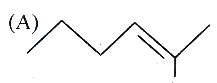
Identify the major product formed when $2-$Methylhexan$-3-$ol is heated with concentrated sulphuric acid.
A
$2-$Methylhex$-2-$ene
B
$2-$Methylhex$-3-$ene
C
$3-$Methylhex$-2-$ene
D
$3-$Methylhex$-3-$ene
Solution
(A) The dehydration of $2-$Methylhexan$-3-$ol with concentrated $H_2SO_4$ proceeds via the formation of a carbocation intermediate.
Upon elimination of a proton,multiple alkenes can be formed.
According to the Saytzeff rule,the more substituted alkene is the major product.
$2-$Methylhexan$-3-$ol undergoes dehydration to form $2-$Methylhex$-2-$ene as the major product because it is a trisubstituted alkene,which is more stable than the disubstituted $2-$Methylhex$-3-$ene.
Upon elimination of a proton,multiple alkenes can be formed.
According to the Saytzeff rule,the more substituted alkene is the major product.
$2-$Methylhexan$-3-$ol undergoes dehydration to form $2-$Methylhex$-2-$ene as the major product because it is a trisubstituted alkene,which is more stable than the disubstituted $2-$Methylhex$-3-$ene.
0 likes
View Solution758
EasyMCQ
Identify the product $B$ in the following sequence of reactions:
$CH_3-CH_2-CH_2-OH$ $\xrightarrow[623 \ K]{Al_2O_3} A$ $\xrightarrow[(ii) H_2O, \Delta]{(i) conc. H_2SO_4} B$
$CH_3-CH_2-CH_2-OH$ $\xrightarrow[623 \ K]{Al_2O_3} A$ $\xrightarrow[(ii) H_2O, \Delta]{(i) conc. H_2SO_4} B$
A
Propan$-2-$ol
B
Propan$-1-$ol
C
Isopropyl hydrogen sulphate
D
Propene
Solution
(A) Step $1$: Dehydration of $Propan-1-ol$ with $Al_2O_3$ at $623 \ K$ gives propene $(A)$ as the product.
$CH_3-CH_2-CH_2-OH \xrightarrow[623 \ K]{Al_2O_3} CH_3-CH=CH_2 (A)$
Step $2$: Addition of $conc. H_2SO_4$ to propene follows $Markovnikov's$ rule to form isopropyl hydrogen sulphate,which upon hydrolysis with water $(H_2O, \Delta)$ yields $Propan-2-ol$ $(B)$.
$CH_3-CH=CH_2$ $\xrightarrow{conc. H_2SO_4} CH_3-CH(OSO_3H)-CH_3$ $\xrightarrow{H_2O, \Delta} CH_3-CH(OH)-CH_3 (B)$
Thus,the final product $B$ is $Propan-2-ol$.
$CH_3-CH_2-CH_2-OH \xrightarrow[623 \ K]{Al_2O_3} CH_3-CH=CH_2 (A)$
Step $2$: Addition of $conc. H_2SO_4$ to propene follows $Markovnikov's$ rule to form isopropyl hydrogen sulphate,which upon hydrolysis with water $(H_2O, \Delta)$ yields $Propan-2-ol$ $(B)$.
$CH_3-CH=CH_2$ $\xrightarrow{conc. H_2SO_4} CH_3-CH(OSO_3H)-CH_3$ $\xrightarrow{H_2O, \Delta} CH_3-CH(OH)-CH_3 (B)$
Thus,the final product $B$ is $Propan-2-ol$.
0 likes
View Solution759
EasyMCQ
Identify the product $B$ in the following series of reactions.
$CH_3-CH_2-CH_2-OH$ $\xrightarrow{Al_2 O_3, 623 \ K} A$ $\xrightarrow[(ii) H_2 O]{(i) \text{conc. } H_2 SO_4} B$
$CH_3-CH_2-CH_2-OH$ $\xrightarrow{Al_2 O_3, 623 \ K} A$ $\xrightarrow[(ii) H_2 O]{(i) \text{conc. } H_2 SO_4} B$
A
Propanal
B
Propan$-2-$ol
C
Propene
D
Propanone
Solution
(B) Step $1$: Dehydration of $CH_3-CH_2-CH_2-OH$ (Propan$-1-$ol) with $Al_2 O_3$ at $623 \ K$ gives $A$,which is Propene $(CH_3-CH=CH_2)$.
Step $2$: Propene reacts with conc. $H_2 SO_4$ followed by hydrolysis $(H_2 O)$ to undergo hydration according to Markovnikov's rule.
Step $3$: The reaction follows the mechanism: $CH_3-CH=CH_2 + H_2 SO_4$ $\rightarrow CH_3-CH(OSO_3 H)-CH_3$ $\xrightarrow{H_2 O} CH_3-CH(OH)-CH_3$ (Propan$-2-$ol).
Thus,the product $B$ is Propan$-2-$ol.
Step $2$: Propene reacts with conc. $H_2 SO_4$ followed by hydrolysis $(H_2 O)$ to undergo hydration according to Markovnikov's rule.
Step $3$: The reaction follows the mechanism: $CH_3-CH=CH_2 + H_2 SO_4$ $\rightarrow CH_3-CH(OSO_3 H)-CH_3$ $\xrightarrow{H_2 O} CH_3-CH(OH)-CH_3$ (Propan$-2-$ol).
Thus,the product $B$ is Propan$-2-$ol.
0 likes
View Solution760
EasyMCQ
The correct order of dehydration of alcohols is
A
$1^{\circ} > 2^{\circ} > 3^{\circ}$
B
$3^{\circ} > 2^{\circ} > 1^{\circ}$
C
$2^{\circ} > 1^{\circ} > 3^{\circ}$
D
$1^{\circ} > 3^{\circ} > 2^{\circ}$
Solution
(B) Dehydration of alcohols involves the formation of carbocation intermediates. The ease of dehydration depends on the stability of the carbocation formed.
Since the stability order of carbocations is $3^{\circ} > 2^{\circ} > 1^{\circ}$,the order of ease of dehydration of alcohols is $3^{\circ} > 2^{\circ} > 1^{\circ}$.
Since the stability order of carbocations is $3^{\circ} > 2^{\circ} > 1^{\circ}$,the order of ease of dehydration of alcohols is $3^{\circ} > 2^{\circ} > 1^{\circ}$.
0 likes
View Solution761
EasyMCQ
Predict the major product of acid-catalyzed dehydration of butan-$1$-ol.
A
$CH_3-CH_2-CH=CH_2$
B
$CH_3-CH=CH-CH_3$
C
$CH_3-CH_2-CH_2-CH_3$
D
$CH_3-CH(OH)-CH_2-CH_3$
Solution
(B) The acid-catalyzed dehydration of butan-$1$-ol $(CH_3-CH_2-CH_2-CH_2OH)$ involves the formation of a primary carbocation,which undergoes a $1,2$-hydride shift to form a more stable secondary carbocation $(CH_3-CH^+-CH_2-CH_3)$.
Elimination of a proton from this secondary carbocation yields but-$2$-ene $(CH_3-CH=CH-CH_3)$ as the major product,following Zaitsev's rule,as it is more substituted and thus more stable than but-$1$-ene $(CH_3-CH_2-CH=CH_2)$.
Elimination of a proton from this secondary carbocation yields but-$2$-ene $(CH_3-CH=CH-CH_3)$ as the major product,following Zaitsev's rule,as it is more substituted and thus more stable than but-$1$-ene $(CH_3-CH_2-CH=CH_2)$.
0 likes
View Solution762
EasyMCQ
Which of the following alcohols undergo a dehydration reaction with $Cu$ (copper) metal at $573 \ K$ temperature?
A
Primary and secondary
B
Secondary and tertiary
C
Primary and Tertiary
D
Only tertiary
Solution
(D) The reaction of alcohols with $Cu$ at $573 \ K$ is a dehydrogenation reaction,not dehydration.
$1$. Primary alcohols $(RCH_2OH)$ form aldehydes.
$2$. Secondary alcohols $(R_2CHOH)$ form ketones.
$3$. Tertiary alcohols $(R_3COH)$ undergo dehydration to form alkenes because they cannot undergo dehydrogenation due to the absence of $\alpha$-hydrogen.
Since the question asks for the reaction with $Cu$ at $573 \ K$,tertiary alcohols specifically undergo dehydration under these conditions. Therefore,the correct option is $D$.
$1$. Primary alcohols $(RCH_2OH)$ form aldehydes.
$2$. Secondary alcohols $(R_2CHOH)$ form ketones.
$3$. Tertiary alcohols $(R_3COH)$ undergo dehydration to form alkenes because they cannot undergo dehydrogenation due to the absence of $\alpha$-hydrogen.
Since the question asks for the reaction with $Cu$ at $573 \ K$,tertiary alcohols specifically undergo dehydration under these conditions. Therefore,the correct option is $D$.
0 likes
View Solution763
EasyMCQ
Which Grignard reagent gives $2-$methylpropan$-1-$ol upon reaction with methanal followed by hydrolysis?
A
$CH_3-CH(CH_3)-MgX$
B
$CH_3-CH=CH-MgX$
C
$CH_3-CH_2-CH_2-MgX$
D
$CH_3-CH(CH_3)-CH_2-MgX$
Solution
(A) The reaction of a Grignard reagent $(R-MgX)$ with methanal $(HCHO)$ followed by hydrolysis yields a primary alcohol with one more carbon atom than the Grignard reagent.
To obtain $2-$methylpropan$-1-$ol $(CH_3-CH(CH_3)-CH_2-OH)$,the Grignard reagent must be isobutylmagnesium halide $(CH_3-CH(CH_3)-CH_2-MgX)$.
The reaction is:
$CH_3-CH(CH_3)-CH_2-MgX + HCHO \rightarrow CH_3-CH(CH_3)-CH_2-CH_2-OMgX$
$CH_3-CH(CH_3)-CH_2-CH_2-OMgX + H_2O \rightarrow CH_3-CH(CH_3)-CH_2-CH_2-OH + Mg(OH)X$
Wait,the target product is $2-$methylpropan$-1-$ol $(C_4H_{10}O)$. The reaction of $R-MgX + HCHO$ adds one carbon. Thus,$R$ must be an isopropyl group $(CH_3-CH(CH_3)-)$.
$CH_3-CH(CH_3)-MgX + HCHO$ $\rightarrow CH_3-CH(CH_3)-CH_2-OMgX$ $\xrightarrow{H_2O} CH_3-CH(CH_3)-CH_2-OH$.
Therefore,the correct Grignard reagent is isopropylmagnesium halide,which is option $A$.
To obtain $2-$methylpropan$-1-$ol $(CH_3-CH(CH_3)-CH_2-OH)$,the Grignard reagent must be isobutylmagnesium halide $(CH_3-CH(CH_3)-CH_2-MgX)$.
The reaction is:
$CH_3-CH(CH_3)-CH_2-MgX + HCHO \rightarrow CH_3-CH(CH_3)-CH_2-CH_2-OMgX$
$CH_3-CH(CH_3)-CH_2-CH_2-OMgX + H_2O \rightarrow CH_3-CH(CH_3)-CH_2-CH_2-OH + Mg(OH)X$
Wait,the target product is $2-$methylpropan$-1-$ol $(C_4H_{10}O)$. The reaction of $R-MgX + HCHO$ adds one carbon. Thus,$R$ must be an isopropyl group $(CH_3-CH(CH_3)-)$.
$CH_3-CH(CH_3)-MgX + HCHO$ $\rightarrow CH_3-CH(CH_3)-CH_2-OMgX$ $\xrightarrow{H_2O} CH_3-CH(CH_3)-CH_2-OH$.
Therefore,the correct Grignard reagent is isopropylmagnesium halide,which is option $A$.
0 likes
View Solution764
EasyMCQ
Which of the following has the highest boiling point?
A
Pentan-$1$-ol
B
Ethoxy ethane
C
Pentanal
D
$n$-Butane
Solution
(A) The boiling point of organic compounds depends on the intermolecular forces present.
$1$. Pentan-$1$-ol is an alcohol,which exhibits strong intermolecular hydrogen bonding.
$2$. Pentanal is an aldehyde,which has dipole-dipole interactions.
$3$. Ethoxy ethane is an ether,which has weaker dipole-dipole interactions.
$4$. $n$-Butane is an alkane,which only has weak London dispersion forces.
Since hydrogen bonding is the strongest intermolecular force among these,Pentan-$1$-ol has the highest boiling point.
$1$. Pentan-$1$-ol is an alcohol,which exhibits strong intermolecular hydrogen bonding.
$2$. Pentanal is an aldehyde,which has dipole-dipole interactions.
$3$. Ethoxy ethane is an ether,which has weaker dipole-dipole interactions.
$4$. $n$-Butane is an alkane,which only has weak London dispersion forces.
Since hydrogen bonding is the strongest intermolecular force among these,Pentan-$1$-ol has the highest boiling point.
0 likes
View Solution765
EasyMCQ
Which of the following alcohols has the highest boiling point?
A
propan$-2-$ol
B
butan$-2-$ol
C
$2-$Methylpropan$-2-$ol
D
butan$-1-$ol
Solution
(D) The boiling point of alcohols depends on the extent of hydrogen bonding and the surface area of the molecule.
$1$. Among the given options,$butan-1-ol$ is a primary alcohol with a straight-chain structure,which provides a larger surface area for van der Waals forces compared to branched isomers.
$2$. $Propan-2-ol$ has $3$ carbons,$butan-2-ol$ is a secondary alcohol,and $2-Methylpropan-2-ol$ is a tertiary alcohol.
$3$. As branching increases,the surface area decreases,leading to weaker intermolecular forces and lower boiling points.
$4$. Therefore,$butan-1-ol$ has the highest boiling point among the given options due to its linear structure and higher molecular mass compared to $propan-2-ol$.
$1$. Among the given options,$butan-1-ol$ is a primary alcohol with a straight-chain structure,which provides a larger surface area for van der Waals forces compared to branched isomers.
$2$. $Propan-2-ol$ has $3$ carbons,$butan-2-ol$ is a secondary alcohol,and $2-Methylpropan-2-ol$ is a tertiary alcohol.
$3$. As branching increases,the surface area decreases,leading to weaker intermolecular forces and lower boiling points.
$4$. Therefore,$butan-1-ol$ has the highest boiling point among the given options due to its linear structure and higher molecular mass compared to $propan-2-ol$.
0 likes
View Solution766
EasyMCQ
Which is the final product obtained by the reaction of Grignard reagent ethyl magnesium bromide with propanone?
A
$2-$Methylbutan$-1-$ol
B
$2-$Methylbutan$-2-$ol
C
Pentan$-1-$ol
D
$3-$Methylbutan$-2-$ol
Solution
(B) The reaction between a Grignard reagent $(CH_3CH_2MgBr)$ and a ketone $(CH_3COCH_3)$ proceeds via nucleophilic addition to the carbonyl group.
$1$. The ethyl group $(CH_3CH_2^-)$ acts as a nucleophile and attacks the electrophilic carbonyl carbon of propanone.
$2$. This forms an intermediate magnesium alkoxide: $(CH_3)_2C(OMgBr)(CH_2CH_3)$.
$3$. Subsequent acid hydrolysis of this intermediate yields the tertiary alcohol: $(CH_3)_2C(OH)(CH_2CH_3)$.
$4$. The $IUPAC$ name of the product $(CH_3)_2C(OH)CH_2CH_3$ is $2-$methylbutan$-2-$ol.
Therefore,the correct option is $B$.
$1$. The ethyl group $(CH_3CH_2^-)$ acts as a nucleophile and attacks the electrophilic carbonyl carbon of propanone.
$2$. This forms an intermediate magnesium alkoxide: $(CH_3)_2C(OMgBr)(CH_2CH_3)$.
$3$. Subsequent acid hydrolysis of this intermediate yields the tertiary alcohol: $(CH_3)_2C(OH)(CH_2CH_3)$.
$4$. The $IUPAC$ name of the product $(CH_3)_2C(OH)CH_2CH_3$ is $2-$methylbutan$-2-$ol.
Therefore,the correct option is $B$.
0 likes
View Solution767
EasyMCQ
Which of the following reactions produces an organic product with the lowest boiling point?
A
$A$. $CH_3-CH_2-COOH \xrightarrow[H_2O]{LiAlH_4} CH_3-CH_2-CH_2OH$
B
$B$. $CH_3-CO-CH_3 \xrightarrow[H_2O]{NaBH_4} CH_3-CH(OH)-CH_3$
C
$C$. $CH_3-CH_2-CHO \xrightarrow[H_2O]{NaBH_4} CH_3-CH_2-CH_2OH$
D
$D$. $CH_3-CH=CH_2 \xrightarrow[H_2O_2, OH^-]{(BH_3)_2} CH_3-CH_2-CH_2OH$
Solution
(B) The products of the reactions are:
$A$. $CH_3-CH_2-CH_2OH$ (propan$-1-$ol,boiling point $\approx 97 \ ^\circ C$)
$B$. $CH_3-CH(OH)-CH_3$ (propan$-2-$ol,boiling point $\approx 82 \ ^\circ C$)
$C$. $CH_3-CH_2-CH_2OH$ (propan$-1-$ol,boiling point $\approx 97 \ ^\circ C$)
$D$. $CH_3-CH_2-CH_2OH$ (propan$-1-$ol,boiling point $\approx 97 \ ^\circ C$)
Among the isomers,branched-chain alcohols have a lower boiling point than straight-chain alcohols due to a smaller surface area,which leads to weaker van der Waals forces.
Therefore,propan$-2-$ol $(B)$ has the lowest boiling point.
$A$. $CH_3-CH_2-CH_2OH$ (propan$-1-$ol,boiling point $\approx 97 \ ^\circ C$)
$B$. $CH_3-CH(OH)-CH_3$ (propan$-2-$ol,boiling point $\approx 82 \ ^\circ C$)
$C$. $CH_3-CH_2-CH_2OH$ (propan$-1-$ol,boiling point $\approx 97 \ ^\circ C$)
$D$. $CH_3-CH_2-CH_2OH$ (propan$-1-$ol,boiling point $\approx 97 \ ^\circ C$)
Among the isomers,branched-chain alcohols have a lower boiling point than straight-chain alcohols due to a smaller surface area,which leads to weaker van der Waals forces.
Therefore,propan$-2-$ol $(B)$ has the lowest boiling point.
0 likes
View Solution768
EasyMCQ
With which of the following reactants does the treatment of primary alcohol yield aldehydes?
A
$PCC + CH_2Cl_2$
B
$KMnO_4 + H_2SO_4$
C
$KMnO_4 + KOH$
D
$Na_2Cr_2O_7 + H_2SO_4$
Solution
(A) Primary alcohols $(R-CH_2OH)$ are oxidized to aldehydes $(R-CHO)$ using mild oxidizing agents.
$PCC$ (Pyridinium chlorochromate) in $CH_2Cl_2$ is a selective oxidizing agent that stops the oxidation at the aldehyde stage.
Strong oxidizing agents like $KMnO_4$ (in acidic or basic medium) or $Na_2Cr_2O_7 + H_2SO_4$ (Jones reagent) oxidize primary alcohols directly to carboxylic acids $(R-COOH)$.
$PCC$ (Pyridinium chlorochromate) in $CH_2Cl_2$ is a selective oxidizing agent that stops the oxidation at the aldehyde stage.
Strong oxidizing agents like $KMnO_4$ (in acidic or basic medium) or $Na_2Cr_2O_7 + H_2SO_4$ (Jones reagent) oxidize primary alcohols directly to carboxylic acids $(R-COOH)$.
0 likes
View Solution769
EasyMCQ
In which of the following reactions of alcohol is there no cleavage of the $C-O$ bond?
A
Oxidation reaction of alcohol.
B
Dehydration reaction of alcohol.
C
Reaction of alcohol with $PBr_3$.
D
Reaction of alcohol with $HCl$ in the presence of $ZnCl_2$.
Solution
(A) In the oxidation reaction of alcohols,the $O-H$ bond is cleaved,and a $C-H$ bond is broken to form a carbonyl group $(C=O)$. The $C-O$ bond remains intact.
In dehydration,$PBr_3$ reaction,and reaction with $HCl$ (Lucas test),the $C-O$ bond is cleaved to form alkenes or alkyl halides.
Therefore,the correct answer is $A$.
In dehydration,$PBr_3$ reaction,and reaction with $HCl$ (Lucas test),the $C-O$ bond is cleaved to form alkenes or alkyl halides.
Therefore,the correct answer is $A$.
0 likes
View Solution770
EasyMCQ
Which of the following alcohols has the highest solubility in water?
A
Secondary butyl alcohol
B
Tertiary butyl alcohol
C
Ethylene glycol
D
Glycerol
Solution
(D) The solubility of alcohols in water depends on the ability to form hydrogen bonds with water molecules.
As the number of hydroxyl $(-OH)$ groups increases,the number of hydrogen bonds formed with water increases,leading to higher solubility.
$A$: Secondary butyl alcohol $(C_4H_9OH)$ has $1$ $-OH$ group.
$B$: Tertiary butyl alcohol $(C_4H_9OH)$ has $1$ $-OH$ group.
$C$: Ethylene glycol $(HO-CH_2-CH_2-OH)$ has $2$ $-OH$ groups.
$D$: Glycerol $(HO-CH_2-CH(OH)-CH_2-OH)$ has $3$ $-OH$ groups.
Since glycerol has the maximum number of $-OH$ groups,it forms the most extensive hydrogen bonding with water,making it the most soluble among the given options.
Therefore,the correct option is $D$.
As the number of hydroxyl $(-OH)$ groups increases,the number of hydrogen bonds formed with water increases,leading to higher solubility.
$A$: Secondary butyl alcohol $(C_4H_9OH)$ has $1$ $-OH$ group.
$B$: Tertiary butyl alcohol $(C_4H_9OH)$ has $1$ $-OH$ group.
$C$: Ethylene glycol $(HO-CH_2-CH_2-OH)$ has $2$ $-OH$ groups.
$D$: Glycerol $(HO-CH_2-CH(OH)-CH_2-OH)$ has $3$ $-OH$ groups.
Since glycerol has the maximum number of $-OH$ groups,it forms the most extensive hydrogen bonding with water,making it the most soluble among the given options.
Therefore,the correct option is $D$.
0 likes
View Solution771
EasyMCQ
Which of the following compounds is more acidic?
A
$(CH_3)_3C-OH$
B
$CH_3-CH_2-CH_2-OH$
C
$CH_3-CH(OH)-CH_3$
D
$CH_3-OH$
Solution
(D) The acidity of alcohols depends on the stability of the alkoxide ion formed after the loss of a proton $(H^+)$.
Alkyl groups are electron-donating groups ($+I$ effect).
As the number of alkyl groups attached to the carbon atom bearing the $-OH$ group increases,the electron density on the oxygen atom increases due to the $+I$ effect,which destabilizes the alkoxide ion.
Therefore,the order of acidity is: $primary > secondary > tertiary$.
Among the given options:
$(A)$ $(CH_3)_3C-OH$ is a tertiary alcohol.
$(B)$ $CH_3-CH_2-CH_2-OH$ is a primary alcohol.
$(C)$ $CH_3-CH(OH)-CH_3$ is a secondary alcohol.
$(D)$ $CH_3-OH$ is methanol (the simplest alcohol with no alkyl group attached to the carbon bearing $-OH$).
Since methanol has no electron-donating alkyl groups to destabilize the methoxide ion,it is the most acidic among the given options.
Alkyl groups are electron-donating groups ($+I$ effect).
As the number of alkyl groups attached to the carbon atom bearing the $-OH$ group increases,the electron density on the oxygen atom increases due to the $+I$ effect,which destabilizes the alkoxide ion.
Therefore,the order of acidity is: $primary > secondary > tertiary$.
Among the given options:
$(A)$ $(CH_3)_3C-OH$ is a tertiary alcohol.
$(B)$ $CH_3-CH_2-CH_2-OH$ is a primary alcohol.
$(C)$ $CH_3-CH(OH)-CH_3$ is a secondary alcohol.
$(D)$ $CH_3-OH$ is methanol (the simplest alcohol with no alkyl group attached to the carbon bearing $-OH$).
Since methanol has no electron-donating alkyl groups to destabilize the methoxide ion,it is the most acidic among the given options.
0 likes
View Solution772
EasyMCQ
Which compound gives a fast reaction with Lucas's reagent?
A
$CH_3CH_2CH(CH_3)OH$
B
$(CH_3)_2CHOH$
C
$(CH_3)_3COH$
D
$CH_3CH_2CH_2OH$
Solution
(C) The reactivity of alcohols with Lucas's reagent $(conc. \ HCl + anhydrous \ ZnCl_2)$ follows the order: $3^\circ > 2^\circ > 1^\circ$.
This is because the reaction proceeds via an $S_N1$ mechanism involving the formation of a carbocation intermediate.
$3^\circ$ alcohols form the most stable carbocation and thus react the fastest,typically at room temperature.
$(CH_3)_3COH$ is a tertiary $(3^\circ)$ alcohol,while the others are secondary $(2^\circ)$ or primary $(1^\circ)$ alcohols.
Therefore,$(CH_3)_3COH$ gives the fastest reaction.
This is because the reaction proceeds via an $S_N1$ mechanism involving the formation of a carbocation intermediate.
$3^\circ$ alcohols form the most stable carbocation and thus react the fastest,typically at room temperature.
$(CH_3)_3COH$ is a tertiary $(3^\circ)$ alcohol,while the others are secondary $(2^\circ)$ or primary $(1^\circ)$ alcohols.
Therefore,$(CH_3)_3COH$ gives the fastest reaction.
0 likes
View Solution773
EasyMCQ
Which compound will give a yellow precipitate on reaction with sodium hypoiodite?
A
isobutyl alcohol
B
$tert-$butyl alcohol
C
$n-$butyl alcohol
D
$sec-$butyl alcohol
Solution
(D) The reaction with sodium hypoiodite $(NaOI)$ is the iodoform test.
Compounds containing the $CH_3CH(OH)-$ group or the $CH_3CO-$ group give a positive iodoform test,resulting in a yellow precipitate of iodoform $(CHI_3)$.
Among the given options,$sec-$butyl alcohol $(CH_3CH(OH)CH_2CH_3)$ contains the $CH_3CH(OH)-$ structural unit.
Therefore,$sec-$butyl alcohol reacts with $NaOI$ to form a yellow precipitate.
Compounds containing the $CH_3CH(OH)-$ group or the $CH_3CO-$ group give a positive iodoform test,resulting in a yellow precipitate of iodoform $(CHI_3)$.
Among the given options,$sec-$butyl alcohol $(CH_3CH(OH)CH_2CH_3)$ contains the $CH_3CH(OH)-$ structural unit.
Therefore,$sec-$butyl alcohol reacts with $NaOI$ to form a yellow precipitate.
0 likes
View Solution774
EasyMCQ
Which reagent is required to convert cyclohexanol to cyclohexanone?
A
$DIBAL-H$
B
$O_3 / H_2O - Zn$ dust
C
Anhydrous $CrO_3$
D
$PCC$
Solution
(C) The oxidation of secondary alcohols like cyclohexanol to ketones like cyclohexanone can be achieved using various oxidizing agents.
Anhydrous $CrO_3$ (Jones reagent or similar chromium-based oxidants) is a standard reagent used for the oxidation of secondary alcohols to ketones.
Therefore,the correct reagent is anhydrous $CrO_3$.
Anhydrous $CrO_3$ (Jones reagent or similar chromium-based oxidants) is a standard reagent used for the oxidation of secondary alcohols to ketones.
Therefore,the correct reagent is anhydrous $CrO_3$.
0 likes
View Solution775
EasyMCQ
Denatured alcohol is:
A
ethanol + methanol
B
rectified spirit + methanol + naphtha
C
undistilled ethanol
D
rectified spirit
Solution
(B) Denatured alcohol is ethyl alcohol that has been made unfit for drinking by adding poisonous substances such as methanol,naphtha,pyridine,or rubber. This process is done to prevent the misuse of industrial alcohol for consumption.
0 likes
View Solution776
MediumMCQ
$PCC$ is
A
$K_2Cr_2O_7 + \text{Pyridine}$
B
$CrO_3 + CHCl_3$
C
$CrO_3 + H_2SO_4$
D
$A$ complex of chromium trioxide with pyridine $+ HCl$
Solution
(D) $PCC$ stands for pyridinium chlorochromate.
It is a complex of chromium trioxide with pyridine and $HCl$,represented as $[C_5H_5NH]^{+}[CrO_3Cl]^{-}$.
It is a reagent in organic synthesis used primarily for the oxidation of primary alcohols to aldehydes and secondary alcohols to ketones.
It is a complex of chromium trioxide with pyridine and $HCl$,represented as $[C_5H_5NH]^{+}[CrO_3Cl]^{-}$.
It is a reagent in organic synthesis used primarily for the oxidation of primary alcohols to aldehydes and secondary alcohols to ketones.
0 likes
View Solution777
EasyMCQ
The major product obtained when ethanol is heated with excess of conc. $H_2SO_4$ at $443 \ K$ is:
A
ethyne
B
ethane
C
methane
D
ethene
Solution
(D) The reaction of ethanol with excess concentrated $H_2SO_4$ at $443 \ K$ is a dehydration reaction.
In this process,a molecule of water is removed from ethanol to form ethene.
The chemical equation is:
$CH_3CH_2OH \xrightarrow[443 \ K]{\text{Conc. } H_2SO_4} CH_2=CH_2 + H_2O$
In this process,a molecule of water is removed from ethanol to form ethene.
The chemical equation is:
$CH_3CH_2OH \xrightarrow[443 \ K]{\text{Conc. } H_2SO_4} CH_2=CH_2 + H_2O$
0 likes
View Solution778
DifficultMCQ
The steps involved in the conversion of propan$-2-$ol to propan$-1-$ol are in the order
A
dehydration,addition of $HBr$,heating with aq. $KOH$
B
heating with $PCl_{5}$,heating with alc. $KOH$,acid catalysed addition of water
C
heating with $PCl_{5}$,heating with alc. $KOH$,hydroboration oxidation
D
dehydration,addition of $HBr$ in presence of peroxide,heating with alc. $KOH$
Solution
(C) The conversion of propan$-2-$ol to propan$-1-$ol proceeds as follows:
$1$. Propan$-2-$ol reacts with $PCl_{5}$ to form $2-$chloropropane.
$2$. $2-$chloropropane undergoes dehydrohalogenation with alcoholic $KOH$ to form propene.
$3$. Propene undergoes hydroboration-oxidation (reaction with $B_{2}H_{6}$ followed by $H_{2}O_{2}/NaOH$) to form propan$-1-$ol via anti-Markovnikov addition of water.
$1$. Propan$-2-$ol reacts with $PCl_{5}$ to form $2-$chloropropane.
$2$. $2-$chloropropane undergoes dehydrohalogenation with alcoholic $KOH$ to form propene.
$3$. Propene undergoes hydroboration-oxidation (reaction with $B_{2}H_{6}$ followed by $H_{2}O_{2}/NaOH$) to form propan$-1-$ol via anti-Markovnikov addition of water.
0 likes
View Solution779
DifficultMCQ
Which of the following can be used to test the acidic nature of ethanol?
A
$NaHCO_{3}$
B
$Na$ metal
C
Blue litmus solution
D
$Na_{2}CO_{3}$
Solution
(B)
$1$. Ethanol is a very weak acid,much weaker than water. It does not react with bases like $NaHCO_{3}$ or $Na_{2}CO_{3}$ and does not change the color of litmus paper.
$2$. However,it reacts with active metals like sodium $(Na)$ to evolve hydrogen gas $(H_{2})$,which confirms its acidic hydrogen atom.
$3$. The reaction is: $2C_{2}H_{5}OH + 2Na \rightarrow 2C_{2}H_{5}ONa + H_{2} \uparrow$
$1$. Ethanol is a very weak acid,much weaker than water. It does not react with bases like $NaHCO_{3}$ or $Na_{2}CO_{3}$ and does not change the color of litmus paper.
$2$. However,it reacts with active metals like sodium $(Na)$ to evolve hydrogen gas $(H_{2})$,which confirms its acidic hydrogen atom.
$3$. The reaction is: $2C_{2}H_{5}OH + 2Na \rightarrow 2C_{2}H_{5}ONa + H_{2} \uparrow$
0 likes
View Solution780
DifficultMCQ
When the vapours of tertiary butyl alcohol are passed through heated copper at $573 \ K$,the product formed is
A
$2-$Methylpropene
B
$2-$Butanone
C
Butan$-2-$ol
D
Butanal
Solution
(A) When vapours of tertiary alcohols are passed over heated copper at $573 \ K$,they undergo dehydration to form alkenes.
$(CH_3)_3COH \xrightarrow[573 \ K]{Cu} CH_2=C(CH_3)_2 + H_2O$
Thus,the product formed is $2-$methylpropene.
$(CH_3)_3COH \xrightarrow[573 \ K]{Cu} CH_2=C(CH_3)_2 + H_2O$
Thus,the product formed is $2-$methylpropene.
0 likes
View Solution781
EasyMCQ
The compound which gives turbidity immediately with Lucas reagent at room temperature is
A
butan$-1-$ol
B
butan$-2-$ol
C
$2-$methyl propan$-2-$ol
D
$2-$methyl propan$-1-$ol
Solution
(C) Lucas reagent is a mixture of concentrated $HCl$ and anhydrous $ZnCl_2$.
Tertiary $(3^{\circ})$ alcohols react immediately with Lucas reagent at room temperature to form alkyl chlorides,which appear as turbidity.
Secondary $(2^{\circ})$ alcohols react within $5-10$ minutes.
Primary $(1^{\circ})$ alcohols do not react at room temperature.
Among the given options,$2-$methyl propan$-2-$ol is a tertiary alcohol,so it gives turbidity immediately.
Tertiary $(3^{\circ})$ alcohols react immediately with Lucas reagent at room temperature to form alkyl chlorides,which appear as turbidity.
Secondary $(2^{\circ})$ alcohols react within $5-10$ minutes.
Primary $(1^{\circ})$ alcohols do not react at room temperature.
Among the given options,$2-$methyl propan$-2-$ol is a tertiary alcohol,so it gives turbidity immediately.
0 likes
View Solution782
MediumMCQ
Lucas test is associated with
A
aldehydes
B
phenols
C
carboxylic acids
D
alcohols
Solution
(D) The Lucas test is a chemical test used to distinguish between primary,secondary,and tertiary alcohols. It involves the reaction of an alcohol with Lucas reagent ($conc. \ HCl$ and $ZnCl_2$). Tertiary alcohols react immediately to form a cloudy precipitate,secondary alcohols react within $5-10 \ minutes$,and primary alcohols do not react at room temperature.
0 likes
View Solution783
MediumMCQ
Ethanol is converted into ethoxyethane by:
A
heating an excess of ethanol with conc. $H_2SO_4$ at $140^{\circ}C$ $(413\ K)$.
B
heating ethanol with an excess of conc. $H_2SO_4$ at $443\ K$.
C
treating with conc. $H_2SO_4$ at room temperature.
D
treating with conc. $H_2SO_4$ at $273\ K$.
Solution
(A) The dehydration of ethanol to form ethoxyethane (diethyl ether) is an intermolecular dehydration reaction.
When an excess of ethanol is heated with concentrated $H_2SO_4$ at $413\ K$ $(140^{\circ}C)$,two molecules of ethanol undergo condensation to form ethoxyethane and water.
The reaction is: $2CH_3CH_2OH \xrightarrow{conc. H_2SO_4, 413\ K} CH_3CH_2-O-CH_2CH_3 + H_2O$.
Heating at $443\ K$ leads to intramolecular dehydration,forming ethene $(CH_2=CH_2)$.
When an excess of ethanol is heated with concentrated $H_2SO_4$ at $413\ K$ $(140^{\circ}C)$,two molecules of ethanol undergo condensation to form ethoxyethane and water.
The reaction is: $2CH_3CH_2OH \xrightarrow{conc. H_2SO_4, 413\ K} CH_3CH_2-O-CH_2CH_3 + H_2O$.
Heating at $443\ K$ leads to intramolecular dehydration,forming ethene $(CH_2=CH_2)$.
0 likes
View Solution784
EasyMCQ
Catalytic dehydrogenation of a primary alcohol gives a
A
secondary alcohol
B
aldehyde
C
ketone
D
ester
Solution
(B) When vapors of a primary alcohol are passed over reduced copper catalyst at $573 \ K$,dehydrogenation occurs to form an aldehyde.
The reaction is represented as:
$R-CH_2OH \xrightarrow{Cu, 573 \ K} R-CHO + H_2$
Thus,the correct product is an aldehyde.
The reaction is represented as:
$R-CH_2OH \xrightarrow{Cu, 573 \ K} R-CHO + H_2$
Thus,the correct product is an aldehyde.
0 likes
View Solution785
MediumMCQ
The compound on dehydrogenation gives a ketone. The original compound is
A
primary alcohol
B
secondary alcohol
C
tertiary alcohol
D
carboxylic acid
Solution
(B) When vapors of secondary alcohols are passed over heated copper $(Cu)$ catalyst at $573 \ K$,they undergo dehydrogenation to form ketones.
The general reaction is:
$R_2CH-OH \xrightarrow{Cu, 573 \ K} R_2C=O + H_2$
The general reaction is:
$R_2CH-OH \xrightarrow{Cu, 573 \ K} R_2C=O + H_2$
0 likes
View Solution786
DifficultMCQ
$8.8 \ g$ of monohydric alcohol added to ethyl magnesium iodide in ether liberates $2240 \ cm^3$ of ethane at $STP$. This monohydric alcohol when oxidized using pyridinium chlorochromate $(PCC)$,forms a carbonyl compound that answers the silver mirror test (Tollen's test). The monohydric alcohol is:
A
butan-$2$-ol
B
$2, 2$-dimethylpropan-$1$-ol
C
pentan-$2$-ol
D
$2$-methylpropan-$1$-ol
Solution
(B) The reaction of monohydric alcohol $(R-OH)$ with ethyl magnesium iodide $(C_2H_5MgI)$ is: $R-OH + C_2H_5MgI \rightarrow R-OMgI + C_2H_6 \uparrow$.
At $STP$,$1 \ mol$ of ethane occupies $22400 \ cm^3$.
Given $2240 \ cm^3$ of ethane is liberated,which corresponds to $2240 / 22400 = 0.1 \ mol$ of ethane.
Since $1 \ mol$ of alcohol produces $1 \ mol$ of ethane,$0.1 \ mol$ of alcohol has a mass of $8.8 \ g$.
Thus,the molar mass of the alcohol is $8.8 / 0.1 = 88 \ g/mol$.
The general formula for a saturated monohydric alcohol is $C_nH_{2n+1}OH$,so $12n + (2n+1) + 16 + 1 = 88$,which gives $14n = 70$,so $n = 5$.
The alcohol is a pentanol isomer $(C_5H_{12}O)$.
Since the alcohol forms an aldehyde upon oxidation with $PCC$ (which gives a positive Tollen's test),it must be a primary $(1^{\circ})$ alcohol.
Among the options,$2, 2$-dimethylpropan-$1$-ol has the formula $(CH_3)_3CCH_2OH$,which is a primary alcohol with molar mass $88 \ g/mol$.
At $STP$,$1 \ mol$ of ethane occupies $22400 \ cm^3$.
Given $2240 \ cm^3$ of ethane is liberated,which corresponds to $2240 / 22400 = 0.1 \ mol$ of ethane.
Since $1 \ mol$ of alcohol produces $1 \ mol$ of ethane,$0.1 \ mol$ of alcohol has a mass of $8.8 \ g$.
Thus,the molar mass of the alcohol is $8.8 / 0.1 = 88 \ g/mol$.
The general formula for a saturated monohydric alcohol is $C_nH_{2n+1}OH$,so $12n + (2n+1) + 16 + 1 = 88$,which gives $14n = 70$,so $n = 5$.
The alcohol is a pentanol isomer $(C_5H_{12}O)$.
Since the alcohol forms an aldehyde upon oxidation with $PCC$ (which gives a positive Tollen's test),it must be a primary $(1^{\circ})$ alcohol.
Among the options,$2, 2$-dimethylpropan-$1$-ol has the formula $(CH_3)_3CCH_2OH$,which is a primary alcohol with molar mass $88 \ g/mol$.
0 likes
View Solution787
EasyMCQ
$A$ better reagent to oxidize primary alcohols into aldehydes is
A
$PCC$
B
Alkaline $KMnO_4$
C
Acidified $K_2Cr_2O_7$
D
$CrO_3$
Solution
(A) $PCC$ (pyridinium chlorochromate) is a commonly used reagent for the oxidation of primary alcohols to aldehydes.
It is favored due to its selectivity,mild reaction conditions,compatibility with other functional groups,and its ability to stop the oxidation at the aldehyde stage without further oxidation to carboxylic acids.
It is favored due to its selectivity,mild reaction conditions,compatibility with other functional groups,and its ability to stop the oxidation at the aldehyde stage without further oxidation to carboxylic acids.
0 likes
View Solution788
MediumMCQ
Consider the following reaction sequence:
$CH_3CHO$ $\xrightarrow[(ii) H_3O^+]{(i) CH_3MgBr} A$ $\xrightarrow[\Delta]{Conc. H_2SO_4} B$ $\xrightarrow[(ii) H_2O, OH^-]{(i) B_2H_6} C$
$A$ and $C$ are:
$CH_3CHO$ $\xrightarrow[(ii) H_3O^+]{(i) CH_3MgBr} A$ $\xrightarrow[\Delta]{Conc. H_2SO_4} B$ $\xrightarrow[(ii) H_2O, OH^-]{(i) B_2H_6} C$
$A$ and $C$ are:
A
Identical
B
Position isomers
C
Functional isomers
D
Optical isomers
Solution
(B) $1$. Reaction of $CH_3CHO$ with $CH_3MgBr$ followed by hydrolysis gives $A$,which is $CH_3-CH(OH)-CH_3$ (Propan$-2-$ol).
$2$. Dehydration of $A$ with $Conc. H_2SO_4$ at high temperature gives $B$,which is $CH_3-CH=CH_2$ (Prop$-1-$ene).
$3$. Hydroboration-oxidation of $B$ $(CH_3-CH=CH_2)$ with $(i) B_2H_6$ and $(ii) H_2O_2/OH^-$ follows anti-Markovnikov addition of water to give $C$,which is $CH_3-CH_2-CH_2OH$ (Propan$-1-$ol).
$4$. Comparing $A$ $(CH_3-CH(OH)-CH_3)$ and $C$ $(CH_3-CH_2-CH_2OH)$,the position of the $-OH$ group is different (carbon-$2$ vs carbon-$1$). Therefore,they are position isomers.
$2$. Dehydration of $A$ with $Conc. H_2SO_4$ at high temperature gives $B$,which is $CH_3-CH=CH_2$ (Prop$-1-$ene).
$3$. Hydroboration-oxidation of $B$ $(CH_3-CH=CH_2)$ with $(i) B_2H_6$ and $(ii) H_2O_2/OH^-$ follows anti-Markovnikov addition of water to give $C$,which is $CH_3-CH_2-CH_2OH$ (Propan$-1-$ol).
$4$. Comparing $A$ $(CH_3-CH(OH)-CH_3)$ and $C$ $(CH_3-CH_2-CH_2OH)$,the position of the $-OH$ group is different (carbon-$2$ vs carbon-$1$). Therefore,they are position isomers.
0 likes
View Solution789
EasyMCQ
An organic compound $X$ on treatment with $PCC$ in dichloromethane gives the compound $Y$. Compound $Y$ reacts with $I_{2}$ and alkali to form a yellow precipitate of triiodomethane. The compound $X$ is
A
$CH_{3}CHO$
B
$CH_{3}COCH_{3}$
C
$CH_{3}CH_{2}OH$
D
$CH_{3}COOH$
Solution
(C) Compound $(Y)$ gives the iodoform test,which means it contains an acetyl group $(CH_{3}-C=O)$.
$PCC$ (Pyridinium chlorochromate) is an oxidizing agent that oxidizes primary alcohols to aldehydes and secondary alcohols to ketones.
Since compound $Y$ is formed from $X$ using $PCC$ and $Y$ gives the iodoform test,$Y$ must be acetaldehyde $(CH_{3}CHO)$,as it is the only aldehyde that gives the iodoform test.
Therefore,the starting material $X$ must be ethanol $(CH_{3}CH_{2}OH)$.
The reactions are as follows:
$CH_{3}CH_{2}OH$ $\xrightarrow{PCC} CH_{3}CHO$ $\xrightarrow{I_{2}/OH^{-}} CHI_{3} + HCOONa$
$PCC$ (Pyridinium chlorochromate) is an oxidizing agent that oxidizes primary alcohols to aldehydes and secondary alcohols to ketones.
Since compound $Y$ is formed from $X$ using $PCC$ and $Y$ gives the iodoform test,$Y$ must be acetaldehyde $(CH_{3}CHO)$,as it is the only aldehyde that gives the iodoform test.
Therefore,the starting material $X$ must be ethanol $(CH_{3}CH_{2}OH)$.
The reactions are as follows:
$CH_{3}CH_{2}OH$ $\xrightarrow{PCC} CH_{3}CHO$ $\xrightarrow{I_{2}/OH^{-}} CHI_{3} + HCOONa$
0 likes
View Solution790
EasyMCQ
Iodoform can be prepared from all,except
A
propan$-2-$ol
B
butan$-2-$one
C
propan$-1-$ol
D
acetophenone
Solution
(C) Iodoform test is given by compounds containing the $-COCH_{3}$ group or the $-CH(OH)CH_{3}$ group.
Propan$-2-$ol contains the $-CH(OH)CH_{3}$ group.
Butan$-2-$one contains the $-COCH_{3}$ group.
Acetophenone contains the $-COCH_{3}$ group attached to a benzene ring.
Propan$-1-$ol is a primary alcohol $(CH_{3}CH_{2}CH_{2}OH)$ and does not contain the $-CH(OH)CH_{3}$ group. Ethanol is the only primary alcohol that gives the iodoform reaction.
Propan$-2-$ol contains the $-CH(OH)CH_{3}$ group.
Butan$-2-$one contains the $-COCH_{3}$ group.
Acetophenone contains the $-COCH_{3}$ group attached to a benzene ring.
Propan$-1-$ol is a primary alcohol $(CH_{3}CH_{2}CH_{2}OH)$ and does not contain the $-CH(OH)CH_{3}$ group. Ethanol is the only primary alcohol that gives the iodoform reaction.
0 likes
View Solution791
MediumMCQ
The reaction involved in the oil of wintergreen test is salicylic acid + reagent $\xrightarrow[Conc. H_{2}SO_{4}]{\Delta}$ product. The product is treated with $Na_{2}CO_{3}$ solution. The missing reagent in the above reaction is
A
phenol
B
$NaOH$
C
ethanol
D
methanol
Solution
(D) The oil of wintergreen test is an esterification reaction used to identify salicylic acid.
Salicylic acid reacts with methanol $(CH_{3}OH)$ in the presence of a few drops of concentrated $H_{2}SO_{4}$ (acid catalyst) upon heating to form methyl salicylate.
Methyl salicylate is an ester that has the characteristic smell of oil of wintergreen.
The reaction is: $C_{6}H_{4}(OH)COOH + CH_{3}OH \xrightarrow[Conc. H_{2}SO_{4}]{\Delta} C_{6}H_{4}(OH)COOCH_{3} + H_{2}O$.
Salicylic acid reacts with methanol $(CH_{3}OH)$ in the presence of a few drops of concentrated $H_{2}SO_{4}$ (acid catalyst) upon heating to form methyl salicylate.
Methyl salicylate is an ester that has the characteristic smell of oil of wintergreen.
The reaction is: $C_{6}H_{4}(OH)COOH + CH_{3}OH \xrightarrow[Conc. H_{2}SO_{4}]{\Delta} C_{6}H_{4}(OH)COOCH_{3} + H_{2}O$.
0 likes
View Solution792
EasyMCQ
The iodoform reaction is given by all of the following,except:
A
$CH_{3}CHO$
B
$CH_{3}CH_{2}CH_{2}OH$
C
$CH_{3}CH(OH)CH_{2}COOH$
D
$CH_{3}CH_{2}OH$
Solution
(B) The iodoform reaction is given by compounds containing the $CH_{3}CO-$ group or the $CH_{3}CH(OH)-$ group.
$A) \ CH_{3}CHO$ contains the $CH_{3}CO-$ group,so it gives the iodoform reaction.
$B) \ CH_{3}CH_{2}CH_{2}OH$ (propan$-1-$ol) is a primary alcohol that does not contain the $CH_{3}CH(OH)-$ group. Therefore,it does not give the iodoform reaction.
$C) \ CH_{3}CH(OH)CH_{2}COOH$ contains the $CH_{3}CH(OH)-$ group,so it gives the iodoform reaction.
$D) \ CH_{3}CH_{2}OH$ (ethanol) is the only primary alcohol that contains the $CH_{3}CH(OH)-$ group,so it gives the iodoform reaction.
Thus,the correct answer is $B$.
$A) \ CH_{3}CHO$ contains the $CH_{3}CO-$ group,so it gives the iodoform reaction.
$B) \ CH_{3}CH_{2}CH_{2}OH$ (propan$-1-$ol) is a primary alcohol that does not contain the $CH_{3}CH(OH)-$ group. Therefore,it does not give the iodoform reaction.
$C) \ CH_{3}CH(OH)CH_{2}COOH$ contains the $CH_{3}CH(OH)-$ group,so it gives the iodoform reaction.
$D) \ CH_{3}CH_{2}OH$ (ethanol) is the only primary alcohol that contains the $CH_{3}CH(OH)-$ group,so it gives the iodoform reaction.
Thus,the correct answer is $B$.
0 likes
View Solution793
MediumMCQ
Which of the following reagents cannot be used to oxidize primary alcohols to aldehydes?
A
$CrO_3$ in anhydrous medium
B
$KMnO_4$ in acidic medium
C
Pyridinium chlorochromate
D
Heating in the presence of $Cu$ at $573 \ K$
Solution
(B) Acidified $KMnO_4$ is a strong oxidizing agent. It oxidizes primary alcohols directly to carboxylic acids rather than stopping at the aldehyde stage. Therefore,it cannot be used to prepare aldehydes from primary alcohols.
0 likes
View Solution794
MediumMCQ
An organic compound $X$ is oxidised by using acidified $K_{2}Cr_{2}O_{7}$. The product obtained reacts with phenyl hydrazine but does not answer the silver mirror test. The possible structure of $X$ is
A
$CH_{3}CH_{2}OH$
B
$CH_{3}OH$
C
$(CH_{3})_{2}CHOH$
D
$CH_{3}CHO$
Solution
(C) The oxidation of a secondary alcohol using acidified $K_{2}Cr_{2}O_{7}$ yields a ketone.
Ketones react with phenyl hydrazine to form phenylhydrazones but do not give the silver mirror test (Tollens' test),which is specific to aldehydes.
Among the given options,$(CH_{3})_{2}CHOH$ is a secondary alcohol (propan$-2-$ol),which on oxidation gives acetone $(CH_{3}COCH_{3})$,a ketone.
Therefore,the correct structure of $X$ is $(CH_{3})_{2}CHOH$.
Ketones react with phenyl hydrazine to form phenylhydrazones but do not give the silver mirror test (Tollens' test),which is specific to aldehydes.
Among the given options,$(CH_{3})_{2}CHOH$ is a secondary alcohol (propan$-2-$ol),which on oxidation gives acetone $(CH_{3}COCH_{3})$,a ketone.
Therefore,the correct structure of $X$ is $(CH_{3})_{2}CHOH$.
0 likes
View Solution795
EasyMCQ
An oxygen-containing organic compound upon oxidation forms a carboxylic acid as the only organic product with its molecular mass higher by $14$ units. The organic compound is
A
an aldehyde
B
a primary alcohol
C
a secondary alcohol
D
a ketone
Solution
(B) The oxidation of a primary alcohol $(R-CH_{2}OH)$ to a carboxylic acid $(R-COOH)$ involves the replacement of two hydrogen atoms with one oxygen atom.
The mass difference is calculated as:
Mass of $-COOH$ group = $12 + 16 + 16 + 1 = 45 \ u$.
Mass of $-CH_{2}OH$ group = $12 + 2(1) + 16 + 1 = 31 \ u$.
Difference = $45 - 31 = 14 \ u$.
Thus,the compound is a primary alcohol.
The mass difference is calculated as:
Mass of $-COOH$ group = $12 + 16 + 16 + 1 = 45 \ u$.
Mass of $-CH_{2}OH$ group = $12 + 2(1) + 16 + 1 = 31 \ u$.
Difference = $45 - 31 = 14 \ u$.
Thus,the compound is a primary alcohol.
0 likes
View Solution796
MediumMCQ
The best method for the conversion of an alcohol into an alkyl chloride is by treating the alcohol with
A
$PCl_{3}$
B
$PCl_{5}$
C
$SOCl_{2}$ in presence of pyridine
D
dry $HCl$ in the presence of anhydrous $ZnCl_{2}$
Solution
(C) The best method for the conversion of an alcohol into an alkyl chloride is by treating the alcohol with $SOCl_{2}$ in the presence of pyridine.
$ROH + SOCl_{2} \longrightarrow RCl + SO_{2} \uparrow + HCl \uparrow$
In this reaction,the by-products $SO_{2}$ and $HCl$ are gases,which escape from the reaction mixture,leaving behind pure alkyl chloride. This is known as the Darzens process.
$ROH + SOCl_{2} \longrightarrow RCl + SO_{2} \uparrow + HCl \uparrow$
In this reaction,the by-products $SO_{2}$ and $HCl$ are gases,which escape from the reaction mixture,leaving behind pure alkyl chloride. This is known as the Darzens process.
0 likes
View Solution797
DifficultMCQ
In the reaction sequence:
$\text{Ethanol}$ $\xrightarrow{PCl_5} X$ $\xrightarrow{\text{alc. } KOH} Y$ $\xrightarrow[H_2O, \Delta]{H_2SO_4, \text{room temp.}} Z$
The product $Z$ is:
$\text{Ethanol}$ $\xrightarrow{PCl_5} X$ $\xrightarrow{\text{alc. } KOH} Y$ $\xrightarrow[H_2O, \Delta]{H_2SO_4, \text{room temp.}} Z$
The product $Z$ is:
A
$O C_2 H_4$
B
$CH_3 CH_2 OCH_2 CH_3$
C
$CH_3 CH_2 OSO_3 H$
D
$CH_3 CH_2 OH$
Solution
(D) The reaction sequence is as follows:
$1$. $\text{Ethanol} (CH_3 CH_2 OH)$ reacts with $PCl_5$ to form $X$,which is chloroethane $(CH_3 CH_2 Cl)$.
$2$. Chloroethane $(CH_3 CH_2 Cl)$ reacts with alcoholic $KOH$ (dehydrohalogenation) to form $Y$,which is ethene $(CH_2 = CH_2)$.
$3$. Ethene $(CH_2 = CH_2)$ reacts with $H_2SO_4$ at room temperature followed by hydrolysis $(H_2O, \Delta)$ to form $Z$,which is ethanol $(CH_3 CH_2 OH)$.
Therefore,the product $Z$ is $CH_3 CH_2 OH$.
$1$. $\text{Ethanol} (CH_3 CH_2 OH)$ reacts with $PCl_5$ to form $X$,which is chloroethane $(CH_3 CH_2 Cl)$.
$2$. Chloroethane $(CH_3 CH_2 Cl)$ reacts with alcoholic $KOH$ (dehydrohalogenation) to form $Y$,which is ethene $(CH_2 = CH_2)$.
$3$. Ethene $(CH_2 = CH_2)$ reacts with $H_2SO_4$ at room temperature followed by hydrolysis $(H_2O, \Delta)$ to form $Z$,which is ethanol $(CH_3 CH_2 OH)$.
Therefore,the product $Z$ is $CH_3 CH_2 OH$.
0 likes
View Solution798
EasyMCQ
$0.44 \ g$ of a monohydric alcohol when added to methylmagnesium iodide in ether liberates $112 \ cm^{3}$ of methane at $S.T.P.$ With $PCC$,the same alcohol forms a carbonyl compound that answers the silver mirror test. The monohydric alcohol is:
A
$(CH_{3})_{3}CCH_{2}OH$
B
$(CH_{3})_{2}CHCH_{2}OH$
C
$CH_{3}CH(OH)CH_{2}CH_{3}$
D
$CH_{3}CH(OH)CH_{2}CH_{2}CH_{3}$
Solution
(A) At $S.T.P.$,$22400 \ cm^{3}$ of methane corresponds to $1 \ mol$.
Therefore,$112 \ cm^{3}$ of methane corresponds to $\frac{112}{22400} = 0.005 \ mol$.
Since $1 \ mol$ of monohydric alcohol reacts with $1 \ mol$ of methylmagnesium iodide to produce $1 \ mol$ of methane,the moles of alcohol used is $0.005 \ mol$.
The molar mass of the alcohol is $\frac{\text{Given mass}}{\text{moles}} = \frac{0.44 \ g}{0.005 \ mol} = 88 \ g/mol$.
Among the options,$CH_{3}CH(OH)CH_{2}CH_{3}$ (butan$-2-$ol) has a molar mass of $74 \ g/mol$,while $C_{5}H_{12}O$ isomers have $88 \ g/mol$. The alcohol must be a primary alcohol to form an aldehyde with $PCC$ that gives a positive silver mirror test. The structure $CH_{3}CH(CH_{3})CH_{2}OH$ ($2$-methylpropan$-1-$ol) has a molar mass of $74 \ g/mol$. Re-evaluating the molar mass $88 \ g/mol$ corresponds to $C_{5}H_{12}O$. The alcohol $CH_{3}CH_{2}CH_{2}CH_{2}CH_{2}OH$ or similar isomers fit. However,based on the requirement of forming an aldehyde that gives a silver mirror test,the alcohol must be primary. The correct structure is $CH_{3}CH_{2}CH_{2}CH_{2}CH_{2}OH$ or similar. Given the options provided,the calculation leads to $88 \ g/mol$.
Therefore,$112 \ cm^{3}$ of methane corresponds to $\frac{112}{22400} = 0.005 \ mol$.
Since $1 \ mol$ of monohydric alcohol reacts with $1 \ mol$ of methylmagnesium iodide to produce $1 \ mol$ of methane,the moles of alcohol used is $0.005 \ mol$.
The molar mass of the alcohol is $\frac{\text{Given mass}}{\text{moles}} = \frac{0.44 \ g}{0.005 \ mol} = 88 \ g/mol$.
Among the options,$CH_{3}CH(OH)CH_{2}CH_{3}$ (butan$-2-$ol) has a molar mass of $74 \ g/mol$,while $C_{5}H_{12}O$ isomers have $88 \ g/mol$. The alcohol must be a primary alcohol to form an aldehyde with $PCC$ that gives a positive silver mirror test. The structure $CH_{3}CH(CH_{3})CH_{2}OH$ ($2$-methylpropan$-1-$ol) has a molar mass of $74 \ g/mol$. Re-evaluating the molar mass $88 \ g/mol$ corresponds to $C_{5}H_{12}O$. The alcohol $CH_{3}CH_{2}CH_{2}CH_{2}CH_{2}OH$ or similar isomers fit. However,based on the requirement of forming an aldehyde that gives a silver mirror test,the alcohol must be primary. The correct structure is $CH_{3}CH_{2}CH_{2}CH_{2}CH_{2}OH$ or similar. Given the options provided,the calculation leads to $88 \ g/mol$.
0 likes
View SolutionAlcohols, Phenols and Ethers — Properties of alcohol · Frequently Asked Questions
1Are these Alcohols, Phenols and Ethers questions useful for JEE and NEET?
Yes. All questions in this section are mapped to JEE Main and NEET exam patterns. Previous year questions from JEE Main, NEET, GUJCET and state-level exams are included with full solutions.
2Can I switch to Hindi or Gujarati for these questions?
Yes. Use the language tabs in the hero section or the sidebar to view the same questions and solutions in English, Hindi or Gujarati.
3How do I generate a question paper from this subtopic?
Use the Vedclass Exam Paper Generator — select the chapter and subtopic, set difficulty, and generate Sets A, B, C, D automatically. First 3 chapters of every subject are free.
Vedclass Products
For Students
Vedclass Test Series
Mock tests in real JEE/NEET style with performance analysis. 5-day free trial.
Start Free TrialFor Teachers
Exam Paper Generator
Generate Set A/B/C/D papers from this chapter in 2 minutes. 3 chapters free.
Try FreeFor Institutes
Online Exam Module
Live online exams with unlimited students, 360° analytics & white-label branding.
See DemoFor Teachers & Institutes
Generate a Alcohols, Phenols and Ethers Exam Paper in 2 Minutes
Select subtopic & difficulty — Sets A, B, C, D auto-generated with No Repeat logic.
First 3 chapters of every subject are free — no payment required.