
A English
Mix Examples-Carboxylic acids and Their derivative Questions in English
Class 12 Chemistry · 8-2.Carboxylic acids and Their derivative · Mix Examples-Carboxylic acids and Their derivative
240+
Questions
English
Language
100%
With Solutions
Showing 50 of 240 questions in English
101
AdvancedMCQ
Compound $(B)$ is

A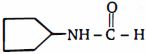
B
C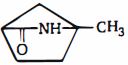
D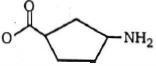
Solution
(C) The reaction sequence is as follows:
$1$. The starting material is a cyclopentane ring substituted with a carboxylic acid group and an amide group. Treatment with $KOBr$ (Hoffmann bromamide degradation) converts the $-CONH_2$ group into an $-NH_2$ group.
$2$. This results in compound $(A)$,which is $3$-aminocyclopentanecarboxylic acid.
$3$. Upon heating $(\Delta)$,the amino acid undergoes intramolecular cyclization (dehydration) to form a cyclic amide,known as a lactam.
$4$. The resulting product $(B)$ is the cyclic lactam,which corresponds to option $C$.
$1$. The starting material is a cyclopentane ring substituted with a carboxylic acid group and an amide group. Treatment with $KOBr$ (Hoffmann bromamide degradation) converts the $-CONH_2$ group into an $-NH_2$ group.
$2$. This results in compound $(A)$,which is $3$-aminocyclopentanecarboxylic acid.
$3$. Upon heating $(\Delta)$,the amino acid undergoes intramolecular cyclization (dehydration) to form a cyclic amide,known as a lactam.
$4$. The resulting product $(B)$ is the cyclic lactam,which corresponds to option $C$.

0 likes
View Solution102
AdvancedMCQ
$C_6H_6$ $\xrightarrow[AlCl_3]{(CH_3)_2CHCOCl}$ $\xrightarrow[\text{reduction}]{\text{Clemmensen}}$ $\xrightarrow[AlCl_3]{CH_3COCl}$ $\xrightarrow[\text{Red } P + HI]{H_3O^{\oplus}} (\text{Ibuprofen})$
Ibuprofen is
Ibuprofen is
A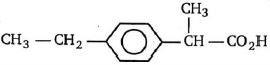
B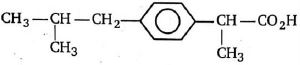
C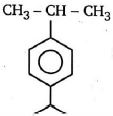
D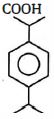
Solution
(B) The synthesis of Ibuprofen involves the following steps:
$1$. Friedel-Crafts acylation of benzene with isobutyryl chloride to form isobutyrophenone.
$2$. Clemmensen reduction of the ketone to form isobutylbenzene.
$3$. Friedel-Crafts acylation of isobutylbenzene with acetyl chloride to form $4$-isobutylacetophenone.
$4$. Cyanohydrin formation followed by reduction with $Red \ P + HI$ to convert the acetyl group into a propionic acid group,yielding $2-(4-\text{isobutylphenyl})\text{propanoic acid}$,which is Ibuprofen.
The correct structure is shown in option $B$.
$1$. Friedel-Crafts acylation of benzene with isobutyryl chloride to form isobutyrophenone.
$2$. Clemmensen reduction of the ketone to form isobutylbenzene.
$3$. Friedel-Crafts acylation of isobutylbenzene with acetyl chloride to form $4$-isobutylacetophenone.
$4$. Cyanohydrin formation followed by reduction with $Red \ P + HI$ to convert the acetyl group into a propionic acid group,yielding $2-(4-\text{isobutylphenyl})\text{propanoic acid}$,which is Ibuprofen.
The correct structure is shown in option $B$.
0 likes
View Solution103
AdvancedMCQ
What is the major product of the above Friedel-Crafts reaction?
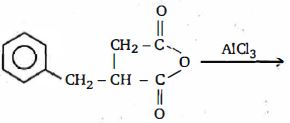
A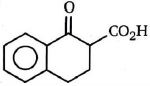
B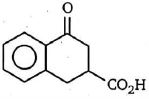
C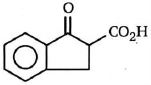
D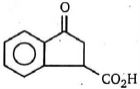
Solution
(B) The reaction is an intramolecular Friedel-Crafts acylation of $3-$phenylbutanoic anhydride derivative.
$1$. The $AlCl_3$ acts as a Lewis acid and coordinates with one of the carbonyl oxygens of the anhydride.
$2$. This facilitates the formation of an acylium ion intermediate.
$3$. The benzene ring then attacks the electrophilic acylium carbon.
$4$. Since the chain length allows for the formation of a stable six-membered ring,the cyclization occurs to form a substituted tetralone.
$5$. Specifically,the product is $3$-methyl-$1$-tetralone-$3$-carboxylic acid derivative,which corresponds to the structure in option $B$.
$1$. The $AlCl_3$ acts as a Lewis acid and coordinates with one of the carbonyl oxygens of the anhydride.
$2$. This facilitates the formation of an acylium ion intermediate.
$3$. The benzene ring then attacks the electrophilic acylium carbon.
$4$. Since the chain length allows for the formation of a stable six-membered ring,the cyclization occurs to form a substituted tetralone.
$5$. Specifically,the product is $3$-methyl-$1$-tetralone-$3$-carboxylic acid derivative,which corresponds to the structure in option $B$.
0 likes
View Solution104
AdvancedMCQ
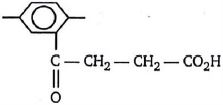
What combination of acid chloride or anhydride and arene would you choose to prepare the given compound?
A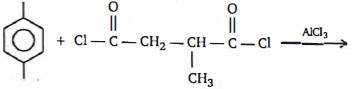
B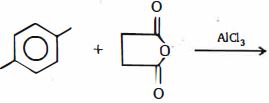
C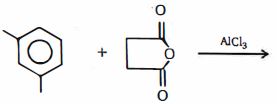
D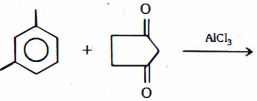
Solution
(B) The given compound is $4-(2,5-\text{dimethylphenyl})-4-\text{oxobutanoic acid}$.
This compound can be prepared by the Friedel-Crafts acylation of $p$-xylene $(1,4-\text{dimethylbenzene})$ with succinic anhydride in the presence of a Lewis acid catalyst like anhydrous $AlCl_3$.
The reaction involves the electrophilic substitution of the benzene ring of $p$-xylene by the acylium ion generated from succinic anhydride.
This compound can be prepared by the Friedel-Crafts acylation of $p$-xylene $(1,4-\text{dimethylbenzene})$ with succinic anhydride in the presence of a Lewis acid catalyst like anhydrous $AlCl_3$.
The reaction involves the electrophilic substitution of the benzene ring of $p$-xylene by the acylium ion generated from succinic anhydride.
0 likes
View Solution105
MediumMCQ
Which of the following tetracarboxylic acids forms a di-anhydride upon heating?
A
Benzene$-1,2,3,4-$tetracarboxylic acid
B
Benzene$-1,2,4,5-$tetracarboxylic acid
C
Neither $(a)$ nor $(b)$
D
Both $(a)$ and $(b)$
Solution
(D) Heating $1,2-$dicarboxylic acids leads to the formation of cyclic anhydrides by the loss of a water molecule.
For a tetracarboxylic acid to form a di-anhydride,it must have two pairs of adjacent carboxylic acid groups.
In benzene$-1,2,3,4-$tetracarboxylic acid,there are two pairs of adjacent $-COOH$ groups (at positions $1,2$ and $3,4$),allowing for the formation of a di-anhydride.
In benzene$-1,2,4,5-$tetracarboxylic acid (pyromellitic acid),there are two pairs of adjacent $-COOH$ groups (at positions $1,2$ and $4,5$),which also allows for the formation of a di-anhydride.
Therefore,both compounds can form di-anhydrides upon heating.
For a tetracarboxylic acid to form a di-anhydride,it must have two pairs of adjacent carboxylic acid groups.
In benzene$-1,2,3,4-$tetracarboxylic acid,there are two pairs of adjacent $-COOH$ groups (at positions $1,2$ and $3,4$),allowing for the formation of a di-anhydride.
In benzene$-1,2,4,5-$tetracarboxylic acid (pyromellitic acid),there are two pairs of adjacent $-COOH$ groups (at positions $1,2$ and $4,5$),which also allows for the formation of a di-anhydride.
Therefore,both compounds can form di-anhydrides upon heating.
0 likes
View Solution106
AdvancedMCQ
The end product of the above reaction is:

A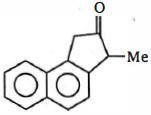
B
C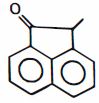
D
Solution
(A) $1$. Esterification: Naphthalene$-1-$acetic acid reacts with $EtOH/H^+$ to form ethyl naphthalene$-1-$acetate.
$2$. Alkylation: Treatment with $NaH$ followed by $MeI$ results in the formation of ethyl $2-$(naphthalen$-1-$yl)propanoate.
$3$. Hydrolysis: Basic hydrolysis followed by acidification gives $2-$(naphthalen$-1-$yl)propanoic acid.
$4$. Cyclization: Treatment with $SOCl_2$ converts the carboxylic acid to an acid chloride,which then undergoes intramolecular Friedel-Crafts acylation in the presence of $AlCl_3$ to form the cyclic ketone,$2$-methyl$-2,3-$dihydro-1H-cyclopenta[a]naphthalen$-1-$one.
$2$. Alkylation: Treatment with $NaH$ followed by $MeI$ results in the formation of ethyl $2-$(naphthalen$-1-$yl)propanoate.
$3$. Hydrolysis: Basic hydrolysis followed by acidification gives $2-$(naphthalen$-1-$yl)propanoic acid.
$4$. Cyclization: Treatment with $SOCl_2$ converts the carboxylic acid to an acid chloride,which then undergoes intramolecular Friedel-Crafts acylation in the presence of $AlCl_3$ to form the cyclic ketone,$2$-methyl$-2,3-$dihydro-1H-cyclopenta[a]naphthalen$-1-$one.
0 likes
View Solution107
DifficultMCQ
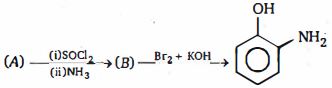
Which of the following compounds on hydrolysis gives reactant $(A)$?
A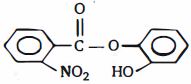
B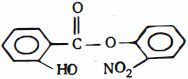
C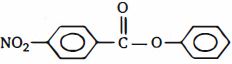
D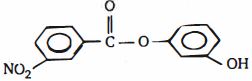
Solution
(B) The reaction sequence is a Hoffmann bromamide degradation,which converts an amide to an amine with one less carbon atom. The final product is $2-aminophenol$. The amide precursor is $2-hydroxybenzamide$. This amide is formed from $2-hydroxybenzoic$ acid (salicylic acid) via $SOCl_2$ and $NH_3$. The reactant $(A)$ is $2-hydroxybenzoic$ acid. Among the options,hydrolysis of the ester in option $(B)$ (which is $2-nitrophenyl-2-hydroxybenzoate$ or similar derivative) yields the required acid. Specifically,the structure in option $(B)$ represents an ester that upon hydrolysis yields $2-hydroxybenzoic$ acid and $2-nitrophenol$.
0 likes
View Solution108
DifficultMCQ
Benzocaine has been used as a component of appetite suppressants,burn and sunburn remedies. Benzocaine is:

A
Ethyl $4-$aminobenzoate
B
Ethyl $p-$aminobenzoate
C
Ethyl $2-$aminobenzoate
D
$4-$aminoethylbenzoate
Solution
(A) Benzocaine is the ethyl ester of $p-$aminobenzoic acid. Its $IUPAC$ name is ethyl $4-$aminobenzoate. Both $A$ and $B$ represent the same compound,as $p-$ (para) position corresponds to the $4-$ position in the benzene ring relative to the carboxylate group. Therefore,both options $A$ and $B$ are chemically correct.
0 likes
View Solution109
DifficultMCQ
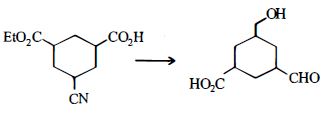
The reagent$(s)$ required for the following conversion are:
A
$(i) NaBH_4, (ii) Raney Ni/H_2, (iii) H_3O^{+}$
B
$(i) LiAlH_4, (ii) H_3O^{+}$
C
$(i) B_2H_6, (ii) DIBAL-H, (iii) H_3O^{+}$
D
$(i) B_2H_6, (ii) SnCl_2/HCl, (iii) H_3O^{+}$
Solution
(D) The starting material contains an ester group $(EtO_2C-)$,a carboxylic acid group $(-COOH)$,and a nitrile group $(-CN)$.
$1$. Treatment with $B_2H_6$ selectively reduces the carboxylic acid group to a primary alcohol $(-CH_2OH)$ without affecting the ester or nitrile groups.
$2$. Treatment with $SnCl_2/HCl$ (Stephen reduction) reduces the nitrile group to an aldehyde $(-CHO)$ group.
$3$. Finally,acidic hydrolysis $(H_3O^{+})$ hydrolyzes the ester group to a carboxylic acid group $(-COOH)$.
Thus,the correct sequence of reagents is $(i) B_2H_6, (ii) SnCl_2/HCl, (iii) H_3O^{+}$.
$1$. Treatment with $B_2H_6$ selectively reduces the carboxylic acid group to a primary alcohol $(-CH_2OH)$ without affecting the ester or nitrile groups.
$2$. Treatment with $SnCl_2/HCl$ (Stephen reduction) reduces the nitrile group to an aldehyde $(-CHO)$ group.
$3$. Finally,acidic hydrolysis $(H_3O^{+})$ hydrolyzes the ester group to a carboxylic acid group $(-COOH)$.
Thus,the correct sequence of reagents is $(i) B_2H_6, (ii) SnCl_2/HCl, (iii) H_3O^{+}$.
0 likes
View Solution110
DifficultMCQ
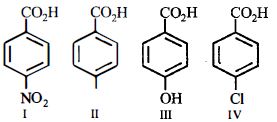
The increasing order of the acidity of the following carboxylic acids is:
A
$III < II < IV < I$
B
$I < III < II < IV$
C
$IV < II < III < I$
D
$II < IV < III < I$
Solution
(A) The acidity of substituted benzoic acids depends on the electronic effects of the substituents at the para position.
$1$. $-NO_2$ is a strong electron-withdrawing group ($-I$ and $-M$ effects),which significantly increases acidity.
$2$. $-Cl$ is an electron-withdrawing group ($-I$ effect) but an electron-donating group ($+M$ effect). The $-I$ effect dominates,increasing acidity compared to benzoic acid.
$3$. $-OH$ is an electron-donating group ($+M$ effect),which decreases acidity compared to benzoic acid.
$4$. Benzoic acid $(II)$ is the reference.
Comparing the substituents: $-NO_2$ (strongest electron-withdrawing) > $-Cl$ (weak electron-withdrawing) > $H$ (no effect) > $-OH$ (electron-donating).
Therefore,the increasing order of acidity is $III < II < IV < I$.
$1$. $-NO_2$ is a strong electron-withdrawing group ($-I$ and $-M$ effects),which significantly increases acidity.
$2$. $-Cl$ is an electron-withdrawing group ($-I$ effect) but an electron-donating group ($+M$ effect). The $-I$ effect dominates,increasing acidity compared to benzoic acid.
$3$. $-OH$ is an electron-donating group ($+M$ effect),which decreases acidity compared to benzoic acid.
$4$. Benzoic acid $(II)$ is the reference.
Comparing the substituents: $-NO_2$ (strongest electron-withdrawing) > $-Cl$ (weak electron-withdrawing) > $H$ (no effect) > $-OH$ (electron-donating).
Therefore,the increasing order of acidity is $III < II < IV < I$.
0 likes
View Solution111
AdvancedMCQ
The major product expected from the following reaction is:
$2-(\text{carbamoyl})-3-(\text{hydroxymethyl})-6-(\text{hydroxy})\text{benzoic acid} \xrightarrow{HCl_{(g)} / CCl_4} ?$
$2-(\text{carbamoyl})-3-(\text{hydroxymethyl})-6-(\text{hydroxy})\text{benzoic acid} \xrightarrow{HCl_{(g)} / CCl_4} ?$
A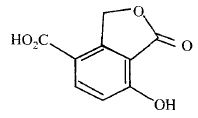
B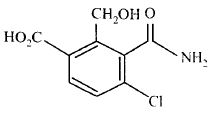
C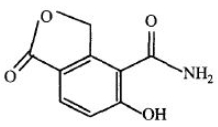
D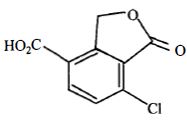
Solution
(D) The reaction involves an intramolecular esterification (lactonization) between the carboxylic acid group $(-COOH)$ and the hydroxymethyl group $(-CH_2OH)$ in the presence of an acid catalyst $(HCl_{(g)})$.
$1$. The carboxylic acid group is protonated by $HCl$,making the carbonyl carbon more electrophilic.
$2$. The oxygen atom of the $-CH_2OH$ group acts as a nucleophile and attacks the activated carbonyl carbon.
$3$. This leads to the formation of a cyclic ester (lactone).
$4$. Water is eliminated in the process to form the final lactone product.
The structure shown in option $D$ represents the correct cyclic lactone formed by the reaction of the carboxylic acid and the hydroxymethyl group.
$1$. The carboxylic acid group is protonated by $HCl$,making the carbonyl carbon more electrophilic.
$2$. The oxygen atom of the $-CH_2OH$ group acts as a nucleophile and attacks the activated carbonyl carbon.
$3$. This leads to the formation of a cyclic ester (lactone).
$4$. Water is eliminated in the process to form the final lactone product.
The structure shown in option $D$ represents the correct cyclic lactone formed by the reaction of the carboxylic acid and the hydroxymethyl group.
0 likes
View Solution112
MediumMCQ
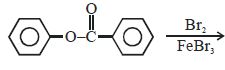
The product of the following reaction is:
A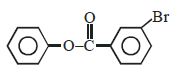
B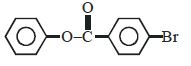
C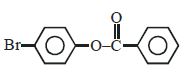
D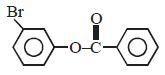
Solution
(C) The reactant is phenyl benzoate,which contains two phenyl rings. One ring is attached to an oxygen atom $(-O-)$,and the other is attached to a carbonyl group $(-C(=O)-)$.
The oxygen atom is electron-donating by resonance ($+M$ effect),which activates the attached phenyl ring towards electrophilic aromatic substitution.
The carbonyl group is electron-withdrawing by resonance ($-M$ effect),which deactivates the other phenyl ring.
Therefore,the electrophile $(Br^+)$ generated by $Br_2/FeBr_3$ will attack the more activated ring,which is the one attached to the oxygen atom.
In the ring attached to the oxygen atom,the $-O-$ group is ortho/para-directing. The para position is sterically less hindered than the ortho position,making the para-substituted product the major one.
Thus,the product is phenyl $4$-bromobenzoate.
The oxygen atom is electron-donating by resonance ($+M$ effect),which activates the attached phenyl ring towards electrophilic aromatic substitution.
The carbonyl group is electron-withdrawing by resonance ($-M$ effect),which deactivates the other phenyl ring.
Therefore,the electrophile $(Br^+)$ generated by $Br_2/FeBr_3$ will attack the more activated ring,which is the one attached to the oxygen atom.
In the ring attached to the oxygen atom,the $-O-$ group is ortho/para-directing. The para position is sterically less hindered than the ortho position,making the para-substituted product the major one.
Thus,the product is phenyl $4$-bromobenzoate.
0 likes
View Solution113
DifficultMCQ
$CH_3-CN$ $\xrightarrow{H_2O/H^{+}} X$ $\xrightarrow{C_6H_5OH/H^{+}} Y$; $Y$ is
A
Phenyl benzoate
B
Propiophenone
C
Phenyl propionate
D
Phenyl acetate
Solution
(D) Step $1$: Acidic hydrolysis of acetonitrile $(CH_3-CN)$ yields acetic acid $(CH_3COOH)$ as intermediate $X$.
$CH_3-CN + 2H_2O \xrightarrow{H^+} CH_3COOH + NH_4^+$
Step $2$: Esterification of acetic acid with phenol $(C_6H_5OH)$ in the presence of an acid catalyst $(H^+)$ yields phenyl acetate $(CH_3COOC_6H_5)$ as product $Y$.
$CH_3COOH + C_6H_5OH \xrightarrow{H^+} CH_3COOC_6H_5 + H_2O$
Thus,$Y$ is phenyl acetate.
$CH_3-CN + 2H_2O \xrightarrow{H^+} CH_3COOH + NH_4^+$
Step $2$: Esterification of acetic acid with phenol $(C_6H_5OH)$ in the presence of an acid catalyst $(H^+)$ yields phenyl acetate $(CH_3COOC_6H_5)$ as product $Y$.
$CH_3COOH + C_6H_5OH \xrightarrow{H^+} CH_3COOC_6H_5 + H_2O$
Thus,$Y$ is phenyl acetate.
0 likes
View Solution114
DifficultMCQ
$CH_3-CH_2-CH=O$ $\xrightarrow[(2) H^{+}]{(1) \text{Tollen's reagent}} X$ $\xrightarrow[(2) \text{dry distillation}]{(1) Ca(OH)_2} Y$; $Y$ is
A
$C_2H_5-CO-C_2H_5$
B
$CH_3-CH_2-CH_3$
C
$CH_3-CH_3$
D
$CH_3-CO-C_2H_5$
Solution
(A) Propanal $(CH_3-CH_2-CHO)$ is oxidized by $\text{Tollen's reagent}$ followed by acidification to give propanoic acid $(X = CH_3-CH_2-COOH)$.
Propanoic acid reacts with $Ca(OH)_2$ to form calcium propionate,which on $\text{dry distillation}$ yields diethyl ketone $(Y = C_2H_5-CO-C_2H_5)$.
$2CH_3CH_2COOH + Ca(OH)_2$ $\rightarrow (CH_3CH_2COO)_2Ca$ $\xrightarrow{\Delta} CH_3CH_2COCH_2CH_3 + CaCO_3$
Propanoic acid reacts with $Ca(OH)_2$ to form calcium propionate,which on $\text{dry distillation}$ yields diethyl ketone $(Y = C_2H_5-CO-C_2H_5)$.
$2CH_3CH_2COOH + Ca(OH)_2$ $\rightarrow (CH_3CH_2COO)_2Ca$ $\xrightarrow{\Delta} CH_3CH_2COCH_2CH_3 + CaCO_3$
0 likes
View Solution115
MediumMCQ
The incorrect match is:
A
The structure of $2$-acetoxybenzoic acid : $\text{Aspirin}$
B
$Cl_3C-CH(C_6H_4Cl)_2$ : $\text{D.D.T.}$
C
$H_2N-CO-NH_2$ : $\text{Urea}$
D
$H_2N-C_6H_4-SO_3H$ : $\text{Sulphanilic acid}$
Solution
(A) Let us analyze each option:
$(A)$ The structure shown is $2$-acetoxybenzoic acid,which is commonly known as $\text{Aspirin}$. This is a correct match.
$(B)$ The structure $Cl_3C-CH(C_6H_4Cl)_2$ represents $p,p'$-dichlorodiphenyltrichloroethane,commonly known as $\text{D.D.T.}$ This is a correct match.
$(C)$ The formula $H_2N-CO-NH_2$ represents $\text{Urea}$. This is a correct match.
$(D)$ The structure $H_2N-C_6H_4-SO_3H$ represents $p$-aminobenzenesulphonic acid,which is $\text{Sulphanilic acid}$. This is a correct match.
Wait,re-evaluating the provided image for option $(A)$: The image shows a benzene ring with an acetoxy group $(-O-CO-CH_3)$ and an aldehyde group $(-CHO)$ at the ortho position. This is $2$-acetoxybenzaldehyde,not $\text{Aspirin}$ ($2$-acetoxybenzoic acid). Therefore,option $(A)$ is the incorrect match.
$(A)$ The structure shown is $2$-acetoxybenzoic acid,which is commonly known as $\text{Aspirin}$. This is a correct match.
$(B)$ The structure $Cl_3C-CH(C_6H_4Cl)_2$ represents $p,p'$-dichlorodiphenyltrichloroethane,commonly known as $\text{D.D.T.}$ This is a correct match.
$(C)$ The formula $H_2N-CO-NH_2$ represents $\text{Urea}$. This is a correct match.
$(D)$ The structure $H_2N-C_6H_4-SO_3H$ represents $p$-aminobenzenesulphonic acid,which is $\text{Sulphanilic acid}$. This is a correct match.
Wait,re-evaluating the provided image for option $(A)$: The image shows a benzene ring with an acetoxy group $(-O-CO-CH_3)$ and an aldehyde group $(-CHO)$ at the ortho position. This is $2$-acetoxybenzaldehyde,not $\text{Aspirin}$ ($2$-acetoxybenzoic acid). Therefore,option $(A)$ is the incorrect match.
0 likes
View Solution116
MediumMCQ
What are the products formed at the anode during Kolbe synthesis?
A
Hydrocarbons
B
$CO_2$
C
Both
D
None
Solution
(C) The Kolbe electrolysis or Kolbe reaction is an organic reaction named after Hermann Kolbe.
The Kolbe reaction is formally a decarboxylative dimerisation of two carboxylic acids (or carboxylate ions).
The overall general reaction is: $2RCOO^- \longrightarrow R-R + 2CO_2 + 2e^-$.
After electrolysis,an alkane (hydrocarbon) is formed at the anode along with the release of carbon dioxide $(CO_2)$.
When potassium acetate $(CH_3COO^- K^+)$ is used in electrolysis,carbon dioxide is released along with ethane $(H_3C-CH_3)$.
$CH_3COO^- \longrightarrow CH_3^{\bullet} + CO_2 + e^-$
$2CH_3^{\bullet} \longrightarrow C_2H_6$
Thus,both hydrocarbons and $CO_2$ are released at the anode.
Option $C$ is the correct answer.
The Kolbe reaction is formally a decarboxylative dimerisation of two carboxylic acids (or carboxylate ions).
The overall general reaction is: $2RCOO^- \longrightarrow R-R + 2CO_2 + 2e^-$.
After electrolysis,an alkane (hydrocarbon) is formed at the anode along with the release of carbon dioxide $(CO_2)$.
When potassium acetate $(CH_3COO^- K^+)$ is used in electrolysis,carbon dioxide is released along with ethane $(H_3C-CH_3)$.
$CH_3COO^- \longrightarrow CH_3^{\bullet} + CO_2 + e^-$
$2CH_3^{\bullet} \longrightarrow C_2H_6$
Thus,both hydrocarbons and $CO_2$ are released at the anode.
Option $C$ is the correct answer.
0 likes
View Solution117
DifficultMCQ
The final product $(III)$ obtained in the reaction sequence is:
$CH_3-CH_2-COOH$ $\xrightarrow{PCl_3} I$ $\xrightarrow{C_6H_6/AlCl_3} II$ $\xrightarrow{NH_2-NH_2/\text{base/heat}} III$
$CH_3-CH_2-COOH$ $\xrightarrow{PCl_3} I$ $\xrightarrow{C_6H_6/AlCl_3} II$ $\xrightarrow{NH_2-NH_2/\text{base/heat}} III$
A
Propylbenzene
B
$1-$Phenylpropan$-1-$ol
C
Propiophenone
D
Ethyl phenyl ketone
Solution
(A) The reaction sequence is as follows:
$1$. $CH_3-CH_2-COOH + PCl_3 \rightarrow CH_3-CH_2-COCl$ (Compound $I$,Propanoyl chloride).
$2$. $CH_3-CH_2-COCl + C_6H_6 \xrightarrow{AlCl_3} C_6H_5-CO-CH_2-CH_3$ (Compound $II$,Propiophenone,which is also known as ethyl phenyl ketone).
$3$. $C_6H_5-CO-CH_2-CH_3 \xrightarrow{NH_2-NH_2/\text{base/heat}} C_6H_5-CH_2-CH_2-CH_3$ (Compound $III$,Propylbenzene).
This is a Friedel-Crafts acylation followed by a Wolff-Kishner reduction.
$1$. $CH_3-CH_2-COOH + PCl_3 \rightarrow CH_3-CH_2-COCl$ (Compound $I$,Propanoyl chloride).
$2$. $CH_3-CH_2-COCl + C_6H_6 \xrightarrow{AlCl_3} C_6H_5-CO-CH_2-CH_3$ (Compound $II$,Propiophenone,which is also known as ethyl phenyl ketone).
$3$. $C_6H_5-CO-CH_2-CH_3 \xrightarrow{NH_2-NH_2/\text{base/heat}} C_6H_5-CH_2-CH_2-CH_3$ (Compound $III$,Propylbenzene).
This is a Friedel-Crafts acylation followed by a Wolff-Kishner reduction.
0 likes
View Solution118
MediumMCQ
Assertion : The $pK_a$ of acetic acid is lower than that of phenol.
Reason : Phenoxide ion is more resonance stabilised.
Reason : Phenoxide ion is more resonance stabilised.
A
If both Assertion and Reason are correct and the Reason is a correct explanation of the Assertion.
B
If both Assertion and Reason are correct but Reason is not a correct explanation of the Assertion.
C
If the Assertion is correct but Reason is incorrect.
D
If both the Assertion and Reason are incorrect.
Solution
(C) lower $pK_a$ value indicates a stronger acid. Acetic acid $(pK_a \approx 4.76)$ is a stronger acid than phenol $(pK_a \approx 10)$.
The acidity of carboxylic acids is due to the resonance stabilization of the carboxylate ion,where the negative charge is delocalized over two highly electronegative oxygen atoms in equivalent resonance structures.
In contrast,the negative charge in the phenoxide ion is delocalized over the carbon atoms of the ring,which is less effective. Therefore,the Assertion is correct,but the Reason is incorrect.
The acidity of carboxylic acids is due to the resonance stabilization of the carboxylate ion,where the negative charge is delocalized over two highly electronegative oxygen atoms in equivalent resonance structures.
In contrast,the negative charge in the phenoxide ion is delocalized over the carbon atoms of the ring,which is less effective. Therefore,the Assertion is correct,but the Reason is incorrect.
0 likes
View Solution119
DifficultMCQ
Assertion: Acetamide has a more polar $C=O$ group than ethyl acetoacetate.
Reason: $-\ddot{N}H_{2}$ is more electron-donating than $-\ddot{O}C_{2}H_{5}$.
Reason: $-\ddot{N}H_{2}$ is more electron-donating than $-\ddot{O}C_{2}H_{5}$.
A
If both Assertion and Reason are correct and the Reason is a correct explanation of the Assertion.
B
If both Assertion and Reason are correct but Reason is not a correct explanation of the Assertion.
C
If the Assertion is correct but Reason is incorrect.
D
If both the Assertion and Reason are incorrect.
Solution
(A) In acetamide $(CH_{3}CONH_{2})$,the nitrogen atom has a lone pair that participates in resonance with the $C=O$ group. However,the $-NH_{2}$ group is a stronger electron-donating group by resonance compared to the $-OC_{2}H_{5}$ group in ethyl acetoacetate $(CH_{3}COCH_{2}COOC_{2}H_{5})$.
Because nitrogen is less electronegative than oxygen,the lone pair on nitrogen is more readily donated into the carbonyl system,increasing the electron density on the oxygen atom of the $C=O$ bond,which makes the $C=O$ bond more polar.
Thus,both the Assertion and the Reason are correct,and the Reason is the correct explanation for the Assertion.
Because nitrogen is less electronegative than oxygen,the lone pair on nitrogen is more readily donated into the carbonyl system,increasing the electron density on the oxygen atom of the $C=O$ bond,which makes the $C=O$ bond more polar.
Thus,both the Assertion and the Reason are correct,and the Reason is the correct explanation for the Assertion.
0 likes
View Solution120
DifficultMCQ
Assertion : $RCOCl$,$(RCO)_2O$ and $RCOOR'$ all react with Grignard reagents to form $3^o$ alcohols.
Reason : $RCOCl$ reacts with $R_2Cd$ to form ketones but $(RCO)_2O$ and $RCOOR'$ do not react at all.
Reason : $RCOCl$ reacts with $R_2Cd$ to form ketones but $(RCO)_2O$ and $RCOOR'$ do not react at all.
A
If both Assertion and Reason are correct and the Reason is a correct explanation of the Assertion.
B
If both Assertion and Reason are correct but Reason is not a correct explanation of the Assertion.
C
If the Assertion is correct but Reason is incorrect.
D
If both the Assertion and Reason are incorrect.
Solution
(C) The Assertion is correct: $RCOCl$,$(RCO)_2O$,and $RCOOR'$ all react with excess Grignard reagents $(R''MgX)$ to form $3^o$ alcohols after hydrolysis.
The Reason is incorrect: While $RCOCl$ reacts with $R_2Cd$ to form ketones,$(RCO)_2O$ also reacts with $R_2Cd$ to form ketones. Therefore,the statement that $(RCO)_2O$ does not react at all is false.
The Reason is incorrect: While $RCOCl$ reacts with $R_2Cd$ to form ketones,$(RCO)_2O$ also reacts with $R_2Cd$ to form ketones. Therefore,the statement that $(RCO)_2O$ does not react at all is false.
0 likes
View Solution121
Difficult
Write chemical reactions to affect the following transformations:
$(i)$ Butan$-1-$ol to butanoic acid
$(ii)$ Benzyl alcohol to phenylethanoic acid
$(iii)$ $3-$Nitrobromobenzene to $3-$nitrobenzoic acid
$(iv)$ $4-$Methylacetophenone to benzene$-1,4-$dicarboxylic acid
$(v)$ Cyclohexene to hexane$-1,6-$dioic acid
$(vi)$ Butanal to butanoic acid.
$(i)$ Butan$-1-$ol to butanoic acid
$(ii)$ Benzyl alcohol to phenylethanoic acid
$(iii)$ $3-$Nitrobromobenzene to $3-$nitrobenzoic acid
$(iv)$ $4-$Methylacetophenone to benzene$-1,4-$dicarboxylic acid
$(v)$ Cyclohexene to hexane$-1,6-$dioic acid
$(vi)$ Butanal to butanoic acid.
Solution
(A) $(i)$ $CH_3CH_2CH_2CH_2OH \xrightarrow{CrO_3 - H_2SO_4 (Jones \ reagent)} CH_3CH_2CH_2COOH$
$(ii)$ $C_6H_5CH_2OH$ $\xrightarrow{HBr} C_6H_5CH_2Br$ $\xrightarrow{KCN} C_6H_5CH_2CN$ $\xrightarrow{H_3O^{+}, \Delta} C_6H_5CH_2COOH$
$(iii)$ $C_6H_4(NO_2)Br$ $\xrightarrow{Mg, \text{ether}} C_6H_4(NO_2)MgBr$ $\xrightarrow{CO_2} C_6H_4(NO_2)COOMgBr$ $\xrightarrow{H_3O^{+}} C_6H_4(NO_2)COOH$
$(iv)$ $CH_3-C_6H_4-COCH_3$ $\xrightarrow{KMnO_4/KOH} KOOC-C_6H_4-COOK$ $\xrightarrow{dil. H_2SO_4} HOOC-C_6H_4-COOH$
$(v)$ $C_6H_{10} \xrightarrow{KMnO_4-H_2SO_4, \Delta} HOOC-(CH_2)_4-COOH$
$(vi)$ $CH_3CH_2CH_2CHO \xrightarrow{[O] \text{ or } \text{Tollens' reagent}} CH_3CH_2CH_2COOH$
$(ii)$ $C_6H_5CH_2OH$ $\xrightarrow{HBr} C_6H_5CH_2Br$ $\xrightarrow{KCN} C_6H_5CH_2CN$ $\xrightarrow{H_3O^{+}, \Delta} C_6H_5CH_2COOH$
$(iii)$ $C_6H_4(NO_2)Br$ $\xrightarrow{Mg, \text{ether}} C_6H_4(NO_2)MgBr$ $\xrightarrow{CO_2} C_6H_4(NO_2)COOMgBr$ $\xrightarrow{H_3O^{+}} C_6H_4(NO_2)COOH$
$(iv)$ $CH_3-C_6H_4-COCH_3$ $\xrightarrow{KMnO_4/KOH} KOOC-C_6H_4-COOK$ $\xrightarrow{dil. H_2SO_4} HOOC-C_6H_4-COOH$
$(v)$ $C_6H_{10} \xrightarrow{KMnO_4-H_2SO_4, \Delta} HOOC-(CH_2)_4-COOH$
$(vi)$ $CH_3CH_2CH_2CHO \xrightarrow{[O] \text{ or } \text{Tollens' reagent}} CH_3CH_2CH_2COOH$
0 likes
View Solution122
Difficult
Show how each of the following compounds can be converted to benzoic acid.
$(i)$ Ethylbenzene
$(ii)$ Acetophenone
$(iii)$ Bromobenzene
$(iv)$ Phenylethene (Styrene)
$(i)$ Ethylbenzene
$(ii)$ Acetophenone
$(iii)$ Bromobenzene
$(iv)$ Phenylethene (Styrene)
Solution
(N/A) The conversion of the given compounds to benzoic acid is as follows:
$(i)$ Ethylbenzene: Oxidation with alkaline $KMnO_4$ followed by acidification gives benzoic acid.
$C_6H_5CH_2CH_3$ $\xrightarrow{KMnO_4/KOH, \Delta} C_6H_5COOK$ $\xrightarrow{H_3O^+} C_6H_5COOH$
$(ii)$ Acetophenone: Oxidation with alkaline $KMnO_4$ followed by acidification gives benzoic acid.
$C_6H_5COCH_3$ $\xrightarrow{KMnO_4/KOH, \Delta} C_6H_5COOK$ $\xrightarrow{H_3O^+} C_6H_5COOH$
$(iii)$ Bromobenzene: Reacts with $Mg$ in dry ether to form phenylmagnesium bromide,which reacts with $CO_2$ (dry ice) followed by acidification to give benzoic acid.
$C_6H_5Br$ $\xrightarrow{Mg, \text{ether}} C_6H_5MgBr$ $\xrightarrow{CO_2} C_6H_5COOMgBr$ $\xrightarrow{H_3O^+} C_6H_5COOH$
$(iv)$ Phenylethene (Styrene): Oxidation with alkaline $KMnO_4$ followed by acidification gives benzoic acid.
$C_6H_5CH=CH_2$ $\xrightarrow{KMnO_4/KOH, \Delta} C_6H_5COOK$ $\xrightarrow{H_3O^+} C_6H_5COOH$
$(i)$ Ethylbenzene: Oxidation with alkaline $KMnO_4$ followed by acidification gives benzoic acid.
$C_6H_5CH_2CH_3$ $\xrightarrow{KMnO_4/KOH, \Delta} C_6H_5COOK$ $\xrightarrow{H_3O^+} C_6H_5COOH$
$(ii)$ Acetophenone: Oxidation with alkaline $KMnO_4$ followed by acidification gives benzoic acid.
$C_6H_5COCH_3$ $\xrightarrow{KMnO_4/KOH, \Delta} C_6H_5COOK$ $\xrightarrow{H_3O^+} C_6H_5COOH$
$(iii)$ Bromobenzene: Reacts with $Mg$ in dry ether to form phenylmagnesium bromide,which reacts with $CO_2$ (dry ice) followed by acidification to give benzoic acid.
$C_6H_5Br$ $\xrightarrow{Mg, \text{ether}} C_6H_5MgBr$ $\xrightarrow{CO_2} C_6H_5COOMgBr$ $\xrightarrow{H_3O^+} C_6H_5COOH$
$(iv)$ Phenylethene (Styrene): Oxidation with alkaline $KMnO_4$ followed by acidification gives benzoic acid.
$C_6H_5CH=CH_2$ $\xrightarrow{KMnO_4/KOH, \Delta} C_6H_5COOK$ $\xrightarrow{H_3O^+} C_6H_5COOH$
0 likes
View Solution123
Difficult
Draw the structures of the following compounds:
$(i)$ $3-$Methylbutanal
$(ii)$ $p-$Nitropropiophenone
$(iii)$ $p-$Methylbenzaldehyde
$(iv)$ $4-$Methylpent$-3-$en$-2-$one
$(v)$ $4-$Chloropentan$-2-$one
$(vi)$ $3-$Bromo$-4-$phenylpentanoic acid
$(vii)$ $p, p^{\prime}-$Dihydroxybenzophenone
$(viii)$ Hex$-2-$en$-4-$ynoic acid
$(i)$ $3-$Methylbutanal
$(ii)$ $p-$Nitropropiophenone
$(iii)$ $p-$Methylbenzaldehyde
$(iv)$ $4-$Methylpent$-3-$en$-2-$one
$(v)$ $4-$Chloropentan$-2-$one
$(vi)$ $3-$Bromo$-4-$phenylpentanoic acid
$(vii)$ $p, p^{\prime}-$Dihydroxybenzophenone
$(viii)$ Hex$-2-$en$-4-$ynoic acid
Solution
(N/A) $(i)$ $(CH_3)_2CHCH_2CHO$
$(ii)$ $O_2NC_6H_4COCH_2CH_3$
$(iii)$ $CH_3C_6H_4CHO$
$(iv)$ $CH_3COCH=C(CH_3)_2$
$(v)$ $CH_3COCH_2CH(Cl)CH_3$
$(vi)$ $CH_3CH(C_6H_5)CH(Br)CH_2COOH$
$(vii)$ $HOC_6H_4COC_6H_4OH$
$(viii)$ $CH_3C \equiv CCH=CHCOOH$
$(ii)$ $O_2NC_6H_4COCH_2CH_3$
$(iii)$ $CH_3C_6H_4CHO$
$(iv)$ $CH_3COCH=C(CH_3)_2$
$(v)$ $CH_3COCH_2CH(Cl)CH_3$
$(vi)$ $CH_3CH(C_6H_5)CH(Br)CH_2COOH$
$(vii)$ $HOC_6H_4COC_6H_4OH$
$(viii)$ $CH_3C \equiv CCH=CHCOOH$
0 likes
View Solution124
Difficult
An organic compound $(A)$ (molecular formula $C_{8}H_{16}O_{2}$) was hydrolysed with dilute sulphuric acid to give a carboxylic acid $(B)$ and an alcohol $(C)$. Oxidation of $(C)$ with chromic acid produced $(B)$. $(C)$ on dehydration gives but$-1-$ene. Write equations for the reactions involved.
Solution
(N/A) An organic compound $(A)$ with molecular formula $C_{8}H_{16}O_{2}$ gives a carboxylic acid $(B)$ and an alcohol $(C)$ on hydrolysis with dilute sulphuric acid. Thus,compound $(A)$ must be an ester.
Further,alcohol $(C)$ gives acid $(B)$ on oxidation with chromic acid. Thus,$(B)$ and $(C)$ must contain an equal number of carbon atoms.
Since compound $(A)$ contains a total of $8$ carbon atoms,each of $(B)$ and $(C)$ contains $4$ carbon atoms.
Again,on dehydration,alcohol $(C)$ gives but$-1-$ene. Therefore,$(C)$ is a straight-chain alcohol,which is butan$-1-$ol.
On oxidation,butan$-1-$ol gives butanoic acid. Hence,acid $(B)$ is butanoic acid.
Thus,the ester with molecular formula $C_{8}H_{16}O_{2}$ is butyl butanoate $(CH_{3}CH_{2}CH_{2}COOCH_{2}CH_{2}CH_{2}CH_{3})$.
The reactions involved are:
$1. \text{Hydrolysis of ester: } CH_{3}CH_{2}CH_{2}COOCH_{2}CH_{2}CH_{2}CH_{3} + H_{2}O$ $\xrightarrow{dil. H_{2}SO_{4}} CH_{3}CH_{2}CH_{2}COOH (B) + CH_{3}CH_{2}CH_{2}CH_{2}OH (C)$
$2. \text{Oxidation of alcohol: } CH_{3}CH_{2}CH_{2}CH_{2}OH \xrightarrow{[O]} CH_{3}CH_{2}CH_{2}COOH (B)$
$3. \text{Dehydration of alcohol: } CH_{3}CH_{2}CH_{2}CH_{2}OH \xrightarrow{H^{+}/\Delta} CH_{3}CH_{2}CH=CH_{2} + H_{2}O$
Further,alcohol $(C)$ gives acid $(B)$ on oxidation with chromic acid. Thus,$(B)$ and $(C)$ must contain an equal number of carbon atoms.
Since compound $(A)$ contains a total of $8$ carbon atoms,each of $(B)$ and $(C)$ contains $4$ carbon atoms.
Again,on dehydration,alcohol $(C)$ gives but$-1-$ene. Therefore,$(C)$ is a straight-chain alcohol,which is butan$-1-$ol.
On oxidation,butan$-1-$ol gives butanoic acid. Hence,acid $(B)$ is butanoic acid.
Thus,the ester with molecular formula $C_{8}H_{16}O_{2}$ is butyl butanoate $(CH_{3}CH_{2}CH_{2}COOCH_{2}CH_{2}CH_{2}CH_{3})$.
The reactions involved are:
$1. \text{Hydrolysis of ester: } CH_{3}CH_{2}CH_{2}COOCH_{2}CH_{2}CH_{2}CH_{3} + H_{2}O$ $\xrightarrow{dil. H_{2}SO_{4}} CH_{3}CH_{2}CH_{2}COOH (B) + CH_{3}CH_{2}CH_{2}CH_{2}OH (C)$
$2. \text{Oxidation of alcohol: } CH_{3}CH_{2}CH_{2}CH_{2}OH \xrightarrow{[O]} CH_{3}CH_{2}CH_{2}COOH (B)$
$3. \text{Dehydration of alcohol: } CH_{3}CH_{2}CH_{2}CH_{2}OH \xrightarrow{H^{+}/\Delta} CH_{3}CH_{2}CH=CH_{2} + H_{2}O$
0 likes
View Solution125
Difficult
Arrange the following compounds in increasing order of their property as indicated:
$(i)$ Acetaldehyde,Acetone,Di-tert-butyl ketone,Methyl tert-butyl ketone (reactivity towards $HCN$)
$(ii)$ $CH_3CH_2CH(Br)COOH$,$CH_3CH(Br)CH_2COOH$,$(CH_3)_2CHCOOH$,$CH_3CH_2CH_2COOH$ (acid strength)
$(iii)$ Benzoic acid,$4$-Nitrobenzoic acid,$3,4$-Dinitrobenzoic acid,$4$-Methoxybenzoic acid (acid strength)
$(i)$ Acetaldehyde,Acetone,Di-tert-butyl ketone,Methyl tert-butyl ketone (reactivity towards $HCN$)
$(ii)$ $CH_3CH_2CH(Br)COOH$,$CH_3CH(Br)CH_2COOH$,$(CH_3)_2CHCOOH$,$CH_3CH_2CH_2COOH$ (acid strength)
$(iii)$ Benzoic acid,$4$-Nitrobenzoic acid,$3,4$-Dinitrobenzoic acid,$4$-Methoxybenzoic acid (acid strength)
Solution
(A) $(i)$ Reactivity towards $HCN$ depends on the electrophilicity of the carbonyl carbon and steric hindrance. As the number of alkyl groups increases,both steric hindrance and $+I$ effect increase,reducing reactivity. The order is: $\text{Di-tert-butyl ketone} < \text{Methyl tert-butyl ketone} < \text{Acetone} < \text{Acetaldehyde}$.
$(ii)$ Acid strength increases with the presence of electron-withdrawing groups ($-I$ effect) and decreases with electron-donating groups ($+I$ effect). The $-I$ effect of $Br$ decreases with distance. The order is: $(CH_3)_2CHCOOH < CH_3CH_2CH_2COOH < CH_3CH(Br)CH_2COOH < CH_3CH_2CH(Br)COOH$.
$(iii)$ Electron-withdrawing groups $(-I, -M)$ increase acid strength,while electron-donating groups $(+M, +I)$ decrease it. The order is: $4\text{-Methoxybenzoic acid} < \text{Benzoic acid} < 4\text{-Nitrobenzoic acid} < 3,4\text{-Dinitrobenzoic acid}$.
$(ii)$ Acid strength increases with the presence of electron-withdrawing groups ($-I$ effect) and decreases with electron-donating groups ($+I$ effect). The $-I$ effect of $Br$ decreases with distance. The order is: $(CH_3)_2CHCOOH < CH_3CH_2CH_2COOH < CH_3CH(Br)CH_2COOH < CH_3CH_2CH(Br)COOH$.
$(iii)$ Electron-withdrawing groups $(-I, -M)$ increase acid strength,while electron-donating groups $(+M, +I)$ decrease it. The order is: $4\text{-Methoxybenzoic acid} < \text{Benzoic acid} < 4\text{-Nitrobenzoic acid} < 3,4\text{-Dinitrobenzoic acid}$.
0 likes
View Solution126
Difficult
Give simple chemical tests to distinguish between the following pairs of compounds.
$(i)$ Propanal and Propanone
$(ii)$ Acetophenone and Benzophenone
$(iii)$ Phenol and Benzoic acid
$(iv)$ Benzoic acid and Ethyl benzoate
$(v)$ Pentan$-2-$one and Pentan$-3-$one
$(vi)$ Benzaldehyde and Acetophenone
$(vii)$ Ethanal and Propanal
$(i)$ Propanal and Propanone
$(ii)$ Acetophenone and Benzophenone
$(iii)$ Phenol and Benzoic acid
$(iv)$ Benzoic acid and Ethyl benzoate
$(v)$ Pentan$-2-$one and Pentan$-3-$one
$(vi)$ Benzaldehyde and Acetophenone
$(vii)$ Ethanal and Propanal
Solution
(N/A) $(i)$ Propanal and propanone can be distinguished by the following tests.
$(a)$ Tollen's test: Propanal is an aldehyde and reduces Tollen's reagent to silver mirror,while propanone does not.
$(b)$ Fehling's test: Propanal reduces Fehling's solution to a red-brown precipitate of $Cu_2O$,while propanone does not.
$(c)$ Iodoform test: Propanone being a methyl ketone gives a yellow precipitate of $CHI_3$ with $NaOI$,while propanal does not.
$(ii)$ Acetophenone and Benzophenone: Use the iodoform test. Acetophenone (a methyl ketone) gives a yellow precipitate of $CHI_3$ with $NaOI$,while benzophenone does not.
$(iii)$ Phenol and Benzoic acid: Use the ferric chloride test. Phenol gives a violet colouration with neutral $FeCl_3$,while benzoic acid gives a buff-coloured precipitate of ferric benzoate.
$(iv)$ Benzoic acid and Ethyl benzoate: Use the sodium bicarbonate test. Benzoic acid reacts with $NaHCO_3$ to produce brisk effervescence of $CO_2$ gas,while ethyl benzoate does not.
$(v)$ Pentan$-2-$one and Pentan$-3-$one: Use the iodoform test. Pentan$-2-$one (a methyl ketone) gives a yellow precipitate of $CHI_3$ with $NaOI$,while pentan$-3-$one does not.
$(vi)$ Benzaldehyde and Acetophenone: Use Tollen's test (benzaldehyde gives silver mirror,acetophenone does not) or iodoform test (acetophenone gives yellow precipitate,benzaldehyde does not).
$(vii)$ Ethanal and Propanal: Use the iodoform test. Ethanal $(CH_3CHO)$ gives a yellow precipitate of $CHI_3$ with $NaOI$,while propanal does not.
$(a)$ Tollen's test: Propanal is an aldehyde and reduces Tollen's reagent to silver mirror,while propanone does not.
$(b)$ Fehling's test: Propanal reduces Fehling's solution to a red-brown precipitate of $Cu_2O$,while propanone does not.
$(c)$ Iodoform test: Propanone being a methyl ketone gives a yellow precipitate of $CHI_3$ with $NaOI$,while propanal does not.
$(ii)$ Acetophenone and Benzophenone: Use the iodoform test. Acetophenone (a methyl ketone) gives a yellow precipitate of $CHI_3$ with $NaOI$,while benzophenone does not.
$(iii)$ Phenol and Benzoic acid: Use the ferric chloride test. Phenol gives a violet colouration with neutral $FeCl_3$,while benzoic acid gives a buff-coloured precipitate of ferric benzoate.
$(iv)$ Benzoic acid and Ethyl benzoate: Use the sodium bicarbonate test. Benzoic acid reacts with $NaHCO_3$ to produce brisk effervescence of $CO_2$ gas,while ethyl benzoate does not.
$(v)$ Pentan$-2-$one and Pentan$-3-$one: Use the iodoform test. Pentan$-2-$one (a methyl ketone) gives a yellow precipitate of $CHI_3$ with $NaOI$,while pentan$-3-$one does not.
$(vi)$ Benzaldehyde and Acetophenone: Use Tollen's test (benzaldehyde gives silver mirror,acetophenone does not) or iodoform test (acetophenone gives yellow precipitate,benzaldehyde does not).
$(vii)$ Ethanal and Propanal: Use the iodoform test. Ethanal $(CH_3CHO)$ gives a yellow precipitate of $CHI_3$ with $NaOI$,while propanal does not.
0 likes
View Solution127
Difficult
How will you prepare the following compounds from benzene? You may use any inorganic reagent and any organic reagent having not more than one carbon atom:
$(i)$ Methyl benzoate
$(ii)$ $m$-Nitrobenzoic acid
$(iii)$ $p$-Nitrobenzoic acid
$(iv)$ Phenylacetic acid
$(v)$ $p$-Nitrobenzaldehyde.
$(i)$ Methyl benzoate
$(ii)$ $m$-Nitrobenzoic acid
$(iii)$ $p$-Nitrobenzoic acid
$(iv)$ Phenylacetic acid
$(v)$ $p$-Nitrobenzaldehyde.
Solution
(N/A) $(i)$ Methyl benzoate: Benzene $\xrightarrow{CH_3Cl, AlCl_3}$ Toluene $\xrightarrow{KMnO_4, OH^-}$ Benzoic acid $\xrightarrow{CH_3OH, H^+}$ Methyl benzoate.
$(ii)$ $m$-Nitrobenzoic acid: Benzene $\xrightarrow{CH_3Cl, AlCl_3}$ Toluene $\xrightarrow{conc. HNO_3, conc. H_2SO_4}$ $p/o$-Nitrotoluene (separate $m$-isomer) $\xrightarrow{KMnO_4, OH^-}$ $m$-Nitrobenzoic acid.
$(iii)$ $p$-Nitrobenzoic acid: Benzene $\xrightarrow{CH_3Cl, AlCl_3}$ Toluene $\xrightarrow{conc. HNO_3, conc. H_2SO_4}$ $p$-Nitrotoluene $\xrightarrow{KMnO_4, OH^-}$ $p$-Nitrobenzoic acid.
$(iv)$ Phenylacetic acid: Benzene $\xrightarrow{CH_3Cl, AlCl_3}$ Toluene $\xrightarrow{Cl_2, h\nu}$ Benzyl chloride $\xrightarrow{KCN}$ Benzyl cyanide $\xrightarrow{H_3O^+}$ Phenylacetic acid.
$(v)$ $p$-Nitrobenzaldehyde: Benzene $\xrightarrow{CH_3Cl, AlCl_3}$ Toluene $\xrightarrow{conc. HNO_3, conc. H_2SO_4}$ $p$-Nitrotoluene $\xrightarrow{CrO_2Cl_2, CS_2, H_3O^+}$ $p$-Nitrobenzaldehyde.
$(ii)$ $m$-Nitrobenzoic acid: Benzene $\xrightarrow{CH_3Cl, AlCl_3}$ Toluene $\xrightarrow{conc. HNO_3, conc. H_2SO_4}$ $p/o$-Nitrotoluene (separate $m$-isomer) $\xrightarrow{KMnO_4, OH^-}$ $m$-Nitrobenzoic acid.
$(iii)$ $p$-Nitrobenzoic acid: Benzene $\xrightarrow{CH_3Cl, AlCl_3}$ Toluene $\xrightarrow{conc. HNO_3, conc. H_2SO_4}$ $p$-Nitrotoluene $\xrightarrow{KMnO_4, OH^-}$ $p$-Nitrobenzoic acid.
$(iv)$ Phenylacetic acid: Benzene $\xrightarrow{CH_3Cl, AlCl_3}$ Toluene $\xrightarrow{Cl_2, h\nu}$ Benzyl chloride $\xrightarrow{KCN}$ Benzyl cyanide $\xrightarrow{H_3O^+}$ Phenylacetic acid.
$(v)$ $p$-Nitrobenzaldehyde: Benzene $\xrightarrow{CH_3Cl, AlCl_3}$ Toluene $\xrightarrow{conc. HNO_3, conc. H_2SO_4}$ $p$-Nitrotoluene $\xrightarrow{CrO_2Cl_2, CS_2, H_3O^+}$ $p$-Nitrobenzaldehyde.
0 likes
View Solution128
Difficult
How will you bring about the following conversions in not more than two steps?
$(i)$ Propanone to Propene
$(ii)$ Benzoic acid to Benzaldehyde
$(iii)$ Ethanol to $3-$Hydroxybutanal
$(iv)$ Benzene to $m-$Nitroacetophenone
$(v)$ Benzaldehyde to Benzophenone
$(vi)$ Bromobenzene to $1-$Phenylethanol
$(vii)$ Benzaldehyde to $3-$Phenylpropan$-1-$ol
$(viii)$ Benzaldehyde to $\alpha-$Hydroxyphenylacetic acid
$(ix)$ Benzoic acid to $m-$Nitrobenzyl alcohol
$(i)$ Propanone to Propene
$(ii)$ Benzoic acid to Benzaldehyde
$(iii)$ Ethanol to $3-$Hydroxybutanal
$(iv)$ Benzene to $m-$Nitroacetophenone
$(v)$ Benzaldehyde to Benzophenone
$(vi)$ Bromobenzene to $1-$Phenylethanol
$(vii)$ Benzaldehyde to $3-$Phenylpropan$-1-$ol
$(viii)$ Benzaldehyde to $\alpha-$Hydroxyphenylacetic acid
$(ix)$ Benzoic acid to $m-$Nitrobenzyl alcohol
Solution
(D)
| $(i)$ | $CH_3COCH_3$ $\xrightarrow{NaBH_4} CH_3CH(OH)CH_3$ $\xrightarrow{\text{conc. } H_2SO_4, \Delta} CH_3CH=CH_2$ |
| $(ii)$ | $C_6H_5COOH$ $\xrightarrow{SOCl_2} C_6H_5COCl$ $\xrightarrow{H_2/Pd-BaSO_4} C_6H_5CHO$ |
| $(iii)$ | $CH_3CH_2OH$ $\xrightarrow{PCC} CH_3CHO$ $\xrightarrow{\text{dil. } NaOH} CH_3CH(OH)CH_2CHO$ |
| $(iv)$ | $C_6H_6$ $\xrightarrow{CH_3COCl/AlCl_3} C_6H_5COCH_3$ $\xrightarrow{\text{conc. } HNO_3/H_2SO_4} m-NO_2-C_6H_4COCH_3$ |
| $(v)$ | $C_6H_5CHO$ $\xrightarrow[2. H_3O^+]{1. C_6H_5MgBr} C_6H_5CH(OH)C_6H_5$ $\xrightarrow{Na_2Cr_2O_7/H_2SO_4} C_6H_5COC_6H_5$ |
| $(vi)$ | $C_6H_5Br$ $\xrightarrow{Mg/\text{ether}} C_6H_5MgBr$ $\xrightarrow[2. H_3O^+]{1. CH_3CHO} C_6H_5CH(OH)CH_3$ |
| $(vii)$ | $C_6H_5CHO + CH_3CHO$ $\xrightarrow{\text{dil. } NaOH} C_6H_5CH=CHCHO$ $\xrightarrow{H_2/Ni} C_6H_5CH_2CH_2CH_2OH$ |
| $(viii)$ | $C_6H_5CHO$ $\xrightarrow{HCN} C_6H_5CH(OH)CN$ $\xrightarrow{H_3O^+} C_6H_5CH(OH)COOH$ |
| $(ix)$ | $C_6H_5COOH$ $\xrightarrow{\text{conc. } HNO_3/H_2SO_4} m-NO_2-C_6H_4COOH$ $\xrightarrow{B_2H_6} m-NO_2-C_6H_4CH_2OH$ |
0 likes
View Solution129
Difficult
Describe the following:
$(i)$ Acetylation
$(ii)$ Cannizzaro reaction
$(iii)$ Cross aldol condensation
$(iv)$ Decarboxylation
$(i)$ Acetylation
$(ii)$ Cannizzaro reaction
$(iii)$ Cross aldol condensation
$(iv)$ Decarboxylation
Solution
(N/A) $(i)$ Acetylation:
The introduction of an acetyl functional group into an organic compound is known as acetylation. It is usually carried out in the presence of a base such as pyridine,dimethylaniline,etc. This process involves the substitution of an acetyl group for an active hydrogen atom. Acetyl chloride and acetic anhydride are commonly used as acetylating agents.
For example,acetylation of ethanol produces ethyl acetate.
$CH_3-CH_2-OH + CH_3COCl \xrightarrow{\text{Pyridine}} CH_3COOC_2H_5 + HCl$
$(ii)$ Cannizzaro reaction:
The self oxidation-reduction (disproportionation) reaction of aldehydes having no $\alpha$-hydrogens on treatment with concentrated alkalis is known as the Cannizzaro reaction. In this reaction,two molecules of aldehydes participate where one is reduced to alcohol and the other is oxidized to carboxylic acid.
For example,when methanal is treated with concentrated potassium hydroxide,methanol and potassium methanoate are produced.
$2HCHO + KOH \rightarrow CH_3OH + HCOOK$
$(iii)$ Cross-aldol condensation:
When aldol condensation is carried out between two different aldehydes,or two different ketones,or an aldehyde and a ketone,then the reaction is called a cross-aldol condensation. If both the reactants contain $\alpha$-hydrogens,four compounds are obtained as products.
For example,ethanal and propanal react to give four products.
$(iv)$ Decarboxylation:
Decarboxylation refers to the reaction in which carboxylic acids lose carbon dioxide to form hydrocarbons when their sodium salts are heated with soda-lime.
$CH_3-COONa + NaOH \xrightarrow{\Delta, CaO} CH_4 + Na_2CO_3$
Decarboxylation also takes place when aqueous solutions of alkali metal salts of carboxylic acids are electrolyzed. This electrolytic process is known as Kolbe's electrolysis.
The introduction of an acetyl functional group into an organic compound is known as acetylation. It is usually carried out in the presence of a base such as pyridine,dimethylaniline,etc. This process involves the substitution of an acetyl group for an active hydrogen atom. Acetyl chloride and acetic anhydride are commonly used as acetylating agents.
For example,acetylation of ethanol produces ethyl acetate.
$CH_3-CH_2-OH + CH_3COCl \xrightarrow{\text{Pyridine}} CH_3COOC_2H_5 + HCl$
$(ii)$ Cannizzaro reaction:
The self oxidation-reduction (disproportionation) reaction of aldehydes having no $\alpha$-hydrogens on treatment with concentrated alkalis is known as the Cannizzaro reaction. In this reaction,two molecules of aldehydes participate where one is reduced to alcohol and the other is oxidized to carboxylic acid.
For example,when methanal is treated with concentrated potassium hydroxide,methanol and potassium methanoate are produced.
$2HCHO + KOH \rightarrow CH_3OH + HCOOK$
$(iii)$ Cross-aldol condensation:
When aldol condensation is carried out between two different aldehydes,or two different ketones,or an aldehyde and a ketone,then the reaction is called a cross-aldol condensation. If both the reactants contain $\alpha$-hydrogens,four compounds are obtained as products.
For example,ethanal and propanal react to give four products.
$(iv)$ Decarboxylation:
Decarboxylation refers to the reaction in which carboxylic acids lose carbon dioxide to form hydrocarbons when their sodium salts are heated with soda-lime.
$CH_3-COONa + NaOH \xrightarrow{\Delta, CaO} CH_4 + Na_2CO_3$
Decarboxylation also takes place when aqueous solutions of alkali metal salts of carboxylic acids are electrolyzed. This electrolytic process is known as Kolbe's electrolysis.
0 likes
View Solution130
Difficult
Give plausible explanation for each of the following:
$(i)$ Cyclohexanone forms cyanohydrin in good yield but $2,2,6-$trimethylcyclohexanone does not.
$(ii)$ There are two $-NH_2$ groups in semicarbazide. However,only one is involved in the formation of semicarbazones.
$(iii)$ During the preparation of esters from a carboxylic acid and an alcohol in the presence of an acid catalyst,the water or the ester should be removed as soon as it is formed.
$(i)$ Cyclohexanone forms cyanohydrin in good yield but $2,2,6-$trimethylcyclohexanone does not.
$(ii)$ There are two $-NH_2$ groups in semicarbazide. However,only one is involved in the formation of semicarbazones.
$(iii)$ During the preparation of esters from a carboxylic acid and an alcohol in the presence of an acid catalyst,the water or the ester should be removed as soon as it is formed.
Solution
(N/A) $(i)$ Cyclohexanone forms cyanohydrin because the nucleophile $CN^{-}$ can easily attack the carbonyl carbon without significant steric hindrance. In $2,2,6-$trimethylcyclohexanone,the methyl groups at the $\alpha-$positions create significant steric hindrance,preventing the nucleophilic attack of $CN^{-}$.
$(ii)$ Semicarbazide $(H_2N-NH-CO-NH_2)$ exhibits resonance where the lone pair of electrons on one of the $-NH_2$ groups is delocalized towards the carbonyl group. This reduces the electron density and nucleophilicity of that specific $-NH_2$ group. The other $-NH_2$ group,which is not involved in resonance,remains nucleophilic and attacks the carbonyl carbon of aldehydes and ketones to form semicarbazones.
$(iii)$ The esterification reaction between a carboxylic acid and an alcohol is a reversible process: $RCOOH + R'OH \rightleftharpoons RCOOR' + H_2O$. According to Le Chatelier's principle,removing the products (water or ester) as they are formed shifts the equilibrium in the forward direction,thereby increasing the yield of the ester.
$(ii)$ Semicarbazide $(H_2N-NH-CO-NH_2)$ exhibits resonance where the lone pair of electrons on one of the $-NH_2$ groups is delocalized towards the carbonyl group. This reduces the electron density and nucleophilicity of that specific $-NH_2$ group. The other $-NH_2$ group,which is not involved in resonance,remains nucleophilic and attacks the carbonyl carbon of aldehydes and ketones to form semicarbazones.
$(iii)$ The esterification reaction between a carboxylic acid and an alcohol is a reversible process: $RCOOH + R'OH \rightleftharpoons RCOOR' + H_2O$. According to Le Chatelier's principle,removing the products (water or ester) as they are formed shifts the equilibrium in the forward direction,thereby increasing the yield of the ester.
0 likes
View Solution131
Medium
Provide the name,common formula,simple structure,and examples of homologous series containing the carbonyl group.
Solution
(N/A) The homologous series containing the carbonyl group $(C=O)$ are summarized in the table below:
| Group (Series) | Common formula | Simple structure | Example |
|---|---|---|---|
| $(i)$ Aldehyde | $RCHO$ | $R-C(=O)-H$ | $CH_3-C(=O)-H$ |
| (ii) Ketone | $RCOR'$ | $R-C(=O)-R'$ | $CH_3-C(=O)-CH_3$ |
| (iii) Carboxylic acid | $RCOOH$ | $R-C(=O)-OH$ | $CH_3-C(=O)-OH$ |
| (iv) Acyl halide | $RCOX$ | $R-C(=O)-X$ | $CH_3-C(=O)-Cl$ |
| $(v)$ Amide | $RCONH_2$ | $R-C(=O)-NH_2$ | $CH_3-C(=O)-NH_2$ |
| (vi) Acid anhydride | $(RCO)_2O$ | $R-C(=O)-O-C(=O)-R$ | $CH_3-C(=O)-O-C(=O)-CH_3$ |
| (vii) Ester | $RCOOR'$ | $R-C(=O)-OR'$ | $CH_3-C(=O)-OC_2H_5$ |
0 likes
View Solution132
MediumMCQ
Identify compounds $X$ and $Y$ in the following reaction: $CH_3COOH + X$ $\xrightarrow{H^+} Y$ $\xrightarrow{H_2, Pd} 2C_2H_5OH$
A
$X = C_2H_5OH, Y = CH_3COOC_2H_5$
B
$X = CH_3OH, Y = CH_3COOCH_3$
C
$X = C_3H_7OH, Y = CH_3COOC_3H_7$
D
$X = C_2H_5CHO, Y = CH_3COOC_2H_5$
Solution
(A) The reaction sequence is as follows:
$1$. $CH_3COOH + C_2H_5OH \xrightarrow{H^+} CH_3COOC_2H_5 + H_2O$
Here,$X$ is $C_2H_5OH$ (ethanol) and $Y$ is $CH_3COOC_2H_5$ (ethyl acetate).
$2$. The catalytic hydrogenation (reduction) of the ester $Y$ $(CH_3COOC_2H_5)$ using $H_2$ and a catalyst like $Pd$ or $LiAlH_4$ yields two molecules of ethanol $(C_2H_5OH)$.
$1$. $CH_3COOH + C_2H_5OH \xrightarrow{H^+} CH_3COOC_2H_5 + H_2O$
Here,$X$ is $C_2H_5OH$ (ethanol) and $Y$ is $CH_3COOC_2H_5$ (ethyl acetate).
$2$. The catalytic hydrogenation (reduction) of the ester $Y$ $(CH_3COOC_2H_5)$ using $H_2$ and a catalyst like $Pd$ or $LiAlH_4$ yields two molecules of ethanol $(C_2H_5OH)$.
0 likes
View Solution133
Medium
Write the chemical reactions for the following conversions:
$1.$ $1$-Bromopropane to Propan-$1$-ol and Propan-$2$-ol
$2.$ Ethanoic acid to Methanol
$1.$ $1$-Bromopropane to Propan-$1$-ol and Propan-$2$-ol
$2.$ Ethanoic acid to Methanol
Solution
(N/A) $1.$ Conversion of $1$-Bromopropane to Propan-$1$-ol and Propan-$2$-ol:
First,$1$-bromopropane $(CH_3CH_2CH_2Br)$ is treated with alcoholic $KOH$ and heated to undergo dehydrohalogenation to form propene $(CH_3CH=CH_2)$.
To obtain Propan-$1$-ol,propene undergoes hydroboration-oxidation: $(i) (BH_3)_2, (ii) H_2O_2, OH^-$.
To obtain Propan-$2$-ol,propene undergoes acid-catalyzed hydration: $H_2SO_4, H_2O$.
$2.$ Conversion of Ethanoic acid to Methanol:
First,ethanoic acid $(CH_3COOH)$ is esterified with methanol $(CH_3OH)$ in the presence of $H^+$ to form methyl ethanoate $(CH_3COOCH_3)$.
Methyl ethanoate is then reduced using $LiAlH_4$ or $H_2/Pd$ to yield ethanol $(CH_3CH_2OH)$ and methanol $(CH_3OH)$.
First,$1$-bromopropane $(CH_3CH_2CH_2Br)$ is treated with alcoholic $KOH$ and heated to undergo dehydrohalogenation to form propene $(CH_3CH=CH_2)$.
To obtain Propan-$1$-ol,propene undergoes hydroboration-oxidation: $(i) (BH_3)_2, (ii) H_2O_2, OH^-$.
To obtain Propan-$2$-ol,propene undergoes acid-catalyzed hydration: $H_2SO_4, H_2O$.
$2.$ Conversion of Ethanoic acid to Methanol:
First,ethanoic acid $(CH_3COOH)$ is esterified with methanol $(CH_3OH)$ in the presence of $H^+$ to form methyl ethanoate $(CH_3COOCH_3)$.
Methyl ethanoate is then reduced using $LiAlH_4$ or $H_2/Pd$ to yield ethanol $(CH_3CH_2OH)$ and methanol $(CH_3OH)$.
0 likes
View Solution134
Medium
Provide the structure and common name for the $IUPAC$ names of the acids given in the table below:
Solution
(A)
| $IUPAC$ Name | Structure | Common Name |
|---|---|---|
| $(i)$ Benzene-$1,2$-dicarboxylic acid | $C_6H_4(COOH)_2$ (ortho) | Phthalic acid |
| $(ii)$ Hexanedioic acid | $HOOC-(CH_2)_4-COOH$ | Adipic acid |
| $(iii)$ Propane-$1,2,3$-tricarboxylic acid | $HOOC-CH_2-CH(COOH)-CH_2-COOH$ | Tricarballylic acid |
| $(iv)$ $2$-aminobenzoic acid | $C_6H_4(NH_2)(COOH)$ (ortho) | Anthranilic acid |
| $(v)$ $2$-hydroxybenzoic acid | $C_6H_4(OH)(COOH)$ (ortho) | Salicylic acid |
| $(vi)$ Benzene-$1,4$-dicarboxylic acid | $C_6H_4(COOH)_2$ (para) | Terephthalic acid |
| $(vii)$ $2,3$-dihydroxybutanedioic acid | $HOOC-CH(OH)-CH(OH)-COOH$ | Tartaric acid |
| $(viii)$ $3$-phenylprop-$2$-enoic acid | $C_6H_5-CH=CH-COOH$ | Cinnamic acid |
| $(ix)$ $2$-methylbenzoic acid | $C_6H_4(CH_3)(COOH)$ (ortho) | $o$-Toluic acid |
0 likes
View Solution135
Advanced
Provide identification tests for the following pairs of compounds:
$(1)$ Phenol and carboxylic acid
$(2)$ Formic acid and acetic acid
$(3)$ Acetic acid and ethanol
$(4)$ Acetic acid and acetone
$(5)$ Aldehyde and ketone
$(6)$ Acetaldehyde and acetone
$(7)$ Acetaldehyde and formaldehyde
$(8)$ Benzaldehyde and acetaldehyde
$(1)$ Phenol and carboxylic acid
$(2)$ Formic acid and acetic acid
$(3)$ Acetic acid and ethanol
$(4)$ Acetic acid and acetone
$(5)$ Aldehyde and ketone
$(6)$ Acetaldehyde and acetone
$(7)$ Acetaldehyde and formaldehyde
$(8)$ Benzaldehyde and acetaldehyde
Solution
(A) The identification tests are as follows:
$(1)$ Phenol and Carboxylic acid:
$(2)$ Formic acid and Acetic acid:
- Formic acid $(HCOOH)$ gives Tollen's test (silver mirror) and reduces $HgCl_2$ to white precipitate of $Hg_2Cl_2$,whereas acetic acid does not.
$(3)$ Acetic acid and Ethanol:
- Acetic acid gives effervescence with $NaHCO_3$,while ethanol does not.
- Ethanol gives the iodoform test (yellow precipitate of $CHI_3$ with $I_2/NaOH$),while acetic acid does not.
$(4)$ Acetic acid and Acetone:
- Acetic acid gives effervescence with $NaHCO_3$,while acetone does not.
- Acetone gives the iodoform test,while acetic acid does not.
$(5)$ Aldehyde and Ketone:
- Aldehydes give Tollen's test and Fehling's test,while ketones do not (except $\alpha$-hydroxy ketones).
$(6)$ Acetaldehyde and Acetone:
- Acetaldehyde gives Tollen's and Fehling's tests,while acetone does not.
- Both give the iodoform test.
$(7)$ Acetaldehyde and Formaldehyde:
- Acetaldehyde gives the iodoform test,while formaldehyde does not.
$(8)$ Benzaldehyde and Acetaldehyde:
- Acetaldehyde gives the iodoform test,while benzaldehyde does not.
$(1)$ Phenol and Carboxylic acid:
| $Test$ | $Phenol$ | $Carboxylic \text{ } acid$ |
| $NaHCO_3$ test | No reaction | Effervescence of $CO_2$ gas |
| Neutral $FeCl_3$ test | Violet/Green colour | Buff-coloured precipitate |
$(2)$ Formic acid and Acetic acid:
- Formic acid $(HCOOH)$ gives Tollen's test (silver mirror) and reduces $HgCl_2$ to white precipitate of $Hg_2Cl_2$,whereas acetic acid does not.
$(3)$ Acetic acid and Ethanol:
- Acetic acid gives effervescence with $NaHCO_3$,while ethanol does not.
- Ethanol gives the iodoform test (yellow precipitate of $CHI_3$ with $I_2/NaOH$),while acetic acid does not.
$(4)$ Acetic acid and Acetone:
- Acetic acid gives effervescence with $NaHCO_3$,while acetone does not.
- Acetone gives the iodoform test,while acetic acid does not.
$(5)$ Aldehyde and Ketone:
- Aldehydes give Tollen's test and Fehling's test,while ketones do not (except $\alpha$-hydroxy ketones).
$(6)$ Acetaldehyde and Acetone:
- Acetaldehyde gives Tollen's and Fehling's tests,while acetone does not.
- Both give the iodoform test.
$(7)$ Acetaldehyde and Formaldehyde:
- Acetaldehyde gives the iodoform test,while formaldehyde does not.
$(8)$ Benzaldehyde and Acetaldehyde:
- Acetaldehyde gives the iodoform test,while benzaldehyde does not.
0 likes
View Solution136
Advanced
Write the chemical reactions of acetic acid $(CH_3COOH)$ with the following reagents:
$(i)$ Excess $Cl_2$ $+$ Red $P$ followed by $H_2O$
$(ii)$ Heating with sodalime $(NaOH + CaO)$
$(iii)$ Electrolysis of its sodium salt ($Kolbe's$ electrolysis)
$(iv)$ Heating with excess ammonia $(NH_3)$
$(v)$ Reaction with $PCl_5$
$(vi)$ Reaction with $PCl_3$
$(vii)$ Reaction with $SOCl_2$
$(viii)$ Heating with $P_2O_5$
$(ix)$ Reaction with $NaOH_{(aq)}$
$(x)$ Reaction with $NaHCO_{3_{(aq)}}$
$(xi)$ Reaction with $Na$ metal
$(xii)$ Reaction with $LiAlH_4$ / ether or $BH_3$
$(xiii)$ Reaction with ethanol $(C_2H_5OH)$ in the presence of $H_2SO_4$ or $HCl$ gas
$(i)$ Excess $Cl_2$ $+$ Red $P$ followed by $H_2O$
$(ii)$ Heating with sodalime $(NaOH + CaO)$
$(iii)$ Electrolysis of its sodium salt ($Kolbe's$ electrolysis)
$(iv)$ Heating with excess ammonia $(NH_3)$
$(v)$ Reaction with $PCl_5$
$(vi)$ Reaction with $PCl_3$
$(vii)$ Reaction with $SOCl_2$
$(viii)$ Heating with $P_2O_5$
$(ix)$ Reaction with $NaOH_{(aq)}$
$(x)$ Reaction with $NaHCO_{3_{(aq)}}$
$(xi)$ Reaction with $Na$ metal
$(xii)$ Reaction with $LiAlH_4$ / ether or $BH_3$
$(xiii)$ Reaction with ethanol $(C_2H_5OH)$ in the presence of $H_2SO_4$ or $HCl$ gas
Solution
(N/A) $(i)$ $CH_3COOH \xrightarrow{Cl_2/Red P} ClCH_2COOH \xrightarrow{Cl_2/Red P} Cl_2CHCOOH \xrightarrow{Cl_2/Red P} Cl_3CCOOH$
$(ii)$ $CH_3COOH + NaOH \rightarrow CH_3COONa + H_2O$; then $CH_3COONa + NaOH(CaO) \xrightarrow{\Delta} CH_4 + Na_2CO_3$
$(iii)$ $2CH_3COONa + 2H_2O \xrightarrow{Electrolysis} CH_3-CH_3 + 2CO_2 + H_2 + 2NaOH$
$(iv)$ $CH_3COOH + NH_3 \rightarrow CH_3COONH_4 \xrightarrow{\Delta} CH_3CONH_2 + H_2O$
$(v)$ $CH_3COOH + PCl_5 \rightarrow CH_3COCl + POCl_3 + HCl$
$(vi)$ $3CH_3COOH + PCl_3 \rightarrow 3CH_3COCl + H_3PO_3$
$(vii)$ $CH_3COOH + SOCl_2 \rightarrow CH_3COCl + SO_2 + HCl$
$(viii)$ $2CH_3COOH \xrightarrow{P_2O_5, \Delta} (CH_3CO)_2O + H_2O$
$(ix)$ $CH_3COOH + NaOH \rightarrow CH_3COONa + H_2O$
$(x)$ $CH_3COOH + NaHCO_3 \rightarrow CH_3COONa + H_2O + CO_2$
$(xi)$ $CH_3COOH + Na \rightarrow CH_3COONa + \frac{1}{2}H_2$
$(xii)$ $CH_3COOH \xrightarrow{LiAlH_4/Ether} CH_3CH_2OH$
$(xiii)$ $CH_3COOH + C_2H_5OH \xrightarrow{H^+} CH_3COOC_2H_5 + H_2O$
$(ii)$ $CH_3COOH + NaOH \rightarrow CH_3COONa + H_2O$; then $CH_3COONa + NaOH(CaO) \xrightarrow{\Delta} CH_4 + Na_2CO_3$
$(iii)$ $2CH_3COONa + 2H_2O \xrightarrow{Electrolysis} CH_3-CH_3 + 2CO_2 + H_2 + 2NaOH$
$(iv)$ $CH_3COOH + NH_3 \rightarrow CH_3COONH_4 \xrightarrow{\Delta} CH_3CONH_2 + H_2O$
$(v)$ $CH_3COOH + PCl_5 \rightarrow CH_3COCl + POCl_3 + HCl$
$(vi)$ $3CH_3COOH + PCl_3 \rightarrow 3CH_3COCl + H_3PO_3$
$(vii)$ $CH_3COOH + SOCl_2 \rightarrow CH_3COCl + SO_2 + HCl$
$(viii)$ $2CH_3COOH \xrightarrow{P_2O_5, \Delta} (CH_3CO)_2O + H_2O$
$(ix)$ $CH_3COOH + NaOH \rightarrow CH_3COONa + H_2O$
$(x)$ $CH_3COOH + NaHCO_3 \rightarrow CH_3COONa + H_2O + CO_2$
$(xi)$ $CH_3COOH + Na \rightarrow CH_3COONa + \frac{1}{2}H_2$
$(xii)$ $CH_3COOH \xrightarrow{LiAlH_4/Ether} CH_3CH_2OH$
$(xiii)$ $CH_3COOH + C_2H_5OH \xrightarrow{H^+} CH_3COOC_2H_5 + H_2O$
0 likes
View Solution137
Difficult
Find the missing information from the following reactions:
$(i)$ $CH_3COOH \rightarrow[\Delta]{H_2SO_4/P_2O_5} ?$
$(ii)$ $? + CH_3OH \rightleftharpoons[H^{+}]{} CH_3COOCH_3 + H_2O$
$(iii)$ $3 CH_3COOH + PCl_3 \rightarrow 3 CH_3COCl + ?$
$(iv)$ $CH_3COOH + PCl_5 \rightarrow CH_3COCl + ? + HCl$
$(v)$ $C_6H_5COONa \rightarrow{?} C_6H_6$
$(vi)$ $CH_3CH_2COOH \rightarrow{\text{excess } Br_2 + \text{Red } P} ? + ?$
$(vii)$ $CH_3CH_2COOH \rightarrow{?} CH_3CH_2CH_2OH$
$(viii)$ $C_6H_5COOH \rightarrow{\text{anhydrous } AlCl_3, CH_3Cl \text{ or } CH_3COCl} ?$
$(i)$ $CH_3COOH \rightarrow[\Delta]{H_2SO_4/P_2O_5} ?$
$(ii)$ $? + CH_3OH \rightleftharpoons[H^{+}]{} CH_3COOCH_3 + H_2O$
$(iii)$ $3 CH_3COOH + PCl_3 \rightarrow 3 CH_3COCl + ?$
$(iv)$ $CH_3COOH + PCl_5 \rightarrow CH_3COCl + ? + HCl$
$(v)$ $C_6H_5COONa \rightarrow{?} C_6H_6$
$(vi)$ $CH_3CH_2COOH \rightarrow{\text{excess } Br_2 + \text{Red } P} ? + ?$
$(vii)$ $CH_3CH_2COOH \rightarrow{?} CH_3CH_2CH_2OH$
$(viii)$ $C_6H_5COOH \rightarrow{\text{anhydrous } AlCl_3, CH_3Cl \text{ or } CH_3COCl} ?$
Solution
(N/A) $(i)$ $(CH_3CO)_2O$ (Ethanoic anhydride)
$(ii)$ $CH_3COOH$ (Ethanoic acid)
$(iii)$ $H_3PO_3$ (Phosphorous acid)
$(iv)$ $POCl_3$ (Phosphorous oxychloride)
$(v)$ $\text{Sodalime } (NaOH + CaO, 3:1) + \Delta$
$(vi)$ $CH_3CHBrCOOH + CH_3CBr_2COOH$ (Hell-Volhard-Zelinsky reaction)
$(vii)$ $LiAlH_4$ or $B_2H_6$ followed by $H_3O^{+}$
$(viii)$ No reaction (Carboxylic acid group is deactivating and forms a complex with $AlCl_3$).
$(ii)$ $CH_3COOH$ (Ethanoic acid)
$(iii)$ $H_3PO_3$ (Phosphorous acid)
$(iv)$ $POCl_3$ (Phosphorous oxychloride)
$(v)$ $\text{Sodalime } (NaOH + CaO, 3:1) + \Delta$
$(vi)$ $CH_3CHBrCOOH + CH_3CBr_2COOH$ (Hell-Volhard-Zelinsky reaction)
$(vii)$ $LiAlH_4$ or $B_2H_6$ followed by $H_3O^{+}$
$(viii)$ No reaction (Carboxylic acid group is deactivating and forms a complex with $AlCl_3$).
0 likes
View Solution138
Difficult
What will be $X$ and $Y$ in the following reactions?
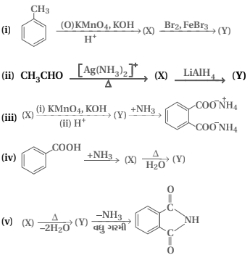
Solution
(A) $(i)$ Toluene on oxidation with $KMnO_4/KOH$ gives benzoic acid $(X)$,which on bromination gives $m$-bromobenzoic acid $(Y)$.
$(ii)$ $CH_3CHO$ with Tollen's reagent gives ethanoic acid $(X)$,which on reduction with $LiAlH_4$ gives ethanol $(Y)$.
$(iii)$ $o$-xylene $(X)$ on oxidation gives phthalic acid $(Y)$.
$(iv)$ Benzoic acid with $NH_3$ gives ammonium benzoate $(X)$,which on heating gives benzamide $(Y)$.
$(v)$ Phthalic acid with $NH_3$ gives ammonium phthalate $(X)$,which on heating gives phthalamide $(Y)$.
$(ii)$ $CH_3CHO$ with Tollen's reagent gives ethanoic acid $(X)$,which on reduction with $LiAlH_4$ gives ethanol $(Y)$.
$(iii)$ $o$-xylene $(X)$ on oxidation gives phthalic acid $(Y)$.
$(iv)$ Benzoic acid with $NH_3$ gives ammonium benzoate $(X)$,which on heating gives benzamide $(Y)$.
$(v)$ Phthalic acid with $NH_3$ gives ammonium phthalate $(X)$,which on heating gives phthalamide $(Y)$.
0 likes
View Solution139
Difficult
Give the conversion of the following:
$(i)$ Phthalimide from $o-xylene$
$(ii)$ Ethanol from Ethanoic anhydride
$(i)$ Phthalimide from $o-xylene$
$(ii)$ Ethanol from Ethanoic anhydride
Solution
(N/A) $(i)$ Conversion of $o-xylene$ to Phthalimide:
$o-xylene$ $\xrightarrow{KMnO_4, H^+}$ Phthalic acid $\xrightarrow{+2NH_3}$ Ammonium phthalate $\xrightarrow{\Delta, -H_2O}$ Phthalamide $\xrightarrow{\Delta, -NH_3}$ Phthalimide.
$(ii)$ Conversion of Ethanoic anhydride to Ethanol:
$(CH_3CO)_2O$ $\xrightarrow{H_2O, \Delta}$ $2CH_3COOH$ (Ethanoic acid) $\xrightarrow{LiAlH_4, \text{ether}}$ $2CH_3CH_2OH$ (Ethanol).
$o-xylene$ $\xrightarrow{KMnO_4, H^+}$ Phthalic acid $\xrightarrow{+2NH_3}$ Ammonium phthalate $\xrightarrow{\Delta, -H_2O}$ Phthalamide $\xrightarrow{\Delta, -NH_3}$ Phthalimide.
$(ii)$ Conversion of Ethanoic anhydride to Ethanol:
$(CH_3CO)_2O$ $\xrightarrow{H_2O, \Delta}$ $2CH_3COOH$ (Ethanoic acid) $\xrightarrow{LiAlH_4, \text{ether}}$ $2CH_3CH_2OH$ (Ethanol).
0 likes
View Solution140
MediumMCQ
Compound $A$ was prepared by oxidation of compound $B$ with alkaline $KMnO_4$. Compound $A$ on reduction with lithium aluminium hydride $(LiAlH_4)$ gets converted back to compound $B$. When compound $A$ is heated with compound $B$ in the presence of $H_2SO_4$,it produces a fruity smell of compound $C$. To which family do the compounds $A$,$B$,and $C$ belong?
A
$A$: Carboxylic acid,$B$: Alcohol,$C$: Ester
B
$A$: Alcohol,$B$: Carboxylic acid,$C$: Ester
C
$A$: Aldehyde,$B$: Alcohol,$C$: Ester
D
$A$: Carboxylic acid,$B$: Aldehyde,$C$: Ester
Solution
(A) $1$. Oxidation of $B$ (alcohol) with alkaline $KMnO_4$ gives $A$ (carboxylic acid).
$2$. Reduction of $A$ (carboxylic acid) with $LiAlH_4$ gives $B$ (alcohol).
$3$. Reaction of $A$ (carboxylic acid) and $B$ (alcohol) in the presence of $H_2SO_4$ (esterification) produces $C$ (ester),which has a characteristic fruity smell.
Therefore,$A$ is a carboxylic acid,$B$ is an alcohol,and $C$ is an ester.
$2$. Reduction of $A$ (carboxylic acid) with $LiAlH_4$ gives $B$ (alcohol).
$3$. Reaction of $A$ (carboxylic acid) and $B$ (alcohol) in the presence of $H_2SO_4$ (esterification) produces $C$ (ester),which has a characteristic fruity smell.
Therefore,$A$ is a carboxylic acid,$B$ is an alcohol,and $C$ is an ester.
0 likes
View Solution141
Medium
Match the compounds possessing carbonyl carbon in Column-$I$ with their formulas in Column-$II$ and examples in Column-$III$:
| Column-$I$ (Name) | Column-$II$ (Formula) | Column-$III$ (Example) |
|---|---|---|
| $(A)$ Ketone | $(i)$ $R-CO-OH$ | $(p)$ $CH_3CHO$ |
| $(B)$ Carboxylic acid | $(ii)$ $R-CO-H$ | $(q)$ $CH_3COOH$ |
| $(C)$ Amide | $(iii)$ $R-CO-R'$ | $(r)$ $CH_3CONH_2$ |
| $(D)$ Aldehyde | $(iv)$ $R-CO-NH_2$ | $(s)$ $CH_3COC_2H_5$ |
Solution
(A) The correct matching is as follows:
$(A)$ Ketone corresponds to formula $(iii)$ $R-CO-R'$ and example $(s)$ $CH_3COC_2H_5$.
$(B)$ Carboxylic acid corresponds to formula $(i)$ $R-CO-OH$ and example $(q)$ $CH_3COOH$.
$(C)$ Amide corresponds to formula $(iv)$ $R-CO-NH_2$ and example $(r)$ $CH_3CONH_2$.
$(D)$ Aldehyde corresponds to formula $(ii)$ $R-CO-H$ and example $(p)$ $CH_3CHO$.
Therefore,the correct sequence is: $A$ $\rightarrow iii$ $\rightarrow s, B$ $\rightarrow i$ $\rightarrow q, C$ $\rightarrow iv$ $\rightarrow r, D$ $\rightarrow ii$ $\rightarrow p$.
$(A)$ Ketone corresponds to formula $(iii)$ $R-CO-R'$ and example $(s)$ $CH_3COC_2H_5$.
$(B)$ Carboxylic acid corresponds to formula $(i)$ $R-CO-OH$ and example $(q)$ $CH_3COOH$.
$(C)$ Amide corresponds to formula $(iv)$ $R-CO-NH_2$ and example $(r)$ $CH_3CONH_2$.
$(D)$ Aldehyde corresponds to formula $(ii)$ $R-CO-H$ and example $(p)$ $CH_3CHO$.
Therefore,the correct sequence is: $A$ $\rightarrow iii$ $\rightarrow s, B$ $\rightarrow i$ $\rightarrow q, C$ $\rightarrow iv$ $\rightarrow r, D$ $\rightarrow ii$ $\rightarrow p$.
0 likes
View Solution142
Medium
Match the formulas in Column-$I$ with their names in Column-$II$.
| Column-$I$ (formula) | Column-$II$ (name) |
| $A$. $RCH=NH$ | $i$. Diisobutyl aluminium hydride |
| $B$. $AlH(i-Bu)_2$ | $ii$. Benzalchloride |
| $C$. $C_6H_5-CH(OCOCH_3)_2$ | $iii$. Imine |
| $D$. $C_6H_5CHCl_2$ | $iv$. Benzylidene diacetate |
Solution
(A-III, B-I, C-IV, D-II) The correct matches are:
$A$. $RCH=NH$ is an $\text{Imine}$ $(iii)$.
$B$. $AlH(i-Bu)_2$ is $\text{Diisobutyl aluminium hydride}$ $(i)$.
$C$. $C_6H_5-CH(OCOCH_3)_2$ is $\text{Benzylidene diacetate}$ $(iv)$.
$D$. $C_6H_5CHCl_2$ is $\text{Benzalchloride}$ $(ii)$.
Therefore,the correct sequence is $A-iii, B-i, C-iv, D-ii$.
$A$. $RCH=NH$ is an $\text{Imine}$ $(iii)$.
$B$. $AlH(i-Bu)_2$ is $\text{Diisobutyl aluminium hydride}$ $(i)$.
$C$. $C_6H_5-CH(OCOCH_3)_2$ is $\text{Benzylidene diacetate}$ $(iv)$.
$D$. $C_6H_5CHCl_2$ is $\text{Benzalchloride}$ $(ii)$.
Therefore,the correct sequence is $A-iii, B-i, C-iv, D-ii$.
0 likes
View Solution143
MediumMCQ
In Column - $I$ the structure of the compound is given,in Column - $II$ the boiling point,and in Column - $III$ the functional group is given. Find the correct match for Column - $I$ from Column - $II$ and Column - $III$.
| Column - $I$ (Formula) | Column - $II$ (Boiling Point) | Column - $III$ (Group) |
| $(A)$ $CH_3COOH$ | $(i)$ $309 \ K$ | $(m)$ Alkane |
| $(B)$ $CH_3CH_2CH_2OH$ | $(ii)$ $322 \ K$ | $(n)$ Ketone |
| $(C)$ $CH_3COCH_3$ | $(iii)$ $329 \ K$ | $(o)$ Aldehyde |
| $(D)$ $CH_3CH_2CHO$ | $(iv)$ $391 \ K$ | $(p)$ Carboxylic acid |
| $(E)$ $CH_3CH_2CH_2CH_2CH_3$ | $(v)$ $370 \ K$ | $(q)$ Alcohol |
A
$(A)-(iv)-(p), (B)-(v)-(q), (C)-(ii)-(n), (D)-(iii)-(o), (E)-(i)-(m)$
B
$(A)-(iv)-(p), (B)-(v)-(q), (C)-(i)-(n), (D)-(ii)-(o), (E)-(iii)-(m)$
C
$(A)-(i)-(p), (B)-(ii)-(q), (C)-(iii)-(n), (D)-(iv)-(o), (E)-(v)-(m)$
D
$(A)-(iv)-(p), (B)-(v)-(q), (C)-(iii)-(n), (D)-(ii)-(o), (E)-(i)-(m)$
Solution
(D) The boiling point of organic compounds depends on the strength of intermolecular forces.
$1.$ Carboxylic acids $(A)$ form stable dimers through strong hydrogen bonding,resulting in the highest boiling point $(391 \ K)$. Group: Carboxylic acid $(p)$.
$2.$ Alcohols $(B)$ also form hydrogen bonds but are generally weaker than carboxylic acid dimers. $BP$: $370 \ K$. Group: Alcohol $(q)$.
$3.$ Ketones $(C)$ and Aldehydes $(D)$ have dipole-dipole interactions. Ketones typically have slightly higher boiling points than isomeric aldehydes. $BP$: Ketone $(329 \ K)$,Aldehyde $(322 \ K)$. Groups: Ketone $(n)$,Aldehyde $(o)$.
$4.$ Alkanes $(E)$ have only weak Van der Waals forces,resulting in the lowest boiling point $(309 \ K)$. Group: Alkane $(m)$.
Therefore,the correct match is $(A)-(iv)-(p), (B)-(v)-(q), (C)-(iii)-(n), (D)-(ii)-(o), (E)-(i)-(m)$.
$1.$ Carboxylic acids $(A)$ form stable dimers through strong hydrogen bonding,resulting in the highest boiling point $(391 \ K)$. Group: Carboxylic acid $(p)$.
$2.$ Alcohols $(B)$ also form hydrogen bonds but are generally weaker than carboxylic acid dimers. $BP$: $370 \ K$. Group: Alcohol $(q)$.
$3.$ Ketones $(C)$ and Aldehydes $(D)$ have dipole-dipole interactions. Ketones typically have slightly higher boiling points than isomeric aldehydes. $BP$: Ketone $(329 \ K)$,Aldehyde $(322 \ K)$. Groups: Ketone $(n)$,Aldehyde $(o)$.
$4.$ Alkanes $(E)$ have only weak Van der Waals forces,resulting in the lowest boiling point $(309 \ K)$. Group: Alkane $(m)$.
Therefore,the correct match is $(A)-(iv)-(p), (B)-(v)-(q), (C)-(iii)-(n), (D)-(ii)-(o), (E)-(i)-(m)$.
0 likes
View Solution144
Medium
Match the compounds given in Column-$I$ with their names in Column-$II$.
| Column-$I$ (Formula) | Column-$II$ (Name) |
| $(A)$ $CH_3-CH=CHCHO$ | $(i)$ $1,3$-diphenylprop-$2$-en-$1$-one |
| $(B)$ $CH_3-C(CH_3)=CH-COCH_3$ | (ii) Acetophenone-$2,4$-dinitrophenylhydrazone |
| $(C)$ $C_6H_5-CH=CH-COC_6H_5$ | (iii) But-$2$-enal |
| $(D)$ $C_6H_5-C(CH_3)=N-NH-C_6H_3(NO_2)_2$ | (iv) $4$-methylpent-$3$-en-$2$-one |
Solution
(A) The matching is as follows:
$(A)$ $CH_3-CH=CHCHO$ is But-$2$-enal $(iii)$.
$(B)$ $CH_3-C(CH_3)=CH-COCH_3$ is $4$-methylpent-$3$-en-$2$-one $(iv)$.
$(C)$ $C_6H_5-CH=CH-COC_6H_5$ is $1,3$-diphenylprop-$2$-en-$1$-one $(i)$.
$(D)$ $C_6H_5-C(CH_3)=N-NH-C_6H_3(NO_2)_2$ is Acetophenone-$2,4$-dinitrophenylhydrazone $(ii)$.
Thus,the correct matching is: $A-iii, B-iv, C-i, D-ii$.
$(A)$ $CH_3-CH=CHCHO$ is But-$2$-enal $(iii)$.
$(B)$ $CH_3-C(CH_3)=CH-COCH_3$ is $4$-methylpent-$3$-en-$2$-one $(iv)$.
$(C)$ $C_6H_5-CH=CH-COC_6H_5$ is $1,3$-diphenylprop-$2$-en-$1$-one $(i)$.
$(D)$ $C_6H_5-C(CH_3)=N-NH-C_6H_3(NO_2)_2$ is Acetophenone-$2,4$-dinitrophenylhydrazone $(ii)$.
Thus,the correct matching is: $A-iii, B-iv, C-i, D-ii$.
0 likes
View Solution145
Difficult
In Column-$I$ formula,in Column-$II$ general name and in Column-$III$ $IUPAC$ name are given. Match the items in Column-$I$ with the appropriate items in Column-$II$ and Column-$III$.
| Column-$I$ (Formula) | Column-$II$ (General Name) and Column-$III$ ($IUPAC$ Name) |
| $(A)$ $HCOOH$ | $(i)$ Succinic acid,$(x)$ Methanoic acid |
| $(B)$ $CH_3CH_2CH_2COOH$ | $(ii)$ Oxalic acid,$(y)$ Ethanedioic acid |
| $(C)$ $(COOH)_2$ | $(iii)$ Formic acid,$(m)$ Butanedioic acid |
| $(D)$ $(CH_2)_2(COOH)_2$ | $(iv)$ Butyric acid,$(n)$ Butanoic acid |
Solution
(A) The correct matches are:
$(A) HCOOH$ is Formic acid $(iii)$ and Methanoic acid $(x)$.
$(B) CH_3CH_2CH_2COOH$ is Butyric acid $(iv)$ and Butanoic acid $(n)$.
$(C) (COOH)_2$ is Oxalic acid $(ii)$ and Ethanedioic acid $(y)$.
$(D) (CH_2)_2(COOH)_2$ is Succinic acid $(i)$ and Butanedioic acid $(m)$.
Therefore,the correct sequence is: $(A$ $\rightarrow iii$ $\rightarrow x), (B$ $\rightarrow iv$ $\rightarrow n), (C$ $\rightarrow ii$ $\rightarrow y), (D$ $\rightarrow i$ $\rightarrow m)$.
$(A) HCOOH$ is Formic acid $(iii)$ and Methanoic acid $(x)$.
$(B) CH_3CH_2CH_2COOH$ is Butyric acid $(iv)$ and Butanoic acid $(n)$.
$(C) (COOH)_2$ is Oxalic acid $(ii)$ and Ethanedioic acid $(y)$.
$(D) (CH_2)_2(COOH)_2$ is Succinic acid $(i)$ and Butanedioic acid $(m)$.
Therefore,the correct sequence is: $(A$ $\rightarrow iii$ $\rightarrow x), (B$ $\rightarrow iv$ $\rightarrow n), (C$ $\rightarrow ii$ $\rightarrow y), (D$ $\rightarrow i$ $\rightarrow m)$.
0 likes
View Solution146
MediumMCQ
Find the correct match for the acid given in Column-$I$ with its formula in Column-$II$ and its $IUPAC$ name in Column-$III$.
| Column-$I$ (Acid) | Column-$II$ (Formula) and Column-$III$ ($IUPAC$ Name) |
|---|---|
| $(A)$ Adipic acid | $(ii)$ $HOOC(CH_2)_4COOH$ ; $(y)$ Hexanedioic acid |
| $(B)$ Carballylic acid | $(iii)$ $HOOC-CH_2-CH(COOH)-CH_2-COOH$ ; $(n)$ Propane-$1,2,3$-tricarboxylic acid |
| $(C)$ Phthalic acid | $(i)$ $1,2-C_6H_4(COOH)_2$ ; $(x)$ Benzene-$1,2$-dicarboxylic acid |
| $(D)$ Glutaric acid | $(iv)$ $HOOC(CH_2)_3COOH$ ; $(m)$ Pentanedioic acid |
A
$(A)-iv-m, (B)-iii-n, (C)-i-x, (D)-ii-y$
B
$(A)-ii-y, (B)-iv-m, (C)-i-x, (D)-iii-n$
C
$(A)-ii-y, (B)-iii-n, (C)-iv-m, (D)-i-x$
D
$(A)-ii-y, (B)-iii-n, (C)-i-x, (D)-iv-m$
Solution
(D) The correct matching is:
$(A)$ Adipic acid $\rightarrow$ $(ii)$ $HOOC(CH_2)_4COOH$ $\rightarrow$ $(y)$ Hexanedioic acid
$(B)$ Carballylic acid $\rightarrow$ $(iii)$ $HOOC-CH_2-CH(COOH)-CH_2-COOH$ $\rightarrow$ $(n)$ Propane-$1,2,3$-tricarboxylic acid
$(C)$ Phthalic acid $\rightarrow$ $(i)$ $1,2-C_6H_4(COOH)_2$ $\rightarrow$ $(x)$ Benzene-$1,2$-dicarboxylic acid
$(D)$ Glutaric acid $\rightarrow$ $(iv)$ $HOOC(CH_2)_3COOH$ $\rightarrow$ $(m)$ Pentanedioic acid
Therefore,the correct match is $(A)-ii-y, (B)-iii-n, (C)-i-x, (D)-iv-m$.
$(A)$ Adipic acid $\rightarrow$ $(ii)$ $HOOC(CH_2)_4COOH$ $\rightarrow$ $(y)$ Hexanedioic acid
$(B)$ Carballylic acid $\rightarrow$ $(iii)$ $HOOC-CH_2-CH(COOH)-CH_2-COOH$ $\rightarrow$ $(n)$ Propane-$1,2,3$-tricarboxylic acid
$(C)$ Phthalic acid $\rightarrow$ $(i)$ $1,2-C_6H_4(COOH)_2$ $\rightarrow$ $(x)$ Benzene-$1,2$-dicarboxylic acid
$(D)$ Glutaric acid $\rightarrow$ $(iv)$ $HOOC(CH_2)_3COOH$ $\rightarrow$ $(m)$ Pentanedioic acid
Therefore,the correct match is $(A)-ii-y, (B)-iii-n, (C)-i-x, (D)-iv-m$.
0 likes
View Solution147
Difficult
Match the reactions given in Column-$I$ with their products in Column-$II$.
| Column-$I$ (Reactant) | Column-$II$ (Product) |
| $A$. $RCH_2OH \xrightarrow[(ii) H_3O^{+}]{(i) NaOH, KMnO_4} ?$ | $i$. $C_6H_5COOH + C_2H_5OH$ |
| $B$. $CH_3(CH_2)_8CH_2OH \xrightarrow{Jones reagent} ?$ | $ii$. $RCOOH$ |
| $C$. $RCONH_2 \xrightarrow{H_3O^{+}, \Delta} ?$ | $iii$. $CH_3(CH_2)_8COOH$ |
| $D$. $C_6H_5COOEt \xrightarrow{H_3O^{+}} ?$ | $iv$. $RCOOH + NH_3$ |
Solution
(A-II, B-III, C-IV, D-I) The correct matches are:
$A \rightarrow ii$: Primary alcohols $(RCH_2OH)$ are oxidized to carboxylic acids $(RCOOH)$ using strong oxidizing agents like $KMnO_4$.
$B \rightarrow iii$: Primary alcohols are oxidized to carboxylic acids using Jones reagent $(CrO_3/H_2SO_4)$.
$C \rightarrow iv$: Amides $(RCONH_2)$ undergo acid-catalyzed hydrolysis to yield carboxylic acids $(RCOOH)$ and ammonia $(NH_3)$.
$D \rightarrow i$: Esters $(C_6H_5COOEt)$ undergo acid-catalyzed hydrolysis to yield the corresponding carboxylic acid $(C_6H_5COOH)$ and alcohol $(C_2H_5OH)$.
Therefore,the correct sequence is $A-ii, B-iii, C-iv, D-i$.
$A \rightarrow ii$: Primary alcohols $(RCH_2OH)$ are oxidized to carboxylic acids $(RCOOH)$ using strong oxidizing agents like $KMnO_4$.
$B \rightarrow iii$: Primary alcohols are oxidized to carboxylic acids using Jones reagent $(CrO_3/H_2SO_4)$.
$C \rightarrow iv$: Amides $(RCONH_2)$ undergo acid-catalyzed hydrolysis to yield carboxylic acids $(RCOOH)$ and ammonia $(NH_3)$.
$D \rightarrow i$: Esters $(C_6H_5COOEt)$ undergo acid-catalyzed hydrolysis to yield the corresponding carboxylic acid $(C_6H_5COOH)$ and alcohol $(C_2H_5OH)$.
Therefore,the correct sequence is $A-ii, B-iii, C-iv, D-i$.
0 likes
View Solution148
Difficult
Match the reactions given in Column-$I$ with the appropriate reagents in Column-$II$.
| Column-$I$ (Reaction) | Column-$II$ (Reagent) |
| :--- | :--- |
| $(A)$ $2CH_3COOH \rightarrow (CH_3CO)_2O$ | $(i)$ $(I) NH_3, (II) \Delta, -H_2O$ |
| $(B)$ Phthalic acid $\rightarrow$ Phthalamide | $(ii)$ $(I) Br_2 / \text{red phosphorous}, (II) H_2O$ |
| $(C)$ $CH_3CH_2COOH \rightarrow CH_3CHBrCOOH$ | $(iii)$ $Br_2 / FeBr_3$ |
| $(D)$ Benzoic acid $\rightarrow$ $m$-Bromobenzoic acid | $(iv)$ $H^+, \Delta \text{ OR } P_2O_5, \Delta$ |
| Column-$I$ (Reaction) | Column-$II$ (Reagent) |
| :--- | :--- |
| $(A)$ $2CH_3COOH \rightarrow (CH_3CO)_2O$ | $(i)$ $(I) NH_3, (II) \Delta, -H_2O$ |
| $(B)$ Phthalic acid $\rightarrow$ Phthalamide | $(ii)$ $(I) Br_2 / \text{red phosphorous}, (II) H_2O$ |
| $(C)$ $CH_3CH_2COOH \rightarrow CH_3CHBrCOOH$ | $(iii)$ $Br_2 / FeBr_3$ |
| $(D)$ Benzoic acid $\rightarrow$ $m$-Bromobenzoic acid | $(iv)$ $H^+, \Delta \text{ OR } P_2O_5, \Delta$ |
Solution
(A-IV, B-I, C-II, D-III) $(A)-(iv)$: Dehydration of acetic acid using $P_2O_5$ or $H^+, \Delta$ gives acetic anhydride.
$(B)-(i)$: Phthalic acid reacts with $NH_3$ followed by heating to form phthalamide.
$(C)-(ii)$: Hell-Volhard-Zelinsky reaction uses $Br_2 / \text{red phosphorous}$ followed by $H_2O$ to alpha-brominate carboxylic acids.
$(D)-(iii)$: Electrophilic aromatic substitution of benzoic acid (meta-directing group) with $Br_2 / FeBr_3$ gives $m$-bromobenzoic acid.
Therefore,the correct matching is $(A)-(iv), (B)-(i), (C)-(ii), (D)-(iii)$.
$(B)-(i)$: Phthalic acid reacts with $NH_3$ followed by heating to form phthalamide.
$(C)-(ii)$: Hell-Volhard-Zelinsky reaction uses $Br_2 / \text{red phosphorous}$ followed by $H_2O$ to alpha-brominate carboxylic acids.
$(D)-(iii)$: Electrophilic aromatic substitution of benzoic acid (meta-directing group) with $Br_2 / FeBr_3$ gives $m$-bromobenzoic acid.
Therefore,the correct matching is $(A)-(iv), (B)-(i), (C)-(ii), (D)-(iii)$.
0 likes
View Solution149
Difficult
Match the reactions given in Column-$I$ with their names in Column-$II$.
| Column-$I$ (Reaction) | Column-$II$ (Name) |
|---|---|
| $A$. $RCH_2COOH \rightarrow[H_2O]{X_2/P} RCH(X)COOH$ | $i$. Decarboxylation |
| $B$. $RCOONa \rightarrow[NaOH, CaO, \Delta]{\text{soda lime}} RH$ | $ii$. Grignard reaction |
| $C$. $RCOOH + R'OH \leftrightarrow{H^{+}} RCOOR' + H_2O$ | $iii$. Hell-Volhard-Zelinsky reaction |
| $D$. $RMgX + R'CHO \rightarrow{H_3O^{+}} RCH(OH)R'$ | $iv$. Esterification |
Solution
(A-III, B-I, C-IV, D-II) The correct matches are as follows:
$A$. $RCH_2COOH \rightarrow[H_2O]{X_2/P} RCH(X)COOH$ is the Hell-Volhard-Zelinsky reaction $(iii)$.
$B$. $RCOONa \rightarrow[NaOH, CaO, \Delta]{\text{soda lime}} RH$ is Decarboxylation $(i)$.
$C$. $RCOOH + R'OH \leftrightarrow{H^{+}} RCOOR' + H_2O$ is Esterification $(iv)$.
$D$. $RMgX + R'CHO \rightarrow{H_3O^{+}} RCH(OH)R'$ is a Grignard reaction $(ii)$.
Therefore,the correct sequence is $A-iii, B-i, C-iv, D-ii$.
$A$. $RCH_2COOH \rightarrow[H_2O]{X_2/P} RCH(X)COOH$ is the Hell-Volhard-Zelinsky reaction $(iii)$.
$B$. $RCOONa \rightarrow[NaOH, CaO, \Delta]{\text{soda lime}} RH$ is Decarboxylation $(i)$.
$C$. $RCOOH + R'OH \leftrightarrow{H^{+}} RCOOR' + H_2O$ is Esterification $(iv)$.
$D$. $RMgX + R'CHO \rightarrow{H_3O^{+}} RCH(OH)R'$ is a Grignard reaction $(ii)$.
Therefore,the correct sequence is $A-iii, B-i, C-iv, D-ii$.
0 likes
View Solution150
Medium
Match Column-$I$ with Column-$II$ based on the $pK_a$ values of the given carboxylic acids:
| Column-$I$ | Column-$II$ |
| $(A)$ $CF_3COOH$ | $(i)$ $3.41$ |
| $(B)$ Benzoic acid | $(ii)$ $4.76$ |
| $(C)$ $CH_3COOH$ | $(iii)$ $0.23$ |
| $(D)$ $4$-nitrobenzoic acid | $(iv)$ $4.20$ |
Solution
(A) The $pK_a$ values for the given acids are as follows:
$(A)$ $CF_3COOH$: $0.23$ (Strongest acid due to electron-withdrawing $-F$ groups)
$(B)$ Benzoic acid: $4.20$
$(C)$ $CH_3COOH$: $4.76$ (Weakest acid)
$(D)$ $4$-nitrobenzoic acid: $3.41$ (Stronger than benzoic acid due to electron-withdrawing $-NO_2$ group)
Therefore,the correct matching is: $(A$ $\rightarrow iii), (B$ $\rightarrow iv), (C$ $\rightarrow ii), (D$ $\rightarrow i)$.
$(A)$ $CF_3COOH$: $0.23$ (Strongest acid due to electron-withdrawing $-F$ groups)
$(B)$ Benzoic acid: $4.20$
$(C)$ $CH_3COOH$: $4.76$ (Weakest acid)
$(D)$ $4$-nitrobenzoic acid: $3.41$ (Stronger than benzoic acid due to electron-withdrawing $-NO_2$ group)
Therefore,the correct matching is: $(A$ $\rightarrow iii), (B$ $\rightarrow iv), (C$ $\rightarrow ii), (D$ $\rightarrow i)$.
0 likes
View Solution8-2.Carboxylic acids and Their derivative — Mix Examples-Carboxylic acids and Their derivative · Frequently Asked Questions
1Are these 8-2.Carboxylic acids and Their derivative questions useful for JEE and NEET?
Yes. All questions in this section are mapped to JEE Main and NEET exam patterns. Previous year questions from JEE Main, NEET, GUJCET and state-level exams are included with full solutions.
2Can I switch to Hindi or Gujarati for these questions?
Yes. Use the language tabs in the hero section or the sidebar to view the same questions and solutions in English, Hindi or Gujarati.
3How do I generate a question paper from this subtopic?
Use the Vedclass Exam Paper Generator — select the chapter and subtopic, set difficulty, and generate Sets A, B, C, D automatically. First 3 chapters of every subject are free.
Vedclass Products
For Students
Vedclass Test Series
Mock tests in real JEE/NEET style with performance analysis. 5-day free trial.
Start Free TrialFor Teachers
Exam Paper Generator
Generate Set A/B/C/D papers from this chapter in 2 minutes. 3 chapters free.
Try FreeFor Institutes
Online Exam Module
Live online exams with unlimited students, 360° analytics & white-label branding.
See DemoFor Teachers & Institutes
Generate a 8-2.Carboxylic acids and Their derivative Exam Paper in 2 Minutes
Select subtopic & difficulty — Sets A, B, C, D auto-generated with No Repeat logic.
First 3 chapters of every subject are free — no payment required.