
A English
Mix Examples-Carboxylic acids and Their derivative Questions in English
Class 12 Chemistry · 8-2.Carboxylic acids and Their derivative · Mix Examples-Carboxylic acids and Their derivative
240+
Questions
English
Language
100%
With Solutions
Showing 26 of 240 questions in English
201
EasyMCQ
Match the following.
| List-$I$ (Substance) | List-$II$ (Use) |
|---|---|
| $(A)$ Methanoic acid | $(i)$ Textile |
| $(B)$ Ethanoic acid | $(iv)$ Vinegar |
| $(C)$ Hexanedioic acid | $(ii)$ Polymer |
| $(D)$ Sodium benzoate | $(iii)$ Food preservative |
A
$(A)-(i), (B)-(iv), (C)-(ii), (D)-(iii)$
B
$(A)-(ii), (B)-(iv), (C)-(i), (D)-(iii)$
C
$(A)-(iii), (B)-(iv), (C)-(ii), (D)-(i)$
D
$(A)-(iv), (B)-(iii), (C)-(ii), (D)-(i)$
Solution
(A) The correct matching is as follows:
$(A)$ Methanoic acid is used in the textile industry as a $pH$ regulator.
$(B)$ Ethanoic acid is used as vinegar,which is a $4-7 \%$ solution of acetic acid.
$(C)$ Hexanedioic acid (adipic acid) is a precursor for the production of nylon (polymer).
$(D)$ Sodium benzoate is widely used as a food preservative to prevent spoilage.
$(A)$ Methanoic acid is used in the textile industry as a $pH$ regulator.
$(B)$ Ethanoic acid is used as vinegar,which is a $4-7 \%$ solution of acetic acid.
$(C)$ Hexanedioic acid (adipic acid) is a precursor for the production of nylon (polymer).
$(D)$ Sodium benzoate is widely used as a food preservative to prevent spoilage.
0 likes
View Solution202
EasyMCQ
Match the name of the acid from List-$I$ with the source from which it is derived.
| $A$. Formic acid | $I$. Rancid butter |
| $B$. Acetic acid | $II$. Vinegar |
| $C$. Butyric acid | $III$. Red ants |
A
$A-I, B-II, C-III$
B
$A-II, B-I, C-III$
C
$A-III, B-II, C-I$
D
$A-III, B-I, C-II$
Solution
(C) The sources of the given carboxylic acids are as follows:
$A$. Formic acid $(HCOOH)$ is found in red ants.
$B$. Acetic acid $(CH_3COOH)$ is the main component of vinegar.
$C$. Butyric acid $(CH_3CH_2CH_2COOH)$ is found in rancid butter.
Therefore,the correct matching is $A-III, B-II, C-I$.
$A$. Formic acid $(HCOOH)$ is found in red ants.
$B$. Acetic acid $(CH_3COOH)$ is the main component of vinegar.
$C$. Butyric acid $(CH_3CH_2CH_2COOH)$ is found in rancid butter.
Therefore,the correct matching is $A-III, B-II, C-I$.
0 likes
View Solution203
MediumMCQ
Increasing order of boiling points in the following compounds is:
$I$. $CH_3COOH$
$II$. $CH_3CH_2CHO$
$III$. $CH_3CH_2CH_2OH$
$IV$. $CH_3COCH_3$
$I$. $CH_3COOH$
$II$. $CH_3CH_2CHO$
$III$. $CH_3CH_2CH_2OH$
$IV$. $CH_3COCH_3$
A
$II < IV < III < I$
B
$II < IV > III < I$
C
$IV < II > I < III$
D
$IV < III < II < I$
Solution
(A) The boiling point of a compound depends on intermolecular forces such as dipole-dipole interactions and hydrogen bonding.
$1$. $CH_3COOH$ (acetic acid) exhibits strong intermolecular hydrogen bonding and exists as a dimer,resulting in the highest boiling point.
$2$. $CH_3CH_2CH_2OH$ (propan$-1-$ol) also exhibits hydrogen bonding,but it is weaker than that in carboxylic acids,so it has a lower boiling point than $CH_3COOH$.
$3$. $CH_3COCH_3$ (acetone) and $CH_3CH_2CHO$ (propanal) are polar molecules exhibiting dipole-dipole interactions. Acetone $(CH_3COCH_3)$ has a higher boiling point than propanal $(CH_3CH_2CHO)$ due to higher molecular polarity and stronger dipole-dipole interactions.
$4$. Comparing all,the order is: $CH_3CH_2CHO < CH_3COCH_3 < CH_3CH_2CH_2OH < CH_3COOH$,which corresponds to $II < IV < III < I$.
$1$. $CH_3COOH$ (acetic acid) exhibits strong intermolecular hydrogen bonding and exists as a dimer,resulting in the highest boiling point.
$2$. $CH_3CH_2CH_2OH$ (propan$-1-$ol) also exhibits hydrogen bonding,but it is weaker than that in carboxylic acids,so it has a lower boiling point than $CH_3COOH$.
$3$. $CH_3COCH_3$ (acetone) and $CH_3CH_2CHO$ (propanal) are polar molecules exhibiting dipole-dipole interactions. Acetone $(CH_3COCH_3)$ has a higher boiling point than propanal $(CH_3CH_2CHO)$ due to higher molecular polarity and stronger dipole-dipole interactions.
$4$. Comparing all,the order is: $CH_3CH_2CHO < CH_3COCH_3 < CH_3CH_2CH_2OH < CH_3COOH$,which corresponds to $II < IV < III < I$.
0 likes
View Solution204
MediumMCQ
Which of the following sets is in the correct order regarding the property mentioned against them?
| Sets | Property |
|---|---|
| $I$. $NCCH_2COOH > FCH_2COOH > H_3CCH_2COOH$ | Acidity |
| $II$. $CH_3CH_2CHO > PhCOCH_3 > PhCHO$ | Reactivity |
| $III$. $H_3COCH_2CH_3 < H_3CCH_2CHO < H_3CCH_2CH_2OH$ | Boiling points |
A
$I, II$ only
B
$I, III$ only
C
$II, III$ only
D
$I, II, III$
Solution
(B) $I$. Acidity: The presence of electron-withdrawing groups ($-I$ effect) increases the acidity of carboxylic acids,while electron-donating groups ($+I$ effect or hyperconjugation) decrease it. The order $NCCH_2COOH > FCH_2COOH > H_3CCH_2COOH$ is correct because $-CN$ has a stronger $-I$ effect than $-F$,and $-CH_3$ is electron-donating.
$II$. Reactivity (towards nucleophilic addition): Aldehydes are generally more reactive than ketones due to less steric hindrance and electronic factors. Among aldehydes,$CH_3CH_2CHO$ is more reactive than $PhCHO$ (due to resonance stabilization of the carbonyl group by the phenyl ring). Thus,the correct order is $CH_3CH_2CHO > PhCHO > PhCOCH_3$. The given order is incorrect.
$III$. Boiling points: Alcohols have the highest boiling points due to intermolecular hydrogen bonding. Among carbonyl compounds of similar molecular weight,aldehydes generally have higher boiling points than ketones due to greater dipole-dipole interactions and less steric hindrance. The order $H_3COCH_2CH_3$ (ketone) $< H_3CCH_2CHO$ (aldehyde) $< H_3CCH_2CH_2OH$ (alcohol) is correct.
Therefore,sets $I$ and $III$ are correct.
$II$. Reactivity (towards nucleophilic addition): Aldehydes are generally more reactive than ketones due to less steric hindrance and electronic factors. Among aldehydes,$CH_3CH_2CHO$ is more reactive than $PhCHO$ (due to resonance stabilization of the carbonyl group by the phenyl ring). Thus,the correct order is $CH_3CH_2CHO > PhCHO > PhCOCH_3$. The given order is incorrect.
$III$. Boiling points: Alcohols have the highest boiling points due to intermolecular hydrogen bonding. Among carbonyl compounds of similar molecular weight,aldehydes generally have higher boiling points than ketones due to greater dipole-dipole interactions and less steric hindrance. The order $H_3COCH_2CH_3$ (ketone) $< H_3CCH_2CHO$ (aldehyde) $< H_3CCH_2CH_2OH$ (alcohol) is correct.
Therefore,sets $I$ and $III$ are correct.
0 likes
View Solution205
EasyMCQ
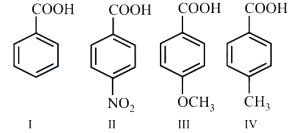
The increasing order of acidity of the following carboxylic acids is:
A
$III < IV < I < II$
B
$II < III < IV < I$
C
$I < II < IV < III$
D
$III < IV < I < II$
Solution
(A) The acidity of substituted benzoic acids depends on the electronic effects of the substituents attached to the benzene ring.
$1$. The $-NO_2$ group (in $II$) is a strong electron-withdrawing group ($-I$ and $-M$ effects),which significantly increases the acidity of the carboxylic acid.
$2$. The $-CH_3$ group (in $IV$) is an electron-donating group ($+I$ and hyperconjugation),which decreases the acidity compared to benzoic acid $(I)$.
$3$. The $-OCH_3$ group (in $III$) exerts a strong $+M$ effect (electron-donating),which is much stronger than its $-I$ effect. This makes it a stronger electron-donating group than $-CH_3$,thus decreasing the acidity more than the $-CH_3$ group.
$4$. Therefore,the acidity order is: $III$ (least acidic) $< IV < I < II$ (most acidic).
Hence,the correct increasing order is $III < IV < I < II$.
$1$. The $-NO_2$ group (in $II$) is a strong electron-withdrawing group ($-I$ and $-M$ effects),which significantly increases the acidity of the carboxylic acid.
$2$. The $-CH_3$ group (in $IV$) is an electron-donating group ($+I$ and hyperconjugation),which decreases the acidity compared to benzoic acid $(I)$.
$3$. The $-OCH_3$ group (in $III$) exerts a strong $+M$ effect (electron-donating),which is much stronger than its $-I$ effect. This makes it a stronger electron-donating group than $-CH_3$,thus decreasing the acidity more than the $-CH_3$ group.
$4$. Therefore,the acidity order is: $III$ (least acidic) $< IV < I < II$ (most acidic).
Hence,the correct increasing order is $III < IV < I < II$.
0 likes
View Solution206
MediumMCQ
Which of the following reactions produce ethyl cyanide $(CH_3 CH_2 CN)$ as a major product?
$1.$ $CH_3 CH_2 CH=NOH \xrightarrow{(CH_3 CO)_2 O} CH_3 CH_2 CN$
$2.$ $CH_3 CH_2 Cl \xrightarrow{\text{Ethanolic } KCN} CH_3 CH_2 CN$
$3.$ $CH_3 CH_2 Cl \xrightarrow{\text{Ethanolic } AgCN} CH_3 CH_2 NC$
$4.$ $CH_3 CH_2 CON(CH_3)_2 \xrightarrow[\text{Pyridine, } 70^{\circ} C]{C_6 H_5 SO_2 Cl} CH_3 CH_2 CN$
$1.$ $CH_3 CH_2 CH=NOH \xrightarrow{(CH_3 CO)_2 O} CH_3 CH_2 CN$
$2.$ $CH_3 CH_2 Cl \xrightarrow{\text{Ethanolic } KCN} CH_3 CH_2 CN$
$3.$ $CH_3 CH_2 Cl \xrightarrow{\text{Ethanolic } AgCN} CH_3 CH_2 NC$
$4.$ $CH_3 CH_2 CON(CH_3)_2 \xrightarrow[\text{Pyridine, } 70^{\circ} C]{C_6 H_5 SO_2 Cl} CH_3 CH_2 CN$
A
$1, 2$
B
$2, 3$
C
$3, 4$
D
$1, 4$
Solution
(A) $1.$ Dehydration of aldoxime with acetic anhydride gives nitrile: $CH_3 CH_2 CH=NOH \xrightarrow{(CH_3 CO)_2 O} CH_3 CH_2 CN + 2 CH_3 COOH$.
$2.$ Nucleophilic substitution of alkyl halide with $KCN$ gives alkyl cyanide: $CH_3 CH_2 Cl + KCN \rightarrow CH_3 CH_2 CN + KCl$.
$3.$ Reaction with $AgCN$ gives isocyanide: $CH_3 CH_2 Cl + AgCN \rightarrow CH_3 CH_2 NC + AgCl$.
$4.$ Dehydration of amide with $C_6 H_5 SO_2 Cl$ in pyridine gives nitrile: $CH_3 CH_2 CON(CH_3)_2 \xrightarrow{C_6 H_5 SO_2 Cl, \text{ Pyridine}} CH_3 CH_2 CN + C_6 H_5 SO_3 H + (CH_3)_2 NH$.
Thus,reactions $1, 2,$ and $4$ produce ethyl cyanide. Given the options,the most appropriate set is $1, 2$.
$2.$ Nucleophilic substitution of alkyl halide with $KCN$ gives alkyl cyanide: $CH_3 CH_2 Cl + KCN \rightarrow CH_3 CH_2 CN + KCl$.
$3.$ Reaction with $AgCN$ gives isocyanide: $CH_3 CH_2 Cl + AgCN \rightarrow CH_3 CH_2 NC + AgCl$.
$4.$ Dehydration of amide with $C_6 H_5 SO_2 Cl$ in pyridine gives nitrile: $CH_3 CH_2 CON(CH_3)_2 \xrightarrow{C_6 H_5 SO_2 Cl, \text{ Pyridine}} CH_3 CH_2 CN + C_6 H_5 SO_3 H + (CH_3)_2 NH$.
Thus,reactions $1, 2,$ and $4$ produce ethyl cyanide. Given the options,the most appropriate set is $1, 2$.
0 likes
View Solution207
MediumMCQ
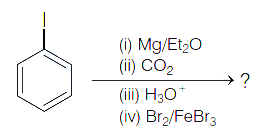
The major product of the following reaction sequence is
A
$3-$bromobenzoic acid
B
$2-$bromobenzoic acid
C
$4-$bromobenzoic acid
D
$3,5-$dibromobenzoic acid
Solution
(A) The reaction sequence is as follows:
$1$. Iodobenzene reacts with $Mg$ in the presence of $Et_2O$ to form phenylmagnesium iodide (a Grignard reagent).
$2$. Phenylmagnesium iodide reacts with $CO_2$ followed by acid hydrolysis $(H_3O^+)$ to yield benzoic acid.
$3$. Benzoic acid undergoes electrophilic aromatic substitution with $Br_2/FeBr_3$. Since the $-COOH$ group is a deactivating and meta-directing group,the bromine atom will be substituted at the meta-position.
$4$. The final product is $3$-bromobenzoic acid.
$1$. Iodobenzene reacts with $Mg$ in the presence of $Et_2O$ to form phenylmagnesium iodide (a Grignard reagent).
$2$. Phenylmagnesium iodide reacts with $CO_2$ followed by acid hydrolysis $(H_3O^+)$ to yield benzoic acid.
$3$. Benzoic acid undergoes electrophilic aromatic substitution with $Br_2/FeBr_3$. Since the $-COOH$ group is a deactivating and meta-directing group,the bromine atom will be substituted at the meta-position.
$4$. The final product is $3$-bromobenzoic acid.
0 likes
View Solution208
MediumMCQ
$CH_3COOH \xrightarrow{LiAlH_4} A$
$A + CH_3COOH \xrightarrow{H_3O^+} B + H_2O$
In the above reactions,'$A$' and '$B$' respectively are:
$A + CH_3COOH \xrightarrow{H_3O^+} B + H_2O$
In the above reactions,'$A$' and '$B$' respectively are:
A
$CH_3COOC_2H_5, C_2H_5OH$
B
$CH_3CHO, C_2H_5OH$
C
$C_2H_5OH, CH_3CHO$
D
$C_2H_5OH, CH_3COOC_2H_5$
Solution
(D) Step $1$: Reduction of acetic acid $(CH_3COOH)$ with $LiAlH_4$ is a strong reducing agent that reduces carboxylic acids to primary alcohols.
$CH_3COOH + 4[H] \xrightarrow{LiAlH_4} CH_3CH_2OH + H_2O$
Thus,$A$ is ethanol $(C_2H_5OH)$.
Step $2$: Esterification reaction between ethanol $(A)$ and acetic acid $(CH_3COOH)$ in the presence of an acid catalyst $(H_3O^+)$ yields an ester.
$CH_3CH_2OH + CH_3COOH \xrightarrow{H_3O^+} CH_3COOC_2H_5 + H_2O$
Thus,$B$ is ethyl acetate $(CH_3COOC_2H_5)$.
Therefore,$A = C_2H_5OH$ and $B = CH_3COOC_2H_5$.
$CH_3COOH + 4[H] \xrightarrow{LiAlH_4} CH_3CH_2OH + H_2O$
Thus,$A$ is ethanol $(C_2H_5OH)$.
Step $2$: Esterification reaction between ethanol $(A)$ and acetic acid $(CH_3COOH)$ in the presence of an acid catalyst $(H_3O^+)$ yields an ester.
$CH_3CH_2OH + CH_3COOH \xrightarrow{H_3O^+} CH_3COOC_2H_5 + H_2O$
Thus,$B$ is ethyl acetate $(CH_3COOC_2H_5)$.
Therefore,$A = C_2H_5OH$ and $B = CH_3COOC_2H_5$.
0 likes
View Solution209
DifficultMCQ
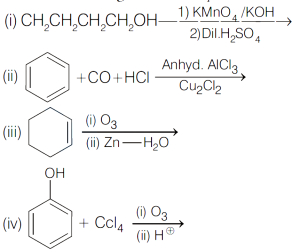
From the following reactions,identify the reactions that give carboxylic acids as products.
A
$(i), (iii)$
B
$(i), (iv)$
C
$(ii), (iii)$
D
$(ii), (iv)$
Solution
(B) Let us analyze each reaction:
$(i)$ Oxidation of $CH_3CH_2CH_2CH_2OH$ with alkaline $KMnO_4$ followed by acidification gives butanoic acid $(CH_3CH_2CH_2COOH)$,which is a carboxylic acid.
$(ii)$ Gattermann-Koch reaction of benzene with $CO$ and $HCl$ in the presence of anhydrous $AlCl_3/Cu_2Cl_2$ gives benzaldehyde $(C_6H_5CHO)$,which is an aldehyde.
$(iii)$ Reductive ozonolysis of cyclohexene with $O_3$ followed by $Zn/H_2O$ gives hexanedial $(OHC-(CH_2)_4-CHO)$,which is a dialdehyde.
$(iv)$ Reimer-Tiemann reaction of phenol with $CCl_4$ in the presence of $NaOH$ followed by acidification gives salicylic acid $(2-hydroxybenzoic \ acid)$,which is a carboxylic acid.
Thus,reactions $(i)$ and $(iv)$ produce carboxylic acids.
$(i)$ Oxidation of $CH_3CH_2CH_2CH_2OH$ with alkaline $KMnO_4$ followed by acidification gives butanoic acid $(CH_3CH_2CH_2COOH)$,which is a carboxylic acid.
$(ii)$ Gattermann-Koch reaction of benzene with $CO$ and $HCl$ in the presence of anhydrous $AlCl_3/Cu_2Cl_2$ gives benzaldehyde $(C_6H_5CHO)$,which is an aldehyde.
$(iii)$ Reductive ozonolysis of cyclohexene with $O_3$ followed by $Zn/H_2O$ gives hexanedial $(OHC-(CH_2)_4-CHO)$,which is a dialdehyde.
$(iv)$ Reimer-Tiemann reaction of phenol with $CCl_4$ in the presence of $NaOH$ followed by acidification gives salicylic acid $(2-hydroxybenzoic \ acid)$,which is a carboxylic acid.
Thus,reactions $(i)$ and $(iv)$ produce carboxylic acids.
0 likes
View Solution210
MediumMCQ
Arrange the following compounds in the increasing order of their $pK_a$ values:
$I.$ Phenol
$II.$ $p$-Nitrophenol
$III.$ Ethanol
$IV.$ $p$-Nitrobenzoic acid
$I.$ Phenol
$II.$ $p$-Nitrophenol
$III.$ Ethanol
$IV.$ $p$-Nitrobenzoic acid
A
$III < IV < II < I$
B
$II < III < IV < I$
C
$IV < II < I < III$
D
$IV < III < II < I$
Solution
(C) The $pK_a$ value is inversely proportional to the acidic strength of the compound.
Acidic strength order:
$IV$ ($p$-Nitrobenzoic acid) > $II$ ($p$-Nitrophenol) > $I$ (Phenol) > $III$ (Ethanol).
$p$-Nitrobenzoic acid is a carboxylic acid,which is significantly more acidic than phenols and alcohols.
$p$-Nitrophenol is more acidic than phenol due to the electron-withdrawing effect of the $-NO_2$ group.
Phenol is more acidic than ethanol due to the resonance stabilization of the phenoxide ion.
Therefore,the increasing order of $pK_a$ values is the reverse of the acidic strength order:
$IV < II < I < III$.
Acidic strength order:
$IV$ ($p$-Nitrobenzoic acid) > $II$ ($p$-Nitrophenol) > $I$ (Phenol) > $III$ (Ethanol).
$p$-Nitrobenzoic acid is a carboxylic acid,which is significantly more acidic than phenols and alcohols.
$p$-Nitrophenol is more acidic than phenol due to the electron-withdrawing effect of the $-NO_2$ group.
Phenol is more acidic than ethanol due to the resonance stabilization of the phenoxide ion.
Therefore,the increasing order of $pK_a$ values is the reverse of the acidic strength order:
$IV < II < I < III$.
0 likes
View Solution211
EasyMCQ
Which of the following reactions produce carboxylic acids?
$(a)$ $MnO_2$ with $CH_3COCH_3$
$(b)$ $Ph-CCl_3 \xrightarrow[(ii) H_2O/H^+]{(i) aq. NaOH} PhCOOH$
$(c)$ $C_2H_5Br \xrightarrow[(iii) H_2O/H^+]{(i) Mg, (ii) CO_2} C_2H_5COOH$
$(d)$ $CH_3CH=CHCH_3 \xrightarrow[\Delta]{K_2Cr_2O_7/H_2SO_4} 2CH_3COOH$
$(a)$ $MnO_2$ with $CH_3COCH_3$
$(b)$ $Ph-CCl_3 \xrightarrow[(ii) H_2O/H^+]{(i) aq. NaOH} PhCOOH$
$(c)$ $C_2H_5Br \xrightarrow[(iii) H_2O/H^+]{(i) Mg, (ii) CO_2} C_2H_5COOH$
$(d)$ $CH_3CH=CHCH_3 \xrightarrow[\Delta]{K_2Cr_2O_7/H_2SO_4} 2CH_3COOH$
A
$a, b, c$
B
$b, c, d$
C
$a, c, d$
D
$a, b, d$
Solution
(B) $MnO_2$ is a mild oxidizing agent and does not oxidize ketones like $CH_3COCH_3$ to carboxylic acids.
$(b)$ $Ph-CCl_3$ undergoes hydrolysis with aqueous $NaOH$ followed by acidification to form benzoic acid $(PhCOOH)$. This is a correct reaction.
$(c)$ Alkyl halides react with $Mg$ to form Grignard reagents $(RMgX)$,which react with $CO_2$ followed by hydrolysis to yield carboxylic acids. This is a correct reaction.
$(d)$ Vigorous oxidation of internal alkenes like $CH_3CH=CHCH_3$ with acidified $K_2Cr_2O_7$ cleaves the double bond to form two molecules of acetic acid $(CH_3COOH)$. This is a correct reaction.
Therefore,reactions $(b)$,$(c)$,and $(d)$ produce carboxylic acids.
$(b)$ $Ph-CCl_3$ undergoes hydrolysis with aqueous $NaOH$ followed by acidification to form benzoic acid $(PhCOOH)$. This is a correct reaction.
$(c)$ Alkyl halides react with $Mg$ to form Grignard reagents $(RMgX)$,which react with $CO_2$ followed by hydrolysis to yield carboxylic acids. This is a correct reaction.
$(d)$ Vigorous oxidation of internal alkenes like $CH_3CH=CHCH_3$ with acidified $K_2Cr_2O_7$ cleaves the double bond to form two molecules of acetic acid $(CH_3COOH)$. This is a correct reaction.
Therefore,reactions $(b)$,$(c)$,and $(d)$ produce carboxylic acids.
0 likes
View Solution212
DifficultMCQ
Statement $(A)$: Carboxylic acid can be obtained by the reaction of $R-C \equiv N$ with $H_3O^+$ under mild reaction conditions.
Statement $(B)$: Hydrolysis of $R-C \equiv N$ in alkaline aqueous medium gives $R-COONa$ and $NH_3$ as products.
The correct answer is:
Statement $(B)$: Hydrolysis of $R-C \equiv N$ in alkaline aqueous medium gives $R-COONa$ and $NH_3$ as products.
The correct answer is:
A
Both $(A)$ and $(B)$ are correct
B
Both $(A)$ and $(B)$ are not correct
C
$(A)$ is correct,but $(B)$ is not correct
D
$(A)$ is not correct but $(B)$ is correct
Solution
(D) The reaction of $R-C \equiv N$ with $H_3O^+$ (acidic hydrolysis) typically requires heating to proceed to the carboxylic acid stage. Under mild conditions,it often stops at the amide stage $(R-CONH_2)$. Thus,statement $(A)$ is generally considered incorrect as it implies a simple,mild reaction.
When alkyl cyanide $(R-C \equiv N)$ is hydrolysed in an alkaline aqueous medium,it undergoes hydrolysis to form a carboxylate salt $(R-COO^-Na^+)$ and ammonia $(NH_3)$. Thus,statement $(B)$ is correct.
When alkyl cyanide $(R-C \equiv N)$ is hydrolysed in an alkaline aqueous medium,it undergoes hydrolysis to form a carboxylate salt $(R-COO^-Na^+)$ and ammonia $(NH_3)$. Thus,statement $(B)$ is correct.
0 likes
View Solution213
DifficultMCQ
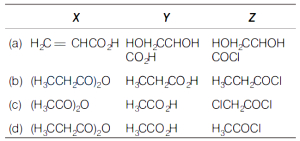
$CH_3CH_2COOH$ $\xrightarrow{P_2O_5}$ $X$ $\xrightarrow{H_2O}$ $Y$ $\xrightarrow{SOCl_2}$ $Z$
Identify $X$,$Y$ and $Z$.
Identify $X$,$Y$ and $Z$.
A
| $X$ | $Y$ | $Z$ |
|---|---|---|
| $H_2C=CHCO_2H$ | $HOH_2CCHOHCO_2H$ | $HOH_2CCHOHCOCl$ |
B
| $X$ | $Y$ | $Z$ |
|---|---|---|
| $(CH_3CH_2CO)_2O$ | $CH_3CH_2CO_2H$ | $CH_3CH_2COCl$ |
C
| $X$ | $Y$ | $Z$ |
|---|---|---|
| $(CH_3CO)_2O$ | $CH_3CO_2H$ | $ClCH_2COCl$ |
D
| $X$ | $Y$ | $Z$ |
|---|---|---|
| $(CH_3CH_2CO)_2O$ | $CH_3CO_2H$ | $CH_3COCl$ |
Solution
(B) $1$. The reaction of propanoic acid $(CH_3CH_2COOH)$ with $P_2O_5$ (a dehydrating agent) leads to the formation of propanoic anhydride,which is $X = (CH_3CH_2CO)_2O$.
$2$. The hydrolysis of propanoic anhydride $(X)$ with $H_2O$ regenerates propanoic acid,which is $Y = CH_3CH_2COOH$.
$3$. The reaction of propanoic acid $(Y)$ with $SOCl_2$ (thionyl chloride) converts the carboxylic acid group into an acid chloride,resulting in propanoyl chloride,which is $Z = CH_3CH_2COCl$.
$4$. Therefore,the correct sequence is $X = (CH_3CH_2CO)_2O$,$Y = CH_3CH_2COOH$,and $Z = CH_3CH_2COCl$.
$2$. The hydrolysis of propanoic anhydride $(X)$ with $H_2O$ regenerates propanoic acid,which is $Y = CH_3CH_2COOH$.
$3$. The reaction of propanoic acid $(Y)$ with $SOCl_2$ (thionyl chloride) converts the carboxylic acid group into an acid chloride,resulting in propanoyl chloride,which is $Z = CH_3CH_2COCl$.
$4$. Therefore,the correct sequence is $X = (CH_3CH_2CO)_2O$,$Y = CH_3CH_2COOH$,and $Z = CH_3CH_2COCl$.
0 likes
View Solution214
MediumMCQ
What are $\underline{A}, \underline{B}, \underline{C}$ in the following reactions?
$(I)$ $(CH_3 CO_2)_2 Ca \stackrel{\Delta}{\longrightarrow} \underline{A}$
$(II)$ $CH_3 CO_2 H \underset{\text{Red P}}{\stackrel{HI}{\longrightarrow}} \underline{B}$
$(III)$ $2 CH_3 CO_2 H \stackrel{P_4 O_{10}}{\longrightarrow} \underline{C}$
$\underline{A} \quad \underline{B} \quad \underline{C}$
$(I)$ $(CH_3 CO_2)_2 Ca \stackrel{\Delta}{\longrightarrow} \underline{A}$
$(II)$ $CH_3 CO_2 H \underset{\text{Red P}}{\stackrel{HI}{\longrightarrow}} \underline{B}$
$(III)$ $2 CH_3 CO_2 H \stackrel{P_4 O_{10}}{\longrightarrow} \underline{C}$
$\underline{A} \quad \underline{B} \quad \underline{C}$
A
$C_2 H_6 \quad CH_3 COCH_3 \quad (CH_3 CO)_2 O$
B
$(CH_3 CO)_2 O \quad C_2 H_6 \quad CH_3 COCH_3$
C
$CH_3 COCH_3 \quad C_2 H_6 \quad (CH_3 CO)_2 O$
D
$CH_3 COCH_3 \quad (CH_3 CO)_2 O \quad C_2 H_6$
Solution
(C) Reaction $(I)$: Dry distillation of calcium acetate gives acetone.
$(CH_3 COO)_2 Ca \xrightarrow{\Delta} CH_3 COCH_3 + CaCO_3$
So,$\underline{A} = CH_3 COCH_3$.
Reaction $(II)$: Reduction of acetic acid with $HI$ and red phosphorus gives ethane.
$CH_3 COOH + 6HI \xrightarrow{\text{Red P}} CH_3 CH_3 + 3I_2 + 2H_2 O$
So,$\underline{B} = C_2 H_6$.
Reaction $(III)$: Dehydration of acetic acid with $P_4 O_{10}$ gives acetic anhydride.
$2 CH_3 COOH \xrightarrow{P_4 O_{10}} (CH_3 CO)_2 O + H_2 O$
So,$\underline{C} = (CH_3 CO)_2 O$.
Therefore,the correct sequence is $\underline{A} = CH_3 COCH_3$,$\underline{B} = C_2 H_6$,$\underline{C} = (CH_3 CO)_2 O$.
$(CH_3 COO)_2 Ca \xrightarrow{\Delta} CH_3 COCH_3 + CaCO_3$
So,$\underline{A} = CH_3 COCH_3$.
Reaction $(II)$: Reduction of acetic acid with $HI$ and red phosphorus gives ethane.
$CH_3 COOH + 6HI \xrightarrow{\text{Red P}} CH_3 CH_3 + 3I_2 + 2H_2 O$
So,$\underline{B} = C_2 H_6$.
Reaction $(III)$: Dehydration of acetic acid with $P_4 O_{10}$ gives acetic anhydride.
$2 CH_3 COOH \xrightarrow{P_4 O_{10}} (CH_3 CO)_2 O + H_2 O$
So,$\underline{C} = (CH_3 CO)_2 O$.
Therefore,the correct sequence is $\underline{A} = CH_3 COCH_3$,$\underline{B} = C_2 H_6$,$\underline{C} = (CH_3 CO)_2 O$.
0 likes
View Solution215
DifficultMCQ
The major products $Q$ and $R$ from the following reactions,respectively are:
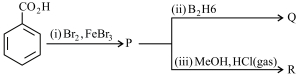
A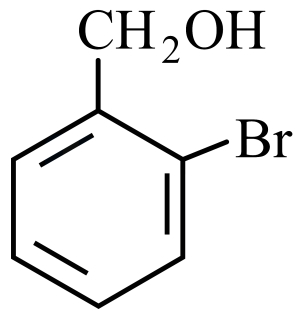
B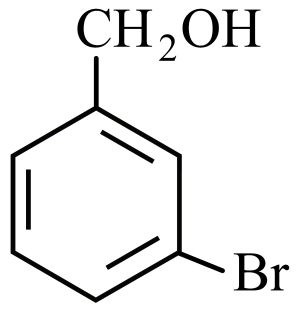
C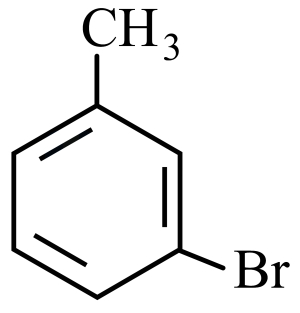
D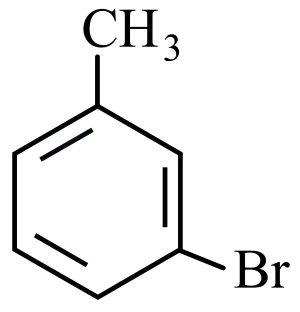
Solution
(B) $1$. The reaction of benzoic acid with $Br_2 / FeBr_3$ is an electrophilic aromatic substitution. The $-COOH$ group is a meta-directing group,so the product $P$ is $m$-bromobenzoic acid.
$2$. In the next step,$m$-bromobenzoic acid reacts with $B_2H_6$. Diborane $(B_2H_6)$ is a selective reducing agent that reduces the carboxylic acid group $(-COOH)$ to a primary alcohol $(-CH_2OH)$ without affecting the bromine atom on the ring. Thus,$Q$ is $m$-bromobenzyl alcohol.
$3$. In the third step,$m$-bromobenzoic acid reacts with $MeOH$ in the presence of $HCl$ (gas). This is a Fischer esterification reaction,where the carboxylic acid reacts with an alcohol to form an ester. Thus,$R$ is methyl $m$-bromobenzoate.
$2$. In the next step,$m$-bromobenzoic acid reacts with $B_2H_6$. Diborane $(B_2H_6)$ is a selective reducing agent that reduces the carboxylic acid group $(-COOH)$ to a primary alcohol $(-CH_2OH)$ without affecting the bromine atom on the ring. Thus,$Q$ is $m$-bromobenzyl alcohol.
$3$. In the third step,$m$-bromobenzoic acid reacts with $MeOH$ in the presence of $HCl$ (gas). This is a Fischer esterification reaction,where the carboxylic acid reacts with an alcohol to form an ester. Thus,$R$ is methyl $m$-bromobenzoate.
0 likes
View Solution216
MediumMCQ
In the following reaction,$X$ and $Y$ are respectively
$CH_3 COOH + NH_3$ $\longrightarrow X \stackrel{\Delta}{}$ ${\longrightarrow} Y + H_2 O$
$CH_3 COOH + NH_3$ $\longrightarrow X \stackrel{\Delta}{}$ ${\longrightarrow} Y + H_2 O$
A
$CH_3 CONH_2, CH_4$
B
$CH_3 COONH_4, CH_3 CONH_2$
C
$CH_3 CONH_2, CH_3 COOH$
D
$CH_3 NH_2, CH_3 CONH_2$
Solution
(B) The reaction of acetic acid $(CH_3 COOH)$ with ammonia $(NH_3)$ forms ammonium acetate $(CH_3 COONH_4)$ as an intermediate $(X)$.
$CH_3 COOH + NH_3 \longrightarrow CH_3 COONH_4$ $(X)$
On heating,ammonium acetate undergoes dehydration to form acetamide $(CH_3 CONH_2)$ as the final product $(Y)$.
$CH_3 COONH_4 \stackrel{\Delta}{\longrightarrow} CH_3 CONH_2$ $(Y)$ $+ H_2 O$
Therefore,$X$ is $CH_3 COONH_4$ and $Y$ is $CH_3 CONH_2$.
$CH_3 COOH + NH_3 \longrightarrow CH_3 COONH_4$ $(X)$
On heating,ammonium acetate undergoes dehydration to form acetamide $(CH_3 CONH_2)$ as the final product $(Y)$.
$CH_3 COONH_4 \stackrel{\Delta}{\longrightarrow} CH_3 CONH_2$ $(Y)$ $+ H_2 O$
Therefore,$X$ is $CH_3 COONH_4$ and $Y$ is $CH_3 CONH_2$.
0 likes
View Solution217
EasyMCQ
Acid hydrolysis of $X$ yields two different organic compounds. Which one of the following is $X$?
A
$CH_3COOH$
B
$CH_3CONH_2$
C
$CH_3COOC_2H_5$
D
$(CH_3CO)_2O$
Solution
(C) Acid hydrolysis of an ester $(X = CH_3COOC_2H_5)$ produces a carboxylic acid and an alcohol.
The reaction is: $CH_3COOC_2H_5 + H_2O \xrightarrow{H^+} CH_3COOH + C_2H_5OH$.
Here,$CH_3COOH$ (acetic acid) and $C_2H_5OH$ (ethanol) are two different organic compounds.
The reaction is: $CH_3COOC_2H_5 + H_2O \xrightarrow{H^+} CH_3COOH + C_2H_5OH$.
Here,$CH_3COOH$ (acetic acid) and $C_2H_5OH$ (ethanol) are two different organic compounds.
0 likes
View Solution218
MediumMCQ
When compound $X$ is oxidised by acidified potassium dichromate,compound $Y$ is formed. Compound $Y$ on reduction with $LiAlH_4$ gives $X$. $X$ and $Y$ respectively are:
A
$C_2 H_5 OH, CH_3 COOH$
B
$CH_3 COCH_3, CH_3 COOH$
C
$C_2 H_5 OH, CH_3 COCH_3$
D
$CH_3 CHO, CH_3 COCH_3$
Solution
(A) When ethyl alcohol $(X)$ is oxidised by acidified potassium dichromate,acetic acid $(Y)$ is formed:
$3 CH_3 CH_2 OH + 2 K_2 Cr_2 O_7 + 8 H_2 SO_4 \longrightarrow 3 CH_3 COOH + 2 Cr_2(SO_4)_3 + 2 K_2 SO_4 + 11 H_2 O$
Carboxylic acids undergo reduction with $LiAlH_4$ to give primary alcohols:
$CH_3 COOH \xrightarrow{LiAlH_4} CH_3 CH_2 OH$
Thus,$X$ is $C_2 H_5 OH$ and $Y$ is $CH_3 COOH$.
$3 CH_3 CH_2 OH + 2 K_2 Cr_2 O_7 + 8 H_2 SO_4 \longrightarrow 3 CH_3 COOH + 2 Cr_2(SO_4)_3 + 2 K_2 SO_4 + 11 H_2 O$
Carboxylic acids undergo reduction with $LiAlH_4$ to give primary alcohols:
$CH_3 COOH \xrightarrow{LiAlH_4} CH_3 CH_2 OH$
Thus,$X$ is $C_2 H_5 OH$ and $Y$ is $CH_3 COOH$.
0 likes
View Solution219
DifficultMCQ
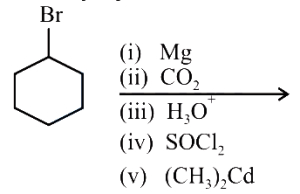
The major product in the following reaction is
A
Cyclohexyl ethanol
B
Cyclohexyl methyl ketone
C
$1-$Cyclohexyl ethanol
D
$2-$Cyclohexyl propan$-2-$ol
Solution
(B) The reaction proceeds as follows:
$1$. Bromocyclohexane reacts with $Mg$ in dry ether to form cyclohexylmagnesium bromide (a Grignard reagent).
$2$. The Grignard reagent reacts with $CO_2$ followed by acidic workup $(H_3O^+)$ to form cyclohexanecarboxylic acid.
$3$. Cyclohexanecarboxylic acid reacts with $SOCl_2$ to form cyclohexanecarbonyl chloride.
$4$. Finally,the reaction of cyclohexanecarbonyl chloride with dimethylcadmium,$(CH_3)_2Cd$,yields cyclohexyl methyl ketone as the major product. This is a standard method for the preparation of ketones from acid chlorides.
$1$. Bromocyclohexane reacts with $Mg$ in dry ether to form cyclohexylmagnesium bromide (a Grignard reagent).
$2$. The Grignard reagent reacts with $CO_2$ followed by acidic workup $(H_3O^+)$ to form cyclohexanecarboxylic acid.
$3$. Cyclohexanecarboxylic acid reacts with $SOCl_2$ to form cyclohexanecarbonyl chloride.
$4$. Finally,the reaction of cyclohexanecarbonyl chloride with dimethylcadmium,$(CH_3)_2Cd$,yields cyclohexyl methyl ketone as the major product. This is a standard method for the preparation of ketones from acid chlorides.
0 likes
View Solution220
MediumMCQ
The product '$C$' in the given reaction sequence is

A
Nitrobenzene
B
Bromobenzene
C
$3-$Bromobenzoic acid
D
Sodium $3-$bromobenzoate
Solution
(A) Step $1$: Formation of Grignard reagent '$A$'.
$m$-Bromonitrobenzene reacts with $Mg$ in the presence of dry ether to form the Grignard reagent,$m$-nitrophenylmagnesium bromide $(A)$.
Step $2$: Formation of '$B$'.
Reaction of the Grignard reagent $(A)$ with $CO_2$ followed by acidic hydrolysis $(H_3O^+)$ yields $m$-nitrobenzoic acid $(B)$.
Step $3$: Formation of '$C$'.
$m$-Nitrobenzoic acid $(B)$ reacts with $Na$ to form sodium $m$-nitrobenzoate,which upon heating with soda lime $(NaOH + CaO)$ undergoes decarboxylation to form nitrobenzene $(C)$.
$m$-Bromonitrobenzene reacts with $Mg$ in the presence of dry ether to form the Grignard reagent,$m$-nitrophenylmagnesium bromide $(A)$.
Step $2$: Formation of '$B$'.
Reaction of the Grignard reagent $(A)$ with $CO_2$ followed by acidic hydrolysis $(H_3O^+)$ yields $m$-nitrobenzoic acid $(B)$.
Step $3$: Formation of '$C$'.
$m$-Nitrobenzoic acid $(B)$ reacts with $Na$ to form sodium $m$-nitrobenzoate,which upon heating with soda lime $(NaOH + CaO)$ undergoes decarboxylation to form nitrobenzene $(C)$.
0 likes
View Solution221
DifficultMCQ
What is the major product of the following reaction?

A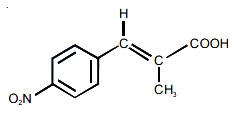
B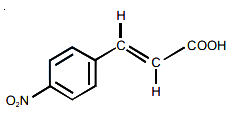
C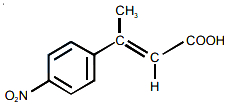
D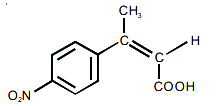
Solution
(A) The reaction is a $Perkin$ condensation. It involves the reaction of an aromatic aldehyde with an acid anhydride in the presence of the corresponding carboxylate salt.
In this case,$p$-nitrobenzaldehyde reacts with propanoic anhydride $(CH_3CH_2CO)_2O$ in the presence of sodium propionate $(CH_3CH_2COONa)$.
The $\alpha$-hydrogen of the propanoic anhydride is abstracted by the propionate ion to form a nucleophilic enolate.
This enolate attacks the carbonyl carbon of $p$-nitrobenzaldehyde.
Subsequent steps involve the formation of a $\beta$-hydroxy acid derivative,followed by dehydration to form an $\alpha,\beta$-unsaturated acid.
The product formed is $2$-methyl-$3$-($4$-nitrophenyl)prop$-2-$enoic acid. The major product is the $(E)$-isomer due to steric considerations,which corresponds to option $A$.
In this case,$p$-nitrobenzaldehyde reacts with propanoic anhydride $(CH_3CH_2CO)_2O$ in the presence of sodium propionate $(CH_3CH_2COONa)$.
The $\alpha$-hydrogen of the propanoic anhydride is abstracted by the propionate ion to form a nucleophilic enolate.
This enolate attacks the carbonyl carbon of $p$-nitrobenzaldehyde.
Subsequent steps involve the formation of a $\beta$-hydroxy acid derivative,followed by dehydration to form an $\alpha,\beta$-unsaturated acid.
The product formed is $2$-methyl-$3$-($4$-nitrophenyl)prop$-2-$enoic acid. The major product is the $(E)$-isomer due to steric considerations,which corresponds to option $A$.
0 likes
View Solution222
EasyMCQ
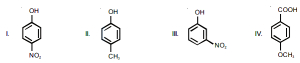
The correct order of acidity for the following compounds is:
A
$II < I < III < IV$
B
$II < III < I < IV$
C
$II < I < IV < III$
D
$IV < II < III < I$
Solution
(B) The compounds are:
$I$: $p$-Nitrophenol
$II$: $p$-Cresol ($4$-Methylphenol)
$III$: $m$-Nitrophenol
$IV$: $p$-Methoxybenzoic acid
Step $1$: Compare the acidity of phenols and carboxylic acids. Carboxylic acids are significantly more acidic than phenols. Thus,$IV$ is the most acidic.
Step $2$: Compare the acidity of the phenols $(I, II, III)$.
- $II$ ($p$-Cresol) has a $-CH_3$ group,which is an electron-donating group ($+I$ and hyperconjugation),decreasing acidity. Thus,$II$ is the least acidic.
- $I$ ($p$-Nitrophenol) has a $-NO_2$ group at the para position,which exerts a strong electron-withdrawing effect ($-I$ and $-M$).
- $III$ ($m$-Nitrophenol) has a $-NO_2$ group at the meta position,which exerts only an electron-withdrawing inductive effect $(-I)$.
- The $-M$ effect of the $-NO_2$ group in $p$-Nitrophenol $(I)$ makes it more acidic than $m$-Nitrophenol $(III)$.
Step $3$: Combining these,the order of acidity is $II < III < I < IV$.
$I$: $p$-Nitrophenol
$II$: $p$-Cresol ($4$-Methylphenol)
$III$: $m$-Nitrophenol
$IV$: $p$-Methoxybenzoic acid
Step $1$: Compare the acidity of phenols and carboxylic acids. Carboxylic acids are significantly more acidic than phenols. Thus,$IV$ is the most acidic.
Step $2$: Compare the acidity of the phenols $(I, II, III)$.
- $II$ ($p$-Cresol) has a $-CH_3$ group,which is an electron-donating group ($+I$ and hyperconjugation),decreasing acidity. Thus,$II$ is the least acidic.
- $I$ ($p$-Nitrophenol) has a $-NO_2$ group at the para position,which exerts a strong electron-withdrawing effect ($-I$ and $-M$).
- $III$ ($m$-Nitrophenol) has a $-NO_2$ group at the meta position,which exerts only an electron-withdrawing inductive effect $(-I)$.
- The $-M$ effect of the $-NO_2$ group in $p$-Nitrophenol $(I)$ makes it more acidic than $m$-Nitrophenol $(III)$.
Step $3$: Combining these,the order of acidity is $II < III < I < IV$.
0 likes
View Solution223
EasyMCQ
The conversion of $CH_{3}CH_{2}COOH$ to the product shown below can be accomplished by:
$CH_{3}CH_{2}CH(OCH_{2}CH_{2}O)$
$CH_{3}CH_{2}CH(OCH_{2}CH_{2}O)$
A
$SOCl_{2}, LiAlH_{4},$ ethylene glycol
B
$SOCl_{2}, KMnO_{4}, NH_{2}NH_{2}$
C
$SnCl_{2}, HCl, Na_{2}SO_{3}$
D
$HCl, SnCl_{2},$ ethylene glycol
Solution
(A, D) The conversion of propanoic acid $(CH_{3}CH_{2}COOH)$ to the cyclic acetal $(CH_{3}CH_{2}CH(OCH_{2}CH_{2}O))$ involves the following steps:
$1$. Conversion of carboxylic acid to acid chloride using $SOCl_{2}$ or $PCl_{5}$.
$2$. Reduction of acid chloride to aldehyde using $LiAlH_{4}$ (at low temperature) or Rosenmund reduction $(H_{2}/Pd-BaSO_{4})$.
$3$. Protection of the aldehyde group by forming a cyclic acetal using ethylene glycol in the presence of an acid catalyst.
Both options $(A)$ and $(D)$ describe valid pathways for this transformation,as $SnCl_{2}/HCl$ is also a standard reagent for the reduction of acid chlorides to aldehydes (Stephen reduction).
$1$. Conversion of carboxylic acid to acid chloride using $SOCl_{2}$ or $PCl_{5}$.
$2$. Reduction of acid chloride to aldehyde using $LiAlH_{4}$ (at low temperature) or Rosenmund reduction $(H_{2}/Pd-BaSO_{4})$.
$3$. Protection of the aldehyde group by forming a cyclic acetal using ethylene glycol in the presence of an acid catalyst.
Both options $(A)$ and $(D)$ describe valid pathways for this transformation,as $SnCl_{2}/HCl$ is also a standard reagent for the reduction of acid chlorides to aldehydes (Stephen reduction).
0 likes
View Solution224
MediumMCQ
$\text{CH}_3\text{COOH} \xrightarrow{\text{LiAlH}_4} \text{X} \xrightarrow{\text{PCl}_5} \text{Y} \xrightarrow{\text{Alcoholic KOH}} \text{Z}$. Find product '$Z$' in the above reaction.
A
Ethyne
B
Ethanol
C
Ethene
D
Ethanal
Solution
(C) The reaction proceeds as follows:
$1$) Reduction of $\text{CH}_3\text{COOH}$ by $\text{LiAlH}_4$ gives $\text{CH}_3\text{CH}_2\text{OH}$ (Ethanol),which is product $\text{X}$.
$2$) Reaction of $\text{CH}_3\text{CH}_2\text{OH}$ with $\text{PCl}_5$ gives $\text{CH}_3\text{CH}_2\text{Cl}$ (Ethyl chloride),which is product $\text{Y}$.
$3$) Dehydrohalogenation (elimination reaction) of $\text{CH}_3\text{CH}_2\text{Cl}$ with alcoholic $\text{KOH}$ gives $\text{CH}_2=\text{CH}_2$ (Ethene),which is product $\text{Z}$.
$1$) Reduction of $\text{CH}_3\text{COOH}$ by $\text{LiAlH}_4$ gives $\text{CH}_3\text{CH}_2\text{OH}$ (Ethanol),which is product $\text{X}$.
$2$) Reaction of $\text{CH}_3\text{CH}_2\text{OH}$ with $\text{PCl}_5$ gives $\text{CH}_3\text{CH}_2\text{Cl}$ (Ethyl chloride),which is product $\text{Y}$.
$3$) Dehydrohalogenation (elimination reaction) of $\text{CH}_3\text{CH}_2\text{Cl}$ with alcoholic $\text{KOH}$ gives $\text{CH}_2=\text{CH}_2$ (Ethene),which is product $\text{Z}$.
0 likes
View Solution225
DifficultMCQ
Amongst the following,the total number of compounds soluble in aqueous $NaOH$ at room temperature is:
$(I)$ Benzaldehyde
$(II)$ $1$-Naphthol
$(III)$ $4$-(Dimethylamino)phenol
$(IV)$ $4$-Methylphenol
$(V)$ Benzoic acid
$(VI)$ $N,N$-Dimethylcyclohexanamine
$(VII)$ $1$-Naphthoic acid
$(VIII)$ $1,4$-Di-tert-butylbenzene
$(IX)$ $1$-Naphthylmethanol
$(I)$ Benzaldehyde
$(II)$ $1$-Naphthol
$(III)$ $4$-(Dimethylamino)phenol
$(IV)$ $4$-Methylphenol
$(V)$ Benzoic acid
$(VI)$ $N,N$-Dimethylcyclohexanamine
$(VII)$ $1$-Naphthoic acid
$(VIII)$ $1,4$-Di-tert-butylbenzene
$(IX)$ $1$-Naphthylmethanol
A
$5$
B
$4$
C
$6$
D
$3$
Solution
(A) Compounds that are soluble in aqueous $NaOH$ are those that are sufficiently acidic to react with the base to form water-soluble salts. These include carboxylic acids and phenols.
Let us analyze each compound:
$(I)$ Benzaldehyde: Not acidic enough to dissolve in $NaOH$.
$(II)$ $1$-Naphthol: $A$ phenol,acidic,soluble in $NaOH$.
$(III)$ $4$-(Dimethylamino)phenol: $A$ phenol,acidic,soluble in $NaOH$.
$(IV)$ $4$-Methylphenol: $A$ phenol,acidic,soluble in $NaOH$.
$(V)$ Benzoic acid: $A$ carboxylic acid,acidic,soluble in $NaOH$.
$(VI)$ $N,N$-Dimethylcyclohexanamine: $A$ base,not soluble in $NaOH$.
$(VII)$ $1$-Naphthoic acid: $A$ carboxylic acid,acidic,soluble in $NaOH$.
$(VIII)$ $1,4$-Di-tert-butylbenzene: $A$ hydrocarbon,not soluble in $NaOH$.
$(IX)$ $1$-Naphthylmethanol: An aliphatic alcohol,not acidic enough to dissolve in $NaOH$.
The compounds that are soluble in $NaOH$ are $(II)$,$(III)$,$(IV)$,$(V)$,and $(VII)$.
Therefore,the total number of such compounds is $5$.
Let us analyze each compound:
$(I)$ Benzaldehyde: Not acidic enough to dissolve in $NaOH$.
$(II)$ $1$-Naphthol: $A$ phenol,acidic,soluble in $NaOH$.
$(III)$ $4$-(Dimethylamino)phenol: $A$ phenol,acidic,soluble in $NaOH$.
$(IV)$ $4$-Methylphenol: $A$ phenol,acidic,soluble in $NaOH$.
$(V)$ Benzoic acid: $A$ carboxylic acid,acidic,soluble in $NaOH$.
$(VI)$ $N,N$-Dimethylcyclohexanamine: $A$ base,not soluble in $NaOH$.
$(VII)$ $1$-Naphthoic acid: $A$ carboxylic acid,acidic,soluble in $NaOH$.
$(VIII)$ $1,4$-Di-tert-butylbenzene: $A$ hydrocarbon,not soluble in $NaOH$.
$(IX)$ $1$-Naphthylmethanol: An aliphatic alcohol,not acidic enough to dissolve in $NaOH$.
The compounds that are soluble in $NaOH$ are $(II)$,$(III)$,$(IV)$,$(V)$,and $(VII)$.
Therefore,the total number of such compounds is $5$.
0 likes
View Solution226
DifficultMCQ
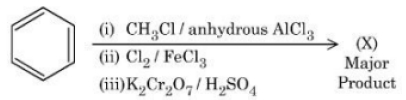
Consider the following sequence of reactions to give the major product $(X)$: $(i)$ $CH_3Cl$ / anhydrous $AlCl_3$,(ii) $Cl_2$ / $FeCl_3$,(iii) $K_2Cr_2O_7$ / $H_2SO_4$. $P$ g of the major product $(X)$ formed is reacted with $NaHCO_3$ solution to liberate a gas which occupied $11.2 \ dm^3$ at $STP$. $P = \text{ . . . . . . }$ g.
A
$122$
B
$244$
C
$61$
D
$183$
Solution
(C) $1$. Sequence of reactions: Benzene $\xrightarrow{CH_3Cl/AlCl_3}$ Toluene $\xrightarrow{Cl_2/FeCl_3}$ p-chlorotoluene $\xrightarrow{K_2Cr_2O_7/H_2SO_4}$ p-chlorobenzoic acid $(X)$.
$2$. Reaction with $NaHCO_3$: $R-COOH + NaHCO_3 \rightarrow R-COONa + H_2O + CO_2 \uparrow$.
$3$. At $STP$,$1 \text{ mole}$ of gas occupies $22.4 \ dm^3$. Therefore,$11.2 \ dm^3$ of $CO_2$ corresponds to $0.5 \text{ moles}$.
$4$. Since $1 \text{ mole}$ of acid reacts to produce $1 \text{ mole}$ of $CO_2$,we require $0.5 \text{ moles}$ of p-chlorobenzoic acid $(C_7H_5ClO_2)$.
$5$. Molar mass of p-chlorobenzoic acid $(C_7H_5ClO_2)$ = $(7 \times 12) + (5 \times 1) + 35.5 + (2 \times 16) = 84 + 5 + 35.5 + 32 = 156.5 \text{ g/mol}$.
$6$. Mass of acid required $(P)$ = $\text{moles} \times \text{molar mass} = 0.5 \times 156.5 = 78.25 \text{ g}$.
Note: The provided options do not contain the calculated value $78.25$. Re-evaluating the question,if the product was benzoic acid ($C_7H_6O_2$,molar mass $122 \text{ g/mol}$),then $0.5 \times 122 = 61 \text{ g}$. Given the options,$61$ is the most plausible intended answer assuming the chlorine atom was not considered or a different product was implied.
$2$. Reaction with $NaHCO_3$: $R-COOH + NaHCO_3 \rightarrow R-COONa + H_2O + CO_2 \uparrow$.
$3$. At $STP$,$1 \text{ mole}$ of gas occupies $22.4 \ dm^3$. Therefore,$11.2 \ dm^3$ of $CO_2$ corresponds to $0.5 \text{ moles}$.
$4$. Since $1 \text{ mole}$ of acid reacts to produce $1 \text{ mole}$ of $CO_2$,we require $0.5 \text{ moles}$ of p-chlorobenzoic acid $(C_7H_5ClO_2)$.
$5$. Molar mass of p-chlorobenzoic acid $(C_7H_5ClO_2)$ = $(7 \times 12) + (5 \times 1) + 35.5 + (2 \times 16) = 84 + 5 + 35.5 + 32 = 156.5 \text{ g/mol}$.
$6$. Mass of acid required $(P)$ = $\text{moles} \times \text{molar mass} = 0.5 \times 156.5 = 78.25 \text{ g}$.
Note: The provided options do not contain the calculated value $78.25$. Re-evaluating the question,if the product was benzoic acid ($C_7H_6O_2$,molar mass $122 \text{ g/mol}$),then $0.5 \times 122 = 61 \text{ g}$. Given the options,$61$ is the most plausible intended answer assuming the chlorine atom was not considered or a different product was implied.
0 likes
View Solution8-2.Carboxylic acids and Their derivative — Mix Examples-Carboxylic acids and Their derivative · Frequently Asked Questions
1Are these 8-2.Carboxylic acids and Their derivative questions useful for JEE and NEET?
Yes. All questions in this section are mapped to JEE Main and NEET exam patterns. Previous year questions from JEE Main, NEET, GUJCET and state-level exams are included with full solutions.
2Can I switch to Hindi or Gujarati for these questions?
Yes. Use the language tabs in the hero section or the sidebar to view the same questions and solutions in English, Hindi or Gujarati.
3How do I generate a question paper from this subtopic?
Use the Vedclass Exam Paper Generator — select the chapter and subtopic, set difficulty, and generate Sets A, B, C, D automatically. First 3 chapters of every subject are free.
Vedclass Products
For Students
Vedclass Test Series
Mock tests in real JEE/NEET style with performance analysis. 5-day free trial.
Start Free TrialFor Teachers
Exam Paper Generator
Generate Set A/B/C/D papers from this chapter in 2 minutes. 3 chapters free.
Try FreeFor Institutes
Online Exam Module
Live online exams with unlimited students, 360° analytics & white-label branding.
See DemoFor Teachers & Institutes
Generate a 8-2.Carboxylic acids and Their derivative Exam Paper in 2 Minutes
Select subtopic & difficulty — Sets A, B, C, D auto-generated with No Repeat logic.
First 3 chapters of every subject are free — no payment required.