
A English
Mix Examples-Carboxylic acids and Their derivative Questions in English
Class 12 Chemistry · 8-2.Carboxylic acids and Their derivative · Mix Examples-Carboxylic acids and Their derivative
240+
Questions
English
Language
100%
With Solutions
Showing 50 of 240 questions in English
51
AdvancedMCQ
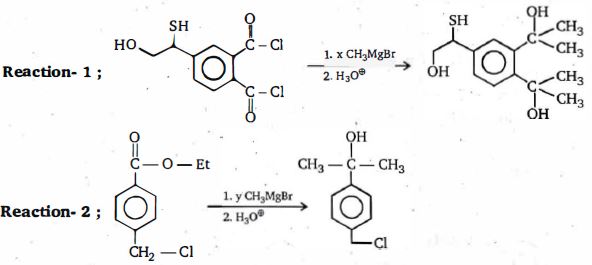
What is the ratio of $(x/y)$ in the above reactions?
A
$1.5$
B
$2$
C
$2.5$
D
$3$
Solution
(D) In Reaction-$1$,the substrate has two $-OH$ groups (one alcoholic,one thiol) and two $-COCl$ groups.
Each $-OH$ group reacts with $1$ mole of $CH_3MgBr$ as an acid-base reaction ($2$ moles total).
Each $-COCl$ group reacts with $2$ moles of $CH_3MgBr$ as a nucleophilic addition-elimination reaction ($4$ moles total).
Thus,$x = 2 + 4 = 6$.
In Reaction-$2$,the substrate has one $-COOEt$ group and one $-CH_2Cl$ group.
The $-COOEt$ group reacts with $2$ moles of $CH_3MgBr$ to form a tertiary alcohol.
The $-CH_2Cl$ group is an alkyl halide and does not react with $CH_3MgBr$ under these conditions.
Thus,$y = 2$ (Note: The provided solution had $y=3$,but based on the product shown,only $2$ moles are consumed for the ester).
However,if we re-evaluate the product,the ester group consumes $2$ moles. The ratio $(x/y) = 6/2 = 3$.
Each $-OH$ group reacts with $1$ mole of $CH_3MgBr$ as an acid-base reaction ($2$ moles total).
Each $-COCl$ group reacts with $2$ moles of $CH_3MgBr$ as a nucleophilic addition-elimination reaction ($4$ moles total).
Thus,$x = 2 + 4 = 6$.
In Reaction-$2$,the substrate has one $-COOEt$ group and one $-CH_2Cl$ group.
The $-COOEt$ group reacts with $2$ moles of $CH_3MgBr$ to form a tertiary alcohol.
The $-CH_2Cl$ group is an alkyl halide and does not react with $CH_3MgBr$ under these conditions.
Thus,$y = 2$ (Note: The provided solution had $y=3$,but based on the product shown,only $2$ moles are consumed for the ester).
However,if we re-evaluate the product,the ester group consumes $2$ moles. The ratio $(x/y) = 6/2 = 3$.
0 likes
View Solution52
MediumMCQ
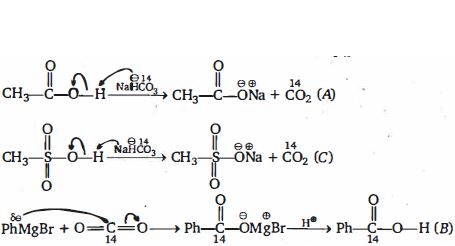
$CH_3-C(=O)-OH$ $\xrightarrow{NaH^{14}CO_3} (A) (\text{gas})$ $\xrightarrow[(ii) H_3O^{+}]{(i) PhMgBr} (B)$
$CH_3-S(=O)_2-OH$ $\xrightarrow{NaH^{14}CO_3} (C) (\text{gas})$ $\xrightarrow[(ii) H_3O^{+}]{(i) PhMgBr} (D)$
Product $(B)$ and $(D)$ in the above reaction are:
$CH_3-S(=O)_2-OH$ $\xrightarrow{NaH^{14}CO_3} (C) (\text{gas})$ $\xrightarrow[(ii) H_3O^{+}]{(i) PhMgBr} (D)$
Product $(B)$ and $(D)$ in the above reaction are:
A
$Ph-COOH$ and $Ph-SO_3H$
B
$Ph-^{14}COOH$ and $Ph-SO_3H$
C
$Ph-^{14}COOH$ and $Ph-^{14}COOH$
D
$Ph-COOH$ and $Ph-SO_3H$
Solution
(C) Both acetic acid $(CH_3COOH)$ and methanesulfonic acid $(CH_3SO_3H)$ are stronger acids than carbonic acid $(H_2CO_3)$. Therefore,they react with $NaH^{14}CO_3$ to release $^{14}CO_2$ gas.
Reaction $1$: $CH_3COOH + NaH^{14}CO_3 \rightarrow CH_3COONa + H_2O + ^{14}CO_2 \uparrow (A)$
Reaction $2$: $CH_3SO_3H + NaH^{14}CO_3 \rightarrow CH_3SO_3Na + H_2O + ^{14}CO_2 \uparrow (C)$
Both $(A)$ and $(C)$ are $^{14}CO_2$.
When $^{14}CO_2$ reacts with Grignard reagent $(PhMgBr)$ followed by hydrolysis:
$PhMgBr + ^{14}CO_2$ $\rightarrow Ph-^{14}COOMgBr$ $\xrightarrow{H_3O^{+}} Ph-^{14}COOH$
Thus,both $(B)$ and $(D)$ are $Ph-^{14}COOH$.
Reaction $1$: $CH_3COOH + NaH^{14}CO_3 \rightarrow CH_3COONa + H_2O + ^{14}CO_2 \uparrow (A)$
Reaction $2$: $CH_3SO_3H + NaH^{14}CO_3 \rightarrow CH_3SO_3Na + H_2O + ^{14}CO_2 \uparrow (C)$
Both $(A)$ and $(C)$ are $^{14}CO_2$.
When $^{14}CO_2$ reacts with Grignard reagent $(PhMgBr)$ followed by hydrolysis:
$PhMgBr + ^{14}CO_2$ $\rightarrow Ph-^{14}COOMgBr$ $\xrightarrow{H_3O^{+}} Ph-^{14}COOH$
Thus,both $(B)$ and $(D)$ are $Ph-^{14}COOH$.
0 likes
View Solution53
MediumMCQ
The number of equivalents of Grignard reagent $(x)$ used in reaction $(1)$ is:

A
$3$ equivalent
B
$4$ equivalent
C
$5$ equivalent
D
$6$ equivalent
Solution
(C) The given reactant contains three acidic protons: one phenolic $-OH$,one alcoholic $-OH$,and one amine $-NH-$.
First,$3$ equivalents of $PhMgBr$ act as a base to deprotonate these three acidic sites,forming the corresponding magnesium salts.
Next,$2$ equivalents of $PhMgBr$ act as a nucleophile to attack the ester group $(MeO_2C-)$,converting it into a tertiary alcohol after workup with $H_3O^+$.
Therefore,the total number of equivalents of $PhMgBr$ required is $3 + 2 = 5$ equivalents.
Thus,$x = 5$.
First,$3$ equivalents of $PhMgBr$ act as a base to deprotonate these three acidic sites,forming the corresponding magnesium salts.
Next,$2$ equivalents of $PhMgBr$ act as a nucleophile to attack the ester group $(MeO_2C-)$,converting it into a tertiary alcohol after workup with $H_3O^+$.
Therefore,the total number of equivalents of $PhMgBr$ required is $3 + 2 = 5$ equivalents.
Thus,$x = 5$.
0 likes
View Solution54
AdvancedMCQ
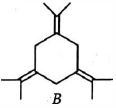
Compound $A$ was treated with a large excess of $CH_3MgBr$. The resulting product was exposed to $POCl_3$ /pyridine to give compound $B$,as one of many products.
Which of the following compounds can be $A$ ?
Which of the following compounds can be $A$ ?
A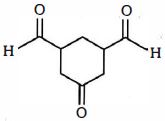
B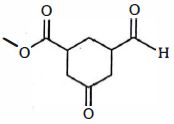
C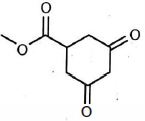
D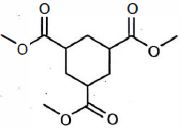
Solution
(D) Compound $B$ is $1,3,5$-tri(propan$-2-$ylidene)cyclohexane.
This structure is formed by the reaction of $1,3,5$-trimethylcyclohexane$-1,3,5-$tricarboxylate (or a similar tri-ester) with excess $CH_3MgBr$ to form a tri-tertiary alcohol,followed by dehydration using $POCl_3$ /pyridine.
Each ester group $(-COOCH_3)$ reacts with $2$ equivalents of $CH_3MgBr$ to form a tertiary alcohol $(-C(OH)(CH_3)_2)$.
Dehydration of these tertiary alcohols with $POCl_3$ /pyridine yields the corresponding isopropylidene groups.
Therefore,compound $A$ must be the tri-ester shown in option $D$.
This structure is formed by the reaction of $1,3,5$-trimethylcyclohexane$-1,3,5-$tricarboxylate (or a similar tri-ester) with excess $CH_3MgBr$ to form a tri-tertiary alcohol,followed by dehydration using $POCl_3$ /pyridine.
Each ester group $(-COOCH_3)$ reacts with $2$ equivalents of $CH_3MgBr$ to form a tertiary alcohol $(-C(OH)(CH_3)_2)$.
Dehydration of these tertiary alcohols with $POCl_3$ /pyridine yields the corresponding isopropylidene groups.
Therefore,compound $A$ must be the tri-ester shown in option $D$.
0 likes
View Solution55
DifficultMCQ
Give the expected product of the following reaction.

A
$4-$($2$-hydroxypropan$-2-$yl)cyclohexan$-1-$one
B
methyl $4-$($1$-hydroxy$-1-$methylethyl)cyclohexane$-1-$carboxylate
C
$4-$($1$-hydroxy$-1-$methylethyl)cyclohexane$-1-$carboxylic acid
D
$2-$($4$-($2$-hydroxypropan$-2-$yl)cyclohexyl)propan$-2-$ol
Solution
(D) The reactant is $4$-oxocyclohexane$-1-$carbonyl chloride.
When treated with excess $CH_3MgBr$ (a Grignard reagent),the nucleophilic $CH_3^-$ attacks both the carbonyl carbon of the acid chloride and the ketone carbonyl.
$1$. The acid chloride reacts with $2$ equivalents of $CH_3MgBr$ to form a tertiary alcohol,specifically a $2$-hydroxypropan-$2$-yl group.
$2$. The ketone reacts with $1$ equivalent of $CH_3MgBr$ to form a tertiary alcohol,specifically a $1$-hydroxy-$1$-methylethyl group.
After aqueous workup $(H_2O)$,the final product is $2-(4-(2-hydroxypropan-2-yl)cyclohexyl)propan-2-ol$.
When treated with excess $CH_3MgBr$ (a Grignard reagent),the nucleophilic $CH_3^-$ attacks both the carbonyl carbon of the acid chloride and the ketone carbonyl.
$1$. The acid chloride reacts with $2$ equivalents of $CH_3MgBr$ to form a tertiary alcohol,specifically a $2$-hydroxypropan-$2$-yl group.
$2$. The ketone reacts with $1$ equivalent of $CH_3MgBr$ to form a tertiary alcohol,specifically a $1$-hydroxy-$1$-methylethyl group.
After aqueous workup $(H_2O)$,the final product is $2-(4-(2-hydroxypropan-2-yl)cyclohexyl)propan-2-ol$.
0 likes
View Solution56
DifficultMCQ
Which is the major product of the following reaction?
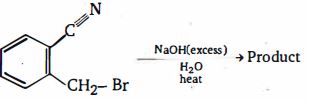
A
$2-$(bromomethyl)benzoic acid
B
$2-$(hydroxymethyl)benzonitrile
C
$2-$(hydroxymethyl)benzoic acid
D
$5-$hydroxy$-2-$(hydroxymethyl)benzonitrile
Solution
(C) The reaction involves the treatment of $2-(\text{bromomethyl})\text{benzonitrile}$ with excess $NaOH$ and $H_2O$ under heating conditions.
$1$. The $-CN$ group (nitrile) undergoes alkaline hydrolysis to form a carboxylate group $(-COO^-)$,which upon acidification (or workup) yields a carboxylic acid $(-COOH)$ group.
$2$. The $-CH_2Br$ group (benzyl bromide) undergoes nucleophilic substitution $(S_N2)$ with $OH^-$ ions to form a primary alcohol $(-CH_2OH)$ group.
Therefore,both functional groups are transformed,resulting in $2-(\text{hydroxymethyl})\text{benzoic acid}$ as the major product.
$1$. The $-CN$ group (nitrile) undergoes alkaline hydrolysis to form a carboxylate group $(-COO^-)$,which upon acidification (or workup) yields a carboxylic acid $(-COOH)$ group.
$2$. The $-CH_2Br$ group (benzyl bromide) undergoes nucleophilic substitution $(S_N2)$ with $OH^-$ ions to form a primary alcohol $(-CH_2OH)$ group.
Therefore,both functional groups are transformed,resulting in $2-(\text{hydroxymethyl})\text{benzoic acid}$ as the major product.
0 likes
View Solution57
MediumMCQ
The above conversion can be done by:

A
$NaBH_4$
B
$LiAlH_4$
C
$PCC$
D
$KMnO_4$
Solution
(B) The given reaction involves the reduction of both a ketone group $(-C=O)$ and a carboxylic acid group $(-COOH)$ to their corresponding alcohols.
$LiAlH_4$ (Lithium aluminium hydride) is a strong reducing agent that can reduce both carboxylic acids to primary alcohols $(-CH_2OH)$ and ketones to secondary alcohols $(-CH(OH)-)$.
$NaBH_4$ is a milder reducing agent that typically reduces ketones but not carboxylic acids.
$PCC$ is an oxidizing agent,and $KMnO_4$ is a strong oxidizing agent.
Therefore,$LiAlH_4$ is the correct reagent for this transformation.
$LiAlH_4$ (Lithium aluminium hydride) is a strong reducing agent that can reduce both carboxylic acids to primary alcohols $(-CH_2OH)$ and ketones to secondary alcohols $(-CH(OH)-)$.
$NaBH_4$ is a milder reducing agent that typically reduces ketones but not carboxylic acids.
$PCC$ is an oxidizing agent,and $KMnO_4$ is a strong oxidizing agent.
Therefore,$LiAlH_4$ is the correct reagent for this transformation.
0 likes
View Solution58
DifficultMCQ
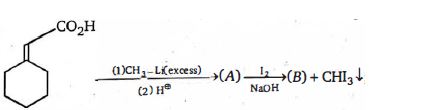
Compound $(B)$ is
A
Cyclohexylidene sodium acetate
B
Sodium cyclohexylidene acetate
C
Sodium cyclohexyl acetate
D
Sodium cyclohexanecarboxylate
Solution
(B) The reaction starts with cyclohexylideneacetic acid reacting with excess $CH_3Li$.
$CH_3Li$ acts as a nucleophile and attacks the carbonyl carbon of the carboxylic acid group.
After protonation,this forms a ketone,specifically cyclohexylideneacetone (compound $A$).
Compound $A$ contains a methyl ketone group $(CH_3-C=O)$,which undergoes the haloform reaction with $I_2$ and $NaOH$.
The haloform reaction converts the methyl ketone into a carboxylate salt and produces iodoform $(CHI_3)$.
Therefore,the final product $(B)$ is the sodium salt of the corresponding acid,which is sodium cyclohexylideneacetate.
$CH_3Li$ acts as a nucleophile and attacks the carbonyl carbon of the carboxylic acid group.
After protonation,this forms a ketone,specifically cyclohexylideneacetone (compound $A$).
Compound $A$ contains a methyl ketone group $(CH_3-C=O)$,which undergoes the haloform reaction with $I_2$ and $NaOH$.
The haloform reaction converts the methyl ketone into a carboxylate salt and produces iodoform $(CHI_3)$.
Therefore,the final product $(B)$ is the sodium salt of the corresponding acid,which is sodium cyclohexylideneacetate.
0 likes
View Solution59
AdvancedMCQ
The product $(B)$ of the reaction is:

A
$p$-nitrophenol
B
Methyl $p$-nitrobenzoate
C
An ester with a cyclohexenone ring
D
$p$-nitrobenzoate ion
Solution
(D) $1$. The first step involves the hydrogenation of the alkene double bond in the cyclohexenone ring using Wilkinson's catalyst,$(Ph_3P)_3RhCl$. This catalyst is selective for the hydrogenation of alkenes without affecting other functional groups like the ester or the nitro group. Thus,$(A)$ is the saturated ester.
$2$. The second step is the alkaline hydrolysis (saponification) of the ester $(A)$ using $0.1 \ M \ NaOH$ in aqueous methanol. This reaction cleaves the ester bond to produce the carboxylate salt and the corresponding alcohol.
$3$. The carboxylate salt formed is the $p$-nitrobenzoate ion,which is product $(B)$. The other product $(C)$ is the alcohol,which contains no nitrogen.
$2$. The second step is the alkaline hydrolysis (saponification) of the ester $(A)$ using $0.1 \ M \ NaOH$ in aqueous methanol. This reaction cleaves the ester bond to produce the carboxylate salt and the corresponding alcohol.
$3$. The carboxylate salt formed is the $p$-nitrobenzoate ion,which is product $(B)$. The other product $(C)$ is the alcohol,which contains no nitrogen.
0 likes
View Solution60
DifficultMCQ
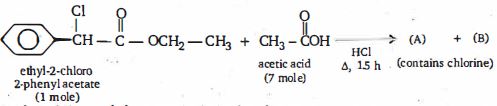
Product $(A)$ and $(B)$ respectively in the above reaction are
A
$C_6H_5CH(Cl)COOH, CH_3COOCH_2CH_3$
B
$C_6H_5CH(Cl)COOCH_2CH_3, CH_3COOH$
C
$C_6H_5CH(Cl)COOCH_2CH_3, CH_3COOCH_3$
D
$C_6H_5CH_2Cl, CH_3COOH$
Solution
(A) The reaction is an acid-catalyzed transesterification reaction between ethyl$-2-$chloro$-2-$phenylacetate and acetic acid.
In the presence of $HCl$ and heat,the ester group $-COOCH_2CH_3$ is replaced by the carboxylic acid group $-COOH$ from the acetic acid.
The mechanism involves the attack of the acetic acid carbonyl oxygen on the ester carbonyl carbon,followed by the elimination of ethanol.
The ethanol then reacts with the excess acetic acid to form ethyl acetate $(CH_3COOCH_2CH_3)$.
Thus,the products are $2-$chloro$-2-$phenylacetic acid $(C_6H_5CH(Cl)COOH)$ and ethyl acetate $(CH_3COOCH_2CH_3)$.
Comparing this with the options,option $A$ represents these products.
In the presence of $HCl$ and heat,the ester group $-COOCH_2CH_3$ is replaced by the carboxylic acid group $-COOH$ from the acetic acid.
The mechanism involves the attack of the acetic acid carbonyl oxygen on the ester carbonyl carbon,followed by the elimination of ethanol.
The ethanol then reacts with the excess acetic acid to form ethyl acetate $(CH_3COOCH_2CH_3)$.
Thus,the products are $2-$chloro$-2-$phenylacetic acid $(C_6H_5CH(Cl)COOH)$ and ethyl acetate $(CH_3COOCH_2CH_3)$.
Comparing this with the options,option $A$ represents these products.
0 likes
View Solution61
AdvancedMCQ
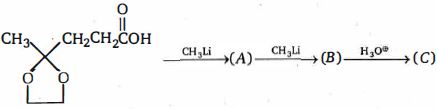
The product $(C)$ of the above reaction is:
A
$CH_3-C(=O)-CH_2-CH_2-C(OH)(CH_3)_2$
B
$CH_3-C(OH)(CH_3)-CH_2-CH_2-C(OH)(CH_3)_2$
C
$CH_3-C(=O)-CH_2-CH_2-C(=O)-CH_3$
D
$CH_3-CH_2-C(=O)-CH_2-CH_2-CH_3$
Solution
(C) $1$. The starting material is a carboxylic acid protected as an acetal at the other end of the chain.
$2$. Treatment with $CH_3Li$ (an organolithium reagent) first deprotonates the carboxylic acid to form a lithium carboxylate salt.
$3$. $A$ second equivalent of $CH_3Li$ attacks the carboxylate carbon to form a gem-diol lithium salt intermediate.
$4$. Upon acidic workup $(H_3O^+)$,the acetal protecting group is hydrolyzed to a ketone,and the gem-diol salt is converted into a ketone.
$5$. The final product $(C)$ is $CH_3-C(=O)-CH_2-CH_2-C(=O)-CH_3$ (hexane$-2,5-$dione).
$2$. Treatment with $CH_3Li$ (an organolithium reagent) first deprotonates the carboxylic acid to form a lithium carboxylate salt.
$3$. $A$ second equivalent of $CH_3Li$ attacks the carboxylate carbon to form a gem-diol lithium salt intermediate.
$4$. Upon acidic workup $(H_3O^+)$,the acetal protecting group is hydrolyzed to a ketone,and the gem-diol salt is converted into a ketone.
$5$. The final product $(C)$ is $CH_3-C(=O)-CH_2-CH_2-C(=O)-CH_3$ (hexane$-2,5-$dione).
0 likes
View Solution62
DifficultMCQ
If $(\pm)$ $2$-methylbutanoic acid is esterified by reaction with $(\pm)$ $2$-butanol,how many optically active compounds will be present in the final equilibrium reaction mixture?
A
$2$
B
$3$
C
$4$
D
$6$
Solution
(C) The reaction is: $(\pm)$ $2$-methylbutanoic acid + $(\pm)$ $2$-butanol $\longleftrightarrow$ ester + $H_2O$.
$(\pm)$ $2$-methylbutanoic acid exists as a pair of enantiomers: $(R)$ and $(S)$.
$(\pm)$ $2$-butanol exists as a pair of enantiomers: $(R)$ and $(S)$.
The esterification reaction involves the formation of an ester from these two chiral components.
The possible combinations of the acid and alcohol enantiomers are:
$1$. $(R)$-acid + $(R)$-alcohol $\rightarrow$ $(R,R)$-ester
$2$. $(R)$-acid + $(S)$-alcohol $\rightarrow$ $(R,S)$-ester
$3$. $(S)$-acid + $(R)$-alcohol $\rightarrow$ $(S,R)$-ester
$4$. $(S)$-acid + $(S)$-alcohol $\rightarrow$ $(S,S)$-ester
Since all four resulting esters contain two chiral centers and are not meso compounds,all $4$ of them are optically active.
$(\pm)$ $2$-methylbutanoic acid exists as a pair of enantiomers: $(R)$ and $(S)$.
$(\pm)$ $2$-butanol exists as a pair of enantiomers: $(R)$ and $(S)$.
The esterification reaction involves the formation of an ester from these two chiral components.
The possible combinations of the acid and alcohol enantiomers are:
$1$. $(R)$-acid + $(R)$-alcohol $\rightarrow$ $(R,R)$-ester
$2$. $(R)$-acid + $(S)$-alcohol $\rightarrow$ $(R,S)$-ester
$3$. $(S)$-acid + $(R)$-alcohol $\rightarrow$ $(S,R)$-ester
$4$. $(S)$-acid + $(S)$-alcohol $\rightarrow$ $(S,S)$-ester
Since all four resulting esters contain two chiral centers and are not meso compounds,all $4$ of them are optically active.
0 likes
View Solution63
MediumMCQ
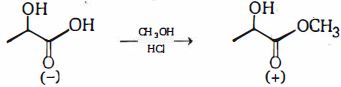
Esterification (shown below) is a reaction converting a carboxylic acid to its ester. It involves only the carbonyl carbon. Esterification of $(-)$ lactic acid with methanol yields $(+)$ methyl lactate. Assuming that there are no side reactions,what is true about this reaction?
A
An $S_N2$ process has occurred,inverting the absolute configuration of the chiral center
B
An $S_N1$ reaction at the chiral center has inverted the optical rotation
C
$A$ diastereomer has been produced; diastereomers have different physical properties including optical rotation
D
Optical rotation is not directly related to absolute configuration,so the change in sign of rotation is merely a coincidence
Solution
(D) The esterification reaction involves the nucleophilic attack of methanol on the carbonyl carbon of the carboxylic acid group.
This process does not involve the chiral center (the carbon atom attached to the $-OH$ group).
Since the chiral center remains unaffected,the absolute configuration ($R$ or $S$) of the molecule does not change.
Optical rotation is a physical property that depends on the specific structure and environment of the molecule.
There is no direct,simple correlation between the absolute configuration and the sign of optical rotation ($+$ or $-$).
Therefore,the change in the sign of optical rotation from $(-)$ to $(+)$ is merely a coincidence resulting from the change in the functional group attached to the molecule.
This process does not involve the chiral center (the carbon atom attached to the $-OH$ group).
Since the chiral center remains unaffected,the absolute configuration ($R$ or $S$) of the molecule does not change.
Optical rotation is a physical property that depends on the specific structure and environment of the molecule.
There is no direct,simple correlation between the absolute configuration and the sign of optical rotation ($+$ or $-$).
Therefore,the change in the sign of optical rotation from $(-)$ to $(+)$ is merely a coincidence resulting from the change in the functional group attached to the molecule.
0 likes
View Solution64
DifficultMCQ
Identify the major product of the reaction when the given compound is hydrolyzed and heated strongly.
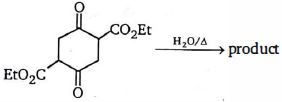
A
$A$ cyclic $\beta$-keto acid derivative.
B
$A$ cyclohexenone derivative.
C
Hydroquinone (benzene$-1,4-$diol).
D
Cyclohexane$-1,4-$dicarboxylic acid.
Solution
(C) The given compound is a $\beta$-keto ester. Upon hydrolysis with $H_3O^+$,the ester groups are converted into carboxylic acid groups,forming a $\beta$-keto acid. $\beta$-keto acids are unstable and undergo decarboxylation upon heating,releasing $CO_2$. The resulting product is cyclohexane$-1,4-$dione. This dione exists in tautomeric equilibrium with its enol form,which is hydroquinone (benzene$-1,4-$diol). Due to the aromatic stabilization of the enol form,it is the major product.
0 likes
View Solution65
MediumMCQ
An unknown compound $(A)$ (molar mass $= 180$) on acylation gives a product (molar mass $= 390$). Find the number of hydroxyl group present in compound $(A)$.
A
$5$
B
$6$
C
$10$
D
$1$
Solution
(A) During acylation,each hydroxyl group $(-OH)$ is replaced by an acetyl group $(-COCH_3)$ with the loss of a hydrogen atom. The net increase in molar mass for each $-OH$ group is $(43 - 1) = 42 \ g/mol$.
Let $n$ be the number of hydroxyl groups.
The change in molar mass is given by: $\Delta M = n \times 42$.
$\Delta M = 390 - 180 = 210$.
$n = \frac{210}{42} = 5$.
Therefore,the number of hydroxyl groups present in compound $(A)$ is $5$.
Let $n$ be the number of hydroxyl groups.
The change in molar mass is given by: $\Delta M = n \times 42$.
$\Delta M = 390 - 180 = 210$.
$n = \frac{210}{42} = 5$.
Therefore,the number of hydroxyl groups present in compound $(A)$ is $5$.
0 likes
View Solution66
MediumMCQ
Which of the following pairs of compounds can be differentiated by $NaHCO_3$ as well as by $NaOH$?
A
Benzoic acid and Phenol
B
Phenol and Benzyl alcohol
C
Benzoic acid and Benzyl alcohol
D
Phenol and Anisole
Solution
(C) To differentiate two compounds using a reagent,one compound must react while the other does not.
$1$. $NaHCO_3$ (Sodium bicarbonate) is a weak base. It reacts only with strong acids like carboxylic acids $(pKa \approx 4-5)$ to evolve $CO_2$ gas,but does not react with weaker acids like phenols $(pKa \approx 10)$.
$2$. $NaOH$ (Sodium hydroxide) is a strong base. It reacts with both carboxylic acids and phenols to form their respective salts.
$3$. In option $(c)$,Benzoic acid $(C_6H_5COOH)$ is a strong acid that reacts with both $NaHCO_3$ (evolving $CO_2$) and $NaOH$. Benzyl alcohol $(C_6H_5CH_2OH)$ is a neutral compound that does not react with either $NaHCO_3$ or $NaOH$. Thus,they can be differentiated by both reagents.
$1$. $NaHCO_3$ (Sodium bicarbonate) is a weak base. It reacts only with strong acids like carboxylic acids $(pKa \approx 4-5)$ to evolve $CO_2$ gas,but does not react with weaker acids like phenols $(pKa \approx 10)$.
$2$. $NaOH$ (Sodium hydroxide) is a strong base. It reacts with both carboxylic acids and phenols to form their respective salts.
$3$. In option $(c)$,Benzoic acid $(C_6H_5COOH)$ is a strong acid that reacts with both $NaHCO_3$ (evolving $CO_2$) and $NaOH$. Benzyl alcohol $(C_6H_5CH_2OH)$ is a neutral compound that does not react with either $NaHCO_3$ or $NaOH$. Thus,they can be differentiated by both reagents.
0 likes
View Solution67
DifficultMCQ
Product $(G)$ is
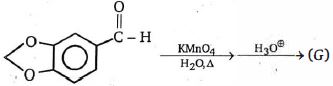
A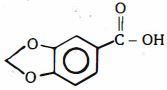
B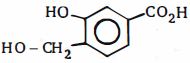
C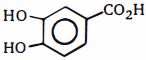
D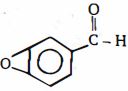
Solution
(C) The starting material is piperonal ($3$,$4$-methylenedioxybenzaldehyde).
$1$. Treatment with $KMnO_4$ in $H_2O$ and heat oxidizes the aldehyde group $(-CHO)$ to a carboxylic acid group $(-COOH)$,forming piperonylic acid.
$2$. Subsequent treatment with $H_3O^+$ (acidic hydrolysis) cleaves the methylenedioxy ring (acetal linkage) to yield $3,4-$dihydroxybenzoic acid (protocatechuic acid).
Therefore,the final product $(G)$ is $3,4-$dihydroxybenzoic acid.
$1$. Treatment with $KMnO_4$ in $H_2O$ and heat oxidizes the aldehyde group $(-CHO)$ to a carboxylic acid group $(-COOH)$,forming piperonylic acid.
$2$. Subsequent treatment with $H_3O^+$ (acidic hydrolysis) cleaves the methylenedioxy ring (acetal linkage) to yield $3,4-$dihydroxybenzoic acid (protocatechuic acid).
Therefore,the final product $(G)$ is $3,4-$dihydroxybenzoic acid.
0 likes
View Solution68
MediumMCQ
Saponification (basic hydrolysis) of $C_6H_5-CO-^{18}OCH_3$ will yield. [$^{18}O$ = mass $-18$ isotope of oxygen]
A
$C_6H_5-COO^- + CH_3-^{18}OH$
B
$C_6H_5-CO^{18}O^- + CH_3OH$
C
$C_6H_5-COO^- + CH_3OH$
D
$C_6H_5-C(^{18}O)O^- + CH_3OH$
Solution
(A) Saponification of an ester $R-CO-OR'$ with aqueous base follows $Acyl$ $Oxygen$ $Cleavage$ ($AAC_2$ mechanism).
The hydroxide ion $(OH^-)$ attacks the carbonyl carbon to form a tetrahedral intermediate.
This intermediate collapses to release the alkoxide ion $(R'O^-)$.
The alkoxide ion quickly abstracts a proton from the carboxylic acid to form the alcohol $(R'OH)$.
In the given ester $C_6H_5-CO-^{18}OCH_3$,the $^{18}O$ isotope is present in the alkoxy group $(-^{18}OCH_3)$.
Therefore,the $^{18}O$ isotope will end up in the resulting alcohol,$CH_3-^{18}OH$.
The hydroxide ion $(OH^-)$ attacks the carbonyl carbon to form a tetrahedral intermediate.
This intermediate collapses to release the alkoxide ion $(R'O^-)$.
The alkoxide ion quickly abstracts a proton from the carboxylic acid to form the alcohol $(R'OH)$.
In the given ester $C_6H_5-CO-^{18}OCH_3$,the $^{18}O$ isotope is present in the alkoxy group $(-^{18}OCH_3)$.
Therefore,the $^{18}O$ isotope will end up in the resulting alcohol,$CH_3-^{18}OH$.

0 likes
View Solution69
DifficultMCQ
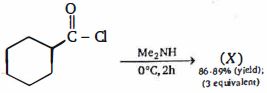
The product $(X)$ of the reaction is:
A
Cyclohexyl-$N$,$N$-dimethylcarboxamide
B
$1,1-$bis(dimethylamino)cyclohexan$-1-$ol
C
$N$,$N$-dimethylcyclohexan$-1-$amine
D
Cyclohexanecarbaldehyde
Solution
(A) The reaction between an acid chloride (cyclohexanecarbonyl chloride) and a secondary amine $(Me_2NH)$ is a nucleophilic acyl substitution reaction.
The lone pair on the nitrogen atom of the amine attacks the electrophilic carbonyl carbon of the acid chloride.
This leads to the formation of an amide as the final product,with the elimination of $HCl$.
The reaction is: $C_6H_{11}COCl + 2Me_2NH \rightarrow C_6H_{11}CONMe_2 + Me_2NH_2^+Cl^-$.
Thus,the product $(X)$ is $N,N$-dimethylcyclohexanecarboxamide.
The lone pair on the nitrogen atom of the amine attacks the electrophilic carbonyl carbon of the acid chloride.
This leads to the formation of an amide as the final product,with the elimination of $HCl$.
The reaction is: $C_6H_{11}COCl + 2Me_2NH \rightarrow C_6H_{11}CONMe_2 + Me_2NH_2^+Cl^-$.
Thus,the product $(X)$ is $N,N$-dimethylcyclohexanecarboxamide.
0 likes
View Solution70
MediumMCQ
Which of the following is the correct order of decarboxylation of $\beta$-keto carboxylate anion?

A
$a > b > c > d$
B
$c > d > a > b$
C
$c > d > b > a$
D
$d > c > a > b$
Solution
(C) The decarboxylation of $\beta$-keto carboxylate anions involves the formation of a carbanion intermediate in the rate-determining step. The stability of this carbanion determines the rate of the reaction. The electron-withdrawing groups $(EWG)$ stabilize the carbanion formed at the $\alpha$-carbon. The order of electron-withdrawing strength is $-NO_2 > -CN > -Cl > -F$. Therefore,the stability of the carbanion and the rate of decarboxylation follow the order: $c (NO_2) > d (CN) > b (Cl) > a (F)$.
0 likes
View Solution71
AdvancedMCQ
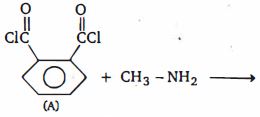
What is the product of the following reaction?
A
$N$-methylphthalimide
B
$2-$hydroxy$-2-$methyl-isoindoline$-1-$one
C
Phthalhydrazide
D
Indane$-1,3-$dione
Solution
(A) The reaction is between phthaloyl chloride and methylamine $(CH_3NH_2)$.
$1$. The nucleophilic nitrogen of methylamine attacks the carbonyl carbon of one of the acid chloride groups,leading to the elimination of $HCl$ and the formation of an amide intermediate.
$2$. The second amide nitrogen then attacks the second carbonyl carbon,leading to the elimination of another molecule of $HCl$ and the formation of a cyclic imide.
$3$. The final product is $N$-methylphthalimide.
$1$. The nucleophilic nitrogen of methylamine attacks the carbonyl carbon of one of the acid chloride groups,leading to the elimination of $HCl$ and the formation of an amide intermediate.
$2$. The second amide nitrogen then attacks the second carbonyl carbon,leading to the elimination of another molecule of $HCl$ and the formation of a cyclic imide.
$3$. The final product is $N$-methylphthalimide.
0 likes
View Solution72
MediumMCQ
Which $\beta$-keto acid shown will not undergo decarboxylation?
A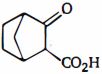
B
C
$Ph-C(=O)-CH_2-CO_2H$
D
$CH_3-C(=O)-CH_2-CO_2H$
Solution
(B) Decarboxylation of $\beta$-keto acids typically proceeds through a cyclic six-membered transition state to form an enol intermediate,which then tautomerizes to a ketone.
Option $B$ represents a bicyclic $\beta$-keto acid where the carboxyl group is at the bridgehead position.
Decarboxylation would require the formation of a double bond at the bridgehead position in the resulting enol intermediate.
According to Bredt's rule,the formation of a double bond at the bridgehead of a small bicyclic system is highly unstable and prohibited.
Therefore,the compound in option $B$ will not undergo decarboxylation.
Option $B$ represents a bicyclic $\beta$-keto acid where the carboxyl group is at the bridgehead position.
Decarboxylation would require the formation of a double bond at the bridgehead position in the resulting enol intermediate.
According to Bredt's rule,the formation of a double bond at the bridgehead of a small bicyclic system is highly unstable and prohibited.
Therefore,the compound in option $B$ will not undergo decarboxylation.
0 likes
View Solution73
MediumMCQ
Choose the response that matches the correct functional group classification with the following group of structural formulas.
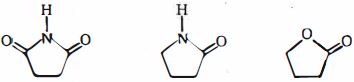
A
Anhydride,Lactam,Lactone
B
Lactam,Imide,Lactone
C
Imide,Lactone,Anhydride
D
Imide,Lactam,Lactone
Solution
(D) The first structure is a cyclic imide (succinimide),which contains two carbonyl groups attached to a nitrogen atom.
The second structure is a cyclic amide,known as a lactam.
The third structure is a cyclic ester,known as a lactone.
Therefore,the correct sequence is Imide,Lactam,Lactone.
Thus,the correct option is $D$.
The second structure is a cyclic amide,known as a lactam.
The third structure is a cyclic ester,known as a lactone.
Therefore,the correct sequence is Imide,Lactam,Lactone.
Thus,the correct option is $D$.
0 likes
View Solution74
MediumMCQ
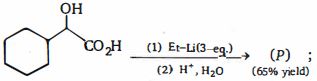
The product $(P)$ of the given reaction is:
A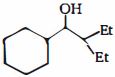
B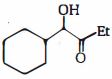
C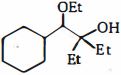
D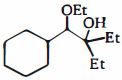
Solution
(B) The reaction involves the treatment of $2$-hydroxy$-2-$cyclohexylacetic acid with $3$ equivalents of $EtLi$.
First,$2$ equivalents of $EtLi$ act as a base,deprotonating both the carboxylic acid group and the hydroxyl group to form a dianion.
The third equivalent of $EtLi$ then acts as a nucleophile,attacking the carboxylate carbon.
Upon acidic workup $(H_3O^+)$,the intermediate forms a gem-diol,which is unstable and loses water to form a ketone.
The final product is $1$-cyclohexyl$-2-$hydroxybutan$-1-$one,which corresponds to the structure in option $B$.
First,$2$ equivalents of $EtLi$ act as a base,deprotonating both the carboxylic acid group and the hydroxyl group to form a dianion.
The third equivalent of $EtLi$ then acts as a nucleophile,attacking the carboxylate carbon.
Upon acidic workup $(H_3O^+)$,the intermediate forms a gem-diol,which is unstable and loses water to form a ketone.
The final product is $1$-cyclohexyl$-2-$hydroxybutan$-1-$one,which corresponds to the structure in option $B$.
0 likes
View Solution75
DifficultMCQ
The product $(X)$ of the reaction is:
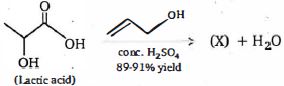
A
Allyl lactate
B
Lactic acid allyl ester
C
Ethyl lactate
D
Allyl pyruvate
Solution
(C) The reaction is an esterification between lactic acid $(CH_3CH(OH)COOH)$ and allyl alcohol $(CH_2=CHCH_2OH)$ in the presence of concentrated $H_2SO_4$.
In an esterification reaction,the carboxylic acid group $(-COOH)$ of the acid reacts with the hydroxyl group $(-OH)$ of the alcohol to form an ester $(-COOR)$ and water $(H_2O)$.
The hydroxyl group attached to the chiral carbon of lactic acid remains unaffected under these conditions.
Therefore,the product $(X)$ is allyl $2-$hydroxypropanoate,also known as allyl lactate.
In an esterification reaction,the carboxylic acid group $(-COOH)$ of the acid reacts with the hydroxyl group $(-OH)$ of the alcohol to form an ester $(-COOR)$ and water $(H_2O)$.
The hydroxyl group attached to the chiral carbon of lactic acid remains unaffected under these conditions.
Therefore,the product $(X)$ is allyl $2-$hydroxypropanoate,also known as allyl lactate.
0 likes
View Solution76
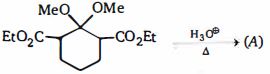
DifficultMCQ
The product $(A)$ obtained is:
A
Cyclohexane$-1,2-$dione
B
Cyclohexanone
C
$2-$(Ethoxycarbonyl)cyclohexanone
D
$2-$Oxocyclohexanecarboxylic acid
Solution
(B) The given reactant is a diester with a ketal group. Upon treatment with $H_3O^{\oplus}$ and heating,the following steps occur:
$1$. Hydrolysis of the two ester groups $(-CO_2Et)$ to carboxylic acid groups $(-COOH)$ and hydrolysis of the ketal group ($-OMe$ groups) to a ketone group $(=O)$.
$2$. The resulting intermediate is a $\beta$-keto dicarboxylic acid.
$3$. $\beta$-keto acids and gem-dicarboxylic acids are unstable upon heating and undergo decarboxylation (loss of $CO_2$).
$4$. The molecule loses two molecules of $CO_2$ and one molecule of $H_2O$ to yield cyclohexanone as the final product $(A)$.
$1$. Hydrolysis of the two ester groups $(-CO_2Et)$ to carboxylic acid groups $(-COOH)$ and hydrolysis of the ketal group ($-OMe$ groups) to a ketone group $(=O)$.
$2$. The resulting intermediate is a $\beta$-keto dicarboxylic acid.
$3$. $\beta$-keto acids and gem-dicarboxylic acids are unstable upon heating and undergo decarboxylation (loss of $CO_2$).
$4$. The molecule loses two molecules of $CO_2$ and one molecule of $H_2O$ to yield cyclohexanone as the final product $(A)$.
0 likes
View Solution77
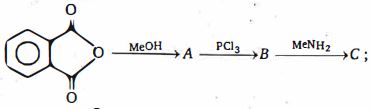
DifficultMCQ
The product $(C)$ of the given reaction sequence is:
A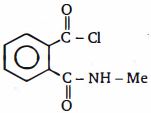
B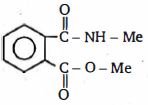
C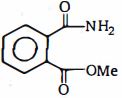
D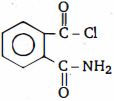
Solution
(C) $1$. Phthalic anhydride reacts with methanol $(MeOH)$ via nucleophilic acyl substitution to open the anhydride ring,forming monomethyl phthalate $(A)$,which is $C_6H_4(COOCH_3)(COOH)$.
$2$. Treatment of the carboxylic acid group in $(A)$ with $PCl_3$ converts it into an acid chloride,yielding methyl $2-$(chlorocarbonyl)benzoate $(B)$,which is $C_6H_4(COOCH_3)(COCl)$.
$3$. Finally,the reaction of the acid chloride $(B)$ with methylamine $(MeNH_2)$ replaces the chlorine atom with a methylamino group,resulting in the final product $(C)$,which is methyl $2-$(methylcarbamoyl)benzoate,$C_6H_4(COOCH_3)(CONHCH_3)$.
$2$. Treatment of the carboxylic acid group in $(A)$ with $PCl_3$ converts it into an acid chloride,yielding methyl $2-$(chlorocarbonyl)benzoate $(B)$,which is $C_6H_4(COOCH_3)(COCl)$.
$3$. Finally,the reaction of the acid chloride $(B)$ with methylamine $(MeNH_2)$ replaces the chlorine atom with a methylamino group,resulting in the final product $(C)$,which is methyl $2-$(methylcarbamoyl)benzoate,$C_6H_4(COOCH_3)(CONHCH_3)$.
0 likes
View Solution78
AdvancedMCQ
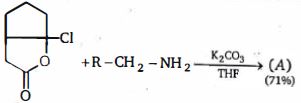
In the above reaction,identify the major product $(A)$ of the reaction.
A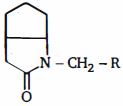
B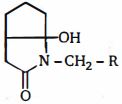
C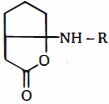
D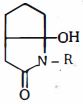
Solution
(B) The reaction involves the nucleophilic attack of the primary amine $(R-CH_2-NH_2)$ on the carbonyl carbon of the lactone ring.
This leads to the ring-opening of the lactone,forming an amide intermediate.
Subsequently,the nitrogen atom of the newly formed amide attacks the other carbonyl group (or the electrophilic center generated by the leaving group) to close the ring,resulting in the formation of a lactam derivative with a hydroxyl group.
The final product $(A)$ is the structure shown in option $(B)$.
This leads to the ring-opening of the lactone,forming an amide intermediate.
Subsequently,the nitrogen atom of the newly formed amide attacks the other carbonyl group (or the electrophilic center generated by the leaving group) to close the ring,resulting in the formation of a lactam derivative with a hydroxyl group.
The final product $(A)$ is the structure shown in option $(B)$.
0 likes
View Solution79
AdvancedMCQ
Product $(X)$ is
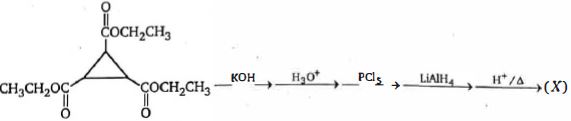
A
B
C
D
Solution
(B) The reaction sequence is as follows:
$1$. The starting material is a triester of cyclopropane$-1,2,3-$tricarboxylic acid.
$2$. Treatment with $KOH$ followed by $H_3O^+$ hydrolyzes the ester groups to carboxylic acid groups,yielding cyclopropane$-1,2,3-$tricarboxylic acid.
$3$. Treatment with $PCl_5$ converts the carboxylic acid groups to acid chloride groups.
$4$. Subsequent reduction with $LiAlH_4$ reduces the acid chloride groups to primary alcohol groups,resulting in cyclopropane$-1,2,3-$trimethanol.
$5$. Finally,heating with $H^+$ causes dehydration and rearrangement to form benzene.
Thus,the product $(X)$ is benzene.
$1$. The starting material is a triester of cyclopropane$-1,2,3-$tricarboxylic acid.
$2$. Treatment with $KOH$ followed by $H_3O^+$ hydrolyzes the ester groups to carboxylic acid groups,yielding cyclopropane$-1,2,3-$tricarboxylic acid.
$3$. Treatment with $PCl_5$ converts the carboxylic acid groups to acid chloride groups.
$4$. Subsequent reduction with $LiAlH_4$ reduces the acid chloride groups to primary alcohol groups,resulting in cyclopropane$-1,2,3-$trimethanol.
$5$. Finally,heating with $H^+$ causes dehydration and rearrangement to form benzene.
Thus,the product $(X)$ is benzene.
0 likes
View Solution80
DifficultMCQ
Identify the final product in the following reaction:
$CH_3-CH(OH)-COOH \xrightarrow{\Delta} \text{Product}$
$CH_3-CH(OH)-COOH \xrightarrow{\Delta} \text{Product}$
A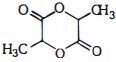
B
$CH_2=CHCO_2H$
C
$CH_3-CO-COOH$
D
$CH_3CH_2OH$
Solution
(A) When $\alpha$-hydroxy acids like lactic acid $(CH_3-CH(OH)-COOH)$ are heated,they undergo intermolecular esterification to form a cyclic diester known as a lactide.
Two molecules of lactic acid lose two molecules of water to form the six-membered cyclic structure shown in the image.
The reaction is: $2 CH_3-CH(OH)-COOH \xrightarrow{\Delta} \text{Lactide} + 2 H_2O$.
Two molecules of lactic acid lose two molecules of water to form the six-membered cyclic structure shown in the image.
The reaction is: $2 CH_3-CH(OH)-COOH \xrightarrow{\Delta} \text{Lactide} + 2 H_2O$.
0 likes
View Solution81
AdvancedMCQ
The product $(A)$ will be:
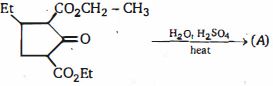
A
$3-$ethylcyclopentanone
B
$2-$ethylcyclopentanone
C
cyclopentanone
D
$2-$ethyl$-3-$oxocyclopentanecarboxylic acid
Solution
(A) The reaction involves the hydrolysis of a $\beta$-keto ester followed by decarboxylation upon heating.
$1$. The starting material is a substituted cyclopentanone with two ester groups $(-CO_2Et)$ at the $\alpha$-positions.
$2$. Hydrolysis of the ester groups with $H_2O/H_2SO_4$ and heat converts them into carboxylic acid groups $(-CO_2H)$.
$3$. The resulting $\beta$-keto acid is unstable and undergoes decarboxylation (loss of $CO_2$) upon heating.
$4$. The ethyl group $(-Et)$ is located at the $3$-position relative to the ketone.
$5$. Therefore,the final product is $3$-ethylcyclopentanone.
$1$. The starting material is a substituted cyclopentanone with two ester groups $(-CO_2Et)$ at the $\alpha$-positions.
$2$. Hydrolysis of the ester groups with $H_2O/H_2SO_4$ and heat converts them into carboxylic acid groups $(-CO_2H)$.
$3$. The resulting $\beta$-keto acid is unstable and undergoes decarboxylation (loss of $CO_2$) upon heating.
$4$. The ethyl group $(-Et)$ is located at the $3$-position relative to the ketone.
$5$. Therefore,the final product is $3$-ethylcyclopentanone.
0 likes
View Solution82
MediumMCQ
Choose the best sequence of reactions for the transformation given. Semicolons indicate separate reaction steps to be used in the order shown.

A
$H_3O^{+}$; $SOCl_2$; $CH_3NH_2$
B
$HO^{-}/H_2O$; $PBr_3$; $Mg$; $CO_2$; $H_3O^{+}$; $SOCl_2$; $CH_3NH_2$
C
$LiAlH_4$; $H_2O$; $HBr$; $Mg$; $CO_2$; $H_3O^{+}$; $SOCl_2$; $CH_3NH_2$
D
None of these would yield the desired product
Solution
(A) The starting material is methyl $p$-methylbenzoate $(CH_3-C_6H_4-COOCH_3)$. The target product is $N$-methyl-$p$-methylbenzamide $(CH_3-C_6H_4-CONHCH_3)$.
$1$. First,the ester is hydrolyzed using acid $(H_3O^{+})$ to form $p$-methylbenzoic acid $(CH_3-C_6H_4-COOH)$.
$2$. Next,the carboxylic acid is treated with thionyl chloride $(SOCl_2)$ to form the corresponding acid chloride $(CH_3-C_6H_4-COCl)$.
$3$. Finally,the acid chloride reacts with methylamine $(CH_3NH_2)$ to form the amide $(CH_3-C_6H_4-CONHCH_3)$.
Thus,the correct sequence is $H_3O^{+}$; $SOCl_2$; $CH_3NH_2$.
$1$. First,the ester is hydrolyzed using acid $(H_3O^{+})$ to form $p$-methylbenzoic acid $(CH_3-C_6H_4-COOH)$.
$2$. Next,the carboxylic acid is treated with thionyl chloride $(SOCl_2)$ to form the corresponding acid chloride $(CH_3-C_6H_4-COCl)$.
$3$. Finally,the acid chloride reacts with methylamine $(CH_3NH_2)$ to form the amide $(CH_3-C_6H_4-CONHCH_3)$.
Thus,the correct sequence is $H_3O^{+}$; $SOCl_2$; $CH_3NH_2$.
0 likes
View Solution83
AdvancedMCQ
Which of the following best describes the nucleophilic addition step in the acid-catalyzed hydrolysis of acetonitrile $(CH_3CN)$?
A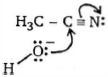
B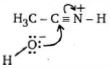
C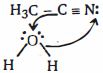
D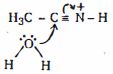
Solution
(D) In the acid-catalyzed hydrolysis of acetonitrile $(CH_3CN)$,the first step is the protonation of the nitrogen atom of the nitrile group by an acid $(H^+)$.
This protonation increases the electrophilicity of the nitrile carbon atom.
Following this,a water molecule $(H_2O)$,acting as a nucleophile,attacks the electrophilic carbon atom of the protonated nitrile.
This corresponds to the mechanism shown in option $D$.
This protonation increases the electrophilicity of the nitrile carbon atom.
Following this,a water molecule $(H_2O)$,acting as a nucleophile,attacks the electrophilic carbon atom of the protonated nitrile.
This corresponds to the mechanism shown in option $D$.
0 likes
View Solution84
DifficultMCQ
The major product expected when Phthalamide is treated with $NaOH$ is:
A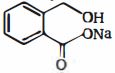
B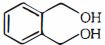
C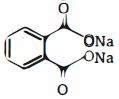
D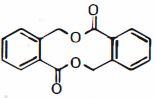
Solution
(C) Phthalamide $(C_6H_4(CONH)_2)$ undergoes hydrolysis when treated with a strong base like $NaOH$.
Initially,the imide group is hydrolyzed to form the amide-acid,and further hydrolysis leads to the formation of the phthalate ion $(C_6H_4(COO^-)_2)$ and ammonia $(NH_3)$.
In the presence of excess $NaOH$,the final product is the disodium salt of phthalic acid,which is sodium phthalate.
Initially,the imide group is hydrolyzed to form the amide-acid,and further hydrolysis leads to the formation of the phthalate ion $(C_6H_4(COO^-)_2)$ and ammonia $(NH_3)$.
In the presence of excess $NaOH$,the final product is the disodium salt of phthalic acid,which is sodium phthalate.
0 likes
View Solution85
DifficultMCQ
At which value of $n$ does the formation of a six-membered ring take place in the following reaction?
$Br-(CH_2)_n-CH_2-Br + CH_2(CO_2Et)_2 \xrightarrow{NaOEt, EtOH} \text{cyclic product}$
$Br-(CH_2)_n-CH_2-Br + CH_2(CO_2Et)_2 \xrightarrow{NaOEt, EtOH} \text{cyclic product}$
A
$2$
B
$3$
C
$5$
D
$6$
Solution
(B) The reaction is a malonic ester synthesis involving an intramolecular alkylation.
The starting material is $Br-CH_2-(CH_2)_n-CH_2-Br$ and diethyl malonate $CH_2(CO_2Et)_2$.
For a six-membered ring to form,the total number of carbon atoms in the ring must be $6$.
The malonate carbon provides $1$ carbon atom,and the chain $-(CH_2)_n-CH_2-CH_2-$ provides the remaining $5$ carbon atoms.
Thus,the chain must have $5$ carbon atoms between the two bromine atoms.
In the structure $Br-CH_2-(CH_2)_n-CH_2-Br$,the total number of carbons in the chain is $n+2$.
Setting $n+2 = 5$ gives $n = 3$.
Therefore,when $n=3$,the chain is $Br-CH_2-CH_2-CH_2-CH_2-CH_2-Br$,which reacts with the malonate to form a six-membered ring.
The starting material is $Br-CH_2-(CH_2)_n-CH_2-Br$ and diethyl malonate $CH_2(CO_2Et)_2$.
For a six-membered ring to form,the total number of carbon atoms in the ring must be $6$.
The malonate carbon provides $1$ carbon atom,and the chain $-(CH_2)_n-CH_2-CH_2-$ provides the remaining $5$ carbon atoms.
Thus,the chain must have $5$ carbon atoms between the two bromine atoms.
In the structure $Br-CH_2-(CH_2)_n-CH_2-Br$,the total number of carbons in the chain is $n+2$.
Setting $n+2 = 5$ gives $n = 3$.
Therefore,when $n=3$,the chain is $Br-CH_2-CH_2-CH_2-CH_2-CH_2-Br$,which reacts with the malonate to form a six-membered ring.
0 likes
View Solution86
MediumMCQ
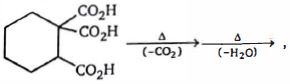
The product of the reaction is:
A
$cis-$ anhydride
B
$trans-$ anhydride
C
both $(a)$ and $(b)$
D
mono-basic acid
Solution
(A) The starting material is cyclohexane$-1,1,2-$tricarboxylic acid.
Upon heating,the geminal dicarboxylic acid group undergoes decarboxylation (loss of $CO_2$) to form cyclohexane$-1,2-$dicarboxylic acid.
The resulting cyclohexane$-1,2-$dicarboxylic acid has the two carboxylic acid groups in a $cis$ configuration relative to the ring.
Further heating leads to the loss of a water molecule (dehydration) between the two adjacent carboxylic acid groups to form a cyclic anhydride.
Since the starting configuration is $cis$,the product formed is $cis-$cyclohexane$-1,2-$dicarboxylic anhydride.
Upon heating,the geminal dicarboxylic acid group undergoes decarboxylation (loss of $CO_2$) to form cyclohexane$-1,2-$dicarboxylic acid.
The resulting cyclohexane$-1,2-$dicarboxylic acid has the two carboxylic acid groups in a $cis$ configuration relative to the ring.
Further heating leads to the loss of a water molecule (dehydration) between the two adjacent carboxylic acid groups to form a cyclic anhydride.
Since the starting configuration is $cis$,the product formed is $cis-$cyclohexane$-1,2-$dicarboxylic anhydride.
0 likes
View Solution87
AdvancedMCQ
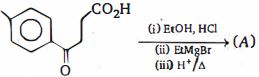
Product $(A)$ of the reaction is:
A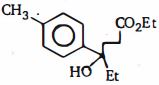
B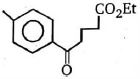
C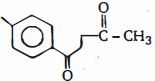
D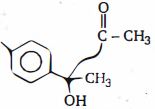
Solution
(A) Step $1$: Esterification of the carboxylic acid group with $EtOH/HCl$ gives the corresponding ethyl ester: $Ar-CO-CH_2CH_2CO_2Et$.
Step $2$: Reaction with $EtMgBr$ (a Grignard reagent). Ketones are more reactive than esters toward nucleophilic attack by Grignard reagents. Therefore,the $Et^-$ nucleophile attacks the ketone carbonyl group.
Step $3$: After acidic workup $(H^+/\Delta)$,the ketone is converted into a tertiary alcohol: $Ar-C(OH)(Et)-CH_2CH_2CO_2Et$.
Step $2$: Reaction with $EtMgBr$ (a Grignard reagent). Ketones are more reactive than esters toward nucleophilic attack by Grignard reagents. Therefore,the $Et^-$ nucleophile attacks the ketone carbonyl group.
Step $3$: After acidic workup $(H^+/\Delta)$,the ketone is converted into a tertiary alcohol: $Ar-C(OH)(Et)-CH_2CH_2CO_2Et$.
0 likes
View Solution88
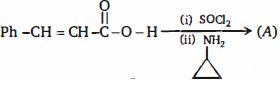
DifficultMCQ
The product $(A)$ of the reaction is:
A
$Ph-CH=CH-C(=O)-CH_2-NH-(cyclopropyl)$
B
$Ph-CH=CH-C(=O)-NH-(cyclopropyl)$
C
$Ph-CH=CH-CHO$
D
$Ph-CH=CH-NH-(cyclopropyl)$
Solution
(B) The reaction proceeds in two steps:
$1$. Treatment of cinnamic acid $(Ph-CH=CH-COOH)$ with $SOCl_2$ converts the carboxylic acid group into an acid chloride group,forming cinnamoyl chloride $(Ph-CH=CH-COCl)$.
$2$. The subsequent reaction of cinnamoyl chloride with cyclopropylamine $(NH_2-cyclopropyl)$ is a nucleophilic acyl substitution reaction. The lone pair on the nitrogen atom of the amine attacks the electrophilic carbonyl carbon of the acid chloride,leading to the formation of an amide.
Thus,the final product $(A)$ is $N$-cyclopropylcinnamamide,which is $Ph-CH=CH-CONH-(cyclopropyl)$.
$1$. Treatment of cinnamic acid $(Ph-CH=CH-COOH)$ with $SOCl_2$ converts the carboxylic acid group into an acid chloride group,forming cinnamoyl chloride $(Ph-CH=CH-COCl)$.
$2$. The subsequent reaction of cinnamoyl chloride with cyclopropylamine $(NH_2-cyclopropyl)$ is a nucleophilic acyl substitution reaction. The lone pair on the nitrogen atom of the amine attacks the electrophilic carbonyl carbon of the acid chloride,leading to the formation of an amide.
Thus,the final product $(A)$ is $N$-cyclopropylcinnamamide,which is $Ph-CH=CH-CONH-(cyclopropyl)$.
0 likes
View Solution89
DifficultMCQ
The reaction of sodium acetate with acetyl chloride proceeds through which of the following mechanisms?
A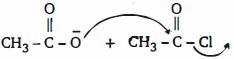
B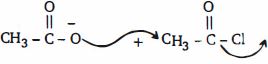
C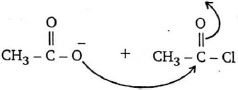
D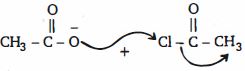
Solution
(A) The reaction between sodium acetate $(CH_3COO^-Na^+)$ and acetyl chloride $(CH_3COCl)$ is a nucleophilic acyl substitution reaction.
In this mechanism,the acetate ion $(CH_3COO^-)$ acts as a nucleophile.
The nucleophilic oxygen atom of the acetate ion attacks the electrophilic carbonyl carbon of the acetyl chloride molecule.
This attack results in the formation of a tetrahedral intermediate,where the carbonyl carbon is bonded to the acetate oxygen,the methyl group,the chlorine atom,and the original carbonyl oxygen (which now carries a negative charge).
Therefore,the correct mechanism involves the acetate ion attacking the carbonyl carbon of acetyl chloride to form a tetrahedral intermediate.
In this mechanism,the acetate ion $(CH_3COO^-)$ acts as a nucleophile.
The nucleophilic oxygen atom of the acetate ion attacks the electrophilic carbonyl carbon of the acetyl chloride molecule.
This attack results in the formation of a tetrahedral intermediate,where the carbonyl carbon is bonded to the acetate oxygen,the methyl group,the chlorine atom,and the original carbonyl oxygen (which now carries a negative charge).
Therefore,the correct mechanism involves the acetate ion attacking the carbonyl carbon of acetyl chloride to form a tetrahedral intermediate.
0 likes
View Solution90
MediumMCQ
Which is the major product of the following reaction?
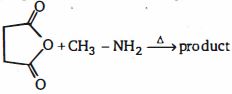
A
$N$-methylsuccinimide
B
Succinic acid
C
$N$-methylsuccinamic acid
D
$N,N'$-dimethylsuccinamide
Solution
(A) The reaction between succinic anhydride and methylamine $(CH_3NH_2)$ initially forms $N$-methylsuccinamic acid. Upon heating,this intermediate undergoes intramolecular cyclization with the loss of a water molecule to form $N$-methylsuccinimide as the final major product.
0 likes
View Solution91
DifficultMCQ
Ethanoic acid $+$ $3$-methylbutan-$1$-ol $\underset{\text{traces } H_2SO_4}{\longleftrightarrow} (A)$; Compound $(A)$ is
A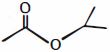
B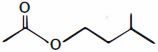
C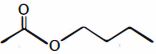
D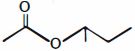
Solution
(B) The reaction between a carboxylic acid and an alcohol in the presence of an acid catalyst (like $H_2SO_4$) is known as Fischer esterification.
Ethanoic acid $(CH_3COOH)$ reacts with $3$-methylbutan-$1$-ol $(CH_3CH(CH_3)CH_2CH_2OH)$ to form the ester $3$-methylbutyl ethanoate.
The structure of $3$-methylbutyl ethanoate is $CH_3COOCH_2CH_2CH(CH_3)CH_3$.
Comparing this with the given options,the structure corresponds to option $(B)$.
Ethanoic acid $(CH_3COOH)$ reacts with $3$-methylbutan-$1$-ol $(CH_3CH(CH_3)CH_2CH_2OH)$ to form the ester $3$-methylbutyl ethanoate.
The structure of $3$-methylbutyl ethanoate is $CH_3COOCH_2CH_2CH(CH_3)CH_3$.
Comparing this with the given options,the structure corresponds to option $(B)$.
0 likes
View Solution92
DifficultMCQ
Identify the final product $(D)$ in the following reaction sequence:
Phthalic anhydride $\xrightarrow{PCl_5} (A)$ $\xrightarrow{LiAlH_4} (B)$ $\xrightarrow{PCC} (C)$ $\xrightarrow{HO^-, \Delta} (D)$
Phthalic anhydride $\xrightarrow{PCl_5} (A)$ $\xrightarrow{LiAlH_4} (B)$ $\xrightarrow{PCC} (C)$ $\xrightarrow{HO^-, \Delta} (D)$
A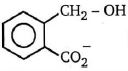
B
C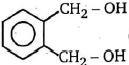
D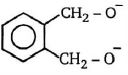
Solution
(A) $1$. Phthalic anhydride reacts with $PCl_5$ to form phthaloyl chloride $(A)$,which is benzene$-1,2-$dicarbonyl chloride.
$2$. Reduction of $(A)$ with $LiAlH_4$ gives benzene$-1,2-$dimethanol $(B)$ (phthalyl alcohol).
$3$. Oxidation of $(B)$ with $PCC$ (Pyridinium chlorochromate) gives phthalaldehyde $(C)$ (benzene$-1,2-$dicarbaldehyde).
$4$. Phthalaldehyde undergoes an intramolecular Cannizzaro reaction in the presence of $HO^-$ and $\Delta$ to form the final product $(D)$,which is the $2-$(hydroxymethyl)benzoate ion.
$2$. Reduction of $(A)$ with $LiAlH_4$ gives benzene$-1,2-$dimethanol $(B)$ (phthalyl alcohol).
$3$. Oxidation of $(B)$ with $PCC$ (Pyridinium chlorochromate) gives phthalaldehyde $(C)$ (benzene$-1,2-$dicarbaldehyde).
$4$. Phthalaldehyde undergoes an intramolecular Cannizzaro reaction in the presence of $HO^-$ and $\Delta$ to form the final product $(D)$,which is the $2-$(hydroxymethyl)benzoate ion.
0 likes
View Solution93
MediumMCQ
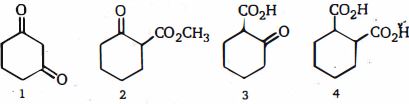
Which of the following compounds will undergo decarboxylation on heating?
A
$2$ and $3$
B
$3$ and $4$
C
$3$ only
D
$1$ and $4$
Solution
(B) Decarboxylation on heating occurs readily in compounds that have a carbonyl group at the $\beta$-position relative to the carboxylic acid group ($\beta$-keto acids).
Compound $3$ is a $\beta$-keto acid,which forms a stable six-membered cyclic transition state upon heating,leading to the loss of $CO_2$.
Compound $4$ is a gem-dicarboxylic acid (specifically,a malonic acid derivative),which also undergoes decarboxylation upon heating to form a monocarboxylic acid.
Therefore,both $3$ and $4$ will undergo decarboxylation on heating.
Compound $3$ is a $\beta$-keto acid,which forms a stable six-membered cyclic transition state upon heating,leading to the loss of $CO_2$.
Compound $4$ is a gem-dicarboxylic acid (specifically,a malonic acid derivative),which also undergoes decarboxylation upon heating to form a monocarboxylic acid.
Therefore,both $3$ and $4$ will undergo decarboxylation on heating.
0 likes
View Solution94
DifficultMCQ
Product $A$ is

A
$RO-CH_2-CO_2R$
B
$RO-CH_2-CO_2Et$
C
$EtO-CH_2-CO_2Et$
D
$R-O-C(=O)-OEt$
Solution
(B) The reaction of a carboxylic acid with an alcohol in the presence of an acid catalyst (like dry $HCl$ gas) is known as Fischer esterification.
In the given reaction,the carboxylic acid group $(-COOH)$ reacts with ethanol $(EtOH)$ to form an ethyl ester.
The ether group $(-OR)$ remains unaffected under these conditions.
Therefore,the carboxylic acid group $-COOH$ is converted to $-CO_2Et$,while the $-OR$ group remains as it is.
The product $A$ is $RO-CH_2-CO_2Et$.
In the given reaction,the carboxylic acid group $(-COOH)$ reacts with ethanol $(EtOH)$ to form an ethyl ester.
The ether group $(-OR)$ remains unaffected under these conditions.
Therefore,the carboxylic acid group $-COOH$ is converted to $-CO_2Et$,while the $-OR$ group remains as it is.
The product $A$ is $RO-CH_2-CO_2Et$.
0 likes
View Solution95
DifficultMCQ
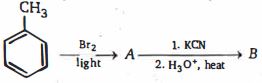
What is the final product $(B)$ of this sequence?
A
$2-$Methylbenzoic acid
B
Benzoic acid
C
$3-$Methylbenzoic acid
D
Phenylacetic acid
Solution
(D) The reaction sequence is as follows:
$1$. Toluene $(Ph-CH_3)$ reacts with $Br_2$ in the presence of light (free radical substitution) to form benzyl bromide $(Ph-CH_2Br)$ as product $(A)$.
$2$. Benzyl bromide $(Ph-CH_2Br)$ reacts with $KCN$ (nucleophilic substitution) to form benzyl cyanide $(Ph-CH_2CN)$.
$3$. Acidic hydrolysis ($H_3O^{\oplus}$,heat) of benzyl cyanide converts the cyano group $(-CN)$ into a carboxylic acid group $(-CO_2H)$,yielding phenylacetic acid $(Ph-CH_2CO_2H)$ as the final product $(B)$.
$1$. Toluene $(Ph-CH_3)$ reacts with $Br_2$ in the presence of light (free radical substitution) to form benzyl bromide $(Ph-CH_2Br)$ as product $(A)$.
$2$. Benzyl bromide $(Ph-CH_2Br)$ reacts with $KCN$ (nucleophilic substitution) to form benzyl cyanide $(Ph-CH_2CN)$.
$3$. Acidic hydrolysis ($H_3O^{\oplus}$,heat) of benzyl cyanide converts the cyano group $(-CN)$ into a carboxylic acid group $(-CO_2H)$,yielding phenylacetic acid $(Ph-CH_2CO_2H)$ as the final product $(B)$.
0 likes
View Solution96
AdvancedMCQ
Which of the following undergoes decarboxylation most readily on being heated?
A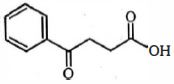
B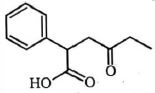
C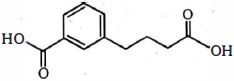
D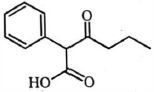
Solution
(B) Decarboxylation of carboxylic acids upon heating is facilitated by the presence of an electron-withdrawing group at the $\beta$-position,such as a carbonyl group ($\beta$-keto acid).
This is because the reaction proceeds through a cyclic six-membered transition state,which is stabilized by the formation of an enol intermediate.
Among the given structures,option $B$ represents a $\beta$-keto acid (specifically,$2$-phenyl-$3$-oxopentanoic acid),where the carboxyl group is at the $\alpha$-position relative to the carbonyl group.
Therefore,it undergoes decarboxylation most readily.
This is because the reaction proceeds through a cyclic six-membered transition state,which is stabilized by the formation of an enol intermediate.
Among the given structures,option $B$ represents a $\beta$-keto acid (specifically,$2$-phenyl-$3$-oxopentanoic acid),where the carboxyl group is at the $\alpha$-position relative to the carbonyl group.
Therefore,it undergoes decarboxylation most readily.
0 likes
View Solution97
DifficultMCQ
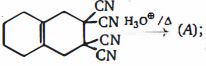
The product $(A)$ of the reaction is:
A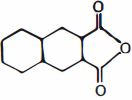
B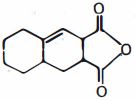
C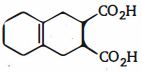
D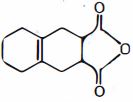
Solution
(D) The starting material is a substituted cyclohexene with two geminal dicyano groups.
Treatment with $H_3O^{\oplus}$ leads to the hydrolysis of the four $-CN$ groups into four $-CO_2H$ groups,forming a tetracarboxylic acid.
Upon heating $(\Delta)$,the tetracarboxylic acid undergoes decarboxylation (loss of $2CO_2$) and cyclization to form a stable cyclic anhydride.
The final product $(A)$ is the cyclic anhydride derivative as shown in the reaction sequence.
Treatment with $H_3O^{\oplus}$ leads to the hydrolysis of the four $-CN$ groups into four $-CO_2H$ groups,forming a tetracarboxylic acid.
Upon heating $(\Delta)$,the tetracarboxylic acid undergoes decarboxylation (loss of $2CO_2$) and cyclization to form a stable cyclic anhydride.
The final product $(A)$ is the cyclic anhydride derivative as shown in the reaction sequence.
0 likes
View Solution98
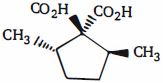
MediumMCQ
How many products will be formed when the given compound undergoes decarboxylation?
A
$0$
B
$1$
C
$2$
D
$3$
Solution
(C) The given compound is a gem-dicarboxylic acid derivative. Upon heating,it undergoes decarboxylation,where one of the $-CO_2H$ groups is lost as $CO_2$.
Since the two $-CO_2H$ groups are diastereotopic due to the presence of chiral centers in the cyclopentane ring,the removal of either group will result in the formation of two different stereoisomeric products (diastereomers).
Therefore,$2$ products will be formed.
Since the two $-CO_2H$ groups are diastereotopic due to the presence of chiral centers in the cyclopentane ring,the removal of either group will result in the formation of two different stereoisomeric products (diastereomers).
Therefore,$2$ products will be formed.
0 likes
View Solution99
DifficultMCQ
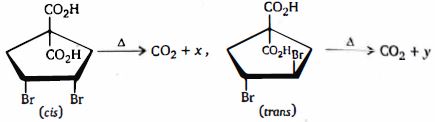
The products obtained in the given reactions are shown below. The number of possible products for $x$ and $y$ are:
A
$1, 1$
B
$1, 2$
C
$2, 1$
D
$2, 2$
Solution
(C) The reaction involves the thermal decarboxylation of $\beta$-dicarboxylic acids.
For the $cis$-isomer,the two carboxylic acid groups are on the same side of the ring. Upon heating,decarboxylation can occur from either of the two equivalent carboxylic acid groups,leading to the formation of two possible stereoisomeric products (diastereomers) depending on the relative orientation of the remaining group and the bromine atoms.
For the $trans$-isomer,the two carboxylic acid groups are on opposite sides of the ring. Due to the specific geometry and the requirement for a cyclic transition state,decarboxylation leads to a single specific product.
Therefore,the number of possible products for $x$ is $2$ and for $y$ is $1$.
For the $cis$-isomer,the two carboxylic acid groups are on the same side of the ring. Upon heating,decarboxylation can occur from either of the two equivalent carboxylic acid groups,leading to the formation of two possible stereoisomeric products (diastereomers) depending on the relative orientation of the remaining group and the bromine atoms.
For the $trans$-isomer,the two carboxylic acid groups are on opposite sides of the ring. Due to the specific geometry and the requirement for a cyclic transition state,decarboxylation leads to a single specific product.
Therefore,the number of possible products for $x$ is $2$ and for $y$ is $1$.
0 likes
View Solution100
DifficultMCQ
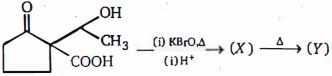
Hence the product $(Y)$ in the above sequence of reactions,is
A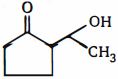
B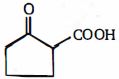
C
D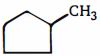
Solution
(C) The starting material is a $\beta$-hydroxy acid derivative of cyclopentanone.
Treatment with $KBrO$ (hypobromite) followed by $H^+$ typically leads to oxidative cleavage or haloform-type reactions.
However,in the context of this specific reaction sequence,the $\beta$-keto acid or related intermediate $(X)$ undergoes decarboxylation upon heating $(\Delta)$.
Decarboxylation of a $\beta$-keto acid results in the loss of $CO_2$ to form the corresponding ketone.
Therefore,the final product $(Y)$ is cyclopentanone.
Treatment with $KBrO$ (hypobromite) followed by $H^+$ typically leads to oxidative cleavage or haloform-type reactions.
However,in the context of this specific reaction sequence,the $\beta$-keto acid or related intermediate $(X)$ undergoes decarboxylation upon heating $(\Delta)$.
Decarboxylation of a $\beta$-keto acid results in the loss of $CO_2$ to form the corresponding ketone.
Therefore,the final product $(Y)$ is cyclopentanone.
0 likes
View Solution8-2.Carboxylic acids and Their derivative — Mix Examples-Carboxylic acids and Their derivative · Frequently Asked Questions
1Are these 8-2.Carboxylic acids and Their derivative questions useful for JEE and NEET?
Yes. All questions in this section are mapped to JEE Main and NEET exam patterns. Previous year questions from JEE Main, NEET, GUJCET and state-level exams are included with full solutions.
2Can I switch to Hindi or Gujarati for these questions?
Yes. Use the language tabs in the hero section or the sidebar to view the same questions and solutions in English, Hindi or Gujarati.
3How do I generate a question paper from this subtopic?
Use the Vedclass Exam Paper Generator — select the chapter and subtopic, set difficulty, and generate Sets A, B, C, D automatically. First 3 chapters of every subject are free.
Vedclass Products
For Students
Vedclass Test Series
Mock tests in real JEE/NEET style with performance analysis. 5-day free trial.
Start Free TrialFor Teachers
Exam Paper Generator
Generate Set A/B/C/D papers from this chapter in 2 minutes. 3 chapters free.
Try FreeFor Institutes
Online Exam Module
Live online exams with unlimited students, 360° analytics & white-label branding.
See DemoFor Teachers & Institutes
Generate a 8-2.Carboxylic acids and Their derivative Exam Paper in 2 Minutes
Select subtopic & difficulty — Sets A, B, C, D auto-generated with No Repeat logic.
First 3 chapters of every subject are free — no payment required.