
A English
Properties Questions in English
Class 12 Chemistry · 8-1.Aldehydes and Ketones · Properties
1739+
Questions
English
Language
100%
With Solutions
Showing 50 of 1739 questions in English
351
MediumMCQ
Which of the following reagents can react with both aldehydes and ketones?
A
Fehling's solution
B
Grignard reagent
C
Schiff's reagent
D
Tollens' reagent
Solution
(B) Both aldehydes and ketones react with $Grignard$ reagent $(RMgX)$ to form alcohols.
$Fehling's$ solution,$Schiff's$ reagent,and $Tollens'$ reagent are specific tests used to distinguish aldehydes from ketones,as they react only with aldehydes.
$Fehling's$ solution,$Schiff's$ reagent,and $Tollens'$ reagent are specific tests used to distinguish aldehydes from ketones,as they react only with aldehydes.
0 likes
View Solution352
MediumMCQ
Which of the following reactions cannot be used to convert $R_2CO$ to $R_2CH_2$?
A
Clemmensen reduction
B
Wolff-Kishner reduction
C
Wurtz reaction
D
Reduction with red phosphorus and $HI$
Solution
(C) The conversion of a carbonyl group $(R_2CO)$ to a methylene group $(R_2CH_2)$ is known as reduction of carbonyl compounds.
Clemmensen reduction $(Zn-Hg/HCl)$,Wolff-Kishner reduction $(NH_2NH_2/KOH)$,and reduction with red phosphorus and $HI$ are standard methods for this transformation.
Wurtz reaction is used for the preparation of higher alkanes from alkyl halides,not for the reduction of carbonyl compounds.
Clemmensen reduction $(Zn-Hg/HCl)$,Wolff-Kishner reduction $(NH_2NH_2/KOH)$,and reduction with red phosphorus and $HI$ are standard methods for this transformation.
Wurtz reaction is used for the preparation of higher alkanes from alkyl halides,not for the reduction of carbonyl compounds.
0 likes
View Solution353
MediumMCQ
Which of the following transformations can be achieved using $Wolff-Kishner$ reduction conditions?
A
Benzaldehyde to Benzyl alcohol
B
Cyclohexanol to Cyclohexane
C
Cyclohexanone to Cyclohexanol
D
Benzophenone to Diphenylmethane
Solution
(D) $Wolff-Kishner$ reduction is used to reduce carbonyl groups $(C=O)$ of aldehydes and ketones to methylene groups $(CH_2)$.
In this reaction,$Benzophenone$ $(C_6H_5-CO-C_6H_5)$ is reduced to $Diphenylmethane$ $(C_6H_5-CH_2-C_6H_5)$.
In this reaction,$Benzophenone$ $(C_6H_5-CO-C_6H_5)$ is reduced to $Diphenylmethane$ $(C_6H_5-CH_2-C_6H_5)$.
0 likes
View Solution354
MediumMCQ
$CH_3-CO-CH_3 + [O] \xrightarrow{SeO_2} P + Se + H_2O$. What is $P$ here?
A
$CH_3-CO-CHO$
B
$CH_3-CO-OCH_3$
C
$CH_3-CO-CH_2OH$
D
None of these
Solution
(A) $SeO_2$ is an oxidizing agent that specifically oxidizes the $\alpha$-methylene or $\alpha$-methyl group of a carbonyl compound to a carbonyl group,forming a $1,2-$dicarbonyl compound.
In the reaction of acetone $(CH_3-CO-CH_3)$ with $SeO_2$,one of the $\alpha$-methyl groups is oxidized to an aldehyde group.
The reaction is: $CH_3-CO-CH_3 + SeO_2 \rightarrow CH_3-CO-CHO + Se + H_2O$.
Thus,$P$ is $CH_3-CO-CHO$ (methylglyoxal or pyruvaldehyde).
In the reaction of acetone $(CH_3-CO-CH_3)$ with $SeO_2$,one of the $\alpha$-methyl groups is oxidized to an aldehyde group.
The reaction is: $CH_3-CO-CH_3 + SeO_2 \rightarrow CH_3-CO-CHO + Se + H_2O$.
Thus,$P$ is $CH_3-CO-CHO$ (methylglyoxal or pyruvaldehyde).
0 likes
View Solution355
MediumMCQ
Which of the following compounds will not give the iodoform test with alkali and iodine?
A
Acetone
B
Ethanol
C
Diethyl ketone
D
Isopropyl alcohol
Solution
(C) Compounds containing the $CH_3-CO-$ group or the $CH_3-CH(OH)-$ group give the iodoform test. Diethyl ketone $(CH_3CH_2-CO-CH_2CH_3)$ does not contain either of these groups,therefore it does not give the iodoform test.
0 likes
View Solution356
MediumMCQ
$2Ph-CHO \xrightarrow{OH^-} Ph-CH_2OH + PhCOO^-$
Which is the slowest step in the above Cannizzaro reaction?
Which is the slowest step in the above Cannizzaro reaction?
A
Attack of $OH^-$ group on the carbonyl group
B
Hydride ion transfer to the carbonyl group
C
Removal of proton from the carboxylic acid group
D
$Ph-CH_2OH$ disproportionation
Solution
(B) The mechanism of the Cannizzaro reaction involves the nucleophilic attack of $OH^-$ on the carbonyl carbon to form a dihydroxyalkoxide intermediate.
This is followed by the transfer of a hydride ion $(H^-)$ from the intermediate to another molecule of aldehyde.
The hydride shift is the rate-determining step (slow step) of the reaction.
Finally,a rapid proton exchange occurs to form the alcohol and carboxylate ion.
This is followed by the transfer of a hydride ion $(H^-)$ from the intermediate to another molecule of aldehyde.
The hydride shift is the rate-determining step (slow step) of the reaction.
Finally,a rapid proton exchange occurs to form the alcohol and carboxylate ion.
0 likes
View Solution357
MediumMCQ
$CH_3CHO + NH_2OH \to CH_3-CH=N-OH$
Under which condition does the above reaction occur?
Under which condition does the above reaction occur?
A
$pH = 1$
B
$pH = 3.5$
C
For any value of $pH$.
D
$pH = 12$
Solution
(B) The reaction of carbonyl compounds with ammonia derivatives (like hydroxylamine) is acid-catalyzed.
It proceeds most efficiently in a weakly acidic medium,typically in the range of $pH = 3 - 4$.
It proceeds most efficiently in a weakly acidic medium,typically in the range of $pH = 3 - 4$.
0 likes
View Solution358
MediumMCQ
Which of the following compounds will react with water?
A
$CHCl_3$
B
$CCl_3CHO$
C
$CCl_4$
D
$ClCH_2CH_2Cl$
Solution
(B) Chloral $(CCl_3CHO)$ reacts with water to form a stable gem-diol known as chloral hydrate. The reaction is: $CCl_3CHO + H_2O \rightarrow CCl_3CH(OH)_2$. The stability of the gem-diol is due to the strong electron-withdrawing effect of the three chlorine atoms,which makes the carbonyl carbon highly electrophilic and facilitates the formation of the hydrate.
0 likes
View Solution359
MediumMCQ
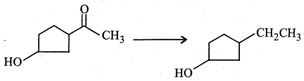
Which reagent is suitable for the following transformation?
A
$Zn(Hg), HCl$
B
$NH_2NH_2, OH^-$
C
$H_2/Ni$
D
$NaBH_4$
Solution
(B) The transformation involves the reduction of a ketone group $(-COCH_3)$ to an alkyl group $(-CH_2CH_3)$.
Both Clemmensen reduction $(Zn(Hg)/HCl)$ and Wolff-Kishner reduction $(NH_2NH_2/OH^-)$ can reduce ketones to alkanes.
However,the substrate contains a hydroxyl $(-OH)$ group. Under acidic conditions $(Zn(Hg)/HCl)$,the $-OH$ group can undergo dehydration or other side reactions.
Therefore,the Wolff-Kishner reduction $(NH_2NH_2/OH^-)$ is the appropriate reagent as it operates under basic conditions,which will not affect the $-OH$ group.
Both Clemmensen reduction $(Zn(Hg)/HCl)$ and Wolff-Kishner reduction $(NH_2NH_2/OH^-)$ can reduce ketones to alkanes.
However,the substrate contains a hydroxyl $(-OH)$ group. Under acidic conditions $(Zn(Hg)/HCl)$,the $-OH$ group can undergo dehydration or other side reactions.
Therefore,the Wolff-Kishner reduction $(NH_2NH_2/OH^-)$ is the appropriate reagent as it operates under basic conditions,which will not affect the $-OH$ group.
0 likes
View Solution360
MediumMCQ
Which of the following compounds has the most acidic hydrogen?
A
$3-$Hexanone
B
$2,4-$Hexanedione
C
$2,5-$Hexanedione
D
$2,3-$Hexanedione
Solution
(B) $2,4-$Hexanedione contains an active methylene group $(-CH_2-)$ situated between two electron-withdrawing carbonyl groups. This makes the hydrogen atoms on this carbon highly acidic.
The structure is: $CH_3-CO-CH_2-CO-CH_2CH_3$.
Upon removal of a proton,the resulting carbanion is stabilized by resonance across both carbonyl groups,significantly increasing its stability compared to the other options.
The structure is: $CH_3-CO-CH_2-CO-CH_2CH_3$.
Upon removal of a proton,the resulting carbanion is stabilized by resonance across both carbonyl groups,significantly increasing its stability compared to the other options.
0 likes
View Solution361
MediumMCQ
What are the products formed when a mixture of benzaldehyde and formaldehyde is heated with an aqueous solution of $NaOH$?
A
Benzyl alcohol and sodium formate
B
Sodium benzoate and methyl alcohol
C
Sodium benzoate and sodium formate
D
Benzyl alcohol and methyl alcohol
Solution
(A) This reaction is a crossed Cannizzaro reaction.
In a crossed Cannizzaro reaction involving formaldehyde $(HCHO)$ and another aldehyde (like benzaldehyde,$C_6H_5CHO$),formaldehyde is more reactive towards nucleophilic attack by $OH^-$.
Therefore,formaldehyde undergoes oxidation to form a formate ion $(HCOO^-)$,which forms sodium formate $(HCOONa)$ in the presence of $NaOH$.
The other aldehyde (benzaldehyde) undergoes reduction to form the corresponding alcohol,which is benzyl alcohol $(C_6H_5CH_2OH)$.
The overall reaction is: $C_6H_5CHO + HCHO + NaOH \rightarrow C_6H_5CH_2OH + HCOONa$.
In a crossed Cannizzaro reaction involving formaldehyde $(HCHO)$ and another aldehyde (like benzaldehyde,$C_6H_5CHO$),formaldehyde is more reactive towards nucleophilic attack by $OH^-$.
Therefore,formaldehyde undergoes oxidation to form a formate ion $(HCOO^-)$,which forms sodium formate $(HCOONa)$ in the presence of $NaOH$.
The other aldehyde (benzaldehyde) undergoes reduction to form the corresponding alcohol,which is benzyl alcohol $(C_6H_5CH_2OH)$.
The overall reaction is: $C_6H_5CHO + HCHO + NaOH \rightarrow C_6H_5CH_2OH + HCOONa$.
0 likes
View Solution362
DifficultMCQ
Compound '$X$' (molecular formula $C_3H_8O$) reacts with acidic potassium dichromate to give product '$Y$' (molecular formula $C_3H_6O$). '$Y$' gives a silver mirror test. When '$Y$' is reacted with aqueous $NH_2CONHNH_2$ and sodium acetate,it gives product '$Z$'. What is the structure of '$Z$'?
A
$CH_3CH_2CH=NNHCONH_2$
B
$CH_3-C(CH_3)=NCONHNH_2$
C
$CH_3-C(CH_3)=NNHCONH_2$
D
$CH_3CH_2CH=NCONHNH_2$
Solution
(A) Since product '$Y$' gives a silver mirror test,it must be an aldehyde. '$Y$' is formed by the oxidation of '$X$',which indicates that '$X$' is a primary alcohol $(CH_3CH_2CH_2OH)$.
$CH_3CH_2CH_2OH (X) \xrightarrow{K_2Cr_2O_7 + H_2SO_4} CH_3CH_2CHO (Y)$
When '$Y$' $(CH_3CH_2CHO)$ reacts with semicarbazide $(NH_2CONHNH_2)$ in the presence of sodium acetate,it forms a semicarbazone derivative.
$CH_3CH_2CHO + NH_2CONHNH_2 \rightarrow CH_3CH_2CH=NNHCONH_2 + H_2O$
The product '$Z$' is $CH_3CH_2CH=NNHCONH_2$.
$CH_3CH_2CH_2OH (X) \xrightarrow{K_2Cr_2O_7 + H_2SO_4} CH_3CH_2CHO (Y)$
When '$Y$' $(CH_3CH_2CHO)$ reacts with semicarbazide $(NH_2CONHNH_2)$ in the presence of sodium acetate,it forms a semicarbazone derivative.
$CH_3CH_2CHO + NH_2CONHNH_2 \rightarrow CH_3CH_2CH=NNHCONH_2 + H_2O$
The product '$Z$' is $CH_3CH_2CH=NNHCONH_2$.
0 likes
View Solution363
MediumMCQ
What will be the compound $X$ in the given reaction?
$MeO-C_6H_4-CHO + (X) \xrightarrow{CH_3COONa, H_3O^+} MeO-C_6H_4-CH=CHCOOH$
$MeO-C_6H_4-CHO + (X) \xrightarrow{CH_3COONa, H_3O^+} MeO-C_6H_4-CH=CHCOOH$
A
$CH_3COOH$
B
$BrCH_2-COOH$
C
$(CH_3CO)_2O$
D
$CHO-COOH$
Solution
(C) The given reaction is the Perkin reaction.
In the Perkin reaction,an aromatic aldehyde reacts with an acid anhydride (containing at least two $\alpha$-hydrogen atoms) in the presence of the corresponding sodium salt of the acid to form an $\alpha,\beta$-unsaturated carboxylic acid.
Here,$p$-methoxybenzaldehyde reacts with acetic anhydride $(CH_3CO)_2O$ in the presence of sodium acetate to yield $p$-methoxycinnamic acid.
Therefore,the compound $X$ is acetic anhydride $(CH_3CO)_2O$.
In the Perkin reaction,an aromatic aldehyde reacts with an acid anhydride (containing at least two $\alpha$-hydrogen atoms) in the presence of the corresponding sodium salt of the acid to form an $\alpha,\beta$-unsaturated carboxylic acid.
Here,$p$-methoxybenzaldehyde reacts with acetic anhydride $(CH_3CO)_2O$ in the presence of sodium acetate to yield $p$-methoxycinnamic acid.
Therefore,the compound $X$ is acetic anhydride $(CH_3CO)_2O$.
0 likes
View Solution364
DifficultMCQ
Which of the following compounds will form lactic acid from its cyanohydrin?
A
Formaldehyde
B
Benzaldehyde
C
Acetaldehyde
D
$\alpha$-Amino acetic acid
Solution
(C) Acetaldehyde reacts with $HCN$ to form a cyanohydrin,which upon hydrolysis yields lactic acid.
$CH_3CHO + HCN \to CH_3CH(OH)CN$
$CH_3CH(OH)CN + 2H_2O \xrightarrow{H^+} CH_3CH(OH)COOH + NH_3$
Here,$CH_3CH(OH)COOH$ is lactic acid.
$CH_3CHO + HCN \to CH_3CH(OH)CN$
$CH_3CH(OH)CN + 2H_2O \xrightarrow{H^+} CH_3CH(OH)COOH + NH_3$
Here,$CH_3CH(OH)COOH$ is lactic acid.
0 likes
View Solution365
DifficultMCQ
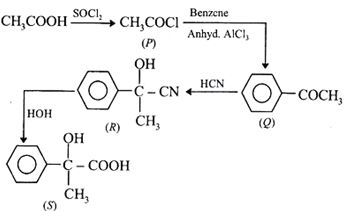
What will be the product $S$ in the following reaction?
$CH_3COOH$ $\xrightarrow{SOCl_2} P$ $\xrightarrow[Anhyd. AlCl_3]{Benzene} Q$ $\xrightarrow{HCN} R$ $\xrightarrow{HOH} S$
$CH_3COOH$ $\xrightarrow{SOCl_2} P$ $\xrightarrow[Anhyd. AlCl_3]{Benzene} Q$ $\xrightarrow{HCN} R$ $\xrightarrow{HOH} S$
A
$2-$hydroxy$-2-$phenylpropanoic acid
B
$3-$hydroxy$-3-$phenylbutanoic acid
C
$2-$hydroxy$-2-$phenylbutanenitrile
D
$2-$hydroxy$-2-$phenylpropanenitrile
Solution
0 likes
View Solution366
MediumMCQ
When mesityl oxide undergoes the iodoform reaction,one of the products obtained is a sodium salt of an organic acid. Which acid is formed?
A
$(CH_3)_2C=CH-CH_2COOH$
B
$(CH_3)_2CH-COOH$
C
$(CH_3)_2C=CH-COOH$
D
$(CH_3)_2C=CH-CO-COOH$
Solution
(C) Mesityl oxide is $(CH_3)_2C=CH-CO-CH_3$.
It contains a methyl ketone group $(-COCH_3)$,which undergoes the iodoform reaction with $I_2$ and $NaOH$.
The reaction is: $(CH_3)_2C=CH-CO-CH_3 + 3I_2 + 4NaOH \rightarrow (CH_3)_2C=CH-COONa + CHI_3 + 3NaI + 3H_2O$.
The organic acid salt formed is sodium salt of $3-$methylbut$-2-$enoic acid.
Therefore,the corresponding acid is $(CH_3)_2C=CH-COOH$.
It contains a methyl ketone group $(-COCH_3)$,which undergoes the iodoform reaction with $I_2$ and $NaOH$.
The reaction is: $(CH_3)_2C=CH-CO-CH_3 + 3I_2 + 4NaOH \rightarrow (CH_3)_2C=CH-COONa + CHI_3 + 3NaI + 3H_2O$.
The organic acid salt formed is sodium salt of $3-$methylbut$-2-$enoic acid.
Therefore,the corresponding acid is $(CH_3)_2C=CH-COOH$.
0 likes
View Solution367
MediumMCQ
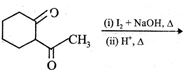
What will be the final product of the following reaction?
A
B
C
D
Solution
(A) The given reaction is a haloform reaction followed by decarboxylation.
Step $1$: Treatment with $I_2 + NaOH$ (iodoform test) converts the acetyl group $(-COCH_3)$ into a carboxylate group $(-COO^-)$ and produces $CHI_3$ (iodoform).
Step $2$: Acidification $(H^+)$ gives the corresponding $\beta$-keto acid.
Step $3$: Heating the $\beta$-keto acid causes decarboxylation (loss of $CO_2$) to yield cyclohexanone as the final product.
Step $1$: Treatment with $I_2 + NaOH$ (iodoform test) converts the acetyl group $(-COCH_3)$ into a carboxylate group $(-COO^-)$ and produces $CHI_3$ (iodoform).
Step $2$: Acidification $(H^+)$ gives the corresponding $\beta$-keto acid.
Step $3$: Heating the $\beta$-keto acid causes decarboxylation (loss of $CO_2$) to yield cyclohexanone as the final product.
0 likes
View Solution368
MediumMCQ
Which of the following methods can be used to oxidize $Butan-2-one$ to $Propionic \ acid$?
A
Tollens' reagent
B
$NaOH + I_2$
C
Bromine water
D
Atmospheric oxidation
Solution
(B) The oxidation of $Butan-2-one$ $(CH_3CH_2COCH_3)$ to $Propionic \ acid$ $(CH_3CH_2COOH)$ is achieved via the $Haloform$ reaction.
$Butan-2-one$ contains a $CH_3CO-$ group,which reacts with $NaOH$ and $I_2$ (iodine) to form $Propionic \ acid$ and $Iodoform$ $(CHI_3)$.
Reaction: $CH_3CH_2COCH_3 + 3I_2 + 4NaOH \rightarrow CH_3CH_2COONa + CHI_3 + 3NaI + 3H_2O$.
Acidification of the resulting salt yields $Propionic \ acid$.
$Butan-2-one$ contains a $CH_3CO-$ group,which reacts with $NaOH$ and $I_2$ (iodine) to form $Propionic \ acid$ and $Iodoform$ $(CHI_3)$.
Reaction: $CH_3CH_2COCH_3 + 3I_2 + 4NaOH \rightarrow CH_3CH_2COONa + CHI_3 + 3NaI + 3H_2O$.
Acidification of the resulting salt yields $Propionic \ acid$.
0 likes
View Solution369
DifficultMCQ
The conversion of an aldehyde into an ester in the presence of aluminum ethoxide is known as which reaction?
A
Schmidt reaction
B
Aldol condensation
C
Beckmann rearrangement
D
Tishchenko reaction
Solution
(D) The reaction of an aldehyde in the presence of aluminum ethoxide $(Al(OC_2H_5)_3)$ to form an ester is known as the Tishchenko reaction.
The general reaction is: $2RCHO \xrightarrow{Al(OC_2H_5)_3} RCOOCH_2R$.
The general reaction is: $2RCHO \xrightarrow{Al(OC_2H_5)_3} RCOOCH_2R$.
0 likes
View Solution370
MediumMCQ
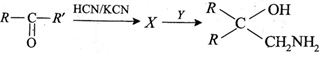
What will be $X$ and $Y$ in the following reaction?
A
$X = RR'C(CN)(OH), Y = LiAlH_4$
B
$X = RR'C(OH)(COOH), Y = NH_3$
C
$X = RR'C(CN)(OH), Y = H_3O^+$
D
$X = RR'CH_2CN, Y = NaOH$
Solution
(A) The reaction of a carbonyl compound $(R-CO-R')$ with $HCN/KCN$ is a nucleophilic addition reaction that forms a cyanohydrin.
Thus,$X$ is the cyanohydrin: $RR'C(OH)(CN)$.
Next,the reduction of the cyano group $(-CN)$ to a primary amine $(-CH_2NH_2)$ is achieved using a strong reducing agent like $LiAlH_4$.
Therefore,$Y$ is $LiAlH_4$.
Thus,$X$ is the cyanohydrin: $RR'C(OH)(CN)$.
Next,the reduction of the cyano group $(-CN)$ to a primary amine $(-CH_2NH_2)$ is achieved using a strong reducing agent like $LiAlH_4$.
Therefore,$Y$ is $LiAlH_4$.
0 likes
View Solution371
MediumMCQ
What is the process of converting an oxime into an amide by rearrangement in the presence of a strong acid called?
A
Curtius rearrangement
B
Fries rearrangement
C
Beckmann rearrangement
D
Aldol condensation
Solution
(C) The conversion of an oxime into an amide in the presence of a strong acid (like $Conc. H_2SO_4$) is known as the $Beckmann$ rearrangement.
The reaction is represented as:
$R-C(=NOH)-R' \xrightarrow{H^+} R'-CO-NHR$ (or $R-CO-NHR'$ depending on the configuration).
The reaction is represented as:
$R-C(=NOH)-R' \xrightarrow{H^+} R'-CO-NHR$ (or $R-CO-NHR'$ depending on the configuration).
0 likes
View Solution372
MediumMCQ
Which of the following compounds is most reactive towards nucleophilic attack on the carbonyl group?
A
$MeCOCl$
B
$MeCHO$
C
$MeCOOMe$
D
$MeCOOCOMe$
Solution
(A) The reactivity of carbonyl compounds towards nucleophilic attack depends on the electrophilicity of the carbonyl carbon and the leaving group ability.
Acid chlorides $(RCOCl)$ are the most reactive because the $Cl^-$ ion is an excellent leaving group and the electron-withdrawing effect of the chlorine atom increases the electrophilicity of the carbonyl carbon.
Therefore,$MeCOCl$ is the most reactive among the given options.
Acid chlorides $(RCOCl)$ are the most reactive because the $Cl^-$ ion is an excellent leaving group and the electron-withdrawing effect of the chlorine atom increases the electrophilicity of the carbonyl carbon.
Therefore,$MeCOCl$ is the most reactive among the given options.
0 likes
View Solution373
MediumMCQ
Which of the following compounds shows tautomerism?
A
$HCHO$
B
$CH_3CN$
C
$CH_3COCH_3$
D
$HCOOH$
Solution
(C) The correct answer is $(C)$.
Acetone $(CH_3COCH_3)$ shows keto-enol tautomerism because it contains $\alpha$-hydrogen atoms adjacent to the carbonyl group.
The keto form exists in equilibrium with its enol form:
$CH_3COCH_3 \rightleftharpoons CH_3-C(OH)=CH_2$.
$HCHO$ and $HCOOH$ do not have $\alpha$-carbons,and while $CH_3CN$ can show nitrile-ketenimine tautomerism,$CH_3COCH_3$ is the standard example for keto-enol tautomerism.
Acetone $(CH_3COCH_3)$ shows keto-enol tautomerism because it contains $\alpha$-hydrogen atoms adjacent to the carbonyl group.
The keto form exists in equilibrium with its enol form:
$CH_3COCH_3 \rightleftharpoons CH_3-C(OH)=CH_2$.
$HCHO$ and $HCOOH$ do not have $\alpha$-carbons,and while $CH_3CN$ can show nitrile-ketenimine tautomerism,$CH_3COCH_3$ is the standard example for keto-enol tautomerism.
0 likes
View Solution374
DifficultMCQ
Butanal with dilute $NaOH$ gives
A
$CH_3-CH_2-CH_2-CH(OH)-CH_2-CH_2-CH_2-CHO$
B
$CH_3-CH_2-CH_2-C(=O)-CH_2-CH_2-CH_2-CHO$
C
$OHC-CH_2-CH_2-CH_2-CH_2-CH_2-CH_2-CHO$
D
$CH_3-CH_2-CH_2-CH(OH)-CH(C_2H_5)-CHO$
Solution
(D) Butanal $(CH_3CH_2CH_2CHO)$ contains $\alpha$-hydrogen atoms.
In the presence of dilute $NaOH$,it undergoes aldol condensation.
The $\alpha$-carbon of one butanal molecule attacks the carbonyl carbon of another butanal molecule to form a $\beta$-hydroxy aldehyde.
The product formed is $2$-ethyl-$3$-hydroxyhexanal,which is $CH_3-CH_2-CH_2-CH(OH)-CH(C_2H_5)-CHO$.
In the presence of dilute $NaOH$,it undergoes aldol condensation.
The $\alpha$-carbon of one butanal molecule attacks the carbonyl carbon of another butanal molecule to form a $\beta$-hydroxy aldehyde.
The product formed is $2$-ethyl-$3$-hydroxyhexanal,which is $CH_3-CH_2-CH_2-CH(OH)-CH(C_2H_5)-CHO$.
0 likes
View Solution375
MediumMCQ
Which one of the following will most readily be dehydrated in acidic condition?
A
$4-$hydroxy$-2-$pentanone
B
$2-$pentanol
C
$3-$hydroxy$-2-$pentanone
D
$5-$hydroxy$-2-$pentanone
Solution
(A) Aldols ($\beta$-hydroxy aldehydes or $\beta$-hydroxy ketones) readily undergo dehydration in acidic or basic conditions to form $\alpha,\beta$-unsaturated carbonyl compounds.
This is because the resulting double bond is conjugated with the carbonyl group,which provides significant stability to the product.
Among the given options,$4$-hydroxy-$2$-pentanone is a $\beta$-hydroxy ketone.
Upon protonation of the hydroxyl group followed by the loss of water,it forms a stable conjugated system.
Other options are either simple alcohols or $\gamma$-hydroxy ketones,which do not form conjugated systems as readily as $\beta$-hydroxy carbonyl compounds.
This is because the resulting double bond is conjugated with the carbonyl group,which provides significant stability to the product.
Among the given options,$4$-hydroxy-$2$-pentanone is a $\beta$-hydroxy ketone.
Upon protonation of the hydroxyl group followed by the loss of water,it forms a stable conjugated system.
Other options are either simple alcohols or $\gamma$-hydroxy ketones,which do not form conjugated systems as readily as $\beta$-hydroxy carbonyl compounds.
0 likes
View Solution376
DifficultMCQ
$p$-cresol reacts with chloroform in an alkaline medium to give compound $A$,which adds hydrogen cyanide to form compound $B$. The latter,on acidic hydrolysis,gives a chiral carboxylic acid. The structure of the carboxylic acid is:
A
$2-$hydroxy$-5-$methylmandelic acid
B
$2-$hydroxy$-5-$methylmandelic acid (with correct structure)
C
$2-$($2$-hydroxy$-5-$methylphenyl)acetic acid
D
$2-$($2$-hydroxy$-5-$methylphenyl)acetic acid (with correct structure)
Solution
(B) $p$-cresol reacts with $CHCl_3$ in an alkaline medium (Reimer-Tiemann reaction) to form $2$-hydroxy-$5$-methylbenzaldehyde (compound $A$).
Compound $A$ reacts with $HCN$ to form a cyanohydrin,$2$-hydroxy-$5$-methylmandelonitrile (compound $B$).
Acidic hydrolysis of the cyanohydrin $(B)$ yields $2$-hydroxy-$5$-methylmandelic acid,which is a chiral carboxylic acid due to the presence of a chiral carbon atom at the $\alpha$-position.
The structure is $2$-hydroxy-$5$-methylmandelic acid,which corresponds to the structure shown in option $B$.
Compound $A$ reacts with $HCN$ to form a cyanohydrin,$2$-hydroxy-$5$-methylmandelonitrile (compound $B$).
Acidic hydrolysis of the cyanohydrin $(B)$ yields $2$-hydroxy-$5$-methylmandelic acid,which is a chiral carboxylic acid due to the presence of a chiral carbon atom at the $\alpha$-position.
The structure is $2$-hydroxy-$5$-methylmandelic acid,which corresponds to the structure shown in option $B$.
0 likes
View Solution377
MediumMCQ
Benzophenone can be converted into benzene using
A
Fused alkali
B
Anhydrous $AlCl_3$
C
Sodium amalgam in water
D
Acidified dichromate
Solution
(A) The conversion of benzophenone to benzene is achieved by fusion with a strong alkali like $KOH$. This reaction is a type of deacylation or cleavage reaction.
Step $1$: $C_6H_5COC_6H_5 + KOH \xrightarrow{\text{Fusion}} C_6H_6 + C_6H_5COOK$
Step $2$: The resulting potassium benzoate can further react with $KOH$ upon heating to produce benzene: $C_6H_5COOK + KOH \xrightarrow{\Delta} K_2CO_3 + C_6H_6$.
Thus,the correct reagent is fused alkali.
Step $1$: $C_6H_5COC_6H_5 + KOH \xrightarrow{\text{Fusion}} C_6H_6 + C_6H_5COOK$
Step $2$: The resulting potassium benzoate can further react with $KOH$ upon heating to produce benzene: $C_6H_5COOK + KOH \xrightarrow{\Delta} K_2CO_3 + C_6H_6$.
Thus,the correct reagent is fused alkali.
0 likes
View Solution378
MediumMCQ
The reagent$(s)$ which can be used to distinguish acetophenone from benzophenone is (are):
A
$2, 4-$dinitrophenyl hydrazine
B
Aqueous solution of $NaHSO_3$
C
Benedict reagent
D
$I_2$ and $Na_2CO_3$
Solution
(D) Acetophenone $(C_6H_5COCH_3)$ contains a methyl ketone group $(-COCH_3)$,which gives a positive iodoform test with $I_2$ and $Na_2CO_3$ (or $NaOH$),resulting in a yellow precipitate of iodoform $(CHI_3)$.
Benzophenone $(C_6H_5COC_6H_5)$ does not contain a methyl ketone group and therefore does not give the iodoform test.
Thus,$I_2$ and $Na_2CO_3$ can be used to distinguish between them.
Benzophenone $(C_6H_5COC_6H_5)$ does not contain a methyl ketone group and therefore does not give the iodoform test.
Thus,$I_2$ and $Na_2CO_3$ can be used to distinguish between them.
0 likes
View Solution379
MediumMCQ
When acetaldehyde is heated with Fehling solution,it gives a red precipitate of:
A
$Cu$
B
$CuO$
C
$Cu_2O$
D
$Cu(OH)_2$
Solution
(C) Acetaldehyde $(CH_3CHO)$ is an aliphatic aldehyde that reduces Fehling solution to a red precipitate of cuprous oxide $(Cu_2O)$.
The chemical reaction is:
$CH_3CHO + 2Cu^{2+} + 5OH^- \to CH_3COO^- + Cu_2O \text{ (Red ppt.)} + 3H_2O$
The chemical reaction is:
$CH_3CHO + 2Cu^{2+} + 5OH^- \to CH_3COO^- + Cu_2O \text{ (Red ppt.)} + 3H_2O$
0 likes
View Solution380
DifficultMCQ
The general order of reactivity of carbonyl compounds for nucleophilic addition reactions is
A
$H_2C = O > RCHO > ArCHO > R_2C = O > Ar_2C = O$
B
$ArCHO > Ar_2C = O > RCHO > R_2C = O > H_2C = O$
C
$Ar_2C = O > R_2C = O > ArCHO > RCHO > H_2C = O$
D
$H_2C = O > R_2C = O > Ar_2C = O > RCHO > ArCHO$
Solution
(A) . The reactivity of carbonyl compounds towards nucleophilic addition is governed by two factors: steric hindrance and electronic effects.
$1$. Steric hindrance: As the number and size of alkyl or aryl groups attached to the carbonyl carbon increase,the approach of the nucleophile becomes more difficult.
$2$. Electronic effects: Alkyl groups are electron-donating ($+I$ effect),which decreases the electrophilicity of the carbonyl carbon.
Formaldehyde $(H_2C = O)$ has the least steric hindrance and no electron-donating groups,making it the most reactive.
Aldehydes $(RCHO)$ are more reactive than ketones $(R_2C = O)$ due to less steric hindrance.
Aryl groups $(Ar)$ provide resonance stabilization to the carbonyl carbon,further reducing its electrophilicity compared to alkyl groups.
Thus,the correct order is $H_2C = O > RCHO > ArCHO > R_2C = O > Ar_2C = O$.
$1$. Steric hindrance: As the number and size of alkyl or aryl groups attached to the carbonyl carbon increase,the approach of the nucleophile becomes more difficult.
$2$. Electronic effects: Alkyl groups are electron-donating ($+I$ effect),which decreases the electrophilicity of the carbonyl carbon.
Formaldehyde $(H_2C = O)$ has the least steric hindrance and no electron-donating groups,making it the most reactive.
Aldehydes $(RCHO)$ are more reactive than ketones $(R_2C = O)$ due to less steric hindrance.
Aryl groups $(Ar)$ provide resonance stabilization to the carbonyl carbon,further reducing its electrophilicity compared to alkyl groups.
Thus,the correct order is $H_2C = O > RCHO > ArCHO > R_2C = O > Ar_2C = O$.
0 likes
View Solution381
MediumMCQ
Which of the following gives an alcohol and salt of carboxylic acid when reacted with conc. $NaOH$?
A
$CH_3CHO$
B
$C_6H_5CHO$
C
$CH_3COCH_3$
D
$C_6H_5COCH_3$
Solution
(B) The reaction of an aldehyde with concentrated $NaOH$ to produce an alcohol and a salt of a carboxylic acid is known as the Cannizzaro reaction.
This reaction occurs in aldehydes that do not possess any $\alpha$-hydrogen atoms.
Among the given options,$C_6H_5CHO$ (Benzaldehyde) lacks $\alpha$-hydrogen atoms.
Therefore,it undergoes the Cannizzaro reaction:
$2C_6H_5CHO \xrightarrow{conc. NaOH} C_6H_5CH_2OH + C_6H_5COONa$
This reaction occurs in aldehydes that do not possess any $\alpha$-hydrogen atoms.
Among the given options,$C_6H_5CHO$ (Benzaldehyde) lacks $\alpha$-hydrogen atoms.
Therefore,it undergoes the Cannizzaro reaction:
$2C_6H_5CHO \xrightarrow{conc. NaOH} C_6H_5CH_2OH + C_6H_5COONa$
0 likes
View Solution382
MediumMCQ
Which of the following compounds would undergo Cannizzaro's reaction?
A
Propionaldehyde
B
Benzaldehyde
C
Bromobenzene
D
Acetaldehyde
Solution
(B) The correct answer is $(B)$.
Cannizzaro's reaction is given by aldehydes that do not contain any $\alpha$-hydrogen atom.
$C_6H_5CHO$ (Benzaldehyde) does not have an $\alpha$-hydrogen atom,so it undergoes the Cannizzaro reaction.
Propionaldehyde $(CH_3CH_2CHO)$ and Acetaldehyde $(CH_3CHO)$ both contain $\alpha$-hydrogen atoms,while Bromobenzene is an aryl halide and does not undergo this reaction.
Cannizzaro's reaction is given by aldehydes that do not contain any $\alpha$-hydrogen atom.
$C_6H_5CHO$ (Benzaldehyde) does not have an $\alpha$-hydrogen atom,so it undergoes the Cannizzaro reaction.
Propionaldehyde $(CH_3CH_2CHO)$ and Acetaldehyde $(CH_3CHO)$ both contain $\alpha$-hydrogen atoms,while Bromobenzene is an aryl halide and does not undergo this reaction.
0 likes
View Solution383
MediumMCQ
$NaOH/H^{+}$ reacts with:
A
$C_6H_5-OCH_3$
B
$CH_3OH$
C
$CH_3COCH_3$
D
$C_2H_5OH$
Solution
(C) $CH_3COCH_3$ (Acetone) contains $\alpha$-hydrogens.
In the presence of a base like $NaOH$,it undergoes an Aldol condensation reaction.
$H^{+}$ is typically used in the workup step to neutralize the product or facilitate dehydration.
In the presence of a base like $NaOH$,it undergoes an Aldol condensation reaction.
$H^{+}$ is typically used in the workup step to neutralize the product or facilitate dehydration.
0 likes
View Solution384
MediumMCQ
The product of the following reaction is:

A
$1-$methylcyclohexanol
B
$1-$methylcyclohexanol (enantiomer)
C
cyclohexanol
D
cyclohexene
Solution
(C) The reaction involves the catalytic hydrogenation of cyclohexanone using $H_2$ in the presence of a $Pt$ catalyst.
$Cyclohexanone + H_2 \xrightarrow{Pt} Cyclohexanol$
The carbonyl group $(C=O)$ is reduced to a hydroxyl group $(-OH)$,resulting in the formation of cyclohexanol.
$Cyclohexanone + H_2 \xrightarrow{Pt} Cyclohexanol$
The carbonyl group $(C=O)$ is reduced to a hydroxyl group $(-OH)$,resulting in the formation of cyclohexanol.
0 likes
View Solution385
EasyMCQ
Which of the following aldehydes is most reactive towards nucleophilic addition reactions?
A
$HCHO$
B
$CH_3CHO$
C
$C_2H_5CHO$
D
$CH_3COCH_3$
Solution
(A) The reactivity of carbonyl compounds towards nucleophilic addition depends on the steric hindrance and electronic effects around the carbonyl carbon.
$HCHO$ (formaldehyde) has two hydrogen atoms attached to the carbonyl carbon,which provides minimum steric hindrance.
Alkyl groups (like $-CH_3$ or $-C_2H_5$) are electron-donating due to the $+I$ (inductive) effect,which decreases the electrophilicity of the carbonyl carbon.
Since $HCHO$ has no alkyl groups,it is the most electrophilic and thus the most reactive towards nucleophilic addition.
$CH_3COCH_3$ is a ketone,which is generally less reactive than aldehydes due to both steric and electronic factors.
$HCHO$ (formaldehyde) has two hydrogen atoms attached to the carbonyl carbon,which provides minimum steric hindrance.
Alkyl groups (like $-CH_3$ or $-C_2H_5$) are electron-donating due to the $+I$ (inductive) effect,which decreases the electrophilicity of the carbonyl carbon.
Since $HCHO$ has no alkyl groups,it is the most electrophilic and thus the most reactive towards nucleophilic addition.
$CH_3COCH_3$ is a ketone,which is generally less reactive than aldehydes due to both steric and electronic factors.
0 likes
View Solution386
EasyMCQ
The active ion in Tollen's reagent is
A
$Cu^{+}$
B
$Cu(NH_3)_2^+$
C
$Ag^{+}$
D
$Ag(NH_3)_2^+$
Solution
(D) The Tollen's reagent is an ammoniacal silver nitrate solution.
The active species in Tollen's reagent is the diamminesilver$(I)$ complex ion,represented as $[Ag(NH_3)_2]^+$.
During the reaction with aldehydes,the $Ag^+$ ion in the complex is reduced to metallic silver $(Ag)$,which deposits on the inner walls of the test tube to form a silver mirror.
Therefore,the correct option is $(D)$.
The active species in Tollen's reagent is the diamminesilver$(I)$ complex ion,represented as $[Ag(NH_3)_2]^+$.
During the reaction with aldehydes,the $Ag^+$ ion in the complex is reduced to metallic silver $(Ag)$,which deposits on the inner walls of the test tube to form a silver mirror.
Therefore,the correct option is $(D)$.
0 likes
View Solution387
DifficultMCQ
Among the following compounds,which will react with acetone to give a product containing $> C = N -$?
A
$C_6H_5NH_2$
B
$(CH_3)_3N$
C
$C_6H_5NHNH_2$
D
$A$ or $C$ both
Solution
(D) Acetone $(CH_3COCH_3)$ reacts with primary amines $(R-NH_2)$ to form imines $(>C=N-)$ and with hydrazines $(R-NHNH_2)$ to form hydrazones $(>C=N-NH-R)$.
$C_6H_5NH_2$ (aniline) is a primary amine,which reacts with acetone to form an imine $(CH_3C(CH_3)=NC_6H_5)$.
$C_6H_5NHNH_2$ (phenylhydrazine) is a hydrazine derivative,which reacts with acetone to form a hydrazone $(CH_3C(CH_3)=NNHC_6H_5)$.
Both products contain the $>C=N-$ linkage.
Therefore,the correct option is $D$.
$C_6H_5NH_2$ (aniline) is a primary amine,which reacts with acetone to form an imine $(CH_3C(CH_3)=NC_6H_5)$.
$C_6H_5NHNH_2$ (phenylhydrazine) is a hydrazine derivative,which reacts with acetone to form a hydrazone $(CH_3C(CH_3)=NNHC_6H_5)$.
Both products contain the $>C=N-$ linkage.
Therefore,the correct option is $D$.
0 likes
View Solution388
EasyMCQ
Which of the following does not give a yellow precipitate with $I_2$ and $NaOH$?
A
$C_2H_5OH$
B
$CH_3CHO$
C
$CH_3COCH_3$
D
$HCHO$
Solution
(D) The iodoform test is given by compounds containing the $CH_3CO-$ group or the $CH_3CH(OH)-$ group.
$C_2H_5OH$ contains the $CH_3CH(OH)-$ group,$CH_3CHO$ contains the $CH_3CO-$ group,and $CH_3COCH_3$ contains the $CH_3CO-$ group.
$HCHO$ (formaldehyde) does not contain either of these groups,so it does not give a yellow precipitate of iodoform $(CHI_3)$ with $I_2$ and $NaOH$.
Therefore,the correct option is $(D)$.
$C_2H_5OH$ contains the $CH_3CH(OH)-$ group,$CH_3CHO$ contains the $CH_3CO-$ group,and $CH_3COCH_3$ contains the $CH_3CO-$ group.
$HCHO$ (formaldehyde) does not contain either of these groups,so it does not give a yellow precipitate of iodoform $(CHI_3)$ with $I_2$ and $NaOH$.
Therefore,the correct option is $(D)$.
0 likes
View Solution389
MediumMCQ
In the reaction $CH_3CHO + HCN \to CH_3CH(OH)CN \xrightarrow{H_3O^+} CH_3CH(OH)COOH$,an asymmetric center is generated. The acid obtained would be:
A
$20\% \ D + 80\% \ L$ isomer
B
$D$ isomer
C
$L$ isomer
D
$50\% \ D + 50\% \ L$ isomer
Solution
(D) The reaction of acetaldehyde $(CH_3CHO)$ with $HCN$ is a nucleophilic addition reaction.
Since the carbonyl carbon in $CH_3CHO$ is $sp^2$ hybridized and planar,the cyanide ion $(CN^-)$ can attack from either side of the plane with equal probability.
This leads to the formation of a racemic mixture of the cyanohydrin intermediate.
Subsequent hydrolysis of the cyanohydrin to the carboxylic acid ($CH_3CH(OH)COOH$,lactic acid) preserves this racemic nature.
Therefore,the final product is a $50\% \ D$ and $50\% \ L$ mixture,which is a racemic mixture.
Since the carbonyl carbon in $CH_3CHO$ is $sp^2$ hybridized and planar,the cyanide ion $(CN^-)$ can attack from either side of the plane with equal probability.
This leads to the formation of a racemic mixture of the cyanohydrin intermediate.
Subsequent hydrolysis of the cyanohydrin to the carboxylic acid ($CH_3CH(OH)COOH$,lactic acid) preserves this racemic nature.
Therefore,the final product is a $50\% \ D$ and $50\% \ L$ mixture,which is a racemic mixture.
0 likes
View Solution390
EasyMCQ
Which of the following compounds will give a positive test with Tollen's reagent?
A
Acetamide
B
Acetaldehyde
C
Acetic acid
D
Acetone
Solution
(B) Tollen's reagent is an ammoniacal silver nitrate solution. Its active oxidizing species is $Ag^+$. It oxidizes both aliphatic and aromatic aldehydes to their corresponding carboxylic acids,while $Ag^+$ is reduced to metallic silver $(Ag)$,forming a silver mirror.The reaction is: $R-CHO + 2[Ag(NH_3)_2]^+ + 3OH^- \rightarrow RCOO^- + 2Ag(s) + 4NH_3 + 2H_2O$.Among the given options,$Acetaldehyde$ $(CH_3CHO)$ is an aldehyde and therefore gives a positive Tollen's test.
0 likes
View Solution391
MediumMCQ
Which of the following fails to give the iodoform test?
A
Pentan-$1$-one
B
Pentan-$2$-one
C
Propan-$2$-one
D
Ethanol
Solution
(A) The iodoform test is given by compounds containing the $CH_3-C(=O)-$ group or the $CH_3-CH(OH)-$ group.
$A$. Pentan-$1$-one (which is actually $Pentanal$) does not contain the $CH_3-C(=O)-$ group,as the carbonyl group is at the terminal position.
$B$. Pentan-$2$-one contains the $CH_3-C(=O)-$ group and gives a positive iodoform test.
$C$. Propan-$2$-one (acetone) contains the $CH_3-C(=O)-$ group and gives a positive iodoform test.
$D$. Ethanol contains the $CH_3-CH(OH)-$ group and gives a positive iodoform test.
Therefore,the correct option is $A$.
$A$. Pentan-$1$-one (which is actually $Pentanal$) does not contain the $CH_3-C(=O)-$ group,as the carbonyl group is at the terminal position.
$B$. Pentan-$2$-one contains the $CH_3-C(=O)-$ group and gives a positive iodoform test.
$C$. Propan-$2$-one (acetone) contains the $CH_3-C(=O)-$ group and gives a positive iodoform test.
$D$. Ethanol contains the $CH_3-CH(OH)-$ group and gives a positive iodoform test.
Therefore,the correct option is $A$.
0 likes
View Solution392
DifficultMCQ
The reagent used for the separation of acetaldehyde from acetophenone is
A
$NaHSO_3$
B
$C_6H_5NHNH_2$
C
$NH_2OH$
D
$NaOH - I_2$
Solution
(A) $NaHSO_3$ forms a crystalline addition product with acetaldehyde (an aliphatic aldehyde),whereas acetophenone (an aromatic ketone) does not react with $NaHSO_3$ due to steric hindrance.
$CH_3CHO + NaHSO_3 \to CH_3CH(OH)SO_3Na$ (White crystalline solid)
$C_6H_5COCH_3 + NaHSO_3 \to \text{No reaction}$
The addition product can be separated by filtration and then decomposed by dilute acid or base to recover the pure acetaldehyde.
$CH_3CHO + NaHSO_3 \to CH_3CH(OH)SO_3Na$ (White crystalline solid)
$C_6H_5COCH_3 + NaHSO_3 \to \text{No reaction}$
The addition product can be separated by filtration and then decomposed by dilute acid or base to recover the pure acetaldehyde.
0 likes
View Solution393
DifficultMCQ
Ethyl acetate reacts with $CH_3MgBr$ to form
A
Secondary alcohol
B
Tertiary alcohol
C
Primary alcohol and acid
D
Acid
Solution
(B) Ethyl acetate $(CH_3COOC_2H_5)$ reacts with two equivalents of Grignard reagent $(CH_3MgBr)$.
In the first step,the ester reacts with one equivalent of $CH_3MgBr$ to form a ketone (acetone,$CH_3COCH_3$).
In the second step,the ketone reacts with the second equivalent of $CH_3MgBr$ to form an alkoxide intermediate,which upon hydrolysis yields a tertiary alcohol (tert-butyl alcohol,$(CH_3)_3COH$).
In the first step,the ester reacts with one equivalent of $CH_3MgBr$ to form a ketone (acetone,$CH_3COCH_3$).
In the second step,the ketone reacts with the second equivalent of $CH_3MgBr$ to form an alkoxide intermediate,which upon hydrolysis yields a tertiary alcohol (tert-butyl alcohol,$(CH_3)_3COH$).
0 likes
View Solution394
MediumMCQ
Treatment of cyclopentanone with methyl lithium gives which of the following species?
A
Cyclopentanonyl radical
B
Cyclopentanonyl biradical
C
Cyclopentanonyl anion
D
Cyclopentanonyl cation
Solution
(C) Methyl lithium $(CH_{3}Li)$ acts as a strong base.
It abstracts an acidic $\alpha$-hydrogen from the cyclopentanone molecule.
This process results in the formation of methane $(CH_{4})$ and a resonance-stabilized enolate intermediate,which is a cyclopentanonyl anion associated with the lithium cation.
It abstracts an acidic $\alpha$-hydrogen from the cyclopentanone molecule.
This process results in the formation of methane $(CH_{4})$ and a resonance-stabilized enolate intermediate,which is a cyclopentanonyl anion associated with the lithium cation.
0 likes
View Solution395
MediumMCQ
In the following reaction:
$HC \equiv CH \xrightarrow[{Hg^{2+}}]{{H_2SO_4}} 'P'$
Product $'P'$ will not give:
$HC \equiv CH \xrightarrow[{Hg^{2+}}]{{H_2SO_4}} 'P'$
Product $'P'$ will not give:
A
Tollen's reagent test
B
Brady's reagent test
C
Victor Meyer test
D
Iodoform test
Solution
(C) The reaction of ethyne $(HC \equiv CH)$ with $H_2SO_4$ in the presence of $Hg^{2+}$ is a hydration reaction (Kucherov reaction).
$HC \equiv CH + H_2O \xrightarrow[{Hg^{2+}}]{{H_2SO_4}} CH_3CHO$ (Acetaldehyde).
Thus,product $'P'$ is acetaldehyde $(CH_3CHO)$.
$1$. Acetaldehyde gives a positive Tollen's reagent test (silver mirror test).
$2$. Acetaldehyde gives a positive Brady's reagent test ($2$,$4$-$DNP$ test) as it is an aldehyde.
$3$. Acetaldehyde gives a positive Iodoform test because it contains the $CH_3CO-$ group.
$4$. The Victor Meyer test is used to distinguish between primary,secondary,and tertiary alcohols,not aldehydes. Therefore,acetaldehyde will not give the Victor Meyer test.
$HC \equiv CH + H_2O \xrightarrow[{Hg^{2+}}]{{H_2SO_4}} CH_3CHO$ (Acetaldehyde).
Thus,product $'P'$ is acetaldehyde $(CH_3CHO)$.
$1$. Acetaldehyde gives a positive Tollen's reagent test (silver mirror test).
$2$. Acetaldehyde gives a positive Brady's reagent test ($2$,$4$-$DNP$ test) as it is an aldehyde.
$3$. Acetaldehyde gives a positive Iodoform test because it contains the $CH_3CO-$ group.
$4$. The Victor Meyer test is used to distinguish between primary,secondary,and tertiary alcohols,not aldehydes. Therefore,acetaldehyde will not give the Victor Meyer test.
0 likes
View Solution396
MediumMCQ
Following compounds are given:
$(i) CH_3-CH_2-OH$
$(ii) CH_3-CO-CH_3$
$(iii) CH_3-CH(OH)-CH_3$
$(iv) CH_3-OH$
Which of the above compound$(s)$,on being warmed with iodine solution and $NaOH$,will give iodoform?
$(i) CH_3-CH_2-OH$
$(ii) CH_3-CO-CH_3$
$(iii) CH_3-CH(OH)-CH_3$
$(iv) CH_3-OH$
Which of the above compound$(s)$,on being warmed with iodine solution and $NaOH$,will give iodoform?
A
$(i), (iii)$ and $(iv)$
B
Only $(ii)$
C
$(i), (ii)$ and $(iii)$
D
$(i)$ and $(ii)$
Solution
(C) The iodoform test is given by compounds containing either a methyl keto group $(CH_3-CO-)$ or a methyl hydroxy group $(CH_3-CH(OH)-)$ which can be oxidized to a methyl keto group.
$(i) CH_3-CH_2-OH$ (Ethanol) oxidizes to $CH_3-CHO$,which gives the iodoform test.
$(ii) CH_3-CO-CH_3$ (Acetone) contains the $CH_3-CO-$ group.
$(iii) CH_3-CH(OH)-CH_3$ (Propan$-2-$ol) oxidizes to $CH_3-CO-CH_3$.
$(iv) CH_3-OH$ (Methanol) does not contain the required group.
Therefore,$(i), (ii),$ and $(iii)$ will give a positive iodoform test.
$(i) CH_3-CH_2-OH$ (Ethanol) oxidizes to $CH_3-CHO$,which gives the iodoform test.
$(ii) CH_3-CO-CH_3$ (Acetone) contains the $CH_3-CO-$ group.
$(iii) CH_3-CH(OH)-CH_3$ (Propan$-2-$ol) oxidizes to $CH_3-CO-CH_3$.
$(iv) CH_3-OH$ (Methanol) does not contain the required group.
Therefore,$(i), (ii),$ and $(iii)$ will give a positive iodoform test.
0 likes
View Solution397
MediumMCQ
Consider the reactions and identify $A, X, Y$ and $Z$:
$X (C_2H_6O)$ $\xrightarrow{Cu, 573 \ K} A$ $\xrightarrow{[Ag(NH_3)_2]^+, ^-OH, \Delta} \text{Silver mirror}$
$A \xrightarrow{^-OH, \Delta} Y$
$A \xrightarrow{NH_2NHCONH_2} Z$
$X (C_2H_6O)$ $\xrightarrow{Cu, 573 \ K} A$ $\xrightarrow{[Ag(NH_3)_2]^+, ^-OH, \Delta} \text{Silver mirror}$
$A \xrightarrow{^-OH, \Delta} Y$
$A \xrightarrow{NH_2NHCONH_2} Z$
A
$A: \text{Methoxymethane}, X: \text{Ethanol}, Y: \text{Ethanoic acid}, Z: \text{Semicarbazide}$
B
$A: \text{Ethanal}, X: \text{Ethanol}, Y: \text{But-2-enal}, Z: \text{Semicarbazone}$
C
$A: \text{Ethanol}, X: \text{Acetaldehyde}, Y: \text{Butanone}, Z: \text{Hydrazone}$
D
$A: \text{Methoxymethane}, X: \text{Ethanoic acid}, Y: \text{Acetate ion}, Z: \text{Hydrazine}$
Solution
(B) $X$ is $C_2H_6O$. Since it reacts with $Cu$ at $573 \ K$ to give $A$,and $A$ gives a silver mirror test,$X$ must be a primary alcohol and $A$ must be an aldehyde.
$X = CH_3CH_2OH$ (Ethanol).
$A = CH_3CHO$ (Ethanal).
$2CH_3CHO \xrightarrow{^-OH, \Delta} CH_3CH=CHCHO$ ($Y$,But$-2-$enal) via Aldol condensation.
$CH_3CHO + NH_2NHCONH_2 \rightarrow CH_3CH=NNHCONH_2$ ($Z$,Semicarbazone).
Thus,$A = \text{Ethanal}, X = \text{Ethanol}, Y = \text{But-2-enal}, Z = \text{Semicarbazone}$.
$X = CH_3CH_2OH$ (Ethanol).
$A = CH_3CHO$ (Ethanal).
$2CH_3CHO \xrightarrow{^-OH, \Delta} CH_3CH=CHCHO$ ($Y$,But$-2-$enal) via Aldol condensation.
$CH_3CHO + NH_2NHCONH_2 \rightarrow CH_3CH=NNHCONH_2$ ($Z$,Semicarbazone).
Thus,$A = \text{Ethanal}, X = \text{Ethanol}, Y = \text{But-2-enal}, Z = \text{Semicarbazone}$.
0 likes
View Solution398
MediumMCQ
Of the following,which is the product formed when cyclohexanone undergoes aldol condensation followed by heating?
A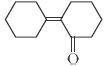
B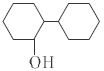
C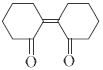
D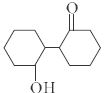
Solution
(A) Cyclohexanone undergoes self-aldol condensation in the presence of a base $(OH^-)$ to form a $\beta$-hydroxy ketone intermediate. Upon heating $(\Delta)$,this intermediate undergoes dehydration (elimination of $H_2O$) to form an $\alpha,\beta$-unsaturated ketone. The final product is $2$-cyclohexylidenecyclohexanone.
0 likes
View Solution399
MediumMCQ
The correct statement regarding a carbonyl compound with a hydrogen atom on its $\alpha-$carbon is:
A
$A$ carbonyl compound with a hydrogen atom on its $\alpha-$carbon rapidly equilibrates with its corresponding enol and this process is known as carbonylation.
B
$A$ carbonyl compound with a hydrogen atom on its $\alpha-$carbon rapidly equilibrates with its corresponding enol and this process is known as keto-enol tautomerism.
C
$A$ carbonyl compound with a hydrogen atom on its $\alpha-$carbon never equilibrates with its corresponding enol.
D
$A$ carbonyl compound with a hydrogen atom on its $\alpha-$carbon rapidly equilibrates with its corresponding enol and this process is known as aldehyde-ketone equilibration.
Solution
(B) Carbonyl compounds containing at least one $\alpha-$hydrogen atom exhibit tautomerism due to the acidic nature of the $\alpha-$hydrogen. The $\alpha-$hydrogen atom migrates to the carbonyl oxygen atom,resulting in an equilibrium between the keto form and the enol form. This phenomenon is specifically known as keto-enol tautomerism.
0 likes
View Solution400
MediumMCQ
Reaction of a carbonyl compound with one of the following reagents involves nucleophilic addition followed by elimination of water. The reagent is
A
hydrazine in presence of feebly acidic solution
B
hydrocyanic acid
C
sodium hydrogen sulphite
D
a Grignard reagent.
Solution
(A) The reaction of carbonyl compounds with ammonia derivatives (like hydrazine,$NH_2NH_2$) involves nucleophilic addition to the carbonyl group followed by the elimination of a water molecule $(H_2O)$ to form a product containing a $C=N$ bond (e.g.,hydrazone).
This is a characteristic nucleophilic addition-elimination reaction.
This is a characteristic nucleophilic addition-elimination reaction.
0 likes
View Solution8-1.Aldehydes and Ketones — Properties · Frequently Asked Questions
1Are these 8-1.Aldehydes and Ketones questions useful for JEE and NEET?
Yes. All questions in this section are mapped to JEE Main and NEET exam patterns. Previous year questions from JEE Main, NEET, GUJCET and state-level exams are included with full solutions.
2Can I switch to Hindi or Gujarati for these questions?
Yes. Use the language tabs in the hero section or the sidebar to view the same questions and solutions in English, Hindi or Gujarati.
3How do I generate a question paper from this subtopic?
Use the Vedclass Exam Paper Generator — select the chapter and subtopic, set difficulty, and generate Sets A, B, C, D automatically. First 3 chapters of every subject are free.
Vedclass Products
For Students
Vedclass Test Series
Mock tests in real JEE/NEET style with performance analysis. 5-day free trial.
Start Free TrialFor Teachers
Exam Paper Generator
Generate Set A/B/C/D papers from this chapter in 2 minutes. 3 chapters free.
Try FreeFor Institutes
Online Exam Module
Live online exams with unlimited students, 360° analytics & white-label branding.
See DemoFor Teachers & Institutes
Generate a 8-1.Aldehydes and Ketones Exam Paper in 2 Minutes
Select subtopic & difficulty — Sets A, B, C, D auto-generated with No Repeat logic.
First 3 chapters of every subject are free — no payment required.