
A English
Properties Questions in English
Class 12 Chemistry · 8-1.Aldehydes and Ketones · Properties
1739+
Questions
English
Language
100%
With Solutions
Showing 50 of 1739 questions in English
1
EasyMCQ
Splitting of signals in $NMR$ spectroscopy is caused by
A
Proton
B
Neutron
C
Positron
D
Electron
Solution
(A) The correct answer is $(A)$. In $NMR$ spectroscopy,the splitting of signals (spin-spin coupling) is caused by the interaction of the magnetic moments of protons attached to adjacent carbon atoms,provided these protons are not chemically equivalent to the absorbing proton.
0 likes
View Solution2
MediumMCQ
$A$ well-known reagent which contains copper sulphate,sodium potassium tartrate,and sodium hydroxide is
A
Fenton's reagent
B
Schiff's reagent
C
Fehling's solution
D
Nessler's reagent
Solution
(C) The correct answer is $(C)$.
Fehling's solution is a mixture of two solutions:
$1$. Fehling's solution $A$: Aqueous copper sulphate $(CuSO_4 \cdot 5H_2O)$.
$2$. Fehling's solution $B$: Alkaline sodium potassium tartrate (Rochelle salt).
Fehling's solution is a mixture of two solutions:
$1$. Fehling's solution $A$: Aqueous copper sulphate $(CuSO_4 \cdot 5H_2O)$.
$2$. Fehling's solution $B$: Alkaline sodium potassium tartrate (Rochelle salt).
0 likes
View Solution3
DifficultMCQ
The dipole moment is the highest for
A
$Trans-2-butene$
B
$1, 3-Dimethylbenzene$
C
$Acetophenone$
D
$Ethanol$
Solution
(C) The dipole moments of the given compounds are as follows:
$(i)$ $Trans-2-butene$: The dipole moment is $0$ due to the cancellation of bond dipoles.
$(ii)$ $1, 3-Dimethylbenzene$: It has a small dipole moment due to the inductive effect of the two methyl groups.
$(iii)$ $Acetophenone$ $(C_6H_5COCH_3)$: It has a high dipole moment due to the strong electron-withdrawing nature of the carbonyl group $(C=O)$,which creates a significant charge separation.
$(iv)$ $Ethanol$ $(C_2H_5OH)$: It has a moderate dipole moment due to the electronegativity difference between oxygen and hydrogen.
Comparing these,$Acetophenone$ has the highest dipole moment among the given options.
$(i)$ $Trans-2-butene$: The dipole moment is $0$ due to the cancellation of bond dipoles.
$(ii)$ $1, 3-Dimethylbenzene$: It has a small dipole moment due to the inductive effect of the two methyl groups.
$(iii)$ $Acetophenone$ $(C_6H_5COCH_3)$: It has a high dipole moment due to the strong electron-withdrawing nature of the carbonyl group $(C=O)$,which creates a significant charge separation.
$(iv)$ $Ethanol$ $(C_2H_5OH)$: It has a moderate dipole moment due to the electronegativity difference between oxygen and hydrogen.
Comparing these,$Acetophenone$ has the highest dipole moment among the given options.
0 likes
View Solution4
MediumMCQ
The reactivity towards nucleophilic addition reaction of
$(I) HCHO$,
$(II) CH_3CHO$,
$(III) CH_3COCH_3$ is
$(I) HCHO$,
$(II) CH_3CHO$,
$(III) CH_3COCH_3$ is
A
$II > III > I$
B
$III > II > I$
C
$I > II > III$
D
$I > II < III$
Solution
(C) The reactivity of carbonyl compounds towards nucleophilic addition depends on the electrophilicity of the carbonyl carbon.
Alkyl groups are electron-donating due to the $+I$ effect,which decreases the positive charge on the carbonyl carbon and increases steric hindrance.
As the number of alkyl groups attached to the carbonyl carbon increases,the reactivity towards nucleophilic addition decreases.
Therefore,the order of reactivity is:
$HCHO (I) > CH_3CHO (II) > CH_3COCH_3 (III)$
Alkyl groups are electron-donating due to the $+I$ effect,which decreases the positive charge on the carbonyl carbon and increases steric hindrance.
As the number of alkyl groups attached to the carbonyl carbon increases,the reactivity towards nucleophilic addition decreases.
Therefore,the order of reactivity is:
$HCHO (I) > CH_3CHO (II) > CH_3COCH_3 (III)$
0 likes
View Solution5
AdvancedMCQ
Which of the following reactions will produce a chiral molecule?
A
$CH_{3}COCl \xrightarrow{LiAlH_{4}}$
B
$C_{2}H_{5}CHO \xrightarrow[H^{+}/H_{2}O]{CH_{3}MgBr}$
C
$(CH_{3})_{2}CHC_{2}H_{5} \xrightarrow{Cu}$
D
The reaction of $2$-methylbut-$2$-ene with $Cl_{2}$
Solution
(B) . The reaction of $C_{2}H_{5}CHO$ with $CH_{3}MgBr$ followed by hydrolysis produces $CH_{3}CH(OH)C_{2}H_{5}$ (butan-$2$-ol).
In this molecule,the carbon atom attached to the $-OH$ group is bonded to four different groups: $-H$,$-OH$,$-CH_{3}$,and $-C_{2}H_{5}$.
Since all four substituents are different,this carbon is a chiral center,making the molecule chiral.
In this molecule,the carbon atom attached to the $-OH$ group is bonded to four different groups: $-H$,$-OH$,$-CH_{3}$,and $-C_{2}H_{5}$.
Since all four substituents are different,this carbon is a chiral center,making the molecule chiral.
0 likes
View Solution6
MediumMCQ
In the reaction $CH_3CHO + HCN \to CH_3CH(OH)CN$,a chiral centre is produced. This product would be
A
Laevo rotatory
B
Meso compound
C
Dextro rotatory
D
Racemic mixture
Solution
(D) The reaction $CH_3CHO + HCN \to CH_3CH(OH)CN$ involves the nucleophilic addition of cyanide to the carbonyl carbon of acetaldehyde.
Since the carbonyl carbon is planar,the cyanide ion can attack from either side with equal probability.
This leads to the formation of both $d$ (dextro) and $l$ (laevo) enantiomers in equal amounts.
Therefore,the resulting product is a racemic mixture.
Since the carbonyl carbon is planar,the cyanide ion can attack from either side with equal probability.
This leads to the formation of both $d$ (dextro) and $l$ (laevo) enantiomers in equal amounts.
Therefore,the resulting product is a racemic mixture.
0 likes
View Solution7
MediumMCQ
For the reduction of ketones to hydrocarbon,the appropriate agent is
A
$HI$
B
$Zn-Hg/HCl$
C
Red phosphorous
D
$H_2SO_4$
Solution
(B) In the Clemmensen reduction,aldehydes and ketones are reduced to their corresponding alkanes using amalgamated $Zn-Hg$ and $HCl$.
0 likes
View Solution8
MediumMCQ
Ethylene is converted to $X$ on passing through a mixture of an acidified aqueous solution of palladium chloride and cupric chloride. Which of the following reagents readily take part in addition reaction with $X$?
A
$Br_2$
B
$HBr$
C
$HCl$
D
$HCN$
Solution
(D) The reaction described is the Wacker process,where ethylene $(CH_2=CH_2)$ is oxidized to acetaldehyde $(CH_3CHO)$ in the presence of $PdCl_2$ and $CuCl_2$.
Thus,$X$ is acetaldehyde $(CH_3CHO)$.
Acetaldehyde contains a carbonyl group $(C=O)$ and undergoes nucleophilic addition reactions.
Among the given options,$HCN$ (hydrogen cyanide) is a classic reagent that readily undergoes nucleophilic addition with the carbonyl group of aldehydes to form cyanohydrins.
Therefore,$HCN$ is the correct reagent.
Thus,$X$ is acetaldehyde $(CH_3CHO)$.
Acetaldehyde contains a carbonyl group $(C=O)$ and undergoes nucleophilic addition reactions.
Among the given options,$HCN$ (hydrogen cyanide) is a classic reagent that readily undergoes nucleophilic addition with the carbonyl group of aldehydes to form cyanohydrins.
Therefore,$HCN$ is the correct reagent.
0 likes
View Solution9
MediumMCQ
$PCl_5$ reacts with propanone to give:
A
vic-dichloride
B
Propanal
C
propane-chloride
D
gem-dichloride
Solution
(D) The reaction of $PCl_5$ with a ketone like propanone $(CH_3COCH_3)$ involves the replacement of the carbonyl oxygen atom with two chlorine atoms at the same carbon position.
This results in the formation of a $gem$-dichloride (specifically $2,2$-dichloropropane).
The reaction is: $CH_3COCH_3 + PCl_5 \to CH_3-CCl_2-CH_3 + POCl_3$.
This results in the formation of a $gem$-dichloride (specifically $2,2$-dichloropropane).
The reaction is: $CH_3COCH_3 + PCl_5 \to CH_3-CCl_2-CH_3 + POCl_3$.
0 likes
View Solution10
MediumMCQ
$CH_3CH=CHCHO$ is oxidized to $CH_3CH=CHCOOH$ using
A
Alkaline potassium permanganate
B
Acidified potassium permanganate
C
Selenium dioxide
D
Osmium tetroxide
Solution
(B) The oxidation of an aldehyde group $(-CHO)$ to a carboxylic acid group $(-COOH)$ while preserving the carbon-carbon double bond $(C=C)$ requires a selective oxidizing agent.
$CH_3CH=CHCHO$ is an $\alpha,\beta$-unsaturated aldehyde.
Using $KMnO_4$ in an acidic medium allows for the selective oxidation of the aldehyde group to the corresponding carboxylic acid,$CH_3CH=CHCOOH$.
$CH_3CH=CHCHO$ is an $\alpha,\beta$-unsaturated aldehyde.
Using $KMnO_4$ in an acidic medium allows for the selective oxidation of the aldehyde group to the corresponding carboxylic acid,$CH_3CH=CHCOOH$.
0 likes
View Solution11
MediumMCQ
Which of the following is not an $o, p-$ directing group?
A
$-NH_2$
B
$-OH$
C
$-X$ (halogens)
D
$-CHO$
Solution
(D) The presence of the $-CHO$ group exerts a strong electron-withdrawing effect due to resonance and inductive effects,which decreases the electron density at the $o-$ (ortho) and $p-$ (para) positions of the benzene ring.
As a result,the electrophilic substitution reaction is directed towards the $m-$ (meta) position,where the electron density is relatively higher compared to the $o-$ and $p-$ positions.
Therefore,$-CHO$ is a meta-directing group.
As a result,the electrophilic substitution reaction is directed towards the $m-$ (meta) position,where the electron density is relatively higher compared to the $o-$ and $p-$ positions.
Therefore,$-CHO$ is a meta-directing group.
0 likes
View Solution12
MediumMCQ
Milk can be preserved by adding a few drops of
A
Formic acid solution
B
Formaldehyde solution
C
Acetic acid solution
D
Acetaldehyde solution
Solution
(B) Milk can be preserved by adding a few drops of $HCHO$ (formaldehyde) solution. $HCHO$ acts as a preservative by inhibiting the growth of bacteria in the milk.
0 likes
View Solution13
EasyMCQ
Silvering of a mirror is done by using which of the following compounds?
A
$AgNO_3$
B
$Ag_2O_3$
C
$Fe_2O_3$
D
$Al_2O_3$
Solution
(A) The process of silvering a mirror involves the deposition of a thin layer of metallic silver on the glass surface. This is typically achieved using $AgNO_3$ (silver nitrate) in the presence of a reducing agent (like glucose or formaldehyde) through the Tollens' test reaction. Therefore,$AgNO_3$ is the correct compound used for this purpose.
0 likes
View Solution14
EasyMCQ
What is Tollen's reagent?
A
$[Ag(NH_3)_2]^+$
B
$Ag_2O$
C
$[Cu(OH)_4]^{2-}$
D
$Cu_2O$
Solution
(A) Tollen's reagent is an ammoniacal silver nitrate solution.
It contains the diamminesilver$(I)$ complex ion,which is represented as $[Ag(NH_3)_2]^+$.
It is used to detect the presence of aldehyde groups in organic compounds.
It contains the diamminesilver$(I)$ complex ion,which is represented as $[Ag(NH_3)_2]^+$.
It is used to detect the presence of aldehyde groups in organic compounds.
0 likes
View Solution15
DifficultMCQ
Which of the following is obtained when chloral is boiled with $NaOH$?
A
$CH_3Cl$
B
$CHCl_3$
C
$CCl_4$
D
None of these
Solution
(B) When chloral $(CCl_3CHO)$ is boiled with an aqueous solution of sodium hydroxide $(NaOH)$,it undergoes a haloform reaction to produce chloroform $(CHCl_3)$ and sodium formate $(HCOONa)$.
The chemical equation is: $CCl_3CHO + NaOH \xrightarrow{\text{Boil}} CHCl_3 + HCOONa$.
The chemical equation is: $CCl_3CHO + NaOH \xrightarrow{\text{Boil}} CHCl_3 + HCOONa$.
0 likes
View Solution16
MediumMCQ
Chlorine reacts with ethanol to give
A
Ethyl chloride
B
Chloroform
C
Acetaldehyde
D
Chloral
Solution
(D) The reaction of ethanol with excess chlorine proceeds in two steps:
$1$. Ethanol is first oxidized to acetaldehyde: $CH_3CH_2OH + Cl_2 \to CH_3CHO + 2HCl$
$2$. Acetaldehyde then undergoes chlorination to form chloral $(CCl_3CHO)$: $CH_3CHO + 3Cl_2 \to CCl_3CHO + 3HCl$
Therefore,the final product is chloral.
$1$. Ethanol is first oxidized to acetaldehyde: $CH_3CH_2OH + Cl_2 \to CH_3CHO + 2HCl$
$2$. Acetaldehyde then undergoes chlorination to form chloral $(CCl_3CHO)$: $CH_3CHO + 3Cl_2 \to CCl_3CHO + 3HCl$
Therefore,the final product is chloral.
0 likes
View Solution17
DifficultMCQ
Which compound does not form iodoform with alkali and iodine?
A
Acetone
B
Ethanol
C
Diethyl ketone
D
Isopropyl alcohol
Solution
(C) The iodoform test is given by compounds containing the $CH_3CO-$ group or the $CH_3CH(OH)-$ group.
$Diethyl \ ketone$ $(CH_3CH_2-CO-CH_2CH_3)$ does not contain the $CH_3CO-$ group,therefore it does not form a yellow precipitate of iodoform $(CHI_3)$.
$Diethyl \ ketone$ $(CH_3CH_2-CO-CH_2CH_3)$ does not contain the $CH_3CO-$ group,therefore it does not form a yellow precipitate of iodoform $(CHI_3)$.
| $CH_3COCH_3 \xrightarrow{NaOH/I_2} CHI_3$ | $Yellow \ ppt$ |
| $C_2H_5OH \xrightarrow{NaOH/I_2} CHI_3$ | |
| $CH_3-CH(OH)-CH_3 \xrightarrow{NaOH/I_2} CHI_3$ |
0 likes
View Solution18
DifficultMCQ
Which compound gives a yellow precipitate with iodine and alkali?
A
$2$-hydroxyethane
B
Acetophenone
C
Methyl acetone
D
Acetamide
Solution
(B) The reaction of a compound with iodine $(I_2)$ and alkali $(NaOH)$ is known as the iodoform test.
Compounds containing the $CH_3CO-$ group or $CH_3CH(OH)-$ group give a yellow precipitate of iodoform $(CHI_3)$.
Acetophenone $(C_6H_5COCH_3)$ contains the $CH_3CO-$ group.
The reaction is:
$C_6H_5COCH_3 + 3I_2 + 4NaOH \rightarrow CHI_3 (\text{yellow ppt.}) + C_6H_5COONa + 3NaI + 3H_2O$.
Compounds containing the $CH_3CO-$ group or $CH_3CH(OH)-$ group give a yellow precipitate of iodoform $(CHI_3)$.
Acetophenone $(C_6H_5COCH_3)$ contains the $CH_3CO-$ group.
The reaction is:
$C_6H_5COCH_3 + 3I_2 + 4NaOH \rightarrow CHI_3 (\text{yellow ppt.}) + C_6H_5COONa + 3NaI + 3H_2O$.
0 likes
View Solution19
DifficultMCQ
Acetone reacts with $I_2$ in the presence of $NaOH$ to form:
A
$C_2H_5I$
B
$C_2H_4I_2$
C
$CHI_3$
D
$CH_3I$
Solution
(C) The reaction of acetone $(CH_3COCH_3)$ with iodine $(I_2)$ in the presence of sodium hydroxide $(NaOH)$ is a classic iodoform test.
$CH_3COCH_3 + 3I_2 + 4NaOH \to CHI_3 + 3NaI + CH_3COONa + 3H_2O$
In this reaction,acetone forms iodoform $(CHI_3)$,which is a yellow precipitate.
$CH_3COCH_3 + 3I_2 + 4NaOH \to CHI_3 + 3NaI + CH_3COONa + 3H_2O$
In this reaction,acetone forms iodoform $(CHI_3)$,which is a yellow precipitate.
0 likes
View Solution20
MediumMCQ
Which of the following compounds is responsible for the iodoform reaction?
A
Formalin
B
Methanol
C
Acetic acid
D
Ethanol
Solution
(D) The iodoform reaction is given by compounds containing the $CH_3CO-$ group or the $CH_3CH(OH)-$ group.
Among the given options,$Ethanol$ $(CH_3CH_2OH)$ contains the $CH_3CH(OH)-$ group,which is oxidized to acetaldehyde $(CH_3CHO)$ during the reaction,subsequently undergoing the iodoform test.
Formalin,methanol,and acetic acid do not contain these structural requirements.
Among the given options,$Ethanol$ $(CH_3CH_2OH)$ contains the $CH_3CH(OH)-$ group,which is oxidized to acetaldehyde $(CH_3CHO)$ during the reaction,subsequently undergoing the iodoform test.
Formalin,methanol,and acetic acid do not contain these structural requirements.
0 likes
View Solution21
AdvancedMCQ
$A$ compound $A$ has a molecular formula $C_2Cl_3OH$. It reduces Fehling's solution and on oxidation gives a monocarboxylic acid $(B)$. $A$ is obtained by the action of chlorine on ethyl alcohol. $A$ is:
A
Chloral
B
$CHCl_3$
C
$CH_3Cl$
D
Chloroacetic acid
Solution
(A) The molecular formula $C_2Cl_3OH$ can be written as $CCl_3CHO$ (Chloral).
Since $A$ reduces Fehling's solution,it must contain an aldehyde $(-CHO)$ group.
Chloral $(CCl_3CHO)$ is formed by the chlorination of ethyl alcohol $(C_2H_5OH)$:
$C_2H_5OH + 4Cl_2 \to CCl_3CHO + 5HCl$.
Upon oxidation,Chloral gives trichloroacetic acid $(CCl_3COOH)$,which is a monocarboxylic acid $(B)$.
Therefore,$A$ is Chloral.
Since $A$ reduces Fehling's solution,it must contain an aldehyde $(-CHO)$ group.
Chloral $(CCl_3CHO)$ is formed by the chlorination of ethyl alcohol $(C_2H_5OH)$:
$C_2H_5OH + 4Cl_2 \to CCl_3CHO + 5HCl$.
Upon oxidation,Chloral gives trichloroacetic acid $(CCl_3COOH)$,which is a monocarboxylic acid $(B)$.
Therefore,$A$ is Chloral.
0 likes
View Solution22
MediumMCQ
Grignard reagent adds to
A
$>C = O$
B
$-C \equiv N$
C
$>C = S$
D
All of the above
Solution
(D) Grignard reagents $(RMgX)$ are nucleophilic and readily undergo addition reactions with polar multiple bonds such as $C = O$,$-C \equiv N$,and $C = S$ groups.
$1$. Reaction with $C = O$: $RMgX + >C = O$ $\rightarrow >C(R)-OMgX$ $\xrightarrow{H_2O} >C(R)-OH + Mg(OH)X$
$2$. Reaction with $-C \equiv N$: $RMgX + -C \equiv N$ $\rightarrow -C(R) = NMgX$ $\xrightarrow{H_2O} -C(R) = O + NH_3 + Mg(OH)X$
$3$. Reaction with $C = S$: $RMgX + >C = S$ $\rightarrow >C(R)-SMgX$ $\xrightarrow{H_2O} >C(R)-SH + Mg(OH)X$
Since Grignard reagents react with all these groups,the correct option is $(D)$.
$1$. Reaction with $C = O$: $RMgX + >C = O$ $\rightarrow >C(R)-OMgX$ $\xrightarrow{H_2O} >C(R)-OH + Mg(OH)X$
$2$. Reaction with $-C \equiv N$: $RMgX + -C \equiv N$ $\rightarrow -C(R) = NMgX$ $\xrightarrow{H_2O} -C(R) = O + NH_3 + Mg(OH)X$
$3$. Reaction with $C = S$: $RMgX + >C = S$ $\rightarrow >C(R)-SMgX$ $\xrightarrow{H_2O} >C(R)-SH + Mg(OH)X$
Since Grignard reagents react with all these groups,the correct option is $(D)$.
0 likes
View Solution23
DifficultMCQ
The product obtained as a result of the reaction between acetone and chloroform is used as:
A
Hypnotic
B
Antiseptic
C
Germicidal
D
Anaesthetic
Solution
(A) The reaction between acetone $(CH_3COCH_3)$ and chloroform $(CHCl_3)$ in the presence of a base (like $KOH$) produces $1,1,1$-trichloro-$2$-methylpropan-$2$-ol,which is commonly known as $Chloretone$.
$Chloretone$ is used as a hypnotic drug in medicine.
$Chloretone$ is used as a hypnotic drug in medicine.
0 likes
View Solution24
DifficultMCQ
Acetals are
A
Ketones
B
Diethers
C
Aldehydes
D
Hydroxy aldehydes
Solution
(B) An acetal is a functional group with the general structure $R_2C(OR')_2$,where $R$ can be hydrogen or an alkyl/aryl group and $R'$ is an alkyl group.
Since an acetal contains two ether linkages $(-C-O-C-)$ attached to the same carbon atom,it is classified as a diether.
Since an acetal contains two ether linkages $(-C-O-C-)$ attached to the same carbon atom,it is classified as a diether.
0 likes
View Solution25
MediumMCQ
Formaldehyde reacts with methyl magnesium iodide to form an additive product,which upon aqueous hydrolysis yields:
A
Isopropyl alcohol
B
Ethyl alcohol
C
Methyl alcohol
D
Propyl alcohol
Solution
(B) The reaction of formaldehyde $(HCHO)$ with methyl magnesium iodide $(CH_3MgI)$ is a nucleophilic addition reaction.
Step $1$: Formaldehyde reacts with $CH_3MgI$ to form an addition product: $HCHO + CH_3MgI \rightarrow CH_3CH_2OMgI$.
Step $2$: Aqueous hydrolysis of the addition product yields ethyl alcohol: $CH_3CH_2OMgI + H_2O \rightarrow CH_3CH_2OH + Mg(OH)I$.
Thus,the final product is ethyl alcohol $(CH_3CH_2OH)$.
Step $1$: Formaldehyde reacts with $CH_3MgI$ to form an addition product: $HCHO + CH_3MgI \rightarrow CH_3CH_2OMgI$.
Step $2$: Aqueous hydrolysis of the addition product yields ethyl alcohol: $CH_3CH_2OMgI + H_2O \rightarrow CH_3CH_2OH + Mg(OH)I$.
Thus,the final product is ethyl alcohol $(CH_3CH_2OH)$.
0 likes
View Solution26
MediumMCQ
Benzyl alcohol is obtained from benzaldehyde by:
A
Fittig's reaction
B
Cannizzaro's reaction
C
Kolbe's reaction
D
Wurtz's reaction
Solution
(B) Benzaldehyde $(C_6H_5CHO)$ lacks $\alpha$-hydrogen atoms.
When treated with concentrated alkali (like $NaOH$),it undergoes a self-oxidation and reduction reaction known as the Cannizzaro reaction.
In this reaction,one molecule of benzaldehyde is reduced to benzyl alcohol $(C_6H_5CH_2OH)$ and another is oxidized to sodium benzoate $(C_6H_5COONa)$.
The reaction is: $2C_6H_5CHO + conc. NaOH \rightarrow C_6H_5CH_2OH + C_6H_5COONa$.
When treated with concentrated alkali (like $NaOH$),it undergoes a self-oxidation and reduction reaction known as the Cannizzaro reaction.
In this reaction,one molecule of benzaldehyde is reduced to benzyl alcohol $(C_6H_5CH_2OH)$ and another is oxidized to sodium benzoate $(C_6H_5COONa)$.
The reaction is: $2C_6H_5CHO + conc. NaOH \rightarrow C_6H_5CH_2OH + C_6H_5COONa$.
0 likes
View Solution27
DifficultMCQ
If formaldehyde and potassium hydroxide are heated,then we get
A
Acetylene
B
Methane
C
Methyl alcohol
D
Ethyl formate
Solution
(C) The reaction between formaldehyde $(HCHO)$ and concentrated potassium hydroxide $(KOH)$ is a classic example of the Cannizzaro reaction.
$2HCHO + KOH \rightarrow CH_3OH + HCOOK$
In this reaction,one molecule of formaldehyde is reduced to methyl alcohol $(CH_3OH)$,while the other is oxidized to potassium formate $(HCOOK)$.
$2HCHO + KOH \rightarrow CH_3OH + HCOOK$
In this reaction,one molecule of formaldehyde is reduced to methyl alcohol $(CH_3OH)$,while the other is oxidized to potassium formate $(HCOOK)$.
0 likes
View Solution28
MediumMCQ
Grignard reagent reacts with compounds containing which of the following groups?
A
$>C=O$
B
$-C \equiv N$
C
$>C=S$
D
All of these
Solution
(D) The Grignard reagent $(RMgX)$ is a strong nucleophile that reacts with compounds containing polar multiple bonds.
It readily undergoes nucleophilic addition reactions with carbonyl groups $(>C=O)$,thiocarbonyl groups $(>C=S)$,and cyano groups $(-C \equiv N)$.
Therefore,the correct option is $D$.
It readily undergoes nucleophilic addition reactions with carbonyl groups $(>C=O)$,thiocarbonyl groups $(>C=S)$,and cyano groups $(-C \equiv N)$.
Therefore,the correct option is $D$.
0 likes
View Solution29
MediumMCQ
Acetone on treatment with $CH_3MgI$ and on further hydrolysis gives:
A
Isopropyl alcohol
B
Primary alcohol
C
Acetic acid
D
$2-$methyl$-2-$propanol
Solution
(D) Acetone $(CH_3COCH_3)$ reacts with Grignard reagent $(CH_3MgI)$ to form an addition product.
$CH_3COCH_3 + CH_3MgI \rightarrow (CH_3)_3C-OMgI$
Upon further hydrolysis,the addition product yields $2-$methyl$-2-$propanol (also known as $tert-$butyl alcohol).
$(CH_3)_3C-OMgI + H_2O \rightarrow (CH_3)_3C-OH + Mg(OH)I$
$CH_3COCH_3 + CH_3MgI \rightarrow (CH_3)_3C-OMgI$
Upon further hydrolysis,the addition product yields $2-$methyl$-2-$propanol (also known as $tert-$butyl alcohol).
$(CH_3)_3C-OMgI + H_2O \rightarrow (CH_3)_3C-OH + Mg(OH)I$
0 likes
View Solution30
DifficultMCQ
The reaction between an ester and an excess of Grignard reagent $(R'MgX)$ finally results in a:
A
Primary alcohol
B
Secondary alcohol
C
Tertiary alcohol
D
Ketone
Solution
(C) When an ester $(RCOOR')$ reacts with a Grignard reagent $(R''MgX)$,the reaction proceeds in two steps.
First,the Grignard reagent attacks the carbonyl carbon of the ester to form a ketone intermediate $(R-CO-R'')$ and an alkoxide $(R'OMgX)$.
Since the Grignard reagent is in excess,it immediately reacts with the newly formed ketone to produce an alkoxide intermediate.
Finally,upon acidic hydrolysis,this intermediate yields a tertiary alcohol $(R-C(OH)(R'')_2)$.
First,the Grignard reagent attacks the carbonyl carbon of the ester to form a ketone intermediate $(R-CO-R'')$ and an alkoxide $(R'OMgX)$.
Since the Grignard reagent is in excess,it immediately reacts with the newly formed ketone to produce an alkoxide intermediate.
Finally,upon acidic hydrolysis,this intermediate yields a tertiary alcohol $(R-C(OH)(R'')_2)$.
0 likes
View Solution31
MediumMCQ
The product of reduction of benzaldehyde is
A
Benzoic acid
B
Benzyl alcohol
C
Benzene
D
Catechol
Solution
(B) The reduction of benzaldehyde $(C_6H_5CHO)$ using a reducing agent like $LiAlH_4$ or $NaBH_4$ leads to the formation of a primary alcohol.
The reaction is as follows:
$C_6H_5CHO + 2[H] \xrightarrow{LiAlH_4} C_6H_5CH_2OH$
Thus,the product formed is benzyl alcohol.
The reaction is as follows:
$C_6H_5CHO + 2[H] \xrightarrow{LiAlH_4} C_6H_5CH_2OH$
Thus,the product formed is benzyl alcohol.
0 likes
View Solution32
DifficultMCQ
Acetyl bromide reacts with excess of $CH_3MgI$ followed by treatment with a saturated solution of $NH_4Cl$ gives:
A
$2$-methyl-$2$-propanol
B
Acetamide
C
Acetone
D
Acetyl iodide
Solution
(A) Acetyl bromide $(CH_3COBr)$ reacts with the first equivalent of $CH_3MgI$ to form acetone $(CH_3COCH_3)$.
Since $CH_3MgI$ is in excess,it further reacts with the formed acetone to produce a tertiary alkoxide intermediate $(CH_3-C(CH_3)_2-OMgI)$.
Finally,hydrolysis of this intermediate with a saturated solution of $NH_4Cl$ yields $2$-methyl-$2$-propanol $(CH_3-C(CH_3)_2-OH)$.
Reaction: $CH_3COBr + 2CH_3MgI$ $\rightarrow CH_3-C(CH_3)_2-OMgI$ $\xrightarrow{NH_4Cl} CH_3-C(CH_3)_2-OH$.
Since $CH_3MgI$ is in excess,it further reacts with the formed acetone to produce a tertiary alkoxide intermediate $(CH_3-C(CH_3)_2-OMgI)$.
Finally,hydrolysis of this intermediate with a saturated solution of $NH_4Cl$ yields $2$-methyl-$2$-propanol $(CH_3-C(CH_3)_2-OH)$.
Reaction: $CH_3COBr + 2CH_3MgI$ $\rightarrow CH_3-C(CH_3)_2-OMgI$ $\xrightarrow{NH_4Cl} CH_3-C(CH_3)_2-OH$.
0 likes
View Solution33
MediumMCQ
Which of the following is formed when benzaldehyde reacts with concentrated sodium hydroxide?
A
Benzyl alcohol
B
Benzoic acid
C
Glucose
D
Acetic acid
Solution
(A) $2C_6H_5CHO + NaOH \to C_6H_5CH_2OH + C_6H_5COONa$
Benzaldehyde undergoes the Cannizzaro reaction in the presence of concentrated alkali.
This is a disproportionation reaction where one molecule of benzaldehyde is reduced to benzyl alcohol and another is oxidized to sodium benzoate.
Benzaldehyde undergoes the Cannizzaro reaction in the presence of concentrated alkali.
This is a disproportionation reaction where one molecule of benzaldehyde is reduced to benzyl alcohol and another is oxidized to sodium benzoate.
0 likes
View Solution34
DifficultMCQ
When ethanal reacts with $CH_3MgBr$ and $C_2H_5OH$/dry $HCl$,the products formed are
A
Ethyl alcohol and $2$-propanol
B
Ethane and hemi-acetal
C
$2$-propanol and acetal
D
Propane and methyl acetate
Solution
(C) $1$. Reaction with $CH_3MgBr$: Ethanal $(CH_3CHO)$ reacts with methylmagnesium bromide $(CH_3MgBr)$ followed by hydrolysis to form $2$-propanol $(CH_3CH(OH)CH_3)$.
$2$. Reaction with $C_2H_5OH$/dry $HCl$: Ethanal reacts with two equivalents of ethanol $(C_2H_5OH)$ in the presence of dry $HCl$ to form an acetal $(CH_3CH(OC_2H_5)_2)$.
$2$. Reaction with $C_2H_5OH$/dry $HCl$: Ethanal reacts with two equivalents of ethanol $(C_2H_5OH)$ in the presence of dry $HCl$ to form an acetal $(CH_3CH(OC_2H_5)_2)$.
0 likes
View Solution35
MediumMCQ
$C_6H_5-CH=CHCHO \xrightarrow{X} C_6H_5-CH=CHCH_2OH$. In the above sequence,$X$ can be:
A
$H_2/Ni$
B
$NaBH_4$
C
$K_2Cr_2O_7/H^+$
D
Both $(a)$ and $(b)$
Solution
(B) $NaBH_4$ is a selective reducing agent that reduces the carbonyl group $(-CHO)$ to a primary alcohol $(-CH_2OH)$ without affecting the carbon-carbon double bond $(C=C)$.
$H_2/Ni$ is a non-selective reducing agent that would reduce both the carbonyl group and the carbon-carbon double bond.
Therefore,the correct reagent is $NaBH_4$.
$C_6H_5-CH=CHCHO \xrightarrow{NaBH_4} C_6H_5-CH=CHCH_2OH$
$H_2/Ni$ is a non-selective reducing agent that would reduce both the carbonyl group and the carbon-carbon double bond.
Therefore,the correct reagent is $NaBH_4$.
$C_6H_5-CH=CHCHO \xrightarrow{NaBH_4} C_6H_5-CH=CHCH_2OH$
0 likes
View Solution36
MediumMCQ
$CH_3-CH=CH-CH(OH)-CH_3 \xrightarrow{\text{Jones reagent}} X$,
Product $X$ is
Product $X$ is
A
$CH_3CH_2CH_2CH(OH)CH_3$
B
$CH_3CH=CHCOCH_3$
C
Both $(a)$ and $(b)$ are correct
D
$CH_3CH_2CH_2COCH_3$
Solution
(B) The Jones reagent ($CrO_3$ in $H_2SO_4/H_2O$) is a strong oxidizing agent used for the oxidation of alcohols.
It oxidizes primary alcohols to carboxylic acids and secondary alcohols to ketones.
The given substrate is $pent-3-en-2-ol$,which is an allylic secondary alcohol.
Jones reagent oxidizes the secondary alcohol group $(-CH(OH)-)$ to a ketone group $(-C=O)$ without affecting the carbon-carbon double bond $(C=C)$ under standard conditions.
Therefore,the reaction is:
$CH_3-CH=CH-CH(OH)-CH_3 \xrightarrow{Jones \ reagent} CH_3-CH=CH-COCH_3$
The product $X$ is $pent-3-en-2-one$ $(CH_3CH=CHCOCH_3)$.
It oxidizes primary alcohols to carboxylic acids and secondary alcohols to ketones.
The given substrate is $pent-3-en-2-ol$,which is an allylic secondary alcohol.
Jones reagent oxidizes the secondary alcohol group $(-CH(OH)-)$ to a ketone group $(-C=O)$ without affecting the carbon-carbon double bond $(C=C)$ under standard conditions.
Therefore,the reaction is:
$CH_3-CH=CH-CH(OH)-CH_3 \xrightarrow{Jones \ reagent} CH_3-CH=CH-COCH_3$
The product $X$ is $pent-3-en-2-one$ $(CH_3CH=CHCOCH_3)$.
0 likes
View Solution37
MediumMCQ
Which of the following compounds gives the iodoform reaction at higher temperatures?
A
$CH_3COCH_3$
B
$CH_3COC_2H_5$
C
$C_6H_5COCH_3$
D
$CH_3COC_6H_5$
Solution
(A) The iodoform reaction is given by compounds containing the $CH_3CO-$ group or the $CH_3CH(OH)-$ group.
All the given options ($CH_3COCH_3$,$CH_3COC_2H_5$,$C_6H_5COCH_3$,and $CH_3COC_6H_5$) contain the $CH_3CO-$ group attached to a carbon or hydrogen atom.
Therefore,all these compounds are capable of undergoing the iodoform reaction.
However,in the context of standard chemistry problems where a single choice is required,it is noted that all these methyl ketones respond positively to the iodoform test.
All the given options ($CH_3COCH_3$,$CH_3COC_2H_5$,$C_6H_5COCH_3$,and $CH_3COC_6H_5$) contain the $CH_3CO-$ group attached to a carbon or hydrogen atom.
Therefore,all these compounds are capable of undergoing the iodoform reaction.
However,in the context of standard chemistry problems where a single choice is required,it is noted that all these methyl ketones respond positively to the iodoform test.
0 likes
View Solution38
DifficultMCQ
Methyl alcohol $(CH_3OH)$,ethyl alcohol $(C_2H_5OH)$,and acetone $(CH_3COCH_3)$ were treated with iodine and sodium hydroxide solutions. Which substances will give the iodoform test?
A
Only ethyl alcohol
B
Only methyl alcohol and ethyl alcohol
C
Only ethyl alcohol and acetone
D
Only acetone
Solution
(C) The iodoform test is given by compounds containing the $CH_3CO-$ group or the $CH_3CH(OH)-$ group.
$1$. Ethyl alcohol $(C_2H_5OH)$ contains the $CH_3CH(OH)-$ group,so it gives a positive iodoform test: $C_2H_5OH + 4I_2 + 6NaOH \rightarrow CHI_3 + HCOONa + 5NaI + 5H_2O$.
$2$. Acetone $(CH_3COCH_3)$ contains the $CH_3CO-$ group,so it gives a positive iodoform test: $CH_3COCH_3 + 3I_2 + 4NaOH \rightarrow CHI_3 + CH_3COONa + 3NaI + 3H_2O$.
$3$. Methyl alcohol $(CH_3OH)$ does not contain either of these groups,so it does not give the iodoform test.
Therefore,only ethyl alcohol and acetone give the iodoform test.
$1$. Ethyl alcohol $(C_2H_5OH)$ contains the $CH_3CH(OH)-$ group,so it gives a positive iodoform test: $C_2H_5OH + 4I_2 + 6NaOH \rightarrow CHI_3 + HCOONa + 5NaI + 5H_2O$.
$2$. Acetone $(CH_3COCH_3)$ contains the $CH_3CO-$ group,so it gives a positive iodoform test: $CH_3COCH_3 + 3I_2 + 4NaOH \rightarrow CHI_3 + CH_3COONa + 3NaI + 3H_2O$.
$3$. Methyl alcohol $(CH_3OH)$ does not contain either of these groups,so it does not give the iodoform test.
Therefore,only ethyl alcohol and acetone give the iodoform test.
0 likes
View Solution39
MediumMCQ
Addition of alcohols to aldehydes in the presence of anhydrous acids yields:
A
Carboxylic acids
B
Ethers
C
Cyclic ethers
D
Acetals
Solution
(D) Aldehydes react with one equivalent of a monohydric alcohol in the presence of dry $HCl$ gas to yield alkoxyalcohol intermediate,known as a hemiacetal.
Further reaction with another molecule of alcohol in the presence of dry $HCl$ gives a gem-dialkoxy compound,which is known as an acetal.
The general reaction is:
$R-CHO + R'OH \xrightarrow{dry \ HCl} R-CH(OH)(OR')$ (Hemiacetal)
$R-CH(OH)(OR') + R'OH \xrightarrow{dry \ HCl} R-CH(OR')_2 + H_2O$ (Acetal)
Therefore,the correct option is $(D)$.
Further reaction with another molecule of alcohol in the presence of dry $HCl$ gives a gem-dialkoxy compound,which is known as an acetal.
The general reaction is:
$R-CHO + R'OH \xrightarrow{dry \ HCl} R-CH(OH)(OR')$ (Hemiacetal)
$R-CH(OH)(OR') + R'OH \xrightarrow{dry \ HCl} R-CH(OR')_2 + H_2O$ (Acetal)
Therefore,the correct option is $(D)$.
0 likes
View Solution40
DifficultMCQ
The best reagent to convert $pent-3-en-2-ol$ into $pent-3-yn-2-one$ is
A
Acidic permanganate
B
Acidic dichromate
C
Chromic anhydride in glacial acetic acid
D
Pyridinium chlorochromate
Solution
(C) The conversion of $pent-3-en-2-ol$ to $pent-3-yn-2-one$ involves the oxidation of the secondary alcohol group to a ketone while preserving the carbon-carbon double bond (or in this case,the triple bond formation requires specific conditions).
Chromic anhydride in glacial acetic acid (Jones reagent or similar conditions) is effective for the oxidation of alcohols to ketones without affecting the unsaturation in the chain.
Chromic anhydride in glacial acetic acid (Jones reagent or similar conditions) is effective for the oxidation of alcohols to ketones without affecting the unsaturation in the chain.
0 likes
View Solution41
EasyMCQ
Which of the following aldehydes is most reactive $?$
A
$C_6H_5-CHO$
B
$CH_3CHO$
C
$HCHO$
D
All are equally reactive
Solution
(C) The reactivity of carbonyl compounds towards nucleophilic addition reactions depends on the magnitude of the positive charge on the carbonyl carbon atom.
Alkyl groups are electron-donating ($+I$ effect),which decreases the positive charge on the carbonyl carbon and reduces its reactivity.
In $HCHO$ (formaldehyde),there are no alkyl groups attached to the carbonyl carbon.
In $CH_3CHO$ (acetaldehyde),one methyl group is attached.
In $C_6H_5CHO$ (benzaldehyde),the phenyl group provides resonance stabilization,further reducing the electrophilicity of the carbonyl carbon.
Therefore,the order of reactivity is $HCHO > CH_3CHO > C_6H_5CHO$.
Thus,$HCHO$ is the most reactive.
Alkyl groups are electron-donating ($+I$ effect),which decreases the positive charge on the carbonyl carbon and reduces its reactivity.
In $HCHO$ (formaldehyde),there are no alkyl groups attached to the carbonyl carbon.
In $CH_3CHO$ (acetaldehyde),one methyl group is attached.
In $C_6H_5CHO$ (benzaldehyde),the phenyl group provides resonance stabilization,further reducing the electrophilicity of the carbonyl carbon.
Therefore,the order of reactivity is $HCHO > CH_3CHO > C_6H_5CHO$.
Thus,$HCHO$ is the most reactive.
0 likes
View Solution42
DifficultMCQ
The end product in the following sequence of reaction is
$HC \equiv CH$ $\xrightarrow{1\% \, HgSO_4, 20\% \, H_2SO_4} A$ $\xrightarrow{CH_3MgX} B$ $\xrightarrow{[O]}$
$HC \equiv CH$ $\xrightarrow{1\% \, HgSO_4, 20\% \, H_2SO_4} A$ $\xrightarrow{CH_3MgX} B$ $\xrightarrow{[O]}$
A
Acetic acid
B
Isopropyl alcohol
C
Acetone
D
Ethanol
Solution
(C) Step $1$: Hydration of ethyne $(HC \equiv CH)$ in the presence of $1\% \, HgSO_4$ and $20\% \, H_2SO_4$ yields acetaldehyde $(CH_3CHO)$ as product $A$.
Step $2$: Reaction of acetaldehyde $(CH_3CHO)$ with Grignard reagent $(CH_3MgX)$ followed by hydrolysis yields isopropyl alcohol $(CH_3CHOHCH_3)$ as product $B$.
Step $3$: Oxidation of isopropyl alcohol $(CH_3CHOHCH_3)$ using an oxidizing agent $([O])$ yields acetone $(CH_3COCH_3)$.
Step $2$: Reaction of acetaldehyde $(CH_3CHO)$ with Grignard reagent $(CH_3MgX)$ followed by hydrolysis yields isopropyl alcohol $(CH_3CHOHCH_3)$ as product $B$.
Step $3$: Oxidation of isopropyl alcohol $(CH_3CHOHCH_3)$ using an oxidizing agent $([O])$ yields acetone $(CH_3COCH_3)$.
0 likes
View Solution43
MediumMCQ
Predict the product $B$ in the sequence of reaction:
$HC \equiv CH$ $\xrightarrow{30\% \ H_2SO_4, HgSO_4} A$ $\xrightarrow{dil. \ NaOH} B$
$HC \equiv CH$ $\xrightarrow{30\% \ H_2SO_4, HgSO_4} A$ $\xrightarrow{dil. \ NaOH} B$
A
$CH_3COONa$
B
$CH_3COOH$
C
$CH_3CHO$
D
$CH_3-CH(OH)-CH_2CHO$
Solution
(D) Step $1$: Acetylene $(HC \equiv CH)$ undergoes hydration in the presence of $30\% \ H_2SO_4$ and $HgSO_4$ to form vinyl alcohol,which tautomerizes to acetaldehyde $(CH_3CHO)$. Thus,$A = CH_3CHO$.
Step $2$: Acetaldehyde contains $\alpha$-hydrogen atoms,so it undergoes aldol condensation in the presence of dilute $NaOH$ to form $3$-hydroxybutanal $(CH_3-CH(OH)-CH_2CHO)$. Thus,$B = CH_3-CH(OH)-CH_2CHO$.
Step $2$: Acetaldehyde contains $\alpha$-hydrogen atoms,so it undergoes aldol condensation in the presence of dilute $NaOH$ to form $3$-hydroxybutanal $(CH_3-CH(OH)-CH_2CHO)$. Thus,$B = CH_3-CH(OH)-CH_2CHO$.
0 likes
View Solution44
MediumMCQ
The Clemmensen reduction of acetone yields
A
Ethanol
B
Ethanal
C
Propane
D
Propanol
Solution
(C) The Clemmensen reduction involves the reduction of carbonyl groups $(C=O)$ to methylene groups $(CH_2)$ using zinc amalgam $(Zn(Hg))$ and concentrated hydrochloric acid $(HCl)$.
Acetone is $CH_3COCH_3$.
When acetone undergoes Clemmensen reduction,the carbonyl group is reduced to a methylene group:
$CH_3COCH_3 + 4[H] \xrightarrow{Zn(Hg)/HCl} CH_3CH_2CH_3 + H_2O$.
The product formed is propane.
Acetone is $CH_3COCH_3$.
When acetone undergoes Clemmensen reduction,the carbonyl group is reduced to a methylene group:
$CH_3COCH_3 + 4[H] \xrightarrow{Zn(Hg)/HCl} CH_3CH_2CH_3 + H_2O$.
The product formed is propane.
0 likes
View Solution45
MediumMCQ
Which of the following on reaction with $NH_3$ gives a urinary antiseptic compound?
A
$HCHO$
B
$CH_3CHO$
C
$C_6H_5CHO$
D
$C_6H_5CH_2CHO$
Solution
(A) $NH_3$ reacts with these aldehydes as follows:
$(i)$ $6HCHO + 4NH_3 \rightarrow (CH_2)_6N_4 + 6H_2O$
$(ii)$ $CH_3CHO + NH_3 \rightarrow CH_3CH(OH)NH_2$
$(iii)$ $C_6H_5CHO + NH_3 \rightarrow C_6H_5-CH(NCHC_6H_5)_2$
The product $(CH_2)_6N_4$ is known as urotropine (hexamethylenetetramine),which is used as a urinary antiseptic.
$(i)$ $6HCHO + 4NH_3 \rightarrow (CH_2)_6N_4 + 6H_2O$
$(ii)$ $CH_3CHO + NH_3 \rightarrow CH_3CH(OH)NH_2$
$(iii)$ $C_6H_5CHO + NH_3 \rightarrow C_6H_5-CH(NCHC_6H_5)_2$
The product $(CH_2)_6N_4$ is known as urotropine (hexamethylenetetramine),which is used as a urinary antiseptic.
0 likes
View Solution46
MediumMCQ
Benzoin is
A
Compound containing an aldehyde and a ketonic group
B
$\alpha, \beta$-unsaturated acid
C
$\alpha$-hydroxy aldehyde
D
$\alpha$-hydroxy ketone
Solution
(D) Benzoin is an organic compound with the chemical formula $C_6H_5CH(OH)COC_6H_5$.
It is formed by the benzoin condensation of benzaldehyde.
The structure contains a ketone group $(C=O)$ with a hydroxyl group $(-OH)$ attached to the adjacent carbon atom (the $\alpha$-carbon).
Therefore,it is classified as an $\alpha$-hydroxy ketone.
It is formed by the benzoin condensation of benzaldehyde.
The structure contains a ketone group $(C=O)$ with a hydroxyl group $(-OH)$ attached to the adjacent carbon atom (the $\alpha$-carbon).
Therefore,it is classified as an $\alpha$-hydroxy ketone.
0 likes
View Solution47
MediumMCQ
Identify the reactant $X$ and the product $Y$ in the reaction of acetone with a Grignard reagent followed by hydrolysis.
A
$X = MgCl_2;\; Y = CH_3CH = CH_2$
B
$X = CH_3MgCl;\; Y = C_2H_5COCH_3$
C
$X = CH_3MgCl;\; Y = (CH_3)_3COH$
D
$X = C_2H_5MgCl;\; Y = (CH_3)_3COH$
Solution
(C) The reaction of acetone $(CH_3COCH_3)$ with methylmagnesium chloride $(CH_3MgCl)$ is a nucleophilic addition reaction.
Step $1$: $CH_3COCH_3 + CH_3MgCl \to (CH_3)_3COMgCl$.
Step $2$: Upon hydrolysis,the intermediate $(CH_3)_3COMgCl$ yields tert-butyl alcohol $(CH_3)_3COH$ as the final product $Y$.
Thus,$X = CH_3MgCl$ and $Y = (CH_3)_3COH$.
Step $1$: $CH_3COCH_3 + CH_3MgCl \to (CH_3)_3COMgCl$.
Step $2$: Upon hydrolysis,the intermediate $(CH_3)_3COMgCl$ yields tert-butyl alcohol $(CH_3)_3COH$ as the final product $Y$.
Thus,$X = CH_3MgCl$ and $Y = (CH_3)_3COH$.
0 likes
View Solution48
MediumMCQ
When $m$-chlorobenzaldehyde is treated with $50\%$ $KOH$ solution,the product$(s)$ obtained is (are):
A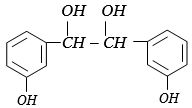
B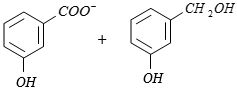
C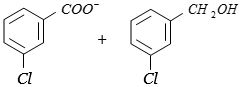
D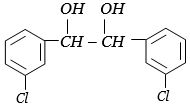
Solution
(B) The reaction of $m$-chlorobenzaldehyde with concentrated $KOH$ $(50\%)$ is a classic example of the Cannizzaro reaction.
Aldehydes that do not contain $\alpha$-hydrogen atoms undergo self-oxidation and reduction (disproportionation) in the presence of concentrated alkali.
$m$-chlorobenzaldehyde lacks $\alpha$-hydrogens,so it undergoes the Cannizzaro reaction to form $m$-chlorobenzoate and $m$-chlorobenzyl alcohol.
Aldehydes that do not contain $\alpha$-hydrogen atoms undergo self-oxidation and reduction (disproportionation) in the presence of concentrated alkali.
$m$-chlorobenzaldehyde lacks $\alpha$-hydrogens,so it undergoes the Cannizzaro reaction to form $m$-chlorobenzoate and $m$-chlorobenzyl alcohol.
0 likes
View Solution49
MediumMCQ
$A$ and $B$ in the following reactions are

A
$A = RR'C(CN)(OH), B = LiAlH_4$
B
$A = RR'C(OH)(COOH), B = NH_3$
C
$A = RR'C(CN)(OH), B = H_3O^+$
D
$A = RR'CH_2CN, B = NaOH$
Solution
(A) The reaction of a ketone $(RR'C=O)$ with $HCN$ in the presence of $KCN$ (catalyst) leads to the formation of a cyanohydrin,where $A = RR'C(OH)(CN)$.
Next,the reduction of the cyanohydrin $(RR'C(OH)(CN))$ using a strong reducing agent like $LiAlH_4$ reduces the nitrile group $(-CN)$ to a primary amine group $(-CH_2NH_2)$.
Therefore,$A = RR'C(OH)(CN)$ and $B = LiAlH_4$.
Next,the reduction of the cyanohydrin $(RR'C(OH)(CN))$ using a strong reducing agent like $LiAlH_4$ reduces the nitrile group $(-CN)$ to a primary amine group $(-CH_2NH_2)$.
Therefore,$A = RR'C(OH)(CN)$ and $B = LiAlH_4$.
0 likes
View Solution50
MediumMCQ
Reduction of aldehydes and ketones to hydrocarbons takes place in the presence of:
A
$Zn$ amalgam and $HCl$ acid
B
$Pd/BaSO_4$
C
Anhydrous $AlCl_3$
D
$Ni/Pt$
Solution
(A) The reduction of aldehydes and ketones to hydrocarbons is known as the $Clemmensen$ reduction.
In this reaction,the carbonyl group is reduced to a methylene group $(-CH_2-)$ using $Zn-Hg$ (zinc amalgam) and concentrated $HCl$.
In this reaction,the carbonyl group is reduced to a methylene group $(-CH_2-)$ using $Zn-Hg$ (zinc amalgam) and concentrated $HCl$.
0 likes
View Solution8-1.Aldehydes and Ketones — Properties · Frequently Asked Questions
1Are these 8-1.Aldehydes and Ketones questions useful for JEE and NEET?
Yes. All questions in this section are mapped to JEE Main and NEET exam patterns. Previous year questions from JEE Main, NEET, GUJCET and state-level exams are included with full solutions.
2Can I switch to Hindi or Gujarati for these questions?
Yes. Use the language tabs in the hero section or the sidebar to view the same questions and solutions in English, Hindi or Gujarati.
3How do I generate a question paper from this subtopic?
Use the Vedclass Exam Paper Generator — select the chapter and subtopic, set difficulty, and generate Sets A, B, C, D automatically. First 3 chapters of every subject are free.
Vedclass Products
For Students
Vedclass Test Series
Mock tests in real JEE/NEET style with performance analysis. 5-day free trial.
Start Free TrialFor Teachers
Exam Paper Generator
Generate Set A/B/C/D papers from this chapter in 2 minutes. 3 chapters free.
Try FreeFor Institutes
Online Exam Module
Live online exams with unlimited students, 360° analytics & white-label branding.
See DemoFor Teachers & Institutes
Generate a 8-1.Aldehydes and Ketones Exam Paper in 2 Minutes
Select subtopic & difficulty — Sets A, B, C, D auto-generated with No Repeat logic.
First 3 chapters of every subject are free — no payment required.