
A English
Properties Questions in English
Class 12 Chemistry · 8-1.Aldehydes and Ketones · Properties
1739+
Questions
English
Language
100%
With Solutions
Showing 50 of 1739 questions in English
451
DifficultMCQ
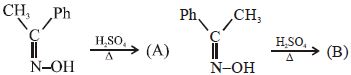
The products $(A)$ and $(B)$ respectively in the above reaction are:
A
$Ph-C(=O)-NH-CH_3, Ph-C(=O)-NH-CH_3$
B
$CH_3-C(=O)-NH-Ph, CH_3-C(=O)-NH-Ph$
C
$Ph-C(=O)-NH-CH_3, CH_3-C(=O)-NH-Ph$
D
$CH_3-C(=O)-NH-Ph, Ph-C(=O)-NH-CH_3$
Solution
(C) In the Beckmann rearrangement,the group anti to the $-OH$ group migrates to the nitrogen atom.
For the first reactant,the $Ph$ group is anti to the $-OH$ group,so it migrates to form $Ph-C(=O)-NH-CH_3$ as product $(A)$.
For the second reactant,the $CH_3$ group is anti to the $-OH$ group,so it migrates to form $CH_3-C(=O)-NH-Ph$ as product $(B)$.
Thus,the correct option is $(C)$.
For the first reactant,the $Ph$ group is anti to the $-OH$ group,so it migrates to form $Ph-C(=O)-NH-CH_3$ as product $(A)$.
For the second reactant,the $CH_3$ group is anti to the $-OH$ group,so it migrates to form $CH_3-C(=O)-NH-Ph$ as product $(B)$.
Thus,the correct option is $(C)$.
0 likes
View Solution452
MediumMCQ
$\text{Phthalic anhydride}$ $\xrightarrow {PCl_5} A$ $\xrightarrow {LiAlH_4} B$ $\xrightarrow {PCC} C$ $\xrightarrow [\Delta ] {OH^{-}} D$
Compound $D$ is :-
Compound $D$ is :-
A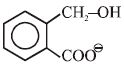
B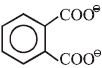
C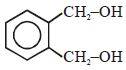
D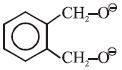
Solution
(A) $1$. Phthalic anhydride reacts with $PCl_5$ to form phthaloyl chloride $(A)$.
$2$. Phthaloyl chloride is reduced by $LiAlH_4$ to form benzene$-1,2-$dimethanol $(B)$.
$3$. Benzene$-1,2-$dimethanol is oxidized by $PCC$ to form phthalaldehyde $(C)$.
$4$. Phthalaldehyde undergoes an intramolecular Cannizzaro reaction in the presence of $OH^-$ and $\Delta$ to form the phthalide anion,which is the salt of $2-$(hydroxymethyl)benzoic acid $(D)$.
$2$. Phthaloyl chloride is reduced by $LiAlH_4$ to form benzene$-1,2-$dimethanol $(B)$.
$3$. Benzene$-1,2-$dimethanol is oxidized by $PCC$ to form phthalaldehyde $(C)$.
$4$. Phthalaldehyde undergoes an intramolecular Cannizzaro reaction in the presence of $OH^-$ and $\Delta$ to form the phthalide anion,which is the salt of $2-$(hydroxymethyl)benzoic acid $(D)$.
0 likes
View Solution453
MediumMCQ
Which is not true about acetophenone?
A
Reacts to form $2,4$-dinitrophenylhydrazine derivative
B
Reacts with Tollen's reagent to form silver mirror
C
Reacts with $I_2/NaOH$ to form iodoform
D
On oxidation with alkaline $KMnO_4$ followed by hydrolysis gives benzoic acid
Solution
(B) Acetophenone is a ketone $(C_6H_5COCH_3)$.
$1$. Ketones do not react with Tollen's reagent,so they do not form a silver mirror.
$2$. Acetophenone contains a methyl ketone group $(-COCH_3)$,so it gives a positive iodoform test with $I_2/NaOH$.
$3$. It reacts with $2,4$-dinitrophenylhydrazine to form a hydrazone derivative.
$4$. Oxidation of acetophenone with alkaline $KMnO_4$ followed by hydrolysis yields benzoic acid.
Therefore,the statement that it reacts with Tollen's reagent to form a silver mirror is false.
$1$. Ketones do not react with Tollen's reagent,so they do not form a silver mirror.
$2$. Acetophenone contains a methyl ketone group $(-COCH_3)$,so it gives a positive iodoform test with $I_2/NaOH$.
$3$. It reacts with $2,4$-dinitrophenylhydrazine to form a hydrazone derivative.
$4$. Oxidation of acetophenone with alkaline $KMnO_4$ followed by hydrolysis yields benzoic acid.
Therefore,the statement that it reacts with Tollen's reagent to form a silver mirror is false.
0 likes
View Solution454
DifficultMCQ
How many aldol products (excluding stereoisomers) are obtained in the given reaction?
$CH_3-CH_2-CHO + C_6H_5CHO \xrightarrow[0-5 \ ^{\circ}C]{OH^{\ominus}} ?$
$CH_3-CH_2-CHO + C_6H_5CHO \xrightarrow[0-5 \ ^{\circ}C]{OH^{\ominus}} ?$
A
$2$
B
$3$
C
$4$
D
$1$
Solution
(A) The reaction is a mixed aldol condensation between propanal $(CH_3CH_2CHO)$ and benzaldehyde $(C_6H_5CHO)$.
Propanal has $\alpha$-hydrogens,while benzaldehyde does not.
Possible products are:
$1$. Self-aldol of propanal: $CH_3CH_2CH(OH)CH(CH_3)CHO$.
$2$. Cross-aldol (propanal as nucleophile,benzaldehyde as electrophile): $C_6H_5CH(OH)CH(CH_3)CHO$.
Since benzaldehyde cannot form an enolate,it cannot act as a nucleophile,so no other cross-aldol or self-aldol products are formed.
Thus,there are $2$ aldol products obtained.
Propanal has $\alpha$-hydrogens,while benzaldehyde does not.
Possible products are:
$1$. Self-aldol of propanal: $CH_3CH_2CH(OH)CH(CH_3)CHO$.
$2$. Cross-aldol (propanal as nucleophile,benzaldehyde as electrophile): $C_6H_5CH(OH)CH(CH_3)CHO$.
Since benzaldehyde cannot form an enolate,it cannot act as a nucleophile,so no other cross-aldol or self-aldol products are formed.
Thus,there are $2$ aldol products obtained.
0 likes
View Solution455
MediumMCQ
$C_6H_5-CO-CHO$ $\xrightarrow{conc. OH^-} (A)$ $\xrightarrow{H_3O^+} (B)$ $\xrightarrow[2. NaOH/CaO/\Delta]{1. KMnO_4} (C)$
Product $(C)$ is:
Product $(C)$ is:
A
Benzene
B
Benzoic acid
C
Mandelic acid
D
Benzaldehyde
Solution
(A) $1$. The reaction of phenylglyoxal $(C_6H_5-CO-CHO)$ with concentrated $OH^-$ undergoes an intramolecular Cannizzaro reaction to form the mandelate ion $(A)$,which is $C_6H_5-CH(OH)-COO^-$.
$2$. Acidification with $H_3O^+$ yields mandelic acid $(B)$,which is $C_6H_5-CH(OH)-COOH$.
$3$. Oxidation with $KMnO_4$ cleaves the side chain to form benzoic acid $(C_6H_5-COOH)$.
$4$. Decarboxylation of benzoic acid with soda lime $(NaOH/CaO/\Delta)$ yields benzene $(C_6H_6)$.
$2$. Acidification with $H_3O^+$ yields mandelic acid $(B)$,which is $C_6H_5-CH(OH)-COOH$.
$3$. Oxidation with $KMnO_4$ cleaves the side chain to form benzoic acid $(C_6H_5-COOH)$.
$4$. Decarboxylation of benzoic acid with soda lime $(NaOH/CaO/\Delta)$ yields benzene $(C_6H_6)$.
0 likes
View Solution456
MediumMCQ
$CH_3CHO + HCHO \text{ (excess)} \xrightarrow{\text{Conc. } NaOH} \text{Product}$. The product is:
A
$CH_3-CH=CH-CHO$
B
$CH_2=CH-CHO$
C
$CH_3-CH(OH)-CHO$
D
$C(CH_2OH)_4$
Solution
(D) The reaction of acetaldehyde $(CH_3CHO)$ with excess formaldehyde $(HCHO)$ in the presence of concentrated $NaOH$ is a classic example of a sequence involving aldol condensation followed by a crossed Cannizzaro reaction.
$1$. Acetaldehyde has three $\alpha$-hydrogens. It undergoes three successive aldol additions with three molecules of formaldehyde to form $CH_3-C(CH_2OH)_3-CHO$.
$2$. This intermediate product,$CH_3-C(CH_2OH)_3-CHO$,has no $\alpha$-hydrogens remaining.
$3$. In the presence of excess formaldehyde and concentrated $NaOH$,this intermediate undergoes a crossed Cannizzaro reaction where the aldehyde group $(-CHO)$ is reduced to a primary alcohol $(-CH_2OH)$ and the formaldehyde is oxidized to sodium formate.
$4$. The final product is pentaerythritol,$C(CH_2OH)_4$.
$1$. Acetaldehyde has three $\alpha$-hydrogens. It undergoes three successive aldol additions with three molecules of formaldehyde to form $CH_3-C(CH_2OH)_3-CHO$.
$2$. This intermediate product,$CH_3-C(CH_2OH)_3-CHO$,has no $\alpha$-hydrogens remaining.
$3$. In the presence of excess formaldehyde and concentrated $NaOH$,this intermediate undergoes a crossed Cannizzaro reaction where the aldehyde group $(-CHO)$ is reduced to a primary alcohol $(-CH_2OH)$ and the formaldehyde is oxidized to sodium formate.
$4$. The final product is pentaerythritol,$C(CH_2OH)_4$.
0 likes
View Solution457
MediumMCQ
Which of the following cannot give a yellow $ppt.$ with $I_2/NaOH$?
A
Ethanol
B
Formaldehyde
C
Acetaldehyde
D
Acetone
Solution
(B) The iodoform test is given by compounds containing the $CH_3CO-$ group or the $CH_3CH(OH)-$ group.
$HCHO$ (Formaldehyde) does not contain either of these groups.
Therefore,$HCHO$ does not give a yellow precipitate of iodoform $(CHI_3)$ with $I_2/NaOH$.
$HCHO$ (Formaldehyde) does not contain either of these groups.
Therefore,$HCHO$ does not give a yellow precipitate of iodoform $(CHI_3)$ with $I_2/NaOH$.
0 likes
View Solution458
MediumMCQ
Which one of the following aldehydes will not form an aldol when treated with $dil. \, NaOH$?
A
$CH_3CHO$
B
$CH_3CH_2CHO$
C
$(CH_3)_3CCHO$
D
$C_6H_5CH_2CHO$
Solution
(C) Aldol condensation occurs in aldehydes or ketones that possess at least one $\alpha$-hydrogen atom.
$CH_3CHO$ has $3 \ \alpha$-hydrogens.
$CH_3CH_2CHO$ has $2 \ \alpha$-hydrogens.
$C_6H_5CH_2CHO$ has $2 \ \alpha$-hydrogens.
$(CH_3)_3CCHO$ (pivalaldehyde) has no $\alpha$-hydrogen atom because the $\alpha$-carbon is bonded to three methyl groups and the aldehyde group,leaving no valency for hydrogen.
Therefore,$(CH_3)_3CCHO$ will not undergo aldol condensation.
$CH_3CHO$ has $3 \ \alpha$-hydrogens.
$CH_3CH_2CHO$ has $2 \ \alpha$-hydrogens.
$C_6H_5CH_2CHO$ has $2 \ \alpha$-hydrogens.
$(CH_3)_3CCHO$ (pivalaldehyde) has no $\alpha$-hydrogen atom because the $\alpha$-carbon is bonded to three methyl groups and the aldehyde group,leaving no valency for hydrogen.
Therefore,$(CH_3)_3CCHO$ will not undergo aldol condensation.
0 likes
View Solution459
AdvancedMCQ
The product of the reaction is
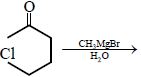
A
$2-$methylcyclohexanone
B
$1-$methylcyclohexanol
C
$2-$methyl$-1-$chlorocyclohexanol
D
$2,2-$dimethyltetrahydrofuran
Solution
(D) The starting material is $2$-chlorocyclohexanone. When it reacts with the Grignard reagent $CH_3MgBr$,the nucleophilic $CH_3^-$ group attacks the carbonyl carbon to form an intermediate alkoxide. Upon hydrolysis with $H_2O$,this forms $2$-chloro-$1$-methylcyclohexanol. Under the reaction conditions,an intramolecular nucleophilic substitution occurs where the hydroxyl oxygen attacks the carbon bearing the chlorine atom,leading to the elimination of $HCl$ and the formation of a cyclic ether,$2,2$-dimethyltetrahydrofuran (or a related bicyclic structure depending on the specific ring strain). Given the options,the final product is $2,2$-dimethyltetrahydrofuran.
0 likes
View Solution460
AdvancedMCQ
Among the aromatic isomers with the molecular formula $C_8H_8O$,one isomer $X$ gives the iodoform test,while another isomer $Y$ gives the Benedict's test. What are the structures of $X$ and $Y$ respectively?
A
$X = \text{Acetophenone}, Y = \text{Phenylacetaldehyde}$
B
$X = \text{Acetophenone}, Y = \text{Benzaldehyde}$
C
$X = o-\text{Methylbenzaldehyde}, Y = \text{Phenylacetaldehyde}$
D
$X = p-\text{Methylbenzaldehyde}, Y = \text{Acetophenone}$
Solution
(A) $1$. The molecular formula $C_8H_8O$ corresponds to several aromatic isomers.
$2$. The iodoform test is given by compounds containing the $CH_3CO-$ group or the $CH_3CH(OH)-$ group. Among the isomers of $C_8H_8O$,$Acetophenone$ $(C_6H_5COCH_3)$ contains the $CH_3CO-$ group and thus gives a positive iodoform test. Therefore,$X = \text{Acetophenone}$.
$3$. The Benedict's test is given by aldehydes. Among the isomers of $C_8H_8O$,$Phenylacetaldehyde$ $(C_6H_5CH_2CHO)$ is an aldehyde and gives a positive Benedict's test. Therefore,$Y = \text{Phenylacetaldehyde}$.
$4$. Thus,$X = \text{Acetophenone}$ and $Y = \text{Phenylacetaldehyde}$.
$2$. The iodoform test is given by compounds containing the $CH_3CO-$ group or the $CH_3CH(OH)-$ group. Among the isomers of $C_8H_8O$,$Acetophenone$ $(C_6H_5COCH_3)$ contains the $CH_3CO-$ group and thus gives a positive iodoform test. Therefore,$X = \text{Acetophenone}$.
$3$. The Benedict's test is given by aldehydes. Among the isomers of $C_8H_8O$,$Phenylacetaldehyde$ $(C_6H_5CH_2CHO)$ is an aldehyde and gives a positive Benedict's test. Therefore,$Y = \text{Phenylacetaldehyde}$.
$4$. Thus,$X = \text{Acetophenone}$ and $Y = \text{Phenylacetaldehyde}$.
0 likes
View Solution461
MediumMCQ
Which of the following can be used to differentiate pentan$-2-$one and pentan$-3-$one?
A
Iodoform test
B
$NaHSO_3$
C
Both $1$ & $2$
D
Tollen's reagent
Solution
(A) Pentan$-2-$one is a methyl ketone $(CH_3-CO-CH_2-CH_2-CH_3)$,which gives a positive iodoform test with $I_2$ and $NaOH$ to form a yellow precipitate of iodoform $(CHI_3)$.
Pentan$-3-$one $(CH_3-CH_2-CO-CH_2-CH_3)$ is not a methyl ketone and does not give the iodoform test.
Both ketones react with $NaHSO_3$ to form bisulfite addition products,so it cannot differentiate them.
Tollen's reagent is used to distinguish aldehydes from ketones,not between two ketones.
Therefore,the iodoform test is the correct method to differentiate these two compounds.
Pentan$-3-$one $(CH_3-CH_2-CO-CH_2-CH_3)$ is not a methyl ketone and does not give the iodoform test.
Both ketones react with $NaHSO_3$ to form bisulfite addition products,so it cannot differentiate them.
Tollen's reagent is used to distinguish aldehydes from ketones,not between two ketones.
Therefore,the iodoform test is the correct method to differentiate these two compounds.
0 likes
View Solution462
DifficultMCQ
How many aldol products are possible (excluding stereoisomers) for the following reaction?
$CH_3-CHO + CH_3-CH_2-CHO \xrightarrow{OH^-/H_2O}$
$CH_3-CHO + CH_3-CH_2-CHO \xrightarrow{OH^-/H_2O}$
A
$2$
B
$4$
C
$6$
D
$8$
Solution
(B) When two different aldehydes,both containing $\alpha$-hydrogen atoms,undergo aldol condensation,a mixture of $4$ products is formed. These include two self-aldol products and two cross-aldol products.
$1.$ Self-aldol of $CH_3CHO$: $CH_3-CH(OH)-CH_2-CHO$
$2.$ Self-aldol of $CH_3CH_2CHO$: $CH_3-CH_2-CH(OH)-CH(CH_3)-CHO$
$3.$ Cross-aldol (Ethanal as acceptor + Propanal as enolate): $CH_3-CH(OH)-CH(CH_3)-CHO$
$4.$ Cross-aldol (Propanal as acceptor + Ethanal as enolate): $CH_3-CH_2-CH(OH)-CH_2-CHO$.
$1.$ Self-aldol of $CH_3CHO$: $CH_3-CH(OH)-CH_2-CHO$
$2.$ Self-aldol of $CH_3CH_2CHO$: $CH_3-CH_2-CH(OH)-CH(CH_3)-CHO$
$3.$ Cross-aldol (Ethanal as acceptor + Propanal as enolate): $CH_3-CH(OH)-CH(CH_3)-CHO$
$4.$ Cross-aldol (Propanal as acceptor + Ethanal as enolate): $CH_3-CH_2-CH(OH)-CH_2-CHO$.
0 likes
View Solution463
AdvancedMCQ
Identify the reagents $P$ and $Q$ in the following reaction sequence:
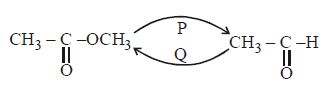
A
$DIBAL-H$ followed by $H_2O$ and $Al(OCH(CH_3)_2)_3$
B
$LiAlH_4$ followed by $H_2O$ and $Al(OCH_2CH_3)_3$
C
$DIBAL-H$ followed by $H_2O$ and $m-CPBA$ followed by $CH_3OH/H^{+}$
D
None of these
Solution
(A) The reaction sequence involves the conversion of an ester $(CH_3COOCH_3)$ to an aldehyde $(CH_3CHO)$ and vice versa.
$1$. For the conversion of ester to aldehyde $(P)$,$DIBAL-H$ (Diisobutylaluminium hydride) is the standard reagent used at low temperature $(-78^{\circ}C)$ followed by hydrolysis $(H_2O)$.
$2$. For the conversion of aldehyde to ester $(Q)$,the Tishchenko reaction is used. The Tishchenko reaction involves the disproportionation of an aldehyde to an ester in the presence of an alkoxide catalyst,such as aluminium isopropoxide,$Al(OCH(CH_3)_2)_3$.
$1$. For the conversion of ester to aldehyde $(P)$,$DIBAL-H$ (Diisobutylaluminium hydride) is the standard reagent used at low temperature $(-78^{\circ}C)$ followed by hydrolysis $(H_2O)$.
$2$. For the conversion of aldehyde to ester $(Q)$,the Tishchenko reaction is used. The Tishchenko reaction involves the disproportionation of an aldehyde to an ester in the presence of an alkoxide catalyst,such as aluminium isopropoxide,$Al(OCH(CH_3)_2)_3$.
0 likes
View Solution464
DifficultMCQ
$C_7H_6O$ is the molecular formula of $X$,which gives a negative Fehling test but a positive Tollen's test. $X$ $\xrightarrow[AcONa]{Ac_2O} Y$ $\xrightarrow[Me_2NH]{1. SOCl_2} Z$. The correct option is:
A
$X$ to $Y$ is called Claisen condensation
B
$Y$ is $Ph-CH=CH-COOH$
C
$Z$ is $Ph-CH=CH-CONMe_2$
D
$X$ is $Ph-CHO$
Solution
(B, D) $X$ is Benzaldehyde $(Ph-CHO)$ because it gives a positive Tollen's test but a negative Fehling test.
The reaction of Benzaldehyde with acetic anhydride in the presence of sodium acetate is the Perkin reaction,which produces Cinnamic acid $(Y)$: $Ph-CHO + (CH_3CO)_2O \xrightarrow{CH_3COONa} Ph-CH=CH-COOH$ $(Y)$.
Then,$Ph-CH=CH-COOH$ $\xrightarrow{SOCl_2} Ph-CH=CH-COCl$ $\xrightarrow{Me_2NH} Ph-CH=CH-CON(CH_3)_2$ $(Z)$.
Thus,options $B$ and $D$ are correct.
The reaction of Benzaldehyde with acetic anhydride in the presence of sodium acetate is the Perkin reaction,which produces Cinnamic acid $(Y)$: $Ph-CHO + (CH_3CO)_2O \xrightarrow{CH_3COONa} Ph-CH=CH-COOH$ $(Y)$.
Then,$Ph-CH=CH-COOH$ $\xrightarrow{SOCl_2} Ph-CH=CH-COCl$ $\xrightarrow{Me_2NH} Ph-CH=CH-CON(CH_3)_2$ $(Z)$.
Thus,options $B$ and $D$ are correct.
0 likes
View Solution465
MediumMCQ
$n$-hexane $\xrightarrow{Al_2O_3/\Delta} (A)$ $\xrightarrow{(CO + HCl)/AlCl_3} (B)$. Select the incorrect statement among the following:
A
Compound $B$ forms a silver mirror on reaction with $[Ag(NH_3)_2]OH$.
B
Molecularity of reaction during conversion from $A$ to $B$ is $3$.
C
Compound $A$ can also be synthesized by the reaction of benzene diazonium chloride with $H_3PO_2$.
D
Compound $B$ gives a grey color with aqueous $HgCl_2$ solution.
Solution
(A) $1$. $n$-hexane undergoes aromatization in the presence of $Al_2O_3/\Delta$ to form benzene $(A)$.
$2$. Benzene $(A)$ reacts with $CO + HCl$ in the presence of $AlCl_3$ (Gattermann-Koch reaction) to form benzaldehyde $(B)$.
$3$. Statement $A$: Benzaldehyde $(B)$ does not form a silver mirror with Tollen's reagent $([Ag(NH_3)_2]OH)$ because it is an aromatic aldehyde and does not reduce it under standard conditions.
$4$. Statement $B$: The Gattermann-Koch reaction involves $CO$ and $HCl$ forming $HCOCl$ in situ,which reacts with $AlCl_3$ to form the formyl cation $(HCO^+)$. The reaction mechanism is bimolecular $(A + E^+)$,not trimolecular.
$5$. Statement $C$: Benzene diazonium chloride reacts with $H_3PO_2$ and $H_2O$ to form benzene $(A)$. This is correct.
$6$. Statement $D$: Benzaldehyde does not give a grey color with $HgCl_2$ (which is a test for formic acid or specific reducing agents).
$7$. The question asks for the incorrect statement. Both $A$ and $B$ are technically incorrect,but in the context of standard chemistry problems,$A$ is the most commonly cited incorrect property.
$2$. Benzene $(A)$ reacts with $CO + HCl$ in the presence of $AlCl_3$ (Gattermann-Koch reaction) to form benzaldehyde $(B)$.
$3$. Statement $A$: Benzaldehyde $(B)$ does not form a silver mirror with Tollen's reagent $([Ag(NH_3)_2]OH)$ because it is an aromatic aldehyde and does not reduce it under standard conditions.
$4$. Statement $B$: The Gattermann-Koch reaction involves $CO$ and $HCl$ forming $HCOCl$ in situ,which reacts with $AlCl_3$ to form the formyl cation $(HCO^+)$. The reaction mechanism is bimolecular $(A + E^+)$,not trimolecular.
$5$. Statement $C$: Benzene diazonium chloride reacts with $H_3PO_2$ and $H_2O$ to form benzene $(A)$. This is correct.
$6$. Statement $D$: Benzaldehyde does not give a grey color with $HgCl_2$ (which is a test for formic acid or specific reducing agents).
$7$. The question asks for the incorrect statement. Both $A$ and $B$ are technically incorrect,but in the context of standard chemistry problems,$A$ is the most commonly cited incorrect property.
0 likes
View Solution466
DifficultMCQ
Identify compound $B$ in the following reaction sequence:
Cyclopentanone $+ H_2NOH$ $\xrightarrow{pH = 4.5, \Delta} (A)$ $\xrightarrow{H^+ / \Delta} (B)$
Cyclopentanone $+ H_2NOH$ $\xrightarrow{pH = 4.5, \Delta} (A)$ $\xrightarrow{H^+ / \Delta} (B)$
A
Dicyclopentylidene
B
Cyclopentanone oxime
C
$1-$Aminocyclopentene
D
Piperidin$-2-$one
Solution
(D) $1$. The reaction of cyclopentanone with hydroxylamine $(H_2NOH)$ at $pH = 4.5$ is a nucleophilic addition-elimination reaction that forms an oxime,which is compound $(A)$.
$2$. Compound $(A)$ is cyclopentanone oxime.
$3$. When cyclopentanone oxime $(A)$ is treated with an acid catalyst $(H^+ / \Delta)$,it undergoes the Beckmann rearrangement.
$4$. The Beckmann rearrangement of a cyclic oxime results in the expansion of the ring by inserting a nitrogen atom,forming a cyclic amide (lactam).
$5$. For cyclopentanone oxime,the ring expansion leads to the formation of a six-membered lactam,which is piperidin$-2-$one (also known as $\delta$-valerolactam),which is compound $(B)$.
$2$. Compound $(A)$ is cyclopentanone oxime.
$3$. When cyclopentanone oxime $(A)$ is treated with an acid catalyst $(H^+ / \Delta)$,it undergoes the Beckmann rearrangement.
$4$. The Beckmann rearrangement of a cyclic oxime results in the expansion of the ring by inserting a nitrogen atom,forming a cyclic amide (lactam).
$5$. For cyclopentanone oxime,the ring expansion leads to the formation of a six-membered lactam,which is piperidin$-2-$one (also known as $\delta$-valerolactam),which is compound $(B)$.
0 likes
View Solution467
AdvancedMCQ
Organic products $A$ and $B$ are respectively -
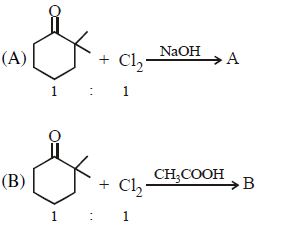
A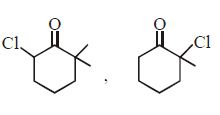
B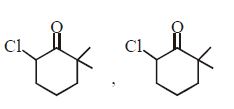
C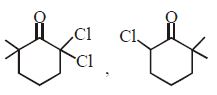
D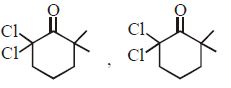
Solution
(B) In reaction $(A)$,$2$-methylcyclohexanone reacts with $Cl_2$ in the presence of a base $(NaOH)$. Base-catalyzed halogenation of ketones proceeds via the formation of an enolate ion. The enolate forms at the less substituted $\alpha$-carbon (the one with more hydrogen atoms) to minimize steric hindrance. Thus,chlorination occurs at the $C-6$ position,yielding $6$-chloro-$2$-methylcyclohexanone.
In reaction $(B)$,$2$-methylcyclohexanone reacts with $Cl_2$ in the presence of an acid $(CH_3COOH)$. Acid-catalyzed halogenation proceeds via the formation of an enol. The more substituted enol is more stable (Zaitsev's rule),which forms at the more substituted $\alpha$-carbon (the $C-2$ position). However,since the $C-2$ position is already substituted with a methyl group,the enolization occurs at the $C-6$ position. Wait,let's re-evaluate: for $2$-methylcyclohexanone,the $C-2$ position has one methyl group and one hydrogen. The $C-6$ position has two hydrogens. Acid-catalyzed halogenation typically occurs at the more substituted $\alpha$-carbon. Since $C-2$ has one hydrogen and $C-6$ has two,the enol forms at $C-2$. But $C-2$ is already substituted. Actually,for $2$-methylcyclohexanone,acid-catalyzed chlorination occurs at the $C-6$ position because the $C-2$ position is sterically hindered. Therefore,both reactions yield $6$-chloro-$2$-methylcyclohexanone as the major product. Looking at the options,option $B$ shows $6$-chloro-$2$-methylcyclohexanone for both,which is the correct chemical outcome.
In reaction $(B)$,$2$-methylcyclohexanone reacts with $Cl_2$ in the presence of an acid $(CH_3COOH)$. Acid-catalyzed halogenation proceeds via the formation of an enol. The more substituted enol is more stable (Zaitsev's rule),which forms at the more substituted $\alpha$-carbon (the $C-2$ position). However,since the $C-2$ position is already substituted with a methyl group,the enolization occurs at the $C-6$ position. Wait,let's re-evaluate: for $2$-methylcyclohexanone,the $C-2$ position has one methyl group and one hydrogen. The $C-6$ position has two hydrogens. Acid-catalyzed halogenation typically occurs at the more substituted $\alpha$-carbon. Since $C-2$ has one hydrogen and $C-6$ has two,the enol forms at $C-2$. But $C-2$ is already substituted. Actually,for $2$-methylcyclohexanone,acid-catalyzed chlorination occurs at the $C-6$ position because the $C-2$ position is sterically hindered. Therefore,both reactions yield $6$-chloro-$2$-methylcyclohexanone as the major product. Looking at the options,option $B$ shows $6$-chloro-$2$-methylcyclohexanone for both,which is the correct chemical outcome.
0 likes
View Solution468
DifficultMCQ
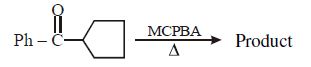
Which of the following represents the major product for the given reaction?
A
$Ph-COOH$
B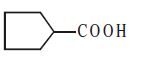
C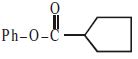
D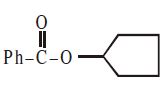
Solution
(D) The reaction of a ketone with a peroxyacid $(MCPBA)$ is known as the Baeyer-Villiger oxidation.
In this reaction,an oxygen atom is inserted next to the carbonyl group to form an ester.
The migratory aptitude of groups in the Baeyer-Villiger oxidation follows the order: $3^o \text{ alkyl} > \text{cyclohexyl} > \text{phenyl} > 2^o \text{ alkyl} > 1^o \text{ alkyl} > \text{methyl}$.
In the given reactant,$Ph-C(=O)-Cy$ (where $Cy$ is a cyclohexyl group),the cyclohexyl group has a higher migratory aptitude than the phenyl group.
Therefore,the oxygen atom inserts between the carbonyl carbon and the cyclohexyl group,resulting in the formation of phenyl cyclohexanecarboxylate $(Ph-C(=O)-O-Cy)$.
In this reaction,an oxygen atom is inserted next to the carbonyl group to form an ester.
The migratory aptitude of groups in the Baeyer-Villiger oxidation follows the order: $3^o \text{ alkyl} > \text{cyclohexyl} > \text{phenyl} > 2^o \text{ alkyl} > 1^o \text{ alkyl} > \text{methyl}$.
In the given reactant,$Ph-C(=O)-Cy$ (where $Cy$ is a cyclohexyl group),the cyclohexyl group has a higher migratory aptitude than the phenyl group.
Therefore,the oxygen atom inserts between the carbonyl carbon and the cyclohexyl group,resulting in the formation of phenyl cyclohexanecarboxylate $(Ph-C(=O)-O-Cy)$.
0 likes
View Solution469
DifficultMCQ
Which of the following will give $-ve$ Tollen's but $+ve$ Iodoform test?
A
$HCHO$
B
$CH_3CHO$
C
$CH_3COCH_2COCH_3$
D
$CH_3CH_2COCH_2CH_3$
0 likes
View Solution470
DifficultMCQ
Identify the correct statement regarding the following sequence of reactions:
$3\text{-methylbut-1-ene}$ $\xrightarrow[(ii) NaBH_4]{(i) Hg(OCOCH_3)_2/H_2O} A$ $\xrightarrow{\Delta, H_2SO_4} B (\text{major alkene})$ $\xrightarrow{O_3/Zn} C + D$
$3\text{-methylbut-1-ene}$ $\xrightarrow[(ii) NaBH_4]{(i) Hg(OCOCH_3)_2/H_2O} A$ $\xrightarrow{\Delta, H_2SO_4} B (\text{major alkene})$ $\xrightarrow{O_3/Zn} C + D$
A
$A$ gives immediate turbidity with Lucas reagent.
B
Total possible isomers of $B$ is $10$.
C
Product $C$ and $D$ both give negative Iodoform test.
D
Product $C$ and $D$ both form crystals with $NaHSO_3$ (positive $NaHSO_3$ test).
Solution
(D) $1$. The reaction of $3\text{-methylbut-1-ene}$ with $Hg(OCOCH_3)_2/H_2O$ followed by $NaBH_4$ is oxymercuration-demercuration,which follows Markovnikov's rule to give $A = 3\text{-methylbutan-2-ol}$.
$2$. Dehydration of $3\text{-methylbutan-2-ol}$ with $H_2SO_4/\Delta$ gives the major alkene $B = 2\text{-methylbut-2-ene}$ via carbocation rearrangement.
$3$. Ozonolysis of $2\text{-methylbut-2-ene}$ $(CH_3-C(CH_3)=CH-CH_3)$ gives $C = \text{acetone} (CH_3COCH_3)$ and $D = \text{acetaldehyde} (CH_3CHO)$.
$4$. Both acetone and acetaldehyde are carbonyl compounds (ketone and aldehyde) and thus give a positive $NaHSO_3$ test (forming crystalline bisulfite addition products).
$5$. Acetone gives a positive Iodoform test,while acetaldehyde also gives a positive Iodoform test. Thus,option $D$ is the correct statement.
$2$. Dehydration of $3\text{-methylbutan-2-ol}$ with $H_2SO_4/\Delta$ gives the major alkene $B = 2\text{-methylbut-2-ene}$ via carbocation rearrangement.
$3$. Ozonolysis of $2\text{-methylbut-2-ene}$ $(CH_3-C(CH_3)=CH-CH_3)$ gives $C = \text{acetone} (CH_3COCH_3)$ and $D = \text{acetaldehyde} (CH_3CHO)$.
$4$. Both acetone and acetaldehyde are carbonyl compounds (ketone and aldehyde) and thus give a positive $NaHSO_3$ test (forming crystalline bisulfite addition products).
$5$. Acetone gives a positive Iodoform test,while acetaldehyde also gives a positive Iodoform test. Thus,option $D$ is the correct statement.
0 likes
View Solution471
DifficultMCQ
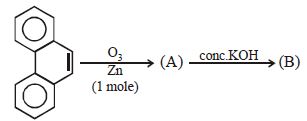
The end product $(B)$ of the above reaction is:
A
$2$,$2$'-diformylbiphenyl
B
$2-$carboxy-$2$'-hydroxymethylbiphenyl potassium salt
C
$2$,$2$'-bis(hydroxymethyl)biphenyl
D
$2$,$2$'-dicarboxylbiphenyl dipotassium salt
0 likes
View Solution472
AdvancedMCQ
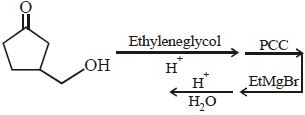
Give the product from the following reaction sequence:
A
$3-$ethyl$-3-$hydroxycyclopentan$-1-$ol
B
$3-$oxocyclopentane$-1-$carbaldehyde
C
$3-$ethylcyclopentan$-1-$one
D
$3-$($1$-hydroxypropyl)cyclopentan$-1-$one
Solution
(D) The starting material is $3$-(hydroxymethyl)cyclopentan-$1$-one.
$1$. The reaction with ethylene glycol in the presence of $H^+$ forms a cyclic acetal (protecting group) at the ketone position,yielding $3$-(hydroxymethyl)cyclopentan-$1$-one ethylene acetal.
$2$. Treatment with $PCC$ (Pyridinium chlorochromate) oxidizes the primary alcohol group $(-CH_2OH)$ to an aldehyde group $(-CHO)$,resulting in $3$-oxocyclopentane-$1$-carbaldehyde ethylene acetal.
$3$. Addition of $EtMgBr$ (Grignard reagent) followed by $H_3O^+$ workup attacks the aldehyde carbonyl,converting it into a secondary alcohol,and simultaneously deprotects the cyclic acetal back to the ketone.
$4$. The final product is $3$-($1$-hydroxypropyl)cyclopentan-$1$-one.
$1$. The reaction with ethylene glycol in the presence of $H^+$ forms a cyclic acetal (protecting group) at the ketone position,yielding $3$-(hydroxymethyl)cyclopentan-$1$-one ethylene acetal.
$2$. Treatment with $PCC$ (Pyridinium chlorochromate) oxidizes the primary alcohol group $(-CH_2OH)$ to an aldehyde group $(-CHO)$,resulting in $3$-oxocyclopentane-$1$-carbaldehyde ethylene acetal.
$3$. Addition of $EtMgBr$ (Grignard reagent) followed by $H_3O^+$ workup attacks the aldehyde carbonyl,converting it into a secondary alcohol,and simultaneously deprotects the cyclic acetal back to the ketone.
$4$. The final product is $3$-($1$-hydroxypropyl)cyclopentan-$1$-one.
0 likes
View Solution473
AdvancedMCQ
The product of the reaction is:

A
$HO-(CH_2)_3-C(=O)-(CH_2)_2CH_3$
B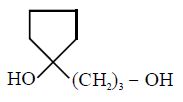
C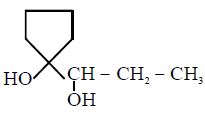
D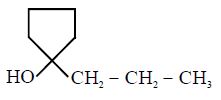
Solution
(B) The reaction involves the nucleophilic attack of the Grignard reagent $ClMg(CH_2)_4MgCl$ on the carbonyl group of the cyclic ester (lactone),$\gamma$-butyrolactone.
$1$. The Grignard reagent acts as a nucleophile,attacking the carbonyl carbon of the lactone.
$2$. The ring opens,and after acidic workup $(H_3O^+)$,the product formed is a diol.
$3$. Specifically,the reaction of $\gamma$-butyrolactone with a bifunctional Grignard reagent like $ClMg(CH_2)_4MgCl$ leads to the formation of a diol where the chain is extended.
$4$. The structure corresponding to the product is a cyclopentane ring substituted with a hydroxy group and a hydroxypropyl chain,which matches the structure shown in option $B$.
$1$. The Grignard reagent acts as a nucleophile,attacking the carbonyl carbon of the lactone.
$2$. The ring opens,and after acidic workup $(H_3O^+)$,the product formed is a diol.
$3$. Specifically,the reaction of $\gamma$-butyrolactone with a bifunctional Grignard reagent like $ClMg(CH_2)_4MgCl$ leads to the formation of a diol where the chain is extended.
$4$. The structure corresponding to the product is a cyclopentane ring substituted with a hydroxy group and a hydroxypropyl chain,which matches the structure shown in option $B$.
0 likes
View Solution474
MediumMCQ
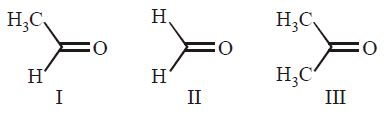
The rate of hydrate formation for the given compounds is:
A
$I > II > III$
B
$III > II > I$
C
$II > I > III$
D
$III > I > II$
Solution
(C) The rate of hydrate formation depends on the electrophilicity of the carbonyl carbon.
Greater electrophilicity leads to a faster rate of nucleophilic addition.
Electrophilicity is decreased by electron-donating groups (like $-CH_3$) and increased by steric hindrance reduction.
Compound $II$ is formaldehyde $(HCHO)$,which has no electron-donating groups and minimal steric hindrance.
Compound $I$ is acetaldehyde $(CH_3CHO)$,which has one electron-donating methyl group.
Compound $III$ is acetone $((CH_3)_2CO)$,which has two electron-donating methyl groups and greater steric hindrance.
Therefore,the order of reactivity is $II > I > III$.
Greater electrophilicity leads to a faster rate of nucleophilic addition.
Electrophilicity is decreased by electron-donating groups (like $-CH_3$) and increased by steric hindrance reduction.
Compound $II$ is formaldehyde $(HCHO)$,which has no electron-donating groups and minimal steric hindrance.
Compound $I$ is acetaldehyde $(CH_3CHO)$,which has one electron-donating methyl group.
Compound $III$ is acetone $((CH_3)_2CO)$,which has two electron-donating methyl groups and greater steric hindrance.
Therefore,the order of reactivity is $II > I > III$.
0 likes
View Solution475
DifficultMCQ
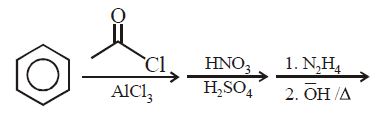
The final product of the given reaction is?
A
$3-$ethylaniline
B
$1-$ethyl$-3-$nitrobenzene
C
$3-$nitroacetophenone
D
$1-$ethyl$-4-$nitrobenzene
0 likes
View Solution476
DifficultMCQ
Arrange these compounds in decreasing order of reactivity for the nucleophilic addition reaction :
$I.$ Acid chloride $II.$ Aldehyde
$III.$ Ketone $IV.$ Ester
Select the correct answer from the codes given below :
$I.$ Acid chloride $II.$ Aldehyde
$III.$ Ketone $IV.$ Ester
Select the correct answer from the codes given below :
A
$I > II > III > IV$
B
$IV > III > II > I$
C
$III > II > I > IV$
D
$I > IV > II > III$
Solution
(A) The reactivity of carbonyl compounds towards nucleophilic addition depends on the electrophilicity of the carbonyl carbon.
$1.$ Acid chloride $(RCOCl)$: The highly electronegative chlorine atom exerts a strong $-I$ effect,significantly increasing the electrophilicity of the carbonyl carbon.
$2.$ Aldehyde $(RCHO)$: Has one alkyl group which is electron-donating ($+I$ effect),making it less reactive than acid chloride.
$3.$ Ketone $(RCOR)$: Has two alkyl groups,which increase electron density on the carbonyl carbon more than in an aldehyde,reducing its electrophilicity.
$4.$ Ester $(RCOOR')$: The alkoxy group $(-OR')$ shows a $+M$ effect (resonance),which donates electron density to the carbonyl carbon,making it the least reactive towards nucleophilic addition.
Thus,the decreasing order of reactivity is $I > II > III > IV$.
The correct option is $A$.
$1.$ Acid chloride $(RCOCl)$: The highly electronegative chlorine atom exerts a strong $-I$ effect,significantly increasing the electrophilicity of the carbonyl carbon.
$2.$ Aldehyde $(RCHO)$: Has one alkyl group which is electron-donating ($+I$ effect),making it less reactive than acid chloride.
$3.$ Ketone $(RCOR)$: Has two alkyl groups,which increase electron density on the carbonyl carbon more than in an aldehyde,reducing its electrophilicity.
$4.$ Ester $(RCOOR')$: The alkoxy group $(-OR')$ shows a $+M$ effect (resonance),which donates electron density to the carbonyl carbon,making it the least reactive towards nucleophilic addition.
Thus,the decreasing order of reactivity is $I > II > III > IV$.
The correct option is $A$.
0 likes
View Solution477
DifficultMCQ
Acetal or ketal is:
A
Vic-dialkoxy compound
B
$\alpha , \omega$-dialkoxy compound
C
$\alpha$-alkoxy alcohol
D
Gem-dialkoxy compound
Solution
(D) An acetal or ketal is a gem-dialkoxy compound because two alkoxy groups are present on the same carbon atom.
For example,in an acetal,the structure is $R-CH(OR')_2$,where two alkoxy groups $(-OR')$ are attached to the same carbon atom.
For example,in an acetal,the structure is $R-CH(OR')_2$,where two alkoxy groups $(-OR')$ are attached to the same carbon atom.
0 likes
View Solution478
AdvancedMCQ
In the given reaction $CH_3-CH_2-C(=O)-CH_2-COOC_2H_5$ $\xrightarrow{[X]} (A)$ $\xrightarrow{(i) LiAlH_4, (ii) H_2O/H^{+}} CH_3-CH_2-C(=O)-CH_2-CH_2OH + C_2H_5OH$,$[X]$ will be:
A
$HCHO$
B
$HO-CH_2-CH_2-OH + H^{+}$
C
$HO-CH_2-CH_2-OH + OH^{-}$
D
$HCN$
Solution
(B) The starting material contains both a ketone and an ester group.
$LiAlH_4$ is a strong reducing agent that reduces both groups.
To selectively reduce the ester group to an alcohol while keeping the ketone group intact,the ketone must first be protected as a cyclic ketal using ethylene glycol $(HO-CH_2-CH_2-OH)$ in the presence of an acid catalyst $(H^{+})$.
The subsequent acidic workup $((ii) H_2O/H^{+})$ after reduction removes the protecting group and restores the ketone functionality.
$LiAlH_4$ is a strong reducing agent that reduces both groups.
To selectively reduce the ester group to an alcohol while keeping the ketone group intact,the ketone must first be protected as a cyclic ketal using ethylene glycol $(HO-CH_2-CH_2-OH)$ in the presence of an acid catalyst $(H^{+})$.
The subsequent acidic workup $((ii) H_2O/H^{+})$ after reduction removes the protecting group and restores the ketone functionality.
0 likes
View Solution479
DifficultMCQ
Schiff's base is prepared from:
A
Carbonyl compound and primary amine
B
Carbonyl compound and secondary amine
C
Carbonyl compound and tertiary amine
D
All of these
Solution
(A) Carbonyl compounds react with primary amines to form substituted imines,which are known as Schiff's bases.
The general reaction is:
$R_2C=O + R'-NH_2 \xrightarrow{H^+} R_2C=N-R' + H_2O$
The general reaction is:
$R_2C=O + R'-NH_2 \xrightarrow{H^+} R_2C=N-R' + H_2O$
0 likes
View Solution480
MediumMCQ
Schiff's reagent is used for the differentiation between:
A
$HCHO$ and $CH_3CHO$
B
$CH_3COCH_3$ and $CH_3CHO$
C
$C_6H_5CH_2COCH_3$ and $C_6H_5COCH_2CH_3$
D
$HCHO$ and $C_6H_5CHO$
Solution
(B) Schiff's reagent is a diagnostic test used to distinguish between aldehydes and ketones.
Aldehydes react with Schiff's reagent to restore its pink/magenta color.
Ketones generally do not react with Schiff's reagent.
In option $(b)$,$CH_3CHO$ (acetaldehyde) is an aldehyde,while $CH_3COCH_3$ (acetone) is a ketone.
Therefore,Schiff's reagent can be used to differentiate between them.
Aldehydes react with Schiff's reagent to restore its pink/magenta color.
Ketones generally do not react with Schiff's reagent.
In option $(b)$,$CH_3CHO$ (acetaldehyde) is an aldehyde,while $CH_3COCH_3$ (acetone) is a ketone.
Therefore,Schiff's reagent can be used to differentiate between them.
0 likes
View Solution481
AdvancedMCQ
Which one of the following compounds will give dimethyl glyoxal with $SeO_2$?
A
Acetone
B
Acetophenone
C
Ethyl methyl ketone
D
Propanaldehyde
Solution
(C) $SeO_2$ (selenium dioxide) is an oxidizing agent that specifically oxidizes the $CH_2$ group adjacent to a carbonyl group to a $CO$ group,forming a $1,2-$dicarbonyl compound.
Ethyl methyl ketone $(CH_3-CO-CH_2-CH_3)$ reacts with $SeO_2$ to form dimethyl glyoxal $(CH_3-CO-CO-CH_3)$.
Ethyl methyl ketone $(CH_3-CO-CH_2-CH_3)$ reacts with $SeO_2$ to form dimethyl glyoxal $(CH_3-CO-CO-CH_3)$.
0 likes
View Solution482
AdvancedMCQ
Consider the given reaction:
$CH_3-CO-CH_3 \xrightarrow{C_6H_5COOOH} CH_3-COO-CH_3$
The above reaction is known as:
$CH_3-CO-CH_3 \xrightarrow{C_6H_5COOOH} CH_3-COO-CH_3$
The above reaction is known as:
A
Baeyer-Villiger oxidation
B
Oppenauer oxidation
C
Periodate oxidation
D
Peroxide oxidation
Solution
(A) The reaction of a ketone with a peroxyacid (such as $C_6H_5COOOH$) to form an ester is known as the Baeyer-Villiger oxidation.
In this reaction,an oxygen atom is inserted between the carbonyl carbon and an adjacent carbon atom.
In this reaction,an oxygen atom is inserted between the carbonyl carbon and an adjacent carbon atom.
0 likes
View Solution483
DifficultMCQ
Acetone can be converted into pinacol by:
A
$Mg/Hg/H_2O$
B
$Zn/Hg/HCl$
C
$Na/Hg/H_2SO_4$
D
All of these
Solution
(A) The reduction of acetone to pinacol is a bimolecular reduction reaction known as the pinacol coupling reaction.
This reaction is typically carried out using a magnesium-mercury amalgam $(Mg/Hg)$ in the presence of water.
The reaction involves the coupling of two acetone molecules to form $2,3-dimethylbutane-2,3-diol$,commonly known as pinacol.
Therefore,the correct reagent is $Mg/Hg/H_2O$.
This reaction is typically carried out using a magnesium-mercury amalgam $(Mg/Hg)$ in the presence of water.
The reaction involves the coupling of two acetone molecules to form $2,3-dimethylbutane-2,3-diol$,commonly known as pinacol.
Therefore,the correct reagent is $Mg/Hg/H_2O$.
0 likes
View Solution484
AdvancedMCQ
In the given reaction $X + Y \xrightarrow[5^\circ C]{NaOH} CH_3-CH(OH)-CH(CH_3)-CHO$,$(X)$ and $(Y)$ will respectively be:
A
$CH_3-CH_2-CHO$ and $CH_3-CH_2-CHO$
B
$CH_3-CHO$ and $CH_3-CH_2-CHO$
C
$CH_3-CHO$ and $CH_3-CHO$
D
$CH_3-CHO$ and $CH_3-C(CH_3)_2-CHO$
Solution
(B) The product $CH_3-CH(OH)-CH(CH_3)-CHO$ is $3$-hydroxy-$2$-methylbutanal.
This is a cross-aldol condensation product.
In this reaction,the enolate ion formed from propanal $(CH_3-CH_2-CHO)$ acts as the nucleophile and attacks the carbonyl carbon of acetaldehyde $(CH_3-CHO)$.
Thus,$(X)$ is $CH_3-CHO$ and $(Y)$ is $CH_3-CH_2-CHO$.
This is a cross-aldol condensation product.
In this reaction,the enolate ion formed from propanal $(CH_3-CH_2-CHO)$ acts as the nucleophile and attacks the carbonyl carbon of acetaldehyde $(CH_3-CHO)$.
Thus,$(X)$ is $CH_3-CHO$ and $(Y)$ is $CH_3-CH_2-CHO$.
0 likes
View Solution485
AdvancedMCQ
Number of products in the given reaction:
$C_6H_5CHO + CH_3CHO \xrightarrow{OH^-} \text{Product}$
will be
$C_6H_5CHO + CH_3CHO \xrightarrow{OH^-} \text{Product}$
will be
A
$1$
B
$3$
C
$2$
D
$4$
Solution
(D) The given reaction is a cross-aldol condensation between benzaldehyde $(C_6H_5CHO)$ and acetaldehyde $(CH_3CHO)$.
Since both carbonyl compounds have $\alpha$-hydrogens (only acetaldehyde has $\alpha$-hydrogens,benzaldehyde does not),the reaction can proceed in the following ways:
$1$. Self-aldol condensation of acetaldehyde ($2$ molecules of $CH_3CHO$ react).
$2$. Cross-aldol condensation ($1$ molecule of $C_6H_5CHO$ and $1$ molecule of $CH_3CHO$ react).
Since benzaldehyde cannot undergo self-aldol condensation due to the absence of $\alpha$-hydrogens,there are $2$ possible aldol products formed (one from self-condensation of acetaldehyde and one from cross-condensation). However,if we consider the dehydration products (aldol condensation products),there are $4$ potential products: $2$ $\beta$-hydroxy aldehydes and $2$ $\alpha,\beta$-unsaturated aldehydes. In standard chemistry problems of this type,the total number of products including both aldol and condensation products is considered to be $4$.
Since both carbonyl compounds have $\alpha$-hydrogens (only acetaldehyde has $\alpha$-hydrogens,benzaldehyde does not),the reaction can proceed in the following ways:
$1$. Self-aldol condensation of acetaldehyde ($2$ molecules of $CH_3CHO$ react).
$2$. Cross-aldol condensation ($1$ molecule of $C_6H_5CHO$ and $1$ molecule of $CH_3CHO$ react).
Since benzaldehyde cannot undergo self-aldol condensation due to the absence of $\alpha$-hydrogens,there are $2$ possible aldol products formed (one from self-condensation of acetaldehyde and one from cross-condensation). However,if we consider the dehydration products (aldol condensation products),there are $4$ potential products: $2$ $\beta$-hydroxy aldehydes and $2$ $\alpha,\beta$-unsaturated aldehydes. In standard chemistry problems of this type,the total number of products including both aldol and condensation products is considered to be $4$.
0 likes
View Solution486
AdvancedMCQ
In the reaction,$[X]$ will be:

A
$2-$($1$-hydroxycyclohexyl)cyclohexanone
B
$1$,$1$'-dihydroxy-$1$,$1$'-bicyclohexyl
C
$2-$hydroxy-$2$'-cyclohexylcyclohexanone
D
$2-$cyclohexylidenecyclohexanone
Solution
(D) The given reaction is an aldol condensation of cyclohexanone in the presence of a base $(\text{OH}^-)$ and heat $(\Delta)$.
$1$. Two molecules of cyclohexanone undergo self-aldol condensation to form $\beta$-hydroxy ketone (aldol product).
$2$. Under heating $(\Delta)$,the aldol product undergoes dehydration to form an $\alpha,\beta$-unsaturated ketone.
$3$. The initial aldol product is $2-(1-\text{hydroxycyclohexyl})\text{cyclohexanone}$.
$4$. Upon heating,it loses a water molecule to form $2-\text{cyclohexylidenecyclohexanone}$.
$5$. Since the reaction includes heating $(\Delta)$,the final product $[X]$ is the dehydrated product,$2-\text{cyclohexylidenecyclohexanone}$.
$1$. Two molecules of cyclohexanone undergo self-aldol condensation to form $\beta$-hydroxy ketone (aldol product).
$2$. Under heating $(\Delta)$,the aldol product undergoes dehydration to form an $\alpha,\beta$-unsaturated ketone.
$3$. The initial aldol product is $2-(1-\text{hydroxycyclohexyl})\text{cyclohexanone}$.
$4$. Upon heating,it loses a water molecule to form $2-\text{cyclohexylidenecyclohexanone}$.
$5$. Since the reaction includes heating $(\Delta)$,the final product $[X]$ is the dehydrated product,$2-\text{cyclohexylidenecyclohexanone}$.
0 likes
View Solution487
AdvancedMCQ
In the given reaction $C_6H_5CHO + X \xrightarrow{(i) Zn, (ii) HOH/NH_4Cl} C_6H_5-CH(OH)-CH_2-COOC_2H_5$,$[X]$ will be:
A
$CH_3-COOC_2H_5$
B
$CH_3-CH_2-COOC_2H_5$
C
$Br-CH_2-COOC_2H_5$
D
$Br_2CH-COOC_2H_5$
Solution
(C) The given reaction is the Reformatsky reaction.
Benzaldehyde reacts with an $\alpha$-halo ester (ethyl bromoacetate) in the presence of $Zn$ to form a $\beta$-hydroxy ester.
$C_6H_5CHO + Br-CH_2-COOC_2H_5 \xrightarrow{(i) Zn, (ii) H_3O^{+}} C_6H_5-CH(OH)-CH_2-COOC_2H_5$
Thus,$[X]$ is $Br-CH_2-COOC_2H_5$.
Benzaldehyde reacts with an $\alpha$-halo ester (ethyl bromoacetate) in the presence of $Zn$ to form a $\beta$-hydroxy ester.
$C_6H_5CHO + Br-CH_2-COOC_2H_5 \xrightarrow{(i) Zn, (ii) H_3O^{+}} C_6H_5-CH(OH)-CH_2-COOC_2H_5$
Thus,$[X]$ is $Br-CH_2-COOC_2H_5$.
0 likes
View Solution488
MediumMCQ
The given reaction
$C_6H_5-CHO + Br-CH_2-COOC_2H_5 \xrightarrow[(ii) HOH/NH_4Cl, (iii) \Delta]{(i) Zn} C_6H_5-CH=CH-COOC_2H_5$
is known as:
$C_6H_5-CHO + Br-CH_2-COOC_2H_5 \xrightarrow[(ii) HOH/NH_4Cl, (iii) \Delta]{(i) Zn} C_6H_5-CH=CH-COOC_2H_5$
is known as:
A
Perkin reaction
B
Knoevenagel reaction
C
Reformatsky reaction
D
Claisen-Schmidt reaction
Solution
(C) The reaction of an aldehyde or ketone with an $\alpha$-bromo ester in the presence of metallic $Zn$ followed by hydrolysis and dehydration is known as the Reformatsky reaction.
In this reaction,an organozinc intermediate is formed,which then reacts with the carbonyl group to yield a $\beta$-hydroxy ester,which upon heating $(\Delta)$ undergoes dehydration to form an $\alpha,\beta$-unsaturated ester.
Therefore,the given reaction is the Reformatsky reaction.
In this reaction,an organozinc intermediate is formed,which then reacts with the carbonyl group to yield a $\beta$-hydroxy ester,which upon heating $(\Delta)$ undergoes dehydration to form an $\alpha,\beta$-unsaturated ester.
Therefore,the given reaction is the Reformatsky reaction.
0 likes
View Solution489
MediumMCQ
Cannizzaro reaction is an example of:
A
Redox reaction
B
Disproportionation
C
Both $A$ and $B$
D
Only oxidation
Solution
(C) The Cannizzaro reaction is a specific type of disproportionation reaction where an aldehyde lacking an $\alpha$-hydrogen atom undergoes self-oxidation and reduction in the presence of a concentrated base.
In this process,one molecule of the aldehyde is oxidized to a carboxylic acid salt,while another molecule is reduced to an alcohol.
Since both oxidation and reduction occur simultaneously in the same reaction,it is classified as a redox reaction.
Therefore,it is both a redox reaction and a disproportionation reaction.
In this process,one molecule of the aldehyde is oxidized to a carboxylic acid salt,while another molecule is reduced to an alcohol.
Since both oxidation and reduction occur simultaneously in the same reaction,it is classified as a redox reaction.
Therefore,it is both a redox reaction and a disproportionation reaction.
0 likes
View Solution490
MediumMCQ
Acetaldehyde can be converted into $C(CH_2OH)_4$ (pentaerythritol) by which reagent?
A
$KOH$
B
$KOH$ followed by $LiAlH_4$
C
excess of $HCHO$ and $KOH$
D
$KCN$ followed by $NaBH_4$
Solution
(C) The reaction of acetaldehyde $(CH_3CHO)$ with excess formaldehyde $(HCHO)$ in the presence of a base like $KOH$ proceeds via a series of aldol additions followed by a crossed Cannizzaro reaction.
$1$. $CH_3CHO + 3HCHO \xrightarrow{OH^-} (HOCH_2)_3C-CHO$
$2$. $(HOCH_2)_3C-CHO + HCHO + OH^- \rightarrow (HOCH_2)_3C-CH_2OH + HCOO^-$
The final product is pentaerythritol,$C(CH_2OH)_4$.
$1$. $CH_3CHO + 3HCHO \xrightarrow{OH^-} (HOCH_2)_3C-CHO$
$2$. $(HOCH_2)_3C-CHO + HCHO + OH^- \rightarrow (HOCH_2)_3C-CH_2OH + HCOO^-$
The final product is pentaerythritol,$C(CH_2OH)_4$.
0 likes
View Solution491
MediumMCQ
Metaformaldehyde is:
A
Dimer of $HCHO$
B
Trimer of formaldehyde
C
Tetramer of formaldehyde
D
Polymer in which number of $HCHO$ unit is more than $100$
Solution
(B) Metaformaldehyde is the trimer of formaldehyde $(HCHO)$.
It is also known as $1,3,5-$trioxane,trioxane,or trioxin.
It is also known as $1,3,5-$trioxane,trioxane,or trioxin.
0 likes
View Solution492
MediumMCQ
Which will give silver mirror test with Tollens reagent?
A
$C_6H_5CHO$
B
$CH_3-CHO$
C
$HCOOH$
D
All of these
Solution
(D) The Tollens reagent test is used to detect the presence of an aldehyde group or a reducing agent.
$1$. $C_6H_5CHO$ (Benzaldehyde) is an aromatic aldehyde and gives a positive silver mirror test.
$2$. $CH_3-CHO$ (Acetaldehyde) is an aliphatic aldehyde and gives a positive silver mirror test.
$3$. $HCOOH$ (Formic acid) contains an aldehyde group $(-CHO)$ attached to a hydrogen atom,which acts as a reducing agent and gives a positive silver mirror test.
Since all the given compounds react with Tollens reagent to form a silver mirror,the correct option is $D$.
$1$. $C_6H_5CHO$ (Benzaldehyde) is an aromatic aldehyde and gives a positive silver mirror test.
$2$. $CH_3-CHO$ (Acetaldehyde) is an aliphatic aldehyde and gives a positive silver mirror test.
$3$. $HCOOH$ (Formic acid) contains an aldehyde group $(-CHO)$ attached to a hydrogen atom,which acts as a reducing agent and gives a positive silver mirror test.
Since all the given compounds react with Tollens reagent to form a silver mirror,the correct option is $D$.
0 likes
View Solution493
DifficultMCQ
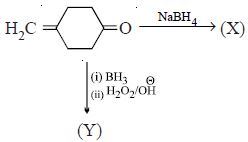
In the given reaction,identify $(X)$ and $(Y)$:
A
$CH_2=C_6H_{10}(OH)$ and $HO-CH_2-C_6H_9=O$
B
$CH_3-C_6H_9=O$ and $HO-CH_2-C_6H_9=O$
C
$CH_2=C_6H_{10}(OH)$ and $HO-CH_2-C_6H_{10}(OH)$
D
$CH_2-C_6H_{10}(OH)$ and $CH_3-C_6H_9(OH)=O$
Solution
(A) The starting material is $4$-methylenecyclohexan-$1$-one.
$1$. Reaction with $NaBH_4$:
$NaBH_4$ is a selective reducing agent that reduces aldehydes and ketones to alcohols but does not reduce isolated carbon-carbon double bonds. Therefore,the ketone group is reduced to a secondary alcohol,while the exocyclic double bond remains intact. Thus,$(X)$ is $4$-methylenecyclohexan-$1$-ol.
$2$. Reaction with $(i) BH_3, (ii) H_2O_2/OH^-$:
This is a hydroboration-oxidation reaction. Hydroboration-oxidation is a regioselective and stereospecific reaction that adds $H$ and $OH$ across a carbon-carbon double bond in an anti-Markovnikov fashion. The $BH_3$ reagent will selectively react with the exocyclic double bond,while the ketone group remains unaffected. Thus,$(Y)$ is $4$-(hydroxymethyl)cyclohexan-$1$-one.
Comparing these results with the given options,the correct products are $4$-methylenecyclohexan-$1$-ol and $4$-(hydroxymethyl)cyclohexan-$1$-one,which corresponds to option $A$.
$1$. Reaction with $NaBH_4$:
$NaBH_4$ is a selective reducing agent that reduces aldehydes and ketones to alcohols but does not reduce isolated carbon-carbon double bonds. Therefore,the ketone group is reduced to a secondary alcohol,while the exocyclic double bond remains intact. Thus,$(X)$ is $4$-methylenecyclohexan-$1$-ol.
$2$. Reaction with $(i) BH_3, (ii) H_2O_2/OH^-$:
This is a hydroboration-oxidation reaction. Hydroboration-oxidation is a regioselective and stereospecific reaction that adds $H$ and $OH$ across a carbon-carbon double bond in an anti-Markovnikov fashion. The $BH_3$ reagent will selectively react with the exocyclic double bond,while the ketone group remains unaffected. Thus,$(Y)$ is $4$-(hydroxymethyl)cyclohexan-$1$-one.
Comparing these results with the given options,the correct products are $4$-methylenecyclohexan-$1$-ol and $4$-(hydroxymethyl)cyclohexan-$1$-one,which corresponds to option $A$.
0 likes
View Solution494
AdvancedMCQ
Cyanohydrin of which compound on hydrolysis will give lactic acid?
A
$C_6H_5CHO$
B
$HCHO$
C
$CH_3CHO$
D
$CH_3-CH_2-CHO$
Solution
(C) The reaction proceeds as follows:
$1$. Acetaldehyde $(CH_3CHO)$ reacts with $HCN$ to form acetaldehyde cyanohydrin $(CH_3CH(OH)CN)$.
$2$. Subsequent acid-catalyzed hydrolysis of the cyanohydrin group $(-CN)$ converts it into a carboxylic acid group $(-COOH)$,yielding lactic acid $(CH_3CH(OH)COOH)$.
$1$. Acetaldehyde $(CH_3CHO)$ reacts with $HCN$ to form acetaldehyde cyanohydrin $(CH_3CH(OH)CN)$.
$2$. Subsequent acid-catalyzed hydrolysis of the cyanohydrin group $(-CN)$ converts it into a carboxylic acid group $(-COOH)$,yielding lactic acid $(CH_3CH(OH)COOH)$.
0 likes
View Solution495
AdvancedMCQ
In the reaction sequence: $CH_2OH-CHOH-CH_2OH$ $\xrightarrow{KHSO_4/\Delta} (X)$ $\xrightarrow{(C_2H_5O)_3Al/\Delta} (Y)$,$(Y)$ will be:
A
$CH_2=CH-CHO$
B
$CH_2=CH-CH_2OH$
C
Mixture of $CH_2=CH-COOH$ and $CH_2=CH-CH_2OH$
D
$CH_2=CH-C(=O)-O-CH_2-CH=CH_2$
Solution
(D) Step $1$: Glycerol $(CH_2OH-CHOH-CH_2OH)$ on heating with $KHSO_4$ undergoes dehydration to form acrolein $(X)$.
$CH_2OH-CHOH-CH_2OH \xrightarrow{KHSO_4, \Delta} CH_2=CH-CHO + 2H_2O$
Step $2$: Acrolein $(X)$ reacts with aluminum ethoxide $(C_2H_5O)_3Al$ via the Tishchenko reaction to form allyl acrylate $(Y)$.
$2CH_2=CH-CHO \xrightarrow{(C_2H_5O)_3Al, \Delta} CH_2=CH-C(=O)-O-CH_2-CH=CH_2$
$CH_2OH-CHOH-CH_2OH \xrightarrow{KHSO_4, \Delta} CH_2=CH-CHO + 2H_2O$
Step $2$: Acrolein $(X)$ reacts with aluminum ethoxide $(C_2H_5O)_3Al$ via the Tishchenko reaction to form allyl acrylate $(Y)$.
$2CH_2=CH-CHO \xrightarrow{(C_2H_5O)_3Al, \Delta} CH_2=CH-C(=O)-O-CH_2-CH=CH_2$
0 likes
View Solution496
DifficultMCQ
The reaction in which $NaCN/C_2H_5OH/HOH$ is used is:
A
Perkin reaction
B
Benzoin condensation
C
Reimer-Tieman reaction
D
Rosenmund reduction
Solution
(B) The reaction involving $NaCN$ in the presence of ethanol $(C_2H_5OH)$ and water $(HOH)$ is the Benzoin condensation.
In this reaction,two molecules of benzaldehyde undergo self-condensation in the presence of cyanide ions to form benzoin.
The reaction is represented as:
$2 C_6H_5CHO \xrightarrow{NaCN, C_2H_5OH, H_2O} C_6H_5CH(OH)COC_6H_5$
In this reaction,two molecules of benzaldehyde undergo self-condensation in the presence of cyanide ions to form benzoin.
The reaction is represented as:
$2 C_6H_5CHO \xrightarrow{NaCN, C_2H_5OH, H_2O} C_6H_5CH(OH)COC_6H_5$
0 likes
View Solution497
DifficultMCQ
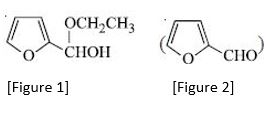
Compound $Figure$ $1$ formed by the reaction of furfural ($Figure$ $2$) with ethanol is:
A
an aldol
B
an acetal
C
a ketal
D
a hemiacetal
Solution
(D) The reaction of an aldehyde (furfural) with an alcohol (ethanol) initially leads to the formation of a hemiacetal.
In $Figure$ $1$,the structure shows a carbon atom bonded to a hydroxyl group $(-OH)$ and an alkoxy group $(-OCH_2CH_3)$.
This functional group arrangement $(R-CH(OH)(OR'))$ is characteristic of a hemiacetal.
Therefore,the compound shown in $Figure$ $1$ is a hemiacetal.
In $Figure$ $1$,the structure shows a carbon atom bonded to a hydroxyl group $(-OH)$ and an alkoxy group $(-OCH_2CH_3)$.
This functional group arrangement $(R-CH(OH)(OR'))$ is characteristic of a hemiacetal.
Therefore,the compound shown in $Figure$ $1$ is a hemiacetal.
0 likes
View Solution498
DifficultMCQ
An alkene $(A)$ $C_{16}H_{16}$ on ozonolysis gives only one product $(B)$ $C_8H_8O$. $(B)$ can also be obtained by the hydrolysis of the product obtained from the reaction between cyanobenzene and $CH_3MgBr$. $(A)$ shows geometrical isomerism and decolourises $Br_2$ water. $(B)$ on treatment with $SeO_2$ produces $(C)$. Which statement is not correct about $(B)$?
A
It gives the iodoform test.
B
On treatment with $LiAlH_4, H_2O$,it produces a compound which also responds to the iodoform test.
C
It gives Tollen's test.
D
On treatment with $NH_2NH_2, EtO^-$ at high temperature,it produces ethylbenzene.
Solution
(C) $1$. Ozonolysis of $(A)$ $C_{16}H_{16}$ gives only one product $(B)$ $C_8H_8O$. This implies $(A)$ is $C_6H_5-CH=CH-C_6H_5$ (stilbene derivative) or similar. Given $(B)$ is obtained from cyanobenzene $(C_6H_5CN)$ and $CH_3MgBr$,$(B)$ is acetophenone $(C_6H_5COCH_3)$.
$2$. Acetophenone $(C_6H_5COCH_3)$ contains a methyl ketone group,so it gives the iodoform test (Option $A$ is correct).
$3$. Reduction of acetophenone with $LiAlH_4$ gives $1$-phenylethanol $(C_6H_5CH(OH)CH_3)$,which is a secondary alcohol with a $CH_3CH(OH)-$ group,thus it gives the iodoform test (Option $B$ is correct).
$4$. Acetophenone is a ketone,not an aldehyde,so it does not give Tollen's test (Option $C$ is incorrect).
$5$. Wolff-Kishner reduction of acetophenone using $NH_2NH_2, EtO^-$ gives ethylbenzene (Option $D$ is correct).
$6$. Therefore,the incorrect statement is $C$.
$2$. Acetophenone $(C_6H_5COCH_3)$ contains a methyl ketone group,so it gives the iodoform test (Option $A$ is correct).
$3$. Reduction of acetophenone with $LiAlH_4$ gives $1$-phenylethanol $(C_6H_5CH(OH)CH_3)$,which is a secondary alcohol with a $CH_3CH(OH)-$ group,thus it gives the iodoform test (Option $B$ is correct).
$4$. Acetophenone is a ketone,not an aldehyde,so it does not give Tollen's test (Option $C$ is incorrect).
$5$. Wolff-Kishner reduction of acetophenone using $NH_2NH_2, EtO^-$ gives ethylbenzene (Option $D$ is correct).
$6$. Therefore,the incorrect statement is $C$.
0 likes
View Solution499
AdvancedMCQ
An alkene $(A)$ $C_{16}H_{16}$ on ozonolysis gives only one product $(B)$ $C_8H_8O$. $(B)$ can also be obtained by the hydrolysis of the product obtained from the reaction between cyanobenzene and $CH_3MgBr$. $(A)$ shows geometrical isomerism and decolourises $Br_2$ water. $(B)$ on treatment with $SeO_2$ produces $(C)$. Which statement is not correct about $(C)$?
A
On treatment with $NaBH_4$ it will produce a diol.
B
On treatment with $OH^{-}$ (conc.) followed by acidification it produces an optically active acid.
C
It gives Tollen's test.
D
It can take part in aldol condensation.
0 likes
View Solution500
AdvancedMCQ
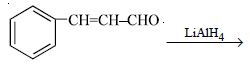
The product in the given reaction is:
A
$C_6H_5-CH_2-CH_2-CHO$
B
$C_6H_5-CH=CH-CH_2OH$
C
$C_6H_5-CH_2-CH_2-CH_2OH$
D
$C_6H_{11}-CH_2-CH_2-CH_2OH$
Solution
(B) $LiAlH_4$ (Lithium aluminium hydride) is a strong reducing agent that reduces aldehydes,ketones,carboxylic acids,and esters to their corresponding alcohols.
However,it does not reduce isolated carbon-carbon double bonds $(C=C)$.
In the given reaction,the reactant is cinnamaldehyde $(C_6H_5-CH=CH-CHO)$.
$LiAlH_4$ selectively reduces the aldehyde group $(-CHO)$ to a primary alcohol group $(-CH_2OH)$ while leaving the conjugated double bond $(C=C)$ intact.
Therefore,the product formed is cinnamyl alcohol,which is $C_6H_5-CH=CH-CH_2OH$.
However,it does not reduce isolated carbon-carbon double bonds $(C=C)$.
In the given reaction,the reactant is cinnamaldehyde $(C_6H_5-CH=CH-CHO)$.
$LiAlH_4$ selectively reduces the aldehyde group $(-CHO)$ to a primary alcohol group $(-CH_2OH)$ while leaving the conjugated double bond $(C=C)$ intact.
Therefore,the product formed is cinnamyl alcohol,which is $C_6H_5-CH=CH-CH_2OH$.
0 likes
View Solution8-1.Aldehydes and Ketones — Properties · Frequently Asked Questions
1Are these 8-1.Aldehydes and Ketones questions useful for JEE and NEET?
Yes. All questions in this section are mapped to JEE Main and NEET exam patterns. Previous year questions from JEE Main, NEET, GUJCET and state-level exams are included with full solutions.
2Can I switch to Hindi or Gujarati for these questions?
Yes. Use the language tabs in the hero section or the sidebar to view the same questions and solutions in English, Hindi or Gujarati.
3How do I generate a question paper from this subtopic?
Use the Vedclass Exam Paper Generator — select the chapter and subtopic, set difficulty, and generate Sets A, B, C, D automatically. First 3 chapters of every subject are free.
Vedclass Products
For Students
Vedclass Test Series
Mock tests in real JEE/NEET style with performance analysis. 5-day free trial.
Start Free TrialFor Teachers
Exam Paper Generator
Generate Set A/B/C/D papers from this chapter in 2 minutes. 3 chapters free.
Try FreeFor Institutes
Online Exam Module
Live online exams with unlimited students, 360° analytics & white-label branding.
See DemoFor Teachers & Institutes
Generate a 8-1.Aldehydes and Ketones Exam Paper in 2 Minutes
Select subtopic & difficulty — Sets A, B, C, D auto-generated with No Repeat logic.
First 3 chapters of every subject are free — no payment required.