
A English
Properties Questions in English
Class 12 Chemistry · 8-1.Aldehydes and Ketones · Properties
1739+
Questions
English
Language
100%
With Solutions
Showing 50 of 1739 questions in English
301
MediumMCQ
Which of the following reactions can be used to convert an unsaturated ketone into an unsaturated hydrocarbon?
A
Aldol condensation
B
Reimer-Tiemann reaction
C
Cannizzaro reaction
D
Wolff-Kishner reduction
Solution
(D) The $Wolff-Kishner$ reduction is used to reduce the carbonyl group $(C=O)$ of aldehydes or ketones to a methylene group $(CH_2)$.
It specifically reduces the ketone group to an alkyl group while leaving the carbon-carbon double bond $(C=C)$ intact.
Therefore,an unsaturated ketone is converted into an unsaturated hydrocarbon.
It specifically reduces the ketone group to an alkyl group while leaving the carbon-carbon double bond $(C=C)$ intact.
Therefore,an unsaturated ketone is converted into an unsaturated hydrocarbon.
0 likes
View Solution302
MediumMCQ
Which of the following aldehydes will undergo the Cannizzaro reaction with a base?
A
$CH_3-CH_2-CH_2-CHO$
B
$CH_3-CH_2-CH(CH_3)-CHO$
C
$CH_3-CH=CH-CHO$
D
$(CH_3)_3C-CHO$
Solution
(D) Aldehydes that do not contain an $\alpha$-hydrogen atom undergo the Cannizzaro reaction in the presence of a base.
In the given options,$(CH_3)_3C-CHO$ (pivalaldehyde) has no $\alpha$-hydrogen atom attached to the carbonyl carbon,therefore it will undergo the Cannizzaro reaction.
In the given options,$(CH_3)_3C-CHO$ (pivalaldehyde) has no $\alpha$-hydrogen atom attached to the carbonyl carbon,therefore it will undergo the Cannizzaro reaction.
0 likes
View Solution303
MediumMCQ
Which of the following compounds will not react with $NaHSO_3$?
A
$HCHO$
B
Acetophenone
C
Acetone
D
Acetaldehyde
Solution
(B) The addition of $NaHSO_3$ (sodium bisulphite) to carbonyl compounds is a nucleophilic addition reaction.
Steric hindrance plays a significant role in this reaction.
$HCHO$,acetaldehyde,and acetone are small enough to allow the nucleophilic attack of $HSO_3^-$.
Acetophenone is an aromatic ketone where the bulky phenyl group causes significant steric hindrance,preventing the formation of the bisulphite addition product.
Steric hindrance plays a significant role in this reaction.
$HCHO$,acetaldehyde,and acetone are small enough to allow the nucleophilic attack of $HSO_3^-$.
Acetophenone is an aromatic ketone where the bulky phenyl group causes significant steric hindrance,preventing the formation of the bisulphite addition product.
0 likes
View Solution304
MediumMCQ
The reduction of carbonyl compounds with aluminum isopropoxide in excess of isopropanol is known as the Meerwein-Ponndorf-Verley $(MPV)$ reduction. What is the final product when cyclohex$-2-$enone undergoes selective reduction using this method?
A
Cyclohexanol
B
Cyclohex$-2-$enol
C
Cyclohexanone
D
Benzene
Solution
(B) The Meerwein-Ponndorf-Verley $(MPV)$ reduction is a highly selective method for the reduction of aldehydes and ketones to their corresponding alcohols.
In this reaction,aluminum isopropoxide acts as a catalyst,and isopropanol serves as the hydride donor.
The reaction is chemoselective,meaning it reduces the carbonyl group $(C=O)$ while leaving other functional groups like carbon-carbon double bonds $(C=C)$ intact.
Therefore,when cyclohex$-2-$enone is subjected to $MPV$ reduction,the ketone group is reduced to an alcohol group,while the double bond remains unaffected.
The product formed is cyclohex$-2-$enol.
In this reaction,aluminum isopropoxide acts as a catalyst,and isopropanol serves as the hydride donor.
The reaction is chemoselective,meaning it reduces the carbonyl group $(C=O)$ while leaving other functional groups like carbon-carbon double bonds $(C=C)$ intact.
Therefore,when cyclohex$-2-$enone is subjected to $MPV$ reduction,the ketone group is reduced to an alcohol group,while the double bond remains unaffected.
The product formed is cyclohex$-2-$enol.
0 likes
View Solution305
MediumMCQ
The $Wolff-Kishner$ reduction is used for which of the following?
A
Nitro compounds
B
Carboxylic acids
C
Carbonyl compounds
D
Olefins
Solution
(C) The $Wolff-Kishner$ reduction is a chemical reaction used to convert carbonyl groups $(C=O)$ into methylene groups $(CH_2)$.
The general reaction is:
$R_2C=O + NH_2NH_2 \xrightarrow{KOH, \text{heat}} R_2CH_2 + N_2 + H_2O$
This reaction is specifically used for the reduction of aldehydes and ketones (carbonyl compounds).
The general reaction is:
$R_2C=O + NH_2NH_2 \xrightarrow{KOH, \text{heat}} R_2CH_2 + N_2 + H_2O$
This reaction is specifically used for the reduction of aldehydes and ketones (carbonyl compounds).
0 likes
View Solution306
MediumMCQ
In the presence of which of the following is the Clemmensen reduction of ketones carried out?
A
$H_2$ with $Pd$ catalyst
B
With glycol
C
$LiAlH_4$ in water
D
$Zn-Hg$ with concentrated $HCl$
Solution
(D) The Clemmensen reduction involves the reduction of a carbonyl group $(C=O)$ to a methylene group $(CH_2)$ using zinc amalgam $(Zn-Hg)$ and concentrated hydrochloric acid $(HCl)$.
Reaction: $R-CO-R + 4[H] \xrightarrow{Zn-Hg, HCl} R-CH_2-R + H_2O$
Reaction: $R-CO-R + 4[H] \xrightarrow{Zn-Hg, HCl} R-CH_2-R + H_2O$
0 likes
View Solution307
MediumMCQ
Identify the product $Y$ in the following reaction sequence:
$CH_3CHO + CH_3MgI$ $\xrightarrow{\quad} X$ $\xrightarrow{H_2O/H^+} Y$
$CH_3CHO + CH_3MgI$ $\xrightarrow{\quad} X$ $\xrightarrow{H_2O/H^+} Y$
A
$CH_3OH$
B
$CH_3CH_2OH$
C
$(CH_3)_2CHOH$
D
$(CH_3)_3COH$
0 likes
View Solution308
MediumMCQ
In the given reaction,what will be $A$ and $B$ respectively?
$(CH_3)_2CO$ $\xrightarrow{NaCN/HCl} A$ $\xrightarrow{H_3O^+} B$
$(CH_3)_2CO$ $\xrightarrow{NaCN/HCl} A$ $\xrightarrow{H_3O^+} B$
A
$(CH_3)_2C(OH)CN, (CH_3)_2C(OH)COOH$
B
$(CH_3)_2C(OH)CN, (CH_3)_2C(OH)_2$
C
$(CH_3)_2C(OH)CN, (CH_3)_2CHCOOH$
D
$(CH_3)_2C(OH)CN, (CH_3)_2C=O$
Solution
(A) The reaction of acetone $(CH_3)_2CO$ with $NaCN/HCl$ is a nucleophilic addition reaction forming a cyanohydrin.
$A = (CH_3)_2C(OH)CN$ (Acetone cyanohydrin).
Subsequent acid-catalyzed hydrolysis of the cyanohydrin $(A)$ converts the $-CN$ group into a $-COOH$ group.
$B = (CH_3)_2C(OH)COOH$ ($2$-hydroxy$-2-$methylpropanoic acid).
Therefore,the correct sequence is $A = (CH_3)_2C(OH)CN$ and $B = (CH_3)_2C(OH)COOH$.
$A = (CH_3)_2C(OH)CN$ (Acetone cyanohydrin).
Subsequent acid-catalyzed hydrolysis of the cyanohydrin $(A)$ converts the $-CN$ group into a $-COOH$ group.
$B = (CH_3)_2C(OH)COOH$ ($2$-hydroxy$-2-$methylpropanoic acid).
Therefore,the correct sequence is $A = (CH_3)_2C(OH)CN$ and $B = (CH_3)_2C(OH)COOH$.
0 likes
View Solution309
MediumMCQ
Which of the following statements is incorrect?
A
$FeCl_3$ is used in the detection of phenol.
B
Fehling's solution can be used for the detection of glucose.
C
Tollens' reagent is used to detect unsaturation.
D
$NaHSO_3$ is used in the detection of carbonyl compounds.
Solution
(C) Tollens' reagent is used for the detection of the aldehyde group,not for detecting unsaturation. Therefore,the statement in option $C$ is incorrect.
0 likes
View Solution310
EasyMCQ
Paraldehyde is a trimer of which of the following?
A
Formaldehyde
B
Acetaldehyde
C
Benzaldehyde
D
Propionaldehyde
Solution
(B) Paraldehyde is formed by the trimerization of acetaldehyde $(CH_3CHO)$ in the presence of an acid catalyst like concentrated $H_2SO_4$ at room temperature. The reaction involves three molecules of acetaldehyde combining to form a cyclic trimer,$2,4,6-trimethyl-1,3,5-trioxane$,commonly known as paraldehyde.
0 likes
View Solution311
MediumMCQ
What is the product obtained when $m$-chlorobenzaldehyde is treated with a $50\% KOH$ solution?
A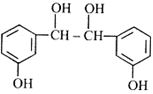
$A$
B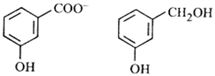
$B$
C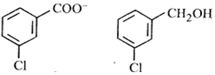
$C$
D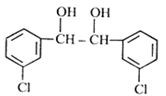
$D$
Solution
(C) $m$-Chlorobenzaldehyde does not have any $\alpha$-hydrogen atoms. Therefore,it undergoes the Cannizzaro reaction when treated with a concentrated base like $50\% KOH$. In this reaction,one molecule of the aldehyde is oxidized to a carboxylate ion ($m$-chlorobenzoate),and another molecule is reduced to an alcohol ($m$-chlorobenzyl alcohol). The correct product is shown in option $C$.
0 likes
View Solution312
MediumMCQ
What are the products formed when benzaldehyde reacts with concentrated sodium hydroxide?
A
Benzyl alcohol
B
Hydrobenzamide
C
Cinnamic acid
D
Benzophenone
Solution
(A) Benzaldehyde $(C_6H_5CHO)$ does not contain $\alpha$-hydrogen atoms. When treated with concentrated $NaOH$,it undergoes the Cannizzaro reaction,which is a disproportionation reaction.
In this reaction,one molecule of benzaldehyde is reduced to benzyl alcohol $(C_6H_5CH_2OH)$ and another molecule is oxidized to sodium benzoate $(C_6H_5COONa)$.
The reaction is: $2C_6H_5CHO + NaOH \rightarrow C_6H_5CH_2OH + C_6H_5COONa$.
In this reaction,one molecule of benzaldehyde is reduced to benzyl alcohol $(C_6H_5CH_2OH)$ and another molecule is oxidized to sodium benzoate $(C_6H_5COONa)$.
The reaction is: $2C_6H_5CHO + NaOH \rightarrow C_6H_5CH_2OH + C_6H_5COONa$.
0 likes
View Solution313
MediumMCQ
Which of the following reactions is used to detect the presence of a carbonyl group?
A
Reaction with hydroxylamine.
B
Reaction with hydrazine.
C
Reaction with phenylhydrazine.
D
All of the above.
Solution
(D) Carbonyl compounds react with hydroxylamine to form oximes,with hydrazine to form hydrazones,and with phenylhydrazine to form phenylhydrazones. All these reactions are characteristic tests used to detect the presence of the carbonyl group.
0 likes
View Solution314
MediumMCQ
What is the final product obtained by the reduction of acetaldehyde with sodium and alcohol?
A
Ethylene
B
Ethyl alcohol
C
Ethane
D
All of these
Solution
(B) The reduction of acetaldehyde $(CH_3CHO)$ with sodium $(Na)$ and alcohol $(C_2H_5OH)$ is a classic reduction reaction.
$CH_3CHO + 2[H] \xrightarrow{Na/C_2H_5OH} CH_3CH_2OH$
Therefore,the product formed is ethyl alcohol (ethanol).
$CH_3CHO + 2[H] \xrightarrow{Na/C_2H_5OH} CH_3CH_2OH$
Therefore,the product formed is ethyl alcohol (ethanol).
0 likes
View Solution315
MediumMCQ
What is obtained when acetaldehyde is heated with ammoniacal silver nitrate?
A
$CH_3OH$
B
Silver acetate
C
$HCHO$
D
Silver mirror
Solution
(D) Acetaldehyde reacts with Tollen's reagent (ammoniacal silver nitrate) to form a silver mirror.
The chemical equation is:
$CH_3CHO + 2[Ag(NH_3)_2]^+ + 3OH^- \xrightarrow{\Delta} CH_3COO^- + 2Ag \downarrow + 4NH_3 + 2H_2O$
Here,$2Ag$ represents the formation of a silver mirror.
The chemical equation is:
$CH_3CHO + 2[Ag(NH_3)_2]^+ + 3OH^- \xrightarrow{\Delta} CH_3COO^- + 2Ag \downarrow + 4NH_3 + 2H_2O$
Here,$2Ag$ represents the formation of a silver mirror.
0 likes
View Solution316
MediumMCQ
Which product is obtained by the reduction of propionaldehyde with amalgamated zinc and concentrated $HCl$?
A
Propanol
B
Propane
C
Propene
D
All of these
Solution
(B) The reaction described is the $Clemmensen$ reduction,which reduces aldehydes and ketones to alkanes using amalgamated zinc $(Zn-Hg)$ and concentrated $HCl$.
The chemical equation is:
$CH_3CH_2CHO + 4[H] \xrightarrow{Zn-Hg, HCl} CH_3CH_2CH_3 + H_2O$
Thus,propionaldehyde $(CH_3CH_2CHO)$ is reduced to propane $(CH_3CH_2CH_3)$.
The chemical equation is:
$CH_3CH_2CHO + 4[H] \xrightarrow{Zn-Hg, HCl} CH_3CH_2CH_3 + H_2O$
Thus,propionaldehyde $(CH_3CH_2CHO)$ is reduced to propane $(CH_3CH_2CH_3)$.
0 likes
View Solution317
MediumMCQ
What is the first intermediate formed during the reduction of carbonyl compounds by $H_2NNH_2$ and $KOH$?
A
$R_2C=NNH_2$
B
$R_2C=NH$
C
$R_2CH-NH-NH_2$
D
$R_2C=N-NH_2$
Solution
(D) The reaction described is the $Wolff-Kishner$ reduction.
In the first step,the carbonyl compound reacts with hydrazine $(H_2NNH_2)$ to form a hydrazone intermediate.
The reaction is: $R_2C=O + H_2NNH_2 \rightarrow R_2C=N-NH_2 + H_2O$.
Thus,the first intermediate formed is a hydrazone,$R_2C=N-NH_2$.
In the first step,the carbonyl compound reacts with hydrazine $(H_2NNH_2)$ to form a hydrazone intermediate.
The reaction is: $R_2C=O + H_2NNH_2 \rightarrow R_2C=N-NH_2 + H_2O$.
Thus,the first intermediate formed is a hydrazone,$R_2C=N-NH_2$.
0 likes
View Solution318
MediumMCQ
Which of the following compounds will not react with phenylhydrazine?
A
Ethanol
B
Ethanal
C
Acetone
D
Acetophenone
Solution
(A) Phenylhydrazine is a nucleophilic reagent that reacts with carbonyl compounds (aldehydes and ketones) to form phenylhydrazones. $Ethanol$ is an alcohol and does not contain a carbonyl group $(C=O)$,therefore it does not undergo this reaction.
0 likes
View Solution319
MediumMCQ
Which of the following compounds can undergo both Cannizzaro reaction and Aldol condensation?
A
$(CH_3)_2CHCHO$
B
$CH_3CH_2CHO$
C
$C_6H_5CHO$
D
$HCHO$
Solution
(A) Aldehydes containing $\alpha$-hydrogen atoms undergo Aldol condensation in the presence of dilute alkali. However,some specific aldehydes,particularly those with a single $\alpha$-hydrogen atom (like isobutyraldehyde,$(CH_3)_2CHCHO$),can undergo both Aldol condensation and Cannizzaro reaction under specific conditions (e.g.,concentrated alkali at high temperatures).
$1$. Isobutyraldehyde $((CH_3)_2CHCHO)$ has one $\alpha$-hydrogen atom,allowing it to form an aldol product.
$2$. Due to the steric hindrance and the specific nature of the $\alpha$-carbon,it can also undergo a cross-Cannizzaro-like reaction or disproportionation under harsh conditions.
$3$. $HCHO$ and $C_6H_5CHO$ lack $\alpha$-hydrogens and only undergo Cannizzaro reaction.
$4$. $CH_3CH_2CHO$ has two $\alpha$-hydrogens and primarily undergoes Aldol condensation.
$1$. Isobutyraldehyde $((CH_3)_2CHCHO)$ has one $\alpha$-hydrogen atom,allowing it to form an aldol product.
$2$. Due to the steric hindrance and the specific nature of the $\alpha$-carbon,it can also undergo a cross-Cannizzaro-like reaction or disproportionation under harsh conditions.
$3$. $HCHO$ and $C_6H_5CHO$ lack $\alpha$-hydrogens and only undergo Cannizzaro reaction.
$4$. $CH_3CH_2CHO$ has two $\alpha$-hydrogens and primarily undergoes Aldol condensation.
0 likes
View Solution320
MediumMCQ
$RCH=O + H_2 \xrightarrow{\text{catalyst}} RCH_2OH$. Which catalyst is used for this reaction?
A
Only $Ni$
B
Only $Pd$
C
Only $Pt$
D
Any of these
Solution
(D) The reduction of an aldehyde to an alcohol can be achieved using any of the given transition metal catalysts ($Ni$,$Pd$,or $Pt$) in the presence of hydrogen gas $(H_2)$.
0 likes
View Solution321
MediumMCQ
$A$ compound contains an $\alpha$-hydrogen atom and forms a $\beta$-hydroxy aldehyde in the presence of a dilute alkali. When this product is heated with a dilute acid,it yields unsaturated crotonaldehyde. Identify the compound.
A
$CH_3CHO$
B
$CH_3CH_2CHO$
C
$CH_2=CHCHO$
D
$HC \equiv C-CHO$
Solution
(A) The reaction described is the Aldol condensation of acetaldehyde $(CH_3CHO)$.
Step $1$: Two molecules of acetaldehyde undergo aldol condensation in the presence of dilute $NaOH$ to form $\beta$-hydroxybutanal.
$CH_3CHO + CH_3CHO \xrightarrow{dil. NaOH} CH_3-CH(OH)-CH_2-CHO$ ($\beta$-hydroxybutanal).
Step $2$: Upon heating with dilute acid,$\beta$-hydroxybutanal undergoes dehydration to form crotonaldehyde $(CH_3CH=CH-CHO)$.
$CH_3-CH(OH)-CH_2-CHO \xrightarrow{\Delta, H^+} CH_3CH=CH-CHO + H_2O$ (Crotonaldehyde).
Therefore,the starting compound is $CH_3CHO$.
Step $1$: Two molecules of acetaldehyde undergo aldol condensation in the presence of dilute $NaOH$ to form $\beta$-hydroxybutanal.
$CH_3CHO + CH_3CHO \xrightarrow{dil. NaOH} CH_3-CH(OH)-CH_2-CHO$ ($\beta$-hydroxybutanal).
Step $2$: Upon heating with dilute acid,$\beta$-hydroxybutanal undergoes dehydration to form crotonaldehyde $(CH_3CH=CH-CHO)$.
$CH_3-CH(OH)-CH_2-CHO \xrightarrow{\Delta, H^+} CH_3CH=CH-CHO + H_2O$ (Crotonaldehyde).
Therefore,the starting compound is $CH_3CHO$.
0 likes
View Solution322
MediumMCQ
What product is formed when benzaldehyde reacts with methylamine?
A
$C_6H_5NH_2$
B
$C_6H_5CH_2NH_2$
C
$C_6H_5CH=NCH_3$
D
$C_6H_5CONH_2$
Solution
(C) Benzaldehyde $(C_6H_5CHO)$ reacts with methylamine $(CH_3NH_2)$ to form a Schiff base (imine) through a nucleophilic addition-elimination reaction.
The reaction is: $C_6H_5CHO + CH_3NH_2 \rightarrow C_6H_5CH=NCH_3 + H_2O$.
The product formed is $N$-benzylidenemethylamine $(C_6H_5CH=NCH_3)$.
The reaction is: $C_6H_5CHO + CH_3NH_2 \rightarrow C_6H_5CH=NCH_3 + H_2O$.
The product formed is $N$-benzylidenemethylamine $(C_6H_5CH=NCH_3)$.
0 likes
View Solution323
MediumMCQ
In which of the following reactions does an aromatic aldehyde react with an acid anhydride in the presence of the salt of the corresponding acid to form an unsaturated aromatic acid?
A
Friedel-Crafts reaction
B
Perkin condensation reaction
C
Wurtz reaction
D
None of these
Solution
(B) The reaction described is the $Perkin$ reaction. In this reaction,an aromatic aldehyde (e.g.,$Benzaldehyde$) reacts with an acid anhydride (e.g.,$Acetic$ $anhydride$) in the presence of the sodium salt of the corresponding acid (e.g.,$CH_3COONa$) to yield an $\alpha,\beta$-unsaturated aromatic acid (e.g.,$Cinnamic$ $acid$ after hydrolysis). The general reaction is: $ArCHO + (RCH_2CO)_2O \xrightarrow{RCH_2COONa} ArCH=C(R)COOH + RCH_2COOH$.
0 likes
View Solution324
MediumMCQ
What is the product formed when propanal reacts with dilute sodium hydroxide?
A
$CH_3CH_2CH_2CH_2CH_2CHO$
B
$CH_3CH_2CH(OH)CH_2CH_2CHO$
C
$CH_3CH_2CH(OH)CH(CH_3)CHO$
D
$CH_3CH_2COONa$
Solution
(C) Propanal $(CH_3CH_2CHO)$ contains $\alpha$-hydrogens and undergoes an aldol condensation reaction in the presence of dilute $NaOH$.
Two molecules of propanal react as follows:
$CH_3CH_2CHO + CH_3CH_2CHO \xrightarrow{dil. NaOH} CH_3CH_2CH(OH)CH(CH_3)CHO$
This product is $3-hydroxy-2-methylpentanal$.
Two molecules of propanal react as follows:
$CH_3CH_2CHO + CH_3CH_2CHO \xrightarrow{dil. NaOH} CH_3CH_2CH(OH)CH(CH_3)CHO$
This product is $3-hydroxy-2-methylpentanal$.
0 likes
View Solution325
MediumMCQ
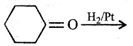
What will be the product of the following reaction?
A
$1-$methylcyclohexanol
B
$1-$methylcyclohexanol (isomer)
C
Cyclohexanol
D
Cyclohexene
Solution
(C) The given reaction is the catalytic hydrogenation of cyclohexanone using $H_2/Pt$.
Catalytic hydrogenation of a ketone reduces the carbonyl group $(C=O)$ to a secondary alcohol group $(-CHOH)$.
Thus,cyclohexanone is reduced to cyclohexanol.
Catalytic hydrogenation of a ketone reduces the carbonyl group $(C=O)$ to a secondary alcohol group $(-CHOH)$.
Thus,cyclohexanone is reduced to cyclohexanol.
0 likes
View Solution326
MediumMCQ
Which reagent is used to distinguish between acetaldehyde and acetophenone?
A
$NaHSO_3$
B
$C_6H_5NHNH_2$
C
$NH_2OH$
D
$NaOH / I_2$
Solution
(A) Acetaldehyde is an aliphatic aldehyde that reacts with $NaHSO_3$ to form a crystalline bisulfite addition product.
Acetophenone,being a bulky aromatic ketone,does not form this addition product due to steric hindrance.
Therefore,$NaHSO_3$ can be used to distinguish between them.
Acetophenone,being a bulky aromatic ketone,does not form this addition product due to steric hindrance.
Therefore,$NaHSO_3$ can be used to distinguish between them.
0 likes
View Solution327
MediumMCQ
Aromatic aldehydes are converted into acyloins in the presence of cyanide ions as a catalyst. What is this reaction called?
A
Perkin reaction
B
Cannizzaro reaction
C
Benzoin condensation
D
Claisen condensation
Solution
(C) The reaction where two molecules of aromatic aldehydes (like benzaldehyde) condense in the presence of cyanide ions $(CN^-)$ to form an $\alpha$-hydroxy ketone (acyloin),specifically benzoin,is known as the Benzoin condensation. The reaction is represented as: $2C_6H_5CHO \xrightarrow{KCN} C_6H_5CH(OH)COC_6H_5$.
0 likes
View Solution328
MediumMCQ
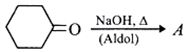
What is $A$ in the following reaction?
A
$2-$cyclohexylidenecyclohexanone
B
$2-$cyclohexylcyclohexanone
C
$1-$cyclohexylidenecyclohexane
D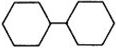
bicyclohexyl
Solution
(A) The reaction shown is an aldol condensation of cyclohexanone in the presence of a base $(NaOH)$ and heat $(\Delta)$.
$1$. Two molecules of cyclohexanone undergo aldol addition to form $\beta$-hydroxy ketone.
$2$. Upon heating,the $\beta$-hydroxy ketone undergoes dehydration (elimination of $H_2O$) to form an $\alpha,\beta$-unsaturated ketone.
$3$. The final product $A$ is $2-$cyclohexylidenecyclohexanone.
$1$. Two molecules of cyclohexanone undergo aldol addition to form $\beta$-hydroxy ketone.
$2$. Upon heating,the $\beta$-hydroxy ketone undergoes dehydration (elimination of $H_2O$) to form an $\alpha,\beta$-unsaturated ketone.
$3$. The final product $A$ is $2-$cyclohexylidenecyclohexanone.
0 likes
View Solution329
MediumMCQ
$2CD_2=O + OH^- \xrightarrow{\quad} X + Y$ ($Y$ is an alcohol and $D$ is deuterium). Identify $X$ and $Y$.
A
$D-COO^-$ and $CD_3OH$
B
$D-COO^-$ and $CD_2HOH$
C
$D-COO^-$ and $CD_3OD$
D
None of these.
Solution
(A) The reaction is a Cannizzaro reaction involving formaldehyde-$d_2$ $(CD_2=O)$.
In the presence of a strong base $(OH^-)$,aldehydes without $\alpha$-hydrogens undergo disproportionation.
One molecule of $CD_2=O$ is oxidized to the formate ion $(D-COO^-)$ and the other is reduced to the corresponding alcohol $(CD_3OH)$.
Thus,$X = D-COO^-$ and $Y = CD_3OH$.
In the presence of a strong base $(OH^-)$,aldehydes without $\alpha$-hydrogens undergo disproportionation.
One molecule of $CD_2=O$ is oxidized to the formate ion $(D-COO^-)$ and the other is reduced to the corresponding alcohol $(CD_3OH)$.
Thus,$X = D-COO^-$ and $Y = CD_3OH$.
0 likes
View Solution330
DifficultMCQ
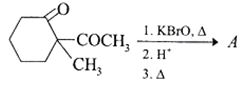
What is the final product $A$ in the following reaction sequence?
A
$2-$methylcyclohexanone
B
$1-$methylcyclohexanecarboxylic acid
C
$1-$hydroxycyclohexanecarboxylic acid
D
$2-$hydroxy$-2-$methylcyclohexanecarboxylic acid
Solution
(A) The reaction sequence is as follows:
$1$. The starting material is $2$-acetyl-$2$-methylcyclohexanone. Treatment with $KBrO$ and $\Delta$ (haloform reaction) converts the acetyl group $(-COCH_3)$ into a carboxylate group $(-COOK)$ while releasing $CHBr_3$.
$2$. Acidification with $H^+$ converts the carboxylate salt into a $\beta$-keto acid,$1$-methyl-$2$-oxocyclohexanecarboxylic acid.
$3$. Heating $(\Delta)$ the $\beta$-keto acid causes decarboxylation,releasing $CO_2$ and forming $2$-methylcyclohexanone as the final product $A$.
$1$. The starting material is $2$-acetyl-$2$-methylcyclohexanone. Treatment with $KBrO$ and $\Delta$ (haloform reaction) converts the acetyl group $(-COCH_3)$ into a carboxylate group $(-COOK)$ while releasing $CHBr_3$.
$2$. Acidification with $H^+$ converts the carboxylate salt into a $\beta$-keto acid,$1$-methyl-$2$-oxocyclohexanecarboxylic acid.
$3$. Heating $(\Delta)$ the $\beta$-keto acid causes decarboxylation,releasing $CO_2$ and forming $2$-methylcyclohexanone as the final product $A$.
0 likes
View Solution331
MediumMCQ
Which is the best oxidizing agent to oxidize $CH_3CH=CHCHO$ to $CH_3CH=CHCOOH$?
A
Acidic $KMnO_4$
B
Alkaline $KMnO_4$
C
Acidic $K_2Cr_2O_7$
D
Tollens' reagent $(Ag(NH_3)_2^+)$
Solution
(D) Tollens' reagent is a mild oxidizing agent that selectively oxidizes the aldehyde group $(-CHO)$ to a carboxylic acid group $(-COOH)$ without affecting the carbon-carbon double bond $(C=C)$.
$CH_3CH=CHCHO \xrightarrow{[Ag(NH_3)_2]^+} CH_3CH=CHCOOH$
Strong oxidizing agents like acidic $KMnO_4$ or acidic $K_2Cr_2O_7$ would oxidize both the aldehyde group and the double bond,leading to cleavage of the molecule.
$CH_3CH=CHCHO \xrightarrow{[Ag(NH_3)_2]^+} CH_3CH=CHCOOH$
Strong oxidizing agents like acidic $KMnO_4$ or acidic $K_2Cr_2O_7$ would oxidize both the aldehyde group and the double bond,leading to cleavage of the molecule.
0 likes
View Solution332
DifficultMCQ
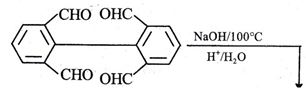
What will be the major product?
A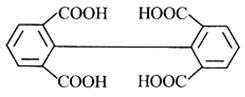
B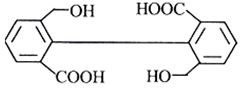
C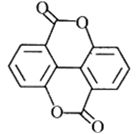
D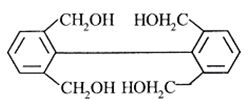
Solution
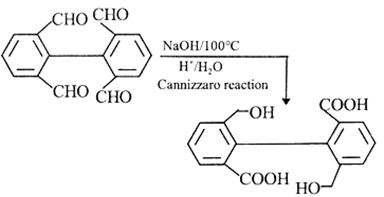
(C) The given reactant is a tetra-aldehyde compound,specifically $2,2',6,6'$-tetrabenzenedicarbaldehyde. When treated with concentrated $NaOH$ at $100^{\circ}C$,it undergoes an intramolecular Cannizzaro reaction. In the Cannizzaro reaction,aldehydes lacking $\alpha$-hydrogen atoms undergo self-oxidation and reduction in the presence of a strong base. Here,the aldehyde groups are reduced to primary alcohol groups $(-CH_2OH)$ and oxidized to carboxylate groups $(-COO^-)$,which upon acidification with $H^+/H_2O$ yield carboxylic acid groups $(-COOH)$. The final product is a compound containing both alcohol and carboxylic acid functional groups,as shown in option $C$.
0 likes
View Solution333
MediumMCQ
Which of the following is a mixed ketone?
A
Pentanone
B
Benzophenone
C
Acetophenone
D
All of these
Solution
(C) mixed ketone is a ketone where the two groups attached to the carbonyl carbon are different.
$1$. Pentanone (e.g.,$CH_3CH_2COCH_2CH_3$ or $CH_3COCH_2CH_2CH_3$) can be simple or mixed.
$2$. Benzophenone $(C_6H_5COC_6H_5)$ is a simple (symmetrical) ketone.
$3$. Acetophenone $(C_6H_5COCH_3)$ has a phenyl group and a methyl group attached to the carbonyl carbon,making it a mixed (unsymmetrical) ketone.
$1$. Pentanone (e.g.,$CH_3CH_2COCH_2CH_3$ or $CH_3COCH_2CH_2CH_3$) can be simple or mixed.
$2$. Benzophenone $(C_6H_5COC_6H_5)$ is a simple (symmetrical) ketone.
$3$. Acetophenone $(C_6H_5COCH_3)$ has a phenyl group and a methyl group attached to the carbonyl carbon,making it a mixed (unsymmetrical) ketone.
0 likes
View Solution334
MediumMCQ
Which reagent is used to distinguish between acetophenone and benzophenone?
A
$2,4-$ dinitrophenylhydrazine
B
Benedict's reagent
C
Aqueous solution of $NaHSO_3$
D
$I_2$ and $Na_2CO_3$
Solution
(D) Acetophenone $(C_6H_5COCH_3)$ contains a methyl ketone group $(-COCH_3)$,which gives a positive iodoform test with $I_2$ and $Na_2CO_3$ (or $NaOH$),producing a yellow precipitate of iodoform $(CHI_3)$.
Benzophenone $(C_6H_5COC_6H_5)$ does not contain a methyl ketone group and therefore does not give the iodoform test.
Thus,$I_2$ and $Na_2CO_3$ can be used to distinguish between them.
Benzophenone $(C_6H_5COC_6H_5)$ does not contain a methyl ketone group and therefore does not give the iodoform test.
Thus,$I_2$ and $Na_2CO_3$ can be used to distinguish between them.
0 likes
View Solution335
MediumMCQ
What product is formed by the self-condensation of acetaldehyde in the presence of a dilute alkali?
A
Acetal
B
Aldol
C
Mesitylene
D
Propionaldehyde
Solution
(B) Acetaldehyde $(CH_3CHO)$ undergoes self-condensation in the presence of dilute alkali $(NaOH)$ to form $3$-hydroxybutanal,which is commonly known as aldol.
The reaction is: $2CH_3CHO \xrightarrow{dil. NaOH} CH_3-CH(OH)-CH_2-CHO$ (Aldol).
The reaction is: $2CH_3CHO \xrightarrow{dil. NaOH} CH_3-CH(OH)-CH_2-CHO$ (Aldol).
0 likes
View Solution336
MediumMCQ
Which of the following cannot be obtained by the reduction of an aldehyde or a ketone using $NaBH_4$ or $LiAlH_4$?
A
Propan$-1-$ol
B
Propan$-2-$ol
C
$2-$Methylpropan$-2-$ol
D
Ethanol
Solution
(C) The reduction of aldehydes and ketones using $NaBH_4$ or $LiAlH_4$ yields primary or secondary alcohols.
$1.$ Aldehydes $(RCHO)$ are reduced to primary alcohols $(RCH_2OH)$.
$2.$ Ketones $(RCOR')$ are reduced to secondary alcohols $(RCH(OH)R')$.
$3.$ Tertiary alcohols cannot be obtained by the reduction of aldehydes or ketones because they require a carbon atom bonded to three other carbon atoms,which is not possible through simple reduction of the carbonyl group.
$4.$ $2$-Methylpropan-$2$-ol is a tertiary alcohol,hence it cannot be obtained by this method.
$1.$ Aldehydes $(RCHO)$ are reduced to primary alcohols $(RCH_2OH)$.
$2.$ Ketones $(RCOR')$ are reduced to secondary alcohols $(RCH(OH)R')$.
$3.$ Tertiary alcohols cannot be obtained by the reduction of aldehydes or ketones because they require a carbon atom bonded to three other carbon atoms,which is not possible through simple reduction of the carbonyl group.
$4.$ $2$-Methylpropan-$2$-ol is a tertiary alcohol,hence it cannot be obtained by this method.
0 likes
View Solution337
MediumMCQ
Which of the following substances will not give a brick-red precipitate with Fehling's solution?
A
Formalin
B
Acetaldehyde
C
Glucose
D
Acetone
Solution
(D) Fehling's solution is a mild oxidizing agent used to distinguish between aldehydes and ketones.
Aldehydes (except benzaldehyde) and reducing sugars like glucose give a brick-red precipitate of $Cu_2O$ with Fehling's solution.
Acetone is a ketone and does not undergo oxidation under these mild conditions; therefore,it does not give a brick-red precipitate.
Aldehydes (except benzaldehyde) and reducing sugars like glucose give a brick-red precipitate of $Cu_2O$ with Fehling's solution.
Acetone is a ketone and does not undergo oxidation under these mild conditions; therefore,it does not give a brick-red precipitate.
0 likes
View Solution338
MediumMCQ
Which of the following reacts with alcohol in the presence of dry $HCl$ to form an acetal?
A
Acetaldehyde
B
Ketone
C
Ether
D
Carboxylic acid
Solution
(A) Aldehydes react with two equivalents of monohydric alcohol in the presence of dry $HCl$ gas to form gem-dialkoxy compounds known as acetals.
$CH_3CHO + R-OH \xrightarrow{dry \ HCl} CH_3CH(OH)(OR)$ (Hemiacetal)
$CH_3CH(OH)(OR) + R-OH \xrightarrow{dry \ HCl} CH_3CH(OR)_2 + H_2O$ (Acetal)
Thus,acetaldehyde reacts with alcohol to form an acetal.
$CH_3CHO + R-OH \xrightarrow{dry \ HCl} CH_3CH(OH)(OR)$ (Hemiacetal)
$CH_3CH(OH)(OR) + R-OH \xrightarrow{dry \ HCl} CH_3CH(OR)_2 + H_2O$ (Acetal)
Thus,acetaldehyde reacts with alcohol to form an acetal.
0 likes
View Solution339
MediumMCQ
Which of the following reagents reacts differently with $HCHO$,$CH_3CHO$,and $CH_3COCH_3$?
A
$HCN$
B
$NH_2NH_2$
C
$NH_2OH$
D
$NH_3$
Solution
(D) Ammonia $(NH_3)$ reacts differently with formaldehyde,acetaldehyde,and acetone.
$1$. Formaldehyde reacts with $NH_3$ to form hexamethylenetetramine (urotropine):
$6HCHO + 4NH_3 \to (CH_2)_6N_4 + 6H_2O$
$2$. Acetaldehyde reacts with $NH_3$ to form acetaldehyde ammonia (an addition product):
$CH_3CHO + NH_3 \to CH_3CH(OH)NH_2$
$3$. Acetone reacts with $NH_3$ to form diacetone amine:
$2CH_3COCH_3 + NH_3 \to (CH_3)_2C(NH_2)CH_2COCH_3 + H_2O$
Other reagents like $HCN$,$NH_2NH_2$,and $NH_2OH$ react with all three carbonyl compounds to form similar types of products (cyanohydrins,hydrazones,and oximes,respectively).
$1$. Formaldehyde reacts with $NH_3$ to form hexamethylenetetramine (urotropine):
$6HCHO + 4NH_3 \to (CH_2)_6N_4 + 6H_2O$
$2$. Acetaldehyde reacts with $NH_3$ to form acetaldehyde ammonia (an addition product):
$CH_3CHO + NH_3 \to CH_3CH(OH)NH_2$
$3$. Acetone reacts with $NH_3$ to form diacetone amine:
$2CH_3COCH_3 + NH_3 \to (CH_3)_2C(NH_2)CH_2COCH_3 + H_2O$
Other reagents like $HCN$,$NH_2NH_2$,and $NH_2OH$ react with all three carbonyl compounds to form similar types of products (cyanohydrins,hydrazones,and oximes,respectively).
0 likes
View Solution340
MediumMCQ
Which of the following reacts with methylmagnesium iodide to produce tert-butyl alcohol?
A
$HCHO$
B
$CH_3CHO$
C
$CH_3COCH_3$
D
$CO_2$
Solution
(C) The reaction of a Grignard reagent $(CH_3MgI)$ with acetone $(CH_3COCH_3)$ followed by hydrolysis yields tert-butyl alcohol $(2-methylpropan-2-ol)$.
$CH_3COCH_3 + CH_3MgI \xrightarrow{dry \, ether} (CH_3)_3C-OMgI$
$(CH_3)_3C-OMgI + H_2O \xrightarrow{H^+} (CH_3)_3C-OH + Mg(OH)I$
Thus,acetone is the correct reactant.
$CH_3COCH_3 + CH_3MgI \xrightarrow{dry \, ether} (CH_3)_3C-OMgI$
$(CH_3)_3C-OMgI + H_2O \xrightarrow{H^+} (CH_3)_3C-OH + Mg(OH)I$
Thus,acetone is the correct reactant.
0 likes
View Solution341
MediumMCQ
Which of the following aldehydes is most reactive towards nucleophilic addition reactions?
A
$CCl_3CHO$
B
$CH_3CHO$
C
$C_2H_5CHO$
D
$CH_3COCH_3$
Solution
(A) The reactivity of carbonyl compounds towards nucleophilic addition reactions depends on the electrophilicity of the carbonyl carbon.
Presence of electron-withdrawing groups (like $-Cl$) increases the positive charge on the carbonyl carbon,making it more susceptible to nucleophilic attack.
In $CCl_3CHO$,the three chlorine atoms exert a strong $-I$ effect,making the carbonyl carbon highly electrophilic.
Thus,$CCl_3CHO$ is the most reactive among the given options.
Presence of electron-withdrawing groups (like $-Cl$) increases the positive charge on the carbonyl carbon,making it more susceptible to nucleophilic attack.
In $CCl_3CHO$,the three chlorine atoms exert a strong $-I$ effect,making the carbonyl carbon highly electrophilic.
Thus,$CCl_3CHO$ is the most reactive among the given options.
0 likes
View Solution342
MediumMCQ
The addition reaction of $HCN$ to carbonyl compounds is an example of which of the following?
A
Nucleophilic substitution
B
Electrophilic addition
C
Nucleophilic addition
D
Electrophilic substitution
Solution
(C) Carbonyl compounds undergo nucleophilic addition reactions.
The reaction is:
$ >C=O + HCN \to >C(OH)(CN) $
This product is known as a cyanohydrin.
The reaction is:
$ >C=O + HCN \to >C(OH)(CN) $
This product is known as a cyanohydrin.
0 likes
View Solution343
MediumMCQ
Which of the following carbonyl compounds gives both Fehling's test and iodoform test?
A
Methanal
B
Ethanal
C
Propanone
D
Ethanol
Solution
(B) Ethanal $(CH_3CHO)$ is an aldehyde,so it gives the Fehling's test.
It also contains the $CH_3-C(=O)-$ group,which allows it to give the iodoform test.
It also contains the $CH_3-C(=O)-$ group,which allows it to give the iodoform test.
0 likes
View Solution344
MediumMCQ
Which of the following can be used to convert benzophenone into benzene?
A
Fused alkali
B
Anhydrous $AlCl_3$
C
Sodium amalgam in water
D
Acidic dichromate
Solution
(A) Benzophenone $(C_6H_5COC_6H_5)$ can be converted into benzene $(C_6H_6)$ by fusion with molten potassium hydroxide $(KOH)$.
This reaction is a type of cleavage reaction where the carbon-carbon bond between the carbonyl group and one of the phenyl rings is broken.
The reaction proceeds as follows:
$C_6H_5COC_6H_5 + KOH \xrightarrow{\text{fusion}} C_6H_6 + C_6H_5COOK$
Here,benzophenone reacts with fused $KOH$ to yield benzene and potassium benzoate.
This reaction is a type of cleavage reaction where the carbon-carbon bond between the carbonyl group and one of the phenyl rings is broken.
The reaction proceeds as follows:
$C_6H_5COC_6H_5 + KOH \xrightarrow{\text{fusion}} C_6H_6 + C_6H_5COOK$
Here,benzophenone reacts with fused $KOH$ to yield benzene and potassium benzoate.
0 likes
View Solution345
MediumMCQ
Which of the following statements regarding the chemical properties of acetophenone is incorrect?
$I.$ It is reduced to methyl phenyl carbinol by sodium and ethanol.
$II.$ It is oxidized to benzoic acid with acidic $KMnO_4$.
$III.$ It does not undergo electrophilic substitution reactions (like nitration at the $m$-position).
$IV.$ It does not give the iodoform test with iodine and alkali.
$I.$ It is reduced to methyl phenyl carbinol by sodium and ethanol.
$II.$ It is oxidized to benzoic acid with acidic $KMnO_4$.
$III.$ It does not undergo electrophilic substitution reactions (like nitration at the $m$-position).
$IV.$ It does not give the iodoform test with iodine and alkali.
A
$I$ and $II$
B
$II$ and $IV$
C
$III$ and $IV$
D
$I$ and $IV$
Solution
(C) Acetophenone $(C_6H_5COCH_3)$ undergoes standard electrophilic aromatic substitution reactions because the acetyl group is deactivating and meta-directing.
Therefore,statement $III$ is incorrect.
Acetophenone contains a methyl ketone group $(-COCH_3)$,so it gives a positive iodoform test with iodine and alkali.
Therefore,statement $IV$ is incorrect.
Statement $I$ is correct: Reduction of acetophenone with $Na/C_2H_5OH$ yields $1$-phenylethanol (methyl phenyl carbinol).
Statement $II$ is correct: Oxidation of acetophenone with acidic $KMnO_4$ yields benzoic acid.
Thus,statements $III$ and $IV$ are incorrect.
Therefore,statement $III$ is incorrect.
Acetophenone contains a methyl ketone group $(-COCH_3)$,so it gives a positive iodoform test with iodine and alkali.
Therefore,statement $IV$ is incorrect.
Statement $I$ is correct: Reduction of acetophenone with $Na/C_2H_5OH$ yields $1$-phenylethanol (methyl phenyl carbinol).
Statement $II$ is correct: Oxidation of acetophenone with acidic $KMnO_4$ yields benzoic acid.
Thus,statements $III$ and $IV$ are incorrect.
0 likes
View Solution346
MediumMCQ
What is formed when benzaldehyde reacts with chlorine in the absence of a catalyst?
A
Chlorobenzene
B
Benzyl chloride
C
Benzoyl chloride
D
Chlorobenzaldehyde
Solution
(C) When benzaldehyde $(C_6H_5CHO)$ reacts with chlorine $(Cl_2)$ in the absence of a catalyst (like $FeCl_3$ or $AlCl_3$),the reaction is a substitution of the aldehydic hydrogen atom.
This reaction produces benzoyl chloride $(C_6H_5COCl)$ and hydrogen chloride $(HCl)$ as a byproduct.
The chemical equation is: $C_6H_5CHO + Cl_2 \rightarrow C_6H_5COCl + HCl$.
This reaction produces benzoyl chloride $(C_6H_5COCl)$ and hydrogen chloride $(HCl)$ as a byproduct.
The chemical equation is: $C_6H_5CHO + Cl_2 \rightarrow C_6H_5COCl + HCl$.
0 likes
View Solution347
MediumMCQ
Arrange the following compounds in the decreasing order of their reactivity towards nucleophilic addition reactions:
$(I) \, HCHO \, (II) \, CH_3CHO \, (III) \, CH_3COCH_3$
$(I) \, HCHO \, (II) \, CH_3CHO \, (III) \, CH_3COCH_3$
A
$II > III > I$
B
$III > II > I$
C
$I > II > III$
D
$I > III > II$
Solution
(C) The reactivity of carbonyl compounds towards nucleophilic addition reactions depends on two factors: steric hindrance and electronic effects.
Aldehydes are generally more reactive than ketones because they have less steric hindrance and less electron-donating alkyl groups attached to the carbonyl carbon.
In $HCHO$,there are two hydrogen atoms attached to the carbonyl carbon,providing the least steric hindrance.
In $CH_3CHO$,one methyl group is present,which increases steric hindrance and provides a $+I$ effect.
In $CH_3COCH_3$,two methyl groups are present,providing the maximum steric hindrance and the strongest $+I$ effect,which decreases the electrophilicity of the carbonyl carbon.
Therefore,the order of reactivity is $I > II > III$.
Aldehydes are generally more reactive than ketones because they have less steric hindrance and less electron-donating alkyl groups attached to the carbonyl carbon.
In $HCHO$,there are two hydrogen atoms attached to the carbonyl carbon,providing the least steric hindrance.
In $CH_3CHO$,one methyl group is present,which increases steric hindrance and provides a $+I$ effect.
In $CH_3COCH_3$,two methyl groups are present,providing the maximum steric hindrance and the strongest $+I$ effect,which decreases the electrophilicity of the carbonyl carbon.
Therefore,the order of reactivity is $I > II > III$.
0 likes
View Solution348
MediumMCQ
Which of the following reagents can be used to reduce the $ > C = O$ group to $CH_2$?
A
Catalytic reduction
B
$Na/C_2H_5OH$
C
$NH_2NH_2 / KOH$
D
$LiAlH_4$
Solution
(C) The reduction of a carbonyl group $( > C = O)$ to a methylene group $( > CH_2)$ is known as the Wolff-Kishner reduction.
This reaction uses hydrazine $(NH_2NH_2)$ in the presence of a strong base like $KOH$ (potassium hydroxide) at high temperatures.
The chemical equation is: $ > C = O + NH_2NH_2 \xrightarrow{KOH} > CH_2 + N_2 + H_2O$.
This reaction uses hydrazine $(NH_2NH_2)$ in the presence of a strong base like $KOH$ (potassium hydroxide) at high temperatures.
The chemical equation is: $ > C = O + NH_2NH_2 \xrightarrow{KOH} > CH_2 + N_2 + H_2O$.
0 likes
View Solution349
MediumMCQ
Which of the following compounds reacts with $50\%$ sodium hydroxide solution to give the corresponding alcohol and acid?
A
Phenol
B
Benzoic acid
C
Butanal
D
Benzaldehyde
Solution
(D) The reaction described is the Cannizzaro reaction. Aldehydes that do not contain an $\alpha$-hydrogen atom undergo self-oxidation and reduction (disproportionation) when treated with a concentrated alkali solution like $50\% \ NaOH$. Benzaldehyde $(C_6H_5CHO)$ lacks $\alpha$-hydrogen atoms and thus undergoes the Cannizzaro reaction to produce benzyl alcohol and sodium benzoate. The reaction is: $2C_6H_5CHO + NaOH (50\%) \rightarrow C_6H_5CH_2OH + C_6H_5COONa$.
0 likes
View Solution350
MediumMCQ
When cyclohexanone reacts with dimethylamine in the presence of a catalytic amount of acid,water is continuously removed during the reaction. What is the product commonly called?
A
Schiff's base
B
Enamine
C
Imine
D
Amine
Solution
(B) The reaction of a ketone (like cyclohexanone) with a secondary amine (like dimethylamine) in the presence of an acid catalyst leads to the formation of an enamine.
During this process,the initial addition product loses a molecule of water $(H_2O)$ to form a carbon-carbon double bond adjacent to the nitrogen atom.
The reaction is: $Cyclohexanone + HN(CH_3)_2 \xrightarrow{H^+} Enamine + H_2O$.
Thus,the product formed is an enamine.
During this process,the initial addition product loses a molecule of water $(H_2O)$ to form a carbon-carbon double bond adjacent to the nitrogen atom.
The reaction is: $Cyclohexanone + HN(CH_3)_2 \xrightarrow{H^+} Enamine + H_2O$.
Thus,the product formed is an enamine.
0 likes
View Solution8-1.Aldehydes and Ketones — Properties · Frequently Asked Questions
1Are these 8-1.Aldehydes and Ketones questions useful for JEE and NEET?
Yes. All questions in this section are mapped to JEE Main and NEET exam patterns. Previous year questions from JEE Main, NEET, GUJCET and state-level exams are included with full solutions.
2Can I switch to Hindi or Gujarati for these questions?
Yes. Use the language tabs in the hero section or the sidebar to view the same questions and solutions in English, Hindi or Gujarati.
3How do I generate a question paper from this subtopic?
Use the Vedclass Exam Paper Generator — select the chapter and subtopic, set difficulty, and generate Sets A, B, C, D automatically. First 3 chapters of every subject are free.
Vedclass Products
For Students
Vedclass Test Series
Mock tests in real JEE/NEET style with performance analysis. 5-day free trial.
Start Free TrialFor Teachers
Exam Paper Generator
Generate Set A/B/C/D papers from this chapter in 2 minutes. 3 chapters free.
Try FreeFor Institutes
Online Exam Module
Live online exams with unlimited students, 360° analytics & white-label branding.
See DemoFor Teachers & Institutes
Generate a 8-1.Aldehydes and Ketones Exam Paper in 2 Minutes
Select subtopic & difficulty — Sets A, B, C, D auto-generated with No Repeat logic.
First 3 chapters of every subject are free — no payment required.