
A English
Properties Questions in English
Class 12 Chemistry · 8-1.Aldehydes and Ketones · Properties
1739+
Questions
English
Language
100%
With Solutions
Showing 50 of 1739 questions in English
251
EasyMCQ
Which of the following does not effect the transformation shown below?
$R_2C=O \rightarrow R_2CH_2$
$R_2C=O \rightarrow R_2CH_2$
A
Clemmensen reduction
B
Wolff-Kishner reduction
C
Wurtz reduction
D
$200^{\circ}C$ red $P$ and $HI$
Solution
(C) The given transformation is the reduction of a carbonyl group $(C=O)$ to a methylene group $(CH_2)$.
Clemmensen reduction $(Zn-Hg/HCl)$ reduces aldehydes and ketones to alkanes.
Wolff-Kishner reduction $(NH_2NH_2/KOH, \Delta)$ also reduces aldehydes and ketones to alkanes.
Red $P$ and $HI$ at $200^{\circ}C$ is a strong reducing agent that reduces carbonyl compounds to alkanes.
Wurtz reaction is used for the preparation of higher alkanes from alkyl halides,not for the reduction of carbonyl compounds.
Therefore,Wurtz reduction does not effect this transformation.
Clemmensen reduction $(Zn-Hg/HCl)$ reduces aldehydes and ketones to alkanes.
Wolff-Kishner reduction $(NH_2NH_2/KOH, \Delta)$ also reduces aldehydes and ketones to alkanes.
Red $P$ and $HI$ at $200^{\circ}C$ is a strong reducing agent that reduces carbonyl compounds to alkanes.
Wurtz reaction is used for the preparation of higher alkanes from alkyl halides,not for the reduction of carbonyl compounds.
Therefore,Wurtz reduction does not effect this transformation.
0 likes
View Solution252
MediumMCQ
Which of the following compounds is reduced to the corresponding hydrocarbon by $Zn-Hg$ and concentrated $HCl$?
A
Acetamide
B
Acetic acid
C
Ethyl acetate
D
Butan-$2$-one
Solution
(D) The reaction involving $Zn-Hg$ and concentrated $HCl$ is known as the $Clemmensen$ reduction.
This reaction specifically reduces carbonyl groups $(C=O)$ of aldehydes and ketones to methylene groups $(CH_2)$.
Among the given options,$Butan-2-one$ $(CH_3COCH_2CH_3)$ is a ketone,which undergoes $Clemmensen$ reduction to form $n-butane$ $(CH_3CH_2CH_2CH_3)$.
Other options like acetamide,acetic acid,and ethyl acetate do not undergo this reduction under these conditions.
This reaction specifically reduces carbonyl groups $(C=O)$ of aldehydes and ketones to methylene groups $(CH_2)$.
Among the given options,$Butan-2-one$ $(CH_3COCH_2CH_3)$ is a ketone,which undergoes $Clemmensen$ reduction to form $n-butane$ $(CH_3CH_2CH_2CH_3)$.
Other options like acetamide,acetic acid,and ethyl acetate do not undergo this reduction under these conditions.
0 likes
View Solution253
DifficultMCQ
Which reagent is suitable for the following transformation?

A
$NaBH_4$
B
$NH_2NH_2, \mathop{OH}\limits^\Theta$
C
$Zn-Hg / HCl$
D
$Na, Liq. NH_3$
Solution
(B) The given transformation involves the reduction of a ketone group $(C=O)$ to a methylene group $(-CH_2-)$ while keeping the carbon-carbon double bond $(C=C)$ and the hydroxyl group $(-OH)$ intact.
$NaBH_4$ reduces ketones to alcohols but does not reduce the $C=O$ group to $CH_2$.
$Zn-Hg / HCl$ (Clemmensen reduction) is acidic and would likely cause dehydration of the alcohol or other side reactions.
$NH_2NH_2, \mathop{OH}\limits^\Theta$ (Wolff-Kishner reduction) is a basic condition that specifically reduces the carbonyl group of aldehydes and ketones to a methylene group without affecting the $C=C$ double bond or the alcohol group.
Therefore,the correct reagent is $NH_2NH_2, \mathop{OH}\limits^\Theta$.
$NaBH_4$ reduces ketones to alcohols but does not reduce the $C=O$ group to $CH_2$.
$Zn-Hg / HCl$ (Clemmensen reduction) is acidic and would likely cause dehydration of the alcohol or other side reactions.
$NH_2NH_2, \mathop{OH}\limits^\Theta$ (Wolff-Kishner reduction) is a basic condition that specifically reduces the carbonyl group of aldehydes and ketones to a methylene group without affecting the $C=C$ double bond or the alcohol group.
Therefore,the correct reagent is $NH_2NH_2, \mathop{OH}\limits^\Theta$.
0 likes
View Solution254
MediumMCQ
The Clemmensen reduction is represented by:
A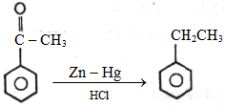
B
$C_6H_5COCH_3 + NH_2NH_2 \xrightarrow{C_2H_5ONa} C_6H_5CH_2CH_3$
C
$CH_3COCH_3 + 4HI \xrightarrow{Red P} CH_3CH_2CH_3$
D
All of the above
Solution
(A) The Clemmensen reduction involves the reduction of carbonyl groups (aldehydes and ketones) to methylene groups $(-CH_2-)$ using zinc amalgam $(Zn-Hg)$ and concentrated hydrochloric acid $(HCl)$.
The reaction shown in the image is:
$C_6H_5COCH_3 \xrightarrow{Zn-Hg/HCl} C_6H_5CH_2CH_3$
This is the classic Clemmensen reduction.
Option $B$ represents the Wolff-Kishner reduction.
Option $C$ represents reduction using red phosphorus and $HI$.
Therefore,only the reaction shown in the image is a Clemmensen reduction.
The reaction shown in the image is:
$C_6H_5COCH_3 \xrightarrow{Zn-Hg/HCl} C_6H_5CH_2CH_3$
This is the classic Clemmensen reduction.
Option $B$ represents the Wolff-Kishner reduction.
Option $C$ represents reduction using red phosphorus and $HI$.
Therefore,only the reaction shown in the image is a Clemmensen reduction.
0 likes
View Solution255
MediumMCQ
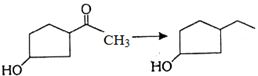
Which reagent is suitable for the following transformation?
A
$Zn(Hg)/HCl$
B
$NH_2NH_2, OH^-$
C
$H_2/Ni$
D
$NaBH_4$
Solution
(B) The given transformation involves the reduction of a ketone group $(C=O)$ to a methylene group $(-CH_2-)$ while keeping the hydroxyl $(-OH)$ group intact.
$1.$ $Zn(Hg)/HCl$ is the reagent for Clemmensen reduction,which is acidic in nature. It would likely cause the dehydration of the alcohol group.
$2.$ $NH_2NH_2, OH^-$ is the reagent for Wolff-Kishner reduction,which is basic in nature. It reduces the carbonyl group to a methylene group without affecting the hydroxyl group.
$3.$ $H_2/Ni$ would reduce the ketone to an alcohol.
$4.$ $NaBH_4$ would reduce the ketone to an alcohol.
Therefore,the correct reagent is $NH_2NH_2, OH^-$.
$1.$ $Zn(Hg)/HCl$ is the reagent for Clemmensen reduction,which is acidic in nature. It would likely cause the dehydration of the alcohol group.
$2.$ $NH_2NH_2, OH^-$ is the reagent for Wolff-Kishner reduction,which is basic in nature. It reduces the carbonyl group to a methylene group without affecting the hydroxyl group.
$3.$ $H_2/Ni$ would reduce the ketone to an alcohol.
$4.$ $NaBH_4$ would reduce the ketone to an alcohol.
Therefore,the correct reagent is $NH_2NH_2, OH^-$.
0 likes
View Solution256
MediumMCQ
Which of the following is reduced by $Zn-Hg/HCl$ to give the corresponding hydrocarbon?
A
Butan-$2$-one
B
Acetic acid
C
Acetamide
D
Ethyl acetate
Solution
(A) The reagent $Zn-Hg/HCl$ is used in the $Clemmensen$ reduction.
This reaction specifically reduces carbonyl groups $(C=O)$ present in aldehydes and ketones to methylene groups $(-CH_2-)$.
Among the given options,butan-$2$-one is a ketone,which undergoes $Clemmensen$ reduction to form butane.
Carboxylic acids,amides,and esters do not undergo $Clemmensen$ reduction under these conditions.
This reaction specifically reduces carbonyl groups $(C=O)$ present in aldehydes and ketones to methylene groups $(-CH_2-)$.
Among the given options,butan-$2$-one is a ketone,which undergoes $Clemmensen$ reduction to form butane.
Carboxylic acids,amides,and esters do not undergo $Clemmensen$ reduction under these conditions.
0 likes
View Solution257
MediumMCQ
What is the reduction of aldehydes and ketones in the presence of zinc amalgam and concentrated $HCl$ called?
A
Cope reduction
B
Dow reduction
C
Wolff-Kishner reduction
D
Clemmensen reduction
Solution
(D) The reduction of aldehydes and ketones to alkanes using zinc amalgam $(Zn-Hg)$ and concentrated hydrochloric acid $(HCl)$ is known as the $Clemmensen$ reduction.
The general reaction is: $R-CO-R' + 4[H] \xrightarrow{Zn-Hg/HCl} R-CH_2-R' + H_2O$.
The general reaction is: $R-CO-R' + 4[H] \xrightarrow{Zn-Hg/HCl} R-CH_2-R' + H_2O$.
0 likes
View Solution258
DifficultMCQ
The reaction $CH_3CHO \xrightarrow[Zn(Hg)/Conc. HCl]{[H]} CH_3CH_3$ is known as:
A
Cannizzaro reaction
B
Wolff-Kishner reduction
C
Rosenmund reduction
D
Clemmensen reduction
Solution
(D) The given reaction involves the reduction of an aldehyde $(CH_3CHO)$ to an alkane $(CH_3CH_3)$ using zinc amalgam $(Zn(Hg))$ and concentrated hydrochloric acid $(Conc. HCl)$.
This specific reagent system is used in the Clemmensen reduction,which reduces carbonyl groups $(C=O)$ to methylene groups $(CH_2)$.
Therefore,the correct option is $D$.
This specific reagent system is used in the Clemmensen reduction,which reduces carbonyl groups $(C=O)$ to methylene groups $(CH_2)$.
Therefore,the correct option is $D$.
0 likes
View Solution259
MediumMCQ
Which of the following reagents converts phenyl methyl ketone into ethylbenzene?
A
$Zn-Hg + HCl$
B
$LiAlH_4$
C
$KMnO_4$
D
None of the above
Solution
(A) The conversion of a carbonyl group $(C=O)$ to a methylene group $(CH_2)$ is achieved by the Clemmensen reduction.
Phenyl methyl ketone $(C_6H_5COCH_3)$ reacts with $Zn-Hg$ amalgam in the presence of concentrated $HCl$ to form ethylbenzene $(C_6H_5CH_2CH_3)$.
This reaction is a standard method for the reduction of ketones to alkanes.
Phenyl methyl ketone $(C_6H_5COCH_3)$ reacts with $Zn-Hg$ amalgam in the presence of concentrated $HCl$ to form ethylbenzene $(C_6H_5CH_2CH_3)$.
This reaction is a standard method for the reduction of ketones to alkanes.
0 likes
View Solution260
EasyMCQ
Which of the following represents the correct order of reactivity towards nucleophilic addition reactions?
A
$HCHO > CH_3CHO > CH_3COCH_3$
B
$CH_3CHO > HCHO > CH_3COCH_3$
C
$CH_3CHO > CH_3COCH_3 > HCHO$
D
$CH_3COCH_3 > CH_3CHO > HCHO$
Solution
(A) The reactivity of carbonyl compounds towards nucleophilic addition depends on two factors: steric hindrance and electronic effects.
$1$. Steric hindrance: As the number of alkyl groups attached to the carbonyl carbon increases,the attack of the nucleophile becomes more difficult due to crowding.
$2$. Electronic effect: Alkyl groups are electron-donating ($+I$ effect),which decreases the electrophilicity of the carbonyl carbon.
Comparing the given compounds:
- $HCHO$ (Formaldehyde): No alkyl groups,least steric hindrance,most electrophilic.
- $CH_3CHO$ (Acetaldehyde): One methyl group,moderate steric hindrance.
- $CH_3COCH_3$ (Acetone): Two methyl groups,highest steric hindrance,least electrophilic.
Therefore,the order of reactivity is $HCHO > CH_3CHO > CH_3COCH_3$.
$1$. Steric hindrance: As the number of alkyl groups attached to the carbonyl carbon increases,the attack of the nucleophile becomes more difficult due to crowding.
$2$. Electronic effect: Alkyl groups are electron-donating ($+I$ effect),which decreases the electrophilicity of the carbonyl carbon.
Comparing the given compounds:
- $HCHO$ (Formaldehyde): No alkyl groups,least steric hindrance,most electrophilic.
- $CH_3CHO$ (Acetaldehyde): One methyl group,moderate steric hindrance.
- $CH_3COCH_3$ (Acetone): Two methyl groups,highest steric hindrance,least electrophilic.
Therefore,the order of reactivity is $HCHO > CH_3CHO > CH_3COCH_3$.
0 likes
View Solution261
EasyMCQ
The formation of cyanohydrin from ketones is an example of which type of reaction?
A
Electrophilic addition
B
Nucleophilic addition
C
Nucleophilic substitution
D
Electrophilic substitution
Solution
(B) The reaction of ketones with hydrogen cyanide $(HCN)$ to form cyanohydrins is a classic example of a nucleophilic addition reaction.
In this process,the cyanide ion $(CN^-)$ acts as a nucleophile and attacks the electrophilic carbonyl carbon of the ketone.
This leads to the formation of an intermediate alkoxide ion,which is subsequently protonated to form the cyanohydrin product.
In this process,the cyanide ion $(CN^-)$ acts as a nucleophile and attacks the electrophilic carbonyl carbon of the ketone.
This leads to the formation of an intermediate alkoxide ion,which is subsequently protonated to form the cyanohydrin product.
0 likes
View Solution262
MediumMCQ
How many total isomers of aldehydes are possible for the molecular formula $C_5H_{10}O$?
A
$3$
B
$4$
C
$5$
D
$6$
Solution
(B) The molecular formula $C_5H_{10}O$ represents an aldehyde with the functional group $-CHO$.
Subtracting one carbon for the $-CHO$ group,we have $4$ carbons remaining to form the alkyl chain.
The possible isomers for the butyl group $(-C_4H_9)$ are:
$1$. $CH_3-CH_2-CH_2-CH_2-CHO$ (pentanal)
$2$. $CH_3-CH_2-CH(CH_3)-CHO$ ($2$-methylbutanal)
$3$. $CH_3-CH(CH_3)-CH_2-CHO$ ($3$-methylbutanal)
$4$. $(CH_3)_3C-CHO$ ($2$,$2$-dimethylpropanal)
Therefore,the total number of possible aldehyde isomers is $4$.
Subtracting one carbon for the $-CHO$ group,we have $4$ carbons remaining to form the alkyl chain.
The possible isomers for the butyl group $(-C_4H_9)$ are:
$1$. $CH_3-CH_2-CH_2-CH_2-CHO$ (pentanal)
$2$. $CH_3-CH_2-CH(CH_3)-CHO$ ($2$-methylbutanal)
$3$. $CH_3-CH(CH_3)-CH_2-CHO$ ($3$-methylbutanal)
$4$. $(CH_3)_3C-CHO$ ($2$,$2$-dimethylpropanal)
Therefore,the total number of possible aldehyde isomers is $4$.
0 likes
View Solution263
MediumMCQ
Arrange the following compounds in increasing order of their enol content:
$1. CH_3CHO$
$2. CH_3COCH_3$
$3. CH_3COCH_2CHO$
$4. CH_3COCH_2COCH_3$
$1. CH_3CHO$
$2. CH_3COCH_3$
$3. CH_3COCH_2CHO$
$4. CH_3COCH_2COCH_3$
A
$1 < 3 < 2 < 4$
B
$4 < 2 < 3 < 1$
C
$1 < 4 < 3 < 2$
D
$1 < 2 < 3 < 4$
Solution
(D) The enol content depends on the stability of the enol form,which is influenced by factors like conjugation and intramolecular hydrogen bonding.
$1. CH_3CHO$ (Acetaldehyde): Enol content is very low $(\approx 10^{-4} \%)$.
$2. CH_3COCH_3$ (Acetone): Enol content is very low $(\approx 10^{-6} \%)$.
$3. CH_3COCH_2CHO$: This is a $\beta$-dicarbonyl compound. The enol form is stabilized by conjugation and intramolecular hydrogen bonding. Enol content is $\approx 9 \%$.
$4. CH_3COCH_2COCH_3$ (Acetylacetone): This is a $\beta$-diketone. The enol form is highly stabilized by strong intramolecular hydrogen bonding and extended conjugation. Enol content is $\approx 76 \%$.
Comparing the values,the order of increasing enol content is $2 < 1 < 3 < 4$. However,among the given options,the sequence $1 < 2 < 3 < 4$ is the most appropriate representation of the increasing trend.
$1. CH_3CHO$ (Acetaldehyde): Enol content is very low $(\approx 10^{-4} \%)$.
$2. CH_3COCH_3$ (Acetone): Enol content is very low $(\approx 10^{-6} \%)$.
$3. CH_3COCH_2CHO$: This is a $\beta$-dicarbonyl compound. The enol form is stabilized by conjugation and intramolecular hydrogen bonding. Enol content is $\approx 9 \%$.
$4. CH_3COCH_2COCH_3$ (Acetylacetone): This is a $\beta$-diketone. The enol form is highly stabilized by strong intramolecular hydrogen bonding and extended conjugation. Enol content is $\approx 76 \%$.
Comparing the values,the order of increasing enol content is $2 < 1 < 3 < 4$. However,among the given options,the sequence $1 < 2 < 3 < 4$ is the most appropriate representation of the increasing trend.
0 likes
View Solution264
DifficultMCQ
Arrange the following compounds in the increasing order of their reactivity towards the nucleophilic addition of $HCN$:
$1. HCHO$
$2. CH_3COCH_3$
$3. PhCOCH_3$
$4. PhCOPh$
$1. HCHO$
$2. CH_3COCH_3$
$3. PhCOCH_3$
$4. PhCOPh$
A
$4 < 3 < 2 < 1$
B
$1 < 2 < 3 < 4$
C
$3 < 4 < 2 < 1$
D
$4 < 2 < 3 < 1$
Solution
(A) The reactivity of carbonyl compounds towards nucleophilic addition reactions depends on two factors: steric hindrance and electronic effects.
$1.$ $HCHO$ has the least steric hindrance and no electron-donating groups,making it the most reactive.
$2.$ $CH_3COCH_3$ has two methyl groups,which provide slight steric hindrance and $+I$ effect.
$3.$ $PhCOCH_3$ has one phenyl group,which provides significant steric hindrance and resonance stabilization to the carbonyl carbon.
$4.$ $PhCOPh$ has two phenyl groups,providing the maximum steric hindrance and resonance stabilization,making it the least reactive.
Therefore,the increasing order of reactivity is $4 < 3 < 2 < 1$.
$1.$ $HCHO$ has the least steric hindrance and no electron-donating groups,making it the most reactive.
$2.$ $CH_3COCH_3$ has two methyl groups,which provide slight steric hindrance and $+I$ effect.
$3.$ $PhCOCH_3$ has one phenyl group,which provides significant steric hindrance and resonance stabilization to the carbonyl carbon.
$4.$ $PhCOPh$ has two phenyl groups,providing the maximum steric hindrance and resonance stabilization,making it the least reactive.
Therefore,the increasing order of reactivity is $4 < 3 < 2 < 1$.
0 likes
View Solution265
MediumMCQ
Which of the following compounds undergoes the highest degree of enolization?
A
$CH_3COCH_3$
B
$CH_3COCH_2CHO$
C
$CH_3COCH(Br)COCH_3$
D
Solution
(D) The extent of enolization depends on the stability of the resulting enol form.
In the case of $1,3$-dicarbonyl compounds,the enol form is stabilized by intramolecular hydrogen bonding and conjugation.
Among the given options,the cyclic $1,3$-dicarbonyl compound (cyclohexane-$1,3$-dione) forms an enol that is highly stabilized due to the formation of a stable,conjugated system and intramolecular hydrogen bonding,leading to the highest degree of enolization.
In the case of $1,3$-dicarbonyl compounds,the enol form is stabilized by intramolecular hydrogen bonding and conjugation.
Among the given options,the cyclic $1,3$-dicarbonyl compound (cyclohexane-$1,3$-dione) forms an enol that is highly stabilized due to the formation of a stable,conjugated system and intramolecular hydrogen bonding,leading to the highest degree of enolization.
0 likes
View Solution266
DifficultMCQ
What is the enol form of acetone after reaction with $D_2O$?
A
$CH_3-C(OD)=CH_2$
B
$CD_3-CO-CD_3$
C
$CH_2=C(OH)-CH_2D$
D
$CD_2=C(OH)-CD_3$
Solution
(D) Acetone $(CH_3COCH_3)$ undergoes keto-enol tautomerism in the presence of $D_2O$ (a deuterium source).
In the presence of a base or acid catalyst,the $\alpha$-hydrogens are exchanged with deuterium atoms.
The keto form becomes $CD_3COCD_3$.
The enol form is formed by the tautomerization of this deuterated ketone.
The enol form of $CD_3COCD_3$ is $CD_2=C(OH)-CD_3$.
In the presence of a base or acid catalyst,the $\alpha$-hydrogens are exchanged with deuterium atoms.
The keto form becomes $CD_3COCD_3$.
The enol form is formed by the tautomerization of this deuterated ketone.
The enol form of $CD_3COCD_3$ is $CD_2=C(OH)-CD_3$.
0 likes
View Solution267
MediumMCQ
What product is obtained from the reaction of a Grignard reagent with a ketone?
A
Tertiary alcohol
B
Secondary alcohol
C
Primary alcohol
D
Carboxylic acid
Solution
(A) The reaction of a ketone with a Grignard reagent $(R'MgX)$ proceeds via nucleophilic addition to the carbonyl group to form an adduct,which upon acidic hydrolysis yields a tertiary alcohol.
$R_2C=O + R'MgX \rightarrow R_2C(R')(OMgX)$
$R_2C(R')(OMgX) + H_2O/H^+ \rightarrow R_2C(R')OH + Mg(OH)X$
Thus,the product is a $3^o$ alcohol.
$R_2C=O + R'MgX \rightarrow R_2C(R')(OMgX)$
$R_2C(R')(OMgX) + H_2O/H^+ \rightarrow R_2C(R')OH + Mg(OH)X$
Thus,the product is a $3^o$ alcohol.
0 likes
View Solution268
MediumMCQ
An organic compound $A$ reacts with methyl magnesium iodide to form an addition product,which on hydrolysis gives compound $B$. Compound $B$ gives a blue color in the Victor Meyer test. What are compounds $A$ and $B$ respectively?
A
Acetaldehyde,Tertiary butyl alcohol
B
Acetaldehyde,Ethyl alcohol
C
Acetaldehyde,Isopropyl alcohol
D
Acetone,Isopropyl alcohol
Solution
(C) The Victor Meyer test gives a blue color for secondary alcohols. This means compound $B$ must be a secondary alcohol. Only aldehydes (other than formaldehyde) react with Grignard reagents to form secondary alcohols. Since the Grignard reagent is methyl magnesium iodide $(CH_3MgI)$,the aldehyde $A$ must be acetaldehyde $(CH_3CHO)$ to produce isopropyl alcohol $(CH_3CH(OH)CH_3)$ as the secondary alcohol $B$.
Reaction:
$CH_3CHO + CH_3MgI \rightarrow CH_3CH(OMgI)CH_3$
$CH_3CH(OMgI)CH_3 + H_2O/H^+ \rightarrow CH_3CH(OH)CH_3 + Mg(OH)I$
Isopropyl alcohol $(CH_3CH(OH)CH_3)$ is a secondary alcohol,which gives a blue color in the Victor Meyer test.
Reaction:
$CH_3CHO + CH_3MgI \rightarrow CH_3CH(OMgI)CH_3$
$CH_3CH(OMgI)CH_3 + H_2O/H^+ \rightarrow CH_3CH(OH)CH_3 + Mg(OH)I$
Isopropyl alcohol $(CH_3CH(OH)CH_3)$ is a secondary alcohol,which gives a blue color in the Victor Meyer test.
0 likes
View Solution269
MediumMCQ
Which of the following substances will not give a yellow precipitate with $I_2/NaOH$?
A
$C_2H_5OH$
B
$CH_3CHO$
C
$CH_3COCH_3$
D
$HCHO$
Solution
(D) The iodoform test is given by compounds containing the $CH_3CO-$ group or the $CH_3CH(OH)-$ group.
$HCHO$ (formaldehyde) does not contain either of these groups.
Therefore,$HCHO$ will not give a yellow precipitate of iodoform $(CHI_3)$ with $I_2/NaOH$.
$HCHO$ (formaldehyde) does not contain either of these groups.
Therefore,$HCHO$ will not give a yellow precipitate of iodoform $(CHI_3)$ with $I_2/NaOH$.
0 likes
View Solution270
DifficultMCQ
Ethyl ester $\xrightarrow{CH_3MgBr} P$. What will be the product $P$?
A
$(CH_3)_3COH$
B
$CH_3CH_2C(OH)(CH_3)_2$
C
$(C_2H_5)_2C(OH)CH_3$
D
$C_3H_7C(OH)(C_2H_5)_2$
Solution
(A) The reaction of an ester with a Grignard reagent $(R'MgX)$ proceeds in two steps to form a tertiary alcohol.
First,the ester reacts with one equivalent of the Grignard reagent to form a ketone intermediate.
$RCOOR'' + R'MgX \rightarrow RCOR' + R''OMgX$.
Then,the ketone reacts with a second equivalent of the Grignard reagent to form the tertiary alcohol after acidic hydrolysis.
$RCOR' + R'MgX$ $\rightarrow R(R')_2COMgX$ $\xrightarrow{H_3O^+} R(R')_2COH$.
For ethyl acetate $(CH_3COOC_2H_5)$ reacting with methylmagnesium bromide $(CH_3MgBr)$:
$1$. $CH_3COOC_2H_5 + CH_3MgBr \rightarrow CH_3COCH_3 + C_2H_5OMgBr$ (Acetone is formed).
$2$. $CH_3COCH_3 + CH_3MgBr \rightarrow (CH_3)_3COMgBr$.
$3$. $(CH_3)_3COMgBr + H_2O/H^+ \rightarrow (CH_3)_3COH + Mg(OH)Br$.
The final product is tert-butyl alcohol,$(CH_3)_3COH$.
First,the ester reacts with one equivalent of the Grignard reagent to form a ketone intermediate.
$RCOOR'' + R'MgX \rightarrow RCOR' + R''OMgX$.
Then,the ketone reacts with a second equivalent of the Grignard reagent to form the tertiary alcohol after acidic hydrolysis.
$RCOR' + R'MgX$ $\rightarrow R(R')_2COMgX$ $\xrightarrow{H_3O^+} R(R')_2COH$.
For ethyl acetate $(CH_3COOC_2H_5)$ reacting with methylmagnesium bromide $(CH_3MgBr)$:
$1$. $CH_3COOC_2H_5 + CH_3MgBr \rightarrow CH_3COCH_3 + C_2H_5OMgBr$ (Acetone is formed).
$2$. $CH_3COCH_3 + CH_3MgBr \rightarrow (CH_3)_3COMgBr$.
$3$. $(CH_3)_3COMgBr + H_2O/H^+ \rightarrow (CH_3)_3COH + Mg(OH)Br$.
The final product is tert-butyl alcohol,$(CH_3)_3COH$.
0 likes
View Solution271
DifficultMCQ
$p$-Cresol reacts with chloroform in an alkaline medium to give compound $A$,which on addition of hydrogen cyanide forms compound $Y$. Acidic hydrolysis of $Y$ yields a chiral carboxylic acid. What is the structure of the carboxylic acid?
A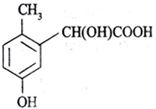
B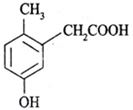
C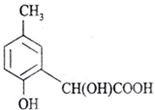
D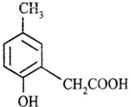
Solution
(C) $1$. $p$-Cresol reacts with $CHCl_3$ in the presence of $NaOH$ (Reimer-Tiemann reaction) to form $2$-hydroxy-$5$-methylbenzaldehyde (compound $A$ or $X$).
$2$. The aldehyde group $(-CHO)$ of $X$ reacts with $HCN$ to form a cyanohydrin $(Y)$,which is $2$-hydroxy-$5$-methylmandelonitrile.
$3$. Acidic hydrolysis of the cyanohydrin $(Y)$ converts the $-CN$ group into a $-COOH$ group,resulting in $2$-hydroxy-$5$-methylmandelic acid.
$4$. The structure of the final product is $2$-hydroxy-$5$-methylmandelic acid,which contains a chiral carbon atom at the alpha position relative to the carboxylic acid group.
$2$. The aldehyde group $(-CHO)$ of $X$ reacts with $HCN$ to form a cyanohydrin $(Y)$,which is $2$-hydroxy-$5$-methylmandelonitrile.
$3$. Acidic hydrolysis of the cyanohydrin $(Y)$ converts the $-CN$ group into a $-COOH$ group,resulting in $2$-hydroxy-$5$-methylmandelic acid.
$4$. The structure of the final product is $2$-hydroxy-$5$-methylmandelic acid,which contains a chiral carbon atom at the alpha position relative to the carboxylic acid group.
0 likes
View Solution272
MediumMCQ
The silver mirror test is used to detect which of the following?
A
Aldehydes
B
Thioalcohols
C
Acids
D
Ethers
Solution
(A) Aldehydes reduce $Tollens'$ reagent to form a silver mirror on the inner walls of the test tube. This reaction is specific to aldehydes.
0 likes
View Solution273
MediumMCQ
What is the product formed when a ketone reacts with $Mg-Hg$ in the presence of water?
A
Pinacolone
B
Pinacols
C
Alcohols
D
None of these
Solution
(B) Ketones undergo bimolecular reduction in the presence of $Mg-Hg$ (magnesium amalgam) and water to form vicinal diols known as pinacols. The reaction is as follows:
$2(CH_3)_2C=O \xrightarrow{Mg-Hg/H_2O} (CH_3)_2C(OH)-C(OH)(CH_3)_2$ (Pinacol).
$2(CH_3)_2C=O \xrightarrow{Mg-Hg/H_2O} (CH_3)_2C(OH)-C(OH)(CH_3)_2$ (Pinacol).
0 likes
View Solution274
MediumMCQ
Which of the following substances will not react with Fehling's solution?
A
Acetaldehyde
B
Glucose
C
Propanone
D
Formic acid
Solution
(C) Fehling's solution is a mild oxidizing agent used to distinguish between aldehydes and ketones.
Aldehydes (except benzaldehyde) and $\alpha$-hydroxy ketones (like glucose) give a positive test with Fehling's solution.
Ketones,such as $CH_3COCH_3$ (propanone),do not react with Fehling's solution because they cannot be easily oxidized.
Therefore,propanone is the correct answer.
Aldehydes (except benzaldehyde) and $\alpha$-hydroxy ketones (like glucose) give a positive test with Fehling's solution.
Ketones,such as $CH_3COCH_3$ (propanone),do not react with Fehling's solution because they cannot be easily oxidized.
Therefore,propanone is the correct answer.
0 likes
View Solution275
MediumMCQ
Which of the following substances will give the silver mirror test?
A
$CH_3(CHOH)_3CHO$
B
$CH_3COCHOHCH_3$
C
$HCOOH$
D
All of these
Solution
(D) Compounds containing the $CHO$ group (aldehydes) reduce Tollen's reagent to form a silver mirror.
$1$. $CH_3(CHOH)_3CHO$ is an aldose (sugar),which contains an aldehyde group and gives the test.
$2$. $CH_3COCHOHCH_3$ is an $\alpha$-hydroxy ketone. $\alpha$-hydroxy ketones are oxidized by Tollen's reagent to dicarbonyl compounds,thus giving a positive silver mirror test.
$3$. $HCOOH$ (formic acid) contains an aldehyde-like hydrogen atom attached to a carbonyl group,which allows it to reduce Tollen's reagent.
Therefore,all of these substances give the silver mirror test.
$1$. $CH_3(CHOH)_3CHO$ is an aldose (sugar),which contains an aldehyde group and gives the test.
$2$. $CH_3COCHOHCH_3$ is an $\alpha$-hydroxy ketone. $\alpha$-hydroxy ketones are oxidized by Tollen's reagent to dicarbonyl compounds,thus giving a positive silver mirror test.
$3$. $HCOOH$ (formic acid) contains an aldehyde-like hydrogen atom attached to a carbonyl group,which allows it to reduce Tollen's reagent.
Therefore,all of these substances give the silver mirror test.
0 likes
View Solution276
MediumMCQ
How can benzyl alcohol be obtained from benzaldehyde?
A
By Fittig reaction
B
By Clemmensen reduction
C
By Kolbe reaction
D
By reduction with $LiAlH_4$
Solution
(D) Benzaldehyde $(C_6H_5CHO)$ is an aldehyde. Aldehydes can be reduced to primary alcohols using strong reducing agents like lithium aluminium hydride $(LiAlH_4)$.
The reaction is as follows:
$C_6H_5CHO + 2[H] \xrightarrow{LiAlH_4} C_6H_5CH_2OH$
Thus,benzaldehyde is reduced to benzyl alcohol using $LiAlH_4$.
The reaction is as follows:
$C_6H_5CHO + 2[H] \xrightarrow{LiAlH_4} C_6H_5CH_2OH$
Thus,benzaldehyde is reduced to benzyl alcohol using $LiAlH_4$.
0 likes
View Solution277
MediumMCQ
Which of the following is used as a hypnotic?
A
Acetaldehyde
B
Metaldehyde
C
Paraldehyde
D
None of these
Solution
(C) Paraldehyde is a cyclic trimer of acetaldehyde. It has been historically used as a hypnotic and sedative agent in medicine.
0 likes
View Solution278
MediumMCQ
$HCHO + CH_3CHO$ $\xrightarrow[Heat]{dil. NaOH} A$ $\xrightarrow{HCN, H_3O^+} B$. What is the formula of $B$ in this reaction?
A
$CH_2=CH-CH(OH)-COOH$
B
$CH_2=CH-CH(CN)-OH$
C
$CH_3CH_2-CH(OH)-COOH$
D
$CH_3-CH(OH)-COOH$
Solution
(A) $1$. The reaction of $HCHO$ and $CH_3CHO$ with $dil. NaOH$ is a cross-aldol condensation. Since $HCHO$ has no $\alpha$-hydrogen,it acts as the electrophile,and $CH_3CHO$ acts as the nucleophile. The product $A$ is $CH_2=CH-CHO$ (after dehydration of the aldol product $HO-CH_2-CH_2-CHO$).
$2$. The reaction of $A$ $(CH_2=CH-CHO)$ with $HCN$ followed by hydrolysis $(H_3O^+)$ is a nucleophilic addition to the carbonyl group followed by hydrolysis of the nitrile group to a carboxylic acid.
$3$. The addition of $HCN$ to $CH_2=CH-CHO$ gives $CH_2=CH-CH(OH)CN$.
$4$. Hydrolysis of $CH_2=CH-CH(OH)CN$ gives $CH_2=CH-CH(OH)COOH$.
$2$. The reaction of $A$ $(CH_2=CH-CHO)$ with $HCN$ followed by hydrolysis $(H_3O^+)$ is a nucleophilic addition to the carbonyl group followed by hydrolysis of the nitrile group to a carboxylic acid.
$3$. The addition of $HCN$ to $CH_2=CH-CHO$ gives $CH_2=CH-CH(OH)CN$.
$4$. Hydrolysis of $CH_2=CH-CH(OH)CN$ gives $CH_2=CH-CH(OH)COOH$.
0 likes
View Solution279
MediumMCQ
An organic compound $A$ has the molecular formula $C_3H_6O$. It gives the iodoform test. When it is saturated with $HCl$,it gives a compound $B$ with the molecular formula $C_9H_{14}O$. What are $A$ and $B$ respectively?
A
Propanal and Mesitylene
B
Propanone and Mesityl oxide
C
Propanone and $2,6-dimethyl-2,5-heptadien-4-one$
D
Propanone and Mesitylene oxide
Solution
(C) Compound $A$ gives the iodoform test,which means it must contain the $CH_3CO-$ or $CH_3CH(OH)-$ group.
Given the molecular formula $C_3H_6O$,compound $A$ is propanone $(CH_3COCH_3)$.
When propanone is treated with $HCl$ (acid-catalyzed aldol condensation followed by dehydration),it undergoes self-condensation to form phorone $(2,6-dimethyl-2,5-heptadien-4-one)$.
The reaction is: $3CH_3COCH_3 \xrightarrow{HCl} (CH_3)_2C=CH-CO-CH=C(CH_3)_2 + 2H_2O$.
Thus,$A$ is propanone and $B$ is $2,6-dimethyl-2,5-heptadien-4-one$.
Given the molecular formula $C_3H_6O$,compound $A$ is propanone $(CH_3COCH_3)$.
When propanone is treated with $HCl$ (acid-catalyzed aldol condensation followed by dehydration),it undergoes self-condensation to form phorone $(2,6-dimethyl-2,5-heptadien-4-one)$.
The reaction is: $3CH_3COCH_3 \xrightarrow{HCl} (CH_3)_2C=CH-CO-CH=C(CH_3)_2 + 2H_2O$.
Thus,$A$ is propanone and $B$ is $2,6-dimethyl-2,5-heptadien-4-one$.
0 likes
View Solution280
MediumMCQ
Which of the following is the correct order of reactivity of carbonyl compounds towards nucleophilic addition reactions?
A
$H_2C=O > R_2C=O > Ar_2C=O > RCHO > ArCHO$
B
$H_2C=O > RCHO > ArCHO > R_2C=O > Ar_2C=O$
C
$Ar_2C=O > R_2C=O > ArCHO > RCHO > H_2C=O$
D
$ArCHO > Ar_2C=O > RCHO > R_2C=O > H_2C=O$
Solution
(B) The reactivity of carbonyl compounds towards nucleophilic addition reactions depends on steric hindrance and electronic effects.
Aldehydes are generally more reactive than ketones due to less steric hindrance and lower electronic stabilization of the carbonyl carbon.
Aliphatic carbonyl compounds are more reactive than their aromatic counterparts because the resonance effect in aromatic compounds stabilizes the carbonyl carbon,making it less electrophilic.
Thus,the correct order of reactivity is: $H_2C=O > RCHO > ArCHO > R_2C=O > Ar_2C=O$.
Aldehydes are generally more reactive than ketones due to less steric hindrance and lower electronic stabilization of the carbonyl carbon.
Aliphatic carbonyl compounds are more reactive than their aromatic counterparts because the resonance effect in aromatic compounds stabilizes the carbonyl carbon,making it less electrophilic.
Thus,the correct order of reactivity is: $H_2C=O > RCHO > ArCHO > R_2C=O > Ar_2C=O$.
0 likes
View Solution281
MediumMCQ
Which of the following statements is $NOT$ false for benzaldehyde?
A
It reduces Tollen's reagent.
B
It undergoes aldol condensation.
C
It gives Cannizzaro reaction.
D
It forms an addition product with sodium hydrogen sulfite.
Solution
(C) Benzaldehyde does not contain $\alpha$-hydrogen atoms,so it does not undergo aldol condensation. It does not form an addition product with sodium hydrogen sulfite due to steric hindrance. However,it gives the Cannizzaro reaction and reduces Tollen's reagent. The question asks for the statement that is '$NOT$ false' (i.e.,true). Both $A$ and $C$ are true,but in the context of standard multiple-choice questions,$C$ is the most characteristic reaction for benzaldehyde.
0 likes
View Solution282
MediumMCQ
Which of the following reagents can be used to oxidize $Butan-2-one$?
A
Tollens' reagent
B
Concentrated $HNO_3$
C
$Br_2$ water
D
Atmospheric oxidation
Solution
(B) Ketones are resistant to oxidation under mild conditions but undergo oxidation with strong oxidizing agents like concentrated $HNO_3$ or $KMnO_4$ at high temperatures,leading to the cleavage of $C-C$ bonds.
$CH_3-CO-CH_2-CH_3 + 3[O] \xrightarrow{conc. HNO_3} 2CH_3COOH$ (Ethanoic acid).
$CH_3-CO-CH_2-CH_3 + 3[O] \xrightarrow{conc. HNO_3} 2CH_3COOH$ (Ethanoic acid).
0 likes
View Solution283
MediumMCQ
Which of the following reagents is used to distinguish between acetone and acetophenone?
A
$NaHSO_3$
B
Grignard reagent
C
$Na_2SO_4$
D
$NH_4Cl$
Solution
(A) Acetone $(CH_3COCH_3)$ is an aliphatic ketone that reacts with saturated sodium bisulfite $(NaHSO_3)$ to form a white crystalline addition product.
Acetophenone $(C_6H_5COCH_3)$ is an aromatic ketone; due to steric hindrance and electronic effects,it does not form a bisulfite addition product with $NaHSO_3$.
Therefore,$NaHSO_3$ is used to distinguish between them.
Acetophenone $(C_6H_5COCH_3)$ is an aromatic ketone; due to steric hindrance and electronic effects,it does not form a bisulfite addition product with $NaHSO_3$.
Therefore,$NaHSO_3$ is used to distinguish between them.
0 likes
View Solution284
MediumMCQ
Which of the following compounds forms lactic acid upon the formation of its cyanohydrin followed by hydrolysis?
A
$HCHO$
B
$CH_3COCH_3$
C
$CH_3CHO$
D
$CH_3CH_2CHO$
Solution
(C) The formation of lactic acid $(2-hydroxypropanoic \ acid)$ involves the reaction of acetaldehyde with $HCN$ to form a cyanohydrin,followed by acid hydrolysis.
$CH_3CHO + HCN \to CH_3CH(OH)CN$ (Acetaldehyde cyanohydrin)
$CH_3CH(OH)CN + 2H_2O + H^{+} \to CH_3CH(OH)COOH + NH_4^{+}$ (Lactic acid)
$CH_3CHO + HCN \to CH_3CH(OH)CN$ (Acetaldehyde cyanohydrin)
$CH_3CH(OH)CN + 2H_2O + H^{+} \to CH_3CH(OH)COOH + NH_4^{+}$ (Lactic acid)
0 likes
View Solution285
MediumMCQ
Which of the following is a lachrymatory agent or tear gas?
A
$C_6H_5COCl$
B
$C_6H_5OC_6H_5$
C
$C_6H_5COCH_2Cl$
D
$C_6H_5COCH_3$
Solution
(C) Phenacyl chloride $(C_6H_5COCH_2Cl)$ is commonly known as a tear gas or lachrymatory agent.
It is prepared by the chlorination of acetophenone $(C_6H_5COCH_3)$ in the presence of a catalyst.
The reaction is as follows:
$C_6H_5COCH_3 + Cl_2 \rightarrow C_6H_5COCH_2Cl + HCl$
It is prepared by the chlorination of acetophenone $(C_6H_5COCH_3)$ in the presence of a catalyst.
The reaction is as follows:
$C_6H_5COCH_3 + Cl_2 \rightarrow C_6H_5COCH_2Cl + HCl$
0 likes
View Solution286
MediumMCQ
Which of the following tests is $NOT$ shown by acetaldehyde?
A
Iodoform test
B
Lucas test
C
Benedict's test
D
Tollens' test
Solution
(B) Acetaldehyde $(CH_3CHO)$ is an aldehyde.
It gives a positive iodoform test due to the presence of the $CH_3CO-$ group.
It gives positive Benedict's and Tollens' tests as it is an aldehyde.
Lucas test is specifically used to distinguish between primary,secondary,and tertiary alcohols,not aldehydes.
It gives a positive iodoform test due to the presence of the $CH_3CO-$ group.
It gives positive Benedict's and Tollens' tests as it is an aldehyde.
Lucas test is specifically used to distinguish between primary,secondary,and tertiary alcohols,not aldehydes.
0 likes
View Solution287
MediumMCQ
Which of the following compounds will not undergo an aldol condensation reaction?
A
$HCHO$
B
$CH_3CH_2CHO$
C
$CH_3CHO$
D
$CH_3CH(OH)CH_3$
Solution
(A) Aldol condensation occurs in aldehydes or ketones that possess at least one $\alpha$-hydrogen atom.
$HCHO$ (formaldehyde) has no $\alpha$-hydrogen.
$CH_3CH_2CHO$ and $CH_3CHO$ possess $\alpha$-hydrogens.
$CH_3CH(OH)CH_3$ is an alcohol,not an aldehyde or ketone,and therefore does not undergo aldol condensation.
$HCHO$ (formaldehyde) has no $\alpha$-hydrogen.
$CH_3CH_2CHO$ and $CH_3CHO$ possess $\alpha$-hydrogens.
$CH_3CH(OH)CH_3$ is an alcohol,not an aldehyde or ketone,and therefore does not undergo aldol condensation.
0 likes
View Solution288
MediumMCQ
$C_6H_5CHO + HCN \rightarrow C_6H_5CH(OH)CN$. The product formed is:
A
$A$ racemic mixture
B
Optically active
C
$A$ meso compound
D
$A$ mixture of diastereomers
Solution
(A) The reaction of benzaldehyde $(C_6H_5CHO)$ with $HCN$ produces benzaldehyde cyanohydrin $(C_6H_5CH(OH)CN)$.
In this molecule,the carbon atom attached to the $-OH$,$-CN$,$-C_6H_5$,and $-H$ groups is a chiral center.
Since the starting material is achiral and the nucleophilic attack by $CN^-$ can occur from either side of the planar carbonyl group with equal probability,both enantiomers ($R$ and $S$) are formed in equal amounts.
Therefore,the resulting product is a racemic mixture.
In this molecule,the carbon atom attached to the $-OH$,$-CN$,$-C_6H_5$,and $-H$ groups is a chiral center.
Since the starting material is achiral and the nucleophilic attack by $CN^-$ can occur from either side of the planar carbonyl group with equal probability,both enantiomers ($R$ and $S$) are formed in equal amounts.
Therefore,the resulting product is a racemic mixture.
0 likes
View Solution289
MediumMCQ
Which of the following tests can be used to distinguish between $C_2H_5CHO$ and $(CH_3)_2CO$?
A
Phenylhydrazine
B
Hydroxylamine
C
Fehling's solution
D
Sodium bisulphite
Solution
(C) $C_2H_5CHO$ is an aldehyde,which reduces Fehling's solution to give a brick-red precipitate of $Cu_2O$.
$(CH_3)_2CO$ is a ketone,which does not react with Fehling's solution.
Therefore,Fehling's solution is used to distinguish between them.
$(CH_3)_2CO$ is a ketone,which does not react with Fehling's solution.
Therefore,Fehling's solution is used to distinguish between them.
0 likes
View Solution290
MediumMCQ
Which of the following organic compounds will give a colored crystalline product with the compound shown in the image?
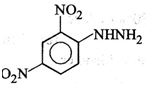
A
$CH_3COCl$
B
$CH_3COCH_3$
C
$CH_3COOC_2H_5$
D
$CH_3CONH_2$
Solution
(B) The compound shown in the image is $2,4-$dinitrophenylhydrazine $(2,4-DNP)$.
Only aldehydes and ketones react with $2,4-DNP$ to form characteristic colored (orange/red/yellow) crystalline precipitates,known as $2,4-$dinitrophenylhydrazones.
Among the given options,$CH_3COCH_3$ (acetone) is a ketone,while the others are acid derivatives (acid chloride,ester,and amide) which do not undergo this reaction.
Only aldehydes and ketones react with $2,4-DNP$ to form characteristic colored (orange/red/yellow) crystalline precipitates,known as $2,4-$dinitrophenylhydrazones.
Among the given options,$CH_3COCH_3$ (acetone) is a ketone,while the others are acid derivatives (acid chloride,ester,and amide) which do not undergo this reaction.
0 likes
View Solution291
MediumMCQ
Which of the following compounds reacts with $NaOH$ to produce an acid and an alcohol?
A
$HCHO$
B
$CH_3COOH$
C
$CH_3CH_2COOH$
D
$C_6H_5COOH$
Solution
(A) $HCHO$ undergoes the Cannizzaro reaction with $NaOH$ to produce an alcohol and a salt of a carboxylic acid.
$2HCHO + NaOH \rightarrow CH_3OH + HCOONa$
Here,$HCHO$ (formaldehyde) is converted into $CH_3OH$ (methanol) and $HCOONa$ (sodium formate).
$2HCHO + NaOH \rightarrow CH_3OH + HCOONa$
Here,$HCHO$ (formaldehyde) is converted into $CH_3OH$ (methanol) and $HCOONa$ (sodium formate).
0 likes
View Solution292
MediumMCQ
What will be the product $B$ in the following sequence of reactions?
$HC \equiv CH$ $\xrightarrow{30\% \, H_2SO_4, \, HgSO_4} A$ $\xrightarrow{NaOH} B$
$HC \equiv CH$ $\xrightarrow{30\% \, H_2SO_4, \, HgSO_4} A$ $\xrightarrow{NaOH} B$
A
$CH_3COONa$
B
$CH_3COOH$
C
$CH_3CHO$
D
$CH_3-CH(OH)-CH_2CHO$
Solution
(D) $1$. The hydration of ethyne $(HC \equiv CH)$ in the presence of $30\% \, H_2SO_4$ and $HgSO_4$ (Kucherov reaction) yields vinyl alcohol,which tautomerizes to form acetaldehyde $(A = CH_3CHO)$.
$2$. Acetaldehyde $(CH_3CHO)$ undergoes an aldol condensation reaction in the presence of dilute $NaOH$ to form $3-hydroxybutanal$ $(B = CH_3-CH(OH)-CH_2CHO)$.
$2$. Acetaldehyde $(CH_3CHO)$ undergoes an aldol condensation reaction in the presence of dilute $NaOH$ to form $3-hydroxybutanal$ $(B = CH_3-CH(OH)-CH_2CHO)$.
0 likes
View Solution293
MediumMCQ
Which of the following compounds undergoes aldol condensation?
A
$C_6H_5OH$
B
$C_6H_5-CO-C_6H_5$
C
$CH_3CH_2-CO-CH_3$
D
$(CH_3)_3C-CHO$
Solution
(C) Aldol condensation is given by carbonyl compounds that possess at least one $\alpha$-hydrogen atom.
In $CH_3CH_2-CO-CH_3$ (Butan$-2-$one),the carbon atom adjacent to the carbonyl group (the $\alpha$-carbon) has two $\alpha$-hydrogen atoms,allowing it to undergo aldol condensation.
$C_6H_5OH$ is phenol,which does not contain a carbonyl group.
$C_6H_5-CO-C_6H_5$ (Benzophenone) has no $\alpha$-hydrogen atoms.
$(CH_3)_3C-CHO$ ($2$,$2$-Dimethylpropanal) has no $\alpha$-hydrogen atoms.
In $CH_3CH_2-CO-CH_3$ (Butan$-2-$one),the carbon atom adjacent to the carbonyl group (the $\alpha$-carbon) has two $\alpha$-hydrogen atoms,allowing it to undergo aldol condensation.
$C_6H_5OH$ is phenol,which does not contain a carbonyl group.
$C_6H_5-CO-C_6H_5$ (Benzophenone) has no $\alpha$-hydrogen atoms.
$(CH_3)_3C-CHO$ ($2$,$2$-Dimethylpropanal) has no $\alpha$-hydrogen atoms.
0 likes
View Solution294
MediumMCQ
$CH_3CHO + HCN$ $\xrightarrow{\text{H}^+} CH_3CH(OH)CN$ $\xrightarrow{\text{H}_3\text{O}^+} CH_3CH(OH)COOH$. In the above reaction,a chiral center is generated. What will be the nature of the resulting acid?
A
$20\% \ d + 80\% \ l$ isomer
B
$d$-isomer
C
$l$-isomer
D
$50\% \ d + 50\% \ l$ isomer (racemic mixture)
0 likes
View Solution295
MediumMCQ
Which of the following is incorrect for $Acetophenone$?
A
It reacts to give $2,4-DNP$ derivative.
B
It reacts with $Tollens'$ reagent to give a silver mirror test.
C
It reacts with $I_2/NaOH$ to form iodoform.
D
It gives benzoic acid upon oxidation with alkaline $KMnO_4$ followed by cleavage.
Solution
(B) $Acetophenone$ $(C_6H_5COCH_3)$ is a ketone.
Ketones do not reduce $Tollens'$ reagent,therefore they do not give a silver mirror test.
$Acetophenone$ contains a methyl ketone group $(-COCH_3)$,so it gives a positive iodoform test.
It forms $2,4-DNP$ derivatives as it is a carbonyl compound.
Oxidation with alkaline $KMnO_4$ followed by acidification yields benzoic acid.
Ketones do not reduce $Tollens'$ reagent,therefore they do not give a silver mirror test.
$Acetophenone$ contains a methyl ketone group $(-COCH_3)$,so it gives a positive iodoform test.
It forms $2,4-DNP$ derivatives as it is a carbonyl compound.
Oxidation with alkaline $KMnO_4$ followed by acidification yields benzoic acid.
0 likes
View Solution296
MediumMCQ
When $(X)$ reacts with $(Y)$ in the presence of dilute $(Z)$ solution,$3-$hydroxybutanal is formed. What are $(X), (Y),$ and $(Z)$?
A
$CH_3CHO, (CH_3)_2CO, NaOH$
B
$CH_3CHO, CH_3CHO, NaCl$
C
$(CH_3)_2CO, (CH_3)_2CO, HCl$
D
$CH_3CHO, CH_3CHO, NaOH$
Solution
(D) The reaction described is an aldol condensation reaction.
Two molecules of acetaldehyde $(CH_3CHO)$ undergo self-aldol condensation in the presence of a dilute base like $NaOH$ to form $3-$hydroxybutanal.
Reaction: $CH_3CHO + CH_3CHO \xrightarrow{\text{dil. } NaOH} CH_3-CH(OH)-CH_2-CHO$.
Here,$(X) = CH_3CHO$,$(Y) = CH_3CHO$,and $(Z) = NaOH$.
Two molecules of acetaldehyde $(CH_3CHO)$ undergo self-aldol condensation in the presence of a dilute base like $NaOH$ to form $3-$hydroxybutanal.
Reaction: $CH_3CHO + CH_3CHO \xrightarrow{\text{dil. } NaOH} CH_3-CH(OH)-CH_2-CHO$.
Here,$(X) = CH_3CHO$,$(Y) = CH_3CHO$,and $(Z) = NaOH$.
0 likes
View Solution297
MediumMCQ
Which of the following is Tollens' reagent?
A
Ammoniacal cuprous chloride
B
Ammoniacal cuprous oxide
C
Ammoniacal silver bromide
D
Ammoniacal silver nitrate
Solution
(D) Tollens' reagent is an alkaline solution of silver nitrate complexed with ammonia,specifically $[Ag(NH_3)_2]^+OH^-$. Therefore,ammoniacal silver nitrate is the correct answer.
0 likes
View Solution298
MediumMCQ
$A$ compound $A$ has the molecular formula $C_2Cl_3OH$. It reduces Fehling's solution and on oxidation,it gives a monocarboxylic acid $B$. Compound $A$ is also obtained by the reaction of ethanol with chlorine. What is $A$?
A
Chloral hydrate
B
$CHCl_3$
C
$CH_3Cl$
D
Chloroacetic acid
Solution
(A) The molecular formula $C_2Cl_3OH$ corresponds to $CCl_3CHO$ (Chloral).
Since it is an aldehyde,it reduces Fehling's solution.
On oxidation,it gives trichloroacetic acid,which is a monocarboxylic acid.
$CCl_3CHO \xrightarrow{[O]} CCl_3COOH$
Chloral is also produced by the reaction of ethanol with chlorine:
$CH_3CH_2OH + 4Cl_2 \rightarrow CCl_3CHO + 5HCl$
Therefore,$A$ is Chloral.
Since it is an aldehyde,it reduces Fehling's solution.
On oxidation,it gives trichloroacetic acid,which is a monocarboxylic acid.
$CCl_3CHO \xrightarrow{[O]} CCl_3COOH$
Chloral is also produced by the reaction of ethanol with chlorine:
$CH_3CH_2OH + 4Cl_2 \rightarrow CCl_3CHO + 5HCl$
Therefore,$A$ is Chloral.
0 likes
View Solution299
MediumMCQ
What is Schiff's reagent?
A
Alkaline phenolphthalein
B
Methyl red
C
Rosaniline hydrochloride
D
Red litmus
Solution
(C) Schiff's reagent is a solution of $Rosaniline \ hydrochloride$ which has been decolorized by sulfur dioxide $(SO_2)$.
0 likes
View Solution300
MediumMCQ
Fehling's solution is a mixture of two solutions. One of them is $CuSO_4$. What does the other solution contain?
A
$CH(OH)COOK \mid CH(OH)COOK$
B
$COONa \mid COONa$
C
$COOH \mid COOH$
D
$CH(OH)COONa \mid CH(OH)COOK$
Solution
(D) Fehling's solution consists of two parts: Fehling's solution $A$ ($CuSO_4$ solution) and Fehling's solution $B$ (alkaline solution of sodium potassium tartrate,also known as Rochelle salt). The structure of sodium potassium tartrate is $CH(OH)COONa \mid CH(OH)COOK$.
0 likes
View Solution8-1.Aldehydes and Ketones — Properties · Frequently Asked Questions
1Are these 8-1.Aldehydes and Ketones questions useful for JEE and NEET?
Yes. All questions in this section are mapped to JEE Main and NEET exam patterns. Previous year questions from JEE Main, NEET, GUJCET and state-level exams are included with full solutions.
2Can I switch to Hindi or Gujarati for these questions?
Yes. Use the language tabs in the hero section or the sidebar to view the same questions and solutions in English, Hindi or Gujarati.
3How do I generate a question paper from this subtopic?
Use the Vedclass Exam Paper Generator — select the chapter and subtopic, set difficulty, and generate Sets A, B, C, D automatically. First 3 chapters of every subject are free.
Vedclass Products
For Students
Vedclass Test Series
Mock tests in real JEE/NEET style with performance analysis. 5-day free trial.
Start Free TrialFor Teachers
Exam Paper Generator
Generate Set A/B/C/D papers from this chapter in 2 minutes. 3 chapters free.
Try FreeFor Institutes
Online Exam Module
Live online exams with unlimited students, 360° analytics & white-label branding.
See DemoFor Teachers & Institutes
Generate a 8-1.Aldehydes and Ketones Exam Paper in 2 Minutes
Select subtopic & difficulty — Sets A, B, C, D auto-generated with No Repeat logic.
First 3 chapters of every subject are free — no payment required.