
A English
Properties Questions in English
Class 12 Chemistry · 8-1.Aldehydes and Ketones · Properties
1739+
Questions
English
Language
100%
With Solutions
Showing 48 of 1739 questions in English
401
MediumMCQ
An organic compound '$X$' having molecular formula $C_5H_{10}O$ yields phenylhydrazone and gives negative response to the iodoform test and Tollens' test. It produces $n-$pentane on reduction. '$X$' could be
A
$3-$pentanone
B
$n-$amyl alcohol
C
pentanal
D
$2-$pentanone
Solution
(A) Compound '$X$' yields phenylhydrazone $\Rightarrow$ Presence of $C=O$ group.
Negative iodoform test $\Rightarrow$ Absence of $CH_3-C=O$ group.
Negative Tollens' test $\Rightarrow$ It is a ketone,not an aldehyde.
Since the compound is a ketone with $5$ carbon atoms and does not contain a methyl ketone group,it must be $3-$pentanone.
$3-$pentanone $(C_5H_{10}O): CH_3CH_2-C(=O)-CH_2CH_3 \xrightarrow{\text{Reduction}} CH_3CH_2CH_2CH_2CH_3$ ($n-$pentane).
Negative iodoform test $\Rightarrow$ Absence of $CH_3-C=O$ group.
Negative Tollens' test $\Rightarrow$ It is a ketone,not an aldehyde.
Since the compound is a ketone with $5$ carbon atoms and does not contain a methyl ketone group,it must be $3-$pentanone.
$3-$pentanone $(C_5H_{10}O): CH_3CH_2-C(=O)-CH_2CH_3 \xrightarrow{\text{Reduction}} CH_3CH_2CH_2CH_2CH_3$ ($n-$pentane).
0 likes
View Solution402
MediumMCQ
Which one is most reactive towards nucleophilic addition reaction?
A
Benzaldehyde
B
Acetophenone
C
$p$-Methylbenzaldehyde
D
$p$-Nitrobenzaldehyde
Solution
(D) The reactivity of carbonyl compounds towards nucleophilic addition reactions is primarily governed by the electrophilicity of the carbonyl carbon.
$1$. Electron-withdrawing groups ($-I, -M$ effects) increase the positive charge on the carbonyl carbon,thereby increasing its reactivity towards nucleophilic attack.
$2$. Electron-donating groups ($+I, +M$ effects) decrease the positive charge on the carbonyl carbon,thereby decreasing its reactivity.
$3$. Steric hindrance also plays a role; aldehydes are generally more reactive than ketones due to less steric hindrance.
Comparing the given compounds:
- $p$-Nitrobenzaldehyde has a strong electron-withdrawing $-NO_2$ group ($-I, -M$ effect),which significantly increases the electrophilicity of the carbonyl carbon.
- Benzaldehyde has no substituent.
- $p$-Methylbenzaldehyde has an electron-donating $-CH_3$ group ($+I$ effect).
- Acetophenone is a ketone and has an electron-donating $-CH_3$ group attached to the carbonyl carbon,making it the least reactive.
Thus,the order of reactivity is: $p$-Nitrobenzaldehyde > Benzaldehyde > $p$-Methylbenzaldehyde > Acetophenone.
Therefore,$p$-Nitrobenzaldehyde is the most reactive.
$1$. Electron-withdrawing groups ($-I, -M$ effects) increase the positive charge on the carbonyl carbon,thereby increasing its reactivity towards nucleophilic attack.
$2$. Electron-donating groups ($+I, +M$ effects) decrease the positive charge on the carbonyl carbon,thereby decreasing its reactivity.
$3$. Steric hindrance also plays a role; aldehydes are generally more reactive than ketones due to less steric hindrance.
Comparing the given compounds:
- $p$-Nitrobenzaldehyde has a strong electron-withdrawing $-NO_2$ group ($-I, -M$ effect),which significantly increases the electrophilicity of the carbonyl carbon.
- Benzaldehyde has no substituent.
- $p$-Methylbenzaldehyde has an electron-donating $-CH_3$ group ($+I$ effect).
- Acetophenone is a ketone and has an electron-donating $-CH_3$ group attached to the carbonyl carbon,making it the least reactive.
Thus,the order of reactivity is: $p$-Nitrobenzaldehyde > Benzaldehyde > $p$-Methylbenzaldehyde > Acetophenone.
Therefore,$p$-Nitrobenzaldehyde is the most reactive.
0 likes
View Solution403
MediumMCQ
Predict the products in the given reaction.
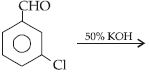
A
$3-$chlorobenzyl alcohol + potassium $3-$chlorobenzoate
B
$3-$hydroxybenzyl alcohol + potassium $3-$hydroxybenzoate
C
$3-$chlorobenzyl alcohol + potassium $3-$chlorobenzoate (with different structure)
D
$3-$hydroxybenzyl alcohol + $3-$hydroxybenzoic acid
Solution
(A) The given reaction is a Cannizzaro reaction because the reactant,$3$-chlorobenzaldehyde,does not have any $\alpha$-hydrogen atoms. When treated with $50 \% \ KOH$,it undergoes disproportionation (self-oxidation and reduction). The aldehyde group is oxidized to a carboxylate salt $(COOK)$ and reduced to an alcohol group $(-CH_2OH)$. The products are $3$-chlorobenzyl alcohol and potassium $3$-chlorobenzoate.
0 likes
View Solution404
MediumMCQ
Acetone is treated with excess of ethanol in the presence of hydrochloric acid. The product obtained is
A
$CH_3-C(OC_2H_5)_2-CH_3$
B
$CH_3-C(OH)(OC_2H_5)-CH_3$
C
$(CH_3)_2C(OH)(OC_2H_5)$
D
$(CH_3)_2C(OC_2H_5)_2$
Solution
(A) Acetone reacts with excess ethanol in the presence of dry $HCl$ gas to form a ketal (a type of acetal). The reaction is as follows:
$CH_3COCH_3 + 2C_2H_5OH \xrightarrow{dry \ HCl} CH_3C(OC_2H_5)_2CH_3 + H_2O$
Thus,the product obtained is $CH_3C(OC_2H_5)_2CH_3$.
$CH_3COCH_3 + 2C_2H_5OH \xrightarrow{dry \ HCl} CH_3C(OC_2H_5)_2CH_3 + H_2O$
Thus,the product obtained is $CH_3C(OC_2H_5)_2CH_3$.
0 likes
View Solution405
MediumMCQ
$CH_3CHO$ and $C_6H_5CH_2CHO$ can be distinguished chemically by
A
Benedict's test
B
Iodoform test
C
Tollen's reagent test
D
Fehling's solution test
Solution
(B) $CH_3CHO$ and $C_6H_5CH_2CHO$ are both aldehydes and react with Tollen's reagent,Fehling's solution,and Benedict's solution,so these cannot distinguish them.
$CH_3CHO$ contains a $CH_3CO-$ group,which gives a positive Iodoform test with $I_2$ and $NaOH$,forming a yellow precipitate of $CHI_3$.
$CH_3CHO + 3 I_2 + 4 NaOH \longrightarrow CHI_3 (\text{yellow ppt}) + HCOONa + 3 NaI + 3 H_2O$
$C_6H_5CH_2CHO$ does not contain the $CH_3CO-$ group and does not give the Iodoform test.
$\therefore$ The Iodoform test is the correct method to distinguish between them.
$CH_3CHO$ contains a $CH_3CO-$ group,which gives a positive Iodoform test with $I_2$ and $NaOH$,forming a yellow precipitate of $CHI_3$.
$CH_3CHO + 3 I_2 + 4 NaOH \longrightarrow CHI_3 (\text{yellow ppt}) + HCOONa + 3 NaI + 3 H_2O$
$C_6H_5CH_2CHO$ does not contain the $CH_3CO-$ group and does not give the Iodoform test.
$\therefore$ The Iodoform test is the correct method to distinguish between them.
0 likes
View Solution406
MediumMCQ
Consider the reaction:
$RCHO + NH_2NH_2 \rightarrow RCH=NNH_2 + H_2O$
What sort of reaction is it?
$RCHO + NH_2NH_2 \rightarrow RCH=NNH_2 + H_2O$
What sort of reaction is it?
A
Electrophilic addition-elimination reaction
B
Free radical addition-elimination reaction
C
Electrophilic substitution-elimination reaction
D
Nucleophilic addition-elimination reaction
Solution
(D) The reaction $RCHO + NH_2NH_2 \rightarrow RCH=NNH_2 + H_2O$ involves the attack of the nucleophilic nitrogen atom of hydrazine $(NH_2NH_2)$ on the electrophilic carbonyl carbon of the aldehyde $(RCHO)$.
This step is a nucleophilic addition to the carbonyl group.
Subsequently,the elimination of a water molecule $(H_2O)$ occurs to form the final product,which is a hydrazone.
Therefore,the overall mechanism is classified as a nucleophilic addition-elimination reaction.
This step is a nucleophilic addition to the carbonyl group.
Subsequently,the elimination of a water molecule $(H_2O)$ occurs to form the final product,which is a hydrazone.
Therefore,the overall mechanism is classified as a nucleophilic addition-elimination reaction.
0 likes
View Solution407
MediumMCQ
Which of the following compounds will give a yellow precipitate with iodine and alkali?
A
Acetophenone
B
Methyl acetate
C
$2-$Hydroxypropane
D
Both $(a)$ and $(c)$
Solution
(D) The iodoform test is given by compounds containing the $CH_3CO-$ group or the $CH_3CH(OH)-$ group.
Acetophenone $(C_6H_5COCH_3)$ contains the $CH_3CO-$ group and gives a yellow precipitate of iodoform $(CHI_3)$.
$2-$Hydroxypropane $(CH_3CH(OH)CH_3)$ contains the $CH_3CH(OH)-$ group and also gives a yellow precipitate of iodoform $(CHI_3)$.
Methyl acetate $(CH_3COOCH_3)$ does not give this test.
Therefore,both $(a)$ and $(c)$ give the yellow precipitate.
Acetophenone $(C_6H_5COCH_3)$ contains the $CH_3CO-$ group and gives a yellow precipitate of iodoform $(CHI_3)$.
$2-$Hydroxypropane $(CH_3CH(OH)CH_3)$ contains the $CH_3CH(OH)-$ group and also gives a yellow precipitate of iodoform $(CHI_3)$.
Methyl acetate $(CH_3COOCH_3)$ does not give this test.
Therefore,both $(a)$ and $(c)$ give the yellow precipitate.
0 likes
View Solution408
MediumMCQ
Clemmensen reduction of a ketone is carried out in the presence of which of the following?
A
$Glycol$ with $KOH$
B
$Zn-Hg$ with $HCl$
C
$LiAlH_4$
D
$H_2$ and $Pt$ as catalyst
Solution
(B) The reducing agent used in Clemmensen reduction is $Zn-Hg$ (zinc amalgam) and $HCl$.
In this reaction,the carbonyl group $(>C=O)$ of an aldehyde or ketone is reduced to a methylene group $(>CH_2)$.
The reaction is represented as: $>C=O \xrightarrow{Zn-Hg / HCl} >CH_2$.
In this reaction,the carbonyl group $(>C=O)$ of an aldehyde or ketone is reduced to a methylene group $(>CH_2)$.
The reaction is represented as: $>C=O \xrightarrow{Zn-Hg / HCl} >CH_2$.
0 likes
View Solution409
MediumMCQ
The order of reactivity of phenyl magnesium bromide $(PhMgBr)$ with the following compounds is:

A
$III > II > I$
B
$II > I > III$
C
$I > III > II$
D
$I > II > III$
Solution
(D) The reactivity of carbonyl compounds towards nucleophilic addition reactions depends on two main factors:
$1$. Electronic factors: Alkyl groups exhibit a $+I$-effect,which increases the electron density on the carbonyl carbon,thereby reducing its electrophilicity. Aryl groups exhibit a $+R$-effect,which also decreases the electrophilicity of the carbonyl carbon.
$2$. Steric factors: As the size and number of groups attached to the carbonyl carbon increase,steric hindrance increases,which hinders the approach of the nucleophile.
In the given compounds:
$(I)$ is acetaldehyde $(CH_3CHO)$,which has one alkyl group and one hydrogen atom.
$(II)$ is acetone $(CH_3COCH_3)$,which has two alkyl groups.
$(III)$ is benzophenone $(PhCOPh)$,which has two bulky phenyl groups.
Due to the combined effect of increased electron density and higher steric hindrance,the reactivity decreases in the order: $I > II > III$.
$1$. Electronic factors: Alkyl groups exhibit a $+I$-effect,which increases the electron density on the carbonyl carbon,thereby reducing its electrophilicity. Aryl groups exhibit a $+R$-effect,which also decreases the electrophilicity of the carbonyl carbon.
$2$. Steric factors: As the size and number of groups attached to the carbonyl carbon increase,steric hindrance increases,which hinders the approach of the nucleophile.
In the given compounds:
$(I)$ is acetaldehyde $(CH_3CHO)$,which has one alkyl group and one hydrogen atom.
$(II)$ is acetone $(CH_3COCH_3)$,which has two alkyl groups.
$(III)$ is benzophenone $(PhCOPh)$,which has two bulky phenyl groups.
Due to the combined effect of increased electron density and higher steric hindrance,the reactivity decreases in the order: $I > II > III$.
0 likes
View Solution410
MediumMCQ
Match the compounds given in List-$I$ with List-$II$ and select the suitable option using the code given below.
| List-$I$ | List-$II$ |
|---|---|
| $A$. Benzaldehyde | $i$. Phenolphthalein |
| $B$. Phthalic anhydride | $ii$. Benzoin condensation |
| $C$. Phenyl benzoate | $iii$. Oil of wintergreen |
| $D$. Methyl salicylate | $iv$. Fries rearrangement |
A
$A-iv, B-i, C-iii, D-ii$
B
$A-iv, B-ii, C-iii, D-i$
C
$A-ii, B-iii, C-iv, D-i$
D
$A-ii, B-i, C-iv, D-iii$
Solution
(D) . Benzaldehyde undergoes $ii$. Benzoin condensation in the presence of cyanide ions.
$B$. Phthalic anhydride reacts with phenol to form $i$. Phenolphthalein.
$C$. Phenyl benzoate undergoes $iv$. Fries rearrangement to form hydroxybenzophenones.
$D$. Methyl salicylate is known as $iii$. Oil of wintergreen.
Therefore,the correct matching is $A-ii, B-i, C-iv, D-iii$.
$B$. Phthalic anhydride reacts with phenol to form $i$. Phenolphthalein.
$C$. Phenyl benzoate undergoes $iv$. Fries rearrangement to form hydroxybenzophenones.
$D$. Methyl salicylate is known as $iii$. Oil of wintergreen.
Therefore,the correct matching is $A-ii, B-i, C-iv, D-iii$.
0 likes
View Solution411
MediumMCQ
Which of the following reactions will not result in the formation of carbon-carbon bonds?
A
Reimer-Tiemann reaction
B
Cannizzaro reaction
C
Wurtz reaction
D
Friedel-Crafts acylation
Solution
(B) In the $Reimer-Tiemann$ reaction,a new $C-C$ bond is formed between the aromatic ring and the formyl group.
In the $Cannizzaro$ reaction,an aldehyde without an $\alpha$-hydrogen undergoes disproportionation to form an alcohol and a carboxylic acid salt. No new $C-C$ bond is formed in this reaction.
$2HCHO \xrightarrow{\text{Conc. } NaOH} CH_3OH + HCOONa$
In the $Wurtz$ reaction,two alkyl halides react in the presence of sodium to form a higher alkane,creating a new $C-C$ bond.
In $Friedel-Crafts$ acylation,an acyl group is introduced into an aromatic ring,forming a new $C-C$ bond between the ring and the acyl group.
Therefore,the $Cannizzaro$ reaction is the correct answer.
In the $Cannizzaro$ reaction,an aldehyde without an $\alpha$-hydrogen undergoes disproportionation to form an alcohol and a carboxylic acid salt. No new $C-C$ bond is formed in this reaction.
$2HCHO \xrightarrow{\text{Conc. } NaOH} CH_3OH + HCOONa$
In the $Wurtz$ reaction,two alkyl halides react in the presence of sodium to form a higher alkane,creating a new $C-C$ bond.
In $Friedel-Crafts$ acylation,an acyl group is introduced into an aromatic ring,forming a new $C-C$ bond between the ring and the acyl group.
Therefore,the $Cannizzaro$ reaction is the correct answer.
0 likes
View Solution412
MediumMCQ
Which one of the following compounds will be most readily dehydrated?
A
$3-$hydroxyhexan$-2-$one
B
$3-$hydroxypentan$-2-$one
C
$4-$hydroxypentan$-2-$one
D
$3-$hydroxyheptan$-2-$one
Solution
(C) The dehydration of alcohols involves the formation of a carbocation intermediate. The stability of the carbocation determines the ease of dehydration. The more stable the carbocation,the easier the dehydration.
In the given compounds,the hydroxyl group is located at different positions relative to the carbonyl group.
For option $C$ ($4$-hydroxypentan-$2$-one),the carbocation formed after the loss of the $-OH$ group is a secondary carbocation that is relatively more stable due to its position,allowing for easier formation of the conjugated enone system.
Comparing the stability of the intermediate carbocations:
$(b)$ and $(d)$ form secondary carbocations adjacent to the carbonyl group (destabilized by the electron-withdrawing effect of the carbonyl group).
$(a)$ forms a secondary carbocation adjacent to the carbonyl group.
$(c)$ forms a secondary carbocation at the $4$-position,which is further from the electron-withdrawing carbonyl group,making it more stable than the others.
Therefore,the compound in option $C$ undergoes dehydration most readily.
In the given compounds,the hydroxyl group is located at different positions relative to the carbonyl group.
For option $C$ ($4$-hydroxypentan-$2$-one),the carbocation formed after the loss of the $-OH$ group is a secondary carbocation that is relatively more stable due to its position,allowing for easier formation of the conjugated enone system.
Comparing the stability of the intermediate carbocations:
$(b)$ and $(d)$ form secondary carbocations adjacent to the carbonyl group (destabilized by the electron-withdrawing effect of the carbonyl group).
$(a)$ forms a secondary carbocation adjacent to the carbonyl group.
$(c)$ forms a secondary carbocation at the $4$-position,which is further from the electron-withdrawing carbonyl group,making it more stable than the others.
Therefore,the compound in option $C$ undergoes dehydration most readily.
0 likes
View Solution413
MediumMCQ
Acetophenone,when reacted with a base,$C_2H_5ONa$,yields a stable compound which has the structure:
A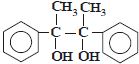
B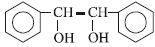
C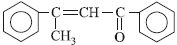
D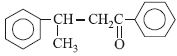
Solution
(C) Acetophenone $(C_6H_5COCH_3)$ contains $\alpha$-hydrogen atoms. When treated with a base like $C_2H_5ONa$,it undergoes an aldol condensation reaction.
$1$. The base abstracts an $\alpha$-hydrogen to form an enolate ion (nucleophile).
$2$. This enolate ion attacks another molecule of acetophenone.
$3$. The resulting $\beta$-hydroxy ketone undergoes dehydration upon heating to form an $\alpha, \beta$-unsaturated ketone.
$4$. The final product is $4$-phenyl-$4$-phenylbut-$3$-en-$2$-one (or similar structure depending on the specific condensation product),which corresponds to the structure shown in option $C$.
$1$. The base abstracts an $\alpha$-hydrogen to form an enolate ion (nucleophile).
$2$. This enolate ion attacks another molecule of acetophenone.
$3$. The resulting $\beta$-hydroxy ketone undergoes dehydration upon heating to form an $\alpha, \beta$-unsaturated ketone.
$4$. The final product is $4$-phenyl-$4$-phenylbut-$3$-en-$2$-one (or similar structure depending on the specific condensation product),which corresponds to the structure shown in option $C$.
0 likes
View Solution414
MediumMCQ
$A$ strong base can abstract an $\alpha$-hydrogen from
A
ketone
B
alkane
C
alkene
D
amine
Solution
(A) The carbonyl group $(C=O)$ in ketones is electron-withdrawing due to the electronegative oxygen atom.
This effect makes the $\alpha$-carbon electron-deficient,which in turn increases the acidity of the hydrogen atoms attached to the $\alpha$-carbon.
Consequently,a strong base can easily abstract an $\alpha$-hydrogen from a ketone to form an enolate ion.
This process is a fundamental step in reactions like the aldol condensation.
This effect makes the $\alpha$-carbon electron-deficient,which in turn increases the acidity of the hydrogen atoms attached to the $\alpha$-carbon.
Consequently,a strong base can easily abstract an $\alpha$-hydrogen from a ketone to form an enolate ion.
This process is a fundamental step in reactions like the aldol condensation.
0 likes
View Solution415
MediumMCQ
Reduction of aldehydes and ketones into hydrocarbons using zinc amalgam $(Zn(Hg))$ and concentrated $HCl$ is called:
A
Cope reduction
B
Dow reduction
C
Wolff-Kishner reduction
D
Clemmensen reduction
Solution
(D) The reduction of aldehydes or ketones to alkanes using zinc amalgam $(Zn(Hg))$ and concentrated hydrochloric acid $(HCl)$ is known as the Clemmensen reduction.
In this reaction,the carbonyl group $(>C=O)$ is reduced to a methylene group $(-CH_2-)$.
In this reaction,the carbonyl group $(>C=O)$ is reduced to a methylene group $(-CH_2-)$.
0 likes
View Solution416
MediumMCQ
Which one of the following on treatment with $50\%$ aqueous sodium hydroxide yields the corresponding alcohol and acid?
A
$C_6H_5CHO$
B
$CH_3-CH_2-CH_2-CHO$
C
$CH_3-CO-CH_3$
D
$C_6H_5-CH_2-CHO$
Solution
(A) Aldehydes that do not possess $\alpha$-hydrogen atoms,such as benzaldehyde $(C_6H_5CHO)$,undergo self-oxidation and reduction (disproportionation) when treated with concentrated alkali ($50\%$ aqueous $NaOH$).
This reaction is known as the Cannizzaro reaction.
It yields the corresponding alcohol (benzyl alcohol) and the salt of the corresponding acid (sodium benzoate).
The reaction is: $2C_6H_5CHO + NaOH \rightarrow C_6H_5CH_2OH + C_6H_5COONa$.
This reaction is known as the Cannizzaro reaction.
It yields the corresponding alcohol (benzyl alcohol) and the salt of the corresponding acid (sodium benzoate).
The reaction is: $2C_6H_5CHO + NaOH \rightarrow C_6H_5CH_2OH + C_6H_5COONa$.
0 likes
View Solution417
MediumMCQ
The product formed in Aldol condensation is
A
a $\beta-$hydroxy aldehyde or a $\beta-$hydroxy ketone
B
an $\alpha-$hydroxy aldehyde or ketone
C
an $\alpha, \beta-$unsaturated ester
D
a $\beta-$hydroxy acid
Solution
(A) Aldol condensation involves the reaction between two molecules of an aldehyde or a ketone containing at least one $\alpha-$hydrogen atom in the presence of a dilute base.
This reaction results in the formation of a $\beta-$hydroxy aldehyde (aldol) or a $\beta-$hydroxy ketone (ketol).
These products can further undergo dehydration upon heating to form $\alpha, \beta-$unsaturated carbonyl compounds.
Therefore,the primary product formed in the initial step of Aldol condensation is a $\beta-$hydroxy aldehyde or a $\beta-$hydroxy ketone.
This reaction results in the formation of a $\beta-$hydroxy aldehyde (aldol) or a $\beta-$hydroxy ketone (ketol).
These products can further undergo dehydration upon heating to form $\alpha, \beta-$unsaturated carbonyl compounds.
Therefore,the primary product formed in the initial step of Aldol condensation is a $\beta-$hydroxy aldehyde or a $\beta-$hydroxy ketone.
0 likes
View Solution418
MediumMCQ
Nucleophilic addition reaction will be most favoured in
A
$CH_3-CHO$
B
$CH_3-CH_2-CO-CH_3$
C
$CH_3-CO-CH_3$
D
$CH_3-CH_2-CHO$
Solution
(A) Nucleophilic addition reactions are influenced by steric and electronic factors.
Aldehydes are generally more reactive than ketones because they have less steric hindrance and fewer electron-donating alkyl groups ($+I$ effect),which reduces the electrophilicity of the carbonyl carbon.
Among the given options,$CH_3-CHO$ (ethanal) has the smallest alkyl group compared to $CH_3-CH_2-CHO$ (propanal),and it is an aldehyde,whereas the other options are ketones or larger aldehydes.
Therefore,$CH_3-CHO$ is the most reactive toward nucleophilic attack.
Aldehydes are generally more reactive than ketones because they have less steric hindrance and fewer electron-donating alkyl groups ($+I$ effect),which reduces the electrophilicity of the carbonyl carbon.
Among the given options,$CH_3-CHO$ (ethanal) has the smallest alkyl group compared to $CH_3-CH_2-CHO$ (propanal),and it is an aldehyde,whereas the other options are ketones or larger aldehydes.
Therefore,$CH_3-CHO$ is the most reactive toward nucleophilic attack.
0 likes
View Solution419
MediumMCQ
$A$ carbonyl compound reacts with hydrogen cyanide $(HCN)$ to form cyanohydrin,which on hydrolysis forms a racemic mixture of $\alpha$-hydroxy acid. The carbonyl compound is:
A
formaldehyde
B
acetaldehyde
C
acetone
D
diethyl ketone
Solution
(B) . Acetaldehyde $(CH_3CHO)$ reacts with $HCN$ to form acetaldehyde cyanohydrin $(CH_3CH(OH)CN)$.
On hydrolysis,it yields lactic acid $(CH_3CH(OH)COOH)$.
Since the $\alpha$-carbon in lactic acid is chiral (bonded to four different groups: $-H$,$-OH$,$-CH_3$,and $-COOH$),it exists as a racemic mixture when synthesized from an achiral starting material like acetaldehyde.
On hydrolysis,it yields lactic acid $(CH_3CH(OH)COOH)$.
Since the $\alpha$-carbon in lactic acid is chiral (bonded to four different groups: $-H$,$-OH$,$-CH_3$,and $-COOH$),it exists as a racemic mixture when synthesized from an achiral starting material like acetaldehyde.
0 likes
View Solution420
MediumMCQ
Self-condensation of two moles of ethyl acetate in the presence of sodium ethoxide yields:
A
ethyl propionate
B
ethyl butyrate
C
acetoacetic ester
D
methyl acetoacetate
Solution
(C) The self-condensation of two moles of ethyl acetate in the presence of a strong base like sodium ethoxide $(NaOC_2H_5)$ is known as the Claisen condensation.
This reaction occurs because ethyl acetate possesses $\alpha$-hydrogen atoms.
The reaction proceeds as follows:
$2CH_3COOC_2H_5 \xrightarrow{NaOC_2H_5} CH_3COCH_2COOC_2H_5 + C_2H_5OH$
The product formed is ethyl acetoacetate,which is commonly referred to as acetoacetic ester.
This reaction occurs because ethyl acetate possesses $\alpha$-hydrogen atoms.
The reaction proceeds as follows:
$2CH_3COOC_2H_5 \xrightarrow{NaOC_2H_5} CH_3COCH_2COOC_2H_5 + C_2H_5OH$
The product formed is ethyl acetoacetate,which is commonly referred to as acetoacetic ester.
0 likes
View Solution421
MediumMCQ
The product formed by the reaction of an aldehyde with a primary amine is
A
carboxylic acid
B
aromatic acid
C
Schiff's base
D
ketone
Solution
(C) The reaction between an aldehyde and a primary amine is a nucleophilic addition-elimination reaction.
The general reaction is: $R-CHO + R'-NH_2 \rightarrow R-CH=N-R' + H_2O$.
The product formed is known as a Schiff's base (or an imine).
The general reaction is: $R-CHO + R'-NH_2 \rightarrow R-CH=N-R' + H_2O$.
The product formed is known as a Schiff's base (or an imine).
0 likes
View Solution422
MediumMCQ
Identify the compound that exhibits tautomerism:
A
$2-$Butene
B
Lactic acid
C
$2-$Pentanone
D
Phenol
Solution
(C) Tautomerism is a special type of functional isomerism in which a compound exists in two or more interconvertible forms that differ in the relative position of at least one atomic nucleus,generally a hydrogen atom.
For a carbonyl compound to exhibit tautomerism,it must possess at least one $\alpha$-hydrogen atom.
$2-$Pentanone $(CH_3COCH_2CH_2CH_3)$ contains $\alpha$-hydrogen atoms on the carbon adjacent to the carbonyl group,and therefore it exhibits keto-enol tautomerism.
For a carbonyl compound to exhibit tautomerism,it must possess at least one $\alpha$-hydrogen atom.
$2-$Pentanone $(CH_3COCH_2CH_2CH_3)$ contains $\alpha$-hydrogen atoms on the carbon adjacent to the carbonyl group,and therefore it exhibits keto-enol tautomerism.
0 likes
View Solution423
MediumMCQ
The increasing order of the rate of $HCN$ addition to the following compounds is:
$(A)\ HCHO$
$(B)\ CH_3COCH_3$
$(C)\ PhCOCH_3$
$(D)\ PhCOPh$
$(A)\ HCHO$
$(B)\ CH_3COCH_3$
$(C)\ PhCOCH_3$
$(D)\ PhCOPh$
A
$D < C < B < A$
B
$C < D < B < A$
C
$A < B < C < D$
D
$D < B < C < A$
Solution
(A) The rate of nucleophilic addition of $HCN$ to carbonyl compounds depends on two factors:
$1$. Steric hindrance: As the size of the groups attached to the carbonyl carbon increases,the rate of nucleophilic attack decreases.
$2$. Electronic effects: Electron-donating groups (like alkyl groups) decrease the electrophilicity of the carbonyl carbon,while electron-withdrawing groups (like phenyl rings via resonance) also decrease the reactivity compared to aliphatic counterparts.
Comparing the given compounds:
$(A)\ HCHO$ (Formaldehyde): No alkyl groups,least steric hindrance,most reactive.
$(B)\ CH_3COCH_3$ (Acetone): Two methyl groups,more steric hindrance than $HCHO$.
$(C)\ PhCOCH_3$ (Acetophenone): One phenyl group and one methyl group. The phenyl group provides resonance stabilization to the carbonyl carbon,reducing its electrophilicity.
$(D)\ PhCOPh$ (Benzophenone): Two phenyl groups,highest steric hindrance and significant resonance stabilization,making it the least reactive.
Thus,the reactivity order is $HCHO > CH_3COCH_3 > PhCOCH_3 > PhCOPh$.
The increasing order is $D < C < B < A$.
$1$. Steric hindrance: As the size of the groups attached to the carbonyl carbon increases,the rate of nucleophilic attack decreases.
$2$. Electronic effects: Electron-donating groups (like alkyl groups) decrease the electrophilicity of the carbonyl carbon,while electron-withdrawing groups (like phenyl rings via resonance) also decrease the reactivity compared to aliphatic counterparts.
Comparing the given compounds:
$(A)\ HCHO$ (Formaldehyde): No alkyl groups,least steric hindrance,most reactive.
$(B)\ CH_3COCH_3$ (Acetone): Two methyl groups,more steric hindrance than $HCHO$.
$(C)\ PhCOCH_3$ (Acetophenone): One phenyl group and one methyl group. The phenyl group provides resonance stabilization to the carbonyl carbon,reducing its electrophilicity.
$(D)\ PhCOPh$ (Benzophenone): Two phenyl groups,highest steric hindrance and significant resonance stabilization,making it the least reactive.
Thus,the reactivity order is $HCHO > CH_3COCH_3 > PhCOCH_3 > PhCOPh$.
The increasing order is $D < C < B < A$.
0 likes
View Solution424
MediumMCQ
In the Cannizzaro reaction given below:
$2PhCHO \xrightarrow{:\mathop{O}\limits^{\ominus}H} PhCH_2OH + PhC\mathop{O_2^{\ominus}}\limits$
the slowest step is:
$2PhCHO \xrightarrow{:\mathop{O}\limits^{\ominus}H} PhCH_2OH + PhC\mathop{O_2^{\ominus}}\limits$
the slowest step is:
A
the transfer of hydride to the carbonyl group
B
the abstraction of proton from the carboxylic group
C
the deprotonation of $PhCH_2OH$
D
the attack of $:\mathop{O}\limits^{\ominus}H$ at the carboxyl group
Solution
(A) The mechanism of the Cannizzaro reaction involves the nucleophilic attack of the hydroxide ion on the carbonyl carbon to form a di-anion intermediate.
The rate-determining step (slowest step) is the transfer of a hydride ion $(H^-)$ from the di-anion intermediate to the carbonyl carbon of a second molecule of aldehyde.
This hydride transfer results in the formation of a carboxylate ion and an alkoxide ion,which subsequently undergo proton exchange to yield the final products,$PhCH_2OH$ and $PhCOO^-$.
The rate-determining step (slowest step) is the transfer of a hydride ion $(H^-)$ from the di-anion intermediate to the carbonyl carbon of a second molecule of aldehyde.
This hydride transfer results in the formation of a carboxylate ion and an alkoxide ion,which subsequently undergo proton exchange to yield the final products,$PhCH_2OH$ and $PhCOO^-$.
0 likes
View Solution425
MediumMCQ
Trichloroacetaldehyde was subjected to Cannizzaro's reaction by using $NaOH$. The mixture of the products contains sodium trichloroacetate and another compound. The other compound is:
A
$2, 2, 2-$ Trichloroethanol
B
Trichloromethanol
C
$2, 2, 2-$ Trichloropropanol
D
Chloroform
Solution
(A) Cannizzaro reaction is a disproportionation reaction of aldehydes lacking $\alpha$-hydrogen atoms in the presence of a strong base.
Trichloroacetaldehyde $(CCl_3CHO)$ does not have $\alpha$-hydrogen atoms.
In the presence of $NaOH$,it undergoes self-oxidation and reduction to form sodium trichloroacetate $(CCl_3COO^-)$ and $2, 2, 2-$trichloroethanol $(CCl_3CH_2OH)$.
Trichloroacetaldehyde $(CCl_3CHO)$ does not have $\alpha$-hydrogen atoms.
In the presence of $NaOH$,it undergoes self-oxidation and reduction to form sodium trichloroacetate $(CCl_3COO^-)$ and $2, 2, 2-$trichloroethanol $(CCl_3CH_2OH)$.
0 likes
View Solution426
MediumMCQ
Silver Mirror test is given by which one of the following compounds?
A
Acetaldehyde
B
Acetone
C
Formaldehyde
D
$A$ and $C$ both
Solution
(D) The Silver Mirror test (Tollens' test) is given by aldehydes because they can be easily oxidized to carboxylic acids.
Both formaldehyde $(HCHO)$ and acetaldehyde $(CH_3CHO)$ are aldehydes and thus give a positive Silver Mirror test.
$HCHO + 2[Ag(NH_3)_2]^+ + 3OH^- \rightarrow HCOO^- + 2Ag \downarrow + 4NH_3 + 2H_2O$
$CH_3CHO + 2[Ag(NH_3)_2]^+ + 3OH^- \rightarrow CH_3COO^- + 2Ag \downarrow + 4NH_3 + 2H_2O$
Ketones like acetone do not give this test.
Both formaldehyde $(HCHO)$ and acetaldehyde $(CH_3CHO)$ are aldehydes and thus give a positive Silver Mirror test.
$HCHO + 2[Ag(NH_3)_2]^+ + 3OH^- \rightarrow HCOO^- + 2Ag \downarrow + 4NH_3 + 2H_2O$
$CH_3CHO + 2[Ag(NH_3)_2]^+ + 3OH^- \rightarrow CH_3COO^- + 2Ag \downarrow + 4NH_3 + 2H_2O$
Ketones like acetone do not give this test.
0 likes
View Solution427
MediumMCQ
In the given transformation,which of the following is the most appropriate reagent?
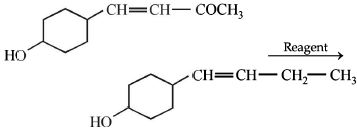
A
$NH_2NH_2, \, \text{OH}^-$
B
$Zn-Hg/HCl$
C
$Na, \text{Liq. } NH_3$
D
$NaBH_4$
Solution
(A) The given transformation involves the reduction of a ketone group to a methylene group ($-COCH_3$ to $-CH_2CH_3$) while keeping the double bond and the hydroxyl group intact.
$1$. $NH_2NH_2, \text{OH}^-$ (Wolff-Kishner reduction) is a basic condition that reduces the carbonyl group to a methylene group without affecting the double bond or the alcohol group.
$2$. $Zn-Hg/HCl$ (Clemmensen reduction) is an acidic condition. The $HCl$ present would react with the alcohol group to form an alkyl chloride and might also affect the double bond.
$3$. $Na, \text{Liq. } NH_3$ (Birch reduction or dissolving metal reduction) would likely reduce the carbon-carbon double bond.
$4$. $NaBH_4$ reduces ketones to alcohols,not to methylene groups.
Therefore,the Wolff-Kishner reduction is the most appropriate reagent.
$1$. $NH_2NH_2, \text{OH}^-$ (Wolff-Kishner reduction) is a basic condition that reduces the carbonyl group to a methylene group without affecting the double bond or the alcohol group.
$2$. $Zn-Hg/HCl$ (Clemmensen reduction) is an acidic condition. The $HCl$ present would react with the alcohol group to form an alkyl chloride and might also affect the double bond.
$3$. $Na, \text{Liq. } NH_3$ (Birch reduction or dissolving metal reduction) would likely reduce the carbon-carbon double bond.
$4$. $NaBH_4$ reduces ketones to alcohols,not to methylene groups.
Therefore,the Wolff-Kishner reduction is the most appropriate reagent.
0 likes
View Solution428
DifficultMCQ
The correct sequence of reagents for the following conversion will be:
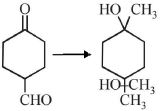
A
$[Ag(NH_3)_2]^+ OH^-, H^+/CH_3OH, CH_3MgBr$
B
$CH_3MgBr, H^+/CH_3OH, [Ag(NH_3)_2]^+ OH^-$
C
$CH_3MgBr, [Ag(NH_3)_2]^+ OH^-, H^+/CH_3OH$
D
$[Ag(NH_3)_2]^+ OH^-, CH_3MgBr, H^+/CH_3OH$
Solution
(A) The conversion involves the selective transformation of an aldehyde group to a tertiary alcohol while preserving the ketone group or transforming it appropriately.
$1$. First,the aldehyde group is oxidized to a carboxylic acid using Tollens' reagent,$[Ag(NH_3)_2]^+ OH^-$.
$2$. Next,the carboxylic acid is esterified to a methyl ester using $H^+/CH_3OH$.
$3$. Finally,the reaction with excess $CH_3MgBr$ (Grignard reagent) attacks both the ketone and the ester groups to form the final diol product.
$1$. First,the aldehyde group is oxidized to a carboxylic acid using Tollens' reagent,$[Ag(NH_3)_2]^+ OH^-$.
$2$. Next,the carboxylic acid is esterified to a methyl ester using $H^+/CH_3OH$.
$3$. Finally,the reaction with excess $CH_3MgBr$ (Grignard reagent) attacks both the ketone and the ester groups to form the final diol product.
0 likes
View Solution429
DifficultMCQ
The major product obtained in the following reaction is:
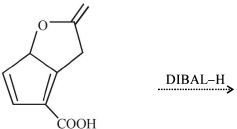
A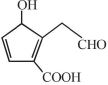
B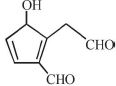
C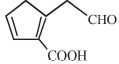
D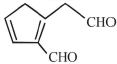
Solution
(A) $DIBAL-H$ (Diisobutylaluminium hydride) is a selective reducing agent. It is commonly used to reduce esters or lactones (cyclic esters) to aldehydes. In the given reaction,the lactone ring is opened and reduced to an aldehyde group,while the hydroxyl group is formed at the position where the oxygen was attached to the ring. The carboxylic acid group $(-COOH)$ remains unaffected under these specific reaction conditions.
0 likes
View Solution430
MediumMCQ
Compound $CH_3-CO-CH_2-OH$ reduces:
A
Tollen's reagent
B
$NaOH / I_2$ solution
C
Fehling solution
D
All of these
Solution
(D) The compound $CH_3-CO-CH_2-OH$ (hydroxyacetone) is an $\alpha$-hydroxy ketone.
$\alpha$-hydroxy ketones are capable of reducing Tollen's reagent and Fehling's solution.
Additionally,the presence of the $CH_3-CO-$ (methyl keto) group allows it to undergo the iodoform reaction with $NaOH / I_2$,where $I_2$ is reduced to $I^-$.
Therefore,it reduces all the given reagents.
$\alpha$-hydroxy ketones are capable of reducing Tollen's reagent and Fehling's solution.
Additionally,the presence of the $CH_3-CO-$ (methyl keto) group allows it to undergo the iodoform reaction with $NaOH / I_2$,where $I_2$ is reduced to $I^-$.
Therefore,it reduces all the given reagents.
0 likes
View Solution431
DifficultMCQ
The final product of the following reaction contains:
$CH_3 - C \equiv C - CH_2 - COCl \xrightarrow[BaSO_4]{H_2 - Pd}$
$CH_3 - C \equiv C - CH_2 - COCl \xrightarrow[BaSO_4]{H_2 - Pd}$
A
Only aldehyde groups
B
Triple bond & alcohol
C
Double bond & alcohol
D
Double bond & aldehyde
Solution
(D) The reagent $H_2/Pd-BaSO_4$ (Rosenmund catalyst) reduces the acid chloride group $(-COCl)$ to an aldehyde group $(-CHO)$.
Simultaneously,the $H_2/Pd$ system acts to reduce the triple bond $(C \equiv C)$ to a double bond $(C = C)$.
Therefore,the final product $CH_3 - CH = CH - CH_2 - CHO$ contains both a double bond and an aldehyde group.
Simultaneously,the $H_2/Pd$ system acts to reduce the triple bond $(C \equiv C)$ to a double bond $(C = C)$.
Therefore,the final product $CH_3 - CH = CH - CH_2 - CHO$ contains both a double bond and an aldehyde group.
0 likes
View Solution432
DifficultMCQ
$A$ compound having molecular formula $C_3H_6O$,on reaction with $NH_2NHCONH_2$ produces mainly $P$ (which shows stereoisomerism). $P$ on reaction with $KOH$ / ethylene glycol,$\Delta$ produces propane. Identify $(P)$.
A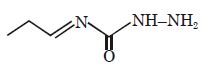
B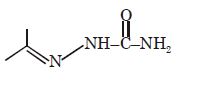
C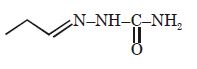
D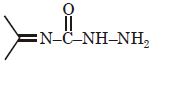
Solution
(C) The molecular formula $C_3H_6O$ corresponds to propanal $(CH_3CH_2CHO)$ or acetone $(CH_3COCH_3)$.
Since the product $P$ shows stereoisomerism (geometrical isomerism),the starting carbonyl compound must be propanal.
Acetone semicarbazone $(CH_3C(NNHCONH_2)CH_3)$ does not show stereoisomerism because the two methyl groups on the carbon are identical.
Propanal reacts with semicarbazide $(NH_2NHCONH_2)$ to form propanal semicarbazone $(CH_3CH_2CH=NNHCONH_2)$.
This compound $P$ $(CH_3CH_2CH=NNHCONH_2)$ undergoes Wolff-Kishner reduction with $KOH$ / ethylene glycol to form propane.
Thus,the correct structure for $P$ is $CH_3CH_2CH=NNHCONH_2$.
Since the product $P$ shows stereoisomerism (geometrical isomerism),the starting carbonyl compound must be propanal.
Acetone semicarbazone $(CH_3C(NNHCONH_2)CH_3)$ does not show stereoisomerism because the two methyl groups on the carbon are identical.
Propanal reacts with semicarbazide $(NH_2NHCONH_2)$ to form propanal semicarbazone $(CH_3CH_2CH=NNHCONH_2)$.
This compound $P$ $(CH_3CH_2CH=NNHCONH_2)$ undergoes Wolff-Kishner reduction with $KOH$ / ethylene glycol to form propane.
Thus,the correct structure for $P$ is $CH_3CH_2CH=NNHCONH_2$.
0 likes
View Solution433
MediumMCQ
$Ph-CO-CH_3 \xrightarrow[H_2O]{Mg-Hg}$ Product. The main product is:
A
$Ph-CO-CO-Ph$
B
$CH_3-CO-CO-CH_3$
C
$Ph-C(OH)(CH_3)-C(OH)(CH_3)-Ph$
D
$Ph-CO-C(Ph)(CH_3)_2$
Solution
(C) The reaction of acetophenone $(Ph-CO-CH_3)$ with magnesium amalgam $(Mg-Hg)$ and water is a bimolecular reduction known as pinacol coupling.
This reaction involves the formation of a radical intermediate which dimerizes to form a $1,2$-diol,commonly called a pinacol.
The reaction is: $2Ph-CO-CH_3 \xrightarrow[H_2O]{Mg-Hg} Ph-C(OH)(CH_3)-C(OH)(CH_3)-Ph$.
This reaction involves the formation of a radical intermediate which dimerizes to form a $1,2$-diol,commonly called a pinacol.
The reaction is: $2Ph-CO-CH_3 \xrightarrow[H_2O]{Mg-Hg} Ph-C(OH)(CH_3)-C(OH)(CH_3)-Ph$.
0 likes
View Solution434
MediumMCQ
Which of the following does not give an aldol reaction with dil. $NaOH$?
A
$CH_3CHO$
B
$CD_3CHO$
C
$CH_3COCH_3$
D
$PhCHO$
Solution
(D) For a compound to undergo an aldol condensation reaction,it must possess at least one $\alpha$-hydrogen atom.
$CH_3CHO$ (acetaldehyde) has three $\alpha$-hydrogens.
$CD_3CHO$ has three $\alpha$-deuteriums,which can be removed to form an enolate,thus it undergoes aldol reaction.
$CH_3COCH_3$ (acetone) has six $\alpha$-hydrogens.
$PhCHO$ (benzaldehyde) has no $\alpha$-hydrogen atom attached to the carbonyl carbon,therefore it does not undergo aldol condensation.
$CH_3CHO$ (acetaldehyde) has three $\alpha$-hydrogens.
$CD_3CHO$ has three $\alpha$-deuteriums,which can be removed to form an enolate,thus it undergoes aldol reaction.
$CH_3COCH_3$ (acetone) has six $\alpha$-hydrogens.
$PhCHO$ (benzaldehyde) has no $\alpha$-hydrogen atom attached to the carbonyl carbon,therefore it does not undergo aldol condensation.
0 likes
View Solution435
AdvancedMCQ
Predict the product of the following reaction:
$3$-hydroxycyclopentanone $\xrightarrow{Zn-Hg/HCl}$ product
$3$-hydroxycyclopentanone $\xrightarrow{Zn-Hg/HCl}$ product
A
cyclopentane
B
$3-$chlorocyclopentanone
C
$3-$hydroxycyclopentane
D
$3-$chlorocyclopentene
Solution
(C) The reaction uses $Zn-Hg/HCl$,which is the reagent for the Clemmensen reduction.
Clemmensen reduction specifically reduces carbonyl groups (aldehydes and ketones) to methylene $(-CH_2-)$ groups.
It does not affect other functional groups like hydroxyl $(-OH)$ groups under these acidic conditions.
Therefore,the ketone group at position $1$ is reduced to a methylene group,while the hydroxyl group at position $3$ remains unchanged.
The product is $3$-hydroxycyclopentane.
Clemmensen reduction specifically reduces carbonyl groups (aldehydes and ketones) to methylene $(-CH_2-)$ groups.
It does not affect other functional groups like hydroxyl $(-OH)$ groups under these acidic conditions.
Therefore,the ketone group at position $1$ is reduced to a methylene group,while the hydroxyl group at position $3$ remains unchanged.
The product is $3$-hydroxycyclopentane.
0 likes
View Solution436
DifficultMCQ
Give the reactivity order towards $HCN$ for the following compounds:
$(I)$ $Ph-CO-CH_3$
$(II)$ $CH_3-CO-CH_3$
$(III)$ $CH_3-CHO$
$(IV)$ $Ph-CO-CH_2-CH_3$
$(I)$ $Ph-CO-CH_3$
$(II)$ $CH_3-CO-CH_3$
$(III)$ $CH_3-CHO$
$(IV)$ $Ph-CO-CH_2-CH_3$
A
$IV > I > II > III$
B
$III > II > I > IV$
C
$II > I > IV > III$
D
$III > II > IV > I$
Solution
(B) The reactivity of carbonyl compounds towards nucleophilic addition reactions (like addition of $HCN$) depends on steric and electronic factors.
$1.$ **Steric factor**: As the size and number of alkyl groups increase,the attack of the nucleophile on the carbonyl carbon becomes difficult. Thus,aldehydes are more reactive than ketones.
$2.$ **Electronic factor**: Electron-donating groups ($+I$ effect) decrease the electrophilicity of the carbonyl carbon. Phenyl groups also decrease reactivity due to resonance.
Comparing the given compounds:
- $(III)$ $CH_3-CHO$ is an aldehyde (most reactive).
- $(II)$ $CH_3-CO-CH_3$ is an aliphatic ketone.
- $(I)$ $Ph-CO-CH_3$ is an aromatic ketone.
- $(IV)$ $Ph-CO-CH_2-CH_3$ is an aromatic ketone with a larger alkyl group than $(I)$.
Therefore,the order is: $III > II > I > IV$.
$1.$ **Steric factor**: As the size and number of alkyl groups increase,the attack of the nucleophile on the carbonyl carbon becomes difficult. Thus,aldehydes are more reactive than ketones.
$2.$ **Electronic factor**: Electron-donating groups ($+I$ effect) decrease the electrophilicity of the carbonyl carbon. Phenyl groups also decrease reactivity due to resonance.
Comparing the given compounds:
- $(III)$ $CH_3-CHO$ is an aldehyde (most reactive).
- $(II)$ $CH_3-CO-CH_3$ is an aliphatic ketone.
- $(I)$ $Ph-CO-CH_3$ is an aromatic ketone.
- $(IV)$ $Ph-CO-CH_2-CH_3$ is an aromatic ketone with a larger alkyl group than $(I)$.
Therefore,the order is: $III > II > I > IV$.
0 likes
View Solution437
DifficultMCQ
Predict the product of the following reaction:
$p-CH_3-C_6H_4-CHO + p-CH_3-C_6H_4-CO-CH_3 \xrightarrow{\bar{O}H, \Delta} \text{Product}$
$p-CH_3-C_6H_4-CHO + p-CH_3-C_6H_4-CO-CH_3 \xrightarrow{\bar{O}H, \Delta} \text{Product}$
A
$p-CH_3-C_6H_4-CH=CH-CO-C_6H_5$
B
$C_6H_5-CO-CH=CH-C_6H_4-p-CH_3$
C
$p-CH_3-C_6H_4-CH=CH-CO-C_6H_4-p-CH_3$
D
$p-HO-CH_2-C_6H_4-CH=CH-C_6H_5$
Solution
(C) The reaction is a cross-aldol condensation between $p$-methylbenzaldehyde and $p$-methylacetophenone in the presence of a base $(\bar{O}H)$ and heat $(\Delta)$.
In this reaction,the ketone ($p$-methylacetophenone) acts as the enolate donor because it has $\alpha$-hydrogens,while the aldehyde ($p$-methylbenzaldehyde) acts as the electrophilic acceptor.
The enolate formed from $p$-methylacetophenone attacks the carbonyl carbon of $p$-methylbenzaldehyde.
Following the condensation and subsequent dehydration (due to heat),the final product is $p-CH_3-C_6H_4-CH=CH-CO-C_6H_4-p-CH_3$.
In this reaction,the ketone ($p$-methylacetophenone) acts as the enolate donor because it has $\alpha$-hydrogens,while the aldehyde ($p$-methylbenzaldehyde) acts as the electrophilic acceptor.
The enolate formed from $p$-methylacetophenone attacks the carbonyl carbon of $p$-methylbenzaldehyde.
Following the condensation and subsequent dehydration (due to heat),the final product is $p-CH_3-C_6H_4-CH=CH-CO-C_6H_4-p-CH_3$.
0 likes
View Solution438
DifficultMCQ
$Ph-C(=O)-CH_3 \xrightarrow{NaOCl} A + \text{salt}$
$A + CH_3-C(=O)-CH_3 \rightarrow B$
$B$ is
$A + CH_3-C(=O)-CH_3 \rightarrow B$
$B$ is
A
$CH_3-C(=O)-CH=C(CH_3)-Ph$
B
$Ph-C(=O)-CH=CH-C(=O)-CH_3$
C
$CH_3-C(OH)(CCl_3)-CH_3$
D
$CH_3-CCl_2-CH_3$
Solution
(C) Acetophenone $(Ph-C(=O)-CH_3)$ undergoes a haloform reaction with $NaOCl$ to produce chloroform $(CHCl_3)$ and sodium benzoate $(Ph-COONa)$.
Thus,$A$ is $CHCl_3$.
Chloroform $(CHCl_3)$ reacts with acetone $(CH_3-C(=O)-CH_3)$ in the presence of a base (nucleophilic addition) to form chloretone $(CH_3-C(OH)(CCl_3)-CH_3)$.
Therefore,$B$ is $CH_3-C(OH)(CCl_3)-CH_3$.
Thus,$A$ is $CHCl_3$.
Chloroform $(CHCl_3)$ reacts with acetone $(CH_3-C(=O)-CH_3)$ in the presence of a base (nucleophilic addition) to form chloretone $(CH_3-C(OH)(CCl_3)-CH_3)$.
Therefore,$B$ is $CH_3-C(OH)(CCl_3)-CH_3$.
0 likes
View Solution439
MediumMCQ
Which of the following does not reduce Fehling solution?
A
$CH_3CHO$
B
$Ph-CHO$
C
$CH_3CH_2CHO$
D
$HCHO$
Solution
(B) Fehling solution is a mild oxidizing agent used to distinguish between aliphatic and aromatic aldehydes.
Aliphatic aldehydes (like $CH_3CHO$,$CH_3CH_2CHO$,and $HCHO$) are easily oxidized by Fehling solution to their corresponding carboxylate ions,resulting in a reddish-brown precipitate of $Cu_2O$.
Aromatic aldehydes (like $Ph-CHO$) are not strong enough reducing agents to reduce the $Cu^{2+}$ ions in Fehling solution.
Therefore,$Ph-CHO$ does not reduce Fehling solution.
Aliphatic aldehydes (like $CH_3CHO$,$CH_3CH_2CHO$,and $HCHO$) are easily oxidized by Fehling solution to their corresponding carboxylate ions,resulting in a reddish-brown precipitate of $Cu_2O$.
Aromatic aldehydes (like $Ph-CHO$) are not strong enough reducing agents to reduce the $Cu^{2+}$ ions in Fehling solution.
Therefore,$Ph-CHO$ does not reduce Fehling solution.
0 likes
View Solution440
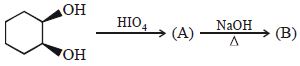
AdvancedMCQ
Product $B$ is :
A
Cyclohexanol
B
$2-$Hydroxycyclohexanone
C
Cyclopent$-1-$enecarbaldehyde
D
Cyclohexene oxide
Solution
(C) The reaction of cyclohexane$-1,2-$diol with periodic acid $(HIO_4)$ causes oxidative cleavage of the $C-C$ bond between the two hydroxyl groups,resulting in the formation of hexane$-1,6-$dial (compound $A$).
Hexane$-1,6-$dial contains two aldehyde groups and alpha-hydrogens,which undergo an intramolecular aldol condensation in the presence of $NaOH$ and heat $(\Delta)$.
This cyclization leads to the formation of a five-membered ring with an unsaturated aldehyde group,which is cyclopent$-1-$enecarbaldehyde (compound $B$).
Hexane$-1,6-$dial contains two aldehyde groups and alpha-hydrogens,which undergo an intramolecular aldol condensation in the presence of $NaOH$ and heat $(\Delta)$.
This cyclization leads to the formation of a five-membered ring with an unsaturated aldehyde group,which is cyclopent$-1-$enecarbaldehyde (compound $B$).
0 likes
View Solution441
MediumMCQ
The reagent that can distinguish benzaldehyde from propionaldehyde is
A
$I_2/NaOH$
B
Fehling's solution
C
Tollens reagent
D
$2, 4-$dinitrophenyl hydrazine
Solution
(B) Benzaldehyde $(C_6H_5CHO)$ is an aromatic aldehyde,while propionaldehyde $(CH_3CH_2CHO)$ is an aliphatic aldehyde.
Fehling's solution is a mild oxidizing agent that can oxidize aliphatic aldehydes to carboxylic acids but cannot oxidize aromatic aldehydes like benzaldehyde.
Therefore,propionaldehyde gives a positive test (red precipitate of $Cu_2O$) with Fehling's solution,whereas benzaldehyde does not.
Tollens reagent reacts with both aliphatic and aromatic aldehydes,and $2, 4-DNP$ reacts with all aldehydes and ketones,so they cannot distinguish between the two.
Fehling's solution is a mild oxidizing agent that can oxidize aliphatic aldehydes to carboxylic acids but cannot oxidize aromatic aldehydes like benzaldehyde.
Therefore,propionaldehyde gives a positive test (red precipitate of $Cu_2O$) with Fehling's solution,whereas benzaldehyde does not.
Tollens reagent reacts with both aliphatic and aromatic aldehydes,and $2, 4-DNP$ reacts with all aldehydes and ketones,so they cannot distinguish between the two.
0 likes
View Solution442
AdvancedMCQ
$Ph-CH(OH)-CH_3$ $\xrightarrow{PCC} A$ $\xrightarrow[(ii) H^{+}/\Delta]{(i) NH_2OH} B + C$
In the given reaction sequence,$B$ and $C$ are:
In the given reaction sequence,$B$ and $C$ are:
A
$Ph-CONH-CH_3, CH_3-CONH-Ph$
B
$Ph-CO-NH-CH_3, CH_3-CO-NH-Ph$
C
$Ph-CO-CH_3, Ph-C(CH_3)=N-OH$
D
$Ph-CH_2-NH-CH_3, CH_3-CH_2-NH-Ph$
Solution
(A) $1$. $Ph-CH(OH)-CH_3$ is a secondary alcohol,which is oxidized by $PCC$ to form acetophenone $(A = Ph-CO-CH_3)$.
$2$. Acetophenone reacts with hydroxylamine $(NH_2OH)$ to form acetophenone oxime $(Ph-C(CH_3)=N-OH)$.
$3$. Upon treatment with $H^{+}/\Delta$,the oxime undergoes Beckmann rearrangement.
$4$. The Beckmann rearrangement of acetophenone oxime involves the migration of either the phenyl group or the methyl group to the nitrogen atom,resulting in two isomeric amides: $Ph-CONH-CH_3$ ($N$-methylbenzamide) and $CH_3-CONH-Ph$ ($N$-phenylacetamide).
$2$. Acetophenone reacts with hydroxylamine $(NH_2OH)$ to form acetophenone oxime $(Ph-C(CH_3)=N-OH)$.
$3$. Upon treatment with $H^{+}/\Delta$,the oxime undergoes Beckmann rearrangement.
$4$. The Beckmann rearrangement of acetophenone oxime involves the migration of either the phenyl group or the methyl group to the nitrogen atom,resulting in two isomeric amides: $Ph-CONH-CH_3$ ($N$-methylbenzamide) and $CH_3-CONH-Ph$ ($N$-phenylacetamide).
0 likes
View Solution443
DifficultMCQ
Compound '$A$' gives a positive test with $2,4-DNP$ and with $I_2/NaOH$. Compound '$A$' may be:
A
$Ph-CHO$
B
Diethyl ketone (Pentan$-3-$one)
C
Benzophenone
D
Butan$-2-$one
Solution
(D) $1$. The $2,4-DNP$ test is a characteristic test for carbonyl compounds (aldehydes and ketones). All given options contain a carbonyl group,so they all give a positive $2,4-DNP$ test.
$2$. The $I_2/NaOH$ test (Iodoform test) is given by compounds containing a $CH_3CO-$ group or a $CH_3CH(OH)-$ group.
$3$. Let us analyze the options:
- $Ph-CHO$ (Benzaldehyde): Does not contain a $CH_3CO-$ group.
- Diethyl ketone $(CH_3CH_2COCH_2CH_3)$: Does not contain a $CH_3CO-$ group.
- Benzophenone $(Ph-CO-Ph)$: Does not contain a $CH_3CO-$ group.
- Butan$-2-$one $(CH_3COCH_2CH_3)$: Contains a $CH_3CO-$ group,therefore it gives a positive iodoform test.
$4$. Thus,Butan$-2-$one is the correct compound.
$2$. The $I_2/NaOH$ test (Iodoform test) is given by compounds containing a $CH_3CO-$ group or a $CH_3CH(OH)-$ group.
$3$. Let us analyze the options:
- $Ph-CHO$ (Benzaldehyde): Does not contain a $CH_3CO-$ group.
- Diethyl ketone $(CH_3CH_2COCH_2CH_3)$: Does not contain a $CH_3CO-$ group.
- Benzophenone $(Ph-CO-Ph)$: Does not contain a $CH_3CO-$ group.
- Butan$-2-$one $(CH_3COCH_2CH_3)$: Contains a $CH_3CO-$ group,therefore it gives a positive iodoform test.
$4$. Thus,Butan$-2-$one is the correct compound.
0 likes
View Solution444
DifficultMCQ
$CH_3-CO-CH_3$ $\xrightarrow{I_2/NaOH} \underset{\text{yellow compound}}{(A)} + (B)$ $\xrightarrow{Ag - \text{powder}, \Delta} (C)$ $\xrightarrow{Dil. H_2SO_4/HgSO_4} (D)$
$A, C$ and $D$ are :-
$A, C$ and $D$ are :-
A
Iodoform,Acetylene & Acetaldehyde
B
Sodium acetate,Ethyne & Acetone
C
Iodoform,Ethyne & Butenyne
D
Sodium acetate,Ethyne & Butenyne
Solution
(A) Step $1$: $CH_3-CO-CH_3$ (Acetone) reacts with $I_2/NaOH$ (Iodoform reaction) to give $CHI_3$ (Iodoform,yellow compound $A$) and $CH_3COONa$ (Sodium acetate $B$).
Step $2$: $2CHI_3 + 6Ag \xrightarrow{\Delta} CH \equiv CH$ (Acetylene or Ethyne $C$) $+ 6AgI$.
Step $3$: $CH \equiv CH$ undergoes hydration in the presence of $HgSO_4/H_2SO_4$ to give $CH_3CHO$ (Acetaldehyde $D$).
Therefore,$A = \text{Iodoform}$,$C = \text{Acetylene}$,$D = \text{Acetaldehyde}$.
Step $2$: $2CHI_3 + 6Ag \xrightarrow{\Delta} CH \equiv CH$ (Acetylene or Ethyne $C$) $+ 6AgI$.
Step $3$: $CH \equiv CH$ undergoes hydration in the presence of $HgSO_4/H_2SO_4$ to give $CH_3CHO$ (Acetaldehyde $D$).
Therefore,$A = \text{Iodoform}$,$C = \text{Acetylene}$,$D = \text{Acetaldehyde}$.
0 likes
View Solution445
AdvancedMCQ
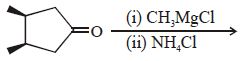
Which of the following is not formed as one of the products in the following reaction?
A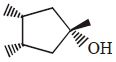
B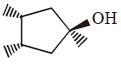
C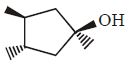
D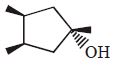
Solution
(C) The reaction of $3,4$-dimethylcyclopentanone with $CH_3MgCl$ (a Grignard reagent) followed by $NH_4Cl$ (acidic workup) is a nucleophilic addition reaction to the carbonyl group. \\ The nucleophile $(CH_3^-)$ can attack the planar carbonyl carbon from either the top face or the bottom face. \\ The starting material,$3,4$-dimethylcyclopentanone,has two chiral centers at positions $3$ and $4$. \\ Depending on the stereochemistry of the starting material (e.g.,cis or trans isomer),the attack of the Grignard reagent will lead to the formation of diastereomers. \\ Since the carbonyl carbon is prochiral,the attack from the two faces will result in two different stereoisomers (epimers at the new chiral center). \\ Option $C$ represents a structure where the relative stereochemistry of the methyl groups is changed (one up,one down),which is not possible through a simple nucleophilic addition to the carbonyl group without affecting the existing chiral centers. Thus,the structure in option $C$ is not formed.
0 likes
View Solution446
MediumMCQ
$A$ mixture of benzaldehyde and formaldehyde on heating with aqueous $NaOH$ solution gives :-
A
$PhCH_2OH$ and $HCOONa$
B
$PhCOONa$ and $CH_3OH$
C
$PhCOONa$ and $HCOONa$
D
$PhCH_2OH$ and $CH_3OH$
Solution
(A) This reaction is a cross-Cannizzaro reaction.
In a cross-Cannizzaro reaction involving formaldehyde $(HCHO)$ and a non-enolizable aldehyde like benzaldehyde $(PhCHO)$,formaldehyde acts as the reducing agent because it is more reactive towards nucleophilic attack.
Therefore,$HCHO$ is oxidized to formate $(HCOONa)$ and $PhCHO$ is reduced to benzyl alcohol $(PhCH_2OH)$.
The reaction is: $PhCHO + HCHO \xrightarrow{NaOH} PhCH_2OH + HCOONa$.
In a cross-Cannizzaro reaction involving formaldehyde $(HCHO)$ and a non-enolizable aldehyde like benzaldehyde $(PhCHO)$,formaldehyde acts as the reducing agent because it is more reactive towards nucleophilic attack.
Therefore,$HCHO$ is oxidized to formate $(HCOONa)$ and $PhCHO$ is reduced to benzyl alcohol $(PhCH_2OH)$.
The reaction is: $PhCHO + HCHO \xrightarrow{NaOH} PhCH_2OH + HCOONa$.
0 likes
View Solution447
MediumMCQ
Which of the reagent is used to convert $2-Butanone$ into propanoic acid?
A
$NaOH, I_2 / H^+$
B
Tollen's Reagent
C
Fehling solution
D
$NaOH, NaI / H^+$
Solution
(A) $2-Butanone$ $(CH_3COCH_2CH_3)$ contains a methyl ketone group.
Treatment with $NaOH$ and $I_2$ (Haloform reaction) converts the methyl group into an iodoform $(CHI_3)$ precipitate and the remaining part into the salt of a carboxylic acid.
Upon acidification with $H^+$,the salt is converted into propanoic acid $(CH_3CH_2COOH)$.
Therefore,$NaOH, I_2 / H^+$ is the correct reagent.
Treatment with $NaOH$ and $I_2$ (Haloform reaction) converts the methyl group into an iodoform $(CHI_3)$ precipitate and the remaining part into the salt of a carboxylic acid.
Upon acidification with $H^+$,the salt is converted into propanoic acid $(CH_3CH_2COOH)$.
Therefore,$NaOH, I_2 / H^+$ is the correct reagent.
0 likes
View Solution448
MediumMCQ
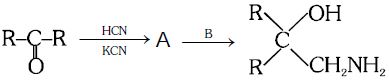
$A$ and $B$ in the following reaction are :-
A
$A = R_2C(OH)COOH, B = NH_3$
B
$A = R_2C(CN)COOH, B = H_3O^{\oplus}$
C
$A = R_2CH_2CN, B = NaOH$
D
$A = R_2C(OH)CN, B = LiAlH_4$
Solution
(D) The reaction of a ketone $(R_2C=O)$ with $HCN$ in the presence of $KCN$ (as a catalyst) is a nucleophilic addition reaction that forms a cyanohydrin.
Thus,$A$ is the cyanohydrin,which has the structure $R_2C(OH)CN$.
Next,the reduction of the cyano group $(-CN)$ to a primary amine $(-CH_2NH_2)$ is achieved using a strong reducing agent like lithium aluminum hydride $(LiAlH_4)$.
Therefore,$B$ is $LiAlH_4$.
Thus,$A$ is the cyanohydrin,which has the structure $R_2C(OH)CN$.
Next,the reduction of the cyano group $(-CN)$ to a primary amine $(-CH_2NH_2)$ is achieved using a strong reducing agent like lithium aluminum hydride $(LiAlH_4)$.
Therefore,$B$ is $LiAlH_4$.
0 likes
View Solution8-1.Aldehydes and Ketones — Properties · Frequently Asked Questions
1Are these 8-1.Aldehydes and Ketones questions useful for JEE and NEET?
Yes. All questions in this section are mapped to JEE Main and NEET exam patterns. Previous year questions from JEE Main, NEET, GUJCET and state-level exams are included with full solutions.
2Can I switch to Hindi or Gujarati for these questions?
Yes. Use the language tabs in the hero section or the sidebar to view the same questions and solutions in English, Hindi or Gujarati.
3How do I generate a question paper from this subtopic?
Use the Vedclass Exam Paper Generator — select the chapter and subtopic, set difficulty, and generate Sets A, B, C, D automatically. First 3 chapters of every subject are free.
Vedclass Products
For Students
Vedclass Test Series
Mock tests in real JEE/NEET style with performance analysis. 5-day free trial.
Start Free TrialFor Teachers
Exam Paper Generator
Generate Set A/B/C/D papers from this chapter in 2 minutes. 3 chapters free.
Try FreeFor Institutes
Online Exam Module
Live online exams with unlimited students, 360° analytics & white-label branding.
See DemoFor Teachers & Institutes
Generate a 8-1.Aldehydes and Ketones Exam Paper in 2 Minutes
Select subtopic & difficulty — Sets A, B, C, D auto-generated with No Repeat logic.
First 3 chapters of every subject are free — no payment required.