
A English
Sex determination Questions in English
Class 12 Biology · Principles of Inheritance and Variation · Sex determination
265+
Questions
English
Language
100%
With Solutions
Showing 50 of 265 questions in English
151
Medium
How is sex determined in honey bees?
Solution
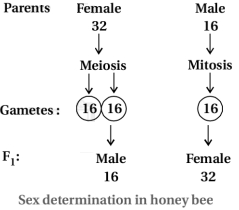
(N/A) The sex determination in honey bees is based on the number of sets of chromosomes an individual receives.
An offspring formed from the union of a sperm and an egg develops as a female (queen or worker),and an unfertilized egg develops as a male (drone) by means of parthenogenesis.
This means that the males have half the number of chromosomes compared to a female.
The females are diploid,having $32$ chromosomes,and males are haploid,i.e.,having $16$ chromosomes.
This is called the haploid-diploid sex determination system and has special characteristic features,such as the males producing sperms by mitosis; they do not have a father and thus cannot have sons,but they have a grandfather and can have grandsons.
An offspring formed from the union of a sperm and an egg develops as a female (queen or worker),and an unfertilized egg develops as a male (drone) by means of parthenogenesis.
This means that the males have half the number of chromosomes compared to a female.
The females are diploid,having $32$ chromosomes,and males are haploid,i.e.,having $16$ chromosomes.
This is called the haploid-diploid sex determination system and has special characteristic features,such as the males producing sperms by mitosis; they do not have a father and thus cannot have sons,but they have a grandfather and can have grandsons.
0 likes
View Solution152
Medium
Honeybees produce their young ones only by sexual reproduction. Inspite of this,in a colony of bees we find both haploid and diploid individuals. Name the haploid and diploid individuals in the colony and analyse the reasons behind their formation.
Solution
(N/A) The colony of honey bees has three types of members:
$(i)$ Diploid queen: Fertile females.
$(ii)$ Worker bees: Sterile females.
$(iii)$ Drones: Haploid males.
An offspring formed from the fertilization of a sperm and an egg develops as a female (queen or worker),which is diploid. An unfertilized egg develops into a male (drone) through a process called parthenogenesis. This results in males having half the number of chromosomes compared to females,making them haploid.
$(i)$ Diploid queen: Fertile females.
$(ii)$ Worker bees: Sterile females.
$(iii)$ Drones: Haploid males.
An offspring formed from the fertilization of a sperm and an egg develops as a female (queen or worker),which is diploid. An unfertilized egg develops into a male (drone) through a process called parthenogenesis. This results in males having half the number of chromosomes compared to females,making them haploid.
0 likes
View Solution153
Easy
Distinguish between: Sex determination in humans and Sex determination in Drosophila.
Solution
(N/A)
| Sex determination in humans | Sex determination in Drosophila |
|---|---|
| $1$. Humans have $44 + XY$ chromosomes in males and $44 + XX$ in females. | $1$. Drosophila has $3A + XX$ in females and $3A + XY$ chromosomes in males (where $A$ represents autosomes). |
| $2$. Males are heterogametic $(XY)$. | $2$. Males can be $XY$ or $XO$. |
| $3$. The presence of the $Y$ chromosome is essential for maleness. | $3$. The $Y$ chromosome is not essential for maleness; $XO$ individuals are sterile males. |
| $4$. Sex is determined by the presence of the $SRY$ gene on the $Y$ chromosome. | $4$. Sex is determined by the ratio of $X$ chromosomes to sets of autosomes ($X/A$ ratio). |
0 likes
View Solution154
Easy
Distinguish between: Haploid process and Diploid process (in the context of Honeybee sex determination).
Solution
(N/A)
| Haploid Process (Arrhenotoky) | Diploid Process (Sexual Reproduction) |
| $(1)$ Gametes in the female are produced by meiosis. | $(1)$ Gametes in the male are produced by mitosis. |
| $(2)$ The egg becomes haploid after meiosis. | $(2)$ Sperm produced by the male remains haploid (but the resulting zygote is diploid). |
| $(3)$ If the haploid egg is unfertilized, it develops into a male (drone). | $(3)$ If the egg is fertilized by a sperm, it develops into a female (queen or worker). |
| $(4)$ Males have $16$ chromosomes and are called drones. | $(4)$ Females have $32$ chromosomes. |
0 likes
View Solution155
Easy
In our society,a woman is often blamed for not bearing a male child. Do you think it is right? Justify.
Solution
(N/A) $50\%$ of sperms carry the $X$-chromosome,while the other $50\%$ carry the $Y$-chromosome.
After the fusion of the male and female gametes,the zygote carries either $XX$ (female) or $XY$ (male) depending on whether the sperm carrying $X$ or $Y$ fertilized the ovum.
Therefore,the sex of the baby is determined by the father's genetic contribution,not by the mother.
Unfortunately,in our society,women are often blamed for producing female children and are ill-treated due to this scientific misconception.
After the fusion of the male and female gametes,the zygote carries either $XX$ (female) or $XY$ (male) depending on whether the sperm carrying $X$ or $Y$ fertilized the ovum.
Therefore,the sex of the baby is determined by the father's genetic contribution,not by the mother.
Unfortunately,in our society,women are often blamed for producing female children and are ill-treated due to this scientific misconception.
0 likes
View Solution156
Medium
$(a)$ In humans,males are heterogametic and females are homogametic. Explain. Are there any examples where males are homogametic and females heterogametic?
$(b)$ Also describe as to who determines the sex of an unborn child? Mention whether temperature has a role in sex determination.
$(b)$ Also describe as to who determines the sex of an unborn child? Mention whether temperature has a role in sex determination.
Solution
(A) The terms homogametic and heterogametic refer to the organism depending upon whether all the gametes contain one or the same type of sex chromosome (Homo = same) or two different types of sex chromosomes (Hetero = different).
$(i)$ Humans show $XX/XY$ type of sex determination,i.e.,females contain two copies of the $X$ chromosome and males contain one $X$ and one $Y$ chromosome.
$(ii)$ Therefore,ova produced by females contain the same sex chromosome,i.e.,$X$.
$(iii)$ On the other hand,the sperms contain two different types of chromosomes,i.e.,$50\%$ of sperms have $X$ and $50\%$ have $Y$ chromosome. Therefore,the sperms are different with respect to the composition of the sex chromosome. In humans,females are homogametic $(XX)$ and males are heterogametic $(XY)$.
Yes,there are examples where males are homogametic and females are heterogametic. In some birds,the mode of sex determination is denoted by $ZZ$ (males) and $ZW$ (females).
$(b)$ As a rule,the heterogametic organism determines the sex of the unborn child. In humans,since males are heterogametic,it is the father and not the mother who determines the sex of the child. In some animals like crocodiles,temperature plays a role in sex determination. Lower temperatures favor the hatching of female offspring,while higher temperatures lead to the hatching of male offspring.
$(i)$ Humans show $XX/XY$ type of sex determination,i.e.,females contain two copies of the $X$ chromosome and males contain one $X$ and one $Y$ chromosome.
$(ii)$ Therefore,ova produced by females contain the same sex chromosome,i.e.,$X$.
$(iii)$ On the other hand,the sperms contain two different types of chromosomes,i.e.,$50\%$ of sperms have $X$ and $50\%$ have $Y$ chromosome. Therefore,the sperms are different with respect to the composition of the sex chromosome. In humans,females are homogametic $(XX)$ and males are heterogametic $(XY)$.
Yes,there are examples where males are homogametic and females are heterogametic. In some birds,the mode of sex determination is denoted by $ZZ$ (males) and $ZW$ (females).
$(b)$ As a rule,the heterogametic organism determines the sex of the unborn child. In humans,since males are heterogametic,it is the father and not the mother who determines the sex of the child. In some animals like crocodiles,temperature plays a role in sex determination. Lower temperatures favor the hatching of female offspring,while higher temperatures lead to the hatching of male offspring.
0 likes
View Solution157
MediumMCQ
What is $XY$ type of sex determination?
A
$A$ mechanism where females are heterogametic.
B
$A$ mechanism where males are heterogametic.
C
$A$ mechanism where both sexes are homogametic.
D
$A$ mechanism where sex is determined by environmental factors.
Solution
(B) The $XY$ type of sex determination is a mechanism where males are heterogametic.
In this system,both males and females have the same number of chromosomes.
Females possess two identical sex chromosomes,denoted as $XX$.
Males possess one $X$ chromosome and one distinctly smaller chromosome,which is called the $Y$ chromosome.
Therefore,the genotype of a female is $AA + XX$ and the genotype of a male is $AA + XY$,where $A$ represents autosomes.
In this system,both males and females have the same number of chromosomes.
Females possess two identical sex chromosomes,denoted as $XX$.
Males possess one $X$ chromosome and one distinctly smaller chromosome,which is called the $Y$ chromosome.
Therefore,the genotype of a female is $AA + XX$ and the genotype of a male is $AA + XY$,where $A$ represents autosomes.
0 likes
View Solution158
Medium
How is sex determined in various organisms? Give the historical background of sex determination.
Solution
(N/A) The mechanism of sex determination has always been a puzzle for geneticists.
The initial clue regarding the genetic/chromosomal mechanism of sex determination can be traced back to experiments conducted on insects.
Cytological observations in several insects led to the development of the concept of the genetic/chromosomal basis of sex determination.
Henking $(1891)$ traced a specific nuclear structure throughout spermatogenesis in a few insects and observed that $50\%$ of the sperm received this structure,while the other $50\%$ did not.
Henking named this structure the $X$-body but could not explain its significance.
Further investigations by other scientists concluded that the $X$-body was actually a chromosome,hence it was named the $X$-chromosome.
It was observed that in many insects,the mechanism is of the $XO$ type,where all eggs bear an additional $X$-chromosome along with autosomes.
Some sperm bear the $X$-chromosome,while others do not.
Eggs fertilized by sperm with an $X$-chromosome become female,and those fertilized by sperm without an $X$-chromosome become male.
Due to the involvement of the $X$-chromosome in sex determination,it was designated as a sex chromosome,and the rest were named autosomes.
Grasshoppers are an example of $XO$ type sex determination,where males have only one $X$-chromosome besides autosomes,while females have a pair of $X$-chromosomes.
In many other insects and mammals,including humans,$XY$ type sex determination is seen,where both sexes have the same number of chromosomes.
Males have an $X$-chromosome,but its counterpart is distinctly smaller and called the $Y$-chromosome.
Females have a pair of $X$-chromosomes.
Thus,both males and females bear the same number of autosomes. Males have autosomes plus $XY$,while females have autosomes plus $XX$.
The initial clue regarding the genetic/chromosomal mechanism of sex determination can be traced back to experiments conducted on insects.
Cytological observations in several insects led to the development of the concept of the genetic/chromosomal basis of sex determination.
Henking $(1891)$ traced a specific nuclear structure throughout spermatogenesis in a few insects and observed that $50\%$ of the sperm received this structure,while the other $50\%$ did not.
Henking named this structure the $X$-body but could not explain its significance.
Further investigations by other scientists concluded that the $X$-body was actually a chromosome,hence it was named the $X$-chromosome.
It was observed that in many insects,the mechanism is of the $XO$ type,where all eggs bear an additional $X$-chromosome along with autosomes.
Some sperm bear the $X$-chromosome,while others do not.
Eggs fertilized by sperm with an $X$-chromosome become female,and those fertilized by sperm without an $X$-chromosome become male.
Due to the involvement of the $X$-chromosome in sex determination,it was designated as a sex chromosome,and the rest were named autosomes.
Grasshoppers are an example of $XO$ type sex determination,where males have only one $X$-chromosome besides autosomes,while females have a pair of $X$-chromosomes.
In many other insects and mammals,including humans,$XY$ type sex determination is seen,where both sexes have the same number of chromosomes.
Males have an $X$-chromosome,but its counterpart is distinctly smaller and called the $Y$-chromosome.
Females have a pair of $X$-chromosomes.
Thus,both males and females bear the same number of autosomes. Males have autosomes plus $XY$,while females have autosomes plus $XX$.
0 likes
View Solution159
Medium
What is heterogamety? Explain by giving proper examples.
Solution
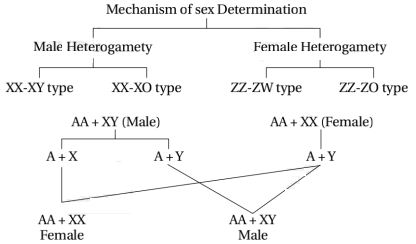
(N/A) Heterogamety is a condition in which an individual produces two different types of gametes with respect to sex chromosomes.
$1$. Male Heterogamety: In this mechanism,the male produces two different types of gametes. For example,in the $XX-XY$ type (seen in humans and Drosophila),males produce $50\%$ of gametes with an $X$ chromosome and $50\%$ with a $Y$ chromosome. In the $XX-XO$ type (seen in grasshoppers),males produce $50\%$ of gametes with an $X$ chromosome and $50\%$ without any sex chromosome $(O)$.
$2$. Female Heterogamety: In this mechanism,the female produces two different types of gametes. For example,in the $ZZ-ZW$ type (seen in birds),females produce $50\%$ of gametes with a $Z$ chromosome and $50\%$ with a $W$ chromosome. In the $ZZ-ZO$ type,females produce $50\%$ of gametes with a $Z$ chromosome and $50\%$ without any sex chromosome $(O)$.
$1$. Male Heterogamety: In this mechanism,the male produces two different types of gametes. For example,in the $XX-XY$ type (seen in humans and Drosophila),males produce $50\%$ of gametes with an $X$ chromosome and $50\%$ with a $Y$ chromosome. In the $XX-XO$ type (seen in grasshoppers),males produce $50\%$ of gametes with an $X$ chromosome and $50\%$ without any sex chromosome $(O)$.
$2$. Female Heterogamety: In this mechanism,the female produces two different types of gametes. For example,in the $ZZ-ZW$ type (seen in birds),females produce $50\%$ of gametes with a $Z$ chromosome and $50\%$ with a $W$ chromosome. In the $ZZ-ZO$ type,females produce $50\%$ of gametes with a $Z$ chromosome and $50\%$ without any sex chromosome $(O)$.
0 likes
View Solution160
Medium
Describe the process of sex determination in humans.
Solution
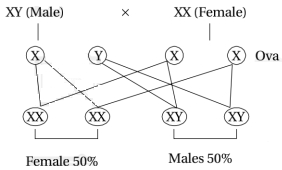
(N/A) The sex-determining mechanism in humans is the $XX: XY$ type.
In humans,out of $23$ pairs of chromosomes,$22$ pairs are exactly the same in both males and females,known as autosomes.
The $23^{\text{rd}}$ pair of chromosomes is the sex chromosome. $A$ pair of $X$-chromosomes $[XX]$ is present in females,while males have one $X$ and one $Y$ chromosome $[XY]$.
During spermatogenesis in males,two types of gametes are produced.
$50\%$ of the total sperms produced carry $X$-chromosomes,and the remaining $50\%$ carry $Y$-chromosomes,in addition to autosomes.
This condition is called male heterogamety.
The $Y$-containing sperms and $X$-containing sperms are called androsperms and gynosperms,respectively.
Females produce only one type of ovum,which contains an $X$-chromosome.
If an ovum is fertilized by a sperm carrying an $X$-chromosome,the zygote develops into a female $[XX]$. If an ovum is fertilized by a sperm carrying a $Y$-chromosome,the resulting zygote will be a male $[XY]$.
Hence,the genetic makeup of the sperm that fertilizes the ovum determines the sex of the child.
There is a $50\%$ chance of having either a male or a female child in each pregnancy.
Thus,it is a chance phenomenon,and women should not be blamed for giving birth to a girl child.
In humans,out of $23$ pairs of chromosomes,$22$ pairs are exactly the same in both males and females,known as autosomes.
The $23^{\text{rd}}$ pair of chromosomes is the sex chromosome. $A$ pair of $X$-chromosomes $[XX]$ is present in females,while males have one $X$ and one $Y$ chromosome $[XY]$.
During spermatogenesis in males,two types of gametes are produced.
$50\%$ of the total sperms produced carry $X$-chromosomes,and the remaining $50\%$ carry $Y$-chromosomes,in addition to autosomes.
This condition is called male heterogamety.
The $Y$-containing sperms and $X$-containing sperms are called androsperms and gynosperms,respectively.
Females produce only one type of ovum,which contains an $X$-chromosome.
If an ovum is fertilized by a sperm carrying an $X$-chromosome,the zygote develops into a female $[XX]$. If an ovum is fertilized by a sperm carrying a $Y$-chromosome,the resulting zygote will be a male $[XY]$.
Hence,the genetic makeup of the sperm that fertilizes the ovum determines the sex of the child.
There is a $50\%$ chance of having either a male or a female child in each pregnancy.
Thus,it is a chance phenomenon,and women should not be blamed for giving birth to a girl child.
0 likes
View Solution161
Easy
Describe the haplo-diploid sex determination system.
Solution
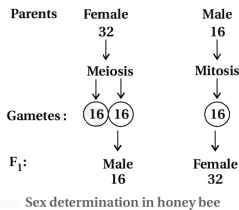
(N/A) The sex determination in honey bees is based on the number of sets of chromosomes an individual receives.
An offspring formed from the union of a sperm and an egg develops as a female (queen or worker),and an unfertilized egg develops as a male (drone) by means of parthenogenesis. This means that the males have half the number of chromosomes compared to a female.
The females are diploid,having $32$ chromosomes,and males are haploid,i.e.,having $16$ chromosomes. This is called the haplo-diploid sex determination system. It has special characteristic features,such as: males produce sperms by mitosis,they do not have a father and thus cannot have sons,but they have a grandfather and can have grandsons.
An offspring formed from the union of a sperm and an egg develops as a female (queen or worker),and an unfertilized egg develops as a male (drone) by means of parthenogenesis. This means that the males have half the number of chromosomes compared to a female.
The females are diploid,having $32$ chromosomes,and males are haploid,i.e.,having $16$ chromosomes. This is called the haplo-diploid sex determination system. It has special characteristic features,such as: males produce sperms by mitosis,they do not have a father and thus cannot have sons,but they have a grandfather and can have grandsons.
0 likes
View Solution162
Easy
Give differences: Male heterogamety and Female heterogamety.
Solution
(N/A)
| Male heterogamety | Female heterogamety |
|---|---|
| $1$. The male individual produces two different types of gametes. | $1$. The female individual produces two different types of gametes. |
| $2$. Example: In humans ($XY$ type),the male produces gametes with $X$ and $Y$ chromosomes. | $2$. Example: In birds ($ZW$ type),the female produces gametes with $Z$ and $W$ chromosomes. |
0 likes
View Solution163
Easy
Define / Explain: Sex determination.
Solution
(N/A) Sex determination is the process by which the sex of an individual is established during the formation of the zygote,based on the genetic composition of the gametes that fuse.
0 likes
View Solution164
EasyMCQ
What is the number of chromosomes in the female gamete of a fruit fly ($Drosophila$ $melanogaster$)?
A
$4$
B
$8$
C
$12$
D
$6$
Solution
(A) The fruit fly ($Drosophila$ $melanogaster$) has a diploid chromosome number of $2n = 8$ in its somatic cells.
Gametes are haploid cells produced through meiosis,containing half the number of chromosomes present in the somatic cells.
Therefore,the number of chromosomes in the female gamete (egg) is $n = 8 / 2 = 4$.
Gametes are haploid cells produced through meiosis,containing half the number of chromosomes present in the somatic cells.
Therefore,the number of chromosomes in the female gamete (egg) is $n = 8 / 2 = 4$.
0 likes
View Solution165
MediumMCQ
The sex of the offspring,whether it will be male or female,is determined by which of the following?
A
Sperm carrying either $X$ or $Y$ chromosome
B
Egg carrying $X$ chromosome
C
Secondary oocyte
D
Primary or secondary polar body
Solution
(A) In humans,the sex of the offspring is determined by the type of sperm that fertilizes the egg.
Females are homogametic,producing eggs that always contain an $X$ chromosome.
Males are heterogametic,producing two types of sperm: those carrying an $X$ chromosome and those carrying a $Y$ chromosome.
If a sperm carrying an $X$ chromosome fertilizes the egg,the resulting zygote will be $XX$ (female).
If a sperm carrying a $Y$ chromosome fertilizes the egg,the resulting zygote will be $XY$ (male).
Therefore,the sex of the offspring depends on the sperm.
Females are homogametic,producing eggs that always contain an $X$ chromosome.
Males are heterogametic,producing two types of sperm: those carrying an $X$ chromosome and those carrying a $Y$ chromosome.
If a sperm carrying an $X$ chromosome fertilizes the egg,the resulting zygote will be $XX$ (female).
If a sperm carrying a $Y$ chromosome fertilizes the egg,the resulting zygote will be $XY$ (male).
Therefore,the sex of the offspring depends on the sperm.
0 likes
View Solution166
MediumMCQ
The sex of a child is determined by whom?
A
Mother
B
Father
C
Both
D
Mother's ova
Solution
(B) In humans,the sex of the child is determined by the sex chromosomes present in the sperm.
Females have $XX$ chromosomes,and males have $XY$ chromosomes.
During fertilization,the mother always contributes an $X$ chromosome through the ovum.
The father can contribute either an $X$ or a $Y$ chromosome through the sperm.
If the sperm carrying the $X$ chromosome fertilizes the egg,the child will be female $(XX)$.
If the sperm carrying the $Y$ chromosome fertilizes the egg,the child will be male $(XY)$.
Therefore,the father is responsible for determining the sex of the child.
Females have $XX$ chromosomes,and males have $XY$ chromosomes.
During fertilization,the mother always contributes an $X$ chromosome through the ovum.
The father can contribute either an $X$ or a $Y$ chromosome through the sperm.
If the sperm carrying the $X$ chromosome fertilizes the egg,the child will be female $(XX)$.
If the sperm carrying the $Y$ chromosome fertilizes the egg,the child will be male $(XY)$.
Therefore,the father is responsible for determining the sex of the child.
0 likes
View Solution167
MediumMCQ
What determines the sex of the embryo?
A
The $X$ or $Y$ chromosome present in the sperm
B
The $X$ or $Y$ chromosome present in the ovum
C
The $X$ chromosome in the ovum and the $X$ chromosome in the sperm
D
The $X$ chromosome in the ovum and the $Y$ chromosome in the sperm
Solution
(A) In humans,the sex of the embryo is determined by the type of sperm that fertilizes the ovum.
Females produce ova that always contain an $X$ chromosome.
Males produce two types of sperm: those containing an $X$ chromosome and those containing a $Y$ chromosome.
If a sperm carrying an $X$ chromosome fertilizes the ovum,the resulting zygote will be $XX$ (female).
If a sperm carrying a $Y$ chromosome fertilizes the ovum,the resulting zygote will be $XY$ (male).
Therefore,the sex of the embryo is determined by the $X$ or $Y$ chromosome present in the sperm.
Females produce ova that always contain an $X$ chromosome.
Males produce two types of sperm: those containing an $X$ chromosome and those containing a $Y$ chromosome.
If a sperm carrying an $X$ chromosome fertilizes the ovum,the resulting zygote will be $XX$ (female).
If a sperm carrying a $Y$ chromosome fertilizes the ovum,the resulting zygote will be $XY$ (male).
Therefore,the sex of the embryo is determined by the $X$ or $Y$ chromosome present in the sperm.
0 likes
View Solution168
EasyMCQ
Which scientist designated the chromosome as the $X$-body?
A
Henking
B
de Vries
C
Sutton
D
Correns
Solution
(A) In $1891$,the German biologist Hermann Henking observed a specific nuclear structure during spermatogenesis in certain insects. He noted that this structure did not participate in the typical pairing of chromosomes during meiosis. Because he was uncertain about its nature,he named it the '$X$-body'. Later,this structure was identified as the $X$ chromosome.
0 likes
View Solution169
MediumMCQ
Which type of sex determination mechanism is observed in insects?
A
$XX-XY$
B
$XX-XO$
C
$XY-X$
D
All of the above
Solution
(B) In many insects,such as grasshoppers,the mechanism of sex determination is of the $XO$ type. In this system,males have only one $X$ chromosome besides the autosomes,while females have a pair of $X$ chromosomes. This is represented as $XX-XO$ type. However,some other insects exhibit $XX-XY$ type sex determination. Since the question asks about insects in general,and different insect species exhibit different mechanisms,the most representative type often cited in textbooks for insects like grasshoppers is $XX-XO$. Given the options provided,$XX-XO$ is the specific mechanism commonly associated with insects in the context of sex determination studies.
0 likes
View Solution170
MediumMCQ
In which of the following organisms are sex chromosome pairs $NOT$ found?
A
Grasshopper
B
Queen honeybee
C
Human female
D
None of these
Solution
(B) In many insects like grasshoppers,sex determination follows the $XO$ type. In this mechanism,males have only one $X$ chromosome (they are $XO$),while females have a pair of $X$ chromosomes $(XX)$.
However,in honeybees,sex determination is based on the number of sets of chromosomes (haplodiploidy). Females (queens and workers) are diploid $(2n = 32)$,and males (drones) are haploid $(n = 16)$.
Since honeybees do not possess specific sex chromosomes to determine sex,but rather rely on ploidy levels,they do not have a 'sex chromosome pair' in the traditional sense compared to $XX/XY$ or $XX/XO$ systems.
Therefore,the queen honeybee does not have a specific pair of sex chromosomes that determines her sex; rather,her sex is determined by her diploid state.
However,in honeybees,sex determination is based on the number of sets of chromosomes (haplodiploidy). Females (queens and workers) are diploid $(2n = 32)$,and males (drones) are haploid $(n = 16)$.
Since honeybees do not possess specific sex chromosomes to determine sex,but rather rely on ploidy levels,they do not have a 'sex chromosome pair' in the traditional sense compared to $XX/XY$ or $XX/XO$ systems.
Therefore,the queen honeybee does not have a specific pair of sex chromosomes that determines her sex; rather,her sex is determined by her diploid state.
0 likes
View Solution171
MediumMCQ
In which of the following organisms is female heterogamety observed in sex determination?
A
Humans
B
Grasshopper
C
Birds
D
Honey bee
Solution
(C) In sex determination,female heterogamety occurs when the female produces two different types of gametes,typically denoted as $ZW$ and $Z$ (or $ZW$ and $ZO$).
This mechanism is characteristic of birds $(Aves)$,some reptiles,and some butterflies.
In humans ($XY$ type) and grasshoppers ($XO$ type),the male is the heterogametic sex.
In honey bees,sex determination is based on the number of sets of chromosomes (haplo-diploidy),where the queen is diploid and the drone is haploid.
Therefore,the correct answer is birds.
This mechanism is characteristic of birds $(Aves)$,some reptiles,and some butterflies.
In humans ($XY$ type) and grasshoppers ($XO$ type),the male is the heterogametic sex.
In honey bees,sex determination is based on the number of sets of chromosomes (haplo-diploidy),where the queen is diploid and the drone is haploid.
Therefore,the correct answer is birds.
0 likes
View Solution172
MediumMCQ
Male heterogamety,which is essential for sex determination in new offspring,is observed in which of the following?
A
Birds
B
Male honeybees
C
Male humans
D
Grasshoppers
Solution
(D) Male heterogamety refers to a condition where the male produces two different types of gametes,such as $X$ and $Y$ or $X$ and $0$.
In humans,males are $XY$ (heterogametic) and females are $XX$ (homogametic).
In grasshoppers,males are $XO$ (heterogametic) and females are $XX$ (homogametic).
Since both humans and grasshoppers exhibit male heterogamety,and the question asks for an example,both $C$ and $D$ are technically correct. However,in the context of standard biology curriculum questions,$XO$ type sex determination in grasshoppers is a classic example of male heterogamety.
Given the options,$D$ (Grasshoppers) is the most specific example of the $XO$ type of male heterogamety.
In humans,males are $XY$ (heterogametic) and females are $XX$ (homogametic).
In grasshoppers,males are $XO$ (heterogametic) and females are $XX$ (homogametic).
Since both humans and grasshoppers exhibit male heterogamety,and the question asks for an example,both $C$ and $D$ are technically correct. However,in the context of standard biology curriculum questions,$XO$ type sex determination in grasshoppers is a classic example of male heterogamety.
Given the options,$D$ (Grasshoppers) is the most specific example of the $XO$ type of male heterogamety.
0 likes
View Solution173
MediumMCQ
In which of the following is male heterogamety $NOT$ observed?
A
Drosophila
B
Humans
C
Birds
D
All of the above
Solution
(C) Male heterogamety refers to a condition where the male produces two different types of gametes (e.g.,$XY$ or $XO$).
In $Drosophila$ and $Humans$,the sex determination mechanism is $XY$ type,where males are heterogametic $(XY)$.
In birds,the sex determination mechanism is $ZW-ZZ$ type,where the female is heterogametic $(ZW)$ and the male is homogametic $(ZZ)$.
Therefore,male heterogamety is not observed in birds.
In $Drosophila$ and $Humans$,the sex determination mechanism is $XY$ type,where males are heterogametic $(XY)$.
In birds,the sex determination mechanism is $ZW-ZZ$ type,where the female is heterogametic $(ZW)$ and the male is homogametic $(ZZ)$.
Therefore,male heterogamety is not observed in birds.
0 likes
View Solution174
MediumMCQ
In humans,the determination of a female offspring is decided by which of the following?
A
Fusion of an $X$-chromosome-bearing ovum with a $Y$-chromosome-bearing sperm.
B
Fusion of an $X$-chromosome-bearing ovum with an $X$-chromosome-bearing sperm.
C
Fusion of a $Y$-chromosome-bearing ovum with an $X$-chromosome-bearing sperm.
D
Fusion of a $Y$-chromosome-bearing ovum with a $Y$-chromosome-bearing sperm.
Solution
(B) In humans,the sex of the offspring is determined by the sex chromosomes of the father.
Females have $XX$ chromosomes and produce only one type of gamete (ovum) containing an $X$ chromosome.
Males have $XY$ chromosomes and produce two types of gametes: $50\%$ containing an $X$ chromosome and $50\%$ containing a $Y$ chromosome.
When an $X$-chromosome-bearing sperm fertilizes an $X$-chromosome-bearing ovum,the resulting zygote is $XX$,which develops into a female offspring.
Therefore,the fusion of an $X$-chromosome-bearing ovum with an $X$-chromosome-bearing sperm results in a female.
Females have $XX$ chromosomes and produce only one type of gamete (ovum) containing an $X$ chromosome.
Males have $XY$ chromosomes and produce two types of gametes: $50\%$ containing an $X$ chromosome and $50\%$ containing a $Y$ chromosome.
When an $X$-chromosome-bearing sperm fertilizes an $X$-chromosome-bearing ovum,the resulting zygote is $XX$,which develops into a female offspring.
Therefore,the fusion of an $X$-chromosome-bearing ovum with an $X$-chromosome-bearing sperm results in a female.
0 likes
View Solution175
MediumMCQ
In humans,sex determination is controlled by which of the following?
A
Genetic constitution of the ovum
B
Genetic constitution of the sperm
C
The female body where fertilization occurs
D
Both $A$ and $B$
Solution
(B) In humans,the sex of the child is determined by the father. Human females have $XX$ sex chromosomes,producing only $X$-bearing gametes (ova). Human males have $XY$ sex chromosomes,producing two types of sperm: $50\%$ carrying the $X$ chromosome and $50\%$ carrying the $Y$ chromosome. If an $X$-bearing sperm fertilizes the ovum,the zygote becomes $XX$ (female). If a $Y$-bearing sperm fertilizes the ovum,the zygote becomes $XY$ (male). Thus,the genetic constitution of the sperm determines the sex of the offspring.
0 likes
View Solution176
MediumMCQ
What is the number of chromosomes in a sterile female worker bee in a beehive?
A
$16$
B
$32$
C
$32$ pairs
D
None of these
Solution
(B) In honey bees,sex determination is based on the number of sets of chromosomes an individual receives.
Worker bees and queens are diploid $(2n)$ females,while drones are haploid $(n)$ males.
The haploid number of chromosomes in honey bees is $n = 16$.
Since worker bees are diploid,the number of chromosomes in a worker bee is $2n = 2 \times 16 = 32$.
Worker bees and queens are diploid $(2n)$ females,while drones are haploid $(n)$ males.
The haploid number of chromosomes in honey bees is $n = 16$.
Since worker bees are diploid,the number of chromosomes in a worker bee is $2n = 2 \times 16 = 32$.
0 likes
View Solution177
MediumMCQ
In which of the following organisms is the structure $Male \rightarrow n$ and $Female \rightarrow 2n$ observed?
A
Grasshopper
B
Birds
C
Honeybee
D
Drosophila
Solution
(C) In honeybees,sex determination is based on the number of sets of chromosomes an individual receives. This is known as haplodiploidy.
$1$. Females are diploid $(2n = 32)$,developed from fertilized eggs (zygotes).
$2$. Males are haploid $(n = 16)$,developed from unfertilized eggs through a process called parthenogenesis.
Therefore,the structure $Male \rightarrow n$ and $Female \rightarrow 2n$ is observed in honeybees.
$1$. Females are diploid $(2n = 32)$,developed from fertilized eggs (zygotes).
$2$. Males are haploid $(n = 16)$,developed from unfertilized eggs through a process called parthenogenesis.
Therefore,the structure $Male \rightarrow n$ and $Female \rightarrow 2n$ is observed in honeybees.
0 likes
View Solution178
MediumMCQ
In haplo-diploid sex determination,by which process are male gametes produced?
A
Parthenogenesis
B
Mitosis
C
Meiosis
D
Conjugation
Solution
(B) In the haplo-diploid sex determination system (e.g.,in honeybees),the males are haploid $(n)$ and females are diploid $(2n)$.
Since the male is already haploid,it cannot undergo meiosis to produce gametes because meiosis reduces the chromosome number by half.
Therefore,males produce sperm (gametes) through the process of mitosis.
This ensures that the sperm contains the same haploid set of chromosomes as the parent.
Since the male is already haploid,it cannot undergo meiosis to produce gametes because meiosis reduces the chromosome number by half.
Therefore,males produce sperm (gametes) through the process of mitosis.
This ensures that the sperm contains the same haploid set of chromosomes as the parent.
0 likes
View Solution179
MediumMCQ
Which of the following is responsible for sex determination in chicks?
A
Ovum
B
Sperm
C
Somatic cell
D
All of the above
Solution
(A) In birds,including chicks,sex determination follows the $ZW-ZZ$ type system.
In this system,the female is heterogametic $(ZW)$ and the male is homogametic $(ZZ)$.
Since the female produces two types of gametes ($Z$ and $W$),the sex of the offspring is determined by the egg (ovum) provided by the female.
Therefore,the ovum is responsible for sex determination in chicks.
In this system,the female is heterogametic $(ZW)$ and the male is homogametic $(ZZ)$.
Since the female produces two types of gametes ($Z$ and $W$),the sex of the offspring is determined by the egg (ovum) provided by the female.
Therefore,the ovum is responsible for sex determination in chicks.
0 likes
View Solution180
EasyMCQ
Genes located on the $Y$ chromosome in males are called ........
A
Sex-linked genes
B
Autosomal genes
C
Holandric genes
D
Both $A$ and $C$
Solution
(C) Genes that are exclusively located on the $Y$ chromosome are known as holandric genes.
These genes are passed directly from father to son and are responsible for traits like hypertrichosis (hairy pinna).
While they are a type of sex-linked gene,the specific term for genes restricted to the $Y$ chromosome is 'holandric'.
These genes are passed directly from father to son and are responsible for traits like hypertrichosis (hairy pinna).
While they are a type of sex-linked gene,the specific term for genes restricted to the $Y$ chromosome is 'holandric'.
0 likes
View Solution181
MediumMCQ
Which of the following patterns of inheritance is exhibited only by males?
A
Sex-linked inheritance
B
Holandric inheritance of genes located on the $Y$-chromosome
C
Autosomal inheritance
D
All of the above
Solution
(B) Holandric traits are those traits whose genes are located on the non-homologous region of the $Y$-chromosome. Since only males possess a $Y$-chromosome ($XY$ genotype),these traits are passed directly from father to son. Therefore,holandric inheritance is exclusively exhibited by males.
0 likes
View Solution182
MediumMCQ
If a gene for a recessive trait is present in a single copy in an individual and still expresses itself,what could that individual be?
A
Male
B
Female
C
Sterile
D
Either male or female
Solution
(A) In diploid organisms,recessive traits usually require two copies of the gene (homozygous condition) to be expressed.
However,in cases of sex-linked inheritance,specifically $X$-linked recessive traits,males are hemizygous because they possess only one $X$ chromosome.
Therefore,if a recessive gene is present on the $X$ chromosome of a male,it will express itself even in a single copy.
Thus,the individual must be a male.
However,in cases of sex-linked inheritance,specifically $X$-linked recessive traits,males are hemizygous because they possess only one $X$ chromosome.
Therefore,if a recessive gene is present on the $X$ chromosome of a male,it will express itself even in a single copy.
Thus,the individual must be a male.
0 likes
View Solution183
MediumMCQ
Which of the following characteristics is shown by a gene located on the $X$-chromosome in males?
A
Baldness
B
Growth of beard and moustache
C
Thalassemia
D
Colour blindness
Solution
(D) Genes located on the $X$-chromosome in males exhibit $X$-linked inheritance.
Since males have only one $X$-chromosome $(XY)$,any recessive gene present on this chromosome will express itself,as there is no corresponding allele on the $Y$-chromosome to mask it.
Colour blindness is a well-known example of an $X$-linked recessive disorder.
Baldness is typically sex-influenced,while beard and moustache growth are secondary sexual characteristics influenced by hormones.
Thalassemia is an autosomal recessive blood disorder.
Therefore,the correct option is $D$.
Since males have only one $X$-chromosome $(XY)$,any recessive gene present on this chromosome will express itself,as there is no corresponding allele on the $Y$-chromosome to mask it.
Colour blindness is a well-known example of an $X$-linked recessive disorder.
Baldness is typically sex-influenced,while beard and moustache growth are secondary sexual characteristics influenced by hormones.
Thalassemia is an autosomal recessive blood disorder.
Therefore,the correct option is $D$.
0 likes
View Solution184
EasyMCQ
How many pairs of autosomes are present in Drosophila?
A
$3$ pairs
B
$4$ pairs
C
$2$ pairs
D
$1$ pair
Solution
(A) Drosophila melanogaster has a total of $8$ chromosomes, which is $4$ pairs.
Out of these $4$ pairs, $3$ pairs are autosomes and $1$ pair consists of sex chromosomes ($XX$ in females and $XY$ in males).
Therefore, the number of autosome pairs in Drosophila is $3$.
Out of these $4$ pairs, $3$ pairs are autosomes and $1$ pair consists of sex chromosomes ($XX$ in females and $XY$ in males).
Therefore, the number of autosome pairs in Drosophila is $3$.
0 likes
View Solution185
MediumMCQ
Male heterogamety is a characteristic of which of the following?
A
Humans
B
Drosophila
C
Grasshoppers
D
All of the above
Solution
(D) Male heterogamety refers to the condition where the male produces two different types of gametes,typically involving sex chromosomes like $XY$ or $XO$.
In humans,males are $XY$ (heterogametic).
In Drosophila,males are $XY$ (heterogametic).
In grasshoppers,males are $XO$ (heterogametic).
Since all three examples exhibit male heterogamety,the correct answer is $D$.
In humans,males are $XY$ (heterogametic).
In Drosophila,males are $XY$ (heterogametic).
In grasshoppers,males are $XO$ (heterogametic).
Since all three examples exhibit male heterogamety,the correct answer is $D$.
0 likes
View Solution186
MediumMCQ
Which of the following represents the genetic constitution of a male grasshopper?
A
$(AA + XX)$
B
$(AA + XO)$
C
$(WW + ZZ)$
D
$(ZZ + WW)$
Solution
(B) In grasshoppers,sex determination follows the $XO$ type mechanism.
In this system,males have only one $X$ chromosome,while females have two $X$ chromosomes.
The autosomes are represented as $AA$.
Therefore,the genetic constitution of a male grasshopper is $AA + XO$,where $A$ represents autosomes and $O$ indicates the absence of a second sex chromosome.
In this system,males have only one $X$ chromosome,while females have two $X$ chromosomes.
The autosomes are represented as $AA$.
Therefore,the genetic constitution of a male grasshopper is $AA + XO$,where $A$ represents autosomes and $O$ indicates the absence of a second sex chromosome.
0 likes
View Solution187
MediumMCQ
Which of the following organisms exhibits a sex determination mechanism similar to that of humans?
A
Birds
B
Grasshopper
C
Drosophila
D
Honeybee
Solution
(C) In humans,sex determination follows the $XX-XY$ type mechanism,where females are homogametic $(XX)$ and males are heterogametic $(XY)$.
Similarly,in $Drosophila$ (fruit fly),the sex determination mechanism is also of the $XX-XY$ type,where the female is $XX$ and the male is $XY$.
Birds exhibit the $ZW-ZZ$ type,grasshoppers exhibit the $XX-XO$ type,and honeybees exhibit the haplodiploid mechanism.
Similarly,in $Drosophila$ (fruit fly),the sex determination mechanism is also of the $XX-XY$ type,where the female is $XX$ and the male is $XY$.
Birds exhibit the $ZW-ZZ$ type,grasshoppers exhibit the $XX-XO$ type,and honeybees exhibit the haplodiploid mechanism.
0 likes
View Solution188
MediumMCQ
According to the genic balance theory of sex determination in Drosophila proposed by Bridges,which $\frac{X}{A}$ ratio indicates a superfemale?
A
$1.0$
B
$1.5$
C
$0.33$
D
$0.5$
Solution
(B) According to the genic balance theory proposed by $C$.$B$. Bridges in Drosophila,sex is determined by the ratio of the number of $X$ chromosomes to the number of sets of autosomes $(A)$.
$1$. If the ratio $\frac{X}{A} = 1.0$,the individual is a normal female.
$2$. If the ratio $\frac{X}{A} = 0.5$,the individual is a normal male.
$3$. If the ratio $\frac{X}{A} > 1.0$ (e.g.,$1.5$),the individual is a superfemale (metafemale).
$4$. If the ratio $\frac{X}{A} < 0.5$ (e.g.,$0.33$),the individual is a supermale (metamale).
Therefore,a ratio of $1.5$ indicates a superfemale.
$1$. If the ratio $\frac{X}{A} = 1.0$,the individual is a normal female.
$2$. If the ratio $\frac{X}{A} = 0.5$,the individual is a normal male.
$3$. If the ratio $\frac{X}{A} > 1.0$ (e.g.,$1.5$),the individual is a superfemale (metafemale).
$4$. If the ratio $\frac{X}{A} < 0.5$ (e.g.,$0.33$),the individual is a supermale (metamale).
Therefore,a ratio of $1.5$ indicates a superfemale.
0 likes
View Solution189
DifficultMCQ
Monosomic male is a characteristic of which of the following?
A
Grasshopper
B
Drosophila
C
Queen honeybee
D
Drone honeybee
Solution
(A) In many insects,sex determination is of the $XO$ type. In this system,the male has only one $X$ chromosome,while the female has two $X$ chromosomes $(XX)$. Since the male lacks a homologous partner for the $X$ chromosome,it is referred to as monosomic for the sex chromosome. This $XO$ type of sex determination is observed in grasshoppers.
0 likes
View Solution190
MediumMCQ
If a couple has $5$ daughters,what is the probability that the $6$th child will be a boy?
A
$50 \%$
B
$100 \%$
C
$1$
D
None of these
Solution
(A) The sex of a child is determined by the chromosomes inherited from the parents.
Each pregnancy is an independent event.
The probability of having a boy or a girl is determined by the father's sperm carrying either an $X$ or a $Y$ chromosome.
Since the probability of a sperm carrying a $Y$ chromosome is $50 \%$ and an $X$ chromosome is $50 \%$,the probability of having a boy remains $50 \%$ for every pregnancy,regardless of the gender of the previous children.
Each pregnancy is an independent event.
The probability of having a boy or a girl is determined by the father's sperm carrying either an $X$ or a $Y$ chromosome.
Since the probability of a sperm carrying a $Y$ chromosome is $50 \%$ and an $X$ chromosome is $50 \%$,the probability of having a boy remains $50 \%$ for every pregnancy,regardless of the gender of the previous children.
0 likes
View Solution191
EasyMCQ
The presence of hair on the pinna of the ear in males is known as what?
A
Male sex-limited trait
B
Hypotrichosis
C
Hypertrichosis
D
$X$-linked trait
Solution
(C) The presence of hair on the pinna (external ear) in males is a classic example of a $Y$-linked trait,also known as a holandric trait.
This condition is specifically referred to as hypertrichosis of the ear.
Since the gene responsible for this trait is located on the non-homologous region of the $Y$ chromosome,it is passed directly from father to son.
Therefore,it is a $Y$-linked inheritance pattern.
This condition is specifically referred to as hypertrichosis of the ear.
Since the gene responsible for this trait is located on the non-homologous region of the $Y$ chromosome,it is passed directly from father to son.
Therefore,it is a $Y$-linked inheritance pattern.
0 likes
View Solution192
EasyMCQ
The $SRY$ gene is located on which chromosome?
A
Male $- X$
B
Male $- Y$
C
Female $- X$
D
Female $- Y$
Solution
(B) The $SRY$ gene stands for Sex-determining Region $Y$.
It is a gene located on the $Y$ chromosome in mammals.
This gene plays a crucial role in male sex determination by triggering the development of testes in the embryo.
Therefore,it is present in males,as males possess the $XY$ chromosome pair.
It is a gene located on the $Y$ chromosome in mammals.
This gene plays a crucial role in male sex determination by triggering the development of testes in the embryo.
Therefore,it is present in males,as males possess the $XY$ chromosome pair.
0 likes
View Solution193
MediumMCQ
Match the following columns:
| Column-$I$ | Column-$II$ |
| $(P)$ $(X+O)$ | $(i)$ Genetic constitution in Drosophila |
| $(Q)$ $(XX+XY)$ | $(ii)$ Genetic constitution in grasshopper |
| $(R)$ $(ZZ+ZW)$ | $(iii)$ Sex determination in birds |
| $(S)$ $(AA+XX)$ | $(iv)$ Sex determination in humans |
A
$P-ii, Q-iv, R-iii, S-i$
B
$P-i, Q-iv, R-iii, S-ii$
C
$P-ii, Q-i, R-iii, S-iv$
D
$P-iii, Q-i, R-ii, S-iv$
Solution
(A) The correct matches are as follows:
$(P)$ $(X+O)$ type sex determination is found in grasshoppers,where males have one $X$ chromosome and females have two $XX$ chromosomes. Thus,$(P-ii)$.
$(Q)$ $(XX+XY)$ type sex determination is found in humans,where males are $XY$ and females are $XX$. Thus,$(Q-iv)$.
$(R)$ $(ZZ+ZW)$ type sex determination is found in birds,where females are heterogametic $(ZW)$ and males are homogametic $(ZZ)$. Thus,$(R-iii)$.
$(S)$ $(AA+XX)$ represents the genetic constitution of a female Drosophila (where $A$ represents autosomes). Thus,$(S-i)$.
Therefore,the correct sequence is $P-ii, Q-iv, R-iii, S-i$.
$(P)$ $(X+O)$ type sex determination is found in grasshoppers,where males have one $X$ chromosome and females have two $XX$ chromosomes. Thus,$(P-ii)$.
$(Q)$ $(XX+XY)$ type sex determination is found in humans,where males are $XY$ and females are $XX$. Thus,$(Q-iv)$.
$(R)$ $(ZZ+ZW)$ type sex determination is found in birds,where females are heterogametic $(ZW)$ and males are homogametic $(ZZ)$. Thus,$(R-iii)$.
$(S)$ $(AA+XX)$ represents the genetic constitution of a female Drosophila (where $A$ represents autosomes). Thus,$(S-i)$.
Therefore,the correct sequence is $P-ii, Q-iv, R-iii, S-i$.
0 likes
View Solution194
MediumMCQ
In the given figure, the part indicated by $B$ is produced by which process?
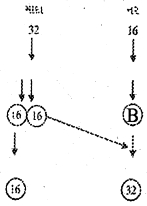
A
Apomixis
B
Mitosis
C
Meiosis
D
Fertilization of gametes
Solution
(B) The provided figure illustrates the sex determination mechanism in honeybees $(Apis \text{ } mellifera)$.
In honeybees, the queen (female) is diploid $(2n = 32)$ and the drone (male) is haploid $(n = 16)$.
The female produces eggs through meiosis, resulting in haploid cells $(n = 16)$.
The male (drone) is already haploid $(n = 16)$. Since it is already haploid, it cannot undergo meiosis to produce gametes. Instead, it produces sperm through mitosis. Therefore, the part indicated by $B$ represents the sperm, which is produced by mitosis.
In honeybees, the queen (female) is diploid $(2n = 32)$ and the drone (male) is haploid $(n = 16)$.
The female produces eggs through meiosis, resulting in haploid cells $(n = 16)$.
The male (drone) is already haploid $(n = 16)$. Since it is already haploid, it cannot undergo meiosis to produce gametes. Instead, it produces sperm through mitosis. Therefore, the part indicated by $B$ represents the sperm, which is produced by mitosis.
0 likes
View Solution195
MediumMCQ
Genes that are transmitted from a mother to her daughter and then to her granddaughter are known as:
A
Holandric genes
B
Hologynic genes
C
Genetic genes
D
All of the above
Solution
(B) Genes that are transmitted from a mother to her daughter and then to her granddaughter are called $Hologynic$ genes.
These genes are typically located on the $X$ chromosome.
Since a mother passes her $X$ chromosome to all her daughters,these traits follow a pattern of inheritance from mother to daughter to granddaughter.
In contrast,$Holandric$ genes are $Y$-linked and are passed from father to son.
These genes are typically located on the $X$ chromosome.
Since a mother passes her $X$ chromosome to all her daughters,these traits follow a pattern of inheritance from mother to daughter to granddaughter.
In contrast,$Holandric$ genes are $Y$-linked and are passed from father to son.
0 likes
View Solution196
EasyMCQ
Which of the following is produced from an unfertilized egg?
A
Queen bee
B
Worker bee
C
Drone
D
Both $B$ and $C$
Solution
(C) In honey bees,the sex determination is based on the number of sets of chromosomes an individual receives.
This is known as the haplodiploid sex-determination system.
Females (Queen and Worker bees) are diploid $(2n = 32)$ and are produced from fertilized eggs (zygotes).
Males (Drones) are haploid $(n = 16)$ and are produced from unfertilized eggs through a process called parthenogenesis.
Therefore,the drone is the individual produced from an unfertilized egg.
This is known as the haplodiploid sex-determination system.
Females (Queen and Worker bees) are diploid $(2n = 32)$ and are produced from fertilized eggs (zygotes).
Males (Drones) are haploid $(n = 16)$ and are produced from unfertilized eggs through a process called parthenogenesis.
Therefore,the drone is the individual produced from an unfertilized egg.
0 likes
View Solution197
MediumMCQ
Why is it scientifically correct to say that the sex of the baby is determined by the father and not by the mother?
A
Human female produces two types of gametes
B
Human male produces one type of gametes
C
Human female is $XX$,whereas male is $XY$; $50\%$ of sperms carry the $X$ chromosome while the other $50\%$ carry the $Y$ chromosome
D
All of these
Solution
(C) In humans,the sex of the baby is determined by the sex chromosomes.
Females are homogametic,possessing $XX$ chromosomes,and produce only one type of gamete (ovum) containing an $X$ chromosome.
Males are heterogametic,possessing $XY$ chromosomes,and produce two types of sperms: $50\%$ containing an $X$ chromosome and $50\%$ containing a $Y$ chromosome.
When an $X$-carrying sperm fertilizes the ovum,the zygote becomes $XX$ (female).
When a $Y$-carrying sperm fertilizes the ovum,the zygote becomes $XY$ (male).
Therefore,the sex of the baby is determined by the type of sperm provided by the father.
Females are homogametic,possessing $XX$ chromosomes,and produce only one type of gamete (ovum) containing an $X$ chromosome.
Males are heterogametic,possessing $XY$ chromosomes,and produce two types of sperms: $50\%$ containing an $X$ chromosome and $50\%$ containing a $Y$ chromosome.
When an $X$-carrying sperm fertilizes the ovum,the zygote becomes $XX$ (female).
When a $Y$-carrying sperm fertilizes the ovum,the zygote becomes $XY$ (male).
Therefore,the sex of the baby is determined by the type of sperm provided by the father.
0 likes
View Solution198
MediumMCQ
Statement $1$: Mother should not be blamed for the birth of the girls in the family.
Statement $2$: Father is not responsible for the sex of the child.
Statement $2$: Father is not responsible for the sex of the child.
A
Statement $1$ is True,Statement $2$ is True; Statement $2$ is correct explanation for Statement $1$.
B
Statement $1$ is True,Statement $2$ is True; Statement $2$ is not correct explanation for Statement $1$.
C
Statement $1$ is True,Statement $2$ is False.
D
Statement $1$ is False,Statement $2$ is True.
Solution
(C) In humans,the sex of the child is determined by the father's sperm.
The mother is homogametic,producing only gametes with the $X$ chromosome $(X, X)$.
The father is heterogametic,producing gametes with either the $X$ or the $Y$ chromosome $(X, Y)$.
If an $X$-bearing sperm fertilizes the egg,the child is a girl $(XX)$. If a $Y$-bearing sperm fertilizes the egg,the child is a boy $(XY)$.
Therefore,Statement $1$ is True because the mother is not responsible for the sex of the child.
Statement $2$ is False because the father is indeed responsible for the sex of the child.
The mother is homogametic,producing only gametes with the $X$ chromosome $(X, X)$.
The father is heterogametic,producing gametes with either the $X$ or the $Y$ chromosome $(X, Y)$.
If an $X$-bearing sperm fertilizes the egg,the child is a girl $(XX)$. If a $Y$-bearing sperm fertilizes the egg,the child is a boy $(XY)$.
Therefore,Statement $1$ is True because the mother is not responsible for the sex of the child.
Statement $2$ is False because the father is indeed responsible for the sex of the child.
0 likes
View Solution199
MediumMCQ
Excessive growth of hair on the pinna is a feature found only in males because
A
The female sex hormone oestrogen suppresses the character in females
B
The gene responsible for the character is present on the $Y-$chromosomes only
C
The gene responsible for the character is recessive in females and dominant only in males
D
The character is induced in males as males produce testosterone
Solution
(B) Genes located in the non-homologous region of the $Y-$chromosome are known as holandric genes.
These genes are transmitted directly from father to son because they are present only on the $Y-$chromosome.
Hypertrichosis of the pinna (excessive hair growth on the ear) is a classic example of a holandric trait.
Since females lack a $Y-$chromosome,they do not inherit or express these genes.
These genes are transmitted directly from father to son because they are present only on the $Y-$chromosome.
Hypertrichosis of the pinna (excessive hair growth on the ear) is a classic example of a holandric trait.
Since females lack a $Y-$chromosome,they do not inherit or express these genes.
0 likes
View Solution200
MediumMCQ
The recessive gene that always produces its effect is:
A
Pleiotropic gene
B
Complementary gene
C
Holandric gene
D
Supplementary gene
Solution
(C) holandric gene is located exclusively on the non-homologous region of the $Y-$chromosome. Since males are hemizygous for the $Y-$chromosome (possessing only one $Y$),any gene present on it will express its phenotype regardless of whether it is dominant or recessive. Therefore,holandric genes always produce their effect in males.
0 likes
View SolutionPrinciples of Inheritance and Variation — Sex determination · Frequently Asked Questions
1Are these Principles of Inheritance and Variation questions useful for JEE and NEET?
Yes. All questions in this section are mapped to JEE Main and NEET exam patterns. Previous year questions from JEE Main, NEET, GUJCET and state-level exams are included with full solutions.
2Can I switch to Hindi or Gujarati for these questions?
Yes. Use the language tabs in the hero section or the sidebar to view the same questions and solutions in English, Hindi or Gujarati.
3How do I generate a question paper from this subtopic?
Use the Vedclass Exam Paper Generator — select the chapter and subtopic, set difficulty, and generate Sets A, B, C, D automatically. First 3 chapters of every subject are free.
Vedclass Products
For Students
Vedclass Test Series
Mock tests in real JEE/NEET style with performance analysis. 5-day free trial.
Start Free TrialFor Teachers
Exam Paper Generator
Generate Set A/B/C/D papers from this chapter in 2 minutes. 3 chapters free.
Try FreeFor Institutes
Online Exam Module
Live online exams with unlimited students, 360° analytics & white-label branding.
See DemoFor Teachers & Institutes
Generate a Principles of Inheritance and Variation Exam Paper in 2 Minutes
Select subtopic & difficulty — Sets A, B, C, D auto-generated with No Repeat logic.
First 3 chapters of every subject are free — no payment required.