
A English
Sex determination Questions in English
Class 12 Biology · Principles of Inheritance and Variation · Sex determination
265+
Questions
English
Language
100%
With Solutions
Showing 50 of 265 questions in English
201
MediumMCQ
Heterogametic male condition does not occur in
A
Birds
B
Humans
C
Drosophila
D
Honey bee
Solution
(A) In birds,the female is heterogametic $(ZW)$ and the male is homogametic $(ZZ)$.
In humans,males are heterogametic $(XY)$ and females are homogametic $(XX)$.
In Drosophila,males are heterogametic $(XY)$ and females are homogametic $(XX)$.
In honey bees,sex determination is based on the number of sets of chromosomes (haplodiploidy),where males are haploid and females are diploid.
Therefore,the heterogametic male condition ($XY$ or $XO$) does not occur in birds.
In humans,males are heterogametic $(XY)$ and females are homogametic $(XX)$.
In Drosophila,males are heterogametic $(XY)$ and females are homogametic $(XX)$.
In honey bees,sex determination is based on the number of sets of chromosomes (haplodiploidy),where males are haploid and females are diploid.
Therefore,the heterogametic male condition ($XY$ or $XO$) does not occur in birds.
0 likes
View Solution202
MediumMCQ
If the ratio between $X$-chromosomes and the complete set of autosomes is $0.5$,then the individual will be:
A
Female
B
Superfemale
C
Male
D
Supermale
Solution
(C) According to Bridges' genic balance theory of sex determination in Drosophila,the sex of an individual is determined by the ratio of the number of $X$-chromosomes to the number of sets of autosomes $(A)$.
If the ratio $(X/A)$ is $1.0$,the individual is a female.
If the ratio $(X/A)$ is $0.5$,the individual is a male.
If the ratio is between $0.5$ and $1.0$,it is an intersex.
If the ratio is greater than $1.0$,it is a superfemale.
If the ratio is less than $0.5$,it is a supermale.
Therefore,for a ratio of $0.5$,the individual will be male.
If the ratio $(X/A)$ is $1.0$,the individual is a female.
If the ratio $(X/A)$ is $0.5$,the individual is a male.
If the ratio is between $0.5$ and $1.0$,it is an intersex.
If the ratio is greater than $1.0$,it is a superfemale.
If the ratio is less than $0.5$,it is a supermale.
Therefore,for a ratio of $0.5$,the individual will be male.
0 likes
View Solution203
EasyMCQ
Sex chromosomes of a female bird are represented by
A
$XO$
B
$XX$
C
$XY$
D
$ZW$
Solution
(D) In birds,sex determination follows the $ZW-ZZ$ system.
In this system,the female is heterogametic,meaning she possesses two different sex chromosomes,represented as $ZW$.
The male is homogametic,possessing two similar sex chromosomes,represented as $ZZ$.
In this system,the female is heterogametic,meaning she possesses two different sex chromosomes,represented as $ZW$.
The male is homogametic,possessing two similar sex chromosomes,represented as $ZZ$.
0 likes
View Solution204
MediumMCQ
Barr body in mammals represents
A
All the heterochromatin in female cells
B
One of the two $X$-chromosomes in somatic cells of females
C
All the heterochromatin in male and female cells
D
The $Y$-chromosome in somatic cells of male
Solution
(B) In mammals,if there is more than one $X$-chromosome,one $X$-chromosome remains active,while the other becomes inactive and highly condensed to form a structure known as the Barr body.
Barr body is a type of sex chromatin particle.
It serves as a sex marker and its number is always one less than the total number of $X$-chromosomes present in the cell (i.e.,$n-1$ rule,where $n$ is the number of $X$-chromosomes).
Barr body is a type of sex chromatin particle.
It serves as a sex marker and its number is always one less than the total number of $X$-chromosomes present in the cell (i.e.,$n-1$ rule,where $n$ is the number of $X$-chromosomes).
0 likes
View Solution205
EasyMCQ
Sex-linked traits are the traits determined by
A
Sex chromosome
B
Autosomes
C
Allosomes
D
All of these
Solution
(A) Sex-linked traits are those traits whose determining genes are located on the sex chromosomes (also known as allosomes).
$(i)$ Sex-linked traits: These are traits determined by genes present on sex chromosomes. They exhibit criss-cross inheritance,a phenomenon first studied by $T.H. Morgan$ in $1910$.
$(ii)$ Sex-limited traits: These are autosomal traits expressed in only one sex due to the influence of sex hormones,such as milk production in females.
$(iii)$ Sex-influenced traits: These are traits whose expression is influenced by sex hormones,such as pattern baldness in males.
Since the question specifically asks for 'sex-linked traits',the correct answer is sex chromosomes (allosomes). Note that in many contexts,'sex chromosomes' and 'allosomes' are synonymous.
$(i)$ Sex-linked traits: These are traits determined by genes present on sex chromosomes. They exhibit criss-cross inheritance,a phenomenon first studied by $T.H. Morgan$ in $1910$.
$(ii)$ Sex-limited traits: These are autosomal traits expressed in only one sex due to the influence of sex hormones,such as milk production in females.
$(iii)$ Sex-influenced traits: These are traits whose expression is influenced by sex hormones,such as pattern baldness in males.
Since the question specifically asks for 'sex-linked traits',the correct answer is sex chromosomes (allosomes). Note that in many contexts,'sex chromosomes' and 'allosomes' are synonymous.
0 likes
View Solution206
MediumMCQ
In Barr body (sex-chromatin) of a normal female:
A
One of the $X$-chromosomes of paternal side becomes inactive to form Barr body
B
$Y$-chromosomes form Barr body
C
Heterochromatin condenses near the centre of the nucleus to form Barr body
D
One of the $X$-chromosomes becomes inactive and forms a Barr body near the nuclear membrane
Solution
(D) In the somatic cells of a normal female $(XX)$,one of the two $X$-chromosomes undergoes heterochromatinization and becomes inactive during interphase. This inactive,condensed $X$-chromosome is known as the Barr body (or sex chromatin). It is typically located at the periphery of the nucleus,adjacent to the nuclear membrane. The number of Barr bodies is calculated as $(n - 1)$,where $n$ is the total number of $X$-chromosomes present. Thus,a normal female $(XX)$ has $2 - 1 = 1$ Barr body.
0 likes
View Solution207
MediumMCQ
$A$ couple has $6$ children-$5$ are girls and $1$ is boy. The percentage of having a girl on next time is (in $, \%$)
A
$10$
B
$20$
C
$50$
D
$100$
Solution
(C) The determination of the sex of each child is an independent and mutually exclusive event.
In humans,the sex of the child is determined by the sex chromosomes of the father $(XY)$ and the mother $(XX)$.
During fertilization,there is a $50\, \%$ chance that the sperm carrying the $X$ chromosome will fertilize the egg,resulting in a girl,and a $50\, \%$ chance that the sperm carrying the $Y$ chromosome will fertilize the egg,resulting in a boy.
Therefore,regardless of the gender of the previous children,the probability of having a girl in the next pregnancy remains $50\, \%$.
In humans,the sex of the child is determined by the sex chromosomes of the father $(XY)$ and the mother $(XX)$.
During fertilization,there is a $50\, \%$ chance that the sperm carrying the $X$ chromosome will fertilize the egg,resulting in a girl,and a $50\, \%$ chance that the sperm carrying the $Y$ chromosome will fertilize the egg,resulting in a boy.
Therefore,regardless of the gender of the previous children,the probability of having a girl in the next pregnancy remains $50\, \%$.
0 likes
View Solution208
EasyMCQ
The Barr body is observed in
A
Basophils of male
B
Neutrophils of female
C
Basophils of female
D
Eosinophils
Solution
(B) The Barr body,often appearing as a 'drumstick' appendage,is a condensed form of the inactive $X$ chromosome.
It is found in the neutrophils (polymorphonuclear leukocytes) of females.
Approximately $3$ to $5 \%$ of neutrophils in females exhibit this structure,whereas it is absent in males.
It is found in the neutrophils (polymorphonuclear leukocytes) of females.
Approximately $3$ to $5 \%$ of neutrophils in females exhibit this structure,whereas it is absent in males.
0 likes
View Solution209
MediumMCQ
Example$(s)$ of environmental determination of sex is/are:
A
Alligators
B
Turtles
C
Bonellia
D
All of these
Solution
(D) Environmental determination of sex refers to the process where environmental factors like temperature or chemical signals influence the sex of an organism.
In $Bonellia$ (a marine worm),the sex of the larva is determined by its environment. If a larva settles alone,it develops into a large $(2.5 \ cm)$ female. If it lands on or near an existing female,chemical substances secreted by the female cause the larva to develop into a tiny $(1.3 \ cm)$ male.
In many reptiles like turtles and alligators,the incubation temperature of the eggs determines the sex of the offspring. Generally,a temperature below $28^{\circ}C$ produces more males,a temperature above $33^{\circ}C$ produces more females,and a temperature between $28^{\circ}C$ and $33^{\circ}C$ produces both males and females in equal proportions.
Therefore,all the given examples exhibit environmental sex determination.
In $Bonellia$ (a marine worm),the sex of the larva is determined by its environment. If a larva settles alone,it develops into a large $(2.5 \ cm)$ female. If it lands on or near an existing female,chemical substances secreted by the female cause the larva to develop into a tiny $(1.3 \ cm)$ male.
In many reptiles like turtles and alligators,the incubation temperature of the eggs determines the sex of the offspring. Generally,a temperature below $28^{\circ}C$ produces more males,a temperature above $33^{\circ}C$ produces more females,and a temperature between $28^{\circ}C$ and $33^{\circ}C$ produces both males and females in equal proportions.
Therefore,all the given examples exhibit environmental sex determination.
0 likes
View Solution210
MediumMCQ
In $Drosophila$,the sex is determined by
A
The ratio of pairs of $X$-chromosomes to the pairs of autosomes
B
Whether the egg is fertilized or develops parthenogenetically
C
The ratio of number of $X$-chromosomes to the set of autosomes
D
$X$ and $Y$-chromosomes
Solution
(C) In $Drosophila$,sex determination follows the genic balance theory proposed by $C.B. Bridges$.
According to this theory,the sex of an individual is determined by the ratio of the number of $X$-chromosomes to the number of sets of autosomes (represented as $A$).
If the ratio $(X/A)$ is $1.0$,the individual is a female.
If the ratio is $0.5$,the individual is a male.
If the ratio is between $0.5$ and $1.0$,it results in an intersex individual.
According to this theory,the sex of an individual is determined by the ratio of the number of $X$-chromosomes to the number of sets of autosomes (represented as $A$).
If the ratio $(X/A)$ is $1.0$,the individual is a female.
If the ratio is $0.5$,the individual is a male.
If the ratio is between $0.5$ and $1.0$,it results in an intersex individual.
0 likes
View Solution211
MediumMCQ
How many types of sex determination mechanisms exhibit dissimilar sex chromosomes?
A
$2$
B
$3$
C
$4$
D
$5$
Solution
(C) The mechanisms of sex determination that involve dissimilar sex chromosomes are as follows:
$(i)$ $XY$ type (e.g.,humans,where males are $XY$ and females are $XX$)
$(ii)$ $XO$ type (e.g.,grasshoppers,where males are $XO$ and females are $XX$)
$(iii)$ $ZW$ type (e.g.,birds,where females are $ZW$ and males are $ZZ$)
$(iv)$ $ZO$ type (e.g.,some butterflies and moths,where females are $ZO$ and males are $ZZ$)
Thus,there are $4$ such conditions where dissimilar sex chromosomes are involved in sex determination.
$(i)$ $XY$ type (e.g.,humans,where males are $XY$ and females are $XX$)
$(ii)$ $XO$ type (e.g.,grasshoppers,where males are $XO$ and females are $XX$)
$(iii)$ $ZW$ type (e.g.,birds,where females are $ZW$ and males are $ZZ$)
$(iv)$ $ZO$ type (e.g.,some butterflies and moths,where females are $ZO$ and males are $ZZ$)
Thus,there are $4$ such conditions where dissimilar sex chromosomes are involved in sex determination.
0 likes
View Solution212
MediumMCQ
In bugs and cockroaches,the sex determination takes place by
A
$XX$ and $XO$ chromosomes
B
$XX$ and $XY$ chromosomes
C
$ZZ-ZW$ chromosomes
D
$ZO-ZZ$ chromosomes
Solution
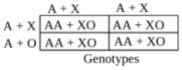
(A) In bugs and cockroaches,sex determination occurs via the $XX-XO$ type mechanism.
In this system,females possess two $X$ chromosomes $(XX)$,while males possess only one $X$ chromosome and lack the homologous partner,denoted as $XO$.
During gametogenesis,the female produces gametes that all contain an $X$ chromosome $(A+X)$. The male produces two types of gametes: half containing an $X$ chromosome $(A+X)$ and half lacking a sex chromosome $(A+O)$.
When these gametes fuse,the resulting offspring are either $AA+XX$ (female) or $AA+XO$ (male),maintaining a $1:1$ sex ratio.
In this system,females possess two $X$ chromosomes $(XX)$,while males possess only one $X$ chromosome and lack the homologous partner,denoted as $XO$.
During gametogenesis,the female produces gametes that all contain an $X$ chromosome $(A+X)$. The male produces two types of gametes: half containing an $X$ chromosome $(A+X)$ and half lacking a sex chromosome $(A+O)$.
When these gametes fuse,the resulting offspring are either $AA+XX$ (female) or $AA+XO$ (male),maintaining a $1:1$ sex ratio.
0 likes
View Solution213
MediumMCQ
$A$ hereditary disease which is never passed on from father to son is
A
$X$-chromosomal linked disease
B
Autosomal linked disease
C
$Y$-chromosomal linked disease
D
None of the above
Solution
(A) male has one $X$-chromosome and one $Y$-chromosome $(XY)$.
He passes his $X$-chromosome to all his daughters and his $Y$-chromosome to all his sons.
Therefore,an $X$-linked recessive or dominant trait present on the father's $X$-chromosome will be inherited by his daughters,but never by his sons,because the son receives the $Y$-chromosome from the father.
He passes his $X$-chromosome to all his daughters and his $Y$-chromosome to all his sons.
Therefore,an $X$-linked recessive or dominant trait present on the father's $X$-chromosome will be inherited by his daughters,but never by his sons,because the son receives the $Y$-chromosome from the father.
0 likes
View Solution214
MediumMCQ
$A$ man can inherit his $X$-chromosome from his
A
Maternal grandmother or maternal grandfather
B
Father
C
Maternal grandfather
D
Paternal grandfather
Solution
(A) In humans,a male has $XY$ sex chromosomes.
He inherits his $Y$-chromosome from his father and his $X$-chromosome from his mother.
The mother,in turn,inherits one $X$-chromosome from her father (maternal grandfather) and one $X$-chromosome from her mother (maternal grandmother).
Therefore,the $X$-chromosome that a man receives from his mother could have originally come from either his maternal grandmother or his maternal grandfather.
Thus,the correct option is $A$.
He inherits his $Y$-chromosome from his father and his $X$-chromosome from his mother.
The mother,in turn,inherits one $X$-chromosome from her father (maternal grandfather) and one $X$-chromosome from her mother (maternal grandmother).
Therefore,the $X$-chromosome that a man receives from his mother could have originally come from either his maternal grandmother or his maternal grandfather.
Thus,the correct option is $A$.
0 likes
View Solution215
MediumMCQ
Initial clues about the genetic/chromosomal mechanism of sex determination can be traced back to some of the experiments carried out in:
A
Human beings
B
Birds
C
Insects
D
Plants
Solution
(C) The initial clues regarding the genetic or chromosomal basis of sex determination were provided by the experiments conducted on insects. In $1891$,Henking observed a specific nuclear structure during spermatogenesis in a few insects,which he termed the $X$-body. Later,it was discovered that this $X$-body was actually a chromosome,now known as the $X$-chromosome.
0 likes
View Solution216
MediumMCQ
In which type of sex determination do both male and female have the same number of chromosomes?
A
$XY$ type
B
$ZO$ type
C
$XO$ type
D
Both $(a) \& (c)$
Solution
(A) In the $XY$ type of sex determination,both males and females possess the same total number of chromosomes.
For example,in humans,the female genotype is $44 + XX$ ($46$ chromosomes) and the male genotype is $44 + XY$ ($46$ chromosomes).
In contrast,in $XO$ and $ZO$ types,the heterogametic sex has one chromosome less than the homogametic sex.
For example,in humans,the female genotype is $44 + XX$ ($46$ chromosomes) and the male genotype is $44 + XY$ ($46$ chromosomes).
In contrast,in $XO$ and $ZO$ types,the heterogametic sex has one chromosome less than the homogametic sex.
0 likes
View Solution217
MediumMCQ
Two different types of gametes in terms of the sex chromosomes are produced by
A
Female fruit fly
B
Male butterfly
C
Male human and female Drosophila
D
Female birds
Solution
(D) In birds,sex determination follows the $ZW-ZZ$ type,where the female is heterogametic $(ZW)$ and the male is homogametic $(ZZ)$.
Because the female is heterogametic,she produces two different types of gametes: one containing the $Z$ chromosome and the other containing the $W$ chromosome.
Therefore,female birds produce two different types of gametes in terms of sex chromosomes.
Because the female is heterogametic,she produces two different types of gametes: one containing the $Z$ chromosome and the other containing the $W$ chromosome.
Therefore,female birds produce two different types of gametes in terms of sex chromosomes.
0 likes
View Solution218
MediumMCQ
Individuals having homomorphic sex chromosomes produce:
A
Only one gamete in complete life span
B
One type of gametes
C
No gametes
D
Two type of gametes
Solution
(B) Individuals with homomorphic sex chromosomes (e.g.,$XX$ in females) possess identical sex chromosomes.
During gametogenesis,they produce only one type of gamete containing the same sex chromosome.
For example,an individual with genotype $AA+XX$ will produce gametes of the type $(A+X)$ only.
Therefore,they produce one type of gametes.
During gametogenesis,they produce only one type of gamete containing the same sex chromosome.
For example,an individual with genotype $AA+XX$ will produce gametes of the type $(A+X)$ only.
Therefore,they produce one type of gametes.
0 likes
View Solution219
MediumMCQ
While solving the problem of sex determination in a large number of insects,it was observed that
A
All eggs lack sex chromosome
B
Some of the sperms bear the $X$-chromosome
C
All eggs as well as sperms bear the $X$-chromosome
D
Some of the eggs bear the $X$-chromosome
Solution
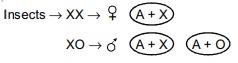
(B) In many insects,the mechanism of sex determination is of the $XO$ type.
In this type,females have two $X$-chromosomes $(XX)$,while males have only one $X$-chromosome $(XO)$.
During gametogenesis in females,all eggs produced contain an autosome $(A)$ and one $X$-chromosome $(A + X)$.
During spermatogenesis in males,two types of sperms are produced: $50$% of the sperms contain an autosome and an $X$-chromosome $(A + X)$,while the other $50$% contain only an autosome $(A + O)$.
Therefore,it is observed that some of the sperms bear the $X$-chromosome.
In this type,females have two $X$-chromosomes $(XX)$,while males have only one $X$-chromosome $(XO)$.
During gametogenesis in females,all eggs produced contain an autosome $(A)$ and one $X$-chromosome $(A + X)$.
During spermatogenesis in males,two types of sperms are produced: $50$% of the sperms contain an autosome and an $X$-chromosome $(A + X)$,while the other $50$% contain only an autosome $(A + O)$.
Therefore,it is observed that some of the sperms bear the $X$-chromosome.
0 likes
View Solution220
MediumMCQ
$A$ $Y$-linked gene is responsible for hypertrichosis (long hair on ears). When an affected man marries a normal woman,what percentage of their daughters would be expected to have hairy ears (in $;\%$)?
A
$25$
B
$0$
C
$50$
D
$100$
Solution
(B) Hypertrichosis is a $Y$-linked trait,meaning the gene is located on the $Y$ chromosome.
In humans,males have $XY$ chromosomes and females have $XX$ chromosomes.
$A$ father passes his $Y$ chromosome only to his sons,while he passes his $X$ chromosome to his daughters.
Since the daughter receives an $X$ chromosome from her father and an $X$ chromosome from her mother,she does not inherit the $Y$ chromosome.
Therefore,$0\;\%$ of the daughters will have hairy ears.
In humans,males have $XY$ chromosomes and females have $XX$ chromosomes.
$A$ father passes his $Y$ chromosome only to his sons,while he passes his $X$ chromosome to his daughters.
Since the daughter receives an $X$ chromosome from her father and an $X$ chromosome from her mother,she does not inherit the $Y$ chromosome.
Therefore,$0\;\%$ of the daughters will have hairy ears.
0 likes
View Solution221
MediumMCQ
$A$: Holandric traits are passed from one generation to the next generation.
$R$: These traits appear more frequently in one sex than in other.
$R$: These traits appear more frequently in one sex than in other.
A
Assertion and Reason both are correct and Reason is the correct explanation of Assertion.
B
Assertion and Reason both are correct but Reason is not the correct explanation of Assertion.
C
Assertion is correct,but Reason is incorrect.
D
Both Assertion and Reason are incorrect.
Solution
(A) Holandric traits are controlled by genes present on the non-homologous region of the $Y$ chromosome.
Since these genes are located on the $Y$ chromosome,they are passed directly from father to son.
Because they are $Y$-linked,they appear exclusively in males and are not found in females,which satisfies the condition of appearing more frequently in one sex than the other.
Therefore,both the Assertion and the Reason are correct,and the Reason correctly explains why these traits are sex-specific.
Since these genes are located on the $Y$ chromosome,they are passed directly from father to son.
Because they are $Y$-linked,they appear exclusively in males and are not found in females,which satisfies the condition of appearing more frequently in one sex than the other.
Therefore,both the Assertion and the Reason are correct,and the Reason correctly explains why these traits are sex-specific.
0 likes
View Solution222
MediumMCQ
$A$: Non-allosomic genic determination of sex is found in bacteria.
$R$: Sex is dependent on some environmental factors in prokaryotes.
$R$: Sex is dependent on some environmental factors in prokaryotes.
A
Assertion and Reason both are correct and Reason is the correct explanation of Assertion.
B
Assertion and Reason both are correct but Reason is not the correct explanation of Assertion.
C
Assertion is correct,but Reason is incorrect.
D
Both Assertion and Reason are incorrect.
Solution
(C) In bacteria,sex determination is not based on sex chromosomes (allosomes) but is controlled by specific genetic elements known as the $F$-plasmid (fertility factor) or sex factor.
Bacteria do not exhibit sex determination based on environmental factors; rather,it is a genetically regulated process involving the transfer of genetic material through conjugation.
Therefore,the Assertion is correct as it refers to non-allosomic genic determination,but the Reason is incorrect because sex in prokaryotes is not determined by environmental factors.
Bacteria do not exhibit sex determination based on environmental factors; rather,it is a genetically regulated process involving the transfer of genetic material through conjugation.
Therefore,the Assertion is correct as it refers to non-allosomic genic determination,but the Reason is incorrect because sex in prokaryotes is not determined by environmental factors.
0 likes
View Solution223
MediumMCQ
$A$: One drumstick per nucleus is present in the neutrophil of a normal female.
$R$: It is absent in the neutrophil of a male.
$R$: It is absent in the neutrophil of a male.
A
Assertion and Reason both are correct and Reason is the correct explanation of Assertion.
B
Assertion and Reason both are correct but Reason is not the correct explanation of Assertion.
C
Assertion is correct,but Reason is incorrect.
D
Both Assertion and Reason are incorrect.
Solution
(A) The drumstick is a small,club-shaped appendage attached to the nucleus of neutrophils in females.
It represents the inactivated $X$ chromosome,also known as the $Barr$ body.
Since females have two $X$ chromosomes $(XX)$,one is inactivated to form the $Barr$ body,which appears as a drumstick in neutrophils.
Males have only one $X$ chromosome $(XY)$,which remains active for transcription,so they do not possess a $Barr$ body or a drumstick appendage in their neutrophils.
Therefore,both the Assertion and the Reason are correct,and the Reason correctly explains why the drumstick is present in females and absent in males.
It represents the inactivated $X$ chromosome,also known as the $Barr$ body.
Since females have two $X$ chromosomes $(XX)$,one is inactivated to form the $Barr$ body,which appears as a drumstick in neutrophils.
Males have only one $X$ chromosome $(XY)$,which remains active for transcription,so they do not possess a $Barr$ body or a drumstick appendage in their neutrophils.
Therefore,both the Assertion and the Reason are correct,and the Reason correctly explains why the drumstick is present in females and absent in males.
0 likes
View Solution224
MediumMCQ
$A$: $XO$ type sex determination is found in a large number of insects.
$R$: Some of the sperms bear the $X$-chromosome,whereas some do not.
$R$: Some of the sperms bear the $X$-chromosome,whereas some do not.
A
Assertion and Reason both are correct and Reason is the correct explanation of Assertion.
B
Assertion and Reason both are correct but Reason is not the correct explanation of Assertion.
C
Assertion is correct,but Reason is incorrect.
D
Both Assertion and Reason are incorrect.
Solution
(A) In the $XO$ type of sex determination,males have only one $X$-chromosome and some other autosomes,while females have a pair of $X$-chromosomes.
During spermatogenesis,males produce two types of gametes: $50\%$ of the sperms carry the $X$-chromosome,and $50\%$ do not carry any sex chromosome.
This mechanism is observed in many insects,such as grasshoppers.
Therefore,both the Assertion and the Reason are correct,and the Reason provides the correct explanation for the Assertion.
During spermatogenesis,males produce two types of gametes: $50\%$ of the sperms carry the $X$-chromosome,and $50\%$ do not carry any sex chromosome.
This mechanism is observed in many insects,such as grasshoppers.
Therefore,both the Assertion and the Reason are correct,and the Reason provides the correct explanation for the Assertion.
0 likes
View Solution225
EasyMCQ
$XO$ type of sex determination can be found in:
A
Birds
B
Grasshoppers
C
Monkeys
D
Drosophila
Solution
(B) In the $XO$ type of sex determination,the male has only one $X$ chromosome,while the female has two $X$ chromosomes $(XX)$.
This mechanism is observed in many insects,including grasshoppers.
In grasshoppers,males produce two types of gametes: $50\%$ with an $X$ chromosome and $50\%$ without an $X$ chromosome.
Birds exhibit $ZW-ZZ$ type sex determination,while $Drosophila$ and humans exhibit $XY$ type sex determination.
This mechanism is observed in many insects,including grasshoppers.
In grasshoppers,males produce two types of gametes: $50\%$ with an $X$ chromosome and $50\%$ without an $X$ chromosome.
Birds exhibit $ZW-ZZ$ type sex determination,while $Drosophila$ and humans exhibit $XY$ type sex determination.
0 likes
View Solution226
MediumMCQ
In terms of chromosomes,females produce $.......$ type of ova,while males produce $.......$ types of sperms.
A
one,one
B
two,two
C
one,two
D
two,one
Solution
(C) In humans,the sex determination is based on the $XY$ chromosome system.
Females are homogametic,meaning they possess two $X$ chromosomes $(XX)$. During oogenesis,all ova produced contain only one type of sex chromosome,which is the $X$ chromosome.
Therefore,females produce only one type of ovum $(22 + X)$.
Males are heterogametic,meaning they possess $XY$ chromosomes. During spermatogenesis,two types of sperms are produced: $50\%$ of sperms contain the $X$ chromosome $(22 + X)$ and $50\%$ of sperms contain the $Y$ chromosome $(22 + Y)$.
Thus,males produce two types of sperms.
Females are homogametic,meaning they possess two $X$ chromosomes $(XX)$. During oogenesis,all ova produced contain only one type of sex chromosome,which is the $X$ chromosome.
Therefore,females produce only one type of ovum $(22 + X)$.
Males are heterogametic,meaning they possess $XY$ chromosomes. During spermatogenesis,two types of sperms are produced: $50\%$ of sperms contain the $X$ chromosome $(22 + X)$ and $50\%$ of sperms contain the $Y$ chromosome $(22 + Y)$.
Thus,males produce two types of sperms.
0 likes
View Solution227
EasyMCQ
An infant with $XX$ chromosomes results in a .........,whereas an infant with $XY$ chromosomes results in a ..........
A
Female,Female
B
Female,Male
C
Male,Female
D
Male,Male
Solution
(B) In humans,the sex of an individual is determined by the sex chromosomes.
An individual with $XX$ chromosomes is genetically female.
An individual with $XY$ chromosomes is genetically male.
Therefore,an infant with $XX$ chromosomes results in a female,and an infant with $XY$ chromosomes results in a male.
An individual with $XX$ chromosomes is genetically female.
An individual with $XY$ chromosomes is genetically male.
Therefore,an infant with $XX$ chromosomes results in a female,and an infant with $XY$ chromosomes results in a male.
0 likes
View Solution228
MediumMCQ
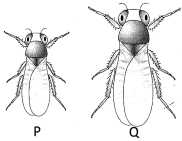
Identify the organisms $P$ and $Q$ shown below.
$\quad\quad \quad P\quad\quad Q$
$\quad\quad \quad P\quad\quad Q$
A
Male fruit fly $\quad$ Female fruit fly
B
Female fruit fly $\quad$ Male fruit fly
C
Male honey bee $\quad$ Female honey bee
D
Female honey bee $\quad$ Male honey bee
Solution
(A) The image shows the sexual dimorphism in Drosophila melanogaster (fruit fly).
In fruit flies,the female is generally larger in size with a pointed abdomen,while the male is smaller in size with a rounded,darker posterior end of the abdomen.
Based on the provided image,organism $P$ is smaller with a rounded abdomen,representing the male fruit fly.
Organism $Q$ is larger with a pointed abdomen,representing the female fruit fly.
Therefore,$P$ is the male fruit fly and $Q$ is the female fruit fly.
In fruit flies,the female is generally larger in size with a pointed abdomen,while the male is smaller in size with a rounded,darker posterior end of the abdomen.
Based on the provided image,organism $P$ is smaller with a rounded abdomen,representing the male fruit fly.
Organism $Q$ is larger with a pointed abdomen,representing the female fruit fly.
Therefore,$P$ is the male fruit fly and $Q$ is the female fruit fly.
0 likes
View Solution229
MediumMCQ
In grasshoppers,the male has ........ and the female has ......... chromosomes.
A
$23, 23$
B
$24, 24$
C
$23, 24$
D
$24, 23$
Solution
(C) In grasshoppers,sex determination follows the $XO$ type mechanism.
In this mechanism,the male has one $X$ chromosome and lacks the other homologous chromosome,resulting in a total of $23$ chromosomes $(22 + XO)$.
The female has a pair of $X$ chromosomes,resulting in a total of $24$ chromosomes $(22 + XX)$.
Therefore,the male has $23$ chromosomes and the female has $24$ chromosomes.
In this mechanism,the male has one $X$ chromosome and lacks the other homologous chromosome,resulting in a total of $23$ chromosomes $(22 + XO)$.
The female has a pair of $X$ chromosomes,resulting in a total of $24$ chromosomes $(22 + XX)$.
Therefore,the male has $23$ chromosomes and the female has $24$ chromosomes.
0 likes
View Solution230
MediumMCQ
$A$ couple has three daughters. What is the probability of having a son in the next pregnancy (in $,\%$)?
A
$0$
B
$25$
C
$50$
D
$75$
Solution
(C) In humans,sex determination is based on the $XY$ chromosome system.
During fertilization,the male gamete (sperm) can carry either an $X$ chromosome or a $Y$ chromosome,while the female gamete (ovum) always carries an $X$ chromosome.
When an $X$-carrying sperm fertilizes an $X$-carrying ovum,a daughter $(XX)$ is produced.
When a $Y$-carrying sperm fertilizes an $X$-carrying ovum,a son $(XY)$ is produced.
Since the chance of a sperm carrying an $X$ or $Y$ chromosome is equal,the probability of having a son or a daughter in any given pregnancy is always $50 \,\%$.
Previous births do not influence the genetic outcome of future pregnancies.
During fertilization,the male gamete (sperm) can carry either an $X$ chromosome or a $Y$ chromosome,while the female gamete (ovum) always carries an $X$ chromosome.
When an $X$-carrying sperm fertilizes an $X$-carrying ovum,a daughter $(XX)$ is produced.
When a $Y$-carrying sperm fertilizes an $X$-carrying ovum,a son $(XY)$ is produced.
Since the chance of a sperm carrying an $X$ or $Y$ chromosome is equal,the probability of having a son or a daughter in any given pregnancy is always $50 \,\%$.
Previous births do not influence the genetic outcome of future pregnancies.
0 likes
View Solution231
MediumMCQ
Which animal exhibits sex determination through the haplo-diploid mechanism?
A
Grasshopper
B
Human
C
Birds
D
Honeybee
Solution
(D) The haplo-diploid sex-determination system is a mechanism where sex is determined by the number of sets of chromosomes an individual receives.
In honeybees $(Apis \text{ } mellifera)$, the queen produces eggs by meiosis, and drones produce sperm by mitosis.
Females (queens and workers) are diploid $(2n = 32)$ and develop from fertilized eggs.
Males (drones) are haploid $(n = 16)$ and develop from unfertilized eggs through a process called parthenogenesis.
Therefore, the correct answer is $D$ (Honeybee).
In honeybees $(Apis \text{ } mellifera)$, the queen produces eggs by meiosis, and drones produce sperm by mitosis.
Females (queens and workers) are diploid $(2n = 32)$ and develop from fertilized eggs.
Males (drones) are haploid $(n = 16)$ and develop from unfertilized eggs through a process called parthenogenesis.
Therefore, the correct answer is $D$ (Honeybee).
0 likes
View Solution232
MediumMCQ
What is the $X-$body as described by Henking?
A
Gene
B
$DNA$
C
Chromosome
D
Nucleus
Solution
(C) In $1891$,Henking observed a specific nuclear structure during spermatogenesis in a few insects. He observed that $50 \%$ of the sperms received this specific structure after meiosis,whereas the other $50 \%$ did not. He named this structure the $X-$body. Later,it was discovered that this $X-$body was actually a chromosome,which is now known as the $X-$chromosome.
0 likes
View Solution233
MediumMCQ
The initial experiments for the genetic basis of sex determination were performed on $........$.
A
Humans
B
Insects
C
Birds
D
Plants
Solution
(B) The initial experiments regarding the genetic basis of sex determination were conducted by $Hermann \text{ } Henking$ in $1891$ on insects. He observed a specific nuclear structure in all sperms of a few insects and named it the $X$-body. Later, it was discovered that this $X$-body was actually a chromosome, which is now known as the $X$-chromosome. This discovery laid the foundation for understanding sex determination in organisms.
0 likes
View Solution234
MediumMCQ
Match the following columns:
| Column-$I$ (Mechanism of Sex Determination) | Column-$II$ (Example) |
| $P$. $XO$ type | $I$. Grasshopper |
| $Q$. Haplo-diploid mechanism | $II$. Drosophila |
| $R$. $XY$ type | $III$. Honey bee |
A
$(P-I), (Q-II), (R-III)$
B
$(P-I), (Q-III), (R-II)$
C
$(P-III), (Q-II), (R-I)$
D
$(P-II), (Q-III), (R-I)$
Solution
(B) The correct matches are as follows:
$1$. $P$. $XO$ type: This mechanism is observed in insects like grasshoppers,where males have one $X$ chromosome and females have two $(XX)$. Thus,$P-I$.
$2$. $Q$. Haplo-diploid mechanism: This is a unique sex determination system found in honey bees,where females are diploid $(2n)$ and males are haploid $(n)$. Thus,$Q-III$.
$3$. $R$. $XY$ type: This is the common sex determination mechanism found in Drosophila (fruit flies) and humans,where males are $XY$ and females are $XX$. Thus,$R-II$.
Therefore,the correct sequence is $(P-I), (Q-III), (R-II)$.
$1$. $P$. $XO$ type: This mechanism is observed in insects like grasshoppers,where males have one $X$ chromosome and females have two $(XX)$. Thus,$P-I$.
$2$. $Q$. Haplo-diploid mechanism: This is a unique sex determination system found in honey bees,where females are diploid $(2n)$ and males are haploid $(n)$. Thus,$Q-III$.
$3$. $R$. $XY$ type: This is the common sex determination mechanism found in Drosophila (fruit flies) and humans,where males are $XY$ and females are $XX$. Thus,$R-II$.
Therefore,the correct sequence is $(P-I), (Q-III), (R-II)$.
0 likes
View Solution235
MediumMCQ
In which of the following organisms is male heterogamety absent?
A
Insects
B
Honey bees
C
Birds
D
Both $B$ and $C$
Solution
(D) Male heterogamety refers to a condition where the male produces two different types of gametes (e.g.,$XY$ or $XO$ types).
In insects (like grasshoppers and Drosophila),male heterogamety is present ($XO$ or $XY$ type).
In honey bees,sex determination is based on the number of sets of chromosomes (haplodiploidy),where males are haploid and females are diploid; thus,they do not exhibit male heterogamety.
In birds,female heterogamety is observed ($ZW$ type for females and $ZZ$ type for males),meaning males are homogametic.
Therefore,both honey bees and birds lack male heterogamety.
In insects (like grasshoppers and Drosophila),male heterogamety is present ($XO$ or $XY$ type).
In honey bees,sex determination is based on the number of sets of chromosomes (haplodiploidy),where males are haploid and females are diploid; thus,they do not exhibit male heterogamety.
In birds,female heterogamety is observed ($ZW$ type for females and $ZZ$ type for males),meaning males are homogametic.
Therefore,both honey bees and birds lack male heterogamety.
0 likes
View Solution236
MediumMCQ
In which of the following organisms is female heterogamety observed?
A
Insects
B
Birds
C
Honey bees
D
Both $B$ and $C$
Solution
(B) Female heterogamety is a mechanism of sex determination where the female produces two different types of gametes.
In birds,sex determination is of the $ZW-ZZ$ type,where females are $ZW$ (heterogametic) and males are $ZZ$ (homogametic).
In honey bees,sex determination is based on the number of sets of chromosomes (haplo-diploidy). Females are diploid $(2n = 32)$ and males are haploid $(n = 16)$. This is not considered female heterogamety in the traditional sense of sex chromosomes.
Therefore,birds exhibit female heterogamety. The correct option is $B$.
In birds,sex determination is of the $ZW-ZZ$ type,where females are $ZW$ (heterogametic) and males are $ZZ$ (homogametic).
In honey bees,sex determination is based on the number of sets of chromosomes (haplo-diploidy). Females are diploid $(2n = 32)$ and males are haploid $(n = 16)$. This is not considered female heterogamety in the traditional sense of sex chromosomes.
Therefore,birds exhibit female heterogamety. The correct option is $B$.
0 likes
View Solution237
MediumMCQ
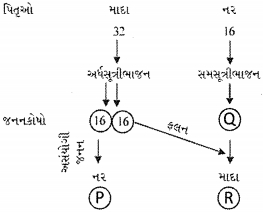
The following diagram shows sex determination in honeybees. How many chromosomes do $P, Q,$ and $R$ have?
$\quad\quad P \quad Q \quad R$
$\quad\quad P \quad Q \quad R$
A
$16 \quad 16 \quad 32$
B
$16 \quad 8 \quad 24$
C
$32 \quad 16 \quad 32$
D
$16 \quad 8 \quad 16$
Solution
(A) In honeybees,sex determination is based on the number of sets of chromosomes an individual receives. Females are diploid $(2n = 32)$ and males are haploid $(n = 16)$.
$1$. The female (queen) produces eggs through meiosis,so each egg has $n = 16$ chromosomes.
$2$. The male (drone) produces sperms through mitosis,so each sperm has $n = 16$ chromosomes.
$3$. $Q$ represents the sperm produced by the male through mitosis,so $Q = 16$.
$4$. $P$ is a male produced from an unfertilized egg (parthenogenesis),so it retains the haploid number,$P = 16$.
$5$. $R$ is a female produced from the fertilization of an egg $(16)$ by a sperm $(16)$,resulting in a diploid zygote,so $R = 16 + 16 = 32$.
Therefore,$P = 16, Q = 16, R = 32$.
$1$. The female (queen) produces eggs through meiosis,so each egg has $n = 16$ chromosomes.
$2$. The male (drone) produces sperms through mitosis,so each sperm has $n = 16$ chromosomes.
$3$. $Q$ represents the sperm produced by the male through mitosis,so $Q = 16$.
$4$. $P$ is a male produced from an unfertilized egg (parthenogenesis),so it retains the haploid number,$P = 16$.
$5$. $R$ is a female produced from the fertilization of an egg $(16)$ by a sperm $(16)$,resulting in a diploid zygote,so $R = 16 + 16 = 32$.
Therefore,$P = 16, Q = 16, R = 32$.
0 likes
View Solution238
MediumMCQ
In humans,sex determination is decided by . . . . . . .
A
Male
B
Female
C
Both
D
None of these
Solution
(A) In humans,the sex of the child is determined by the sex chromosomes inherited from the parents.
Human males have $XY$ sex chromosomes,while human females have $XX$ sex chromosomes.
During gametogenesis,males produce two types of sperms: $50\%$ carrying the $X$ chromosome and $50\%$ carrying the $Y$ chromosome.
Females produce only one type of ovum,which always carries the $X$ chromosome.
If a sperm carrying the $X$ chromosome fertilizes the ovum,the zygote develops into a female $(XX)$.
If a sperm carrying the $Y$ chromosome fertilizes the ovum,the zygote develops into a male $(XY)$.
Therefore,the sex of the offspring is determined by the male gamete (sperm) that fertilizes the egg.
Human males have $XY$ sex chromosomes,while human females have $XX$ sex chromosomes.
During gametogenesis,males produce two types of sperms: $50\%$ carrying the $X$ chromosome and $50\%$ carrying the $Y$ chromosome.
Females produce only one type of ovum,which always carries the $X$ chromosome.
If a sperm carrying the $X$ chromosome fertilizes the ovum,the zygote develops into a female $(XX)$.
If a sperm carrying the $Y$ chromosome fertilizes the ovum,the zygote develops into a male $(XY)$.
Therefore,the sex of the offspring is determined by the male gamete (sperm) that fertilizes the egg.
0 likes
View Solution239
MediumMCQ
Which of the following organisms produce two types of gametes?
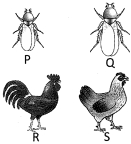
A
$P$ and $R$
B
$Q$ and $R$
C
$P$ and $S$
D
$Q$ and $S$
Solution
(C) In the given image,$P$ and $Q$ represent male and female Drosophila (fruit flies),while $R$ and $S$ represent a rooster and a hen.
In Drosophila,sex determination is of the $XX-XY$ type. The male $(P)$ is heterogametic,producing two types of gametes ($X$ and $Y$),while the female $(Q)$ is homogametic.
In birds,sex determination is of the $ZW-ZZ$ type. The female $(S)$ is heterogametic,producing two types of gametes ($Z$ and $W$),while the male $(R)$ is homogametic.
Therefore,the organisms that produce two types of gametes are the male Drosophila $(P)$ and the female bird $(S)$.
In Drosophila,sex determination is of the $XX-XY$ type. The male $(P)$ is heterogametic,producing two types of gametes ($X$ and $Y$),while the female $(Q)$ is homogametic.
In birds,sex determination is of the $ZW-ZZ$ type. The female $(S)$ is heterogametic,producing two types of gametes ($Z$ and $W$),while the male $(R)$ is homogametic.
Therefore,the organisms that produce two types of gametes are the male Drosophila $(P)$ and the female bird $(S)$.
0 likes
View Solution240
MediumMCQ
Organism with male heterogamety $- P$
Organism with female heterogamety $- Q$
$I -$ Human,$II -$ Bird,$III -$ Drosophila,$IV -$ Grasshopper
Select the correct option for $P$ and $Q$.
$\quad P \quad\quad Q$
Organism with female heterogamety $- Q$
$I -$ Human,$II -$ Bird,$III -$ Drosophila,$IV -$ Grasshopper
Select the correct option for $P$ and $Q$.
$\quad P \quad\quad Q$
A
$III, IV \quad I, II$
B
$I, II \quad III, IV$
C
$I, III, IV \quad II$
D
$II \quad I, III, IV$
Solution
(C) Male heterogamety occurs when the male produces two different types of gametes (e.g.,$XY$ or $XO$ type). This is seen in humans $(I)$,Drosophila $(III)$,and grasshoppers $(IV)$.
Female heterogamety occurs when the female produces two different types of gametes (e.g.,$ZW$ type). This is seen in birds $(II)$.
Therefore,$P = I, III, IV$ and $Q = II$.
The correct option is $C$.
Female heterogamety occurs when the female produces two different types of gametes (e.g.,$ZW$ type). This is seen in birds $(II)$.
Therefore,$P = I, III, IV$ and $Q = II$.
The correct option is $C$.
0 likes
View Solution241
MediumMCQ
Who traced a specific nuclear structure all through spermatogenesis in a few insects and named it $x-$body?
A
Stevens
B
Morgan
C
Henking
D
Sutton
Solution
(C) In $1891$,German biologist $Hermann \ Henking$ observed a specific nuclear structure during spermatogenesis in some insects. He noted that this structure was present in only $50\%$ of the sperm cells. He named this structure the $x-$body. Later,it was discovered that this $x-$body is actually the $X$ chromosome,which plays a crucial role in sex determination.
0 likes
View Solution242
MediumMCQ
Henking observed that in a few male insects,$50 \%$ of the sperm received a specific nuclear structure known as $X$-body,whereas the other $50 \%$ of sperms did not receive it. This method of sex determination was:
A
$XX - XY$ method
B
$XX - XO$ method
C
$ZZ - ZW$ method
D
Haplodiploidy
Solution
(B) Henking $(1891)$ was the first to trace a specific nuclear structure during spermatogenesis in a few insects.
He observed that $50 \%$ of the sperms received this specific nuclear structure,which he named the $X$-body,while the other $50 \%$ did not.
Later,it was discovered that the $X$-body was actually a chromosome,now called the $X$-chromosome.
This type of sex determination,where males have one $X$-chromosome and one missing chromosome (denoted as $O$),is known as the $XX - XO$ type of sex determination.
In this system,females are homogametic $(XX)$,and males are heterogametic $(XO)$.
He observed that $50 \%$ of the sperms received this specific nuclear structure,which he named the $X$-body,while the other $50 \%$ did not.
Later,it was discovered that the $X$-body was actually a chromosome,now called the $X$-chromosome.
This type of sex determination,where males have one $X$-chromosome and one missing chromosome (denoted as $O$),is known as the $XX - XO$ type of sex determination.
In this system,females are homogametic $(XX)$,and males are heterogametic $(XO)$.
0 likes
View Solution243
EasyMCQ
Allosomes are responsible for . . . . . . .
A
determination of genetic material
B
packaging of genetic material
C
sex determination
D
determination of body characters
Solution
(C) Allosomes,also known as sex chromosomes,are chromosomes that differ in size,form,and behavior from autosomes. In humans,the $X$ and $Y$ chromosomes are allosomes. Their primary function is the determination of the sex of an individual. Autosomes are responsible for the determination of body characters (somatic traits),whereas allosomes specifically carry genes that dictate sexual development.
0 likes
View Solution244
EasyMCQ
$ZW-ZZ$ type of sex determination is seen in . . . . . . .
A
birds
B
honeybees
C
human beings
D
Bonellia
Solution
(A) In $ZW-ZZ$ type of sex determination,the female is heterogametic $(ZW)$ and the male is homogametic $(ZZ)$. This mechanism is characteristic of birds and some reptiles.
| Organism | Type of sex determination |
| Birds | $ZW-ZZ$ |
| Honeybees | Haplo-diploid |
| Human beings | $XX-XY$ |
| Bonellia | Environmental factor dependent |
0 likes
View Solution245
EasyMCQ
Given below are two statements.
Statement $I$ - $X$ Chromosome has a large amount of euchromatin and a small amount of heterochromatin.
Statement $II$ - The homologous region of the $X$ Chromosome contains a smaller number of genes than the $Y$ Chromosome.
In the light of the above statements,select the correct option given below:
Statement $I$ - $X$ Chromosome has a large amount of euchromatin and a small amount of heterochromatin.
Statement $II$ - The homologous region of the $X$ Chromosome contains a smaller number of genes than the $Y$ Chromosome.
In the light of the above statements,select the correct option given below:
A
Both statement $I$ and statement $II$ are correct.
B
Both statement $I$ and statement $II$ are incorrect.
C
Statement $I$ is correct but statement $II$ is incorrect.
D
Statement $I$ is incorrect but statement $II$ is correct.
Solution
(C) Statement $I$ is correct: The $X$ chromosome is genetically active and contains a large amount of euchromatin,which is loosely packed and transcriptionally active,and a small amount of heterochromatin.
Statement $II$ is incorrect: The homologous region of the $X$ chromosome is significantly larger and contains a much higher number of genes compared to the homologous region of the $Y$ chromosome. The $Y$ chromosome is largely heterochromatic and gene-poor.
Statement $II$ is incorrect: The homologous region of the $X$ chromosome is significantly larger and contains a much higher number of genes compared to the homologous region of the $Y$ chromosome. The $Y$ chromosome is largely heterochromatic and gene-poor.
0 likes
View Solution246
EasyMCQ
In which one of the following,gametogenesis takes place only by mitosis?
A
Male bird
B
Female bird
C
Worker honeybee
D
Drone bee
Solution
(D) In honeybees,the sex-determination system is haplodiploid.
$1.$ The queen $(2n)$ produces eggs by meiosis.
$2.$ The drone $(n)$ is produced from unfertilized eggs via parthenogenesis.
$3.$ Since the drone is already haploid $(n)$,it produces sperms by mitosis,not meiosis,because it cannot undergo further reduction division.
$4.$ Therefore,in the drone bee,gametogenesis occurs only by mitosis.
$1.$ The queen $(2n)$ produces eggs by meiosis.
$2.$ The drone $(n)$ is produced from unfertilized eggs via parthenogenesis.
$3.$ Since the drone is already haploid $(n)$,it produces sperms by mitosis,not meiosis,because it cannot undergo further reduction division.
$4.$ Therefore,in the drone bee,gametogenesis occurs only by mitosis.
0 likes
View Solution247
EasyMCQ
Where are the genes of incomplete sex linkage situated?
A
Homologous region of $X$ and $Y$ chromosomes.
B
Non-homologous region of $X$ and $Y$ chromosomes.
C
Homologous region of $Y$ chromosome and autosome.
D
Homologous region of autosomes.
Solution
(A) Incomplete sex linkage is exhibited by genes located on the homologous regions of $X$ and $Y$ chromosomes.
These genes undergo crossing over during meiosis,which leads to the exchange of genetic material between the $X$ and $Y$ chromosomes.
Because they are present on the homologous segments,they do not show complete linkage,hence the term 'incomplete sex linkage'.
These genes undergo crossing over during meiosis,which leads to the exchange of genetic material between the $X$ and $Y$ chromosomes.
Because they are present on the homologous segments,they do not show complete linkage,hence the term 'incomplete sex linkage'.
0 likes
View Solution248
EasyMCQ
$A$ recessive gene present on the non-homologous part of only one $X$ chromosome of humans will . . . . . . .
A
cause pleiotropism
B
be expressed only in females
C
be expressed only in males
D
will not be expressed either in males or females
Solution
(C) In humans,males have one $X$ chromosome and one $Y$ chromosome $(XY)$,while females have two $X$ chromosomes $(XX)$.
If a recessive gene is present on the non-homologous part of the $X$ chromosome,it will be expressed in males because they possess only one $X$ chromosome and lack a corresponding allele on the $Y$ chromosome to mask its effect.
In contrast,females have two $X$ chromosomes; if they carry a recessive gene on one $X$ chromosome,the presence of a dominant allele on the other $X$ chromosome can suppress its expression,making them carriers rather than showing the trait.
If a recessive gene is present on the non-homologous part of the $X$ chromosome,it will be expressed in males because they possess only one $X$ chromosome and lack a corresponding allele on the $Y$ chromosome to mask its effect.
In contrast,females have two $X$ chromosomes; if they carry a recessive gene on one $X$ chromosome,the presence of a dominant allele on the other $X$ chromosome can suppress its expression,making them carriers rather than showing the trait.
0 likes
View Solution249
EasyMCQ
While studying gametogenesis,Henking observed an '$X$' body in . . . . . . .
A
Bonellia viridis
B
Anasa tristis
C
Drosophila melanogaster
D
Plasmodium vivax
Solution
(B) In $1891$,German biologist Hermann Henking was studying spermatogenesis in the insect $Anasa$ $tristis$ (the squash bug).
He observed a specific nuclear structure that segregated to only half of the sperm cells during meiosis.
He named this structure the '$X$' body.
Later,it was discovered that this '$X$' body was actually the $X$ chromosome,which plays a crucial role in sex determination.
He observed a specific nuclear structure that segregated to only half of the sperm cells during meiosis.
He named this structure the '$X$' body.
Later,it was discovered that this '$X$' body was actually the $X$ chromosome,which plays a crucial role in sex determination.
0 likes
View Solution250
EasyMCQ
Given below are two statements.
Statement $I$: The queen of honey bee develops by way of parthenogenesis.
Statement $II$: In honey bees,all diploid zygotes develop into males.
In light of the above statements,select the correct answer from the options given below.
Statement $I$: The queen of honey bee develops by way of parthenogenesis.
Statement $II$: In honey bees,all diploid zygotes develop into males.
In light of the above statements,select the correct answer from the options given below.
A
Both statements $I$ and statement $II$ are correct.
B
Statement $I$ is correct and statement $II$ is incorrect.
C
Both statement $I$ and statement $II$ are incorrect.
D
Statement $I$ is incorrect and statement $II$ is correct.
Solution
(C) In honey bees,sex determination is based on the number of sets of chromosomes.
Statement $I$ is incorrect because the queen honey bee is a fertile diploid female that develops from a fertilized egg (zygote),not by parthenogenesis.
Statement $II$ is incorrect because,in honey bees,all diploid zygotes develop into females (either queens or workers),while haploid eggs develop into males (drones) via parthenogenesis.
Therefore,both statements are incorrect.
Statement $I$ is incorrect because the queen honey bee is a fertile diploid female that develops from a fertilized egg (zygote),not by parthenogenesis.
Statement $II$ is incorrect because,in honey bees,all diploid zygotes develop into females (either queens or workers),while haploid eggs develop into males (drones) via parthenogenesis.
Therefore,both statements are incorrect.
0 likes
View SolutionPrinciples of Inheritance and Variation — Sex determination · Frequently Asked Questions
1Are these Principles of Inheritance and Variation questions useful for JEE and NEET?
Yes. All questions in this section are mapped to JEE Main and NEET exam patterns. Previous year questions from JEE Main, NEET, GUJCET and state-level exams are included with full solutions.
2Can I switch to Hindi or Gujarati for these questions?
Yes. Use the language tabs in the hero section or the sidebar to view the same questions and solutions in English, Hindi or Gujarati.
3How do I generate a question paper from this subtopic?
Use the Vedclass Exam Paper Generator — select the chapter and subtopic, set difficulty, and generate Sets A, B, C, D automatically. First 3 chapters of every subject are free.
Vedclass Products
For Students
Vedclass Test Series
Mock tests in real JEE/NEET style with performance analysis. 5-day free trial.
Start Free TrialFor Teachers
Exam Paper Generator
Generate Set A/B/C/D papers from this chapter in 2 minutes. 3 chapters free.
Try FreeFor Institutes
Online Exam Module
Live online exams with unlimited students, 360° analytics & white-label branding.
See DemoFor Teachers & Institutes
Generate a Principles of Inheritance and Variation Exam Paper in 2 Minutes
Select subtopic & difficulty — Sets A, B, C, D auto-generated with No Repeat logic.
First 3 chapters of every subject are free — no payment required.