
A English
Sex determination Questions in English
Class 12 Biology · Principles of Inheritance and Variation · Sex determination
265+
Questions
English
Language
100%
With Solutions
Showing 46 of 265 questions in English
101
MediumMCQ
Which of the following best explains the formation and cellular basis of gynandromorphs in $Drosophila$?
A
$X$ chromosome plays a major role in sex determination.
B
$X$ chromosome plays no role in sex determination.
C
$Y$ chromosome plays no role in sex determination.
D
$Y$ chromosome is essential for maleness.
Solution
(C) In $Drosophila$,sex is determined by the ratio of $X$ chromosomes to the number of sets of autosomes $(A)$.
$A$ gynandromorph is an organism that contains both male and female tissues.
This occurs due to the loss of one $X$ chromosome during an early mitotic division in a developing $XX$ (female) zygote.
As a result,some cells remain $XX$ (female),while others become $X0$ (male).
This phenomenon demonstrates that the $X$ chromosome is the primary factor in sex determination,while the $Y$ chromosome does not determine sex in $Drosophila$ (it is only required for male fertility).
$A$ gynandromorph is an organism that contains both male and female tissues.
This occurs due to the loss of one $X$ chromosome during an early mitotic division in a developing $XX$ (female) zygote.
As a result,some cells remain $XX$ (female),while others become $X0$ (male).
This phenomenon demonstrates that the $X$ chromosome is the primary factor in sex determination,while the $Y$ chromosome does not determine sex in $Drosophila$ (it is only required for male fertility).
0 likes
View Solution102
MediumMCQ
In which of the following is sex determination carried out by the female?
A
Humans
B
Drosophila
C
Birds
D
Grasshoppers
Solution
(C) In birds,sex determination follows the $ZW-ZZ$ type mechanism.
In this system,the female is heterogametic $(ZW)$,meaning she produces two types of gametes,while the male is homogametic $(ZZ)$.
Therefore,the sex of the offspring is determined by the type of egg (ovum) contributed by the female.
In humans,$Drosophila$,and grasshoppers,the male is heterogametic ($XY$ or $XO$),and the sex is determined by the sperm.
In this system,the female is heterogametic $(ZW)$,meaning she produces two types of gametes,while the male is homogametic $(ZZ)$.
Therefore,the sex of the offspring is determined by the type of egg (ovum) contributed by the female.
In humans,$Drosophila$,and grasshoppers,the male is heterogametic ($XY$ or $XO$),and the sex is determined by the sperm.
0 likes
View Solution103
DifficultMCQ
If the first seven children born to a specific couple are all male,what is the probability that the eighth child will also be male?
A
$1/2$
B
$1/4$
C
$1/8$
D
$1/16$
Solution
(A) The sex of a child is determined by the combination of sex chromosomes at the time of fertilization.
Each pregnancy is an independent event.
The probability of having a male child $(XY)$ or a female child $(XX)$ is always $1/2$ or $50\%$,regardless of the sex of the previous children.
Therefore,the probability that the eighth child will be male remains $1/2$.
Each pregnancy is an independent event.
The probability of having a male child $(XY)$ or a female child $(XX)$ is always $1/2$ or $50\%$,regardless of the sex of the previous children.
Therefore,the probability that the eighth child will be male remains $1/2$.
0 likes
View Solution104
MediumMCQ
In $Drosophila$,the sex index ratio for a super female is ....
A
$1.0$
B
$0.5$
C
$1.5$
D
$0.67$
Solution
(C) According to Bridges' genic balance theory of sex determination in $Drosophila$,the sex of an individual is determined by the ratio of the number of $X$ chromosomes to the number of sets of autosomes $(A)$.
This ratio is known as the sex index ratio.
For a normal female,the ratio is $1.0$ $(2X:2A)$.
For a normal male,the ratio is $0.5$ $(1X:2A)$.
For a super female (metafemale),the ratio is $1.5$ $(3X:2A)$.
Therefore,the correct option is $C$.
This ratio is known as the sex index ratio.
For a normal female,the ratio is $1.0$ $(2X:2A)$.
For a normal male,the ratio is $0.5$ $(1X:2A)$.
For a super female (metafemale),the ratio is $1.5$ $(3X:2A)$.
Therefore,the correct option is $C$.
0 likes
View Solution105
MediumMCQ
In $Drosophila$,sex is determined by:
A
The ratio of the number of $X$ chromosomes to the sets of autosomes.
B
$X$ and $Y$ chromosomes.
C
The ratio of pairs of $X$ chromosomes to pairs of autosomes.
D
Whether the egg is fertilized or develops by parthenogenesis.
Solution
(A) In $Drosophila$,sex determination is based on the genic balance theory proposed by $C.B. Bridges$.
According to this theory,sex is determined by the ratio of the number of $X$ chromosomes to the number of sets of autosomes $(A)$.
This ratio is represented as $X/A$.
If the ratio is $1.0$,the individual is female; if the ratio is $0.5$,the individual is male.
Therefore,the correct option is $A$.
According to this theory,sex is determined by the ratio of the number of $X$ chromosomes to the number of sets of autosomes $(A)$.
This ratio is represented as $X/A$.
If the ratio is $1.0$,the individual is female; if the ratio is $0.5$,the individual is male.
Therefore,the correct option is $A$.
0 likes
View Solution106
MediumMCQ
In humans,sex determination is caused by:
A
Father's sex chromosomes
B
Size of the sperm
C
Size of the egg
D
Mother's sex chromosomes
Solution
(A) In humans,the chromosomal mechanism of sex determination is of the $XX-XY$ type.
Females are homogametic,producing gametes with $22 + X$ chromosomes.
Males are heterogametic,producing two types of sperm: $22 + X$ and $22 + Y$.
If a sperm carrying an $X$ chromosome fertilizes the egg,the zygote develops into a female $(XX)$.
If a sperm carrying a $Y$ chromosome fertilizes the egg,the zygote develops into a male $(XY)$.
Therefore,the sex of the child is determined by the sex chromosome contributed by the father.
Females are homogametic,producing gametes with $22 + X$ chromosomes.
Males are heterogametic,producing two types of sperm: $22 + X$ and $22 + Y$.
If a sperm carrying an $X$ chromosome fertilizes the egg,the zygote develops into a female $(XX)$.
If a sperm carrying a $Y$ chromosome fertilizes the egg,the zygote develops into a male $(XY)$.
Therefore,the sex of the child is determined by the sex chromosome contributed by the father.
0 likes
View Solution107
EasyMCQ
The genic balance theory of sex determination in $Drosophila$ was proposed by:
A
Prof. $R$.$P$. Roy
B
$H$.$E$. Warmke
C
$C$.$B$. Bridges
D
McClung
Solution
(C) The genic balance theory of sex determination in $Drosophila$ was proposed by $C.B. Bridges$ in $1921$.
According to this theory,sex in $Drosophila$ is determined by the ratio of the number of $X$ chromosomes to the number of sets of autosomes $(A)$.
If the ratio $(X/A)$ is $1.0$,the individual is a female.
If the ratio $(X/A)$ is $0.5$,the individual is a male.
If the ratio is between $0.5$ and $1.0$,it results in an intersex individual.
According to this theory,sex in $Drosophila$ is determined by the ratio of the number of $X$ chromosomes to the number of sets of autosomes $(A)$.
If the ratio $(X/A)$ is $1.0$,the individual is a female.
If the ratio $(X/A)$ is $0.5$,the individual is a male.
If the ratio is between $0.5$ and $1.0$,it results in an intersex individual.
0 likes
View Solution108
MediumMCQ
In which organism is the female homogametic and possesses one chromosome more than the male?
A
Birds
B
Drosophila
C
Fowl
D
Grasshopper
Solution
(D) In $XO$ type of sex determination,which is observed in insects like grasshoppers,the male is heterogametic $(XO)$ and the female is homogametic $(XX)$.
In this system,the female has one chromosome more than the male.
Specifically,the female has $2A + XX$ chromosomes,while the male has $2A + XO$ chromosomes.
Therefore,the female possesses one chromosome more than the male.
In this system,the female has one chromosome more than the male.
Specifically,the female has $2A + XX$ chromosomes,while the male has $2A + XO$ chromosomes.
Therefore,the female possesses one chromosome more than the male.
0 likes
View Solution109
MediumMCQ
Which of the following exhibits female heterogamety?
A
Plants
B
Humans
C
Insects
D
Birds
Solution
(D) In $ZW-ZZ$ type of sex determination,females are heterogametic $(ZW)$ and males are homogametic $(ZZ)$. This mechanism is observed in birds,some reptiles,and some butterflies. In humans and most insects,the male is heterogametic ($XY$ or $XO$),while the female is homogametic $(XX)$. Therefore,birds exhibit female heterogamety.
0 likes
View Solution110
EasyMCQ
The $TDF$ gene is a.....
A
Gene present on the $X$ chromosome
B
Part of $RNA$
C
Proteinaceous factor
D
Gene present on the $Y$ chromosome
Solution
(D) The $TDF$ stands for $Testis-Determining$ $Factor$.
It is a gene located on the $Y$ chromosome,specifically in the $SRY$ ($Sex-determining$ $Region$ $Y$) region.
This gene is responsible for the initiation of male sex determination in mammals by triggering the development of testes from the undifferentiated gonads.
It is a gene located on the $Y$ chromosome,specifically in the $SRY$ ($Sex-determining$ $Region$ $Y$) region.
This gene is responsible for the initiation of male sex determination in mammals by triggering the development of testes from the undifferentiated gonads.
0 likes
View Solution111
MediumMCQ
Sex determination in plants is caused by .....
A
$X$-chromosome
B
$Y$-chromosome
C
$A$-chromosome
D
$B$-chromosome
Solution
(B) Sex determination in plants,similar to many animals,is primarily governed by sex chromosomes. In many dioecious plants,the presence of specific sex chromosomes (such as $X$ and $Y$ chromosomes) determines the sex of the individual. The $Y$-chromosome often carries the genes responsible for male development,while the $X$-chromosome is associated with female development. Therefore,the sex of the plant is determined by the presence or absence of these sex chromosomes.
0 likes
View Solution112
MediumMCQ
$A$ family has $9$ daughters. What is the probability of having a son at the $10$th birth (in $\%$)?
A
$50$
B
$100$
C
$25$
D
$75$
Solution
(A) The sex of a child is determined by the sperm cell that fertilizes the egg.
Each pregnancy is an independent event.
In humans,the male produces two types of sperm: $50\%$ carrying the $X$ chromosome and $50\%$ carrying the $Y$ chromosome.
Therefore,for every pregnancy,the probability of having a boy or a girl remains $1/2$ or $50\%$,regardless of the gender of the previous children.
Thus,the probability of having a son at the $10$th birth is $50\%$.
Each pregnancy is an independent event.
In humans,the male produces two types of sperm: $50\%$ carrying the $X$ chromosome and $50\%$ carrying the $Y$ chromosome.
Therefore,for every pregnancy,the probability of having a boy or a girl remains $1/2$ or $50\%$,regardless of the gender of the previous children.
Thus,the probability of having a son at the $10$th birth is $50\%$.
0 likes
View Solution113
MediumMCQ
In which of the following is the male heterogametic condition observed?
A
Male $XO$ type in grasshoppers
B
Male $XY$ type in humans
C
Male $ZW$ type in birds
D
Both $A$ and $B$
Solution
(D) Male heterogamety refers to the condition where the male produces two different types of gametes.
In grasshoppers,the male has an $XO$ type of sex determination,meaning it produces gametes with $X$ and gametes without $X$ (or $O$),making it heterogametic.
In humans,the male has an $XY$ type of sex determination,producing gametes with $X$ and gametes with $Y$,making it heterogametic.
In birds,the female is heterogametic ($ZW$ type),while the male is homogametic ($ZZ$ type).
Therefore,both grasshoppers and humans exhibit male heterogamety.
In grasshoppers,the male has an $XO$ type of sex determination,meaning it produces gametes with $X$ and gametes without $X$ (or $O$),making it heterogametic.
In humans,the male has an $XY$ type of sex determination,producing gametes with $X$ and gametes with $Y$,making it heterogametic.
In birds,the female is heterogametic ($ZW$ type),while the male is homogametic ($ZZ$ type).
Therefore,both grasshoppers and humans exhibit male heterogamety.
0 likes
View Solution114
MediumMCQ
In which of the following is parthenogenesis observed?
A
Honey bee
B
Silkworm
C
Earthworm
D
Housefly
Solution
(A) Parthenogenesis is a form of asexual reproduction where an embryo develops from an unfertilized egg.
In honey bees ($Apis$ $mellifera$),the sex determination is haplodiploid.
The queen bee lays eggs that can either be fertilized (by sperm from the spermatheca) or unfertilized.
Fertilized eggs develop into diploid females (queens or workers),while unfertilized eggs develop into haploid males (drones) through the process of parthenogenesis.
Therefore,honey bees exhibit natural parthenogenesis.
In honey bees ($Apis$ $mellifera$),the sex determination is haplodiploid.
The queen bee lays eggs that can either be fertilized (by sperm from the spermatheca) or unfertilized.
Fertilized eggs develop into diploid females (queens or workers),while unfertilized eggs develop into haploid males (drones) through the process of parthenogenesis.
Therefore,honey bees exhibit natural parthenogenesis.
0 likes
View Solution115
MediumMCQ
In our society,women are often blamed for producing female children. Choose the correct answer regarding sex determination in humans.
A
Due to some defect like aspermia in man
B
Due to the genetic makeup of the particular sperm that fertilizes the egg
C
Due to the genetic makeup of the egg
D
Due to some defect in the woman
Solution
(B) : The establishment of sex through differential development in an individual at an early stage of life is called sex determination.
It is determined at the time of fertilization and is also called syngametic sex determination.
The female is homomorphic,possessing two similar sex chromosomes,$XX$,and the male is heteromorphic,possessing one $X$ chromosome similar to that of the female and one shorter,morphologically different $Y$ chromosome.
The female is homogametic (produces similar eggs) and the male is heterogametic (produces two types of sperms,$i.e.$,$X$ or $Y$).
Sex is determined at the time of fertilization by the kind of sperm ($X$ or $Y$) that fuses with the ovum $(X)$.
It is determined at the time of fertilization and is also called syngametic sex determination.
The female is homomorphic,possessing two similar sex chromosomes,$XX$,and the male is heteromorphic,possessing one $X$ chromosome similar to that of the female and one shorter,morphologically different $Y$ chromosome.
The female is homogametic (produces similar eggs) and the male is heterogametic (produces two types of sperms,$i.e.$,$X$ or $Y$).
Sex is determined at the time of fertilization by the kind of sperm ($X$ or $Y$) that fuses with the ovum $(X)$.
0 likes
View Solution116
MediumMCQ
Which one of the following conditions correctly describes the manner of determining the sex?
A
Homozygous sex chromosomes $(ZZ)$ determine female sex in birds.
B
$XO$ type of sex chromosomes determine male sex in grasshopper.
C
$XO$ condition in humans as found in Turner's syndrome,determines female sex.
D
Homozygous sex chromosomes $(XX)$ produce male in Drosophila.
Solution
(B) : $XO$ type of sex chromosomes determine male sex in grasshoppers. This type of sex determination comes under $XX-XO$ type. Its common examples are cockroaches,grasshoppers,and bugs. The female has two homomorphic sex chromosomes $(XX)$ and is homogametic. It produces similar eggs,each with $X$-chromosome. The male has one chromosome only and is heterogametic. It produces $2$ types of sperms: gynosperms with $X$ and androsperms without $X$. Fertilization of an egg by $X$-bearing sperm yields female offspring and by no-$X$ sperm yields male offspring. The chromosomal constitution is represented as $AA + XX$ (female) and $AA + XO$ (male).
0 likes
View Solution117
EasyMCQ
Which one of the following conditions of the zygotic cell would lead to the birth of a normal human female child?
A
Two $X$ chromosomes
B
Only one $Y$ chromosome
C
Only one $X$ chromosome
D
One $X$ and one $Y$ chromosome
Solution
(A) The correct answer is $A$. In humans,the female has a pair of $X$ chromosomes ($XX$ - homogametic composition),and the male has $XY$ chromosomes (heterogametic composition).
During fertilization,the fusion of an egg (containing an $X$ chromosome) with a sperm (containing an $X$ chromosome) results in a zygote with two $X$ chromosomes $(XX)$.
This $XX$ chromosomal constitution in the zygotic cell leads to the development of a normal human female child.
During fertilization,the fusion of an egg (containing an $X$ chromosome) with a sperm (containing an $X$ chromosome) results in a zygote with two $X$ chromosomes $(XX)$.
This $XX$ chromosomal constitution in the zygotic cell leads to the development of a normal human female child.
0 likes
View Solution118
MediumMCQ
If an $X$ chromosome-containing sperm enters an $X$ chromosome-containing ovum,then what is produced?
A
Male
B
Female
C
Cannot say anything
D
Both male and female
Solution
(B) In humans,the sex of the offspring is determined by the sex chromosomes provided by the sperm.
An ovum always contains an $X$ chromosome $(22 + X)$.
If a sperm carrying an $X$ chromosome $(22 + X)$ fertilizes the ovum,the resulting zygote will have an $XX$ chromosomal constitution $(44 + XX)$.
An $XX$ zygote develops into a female child.
Conversely,if a sperm carrying a $Y$ chromosome $(22 + Y)$ fertilizes the ovum,the resulting zygote will have an $XY$ chromosomal constitution $(44 + XY)$,which develops into a male child.
An ovum always contains an $X$ chromosome $(22 + X)$.
If a sperm carrying an $X$ chromosome $(22 + X)$ fertilizes the ovum,the resulting zygote will have an $XX$ chromosomal constitution $(44 + XX)$.
An $XX$ zygote develops into a female child.
Conversely,if a sperm carrying a $Y$ chromosome $(22 + Y)$ fertilizes the ovum,the resulting zygote will have an $XY$ chromosomal constitution $(44 + XY)$,which develops into a male child.
0 likes
View Solution119
MediumMCQ
$X$-chromosome or $X$-body was first observed by.............
A
Mendel $(1901)$
B
Castle $(1910)$
C
Henking $(1891)$
D
Bateson $(1906)$
Solution
(C) The $X$-body was first observed by German biologist Hermann Henking in $1891$ while studying spermatogenesis in the firebug, $Pyrrhocoris$ $apterus$.
He noticed a specific nuclear structure that segregated into only half of the sperm cells, which he termed the '$X$-body'.
Later, this structure was identified as the $X$-chromosome, which plays a crucial role in sex determination.
He noticed a specific nuclear structure that segregated into only half of the sperm cells, which he termed the '$X$-body'.
Later, this structure was identified as the $X$-chromosome, which plays a crucial role in sex determination.
0 likes
View Solution120
EasyMCQ
Number of autosomal chromosomes in Drosophila.
A
$4$ pairs
B
$1$ pair
C
$22$ pairs
D
$3$ pairs
Solution
(D) The total number of chromosomes in $Drosophila$ $melanogaster$ is $8$ $(2n = 8)$.
These consist of $4$ pairs of chromosomes.
Out of these, $1$ pair is the sex chromosome ($XX$ in females, $XY$ in males).
The remaining $3$ pairs are autosomes.
Therefore, the number of autosomal chromosomes in $Drosophila$ is $3$ pairs.
These consist of $4$ pairs of chromosomes.
Out of these, $1$ pair is the sex chromosome ($XX$ in females, $XY$ in males).
The remaining $3$ pairs are autosomes.
Therefore, the number of autosomal chromosomes in $Drosophila$ is $3$ pairs.
0 likes
View Solution121
MediumMCQ
What type of sex determination is observed in grasshoppers?
A
$XX - XY$ type
B
$XX - XO$ type
C
$ZZ - ZW$ type
D
$ZZ - ZO$ type
Solution
(B) In grasshoppers,sex determination is of the $XX - XO$ type.
In this mechanism,the male grasshopper has only one $X$ chromosome along with autosomes,while the female has a pair of $X$ chromosomes.
During spermatogenesis,males produce two types of gametes: $50\%$ of the sperms carry the $X$ chromosome,and $50\%$ do not carry any sex chromosome (often denoted as $O$).
Females are homogametic,producing all eggs with an $X$ chromosome.
Fertilization of an egg by a sperm carrying an $X$ chromosome results in a female $(XX)$,while fertilization by a sperm lacking the $X$ chromosome results in a male $(XO)$.
In this mechanism,the male grasshopper has only one $X$ chromosome along with autosomes,while the female has a pair of $X$ chromosomes.
During spermatogenesis,males produce two types of gametes: $50\%$ of the sperms carry the $X$ chromosome,and $50\%$ do not carry any sex chromosome (often denoted as $O$).
Females are homogametic,producing all eggs with an $X$ chromosome.
Fertilization of an egg by a sperm carrying an $X$ chromosome results in a female $(XX)$,while fertilization by a sperm lacking the $X$ chromosome results in a male $(XO)$.
0 likes
View Solution122
MediumMCQ
Identify the odd one out:
A
$XO$-Type
B
$XY$-Type
C
$ZW$-Type
D
$OY$-Type
Solution
(D) In biological sex determination systems,$XO$-Type,$XY$-Type,and $ZW$-Type are well-documented mechanisms found in various organisms.
$XO$-Type is found in insects like grasshoppers.
$XY$-Type is found in humans and Drosophila.
$ZW$-Type is found in birds.
$OY$-Type is not a recognized or standard biological sex determination system; therefore,it is the odd one out.
$XO$-Type is found in insects like grasshoppers.
$XY$-Type is found in humans and Drosophila.
$ZW$-Type is found in birds.
$OY$-Type is not a recognized or standard biological sex determination system; therefore,it is the odd one out.
0 likes
View Solution123
MediumMCQ
What is true in the case of honey bees?
A
Male diploid,female haploid
B
Male diploid,female diploid
C
Male haploid,female haploid
D
Male haploid,female diploid
Solution
(D) In honey bees,sex determination occurs through the haplodiploid mechanism.
$1$. Females ($queen$ and $worker$ bees) are produced from fertilized eggs and are diploid $(2n = 32)$.
$2$. Males $(drones)$ are produced from unfertilized eggs through parthenogenesis and are haploid $(n = 16)$.
Therefore,the correct statement is that males are haploid and females are diploid.
$1$. Females ($queen$ and $worker$ bees) are produced from fertilized eggs and are diploid $(2n = 32)$.
$2$. Males $(drones)$ are produced from unfertilized eggs through parthenogenesis and are haploid $(n = 16)$.
Therefore,the correct statement is that males are haploid and females are diploid.
0 likes
View Solution124
MediumMCQ
$A$ family has five daughters and is expecting a sixth child. What is the probability of it being a boy?
A
Zero
B
$25\%$
C
$50\%$
D
$100\%$
Solution
(C) In humans,sex determination is based on the $XY$ chromosome system.
During fertilization,the male gamete (sperm) can carry either an $X$ or a $Y$ chromosome,while the female gamete (ovum) always carries an $X$ chromosome.
When an $X$-bearing sperm fertilizes an egg,the zygote becomes $XX$ (female).
When a $Y$-bearing sperm fertilizes an egg,the zygote becomes $XY$ (male).
Since the probability of a sperm carrying an $X$ or a $Y$ chromosome is equal ($50\%$ each),the probability of having a boy or a girl for any pregnancy is always $50\%$,regardless of the gender of previous children.
Therefore,the probability of the sixth child being a boy is $50\%$.
During fertilization,the male gamete (sperm) can carry either an $X$ or a $Y$ chromosome,while the female gamete (ovum) always carries an $X$ chromosome.
When an $X$-bearing sperm fertilizes an egg,the zygote becomes $XX$ (female).
When a $Y$-bearing sperm fertilizes an egg,the zygote becomes $XY$ (male).
Since the probability of a sperm carrying an $X$ or a $Y$ chromosome is equal ($50\%$ each),the probability of having a boy or a girl for any pregnancy is always $50\%$,regardless of the gender of previous children.
Therefore,the probability of the sixth child being a boy is $50\%$.
0 likes
View Solution125
MediumMCQ
When does sex determination occur in humans?
A
At the time of egg formation
B
At the time of fertilization
C
$40$ days after fertilization
D
At the 7th to 8th week when the differentiation of the embryo's reproductive organs occurs
Solution
(B) In humans,sex determination is genetic and occurs at the time of fertilization.
When a sperm carrying either an $X$ or a $Y$ chromosome fertilizes an egg (which always carries an $X$ chromosome),the sex of the zygote is decided.
If an $X$-bearing sperm fertilizes the egg,the zygote becomes $XX$ (female).
If a $Y$-bearing sperm fertilizes the egg,the zygote becomes $XY$ (male).
Therefore,the sex is determined at the moment of fusion of the male and female gametes.
When a sperm carrying either an $X$ or a $Y$ chromosome fertilizes an egg (which always carries an $X$ chromosome),the sex of the zygote is decided.
If an $X$-bearing sperm fertilizes the egg,the zygote becomes $XX$ (female).
If a $Y$-bearing sperm fertilizes the egg,the zygote becomes $XY$ (male).
Therefore,the sex is determined at the moment of fusion of the male and female gametes.
0 likes
View Solution126
EasyMCQ
$A$ gene located on the $Y$ chromosome is called:
A
Mutant gene
B
Sex-linked gene
C
Autosomal gene
D
Holandric gene
Solution
(D) Genes that are exclusively located on the $Y$ chromosome are known as holandric genes. These genes are transmitted directly from father to son. Since females do not possess a $Y$ chromosome,these traits are never expressed in females.
0 likes
View Solution127
MediumMCQ
What is an individual called who exhibits both male and female sexual characteristics in their body?
A
Hermaphrodite
B
Intersex
C
Gynandromorph
D
Bisexual
Solution
(C) An individual that exhibits both male and female sexual characteristics is known as a $Gynandromorph$.
In such organisms,one part of the body displays male characteristics while the other part displays female characteristics due to abnormal chromosomal distribution during early development.
$Hermaphrodite$ refers to an organism that has both male and female reproductive organs,but $Gynandromorph$ specifically refers to the mosaic expression of sexual traits.
In such organisms,one part of the body displays male characteristics while the other part displays female characteristics due to abnormal chromosomal distribution during early development.
$Hermaphrodite$ refers to an organism that has both male and female reproductive organs,but $Gynandromorph$ specifically refers to the mosaic expression of sexual traits.
0 likes
View Solution128
MediumMCQ
$A$ man affected by a certain disease marries a normal woman. They have $8$ children ($3$ daughters and $5$ sons). All the daughters suffer from their father's disease,but none of the sons are affected. What type of inheritance can you suggest for this disease?
A
Sex-linked recessive
B
Sex-linked dominant
C
Autosomal dominant
D
Sex-limited recessive
Solution
(B) In this scenario,the father is affected and passes the trait to all his daughters but none of his sons.
Since the father passes his $X$ chromosome to all his daughters and his $Y$ chromosome to all his sons,the trait must be located on the $X$ chromosome.
Because all daughters are affected,the trait must be dominant,as a single copy of the dominant allele on the $X$ chromosome inherited from the father is sufficient to express the disease in the daughters.
If it were recessive,the daughters would be carriers (assuming the mother is normal),but they would not necessarily show the disease unless the mother was also a carrier. Thus,the pattern of inheritance is $X$-linked dominant.
Since the father passes his $X$ chromosome to all his daughters and his $Y$ chromosome to all his sons,the trait must be located on the $X$ chromosome.
Because all daughters are affected,the trait must be dominant,as a single copy of the dominant allele on the $X$ chromosome inherited from the father is sufficient to express the disease in the daughters.
If it were recessive,the daughters would be carriers (assuming the mother is normal),but they would not necessarily show the disease unless the mother was also a carrier. Thus,the pattern of inheritance is $X$-linked dominant.
0 likes
View Solution129
MediumMCQ
In humans,the genetic identity of a male is determined by which of the following?
A
Autosomes
B
Nucleolus
C
Sex chromosomes
D
Cell organelles
Solution
(C) In humans,sex determination is based on the presence of specific sex chromosomes.
Females have two $X$ chromosomes $(XX)$,while males have one $X$ chromosome and one $Y$ chromosome $(XY)$.
The presence of the $Y$ chromosome,which carries the $SRY$ gene,triggers the development of male characteristics.
Therefore,the genetic identity of a male is determined by the sex chromosomes.
Females have two $X$ chromosomes $(XX)$,while males have one $X$ chromosome and one $Y$ chromosome $(XY)$.
The presence of the $Y$ chromosome,which carries the $SRY$ gene,triggers the development of male characteristics.
Therefore,the genetic identity of a male is determined by the sex chromosomes.
0 likes
View Solution130
MediumMCQ
$A$ fruit fly is heterozygous for a sex-linked gene. It is crossed with a normal female fruit fly. The specific chromosome for the male enters the egg in the ratio of ............. (in $: 1$)
A
$1$
B
$2$
C
$3$
D
$7$
Solution
(A) In fruit flies $(Drosophila)$,sex determination follows the $XY$ system where the female is $XX$ and the male is $XY$.
If a male is heterozygous for a sex-linked gene,it means the gene is located on the $X$ chromosome.
When a heterozygous male $(X^A Y)$ is crossed with a normal female $(X^A X^A)$,the gametes produced by the male are $X^A$ and $Y$ in a $1:1$ ratio.
Since the question asks for the ratio in which the specific chromosome for the male ($Y$ chromosome) enters the egg (or rather,the ratio of gametes containing $X$ vs $Y$),the segregation of sex chromosomes during meiosis results in $50\%$ $X$-bearing sperm and $50\%$ $Y$-bearing sperm.
Thus,the ratio is $1:1$.
If a male is heterozygous for a sex-linked gene,it means the gene is located on the $X$ chromosome.
When a heterozygous male $(X^A Y)$ is crossed with a normal female $(X^A X^A)$,the gametes produced by the male are $X^A$ and $Y$ in a $1:1$ ratio.
Since the question asks for the ratio in which the specific chromosome for the male ($Y$ chromosome) enters the egg (or rather,the ratio of gametes containing $X$ vs $Y$),the segregation of sex chromosomes during meiosis results in $50\%$ $X$-bearing sperm and $50\%$ $Y$-bearing sperm.
Thus,the ratio is $1:1$.
0 likes
View Solution131
MediumMCQ
What is the result if the $X$ chromosome is lost during the development of certain cells in an organism?
A
Diploid organism
B
Triploid organism
C
Gynandromorph (exhibiting both male and female characteristics)
D
Both $(A)$ and $(B)$
Solution
(C) gynandromorph is an organism that contains both male and female tissues. In certain insects like Drosophila,this occurs due to the loss of one $X$ chromosome during early mitotic divisions in a developing embryo. If a cell that is $XX$ (female) loses one $X$ chromosome,it becomes $XO$ (male). As the embryo continues to develop,the tissues derived from the $XX$ cells become female,while the tissues derived from the $XO$ cells become male,resulting in a gynandromorph.
0 likes
View Solution132
MediumMCQ
$A$ $XXY$ genotype in Drosophila is a female,whereas in humans,it is an abnormal male. This indicates that...
A
$Y$ chromosome is essential for sex determination in Drosophila.
B
$Y$ chromosome is female-determining in Drosophila.
C
$Y$ chromosome is the male-determining factor in humans.
D
$Y$ chromosome has no role in sex determination in either Drosophila or humans.
Solution
(C) ड्रोसोफिला में लिंग निर्धारण $X$ गुणसूत्रों की संख्या और ऑटोसोम के सेट के अनुपात ($X/A$ अनुपात) द्वारा निर्धारित होता है। यहाँ $Y$ गुणसूत्र नर प्रजनन क्षमता के लिए आवश्यक है,लेकिन यह लिंग निर्धारित नहीं करता है। मनुष्यों में,$Y$ गुणसूत्र पर मौजूद $SRY$ जीन नर लिंग के विकास के लिए जिम्मेदार होता है,इसलिए $XXY$ जीनोटाइप वाला व्यक्ति पुरुष होता है (क्लाइनफेल्टर सिंड्रोम)। अतः,$Y$ गुणसूत्र मनुष्यों में नर का निर्धारण करने वाला कारक है।
0 likes
View Solution133
MediumMCQ
Sometimes $XX$ males and $XY$ females are produced due to:
A
Deletion
B
Hormonal imbalance
C
Aneuploidy
D
Translocation of a segment of $X$ and $Y$ chromosomes
Solution
(D) In humans,sex determination is primarily governed by the $XY$ system,where $XY$ individuals are typically male and $XX$ individuals are female.
However,the $SRY$ gene (Sex-determining Region $Y$) located on the $Y$ chromosome is responsible for male development.
If a translocation occurs where the $SRY$ gene segment is transferred from the $Y$ chromosome to the $X$ chromosome during meiosis,an $X$ chromosome carrying the $SRY$ gene can be inherited.
Consequently,an $XX$ individual inheriting this $SRY$-carrying $X$ chromosome will develop as a male.
Conversely,an $XY$ individual who loses the $SRY$ gene segment through translocation will develop as a female.
Therefore,the correct answer is the translocation of a segment of $X$ and $Y$ chromosomes.
However,the $SRY$ gene (Sex-determining Region $Y$) located on the $Y$ chromosome is responsible for male development.
If a translocation occurs where the $SRY$ gene segment is transferred from the $Y$ chromosome to the $X$ chromosome during meiosis,an $X$ chromosome carrying the $SRY$ gene can be inherited.
Consequently,an $XX$ individual inheriting this $SRY$-carrying $X$ chromosome will develop as a male.
Conversely,an $XY$ individual who loses the $SRY$ gene segment through translocation will develop as a female.
Therefore,the correct answer is the translocation of a segment of $X$ and $Y$ chromosomes.
0 likes
View Solution134
MediumMCQ
In $Drosophila$,how is sex determination decided?
A
By the ratio of pairs of $X$ chromosomes to pairs of autosomes.
B
By whether the egg is fertilized or develops via parthenogenesis.
C
By the ratio of the number of $X$ chromosomes to the number of sets of autosomes.
D
By the presence of $X$ and $Y$ chromosomes.
Solution
(C) In $Drosophila$ (fruit fly),sex determination is based on the genic balance theory proposed by $C.B. Bridges$.
According to this theory,the sex of the individual is determined by the ratio of the number of $X$ chromosomes $(X)$ to the number of sets of autosomes $(A)$.
This ratio is denoted as $X/A$ ratio.
If the $X/A$ ratio is $1.0$,the individual is a female.
If the $X/A$ ratio is $0.5$,the individual is a male.
If the ratio is between $0.5$ and $1.0$,it results in an intersex individual.
Therefore,the correct answer is the ratio of the number of $X$ chromosomes to the number of sets of autosomes.
According to this theory,the sex of the individual is determined by the ratio of the number of $X$ chromosomes $(X)$ to the number of sets of autosomes $(A)$.
This ratio is denoted as $X/A$ ratio.
If the $X/A$ ratio is $1.0$,the individual is a female.
If the $X/A$ ratio is $0.5$,the individual is a male.
If the ratio is between $0.5$ and $1.0$,it results in an intersex individual.
Therefore,the correct answer is the ratio of the number of $X$ chromosomes to the number of sets of autosomes.
0 likes
View Solution135
MediumMCQ
In humans,recessive genes located on the $X$-chromosome are always:
A
Lethal
B
Sub-lethal
C
Expressed in males
D
Expressed in females
Solution
(C) In humans,males have only one $X$-chromosome ($XY$ genotype). Therefore,any recessive gene located on the $X$-chromosome is always expressed in males because there is no corresponding allele on the $Y$-chromosome to mask its effect. This condition is known as 'hemizygous'. In females,due to the presence of two $X$-chromosomes ($XX$ genotype),a recessive gene is expressed only if it is present on both $X$-chromosomes.
0 likes
View Solution136
MediumMCQ
Which of the following correctly describes the mechanism of sex determination in the given example?
A
In birds,the female sex is determined by homogametic sex chromosomes $(ZZ)$.
B
In grasshoppers,the male sex is determined by the $XO$ type of sex chromosomes.
C
In humans,the $XO$ condition,which is seen in Turner syndrome,determines the female sex.
D
In Drosophila,homogametic sex chromosomes $(XX)$ produce males.
Solution
(B) In grasshoppers,sex determination is of the $XO$ type. The males possess only one $X$ chromosome besides the autosomes,whereas females have a pair of $X$ chromosomes. Thus,the presence of a single $X$ chromosome determines the male sex,while the presence of two $X$ chromosomes determines the female sex. Option $A$ is incorrect because in birds,males are homogametic $(ZZ)$ and females are heterogametic $(ZW)$. Option $C$ is incorrect because $XO$ in humans results in Turner syndrome,which is a female with underdeveloped ovaries. Option $D$ is incorrect because in Drosophila,$XX$ chromosomes produce females,not males.
0 likes
View Solution137
EasyMCQ
Select the incorrect statement.
A
Male fruit fly is heterogametic.
B
In male grasshoppers,$50 \%$ of sperms have no sex-chromosome.
C
In domesticated fowls,the sex of the progeny depends on the type of sperm rather than the egg.
D
Human males have one of their sex-chromosomes much shorter than the other.
Solution
(C) In domesticated fowls,sex determination follows the $ZW-ZZ$ type mechanism,where the female is heterogametic $(ZW)$ and the male is homogametic $(ZZ)$. Therefore,the sex of the progeny depends on the type of egg (whether it carries $Z$ or $W$) rather than the sperm. Thus,statement $C$ is incorrect.
- Male fruit flies $(Drosophila)$ are heterogametic $(XY)$,so statement $A$ is correct.
- Male grasshoppers are $XO$ type,meaning $50 \%$ of sperms lack a sex chromosome,so statement $B$ is correct.
- Human males are $XY$,where the $Y$ chromosome is significantly shorter than the $X$ chromosome,so statement $D$ is correct.
- Male fruit flies $(Drosophila)$ are heterogametic $(XY)$,so statement $A$ is correct.
- Male grasshoppers are $XO$ type,meaning $50 \%$ of sperms lack a sex chromosome,so statement $B$ is correct.
- Human males are $XY$,where the $Y$ chromosome is significantly shorter than the $X$ chromosome,so statement $D$ is correct.
0 likes
View Solution138
EasyMCQ
Bird females have chromosome arrangement as
A
$XY$
B
$XO$
C
$ZW$
D
$ZZ$
Solution
(C) In birds,sex is determined by a morphologically dissimilar pair of chromosomes called sex chromosomes.
$Z$ and $W$ are the two sex chromosomes found in birds.
$A$ male bird has a $ZZ$ (homogametic) arrangement,while a female bird has a $ZW$ (heterogametic) arrangement of chromosomes.
Therefore,the female bird has the $ZW$ chromosome arrangement.
$Z$ and $W$ are the two sex chromosomes found in birds.
$A$ male bird has a $ZZ$ (homogametic) arrangement,while a female bird has a $ZW$ (heterogametic) arrangement of chromosomes.
Therefore,the female bird has the $ZW$ chromosome arrangement.
0 likes
View Solution139
MediumMCQ
Assertion : In humans,the gamete contributed by the male determines whether the child produced will be male or female.
Reason : Sex in humans is a polygenic trait depending upon a cumulative effect of some genes on $X-$ chromosome and some on $Y-$ chromosome.
Reason : Sex in humans is a polygenic trait depending upon a cumulative effect of some genes on $X-$ chromosome and some on $Y-$ chromosome.
A
If both Assertion and Reason are correct and the Reason is a correct explanation of the Assertion.
B
If both Assertion and Reason are correct but Reason is not a correct explanation of the Assertion.
C
If the Assertion is correct but Reason is incorrect.
D
If both the Assertion and Reason are incorrect.
Solution
(C) In humans,sex determination is based on the $XY$ type. Males produce two types of gametes: $50\%$ carrying the $X$ chromosome and $50\%$ carrying the $Y$ chromosome. Females produce only one type of gamete,all carrying the $X$ chromosome. Therefore,the sex of the child is determined by the sperm (male gamete) that fertilizes the egg. Thus,the Assertion is correct.
Sex in humans is not a polygenic trait; it is determined by the presence or absence of the $Y$ chromosome,specifically the $SRY$ gene located on it. The Reason statement is scientifically incorrect because sex determination in humans is primarily a monogenic trait controlled by the $Y$ chromosome,not a polygenic trait.
Sex in humans is not a polygenic trait; it is determined by the presence or absence of the $Y$ chromosome,specifically the $SRY$ gene located on it. The Reason statement is scientifically incorrect because sex determination in humans is primarily a monogenic trait controlled by the $Y$ chromosome,not a polygenic trait.
0 likes
View Solution140
Easy
In our society,women are often blamed for giving birth to daughters. Can you explain why this is not correct?
Solution
(N/A) All human beings have $23$ pairs of chromosomes. Human males have $22$ pairs of autosomes and one pair of sex chromosomes,which are $XY$. Human females have $22$ pairs of autosomes and one pair of sex chromosomes,which are $XX$. The sex of an individual is determined by the type of male gamete ($X$ or $Y$) that fuses with the $X$ chromosome of the female egg. If the fertilizing sperm carries an $X$ chromosome,the resulting zygote will be $XX$ (a girl). If the fertilizing sperm carries a $Y$ chromosome,the resulting zygote will be $XY$ (a boy). Therefore,the sex of the child is determined by the father's genetic contribution,and it is scientifically incorrect to blame a woman for the gender of the child.
0 likes
View Solution141
Medium
Explain: When and how the sex of the baby is determined?
Solution
(D) In human females,the chromosome pattern is $XX$,and in males,it is $XY$.
Therefore,all haploid gametes (ova) produced by the female carry the $X$ chromosome.
In male gametes (sperms),the sex chromosome can be either $X$ or $Y$. Thus,$50\%$ of sperms carry the $X$ chromosome,while the other $50\%$ carry the $Y$ chromosome.
After the fusion of male and female gametes,the zygote will carry either $XX$ or $XY$,depending on whether the sperm carrying $X$ or $Y$ fertilized the ovum.
$A$ zygote carrying $XX$ develops into a female baby,and $XY$ develops into a male baby.
Thus,the sex of the baby is determined by the father and not by the mother.
Additional Information:
During fertilization,sperms deposited in the vagina move towards the fallopian tube through the uterus. Contractions of the vaginal and uterine walls assist in this movement.
The sticky secretion of the oviduct walls also aids this process,which takes about $5$ to $6$ hours.
The secondary oocyte is surrounded by numerous sperms and is protected by the zona pellucida and corona radiata layers.
Among the enzymes in the acrosome of the sperm,hyaluronidase facilitates the entry of the sperm into the ovum.
The head and middle piece of the sperm enter the secondary oocyte. The nucleus in the sperm head is called the male pronucleus.
The entry of the sperm into the secondary oocyte triggers immediate changes.
The ovum membrane separates slightly from the plasma membrane,forming the fertilization membrane,which prevents the entry of other sperms.
The entry of the sperm triggers the completion of the second meiotic division of the secondary oocyte,resulting in the formation of the female pronucleus.
The fusion of the male pronucleus and the female pronucleus forms a diploid zygote nucleus.
The fertilized ovum is called a zygote.
Therefore,all haploid gametes (ova) produced by the female carry the $X$ chromosome.
In male gametes (sperms),the sex chromosome can be either $X$ or $Y$. Thus,$50\%$ of sperms carry the $X$ chromosome,while the other $50\%$ carry the $Y$ chromosome.
After the fusion of male and female gametes,the zygote will carry either $XX$ or $XY$,depending on whether the sperm carrying $X$ or $Y$ fertilized the ovum.
$A$ zygote carrying $XX$ develops into a female baby,and $XY$ develops into a male baby.
Thus,the sex of the baby is determined by the father and not by the mother.
Additional Information:
During fertilization,sperms deposited in the vagina move towards the fallopian tube through the uterus. Contractions of the vaginal and uterine walls assist in this movement.
The sticky secretion of the oviduct walls also aids this process,which takes about $5$ to $6$ hours.
The secondary oocyte is surrounded by numerous sperms and is protected by the zona pellucida and corona radiata layers.
Among the enzymes in the acrosome of the sperm,hyaluronidase facilitates the entry of the sperm into the ovum.
The head and middle piece of the sperm enter the secondary oocyte. The nucleus in the sperm head is called the male pronucleus.
The entry of the sperm into the secondary oocyte triggers immediate changes.
The ovum membrane separates slightly from the plasma membrane,forming the fertilization membrane,which prevents the entry of other sperms.
The entry of the sperm triggers the completion of the second meiotic division of the secondary oocyte,resulting in the formation of the female pronucleus.
The fusion of the male pronucleus and the female pronucleus forms a diploid zygote nucleus.
The fertilized ovum is called a zygote.
0 likes
View Solution142
Difficult
How is sex determined in human beings?
Solution
(N/A) Human beings exhibit male heterogamy. In humans,males $(XY)$ produce two different types of gametes,$X$ and $Y$. The human female $(XX)$ produces only one type of gametes containing $X$ chromosomes. The sex of the baby is determined by the type of male gamete that fuses with the female gamete. If the fertilizing sperm contains $X$ chromosome,then the baby produced will be a girl and if the fertilizing sperm contains $Y$ chromosome,then the baby produced will be a boy. Hence,it is a matter of chance that determines the sex of a baby. There is an equal probability of the fertilizing sperm being an $X$ or $Y$ chromosome. Thus,it is the genetic makeup of the sperm that determines the sex of the baby.
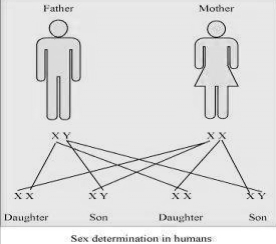
0 likes
View Solution143
MediumMCQ
Provide information on the chromosomal theory of sex determination.
A
It is based on environmental factors.
B
It is based on the presence of specific chromosomes.
C
It is based on hormonal regulation.
D
It is based on temperature variations.
Solution
(B) The initial clues about the genetic$/$chromosomal basis of sex determination were obtained from experiments carried out on insects.
Henking $(1891)$ observed a specific nuclear structure during spermatogenesis in some insects.
He observed that $50\, \%$ of the sperms received this structure,while the other $50\, \%$ did not.
Henking named this structure the $X$-body,but he could not explain its significance.
Later,other scientists concluded that the $X$-body observed by Henking was actually a chromosome,which was later named the $X$-chromosome.
Henking $(1891)$ observed a specific nuclear structure during spermatogenesis in some insects.
He observed that $50\, \%$ of the sperms received this structure,while the other $50\, \%$ did not.
Henking named this structure the $X$-body,but he could not explain its significance.
Later,other scientists concluded that the $X$-body observed by Henking was actually a chromosome,which was later named the $X$-chromosome.
0 likes
View Solution144
Medium
Explain the $XO$ and $XY$ types of sex determination.
Solution
(N/A) In many insects,the mechanism of sex determination is of the $XO$ type. All eggs bear an additional chromosome besides the autosomes.
On the other hand,some of the sperms bear the $X$ chromosome whereas some do not. Eggs fertilized by sperm having an $X$ chromosome become females and those fertilized by sperms that do not have an $X$ chromosome become males.
Due to the involvement of the $X$ chromosome in the determination of sex,it was designated to be the sex chromosome,and the rest of the chromosomes were named as autosomes. Grasshopper is an example of $XO$ type of sex determination in which the male has only one $X$ chromosome besides the autosomes,whereas females have a pair of $X$ chromosomes $(XX)$.
In many other insects and mammals including humans,$XY$ type of sex determination is observed.
In this type,the number of chromosomes is the same in both males and females. In males,one chromosome is $X$ while the other is distinctly smaller,called the $Y$ chromosome.
Autosomes are present in equal numbers in both males and females.
In males,the chromosomal constitution is $AA + XY$,while in females,it is $AA + XX$.
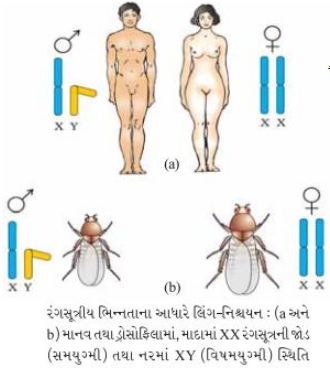
In humans and Drosophila,males have one $X$ and one $Y$ chromosome in addition to autosomes. Females have a pair of $X$ chromosomes in addition to autosomes.
In both $XO$ and $XY$ types,the male produces two different types of gametes: $(a)$ with or without $X$ $(XO)$,$(b)$ some with $X$ and some with $Y$.
Such a type of sex determination mechanism is designated as the example of male heterogamety.
On the other hand,some of the sperms bear the $X$ chromosome whereas some do not. Eggs fertilized by sperm having an $X$ chromosome become females and those fertilized by sperms that do not have an $X$ chromosome become males.
Due to the involvement of the $X$ chromosome in the determination of sex,it was designated to be the sex chromosome,and the rest of the chromosomes were named as autosomes. Grasshopper is an example of $XO$ type of sex determination in which the male has only one $X$ chromosome besides the autosomes,whereas females have a pair of $X$ chromosomes $(XX)$.
In many other insects and mammals including humans,$XY$ type of sex determination is observed.
In this type,the number of chromosomes is the same in both males and females. In males,one chromosome is $X$ while the other is distinctly smaller,called the $Y$ chromosome.
Autosomes are present in equal numbers in both males and females.
In males,the chromosomal constitution is $AA + XY$,while in females,it is $AA + XX$.
In humans and Drosophila,males have one $X$ and one $Y$ chromosome in addition to autosomes. Females have a pair of $X$ chromosomes in addition to autosomes.
In both $XO$ and $XY$ types,the male produces two different types of gametes: $(a)$ with or without $X$ $(XO)$,$(b)$ some with $X$ and some with $Y$.
Such a type of sex determination mechanism is designated as the example of male heterogamety.
0 likes
View Solution145
MediumMCQ
Describe the mechanism of sex determination in birds.
A
Male heterogamety $(ZZ-ZW)$
B
Female heterogamety $(ZZ-ZW)$
C
Male heterogamety $(XX-XY)$
D
Female heterogamety $(XX-XY)$
Solution
(B) In birds,sex determination follows the $ZW-ZZ$ type mechanism.
In this system,the female is heterogametic,meaning she produces two different types of gametes,carrying either a $Z$ or a $W$ chromosome.
The male is homogametic,producing gametes that all carry a $Z$ chromosome.
Therefore,the sex of the offspring is determined by the type of egg fertilized by the sperm. If an egg with a $Z$ chromosome is fertilized,the offspring is male $(ZZ)$,and if an egg with a $W$ chromosome is fertilized,the offspring is female $(ZW)$.
In this system,the female is heterogametic,meaning she produces two different types of gametes,carrying either a $Z$ or a $W$ chromosome.
The male is homogametic,producing gametes that all carry a $Z$ chromosome.
Therefore,the sex of the offspring is determined by the type of egg fertilized by the sperm. If an egg with a $Z$ chromosome is fertilized,the offspring is male $(ZZ)$,and if an egg with a $W$ chromosome is fertilized,the offspring is female $(ZW)$.
0 likes
View Solution146
Medium
What type of sex determination is observed in humans? Explain.
Solution
(N/A) Humans possess $23$ pairs of chromosomes,out of which $22$ pairs are autosomes,which are identical in both males and females.
In females,the $23$rd pair consists of two identical $X$ chromosomes $(XX)$. In males,the $23$rd pair consists of one $X$ chromosome and one smaller $Y$ chromosome $(XY)$.
Females produce only one type of ovum. Each ovum contains $22$ autosomes and one $X$ sex chromosome.
In males,two types of sperms are produced. Half of the total sperms contain $22$ autosomes and one $X$ chromosome,while the other half contain $22$ autosomes and one $Y$ chromosome.
Whether the child will be a boy or a girl depends on the sperm that fertilizes the ovum.
Thus,it is clear that the sex of the child is determined by the genetic composition of the sperm. Furthermore,in every pregnancy,there is a $50\, \%$ probability of the child developing as either male or female.
In females,the $23$rd pair consists of two identical $X$ chromosomes $(XX)$. In males,the $23$rd pair consists of one $X$ chromosome and one smaller $Y$ chromosome $(XY)$.
Females produce only one type of ovum. Each ovum contains $22$ autosomes and one $X$ sex chromosome.
In males,two types of sperms are produced. Half of the total sperms contain $22$ autosomes and one $X$ chromosome,while the other half contain $22$ autosomes and one $Y$ chromosome.
Whether the child will be a boy or a girl depends on the sperm that fertilizes the ovum.
Thus,it is clear that the sex of the child is determined by the genetic composition of the sperm. Furthermore,in every pregnancy,there is a $50\, \%$ probability of the child developing as either male or female.
0 likes
View SolutionPrinciples of Inheritance and Variation — Sex determination · Frequently Asked Questions
1Are these Principles of Inheritance and Variation questions useful for JEE and NEET?
Yes. All questions in this section are mapped to JEE Main and NEET exam patterns. Previous year questions from JEE Main, NEET, GUJCET and state-level exams are included with full solutions.
2Can I switch to Hindi or Gujarati for these questions?
Yes. Use the language tabs in the hero section or the sidebar to view the same questions and solutions in English, Hindi or Gujarati.
3How do I generate a question paper from this subtopic?
Use the Vedclass Exam Paper Generator — select the chapter and subtopic, set difficulty, and generate Sets A, B, C, D automatically. First 3 chapters of every subject are free.
Vedclass Products
For Students
Vedclass Test Series
Mock tests in real JEE/NEET style with performance analysis. 5-day free trial.
Start Free TrialFor Teachers
Exam Paper Generator
Generate Set A/B/C/D papers from this chapter in 2 minutes. 3 chapters free.
Try FreeFor Institutes
Online Exam Module
Live online exams with unlimited students, 360° analytics & white-label branding.
See DemoFor Teachers & Institutes
Generate a Principles of Inheritance and Variation Exam Paper in 2 Minutes
Select subtopic & difficulty — Sets A, B, C, D auto-generated with No Repeat logic.
First 3 chapters of every subject are free — no payment required.