
A English
Sex determination Questions in English
Class 12 Biology · Principles of Inheritance and Variation · Sex determination
265+
Questions
English
Language
100%
With Solutions
Showing 15 of 265 questions in English
251
EasyMCQ
Select the $INCORRECT$ statement.
A
Holandric genes are present on non-homologous region of $Y$ chromosome.
B
Female bird is heterogametic.
C
Queen bee and worker bees have haploid number of chromosomes.
D
Father is responsible for sex of the child in human beings.
Solution
(C) In honey bees,the sex determination is based on the number of sets of chromosomes an individual receives. Females (queen and workers) are diploid $(2n = 32)$,while males (drones) are haploid $(n = 16)$. Therefore,the statement that queen and worker bees have a haploid number of chromosomes is incorrect,as they are diploid.
0 likes
View Solution252
EasyMCQ
Holandric genes are present on . . . . . . .
A
homologous part of $X$ chromosome
B
homologous part of $Y$ chromosome
C
non-homologous part of $X$ chromosome
D
non-homologous part of $Y$ chromosome
Solution
(D) Holandric genes are those genes that are located exclusively on the non-homologous part of the $Y$ chromosome.
These genes are inherited directly from father to son and are never expressed in females.
Since they are present only on the $Y$ chromosome,they are also known as $Y$-linked genes.
Therefore,the correct option is $D$.
These genes are inherited directly from father to son and are never expressed in females.
Since they are present only on the $Y$ chromosome,they are also known as $Y$-linked genes.
Therefore,the correct option is $D$.
0 likes
View Solution253
EasyMCQ
In higher unisexual animals,one pair of chromosomes is not identical in two sexes. It is called as . . . . . . .
A
Non homologous chromosomes
B
Homologous chromosomes
C
Autosomes
D
Sex chromosomes
Solution
(D) In higher unisexual organisms,the chromosomes are categorized into two types: autosomes and sex chromosomes.
Autosomes are identical in both sexes and determine somatic traits.
Sex chromosomes are the pair of chromosomes that differ between the two sexes and are responsible for sex determination.
For example,in humans,females have a pair of $X$ chromosomes $(XX)$,while males have one $X$ and one $Y$ chromosome $(XY)$.
Since the $X$ and $Y$ chromosomes are not identical,they are referred to as sex chromosomes or allosomes.
Autosomes are identical in both sexes and determine somatic traits.
Sex chromosomes are the pair of chromosomes that differ between the two sexes and are responsible for sex determination.
For example,in humans,females have a pair of $X$ chromosomes $(XX)$,while males have one $X$ and one $Y$ chromosome $(XY)$.
Since the $X$ and $Y$ chromosomes are not identical,they are referred to as sex chromosomes or allosomes.
0 likes
View Solution254
EasyMCQ
Select the $CORRECT$ statement.
A
Sex-linked traits appear more frequently in females.
B
Colour blindness is caused due to proper formation of colour sensitive cells.
C
Human females have double dose of $X$ chromosome.
D
Drone bees produce sperms by meiosis.
Solution
(C) Sex-linked traits appear more frequently in males because they have only one '$X$' chromosome,so the recessive gene gets a chance to express itself.
Colour blindness is caused due to a defect in the gene that prevents the proper formation of colour-sensitive cells in the retina.
Drone bees are haploid and produce sperms by mitosis,not meiosis.
Human females have two '$X$' chromosomes,which is referred to as a double dose of the '$X$' chromosome.
Colour blindness is caused due to a defect in the gene that prevents the proper formation of colour-sensitive cells in the retina.
Drone bees are haploid and produce sperms by mitosis,not meiosis.
Human females have two '$X$' chromosomes,which is referred to as a double dose of the '$X$' chromosome.
0 likes
View Solution255
EasyMCQ
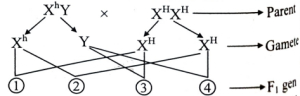
Select the correct sequence of the $F_1$ generation based on the provided cross.
A
$(1)$ - $X^H X^H$,$(2)$ - $X^h X^H$,$(3)$ - $X^H Y$,$(4)$ - $X^H Y$
B
$(1)$ - $X^H X^h$,$(2)$ - $X^H X^h$,$(3)$ - $X^H Y$,$(4)$ - $X^H Y$
C
$(1)$ - $X^H X^h$,$(2)$ - $X^h X^H$,$(3)$ - $X^h Y$,$(4)$ - $X^h Y$
D
$(1)$ - $X^h X^H$,$(2)$ - $X^H X^h$,$(3)$ - $X^H Y$,$(4)$ - $X^h Y$
Solution
(B) In the given cross,the male parent has the genotype $X^h Y$ and the female parent has the genotype $X^H X^H$.
The gametes produced by the male parent are $X^h$ and $Y$.
The gametes produced by the female parent are $X^H$ and $X^H$.
By performing the cross:
$(1)$ $X^h$ from male combines with $X^H$ from female to form $X^H X^h$.
$(2)$ $X^h$ from male combines with $X^H$ from female to form $X^H X^h$.
$(3)$ $Y$ from male combines with $X^H$ from female to form $X^H Y$.
$(4)$ $Y$ from male combines with $X^H$ from female to form $X^H Y$.
Thus,the correct sequence is $(1)$ - $X^H X^h$,$(2)$ - $X^H X^h$,$(3)$ - $X^H Y$,$(4)$ - $X^H Y$.
The gametes produced by the male parent are $X^h$ and $Y$.
The gametes produced by the female parent are $X^H$ and $X^H$.
By performing the cross:
$(1)$ $X^h$ from male combines with $X^H$ from female to form $X^H X^h$.
$(2)$ $X^h$ from male combines with $X^H$ from female to form $X^H X^h$.
$(3)$ $Y$ from male combines with $X^H$ from female to form $X^H Y$.
$(4)$ $Y$ from male combines with $X^H$ from female to form $X^H Y$.
Thus,the correct sequence is $(1)$ - $X^H X^h$,$(2)$ - $X^H X^h$,$(3)$ - $X^H Y$,$(4)$ - $X^H Y$.
0 likes
View Solution256
EasyMCQ
Sex determination in humans is identified by:
A
Somatic cell $\rightarrow$ autosomes
B
Germ cell $\rightarrow$ sex chromosomes
C
Germ cell $\rightarrow$ autosomes
D
Somatic cell $\rightarrow$ sex chromosomes
Solution
(B) In humans,sex determination is governed by the presence of specific sex chromosomes ($XX$ in females and $XY$ in males). These chromosomes are present in the germ cells (gametes) which determine the sex of the offspring upon fertilization. While somatic cells also contain these chromosomes,the fundamental mechanism of sex determination is defined by the chromosomal constitution of the germ cells (sperm and egg) that fuse to form the zygote.
0 likes
View Solution257
EasyMCQ
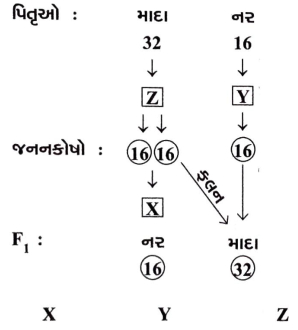
Select the option showing the correct nomenclature for '$X$','$Y$' and '$Z$' in the given figure.
A
Asexual reproduction,Meiosis,Isosomal division
B
Asexual reproduction,Isosomal division,Meiosis
C
Isosomal division,Meiosis,Asexual reproduction
D
Meiosis,Isosomal division,Asexual reproduction
Solution
(B) The given figure represents the sex determination mechanism in honeybees (haplodiploidy).
$1$. In the female (diploid,$32$ chromosomes),the formation of gametes (haploid,$16$ chromosomes) occurs via 'Meiosis' $(Z)$.
$2$. In the male (haploid,$16$ chromosomes),the formation of gametes (haploid,$16$ chromosomes) occurs via 'Isosomal division' or 'Mitosis' $(Y)$.
$3$. The development of an unfertilized egg into a male (drone) is a form of 'Asexual reproduction' or 'Parthenogenesis' $(X)$.
Therefore,$X$ = Asexual reproduction,$Y$ = Isosomal division,$Z$ = Meiosis.
$1$. In the female (diploid,$32$ chromosomes),the formation of gametes (haploid,$16$ chromosomes) occurs via 'Meiosis' $(Z)$.
$2$. In the male (haploid,$16$ chromosomes),the formation of gametes (haploid,$16$ chromosomes) occurs via 'Isosomal division' or 'Mitosis' $(Y)$.
$3$. The development of an unfertilized egg into a male (drone) is a form of 'Asexual reproduction' or 'Parthenogenesis' $(X)$.
Therefore,$X$ = Asexual reproduction,$Y$ = Isosomal division,$Z$ = Meiosis.
0 likes
View Solution258
Easy
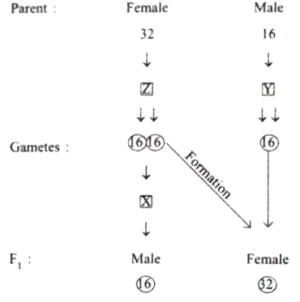
For the given chart, choose the correct option for '$X$', '$Y$', and '$Z$'.
| $X$ | $Y$ | $Z$ |
| $(A)$ Parthenogenesis | Mitosis | Meiosis |
| $(B)$ Mitosis | Meiosis | Parthenogenesis |
| $(C)$ Parthenogenesis | Meiosis | Mitosis |
| $(D)$ Meiosis | Mitosis | Parthenogenesis |
Solution
$(A)$ The provided chart illustrates the sex determination mechanism in honeybees $(Apis \text{ } mellifera)$.
$1$. In honeybees, the female is diploid $(2n = 32)$ and the male is haploid $(n = 16)$.
$2$. The female produces gametes (eggs) by meiosis. Thus, $Z$ represents Meiosis $(32 \rightarrow 16)$.
$3$. The male produces sperms by mitosis because it is already haploid. Thus, $Y$ represents Mitosis $(16 \rightarrow 16)$.
$4$. The union of an egg and a sperm forms a diploid zygote $(32)$, which develops into a female. An unfertilized egg develops into a male by parthenogenesis. Thus, $X$ represents Parthenogenesis.
Therefore, the correct sequence is $X = \text{Parthenogenesis}$, $Y = \text{Mitosis}$, $Z = \text{Meiosis}$.
$1$. In honeybees, the female is diploid $(2n = 32)$ and the male is haploid $(n = 16)$.
$2$. The female produces gametes (eggs) by meiosis. Thus, $Z$ represents Meiosis $(32 \rightarrow 16)$.
$3$. The male produces sperms by mitosis because it is already haploid. Thus, $Y$ represents Mitosis $(16 \rightarrow 16)$.
$4$. The union of an egg and a sperm forms a diploid zygote $(32)$, which develops into a female. An unfertilized egg develops into a male by parthenogenesis. Thus, $X$ represents Parthenogenesis.
Therefore, the correct sequence is $X = \text{Parthenogenesis}$, $Y = \text{Mitosis}$, $Z = \text{Meiosis}$.
0 likes
View Solution259
EasyMCQ
In the male heterogametic type of sex determination:
A
Males do not produce gametes.
B
Male parent produces similar gametes.
C
Female parent produces dissimilar gametes.
D
Male parent produces dissimilar gametes.
Solution
(D) The correct answer is $D$.
In the male heterogametic type of sex determination,the male individual produces two different types of gametes (e.g.,$X$ and $Y$ in humans or $X$ and $O$ in some insects),which is why they are called heterogametic. The female,in this case,is homogametic,meaning she produces only one type of gamete $(X)$.
In the male heterogametic type of sex determination,the male individual produces two different types of gametes (e.g.,$X$ and $Y$ in humans or $X$ and $O$ in some insects),which is why they are called heterogametic. The female,in this case,is homogametic,meaning she produces only one type of gamete $(X)$.
0 likes
View Solution260
EasyMCQ
From the chromosomal complements given below,identify the one which shows female heterogamety.
A
$XX$-$XO$
B
$XX$-$XY$
C
$XX$-$XXY$
D
$ZZ$-$ZW$
Solution
(D) In the $ZZ-ZW$ type of sex determination,the male is homogametic $(ZZ)$ and the female is heterogametic $(ZW)$.
This system is commonly observed in birds and some reptiles.
In contrast,$XX-XO$ and $XX-XY$ systems represent male heterogamety,where the male produces two different types of gametes.
This system is commonly observed in birds and some reptiles.
In contrast,$XX-XO$ and $XX-XY$ systems represent male heterogamety,where the male produces two different types of gametes.
0 likes
View Solution261
EasyMCQ
$XO$ type of sex determination and $XY$ type of sex determination are examples of:
A
male homogamety
B
male heterogamety
C
female homogamety
D
female heterogamety
Solution
(B) The correct answer is $B$ (male heterogamety).
In both $XO$ type and $XY$ type of sex determination,the male individual produces two different types of gametes (heterogametes).
In $XO$ type,males produce gametes with an $X$ chromosome and gametes without an $X$ chromosome.
In $XY$ type,males produce gametes with an $X$ chromosome and gametes with a $Y$ chromosome.
Since the male produces two different types of gametes,this mechanism is known as male heterogamety.
In both $XO$ type and $XY$ type of sex determination,the male individual produces two different types of gametes (heterogametes).
In $XO$ type,males produce gametes with an $X$ chromosome and gametes without an $X$ chromosome.
In $XY$ type,males produce gametes with an $X$ chromosome and gametes with a $Y$ chromosome.
Since the male produces two different types of gametes,this mechanism is known as male heterogamety.
0 likes
View Solution262
EasyMCQ
The type of sex determination in honey bees is:
A
Haplo-diploidy
B
Haploidy
C
Diploidy
D
$ZZ$-$ZW$
Solution
(A) The correct answer is $A$.
In honey bees,sex determination is based on the number of sets of chromosomes an individual receives.
This mechanism is known as $Haplo-diploidy$.
In this system,females (queens and workers) are diploid $(2n = 32)$ and are produced from fertilized eggs.
Males (drones) are haploid $(n = 16)$ and are produced from unfertilized eggs via parthenogenesis.
In honey bees,sex determination is based on the number of sets of chromosomes an individual receives.
This mechanism is known as $Haplo-diploidy$.
In this system,females (queens and workers) are diploid $(2n = 32)$ and are produced from fertilized eggs.
Males (drones) are haploid $(n = 16)$ and are produced from unfertilized eggs via parthenogenesis.
0 likes
View Solution263
EasyMCQ
Which of the following conditions correctly describes the manner of determining the sex in the given example?
A
Homozygous sex chromosome $XX$ produces male in $Drosophila$.
B
$XO$ type of sex determines male sex in grasshopper.
C
Homozygous sex chromosome $ZZ$ determines female sex in birds.
D
$XO$ condition in humans as found in Klinefelter's syndrome determines female sex.
Solution
(B) is the correct answer: $XO$ type of sex determines male sex in grasshopper.
In $Drosophila$,the $XX$ condition (homozygous) results in a female,while $XY$ results in a male.
In birds,the $ZZ$ condition (homozygous) results in a male,while $ZW$ results in a female.
In humans,Klinefelter's syndrome is characterized by an $XXY$ genotype ($47$ chromosomes),not $XO$.
In $Drosophila$,the $XX$ condition (homozygous) results in a female,while $XY$ results in a male.
In birds,the $ZZ$ condition (homozygous) results in a male,while $ZW$ results in a female.
In humans,Klinefelter's syndrome is characterized by an $XXY$ genotype ($47$ chromosomes),not $XO$.
0 likes
View Solution264
MediumMCQ
Which of the following statements are true with reference to the sex-determination in honeybees?
$A$. An offspring formed from the union of a sperm and an egg,develops as a female (queen or worker).
$B$. An unfertilized egg develops as a male by parthenogenesis.
$C$. $A$ male has half the number of chromosomes than that of a female.
$D$. Males produce sperms by meiosis.
$E$. Honeybees have a haplodiploid sex determination system.
Choose the correct answer from the options given below:
$A$. An offspring formed from the union of a sperm and an egg,develops as a female (queen or worker).
$B$. An unfertilized egg develops as a male by parthenogenesis.
$C$. $A$ male has half the number of chromosomes than that of a female.
$D$. Males produce sperms by meiosis.
$E$. Honeybees have a haplodiploid sex determination system.
Choose the correct answer from the options given below:
A
$(1)$ $A, B, C$ and $E$ only
B
$(2)$ $A, B, C$ and $D$ only
C
$(3)$ $B, C, D$ and $E$ only
D
$(4)$ $A, B, D$ and $E$ only
Solution
(A) In honeybees,the sex-determination system is known as haplodiploidy.
Females are diploid $(2n)$,produced from the union of a sperm and an egg (fertilized eggs).
Males are haploid $(n)$,produced from unfertilized eggs through a process called parthenogenesis.
Since males are haploid,they cannot undergo meiosis to produce gametes; instead,they produce sperms by mitosis.
Therefore,statements $A, B, C,$ and $E$ are correct,while statement $D$ is incorrect.
Females are diploid $(2n)$,produced from the union of a sperm and an egg (fertilized eggs).
Males are haploid $(n)$,produced from unfertilized eggs through a process called parthenogenesis.
Since males are haploid,they cannot undergo meiosis to produce gametes; instead,they produce sperms by mitosis.
Therefore,statements $A, B, C,$ and $E$ are correct,while statement $D$ is incorrect.
0 likes
View Solution265
MediumMCQ
In a population of a grasshopper species,the chromosome number of some members is $23$ and some other members possess $24$ chromosomes. The $23$ and $24$ chromosome-bearing members in this species are . . . . . . .
A
$A$. females and males,respectively
B
$B$. males and females,respectively
C
$C$. all males
D
$D$. all females
Solution
(B) Grasshoppers exhibit $XO$ type of sex determination.
Females are homogametic $(XX)$ and males are heterogametic $(XO)$.
Therefore,males have one chromosome less than females.
If females have $24$ chromosomes $(22+XX)$,males have $23$ chromosomes $(22+XO)$.
Females are homogametic $(XX)$ and males are heterogametic $(XO)$.
Therefore,males have one chromosome less than females.
If females have $24$ chromosomes $(22+XX)$,males have $23$ chromosomes $(22+XO)$.
0 likes
View SolutionPrinciples of Inheritance and Variation — Sex determination · Frequently Asked Questions
1Are these Principles of Inheritance and Variation questions useful for JEE and NEET?
Yes. All questions in this section are mapped to JEE Main and NEET exam patterns. Previous year questions from JEE Main, NEET, GUJCET and state-level exams are included with full solutions.
2Can I switch to Hindi or Gujarati for these questions?
Yes. Use the language tabs in the hero section or the sidebar to view the same questions and solutions in English, Hindi or Gujarati.
3How do I generate a question paper from this subtopic?
Use the Vedclass Exam Paper Generator — select the chapter and subtopic, set difficulty, and generate Sets A, B, C, D automatically. First 3 chapters of every subject are free.
Vedclass Products
For Students
Vedclass Test Series
Mock tests in real JEE/NEET style with performance analysis. 5-day free trial.
Start Free TrialFor Teachers
Exam Paper Generator
Generate Set A/B/C/D papers from this chapter in 2 minutes. 3 chapters free.
Try FreeFor Institutes
Online Exam Module
Live online exams with unlimited students, 360° analytics & white-label branding.
See DemoFor Teachers & Institutes
Generate a Principles of Inheritance and Variation Exam Paper in 2 Minutes
Select subtopic & difficulty — Sets A, B, C, D auto-generated with No Repeat logic.
First 3 chapters of every subject are free — no payment required.