
A English
Pedigree Analysis and Mendelian disorders Questions in English
Class 12 Biology · Principles of Inheritance and Variation · Pedigree Analysis and Mendelian disorders
420+
Questions
English
Language
100%
With Solutions
Showing 20 of 420 questions in English
401
EasyMCQ
Select the correct options for the given statements:
Statements:
$X$: Formation of Haemoglobin is controlled by two closely linked genes $HBA1$ and $HBA2$ on chromosome $16$ of each parent.
$Y$: $\beta$-Thalassemia is controlled by a single gene $HBB$ on chromosome $21$ of each parent.
Statements:
$X$: Formation of Haemoglobin is controlled by two closely linked genes $HBA1$ and $HBA2$ on chromosome $16$ of each parent.
$Y$: $\beta$-Thalassemia is controlled by a single gene $HBB$ on chromosome $21$ of each parent.
A
$X$ and $Y$ both are Wrong
B
$X$ is Wrong and $Y$ is Correct
C
$X$ and $Y$ both are Correct
D
$X$ is Correct and $Y$ is Wrong
Solution
(D) Statement $X$ is Correct: The synthesis of the $\alpha$-globin chain of haemoglobin is controlled by two closely linked genes,$HBA1$ and $HBA2$,located on chromosome $16$ in each parent.
Statement $Y$ is Wrong: $\beta$-Thalassemia is indeed controlled by a single gene,$HBB$,but this gene is located on chromosome $11$,not chromosome $21$.
Therefore,$X$ is Correct and $Y$ is Wrong.
Statement $Y$ is Wrong: $\beta$-Thalassemia is indeed controlled by a single gene,$HBB$,but this gene is located on chromosome $11$,not chromosome $21$.
Therefore,$X$ is Correct and $Y$ is Wrong.
0 likes
View Solution402
EasyMCQ
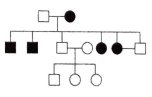
Which type of abnormality is seen in the given pedigree chart?
A
Autosomal dominant
B
$X$-Linked dominant
C
Autosomal recessive
D
$X$-Linked recessive
Solution
(A) To determine the mode of inheritance from the pedigree chart:
$1$. Observe that an affected mother (filled circle) and an unaffected father (empty square) produce both affected sons and affected daughters.
$2$. Since the trait appears in every generation and affected individuals have at least one affected parent,it is a dominant trait.
$3$. If it were $X$-linked dominant,an affected father would pass the trait to all his daughters,which is not observed here. Also,an affected mother would pass it to all her sons,but here she has an unaffected son as well.
$4$. The pattern of inheritance where an affected mother passes the trait to both sons and daughters,and the trait does not skip generations,is characteristic of Autosomal Dominant inheritance.
$5$. Therefore,the correct option is $A$.
$1$. Observe that an affected mother (filled circle) and an unaffected father (empty square) produce both affected sons and affected daughters.
$2$. Since the trait appears in every generation and affected individuals have at least one affected parent,it is a dominant trait.
$3$. If it were $X$-linked dominant,an affected father would pass the trait to all his daughters,which is not observed here. Also,an affected mother would pass it to all her sons,but here she has an unaffected son as well.
$4$. The pattern of inheritance where an affected mother passes the trait to both sons and daughters,and the trait does not skip generations,is characteristic of Autosomal Dominant inheritance.
$5$. Therefore,the correct option is $A$.
0 likes
View Solution403
EasyMCQ
The genes $HBA1$ and $HBA2$ associated with alpha-thalassemia are located on which chromosome in humans?
A
$11^{\text{th}}$ Chromosome
B
$16^{\text{th}}$ Chromosome
C
$18^{\text{th}}$ Chromosome
D
$14^{\text{th}}$ Chromosome
Solution
(B) Alpha-thalassemia is a genetic blood disorder caused by mutations in the genes responsible for the production of the alpha-globin chain of hemoglobin.
The genes $HBA1$ and $HBA2$ are responsible for encoding the alpha-globin protein.
These two genes are located on the short arm of chromosome $16$ $(16p13.3)$.
Therefore,the correct option is $B$.
The genes $HBA1$ and $HBA2$ are responsible for encoding the alpha-globin protein.
These two genes are located on the short arm of chromosome $16$ $(16p13.3)$.
Therefore,the correct option is $B$.
0 likes
View Solution404
EasyMCQ
On which chromosomes are the genes associated with $\alpha$-thalassemia and $\beta$-thalassemia respectively located?
A
$16^{\text{th}}$ and $11^{\text{th}}$
B
$11^{\text{th}}$ and $16^{\text{th}}$
C
$18^{\text{th}}$ and $11^{\text{th}}$
D
$12^{\text{th}}$ and $18^{\text{th}}$
Solution
(A) Thalassemia is an autosomal recessive blood disorder.
$\alpha$-thalassemia is caused by mutations in the genes $HBA1$ and $HBA2$,which are located on chromosome $16$.
$\beta$-thalassemia is caused by mutations in the $HBB$ gene,which is located on chromosome $11$.
Therefore,the genes associated with $\alpha$-thalassemia and $\beta$-thalassemia are located on the $16^{\text{th}}$ and $11^{\text{th}}$ chromosomes,respectively.
$\alpha$-thalassemia is caused by mutations in the genes $HBA1$ and $HBA2$,which are located on chromosome $16$.
$\beta$-thalassemia is caused by mutations in the $HBB$ gene,which is located on chromosome $11$.
Therefore,the genes associated with $\alpha$-thalassemia and $\beta$-thalassemia are located on the $16^{\text{th}}$ and $11^{\text{th}}$ chromosomes,respectively.
0 likes
View Solution405
EasyMCQ
Which of the following is a Mendelian disorder?
A
Turner's syndrome
B
Cystic fibrosis
C
Klinefelter's syndrome
D
Down's syndrome
Solution
(B) Mendelian disorders are primarily determined by alteration or mutation in a single gene.
$A$,$C$,and $D$ are chromosomal disorders caused by an excess,absence,or abnormal arrangement of chromosomes.
$B$ (Cystic fibrosis) is an autosomal recessive Mendelian disorder caused by a mutation in the $CFTR$ gene.
Therefore,the correct option is $B$.
$A$,$C$,and $D$ are chromosomal disorders caused by an excess,absence,or abnormal arrangement of chromosomes.
$B$ (Cystic fibrosis) is an autosomal recessive Mendelian disorder caused by a mutation in the $CFTR$ gene.
Therefore,the correct option is $B$.
0 likes
View Solution406
EasyMCQ
The affected male in the pedigree chart is symbolised by
A
B
C
D
Solution
(A) In a pedigree chart,standard symbols are used to represent individuals and their relationships.
- $A$ square represents a male.
- $A$ circle represents a female.
- $A$ shaded (filled) symbol indicates an affected individual (showing the trait or disease).
- Therefore,an affected male is represented by a shaded square.
- $A$ square represents a male.
- $A$ circle represents a female.
- $A$ shaded (filled) symbol indicates an affected individual (showing the trait or disease).
- Therefore,an affected male is represented by a shaded square.

0 likes
View Solution407
EasyMCQ
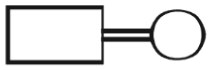
In the following symbols used in human pedigree analysis,identify the symbol that denotes consanguineous mating.
A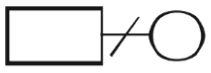
B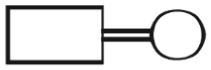
C
D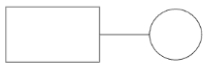
Solution
(B) In human pedigree analysis,symbols are used to represent different relationships and traits.
$A$ represents a mating between a male and a female with a line crossed through it,indicating a mating that did not result in offspring or a broken relationship.
$B$ represents consanguineous mating,which is a mating between close relatives (such as cousins). It is depicted by two horizontal lines connecting the male and female symbols.
$C$ represents a male and a female with no connection,indicating no mating relationship.
$D$ represents a standard mating between a male and a female,depicted by a single horizontal line connecting them.
Therefore,the correct symbol for consanguineous mating is $B$.
$A$ represents a mating between a male and a female with a line crossed through it,indicating a mating that did not result in offspring or a broken relationship.
$B$ represents consanguineous mating,which is a mating between close relatives (such as cousins). It is depicted by two horizontal lines connecting the male and female symbols.
$C$ represents a male and a female with no connection,indicating no mating relationship.
$D$ represents a standard mating between a male and a female,depicted by a single horizontal line connecting them.
Therefore,the correct symbol for consanguineous mating is $B$.
0 likes
View Solution408
EasyMCQ
Identify the odd one among the following disorders.
A
Haemophilia
B
Sickle-cell anaemia
C
Phenylketonuria
D
Thalassemia
Solution
(A) Haemophilia.
Haemophilia is a sex-linked recessive disease.
Sickle-cell anaemia,phenylketonuria,and thalassemia are autosomal recessive diseases.
Haemophilia is a sex-linked recessive disease.
Sickle-cell anaemia,phenylketonuria,and thalassemia are autosomal recessive diseases.
0 likes
View Solution409
EasyMCQ
Both male and female have normal vision though their fathers were colour blind,and mothers did not have any gene for colour blindness. The probability of their daughter becoming colour blind is (in $\%$)
A
$0$
B
$15$
C
$25$
D
$50$
Solution
(A) Colour blindness is an $X$-linked recessive trait.
Since the fathers of both the male and female were colour blind,the male received his $Y$ chromosome from his father and his $X$ chromosome from his mother. Since the mother did not have the gene,the male is $XY$ (normal).
The female received one $X$ chromosome from her colour-blind father $(X^c)$ and one $X$ chromosome from her mother. Since the female has normal vision,she must be a carrier $(X^c X)$.
When a normal male $(XY)$ marries a carrier female $(X^c X)$,the possible genotypes for their daughters are $XX$ (normal) and $X^c X$ (carrier).
None of the daughters will be colour blind $(X^c X^c)$,because the father is normal and does not pass the recessive gene to his daughters.
Therefore,the probability of their daughter becoming colour blind is $0 \%$.
Since the fathers of both the male and female were colour blind,the male received his $Y$ chromosome from his father and his $X$ chromosome from his mother. Since the mother did not have the gene,the male is $XY$ (normal).
The female received one $X$ chromosome from her colour-blind father $(X^c)$ and one $X$ chromosome from her mother. Since the female has normal vision,she must be a carrier $(X^c X)$.
When a normal male $(XY)$ marries a carrier female $(X^c X)$,the possible genotypes for their daughters are $XX$ (normal) and $X^c X$ (carrier).
None of the daughters will be colour blind $(X^c X^c)$,because the father is normal and does not pass the recessive gene to his daughters.
Therefore,the probability of their daughter becoming colour blind is $0 \%$.
0 likes
View Solution410
EasyMCQ
Sickle-cell anaemia is caused by the following mutant gene mutation ($DNA$ level):
A
$CTC$-$CAC$
B
$CTC$-$GAC$
C
$CAC$-$GUG$
D
$GAG$-$GUG$
Solution
(A) The correct answer is $GAG-GUG$ (at the mRNA level) or $CTC-CAC$ (at the $DNA$ template strand level).
In sickle-cell anaemia,a point mutation occurs in the $\beta$-globin gene.
Specifically,the codon $GAG$ (coding for glutamic acid) is mutated to $GUG$ (coding for valine) at the sixth position of the $\beta$-globin chain.
At the $DNA$ level,the template strand codon $CTC$ is mutated to $CAC$,which results in the transcription of $GUG$ instead of $GAG$.
This substitution of valine for glutamic acid causes the haemoglobin molecules to polymerize under low oxygen tension,leading to the characteristic sickle shape of the red blood cells.
In sickle-cell anaemia,a point mutation occurs in the $\beta$-globin gene.
Specifically,the codon $GAG$ (coding for glutamic acid) is mutated to $GUG$ (coding for valine) at the sixth position of the $\beta$-globin chain.
At the $DNA$ level,the template strand codon $CTC$ is mutated to $CAC$,which results in the transcription of $GUG$ instead of $GAG$.
This substitution of valine for glutamic acid causes the haemoglobin molecules to polymerize under low oxygen tension,leading to the characteristic sickle shape of the red blood cells.
0 likes
View Solution411
EasyMCQ
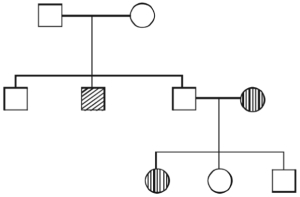
From the following pedigree chart of a family,one can make an analysis that:
A
It is an autosomal dominant trait
B
It is an autosomal recessive trait
C
It is an allosomal dominant trait
D
It is an allosomal recessive trait
Solution
(B) The correct answer is $B$.
$1$. In the pedigree,unaffected parents produce an affected offspring (the second child in the first generation). This indicates that the trait is recessive,as it skips a generation and appears in the offspring of phenotypically normal parents.
$2$. Since the trait appears in both males and females and does not show a sex-linked pattern (e.g.,it is not exclusively passed from father to daughter or mother to son),it is classified as an autosomal recessive trait.
$1$. In the pedigree,unaffected parents produce an affected offspring (the second child in the first generation). This indicates that the trait is recessive,as it skips a generation and appears in the offspring of phenotypically normal parents.
$2$. Since the trait appears in both males and females and does not show a sex-linked pattern (e.g.,it is not exclusively passed from father to daughter or mother to son),it is classified as an autosomal recessive trait.
0 likes
View Solution412
EasyMCQ
The gene for haemophilia is located on the $X$ chromosome. Hence,it is normally impossible for a:
A
haemophilic father to pass the gene to his daughter
B
carrier mother to pass the gene to her daughter
C
carrier mother to pass the gene to her son
D
haemophilic father to pass the gene to his son
Solution
(D) The correct answer is $D$.
Haemophilia is an $X$-linked recessive disorder.
In males,there is only one $X$ chromosome. If a male is haemophilic,his genotype is $X^hY$.
During reproduction,a father passes his $Y$ chromosome to his son and his $X$ chromosome to his daughter.
Therefore,a haemophilic father $(X^hY)$ will always pass his $Y$ chromosome to his son,meaning he cannot pass the haemophilia gene to his son.
Haemophilia is an $X$-linked recessive disorder.
In males,there is only one $X$ chromosome. If a male is haemophilic,his genotype is $X^hY$.
During reproduction,a father passes his $Y$ chromosome to his son and his $X$ chromosome to his daughter.
Therefore,a haemophilic father $(X^hY)$ will always pass his $Y$ chromosome to his son,meaning he cannot pass the haemophilia gene to his son.
0 likes
View Solution413
EasyMCQ
Double lines in pedigree analysis show
A
unaffected offspring
B
sex unspecified
C
normal mating
D
consanguineous marriage
Solution
(D) In pedigree analysis,a single horizontal line between two individuals represents mating,while double horizontal lines represent consanguineous mating or mating between close relatives. Therefore,the correct option is $D$.
0 likes
View Solution414
EasyMCQ
With respect to phenylketonuria,identify which statement is not correct.
A
It is a case of aneuploidy
B
It is an example of pleiotropy
C
Caused due to autosomal recessive trait
D
It is an error in metabolism
Solution
(A) is the correct answer because it is not a case of aneuploidy.
$1$. Phenylketonuria $(PKU)$ is an inborn error of metabolism.
$2$. It is an autosomal recessive disorder caused by a mutation in the gene encoding the enzyme phenylalanine hydroxylase.
$3$. This enzyme is required to convert the amino acid phenylalanine into tyrosine in the liver.
$4$. Because the defective gene affects multiple phenotypic traits (such as mental retardation and reduction in hair and skin pigmentation),it is a classic example of pleiotropy.
$1$. Phenylketonuria $(PKU)$ is an inborn error of metabolism.
$2$. It is an autosomal recessive disorder caused by a mutation in the gene encoding the enzyme phenylalanine hydroxylase.
$3$. This enzyme is required to convert the amino acid phenylalanine into tyrosine in the liver.
$4$. Because the defective gene affects multiple phenotypic traits (such as mental retardation and reduction in hair and skin pigmentation),it is a classic example of pleiotropy.
0 likes
View Solution415
EasyMCQ
Sickle cell anaemia is caused due to the substitution of
A
valine at the $6^{\text{th}}$ position of beta globin chain by glutamine
B
valine at the $6^{\text{th}}$ position of alpha globin chain by glutamic acid
C
glycine at the $6^{\text{th}}$ position of alpha globin chain by glutamic acid
D
glutamic acid at the $6^{\text{th}}$ position of beta globin chain by valine
Solution
(D) is the correct answer.
Sickle-cell anaemia is an autosomal recessive genetic disorder.
It is caused by a point mutation in the gene coding for the $\beta$-globin chain of haemoglobin.
Specifically,the $6^{\text{th}}$ amino acid of the $\beta$-globin chain,which is normally glutamic acid,is replaced by valine.
This substitution changes the structure of the haemoglobin molecule,causing red blood cells to become sickle-shaped under low oxygen conditions.
Sickle-cell anaemia is an autosomal recessive genetic disorder.
It is caused by a point mutation in the gene coding for the $\beta$-globin chain of haemoglobin.
Specifically,the $6^{\text{th}}$ amino acid of the $\beta$-globin chain,which is normally glutamic acid,is replaced by valine.
This substitution changes the structure of the haemoglobin molecule,causing red blood cells to become sickle-shaped under low oxygen conditions.
0 likes
View Solution416
EasyMCQ
More men suffer from colour blindness than women because
A
women are more resistant to disease than men
B
the male sex hormone testosterone causes the disease
C
the colour blind gene is carried on the '$Y$' chromosome
D
men are hemizygous and one defective gene is enough to make them colour blind.
Solution
(D) men are hemizygous and one defective gene is enough to make them colour blind.
More men suffer from colour blindness than women because men are hemizygous for the $X$ chromosome.
Since men have only one $X$ chromosome,a single recessive allele on this chromosome is sufficient to express the trait of colour blindness.
In contrast,women have two $X$ chromosomes,so they require two defective copies of the gene to express the condition,making it significantly less common in women.
More men suffer from colour blindness than women because men are hemizygous for the $X$ chromosome.
Since men have only one $X$ chromosome,a single recessive allele on this chromosome is sufficient to express the trait of colour blindness.
In contrast,women have two $X$ chromosomes,so they require two defective copies of the gene to express the condition,making it significantly less common in women.
0 likes
View Solution417
EasyMCQ
Both husband and wife have normal vision,though their fathers were colour blind and their mothers did not have any gene for colour blindness. The probability of their daughters becoming colour blind is (in $\%$)
A
$0$
B
$25$
C
$50$
D
$75$
Solution
(A) The correct answer is $A$ $(0\%)$.
Given:
$1$. Both husband and wife have normal vision.
$2$. Both fathers were colour blind $(X^CY)$.
$3$. Both mothers were normal and did not carry the gene for colour blindness $(XX)$.
Analysis:
- The wife's father was colour blind $(X^CY)$,so she must have inherited the $X^C$ chromosome from him. Since she has normal vision,she must be a carrier $(X^CX)$.
- The husband's father was colour blind $(X^CY)$,but the husband inherited his $X$ chromosome from his mother (who was $XX$). Therefore,the husband is normal $(XY)$.
Cross:
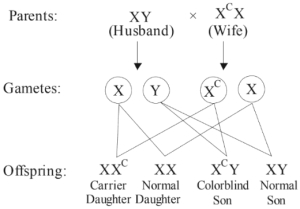
Parents: $XY$ (Husband) $\times$ $X^CX$ (Wife)
Gametes: $X, Y$ and $X^C, X$
Offspring:
- $X^CX$ (Carrier Daughter)
- $XX$ (Normal Daughter)
- $X^CY$ (Colour blind Son)
- $XY$ (Normal Son)
Conclusion:
From the cross,the daughters are either carrier $(X^CX)$ or normal $(XX)$. None of the daughters are colour blind. Therefore,the probability of their daughters becoming colour blind is $0\%$.
Given:
$1$. Both husband and wife have normal vision.
$2$. Both fathers were colour blind $(X^CY)$.
$3$. Both mothers were normal and did not carry the gene for colour blindness $(XX)$.
Analysis:
- The wife's father was colour blind $(X^CY)$,so she must have inherited the $X^C$ chromosome from him. Since she has normal vision,she must be a carrier $(X^CX)$.
- The husband's father was colour blind $(X^CY)$,but the husband inherited his $X$ chromosome from his mother (who was $XX$). Therefore,the husband is normal $(XY)$.
Cross:
Parents: $XY$ (Husband) $\times$ $X^CX$ (Wife)
Gametes: $X, Y$ and $X^C, X$
Offspring:
- $X^CX$ (Carrier Daughter)
- $XX$ (Normal Daughter)
- $X^CY$ (Colour blind Son)
- $XY$ (Normal Son)
Conclusion:
From the cross,the daughters are either carrier $(X^CX)$ or normal $(XX)$. None of the daughters are colour blind. Therefore,the probability of their daughters becoming colour blind is $0\%$.
0 likes
View Solution418
EasyMCQ
Haemophilia is a condition where there is . . . . . .
A
No production of melanin in the skin
B
No production of haemoglobin in the blood
C
$A$ delay in the clotting of blood
D
$A$ failure in the clotting mechanism of blood
Solution
(D) Haemophilia is a sex-linked recessive disorder in which the blood fails to clot normally.
It is caused by a defect in the genes that code for clotting factors (specifically Factor $VIII$ or $IX$).
Because of this genetic defect,the individual lacks the necessary proteins required for the blood coagulation cascade.
Consequently,even a minor injury can lead to excessive and continuous bleeding,as the clotting mechanism is significantly impaired or fails to initiate properly.
Therefore,the most accurate description is that there is a failure in the clotting mechanism of blood.
It is caused by a defect in the genes that code for clotting factors (specifically Factor $VIII$ or $IX$).
Because of this genetic defect,the individual lacks the necessary proteins required for the blood coagulation cascade.
Consequently,even a minor injury can lead to excessive and continuous bleeding,as the clotting mechanism is significantly impaired or fails to initiate properly.
Therefore,the most accurate description is that there is a failure in the clotting mechanism of blood.
0 likes
View Solution419
MediumMCQ
$A$ colour blind man marries a female with homozygous normal vision. What will be the possibility of colour blindness in their male children?
A
$0$
B
$0.25$
C
$0.5$
D
$1$
Solution
(A) Colour blindness is a sex-linked recessive trait.
Let $X^c$ be the recessive gene for colour blindness and $X$ be the normal gene.
Genotype of the man: $X^cY$.
Genotype of the woman (homozygous normal): $XX$.
Cross: $X^cY \times XX$.
Offspring genotypes: $X^cX$ (carrier daughter),$X^cX$ (carrier daughter),$XY$ (normal son),$XY$ (normal son).
Since all sons receive their $X$ chromosome from the mother,who is homozygous normal,all male children will have normal vision.
Therefore,the possibility of colour blindness in their male children is $0$.
Let $X^c$ be the recessive gene for colour blindness and $X$ be the normal gene.
Genotype of the man: $X^cY$.
Genotype of the woman (homozygous normal): $XX$.
Cross: $X^cY \times XX$.
Offspring genotypes: $X^cX$ (carrier daughter),$X^cX$ (carrier daughter),$XY$ (normal son),$XY$ (normal son).
Since all sons receive their $X$ chromosome from the mother,who is homozygous normal,all male children will have normal vision.
Therefore,the possibility of colour blindness in their male children is $0$.
0 likes
View Solution420
MediumMCQ
Which one of the following disorders is caused by the substitution of Glutamic acid (Glu) by Valine (Val) at the sixth position of the beta globin chain of the haemoglobin molecule?
A
$(1)$ Phenylketonuria
B
$(2)$ Haemophilia
C
$(3)$ Sickle-cell anaemia
D
$(4)$ Thalassemia
Solution
(C) Sickle-cell anaemia is an autosomal linked recessive trait that can be transmitted from parents to the offspring when both the partners are carriers for the gene.
This genetic disorder is caused by a point mutation in the gene coding for the beta-globin chain of haemoglobin.
Specifically,at the sixth position of the beta-globin chain,the amino acid Glutamic acid (Glu) is replaced by Valine (Val).
This substitution leads to the formation of abnormal haemoglobin molecules,which cause red blood cells to change their shape into a sickle-like structure under low oxygen tension.
This genetic disorder is caused by a point mutation in the gene coding for the beta-globin chain of haemoglobin.
Specifically,at the sixth position of the beta-globin chain,the amino acid Glutamic acid (Glu) is replaced by Valine (Val).
This substitution leads to the formation of abnormal haemoglobin molecules,which cause red blood cells to change their shape into a sickle-like structure under low oxygen tension.
0 likes
View SolutionPrinciples of Inheritance and Variation — Pedigree Analysis and Mendelian disorders · Frequently Asked Questions
1Are these Principles of Inheritance and Variation questions useful for JEE and NEET?
Yes. All questions in this section are mapped to JEE Main and NEET exam patterns. Previous year questions from JEE Main, NEET, GUJCET and state-level exams are included with full solutions.
2Can I switch to Hindi or Gujarati for these questions?
Yes. Use the language tabs in the hero section or the sidebar to view the same questions and solutions in English, Hindi or Gujarati.
3How do I generate a question paper from this subtopic?
Use the Vedclass Exam Paper Generator — select the chapter and subtopic, set difficulty, and generate Sets A, B, C, D automatically. First 3 chapters of every subject are free.
Vedclass Products
For Students
Vedclass Test Series
Mock tests in real JEE/NEET style with performance analysis. 5-day free trial.
Start Free TrialFor Teachers
Exam Paper Generator
Generate Set A/B/C/D papers from this chapter in 2 minutes. 3 chapters free.
Try FreeFor Institutes
Online Exam Module
Live online exams with unlimited students, 360° analytics & white-label branding.
See DemoFor Teachers & Institutes
Generate a Principles of Inheritance and Variation Exam Paper in 2 Minutes
Select subtopic & difficulty — Sets A, B, C, D auto-generated with No Repeat logic.
First 3 chapters of every subject are free — no payment required.