
A English
Inheritance of two gene Questions in English
Class 12 Biology · Principles of Inheritance and Variation · Inheritance of two gene
180+
Questions
English
Language
100%
With Solutions
Showing 30 of 180 questions in English
151
MediumMCQ
In the $F_{2}$ generation of a Mendelian dihybrid cross $(TTRR \times ttrr)$,which of the following statements is correct?
A
Tall plants and violet flowered plants are obtained in $1:1$ frequency.
B
The ratio of parental and non-parental plants is $1:15$.
C
Recombinant plants are obtained in $1:1$ frequency.
D
$F_{2}$ generation,the phenotypic ratio is $9:3:3:1$.
Solution
(D) In a Mendelian dihybrid cross involving two traits,the $F_{2}$ phenotypic ratio is $9:3:3:1$.
Total number of combinations = $16$.
Parental phenotypes (resembling parents $TTRR$ and $ttrr$) are $9$ (dominant-dominant) and $1$ (recessive-recessive),totaling $10$.
Non-parental (recombinant) phenotypes are $3$ and $3$,totaling $6$.
The ratio of parental to non-parental plants is $10:6$,which simplifies to $5:3$.
Option $D$ correctly identifies the standard Mendelian phenotypic ratio for a dihybrid cross.
Total number of combinations = $16$.
Parental phenotypes (resembling parents $TTRR$ and $ttrr$) are $9$ (dominant-dominant) and $1$ (recessive-recessive),totaling $10$.
Non-parental (recombinant) phenotypes are $3$ and $3$,totaling $6$.
The ratio of parental to non-parental plants is $10:6$,which simplifies to $5:3$.
Option $D$ correctly identifies the standard Mendelian phenotypic ratio for a dihybrid cross.
0 likes
View Solution152
MediumMCQ
In Mendel's dihybrid cross,what percentage of the $F_2$ generation possesses the $RrYy$ genotype (in $,\%$)?
A
$6.25$
B
$12.5$
C
$25$
D
$50$
Solution
(C) In a Mendelian dihybrid cross involving two traits (e.g.,seed shape and seed color),the $F_2$ generation is produced by selfing the $F_1$ dihybrid $(RrYy \times RrYy)$.
According to the Punnett square for a dihybrid cross,the total number of combinations is $16$.
The genotype $RrYy$ appears $4$ times in the $16$ possible combinations.
Therefore,the percentage is calculated as: $(4 / 16) \times 100 = 25 \,\%$.
According to the Punnett square for a dihybrid cross,the total number of combinations is $16$.
The genotype $RrYy$ appears $4$ times in the $16$ possible combinations.
Therefore,the percentage is calculated as: $(4 / 16) \times 100 = 25 \,\%$.
0 likes
View Solution153
MediumMCQ
Which traits did Mendel consider for his dihybrid cross experiment?
A
Seed color,Seed shape
B
Pod color,Pod shape
C
Pod color,Seed shape
D
Seed color,Pod shape
Solution
(A) Mendel performed his dihybrid cross experiment using the garden pea plant $(Pisum \text{ } sativum)$.
He chose two pairs of contrasting traits to study the inheritance of two genes simultaneously.
The two traits selected were the seed color (yellow vs. green) and the seed shape (round vs. wrinkled).
Therefore, the correct option is $A$.
He chose two pairs of contrasting traits to study the inheritance of two genes simultaneously.
The two traits selected were the seed color (yellow vs. green) and the seed shape (round vs. wrinkled).
Therefore, the correct option is $A$.
0 likes
View Solution154
MediumMCQ
In Mendel's dihybrid cross,how many types of offspring were obtained in the $F_2$ generation that were different from the parental types?
A
$1$
B
$2$
C
$4$
D
$14$
Solution
(B) In Mendel's dihybrid cross involving seed shape (Round/Wrinkled) and seed color (Yellow/Green),the parental phenotypes are Round-Yellow $(RRYY)$ and Wrinkled-Green $(rryy)$.
In the $F_2$ generation,the phenotypic ratio is $9:3:3:1$.
The total number of phenotypes is $16$.
The parental types are Round-Yellow $(9)$ and Wrinkled-Green $(1)$.
The recombinant (non-parental) types are Round-Green $(3)$ and Wrinkled-Yellow $(3)$.
Thus,there are $2$ types of offspring that are different from the parental types.
In the $F_2$ generation,the phenotypic ratio is $9:3:3:1$.
The total number of phenotypes is $16$.
The parental types are Round-Yellow $(9)$ and Wrinkled-Green $(1)$.
The recombinant (non-parental) types are Round-Green $(3)$ and Wrinkled-Yellow $(3)$.
Thus,there are $2$ types of offspring that are different from the parental types.
0 likes
View Solution155
MediumMCQ
Which law did Mendel propose based on his dihybrid cross experiment?
A
Law of Independent Assortment
B
Law of Segregation
C
Law of Dominance
D
Law of Incomplete Dominance
Solution
(A) Mendel performed dihybrid crosses involving two traits (e.g.,seed shape and seed color) to understand how different genes are inherited together.
Based on the results of these experiments,he proposed the $Law$ $of$ $Independent$ $Assortment$.
This law states that when two pairs of traits are combined in a hybrid,segregation of one pair of characters is independent of the other pair of characters at the time of gamete formation.
Based on the results of these experiments,he proposed the $Law$ $of$ $Independent$ $Assortment$.
This law states that when two pairs of traits are combined in a hybrid,segregation of one pair of characters is independent of the other pair of characters at the time of gamete formation.
0 likes
View Solution156
MediumMCQ
What is the genotypic ratio of the $F_2$ generation in Mendel's dihybrid cross?
A
$9: 3: 3: 1$
B
$3: 1$
C
$1: 2: 1$
D
$1: 2: 1: 2: 4: 2: 1: 2: 1$
Solution
(D) In Mendel's dihybrid cross,the phenotypic ratio is $9: 3: 3: 1$.
However,the genotypic ratio for the $F_2$ generation is determined by the combination of two monohybrid crosses $(1: 2: 1) \times (1: 2: 1)$.
This results in the ratio $1: 2: 1: 2: 4: 2: 1: 2: 1$.
Therefore,the correct option is $D$.
However,the genotypic ratio for the $F_2$ generation is determined by the combination of two monohybrid crosses $(1: 2: 1) \times (1: 2: 1)$.
This results in the ratio $1: 2: 1: 2: 4: 2: 1: 2: 1$.
Therefore,the correct option is $D$.
0 likes
View Solution157
MediumMCQ
In Mendel's dihybrid cross,the number of genotypes and phenotypes obtained in the $F_2$ generation are $P$ and $Q$ respectively. Identify $P$ and $Q$.
A
$P = 16, Q = 4$
B
$P = 3, Q = 2$
C
$P = 9, Q = 4$
D
$P = 4, Q = 4$
Solution
(C) In a dihybrid cross,Mendel studied the inheritance of two pairs of contrasting traits.
For $F_2$ generation:
$1$. The phenotypic ratio is $9:3:3:1$,which results in $4$ distinct phenotypes.
$2$. The genotypic ratio is $(1:2:1:2:4:2:1:2:1)$,which results in $9$ distinct genotypes.
Therefore,the number of genotypes $(P)$ is $9$ and the number of phenotypes $(Q)$ is $4$.
For $F_2$ generation:
$1$. The phenotypic ratio is $9:3:3:1$,which results in $4$ distinct phenotypes.
$2$. The genotypic ratio is $(1:2:1:2:4:2:1:2:1)$,which results in $9$ distinct genotypes.
Therefore,the number of genotypes $(P)$ is $9$ and the number of phenotypes $(Q)$ is $4$.
0 likes
View Solution158
MediumMCQ
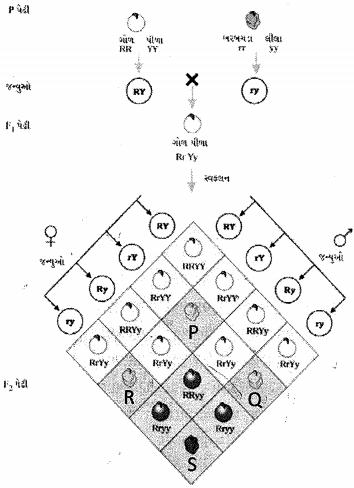
The following experiment is a dihybrid cross performed by Mendel. In which of the following are the green and wrinkled traits observed in the pea plants?
A
$P$
B
$Q$
C
$R$
D
$S$
Solution
(D) In Mendel's dihybrid cross,the traits for seed shape are round $(R)$ and wrinkled $(r)$,and for seed color are yellow $(Y)$ and green $(y)$.
Green and wrinkled traits are recessive,represented by the genotype $rryy$.
Looking at the Punnett square provided:
- $P$ corresponds to $RrYy$ (Round,Yellow).
- $Q$ corresponds to $Rryy$ (Round,Green).
- $R$ corresponds to $rrYy$ (Wrinkled,Yellow).
- $S$ corresponds to $rryy$ (Wrinkled,Green).
Therefore,the green and wrinkled phenotype is represented by $S$.
Green and wrinkled traits are recessive,represented by the genotype $rryy$.
Looking at the Punnett square provided:
- $P$ corresponds to $RrYy$ (Round,Yellow).
- $Q$ corresponds to $Rryy$ (Round,Green).
- $R$ corresponds to $rrYy$ (Wrinkled,Yellow).
- $S$ corresponds to $rryy$ (Wrinkled,Green).
Therefore,the green and wrinkled phenotype is represented by $S$.
0 likes
View Solution159
DifficultMCQ
What is the expected percentage of $F_2$ progeny with yellow and inflated pod in a dihybrid cross experiment involving pea plants with green-coloured,inflated pods and yellow-coloured,constricted pods (in $\%$)?
A
$100$
B
$56.25$
C
$18.75$
D
$9$
Solution
(C) In pea plants,green pod colour $(G)$ is dominant over yellow $(g)$,and inflated pod shape $(I)$ is dominant over constricted $(i)$.
The parental cross is between green-inflated $(GGII)$ and yellow-constricted $(ggii)$.
The $F_1$ generation is $GgIi$ (green-inflated).
In a dihybrid cross,the $F_2$ phenotypic ratio is $9:3:3:1$.
The phenotypes are:
$9$ (Green,Inflated) : $3$ (Green,Constricted) : $3$ (Yellow,Inflated) : $1$ (Yellow,Constricted).
The total number of parts is $9+3+3+1 = 16$.
The proportion of yellow and inflated pods is $3/16$.
Percentage = $(3/16) \times 100 = 18.75 \%$.
The parental cross is between green-inflated $(GGII)$ and yellow-constricted $(ggii)$.
The $F_1$ generation is $GgIi$ (green-inflated).
In a dihybrid cross,the $F_2$ phenotypic ratio is $9:3:3:1$.
The phenotypes are:
$9$ (Green,Inflated) : $3$ (Green,Constricted) : $3$ (Yellow,Inflated) : $1$ (Yellow,Constricted).
The total number of parts is $9+3+3+1 = 16$.
The proportion of yellow and inflated pods is $3/16$.
Percentage = $(3/16) \times 100 = 18.75 \%$.
0 likes
View Solution160
EasyMCQ
Genes $R$ and $Y$ follow independent assortment. If $RRYY$ produces round yellow seeds and $rryy$ produces wrinkled green seeds,what will be the phenotypic ratio of the $F2$ generation?
A
Phenotypic ratio $- 1: 2: 1$
B
Phenotypic ratio $- 3: 1$
C
Phenotypic ratio $- 9: 3: 3: 1$
D
Phenotypic ratio $- 9: 7$
Solution
(C) According to Mendel's Law of Independent Assortment,when two pairs of contrasting traits are considered simultaneously (dihybrid cross),the inheritance of one pair of traits is independent of the other.
In this cross,the parent generation $(P)$ consists of $RRYY$ (round yellow) and $rryy$ (wrinkled green).
The $F1$ generation results in $RrYy$ (round yellow) individuals.
When $F1$ individuals $(RrYy)$ are self-crossed,the gametes produced are $RY, Ry, rY,$ and $ry$.
Using a Punnett square to cross these gametes,the resulting $F2$ phenotypic distribution is $9$ round yellow,$3$ round green,$3$ wrinkled yellow,and $1$ wrinkled green.
Therefore,the phenotypic ratio is $9: 3: 3: 1$.
In this cross,the parent generation $(P)$ consists of $RRYY$ (round yellow) and $rryy$ (wrinkled green).
The $F1$ generation results in $RrYy$ (round yellow) individuals.
When $F1$ individuals $(RrYy)$ are self-crossed,the gametes produced are $RY, Ry, rY,$ and $ry$.
Using a Punnett square to cross these gametes,the resulting $F2$ phenotypic distribution is $9$ round yellow,$3$ round green,$3$ wrinkled yellow,and $1$ wrinkled green.
Therefore,the phenotypic ratio is $9: 3: 3: 1$.
0 likes
View Solution161
MediumMCQ
In a dihybrid Mendelian cross,how many types of genotype and phenotype will be obtained $:-$
A
$4$ and $9$ respectively
B
$16$ and $4$ respectively
C
$9$ and $4$ respectively
D
$4$ and $16$ respectively
Solution
(C) In a dihybrid cross,two pairs of contrasting traits are considered.
For a dihybrid cross,the number of phenotypes is calculated by the formula $2^n$,where $n$ is the number of gene pairs. Here,$n = 2$,so phenotypes = $2^2 = 4$.
The number of genotypes is calculated by the formula $3^n$. Here,$n = 2$,so genotypes = $3^2 = 9$.
Therefore,in a dihybrid Mendelian cross,there are $9$ types of genotypes and $4$ types of phenotypes.
For a dihybrid cross,the number of phenotypes is calculated by the formula $2^n$,where $n$ is the number of gene pairs. Here,$n = 2$,so phenotypes = $2^2 = 4$.
The number of genotypes is calculated by the formula $3^n$. Here,$n = 2$,so genotypes = $3^2 = 9$.
Therefore,in a dihybrid Mendelian cross,there are $9$ types of genotypes and $4$ types of phenotypes.
0 likes
View Solution162
EasyMCQ
If the gametes of an individual are $RY$ and $Ry$ only,then the genotype of the same individual will be . . . . . . .
A
$RrYy$
B
$RRYY$
C
$RRYy$
D
$RRyy$
Solution
(C) To determine the genotype,we look at the gametes produced by the individual. The gametes are $RY$ and $Ry$.
Since both gametes contain the dominant allele $R$ for the first trait,the individual must be homozygous dominant for this trait,which is $RR$.
For the second trait,the gametes contain both $Y$ and $y$ alleles. Therefore,the individual must be heterozygous for the second trait,which is $Yy$.
Combining these,the genotype of the individual is $RRYy$.
Since both gametes contain the dominant allele $R$ for the first trait,the individual must be homozygous dominant for this trait,which is $RR$.
For the second trait,the gametes contain both $Y$ and $y$ alleles. Therefore,the individual must be heterozygous for the second trait,which is $Yy$.
Combining these,the genotype of the individual is $RRYy$.
0 likes
View Solution163
EasyMCQ
In the $F_2$ generation of a Mendelian dihybrid cross,how many plants homozygous for both the traits are found?
A
One
B
Two
C
Four
D
Six
Solution
(C) In a Mendelian dihybrid cross,the $F_2$ generation consists of $16$ possible combinations of genotypes.
Among these,only $4$ plants are homozygous for both traits.
These genotypes are $YYRR$,$YYrr$,$yyRR$,and $yyrr$.
Therefore,the correct answer is $4$.
Among these,only $4$ plants are homozygous for both traits.
These genotypes are $YYRR$,$YYrr$,$yyRR$,and $yyrr$.
Therefore,the correct answer is $4$.
0 likes
View Solution164
EasyMCQ
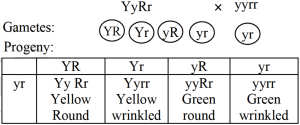
The following cross,$YyRr \times yyrr$ in garden pea plant,would result in the formation of
A
Yellow - round and green - wrinkled seed-bearing plants in the ratio of $1:2$.
B
Yellow - round,yellow - wrinkled,green - round and green - wrinkled plants in equal proportion.
C
Plants with yellow - round seeds only.
D
Yellow - round and green wrinkled plants in the ratio of $3:1$ respectively.
Solution
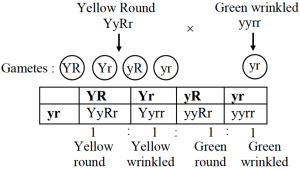
(B) This cross is a classic example of a dihybrid test cross.
In a dihybrid test cross,a dihybrid individual $(YyRr)$ is crossed with a homozygous recessive individual $(yyrr)$.
The dihybrid parent $(YyRr)$ produces four types of gametes: $YR$,$Yr$,$yR$,and $yr$ in equal proportions.
The homozygous recessive parent $(yyrr)$ produces only one type of gamete: $yr$.
When these gametes fuse,the resulting offspring genotypes are $YyRr$,$Yyrr$,$yyRr$,and $yyrr$ in a $1:1:1:1$ ratio.
These genotypes correspond to the phenotypes: Yellow-round,Yellow-wrinkled,Green-round,and Green-wrinkled,respectively.
Therefore,all four phenotypes are produced in equal proportions.
In a dihybrid test cross,a dihybrid individual $(YyRr)$ is crossed with a homozygous recessive individual $(yyrr)$.
The dihybrid parent $(YyRr)$ produces four types of gametes: $YR$,$Yr$,$yR$,and $yr$ in equal proportions.
The homozygous recessive parent $(yyrr)$ produces only one type of gamete: $yr$.
When these gametes fuse,the resulting offspring genotypes are $YyRr$,$Yyrr$,$yyRr$,and $yyrr$ in a $1:1:1:1$ ratio.
These genotypes correspond to the phenotypes: Yellow-round,Yellow-wrinkled,Green-round,and Green-wrinkled,respectively.
Therefore,all four phenotypes are produced in equal proportions.
0 likes
View Solution165
EasyMCQ
How many phenotypes can be obtained if a pea plant $(RrTt)$ is crossed with another pea plant with the same genotype?
A
$4$
B
$9$
C
$12$
D
$16$
Solution
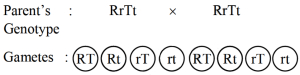
(A) The cross between two dihybrid pea plants $(RrTt \times RrTt)$ follows Mendel's Law of Independent Assortment.
The resulting phenotypes are:
$1$. Tall plant with round seeds $(R-T-)$
$2$. Tall plant with wrinkled seeds $(R-tt)$
$3$. Dwarf plant with round seeds $(rrT-)$
$4$. Dwarf plant with wrinkled seeds $(rrtt)$
Thus,there are $4$ distinct phenotypes.
| $RT$ | $Rt$ | $rT$ | $rt$ | |
| $RT$ | $RRTT$ | $RRTt$ | $RrTT$ | $RrTt$ |
| $Rt$ | $RRTt$ | $RRtt$ | $RrTt$ | $Rrtt$ |
| $rT$ | $RrTT$ | $RrTt$ | $rrTT$ | $rrTt$ |
| $rt$ | $RrTt$ | $Rrtt$ | $rrTt$ | $rrtt$ |
The resulting phenotypes are:
$1$. Tall plant with round seeds $(R-T-)$
$2$. Tall plant with wrinkled seeds $(R-tt)$
$3$. Dwarf plant with round seeds $(rrT-)$
$4$. Dwarf plant with wrinkled seeds $(rrtt)$
Thus,there are $4$ distinct phenotypes.
0 likes
View Solution166
EasyMCQ
In the $F_2$ generation of a dihybrid cross of homozygous parents,the number of genotypes and phenotypes will be respectively . . . . . . .
A
$16$ and $9$
B
$4$ and $9$
C
$9$ and $4$
D
$9$ and $16$
Solution
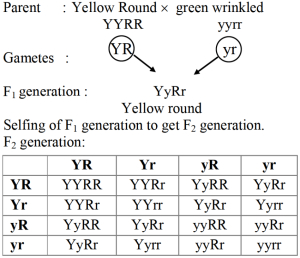
(C) In a dihybrid cross,two pairs of contrasting traits are considered. For $n$ pairs of contrasting traits,the number of genotypes is $3^n$ and the number of phenotypes is $2^n$.
For a dihybrid cross,$n = 2$.
Number of genotypes = $3^2 = 9$.
Number of phenotypes = $2^2 = 4$.
Therefore,in the $F_2$ generation,there are $9$ genotypes and $4$ phenotypes.
For a dihybrid cross,$n = 2$.
Number of genotypes = $3^2 = 9$.
Number of phenotypes = $2^2 = 4$.
Therefore,in the $F_2$ generation,there are $9$ genotypes and $4$ phenotypes.
0 likes
View Solution167
EasyMCQ
Appearance of new combinations in $F_2$ generation of a dihybrid cross proves the law of . . . . . . .
A
Dominance
B
Segregation
C
Independent assortment
D
Purity of gametes
Solution
(C) In a dihybrid cross,when two pairs of contrasting traits are considered,the $F_2$ generation exhibits not only the parental combinations but also new combinations of traits (recombinants).
This occurs because the alleles of different genes segregate independently of each other during gamete formation.
This phenomenon is described by Mendel's Law of Independent Assortment,which states that when two pairs of traits are combined in a hybrid,segregation of one pair of characters is independent of the other pair of characters.
This occurs because the alleles of different genes segregate independently of each other during gamete formation.
This phenomenon is described by Mendel's Law of Independent Assortment,which states that when two pairs of traits are combined in a hybrid,segregation of one pair of characters is independent of the other pair of characters.
0 likes
View Solution168
EasyMCQ
In a cross performed between parents considering two contrasting characters yellow round and green wrinkled seeds. In the $F_2$ generation progeny,the ratio of yellow and green will be . . . . . . .
A
$9$:$3$
B
$12$:$4$
C
$4$:$1$
D
$4$:$12$
Solution
(B) In a dihybrid cross between $YYRR$ (yellow round) and $yyrr$ (green wrinkled),the $F_1$ generation produces $YyRr$ (yellow round) seeds.
When $F_1$ generation plants are self-pollinated,the $F_2$ phenotypic ratio is $9:3:3:1$.
- Yellow round = $9$
- Yellow wrinkled = $3$
- Green round = $3$
- Green wrinkled = $1$
To find the ratio of yellow to green seeds:
- Total yellow seeds = $9 + 3 = 12$
- Total green seeds = $3 + 1 = 4$
Thus,the ratio of yellow to green seeds in the $F_2$ generation is $12:4$ (which simplifies to $3:1$).
When $F_1$ generation plants are self-pollinated,the $F_2$ phenotypic ratio is $9:3:3:1$.
- Yellow round = $9$
- Yellow wrinkled = $3$
- Green round = $3$
- Green wrinkled = $1$
To find the ratio of yellow to green seeds:
- Total yellow seeds = $9 + 3 = 12$
- Total green seeds = $3 + 1 = 4$
Thus,the ratio of yellow to green seeds in the $F_2$ generation is $12:4$ (which simplifies to $3:1$).
0 likes
View Solution169
EasyMCQ
Which one of the following crosses will have a $1:1:1:1$ ratio of progeny?
A
$YyRr \times YyRr$
B
$YyRr \times yyrr$
C
$YyRR \times yyrr$
D
$YYRR \times yyrr$
Solution
(B) test cross is a cross between an individual with a dominant phenotype (but unknown genotype) and a homozygous recessive individual.
In a dihybrid test cross,an individual heterozygous for two traits $(YyRr)$ is crossed with a homozygous recessive individual $(yyrr)$.
The gametes produced by $YyRr$ are $YR, Yr, yR,$ and $yr$.
The gametes produced by $yyrr$ are only $yr$.
The resulting progeny are $YyRr$ (Yellow Round),$Yyrr$ (Yellow wrinkled),$yyRr$ (Green round),and $yyrr$ (Green wrinkled) in a $1:1:1:1$ ratio.
Therefore,the cross $YyRr \times yyrr$ results in a $1:1:1:1$ phenotypic ratio.
In a dihybrid test cross,an individual heterozygous for two traits $(YyRr)$ is crossed with a homozygous recessive individual $(yyrr)$.
The gametes produced by $YyRr$ are $YR, Yr, yR,$ and $yr$.
The gametes produced by $yyrr$ are only $yr$.
The resulting progeny are $YyRr$ (Yellow Round),$Yyrr$ (Yellow wrinkled),$yyRr$ (Green round),and $yyrr$ (Green wrinkled) in a $1:1:1:1$ ratio.
Therefore,the cross $YyRr \times yyrr$ results in a $1:1:1:1$ phenotypic ratio.
0 likes
View Solution170
EasyMCQ
How many different types of gametes will be formed by a pea plant with genotype $TtYy$?
A
$16$
B
$08$
C
$06$
D
$04$
Solution
(D) The number of different types of gametes produced by an organism can be calculated using the formula $2^n$,where $n$ is the number of heterozygous gene pairs.
For the genotype $TtYy$,there are $2$ heterozygous pairs ($Tt$ and $Yy$),so $n = 2$.
The number of gamete types = $2^2 = 4$.
The specific types of gametes formed are $TY$,$Ty$,$tY$,and $ty$.
For the genotype $TtYy$,there are $2$ heterozygous pairs ($Tt$ and $Yy$),so $n = 2$.
The number of gamete types = $2^2 = 4$.
The specific types of gametes formed are $TY$,$Ty$,$tY$,and $ty$.
0 likes
View Solution171
EasyMCQ
The number of phenotypic recombinant offspring formed during the $F_2$ generation of a dihybrid cross is . . . . . . . (in $1/16$)
A
$9$
B
$7$
C
$6$
D
$4$
Solution
(C) In a dihybrid cross between $YYRR$ (yellow round) and $yyrr$ (green wrinkled), the phenotypic ratio of the $F_2$ generation is $9:3:3:1$.
The parental phenotypes are yellow round and green wrinkled, which account for $9/16 + 1/16 = 10/16$ of the total offspring.
The recombinant phenotypes are yellow wrinkled and green round, which account for $3/16 + 3/16 = 6/16$ of the total offspring.
Therefore, the proportion of recombinant offspring is $6/16$.
| $9/16$ Yellow round (Parental) | $3/16$ Yellow wrinkled (Recombinant) |
| $3/16$ Green round (Recombinant) | $1/16$ Green wrinkled (Parental) |
The parental phenotypes are yellow round and green wrinkled, which account for $9/16 + 1/16 = 10/16$ of the total offspring.
The recombinant phenotypes are yellow wrinkled and green round, which account for $3/16 + 3/16 = 6/16$ of the total offspring.
Therefore, the proportion of recombinant offspring is $6/16$.
0 likes
View Solution172
EasyMCQ
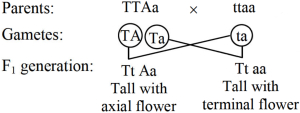
$A$ cross between two pea plants,tall with axial flowers and dwarf with terminal flowers,produced offspring that were tall with axial flowers and tall with terminal flowers in the ratio $1:1$. What will be the genotype of the parents?
A
$TTAa \times ttaa$
B
$TtAa \times ttaa$
C
$TtAA \times ttaa$
D
$TTAA \times ttaa$
Solution
(A) In pea plants,tall $(T)$ is dominant over dwarf $(t)$,and axial flowers $(A)$ are dominant over terminal flowers $(a)$.
The dwarf plant with terminal flowers must have the genotype $ttaa$.
The offspring are tall with axial flowers $(TtAa)$ and tall with terminal flowers $(Ttaa)$ in a $1:1$ ratio.
Since all offspring are tall $(Tt)$,the tall parent must be homozygous dominant $(TT)$.
Since the offspring show a $1:1$ ratio for flower position (axial:terminal),the tall parent must be heterozygous for flower position $(Aa)$.
Therefore,the cross is $TTAa \times ttaa$.
The dwarf plant with terminal flowers must have the genotype $ttaa$.
The offspring are tall with axial flowers $(TtAa)$ and tall with terminal flowers $(Ttaa)$ in a $1:1$ ratio.
Since all offspring are tall $(Tt)$,the tall parent must be homozygous dominant $(TT)$.
Since the offspring show a $1:1$ ratio for flower position (axial:terminal),the tall parent must be heterozygous for flower position $(Aa)$.
Therefore,the cross is $TTAa \times ttaa$.
0 likes
View Solution173
EasyMCQ
During a dihybrid cross with contrasting characters,in the $F_2$ generation,what is the proportion of individuals with parental genotypes (in $/6$)?
A
$1$
B
$2$
C
$3$
D
$4$
Solution
(B) In a dihybrid cross involving two traits (e.g.,$AaBb \times AaBb$),the $F_2$ generation produces $16$ combinations of genotypes.
Among these,the parental genotypes are the homozygous dominant $(AABB)$ and the homozygous recessive $(aabb)$.
There is $1$ individual with the $AABB$ genotype and $1$ individual with the $aabb$ genotype.
Therefore,the total number of individuals with parental genotypes is $1 + 1 = 2$.
The proportion of these individuals in the $F_2$ generation is $2/16$.
Among these,the parental genotypes are the homozygous dominant $(AABB)$ and the homozygous recessive $(aabb)$.
There is $1$ individual with the $AABB$ genotype and $1$ individual with the $aabb$ genotype.
Therefore,the total number of individuals with parental genotypes is $1 + 1 = 2$.
The proportion of these individuals in the $F_2$ generation is $2/16$.
0 likes
View Solution174
EasyMCQ
During a dihybrid cross, in the $F_2$ generation, the ratio of individuals showing one dominant and the other recessive character will be . . . . . . of the total population. (in $/16$)
A
$4$
B
$6$
C
$8$
D
$9$
Solution
(B) In a dihybrid cross, the $F_2$ phenotypic ratio is $9:3:3:1$.
Individuals showing one dominant and one recessive character are represented by the two groups of $3$ in the ratio (i.e., $3 + 3 = 6$).
These phenotypes correspond to the genotypes $AAbb$ and $aaBB$ (or $Yyrr$ and $yyRr$ in the case of seed color and shape).
Therefore, the total proportion of individuals showing one dominant and one recessive trait is $6/16$.
Individuals showing one dominant and one recessive character are represented by the two groups of $3$ in the ratio (i.e., $3 + 3 = 6$).
These phenotypes correspond to the genotypes $AAbb$ and $aaBB$ (or $Yyrr$ and $yyRr$ in the case of seed color and shape).
Therefore, the total proportion of individuals showing one dominant and one recessive trait is $6/16$.
0 likes
View Solution175
EasyMCQ
How many types of gametes will be produced by an individual having genotype $AaBbcc$?
A
four
B
three
C
two
D
one
Solution
(A) The genotype of the individual is $AaBbcc$.
To calculate the number of different types of gametes produced,we use the formula $2^n$,where $n$ represents the number of heterozygous gene pairs.
In the genotype $AaBbcc$,the heterozygous pairs are $Aa$ and $Bb$,while $cc$ is homozygous.
Therefore,$n = 2$.
The number of gametes produced is $2^2 = 4$.
The four types of gametes are $Abc, Abc, aBc, abc$.
To calculate the number of different types of gametes produced,we use the formula $2^n$,where $n$ represents the number of heterozygous gene pairs.
In the genotype $AaBbcc$,the heterozygous pairs are $Aa$ and $Bb$,while $cc$ is homozygous.
Therefore,$n = 2$.
The number of gametes produced is $2^2 = 4$.
The four types of gametes are $Abc, Abc, aBc, abc$.
0 likes
View Solution176
EasyMCQ
$A$ cross was made by Mendel with pea plants between violet flowers $(VV)$ in axial position $(AA)$ and white flowers $(vv)$ in terminal position $(aa)$. What phenotypic ratio of white flowers $(vv)$ did he receive in the $F_2$ generation (in $/16$)?
A
$1$
B
$3$
C
$4$
D
$9$
Solution
(C) In a dihybrid cross involving two traits (flower color and flower position),the $F_1$ generation produces dihybrid plants with the genotype $VvAa$.
When these $F_1$ individuals are self-crossed to produce the $F_2$ generation,the phenotypic ratio follows the Mendelian dihybrid ratio of $9:3:3:1$.
The traits are:
$9$ (Violet,Axial)
$3$ (Violet,Terminal)
$3$ (White,Axial)
$1$ (White,Terminal)
White flowers are recessive $(vv)$. In the $F_2$ generation,the total proportion of white-flowered plants is the sum of those that are white-axial and white-terminal,which is $3/16 + 1/16 = 4/16$ (or $1/4$).
Therefore,the phenotypic ratio of white flowers is $4/16$.
When these $F_1$ individuals are self-crossed to produce the $F_2$ generation,the phenotypic ratio follows the Mendelian dihybrid ratio of $9:3:3:1$.
The traits are:
$9$ (Violet,Axial)
$3$ (Violet,Terminal)
$3$ (White,Axial)
$1$ (White,Terminal)
White flowers are recessive $(vv)$. In the $F_2$ generation,the total proportion of white-flowered plants is the sum of those that are white-axial and white-terminal,which is $3/16 + 1/16 = 4/16$ (or $1/4$).
Therefore,the phenotypic ratio of white flowers is $4/16$.
0 likes
View Solution177
EasyMCQ
The Mendel dihybrid phenotypic ratio is . . . . . . .
A
$1$ : $3$ : $3$ : $9$
B
$3$ : $9$ : $1$ : $3$
C
$9$ : $3$ : $3$ : $1$
D
$6$ : $3$ : $3$ : $4$
Solution
(C) In a dihybrid cross,Mendel studied the inheritance of two pairs of contrasting traits simultaneously. For example,when crossing a plant with round and yellow seeds $(RRYY)$ with a plant having wrinkled and green seeds $(rryy)$,the $F_1$ generation produces all round and yellow seeds $(RrYy)$. Upon self-pollination of the $F_1$ generation,the $F_2$ generation exhibits four different phenotypes in the ratio of $9 : 3 : 3 : 1$. These represent:
$1$. Round-Yellow $(9)$
$2$. Round-Green $(3)$
$3$. Wrinkled-Yellow $(3)$
$4$. Wrinkled-Green $(1)$
$1$. Round-Yellow $(9)$
$2$. Round-Green $(3)$
$3$. Wrinkled-Yellow $(3)$
$4$. Wrinkled-Green $(1)$
0 likes
View Solution178
EasyMCQ
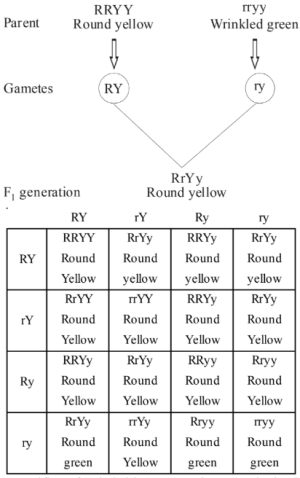
$A$ pure breeding pea plant with round yellow seeds was crossed with a pea plant having wrinkled green seeds. On selfing of the $F_1$ hybrid of this cross,$64$ progenies were obtained in the $F_2$ generation. Find out the number of $F_2$ progenies showing non-parental characters.
A
$24$
B
$36$
C
$4$
D
$12$
Solution
(A) In a dihybrid cross,the phenotypic ratio in the $F_2$ generation is $9:3:3:1$.
The parental combinations are Round-Yellow $(9/16)$ and Wrinkled-Green $(1/16)$.
The non-parental (recombinant) combinations are Round-Green $(3/16)$ and Wrinkled-Yellow $(3/16)$.
Total proportion of non-parental characters = $3/16 + 3/16 = 6/16 = 3/8$.
Given that the total number of $F_2$ progenies is $64$.
Number of non-parental progenies = $(3/8) \times 64 = 3 \times 8 = 24$.
The parental combinations are Round-Yellow $(9/16)$ and Wrinkled-Green $(1/16)$.
The non-parental (recombinant) combinations are Round-Green $(3/16)$ and Wrinkled-Yellow $(3/16)$.
Total proportion of non-parental characters = $3/16 + 3/16 = 6/16 = 3/8$.
Given that the total number of $F_2$ progenies is $64$.
Number of non-parental progenies = $(3/8) \times 64 = 3 \times 8 = 24$.
0 likes
View Solution179
EasyMCQ
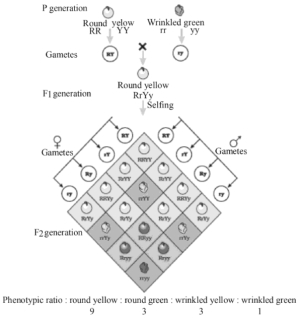
In a dihybrid cross,when $F_1$ plants $(RrYy)$ are self-hybridized,what is the segregation ratio of yellow and green seeds in the $F_2$ generation?
A
$1$:$2$:$1$
B
$3$:$1$
C
$9$:$3$:$3$:$1$
D
$1$:$1$:$1$:$1$
Solution
(B) In a dihybrid cross,the inheritance of two traits is considered independently. According to Mendel's Law of Independent Assortment,the alleles for seed color (Yellow $Y$ and Green $y$) segregate independently of the alleles for seed shape (Round $R$ and Wrinkled $r$).
For the seed color trait,the $F_1$ generation is heterozygous $(Yy)$. When $F_1$ plants are self-hybridized $(Yy \times Yy)$,the resulting $F_2$ generation follows a monohybrid phenotypic ratio.
The Punnett square for seed color yields: $1 YY$ (Yellow) : $2 Yy$ (Yellow) : $1 yy$ (Green).
Thus,the total number of Yellow seeds is $3$ $(1 YY + 2 Yy)$ and the total number of Green seeds is $1$ $(1 yy)$.
Therefore,the phenotypic segregation ratio of Yellow to Green seeds in the $F_2$ generation is $3:1$.
For the seed color trait,the $F_1$ generation is heterozygous $(Yy)$. When $F_1$ plants are self-hybridized $(Yy \times Yy)$,the resulting $F_2$ generation follows a monohybrid phenotypic ratio.
The Punnett square for seed color yields: $1 YY$ (Yellow) : $2 Yy$ (Yellow) : $1 yy$ (Green).
Thus,the total number of Yellow seeds is $3$ $(1 YY + 2 Yy)$ and the total number of Green seeds is $1$ $(1 yy)$.
Therefore,the phenotypic segregation ratio of Yellow to Green seeds in the $F_2$ generation is $3:1$.
0 likes
View Solution180
EasyMCQ
In a typical Mendelian dihybrid cross,one parent is homozygous for both dominant traits and another parent is homozygous for both recessive traits. In the $F_2$ generation,both parental combinations and recombinations appear. The phenotypic ratio of parental combinations to recombinations is
A
$10$:$6$
B
$12$:$4$
C
$9$:$7$
D
$15$:$1$
Solution
(A) In a typical Mendelian dihybrid cross,the $F_2$ phenotypic ratio is $9:3:3:1$.
Here,the parental combinations are the phenotypes that resemble the original parents (homozygous dominant and homozygous recessive),which are represented by the $9$ (both dominant) and $1$ (both recessive) classes.
Total parental combinations = $9 + 1 = 10$.
The recombinations are the new phenotypes that differ from the parents,represented by the two $3$ classes (one dominant and one recessive trait each).
Total recombinations = $3 + 3 = 6$.
Therefore,the ratio of parental combinations to recombinations is $10:6$.
Here,the parental combinations are the phenotypes that resemble the original parents (homozygous dominant and homozygous recessive),which are represented by the $9$ (both dominant) and $1$ (both recessive) classes.
Total parental combinations = $9 + 1 = 10$.
The recombinations are the new phenotypes that differ from the parents,represented by the two $3$ classes (one dominant and one recessive trait each).
Total recombinations = $3 + 3 = 6$.
Therefore,the ratio of parental combinations to recombinations is $10:6$.
0 likes
View SolutionPrinciples of Inheritance and Variation — Inheritance of two gene · Frequently Asked Questions
1Are these Principles of Inheritance and Variation questions useful for JEE and NEET?
Yes. All questions in this section are mapped to JEE Main and NEET exam patterns. Previous year questions from JEE Main, NEET, GUJCET and state-level exams are included with full solutions.
2Can I switch to Hindi or Gujarati for these questions?
Yes. Use the language tabs in the hero section or the sidebar to view the same questions and solutions in English, Hindi or Gujarati.
3How do I generate a question paper from this subtopic?
Use the Vedclass Exam Paper Generator — select the chapter and subtopic, set difficulty, and generate Sets A, B, C, D automatically. First 3 chapters of every subject are free.
Vedclass Products
For Students
Vedclass Test Series
Mock tests in real JEE/NEET style with performance analysis. 5-day free trial.
Start Free TrialFor Teachers
Exam Paper Generator
Generate Set A/B/C/D papers from this chapter in 2 minutes. 3 chapters free.
Try FreeFor Institutes
Online Exam Module
Live online exams with unlimited students, 360° analytics & white-label branding.
See DemoFor Teachers & Institutes
Generate a Principles of Inheritance and Variation Exam Paper in 2 Minutes
Select subtopic & difficulty — Sets A, B, C, D auto-generated with No Repeat logic.
First 3 chapters of every subject are free — no payment required.