
A English
Inheritance of two gene Questions in English
Class 12 Biology · Principles of Inheritance and Variation · Inheritance of two gene
180+
Questions
English
Language
100%
With Solutions
Showing 50 of 180 questions in English
101
MediumMCQ
In Mendel's dihybrid cross experiment,what is the phenotypic ratio of the progeny obtained from a test cross of the $F_1$ generation?
A
$9 : 3 : 3 : 1$
B
$1 : 1 : 1 : 7$
C
$1 : 1 : 1 : 1$
D
$1 : 2 : 1 : 2$
Solution
(C) dihybrid test cross involves crossing an $F_1$ dihybrid individual (genotype $AaBb$) with a homozygous recessive individual (genotype $aabb$).
In this cross,the $F_1$ individual produces four types of gametes: $AB$,$Ab$,$aB$,and $ab$.
The homozygous recessive parent produces only one type of gamete: $ab$.
When these gametes combine,the resulting offspring genotypes are $AaBb$,$Aabb$,$aaBb$,and $aabb$.
Each of these genotypes corresponds to a distinct phenotype in a $1:1:1:1$ ratio.
In this cross,the $F_1$ individual produces four types of gametes: $AB$,$Ab$,$aB$,and $ab$.
The homozygous recessive parent produces only one type of gamete: $ab$.
When these gametes combine,the resulting offspring genotypes are $AaBb$,$Aabb$,$aaBb$,and $aabb$.
Each of these genotypes corresponds to a distinct phenotype in a $1:1:1:1$ ratio.
0 likes
View Solution102
MediumMCQ
Determine the number of possible gametes produced from an organism with the genotype $RrYy$.
A
$1$
B
$2$
C
$4$
D
$8$
Solution
(C) The number of different types of gametes produced by an organism can be calculated using the formula $2^n$,where $n$ represents the number of heterozygous gene pairs.
In the genotype $RrYy$,there are two heterozygous gene pairs ($Rr$ and $Yy$),so $n = 2$.
Therefore,the number of possible gametes = $2^2 = 4$.
The four types of gametes produced are $RY$,$Ry$,$rY$,and $ry$.
In the genotype $RrYy$,there are two heterozygous gene pairs ($Rr$ and $Yy$),so $n = 2$.
Therefore,the number of possible gametes = $2^2 = 4$.
The four types of gametes produced are $RY$,$Ry$,$rY$,and $ry$.
0 likes
View Solution103
MediumMCQ
In Mendel's dihybrid cross experiment,what is the number of offspring with the $RRYY$ genotype in the $F_2$ generation?
A
$1$
B
$9$
C
$3$
D
$4$
Solution
(A) In a dihybrid cross,Mendel crossed plants with round yellow seeds $(RRYY)$ and wrinkled green seeds $(rryy)$.
In the $F_1$ generation,all plants were heterozygous $(RrYy)$.
When $F_1$ plants were self-pollinated to produce the $F_2$ generation,a Punnett square of $16$ combinations is formed.
The genotypic ratio of the $F_2$ generation in a dihybrid cross is $1:2:1:2:4:2:1:2:1$.
The genotype $RRYY$ is homozygous dominant for both traits and appears only once in the $16$ possible combinations of the $F_2$ generation.
Therefore,the number of offspring with the $RRYY$ genotype is $1$.
In the $F_1$ generation,all plants were heterozygous $(RrYy)$.
When $F_1$ plants were self-pollinated to produce the $F_2$ generation,a Punnett square of $16$ combinations is formed.
The genotypic ratio of the $F_2$ generation in a dihybrid cross is $1:2:1:2:4:2:1:2:1$.
The genotype $RRYY$ is homozygous dominant for both traits and appears only once in the $16$ possible combinations of the $F_2$ generation.
Therefore,the number of offspring with the $RRYY$ genotype is $1$.
0 likes
View Solution104
MediumMCQ
What is the phenotypic ratio of a test cross in the $F_1$ generation of a dihybrid cross?
A
$1:1:1:1$
B
$9:3:3:1$
C
$1:2:1$
D
$3:1$
Solution
(A) dihybrid test cross involves crossing an $F_1$ dihybrid individual (genotype $AaBb$) with a homozygous recessive individual (genotype $aabb$).
Since the $F_1$ individual produces four types of gametes $(AB, Ab, aB, ab)$ and the recessive parent produces only one type of gamete $(ab)$,the resulting offspring will have four different phenotypes in equal proportions.
The resulting phenotypic ratio is $1:1:1:1$.
Since the $F_1$ individual produces four types of gametes $(AB, Ab, aB, ab)$ and the recessive parent produces only one type of gamete $(ab)$,the resulting offspring will have four different phenotypes in equal proportions.
The resulting phenotypic ratio is $1:1:1:1$.
0 likes
View Solution105
MediumMCQ
In the $F_2$ generation of Mendel's dihybrid cross,which phenotype is observed with the highest frequency?
A
Wrinkled and yellow seeds
B
Round and yellow seeds
C
Round and green seeds
D
Wrinkled and green seeds
Solution
(B) In Mendel's dihybrid cross involving seed shape (Round $R$,Wrinkled $r$) and seed color (Yellow $Y$,Green $y$),the $F_2$ phenotypic ratio is $9:3:3:1$.
The phenotypic distribution is as follows:
- Round and Yellow: $9/16$
- Round and Green: $3/16$
- Wrinkled and Yellow: $3/16$
- Wrinkled and Green: $1/16$
Therefore,the phenotype with the highest frequency is Round and Yellow seeds.
The phenotypic distribution is as follows:
- Round and Yellow: $9/16$
- Round and Green: $3/16$
- Wrinkled and Yellow: $3/16$
- Wrinkled and Green: $1/16$
Therefore,the phenotype with the highest frequency is Round and Yellow seeds.
0 likes
View Solution106
MediumMCQ
In Mendel's dihybrid cross experiment,when $F_1$ generation plants are self-pollinated,what is the proportion of each type of gamete produced (in $\%$)?
A
$25$
B
$50$
C
$75$
D
$100$
Solution
(A) In Mendel's dihybrid cross,the $F_1$ generation is heterozygous for two traits,represented as $RrYy$.
According to the Law of Independent Assortment,the alleles of two different genes segregate independently during gamete formation.
For the genotype $RrYy$,the possible gametes produced are $RY$,$Ry$,$rY$,and $ry$.
Each of these four types of gametes is produced in equal proportions.
Therefore,the proportion of each type of gamete is $1/4$ or $25 \%$.
According to the Law of Independent Assortment,the alleles of two different genes segregate independently during gamete formation.
For the genotype $RrYy$,the possible gametes produced are $RY$,$Ry$,$rY$,and $ry$.
Each of these four types of gametes is produced in equal proportions.
Therefore,the proportion of each type of gamete is $1/4$ or $25 \%$.
0 likes
View Solution107
MediumMCQ
In Mendel's dihybrid cross experiment,what was the phenotype of the $F_1$ generation that was self-pollinated?
A
Green and round
B
Wrinkled and green
C
Wrinkled and yellow
D
Yellow and round
Solution
(D) In Mendel's dihybrid cross,the parents were pure-breeding plants with yellow-round seeds $(YYRR)$ and green-wrinkled seeds $(yyrr)$.
When these parents were crossed,the $F_1$ generation produced plants that were heterozygous for both traits $(YyRr)$.
These $F_1$ plants exhibited the dominant phenotype,which is yellow and round seeds.
Therefore,the $F_1$ generation that was self-pollinated had a phenotype of yellow and round seeds.
When these parents were crossed,the $F_1$ generation produced plants that were heterozygous for both traits $(YyRr)$.
These $F_1$ plants exhibited the dominant phenotype,which is yellow and round seeds.
Therefore,the $F_1$ generation that was self-pollinated had a phenotype of yellow and round seeds.
0 likes
View Solution108
MediumMCQ
In Mendel's dihybrid cross,what percentage of the total $F_2$ progeny had green seeds (in $\%$)?
A
$1$
B
$6$
C
$10$
D
$25$
Solution
(D) In Mendel's dihybrid cross involving seed color (Yellow $Y$ vs Green $y$) and seed shape (Round $R$ vs Wrinkled $r$),the $F_2$ phenotypic ratio is $9:3:3:1$.
Specifically,the phenotypes are:
$9$ Yellow-Round,$3$ Yellow-Wrinkled,$3$ Green-Round,and $1$ Green-Wrinkled.
The total number of parts is $9 + 3 + 3 + 1 = 16$.
The green seeds are represented by the $3$ Green-Round and $1$ Green-Wrinkled phenotypes.
Total green seeds = $3 + 1 = 4$.
The percentage of green seeds = $(4 / 16) \times 100 = 25 \%$.
Specifically,the phenotypes are:
$9$ Yellow-Round,$3$ Yellow-Wrinkled,$3$ Green-Round,and $1$ Green-Wrinkled.
The total number of parts is $9 + 3 + 3 + 1 = 16$.
The green seeds are represented by the $3$ Green-Round and $1$ Green-Wrinkled phenotypes.
Total green seeds = $3 + 1 = 4$.
The percentage of green seeds = $(4 / 16) \times 100 = 25 \%$.
0 likes
View Solution109
MediumMCQ
In Mendel's dihybrid cross,what percentage of seeds with yellow color were obtained in the $F_2$ generation (in $\%$)?
A
$25$
B
$50$
C
$75$
D
$100$
Solution
(C) In Mendel's dihybrid cross involving seed color (Yellow $Y$ and Green $y$) and seed shape (Round $R$ and Wrinkled $r$),the $F_2$ phenotypic ratio is $9:3:3:1$.
Specifically,the distribution of seed color is as follows:
- Yellow seeds ($YY$ or $Yy$): $9$ (Round-Yellow) + $3$ (Wrinkled-Yellow) = $12$ parts.
- Green seeds $(yy)$: $3$ (Round-Green) + $1$ (Wrinkled-Green) = $4$ parts.
Total parts = $16$.
The percentage of yellow seeds is calculated as $(12 / 16) \times 100 = 75 \%$.
Specifically,the distribution of seed color is as follows:
- Yellow seeds ($YY$ or $Yy$): $9$ (Round-Yellow) + $3$ (Wrinkled-Yellow) = $12$ parts.
- Green seeds $(yy)$: $3$ (Round-Green) + $1$ (Wrinkled-Green) = $4$ parts.
Total parts = $16$.
The percentage of yellow seeds is calculated as $(12 / 16) \times 100 = 75 \%$.
0 likes
View Solution110
MediumMCQ
Which law did Mendel propose based on the inheritance of two traits?
A
Law of Dominance
B
Law of Segregation
C
Law of Independent Assortment
D
All of the above
Solution
(C) Mendel performed dihybrid crosses (crosses involving two traits) to study the inheritance pattern of two genes simultaneously. Based on the results of these dihybrid crosses,he proposed the $Law$ $of$ $Independent$ $Assortment$. This law states that when two pairs of traits are combined in a hybrid,segregation of one pair of characters is independent of the other pair of characters. The $Law$ $of$ $Dominance$ and $Law$ $of$ $Segregation$ were derived from monohybrid crosses.
0 likes
View Solution111
MediumMCQ
In a dihybrid cross between $RRYY$ and $rryy$,what is the probability of obtaining $RrYy$ in the $F_{2}$ generation (in $/16$)?
A
$4$
B
$8$
C
$2$
D
$10$
Solution
(A) In a dihybrid cross between $RRYY$ (round yellow) and $rryy$ (wrinkled green),the $F_{1}$ generation produces all $RrYy$ (round yellow) individuals.
When $F_{1}$ individuals $(RrYy)$ are self-crossed to obtain the $F_{2}$ generation,the phenotypic ratio is $9:3:3:1$.
The genotypic ratio for the $F_{2}$ generation is $1:2:1:2:4:2:1:2:1$.
Specifically,the genotype $RrYy$ represents the double heterozygous condition.
In the $16$ possible combinations of the Punnett square,the genotype $RrYy$ appears $4$ times.
Therefore,the probability of obtaining $RrYy$ in the $F_{2}$ generation is $4/16$.
When $F_{1}$ individuals $(RrYy)$ are self-crossed to obtain the $F_{2}$ generation,the phenotypic ratio is $9:3:3:1$.
The genotypic ratio for the $F_{2}$ generation is $1:2:1:2:4:2:1:2:1$.
Specifically,the genotype $RrYy$ represents the double heterozygous condition.
In the $16$ possible combinations of the Punnett square,the genotype $RrYy$ appears $4$ times.
Therefore,the probability of obtaining $RrYy$ in the $F_{2}$ generation is $4/16$.
0 likes
View Solution112
MediumMCQ
What is the genotype of the $F_1$ generation offspring obtained in a dihybrid cross?
A
$RrTt$
B
$RRTT$
C
$rrtt$
D
$RRTt$
Solution
(A) In a dihybrid cross,we consider the inheritance of two pairs of contrasting traits.
When a homozygous dominant parent (e.g.,$RRTT$ for round and yellow seeds) is crossed with a homozygous recessive parent (e.g.,$rrtt$ for wrinkled and green seeds),the gametes produced are $RT$ and $rt$ respectively.
Upon fertilization,these gametes fuse to form the $F_1$ generation offspring.
The resulting genotype of all $F_1$ individuals is $RrTt$,which is heterozygous for both traits.
When a homozygous dominant parent (e.g.,$RRTT$ for round and yellow seeds) is crossed with a homozygous recessive parent (e.g.,$rrtt$ for wrinkled and green seeds),the gametes produced are $RT$ and $rt$ respectively.
Upon fertilization,these gametes fuse to form the $F_1$ generation offspring.
The resulting genotype of all $F_1$ individuals is $RrTt$,which is heterozygous for both traits.
0 likes
View Solution113
MediumMCQ
How many types of gametes will be produced by the offspring resulting from the cross $AABB \times aabb$?
A
$2$
B
$4$
C
$8$
D
$16$
Solution
(B) $1$. The cross is between $AABB$ (homozygous dominant) and $aabb$ (homozygous recessive).
$2$. The offspring produced from this cross will have the genotype $AaBb$.
$3$. The number of types of gametes produced by an organism with genotype $AaBb$ is calculated using the formula $2^n$,where $n$ is the number of heterozygous gene pairs.
$4$. Here,$n = 2$ (since $Aa$ and $Bb$ are heterozygous).
$5$. Therefore,the number of types of gametes = $2^2 = 4$.
$2$. The offspring produced from this cross will have the genotype $AaBb$.
$3$. The number of types of gametes produced by an organism with genotype $AaBb$ is calculated using the formula $2^n$,where $n$ is the number of heterozygous gene pairs.
$4$. Here,$n = 2$ (since $Aa$ and $Bb$ are heterozygous).
$5$. Therefore,the number of types of gametes = $2^2 = 4$.
0 likes
View Solution114
MediumMCQ
When a dwarf plant with terminal flowers is crossed with a tall plant with axial flowers,what will be the proportion of dwarf plant progeny in the $F_1$ generation (in $\%$)?
A
$50$
B
$25$
C
$100$
D
$0$
Solution
(D) In pea plants,tallness $(T)$ is dominant over dwarfness $(t)$,and axial flower position $(A)$ is dominant over terminal flower position $(a)$.
The dwarf plant with terminal flowers has the genotype $ttaa$.
The tall plant with axial flowers is assumed to be homozygous $(TTAA)$ as it is a standard cross for $F_1$ generation analysis.
The cross is: $ttaa \times TTAA$.
Gametes produced: $ta$ from the dwarf plant and $TA$ from the tall plant.
The $F_1$ generation genotype is $TtAa$,which represents tall plants with axial flowers.
Since all $F_1$ offspring are heterozygous $(TtAa)$,they all exhibit the dominant traits (tall and axial).
Therefore,the proportion of dwarf plants in the $F_1$ generation is $0 \%$.
The dwarf plant with terminal flowers has the genotype $ttaa$.
The tall plant with axial flowers is assumed to be homozygous $(TTAA)$ as it is a standard cross for $F_1$ generation analysis.
The cross is: $ttaa \times TTAA$.
Gametes produced: $ta$ from the dwarf plant and $TA$ from the tall plant.
The $F_1$ generation genotype is $TtAa$,which represents tall plants with axial flowers.
Since all $F_1$ offspring are heterozygous $(TtAa)$,they all exhibit the dominant traits (tall and axial).
Therefore,the proportion of dwarf plants in the $F_1$ generation is $0 \%$.
0 likes
View Solution115
MediumMCQ
If gene $A$ is dominant for height (tall) and gene $B$ is dominant for white color,what proportion of the $F_1$ progeny from the cross $AABb \times aabb$ will be short and white (in $\%$)?
A
$0$
B
$50$
C
$25$
D
$100$
Solution
(A) To determine the phenotype of the offspring,we analyze the cross $AABb \times aabb$ using a Punnett square or by considering individual gene segregation.
$1$. For gene $A$: The cross is $AA \times aa$. All offspring will be $Aa$. Since $A$ is dominant for tall height,all offspring will be tall.
$2$. For gene $B$: The cross is $Bb \times bb$. The offspring will be $50\% Bb$ (white) and $50\% bb$ (non-white/colored).
$3$. The question asks for 'short and white' offspring.
- Short height requires the genotype $aa$. Since all offspring are $Aa$,the probability of being short is $0$.
- Therefore,the probability of being 'short and white' is $0 \times 0.5 = 0$.
$1$. For gene $A$: The cross is $AA \times aa$. All offspring will be $Aa$. Since $A$ is dominant for tall height,all offspring will be tall.
$2$. For gene $B$: The cross is $Bb \times bb$. The offspring will be $50\% Bb$ (white) and $50\% bb$ (non-white/colored).
$3$. The question asks for 'short and white' offspring.
- Short height requires the genotype $aa$. Since all offspring are $Aa$,the probability of being short is $0$.
- Therefore,the probability of being 'short and white' is $0 \times 0.5 = 0$.
0 likes
View Solution116
MediumMCQ
If two pairs of genes are represented by $AA, Bb$,what are the possible gametic combinations after meiosis?
A
$AB, Ab$
B
$A, B, b$
C
$AA, Bb$
D
None of these
Solution
(A) During meiosis,the alleles of a gene pair segregate independently of the alleles of another gene pair (Law of Independent Assortment).
For the genotype $AA, Bb$,the alleles $A$ and $A$ will separate,and $B$ and $b$ will separate.
Since both alleles for the first gene are identical ($A$ and $A$),each gamete will receive one $A$ allele.
The second gene pair $Bb$ will segregate such that one gamete receives $B$ and the other receives $b$.
Therefore,the possible combinations in the gametes are $AB$ and $Ab$.
For the genotype $AA, Bb$,the alleles $A$ and $A$ will separate,and $B$ and $b$ will separate.
Since both alleles for the first gene are identical ($A$ and $A$),each gamete will receive one $A$ allele.
The second gene pair $Bb$ will segregate such that one gamete receives $B$ and the other receives $b$.
Therefore,the possible combinations in the gametes are $AB$ and $Ab$.
0 likes
View Solution117
MediumMCQ
In Mendel's dihybrid cross,what is the probability of obtaining a homozygous recessive plant in the $F_2$ generation?
A
$\frac{1}{16}$
B
$\frac{4}{16}$
C
$\frac{8}{16}$
D
$\frac{9}{16}$
Solution
(A) In a dihybrid cross involving two traits (e.g.,seed shape and seed color),the $F_2$ phenotypic ratio is $9:3:3:1$.
However,the genotypic ratio is more complex. The homozygous recessive genotype (e.g.,$rryy$) occurs only once in the $16$ possible combinations of the Punnett square.
Therefore,the probability of obtaining a homozygous recessive plant is $\frac{1}{16}$.
However,the genotypic ratio is more complex. The homozygous recessive genotype (e.g.,$rryy$) occurs only once in the $16$ possible combinations of the Punnett square.
Therefore,the probability of obtaining a homozygous recessive plant is $\frac{1}{16}$.
0 likes
View Solution118
MediumMCQ
In Mendel's dihybrid cross,what is the probability of obtaining a plant that is heterozygous for both traits (in $/16$)?
A
$9$
B
$3$
C
$1$
D
$4$
Solution
(D) In a dihybrid cross involving two traits (e.g.,seed shape and seed color),the $F_2$ generation follows the phenotypic ratio of $9:3:3:1$ and a genotypic ratio.
For two genes,let the alleles be $Aa$ and $Bb$.
$A$ plant that is heterozygous for both traits has the genotype $AaBb$.
In the $F_2$ Punnett square of a dihybrid cross,the total number of combinations is $16$.
The genotype $AaBb$ appears in $4$ out of the $16$ squares.
Therefore,the probability is $4/16$ (or $1/4$).
For two genes,let the alleles be $Aa$ and $Bb$.
$A$ plant that is heterozygous for both traits has the genotype $AaBb$.
In the $F_2$ Punnett square of a dihybrid cross,the total number of combinations is $16$.
The genotype $AaBb$ appears in $4$ out of the $16$ squares.
Therefore,the probability is $4/16$ (or $1/4$).
0 likes
View Solution119
MediumMCQ
In Mendel's dihybrid cross,what is the proportion of the dominant homozygous plants in the $F_2$ generation (in $/16$)?
A
$1$
B
$3$
C
$4$
D
$9$
Solution
(A) In a dihybrid cross involving two traits (e.g.,seed shape and seed color),the $F_2$ generation follows a phenotypic ratio of $9:3:3:1$.
However,the question asks for the proportion of dominant homozygous plants.
Let the traits be represented by alleles $R$ (round) and $Y$ (yellow),which are dominant over $r$ (wrinkled) and $y$ (green).
The dominant homozygous genotype is $RRYY$.
In a Punnett square of $16$ squares,the genotype $RRYY$ appears only once.
Therefore,the proportion of the dominant homozygous plants is $1/16$.
However,the question asks for the proportion of dominant homozygous plants.
Let the traits be represented by alleles $R$ (round) and $Y$ (yellow),which are dominant over $r$ (wrinkled) and $y$ (green).
The dominant homozygous genotype is $RRYY$.
In a Punnett square of $16$ squares,the genotype $RRYY$ appears only once.
Therefore,the proportion of the dominant homozygous plants is $1/16$.
0 likes
View Solution120
MediumMCQ
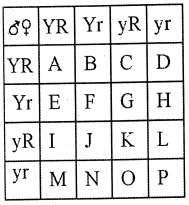
Analyze the given Punnett square. If yellow and round seed alleles are dominant over green and wrinkled seed alleles,which plant will the seeds produced by the plant of genotype $G$ resemble?
A
$M$
B
$D$
C
$J$
D
All of the above
Solution
(A) In the given Punnett square for a dihybrid cross,the genotype at position $G$ is formed by the intersection of the row with gamete $Yr$ and the column with gamete $yR$.
Thus,the genotype at $G$ is $YyRr$.
$YyRr$ represents a plant with yellow and round seeds because yellow $(Y)$ is dominant over green $(y)$ and round $(R)$ is dominant over wrinkled $(r)$.
Now,let us analyze the other options:
$M$ is formed by $yr \times YR$,resulting in $YyRr$.
$D$ is formed by $yr \times YR$,resulting in $YyRr$.
$J$ is formed by $yr \times Yr$,resulting in $Yyrr$.
Since $G$ is $YyRr$ (yellow and round),and $M$ is also $YyRr$ (yellow and round),the plant $G$ resembles plant $M$.
Thus,the genotype at $G$ is $YyRr$.
$YyRr$ represents a plant with yellow and round seeds because yellow $(Y)$ is dominant over green $(y)$ and round $(R)$ is dominant over wrinkled $(r)$.
Now,let us analyze the other options:
$M$ is formed by $yr \times YR$,resulting in $YyRr$.
$D$ is formed by $yr \times YR$,resulting in $YyRr$.
$J$ is formed by $yr \times Yr$,resulting in $Yyrr$.
Since $G$ is $YyRr$ (yellow and round),and $M$ is also $YyRr$ (yellow and round),the plant $G$ resembles plant $M$.
0 likes
View Solution121
MediumMCQ
Which law is demonstrated by Mendel's dihybrid cross?
A
Law of Segregation
B
Law of Dominance
C
Law of Purity of Gametes
D
Law of Independent Assortment
Solution
(D) Mendel's dihybrid cross involves the study of the inheritance of two pairs of contrasting traits simultaneously.
Based on the results of this cross, Mendel proposed the $Law of Independent Assortment$.
This law states that when two pairs of traits are combined in a hybrid, segregation of one pair of characters is independent of the other pair of characters at the time of gamete formation.
Therefore, the correct option is $D$.
Based on the results of this cross, Mendel proposed the $Law of Independent Assortment$.
This law states that when two pairs of traits are combined in a hybrid, segregation of one pair of characters is independent of the other pair of characters at the time of gamete formation.
Therefore, the correct option is $D$.
0 likes
View Solution122
MediumMCQ
In a dihybrid cross,what is the proportion of $RrYy$ offspring obtained from the selfing of an $RrYy$ plant (in $/16$)?
A
$1$
B
$2$
C
$4$
D
$8$
Solution
(C) In a dihybrid cross involving two heterozygous parents $(RrYy \times RrYy)$,the Punnett square yields a total of $16$ possible combinations.
According to the law of independent assortment,the phenotypic ratio is $9:3:3:1$,but the genotypic ratio for the $RrYy$ genotype is calculated as follows:
The probability of obtaining $Rr$ from $Rr \times Rr$ is $2/4$ $(1/2)$.
The probability of obtaining $Yy$ from $Yy \times Yy$ is $2/4$ $(1/2)$.
Therefore,the probability of obtaining the $RrYy$ genotype is $(1/2) \times (1/2) = 1/4$,which is equivalent to $4/16$.
According to the law of independent assortment,the phenotypic ratio is $9:3:3:1$,but the genotypic ratio for the $RrYy$ genotype is calculated as follows:
The probability of obtaining $Rr$ from $Rr \times Rr$ is $2/4$ $(1/2)$.
The probability of obtaining $Yy$ from $Yy \times Yy$ is $2/4$ $(1/2)$.
Therefore,the probability of obtaining the $RrYy$ genotype is $(1/2) \times (1/2) = 1/4$,which is equivalent to $4/16$.
0 likes
View Solution123
MediumMCQ
In Mendel's dihybrid cross,how many seeds out of the $F_2$ generation ratio of $9:3:3:1$ were found to be round?
A
$9$
B
$3$
C
$12$
D
$16$
Solution
(C) In Mendel's dihybrid cross involving seed shape (round vs. wrinkled) and seed color (yellow vs. green),the $F_2$ phenotypic ratio is $9:3:3:1$.
The phenotypes are as follows:
$9$ Round-Yellow
$3$ Round-Green
$3$ Wrinkled-Yellow
$1$ Wrinkled-Green
To find the total number of round seeds,we add the phenotypes that possess the dominant round trait: Round-Yellow $(9)$ + Round-Green $(3)$ = $12$.
Therefore,out of $16$ total combinations,$12$ seeds are round.
The phenotypes are as follows:
$9$ Round-Yellow
$3$ Round-Green
$3$ Wrinkled-Yellow
$1$ Wrinkled-Green
To find the total number of round seeds,we add the phenotypes that possess the dominant round trait: Round-Yellow $(9)$ + Round-Green $(3)$ = $12$.
Therefore,out of $16$ total combinations,$12$ seeds are round.
0 likes
View Solution124
MediumMCQ
In Mendel's dihybrid cross,what is the ratio of offspring possessing homozygous dominant and homozygous recessive genotypes in the $F_2$ generation,which shows a phenotypic ratio of $9:3:3:1$?
A
$1:1$
B
$9:1$
C
$3:3$
D
$9:3:3:1$
Solution
(A) In a dihybrid cross,the $F_2$ generation consists of $16$ possible combinations of genotypes.
The genotype for homozygous dominant is $AABB$,which appears $1$ time.
The genotype for homozygous recessive is $aabb$,which also appears $1$ time.
Therefore,the ratio of homozygous dominant to homozygous recessive genotypes is $1:1$.
The genotype for homozygous dominant is $AABB$,which appears $1$ time.
The genotype for homozygous recessive is $aabb$,which also appears $1$ time.
Therefore,the ratio of homozygous dominant to homozygous recessive genotypes is $1:1$.
0 likes
View Solution125
MediumMCQ
How many types of gametes will be produced by a genotype $AABbCc$?
A
$2$
B
$6$
C
$8$
D
$4$
Solution
(D) To determine the number of different types of gametes produced by a genotype,we use the formula $2^n$,where $n$ is the number of heterozygous gene pairs.
In the genotype $AABbCc$:
- $AA$ is homozygous (not heterozygous).
- $Bb$ is heterozygous.
- $Cc$ is heterozygous.
Therefore,the number of heterozygous pairs $(n)$ is $2$.
Using the formula: $2^n = 2^2 = 4$.
Thus,the genotype $AABbCc$ will produce $4$ types of gametes.
In the genotype $AABbCc$:
- $AA$ is homozygous (not heterozygous).
- $Bb$ is heterozygous.
- $Cc$ is heterozygous.
Therefore,the number of heterozygous pairs $(n)$ is $2$.
Using the formula: $2^n = 2^2 = 4$.
Thus,the genotype $AABbCc$ will produce $4$ types of gametes.
0 likes
View Solution126
MediumMCQ
What is the percentage of recessive gametes produced by $YyRr$ (in $\%$)?
A
$25$
B
$50$
C
$75$
D
$100$
Solution
(A) The genotype $YyRr$ is a dihybrid individual.
According to the Law of Independent Assortment,the alleles of two different genes segregate independently during gamete formation.
The possible gametes produced by $YyRr$ are $YR$,$Yr$,$yR$,and $yr$.
Each of these four types of gametes is produced in equal proportions,i.e.,$25 \%$ each.
The gamete $yr$ contains both recessive alleles ($y$ and $r$).
Therefore,the percentage of recessive gametes $(yr)$ produced is $25 \%$.
According to the Law of Independent Assortment,the alleles of two different genes segregate independently during gamete formation.
The possible gametes produced by $YyRr$ are $YR$,$Yr$,$yR$,and $yr$.
Each of these four types of gametes is produced in equal proportions,i.e.,$25 \%$ each.
The gamete $yr$ contains both recessive alleles ($y$ and $r$).
Therefore,the percentage of recessive gametes $(yr)$ produced is $25 \%$.
0 likes
View Solution127
MediumMCQ
What will be the phenotypic ratio of the offspring obtained from a cross between $Aabb$ and $Ccdd$?
A
$1 : 1 : 1 : 1$
B
$3 : 1$
C
$9 : 3 : 3 : 1$
D
$1 : 2 : 1$
Solution
(A) To find the phenotypic ratio of the cross $Aabb \times Ccdd$,we analyze the inheritance of each gene pair independently.
$1$. For the first gene pair: $Aa \times Cc$ (assuming independent assortment of alleles,though these are different genes,we treat them as independent traits).
$2$. Actually,the cross is between two individuals with genotypes $Aabb$ and $Ccdd$.
$3$. The cross can be broken down into two independent monohybrid crosses:
- Cross $1$: $Aa \times Cc$ (This is not a standard cross,but if we assume independent segregation of alleles $A/a$ and $C/c$):
- The offspring for $Aa \times Cc$ would be $1 AC : 1 Ac : 1 aC : 1 ac$.
- Cross $2$: $bb \times dd$ (This results in $100\%$ $bd$ phenotype).
$4$. Combining these,the phenotypic ratio is $1 : 1 : 1 : 1$.
$1$. For the first gene pair: $Aa \times Cc$ (assuming independent assortment of alleles,though these are different genes,we treat them as independent traits).
$2$. Actually,the cross is between two individuals with genotypes $Aabb$ and $Ccdd$.
$3$. The cross can be broken down into two independent monohybrid crosses:
- Cross $1$: $Aa \times Cc$ (This is not a standard cross,but if we assume independent segregation of alleles $A/a$ and $C/c$):
- The offspring for $Aa \times Cc$ would be $1 AC : 1 Ac : 1 aC : 1 ac$.
- Cross $2$: $bb \times dd$ (This results in $100\%$ $bd$ phenotype).
$4$. Combining these,the phenotypic ratio is $1 : 1 : 1 : 1$.
0 likes
View Solution128
MediumMCQ
In a dihybrid cross,considering the characteristics of the $F_1$ generation obtained from the parental generation and the $F_2$ generation,how many types of gametes (pollen grains) will be produced by the $F_1$ generation?
A
One
B
Two
C
Eight
D
Four
Solution
(D) In a dihybrid cross,the $F_1$ generation is heterozygous for two traits (e.g.,$RrYy$).
According to the law of independent assortment,the number of types of gametes produced by an organism is calculated by the formula $2^n$,where $n$ is the number of heterozygous gene pairs.
Here,$n = 2$ (since the genotype is $RrYy$).
Therefore,the number of types of gametes = $2^2 = 4$.
The four types of gametes produced are $RY, Ry, rY,$ and $ry$.
According to the law of independent assortment,the number of types of gametes produced by an organism is calculated by the formula $2^n$,where $n$ is the number of heterozygous gene pairs.
Here,$n = 2$ (since the genotype is $RrYy$).
Therefore,the number of types of gametes = $2^2 = 4$.
The four types of gametes produced are $RY, Ry, rY,$ and $ry$.
0 likes
View Solution129
MediumMCQ
In the $F_2$ generation of a dihybrid cross,how many plants possess the same genotype as the parental generation?
A
$9$
B
$1$
C
$3$
D
$2$
Solution
(D) In a dihybrid cross (e.g.,$RRYY \times rryy$),the $F_1$ generation is heterozygous $(RrYy)$.
When $F_1$ plants are self-crossed $(RrYy \times RrYy)$,the $F_2$ generation produces a phenotypic ratio of $9:3:3:1$.
The genotypic ratio of the $F_2$ generation is $1:2:1:2:4:2:1:2:1$.
The parental genotypes are $RRYY$ and $rryy$.
In the $F_2$ generation,there is only $1$ plant with the genotype $RRYY$ and $1$ plant with the genotype $rryy$.
Therefore,there are $2$ plants in total that possess the same genotype as the parental generation.
When $F_1$ plants are self-crossed $(RrYy \times RrYy)$,the $F_2$ generation produces a phenotypic ratio of $9:3:3:1$.
The genotypic ratio of the $F_2$ generation is $1:2:1:2:4:2:1:2:1$.
The parental genotypes are $RRYY$ and $rryy$.
In the $F_2$ generation,there is only $1$ plant with the genotype $RRYY$ and $1$ plant with the genotype $rryy$.
Therefore,there are $2$ plants in total that possess the same genotype as the parental generation.
0 likes
View Solution130
MediumMCQ
In Mendel's dihybrid cross experiment,how many types of genotypes are obtained in the $F_2$ generation?
A
$7$
B
$6$
C
$9$
D
$1$
Solution
(C) In a dihybrid cross,Mendel considered two traits,each controlled by a pair of alleles. For each gene,there are $3$ possible genotypes $(AA, Aa, aa)$.
Since the two genes assort independently,the total number of genotypes in the $F_2$ generation is calculated by the formula $3^n$,where $n$ is the number of genes.
For a dihybrid cross,$n = 2$.
Therefore,the number of genotypes = $3^2 = 9$.
The $9$ genotypes are: $YYRR, YYRr, YyRR, YyRr, YYrr, Yyrr, yyRR, yyRr, yyrr$.
Since the two genes assort independently,the total number of genotypes in the $F_2$ generation is calculated by the formula $3^n$,where $n$ is the number of genes.
For a dihybrid cross,$n = 2$.
Therefore,the number of genotypes = $3^2 = 9$.
The $9$ genotypes are: $YYRR, YYRr, YyRR, YyRr, YYrr, Yyrr, yyRR, yyRr, yyrr$.
0 likes
View Solution131
MediumMCQ
In a dihybrid cross experiment,what is the phenotypic ratio obtained from the test cross of $F_1$ generation plants?
A
$1 : 1$
B
$9 : 3 : 3 : 1$
C
$1 : 1 : 1 : 1$
D
$11 : 7 : 7 : 1$
Solution
(C) dihybrid cross involves two traits (e.g.,seed shape and seed color). The $F_1$ generation plants are dihybrid,meaning they are heterozygous for both traits (e.g.,$RrYy$).
In a test cross,the $F_1$ individual is crossed with a homozygous recessive parent (e.g.,$rryy$).
The gametes produced by the $F_1$ dihybrid $(RrYy)$ are $RY, Ry, rY, ry$.
The gametes produced by the homozygous recessive parent $(rryy)$ are only $ry$.
Crossing these results in four combinations: $RrYy, Rryy, rrYy, rryy$.
Each of these four genotypes corresponds to a distinct phenotype in a $1$:$1$:$1$:$1$ ratio.
In a test cross,the $F_1$ individual is crossed with a homozygous recessive parent (e.g.,$rryy$).
The gametes produced by the $F_1$ dihybrid $(RrYy)$ are $RY, Ry, rY, ry$.
The gametes produced by the homozygous recessive parent $(rryy)$ are only $ry$.
Crossing these results in four combinations: $RrYy, Rryy, rrYy, rryy$.
Each of these four genotypes corresponds to a distinct phenotype in a $1$:$1$:$1$:$1$ ratio.
0 likes
View Solution132
MediumMCQ
What will be the phenotypic ratio produced by the cross $AaBbCc \times AaBbCc$?
A
$9 : 3 : 3 : 1$
B
$1 : 2 : 2 : 4 : 2 : 2 : 1$
C
$1 : 6 : 15 : 20 : 15 : 6 : 1$
D
$27 : 9 : 9 : 9 : 3 : 3 : 3 : 1$
Solution
(D) The cross $AaBbCc \times AaBbCc$ represents a trihybrid cross involving three independent genes.
For a single gene cross $(Aa \times Aa)$,the phenotypic ratio is $3:1$.
For a trihybrid cross,we apply the product rule of probability by multiplying the ratios of the three independent monohybrid crosses: $(3:1) \times (3:1) \times (3:1)$.
Expanding this: $(3:1) \times (9:3:3:1) = 27:9:9:9:3:3:3:1$.
This ratio represents the $8$ different phenotypic classes in the $F_2$ generation.
For a single gene cross $(Aa \times Aa)$,the phenotypic ratio is $3:1$.
For a trihybrid cross,we apply the product rule of probability by multiplying the ratios of the three independent monohybrid crosses: $(3:1) \times (3:1) \times (3:1)$.
Expanding this: $(3:1) \times (9:3:3:1) = 27:9:9:9:3:3:3:1$.
This ratio represents the $8$ different phenotypic classes in the $F_2$ generation.
0 likes
View Solution133
MediumMCQ
In Mendel's dihybrid cross experiment,out of $16$ offspring,how many offspring possess the genotype $rrYy$?
A
$1$
B
$2$
C
$4$
D
$8$
Solution
(B) In a dihybrid cross between two heterozygous parents $(RrYy \times RrYy)$,the phenotypic ratio is $9:3:3:1$.
However,the genotypic distribution in the $F_2$ generation follows the Punnett square grid of $16$ squares.
The genotype $rrYy$ represents a plant that is homozygous recessive for the first trait $(rr)$ and heterozygous for the second trait $(Yy)$.
In the $F_2$ Punnett square,the frequency of the $rrYy$ genotype is $2$ out of $16$ (specifically,the combinations $rY$ and $ry$ from one parent crossing with $rY$ and $ry$ from the other result in $rrYY, rrYy, rrYy, rryy$).
Thus,there are $2$ offspring with the genotype $rrYy$.
However,the genotypic distribution in the $F_2$ generation follows the Punnett square grid of $16$ squares.
The genotype $rrYy$ represents a plant that is homozygous recessive for the first trait $(rr)$ and heterozygous for the second trait $(Yy)$.
In the $F_2$ Punnett square,the frequency of the $rrYy$ genotype is $2$ out of $16$ (specifically,the combinations $rY$ and $ry$ from one parent crossing with $rY$ and $ry$ from the other result in $rrYY, rrYy, rrYy, rryy$).
Thus,there are $2$ offspring with the genotype $rrYy$.
0 likes
View Solution134
MediumMCQ
The phenotypic ratio in the $F_{2}$ generation of a dihybrid cross is
A
$9: 3: 3: 1$
B
$1: 2: 2: 4: 1: 2: 1: 2: 1$
C
$7: 1: 1: 7$
D
$12: 8: 4$
Solution
(A) dihybrid cross involves two pairs of contrasting characters,for example,yellow round seeded plants and green wrinkled seeded plants (both pure lines,homozygous).
When a dihybrid cross is performed between two pure-line homozygous parents,the $F_{1}$ generation shows hybrids with the dominant phenotypic effect.
When $F_{1}$ heterozygous plants are self-fertilized to produce the $F_{2}$ generation,four types of phenotypic combinations are obtained.
These combinations are: dominant-dominant,dominant-recessive,recessive-dominant,and recessive-recessive.
The phenotypic dihybrid ratio of these four combinations in the $F_{2}$ generation is $9: 3: 3: 1$.
In contrast,the genotypic dihybrid ratio is $1: 2: 2: 4: 1: 2: 1: 2: 1$.
When a dihybrid cross is performed between two pure-line homozygous parents,the $F_{1}$ generation shows hybrids with the dominant phenotypic effect.
When $F_{1}$ heterozygous plants are self-fertilized to produce the $F_{2}$ generation,four types of phenotypic combinations are obtained.
These combinations are: dominant-dominant,dominant-recessive,recessive-dominant,and recessive-recessive.
The phenotypic dihybrid ratio of these four combinations in the $F_{2}$ generation is $9: 3: 3: 1$.
In contrast,the genotypic dihybrid ratio is $1: 2: 2: 4: 1: 2: 1: 2: 1$.
0 likes
View Solution135
MediumMCQ
If a plant having yellow and round seeds was crossed with another plant having green and wrinkled seeds,then the $F_{1}$-progeny are in the ratio:
A
$15: 1$
B
$1: 15$
C
$1: 13$
D
All yellow and round seeds
Solution
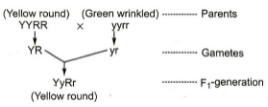
(D) Mendel performed a dihybrid cross between a homozygous dominant plant with yellow and round seeds $(YYRR)$ and a homozygous recessive plant with green and wrinkled seeds $(yyrr)$.
The gametes produced by the $YYRR$ parent are $YR$,and the gametes produced by the $yyrr$ parent are $yr$.
Upon fertilization,these gametes fuse to form the $F_{1}$ generation with the genotype $YyRr$.
Since yellow $(Y)$ is dominant over green $(y)$ and round $(R)$ is dominant over wrinkled $(r)$,all individuals in the $F_{1}$ generation will exhibit the dominant phenotype,which is yellow and round seeds.
The gametes produced by the $YYRR$ parent are $YR$,and the gametes produced by the $yyrr$ parent are $yr$.
Upon fertilization,these gametes fuse to form the $F_{1}$ generation with the genotype $YyRr$.
Since yellow $(Y)$ is dominant over green $(y)$ and round $(R)$ is dominant over wrinkled $(r)$,all individuals in the $F_{1}$ generation will exhibit the dominant phenotype,which is yellow and round seeds.
0 likes
View Solution136
MediumMCQ
Types of genotype observed in a dihybrid cross are
A
$9$
B
$12$
C
$4$
D
$6$
Solution
(A) In a dihybrid cross involving two traits (e.g.,$AaBb \times AaBb$),the genotypic ratio is $1:2:1:2:4:2:1:2:1$.
This ratio represents $9$ distinct types of genotypes.
In contrast,there are only $4$ types of phenotypes observed in the $F_2$ generation.
This ratio represents $9$ distinct types of genotypes.
In contrast,there are only $4$ types of phenotypes observed in the $F_2$ generation.
0 likes
View Solution137
MediumMCQ
If $AAbb \times aaBB$,then the phenotypic ratio of its $F_{2}$ progeny will be
A
$9: 3: 3: 1$
B
$1: 2: 1$
C
$1: 1: 1: 1$
D
$4: 1$
Solution
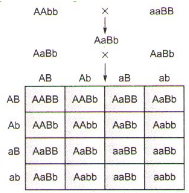
(A) The cross between $AAbb$ and $aaBB$ produces an $F_{1}$ generation with the genotype $AaBb$.
When $F_{1}$ individuals $(AaBb)$ are self-crossed $(AaBb \times AaBb)$,it represents a standard dihybrid cross.
According to Mendel's Law of Independent Assortment,the phenotypic ratio of the $F_{2}$ progeny in a dihybrid cross is $9: 3: 3: 1$.
This ratio consists of $9$ individuals showing both dominant traits,$3$ showing one dominant and one recessive trait,$3$ showing the other dominant and recessive trait,and $1$ showing both recessive traits.
When $F_{1}$ individuals $(AaBb)$ are self-crossed $(AaBb \times AaBb)$,it represents a standard dihybrid cross.
According to Mendel's Law of Independent Assortment,the phenotypic ratio of the $F_{2}$ progeny in a dihybrid cross is $9: 3: 3: 1$.
This ratio consists of $9$ individuals showing both dominant traits,$3$ showing one dominant and one recessive trait,$3$ showing the other dominant and recessive trait,and $1$ showing both recessive traits.
0 likes
View Solution138
MediumMCQ
The dihybrid test cross ratio of $1: 1: 1: 1$ proves that
A
$F_{1}$ hybrid produces four different types of gametes
B
$F_{1}$ hybrid produces two different types of gametes
C
Parents produce two different types of gametes
D
None of the above
Solution
(A) dihybrid cross involves two pairs of contrasting characters.
In a dihybrid test cross,the $F_{1}$ hybrid (heterozygous for two traits) is crossed with a double recessive parent.
The resulting phenotypic ratio of $1: 1: 1: 1$ indicates that the $F_{1}$ hybrid produces four different types of gametes in equal proportions.
This occurs because the two pairs of alleles segregate and assort independently during meiosis,according to Mendel's Law of Independent Assortment.
In a dihybrid test cross,the $F_{1}$ hybrid (heterozygous for two traits) is crossed with a double recessive parent.
The resulting phenotypic ratio of $1: 1: 1: 1$ indicates that the $F_{1}$ hybrid produces four different types of gametes in equal proportions.
This occurs because the two pairs of alleles segregate and assort independently during meiosis,according to Mendel's Law of Independent Assortment.
0 likes
View Solution139
MediumMCQ
In a cross between yellow round $(YYRR)$ and pure breeding pea plants having green wrinkled $(yyrr)$ seeds,find out the total number of seeds (plants) having yellow colour in the $F_2$ generation out of $16$ offspring.
A
$12$
B
$10$
C
$9$
D
$3$
Solution
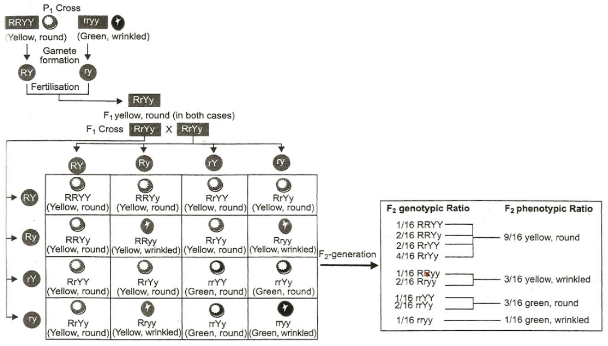
(A) In a dihybrid cross between yellow round $(YYRR)$ and green wrinkled $(yyrr)$ pea plants,the $F_1$ generation produces heterozygous yellow round $(RrYy)$ plants.
When $F_1$ plants are self-crossed,the $F_2$ generation phenotypic ratio is $9:3:3:1$.
The phenotypes are:
$9$ Yellow Round
$3$ Yellow Wrinkled
$3$ Green Round
$1$ Green Wrinkled
Total plants with yellow colour = (Yellow Round + Yellow Wrinkled) = $9 + 3 = 12$.
When $F_1$ plants are self-crossed,the $F_2$ generation phenotypic ratio is $9:3:3:1$.
The phenotypes are:
$9$ Yellow Round
$3$ Yellow Wrinkled
$3$ Green Round
$1$ Green Wrinkled
Total plants with yellow colour = (Yellow Round + Yellow Wrinkled) = $9 + 3 = 12$.
0 likes
View Solution140
MediumMCQ
How many types of gametes may be produced by genotype $D/d : E/e : F/f$?
A
$27$
B
$8$
C
$3$
D
$6$
Solution
(B) The number of different types of gametes produced by an organism can be calculated using the formula $2^n$,where $n$ is the number of heterozygous gene pairs.
In the given genotype $D/d : E/e : F/f$,there are $3$ heterozygous pairs ($D/d$,$E/e$,and $F/f$).
Therefore,$n = 3$.
The number of gametes = $2^n = 2^3 = 8$.
Thus,$8$ types of gametes will be produced.
In the given genotype $D/d : E/e : F/f$,there are $3$ heterozygous pairs ($D/d$,$E/e$,and $F/f$).
Therefore,$n = 3$.
The number of gametes = $2^n = 2^3 = 8$.
Thus,$8$ types of gametes will be produced.
0 likes
View Solution141
MediumMCQ
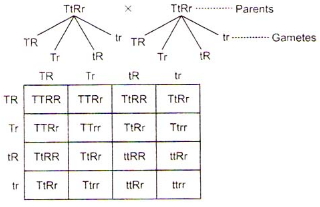
In a dihybrid cross between individuals with genotypes $TtRr$,if the total number of offspring is $16$,identify the number of individuals with genotypes $TtRr$ and $TtRR$ among them.
A
$4$ and $2$
B
$2$ and $3$
C
$3$ and $1$
D
$1$ and $2$
Solution
(A) In a dihybrid cross of $TtRr \times TtRr$,the Punnett square yields $16$ combinations.
Based on the Mendelian dihybrid ratio,the genotypic distribution is as follows:
$TtRr$ appears $4$ times in the $4 \times 4$ grid.
$TtRR$ appears $2$ times in the $4 \times 4$ grid.
Therefore,the number of individuals with genotypes $TtRr$ and $TtRR$ are $4$ and $2$ respectively.
Based on the Mendelian dihybrid ratio,the genotypic distribution is as follows:
$TtRr$ appears $4$ times in the $4 \times 4$ grid.
$TtRR$ appears $2$ times in the $4 \times 4$ grid.
Therefore,the number of individuals with genotypes $TtRr$ and $TtRR$ are $4$ and $2$ respectively.
0 likes
View Solution142
MediumMCQ
In a cross between yellow round $(YYRR)$ and green wrinkled $(yyrr)$ pea plants,find out the ratio between seeds having yellow and green seed colour in the $F_{2}$ generation.
A
$3: 2$
B
$3: 1$
C
$9: 7$
D
$7: 9$
Solution
(B) In a dihybrid cross between yellow round $(YYRR)$ and green wrinkled $(yyrr)$ seeds,the $F_{1}$ generation produces all yellow round $(YyRr)$ seeds.
When $F_{1}$ plants are self-pollinated,the $F_{2}$ generation phenotypic ratio is $9: 3: 3: 1$.
This ratio consists of $9$ yellow round,$3$ yellow wrinkled,$3$ green round,and $1$ green wrinkled.
To find the ratio of seed colours,we sum the phenotypes based on colour:
Yellow seeds = Yellow round $(9) +$ Yellow wrinkled $(3) = 12$.
Green seeds = Green round $(3) +$ Green wrinkled $(1) = 4$.
The ratio of yellow to green seeds is $12: 4$,which simplifies to $3: 1$.
This confirms that each trait follows the Law of Independent Assortment,where the inheritance of seed colour is independent of seed shape,resulting in a $3: 1$ monohybrid ratio for each character.
When $F_{1}$ plants are self-pollinated,the $F_{2}$ generation phenotypic ratio is $9: 3: 3: 1$.
This ratio consists of $9$ yellow round,$3$ yellow wrinkled,$3$ green round,and $1$ green wrinkled.
To find the ratio of seed colours,we sum the phenotypes based on colour:
Yellow seeds = Yellow round $(9) +$ Yellow wrinkled $(3) = 12$.
Green seeds = Green round $(3) +$ Green wrinkled $(1) = 4$.
The ratio of yellow to green seeds is $12: 4$,which simplifies to $3: 1$.
This confirms that each trait follows the Law of Independent Assortment,where the inheritance of seed colour is independent of seed shape,resulting in a $3: 1$ monohybrid ratio for each character.
0 likes
View Solution143
MediumMCQ
Probability of genotype $TTrr$ in $F_{2}$-generation of a dihybrid cross is
A
$\frac{1}{16}$
B
$\frac{3}{16}$
C
$\frac{9}{16}$
D
$\frac{6}{16}$
Solution
(A) In a dihybrid cross involving two traits (e.g.,height $T/t$ and seed shape $R/r$),the $F_{2}$ generation is produced by selfing the $F_{1}$ dihybrid $(TtRr \times TtRr)$.
According to the law of independent assortment,the probability of each allele combination can be calculated independently.
The probability of genotype $TT$ is $\frac{1}{4}$ and the probability of genotype $rr$ is $\frac{1}{4}$.
Therefore,the probability of the combined genotype $TTrr$ is $\frac{1}{4} \times \frac{1}{4} = \frac{1}{16}$.
According to the law of independent assortment,the probability of each allele combination can be calculated independently.
The probability of genotype $TT$ is $\frac{1}{4}$ and the probability of genotype $rr$ is $\frac{1}{4}$.
Therefore,the probability of the combined genotype $TTrr$ is $\frac{1}{4} \times \frac{1}{4} = \frac{1}{16}$.
0 likes
View Solution144
MediumMCQ
In Mendel's experiments with garden pea,round seed shape $(RR)$ was dominant over wrinkled seeds $(rr),$ and yellow cotyledon $(YY)$ was dominant over green cotyledon $(yy).$ What are the expected phenotypes in the $F_{2}$-generation of the cross $RRYY \times rryy$?
A
Only round seeds with green cotyledons
B
Only wrinkled seeds with yellow cotyledons
C
Only wrinkled seeds with green cotyledons
D
Round yellow,round green,wrinkled yellow,and wrinkled green seeds
Solution
(D) When a dihybrid cross is performed between plants with round yellow seeds $(RRYY)$ and wrinkled green seeds $(rryy)$,the $F_{1}$-generation produces all heterozygous plants with round yellow seeds $(RrYy)$.
When these $F_{1}$ plants are self-pollinated to obtain the $F_{2}$-generation,the law of independent assortment applies.
The phenotypic ratio obtained in the $F_{2}$-generation is $9:3:3:1$.
This results in four types of phenotypes: round yellow,round green,wrinkled yellow,and wrinkled green seeds.
When these $F_{1}$ plants are self-pollinated to obtain the $F_{2}$-generation,the law of independent assortment applies.
The phenotypic ratio obtained in the $F_{2}$-generation is $9:3:3:1$.
This results in four types of phenotypes: round yellow,round green,wrinkled yellow,and wrinkled green seeds.
0 likes
View Solution145
MediumMCQ
$F_{1}$ progeny of a Mendelian dihybrid cross produces:
A
Two types of pollen grains
B
Four genotypes of gametes
C
Two types of eggs
D
Four types of pollens only
Solution
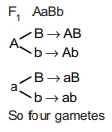
(B) In a Mendelian dihybrid cross,the $F_{1}$ generation is heterozygous for both traits,represented by the genotype $AaBb$.
According to the law of independent assortment,each pair of alleles segregates independently of the other pairs during gamete formation.
For the genotype $AaBb$,the possible combinations of alleles in the gametes are $AB$,$Ab$,$aB$,and $ab$.
These represent four distinct genotypes of gametes,which can function as either pollen grains or egg cells.
Therefore,the $F_{1}$ progeny produces four genotypes of gametes.
According to the law of independent assortment,each pair of alleles segregates independently of the other pairs during gamete formation.
For the genotype $AaBb$,the possible combinations of alleles in the gametes are $AB$,$Ab$,$aB$,and $ab$.
These represent four distinct genotypes of gametes,which can function as either pollen grains or egg cells.
Therefore,the $F_{1}$ progeny produces four genotypes of gametes.
0 likes
View Solution146
MediumMCQ
When Mendel self-hybridised the $F_{1}$ plants $(RrYy)$,he found that dominant and recessive traits of one character are segregated in a
A
$9 : 1$ ratio
B
$3 : 3$ ratio
C
$10 : 6$ ratio
D
$3 : 1$ ratio
Solution
(D) In a dihybrid cross,Mendel crossed $F_{1}$ plants $(RrYy)$ with themselves.
According to the law of independent assortment,the traits for each character segregate independently.
For a single character (e.g.,seed shape $Rr \times Rr$ or seed color $Yy \times Yy$),the phenotypic ratio of dominant to recessive traits in the $F_{2}$ generation is always $3:1$.
Thus,for any one character,the dominant and recessive traits are segregated in a $3:1$ ratio.
According to the law of independent assortment,the traits for each character segregate independently.
For a single character (e.g.,seed shape $Rr \times Rr$ or seed color $Yy \times Yy$),the phenotypic ratio of dominant to recessive traits in the $F_{2}$ generation is always $3:1$.
Thus,for any one character,the dominant and recessive traits are segregated in a $3:1$ ratio.
0 likes
View Solution147
MediumMCQ
Heterozygous round and yellow seeded pea plants were selfed and a total of $800$ seeds were collected. What is the total number of seeds with the first dominant trait (round) and the second recessive trait (green)?
A
$950$
B
$300$
C
$200$
D
$150$
Solution
(D) In a dihybrid cross involving heterozygous round and yellow seeded pea plants $(RrYy \times RrYy)$,the phenotypic ratio in the $F_2$ generation is $9:3:3:1$.
Here,the traits are:
Round $(R)$ is dominant,Wrinkled $(r)$ is recessive.
Yellow $(Y)$ is dominant,Green $(y)$ is recessive.
The question asks for seeds with the first dominant trait (Round) and the second recessive trait (Green),which corresponds to the genotype $R-yy$.
The probability of obtaining Round and Green seeds is $\frac{3}{16}$.
Given the total number of seeds is $800$,the number of Round and Green seeds is calculated as:
$800 \times \frac{3}{16} = 50 \times 3 = 150$.
Here,the traits are:
Round $(R)$ is dominant,Wrinkled $(r)$ is recessive.
Yellow $(Y)$ is dominant,Green $(y)$ is recessive.
The question asks for seeds with the first dominant trait (Round) and the second recessive trait (Green),which corresponds to the genotype $R-yy$.
The probability of obtaining Round and Green seeds is $\frac{3}{16}$.
Given the total number of seeds is $800$,the number of Round and Green seeds is calculated as:
$800 \times \frac{3}{16} = 50 \times 3 = 150$.
0 likes
View Solution148
MediumMCQ
Heterozygous tall and violet flowered pea plants were selfed and total $512$ seeds are collected. What will be the total number of seeds that are heterozygous for both traits?
A
$128$
B
$256$
C
$384$
D
$64$
Solution
(A) The genotype of the heterozygous tall and violet flowered pea plant is $TtRr$.
When $TtRr$ is selfed $(TtRr \times TtRr)$,the phenotypic ratio of the offspring is $9:3:3:1$.
The genotypic ratio for the double heterozygous condition $(TtRr)$ in a dihybrid cross is $4/16$ (or $1/4$ of the total population).
Given the total number of seeds is $512$.
The number of seeds heterozygous for both traits $(TtRr)$ = $512 \times (4/16) = 512 \times (1/4) = 128$.
When $TtRr$ is selfed $(TtRr \times TtRr)$,the phenotypic ratio of the offspring is $9:3:3:1$.
The genotypic ratio for the double heterozygous condition $(TtRr)$ in a dihybrid cross is $4/16$ (or $1/4$ of the total population).
Given the total number of seeds is $512$.
The number of seeds heterozygous for both traits $(TtRr)$ = $512 \times (4/16) = 512 \times (1/4) = 128$.
0 likes
View Solution149
MediumMCQ
Mark the odd one (w.r.t. $F_{2}$ generation of Mendelian dihybrid cross).
A
Frequency of $TtRR$ genotype = $12.5\;\%$
B
Frequency of $ttrr$ genotype = $6.25\;\%$
C
Frequency of $TTRR$ genotype = $6.25\;\%$
D
Frequency of $ttRr$ genotype = $25\;\%$
Solution
(D) In a Mendelian dihybrid cross,the $F_{2}$ generation follows a phenotypic ratio of $9:3:3:1$ and a genotypic ratio based on the $1:2:1:2:4:2:1:2:1$ distribution.
Total possible combinations are $16$.
$1$. Frequency of $TtRR$ genotype: $2/16 = 1/8 = 12.5\%$.
$2$. Frequency of $ttrr$ genotype: $1/16 = 6.25\%$.
$3$. Frequency of $TTRR$ genotype: $1/16 = 6.25\%$.
$4$. Frequency of $ttRr$ genotype: $2/16 = 1/8 = 12.5\%$.
Option $D$ states the frequency of $ttRr$ is $25\%$,which is incorrect as it is $12.5\%$.
Total possible combinations are $16$.
$1$. Frequency of $TtRR$ genotype: $2/16 = 1/8 = 12.5\%$.
$2$. Frequency of $ttrr$ genotype: $1/16 = 6.25\%$.
$3$. Frequency of $TTRR$ genotype: $1/16 = 6.25\%$.
$4$. Frequency of $ttRr$ genotype: $2/16 = 1/8 = 12.5\%$.
Option $D$ states the frequency of $ttRr$ is $25\%$,which is incorrect as it is $12.5\%$.
0 likes
View Solution150
MediumMCQ
Find out the frequency of $AabbCcDdee$ if parents are $AabbCCddEe$ and $AabbccDdee$. (in $\%$)
A
$0.78$
B
$12.5$
C
$25$
D
$50$
Solution
(B) To find the frequency of the genotype $AabbCcDdee$,we analyze each gene locus independently assuming independent assortment:
$1$. For gene $A$: $Aa \times Aa \rightarrow$ probability of $Aa$ is $2/4 = 1/2$.
$2$. For gene $b$: $bb \times bb \rightarrow$ probability of $bb$ is $1$.
$3$. For gene $C$: $CC \times cc \rightarrow$ probability of $Cc$ is $1$.
$4$. For gene $D$: $dd \times Dd \rightarrow$ probability of $Dd$ is $2/4 = 1/2$.
$5$. For gene $e$: $Ee \times ee \rightarrow$ probability of $ee$ is $2/4 = 1/2$.
Multiplying these independent probabilities: $(1/2) \times 1 \times 1 \times (1/2) \times (1/2) = 1/8 = 0.125$ or $12.5\%$.
$1$. For gene $A$: $Aa \times Aa \rightarrow$ probability of $Aa$ is $2/4 = 1/2$.
$2$. For gene $b$: $bb \times bb \rightarrow$ probability of $bb$ is $1$.
$3$. For gene $C$: $CC \times cc \rightarrow$ probability of $Cc$ is $1$.
$4$. For gene $D$: $dd \times Dd \rightarrow$ probability of $Dd$ is $2/4 = 1/2$.
$5$. For gene $e$: $Ee \times ee \rightarrow$ probability of $ee$ is $2/4 = 1/2$.
Multiplying these independent probabilities: $(1/2) \times 1 \times 1 \times (1/2) \times (1/2) = 1/8 = 0.125$ or $12.5\%$.
0 likes
View SolutionPrinciples of Inheritance and Variation — Inheritance of two gene · Frequently Asked Questions
1Are these Principles of Inheritance and Variation questions useful for JEE and NEET?
Yes. All questions in this section are mapped to JEE Main and NEET exam patterns. Previous year questions from JEE Main, NEET, GUJCET and state-level exams are included with full solutions.
2Can I switch to Hindi or Gujarati for these questions?
Yes. Use the language tabs in the hero section or the sidebar to view the same questions and solutions in English, Hindi or Gujarati.
3How do I generate a question paper from this subtopic?
Use the Vedclass Exam Paper Generator — select the chapter and subtopic, set difficulty, and generate Sets A, B, C, D automatically. First 3 chapters of every subject are free.
Vedclass Products
For Students
Vedclass Test Series
Mock tests in real JEE/NEET style with performance analysis. 5-day free trial.
Start Free TrialFor Teachers
Exam Paper Generator
Generate Set A/B/C/D papers from this chapter in 2 minutes. 3 chapters free.
Try FreeFor Institutes
Online Exam Module
Live online exams with unlimited students, 360° analytics & white-label branding.
See DemoFor Teachers & Institutes
Generate a Principles of Inheritance and Variation Exam Paper in 2 Minutes
Select subtopic & difficulty — Sets A, B, C, D auto-generated with No Repeat logic.
First 3 chapters of every subject are free — no payment required.