
A English
Transverse Stationary Waves and Sonometer Questions in English
Class 11 Physics · Waves and Sound · Transverse Stationary Waves and Sonometer
225+
Questions
English
Language
100%
With Solutions
Showing 49 of 225 questions in English
51
DifficultMCQ
Standing waves are generated on a sonometer string loaded with a cylindrical body. If the cylinder is completely immersed in water,the length of the loops changes by a factor of $2.2$. The specific gravity of the material of the cylinder is
A
$1.11$
B
$2.15$
C
$2.50$
D
$1.26$
Solution
(D) The frequency of the sonometer wire is given by $f = \frac{1}{2L} \sqrt{\frac{T}{\mu}}$,where $L$ is the length of the loop,$T$ is the tension,and $\mu$ is the linear mass density.
Since the frequency $f$ remains constant,we have $\frac{1}{L_1} \sqrt{T_1} = \frac{1}{L_2} \sqrt{T_2}$.
Given $\frac{L_1}{L_2} = 2.2$,we have $\sqrt{\frac{T_1}{T_2}} = 2.2$,which implies $T_1 = (2.2)^2 T_2 = 4.84 T_2$.
When the cylinder is in air,$T_1 = Mg$. When immersed in water,$T_2 = Mg - F_B$,where $F_B$ is the buoyant force.
$F_B = V_{cyl} \rho_w g = \frac{M}{\rho_{cyl}} \rho_w g = \frac{Mg}{S.G.}$,where $S.G.$ is the specific gravity.
Thus,$Mg = 4.84 (Mg - \frac{Mg}{S.G.})$.
Dividing by $Mg$,we get $1 = 4.84 (1 - \frac{1}{S.G.})$.
$1 = 4.84 - \frac{4.84}{S.G.}$,which gives $\frac{4.84}{S.G.} = 3.84$.
$S.G. = \frac{4.84}{3.84} \approx 1.26$.
Since the frequency $f$ remains constant,we have $\frac{1}{L_1} \sqrt{T_1} = \frac{1}{L_2} \sqrt{T_2}$.
Given $\frac{L_1}{L_2} = 2.2$,we have $\sqrt{\frac{T_1}{T_2}} = 2.2$,which implies $T_1 = (2.2)^2 T_2 = 4.84 T_2$.
When the cylinder is in air,$T_1 = Mg$. When immersed in water,$T_2 = Mg - F_B$,where $F_B$ is the buoyant force.
$F_B = V_{cyl} \rho_w g = \frac{M}{\rho_{cyl}} \rho_w g = \frac{Mg}{S.G.}$,where $S.G.$ is the specific gravity.
Thus,$Mg = 4.84 (Mg - \frac{Mg}{S.G.})$.
Dividing by $Mg$,we get $1 = 4.84 (1 - \frac{1}{S.G.})$.
$1 = 4.84 - \frac{4.84}{S.G.}$,which gives $\frac{4.84}{S.G.} = 3.84$.
$S.G. = \frac{4.84}{3.84} \approx 1.26$.
0 likes
View Solution52
MediumMCQ
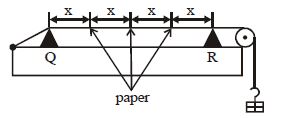
The given diagram shows three light pieces of paper placed on a wire that is stretched over two supports,$Q$ and $R$,a distance $4x$ apart. When the wire is made to vibrate at a particular frequency,all the pieces of paper,except the middle one,fall off the wire. Which of the following could be the wavelength of the vibration (in $x$)?
A
$2$
B
$3$
C
$4$
D
$8$
Solution
(C) In a stationary wave,the points where the amplitude of vibration is zero are called nodes,and the points where the amplitude is maximum are called antinodes.
Paper pieces placed at antinodes will fall off due to maximum vibration,while a paper piece placed at a node will remain on the wire because the amplitude of vibration at a node is zero.
Since the middle piece of paper does not fall,it must be located at a node.
The distance between the two supports $Q$ and $R$ is $L = 4x$.
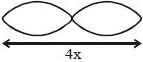
Given that the middle piece is at a node,the wire vibrates in two loops (each of length $2x$).
The length of one loop is $\frac{\lambda}{2}$.
Therefore,$2x = \frac{\lambda}{2}$,which gives $\lambda = 4x$.
Thus,the wavelength of the vibration is $4x$.
Paper pieces placed at antinodes will fall off due to maximum vibration,while a paper piece placed at a node will remain on the wire because the amplitude of vibration at a node is zero.
Since the middle piece of paper does not fall,it must be located at a node.
The distance between the two supports $Q$ and $R$ is $L = 4x$.
Given that the middle piece is at a node,the wire vibrates in two loops (each of length $2x$).
The length of one loop is $\frac{\lambda}{2}$.
Therefore,$2x = \frac{\lambda}{2}$,which gives $\lambda = 4x$.
Thus,the wavelength of the vibration is $4x$.
0 likes
View Solution53
DifficultMCQ
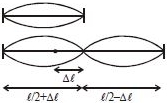
The fundamental frequency of a sonometer wire of length $l$ is $n_0$. $A$ bridge is now introduced at a distance of $\Delta l$ (where $\Delta l \ll l$) from the center of the wire. The lengths of wire on the two sides of the bridge are now vibrated in their fundamental modes. Then,the beat frequency is nearly
A
$n_0 \Delta l / l$
B
$8 n_0 \Delta l / l$
C
$2 n_0 \Delta l / l$
D
$n_0 \Delta l / 2l$
Solution
(B) The fundamental frequency of the original wire of length $l$ is $n_0 = \frac{v}{2l}$,where $v$ is the wave speed.
When a bridge is introduced at a distance $\Delta l$ from the center,the wire is divided into two segments of lengths $l_1 = \frac{l}{2} + \Delta l$ and $l_2 = \frac{l}{2} - \Delta l$.
The fundamental frequencies of these two segments are:
$n_1 = \frac{v}{2l_1} = \frac{v}{2(\frac{l}{2} + \Delta l)} = \frac{v}{l + 2\Delta l}$
$n_2 = \frac{v}{2l_2} = \frac{v}{2(\frac{l}{2} - \Delta l)} = \frac{v}{l - 2\Delta l}$
The beat frequency is $|n_2 - n_1| = \frac{v}{l - 2\Delta l} - \frac{v}{l + 2\Delta l}$.
Using the binomial approximation $(1 \pm x)^{-1} \approx 1 \mp x$ for $x \ll 1$:
$|n_2 - n_1| = \frac{v}{l} \left( (1 - \frac{2\Delta l}{l})^{-1} - (1 + \frac{2\Delta l}{l})^{-1} \right)$
$\approx \frac{v}{l} \left( (1 + \frac{2\Delta l}{l}) - (1 - \frac{2\Delta l}{l}) \right)$
$= \frac{v}{l} \left( \frac{4\Delta l}{l} \right) = \frac{4v}{l} \cdot \frac{\Delta l}{l}$.
Since $n_0 = \frac{v}{2l}$,we have $\frac{v}{l} = 2n_0$.
Substituting this,the beat frequency is $4(2n_0) \frac{\Delta l}{l} = 8 n_0 \frac{\Delta l}{l}$.
When a bridge is introduced at a distance $\Delta l$ from the center,the wire is divided into two segments of lengths $l_1 = \frac{l}{2} + \Delta l$ and $l_2 = \frac{l}{2} - \Delta l$.
The fundamental frequencies of these two segments are:
$n_1 = \frac{v}{2l_1} = \frac{v}{2(\frac{l}{2} + \Delta l)} = \frac{v}{l + 2\Delta l}$
$n_2 = \frac{v}{2l_2} = \frac{v}{2(\frac{l}{2} - \Delta l)} = \frac{v}{l - 2\Delta l}$
The beat frequency is $|n_2 - n_1| = \frac{v}{l - 2\Delta l} - \frac{v}{l + 2\Delta l}$.
Using the binomial approximation $(1 \pm x)^{-1} \approx 1 \mp x$ for $x \ll 1$:
$|n_2 - n_1| = \frac{v}{l} \left( (1 - \frac{2\Delta l}{l})^{-1} - (1 + \frac{2\Delta l}{l})^{-1} \right)$
$\approx \frac{v}{l} \left( (1 + \frac{2\Delta l}{l}) - (1 - \frac{2\Delta l}{l}) \right)$
$= \frac{v}{l} \left( \frac{4\Delta l}{l} \right) = \frac{4v}{l} \cdot \frac{\Delta l}{l}$.
Since $n_0 = \frac{v}{2l}$,we have $\frac{v}{l} = 2n_0$.
Substituting this,the beat frequency is $4(2n_0) \frac{\Delta l}{l} = 8 n_0 \frac{\Delta l}{l}$.
0 likes
View Solution54
DifficultMCQ
The fundamental frequency of a sonometer wire increases by $6 \ Hz$ if its tension is increased by $44\%$ keeping the length constant. The change in the fundamental frequency of the sonometer wire in $Hz$ when the length of the wire is increased by $20\%$,keeping the original tension in the wire will be :-
A
$2$
B
$4$
C
$5$
D
$10$
Solution
(C) The fundamental frequency of a sonometer wire is given by $n = \frac{1}{2l} \sqrt{\frac{T}{m}}$.
Case $1$: Tension is increased by $44\%$. The new tension $T' = T + 0.44T = 1.44T$.
The new frequency $n' = n + 6$.
$n + 6 = \frac{1}{2l} \sqrt{\frac{1.44T}{m}} = 1.2 \left( \frac{1}{2l} \sqrt{\frac{T}{m}} \right) = 1.2n$.
$0.2n = 6 \Rightarrow n = 30 \ Hz$.
Case $2$: Length is increased by $20\%$. The new length $l' = l + 0.2l = 1.2l$.
The new frequency $n'' = \frac{1}{2l'} \sqrt{\frac{T}{m}} = \frac{1}{2(1.2l)} \sqrt{\frac{T}{m}} = \frac{n}{1.2} = \frac{30}{1.2} = 25 \ Hz$.
The change in frequency is $|n - n''| = |30 - 25| = 5 \ Hz$.
Case $1$: Tension is increased by $44\%$. The new tension $T' = T + 0.44T = 1.44T$.
The new frequency $n' = n + 6$.
$n + 6 = \frac{1}{2l} \sqrt{\frac{1.44T}{m}} = 1.2 \left( \frac{1}{2l} \sqrt{\frac{T}{m}} \right) = 1.2n$.
$0.2n = 6 \Rightarrow n = 30 \ Hz$.
Case $2$: Length is increased by $20\%$. The new length $l' = l + 0.2l = 1.2l$.
The new frequency $n'' = \frac{1}{2l'} \sqrt{\frac{T}{m}} = \frac{1}{2(1.2l)} \sqrt{\frac{T}{m}} = \frac{n}{1.2} = \frac{30}{1.2} = 25 \ Hz$.
The change in frequency is $|n - n''| = |30 - 25| = 5 \ Hz$.
0 likes
View Solution55
DifficultMCQ
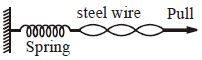
$A$ steel wire is used to stretch a spring. An oscillating magnetic field drives the steel wire up and down. $A$ standing wave with three antinodes is created when the spring is stretched by $4.0\, cm$. What stretch of the spring produces a standing wave with two antinodes with the same frequency (in $, cm$)?
A
$4$
B
$12$
C
$9$
D
$6$
Solution
(C) The frequency $f$ of a standing wave in a wire under tension $T$ is given by $f = \frac{n}{2L} \sqrt{\frac{T}{\mu}}$,where $n$ is the number of antinodes,$L$ is the length of the wire,and $\mu$ is the linear mass density.
The tension $T$ in the wire is provided by the spring,so $T = kx$,where $k$ is the spring constant and $x$ is the stretch.
Thus,$f = \frac{n}{2L} \sqrt{\frac{kx}{\mu}}$.
For the first case,$n_1 = 3$ and $x_1 = 4.0\, cm$. So,$f = \frac{3}{2L} \sqrt{\frac{k(4.0)}{\mu}}$.
For the second case,$n_2 = 2$ and we need to find $x_2$. Since the frequency $f$ is the same,$f = \frac{2}{2L} \sqrt{\frac{k(x_2)}{\mu}}$.
Equating the two expressions for $f$: $\frac{3}{2L} \sqrt{\frac{k(4.0)}{\mu}} = \frac{2}{2L} \sqrt{\frac{k(x_2)}{\mu}}$.
Simplifying,we get $3 \sqrt{4.0} = 2 \sqrt{x_2}$.
$3 \times 2 = 2 \sqrt{x_2} \implies 6 = 2 \sqrt{x_2} \implies \sqrt{x_2} = 3$.
Squaring both sides,$x_2 = 9\, cm$.
The tension $T$ in the wire is provided by the spring,so $T = kx$,where $k$ is the spring constant and $x$ is the stretch.
Thus,$f = \frac{n}{2L} \sqrt{\frac{kx}{\mu}}$.
For the first case,$n_1 = 3$ and $x_1 = 4.0\, cm$. So,$f = \frac{3}{2L} \sqrt{\frac{k(4.0)}{\mu}}$.
For the second case,$n_2 = 2$ and we need to find $x_2$. Since the frequency $f$ is the same,$f = \frac{2}{2L} \sqrt{\frac{k(x_2)}{\mu}}$.
Equating the two expressions for $f$: $\frac{3}{2L} \sqrt{\frac{k(4.0)}{\mu}} = \frac{2}{2L} \sqrt{\frac{k(x_2)}{\mu}}$.
Simplifying,we get $3 \sqrt{4.0} = 2 \sqrt{x_2}$.
$3 \times 2 = 2 \sqrt{x_2} \implies 6 = 2 \sqrt{x_2} \implies \sqrt{x_2} = 3$.
Squaring both sides,$x_2 = 9\, cm$.
0 likes
View Solution56
DifficultMCQ
$L$ length and $M$ mass uniform wire is stretched between two fixed points with tension $F$. $A$ sound of frequency $\mu$ is impressed on it. The maximum vibrational energy exists in the wire when $\mu$ =
A
$\frac{1}{2}\sqrt{\frac{ML}{F}}$
B
$\sqrt{\frac{FL}{M}}$
C
$2\sqrt{\frac{MF}{L}}$
D
$\frac{1}{2}\sqrt{\frac{F}{ML}}$
Solution
(D) The fundamental frequency of a stretched wire is given by $\mu = \frac{1}{2L} \sqrt{\frac{F}{\lambda}}$,where $\lambda$ is the mass per unit length.
Given that the total mass is $M$ and length is $L$,the mass per unit length $\lambda = \frac{M}{L}$.
Substituting this into the frequency formula:
$\mu = \frac{1}{2L} \sqrt{\frac{F}{M/L}}$
$\mu = \frac{1}{2L} \sqrt{\frac{FL}{M}}$
$\mu = \frac{1}{2} \sqrt{\frac{FL}{M \cdot L^2}}$
$\mu = \frac{1}{2} \sqrt{\frac{F}{ML}}$
Resonance occurs when the impressed frequency matches the fundamental frequency of the wire,leading to maximum vibrational energy.
Given that the total mass is $M$ and length is $L$,the mass per unit length $\lambda = \frac{M}{L}$.
Substituting this into the frequency formula:
$\mu = \frac{1}{2L} \sqrt{\frac{F}{M/L}}$
$\mu = \frac{1}{2L} \sqrt{\frac{FL}{M}}$
$\mu = \frac{1}{2} \sqrt{\frac{FL}{M \cdot L^2}}$
$\mu = \frac{1}{2} \sqrt{\frac{F}{ML}}$
Resonance occurs when the impressed frequency matches the fundamental frequency of the wire,leading to maximum vibrational energy.
0 likes
View Solution57
DifficultMCQ
Two vibrating strings of the same material but lengths $L$ and $2L$ have radii $2r$ and $r$ respectively. They are stretched under the same tension. Both the strings vibrate in their fundamental modes,the one of length $L$ with frequency $f_1$ and the other with frequency $f_2$. The ratio $\frac{f_1}{f_2}$ is given by
A
$2$
B
$4$
C
$8$
D
$1$
Solution
(D) The fundamental frequency of a vibrating string is given by $f = \frac{1}{2L} \sqrt{\frac{T}{\mu}}$,where $T$ is the tension and $\mu$ is the linear mass density.
Linear mass density $\mu = \text{mass per unit length} = \rho \times \text{Area of cross-section} = \rho \pi r^2$,where $\rho$ is the density of the material.
Given: $L_1 = L$,$r_1 = 2r$,$L_2 = 2L$,$r_2 = r$,and $T_1 = T_2 = T$.
For the first string: $f_1 = \frac{1}{2L_1} \sqrt{\frac{T}{\rho \pi r_1^2}} = \frac{1}{2L} \sqrt{\frac{T}{\rho \pi (2r)^2}} = \frac{1}{4L} \sqrt{\frac{T}{\rho \pi r^2}}$.
For the second string: $f_2 = \frac{1}{2L_2} \sqrt{\frac{T}{\rho \pi r_2^2}} = \frac{1}{2(2L)} \sqrt{\frac{T}{\rho \pi r^2}} = \frac{1}{4L} \sqrt{\frac{T}{\rho \pi r^2}}$.
Taking the ratio: $\frac{f_1}{f_2} = \frac{\frac{1}{4L} \sqrt{\frac{T}{\rho \pi r^2}}}{\frac{1}{4L} \sqrt{\frac{T}{\rho \pi r^2}}} = 1$.
Linear mass density $\mu = \text{mass per unit length} = \rho \times \text{Area of cross-section} = \rho \pi r^2$,where $\rho$ is the density of the material.
Given: $L_1 = L$,$r_1 = 2r$,$L_2 = 2L$,$r_2 = r$,and $T_1 = T_2 = T$.
For the first string: $f_1 = \frac{1}{2L_1} \sqrt{\frac{T}{\rho \pi r_1^2}} = \frac{1}{2L} \sqrt{\frac{T}{\rho \pi (2r)^2}} = \frac{1}{4L} \sqrt{\frac{T}{\rho \pi r^2}}$.
For the second string: $f_2 = \frac{1}{2L_2} \sqrt{\frac{T}{\rho \pi r_2^2}} = \frac{1}{2(2L)} \sqrt{\frac{T}{\rho \pi r^2}} = \frac{1}{4L} \sqrt{\frac{T}{\rho \pi r^2}}$.
Taking the ratio: $\frac{f_1}{f_2} = \frac{\frac{1}{4L} \sqrt{\frac{T}{\rho \pi r^2}}}{\frac{1}{4L} \sqrt{\frac{T}{\rho \pi r^2}}} = 1$.
0 likes
View Solution58
DifficultMCQ
One insulated conductor from a household extension cord has a mass per unit length of $\mu$. $A$ section of this conductor is held under tension between two clamps. $A$ subsection is located in a magnetic field of magnitude $B$ directed perpendicular to the length of the cord. When the cord carries an $AC$ current of $i$ at a frequency of $f$,it vibrates in resonance in its simplest standing-wave vibration state. Determine the relationship that must be satisfied between the separation $d$ of the clamps and the tension $T$ in the cord.
A
$T = 4\mu f^2 d^2$
B
$T = 2\mu f^2 d^2$
C
$T = \frac{\mu f^2 d^2}{2}$
D
$T = \frac{\mu f^2 d^2}{4}$
Solution
(A) The cord vibrates in its simplest standing-wave mode (fundamental mode),where the length of the cord $d$ corresponds to half a wavelength,i.e.,$d = \frac{\lambda}{2}$,or $\lambda = 2d$.
The frequency of the standing wave $f$ is equal to the frequency of the $AC$ current.
The wave speed $v$ on a stretched string is given by $v = \sqrt{\frac{T}{\mu}}$.
Using the wave equation $v = f\lambda$,we substitute $\lambda = 2d$ to get $v = f(2d) = 2fd$.
Equating the two expressions for $v$: $\sqrt{\frac{T}{\mu}} = 2fd$.
Squaring both sides: $\frac{T}{\mu} = 4f^2 d^2$.
Therefore,the relationship is $T = 4\mu f^2 d^2$.
The frequency of the standing wave $f$ is equal to the frequency of the $AC$ current.
The wave speed $v$ on a stretched string is given by $v = \sqrt{\frac{T}{\mu}}$.
Using the wave equation $v = f\lambda$,we substitute $\lambda = 2d$ to get $v = f(2d) = 2fd$.
Equating the two expressions for $v$: $\sqrt{\frac{T}{\mu}} = 2fd$.
Squaring both sides: $\frac{T}{\mu} = 4f^2 d^2$.
Therefore,the relationship is $T = 4\mu f^2 d^2$.
0 likes
View Solution59
MediumMCQ
The length of a sonometer wire $AB$ is $110\; cm$. Where should the two bridges be placed from $A$ to divide the wire into $3$ segments whose fundamental frequencies are in the ratio of $1:2:3$?
A
$40\; cm$ and $80\; cm$
B
$60\; cm$ and $90\; cm$
C
$30\; cm$ and $60\; cm$
D
$30\; cm$ and $90\; cm$
Solution
(B) The fundamental frequency of a stretched wire is given by $f = \frac{V}{2L}$,which implies $f \propto \frac{1}{L}$.
Given the ratio of frequencies $f_1 : f_2 : f_3 = 1 : 2 : 3$,the lengths of the segments must be in the ratio of the reciprocals of the frequencies:
$L_1 : L_2 : L_3 = \frac{1}{1} : \frac{1}{2} : \frac{1}{3} = 6 : 3 : 2$.
Let the lengths be $L_1 = 6x$,$L_2 = 3x$,and $L_3 = 2x$.
The total length is $L_1 + L_2 + L_3 = 110\; cm$.
$6x + 3x + 2x = 110 \Rightarrow 11x = 110 \Rightarrow x = 10\; cm$.
Thus,the lengths are $L_1 = 60\; cm$,$L_2 = 30\; cm$,and $L_3 = 20\; cm$.
The first bridge is placed at $L_1 = 60\; cm$ from $A$.
The second bridge is placed at $L_1 + L_2 = 60 + 30 = 90\; cm$ from $A$.
Given the ratio of frequencies $f_1 : f_2 : f_3 = 1 : 2 : 3$,the lengths of the segments must be in the ratio of the reciprocals of the frequencies:
$L_1 : L_2 : L_3 = \frac{1}{1} : \frac{1}{2} : \frac{1}{3} = 6 : 3 : 2$.
Let the lengths be $L_1 = 6x$,$L_2 = 3x$,and $L_3 = 2x$.
The total length is $L_1 + L_2 + L_3 = 110\; cm$.
$6x + 3x + 2x = 110 \Rightarrow 11x = 110 \Rightarrow x = 10\; cm$.
Thus,the lengths are $L_1 = 60\; cm$,$L_2 = 30\; cm$,and $L_3 = 20\; cm$.
The first bridge is placed at $L_1 = 60\; cm$ from $A$.
The second bridge is placed at $L_1 + L_2 = 60 + 30 = 90\; cm$ from $A$.

0 likes
View Solution60
MediumMCQ
$A$ tuning fork gives $4$ beats with $50 \, cm$ length of a sonometer wire. If the length of the wire is shortened by $1 \, cm$,the number of beats remains the same. The frequency of the fork is ............. $Hz$.
A
$396$
B
$400$
C
$404$
D
$384$
Solution
(A) The frequency of a sonometer wire is given by $n' \propto \frac{1}{l}$.
Let the frequency of the tuning fork be $n$.
For length $l_1 = 50 \, cm$,the frequency of the wire is $n_1 = \frac{k}{50}$. Since it produces $4$ beats,$n_1 = n \pm 4$.
For length $l_2 = 49 \, cm$,the frequency of the wire is $n_2 = \frac{k}{49}$. Since it produces $4$ beats,$n_2 = n \pm 4$.
Since $l_2 < l_1$,$n_2 > n_1$. Thus,$n_1 = n - 4$ and $n_2 = n + 4$.
So,$\frac{n_1}{n_2} = \frac{49}{50} = \frac{n-4}{n+4}$.
$50(n-4) = 49(n+4)$.
$50n - 200 = 49n + 196$.
$n = 396 \, Hz$.
Let the frequency of the tuning fork be $n$.
For length $l_1 = 50 \, cm$,the frequency of the wire is $n_1 = \frac{k}{50}$. Since it produces $4$ beats,$n_1 = n \pm 4$.
For length $l_2 = 49 \, cm$,the frequency of the wire is $n_2 = \frac{k}{49}$. Since it produces $4$ beats,$n_2 = n \pm 4$.
Since $l_2 < l_1$,$n_2 > n_1$. Thus,$n_1 = n - 4$ and $n_2 = n + 4$.
So,$\frac{n_1}{n_2} = \frac{49}{50} = \frac{n-4}{n+4}$.
$50(n-4) = 49(n+4)$.
$50n - 200 = 49n + 196$.
$n = 396 \, Hz$.
0 likes
View Solution61
MediumMCQ
$A$ string of length $1 \, m$ fixed at both ends is vibrating in the $3^{rd}$ overtone. The tension in the string is $200 \, N$ and the linear mass density is $5 \, g/m$. The frequency of these vibrations is ..... $Hz$.
A
$200$
B
$250$
C
$300$
D
$400$
Solution
(D) For a string fixed at both ends,the frequency of the $n^{th}$ harmonic is given by $f_n = \frac{n v}{2L}$,where $n = 1, 2, 3, \dots$ and $v = \sqrt{\frac{T}{\mu}}$.
The $3^{rd}$ overtone corresponds to the $4^{th}$ harmonic,so $n = 4$.
Given: Length $L = 1 \, m$,Tension $T = 200 \, N$,Linear mass density $\mu = 5 \, g/m = 5 \times 10^{-3} \, kg/m$.
First,calculate the wave speed $v = \sqrt{\frac{200}{5 \times 10^{-3}}} = \sqrt{40000} = 200 \, m/s$.
Now,calculate the frequency $f_4 = \frac{4 \times 200}{2 \times 1} = 2 \times 200 = 400 \, Hz$.
The $3^{rd}$ overtone corresponds to the $4^{th}$ harmonic,so $n = 4$.
Given: Length $L = 1 \, m$,Tension $T = 200 \, N$,Linear mass density $\mu = 5 \, g/m = 5 \times 10^{-3} \, kg/m$.
First,calculate the wave speed $v = \sqrt{\frac{200}{5 \times 10^{-3}}} = \sqrt{40000} = 200 \, m/s$.
Now,calculate the frequency $f_4 = \frac{4 \times 200}{2 \times 1} = 2 \times 200 = 400 \, Hz$.
0 likes
View Solution62
DifficultMCQ
$A$ piano string $1.5 \, m$ long is made of steel of density $7.7 \times 10^3 \, kg/m^3$ and Young's modulus $2 \times 10^{11} \, N/m^2$. It is maintained at a tension which produces an elastic strain of $1 \%$ in the string. The fundamental frequency of transverse vibrations of the string is ......... $Hz$.
A
$85$
B
$170$
C
$340$
D
$310$
Solution
(B) Given: Length $L = 1.5 \, m$,Density $\rho = 7.7 \times 10^3 \, kg/m^3$,Young's modulus $Y = 2 \times 10^{11} \, N/m^2$,Strain $\epsilon = \frac{\Delta L}{L} = 1 \% = 0.01$.
Young's modulus is defined as $Y = \frac{F/A}{\Delta L/L}$,so the tension $F = Y \cdot A \cdot \epsilon$.
The fundamental frequency $n$ of a stretched string is given by $n = \frac{1}{2L} \sqrt{\frac{F}{\mu}}$,where $\mu = A \cdot \rho$ is the mass per unit length.
Substituting $F$: $n = \frac{1}{2L} \sqrt{\frac{Y \cdot A \cdot \epsilon}{A \cdot \rho}} = \frac{1}{2L} \sqrt{\frac{Y \cdot \epsilon}{\rho}}$.
Substituting the values: $n = \frac{1}{2 \times 1.5} \sqrt{\frac{2 \times 10^{11} \times 0.01}{7.7 \times 10^3}}$.
$n = \frac{1}{3} \sqrt{\frac{2 \times 10^9}{7.7 \times 10^3}} = \frac{1}{3} \sqrt{0.2597 \times 10^6} = \frac{1}{3} \times 509.6 \approx 170 \, Hz$.
Young's modulus is defined as $Y = \frac{F/A}{\Delta L/L}$,so the tension $F = Y \cdot A \cdot \epsilon$.
The fundamental frequency $n$ of a stretched string is given by $n = \frac{1}{2L} \sqrt{\frac{F}{\mu}}$,where $\mu = A \cdot \rho$ is the mass per unit length.
Substituting $F$: $n = \frac{1}{2L} \sqrt{\frac{Y \cdot A \cdot \epsilon}{A \cdot \rho}} = \frac{1}{2L} \sqrt{\frac{Y \cdot \epsilon}{\rho}}$.
Substituting the values: $n = \frac{1}{2 \times 1.5} \sqrt{\frac{2 \times 10^{11} \times 0.01}{7.7 \times 10^3}}$.
$n = \frac{1}{3} \sqrt{\frac{2 \times 10^9}{7.7 \times 10^3}} = \frac{1}{3} \sqrt{0.2597 \times 10^6} = \frac{1}{3} \times 509.6 \approx 170 \, Hz$.
0 likes
View Solution63
MediumMCQ
$A$ second harmonic has to be generated in a string of length $l$ stretched between two rigid supports. The points where the string has to be plucked and touched are
A
Plucked at $l/4$ and touched at $l/2$
B
Plucked at $l/4$ and touched at $3l/4$
C
Plucked at $l/2$ and touched at $l/4$
D
Plucked at $l/2$ and touched at $3l/4$
Solution
(A) For the second harmonic in a string of length $l$ fixed at both ends,the standing wave pattern consists of two loops with a node at the center $(l/2)$.
To excite a specific harmonic,we pluck the string at an antinode and touch it at a node.
For the second harmonic $(n=2)$,the wavelength is $\lambda_2 = 2l/n = l$.
The nodes are located at $x = 0, l/2, l$.
The antinodes are located at $x = l/4$ and $x = 3l/4$.
To generate the second harmonic,we must pluck the string at an antinode (e.g.,$l/4$) and touch it at a node (e.g.,$l/2$) to suppress the fundamental frequency and allow the second harmonic to persist.
To excite a specific harmonic,we pluck the string at an antinode and touch it at a node.
For the second harmonic $(n=2)$,the wavelength is $\lambda_2 = 2l/n = l$.
The nodes are located at $x = 0, l/2, l$.
The antinodes are located at $x = l/4$ and $x = 3l/4$.
To generate the second harmonic,we must pluck the string at an antinode (e.g.,$l/4$) and touch it at a node (e.g.,$l/2$) to suppress the fundamental frequency and allow the second harmonic to persist.
0 likes
View Solution64
DifficultMCQ
The fundamental frequency of a sonometer wire is $n$. If the length,tension,and diameter of the wire are all tripled,what is the new fundamental frequency?
A
$\frac{n}{\sqrt{3}}$
B
$\frac{n}{2\sqrt{3}}$
C
$n\sqrt{3}$
D
$\frac{n}{3\sqrt{3}}$
Solution
(D) The fundamental frequency $n$ of a sonometer wire is given by the formula: $n = \frac{1}{2l} \sqrt{\frac{T}{\mu}}$,where $\mu = \pi r^2 \rho$ is the mass per unit length.
Thus,$n = \frac{1}{2l} \sqrt{\frac{T}{\pi r^2 \rho}} = \frac{1}{2lr} \sqrt{\frac{T}{\pi \rho}}$.
From this,we see that $n \propto \frac{\sqrt{T}}{lr}$.
Let the initial values be $l_1 = l$,$T_1 = T$,and $r_1 = r$. The new values are $l_2 = 3l$,$T_2 = 3T$,and $r_2 = 3r$.
The ratio of the frequencies is given by:
$\frac{n_2}{n_1} = \sqrt{\frac{T_2}{T_1}} \times \frac{l_1}{l_2} \times \frac{r_1}{r_2}$
$\frac{n_2}{n} = \sqrt{\frac{3T}{T}} \times \frac{l}{3l} \times \frac{r}{3r}$
$\frac{n_2}{n} = \sqrt{3} \times \frac{1}{3} \times \frac{1}{3} = \frac{\sqrt{3}}{9} = \frac{1}{3\sqrt{3}}$
Therefore,$n_2 = \frac{n}{3\sqrt{3}}$.
Thus,$n = \frac{1}{2l} \sqrt{\frac{T}{\pi r^2 \rho}} = \frac{1}{2lr} \sqrt{\frac{T}{\pi \rho}}$.
From this,we see that $n \propto \frac{\sqrt{T}}{lr}$.
Let the initial values be $l_1 = l$,$T_1 = T$,and $r_1 = r$. The new values are $l_2 = 3l$,$T_2 = 3T$,and $r_2 = 3r$.
The ratio of the frequencies is given by:
$\frac{n_2}{n_1} = \sqrt{\frac{T_2}{T_1}} \times \frac{l_1}{l_2} \times \frac{r_1}{r_2}$
$\frac{n_2}{n} = \sqrt{\frac{3T}{T}} \times \frac{l}{3l} \times \frac{r}{3r}$
$\frac{n_2}{n} = \sqrt{3} \times \frac{1}{3} \times \frac{1}{3} = \frac{\sqrt{3}}{9} = \frac{1}{3\sqrt{3}}$
Therefore,$n_2 = \frac{n}{3\sqrt{3}}$.
0 likes
View Solution65
MediumMCQ
$A$ string is stretched between two fixed points separated by $75\,cm$. It is observed to have resonant frequencies of $420\,Hz$ and $315\,Hz$. There are no other resonant frequencies between these two. Then,the lowest resonant frequency for this string is ..... $Hz$.
A
$10.5$
B
$105$
C
$1.05$
D
$1050$
Solution
(B) The resonant frequencies of a string fixed at both ends are given by $f_n = n \cdot f_0$,where $f_0$ is the fundamental frequency and $n$ is an integer $(n = 1, 2, 3, \dots)$.
Given two consecutive resonant frequencies $f_n = 315\,Hz$ and $f_{n+1} = 420\,Hz$.
The difference between two consecutive resonant frequencies is the fundamental frequency $f_0$.
$f_0 = f_{n+1} - f_n = 420\,Hz - 315\,Hz = 105\,Hz$.
Thus,the lowest resonant frequency (fundamental frequency) is $105\,Hz$.
Given two consecutive resonant frequencies $f_n = 315\,Hz$ and $f_{n+1} = 420\,Hz$.
The difference between two consecutive resonant frequencies is the fundamental frequency $f_0$.
$f_0 = f_{n+1} - f_n = 420\,Hz - 315\,Hz = 105\,Hz$.
Thus,the lowest resonant frequency (fundamental frequency) is $105\,Hz$.
0 likes
View Solution66
EasyMCQ
$A$ string fixed at both ends resonates at a certain fundamental frequency. Which of the following adjustments would not affect the fundamental frequency?
A
Tension is made four times and length is doubled
B
Tension is doubled and length is halved
C
Both tension and length are halved
D
Both length and tension are doubled
Solution
(A) The fundamental frequency of a string fixed at both ends is given by $n = \frac{1}{2l} \sqrt{\frac{T}{m}}$,where $l$ is the length,$T$ is the tension,and $m$ is the mass per unit length.
For option $A$: $n' = \frac{1}{2(2l)} \sqrt{\frac{4T}{m}} = \frac{1}{4l} \cdot 2 \sqrt{\frac{T}{m}} = n$ (No change).
For option $B$: $n' = \frac{1}{2(l/2)} \sqrt{\frac{2T}{m}} = \sqrt{2} n$ (Changes).
For option $C$: $n' = \frac{1}{2(l/2)} \sqrt{\frac{T/2}{m}} = \frac{1}{\sqrt{2}} n$ (Changes).
For option $D$: $n' = \frac{1}{2(2l)} \sqrt{\frac{2T}{m}} = \frac{1}{\sqrt{2}} n$ (Changes).
Thus,the adjustment in option $A$ does not affect the fundamental frequency.
For option $A$: $n' = \frac{1}{2(2l)} \sqrt{\frac{4T}{m}} = \frac{1}{4l} \cdot 2 \sqrt{\frac{T}{m}} = n$ (No change).
For option $B$: $n' = \frac{1}{2(l/2)} \sqrt{\frac{2T}{m}} = \sqrt{2} n$ (Changes).
For option $C$: $n' = \frac{1}{2(l/2)} \sqrt{\frac{T/2}{m}} = \frac{1}{\sqrt{2}} n$ (Changes).
For option $D$: $n' = \frac{1}{2(2l)} \sqrt{\frac{2T}{m}} = \frac{1}{\sqrt{2}} n$ (Changes).
Thus,the adjustment in option $A$ does not affect the fundamental frequency.
0 likes
View Solution67
MediumMCQ
The fundamental frequency of a sonometer wire increases by $6\, Hz$ if its tension is increased by $44\%$,keeping the length constant. The frequency of the wire is ...... $Hz$.
A
$24$
B
$30$
C
$36$
D
$42$
Solution
(B) The fundamental frequency $n$ of a sonometer wire is given by the formula $n = \frac{1}{2 \ell} \sqrt{\frac{T}{m}}$,where $\ell$ is the length,$T$ is the tension,and $m$ is the mass per unit length.
Since $\ell$ and $m$ are constant,we have $n \propto \sqrt{T}$.
Let the initial frequency be $n$. When the tension $T$ is increased by $44\%$,the new tension $T' = T + 0.44T = 1.44T$.
The new frequency $n'$ is given as $n + 6$.
Using the proportionality $n \propto \sqrt{T}$,we get $\frac{n'}{n} = \sqrt{\frac{T'}{T}}$.
Substituting the values: $\frac{n+6}{n} = \sqrt{\frac{1.44T}{T}} = \sqrt{1.44} = 1.2$.
Thus,$n + 6 = 1.2n$.
$0.2n = 6$.
$n = \frac{6}{0.2} = 30\, Hz$.
Since $\ell$ and $m$ are constant,we have $n \propto \sqrt{T}$.
Let the initial frequency be $n$. When the tension $T$ is increased by $44\%$,the new tension $T' = T + 0.44T = 1.44T$.
The new frequency $n'$ is given as $n + 6$.
Using the proportionality $n \propto \sqrt{T}$,we get $\frac{n'}{n} = \sqrt{\frac{T'}{T}}$.
Substituting the values: $\frac{n+6}{n} = \sqrt{\frac{1.44T}{T}} = \sqrt{1.44} = 1.2$.
Thus,$n + 6 = 1.2n$.
$0.2n = 6$.
$n = \frac{6}{0.2} = 30\, Hz$.
0 likes
View Solution68
MediumMCQ
$A$ sonometer wire,with a suspended mass of $M = 1 \, kg$,is in resonance with a given tuning fork. The apparatus is taken to the moon where the acceleration due to gravity is $(1/6)$ that on earth. To obtain resonance on the moon,the value of $M$ should be ......... $kg$.
A
$1$
B
$\sqrt{6}$
C
$6$
D
$36$
Solution
(C) The frequency of a sonometer wire is given by $n = \frac{1}{2 \ell} \sqrt{\frac{T}{\mu}}$,where $T = Mg$ is the tension in the wire and $\mu$ is the linear mass density.
Thus,$n = \frac{1}{2 \ell} \sqrt{\frac{Mg}{\mu}}$.
For the wire to be in resonance with the same tuning fork,the frequency $n$ must remain constant.
Since $\ell$ and $\mu$ are constant,we have $n \propto \sqrt{Mg}$.
Therefore,$\sqrt{M_1 g_1} = \sqrt{M_2 g_2}$.
Given $M_1 = 1 \, kg$,$g_1 = g$,and $g_2 = g/6$.
Substituting these values: $\sqrt{1 \times g} = \sqrt{M_2 \times \frac{g}{6}}$.
Squaring both sides: $g = M_2 \times \frac{g}{6}$.
Solving for $M_2$,we get $M_2 = 6 \, kg$.
Thus,$n = \frac{1}{2 \ell} \sqrt{\frac{Mg}{\mu}}$.
For the wire to be in resonance with the same tuning fork,the frequency $n$ must remain constant.
Since $\ell$ and $\mu$ are constant,we have $n \propto \sqrt{Mg}$.
Therefore,$\sqrt{M_1 g_1} = \sqrt{M_2 g_2}$.
Given $M_1 = 1 \, kg$,$g_1 = g$,and $g_2 = g/6$.
Substituting these values: $\sqrt{1 \times g} = \sqrt{M_2 \times \frac{g}{6}}$.
Squaring both sides: $g = M_2 \times \frac{g}{6}$.
Solving for $M_2$,we get $M_2 = 6 \, kg$.
0 likes
View Solution69
DifficultMCQ
$A$ stretched wire of length $110 \, cm$ is divided into three segments whose frequencies are in the ratio $1 : 2 : 3$. Their lengths must be:
A
$20 \, cm, 30 \, cm, 60 \, cm$
B
$60 \, cm, 30 \, cm, 20 \, cm$
C
$60 \, cm, 20 \, cm, 30 \, cm$
D
$30 \, cm, 60 \, cm, 20 \, cm$
Solution
(B) For a stretched wire under constant tension and linear mass density, the frequency $n$ is inversely proportional to the length $l$, i.e., $n \propto 1/l$ or $nl = \text{constant}$.
Given the total length $L = l_1 + l_2 + l_3 = 110 \, cm$.
The frequencies are in the ratio $n_1 : n_2 : n_3 = 1 : 2 : 3$.
Since $n_1 l_1 = n_2 l_2 = n_3 l_3 = k$, we have $l_1 = k/n_1, l_2 = k/n_2, l_3 = k/n_3$.
Thus, $l_1 : l_2 : l_3 = 1/1 : 1/2 : 1/3 = 6 : 3 : 2$.
Let the lengths be $6x, 3x,$ and $2x$.
Then $6x + 3x + 2x = 110 \, cm \Rightarrow 11x = 110 \, cm \Rightarrow x = 10 \, cm$.
Therefore, the lengths are $l_1 = 6(10) = 60 \, cm$, $l_2 = 3(10) = 30 \, cm$, and $l_3 = 2(10) = 20 \, cm$.
Given the total length $L = l_1 + l_2 + l_3 = 110 \, cm$.
The frequencies are in the ratio $n_1 : n_2 : n_3 = 1 : 2 : 3$.
Since $n_1 l_1 = n_2 l_2 = n_3 l_3 = k$, we have $l_1 = k/n_1, l_2 = k/n_2, l_3 = k/n_3$.
Thus, $l_1 : l_2 : l_3 = 1/1 : 1/2 : 1/3 = 6 : 3 : 2$.
Let the lengths be $6x, 3x,$ and $2x$.
Then $6x + 3x + 2x = 110 \, cm \Rightarrow 11x = 110 \, cm \Rightarrow x = 10 \, cm$.
Therefore, the lengths are $l_1 = 6(10) = 60 \, cm$, $l_2 = 3(10) = 30 \, cm$, and $l_3 = 2(10) = 20 \, cm$.
0 likes
View Solution70
MediumMCQ
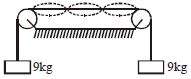
The length of the wire shown in the figure between the pulleys is $1.5 \, m$ and its mass is $12.0 \, g$. The frequency of vibration with which the wire vibrates in three loops,forming an antinode at the midpoint of the wire,is: (Given $g = 9.8 \, m/s^2$)
A
$210 \, Hz$
B
$140 \, Hz$
C
$70 \, Hz$
D
None of these
Solution
(D) The tension $T$ in the wire is equal to the weight of the hanging mass,$T = Mg = 9 \times 9.8 = 88.2 \, N$.
The linear mass density $\mu$ is $\mu = \frac{m}{l} = \frac{12 \times 10^{-3} \, kg}{1.5 \, m} = 8 \times 10^{-3} \, kg/m$.
The velocity of the transverse wave is $v = \sqrt{\frac{T}{\mu}} = \sqrt{\frac{88.2}{8 \times 10^{-3}}} = \sqrt{11025} = 105 \, m/s$.
For vibration in $p=3$ loops,the frequency $f$ is given by $f = \frac{p v}{2l}$.
Substituting the values,$f = \frac{3 \times 105}{2 \times 1.5} = \frac{315}{3} = 105 \, Hz$.
Since $105 \, Hz$ is not among the options,the correct choice is $D$.
The linear mass density $\mu$ is $\mu = \frac{m}{l} = \frac{12 \times 10^{-3} \, kg}{1.5 \, m} = 8 \times 10^{-3} \, kg/m$.
The velocity of the transverse wave is $v = \sqrt{\frac{T}{\mu}} = \sqrt{\frac{88.2}{8 \times 10^{-3}}} = \sqrt{11025} = 105 \, m/s$.
For vibration in $p=3$ loops,the frequency $f$ is given by $f = \frac{p v}{2l}$.
Substituting the values,$f = \frac{3 \times 105}{2 \times 1.5} = \frac{315}{3} = 105 \, Hz$.
Since $105 \, Hz$ is not among the options,the correct choice is $D$.
0 likes
View Solution71
MediumMCQ
$A$ wire of density $9 \times 10^3 \,kg/m^3$ is stretched between two clamps $1 \,m$ apart and is subjected to an extension of $4.9 \times 10^{-4} \,m$. What will be the lowest frequency of the transverse vibrations in the wire in $Hz$ $[Y = 9 \times 10^{10} \,N/m^2]$?
A
$38$
B
$36$
C
$35$
D
$32$
Solution
(C) The Young's modulus $Y$ is given by $Y = \frac{T/A}{\Delta \ell / \ell}$,where $T$ is tension,$A$ is cross-sectional area,$\Delta \ell$ is extension,and $\ell$ is length.
$T = \frac{Y A \Delta \ell}{\ell}$.
The velocity of transverse waves in the wire is $v = \sqrt{\frac{T}{\mu}}$,where $\mu = A \rho$ is the mass per unit length and $\rho$ is the density.
$v = \sqrt{\frac{Y A \Delta \ell}{\ell A \rho}} = \sqrt{\frac{Y \Delta \ell}{\ell \rho}}$.
Substituting the given values: $v = \sqrt{\frac{9 \times 10^{10} \times 4.9 \times 10^{-4}}{1 \times 9 \times 10^3}} = \sqrt{\frac{44.1 \times 10^6}{9 \times 10^3}} = \sqrt{4.9 \times 10^3} = \sqrt{4900} = 70 \,m/s$.
The lowest frequency (fundamental frequency) is $f = \frac{v}{2\ell} = \frac{70}{2 \times 1} = 35 \,Hz$.
$T = \frac{Y A \Delta \ell}{\ell}$.
The velocity of transverse waves in the wire is $v = \sqrt{\frac{T}{\mu}}$,where $\mu = A \rho$ is the mass per unit length and $\rho$ is the density.
$v = \sqrt{\frac{Y A \Delta \ell}{\ell A \rho}} = \sqrt{\frac{Y \Delta \ell}{\ell \rho}}$.
Substituting the given values: $v = \sqrt{\frac{9 \times 10^{10} \times 4.9 \times 10^{-4}}{1 \times 9 \times 10^3}} = \sqrt{\frac{44.1 \times 10^6}{9 \times 10^3}} = \sqrt{4.9 \times 10^3} = \sqrt{4900} = 70 \,m/s$.
The lowest frequency (fundamental frequency) is $f = \frac{v}{2\ell} = \frac{70}{2 \times 1} = 35 \,Hz$.
0 likes
View Solution72
MediumMCQ
The transverse displacement in a stretched string is given by $y = 0.06 \sin \left( \frac{2\pi}{3}x \right) \cos (120\pi t)$,where $x$ and $y$ are in $m$ and $t$ is in $s$. The length of the string is $1.5 \, m$ and its mass is $3.0 \times 10^{-2} \, kg$. The tension in the string is ..... $N$.
A
$648$
B
$650$
C
$649$
D
$651$
Solution
(A) The given equation is $y = 0.06 \sin \left( \frac{2\pi}{3}x \right) \cos (120\pi t)$.
Comparing this with the standard wave equation,we have angular frequency $\omega = 120\pi \, rad/s$ and wave number $k = \frac{2\pi}{3} \, m^{-1}$.
The wave speed $v$ is given by $v = \frac{\omega}{k} = \frac{120\pi}{2\pi/3} = 180 \, m/s$.
The linear mass density $\mu$ is $\mu = \frac{m}{L} = \frac{3.0 \times 10^{-2} \, kg}{1.5 \, m} = 2.0 \times 10^{-2} \, kg/m$.
The tension $T$ in the string is given by $T = v^2 \mu$.
Substituting the values,$T = (180)^2 \times (2.0 \times 10^{-2}) = 32400 \times 0.02 = 648 \, N$.
Comparing this with the standard wave equation,we have angular frequency $\omega = 120\pi \, rad/s$ and wave number $k = \frac{2\pi}{3} \, m^{-1}$.
The wave speed $v$ is given by $v = \frac{\omega}{k} = \frac{120\pi}{2\pi/3} = 180 \, m/s$.
The linear mass density $\mu$ is $\mu = \frac{m}{L} = \frac{3.0 \times 10^{-2} \, kg}{1.5 \, m} = 2.0 \times 10^{-2} \, kg/m$.
The tension $T$ in the string is given by $T = v^2 \mu$.
Substituting the values,$T = (180)^2 \times (2.0 \times 10^{-2}) = 32400 \times 0.02 = 648 \, N$.
0 likes
View Solution73
MediumMCQ
The fundamental frequency of a sonometer with a weight of $4\,kg$ is $256\,Hz$. The weight required to produce its octave is .... $kg-wt$
A
$4$
B
$12$
C
$16$
D
$24$
Solution
(C) The fundamental frequency of a sonometer wire is given by $f = \frac{1}{2L} \sqrt{\frac{T}{\mu}}$,where $T$ is the tension (weight) and $\mu$ is the mass per unit length.
Since $f \propto \sqrt{T}$,we have $\frac{f_2}{f_1} = \sqrt{\frac{T_2}{T_1}}$.
An octave means the frequency is doubled,so $f_2 = 2f_1$.
Therefore,$\frac{2f_1}{f_1} = \sqrt{\frac{T_2}{T_1}}$,which implies $2 = \sqrt{\frac{T_2}{T_1}}$.
Squaring both sides,we get $4 = \frac{T_2}{T_1}$.
Given $T_1 = 4\,kg-wt$,we find $T_2 = 4 \times 4 = 16\,kg-wt$.
Since $f \propto \sqrt{T}$,we have $\frac{f_2}{f_1} = \sqrt{\frac{T_2}{T_1}}$.
An octave means the frequency is doubled,so $f_2 = 2f_1$.
Therefore,$\frac{2f_1}{f_1} = \sqrt{\frac{T_2}{T_1}}$,which implies $2 = \sqrt{\frac{T_2}{T_1}}$.
Squaring both sides,we get $4 = \frac{T_2}{T_1}$.
Given $T_1 = 4\,kg-wt$,we find $T_2 = 4 \times 4 = 16\,kg-wt$.
0 likes
View Solution74
EasyMCQ
$A$ stretched string resonates with a tuning fork of frequency $512 \; Hz$ when the length of the string is $0.5 \; m$. The length of the string required to vibrate resonantly with a tuning fork of frequency $256 \; Hz$ would be .......... $m$.
A
$0.25$
B
$0.5$
C
$2$
D
$1$
Solution
(D) The fundamental frequency $f$ of a stretched string is given by the formula: $f = \frac{1}{2l} \sqrt{\frac{T}{\mu}}$.
Here,$T$ is the tension and $\mu$ is the linear mass density of the string.
Since $T$ and $\mu$ remain constant,the product of frequency and length is constant: $f_1 l_1 = f_2 l_2$.
Given $f_1 = 512 \; Hz$,$l_1 = 0.5 \; m$,and $f_2 = 256 \; Hz$.
Substituting the values: $512 \times 0.5 = 256 \times l_2$.
$256 = 256 \times l_2$.
Therefore,$l_2 = 1 \; m$.
Here,$T$ is the tension and $\mu$ is the linear mass density of the string.
Since $T$ and $\mu$ remain constant,the product of frequency and length is constant: $f_1 l_1 = f_2 l_2$.
Given $f_1 = 512 \; Hz$,$l_1 = 0.5 \; m$,and $f_2 = 256 \; Hz$.
Substituting the values: $512 \times 0.5 = 256 \times l_2$.
$256 = 256 \times l_2$.
Therefore,$l_2 = 1 \; m$.
0 likes
View Solution75
DifficultMCQ
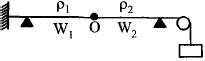
Two wires $W_1$ and $W_2$ have the same radius $r$ and respective densities $\rho_1$ and $\rho_2$ such that $\rho_2 = 4\rho_1$. They are joined together at the point $O$,as shown in the figure. The combination is used as a sonometer wire and kept under tension $T$. The point $O$ is midway between the two bridges. When a stationary wave is set up in the composite wire,the joint is found to be a node. The ratio of the number of antinodes formed in $W_1$ to $W_2$ is
A
$1:1$
B
$1:2$
C
$1:3$
D
$2:1$
Solution
(B) For a sonometer wire,the frequency of vibration $n$ is given by $n = \frac{p}{2l} \sqrt{\frac{T}{\mu}}$,where $p$ is the number of loops (antinodes),$l$ is the length,$T$ is the tension,and $\mu$ is the linear mass density.
Since $\mu = \pi r^2 \rho$,the frequency formula becomes $n = \frac{p}{2l} \sqrt{\frac{T}{\pi r^2 \rho}}$.
For the composite wire,the frequency $n$ is the same for both parts $W_1$ and $W_2$. Also,$T$,$r$,and $l$ are the same for both wires.
Thus,$n_1 = n_2 \implies \frac{p_1}{2l} \sqrt{\frac{T}{\pi r^2 \rho_1}} = \frac{p_2}{2l} \sqrt{\frac{T}{\pi r^2 \rho_2}}$.
Simplifying,we get $\frac{p_1}{\sqrt{\rho_1}} = \frac{p_2}{\sqrt{\rho_2}}$.
Given $\rho_2 = 4\rho_1$,we have $\frac{p_1}{\sqrt{\rho_1}} = \frac{p_2}{\sqrt{4\rho_1}} = \frac{p_2}{2\sqrt{\rho_1}}$.
Therefore,$\frac{p_1}{p_2} = \frac{1}{2}$.
Since $\mu = \pi r^2 \rho$,the frequency formula becomes $n = \frac{p}{2l} \sqrt{\frac{T}{\pi r^2 \rho}}$.
For the composite wire,the frequency $n$ is the same for both parts $W_1$ and $W_2$. Also,$T$,$r$,and $l$ are the same for both wires.
Thus,$n_1 = n_2 \implies \frac{p_1}{2l} \sqrt{\frac{T}{\pi r^2 \rho_1}} = \frac{p_2}{2l} \sqrt{\frac{T}{\pi r^2 \rho_2}}$.
Simplifying,we get $\frac{p_1}{\sqrt{\rho_1}} = \frac{p_2}{\sqrt{\rho_2}}$.
Given $\rho_2 = 4\rho_1$,we have $\frac{p_1}{\sqrt{\rho_1}} = \frac{p_2}{\sqrt{4\rho_1}} = \frac{p_2}{2\sqrt{\rho_1}}$.
Therefore,$\frac{p_1}{p_2} = \frac{1}{2}$.
0 likes
View Solution76
DifficultMCQ
The total length of a sonometer wire between fixed ends is $110 \ cm$. Two bridges are placed to divide the length of the wire in the ratio $6 : 3 : 2$. The tension in the wire is $400 \ N$ and the mass per unit length is $0.01 \ kg/m$. What is the minimum common frequency with which the three parts can vibrate in $Hz$?
A
$1100$
B
$1000$
C
$166$
D
$100$
Solution
(B) The total length of the wire is $L = 110 \ cm = 1.1 \ m$. The ratio of the lengths is $6:3:2$. Let the lengths be $l_1, l_2, l_3$.
Sum of parts $= 6+3+2 = 11$.
$l_1 = (6/11) \times 110 = 60 \ cm = 0.6 \ m$.
$l_2 = (3/11) \times 110 = 30 \ cm = 0.3 \ m$.
$l_3 = (2/11) \times 110 = 20 \ cm = 0.2 \ m$.
The fundamental frequency of a wire is given by $f = \frac{1}{2l} \sqrt{\frac{T}{\mu}}$,where $T = 400 \ N$ and $\mu = 0.01 \ kg/m$.
$\sqrt{\frac{T}{\mu}} = \sqrt{\frac{400}{0.01}} = \sqrt{40000} = 200 \ m/s$.
$f_1 = \frac{200}{2 \times 0.6} = \frac{100}{0.6} = \frac{1000}{6} \ Hz$.
$f_2 = \frac{200}{2 \times 0.3} = \frac{100}{0.3} = \frac{1000}{3} \ Hz$.
$f_3 = \frac{200}{2 \times 0.2} = \frac{100}{0.2} = 500 \ Hz = \frac{1000}{2} \ Hz$.
The common frequency is the Least Common Multiple $(LCM)$ of the frequencies.
$LCM(\frac{1000}{6}, \frac{1000}{3}, \frac{1000}{2}) = \frac{LCM(1000, 1000, 1000)}{GCD(6, 3, 2)} = \frac{1000}{1} = 1000 \ Hz$.
Sum of parts $= 6+3+2 = 11$.
$l_1 = (6/11) \times 110 = 60 \ cm = 0.6 \ m$.
$l_2 = (3/11) \times 110 = 30 \ cm = 0.3 \ m$.
$l_3 = (2/11) \times 110 = 20 \ cm = 0.2 \ m$.
The fundamental frequency of a wire is given by $f = \frac{1}{2l} \sqrt{\frac{T}{\mu}}$,where $T = 400 \ N$ and $\mu = 0.01 \ kg/m$.
$\sqrt{\frac{T}{\mu}} = \sqrt{\frac{400}{0.01}} = \sqrt{40000} = 200 \ m/s$.
$f_1 = \frac{200}{2 \times 0.6} = \frac{100}{0.6} = \frac{1000}{6} \ Hz$.
$f_2 = \frac{200}{2 \times 0.3} = \frac{100}{0.3} = \frac{1000}{3} \ Hz$.
$f_3 = \frac{200}{2 \times 0.2} = \frac{100}{0.2} = 500 \ Hz = \frac{1000}{2} \ Hz$.
The common frequency is the Least Common Multiple $(LCM)$ of the frequencies.
$LCM(\frac{1000}{6}, \frac{1000}{3}, \frac{1000}{2}) = \frac{LCM(1000, 1000, 1000)}{GCD(6, 3, 2)} = \frac{1000}{1} = 1000 \ Hz$.
0 likes
View Solution77
DifficultMCQ
$A$ sonometer wire of length $114\, cm$ is fixed at both the ends. Where should the two bridges be placed so as to divide the wire into three segments whose fundamental frequencies are in the ratio $1 : 3 : 4$?
A
At $36\, cm$ and $84\, cm$ from one end
B
At $24\, cm$ and $72\, cm$ from one end
C
At $48\, cm$ and $96\, cm$ from one end
D
At $72\, cm$ and $96\, cm$ from one end
Solution
(D) Total length of the wire,$L = 114\, cm$.
The fundamental frequency $n$ of a stretched string is given by $n = \frac{1}{2L} \sqrt{\frac{T}{\mu}}$,which implies $n \propto \frac{1}{L}$.
Given the ratio of frequencies $n_1 : n_2 : n_3 = 1 : 3 : 4$.
Therefore,the ratio of the lengths of the three segments is $L_1 : L_2 : L_3 = \frac{1}{1} : \frac{1}{3} : \frac{1}{4} = 12 : 4 : 3$.
The sum of the ratio parts is $12 + 4 + 3 = 19$.
Calculating the lengths:
$L_1 = \frac{12}{19} \times 114 = 12 \times 6 = 72\, cm$.
$L_2 = \frac{4}{19} \times 114 = 4 \times 6 = 24\, cm$.
$L_3 = \frac{3}{19} \times 114 = 3 \times 6 = 18\, cm$.
To divide the wire into these segments,the first bridge should be placed at $72\, cm$ from one end,and the second bridge should be placed at $72 + 24 = 96\, cm$ from the same end.
The fundamental frequency $n$ of a stretched string is given by $n = \frac{1}{2L} \sqrt{\frac{T}{\mu}}$,which implies $n \propto \frac{1}{L}$.
Given the ratio of frequencies $n_1 : n_2 : n_3 = 1 : 3 : 4$.
Therefore,the ratio of the lengths of the three segments is $L_1 : L_2 : L_3 = \frac{1}{1} : \frac{1}{3} : \frac{1}{4} = 12 : 4 : 3$.
The sum of the ratio parts is $12 + 4 + 3 = 19$.
Calculating the lengths:
$L_1 = \frac{12}{19} \times 114 = 12 \times 6 = 72\, cm$.
$L_2 = \frac{4}{19} \times 114 = 4 \times 6 = 24\, cm$.
$L_3 = \frac{3}{19} \times 114 = 3 \times 6 = 18\, cm$.
To divide the wire into these segments,the first bridge should be placed at $72\, cm$ from one end,and the second bridge should be placed at $72 + 24 = 96\, cm$ from the same end.
0 likes
View Solution78
MediumMCQ
$A$ string of length $1\, m$ and mass $5\, g$ is fixed at both ends. The tension in the string is $8.0\, N$. The string is set into vibration using an external vibrator of frequency $100\, Hz$. The separation between successive nodes on the string is close to .... $cm$
A
$10$
B
$33.3$
C
$16.6$
D
$20.0$
Solution
(D) The linear mass density $\mu = \frac{m}{L} = \frac{5 \times 10^{-3} \, kg}{1 \, m} = 5 \times 10^{-3} \, kg/m$.
The wave speed $v = \sqrt{\frac{T}{\mu}} = \sqrt{\frac{8.0}{5 \times 10^{-3}}} = \sqrt{1600} = 40 \, m/s$.
The wavelength $\lambda = \frac{v}{f} = \frac{40 \, m/s}{100 \, Hz} = 0.4 \, m$.
The separation between successive nodes is equal to $\frac{\lambda}{2}$.
Separation $= \frac{0.4 \, m}{2} = 0.2 \, m = 20 \, cm$.
The wave speed $v = \sqrt{\frac{T}{\mu}} = \sqrt{\frac{8.0}{5 \times 10^{-3}}} = \sqrt{1600} = 40 \, m/s$.
The wavelength $\lambda = \frac{v}{f} = \frac{40 \, m/s}{100 \, Hz} = 0.4 \, m$.
The separation between successive nodes is equal to $\frac{\lambda}{2}$.
Separation $= \frac{0.4 \, m}{2} = 0.2 \, m = 20 \, cm$.
0 likes
View Solution79
DifficultMCQ
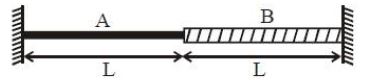
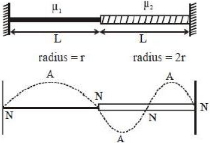
$A$ wire of length $2L$ is made by joining two wires $A$ and $B$ of same lengths but different radii $r$ and $2r$ and made of the same material. It is vibrating at a frequency such that the joint of the two wires forms a node. If the number of antinodes in wire $A$ is $p$ and that in $B$ is $q$,then the ratio $p : q$ is
A
$1 : 2$
B
$1 : 4$
C
$2 : 1$
D
$4 : 1$
Solution
(A) Let the mass per unit length of wires $A$ and $B$ be $\mu_1$ and $\mu_2$ respectively.
Since the materials are the same,the density $\rho$ is the same.
$\mu_1 = \rho \pi r^2$ and $\mu_2 = \rho \pi (2r)^2 = 4 \rho \pi r^2 = 4 \mu_1$.
The tension $T$ is the same in both wires.
The wave speed in the wires is $v = \sqrt{T/\mu}$.
Thus,$v_1 = \sqrt{T/\mu_1} = v$ and $v_2 = \sqrt{T/\mu_2} = \sqrt{T/(4\mu_1)} = v/2$.
For a wire of length $L$ fixed at both ends,the frequency of the $n$-th harmonic is $f = n \frac{v}{2L}$.
Since the joint is a node,both wires vibrate independently with the same frequency $f$.
$f = p \frac{v_1}{2L} = q \frac{v_2}{2L}$,where $p$ and $q$ are the number of loops (which equals the number of antinodes).
$p \frac{v}{2L} = q \frac{v/2}{2L} \implies p = q/2 \implies p/q = 1/2$.
Therefore,the ratio $p : q$ is $1 : 2$.
Since the materials are the same,the density $\rho$ is the same.
$\mu_1 = \rho \pi r^2$ and $\mu_2 = \rho \pi (2r)^2 = 4 \rho \pi r^2 = 4 \mu_1$.
The tension $T$ is the same in both wires.
The wave speed in the wires is $v = \sqrt{T/\mu}$.
Thus,$v_1 = \sqrt{T/\mu_1} = v$ and $v_2 = \sqrt{T/\mu_2} = \sqrt{T/(4\mu_1)} = v/2$.
For a wire of length $L$ fixed at both ends,the frequency of the $n$-th harmonic is $f = n \frac{v}{2L}$.
Since the joint is a node,both wires vibrate independently with the same frequency $f$.
$f = p \frac{v_1}{2L} = q \frac{v_2}{2L}$,where $p$ and $q$ are the number of loops (which equals the number of antinodes).
$p \frac{v}{2L} = q \frac{v/2}{2L} \implies p = q/2 \implies p/q = 1/2$.
Therefore,the ratio $p : q$ is $1 : 2$.
0 likes
View Solution80
MediumMCQ
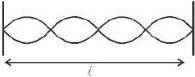
$A$ string is clamped at both ends and it is vibrating in its $4^{th}$ harmonic. The equation of the stationary wave is $Y = 0.3 \sin(0.157 x) \cos(200\pi t)$. The length of the string is ..... $m$ (all quantities are in $SI$ units).
A
$60$
B
$80$
C
$40$
D
$20$
Solution
(B) For a string clamped at both ends,the length $\ell$ in the $n^{th}$ harmonic is given by $\ell = n \frac{\lambda}{2}$.
Given $n = 4$,we have $\ell = 4 \frac{\lambda}{2} = 2\lambda$.
The general equation of a stationary wave is $Y = A \sin(kx) \cos(\omega t)$,where $k = \frac{2\pi}{\lambda}$.
Comparing the given equation $Y = 0.3 \sin(0.157 x) \cos(200\pi t)$ with the general form,we get $k = 0.157$.
Since $0.157 \approx \frac{\pi}{20}$,we have $\frac{2\pi}{\lambda} = \frac{\pi}{20}$.
Solving for $\lambda$,we get $\lambda = 40 \, m$.
Substituting this into the length formula: $\ell = 2 \lambda = 2 \times 40 = 80 \, m$.
Given $n = 4$,we have $\ell = 4 \frac{\lambda}{2} = 2\lambda$.
The general equation of a stationary wave is $Y = A \sin(kx) \cos(\omega t)$,where $k = \frac{2\pi}{\lambda}$.
Comparing the given equation $Y = 0.3 \sin(0.157 x) \cos(200\pi t)$ with the general form,we get $k = 0.157$.
Since $0.157 \approx \frac{\pi}{20}$,we have $\frac{2\pi}{\lambda} = \frac{\pi}{20}$.
Solving for $\lambda$,we get $\lambda = 40 \, m$.
Substituting this into the length formula: $\ell = 2 \lambda = 2 \times 40 = 80 \, m$.
0 likes
View Solution81
MediumMCQ
$A$ string $2.0\, m$ long and fixed at its ends is driven by a $240\, Hz$ vibrator. The string vibrates in its third harmonic mode. The speed of the wave and its fundamental frequency are:
A
$320\, m/s, 120\, Hz$
B
$180\, m/s, 80\, Hz$
C
$180\, m/s, 120\, Hz$
D
$320\, m/s, 80\, Hz$
Solution
(D) The frequency of the $n^{th}$ harmonic for a string fixed at both ends is given by $f_n = \frac{n v}{2L}$.
Given: length $L = 2.0\, m$,frequency $f_3 = 240\, Hz$,and harmonic $n = 3$.
Substituting the values into the formula: $240 = \frac{3 \times v}{2 \times 2.0}$.
$240 = \frac{3v}{4} \Rightarrow 3v = 960 \Rightarrow v = 320\, m/s$.
The fundamental frequency $(n=1)$ is $f_1 = \frac{v}{2L} = \frac{320}{2 \times 2.0} = \frac{320}{4} = 80\, Hz$.
Given: length $L = 2.0\, m$,frequency $f_3 = 240\, Hz$,and harmonic $n = 3$.
Substituting the values into the formula: $240 = \frac{3 \times v}{2 \times 2.0}$.
$240 = \frac{3v}{4} \Rightarrow 3v = 960 \Rightarrow v = 320\, m/s$.
The fundamental frequency $(n=1)$ is $f_1 = \frac{v}{2L} = \frac{320}{2 \times 2.0} = \frac{320}{4} = 80\, Hz$.
0 likes
View Solution82
MediumMCQ
The length of a sonometer wire is $0.75\, m$ and density is $9 \times 10^3\, kg/m^3$. It can bear a stress of $8.1 \times 10^8\, N/m^2$ without exceeding the elastic limit. What is the fundamental frequency that can be produced in the wire in $Hz$?
A
$100$
B
$200$
C
$150$
D
$175$
Solution
(B) The fundamental frequency $n$ of a stretched wire is given by $n = \frac{1}{2L} \sqrt{\frac{T}{\mu}}$.
Since stress $\sigma = \frac{T}{A}$ and mass per unit length $\mu = \frac{m}{L} = \frac{\rho \cdot A \cdot L}{L} = \rho A$,we have $\frac{T}{\mu} = \frac{\sigma A}{\rho A} = \frac{\sigma}{\rho}$.
Substituting this into the frequency formula: $n = \frac{1}{2L} \sqrt{\frac{\sigma}{\rho}}$.
Given: $L = 0.75\, m$,$\sigma = 8.1 \times 10^8\, N/m^2$,and $\rho = 9 \times 10^3\, kg/m^3$.
$n = \frac{1}{2 \times 0.75} \sqrt{\frac{8.1 \times 10^8}{9 \times 10^3}} = \frac{1}{1.5} \sqrt{0.9 \times 10^5} = \frac{1}{1.5} \sqrt{9 \times 10^4} = \frac{300}{1.5} = 200\, Hz$.
Since stress $\sigma = \frac{T}{A}$ and mass per unit length $\mu = \frac{m}{L} = \frac{\rho \cdot A \cdot L}{L} = \rho A$,we have $\frac{T}{\mu} = \frac{\sigma A}{\rho A} = \frac{\sigma}{\rho}$.
Substituting this into the frequency formula: $n = \frac{1}{2L} \sqrt{\frac{\sigma}{\rho}}$.
Given: $L = 0.75\, m$,$\sigma = 8.1 \times 10^8\, N/m^2$,and $\rho = 9 \times 10^3\, kg/m^3$.
$n = \frac{1}{2 \times 0.75} \sqrt{\frac{8.1 \times 10^8}{9 \times 10^3}} = \frac{1}{1.5} \sqrt{0.9 \times 10^5} = \frac{1}{1.5} \sqrt{9 \times 10^4} = \frac{300}{1.5} = 200\, Hz$.
0 likes
View Solution83
MediumMCQ
$A$ tuning fork produces $5 \, Hz$ beats per second when the length of a sonometer wire is either $1 \, m$ or $1.05 \, m$. Calculate the frequency of the tuning fork in $Hz$.
A
$102.5$
B
$125$
C
$100$
D
$205$
Solution
(D) Let the frequency of the tuning fork be $n$.
The frequency of the sonometer wire $f$ is inversely proportional to its length $\ell$,i.e.,$f \propto \frac{1}{\ell}$.
Given that the tuning fork produces $5 \, Hz$ beats in both cases,the frequency of the wire is either $(n + 5)$ or $(n - 5)$.
Since frequency is inversely proportional to length,the higher frequency corresponds to the shorter length:
$n + 5 = \frac{k}{1}$
$n - 5 = \frac{k}{1.05}$
Dividing the two equations:
$\frac{n + 5}{n - 5} = \frac{1.05}{1}$
$n + 5 = 1.05(n - 5)$
$n + 5 = 1.05n - 5.25$
$0.05n = 10.25$
$n = \frac{10.25}{0.05} = 205 \, Hz$.
The frequency of the sonometer wire $f$ is inversely proportional to its length $\ell$,i.e.,$f \propto \frac{1}{\ell}$.
Given that the tuning fork produces $5 \, Hz$ beats in both cases,the frequency of the wire is either $(n + 5)$ or $(n - 5)$.
Since frequency is inversely proportional to length,the higher frequency corresponds to the shorter length:
$n + 5 = \frac{k}{1}$
$n - 5 = \frac{k}{1.05}$
Dividing the two equations:
$\frac{n + 5}{n - 5} = \frac{1.05}{1}$
$n + 5 = 1.05(n - 5)$
$n + 5 = 1.05n - 5.25$
$0.05n = 10.25$
$n = \frac{10.25}{0.05} = 205 \, Hz$.
0 likes
View Solution84
DifficultMCQ
When a string is divided into three segments of length $l_1, l_2$ and $l_3,$ the fundamental frequencies of these three segments are $v_1, v_2$ and $v_3$ respectively. The original fundamental frequency $(v)$ of the string is
A
$\frac{1}{v} = \frac{1}{v_1} + \frac{1}{v_2} + \frac{1}{v_3}$
B
$\frac{1}{\sqrt{v}} = \frac{1}{\sqrt{v_1}} + \frac{1}{\sqrt{v_2}} + \frac{1}{\sqrt{v_3}}$
C
$\sqrt{v} = \sqrt{v_1} + \sqrt{v_2} + \sqrt{v_3}$
D
$v = v_1 + v_2 + v_3$
Solution
(A) The fundamental frequency of a stretched string is given by $v = \frac{1}{2l} \sqrt{\frac{T}{\mu}}$,where $T$ is tension and $\mu$ is mass per unit length.
Since $T$ and $\mu$ are constant for the string,$v \propto \frac{1}{l}$,which implies $vl = k$ (a constant).
Therefore,for the three segments,we have $v_1 l_1 = v_2 l_2 = v_3 l_3 = k$.
This gives $l_1 = \frac{k}{v_1}$,$l_2 = \frac{k}{v_2}$,and $l_3 = \frac{k}{v_3}$.
The original length $l$ of the string is the sum of the lengths of the segments: $l = l_1 + l_2 + l_3$.
Substituting the expressions for lengths in terms of frequencies: $\frac{k}{v} = \frac{k}{v_1} + \frac{k}{v_2} + \frac{k}{v_3}$.
Dividing both sides by $k$,we get $\frac{1}{v} = \frac{1}{v_1} + \frac{1}{v_2} + \frac{1}{v_3}$.
Since $T$ and $\mu$ are constant for the string,$v \propto \frac{1}{l}$,which implies $vl = k$ (a constant).
Therefore,for the three segments,we have $v_1 l_1 = v_2 l_2 = v_3 l_3 = k$.
This gives $l_1 = \frac{k}{v_1}$,$l_2 = \frac{k}{v_2}$,and $l_3 = \frac{k}{v_3}$.
The original length $l$ of the string is the sum of the lengths of the segments: $l = l_1 + l_2 + l_3$.
Substituting the expressions for lengths in terms of frequencies: $\frac{k}{v} = \frac{k}{v_1} + \frac{k}{v_2} + \frac{k}{v_3}$.
Dividing both sides by $k$,we get $\frac{1}{v} = \frac{1}{v_1} + \frac{1}{v_2} + \frac{1}{v_3}$.
0 likes
View Solution85
MediumMCQ
If the length of a stretched string is shortened by $40\%$ and the tension is increased by $44\%$,then the ratio of the final and initial fundamental frequencies is
A
$3 : 4$
B
$4 : 3$
C
$1 : 3$
D
$2 : 1$
Solution
(D) The fundamental frequency of a stretched string is given by $n = \frac{1}{2L} \sqrt{\frac{T}{\mu}}$,where $L$ is the length,$T$ is the tension,and $\mu$ is the mass per unit length.
Since $\mu$ remains constant,$n \propto \frac{1}{L} \sqrt{T}$.
Let the initial length be $L_1$ and initial tension be $T_1$. The final length $L_2 = L_1 - 0.40L_1 = 0.60L_1$ and final tension $T_2 = T_1 + 0.44T_1 = 1.44T_1$.
The ratio of the final frequency $n_2$ to the initial frequency $n_1$ is given by $\frac{n_2}{n_1} = \frac{L_1}{L_2} \sqrt{\frac{T_2}{T_1}}$.
Substituting the values: $\frac{n_2}{n_1} = \frac{L_1}{0.60L_1} \sqrt{\frac{1.44T_1}{T_1}} = \frac{1}{0.6} \times \sqrt{1.44} = \frac{1}{0.6} \times 1.2 = 2$.
Thus,the ratio is $2 : 1$.
Since $\mu$ remains constant,$n \propto \frac{1}{L} \sqrt{T}$.
Let the initial length be $L_1$ and initial tension be $T_1$. The final length $L_2 = L_1 - 0.40L_1 = 0.60L_1$ and final tension $T_2 = T_1 + 0.44T_1 = 1.44T_1$.
The ratio of the final frequency $n_2$ to the initial frequency $n_1$ is given by $\frac{n_2}{n_1} = \frac{L_1}{L_2} \sqrt{\frac{T_2}{T_1}}$.
Substituting the values: $\frac{n_2}{n_1} = \frac{L_1}{0.60L_1} \sqrt{\frac{1.44T_1}{T_1}} = \frac{1}{0.6} \times \sqrt{1.44} = \frac{1}{0.6} \times 1.2 = 2$.
Thus,the ratio is $2 : 1$.
0 likes
View Solution86
MediumMCQ
Two wires made up of the same material are of equal lengths but their radii are in the ratio $1 : 2$. On stretching each of these two strings by the same tension,the ratio between the fundamental frequencies is
A
$1 : 4$
B
$4 : 1$
C
$2 : 1$
D
$1 : 2$
Solution
(C) The fundamental frequency $f$ of a stretched wire is given by $f = \frac{1}{2L} \sqrt{\frac{T}{\mu}}$,where $L$ is the length,$T$ is the tension,and $\mu$ is the linear mass density.
Since $\mu = \rho \times A = \rho \times \pi r^2$,where $\rho$ is the density of the material and $r$ is the radius,the formula becomes $f = \frac{1}{2L} \sqrt{\frac{T}{\rho \pi r^2}} = \frac{1}{2Lr} \sqrt{\frac{T}{\rho \pi}}$.
Given that $L$,$T$,and $\rho$ are the same for both wires,we have $f \propto \frac{1}{r}$.
Therefore,the ratio of the fundamental frequencies is $\frac{f_1}{f_2} = \frac{r_2}{r_1}$.
Given the ratio of radii $r_1 : r_2 = 1 : 2$,we have $\frac{r_2}{r_1} = \frac{2}{1}$.
Thus,the ratio of the fundamental frequencies is $2 : 1$.
Since $\mu = \rho \times A = \rho \times \pi r^2$,where $\rho$ is the density of the material and $r$ is the radius,the formula becomes $f = \frac{1}{2L} \sqrt{\frac{T}{\rho \pi r^2}} = \frac{1}{2Lr} \sqrt{\frac{T}{\rho \pi}}$.
Given that $L$,$T$,and $\rho$ are the same for both wires,we have $f \propto \frac{1}{r}$.
Therefore,the ratio of the fundamental frequencies is $\frac{f_1}{f_2} = \frac{r_2}{r_1}$.
Given the ratio of radii $r_1 : r_2 = 1 : 2$,we have $\frac{r_2}{r_1} = \frac{2}{1}$.
Thus,the ratio of the fundamental frequencies is $2 : 1$.
0 likes
View Solution87
DifficultMCQ
$A$ stretched string is divided into three segments of lengths $50\,cm$,$40\,cm$,and $10\,cm$ with the help of bridges. Their vibrations will have frequencies in the ratio:
A
$5 : 4 : 1$
B
$1 : 4 : 5$
C
$4 : 5 : 20$
D
$2 : 5 : 10$
Solution
(C) For a stretched string of constant tension $T$ and linear mass density $\mu$,the fundamental frequency $f$ is given by $f = \frac{1}{2L} \sqrt{\frac{T}{\mu}}$.
Since $T$ and $\mu$ are constant for all segments,the frequency is inversely proportional to the length of the segment,i.e.,$f \propto \frac{1}{L}$.
Given lengths are $L_1 = 50\,cm$,$L_2 = 40\,cm$,and $L_3 = 10\,cm$.
The ratio of frequencies is $f_1 : f_2 : f_3 = \frac{1}{L_1} : \frac{1}{L_2} : \frac{1}{L_3}$.
Substituting the values: $f_1 : f_2 : f_3 = \frac{1}{50} : \frac{1}{40} : \frac{1}{10}$.
To simplify,multiply by the least common multiple of $50, 40, 10$,which is $200$.
$f_1 : f_2 : f_3 = \frac{200}{50} : \frac{200}{40} : \frac{200}{10} = 4 : 5 : 20$.
Since $T$ and $\mu$ are constant for all segments,the frequency is inversely proportional to the length of the segment,i.e.,$f \propto \frac{1}{L}$.
Given lengths are $L_1 = 50\,cm$,$L_2 = 40\,cm$,and $L_3 = 10\,cm$.
The ratio of frequencies is $f_1 : f_2 : f_3 = \frac{1}{L_1} : \frac{1}{L_2} : \frac{1}{L_3}$.
Substituting the values: $f_1 : f_2 : f_3 = \frac{1}{50} : \frac{1}{40} : \frac{1}{10}$.
To simplify,multiply by the least common multiple of $50, 40, 10$,which is $200$.
$f_1 : f_2 : f_3 = \frac{200}{50} : \frac{200}{40} : \frac{200}{10} = 4 : 5 : 20$.
0 likes
View Solution88
MediumMCQ
The transverse displacement of a string (clamped at its both ends) is given by $y(x,t) = 0.6 \sin \left( \frac{2\pi}{3}x \right) \cos (120\pi t)$,where $x$ and $y$ are in $m$ and $t$ is in $s$. The length of the string is $1.5 \, m$ and its mass is $3.0 \times 10^{-2} \, kg$. The tension in the string will be .... $N$.
A
$648$
B
$1248$
C
$324$
D
$162$
Solution
(A) The standard equation for a standing wave is $y(x,t) = A \sin(kx) \cos(\omega t)$.
Comparing this with the given equation $y(x,t) = 0.6 \sin \left( \frac{2\pi}{3}x \right) \cos (120\pi t)$,we get angular frequency $\omega = 120\pi \, rad/s$ and wave number $k = \frac{2\pi}{3} \, m^{-1}$.
The wave speed $v$ is given by $v = \frac{\omega}{k} = \frac{120\pi}{2\pi/3} = 180 \, m/s$.
The linear mass density $\mu$ is $\mu = \frac{M}{L} = \frac{3.0 \times 10^{-2} \, kg}{1.5 \, m} = 2 \times 10^{-2} \, kg/m$.
The wave speed in a string is related to tension $T$ by $v = \sqrt{\frac{T}{\mu}}$,so $T = \mu v^2$.
Substituting the values: $T = (2 \times 10^{-2} \, kg/m) \times (180 \, m/s)^2 = 2 \times 10^{-2} \times 32400 = 648 \, N$.
Comparing this with the given equation $y(x,t) = 0.6 \sin \left( \frac{2\pi}{3}x \right) \cos (120\pi t)$,we get angular frequency $\omega = 120\pi \, rad/s$ and wave number $k = \frac{2\pi}{3} \, m^{-1}$.
The wave speed $v$ is given by $v = \frac{\omega}{k} = \frac{120\pi}{2\pi/3} = 180 \, m/s$.
The linear mass density $\mu$ is $\mu = \frac{M}{L} = \frac{3.0 \times 10^{-2} \, kg}{1.5 \, m} = 2 \times 10^{-2} \, kg/m$.
The wave speed in a string is related to tension $T$ by $v = \sqrt{\frac{T}{\mu}}$,so $T = \mu v^2$.
Substituting the values: $T = (2 \times 10^{-2} \, kg/m) \times (180 \, m/s)^2 = 2 \times 10^{-2} \times 32400 = 648 \, N$.
0 likes
View Solution89
DifficultMCQ
$A$ string with a mass density of $4 \times 10^{-3} \, kg/m$ is under a tension of $360 \, N$ and is fixed at both ends. One of its resonance frequencies is $375 \, Hz$. The next higher resonance frequency is $450 \, Hz$. The mass of the string is:
A
$2 \times 10^{-3} \, kg$
B
$3 \times 10^{-3} \, kg$
C
$4 \times 10^{-3} \, kg$
D
$8 \times 10^{-3} \, kg$
Solution
(D) The resonance frequencies of a string fixed at both ends are given by $f_n = n f_1$,where $f_1$ is the fundamental frequency.
The difference between two consecutive resonance frequencies is equal to the fundamental frequency:
$f_{n+1} - f_n = f_1 = 450 \, Hz - 375 \, Hz = 75 \, Hz$.
The fundamental frequency is $f_1 = \frac{1}{2L} \sqrt{\frac{T}{\mu}}$,where $L$ is the length of the string,$T$ is the tension,and $\mu$ is the linear mass density.
Substituting the values:
$75 = \frac{1}{2L} \sqrt{\frac{360}{4 \times 10^{-3}}}$
$75 = \frac{1}{2L} \sqrt{90000} = \frac{300}{2L}$
$L = \frac{300}{150} = 2 \, m$.
The total mass of the string $m$ is given by $m = \mu \times L$.
$m = (4 \times 10^{-3} \, kg/m) \times (2 \, m) = 8 \times 10^{-3} \, kg$.
The difference between two consecutive resonance frequencies is equal to the fundamental frequency:
$f_{n+1} - f_n = f_1 = 450 \, Hz - 375 \, Hz = 75 \, Hz$.
The fundamental frequency is $f_1 = \frac{1}{2L} \sqrt{\frac{T}{\mu}}$,where $L$ is the length of the string,$T$ is the tension,and $\mu$ is the linear mass density.
Substituting the values:
$75 = \frac{1}{2L} \sqrt{\frac{360}{4 \times 10^{-3}}}$
$75 = \frac{1}{2L} \sqrt{90000} = \frac{300}{2L}$
$L = \frac{300}{150} = 2 \, m$.
The total mass of the string $m$ is given by $m = \mu \times L$.
$m = (4 \times 10^{-3} \, kg/m) \times (2 \, m) = 8 \times 10^{-3} \, kg$.
0 likes
View Solution90
DifficultMCQ
The fundamental frequency of a sonometer wire is $n$. If the length and diameter of the wire are doubled while keeping the tension constant,what is the new fundamental frequency?
A
$\frac{n}{\sqrt{2}}$
B
$\frac{n}{2\sqrt{2}}$
C
$\sqrt{2}n$
D
$\frac{n}{4}$
Solution
(D) The fundamental frequency of a sonometer wire is given by $n = \frac{1}{2l} \sqrt{\frac{T}{\mu}}$,where $\mu = \pi r^2 \rho$ is the linear mass density.
Substituting $\mu$,we get $n = \frac{1}{2l} \sqrt{\frac{T}{\pi r^2 \rho}} = \frac{1}{2lr} \sqrt{\frac{T}{\pi \rho}}$.
Since tension $T$ and density $\rho$ are constant,the frequency $n \propto \frac{1}{lr}$.
Given that the length is doubled $(l' = 2l)$ and the diameter is doubled,which implies the radius is also doubled $(r' = 2r)$.
The new frequency $n'$ is given by $n' = n \times (\frac{l}{l'}) \times (\frac{r}{r'}) = n \times (\frac{l}{2l}) \times (\frac{r}{2r}) = n \times \frac{1}{2} \times \frac{1}{2} = \frac{n}{4}$.
Substituting $\mu$,we get $n = \frac{1}{2l} \sqrt{\frac{T}{\pi r^2 \rho}} = \frac{1}{2lr} \sqrt{\frac{T}{\pi \rho}}$.
Since tension $T$ and density $\rho$ are constant,the frequency $n \propto \frac{1}{lr}$.
Given that the length is doubled $(l' = 2l)$ and the diameter is doubled,which implies the radius is also doubled $(r' = 2r)$.
The new frequency $n'$ is given by $n' = n \times (\frac{l}{l'}) \times (\frac{r}{r'}) = n \times (\frac{l}{2l}) \times (\frac{r}{2r}) = n \times \frac{1}{2} \times \frac{1}{2} = \frac{n}{4}$.
0 likes
View Solution91
MediumMCQ
$A$ string fixed at both ends vibrates in three loops. The wavelength is $10 \, cm$. The length of the string is .... $cm$.
A
$5$
B
$15$
C
$30$
D
None
Solution
(B) For a string fixed at both ends vibrating in $n$ loops,the length of the string $L$ is given by the formula $L = \frac{n\lambda}{2}$.
Here,the number of loops $n = 3$.
The wavelength $\lambda = 10 \, cm$.
Substituting these values into the formula:
$L = \frac{3 \times 10}{2} = \frac{30}{2} = 15 \, cm$.
Therefore,the length of the string is $15 \, cm$.
Here,the number of loops $n = 3$.
The wavelength $\lambda = 10 \, cm$.
Substituting these values into the formula:
$L = \frac{3 \times 10}{2} = \frac{30}{2} = 15 \, cm$.
Therefore,the length of the string is $15 \, cm$.
0 likes
View Solution92
MediumMCQ
$A$ string is stretched between fixed points separated by $75.0\, cm$. It is observed to have resonant frequencies of $420\, Hz$ and $315\, Hz$. There are no other resonant frequencies between these two. Then,the lowest resonant frequency for this string is .... $Hz$
A
$105$
B
$1.05$
C
$1050$
D
$10.5$
Solution
(A) The resonant frequencies of a string fixed at both ends are given by $f_n = n \times f_1$,where $f_1 = \frac{v}{2L}$ is the fundamental frequency and $n = 1, 2, 3, \dots$ is an integer.
Given two consecutive resonant frequencies $f_n = 315\, Hz$ and $f_{n+1} = 420\, Hz$.
We know that the difference between two consecutive resonant frequencies is equal to the fundamental frequency $f_1$.
$f_1 = f_{n+1} - f_n = 420\, Hz - 315\, Hz = 105\, Hz$.
Alternatively,$\frac{f_{n+1}}{f_n} = \frac{n+1}{n} = \frac{420}{315} = \frac{4}{3}$.
This implies $n = 3$,so $f_3 = 315\, Hz$ and $f_4 = 420\, Hz$.
Since $f_3 = 3 \times f_1 = 315\, Hz$,we get $f_1 = \frac{315}{3} = 105\, Hz$.
The lowest resonant frequency is the fundamental frequency $f_1 = 105\, Hz$.
Given two consecutive resonant frequencies $f_n = 315\, Hz$ and $f_{n+1} = 420\, Hz$.
We know that the difference between two consecutive resonant frequencies is equal to the fundamental frequency $f_1$.
$f_1 = f_{n+1} - f_n = 420\, Hz - 315\, Hz = 105\, Hz$.
Alternatively,$\frac{f_{n+1}}{f_n} = \frac{n+1}{n} = \frac{420}{315} = \frac{4}{3}$.
This implies $n = 3$,so $f_3 = 315\, Hz$ and $f_4 = 420\, Hz$.
Since $f_3 = 3 \times f_1 = 315\, Hz$,we get $f_1 = \frac{315}{3} = 105\, Hz$.
The lowest resonant frequency is the fundamental frequency $f_1 = 105\, Hz$.
0 likes
View Solution93
DifficultMCQ
$A$ wire of length $L$ and mass per unit length $6.0 \times 10^{-3} \; kg/m$ is put under a tension of $540 \; N$. Two consecutive frequencies at which it resonates are $420 \; Hz$ and $490 \; Hz$. Then $L$ in meters is: (in $; m$)
A
$8.1$
B
$5.1$
C
$1.1$
D
$2.1$
Solution
(D) The frequency of the $n$-th harmonic for a string fixed at both ends is given by $f_n = \frac{n}{2L} \sqrt{\frac{T}{\mu}}$.
Given consecutive frequencies $f_n = 420 \; Hz$ and $f_{n+1} = 490 \; Hz$.
The difference between consecutive frequencies is the fundamental frequency $f_1 = f_{n+1} - f_n = 490 - 420 = 70 \; Hz$.
We know $f_1 = \frac{1}{2L} \sqrt{\frac{T}{\mu}} = 70 \; Hz$.
Given $T = 540 \; N$ and $\mu = 6.0 \times 10^{-3} \; kg/m$.
Calculate the wave speed $v = \sqrt{\frac{T}{\mu}} = \sqrt{\frac{540}{6.0 \times 10^{-3}}} = \sqrt{90,000} = 300 \; m/s$.
Substitute $v$ into the fundamental frequency equation: $70 = \frac{300}{2L}$.
Solving for $L$: $L = \frac{300}{140} \approx 2.14 \; m$.
Thus,the length $L$ is approximately $2.1 \; m$.
Given consecutive frequencies $f_n = 420 \; Hz$ and $f_{n+1} = 490 \; Hz$.
The difference between consecutive frequencies is the fundamental frequency $f_1 = f_{n+1} - f_n = 490 - 420 = 70 \; Hz$.
We know $f_1 = \frac{1}{2L} \sqrt{\frac{T}{\mu}} = 70 \; Hz$.
Given $T = 540 \; N$ and $\mu = 6.0 \times 10^{-3} \; kg/m$.
Calculate the wave speed $v = \sqrt{\frac{T}{\mu}} = \sqrt{\frac{540}{6.0 \times 10^{-3}}} = \sqrt{90,000} = 300 \; m/s$.
Substitute $v$ into the fundamental frequency equation: $70 = \frac{300}{2L}$.
Solving for $L$: $L = \frac{300}{140} \approx 2.14 \; m$.
Thus,the length $L$ is approximately $2.1 \; m$.
0 likes
View Solution94
Medium
$A$ wire stretched between two rigid supports vibrates in its fundamental mode with a frequency of $45 \;Hz$. The mass of the wire is $3.5 \times 10^{-2} \;kg$ and its linear mass density is $4.0 \times 10^{-2} \;kg \;m^{-1}$. What is
$(a)$ the speed of a transverse wave on the string,and
$(b)$ the tension in the string?
$(a)$ the speed of a transverse wave on the string,and
$(b)$ the tension in the string?
Solution
(N/A) Given:
Mass of the wire,$m = 3.5 \times 10^{-2} \;kg$
Linear mass density,$\mu = 4.0 \times 10^{-2} \;kg \;m^{-1}$
Frequency of vibration,$f = 45 \;Hz$
Length of the wire,$l = \frac{m}{\mu} = \frac{3.5 \times 10^{-2}}{4.0 \times 10^{-2}} = 0.875 \;m$
For the fundamental mode of vibration,the length of the wire $l$ is equal to half the wavelength,i.e.,$l = \frac{\lambda}{2}$.
Therefore,$\lambda = 2l = 2 \times 0.875 = 1.75 \;m$.
$(a)$ The speed of the transverse wave $(v)$ is given by:
$v = f \lambda = 45 \times 1.75 = 78.75 \;m/s$.
$(b)$ The tension $(T)$ in the string is given by the relation $v = \sqrt{\frac{T}{\mu}}$,so $T = v^2 \mu$.
$T = (78.75)^2 \times 4.0 \times 10^{-2} = 6201.5625 \times 0.04 = 248.06 \;N$.
Mass of the wire,$m = 3.5 \times 10^{-2} \;kg$
Linear mass density,$\mu = 4.0 \times 10^{-2} \;kg \;m^{-1}$
Frequency of vibration,$f = 45 \;Hz$
Length of the wire,$l = \frac{m}{\mu} = \frac{3.5 \times 10^{-2}}{4.0 \times 10^{-2}} = 0.875 \;m$
For the fundamental mode of vibration,the length of the wire $l$ is equal to half the wavelength,i.e.,$l = \frac{\lambda}{2}$.
Therefore,$\lambda = 2l = 2 \times 0.875 = 1.75 \;m$.
$(a)$ The speed of the transverse wave $(v)$ is given by:
$v = f \lambda = 45 \times 1.75 = 78.75 \;m/s$.
$(b)$ The tension $(T)$ in the string is given by the relation $v = \sqrt{\frac{T}{\mu}}$,so $T = v^2 \mu$.
$T = (78.75)^2 \times 4.0 \times 10^{-2} = 6201.5625 \times 0.04 = 248.06 \;N$.
0 likes
View Solution95
Medium
Obtain the equation of frequency of oscillations in a string tied at both ends.
Solution
(N/A) Consider a string of length $L$ fixed at both ends under tension $T$. Let $\mu$ be the linear mass density of the string.
The wave equation for a stationary wave is given by $y(x, t) = A \sin(kx) \cos(\omega t)$.
Since the string is fixed at $x = 0$ and $x = L$,the boundary conditions are $y(0, t) = 0$ and $y(L, t) = 0$.
Applying the boundary condition at $x = L$,we get $\sin(kL) = 0$,which implies $kL = n\pi$ for $n = 1, 2, 3, \dots$.
Since $k = \frac{2\pi}{\lambda}$,we have $\frac{2\pi L}{\lambda} = n\pi$,which gives $\lambda = \frac{2L}{n}$.
The speed of the wave in the string is $v = \sqrt{\frac{T}{\mu}}$.
Using the relation $v = f\lambda$,where $f$ is the frequency,we get $f = \frac{v}{\lambda}$.
Substituting $\lambda = \frac{2L}{n}$,we obtain $f = \frac{nv}{2L} = \frac{n}{2L} \sqrt{\frac{T}{\mu}}$,where $n = 1, 2, 3, \dots$ represents the mode of vibration.
The wave equation for a stationary wave is given by $y(x, t) = A \sin(kx) \cos(\omega t)$.
Since the string is fixed at $x = 0$ and $x = L$,the boundary conditions are $y(0, t) = 0$ and $y(L, t) = 0$.
Applying the boundary condition at $x = L$,we get $\sin(kL) = 0$,which implies $kL = n\pi$ for $n = 1, 2, 3, \dots$.
Since $k = \frac{2\pi}{\lambda}$,we have $\frac{2\pi L}{\lambda} = n\pi$,which gives $\lambda = \frac{2L}{n}$.
The speed of the wave in the string is $v = \sqrt{\frac{T}{\mu}}$.
Using the relation $v = f\lambda$,where $f$ is the frequency,we get $f = \frac{v}{\lambda}$.
Substituting $\lambda = \frac{2L}{n}$,we obtain $f = \frac{nv}{2L} = \frac{n}{2L} \sqrt{\frac{T}{\mu}}$,where $n = 1, 2, 3, \dots$ represents the mode of vibration.
0 likes
View Solution96
Medium
$A$ sonometer wire is vibrating in resonance with a tuning fork. Keeping the tension applied same,the length of the wire is doubled. Under what conditions would the tuning fork still be in resonance with the wire?
Solution
(B) The fundamental frequency of a sonometer wire is given by $f = \frac{1}{2L} \sqrt{\frac{T}{\mu}}$,where $L$ is the length,$T$ is the tension,and $\mu$ is the linear mass density.
Initially,the wire vibrates in its fundamental mode (first harmonic) with frequency $f_1 = \frac{1}{2L} \sqrt{\frac{T}{\mu}} = f$,where $f$ is the frequency of the tuning fork.
When the length is doubled $(L' = 2L)$ and tension $T$ remains constant,the new fundamental frequency becomes $f_1' = \frac{1}{2(2L)} \sqrt{\frac{T}{\mu}} = \frac{1}{2} f$.
For the tuning fork to still be in resonance,the wire must vibrate at a higher harmonic such that its frequency matches $f$. The $n$-th harmonic frequency is $f_n = n \times f_1'$.
Setting $f_n = f$,we get $n \times (\frac{1}{2} f) = f$,which implies $n = 2$.
Therefore,the tuning fork will be in resonance with the wire when the wire vibrates in its second harmonic (first overtone).
Initially,the wire vibrates in its fundamental mode (first harmonic) with frequency $f_1 = \frac{1}{2L} \sqrt{\frac{T}{\mu}} = f$,where $f$ is the frequency of the tuning fork.
When the length is doubled $(L' = 2L)$ and tension $T$ remains constant,the new fundamental frequency becomes $f_1' = \frac{1}{2(2L)} \sqrt{\frac{T}{\mu}} = \frac{1}{2} f$.
For the tuning fork to still be in resonance,the wire must vibrate at a higher harmonic such that its frequency matches $f$. The $n$-th harmonic frequency is $f_n = n \times f_1'$.
Setting $f_n = f$,we get $n \times (\frac{1}{2} f) = f$,which implies $n = 2$.
Therefore,the tuning fork will be in resonance with the wire when the wire vibrates in its second harmonic (first overtone).
0 likes
View Solution97
Medium
Show that when a string fixed at its two ends vibrates in $1$ loop,$2$ loops,$3$ loops and $4$ loops,the frequencies are in the ratio $1 : 2 : 3 : 4$.
Solution
(N/A) For a string of length $L$ fixed at both ends,the frequency of the $n^{\text{th}}$ harmonic is given by the formula: $f_n = \frac{nv}{2L}$,where $n$ is the number of loops,$v$ is the speed of the transverse wave in the string,and $L$ is the length of the string.
Since $v$ and $L$ are constant for a given string under constant tension,the frequency $f_n$ is directly proportional to the number of loops $n$ $(f_n \propto n)$.
For $n=1, 2, 3, 4$,the frequencies are $f_1 = \frac{v}{2L}$,$f_2 = \frac{2v}{2L}$,$f_3 = \frac{3v}{2L}$,and $f_4 = \frac{4v}{2L}$.
Therefore,the ratio of the frequencies is $f_1 : f_2 : f_3 : f_4 = 1 : 2 : 3 : 4$.
Since $v$ and $L$ are constant for a given string under constant tension,the frequency $f_n$ is directly proportional to the number of loops $n$ $(f_n \propto n)$.
For $n=1, 2, 3, 4$,the frequencies are $f_1 = \frac{v}{2L}$,$f_2 = \frac{2v}{2L}$,$f_3 = \frac{3v}{2L}$,and $f_4 = \frac{4v}{2L}$.
Therefore,the ratio of the frequencies is $f_1 : f_2 : f_3 : f_4 = 1 : 2 : 3 : 4$.
0 likes
View Solution98
DifficultMCQ
$A$ wire of density $9 \times 10^{-3} \,kg\, cm^{-3}$ is stretched between two clamps $1 \,m$ apart. The resulting strain in the wire is $4.9 \times 10^{-4}$. The lowest frequency of the transverse vibrations in the wire is......$Hz$ (Young's modulus of wire $Y = 9 \times 10^{10} \,N m^{-2}$),(to the nearest integer).
A
$35$
B
$55$
C
$20$
D
$40$
Solution
(A) Given: Density $\rho = 9 \times 10^{-3} \,kg/cm^3 = 9 \times 10^{-3} / 10^{-6} \,kg/m^3 = 9000 \,kg/m^3$.
Length $L = 1 \,m$.
Strain $= 4.9 \times 10^{-4}$.
Young's modulus $Y = 9 \times 10^{10} \,N/m^2$.
For the lowest frequency (fundamental mode),$L = \lambda / 2$,so $\lambda = 2L = 2 \,m$.
The frequency $f$ is given by $f = v / \lambda = (1 / \lambda) \sqrt{T / \mu}$,where $T$ is tension and $\mu$ is mass per unit length.
Since $Y = (T/A) / \text{strain}$,we have $T = Y \cdot A \cdot \text{strain}$.
Also,$\mu = m/L = (\rho \cdot V) / L = (\rho \cdot A \cdot L) / L = \rho \cdot A$.
Substituting these into the frequency formula:
$f = (1 / 2L) \sqrt{(Y \cdot A \cdot \text{strain}) / (\rho \cdot A)} = (1 / 2L) \sqrt{(Y \cdot \text{strain}) / \rho}$.
Substituting the values:
$f = (1 / 2) \sqrt{(9 \times 10^{10} \times 4.9 \times 10^{-4}) / 9000} = (1 / 2) \sqrt{(9 \times 10^6 \times 4.9) / 9000} = (1 / 2) \sqrt{10^3 \times 4.9} = (1 / 2) \sqrt{4900} = 70 / 2 = 35 \,Hz$.
Length $L = 1 \,m$.
Strain $= 4.9 \times 10^{-4}$.
Young's modulus $Y = 9 \times 10^{10} \,N/m^2$.
For the lowest frequency (fundamental mode),$L = \lambda / 2$,so $\lambda = 2L = 2 \,m$.
The frequency $f$ is given by $f = v / \lambda = (1 / \lambda) \sqrt{T / \mu}$,where $T$ is tension and $\mu$ is mass per unit length.
Since $Y = (T/A) / \text{strain}$,we have $T = Y \cdot A \cdot \text{strain}$.
Also,$\mu = m/L = (\rho \cdot V) / L = (\rho \cdot A \cdot L) / L = \rho \cdot A$.
Substituting these into the frequency formula:
$f = (1 / 2L) \sqrt{(Y \cdot A \cdot \text{strain}) / (\rho \cdot A)} = (1 / 2L) \sqrt{(Y \cdot \text{strain}) / \rho}$.
Substituting the values:
$f = (1 / 2) \sqrt{(9 \times 10^{10} \times 4.9 \times 10^{-4}) / 9000} = (1 / 2) \sqrt{(9 \times 10^6 \times 4.9) / 9000} = (1 / 2) \sqrt{10^3 \times 4.9} = (1 / 2) \sqrt{4900} = 70 / 2 = 35 \,Hz$.
0 likes
View Solution99
MediumMCQ
Two identical strings $X$ and $Z$ made of the same material have tensions $T_{x}$ and $T_{z}$ in them. If their fundamental frequencies are $450\, Hz$ and $300\, Hz$,respectively,then the ratio $T_{x} / T_{z}$ is:
A
$0.44$
B
$1.5$
C
$2.25$
D
$1.25$
Solution
(C) The fundamental frequency $f$ of a stretched string is given by the formula: $f = \frac{1}{2L} \sqrt{\frac{T}{\mu}}$,where $L$ is the length,$T$ is the tension,and $\mu$ is the linear mass density.
Since the strings $X$ and $Z$ are identical and made of the same material,their length $L$ and linear mass density $\mu$ are the same.
Therefore,the frequency is directly proportional to the square root of the tension: $f \propto \sqrt{T}$.
Given $f_{x} = 450\, Hz$ and $f_{z} = 300\, Hz$,we have:
$\frac{f_{x}}{f_{z}} = \sqrt{\frac{T_{x}}{T_{z}}}$
Substituting the values:
$\frac{450}{300} = \sqrt{\frac{T_{x}}{T_{z}}}$
$1.5 = \sqrt{\frac{T_{x}}{T_{z}}}$
Squaring both sides:
$\frac{T_{x}}{T_{z}} = (1.5)^2 = 2.25$.
Since the strings $X$ and $Z$ are identical and made of the same material,their length $L$ and linear mass density $\mu$ are the same.
Therefore,the frequency is directly proportional to the square root of the tension: $f \propto \sqrt{T}$.
Given $f_{x} = 450\, Hz$ and $f_{z} = 300\, Hz$,we have:
$\frac{f_{x}}{f_{z}} = \sqrt{\frac{T_{x}}{T_{z}}}$
Substituting the values:
$\frac{450}{300} = \sqrt{\frac{T_{x}}{T_{z}}}$
$1.5 = \sqrt{\frac{T_{x}}{T_{z}}}$
Squaring both sides:
$\frac{T_{x}}{T_{z}} = (1.5)^2 = 2.25$.
0 likes
View SolutionWaves and Sound — Transverse Stationary Waves and Sonometer · Frequently Asked Questions
1Are these Waves and Sound questions useful for JEE and NEET?
Yes. All questions in this section are mapped to JEE Main and NEET exam patterns. Previous year questions from JEE Main, NEET, GUJCET and state-level exams are included with full solutions.
2Can I switch to Hindi or Gujarati for these questions?
Yes. Use the language tabs in the hero section or the sidebar to view the same questions and solutions in English, Hindi or Gujarati.
3How do I generate a question paper from this subtopic?
Use the Vedclass Exam Paper Generator — select the chapter and subtopic, set difficulty, and generate Sets A, B, C, D automatically. First 3 chapters of every subject are free.
Vedclass Products
For Students
Vedclass Test Series
Mock tests in real JEE/NEET style with performance analysis. 5-day free trial.
Start Free TrialFor Teachers
Exam Paper Generator
Generate Set A/B/C/D papers from this chapter in 2 minutes. 3 chapters free.
Try FreeFor Institutes
Online Exam Module
Live online exams with unlimited students, 360° analytics & white-label branding.
See DemoFor Teachers & Institutes
Generate a Waves and Sound Exam Paper in 2 Minutes
Select subtopic & difficulty — Sets A, B, C, D auto-generated with No Repeat logic.
First 3 chapters of every subject are free — no payment required.