
A English
Transverse Stationary Waves and Sonometer Questions in English
Class 11 Physics · Waves and Sound · Transverse Stationary Waves and Sonometer
225+
Questions
English
Language
100%
With Solutions
Showing 50 of 225 questions in English
101
MediumMCQ
The length of the string of a musical instrument is $90 \;cm$ and has a fundamental frequency of $120 \;Hz$. Where (in $cm$) should it be pressed to produce a fundamental frequency of $180 \;Hz$?
A
$80$
B
$75$
C
$60$
D
$45$
Solution
(C) The fundamental frequency of a stretched string is given by $n = \frac{1}{2L} \sqrt{\frac{T}{\mu}}$.
Since the tension $T$ and mass per unit length $\mu$ are constant,the frequency is inversely proportional to the length of the string: $n \propto \frac{1}{L}$.
Therefore,$n_1 L_1 = n_2 L_2$.
Given $n_1 = 120 \;Hz$,$L_1 = 90 \;cm$,and $n_2 = 180 \;Hz$.
Substituting the values: $120 \times 90 = 180 \times L_2$.
$L_2 = \frac{120 \times 90}{180} = \frac{10800}{180} = 60 \;cm$.
Thus,the string should be pressed at $60 \;cm$ from one end to produce the required frequency.
Since the tension $T$ and mass per unit length $\mu$ are constant,the frequency is inversely proportional to the length of the string: $n \propto \frac{1}{L}$.
Therefore,$n_1 L_1 = n_2 L_2$.
Given $n_1 = 120 \;Hz$,$L_1 = 90 \;cm$,and $n_2 = 180 \;Hz$.
Substituting the values: $120 \times 90 = 180 \times L_2$.
$L_2 = \frac{120 \times 90}{180} = \frac{10800}{180} = 60 \;cm$.
Thus,the string should be pressed at $60 \;cm$ from one end to produce the required frequency.
0 likes
View Solution102
DifficultMCQ
$A$ wire having a linear mass density $9.0 \times 10^{-4} \; \text{kg/m}$ is stretched between two rigid supports with a tension of $900 \; \text{N}$. The wire resonates at a frequency of $500 \; \text{Hz}$. The next higher frequency at which the same wire resonates is $550 \; \text{Hz}$. The length of the wire is $...... \; \text{m}$.
A
$50$
B
$100$
C
$10$
D
$2$
Solution
(C) The wave speed $v$ in the wire is given by $v = \sqrt{\frac{T}{\mu}}$.
Given $T = 900 \; \text{N}$ and $\mu = 9.0 \times 10^{-4} \; \text{kg/m}$.
$v = \sqrt{\frac{900}{9.0 \times 10^{-4}}} = \sqrt{10^6} = 1000 \; \text{m/s}$.
The resonant frequencies of a string fixed at both ends are given by $f_n = \frac{nv}{2L}$,where $n = 1, 2, 3, \dots$.
The difference between two consecutive resonant frequencies is $\Delta f = f_{n+1} - f_n = \frac{(n+1)v}{2L} - \frac{nv}{2L} = \frac{v}{2L}$.
Given $\Delta f = 550 \; \text{Hz} - 500 \; \text{Hz} = 50 \; \text{Hz}$.
Therefore,$\frac{v}{2L} = 50 \; \text{Hz}$.
Substituting $v = 1000 \; \text{m/s}$,we get $\frac{1000}{2L} = 50$.
$2L = \frac{1000}{50} = 20$.
$L = 10 \; \text{m}$.
Given $T = 900 \; \text{N}$ and $\mu = 9.0 \times 10^{-4} \; \text{kg/m}$.
$v = \sqrt{\frac{900}{9.0 \times 10^{-4}}} = \sqrt{10^6} = 1000 \; \text{m/s}$.
The resonant frequencies of a string fixed at both ends are given by $f_n = \frac{nv}{2L}$,where $n = 1, 2, 3, \dots$.
The difference between two consecutive resonant frequencies is $\Delta f = f_{n+1} - f_n = \frac{(n+1)v}{2L} - \frac{nv}{2L} = \frac{v}{2L}$.
Given $\Delta f = 550 \; \text{Hz} - 500 \; \text{Hz} = 50 \; \text{Hz}$.
Therefore,$\frac{v}{2L} = 50 \; \text{Hz}$.
Substituting $v = 1000 \; \text{m/s}$,we get $\frac{1000}{2L} = 50$.
$2L = \frac{1000}{50} = 20$.
$L = 10 \; \text{m}$.
0 likes
View Solution103
MediumMCQ
$A$ wire of length $0.3\,m$,stretched between rigid supports,has its $n^{\text{th}}$ and $(n+1)^{\text{th}}$ harmonics at $400\,Hz$ and $450\,Hz$,respectively. If the tension in the string is $2700\,N$,its linear mass density is ......... $kg/m$.
A
$1.5$
B
$6$
C
$9$
D
$3$
Solution
(D) The frequency of the $n^{\text{th}}$ harmonic is given by $f_n = \frac{nv}{2L} = 400\,Hz$.
The frequency of the $(n+1)^{\text{th}}$ harmonic is $f_{n+1} = \frac{(n+1)v}{2L} = 450\,Hz$.
The difference between consecutive harmonics is $\Delta f = f_{n+1} - f_n = \frac{v}{2L} = 450 - 400 = 50\,Hz$.
Given length $L = 0.3\,m$,we have $\frac{v}{2(0.3)} = 50$,which implies $v = 50 \times 0.6 = 30\,m/s$.
The wave speed $v$ is related to tension $T$ and linear mass density $\mu$ by $v = \sqrt{\frac{T}{\mu}}$.
Substituting the values: $30 = \sqrt{\frac{2700}{\mu}}$.
Squaring both sides: $900 = \frac{2700}{\mu}$.
Therefore,$\mu = \frac{2700}{900} = 3\,kg/m$.
The frequency of the $(n+1)^{\text{th}}$ harmonic is $f_{n+1} = \frac{(n+1)v}{2L} = 450\,Hz$.
The difference between consecutive harmonics is $\Delta f = f_{n+1} - f_n = \frac{v}{2L} = 450 - 400 = 50\,Hz$.
Given length $L = 0.3\,m$,we have $\frac{v}{2(0.3)} = 50$,which implies $v = 50 \times 0.6 = 30\,m/s$.
The wave speed $v$ is related to tension $T$ and linear mass density $\mu$ by $v = \sqrt{\frac{T}{\mu}}$.
Substituting the values: $30 = \sqrt{\frac{2700}{\mu}}$.
Squaring both sides: $900 = \frac{2700}{\mu}$.
Therefore,$\mu = \frac{2700}{900} = 3\,kg/m$.
0 likes
View Solution104
EasyMCQ
If the fundamental frequency of a string is $220 \, cps$,the frequency of the fifth harmonic will be ......... $cps$.
A
$44$
B
$55$
C
$1100$
D
$440$
Solution
(C) The fundamental frequency of a string is given as $f_1 = 220 \, cps$.
In a vibrating string,the frequency of the $n^{th}$ harmonic is given by the formula $f_n = n \times f_1$.
For the fifth harmonic,$n = 5$.
Therefore,the frequency of the fifth harmonic is $f_5 = 5 \times 220 \, cps = 1100 \, cps$.
Thus,the correct option is $C$.
In a vibrating string,the frequency of the $n^{th}$ harmonic is given by the formula $f_n = n \times f_1$.
For the fifth harmonic,$n = 5$.
Therefore,the frequency of the fifth harmonic is $f_5 = 5 \times 220 \, cps = 1100 \, cps$.
Thus,the correct option is $C$.
0 likes
View Solution105
MediumMCQ
The tension in a wire is decreased by $19 \%$. The percentage decrease in frequency will be ......... $\%$
A
$0.19$
B
$10$
C
$19$
D
$0.9$
Solution
(B) The fundamental frequency $f$ of a stretched wire is given by $f = \frac{1}{2l} \sqrt{\frac{T}{\mu}}$,where $T$ is the tension,$l$ is the length,and $\mu$ is the linear mass density.
From this relation,$f \propto \sqrt{T}$.
Let the initial tension be $T_1 = T$ and the final tension be $T_2 = T - 0.19T = 0.81T$.
The new frequency $f^{\prime}$ is given by $f^{\prime} = \sqrt{\frac{T_2}{T_1}} f = \sqrt{0.81} f = 0.9f$.
The decrease in frequency is $\Delta f = f - f^{\prime} = f - 0.9f = 0.1f$.
The percentage decrease in frequency is $\frac{\Delta f}{f} \times 100 = 0.1 \times 100 = 10 \%$.
From this relation,$f \propto \sqrt{T}$.
Let the initial tension be $T_1 = T$ and the final tension be $T_2 = T - 0.19T = 0.81T$.
The new frequency $f^{\prime}$ is given by $f^{\prime} = \sqrt{\frac{T_2}{T_1}} f = \sqrt{0.81} f = 0.9f$.
The decrease in frequency is $\Delta f = f - f^{\prime} = f - 0.9f = 0.1f$.
The percentage decrease in frequency is $\frac{\Delta f}{f} \times 100 = 0.1 \times 100 = 10 \%$.
0 likes
View Solution106
MediumMCQ
$A$ $12 \,m$ long vibrating string has a wave speed of $48 \,m/s$. At what frequencies will it resonate in $cps$?
A
$2$
B
$4$
C
$6$
D
All of these
Solution
(D) The frequency of a vibrating string fixed at both ends is given by the formula $f_n = \frac{n v}{2 l}$,where $n = 1, 2, 3, \dots$ is the harmonic number.
Given: length $l = 12 \,m$ and wave speed $v = 48 \,m/s$.
Substituting the values: $f_n = \frac{n \times 48}{2 \times 12} = \frac{48 n}{24} = 2n \,Hz$.
For $n=1$,$f_1 = 2 \,Hz$.
For $n=2$,$f_2 = 4 \,Hz$.
For $n=3$,$f_3 = 6 \,Hz$.
Since the string can resonate at any integer multiple of the fundamental frequency $(2 \,Hz)$,all the given options $(2, 4, 6)$ are possible resonant frequencies.
Therefore,the correct option is $(d)$.
Given: length $l = 12 \,m$ and wave speed $v = 48 \,m/s$.
Substituting the values: $f_n = \frac{n \times 48}{2 \times 12} = \frac{48 n}{24} = 2n \,Hz$.
For $n=1$,$f_1 = 2 \,Hz$.
For $n=2$,$f_2 = 4 \,Hz$.
For $n=3$,$f_3 = 6 \,Hz$.
Since the string can resonate at any integer multiple of the fundamental frequency $(2 \,Hz)$,all the given options $(2, 4, 6)$ are possible resonant frequencies.
Therefore,the correct option is $(d)$.
0 likes
View Solution107
EasyMCQ
$A$ certain string will resonate at several frequencies,the lowest of which is $200 \,Hz$. What are the next three higher frequencies at which it resonates?
A
$400, 600, 800 \,Hz$
B
$300, 400, 500 \,Hz$
C
$100, 150, 200 \,Hz$
D
$200, 250, 300 \,Hz$
Solution
(A) The resonant frequencies of a string fixed at both ends are given by the formula $f_n = n \times f_1$,where $n = 1, 2, 3, \dots$ and $f_1$ is the fundamental frequency.
Given that the lowest resonant frequency (fundamental frequency) is $f_1 = 200 \,Hz$.
The next three higher resonant frequencies correspond to $n = 2, 3,$ and $4$.
For $n = 2$,$f_2 = 2 \times 200 = 400 \,Hz$.
For $n = 3$,$f_3 = 3 \times 200 = 600 \,Hz$.
For $n = 4$,$f_4 = 4 \times 200 = 800 \,Hz$.
Therefore,the next three higher frequencies are $400 \,Hz, 600 \,Hz,$ and $800 \,Hz$.
Given that the lowest resonant frequency (fundamental frequency) is $f_1 = 200 \,Hz$.
The next three higher resonant frequencies correspond to $n = 2, 3,$ and $4$.
For $n = 2$,$f_2 = 2 \times 200 = 400 \,Hz$.
For $n = 3$,$f_3 = 3 \times 200 = 600 \,Hz$.
For $n = 4$,$f_4 = 4 \times 200 = 800 \,Hz$.
Therefore,the next three higher frequencies are $400 \,Hz, 600 \,Hz,$ and $800 \,Hz$.
0 likes
View Solution108
MediumMCQ
The string of a violin has a frequency of $440 \,cps$. If the violin string is shortened by one fifth,its frequency will be changed to ........... $cps$.
A
$440$
B
$880$
C
$550$
D
$2200$
Solution
(D) The fundamental frequency of a vibrating string is given by $f = \frac{v}{2l}$,where $v$ is the wave speed and $l$ is the length of the string.
Given initial frequency $f_1 = 440 \,cps$ for length $l_1 = l$.
If the string is shortened by one-fifth,the new length becomes $l_2 = l - \frac{l}{5} = \frac{4l}{5}$.
However,the question states the string is shortened *by* one-fifth,implying the new length is $l_2 = \frac{4l}{5}$. If the interpretation is that the string is shortened *to* one-fifth of its original length,$l_2 = \frac{l}{5}$.
Given the options,we calculate for $l_2 = \frac{l}{5}$:
$f_2 = \frac{v}{2l_2} = \frac{v}{2(l/5)} = 5 \times \frac{v}{2l} = 5 \times f_1$.
$f_2 = 5 \times 440 = 2200 \,cps$.
Given initial frequency $f_1 = 440 \,cps$ for length $l_1 = l$.
If the string is shortened by one-fifth,the new length becomes $l_2 = l - \frac{l}{5} = \frac{4l}{5}$.
However,the question states the string is shortened *by* one-fifth,implying the new length is $l_2 = \frac{4l}{5}$. If the interpretation is that the string is shortened *to* one-fifth of its original length,$l_2 = \frac{l}{5}$.
Given the options,we calculate for $l_2 = \frac{l}{5}$:
$f_2 = \frac{v}{2l_2} = \frac{v}{2(l/5)} = 5 \times \frac{v}{2l} = 5 \times f_1$.
$f_2 = 5 \times 440 = 2200 \,cps$.
0 likes
View Solution109
MediumMCQ
$A$ wire of length $1 \,m$ under a certain initial tension emits a sound of fundamental frequency $256 \,Hz$. When the tension is increased by $1 \,kg \,wt$,the frequency of the fundamental note increases to $320 \,Hz$. The initial tension is ........... $kg \,wt$.
A
$3/4$
B
$4/3$
C
$16/9$
D
$20/9$
Solution
(C) The fundamental frequency of a stretched wire is given by $f = \frac{1}{2l} \sqrt{\frac{T}{\mu}}$,where $T$ is the tension and $\mu$ is the linear mass density.
Let the initial tension be $T$. Then,$256 = \frac{1}{2l} \sqrt{\frac{T}{\mu}}$.
When the tension is increased by $1 \,kg \,wt$,the new tension is $(T+1) \,kg \,wt$. The new frequency is $320 = \frac{1}{2l} \sqrt{\frac{T+1}{\mu}}$.
Dividing the two equations: $\frac{320}{256} = \sqrt{\frac{T+1}{T}}$.
Simplifying the ratio: $\frac{320}{256} = \frac{5}{4}$.
Squaring both sides: $\frac{25}{16} = \frac{T+1}{T}$.
$25T = 16(T+1) \implies 25T = 16T + 16$.
$9T = 16 \implies T = \frac{16}{9} \,kg \,wt$.
Let the initial tension be $T$. Then,$256 = \frac{1}{2l} \sqrt{\frac{T}{\mu}}$.
When the tension is increased by $1 \,kg \,wt$,the new tension is $(T+1) \,kg \,wt$. The new frequency is $320 = \frac{1}{2l} \sqrt{\frac{T+1}{\mu}}$.
Dividing the two equations: $\frac{320}{256} = \sqrt{\frac{T+1}{T}}$.
Simplifying the ratio: $\frac{320}{256} = \frac{5}{4}$.
Squaring both sides: $\frac{25}{16} = \frac{T+1}{T}$.
$25T = 16(T+1) \implies 25T = 16T + 16$.
$9T = 16 \implies T = \frac{16}{9} \,kg \,wt$.
0 likes
View Solution110
MediumMCQ
$A$ tuning fork vibrating with a sonometer having a wire of length $20 \,cm$ produces $5$ beats per second. The beat frequency does not change if the length of the wire is changed to $21 \,cm$. The frequency of the tuning fork must be ............ $Hz$.
A
$200$
B
$210$
C
$205$
D
$215$
Solution
(C) Let the frequency of the tuning fork be $f$ and the frequency of the sonometer wire be $n = \frac{v}{2L}$.
Given that the beat frequency is $5 \,Hz$,we have $|f - n| = 5$.
For $L_1 = 0.20 \,m$,$n_1 = \frac{v}{2 \times 0.20} = \frac{v}{0.4}$.
For $L_2 = 0.21 \,m$,$n_2 = \frac{v}{2 \times 0.21} = \frac{v}{0.42}$.
Since $L_2 > L_1$,$n_2 < n_1$.
If the beat frequency remains $5 \,Hz$,the tuning fork frequency $f$ must lie between $n_1$ and $n_2$ or be such that the difference remains constant.
Case $1$: $n_1 - f = 5 \implies f = n_1 - 5$.
Case $2$: $f - n_2 = 5 \implies f = n_2 + 5$.
Equating the two: $n_1 - 5 = n_2 + 5 \implies n_1 - n_2 = 10$.
Substituting $n_1 = \frac{v}{0.4}$ and $n_2 = \frac{v}{0.42}$:
$\frac{v}{0.4} - \frac{v}{0.42} = 10 \implies v \left( \frac{0.42 - 0.4}{0.168} \right) = 10 \implies v \left( \frac{0.02}{0.168} \right) = 10 \implies v = \frac{1.68}{0.02} = 84 \,m/s$.
Now,$n_1 = \frac{84}{0.4} = 210 \,Hz$.
Since $f = n_1 - 5 = 210 - 5 = 205 \,Hz$.
Given that the beat frequency is $5 \,Hz$,we have $|f - n| = 5$.
For $L_1 = 0.20 \,m$,$n_1 = \frac{v}{2 \times 0.20} = \frac{v}{0.4}$.
For $L_2 = 0.21 \,m$,$n_2 = \frac{v}{2 \times 0.21} = \frac{v}{0.42}$.
Since $L_2 > L_1$,$n_2 < n_1$.
If the beat frequency remains $5 \,Hz$,the tuning fork frequency $f$ must lie between $n_1$ and $n_2$ or be such that the difference remains constant.
Case $1$: $n_1 - f = 5 \implies f = n_1 - 5$.
Case $2$: $f - n_2 = 5 \implies f = n_2 + 5$.
Equating the two: $n_1 - 5 = n_2 + 5 \implies n_1 - n_2 = 10$.
Substituting $n_1 = \frac{v}{0.4}$ and $n_2 = \frac{v}{0.42}$:
$\frac{v}{0.4} - \frac{v}{0.42} = 10 \implies v \left( \frac{0.42 - 0.4}{0.168} \right) = 10 \implies v \left( \frac{0.02}{0.168} \right) = 10 \implies v = \frac{1.68}{0.02} = 84 \,m/s$.
Now,$n_1 = \frac{84}{0.4} = 210 \,Hz$.
Since $f = n_1 - 5 = 210 - 5 = 205 \,Hz$.
0 likes
View Solution111
EasyMCQ
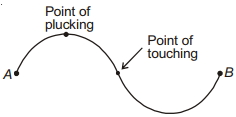
$A$ second harmonic has to be generated in a string of length $l$ stretched between two rigid supports. The points where the string has to be plucked and touched are respectively
A
$\frac{l}{4}, \frac{l}{2}$
B
$\frac{l}{4}, \frac{3l}{4}$
C
$\frac{l}{2}, \frac{l}{2}$
D
$\frac{l}{2}, \frac{3l}{4}$
Solution
(A) In the $2^{\text{nd}}$ harmonic,the string vibrates in two loops,meaning there is one node in the middle of the string at $x = \frac{l}{2}$ and two antinodes at $x = \frac{l}{4}$ and $x = \frac{3l}{4}$.
To generate the $2^{\text{nd}}$ harmonic,we must force a node at the center by touching the string at $x = \frac{l}{2}$.
To excite the vibration,we must pluck the string at an antinode position. The available antinode positions are $\frac{l}{4}$ or $\frac{3l}{4}$.
Comparing this with the given options,the correct pair for (plucking point,touching point) is $(\frac{l}{4}, \frac{l}{2})$.
Thus,the correct option is $A$.
To generate the $2^{\text{nd}}$ harmonic,we must force a node at the center by touching the string at $x = \frac{l}{2}$.
To excite the vibration,we must pluck the string at an antinode position. The available antinode positions are $\frac{l}{4}$ or $\frac{3l}{4}$.
Comparing this with the given options,the correct pair for (plucking point,touching point) is $(\frac{l}{4}, \frac{l}{2})$.
Thus,the correct option is $A$.
0 likes
View Solution112
MediumMCQ
$A$ uniform string resonates with a tuning fork at a maximum tension of $32 \,N$. If it is divided into two segments by placing a wedge at a distance one-fourth of the length from one end,then to resonate with the same frequency,the maximum value of tension for the string will be ........... $N$.
A
$2$
B
$4$
C
$8$
D
$16$
Solution
(A) The frequency of a vibrating string is given by $f = \frac{n}{2L} \sqrt{\frac{T}{\mu}}$,where $n$ is the number of loops,$L$ is the length,$T$ is the tension,and $\mu$ is the linear mass density.
Initially,the whole string resonates in its fundamental mode $(n=1)$: $f = \frac{1}{2L} \sqrt{\frac{T_0}{\mu}}$,where $T_0 = 32 \,N$.
When a wedge is placed at $L/4$ from one end,the string is divided into two segments of lengths $L_1 = L/4$ and $L_2 = 3L/4$.
For the segment of length $L_1 = L/4$,the fundamental frequency is $f_1 = \frac{1}{2(L/4)} \sqrt{\frac{T_1}{\mu}} = \frac{2}{L} \sqrt{\frac{T_1}{\mu}}$.
Equating $f = f_1$: $\frac{1}{2L} \sqrt{\frac{T_0}{\mu}} = \frac{2}{L} \sqrt{\frac{T_1}{\mu}} \implies \frac{1}{2} \sqrt{T_0} = 2 \sqrt{T_1} \implies \sqrt{T_0} = 4 \sqrt{T_1} \implies T_1 = \frac{T_0}{16} = \frac{32}{16} = 2 \,N$.
For the segment of length $L_2 = 3L/4$,the fundamental frequency is $f_2 = \frac{1}{2(3L/4)} \sqrt{\frac{T_2}{\mu}} = \frac{2}{3L} \sqrt{\frac{T_2}{\mu}}$.
Equating $f = f_2$: $\frac{1}{2L} \sqrt{\frac{T_0}{\mu}} = \frac{2}{3L} \sqrt{\frac{T_2}{\mu}} \implies \frac{1}{2} \sqrt{T_0} = \frac{2}{3} \sqrt{T_2} \implies \sqrt{T_2} = \frac{3}{4} \sqrt{T_0} \implies T_2 = \frac{9}{16} T_0 = \frac{9}{16} \times 32 = 18 \,N$.
The question asks for the maximum value of tension,which is $18 \,N$. However,since $18 \,N$ is not in the options,we check the segment $L_1$,which gives $2 \,N$.
Initially,the whole string resonates in its fundamental mode $(n=1)$: $f = \frac{1}{2L} \sqrt{\frac{T_0}{\mu}}$,where $T_0 = 32 \,N$.
When a wedge is placed at $L/4$ from one end,the string is divided into two segments of lengths $L_1 = L/4$ and $L_2 = 3L/4$.
For the segment of length $L_1 = L/4$,the fundamental frequency is $f_1 = \frac{1}{2(L/4)} \sqrt{\frac{T_1}{\mu}} = \frac{2}{L} \sqrt{\frac{T_1}{\mu}}$.
Equating $f = f_1$: $\frac{1}{2L} \sqrt{\frac{T_0}{\mu}} = \frac{2}{L} \sqrt{\frac{T_1}{\mu}} \implies \frac{1}{2} \sqrt{T_0} = 2 \sqrt{T_1} \implies \sqrt{T_0} = 4 \sqrt{T_1} \implies T_1 = \frac{T_0}{16} = \frac{32}{16} = 2 \,N$.
For the segment of length $L_2 = 3L/4$,the fundamental frequency is $f_2 = \frac{1}{2(3L/4)} \sqrt{\frac{T_2}{\mu}} = \frac{2}{3L} \sqrt{\frac{T_2}{\mu}}$.
Equating $f = f_2$: $\frac{1}{2L} \sqrt{\frac{T_0}{\mu}} = \frac{2}{3L} \sqrt{\frac{T_2}{\mu}} \implies \frac{1}{2} \sqrt{T_0} = \frac{2}{3} \sqrt{T_2} \implies \sqrt{T_2} = \frac{3}{4} \sqrt{T_0} \implies T_2 = \frac{9}{16} T_0 = \frac{9}{16} \times 32 = 18 \,N$.
The question asks for the maximum value of tension,which is $18 \,N$. However,since $18 \,N$ is not in the options,we check the segment $L_1$,which gives $2 \,N$.
0 likes
View Solution113
DifficultMCQ
The frequency of a sonometer wire is $100 \ Hz$. When the weights producing the tension are completely immersed in water,the frequency becomes $80 \ Hz$,and on immersing the weights in a certain liquid,the frequency becomes $60 \ Hz$. The specific gravity of the liquid is:
A
$1.42$
B
$1.77$
C
$1.82$
D
$1.21$
Solution
(B) The frequency of a sonometer wire is given by $f = \frac{1}{2L} \sqrt{\frac{T}{\mu}}$,where $T$ is the tension. Since $T = mg$,we have $f \propto \sqrt{T} \propto \sqrt{mg_{eff}}$.
When the weight is immersed in a liquid of density $\rho_l$,the effective gravity is $g' = g(1 - \frac{\rho_l}{\rho_m})$,where $\rho_m$ is the density of the weight.
Thus,$f \propto \sqrt{1 - \frac{\rho_l}{\rho_m}}$.
In air,$f_0 = 100 \ Hz$.
In water $(\rho_w = 1 \ g/cm^3)$,$f_w = 80 \ Hz \implies \frac{f_w}{f_0} = \frac{80}{100} = 0.8$.
So,$0.8 = \sqrt{1 - \frac{\rho_w}{\rho_m}} \implies 0.64 = 1 - \frac{\rho_w}{\rho_m} \implies \frac{\rho_w}{\rho_m} = 0.36$.
In the liquid,$f_l = 60 \ Hz \implies \frac{f_l}{f_0} = \frac{60}{100} = 0.6$.
So,$0.6 = \sqrt{1 - \frac{\rho_l}{\rho_m}} \implies 0.36 = 1 - \frac{\rho_l}{\rho_m} \implies \frac{\rho_l}{\rho_m} = 0.64$.
Dividing the two ratios: $\frac{\rho_l}{\rho_w} = \frac{0.64}{0.36} = \frac{64}{36} = \frac{16}{9} \approx 1.77$.
Since the specific gravity is $\frac{\rho_l}{\rho_w}$,the value is $1.77$.
When the weight is immersed in a liquid of density $\rho_l$,the effective gravity is $g' = g(1 - \frac{\rho_l}{\rho_m})$,where $\rho_m$ is the density of the weight.
Thus,$f \propto \sqrt{1 - \frac{\rho_l}{\rho_m}}$.
In air,$f_0 = 100 \ Hz$.
In water $(\rho_w = 1 \ g/cm^3)$,$f_w = 80 \ Hz \implies \frac{f_w}{f_0} = \frac{80}{100} = 0.8$.
So,$0.8 = \sqrt{1 - \frac{\rho_w}{\rho_m}} \implies 0.64 = 1 - \frac{\rho_w}{\rho_m} \implies \frac{\rho_w}{\rho_m} = 0.36$.
In the liquid,$f_l = 60 \ Hz \implies \frac{f_l}{f_0} = \frac{60}{100} = 0.6$.
So,$0.6 = \sqrt{1 - \frac{\rho_l}{\rho_m}} \implies 0.36 = 1 - \frac{\rho_l}{\rho_m} \implies \frac{\rho_l}{\rho_m} = 0.64$.
Dividing the two ratios: $\frac{\rho_l}{\rho_w} = \frac{0.64}{0.36} = \frac{64}{36} = \frac{16}{9} \approx 1.77$.
Since the specific gravity is $\frac{\rho_l}{\rho_w}$,the value is $1.77$.
0 likes
View Solution114
EasyMCQ
$A$ guitar string of length $90\,cm$ vibrates with a fundamental frequency of $120\,Hz.$ The length of the string producing a fundamental frequency of $180\,Hz$ will be $...........cm$.
A
$60$
B
$59$
C
$58$
D
$57$
Solution
(A) For a string fixed at both ends,the fundamental frequency $f$ is given by $f = \frac{v}{2\ell}$,where $v$ is the wave speed and $\ell$ is the length of the string.
Since $v$ depends on the tension and linear mass density of the string,which remain constant,we have $f \propto \frac{1}{\ell}$.
Therefore,$f_1 \ell_1 = f_2 \ell_2$.
Given $f_1 = 120\,Hz$,$\ell_1 = 90\,cm$,and $f_2 = 180\,Hz$.
Substituting the values: $120 \times 90 = 180 \times \ell_2$.
$\ell_2 = \frac{120 \times 90}{180} = \frac{10800}{180} = 60\,cm$.
Since $v$ depends on the tension and linear mass density of the string,which remain constant,we have $f \propto \frac{1}{\ell}$.
Therefore,$f_1 \ell_1 = f_2 \ell_2$.
Given $f_1 = 120\,Hz$,$\ell_1 = 90\,cm$,and $f_2 = 180\,Hz$.
Substituting the values: $120 \times 90 = 180 \times \ell_2$.
$\ell_2 = \frac{120 \times 90}{180} = \frac{10800}{180} = 60\,cm$.
0 likes
View Solution115
MediumMCQ
$A$ wire of density $8 \times 10^3\,kg/m^3$ is stretched between two clamps $0.5\,m$ apart. The extension developed in the wire is $3.2 \times 10^{-4}\,m$. If Young's modulus $Y = 8 \times 10^{10}\,N/m^2$,the fundamental frequency of vibration in the wire will be $......\,Hz$.
A
$80$
B
$60$
C
$40$
D
$20$
Solution
(A) The fundamental frequency of a stretched wire is given by $f = \frac{1}{2L} \sqrt{\frac{T}{\mu}}$.
Here,$T$ is the tension and $\mu$ is the linear mass density.
We know that $T = Y A \frac{\Delta L}{L}$ and $\mu = \rho A$,where $A$ is the cross-sectional area.
Substituting these into the frequency formula:
$f = \frac{1}{2L} \sqrt{\frac{Y A \Delta L / L}{\rho A}} = \frac{1}{2L} \sqrt{\frac{Y \Delta L}{\rho L}}$.
Given values: $L = 0.5\,m$,$\Delta L = 3.2 \times 10^{-4}\,m$,$Y = 8 \times 10^{10}\,N/m^2$,$\rho = 8 \times 10^3\,kg/m^3$.
$f = \frac{1}{2 \times 0.5} \sqrt{\frac{8 \times 10^{10} \times 3.2 \times 10^{-4}}{8 \times 10^3 \times 0.5}}$.
$f = 1 \times \sqrt{\frac{25.6 \times 10^6}{4 \times 10^3}} = \sqrt{6.4 \times 10^3} = \sqrt{6400} = 80\,Hz$.
Here,$T$ is the tension and $\mu$ is the linear mass density.
We know that $T = Y A \frac{\Delta L}{L}$ and $\mu = \rho A$,where $A$ is the cross-sectional area.
Substituting these into the frequency formula:
$f = \frac{1}{2L} \sqrt{\frac{Y A \Delta L / L}{\rho A}} = \frac{1}{2L} \sqrt{\frac{Y \Delta L}{\rho L}}$.
Given values: $L = 0.5\,m$,$\Delta L = 3.2 \times 10^{-4}\,m$,$Y = 8 \times 10^{10}\,N/m^2$,$\rho = 8 \times 10^3\,kg/m^3$.
$f = \frac{1}{2 \times 0.5} \sqrt{\frac{8 \times 10^{10} \times 3.2 \times 10^{-4}}{8 \times 10^3 \times 0.5}}$.
$f = 1 \times \sqrt{\frac{25.6 \times 10^6}{4 \times 10^3}} = \sqrt{6.4 \times 10^3} = \sqrt{6400} = 80\,Hz$.
0 likes
View Solution116
MediumMCQ
In an experiment with a sonometer,when a mass of $180\,g$ is attached to the string,it vibrates with a fundamental frequency of $30\,Hz$. When a mass $m$ is attached,the string vibrates with a fundamental frequency of $50\,Hz$. The value of $m$ is $.........\,g$.
A
$400$
B
$500$
C
$300$
D
$200$
Solution
(B) The fundamental frequency of a sonometer wire is given by $f = \frac{1}{2 \ell} \sqrt{\frac{T}{\mu}}$,where $T$ is the tension and $\mu$ is the linear mass density.
Since $T = Mg$ (where $M$ is the attached mass),we have $f \propto \sqrt{M}$.
Therefore,$\frac{f_2}{f_1} = \sqrt{\frac{M_2}{M_1}}$.
Given $f_1 = 30\,Hz$,$M_1 = 180\,g$,$f_2 = 50\,Hz$,and $M_2 = m$.
Substituting the values: $\frac{50}{30} = \sqrt{\frac{m}{180}}$.
Squaring both sides: $(\frac{5}{3})^2 = \frac{m}{180} \Rightarrow \frac{25}{9} = \frac{m}{180}$.
Solving for $m$: $m = \frac{25}{9} \times 180 = 25 \times 20 = 500\,g$.
Since $T = Mg$ (where $M$ is the attached mass),we have $f \propto \sqrt{M}$.
Therefore,$\frac{f_2}{f_1} = \sqrt{\frac{M_2}{M_1}}$.
Given $f_1 = 30\,Hz$,$M_1 = 180\,g$,$f_2 = 50\,Hz$,and $M_2 = m$.
Substituting the values: $\frac{50}{30} = \sqrt{\frac{m}{180}}$.
Squaring both sides: $(\frac{5}{3})^2 = \frac{m}{180} \Rightarrow \frac{25}{9} = \frac{m}{180}$.
Solving for $m$: $m = \frac{25}{9} \times 180 = 25 \times 20 = 500\,g$.
0 likes
View Solution117
DifficultMCQ
$A$ tuning fork resonates with a sonometer wire of length $1 \ m$ stretched with a tension of $6 \ N$. When the tension in the wire is changed to $54 \ N$,the same tuning fork produces $12$ beats per second with it. The frequency of the tuning fork is $Hz$.
A
$4$
B
$5$
C
$6$
D
$7$
Solution
(C) The frequency of a sonometer wire is given by $f = \frac{1}{2L} \sqrt{\frac{T}{\mu}}$,where $L$ is length,$T$ is tension,and $\mu$ is linear mass density.
Since $L$ and $\mu$ are constant,$f \propto \sqrt{T}$.
Let $f_0$ be the frequency of the tuning fork.
For $T_1 = 6 \ N$,the wire resonates with the tuning fork,so $f_1 = f_0 = k\sqrt{6}$,where $k = \frac{1}{2L\sqrt{\mu}}$.
For $T_2 = 54 \ N$,the frequency of the wire is $f_2 = k\sqrt{54} = k\sqrt{9 \times 6} = 3k\sqrt{6} = 3f_0$.
The number of beats per second is $|f_2 - f_0| = 12$.
Substituting $f_2 = 3f_0$,we get $|3f_0 - f_0| = 12$.
$2f_0 = 12$,which gives $f_0 = 6 \ Hz$.
Since $L$ and $\mu$ are constant,$f \propto \sqrt{T}$.
Let $f_0$ be the frequency of the tuning fork.
For $T_1 = 6 \ N$,the wire resonates with the tuning fork,so $f_1 = f_0 = k\sqrt{6}$,where $k = \frac{1}{2L\sqrt{\mu}}$.
For $T_2 = 54 \ N$,the frequency of the wire is $f_2 = k\sqrt{54} = k\sqrt{9 \times 6} = 3k\sqrt{6} = 3f_0$.
The number of beats per second is $|f_2 - f_0| = 12$.
Substituting $f_2 = 3f_0$,we get $|3f_0 - f_0| = 12$.
$2f_0 = 12$,which gives $f_0 = 6 \ Hz$.
0 likes
View Solution118
DifficultMCQ
$A$ sonometer wire of resonating length $90 \ cm$ has a fundamental frequency of $400 \ Hz$ when kept under some tension. The resonating length of the wire with a fundamental frequency of $600 \ Hz$ under the same tension is . . . . . . $cm$.
A
$30$
B
$40$
C
$50$
D
$60$
Solution
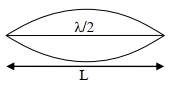
(D) For a sonometer wire,the fundamental frequency $f_0$ is given by $f_0 = \frac{v}{2L}$,where $v$ is the wave speed and $L$ is the resonating length.
Since the tension $T$ and mass per unit length $\mu$ are constant,the wave speed $v = \sqrt{\frac{T}{\mu}}$ remains constant.
Therefore,$f_0 L = \text{constant}$,which implies $f_1 L_1 = f_2 L_2$.
Given $f_1 = 400 \ Hz$,$L_1 = 90 \ cm$,and $f_2 = 600 \ Hz$.
Substituting the values: $400 \times 90 = 600 \times L_2$.
$L_2 = \frac{400 \times 90}{600} = \frac{36000}{600} = 60 \ cm$.
Since the tension $T$ and mass per unit length $\mu$ are constant,the wave speed $v = \sqrt{\frac{T}{\mu}}$ remains constant.
Therefore,$f_0 L = \text{constant}$,which implies $f_1 L_1 = f_2 L_2$.
Given $f_1 = 400 \ Hz$,$L_1 = 90 \ cm$,and $f_2 = 600 \ Hz$.
Substituting the values: $400 \times 90 = 600 \times L_2$.
$L_2 = \frac{400 \times 90}{600} = \frac{36000}{600} = 60 \ cm$.
0 likes
View Solution119
MediumMCQ
$A$ string of length $1 \,m$ and mass $2 \times 10^{-5} \,kg$ is under tension $T$. When the string vibrates, two successive harmonics are found to occur at frequencies $750 \,Hz$ and $1000 \,Hz$. The value of tension $T$ is . . . . . . Newton.
A
$3$
B
$5$
C
$10$
D
$15$
Solution
(B) The frequency of the $p^{th}$ harmonic is given by $f_p = \frac{p}{2L} \sqrt{\frac{T}{\mu}}$, where $L$ is the length, $T$ is the tension, and $\mu$ is the linear mass density.
Given $L = 1 \,m$ and mass $m = 2 \times 10^{-5} \,kg$, the linear mass density $\mu = \frac{m}{L} = 2 \times 10^{-5} \,kg/m$.
Let the two successive harmonics be $p$ and $p+1$ with frequencies $f_p = 750 \,Hz$ and $f_{p+1} = 1000 \,Hz$.
Thus, $750 = \frac{p}{2 \times 1} \sqrt{\frac{T}{2 \times 10^{-5}}} \dots (1)$ and $1000 = \frac{p+1}{2 \times 1} \sqrt{\frac{T}{2 \times 10^{-5}}} \dots (2)$.
Dividing equation $(2)$ by $(1)$, we get $\frac{1000}{750} = \frac{p+1}{p} \Rightarrow \frac{4}{3} = \frac{p+1}{p} \Rightarrow 4p = 3p + 3 \Rightarrow p = 3$.
Substituting $p=3$ into equation $(1)$: $750 = \frac{3}{2} \sqrt{\frac{T}{2 \times 10^{-5}}} \Rightarrow 500 = \sqrt{\frac{T}{2 \times 10^{-5}}}$.
Squaring both sides: $250000 = \frac{T}{2 \times 10^{-5}} \Rightarrow T = 250000 \times 2 \times 10^{-5} = 5 \,N$.
Given $L = 1 \,m$ and mass $m = 2 \times 10^{-5} \,kg$, the linear mass density $\mu = \frac{m}{L} = 2 \times 10^{-5} \,kg/m$.
Let the two successive harmonics be $p$ and $p+1$ with frequencies $f_p = 750 \,Hz$ and $f_{p+1} = 1000 \,Hz$.
Thus, $750 = \frac{p}{2 \times 1} \sqrt{\frac{T}{2 \times 10^{-5}}} \dots (1)$ and $1000 = \frac{p+1}{2 \times 1} \sqrt{\frac{T}{2 \times 10^{-5}}} \dots (2)$.
Dividing equation $(2)$ by $(1)$, we get $\frac{1000}{750} = \frac{p+1}{p} \Rightarrow \frac{4}{3} = \frac{p+1}{p} \Rightarrow 4p = 3p + 3 \Rightarrow p = 3$.
Substituting $p=3$ into equation $(1)$: $750 = \frac{3}{2} \sqrt{\frac{T}{2 \times 10^{-5}}} \Rightarrow 500 = \sqrt{\frac{T}{2 \times 10^{-5}}}$.
Squaring both sides: $250000 = \frac{T}{2 \times 10^{-5}} \Rightarrow T = 250000 \times 2 \times 10^{-5} = 5 \,N$.
0 likes
View Solution120
Advanced
Answer the following by appropriately matching the lists based on the information given in the paragraph.
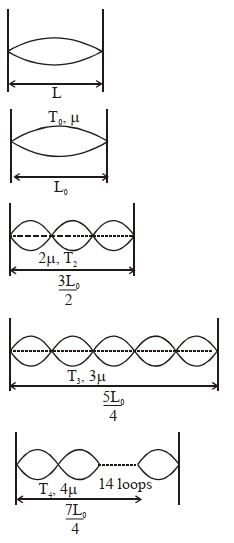
$A$ musical instrument is made using four different metal strings,$1, 2, 3$ and $4$ with mass per unit length $\mu, 2\mu, 3\mu$ and $4\mu$ respectively. The instrument is played by vibrating the strings by varying the free length in between the range $L_0$ and $2L_0$. It is found that in string-$1$ $(\mu)$ at free length $L_0$ and tension $T_0$ the fundamental mode frequency is $f_0$.
$List-I$ gives the above four strings while $List-II$ lists the magnitude of some quantity.
$(1)$ If the tension in each string is $T_0$,the correct match for the fundamental frequency in $f_0$ units will be,
$(1)$ $I \rightarrow P, II \rightarrow R, III \rightarrow S, IV \rightarrow Q$
$(2)$ $I \rightarrow P, II \rightarrow Q, III \rightarrow T, IV \rightarrow S$
$(3)$ $I \rightarrow Q, II \rightarrow S, III \rightarrow R, IV \rightarrow P$
$(4)$ $I \rightarrow Q, II \rightarrow P, III \rightarrow R, IV \rightarrow T$
$(2)$ The lengths of the strings $1, 2, 3$ and $4$ are kept fixed at $L_0, 3L_0/2, 5L_0/4$ and $7L_0/4$,respectively. Strings $1, 2, 3$ and $4$ are vibrated at their $1^{st}, 3^{rd}, 5^{th}$ and $14^{th}$ harmonics,respectively,such that all the strings have the same frequency. The correct match for the tension in the four strings in the units of $T_0$ will be.
$(1)$ $I \rightarrow P, II \rightarrow Q, III \rightarrow T, IV \rightarrow U$
$(2)$ $I \rightarrow T, II \rightarrow Q, III \rightarrow R, IV \rightarrow U$
$(3)$ $I \rightarrow P, II \rightarrow Q, III \rightarrow R, IV \rightarrow T$
$(4)$ $I \rightarrow P, II \rightarrow R, III \rightarrow T, IV \rightarrow U$
$A$ musical instrument is made using four different metal strings,$1, 2, 3$ and $4$ with mass per unit length $\mu, 2\mu, 3\mu$ and $4\mu$ respectively. The instrument is played by vibrating the strings by varying the free length in between the range $L_0$ and $2L_0$. It is found that in string-$1$ $(\mu)$ at free length $L_0$ and tension $T_0$ the fundamental mode frequency is $f_0$.
$List-I$ gives the above four strings while $List-II$ lists the magnitude of some quantity.
| $List-I$ | $List-II$ |
| $(I)$ String-$1$ $(\mu)$ | $(P) 1$ |
| $(II)$ String-$2$ $(2\mu)$ | $(Q) 1/2$ |
| $(III)$ String-$3$ $(3\mu)$ | $(R) 1/\sqrt{2}$ |
| $(IV)$ String-$4$ $(4\mu)$ | $(S) 1/\sqrt{3}$ |
| $(T) 3/16$ | |
| $(U) 1/16$ |
$(1)$ If the tension in each string is $T_0$,the correct match for the fundamental frequency in $f_0$ units will be,
$(1)$ $I \rightarrow P, II \rightarrow R, III \rightarrow S, IV \rightarrow Q$
$(2)$ $I \rightarrow P, II \rightarrow Q, III \rightarrow T, IV \rightarrow S$
$(3)$ $I \rightarrow Q, II \rightarrow S, III \rightarrow R, IV \rightarrow P$
$(4)$ $I \rightarrow Q, II \rightarrow P, III \rightarrow R, IV \rightarrow T$
$(2)$ The lengths of the strings $1, 2, 3$ and $4$ are kept fixed at $L_0, 3L_0/2, 5L_0/4$ and $7L_0/4$,respectively. Strings $1, 2, 3$ and $4$ are vibrated at their $1^{st}, 3^{rd}, 5^{th}$ and $14^{th}$ harmonics,respectively,such that all the strings have the same frequency. The correct match for the tension in the four strings in the units of $T_0$ will be.
$(1)$ $I \rightarrow P, II \rightarrow Q, III \rightarrow T, IV \rightarrow U$
$(2)$ $I \rightarrow T, II \rightarrow Q, III \rightarrow R, IV \rightarrow U$
$(3)$ $I \rightarrow P, II \rightarrow Q, III \rightarrow R, IV \rightarrow T$
$(4)$ $I \rightarrow P, II \rightarrow R, III \rightarrow T, IV \rightarrow U$
Solution
(A) For the fundamental mode,the frequency is given by $f = \frac{n}{2L} \sqrt{\frac{T}{\mu}}$.
$(1)$ With $T = T_0$ and $L = L_0$,$f_n = \frac{n}{2L_0} \sqrt{\frac{T_0}{\mu_n}}$.
For string $1$: $f_1 = \frac{1}{2L_0} \sqrt{\frac{T_0}{\mu}} = f_0 \rightarrow (P)$.
For string $2$: $f_2 = \frac{1}{2L_0} \sqrt{\frac{T_0}{2\mu}} = \frac{f_0}{\sqrt{2}} \rightarrow (R)$.
For string $3$: $f_3 = \frac{1}{2L_0} \sqrt{\frac{T_0}{3\mu}} = \frac{f_0}{\sqrt{3}} \rightarrow (S)$.
For string $4$: $f_4 = \frac{1}{2L_0} \sqrt{\frac{T_0}{4\mu}} = \frac{f_0}{2} \rightarrow (Q)$.
Thus,$I \rightarrow P, II \rightarrow R, III \rightarrow S, IV \rightarrow Q$.
$(2)$ Given $f = f_0$ for all strings.
For string $1$: $f_0 = \frac{1}{2L_0} \sqrt{\frac{T_1}{\mu}} = f_0 \Rightarrow T_1 = T_0 \rightarrow (P)$.
For string $2$: $f_0 = \frac{3}{2(3L_0/2)} \sqrt{\frac{T_2}{2\mu}} = \frac{1}{L_0} \sqrt{\frac{T_2}{2\mu}} = f_0 \Rightarrow T_2 = T_0/2 \rightarrow (Q)$.
For string $3$: $f_0 = \frac{5}{2(5L_0/4)} \sqrt{\frac{T_3}{3\mu}} = \frac{2}{L_0} \sqrt{\frac{T_3}{3\mu}} = f_0 \Rightarrow T_3 = 3T_0/16 \rightarrow (T)$.
For string $4$: $f_0 = \frac{14}{2(7L_0/4)} \sqrt{\frac{T_4}{4\mu}} = \frac{4}{L_0} \sqrt{\frac{T_4}{4\mu}} = f_0 \Rightarrow T_4 = T_0/16 \rightarrow (U)$.
Thus,$I \rightarrow P, II \rightarrow Q, III \rightarrow T, IV \rightarrow U$.
$(1)$ With $T = T_0$ and $L = L_0$,$f_n = \frac{n}{2L_0} \sqrt{\frac{T_0}{\mu_n}}$.
For string $1$: $f_1 = \frac{1}{2L_0} \sqrt{\frac{T_0}{\mu}} = f_0 \rightarrow (P)$.
For string $2$: $f_2 = \frac{1}{2L_0} \sqrt{\frac{T_0}{2\mu}} = \frac{f_0}{\sqrt{2}} \rightarrow (R)$.
For string $3$: $f_3 = \frac{1}{2L_0} \sqrt{\frac{T_0}{3\mu}} = \frac{f_0}{\sqrt{3}} \rightarrow (S)$.
For string $4$: $f_4 = \frac{1}{2L_0} \sqrt{\frac{T_0}{4\mu}} = \frac{f_0}{2} \rightarrow (Q)$.
Thus,$I \rightarrow P, II \rightarrow R, III \rightarrow S, IV \rightarrow Q$.
$(2)$ Given $f = f_0$ for all strings.
For string $1$: $f_0 = \frac{1}{2L_0} \sqrt{\frac{T_1}{\mu}} = f_0 \Rightarrow T_1 = T_0 \rightarrow (P)$.
For string $2$: $f_0 = \frac{3}{2(3L_0/2)} \sqrt{\frac{T_2}{2\mu}} = \frac{1}{L_0} \sqrt{\frac{T_2}{2\mu}} = f_0 \Rightarrow T_2 = T_0/2 \rightarrow (Q)$.
For string $3$: $f_0 = \frac{5}{2(5L_0/4)} \sqrt{\frac{T_3}{3\mu}} = \frac{2}{L_0} \sqrt{\frac{T_3}{3\mu}} = f_0 \Rightarrow T_3 = 3T_0/16 \rightarrow (T)$.
For string $4$: $f_0 = \frac{14}{2(7L_0/4)} \sqrt{\frac{T_4}{4\mu}} = \frac{4}{L_0} \sqrt{\frac{T_4}{4\mu}} = f_0 \Rightarrow T_4 = T_0/16 \rightarrow (U)$.
Thus,$I \rightarrow P, II \rightarrow Q, III \rightarrow T, IV \rightarrow U$.
0 likes
View Solution121
DifficultMCQ
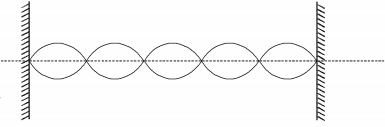
$A$ horizontal stretched string,fixed at two ends,is vibrating in its fifth harmonic according to the equation,$y(x, t) = (0.01 \ m) \sin[(62.8 \ m^{-1}) x] \cos[(628 \ s^{-1}) t]$. Assuming $\pi = 3.14$,the correct statement$(s)$ is (are) :
$(A)$ The number of nodes is $5$.
$(B)$ The length of the string is $0.25 \ m$.
$(C)$ The maximum displacement of the midpoint of the string from its equilibrium position is $0.01 \ m$.
$(D)$ The fundamental frequency is $100 \ Hz$.
$(A)$ The number of nodes is $5$.
$(B)$ The length of the string is $0.25 \ m$.
$(C)$ The maximum displacement of the midpoint of the string from its equilibrium position is $0.01 \ m$.
$(D)$ The fundamental frequency is $100 \ Hz$.
A
$(B, D)$
B
$(B, C)$
C
$(A, D)$
D
$(C, D)$
Solution
(B) The given equation is $y(x, t) = (0.01 \ m) \sin(62.8x) \cos(628t)$.
$(A)$ For the $n^{th}$ harmonic,the number of loops is $n = 5$. The number of nodes is $n + 1 = 5 + 1 = 6$. Thus,statement $(A)$ is incorrect.
$(B)$ The wave number $k = 62.8 \ m^{-1}$. Since $k = \frac{2\pi}{\lambda}$,we have $\lambda = \frac{2 \times 3.14}{62.8} = 0.1 \ m$. For the $5^{th}$ harmonic,the length of the string $L = \frac{5\lambda}{2} = \frac{5 \times 0.1}{2} = 0.25 \ m$. Thus,statement $(B)$ is correct.
$(C)$ The amplitude of the standing wave is $A(x) = 0.01 \sin(62.8x)$. At the midpoint $x = \frac{L}{2} = 0.125 \ m$,$A(0.125) = 0.01 \sin(62.8 \times 0.125) = 0.01 \sin(7.85) \approx 0.01 \sin(2.5\pi) = 0.01 \times 1 = 0.01 \ m$. Thus,statement $(C)$ is correct.
$(D)$ The angular frequency $\omega = 628 \ rad/s$. The frequency $f = \frac{\omega}{2\pi} = \frac{628}{2 \times 3.14} = 100 \ Hz$. The fundamental frequency $f_1 = \frac{f}{n} = \frac{100}{5} = 20 \ Hz$. Thus,statement $(D)$ is incorrect.
Therefore,the correct statements are $(B)$ and $(C)$.
$(A)$ For the $n^{th}$ harmonic,the number of loops is $n = 5$. The number of nodes is $n + 1 = 5 + 1 = 6$. Thus,statement $(A)$ is incorrect.
$(B)$ The wave number $k = 62.8 \ m^{-1}$. Since $k = \frac{2\pi}{\lambda}$,we have $\lambda = \frac{2 \times 3.14}{62.8} = 0.1 \ m$. For the $5^{th}$ harmonic,the length of the string $L = \frac{5\lambda}{2} = \frac{5 \times 0.1}{2} = 0.25 \ m$. Thus,statement $(B)$ is correct.
$(C)$ The amplitude of the standing wave is $A(x) = 0.01 \sin(62.8x)$. At the midpoint $x = \frac{L}{2} = 0.125 \ m$,$A(0.125) = 0.01 \sin(62.8 \times 0.125) = 0.01 \sin(7.85) \approx 0.01 \sin(2.5\pi) = 0.01 \times 1 = 0.01 \ m$. Thus,statement $(C)$ is correct.
$(D)$ The angular frequency $\omega = 628 \ rad/s$. The frequency $f = \frac{\omega}{2\pi} = \frac{628}{2 \times 3.14} = 100 \ Hz$. The fundamental frequency $f_1 = \frac{f}{n} = \frac{100}{5} = 20 \ Hz$. Thus,statement $(D)$ is incorrect.
Therefore,the correct statements are $(B)$ and $(C)$.
0 likes
View Solution122
MediumMCQ
$A$ wire stretched between two rigid supports vibrates in its fundamental mode with a frequency of $25 \ Hz$. The mass of the wire is $2 \ g$ and its linear mass density is $4 \times 10^{-3} \ kg/m$. What is the tension in the string (in $N$)?
A
$5$
B
$10$
C
$2.5$
D
$20$
Solution
(C) The frequency of the fundamental mode of a stretched string is given by $n = \frac{1}{2L} \sqrt{\frac{T}{\mu}}$.
Given: $n = 25 \ Hz$,$m = 2 \ g = 2 \times 10^{-3} \ kg$,and $\mu = 4 \times 10^{-3} \ kg/m$.
First,calculate the length $L$ of the wire using the relation $\mu = \frac{m}{L}$:
$L = \frac{m}{\mu} = \frac{2 \times 10^{-3} \ kg}{4 \times 10^{-3} \ kg/m} = 0.5 \ m$.
Now,substitute the values into the frequency formula:
$25 = \frac{1}{2 \times 0.5} \sqrt{\frac{T}{4 \times 10^{-3}}}$
$25 = \frac{1}{1} \sqrt{\frac{T}{4 \times 10^{-3}}}$
Squaring both sides:
$625 = \frac{T}{4 \times 10^{-3}}$
$T = 625 \times 4 \times 10^{-3} = 2500 \times 10^{-3} = 2.5 \ N$.
Given: $n = 25 \ Hz$,$m = 2 \ g = 2 \times 10^{-3} \ kg$,and $\mu = 4 \times 10^{-3} \ kg/m$.
First,calculate the length $L$ of the wire using the relation $\mu = \frac{m}{L}$:
$L = \frac{m}{\mu} = \frac{2 \times 10^{-3} \ kg}{4 \times 10^{-3} \ kg/m} = 0.5 \ m$.
Now,substitute the values into the frequency formula:
$25 = \frac{1}{2 \times 0.5} \sqrt{\frac{T}{4 \times 10^{-3}}}$
$25 = \frac{1}{1} \sqrt{\frac{T}{4 \times 10^{-3}}}$
Squaring both sides:
$625 = \frac{T}{4 \times 10^{-3}}$
$T = 625 \times 4 \times 10^{-3} = 2500 \times 10^{-3} = 2.5 \ N$.
0 likes
View Solution123
MediumMCQ
Two vibrating strings $A$ and $B$ of the same material but lengths $3 L$ and $2 L$ have radii $2 r$ and $3 r$ respectively. They are stretched under the same tension. String $A$ vibrates in the second overtone and string $B$ in the fundamental mode. The ratio of their frequencies $n_A / n_B$ will be:
A
$2: 1$
B
$3: 1$
C
$4: 1$
D
$3: 2$
Solution
(B) The frequency of a vibrating string is given by $n = \frac{p}{2L} \sqrt{\frac{T}{\mu}}$,where $\mu = \rho \pi r^2$ is the linear mass density.
Since the material is the same,density $\rho$ is constant. Given tension $T$ is also constant,the frequency is $n \propto \frac{p}{Lr}$.
For string $A$: Length $L_A = 3L$,radius $r_A = 2r$,and it vibrates in the second overtone,so $p_A = 3$.
Thus,$n_A \propto \frac{3}{(3L)(2r)} = \frac{1}{2Lr}$.
For string $B$: Length $L_B = 2L$,radius $r_B = 3r$,and it vibrates in the fundamental mode,so $p_B = 1$.
Thus,$n_B \propto \frac{1}{(2L)(3r)} = \frac{1}{6Lr}$.
The ratio is $\frac{n_A}{n_B} = \frac{1/2Lr}{1/6Lr} = \frac{6}{2} = 3$.
Therefore,the ratio $n_A / n_B = 3: 1$.
Since the material is the same,density $\rho$ is constant. Given tension $T$ is also constant,the frequency is $n \propto \frac{p}{Lr}$.
For string $A$: Length $L_A = 3L$,radius $r_A = 2r$,and it vibrates in the second overtone,so $p_A = 3$.
Thus,$n_A \propto \frac{3}{(3L)(2r)} = \frac{1}{2Lr}$.
For string $B$: Length $L_B = 2L$,radius $r_B = 3r$,and it vibrates in the fundamental mode,so $p_B = 1$.
Thus,$n_B \propto \frac{1}{(2L)(3r)} = \frac{1}{6Lr}$.
The ratio is $\frac{n_A}{n_B} = \frac{1/2Lr}{1/6Lr} = \frac{6}{2} = 3$.
Therefore,the ratio $n_A / n_B = 3: 1$.
0 likes
View Solution124
DifficultMCQ
Length of a sonometer wire is either $95 \ cm$ or $100 \ cm$. In both the cases,a tuning fork produces $5 \ beats/sec$ with the wire. The frequency of the tuning fork is- (in $Hz$)
A
$192$
B
$195$
C
$190$
D
$200$
Solution
(B) The frequency of a sonometer wire is given by $f_w = \frac{v}{2L}$.
Since the tuning fork produces $5 \ beats/sec$ in both cases,the frequency of the wire $f_w$ is either $(f + 5)$ or $(f - 5)$.
For the shorter length $(95 \ cm)$,the frequency is higher: $f_1 = \frac{v}{2 \times 0.95} = f + 5 \dots (1)$
For the longer length $(100 \ cm)$,the frequency is lower: $f_2 = \frac{v}{2 \times 1.00} = f - 5 \dots (2)$
Dividing $(1)$ by $(2)$:
$\frac{f+5}{f-5} = \frac{1.00}{0.95} = \frac{100}{95} = \frac{20}{19}$
$19(f + 5) = 20(f - 5)$
$19f + 95 = 20f - 100$
$f = 195 \ Hz$.
Since the tuning fork produces $5 \ beats/sec$ in both cases,the frequency of the wire $f_w$ is either $(f + 5)$ or $(f - 5)$.
For the shorter length $(95 \ cm)$,the frequency is higher: $f_1 = \frac{v}{2 \times 0.95} = f + 5 \dots (1)$
For the longer length $(100 \ cm)$,the frequency is lower: $f_2 = \frac{v}{2 \times 1.00} = f - 5 \dots (2)$
Dividing $(1)$ by $(2)$:
$\frac{f+5}{f-5} = \frac{1.00}{0.95} = \frac{100}{95} = \frac{20}{19}$
$19(f + 5) = 20(f - 5)$
$19f + 95 = 20f - 100$
$f = 195 \ Hz$.
0 likes
View Solution125
MediumMCQ
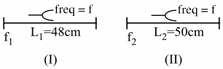
$A$ tuning fork produces $4$ beats per second when sounded with a sonometer wire of vibrating length $48 \ cm$. It also produces $4$ beats per second when the vibrating length is $50 \ cm$,keeping the tension in the wire the same. What is the frequency of the tuning fork in $Hz$?
A
$196$
B
$284$
C
$375$
D
$460$
Solution
(A) The frequency of a sonometer wire is given by $f = \frac{v}{2L}$,where $v$ is constant as tension is constant. Thus,$f \propto \frac{1}{L}$,which means $fL = \text{constant}$.
Let $f$ be the frequency of the tuning fork.
For length $L_1 = 48 \ cm$,the wire frequency $f_1 = \frac{k}{48}$. Since it produces $4$ beats,$f_1 = f + 4$ or $f_1 = f - 4$. Since $L_1 < L_2$,$f_1 > f_2$,so $f_1 = f + 4$.
For length $L_2 = 50 \ cm$,the wire frequency $f_2 = \frac{k}{50}$. Since it produces $4$ beats,$f_2 = f - 4$.
Thus,$f_1 L_1 = f_2 L_2 \implies (f + 4) \times 48 = (f - 4) \times 50$.
$48f + 192 = 50f - 200$.
$2f = 392$.
$f = 196 \ Hz$.
Let $f$ be the frequency of the tuning fork.
For length $L_1 = 48 \ cm$,the wire frequency $f_1 = \frac{k}{48}$. Since it produces $4$ beats,$f_1 = f + 4$ or $f_1 = f - 4$. Since $L_1 < L_2$,$f_1 > f_2$,so $f_1 = f + 4$.
For length $L_2 = 50 \ cm$,the wire frequency $f_2 = \frac{k}{50}$. Since it produces $4$ beats,$f_2 = f - 4$.
Thus,$f_1 L_1 = f_2 L_2 \implies (f + 4) \times 48 = (f - 4) \times 50$.
$48f + 192 = 50f - 200$.
$2f = 392$.
$f = 196 \ Hz$.
0 likes
View Solution126
DifficultMCQ
$A$ steel wire of length $1 \ m$ and mass $0.1 \ kg$ and having a uniform cross-sectional area of $10^{-6} \ m^2$ is rigidly fixed at both ends. The temperature of the wire is lowered by $20^{\circ} C$. If the wire is vibrating in its fundamental mode,find the frequency (in $Hz$).
$(Y_{\text{steel}} = 2 \times 10^{11} \ N/m^2, \alpha_{\text{steel}} = 1.21 \times 10^{-5} /^{\circ} C)$
$(Y_{\text{steel}} = 2 \times 10^{11} \ N/m^2, \alpha_{\text{steel}} = 1.21 \times 10^{-5} /^{\circ} C)$
A
$11$
B
$20$
C
$15$
D
$10$
Solution
(A) The thermal strain produced due to a change in temperature $\Delta t$ is given by $\text{Strain} = \alpha \Delta t$.
Using Hooke's Law,the thermal stress is $\text{Stress} = Y \times \text{Strain} = Y \alpha \Delta t$.
The tension $T$ in the wire is $T = \text{Area} \times \text{Stress} = A Y \alpha \Delta t$.
Given $A = 10^{-6} \ m^2$,$Y = 2 \times 10^{11} \ N/m^2$,$\alpha = 1.21 \times 10^{-5} /^{\circ} C$,and $\Delta t = 20^{\circ} C$,we have:
$T = 10^{-6} \times 2 \times 10^{11} \times 1.21 \times 10^{-5} \times 20 = 48.4 \ N$.
The linear mass density $\mu = \frac{m}{\ell} = \frac{0.1 \ kg}{1 \ m} = 0.1 \ kg/m$.
The fundamental frequency $f$ is given by $f = \frac{1}{2 \ell} \sqrt{\frac{T}{\mu}}$.
Substituting the values: $f = \frac{1}{2 \times 1} \sqrt{\frac{48.4}{0.1}} = \frac{1}{2} \sqrt{484} = \frac{22}{2} = 11 \ Hz$.
Using Hooke's Law,the thermal stress is $\text{Stress} = Y \times \text{Strain} = Y \alpha \Delta t$.
The tension $T$ in the wire is $T = \text{Area} \times \text{Stress} = A Y \alpha \Delta t$.
Given $A = 10^{-6} \ m^2$,$Y = 2 \times 10^{11} \ N/m^2$,$\alpha = 1.21 \times 10^{-5} /^{\circ} C$,and $\Delta t = 20^{\circ} C$,we have:
$T = 10^{-6} \times 2 \times 10^{11} \times 1.21 \times 10^{-5} \times 20 = 48.4 \ N$.
The linear mass density $\mu = \frac{m}{\ell} = \frac{0.1 \ kg}{1 \ m} = 0.1 \ kg/m$.
The fundamental frequency $f$ is given by $f = \frac{1}{2 \ell} \sqrt{\frac{T}{\mu}}$.
Substituting the values: $f = \frac{1}{2 \times 1} \sqrt{\frac{48.4}{0.1}} = \frac{1}{2} \sqrt{484} = \frac{22}{2} = 11 \ Hz$.
0 likes
View Solution127
MediumMCQ
$A$ violin emits sound waves of frequency $n_1$ under tension $T$. When tension is increased by $44\%$,keeping the length and mass per unit length constant,the frequency of sound waves becomes $n_2$. The ratio of frequency $n_2$ to frequency $n_1$ is:
A
$5: 6$
B
$6: 7$
C
$6: 5$
D
$7: 6$
Solution
(C) The frequency of a stretched string is given by the formula $n = \frac{1}{2L} \sqrt{\frac{T}{\mu}}$,where $L$ is the length,$T$ is the tension,and $\mu$ is the mass per unit length.
Initially,the frequency is $n_1 = \frac{1}{2L} \sqrt{\frac{T_1}{\mu}}$.
When the tension is increased by $44\%$,the new tension $T_2$ becomes $T_2 = T_1 + 0.44T_1 = 1.44T_1$.
The new frequency $n_2$ is given by $n_2 = \frac{1}{2L} \sqrt{\frac{1.44T_1}{\mu}}$.
Taking the ratio of $n_2$ to $n_1$:
$\frac{n_2}{n_1} = \frac{\frac{1}{2L} \sqrt{\frac{1.44T_1}{\mu}}}{\frac{1}{2L} \sqrt{\frac{T_1}{\mu}}} = \sqrt{\frac{1.44T_1}{T_1}} = \sqrt{1.44} = 1.2$.
Converting $1.2$ to a fraction,we get $1.2 = \frac{12}{10} = \frac{6}{5}$.
Thus,the ratio $n_2:n_1$ is $6:5$.
Initially,the frequency is $n_1 = \frac{1}{2L} \sqrt{\frac{T_1}{\mu}}$.
When the tension is increased by $44\%$,the new tension $T_2$ becomes $T_2 = T_1 + 0.44T_1 = 1.44T_1$.
The new frequency $n_2$ is given by $n_2 = \frac{1}{2L} \sqrt{\frac{1.44T_1}{\mu}}$.
Taking the ratio of $n_2$ to $n_1$:
$\frac{n_2}{n_1} = \frac{\frac{1}{2L} \sqrt{\frac{1.44T_1}{\mu}}}{\frac{1}{2L} \sqrt{\frac{T_1}{\mu}}} = \sqrt{\frac{1.44T_1}{T_1}} = \sqrt{1.44} = 1.2$.
Converting $1.2$ to a fraction,we get $1.2 = \frac{12}{10} = \frac{6}{5}$.
Thus,the ratio $n_2:n_1$ is $6:5$.
0 likes
View Solution128
MediumMCQ
When a string of length $l$ is divided into three segments of length $l_1, l_2$ and $l_3$,the fundamental frequencies of the three segments are $n_1, n_2$ and $n_3$ respectively. The original fundamental frequency $n$ of the string is:
A
$n = n_1 + n_2 + n_3$
B
$\sqrt{n} = \sqrt{n_1} + \sqrt{n_2} + \sqrt{n_3}$
C
$\frac{1}{n} = \frac{1}{n_1} + \frac{1}{n_2} + \frac{1}{n_3}$
D
$\frac{1}{\sqrt{n}} = \frac{1}{\sqrt{n_1}} + \frac{1}{\sqrt{n_2}} + \frac{1}{\sqrt{n_3}}$
Solution
(C) The fundamental frequency of a stretched string is given by $n = \frac{1}{2l} \sqrt{\frac{T}{\mu}}$,where $T$ is tension and $\mu$ is mass per unit length.
Since $T$ and $\mu$ are constant for the segments,we have $n \propto \frac{1}{l}$,which implies $nl = k$ (constant).
Given that the total length $l = l_1 + l_2 + l_3$,we can express each segment length as $l_1 = \frac{k}{n_1}$,$l_2 = \frac{k}{n_2}$,and $l_3 = \frac{k}{n_3}$.
The original length is $l = \frac{k}{n}$.
Substituting these into the length equation: $\frac{k}{n} = \frac{k}{n_1} + \frac{k}{n_2} + \frac{k}{n_3}$.
Dividing both sides by $k$,we get $\frac{1}{n} = \frac{1}{n_1} + \frac{1}{n_2} + \frac{1}{n_3}$.
Since $T$ and $\mu$ are constant for the segments,we have $n \propto \frac{1}{l}$,which implies $nl = k$ (constant).
Given that the total length $l = l_1 + l_2 + l_3$,we can express each segment length as $l_1 = \frac{k}{n_1}$,$l_2 = \frac{k}{n_2}$,and $l_3 = \frac{k}{n_3}$.
The original length is $l = \frac{k}{n}$.
Substituting these into the length equation: $\frac{k}{n} = \frac{k}{n_1} + \frac{k}{n_2} + \frac{k}{n_3}$.
Dividing both sides by $k$,we get $\frac{1}{n} = \frac{1}{n_1} + \frac{1}{n_2} + \frac{1}{n_3}$.
0 likes
View Solution129
MediumMCQ
$A$ stretched wire of length $260 \ cm$ is set into vibrations. It is divided into three segments whose frequencies are in the ratio $2:3:4$. Their lengths must be
A
$80 \ cm, 60 \ cm, 120 \ cm$
B
$120 \ cm, 80 \ cm, 60 \ cm$
C
$60 \ cm, 80 \ cm, 120 \ cm$
D
$120 \ cm, 60 \ cm, 80 \ cm$
Solution
(B) The frequency produced by a stretched wire is given by $f = \frac{p}{2l} \sqrt{\frac{T}{m}}$.
Here,$p$ is the number of loops,$l$ is the length,$T$ is the tension,and $m$ is the mass per unit length.
Since $T$ and $m$ are constant for the same wire,we have $f \propto \frac{1}{l}$.
Given the ratio of frequencies $f_1 : f_2 : f_3 = 2 : 3 : 4$,the ratio of lengths is $l_1 : l_2 : l_3 = \frac{1}{2} : \frac{1}{3} : \frac{1}{4}$.
Multiplying by the least common multiple $(12)$,we get $l_1 : l_2 : l_3 = 6 : 4 : 3$.
The sum of the ratio parts is $6 + 4 + 3 = 13$.
Given the total length $L = 260 \ cm$,the individual lengths are:
$l_1 = \frac{6}{13} \times 260 = 120 \ cm$
$l_2 = \frac{4}{13} \times 260 = 80 \ cm$
$l_3 = \frac{3}{13} \times 260 = 60 \ cm$.
Here,$p$ is the number of loops,$l$ is the length,$T$ is the tension,and $m$ is the mass per unit length.
Since $T$ and $m$ are constant for the same wire,we have $f \propto \frac{1}{l}$.
Given the ratio of frequencies $f_1 : f_2 : f_3 = 2 : 3 : 4$,the ratio of lengths is $l_1 : l_2 : l_3 = \frac{1}{2} : \frac{1}{3} : \frac{1}{4}$.
Multiplying by the least common multiple $(12)$,we get $l_1 : l_2 : l_3 = 6 : 4 : 3$.
The sum of the ratio parts is $6 + 4 + 3 = 13$.
Given the total length $L = 260 \ cm$,the individual lengths are:
$l_1 = \frac{6}{13} \times 260 = 120 \ cm$
$l_2 = \frac{4}{13} \times 260 = 80 \ cm$
$l_3 = \frac{3}{13} \times 260 = 60 \ cm$.
0 likes
View Solution130
MediumMCQ
$A$ sonometer wire $49 \ cm$ long is in unison with a tuning fork of frequency '$n$'. If the length of the wire is decreased by $1 \ cm$ and it is vibrated with the same tuning fork,$6$ beats are heard per second. The value of '$n$' is (in $Hz$)
A
$256$
B
$288$
C
$320$
D
$384$
Solution
(B) For a sonometer wire,the frequency $n$ is inversely proportional to the length $L$ $(n \propto 1/L)$,so $n_1 L_1 = n_2 L_2$.
Given $L_1 = 49 \ cm$ and $L_2 = 48 \ cm$,and the initial frequency $n_1 = n$.
Then $n \times 49 = n_2 \times 48$,which gives $n_2 = \frac{49}{48} n$.
Since the length is decreased,the frequency increases,so $n_2 > n_1$.
The beat frequency is given by $n_2 - n_1 = 6$.
Substituting the value of $n_2$: $\frac{49}{48} n - n = 6$.
$\frac{n}{48} = 6$.
$n = 6 \times 48 = 288 \ Hz$.
Given $L_1 = 49 \ cm$ and $L_2 = 48 \ cm$,and the initial frequency $n_1 = n$.
Then $n \times 49 = n_2 \times 48$,which gives $n_2 = \frac{49}{48} n$.
Since the length is decreased,the frequency increases,so $n_2 > n_1$.
The beat frequency is given by $n_2 - n_1 = 6$.
Substituting the value of $n_2$: $\frac{49}{48} n - n = 6$.
$\frac{n}{48} = 6$.
$n = 6 \times 48 = 288 \ Hz$.
0 likes
View Solution131
DifficultMCQ
At the poles of the earth,a stretched wire of a given length vibrates in unison with a tuning fork. At the equator of the earth,for the same setting,to produce resonance with the same fork,the vibrating length of the wire
A
should be decreased.
B
should be increased.
C
should be same.
D
should be three times the original.
Solution
(A) The frequency of vibration of a stretched wire is given by $n = \frac{1}{2l} \sqrt{\frac{T}{m}}$.
Here,$T$ is the tension in the wire,which is provided by the weight of a mass $M$ suspended from it,so $T = Mg$.
Thus,$n = \frac{1}{2l} \sqrt{\frac{Mg}{m}}$.
For the frequency $n$ to remain constant with the same tuning fork,we have $\frac{1}{l} \sqrt{g} = \text{constant}$.
This implies $l \propto \sqrt{g}$.
Since the acceleration due to gravity $g$ is greater at the poles $(g_p)$ than at the equator $(g_e)$,i.e.,$g_p > g_e$,it follows that the length $l$ must be adjusted.
To maintain the same frequency at the equator where $g$ is smaller,the length $l$ must be decreased to compensate for the decrease in $g$ such that the ratio $\frac{\sqrt{g}}{l}$ remains constant.
Therefore,the vibrating length of the wire should be decreased.
Here,$T$ is the tension in the wire,which is provided by the weight of a mass $M$ suspended from it,so $T = Mg$.
Thus,$n = \frac{1}{2l} \sqrt{\frac{Mg}{m}}$.
For the frequency $n$ to remain constant with the same tuning fork,we have $\frac{1}{l} \sqrt{g} = \text{constant}$.
This implies $l \propto \sqrt{g}$.
Since the acceleration due to gravity $g$ is greater at the poles $(g_p)$ than at the equator $(g_e)$,i.e.,$g_p > g_e$,it follows that the length $l$ must be adjusted.
To maintain the same frequency at the equator where $g$ is smaller,the length $l$ must be decreased to compensate for the decrease in $g$ such that the ratio $\frac{\sqrt{g}}{l}$ remains constant.
Therefore,the vibrating length of the wire should be decreased.
0 likes
View Solution132
EasyMCQ
At the poles,a stretched wire of a given length vibrates in unison with a tuning fork. At the equator,for the same setting to produce resonance with the same fork,the vibrating length of the wire
A
should be increased.
B
should be $3$ times the original length.
C
should be same.
D
should be decreased.
Solution
(D) The frequency of vibration of a stretched wire is given by $n = \frac{1}{2\ell} \sqrt{\frac{T}{m}}$.
Assuming the tension $T$ is provided by a mass $M$ hanging from the wire,$T = Mg$,so $n = \frac{1}{2\ell} \sqrt{\frac{Mg}{m}}$.
Let $\ell_1$ and $g_1$ be the length and acceleration due to gravity at the poles,and $\ell_2$ and $g_2$ be the length and acceleration due to gravity at the equator.
Since the frequency $n$ remains the same for the same tuning fork,we have $\frac{1}{2\ell_1} \sqrt{\frac{Mg_1}{m}} = \frac{1}{2\ell_2} \sqrt{\frac{Mg_2}{m}}$.
This simplifies to $\frac{\sqrt{g_1}}{\ell_1} = \frac{\sqrt{g_2}}{\ell_2}$,which implies $\frac{\ell_2}{\ell_1} = \sqrt{\frac{g_2}{g_1}}$.
Since the acceleration due to gravity is greater at the poles than at the equator $(g_1 > g_2)$,it follows that $\ell_1 > \ell_2$.
Therefore,to maintain resonance at the equator,the vibrating length of the wire must be decreased.
Assuming the tension $T$ is provided by a mass $M$ hanging from the wire,$T = Mg$,so $n = \frac{1}{2\ell} \sqrt{\frac{Mg}{m}}$.
Let $\ell_1$ and $g_1$ be the length and acceleration due to gravity at the poles,and $\ell_2$ and $g_2$ be the length and acceleration due to gravity at the equator.
Since the frequency $n$ remains the same for the same tuning fork,we have $\frac{1}{2\ell_1} \sqrt{\frac{Mg_1}{m}} = \frac{1}{2\ell_2} \sqrt{\frac{Mg_2}{m}}$.
This simplifies to $\frac{\sqrt{g_1}}{\ell_1} = \frac{\sqrt{g_2}}{\ell_2}$,which implies $\frac{\ell_2}{\ell_1} = \sqrt{\frac{g_2}{g_1}}$.
Since the acceleration due to gravity is greater at the poles than at the equator $(g_1 > g_2)$,it follows that $\ell_1 > \ell_2$.
Therefore,to maintain resonance at the equator,the vibrating length of the wire must be decreased.
0 likes
View Solution133
EasyMCQ
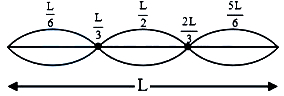
In a sonometer experiment,a string of length $L$ under tension vibrates in its second overtone between two bridges. The amplitude of vibration is maximum at:
A
$\frac{L}{6}, \frac{L}{2}, \frac{5L}{6}$
B
$\frac{L}{8}, \frac{L}{4}, \frac{L}{2}$
C
$\frac{L}{2}, \frac{L}{4}, \frac{L}{6}$
D
$\frac{L}{3}, \frac{2L}{3}, \frac{5L}{6}$
Solution
(A) In the second overtone of a string fixed at both ends,the string vibrates in $3$ loops (segments).
For a string of length $L$ vibrating in $n$ loops,the positions of the antinodes (where amplitude is maximum) are given by $x = \frac{(2k-1)L}{2n}$,where $k = 1, 2, ..., n$.
Here,$n = 3$ (second overtone corresponds to the $3^{rd}$ harmonic).
For $k = 1$: $x_1 = \frac{(2(1)-1)L}{2(3)} = \frac{L}{6}$.
For $k = 2$: $x_2 = \frac{(2(2)-1)L}{2(3)} = \frac{3L}{6} = \frac{L}{2}$.
For $k = 3$: $x_3 = \frac{(2(3)-1)L}{2(3)} = \frac{5L}{6}$.
Thus,the amplitude is maximum at $\frac{L}{6}, \frac{L}{2}, \text{ and } \frac{5L}{6}$.
For a string of length $L$ vibrating in $n$ loops,the positions of the antinodes (where amplitude is maximum) are given by $x = \frac{(2k-1)L}{2n}$,where $k = 1, 2, ..., n$.
Here,$n = 3$ (second overtone corresponds to the $3^{rd}$ harmonic).
For $k = 1$: $x_1 = \frac{(2(1)-1)L}{2(3)} = \frac{L}{6}$.
For $k = 2$: $x_2 = \frac{(2(2)-1)L}{2(3)} = \frac{3L}{6} = \frac{L}{2}$.
For $k = 3$: $x_3 = \frac{(2(3)-1)L}{2(3)} = \frac{5L}{6}$.
Thus,the amplitude is maximum at $\frac{L}{6}, \frac{L}{2}, \text{ and } \frac{5L}{6}$.
0 likes
View Solution134
EasyMCQ
$A$ stationary wave is produced along a stretched string of length $80 \,cm$. The resonant frequencies of the string are $90 \,Hz$, $150 \,Hz$, and $210 \,Hz$. The speed of the transverse wave in the string is: (in $\,m/s$)
A
$45$
B
$75$
C
$48$
D
$80$
Solution
(C) The resonant frequencies are given as $f_1 = 90 \,Hz$, $f_2 = 150 \,Hz$, and $f_3 = 210 \,Hz$.
The difference between consecutive resonant frequencies is $\Delta f = 150 - 90 = 60 \,Hz$ and $210 - 150 = 60 \,Hz$.
For a string fixed at both ends, the resonant frequencies are integer multiples of the fundamental frequency $f_0$. Thus, $\Delta f = f_0 = 60 \,Hz$.
The given frequencies are $f_1 = 1.5 f_0$ (not possible for both ends fixed) or they are harmonics of a string fixed at one end. However, if we assume the fundamental frequency $f_0 = 30 \,Hz$ (since $90 = 3 \times 30$, $150 = 5 \times 30$, $210 = 7 \times 30$), these are odd harmonics of a string fixed at both ends where the fundamental is $30 \,Hz$.
Using $f_n = \frac{n v}{2L}$, for $n=3$, $f_3 = \frac{3v}{2L} = 90 \,Hz$.
Given $L = 0.8 \,m$, we have $90 = \frac{3v}{2 \times 0.8}$.
$90 = \frac{3v}{1.6} \implies 3v = 144 \implies v = 48 \,m/s$.
The difference between consecutive resonant frequencies is $\Delta f = 150 - 90 = 60 \,Hz$ and $210 - 150 = 60 \,Hz$.
For a string fixed at both ends, the resonant frequencies are integer multiples of the fundamental frequency $f_0$. Thus, $\Delta f = f_0 = 60 \,Hz$.
The given frequencies are $f_1 = 1.5 f_0$ (not possible for both ends fixed) or they are harmonics of a string fixed at one end. However, if we assume the fundamental frequency $f_0 = 30 \,Hz$ (since $90 = 3 \times 30$, $150 = 5 \times 30$, $210 = 7 \times 30$), these are odd harmonics of a string fixed at both ends where the fundamental is $30 \,Hz$.
Using $f_n = \frac{n v}{2L}$, for $n=3$, $f_3 = \frac{3v}{2L} = 90 \,Hz$.
Given $L = 0.8 \,m$, we have $90 = \frac{3v}{2 \times 0.8}$.
$90 = \frac{3v}{1.6} \implies 3v = 144 \implies v = 48 \,m/s$.
0 likes
View Solution135
MediumMCQ
In Melde's experiment,when the tension decreases by $0.009 \ kg-wt$,the number of loops changes from $4$ to $5$. The initial tension is
A
$0.036 \ kg-wt$.
B
$0.009 \ kg-wt$.
C
$0.018 \ kg-wt$.
D
$0.025 \ kg-wt$.
Solution
(D) In Melde's experiment,the frequency of the vibrating string is given by $f = \frac{P}{2L} \sqrt{\frac{T}{\mu}}$,where $P$ is the number of loops,$T$ is the tension,$L$ is the length,and $\mu$ is the linear mass density.
Since the frequency $f$ and the length $L$ remain constant,we have $P \propto \frac{1}{\sqrt{T}}$,which implies $T P^{2} = \text{constant}$.
Let the initial tension be $T_1$ and the final tension be $T_2 = T_1 - 0.009 \ kg-wt$.
Given $P_1 = 4$ and $P_2 = 5$.
Using the relation $T_1 P_1^{2} = T_2 P_2^{2}$:
$T_1 (4)^{2} = (T_1 - 0.009) (5)^{2}$
$16 T_1 = 25 T_1 - 0.009 \times 25$
$25 T_1 - 16 T_1 = 0.225$
$9 T_1 = 0.225$
$T_1 = \frac{0.225}{9} = 0.025 \ kg-wt$.
Since the frequency $f$ and the length $L$ remain constant,we have $P \propto \frac{1}{\sqrt{T}}$,which implies $T P^{2} = \text{constant}$.
Let the initial tension be $T_1$ and the final tension be $T_2 = T_1 - 0.009 \ kg-wt$.
Given $P_1 = 4$ and $P_2 = 5$.
Using the relation $T_1 P_1^{2} = T_2 P_2^{2}$:
$T_1 (4)^{2} = (T_1 - 0.009) (5)^{2}$
$16 T_1 = 25 T_1 - 0.009 \times 25$
$25 T_1 - 16 T_1 = 0.225$
$9 T_1 = 0.225$
$T_1 = \frac{0.225}{9} = 0.025 \ kg-wt$.
0 likes
View Solution136
EasyMCQ
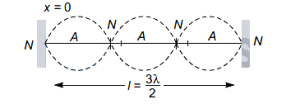
If you set up the $7^{th}$ overtone on a string fixed at both ends,how many nodes and antinodes are set up in it?
A
$9, 8$
B
$8, 9$
C
$7, 8$
D
$8, 7$
Solution
(A) For a string fixed at both ends,the frequency of the $n^{th}$ harmonic is given by $f_n = n f_1$,where $n = 1, 2, 3, \dots$ is the mode number.
The $n^{th}$ harmonic corresponds to $(n-1)^{th}$ overtone.
Given that we have the $7^{th}$ overtone,we have $n-1 = 7$,which implies $n = 8$.
Thus,the $7^{th}$ overtone is the $8^{th}$ harmonic.
In the $n^{th}$ harmonic,the number of loops is $n$.
Therefore,for the $8^{th}$ harmonic,there are $8$ loops.
For a string with $n$ loops,the number of nodes is $n+1$ and the number of antinodes is $n$.
For $n = 8$,the number of nodes is $8 + 1 = 9$ and the number of antinodes is $8$.
The $n^{th}$ harmonic corresponds to $(n-1)^{th}$ overtone.
Given that we have the $7^{th}$ overtone,we have $n-1 = 7$,which implies $n = 8$.
Thus,the $7^{th}$ overtone is the $8^{th}$ harmonic.
In the $n^{th}$ harmonic,the number of loops is $n$.
Therefore,for the $8^{th}$ harmonic,there are $8$ loops.
For a string with $n$ loops,the number of nodes is $n+1$ and the number of antinodes is $n$.
For $n = 8$,the number of nodes is $8 + 1 = 9$ and the number of antinodes is $8$.
0 likes
View Solution137
DifficultMCQ
$A$ uniform wire of length $L$,diameter $D$,and density $\rho$ is stretched by a tension $T$. The frequency $f$ of the wire is proportional to:
A
$f \propto \frac{L}{D}$
B
$f \propto \frac{1}{L D}$
C
$f \propto \frac{1}{L \sqrt{D}}$
D
$f \propto \frac{1}{L D^2}$
Solution
(B) The fundamental frequency $f$ of a stretched wire is given by the formula: $f = \frac{1}{2L} \sqrt{\frac{T}{\mu}}$,where $T$ is the tension and $\mu$ is the linear mass density.
Linear mass density $\mu$ is defined as mass per unit length,which can be expressed in terms of density $\rho$ and cross-sectional area $A$ as $\mu = A \rho$.
Since the wire has a circular cross-section with diameter $D$,the area $A = \pi \frac{D^2}{4}$.
Substituting this into the expression for $\mu$,we get $\mu = \frac{\pi D^2 \rho}{4}$.
Now,substitute $\mu$ back into the frequency formula: $f = \frac{1}{2L} \sqrt{\frac{T}{\frac{\pi D^2 \rho}{4}}} = \frac{1}{2L} \sqrt{\frac{4T}{\pi D^2 \rho}} = \frac{1}{2L} \cdot \frac{2}{D} \sqrt{\frac{T}{\pi \rho}} = \frac{1}{LD} \sqrt{\frac{T}{\pi \rho}}$.
From this expression,it is clear that $f \propto \frac{1}{LD}$.
Linear mass density $\mu$ is defined as mass per unit length,which can be expressed in terms of density $\rho$ and cross-sectional area $A$ as $\mu = A \rho$.
Since the wire has a circular cross-section with diameter $D$,the area $A = \pi \frac{D^2}{4}$.
Substituting this into the expression for $\mu$,we get $\mu = \frac{\pi D^2 \rho}{4}$.
Now,substitute $\mu$ back into the frequency formula: $f = \frac{1}{2L} \sqrt{\frac{T}{\frac{\pi D^2 \rho}{4}}} = \frac{1}{2L} \sqrt{\frac{4T}{\pi D^2 \rho}} = \frac{1}{2L} \cdot \frac{2}{D} \sqrt{\frac{T}{\pi \rho}} = \frac{1}{LD} \sqrt{\frac{T}{\pi \rho}}$.
From this expression,it is clear that $f \propto \frac{1}{LD}$.
0 likes
View Solution138
MediumMCQ
$A$ wire of length $L$,diameter $d$,and density of material $\rho$ is under tension $T$,having a fundamental frequency of vibration $n_A$. Another wire of length $2L$,tension $2T$,density $2\rho$,and diameter $3d$ has a fundamental frequency of vibration $n_B$. The ratio $n_B : n_A$ is
A
$1 : 2$
B
$1 : 4$
C
$1 : 6$
D
$1 : 8$
Solution
(C) The fundamental frequency of a stretched wire is given by $n = \frac{1}{2L} \sqrt{\frac{T}{\mu}}$,where $\mu$ is the mass per unit length.
Since $\mu = \text{Area} \times \text{Density} = (\pi r^2) \rho = \pi (d/2)^2 \rho = \frac{\pi d^2 \rho}{4}$,we can write $n = \frac{1}{2L} \sqrt{\frac{T}{\frac{\pi d^2 \rho}{4}}} = \frac{1}{Ld} \sqrt{\frac{T}{\pi \rho}}$.
For wire $A$: $n_A = \frac{1}{Ld} \sqrt{\frac{T}{\pi \rho}}$.
For wire $B$: $n_B = \frac{1}{(2L)(3d)} \sqrt{\frac{2T}{\pi (2\rho)}} = \frac{1}{6Ld} \sqrt{\frac{T}{\pi \rho}}$.
Taking the ratio $n_B : n_A = \frac{\frac{1}{6Ld} \sqrt{\frac{T}{\pi \rho}}}{\frac{1}{Ld} \sqrt{\frac{T}{\pi \rho}}} = \frac{1}{6}$.
Thus,the ratio $n_B : n_A$ is $1 : 6$.
Since $\mu = \text{Area} \times \text{Density} = (\pi r^2) \rho = \pi (d/2)^2 \rho = \frac{\pi d^2 \rho}{4}$,we can write $n = \frac{1}{2L} \sqrt{\frac{T}{\frac{\pi d^2 \rho}{4}}} = \frac{1}{Ld} \sqrt{\frac{T}{\pi \rho}}$.
For wire $A$: $n_A = \frac{1}{Ld} \sqrt{\frac{T}{\pi \rho}}$.
For wire $B$: $n_B = \frac{1}{(2L)(3d)} \sqrt{\frac{2T}{\pi (2\rho)}} = \frac{1}{6Ld} \sqrt{\frac{T}{\pi \rho}}$.
Taking the ratio $n_B : n_A = \frac{\frac{1}{6Ld} \sqrt{\frac{T}{\pi \rho}}}{\frac{1}{Ld} \sqrt{\frac{T}{\pi \rho}}} = \frac{1}{6}$.
Thus,the ratio $n_B : n_A$ is $1 : 6$.
0 likes
View Solution139
MediumMCQ
Two uniform wires of same material are vibrating under the same tension. If the $1^{\text{st}}$ overtone of the $1^{\text{st}}$ wire is equal to the $2^{\text{nd}}$ overtone of the $2^{\text{nd}}$ wire and the radius of the $1^{\text{st}}$ wire is twice the radius of the $2^{\text{nd}}$ wire,find the ratio of the length of the $1^{\text{st}}$ wire to that of the $2^{\text{nd}}$ wire.
A
$1: 3$
B
$3: 1$
C
$2: 3$
D
$3: 2$
Solution
(A) The frequency of the $n^{\text{th}}$ harmonic for a stretched string is given by $f = \frac{n}{2L} \sqrt{\frac{T}{\mu}}$,where $\mu = \pi r^2 \rho$.
Thus,$f = \frac{n}{2L r} \sqrt{\frac{T}{\pi \rho}}$.
For the $1^{\text{st}}$ wire,the $1^{\text{st}}$ overtone is the $2^{\text{nd}}$ harmonic $(n_1 = 2)$.
So,$f_1 = \frac{2}{2L_1 r_1} \sqrt{\frac{T}{\pi \rho}} = \frac{1}{L_1 r_1} \sqrt{\frac{T}{\pi \rho}}$.
For the $2^{\text{nd}}$ wire,the $2^{\text{nd}}$ overtone is the $3^{\text{rd}}$ harmonic $(n_2 = 3)$.
So,$f_2 = \frac{3}{2L_2 r_2} \sqrt{\frac{T}{\pi \rho}}$.
Given $f_1 = f_2$ and $r_1 = 2r_2$:
$\frac{1}{L_1 (2r_2)} = \frac{3}{2L_2 r_2}$.
$\frac{1}{2L_1} = \frac{3}{2L_2} \implies \frac{L_1}{L_2} = \frac{1}{3}$.
Therefore,the ratio is $1: 3$.
Thus,$f = \frac{n}{2L r} \sqrt{\frac{T}{\pi \rho}}$.
For the $1^{\text{st}}$ wire,the $1^{\text{st}}$ overtone is the $2^{\text{nd}}$ harmonic $(n_1 = 2)$.
So,$f_1 = \frac{2}{2L_1 r_1} \sqrt{\frac{T}{\pi \rho}} = \frac{1}{L_1 r_1} \sqrt{\frac{T}{\pi \rho}}$.
For the $2^{\text{nd}}$ wire,the $2^{\text{nd}}$ overtone is the $3^{\text{rd}}$ harmonic $(n_2 = 3)$.
So,$f_2 = \frac{3}{2L_2 r_2} \sqrt{\frac{T}{\pi \rho}}$.
Given $f_1 = f_2$ and $r_1 = 2r_2$:
$\frac{1}{L_1 (2r_2)} = \frac{3}{2L_2 r_2}$.
$\frac{1}{2L_1} = \frac{3}{2L_2} \implies \frac{L_1}{L_2} = \frac{1}{3}$.
Therefore,the ratio is $1: 3$.
0 likes
View Solution140
EasyMCQ
The fundamental frequency of a sonometer wire is $50 \text{ Hz}$ for a given length and tension. If the length is increased by $25 \%$ while keeping the tension constant,what is the percentage change in the frequency of the second harmonic?
A
increased by $20 \%$
B
decreased by $20 \%$
C
increased by $10 \%$
D
decreased by $10 \%$
Solution
(B) The fundamental frequency of a sonometer wire is given by $f = \frac{1}{2L} \sqrt{\frac{T}{\mu}}$.
Since $T$ and $\mu$ are constant,$f \propto \frac{1}{L}$.
Let the initial length be $L_1 = L$ and the initial fundamental frequency be $f_1 = 50 \text{ Hz}$.
The new length is $L_2 = L + 0.25L = 1.25L = \frac{5}{4}L$.
The new fundamental frequency $f_2$ is given by $\frac{f_2}{f_1} = \frac{L_1}{L_2} = \frac{L}{1.25L} = \frac{1}{1.25} = 0.8$.
So,$f_2 = 0.8 \times 50 \text{ Hz} = 40 \text{ Hz}$.
The frequency of the second harmonic is $f'_n = n \times f_n$. For the second harmonic $(n=2)$,$f'_2 = 2 \times f_2 = 2 \times 40 \text{ Hz} = 80 \text{ Hz}$.
The initial frequency of the second harmonic was $f'_1 = 2 \times f_1 = 2 \times 50 \text{ Hz} = 100 \text{ Hz}$.
The change in frequency is $\Delta f = f'_2 - f'_1 = 80 - 100 = -20 \text{ Hz}$.
The percentage change is $\frac{\Delta f}{f'_1} \times 100 = \frac{-20}{100} \times 100 = -20 \%$.
Thus,the frequency of the second harmonic decreases by $20 \%$.
Since $T$ and $\mu$ are constant,$f \propto \frac{1}{L}$.
Let the initial length be $L_1 = L$ and the initial fundamental frequency be $f_1 = 50 \text{ Hz}$.
The new length is $L_2 = L + 0.25L = 1.25L = \frac{5}{4}L$.
The new fundamental frequency $f_2$ is given by $\frac{f_2}{f_1} = \frac{L_1}{L_2} = \frac{L}{1.25L} = \frac{1}{1.25} = 0.8$.
So,$f_2 = 0.8 \times 50 \text{ Hz} = 40 \text{ Hz}$.
The frequency of the second harmonic is $f'_n = n \times f_n$. For the second harmonic $(n=2)$,$f'_2 = 2 \times f_2 = 2 \times 40 \text{ Hz} = 80 \text{ Hz}$.
The initial frequency of the second harmonic was $f'_1 = 2 \times f_1 = 2 \times 50 \text{ Hz} = 100 \text{ Hz}$.
The change in frequency is $\Delta f = f'_2 - f'_1 = 80 - 100 = -20 \text{ Hz}$.
The percentage change is $\frac{\Delta f}{f'_1} \times 100 = \frac{-20}{100} \times 100 = -20 \%$.
Thus,the frequency of the second harmonic decreases by $20 \%$.
0 likes
View Solution141
MediumMCQ
Two tuning forks when sounded together produce $4$ beats per second. One of the forks is in unison with $23 \ cm$ length of a sonometer wire and the other with $24 \ cm$ length of the same wire. The frequencies of the two tuning forks are
A
$96 \ Hz, 92 \ Hz$
B
$92 \ Hz, 88 \ Hz$
C
$72 \ Hz, 68 \ Hz$
D
$48 \ Hz, 44 \ Hz$
Solution
(A) For a sonometer wire,the frequency $f$ is inversely proportional to the length $l$ of the wire,i.e.,$f \propto 1/l$ or $f \cdot l = k$ (constant).
Let the frequencies of the two tuning forks be $f_1$ and $f_2$.
Given $f_1 \cdot 23 = f_2 \cdot 24 = k$.
This implies $f_1 = k/23$ and $f_2 = k/24$.
Since $f_1 > f_2$,the beat frequency is $f_1 - f_2 = 4$.
Substituting the values: $k/23 - k/24 = 4$.
Taking $k$ as common: $k(24 - 23) / (23 \cdot 24) = 4$.
$k / 552 = 4 \implies k = 2208$.
Now,$f_1 = 2208 / 23 = 96 \ Hz$.
And $f_2 = 2208 / 24 = 92 \ Hz$.
Thus,the frequencies are $96 \ Hz$ and $92 \ Hz$.
Let the frequencies of the two tuning forks be $f_1$ and $f_2$.
Given $f_1 \cdot 23 = f_2 \cdot 24 = k$.
This implies $f_1 = k/23$ and $f_2 = k/24$.
Since $f_1 > f_2$,the beat frequency is $f_1 - f_2 = 4$.
Substituting the values: $k/23 - k/24 = 4$.
Taking $k$ as common: $k(24 - 23) / (23 \cdot 24) = 4$.
$k / 552 = 4 \implies k = 2208$.
Now,$f_1 = 2208 / 23 = 96 \ Hz$.
And $f_2 = 2208 / 24 = 92 \ Hz$.
Thus,the frequencies are $96 \ Hz$ and $92 \ Hz$.
0 likes
View Solution142
MediumMCQ
The fundamental frequency of a sonometer wire is $n$. If the tension is increased $3$ times,the length is increased $3$ times,and the diameter is increased $2$ times,what will be the new frequency?
A
$\sqrt{\frac{3}{2}} n$
B
$\frac{\sqrt{3}}{2} n$
C
$\frac{n}{2 \sqrt{3}}$
D
$2 \sqrt{3} n$
Solution
(C) The fundamental frequency $n$ of a sonometer wire is given by the formula: $n = \frac{1}{2L} \sqrt{\frac{T}{\mu}}$,where $L$ is the length,$T$ is the tension,and $\mu$ is the linear mass density.
Since $\mu = \pi r^2 \rho$ (where $r$ is the radius and $\rho$ is the density),the frequency can be written as: $n = \frac{1}{2L} \sqrt{\frac{T}{\pi r^2 \rho}} = \frac{1}{2Lr} \sqrt{\frac{T}{\pi \rho}}$.
Given that the diameter $D = 2r$,we have $n \propto \frac{1}{LD} \sqrt{T}$.
Let the initial frequency be $n_1 = n$. The new frequency $n_2$ is given by the ratios of the changes:
$n_2 = n_1 \times \left( \frac{L_1}{L_2} \right) \times \left( \frac{D_1}{D_2} \right) \times \sqrt{\frac{T_2}{T_1}}$.
Given $L_2 = 3L_1$,$D_2 = 2D_1$,and $T_2 = 3T_1$:
$n_2 = n \times \left( \frac{1}{3} \right) \times \left( \frac{1}{2} \right) \times \sqrt{3} = n \times \frac{\sqrt{3}}{6} = \frac{\sqrt{3}}{2 \times 3} n = \frac{\sqrt{3}}{2 \times \sqrt{3} \times \sqrt{3}} n = \frac{n}{2 \sqrt{3}}$.
Thus,the new frequency is $\frac{n}{2 \sqrt{3}}$.
Since $\mu = \pi r^2 \rho$ (where $r$ is the radius and $\rho$ is the density),the frequency can be written as: $n = \frac{1}{2L} \sqrt{\frac{T}{\pi r^2 \rho}} = \frac{1}{2Lr} \sqrt{\frac{T}{\pi \rho}}$.
Given that the diameter $D = 2r$,we have $n \propto \frac{1}{LD} \sqrt{T}$.
Let the initial frequency be $n_1 = n$. The new frequency $n_2$ is given by the ratios of the changes:
$n_2 = n_1 \times \left( \frac{L_1}{L_2} \right) \times \left( \frac{D_1}{D_2} \right) \times \sqrt{\frac{T_2}{T_1}}$.
Given $L_2 = 3L_1$,$D_2 = 2D_1$,and $T_2 = 3T_1$:
$n_2 = n \times \left( \frac{1}{3} \right) \times \left( \frac{1}{2} \right) \times \sqrt{3} = n \times \frac{\sqrt{3}}{6} = \frac{\sqrt{3}}{2 \times 3} n = \frac{\sqrt{3}}{2 \times \sqrt{3} \times \sqrt{3}} n = \frac{n}{2 \sqrt{3}}$.
Thus,the new frequency is $\frac{n}{2 \sqrt{3}}$.
0 likes
View Solution143
MediumMCQ
At poles,a stretched wire of a given length vibrates in unison with a tuning fork. At the equator,for the same setting,to produce resonance with the same fork,the vibrating length of the wire
A
should be decreased.
B
should be increased.
C
should be same.
D
should be three times.
Solution
(A) The frequency of a vibrating stretched wire is given by $f = \frac{1}{2L} \sqrt{\frac{T}{\mu}}$,where $L$ is the vibrating length,$T$ is the tension,and $\mu$ is the mass per unit length.
Since the frequency $f$ of the tuning fork is constant,we have $L \propto \sqrt{T}$.
The tension $T$ in the wire is provided by a suspended mass $M$,so $T = Mg$,where $g$ is the acceleration due to gravity.
Thus,$L \propto \sqrt{g}$.
At the equator,the value of $g$ is less than at the poles $(g_{equator} < g_{poles})$.
Since $L$ is directly proportional to $\sqrt{g}$,the vibrating length $L$ must be decreased at the equator to maintain the same frequency $f$.
Since the frequency $f$ of the tuning fork is constant,we have $L \propto \sqrt{T}$.
The tension $T$ in the wire is provided by a suspended mass $M$,so $T = Mg$,where $g$ is the acceleration due to gravity.
Thus,$L \propto \sqrt{g}$.
At the equator,the value of $g$ is less than at the poles $(g_{equator} < g_{poles})$.
Since $L$ is directly proportional to $\sqrt{g}$,the vibrating length $L$ must be decreased at the equator to maintain the same frequency $f$.
0 likes
View Solution144
MediumMCQ
$A$ tuning fork gives $5$ beats per second with $40 \ cm$ length of a sonometer wire. If the length of the wire is shortened by $1 \ cm$,the number of beats is still the same. The frequency of the fork is (in $Hz$)
A
$390$
B
$395$
C
$400$
D
$405$
Solution
(B) The frequency of a sonometer wire is given by $f = \frac{1}{2L} \sqrt{\frac{T}{\mu}}$,which implies $f \propto \frac{1}{L}$.
Let the frequency of the tuning fork be $n$.
For length $L_1 = 40 \ cm$,the frequency of the wire is $f_1 = \frac{k}{40}$. Since it produces $5$ beats,$f_1 = n \pm 5$.
For length $L_2 = 39 \ cm$,the frequency of the wire is $f_2 = \frac{k}{39}$. Since it produces $5$ beats,$f_2 = n \pm 5$.
Since $L_2 < L_1$,$f_2 > f_1$. Thus,$f_1 = n - 5$ and $f_2 = n + 5$.
So,$\frac{k}{40} = n - 5$ and $\frac{k}{39} = n + 5$.
From the first equation,$k = 40(n - 5)$.
From the second equation,$k = 39(n + 5)$.
Equating the two: $40n - 200 = 39n + 195$.
$40n - 39n = 195 + 200$.
$n = 395 \ Hz$.
Let the frequency of the tuning fork be $n$.
For length $L_1 = 40 \ cm$,the frequency of the wire is $f_1 = \frac{k}{40}$. Since it produces $5$ beats,$f_1 = n \pm 5$.
For length $L_2 = 39 \ cm$,the frequency of the wire is $f_2 = \frac{k}{39}$. Since it produces $5$ beats,$f_2 = n \pm 5$.
Since $L_2 < L_1$,$f_2 > f_1$. Thus,$f_1 = n - 5$ and $f_2 = n + 5$.
So,$\frac{k}{40} = n - 5$ and $\frac{k}{39} = n + 5$.
From the first equation,$k = 40(n - 5)$.
From the second equation,$k = 39(n + 5)$.
Equating the two: $40n - 200 = 39n + 195$.
$40n - 39n = 195 + 200$.
$n = 395 \ Hz$.
0 likes
View Solution145
EasyMCQ
In a Sonometer experiment,the frequency of the tuning fork used is $288 \ Hz$. Harmonics will '$NOT$' be produced at the frequency: (in $Hz$)
A
$288$
B
$576$
C
$844$
D
$864$
Solution
(C) In a Sonometer experiment,the string vibrates in harmonics which are integer multiples of the fundamental frequency $(f_0)$.
Given the fundamental frequency $f_0 = 288 \ Hz$.
The frequencies of the harmonics are given by $f_n = n \times f_0$,where $n = 1, 2, 3, ...$.
Calculating the first few harmonics:
$n=1: f_1 = 1 \times 288 = 288 \ Hz$
$n=2: f_2 = 2 \times 288 = 576 \ Hz$
$n=3: f_3 = 3 \times 288 = 864 \ Hz$
Comparing these with the given options,$844 \ Hz$ is not an integer multiple of $288 \ Hz$. Therefore,harmonics will not be produced at $844 \ Hz$.
Given the fundamental frequency $f_0 = 288 \ Hz$.
The frequencies of the harmonics are given by $f_n = n \times f_0$,where $n = 1, 2, 3, ...$.
Calculating the first few harmonics:
$n=1: f_1 = 1 \times 288 = 288 \ Hz$
$n=2: f_2 = 2 \times 288 = 576 \ Hz$
$n=3: f_3 = 3 \times 288 = 864 \ Hz$
Comparing these with the given options,$844 \ Hz$ is not an integer multiple of $288 \ Hz$. Therefore,harmonics will not be produced at $844 \ Hz$.
0 likes
View Solution146
MediumMCQ
The fundamental frequency of a sonometer wire is $n$. If the tension is increased $3$ times,the length is increased $3$ times,and the diameter is increased $2$ times,what will be the new frequency?
A
$2 n$
B
$\frac{\sqrt{3}}{2} n$
C
$\frac{n}{2 \sqrt{3}}$
D
$\sqrt{3} n$
Solution
(C) The fundamental frequency of a sonometer wire is given by the formula: $n = \frac{1}{2L} \sqrt{\frac{T}{\mu}}$,where $L$ is the length,$T$ is the tension,and $\mu$ is the linear mass density.
Since $\mu = \text{Area} \times \text{Density} = (\pi r^2) \rho = \pi (\frac{d}{2})^2 \rho = \frac{\pi d^2 \rho}{4}$,we can write $n \propto \frac{1}{L d} \sqrt{\frac{T}{\rho}}$.
Given the initial conditions: $n_1 = n$,$L_1 = L$,$T_1 = T$,$d_1 = d$.
New conditions: $L_2 = 3L$,$T_2 = 3T$,$d_2 = 2d$.
The new frequency $n_2$ is given by: $n_2 = n_1 \times (\frac{L_1}{L_2}) \times (\frac{d_1}{d_2}) \times \sqrt{\frac{T_2}{T_1}}$.
Substituting the values: $n_2 = n \times (\frac{L}{3L}) \times (\frac{d}{2d}) \times \sqrt{\frac{3T}{T}}$.
$n_2 = n \times \frac{1}{3} \times \frac{1}{2} \times \sqrt{3} = \frac{\sqrt{3}}{6} n = \frac{\sqrt{3}}{2 \times 3} n = \frac{n}{2 \sqrt{3}}$.
Since $\mu = \text{Area} \times \text{Density} = (\pi r^2) \rho = \pi (\frac{d}{2})^2 \rho = \frac{\pi d^2 \rho}{4}$,we can write $n \propto \frac{1}{L d} \sqrt{\frac{T}{\rho}}$.
Given the initial conditions: $n_1 = n$,$L_1 = L$,$T_1 = T$,$d_1 = d$.
New conditions: $L_2 = 3L$,$T_2 = 3T$,$d_2 = 2d$.
The new frequency $n_2$ is given by: $n_2 = n_1 \times (\frac{L_1}{L_2}) \times (\frac{d_1}{d_2}) \times \sqrt{\frac{T_2}{T_1}}$.
Substituting the values: $n_2 = n \times (\frac{L}{3L}) \times (\frac{d}{2d}) \times \sqrt{\frac{3T}{T}}$.
$n_2 = n \times \frac{1}{3} \times \frac{1}{2} \times \sqrt{3} = \frac{\sqrt{3}}{6} n = \frac{\sqrt{3}}{2 \times 3} n = \frac{n}{2 \sqrt{3}}$.
0 likes
View Solution147
MediumMCQ
$A$ string $A$ has twice the length,twice the diameter,twice the tension,and twice the density of another string $B$. The overtone of $A$ which will have the same fundamental frequency as that of $B$ is:
A
first
B
second
C
third
D
fourth
Solution
(C) The fundamental frequency of a string is given by $n = \frac{1}{2l} \sqrt{\frac{T}{\mu}}$,where $\mu = \rho \pi r^2$.
For string $B$: $n_B = \frac{1}{2l_B} \sqrt{\frac{T_B}{\mu_B}}$.
Given for string $A$: $l_A = 2l_B$,$d_A = 2d_B \Rightarrow r_A = 2r_B$,$T_A = 2T_B$,and $\rho_A = 2\rho_B$.
Calculating $\mu_A$: $\mu_A = \rho_A \pi r_A^2 = (2\rho_B) \pi (2r_B)^2 = 8 \rho_B \pi r_B^2 = 8\mu_B$.
Now,the fundamental frequency of string $A$ is: $n_A = \frac{1}{2l_A} \sqrt{\frac{T_A}{\mu_A}} = \frac{1}{2(2l_B)} \sqrt{\frac{2T_B}{8\mu_B}} = \frac{1}{4} \left( \frac{1}{2l_B} \sqrt{\frac{T_B}{\mu_B}} \right) = \frac{1}{4} n_B$.
The frequency of the $p^{\text{th}}$ overtone of string $A$ is $f_p = (p+1)n_A$.
We want $f_p = n_B$,so $(p+1) \frac{n_B}{4} = n_B$.
This gives $p+1 = 4$,or $p = 3$.
Thus,the $3^{\text{rd}}$ overtone of string $A$ has the same frequency as the fundamental frequency of string $B$.
For string $B$: $n_B = \frac{1}{2l_B} \sqrt{\frac{T_B}{\mu_B}}$.
Given for string $A$: $l_A = 2l_B$,$d_A = 2d_B \Rightarrow r_A = 2r_B$,$T_A = 2T_B$,and $\rho_A = 2\rho_B$.
Calculating $\mu_A$: $\mu_A = \rho_A \pi r_A^2 = (2\rho_B) \pi (2r_B)^2 = 8 \rho_B \pi r_B^2 = 8\mu_B$.
Now,the fundamental frequency of string $A$ is: $n_A = \frac{1}{2l_A} \sqrt{\frac{T_A}{\mu_A}} = \frac{1}{2(2l_B)} \sqrt{\frac{2T_B}{8\mu_B}} = \frac{1}{4} \left( \frac{1}{2l_B} \sqrt{\frac{T_B}{\mu_B}} \right) = \frac{1}{4} n_B$.
The frequency of the $p^{\text{th}}$ overtone of string $A$ is $f_p = (p+1)n_A$.
We want $f_p = n_B$,so $(p+1) \frac{n_B}{4} = n_B$.
This gives $p+1 = 4$,or $p = 3$.
Thus,the $3^{\text{rd}}$ overtone of string $A$ has the same frequency as the fundamental frequency of string $B$.
0 likes
View Solution148
DifficultMCQ
$A$ sonometer wire is stretched by hanging a metal bob,the fundamental frequency of the wire is $n_1$. When the bob is completely immersed in water,the frequency of vibration of the wire becomes $n_2$. The relative density of the metal of the bob is
A
$\frac{n_1^2}{n_1^2-n_2^2}$
B
$\frac{n_2^2}{n_1^2-n_2^2}$
C
$\frac{n_1^2}{n_1^2+n_2^2}$
D
$\frac{n_2^2}{n_1^2+n_2^2}$
Solution
(A) The fundamental frequency of a sonometer wire is given by $n = \frac{1}{2L} \sqrt{\frac{T}{\mu}}$,where $T$ is the tension in the wire.
When the bob of weight $W$ is in air,the tension $T_1 = W$. Thus,$n_1 = \frac{1}{2L} \sqrt{\frac{W}{\mu}}$.
When the bob is immersed in water,the buoyant force $F_B$ acts on it,reducing the tension to $T_2 = W - F_B$. Thus,$n_2 = \frac{1}{2L} \sqrt{\frac{W - F_B}{\mu}}$.
Taking the ratio: $\frac{n_1}{n_2} = \sqrt{\frac{W}{W - F_B}} \implies \frac{n_1^2}{n_2^2} = \frac{W}{W - F_B}$.
Relative density $\sigma = \frac{W}{F_B}$.
Rearranging the ratio: $\frac{n_1^2}{n_2^2} = \frac{W}{W - (W/\sigma)} = \frac{\sigma}{\sigma - 1}$.
Solving for $\sigma$: $n_1^2(\sigma - 1) = n_2^2 \sigma \implies \sigma(n_1^2 - n_2^2) = n_1^2$.
Therefore,$\sigma = \frac{n_1^2}{n_1^2 - n_2^2}$.
When the bob of weight $W$ is in air,the tension $T_1 = W$. Thus,$n_1 = \frac{1}{2L} \sqrt{\frac{W}{\mu}}$.
When the bob is immersed in water,the buoyant force $F_B$ acts on it,reducing the tension to $T_2 = W - F_B$. Thus,$n_2 = \frac{1}{2L} \sqrt{\frac{W - F_B}{\mu}}$.
Taking the ratio: $\frac{n_1}{n_2} = \sqrt{\frac{W}{W - F_B}} \implies \frac{n_1^2}{n_2^2} = \frac{W}{W - F_B}$.
Relative density $\sigma = \frac{W}{F_B}$.
Rearranging the ratio: $\frac{n_1^2}{n_2^2} = \frac{W}{W - (W/\sigma)} = \frac{\sigma}{\sigma - 1}$.
Solving for $\sigma$: $n_1^2(\sigma - 1) = n_2^2 \sigma \implies \sigma(n_1^2 - n_2^2) = n_1^2$.
Therefore,$\sigma = \frac{n_1^2}{n_1^2 - n_2^2}$.
0 likes
View Solution149
MediumMCQ
When the tension in a string is increased by $3 \ kg \ wt$,the frequency of the fundamental mode increases in the ratio $2:3$. The initial tension in the string is: (in $kg \ wt$)
A
$1.6$
B
$2.0$
C
$2.4$
D
$2.8$
Solution
(C) The frequency of the fundamental mode of a stretched string is given by $f = \frac{1}{2l} \sqrt{\frac{T}{m}}$,where $T$ is the tension and $m$ is the linear mass density.
Let the initial tension be $T$. The initial frequency is $f = \frac{1}{2l} \sqrt{\frac{T}{m}}$.
When the tension is increased by $3 \ kg \ wt$,the new tension becomes $T' = T + 3$. The new frequency is $f' = \frac{1}{2l} \sqrt{\frac{T+3}{m}}$.
Given the ratio of frequencies is $f : f' = 2 : 3$,we have:
$\frac{f}{f'} = \sqrt{\frac{T}{T+3}} = \frac{2}{3}$
Squaring both sides:
$\frac{T}{T+3} = \frac{4}{9}$
$9T = 4(T + 3)$
$9T = 4T + 12$
$5T = 12$
$T = 2.4 \ kg \ wt$
Thus,the initial tension in the string is $2.4 \ kg \ wt$.
Let the initial tension be $T$. The initial frequency is $f = \frac{1}{2l} \sqrt{\frac{T}{m}}$.
When the tension is increased by $3 \ kg \ wt$,the new tension becomes $T' = T + 3$. The new frequency is $f' = \frac{1}{2l} \sqrt{\frac{T+3}{m}}$.
Given the ratio of frequencies is $f : f' = 2 : 3$,we have:
$\frac{f}{f'} = \sqrt{\frac{T}{T+3}} = \frac{2}{3}$
Squaring both sides:
$\frac{T}{T+3} = \frac{4}{9}$
$9T = 4(T + 3)$
$9T = 4T + 12$
$5T = 12$
$T = 2.4 \ kg \ wt$
Thus,the initial tension in the string is $2.4 \ kg \ wt$.
0 likes
View Solution150
DifficultMCQ
$A$ sonometer wire is in unison with a tuning fork of frequency '$n$' when it is stretched by a weight of specific gravity '$d$'. When the weight is completely immersed in water,'$x$' beats are produced per second,then
A
$\frac{n}{n-x}=\frac{d}{d-1}$
B
$\frac{n}{n-x}=\sqrt{\frac{d}{d-1}}$
C
$\frac{n-x}{n}=\frac{d-1}{d}$
D
$\frac{n-x}{n}=\sqrt{\frac{d}{d-1}}$
Solution
(B) For a sonometer,the frequency of vibration $n$ is proportional to the square root of the tension $T$,i.e.,$n \propto \sqrt{T}$.
When the weight is in air,the tension $T_1 = V \cdot d \cdot \rho_w \cdot g$,where $V$ is the volume of the weight,$d$ is its specific gravity,and $\rho_w$ is the density of water.
Thus,$n \propto \sqrt{V \cdot d \cdot \rho_w \cdot g}$.
When the weight is immersed in water,the effective weight (tension) becomes $T_2 = V \cdot (d - 1) \cdot \rho_w \cdot g$ due to the buoyant force.
The new frequency $n'$ is given by $n' = n - x$ (since beats are produced).
Thus,$n' \propto \sqrt{V \cdot (d - 1) \cdot \rho_w \cdot g}$.
Taking the ratio of the two frequencies:
$\frac{n}{n-x} = \sqrt{\frac{V \cdot d \cdot \rho_w \cdot g}{V \cdot (d - 1) \cdot \rho_w \cdot g}}$
$\frac{n}{n-x} = \sqrt{\frac{d}{d-1}}$.
When the weight is in air,the tension $T_1 = V \cdot d \cdot \rho_w \cdot g$,where $V$ is the volume of the weight,$d$ is its specific gravity,and $\rho_w$ is the density of water.
Thus,$n \propto \sqrt{V \cdot d \cdot \rho_w \cdot g}$.
When the weight is immersed in water,the effective weight (tension) becomes $T_2 = V \cdot (d - 1) \cdot \rho_w \cdot g$ due to the buoyant force.
The new frequency $n'$ is given by $n' = n - x$ (since beats are produced).
Thus,$n' \propto \sqrt{V \cdot (d - 1) \cdot \rho_w \cdot g}$.
Taking the ratio of the two frequencies:
$\frac{n}{n-x} = \sqrt{\frac{V \cdot d \cdot \rho_w \cdot g}{V \cdot (d - 1) \cdot \rho_w \cdot g}}$
$\frac{n}{n-x} = \sqrt{\frac{d}{d-1}}$.
0 likes
View SolutionWaves and Sound — Transverse Stationary Waves and Sonometer · Frequently Asked Questions
1Are these Waves and Sound questions useful for JEE and NEET?
Yes. All questions in this section are mapped to JEE Main and NEET exam patterns. Previous year questions from JEE Main, NEET, GUJCET and state-level exams are included with full solutions.
2Can I switch to Hindi or Gujarati for these questions?
Yes. Use the language tabs in the hero section or the sidebar to view the same questions and solutions in English, Hindi or Gujarati.
3How do I generate a question paper from this subtopic?
Use the Vedclass Exam Paper Generator — select the chapter and subtopic, set difficulty, and generate Sets A, B, C, D automatically. First 3 chapters of every subject are free.
Vedclass Products
For Students
Vedclass Test Series
Mock tests in real JEE/NEET style with performance analysis. 5-day free trial.
Start Free TrialFor Teachers
Exam Paper Generator
Generate Set A/B/C/D papers from this chapter in 2 minutes. 3 chapters free.
Try FreeFor Institutes
Online Exam Module
Live online exams with unlimited students, 360° analytics & white-label branding.
See DemoFor Teachers & Institutes
Generate a Waves and Sound Exam Paper in 2 Minutes
Select subtopic & difficulty — Sets A, B, C, D auto-generated with No Repeat logic.
First 3 chapters of every subject are free — no payment required.