
A English
Errors of Measurement Questions in English
Class 11 Physics · Units, Dimensions and Measurement · Errors of Measurement
278+
Questions
English
Language
100%
With Solutions
Showing 50 of 278 questions in English
51
MediumMCQ
$A$ certain body weighs $22.42 \; g$ and has a measured volume of $4.7 \; cc$. The possible errors in the measurement of mass and volume are $0.01 \; g$ and $0.1 \; cc$,respectively. Then the maximum percentage error in the density will be: (in $\%$)
A
$22$
B
$0.2$
C
$2$
D
$0.02$
Solution
(C) Density $\rho$ is given by the formula $\rho = \frac{m}{V}$.
For a product or quotient,the relative error is the sum of the relative errors of the individual measurements: $\frac{\Delta \rho}{\rho} = \frac{\Delta m}{m} + \frac{\Delta V}{V}$.
Given: $m = 22.42 \; g$,$\Delta m = 0.01 \; g$,$V = 4.7 \; cc$,$\Delta V = 0.1 \; cc$.
Substituting the values:
$\frac{\Delta \rho}{\rho} = \frac{0.01}{22.42} + \frac{0.1}{4.7}$.
$\frac{\Delta \rho}{\rho} \approx 0.000446 + 0.021276 \approx 0.021722$.
To find the percentage error,multiply by $100 \%$:
Percentage error $= 0.021722 \times 100 \% \approx 2.17 \%$.
Rounding to the nearest significant value provided in the options,the maximum percentage error is approximately $2 \%$.
For a product or quotient,the relative error is the sum of the relative errors of the individual measurements: $\frac{\Delta \rho}{\rho} = \frac{\Delta m}{m} + \frac{\Delta V}{V}$.
Given: $m = 22.42 \; g$,$\Delta m = 0.01 \; g$,$V = 4.7 \; cc$,$\Delta V = 0.1 \; cc$.
Substituting the values:
$\frac{\Delta \rho}{\rho} = \frac{0.01}{22.42} + \frac{0.1}{4.7}$.
$\frac{\Delta \rho}{\rho} \approx 0.000446 + 0.021276 \approx 0.021722$.
To find the percentage error,multiply by $100 \%$:
Percentage error $= 0.021722 \times 100 \% \approx 2.17 \%$.
Rounding to the nearest significant value provided in the options,the maximum percentage error is approximately $2 \%$.
0 likes
View Solution52
MediumMCQ
$A$ student performs an experiment for the determination of $g = \frac{4 \pi^{2} \ell}{T^{2}}$. Given $\ell = 1 \, m$,the student commits an error of $\Delta \ell$. For $T$,the student measures the time of $n$ oscillations using a stopwatch with a least count of $\Delta T$ and commits a human error of $0.1 \, s$. For which of the following data will the measurement of $g$ be the most accurate?
A
$\Delta \ell = 5 \, mm, \Delta T = 0.2 \, s, n = 10$
B
$\Delta \ell = 5 \, mm, \Delta T = 0.2 \, s, n = 20$
C
$\Delta \ell = 5 \, mm, \Delta T = 0.1 \, s, n = 10$
D
$\Delta \ell = 1 \, mm, \Delta T = 0.1 \, s, n = 50$
Solution
(D) The relative error in $g$ is given by $\frac{\Delta g}{g} = \frac{\Delta \ell}{\ell} + 2 \frac{\Delta T}{T}$.
Here,the total error in time measurement is $\Delta T_{total} = \Delta T + 0.1 \, s$.
The time period $T$ is measured as $T = \frac{t}{n}$,where $t$ is the time for $n$ oscillations.
Thus,$\frac{\Delta T}{T} = \frac{\Delta T_{total}}{t} = \frac{\Delta T + 0.1}{n \times T_0}$,where $T_0 \approx 2 \, s$ for a $1 \, m$ pendulum.
Substituting values:
$(A)$ $\frac{\Delta g}{g} = \frac{5 \times 10^{-3}}{1} + 2 \left( \frac{0.2 + 0.1}{10 \times 2} \right) = 0.005 + 0.03 = 0.035$
$(B)$ $\frac{\Delta g}{g} = \frac{5 \times 10^{-3}}{1} + 2 \left( \frac{0.2 + 0.1}{20 \times 2} \right) = 0.005 + 0.015 = 0.020$
$(C)$ $\frac{\Delta g}{g} = \frac{5 \times 10^{-3}}{1} + 2 \left( \frac{0.1 + 0.1}{10 \times 2} \right) = 0.005 + 0.02 = 0.025$
$(D)$ $\frac{\Delta g}{g} = \frac{1 \times 10^{-3}}{1} + 2 \left( \frac{0.1 + 0.1}{50 \times 2} \right) = 0.001 + 0.004 = 0.005$
Since the relative error is minimum in case $(D)$,the measurement is most accurate.
Here,the total error in time measurement is $\Delta T_{total} = \Delta T + 0.1 \, s$.
The time period $T$ is measured as $T = \frac{t}{n}$,where $t$ is the time for $n$ oscillations.
Thus,$\frac{\Delta T}{T} = \frac{\Delta T_{total}}{t} = \frac{\Delta T + 0.1}{n \times T_0}$,where $T_0 \approx 2 \, s$ for a $1 \, m$ pendulum.
Substituting values:
$(A)$ $\frac{\Delta g}{g} = \frac{5 \times 10^{-3}}{1} + 2 \left( \frac{0.2 + 0.1}{10 \times 2} \right) = 0.005 + 0.03 = 0.035$
$(B)$ $\frac{\Delta g}{g} = \frac{5 \times 10^{-3}}{1} + 2 \left( \frac{0.2 + 0.1}{20 \times 2} \right) = 0.005 + 0.015 = 0.020$
$(C)$ $\frac{\Delta g}{g} = \frac{5 \times 10^{-3}}{1} + 2 \left( \frac{0.1 + 0.1}{10 \times 2} \right) = 0.005 + 0.02 = 0.025$
$(D)$ $\frac{\Delta g}{g} = \frac{1 \times 10^{-3}}{1} + 2 \left( \frac{0.1 + 0.1}{50 \times 2} \right) = 0.001 + 0.004 = 0.005$
Since the relative error is minimum in case $(D)$,the measurement is most accurate.
0 likes
View Solution53
DifficultMCQ
$A$ body travels uniformly a distance of $(13.8 \pm 0.2) \text{ m}$ in a time $(4.0 \pm 0.3) \text{ s}$. Its velocity with error limits and percentage error is
A
$(4.0 \pm 0.31) \text{ m/s}, \pm 8\%$
B
$(3.5 \pm 0.31) \text{ m/s}, \pm 9\%$
C
$(5.0 \pm 0.37) \text{ m/s}, \pm 9\%$
D
$(3.8 \pm 0.34) \text{ m/s}, \pm 7\%$
Solution
(B) Given: Distance $s = (13.8 \pm 0.2) \text{ m}$ and time $t = (4.0 \pm 0.3) \text{ s}$.
Velocity $v = \frac{s}{t} = \frac{13.8}{4.0} = 3.45 \text{ m/s} \approx 3.5 \text{ m/s}$.
The relative error in velocity is given by $\frac{\Delta v}{v} = \frac{\Delta s}{s} + \frac{\Delta t}{t}$.
Substituting the values: $\frac{\Delta v}{v} = \frac{0.2}{13.8} + \frac{0.3}{4.0} = 0.0145 + 0.075 = 0.0895$.
Absolute error $\Delta v = v \times 0.0895 = 3.45 \times 0.0895 \approx 0.3087 \approx 0.31 \text{ m/s}$.
Thus,velocity $v = (3.5 \pm 0.31) \text{ m/s}$.
Percentage error = $\frac{\Delta v}{v} \times 100 = 0.0895 \times 100 = 8.95\% \approx 9\%$.
Velocity $v = \frac{s}{t} = \frac{13.8}{4.0} = 3.45 \text{ m/s} \approx 3.5 \text{ m/s}$.
The relative error in velocity is given by $\frac{\Delta v}{v} = \frac{\Delta s}{s} + \frac{\Delta t}{t}$.
Substituting the values: $\frac{\Delta v}{v} = \frac{0.2}{13.8} + \frac{0.3}{4.0} = 0.0145 + 0.075 = 0.0895$.
Absolute error $\Delta v = v \times 0.0895 = 3.45 \times 0.0895 \approx 0.3087 \approx 0.31 \text{ m/s}$.
Thus,velocity $v = (3.5 \pm 0.31) \text{ m/s}$.
Percentage error = $\frac{\Delta v}{v} \times 100 = 0.0895 \times 100 = 8.95\% \approx 9\%$.
0 likes
View Solution54
EasyMCQ
If the error in the measurement of the radius of a sphere is $2\%$,then the error in the determination of the volume of the sphere will be ........ $\%$
A
$2$
B
$4$
C
$6$
D
$8$
Solution
(C) The percentage error in the radius is given as $\frac{\Delta r}{r} \times 100 = 2\%$.
The volume of a sphere is given by the formula $V = \frac{4}{3} \pi r^3$.
Using the rules of propagation of errors for powers,the relative error in volume is $\frac{\Delta V}{V} = 3 \times \frac{\Delta r}{r}$.
To find the percentage error,multiply both sides by $100$:
$\frac{\Delta V}{V} \times 100 = 3 \times (\frac{\Delta r}{r} \times 100)$.
Substituting the given value:
$\frac{\Delta V}{V} \times 100 = 3 \times 2\% = 6\%$.
The volume of a sphere is given by the formula $V = \frac{4}{3} \pi r^3$.
Using the rules of propagation of errors for powers,the relative error in volume is $\frac{\Delta V}{V} = 3 \times \frac{\Delta r}{r}$.
To find the percentage error,multiply both sides by $100$:
$\frac{\Delta V}{V} \times 100 = 3 \times (\frac{\Delta r}{r} \times 100)$.
Substituting the given value:
$\frac{\Delta V}{V} \times 100 = 3 \times 2\% = 6\%$.
0 likes
View Solution55
MediumMCQ
$A$ student measures the distance traversed in free fall of a body,initially at rest,in a given time. He uses this data to estimate $g$,the acceleration due to gravity. If the maximum percentage errors in measurement of the distance and the time are $e_1$ and $e_2$ respectively,the percentage error in the estimation of $g$ is:
A
$e_2 - e_1$
B
$e_1 + 2e_2$
C
$e_1 + e_2$
D
$e_1 - 2e_2$
Solution
(B) For a body starting from rest,the distance $h$ covered in time $t$ is given by the equation of motion:
$h = \frac{1}{2}gt^2$
Rearranging for $g$,we get:
$g = \frac{2h}{t^2}$
Taking the natural logarithm on both sides:
$\ln g = \ln 2 + \ln h - 2\ln t$
Differentiating to find the relative error:
$\frac{\Delta g}{g} = \frac{\Delta h}{h} + 2\frac{\Delta t}{t}$
For maximum permissible percentage error,we add the absolute values of the relative errors:
$\left( \frac{\Delta g}{g} \times 100 \right)_{\max} = \left( \frac{\Delta h}{h} \times 100 \right) + 2 \times \left( \frac{\Delta t}{t} \times 100 \right)$
Given that $\frac{\Delta h}{h} \times 100 = e_1$ and $\frac{\Delta t}{t} \times 100 = e_2$,the percentage error in $g$ is:
$\text{Percentage error in } g = e_1 + 2e_2$
$h = \frac{1}{2}gt^2$
Rearranging for $g$,we get:
$g = \frac{2h}{t^2}$
Taking the natural logarithm on both sides:
$\ln g = \ln 2 + \ln h - 2\ln t$
Differentiating to find the relative error:
$\frac{\Delta g}{g} = \frac{\Delta h}{h} + 2\frac{\Delta t}{t}$
For maximum permissible percentage error,we add the absolute values of the relative errors:
$\left( \frac{\Delta g}{g} \times 100 \right)_{\max} = \left( \frac{\Delta h}{h} \times 100 \right) + 2 \times \left( \frac{\Delta t}{t} \times 100 \right)$
Given that $\frac{\Delta h}{h} \times 100 = e_1$ and $\frac{\Delta t}{t} \times 100 = e_2$,the percentage error in $g$ is:
$\text{Percentage error in } g = e_1 + 2e_2$
0 likes
View Solution56
EasyMCQ
If the radius of a sphere is $(5.3 \pm 0.1) \; cm$,then the percentage error in its volume will be:
A
$3 + 6.01 \times \frac{100}{5.3}$
B
$\frac{1}{3} \times 0.01 \times \frac{100}{5.3}$
C
$\left( \frac{3 \times 0.1}{5.3} \right) \times 100$
D
$\frac{0.1}{5.3} \times 100$
Solution
(C) The volume of a sphere is given by the formula $V = \frac{4}{3} \pi r^3$.
The relative error in the volume $V$ is given by $\frac{\Delta V}{V} = 3 \times \frac{\Delta r}{r}$.
Given the radius $r = 5.3 \; cm$ and the absolute error $\Delta r = 0.1 \; cm$.
The percentage error in volume is $\frac{\Delta V}{V} \times 100 = 3 \times \frac{\Delta r}{r} \times 100$.
Substituting the values,we get: $\left( 3 \times \frac{0.1}{5.3} \right) \times 100$.
The relative error in the volume $V$ is given by $\frac{\Delta V}{V} = 3 \times \frac{\Delta r}{r}$.
Given the radius $r = 5.3 \; cm$ and the absolute error $\Delta r = 0.1 \; cm$.
The percentage error in volume is $\frac{\Delta V}{V} \times 100 = 3 \times \frac{\Delta r}{r} \times 100$.
Substituting the values,we get: $\left( 3 \times \frac{0.1}{5.3} \right) \times 100$.
0 likes
View Solution57
MediumMCQ
The pressure on a square plate is measured by measuring the force on the plate and the length of the sides of the plate. If the maximum percentage error in the measurement of force and length are respectively $4\%$ and $2\%$,the maximum percentage error in the measurement of pressure is ....... $\%$
A
$1$
B
$2$
C
$6$
D
$8$
Solution
(D) The pressure $P$ on a square plate of side $l$ is given by $P = \frac{F}{A} = \frac{F}{l^2}$.
Using the formula for the propagation of errors,the relative error in $P$ is given by $\frac{\Delta P}{P} = \frac{\Delta F}{F} + 2\frac{\Delta l}{l}$.
To find the maximum percentage error,we multiply by $100$:
$\left( \frac{\Delta P}{P} \times 100 \right)_{\max} = \left( \frac{\Delta F}{F} \times 100 \right) + 2 \times \left( \frac{\Delta l}{l} \times 100 \right)$.
Given that the percentage error in force $\frac{\Delta F}{F} \times 100 = 4\%$ and the percentage error in length $\frac{\Delta l}{l} \times 100 = 2\%$.
Substituting these values,we get:
$\left( \frac{\Delta P}{P} \times 100 \right)_{\max} = 4\% + 2 \times 2\% = 4\% + 4\% = 8\%$.
Using the formula for the propagation of errors,the relative error in $P$ is given by $\frac{\Delta P}{P} = \frac{\Delta F}{F} + 2\frac{\Delta l}{l}$.
To find the maximum percentage error,we multiply by $100$:
$\left( \frac{\Delta P}{P} \times 100 \right)_{\max} = \left( \frac{\Delta F}{F} \times 100 \right) + 2 \times \left( \frac{\Delta l}{l} \times 100 \right)$.
Given that the percentage error in force $\frac{\Delta F}{F} \times 100 = 4\%$ and the percentage error in length $\frac{\Delta l}{l} \times 100 = 2\%$.
Substituting these values,we get:
$\left( \frac{\Delta P}{P} \times 100 \right)_{\max} = 4\% + 2 \times 2\% = 4\% + 4\% = 8\%$.
0 likes
View Solution58
EasyMCQ
While measuring the acceleration due to gravity by a simple pendulum,a student makes a positive error of $1\%$ in the length of the pendulum and a negative error of $3\%$ in the value of time period. His percentage error in the measurement of $g$ by the relation $g = 4{\pi ^2}(l/T^2)$ will be ........ $\%$
A
$2$
B
$4$
C
$7$
D
$10$
Solution
(C) The formula for acceleration due to gravity is $g = 4\pi^2 \left(\frac{l}{T^2}\right)$.
Taking the relative error,we get $\frac{\Delta g}{g} = \frac{\Delta l}{l} + 2\frac{\Delta T}{T}$.
Given that the percentage error in length $\left(\frac{\Delta l}{l} \times 100\right) = 1\%$ and the percentage error in time period $\left(\frac{\Delta T}{T} \times 100\right) = 3\%$.
Since errors are always additive,the percentage error in $g$ is $\frac{\Delta g}{g} \times 100 = \left(\frac{\Delta l}{l} \times 100\right) + 2 \times \left(\frac{\Delta T}{T} \times 100\right)$.
Substituting the values: $\frac{\Delta g}{g} \times 100 = 1\% + 2(3\%) = 1\% + 6\% = 7\%$.
Therefore,the percentage error in the measurement of $g$ is $7\%$.
Taking the relative error,we get $\frac{\Delta g}{g} = \frac{\Delta l}{l} + 2\frac{\Delta T}{T}$.
Given that the percentage error in length $\left(\frac{\Delta l}{l} \times 100\right) = 1\%$ and the percentage error in time period $\left(\frac{\Delta T}{T} \times 100\right) = 3\%$.
Since errors are always additive,the percentage error in $g$ is $\frac{\Delta g}{g} \times 100 = \left(\frac{\Delta l}{l} \times 100\right) + 2 \times \left(\frac{\Delta T}{T} \times 100\right)$.
Substituting the values: $\frac{\Delta g}{g} \times 100 = 1\% + 2(3\%) = 1\% + 6\% = 7\%$.
Therefore,the percentage error in the measurement of $g$ is $7\%$.
0 likes
View Solution59
EasyMCQ
$A$ current of $(2.5 \pm 0.05) \ A$ flows through a wire and develops a potential difference of $(10 \pm 0.1) \ V$. The resistance of the wire in $\Omega$ is:
A
$4 \pm 0.12$
B
$4 \pm 0.04$
C
$4 \pm 0.08$
D
$4 \pm 0.02$
Solution
(A) Given: $I = (2.5 \pm 0.05) \ A$ and $V = (10 \pm 0.1) \ V$.
Resistance $R = \frac{V}{I} = \frac{10}{2.5} = 4 \ \Omega$.
The relative error in resistance is given by $\frac{\Delta R}{R} = \frac{\Delta V}{V} + \frac{\Delta I}{I}$.
Substituting the values: $\frac{\Delta R}{4} = \frac{0.1}{10} + \frac{0.05}{2.5}$.
$\frac{\Delta R}{4} = 0.01 + 0.02 = 0.03$.
$\Delta R = 4 \times 0.03 = 0.12 \ \Omega$.
Therefore,the resistance is $(4 \pm 0.12) \ \Omega$.
Resistance $R = \frac{V}{I} = \frac{10}{2.5} = 4 \ \Omega$.
The relative error in resistance is given by $\frac{\Delta R}{R} = \frac{\Delta V}{V} + \frac{\Delta I}{I}$.
Substituting the values: $\frac{\Delta R}{4} = \frac{0.1}{10} + \frac{0.05}{2.5}$.
$\frac{\Delta R}{4} = 0.01 + 0.02 = 0.03$.
$\Delta R = 4 \times 0.03 = 0.12 \ \Omega$.
Therefore,the resistance is $(4 \pm 0.12) \ \Omega$.
0 likes
View Solution60
MediumMCQ
Resistance of a given wire is obtained by measuring the current flowing in it and the voltage difference applied across it. If the percentage errors in the measurement of the current and the voltage difference are $3\%$ each,then the error in the value of resistance of the wire is ........ $\%$
A
$3$
B
$6$
C
$0$
D
$1$
Solution
(B) According to Ohm's law,the resistance $R$ is given by $R = \frac{V}{I}$.
For a quotient,the relative error is the sum of the relative errors of the individual quantities: $\frac{\Delta R}{R} = \frac{\Delta V}{V} + \frac{\Delta I}{I}$.
To find the percentage error,we multiply by $100$:
$\frac{\Delta R}{R} \times 100 = \left( \frac{\Delta V}{V} \times 100 \right) + \left( \frac{\Delta I}{I} \times 100 \right)$.
Given that the percentage error in voltage $\frac{\Delta V}{V} \times 100 = 3\%$ and the percentage error in current $\frac{\Delta I}{I} \times 100 = 3\%$.
Therefore,the percentage error in resistance is $3\% + 3\% = 6\%$.
For a quotient,the relative error is the sum of the relative errors of the individual quantities: $\frac{\Delta R}{R} = \frac{\Delta V}{V} + \frac{\Delta I}{I}$.
To find the percentage error,we multiply by $100$:
$\frac{\Delta R}{R} \times 100 = \left( \frac{\Delta V}{V} \times 100 \right) + \left( \frac{\Delta I}{I} \times 100 \right)$.
Given that the percentage error in voltage $\frac{\Delta V}{V} \times 100 = 3\%$ and the percentage error in current $\frac{\Delta I}{I} \times 100 = 3\%$.
Therefore,the percentage error in resistance is $3\% + 3\% = 6\%$.
0 likes
View Solution61
DifficultMCQ
The period of oscillation of a simple pendulum is $T = 2\pi \sqrt{\frac{l}{g}}$. The measured value of $l$ is $20.0 \text{ cm}$ known to $1 \text{ mm}$ accuracy,and the time for $100$ oscillations of the pendulum is found to be $90 \text{ s}$ using a wristwatch of $1 \text{ s}$ resolution. The accuracy in the determination of $g$ is ........ $\%$
A
$3$
B
$1$
C
$5$
D
$2$
Solution
(A) The formula for the period of a simple pendulum is $T = 2\pi \sqrt{\frac{l}{g}}$.
Squaring both sides,we get $T^2 = 4\pi^2 \frac{l}{g}$,which implies $g = 4\pi^2 \frac{l}{T^2}$.
The relative error in $g$ is given by $\frac{\Delta g}{g} = \frac{\Delta l}{l} + 2 \frac{\Delta T}{T}$.
Given values are $l = 20.0 \text{ cm}$,$\Delta l = 1 \text{ mm} = 0.1 \text{ cm}$.
Total time for $100$ oscillations is $t = 90 \text{ s}$ with a resolution $\Delta t = 1 \text{ s}$.
The period $T = \frac{t}{100} = 0.9 \text{ s}$,and the error in period $\Delta T = \frac{\Delta t}{100} = \frac{1}{100} = 0.01 \text{ s}$.
Now,the percentage error is $\frac{\Delta g}{g} \times 100 = \left( \frac{\Delta l}{l} \times 100 \right) + 2 \left( \frac{\Delta T}{T} \times 100 \right)$.
Substituting the values: $\frac{\Delta g}{g} \times 100 = \left( \frac{0.1}{20.0} \times 100 \right) + 2 \left( \frac{0.01}{0.9} \times 100 \right)$.
$= 0.5\% + 2 \times 1.11\% = 0.5\% + 2.22\% = 2.72\%$.
Rounding to the nearest integer,we get $3\%$.
Squaring both sides,we get $T^2 = 4\pi^2 \frac{l}{g}$,which implies $g = 4\pi^2 \frac{l}{T^2}$.
The relative error in $g$ is given by $\frac{\Delta g}{g} = \frac{\Delta l}{l} + 2 \frac{\Delta T}{T}$.
Given values are $l = 20.0 \text{ cm}$,$\Delta l = 1 \text{ mm} = 0.1 \text{ cm}$.
Total time for $100$ oscillations is $t = 90 \text{ s}$ with a resolution $\Delta t = 1 \text{ s}$.
The period $T = \frac{t}{100} = 0.9 \text{ s}$,and the error in period $\Delta T = \frac{\Delta t}{100} = \frac{1}{100} = 0.01 \text{ s}$.
Now,the percentage error is $\frac{\Delta g}{g} \times 100 = \left( \frac{\Delta l}{l} \times 100 \right) + 2 \left( \frac{\Delta T}{T} \times 100 \right)$.
Substituting the values: $\frac{\Delta g}{g} \times 100 = \left( \frac{0.1}{20.0} \times 100 \right) + 2 \left( \frac{0.01}{0.9} \times 100 \right)$.
$= 0.5\% + 2 \times 1.11\% = 0.5\% + 2.22\% = 2.72\%$.
Rounding to the nearest integer,we get $3\%$.
0 likes
View Solution62
MediumMCQ
$A$ student measures the time period of $100$ oscillations of a simple pendulum four times. The data set is $90\;s$,$91\;s$,$95\;s$,and $92\;s$. If the minimum division in the measuring clock is $1\;s$,then the reported mean time should be
A
$92\pm 2\;s$
B
$92\pm 3\;s$
C
$92\pm 1.8\;s$
D
$92\pm 5\;s$
Solution
(A) Step $1$: Calculate the mean time period $(T_{mean})$:
$T_{mean} = \frac{90 + 91 + 95 + 92}{4} = \frac{368}{4} = 92\;s$.
Step $2$: Calculate the absolute errors for each measurement:
$|\Delta T_1| = |92 - 90| = 2\;s$
$|\Delta T_2| = |92 - 91| = 1\;s$
$|\Delta T_3| = |92 - 95| = 3\;s$
$|\Delta T_4| = |92 - 92| = 0\;s$
Step $3$: Calculate the mean absolute error $(\Delta T_{mean})$:
$\Delta T_{mean} = \frac{2 + 1 + 3 + 0}{4} = \frac{6}{4} = 1.5\;s$.
Step $4$: Rounding off based on the least count:
The least count of the clock is $1\;s$. Therefore,the mean absolute error should be rounded to the nearest integer,which is $2\;s$.
Thus,the reported mean time is $92 \pm 2\;s$.
$T_{mean} = \frac{90 + 91 + 95 + 92}{4} = \frac{368}{4} = 92\;s$.
Step $2$: Calculate the absolute errors for each measurement:
$|\Delta T_1| = |92 - 90| = 2\;s$
$|\Delta T_2| = |92 - 91| = 1\;s$
$|\Delta T_3| = |92 - 95| = 3\;s$
$|\Delta T_4| = |92 - 92| = 0\;s$
Step $3$: Calculate the mean absolute error $(\Delta T_{mean})$:
$\Delta T_{mean} = \frac{2 + 1 + 3 + 0}{4} = \frac{6}{4} = 1.5\;s$.
Step $4$: Rounding off based on the least count:
The least count of the clock is $1\;s$. Therefore,the mean absolute error should be rounded to the nearest integer,which is $2\;s$.
Thus,the reported mean time is $92 \pm 2\;s$.
0 likes
View Solution63
EasyMCQ
The density of a material in the shape of a cube is determined by measuring three sides of the cube and its mass. If the relative errors in measuring the mass and length are respectively $1.5\%$ and $1\%$,the maximum error in determining the density is ........ $\%$
A
$3.5$
B
$4.5$
C
$6$
D
$2.5$
Solution
(B) Density $(d)$ is given by the formula: $d = \frac{M}{V} = \frac{M}{L^3}$,where $M$ is the mass and $L$ is the length of the side of the cube.
Using the propagation of errors formula,the relative error in density is given by: $\frac{\Delta d}{d} = \frac{\Delta M}{M} + 3 \frac{\Delta L}{L}$.
Given that the relative error in mass $\frac{\Delta M}{M} = 1.5\%$ and the relative error in length $\frac{\Delta L}{L} = 1\%$.
Substituting these values into the equation: $\frac{\Delta d}{d} = 1.5\% + 3(1\%) = 1.5\% + 3\% = 4.5\%$.
Therefore,the maximum error in determining the density is $4.5\%$.
Using the propagation of errors formula,the relative error in density is given by: $\frac{\Delta d}{d} = \frac{\Delta M}{M} + 3 \frac{\Delta L}{L}$.
Given that the relative error in mass $\frac{\Delta M}{M} = 1.5\%$ and the relative error in length $\frac{\Delta L}{L} = 1\%$.
Substituting these values into the equation: $\frac{\Delta d}{d} = 1.5\% + 3(1\%) = 1.5\% + 3\% = 4.5\%$.
Therefore,the maximum error in determining the density is $4.5\%$.
0 likes
View Solution64
MediumMCQ
The current-voltage relation of a diode is given by $I = (e^{1000V/T} - 1) \text{ mA}$,where the applied voltage $V$ is in volts and the temperature $T$ is in Kelvin. If a student makes an error of $\pm 0.01 \text{ V}$ while measuring the voltage to obtain a current of $5 \text{ mA}$ at $300 \text{ K}$,what will be the error in the value of current in $\text{mA}$?
A
$0.02$
B
$0.5$
C
$0.05$
D
$0.2$
Solution
(D) The given current-voltage relation is $I = (e^{1000V/T} - 1) \text{ mA}$.
Given $I = 5 \text{ mA}$,we have $5 = e^{1000V/T} - 1$,which implies $e^{1000V/T} = 6$.
To find the error in current $(dI)$,we differentiate the expression with respect to $V$:
$dI = \frac{d}{dV} (e^{1000V/T} - 1) \cdot dV = \left( e^{1000V/T} \cdot \frac{1000}{T} \right) dV$.
Given $dV = 0.01 \text{ V}$ and $T = 300 \text{ K}$,substitute the values:
$dI = (6) \cdot \left( \frac{1000}{300} \right) \cdot (0.01)$.
$dI = 6 \cdot \left( \frac{10}{3} \right) \cdot 0.01 = 2 \cdot 10 \cdot 0.01 = 0.2 \text{ mA}$.
Thus,the error in the value of current is $0.2 \text{ mA}$.
Given $I = 5 \text{ mA}$,we have $5 = e^{1000V/T} - 1$,which implies $e^{1000V/T} = 6$.
To find the error in current $(dI)$,we differentiate the expression with respect to $V$:
$dI = \frac{d}{dV} (e^{1000V/T} - 1) \cdot dV = \left( e^{1000V/T} \cdot \frac{1000}{T} \right) dV$.
Given $dV = 0.01 \text{ V}$ and $T = 300 \text{ K}$,substitute the values:
$dI = (6) \cdot \left( \frac{1000}{300} \right) \cdot (0.01)$.
$dI = 6 \cdot \left( \frac{10}{3} \right) \cdot 0.01 = 2 \cdot 10 \cdot 0.01 = 0.2 \text{ mA}$.
Thus,the error in the value of current is $0.2 \text{ mA}$.
0 likes
View Solution65
MediumMCQ
$A$ physical quantity $A$ is dependent on four other physical quantities $p, q, r,$ and $s$ as given by the relation $A = \frac{\sqrt{pq}}{r^2s^3}.$ If the percentage errors of measurement in $p, q, r,$ and $s$ are $1\%, 3\%, 0.5\%,$ and $0.33\%$ respectively,then the maximum percentage error in $A$ is .......... $\%$.
A
$2$
B
$0$
C
$4$
D
$3$
Solution
(C) The given relation is $A = \frac{p^{1/2} q^{1/2}}{r^2 s^3}$.
The relative error in $A$ is given by the formula:
$\frac{\Delta A}{A} = \frac{1}{2} \frac{\Delta p}{p} + \frac{1}{2} \frac{\Delta q}{q} + 2 \frac{\Delta r}{r} + 3 \frac{\Delta s}{s}$.
Given percentage errors are:
$\frac{\Delta p}{p} \times 100 = 1\%$
$\frac{\Delta q}{q} \times 100 = 3\%$
$\frac{\Delta r}{r} \times 100 = 0.5\%$
$\frac{\Delta s}{s} \times 100 = 0.33\%$
Substituting these values into the expression for percentage error in $A$:
$\frac{\Delta A}{A} \times 100 = \frac{1}{2}(1\%) + \frac{1}{2}(3\%) + 2(0.5\%) + 3(0.33\%)$
$= 0.5\% + 1.5\% + 1.0\% + 0.99\%$
$= 3.99\% \approx 4\%$.
The relative error in $A$ is given by the formula:
$\frac{\Delta A}{A} = \frac{1}{2} \frac{\Delta p}{p} + \frac{1}{2} \frac{\Delta q}{q} + 2 \frac{\Delta r}{r} + 3 \frac{\Delta s}{s}$.
Given percentage errors are:
$\frac{\Delta p}{p} \times 100 = 1\%$
$\frac{\Delta q}{q} \times 100 = 3\%$
$\frac{\Delta r}{r} \times 100 = 0.5\%$
$\frac{\Delta s}{s} \times 100 = 0.33\%$
Substituting these values into the expression for percentage error in $A$:
$\frac{\Delta A}{A} \times 100 = \frac{1}{2}(1\%) + \frac{1}{2}(3\%) + 2(0.5\%) + 3(0.33\%)$
$= 0.5\% + 1.5\% + 1.0\% + 0.99\%$
$= 3.99\% \approx 4\%$.
0 likes
View Solution66
MediumMCQ
The relative error in resistivity of a material where resistance $= 1.05 \pm 0.01 \, \Omega$,diameter $= 0.60 \pm 0.01 \, mm$,and length $= 75.3 \pm 0.1 \, cm$ is:
A
$0.04$
B
$0.40$
C
$0.08$
D
$0.01$
Solution
(A) The formula for resistivity is $\rho = \frac{RA}{\ell} = \frac{R \pi (d/2)^2}{\ell} = \frac{\pi R d^2}{4 \ell}$.
Taking the relative error,we have $\frac{\Delta \rho}{\rho} = \frac{\Delta R}{R} + 2 \frac{\Delta d}{d} + \frac{\Delta \ell}{\ell}$.
Given values: $R = 1.05, \Delta R = 0.01$; $d = 0.60, \Delta d = 0.01$; $\ell = 75.3, \Delta \ell = 0.1$.
Substituting the values: $\frac{\Delta \rho}{\rho} = \frac{0.01}{1.05} + 2 \times \frac{0.01}{0.60} + \frac{0.1}{75.3}$.
$\frac{\Delta \rho}{\rho} \approx 0.0095 + 0.0333 + 0.0013 = 0.0441$.
Rounding to the nearest provided option,the relative error is approximately $0.04$.
Taking the relative error,we have $\frac{\Delta \rho}{\rho} = \frac{\Delta R}{R} + 2 \frac{\Delta d}{d} + \frac{\Delta \ell}{\ell}$.
Given values: $R = 1.05, \Delta R = 0.01$; $d = 0.60, \Delta d = 0.01$; $\ell = 75.3, \Delta \ell = 0.1$.
Substituting the values: $\frac{\Delta \rho}{\rho} = \frac{0.01}{1.05} + 2 \times \frac{0.01}{0.60} + \frac{0.1}{75.3}$.
$\frac{\Delta \rho}{\rho} \approx 0.0095 + 0.0333 + 0.0013 = 0.0441$.
Rounding to the nearest provided option,the relative error is approximately $0.04$.
0 likes
View Solution67
EasyMCQ
If $Q = \frac{X^n}{Y^m}$ and $\Delta X$ is the absolute error in the measurement of $X$,and $\Delta Y$ is the absolute error in the measurement of $Y$,then the absolute error $\Delta Q$ in $Q$ is:
A
$\Delta Q = \pm \left( n\frac{\Delta X}{X} + m\frac{\Delta Y}{Y} \right)$
B
$\Delta Q = \pm \left( n\frac{\Delta X}{X} + m\frac{\Delta Y}{Y} \right) Q$
C
$\Delta Q = \pm \left( n\frac{\Delta X}{X} - m\frac{\Delta Y}{Y} \right) Q$
D
$\Delta Q = \pm \left( n\frac{\Delta X}{X} - m\frac{\Delta Y}{Y} \right)$
Solution
(B) Given the expression $Q = \frac{X^n}{Y^m}$.
Taking the natural logarithm on both sides: $\ln Q = n \ln X - m \ln Y$.
Differentiating both sides,we get: $\frac{dQ}{Q} = n \frac{dX}{X} - m \frac{dY}{Y}$.
For errors,we consider the maximum relative error,which is the sum of the absolute values of the individual relative errors:
$\frac{\Delta Q}{Q} = \pm \left( n \frac{\Delta X}{X} + m \frac{\Delta Y}{Y} \right)$.
Multiplying both sides by $Q$,we get the absolute error in $Q$:
$\Delta Q = \pm \left( n \frac{\Delta X}{X} + m \frac{\Delta Y}{Y} \right) Q$.
Taking the natural logarithm on both sides: $\ln Q = n \ln X - m \ln Y$.
Differentiating both sides,we get: $\frac{dQ}{Q} = n \frac{dX}{X} - m \frac{dY}{Y}$.
For errors,we consider the maximum relative error,which is the sum of the absolute values of the individual relative errors:
$\frac{\Delta Q}{Q} = \pm \left( n \frac{\Delta X}{X} + m \frac{\Delta Y}{Y} \right)$.
Multiplying both sides by $Q$,we get the absolute error in $Q$:
$\Delta Q = \pm \left( n \frac{\Delta X}{X} + m \frac{\Delta Y}{Y} \right) Q$.
0 likes
View Solution68
DifficultMCQ
$A$ projectile is thrown with velocity $U = 20 \ m/s \pm 5\%$ at an angle $60^{\circ}.$ If the projectile falls back on the ground at the same level,then which of the following values in $m$ cannot be a possible answer for the range?
A
$39.0$
B
$37.5$
C
$34.6$
D
$32.0$
Solution
(A) The formula for the range $R$ of a projectile is $R = \frac{U^2 \sin(2\theta)}{g}$.
Given $U = 20 \ m/s$,$\theta = 60^{\circ}$,and $g \approx 10 \ m/s^2$.
$R = \frac{20^2 \times \sin(120^{\circ})}{10} = \frac{400 \times \frac{\sqrt{3}}{2}}{10} = 20\sqrt{3} \approx 34.64 \ m$.
The relative error in $U$ is $\frac{\Delta U}{U} = 5\% = 0.05$.
Since $R \propto U^2$,the relative error in range is $\frac{\Delta R}{R} = 2 \times \frac{\Delta U}{U} = 2 \times 0.05 = 0.10$.
Thus,$\Delta R = 0.10 \times R = 0.10 \times 34.64 = 3.464 \ m$.
The possible range lies in the interval $(R - \Delta R, R + \Delta R) = (34.64 - 3.46, 34.64 + 3.46) = (31.18 \ m, 38.10 \ m)$.
Comparing the options,$39.0 \ m$ lies outside this range.
Given $U = 20 \ m/s$,$\theta = 60^{\circ}$,and $g \approx 10 \ m/s^2$.
$R = \frac{20^2 \times \sin(120^{\circ})}{10} = \frac{400 \times \frac{\sqrt{3}}{2}}{10} = 20\sqrt{3} \approx 34.64 \ m$.
The relative error in $U$ is $\frac{\Delta U}{U} = 5\% = 0.05$.
Since $R \propto U^2$,the relative error in range is $\frac{\Delta R}{R} = 2 \times \frac{\Delta U}{U} = 2 \times 0.05 = 0.10$.
Thus,$\Delta R = 0.10 \times R = 0.10 \times 34.64 = 3.464 \ m$.
The possible range lies in the interval $(R - \Delta R, R + \Delta R) = (34.64 - 3.46, 34.64 + 3.46) = (31.18 \ m, 38.10 \ m)$.
Comparing the options,$39.0 \ m$ lies outside this range.
0 likes
View Solution69
MediumMCQ
$A$ physical quantity $x$ is calculated from the relation $x = \frac{a^2 b^3}{c \sqrt{d}}$. If the percentage errors in $a, b, c,$ and $d$ are $2\%, 1\%, 3\%,$ and $4\%$ respectively,what is the percentage error in $x$?
A
$ \pm 11\%$
B
$ \pm 13\%$
C
$ \pm 12\%$
D
$ \pm 14\%$
Solution
(C) The given relation is $x = \frac{a^2 b^3}{c \sqrt{d}}$.
The percentage error in $x$ is given by the formula:
$\frac{\Delta x}{x} \times 100 = 2 \left( \frac{\Delta a}{a} \times 100 \right) + 3 \left( \frac{\Delta b}{b} \times 100 \right) + 1 \left( \frac{\Delta c}{c} \times 100 \right) + \frac{1}{2} \left( \frac{\Delta d}{d} \times 100 \right)$.
Given percentage errors are:
$\frac{\Delta a}{a} \times 100 = 2\%$,$\frac{\Delta b}{b} \times 100 = 1\%$,$\frac{\Delta c}{c} \times 100 = 3\%$,and $\frac{\Delta d}{d} \times 100 = 4\%$.
Substituting these values into the formula:
$\frac{\Delta x}{x} \times 100 = 2(2\%) + 3(1\%) + 1(3\%) + \frac{1}{2}(4\%)$.
$\frac{\Delta x}{x} \times 100 = 4\% + 3\% + 3\% + 2\% = 12\%$.
Therefore,the percentage error in $x$ is $\pm 12\%$.
The percentage error in $x$ is given by the formula:
$\frac{\Delta x}{x} \times 100 = 2 \left( \frac{\Delta a}{a} \times 100 \right) + 3 \left( \frac{\Delta b}{b} \times 100 \right) + 1 \left( \frac{\Delta c}{c} \times 100 \right) + \frac{1}{2} \left( \frac{\Delta d}{d} \times 100 \right)$.
Given percentage errors are:
$\frac{\Delta a}{a} \times 100 = 2\%$,$\frac{\Delta b}{b} \times 100 = 1\%$,$\frac{\Delta c}{c} \times 100 = 3\%$,and $\frac{\Delta d}{d} \times 100 = 4\%$.
Substituting these values into the formula:
$\frac{\Delta x}{x} \times 100 = 2(2\%) + 3(1\%) + 1(3\%) + \frac{1}{2}(4\%)$.
$\frac{\Delta x}{x} \times 100 = 4\% + 3\% + 3\% + 2\% = 12\%$.
Therefore,the percentage error in $x$ is $\pm 12\%$.
0 likes
View Solution70
DifficultMCQ
The percentage error in the measurement of a physical quantity $m$ given by $m = \pi \tan \theta$ is minimum when $\theta = \dots \dots \dots \dots \dots ^\circ$ (Assume that the error in $\theta$ remains constant).
A
$45$
B
$90$
C
$60$
D
$30$
Solution
(A) Given the relation $m = \pi \tan \theta$.
Taking the differential of both sides,we get $dm = \pi \sec^2 \theta \, d\theta$.
The relative error is given by $\frac{dm}{m} = \frac{\pi \sec^2 \theta \, d\theta}{\pi \tan \theta}$.
Simplifying the expression: $\frac{dm}{m} = \frac{\sec^2 \theta}{\tan \theta} d\theta = \frac{1}{\cos^2 \theta} \cdot \frac{\cos \theta}{\sin \theta} d\theta = \frac{1}{\sin \theta \cos \theta} d\theta$.
Multiplying the numerator and denominator by $2$,we get $\frac{dm}{m} = \frac{2 d\theta}{2 \sin \theta \cos \theta} = \frac{2 d\theta}{\sin 2\theta}$.
For the percentage error to be minimum,the denominator $\sin 2\theta$ must be maximum.
The maximum value of $\sin 2\theta$ is $1$,which occurs when $2\theta = 90^\circ$.
Therefore,$\theta = 45^\circ$.
Taking the differential of both sides,we get $dm = \pi \sec^2 \theta \, d\theta$.
The relative error is given by $\frac{dm}{m} = \frac{\pi \sec^2 \theta \, d\theta}{\pi \tan \theta}$.
Simplifying the expression: $\frac{dm}{m} = \frac{\sec^2 \theta}{\tan \theta} d\theta = \frac{1}{\cos^2 \theta} \cdot \frac{\cos \theta}{\sin \theta} d\theta = \frac{1}{\sin \theta \cos \theta} d\theta$.
Multiplying the numerator and denominator by $2$,we get $\frac{dm}{m} = \frac{2 d\theta}{2 \sin \theta \cos \theta} = \frac{2 d\theta}{\sin 2\theta}$.
For the percentage error to be minimum,the denominator $\sin 2\theta$ must be maximum.
The maximum value of $\sin 2\theta$ is $1$,which occurs when $2\theta = 90^\circ$.
Therefore,$\theta = 45^\circ$.
0 likes
View Solution71
MediumMCQ
Quantity $Z$ varies with $x$ and $y$ according to the equation $Z = x^2y - xy^2$,where $x = 3.0 \pm 0.1$ and $y = 2.0 \pm 0.1$. The value of $Z$ is:
A
$6 \pm 1.1$
B
$6 \pm 1.4$
C
$6 \pm 1.0$
D
$6 \pm 0.1$
Solution
(A) Given $Z = x^2y - xy^2$,$x = 3.0 \pm 0.1$,and $y = 2.0 \pm 0.1$.
First,calculate the nominal value of $Z$:
$Z = (3.0)^2(2.0) - (3.0)(2.0)^2 = (9.0)(2.0) - (3.0)(4.0) = 18.0 - 12.0 = 6.0$.
Next,calculate the absolute error $\delta Z$ using the partial differentiation method:
$\delta Z = \left| \frac{\partial Z}{\partial x} \right| \delta x + \left| \frac{\partial Z}{\partial y} \right| \delta y$.
$\frac{\partial Z}{\partial x} = 2xy - y^2 = 2(3.0)(2.0) - (2.0)^2 = 12.0 - 4.0 = 8.0$.
$\frac{\partial Z}{\partial y} = x^2 - 2xy = (3.0)^2 - 2(3.0)(2.0) = 9.0 - 12.0 = -3.0$.
Now,substitute the values into the error formula:
$\delta Z = |8.0| \times 0.1 + |-3.0| \times 0.1 = 0.8 + 0.3 = 1.1$.
Therefore,the value of $Z$ is $6.0 \pm 1.1$.
First,calculate the nominal value of $Z$:
$Z = (3.0)^2(2.0) - (3.0)(2.0)^2 = (9.0)(2.0) - (3.0)(4.0) = 18.0 - 12.0 = 6.0$.
Next,calculate the absolute error $\delta Z$ using the partial differentiation method:
$\delta Z = \left| \frac{\partial Z}{\partial x} \right| \delta x + \left| \frac{\partial Z}{\partial y} \right| \delta y$.
$\frac{\partial Z}{\partial x} = 2xy - y^2 = 2(3.0)(2.0) - (2.0)^2 = 12.0 - 4.0 = 8.0$.
$\frac{\partial Z}{\partial y} = x^2 - 2xy = (3.0)^2 - 2(3.0)(2.0) = 9.0 - 12.0 = -3.0$.
Now,substitute the values into the error formula:
$\delta Z = |8.0| \times 0.1 + |-3.0| \times 0.1 = 0.8 + 0.3 = 1.1$.
Therefore,the value of $Z$ is $6.0 \pm 1.1$.
0 likes
View Solution72
MediumMCQ
Resistance of a rod is calculated by measuring its length with the help of a meter scale of least count $1 \ mm$. Its radius is measured with the help of a screw gauge having $50$ divisions on the circular scale and a pitch of $1 \ mm$. Resistivity of the material is exact. The length of the wire is found to be $20 \ cm$ and the diameter of the wire is $4 \ mm$. Find the percentage error in the calculation of resistance.
A
$1.5$
B
$2$
C
$2.5$
D
$3.5$
Solution
(A) The resistance of a rod is given by $R = \frac{\rho \ell}{A} = \frac{\rho \ell}{\pi r^2} = \frac{4 \rho \ell}{\pi D^2}$,where $\ell$ is length and $D$ is diameter.
Taking the relative error: $\frac{\Delta R}{R} = \frac{\Delta \ell}{\ell} + 2 \frac{\Delta D}{D}$ (since $\rho$ is exact,$\Delta \rho = 0$).
Given: $\ell = 20 \ cm = 200 \ mm$,$\Delta \ell = 1 \ mm$.
Diameter $D = 4 \ mm$. The least count of the screw gauge is $LC = \frac{\text{pitch}}{\text{number of divisions}} = \frac{1 \ mm}{50} = 0.02 \ mm$. Thus,$\Delta D = 0.02 \ mm$.
Percentage error = $\left( \frac{\Delta \ell}{\ell} + 2 \frac{\Delta D}{D} \right) \times 100\%$.
Percentage error = $\left( \frac{1}{200} + 2 \times \frac{0.02}{4} \right) \times 100\% = (0.005 + 0.01) \times 100\% = 0.015 \times 100\% = 1.5\%$.
Taking the relative error: $\frac{\Delta R}{R} = \frac{\Delta \ell}{\ell} + 2 \frac{\Delta D}{D}$ (since $\rho$ is exact,$\Delta \rho = 0$).
Given: $\ell = 20 \ cm = 200 \ mm$,$\Delta \ell = 1 \ mm$.
Diameter $D = 4 \ mm$. The least count of the screw gauge is $LC = \frac{\text{pitch}}{\text{number of divisions}} = \frac{1 \ mm}{50} = 0.02 \ mm$. Thus,$\Delta D = 0.02 \ mm$.
Percentage error = $\left( \frac{\Delta \ell}{\ell} + 2 \frac{\Delta D}{D} \right) \times 100\%$.
Percentage error = $\left( \frac{1}{200} + 2 \times \frac{0.02}{4} \right) \times 100\% = (0.005 + 0.01) \times 100\% = 0.015 \times 100\% = 1.5\%$.
0 likes
View Solution73
MediumMCQ
If $x = a - b$,then the percentage error in $x$ will be
A
$\left( \frac{\Delta a}{a} + \frac{\Delta b}{b} \right) \times 100\%$
B
$\left( \frac{\Delta a}{a} - \frac{\Delta b}{b} \right) \times 100\%$
C
$\left( \frac{\Delta a}{a-b} + \frac{\Delta b}{a-b} \right) \times 100\%$
D
$\left( \frac{\Delta a}{a-b} - \frac{\Delta b}{a-b} \right) \times 100\%$
Solution
(C) Given the relation $x = a - b$.
The absolute error in $x$,denoted by $\Delta x$,is given by the sum of the absolute errors in $a$ and $b$ because errors always add up in subtraction as well.
Therefore,$\Delta x = \Delta a + \Delta b$.
The percentage error is defined as $\frac{\Delta x}{x} \times 100\%$.
Substituting the values of $\Delta x$ and $x$,we get:
Percentage error $= \left( \frac{\Delta a + \Delta b}{a - b} \right) \times 100\% = \left( \frac{\Delta a}{a - b} + \frac{\Delta b}{a - b} \right) \times 100\%$.
The absolute error in $x$,denoted by $\Delta x$,is given by the sum of the absolute errors in $a$ and $b$ because errors always add up in subtraction as well.
Therefore,$\Delta x = \Delta a + \Delta b$.
The percentage error is defined as $\frac{\Delta x}{x} \times 100\%$.
Substituting the values of $\Delta x$ and $x$,we get:
Percentage error $= \left( \frac{\Delta a + \Delta b}{a - b} \right) \times 100\% = \left( \frac{\Delta a}{a - b} + \frac{\Delta b}{a - b} \right) \times 100\%$.
0 likes
View Solution74
EasyMCQ
The percentage error in the measurement of mass and speed are $3\%$ and $2\%$ respectively. Then,the percentage error in kinetic energy will be .......... $\%$
A
$6$
B
$7$
C
$10$
D
$12$
Solution
(B) The formula for kinetic energy is $E = \frac{1}{2}mv^2$.
The relative error in kinetic energy is given by $\frac{\Delta E}{E} = \frac{\Delta m}{m} + 2 \frac{\Delta v}{v}$.
To find the percentage error,multiply by $100$:
$\left( \frac{\Delta E}{E} \times 100 \right) = \left( \frac{\Delta m}{m} \times 100 \right) + 2 \times \left( \frac{\Delta v}{v} \times 100 \right)$.
Given that the percentage error in mass is $3\%$ and the percentage error in speed is $2\%$,we substitute these values:
$\text{Percentage error in } E = 3\% + 2 \times (2\%) = 3\% + 4\% = 7\%$.
Therefore,the error in kinetic energy is $7\%$.
The relative error in kinetic energy is given by $\frac{\Delta E}{E} = \frac{\Delta m}{m} + 2 \frac{\Delta v}{v}$.
To find the percentage error,multiply by $100$:
$\left( \frac{\Delta E}{E} \times 100 \right) = \left( \frac{\Delta m}{m} \times 100 \right) + 2 \times \left( \frac{\Delta v}{v} \times 100 \right)$.
Given that the percentage error in mass is $3\%$ and the percentage error in speed is $2\%$,we substitute these values:
$\text{Percentage error in } E = 3\% + 2 \times (2\%) = 3\% + 4\% = 7\%$.
Therefore,the error in kinetic energy is $7\%$.
0 likes
View Solution75
MediumMCQ
If there is an error of $1\%$ in the calculation of the mass of a disc and $1.5\%$ error in the radius,then the $\%$ error in the moment of inertia about an axis tangent to the disc is .......... $\%$
A
$2.5$
B
$4$
C
$3.5$
D
$5$
Solution
(B) The moment of inertia of a disc about an axis tangent to it is given by the parallel axis theorem: $I = I_{cm} + MR^2 = \frac{1}{2}MR^2 + MR^2 = \frac{3}{2}MR^2$.
However,for a disc,the moment of inertia about a tangent in its plane is $I = \frac{5}{4}MR^2$.
Using the relative error formula for $I = k M^a R^b$,we have $\frac{\Delta I}{I} = a \frac{\Delta M}{M} + b \frac{\Delta R}{R}$.
Here,$a = 1$ and $b = 2$.
Given $\frac{\Delta M}{M} = 1\%$ and $\frac{\Delta R}{R} = 1.5\%$.
Therefore,$\frac{\Delta I}{I} \times 100 = (1 \times 1\%) + (2 \times 1.5\%) = 1\% + 3\% = 4\%$.
However,for a disc,the moment of inertia about a tangent in its plane is $I = \frac{5}{4}MR^2$.
Using the relative error formula for $I = k M^a R^b$,we have $\frac{\Delta I}{I} = a \frac{\Delta M}{M} + b \frac{\Delta R}{R}$.
Here,$a = 1$ and $b = 2$.
Given $\frac{\Delta M}{M} = 1\%$ and $\frac{\Delta R}{R} = 1.5\%$.
Therefore,$\frac{\Delta I}{I} \times 100 = (1 \times 1\%) + (2 \times 1.5\%) = 1\% + 3\% = 4\%$.
0 likes
View Solution76
EasyMCQ
If $P = \frac{A^3}{B^{5/2}}$ and $\Delta A$ is the absolute error in $A$ and $\Delta B$ is the absolute error in $B$,then the absolute error $\Delta P$ in $P$ is:
A
$\Delta P = \pm \left( 3 \frac{\Delta A}{A} + \frac{5}{2} \frac{\Delta B}{B} \right) P$
B
$\Delta P = \pm \left( 3 \frac{\Delta A}{A} + \frac{5}{2} \frac{\Delta B}{B} \right)$
C
$\Delta P = \pm \left( 3 \frac{\Delta A}{A} - \frac{5}{2} \frac{\Delta B}{B} \right) P$
D
$\Delta P = \pm \left( 3 \frac{\Delta A}{B} - \frac{5}{2} \frac{\Delta B}{A} \right) P$
Solution
(A) Given the relation $P = \frac{A^3}{B^{5/2}}$.
Taking the natural logarithm on both sides,we get $\ln P = 3 \ln A - \frac{5}{2} \ln B$.
Differentiating both sides,we obtain $\frac{dP}{P} = 3 \frac{dA}{A} - \frac{5}{2} \frac{dB}{B}$.
For maximum relative error,we consider the absolute values of the terms,so $\frac{\Delta P}{P} = \pm \left( 3 \frac{\Delta A}{A} + \frac{5}{2} \frac{\Delta B}{B} \right)$.
Multiplying both sides by $P$,we get the absolute error $\Delta P = \pm \left( 3 \frac{\Delta A}{A} + \frac{5}{2} \frac{\Delta B}{B} \right) P$.
Taking the natural logarithm on both sides,we get $\ln P = 3 \ln A - \frac{5}{2} \ln B$.
Differentiating both sides,we obtain $\frac{dP}{P} = 3 \frac{dA}{A} - \frac{5}{2} \frac{dB}{B}$.
For maximum relative error,we consider the absolute values of the terms,so $\frac{\Delta P}{P} = \pm \left( 3 \frac{\Delta A}{A} + \frac{5}{2} \frac{\Delta B}{B} \right)$.
Multiplying both sides by $P$,we get the absolute error $\Delta P = \pm \left( 3 \frac{\Delta A}{A} + \frac{5}{2} \frac{\Delta B}{B} \right) P$.
0 likes
View Solution77
DifficultMCQ
What is the percentage error in the measurement of the time period of a pendulum if the maximum errors in the measurement of $l$ and $g$ are $2\%$ and $4\%$ respectively?
A
$6$
B
$4$
C
$3$
D
$5$
Solution
(C) The time period of a simple pendulum is given by $T = 2\pi \sqrt{\frac{l}{g}}$.
Taking the natural logarithm on both sides,we get $\ln T = \ln(2\pi) + \frac{1}{2} \ln l - \frac{1}{2} \ln g$.
Differentiating to find the relative error,we have $\frac{\Delta T}{T} = \frac{1}{2} \frac{\Delta l}{l} + \frac{1}{2} \frac{\Delta g}{g}$.
Given that the percentage error in $l$ is $\frac{\Delta l}{l} \times 100 = 2\%$ and in $g$ is $\frac{\Delta g}{g} \times 100 = 4\%$.
Substituting these values,the percentage error in $T$ is $\frac{\Delta T}{T} \times 100 = \frac{1}{2} (2\%) + \frac{1}{2} (4\%) = 1\% + 2\% = 3\%$.
Taking the natural logarithm on both sides,we get $\ln T = \ln(2\pi) + \frac{1}{2} \ln l - \frac{1}{2} \ln g$.
Differentiating to find the relative error,we have $\frac{\Delta T}{T} = \frac{1}{2} \frac{\Delta l}{l} + \frac{1}{2} \frac{\Delta g}{g}$.
Given that the percentage error in $l$ is $\frac{\Delta l}{l} \times 100 = 2\%$ and in $g$ is $\frac{\Delta g}{g} \times 100 = 4\%$.
Substituting these values,the percentage error in $T$ is $\frac{\Delta T}{T} \times 100 = \frac{1}{2} (2\%) + \frac{1}{2} (4\%) = 1\% + 2\% = 3\%$.
0 likes
View Solution78
MediumMCQ
$A$ quantity is measured repeatedly many times with an instrument. The readings are shown in the figures where $T$ represents the true value of the measurement. Which of the following measurements is imprecise but accurate?
A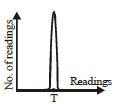
B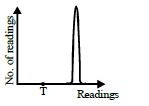
C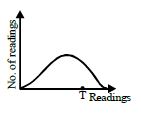
D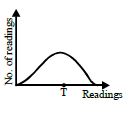
Solution
(C) $1$. Accuracy refers to how close the average of the measured values is to the true value $(T)$.
$2$. Precision refers to the consistency or repeatability of the measurements,indicated by the spread or width of the distribution curve.
$3$. $A$ narrow peak indicates high precision (low variation),while a broad,wide peak indicates low precision (high variation or imprecise).
$4$. In Figure $A$,the peak is narrow (precise) and centered at $T$ (accurate).
$5$. In Figure $B$,the peak is narrow (precise) but shifted away from $T$ (inaccurate).
$6$. In Figure $C$,the peak is broad (imprecise) and centered at $T$ (accurate).
$7$. In Figure $D$,the peak is broad (imprecise) and shifted away from $T$ (inaccurate).
$8$. Therefore,Figure $C$ represents a measurement that is imprecise (broad peak) but accurate (centered at $T$).
$2$. Precision refers to the consistency or repeatability of the measurements,indicated by the spread or width of the distribution curve.
$3$. $A$ narrow peak indicates high precision (low variation),while a broad,wide peak indicates low precision (high variation or imprecise).
$4$. In Figure $A$,the peak is narrow (precise) and centered at $T$ (accurate).
$5$. In Figure $B$,the peak is narrow (precise) but shifted away from $T$ (inaccurate).
$6$. In Figure $C$,the peak is broad (imprecise) and centered at $T$ (accurate).
$7$. In Figure $D$,the peak is broad (imprecise) and shifted away from $T$ (inaccurate).
$8$. Therefore,Figure $C$ represents a measurement that is imprecise (broad peak) but accurate (centered at $T$).
0 likes
View Solution79
DifficultMCQ
Two resistances are measured in $\Omega$ and are given as $R_1 = 3 \Omega \pm 1\%$ and $R_2 = 6 \Omega \pm 2\%$. When they are connected in parallel,the percentage error in equivalent resistance is .......... $\%$
A
$3$
B
$4.5$
C
$0.67$
D
$1.33$
Solution
(D) The equivalent resistance $R_{eq}$ for two resistors in parallel is given by $\frac{1}{R_{eq}} = \frac{1}{R_1} + \frac{1}{R_2}$.
First,calculate $R_{eq}$: $R_{eq} = \frac{R_1 R_2}{R_1 + R_2} = \frac{3 \times 6}{3 + 6} = \frac{18}{9} = 2 \Omega$.
Differentiating the expression $\frac{1}{R_{eq}} = \frac{1}{R_1} + \frac{1}{R_2}$,we get $-\frac{dR_{eq}}{R_{eq}^2} = -\frac{dR_1}{R_1^2} - \frac{dR_2}{R_2^2}$,which simplifies to $\frac{dR_{eq}}{R_{eq}^2} = \frac{dR_1}{R_1^2} + \frac{dR_2}{R_2^2}$.
Multiplying by $R_{eq}$,we get $\frac{dR_{eq}}{R_{eq}} = \frac{R_{eq}}{R_1} \left( \frac{dR_1}{R_1} \right) + \frac{R_{eq}}{R_2} \left( \frac{dR_2}{R_2} \right)$.
Given $\frac{dR_1}{R_1} = 1\%$ and $\frac{dR_2}{R_2} = 2\%$,we substitute the values:
$\frac{dR_{eq}}{R_{eq}} = \frac{2}{3} (1\%) + \frac{2}{6} (2\%) = \frac{2}{3}\% + \frac{2}{3}\% = \frac{4}{3}\%$.
$\frac{dR_{eq}}{R_{eq}} = 1.33\%$.
First,calculate $R_{eq}$: $R_{eq} = \frac{R_1 R_2}{R_1 + R_2} = \frac{3 \times 6}{3 + 6} = \frac{18}{9} = 2 \Omega$.
Differentiating the expression $\frac{1}{R_{eq}} = \frac{1}{R_1} + \frac{1}{R_2}$,we get $-\frac{dR_{eq}}{R_{eq}^2} = -\frac{dR_1}{R_1^2} - \frac{dR_2}{R_2^2}$,which simplifies to $\frac{dR_{eq}}{R_{eq}^2} = \frac{dR_1}{R_1^2} + \frac{dR_2}{R_2^2}$.
Multiplying by $R_{eq}$,we get $\frac{dR_{eq}}{R_{eq}} = \frac{R_{eq}}{R_1} \left( \frac{dR_1}{R_1} \right) + \frac{R_{eq}}{R_2} \left( \frac{dR_2}{R_2} \right)$.
Given $\frac{dR_1}{R_1} = 1\%$ and $\frac{dR_2}{R_2} = 2\%$,we substitute the values:
$\frac{dR_{eq}}{R_{eq}} = \frac{2}{3} (1\%) + \frac{2}{6} (2\%) = \frac{2}{3}\% + \frac{2}{3}\% = \frac{4}{3}\%$.
$\frac{dR_{eq}}{R_{eq}} = 1.33\%$.
0 likes
View Solution80
EasyMCQ
Two resistors of resistances $R_1 = (300 \pm 3) \,\Omega$ and $R_2 = (500 \pm 4) \,\Omega$ are connected in series. The equivalent resistance of the series combination is
A
$(800 \pm 1) \,\Omega$
B
$(800 \pm 7) \,\Omega$
C
$(200 \pm 7) \,\Omega$
D
$(200 \pm 1) \,\Omega$
Solution
(B) For resistors connected in series,the equivalent resistance $R_s$ is the sum of individual resistances:
$R_s = R_1 + R_2 = 300 \,\Omega + 500 \,\Omega = 800 \,\Omega$
The error in the sum of two quantities is the sum of their absolute errors:
$\Delta R_s = \Delta R_1 + \Delta R_2 = 3 \,\Omega + 4 \,\Omega = 7 \,\Omega$
Therefore,the equivalent resistance with its uncertainty is expressed as:
$R_s \pm \Delta R_s = (800 \pm 7) \,\Omega$
$R_s = R_1 + R_2 = 300 \,\Omega + 500 \,\Omega = 800 \,\Omega$
The error in the sum of two quantities is the sum of their absolute errors:
$\Delta R_s = \Delta R_1 + \Delta R_2 = 3 \,\Omega + 4 \,\Omega = 7 \,\Omega$
Therefore,the equivalent resistance with its uncertainty is expressed as:
$R_s \pm \Delta R_s = (800 \pm 7) \,\Omega$
0 likes
View Solution81
DifficultMCQ
$A$ particle covers a distance of $(13.8 \pm 0.2) \ m$ in $(4 \pm 0.3) \ s$. Its velocity under error limits will be
A
$3.5 \pm 0.6 \ ms^{-1}$
B
$3.5 \pm 0.3 \ ms^{-1}$
C
$6.1 \pm 0.6 \ ms^{-1}$
D
$6.1 \pm 0.3 \ ms^{-1}$
Solution
(B) Given: Distance $s = (13.8 \pm 0.2) \ m$ and time $t = (4 \pm 0.3) \ s$.
Velocity $v = \frac{s}{t} = \frac{13.8}{4} = 3.45 \ ms^{-1}$. Rounding to one decimal place,$v = 3.5 \ ms^{-1}$.
The relative error in velocity is given by $\frac{\Delta v}{v} = \frac{\Delta s}{s} + \frac{\Delta t}{t}$.
Substituting the values: $\frac{\Delta v}{3.45} = \frac{0.2}{13.8} + \frac{0.3}{4}$.
$\frac{\Delta v}{3.45} = 0.0145 + 0.075 = 0.0895$.
$\Delta v = 0.0895 \times 3.45 \approx 0.3087 \ ms^{-1}$.
Rounding to one significant figure,$\Delta v \approx 0.3 \ ms^{-1}$.
Thus,the velocity is $(3.5 \pm 0.3) \ ms^{-1}$.
Velocity $v = \frac{s}{t} = \frac{13.8}{4} = 3.45 \ ms^{-1}$. Rounding to one decimal place,$v = 3.5 \ ms^{-1}$.
The relative error in velocity is given by $\frac{\Delta v}{v} = \frac{\Delta s}{s} + \frac{\Delta t}{t}$.
Substituting the values: $\frac{\Delta v}{3.45} = \frac{0.2}{13.8} + \frac{0.3}{4}$.
$\frac{\Delta v}{3.45} = 0.0145 + 0.075 = 0.0895$.
$\Delta v = 0.0895 \times 3.45 \approx 0.3087 \ ms^{-1}$.
Rounding to one significant figure,$\Delta v \approx 0.3 \ ms^{-1}$.
Thus,the velocity is $(3.5 \pm 0.3) \ ms^{-1}$.
0 likes
View Solution82
MediumMCQ
In an experiment of a simple pendulum,the time period measured was $50 \, s$ for $25$ vibrations when the length of the simple pendulum was taken as $100 \, cm$. If the least count of the stopwatch is $0.1 \, s$ and that of the meter scale is $0.1 \, cm$,then the maximum possible error in the value of $g$ is .......... $\%$
A
$0.5$
B
$1$
C
$0.4$
D
$0.1$
Solution
(A) The formula for the time period of a simple pendulum is $T = 2\pi \sqrt{\frac{l}{g}}$.
Squaring both sides and rearranging for $g$,we get $g = \frac{4\pi^2 l}{T^2}$.
The relative error in $g$ is given by $\frac{\Delta g}{g} = \frac{\Delta l}{l} + 2\frac{\Delta T}{T}$.
Given: $l = 100 \, cm$,$\Delta l = 0.1 \, cm$,$T_{total} = 50 \, s$,$\Delta T_{total} = 0.1 \, s$.
Note that $T$ is the time period of one vibration,$T = \frac{T_{total}}{25} = \frac{50}{25} = 2 \, s$.
The error in $T$ is $\Delta T = \frac{\Delta T_{total}}{25} = \frac{0.1}{25} = 0.004 \, s$.
Substituting these values: $\frac{\Delta g}{g} = \frac{0.1}{100} + 2 \left( \frac{0.004}{2} \right) = 0.001 + 0.004 = 0.005$.
Percentage error = $0.005 \times 100 = 0.5 \%$.
Squaring both sides and rearranging for $g$,we get $g = \frac{4\pi^2 l}{T^2}$.
The relative error in $g$ is given by $\frac{\Delta g}{g} = \frac{\Delta l}{l} + 2\frac{\Delta T}{T}$.
Given: $l = 100 \, cm$,$\Delta l = 0.1 \, cm$,$T_{total} = 50 \, s$,$\Delta T_{total} = 0.1 \, s$.
Note that $T$ is the time period of one vibration,$T = \frac{T_{total}}{25} = \frac{50}{25} = 2 \, s$.
The error in $T$ is $\Delta T = \frac{\Delta T_{total}}{25} = \frac{0.1}{25} = 0.004 \, s$.
Substituting these values: $\frac{\Delta g}{g} = \frac{0.1}{100} + 2 \left( \frac{0.004}{2} \right) = 0.001 + 0.004 = 0.005$.
Percentage error = $0.005 \times 100 = 0.5 \%$.
0 likes
View Solution83
DifficultMCQ
The relative error in the determination of the surface area of a sphere is $\alpha$. Then the relative error in the determination of its volume is
A
$\frac{2}{3}\alpha$
B
$\frac{5}{2}\alpha$
C
$\frac{3}{2}\alpha$
D
$\alpha$
Solution
(C) The surface area of a sphere is given by $S = 4\pi r^2$. The relative error in the surface area is $\frac{\Delta S}{S} = 2 \frac{\Delta r}{r} = \alpha$.
From this,the relative error in the radius is $\frac{\Delta r}{r} = \frac{\alpha}{2}$.
The volume of a sphere is given by $V = \frac{4}{3}\pi r^3$. The relative error in the volume is $\frac{\Delta V}{V} = 3 \frac{\Delta r}{r}$.
Substituting the value of $\frac{\Delta r}{r}$,we get $\frac{\Delta V}{V} = 3 \times \frac{\alpha}{2} = \frac{3}{2}\alpha$.
From this,the relative error in the radius is $\frac{\Delta r}{r} = \frac{\alpha}{2}$.
The volume of a sphere is given by $V = \frac{4}{3}\pi r^3$. The relative error in the volume is $\frac{\Delta V}{V} = 3 \frac{\Delta r}{r}$.
Substituting the value of $\frac{\Delta r}{r}$,we get $\frac{\Delta V}{V} = 3 \times \frac{\alpha}{2} = \frac{3}{2}\alpha$.
0 likes
View Solution84
DifficultMCQ
The percentage errors in quantities $P, Q, R$ and $S$ are $0.5\%, 1\%, 3\%$ and $1.5\%$ respectively in the measurement of a physical quantity $A = \frac{P^3 Q^2}{\sqrt{R} S}$. The maximum percentage error in the value of $A$ will be ........... $\%$.
A
$8.5$
B
$6.0$
C
$7.5$
D
$6.5$
Solution
(D) Given the formula $A = \frac{P^3 Q^2}{R^{1/2} S}$.
To find the maximum percentage error in $A$,we use the formula for propagation of errors:
$\frac{\Delta A}{A} \times 100 = 3 \left( \frac{\Delta P}{P} \times 100 \right) + 2 \left( \frac{\Delta Q}{Q} \times 100 \right) + \frac{1}{2} \left( \frac{\Delta R}{R} \times 100 \right) + 1 \left( \frac{\Delta S}{S} \times 100 \right)$.
Substituting the given percentage errors:
$\text{Max } \% \text{ error in } A = 3(0.5\%) + 2(1\%) + 0.5(3\%) + 1(1.5\%)$.
$= 1.5\% + 2.0\% + 1.5\% + 1.5\%$.
$= 6.5\%$.
To find the maximum percentage error in $A$,we use the formula for propagation of errors:
$\frac{\Delta A}{A} \times 100 = 3 \left( \frac{\Delta P}{P} \times 100 \right) + 2 \left( \frac{\Delta Q}{Q} \times 100 \right) + \frac{1}{2} \left( \frac{\Delta R}{R} \times 100 \right) + 1 \left( \frac{\Delta S}{S} \times 100 \right)$.
Substituting the given percentage errors:
$\text{Max } \% \text{ error in } A = 3(0.5\%) + 2(1\%) + 0.5(3\%) + 1(1.5\%)$.
$= 1.5\% + 2.0\% + 1.5\% + 1.5\%$.
$= 6.5\%$.
0 likes
View Solution85
MediumMCQ
$A$ physical quantity $p$ is described by the relation $p = a^{1/2} b^2 c^3 d^{-4}$. If the relative errors in the measurement of $a, b, c$ and $d$ are $2\%$,$1\%$,$3\%$ and $5\%$ respectively,then the relative error in $p$ will be ........... $\%$.
A
$8$
B
$12$
C
$32$
D
$25$
Solution
(C) Given the relation: $p = a^{1/2} b^2 c^3 d^{-4}$.
The formula for the maximum relative error is given by:
$\frac{\Delta p}{p} = \frac{1}{2} \frac{\Delta a}{a} + 2 \frac{\Delta b}{b} + 3 \frac{\Delta c}{c} + 4 \frac{\Delta d}{d}$.
Substituting the given percentage errors:
$\frac{\Delta p}{p} \times 100 = \frac{1}{2}(2\%) + 2(1\%) + 3(3\%) + 4(5\%)$.
Calculating the values:
$= 1\% + 2\% + 9\% + 20\% = 32\%$.
Therefore,the relative error in $p$ is $32\%$.
The formula for the maximum relative error is given by:
$\frac{\Delta p}{p} = \frac{1}{2} \frac{\Delta a}{a} + 2 \frac{\Delta b}{b} + 3 \frac{\Delta c}{c} + 4 \frac{\Delta d}{d}$.
Substituting the given percentage errors:
$\frac{\Delta p}{p} \times 100 = \frac{1}{2}(2\%) + 2(1\%) + 3(3\%) + 4(5\%)$.
Calculating the values:
$= 1\% + 2\% + 9\% + 20\% = 32\%$.
Therefore,the relative error in $p$ is $32\%$.
0 likes
View Solution86
DifficultMCQ
An experiment is performed to obtain the value of acceleration due to gravity $g$ by using a simple pendulum of length $L$. In this experiment,the time for $100$ oscillations is measured by using a watch of $1$ second least count,and the value is $90.0$ seconds. The length $L$ is measured by using a meter scale of least count $1$ mm,and the value is $20.0$ cm. The error in the determination of $g$ would be ........... $\%$.
A
$1.7$
B
$2.7$
C
$4.4$
D
$2.27$
Solution
(B) The formula for the time period of a simple pendulum is $T = 2\pi \sqrt{\frac{L}{g}}$.
Squaring both sides,we get $T^2 = 4\pi^2 \frac{L}{g}$,which implies $g = 4\pi^2 \frac{L}{T^2}$.
The relative error in $g$ is given by $\frac{\Delta g}{g} = \frac{\Delta L}{L} + 2 \frac{\Delta T}{T}$.
Given: $L = 20.0$ cm,$\Delta L = 1$ mm = $0.1$ cm.
$T_{total} = 90.0$ s,$\Delta T_{total} = 1$ s. Since $T = \frac{T_{total}}{100}$,$\Delta T = \frac{\Delta T_{total}}{100} = \frac{1}{100} = 0.01$ s.
Substituting the values:
$\frac{\Delta g}{g} = \frac{0.1}{20.0} + 2 \times \frac{1}{90} = 0.005 + 0.0222 = 0.0272$.
Percentage error = $0.0272 \times 100 = 2.72 \% \approx 2.7 \%$.
Squaring both sides,we get $T^2 = 4\pi^2 \frac{L}{g}$,which implies $g = 4\pi^2 \frac{L}{T^2}$.
The relative error in $g$ is given by $\frac{\Delta g}{g} = \frac{\Delta L}{L} + 2 \frac{\Delta T}{T}$.
Given: $L = 20.0$ cm,$\Delta L = 1$ mm = $0.1$ cm.
$T_{total} = 90.0$ s,$\Delta T_{total} = 1$ s. Since $T = \frac{T_{total}}{100}$,$\Delta T = \frac{\Delta T_{total}}{100} = \frac{1}{100} = 0.01$ s.
Substituting the values:
$\frac{\Delta g}{g} = \frac{0.1}{20.0} + 2 \times \frac{1}{90} = 0.005 + 0.0222 = 0.0272$.
Percentage error = $0.0272 \times 100 = 2.72 \% \approx 2.7 \%$.
0 likes
View Solution87
MediumMCQ
The amount of heat produced in an electric circuit depends upon the current $(I),$ resistance $(R)$ and time $(t).$ If the error made in the measurements of the above quantities are $2\%, 1\%$ and $1\%$ respectively then the maximum possible error in the total heat produced will be ........... $\%$
A
$1$
B
$2$
C
$6$
D
$3$
Solution
(C) The formula for heat produced in an electric circuit is given by $H = I^2Rt.$
To find the maximum relative error in $H,$ we use the formula for propagation of errors:
$\frac{\Delta H}{H} = 2\left(\frac{\Delta I}{I}\right) + \frac{\Delta R}{R} + \frac{\Delta t}{t}.$
Given percentage errors are $\frac{\Delta I}{I} \times 100 = 2\%,$ $\frac{\Delta R}{R} \times 100 = 1\%,$ and $\frac{\Delta t}{t} \times 100 = 1\%.$
Substituting these values into the error equation:
$\frac{\Delta H}{H} \times 100 = 2(2\%) + 1\% + 1\% = 4\% + 1\% + 1\% = 6\%.$
Thus,the maximum possible error in the total heat produced is $6\%.$
To find the maximum relative error in $H,$ we use the formula for propagation of errors:
$\frac{\Delta H}{H} = 2\left(\frac{\Delta I}{I}\right) + \frac{\Delta R}{R} + \frac{\Delta t}{t}.$
Given percentage errors are $\frac{\Delta I}{I} \times 100 = 2\%,$ $\frac{\Delta R}{R} \times 100 = 1\%,$ and $\frac{\Delta t}{t} \times 100 = 1\%.$
Substituting these values into the error equation:
$\frac{\Delta H}{H} \times 100 = 2(2\%) + 1\% + 1\% = 4\% + 1\% + 1\% = 6\%.$
Thus,the maximum possible error in the total heat produced is $6\%.$
0 likes
View Solution88
DifficultMCQ
In a simple pendulum experiment for determination of acceleration due to gravity $(g)$, time taken for $20$ oscillations is measured by using a watch of $1\,s$ least count. The mean value of time taken comes out to be $30\,s$. The length of the pendulum is measured by using a meter scale of least count $1\,mm$ and the value obtained is $55.0\,cm$. The percentage error in the determination of $g$ is close to ........... $\%$
A
$0.7$
B
$3.5$
C
$6.8$
D
$0.2$
Solution
(C) The formula for acceleration due to gravity is $g = \frac{4\pi^2 L}{T^2}$.
Taking the relative error, we have $\frac{\Delta g}{g} = \frac{\Delta L}{L} + 2\frac{\Delta T}{T}$.
Given:
$L = 55.0\,cm$, $\Delta L = 1\,mm = 0.1\,cm$.
Time for $20$ oscillations is $t = 30\,s$, so $T = \frac{30}{20} = 1.5\,s$.
The least count of the watch is $1\,s$, so the error in total time is $\Delta t = 1\,s$. Thus, $\Delta T = \frac{\Delta t}{20} = \frac{1}{20} = 0.05\,s$.
Now, calculate the percentage error:
$\frac{\Delta g}{g} \times 100 = \left( \frac{\Delta L}{L} + 2\frac{\Delta T}{T} \right) \times 100\%$
$= \left( \frac{0.1}{55.0} + 2 \times \frac{0.05}{1.5} \right) \times 100\%$
$= \left( 0.001818 + 0.06666 \right) \times 100\%$
$= 0.06848 \times 100\% \approx 6.8\%$.
Taking the relative error, we have $\frac{\Delta g}{g} = \frac{\Delta L}{L} + 2\frac{\Delta T}{T}$.
Given:
$L = 55.0\,cm$, $\Delta L = 1\,mm = 0.1\,cm$.
Time for $20$ oscillations is $t = 30\,s$, so $T = \frac{30}{20} = 1.5\,s$.
The least count of the watch is $1\,s$, so the error in total time is $\Delta t = 1\,s$. Thus, $\Delta T = \frac{\Delta t}{20} = \frac{1}{20} = 0.05\,s$.
Now, calculate the percentage error:
$\frac{\Delta g}{g} \times 100 = \left( \frac{\Delta L}{L} + 2\frac{\Delta T}{T} \right) \times 100\%$
$= \left( \frac{0.1}{55.0} + 2 \times \frac{0.05}{1.5} \right) \times 100\%$
$= \left( 0.001818 + 0.06666 \right) \times 100\%$
$= 0.06848 \times 100\% \approx 6.8\%$.
0 likes
View Solution89
DifficultMCQ
In the density measurement of a cube,the mass and edge length are measured as $(10.00 \pm 0.10) \, kg$ and $(0.10 \pm 0.01) \, m$ respectively. The error in the measurement of density is
A
$0.10 \, kg/m^3$
B
$0.31 \, kg/m^3$
C
$0.07 \, kg/m^3$
D
None of these
Solution
(D) The density $\rho$ of a cube is given by $\rho = \frac{m}{L^3}$,where $m$ is the mass and $L$ is the edge length.
Given: $m = 10.00 \, kg$,$\Delta m = 0.10 \, kg$,$L = 0.10 \, m$,$\Delta L = 0.01 \, m$.
The measured density is $\rho = \frac{10.00}{(0.10)^3} = \frac{10.00}{0.001} = 10000 \, kg/m^3$.
Since the relative error in $L$ is $\frac{\Delta L}{L} = \frac{0.01}{0.10} = 0.1$,which is not small,we calculate the maximum and minimum possible density values.
$\rho_{max} = \frac{m + \Delta m}{(L - \Delta L)^3} = \frac{10.10}{(0.09)^3} = \frac{10.10}{0.000729} \approx 13854.6 \, kg/m^3$.
$\rho_{min} = \frac{m - \Delta m}{(L + \Delta L)^3} = \frac{9.90}{(0.11)^3} = \frac{9.90}{0.001331} \approx 7438.0 \, kg/m^3$.
The absolute error in density is $\Delta \rho = \frac{\rho_{max} - \rho_{min}}{2} = \frac{13854.6 - 7438.0}{2} = \frac{6416.6}{2} = 3208.3 \, kg/m^3$.
Since this value is not among the given options,the correct choice is $D$.
Given: $m = 10.00 \, kg$,$\Delta m = 0.10 \, kg$,$L = 0.10 \, m$,$\Delta L = 0.01 \, m$.
The measured density is $\rho = \frac{10.00}{(0.10)^3} = \frac{10.00}{0.001} = 10000 \, kg/m^3$.
Since the relative error in $L$ is $\frac{\Delta L}{L} = \frac{0.01}{0.10} = 0.1$,which is not small,we calculate the maximum and minimum possible density values.
$\rho_{max} = \frac{m + \Delta m}{(L - \Delta L)^3} = \frac{10.10}{(0.09)^3} = \frac{10.10}{0.000729} \approx 13854.6 \, kg/m^3$.
$\rho_{min} = \frac{m - \Delta m}{(L + \Delta L)^3} = \frac{9.90}{(0.11)^3} = \frac{9.90}{0.001331} \approx 7438.0 \, kg/m^3$.
The absolute error in density is $\Delta \rho = \frac{\rho_{max} - \rho_{min}}{2} = \frac{13854.6 - 7438.0}{2} = \frac{6416.6}{2} = 3208.3 \, kg/m^3$.
Since this value is not among the given options,the correct choice is $D$.
0 likes
View Solution90
MediumMCQ
The density of a cube is measured by measuring its mass and the length of its sides. If the maximum error in the measurement of mass and length are $3\%$ and $2\%$ respectively,then find the maximum error in the measurement of the density of the cube.
A
$12$
B
$14$
C
$7$
D
$9$
Solution
(D) The density $\rho$ of a cube is given by the formula $\rho = \frac{M}{V} = \frac{M}{L^3}$,where $M$ is the mass and $L$ is the length of the side of the cube.
Using the formula for relative error,the maximum percentage error in density is given by:
$\frac{\Delta \rho}{\rho} \times 100 = \frac{\Delta M}{M} \times 100 + 3 \times \left( \frac{\Delta L}{L} \times 100 \right)$
Given that the maximum error in mass $\frac{\Delta M}{M} \times 100 = 3\%$ and the maximum error in length $\frac{\Delta L}{L} \times 100 = 2\%$.
Substituting these values into the equation:
$\text{Percentage error in } \rho = 3\% + 3 \times (2\%) = 3\% + 6\% = 9\%$.
Therefore,the maximum error in the measurement of the density of the cube is $9\%$.
Using the formula for relative error,the maximum percentage error in density is given by:
$\frac{\Delta \rho}{\rho} \times 100 = \frac{\Delta M}{M} \times 100 + 3 \times \left( \frac{\Delta L}{L} \times 100 \right)$
Given that the maximum error in mass $\frac{\Delta M}{M} \times 100 = 3\%$ and the maximum error in length $\frac{\Delta L}{L} \times 100 = 2\%$.
Substituting these values into the equation:
$\text{Percentage error in } \rho = 3\% + 3 \times (2\%) = 3\% + 6\% = 9\%$.
Therefore,the maximum error in the measurement of the density of the cube is $9\%$.
0 likes
View Solution91
MediumMCQ
The temperatures of two bodies measured by a thermometer are $t_1 = 20^{\circ}C \pm 0.5^{\circ}C$ and $t_2 = 50^{\circ}C \pm 0.5^{\circ}C$. The temperature difference and the error therein are:
A
$30^{\circ}C \pm 1^{\circ}C$
B
$70^{\circ}C \pm 0.5^{\circ}C$
C
$30^{\circ}C \pm 0.5^{\circ}C$
D
$70^{\circ}C \pm 1^{\circ}C$
Solution
(A) Given temperatures are $t_1 = 20^{\circ}C \pm 0.5^{\circ}C$ and $t_2 = 50^{\circ}C \pm 0.5^{\circ}C$.
The temperature difference is calculated as $\Delta t = t_2 - t_1 = 50^{\circ}C - 20^{\circ}C = 30^{\circ}C$.
When subtracting two quantities,the absolute errors are added.
The error in the difference is $\Delta t = \Delta t_1 + \Delta t_2 = 0.5^{\circ}C + 0.5^{\circ}C = 1^{\circ}C$.
Thus,the temperature difference is $30^{\circ}C \pm 1^{\circ}C$.
The temperature difference is calculated as $\Delta t = t_2 - t_1 = 50^{\circ}C - 20^{\circ}C = 30^{\circ}C$.
When subtracting two quantities,the absolute errors are added.
The error in the difference is $\Delta t = \Delta t_1 + \Delta t_2 = 0.5^{\circ}C + 0.5^{\circ}C = 1^{\circ}C$.
Thus,the temperature difference is $30^{\circ}C \pm 1^{\circ}C$.
0 likes
View Solution92
EasyMCQ
$A$ physical quantity is $A = P^2/Q^3$. The percentage error in the measurement of $P$ and $Q$ is $x$ and $y$ respectively. The maximum percentage error in the measurement of $A$ is:
A
$2x - 3y$
B
$3x - 2y$
C
$3x + 2y$
D
$2x + 3y$
Solution
(D) Given the physical quantity $A = P^2/Q^3$.
To find the maximum percentage error,we use the formula for relative error in powers:
$\frac{\Delta A}{A} = 2 \left( \frac{\Delta P}{P} \right) + 3 \left( \frac{\Delta Q}{Q} \right)$.
Multiplying by $100$ to convert to percentage error:
$\left( \frac{\Delta A}{A} \times 100 \right) = 2 \left( \frac{\Delta P}{P} \times 100 \right) + 3 \left( \frac{\Delta Q}{Q} \times 100 \right)$.
Given that the percentage error in $P$ is $x$ and in $Q$ is $y$,we substitute these values:
$\text{Percentage error in } A = 2x + 3y$.
To find the maximum percentage error,we use the formula for relative error in powers:
$\frac{\Delta A}{A} = 2 \left( \frac{\Delta P}{P} \right) + 3 \left( \frac{\Delta Q}{Q} \right)$.
Multiplying by $100$ to convert to percentage error:
$\left( \frac{\Delta A}{A} \times 100 \right) = 2 \left( \frac{\Delta P}{P} \times 100 \right) + 3 \left( \frac{\Delta Q}{Q} \times 100 \right)$.
Given that the percentage error in $P$ is $x$ and in $Q$ is $y$,we substitute these values:
$\text{Percentage error in } A = 2x + 3y$.
0 likes
View Solution93
EasyMCQ
Error in volume of a sphere is $6\%$. Error in its radius will be .......... $\%$
A
$2$
B
$3$
C
$4$
D
$5$
Solution
(A) The volume of a sphere is given by the formula $V = \frac{4}{3}\pi r^3$.
Taking the logarithmic derivative,we get $\frac{\Delta V}{V} = 3 \frac{\Delta r}{r}$.
Given that the percentage error in volume is $\frac{\Delta V}{V} \times 100 = 6\%$.
Substituting this into the equation: $6\% = 3 \times (\frac{\Delta r}{r} \times 100)$.
Therefore,the percentage error in radius is $\frac{\Delta r}{r} \times 100 = \frac{6\%}{3} = 2\%$.
Taking the logarithmic derivative,we get $\frac{\Delta V}{V} = 3 \frac{\Delta r}{r}$.
Given that the percentage error in volume is $\frac{\Delta V}{V} \times 100 = 6\%$.
Substituting this into the equation: $6\% = 3 \times (\frac{\Delta r}{r} \times 100)$.
Therefore,the percentage error in radius is $\frac{\Delta r}{r} \times 100 = \frac{6\%}{3} = 2\%$.
0 likes
View Solution94
MediumMCQ
The two specific heat capacities of a gas are measured as $C_P = (12.28 \pm 0.2) \text{ units}$ and $C_V = (3.97 \pm 0.3) \text{ units}$. Find the value of the gas constant $(R)$.
A
$(8.31 \pm 0.1) \text{ units}$
B
$(8.31 \pm 0.5) \text{ units}$
C
$(16.25 \pm 0.1) \text{ units}$
D
$(16.25 \pm 0.5) \text{ units}$
Solution
(B) According to Mayer's relation,the gas constant $R$ is given by $R = C_P - C_V$.
Substituting the given values: $R = 12.28 - 3.97 = 8.31 \text{ units}$.
For the error in $R$,we use the rule for the subtraction of physical quantities: $\Delta R = \Delta C_P + \Delta C_V$.
Substituting the error values: $\Delta R = 0.2 + 0.3 = 0.5 \text{ units}$.
Therefore,the value of the gas constant is $R = (8.31 \pm 0.5) \text{ units}$.
Substituting the given values: $R = 12.28 - 3.97 = 8.31 \text{ units}$.
For the error in $R$,we use the rule for the subtraction of physical quantities: $\Delta R = \Delta C_P + \Delta C_V$.
Substituting the error values: $\Delta R = 0.2 + 0.3 = 0.5 \text{ units}$.
Therefore,the value of the gas constant is $R = (8.31 \pm 0.5) \text{ units}$.
0 likes
View Solution95
MediumMCQ
If $Q = \frac{X^n}{Y^m}$ and $\Delta X$ is the absolute error in the measurement of $X,$ and $\Delta Y$ is the absolute error in the measurement of $Y,$ then the absolute error $\Delta Q$ in $Q$ is:
A
$\Delta Q = \pm \left( n\frac{\Delta X}{X} + m\frac{\Delta Y}{Y} \right)$
B
$\Delta Q = \pm \left( n\frac{\Delta X}{X} + m\frac{\Delta Y}{Y} \right) Q$
C
$\Delta Q = \pm \left( n\frac{\Delta X}{X} - m\frac{\Delta Y}{Y} \right) Q$
D
$\Delta Q = \pm \left( n\frac{\Delta X}{Y} - m\frac{\Delta Y}{X} \right) Q$
Solution
(B) Given the expression $Q = \frac{X^n}{Y^m}$.
Taking the natural logarithm on both sides: $\ln Q = n \ln X - m \ln Y$.
Differentiating both sides,we get the expression for relative error: $\frac{dQ}{Q} = n \frac{dX}{X} - m \frac{dY}{Y}$.
For maximum absolute error,we consider the sum of the magnitudes of the relative errors: $\frac{\Delta Q}{Q} = \pm \left( n \frac{\Delta X}{X} + m \frac{\Delta Y}{Y} \right)$.
Therefore,the absolute error $\Delta Q$ is given by: $\Delta Q = \pm \left( n \frac{\Delta X}{X} + m \frac{\Delta Y}{Y} \right) Q$.
Taking the natural logarithm on both sides: $\ln Q = n \ln X - m \ln Y$.
Differentiating both sides,we get the expression for relative error: $\frac{dQ}{Q} = n \frac{dX}{X} - m \frac{dY}{Y}$.
For maximum absolute error,we consider the sum of the magnitudes of the relative errors: $\frac{\Delta Q}{Q} = \pm \left( n \frac{\Delta X}{X} + m \frac{\Delta Y}{Y} \right)$.
Therefore,the absolute error $\Delta Q$ is given by: $\Delta Q = \pm \left( n \frac{\Delta X}{X} + m \frac{\Delta Y}{Y} \right) Q$.
0 likes
View Solution96
MediumMCQ
The mass of the body is $10.000\,g$ and its volume is $10.00\,cm^3$. If the measured values are expressed up to the correct significant figures,the maximum error in the measurement of density is
A
$0.0011\,g\,cm^{-3}$
B
$0.001\,g\,cm^{-3}$
C
$0.0001\,g\,cm^{-3}$
D
$0.021\,g\,cm^{-3}$
Solution
(A) Given: Mass $M = 10.000\,g$,Volume $V = 10.00\,cm^3$.
The uncertainty in mass $\Delta M = 0.001\,g$ and in volume $\Delta V = 0.01\,cm^3$.
Density $\rho = \frac{M}{V} = \frac{10.000}{10.00} = 1.000\,g\,cm^{-3}$.
The relative error in density is given by $\frac{\Delta \rho}{\rho} = \frac{\Delta M}{M} + \frac{\Delta V}{V}$.
Substituting the values: $\frac{\Delta \rho}{\rho} = \frac{0.001}{10.000} + \frac{0.01}{10.00} = 0.0001 + 0.001 = 0.0011$.
Therefore,the absolute error $\Delta \rho = 0.0011 \times \rho = 0.0011 \times 1.000 = 0.0011\,g\,cm^{-3}$.
The uncertainty in mass $\Delta M = 0.001\,g$ and in volume $\Delta V = 0.01\,cm^3$.
Density $\rho = \frac{M}{V} = \frac{10.000}{10.00} = 1.000\,g\,cm^{-3}$.
The relative error in density is given by $\frac{\Delta \rho}{\rho} = \frac{\Delta M}{M} + \frac{\Delta V}{V}$.
Substituting the values: $\frac{\Delta \rho}{\rho} = \frac{0.001}{10.000} + \frac{0.01}{10.00} = 0.0001 + 0.001 = 0.0011$.
Therefore,the absolute error $\Delta \rho = 0.0011 \times \rho = 0.0011 \times 1.000 = 0.0011\,g\,cm^{-3}$.
0 likes
View Solution97
MediumMCQ
The mass and volume of a body are found to be $(5.00 \pm 0.05) \ kg$ and $(1.00 \pm 0.05) \ m^3$ respectively. Then the maximum possible percentage error in its density is .......... $\%$
A
$3$
B
$5$
C
$6$
D
$7$
Solution
(C) Density $\rho$ is defined as $\rho = \frac{m}{V}$.
For a quotient,the relative error is the sum of the relative errors of the individual quantities: $\frac{\Delta \rho}{\rho} = \frac{\Delta m}{m} + \frac{\Delta V}{V}$.
Given: $m = 5.00 \ kg$,$\Delta m = 0.05 \ kg$,$V = 1.00 \ m^3$,$\Delta V = 0.05 \ m^3$.
The percentage error in density is given by: $\frac{\Delta \rho}{\rho} \times 100 = \left( \frac{\Delta m}{m} + \frac{\Delta V}{V} \right) \times 100$.
Substituting the values: $\left( \frac{0.05}{5.00} + \frac{0.05}{1.00} \right) \times 100 = (0.01 + 0.05) \times 100 = 0.06 \times 100 = 6 \%$.
Therefore,the maximum possible percentage error in density is $6 \%$.
For a quotient,the relative error is the sum of the relative errors of the individual quantities: $\frac{\Delta \rho}{\rho} = \frac{\Delta m}{m} + \frac{\Delta V}{V}$.
Given: $m = 5.00 \ kg$,$\Delta m = 0.05 \ kg$,$V = 1.00 \ m^3$,$\Delta V = 0.05 \ m^3$.
The percentage error in density is given by: $\frac{\Delta \rho}{\rho} \times 100 = \left( \frac{\Delta m}{m} + \frac{\Delta V}{V} \right) \times 100$.
Substituting the values: $\left( \frac{0.05}{5.00} + \frac{0.05}{1.00} \right) \times 100 = (0.01 + 0.05) \times 100 = 0.06 \times 100 = 6 \%$.
Therefore,the maximum possible percentage error in density is $6 \%$.
0 likes
View Solution98
MediumMCQ
In the expression for time period $T$ of a simple pendulum $T = 2 \pi \sqrt{\frac{l}{g}}$,if the percentage error in time period $T$ and length $l$ are $2 \%$ and $2 \%$ respectively,then the percentage error in acceleration due to gravity $g$ is equal to ......... $\%$
A
$8$
B
$2$
C
$4$
D
$6$
Solution
(D) The formula for the time period of a simple pendulum is $T = 2 \pi \sqrt{\frac{l}{g}}$.
Squaring both sides,we get $T^2 = 4 \pi^2 \frac{l}{g}$.
Rearranging for $g$,we get $g = 4 \pi^2 \frac{l}{T^2}$.
The relative error in $g$ is given by $\frac{\Delta g}{g} = \frac{\Delta l}{l} + 2 \frac{\Delta T}{T}$.
To find the percentage error,multiply by $100$:
$\frac{\Delta g}{g} \times 100 = \left( \frac{\Delta l}{l} \times 100 \right) + 2 \left( \frac{\Delta T}{T} \times 100 \right)$.
Given $\frac{\Delta l}{l} \times 100 = 2 \%$ and $\frac{\Delta T}{T} \times 100 = 2 \%$.
Substituting these values: $\frac{\Delta g}{g} \times 100 = 2 \% + 2(2 \%) = 2 \% + 4 \% = 6 \%$.
Squaring both sides,we get $T^2 = 4 \pi^2 \frac{l}{g}$.
Rearranging for $g$,we get $g = 4 \pi^2 \frac{l}{T^2}$.
The relative error in $g$ is given by $\frac{\Delta g}{g} = \frac{\Delta l}{l} + 2 \frac{\Delta T}{T}$.
To find the percentage error,multiply by $100$:
$\frac{\Delta g}{g} \times 100 = \left( \frac{\Delta l}{l} \times 100 \right) + 2 \left( \frac{\Delta T}{T} \times 100 \right)$.
Given $\frac{\Delta l}{l} \times 100 = 2 \%$ and $\frac{\Delta T}{T} \times 100 = 2 \%$.
Substituting these values: $\frac{\Delta g}{g} \times 100 = 2 \% + 2(2 \%) = 2 \% + 4 \% = 6 \%$.
0 likes
View Solution99
MediumMCQ
$A$ physical quantity $X$ is given by $X = \frac{2k^3l^2}{m\sqrt{n}}$. The percentage errors in the measurements of $k, l, m$ and $n$ are $1\%, 2\%, 3\%$ and $4\%$ respectively. The value of $X$ is uncertain by .......... $\%$
A
$8$
B
$10$
C
$12$
D
$14$
Solution
(C) The given physical quantity is $X = \frac{2k^3l^2}{m\sqrt{n}}$.
The relative error in $X$ is given by the formula: $\frac{\Delta X}{X} = 3\frac{\Delta k}{k} + 2\frac{\Delta l}{l} + \frac{\Delta m}{m} + \frac{1}{2}\frac{\Delta n}{n}$.
Given percentage errors are $\frac{\Delta k}{k} \times 100 = 1\%$,$\frac{\Delta l}{l} \times 100 = 2\%$,$\frac{\Delta m}{m} \times 100 = 3\%$,and $\frac{\Delta n}{n} \times 100 = 4\%$.
Substituting these values into the expression for percentage error:
$\frac{\Delta X}{X} \times 100 = 3(1\%) + 2(2\%) + 3\% + \frac{1}{2}(4\%)$.
Calculating the result: $3 + 4 + 3 + 2 = 12\%$.
Therefore,the value of $X$ is uncertain by $12\%$.
The relative error in $X$ is given by the formula: $\frac{\Delta X}{X} = 3\frac{\Delta k}{k} + 2\frac{\Delta l}{l} + \frac{\Delta m}{m} + \frac{1}{2}\frac{\Delta n}{n}$.
Given percentage errors are $\frac{\Delta k}{k} \times 100 = 1\%$,$\frac{\Delta l}{l} \times 100 = 2\%$,$\frac{\Delta m}{m} \times 100 = 3\%$,and $\frac{\Delta n}{n} \times 100 = 4\%$.
Substituting these values into the expression for percentage error:
$\frac{\Delta X}{X} \times 100 = 3(1\%) + 2(2\%) + 3\% + \frac{1}{2}(4\%)$.
Calculating the result: $3 + 4 + 3 + 2 = 12\%$.
Therefore,the value of $X$ is uncertain by $12\%$.
0 likes
View Solution100
EasyMCQ
The length of a rod is $(11.05 \pm 0.05) \ cm$. What is the length of two such rods?
A
$(22.1 \pm 0.05) \ cm$
B
$(22.1 \pm 0.1) \ cm$
C
$(22.10 \pm 0.05) \ cm$
D
$(22.10 \pm 0.10) \ cm$
Solution
(D) Let the length of one rod be $L = (11.05 \pm 0.05) \ cm$.
For two rods,the total length $L_{total} = L + L = 2 \times (11.05 \pm 0.05) \ cm$.
The mean value is $2 \times 11.05 = 22.10 \ cm$.
The absolute error adds up: $\Delta L_{total} = 0.05 + 0.05 = 0.10 \ cm$.
According to the rules of significant figures in addition/subtraction,the result should have the same number of decimal places as the measurement with the least number of decimal places.
Here,$11.05$ has two decimal places,so the result $22.10$ is appropriate.
Thus,the total length is $(22.10 \pm 0.10) \ cm$.
For two rods,the total length $L_{total} = L + L = 2 \times (11.05 \pm 0.05) \ cm$.
The mean value is $2 \times 11.05 = 22.10 \ cm$.
The absolute error adds up: $\Delta L_{total} = 0.05 + 0.05 = 0.10 \ cm$.
According to the rules of significant figures in addition/subtraction,the result should have the same number of decimal places as the measurement with the least number of decimal places.
Here,$11.05$ has two decimal places,so the result $22.10$ is appropriate.
Thus,the total length is $(22.10 \pm 0.10) \ cm$.
0 likes
View SolutionUnits, Dimensions and Measurement — Errors of Measurement · Frequently Asked Questions
1Are these Units, Dimensions and Measurement questions useful for JEE and NEET?
Yes. All questions in this section are mapped to JEE Main and NEET exam patterns. Previous year questions from JEE Main, NEET, GUJCET and state-level exams are included with full solutions.
2Can I switch to Hindi or Gujarati for these questions?
Yes. Use the language tabs in the hero section or the sidebar to view the same questions and solutions in English, Hindi or Gujarati.
3How do I generate a question paper from this subtopic?
Use the Vedclass Exam Paper Generator — select the chapter and subtopic, set difficulty, and generate Sets A, B, C, D automatically. First 3 chapters of every subject are free.
Vedclass Products
For Students
Vedclass Test Series
Mock tests in real JEE/NEET style with performance analysis. 5-day free trial.
Start Free TrialFor Teachers
Exam Paper Generator
Generate Set A/B/C/D papers from this chapter in 2 minutes. 3 chapters free.
Try FreeFor Institutes
Online Exam Module
Live online exams with unlimited students, 360° analytics & white-label branding.
See DemoFor Teachers & Institutes
Generate a Units, Dimensions and Measurement Exam Paper in 2 Minutes
Select subtopic & difficulty — Sets A, B, C, D auto-generated with No Repeat logic.
First 3 chapters of every subject are free — no payment required.