
A English
Vernier Calipers, Micrometer screw gauge Questions in English
Class 11 Physics · Units, Dimensions and Measurement · Vernier Calipers, Micrometer screw gauge
105+
Questions
English
Language
100%
With Solutions
Showing 50 of 105 questions in English
1
EasyMCQ
The diameter of a wire is measured with a screw gauge having a least count of $0.01\;mm$. Which of the following correctly expresses the diameter?
A
$0.20\;cm$
B
$0.002\;m$
C
$2.00\;mm$
D
$0.2\;cm$
Solution
(C) The least count of the screw gauge is $0.01\;mm$.
This means that any measurement taken with this instrument must be recorded to two decimal places in millimeters to reflect the precision of the device.
Among the given options,$2.00\;mm$ is the only value expressed with the correct precision corresponding to the least count of $0.01\;mm$.
This means that any measurement taken with this instrument must be recorded to two decimal places in millimeters to reflect the precision of the device.
Among the given options,$2.00\;mm$ is the only value expressed with the correct precision corresponding to the least count of $0.01\;mm$.
0 likes
View Solution2
EasyMCQ
The length of a cylinder measured by a Vernier caliper is given by the following observations: $3.29 \, cm, 3.28 \, cm, 3.29 \, cm, 3.31 \, cm, 3.28 \, cm, 3.27 \, cm, 3.29 \, cm, 3.30 \, cm$. The most accurate length of the cylinder is ........ $cm$.
A
$2.19$
B
$2.98$
C
$3.29$
D
$3.52$
Solution
(C) The most accurate length of the cylinder is the arithmetic mean of the given observations.
$\text{Mean length } (\overline{\ell}) = \frac{3.29 + 3.28 + 3.29 + 3.31 + 3.28 + 3.27 + 3.29 + 3.30}{8}$
$\overline{\ell} = \frac{26.31}{8} = 3.28875 \, cm$
Rounding off to two decimal places (consistent with the precision of the instrument),we get:
$\overline{\ell} \approx 3.29 \, cm$.
$\text{Mean length } (\overline{\ell}) = \frac{3.29 + 3.28 + 3.29 + 3.31 + 3.28 + 3.27 + 3.29 + 3.30}{8}$
$\overline{\ell} = \frac{26.31}{8} = 3.28875 \, cm$
Rounding off to two decimal places (consistent with the precision of the instrument),we get:
$\overline{\ell} \approx 3.29 \, cm$.
0 likes
View Solution3
MediumMCQ
$A$ student performs an experiment of measuring the thickness of a slab with a vernier calliper whose $50$ divisions of the vernier scale are equal to $49$ divisions of the main scale. He noted that the zero of the vernier scale is between $7.00 \; cm$ and $7.05 \; cm$ mark of the main scale and the $23^{rd}$ division of the vernier scale exactly coincides with the main scale. The measured value of the thickness of the given slab using the calliper will be (in $; cm$)
A
$7.23$
B
$7.023$
C
$7.073$
D
$7.73$
Solution
(B) Given that $50$ divisions of the vernier scale $(VSD)$ are equal to $49$ divisions of the main scale $(MSD)$.
First,we find the value of one main scale division $(MSD)$: $MSD = 7.05 \; cm - 7.00 \; cm = 0.05 \; cm$.
The least count $(LC)$ of the vernier calliper is defined as $LC = 1 \; MSD - 1 \; VSD$.
Since $50 \; VSD = 49 \; MSD$,we have $1 \; VSD = \frac{49}{50} \; MSD = 0.98 \; MSD$.
Therefore,$LC = 1 \; MSD - 0.98 \; MSD = 0.02 \; MSD$.
Substituting the value of $MSD$: $LC = 0.02 \times 0.05 \; cm = 0.001 \; cm$.
The main scale reading $(MSR)$ is the mark just before the vernier zero,which is $7.00 \; cm$.
The vernier scale reading $(VSR)$ is the coinciding division multiplied by the least count: $VSR = 23 \times 0.001 \; cm = 0.023 \; cm$.
The total measured thickness is $MSR + VSR = 7.00 \; cm + 0.023 \; cm = 7.023 \; cm$.
First,we find the value of one main scale division $(MSD)$: $MSD = 7.05 \; cm - 7.00 \; cm = 0.05 \; cm$.
The least count $(LC)$ of the vernier calliper is defined as $LC = 1 \; MSD - 1 \; VSD$.
Since $50 \; VSD = 49 \; MSD$,we have $1 \; VSD = \frac{49}{50} \; MSD = 0.98 \; MSD$.
Therefore,$LC = 1 \; MSD - 0.98 \; MSD = 0.02 \; MSD$.
Substituting the value of $MSD$: $LC = 0.02 \times 0.05 \; cm = 0.001 \; cm$.
The main scale reading $(MSR)$ is the mark just before the vernier zero,which is $7.00 \; cm$.
The vernier scale reading $(VSR)$ is the coinciding division multiplied by the least count: $VSR = 23 \times 0.001 \; cm = 0.023 \; cm$.
The total measured thickness is $MSR + VSR = 7.00 \; cm + 0.023 \; cm = 7.023 \; cm$.
0 likes
View Solution4
MediumMCQ
$A$ student measured the diameter of a small steel ball using a screw gauge of least count $0.001 \, cm$. The main scale reading is $5 \, mm$ and the circular scale division coinciding with the reference level is $25$. If the screw gauge has a zero error of $-0.004 \, cm$,the correct diameter of the ball is: (in $, cm$)
A
$0.521$
B
$0.525$
C
$0.529$
D
$0.053$
Solution
(C) The diameter of the ball is calculated using the formula: $\text{Diameter} = \text{MSR} + (\text{CSR} \times \text{LC}) - \text{Zero Error}$.
Given: $\text{MSR} = 5 \, mm = 0.5 \, cm$,$\text{CSR} = 25$,$\text{LC} = 0.001 \, cm$,and $\text{Zero Error} = -0.004 \, cm$.
Substituting the values:
$\text{Diameter} = 0.5 \, cm + (25 \times 0.001 \, cm) - (-0.004 \, cm)$.
$\text{Diameter} = 0.5 \, cm + 0.025 \, cm + 0.004 \, cm$.
$\text{Diameter} = 0.529 \, cm$.
Given: $\text{MSR} = 5 \, mm = 0.5 \, cm$,$\text{CSR} = 25$,$\text{LC} = 0.001 \, cm$,and $\text{Zero Error} = -0.004 \, cm$.
Substituting the values:
$\text{Diameter} = 0.5 \, cm + (25 \times 0.001 \, cm) - (-0.004 \, cm)$.
$\text{Diameter} = 0.5 \, cm + 0.025 \, cm + 0.004 \, cm$.
$\text{Diameter} = 0.529 \, cm$.
0 likes
View Solution5
MediumMCQ
Two full turns of the circular scale of a screw gauge cover a distance of $1 \ mm$ on its main scale. The total number of divisions on the circular scale is $50$. Further,it is found that the screw gauge has a zero error of $-0.03 \ mm$. While measuring the diameter of a thin wire,a student notes the main scale reading of $3 \ mm$ and the number of circular scale divisions in line with the main scale as $35$. The diameter of the wire is ....... $mm$
A
$3.38$
B
$3.32$
C
$3.73$
D
$3.67$
Solution
(A) The pitch of the screw gauge is the distance moved in one full rotation. Since $2$ full turns cover $1 \ mm$,the pitch $= \frac{1 \ mm}{2} = 0.5 \ mm$.
The least count $(LC)$ is given by $\frac{\text{pitch}}{\text{total number of divisions}} = \frac{0.5 \ mm}{50} = 0.01 \ mm$.
The observed reading is calculated as: $\text{Main Scale Reading} + (\text{Circular Scale Division} \times LC) = 3 \ mm + (35 \times 0.01 \ mm) = 3.35 \ mm$.
The actual diameter is calculated by subtracting the zero error from the observed reading: $\text{Diameter} = \text{Observed Reading} - (\text{Zero Error}) = 3.35 \ mm - (-0.03 \ mm) = 3.35 \ mm + 0.03 \ mm = 3.38 \ mm$.
The least count $(LC)$ is given by $\frac{\text{pitch}}{\text{total number of divisions}} = \frac{0.5 \ mm}{50} = 0.01 \ mm$.
The observed reading is calculated as: $\text{Main Scale Reading} + (\text{Circular Scale Division} \times LC) = 3 \ mm + (35 \times 0.01 \ mm) = 3.35 \ mm$.
The actual diameter is calculated by subtracting the zero error from the observed reading: $\text{Diameter} = \text{Observed Reading} - (\text{Zero Error}) = 3.35 \ mm - (-0.03 \ mm) = 3.35 \ mm + 0.03 \ mm = 3.38 \ mm$.
0 likes
View Solution6
MediumMCQ
In an experiment,the angles are required to be measured using an instrument where $29$ divisions of the main scale exactly coincide with $30$ divisions of the vernier scale. If the smallest division of the main scale is half a degree $(= 0.5^\circ)$,then the least count of the instrument is:
A
$1^\circ$
B
$\frac{1}{2}^\circ$
C
$1'$
D
$(\frac{1}{2})'$
Solution
(C) Given that $30$ divisions of the vernier scale coincide with $29$ divisions of the main scale.
Therefore,$1$ Vernier Scale Division $(VSD) = \frac{29}{30}$ Main Scale Division $(MSD)$.
The least count of the instrument is defined as the difference between one main scale division and one vernier scale division.
Least Count $= 1\,MSD - 1\,VSD$.
Least Count $= 1\,MSD - \frac{29}{30}\,MSD = \frac{1}{30}\,MSD$.
Given that $1\,MSD = 0.5^\circ$.
Least Count $= \frac{1}{30} \times 0.5^\circ = \frac{0.5}{30}^\circ = \frac{1}{60}^\circ$.
Since $1^\circ = 60$ minutes $(')$,
Least Count $= \frac{1}{60} \times 60' = 1'$.
Therefore,$1$ Vernier Scale Division $(VSD) = \frac{29}{30}$ Main Scale Division $(MSD)$.
The least count of the instrument is defined as the difference between one main scale division and one vernier scale division.
Least Count $= 1\,MSD - 1\,VSD$.
Least Count $= 1\,MSD - \frac{29}{30}\,MSD = \frac{1}{30}\,MSD$.
Given that $1\,MSD = 0.5^\circ$.
Least Count $= \frac{1}{30} \times 0.5^\circ = \frac{0.5}{30}^\circ = \frac{1}{60}^\circ$.
Since $1^\circ = 60$ minutes $(')$,
Least Count $= \frac{1}{60} \times 60' = 1'$.
0 likes
View Solution7
MediumMCQ
$A$ screw gauge gives the following reading when used to measure the diameter of a wire.
Main scale reading : $0 \ mm$
Circular scale reading : $52 \ divisions$
Given that $1 \ mm$ on the main scale corresponds to $100$ divisions of the circular scale. The diameter of the wire from the above data is: (in $cm$)
Main scale reading : $0 \ mm$
Circular scale reading : $52 \ divisions$
Given that $1 \ mm$ on the main scale corresponds to $100$ divisions of the circular scale. The diameter of the wire from the above data is: (in $cm$)
A
$0.052$
B
$0.026$
C
$0.005$
D
$0.52$
Solution
(A) The Least Count $(LC)$ of the screw gauge is calculated as the value of one main scale division divided by the total number of circular scale divisions.
$LC = \frac{1 \ mm}{100} = 0.01 \ mm$.
The diameter of the wire is given by the formula: $\text{Diameter} = \text{Main Scale Reading} (MSR) + (\text{Circular Scale Reading} (CSR) \times LC)$.
Given $MSR = 0 \ mm$ and $CSR = 52 \ divisions$.
$\text{Diameter} = 0 \ mm + (52 \times 0.01 \ mm) = 0.52 \ mm$.
To convert the diameter from $mm$ to $cm$,we divide by $10$:
$\text{Diameter} = \frac{0.52}{10} \ cm = 0.052 \ cm$.
$LC = \frac{1 \ mm}{100} = 0.01 \ mm$.
The diameter of the wire is given by the formula: $\text{Diameter} = \text{Main Scale Reading} (MSR) + (\text{Circular Scale Reading} (CSR) \times LC)$.
Given $MSR = 0 \ mm$ and $CSR = 52 \ divisions$.
$\text{Diameter} = 0 \ mm + (52 \times 0.01 \ mm) = 0.52 \ mm$.
To convert the diameter from $mm$ to $cm$,we divide by $10$:
$\text{Diameter} = \frac{0.52}{10} \ cm = 0.052 \ cm$.
0 likes
View Solution8
MediumMCQ
$A$ spectrometer gives the following reading when used to measure the angle of a prism.
Main scale reading : $58.5^{\circ}$
Vernier scale reading : $09$ divisions
Given that $1$ division on the main scale corresponds to $0.5^{\circ}$. The total number of divisions on the Vernier scale is $30$,which matches $29$ divisions of the main scale. The angle of the prism from the above data is ....... $degree$. (in $^{\circ}$)
Main scale reading : $58.5^{\circ}$
Vernier scale reading : $09$ divisions
Given that $1$ division on the main scale corresponds to $0.5^{\circ}$. The total number of divisions on the Vernier scale is $30$,which matches $29$ divisions of the main scale. The angle of the prism from the above data is ....... $degree$. (in $^{\circ}$)
A
$59$
B
$58.59$
C
$58.77$
D
$58.65$
Solution
(D) The reading of a spectrometer is given by: $\text{Reading} = \text{Main scale reading} + (\text{Vernier scale reading} \times \text{Least count})$.
First,calculate the Least Count $(LC)$ of the Vernier scale:
$LC = \frac{\text{Value of 1 Main Scale Division}}{\text{Total number of Vernier divisions}} = \frac{0.5^{\circ}}{30}$.
Given:
Main scale reading $= 58.5^{\circ}$
Vernier scale reading $= 09$ divisions
Now,calculate the total reading $(R)$:
$R = 58.5^{\circ} + (9 \times \frac{0.5^{\circ}}{30})$
$R = 58.5^{\circ} + (9 \times 0.01667^{\circ})$
$R = 58.5^{\circ} + 0.15^{\circ}$
$R = 58.65^{\circ}$.
First,calculate the Least Count $(LC)$ of the Vernier scale:
$LC = \frac{\text{Value of 1 Main Scale Division}}{\text{Total number of Vernier divisions}} = \frac{0.5^{\circ}}{30}$.
Given:
Main scale reading $= 58.5^{\circ}$
Vernier scale reading $= 09$ divisions
Now,calculate the total reading $(R)$:
$R = 58.5^{\circ} + (9 \times \frac{0.5^{\circ}}{30})$
$R = 58.5^{\circ} + (9 \times 0.01667^{\circ})$
$R = 58.5^{\circ} + 0.15^{\circ}$
$R = 58.65^{\circ}$.
0 likes
View Solution9
MediumMCQ
$A$ student measured the length of a rod and wrote it as $3.50\;cm$. Which instrument did he use to measure it?
A
$A$ vernier calliper where the $10$ divisions in vernier scale matches with $9$ divisions in main scale and main scale has $10$ divisions in $1\;cm$.
B
$A$ screw gauge having $100$ divisions in the circular scale and pitch as $1\;mm$.
C
$A$ screw gauge having $50$ divisions in the circular scale and pitch as $1\;mm$.
D
$A$ meter scale.
Solution
(A) The measurement $3.50\;cm$ indicates a precision up to two decimal places in centimeters,which corresponds to a least count of $0.01\;cm$.
For the vernier calliper described in option $A$:
Main Scale Division $(MSD)$ $= 1\;cm / 10 = 0.1\;cm$.
Given $10\;VSD = 9\;MSD$,so $1\;VSD = 0.9\;MSD = 0.9 \times 0.1\;cm = 0.09\;cm$.
Least Count $(LC)$ $= 1\;MSD - 1\;VSD = 0.1\;cm - 0.09\;cm = 0.01\;cm$.
For the screw gauge in option $B$:
$LC = \text{Pitch} / \text{Number of circular scale divisions} = 1\;mm / 100 = 0.01\;mm = 0.001\;cm$.
For the screw gauge in option $C$:
$LC = 1\;mm / 50 = 0.02\;mm = 0.002\;cm$.
Since the measurement $3.50\;cm$ has a precision of $0.01\;cm$,the vernier calliper described in option $A$ is the correct instrument.
For the vernier calliper described in option $A$:
Main Scale Division $(MSD)$ $= 1\;cm / 10 = 0.1\;cm$.
Given $10\;VSD = 9\;MSD$,so $1\;VSD = 0.9\;MSD = 0.9 \times 0.1\;cm = 0.09\;cm$.
Least Count $(LC)$ $= 1\;MSD - 1\;VSD = 0.1\;cm - 0.09\;cm = 0.01\;cm$.
For the screw gauge in option $B$:
$LC = \text{Pitch} / \text{Number of circular scale divisions} = 1\;mm / 100 = 0.01\;mm = 0.001\;cm$.
For the screw gauge in option $C$:
$LC = 1\;mm / 50 = 0.02\;mm = 0.002\;cm$.
Since the measurement $3.50\;cm$ has a precision of $0.01\;cm$,the vernier calliper described in option $A$ is the correct instrument.
0 likes
View Solution10
MediumMCQ
$A$ screw gauge with a pitch of $0.5 \ mm$ and a circular scale with $50$ divisions is used to measure the thickness of a thin sheet of Aluminium. Before starting the measurement,it is found that when the two jaws of the screw gauge are brought in contact,the $45^{th}$ division coincides with the main scale line and the zero of the main scale is barely visible. What is the thickness of the sheet (in $mm$) if the main scale reading is $0.5 \ mm$ and the $25^{th}$ division coincides with the main scale line?
A
$0.70$
B
$0.50$
C
$0.75$
D
$0.80$
Solution
(D) The Least Count $(LC)$ of the screw gauge is calculated as: $LC = \frac{\text{Pitch}}{\text{Number of circular scale divisions}} = \frac{0.5 \ mm}{50} = 0.01 \ mm$.
Since the $45^{th}$ division coincides with the main scale line and the zero is barely visible,the zero error is negative. The number of divisions past the zero mark is $50 - 45 = 5$.
Zero Error $(ZE)$ = $-5 \times LC = -5 \times 0.01 \ mm = -0.05 \ mm$.
The observed reading is: $\text{Main Scale Reading} + (\text{Circular Scale Reading} \times LC) = 0.5 \ mm + (25 \times 0.01 \ mm) = 0.5 \ mm + 0.25 \ mm = 0.75 \ mm$.
The corrected reading (thickness) is: $\text{Observed Reading} - ZE = 0.75 \ mm - (-0.05 \ mm) = 0.75 \ mm + 0.05 \ mm = 0.80 \ mm$.
Since the $45^{th}$ division coincides with the main scale line and the zero is barely visible,the zero error is negative. The number of divisions past the zero mark is $50 - 45 = 5$.
Zero Error $(ZE)$ = $-5 \times LC = -5 \times 0.01 \ mm = -0.05 \ mm$.
The observed reading is: $\text{Main Scale Reading} + (\text{Circular Scale Reading} \times LC) = 0.5 \ mm + (25 \times 0.01 \ mm) = 0.5 \ mm + 0.25 \ mm = 0.75 \ mm$.
The corrected reading (thickness) is: $\text{Observed Reading} - ZE = 0.75 \ mm - (-0.05 \ mm) = 0.75 \ mm + 0.05 \ mm = 0.80 \ mm$.
0 likes
View Solution11
EasyMCQ
An experiment is performed to find the refractive index of glass using a travelling microscope. In this experiment,distances are measured by
A
a meter scale provided on the microscope
B
a vernier scale provided on the microscope
C
a screw gauge provided on the microscope
D
a standard laboratory scale
Solution
(B) travelling microscope is a precision instrument used to measure small distances.
It consists of a main scale and a vernier scale attached to the microscope assembly.
When measuring the refractive index of a glass slab,the microscope is focused on a mark on the table,then on the mark through the glass slab,and finally on a dust particle on the top surface of the slab.
The vertical displacement is measured accurately using the vernier scale provided on the microscope.
It consists of a main scale and a vernier scale attached to the microscope assembly.
When measuring the refractive index of a glass slab,the microscope is focused on a mark on the table,then on the mark through the glass slab,and finally on a dust particle on the top surface of the slab.
The vertical displacement is measured accurately using the vernier scale provided on the microscope.
0 likes
View Solution12
MediumMCQ
$A$ screw gauge has some zero error but its value is unknown. We have two identical rods. When the first rod is inserted in the screw gauge,the state of the instrument is shown by diagram $(I)$. When both the rods are inserted together in series,the state is shown by diagram $(II)$. What is the zero error of the instrument in $mm$? Given: $1 \, M.S.D. = 100 \, C.S.D. = 1 \, mm$.
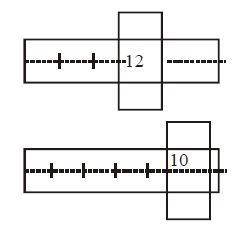
A
$-0.16$
B
$+0.16$
C
$+0.14$
D
$-0.14$
Solution
(C) The least count $(L.C.)$ of the screw gauge is $L.C. = \frac{1 \, mm}{100} = 0.01 \, mm$.
Let the actual length of each rod be $\ell$ and the zero error be $x$.
From diagram $(I)$,the main scale reading is $2 \, mm$ and the circular scale reading is $12$. The observed reading is $2 + 12 \times 0.01 = 2.12 \, mm$. Thus,$\ell + x = 2.12 \, mm$.
From diagram $(II)$,the main scale reading is $4 \, mm$ and the circular scale reading is $10$. The observed reading is $4 + 10 \times 0.01 = 4.10 \, mm$. Thus,$2\ell + x = 4.10 \, mm$.
Subtracting the first equation from the second: $(2\ell + x) - (\ell + x) = 4.10 - 2.12$,which gives $\ell = 1.98 \, mm$.
Substituting $\ell$ into the first equation: $1.98 + x = 2.12$,so $x = 2.12 - 1.98 = 0.14 \, mm$.
Since the reading is positive,the zero error is $+0.14 \, mm$.
Let the actual length of each rod be $\ell$ and the zero error be $x$.
From diagram $(I)$,the main scale reading is $2 \, mm$ and the circular scale reading is $12$. The observed reading is $2 + 12 \times 0.01 = 2.12 \, mm$. Thus,$\ell + x = 2.12 \, mm$.
From diagram $(II)$,the main scale reading is $4 \, mm$ and the circular scale reading is $10$. The observed reading is $4 + 10 \times 0.01 = 4.10 \, mm$. Thus,$2\ell + x = 4.10 \, mm$.
Subtracting the first equation from the second: $(2\ell + x) - (\ell + x) = 4.10 - 2.12$,which gives $\ell = 1.98 \, mm$.
Substituting $\ell$ into the first equation: $1.98 + x = 2.12$,so $x = 2.12 - 1.98 = 0.14 \, mm$.
Since the reading is positive,the zero error is $+0.14 \, mm$.
0 likes
View Solution13
MediumMCQ
In a screw gauge,$5$ complete rotations of the circular scale give a $1.5 \, mm$ reading on the linear scale. The circular scale has $50$ divisions. The least count of the screw gauge is: (in $, mm$)
A
$0.006$
B
$0.003$
C
$0.015$
D
$0.03$
Solution
(A) The pitch of the screw gauge is defined as the distance moved by the spindle per complete rotation of the circular scale.
Given that $5$ complete rotations correspond to $1.5 \, mm$ on the linear scale,the pitch is calculated as:
$\text{Pitch} = \frac{1.5 \, mm}{5} = 0.3 \, mm$.
The least count of a screw gauge is defined as the ratio of the pitch to the total number of divisions on the circular scale.
Given that the circular scale has $50$ divisions,the least count is:
$\text{Least Count} = \frac{\text{Pitch}}{\text{Number of divisions}} = \frac{0.3 \, mm}{50} = 0.006 \, mm$.
Given that $5$ complete rotations correspond to $1.5 \, mm$ on the linear scale,the pitch is calculated as:
$\text{Pitch} = \frac{1.5 \, mm}{5} = 0.3 \, mm$.
The least count of a screw gauge is defined as the ratio of the pitch to the total number of divisions on the circular scale.
Given that the circular scale has $50$ divisions,the least count is:
$\text{Least Count} = \frac{\text{Pitch}}{\text{Number of divisions}} = \frac{0.3 \, mm}{50} = 0.006 \, mm$.
0 likes
View Solution14
DifficultMCQ
When the gap is closed without placing any object in a screw gauge whose least count is $0.005 \ mm$,the $5^{th}$ division on its circular scale coincides with the reference line on the main scale. When a small sphere is placed,the reading on the main scale advances by $4$ divisions,whereas the circular scale reading advances by five times the corresponding reading when no object was placed. There are $200$ divisions on the circular scale. The radius of the sphere is .......... $mm$.
A
$4.10$
B
$4.05$
C
$2.10$
D
$2.05$
Solution
(D) Given,least count $(LC)$ = $0.005 \ mm$ and total divisions on circular scale $(N)$ = $200$.
Pitch of the screw gauge = $LC \times N = 0.005 \times 200 = 1 \ mm$.
This means $1 \ MSD$ (Main Scale Division) = $1 \ mm$.
Zero error $(ZE)$ = $5 \times LC = 5 \times 0.005 = 0.025 \ mm$.
When the sphere is placed,the main scale reading $(MSR)$ = $4 \times 1 \ mm = 4 \ mm$.
The circular scale reading $(CSR)$ advances by $5$ times the initial reading,so final $CSR = 5 \times 5 = 25$.
Observed reading $(OR)$ = $MSR + (CSR \times LC) = 4 + (25 \times 0.005) = 4 + 0.125 = 4.125 \ mm$.
Corrected diameter $(D)$ = $OR - ZE = 4.125 - 0.025 = 4.10 \ mm$.
Radius $(r)$ = $D / 2 = 4.10 / 2 = 2.05 \ mm$.
Pitch of the screw gauge = $LC \times N = 0.005 \times 200 = 1 \ mm$.
This means $1 \ MSD$ (Main Scale Division) = $1 \ mm$.
Zero error $(ZE)$ = $5 \times LC = 5 \times 0.005 = 0.025 \ mm$.
When the sphere is placed,the main scale reading $(MSR)$ = $4 \times 1 \ mm = 4 \ mm$.
The circular scale reading $(CSR)$ advances by $5$ times the initial reading,so final $CSR = 5 \times 5 = 25$.
Observed reading $(OR)$ = $MSR + (CSR \times LC) = 4 + (25 \times 0.005) = 4 + 0.125 = 4.125 \ mm$.
Corrected diameter $(D)$ = $OR - ZE = 4.125 - 0.025 = 4.10 \ mm$.
Radius $(r)$ = $D / 2 = 4.10 / 2 = 2.05 \ mm$.
0 likes
View Solution15
DifficultMCQ
$A$ vernier callipers used by a student has $20$ divisions in $1\;cm$ on the main scale. $10$ vernier divisions coincide with $9$ main scale divisions. When the jaws are closed,the zero of the main scale is to the left of the zero of the vernier scale,and the $6^{th}$ division of the vernier scale coincides with a main scale division. The student places a wooden cylinder between the jaws to measure its length. The zero of the vernier scale is to the right of the $3.20\;cm$ mark,and the $8^{th}$ vernier division coincides with a main scale division. When measuring the thickness (diameter) of the cylinder,the zero of the vernier scale lies to the right of the $1.50\;cm$ mark,and the $6^{th}$ vernier division coincides with a main scale division. The correct values of the measured length and diameter are respectively:
A
$3.21\;cm, 1.50\;cm$
B
$3.210\;cm, 1.500\;cm$
C
$3.27\;cm, 1.93\;cm$
D
$3.270\;cm, 1.560\;cm$
Solution
(A) Main Scale Division $(MSD)$ = $1/20\;cm = 0.05\;cm$.
Vernier Scale Division $(VSD)$ = $(9/10) \times MSD = 0.9 \times 0.05\;cm = 0.045\;cm$.
Least Count $(LC)$ = $MSD - VSD = 0.05\;cm - 0.045\;cm = 0.005\;cm$.
Zero Error: Since the zero of the vernier scale is to the right of the main scale zero,it is a positive zero error. $Zero\;Error = + (6 \times LC) = + (6 \times 0.005\;cm) = +0.03\;cm$.
Measured Length = $Main\;Scale\;Reading (MSR) + (Vernier\;Coincidence \times LC) = 3.20\;cm + (8 \times 0.005\;cm) = 3.20 + 0.04 = 3.24\;cm$.
Corrected Length = $Measured\;Length - Zero\;Error = 3.24\;cm - 0.03\;cm = 3.21\;cm$.
Measured Diameter = $MSR + (Vernier\;Coincidence \times LC) = 1.50\;cm + (6 \times 0.005\;cm) = 1.50 + 0.03 = 1.53\;cm$.
Corrected Diameter = $Measured\;Diameter - Zero\;Error = 1.53\;cm - 0.03\;cm = 1.50\;cm$.
Vernier Scale Division $(VSD)$ = $(9/10) \times MSD = 0.9 \times 0.05\;cm = 0.045\;cm$.
Least Count $(LC)$ = $MSD - VSD = 0.05\;cm - 0.045\;cm = 0.005\;cm$.
Zero Error: Since the zero of the vernier scale is to the right of the main scale zero,it is a positive zero error. $Zero\;Error = + (6 \times LC) = + (6 \times 0.005\;cm) = +0.03\;cm$.
Measured Length = $Main\;Scale\;Reading (MSR) + (Vernier\;Coincidence \times LC) = 3.20\;cm + (8 \times 0.005\;cm) = 3.20 + 0.04 = 3.24\;cm$.
Corrected Length = $Measured\;Length - Zero\;Error = 3.24\;cm - 0.03\;cm = 3.21\;cm$.
Measured Diameter = $MSR + (Vernier\;Coincidence \times LC) = 1.50\;cm + (6 \times 0.005\;cm) = 1.50 + 0.03 = 1.53\;cm$.
Corrected Diameter = $Measured\;Diameter - Zero\;Error = 1.53\;cm - 0.03\;cm = 1.50\;cm$.
0 likes
View Solution16
MediumMCQ
The diagrams show readings of a screw gauge. Figure $(i)$ shows the zero error reading when the screw gauge is closed,and figure $(ii)$ shows the reading when the screw gauge is being used to measure the diameter of a ball-bearing. What is the diameter of the ball-bearing in $mm$? There are $50$ divisions on the circular scale.
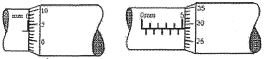
A
$5.29$
B
$5.26$
C
$5.32$
D
$5.28$
Solution
(B) The least count $(LC)$ of the screw gauge is calculated as: $LC = \frac{\text{Pitch}}{\text{Number of divisions on circular scale}} = \frac{0.5 \ mm}{50} = 0.01 \ mm$.
From figure $(i)$,the zero error is $+3$ divisions. Therefore,the zero error is $3 \times 0.01 \ mm = +0.03 \ mm$.
From figure $(ii)$,the main scale reading is $5.0 \ mm$ and the circular scale division coinciding with the reference line is $29$. The observed reading is $5.0 \ mm + (29 \times 0.01 \ mm) = 5.29 \ mm$.
The actual diameter is given by: $\text{Diameter} = \text{Observed reading} - \text{Zero error} = 5.29 \ mm - 0.03 \ mm = 5.26 \ mm$.
From figure $(i)$,the zero error is $+3$ divisions. Therefore,the zero error is $3 \times 0.01 \ mm = +0.03 \ mm$.
From figure $(ii)$,the main scale reading is $5.0 \ mm$ and the circular scale division coinciding with the reference line is $29$. The observed reading is $5.0 \ mm + (29 \times 0.01 \ mm) = 5.29 \ mm$.
The actual diameter is given by: $\text{Diameter} = \text{Observed reading} - \text{Zero error} = 5.29 \ mm - 0.03 \ mm = 5.26 \ mm$.
0 likes
View Solution17
DifficultMCQ
The main scale of a vernier caliper reads in millimeters and its vernier scale is divided into $8$ divisions,which coincide with $5$ divisions of the main scale. When the two jaws of the instrument touch each other,the zero of the vernier scale coincides with the zero of the main scale. $A$ rod is placed between the two jaws. It is observed that the zero of the vernier scale lies just to the left of the $36^{th}$ division of the main scale and the fourth division of the vernier scale coincides with a main scale division. The measured value is .......... $cm$.
A
$3.66$
B
$3.55$
C
$3.65$
D
$3.56$
Solution
(C) The main scale division $(MSD)$ is $1 \text{ mm}$.
Given that $8$ vernier scale divisions $(VSD)$ coincide with $5$ main scale divisions $(MSD)$.
Therefore,$1 \text{ VSD} = \frac{5}{8} \text{ MSD} = \frac{5}{8} \text{ mm} = 0.625 \text{ mm}$.
The least count $(LC)$ of the vernier caliper is $1 \text{ MSD} - 1 \text{ VSD} = 1 \text{ mm} - 0.625 \text{ mm} = 0.375 \text{ mm}$.
The zero of the vernier scale is to the left of the $36^{th}$ division of the main scale,so the main scale reading $(MSR)$ is $35 \text{ mm}$.
The fourth division of the vernier scale coincides with the main scale,so the vernier scale reading $(VSR)$ is $4 \times \text{LC} = 4 \times 0.375 \text{ mm} = 1.5 \text{ mm}$.
The total reading is $\text{MSR} + \text{VSR} = 35 \text{ mm} + 1.5 \text{ mm} = 36.5 \text{ mm}$.
Converting to centimeters,$36.5 \text{ mm} = 3.65 \text{ cm}$.
Given that $8$ vernier scale divisions $(VSD)$ coincide with $5$ main scale divisions $(MSD)$.
Therefore,$1 \text{ VSD} = \frac{5}{8} \text{ MSD} = \frac{5}{8} \text{ mm} = 0.625 \text{ mm}$.
The least count $(LC)$ of the vernier caliper is $1 \text{ MSD} - 1 \text{ VSD} = 1 \text{ mm} - 0.625 \text{ mm} = 0.375 \text{ mm}$.
The zero of the vernier scale is to the left of the $36^{th}$ division of the main scale,so the main scale reading $(MSR)$ is $35 \text{ mm}$.
The fourth division of the vernier scale coincides with the main scale,so the vernier scale reading $(VSR)$ is $4 \times \text{LC} = 4 \times 0.375 \text{ mm} = 1.5 \text{ mm}$.
The total reading is $\text{MSR} + \text{VSR} = 35 \text{ mm} + 1.5 \text{ mm} = 36.5 \text{ mm}$.
Converting to centimeters,$36.5 \text{ mm} = 3.65 \text{ cm}$.
0 likes
View Solution18
DifficultMCQ
The main scale division of a vernier caliper is $1 \ mm$. The vernier scale divisions are in an arithmetic progression $(A.P.)$; the $1^{st}$ division is $0.95 \ mm$, the $2^{nd}$ division is $0.90 \ mm$, and so on. When an object is placed between the jaws of the vernier caliper, the zero of the vernier scale lies between $3.1 \ cm$ and $3.2 \ cm$, and the $4^{th}$ division of the vernier scale coincides with a main scale division. The reading of the vernier caliper is .......... $cm$.
A
$3.12$
B
$3.14$
C
$3.15$
D
$3.18$
Solution
(D) The main scale reading $(MSR)$ is $3.1 \ cm = 31 \ mm$.
The vernier scale divisions follow an $A.P.$ where the $n^{th}$ division $V_n$ is given by $V_n = a + (n-1)d$.
Here, $a = 0.95 \ mm$ and the common difference $d = 0.90 - 0.95 = -0.05 \ mm$.
The $4^{th}$ division $V_4 = 0.95 + (4-1)(-0.05) = 0.95 - 0.15 = 0.80 \ mm$.
The vernier constant $(VC)$ is the difference between the main scale division $(MSD)$ and the vernier scale division $(VSD)$.
For the $4^{th}$ division, the effective vernier reading is $n \times (MSD - V_n) = 4 \times (1.00 - 0.80) = 4 \times 0.20 = 0.80 \ mm = 0.08 \ cm$.
Total reading = $MSR + \text{Vernier Reading} = 3.1 \ cm + 0.08 \ cm = 3.18 \ cm$.
The vernier scale divisions follow an $A.P.$ where the $n^{th}$ division $V_n$ is given by $V_n = a + (n-1)d$.
Here, $a = 0.95 \ mm$ and the common difference $d = 0.90 - 0.95 = -0.05 \ mm$.
The $4^{th}$ division $V_4 = 0.95 + (4-1)(-0.05) = 0.95 - 0.15 = 0.80 \ mm$.
The vernier constant $(VC)$ is the difference between the main scale division $(MSD)$ and the vernier scale division $(VSD)$.
For the $4^{th}$ division, the effective vernier reading is $n \times (MSD - V_n) = 4 \times (1.00 - 0.80) = 4 \times 0.20 = 0.80 \ mm = 0.08 \ cm$.
Total reading = $MSR + \text{Vernier Reading} = 3.1 \ cm + 0.08 \ cm = 3.18 \ cm$.
0 likes
View Solution19
DifficultMCQ
$A$ screw gauge has a pitch of $1.5\; mm$ and there is no zero error. The linear scale has markings at $MSD = 1\; mm$ and there are $100$ equal divisions on the circular scale. When the diameter of a sphere is measured with this instrument,the $2\; mm$ mark is visible on the linear scale,but the $3\; mm$ mark is not visible. The $76^{th}$ division of the circular scale is in line with the linear scale. What is the diameter of the sphere in $mm$?
A
$2.64$
B
$3.14$
C
$1.14$
D
$2.76$
Solution
(B) The pitch of the screw gauge is $1.5\; mm$ and the number of circular scale divisions is $100$.
The Least Count $(L.C.)$ is calculated as: $L.C. = \frac{\text{Pitch}}{\text{Total circular scale divisions}} = \frac{1.5\; mm}{100} = 0.015\; mm$.
The main scale reading $(M.S.R.)$ is the last visible mark on the linear scale,which is $2\; mm$.
The circular scale reading $(C.S.R.)$ is the $76^{th}$ division.
The diameter is given by the formula: $Diameter = M.S.R. + (L.C. \times C.S.R.)$.
Substituting the values: $Diameter = 2\; mm + (0.015\; mm \times 76) = 2\; mm + 1.14\; mm = 3.14\; mm$.
The Least Count $(L.C.)$ is calculated as: $L.C. = \frac{\text{Pitch}}{\text{Total circular scale divisions}} = \frac{1.5\; mm}{100} = 0.015\; mm$.
The main scale reading $(M.S.R.)$ is the last visible mark on the linear scale,which is $2\; mm$.
The circular scale reading $(C.S.R.)$ is the $76^{th}$ division.
The diameter is given by the formula: $Diameter = M.S.R. + (L.C. \times C.S.R.)$.
Substituting the values: $Diameter = 2\; mm + (0.015\; mm \times 76) = 2\; mm + 1.14\; mm = 3.14\; mm$.
0 likes
View Solution20
MediumMCQ
In a vernier callipers,$10$ divisions of vernier scale coincide with $9$ divisions of main scale,the least count of which is $0.1\,cm$. If in the measurement of inner diameter of a cylinder,the zero of the vernier scale lies between $1.3\,cm$ and $1.4\,cm$ of the main scale and the $2^{nd}$ division of the vernier scale coincides with a main scale division,then the diameter will be .......... $cm$.
A
$1.30$
B
$1.34$
C
$1.32$
D
$1.36$
Solution
(C) The Least Count $(LC)$ of a vernier callipers is given by: $LC = 1\,MSD - 1\,VSD$.
Given that $10\,VSD = 9\,MSD$,we have $1\,VSD = 0.9\,MSD$.
Since $1\,MSD = 0.1\,cm$,then $1\,VSD = 0.9 \times 0.1\,cm = 0.09\,cm$.
Therefore,$LC = 0.1\,cm - 0.09\,cm = 0.01\,cm$.
The diameter is calculated as: $Diameter = MSR + (LC \times VSR)$.
Here,the Main Scale Reading $(MSR)$ is $1.3\,cm$ and the Vernier Scale Reading $(VSR)$ is $2$.
$Diameter = 1.3\,cm + (0.01\,cm \times 2) = 1.3\,cm + 0.02\,cm = 1.32\,cm$.
Given that $10\,VSD = 9\,MSD$,we have $1\,VSD = 0.9\,MSD$.
Since $1\,MSD = 0.1\,cm$,then $1\,VSD = 0.9 \times 0.1\,cm = 0.09\,cm$.
Therefore,$LC = 0.1\,cm - 0.09\,cm = 0.01\,cm$.
The diameter is calculated as: $Diameter = MSR + (LC \times VSR)$.
Here,the Main Scale Reading $(MSR)$ is $1.3\,cm$ and the Vernier Scale Reading $(VSR)$ is $2$.
$Diameter = 1.3\,cm + (0.01\,cm \times 2) = 1.3\,cm + 0.02\,cm = 1.32\,cm$.
0 likes
View Solution21
MediumMCQ
The circular scale of a micrometer has $200$ divisions and a pitch of $2 \, mm$. Find the measured value of the thickness of a thin sheet in $mm$.

A
$3.41$
B
$6.41$
C
$3.46$
D
$3.51$
Solution
(A) $1$. Calculate the Least Count $(LC)$ of the micrometer:
$LC = \frac{\text{Pitch}}{\text{Number of circular scale divisions}} = \frac{2 \, mm}{200} = 0.01 \, mm$.
$2$. Determine the zero error from the first figure:
The reference line of the main scale coincides with the $5^{th}$ division of the circular scale. Since the zero of the circular scale is above the reference line,the zero error is positive.
Zero Error $= +5 \times LC = +5 \times 0.01 \, mm = +0.05 \, mm$.
$3$. Determine the main scale and circular scale reading from the second figure:
Main scale reading $= 3 \, mm$.
Circular scale reading $= 46^{th}$ division coincides with the reference line.
Observed reading $= \text{Main scale reading} + (\text{Circular scale reading} \times LC) = 3 \, mm + (46 \times 0.01 \, mm) = 3.46 \, mm$.
$4$. Calculate the true thickness:
True thickness $= \text{Observed reading} - \text{Zero error} = 3.46 \, mm - 0.05 \, mm = 3.41 \, mm$.
$LC = \frac{\text{Pitch}}{\text{Number of circular scale divisions}} = \frac{2 \, mm}{200} = 0.01 \, mm$.
$2$. Determine the zero error from the first figure:
The reference line of the main scale coincides with the $5^{th}$ division of the circular scale. Since the zero of the circular scale is above the reference line,the zero error is positive.
Zero Error $= +5 \times LC = +5 \times 0.01 \, mm = +0.05 \, mm$.
$3$. Determine the main scale and circular scale reading from the second figure:
Main scale reading $= 3 \, mm$.
Circular scale reading $= 46^{th}$ division coincides with the reference line.
Observed reading $= \text{Main scale reading} + (\text{Circular scale reading} \times LC) = 3 \, mm + (46 \times 0.01 \, mm) = 3.46 \, mm$.
$4$. Calculate the true thickness:
True thickness $= \text{Observed reading} - \text{Zero error} = 3.46 \, mm - 0.05 \, mm = 3.41 \, mm$.
0 likes
View Solution22
MediumMCQ
In a screw gauge,$5$ complete rotations of the screw cause it to move a linear distance of $0.25\, cm$. There are $100$ circular scale divisions. The thickness of a wire measured by this screw gauge gives a reading of $4$ main scale divisions and $30$ circular scale divisions. Assuming negligible zero error,the thickness of the wire is (in $, cm$)
A
$0.0430$
B
$0.3150$
C
$0.4300$
D
$0.2150$
Solution
(D) The pitch of the screw gauge is the distance moved in one complete rotation.
Pitch $= \frac{0.25\, cm}{5} = 0.05\, cm$.
The least count $(LC)$ is given by $\frac{\text{Pitch}}{\text{Number of circular scale divisions}}$.
$LC = \frac{0.05\, cm}{100} = 0.0005\, cm$.
The reading is calculated as: $\text{Main Scale Reading} + (\text{Circular Scale Reading} \times LC)$.
Main Scale Reading $= 4 \times 0.05\, cm = 0.20\, cm$.
Circular Scale Reading $= 30 \times 0.0005\, cm = 0.0150\, cm$.
Total thickness $= 0.20\, cm + 0.0150\, cm = 0.2150\, cm$.
Pitch $= \frac{0.25\, cm}{5} = 0.05\, cm$.
The least count $(LC)$ is given by $\frac{\text{Pitch}}{\text{Number of circular scale divisions}}$.
$LC = \frac{0.05\, cm}{100} = 0.0005\, cm$.
The reading is calculated as: $\text{Main Scale Reading} + (\text{Circular Scale Reading} \times LC)$.
Main Scale Reading $= 4 \times 0.05\, cm = 0.20\, cm$.
Circular Scale Reading $= 30 \times 0.0005\, cm = 0.0150\, cm$.
Total thickness $= 0.20\, cm + 0.0150\, cm = 0.2150\, cm$.
0 likes
View Solution23
MediumMCQ
Diameter of a steel ball is measured using a Vernier callipers which has divisions of $0.1\,cm$ on its main scale $(MS)$ and $10$ divisions of its vernier scale $(VS)$ match $9$ divisions on the main scale. Three such measurements for a ball are given as:
If the zero error is $-0.03\,cm,$ then the mean corrected diameter is ........... $cm$.
| $S$.No. | $MS\;(cm)$ | $VS$ divisions |
| $(1)$ | $0.5$ | $8$ |
| $(2)$ | $0.5$ | $4$ |
| $(3)$ | $0.5$ | $6$ |
If the zero error is $-0.03\,cm,$ then the mean corrected diameter is ........... $cm$.
A
$0.52$
B
$0.59$
C
$0.56$
D
$0.53$
Solution
(B) The least count $(LC)$ of the Vernier callipers is given by:
$LC = \frac{\text{Value of 1 MS division}}{\text{Total number of VS divisions}} = \frac{0.1\,cm}{10} = 0.01\,cm$.
The observed diameter $d$ is calculated as: $d = \text{Main Scale Reading} + (VS \text{ division} \times LC)$.
Given zero error $= -0.03\,cm$,the correction is $-(\text{zero error}) = +0.03\,cm$.
Corrected diameter $d' = d + 0.03\,cm$.
For measurement $(1)$: $d_1 = 0.5 + (8 \times 0.01) + 0.03 = 0.5 + 0.08 + 0.03 = 0.61\,cm$.
For measurement $(2)$: $d_2 = 0.5 + (4 \times 0.01) + 0.03 = 0.5 + 0.04 + 0.03 = 0.57\,cm$.
For measurement $(3)$: $d_3 = 0.5 + (6 \times 0.01) + 0.03 = 0.5 + 0.06 + 0.03 = 0.59\,cm$.
Mean corrected diameter $= \frac{0.61 + 0.57 + 0.59}{3} = \frac{1.77}{3} = 0.59\,cm$.
$LC = \frac{\text{Value of 1 MS division}}{\text{Total number of VS divisions}} = \frac{0.1\,cm}{10} = 0.01\,cm$.
The observed diameter $d$ is calculated as: $d = \text{Main Scale Reading} + (VS \text{ division} \times LC)$.
Given zero error $= -0.03\,cm$,the correction is $-(\text{zero error}) = +0.03\,cm$.
Corrected diameter $d' = d + 0.03\,cm$.
For measurement $(1)$: $d_1 = 0.5 + (8 \times 0.01) + 0.03 = 0.5 + 0.08 + 0.03 = 0.61\,cm$.
For measurement $(2)$: $d_2 = 0.5 + (4 \times 0.01) + 0.03 = 0.5 + 0.04 + 0.03 = 0.57\,cm$.
For measurement $(3)$: $d_3 = 0.5 + (6 \times 0.01) + 0.03 = 0.5 + 0.06 + 0.03 = 0.59\,cm$.
Mean corrected diameter $= \frac{0.61 + 0.57 + 0.59}{3} = \frac{1.77}{3} = 0.59\,cm$.
0 likes
View Solution24
MediumMCQ
$A$ student measured the diameter of a wire using a screw gauge with the least count $0.001\, cm$ and listed the measurements. The measured value should be recorded as (in $, cm$)
A
$5.3200$
B
$5.3$
C
$5.32$
D
$5.320$
Solution
(D) The least count $(L.C.)$ of a screw gauge represents the smallest length that can be measured accurately with the instrument.
Given that the least count is $0.001\, cm$,which is equivalent to $10^{-3}\, cm$.
This implies that the instrument is precise up to the third decimal place.
Therefore,any measurement taken with this screw gauge must be recorded up to $3$ decimal places to maintain the correct precision.
Among the given options,$5.320\, cm$ is the only value recorded to $3$ decimal places.
Given that the least count is $0.001\, cm$,which is equivalent to $10^{-3}\, cm$.
This implies that the instrument is precise up to the third decimal place.
Therefore,any measurement taken with this screw gauge must be recorded up to $3$ decimal places to maintain the correct precision.
Among the given options,$5.320\, cm$ is the only value recorded to $3$ decimal places.
0 likes
View Solution25
DifficultMCQ
$N$ divisions on the main scale of a vernier calliper coincide with $(N + 1)$ divisions of the vernier scale. If each division of the main scale is $a$ units,then the least count of the instrument is:
A
$a$
B
$\frac{a}{N}$
C
$\frac{N}{N + 1} \times a$
D
$\frac{a}{N + 1}$
Solution
(D) Given that $N$ divisions of the main scale coincide with $(N + 1)$ divisions of the vernier scale.
Let the value of one main scale division be $a$.
Let the value of one vernier scale division be $v$.
According to the problem,$(N + 1)v = Na$.
Therefore,the value of one vernier scale division is $v = \frac{Na}{N + 1}$.
The least count of a vernier calliper is defined as the difference between one main scale division and one vernier scale division.
Least Count = $a - v$.
Substituting the value of $v$:
Least Count = $a - \frac{Na}{N + 1} = a \left( 1 - \frac{N}{N + 1} \right)$.
Least Count = $a \left( \frac{N + 1 - N}{N + 1} \right) = \frac{a}{N + 1}$.
Let the value of one main scale division be $a$.
Let the value of one vernier scale division be $v$.
According to the problem,$(N + 1)v = Na$.
Therefore,the value of one vernier scale division is $v = \frac{Na}{N + 1}$.
The least count of a vernier calliper is defined as the difference between one main scale division and one vernier scale division.
Least Count = $a - v$.
Substituting the value of $v$:
Least Count = $a - \frac{Na}{N + 1} = a \left( 1 - \frac{N}{N + 1} \right)$.
Least Count = $a \left( \frac{N + 1 - N}{N + 1} \right) = \frac{a}{N + 1}$.
0 likes
View Solution26
DifficultMCQ
The pitch and the number of divisions on the circular scale for a given screw gauge are $0.5\,mm$ and $100$ respectively. When the screw gauge is fully tightened without any object,the zero of its circular scale lies $3$ divisions below the mean line. The readings of the main scale and the circular scale for a thin sheet are $5.5\,mm$ and $48$ respectively. The thickness of this sheet is: (in $,mm$)
A
$5.755$
B
$5.950$
C
$5.725$
D
$5.740$
Solution
(C) The Least Count $(LC)$ of the screw gauge is given by:
$LC = \frac{\text{Pitch}}{\text{Number of divisions}} = \frac{0.5\,mm}{100} = 0.005\,mm$.
Since the zero of the circular scale lies $3$ divisions below the mean line,there is a positive zero error:
$\text{Zero Error} = +3 \times LC = 3 \times 0.005\,mm = 0.015\,mm$.
The observed reading is given by:
$\text{Observed Reading} = \text{Main Scale Reading} (MSR) + (\text{Circular Scale Reading} (CSR) \times LC)$.
$\text{Observed Reading} = 5.5\,mm + (48 \times 0.005\,mm) = 5.5\,mm + 0.240\,mm = 5.740\,mm$.
The actual thickness is calculated by subtracting the zero error from the observed reading:
$\text{Thickness} = \text{Observed Reading} - \text{Zero Error}$.
$\text{Thickness} = 5.740\,mm - 0.015\,mm = 5.725\,mm$.
$LC = \frac{\text{Pitch}}{\text{Number of divisions}} = \frac{0.5\,mm}{100} = 0.005\,mm$.
Since the zero of the circular scale lies $3$ divisions below the mean line,there is a positive zero error:
$\text{Zero Error} = +3 \times LC = 3 \times 0.005\,mm = 0.015\,mm$.
The observed reading is given by:
$\text{Observed Reading} = \text{Main Scale Reading} (MSR) + (\text{Circular Scale Reading} (CSR) \times LC)$.
$\text{Observed Reading} = 5.5\,mm + (48 \times 0.005\,mm) = 5.5\,mm + 0.240\,mm = 5.740\,mm$.
The actual thickness is calculated by subtracting the zero error from the observed reading:
$\text{Thickness} = \text{Observed Reading} - \text{Zero Error}$.
$\text{Thickness} = 5.740\,mm - 0.015\,mm = 5.725\,mm$.
0 likes
View Solution27
MediumMCQ
The least count of the main scale of a screw gauge is $1\, mm$. The minimum number of divisions on its circular scale required to measure $5\,\mu m$ diameter of a wire is
A
$50$
B
$200$
C
$100$
D
$500$
Solution
(B) The least count $(LC)$ of a screw gauge is defined as the ratio of the pitch of the screw to the total number of divisions on the circular scale $(N)$.
Given:
Pitch = $1\, mm = 10^{-3}\, m$
$LC = 5\,\mu m = 5 \times 10^{-6}\, m$
Using the formula:
$LC = \frac{\text{Pitch}}{N}$
$5 \times 10^{-6} = \frac{10^{-3}}{N}$
$N = \frac{10^{-3}}{5 \times 10^{-6}}$
$N = \frac{1000}{5} = 200$
Therefore,the minimum number of divisions required is $200$.
Given:
Pitch = $1\, mm = 10^{-3}\, m$
$LC = 5\,\mu m = 5 \times 10^{-6}\, m$
Using the formula:
$LC = \frac{\text{Pitch}}{N}$
$5 \times 10^{-6} = \frac{10^{-3}}{N}$
$N = \frac{10^{-3}}{5 \times 10^{-6}}$
$N = \frac{1000}{5} = 200$
Therefore,the minimum number of divisions required is $200$.
0 likes
View Solution28
EasyMCQ
The internal and external radii of a hollow cylinder are measured with the help of a vernier callipers. Their values are $(4.23 \pm 0.01) \, cm$ and $(3.87 \pm 0.01) \, cm,$ respectively. The thickness of the wall of the cylinder is
A
$(0.36 \pm 0.02) \, cm$
B
$(0.18 \pm 0.02) \, cm$
C
$(0.36 \pm 0.01) \, cm$
D
$(0.18 \pm 0.01) \, cm$
Solution
(A) The thickness of the wall of a hollow cylinder is given by the difference between the external radius $(R)$ and the internal radius $(r)$.
$t = R - r$
Given: $R = (4.23 \pm 0.01) \, cm$ and $r = (3.87 \pm 0.01) \, cm$.
The mean value of the thickness is $t = 4.23 - 3.87 = 0.36 \, cm$.
When quantities are subtracted,the absolute errors are added.
Therefore,the absolute error in thickness is $\Delta t = \Delta R + \Delta r = 0.01 + 0.01 = 0.02 \, cm$.
Thus,the thickness of the wall is $(0.36 \pm 0.02) \, cm$.
$t = R - r$
Given: $R = (4.23 \pm 0.01) \, cm$ and $r = (3.87 \pm 0.01) \, cm$.
The mean value of the thickness is $t = 4.23 - 3.87 = 0.36 \, cm$.
When quantities are subtracted,the absolute errors are added.
Therefore,the absolute error in thickness is $\Delta t = \Delta R + \Delta r = 0.01 + 0.01 = 0.02 \, cm$.
Thus,the thickness of the wall is $(0.36 \pm 0.02) \, cm$.
0 likes
View Solution29
DifficultMCQ
The main scale of a vernier calliper has $n$ divisions per $cm$. $n$ divisions of the vernier scale coincide with $(n-1)$ divisions of the main scale. The least count of the vernier calliper is,
A
$\frac{1}{(n+1)(n-1)} \text{ cm}$
B
$\frac{1}{n} \text{ cm}$
C
$\frac{1}{n^2} \text{ cm}$
D
$\frac{1}{n(n+1)} \text{ cm}$
Solution
(C) Given that the main scale has $n$ divisions per $cm$,the value of $1 \text{ MSD}$ (Main Scale Division) is $\frac{1}{n} \text{ cm}$.
According to the problem,$n \text{ VSD}$ (Vernier Scale Divisions) coincide with $(n-1) \text{ MSD}$.
Therefore,$1 \text{ VSD} = \frac{n-1}{n} \text{ MSD}$.
The least count of a vernier calliper is defined as $1 \text{ MSD} - 1 \text{ VSD}$.
Least Count $= 1 \text{ MSD} - \left( \frac{n-1}{n} \right) \text{ MSD} = \left( 1 - \frac{n-1}{n} \right) \text{ MSD} = \frac{1}{n} \text{ MSD}$.
Substituting the value of $1 \text{ MSD} = \frac{1}{n} \text{ cm}$,we get:
Least Count $= \frac{1}{n} \times \frac{1}{n} \text{ cm} = \frac{1}{n^2} \text{ cm}$.
According to the problem,$n \text{ VSD}$ (Vernier Scale Divisions) coincide with $(n-1) \text{ MSD}$.
Therefore,$1 \text{ VSD} = \frac{n-1}{n} \text{ MSD}$.
The least count of a vernier calliper is defined as $1 \text{ MSD} - 1 \text{ VSD}$.
Least Count $= 1 \text{ MSD} - \left( \frac{n-1}{n} \right) \text{ MSD} = \left( 1 - \frac{n-1}{n} \right) \text{ MSD} = \frac{1}{n} \text{ MSD}$.
Substituting the value of $1 \text{ MSD} = \frac{1}{n} \text{ cm}$,we get:
Least Count $= \frac{1}{n} \times \frac{1}{n} \text{ cm} = \frac{1}{n^2} \text{ cm}$.
0 likes
View Solution30
MediumMCQ
If the screw on a screw gauge is given six rotations,it moves by $3\; mm$ on the main scale. If there are $50$ divisions on the circular scale,the least count of the screw gauge is:
A
$0.001\; mm$
B
$0.001\; cm$
C
$0.02\; mm$
D
$0.01\; cm$
Solution
(B) The pitch of the screw gauge is the distance moved by the screw in one complete rotation.
Given that $6$ rotations correspond to a movement of $3\; mm$ on the main scale.
Therefore,the pitch $= \frac{3\; mm}{6} = 0.5\; mm$.
The least count $(LC)$ of a screw gauge is defined as the ratio of the pitch to the total number of divisions on the circular scale.
$LC = \frac{\text{Pitch}}{\text{Number of circular scale divisions}}$.
Given the number of divisions $= 50$.
$LC = \frac{0.5\; mm}{50} = 0.01\; mm$.
Converting this to centimeters,$0.01\; mm = 0.001\; cm$.
Given that $6$ rotations correspond to a movement of $3\; mm$ on the main scale.
Therefore,the pitch $= \frac{3\; mm}{6} = 0.5\; mm$.
The least count $(LC)$ of a screw gauge is defined as the ratio of the pitch to the total number of divisions on the circular scale.
$LC = \frac{\text{Pitch}}{\text{Number of circular scale divisions}}$.
Given the number of divisions $= 50$.
$LC = \frac{0.5\; mm}{50} = 0.01\; mm$.
Converting this to centimeters,$0.01\; mm = 0.001\; cm$.
0 likes
View Solution31
MediumMCQ
Which of the following is the most precise device for measuring length:
$A)$ a vernier callipers with $20$ divisions on the sliding scale
$B)$ a screw gauge of pitch $1 \; mm$ and $100$ divisions on the circular scale
$C)$ an optical instrument that can measure length to within a wavelength of light?
$A)$ a vernier callipers with $20$ divisions on the sliding scale
$B)$ a screw gauge of pitch $1 \; mm$ and $100$ divisions on the circular scale
$C)$ an optical instrument that can measure length to within a wavelength of light?
A
a vernier callipers with $20$ divisions on the sliding scale
B
a screw gauge of pitch $1 \; mm$ and $100$ divisions on the circular scale
C
an optical instrument that can measure length to within a wavelength of light
Solution
(C) device with the smallest least count is the most precise for measuring length.
$1.$ Least count of vernier callipers: Assuming $1$ main scale division $(MSD) = 1 \; mm$,and $20$ vernier divisions $(VD)$ coincide with $19$ $MSD$,the least count $= 1 \; MSD - 1 \; VD = 1 \; mm - \frac{19}{20} \; mm = 0.05 \; mm = 0.005 \; cm$.
$2.$ Least count of screw gauge $= \frac{\text{Pitch}}{\text{Number of divisions}} = \frac{1 \; mm}{100} = 0.01 \; mm = 0.001 \; cm$.
$3.$ Least count of an optical device $\approx$ Wavelength of light $\approx 10^{-5} \; cm = 0.00001 \; cm$.
Comparing the values: $0.00001 \; cm < 0.001 \; cm < 0.005 \; cm$.
Since the optical instrument has the smallest least count,it is the most precise device.
$1.$ Least count of vernier callipers: Assuming $1$ main scale division $(MSD) = 1 \; mm$,and $20$ vernier divisions $(VD)$ coincide with $19$ $MSD$,the least count $= 1 \; MSD - 1 \; VD = 1 \; mm - \frac{19}{20} \; mm = 0.05 \; mm = 0.005 \; cm$.
$2.$ Least count of screw gauge $= \frac{\text{Pitch}}{\text{Number of divisions}} = \frac{1 \; mm}{100} = 0.01 \; mm = 0.001 \; cm$.
$3.$ Least count of an optical device $\approx$ Wavelength of light $\approx 10^{-5} \; cm = 0.00001 \; cm$.
Comparing the values: $0.00001 \; cm < 0.001 \; cm < 0.005 \; cm$.
Since the optical instrument has the smallest least count,it is the most precise device.
0 likes
View Solution32
Medium
Answer the following:
$(a)$ You are given a thread and a metre scale. How will you estimate the diameter of the thread?
$(b)$ $A$ screw gauge has a pitch of $1.0\; mm$ and $200$ divisions on the circular scale. Do you think it is possible to increase the accuracy of the screw gauge arbitrarily by increasing the number of divisions on the circular scale?
$(c)$ The mean diameter of a thin brass rod is to be measured by vernier callipers. Why is a set of $100$ measurements of the diameter expected to yield a more reliable estimate than a set of $5$ measurements only?
$(a)$ You are given a thread and a metre scale. How will you estimate the diameter of the thread?
$(b)$ $A$ screw gauge has a pitch of $1.0\; mm$ and $200$ divisions on the circular scale. Do you think it is possible to increase the accuracy of the screw gauge arbitrarily by increasing the number of divisions on the circular scale?
$(c)$ The mean diameter of a thin brass rod is to be measured by vernier callipers. Why is a set of $100$ measurements of the diameter expected to yield a more reliable estimate than a set of $5$ measurements only?
Solution
(N/A) Part $(a)$: Wrap the thread closely around a uniform smooth rod such that the coils are touching each other without overlapping. Measure the total length $(L)$ of the coiled portion using a metre scale. If $(n)$ is the number of turns,the diameter $(d)$ of the thread is given by $d = \frac{L}{n}$.
Part $(b)$: No,it is not possible to increase the accuracy arbitrarily. While increasing the number of divisions decreases the least count,the accuracy is limited by other factors such as the mechanical errors of the instrument,the flexibility of the screw,and the precision of the human observer.
Part $(c)$: $A$ set of $100$ measurements is more reliable because the random errors in measurement follow a statistical distribution. As the number of observations $(N)$ increases,the random error in the mean value decreases by a factor of $\frac{1}{\sqrt{N}}$. Thus,$100$ measurements provide a much smaller uncertainty compared to $5$ measurements.
Part $(b)$: No,it is not possible to increase the accuracy arbitrarily. While increasing the number of divisions decreases the least count,the accuracy is limited by other factors such as the mechanical errors of the instrument,the flexibility of the screw,and the precision of the human observer.
Part $(c)$: $A$ set of $100$ measurements is more reliable because the random errors in measurement follow a statistical distribution. As the number of observations $(N)$ increases,the random error in the mean value decreases by a factor of $\frac{1}{\sqrt{N}}$. Thus,$100$ measurements provide a much smaller uncertainty compared to $5$ measurements.
0 likes
View Solution33
Medium
Which devices are used for the measurement of lengths of different orders?
Solution
(N/A) The measurement of length varies significantly depending on the scale. Below is a table summarizing the devices and methods used for different orders of magnitude:
| Order of Length $(m)$ | Device (Instrument) |
|---|---|
| $10^{-10}$ to $10^{-8}$ | Optical/Electron Microscope |
| $10^{-5}$ to $10^{-4}$ | Screw gauge,Spherometer,Vernier Calipers |
| $10^{-3}$ to $10^{2}$ | Meter scale |
| $> 10^{2}$ | Telescope,Radar,Laser,Sonar |
0 likes
View Solution34
MediumMCQ
The vernier scale of a travelling microscope has $50$ divisions which coincide with $49$ main scale divisions. If each main scale division is $0.5 \ mm$,calculate the minimum inaccuracy in the measurement of distance. (in $mm$)
A
$0.01$
B
$0.05$
C
$0.1$
D
$0.005$
Solution
(A) The minimum inaccuracy in a vernier instrument is equal to its least count.
Given that $50$ vernier scale divisions $(VSD)$ coincide with $49$ main scale divisions $(MSD)$.
$1 \ VSD = \frac{49}{50} \ MSD$
Least Count $(LC)$ = $1 \ MSD - 1 \ VSD$
$LC = 1 \ MSD - \frac{49}{50} \ MSD = \frac{1}{50} \ MSD$
Given that $1 \ MSD = 0.5 \ mm$.
$LC = \frac{1}{50} \times 0.5 \ mm = \frac{0.5}{50} \ mm = 0.01 \ mm$.
Therefore,the minimum inaccuracy is $0.01 \ mm$.
Given that $50$ vernier scale divisions $(VSD)$ coincide with $49$ main scale divisions $(MSD)$.
$1 \ VSD = \frac{49}{50} \ MSD$
Least Count $(LC)$ = $1 \ MSD - 1 \ VSD$
$LC = 1 \ MSD - \frac{49}{50} \ MSD = \frac{1}{50} \ MSD$
Given that $1 \ MSD = 0.5 \ mm$.
$LC = \frac{1}{50} \times 0.5 \ mm = \frac{0.5}{50} \ mm = 0.01 \ mm$.
Therefore,the minimum inaccuracy is $0.01 \ mm$.
0 likes
View Solution35
MediumMCQ
Match the instruments in Column-$I$ with their respective least counts in Column-$II$.
| Column-$I$ | Column-$II$ |
| $(1)$ Traveling Microscope | $(a)$ $0.01\,cm$ |
| $(2)$ Screw Gauge | $(b)$ $0.001\,cm$ |
| $(c)$ $0.0001\,cm$ |
A
$1-c, 2-b$
B
$1-b, 2-c$
C
$1-a, 2-b$
D
$1-c, 2-a$
Solution
(B) The least count of a measuring instrument is the smallest value that can be measured by it.
$(1)$ A Traveling Microscope typically has a least count of $0.001\,cm$ (or $10\,\mu m$).
$(2)$ A standard Screw Gauge has a least count of $0.001\,cm$ (or $0.01\,mm$).
However, based on the provided options and standard laboratory equipment specifications:
- Traveling Microscope: $0.001\,cm$ (Option $b$)
- Screw Gauge: $0.001\,cm$ (Option $b$)
Given the structure of the question, the most accurate match is $(1-b)$ and $(2-b)$ if they share the same precision, or $(1-c)$ if the microscope is high-precision. Re-evaluating standard textbook values: A standard Screw Gauge is $0.001\,cm$. A Traveling Microscope is often $0.001\,cm$. If we must choose unique mappings from the provided list: $(1-b)$ and $(2-b)$ are both $0.001\,cm$. Given the options, the correct mapping is $(1-b, 2-b)$.
$(1)$ A Traveling Microscope typically has a least count of $0.001\,cm$ (or $10\,\mu m$).
$(2)$ A standard Screw Gauge has a least count of $0.001\,cm$ (or $0.01\,mm$).
However, based on the provided options and standard laboratory equipment specifications:
- Traveling Microscope: $0.001\,cm$ (Option $b$)
- Screw Gauge: $0.001\,cm$ (Option $b$)
Given the structure of the question, the most accurate match is $(1-b)$ and $(2-b)$ if they share the same precision, or $(1-c)$ if the microscope is high-precision. Re-evaluating standard textbook values: A standard Screw Gauge is $0.001\,cm$. A Traveling Microscope is often $0.001\,cm$. If we must choose unique mappings from the provided list: $(1-b)$ and $(2-b)$ are both $0.001\,cm$. Given the options, the correct mapping is $(1-b, 2-b)$.
0 likes
View Solution36
DifficultMCQ
The least count of the main scale of a vernier callipers is $1\, mm$. Its vernier scale is divided into $10$ divisions and coincides with $9$ divisions of the main scale. When jaws are touching each other,the $7^{th}$ division of the vernier scale coincides with a division of the main scale and the zero of the vernier scale lies to the right side of the zero of the main scale. When this vernier is used to measure the length of a cylinder,the zero of the vernier scale is between $3.1\, cm$ and $3.2\, cm$ and the $4^{th}$ $VSD$ coincides with a main scale division. The length of the cylinder is $.....\, cm$. ($VSD$ is vernier scale division)
A
$3.21$
B
$2.99$
C
$3.2$
D
$3.07$
Solution
(D) $1$. Calculate the Least Count $(LC)$: $LC = 1\, MS D - 1\, VSD$. Given $10\, VSD = 9\, MSD$,so $1\, VSD = 0.9\, MSD = 0.9\, mm$. Thus,$LC = 1\, mm - 0.9\, mm = 0.1\, mm = 0.01\, cm$.
$2$. Calculate Zero Error: Since the zero of the vernier scale is to the right of the main scale zero,the error is positive. The $7^{th}$ division coincides,so $Zero\, Error = + (7 \times LC) = + (7 \times 0.01\, cm) = +0.07\, cm$.
$3$. Calculate Observed Reading: $Main\, Scale\, Reading (MSR) = 3.1\, cm$. $Vernier\, Scale\, Reading (VSR) = 4 \times LC = 4 \times 0.01\, cm = 0.04\, cm$. $Observed\, Reading = MSR + VSR = 3.1\, cm + 0.04\, cm = 3.14\, cm$.
$4$. Calculate Corrected Length: $Corrected\, Length = Observed\, Reading - Zero\, Error = 3.14\, cm - 0.07\, cm = 3.07\, cm$.
$2$. Calculate Zero Error: Since the zero of the vernier scale is to the right of the main scale zero,the error is positive. The $7^{th}$ division coincides,so $Zero\, Error = + (7 \times LC) = + (7 \times 0.01\, cm) = +0.07\, cm$.
$3$. Calculate Observed Reading: $Main\, Scale\, Reading (MSR) = 3.1\, cm$. $Vernier\, Scale\, Reading (VSR) = 4 \times LC = 4 \times 0.01\, cm = 0.04\, cm$. $Observed\, Reading = MSR + VSR = 3.1\, cm + 0.04\, cm = 3.14\, cm$.
$4$. Calculate Corrected Length: $Corrected\, Length = Observed\, Reading - Zero\, Error = 3.14\, cm - 0.07\, cm = 3.07\, cm$.
0 likes
View Solution37
MediumMCQ
Using a screw gauge with a pitch of $0.1 \ cm$ and $50$ divisions on its circular scale,the thickness of an object is measured. How should the measurement be correctly recorded (in $cm$)?
A
$2.123$
B
$2.125$
C
$2.121$
D
$2.124$
Solution
(D) The Least Count $(LC)$ of the screw gauge is calculated as:
$LC = \frac{\text{pitch}}{\text{number of circular scale divisions}} = \frac{0.1 \ cm}{50} = 0.002 \ cm$.
Any measurement taken with this instrument must be an integer multiple of the least count $(0.002 \ cm)$.
Checking the options:
$A) \ 2.123 / 0.002 = 1061.5$ (Not an integer)
$B) \ 2.125 / 0.002 = 1062.5$ (Not an integer)
$C) \ 2.121 / 0.002 = 1060.5$ (Not an integer)
$D) \ 2.124 / 0.002 = 1062$ (This is an integer).
Therefore,the correct measurement is $2.124 \ cm$.
$LC = \frac{\text{pitch}}{\text{number of circular scale divisions}} = \frac{0.1 \ cm}{50} = 0.002 \ cm$.
Any measurement taken with this instrument must be an integer multiple of the least count $(0.002 \ cm)$.
Checking the options:
$A) \ 2.123 / 0.002 = 1061.5$ (Not an integer)
$B) \ 2.125 / 0.002 = 1062.5$ (Not an integer)
$C) \ 2.121 / 0.002 = 1060.5$ (Not an integer)
$D) \ 2.124 / 0.002 = 1062$ (This is an integer).
Therefore,the correct measurement is $2.124 \ cm$.
0 likes
View Solution38
MediumMCQ
$A$ screw gauge has $50$ divisions on its circular scale. The circular scale is $4$ units ahead of the pitch scale marking,prior to use. Upon one complete rotation of the circular scale,a displacement of $0.5\, mm$ is noticed on the pitch scale. The nature of zero error involved,and the least count of the screw gauge,are respectively
A
Negative,$2\, \mu m$
B
Positive,$10\, \mu m$
C
Positive,$0.1\, \mu m$
D
Positive,$0.1\, mm$
Solution
(B) The least count $(LC)$ of a screw gauge is calculated as:
$LC = \frac{\text{Pitch}}{\text{Number of divisions on circular scale}}$
Given,$\text{Pitch} = 0.5\, mm$ and $\text{Number of divisions} = 50$.
$LC = \frac{0.5\, mm}{50} = 0.01\, mm = 10\, \mu m$.
Since the circular scale is $4$ units ahead of the pitch scale marking (the zero of the circular scale is above the reference line),the zero error is positive.
Therefore,the nature of zero error is positive and the least count is $10\, \mu m$.
$LC = \frac{\text{Pitch}}{\text{Number of divisions on circular scale}}$
Given,$\text{Pitch} = 0.5\, mm$ and $\text{Number of divisions} = 50$.
$LC = \frac{0.5\, mm}{50} = 0.01\, mm = 10\, \mu m$.
Since the circular scale is $4$ units ahead of the pitch scale marking (the zero of the circular scale is above the reference line),the zero error is positive.
Therefore,the nature of zero error is positive and the least count is $10\, \mu m$.
0 likes
View Solution39
EasyMCQ
$A$ screw gauge has a least count of $0.01\, mm$ and there are $50$ divisions on its circular scale. The pitch of the screw gauge is $........\, mm$.
A
$1.0$
B
$0.01$
C
$0.25$
D
$0.5$
Solution
(D) The least count $(L.C.)$ of a screw gauge is defined by the formula:
$L.C. = \frac{\text{Pitch}}{\text{Number of divisions on circular scale}}$
Given:
$L.C. = 0.01\, mm$
Number of divisions = $50$
Substituting the values into the formula:
$0.01\, mm = \frac{\text{Pitch}}{50}$
Therefore,the pitch is:
$\text{Pitch} = 0.01\, mm \times 50 = 0.5\, mm$.
$L.C. = \frac{\text{Pitch}}{\text{Number of divisions on circular scale}}$
Given:
$L.C. = 0.01\, mm$
Number of divisions = $50$
Substituting the values into the formula:
$0.01\, mm = \frac{\text{Pitch}}{50}$
Therefore,the pitch is:
$\text{Pitch} = 0.01\, mm \times 50 = 0.5\, mm$.
0 likes
View Solution40
EasyMCQ
$A$ plano-convex lens of unknown material and unknown focal length is given. With the help of a Spherometer,we can measure the,
A
refractive index of the material
B
focal length of the lens
C
radius of curvature of the curved surface
D
aperture of the lens
Solution
(C) Spherometer is a precision instrument designed to measure the sagitta (height) of a spherical surface. By knowing the distance between the legs of the Spherometer and measuring the sagitta,we can calculate the radius of curvature $(R)$ of the curved surface using the formula $R = \frac{a^2}{6h} + \frac{h}{2}$,where $a$ is the distance between the legs and $h$ is the sagitta. Therefore,a Spherometer is used to measure the radius of curvature of the curved surface.
0 likes
View Solution41
MediumMCQ
One main scale division of a vernier callipers is $a \ cm$ and $n^{\text{th}}$ division of the vernier scale coincides with $(n-1)^{\text{th}}$ division of the main scale. The least count of the callipers in $mm$ is
A
$\frac{10 na}{(n-1)}$
B
$\frac{10 a}{(n-1)}$
C
$\left(\frac{n-1}{10n}\right) a$
D
$\frac{10 a}{n}$
Solution
(D) Given that $1 \text{ Main Scale Division (MSD)} = a \ cm$.
Let $1 \text{ Vernier Scale Division (VSD)} = a' \ cm$.
According to the problem,the $n^{\text{th}}$ division of the vernier scale coincides with the $(n-1)^{\text{th}}$ division of the main scale:
$n \times a' = (n-1) \times a$
$a' = \frac{(n-1)a}{n} \ cm$.
The least count ($L$.$C$.) is defined as the difference between one main scale division and one vernier scale division:
$L.C. = 1 \text{ MSD} - 1 \text{ VSD} = (a - a') \ cm$.
Substituting the value of $a'$:
$L.C. = a - \frac{(n-1)a}{n} = \frac{na - na + a}{n} = \frac{a}{n} \ cm$.
To convert the least count into $mm$,we multiply by $10$ (since $1 \ cm = 10 \ mm$):
$L.C. = \left(\frac{a}{n}\right) \times 10 \ mm = \frac{10a}{n} \ mm$.
Let $1 \text{ Vernier Scale Division (VSD)} = a' \ cm$.
According to the problem,the $n^{\text{th}}$ division of the vernier scale coincides with the $(n-1)^{\text{th}}$ division of the main scale:
$n \times a' = (n-1) \times a$
$a' = \frac{(n-1)a}{n} \ cm$.
The least count ($L$.$C$.) is defined as the difference between one main scale division and one vernier scale division:
$L.C. = 1 \text{ MSD} - 1 \text{ VSD} = (a - a') \ cm$.
Substituting the value of $a'$:
$L.C. = a - \frac{(n-1)a}{n} = \frac{na - na + a}{n} = \frac{a}{n} \ cm$.
To convert the least count into $mm$,we multiply by $10$ (since $1 \ cm = 10 \ mm$):
$L.C. = \left(\frac{a}{n}\right) \times 10 \ mm = \frac{10a}{n} \ mm$.
0 likes
View Solution42
MediumMCQ
The vernier scale used for measurement has a positive zero error of $0.2\, mm$. If while taking a measurement it was noted that the '$0$' on the vernier scale lies between $8.5\, cm$ and $8.6\, cm$ and the vernier coincidence is $6$,then the correct value of measurement is ............. $cm$. (Least count $= 0.01\, cm$)
A
$8.36$
B
$8.54$
C
$8.58$
D
$8.56$
Solution
(B) Given,positive zero error $= 0.2\, mm = 0.02\, cm$.
Main scale reading $(MSR) = 8.5\, cm$.
Vernier scale reading $(VSR) = \text{Vernier coincidence} \times \text{Least count} = 6 \times 0.01\, cm = 0.06\, cm$.
Observed reading $= MSR + VSR = 8.5\, cm + 0.06\, cm = 8.56\, cm$.
Correct reading $= \text{Observed reading} - \text{Zero error} = 8.56\, cm - 0.02\, cm = 8.54\, cm$.
Main scale reading $(MSR) = 8.5\, cm$.
Vernier scale reading $(VSR) = \text{Vernier coincidence} \times \text{Least count} = 6 \times 0.01\, cm = 0.06\, cm$.
Observed reading $= MSR + VSR = 8.5\, cm + 0.06\, cm = 8.56\, cm$.
Correct reading $= \text{Observed reading} - \text{Zero error} = 8.56\, cm - 0.02\, cm = 8.54\, cm$.
0 likes
View Solution43
DifficultMCQ
The pitch of the screw gauge is $1\, mm$ and there are $100$ divisions on the circular scale. When nothing is put in between the jaws,the zero of the circular scale lies $8$ divisions below the reference line. When a wire is placed between the jaws,the first linear scale division is clearly visible while $72^{nd}$ division on the circular scale coincides with the reference line. The radius of the wire is.........$mm$
A
$1.64$
B
$0.82$
C
$1.80$
D
$0.90$
Solution
(B) Least count $(LC)$ $= \frac{\text{Pitch}}{\text{Number of circular scale divisions}} = \frac{1\, mm}{100} = 0.01\, mm$.
Zero error $= +8 \times LC = +8 \times 0.01\, mm = +0.08\, mm$.
Observed reading $= \text{Main scale reading} + (\text{Circular scale reading} \times LC) = 1\, mm + (72 \times 0.01\, mm) = 1.72\, mm$.
True diameter $= \text{Observed reading} - \text{Zero error} = 1.72\, mm - 0.08\, mm = 1.64\, mm$.
Radius of the wire $= \frac{\text{Diameter}}{2} = \frac{1.64\, mm}{2} = 0.82\, mm$.
Zero error $= +8 \times LC = +8 \times 0.01\, mm = +0.08\, mm$.
Observed reading $= \text{Main scale reading} + (\text{Circular scale reading} \times LC) = 1\, mm + (72 \times 0.01\, mm) = 1.72\, mm$.
True diameter $= \text{Observed reading} - \text{Zero error} = 1.72\, mm - 0.08\, mm = 1.64\, mm$.
Radius of the wire $= \frac{\text{Diameter}}{2} = \frac{1.64\, mm}{2} = 0.82\, mm$.
0 likes
View Solution44
DifficultMCQ
In a screw gauge,the fifth division of the circular scale coincides with the reference line when the ratchet is closed. There are $50$ divisions on the circular scale,and the main scale moves by $0.5 \, mm$ on a complete rotation. For a particular observation,the reading on the main scale is $5 \, mm$ and the $20^{th}$ division of the circular scale coincides with the reference line. Calculate the true reading in $mm$.
A
$5.00$
B
$5.25$
C
$5.15$
D
$5.20$
Solution
(C) $1$. Calculate the Least Count $(LC)$: The pitch is $0.5 \, mm$ and the number of circular scale divisions is $50$. Thus,$LC = \frac{0.5 \, mm}{50} = 0.01 \, mm$.
$2$. Determine the Zero Error: The $5^{th}$ division coincides with the reference line when the ratchet is closed. Since it is positive (implied by standard convention for this type of problem),Zero Error $= +5 \times LC = 5 \times 0.01 = 0.05 \, mm$.
$3$. Calculate the Observed Reading: Observed Reading = Main Scale Reading + (Circular Scale Division $\times LC$) = $5 \, mm + (20 \times 0.01 \, mm) = 5.20 \, mm$.
$4$. Calculate the True Reading: True Reading = Observed Reading - Zero Error = $5.20 \, mm - 0.05 \, mm = 5.15 \, mm$.
$2$. Determine the Zero Error: The $5^{th}$ division coincides with the reference line when the ratchet is closed. Since it is positive (implied by standard convention for this type of problem),Zero Error $= +5 \times LC = 5 \times 0.01 = 0.05 \, mm$.
$3$. Calculate the Observed Reading: Observed Reading = Main Scale Reading + (Circular Scale Division $\times LC$) = $5 \, mm + (20 \times 0.01 \, mm) = 5.20 \, mm$.
$4$. Calculate the True Reading: True Reading = Observed Reading - Zero Error = $5.20 \, mm - 0.05 \, mm = 5.15 \, mm$.
0 likes
View Solution45
DifficultMCQ
The diameter of a spherical bob is measured using a vernier callipers. $9$ divisions of the main scale,in the vernier callipers,are equal to $10$ divisions of vernier scale. One main scale division is $1\, {mm}$. The main scale reading is $10\, {mm}$ and $8^{\text{th}}$ division of vernier scale was found to coincide exactly with one of the main scale division. If the given vernier callipers has positive zero error of $0.04\, {cm}$,then the radius of the bob is $...... \,\times 10^{-2} \,{cm}$.
A
$0.52$
B
$520$
C
$5.2$
D
$52$
Solution
(D) Given: $9 \, {MSD} = 10 \, {VSD}$.
Since $1 \, {MSD} = 1 \, {mm}$,then $10 \, {VSD} = 9 \, {mm}$,so $1 \, {VSD} = 0.9 \, {mm}$.
Least Count $({LC})$ = $1 \, {MSD} - 1 \, {VSD} = 1 \, {mm} - 0.9 \, {mm} = 0.1 \, {mm} = 0.01 \, {cm}$.
Observed Diameter = ${MSR} + ({VSR} \times {LC}) = 10 \, {mm} + (8 \times 0.1 \, {mm}) = 10.8 \, {mm} = 1.08 \, {cm}$.
Positive zero error = $0.04 \, {cm}$.
Corrected Diameter = $\text{Observed Reading} - \text{Zero Error} = 1.08 \, {cm} - 0.04 \, {cm} = 1.04 \, {cm}$.
Radius = $\frac{\text{Diameter}}{2} = \frac{1.04 \, {cm}}{2} = 0.52 \, {cm}$.
Expressing in $10^{-2} \, {cm}$: $0.52 \, {cm} = 52 \times 10^{-2} \, {cm}$.
Thus,the value is $52$.
Since $1 \, {MSD} = 1 \, {mm}$,then $10 \, {VSD} = 9 \, {mm}$,so $1 \, {VSD} = 0.9 \, {mm}$.
Least Count $({LC})$ = $1 \, {MSD} - 1 \, {VSD} = 1 \, {mm} - 0.9 \, {mm} = 0.1 \, {mm} = 0.01 \, {cm}$.
Observed Diameter = ${MSR} + ({VSR} \times {LC}) = 10 \, {mm} + (8 \times 0.1 \, {mm}) = 10.8 \, {mm} = 1.08 \, {cm}$.
Positive zero error = $0.04 \, {cm}$.
Corrected Diameter = $\text{Observed Reading} - \text{Zero Error} = 1.08 \, {cm} - 0.04 \, {cm} = 1.04 \, {cm}$.
Radius = $\frac{\text{Diameter}}{2} = \frac{1.04 \, {cm}}{2} = 0.52 \, {cm}$.
Expressing in $10^{-2} \, {cm}$: $0.52 \, {cm} = 52 \times 10^{-2} \, {cm}$.
Thus,the value is $52$.
1 likes
View Solution46
MediumMCQ
$A$ screw gauge gives the following readings when used to measure the diameter of a wire:
Main scale reading: $0 \, mm$
Circular scale reading: $52$ divisions
Given that $1 \, mm$ on the main scale corresponds to $100$ divisions on the circular scale. The diameter of the wire from the above data is ...... $cm$.
Main scale reading: $0 \, mm$
Circular scale reading: $52$ divisions
Given that $1 \, mm$ on the main scale corresponds to $100$ divisions on the circular scale. The diameter of the wire from the above data is ...... $cm$.
A
$0.52$
B
$0.026$
C
$0.26$
D
$0.052$
Solution
(D) The Least Count $(L.C.)$ of the screw gauge is calculated as:
$L.C. = \frac{\text{Pitch}}{\text{Total circular scale divisions}} = \frac{1 \, mm}{100} = 0.01 \, mm$.
Since $1 \, mm = 0.1 \, cm$,the $L.C.$ in $cm$ is:
$L.C. = 0.01 \, mm = 0.001 \, cm$.
The diameter $(D)$ is given by the formula:
$D = \text{Main scale reading} + (\text{Circular scale reading} \times L.C.)$
Substituting the given values:
$D = 0 \, mm + (52 \times 0.01 \, mm) = 0.52 \, mm$.
Converting the diameter into $cm$:
$D = \frac{0.52}{10} \, cm = 0.052 \, cm$.
$L.C. = \frac{\text{Pitch}}{\text{Total circular scale divisions}} = \frac{1 \, mm}{100} = 0.01 \, mm$.
Since $1 \, mm = 0.1 \, cm$,the $L.C.$ in $cm$ is:
$L.C. = 0.01 \, mm = 0.001 \, cm$.
The diameter $(D)$ is given by the formula:
$D = \text{Main scale reading} + (\text{Circular scale reading} \times L.C.)$
Substituting the given values:
$D = 0 \, mm + (52 \times 0.01 \, mm) = 0.52 \, mm$.
Converting the diameter into $cm$:
$D = \frac{0.52}{10} \, cm = 0.052 \, cm$.
0 likes
View Solution47
DifficultMCQ
Student $A$ and Student $B$ used two screw gauges of equal pitch and $100$ equal circular divisions to measure the radius of a given wire. The actual value of the radius of the wire is $0.322 \, \text{cm}$. The absolute value of the difference between the final circular scale readings observed by the students $A$ and $B$ is .... .
Given pitch $= 0.1 \, \text{cm}$.
Given pitch $= 0.1 \, \text{cm}$.
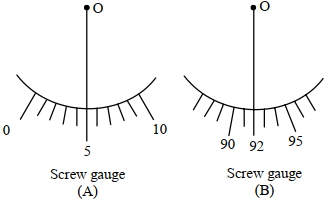
A
$13$
B
$26$
C
$39$
D
$130$
Solution
(A) The least count $(LC)$ of the screw gauge is given by:
$LC = \frac{\text{Pitch}}{\text{Total circular divisions}} = \frac{0.1 \, \text{cm}}{100} = 0.001 \, \text{cm}$.
For Student $A$:
Zero error $= +5 \times LC = +0.005 \, \text{cm}$.
Observed reading $= \text{MSR} + (\text{CSR} \times LC) = 0.322 \, \text{cm}$.
Assuming the main scale reading $(MSR)$ is $0.300 \, \text{cm}$,then:
$0.300 + (\text{CSR}_A \times 0.001) - 0.005 = 0.322 \implies \text{CSR}_A \times 0.001 = 0.027 \implies \text{CSR}_A = 27$.
For Student $B$:
Zero error $= -8 \times LC = -0.008 \, \text{cm}$ (since $92$ is aligned,error is $92-100 = -8$).
Assuming the main scale reading $(MSR)$ is $0.300 \, \text{cm}$,then:
$0.300 + (\text{CSR}_B \times 0.001) - (-0.008) = 0.322 \implies \text{CSR}_B \times 0.001 = 0.014 \implies \text{CSR}_B = 14$.
Difference in circular scale readings $= |27 - 14| = 13$.
$LC = \frac{\text{Pitch}}{\text{Total circular divisions}} = \frac{0.1 \, \text{cm}}{100} = 0.001 \, \text{cm}$.
For Student $A$:
Zero error $= +5 \times LC = +0.005 \, \text{cm}$.
Observed reading $= \text{MSR} + (\text{CSR} \times LC) = 0.322 \, \text{cm}$.
Assuming the main scale reading $(MSR)$ is $0.300 \, \text{cm}$,then:
$0.300 + (\text{CSR}_A \times 0.001) - 0.005 = 0.322 \implies \text{CSR}_A \times 0.001 = 0.027 \implies \text{CSR}_A = 27$.
For Student $B$:
Zero error $= -8 \times LC = -0.008 \, \text{cm}$ (since $92$ is aligned,error is $92-100 = -8$).
Assuming the main scale reading $(MSR)$ is $0.300 \, \text{cm}$,then:
$0.300 + (\text{CSR}_B \times 0.001) - (-0.008) = 0.322 \implies \text{CSR}_B \times 0.001 = 0.014 \implies \text{CSR}_B = 14$.
Difference in circular scale readings $= |27 - 14| = 13$.
0 likes
View Solution48
MediumMCQ
Assertion $A$: If in five complete rotations of the circular scale,the distance travelled on the main scale of the screw gauge is $5 \, mm$ and there are $50$ total divisions on the circular scale,then the least count is $0.001 \, cm$.
Reason $R$: $\text{Least Count} = \frac{\text{Pitch}}{\text{Total divisions on circular scale}}$
In the light of the above statements,choose the most appropriate answer from the options given below:
Reason $R$: $\text{Least Count} = \frac{\text{Pitch}}{\text{Total divisions on circular scale}}$
In the light of the above statements,choose the most appropriate answer from the options given below:
A
Both $A$ and $R$ are correct and $R$ is the correct explanation of $A$.
B
$A$ is not correct but $R$ is correct.
C
Both $A$ and $R$ are correct and $R$ is $NOT$ the correct explanation of $A$.
D
$A$ is correct but $R$ is not correct.
Solution
(B) The pitch of a screw gauge is defined as the distance moved by the spindle per complete rotation of the circular scale.
Given that in $5$ complete rotations,the distance moved on the main scale is $5 \, mm$.
Therefore,the pitch $= \frac{5 \, mm}{5} = 1 \, mm$.
The least count is defined as: $\text{Least Count} = \frac{\text{Pitch}}{\text{Total divisions on circular scale}}$.
Given total divisions $= 50$.
So,$\text{Least Count} = \frac{1 \, mm}{50} = 0.02 \, mm$.
Converting to centimeters: $0.02 \, mm = 0.002 \, cm$.
Since the calculated least count is $0.002 \, cm$ and the assertion states $0.001 \, cm$,assertion $A$ is incorrect.
Reason $R$ is the standard definition of the least count of a screw gauge,which is correct.
Given that in $5$ complete rotations,the distance moved on the main scale is $5 \, mm$.
Therefore,the pitch $= \frac{5 \, mm}{5} = 1 \, mm$.
The least count is defined as: $\text{Least Count} = \frac{\text{Pitch}}{\text{Total divisions on circular scale}}$.
Given total divisions $= 50$.
So,$\text{Least Count} = \frac{1 \, mm}{50} = 0.02 \, mm$.
Converting to centimeters: $0.02 \, mm = 0.002 \, cm$.
Since the calculated least count is $0.002 \, cm$ and the assertion states $0.001 \, cm$,assertion $A$ is incorrect.
Reason $R$ is the standard definition of the least count of a screw gauge,which is correct.
0 likes
View Solution49
MediumMCQ
$A$ travelling microscope is used to determine the refractive index of a glass slab. If $40$ divisions are there in $1 \; cm$ on the main scale and $50$ Vernier scale divisions are equal to $49$ main scale divisions,then the least count of the travelling microscope is $\dots \times 10^{-6} \; m$.
A
$2$
B
$3$
C
$4$
D
$5$
Solution
(D) Given that $50 \; VSD = 49 \; MSD$.
Therefore,$1 \; VSD = \frac{49}{50} \; MSD$.
The least count of the travelling microscope is defined as $LC = 1 \; MSD - 1 \; VSD$.
$LC = (1 - \frac{49}{50}) \; MSD = \frac{1}{50} \; MSD$.
Since $40$ divisions are present in $1 \; cm$ on the main scale,$1 \; MSD = \frac{1}{40} \; cm$.
Substituting this value,$LC = \frac{1}{50} \times \frac{1}{40} \; cm = \frac{1}{2000} \; cm$.
Converting to meters: $LC = \frac{1}{2000} \times 10^{-2} \; m = 0.5 \times 10^{-5} \; m$.
Expressing in the required format: $LC = 5 \times 10^{-6} \; m$.
Thus,the value is $5$.
Therefore,$1 \; VSD = \frac{49}{50} \; MSD$.
The least count of the travelling microscope is defined as $LC = 1 \; MSD - 1 \; VSD$.
$LC = (1 - \frac{49}{50}) \; MSD = \frac{1}{50} \; MSD$.
Since $40$ divisions are present in $1 \; cm$ on the main scale,$1 \; MSD = \frac{1}{40} \; cm$.
Substituting this value,$LC = \frac{1}{50} \times \frac{1}{40} \; cm = \frac{1}{2000} \; cm$.
Converting to meters: $LC = \frac{1}{2000} \times 10^{-2} \; m = 0.5 \times 10^{-5} \; m$.
Expressing in the required format: $LC = 5 \times 10^{-6} \; m$.
Thus,the value is $5$.
0 likes
View Solution50
MediumMCQ
In a vernier callipers,each $cm$ on the main scale is divided into $20$ equal parts. If the $10^{th}$ vernier scale division coincides with the $9^{th}$ main scale division,then the value of the vernier constant will be $\dots \; \times 10^{-2} \; mm$.
A
$3$
B
$5$
C
$7$
D
$9$
Solution
(B) Given that $20 \; MSD = 1 \; cm$.
Therefore,$1 \; MSD = \frac{1}{20} \; cm = 0.05 \; cm = 0.5 \; mm$.
We are given that $10 \; VSD = 9 \; MSD$.
Thus,$1 \; VSD = \frac{9}{10} \; MSD = 0.9 \times 0.5 \; mm = 0.45 \; mm$.
The Vernier Constant $(VC)$ is defined as $VC = 1 \; MSD - 1 \; VSD$.
$VC = 0.5 \; mm - 0.45 \; mm = 0.05 \; mm$.
Expressing this in the form $\dots \times 10^{-2} \; mm$,we get $VC = 5 \times 10^{-2} \; mm$.
Thus,the value is $5$.
Therefore,$1 \; MSD = \frac{1}{20} \; cm = 0.05 \; cm = 0.5 \; mm$.
We are given that $10 \; VSD = 9 \; MSD$.
Thus,$1 \; VSD = \frac{9}{10} \; MSD = 0.9 \times 0.5 \; mm = 0.45 \; mm$.
The Vernier Constant $(VC)$ is defined as $VC = 1 \; MSD - 1 \; VSD$.
$VC = 0.5 \; mm - 0.45 \; mm = 0.05 \; mm$.
Expressing this in the form $\dots \times 10^{-2} \; mm$,we get $VC = 5 \times 10^{-2} \; mm$.
Thus,the value is $5$.
0 likes
View SolutionUnits, Dimensions and Measurement — Vernier Calipers, Micrometer screw gauge · Frequently Asked Questions
1Are these Units, Dimensions and Measurement questions useful for JEE and NEET?
Yes. All questions in this section are mapped to JEE Main and NEET exam patterns. Previous year questions from JEE Main, NEET, GUJCET and state-level exams are included with full solutions.
2Can I switch to Hindi or Gujarati for these questions?
Yes. Use the language tabs in the hero section or the sidebar to view the same questions and solutions in English, Hindi or Gujarati.
3How do I generate a question paper from this subtopic?
Use the Vedclass Exam Paper Generator — select the chapter and subtopic, set difficulty, and generate Sets A, B, C, D automatically. First 3 chapters of every subject are free.
Vedclass Products
For Students
Vedclass Test Series
Mock tests in real JEE/NEET style with performance analysis. 5-day free trial.
Start Free TrialFor Teachers
Exam Paper Generator
Generate Set A/B/C/D papers from this chapter in 2 minutes. 3 chapters free.
Try FreeFor Institutes
Online Exam Module
Live online exams with unlimited students, 360° analytics & white-label branding.
See DemoFor Teachers & Institutes
Generate a Units, Dimensions and Measurement Exam Paper in 2 Minutes
Select subtopic & difficulty — Sets A, B, C, D auto-generated with No Repeat logic.
First 3 chapters of every subject are free — no payment required.